PANAMA HILL
Perama Hill (Greece)
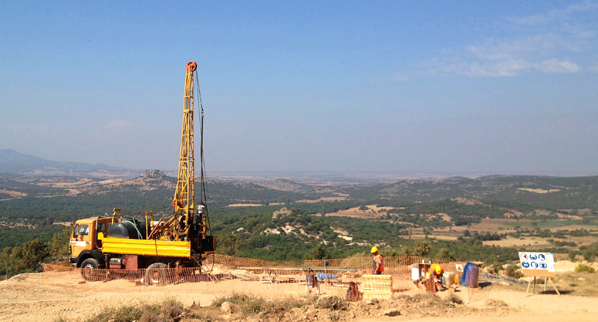
Perama Hill is an epithermal gold-silver deposit located in the Thrace region of northern Greece.
It will operate as a small open pit mine that uses a conventional carbon in leach circuit for gold recovery.
Key Facts
| Location | Thrace, Greece |
|---|---|
| Mine type | Open pit |
| Metals mined | Gold, Silver |
| Employees/contractors | 12 |
| Expected mine life | 8 years* |
| Deposit type | Epithermal gold-silver |
| Ownership | 100% |
| Resources & Reserves | Resources & Reserves |
* Based on current proven and probable reserves.
Indicative Operating Data
| Estimated Annual | |
|---|---|
| Tonnes milled | 1.2 Mt |
| Au grade | 3.2 g/t |
| Ag grade | 3.8 g/t |
| Au recovery | 89% |
| Gold production | 106,000oz |
| Silver production | 98,000 oz |
| C1 – Operating cash cost* | $430/oz |
| C2 – Total cash cost | $465/oz |
| Sustaining cash cost** | $480/oz |
* Net of by-products
** C2 + sustaining capital
For more information, please see our Perama Hill Project Presentation.
Geology and Mineralization
Perama Hill is a high sulfidation epithermal gold deposit hosted within sandstone, conglomerate and andesite of the Petrota graben in NE Greece. The deposit is bounded by the Eastern Graben Fault, a major structure that separates the Oligocene age sedimentary and volcanic rocks to the west from Mesozoic metamorphic basement rocks to the east. Almost 80% of the gold is hosted within the sandstone and the remaining 20% occurs in the underlying andesitic rocks. In the central portion of the deposit the ore is oxidized to at least 100m whereas on the margins the oxidation thins out to 15 to 20m. The epithermal system evolved from an early stage of silica-pyrite and argillic alteration to later deposition of quartz-barite veins and stockworks. Silicification was developed mainly in the sandstones and the alteration is composed of microcrystalline quartz, kaolinite, pyrite, and barite. In the andesite, silicification is controlled by potential feeder-structures to the overlying mineralization, and the alteration is characterized by kaolinite-illite altered andesite breccia clasts surrounded by a pervasive silicified matrix.
Exploration
The Perama project has significant upside potential for both high-grade mineralization associated with feeder zones underlying the deposit, and for stratigraphically-controlled lenses downdip from the Perama South deposit. Future exploration plans to focus on testing these distinct styles of mineralization, as well as expanding resources and reserves at the nearby Sapes project.
History
| 2016 | Put on care and maintenance |
|---|---|
| 2012 | Received approval of preliminary EIA |
| 2008 | Eldorado acquired Perama Hill via the acquisition of Frontier Pacific |
| 1995 | Identified ore body and began in-depth exploration |