Imprinting (psychology)
In psychology and ethology, imprinting is a relatively rapid learning process that occurs during a particular developmental phase of life and leads to corresponding behavioural adaptations. The term originally was used to describe situations in which an animal internalises (learns) the characteristics of a perceived object, for example of a dangerous predator or a sweet fruit.
Sigmund Freud, the founder of psychoanalysis, provided the first scientific explanation of how imprinting really works, developing the thesis that our brain can store experiences in its neural network through "a permanent change after an event" – one of the main functions of the long-term memory, which he called superego.[2] Shaped by social experiences during childhood, this instance is connected to the ego (consciousness) which is necessary for controlling behaviour in order to satisfy a series of innate needs. Ultimately the imprinted superego performs the function of conscience, which makes aware of two types of feelings: warnings not to repeat wrong decisions; and anticipation of the repeated experience of satisfaction.
Even in ancient times, philosophers pondered the material properties that would be necessary for the function of ‘remembering’ and the learning process as such. To illustrate this, they imagined a kind of writing tablet in the brain, which was like soft clay and remained blank until an experience was mechanically ‘imprinted’ onto it.
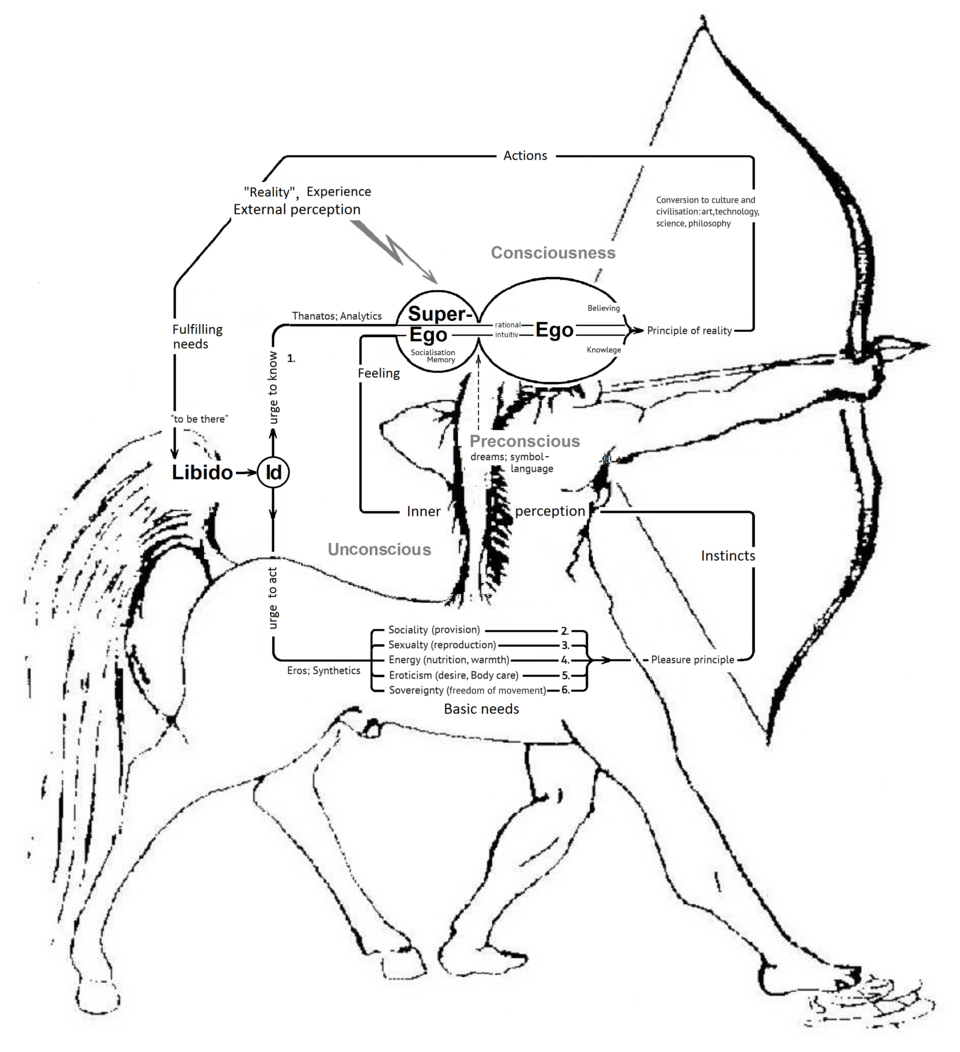
Freud's psychoanalytical model of the soul, referring to his rider metaphor: the head symbolizes the ego; the animal body the id. Similarly dual, the libido-energy branches out from the id into two main areas: the mental urge to know (up), and the bodily urge to act (down). Both unite in the ego in order to fulfil the needs of the id. This includes judgement of inner/outer reality, leading to experiences by muscle control, which imprint the super-ego. The imprints contain socialisation, taking place in childhood. If they support the instinctual needs of the id, the organism remains mentally healthy – the 'rider' carries out his 'animal's' will "as if it were his own".[1]
See PDF for complete article, downloaded
Monday, May 18, 2026 11:08AM