Genome Sequencing
A genome sequence is not an end in itself. A major challenge still has to be met in understanding what the genome contains and how the genome functions. The former is addressed by a combination of computer analysis and experimentation, with the primary aim of locating the genes and their control regions. The first part of this chapter is devoted to these methods. The second question - understanding how the genome functions - is, to a certain extent, merely a different way of stating the objectives of molecular biology over the last 30 years. The difference is that in the past attention has been directed at the expression pathways for individual genes, with groups of genes being considered only when the expression of one gene is linked to that of another. Now the question has become more general and relates to the expression of the genome as a whole. The techniques used to address this topic will be covered in the latter parts of this chapter. See ncbl,nim article
Whole genome sequencing (also known as full genome sequencing, complete genome sequencing, or entire genome sequencing) is a laboratory process that determines the complete DNA sequence of an organism's genome at a single time. This entails sequencing all of an organism's chromosomal DNA as well as DNA contained in the mitochondria and, for plants, in the chloroplast. See wikipedia article.
GENOME SEQUENCING
Genome sequencing is figuring out the order of DNA nucleotides, or bases, in a genome—the order of As, Cs, Gs, and Ts that make up an organism's DNA. The human genome is made up of over 3 billion of these genetic letters.
Today, DNA sequencing on a large scale—the scale necessary for ambitious projects such as sequencing an entire genome—is mostly done by high-tech machines. Much as your eye scans a sequence of letters to read a sentence, these machines "read" a sequence of DNA bases.
A DNA sequence that has been translated from life's chemical alphabet into our alphabet of written letters might look like this:

That is, in this particular piece of DNA, an adenine (A) is followed by a guanine (G), which is followed by a thymine (T), which in turn is followed by a cytosine (C), another cytosine (C), and so on.
What is genome sequencing?
By itself, not a whole lot. Genome sequencing is often compared to "decoding," but a sequence is still very much in code. In a sense, a genome sequence is simply a very long string of letters in a mysterious language.
When you read a sentence, the meaning is not just in the sequence of the letters. It is also in the words those letters make and in the grammar of the language. Similarly, the human genome is more than just its sequence.
Imagine the genome as a book written without capitalization or punctuation, without breaks between words, sentences, or paragraphs, and with strings of nonsense letters scattered between and even within sentences. A passage from such a book in English might look like this:

Even in a familiar language it is difficult to pick out the meaning of the passage: The quick brown fox jumped over the lazy dog. The dog lay quietly dreaming of dinner. And the genome is "written" in a far less familiar language, multiplying the difficulties involved in reading it.
So sequencing the genome doesn't immediately lay open the genetic secrets of an entire species. Even with a rough draft of the human genome sequence in hand, much work remains to be done. Scientists still have to translate those strings of letters into an understanding of how the genome works: what the various genes that make up the genome do, how different genes are related, and how the various parts of the genome are coordinated. That is, they have to figure out what those letters of the genome sequence mean.
How do you sequence a genome?
here are two approaches to the task of cutting up the genome and putting it back together again. One strategy, known as the "clone-by-clone" approach, involves first breaking the genome up into relatively large chunks, called clones, about 150,000 base pairs (bp) long. Scientists use genome mapping techniques (discussed in further detail later) to figure out where in the genome each clone belongs. Next they cut each clone into smaller, overlapping pieces the right size for sequencing—about 500 BP each. Finally, they sequence the pieces and use the overlaps to reconstruct the sequence of the whole clone.
The other strategy, called "whole-genome shotgun" method, involves breaking the genome up into small pieces, sequencing the pieces, and reassembling the pieces into the full genome sequence.
How does DNA sequencing work?See whats a genome part 2 etc.
Regardless of the approach to the genome as a whole, the actual process of DNA sequencing is the same. Sequencing employs a technique known as electrophoresis to separate pieces of DNA that differ in length by only one base.
How does the sequencing machine know whether a base is an A, C, G, or T?
Sequencing machines can't "see" DNA directly, so scientists must use a complex set of procedures to prepare DNA for sequencing. When DNA is finally in a form that the machines can read, it has been chopped up, copied, chemically modified, and tagged with fluorescent dyes corresponding to the four different DNA bases, or genetic letters.
Before it is sequenced, a piece of DNA is copied many times, then divided into four batches in preparation for another round of copying. In this second round, a small amount of chemically modified base is added to each batch—that is, modified T to one batch, A to another, and so on. When one of these modified bases is incorporated into a DNA molecule, the chain of bases stops growing. The result of all this is that one batch of DNA will contain only pieces that end in T, another only pieces that end in A, a third only pieces that end in G, and the fourth batch only pieces that end in C.
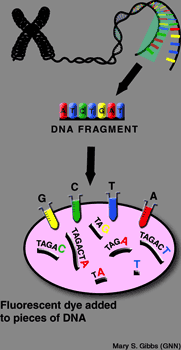
In the second round of copying, a different fluorescent dye is also added to each batch of DNA. Thus, every piece of DNA that ends with T has a blue dye tag, for example; those that end in A have a red dye tag; those that end in G have a yellow dye tag; and those that end in C have a green dye tag.
Suppose you apply that procedure to this sequence of DNA:
TAGACT
At the end of the second round of copying, each batch will contain the following pieces of DNA:
1: blue-T, blue-TAGACT
2: red-TA, red-TAGA
3: yellow-TAG
4: green-TAGAC
Into one lane or capillary of a sequencing machine goes a mixture of DNA from all four batches. Because smaller molecules move through the gel faster, the DNA pieces come through the gel in increasing order of size—each piece one base longer than the last.
Thus, in this example, the first piece to make it all the way through the gel is a T attached to a blue dye tag; the next piece is TA with a red dye tag; next is TAG attached to a yellow dye tag; and so on.
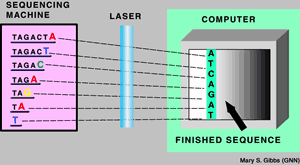
As the pieces emerge from the gel, they move past a laser that causes the dye molecules to fluoresce. A detector reads the color of the fluorescence—blue, red, yellow…—and a software program matches the color to the corresponding base—T, A, G…. In this way, the sequence grows base by base. Each sequence of 500 bases or so that a sequencing machine generates is known as a "read."