Next Generation Sequencing
Next generation sequencing (NGS), massively parallel or deep sequencing are related terms that describe a DNA sequencing technology which has revolutionised genomic research. Using NGS an entire human genome can be sequenced within a single day.
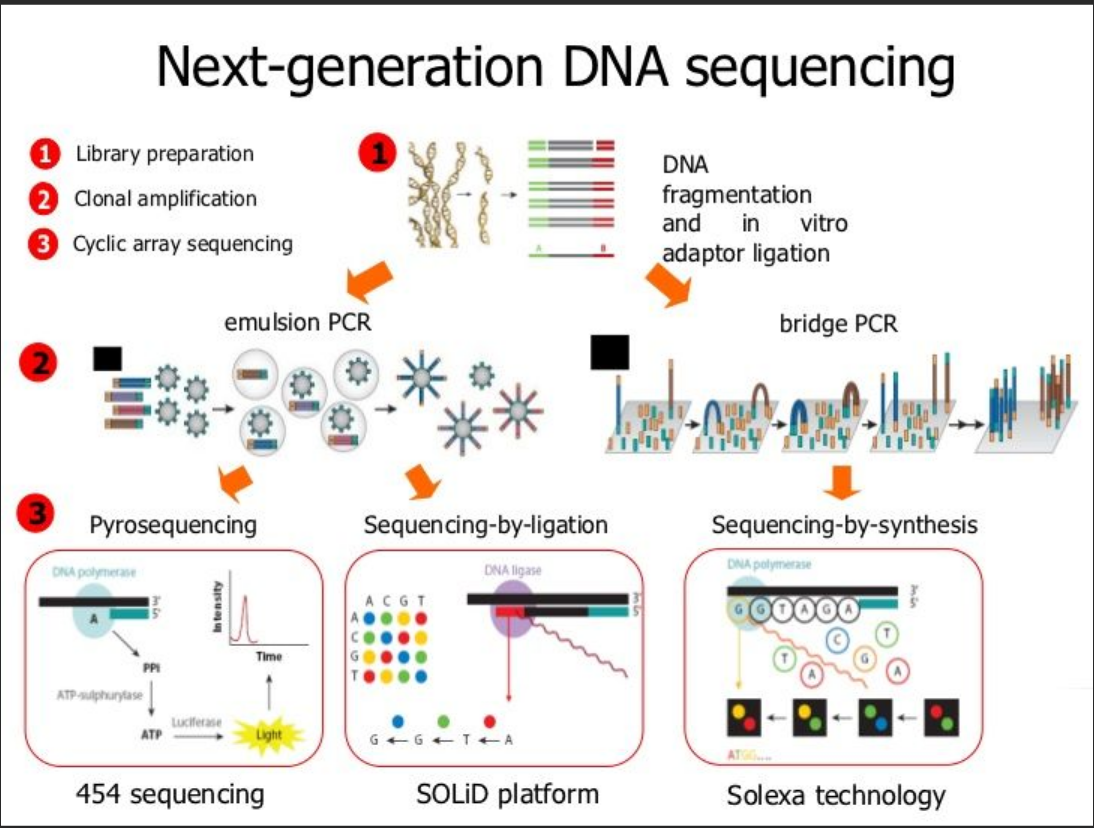
The basic next-generation sequencing process involves fragmenting DNA/RNA into multiple pieces, adding adapters, sequencing the libraries, and reassembling them to form a genomic sequence. In principle, the concept is similar to capillary electrophoresis. The critical difference is that NGS sequences millions of fragments in a massively parallel fashion, improving speed and accuracy while reducing the cost of sequencing.
Pyrosequencing-- Pyrosequencing uses a DNA polymerase to synthesize the DNA counter strand, although the type of DNA polymerase can still vary.
The DNA mixture is ligated with a DNA adapter and coupled to beads via a complementary adapter sequence. The beads loaded with DNA are placed on a plate with pores. The detection is dependent on a light detector.
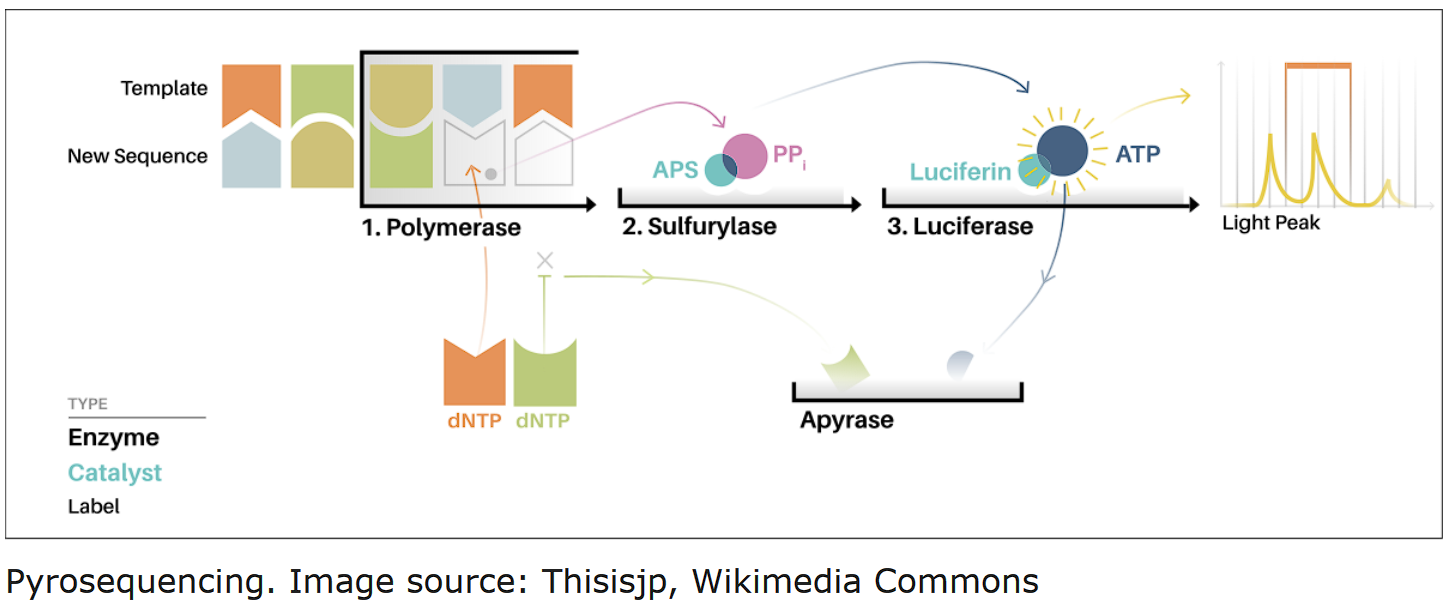
The DNA polymerase is observed “in action” as it successively attaches individual nucleotides to a newly synthesized DNA strand. Successful insertion of a nucleotide is converted into a light signal that is detected by a detector. The DNA to be sequenced serves as a matrix strand and is available in a single-strand form.
DNA strand elongation is done by adding one of the four types of deoxynucleoside triphosphates (dNTP) complementarily. When the appropriate nucleotide is added, a signal is obtained. The addition of an unsuitable NTP does not result in detectable signal. Then the existing NTP is destroyed and another type is added; this continues until a reaction is shown again.
This is a luciferase enzyme-mediated reaction. When a complementary nucleotide is incorporated by the DNA polymerase, pyrophosphate (PPi) is released. The pyrophosphate is converted to adenosine triphosphate (ATP) by ATP sulfurylase.
The ATP drives the luciferase reaction, which converts luciferin into oxyluciferin. This in turn results in a detectable light signal – the strength of which is proportional to the ATP consumed.
Pyrosequencing has been used to determine the frequency of certain gene mutations e.g. in the investigation of genetic diseases. Pyrosequencing can be easily automated and is suitable for the highly parallel analysis of DNA samples.
January 15, 2023, 1:10 PM
Third-generation DNA sequencing
For the first time, third-generation sequencing measures the reaction in single molecules as a single-molecule experiment.
This eliminates the need for amplification by PCR prior to sequencing. Polymerases show bias for binding to some DNA sequences. Hence this avoids uneven amplification by thermostable DNA polymerases.
Thus, some sequences can be overlooked. Furthermore, the genome of an individual cell can be examined.
The released signal is recorded in real-time. In third-generation DNA sequencing, two different signals are recorded, depending on the method used. They are released protons or fluorophores. The DNA and RNA sequencing of individual cells was named “method of the year 2013” by the journal Nature Methods.
Nanopore sequencing
Nanopore sequencing is based on changes in the ion flow through nanopores embedded in an artificially created membrane. Nanopores are biological or synthetic pores or even semi-synthetic pores. The nanopore is embedded in an artificial membrane that has a particularly high electrical resistance.
The pore is permanently open in contrast to ordinary ion channels. This allows a constant flow of ions through the membrane after the application of a potential. DNA molecules passing through the pore lead to a reduction of the current. This current reduction has a specific amplitude for each nucleotide, which can be measured and assigned to the corresponding nucleotide.
In single-strand sequencing, a double-stranded DNA strand is separated by a helicase and introduced into the nanopore.
In the case of a MspA pore, four nucleotides of the DNA are simultaneously located within the pore. The speed of passage depends, among other things, on the pH value difference across the membrane. The specific ion current changes for each of the four nucleotides allow the sequence to be read.
An evaluation is carried out, for example, with the Poretools software. The advantage of this method is that it has a constant accuracy even with long DNA strands. A variation of the method is used for protein sequencing.