Base Editing
See "Guidelines" opposite--excellent article on Base Editing. This is really an advance on CRISPR/Cas9 system.
Base editing is a new genome editing technology that enables the direct, irreversible conversion of a specific DNA base into another at a targeted genomic locus. Importantly, this can be achieved without requiring double-stranded DNA breaks (DSB). Since many genetic diseases arise from point mutations, this technology has important implications in the study of human health and disease.
Until now, other genome editing techniques, including CRISPR, begin with the introduction of a DSB at a locus of interest [2-4]. Subsequently, cellular DNA repair enzymes mend the break, commonly resulting in random insertions or deletions (indels) of bases at the site of the DSB . However, when the introduction or correction of a point mutation at a target locus is desired rather than stochastic disruption of the entire gene, these traditional genome editing techniques are unsuitable, as correction rates are low (typically 0.1% to 5%), with the major genome editing products being indels.
In order to increase the efficiency of gene correction without simultaneously introducing random indels, we modified the CRISPR/Cas9 system to directly convert one DNA base into another without DSB formation (Figure 1). Thus far, with our technique we have seen correction efficiencies of 15% - 75% alongside indel formation of only 0.1-5%.

Sept 28 2017The team at Sun Yat-sen University used a technique called base editing to correct a single error out of the three billion "letters" of our genetic code. They altered lab-made embryos to remove the disease beta-thalassemia. The embryos were not implanted. The team says the approach may one day treat a range of inherited diseases. Base editing alters the fundamental building blocks of DNA: the four bases adenine, cytosine, guanine and thymine. The potentially life-threatening blood disorder beta-thalassemia is caused by a change to a single base in the genetic code - known as a point mutation. The team in China edited it back. They scanned DNA for the error then converted a G to an A, correcting the fault.
Article " A "Fourth Generation etc" opposite
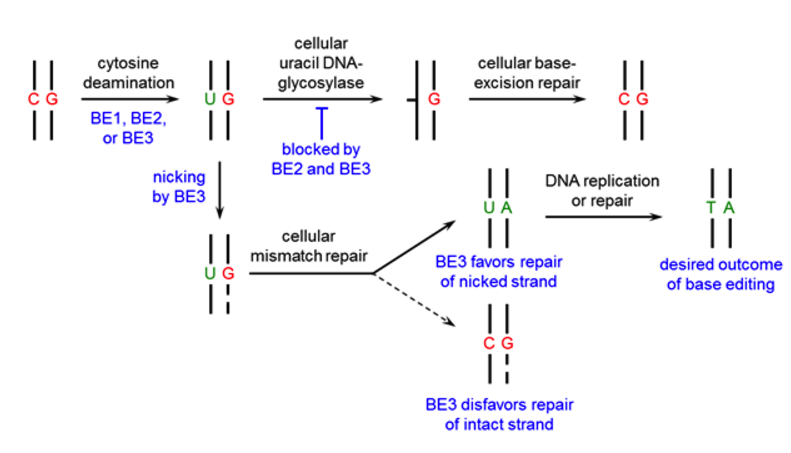
Komor et al. then designed a “fourth-generation” base editor combined with an inhibitor, called BE4, which blocks UNG from cutting and altering DNA inadvertently. “BE4 shuts down the cellular troublemaker (UNG) more effectively than our previous base editors, which results in higher efficiency of C to T base editing, and also fewer undesired products,” said Liu.Using BE4 formed with the bacteria Streptococcus pyogenes, this base editing procedure increased the efficiency of swapping C:G to T:A by 50 percent, while halving the frequency of undesired byproducts.
Fourth-Generation Base Editors
Work with third-generation base editors can result in a mix of products; rather than uniform C->T conversion, researchers have observed undesired C->G or C->A conversion. Komor et al. 2017 hypothesized that these byproducts resulted from excision by uracil N-glycosylase (UNG) during base excision repair. Although third-generation base editors contain the UNG inhibitor UGI, adding a second copy of UGI increases base editing product purity. In addition, Komor et al. extended the APOBEC1-Cas9n and Cas9n-UGI linkers to improve product purity, and these three improvements together represent the fourth generation of base editors. Compared to BE3, BE4 offers a 2.3 fold decrease in C->G and C->A products as well as a 2.3 fold decrease in indel formation.
To further decrease the already low rate of indel formation with fourth-generation base editors, Komor et al. fused bacteriophage protein Gam to the N-terminus of BE4. Gam binds the free ends of DSBs, which may lead to cell death rather than NHEJ repair, thus removing these cells from the edited population. Adding Gam to BE4 or SaBE4 decreased indel frequency 1.5-2 fold.
In just a short time, researchers have expanded the field of base editing far beyond BE2 and BE3. The use of varied Cas9s, cytidine deaminases and accessory proteins has created a suite of base editors with complementary and overlapping functions. The utility of base editing continues to improve, and we at Addgene look forward to the further expansion of base editing tools.
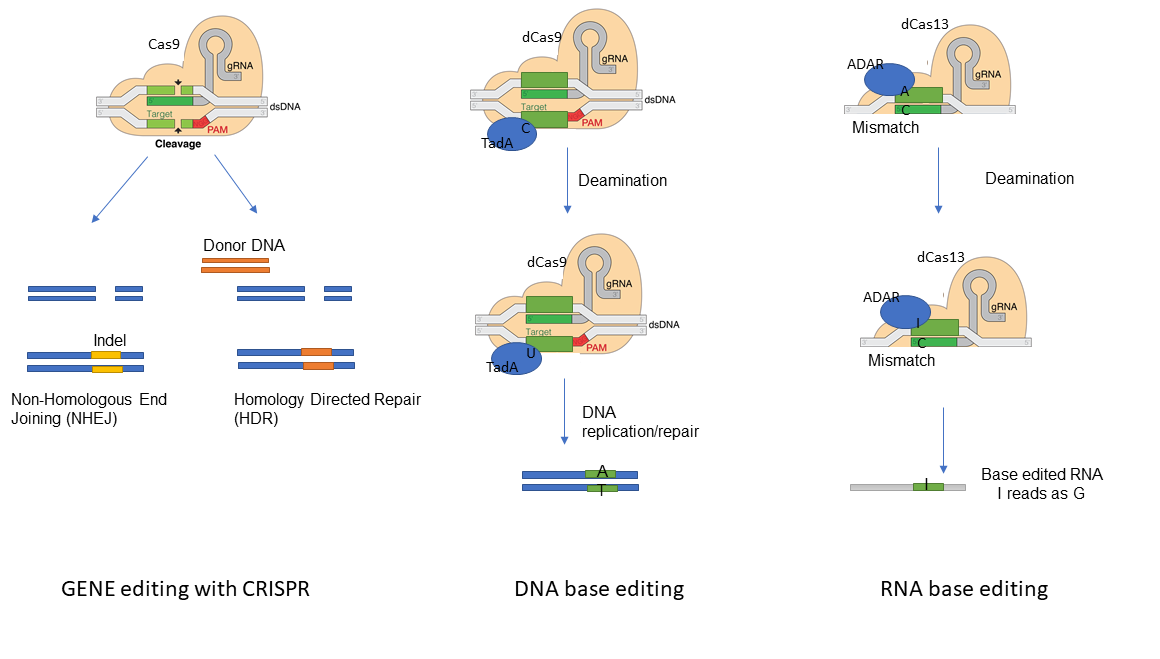
Conclusion from Base Editing article-- Genome and base editing tools are very powerful toolsthat have been constantly improved since the development of the first CRISPR-Cas editing system less than a decade ago. For genome editing the CRISPR system uses a guide RNA attached to a nuclease to produce a double-stranded DNA cleavage at a target site in a genome. The cellular repair systems repair the cut DNA ends, but occasionally insert or delete bases (Figure 3). Base editors use CRISPR components, guide RNAs and a mutant Cas9, but do not cut the DNA. Instead they use deaminase enzymes such as TADA and ADAR enzymes to chemically convert single bases without altering the surrounding sequence. While genome editing is specific to DNA manipulation, base editing can be performed in both DNA and RNA molecules (Figure 3).
Because it eliminates the unwanted insertion and/or deletions caused by gene editing, base editing seems the method of choice for fixing point mutations. However, due to their innate properties, like PAM sequence dependence, base editors cannot act upon all bases in a genome. Thus, many point-mutations associated with disease might still not be correctable by base editing. In addition, the unexpected high number of RNA off-target events introduced by CBEs must be addressed before base editing becomes a tool fit to cure diseases.
Figure 3