Epigenetics
December 15, 2025, 1:08 PM
Full article: Recent advances in methodologies of epigenomics
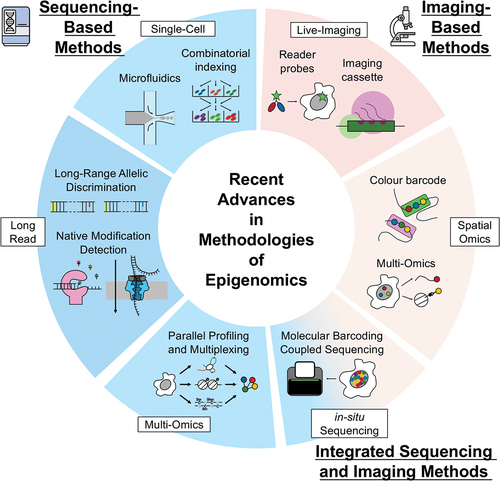
Epigenomics investigates chemical modifications on the genome that regulate gene expression without altering the DNA sequence itself, such as DNA methylation, histone (post-translational) modifications, and the related three-dimensional (3D) higher-order chromatin structure. Early epigenomic studies relied on bulk cell measurements, such as bisulfite sequencing for DNA methylation and chromatin immunoprecipitation sequencing (ChIP-seq) for histone modifications [Citation1]. These bulk approaches revealed global epigenetic mechanisms, but obscured cellular heterogeneity and masked local epigenetic regulation. To address these limitations, an explosion of new methodologies developed over the past ten years enable researchers to interrogate epigenetic states at single-cell resolution, detect modifications on long reads without the need for harsh chemical treatments, and integrate multiple data layers (transcriptome, accessibility, and modification states) within the same cell. Furthermore, developments in imaging-based methods, such as super-resolution microscopy and high-plex fluorescent in situ hybridization (FISH), have enabled direct visualization of higher-order chromatin structure and epigenetic marks in their intracellular spatial contexts. Integrated with machine learning approaches, these parallel technological revolutions (sequencing-based and imaging-based) offer deeper insights into how epigenetic modifications shape gene regulation.
In this review, we first delve into sequencing-based epigenomic methodologies (Section 2). We then survey imaging-based approaches and their applications for the intracellular spatial and dynamic analysis of the epigenome (Section 3). Next, we explore integrative frameworks that combine sequencing and imaging to link genomic and epigenomic data with intracellular spatial organization information at high resolution (Section 4). Finally, we discuss key challenges and future prospects (Section 5) before concluding (Section 6). By focusing on innovations in recent years, we aim to provide a current perspective on the methodological advances and biological insights that are advancing this research field (Figure 1) (See [Citation2] for an extensive review of the technical basis of these advancements.).
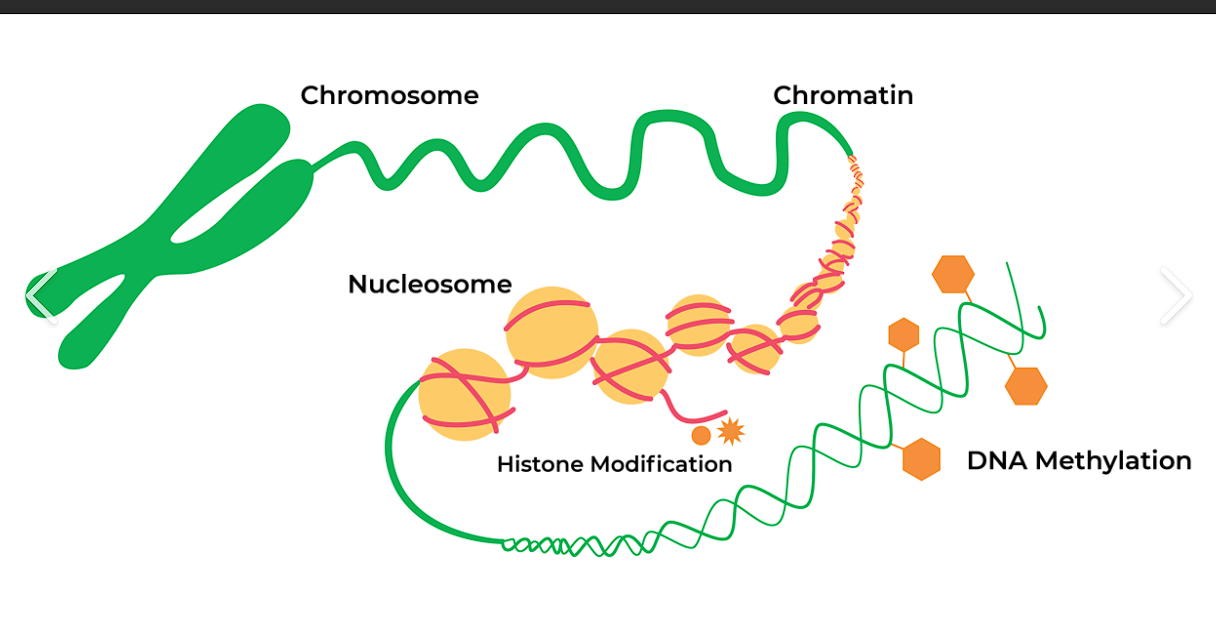
The epigenome comprises all of the chemical compounds that have been added to the entirety of one’s DNA (genome) as a way to regulate the activity (expression) of all the genes within the genome. The chemical compounds of the epigenome are not part of the DNA sequence, but are on or attached to DNA (“epi-“ means above in Greek). Epigenomic modifications remain as cells divide and in some cases can be inherited through the generations. Environmental influences, such as a person’s diet and exposure to pollutants, can also impact the epigenome.
Epigenetic changes can help determine whether genes are turned on or off and can influence the production of proteins in certain cells, ensuring that only necessary proteins are produced. For example, proteins that promote bone growth are not produced in muscle cells. Patterns of epigenome modification vary among individuals, different tissues within an individual, and even different cells.
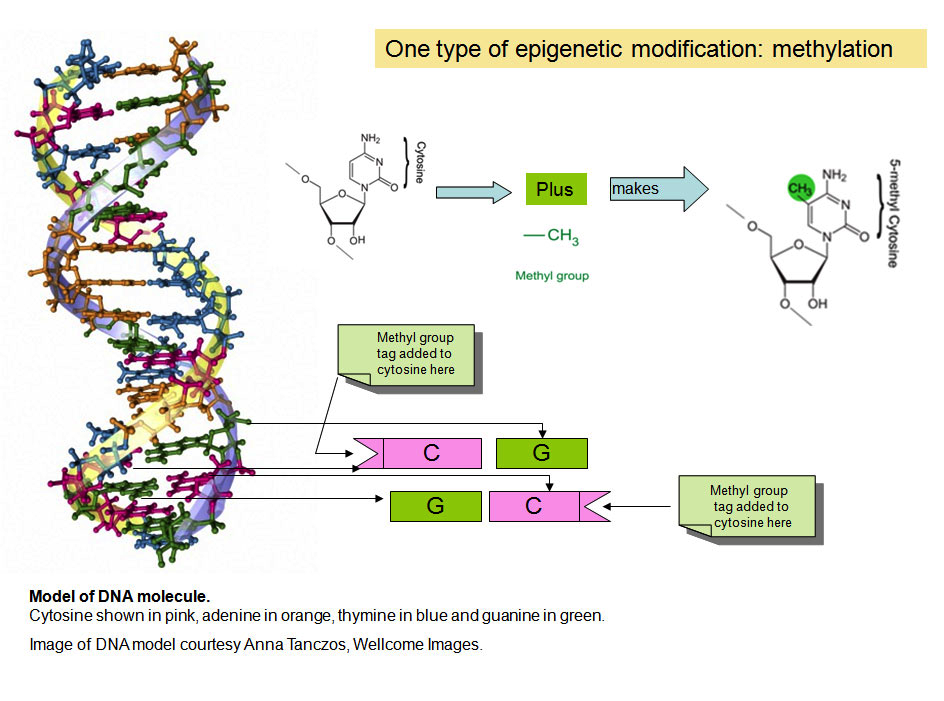
A common type of epigenomic modification is called methylation. Methylation involves attaching small molecules called methyl groups, each consisting of one carbon atom and three hydrogen atoms, to segments of DNA. When methyl groups are added to a particular gene, that gene is turned off or silenced, and no protein is produced from that gene.
Because errors in the epigenetic process, such as modifying the wrong gene or failing to add a compound to a gene, can lead to abnormal gene activity or inactivity, they can cause genetic disorders. Conditions including cancers, metabolic disorders, and degenerative disorders have all been found to be related to epigenetic errors.
Epigenetics
The term also refers to the changes themselves: functionally relevant changes to the genome that do not involve a change in the nucleotide sequence. Examples of mechanisms that produce such changes are DNA methylation and histone modification, each of which alters how genes are expressed without altering the underlying DNA sequence. Gene expression can be controlled through the action of repressor proteins that attach to silencer regions of the DNA. These epigenetic changes may last through cell divisions for the duration of the cell's life, and may also last for multiple generations even though they do not involve changes in the underlying DNA sequence of the organism; instead, non-genetic factors cause the organism's genes to behave (or "express themselves") differently. So epigenetics can refer to mitotic mutations or meoitic mutations or histone and chromatin changes.
One example of an epigenetic change in eukaryotic biology is the process of cellular differentiation. During morphogenesis, totipotent stem cells become the various pluripotent cell lines of the embryo, which in turn become fully differentiated cells. In other words, as a single fertilized egg cell – the zygote – continues to divide, the resulting daughter cells change into all the different cell types in an organism, including neurons, muscle cells, epithelium, endothelium of blood vessels, etc., by activating some genes while inhibiting the expression of others.
Article opposite on Integrative Analysis of 111 reference Human Epigenomes, is very detailed and complex but below are some illustrations
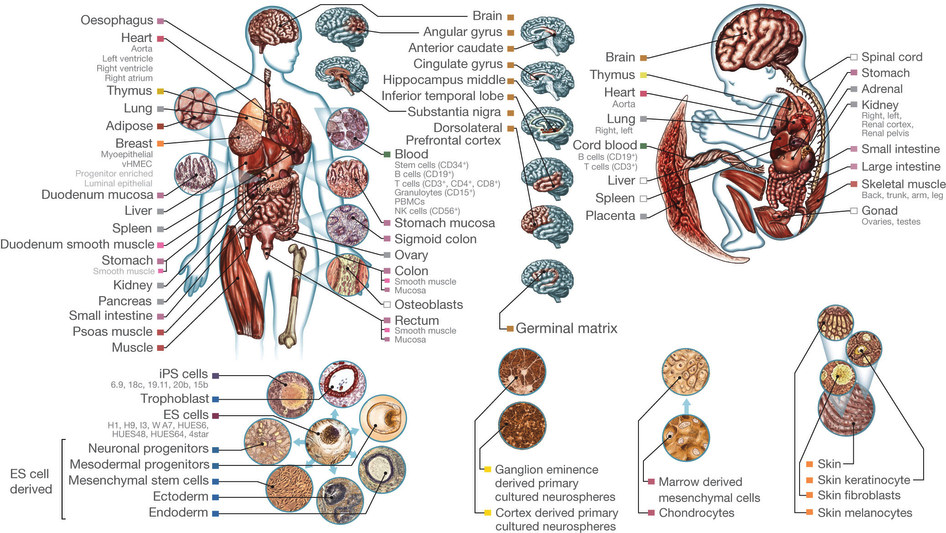
Tissues profiled in study. Box colours match groups shown in Fig. 2b. Epigenome identifiers (EIDs, Fig. 2c) for each sample are shown in Extended Data Fig. 1. Best seen in article.
"Little Atoms " good questioning article opposite . Far too much hype on epigenetics at this time, unscientific claims etc
Beyond DNA, good article on epigenetics and C Elegans and Slime Molds. Greer
Epigenetics in meiosis---Greer AUg 2019
Today, Greer studies epigenetic inheritance using a menagerie of different model organisms and a wide range of approaches. In a paper this month in PLoS Genetics, his lab showed how an epigenetic regulator can disrupt meiosis, the first step in reproduction.
Cells in the ovaries and testes normally divide twice, copying and then splitting their DNA, ultimately forming four “granddaughter” cells with a single copy of each gene. Missteps in meiosis are the leading cause of miscarriages as well as developmental and intellectual disabilities.
“When meiosis goes awry, after deleting this chromatin regulating enzyme, it causes gross chromosomal disorganization—sometimes causing loss of a chromosome,” said Greer. “This leads to reduced egg production.”
Greer and colleagues found an enzyme in C. elegans that removes methyl groups, interacts with the DNA replication machinery and is essential for normal meiosis.
When they deleted this enzyme, NMAD-1, in worms, meiosis problems ensued. The worms laid only one-sixth as many eggs and spawned an unusually high number of males, an indication that chromosomes were being lost during meiosis.
The corresponding enzyme in mice, when mutated, also caused defects in reproduction.
“We’ll have to see how widely conserved this mechanism is among species and work out more of the specific details,” Greer said.
Epigenetics--catchwords and Bullshit !!! There is a very real danger that small brains are misunderstanding the complexities of this subject and already making weird claims for ways you can influence your own epigenetic changes. See this article-- Skeptoid.com
In conclusion--from Epigenetics Hype and woo.
In the past, we had ‘quantum woo‘; now we seem to have epi-woo. As James Watson once said in rather blunt terms, “epigenetics is used for a lot of crap”. I am glad @EpigeneticsBs keeps track of it. This might help with the “challenges faced when moderating societal discussion of epigenetics in ways that expand excitement whilst deflating (what researchers regard as) unrealistic expectations” (Pickersgill et al., 2016), both in terms of hopes and fears.