Model Organisms
A model organism is a non-human species that is extensively studied to understand particular biological phenomena, with the expectation that discoveries made in the organism model will provide insight into the workings of other organisms. Model organisms are in vivo models and are widely used to research human disease when human experimentation would be unfeasible or unethical. This strategy is made possible by the common descent of all living organisms, and the conservation of metabolic and developmental pathways and genetic material over the course of evolution. Studying model organisms can be informative, but care must be taken when extrapolating from one organism to another.
.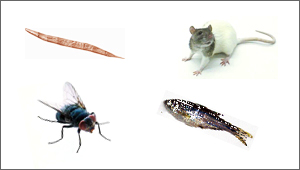
There are many model organisms. One of the first model systems for molecular biology was the bacterium Escherichia coli, a common constituent of the human digestive system. Several of the bacterial viruses (bacteriophage) that infect E. coli also have been very useful for the study of gene structure and gene regulation (e.g. phages Lambda and T4). However, bacteriophages are not organisms because they lack metabolism and depend on functions of the host cells for propagation.
In eukaryotes, several yeasts, particularly Saccharomyces cerevisiae ("baker's" or "budding" yeast), have been widely used in genetics and cell biology, largely because they are quick and easy to grow. The cell cycle in a simple yeast is very similar to the cell cycle in humans and is regulated by homologous proteins. The fruit fly Drosophila melanogaster is studied, again, because it is easy to grow for an animal, has various visible congenital traits and has a polytene (giant) chromosome in its salivary glands that can be examined under a light microscope. The roundworm Caenorhabditis elegans is studied because it has very defined development patterns involving fixed numbers of cells, and it can be rapidly assayed for abnormalities.
There are 5-6 Viruses and Phages that are also used as model organisms. Phage Lambda, T4 Phage, Tobacco Mosaic virus, and Phi X 174--
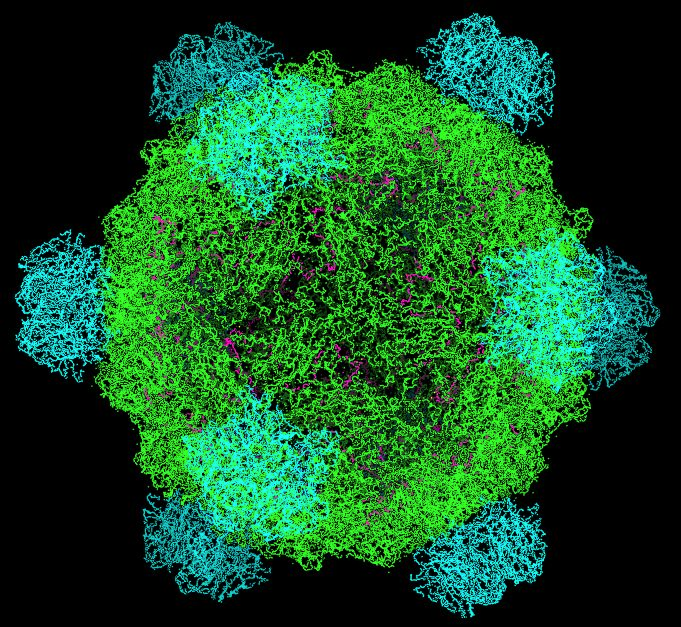
Phi X 174- its genome was the first ever to be sequenced. The genome is a circle of 11 genes, 5386 base pairs in length. 1977 was when it was sequenced. This bacteriophage has a [+] circular single-stranded DNA genome of 5386 nucleotides encoding 11 proteins. Of these 11 genes, only 8 are essential to viral morphogenesis. The GC-content is 44% and 95% of nucleotides belong to coding genes. Phi X is regularly used as a positive control in DNA sequencing due to its relatively small genome size in comparison to other organisms and the extensive work that has been done on it.
 Arabidopsis Thaliana, currently plant model number one.
See p 760 of intro to genetic analysis. On the Brain here there are just a few illustrated.