Freud’s theory in a nutshell
1. The Unconscious Mind
- Most of our thoughts, desires, and memories operate outside our conscious awareness.
- The unconscious drives much of our behavior, influencing choices, symptoms, slips of the tongue (“Freudian slips”), and dreams123.
2. Structure of Personality: Id, Ego, and Superego
- Id: The instinctual, primitive part of the mind, seeking immediate gratification for basic drives like sex and aggression (pleasure principle).
- Ego: The rational, realistic mediator that balances the desires of the id with the constraints of reality (reality principle).
- Superego: The internalized moral standards and ideals, acting as conscience and striving for perfection4567.
- Behavior results from dynamic conflict and negotiation between these three parts.
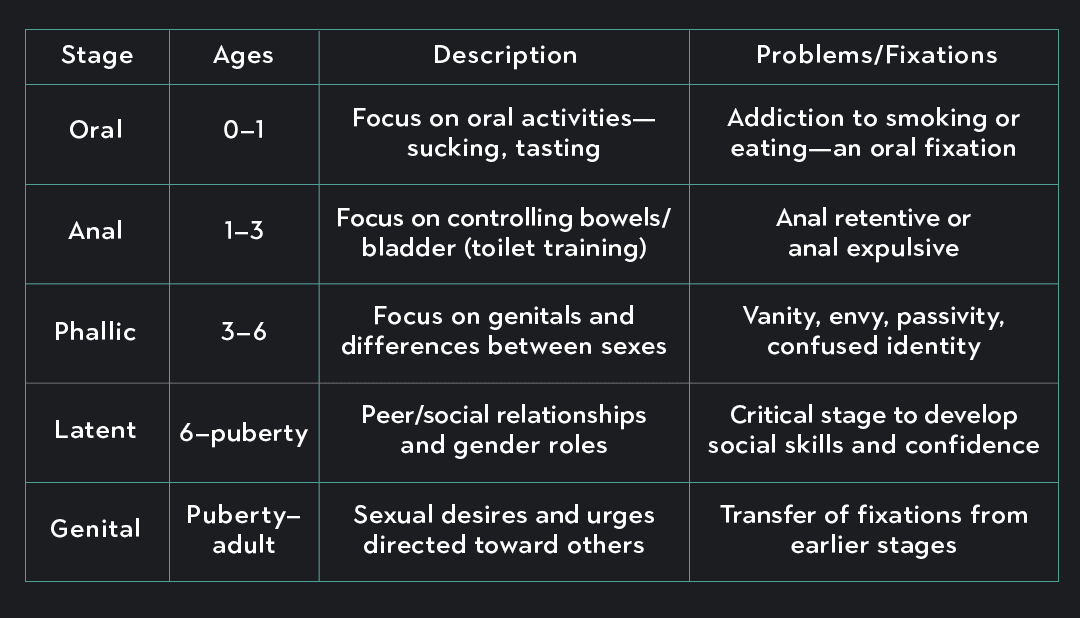
3. Psychosexual Stages of Development
- Freud proposed that children pass through five developmental stages, each focused on a different erogenous zone:
- Oral (0–18 months): Pleasure centers on the mouth.
- Anal (18 months–3 years): Focus on bowel and bladder control.
- Phallic (3–6 years): Focus on the genitals; includes the controversial Oedipus complex (boys' unconscious desire for the mother, rivalry with the father).
- Latency (6–puberty): Sexual impulses subside, and social/academic skills develop.
- Genital (puberty+): Mature sexual interests appear568.
- Fixation at any stage can affect adult personality and behavior.
4. Defense Mechanisms
- The ego employs defense mechanisms to manage conflict between the id, ego, and superego—common examples include repression, denial, projection, displacement, and sublimation257.
Freudian defense mechanisms most commonly discussed in classic and modern sources:
- Denial: Refusing to accept reality or facts, acting as if a painful event, thought, or feeling does not exist157.
- Repression: Unconsciously blocking unwanted thoughts, memories, or impulses from conscious awareness157.
- Projection: Attributing one’s own unacceptable feelings or impulses to another person578.
- Displacement: Redirecting emotions or impulses from a threatening target to a safer, substitute target157.
- Sublimation: Channeling unacceptable impulses or urges into socially acceptable or constructive activities578.
- Reaction Formation: Behaving in a way that is opposite to one’s true, unacceptable desires or feelings157.
- Rationalization: Creating logical explanations or excuses to justify unacceptable behavior or feelings157.
- Regression: Reverting to earlier patterns of behavior, often childhood-like, when faced with stress7.
- Suppression: Consciously choosing to avoid thinking about disturbing thoughts or feelings (distinct from repression, which is unconscious)27.
- Undoing: Attempting to ‘cancel out’ or make amends for an unacceptable thought, feeling, or action26.
- Intellectualization: Focusing on facts and logic to distance oneself from emotional stress7.
- Identification: Adopting characteristics of another person to cope with feelings of threat or anxiety8.
- Isolation (of affect): Separating feelings from ideas or events, thus retaining the event in consciousness but removing its emotional impact6.
Not all lists are identical; these are the core mechanisms highlighted by Freud and his followers, especially Anna Freud, with many modern psychologists expanding the list further67.
- https://www.simplypsychology.org/defense-mechanisms.html
- https://www.psychologistworld.com/freud/defence-mechanisms-list
- https://achology.com/psychology/sigmund-freuds-defence-mechanisms/
- https://www.ncbi.nlm.nih.gov/books/NBK559106/
- https://www.betterhelp.com/advice/defense-mechanisms/an-overview-of-freuds-defense-mechanisms-and-how-they-may-show-up-in-everyday-life/
- https://en.wikipedia.org/wiki/Defence_mechanism
- https://www.verywellmind.com/defense-mechanisms-2795960
- https://positivepsychology.com/defense-mechanisms-in-psychology/
- https://www.dummies.com/article/body-mind-spirit/emotional-health-psychology/psychology/general-psychology/freuds-7-psychological-defense-psychological-mechanisms-160464/
- https://www.contemporarypsychology.com.au/freuds-defence-mechanisms/
5. Dream Analysis & Symbolism
- Freud called dreams “the royal road to the unconscious.” He believed they reveal hidden desires and conflicts in disguised, often symbolic, forms.
- Psychoanalysis uses free association and dream interpretation to uncover these unconscious contents23.
6. Other Notable Concepts
- Transference: Patients project feelings about important figures from their past onto the therapist.
- Childhood Experience: Early relationships and experiences profoundly shape adult personality and emotional difficulties910.
Freud’s legacy persists in modern psychodynamic therapies, fiction, and popular culture, even as core elements are debated or rejected by contemporary psychology11.
- https://www.verywellmind.com/freudian-theory-2795845
- https://www.simplypsychology.org/sigmund-freud.html
- https://www.simplypsychology.org/psychoanalysis.html
- https://en.wikipedia.org/wiki/Freud's_psychoanalytic_theories
- https://www.harleytherapy.co.uk/counselling/freuds-main-theories-psychoanalysis.htm
- https://www.structural-learning.com/post/sigmund-freuds-theories
- https://www.simplypsychology.org/psyche.html
- https://www.verywellmind.com/freuds-stages-of-psychosexual-development-2795962
- https://iastate.pressbooks.pub/individualfamilydevelopment/chapter/freuds-psychodynamic-theory/
- https://pmc.ncbi.nlm.nih.gov/articles/PMC10575551/
- https://www.psychologytoday.com/gb/basics/freudian-psychology
- https://empire2.esc.edu/FACULTYWEB/JANETBACHANT.NSF/003a7ad981f4fb2085256889006cd9b4/7d3af28382433ae2852571d9006dd2df?OpenDocument
- https://www.sciencedirect.com/topics/medicine-and-dentistry/freudian-theory
- https://positivepsychology.com/psychoanalysis/
- https://apsa.org/about-psychoanalysis/psychoanalytic-terms-concepts-defined/
- https://nypsi.org/learn-about-psychoanalysis/key-concepts-in-psychoanalysis/
- https://www.psychologytoday.com/us/basics/psychoanalysis
- https://open.baypath.edu/psy321book/chapter/c2p2/
- https://www.ncbi.nlm.nih.gov/books/NBK557526/