Is the Oedipus Complex a valid framework for understanding the development of the human mind?
The Evidence Base for and Against the Oedipus Complex: A Comprehensive Scientific Analysis
The Oedipus complex, one of Sigmund Freud's most controversial and widely discussed theories, posits that children between ages 3-6 experience unconscious sexual desires for their opposite-sex parent and rivalry with their same-sex parent12. Despite its cultural influence and enduring presence in popular discourse, the scientific evidence for this theory has been subjected to extensive scrutiny over the past century. This analysis examines the empirical evidence both supporting and contradicting the validity of the Oedipus complex as a universal aspect of human psychological development.
In a nutshell it lacks the empirical support required of scientific theories.
The Theory and Its Claims
The Oedipus complex, first formally introduced by Freud in 1910, encompasses several key assertions: children develop sexual attraction to their opposite-sex parent, experience hostility toward their same-sex parent, resolve this conflict through identification with the same-sex parent, and that failure to resolve this complex leads to psychological dysfunction in adulthood134. Freud considered this theory central to his psychoanalytic framework, famously stating that the "discovery of the repressed Oedipus complex…alone would give [psychoanalysis] a claim to be included among the precious new acquisitions of mankind"5.
Evidence Supporting the Oedipus Complex
Cross-Cultural Mythological Parallels
Proponents of the Oedipus complex point to cross-cultural studies of mythology that reveal similar triangular family dynamics across different societies. Tang and Smith's analysis of myths from Chinese, Indian, and European cultures found recurring themes of mother-father-son relationships, though they noted that these myths "stress different aspects and proscriptions" reflecting cultural values rather than universal psychological patterns6. However, these mythological parallels provide only indirect support and may reflect narrative archetypes rather than psychological universals.
Projective Test Results
Some researchers have attempted to validate the Oedipus complex using projective tests. Kline's review of projective studies, including story completion tests, found "suggestive confirmation for oedipal themes" in subjects who were not patients7. These studies suggested that when people are presented with ambiguous stimuli, they sometimes project content that could be interpreted as consistent with oedipal conflicts. However, the interpretation of projective test results remains highly subjective and controversial within psychology.
Clinical Observations and Attachment Theory Connections
Some psychoanalytic practitioners argue that clinical observations of children's behavior toward parents provide evidence for oedipal dynamics. Modern attachment theorists have noted that children do form strong emotional bonds with caregivers and may show preference for one parent over another, though they interpret this through the lens of security and survival rather than sexual desire89.
oedipus_complex_evidence_summary.csv
Generated File
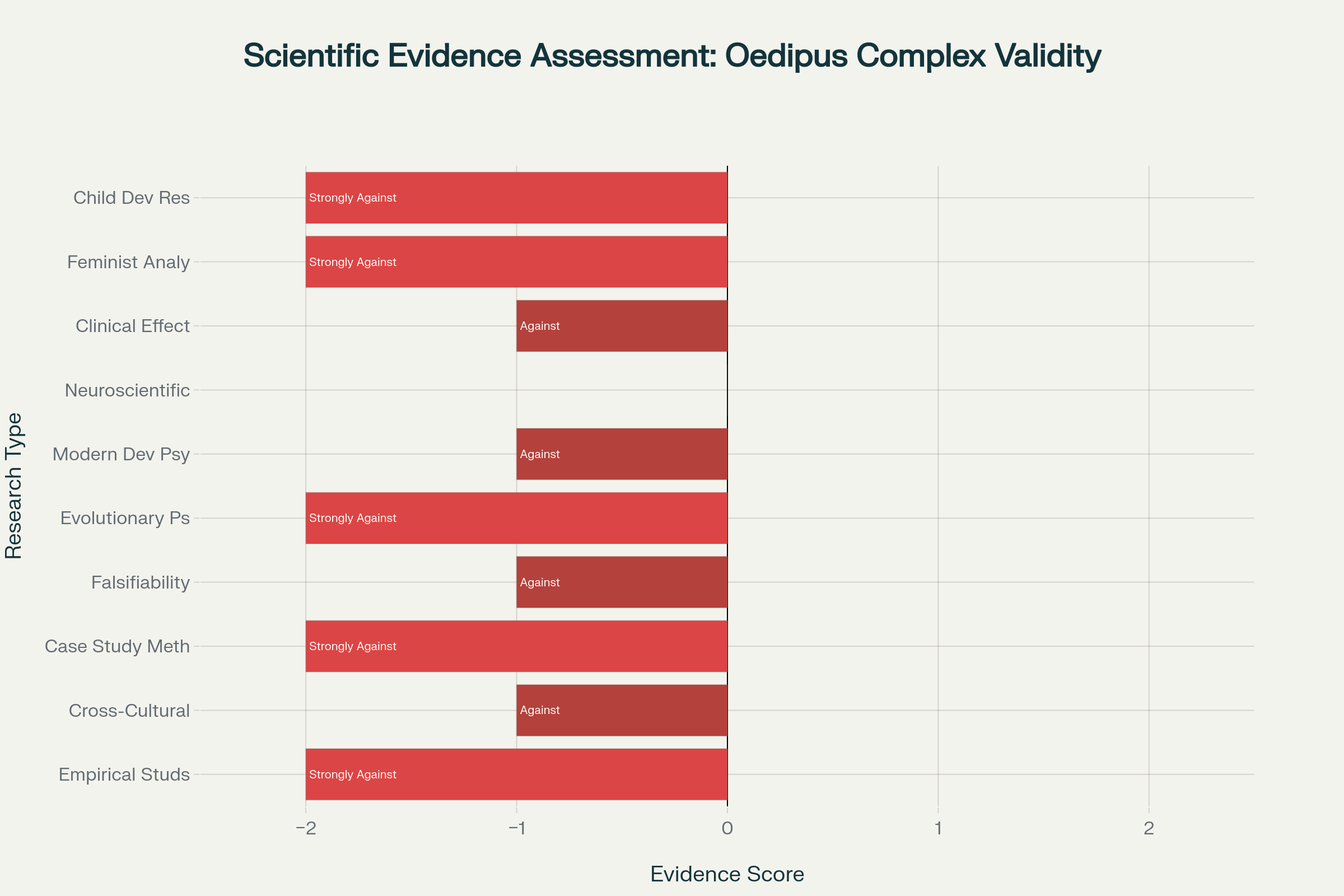
Scientific evidence assessment showing that most research areas provide evidence against the validity of the Oedipus complex theory
Evidence Against the Oedipus Complex
Lack of Empirical Evidence
The most significant challenge to the Oedipus complex is the absence of robust empirical evidence. Critics consistently note that "despite the case of Little Hans, there is very little empirical evidence to prove the theory's validity"5. In the twenty-first century, "mainstream psychology continued to discredit the Oedipus complex theory due to a lack of empirical evidence"10. Multiple comprehensive reviews have found that Freud's theories generally lack the empirical support expected of scientific hypotheses111213.
Methodological Problems with Foundational Case Studies
The Little Hans case study, Freud's primary evidence for the Oedipus complex in children, has been extensively criticized for severe methodological flaws. Harold Blum's centennial review revealed that "the severe disturbance of his mother had an adverse impact on Little Hans and his family" and that "her abuse of Hans's infant sister has been overlooked by generations of analysts"14. The case study suffered from:
- Observer bias: Hans's father was already familiar with and supportive of Freud's theories, potentially leading questions and selective reporting1516
- Alternative explanations: Hans's horse phobia could be explained by classical conditioning after witnessing a horse collapse, or through attachment theory as a response to family disruption1716
- Indirect data collection: Freud only met Hans twice, relying primarily on his father's letters for information1618
Unfalsifiability and Scientific Status
Karl Popper famously criticized psychoanalysis, including the Oedipus complex, as unfalsifiable and therefore unscientific. The theory "explains every possible patient reaction as confirmation of its underlying theory," making it impossible to design experiments that could definitively prove it wrong12. While Popper acknowledged that psychoanalytic ideas contained "interesting psychological suggestions," he maintained that unfalsifiable theories cannot be considered scientific19.
Cross-Cultural Evidence Against Universality
Anthropological research has largely failed to support the universality of the Oedipus complex. The most famous challenge came from Bronisław Malinowski's studies of the matrilineal Trobriand Islanders, though Melford Spiro's later reanalysis suggested the complex might exist in different forms across cultures20. However, subsequent cross-cultural studies have generally failed to find consistent evidence for universal oedipal patterns, suggesting that family dynamics are more influenced by cultural and social structures than by an innate psychological complex621.
Evolutionary Psychology and the Westermarck Effect
Evolutionary psychology provides strong evidence against the Oedipus complex through the well-documented Westermarck effect. This psychological mechanism causes people who live in close proximity during early childhood to develop sexual aversion rather than attraction to each other2223. Research on Israeli kibbutzim, Chinese Shim-pua marriages, and other natural experiments consistently shows that "persons exposed to one another for a significant duration during the childhood of one of the pair will later each be averse to sex with the other"23.
The Westermarck effect makes evolutionary sense because "sexual apathy or aversion toward family members is activated during the early years of childhood" as an inbreeding avoidance mechanism24. As one evolutionary psychologist noted, "a mechanism inhibiting incestuous mating is much more likely to have evolved than a mechanism motivating incestuous mating"24.
Modern Developmental Psychology Contradictions
Contemporary child development research contradicts core assumptions of the Oedipus complex. Studies show that children typically develop incest avoidance rather than incest attraction, and that attachment behaviors previously interpreted as "oedipal" are better explained by security needs and survival instincts1025. Family systems theory and attachment theory provide more empirically supported explanations for parent-child dynamics without requiring assumptions about infantile sexuality2627.
Feminist Criticisms and Gender Bias
Feminist scholars have extensively criticized the Oedipus complex for its inherent gender bias and patriarchal assumptions. The theory "can be read as the critical point at which girls move toward being passive wives and boys move toward being active husbands"28. Key feminist criticisms include:
- Penis envy: Freud's assertion that girls suffer from "penis envy" has been widely rejected as reflecting cultural gender inequality rather than biological reality2930
- Male-centered framework: The theory primarily focuses on male development, treating female development as derivative and problematic2931
- Potential cover-up for abuse: Critics argue that attributing children's reports of sexual abuse to fantasy rather than reality has harmful consequences3230
Neuroscientific Evidence
Despite attempts to find neurobiological support for psychoanalytic concepts, neuroscience has not identified specific brain mechanisms underlying the Oedipus complex. While some researchers have attempted to connect Freudian concepts to brain function, these efforts remain speculative and have not produced convincing evidence for oedipal mechanisms333435.
Clinical Effectiveness and Treatment Implications
The practical implications of believing in the Oedipus complex have also been questioned. Research shows that "almost all the studies reviewed concerned short-term psychodynamic psychotherapy" rather than classical psychoanalysis, and the "evidence base for psychoanalytic therapy remains thin"13. Modern evidence-based treatments for psychological disorders rarely invoke oedipal concepts, suggesting they may not be necessary for effective therapeutic intervention.
Contemporary Scientific Consensus
The current scientific consensus regarding the Oedipus complex can be summarized as follows: while the theory may contain "interesting psychological suggestions" about family dynamics and early development, it lacks the empirical support required of scientific theories19. As one comprehensive review concluded, "if psychoanalysis is not a science, the rest of psychology falls with it" - yet mainstream psychology has largely moved beyond Freudian concepts toward more empirically supported models36.
The persistence of the Oedipus complex in popular culture and some therapeutic contexts appears to reflect its metaphorical rather than literal value. Modern psychologists who find any utility in the concept tend to interpret it symbolically - as representing general family dynamics, power relationships, or identity formation - rather than as a literal description of infantile sexual desires3237.
Conclusion
The weight of scientific evidence strongly argues against the validity of the Oedipus complex as originally formulated by Freud. While the theory addressed important questions about family relationships and psychological development, it has not withstood empirical scrutiny. The lack of controlled experimental support, methodological problems with foundational case studies, contradictory evidence from evolutionary psychology and cross-cultural research, and the availability of better-supported alternative theories all contribute to the scientific rejection of the Oedipus complex.
However, this does not diminish the historical importance of Freud's work in establishing psychology as a field concerned with unconscious processes, early development, and family dynamics. Modern psychology has built upon these insights while developing more rigorous, empirically supported theories. The study of parent-child relationships, attachment formation, and identity development continues to be important areas of research, but contemporary approaches rely on observational studies, controlled experiments, and cross-cultural validation rather than clinical anecdotes and unfalsifiable theoretical constructs.
For practitioners and researchers today, the evidence suggests that understanding family dynamics, child development, and psychological dysfunction is better served by attachment theory, family systems approaches, and other empirically validated models rather than by the classical Oedipus complex. While Freud's contributions to psychology deserve historical recognition, the scientific evidence does not support the continued use of the Oedipus complex as a valid theory of human psychological development.
- https://www.verywellmind.com/what-is-an-oedipal-complex-2795403
- https://pmc.ncbi.nlm.nih.gov/articles/PMC3330618/
- https://pubmed.ncbi.nlm.nih.gov/27437633/
- https://en.wikipedia.org/wiki/Oedipus_complex
- https://www.reddit.com/r/askphilosophy/comments/axdm7d/can_someone_explain_freuds_idea_of_the_oedipus/
- https://www.freud.org.uk/schools/resources/what-is-psychoanalysis-part-3-the-oedipus-complex/
- https://www.healthline.com/health/oedipus-complex
- https://www.simplypsychology.org/psychosexual.html
- https://www.simplypsychology.org/oedipal-complex.html
- https://www.britannica.com/science/Oedipus-complex
- https://psychcentral.com/health/oedipus-complex
- https://www.academypublication.com/issues/past/jltr/vol02/06/28.pdf
- https://www.uvm.edu/~jbailly/courses/tragedy/student%20second%20documents/Oedipus%20Complex.html
- https://melanie-klein-trust.org.uk/theory/oedipus-complex/
- https://dictionary.apa.org/oedipus-complex
- https://psyartjournal.com/article/show/armstrong-oedipus_as_evidence_the_theatrical_backg
- https://www.scientificamerican.com/article/oedipus-complex-study-withdrawn/
- https://pubmed.ncbi.nlm.nih.gov/9029977/
- https://hraf.yale.edu/ehc/documents/109
- https://www.britannica.com/story/is-the-oedipus-complex-real
- https://www.sciencedirect.com/science/article/abs/pii/S2542360623000471
- https://pep-web.org/search/document/PAQ.032.0415A
- https://www.ebsco.com/research-starters/health-and-medicine/oedipus-complex
- https://www.tandfonline.com/doi/abs/10.1111/1745-8315.12278?journalCode=ripa20
- https://archive.org/details/oedipuscomplexcr0000step
- https://www.psychologytoday.com/gb/blog/talking-apes/201802/searching-evidence-the-oedipus-complex
- https://www.journals.uchicago.edu/doi/10.1086/223568
- https://www.reddit.com/r/psychoanalysis/comments/1ajexb/is_there_any_evidence_or_science_behind_freuds/
- https://www.deepdyve.com/lp/doc/V4ou70Knrb
- https://science.howstuffworks.com/life/inside-the-mind/human-brain/oedipus-complex.htm
- https://www.jstor.org/stable/1420154
- https://academicjournals.org/journal/IJEL/article-full-text-pdf/A6ABAA82875
- https://pubmed.ncbi.nlm.nih.gov/17915645/
- https://miamihighnews.com/2024/06/03/the-oedipus-complex-was-wrong/
- https://study.com/academy/lesson/psychology-case-study-little-hans.html
- https://www.ijsrp.org/research-paper-0419/ijsrp-p8858.pdf
- https://katiehulbertresearchm.wordpress.com/2011/09/30/the-reliability-and-validity-of-freuds-case-study-little-hans/
- https://www.simplypsychology.org/little-hans.html
- https://www.simplypsychology.org/attachment-theory-and-psychoanalysis.html
- https://www.psychologistworld.com/freud/little-hans-freud-case
- https://www.reddit.com/r/askpsychology/comments/a0nob9/what_is_the_modern_stance_on_the_oedipus_complex/
- https://goodenoughcaring.co.uk/writings/attachment-theory-how-children-are-able-to-make-relationships/
- https://getrevising.co.uk/grids/strength-and-weaknesses-of-little-hans
- https://www.freud.org.uk/2024/07/09/psychoanalysis-with-children-a-brief-journey/
- https://www.earlyyears.tv/sigmund-freud-in-early-childhood-education-a-practical-guide/
- https://en.wikipedia.org/wiki/Feminist_views_on_the_Oedipus_complex
- https://biology.stackexchange.com/questions/17235/how-does-oedipus-complex-fit-in-the-evolutionary-theory
- https://www.health.com/oedipus-complex-7500028
- https://storyality.wordpress.com/2013/11/17/storyality-90-freud-was-wrong-about-oedipus-sugiyama/
- https://kirstyahawthorn.wordpress.com/literature/a-feminist-response-to-freuds-theory-of-femininity/
- https://www.bps.org.uk/psychologist/sigmund-freud-and-penis-envy-failure-courage
- https://www.thecjc.org/pdf/totem_taboo_poff_4-5.pdf
- https://library.fiveable.me/literary-theory-criticism/unit-4/oedipus-complex/study-guide/NDqRZ7PogrpZFXUZ
- https://anthrosource.onlinelibrary.wiley.com/doi/10.1111/anoc.70000
- https://plato.stanford.edu/entries/feminism-psychoanalysis/
- https://www.anthrometronom.com/post/is-the-oedipus-complex-universal
- https://journals.sagepub.com/doi/pdf/10.1177/070674377602100308
- https://publishing.cdlib.org/ucpressebooks/view?docId=ft0k40038c&chunk.id=d0e2561&toc.depth=1&toc.id=d0e2561&brand=ucpress
- https://pmc.ncbi.nlm.nih.gov/articles/PMC10358401/
- https://www.ebsco.com/research-starters/health-and-medicine/family-systems-theory
- https://en.wikipedia.org/wiki/Westermarck_effect
- https://psychscenehub.com/psychinsights/neurobiology-of-freuds-psychoanalytic-theories/
- https://quenza.com/blog/family-dynamics/
- http://www.danielmtfessler.com/wp-content/uploads/2013/12/Fessler-Navarrete-2004-3rd-party-attitudes-incest.pdf
- https://us.sagepub.com/sites/default/files/upm-assets/109149_book_item_109149.pdf
- https://www.sciencedirect.com/science/article/abs/pii/S1090513813000962
- https://www.frontiersin.org/journals/behavioral-neuroscience/articles/10.3389/fnbeh.2018.00294/full
- https://study.com/learn/lesson/family-dynamics-roles-examples.html
- https://academic.oup.com/beheco/article/24/4/842/220309
- https://aeon.co/essays/can-neuroscience-rehabilitate-freud-for-the-age-of-the-brain
- https://www.ncbi.nlm.nih.gov/books/NBK560487/
- https://www.sciencedirect.com/science/article/pii/0162309593900042
- https://www.sciencedirect.com/topics/neuroscience/oedipus-complex
- https://www.psychologytoday.com/gb/basics/family-dynamics
- https://journals.sagepub.com/doi/abs/10.1177/1474704919849924
- https://pmc.ncbi.nlm.nih.gov/articles/PMC3646245/
- https://pmc.ncbi.nlm.nih.gov/articles/PMC6020924/
- https://ouci.dntb.gov.ua/en/works/7W0LdMz4/
- https://bigthink.com/health/sigmund-freud-ideas-not-substantiated/
- https://pmc.ncbi.nlm.nih.gov/articles/PMC5459228/
- https://www.mdpi.com/2409-9287/5/4/27
- https://www.reddit.com/r/psychology/comments/136sy5/is_there_any_truth_to_freuds_theories/
- https://deepblue.lib.umich.edu/bitstream/handle/2027.42/66512/10.1177_000306517001800106.pdf?sequence=2
- http://www.personalityresearch.org/papers/beystehner.html
- https://academic.oup.com/brain/article/147/4/1115/7469295
- https://pmc.ncbi.nlm.nih.gov/articles/PMC3115290/
- https://cosmonautmag.com/2021/10/on-the-scientific-status-of-psychoanalysis/
- https://www.savemyexams.com/a-level/psychology/aqa/17/revision-notes/10-gender-a-level-only/10-3-approaches-and-gender-development/the-psychodynamic-explanation-of-gender/
- https://www.simplypsychology.org/sigmund-freud.html
- https://www.sciencedirect.com/science/article/pii/S0049237X09706056
- https://www.sciencedirect.com/topics/psychology/oedipus-complex
- https://www.sciencedirect.com/topics/medicine-and-dentistry/freudian-theory