Matthew 16
16 And the Pharisees and Sadducees having come, tempting, did question him, to shew to them a sign from the heaven,
^2 ^and he answering said to them, `Evening having come, ye say, Fair weather, for the heaven is red,
^3 ^and at morning, Foul weather to-day, for the heaven is red -- gloomy; hypocrites, the face of the heavens indeed ye do know to discern, but the signs of the times ye are not able!
^4 `A generation evil and adulterous doth seek a sign, and a sign shall not be given to it, except the sign of Jonah the prophet;' and having left them he went away.
^5 ^And his disciples having come to the other side, forgot to take loaves,
^6 ^and Jesus said to them, `Beware, and take heed of the leaven of the Pharisees and Sadducees;'
^7 ^and they were reasoning in themselves, saying, `Because we took no loaves.'
^8 ^And Jesus having known, said to them, `Why reason ye in yourselves, ye of little faith, because ye took no loaves?
^9 ^do ye not yet understand, nor remember the five loaves of the five thousand, and how many hand-baskets ye took up?
^10 ^nor the seven loaves of the four thousand, and how many baskets ye took up?
^11 ^how do ye not understand that I did not speak to you of bread -- to take heed of the leaven of the Pharisees and Sadducees?'
^12 ^Then they understood that he did not say to take heed of the leaven of the bread, but of the teaching, of the Pharisees and Sadducees.
^13 ^And Jesus, having come to the parts of Cesarea Philippi, was asking his disciples, saying, `Who do men say me to be -- the Son of Man?'
This city is in the far north of Israel, about 25 miles north of Capernaum and the Sea of Galilee. Located at the foot of Mt. Hermon, it is where one of the three main branches of the Jordan River originates. Immediately above where the river springs directly out of the base of a cliff is a massive rock outcropping that dominates the topography. Its presence towers over the landscape. None who were present when Christ spoke these words could possibly have believed He was talking about building His Church on Peter, whom He compared to a little rock. The enormous physical size of the rock looming directly over Christ’s head reinforced His message that He was building the Church on a giant Rock—HIMSELF! 1 Corinthians 10:4
^14 ^and they said, `Some, John the Baptist, and others, Elijah, and others, Jeremiah, or one of the prophets.'
^15 ^He saith to them, `And ye -- who do ye say me to be?'
^16 ^and Simon Peter answering said, `Thou art the Christ, the Son of the living God.'
^17 ^And Jesus answering said to him, `Happy art thou, Simon Bar-Jona, because flesh and blood did not reveal [it] to thee, but my Father who is in the heavens.
^18 `And I also say to thee, that thou art a rock //Kefa Peter//, and upon this rock //not Peter, the rock they were standing on// I will build my assembly, and gates of Hades shall not prevail against it;
Jesus called Simon - Kefa/Peter as soon as he first saw him John 1:42 you shall be called Cephas, which is by interpretation, A stone”
Peter answered, “You are the Christ, the Son of the living God” (vs. 16). Then Christ responded, “You are Peter [petros, which means “little rock or pebble”], and upon this rock [petra, meaning “very great rock”] I will build My church”
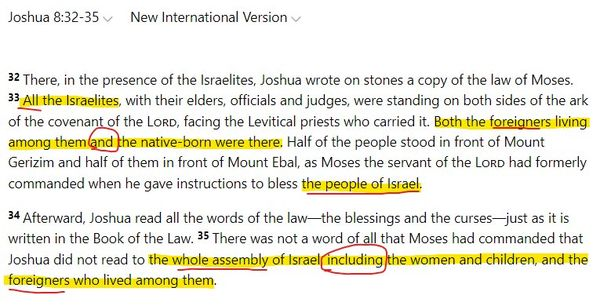
Joshua 8:32-33, Acts 7:38
^19 ^and I will give to thee the keys of the reign of the heavens, and whatever thou mayest bind upon the earth shall be having been bound in the heavens, and whatever thou mayest loose upon the earth shall be having been loosed in the heavens.'
^20 ^Then did he charge his disciples that they may say to no one that he is Jesus the Christ.
^21 ^From that time began Jesus to shew to his disciples that it is necessary for him to go away to Jerusalem, and to suffer many things from the elders, and chief priests, and scribes, and to be put to death, and the third day to rise.
^22 ^And having taken him aside, Peter began to rebuke him, saying, `Be kind to thyself, sir; this shall not be to thee;'
^23 ^and he having turned, said to Peter, `Get thee behind me, adversary! thou art a stumbling-block to me, for thou dost not mind the things of God, but the things of men.'
^24 ^Then said Jesus to his disciples, `If any one doth will to come after me, let him disown himself, and take up his cross, and follow me,
^25 ^for whoever may will to save his life, shall lose it, and whoever may lose his life for my sake shall find it,
^26 ^for what is a man profited if he may gain the whole world, but of his life suffer loss? or what shall a man give as an exchange for his life?
^27 `For, the Son of Man is about to come in the glory of his Father, with his messengers, and then he will reward each, according to his work.
^28 ^Verily I say to you, there are certain of those standing here who shall not taste of death till they may see the Son of Man coming in his reign.'
NOTES
Notes
Yah/God always included the foreigner/gentile as part of the whole assembly of Israel. Gentiles were numbered as an Israelite if they chose to follow the god of Abraham, Isaac, and Jacob. It was man made rules which eventually tried to exclude them. Jesus came and set the Kingdom of Yah (where Yah reigns) back to the ways of Yah and did away with the ways of man.
The whole assembly (qahal/kahal) = the first church - same word used in the New Testament rendered ekklesia in Greek. Sometimes translated as church, sometimes translated as synagogue. Matthew 16:18
Heiser, Michael S.. The Unseen Realm: Recovering the Supernatural Worldview of the Bible (pp. 319-320). Lexham Press. Kindle Edition.
The location of the incident—Caesarea Philippi—and the reference to the “gates of hell” provide the context for the “rock” of which Jesus is speaking.
Caesarea Philippi was located in the northern part of the Old Testament region of Bashan, the “place of the serpent,” at the foot of Mount Hermon.10
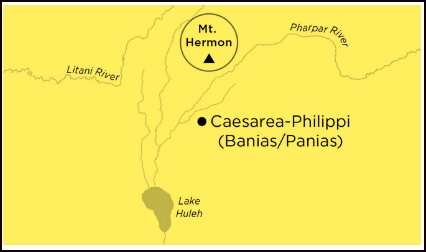
Things hadn’t changed much by Jesus’ day, at least in terms of spiritual control. You may have noticed on these maps that Caesarea Philippi was also called “Panias.” The early church historian Eusebius notes: “Until today the mount in front of Panias and Lebanon is known as Hermon and it is respected by nations as a sanctuary.”11 The site was famous in the ancient world as a center of the worship of Pan and for a temple to the high god Zeus, considered in Jesus’ day to be incarnate in Augustus Caesar.12
The basis for Catholicism’s contention that the Church is built on Peter’s leadership is that his name means “stone.”14 For sure there is wordplay going on in Peter’s confession, but I would suggest there is also an important double entendre: the “rock” refers to the mountain location where Jesus makes the statement. When viewed from this perspective, Peter confesses Jesus as the Christ, the Son of the living God, at “this rock” (this mountain—Mount Hermon). Why? This place was considered the “gates of hell,” the gateway to the realm of the dead, in Old Testament times.15 The theological messaging couldn’t be more dramatic. Jesus says he will build his church—and the “gates of hell” will not prevail against it. We often think of this phrase as though God’s people are in a posture of having to bravely fend off Satan and his demons. This simply isn’t correct. Gates are defensive structures, not offensive weapons. The kingdom of God is the aggressor.16 Jesus begins at ground zero in the cosmic geography of both testaments to announce the great reversal. It is the gates of hell that are under assault—and they will not hold up against the Church. Hell will one day be Satan’s tomb.
Mount Hermon, as readers will recall, was the place where, in Jewish literature such as the book of 1 Enoch, the sons of God of Genesis 6:1–4 chose to launch their rebellion against Yahweh. Jesus had one more statement to make to his unseen enemies. Matthew, Mark, and Luke all agree that the next event in the ministry of Jesus after Peter’s confession was the transfiguration: