Genesis 16
16 And Sarai,
Abram's wife,
hath not borne to him //Abraham//,
and she //Sarah// hath an handmaid,
an Egyptian,
and her name [is] Hagar;
and Sarai saith unto Abram,
`Lo, I //Sarah// pray thee //Abraham//,
Jehovah hath
restrained me
from bearing,
She acknowledges the restraint is from YHWH
go in, I pray thee,
unto my handmaid;
perhaps I am built up from her;'
and Abram hearkeneth to the voice of Sarai.
The practice of a barren wife giving her maidservant to her husband to produce an heir is attested in Mesopotamian texts, such as the Nuzi marriage contracts, where a slave-woman could bear children “for” the wife, but the wife retained authority over her. Maidservants could be used strategically in marriage arrangements, as seen in Nuzi texts where a barren wife might provide a servant to bear children, mirroring Sarah’s actions with Hagar (Genesis 16:2).
Abraham doesn’t object nor question. Just like Adam - he spoke directly with YWHW but listened to the voice of his wife instead. At this point, neither Abraham nor Sarai, have consulted nor have heard directly from YHWH on this matter. However, up until now, God has not specifically said the heir would come from Sarah.
And Sarai,
Abram's wife,
taketh Hagar
the Egyptian,
her handmaid,
at the end of the tenth //10// year
of Abram's dwelling
in the land of Canaan,
and giveth her to Abram
her husband,
to him for a wife,
maid” (Hebrew: shiphchah, Genesis 16:1), an Egyptian servant. Genesis 25:1 mentions Keturah as Abraham’s “wife” after Sarah’s death, but Genesis 25:6 refers to “sons of the concubines” Abraham had, implying Keturah and others were concubines whose sons (e.g., Midian, Zimran) were secondary to Isaac. Hagar is initially Sarah’s maidservant (Genesis 16:1) before being given to Abraham as a concubine. Maidservants performed domestic tasks, such as fetching water, cooking, or attending to the mistress (e.g., Hagar serving Sarah). They could be elevated to concubine status to bear children, as with Hagar (Genesis 16:2-3).
The Hebrew word used for "wife" in this verse is אִשָּׁה (ishshah). This term is commonly used in the Hebrew Bible to refer to a wife or a woman, depending on the context. In Genesis 16:3, ishshah is applied to both Sarai (Abram’s primary wife) and Hagar (given to Abram “to be his wife”), though Hagar’s role is understood culturally as that of a concubine, a secondary wife with lower status, as discussed previously. The use of ishshah for Hagar indicates a marital relationship for the purpose of childbearing, but the broader narrative (e.g., Genesis 16:6, 21:10-14) and cultural context clarify her subordinate position compared to Sarai.
In Mesopotamian society (e.g., Babylonian and Sumerian cultures, akin to Ur, Abraham’s homeland), a primary wife (often called the patroness or main wife in texts like the Code of Hammurabi, circa 1754 BCE) held the highest status in the household. She managed the household, had legal rights to inheritance for her children, and was often from a family of equal or higher social standing (Sarah was Abraham’s half sister).
Marriage contracts, as seen in cuneiform tablets from Nuzi and Mari (contemporaneous with Abraham), often stipulated the wife’s role in producing heirs and her authority over secondary wives or concubines.
The wife’s children were typically the primary heirs, especially for covenantal or property purposes, aligning with Sarah’s son Isaac being the heir of God’s promise (Genesis 17:19-21).
The term “wife” for Hagar in Genesis 16:3 likely reflects her role as a child-bearing partner, but her treatment and expulsion (Genesis 21:14) suggest a lower status, consistent with a concubine. Nuzi tablets describe concubines as women taken to bear children, especially if the primary wife was barren, as with Sarah. Concubines had fewer legal rights than primary wives. Their children could inherit, but only if the primary wife had no heir or if the husband granted legitimacy (cf. Ishmael’s exclusion from primary inheritance, Genesis 21:10). In texts like the Code of Hammurabi (Law 146), a maidservant given as a concubine could not claim equality with the primary wife, and her children’s status depended on the husband’s or wife’s decisions VERY KEY TO UNDERSTANDING Galatians 4
Lamech the descendant of Cain - was the first to be recorded as having two wives - ~1500-1700 years prior. The Bible does not explicitly state that any individual between Lamech (Genesis 4:19) and Abraham (Genesis 11:26 onward) had two or more wives.
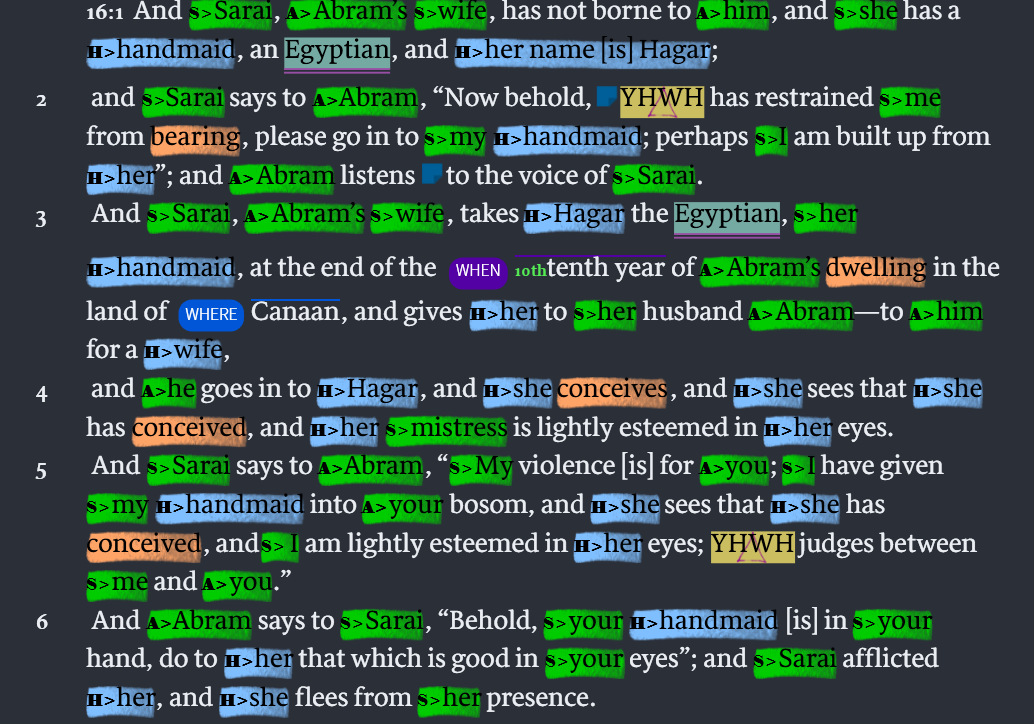
^and he //Abraham// goeth in unto Hagar,
and she conceiveth,
and she seeth that she hath conceived,
and her mistress is lightly esteemed in her eyes.
And Sarai saith unto Abram,
`My violence [is] for thee;
I -- I have given mine handmaid
into thy bosom,
and she seeth that she hath conceived,
and I am lightly esteemed in her eyes;
Jehovah doth judge between me and thee.'
^And Abram saith unto Sarai,
`Lo, thine handmaid [is] in thine hand,
do to her that which is good in thine eyes;'
and Sarai afflicted her, and she fleeth from her presence.
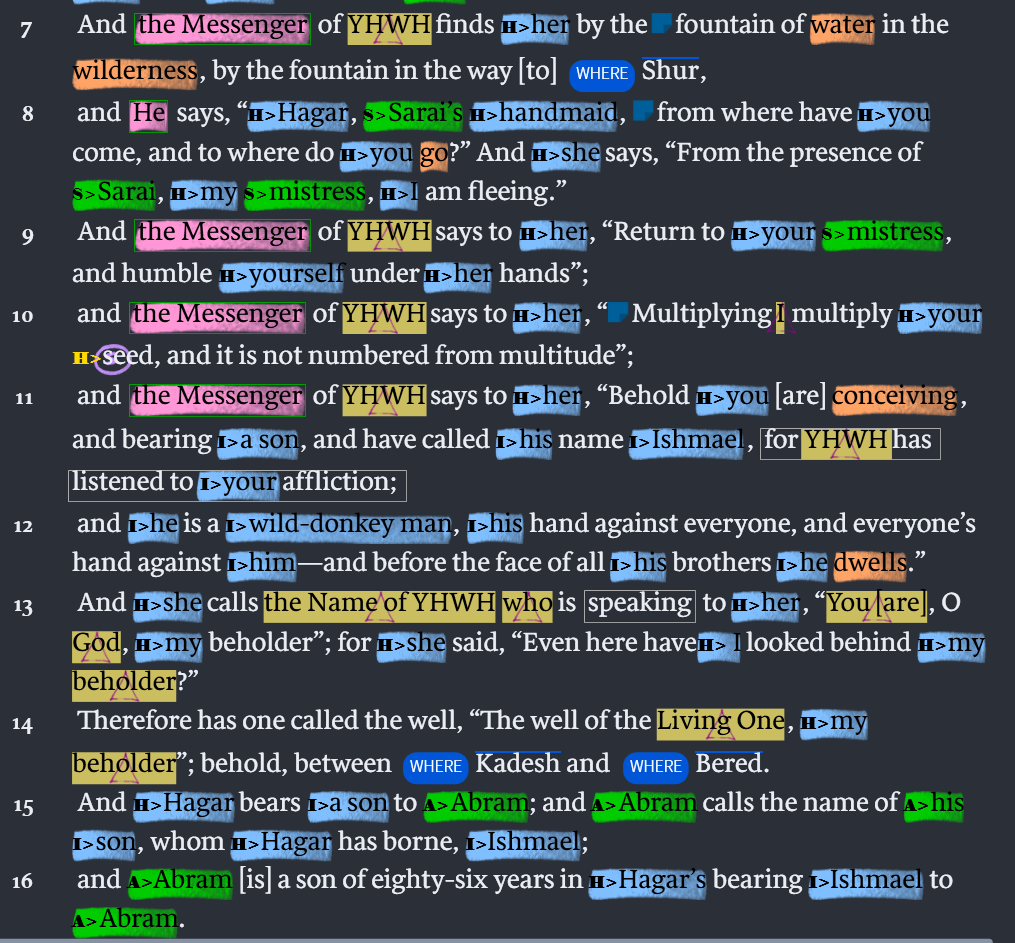
^And amessenger of Jehovah
findeth her //Hagar//
by the fountain of water
in the wilderness,
by the fountain
in the way [to] Shur,
and he saith, Hagar,
Sarai's handmaid,
whence hast thou come,
and whither dost thou go?'
and she saith,
From `the presence of Sarai,
my mistress,
I am fleeing.'
And the messenger of Jehovah saith to her,
`Turn back
unto thy mistress,
and humble thyself
under her hands;'
`Multiplying I multiply
thy //Hagar// seed,
and it is not numbered from multitude;'
`Behold thou
[art] conceiving,
and bearing a son,
and hast called his name
Ishmael,
for Jehovah hath hearkened unto thine affliction;
and he is a wild-ass man,
his hand against every one,
and every one's hand against him --
and before the face of all his brethren he dwelleth.'
And she calleth the name of Jehovah
who is speaking
unto her,
Thou [art],
O God,
my beholder;'
Even here have I looked behind my beholder?'
therefore hath one called the well,
`The well of the Living One, //Beer-lahai-roi//
my beholder;' lo,
between Kadesh and Bered.
This is only the second time Yah or a Messenger speaks to a woman directly (Eve). Sounds similar to the question asked of Adam and Eve in the garden
This is the first time the “Messenger of the Lord” is identified.
This “messenger states “I multiply”
Hagar called the name = Hagar naming God as El Ro’i the phrase translated as “Thou God seest me” is אַתָּה אֵל רֹאִי (attah El Ro’i)
אַתָּה (attah): “Thou” (second-person singular, addressing God).
אֵל (El): “God.”
רֹאִי (Ro’i): “My seer” or “the one who sees me,”
הַרְבָּה אַרְבֶּה אֶת־זַרְעֵךְ (harbah arbeh et-zar‘ekh), meaning “I will multiply your seed exceedingly.” The infinitive absolute harbah intensifies the verb arbeh (I will multiply), and et-zar‘ekh specifies “your seed.” SEED of the woman.
I will mutiply your seed:
- Hagar (her seed),
- Abraham
Genesis 17, with otkha (“thee,” Abraham) instead of zar‘ekha (your seed). The focus is on multiplying Abraham himself (his person or progeny broadly), not specifically “your seed.”
Genesis 22, exact match to the phrase - (his seed)
- Isaac Genesis 26 This is very similar to Genesis 16:10 but lacks the infinitive “exceedingly”
הֲגַם (hagam): An interrogative particle meaning “also,” “even,” or “indeed.” It introduces a rhetorical or surprised question, often translated as “Have I also?” in the KJV. It conveys Hagar’s astonishment or emphasis
אַחֲרֵי (acharei): A preposition meaning “after” or “behind.” In this context, it can imply “after” in a temporal sense (after seeing) or “behind” in a spatial sense (looking after/behind someone)
The phrase הֲגַם הֲלֹם רָאִיתִי אַחֲרֵי רֹאִי (hagam halom ra’iti acharei ro’i) can be literally translated as: “Have I also here seen after/behind my seer?” or “Even here have I looked after/behind the one who sees me?” Hagar’s acharei is a preposition, flexible in meaning (temporal “after” or spatial “behind”), while Moses’ achorai is a noun, specifically referring to God’s “back parts” as a physical or metaphorical aspect of His glory.
And Hagar
beareth
to Abram
a son;
and Abram calleth the name of his son,
whom Hagar hath borne,
Ishmael;
and Abram [is] a son of
eighty and six years
in Hagar's bearing
Ishmael
to Abram.
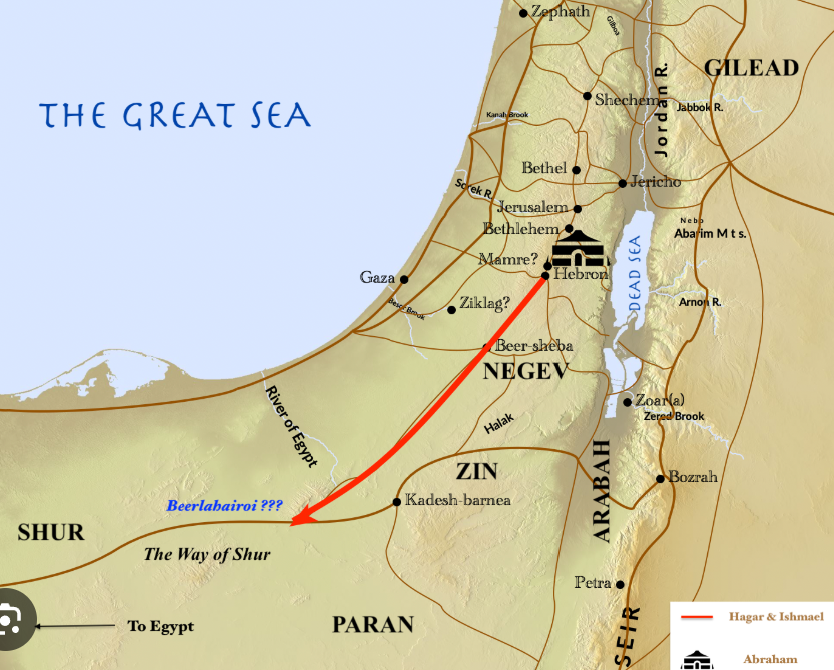
שׁוּר pronounced "shoor" consistently refers to a region or wilderness near the border of Egypt and Canaan, likely in the northwestern Sinai Peninsula or the Negev desert. It is described as “before Egypt” or “over against Egypt,” suggesting it lies east of Egypt, along the route from Canaan to Egypt (as Hagar, an Egyptian, was fleeing toward her homeland, Genesis 16:1, 7).
Shur as a place name is “wall,” possibly referring to a line of fortifications or a natural barrier (e.g., a ridge or desert boundary) along Egypt’s frontier. Ancient Egyptian texts mention a “Wall of the Ruler” defending Egypt’s eastern border, which some scholars associate with Shur
Flash back to the Eden and the Tree of the Knoweldge of Good and Evil:
- Sarah saw it was good to multiply
- She took the handmaiden
- She gave to the man;
- The man accepted and made no objection even though he had been given direct instruction or revelation from YHWH
- Hagar “hides”
- God seeks her out
- Consequence is emnity between seeds
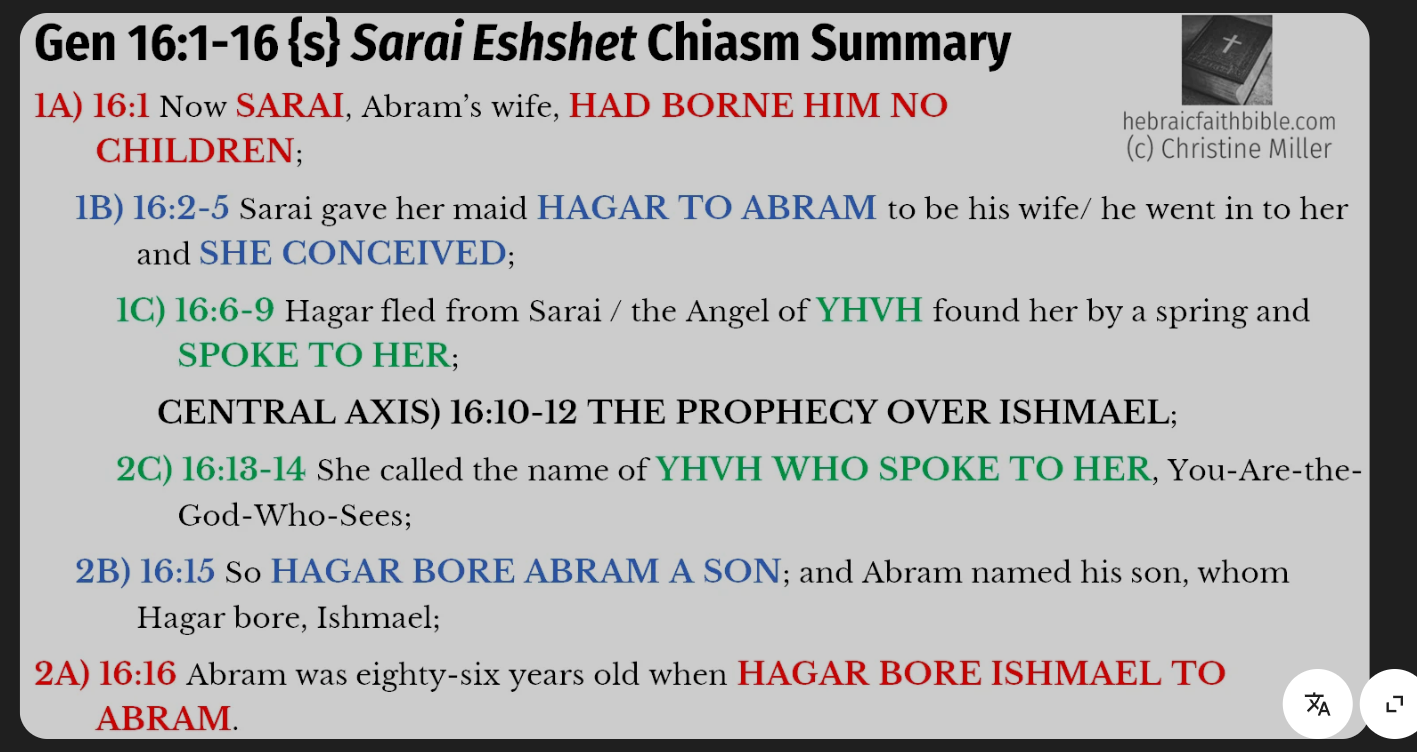
Chiasm Structure