Tyre
Amos 1:9-10: Pronounces judgment on Tyre for slave trading, with leaders implied in the city’s actions, paralleling the king’s corrupt trade in Ezekiel 28:16, 18.
Matthew 11:21-22; Luke 10:13-14: Jesus says Sidon (and Tyre) would have repented if shown His miracles, yet they face judgment at the last day, implying spiritual hardness.
Matthew 15:21; Mark 7:24: Jesus visits “the region of Tyre and Sidon,” healing a Canaanite woman’s daughter, showing Sidon’s continued presence.
Tyre’s Significance:
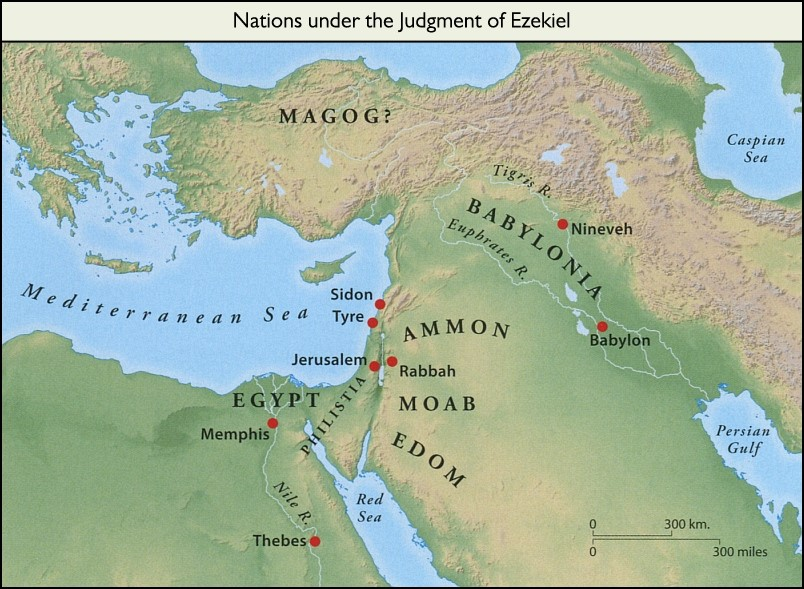
Tyre was a major Phoenician city-state, located on an island off modern Lebanon’s coast, renowned for its wealth, maritime trade, and craftsmanship (e.g., purple dye, cedar). By Ezekiel’s time, it was a cosmopolitan hub, trading with Egypt, Mesopotamia, and beyond (Ezekiel 27:3-25). Its island position made it nearly impregnable, fostering the pride Ezekiel condemns (Ezekiel 28:2, 5).
The Phoenicians were culturally and politically influential, often aligning with or resisting regional powers like Babylon and Egypt. Tyre’s leaders, including Ithobaal III, navigated these tensions, balancing autonomy with survival.
Reign and Political Context:
Ithobaal III ruled during a turbulent period when the Neo-Babylonian Empire, under Nebuchadnezzar II, sought to dominate the Levant. After defeating Egypt at Carchemish (605 BCE), Babylon targeted rebellious or strategic cities like Jerusalem and Tyre (2 Kings 24:1; Ezekiel 26:7).
Josephus cites Phoenician annals, stating Nebuchadnezzar besieged Tyre for 13 years (circa 586–573 BCE, though some suggest 598–585 BCE). This siege likely began in Ithobaal III’s reign, targeting Tyre’s defiance or economic dominance. The exact start is debated due to conflicting chronologies (e.g., Nebuchadnezzar’s 7th year vs. Ithobaal’s 7th year).
Ezekiel’s prophecies against Tyre (Ezekiel 26–28) coincide with this period, predicting its downfall (Ezekiel 26:4-14), though the Bible notes the siege yielded no plunder for Babylon (Ezekiel 29:18), suggesting Tyre wasn’t fully captured under Ithobaal III.
FULFILLED BIBLE PROPHECY - DESTRUCTION OF TYRE
FULFILLED BIBLE PROPHECY - DESTRUCTION OF TYRE | Precept Austin
History testifies that all this is precisely what happened. Many nations did come up against Tyre including the Babylonians, Greeks, Romans, Muslims, and Crusaders. In 586 BC, three years after Ezekiel's prophecy, Nebuchadnezzar was the first of these invaders, who, after a 13 year siege, broke down the walls and towers of mainland Tyre (not the island), thus fulfilling the first of Ezekiel’s prophecies against Tyre. Nebuchadnezzar massacred all of Tyre’s inhabitants except for those who escaped to an island fortress a half mile out in the Mediterranean Sea. It is notable that it was Tyre's abundance of freshwater that allowed the city to hold out against Nebuchadnezzar for so many years. In the years after Nebuchadnezzar's crushing defeat, the people of the city transferred the wealth of the former mainland city of Tyre to an adjacent island and there the new city of Tyre prospered protected by the sea and walls extending out into the sea to protect the port.
Some 241 years after Nebuchadnezzar had destroyed the old city of Tyre, Alexander the Great began his conquest of the ancient world, as he sought to capture Persia. But before he went to Persia, he headed south to conquer Tyre, fearing that while his troops were in the East engaged in war, and that the Phoenician navy might therefore seek to invade Greece. Alexander approached Tyre and demanded that the city surrender but they refused. After Alexander's first attempt failed, he took the ruble of the old city of Tyre left by Nebuchadnezzar and built a causeway out to the island. The city was completely destroyed by Alexander as a warning to other cities that might seek to defy his demands of surrender. After hearing of Tyre's fall, many cities opened their gates in fear to avoid being destroyed.
Centuries later Alexander the Great fulfilled a portion of the prophecy. In order to conquer the island fortress of Tyre (because he lacked a navy), he and his celebrated architect Diades devised one of the most brilliant engineering feats of ancient warfare. They built a causeway from Tyre’s mainland to the island fortress, using the millions of cubic feet of rubble left over on mainland Tyre. Thus Tyre was scraped bare as a rock, just as Ezekiel predicted.
Modern Tyre in Lebanon is a medium-sized city near to, but smaller than, the ancient site.
No city has been built over the ruins of ancient Tyre, in fulfillment of this prophecy.
-- Moody Bible Commentary
The most astonishing of Ezekiel’s predictions was that Tyre would never be rebuilt. This is singularly incredible because Tyre is strategically located on the east coast of the Mediterranean Sea and contains the Springs of Reselain, which pump ten million gallons of fresh water daily, enough to take care of the needs of a modern city. Yet, history records that after a succession of invasions, Tyre finally and irrevocably fell in A.D. 1291, never to be rebuilt again. Some 200 years ago archeologists were watching some fishermen spreading their nets on the bare rocks of a place that proved to be Tyre.
Today Tyre has been humbled to the point of becoming a place for the drying of fishermen's nets, literally what Ezekiel prophesied