Genesis 3
The Serpent
And the serpent //nachash//
- hath been subtile
- above every beast of the field
- which Jehovah God hath made,
- above every beast of the field
- and he saith
- unto the woman,
- `Is it true that
- God hath said,
- Ye do not eat of every tree of the garden?'
- God hath said,
- `Is it true that
- unto the woman,
- And the serpent saith
- unto the woman,
- `Dying, ye do not die,
- for God doth know
- that in the day of your eating of it
- -- your eyes have been opened,
- and ye have been as God,
- knowing good and evil.' tree of knowledge of good and evil
- and ye have been as God,
- for God doth know
- `Dying, ye do not die,
- unto the woman,
//Gadreel//
^And Jehovah God saith
unto the serpent,
`Because thou hast done this,
cursed //curse// [art] thou
above all the cattle,
and above every beast of the field:
on thy belly
dost thou go,
and dust thou dost eat,
all days of thy life;
^and enmity I put
between thee and the woman,
and between thy seed and her seed;
he doth bruise thee //serpent// -- the head,
and thou dost bruise him -- the heel.'
Observation: He didn’t ask the serpent a question like he did Adam and Eve?
The serpent tried to usurp the rulership of the humans. The serpant is cursesd.
Both the woman and the snake have a seed - the woman’s seed will crush the snake, not the snakes seed
The snake will launch an attack against her seed and he (her seed) will have victory.
The serpant is cursed and become humanities enemy through the woman.
- Revelation 12
- Revelation 20
The Woman
And the woman saith
unto the serpent,
`Of the fruit of the trees of the garden we do eat,
and of the fruit of the tree
which [is] in the midst of the garden
God hath said,
Ye do not eat of it, nor touch it, lest ye die.'
^And the woman seeth
that the tree [is] good for food,
and that it [is] pleasant to the eyes,
and the tree is desirable to make [one] wise,
and she taketh
of its fruit
and eateth,
and giveth also
to her husband
with her,
And they hear
the sound of
Jehovah God
walking up and down
in the garden
at the breeze of the day //ruakh ha-yom wind of the day//,
and the man and his wife hide themselves
from the face of
Jehovah God
in the midst of the trees
of the garden.
And Jehovah God saith
to the woman //Eve//,
`What [is] this thou hast done?'
and the woman saith,
The serpent hath
caused me
to forget
-- and I do eat.'
^And Jehovah God saith
unto the serpent,
^and enmity I put
between thee and the woman,
and between thy seed and her seed;
he doth bruise thee //serpent// -- the head,
and thou dost bruise him -- the heel.'
He //God// said,
^Unto the woman
`Multiplying I multiply
thy sorrow
in sorrow dost thou bear children
and thy conception, ,
toward thy husband [is]
thy desire,
and he doth rule over thee.'
Some scholars believe conception/childbirth: Does not mean childbirth. It means Herayon conception, pregnancy. And the word pain is the emotional toll. Circumstances of how babies are conceived will be fraught with painful, complicated relationships that help that cause emotional pain.
Humans were called to rule together, but now there is a lack of safety and unity. The man will now treat the woman like an animal and rule over her instead of ruling with her. Rule ( יִמְשָׁל־בָּךְ (yimshol-bakh). In the ancient Israelite context, יִמְשָׁל־בָּךְ would have been understood within the patriarchal social structure of the time, where male authority in family and society was normative.
Both the woman and the snake have a seed - the woman’s seed will crush the snake, not the snakes seed
The snake will launch an attack against her seed and he (her seed) will have victory.
The serpent and the man both get a concequence which includes eating - serpent eat dust; man eat in sorrow, herb, and bread from the ground.
And the man
calleth his wife's name Eve:
for she hath been mother of all living.
^And Jehovah God doth make
to the man and to his wife
coats of skin,
and doth clothe them.
The Man
and he doth eat;
and the eyes of them //Adam and Eve//
both are opened,
and they know
that they [are] naked,
and they sew fig-leaves,
and make to themselves girdles.
And they hear
the sound of
Jehovah God
walking up and down
in the garden
at the breeze of the day //ruakh ha-yom wind of the day//,
and the man and his wife hide themselves
from the face of
Jehovah God
in the midst of the trees
of the garden.
the sound of
Jehovah God
walking up and down
in the garden
at the breeze of the day //ruakh ha-yom wind of the day//,
and the man and his wife hide themselves
from the face of
Jehovah God
in the midst of the trees
of the garden.
Whatever this appearance of the sound of Yahweh coming and blowing through the garden, it clearly makes them afraid because they hide. Elohim storms in. The Day of the Lord is always depicted as the coming of a great storm. Zephaniah 1
And Jehovah God calleth
unto the man,
and he //Adam// saith,
`Thy //God// sound I //Adam// have heard
in the garden,
and I am afraid,
for I am naked,
and I hide myself.'
And He //God// saith,
`Who hath declared
to thee //Adam//
and the man saith //to God//,
`The woman
whom Thou didst place with me
-- she hath given to me
of the tree
-- and I do eat.'
He //God// said,
^And to the man
`Because thou hast hearkened
to the voice
of thy wife,
and dost eat of the tree
concerning which I have charged thee, saying,
Thou dost not eat of it,
cursed [is] the ground
on thine //Adam// account;
thou dost eat of it
in sorrow
all days of thy life,
and thorn and bramble
it //the ground// doth bring forth to thee,
and thou hast eaten the herb of the field;
by the sweat of thy face
thou dost eat bread
till thy return unto the ground,
for out of it hast thou been taken,
for dust thou [art],
and unto dust thou turnest back.'
Hosea 6:7: Mentions Adam’s transgression, directly referencing the covenant broken
And the man
calleth his wife's name Eve:
for she hath been mother of all living.
^And Jehovah God doth make
to the man and to his wife
coats of skin,
and doth clothe them.
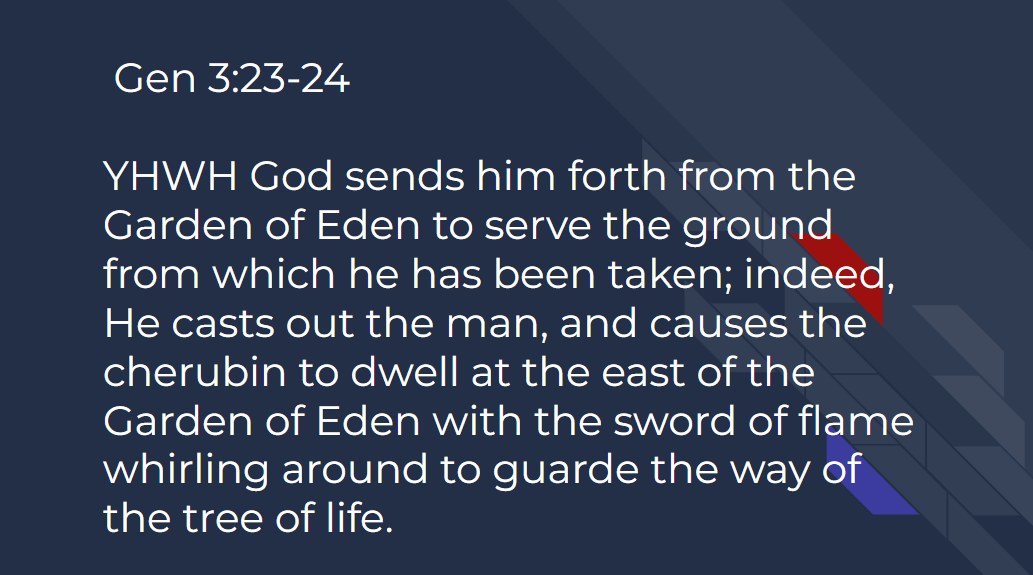
Jehovah God sendeth
him //Adam// forth
from the garden of Eden
to serve the ground
from which he hath been taken;
^yea, he casteth out the man,
and causeth to dwell
at the east
of the garden of Eden
He was created to serve the ground Genesis 2:15
The Earth
He //God// said,
cursed [is] the ground
on thine //Adam// account;
and thorn and bramble
it //the ground// doth bring forth to thee,
and thou hast eaten the herb of the field;
by the sweat of thy face
thou dost eat bread
till thy return unto the ground,
for out of it hast thou been taken,
for dust thou [art],
and unto dust thou turnest back.'
And Jehovah God saith,
to ???us???
`Lo, the man
was as one of Us,
as to the knowledge of good and evil;
and now, lest he send forth his hand,
and have taken also of the tree of life,
and eaten,
and lived to the age,' -- tree of knowledge of good and evil
Jehovah God sendeth
him //Adam// forth
from the garden of Eden
to serve the ground
from which he hath been taken;
^yea, he casteth out the man,
and causeth to dwell
at the east
of the garden of Eden
the cherubs
and the flame of the sword
which is turning itself round
to guard the way of the tree of life.
The ground is cursed, it become humanities adversary through the man.
- Leviticus 18:25-28: The land becomes defiled by sin and “vomits out” its inhabitants, linking moral failure to the land’s condition;
- Leviticus 26:19-20: Describes the land’s failure to yield crops as a consequence of disobedience, echoing the curse’s effects.
- Deuteronomy 11:16-17: Warns that disobedience will cause the land to withhold rain and produce, tying sin to agricultural barrenness
- Deuteronomy 28:15-24: Lists curses for breaking the covenant, including drought, barren land, and dust
- Deuteronomy 29:22-24: Depicts the land as desolate and sulfurous due to God’s judgment, alluding to the curse’s broader impact
- Psalm 107:33-34: Describes God turning fruitful land into barrenness because of wickedness, connecting sin to the land’s state
- Isaiah 33:8-9: The land languishes and becomes desolate due to human sin
- Jeremiah 12:4: The land mourns and vegetation withers because of human evil, reflecting the ground’s cursed condition
- Jeremiah 23:10: The land is full of adulterers, causing it to mourn and pastures to dry up, alluding to the curse.
- Hosea 4:1-3: The land mourns, and all living things waste away due to sin, directly tied to the curse’s impact.
- Joel 1:10-12: The land’s crops fail, and fields are ruined, portraying the earth suffering under judgment
- Micah 7:13: The earth becomes desolate because of its inhabitants’ deeds, linking sin to the land’s ruin.
- Hebrews 6:7-8: Land producing thorns and thistles is cursed and faces burning
Jeremiah 4:23-26: Describes a reversal of the heavens and earth’s order
Romans 8:19-22: Speaks of creation (heavens and earth) groaning, longing for redemption from the disruption
Genesis 5:29: Lamech names Noah, hoping he will bring relief from the cursed ground’s toil
Genesis 8:21: “And when the Lord smelled the pleasing aroma, the Lord said in his heart, ‘I will never again curse the ground because of man, for the intention of man’s heart is evil from his youth. Neither will I ever again strike down every living creature as I have done.’”
Revelation 20: The earth and heaven fled from His presence, but no place was found for them.; Revelation 21: Then I saw a new heaven and a new earth; for the first heaven and the first earth had passed away, and the sea was no more. Revelation 22:1-5: Depicts a restored Eden with a river and tree of life
Yah
And Jehovah God calleth
unto the man,
and saith to him,
`Where [art] thou?'
And He //God// saith,
`Who hath declared
to thee //Adam//
that thou [art] naked?
of the tree
of which I have commanded thee
not to eat,
hast thou eaten?'
And Jehovah God saith
to the woman //Eve//,
`What [is] this thou hast done?'
^And Jehovah God saith
unto the serpent,
`Because thou hast done this,
cursed //curse// [art] thou
above all the cattle,
and above every beast of the field:
on thy belly
dost thou go,
and dust thou dost eat,
all days of thy life;
^and enmity I put
between thee and the woman,
and between thy seed and her seed;
he doth bruise thee -- the head,
and thou dost bruise him -- the heel.'
He //God// said,
^Unto the woman
`Multiplying I multiply
thy sorrow
in sorrow dost thou bear children
and thy conception, ,
toward thy husband [is]
thy desire,
and he doth rule over thee.'
He //God// said,
^And to the man
`Because thou hast hearkened
to the voice
of thy wife,
and dost eat of the tree
concerning which I have charged thee, saying,
Thou dost not eat of it,
cursed [is] the ground
on thine //Adam// account;
thou dost eat of it
in sorrow
all days of thy life,
and thorn and bramble
it //the ground// doth bring forth to thee,
and thou hast eaten the herb of the field;
by the sweat of thy face
thou dost eat bread
till thy return unto the ground,
for out of it hast thou been taken,
for dust thou [art],
and unto dust thou turnest back.'
Ezekiel 28:24 And there is no more pricking brier and paining thorn
And Jehovah God saith,
to ???us???
`Lo, the man
was as one of Us,
as to the knowledge of good and evil;
and now, lest he send forth his hand,
and have taken also of the tree of life,
and eaten,
and lived to the age,' -- tree of knowledge of good and evil
Jehovah God sendeth
him //Adam// forth
from the garden of Eden
to serve the ground from which he hath been taken;
^yea, he casteth out the man,
and causeth to dwell
at the east
of the garden of Eden
He was created to serve the ground Genesis 2:15
the cherubs
and the flame of the sword
which is turning itself round
to guard the way of the tree of life.
Psalm 51:5: David acknowledges sinfulness from birth, connecting to the inherited sin nature
Source: handouts
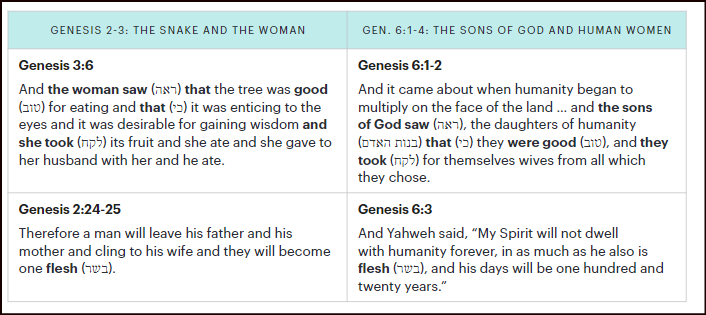
Genesis 3 :6; Genesis 2: 24-25; Genesis 6 :1-2; Genesis 6 :3 connection:
NOTES:
Heiser, Michael S.. The Unseen Realm: Recovering the Supernatural Worldview of the Bible. Lexham Press. Kindle Edition.
Genesis 3:5 the serpent (Hebrew: nachash) says to Eve: “For God (elohim) knows that on the day you both eat from it, then your eyes will be opened and you both shall be like gods (elohim), knowing good and evil.”
A CHRISTIAN WALK WITH THE TABERNACLE PRIESTS
Adam and Eve decide they want to decide they no longer want to depend on God to decide what is right and wrong, they want to decide for themselves. So they eat of the tree of the Knowledge of Good and Evil.