Genesis 6
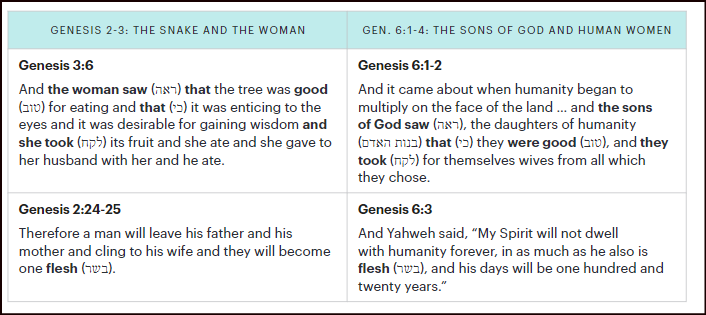
6 And it cometh to pass that mankind have begun //beginning a replay becauses they have been, but it is referring to beginning// to multiply on the face of the ground, and daughters have been born to them,
^2 ^and sons of God see the daughters of men that they [are] fair //good//, and they take to themselves women of all whom they have chosen.
Good ... Took - flashback to Genesis 3 where humans saw it was good and took. A distorted grab for wisdom. Humans influenced by spiritual being now spiritual beings influenced by humans.
the elohim are trying to turn humans into elohim too. A distorted grab of trying to restore eternal life to humans in their corrupt state. This is the origin of a theme we will see with more clarity in the story of Babylon, first named in Genesis 11.
^3 ^And Jehovah saith:
- `My Spirit //ruakh// doth not strive in man -- to the age;
- in their erring they [are] flesh:'
- and his //child of human/spiritual beings// days have been an hundred and twenty years.
- `My Spirit //ruakh// doth not strive in man -- to the age;
Two thoughts:
* 120 puts a cap on human life. However, but many people go on to live more than 120 years.
* Setting of the clock: Number of years before the flood. Dead Sea Scrolls took this to be just that. Comes about because of the warrior giants - Gibboreem. In other words, mankind is given 120 years to repent and if they do not, the world will experience the consequence.
God is here saying that these illicit unions will not generate eternal life but will end in the same fate as the foolish humans in Genesis 3 :22-24
^4 ^The fallen ones //Nephilim gibborim giants//
- were in the earth in those days,
- and even afterwards
- when sons of God come in unto daughters of men, and they have borne to them --
- they [are] the heroes, who, from of old, [are] the men of name.
All older texts say the Sons of God ere what we now call Angels. Not Sethites and Caininites. That thought only came more recently.. Sethites were supposed to be good people - they would not have kidnapped and took others by force. BibleFacts.Org
^5 ^And Jehovah seeth that abundant [is] the wickedness of man in the earth, and every imagination of the thoughts of his heart only evil all the day;
^6 ^and Jehovah repenteth that He hath made man in the earth, and He grieveth Himself -- unto His heart.
^7 ^And Jehovah saith, `I wipe away man whom I have prepared from off the face of the ground, from man unto beast, unto creeping thing, and unto fowl of the heavens, for I have repented that I have made them.'
Not just man, beast, creeping thing, and birds - everything in the waters above and below the expanse from Genesis 1
^8 ^And Noah found grace in the eyes of Jehovah.
^9 ^These [are] births of Noah: Noah [is] a righteous man; perfect //blameless// he hath been among his generations; with God hath Noah walked habitually.
^10 ^And Noah begetteth three sons, Shem, Ham, and Japheth.
^11 ^And the earth is corrupt before God,
and the earth is filled [with] violence.
And God seeth the earth,
and lo, it hath been corrupted,
for all flesh hath corrupted its way on the earth.
And God said to Noah //Noakh//,
`An end //Qets// of all flesh hath come before Me,
for the earth hath been full of violence
from their presence;
and lo, I am destroying them
with the earth.
The end ties back to the outcry Tsa’aq of Cains blood. It is a blood soaked land that needs to be purified and washed. God will de-create in order to create.
God is going to accelerate what humans have already begun. The outcry is so massive - he has to do something. It can also be tied to the outcry of Christ on the cross, his blood, and the destruction of Jerusalem.
"The verse suggests that God has seen where the ruination of creation is headed and has decided to accelerate the process to its completion ... the plain sense of the Hebrew text conveys something very different from most English translations, which are perhaps by the view of an angry, punitive deity ... The flood was an ancient symbol of destruction and disorder, as so is a fitting medium for the dissolution of creation as it overwhelms every boundary and returns creation to the primordial undifferentiated 'deep' that existed before Yahweh spoke boundaries into being ... We are left with the sense that God is not so much sending the flood to punish the world as much as facilitating, through the flood, the inevitable descent into chaos caused by human destructiveness and violence. God ruins an already ruined creation, and in so doing creates conditions for a reordering and a renewal to take place." Daniel Hawk
Enoch 1-16 The Fallen angels
^14 `Make for thyself an ark
of gopher-wood;
rooms //reeds not rooms// dost thou make with the ark,
and thou hast covered it within and without with cypress //pitch same word as atonment//;
Garden boat - made of trees/wood, and all the animals from Genesis 1 listed in Genesis 7, food is supplied, a place above the waters. The same word is used for what Moses is put into in order to be saved.
and this [is] that which thou dost with it:
three hundred cubits [is] the length of the ark,
fifty cubits its breadth,
and thirty cubits its height;
a window dost thou make for the ark,
and unto a cubit thou dost restrain it from above;
and the opening of the ark thou dost put in its side,
-- lower,
second,
and third [stories] dost thou make it.
^17 `And I, lo, I am bringing in the deluge of waters on the earth to destroy all flesh, in which [is] a living spirit //ruakh//, from under the heavens; all that [is] in the earth doth expire.
Flashback to Genesis 2 Nishmat because of the image of heaven and earth. Pairing Ruakh with Nishmat.
^18 `And I have established My covenant with thee, and thou hast come in unto the ark, thou, and thy sons, and thy wife, and thy son's wives with thee;
^19 ^and of all that liveth, of all flesh, two of every [sort] thou dost bring in unto the ark, to keep alive with thee; male and female are they.
^20 ^Of the fowl after its kind, and of the cattle after their kind, of every creeping thing of the ground after its kind, two of every [sort] they come in unto thee, to keep alive.
^21 `And thou, take to thyself of all food that is eaten; and thou hast gathered unto thyself, and it hath been to thee and to them for food.'
^22 ^And Noah doth according to all that God hath commanded him; so hath he done.
“The meaning of the flood is what the author is working really hard in the narrative to communicate. The meaning is about God asserting his cosmic authority to hand creation over to its own self-destruction. And it’s the inversion of God’s creative authority to sustain creation. It’s a statement and God’s sovereignty as the creator. - Tim Mackie session-22-noahs-ark-flood-debate
Resources
Bible Project: handouts
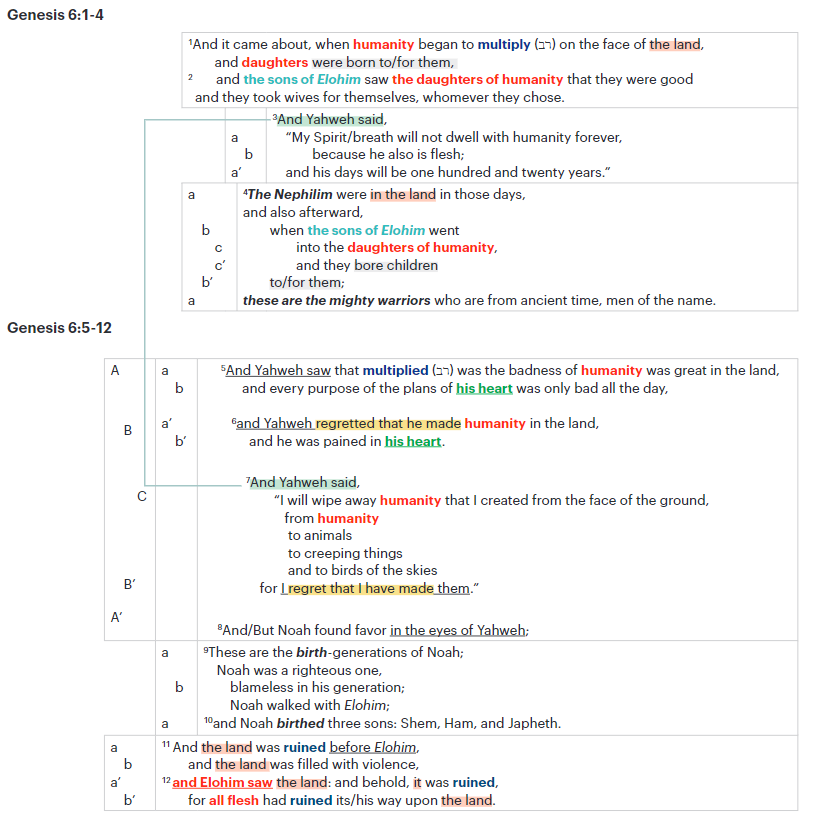
Genesis 3 :6; Genesis 2: 24-25; Genesis 6 :1-2; Genesis 6 :3 connection:
NOTES:
Heiser, Michael S.. The Unseen Realm: Recovering the Supernatural Worldview of the Bible. Lexham Press. Kindle Edition.
These elements come from Jewish literature written between our Old and New Testaments (the “Second Temple” period) that retell the Genesis 6 episode. The most famous of these is 1 Enoch. That book informed the thinking of Peter and Jude; it was part of their intellectual worldview.14 The inspired New Testament writers were perfectly comfortable referencing content found in 1 Enoch and other Jewish books to articulate their theology.15
The parallels to Genesis 6:1–4 are impossible to miss. The “two-thirds divine” description is especially noteworthy, since it precisely matches the description of the Mesopotamian hero Gilgamesh.
Ken Johnson BibleFacts.Org
Palestinian Targum - 6:4 In those days ... and after that
- Schamchazai and Uzziel, who fell from heaven, were on the earth in those days; and also, afer the sons of the Great had gone in with the daughters of men, they bare to them: and these are they who are called men who are of the world, men of names.
- Uzziel/Azazel came down to earth and started doing genetic engineering. They stayed away from people. Scapegoat ritual comes from the things that Azazel did.
- Schamchazai - took two hundred angesl and descended on Mt. Hermon.
- Schamchazai and Uzziel, who fell from heaven, were on the earth in those days; and also, afer the sons of the Great had gone in with the daughters of men, they bare to them: and these are they who are called men who are of the world, men of names.
All were destroyed in the flood. After the flood, one of the sons of Cainan and found written records and learns how to create Nephalim. Anak and Goliath come from this line.