Outer Courts Veil
- The Gate of the Court: Entering the Christian Walk (Exodus 27:16, John 10:9)
- Tabernacle Context: The outer court gate, a curtain of blue, purple, scarlet, and fine linen, was the entry point for anyone seeking God through sacrifice (Exodus 27:16). It was open to all Israelites who approached with an offering.
- In Jewish Rabbinical traditions, 'The Way' refers to the entrance to the outer courts. In the outer courts we find the Bronze Altar where sacrifices are offered in atonement of their transgressions and the Bronze Laver or Basin where the Priest washed before entering into the Set-Apart Place, better known to the Christian world as The Holy Place.
- In Christian traditions, 'The Way' refers to Jesus the only way, he provided a way for atonement and redemption by offering himself as a sacrifice to die for the transgressions. Through the blood of Jesus, the Anointed One/Christ, we are given a way back to God.
- In John 14, we see Jesus say he is going to the Father and "You know the way to the place where I am going." And then Thomas ask Jesus, "How can we know the way?" Jesus replies, "I am the way, the truth, and the life! No one comes to the Father except through me. If you have come to Me, you will know My father also. From now on, you do know Him and have seen him." Jesus is speaking to mostly Jewish people here. What do you think they thought of as soon as Jesus said, 'The Way?' Which tradition do you think would best fit their initial thoughts?
- Jesus’ Work: Jesus said, “I am the door. If anyone enters by me, he will be saved and will go in and out and find pasture” (John 10:9). His death provides the entry point to salvation (Romans 5:1-2, “We have peace with God through our Lord Jesus Christ… we have obtained access by faith into this grace”).
- Christian Walk: This correlates to the beginning of the Christian life—accepting Jesus as Savior. Entering through the “gate” is the act of faith, repentance, and baptism into Christ (Acts 2:38). It’s where the journey starts, as believers pass from separation into relationship with God, trusting in Jesus’ sacrifice (Ephesians 2:8-9).
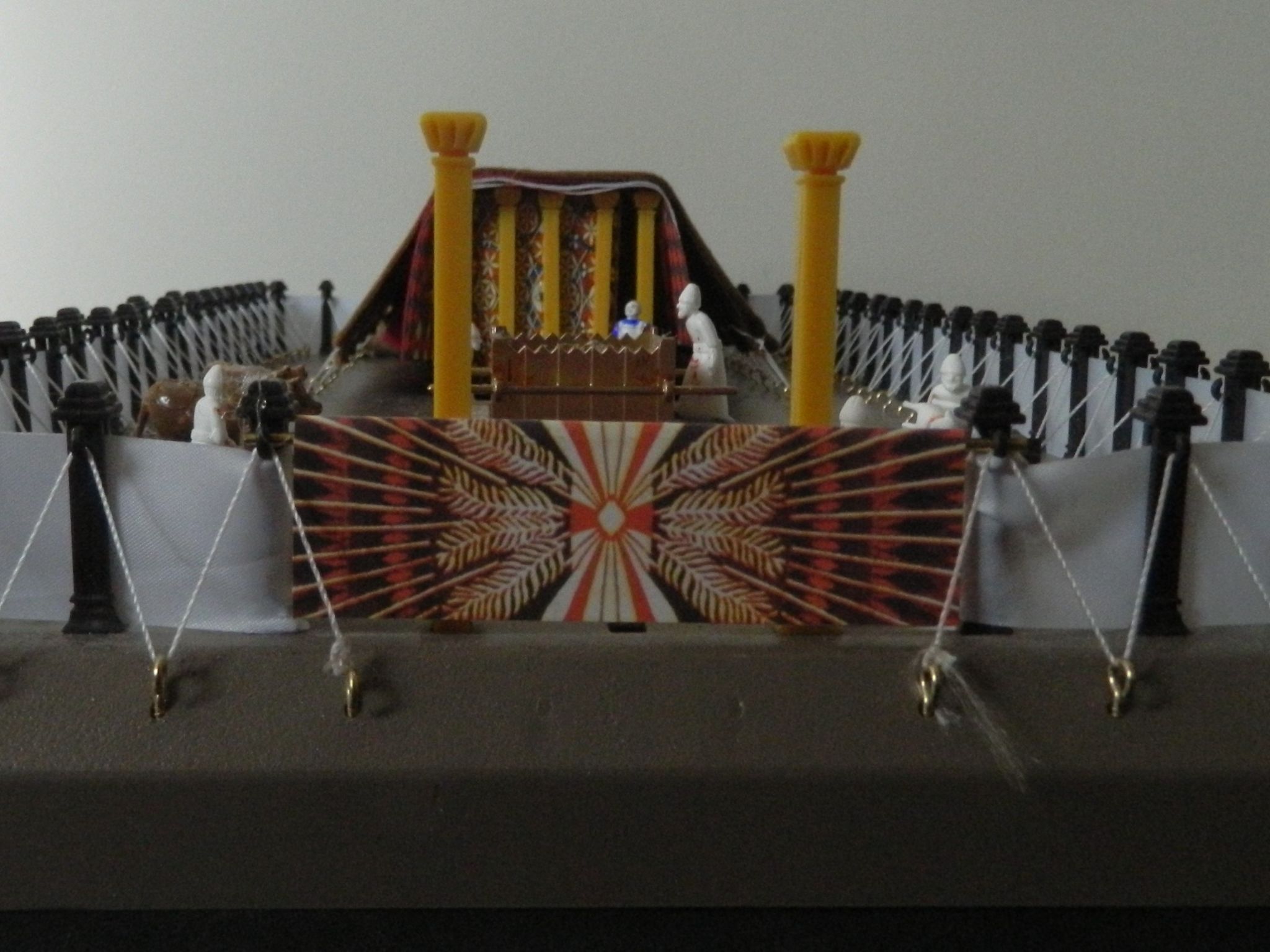
The following passages from the Bible (KJV translation for consistency) describe the hangings or screen at the entrance to the outer court of the Tabernacle, which is the closest equivalent to a "veil" in that context:
- Exodus 27:9-18
Description: Details the construction of the outer court's hangings and the gate's screen.
Relevant Verses:
- Exodus 27:9: "And thou shalt make the court of the tabernacle: for the south side southward there shall be hangings for the court of fine twined linen of an hundred cubits long for one side."
- Exodus 27:16: "And for the gate of the court shall be an hanging of twenty cubits, of blue, and purple, and scarlet, and fine twined linen, wrought with needlework: and their pillars shall be four, and their sockets four."
Context: The "hanging" (Hebrew masak, often translated as screen or curtain) at the gate of the outer court is described. This is not called a "veil" (paroket), but it serves as the entryway covering for the outer court, distinguishing it from the inner veil.
- Exodus 38:9-18
Description: Describes the actual construction of the outer court's hangings and gate screen, mirroring the instructions in Exodus 27.
Relevant Verse:
- Exodus 38:18: "And the hanging for the gate of the court was needlework, of blue, and purple, and scarlet, and fine twined linen: and twenty cubits was the length, and the height in the breadth was five cubits, answerable to the hangings of the court."
Context: This confirms the construction of the outer court’s gate screen (masak), made of similar materials (blue, purple, scarlet, fine linen) as the inner veil but distinct in function and location.
- Exodus 40:8, 28, 33
Description: Describes the setup of the Tabernacle, including the outer court and its gate.
Relevant Verses:
- Exodus 40:8: "And thou shalt set up the court round about, and hang up the hanging at the court gate."
- Exodus 40:28: "And he set up the hanging at the door of the tabernacle." (Note: This likely refers to the screen at the entrance to the Holy Place, not the court, but included for clarity.)
- Exodus 40:33: "And he reared up the court round about the tabernacle and the altar, and set up the hanging of the court gate. So Moses finished the work."
Context: These verses mention the "hanging" (masak) at the court gate, reinforcing its role as the outer court’s entry covering.
- Numbers 3:25-26
Description: Assigns duties to the Gershonites, including care for the outer court’s hangings and gate screen.
Relevant Verse:
- Numbers 3:26: "And the hangings of the court, and the curtain for the door of the court, which is by the tabernacle, and by the altar round about, and the cords of it for all the service thereof."
Context: The "curtain for the door of the court" (masak) refers to the screen at the outer court’s gate, again distinguishing it from the inner veil.
- Numbers 4:25-26
Description: Further details the Gershonites’ responsibility for transporting the outer court’s hangings and gate screen.
Relevant Verse:
- Numbers 4:26: "And the hangings of the court, and the hanging for the door of the gate of the court, which is by the tabernacle and by the altar round about, and their cords, and all the instruments of their service, and all that is made for them: so shall they serve."
Context: This repeats the reference to the outer court’s gate screen (masak), emphasizing its distinct role.
Clarifications and Notes
- Terminology: The Hebrew word paroket is used for the inner veil separating the Holy of Holies (e.g., Exodus 26:31-33), while masak is used for the screen or hanging at the outer court’s gate and the entrance to the Holy Place. The outer court’s "veil" is more accurately a "screen" or "hanging," not a veil in the sense of the Holy of Holies.
- No Inner Veil in Outer Court: The Bible does not describe a paroket-style veil in the outer court. The outer court was enclosed by linen hangings (Exodus 27:9) and had a decorative screen at the gate (Exodus 27:16).
- Exclusion of Inner Veil Passages: Scriptures like Exodus 26:31-33, Leviticus 16:2, or Hebrews 9:3 (New Testament) refer to the inner veil (paroket) of the Holy of Holies, not the outer court, and are thus excluded.
- Temple Context: The Solomon’s Temple and later temples (e.g., Ezekiel’s vision in Ezekiel 40-42) have less detail about the outer court’s entrance. The focus remains on the Tabernacle in Exodus and Numbers for outer court descriptions.
In the New Testament, there are no direct references to a "veil" or screen specifically associated with the outer court of the Tabernacle or Temple, as described in the Old Testament (e.g., the masak or hanging at the court gate in Exodus 27:16). The New Testament rarely discusses the outer court’s structure in detail, focusing instead on the inner veil of the Temple (the paroket separating the Holy of Holies) or using the veil as a theological symbol.
The outer court of the Temple (often called the Court of the Gentiles in the Second Temple period) was an open area with limited mention of its physical barriers or entrance coverings in the New Testament. The "veil" in New Testament contexts typically refers to:
- The inner veil of the Temple (Holy of Holies), torn at Jesus’ crucifixion (e.g., Matthew 27:51).
- Symbolic veils, such as spiritual blindness (e.g., 2 Corinthians 3:14-16).
- The physical layout of the Temple courts is mentioned in passing (e.g., Jesus in the Temple courts), but the gate’s screen or hangings (like the masak in Exodus) are not explicitly described.
No New Testament passages explicitly mention a veil or screen at the outer court’s gate, but the following are the closest references to the Temple’s outer court or its boundaries, examined for any possible connection:
- Matthew 27:51; Mark 15:38; Luke 23:45
Text (KJV):
- Matthew 27:51: "And, behold, the veil of the temple was rent in twain from the top to the bottom; and the earth did quake, and the rocks rent;"
- Mark 15:38: "And the veil of the temple was rent in twain from the top to the bottom."
- Luke 23:45: "And the sun was darkened, and the veil of the temple was rent in the midst."
Context: These verses describe the tearing of the Temple’s veil at Jesus’ crucifixion. The "veil of the temple" almost certainly refers to the inner veil (paroket) separating the Holy of Holies, not the outer court’s screen or hangings. The outer court had no such veil in the Second Temple’s layout, and the dramatic tearing suggests the inner sanctuary’s barrier.
Relevance: Does not refer to the outer court’s veil; included to clarify the distinction.
- Hebrews 9:1-8
Text (KJV):
- Hebrews 9:2-3: "For there was a tabernacle made; the first, wherein was the candlestick, and the table, and the shewbread; which is called the sanctuary. And after the second veil, the tabernacle which is called the Holiest of all;"
- Hebrews 9:8: "The Holy Ghost this signifying, that the way into the holiest of all was not yet made manifest, while as the first tabernacle was yet standing:"
Context: Hebrews describes the Tabernacle’s structure, mentioning the "second veil" (the paroket to the Holy of Holies) and the "first" sanctuary (Holy Place). The outer court is implied as part of the Tabernacle’s layout but not described in detail, and no veil or screen for the outer court is mentioned.
Relevance: Does not explicitly reference the outer court’s veil or screen; focuses on inner divisions.
- Hebrews 10:19-20
Text (KJV):
- Hebrews 10:19-20: "Having therefore, brethren, boldness to enter into the holiest by the blood of Jesus, By a new and living way, which he hath consecrated for us, through the veil, that is to say, his flesh;"
Context: This passage uses the veil as a metaphor for Jesus’ flesh, symbolizing access to the Holy of Holies through His sacrifice. The veil referenced is the inner veil (paroket), not the outer court’s screen.
Relevance: Does not refer to the outer court; included for symbolic veil discussion.
- John 2:19-21
Text (KJV):
- John 2:20-21: "Then said the Jews, Forty and six years was this temple in building, and wilt thou rear it up in three days? But he spake of the temple of his body."
Context: Jesus speaks in the Temple (likely in the outer court or Court of the Gentiles, as He was teaching publicly). The passage mentions the Temple but does not describe its physical structure, including any veil or screen at the outer court’s gate.
Relevance: Indirectly references the Temple’s outer court as a setting but contains no mention of a veil or screen.
- Acts 3:11
Text (KJV):
- Acts 3:11: "And as the lame man which was healed held Peter and John, all the people ran together unto them in the porch that is called Solomon’s, greatly wondering."
Context: This occurs in Solomon’s Porch, part of the outer court of the Second Temple. The outer court is a setting, but no veil, screen, or gate covering is mentioned.
Relevance: Mentions the outer court but no veil or screen.
- Revelation 11:1-2
Text (KJV):
- Revelation 11:2: "But the court which is without the temple leave out, and measure it not; for it is given unto the Gentiles: and the holy city shall they tread under foot forty and two months."
Context: This describes a vision of the Temple, with the outer court (likely the Court of the Gentiles) distinguished from the inner sanctuary. The outer court is mentioned, but no veil, screen, or hanging at its gate is described.
Relevance: Refers to the outer court but no veil or screen is specified.
Unlike the Old Testament (e.g., Exodus 27:16, which describes the masak screen at the outer court’s gate), the New Testament does not provide architectural details about the outer court’s gate or its coverings. The Second Temple’s outer court likely had a gate with some form of barrier or curtain (as inferred from Old Testament precedent and historical context), but the Bible’s New Testament texts do not mention it.
If you were looking for symbolic or theological connections to the outer court’s veil (e.g., access to the Temple), or if you meant the inner veil, let me know, and I can explore further or adjust the focus!