The Tabernacle
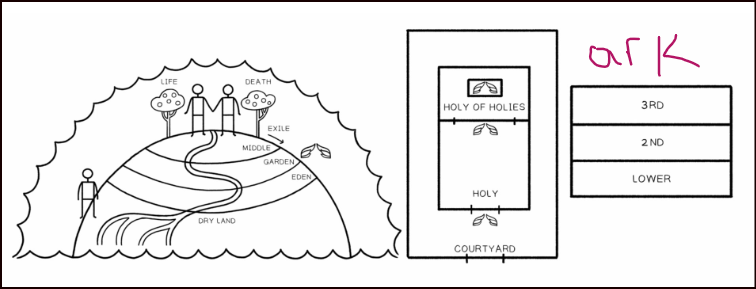
A Christian Walk with the Tabernacle Israelite Common People
Tabernacle Offerings
There were 5 types of offerings, but only two were required, the other three were voluntary.
The first of the two required was the Guilt offering. FLESH - these were committed against self and others.
The second was the Sin-Offering - Remember what God said to Cain. “And if you do not do good, towards the door is a sin offering.”
We no longer bring these offerings. Jesus has shed his blood once and for all. The laws haven’t changed, the penalty hasn’t changed, how we pay the penalty has changed.
This is what is meant by Jesus when he said he didn’t come to abolish the law, he came to fulfill the law. He came to fulfill the penalty requirements.
Guilt Offering
- The guilt offering could be brought for either an unintentional or intentional sin against man.
- Think of the laws 6-10 in God’s Witness or Ten Commandments.
- The goal of this offering was restoration. Restoring relationship with man, and restoring relationship with God.
- When the guilt offering was brought, a restitution in full was also brought to restore what was taken or lost.
- The blood was sprinkled on the altar.
- It also included a “fifth part” added to give to the priest.
- These sins are committed in the flesh against flesh.
Sin-Offering
- The Sin-Offering could only be brought for an UNINTENTIONAL sin.
- Think of the laws 1-5 in God’s Witness or Ten Commandments
- The goal of this offering was atonement and purification.
- There were different requirements based on whether the person was a common, a leader, or a priest.
- This offering was expensive, the law breaker had to bring an animal based on what they could afford and it had to be unblemished.
- When this offering was brought, the sinner had to confess the sin, put their hands on the head of the sacrifice and push down, transferring his sin onto the animal and then slaughter it.
- Once the animal was slaughter, the blood was sprinkled as directed throughout the Tabernacle.
- These sins are mainly committed against God in our spirit. There may be outward signs, but sometimes there are not.
When Jesus was asked which of the laws was the greatest, he said they all could be summed up by these two things.
Love Others as Yourself (Guilt Offering)
Love God (Sin-Offering)
If you are not sinning against yourself, others, and God, then you have no need to bring any Guilt or Sin-Offering.
Study Notes
Related items
- 1. Adam and 2. Eve about 4000 BC Genesis 1&2
- Moses about 1446 BC Exodus 36
- Ezekiel Vision in the Spirit about 593 BC Ezekiel 46. Ezekiel served in the temple before it was destroyed in 586 BC
- John Vision in the Spirit about 95 AD Revelation 21
- You can see the expanse of time here. Ezekiel and John would have both been very familiar with the layout of Moses Tabernacle.
Offerings
- There were 5 types of offerings, but only two were required, the other three were voluntary.
- The first of the two required was the Guilt offering.
- FLESH - these were committed against self and others.
- The second was the Sin-Offering- Remember what God said to Cain. “And if you do not do good, towards the door is a sin offering.”
- We no longer bring these offerings. 1. Yehoshua (Jesus) has shed his blood once and for all. The laws haven’t changed, the penalty hasn’t changed, how we pay the penalty has changed.
- This is what is meant by Jesus when he said he didn’t come to abolish the law, he came to fulfill the law. He came to fulfill the penalty requirements.*
NOTES:
Heiser, Michael S.. The Unseen Realm: Recovering the Supernatural Worldview of the Bible. Lexham Press. Kindle Edition.
The description of Yahweh “walking” is also used of God’s active presence inside Israel’s tabernacle, creating another link between Eden, the cosmic mountain, and the tabernacle sanctuary.
The idea that “walking” was language that expressed presence shouldn’t be foreign to us.