algorithm 2
rename 2 3 26
NO MERRI
from maIn 7 24
maybe disambiguation for now
move to discrimination
no merri
see hype 3 fear anger echo escalator polarization misinfo disinfo soc med facebook meta
see google
AI machine learning
see monetize
see extraction corps silicon valley monopoly max profits cancer amplify
note de-platform correction filter fail b/c of $ extraction corps
html 0.03 secs librarian-like
bak 6 22
---
see tony cox risk asses
NOAH YUVAL ALGO = EARLY AI
---
---
---
mma
Right-wing and right-leaning online show hosts, including Nick Fuentes, are getting millions of views pushing extremely racist rhetoric
After the Belfast riots, Henry Nowak murder case, and Karmelo Anthony trial, online show hosts defended, supported, and even encouraged more protests and violence, earning over 5.3 million views combined. Nick Fuentes alone earned 2.4 million views.
Written by Reed McMaster, Gideon Taaffe & Jack Wheatley
Published 07/15/26
Right-wing and right-leaning online shows and hosts earned millions of views pushing extreme rhetoric in the wake of Karmelo Anthony's trial in the U.S., the murder of Henry Nowak in Britain, and race riots in Northern Ireland following an alleged knife attack by a Sudanese immigrant.
Media Matters found that white nationalist Nick Fuentes’ online show America First earned at least 2.4 million combined views on Rumble for 3 episodes that defended people resorting to violence in the wake of these events. We also found at least 13 episodes from 11 other right-wing and right-leaning online shows from June 2 through June 11 that contained incendiary rhetoric against immigrants or people of color while discussing those events, with over 2.8 million combined views on YouTube and Rumble.
Hosts of the 11 online shows we identified range from well-known staples of conservative media like Glenn Beck to far-right commentator Stew Peters, who suggested that “all of us should be” recreating the Belfast riots. After Anthony's trial, during which the Black teenager was tried and found guilty of murdering a white peer, these online hosts echoed rhetoric usually relegated to white nationalist circles: The Daily Wire's Matt Walsh used the incident to attack the 20th century Civil Rights Movement, saying its “purpose” was “eliminating the civil rights of every white American,” while Stew Peters Network podcaster Frankie Stockes claimed, “These types of things have been happening in this country since the integration of schools.”
Recent incidents in America and Europe have sparked racist commentary from right-wing and right-leaning media, with many commentators mirroring Fuentes' extreme rhetoric
- In June, an alleged knife attack by a Sudanese man in Belfast, Northern Ireland, led anti-immigrant rioters to burn down multiple homes and vehicles, and some participants allegedly threatened people of color during the riot. WIRED noted the influence of outside agitators, specifically a white supremacist youth group that helped organize the riot.
- Violence also erupted in Southampton, England, following a trial for the December 2025 murder of a young man named Henry Nowak by a Sikh man who reportedly “lied to the police by falsely claiming that Nowak, who was white, had racially abused him.” The story ignited widespread anti-immigrant protests as news broke that the assailant in Nowak’s murder was convicted on May 28 and police bodycam footage was released that, according to the BBC, showed “Nowak being handcuffed as he lay dying.”
- In the U.S., a Black teenager named Karmelo Anthony was convicted on June 9 of stabbing and killing a white teen, Austin Metcalf, at an April 2025 track meet. The trial became a cultural flash point — as Forbes reported, “some claimed the response to the facts of the case would have been different if the races were reversed; others lamented that Anthony’s fate was decided by [a] jury that included no Black people.” During the trial, Jake Lang, who Forbes described as a “right-wing provocateur,” appeared at the courthouse and reportedly shouted that Anthony should be “lynched.”
- Many popular figures within the right-wing and right-leaning podcasting world responded to news coverage of these three cases with extreme racist rhetoric, often mirroring the kind of language used by white nationalists like Nick Fuentes.
- Since 2025, Fuentes — who last year was named Media Matters’ Misinformer of the Year — has been making the rounds on numerous online shows, getting millions of views, and sparking debate about whether the conservative movement should embrace him and his positions. At the same time, right-wing and right-leaning media personalities have also been echoing language and ideas from white nationalists — for example, by endorsing the concept of remigration, a form of ethnic cleansing that reflects exactly the kind of harsh anti-immigrant ideas Fuentes espouses.
- As Media Matters’ John Whitehouse wrote last year, the fact that there’s even a debate regarding whether the conservative movement should embrace Fuentes can be attributed to “the right's continued embrace of extremism as the fractured MAGA coalition jockeys for power in a second Trump term and beyond.”
Right-wing and right-leaning online shows pushing extreme rhetoric over these events earned over 5.3 million views across YouTube and Rumble
- Media Matters reviewed transcripts of episodes from right-wing and right-leaning online shows and found at least 16 episodes from 12 programs that were published between June 2 and June 11 and pushed extreme anti-immigrant, racist, and anti-civil rights rhetoric while discussing the Karmelo Anthony trial in the U.S., Henry Nowak’s murder in the U.K., and the Belfast riots. These episodes earned over 5.3 million views combined on YouTube and Rumble.
- Three of these episodes came from Nick Fuentes’ America First, with these episodes earning at least 2.4 million views combined on Rumble, or roughly 825,000 average views per episode. The other 13 episodes earned at least 2.8 million views combined, with over 1.3 million views earned on YouTube and nearly 1.5 million on Rumble. These episodes garnered roughly 218,000 average views.
- While Fuentes’ three episodes earned the most views on Rumble, The Daily Wire's The Matt Walsh Show garnered the most on YouTube, with at least 766,000 views over two episodes.
Right-wing and right-leaning podcasters defended the riots in Belfast, with some suggesting they should spread to other countries
- Nick Fuentes: “It is refreshing to see white people riot. I do love to see it actually because you know what, it is our fucking turn.” He continued, “Clearly, that's the only way anything gets done. That's just how we do things. That is just how we do things. Now that society has become open warfare between tribes, this is clearly just how we resolve disputes and differences. Muslim thugs, African thugs, Black thugs, gangsters and gangbangers from every group, this is how they get their way. Violence, intimidations, tribalism, rioting — that is how they get their way. That is how they push white people around. That’s how they push government around.” [Rumble, America First, 6/10/26]
- Podcaster Benny Johnson said “Belfast is set completely ablaze” because a “70 IQ or less Third World invader from Sudan” was “brought there from Paris.” Johnson added, “We, the civilized taxpayers who uphold society and whose ancestors built society and who play by the rule, we're tired of being preyed on, raped, murdered, pillaged. We're sick of it.” Johnson continued, “Belfast is set completely ablaze. Why? Well, because a 70 IQ or less Third World invader from Sudan, who should have never been in Belfast — couldn't have built a plane, couldn't have built a train, couldn't have built a boat to get to Belfast — was brought there from Paris.” [YouTube, The Benny Show, 6/10/26]
- War Room host and former Trump administration official Steve Bannon reacted to the riots in Belfast, saying, “Hopefully it gets channeled into positive nationalism,” adding, “You got to throw down at first, because they don't listen until you throw down hard.” Referencing Nowak’s murder as well, right-wing influencer Jack Posobiec responded, “You saw people — we were talking about this before — how it's uniting all of Europe, how the old tribalisms of Europe have now kind of been broken down because there's a new situation going on. The migrant invasion of 2015 is now finally being responded to. And you've got people in Eastern Europe, Northern Europe, Southern Europe, England, Western Europe, all over, rising up and saying enough is enough.” [Real America’s Voice, War Room, 6/9/26]
- Podcaster Steven Crowder on the Belfast riots: “I think there's a turning point in the Western world, and everyone is seeing it right now.” Crowder said, “Even though I don't support political violence, indiscriminately, at all, whatsoever, people in Belfast breaking windows in the public housing for asylum-seekers that they pay for — I understand it.” He also commented on Anthony's verdict, claiming people have “Black fatigue, I get it.” [Rumble, Louder with Crowder, 6/10/26]
- Host Glenn Beck said the probable cause of the attack which inspired the Belfast riots was “the cultural clash rooted in Islamic patterns of violence that have no place in Western society.” He also said, “Enough is enough. People are rising up because the elites ignored them for too long.” He later continued, “You know, towns just didn't slide into Third World violence by accident. It happened when leaders prioritized open borders and brought the Third World in.” [YouTube, The Glenn Beck Program, 6/10/26]
- Podcaster Dave Rubin reacted to the Belfast riots saying, “If you import people, for whatever reason, who do not have approximately the same views as you, who are willing to do unimaginably evil things on their religious or cultural conquest, or anything else, then your society will die.” He continued, “We have so much empathy for these brown people who, you know, they just — they're just different from us and OK, they rape, OK, they behead, but let's just invite them into our country and see what happens. And that is how you will get the collapse of the West. Quite literally.” [YouTube, The Rubin Report, 6/10/26]
- After guest Anthony Pompliano said he thought the Belfast riots were “something where you’re going to see other people in other countries get inspired by it,” PBD Podcast host Patrick Bet-David responded, “Hopefully, hopefully.” Pompliano said, “This is something that is much more systemic. And, again, it goes back to — there's an economic reason that we got to this point. But now when you get this type of response, I think that this is something where you're going to see other people in other countries get inspired by it.” Bet-David replied, “Hopefully, hopefully.” [Valuetainment, PBD Podcast, 6/10/26]
- Far-right commentator Stew Peters — who has promoted white nationalism and antisemitism, including on his show — argued that “all of us should be” recreating the Belfast riots. Peters stated, “Until just recently, Scotland had a Muslim invader as their first minister, the equivalent of their head of state. Just think of that. The country where King Robert the Bruce, upon his death, ordered his men to cut his heart out of his body and take it with them around the world to fight the enemies of Christianity. That place was conquered by Jews and had a Muslim installed as its head of state. Really, the people of Scotland should have been out in their streets doing exactly what they're doing in Northern Ireland right now a long time ago. All of us should be.” [Stew Peters Network, The Stew Peters Show, 6/10/26; Southern Poverty Law Center, accessed on 6/25/26; Media Matters, 3/13/23]
Reacting to the trials for the killings of Metcalf and Nowak, right-wing and right-leaning online hosts attacked the Civil Rights Movement, promoted violence, and fearmongered about the death of “Western civilization"
- Nick Fuentes claimed, “What we find emerging is a pattern where it is always — the interracial violence is always — nonwhite people killing white people,” adding later, “They're crossing over into our communities and killing our own people.” He continued, “They're migrating to our countries and turning our countries into war zones, centers of conflict. And again, throughout history, these things happen too. Tribal conflict happens. Sometimes the barbarians breach the perimeter and get inside the city gates. ... When this happens, it is incumbent on a people, and in particular its government, to get together and protect the sovereignty and safety and the well-being ... of our society.” [Rumble, America First, 6/9/26]
- Fuentes celebrated violence against minorities, saying, “I actually do love to see … some white men show up and just start beating the shit out of these people.” He then added, “Sadly, you can't even do that because that would be the solution. It would be.” [Rumble, America First, 6/10/26]
- Fuentes argued Western civilization is “going to die” unless white people fight back in the face of Nowak's murder. He said, “This is the state of the Western white world. And the future without white civilization is ugly. It's ugly and it's bleak and it's poor and it is primitive and it is sad. And ultimately, unless white people are willing to fight for a place in this world where we are not being stabbed to death, where police are not arresting us for being stabbed, unless white people are willing to take a stand and fight for space, fight to take up space, fight for power as whites, not just incidentally holding power and being white, but holding power as whites, then we are going to die and our civilization will be wiped out.” [Rumble, America First, 6/2/26]
- Benny Johnson called Nowak’s story a “massive red-flashing warning sign” about “how pernicious and evil our current leaders are in the West, how much they seek the destruction of everything Western, good, and Christian.” He continued, “They seek the destruction of our culture, and it's permissible, and they're using the authorities to do it. Whether that's locking us down during COVID, burning our cities during the George Floyd riots, or letting Henry Nowak bleed out. It is those institutions that must be ripped up. They were founded well before any of us were born. They were founded in post-World War II, modernist thinking, nihilistic thinking. They're antithetical to God and creation and a harmonious culture that was established by our founding.” [YouTube, The Benny Show, 6/2/26]
- The Daily Wire's Matt Walsh reacted to the Anthony trial by claiming that the civil rights era “achieved in the rest of the Western world” the “purpose” of “eliminating the civil rights of every white American.” He said, “Ever since the civil rights era, our leaders have conditioned millions of white Americans to accept their debasement, humiliation, and discrimination on the basis of race. And once white victims are held responsible for their own murders, on top of all that, then the civil rights era will have achieved its ultimate purpose. The purpose that's already been achieved in the rest of the Western world — eliminating the civil rights of every white American.” [The Daily Wire, The Matt Walsh Show, 6/2/26]
- Walsh called for British men to “transform their entire society and their entire legal system to avenge Henry Nowak.” He said, “And if British men responded to this murder with one-tenth of the intensity that leftists used in response to George Floyd's overdose, the problem will be solved overnight. So, when does that happen? When are the riots starting? When will British men transform their entire society and their entire legal system to avenge Henry Nowak? And it doesn't even need to be riots because rioting is not the answer to anything. But actual anger and real systemic change in the country.” [The Daily Wire, The Matt Walsh Show, 6/2/26]
- Referencing Nowak's murder and protests outside a New Jersey immigration detention center, Turning Point USA's Andrew Kolvet said: “You have Henry Nowak in the U.K. All of these forces, they feel like civilizational-defining forces that are clashing and colliding all the time. And the question I sort of have right now is, do we have the coalition that can save the West?” Kolvet added, “The forces arrayed against us are so vast and so demonic that we need to stick together.” [Real America’s Voice, The Charlie Kirk Show, 6/3/26; PBS, 6/6/26]
- Frankie Stockes of the Stew Peters Network reacted to the Anthony verdict by asserting that “the social contract is white” and “these types of things have been happening in this country since the integration of schools.” He went on to add: “You still have idiot adults out here who will continue to tell their children after seeing this and cases just like it, Everyone else is just like you, everyone else is playing by the same set of rules that you are, everyone else has the same morals that you do. … Little Tyrone, little Raphael, little Abdul, little Ari, little Avi, they’re not so different than you, little Bobby. Yeah they are.” [Stew Peters Network, The Based Report, 6/10/26]
- Media Matters is maintaining a database of online shows with a right-leaning or left-leaning ideological bent, including those that self-categorize in nonpolitical categories such as comedy, sports, and culture but which we determined regularly cover news and politics. This report draws upon that ongoing research in categorizing the online shows mentioned.
//
Right-wing media are split on white nationalist Nick Fuentes
- 06/17/26 10:15 AM EDT
Megyn Kelly reacts to Supreme Court TPS decision: “Go back to fucking Haiti”
- 06/25/26 1:52 PM EDT
Jesse Watters on New York elections: “This is what happens when you import the third world”
- 06/24/2
---
AN
Study confirms what many suspected: the 2024 election was rigged
U.S. President Donald Trump places a hand over his heart during a Veterans Day ceremony at Arlington National Cemetery in Arlington, Virginia, U.S., November 11, 2025. REUTERS/Kevin Lamarque
:{Thom HartmannJuly 10, 2026
It sure looks like tech billionaires and foreign dictatorships gave us Trump in 2024. This is as bad as the massive Russian bot presence on Facebook and Twitter back in 2016, which Robert Mueller documented gave Trump the presidency that time.
A peer-reviewed study released Thursday in Nature, the world’s most prestigious scientific journal, has finally put hard numbers to what a lot of us suspected the moment the 2024 election was called for Trump (and Republicans in Congress) by the big networks: the algorithms that control our largest social media platforms intentionally and explicitly tilted the playing field, and they tilted it for Donald Trump and the GOP.
Researchers at New York University Abu Dhabi created hundreds of “sock puppet” TikTok accounts in New York, Texas, and Georgia (via VPN), uploaded to them either pro-Democratic or pro-Republican videos to show their political leanings, and then watched what TikTok’s algorithm fed back to them every day over the 27 weeks leading up to Election Day.
Across more than 280,000 recommendations, Republican-seeded accounts received about 11.5 percent more “party-aligned content” than their Democratic counterparts, while the pro-Democratic accounts were force-fed 7.5 percent more attacks from the other side. As Professor Talal Rahwan put it:
“The algorithm wasn’t just giving people what they want; it was giving one side more of what the other side says about them.”
The pro-rightwing bias was even more dramatic when researchers looked at how the candidates’ own accounts did. Candidate Trump’s official TikTok videos were pushed to Democratic-leaning users 27 percent of the time, while Kamala Harris’s videos only reached Republican-leaning users just 15.3 percent of the time.
Translation: Leading up to the 2024 election, TikTok was working overtime to expose Democrats and lefties to MAGA’s most persuasive messaging, all while shielding rightwingers, independents, and Republican voters from Harris’s voice.
Making it even more astonishingly consequential, studies show that TikTok matters enormously to young people; roughly half of TikTok users under 30 say they use the app to keep up with politics and news, and that TikTok-engaged demographic shifted a mind-boggling full 10 percentage points toward Trump between 2020 and 2024 following this exposure.
Young men, for example, flipped from voting 56 percent Biden in 2020 to 56 percent choosing Trump in 2024, the kind of swing that decides battleground states.
Even more troubling, other research shows that TikTok isn’t an outlier. It’s one piece of a much larger algorithm-run social media ecosystem, and that system is now the main way a plurality of Americans engage with politics. Pew Research, for example, found that 42 percent of US social media users consider these platforms “important” for getting involved in political and social issues, and almost none of them have any idea how the top-secret social media algorithms decide what they see.
Sometimes it’s so obvious that it’s surprising it’s not a bigger news story.
Researchers at the Queensland University of Technology found a “structural break for Musk’s metrics around July 13th, 2024,” the exact day Elon Musk endorsed Trump. Overnight, algorithm-driven view counts on Musk’s own X posts jumped 138 percent and retweets exploded 237 percent, far above what any other major account experienced.
And it wasn’t just Musk’s own posts that got the boost; other pro-MAGA, pro-white supremacy, pro-GOP right-wing accounts across X were also systematically amplified. A separate peer-reviewed field experiment published this year in Nature randomly assigned active US users to either an algorithmic or chronological X feed for seven weeks. The result — what could only be called successful brainwashing of those being fed posts by the X algorithm — was astonishing.
The scientists noted that those on the algorithmic feed shifted “towards more conservative positions, particularly regarding policy priorities, perceptions of criminal investigations into Donald Trump, and views on the war in Ukraine.”
And once people are initially convinced of a worldview, changing their mind is a huge and usually unsuccessful undertaking, which is why rightwing billionaires were so eager to fund Charlie Kirk and other programs to indoctrinate schoolkids. Switching back to a chronological feed didn’t undo the damage.
This was on top of the roughly $277 million Musk personally spent electing Trump and Republicans, $239 million of it through his America PAC, making him by a wide margin the largest individual donor of the 2024 cycle.
Then there’s Mark Zuckerberg. After spending a decade telling Congress that Meta was politically neutral, Zuckerberg watched Trump win, metaphorically dropped to his knees, and immediately killed the fact-checking systems on Facebook and Instagram that kept identifying and calling out Trump’s and Republicans’ lies and misrepresentations.
Like a loyal puppy (or a terrified rabbit), Zuck called Trump’s reelection “a cultural tipping point,” wrote a $1 million check to Trump’s inaugural slush fund, replaced his head of global policy with longtime Bush-era Republican Joel Kaplan, and then announced he was moving Meta’s trust-and-safety operation from California to Texas. Meta’s institutional pivot toward Trump and MAGA wasn’t even subtle.
YouTube — also largely owned and run by right-wing billionaires — isn’t innocent either. A UC Davis audit using 100,000 sock-puppet accounts found that right-leaning users get systematically funneled into channels pushing rightwing extremism, conspiracy theories, and hard-right “otherwise problematic content,” while left-leaning users see nothing comparable.
A separate Brookings analysis found that YouTube’s algorithm tugs every user, regardless of where they start, “in a moderately conservative direction.”
I’ve been around digital media since the very beginning. My business partner Nigel Peacock and I were running forums on CompuServe back in the early 1980s, when “going online” meant a 300-baud modem screeching into your phone line and a connection bill that could put a small business under in a month.
The platforms were primitive, slow, and gloriously pluralistic; gatekeepers were a handful of sysops who worked with Nigel and me (CompuServe paid us) trying to keep the message boards clean and useful. Things were civil, the feed was chronological, and there was no anonymity; even political arguments were reasonable.
None of us back then imagined that one day a few billionaires would be able to flip a switch in Beijing, San Francisco, or Austin and successfully shift the political mood of an entire continent overnight. But that’s exactly where we are today, and it appears to have been the tipping point that brought us Trump and all the horrors that accompanied him.
The closest historical parallel is the era of William Randolph Hearst and the Yellow Press at the turn of the 20th century. Hearst’s chain of newspapers reached more readers than any information outlet in human history up to that point, and when he decided it would be in his interest for America to have a war with Spain in 1898, he largely manufactured one with wild, sensationalist coverage of an explosion in the boiler room of the USS Maine in Havana harbor, casting it as an attack against America.
He’s said to have cabled his illustrator in Cuba, “You furnish the pictures, and I’ll furnish the war.” And, sure enough, within just a few months, America was at war.
The difference between Hearst and the men running today’s platforms isn’t moral; it’s mechanical. Hearst had to print on physical paper and ship it on physical trains. Musk, Zuckerberg, and the executives at TikTok and Google/YouTube can rewrite the political information environment in which hundreds of millions of people are marinating in real time, with no editor, no copy desk, and — unless things change — exactly zero public accountability.
So what do we do about these men effortlessly swinging our elections invisibly and without spending a penny of their own money? Three things are at the top of the list that Democrats in Congress and Democratic candidates need to make priorities.
First, Congress needs to require algorithmic transparency, as I suggested in The Hidden History of Big Brother in America. Senators Markey and Blumenthal have introduced excellent bills demanding that platforms disclose how their recommendation systems weight political content and forcing them to submit to fully independent audits. Given the political power these platforms and their billionaire owners command and how they’ll fight to hang onto it, none of these types of bills will pass without sustained public pressure.
Second, we need to repeal or substantially reform Section 230 of the Communications Decency Act so that algorithm-driven platforms are treated legally like the publishers they are, rather than like the telephone wires they used to travel over.
Third, the Justice Department’s antitrust division needs to be unleashed against the handful of companies that now control the political conversation in America. Standard Oil was broken up in 1911. AT&T was broken up in 1984. There is nothing about Meta, X, or Google that makes them more sacred that these behemoths that preceded them.
Call your senators today through the Capitol switchboard at (202) 224-3121 and tell them you want algorithmic transparency legislation and Section 230 reform. Make sure your voter registration is current at vote.org, check on your state-level legislators at openstates.org, and start telling everyone you know that science has now proven that the 2024 election wasn’t a free and fair contest of ideas.
It was — based on this new research — a rigged information environment run by a handful of billionaires that put a corrupt, predatory fellow billionaire in the White House and helped install billionaire-friendly Republican lickspittles in Congress and state houses across the country.
We can fix this mess. But only if we stop scrolling and start demanding change.
---
---
AN
NO LNX
Science just proved what we all suspected: the 2024 election was rigged
Thom Hartmann May 09, 2026
It sure looks like tech billionaires and foreign dictatorships gave us Trump in 2024. This is as bad as the massive Russian bot presence on Facebook and Twitter back in 2016, which Robert Mueller documented gave Trump the presidency that time.
A peer-reviewed study released Thursday in Nature, the world’s most prestigious scientific journal, has finally put hard numbers to what a lot of us suspected the moment the 2024 election was called for Trump (and Republicans in Congress) by the big networks: the algorithms that control our largest social media platforms intentionally and explicitly tilted the playing field, and they tilted it for Donald Trump and the GOP.
Researchers at New York University Abu Dhabi created hundreds of “sock puppet” TikTok accounts in New York, Texas, and Georgia (via VPN), uploaded to them either pro-Democratic or pro-Republican videos to show their political leanings, and then watched what TikTok’s algorithm fed back to them every day over the 27 weeks leading up to Election Day.
Across more than 280,000 recommendations, Republican-seeded accounts received about 11.5 percent more “party-aligned content” than their Democratic counterparts, while the pro-Democratic accounts were force-fed 7.5 percent more attacks from the other side. As Professor Talal Rahwan put it:
“The algorithm wasn’t just giving people what they want; it was giving one side more of what the other side says about them.”
The pro-rightwing bias was even more dramatic when researchers looked at how the candidates’ own accounts did. Candidate Trump’s official TikTok videos were pushed to Democratic-leaning users 27 percent of the time, while Kamala Harris’s videos only reached Republican-leaning users just 15.3 percent of the time.
Translation: Leading up to the 2024 election, TikTok was working overtime to expose Democrats and lefties to MAGA’s most persuasive messaging, all while shielding rightwingers, independents, and Republican voters from Harris’s voice.
Making it even more astonishingly consequential, studies show that TikTok matters enormously to young people; roughly half of TikTok users under 30 say they use the app to keep up with politics and news, and that TikTok-engaged demographic shifted a mind-boggling full 10 percentage points toward Trump between 2020 and 2024 following this exposure.
Young men, for example, flipped from voting 56 percent Biden in 2020 to 56 percent choosing Trump in 2024, the kind of swing that decides battleground states.
Even more troubling, other research shows that TikTok isn’t an outlier. It’s one piece of a much larger algorithm-run social media ecosystem, and that system is now the main way a plurality of Americans engage with politics. Pew Research, for example, found that 42 percent of US social media users consider these platforms “important” for getting involved in political and social issues, and almost none of them have any idea how the top-secret social media algorithms decide what they see.
Sometimes it’s so obvious that it’s surprising it’s not a bigger news story.
Researchers at the Queensland University of Technology found a “structural break for Musk’s metrics around July 13th, 2024,” the exact day Elon Musk endorsed Trump. Overnight, algorithm-driven view counts on Musk’s own X posts jumped 138 percent and retweets exploded 237 percent, far above what any other major account experienced.
And it wasn’t just Musk’s own posts that got the boost; other pro-MAGA, pro-white supremacy, pro-GOP right-wing accounts across X were also systematically amplified. A separate peer-reviewed field experiment published this year in Nature randomly assigned active US users to either an algorithmic or chronological X feed for seven weeks. The result — what could only be called successful brainwashing of those being fed posts by the X algorithm — was astonishing.
The scientists noted that those on the algorithmic feed shifted “towards more conservative positions, particularly regarding policy priorities, perceptions of criminal investigations into Donald Trump, and views on the war in Ukraine.”
And once people are initially convinced of a worldview, changing their mind is a huge and usually unsuccessful undertaking, which is why rightwing billionaires were so eager to fund Charlie Kirk and other programs to indoctrinate schoolkids. Switching back to a chronological feed didn’t undo the damage.
This was on top of the roughly $277 million Musk personally spent electing Trump and Republicans, $239 million of it through his America PAC, making him by a wide margin the largest individual donor of the 2024 cycle.
Then there’s Mark Zuckerberg. After spending a decade telling Congress that Meta was politically neutral, Zuckerberg watched Trump win, metaphorically dropped to his knees, and immediately killed the fact-checking systems on Facebook and Instagram that kept identifying and calling out Trump’s and Republicans’ lies and misrepresentations.
Like a loyal puppy (or a terrified rabbit), Zuck called Trump’s reelection “a cultural tipping point,” wrote a $1 million check to Trump’s inaugural slush fund, replaced his head of global policy with longtime Bush-era Republican Joel Kaplan, and then announced he was moving Meta’s trust-and-safety operation from California to Texas. Meta’s institutional pivot toward Trump and MAGA wasn’t even subtle.
YouTube — also largely owned and run by right-wing billionaires — isn’t innocent either. A UC Davis audit using 100,000 sock-puppet accounts found that right-leaning users get systematically funneled into channels pushing rightwing extremism, conspiracy theories, and hard-right “otherwise problematic content,” while left-leaning users see nothing comparable.
A separate Brookings analysis found that YouTube’s algorithm tugs every user, regardless of where they start, “in a moderately conservative direction.”
I’ve been around digital media since the very beginning. My business partner Nigel Peacock and I were running forums on CompuServe back in the early 1980s, when “going online” meant a 300-baud modem screeching into your phone line and a connection bill that could put a small business under in a month.
The platforms were primitive, slow, and gloriously pluralistic; gatekeepers were a handful of sysops who worked with Nigel and me (CompuServe paid us) trying to keep the message boards clean and useful. Things were civil, the feed was chronological, and there was no anonymity; even political arguments were reasonable.
None of us back then imagined that one day a few billionaires would be able to flip a switch in Beijing, San Francisco, or Austin and successfully shift the political mood of an entire continent overnight. But that’s exactly where we are today, and it appears to have been the tipping point that brought us Trump and all the horrors that accompanied him.
The closest historical parallel is the era of William Randolph Hearst and the Yellow Press at the turn of the 20th century. Hearst’s chain of newspapers reached more readers than any information outlet in human history up to that point, and when he decided it would be in his interest for America to have a war with Spain in 1898, he largely manufactured one with wild, sensationalist coverage of an explosion in the boiler room of the USS Maine in Havana harbor, casting it as an attack against America.
He’s said to have cabled his illustrator in Cuba, “You furnish the pictures, and I’ll furnish the war.” And, sure enough, within just a few months, America was at war.
The difference between Hearst and the men running today’s platforms isn’t moral; it’s mechanical. Hearst had to print on physical paper and ship it on physical trains. Musk, Zuckerberg, and the executives at TikTok and Google/YouTube can rewrite the political information environment in which hundreds of millions of people are marinating in real time, with no editor, no copy desk, and — unless things change — exactly zero public accountability.
So what do we do about these men effortlessly swinging our elections invisibly and without spending a penny of their own money? Three things are at the top of the list that Democrats in Congress and Democratic candidates need to make priorities.
First, Congress needs to require algorithmic transparency, as I suggested in The Hidden History of Big Brother in America. Senators Markey and Blumenthal have introduced excellent bills demanding that platforms disclose how their recommendation systems weight political content and forcing them to submit to fully independent audits. Given the political power these platforms and their billionaire owners command and how they’ll fight to hang onto it, none of these types of bills will pass without sustained public pressure.
Second, we need to repeal or substantially reform Section 230 of the Communications Decency Act so that algorithm-driven platforms are treated legally like the publishers they are, rather than like the telephone wires they used to travel over.
Third, the Justice Department’s antitrust division needs to be unleashed against the handful of companies that now control the political conversation in America. Standard Oil was broken up in 1911. AT&T was broken up in 1984. There is nothing about Meta, X, or Google that makes them more sacred that these behemoths that preceded them.
Call your senators today through the Capitol switchboard at (202) 224-3121 and tell them you want algorithmic transparency legislation and Section 230 reform. Make sure your voter registration is current at vote.org, check on your state-level legislators at openstates.org, and start telling everyone you know that science has now proven that the 2024 election wasn’t a free and fair contest of ideas.
It was — based on this new research — a rigged information environment run by a handful of billionaires that put a corrupt, predatory fellow billionaire in the White House and helped install billionaire-friendly Republican lickspittles in Congress and state houses across the country.
We can fix this mess. But only if we stop scrolling and start demanding change.
---
---
2 26 MANY yt ON CENSORSHIP ~ KARA?
---
DUCK 5 26
- - [
 rawstory.com
Researchers expose algorithm skew that boosted Trump in 2024
2 days ago
](https://www.rawstory.com/trump-2676859361/)
- [
 truthout.org
- [
TikTok Algorithm Favored Conservative Content in 2024 POTUS Race, Study Suggests
23 hours ago
](https://truthout.org/articles/tiktok-algorithm-favored-conservative-content-in-2024-potus-race-study-suggests/)
A NEW study examining the algorithms of the social media site TikTok appears to suggest that content users received on the platform skewed more politically conservative during the 2024 presidential election, regardless of a user’s personal preferences.
Researchers Talal Rahwan and Yasir Zaki at New York University’s Abu Dhabi campus created over 300 “dummy” botaccountstomimic real-life users during the 2024 race. The bots “lived” in Democratic-leaning New York, Republican-leaning Texas, and the “purple” state of Georgia.
After creating the accounts, the researchers trained some to follow and react positively to Democratic messaging, while others were trained to support Republican content. Afterward, the researchers monitored the accounts’ “For You” pages for 27 weeks during the campaign, analyzing over 280,000 videos that were suggested by TikTok.
For the Republican bots, the outcome was predictable: the algorithm resulted in an 11.5 percent higher chance that they’d see more Republican-leaning content than Democratic-leaning posts.
But for the Democratic bots, it was different. Those accounts were 7.5 percent more likely to see Republican posts than Democratic ones.
Related Story
|
TikTok Restricts Gaza Journalist Bisan Owda’s Account Mere Days After US Deal
Owda’s account had 1.4 million followers, she said.
By Sharon Zhang , TruthoutJanuary 29, 2026
“Our findings show partisan imbalances in political information exposure on a platform dominated by algorithmic recommendations, with implications for platform governance and democratic discourse,” the researchers wrote in their study, which was published in *Nature*this week.
“The question arises whether the partisan content recommended on TikTok is skewed towards one party over the other,” the authors added.
TikTok responded to the study’s findings, claiming that its conclusions were largely incorrect. In a statement, the company stated:
This artificial experiment with fake accounts does not reflect how people actually use TikTok. In reality, people discover and watch a wide variety of content on our platform which they continuously shape and can control through more than a dozen tools the authors seem unaware of.
But the study’s authors defended their conclusions.
“Our finding isn’t just about reinforcement; Democratic accounts were shown significantly more anti-Democratic content than Republican accounts were shown anti-Republican content,” Rahwan said, speaking to *The Guardian* about the study’s findings.
“The algorithm wasn’t just giving people what they want; it was giving one side more of what the other side says about them,” Rahwan added.
How social media sites design their algorithms — and whether they are skewed toward one political party over another, accidentally or purposefully — could have real repercussions for elections and the political direction of the country. Indeed, according to data collected from Pew Research, 57 percent of Americans used digital devices “often” to get their news in 2024, higher than any other media, including television (33 percent) and the radio (11 percent).
“In an environment where margins are thin, systematic differences in the kind of political information recommended to tens of millions of young voters are worth taking seriously,” Zaki said.
TikTok Algorithm Favored Conservative Content in 2024 POTUS Race, Study Suggests | Truthout
---

Nature
https://www.nature.com › articles › d41586-026-01314-0
TikTok's algorithm systematically skewed to the right during the 2024 ...
2 days agoAn audit of TikTok's recommendation algorithm using hundreds of automated 'bot' accounts during the 2024 US presidential election finds that the 'For You' feed of the platform steered ...
---
Scott Galloway on TikTok, Musk, and the Radicalization Pipeline | Best of Lincoln Square
959 views Premiered 3 hours ago #politics #lincolnsquare #democracy
---
gmail 3 26
Forwarded this email? Subscribe here for more
Please don’t take this newsletter for granted. User Mag was founded on the belief that journalists should not have to work under the thumb of reactionary billionaires who decide what stories get told.
But this newsletter can't continue without your support. To unlock more of my reporting on how the internet is reshaping culture, business, media, and politics, and to read my deep dives into emerging online spaces and internet trends become a paid subscriber.
Becoming a paid subscriber is the most impactful way to help keep this newsletter alive and demonstrate that there’s a better approach to journalism. Subscriptions start at just $8 a month or $80 a year. Click the button below— and thank you for supporting independent journalism.
Upgrade to paid
You Are Being Lied to About Algorithms
- AI Amish influencers, baby gut health, Kai Trump's Erewhon vlog, bed rotting for art, the Substack book, MrBeast banking, Quittr, a new Ellison, Ben Affleck's AI startup, Heated Rivalry fanfic drama
Taylor Lorenz
Mar 10
I just released the latest episode of my Section 230 mini-series, where I sat down with Eric Goldman, associate dean for research and a professor at Santa Clara Law, one of the nation's foremost experts on internet law, to debunk the biggest myths surrounding Section 230 and algorithmic amplification.
One big thing I’ve heard since starting this series is, “platforms should lose their Section 230 protections because they use algorithms.” This is very silly, and Mike Masnick, (as usual!!) has debunked this well. But I wanted to help people understand why this line of thinking is so flawed.
Most people don't even understand what an algorithm even is. Eric discusses how even the beloved "reverse chronological order" feed is an algorithm, and how it actually rewards spammers, trolls, and bad actors.
We dive deep into how politicians are using the techlash to amass more power, how censorship has become a bipartisan value, and how companies like Meta actually want Section 230 amended so they can wipe out their smaller competitors.
From the dangers of age verification laws to the truth about how algorithms protect us from a dystopian, miserable internet full of spam and scams, Eric and I discuss the real existential threats to the open web, and how arguments about "algorithms" miss the real powers at play. [WATCH]
---
---
AN 2 26 TCONV
A new study published today in Nature has found that X’s algorithm – the hidden system or “recipe” that governs which posts appear in your feed and in which order – shifts users’ political opinions in a more conservative direction.
Led by Germain Gauthier from Bocconi University in Italy, it is a rare, real-world randomised experimental study on a major social media platform. And it builds on a growing body of research that shows how these platforms can shape people’s political attitudes.
Two different algorithms
The researchers randomly assigned 4,965 active US-based X users to one of two groups.
The first group used X’s default “For You” feed. This features an algorithm that selects and ranks posts it thinks users will be more likely to engage with, including posts from accounts that they don’t necessarily follow.
The second group used a chronological feed. This only shows posts from accounts users follow, displayed in the order they were posted. The experiment ran for seven weeks during 2023.
Users who switched from the chronological feed to the “For You” feed were 4.7 percentage points more likely to prioritise policy issues favoured by US Republicans (for example, crime, inflation and immigration). They were also more likely to view the criminal investigation into US President Donald Trump as unacceptable.
They also shifted in a more pro-Russia direction in regards to the war in Ukraine. For example, these users became 7.4 percentage points less likely to view Ukrainian President Volodymyr Zelenskyy positively, and scored slightly higher on a pro-Russian attitude index overall.
The researchers also examined how the algorithm produced these effects.
They found evidence that the algorithm increased the share of right-leaning content by 2.9 percentage points overall (and 2.5 points among political posts), compared with the chronological feed.
It also significantly demoted the share of posts from traditional news organisations’ accounts while promoting or boosting posts from political activists.
One of the most concerning findings of the study is the longer-term effects of X’s algorithmic feed. The study showed the algorithm nudged users towards following more right-leaning accounts, and that the new following patterns endured even after switching back to the chronological feed.
In other words, turning the algorithm off didn’t simply “reset” what people see. It had a longer-lasting impact beyond its day-to-day effects.
One piece of a much bigger picture
This new study supports findings of similar studies.
For example, a study in 2022, before Elon Musk had bought Twitter and rebranded it as X, found the platform’s algorithmic systems amplified content from the mainstream political right more than the left in six out of the seven countries.
An experimental study from 2025 re-ranked X feeds to reduce exposure to content that expresses antidemocratic attitudes and partisan animosity. They found this shifted feelings towards their political opponents by more than two points on a 0–100 “feeling thermometer”. This is a shift the authors argued would have normally taken about three years to occur organically in the general population.
My own research offers another piece of evidence to this picture of algorithmic bias on X. Along with my colleague Mark Andrejevic, I analysed engagement data (such as likes and reposts) from prominent political accounts during the final stages of the 2024 US election.
Our findings unearthed a sudden and unusual spike in engagement with Musk’s account after his endorsement of Trump on July 13 – the day of the assassination attempt on Trump. Views on Musk’s posts surged by 138%, retweets by 238%, and likes by 186%. This far outstripped increases on other accounts.
After July 13, right-leaning accounts on X gained significantly greater visibility than progressive ones. The “playing field” for attention and engagement on the platform was tilted thereafter towards right-leaning accounts – a trend that continued for the remainder of the time period we analysed in that study.
Not a niche product
This matters because we are not talking about a niche product.
X has more than 400 million users globally. It has become embedded as infrastructure – a key source of political and social communication. And once technical systems become infrastructure, they can become invisible – like background objects that we barely think about, but which shape society at its foundations and can be exploited under our noses.
Think of the overpass bridges Robert Moses designed in New York in the 1930s. These seemed like inert objects. But they were designed to be very low, to exclude people of colour from taking buses to recreation areas in Long Island.
Similar to this, the design and governance of social media platforms also has real consequences.
The point is that X’s algorithms are not neutral tools. They are an editorial force, shaping what people know, whom they pay attention to, who the outgroup is and what “we” should do about or to them – and, as this new study shows, what people come to believe.
The age of taking platform companies at their word about the design and effects of their own algorithms must come to an end. Governments around the world – including in Australia where the eSafety Commissioner has powers to drive “algorithmic transparency and accountability” and require that platforms report on how their algorithms contribute to or reduce harms – need to mandate genuine transparency over how these systems work.
When infrastructure become harmful or unsafe, nobody bats an eye when governments do something to protect us. The same needs to happen urgently for social media infrastructures.
Timothy Graham, Associate Professor in Digital Media, *Queensland University of Technology
This article is republished from The Conversation under a Creative Commons license. Read the original article.
---}:
---
an 10 25
no lnx
Trump isn't the gravest threat to our democracy
U.S. President Donald Trump delivers remarks during a Navy 250 Celebration in Norfolk, Virginia, U.S. October 5, 2025. REUTERS/Jonathan Ernst
Thom HartmannNovember 01, 2025
Some data points for your consideration:
Last Saturday in Chicago’s affluent Old Irving Park neighborhood, Donald Trump’s secret, masked police violently pulled a 67‑year‑old U.S. citizen — a member of a local running club returning to his home from a run — out of his car and threw him to the street, where they assaulted him with such force that they broke six ribs and left him with internal bleeding.
Trump is openly taking bribes, publicly ordering political prosecutions, murdering people in naked violation of both US and international law, all while claiming the Supreme Court gave him absolute immunity from prosecution for any crime.
An MIT study finds that lies presented as news travel six times faster across social media than truths.
While more than 75 percent of Americans trusted the news 50 years ago, today that number is a mere 28 percent, with only 8 percent of Republicans believing what they see or read in mainstream outlets.
These are all the same story, and they all largely derive from a single source, a mind poison that was introduced into the American (and world) mindstream in a big way about two decades ago.
It’s called the algorithm, and if we’re to survive as a republic it must be regulated the same way we regulate anything else that produces addictive, compulsive behavior that twists and distorts people’s lives.
Possibly the greatest threat to humanity at this moment is the algorithm.
It can twist and wreck people’s minds and lives — tear apart families and destroy countries — in a way that can be more rapid and more powerful than heroin, cocaine, or fentanyl. And yet it is completely unregulated.
An algorithm is a software program/system that inserts itself between humans as we attempt to communicate with each other. It decides which communications are important and which are not, which communications will be shared and which will not, what we will see or learn and what we will not.
As a result, in a nation where 48 percent of citizens get much or most of their news from social media, the algorithms driving social media sites ultimately decide which direction society will move as a result of the shared information they encourage or suppress across society.
When you log onto social media and read your “feed,” you’re not seeing (in most cases) what was most recently posted by the people you “follow.” While some of that’s there, the algorithm also feeds you other posts it thinks you’ll like based on your past behavior, so as to increase your “engagement,” aka the amount of time you spend on the site and thus the number of advertisements you will view.
As a result, your attention is continually tweaked, led, and fine-tuned to reflect the goal of the algorithm’s programmers. Click on a post about voting, for example, and the algorithm then leads you to election denial, from there to climate denial, from there to Qanon.
Next stop, radicalization or paralysis. But at least you stayed along for the ride and viewed a lot of ads in the process.
Algorithms used in social media are not tuned for what is best for society. They don’t follow the rules that hundreds of thousands of years of human evolution have built into our cultures, religions, and political systems.
They don’t ask themselves, “Is this true?” or “Will this information help or hurt this individual or humanity?”
Instead, the algorithms’ main purpose is to make more money for the billionaires who own the social media platforms.
If telling you that, as Trump recently said, climate change “may affect us in 300 years” makes for more engagement (and more profit for the social media site) than does telling the truth about fossil fuels, it will get pushed into more and more minds.
No matter that such lies literally threaten human society short-term and possibly the survival of the human race long-term.
As Jaron Lanier told the Guardian:
“People survive by passing information between themselves. We’re putting that fundamental quality of humanness through a process with an inherent incentive for corruption and degradation. The fundamental drama of this period is whether we can figure out how to survive properly with those elements or not.”
Those of a certain age or students of the advertising business may remember when Vance Packard’s book The Hidden Persuaders set off a panic across America in the 1960s, claiming that movies and TV shows were inserting micro-bursts of advertisements that flew below the radar of consciousness but nevertheless changed behavior.
The classic example was popcorn flashing on movie screens with the words “Buy Now!” It provoked a panic in Congress and multiple attempts at legislation to outlaw it before the practice was debunked as ineffective.
But algorithms are far from ineffective. They’re arguably one of the most powerful forces on the planet today.
The premise of several books, most famously Shoshana Zuboff’s The Age of Surveillance Capitalism, is that the collection of massive amounts of data about each of us — then massaged and used by “automated” algorithms to increase our engagement — is actually a high-tech form of old fashioned but extremely effective thought control.
She argues that these companies are “intervening in our experience to shape our behavior in ways that favor surveillance capitalists’ commercial outcomes. New automated protocols are designed to influence and modify human behavior at scale as the means of production is subordinated to a new and more complex means of behavior modification.” (Emphasis hers.)She notes that “only a few decades ago US society denounced mass behavior-modification techniques as unacceptable threats to individual autonomy and the democratic order.” Today, however, “the same practices meet little resistance or even discussion as they are routinely and pervasively deployed” to meet the financial goals of those engaging in surveillance capitalism.
This is such a powerful system for modifying our perspectives and behaviors, she argues, that it intervenes in or interferes with our “elemental right to the future tense, which accounts for the individual’s ability to imagine, intend, promise, and construct a future.” (Emphasis hers.)
Social media companies have claimed that their algorithms are intellectual properties, inventions, and trade secrets, all things that fall under the rubric of laws designed to advance and protect intellectual property and commerce.
In my book The Hidden History of Big Brother: How the Death of Privacy and the Rise of Surveillance Threaten Us and Our Democracy, I argue that algorithms should be open-source and thus publicly available for examination.
The reason so many algorithms are so toxic is because they are fine-tuned or adjusted to maximize engagement to benefit advertisers, who then pay the social media company, with little or no consideration for their impact on individuals or society.
Even more insidious, a billionaire social media company owner with a political agenda can program his algorithm to promote a particular politician, point of view, or a story that might help or destroy a politician or political party. Or even destroy a nation’s citizens’ faith in their government, media, or in democracy itself.
One way to get this under control is to require social media companies to ditch the algorithm and its associated advertising revenue model, and work instead on a subscription model with a modest fee.
Nigel Peacock and I saw this at work for the nearly two decades that we ran over 20 forums on CompuServe back in the 1980s and ’90s. Everybody there paid a membership fee to CompuServe and there was no advertising, so we had no incentive to try to manipulate their experience beyond normal moderation. There was no algorithm driving the show.
Replacing secret algorithms with subscriptions — or requiring they be publicly available in plain English so everybody can see how they’re being manipulated — would reduce the amount of screen time and the level of “screen addiction” so many people experience.
There’s an absolute consensus among both social scientists, psychologists, and political scientists that reducing algorithm-driven screen addiction would be a good thing for both individual mental health and the cohesion and health of our society.
But lacking a change in business model, the unique power social media holds to change behavior for good or ill — from Twitter spreading the Arab Spring, to Facebook provoking a mass slaughter in Myanmar, to both helping Russia elect Donald Trump in 2016 and 2024 — cries out for regulation, transparency, or, preferably, both.
Three years ago, Sen. Ron Wyden (D-OR) with Sen. Cory Booker (D-NJ) and Rep. Yvette Clarke, (D-NY) introduced the Algorithmic Accountability Act of 2022, which would do just that.
“Too often, Big Tech’s algorithms put profits before people, from negatively impacting young people’s mental health, to discriminating against people based on race, ethnicity, or gender, and everything in between,” said Sen. Tammy Baldwin (D-WI), a co-sponsor of the legislation.“It is long past time,” she added, “for the American public and policymakers to get a look under the hood and see how these algorithms are being used and what next steps need to be taken to protect consumers.”
And — let’s not forget — to protect our democracy, our nation, and our planet.
The morbidly rich people who own our social media, focused more on adding more billions to their money bins than the consequences of their algorithms, don’t seem particularly concerned about these issues. Instead, they appear to be intentionally tweaking their algorithms to promote content that agrees with their political views and economic interests (although we can’t be sure because they keep them secret).
But it’s a safe bet that without the “enraging effect” of algorithmic amplification of outrage and hate, Donald Trump would never have become president, most Americans wouldn’t support brutal ICE tactics out of fear of brown people, and we wouldn’t today live in a nation where one in five households have stopped speaking with each other because of politics.
Right now, the Trump administration and Republican politicians don’t want to touch this subject because they believe Zuckerberg, Musk, and others who control the algorithms are using them to the GOP’s advantage.
But that sword can cut both ways, when public outrage reaches the point where it’s more profitable for the tech billionaires to promote anger against those in power than those currently on the outside.
It’s way past time to end the algorithmic manipulation of the American mind.
Pass it along (because the algorithm probably won’t).
---
---
MMA
TikTok’s search engine algorithm promotes anti-abortion propaganda}:
06/17/25
---
===
MMA
:{05/19/25
---
an 12 24
A new trend taking over TikTok is targeting vulnerable young men. The “looksmaxxing” phenomenon – to maximise one’s looks – is aimed at young men and boys who want to change their appearance to become more attractive and gain social acceptance.
Unhappy with their appearance, teenage boys and young men scrolling the app are directed to chat rooms where they’re instructed to upload photos in exchange for advice.
It begins with “softmaxxing”. This includes basic hygiene such as teeth brushing and whitening, removal of face and body hair, and “mewing” (tongue exercises that supposedly help tone facial muscles).
This progresses to “hardmaxxing”, which is to improve one’s appearance by any means necessary. More extreme measures include:
- steroid use
- hair transplants and plastic surgery
- using pumps for penis stretching
- removing ribs for a sculpted waist
- “bone-smashing”, which involves using hammers to break bones in the face to look more masculine
- “starvemaxxing”, which encourages extreme dieting and eating disorders
- “whitemaxxing”, which involves using creams to present as more White
- and “edgemaxxing”, which is described as “withholding climaxing in order to boost testosterone to improve appearance”.
Looksmaxxing may appear harmless, encouraging self-care, exercise and healthy eating. But at its core it has ties to violence, suicide and incels (involuntary celibates) – men who blame women for their struggles with establishing romantic or sexual relationships.
A click away from the incel rabbit hole
Looksmaxxing videos on TikTok have amassed many millions of views.
They pull young boys and men into a dark subculture of incels. Incel and extremist content is suggested to users on multiple platforms including TikTok Instagram and Youtube.
Within minutes, TikTok users may be bombarded with videos that promote suicide and gendered hate speech. One 2021 research report found young YouTube users will sometimes be suggested incel-related videos by YouTube’s algorithm within just five hops when starting from a non incel-related video.
‘Hunter’ versus ‘prey’ eyes
Male model Jordan Barrett has become an envied idol for men and boys following the looksmaxxing trend.
Many looksmaxxers believe having his “hunter eyes” with a positive canthal tilt (the canthal is the angle between the inner and outer corner of the eye), along with pursed lips and hollow cheeks, translates to a dominating stare women can’t possibly resist.
On anonymous incel forums, young men are trained to calculate their “sexual market value”. If they’re deemed below average, they’re bullied, accused of being “bitches who are feminine, weak and submissive, too ugly to live” and told to take their own lives.
The Bateman effect
At the apex of the incel beauty tower is the character Patrick Bateman from the 2000 satire-thriller American Psycho. Bateman is known by incels as a superior “sigma” male: a lone wolf and capitalist hustler who attracts money-hungry women.
In fact, he is shallow, manipulative, misogynistic and extremely violent. This sociopathic ideal resonates with many incels. Other characters idolised by incels include Tyler Durden from Fight Club and Joaquin Phoenix’s Joker.
Incels who feel they are misunderstood and demoralised by women also look to self-proclaimed powerful male influencers with perceived “social status”, such as Andrew Tate, for solace. Alongside messages about fitness, financial gain and self-improvement, Tate is openly misogynistic and suggests it’s socially acceptable to indulge in violent desires against women.
This false representation of masculinity creates a sense of entitlement in men who believe they are repressed. This can then be used as fuel for gender-based violence, femicide, copycat crimes and mass killings.
Bateman and incel ideology influenced self-proclaimed incel and mass shooter Elliot Rodger. In 2014, Rodger carried out a deadly mass shooting and stabbing spree in Isla Vista, California, killing six people. He blamed women for his celibacy and wanted to seek revenge by killing them.
Many misogynist incels now hail him as a hero. Some men use his initials claiming they want to “go ER” or “be a hERo”, implying they’re ready to commit mass murder.
A 2023 report from the Australia Strategic Policy Centre highlights concerning incel content online. One user says “women should be stripped of their rights because they still have primitive minds that need to be tamed”. Another says “I might start a political movement. ‘BRING BACK RAPE’ […] ‘WANNA STOP BEING INCEL, TIME TO START RAPING’.”
Young people are under pressure
Our preoccupation with having a perfect appearance is an obsessive social disease alienating us from ourselves and others.
Researchers point to a link between trends such as looksmaxxing and the broader cultural pressures young people face. They’re growing up in an increasingly precarious world with war, post-pandemic anxiety, environmental degradation, unaffordable living and unstable employment. This is juxtaposed with neoliberal hyper-individualism, hypersexuality and consumer capitalism.
Where young people feel like they can’t control their environment, they may turn to trends such as looksmaxxing as something they can control.
In recent years, former members of the manosphere have started producing their own counter-forums that challenge the beliefs they once held.
Studies highlight young men and boys are beginning to recognise misogynistic ideology and restrictive performances of masculinity. These studies also argue these forums can offer alternative perspectives, with information that emphasises the importance of healthy socialising, consent and respectful relationships.
In the age of TikTok algorithms, schools and communities must do more to educate on masculinity, what it means to be a “man” and the dangers of incel culture, extremism, gendered hate speech and sexual violence.
Celebrities and influencers also have a role to play. Actors such as Mark Ruffalo and Ryan Gosling have helped foster positive ideas about what it means to be a man. Real, positive change can come from instilling the belief that collectively we can create a more equal and empathetic world.
Jamilla Rosdahl, Senior Lecturer, Australian College of Applied Psychology
This article is republished from The Conversation under a Creative Commons license. Read the original article.
===
am 12 24
Trump's second term as president is less than a month away, with the president-elect scheduled to be inaugurated on January 20, 2025. And when he is sworn in, Republicans will have small majorities in both branches of Congress.
Salon's Chauncey DeVega hasn't minced words in his anti-Trump articles, many of which have attacked him as a dangerously authoritarian.
In an article published on December 27, DeVega offers a "Words of the Year" listicle for "Donald Trump’s imminent return to power and the very dark and challenging times that may lie beyond in the country's worsening democracy crisis."
READ MORE: 'Cracks are showing': Why 'messy mix' of 'contradictions' may sink Trump’s coalition
The terms in DeVega's listicle include: (1) "weathering," (2) "witnessing," (3) "dread," (4) "corporeal politics," (5) "anticipatory obedience," and (6) "malignant normality."
DeVega describes "weathering" as "the impact of chronic stress and other negative factors on a person's mind, body and overall wellbeing."
"The American people are going to experience great weathering from a resurgent Trump Administration, the MAGA Republicans and the larger 'conservative' movement and its allied forces," DeVega warns. "This weathering will also impact those people who voted for Trump — his 'working-class' supporters in red state America will be particularly vulnerable."
DeVega describes "corporeal politics" as "the relationship of the body to politics" and "anticipatory obedience" as "a temptation to surrender in advance" when " societies that are under siege from fascist and other such authoritarian, illiberal, and antidemocratic forces."
READ MORE:[GOP trifecta to feature legislative attacks on voting rights
"The reasoning here is that preemptive surrender and compliance will somehow create safety," DeVega explains. "This is largely an illusion."
According to DeVega, the "malignant normality" concept "helps to explain Donald Trump and the MAGA movement and larger right-wing's hold on power and the country's political imagination."
The Salon journalist laments, "This state of malignant normality will likely endure long into the future because the collective relationship between truth and reality has been so disrupted by right-wing malign actors and such forces as disinformation, propaganda, social media, the algorithm, digital media echo chambers, conspiracism, closed epistemes and alternate realities, a failing public education system, a weak Fourth Estate and the death of local newspapers and other legitimate news sources, and perhaps most importantly the Trump-MAGA political experience-infotainment machine and pseudo-religion."
===
mma 7 24
in a new analysis of electric vehicle-related content on Facebook, Media Matters found that negative stories made up the vast majority of content, particularly on right-leaning and politically nonaligned U.S. news and political pages, a trend which does not align with the optimistic outlook of EV adoption and technological advancements.
Since 2021, the Biden administration has allocated billions of dollars toward meeting the ambitious goal of making half of all new cars sold electric or hybrid over the next few years. Provisions in the Inflation Reduction Act, the Infrastructure Investment and Jobs Act and the CHIPS Act have provided tax credits and other incentives to jump start electric vehicle sales and infrastructure such as charging stations, domestic battery manufacturing, critical mineral acquisition, in addition to preparing the automotive industry workforce for the transition.
In March, an Environmental Protection Agency rule setting strict limits on pollution from new gas-powered cars primed automakers for success in meeting these goals.
Biden’s EV push will continue to play an important role in the upcoming presidential election. Former president and current GOP candidate Donald Trump has insisted that Biden’s policies benefit China, which makes up the largest share of the global EV market. In March, while talking about the current state of the auto industry, Trump declared, “If I don’t get elected, it’s going to be a bloodbath for the whole — that’s going to be the least of it. It’s going to be a bloodbath for the country.” Economists disagree.
The comment tracks with years of outrage and opposition from Republican politicians, right-wing media, and fossil fuel industry surrogates, who have often disparaged the new technology and related policy and misleadingly framed the EV push as a threat to American jobs and national security.
Constant attacks on EVs from the right have helped fuel a politically divided market, where people who identify as Democrats are now much more likely to buy them or consider buying them, while nearly 70% of Republican respondents to a recent poll said they “would not buy” an EV. So far in 2024, headline after headline announced EV sales slumps and proclaimed that “EV euphoria is dead,'' despite reports of “robust” growth. In February, CNN changed a headline about EV sales on its website from a success story to a failure. Despite the positive long term outlook for EVs based on indicators like sales and government investments, the discourse around electric vehicles is often pessimistic.
Nowhere is this phenomenon more visible than on social media.
Media Matters compiled and analyzed Facebook posts related to EVs from U.S. news and political pages between January 1 and June 1 of this year and found that the majority of posts framed EVs in a negative light. The analysis also found that negative posts earned more than triple the interactions that content with a positive or neutral framing earned.
Media Matters also isolated Facebook posts from right-leaning U.S. news and political pages. In both this data set and the data set that included pages of all political leanings, the subject we saw the most was automakers or car rental companies rolling back their commitments to selling EVs.
- ## Key findings
- Between January 1 and June 1, 81% of the posts analyzed were related to sales setbacks, performance or charging issues, or other negative press. These posts had over 1.3 million interactions, accounting for 79% of total interactions related to EVs.
- Posts related to automakers or car rental companies rolling back their commitments to selling EVs made up over a third of this content. Another popular topic focused on performance issues sometimes exacerbated by cold weather, which made up 20% of posts related to EVs.
- Nearly three quarters (74%) of EV-related posts on nonaligned pages (neither left-leaning or right-leaning) had a negative framing. These posts generated 83% of all interactions on EV-related posts from nonaligned pages.
- Out of the top 100 posts related to EVs on right-leaning pages, 95% were negative. Of the negative posts, 43% were related to automakers or car rental companies rolling back their commitments to selling EVs -- these posts earned over 477,000 interactions.
- ## Posts that were negative about EVs — covering sales setbacks, performance issues, charging issues, and other negative press — earned 79% of total interactions, or 3 times more than content that had a positive or neutral framing combined
- While EVs are experiencing some growing pains, particularly in the U.S., BloombergNEF recently found that “EV adoption is still growing, despite the mixed near-term outlook.” Despite what Canary media calls “day-to-day messiness of the transitioning auto industry” the reality is that “more than one-fifth of the vehicles sold worldwide will be an EV or a PHEV this year. In 2018, just about 2 percent of cars sold fit into this category.” If EVs in the U.S. follow an S-curve trajectory, which has been established by EV markets in China and Europe, rapid growth is likely in the coming years.
However, on Facebook Media Matters found that this “day-to-day messiness” appears to be getting much more attention than the big picture. Negative stories related to EVs represented 81 out of 100 posts and generated 1.3 million interactions. That’s far more than more positive stories (15% of interactions) or neutral stories which presented both pros and cons (7%).
Even though EV owners are largely satisfied with their purchases overall, the emerging industry is still responding to challenges. These issues, particularly frustration with charging networks, which increase concerns about driving range, are a speed bump on the road to electrifying transportation.
Facebook users were drawn to news stories about Teslas breaking down in the cold, or people waiting in lines for hours to charge their EVs.
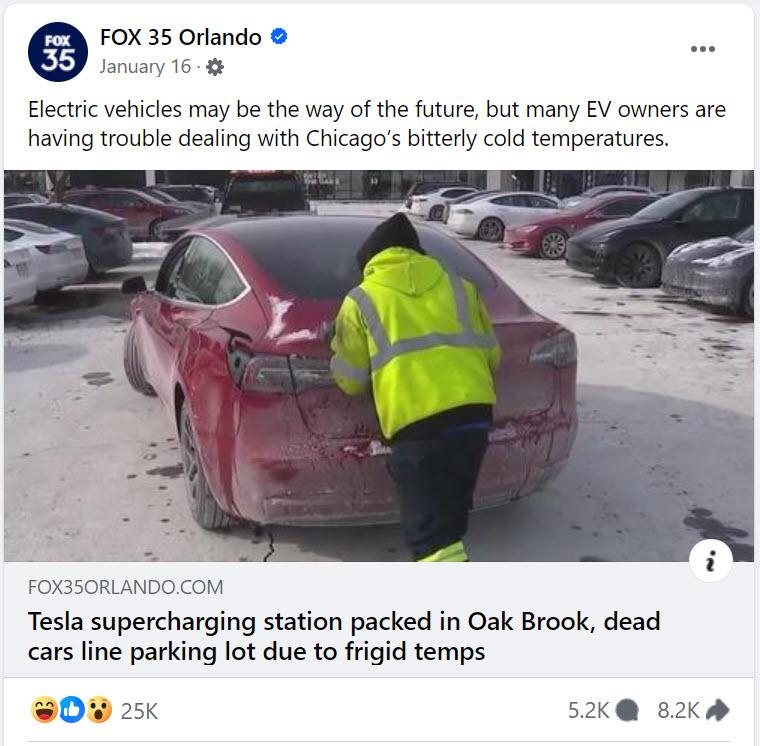
Some of the positive stories, which were apparently largely overlooked, included news of expanding charging networks in states like Florida, Michigan, and California. In another post, President Joe Biden declared that “the future of electric vehicles will be made in America by union workers.”
- ## Posts about automakers or car rental companies rolling back their commitments to EVs drove engagement
- In 2024, auto giants like Ford and General Motors, which are at the forefront of the transition to EVs in the U.S., announced they would be delaying the rollout of new electric models or cutting back on production commitments because of lower than anticipated demand.
The top post on right-leaning pages during the study period, which was posted by Breitbart and earned 58,283 interactions, highlighted that Ford lost $1.3 billion on EVs in the first quarter of 2024. Anothertop post, from a local Fox affiliate in Milwaukee, Wisconsin, featured a story with the headline “Hertz selling 20,000 EVs from rental fleet; will invest in gas-powered vehicles.” This post earned 76,224 interactions.
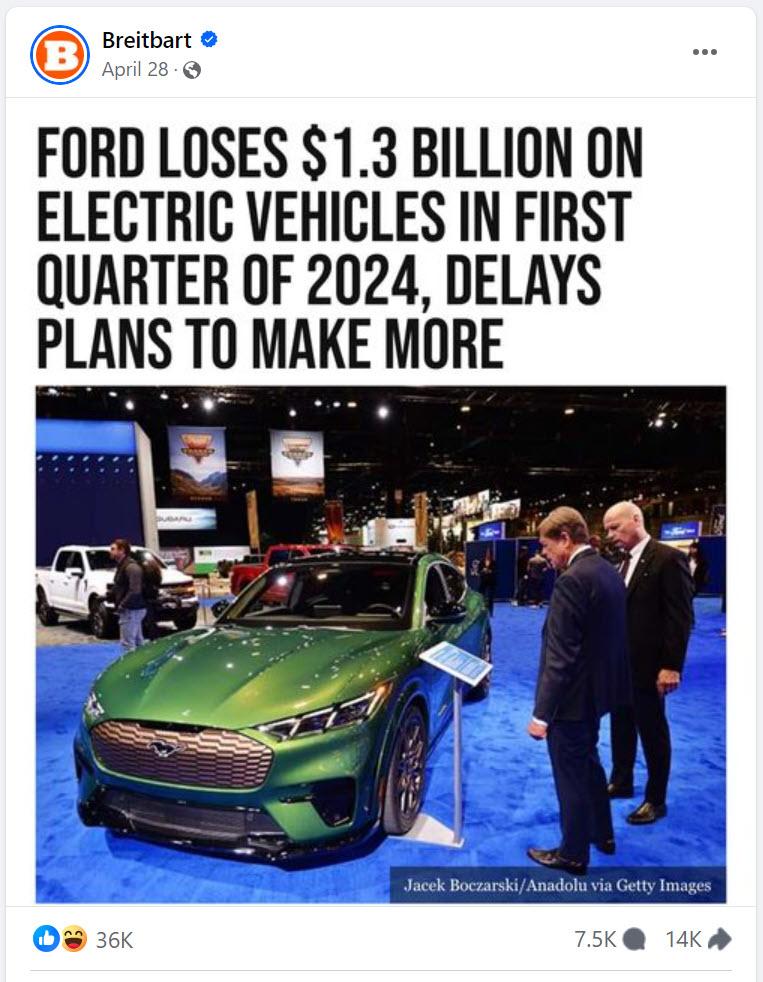
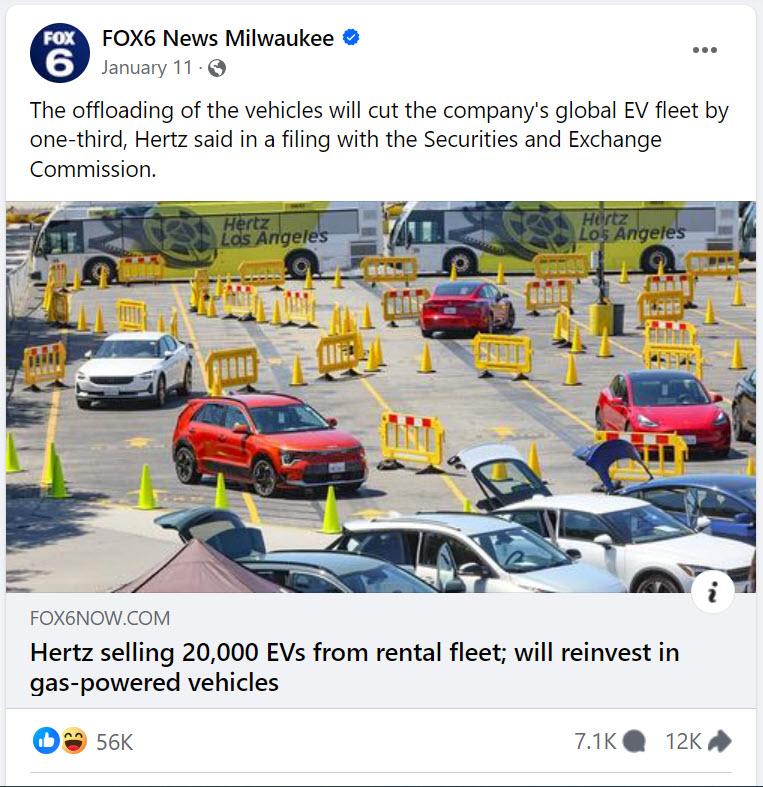
- The rental car company later announced it would be selling more EVs after it made a deal with Tesla to offer the cars to renters and the value of the cars went down. On top of that, Tesla has had its own challenges. In April, the company reported that its first-quarter earnings plunged by 48%.
Stories about automakers and EV sales garnered 675,188 interactions (38%) compared to content about charging infrastructure (164,150 interactions, or 9%) or even EV trouble in cold weather (295,794 interactions, or 17%).
When looking at the top 100 posts from right-leaning political pages only, Media Matters found a similar pattern. Posts related to automakers or EV sales garnered 477,233 interactions (45%). Posts about charging infrastructure earned just 7% and posts about performance issues, particularly in cold weather, earned 10% of interactions. The remaining posts covered an even wider range of different topics.
Importantly, EV sales are still growing, despite setbacks. In May, Ford reported a 65% increase in hybrid and EV sales. Also in May, Bloomberg reported that “EV sales are still booming for most automakers — even if Tesla is in a nut.” The article pointed out that, “Six of the 10 biggest EV makers in the US saw sales grow at a scorching pace compared to a year ago.”
On the predicament at Hertz, CNN reportedthat the problem,“wasn’t necessarily that the cars were electric, and customers simply do not want to drive electric cars. The problem was how Hertz handled the fleet in general.” For example, Hertz did not have charging stations at its rental locations, and the company has been mired by other issues as well. This important context was largely omitted from the post text, headlines, or first paragraphs of the top posts Media Matters analyzed. On Facebook, the optimistic long-term outlook on EV growth was largely ignored.
- ## Politically nonaligned pages — not just right-leaning ones — helped drive engagement around negative stories
* Right-wing media have been driving anti-EV sentiment (with help from fossil fuel industry allies) since the start of Biden’s term. This trend was clearly reflected in Media Matters’ analysis. Out of the top 100 posts related to EVs on right-leaning pages, 95% were negative, earning over a million interactions in 2024 so far.
But on Facebook, politically nonaligned pages fed into this trend as well. Nearly three quarters (74%) of EV related top posts on nonaligned pages had a negative framing. These posts generated 83% of all interactions on EV-related top posts from nonaligned pages.
Some of the same headlines that received attention on right-leaning pages also got attention on nonaligned pages. Several local news outlets highlighted Ford and Hertz’s losses, along with other problems related to EVs struggling to charge in cold weather.
Our analysis indicates that media on Facebook are not contextualizing conversations about the so-called EV sales slump, and other problems that most nascent technologies inevitably face. The nation is undertaking a massive and necessary transition to electrify the transportation sector, reduce car dependency, and expand access to public transit. Transforming the transportation sector in this way will not only cut planet-warming carbon pollution, but will also improve health outcomes for many Americans.
- ## Methodology
- Using CrowdTangle, Media Matters compiled a list of 1,773 Facebook pages that frequently posted about U.S. politics. For an explanation of how we compiled pages and identified them as right-leaning, left-leaning, or ideologically nonaligned, see the methodology here. The resulting list consisted of 771 right-leaning pages, 497 ideologically nonaligned pages, and 505 left-leaning pages.
===
JUDD HEATED ETC SaiD TARGET BY FB? SAME DEAL?
AN 6 24
The biggest conservative news outlets are seeing a precipitous decline in traffic to their websites, and it's showing no sign of abating despite 2024 being a high-profile election season.
On Wednesday, Daily Beast media reporter Justin Baragona tweeted traffic data compiled by media analyst Howard Polskin's website TheRighting.com, which specializes in tracking conservative media. Polskin assembled a table showing the number of unique visitors (individual internet users who visit a website) a site received in May of 2020 compared to May of 2024, along with a percentage difference in the subsequent column.
Polskin found that high-profile far-right websites like Breitbart, Daily Wire, The Blaze, National Review, Daily Caller and the Federalist all saw sharp drops in unique visitors between the 2020 election cycle and the 2024 cycle. Breitbart — which was led by Steve Bannon before he joined former President Donald Trump's campaign and administration — saw its unique visitors drop from more than five million in 2020 to just over 500,000 last month – a 90% drop. The Federalist, which was co-founded by Meghan McCain's husband, Ben Domenech, saw its unique user count plummet from 3.3 million to 166,000, which is a 95% decline.
READ MORE:**Pro-Trump media landscape 'utterly collapsing' compared to last election cycle: report**
While traffic to other, larger mainstream outlets is also down, the rapid cratering of unique user numbers is mostly concentrated among right-wing media.
maybe disambiguation for now
move to discrimination
html 0.03 secs librarian-like
see google
AI machine learning
see zuck tweak 2018 politics
see extraction
bak 6 22
===
see tony cox risk asses
===
JUDD HEATED ETC SIAD TARGET BY FB? SAME DEAL?
AN 6 24
The biggest conservative news outlets are seeing a precipitous decline in traffic to their websites, and it's showing no sign of abating despite 2024 being a high-profile election season.
On Wednesday, Daily Beast media reporter Justin Baragona tweeted traffic data compiled by media analyst Howard Polskin's website TheRighting.com, which specializes in tracking conservative media. Polskin assembled a table showing the number of unique visitors (individual internet users who visit a website) a site received in May of 2020 compared to May of 2024, along with a percentage difference in the subsequent column.
Polskin found that high-profile far-right websites like Breitbart, Daily Wire, The Blaze, National Review, Daily Caller and the Federalist all saw sharp drops in unique visitors between the 2020 election cycle and the 2024 cycle. Breitbart — which was led by Steve Bannon before he joined former President Donald Trump's campaign and administration — saw its unique visitors drop from more than five million in 2020 to just over 500,000 last month – a 90% drop. The Federalist, which was co-founded by Meghan McCain's husband, Ben Domenech, saw its unique user count plummet from 3.3 million to 166,000, which is a 95% decline.
READ MORE:**Pro-Trump media landscape 'utterly collapsing' compared to last election cycle: report**
While traffic to other, larger mainstream outlets is also down, the rapid cratering of unique user numbers is mostly concentrated among right-wing media.
Baragona pointing out that
"Even compared to last year, most of the top right-wing media outlets have seen a traffic tailspin. Year over year, the Washington Examiner is down 72%, Outkick has dropped 46% and The Federalist has lost 79% of its audience," Baragona tweeted. "Meanwhile, compared to May 2023, the NYT is up 10%."
One culprit of this traffic decline could be due to Facebook adjusting its algorithm – which is the code that dictates what users see in their respective news feeds — in recent years. In April, Polskin noted that traffic for pro-Trump sites was down by roughly 40% over the past four years, which lines up with Facebook co-founder and CEO Mark Zuckerberg's announcement of changes to the algorithm. In 2018, Zuckerberg announced the feed would begin prioritizing content from users' friends and family over more overtly political content from pages.
Following the changes to the Facebook algorithm, publishers like Dan Bongino, Franklin Graham and Daily Wire, which used to frequently top the social media platform's engagement lists, saw significant drops in likes, comments and shares on their content.
"The flow of traffic to Donald Trump’s most loyal digital-media boosters isn’t just slowing, as in the rest of the industry; it’s utterly collapsing," Atlantic contributor Paul Farhi wrote at the time.
However, this problem may not be confined to news outlets. Baragona observed that Trump's Truth Social platform also saw a significant decline in unique users. In May of 2024, Truth Social had just 2.7 million unique users, which is a 14% drop compared to May of 2023. This marked the platform's second-worst performing month since its launch.
Click here to read Baragona's thread on X (formerly Twitter).
READ MORE: Analysis reveals the real reason conservative media turned on Noem
===
6 24 ymail judd
over the last four years, rents have skyrocketed by an average of over 30% nationwide and are a major factor in the overall inflation rate. There are a variety of factors behind the increases, including an overall housing shortage. But the Department of Justice is investigating another potential cause: a massive criminal conspiracy among large landlords.
Last month, the FBI reportedly conducted an unannounced raid of Cortland Management, a major corporate landlord based in Atlanta. The surprise search appears to be part of a Department of Justice criminal investigation, first reported by Politico in March, into an alleged scheme among many corporate landlords to artificially increase rents through collusion.
The investigation centers around the use of RealPage, advanced property management software used by many corporate landlords. Following a 2022 exposé by ProPublica, RealPage and landlords that use the software have been named defendants in multiple class action lawsuits, as well as actions filed by the Attorneys General of Arizona and Washington, DC.
According to the lawsuit filed by the State of Arizona in February, landlords that are supposed to be in competition with each other "outsource daily pricing and ongoing revenue oversight" to RealPage. The company allegedly facilitates and encourages landlords to work cooperatively to increase rents. An e-book produced by RealPage says that the company allows corporate landlords who are “technically competitors” to "work together . . . to make us all more successful in our pricing." RealPage bragged that landlords that use its software “continually outpace the market in good times and bad.” In other words, RealPage helps landlords charge higher rates than they would in a truly competitive market. An executive for Camden Property Trust, a corporate landlord based in Houston, said deploying RealPage's software resulted in "pushing people out" with higher rents but ultimately increased revenue by $10 million.
How corporate landlords collude via algorithm
Corporate landlords that use RealPage software dominate the rental market in many metropolitan areas. In Phoenix, according to Arizona's lawsuit, "70% of multifamily apartment units listed in the Phoenix metropolitan area are owned, operated, or managed by companies that have contracted with RealPage." According to the lawsuit filed by DC, 60% of large multifamily buildings (50 units or more) set prices using RealPage's software.
RealPage's former CEO revealed that participating landlords share "occupancy rates, rents charged for each unit and each floorplan, lease terms, amenities, move-in dates, and move-out dates." After feeding in this highly-detailed information that would normally be kept proprietary, "landlords agree to outsource their pricing authority to RealPage—rather than competing with one another on price." RealPage even has a feature called "auto-pilot" that lets the software set rent prices without any human approval or intervention.
The system has resulted in large rent increases that were previously unthinkable, according to RealPage's own executives. “As a property manager, very few of us would be willing to actually raise rents double digits within a single month by doing it manually," RealPage executive Andrew Bowen said.
Arizona's lawsuit alleges that RealPage "puts significant pressure on participants to ensure they adopt RealPage’s prices." Specifically, RealPage employs "pricing advisors" who "meet with landlords to ensure that properties are implementing RealPage’s set rates." This is described by Arizona as "policing the conspiracy to make sure no one cheats by lowering prices and trying to gain market share." RealPage training materials, cited in the DC lawsuit, advise that landlords "should be compliant" with the software's pricing recommendations. The Arizona lawsuit claims that landlords "agree that if they fail to consistently implement RealPage’s set rates, their contract with RealPage will be terminated." Jeffrey Roper, who created the RealPage algorithm, explained that if "you have idiots undervaluing, it costs the whole system."
According to DC's lawsuit, this practice shows that "while RealPage sought to grow the cartel to maximize profits, it also understood the importance of universal adherence and was willing to expel an occasional cartel member to demonstrate its commitment to enforcement of the agreed-upon pricing scheme." While the RealPage software eliminates the need for competitors to meet in a smoke-filled room, Arizona asserts that it "is still illegal… for competitors to join together decision-making power to raise, depress, fix, or stabilize prices—no matter the technology used to effect a price-fixing agreement."
Why the feds are focusing on Atlanta
Why is the FBI specifically raiding a corporate landlord that uses RealPage in Atlanta? The agency is not commenting, but a class-action lawsuit revealed that landlords who use RealPage control a large number of properties in the Atlanta area. According to the plaintiffs, landlords using RealPage "account for over 53% of the multifamily rental market in the Atlanta Submarket." This is a map, included in the complaint, which shows properties using RealPage software in the Atlanta area.
...
The use of RealPage in the Atlanta area has coincided with a sharp increase in rental prices. Overall, rents in Atlanta are up 56% since 2016.
Where will the FBI conduct its next raid? They have plenty of choices. RealPage also controls a large share of the market in Baltimore, Charlotte, Houston, and Miami.
RealPage says this is all a big misunderstanding. After DC filed its lawsuit in November 2023, the company said its critics were incorrectly drawing "a causal connection between revenue management software like ours and increases in market-wide rents." It said the lawsuit was "wrong on both the facts and the law and we will vigorously defend against it."
Not everyone involved in the scheme is so confident. Earlier this year, two corporate landlords named in a class action lawsuit filed by tenants reached settlements with the plaintiffs. The terms were not disclosed.
===
4. What about in California?
Lists of top single-family rental markets vary, but Atlanta, Georgia; Charlotte, North Carolina; and Jacksonville, Florida regularly come out on top. California does not appear to be a destination of choice for the nation’s largest investors. Less than 2% of single-family homes are owned by investors with 10 properties or more, statewide, according to the California Research Bureau.
What institutional investor-friendly markets have in common: Rapidly growing populations and relatively low real estate prices compared to rents.
“That does not describe California at all,” said Laurie Goodman, an economist at the Urban Institute.
When big investors do show up in California it’s disproportionately in the state’s quickly growing, still relatively affordable regions: the Inland Empire, the southern half of the San Joaquin Valley and the Sacramento suburbs. The county with the highest share of single-family homes owned by big investors is Fresno at 5.9%, according to the California Research Bureau.
Fresno is a bit of an unusual case, in that the largest single owner there, JD Home Rentals, is a local outfit whose portfolio of some 2,000 homes are clustered in that region.
Statewide, the largest single corporate owner is also the country’s biggest. Invitation Homes kicked off the corporate single-family rental rental trend when it started buying up distressed houses, rehabbing them and putting them on the rental market in 2012. Originally funded by theprivate equity giant Blackstone, the company has since become its own publicly traded company. The company owns 84,567 homes, of which 11,862 are in California, according to its most recent filing with the Securities and Exchange Commission.
5. Do corporate landlords cause rents to go up?
There are plenty of anecdotes of big investors sweeping into a neighborhood, only for rent hikes to follow. Do big investors cause rents to rise or do rising rents attract big landlords? When researchers have tried to disentangle those two trends, they’ve produced mixed results.
One national overview found that rising rents in a city reliably preceded an increase in single-family investor activity three months later. But they didn’t find that the reverse was true, implying that investors chase after rising rents, but don’t cause them.
“I think that the investor problem is kind of a boogeyman for the housing market.”
DARYL FAIRWEATHER, ECONOMIST, REDFIN
But another study found that single-family areas with higher concentrations of corporate ownership did, in fact, see modestly higher rents than comparable neighborhoods. These companies were able to exploit their relative control over a neighborhood’s housing stock to extract higher than fair-market rent from tenants, the researchers found. But the researchers also found a second explanation behind the rental run-up: By beefing up security across a slew of properties in the same area, they were able to lower crime rates and “enhance neighborhood quality.”
Many larger landlords also use rent-setting algorithms designed to squeeze the highest rent possible from new tenants. Defenders of the industry say those programs simply allow landlords to find an area’s market rent, though renters, prosecutors and federal regulators have argued that, at least in the apartment rental industry, it has amounted to illegal price-fixing.
6. Do big buyers take homeownership opportunities away from first-time buyers?
Every house that’s bought by a major investor and converted into a rental is one fewer opportunity for a would-be first-time buyer. That zero-sum trade off is particularly acute in places where few new homes are being built. A study out of Atlanta found that an influx of institutional investment in a neighborhood predicted a decline in the area’s homeownership rate. Likewise, a study in the Netherlands found that the reverse was true: When cities banned investors from converting homes into rentals, the number of first-time buyers shot up.
===
pro pub algo Close oct 2022
on a summer day last year, a group of real estate tech executives gathered at a conference hall in Nashville to boast about one of their company’s signature products: software that uses a mysterious algorithm to help landlords push the highest possible rents on tenants.
“Never before have we seen these numbers,” said Jay Parsons, a vice president of RealPage, as conventiongoers wandered by. Apartment rents had recently shot up by as much as 14.5%, he said in a video touting the company’s services. Turning to his colleague, Parsons asked: What role had the software played?
“I think it’s driving it, quite honestly,” answered Andrew Bowen, another RealPage executive. “As a property manager, very few of us would be willing to actually raise rents double digits within a single month by doing it manually.”
The celebratory remarks were more than swagger. For years, RealPage has sold software that uses data analytics to suggest daily prices for open units. Property managers across the United States have gushed about how the company’s algorithm boosts profits.
“The beauty of YieldStar is that it pushes you to go places that you wouldn’t have gone if you weren’t using it,” said Kortney Balas, director of revenue management at JVM Realty, referring to RealPage’s software in a testimonial video on the company’s website.
The nation’s largest property management firm, Greystar, found that even in one downturn, its buildings using YieldStar “outperformed their markets by 4.8%,” a significant premium above competitors, RealPage said in materials on its website. Greystar uses RealPage’s software to price tens of thousands of apartments.
RealPage became the nation’s dominant provider of such rent-setting software after federal regulators approved a controversial merger in 2017, a ProPublica investigation found, greatly expanding the company’s influence over apartment prices. The move helped the Texas-based company push the client base for its array of real estate tech services past 31,700 customers.
The impact is stark in some markets.
In one neighborhood in Seattle, ProPublica found, 70% of apartments were overseen by just 10 property managers, every single one of which used pricing software sold by RealPage.
To arrive at a recommended rent, the software deploys an algorithm — a set of mathematical rules — to analyze a trove of data RealPage gathers from clients, including private information on what nearby competitors charge.
For tenants, the system upends the practice of negotiating with apartment building staff. RealPage discourages bargaining with renters and has even recommended that landlords in some cases accept a lower occupancy rate in order to raise rents and make more money.
One of the algorithm’s developers told ProPublica that leasing agents had “too much empathy” compared to computer generated pricing.
Apartment managers can reject the software’s suggestions, but as many as 90% are adopted, according to former RealPage employees.
The software’s design and growing reach have raised questions among real estate and legal experts about whether RealPage has birthed a new kind of cartel that allows the nation’s largest landlords to indirectly coordinate pricing, potentially in violation of federal law.
Experts say RealPage and its clients invite scrutiny from antitrust enforcers for several reasons, including their use of private data on what competitors charge in rent. In particular, RealPage’s creation of work groups that meet privately and include landlords who are otherwise rivals could be a red flag of potential collusion, a former federal prosecutor said.
At a minimum, critics said, the software’s algorithm may be artificially inflating rents and stifling competition.
“Machines quickly learn the only way to win is to push prices above competitive levels,” said University of Tennessee law professor Maurice Stucke, a former prosecutor in the Justice Department’s antitrust division.
RealPage acknowledged that it feeds its clients’ internal rent data into its pricing software, giving landlords an aggregated, anonymous look at what their competitors nearby are charging.
A company representative said in an email that RealPage “uses aggregated market data from a variety of sources in a legally compliant manner.”
The company noted that landlords who use employees to manually set prices “typically” conduct phone surveys to check competitors’ rents, which the company says could result in anti-competitive behavior.
“RealPage’s revenue management solutions prioritize a property’s own internal supply/demand dynamics over external factors such as competitors’ rents,” a company statement said, “and therefore help eliminate the risk of collusion that could occur with manual pricing.”
The statement said RealPage’s software also helps prevent rents from reaching unaffordable levels because it detects drops in demand, like those that happen seasonally, and can respond to them by lowering rents.
RealPage did not make Parsons, Bowen or the company’s current CEO, Dana Jones, available for interviews. Balas and a Greystar representative declined to comment on the record about YieldStar. The National Multifamily Housing Council, an industry group, also declined to comment.
Proponents say the software is not distorting the market. RealPage’s CEO told investors five years ago that the company wouldn’t be big enough to harm competition even after the merger. The CEO of one of YieldStar’s earliest users, Ric Campo of Camden Property Trust, told ProPublica that the apartment market in his company’s home city alone is so big and diverse that “it would be hard to argue there was some kind of price fixing.”
What role RealPage’s software has played in soaring rents — which in the decade before the pandemic nearly doubled in some cities — is hard to discern. Inadequate new construction and the tight market for homebuyers have exacerbated an existing housing shortage.
But by RealPage’s own admission, its algorithm is helping drive rents higher.
“Find out how YieldStar can help you outperform the market 3% to 7%,” RealPage urges potential clients on its website.
Few tenants know that such software, owned by a privately held company, has had a hand in rent increases across the country.
In Boston, renter Kaylee Hutchinson said she was puzzled when her landlord — unbeknownst to her, a RealPage client — told her days into the first pandemic lockdowns that her rent was going up. Building staff insisted that the market rate for her apartment was 6.5% higher than she was paying, despite her protests that people were fleeing the city.
Kaylee Hutchinson’s landlord, who uses RealPage’s pricing software, told her rent was going up at the start of the pandemic even as many people were fleeing the city. Credit:Philip Keith, special to ProPublica
A few weeks later, she and her fiancé saw a newly vacant unit in their building advertised online for less. One of their landlord’s policies permitted moving to another unit owned by the company, so they did.
Hutchinson, who is an analyst for the police department, wondered if a computer algorithm was behind building staff’s inflexibility. “It was pretty obvious they should have been dropping prices,” she said. “They were digging their heels in.”
Hutchinson said she watched apartments in her building sit vacant at prices that didn’t make sense to her.
“A normal mom-and-pop landlord, they’re worried about having a good tenant and protecting their interest in the agreement,” Hutchinson said. “These companies, they’ll just replace you.”
The Origins of YieldStar
One of YieldStar’s main architects was a business executive who had personal experience with an antitrust prosecution.
A genial, self-described “numbers nerd,” Jeffrey Roper was Alaska Airlines’ director of revenue management when it and other major airlines began developing price-setting software in the 1980s.
Competing airlines began using common software to share planned routes and prices with each other before they became public. The technology helped head off price wars that would have lowered ticket prices, the Department of Justice said.
The department said the arrangement may have artificially inflated airfares, estimating the cost to consumers at more than a billion dollars between 1988 and 1992. The government eventually reached settlements or consent decrees for price fixing with eight airlines, including Alaska Airlines, all of which agreed to change how they used the technology.
At one point, federal agents removed a computer and documents from Roper’s office at the airline. He said he and other creators of the software weren’t aware of the antitrust implications. “We all got called up before the Department of Justice in the early 1980s because we were colluding,” he said. “We had no idea.”
When Roper returned to the United States in the early 2000s after a stint in central and eastern Europe, he said, he discovered the apartment rental industry was so far behind technologically that it resembled the emerging markets he’d just left.
Apartment managers were “basically pricing their product on a paper napkin,” said Roper, who eventually formed his own company.
Old computers and manual recordkeeping were mainstays of the industry. Leasing agents gauged how their buildings compared by calling up competitors. “This was just a ripe business,” with lots of money and lots of opportunities for technological improvement, Roper said.
RealPage hired Roper as its principal scientist in 2004 to improve software it had bought from Camden Property Trust, a large investor-backed owner and manager of apartment buildings.
Roper quickly realized he required data — a lot of data — to get the algorithm working properly. He began building a “master data warehouse” that pulled in client data from other RealPage applications, such as those for leasing managers.
A proof-of-concept version of the software had performed well in tests at townhouses Camden offered for rent in its home city of Houston.
At the time, the street behind Camden’s townhouses was shut down while a grocery store was being built. Leasing staff wanted to discount rent for the townhouses because of the nuisance, said Kip Zacharias, who worked with Camden as a consultant.
Instead, YieldStar suggested boosting rents. “We were like, ‘Guys, just try it,’” Zacharias said.
The units ended up renting for significantly more than staff had expected, he said. “That was kind of the eureka moment,” Zacharias said. “If you’d listened to your gut, you would have lowered your price.”
The practice of lowering rent to fill a vacancy was a reflex for many in the apartment industry. Letting units sit empty could be costly and nerve-wracking for leasing agents.
Such agents sometimes hesitated to push rents higher. Roper said they were often peers of the people they were renting to. “We said there’s way too much empathy going on here,” he said. “This is one of the reasons we wanted to get pricing off-site.”
Unimpeded by human worries, YieldStar’s price increases sometimes led to more tenants leaving.
Camden’s turnover rates increased about 15 percentage points in 2006 after it implemented YieldStar, Campo, the company’s CEO, told a trade publication a few years later. But that wasn’t a problem for the firm: Despite having to replace more renters, its revenue grew by 7.4%.
“The net effect of driving revenue and pushing people out was $10 million in income,” Campo said. “I think that shows keeping the heads in the beds above all else is not always the best strategy.”
(Reminded of that quote, Campo told ProPublica it “sounds awful” and doesn’t reflect how he or Camden views renters today. “We fundamentally believe our customers are the most important part of our business,” he said. “We’re not about pushing people out.”)
Hiking rents at the same time benefited all landlords, the industry learned. “A rising tide lifts all boats,” one real estate executive and revenue management proponent told the industry publication Yield Pro in 2007.
One of the greatest threats to a landlord’s profit, according to Roper and other executives, was other firms setting rents too low at nearby properties. “If you have idiots undervaluing, it costs the whole system,” Roper said.
Jeffrey Roper helped develop YieldStar, which uses an algorithm to suggest prices for apartments across the country. Credit:Shelby Tauber for ProPublica
Roper wasn’t the only technologist working on an apartment pricing algorithm. Donald Davidoff, the primary developer of rival software called Lease Rent Options, or LRO, said he designed his program differently, to head off any concerns about collusion.
Instead of relying on a digital warehouse that includes competitor data, Davidoff used a complex formula and public market data to steer LRO’s algorithm. The system relied on incremental price shifts to manage demand for apartments, said Davidoff, an MIT-educated former rocket engineer. “That’s not dissimilar to changing a trajectory of a rocket through inflection of a nozzle,” he said — making small changes that can dramatically alter something’s course over time.
Davidoff said he was careful to avoid features that might run counter not only to anti-discrimination laws, such as the Fair Housing Act, but also those that bar competitors from conspiring to set prices.
“I had many conversations with attorneys to understand where the boundaries are,” he said. “Anybody who’s building one of these systems or is involved in these should care a lot about fair housing and should care a lot about price collusion to avoid both.”
Roper told ProPublica that when he was developing the YieldStar software more than a decade ago, he was concerned about avoiding both issues. He also said he didn’t want to misuse private data in pricing.
“I was highly sensitized to: You just don’t do it,” Roper said.
Despite differences in the software’s design, RealPage acquired LRO in 2017 after months of scrutiny by the antitrust division of the justice department. Federal regulators review mergers above a certain size — right now, it is transactions valued at $101 million — and typically allow them to proceed after only a preliminary review. But some are flagged for a more extensive look. The government can challenge a merger in court if it believes it could substantially harm competition.
RealPage’s purchase of LRO received such a second look, but the DOJ allowed it to proceed in late 2017. The department did not respond to requests for comment.
The approval allowed RealPage to acquire its only significant competitor, Roper said, adding, “I was surprised the DOJ let that go through.”
RealPage was pricing 1.5 million units, and the acquisition of LRO would double that, Steve Winn, RealPage’s then-CEO, said at a mid-2017 investor conference. “I don’t think there’s any concentration, enough concentration, of buying or pricing power here” to warrant DOJ concerns, he said. A third company had a substantial footprint in the market, Winn said, but property managers’ own manual pricing processes or proprietary systems were RealPage’s largest competitor.
“We expect our combined platform to drive accelerated, sustained revenue growth,” Winn said in a media release announcing the deal.
RealPage’s influence was burgeoning. That year, the firm’s target market — multifamily buildings with five or more units — made up about 19 million of the nation’s 45 million rental units. A growing share of those buildings were owned by firms backed by Wall Street investors, who were among the most eager adopters of pricing software.
RealPage renamed its combined pricing software AI Revenue Management. By the end of 2020, the firm was reporting in a Securities and Exchange Commission filing that its clients used its services and products to manage 19.7 million rental units of all types, including single-family homes. The private equity firm Thoma Bravo bought the public company a few months later for $10.2 billion.
Winn, whose net worth Forbes estimates at $1.7 billion, stepped aside. He did not respond to requests for comment.
A spokesperson for Thoma Bravo declined to comment.
Who Uses the Software and How It Works
Somewhere around 2016, according to one trade group, the industry’s use of the pricing software began to achieve “critical mass.”
The more property managers who sign on to RealPage services, the more data flows into the company’s repository. That in turn aids its pricing service, which the company says “leverages multifamily’s largest lease transaction database.”
RealPage’s clients include some of the largest property managers in the country. Many favor cities where rent has been rising rapidly, according to a ProPublica analysis of five of the country’s top 10 property managers as of 2020. All five use RealPage pricing software in at least some buildings, and together they control thousands of apartments in metro areas such as Denver, Nashville, Atlanta and Seattle, where rents for a typical two-bedroom apartment rose 30% or more between 2014 and 2019.
Greystar and FPI Management each control hundreds of buildings in metro areas where rents have risen steeply in recent years. And Equity Residential, Lincoln Property Company and Mid-America Apartment Communities each manage dozens of buildings in high-growth markets.
In contrast, these same companies control fewer buildings in metro areas such as Philadelphia, Tampa and Chicago, where rents have increased more slowly, the analysis found.
Many factors may cause RealPage clients to cluster in high rent-growth markets. The company’s clients may gravitate toward such markets because those areas will bear more rent hikes and so offer an opportunity to make more money, for instance. But RealPage says its software steers pricing that beats the market in areas where it operates.
RealPage’s algorithm calculates how demand for apartments responds to changes in price — what’s known as price elasticity.
The algorithm takes into account characteristics of apartments, like the number of bedrooms. It also considers factors such as how many more of a complex’s apartments are likely to become available in the near future. Property managers can adjust settings according to their priorities — such as how full they want their buildings to be.
The software also analyzes rent prices in the broader market, the company said. That data can provide insight into how competitors’ buildings located near the client — such as within, say, a half-mile or mile radius — are being priced, said Ryan Kimura, a former RealPage executive.
One advantage RealPage’s data warehouse had was its access to actual lease transactions — giving it the true rents paid, instead of simply those a landlord advertised, RealPage said.
Property managers can’t look at the unpublished data any one rival is sharing with YieldStar, Roper and other former RealPage employees said.
Nicole Lott said that when the building where she worked as a property manager near Dallas started using YieldStar, the software determined that similar buildings in the area were charging more. It pushed for steep increases.
“It really jumped rates up,” Lott said. “Leasing slowed down to a crawl.”
She and other staff challenged the software, asking the division of her company that oversaw YieldStar for a review, she said. The landlord ended up raising rates more gradually, she said.
“We didn’t think we could get those rates,” she said. “In some cases we were right and in some cases we might have been wrong.”
Kimura, a former RealPage executive who worked at the firm for three years before leaving in 2021, said the company would typically see pushback from property staff on about 10%-20% of the software’s recommendations. It was part of the process. “If they are approving every rate and it’s 100% acceptance,” he said, “they basically have a blindfold on and are pushing a button.”
RealPage claims its software will increase revenue and decrease vacancies. But at times the company has appeared to urge apartment owners and managers to reduce supply while increasing price.
During an earnings call in 2017, Winn said one large property company, which managed more than 40,000 units, learned it could make more profit by operating at a lower occupancy level that “would have made management uncomfortable before,” he said.
The company had been seeking occupancy levels of 97% or 98% in markets where it was a leader, Winn said. But when it began using YieldStar, managers saw that raising rents and leaving some apartments vacant made more money.
“Initially, it was very hard for executives to accept that they could operate at 94% or 96% and achieve a higher NOI by increasing rents,” Winn said on the call, referring to net operating income. The company “began utilizing RealPage to operate at 95%, while seeing revenue increases of 3% to 4%.”
But the software’s supporters say it’s not driving the nation’s housing affordability problem.
Though soaring rent is giving the industry a “black eye,” Campo said, the culprit is a lot of demand and not enough supply — not revenue management software. The software just helps managers react to trends faster, he said.
“Would you rather do your work today on a typewriter or a computer?” he asked. “That’s what revenue management is.”
Using software like YieldStar is “taking what we used to do manually on a yellow pad and calling people on the phone and putting it on a codified system where you take the errors out of the pricing,” he said.
RealPage, Seattle and Rising Rents
To see how rent-setting software can make a difference, look no further than Seattle, where over the last few years rents have risen faster than almost anywhere in the country, some studies show.
Large apartment buildings in one ZIP code just north of downtown, sandwiched between the Space Needle and Pike Place Market, are overwhelmingly controlled by RealPage clients, ProPublica found.
The trendy Belltown neighborhood, with its live music venues and residential towers, had 9,066 market rate apartments in buildings with five or more units as of June, according to the data firm CoStar and Apartments.com. Property management was highly concentrated: The ZIP code’s 10 biggest management firms ran 70% of units, data showed.
All 10 used RealPage’s pricing software in at least some of their buildings, according to employees, press releases and articles in trade publications.
Expensive markets with high rents, like Seattle, tend to have “very high” rates of revenue management use by landlords, Roper said.
Two buildings in the ZIP code — one with revenue management software and the other without — reveal diverging approaches to pricing apartments.
The Fountain Court apartments, 320 units clustered around a courtyard with a fountain, are about a half-mile from Amazon’s corporate headquarters. The building is owned and managed by Essex Property Trust, whose executives told investors in a 2008 earnings call that they were implementing YieldStar in the trust’s apartment buildings.
At the Fountain Court, rent has risen 42% since 2012, CoStar data shows — steeper than the 33% average increase for similar downtown buildings.
Tenant Amanda Tolep and her husband were approaching the end of their lease for a one-bedroom at the six-story building near the end of 2021 when they learned rent would jump about $400, to $1,600. The increase amounted to 33% — in one year.
Tolep had been working as a barista and launching her own nutrition-related business. Her husband worked for a bank. They expected their rent to go up, knowing they had received a “COVID deal.” But the size of the jump, along with other nuisances — like stolen packages and noise from a nearby fire station — led them to look elsewhere.
After finding prices similar to their raised rent at several other neighborhood buildings, the couple decided to leave the city and move a half-hour’s drive north.
A spokesperson for Essex declined to comment. None of the other biggest property managers commented on the record about their use of revenue management.
About six blocks away, rent has not gone up as dramatically at The Humphrey Apartments, a historic six-story brick building with 74 units.
John Stepan’s rent stayed relatively steady in a building that did not use RealPage’s pricing software. Credit:Jovelle Tamayo for ProPublica
John Stepan, a writer for a tech company, moved into a studio in the 1923 building a little more than a year ago. It was small, but he liked the high ceilings, hardwood floors and farmhouse-style kitchen. He had secured a COVID deal, too: one month free, with rent of $1,295 a month after that.
A few months before his lease was up, the building notified him that rent would increase by $50, which amounted to about a 3.9% rise. “It was surprisingly low,” said Stepan, who left only because he found a condo to buy nearby.
Tami Drougas, the asset manager who oversees The Humphrey and two other Seattle-area buildings for the local real estate developer who owns them, said she doesn’t use a revenue management system.
“I don’t believe in them,” she said. “That’s great and fine for larger corporations. But I think it takes the humanity out of what we do.”
After 24 years in the industry, she said, she sees good relationships with tenants and vendors as the key to running a building successfully. She said The Humphrey has low costs related to vacancies.
The building’s rent has barely budged in recent years, she acknowledged. “We have a lot less turnover and I feel like that keeps expenses down,” Drougas said.
Seattle has been hit particularly hard by soaring rents. One report found the city had the steepest rent growth of any major city in the nation over the decade ending in 2019. Almost 46,000 Seattle households were spending more than half their incomes on housing, making them what federal standards call “severely cost-burdened,” according to a 2021 study the city commissioned. Many families have trouble paying for necessities like food and medical care when their rent eats up 30% or more of their income.
“Many others have been priced out of Seattle altogether due to rapidly rising rents and housing prices,” the study said.
It also found that people with higher incomes often “down rented,” choosing cheaper apartments that would otherwise have been available to people making less. Seattle should have had a surplus of 9,000 apartments affordable to people making 80% or less of the median income, the study found. But tenants’ down renting as prices rose turned that surplus into a deficit of 21,000.
Newly Rent-Burdened Workers Range From Accountants to Groundskeepers
In metro Seattle, more people in a variety of jobs are spending over 30% of their income on rent. Below are the 10 occupations where the share of rent-burdened households jumped the most.
Share of households that are rent-burdened in:
2014
2019
55%
76%
Grounds maintenance workers
44%
65%
Food service supervisors
41%
48%
Delivery drivers
24%
35%
Accountants and auditors
13%
32%
Police officers and detectives
15%
29%
Manufacturing supervisors
Computer scientists, network
16%
22%
analysts & web developers
Electrical and electronics
4%
20%
engineers
12%
15%
Software developers
11%
14%
IT managers
50%
Note: A household’s occupation was determined by the job held by the highest earner in each household; to determine if a household is cost-burdened, gross rent (including utilities) was divided by total household income. Homeowners were not included. Source: IPUMS USA, University of Minnesota. Credit:Graphic by Haru Coryne
As the availability of apartments has shrunk, so has the choice of landlords. The startling concentration of property management in Belltown mirrors a national trend.
The number of apartments controlled by the country’s 50 largest property managers has grown every year for 14 years, according to the National Multifamily Housing Council, which surveys buildings with five or more units.
Those firms oversaw about 1 in 6 such apartments nationwide in 2019, amounting to 3.6 million units. By 2021, the number had risen to almost 4.2 million.
James Nelson, a former bank examiner and loan broker, noticed the concentration of landlords when he and his partner moved to Seattle in 2018.
Troubled by astronomical home sale prices and high rents, Nelson began looking at what was happening in the broader market.
After some digging, he found that many if not most of the bigger apartment managers in Seattle appeared to be using price-setting software. “The name RealPage kept popping up,” said Nelson, who is retired and writing a book on his research. “I went in and looked at the technologies that they were using.”
He concluded the landlords were using tech to do exactly what RealPage advertised it could do — help them charge high rents and beat the market.
“There is no competition,” he said.
Concerns About Competition
RealPage’s software has gained traction at a time when the Biden administration, concerned about rising prices and corporate concentration, is looking to bolster enforcement of rules meant to ensure competition is flourishing.
To win cases, antitrust prosecutors have traditionally needed to show that competitors agreed among themselves to tamper with pricing. “If competitors agreed among themselves to use the same algorithm and to share information among themselves with the purpose of stabilizing pricing, that would be per se illegal,” said Stucke, the former antitrust prosecutor.
If they simply shared information without agreeing to manipulate pricing, the question of whether antitrust law was violated would be more complex, he said. Stucke said he knew of no cases where companies had been prosecuted for what’s known as tacit collusion while using the same algorithm to set prices.
But Maureen K. Ohlhausen, who was then the acting chair of the Federal Trade Commission, said in a 2017 talk that it could be problematic if a group of competitors all used the same outside firm’s algorithm to maximize prices across a market.
She suggested substituting “a guy named Bob” everywhere the word algorithm appears.
“Is it OK for a guy named Bob to collect confidential price strategy information from all the participants in a market and then tell everybody how they should price?” she said. “If it isn’t OK for a guy named Bob to do it, then it probably isn’t OK for an algorithm to do it either.”
Through a representative, Ohlhausen declined to comment on RealPage.
RealPage’s software raises multiple concerns, experts said.
Courts have frowned on sharing nonpublic data among competitors. Lease transaction data is not always public.
As far as RealPage’s claim on its website that it uses “disciplined analytics that balance supply and demand to maximize revenue growth,” Stucke said that businesses can’t usually control supply and demand on their own. “Normally that’s left to market forces,” he said.
The RealPage User Group — the forum for apartment managers who use the company’s products — encourages rivals to work together, something that has been challenged as anti-competitive in antitrust prosecutions, too. The company’s website says the group aims to “promote communications between users,” among other things.
Starting out with 10 members in 2003, the group has grown to more than 1,000 participants, according to the website. A dozen subcommittees, including two focused on revenue management, meet in invitation-only sessions at the company’s annual conference, RealWorld, and participate in a conference call each quarter.
Those sorts of collaborations, Stucke said, “could raise an antitrust red flag.”
If clients are tampering with market forces, their assertions in RealPage marketing videos that its software keeps prices and occupancy “more stable” could also become relevant in court, Stucke said. Similar comments have been used as evidence in previous antitrust cases.
And the exhortations by RealPage and real estate executives for companies to use YieldStar and let some units sit vacant to raise prices are reminiscent of a legal case in the early 1900s, he said, where lumber companies shared information and a directive to reduce supply in order to push up prices.
In an email to ProPublica, RealPage dismissed the notion that the company was using market data improperly.
The company said that using actual rents helps the company “capture a truer picture of price elasticity and affordability,” which reduces the odds a unit is overpriced. And the lease transaction data RealPage is using isn’t always private; sometimes such data is disclosed, the company said, such as when publicly traded real estate firms make reports.
The FTC, which has broad authority to bring enforcement cases against businesses for anti-competitive practices, said in 2021 that it was seeking a more active role in such cases.
A spokesperson for the FTC declined to comment on RealPage’s pricing software.
The agency has tangled with RealPage before: In 2018, the company agreed to pay $3 million to settle an FTC complaint that the company had failed to do enough to make sure personal information used in its tenant screening product was accurate. RealPage did not admit wrongdoing in the settlement.
Higher Rents Are Burdening More Tenants
Drama over rising rent costs — now a key driver of inflation — has been increasingly public. The year before the pandemic, roughly 46% of renters in the U.S. spent more than 30% of their income on rent and therefore met the definition of cost-burdened, Harvard University’s Joint Center for Housing Studies found.
In mid-September in Washington, D.C., angry protesters disrupted the normally sedate yearly conference held by the National Multifamily Housing Council. Before security ejected them, they seized the stage and recounted how their families had been harmed by an inability to find safe, affordable housing.
At the center of the acrimonious debate has been RealPage’s Jay Parsons.
Since RealPage’s own July conference, he’s repeated a statistic, compiled from a company data set of new lease transactions, that market-rate apartment renters are only spending around 23% of their income on rent.
“The reality is that rents can only rise as incomes rise,” Parsons told The New York Times last month. “If people can’t afford it, you can’t lease it.”
But his sunny view has drawn sharp rebukes.
We Found That Landlords Could Be Using Algorithms to Fix Rent Prices. Now Lawmakers Want to Make the Practice Illegal.](https://www.propublica.org/article/senators-introduce-legislation-stop-landlords-algorithm-price-fixing)
“This is demonstrably false,” wrote Ben Teresa, co-director of the RVA Eviction Lab at Virginia Commonwealth University, on Twitter. “One of the defining characteristics of housing markets in the last 40 years has been rents increasing faster than wages.
“The problem is quite precisely that people are paying rents they can’t afford,” he wrote.
aha yikes nexus: algo amp alt fact earth2 polarization socmed echo escalator qanon covid conspiracy
mma 1 23
CHRIS HAYES (HOST): There's also another thing that I've been watching happening on the right, and I think this is because of the sort of polarization around low trust, high trust. But the InfoWars-ization of right-wing media, and I say this even in the like, even when you move it outside the bounds of polarizing, like did aliens build the pyramids? This is like a hoary conspiratorial cliché for decades, right? That’s the kind of thing you’re seeing right-wing media people talk about now. It doesn’t even score a political point. It's just this view that, like, everything they tell you is a lie, that is more and more taking over that entire universe.
ANGELO CARUSONE (GUEST): Yes, and I think that what's concerning about that, and sort of the fact that has led into it is that, one, obviouslysocial media and, in particular, the metastasizing of the QAnon conspiracy in the spring of 2020 coupled with all of the COVID stuff really helped that sort of, just that toxicity spill over.
But the other factor is that, it's worth keeping in mind that a very large segment of Republican leaders started to organize power on what used to be considered the fringes. And as they started to increasingly organize power on what used to be considered the fringes, using the right-wing media as a conduit for accessing that, they brought all that stuff that, you know, used to be on the fringes more toward the center. That's why something like groomers and pedophilia would be sort of far out there stuff years ago. And that is mainstream Republican orthodoxy now, it's not even controversial to say that, you know, Democrats are sexualizing children. Everyone is saying that in Republican politics. You don't have to be an extremist to make that point.
HAYES: There is a final point here, which I didn't note in the monologue, which is Elon Musk's particular role in this, who purchased Twitter and one of the first, most notable things he did in Twitter. And it was the first time I ever encountered this ludicrous, gross conspiracy theory that the two men had some relationship and that this was, like, a lovers' quarrel or something like that, was Elon Musk tweeting about it in a response to Hillary Clinton. That really put rocket fuel. He has since said he's apologized, but, like, Elon Musk owns a huge share of this entire thing.
CARUSONE: He does, because -- and this is exactly the danger for him being in charge. I mean, he supercharged that conspiracy theory. And it's worth noting that that is sort of the function of Twitter now after Elon Musk, is that it's kind of become a red pill PEZ dispenser, where these conspiracies, these really far out things are increasingly getting supercharged because they're gettingalgorithmic boosts.So even things that Elon Musk doesn't promote, we're actually seeing get supercharged all the time now.
===
===
aha note echo escal amplify tucker, jnx, sucks from vdare swamp Gt replacement booster // tucker
caravan invasion hype fear key to escalator cf algorithm
no lnx twt
https://www.mediamatters.org/vdare/white-nationalists-embrace-fox-news-bill-melugin
White nationalists embrace Fox News’ Bill Melugin
The network’s top reporter at the US southern border has been promoted and celebrated by anti-immigrant racists
WRITTEN BY JOHN KNEFEL
PUBLISHED 12/20/22
White nationalists and other far-right extremists have embraced and celebrated Fox News’ Bill Melugin, the network’s primary correspondent at the US southern border. His reporting is regularly mentioned and praised on racist, anti-immigrant websites including VDARE, Infowars, and other extremist outlets, highlighting the ideological overlap between so-called mainstream conservatism and its more openly racist fringes.
Melugin is a fixture on Fox News, regularly appearing both in supposed straight news programming and during primetime opinion shows. He has been on Fox at least 427 times in 2022, including at least 30 segments on the network’s flagship program, Tucker Carlson Tonight. (Data on Melugin's appearances is current through December 19, 2022, at 12:40pm.)
Drawing clear distinctions between mainstream conservatism and white nationalist extremism is not easy. Fox News’ Tucker Carlson, for example, has fully embraced the racist “great replacement” conspiracy theory, once a fringe position only pushed by overt racists. Melugin has played a key role in much of Carlson’s mainstreaming of that xenophobic idea, so it is not a surprise that his coverage would also appear in far-right media venues.
Bill Melugin / Tucker Carlson / caravan
CitationFox News
One of the racist sites that has embraced Melugin is VDare, a white nationalist outlet founded by Peter Brimelow,a reclusive conservative publisher who straddles the line between the conservative establishment and overt white supremacy. Brimelow endorsed “racial nationalism” at CPAC in 2018, and one year later argued that when it came to immigration policy, “Western elites” were only interested in “repressing the white host nations,” according to the Southern Poverty Law Center. In a column for VDare in 2012, white nationalist John Derbyshire argued that, “White supremacy, in the sense of a society in which key decisions are made by white Europeans, is one of the better arrangements History has come up with,” also as reported by the SPLC.
Brimelow recently attended the New York Young Republican Club’s annual gala in Manhattan.He was photographed next to former Trump adviser Steve Bannon, host of the War Room podcast, further illustrating the porous boundaries between supposedly respectable conservatism and its explicitly racist fellow travelers.
Over the last year and a half, VDare has used Melugin’s reporting as the basis for at least 31 blogs or videos on their site. While it’s true that an individual reporter can’t control what happens to their journalism once it’s out in the world, the pattern that emerges from VDare’s commentary on, and aggregation of, Melugin’s work is clear. The stories Melugin tells, and the way he frames them, fully align with VDare’s white nationalist agenda.
VDare celebrates Melugin’s reporting
On December 12, conservativeedgelordand Twitter owner Elon Musk approvingly responded to a typically sensationalistic tweet from Melugin. “Wow,” Musk replied to a video purporting to show over 1,000 migrants crossing the Rio Grande river without authorization. Musk’s interaction with Melugin’s post amplified its reach significantly. Later that morning, VDare’s official twitter account retweeted Melugin’s original tweet, again signaling the close proximity between conservative provocateurs like Musk and more overtly racist outlets.
BREAKING: A huge migrant caravan of over 1,000 people crossed illegally into El Paso, TX last night, making it the largest single group we have ever seen. The city of El Paso reports Border Patrol now has over 5,000 in custody & has released hundreds to city streets.
CitationFrom the Twitter account of VDare, posted December 12.
VDare’s account promoted Melugin two other times that morning as well, in both cases by retweeting comments added by white nationalist and Infowars contributor Dan Lyman. The account also retweeted Melugin or amplified his work at least nine other times in December, including one instance in which white nationalist and former Trump advisor Stephen Miller used his footage to argue against a spending bill Congress was debating. And in August, VDare celebrated after Musk had responded positively to another Melguin tweet.
Looks like a scene out of World War Z or Elysium The US as we’ve known it is finished. Just a matter of how / when it dies and what comes next.
CitationFrom the Twitter account of VDare.
Not a serious country anymore
CitationFrom the Twitter account of VDare
He's noticed!-- @elonmusk on @BillFOXLA 's daily reports on the Biden Rush at the southern border. #IMPEACHBIDENHARRIS
CitationFrom the Twitter account of VDare
VDare amplifies Melugin’s work even more frequently on their website. In October, VDare published a story based on a tweet of Melugin’s that incorrectly reported a Border Patrol agent had shot and killed a detained migrant after he had gone for the agent’s gun. In fact, as an FBI investigation found just days later, the man, Manuel Gonzalez-Moran, had apparently grabbed an unspecified “edged weapon” off an office desk, after which point a Border Patrol agent shot and killed him.
In July, VDare published a story under the same byline praising Melugin as an “intrepid” reporter “who documents The Great Replacement almost daily on his Twitter feed.” The same credited writer used similar language in February, again referencing “Fox News’s intrepid Bill Melugin, who keeps an eagle eye of Biden’s planned invasion of replacement citizens.” Also in February, a post under a pseudonymous byline said Melugin “has been doing excellent coverage along the border.”
Both Melugin and VDare have repeatedly covered the controversy over a photo that initially appeared to show Border Patrol agents whipping a Haitian migrant named Mirard Joseph in September 2021. Melugin has consistently claimed that Border Patrol didn’t do anything wrong. In October, he revisited the allegations, tweeting out an email obtained by conservative think tank The Heritage Foundation sent to Department of Homeland Security head Alejandro Mayorkas that quoted the photojournalist who took the shot. The email appeared to undercut the whipping allegations, and cast Mayorkas in an unfavorable light. VDare embedded Melugin's tweet in a blog that also included criticism of Mayorkas from the Border Patrol Union and Texas Senator Ted Cruz.
The stories Melugin tells, and the way he frames them, fully align with VDare’s white nationalist agenda.
The reality of the story is far more nuanced than either Melugin or VDare want to admit. Melugin’s supposed smoking gun email included a write-up of an interview of Paul Ratje, the photographer, in which said he hadn't witnessed agents whipping any migrants, but later said his comments had been misconstrued as giving Border Patrol “a pass.” Joseph and other migrants mistreated by Border Patrol agents that day filed a lawsuit against the government, claiming agents had “lashed” him. Joseph described his treatment while in U.S. custody as “the worst humiliation I have endured in my life.” An official investigation by Customs and Border Protection didn’t find evidence that whipping took place, but did uncover “unprofessional and dangerous behavior by several individual Agents.” But both Melugin and VDare saw an opportunity to demonize migrants and took it.
Conspiracy theorists at Infowars rely on Melugin's work
Melugin’s support from Infowars extends beyond the recent tweets from Lyman, the white nationalist who VDare retweeted. In September, Alex Jones’ co-host Owen Shroyer repeatedly praised Melugin after Politico reported that the Biden White House had “become increasingly irritated” with the Fox News correspondent. Shroyer claimed, without evidence, that the story was an attempt to “get Melugin shut down and banned and censored from the Internet” to punish him for his journalism.
Video CitationFrom the September 21, 2022, edition of Infowars'The Alex Jones Show, streamed on Rumble
“Now, who’s down there reporting at the border, probably more-so and better than anyone else, that’s Bill Melugin,” Shroyer said to introduce the topic. (Shroyer, never one to sweat the details, pronounced Melugin’s name wrong until a producer appeared to correct him midway through the segment.)
“And so why are they mad at Bill Melugin?” Shroyer asked. “Because he’s down at the border every day with a Fox News crew, with cameras, and they’re showing the tens of thousands of illegal immigrants that come across the border every day. And talking to Border Patrol about the terrorists, and the child rapists that they arrest.”
Like VDare, the Infowars website regularly writes articles based on Melugin’s work. A review of Infowars’ archives show at least 37 posts that include his reporting, typically as the piece’s primary or exclusive source. These stories adopt his anti-migrant framing, treating irregular border crossings as a rolling catastrophe – the frontline in a war zone – that must be addressed with militarized responses.
In many cases, Melugin is mentioned without additional comment, but there are several instances in which Infowars bloggers express their admiration for him. Writer Steve Watson recently celebrated Melugin as a reporter “who has been at the front lines on the border crisis for years now.” Last month, on the day of the 2022 midterms, Lyman characterized Melugin as “documenting the invasion of Maverick County,” in Texas. One month earlier, writer Kelen McBreen praised a tweet of Melugin’s that supposedly “accurately pointed out” the hypocrisy of New York city’s immigration policy compared with Texas’. Watson, weeks earlier, again cheered on Melugin for being “ever present at the border.”
Racists, other far-right extremists praise Melugin’s Del Rio bridge story
Arguably Melugin’s breakthrough story came in August and September, 2021, when he covered an influx of mostly Haitian migrants who had sought refuge under the Del Rio bridge in Texas. Infowars covered the issue by cross-posting a blog from far-right conspiracy site ZeroHedge, written by pseudonymous blogger Tyler Durden. “Melugin has been reporting from the bridge for more than a month,” Durden wrote approvingly that September, also referring to the “stunning drone footage” Melugin had captured.
When the FAA issued a two-week flight restriction over the bridge, Durden accused the Biden administration of trying to kill the story, and praised Melugin for persevering. “The Biden administration’s attempt to cover up the border disaster by blocking drones didn’t stop Melugin and his team who hitched a ride on a Texas Department of Public Safety’s helicopter to capture an aerial view of the migrant crisis,” Durden gushed. In fact, shortly after issuing the restriction, the FAA provided clearance for Melugin about a day later.
The Del Rio bridge story became a national sensation, with Melugin’s implicitly xenophobic coverage leading the way. The story spread to some of the worst parts of the Internet, where the implicit bigotry was abandoned for explicit racism. Neo-Nazi site The Daily Stormer referred to the migrants as “invaders,” claiming the United States’ refugee policy was “about making America nonwhite. There’s no other goal.”
The racist site Occidental Dissentalso covered the story. It was “another scene of imperial decline,” according to the site’s founder, Brad Griffin, who uses the pen name Hunter Wallace. “This has been going on ever since Joe Biden was inaugurated in January,” he added. “The only difference now is seeing so many black faces joining the flood.”
What’s most notable about this explicitly racist commentary is how closely it matched Fox News’ own coverage at the time. As Media Matters and others noted, Tucker Carlson – using Melugin’s reporting – fully embraced the racist great replacement conspiracy theorywhile discussing the Del Rio bridge story. Biden’s immigration policy was designed "to change the racial mix of the country,” Carlson said. “In political terms, this policy is called ‘the great replacement,’ the replacement of legacy Americans with more obedient people from far-away countries.”
Melugin frames himself as a straightforward reporter, just covering the facts as he sees them. But his body of work has been wholeheartedly embraced by far-right extremists and conspiracy theorists, Carlson very much among them. That’s not intrepid reporting – it’s laying the foundation for racist propaganda.
===
===
aha yikes correction in soc media no longer POSSIBLE?!
an ah 12 22
Dr. Anthony Fauci, the top White House medical adviser to President Joe Biden and long-time director of the National Institute of Allergy and Infectious Diseases (NIAID), has been serving in the United States’ federal government since the late 1960s. Fauci, who will be celebrating his 82nd birthday on December 24, 2022, has been in the United States’ federal government since the late 1960s. And he has never had a problem serving under conservative Republican presidents, including Richard Nixon, Ronald Reagan, George H.W. Bush and George W. Bush.
The younger President Bush, in fact, had nothing but praise for Fauci when he presented him with the 2008 Presidential Medal of Freedom.
But during the COVID-19 pandemic, Fauci became a major target of the MAGA movement. Countless MAGA culture warriors, consumed with identity politics, have turned hating Fauci into a popular pastime. Tesla CEO and new Twitter own Elon Musk, who supported President Joe Biden in 2020 but often sounds very MAGA in his rhetoric, bashed the retiring NIAID director when, on December 11, he tweeted, “My pronouns are Prosecute/Fauci.” [// desantis BS]
READ MORE: Elon Musk dethroned as richest man in the world: report
Many Twitter users have been calling Musk out for that tweet. But liberal Washington Post opinion columnist Greg Sargent, in his December 13 column, stresses that Musk is unfazed by such critics because his motivation is appealing to the “right-wing information ecosystem.”
“By now, it should be obvious that for large swaths of the right-wing media ecosystem, the Triggering of the Libs has become an end in itself,” Sargent explains. “In the brutal competition of the so-called attention economy, provoking large-scale outrage and loathing is not an incidental feature of making controversial arguments. It has become a key marker of success.”
Sargent continues, “Over the weekend, Elon Musk called for the prosecution of Anthony S. Fauci, the leading infectious-disease expert in the Biden Administration. 'My pronouns are Prosecute/Fauci,' Musk tweeted, mocking transgender people for good measure. Musk then endorsed a complicated right-wing conspiracy theory about Fauci’s role in the COVID-19 pandemic. Democrats and other Musk critics reacted with an explosion of outrage.”
Twitter users who vigorously defended Fauci against Musk ranged from Sen. Amy Klobuchar of Minnesota to former CIA Director John O. Brennan. The latter told Musk, “Dr. Fauci is a national hero who will be remembered for generations to come for his innate goodness & many contributions to public health. Despite your business success, you will be remembered most for fueling public hate & divisions. You may have money, but you have no class.”
READ MORE:How Elon Musk is positioning himself as a 'hard-right culture warrior': journalists
Sargent stresses, however, that while Brennan and Klobuchar’s defenses of Fauci are “reasonable,” they also “seem fundamentally out of touch with basic realities of how right-wing information warfare really works.”
“This sort of info-warring, at bottom, is what characterizes Musk’s transformation into the world’s richest right-wing troll,” Sargent explains. “Tons of pixels have been wasted on efforts to pin down Musk’s true beliefs, but whatever they are, we can say right now that he’s consciously exploiting fundamental features of the right-wing information ecosystem.”
Sargent adds that offending liberals is the whole point of an “info-warring” tweet like Musk’s December 11 attack on Fauci.
“It’s understandable that Musk’s critics are trying shaming and outrage, in that this could further drive advertisers away from Twitter,” Sargent writes. “But paradoxically, it might also help Musk…. In much of the right-wing info-ecosystem, liberal outrage is a sign of an attack’s effectiveness. It can be only confirmation that the Libs Were Owned. Shaming is useless in such an environment, and in some ways can backfire.”
READ MORE:Elon Musk’s epic bumbling is a daily reminder that America is not a meritocracy
---
mma 12 22
wonder why no longer richest bastard
Supporters of the QAnon conspiracy theory have celebrated Twitter owner Elon Musk tweeting a phrase that has been regularly invoked in the community, taking it as evidence that he supposedly supports the conspiracy theory in some manner.
On December 12, Musk tweeted, “Follow” next to a rabbit emoji. The wording with the emoji would seem to be referring to the phrase “follow the white rabbit,” a reference to the classic fantasy novel Alice’s Adventures in Wonderland, which was repopularized byThe Matrixfilm franchise and subsequently adopted as an online rallying cry in the early days of the QAnon movement. The conspiracy theory’s central figure, “Q”, repeatedly referenced the “white rabbit” and the story directly in posts.
QAnon figures, who were already primed to believe that Musk was an ally, hyped Musk’s “clear Q reference” as some kind of green light, along with a follow-up tweet from Musk in response to a scene in The Matrixabout choosing between taking a blue pill and a red pill (which has been embraced in the far-right as so-called “red-pilling,” referring to a process by with individuals come to support far-right ideas). Adherents to the QAnon conspiracy theory claimed Musk has been “keeping with the Q Comms” and was “on pace to start posting Q drops to millions of normies,” with some believing the tweet may already be referring to a Q post
[twts]
the QAnon community’s excitement for Musk’s tweet comes asMusk has pushed claims of child traffickingon Twitter and blamed Twitter’s leadership, including targeting Twitter’s former head of trust and safety, who was forced to flee his home due to threats. It also comes as more QAnon accounts have come back or at least attempted to come back to Twitter in the midst of Musk taking over the platform.
===
===
an 11 22 maker said better than hu b/c no compassion; team human tenant w/ perfect record booted b/c potential higher profit out there; encourage empty.
The senator tasked with overseeing federal antitrust enforcement is urging the U.S. Department of Justice to investigate whether a Texas-based company’s price-setting software is undermining competition and pushing up rents.
Amy Klobuchar, the Minnesota Democrat who chairs the Senate Subcommittee on Competition Policy, Antitrust and Consumer Rights, sent a letter to the DOJ’s Antitrust Division this month. It was also signed by two other Democrats, Sen. Richard Durbin of Illinois and Sen. Cory Booker of New Jersey.
“We are concerned that the use of this rate setting software essentially amounts to a cartel to artificially inflate rental rates in multifamily residential buildings,” the letter said. It encouraged the DOJ to “take appropriate action to protect renters and competition in the residential rental markets.”
In mid-October, a ProPublica investigation documented how real estate tech company RealPage’s price-setting software uses nearby competitors’ nonpublic rent data to feed an algorithm that suggests what landlords should charge for available apartments each day. Legal experts said the algorithm may be enabling violations of antitrust laws.
ProPublica detailed how RealPage’s User Group, a forum that includes landlords who adopt the company’s software, had grown to more than 1,000 members, who meet in private at an annual conference and take part in quarterly phone calls. The senators raised specific questions about the group, saying, “We are concerned about potential anticompetitive coordination taking place through the RealPage User Group.”
RealPage did not immediately respond to a request for comment.
RealPage has said that the company “uses aggregated market data from a variety of sources in a legally compliant manner” and that its software prioritizes a property’s own internal supply and demand dynamics over external factors such as competitors’ rents. The company has said its software helps reduce the risk of collusion that would occur if landlords relied on phone surveys of competitors to manually price their units.
The DOJ declined to comment on the letter.
The department five years ago reviewed RealPage’s plan to acquire its biggest competitor in pricing software, but federal prosecutors declined to seek to block the merger, which doubled the number of apartments RealPage was pricing.
The senators noted that transaction, saying RealPage has made more than 10 acquisitions since 2016. They said in data-intensive industries, “the ability to acquire more data can result in the algorithms suggesting higher prices and can also increase the barriers to entry” for other competitors. The lawmakers encouraged the department “to consider looking back at RealPage’s past behavior to determine whether any of it was anticompetitive.”
The letter follows two others sent by lawmakers urging the DOJ or Federal Trade Commission to investigate RealPage. Since ProPublica’s investigation was published, three lawsuits have been filed on behalf of renters alleging that the software is artificially inflating rents and facilitating collusion. RealPage has denied allegations in a lawsuit filed in San Diego, and it has not responded to calls for comment about the other two legal actions, filed in federal district court in Seattle.
===
===
https://www.alternet.org/2022/06/facebook-ad-algorithm/
Facebook pages run by state and local level Republican Parties appear to have received more exposure and engagement than the same types of pages belonging to the Democratic Party, new research finds.
On Wednesday, June 8, research was made public highlighting an apparent "gap in engagement growth 'unique to Facebook' between the GOP pages and their Democratic counterparts by 2019."
According to HuffPost, the findings also noted a distinct difference in the level of engagement for posts shared by both parties. Posts shared by local Republican Parties had “a doubling of the total shares” compared to Democratic posts.
The authors of the study also weighed in with more details about their findings.
“Regardless of Facebook’s motivations, their decision to change the algorithm might have given local Republican parties greater reach to connect with citizens and shape political realities for Americans,” the research authors noted.
"The fact that private companies can so easily control the political information flow for millions of Americans raises clear questions for the state of democracy," they added.
Kevin Reuning, an associate professor at Miami University who also co-authored the study, took to Twitter with visual representations of their findings. With the visual, he tweeted about the "weird patterns" in the data.
"In 2018, local Republican parties on facebook started to receive substantially more attention than local Democratic parties did," he tweeted.
[twt graf]
In response to the research data reports, Meta spokesperson Dani Lever pushed back arguing the data “'doesn’t add up' to what Facebook’s 2018 change to prioritize 'meaningful social interactions' actually did for the platform," per HuffPost.
Writing to NBC News, Lever wrote, “The trends here instead seem to coincide with a divisive election cycle, and since the differences between political parties in the U.S. have been growing for decades, the idea that a change to Facebook ranking would fundamentally shift how people choose to engage with political parties is implausible."
===
https://techcrunch.com/2022/02/10/researchers-warn-that-social-media-may-be-fundamentally-at-odds-with-science/
r
esearchers Warn That Social Media May be ‘Fundamentally at Odds’ with Science
Social media in its current form may well be fundamentally broken for the purposes of presenting and disseminating facts and reason. Read more at TechCrunch
no lnx
a special set of editorials published in today’s issue of the journal Science argue that social media in its current form may well be fundamentally broken for the purposes of presenting and disseminating facts and reason.The algorithms are running the show now, they argue, and the systems priorities are unfortunately backwards.
In an incisive (and free to read) opinion piece by Dominique Brossard and Dietram Scheufele of the University of Wisconsin-Madison, the basic disconnect with what scientists need and what social media platforms provide is convincingly laid out.
“Rules of scientific discourse and the systematic, objective, and transparent evaluation of evidence are fundamentally at odds with the realities of debates in most online spaces,” they write. “It is debatable whether social media platforms that are designed to monetize outrage and disagreement among users are the most productive channel for convincing skeptical publics that settled science about climate change or vaccines is not up for debate.”
The most elementary feature of social media that reduces the effect of communication by scientists is pervasive sorting and recommendation engines. This produces what Brossard and Scheufele call “homophilic self-sorting” — the ones who are shown this content are the ones who are already familiar with it. In other words, they’re preaching to the choir.
“The same profit-driven algorithmic tools that bring science-friendly and curious followers to scientists’ Twitter feeds and YouTube channels will increasingly disconnect scientists from the audiences that they need to connect with most urgently,” they write. And there’s no obvious solution: “The cause is a tectonic shift in the balance of power in science information ecologies. Social media platforms and their underlying algorithms are designed to outperform the ability of science audiences to sift through rapidly growing information streams and to capitalize on their emotional and cognitive weaknesses in doing so. No one should be surprised when this happens.”
“But it’s a good way for Facebook to make money,” said H. Holden Thorp, editor-in-chief of the Science family of journals.
Thorp, who also wrote an editorial on the topic, told me that there are at least two distinct problems with the way scientists and social media interact these days.
“One is that, especially with Twitter, scientists like to use it to bat things around and openly air ideas, support them or shoot them down — the things they used to do standing around a blackboard, or at a conference,” he said. “It was going on before the pandemic, but now it’s become a major way that kind of interchange happens. The problem with that, of course, is that there is now an enduring permanent record of it. And some of the hypotheses that get made and turn out to be wrong, overturned in the ordinary course of science, get cherry picked by people who are trying to undermine what we’re doing.”
“The second is naivete about the algorithms, especially Facebook’s, which put a very high premium on disagreement and informal posts that spread disagreement. You know, ‘my uncle wore a mask to church and got COVID anyway’ — that’s going to beat out authoritative info every time,” he continued.
As Brossard and Scheufele point out, the combination of these things puts scientists “at a distinct disadvantage…as some of the very few participants in public debates whose professional norms and ethics dictate that they prioritize reliable, cumulative evidence over persuasive power.”
Sadly, there isn’t much anyone can do on the science side. Arguably the more they participate in the system, the more they reinforce the silos around themselves. No one is arguing that we should just give up — but we really need to acknowledge that the problem isn’t just a matter of the science community being less effective communicators on social media than peddlers of disinformation.
Thorp also acknowledged that this is only the latest phase of growing anti-factual tendencies and politicization that goes back decades.
“I think people tend to get a little more emotional about this without recognizing it’s a very simple thing: The political parties aren’t going to take the same position — and when one of those positions is scientifically rigorous, the other is going to be against science,” he explained. That the Democratic party is more often on the side of science is true enough, but it has also been on the other side with GMOs and nuclear power, he pointed out. The important thing is not who is for what, but that the two parties define themselves by opposition.
“That’s a political party coming to the realization that it was more politically useful to be against science than to be for it,” he said. “So that’s another thing scientists are naive about, saying ‘we’re not getting our message across!’ But you’re up against this political machine that now has the power of Facebook behind it.”
Brossard and Scheufele make a final parallel in the defeat of Garry Kasparov by Deep Blue — afterwards, no one called for special training to outplay supercomputers, and no one blamed Kasparov for not playing well enough. After the shock wore off, it was clear to everyone that we’d turned a corner not just in chess but in the possibilities of computing and algorithms. (Kasparov’s own views have evolved as well, as he told me a while back.)
“The same understanding is now here for scientists,” they write. “It’s a new age for informing public debates with facts and evidence, and some realities have changed for good.”
===
===
see amplifying (accelerating) eg soc med
===
game the moderation to jack the algo
https://www.mediamatters.org/facebook/network-hate-fueled-accounts-thriving-instagram
no lnx pix
media Matters has identified a network of Instagram accounts that collaborate and coordinate activity to remain on the platform and promote overt racism. These accounts -- some of which self-identify as “racistgram” -- coalesce around white supremacy and are fueled by the “great replacement” conspiracy theory that has inspired multiple racial attacks, including the deadly, racist mass shooting in Buffalo, New York, over the weekend.
Media Matters has reported on hate speech on Instagram before. One of the accounts identified in our previous reporting on Instagram’s poor moderation is affiliated with a website that was cited repeatedly in the alleged Buffalo shooter’s online writings. As of publishing, the account remains on Instagram -- where it has been since at least June 2020 -- with over 18,500 followers. Many of the accounts identified within this “racistgram” network follow this larger account, which pushes the “puppet master” conspiracy theory.
How these accounts operate
While the theme and tone of each node of this network varies, they generally layer their commentary in satire, irony, and in-group jokes, often to the point where the true meaning would be lost on an outside viewer. Other accounts openly discuss strategies to increase the white population, lament supposed Jewish control, and discuss the role of their Instagram posting in the larger movement.
The accounts in this “racistgram” network typically make minimal effort to tailor their content to avoid moderation by Instagram and are repeatedly removed from the platform. But the users behind these accounts are able to return to Instagram by simply making a new account, and having their new handle circulated through the community, using the existing network to promote themselves and regain lost followers. One account Media Matters identified in this network claimed that it has reemerged on Instagram at least 15 times under new handles.
Three screenshots of Instagram accounts sharing a post from a new account to promote it to their followers]
These accounts do not just ambiently fester on Instagram -- they use the platform and its many features with intention. Instagram Live and Stories allow for more ephemeral, and therefore harder to moderate, content. Additionally, accounts sometimes include links in their bios or use the link sticker in order to organize on other platforms, link to back up Instagram accounts, and even sell merchandise. (Link sticker is a feature that allows users to put hyperlinks in Instagram Stories and has a track record of misuse.)
three screenshots showing users commenting on their use of Instagram Live, link-in-bio, and the Stories link sticker feature]
While these features are undoubtedly helpful for creators and influencers, the app’s appeal for these racist accounts likely lies in a more core component of the platform -- the recommendation algorithms. Meta claims that its “Recommendations Guidelines are designed to maintain a higher standard than our Community Guidelines,” but Media Matters has reported on how features like suggested accounts and the “Explore” page recommend violative content.
When discussing the best way to “race pill” other Instagram users, two accounts within the racistgram network noted that, while Instagram tries to prevent its algorithms from leading people to their content,they can circumvent this effort by developing connections with more palatable accounts: “The way the algorithm works, we just have to make these connections,” one said. “Once we start making these connections to them, and we basically just link ourselves to them and the algorithm. … We just pretty much have to tie ourselves into them on the algorithm, but once we do, it's gonna be a trailblazer, because it's not hard.”
Their strategy relies on using the “infrastructure” they have created through this Instagram network, and they acknowledge that “it's going to take multiple pages” to introduce other users to their ideology.They describe the need for pages that have a wide range in how they project racist sentiments, saying they all have a role in the migration of users to the most overtly racist pages in their network.
Coordinated campaigns
In addition to sharing racist and antisemitic content, these accounts work together to orchestrate coordinated campaigns through Instagram. In April, one of the accounts spearheaded an “anitsemite pride month,” during which the network conducted coordinated harassment, sometimes referred to as “raids,” on social media accounts belonging to Jewish users and Jewish organizations. They also worked to spread antisemitic content and celebrated the birthday of Hitler.
screen shots of an account directing its followers to spam posts with antisemitic comments
Media Matters reported to Instagram the initial post announcing the racist intentions for the month -- a post which the account owner later noted was their most popular to date. Instagram reviewed the report and responded, stating that the company did not remove the post because the “photo likely doesn’t go against our Community Guidelines.”
a screenshot of the response to a report of the violative content stating that it would not be removed
We then requested an appeal to this decision. As of publishing, there has been no response to this appeal, and the request is still in the “received” stage.
a screenshot of the request to review the decision to not remove the violate content
Later in the month, Media Matters attempted to report the account leading the “antisemite pride month.” Instagram again decided not remove the reported content.
a screenshot of the response to a report stating that the violative account would not be removed
In early May, after the “antisemite pride month” campaign had been allowed to flourish on the platform, the account finally disappeared from Instagram, though the cause of its disappearance is unclear.
The coordinated harassment, or “raids,” performed by this network is not isolated to “antisemite pride month.” These users repeatedly share posts from other accounts to their stories and direct their followers to “spam” or raid the comments with racial slurs and other forms of hate speech.
screenshots of an Instagram story in which a user is directing their followers to harass another user by leaving racist comments on their photo
The accounts also collaborated to develop content around the brief #DarkMAGA online trend, which celebrates the idea of former President Donald Trump returning to politics with more anger and violence toward enemies of his supporters.
a screenshot of a story showing all of the users who had Dark MAGA profile photos]
Instagram has long claimed that it is working to address issues of hate speech and violent rhetoric on its platform. Adam Mosseri, the head of Instagram, even went as far as to say in an interview last summer, “I don't think it's good enough, for instance, for us just to remove hate speech and racism from our platform as much as possible. I think we should be a force to reduce racial inequality in the world.” And yet, the company continues to roll out new features in an attempt to maintain relevance while clearly failing to protect its users by upholding its own policies.
===
omg/doh
barbara walter ucsd:
https://www.alternet.org/2022/03/expert-second-american-civil-war/
If you had 15 minutes to brief President Biden or Attorney General Garland, what would you highlight as the first steps they should take to contain this threat?
Regulate social media. It's the easiest thing that the U.S. government can do. The five biggest tech companies are all American companies.Don't engage in censorship. Let people put whatever they want on social media, but regulate what tech companies are allowed to do in terms of their recommendation engines. Don't allow them to take the most incendiary material and push it out to the widest possible audience, because that is causing a range of really negative societal effects. These include helping to accelerate the decline of democracy,helping to grow the rise of ethnic nationalism and hate crimes and helping to make it easier to organize militias. Regulating social media would be the quickest and easiest way to reverse these negative effects.
===
===
aha: echo is isolation from Earth1, legit press info (ie ideas/info you do not want b/c does not fit your POV) and escalator= AMPLIFY/ BOOST/ PROPAGATE TO MORE PPL AND MORE INFLUENTIAL/INFECTIOUS PPL/ SOURCES; boost is boosted by algorithm and hype hate anger fear is monetized which is both an incentive and an extra further boost --> runaway mode
an 2 22 edit bd
On February 15, Bloomberg ran a story about the “freedom convoy” that seemed to illustrate Dietrich Bonhoeffer’s theory of stupidity.
Bonhoeffer was a Lutheran minister who was part of the German resistance to the Nazi Party and to Adolf Hitler’s rise. His book, The Cost of Discipleship, is a meditation on “The Sermon on the Mount” in which Bonhoeffer splits the Christian concept of grace in two.
On the one hand is “cheap grace,” which is “without discipleship, grace without the cross, grace without Jesus Christ, living and incarnate.”
On the other hand, Bonhoeffer said, is “costly grace.” It “confronts us as a gracious call to follow Jesus, it comes as a word of forgiveness to the broken spirit and the contrite heart. It is costly because it compels a man to submit to the yoke of Christ and follow him.”
Indeed, resisting fascism by submitting “to the yoke of Christ” and following him cost him dearly. At age 39, the Nazis hanged him.
His theory of stupidity is featured in a letter written to friends a few years earlier. The letter, which is now known as “After Ten Years,” argues that evil like the Nazis isn’t the worst thing. Stupidity is.
“One may protest against evil; it can be exposed and, if need be, prevented by use of force,” he wrote. “Evil always carries within itself the germ of its own subversion in that it leaves behind in human beings at least a sense of unease. Against stupidity we are defenseless.”
Neither protests nor the use of force accomplish anything here; reasons fall on deaf ears; facts that contradict one’s prejudgment simply need not be believed – in such moments the stupid person even becomes critical – and when facts are irrefutable they are just pushed aside as inconsequential, as incidental. In all this the stupid person, in contrast to the malicious one, is utterly self satisfied and, being easily irritated, becomes dangerous by going on the attack.
Bloomberg reporters Jen Skerritt and Robert Tuttle were covering protests of the Canadian government’s requirement that truck drivers delivering freight across the US-Canadian border must be vaccinated.
Protests in Alberta and Manitoba, dubbed the “freedom convoy,” took the form of blockades of bridges and trucking routes, at odds with Prime Minister Justin Trudeau’s declaration of emergency powers.
Skerritt and Tuttle interviewed one trucker. His name is Jake Klassen. His two campers and semi were in the blockade. He said Trudeau’s emergency powers were an attempt to “take everything from us.”
Then there is this part:
Klassen said he hasn’t been able to visit his nine-year-old daughter in months. She is receiving palliative care at St. Amant, a care residence in Winnipeg, but due to restrictions that require visitors to be fully vaccinated, Klassen and his wife can’t see her.
“Yes, that's absolutely stunning and sad,” said Victoria Barnett.
Barnett was director of programs on ethics, religion and the Holocaust at the National Holocaust Museum. She’s the author of many books on interfaith history. She edited a 2017 translation of “After Ten Years.” I asked if Jake Klassen exemplifies Bonhoeffer’s theory of stupidity.
Maybe, but as part of a bigger phenomenon. “After Ten Years” was his attempt to understand the first 10 years of National Socialism and what had happened to his compatriots, his church, his country.
He's trying to figure out why most Germans caved to Nazi ideology and why they became integral to what happened. The historian Klemens von Klemperer (himself a refugee) called the Third Reich a "consensual dictatorship" -- which is a pretty good description.
Go into that a bit more please. How was it consensual?
His main point is that stupidity is a moral failure, not an intellectual one. He's reflecting on the process by which people willfully become part of a larger movement or political group, etc. As they become increasingly involved, two things tend to happen:
- They become isolated(or they isolate themselves) from those who disagree with them or challenge them (and I would say also from news sources that would challenge their worldview) and
- They get a lot of reinforcement. One of the things that happened in 1933 after Hitler came to power was that Nazi Party organizations were founded for every demographic group – teachers, housewives, kids, etc. Everyone suddenly had a badge, a uniform, meetings to go to, new friends to meet etc. — and that was a big factor in creating a new sense of a larger German community serving a "grander" purpose (in the Nazi mindset).
A big part of that, of course, was identifying enemies and those who needed to be excluded -- Jewish citizens, political opponents, critical journalists, etc. But that early formation of consensus made life much harder, even by the end of 1933, for people who didn't agree with it.
What you're describing is collectivism, no?
The self-understanding of the German Volk was a collective concept personified by the "Fuhrer.” That's a big part of authoritarian or fascist regimes. Authoritarian leaders can do things without parliamentary approval, because they represent the "true" will of "the people."
But that also created a dynamic in Nazi Germany in which there was this mass adoration – almost a mass hysteria – for the person of Adolf Hitler. There are paintings portraying him as a messianic figure.
Bonhoeffer said there is no defense against stupidity. But if it's a moral failing, wouldn't a defense be private and public morality?
Ideally, yes.
Bonhoeffer's essay is an exploration of why that didn't happen. (Elsewhere, he explores the lack of civil courage) But Nazi Germany is a disturbing case study in the failure of leaders, institutions (such as the church), etc., to stand up in an effective way to National Socialism.
The best and bravest people were either arrested early on or got out. But he's pondering (and I think this is autobiographical) the failure of good decent people critical of the regime to be more effective.
That didn't happen. (Along the way, one must acknowledge that many of them became complicit). But by staying in and working from inside the regime, they also failed to offer a clearer example of resistance.
That's why by 1942 Bonhoeffer believes (as he writes here) that "only an act of liberation, not instruction, can overcome stupidity."
The trucker above says he's seeking liberation, too. Liberation from responsibility. How would Bonhoeffer persuade a man that he has agency and can visit his dying daughter by making the right choice?
One thing DB ignores is the psychology of all this. (He describes stupidity as a sociological problem). In Nazi Germany, we're also looking at the pressures and dynamics within a fascist police state.
In other circumstances, however (eg, the truckers' protests), this gets back to the peer pressures within a group that’s getting its information only from certain sources, in which there is a lot of pressure to conform to the will of the group (and a reward for doing so).
I've studied this in terms of the psychology of group behavior in Nazi Germany, but the literature on personality cults, mob behavior, etc., shows that the longer and more deeply a person gets involved in something like this, the less individual agency they perceive they have.
For Bonhoeffer personally -- he wrote as a theologian and person of deep faith -- that faith has the capacity to make someone see more clearly. But “After Ten Years” is a rather bleak assessment.
I'm reminded of something Michael Josephson said in 1989:
Success can be defined so many different ways but right now it is defined in a kind of how high is your position, how many people work for you, how high is your salary. When you get into that kind of yuppie version of success,you’re going to sacrifice things along the way.There’s not enough commitment to the ground rules of civil virtue.
A society focused on "success" (greed, selfishness) is a society in which a man won't do the right thing to see his dying daughter and as a consequence, will make sacrifices he can’t reverse along the way.
He's making an important point about what we value publicly and how that affects the individual's ethics and sense of responsibility.
I've been very disturbed by some of the very callous reactions during the pandemic – eg, the minimization of the deaths in nursing homes, the rush to get back to normal when thousands of people are still getting sick and dying (and when large sectors of the population -- children under the age of 6 -- can't yet be vaccinated).
But as I saw somewhere, the scale of the callousness has been on display for some time now in how we've dealt with school shootings, the high level of violence in our society and the much higher levels of violence experienced by people of color and the poor.
A society is measured in part by what we are willing to live with and by whether we are willing to change to make life better. Bonhoeffer, in his text, addresses this when he writes about the responsibility we are willing to take upon ourselves for the sake of a different future.
Prime Minister Justin Trudeau seems to be doing what Bonhoeffer wished more Germans had done. He called out conservatives in the Parliament for standing with the Swastika and the Confederate flag.
I interviewed a number of Germans back in the 1980s when I was working on my first book (a collection of oral histories from people who had been in the Confessing Church) and I recall Kurt Scharf (a very brave pastor, who would later became a bishop) saying thatif Germans had held mass demonstrations and marched in 1933 in solidarity with German Jews, they might have changed things.
Impossible to know in retrospect, that’s what’s important here (and for understanding Bonhoeffer as well) -- taking a public position not only draws a line for what can be tolerated, but it also serves as a model to others that it is possible to speak out. That's what he was writing about in the section on the lack of civil courage among Germans.
===
https://www.thesocialdilemma.com/
katie couric 1:15 : https://www.youtube.com/watch?v=yGi2YKZZNFg
Cathy O’Neil, PhD:
travel ceo never see U Phoenix again:
know who can be persuaded not to vote and will not show it to ppl who would detect/resist /not fall for it.
===
===
https://www.cnet.com/how-to/the-facebook-papers-how-to-read-the-reports/
...Here's a list of articles and videos on the Facebook Papers from a collection of news outlets that have seen the internal documents. Note that some of the articles may require a subscription to read.
The Associated Press
- Facebook froze as anti-vaccine comments swarmed users, Oct. 26
- Facebook language gaps weaken screening of hate, terrorism, Oct. 25
- Apple once threatened Facebook ban over Mideast maid abuse, Oct. 25
- People or profit? Facebook papers show deep conflict within, Oct. 25
- Facebook dithered in curbing divisive user content in India, Oct. 24
- Amid the Capitol riot, Facebook faced its own insurrection, Oct. 22
The Atlantic
- 'History Will Not Judge Us Kindly,' Oct. 25
- How Facebook Failed the World, Oct. 25
- What Happened When Facebook Became Boomerbook, Oct. 5
Bloomberg
- Facebook Hobbled Team Tasked With Stemming Harmful Content, Oct. 25
- Facebook Staff Say Core Products Make Misinformation Worse, Oct. 25
- Facebook Privately Worried About Hate Speech Spawning Violence, Oct. 25
- The Facebook Papers: Social Network Shaken by Content, User Woe, Oct. 25
- Facebook, Alarmed by Teen Usage Drop, Left Investors in the Dark, Oct. 25
CBS
- Liberals to 'Moscow Mitch,' conservatives to QAnon: Facebook researchers saw how its algorithms led to misinformation, Oct. 25
- Facebook internal documents show execs knew platform spread misinformation and failed to act at times, Oct. 25
- , Oct. 3
CNBC
CNN
- Facebook has language blind spots around the world that allow hate speech to flourish, Oct. 26
- The Facebook Papers may be the biggest crisis in the company's history, Oct. 25
- Facebook knew it was being used to incite violence in Ethiopia. It did little to stop the spread, documents show, Oct. 25
- Facebook has known it has a human trafficking problem for years. It still hasn't fully fixed it, Oct. 25
- Revealed: How Facebook promoted QAnon to a 'North Carolina mom,' Oct. 25
- Not stopping 'Stop the Steal:' Facebook Papers paint damning picture of company's role in insurrection, Oct. 24
- Messages show what employees were saying about Facebook's role in the insurrection, Oct. 23
The Financial Times
- Facebook bungled efforts to curb explosion of hate speech ahead of Capitol attack, Oct. 25
- Four revelations from the Facebook Papers, Oct. 25
- Employees pleaded with Facebook to stop letting politicians bend rules, Oct. 22
- Facebook confronts growth problems as number of young users in US declines, Oct. 22
Fox Business
- Facebook employees claimed tactics were 'hostile', 'disrespectful' toward users, document shows, Oct. 25
- Facebook aides say company fueled violence, Oct. 25
NBC
- The Facebook Papers: Documents reveal internal fury and dissent over site's policies, Oct. 25
- Internal Facebook documents reveal more red flags about misinformation on site, Oct. 25
- 'Carol's Journey': What Facebook knew about how it radicalized users, Oct. 22
The New York Times
- Facebook Wrestles With the Features It Used to Define Social Networking, Oct. 25
- The Facebook Papers and their Fallout, Oct. 25
- In India, Facebook Grapples With an Amplified Version of Its Problems, Oct. 23
- Internal Alarm, Public Shrugs: Facebook's Employees Dissect Its Election Role, Oct. 22
NPR
- What Facebook's internal documents reveal about the company, Oct. 25
- How the 'Stop the Steal' movement outwitted Facebook ahead of the Jan. 6 insurrection, Oct. 22
Politico
- Facebook documents offer a treasure trove for Washington's antitrust war, Oct. 25
- 'This is NOT normal': Facebook employees vent their anguish, Oct. 25
- Facebook's Jan. 6 problem: A thin playbook for false election claims, Oct. 25
- How Facebook users wield multiple accounts to spread toxic politics, Oct. 25
- Facebook's 'fatal flaw': Staff spar over the sway of their lobbyists, Oct. 25
- Facebook did little to moderate posts in the world's most violent countries, Oct. 25
- Inside Facebook's struggle to contain insurrectionists' posts, Oct. 25
Reuters
USA Today
- Facebook says it's stopping hate and violence against Black Americans. Its own research shows otherwise, Oct. 25
- The story of Carol and Karen: Two experimental Facebook accounts show how the company helped divide America, Oct. 23
The Wall Street Journal
- Facebook's Internal Chat Boards Show Politics Often at Center of Decision Making, Oct. 24
- Facebook Services Are Used to Spread Religious Hatred in India, Internal Documents Show, Oct. 23
- Facebook Increasingly Suppresses Political Movements It Deems Dangerous, Oct. 22
- The Facebook Files, Sept. 13
The Washington Post
- Five points for anger, one for a 'like': How Facebook's formula fostered rage and misinformation, Oct. 26
- The case against Mark Zuckerberg: Insiders say Facebook's CEO chose growth over safety, Oct. 25
- How Facebook neglected the rest of the world, fueling hate speech and violence in India, Oct. 25
- A whistleblower's power: Key takeaways from the Facebook Papers, Oct. 25
- Inside Facebook, Jan. 6 violence fueled anger, regret over missed warning signs, Oct. 22
- New whistleblower claims Facebook allowed hate, illegal activity to go unchecked, Oct. 22
The Verge
- The tier list: How Facebook decides which countries need protection, Oct. 25
- Facebook's lost generation, Oct. 25
Wired
- Facebook is Everywhere; Its Moderation is Nowhere Close, Oct. 25
- How to Fix Facebook, According to Facebook Employees, Oct. 25
- Facebook Failed the People who Tried to Improve It, Oct. 25
===
The story of Carol and Karen: Two experimental Facebook accounts show how the company helped divide America
Jessica Guynn and Kevin McCoy, USA TODAY
October 25, 2021·
In 2019, two users joined Facebook. Both had similar interests: young children and parenting, Christianity, civics and community.
"Carol," 41, was a conservative from North Carolina. She was interested in news, politics, then-President Donald Trump and the nation's first family. She followed the official accounts for Trump, first lady Melania Trump and Fox News.
"Karen" was the same age and lived in the same state. But she was a liberal who liked politics, news and Sens. Bernie Sanders and Elizabeth Warren. She disliked Trump. She followed a local news site, pages about North Carolina and the liberal advocacy group MoveOn.
Facebook's algorithms got to work, suggesting what they'd be interested in.
Accepting recommendations for sites supportive of Trump led Carol to suggestions for a site called “Donald Trump is Jesus,” and another for QAnon, a wide-ranging extremist ideology that alleges celebrities and top Democrats are engaged in a pedophile ring. Karen was presented with anti-Trump pages, including one that posted an image showing an anus instead of Trump's mouth.
The two women were not real. They were created by a Facebook researcher to explore how the social media platform deepened political divides in the U.S. by recommending content rife with misinformation and extremism.
Live updates: More on Facebook papers and the whistleblower testimony in the UK]
The experiment shows that Facebook, which had 2.9 billion monthly active users as of June 30, knew before the 2020 presidential election that its automated recommendations amplified misinformation and polarization in the U.S., yet the company largely failed to curtail its role in deepening the political divide.
Reports describing the experiments are among hundreds of documents disclosed to the Securities and Exchange Commission and provided to Congress in redacted form by attorneys for Frances Haugen, a former Facebook employee. The redacted versions were obtained by a consortium of 17 news organizations, including USA TODAY.
More: Facebook says it removes hate speech. Its own research says otherwise.]
In the summer of 2019, a Facebook researcher created two fictitious accounts with similar demographics but opposite political beliefs. Facebook's recommendation algorithm quickly suggested the users follow accounts on extreme ends of the political spectrum.
Jose Rocha said he's experienced the divisiveness firsthand.
A military veteran who grew up in a Democratic, pro-union family in Selah, Washington, Rocha said Facebook normalized racist views and led him down a rabbit hole to far-right ideologies.
For a time, Rocha said, he became a Nazi sympathizer and a backer of other extremist views – behavior he now blames on Facebook's recommendations system.
"I wouldn't have even known they existed if it wasn't for Facebook. So I wouldn't have went out seeking them," said Rocha, 27.
Bill Navari, 57, a conservative sports commentator from Pittsburgh, said a cousin blocked him on Facebook after he suggested she get her TDS ("Trump derangement syndrome") checked.
“I’ve seen people on Facebook saying, ‘If you are voting for Trump, unfriend me.' But I didn’t see anyone saying, ‘If you are voting for Biden, unfriend me,'” he said. “Facebook has become like oil and water, and never the two shall meet.”
These days, he steers clear of political debates on Facebook.
“I’ll post pics of my family, of my dog, where we went on vacation, and I stay in touch with the friends and family. But posting a meme or putting something on Facebook, it’s not going to change anyone’s mind,” he said. “I just think the conversation has become so coarse.”
Is Facebook to blame? “I don’t like pointing fingers without direct knowledge,” he said. “But I do think that Facebook is a party to this.”
The internal Facebook documents show how swiftly the platform's recommendation algorithms can amplify polarization by sending users to content full of misinformation and extremism.
The company's experiment with the hypothetical conservative user was called "Carol's Journey to QAnon." Within five days of going live on June 2, 2019, the user was barraged by "extreme, conspiratorial and graphic content," the researcher wrote.
One of the recommendations included an image labeling former President Barack Obama a "traitor" with a caption that read, "When we're done he'll claim Kenyan citizenship as a way to escape." (Despite racist claims to the contrary, Obama is a U.S. citizen.)
The report on the fictitious liberal user was called "Karen and the Echo Chamber of Reshares." That account went live on July 20, 2019. Within a week, Facebook's recommendations pivoted to "all anti-Trump content." Some recommendations came from a small Facebook group that had been flagged for "promoting illegal activity," the Facebook researcher wrote.
One image served to Karen showed then-first lady Melania Trump's face superimposed on the body of a bikini-clad woman kneeling on a bed. The caption read, "Melania Trump: Giving evangelicals something they can get behind."
Facebook whistleblower Frances Haugen appears before the Senate Commerce, Science, and Transportation Subcommittee at the Russell Senate Office Building on October 05, 2021, in Washington, D.C. Haugen left Facebook in May and provided internal company documents about Facebook to journalists and others, alleging that Facebook consistently chooses profits over safety.
Haugen, the former Facebook employee who has blown the whistle on the company, is a former product manager who worked on Facebook’s Civic Integrity team, focusing on elections. She had a front-row seat to the most divisive political events in recent memory, including the Jan. 6 insurrection in which Trump supporters tried to block Congress from certifying Joe Biden's win in the presidential election.
Concerned that Facebook was prioritizing profits over the well-being of its users, Haugen reviewed thousands of documents over several weeks before leaving the company in May.
The documents, some of which have been the subject of extensive reporting by The Wall Street Journal and CBS News' "60 Minutes," detail company research showing that toxic and divisive content is prevalent in posts boosted by Facebook and shared widely by users.
"I saw Facebook repeatedly encounter conflicts between its own profits and our safety. Facebook consistently resolves these conflicts in favor of its own profits," Haugen alleged during a Senate hearing this month. "The result has been more division, more harm, more lies, more threats and more combat."
Haugen has called on Facebook to limit its practice of prioritizing content that has drawn shares and comments from many users.
She has sought federal whistleblower protection from the SEC, alleging that Facebook, a publicly traded company, misled investors. She could get a financial award if the SEC were to penalize the company.
Facebook denies that it is the cause of political divisions in the U.S.
“The rise of polarization has been the subject of serious academic research in recent years but without a great deal of consensus," said spokesman Andy Stone. "But what evidence there is simply does not support the idea that Facebook, or social media more generally, is the primary cause of polarization."
Facebook cited a research study that showed polarization has declined in a number of countries with high social media use even as it has risen in the U.S.
As for the test accounts, Stone said the experiment was "a perfect example of research the company does to improve our systems and helped inform our decision to remove QAnon from the platform."
Facebook while black: Users call it getting 'Zucked,' say talking about racism is censored as hate speech]
Facebook tweaks its algorithms to increase engagement
After Russia used Facebook to interfere in the 2016 presidential election, pressure built on the company and its CEO, Mark Zuckerberg, to do something about misinformation and divisive content.
Meanwhile, critics charged that the company's apps exploited human psychology to hook people on social media, hijacking their time and undermining their well-being.
Facebook and Instagram ads linked to Russia during the 2016 election.
Especially worrying to company leaders was that users were less engaged on the platform. They scrolled through updates on their timelines, reading articles and watching videos. But they commented and shared posts less than before.
In response, Facebook radically altered the algorithm that determines what to display at the top of users' News Feed, the stream of posts from friends, family, groups and pages. The change was aimed at bringing users more updates from friends and family that spark meaningful social exchanges, the company said at the time.
But the focus on posts with high numbers of comments and likes rewarded outrage and resulted in the spread of more misinformation and divisive content, according to internal documents reviewed by USA TODAY. The more negative or incendiary the post, the further and faster it spread.
The change was noticeable.
Kent Dodds, a software engineer from Utah, said he rarely uses Facebook. In September 2019, he hopped on to voice his support for then-Democratic presidential candidate Andrew Yang.
Soon Dodds' News Feed shifted. Instead of seeing posts from his social circle, he was bombarded by political posts from distant Facebook connections.
“I remember coming away from that thinking, Facebook wants me to fight. They really want me to engage with these friends I haven’t talked to in a long time about their very different political views, and clearly not in a positive way,” Dodds said.
“Whether or not Facebook is intentional about what their algorithm is doing, it is responsible for it, and it’s doing harm to our society and they should be held accountable,” he said.
Dodds' experience wasn't unique. The company's research showed "how outrage and misinformation are more likely to be viral," one internal document says.
Particularly problematic were “deep reshares,” or posts from people who are not your friends and whom you don’t follow on Facebook. “Our data shows that misinformation, toxicity and violent content are inordinately prevalent among reshares,” another document says.
This content often went viral before Facebook could catch it, according to a study.
“This is an increasing liability. For example: Political operatives and publishers tell us that they rely more on negativity and sensationalism for distribution due to recent algorithmic changes that favor reshares,” according to the study.
Facebook tweaked its algorithm last year before the election to reduce the problem in civic and health-related posts. However, Zuckerberg was reluctant to expand those changes to other types of posts if it would decrease overall user engagement, according to an internal memo.
“Mark doesn’t think we could go broad,” the memo said.
Facebook confirmed another experiment that didn't go forward. In 2019, a company researcher proposed a project in which users would be paid for allowing the company to monitor their usage of the platform in the runup to the 2020 presidential election. The goal was to show that the platform does not drive polarization.
Facebook told USA TODAY the study was scuttled because it duplicated another project about the election – a partnership between Facebook researchers and academics – that has not yet been published.
The debates over user engagement and polarization are complex, said Eli Pariser, author of "The Filter Bubble" and a researcher and co-director of New_Public, an incubator seeking to create better digital spaces.
"I think it’s also pretty clear that the company had made a whole bunch of decisions to prioritize engagement, and those have had public consequences,” he said.
More: Facebook says it’s winning the fight against hate speech targeting Black Americans. Its own research says otherwise.]
One user's rule: Don't mix friends and family on Facebook
Deanie Mills struggled to deal with those consequences.
Mills is a 70-year-old crime novelist and grandmother who lives with her husband on a remote West Texas ranch. Half her family are Democrats; the other half are old-school conservatives, many of them military veterans.
For years she bit her tongue at family gatherings. “I didn’t want to get into a barroom brawl over politics with friends,” she said.
In 2008, she joined Facebook and used her account to speak out against the Iraq War at the urging of her son, a Marine who had become disillusioned with the war effort.
Facebook friend requests from relatives started to roll in. “I thought, oh crap,” said Mills, who backed Barack Obama for president. “I support the troops 100%, but I don’t support this war and I don’t want to lose family over it.”
She created a rule: Don’t mix Facebook with family. Relatives agreed to stay in touch in other ways.
Today she said her heart breaks every time she hears about families and friendships ripped apart by Facebook feuds. The problem, she said, is that people have a predilection for sensationalism, fear and outrage.
“People just want to be whipped up,” Mills said. “And Facebook says, ‘Here’s your drug. Come back here in the alley and I can fix you up.'"
Experts who have studied Facebook say that's how the platform is engineered.
Brent Kitchens, an assistant professor of commerce at the University of Virginia, co-authored a 2020 report that found Facebook users' News Feeds become more polarized as they spend more time on the platform. Facebook usage is five times more polarizing for conservatives than for liberals, the study found.
"Everything leads me to believe it's not malicious, and not intentional, but it's something they're aware of from their engagement-based content curation," Kitchens said.
Chris Bail, the director of Duke University's Polarization Lab, said he believes Facebook has played a role in deepening political divisions, but he cautioned there are other factors. He partly blames social media users who – consciously or not – seek validation and approval from others.[ yes but MG says this is known vulnerability FB expoits]
"Changing a few algorithms wouldn't do the trick to change that," said Bail, the author of "Breaking the Social Media Prism."
Alex Mayercik, a 52-year-old from Houston, also blames human nature.
“I have often said to people: It was harder for me to come out as a gay conservative than it was for me to come out,” she said.
Her political views and support of Trump cost her friends on Facebook, including her best friend from grade school, she said. "These were people that were friends, that I knew, that I broke bread with, that I went to church with."
But she also blames Facebook.
“I feel it leans one way politically, and that does not promote open dialogue,” said Mayercik. “People have to disagree. It seems to me that whether it’s Facebook or Twitter or any other social media platform, everybody is entitled to have an opinion.”
Facebook removes guardrails after election
Haugen told U.S. senators this month she was alarmed when, after the 2020 presidential election and before the Jan. 6 Capitol riot, Facebook disbanded her team and turned off safeguards to combat misinformation and dangerous movements.
Removing those measures, such as limits on live video, allowed election fraud misinformation to spread widely and for groups to gather on Facebook as they planned to storm the Capitol, she testified.
Protesters attempt to enter the U.S. Capitol building on Jan. 6 after mass demonstrations during a joint session of Congress to ratify President-elect Joe Biden's 306-232 Electoral College win over President Donald Trump.
Protesters attempt to enter the U.S. Capitol building on Jan. 6 after mass demonstrations during a joint session of Congress to ratify President-elect Joe Biden's 306-232 Electoral College win over President Donald Trump.
"Facebook changed those safety defaults in the runup to the election because they knew they were dangerous. And because they wanted that growth back, they wanted the acceleration of the platform back after the election, they returned to their original defaults," Haugen said when she testified before Congress this month.
"The fact that they had to 'break the glass' on Jan. 6 and turn them back on, I think that’s deeply problematic," she said.
Facebook rolled back the measures when conditions returned to normal after the election, a decision "based on careful data-driven analysis," Nick Clegg, Facebook’s vice president of policy and global affairs, wrote in a recent memo to employees.
Some of those measures were left in place through February, he wrote. "And others, like not recommending civic, political or new groups, we have decided to retain permanently."
The Facebook researcher who created Carol and Karen suggested deeper changes. The platform's recommendations should exclude groups or pages with known references to conspiracies in their names, such as QAnon, and those with administrators who broke Facebook's rules.
The researcher left the company in August 2020 as Facebook banned thousands of QAnon pages and groups, criticizing the failure to act sooner, BuzzFeed News reported. The FBI labeled QAnon a potential domestic terrorism threat in 2019.
Stone, the company spokesman, said Facebook adopted some of the researcher's recommendations earlier this year, such as eliminating the "like" button in the News Feed for pages that had violated the company's rules but had not yet been removed from the platform.
Duke University's Bail said Facebook should change its system in a more fundamental way.
Rather than boost posts that get the most likes, he said, the platform should boost those with a large number of likes from a cross-section of sources, including Democrats and Republicans.
Regardless of whether Facebook makes such changes, it has already lost its hold on Katie Bryan. The interior designer from Woodbridge, Virginia, said she got fed up with the spread of hate and misinformation by Trump supporters when he first ran for president. She responded by unfriending friends and relatives.
Now, she said, “I don’t really even enjoy logging on to Facebook anymore."
Since Haugen came forward, Bryan deleted the Facebook and Instagram apps from her phone.
===
~ RADICALIZATION STUDY STANFORD
https://www.pnas.org/content/118/32/e2101967118
===
https://www.buzzfeednews.com/article/carolineodonovan/down-youtubes-recommendation-rabbithole
Despite year-old promises to fix its “Up Next” content recommendation system, YouTube is still suggesting conspiracy videos, hyperpartisan and misogynist videos, pirated videos, and content from hate groups following common news-related searches.
no lnx 1/19
How many clicks through YouTube’s “Up Next” recommendations does it take to go from an anodyne PBS clip about the 116th United States Congress to an anti-immigrant video from a designated hate organization? Thanks to the site’s recommendation algorithm, just nine
The video in question is “A Day in the Life of an Arizona Rancher.” It features a man named Richard Humphries recalling an incident in which a crying woman begged him not to report her to Border Patrol, though, unbeknownst to her, he had already done so. It’s been viewed over 47,000 times. Its top comment: “Illegals are our enemies , FLUSH them out or we are doomed.?”
The Center for Immigration Studies, a think tank the Southern Poverty Law Center classified as an anti-immigrant hate group in 2016, posted the video to YouTube in 2011. But that designation didn’t stop YouTube’s Up Next from recommending it earlier this month after a search for “us house of representatives” conducted in a fresh search session with no viewing history, personal data, or browser cookies. YouTube’s top result for this query was a PBS NewsHour clip, but after clicking through eight of the platform’s top Up Next recommendations, it offered the Arizona rancher video alongside content from the Atlantic, the Wall Street Journal, and PragerU, a right-wing online “university.”....
YouTube does not have an information panel linking to contextual information about the Center for Immigration Studies, although the Southern Poverty Law Center (SPLC) designated it a hate group in 2016, and YouTube has had a partnership with the SPLC since 2018.
(The Center for Immigration Studies has denied that it promotes hate against immigrant groups, and it recently filed a lawsuit against the SPLC in federal court alleging that the nonprofit has been scheming to destroy CIS for two years. According to YouTube, the CIS video doesn’t violate its community guidelines; YouTube didn’t respond to questions about whether it considers CIS a hate group.)
That YouTube can be a petri dish of divisive, conspiratorial, and sometimes hateful content is well-documented. Yet the recommendation systems that surface and promote videos to the platform's users, the majority of whom report clicking on recommended videos, are frustratingly opaque. YouTube's Up Next recommendations are algorithmically personalized, the result of calculations that weigh keywords, watch history, engagement, and a proprietary slurry of other undisclosed data points. YouTube declined to provide BuzzFeed News with information about what inputs the Up Next algorithm considers, but said it’s been working to improve the experience for users seeking news and information.
“Over the last year we’ve worked to better surface news sources across our site for people searching for news-related topics,” a company spokesperson wrote via email. “We’ve changed our search and discovery algorithms to surface and recommend authoritative content and introduced information panels to help give users more sources where they can fact check information for themselves.”
To better understand how Up Next discovery works, BuzzFeed News ran a series of searches on YouTube for news and politics terms popular during the first week of January 2019 (per Google Trends). We played the first result and then clicked the top video recommended by the platform’s Up Next algorithm. We made each query in a fresh search session with no personal account or watch history data informing the algorithm, except for geographical location and time of day, effectively demonstrating how YouTube’s recommendation operates in the absence of personalization.
In the face of ongoing scrutiny from the public and legislators, YouTube has repeatedly promised to do a better job of policing hateful and conspiratorial content. Yet BuzzFeed News’ queries show the company’s recommendation system continues to promote conspiracy videos, videos produced by hate groups, and pirated videos published by accounts that YouTube itself sometimes bans. These findings — the product of 147 total “down the rabbit hole” searches for 50 unique terms, resulting in a total of 2,221 videos played — reveal little in the way of overt ideological bias.
But they do suggest that the YouTube users who turn to the platform for news and information — more than half of all users, according to the Pew Research Center — aren’t well served by its haphazard recommendation algorithm, which seems to be driven by an id that demands engagement above all else.
==
https://www.theatlantic.com/technology/archive/2021/11/facebook-experiment-toxic-centrist-content/620731/
By Kaitlyn Tiffany
I Made the World’s Blandest Facebook Profile, Just to See What Happens
My new Facebook account had the most generic interests possible, and still it brought me to a place no one should ever have to go.
In 2019, a researcher at Facebook conducted an experiment to see whether the platform really has a tendency to send users down a rabbit hole of extreme and conspiratorial content. The employee set up a pair of fake profiles—for Trump-supporting “Carol Smith” and Bernie-loving “Karen Jones”—and then led each one down the path of least resistance, liking whichever groups and pages Facebook’s recommendation system served up. Not a huge surprise: It took less than a week for Carol to be pushed toward online communities dedicated to QAnon, and for Karen to be swamped by lewd anti-Trump material.
The details of this experiment were found among the thousands of documents shared with reporters last month by the whistleblower and former Facebook employee Frances Haugen; “Carol’s Journey to QAnon,” in particular, has featured heavily in coverage. But the mere existence of the rabbit hole wasn’t shocking in itself. In 2017, the reporter Ryan Broderick published a bloggy version of the same idea at BuzzFeed News: “I Made a Facebook Profile, Started Liking Right-Wing Pages, and Radicalized My News Feed in Four Days.” When that piece came out, Facebook responded, “This isn’t an experiment; it’s a stunt.” Now we know that Broderick’s stunt produced, if nothing else, a replicable result.
Carol’s journey, like Karen’s and Broderick’s, addressed specific, urgent questions about how Facebook might polarize and confuse American voters. Facebook’s fake accounts started out by liking Fox News and Donald Trump, or else Elizabeth Warren and MoveOn; the one created for BuzzFeed went with the Republican National Committee and then–White House Chief of Staff Reince Priebus, as well as Hillary Clinton and Barack Obama. Taken all together, they show how Facebook’s mechanics, left unchecked, can grab ahold of even the slightest political leaning and bend it to grotesque extremes.
But none of these experiments has that much to say about what might happen to a Facebook user who doesn’t care about politics at all. Let’s say you never gave the platform any hint about your ideology, or how you’ve ever voted, or whether you even have. Let’s say you made yourself as bland and centrist as you possibly could be, and then let the system do its algorithmic work. Would your account get pulled into some other kind of rabbit hole? And if it did, what would be waiting there?....
...Of course, I wasn’t using Facebook as it was intended—I was using it as a person who had no friends at all. When your family and friends are active on Facebook, you might at least get to see some photos of faces you recognize, doing things you can understand. But I’m not the first person to notice that Facebook has started to resemble something undead. “Earlier this month, the highest-performing link on U.S. Facebook was a five-year-old story about a shelter dog likely posted to the platform by a bot,” Ryan Broderick wrote in October. “That is 2010-Myspace levels of grim.” In recent issues of his newsletter, Platformer, Casey Newton picked through a couple of Facebook’s new “Widely Viewed Content” reports, noting how many of the site’s most popular posts had been ripped off from other sites and repurposed, and how many of its biggest pages were both selling something weird and operating like spam networks. If we can say that Facebook is a doomsday machine, we can also call it a chicken with its head cut off....
---
rubber glue: WE GOP didn't steal the election (by gerry and voter suppression of POC] DEMS stole by chicago style dead ppl vote; WE did not have insurrection, the REAL one was election.
aha: bannon is just latest extension of rove's dismissal of reality-based journalism?
alt rt trolls win by owning the libs, often by making outrageous claim they know to be false to provoke an emotional reaction in weak woman-y snowflakes.
recall early graphic of blogs red/blue but red more insular/echo
flood the zone bannon/ troll it is a deliberate strategy to overwhelm correction [by lamestream media, fake news?!] and thus moderation; you cannot trust news nor gubmint thus civil society erodes and --> authoritartian/fascism strong MAN/strict FATHER to fix, maga
:{:{}:
}:
:{:{}:
}:
soc media co attempt to tamp down BS evaded by misspell or vol/forced migration to gab etc that prides self on lack of moderation [censorship]
flood the zone with shit/disinfo might originally been troll tactic to deflect accurate critiques/blame and rubber glue inverse crypto bizarro mirror world --> Earth2; but always hype fear about THEM enemy threat to all that's good, grift for $ to fight the evil
amplify/accelerate --> radicalization; enemy // target // tyrant gubmint is tyrant, they deprive us of vote/legit means so all is left is righteous violence--> when do we get to use the guns?
aha echo ALGORITHM is the opposite of correction,[WELL THERE'S A SORT OF CORRECTION BUT IN THE WRONG DIRECTION BY A SMALLER AND SMALLER SUBSET OF WACKOS THAT IS IRONICALLY GETTING LARGER AND LARGER AND FINDING/MAKING EACH OTHER [[CRAZIER]]; and algo gives incremental DOSE of crazy that builds on previous slightly less crazy:--> earth2 delusional break from reality is phase shift/level up/ tip pt? doom spiral?
12 21 an salon https://www.alternet.org/2021/12/tucker-carlson/
the TV was talking to me. I was in the midst of a delusion that the news anchors on CNN were operatives of a shadow government run by the Clintons. Every time I crossed the living room of my father's dingy basement apartment, their heads followed me and the news anchors interrogated me about my role in the Russia investigation. I believed "Russia investigation" was really code for a global conspiracy to enslave humanity through mind control. President Donald Trump and the Republicans were secretly working to overturn this shadow government and end the deep state programs. Targets of torture like me would be set free.
I turned the channel to FOX News. They repeated over and over that Hilary Clinton was a criminal. Even though I was a Democrat and had voted for Bill Clinton twice, I mailed in the form to join the Republican Party. Then I faxed evidence to the Russian consulate and sent a letter to the CIA offering to cooperate in the investigation.
What I didn't know I was that I was in the advanced stages of untreated paranoid schizophrenia. I was experiencing a psychotic break from reality.
It all seemed so real.
When I was eventually treated, my psychiatrist explained to me, "With paranoid schizophrenia it's just like "The Bourne Identity" — there are people for you, people against you, and somebody always has to be the villain."
I know what you're thinking — thank God they have medication for these people.Now, I wonder, is the average American so different from me? Are we all susceptible to paranoid thoughts, conspiratorial thinking and bias when executive function in the frontal lobes and our ability to reason are disabled by fear?
Terrified by a global pandemic, there are people who believe Bill Gates is an evil mastermind who engineered the coronavirus, with plans to depopulate and microchip the world's population, while profiting in the process. Antivaxxers refuse to take a vaccine they think will alter the structure of human DNA. Our brains seek to impose order. Conspiracy theories can provide answers to people who feel overwhelmed. But ideally the frontal lobes should step in to challenge strange thoughts by asking the question: Is what I am perceiving based in reality?
Dr. Oliver Freudenreich, Co-Director of the Massachusetts General Hospital Psychosis Program, states that there is no generally agreed-upon definition on what constitutes a delusion. From a psychiatric or biological perspective, delusions are driven by excessive amounts of the neurotransmitter dopamine. There is a biological basis to them, and treatment can correct this abnormality. A person with such delusions (e.g., somebody with schizophrenia) is expected to respond to being treated with an antipsychotic medication which blocks dopamine. In other words, one can take a pill and think rationally.
However, many people can't do that if their delusional thinking is part of a worldview that is more an ideology. According to Dr. Freudenreich, when people create their own insular groups — where delusional ideas are never corrected, but simply bounce around in an echo chamber — it is much harder to fight those types of delusions.
Policy divides are now often framed as a battle between good and evil.The most obvious consequence of overheated partisan rhetoric is that someone with an untreated psychiatric illness can go on to commit an act of violence against a person or group that they believe is a perpetrator of their suffering. This is rare. More common is the normal person who goes down the conspiracy theory rabbit hole and finds a world that makes sense to them.
On January 6th, 2021, incited by President Trump and believing the election had been stolen, a mob attacked the Capital building. Some in the crowd showed up for the "Storm," which is a QAnon conspiracy theory that posits that Trump was planning mass arrests of a secret cabal of satanic pedophiles and coup plotters, headed by Hilary Clinton and George Soros. Capitol police described the scene as being like fighting a medieval battle.
Social dynamics can propagate conspiracy-based thinking that mimics biologically triggered delusions. But there is no medication that will stop mass violence fueled by conspiracies.
I was a forty-six-year-old filmmaker when I suddenly began to have paranoid thoughts that people were following me. When I lost my day job due to bizarre behavior, I lost my excellent health insurance. I was dumped into America's broken mental health care system that offers substandard psychiatric care to patients on Medicaid, while spending vast amounts of taxpayer money. Misdiagnosed and neglected at the county hospital, I got sicker and sicker … until the TV started talking to me.
Years of my life are now gone. I try not to be bitter that I ended up unemployed, bankrupt and almost homeless, when all I needed was proper medical care. Every day I am grateful that I didn't wind up living on the streets or locked up in prison, like so many people with schizophrenia.
It's easy to mock people who think Bill Gates wants to put a microchip in them with the coronavirus vaccine. But it's much harder to separate conspiracy theorists' larger existential fears from our own. We're approaching the second year of a global pandemic, which is causing mass anxiety and depression. The internet routinely displays images of future roads in major cities as gushing rivers due to climate change. Billions of fish were boiled in the American Northwest and Canada during an unprecedented heatwave this summer. If someone's mind starts spinning with their wildest fears and finds solace in a conspiracy theory, can you really blame them?
Television is a powerful medium. CNN and FOX News repeat the same headlines, the same phrases, over and over in the same news day. Back then, these read to my unhinged mind as coded speech; to the unsuspecting public, it is more akin to propaganda. When I was psychotic, I thought a shadow government had a ministry of propaganda and they colluded across networks. I worry about living in a country where the two major political parties are always at war, unable to get anything done, and the public is fed a delusional world by networks and social media companies competing for viewers.
People with paranoid schizophrenia see patterns that don't actually exist. Just like conspiracy theorists, they are constantly scanning the news for pieces of information to connect the dots about unseen forces controlling events. Both groups believe they are being persecuted by others. I had grandiose beliefs that I was at the center of every news story on TV. My mind was looking to cast a villain to account for the symptoms of a brain disease. The media handed me a culprit to blame. [q or trump sent me]
Dr. Anthony Fauci has complained about the extraordinary divisiveness surrounding the public health crisis created by the pandemic. The current battle is over masks and vaccines. FOX News paints the Democratic Party as a threat to democracy that has invented domestic enemies, such as the unvaccinated, to desperately cling to power. News anchors across CNN repeat the phrase "viral blizzard" to warn the public and scare the unvaccinated about the new variant. Fear mongering is psychologically destabilizing to the most normal person. But this media environment can be toxic to someone with an untreated psychiatric illness. I wish politicians and their media allies would stop contributing to the collective unraveling of the American mind.
===
aha/doh IT'S SYSTEMIC: shift platform eg telegram, then use bad spelling, it's resilient b/c it's a network
amplify, algo, radicalization, echo/escalator
https://theconversation.com/facebook-whistleblower-frances-haugen-testified-that-the-companys-algorithms-are-dangerous-heres-how-they-can-manipulate-you-169420
Fo:{rmer Facebook product manager Frances Haugen testified before the U.S. Senate on Oct. 5, 2021, that the company’s social media platforms “}
Haugen was the primary source for a Wall Street Journal exposé on the company. She called Facebook’s algorithms dangerous, said Facebook executives were aware of the threat but put profits before people, and called on Congress to regulate the company.
Social media platforms rely heavily on people’s behavior to decide on the content that you see. In particular, they watch for content that people respond to or “engage” with by liking, commenting and sharing. Troll farms, organizations that spread provocative content, exploit this by copying high-engagement content and posting it as their own, which helps them reach a wide audience.
As a computer scientist who studies the ways large numbers of people interact using technology, I understand the logic of using the wisdom of the crowds in these algorithms. I also see substantial pitfalls in how the social media companies do so in practice.
From lions on the savanna to likes on Facebook
The concept of the wisdom of crowds assumes that using signals from others’ actions, opinions and preferences as a guide will lead to sound decisions. For example, collective predictions are normally more accurate than individual ones. Collective intelligence is used to predict financial markets, sports, elections and even disease outbreaks.
Throughout millions of years of evolution, these principles have been coded into the human brain in the form of cognitive biases that come with names like familiarity, mere exposure and bandwagon effect. If everyone starts running, you should also start running; maybe someone saw a lion coming and running could save your life. You may not know why, but it’s wiser to ask questions later.
Your brain picks up clues from the environment – including your peers – and uses simple rules to quickly translate those signals into decisions: Go with the winner, follow the majority, copy your neighbor. These rules work remarkably well in typical situations because they are based on sound assumptions. For example, they assume that people often act rationally, it is unlikely that many are wrong, the past predicts the future, and so on.
Technology allows people to access signals from much larger numbers of other people, most of whom they do not know. Artificial intelligence applications make heavy use of these popularity or “engagement” signals, from selecting search engine results to recommending music and videos, and from suggesting friends to ranking posts on news feeds.
Not everything viral deserves to be
Our research shows that virtually all web technology platforms, such as social media and news recommendation systems, have a strong popularity bias. When applications are driven by cues like engagement rather than explicit search engine queries, popularity bias can lead to harmful unintended consequences.
Social media like Facebook, Instagram, Twitter, YouTube and TikTok rely heavily on AI algorithms to rank and recommend content. These algorithms take as input what you like, comment on and share – in other words, content you engage with. The goal of the algorithms is to maximize engagement by finding out what people like and ranking it at the top of their feeds.
A primer on the Facebook algorithm.[vid?]
On the surface this seems reasonable. If people like credible news, expert opinions and fun videos, these algorithms should identify such high-quality content. But the wisdom of the crowds makes a key assumption here: that recommending what is popular will help high-quality content “bubble up.”
We tested this assumption by studying an algorithm that ranks items using a mix of quality and popularity. We found that in general, popularity bias is more likely to lower the overall quality of content. The reason is that engagement is not a reliable indicator of quality when few people have been exposed to an item. In these cases, engagement generates a noisy signal, and the algorithm is likely to amplify this initial noise. Once the popularity of a low-quality item is large enough, it will keep getting amplified.
Algorithms aren’t the only thing affected by engagement bias – it can affect people too.Evidence shows that information is transmitted via “complex contagion,” meaning the more times people are exposed to an idea online, the more likely they are to adopt and reshare it. When social media tells people an item is going viral, their cognitive biases kick in and translate into the irresistible urge to pay attention to it and share it.
Not-so-wise crowds
We recently ran an experiment using a news literacy app called Fakey. It is a game developed by our lab that simulates a news feed like those of Facebook and Twitter. Players see a mix of current articles from fake news, junk science, hyperpartisan and conspiratorial sources, as well as mainstream sources. They get points for sharing or liking news from reliable sources and for flagging low-credibility articles for fact-checking.
We found that players are more likely to like or share and less likely to flag articles from low-credibility sources when players can see that many other users have engaged with those articles. Exposure to the engagement metrics thus creates a vulnerability.
The wisdom of the crowds fails because it is built on the false assumption that the crowd is made up of diverse, independent sources. There may be several reasons this is not the case.
First, because of people’s tendency to associate with similar people, their online neighborhoods are not very diverse. The ease with which social media users can unfriend those with whom they disagree pushes people into homogeneous communities, often referred to as echo chambers.
Second, because many people’s friends are friends of one another, they influence one another. A famous experiment demonstrated that knowing what music your friends like affects your own stated preferences. Your social desire to conform distorts your independent judgment.
Third, popularity signals can be gamed. Over the years, search engines have developed sophisticated techniques to counter so-called “link farms” and other schemes to manipulate search algorithms. Social media platforms, on the other hand, are just beginning to learn about their own vulnerabilities.
People aiming to manipulate the information market have created fake accounts, like trolls and social bots, and organized fake networks. They have flooded the network to create the appearance that a conspiracy theory or a political candidate is popular, tricking both platform algorithms and people’s cognitive biases at once. They have even altered the structure of social networks to create illusions about majority opinions.
Dialing down engagement
What to do? Technology platforms are currently on the defensive. They are becoming more aggressive during elections in taking down fake accounts and harmful misinformation. But these efforts can be akin to a game of whack-a-mole.
A different, preventive approach would be to add friction. In other words, to slow down the process of spreading information. High-frequency behaviors such as automated liking and sharing could be inhibited by CAPTCHA tests, which require a human to respond, or fees. Not only would this decrease opportunities for manipulation, but with less information people would be able to pay more attention to what they see. It would leave less room for engagement bias to affect people’s decisions.
It would also help if social media companies adjusted their algorithms to rely less on engagement signals and more on quality signals to determine the content they serve you. Perhaps the whistleblower revelations will provide the necessary impetus.
===
==
https://www.mediamatters.org/facebook/instagrams-suggestion-algorithm-promoting-accounts-share-misinformation
no lnx many pix
Instagram’s suggestion algorithm is promoting accounts that share misinformation
WRITTEN BY SPENCER SILVA
PUBLISHED 10/20/21
An Instagram feature that recommends accounts for users is pushing them down the misinformation rabbit hole.
:{:{}:
}:
A Media Matters analysis found that Instagram’s “similar account suggestions” feature, a drop-down widget that appears on users’ profiles and suggests accounts to follow, reliably shepherds users who show an interest in anti-vaccine misinformation and other harmful content (some of which the platform claims to ban) toward similar types of content.
:{:{}:
}:
Like other algorithm-driven features designed by Facebook, which owns Instagram, the feature steers users toward content they’re likely to interact with — thus keeping them on the platform longer. If a user follows NBA superstar Lebron James, for instance, the feature will suggest following other basketball stars like Stephen Curry or entertainers like Dwayne “The Rock” Johnson or rapper Cardi B.
[pix]
Benign, right? Not so much.
In order to test how Instagram’s“similar account suggestions” workswhen users click on pages with less savory content, Media Matters created a new Instagram account and navigated to the pages of several well-known bad actors and scrutinized Instagram’s suggested follows. These bad actors included members of the “Disinformation Dozen,” influencers identified in a report by the Center for Countering Digital Hate as the originators of an estimated 65% of vaccine misinformation spread on Facebook and Twitter.
The result: The platform’s algorithm repeatedly urged us to follow accounts spreading dangerous misinformation, including content that seems to violate Instagram’s stated policies against vaccine misinformation. It also led us to content it doesn't ban but supposedly does not promote, such as posts featuring exaggerated health claims.
For instance, when we demonstrated interest in anti-vaccine accounts by clicking on pages known to feature such content, Instagram suggested pages containing more anti-vaccine propaganda, including posts that the platform itself labeled as false. The same was true of pages hawking weight loss products and “natural cures for every disease.”
Instagram is recommending anti-vaccine accounts to its users
Despite Instagram chief Adam Mosseri’s claims that the company removes anti-vax content — “we just take it off the platform entirely,” he said in a July interview — Instagram remains awash in anti-vaccine misinformation.
Anti-vaccine merchandise is widely available via Instagram Shopping. Influencers spreading health misinformation boast hundreds of thousands of followers. And when the platform does take action against these accounts, they usually return within days.
What’s more, Instagram is not only allowing anti-vaccine content to remain on the platform, but also actively promoting it.
Take, for instance, the account of osteopathic physician and anti-vaccine advocate Sherri Tenpenny, who has been removed from Instagram several times for spreading vaccine misinformation and hawking other dangerous ideas. In just the past few weeks, she’s promoted the debunked conspiracy theory that Microsoft founder Bill Gates once proposed deadly vaccines as a way to reduce the global population. Tenpenny has also recently been fearmongering about toddlers dying from the Pfizer COVID-19 vaccine — although the Pfizer vaccine isn't approved for children under 16.
When we followed her, the top recommended account was an anti-vaccine account that promotes any number of false claims about COVID-19 vaccines, including the conspiracy theory that COVID-19 vaccines contain microchips at Gates’ behest.
Earlier this summer, Media Matters documented Instagram’s suggestions when we followed accounts associated with seven members of the “Disinformation Dozen.” The top three most-recommended accounts included an anti-vaccine influencer who’s been removed from the platform several times and Robert F. Kennedy Jr.’s organization, Children’s Health Defense, an anti-vaccine activist organization that is now banned on Instagram.
The “similar accounts suggestions” feature is also enabling local chapters of global anti-vaccine activist organizations to recruit members and fundraise via Instagram. For example, if a user follows the page for Freedom Keepers United, a popular anti-vaccine organization that has planned rallies against mask and vaccine mandates, Instagram guides them to dozens of local chapters of the organization. Many of these chapters use link-curating services like Linktree to sell merchandise and organize against vaccine mandates and other state-level policies.
“Similar account suggestions” feature is leading users to diet and weight loss gimmicks
In addition to promoting anti-vaccine pages, the “similar account suggestions” feature is also leading users to diet and health misinformation.
While most health misinformation isn’t explicitly banned from Instagram, the platform claims that it tries “to avoid recommending” “sensitive or low-quality content about Health or Finance.” This includes “content containing exaggerated health claims, such as ‘miracle cures’” and “content attempting to sell products or services based on health-related claims, such as promoting a supplement to help a person lose weight.”
Media Matters has previously shown that the platform recommends weight loss gimmicks through the “Explore” page. When we followed accounts that fit Instagram’s description of pages publishing low-quality health content, the platform recommended several pages selling “natural cures for every disease.”
Compared to other features on Facebook platforms, it’s easy to fix Instagram’s suggestions feature: Just get rid of it. In fact, users can already opt out of the feature in the app’s settings, which makes it clear that suggesting similar accounts isn't an essential function of the platform. But as The Wall Street Journal’s reporting has shown, the company will always choose profits over curbing misinformation.
THE LATEST
...
Cumulus Media gives a platform to some of radio’s biggest anti-vaccine peddlers despite its own vaccine mandate
10/22/21 3:10 PM EDT
Related
Instagram's playing whack-a-mole with anti-vaccine influencers
04/28/21 12:59 PM EDT
Instagram Shopping is full of anti-vaccine merchandise
08/09/21 9:28 AM EDT
Instagram is recommending weight loss gimmicks through the “Explore” page
09/22/21 3:58 PM EDT
===
===
https://www.mediamatters.org/tiktok/tiktoks-algorithm-leads-users-transphobic-videos-far-right-rabbit-holes
===
aha bad combo: isolation, depression, algorithm
https://www.alternet.org/2021/02/qanon-cult/
kos
As mainstream media digs into the deeply concerning QAnon conspiracy theory—including coverage of the reality that we now have a QAnon congresswoman—we're also seeing more people who formerly identified with the movement come forward. In an interview with CNN, Melissa Rein Lively described how she fell into the conspiracy tunnel, and why she wants to help people experiencing the same thing now. "I really became all consumed in the QAnon conspiracy theories because of a mix of fear, anxiety, depression," she told host Alisyn Camerota on Monday. "You know, uncertainty. Inconsistency about information coming out about the pandemic." She talked about feeling terrified seeing people around her lose their businesses. So what did she do? She went online. And that's when, according to Lively, the algorithm took hold and brought her into an "echo chamber."
Lively says she began looking at a number of wellness, spirituality, and New Age pages, and within a "matter of weeks," the algorithm hooked her into a "terrifying echo chamber" that "completely changed the way that I think and that I process information." Lively notes that the Save the Children messaging, in particular, spoke to her. Lively went on to describe how her husband gave her an ultimatum between her family and the QAnon movement, including even calling the police out of concern for her well-being.
Lively says she ultimately broke the QAnon spell by seeking mental health treatment with a specific focus on PTSD and trauma. "I really believe that it's a cult," she said. "It operates like a cult in every single way. And people don't realize that they're being consumed by QAnon until it's too late."
If Lively sounds familiar to you, it might be because she went viral back in the fall yelling and throwing face masks on the ground in a Target. "I've been looking forward to this," her voice says in one video. "Target … I'm not playing any more of their games."
In a video later filmed at her garage, she is seen describing herself to police (summoned by her husband) as a "QAnon spokesperson" and claiming that she was on the phone with Donald Trump "all the time."
In an interview with The Washington Post, Lively described falling into QAnon as happening "gradually, and you don't realize you're getting more and more deep in it."
And if this language sounds familiar, it's likely because you heard about another former QAnon believer, Ashley Vanderbilt. As Daily Kos covered, Vanderbilt recently gave an interview to CNN talking about her fall into the QAnon rabbit hole. Vanderbilt, the mother to a four-year-old daughter, lifelong Republican, and employee of a construction company, told the network she fell deep down the conspiracy well when she became very "isolated." She also describes trusting Trump-supporting friends who sent her deeper down the conspiracy rabbit hole via conspiracy YouTube videos.
A big similarity to Lively's journey? Algorithms. Vanderbilt described using social media (TikTok, specifically) and "liking" pro-Trump and anti-Biden posts, and then, lo and behold, the algorithm did the rest.
You can watch the full CNN interview with Lively below, courtesy of YouTube.
==
https://www.alternet.org/2020/12/phrenology/
aeon
'Phrenology' has an old-fashioned ring to it. It sounds like it belongs in a history book, filed somewhere between bloodletting and velocipedes. We'd like to think that judging people's worth based on the size and shape of their skull is a practice that's well behind us. However, phrenology is once again rearing its lumpy head.
In recent years, machine-learning algorithms have promised governments and private companies the power to glean all sorts of information from people's appearance. Several startups now claim to be able to use artificial intelligence (AI) to help employers detect the personality traits of job candidates based on their facial expressions. In China, the government has pioneered the use of surveillance cameras that identify and track ethnic minorities. Meanwhile, reports have emerged of schools installing camera systems that automatically sanction children for not paying attention, based on facial movements and microexpressions such as eyebrow twitches.
Perhaps most notoriously, a few years ago, AI researchers Xiaolin Wu and Xi Zhang claimed to have trained an algorithm to identify criminals based on the shape of their faces, with an accuracy of 89.5 per cent. They didn't go so far as to endorse some of the ideas about physiognomy and character that circulated in the 19th century, notably from the work of the Italian criminologist Cesare Lombroso: that criminals are underevolved, subhuman beasts, recognisable from their sloping foreheads and hawk-like noses. However, the recent study's seemingly high-tech attempt to pick out facial features associated with criminality borrows directly from the 'photographic composite method' developed by the Victorian jack-of-all-trades Francis Galton – which involved overlaying the faces of multiple people in a certain category to find the features indicative of qualities like health, disease, beauty and criminality.
Technology commentators have panned these facial-recognition technologies as 'literal phrenology'; they've also linked it to eugenics, the pseudoscience of improving the human race by encouraging people deemed the fittest to reproduce. (Galton himself coined the term 'eugenics', describing it in 1883 as 'all influences that tend in however remote a degree to give to the more suitable races or strains of blood a better chance of prevailing speedily over the less suitable than they otherwise would have had'.)
In some cases, the explicit goal of these technologies is to deny opportunities to those deemed unfit; in others, it might not be the goal, but it's a predictable result. Yet when we dismiss algorithms by labelling them as phrenology, what exactly is the problem we're trying to point out? Are we saying that these methods are scientifically flawed and that they don't really work – or are we saying that it's morally wrong to use them regardless?
There is a long and tangled history to the way 'phrenology' has been used as a withering insult. Philosophical and scientific criticisms of the endeavour have always been intertwined, though their entanglement has changed over time. In the 19th century, phrenology's detractors objected to the fact that phrenology attempted to pinpoint the location of different mental functions in different parts of the brain – a move that was seen as heretical, since it called into question Christian ideas about the unity of the soul. Interestingly, though, trying to discover a person's character and intellect based on the size and shape of their head wasn't perceived as a serious moral issue. Today, by contrast, the idea of localising mental functions is fairly uncontroversial. Scientists might no longer think that destructiveness is seated above the right ear, but the notion that cognitive functions can be localised in particular brain circuits is a standard assumption in mainstream neuroscience.
Phrenology had its share of empirical criticism in the 19th century, too. Debates raged about which functions resided where, and whether skull measurements were a reliable way of determining what's going on in the brain. The most influential empirical criticism of old phrenology, though, came from the French physician Jean Pierre Flourens's studies based on damaging the brains of rabbits and pigeons – from which he concluded that mental functions are distributed, rather than localised. (These results were later discredited.) The fact that phrenology was rejected for reasons that most contemporary observers would no longer accept makes it only more difficult to figure out what we're targeting when we use 'phrenology' as a slur today.
Both 'old' and 'new' phrenology have been critiqued for their sloppy methods. In the recent AI study of criminality, the data were taken from two very different sources: mugshots of convicts, versus pictures from work websites for nonconvicts. That fact alone could account for the algorithm's ability to detect a difference between the groups. In a new preface to the paper, the researchers also admitted that taking court convictions as synonymous with criminality was a 'serious oversight'. Yet equating convictions with criminality seems to register with the authors mainly as an empirical flaw: using mugshots of convicted criminals, but not of the ones who got away introduces a statistical bias. They said they were 'deeply baffled' at the public outrage in reaction to a paper that was intended 'for pure academic discussions'.
[pix]
notably, the researchers don't comment on the fact that conviction itself depends on the impressions that police, judges and juries form of the suspect – making a person's 'criminal' appearance a confounding variable. They also fail to mention how the intense policing of particular communities, and inequality of access to legal representation, skews the dataset. In their response to criticism, the authors don't back down on the assumption that 'being a criminal requires a host of abnormal (outlier) personal traits'. Indeed, their framing suggests that criminality is an innate characteristic, rather than a response to social conditions such as poverty or abuse. Part of what makes their dataset questionable on empirical grounds is that who gets labelled 'criminal' is hardly value-neutral.
One of the strongest moral objections to using facial recognition to detect criminality is that it stigmatises people who are already overpoliced. The authors say that their tool should not be used in law-enforcement, but cite only statistical arguments about why it ought not to be deployed. They note that the false-positive rate (50 per cent) would be very high, but take no notice of what that means in human terms. Those false positives would be individuals whose faces resemble people who have been convicted in the past. Given the racial and other biases that exist in the criminal justice system, such algorithms would end up overestimating criminality among marginalised communities.
The most contentious question seems to be whether reinventing physiognomy is fair game for the purposes of 'pure academic discussion'. One could object on empirical grounds: eugenicists of the past such as Galton and Lombroso ultimately failed to find facial features that predisposed a person to criminality. That's because there are no such connections to be found. Likewise, psychologists studying the heritability of intelligence, such as Cyril Burt and Philippe Rushton, had to play fast and loose with their data to manufacture correlations between skull size, race and IQ. If there were anything to discover, presumably the many people who have tried over the years wouldn't have come up dry.
The problem with reinventing physiognomy is not merely that it has been tried without success before. Researchers who persist in looking for cold fusion after the scientific consensus has moved on also face criticism for chasing unicorns – but disapproval of cold fusion falls far short of opprobrium. At worst, they are seen as wasting their time. The difference is that the potential harms of cold fusion research are much more limited. In contrast, some commentators argue that facial recognition should be regulated as tightly as plutonium, because it has so few nonharmful uses. When the dead-end project you want to resurrect was invented for the purpose of propping up colonial and class structures – and when the only thing it's capable of measuring is the racism inherent in those structures – it's hard to justify trying it one more time, just for curiosity's sake.
However, calling facial-recognition research 'phrenology' without explaining what is at stake probably isn't the most effective strategy for communicating the force of the complaint. For scientists to take their moral responsibilities seriously, they need to be aware of the harms that might result from their research. Spelling out more clearly what's wrong with the work labelled 'phrenology' will hopefully have more of an impact than simply throwing the name around as an insult.
Catherine Stinson
This article was originally published at Aeon and has been republished under Creative Commons.
FROM YOUR SITE ARTICLES
RELATED ARTICLES AROUND THE WEB
- Neuroscientists put the dubious theory of 'phrenology' through ... ›
- phrenology | History, Theory, & Pseudoscience | Britannica ›
- Phrenology - Wikipedia ›
===
mma 1120
Following election day YouTube has allowed users to share videos pushing false conspiracy theories alleging interference with voting machines and election computer systems. The videos have racked up millions of views, and the platform has profited from some of them.
A variety of debunked conspiracy theories have circulated on social media, including one theorythat falsely alleged that some kind of supercomputer named “Hammer” and a computer program called “Scorecard” were used to alter vote counts (and that footage shown on CNN last year proves it); the director of the Cybersecurity and Infrastructure Security Agency in the Department of Homeland Security has called it “nonsense.”
The claims promoted in these videos are false, however YouTube have suggested that election misinformation that does not directly encourage people to interfere with the vote count does not violate its rules and says it is not algorithmically promoting inaccurate videos.
This week Media Matters used the tracking tool BuzzSumo to review videos posted between November 5 and November 12 that have at least 10,000 views and had “hammer” and “scorecard” or “dominion” in the title, and we found 41 such videos, with a combined total of nearly 3 million views.
===
aha, no accident this is most pronounced on youtube? post-literate, video enflames emotiions more than print, bypass brain, plus algo amplification:
https://www.alternet.org/2020/10/are-fox-news-viewers-racist/
It's no secret that U.S. politics has become highly polarized.
Even so, there are probably few living Americans who ever witnessed anything that quite compares with this fall's first presidential debate.
Was it really the case that the nation could do no better than a verbal food fight, with two candidates hurling fourth-grade insults and talking past each other?
To us, the discordant debate was just one more symptom of the nation's fraying civic discourse, which, in a recent study, we were able to show extends to the words we use to talk about politics.
Earlier this year, we started constructing a data set that consists of all of the viewer comments on YouTube videos posted by four television networks — MSNBC, CNN, Fox News and One America News Network — that target slices of the political spectrum. Together, the data set contains over 85 million comments on over 200,000 videos from 6.5 million viewers since 2014.
We studied whether there are distinct variants of English written in the comments sections, akin to the distinction between British English and American English.
Using machine learning methods, we found these permutations do exist. Moreover, we can rank them in terms of the "left-ness" and the "right-ness." To the best of our knowledge, this is the first empirical demonstration of quantifiable linguistic differences in news audiences.
Our second finding, however, was even more unexpected.
Our machine learning translation system found that words with vastly different meanings, like "KKK" and "BLM," were used in the exact same contexts depending on the YouTube channel being analyzed.
The company a word keeps
When translating two different languages — say, Spanish and English — automated translation systems like Google Translate begin with a large training set of texts in both languages. The system then applies machine learning methods to become better at translating.
Over the years, this technology has become increasingly accurate, thanks to two key insights.
The first dates back to the 1950s, when linguist John Rupert Firth came up with the aphorism "You shall know a word by the company it keeps."
To modern machine translation systems, the "company" a word keeps is its "context," or the words surrounding it. For example, the English word "grape" occurs in contexts such as "grape juice" and "grape vine," while the equivalent word in Spanish, uva, occurs in the same contexts — jugo de uva, vid de uva — in Spanish sentences.
The second important discovery came rather recently. A 2013 study found a way to identify — and thereby link — a word's context in one language to its context in another. Modern machine translation depends heavily on this process.
What we have done is to use this type of translation in an entirely new way: to translate English to English.
When "Trumptards" become "snowflakes"
That may sound bizarre. Why translate English to English?
Well, consider American English and British English. Many words are the same in both languages. Yet there can be subtle differences. For instance, "apartment" in American English may translate into "flat" in British English.
For the purposes of our study, we labeled the language used in each network's comment section "MSNBC-English," "CNN-English," "Fox-English" and "OneAmerica-English." After analyzing the comments, our translation algorithms uncovered two different patterns of "misaligned words" — terms that aren't identical across the comment sections but are used in the same contexts.
One type was similar to "flat" and "apartment," in the sense that both are describing ostensibly the same thing. However, the word pairs we uncovered have different intonations. For example, we found that what one community calls "Pelosi," the other one calls "Pelousy"; and "Trump" in one news-language translates into "Drumpf" in another.
A second — and deeper — kind of misalignment occurred when the two words refer to two fundamentally different things.
For example, we found that in CNN-English, "KKK" — the abbreviation for the Ku Klux Klan — is translated by our algorithm to "BLM" — shorthand for Black Lives Matter — in Fox-English. The algorithm is basically finding that the comments made by one community about KKK are very much like the comments made by the other about BLM. While the belief systems of the KKK and BLM are about as different as can be, depending on the comment section, they seem to each represent something similarly ominous and threatening.
CNN-English and Fox-English are not the only two languages displaying these types of misalignments. The conservative end of the spectrum itself breaks into two languages.For example, "mask" in Fox-English translates to "muzzle" in OneAmerica-English, reflecting the differing attitudes across these subcommunities.
There seems to be a mirrorlike duality at play. "Conservatism" becomes "liberalism," "red" is translated to "blue," while "Cooper" is converted into "Hannity."
There's also no lack of what can only be called childish name-calling.
"Trumptards" in CNN-English translates to "snowflakes" in Fox-English; "Trumpty" in CNN-English translates to "Obummer" in Fox-English; and "republicunts" in CNN-English translates to "democraps" in Fox-English.
Uncharted territory
Linguists have long emphasized how effective communication among people with different beliefs requires common ground. Our findings show that the way we talk about political issues is becoming more divergent; depending on who's writing, a common word can be imbued with an entirely different meaning.
We wonder: How far are we from the point of no return when these linguistic differences begin to erode the common ground needed for productive communication?
Have echo chambers on social media exacerbated political polarization to the point where these linguistic misalignments have become ingrained in political discourse?
When will "democracy" in one language variant stop translating into "democracy" in the other?
Mark Kamlet, University Professor of Economics and Public Policy, Carnegie Mellon University; Ashique KhudaBukhsh, Project Scientist at the School of Computer Science, Carnegie Mellon University, and Tom Mitchell, Founders University Professor of Machine Learning, Carnegie Mellon University
===
mma1120
| In an effort to “work the refs”, right-wing media and conservative politicians have long claimed that social media and tech companies are biased against them and censor their content, despite copious data proving otherwise.This week, we released a nine-month studywhich found that right-leaning Facebook pages outperformed left-leaning pages or performed similarly to them.Right-leaning pages consistently earned more average weekly interactions than left-leaning pages, while both types of pages earned similar engagement rates -- a measure of performance that accounts for interactions as well as numbers of page likes and posts. |
| [graf] |
In an NBC News op-ed, Media Matters president Angelo Carusone examined the role of Facebook's right-wing executive Joel Kaplan : "While conservatives claim censorship is rampant on the platform, the hard truth is that Facebook has an active Republican operative — vice president of public policy Joel Kaplan — at the center of these stories who repeatedly sided with right-wing misinformation peddlers. It was Kaplan who set up the 2016 meeting between Zuckerberg and prominent right-wing media personalities like Tucker Carlson and Laura Ingrahamin order to assuage their concerns about anti-conservative bias in Facebook’s trending topics. ... Kaplan continues to shape Facebook’s policies into advocacy tools for right-wing chicanery and partisan interests. Kaplan made an effort to “protect” Breitbart's account from being downsized in the news feed despite its distribution of harmful misinformation. Kaplan reportedly defended keeping up a network of fake news pages because removing them would “disproportionately affect conservatives.” Kaplan also reportedly defended basing Facebook’s algorithm on “super-sharers” — who are mostly extremely partisan — instead of regular Facebook users. And Kaplan shut down efforts to address polarization and extremism on the platform. In his spare time, Kaplan remains a Republican operative; most infamously, he helped shepherd through Brett Kavanaugh’s Supreme Court nomination through the Senate." Finally: A blockbuster new Washington Post story details Facebook's "kid-glove treatment" of right-wing lies on the platform.Amazingly, Facebook's public policy team even "floated a proposal ensuring that a new system to escalate harmful posts do so evenly along ideological lines, the person said, so that 50 percent of the escalated material would be conservative and 50 percent would be liberal, even if the material was not equivalent in potential risk." The article details how repeat right-wing offenders of Facebook's misinformation policy are let off the hook. |
===
aha/doh: --> echo bubble (and amp)
https://www.alternet.org/2020/10/historian-warns-america-is-already-in-its-own-slow-motion-reichstag-fire/
no lnx audio
Historian warns America is already in its own 'slow-motion Reichstag Fire'
Chauncey DeVega and Salon October 18, 2020
Donald Trump continues to make it clear that he does not intend to leave office peacefully if he is defeated by Joe Biden and the Democrats on Election Day. Moreover, Donald Trump considers any election in which he is not the "winner" to be null and void. Trump's appointment of Amy Coney Barrett to the United States Supreme Court is an obvious quid pro quo to secure his "reelection" if his attorneys and other agents can sufficiently sabotage the vote on Election Day and beyond.
On Thursday, Trump again followed the authoritarian's playbook when he bragged to his supporters at a rally in North Carolina that U.S. Marshalls essentially executed Michael Reinoehl, an anti-fascist activist accused of killing a right wing paramilitary member during protests in Oregon last August.
:{:{}:
}:
Celebrating the extra-judicial killings of one's political "enemies" is a common feature of fascist authoritarian regimes and the types of leaders admired and imitated by Donald Trump.
:{:{}:
}:
Donald Trump's commitment to and use of political violence is a matter of public record. Two of the most recent examples include how Trump's followers in Michigan allegedly planned to kidnap and possibly murder Michigan Democratic Governor Gretchen Whitmer. During his debate with Joe Biden, Trump also commanded white supremacist paramilitaries to be prepared to attack his and their "enemies" if he loses on Election Day or is otherwise removed from office.
Trump also wants Joe Biden and other leading Democrats imprisoned and perhaps even executed because he deems them to be "guilty" of "treason" and a "coup" attempt against him. Donald Trump and his Attorney General William Barr have also threatened to use the United States military against the American people if they dare to protest the outcome of the 2020 Election if Trump somehow finds some extra-legal (if not outright illegal) way to stay in office.
Because he is a political sadist and master of misery and pain, Donald Trump is using the coronavirus pandemic as a weapon to physically and emotionally abuse the American people in order to make them more compliant and subservient to his regime. Like other autocrats and authoritarians, he is also using the economic and human devastation caused by the coronavirus pandemic to personally enrich himself, his family, and allies as a way of guaranteeing the latter's loyalty.
In all, as with his obsessive rhetoric about "law and order," like other fascist authoritarians Donald Trump and his regime define the "law" in ways that benefit themselves and disregard the law when it does not serve their interests. Through that logic democracy is a tool for the Trump regime to stay in power indefinitely if they "win" and to disregard the outcome on Election Day and beyond if they are voted out of office by the American people.
Trump's strategy of attacking America's democratic norms, institutions, and culture is a constant torrent where the targets are corrupted, weakened, and then finally routed through sheer exhaustion.
In a new essay at The Bulwark, senior Democratic Party strategist James Carville summarizes this existential moment of crisis for the United States as:
Very seldom in American history have there been periods when people can nobly wage a crusade to create real and lasting change. But when these crusades do occur, when those moments arrive, what we do to vanquish the threat to freedom builds something everlasting into the framework of our society.
:{:{}:
}:
The American Revolution, the Civil War, World War II, Seneca Falls, Stonewall, and Selma, were all historical flashpoints where Americans displayed their patriotism against oppressive forces in a resounding way. These movements overthrew an empire, ended slavery, staved off totalitarianism, and paved the way for the establishment of fundamental civil rights and liberties for women, LGBTQ+ and black Americans.
We find ourselves again at such a turning point. Donald Trump's authoritarian presence behind the Resolute Desk is amongst the gravest threats America has ever faced from within. And Americans have risen to meet this threat.
The Trump regime has created a defense in depth against the American people. A key part of Trump's defensive strategy consists of how those Americans and others who are expecting one dramatic and climactic assault on the country's democracy have been lulled into a type of complacency and surrender.
As wielded by Donald Trump and other fascist authoritarians, the poison they have injected into the country's body politic and democracy is actually quite slow acting, where the victim becomes used to chronic pain before finally succumbing.
:{:{}:
}:
Why does America's mainstream news media continue to avoid describing Donald Trump and his regime as fascist authoritarians? What are they afraid of? How has that evasion helped to empower and normalize Trumpism?
In what ways have Donald Trump and his regime used the coronavirus — and the pain and social injustice it has revealed and made worse — as a weapon against democracy and the American people?
In an effort to answer these questions, I recently spoke with Timothy Snyder. He is a Professor of History at Yale University and the author of the bestselling books "On Tyranny: Twenty Lessons from the Twentieth Century" and "The Road to Unfreedom: Russia, Europe, America." His new book is "Our Malady: Lessons in Liberty from a Hospital Diary."
At the end of this conversation, Timothy Snyder warns that the United States is in the midst of a years-long slow-motion Reichstag Fire emergency that Election Day 2020 may not resolve.
You can also listen to my conversation with Timothy Snyder on my podcast "The Truth Report" or through the player embedded below.
Donald Trump's attacks on democracy are escalating. He continues to say that he will not respect the outcome of the election if he loses to Joe Biden and the Democrats. There are some public voices who have been warning about Trump and authoritarianism and fascism for several years. You are foremost among them. Why did more people not listen to the warnings?
It is structural. At present it is harder to reach people who do not already agree with you. This is true even for those of us with a public platform and big audience. More contact is virtual and less in person. It is also harder to surprise people. Ultimately, it is very hard to reach people before an algorithm does. By then a person's mind is already made up one way or another.
The second answer is that many Americans really like authoritarianism.Sure, the conventional wisdom says that Americans like freedom. Some of them do. Some of them do not. The Americans who do not like freedom are not going to be reached or otherwise have their minds changed. It is as simple as that....
===
===
https://www.alternet.org/2020/10/liberal-journalism-faces-an-uphill-visibility-battle-as-gop-backs-more-propaganda-outlets/
A new report highlights the decline in liberal journalism outlets over the last 15 years with more than 25% of America's newspaper publications and news communities slowly becoming "news deserts" amid the rise of right-wing publications.
A report titled, "The Expanding News Desert," released by the University of North Carolina's Hussman School of Journalism and Media which revealed statistics about the decline in publications and the disappearance of nearly half of the journalists in the United States. According to the report, thousands of communities are now being described as "news deserts" as paid politically-charged journalism attempts to take centerstage.
Another issue that contributes to the war on journalism is the fast-paced production of algorithmically generated content. In 2019, the Lansing State Journal became aware of a website called, The Lansing Sun. At first glance, the website looked like a typical news outlet, but a closer look revealed that the site was, in fact, part of a network of sites baring only the appearance of an actual community news outlet.
Additional reports expounded on Columbia University's Tow Center's reporting of "at least 450 websites in a network of local and business news organizations, each distributing thousands of algorithmically generated articles and a smaller number of reported stories."
By August of 2019, the network of pseudo news outlets had expanded to more than 1,200 websites. In fact, The New York Times recently revealed a former journalist by the name of Brian Timpone was behind the rise of the "pay-for-play" network which fuels the spread of right-wing propaganda.
"Employees at the Illinois Opportunity Project, a conservative advocacy group, requested dozens of articles about specific Republican politicians in Illinois. The group has paid $441,000 to Mr. Timpone's companies, according to the nonprofit's tax records." - The New York Times
According to one report, the ongoing scheme further perpetuates the war on "the entire concept of media literacy."
"The scheme takes advantage of how profit-chasing has blown up the entire concept of 'media literacy.' When your local paper's website is as larded up with spammy-looking ad crud as an illegal Monday Night Football stream, these spare sites cannot possibly look any less 'real.' And as newspapers die and people get more and more of their news from social media, fewer people recognize which news 'brands' are supposed to be 'trustworthy.'
As these types of platforms continue to rise, American journalism is at stake.
:{aha two robots meld: LLC corp and algorithm / AI: :(style="background-color:#ffcc66;"):}:
https://mainebeacon.com/anonymous-maine-news-site-tied-to-conservative-pac-funded-network/
at first glance, Maine Business Daily seems like some kind of local corporate newsletter, combining niche industry reports, localized data summaries, and press releases from regional Maine Chambers of Commerce. The earliest articles on the site date back to spring 2018 and the vast majority of the articles are attributed to anonymous bylines “Maine Business Daily reports” or “Local Labs News Service.”
However, nestled amid the banal business reporting are two recent stories on the allegations that Democratic Maine House Speaker Sara Gideon, who is mounting a challenge to U.S. Senator Susan Collins, violated campaign finance rules. Jason Savage, executive director of the Maine GOP, is quoted heavily in the posts, which are attributed to West Virginia-based freelance journalist Kyla Asbury (and are the only stories on Maine Business Daily that have an actual name as a byline).
The publication and promotion of these pieces raised some flags for Maine readers, with one Reddit user writing “I’ve never heard of Maine Business Daily, but two of the top three articles in their ‘public policy’ section right now are political articles about Sara Gideon that have nothing to do with policy.”
Screenshot of a portion of the Maine Business Daily website featuring stories on House Speaker Sara Gideon.
Maine Business Daily’s “About” section also provides scant information about who is operating the site, though it does note that part of its mission is to “inspire productive discussion among policy makers, business leaders and the public.”
The Maine State Chamber of Commerce told Beacon that, despite the reposting of local chamber releases, it is not affiliated with the website.
The homepage of Maine Business Daily includes a link to theMetro Business Network, which lists 30 other state-based sites as part of its organization. According to its website, the Metro Business Network “provides a fresh take on business news. Launching in all 50 states plus DC, we aim to cover news from Fortune 500’s to SMB’s on Main Steet [sic].”
Matt Gertz, a senior fellow with Media Matters for America who specializes in conservative media infrastructure, says that these kinds of networks have flourished amid the decline of local news.
“As local newspapers get wiped out or bought out by big chains and reporters get laid off and chains try to seek efficiencies, you see a void around local news and these news networks try to fill that void,” Gertz said. “A lot of sites are providing information about local events that previously you would get from local newspaper, so you come for information about a local event and if you end up with some sort of ideological screed about the terrors of government, it’s a win for them.”
The Metro Business web
The Metro Business Network sites are uniform in appearance and content. The same stories appear across the entire network, with each “Education” page filled with versions of this story: “Graduates earn 91 degrees, certificates from the University of Maine at Machias” and each “Public Policy” section has a regional version of this one: “Maine ranks 3rd for rental car tax rates, study finds.”
Gertz said the content is likely being generated by an algorithm, which provides “a way to mass produce seemingly local content almost with no overhead, because you are paying no reporters to write stories but you can pump out a huge amount of stuff.”
Buried amid the posts, however, are partisan landmines such as this op-ed that appeared on numerous publications in the network, “Next Step in Dismantling Obamacare: Independent Payment Advisory Board (IPAB),” that concludes: “This is America. Rationing is for commies. Repeal IPAB now!” The column is written by notorious fake pollster and right wing conspiracy theorist Dean Chambers.
Other articles are more subtle, such as this Illinois news story arguing against the local minimum wage increase.
Anonymous news with a worldview
The website’s privacy policy states that Maine Business Daily and these other business news sites are operated by theDelaware-based Locality Labs, LLC, which, according to an April 2018 investigation by the Chicago Tribune, is owned by the conservative Chicago-based media entrepreneur Brian Timpone.
“A firm of Timpone’s called Journatic once used database mining and low-cost freelance writers to create hyperlocal news stories for the Tribune until complaints emergedof plagiarism and faked bylines,” the Tribune reported. That firm is “now known as Locality Labs.”
An earlier piece published in the Columbia Journalism Review in 2016 revealed that Locality Labs, or Local Labs as it is often called, is part of a web of content creators, online and print publications run by Timpone and his cohorts that were accused of electioneering due to their coverage of and connection to candidates and political action committees. Some of Timpone’s news ventures received hundreds of thousands of dollars in funding from theLiberty Principles PAC, whose objective is to “support candidates for state and local offices who are committed to the economic liberty policy agenda.”
Ashbury, who authored the two stories on Gideon, has bylines published on other Locality Labs-owned sites, including the Cook County Record, West Virginia Record, and Legal Newsline — the website of which explains that its coverage is focused on how state court rulings impact the “legal landscape for corporate executives.”
Asbury’s LinkedIn profile says that for the past year she has worked as a freelance writer for a company called Interactive Content Services. The 2018 Tribune article said that another Trimpone-owned firm Newsinator “has a history of doing paid political work and offers marketing services to companies under the name Interactive Content Services.”...
Facebook Needs Trump Even More Than Trump Needs Facebook
Bloomberg Businessweek. 17 September 2020.
no lnx
Facebook Needs Trump Even More Than Trump Needs Facebook
Employees fear Zuckerberg’s commitment to free speech is more about protecting the president than the company’s ideals.
By and September 17, 2020,
In late 2019, during one of Mark Zuckerberg’s many trips to Washington to defend Facebook in front of Congress, he stopped for a private dinner with Donald Trump and offered the president a titillating statistic. “I’d like to congratulate you,” Zuckerberg said. “You’re No.1 on Facebook.”
At least that’s the story as told by Trump, on Rush Limbaugh’s radio show in January. Trump is technically not the top politician by followers on Facebook. That would be former President Barack Obama. But as the country’s most powerful newsmaker and the person in charge of a government that’s been aggressively pursuing antitrust cases against big tech companies, he does have leverage over Zuckerberg. So the chief executive officer could be forgiven for flattering Trump. Any moment that the president is happy with Facebook is a moment he’s not pursuing hostile regulation—or more likely, sparking a bad news cycle.
Facebook Inc. declined to comment on whether Zuckerberg indeed told Trump he was No.1 and, if so, in what category he meant, but it’s adamant that its founder isn’t playing favorites. After the New York Times speculated that the dinner between Zuckerberg and Trump might have involved a deal over whether Facebook would fact-check the president, Zuckerberg said he was simply stopping by the White House because he was in town. “The whole idea of a deal is pretty ridiculous,” he told Axios in July.
Longtime current and former employees say this denial may be a bit misleading. Zuckerberg isn’t easily influenced by politics. But what he does care about—more than anything else perhaps—is Facebook’s ubiquity and its potential for growth. The result, critics say, has been an alliance of convenience between the world’s largest social network and the White House, in which Facebook looks the other way while Trump spreads misinformation about voting that could delegitimize the winner or even swing the election. “Facebook, more so than other platforms, has gone out of its way to not ruffle feathers in the current administration,” says Jesse Lehrich, co-founder of Accountable Tech, an organization making recommendations to tech companies on public-policy issues. “At best, you could say it’s willful negligence.”
The pattern hasn’t been confined to U.S. politics. A Facebook executive in India was accused in August of granting special treatment to a lawmaker from Prime Minister Narendra Modi’s ruling Bharatiya Janata Party who’d called for violence against Rohingya Muslim immigrants. (It was only after the Wall Street Journal reported on the posts that the company banned the lawmaker, T. Raja Singh.) A memo from a former employee, published by BuzzFeed on Sept. 14, detailed how Facebook had ignored or delayed taking action against governments using fake accounts to mislead their citizens. “I have blood on my hands,” she wrote.
“You can continuously see the challenge of them trying to have these kinds of broad principles around free expression and stopping harm, and then that mixing with the realpolitik of trying to keep the executive branch happy,” said Alex Stamos, the former top security executive at Facebook, at a conference in June. Facebook executives say their only loyalty is to free speech. “The idea that there is systematic or deliberate political bias in our decisions I really don’t think is borne out by the facts,” says Nick Clegg, head of policy and communications. “Of course, there are isolated cases.”
“Mark is wrong, and I will endeavor in the loudest possible way to change his mind”
Facebook executives often point out that the company was seen as overly friendly to Democrats during the Obama years and that it takes plenty of heat from the Right. In the summer of 2016, the tech website Gizmodo wrote that it had been directing employees to suppress pro-Trump sites in its trending news section. The story led to a scandal over supposed anticonservative bias at social media companies, and it was in response to this backlash that Facebook started to drift rightward. The company flew conservative commentators to its headquarters in Menlo Park, Calif., to reassure them that there was no need for concern about how Facebook operated.
The romancing continued after election day as Facebook celebrated Trump’s victory. In January 2017, the company co-hosted an inauguration party with the Daily Caller, which has published writers who have espoused white nationalist views.The lemons in the catered drinks were stamped with Facebook logos. An internal report from around the same time touted Trump’s superior strategy with Facebook ads, noting that Trump followed advice and training from the company that his opponent, Hillary Clinton, had rejected. Trump “got elected because he ran the single best digital ad campaign I’ve ever seen from any advertiser. Period,” Andrew Bosworth, who currently runs the company’s efforts in augmented and virtual reality and who was head of ads at the time, wrote in a memo to employees in 2018.
Facebook’s mostly liberal staff saw its Republican relationship-building as the price of doing business, but as the company weathered public scrutiny—about Russia’s spread of election misinformation, as well as its failure to stop Cambridge Analytica’s data-gathering operation—something changed. Among the rank and file, and even among some executives, the shift went from grudging professional admiration for Trump to a realization that he was using Facebook to attack many of the issues employees cared about. During the Supreme Court confirmation hearings for Brett Kavanaugh, during which Kavanaugh was accused of sexual assault, head of policy Joel Kaplan was shown seated directly behind the nominee, a close friend. The days following, several Facebook employees say, was the first time they saw colleagues cry openly at Zuckerberg’s weekly question-and-answer sessions.
After the Kavanaugh hearings, employees began to notice that Kaplan, George W. Bush’s former deputy chief of staff, seemed more concerned about critiques of bias from conservatives than from liberals.Facebook’s internal data showed that conservative voices are consistently the most popular on the site. (On a recent Monday morning, the top 10 Facebook posts, by interactions—such as likes, shares, and comments—included eight from conservative pundits and news outlets, one from Ivanka Trump, and one from NPR.) But in 2019, under pressure from the same group who’d visited before Trump’s election, Kaplan commissioned a yearlong independent study that concluded the opposite. “There is still significant work to be done to satisfy the concerns we heard from conservatives,” it said.
Historically, Facebook had given executives in charge of its products immense leeway in making decisions, but suddenly the company’s policy team seemed to have veto power.In January 2018, Zuckerberg asked to reduce the prevalence of news in users’ feeds, especially from incendiary and untrustworthy outlets. The product team tweaked the news feed, but thenmembers of Kaplan’s team reviewed test simulations. They noted that the product change was causing traffic to drop more severely for right-wing outlets such as Fox News and Breitbart News,according to a person familiar with the incident who spoke with Bloomberg Businessweek on the condition of anonymity.
Of course, this was because Fox and Breitbart tend to publish more incendiary content—Breitbart famously once had a “black crime” section on the site. So the engineers were ordered to tweak the algorithm a little more until it punished liberal outlets as much as conservative ones, before releasing the update to 2.5 billion users. Fox maintained its position as the top publisher on Facebook. This kind of review wasn’t unusual, employees say. The policy team would regularly investigate whether changes would affect right-leaning outlets while seeming less concerned about the effects on more left-leaning ones. A Facebook spokesman denies that Kaplan’s pushback was partisan and says the algorithm was not changed as a result of his concerns.
As employees started to worry about Facebook’s proximity to the Right, Facebook’s M-Team—“M” for management—seemed intent on pushing the company even closer to it.At one point, the group flew to New York for a leadership off-site at the headquarters of News Corp., which like Fox News is controlled by Rupert Murdoch and his family. One executive, Instagram co-founder Kevin Systrom (who left the company in 2018), refused to attend, citing Fox’s polarizing influence, according to a person familiar with the matter. The company says it regularly meets with media outlets. Systrom didn’t respond to a request for comment.
Eventually, Trump pushed the limits. In the early morning hours of May 29, he posted a message to his 29.5 million Facebook followers, warning protesters in Minneapolis that they were risking violent retribution. “When the looting starts, the shooting starts,” the president wrote. It was a formulation that’s long been associated with police brutality. A similar threat was used by the segregationist presidential candidate George Wallace.
Trump had said the same on Twitter, which quickly hid his post, saying it violated rules against glorifying violence. Zuckerberg waited, leaving the post up for hours while consulting his top lieutenants to discuss what to do. Chief Operating Officer Sheryl Sandberg, Kaplan, and Clegg all weighed in. So did Maxine Williams, the company’s head of diversity. And then, that afternoon, another very influential figure piped up: the president himself, who spoke to Zuckerberg by phone. Zuckerberg said later that he told Trump he disagreed with the post and found it unhelpful. But, crucially, he also didn’t think it went against Facebook’s rules.
Trump’s post remained on Facebook, sparking a virtual walkout. Employees began criticizing Zuckerberg openly and leaking to the press. “Mark is wrong,” tweeted Ryan Freitas, director of product design for the company’s news feed, “and I will endeavor in the loudest possible way to change his mind.” A flurry of stories appeared over the next two months detailing instances that reinforced the suspicions about the alliance between Facebook and Trump.For instance, media outlets reported that the president had no negative hashtags associated with his name on Instagram, while Joe Biden had lots; that a Facebook employee was fired after complaining that the company seemed to be allowing far-right pundits, such as Diamond and Silk, to break rules about misinformation; and that an investigation into Ben Shapiro, whose site the Daily Wire routinely broke the rules to boost its audience, was thwarted by Kaplan’s policy group.
Employees also noticed a difference between Zuckerberg’s relationship with Trump and his interactions with his Democratic opponent. In a June 29 letter addressed to Clegg, Biden’s campaign manager, Jen O’Malley Dillon, pointed out three instances where she felt Trump had shared voting misinformation and asked if Facebook “will apply its policies impartially.” In a separate letter on July 10, campaign general counsel Dana Remus accused Facebook of hypocrisy. “Your company’s actions fail to live up to its stated commitments,” she wrote. Zuckerberg hasn’t spoken to Biden all year.
After the looting-and-shooting post, Facebook’s policy team contacted the White House to explain the company’s process, which lead to Trump’s phone call with Zuckerberg. During the delay, the post got millions of views. Around the same time, Biden posted an open letter asking Facebook to stem the tide of misinformation. Facebook clapped back in public. “The people’s elected representatives should set the rules, and we will follow them,” it said in a blog post. “There is an election coming in November and we will protect political speech, even when we strongly disagree with it.” The message was clear: We listen to the government in charge.
By now, Facebook’s failures during the 2016 election are well known.A group backed by the Russian government used the company’s products to promote Trump and disparage Clinton, according to the report issued by special counsel Robert Mueller. For instance, Russian operatives created fake accounts aimed at Black voters, seen as a key part of Clinton’s base. They told people who followed these accounts they shouldn’t bother voting, or that they should vote by text message, which isn’t possible. In all, the Russian posts reached more than 150 million Americans.
The job of rooting out fake content created by foreign governments falls to Facebook’s election integrity and cybersecurity groups, which are separate from the policy team and, in theory, nonpartisan. Facebook has gotten better at finding these campaigns. Last year alone, it removed 50 networks of accounts like the Russian one from 2016. But some former employees have complained of being ignored or sidelined based on political concerns. In 2018, Yaël Eisenstat, a former CIA intelligence officer, worked on a plan to use software to scan ads for language that could give false information about voting procedures. The proposal was rejected, Eisenstadt was told, because the problem wasn’t urgent enough. She left that November.
The following year, Facebook did make rules against giving incorrect information about how to vote, but then it froze when Trump actually put the policy to the test. On May 20, a week before the looting-and-shooting post, the president claimed that officials in Michigan and Nevada were sending out mail-in ballots illegally, which was not true. A few days later, on May 26,Trump posted that California was mailing ballots to “anyone living in the state,” another lie. The posts stayed up, and Zuckerberg went on Fox News to criticize Twitter, which had fact-checked similar posts. An outside civil rights auditor later concluded that Facebook failed to enforce its own policies in both instances.
Instead Zuckerberg came up with something new—what he called “the largest voting information campaign in U.S. history,” a plan to register 4 million voters. Facebook also designed a “voting information center,” a webpage with facts about the election compiled from state authorities. The social media network has been promoting the page atop every user’s Facebook and Instagram feed and attaches a link to it with every post on the service that mentions the election process. The hub “ensures that people can see the post and hear from their elected officials, warts and all, but also have accurate context about what the experts are saying,” Nathaniel Gleicher, Facebook’s head of cybersecurity policy, told reporters in August.
But the links below Trump’s ever-more-frequent postings about voting do not warn Facebook users if the information is untrue—they simply advertise an information center. Moreover, after Republicans complained about the voter registration efforts, Facebook seemed to back off further, according to emails obtained by the Tech Transparency Project. The company had planned a two-day promotion over the July 4th holiday on Facebook, as well as on Instagram and Messenger, but then cut that down to a one-day push on Facebook alone.
Facebook has said that the suggestion that the company scaled down its voter registration plans for political reasons is “pure fabrication.” Another spokesman, replying to a Twitter user who suggested the same, responded with a picture of a woman in a tin foil hat.
The company, of course, knows lots about conspiracy theorists, who thrive on the site. There’s QAnon, a far-right movement that espouses a complex theory involving a cabal of elites engaged in child sex trafficking. The FBI deemed it a form of domestic terrorism in August 2019, but Facebook only started removing accounts in May. The company also initially ignored posts tied to a Kenosha, Wis., militia in which users discussed shooting Black Lives Matter protesters. The militia’s event page was flagged more than 400 times, but moderators allowed it to stay up, according to BuzzFeed. Not long after the posts began appearing, a 17-year-old with an assault rifle shot and killed two people at a protest in the city.
Even as employees accuse Facebook of aiding Trump’s reelection effort, the administration has kept up the pressure on the company. In late May the president signed an executive order threatening to revoke the immunity enjoyed by social media companies, including Facebook, under Section 230 of the Communications Decency Act of 1996, if they showed political bias. The order was an apparent threat to social networks that censored posts from Trump and his allies. Facebook responded by saying the move would restrict free speech.
Trump’s threats haven’t yet materialized into anything crippling—at least not for Facebook. The U.S. Department of Justice is preparing a case against the company’s main rival, Google, which it’s expected to file before Election Day. Meanwhile, Trump has forced another key Facebook competitor, Chinese-owned TikTok, to find a U.S. buyer or face ejection from the country.
So far, Zuckerberg’s cultivation of Trump has seemed to keep Facebook safe from the president’s ire. But Trump is trailing by 7 points or so nationally, and it’s likely that a Biden administration would seek to regulate Facebook. In July, Zuckerberg got a preview of the Democrats’ playbook when he faced the House Judiciary subcommittee on antitrust, alongside all the other major tech executives. Representatives’ questions for him were pointed, prosecutorial, and informed by thousands of internal emails and chat logs that seemed to suggest a path for regulators to argue that the company should be broken up or penalized in some other way.
“All of these companies engage in behavior which is deeply disturbing and requires Congress to take action,” David Cicilline, the Rhode Island representative who’s the panel’s chairman, told Bloomberg in August, the same day Facebook’s stock hit a record high. He said he was especially struck by the “casual way” Zuckerberg admitted to buying Instagram and WhatsApp to eliminate them as competitors. Facebook disputes Cicilline’s statement and says both acquisitions have not harmed competition.
Biden, meanwhile, has said he also favors removing Section 230 protections and holding executives personally liable. “I’ve never been a big Zuckerberg fan,” he told the New York Times in January. Zuckerberg seems keenly aware of the risks of a Trump loss. He’s told employees that Facebook is likely to fare better under Republicans, according to people familiar with the conversations.
This isn’t to say Facebook wouldn’t adapt if Biden wins in November. In June, Zuckerberg announced he’d rehired Chris Cox, former chief product officer, who’d been active in Democratic politics since leaving Facebook last year. Cox is widely considered to be the most likely candidate to become CEO if the Facebook founder ever stepped down. “Nothing stays the same, of course not,” says Clegg, the VP for communications, when asked how Facebook would adjust to a future Biden administration. “We’ll adapt to the environment in which we’re operating.”
Read next: Palantir Is Bad-Mouthing Big Tech While Taking Its Tech Public
===
===
https://www.alternet.org/2020/09/red-pills-and-radicalization-heres-how-conspiracism-is-overwhelming-us/
america is drowning in conspiracy theories: QAnon cultists are taking over the Republican Party, the occupant of the Oval Office praises them in press conferences, rational COVID-19 pandemic measures are met with armed protests and raging open defiance, and Proud Boys and militiamen are bringing violence to liberal cities while armed vigilantes riled up about nonexistent “antifa arsonists” harass strangers and journalists in fire-stricken rural areas.
So I wrote a book about it. More importantly, it’s a book intended not just to document and explain the phenomenon, but to also be a guide for finding our way out of the morass. It’s titled Red Pill, Blue Pill: How to Counteract the Conspiracy Theories That Are Killing Us, out this week from Prometheus Books. Here’s an excerpt.
[The following excerpt is from Chapter Seven, “Chaos By Design,” which describes how and why people are effectively radicalized online by conspiracism and its attendant disinformation. It seemed especially appropriate for the current moment.]
It may be the most notorious Google search in history: “black on white crime.” That was the search that sent Dylann Roof down the path that led him to murder nine black parishioners inside a Charleston, South Carolina, church one evening in June 2015. he described this path in a post on the white supremacist website he had created.
The event that truly awakened me was the Trayvon Martin case. I kept hearing and seeing his name, and eventually I decided to look him up. I read the Wikipedia article and right away I was unable to understand what the big deal was. It was obvious that Zimmerman was in the right. But more importantly this prompted me to type in the words “black on White crime” into Google, and I have never been the same since that day. The first website I came to was the Council of Conservative Citizens. There were pages upon pages of these brutal black on White murders. I was in disbelief. At this moment I realized that something was very wrong. How could the news be blowing up the Trayvon Martin case while hundreds of these black on White murders got ignored?
From this point I researched deeper and found out what was happening in Europe. I saw that the same things were happening in England and France, and in all the other Western European countries. Again I found myself in disbelief. As an American we are taught to accept living in the melting pot, and black and other minorities have just as much right to be here as we do, since we are all immigrants. But Europe is the homeland of White people, and in many ways the situation is even worse there.From here I found out about the Jewish problem and other issues facing our race, and I can say today that I am completely racially aware.
Roof actually has provided a kind of map of radicalization online. As information scientist Michael Caulfield explains, this whole process is actually produced by a kind of self-contained data spiral that’s based to a large extent on “curation”—that is, the way we collect web materials into our own spaces and annotate them. That curation creates a data feedback for the algorithm that then directly affects what you see. Curations, he warns, can warp reality because of the resulting feedback loop: they “don’t protect us from opposing views, but often bring us to more radical views.”
Caulfield observes that “black on white crime” is a data void—that is, it’s not a term used by social scientists or reputable news organizations, “which is why the white nationalist site Council of Conservative Citizens came up in those results.That site has since gone away, but what it was was a running catalog of cases where black men had murdered (usually) white women. In other words, it’s yet another curation, even more radical and toxic than the one that got you there. And then the process begins again.”
Noble explains that the framing a person brings to his or her Internet experience shapes what kinds of results they see on a search engine, or a video recommendation, or a social media news feed. “In the case of Dylann Roof’s alleged Google searches,” she writes, “his very framing of the problems of race relations in the U.S. through an inquiry such as ‘black on white crime’ reveals how search results belie any ability to intercede in the framing of a question itself. In this case, answers from conservative organizations and cloaked websites that present news from a right-wing, anti-Black, and anti-Jewish perspective are nothing more than propaganda to foment racial hatred.”
The key to this process of radicalization is its incremental nature: people undergoing it don’t recognize what is happening to them, since each step feels normal initially. This is in fact precisely by design by the organizations and ideologues who are trying to recruit people into their conspiracy theories, which are ultimately about belief systems and political movements.
A onetime “red-pilled” conspiracy theorist named Matt described how he became trapped in a curated spiral like this for Kelly Weill ofThe Daily Beast. It began when he innocently watched a video of Bill Maher and Ben Affleck discussing Islam, and at its completion, the algorithm recommended several much more extreme videosattacking Islam, including some produced by Infowars conspiracy theorist Paul Joseph Watson. One video led to the next and the next.
“Delve into [Watson’s] channel and start finding his anti-immigration stuff which often in turn leads people to become more sympathetic to ethno-nationalist politics,” Matt said. “This sort of indirectly sent me down a path to moving way more to the right politically as it led me to discover other people with similar far-right views.”
Now twenty, Matt has since exited the ideology and built an anonymous Internet presence where he argues with his ex-brethren on the right.
“I think YouTube certainly played a role in my shift to the right because through the recommendations I got,” he said, “it led me to discover other content that was very much right of center, and this only got progressively worse over time, leading me to discover more sinister content.”
“The thing to remember about this algorithmic–human grooming hybrid is that the gradualness of it—the step-by-step nature of it—is a feature for the groomers, not a bug,” says Caulfield. “I imagine if the first page Roof had encountered on the CCC page had sported a Nazi flag and a big banner saying ‘Kill All Jews,’ he’d have hit the back button, and maybe the world might be different. (Maybe.) But the curation/search spiral brings you to that point step by step. In the center of the spiral you probably still have enough good sense to not read stuff by Nazis, at least knowingly. By the time you get to the edges, not so much.”
Peter Neumann, of the U.K.’s Centre for the Study of Radicalisation, identifies six steps on the ladder of extremist belief. “The first two of these processes deal with the consequences of being exposed to extremist content,” he writes. “No single item of extremist propaganda is guaranteed to transform people into terrorists. Rather, in most cases, online radicalization results from individuals being immersed in extremist content for extended periods of time, the amplified effects of graphic images and video, and the resulting emotional desensitization.”
Beheading videos, photos of corpses, suicides, and mass murders, all these things are part of these first two steps in the immersion process. Neumann calls this mortality salience—material intended to create an overpowering sense of one’s own vulnerability to death, as well as to heighten the viewer’s moral outrage.
The next two steps are also key to the process—namely, immersion in extremist forums, where deviant and extremist views are normalized, and online disinhibition, wherein people lose their normal inhibitions about violence because of their relative anonymity online. “Some of the participants get so worked up that they declare themselves ready to be terrorists,” notes psychologist Marc Sageman. “Since this process takes place at home, often in the parental home, it facilitates the emergence of homegrown radicalization, worldwide.”
The final stages occur when online role-playing occurs—the kind in which new recruits more or less practice their ideology in gaming situations, often in the context of modern video games. The participants project themselves into their gaming avatars, giving themselves traits that they usually do not possess in real life. After a while, this divide becomes noticeable and drives further radicalization: “[A]fter recognizing the gap between their avatar’s mobilization and their own physical mobilization, many online participants begin taking steps to reconcile the gap,” observe researchers Jaret Brachmann and Alex Levine. This is when they take the last step: using the Internet to connect directly to terrorist infrastructures that then begin to mobilize them.
Caulfield believes one of the keys to preventing this kind of radicalization lies in establishing “digital literacy” programs wherein young people new to the Internet can learn how to confront, cope with, and overcome the challenges they will be forced to navigate there. And it all begins with the curation process, how we accumulate the materials for our personal spaces.
“So, the idea here is that you might start in a relatively benign space with some kind of ideological meaning, and then someone uses this term ‘black on white crime,’” Caulfield says. “It’s probably a stretch to call the Google search results a curation, but you can think of it along the same lines. You put in a term, and Google is going to show you the most relevant, not necessarily the best, but the most relevant results for that term.And now you have a set of things that are in front of you. Now, on each of those pages, because you picked ‘black on white crime,’ if you click into that page that has ‘black on white crime,’ there are going to be other phrases on there.”
Even people with normal levels of skepticism can find themselves drawn inside. “So you go, and you do the Google search, and you’re like, ‘You know what? I can’t trust this page. I’m going to be a good info-literacy person, and what I’m going to do is, I’m going to just check that these crimes really happened.’ OK, so what do you do? You pull these crimes and what you find is that these crimes did happen, and the pages they’re going to are more white supremacists talking about how these are actually black on white hate crimes. And now they’re mentioning more things, and they’re mentioning more terms, and they’re mentioning changes in law that now make it easier for black people to kill white people.
“So you’re like ‘Oh, well, I’ve got to Google this change in the law.’ But who’s talking about this thing that’s broadly made up, or it’s a heavy misinterpretation of something? Well, again it’s white … So you keep going deeper and deeper, and every time you’re pulling out something to investigate on that page, it’s pulling you into another site, and that other site of course is covering a bunch of other events and terms and so forth. And you end up going deeper and deeper into it.”
Caulfield argues that educators need to help their students develop better informational literacy, including learning how to recognize when they are being recruited into a radical belief system or cult or are being manipulated for either financial or political motivations.
“My contention is that the students are practicing info-literacy as they’ve learned it,” he says. “And as a matter of fact, this approach to researching online is what they have learned from a fairly early age in terms of how to approach sources and information on the web.
“I think a lot of academics and teachers would say, ‘but that’s not what we’re teaching,’” he adds. “Let’s just put that whole argument aside because it doesn’t matter. Whatever we’re teaching, these are the lessons they take away from it. So they are practicing info-literacy as learned, and through either chance or through engineering or through fate, whatever it is, these techniques plug really well into radicalization.”
*
Sometimes the people who fall down the rabbit holes and are recruited into communities organized around conspiracy theories would have ended up in a similar situation regardless. But people are also being actively recruited for a combination of political, ideological, and financial/economic motivations. And they are being actively deceived.
“We are all targets of disinformation, meant to erode our trust in democracy and divide us,” warns University of Washington information scientist Kate Starbird.
She came to this stark conclusion while conducting a study at the University of Washington involving the evolution of the discussion about the Black Lives Matter movement on social media—and found herself walking into the unexpected realization, supported both by data and a raft of real-world evidence, that the whole discussion was being manipulated, and not for the better. The more the team examined the evidence, the clearer it became that this manipulation was intended to fuel internal social strife among the American public.
The study quickly morphed into a scientific examination of disinformation—that is, information that’s intended to confuse and distort, whether accurate or not—which exists on all sides of the political spectrum. One of their key studies focused on Twitter to see how bad information immediately follows major crisis-type events such as mass shootings and how those rumors “muddy the waters” around the event, even for people who were physically present, and in particular how such rumors can permanently alter the public’s perception of the event itself and its causes.
Consider exhibit A: the nearly instantaneous claims by Alex Jones and other conspiracy theorists that the Las Vegas mass shooting of October 1, 2017, was a false flag event and the ensuing swirl of confusion around it, which eventually permanently obscured the public’s understanding that the man who perpetrated it was unhinged and at least partially motivated by far-right conspiracy theories about guns. Police investigators avoided the evidence that this had been the case as well.
The chief reason we perceive stories, whether real or not, as “true” depends in large part on our unconscious cognitive biases, Starbird says—that is, when our preexisting beliefs are confirmed along the way. We’ve seen how these biases can be targeted by technology companies. Well-equipped political organizations can manipulate disinformation in much the same way.
“If it makes you feel outraged against the other side, probably someone is manipulating you,” she warns.
The main wellspring of the disinformation Starbird dealt with in her study was Russia and its “troll farms” that introduced industrial-strength data pollution into the American discourse via social media during the 2016 election campaign and afterward. However, she says that the disinformation can be, and often is, run by anyone sophisticated enough to understand its essential principles. These include white nationalists, a number of conspiracy-oriented campaigns involving vaccines and other health-related conspiracies, and in recent years, QAnon.
The strategy, she says, is not just consistent, but frighteningly sophisticated and nuanced. “One of these goals is to ‘sow division,’ to put pressure on the fault lines in our society,” she explained in her findings. “A divided society that turns against itself, that cannot come together and find common ground, is one that is easily manipulated. . . . Russian agents did not create political division in the United States, but they were working to encourage it.”
These outside organizational entities make full use of a preexisting media ecosystem featuring “news” outlets that claim to be “fair” and “independent,” but which are in fact only propaganda organizations, nearly all of them right-wing. As Starbird explained in one of her studies:
This alternative media ecosystem has challenged the traditional authority of journalists, both directly and indirectly. . . . Its development has been accompanied by a decreased reliance on and an increased distrust of mainstream media, with the latter partially motivated by a perception of widespread ethical violations and corruption [METOO?] within mainstream media. . . . Indeed, many view these alternative news sites as more authentic and truthful than mainstream media, and these effects are compounding—as research has found that exposure to online media correlates with distrust of mainstream media.
False information renders democratic discourse, which relies on factual accuracy, impossible, and as Starbird notes, “with the loss of commonly-held standards regarding information mediation and theabsence of easily decipherable credibility cues, this ecosystem has become vulnerable to the spread of misinformation and propaganda.”
Because it’s actually a fairly closed, self-contained, and narrow ecosystem, it becomes a real echo chamber, with stories being repeated among the various “independent” news sites, even if they seem not to show up on the major networks (Fox being the most common exception). After a while, the repetition acts as a kind of confirmation for the stories—if people keep seeing different versions of the same headlines, they’ll start thinking the information has been confirmed by a “variety” of sources.
“The tactics of disinformation can be used by anyone,” Starbird says. “The Internet seems to facilitate access towards targets of different kinds, and we are definitely seeing disinformation from multiple sets of actors, including from the U.S., including foreign actors and domestic actors as well. There’s a certain flavor of Russian disinformation that is perhaps different from some others, but the tactics are known and they are easily learned and portable.”
Unwinding the relationship between authoritarian governments like Russia—which has been promoting far-right political movements around the world, particularly in Europe—and white nationalists trying to “red-pill” vulnerable young people is complicated. “There are some movements, particularly these far-right movements, whose disinformation aligns neatly with Russian disinformation as well,” Starbird observes.
“It’s a chicken-and-egg problem. The current manifestation of the far right or alt-right or whatever we want to call it, the information systems and some of the mechanisms for information flow all seem to have Russian disinformation integrated into them. It’s hard to know what’s cause and what’s effect, but they seem to be intertwined. In a similar way, we can see far left ecosystems around things like Syria and Venezuela are integrated with Russian disinformation as well… . We don’t know how causal that is versus opportunistic.”
===
===
amplifying (accelerating) eg soc med
David Atkins / Washington Monthly August 16, 2020
:{:{}:
}:
https://www.alternet.org/2020/08/why-the-gop-cant-control-qanon-the-party-was-already-becoming-a-conspiracy-cult/
at long last, mainstream reporters are starting to take the QAnon conspiracy cult seriously. With at least one QAnon devotee about to be elected to Congress, millions of online followers and several big stories in major publications, the cult has come into its own. Pushback against it has come too little, too late. Facebook, Twitter and TikTok only recently started deactivating major QAnon promoters and groups, even as those accounts engage in coordinated ban evasion and continue to peddle lies on other platforms.
I (as others have) use the word “cult” here very intentionally. QAnon is not a political movement centered around an ideology or policy platform: it is a freewheeling grab bag of mostly far-right but also non-partisan conspiracy theories from flat-earthers to believers in lizard people to those who believe that JFK Jr is still alive and coordinating the arrests of a massive global pedophile and Satanic child sacrifice ring. Its adherents demand not allegiance to a specific orthodoxy, but only blind faith in the leader: an anonymous online figure nicknamed “Q” who began posting on 4chan during the early days of the Trump Administration, claiming to be a member of the administration withtop “Q” level security clearance (no such clearance actually exists.) Members spend countless hours analyzing specific “drops” from Q, using numerology and other hokey deep reading techniques to parse misspelling in Trump tweets for hidden messages and patterns, fitting them into bizarre and hopelessly complicated “calendars” and “clocks.”
The key catchphrases of the movement are typical of cultic in-groups with political overtones. “Trust the Plan.” “Patriots Are in Control.” “Where We Go One We Go All.” It provides a built-in community of fellow believers, and a chiliastic all-encompassing spiritual battle against both human and supernatural enemies. As with an adventist cult, Q followers are supposed to beessential team members laying the groundwork for the exposure of the “truth”: a giant global ring of child-eating Satanist pedophiles restricting access tofree energy, debt jubileesand world peace.
Central to all of this is the figure of Donald Trump, who will supposedly one day bring “the pain”: the mass arrest and summary execution of all the cult’s enemies, ranging from standard right-wing targets like Hillary Clinton and Barack Obama to celebrities like Tom Hanks and Chrissy Teigen. (The fact that President Trump, leader of the Executive Branch of the United States, has supposedly allowed this ring to exist unhampered for nearly four years while an anonymous 8chan user spreads the gospel is dismissed as a minor inconvenience.) All of it is overlaid on existing white supremacist and anti-semitic themes, as the enemy is supposed to be a “globalist” cabal using minorities to overwhelm majority-white Christian nations.
QAnon followers are also suffering the same sorts of social isolation and estrangement from family and friends that is typical of new cult members. QAnon leaders, for their part, offer a substitute family for them in replacement. As QAnon influencer Martin Geddes once tweeted before his account was suspended:
'Part of the struggle of being “awake(ish)” is that many of your normal sources of support become flimsy or even can attack. Your preacher, teacher, therapist, mother, lover etc can be under the spell of false narratives or devious doctrines. Requires building a whole new network.”
This is not a political movement. It is a :{novel form of }::{online religion}: enabled by social media algorithms. And it is deeply dangerous, not just because of its capacity for catapulting all sorts of misinformation but also because of its natural tendency toward political violence. After all, if you believed that such things were true and such people existed, what would you do to stop them?
One would think that the Republican Party would see the danger of this phenomenon and try to nip it in the bud, as surely as any political entity would try to quell a cult growing like a cancer within it. But it hasn’t. House GOP Minority Leader Kevin McCarthy has come under fire for not doing enough to stop QAnon within Republican circles and hewing too close to Trump, but he is unlikely to be seriously threatened for leadership. Trump himself refuses to try to squelch the conspiracy group, seeing any supporter as a good supporter.
The problem is that Republican Party has been relying on only slightly milder forms of conspiratorial politics for years now. It’s staggering to ponder the implications of modern Republican ideology all at once, but consider a few examples. To be a modern Republican you have to believe that thousands of climate scientists are engaged in a worldwide conspiracy to falsify data for grant money, while oil executives are victims trying to expose the truth. You have to believe that hundreds of thousands or even millions of people are engaged in coordinated voter impersonation fraud, abetted by hundreds of local elections officials in both blue and red areas, and no one has ever leaked it or been caught. You have to believe in a massively coordinated effort to take away guns not to protect children from being shot in schools and movie theaters, but to leave white people defenseless in a race war or implement a Stalinist state tyranny. You have to believe that social services are a racket to keep racial minorities voting for Democrats, rather than an attempt to mitigate the inequities of brutal capital markets in a society riddled with horrific structural racism. And so on.
These (among others) are truly bizarre beliefs, but they are preached from the Fox News pulpit 24-hours-a-day on America’s most-watched cable news network. They have become part of our daily political existence, such that we barely stop to remark anymore on just how outlandish and nonsensical they are when given a moment’s thought.It’s a deeply conspiratorial worldview that depends on its adherents remaining ensconced in a bubble of alternative misinformation.
So it’s not a huge logical leap from these conspiracy theories into even more fantastical QAnon territory. It’s not a big step, for instance, from ridiculously claiming that climate scientists are all lying for grant money–which lacks real credibility as a motive–to speculating that they’re lying for deeper, more nefarious ends. In some ways the Republican tropes actually gain more credibility the more villainous the opponents’ motives are claimed to be. If you’re going to claim that Democrats want to offer universal childcare as an evil scheme to gain power to do vague unspecified things, why not go all the way to claiming that they want to keep patriots subdued so they can harvest babies for adrenochrome? If you’re going to vilify your enemies with absurd claims and keep your followers in a tightly controlled information bubble, why stop at a partially enraptured cable news/AM radio audience? Why not go all the way?
This is why the GOP can’t control QAnon. Once the Republican Party handed over control of its messaging to cable news and radio hosts, and once it began to depend on an alternative universe of conspiracy theories promulgated on social media to prop itself up, it was only a matter of time before these things started to take on a life of their own.
Now we are all paying the price as this toxic cult threatens to infuse American politics with even more extremism, misinformation and violence. But it was the “mainstream” Republican Party and its allies that laid all the groundwork for it.
==
===
https://theintercept.com/2020/07/12/risk-assessment-tools-bail-reform/
==
New Zealand Has a Radical Idea for Fighting Algorithmic Bias: Transparency The ‘world’s first’ algorithm charter is meant to inform citizens and fight against systemic issues in A.I. |
==
QANON:
...QAnon’s Coronavirus-Fueled Boom Is A Warning Of What's To
ANADOLU AGENCY VIA GETTY IMAGES] [sign: Q sent me]
Skyrocketing Online Interest
QAnon’s ostensible leader is “Q,” an anonymous online poster who adherents believe is a top government insider leaking coded intel to the public. [flynn? 3 stars] Q posts cryptic messages to the forum 8kun, which replaced the now-shuttered website 8chan last fall. There’s no clear indication of how many subscribers QAnon has amassed since its origins in 2017, although researchers estimate that its base could comprise hundreds of thousands of people or more — including at least 57 current and former congressional candidates. Some QAnon followers have even been inspired to commit violent crimes.
Rather than getting their supposed intel directly from Q on 8kun, which can be difficult to navigate, many QAnon supporters rely on a network of so-called “decoders,” or proxy figures, [AMPLIFY] who decipher and extrapolate on Q’s posts on their various social media channels. Whenever QAnon content scores a prominent new endorser, a trending hashtag, an affirming feature on Fox News or a presidential retweet, for example, decoders’ Twitter, YouTube, Instagram and Facebook pages tend to light up with curious new followers seeking information about the movement.
That’s been happening a lot lately, particularly as people search for answers about a global health emergency that’s unprecedented in most living memories. QAnon has played a major role in amplifying COVID-19 conspiracy theories into virality [TIP POINT = UNSTOPPABLE?!— many stemming from the baseless claim that the virus is a state-engineered bioweapon — while attracting hordes of new adherents in the process.
HuffPost analyzed the growth of dozens of the largest QAnon decoder accounts on social media, using the analytics tools Social Blade and CrowdTangle. The data showed explosive spikes in followers and subscribers starting in mid-March, just as the outbreak reached official pandemic status and as much of the world awoke to its severity. Most accounts’ followings have grown at least threefold since March 11, with one QAnon-centric Facebook group’s membership skyrocketing by more than 5,000%.
This graph charts the growth of four of the largest QAnon
HUFFPOST/DATAWRAPPER]
This graph charts the growth of four of the largest QAnon "decoder" accounts on social media. Each started spiking in followers or subscribers in mid-March — a trend reflected across dozens of other decoder accounts HuffPost analyzed.
Google searches for “QAnon” also began to soar in mid-March, as Mother Jones reported, along with searches for “deep state”; “Fall of the Cabal,” a popular QAnon video explainer series; and “WWG1WGA,” the movement’s slogan, meaning “Where We Go One, We Go All.” The number of visits to qmap.pub, a website that catalogs Q’s posts, has likewise erupted during the pandemic. The page had more than 10.5 million hits in May, compared to 4.1 million in January, according to the analytics tool SimilarWeb.
This surge in traffic appears to represent a staggering wave of new interest in QAnon. Although it may seem like a bizarre, low-level threat given its #PizzaGate-style theories, QAnon has an outsize real-world impact. As it has bubbled up from the paranoiac cesspools, it has shown time and again its insidious ability to disseminate disinformation to the masses — including, recently, anti-vaccine propaganda, the promotion of bleach as a COVID-19 cure, and hoaxes targeting front-line health care workers.
Even before the virus took its toll,QAnon had staked its territory in the political realm. Time magazine listed Q among the most influential people on the internet in 2018. A 2019 Civiqs poll of 1,543 registered U.S. voters found that 17% considered QAnon’s theory “about a conspiracy among deep state elites” to be “mostly true.”
Last spring, following a deadly shooting and other violent incidents involving self-proclaimed QAnon believers, the FBI labeled the movement a potential domestic terrorism threat. Trump has retweeted QAnon-supporting accounts more than 130 times — including three times on Saturday alone. And now, anopen QAnon promoter is expected to make it to Congress.
A 265,000-follower QAnon decoder Instagram account suggests the COVID-19 pandemic is a
INSTAGRAM]
A 265,000-follower QAnon decoder Instagram account suggests the COVID-19 pandemic is a "great awakening" — a common QAnon reference to people "waking up" to the movement. [millenial END DAYS GHOST DANCE TRUMP DEATH CULT?]
The pandemic has provided the ideal conditions for QAnon to gain critical mass. Fear and desperation abound in times of crisis, and rapidly changing information — such as the shifting advice regarding face masks early on — can rattle people’s confidence in authoritative news sources, rendering them especially vulnerable to conspiracy theories.
“People are looking for explanations for what feels like randomness,” Kaplan said. Conspiracy theorists are ready and eager to meet that demand.
The coronavirus has even brought unlikely QAnon enthusiasts out of the woodwork to preach Q’s message to entirely new audiences.Over the past three and half months, a series of lifestyle influencers on Instagram have abruptly pivoted their content from fashion, yoga, filtered selfies and the like to far-right agitprop.
“With everything going on in the world, I’m ready to share some of the things that I have been following for a really long time that I think are going to be exposed to the masses very soon,” one influencer-turned-propagandist announced in March, before posting a series of QAnon-themed Story Highlights to “awaken” her more than 100,000 followers.
Since then, she has repeatedly used her platform to advance the notion that the pandemic is a false flag event orchestrated to distract from “deep state” depravity, to mandate vaccines and, more generally, to exert unbridled control over society....
==
==
intercept 320
Sam Biddle
ICE is using an algorithm to determine whether detainees should be released or not, but eliminated options for both release and bond.
==
homeland Security Algorithm Revokes U.S. Visa of War Crimes Investigator Eyal Weizman
Robert Mackey
Weizman was barred from traveling to the U.S. after being identified as a security risk by an algorithm used by the Department of Homeland Security.
==
oops not algo?
:{Charlton McIlwain, "Black Software"New York University professor Charlton McIlwain looked at the impact of…:{}:
https://www.c-span.org/video/?466932-1/black-software
DECEMBER 4, 2019
Black Software
New York University Professor Charlton McIlwainlooked at the impact of social media and the internet on racial justice movements, including Black Lives Matter.
}:
==
https://theconversation.com/ai-algorithms-intended-to-root-out-welfare-fraud-often-end-up-punishing-the-poor-instead-131625
President Donald Trump recently suggested there is “tremendous fraud” in government welfare programs.
Although there’s very little evidence to back up his claim, he’s hardly the first politician – conservative or liberal – to vow to crack down on fraud and waste in America’s social safety net.
States – which are charged with distributing and overseeing many federally funded benefits – are taking these fraud accusations seriously. They are increasingly turning to artificial intelligence and other automated systems to determine benefits eligibility and ferret out fraud in a variety of benefits programs, from food stamps and Medicaid to unemployment insurance.
Of course, government agencies should ensure that taxpayer dollars are spent effectively.The problem is these automated decision-making systems are sometimes rife with errors and designed in ways that punish the poor for being poor, leading to tragic results.
As a clinical law professor who has researched safety net programs and has represented low-income clients in public benefits cases for over 20 years, I believe it’s essential these systems are designed in ways that are fair, transparent and accountable to prevent hurting society’s most vulnerable.
...
===
==
Rage Inside the Machine: The Prejudice of Algorithms
Posted on December 6, 2019December 6, 20190
FEATURING ROBERT ELLIOTT SMITH - The rapid rise of digital technology and the Internet has changed our political landscape, how we communicate with our peers, and how we communicate to
===
==
https://www.corporatecrimereporter.com/
==
CCR
no lnx
Corporate Crime Escape Hatch: The Algorithm Did It
By Editor Filed in Uncategorized August 7th, 2019 @ 12:23 pm
For centuries, the law has defined corporate misconduct in terms of employee misconduct. The legal doctrine for attributing mental states to corporations – respondeat superior – defines corporate mental states in terms of employee mental states.
Mihailis Diamantis
Iowa College of Law
Iowa City, Iowa
But algorithms may soon replace employees as the leading cause of corporate harm.
When corporations using algorithms to break the law, current liability doctrines do not apply.
Unless the law adapts, corporations will become increasingly immune to civil and criminal liability as they transfer responsibility from employees to algorithms.
That’s according to a new paper titled – The Extended Corporate Mind: When Corporations Use AI to Break the Law by Mihailis E. Diamantis, an associate professor of law at the University of Iowa College of Law.
The paper examines the growing doctrinal gap left by what Diamantis calls “algorithmic corporate misconduct.”
“To hold corporations accountable, the law must sometimes treat them as if they ‘know’ information stored on their servers and ‘intend’ decisions reached by their automated systems. Cognitive science and the philosophy of mind offer a path forward,” Diamantis writes. “The ‘extended mind thesis’ complicates traditional views about the physical boundaries of the mind. The thesis states that the mind encompasses any system that sufficiently assists thought – by facilitating recall or enhancing decision-making. For natural people, the thesis implies that minds can extend beyond the brain to include external cognitive aids, like rolodexes and calculators.”
Diamantis adapts the extended mind thesis to corporate law. He puts forward a doctrinal framework for extending the corporate mind to the algorithms that are increasingly integral to corporate thought.
“The law needs such an innovation if it is to hold future corporations to account for their most serious harms,” Diamantis writes.
==
==
“A lot of Jones’s programming is impromptu, where he’s doing emergency broadcasts drunk in his house at 1 AM,” Carusone said. “Without YouTube’s push notifications or algorithms, there’s no way anyone would be watching that.”
===
https://www.cityonahillpress.com/2019/03/18/written-into-the-code/
Written into the Code
UCLA professor talks search engines and racism
By Thomas Sawano - March 18, 2019184
Illustration by Franky Olivares.
Google engineers don’t take sociology courses. And yet — with search engines guiding our every decision — they’re shaping society behind closed doors. Safiya U. Noble, associate professor of Information and African American Studies at UC Los Angeles, is trying to unveil the bias behind code.
On March 12, Kresge College and the UC Santa Cruz Humanities Institute hosted Noble at Kresge Town Hall to discuss her new book, “Algorithms of Oppression.” It’s about the subtle ways in which search engines reinforce harmful stereotypes about marginalized groups, a topic often overlooked in other books about big data.
“[Other books] were not centering vulnerable people,” Noble said. “They weren’t using frameworks of analysis that would allow them to kind of see the disparate impact search engines have on vulnerable communities, [like] women and girls of color.”
The event was a crossover between Kresge College’s Media and Society lecture series and the Humanities Institute’s Data and Democracy initiative. Over the course of the year, the two programs have chewed opposite ends of similar questions, like how institutions will adapt to a changing technological landscape. They met in the middle at “Algorithms of Oppression.”
“The conversation about data is so present in our society right now,” said Rachel Deblinger, research program manager of the Humanities Institute. “When we were planning for the year’s theme last spring, there was revelation after revelation of data breaches and questions about the security of our voting systems.”
Although most associate Google with objectivity and hard data, this scope is limited.
“Algorithms of Oppression” takes readers behind the pixel curtains of Google search. As Noble explains, the platform is more auction house than library, with for-profit interests bidding for the attention of potential customers. To do this, companies circulate brand-associated keywords across the web — and in doing so, divert search queries of these keywords to their sales pages.
Called “search engine optimization” (SEO), this marketing strategy is the reason why Googling “love” links to eBay. But while SEO might be a Digital Age version of last century’s jingles, Noble said that it’s one of many forces online that incentivize companies to traffic in bigotry.
“Going all the way back to the first full length film through contemporary Hollywood, we have stereotypes being incredibly profitable, because they reinforce negative depictions of African Americans, of Latinos, of [the] indigenous people of the Americas,” Noble said. “We wouldn’t have those types of images circulating in our society if they weren’t tied to products and services and films.”
Put simply, Google not only reflects — but amplifies — stereotypical views. This creates a version of reality in which groups are reduced to the most sensational imagery they are associated with.
In her talk, Noble ran through the gambit of recent cases of “algorithmic oppression.” One, of 2016 tweetstorm fame, compared the results of Googling “three white teenagers” and “three black teenagers.” Whereas the former displayed pictures of wholesome all-Americanism, the latter displayed an array of mugshots, lineups and arrests.
Since Google plays such an outsized role in informing the way young people view the world, inaccuracy can kill. Twenty-one-year-old Dylann Roof’s shooting of nine Black churchgoers on June 17, 2015 was due in part to Google’s algorithms, Noble said, with Roof’s search queries about Black-on-white crime fueling the rationale for a perceived need to retaliate.
“Dylann Roof was trying to make sense of the news media story. He was trying to fact check,” Noble said. “What you find when you search on Black-on-white crime is not, for example, FBI statistics that show that violent crime is actually an intra-racial phenomenon. […] White Americans are actually more likely to be murdered by other white Americans [than by Black Americans].”
To avoid similar tragedies of misinformation, Noble makes the case for an information society based on curated knowledge. Taking cues from the data centers of old — libraries — she said that search engines moderated by librarian-like professionals would prevent the spread of misleading facts. These databases would be maintained for the public interest.
“One of the things that I call for in the book is public interest search engines as a counterweight to commercial advertising platforms,” Noble said. “It doesn’t make sense that [we] have come to expect that all the world’s knowledge can be known in0.03seconds. […] We would be out of business at universities if that were the case.”
===
==