breakthru inst bak
---
factcheck by old org?!
No, Offshore Wind Will Not Drive Right… | The Breakthrough Institute
jan 2025
### Seaver Wang Seaver Wang is Director of the Climate and Energy team.
No, Offshore Wind Will Not Drive Right Whales Extinct
A Reminder That Common Environmentalist Tropes Often Boomerang
Jan 24, 2025
“If you’re into whales, you don’t want windmills,” Trump asserted in an Inauguration Day speech before supporters in Washington D.C.. The same day, Trump issued an executive order withdrawing all areas of the outer continental shelf from offshore wind leasing.
This dramatic reversal for the U.S. offshore wind sector marks a clear victory for offshore wind critics who have long warned that wind projects would devastate Atlantic whale populations. Such arguments have amassed surprising popularity. Earlier this month for example, controversial commentator and self-described journalist [past Breakthrough co-founder?] Michael Shellenberger published a tweet thread to viral acclaim claiming that offshore wind projects off the East Coast of the U.S. threaten the North Atlantic right whale with extinction and calling upon the new Trump administration to “end the slaughter.” In his post, Shellenberger shared, a September 2023 movie produced by his organization Environmental Progress that allegedly investigates the links between wind farm construction and whale deaths.
But upon cursory examination, Thrown to the Wind commits numerous factual errors on critical points, systematically omits contextualizing information, neglects to discuss the many other threats that whales currently face, and generally dresses up uncritical sensationalism with vigorous hand waving and worn appeals to science. In 29 minutes of runtime, Shellenberger’s “documentary” presents only tenuous circumstantial evidence that no credible researcher would deem sufficient to support his bombastic, confident claims that offshore wind projects are killing and will kill endangered whales en masse.
When placed in context of the total sum of human shipping, surveying, and construction activities and broader human impacts upon the sea, a conclusive assertion that wind projects represent the existential threat to right whales rightly appears ridiculous. Moreover, Shellenberger appears wholly uninterested in discussing any technical, operational, or policy solutions that could ameliorate or even eliminate any impacts that offshore wind might pose to whales.
Yet this forgettable cinema project actually highlights a broader long standing problem—the boomer environmental movement’s endemic reliance upon appeals to emotion and simplistic tropes to resist new technology and construction. Despite paying reverent lip service to science, old-school conservationists now routinely eschew evidence-based inquiry in favor of such run-of-the-mill indie documentaries. All of this video content borrows from the same playbook—suggestive tricks of cinematography, hamfisted appeals to emotion, grave sermons on the inviolability of the “precautionary principle”, vague claims about the “fragility of intertwined ecosystems” and the certainty of collapse should the objectionable project of the day move forward. Unfortunately, such misleading messaging is often as effective as it is ubiquitous, as evidenced by the social media splash made by Shellenberger’s posts—20,000 retweets, 48,000 likes, and over a million views.
What this all highlights is how commentators of all stripes readily invoke marine wildlife protection for their own purposes. Shellenberger and others attack the offshore wind sector by spinning a whale slaughter narrative while ignoring far more impactful threats whales face from fishing gear and boat strikes. Yet their tactics parallel those of ocean conservation groups catastrophizing about how seafloor minerals exploration will destroy the ocean carbon cycle—with an equal passion for flashy claims that contradict evidence-based reasoning. Meanwhile mainstream environmentalists lament the miniscule quantities of fish eggs and plankton ingested by a nuclear power plant’s cooling system while simultaneously calling for offshore wind development on the same patch of coast.
All of this agenda-driven messaging suffers from the same lack of holistic perspective. Human civilization already interacts profoundly with the ocean through ship traffic, dredging, transoceanic cables, fishing, naval activity, aquaculture, coastal construction, and countless other activities. All of this meanwhile takes place against a larger backdrop of human impacts from nutrient pollution, plastic waste, ocean acidification, noise, and ocean warming. We already have no choice but to balance new activities like wind farm development, now and forever, within this larger landscape of ubiquitous human activities at sea and human impacts on oceans. If we want to work seriously to advance infrastructure development with well-managed impacts on the ocean environment, then we simply must let go of the traditional environmentalist reliance on selective narratives.
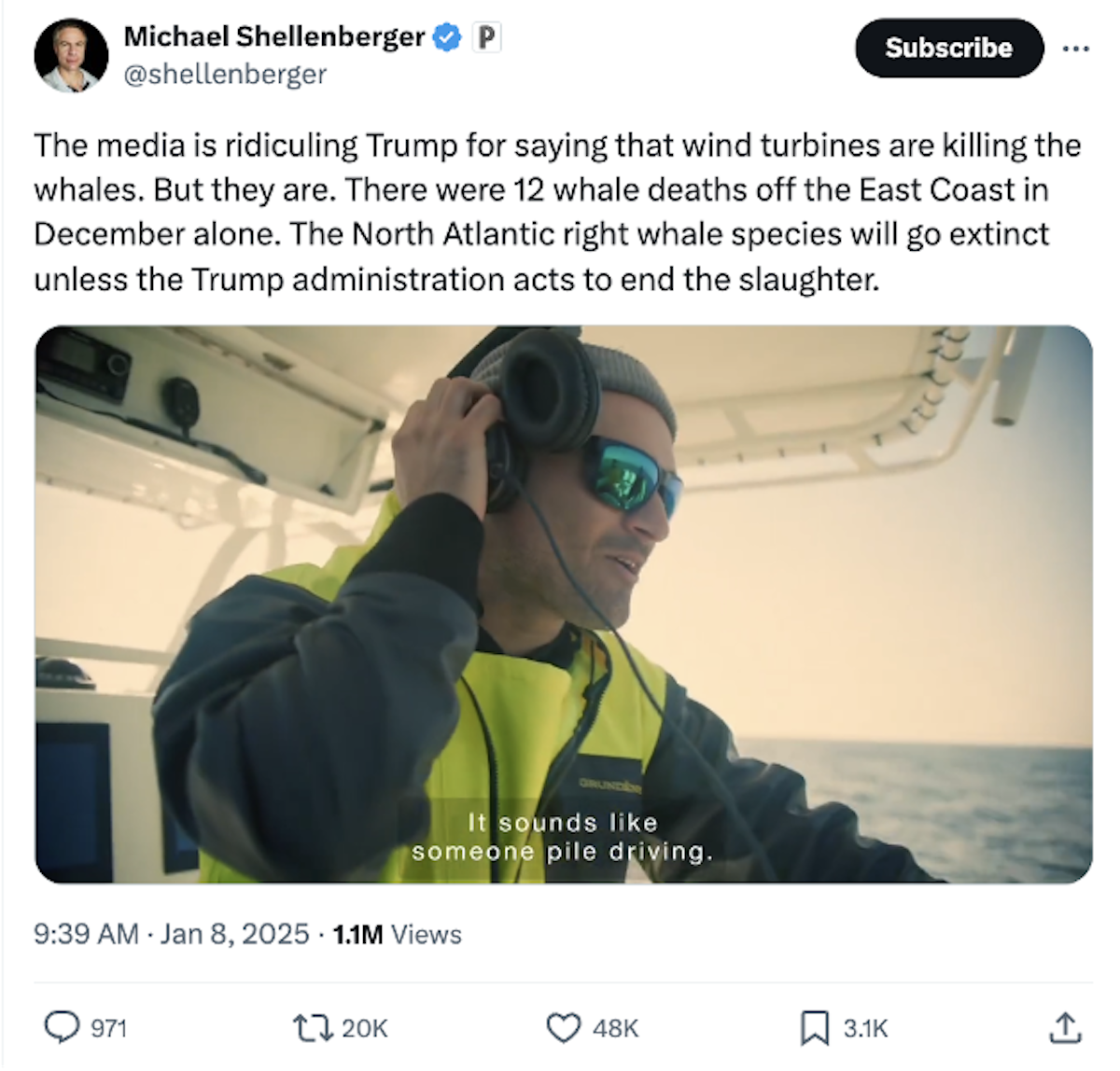 Link to tweet: https://x.com/shellenberger/status/1877002130776572270
What does Thrown to the Wind get wrong?
From the very start, Shellenberger’s brazen tweet makes a sweeping causal conflation. He claims that all 12 whale deaths off the U.S. East Coast throughout December 2024 occurred because of wind turbines, and that the North Atlantic right whale will go extinct unless Trump puts a stop to wind project development.
Having reviewed the film Thrown to the Wind in detail, such gyrating leaps of illogic accurately describe Shellenberger’s work on the subject.
Thrown to the Wind’s glaring sin is that it noticeably sidesteps discussion of any other possible causes of whale deaths, particularly the two consistent top known causes of death—entanglement in discarded fishing nets and gear, and collisions with boats of all kinds. These two factors accounted for 25 out of 41 known right whale deaths between 2017 and 2024. If a film were really centering whale welfare, one would expect it to touch at least briefly upon all the varied threats that whales face in practice.
It only gets worse from there. None of 12 East Coast whale deaths in December 2024 were right whales, contrary to what a casual reader might take Shellenberger’s tweet to imply. One of these dead whales washed ashore far away in North Carolina, where no wind construction is ongoing. Several of the dead whales appeared on beaches along the north side of Cape Cod, the side opposite from early-stage wind project development off Martha’s Vineyard south of Cape Cod’s southern coast. And while whale autopsy work on most of these dead whales is still in progress, initial findings so far have already ruled out offshore wind as the clear culprit in a couple cases—a Minke whale dead of disease, and a young humpback whale found on Cape Cod’s north side struck head-on by a boat.
Skating over such inconvenient details, Shellenberger and colleagues pin the blame for whale deaths squarely upon underwater noise pollution from offshore wind development. They claim to have shadowed ships performing preliminary work at the Vineyard Winds offshore wind site and to have taken damning measurements of noise emitted from such work.
A trailer clip Shellenberger shared prominently includes an off-the-cuff statement by a boat crew member recording noise from a survey vessel, who remarks “it sounds like somebody is pile driving.” This alludes to the process of pounding monopile structures into the offshore continental shelf, upon which developers later place the wind turbines themselves. Yet the fast-paced chirping sounds recorded from the small boat clearly do not originate from pile driving, which exhibits between strikes. Robert Rand, who the film credits as an acoustics expert, does correctly identify the noise as scanning sonar shortly thereafter in the film. This clarification is left out of the shorter promotional clip. Yet in any case, multibeam and sidescan sonar typically operate at frequencies above what humpback whales can hear and dissipate over short distances, and are used across oceanic industries like fishing, dredging, and scientific surveys. If sonar systems posed an existential threat to large whales, culpability would extend far beyond the offshore wind sector.
The film’s commentary on underwater sound levels also neglects context regarding the volume of the sounds measured. The film crew claims to have measured 150 decibels of sonar sound at a good distance from a specific seafloor surveying vessel in the Vineyard Wind development area, MISS EMMA MCCALL, then around 90 dB of sonar noise at a distance of 0.5 nautical miles in a separate instance. In comparison, the underwater noise from a moving cargo ship can be 190 dB at the source, while some research papers report that whale watching boats can produce 138-169 dB at the source (all decibel measurements are with respect to 1 μPa at 1 m). Coastal dredging to maintain harbor channels for ships and boats generates 180 dB.
How noisy does underwater sound have to be to bother marine life? Natural “ambient noise levels experienced in gentle weather conditions”, as it turns out, typically reach 94 dB. The U.S. National Marine Fisheries Service defines a continuous noise threshold of 120 dB beyond which there is a “possibility of behavioral impacts, generically, to marine mammals.” In other words, not all of the wind farm zone noise measured by the film crew was even particularly distinguishable from background ocean noise let alone harmful, while offshore wind operations are far from the only potentially loud noise sources in the coastal marine environment.
MISS EMMA MCCALL also uses exactly the same gear to survey across the U.S. East and Gulf coasts for offshore cables, underwater pipelines, offshore oil and gas drilling, dredging, government and scientific research, and other seafloor surface characterization activities. As of time of this writing, MISS EMMA MCCALL is docked in the Gulf of Mexico.
At another key point, the film shows charts comparing regional ship traffic in the mid-Atlantic and New England against the locations of reported whale deaths over different time frames. Predictably, the charts do show an increase in ship activity in the Martha’s Vineyard region in 2022 and 2023, while the number and location of whale deaths seems to fluctuate wildly between periods. Shellenberger quips in response to a colleague: “I appreciate your caveat about not suggesting causality, but it’s impossible not to look at these correlations and imagine there’s some connection.” His comment unintentionally reveals the skew characterizing the whole documentary project—a deliberate disinterest in alternative hypotheses, uncertainties, and sources of error.
The film, for example, does not seem particularly concerned with comparing its ship traffic and whale deaths narrative against the actual timeline of wind farm construction. Before 2022, the US built just 7offshore wind turbines. Five turbines near Block Island, Rhode Island constructed between 2015-2016, and two turbines off Virginia constructed in 2020. This calls into question the significance of the ship traffic imagery shown from December 2016 through the end of 2021.
The film team’s presentation of ship traffic in inconsistent time periods does not account for seasonal patterns of boat traffic around the Martha’s Vineyard, Nantucket, Cape Cod regions during the summer months. Nor do they consider the seasonal pattern of whale activity, in which whales are present year-round but concentrate off New England largely in the winter and spring months. In response, federal agencies and wind farm developers have also explicitly agreed that developers will concentrate onsite activity during summer months—another factor that the superficial commentary does not consider.
Meanwhile, dead whales washing ashore do not exactly offer the clear narrative that Shellenberger and company would like. Dead whales appearing on beaches are obviously decoupled in time and place from where and when they died, and researchers often require months of autopsy work to investigate the cause of death. Whale strandings, by nature, are a metric carrying considerable error—an inherently incomplete picture of whale mortality with a lot of chance thrown in that could create illusions of trends. The time needed to detect robust trends in whale deaths in response to a new stressor may be quite long. Simultaneously, one can easily imagine other explanations for increasing whale deaths on the U.S. East Coast since 2016, such as infectious disease, marine pollution, climate shifts, or significant shifts in boat traffic during and after the COVID-19 pandemic.
As the film’s final piece of evidence, activist Lisa Linowes claims that a letter to the Bureau of Ocean Energy Management by NOAA Chief of Protected Species Sean Hayes warns that wind turbine turbulence will destroy the plankton that whales feed on. This assertion utterly butchers the actual scientific concern the letter by NOAA scientists highlights—a far more mundane risk that turbines could change local patterns of water circulation and stratification, shifting where zooplankton occur. Many anti-wind activist groups regularly cite this NOAA letter, but few groups draw attention to the NOAA scientists’ proposed solution to protect whales from negative impacts—an incremental 20 kilometer shift of the wind farm development zone. This policy suggestion stands in sharp contrast to how Shellenberger’s film frames the threat to whales from offshore wind projects as a yes or no binary, as opposed to any interest in exploring solutions throughout the whole spectrum of impacts and countermeasures.
Make no mistake—this critique of Shellenberger’s film does not seek to dismiss the real concerns regarding possible negative impacts upon whales from offshore wind development. As evidenced by federal regulations, industry countermeasures, and academic research and oversight, such concerns do demand serious study and attention. But members of the public worried about whale welfare are far better off reading the actual NOAA letter and related scientific work themselves rather than wasting time on this “documentary.”
On the future of humans, the ocean, and the Earth
Overall society would benefit by drawing some much-needed lessons from this silly film. Likely, many clean energy advocates and climate hawks have nodded along so far with this critique of Thrown to the Wind.
Yet members of the broader environmental coalition should consider how this film is actually representative of the highly unscientific, typical documentary often celebrated by the environmental movement. Thrown to the Wind’s distorted narrative echoes that of films like the widely-panned Seaspiracy, which spun similarly superficial and unscientific narratives about fishing and ecological collapse. The ranks of junk food movies on nuclear power include examples like Meltdown: Three Mile Island, which earned a Netflix release despite wildly mischaracterizing numerous technical and historical facts and leaning heavily on appeals to emotion.
One could literally shoot the same kind of documentary speculating about how geothermal power will poison the flamingos, complete with an eerie musical score, camera angles lingering melancholically on a flamingo chick, and sermonizing over the sins of industrializing nature. This is a mirror image of classical environmentalist doco-dramas, just mobilized for different ideological purposes. Shellenberger, after proclaiming the “Death of Environmentalism” just two decades ago, has now essentially chosen to leap into the same grave.
Critics do not need to make up arguments against offshore wind. Shellenberger is likely grossly overstating the impacts of offshore wind development on Atlantic whale populations so far, but neither is it reasonable to argue that the old Biden administration goal of expanding offshore wind capacity from 42 megawatts to 30,000 megawatts by 2030 would have zero impacts upon whales. A more rational discussion of impacts management can appreciate the full spectrum of tradeoffs between building many wind farms speedily and cheaply versus slower, limited construction with obligations to implement a whole suite of high-cost mitigative measures.
From a big picture perspective, one can easily imagine that in a techno-economic future where nuclear power or advanced geothermal scale with great commercial success, the entire case for offshore wind could weaken to the point of non-viability. But the future technological breakthroughs are hard to predict and society needs more clean energy tools, not less.
Meanwhile, one thing is certain: the fate of Atlantic whales will depend upon a far richer set of factors—ranging from fishing to navy sonar to climate shifts—than just offshore wind turbines alone.
---
via drilled
the New Denial Is Delay
How an attempt to revolutionize the environmental movement became a push to delay action on climate change.
By Paul D. Thacker
In October 2004, Ted Nordhaus and Michael Shellenberger, the founders of a scrappy Bay Area think tank called The Breakthrough Institute, published “The Death of Environmentalism,” an essay that argued the environmental movement had failed. To knock back critics, the duo constantly underlined their environmental credentials and years of experience providing public relations advice to green groups like the Sierra Club and Natural Resources Defense Council.
Seeking to define themselves as different from run-of-the-mill climate skeptics, Shellenberger told a reporter around that time, “We’re not like Bjorn Lomborg or whatever.” Lomborg, of course, is the Danish climate contrarian best known for the fact-challenged book Cool It and, more recently, False Alarm.
A few years after seeking to differentiate the Breakthrough Institute from Lomborg, Shellenberger joinedthe Danish writer on a panel at Brown University, where both urged more tempered rhetoric on climate change. As reported by the Brown Daily Herald, Shellenberger argued that climate change experts dismissed him and Lomborg because policy experts did not allow for their “alternative voices.”
[janus forum pix]
More than a decade later, Shellenberger has left the Breakthrough Institute, but little else has changed. Both Shellenberger and Lomborg have released new books—as in the past, experts immediately savaged them. In a review at Yale 360, Pacific Institute emeritus president Peter Gleick wrote, “Bad science and bad arguments abound in 'Apocalypse Never' by Michael Shellenberger.” Taking a pickaxe to Lomborg’s book False Alarm, Nobel Prize winning economist Joseph Stiglitz wrote in the New York Times, “This book proves the aphorism that a little knowledge is dangerous. It’s nominally about air pollution. It’s really about mind pollution.”
--
A decade after theBreakthrough Institute burst on the scene firing shots at Big Green, Shellenberger followed Sierra Club president Mike Brune onto the stage for Brainstorm Green, Fortune Magazine’s 2014 conference for environmental leaders. After opening remarks from Brune, dressed the part of an environmental nonprofit boss in boring suit and tie, Shellenberger stepped up to the podium in slacks and a fitted shirt—uniform-ready to host an inspiring Ted Talk.
He then proceeded to berate Brune for failing to offer real solutions to climate change.
By this point, Shellenberger no longer felt the need to namecheck his environmental roots before launching a missile at Big Green. He recounted how, in contrast to Brune and his ineffective Sierra Club, he and Breakthrough co-founder Ted Nordhaushad successfully lobbied for the New Apollo Project, a coalition advocating for cleantech and renewable energy. Shellenberger added that the New Apollo later convinced the Obama administration to put $150 billion into a stimulus bill.
After leaving the podium, Shellenberger sat down next to Brune to continue the debate. Brune then punched back, “We operate differently from your Breakthrough Institute. We are not a think tank; we are a group that gets results...on the ground.”
With a grin and a shrug, , “We had pretty good results with the stimulus, actually.”
The sparring was vintage Breakthrough: tiny, Left Coast think tank smacks down Big Environment for sclerotic thinking and green solutions less palatable than last week’s stale, organic, whole grain muffins. Also standard: Shellenberger’s Apollo parable relied on a string of selective facts, loudly paraded onto stage for political theater.
Started in the early 2000s, the Apollo Alliance banded together dozens of labor unions and green groups in a coalition that advocated for federal funding to advance technologies and create jobs for clean energy. Members included everyone from the NAACP, SEIU, Greenpeace, Tides Foundation, League of Conservation Voters, and the AFL-CIO. Anyone who was anyone began adopting Apollo-like rhetoric, including Bill Clinton, and The Nationeditor and publisher Katrina Vanden Heuvel. Not surprisingly, a founding board memberof Apollo was the Sierra Club’s executive director, which makes it odd that Shellenberger would try to seize sole credit for the coalition’s purported success, let alone use it against Brune.
In reality, Nordhaus and Shellenberger were two of the many, many people that helped get the coalition off the ground. And in 2005, nearly a decade before that public spat with Brune, Shellenbergerannounced that he had left Apollo over disagreements with members. In a recent interview with Drilled,Shellenberger put it more bluntly: “I was shitcanned from Apollo over ‘Death of Environmentalism.’”
Despite that happening more than fifteen years ago, Shellenberger still references his time with the Apollo Alliance when plugging his tale as a hero to save the planet from climate change. In January 2020, for example, when he testified before the House Science Committee, Shellenberger noted “In 2003 I co-founded the Apollo Alliance to advocate for a Green New Deal, which we called a ‘New Apollo Project.’” He added that Obama’s stimulus (passed in 2009) funded many Apollo proposals for renewables, energy efficiency, and electric vehicles.
In speaking with Drilled, Shellenberger claimed to have had a hand in that stimulus as well, after meeting with Obama’s policy team. “And the Obama people, they got it right away,” Shellenberger said. “And then the rest is history. They basically were like, ‘Yeah, we want to do a big investment in clean energy.’ And that was the stimulus investment.”
A recently retired Hill staffer, who did not want his name in the media, said he worked for decades on appropriations for the House but never heard of the Breakthrough Institute. He wondered how Shellenberger—or anyone—could claim personal credit for passing billions of dollars in renewable energy policy with just one or two meetings, when the Hill is swarming with professional lobbyists working around the clock.
“He’s constantly reinventing his story to build the appearance of power and access,” said Kert Davies, who spent 13 years at Greenpeace examining energy policy, before founding the Climate Investigations Center in 2013. Davies said he first met Shellenberger in the early 2000s, when Shellenberger was vying to get a communications contract with Greenpeace. “He takes credit for things [that happened] years after he was boosted from the Apollo Alliance. He can say whatever he wants, and it’s all vapor because the organization is now gone.”
“They aren’t players up here on the Hill,” a Democratic Committee staffer said of The Breakthrough Institute. This staffer has spent almost two decades in Congress working on environmental and climate change policy but is not authorized to speak to the media. “They spend most of their time shooting spitballs at mainstream environmental organizations and that makes them a bright, shiny object to some journalists.”
Nonetheless, when Nordhaus and Shellenberger flew from California to Washington in 2009 to discuss climate policy, NPR interviewed them outside the Senate Dirksen Office Building, and reported their funder Peter Teague’s claims that President Obama had adopted Breakthrough’s “language and visionary rhetoric.”
--
Jockeying to position themselves as the smart, thoughtful adults on environmental policy is core to the Breakthrough model, and to Shellenberger's approach post-Breakthrough as well, along with constant bashing of “Big Environment.” In 2005, after Greenpeace created the website Exxon Secrets to track the oil company’s funding for climate change disinformation, Mother Jones published a sprawling investigationdetailing how Exxon was throwing buckets of cash at forty organizations that attacked the scientific consensus on climate....
sfgate
2004
,,,Rival pollster Penn, Schoen & Berland Associates, a Washington, D.C., firm that was former President Bill Clinton's chief poll-taker and was hired by the Venezuelan opposition, issued an exit poll Sunday that got the results reversed. More than four hours before the voting ended, the firm issued a press release with the headline "Exit Poll Results Show Major Defeat for Chavez." It claimed Chavez had been defeated, 59 percent to 41 percent.
The opposition tried to use Penn Schoen's exit poll to justify its claim that the official election tally must have been falsified, and it claimed that former President Jimmy Carter and officials of the Organization of American States, who verified the results as accurate, were dupes of Chavez.
In the middle of the fray has been Michael Shellenberger, president of Lumina Strategies, an El Cerrito public relations firm that was hired by Chavez in June to help repair his poor public image in the United States. Shellenberger, who previously worked oncampaigns to save the Headwaters Forest and against Nike over sweatshop labor said that the Penn Schoen survey was unreliable because the actual polling was carried out by a Venezuelan opposition group, Sumate, that received U.S. government funding and was itself a key organizer of the referendum....
==
https://publicintegrity.org/environment/venezuela-head-polishes-image-with-oil-dollars/
9/04 Kevin Bogardus
INTRODUCTIO
Using Venezuela’s oil wealth to fund his social programs, President Hugo Chavez has divided his country largely along class lines, resulting in protests, strikes, and even a coup since his 1998 election.
Yet Chavez not only secured enough support in his home country to win this past August’s recall election, but also found friends here in the United States—grassroots activists who have opposed the White House and now promote Chavez’s cause.
The Latin American nation’s welfare policies have reverberated with American organizers. “Venezuela, under Chavez, is using its oil resources to improve the lives of the poor,” said Medea Benjamin, the co-founder of Global Exchange, a San Francisco, Calif., international human rights organization. “We here are obviously very excited about that.”
Chavez has spent more than $1.6 million from mid-2003 through June 2004 on lobbying the federal government in Washington. The country also created its own Washington mouthpiece called theVenezuela Information Officein July 2003 and soon after hired a top U.S. protest organizer as its executive director.
The VIO tapped into a major U.S. activist network by contacting Global Exchange in early September 2003. The group has helped organize some of the world’s largest protests, including demonstrations against Seattle’s 1999 World Trade Organization summit and the 2004 Republican National Convention.
“We have been very careful to make sure we remain separate in our work,” said Deborah James, the VIO’s executive director, referring to Global Exchange. “I have not met with their people down there [in Venezuela].”
Yet the activist group and the VIO together posted an action alert online in May 2004 to voice concern over an editorial in The Washington Post.
“The Venezuela Information Office and Global Exchange is asking people to write publishable letters to the editor of The Washington Post, in order to provide factual information about recent events in Venezuela and point out the factual inaccuracies contained in the Post’s editorial,” read the notice on Global Exchange’s Web site.
Global Exchange has been involved with Venezuela before. The group has also coordinated so-called “reality tours” of the Latin American country.
“We have been taking a lot of groups to visit Venezuela,” said Benjamin. “They learn a lot about the social programs, which are run by the government.”
With a $15 billion budget in 2004, PdVSA, Venezuela’s state oil company, has been forced to set aside $1.7 billion to fund Chavez’s social programs. Some critics have charged that Venezuela’s welfare projects have compromised PdVSA’s future, forcing the company to under-invest in its oil operations.
PdVSA is not a model of stability either. Chavez has appointed five different directors to run the company since he has come into power—even triggering the 2002 coup that briefly ousted the Venezuelan president.
Though not actively lobbying this year, PdVSA itself has contracted law firms in the past, including such powerhouses as Hill & Knowlton and Cleary, Gottlieb, Steen & Hamilton.
The VIO discussed with James, then a high-level organizer at Global Exchange, “ideas for strategizing on Venezuela” and the “need to begin conference calls of solidarity groups” in September 2003. One of James’ current projects is a book on Chavez and the “Bolivarian Revolution” in Venezuela.
Soon after the VIO was founded, its American staffers began contacting activists and protesters, even appearing at events sponsored by the peace and social justice movements.
“When people see the incredible social transformation that is happening in Venezuela and in particular when they learn about the use of oil revenues to benefit all Venezuelans, people contact us so that we provide them with ways they can work against U.S. intervention,” James told the Center.
At protests, conferences, and college campuses, VIO employees handed out literature and played The Revolution Will Not Be Televised, a documentary of Venezuela’s 2002 aborted military coup. The VIO e-mailed several independent film theaters about showing the movie throughout the year.
The VIO also coordinated a “rapid response” team to combat news articles and editorials critical of Chavez. Eva Golinger, a writer at the pro-Chavez Web site, Venezuelanalysis.com, was asked to be a member of the team in September 2003.
“We encourage people to go their site because it is the most in-depth, comprehensive coverage of Venezuela in English,” said James. “But we certainly do not have a structural relationship with them.”
Golinger has written opinion pieces on the Web site critical of U.S. policy towards Venezuela. VIO requested that Golinger write letters-to-the-editor of various publications to challenge news articles, editorials and op-eds that were deemed too critical of Chavez’s government. The VIO contacted over a dozen individuals to write letters, according to lobbying disclosure filings.
Golinger, who contacted the Center after this report was published, wrote that VIO’s communications were not significant, and that, “Long before that office came into existence…I was writing articles about Venezuela and engaging in efforts to educate on Venezuelan current affairs.”
Some members of the VIO’s “rapid response” team were officially connected to the Venezuelan government, such as Antonio Padrino, the press secretary in Venezuela’s Miami consulate, while others were part of activist groups, such as Chuck Kaufman, a coordinator of the Nicaragua Network.
The VIO e-mailed reporters who covered Venezuela as well. The VIO’s Communications Coordinator Nathan Converse spent days contacting journalists about their reporting, which he termed “inaccurate,” “biased,” or “unfair.” In total, Converse sent over 50 e-mails in roughly half a year to reporters and editors who were critical of Chavez.
The VIO also coordinated activists’ delegations to visit Venezuela in January 2004, including one sponsored by the TransAfrica Forum, a non-profit organization that researches U.S. foreign policy and how it affects Africa, the Caribbean and Latin America. One of the VIO’s letter-writers, Edgard Hernandez, interviewed TransAfrica’s president, Bill Fletcher, upon his return to the United States and wrote a glowing report of the trip on Venezuelanalysis.com.
The VIO abruptly ended operations at the end of January 2004, only to reconstitute itself a month later with a reshuffled staff and a budget of $660,000. James was put on the payroll and became executive director of the new VIO. She is currently on leave from Global Exchange. Converse has stayed on at VIO, working on media relations.
According to records, the new VIO is incorporated in Florida under the name VIO Investments Corp. and is owned by Isaura and Evelio Gilmond.
“[Isaura] does the majority of our administrative and accounting work for us,” said James.
The reasons for the changes were not made clear in its filings with the Justice Department, nor in a James interview with the Center.
Coincidentally, the same day the VIO re-registered with the Justice Department, a letter was posted on a Web site frequented by large donors to progressive causes. Authored by members of the American progressive community, the letter appealed “to the progressive funding community to take an interest in this issue [democracy in Venezuela], and provide funding to groups that are working on it, before it is too late.”*
“That was not asking for money for the Venezuelan Information Office or for any particular organization,” said Marc Weisbrot, the co-director of the Center for Economic and Policy Research. “[It] was saying to funders to pay attention to what is happening in Venezuela. That letter had certainly nothing to do with the Venezuela Information Office.” Weisbrot was one of the signers of the letter.
Many of the letter’s co-signatories had been contacted by the VIO beforehand though, even traveling to Venezuela on delegations organized by the office. Weisbrot himself has written several newspaper editorials against U.S. policy towards Venezuela.
The new VIO signed a $60,000 subcontract with Lumina Strategies in May 2004. Headed by Michael Shellenberger, a former Global Exchange employee, the group plans to oversee media relations and provide strategic counsel to Venezuela’s government.
Global Exchange is one of Shellenberger’s past clients. Several of their joint campaigns – encouraging balanced U.S. media coverage of Mexico and battling against Nike’s use of “sweatshop” labor – are spotlighted in case studies on Lumina’s Web site.
Despite its frequent contact with activists who oppose Bush, Venezuela has made overtures to the White House through Patton Boggs, one of Washington’s largest legal and lobbying firms. For fees of $670,000 in this past year alone, Patton Boggs lobbyists advised the Venezuelan president to heat up his own war against drugs to find favor in the Bush Administration, according to a leaked memo.
Whether loved by the White House or not, Chavez and his oil remain vital to the American economy. Venezuela is the United States’ fourth biggest source of the fuel.
==
10/16
“Power, power for the people,” sang a crowd of about 40 mostly young people holding protest signs and marching outside a high-rise office building in downtown Chicago on Monday.
Their signs denounced fossil fuels, and their rally was billed as inspired by the Civil Rights March on Washington, the Stonewall gay rights uprising and Gandhi’s Salt March.
But the forces targeted by this would-be social movement were a major environmental organization and renewable energy developer, which protesters say are standing in the way of legislation that would aid Illinois’ nuclear power plants.
The march was the latest effort by Environmental Progress, a national group founded by prominent Bay Area environmentalist and nuclear advocate Michael Shellenberger with the support of philanthropist Rachel Pritzker. Shellenberger was in Illinois earlier this year, along with Pritzker and climate scientist James Hansen, to tout nuclear energy and demand Illinois’ plants be kept open.
Shellenberger and his supporters describe their group as a nascent environmental movement that takes no industry money. The group’s website says it was founded to address the twin issues of climate change and curbing the burning of wood and dung for power, with the site featuring photos of women and children in developing countries, as well as various primates.
But preventing the closing of nuclear plants, specifically in Illinois, California and New York, appears to be the group’s primary focus so far. “The ocean’s getting sicker, hear the bird and mammal cries; the environment’s at risk from anti-nukes who spew their lies,” goes the final verse of their protest song.
A number of Chicago clean energy and environmental advocates view Shellenberger’s quest as quixotic or disingenuous, and say he is sowing confusion about Illinois’ energy economy at a time when state lawmakers are considering controversial legislation that would guarantee revenue to Exelon Corporation’s nuclear plants. Exelon, which owns six nuclear plants in Illinois, has said it will close two facilities, Clinton and Quad Cities, if it does not get the guarantees.
Dave Lundy is executive director of the BEST coalition, a 501(c)4 organization of consumer groups and companies that oppose the supports for nuclear in the proposed bill.
“Gandhi was marching against the British in an attempt to break a monopoly, and these guys are marching for the monopolists,” Lundy said. “I’m sure most of these marchers are very well-meaning people. Unfortunately they know absolutely nothing about the Illinois energy market. Illinois currently generates 40 percent more electricity than we need.”
Lundy cited 2015 Energy Information Administration statistics showing 193.5 million MWh of electricity generation and 137.5 million MWh of consumption in the state. “Demand is declining, and we already have more power than we need,” he added.
Ideology or influence
Shellenberger’s protest was billed as calling out the Environmental Law & Policy Center for taking money from what he characterizes as fossil fuel interests, namely Invenergy, a developer of solar, wind and natural gas power that donated $10,000 for a table at ELPC’s annual fundraising dinner in April featuring U.S. Senator Elizabeth Warren.
Invenergy’s website says its developments include 7,654 MW of wind, 5,833 MW of natural gas and 179 MW of solar power.
ELPC declined to comment but provided a statement about the march, citing organizers’ references to civil rights and Gandhi:
“That’s tone-deaf to the people who have fought for civil rights for millions of people. This group is instead apparently demanding that Illinois consumers pay a billion dollar rate hike for Exelon’s benefit while our schools, kids’ programs, public transit districts and mental health programs are suffering harsh funding cuts. Let’s show some common sense here.”
The ELPC is a member of RE-AMP, which publishes Midwest Energy News.
When asked whether he thinks ELPC’s or other environmental groups’ policy positions are influenced by the natural gas industry, Shellenberger said “they have the ideology and then the money comes later.
“Their outmoded 1970s tin-foil-hat ideologies are being locked in by these contributions,” he said.
ELPC’S statement listed some of their efforts to reduce pollution from fossil fuels:“ELPC worked with community partners to challenge the highly-polluting Fisk and Crawford coal plants, we are in court to make sure that Peabody Energy doesn’t shift coal mine reclamation costs onto the public, and we are in court to protect clean air and reduce pollution from the Edwards coal plant in Peoria. Just as importantly, ELPC is advancing sensible energy efficiency programs that avoid pollution, create jobs and save families and businesses money on utility bills.”
Shellenberger said he blames ELPC for being a roadblock to the passage of proposed state legislationthat could provide hundreds of millions of dollars in guaranteed revenue for Exelon’s nuclear plants. The bill includes numerous other contentious provisions backed by Exelon’s subsidiary utility ComEd, including policies that critics say are hostile to solar development.
Intense negotiations over energy legislation are ongoing between ComEd, Exelon and members of the Clean Jobs Coalition — renewable companies and environmental groups, including ELPC, that have introduced their own bill.
The Oct. 23-24 agenda advertised by Shellenberger’s group noted a meeting with Clean Jobs Coalition members preceding the march. He said he has contacted all the members of the coalition but only one agreed to meet with his group, and that meeting had to be rescheduled.
Shellenberger and many of the marchers said that natural gas and coal power will proliferate, with new plants opened and existing ones kept running, if the bill isn’t passed to support Illinois’ nuclear plants. But critics of the bill have long pointed out that Illinois is an energy exporter, and the regional grid operator PJM announced this year that there would be no reliability impacts if Quad Cities closed. MISO will do a similar analysis for the Clinton plant.
The idea that closing the two Illinois nuclear plants will mean more greenhouse gas emissions, Lundy said, “is an assertion in direct conflict with the facts. If you shut down Quad Cities and Clinton, we’re not going to be starting up a bunch of new coal plants. Illinois is in a good position with or without Clinton and Quad Cities — those are just the numbers.”
The power of money
Shellenberger made his name as a renewable energy advocate, including co-founding the Apollo Alliance in 2003. The Breakthrough Institute, which he also co-founded, advocates for new energy solutions driven by technology and innovation, including in nuclear and renewables. But Shellenberger said that funding from both fossil fuels and clean energy companies unfairly influences the political debate.
“You can’t take money from renewable companies and be an honest broker,” he said. “We don’t take money from any energy companies. Frankly that’s unethical.”
Shellenberger said the Pritzker Innovation Fund provided the seed money necessary for Environmental Progress, founded this year, to attract 11 other funders, mostly small foundations or individuals.
The Pritzker Innovation Fund’s 990 forms for 2014 filed with the IRS show a $600,000 contribution to the Breakthrough Institute, along with $100,000 to the Clean Air Task Force and several other major donations. The fund also contributed $94,433 to the Third Way Instituterelated to Pandora’s Promise, a film featuring Shellenberger and touting the benefits of the nuclear industry and its safety, including the idea that the Chernobyl nuclear meltdown caused far less harm than commonly believed.
Shellenberger has on at least one occasion been on the receiving end of criticism about alleged fossil fuel ties.
Among his varied past public relations work, Shellenberger once represented the administration of then-Venezuelan president Hugo Chavez. His firm Lumina Strategies reportedly helped try to revamp the socialist leader’s image in the U.S. in 2004.
Journalist and Chavez critic Aleksander Boyd was sharply critical of Shellenberger accepting the work.
“What is the source of Shellenberger’s salary if not oil money that could have been used to benefit ordinary people?” he wrote at the time.
Faith in nuclear
In Chicago, protester Heather Matteson said she has worked at the Diablo Canyon nuclear plant in California for more than a decade. In June the company PG&E announced it will not seek license renewal, and Diablo — California’s last nuclear plant — will close in 2025 contingent upon several regulatory approvals. The company made an agreement to invest in renewables, energy storage and energy efficiency to replace the power from the plant.
Alarmed by the news, Matteson began doing research and “found Michael.” With his help, she said, she founded the group Mothers for Nuclear, which now has representatives in several states.
Matteson said she first got her job at the plant thinking that “I’d be a little bit of a spy,” since she was part of the group Mothers for Peace*, where members opposed nuclear power. But seeing the industry firsthand she quickly became convinced of its safety and value, she said. She is from a tiny copper mining town in Arizona, where she saw the need to preserve water and land, and she feels like nuclear energy produces less waste and environmental harm than fossil fuels or renewable energy.
[*UPDATE October 31, 2016: Mothers for Peace member Molly Johnson said that board members say and the group’s records show that Matteson has never been a member of the anti-nuclear group. Matteson said she is on the group’s mailing list, and thought that constituted membership.]
“The market’s not accurate and doesn’t reward nuclear for being carbon-free,” Matteson said at the Chicago march. “It’s unfair because of subsidies for renewables.”
Emma Redfoot heads the Idaho chapter of Mothers for Nuclear, though she doesn’t have children. She’s a graduate student in nuclear engineering with a bachelor’s degree in environmental studies. Her research focuses on nuclear hybrid energy systems, wherein nuclear reactors can ramp up or down quickly to complement variable output from solar and wind power. In the U.S., natural gas plants typically fill this role. Redfoot thinks environmental groups would look more kindly on nuclear energy if they saw it in this capacity.
“They absolutely believe in renewables, and that means you have to support natural gas,” she said.
The march included many nuclear engineering students, including from the University of Illinois and Berkeley. “I’ve always been interested in clean power,” said University of Wisconsin-Madison student McKinleigh McCabe. “And as I got more into my major I realized that nuclear is really cool.”
Members of the Nuclear Energy Information Service, an anti-nuclear group, protested against Shellenberger’s group outside the ELPC offices. NEIS executive director Dave Kraft described Shellenberger’s campaign as among “astro-turf, pseudo-environmental efforts to bail out the failing nuclear power industry.” In response to the anti-nuclear protestors, nuclear advocates, mostly a generation or two younger, chanted “No tin foil hats!”
Shellenberger said he was proud of the two-day event, especially the student turnout. “We’re still small,” he said, “but all great things start small.”
CORRECTION: A $600,000 contribution from the Pritzker Innovation Fund to the Breakthrough Institute in 2014 was not made for the group Environmental Progress, as reported in a previous version of this story. Environmental Progress was founded in 2016.
ABOUT KARI LYDERSEN
Kari has written for Midwest Energy News since January 2011. She is an author and journalist who worked for the Washington Post's Midwest bureau from 1997 through 2009. Her work has also appeared in the New York Times, Chicago News Cooperative, Chicago Reader and other publications. Kari covers Illinois, Wisconsin and Indiana as well as environmental justice topics.
https://fair.org/home/wsj-fakes-a-green-shift-toward-nuclear-power/
Wall Street Journal(6/16/16) published an article headlined “Environmental Groups Change Tune on Nuclear Power: Focus on Climate Change Has Raised Profile of Reactors, Now Viewed as Reliable, Carbon-Free Source of Energy.” Written by Amy Harder, the approximately 600-word piece appeared on the front page of the Journal’s B section.
Its dramatic lead-in:
Some of the nation’s most influential environmental groups are softening their longstanding opposition to nuclear power, marking a significant shift in the antinuclear movement as environmentalists’ priority shifts to climate change.
This shift, Harder wrote, “is lowering one of the biggest political hurdles facing the nuclear power industry in the US.”
What followed was framed by the story’s two quoted pro-nuclear sources, Joe Dominguez, an executive with Exelon Corp, the US’s largest electric holding company and operator of its largest fleet of nuclear plants, and Michael Shellenberger, co-founder of the quasi-neoliberal, pro-technology environmental think tank The Breakthrough Institute. According to Dominguez, the green groups’ “absence on the opposition front” is “’pretty significant’” and the “’shift in attitude…has a clear impact on companies’ bottom line.’”
The evidence of this shift? Vague assertions that the Sierra Club “is debating whether to halt its longtime position in support of shuttering all existing nuclear power plants” and that its “leaders see existing reactors as a bridge to renewable energy…as the group campaigns to shut down coal and natural gas plants.” Similarly, the story says, the Environmental Defense Fund is “deciding to what extent it should adjust its policy.”
Central to the story is the contention that prominent eco-advocacy groups, including Sierra, EDF and the Natural Resources Defense Council, are among those working with Exelon and state lawmakers on a legislative deal that would reverse a decision the company made in early June to close two money-losing nuclear reactors,Quad Cities and Clinton, and “ensure that the reactors remain in operation by providing financial recognition for the zero-carbon electricity they produce.”
But major assertions in the Journal article turn out to be either factually inaccurate, or to omit or spin important details. First, though Harder refers multiple times to nuclear power being “carbon-free” (echoing the websites of nuclear plant owners such as Exelon and Pacific Gas & Electric), that is not the case.
According to the Nuclear Energy Institute, an industry lobbying group:
Nuclear energy facilities do not emit criteria pollutants or greenhouse gases when they generate electricity, but certain processes used to build and fuel the plants do. This is true for all energy facilities. Nuclear energy’s life-cycle emissions include emissions associated with the construction of the plant, mining and processing the fuel, routine operation of the plant, disposal of used fuel and other waste byproducts, and decommissioning.
Nuclear energy’s greenhouse gas footprint is higher than renewables’, however. And as Greenpeace nuclear policy analyst Jim Riccio told the peer-reviewed journal Nature Climate Change in 2008, “The fact is, there’s no such thing as a carbon-free lunch for any energy source.” Riccio is also quoted in the Journal piece—against nuclear power: “Illinois should not be bailing out old and dangerous reactors because they can’t complete,” he said—hardly an endorsement. That sentiment is reflected on Greenpeace’s website, which states, “Nuclear power has no place in a safe, clean, sustainable future.”
Second, the notion that “the nation’s most influential” green groups are “changing their tune” is also untrue. The characterization of Illinois’ energy-policy debate, for example, is “over-the-top outrageous,” according to Dave Kraft, director of the Nuclear Energy Information Service, a 35-year-old safe-energy organization that calls itself “Illinois’ Nuclear Power Watchdog.”
NEIS is part of a coalition of environmental groups opposing SB 1585, a piece of legislation dubbed the Next Generation Energy Plan that is still in play. The bill was cobbled together from a proposal developed by Exelon with input from a variety of competing interests, including green groups. Kraft says these activists have been negotiating not “SO THAT the plants would be kept in operation, but WHETHER they will.… That’s a significant difference.” He says NEIS plans to write a letter of complaint to the Journal, asking for a correction and a retraction. (As this story went to press, Exelon notified the Nuclear Regulatory Commission that it intends to close the Quad Cities and Clinton reactors—WJBC, 6/23/16.)
Since the Journal story’s publication, other eco groups are rushing to clarify their positions. The NRDC, for one, published a blog post (6/19/16) debunking the piece, stating:
The story highlighted coalition negotiations underway in the Illinois General Assembly…. NRDC is engaged with allies in legislative negotiations on energy policy in Illinois. But the Journal is dead wrong on our goals, focus and motivation. Our effort to reform energy policy does not involve, or signal, a change in NRDC’s long-held concerns about the role of nuclear energy in the country’s generation mix. That is especially true in Illinois, the state with the greatest number of nuclear reactors and waste in the entire country. Our efforts to negotiate an agreement with Exelon involves a continuing dedication to transform the Illinois energy landscape and advance a new, clean energy economy.
The post went on to refute the Journal piece’s allegation that shuttered plants inevitably mean more carbon-spewing coal and gas in their place:
Current proposals by Exelon would bring financial assistance to the company’s two economically distressed nuclear facilities, as noted in the Wall Street Journal…. Our coalition is negotiating to ensure an orderly and just transition that will help ensure that when nuclear plants close (whether for financial reasons or reaching the end of their design life), efforts should be focused on how to replace them with energy efficiency gains and clean power from the wind and sun, not dirty fossil fuels. Without fixing the state’s flawed renewable energy policies, that cannot happen—so this is a conversation NRDC will continue to encourage in Illinois.
The Sierra Club, for its part, quickly answered the assertion that it’s reconsidering its position with a June 17 statement on the Club’s website by executive director Michael Brune:
Sierra Club remains opposed to dangerous nuclear power, and our efforts to make sure these plants shut down continue. Our successful work to stop and retire coal, oil, and gas operations has not precluded this important work, nor will it in the future. It’s imperative that we move toward an economy powered by 100 percent clean, renewable energy like wind and solar right away.
In addition, Sierra has publicly opposed the proposed bailout of the Exelon plants embodied in SB 1585, and has submitted a letter to the editor of the Journal, according to Club spokesperson Trey Pollard.
Even EDF, historically more industry-friendly, is not exactly a nuclear booster. The organization’s website recently featured a blog post (6/1/16) that listed key policies to “turn the corner” on carbon emissions: putting a price on carbon, implementing President Obama’s Clean Power Plan and developing a nationwide smart grid.
With this story, the Journal seems to be conflating the pro-nuke positions of prominent individuals in the scientific and policy community with the sentiments of major environmental organizations. As the Washington Post’s Chris Mooney reported in a fairly balanced (but misleadingly titled) article late last year, there has been a vocal group of academic scientists rethinking nukes. He wrote:
A new letter, signed by 71 ecologists and conservation researchers (at last count), may be…significant. Authored by ecologists Barry Brook of the University of Tasmania and Corey J.A. Bradshaw of the University of Adelaide—and based on a longer paper by the two just out in the journal Conservation Biology—it argues that greens must rethink their nuclear power resistance…. This is not the first time that a coterie of environmental scientists have stood up for nuclear energy. Last year, four top climate researchers—Ken Caldeira of the Carnegie Institution, Kerry Emanuel of MIT, Tom Wigley of the National Center for Atmospheric Research, and James Hansen of the Earth Institute of Columbia University—wrote a letter defending the deployment of what they described as newer, safer nuclear power technologies.
Frequently joining this latter group of pro-nuclear climate hawks has been TBI’s Michael Shellenberger, who told the Journal, “If anything gives me hope in these dark times, it’s that so many environmentalists are changing their minds about nuclear…. What was just a trickle of converters a few years ago has become a positive stampede.”
Who these converts are he did not say. But although the Journal describes TBI as “a progressive think tank,” the Institute and its new spinoff, Environmental Progress, have a history of separating themselves from, and even trashing, the environmental mainstream. The organization originally gained fame in the early 2000s with their essay “Death of Environmentalism: Global Warming Politics in a Post-Environmental World.” TBI advances a philosophy they call “ecomodernism,” a “manifesto to use humanity’s extraordinary powers in service of creating a good Anthropocene.” A strong pro-nuclear stance is part of TBI’s and EP’s platforms.
So perhaps it’s not surprising that Shellenberger, Hansen, Caldeira et al. signed a letter to Illinois legislators April 4 that repeatedly refers to nuclear power as “clean energy” and said that the two plants Exelon may close have saved lives that otherwise might have been harmed by coal plant emissions. The letter asserts that renewables like wind have an unfair market advantage over nuclear in terms of subsidies, and advocates that nukes be included in the state’s Renewable Portfolio Standard. (For the record, nuclear power is not a renewable energy source because it does not regenerate, according to the US Energy Information Administration—and nuclear power is heavily subsidized, not least through the Price Anderson Act, which caps liability for nuclear accidents at a tiny fraction of their potential cost.)
These scientists and policy wonks have also established a “win/win” pro-nuclear group called Save Diablo Canyon. In response to the Southern California plant’s impending closure, Save Diablo Canyon, Environmental Progress and something calledMothers for Nuclear (started by two women who work in the nuclear power industry) will lead a protest “March for Environmental Hope” from San Francisco to Sacramento beginning June 24 (Forbes, 6/21/16).
The Wall Street Journal has a long history of editorial page support for nuclear power (4/17/01; 8/5/09; 11/9/09; 4/6/11; 5/24/13, to cite but a few) and against wind power (5/22/06, 3/1/10, 8/24/10, 11/8/12, 5/18/14 and others). In publishing this piece as edited, perhaps it is telling a story it wishes were true. As Harder’s article itself acknowledges, nuclear power is in decline due to a combination of economics, displacement by renewables and opposition. The green groups’ supposed change of heart “comes at a critical time, as several financially struggling reactors are set to shut down” even as other reactors already have, due to the low price of natural gas and state policies “that favor renewables over nuclear power.” As if to prove that point, the story provided a list of a dozen reactors that have been or will soon be shut down.
Indeed, the anticipated closing of Diablo Canyon seems to show the opposite of the trend Harder describes. There, a coalition of environmentalists led by Friends of the Earth got industry and government to agree not only to phase out the plant, but also to replace the energy it generated with something other than fossil fuels. As Ivan Penn and Samantha Masunaga of the Los Angeles Times (6/21/16) reported, PG&E pledged that the “power produced by Diablo Canyon’s two nuclear reactors would be replaced with investment in a greenhouse-gas-free portfolio of energy efficiency, renewables and energy storage.” Their story notes that the move “runs counter to the nuclear industry’s arguments that curbing carbon emissions and combating climate change require use of nuclear power.”
So are there prominent climate scientists and self-described environmentalists advocating for nuclear power? To be sure. But their stance doesn’t necessarily define the larger movement of low-carbon, renewable energy advocates who hold a decidedly different position.
Miranda Spencer is a freelance writer and editor, and a longtime FAIR contributor.
==
Planetary Boundaries
Where do you draw the line?
A group of earth-system scientists in 2009 proposed a new framework of “planetary boundaries” that attempted to comprehensively consider every aspect of humanity’s transformation of the environment, from climate change to biodiversity loss. They wanted to establish an easily understandable guide to what was left of an optimum “safe operating space for humanity.” Beyond these boundaries, the researchers said, there is a risk of “irreversible and abrupt environmental change” that would make the planet significantly less habitable for humans.
The researchers, led by Johan Rockström of the Stockholm Resilience Centre and Will Steffen of the Australian National University, identified nine such boundaries. Currently, the Earth appears to have crossed the boundaries of climate change, biodiversity loss, and the nitrogen cycle (but not the phosphorus cycle).
While endorsed by a number of organizations, the debate over this approach centers on whether these boundaries represent rigid, permanent upper limits to human societal growth, or whether should be considered more like a rule of thumb.
There is a sense of unease in some quarters at the presumption of global governance that the concept implies. Others worry that the concept is a bit Malthusian – that planetary limits on people and resources limit growth.
A number of self-styled ‘eco-modernists’ such as the Breakthrough Institute, a U.S. environmental organization, disagree whether limits can truly have meaning for our species, given our historic ingenuity in the face of obstacles, or that the concept of carrying capacity can apply to humanity.
“Ever since early humans discovered fire and the benefits of collaborative systems such as collective hunting and social learning, human systems, not the classic biophysical limits that still constrain other species, have set the wider envelope for human population growth and prosperity,” argues ecologist Erle Ellis, an associate of the Breakthrough Institute.
If you want to read more, a special issue of Nature explored the topic in great detail, including critical commentaries from researchers not associated with the original paper. The Stockholm Resilience Centre website contains videos and a host of further research links. For the other side, Ellis’ essay for the Breakthrough Institute, “Planet of No Return,” also offers a series of further reading recommendations.
Critics of a Malthusian reading of the planetary boundaries concept include Steve Rayner, Ted Nordhaus and Michael Shellenberger, and Keith Kloor.
==
plos
https://web.archive.org/web/20170312052938/http://journals.plos.org/plosbiology/article?id=10.1371/journal.pbio.1001700
off bs 404
https://web.archive.org/web/20170417032720/http://thebreakthrough.org/about/history/
Since its founding in 2003 by Ted Nordhaus and Michael Shellenberger, the Breakthrough Institute has worked to change the way people think about energy and the environment in order to meet the global challenges of the 21st century.
Some highlights since our founding include:
In 2003, Ted Nordhaus and Michael Shellenberger cofounded the Apollo Alliance to unite major environmental groups and labor unions around a high-tech vision for the future of the American economy. The coalition called for a new “Apollo Project” to revitalize the American economy through a $300 billion, 10-year effort to accelerate the transition to clean energy.
In 2004, Nordhaus and Shellenberger coauthored "The Death of Environmentalism," igniting a national debate that continues to influence conversations about climate, energy, and the environment.
Nordhaus and Shellenberger expanded on their essay with the 2007 publication of *Break Through: From the Death of Environmentalism to the Politics of Possibility*, which was called "prescient" (Time)for its prediction of the failure of the Kyoto Protocol, and "the best thing to happen to environmentalism since Rachel Carson'sSilent Spring" (*Wired*) for its embrace of human development and technology.
In 2008, the Breakthrough Institute launched Breakthrough Generation, a research fellowship program that has since trained more than 50 young scholars and policy analysts.
In 2009, President Barack Obama worked with Congress to enact investments in clean energy totaling more than $150 billion over five years -- half of the original Apollo Project proposal.
In 2010, Breakthrough coauthored the influential Hartwell Paper, proposing an alternative international approach to climate change focused on efforts that would accelerate adaptation to climate change and technology innovation to make clean energy cheap and accessible around the planet.
Breakthrough coauthored the 2010 report Post-Partisan Power with scholars from the Brookings Institution and the American Enterprise Institute, calling for an overhaul of America’s energy innovation system.
In his 2011 State of the Union Address, President Obama called for a direct but limited government role in advancing technology innovation, drawing on case studies popularized by Breakthrough’s report Where Good Technologies Come From.
That summer, Breakthrough hosted its first Breakthrough Dialogue and published the first issue of Breakthrough Journal. New Republic called Breakthrough Journal"among the most complete efforts to provide a fresh answer to" the question of the future of liberalism.
In the fall of 2011, Breakthrough published an investigation into the origins of today’snatural gas boom, debunking the popular myth that it was brought about by private industry alone. President Obama highlighted these efforts by the federal government in his 2012 State of the Union Address.
Breakthrough published its first ebook in 2011, *Love Your Monsters*, which was lauded in Salon as “the best thinking about the implications of the Anthropocene.”
In April 2012, the Breakthrough Institute, together with the Brookings Institution and the World Resources Institute,released Beyond Boom and Bust, a report illustrating the need to reform clean tech subsidies in order to drive innovation, improve performance, and reduce costs. The New York Times editorial board endorsed the report’s recommendations and Breakthrough staff gave Senate testimony on our findings.
The first major report on conservation, Planetary Boundaries: A Review of the Evidence, was published in June 2012. It found the concept of “planetary boundaries” to be deeply flawed and a poor basis for understanding global environmental challenges.
In January 2013, Michael Shellenberger appeared on the Colbert Report, where he discussed the rise of ecomodernism – a new environmental movement defined by its embrace of technology as essential to human progress and tackling global problems like climate change.
Our conservation research staff followed up on our planetary boundaries report with an article in the academic journal *Trends in Ecology and Evolution*, arguing that tipping points in the terrestrial biosphere don't operate on a global scale. Later that year, Breakthrough published a second journal article in *PLoS Biology* finding the methodology behind the ecological footprint lacking.
After investigating the origins of the natural gas boom, Breakthrough initiated a yearlong investigation on the environmental ramifications of natural gas and fracking. Our June 2013 report *Coal Killer*concluded that on almost every single metric, natural gas is better for the environment than coal.
In 2013, Michael Shellenberger was featured in the documentary *Pandora's Promise*, which profiled a number of formerly antinuclear activists who have come to embrace nuclear power as a means to mitigate climate change. In July, Breakthrough released its report *How to Make Nuclear Cheap*, to a standing-room only audience on Capitol Hill.
In 2014, Breakthrough called for a more ambitious and ethical framework for expanding energy access in poor countries in our report *Our High-Energy Planet*, with World Bank President Jim Kim affirming the vision at the US-Africa Leaders Summit.
In April 2015, days before the 45th anniversary of the inaugural Earth Day, 18 authors – including Breakthrough cofounders Michael Shellenberger and Ted Nordhaus and Linus Blomqvist, Breakthrough's Director of Conservation – release *An Ecomodernist Manifesto*. The visionary document outlined a path forward to use humanity's powers to create a good Anthropocene. It continues to stir dialogue and debate.