Third Way 3rd dem
---
merri ok
SEE SEARCHLIGHT TT
see blue dog
see corp dems
see BBB (what bill[s] had negot drug price canada?)
EXXON
CORP DEMS DINOs?
coehlo tony? clinton? TRIANGULATION?
no labels?
ROBT R SAYS // AIPAC
---
-=-=
=-=-=
AM 8 26
Most discussions about the Democratic Party in this election cycle focus on the remarkable rise of progressive Democrats (such as Florida state Rep. Angie Nixon, a democratic socialist who yesterday scored an upset win in the Democratic contest for the Florida Senate).
An equally big story is the remarkable decline of corporate Democrats.
Some Democrats worry about this. My old friend Democratic strategist James Carville compares the current wave of progressive primary wins to progressive campaigns in 2016 — especially that of Bernie Sanders — that he believes fractured the Democratic coalition.
“Bernie Sanders is the reason that Donald Trump is president,” Carville said recently, claiming that Bernie’s primary challenge to Hillary Clinton convinced voters in battleground states that establishment Democrats were no different from establishment Republicans, thereby weakening her prospects in the general election.
Even if James is right about 2016 (and I don’t believe he is) his assessment is irrelevant now because we’re at a radically different point in American politics than we were 10 years ago.
The silver lining on the dark storm cloud of Trump and his detestable regime is that it has exposed the greed, venality, cupidity, and corruption of America’s corporate elite.
Trump has allowed the CEOs of giant corporations and the titans of Wall Street to do whatever they want as long as they suck up to him. And he’s providing all sorts of corporate welfare to those who generously bribe him — no-bid government contracts, exclusive licenses, tax loopholes, tariff exemptions, use of public lands, and permission to become even bigger monopolies.
Trump has thereby unveiled a truth about corporate America that for many years has been hidden behind a soothing blanket of corporate PR bullsh*t about social responsibility, corporate charity, and “trickle-down” economics.
That truth is the captains of corporate America are so rapacious that they’re willing to throw average working Americans under the bus to make billions more.
Corporate avarice under Trump has become so blatant and corporate America’s contempt for the needs of average Americans so flagrant that most Americans are now catching on.
They’re voting for progressive Democrats not because they want socialism, support the Democratic Socialists of America, or reject candidates called “moderate.”
They’re voting for candidates whom they believe will fight to make housing, food, healthcare, and childcare affordable to average working families. And who’ll take on Trump’s billionaire backers, CEOs, and Wall Street titans who are rigging the economy against them.
Much of the corporate media won’t tell this story. When Dr. Abdul El-Sayed won Michigan’s Democratic primary over Haley Stevens, the media overflowed with accounts of how much smaller El-Sayed’s margin of victory was than polls had predicted.
Yet the most remarkable thing about El-Sayed’s victory was that he won despite being dramatically outspent by super PACs arrayed against him.
Stevens benefited from tens of millions of dollars in outside spending, including the largest investment in a senatorial race ever made by the American Israel Public Affairs Committee, which traditionally supports pro-Israel candidates but in recent election cycles has supported candidates most favored by corporate America. AIPAC’s ads in favor of Stevens and against El-Sayed never even mentioned Israel.
Outside super PACs poured an estimated $54 million to $60 million into backing Stevens and opposing El-Sayed, compared to only about $5 million for El-Sayed. Pro-Stevens groups outspent El-Sayed on TV advertising alone by more than 12 to 1 ($26.9 million to $2.1 million) in the closing weeks. An average of $95 was spent for every vote against El-Sayed versus just $9 per vote for him.
The race between Stevens and El-Sayed was a proxy fight over the future of the Democratic Party. Senate Minority Leader Chuck Schumer backed Stevens and encouraged donors to back her campaign, as did other corporate-aligned politicians such as Michigan senator Gary Peters. On the other hand, Sen. Bernie Sanders and U.S. Rep. Alexandria Ocasio-Cortez supported El-Sayed, as did progressives such as Sens. Chris Van Hollen and Elizabeth Warren.
El-Sayed justifiably made a campaign issue out of how much corporate money was backing his rival. He argued that Democrats should reject corporate influence and embrace an agenda that helps average Americans. His campaign centered on providing Medicare for All, lowering prescription drug costs, and banning corporate PAC money. “We’re in a situation right now where the rich keep getting hyper-rich on the backs of figuring out how to monetize everyday people,” El-Sayed told AP during a Sunday afternoon march, as his supporters chanted behind him, “Money out of politics! Money in your pockets!”
El-Sayed’s victory marked a turning point for the corporate wing of the Democratic Party.
I saw the start of the corporate Democrats in the early 1980s, when Democrats in congress began drinking from the same campaign funding trough as the Republicans, mostly from big corporations.
“Business has to deal with us whether they want to or not” crowed Democratic Rep. Tony Coelho, who then headed the Democratic Congressional Campaign Committee. Democrats had controlled Congress since 1955, and assumed they’d continue to run the House for years. They thought they could take advantage of their seemingly permanent power to raise cash for their campaigns.
Coelho’s Democrats soon achieved a rough parity with Republicans in contributions from corporate and Wall Street campaign coffers, but it proved a Faustian bargain as big corporations and Wall Street gained increasing influence in the party. It is a truism in politics as in nature: One dares not bite the hands that feed.
Corporate Democrats thereafter stopped the Democratic Party from pursuing an agenda that would have dramatically helped America’s working class.
To be sure, over the last three decades Democrats have scored some important victories for working families — the Affordable Care Act, an expanded Earned Income Tax Credit, and the Family and Medical Leave Act, for example.
Yet they’ve done little to alter the widening economic inequalities that have taken a huge toll on working-class families.
Both Clinton and Barack Obama ardently pushed for free-trade agreements, for example, but didn’t provide the millions of blue-collar workers who thereby lost their jobs means of getting new ones that paid at least as well.
They also stood by as corporations hammered trade unions, the backbone of the white working class. Clinton and Obama failed to reform labor laws to impose meaningful penalties on companies that violated them, or to enable workers to form unions with a simple up-or-down vote.
In his 1992 campaign, Clinton promised such reform but once elected didn’t want to buck corporate Democrats by spending political capital on it. In his 2008 campaign, Obama made the same promise but never acted on it.
Partly as a result, union membership sank from 22 percent of all workers when Clinton was elected president to fewer than 10 percent today, and the working class lost bargaining leverage to get a share of the economy’s gains.
The Obama administration also protected Wall Street from the consequences of its gambling addiction through a giant taxpayer-funded bailout but left millions of underwater homeowners to drown.
Both Clinton and Obama allowed antitrust enforcement to ossify — with the result that large corporations have grown far larger and major industries far more concentrated.
And they turned their backs on campaign finance reform. In 2008, Obama was the first presidential nominee since Richard Nixon to reject public financing in his primary and general election campaigns. And he never followed up on his reelection campaign promise to pursue a constitutional amendment overturning Citizens United v. FEC, the 2010 Supreme Court decision that opened the floodgates to big money in politics.
What happens when you combine free trade, shrinking unions, Wall Street bailouts, growing corporate monopoly power, and the abandonment of campaign finance reform? You get an economy favoring the wealthy and a political system favoring the powerful, while workers without college degrees suffer declining real wages and dwindling job security.
John F. Kennedy was the last Democratic president to depend on the votes of working-class Americans while losing the votes of white, college-educated Americans by 2 to 1. Sixty years later, Joe Biden depended on the votes of college-educated Americans while losing the votes of the white working class by 2 to 1. Kamala Harris lost the working class by an even larger margin.
Trump has exposed the venality and cupidity of corporate America, while large swaths of the working middle class struggle to make ends meet. As a result, Republicans appear likely to face some major defeats in the midterm elections. Corporate Democrats are on the defensive because their campaign cash isn’t working the way it used to.
Now, finally, the Democratic Party has an opportunity to once again become the party of working Americans, as it was under Franklin D. Roosevelt, rather than the party of corporate America. It is more urgent than at any time since the Great Depression that Democrats act on this opportunity.
-=-=
-=-=
note doh mebbe 6 26
aipac broliarch back mod dem to covkblovk progressive cands? // bogus 3rd cand to split vote eg
Political Activism
Tan’s libertarian and founder-centric ideology extends to his local civic and political activities in San Francisco. [1, 2]
- Local Centrist Advocacy: He has aggressively funded and promoted centrist Democratic candidates to challenge the city's left-wing progressive establishment. His involvement stems from a deeply held belief that high taxes, burdensome local regulations, and government overreach threaten Silicon Valley’s position as the global tech hub. [1, 2, 3]
*
- Wealth Protection: Tan has vocally opposed measures that directly tax extreme net worths, characterizing asset-seizure proposals as fundamental threats to founder equity and innovation.
 ]
---
---
3rd way 30-50m$ to attack prog 4 26 cory b? slotkin? torres gillebrand?
---
lauren egan 4 26
IN THE AFTERMATH of the 2024 election, a few points of agreement emerged among Democrats about where the party had gone wrong. Chief among them was that candidates simply had to ditch the litmus-test culture that had forced them to adopt positions outside the mainstream and led them to avoid uncomfortable or tricky interviews.
Among those most vocally making the case were center-left organizations like Third Way, which urged the left flank of the party to recognize that a winning coalition requires tolerance of a wide range of viewpoints. They begged candidates to stop listening to advocacy groups and to refuse to fill out questionnaires and policy pledges that they argued had pushed the party too far left.
For a good part of the past year, this consensus held. Democrats embraced a just-win-baby! mentality as they branched out to different podcasts and generally avoided the rhetorical and policy missteps that plagued them in 2024.
But as the midterms near, the consensus is now being tested—and it’s Third Way doing the testing.
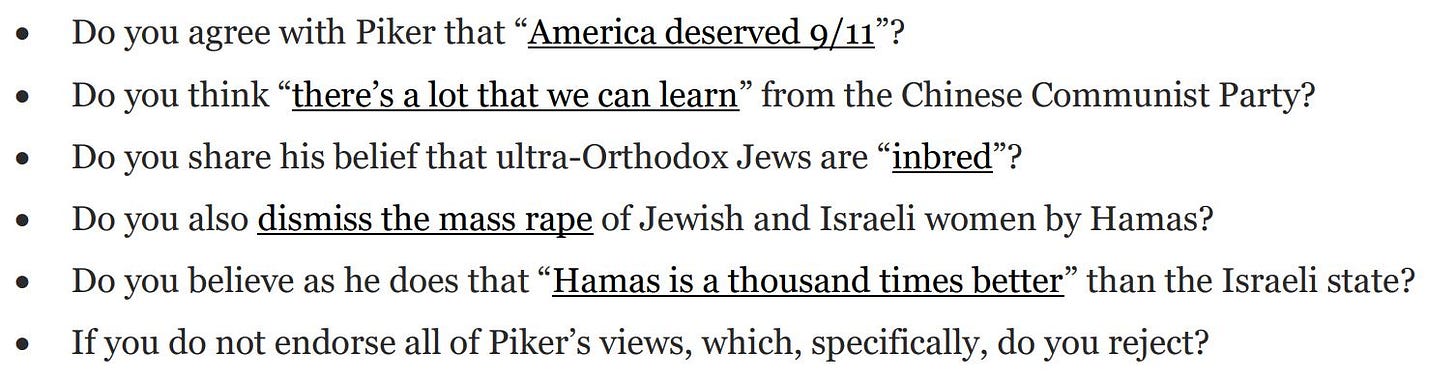
The group has spent the past few weeks urging Democrats to distance themselves from Hasan Piker, the widely popular Twitch and YouTube streamer. The group’s president and press adviser, Jonathan Cowan and Lily Cohen, coauthored a Wall Street Journal opinion piece arguing that Piker’s “misogyny is indistinguishable from that of far-right influencers” and accusing him of antisemitism, saying that there was “no excuse for putting political tribalism before Jewish safety.” Things escalated last week when, who is running in the Democratic primary for Michigan’s open Senate seat, announced that Piker would campaign with him on college campuses. Then, this morning, Cowan sent a letter to El-Sayed warning that it would be a “stain” on his character if he followed through with the planned rallies, especially after a Michigan synagogue was attacked last month. The letter lists six questions in bullet points, asking El-Sayed to respond:
:{[
To Third Way’s critics, this was nothing short of abject hypocrisy—a group applying litmus tests to a liberal candidate after demanding that liberal groups drop the litmus tests they placed on mainstream candidates.
“This is so clearly Third Way riling people up in a way that is so disingenuous,” said Amanda Litman, the cofounder of Run for Something, a progressive group that recruits and trains first-time candidates. She emphasized that part of politics is “having to deal with people who say crazy things you don’t agree with—and you have to work with them anyway.”
“Who’s doing the scolding here?” she asked. “I thought we weren’t supposed to be canceling anyone anymore.”
For Third Way, there is nothing inconsistent about its approach. In an interview, Cowan told me he draws a distinction between demanding policy purity from a candidate and moral clarity. He argued that if Piker had said offensive things about a minority group other than Jews, Democrats wouldn’t have hesitated to shun him. For El-Sayed to rally with Piker, he said, is as if George Bush had campaigned with David Duke instead of denouncing the KKK leader.
Most significantly, Cowan made it clear that he’d rather accept some electoral risk than see the party show flexibility on this front.
“If people really are arguing that the price of winning is becoming like a bigoted misogynist like Hasan Piker, then I’ll take not winning,” Cowan told me. “What is the point of reviving the Democratic party so it can compete in an age of right-wing populism, if the price of that is you mainstream bigoted, anti-American, misogynistic voices?”
THAT PIKER HAS GAINED this type of lightning-rod status for Third Way is a testament to two things: the controversial statements he has made in the past and the size of the audience he has in the present.
---
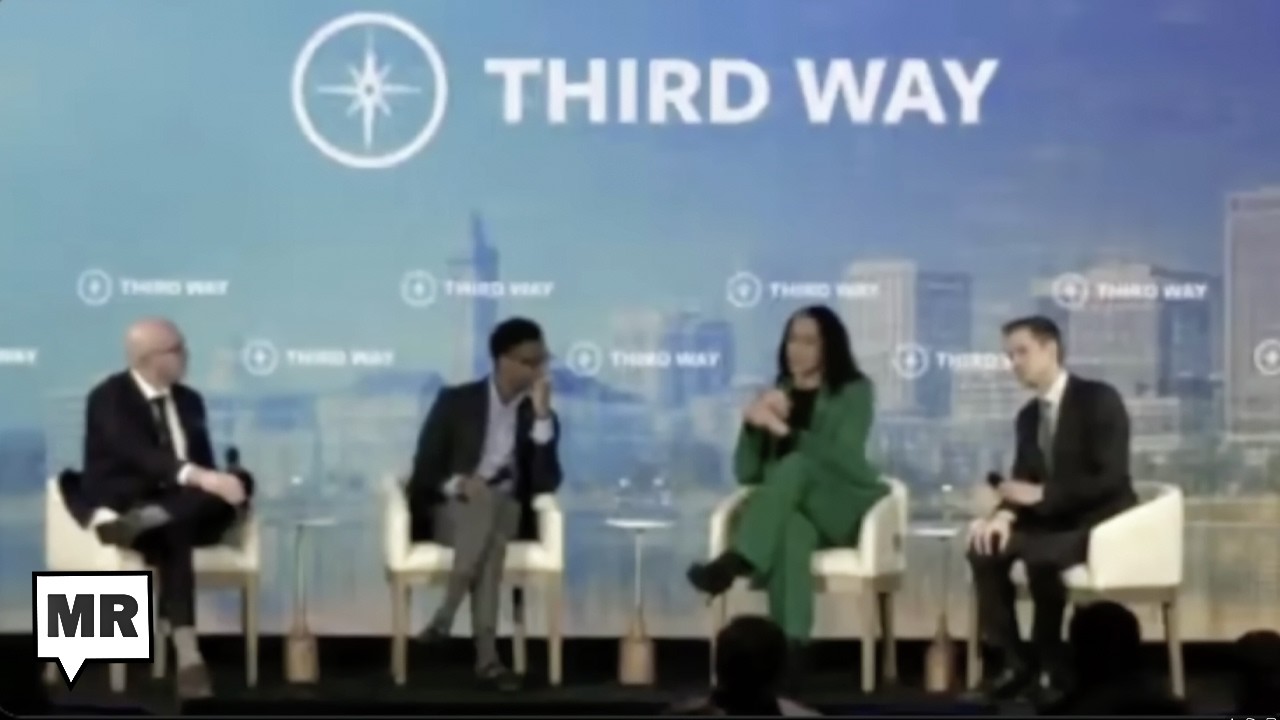
3RD WAY
Don't Listen To These Losers
3 10? 26
4:02
here in this third way conference it's
4:03
the loser Biden people that are trying
4:06
to make sure that they still have
4:08
influence within the Democratic party
4:10
this is uh San Francisco DA Brooke
4:13
Jenkins. Uh she's on stage with Matt
4:15
Alacius and Alshus
4:19
uh Massachusetts congressman and uh the
4:23
mayor of uh uh is it Cleveland, Ohio?
4:27
Now the mayor from Cleveland, Ohio is
---
THE LEFT HOOK with Wajahat Ali is live with David Sirota on Substack now: "Beware the Corporate Democrats Trying to Hijack the Party!"
2 11 26 gmail

The American Prospect
Centrists: Better Things Aren't Possible - The American Prospect
TodayDemocratic strategist Jim Messina, right, speaks as Third Way President Jon Cowan listens during Third Way's "Winning the Middle" conference, March 2, 2026, in Charleston, South Carolina. Credit: Meg Kinnard/AP Photo The Revolving Door Project, a Prospect partner, scrutinizes the executive branch and presidential power.
New York Times
https://www.nytimes.com › 2026 › 03 › 02 › us › politics › democrats-centrism-2028-election.html
Can These Democrats Make Combative Centrism Happen?
7 days agoJon Cowan, left, president of the group Third Way, and Jim Messina, a Democratic strategist. Credit...Meg Kinnard/Associated Press

YouTube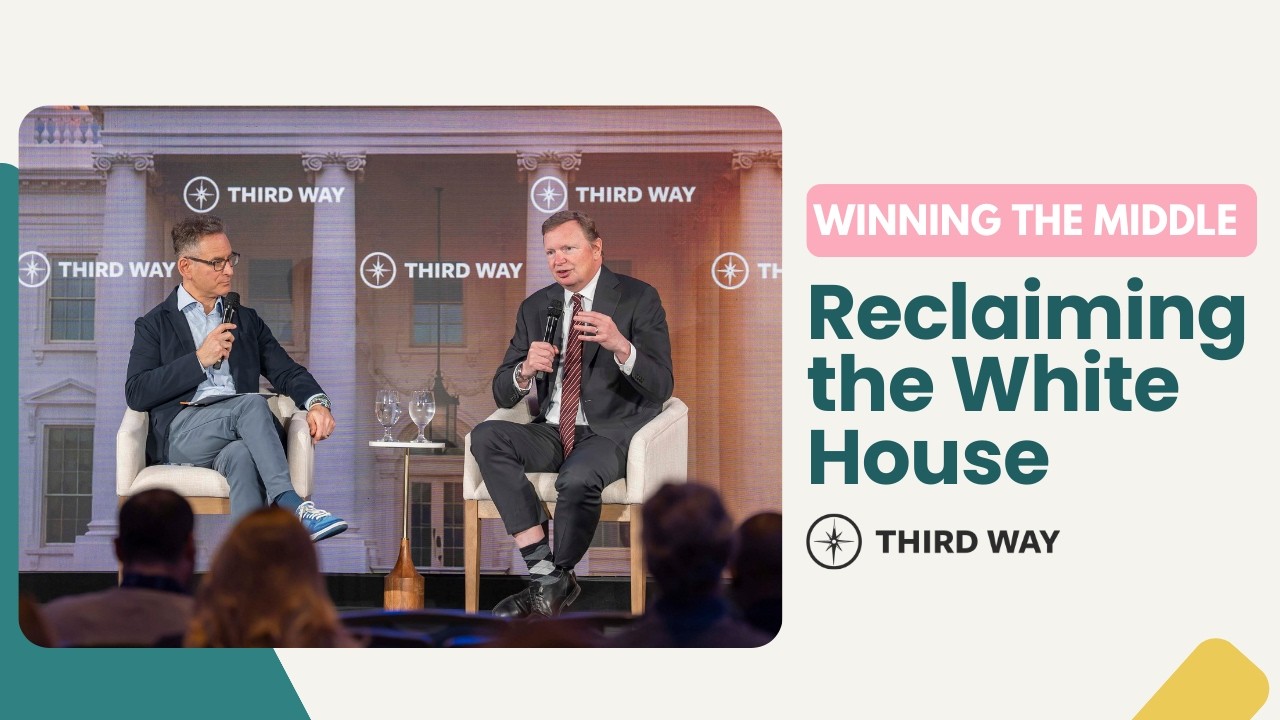
##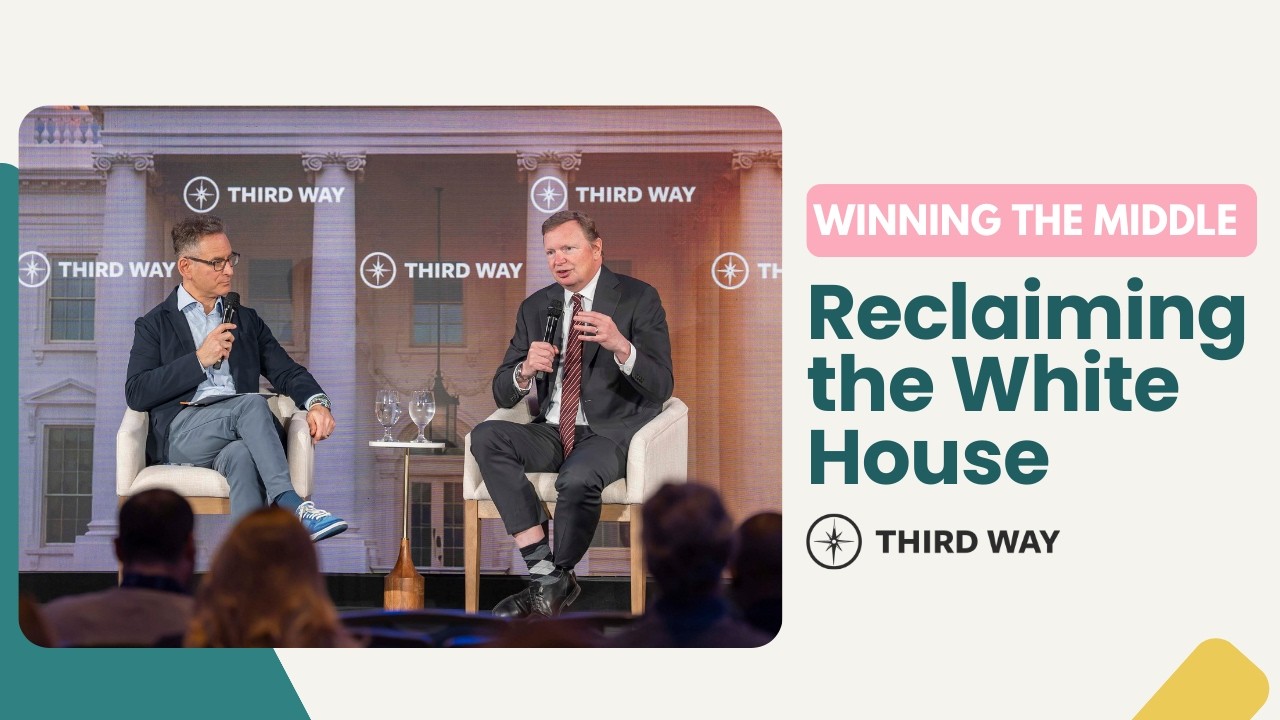
Third Way President Jon Cowan sits down with Jim Messina, CEO of the Messina Group and campaign manager for President Barack Obama's successful re-election campaign in 2012, to discuss the path ...

timesherald
https://www.timesherald.com › 2026 › 03 › 02 › us-election-2026-moderate-democrats
Democratic moderates warn that leaning too far left in midterms sets up ...
Mar 2, 2026Democratic strategist Jim Messina, right, speaks as Third Way President Jon Cowan listens during Third Way's "Winning the Middle" conference Monday, March 2, 2026, in Charleston, S.C. (AP ...
messinamemo.substack.com
https://messinamemo.substack.com › p › the-1988-trap-democrats-are-in-danger
The 1988 Trap: Democrats Are in Danger of Repeating a Painful Lesson
Aug 22, 2025Don't publicly box candidates into unpopular positions. Third Way, a mainstream Democrat-aligned think tank, has done a lot of research on this, and Democrats would be wise to weigh the risks and benefits before going down that path. Don't split the mainstream vote in the primary.

patriotfetch.com
Third Way Conference Unveils Struggles As Dem Moderates Push Back ...
2 days agoDemocratic leaders reflected on past mistakes, aware that a disconnect with the average voter could doom their chances. "We have no economic message," Jim Messina commented sharply. He added that without a resonant economic narrative, a Democratic loss in 2028 seems inevitable. His words strike at the heart of a major concern: the party needs to relate to real-world challenges faced by ...

Alamy
Democratic strategist Jim Messina, right, speaks as Third Way ... - Alamy
Mar 2, 2026Download this stock image: Democratic strategist Jim Messina, right, speaks as Third Way President Jon Cowan listens during Third Way's Winning the Middle conference Monday, March 2, 2026, in Charleston, S.C. (AP Photo/Meg Kinnard) - 3DXD3Y1 from Alamy's library of millions of high resolution stock photos, illustrations and vectors.
POLITICO
Centrist Dems met to plot 2028. Then Iran happened. - POLITICO
7 days agoCentrist Dems met to plot 2028. Then Iran happened. At a gathering this week, top center-left consultants and strategists for rumored presidential hopefuls pitched how to talk about foreign policy.

The Messina Group
https://themessinagroup.com › third-parties-threat-to-democracy-no-labels
"These third parties are the biggest threat to democracy."
Jim Messina, CEO of The Messina Group, joined Ana Cabrera on MSNBC to discuss the aftermath of the fourth GOP debate, and the potential threat third party candidates pose to Biden's reelection campaign.
New York Magazine
Third Way Is Trying to Stop No Labels From Electing Trump
Gathered together were Third Way's leaders, top advisers to the two most recent Democratic presidents like Ron Klain and Jim Messina, former Democratic senators like Doug Jones and Claire ...
altmo 10 25
no lnx
The Democrats’ Heterodoxy Problem
There’s not enough of it, according to one political operative.
By Elaine Godfrey
October 14, 2025
The age of the conventional Democrat is over. The time of the Democratic contrarian has come.
So says Adam Jentleson, anyway. The veteran political operative and former adviser to the late Senate Majority Leader Harry Reid recently launched a think tank that asks Democratic candidates to ignore pressure from the far left, take positions outside the “liberal box,” and be a lot more “heterodox” in general. If this seems to you like Beltway speak for asking Democrats to sound more like Republicans, well, you would be at least partly correct. The Democratic Party used to have supermajorities in Congress because it allowed its members to hold a wide range of positions, Jentleson told me. To start winning again, the party needs to bring that back, he said. His new think tank, Searchlight Institute, plans to help.
With its seven-person team, a polling arm, and a $10 million budget, Searchlight promises to offer a “menu” of orthodoxy-challenging ideas for Democrats to run on. “We don’t need to create a new Joe Rogan,” Jentleson said. “We need people to go on Rogan with better ideas.”
Some Democrats are excited about that menu, at least in theory. The party needs to figure out an agenda beyond opposing President Donald Trump, they say. And there are no bad ideas in brainstorming. It’s “like that year in the 1980s when Saturday Night Live fired everybody and kept Eddie Murphy,” Mike Nellis, a party strategist and former adviser to Kamala Harris, told me. “Right now you’ve gotta prove you’re Eddie Murphy or get the hell out of here. So I’m not begrudging anybody that’s trying something new.”...
---
politico
By Adam Wren08/22/2025
Democrats seem to think they can talk their way out of the political wilderness.
Listen closely and you can hear it through the din of their all-caps Trumpian X feeds, their hourslong “manosphere” podcast interviews and their more frequent swearing.
Nearly 10 months after the 2024 elections, and the party is still embroiled in self-recriminations over where they’re talking, what they’re talking about and, now, the actual words they’re using. Or, more precisely: which words they shouldn’t utter.
In a new memo, shared exclusively with POLITICO, the center-left think tank Third Way is circulating a list of 45 words and phrases they want Democrats to avoid using, alleging the terms put “a wall between us and everyday people of all races, religions, and ethnicities.” It’s a set of words that Third Way suggests “people simply do not say, yet they hear them from Democrats.”
They span six categories — from “therapy speak” to “explaining away crime” — and put in sharp relief a party that authors say makes Democrats “sound like the extreme, divisive, elitist, and obfuscatory, enforcers of wokeness.” In the document, titled “Was It Something I Said?” Third Way argues that to “please the few, we have alienated the many — especially on culture issues, where our language sounds superior, haughty and arrogant,” according to the memo.
Among the blacklisted terms: privilege … violence (as in “environmental violence”) … dialoguing … triggering … othering … microaggression … holding space … body shaming … subverting norms … systems of oppression … cultural appropriation … Overton window … existential threat to [the climate, democracy, economy] … radical transparency … stakeholders … the unhoused … food insecurity … housing insecurity … person who immigrated … birthing person … cisgender … deadnaming … heteronormative … patriarchy … LGBTQIA+ … BIPOC … allyship … incarcerated people … involuntary confinement.
“We are doing our best to get Democrats to talk like normal people and stop talking like they’re leading a seminar at Antioch,” says Matt Bennett, Third Way’s executive vice president of public affairs. “We think language is one of the central problems we face with normie voters, signaling that we are out of touch with how they live, think and talk. In recent weeks, this has become a bit of a thing, with comedians like Jimmy Kimmel and Sarah Silverman highlighting how insane Dems can sometimes sound. Also, elected officials like [Delaware Rep.] Sarah McBride and [Kentucky Gov.] Andy Beshear are begging their colleagues to just be normal again.”
“People can’t relate to something unless it has some edge about it,” Lanae Erickson, Third Way’s senior vice president, tells Playbook. “And we had shaved off all of our edges in an attempt to never make anyone upset about anything.”
The group doesn’t base its list on any specific polling. And the authors don’t offer specific counter recommendations for these terms. But they do outline the values their vision of the party includes.
“We will never abandon our values or stop doing things to protect those who need help, encouragement, trust, a second chance, acceptance, a fair shake, and the opportunity to pursue life, liberty and happiness But as the catastrophe of Trump 2.0 has shown, the most important thing we can do for those people and causes is to build a bigger army to fight them,” the memo reads. “Communicating in authentic ways that welcome rather than drive voters away would be a good start.”
It’s worth noting that in certain parts of the country, a lot of people, especially now, dotalk in this language and use the phrases Third Way recommends against, even if it doesn’t scream big tent enough. It’s also worth noting an inherent irony in all of this: it’s hard to police how politicians talk at the same time that you’re asking them to be authentic.
The memo’s authors write “we are not out to police language, ban phrases or create our own form of censorship. Truth be told, we have published papers that have used some of these words as well. But when policymakers are public-facing, the language we use must invite, not repel; start a conversation, not end it; provide clarity, not confusion.”
“The Democratic Party brand is toxic across the country at this point with way too many people — enough that there’s no way for us to win a governing majority without changing that,” Erickson said. “Part of the problem was that we were using words that literally no normal people used — that we were sticking to messages that were so overly scripted that they basically sounded like nothing.”
What about bright spots for the party? Erickson cited three potential 2028 Democratic presidential contenders who she says are good examples of how to communicate: Beshear, former Transportation Secretary Pete Buttigieg and Sen. Ruben Gallego (D-Ariz.).
- “Gallego is doing a great job talking about economic success,” she says. “He goes into communities and he’s like, ‘I want you to have a big ass truck, if that’s what you want.’”
- Buttigieg, she said, is “doing a great job of going into spaces that are maybe not hostile, but unusual spaces for him to be in and having real conversations about complicated topics, like transgender people in sports, and saying, ‘you know, I think you should have empathy toward people that are figuring this issue out for the first time. And you should have empathy toward transgender kids and their families.’ But he’s not afraid to say those things, and he’s getting yelled at.”
- And Beshear is “getting this so exactly right, talking about how these terms aren’t even what those communities use to call themselves,” she said. She recalled Beshear “talking about the fact that ‘justice-involved individuals’ is not a thing that any justice-involved individual would call themselves. They would call themselves incarcerated, call themselves convicted, or they would call themselves a whole lot of other things, but that’s not what they or their families would call themselves. So inventing terms that the people that we’re talking about and trying to protect don’t even use, and then enforcing that that’s the only way you can talk about those people, is crazy.”
So, can Democrats really talk their way back to power? It’s an Aaron Sorkin-eqsue idea to think that everything can be solved by the right words and a compelling speech. (And it’s one that the party has been tantalized by, on and off, for decades.) Of course, Democrats face bigger and deeper problems — a yawning voter registration gap among them — and are still figuring out which policies to advocate.
Watch: The Conversation
Play Video
45:37
Illinois Gov. JB Pritzker and Jacqui Heinrich | The Conversation
In some ways, Third Way is reaching the same political conclusion VP JD Vance arrived at during his interview with Fox News’ Laura Ingraham this week. “I mean, look, the autopsy for the Democrats, some free political advice from the president of the United States is: stop sounding like crazy people,” Vance said.
Vance’s remarks came on the same day he had burgers with the National Guard troops at Union Station. Which is itself a glaring reminder of some of the stakes if Democrats don’t get this right.
Erickson mentioned crime as a key issue on which Democrats need to recalibrate, citing Trump’s “invasion of D.C.”
“It shows that people don’t think Democrats want to hold criminals accountable at all,” she said. “Like we don’t care about violent crime and we don’t care if someone hurts someone, that they should be held accountable. That’s not true. We’re afraid to say that because we’re afraid that someone is going to criticize us for being too ‘tough on crime.’”
Third Way sees it as a place to start. “We need to reflect on the ways that our bubble and our fear of being criticized by anyone on the left has led to a problem with both our policy and our language,” Erickson said.
---
AN 8 25
NO LNX
'Insufferable little tyrants': MAGA'S newest 'idiotic' delusion blasted by critics
John StoehrAugust 25, 2025
I was not planning to write about Cracker Barrel’s new logo. Neither was I planning to write about the voluminous rightwing backlash against it. The redesign, which does away with the old man sitting on a chair leaning against a barrel, doesn’t look “woke” to me. But change is hard for some, especially rightwingers who see dangers everywhere.
But I feel compelled to talk about it, because the official Twitter account for the Democratic Party decided to talk about it. Not only that, but the account, in a post put up yesterday evening and viewed nearly 8 million times, decided to agree with the rightwing freakout.
“We think the Cracker Barrel rebrand sucks, too,” the post says, over Norman Rockwell’s painting of a man voicing an unpopular opinion.
I don’t want to make too much of this, but this is a microcosm of a macro problem within the Democrats, in particular that faction of the party that has most of the money and most of the influence over the press corps. In short, the problem is rooted in the belief among elite Democrats that they can compromise with bad actors who in turn are motivated by compromise to be worse. Even shorter, if you accept as true the lies told by the fascists, you have two enemies: them and you.
If I must guess, I’d say the Democrats’ point is showing at least some portion of the people who are freaking out about Cracker Barrel’s redesign that the Democrats played no role in the “wokification” they see. The point might even be some sort of solidarity, as if to say the Democrats dislike “radicals” and “cancel culture” as much as you do.
To this dominant faction of the Democratic Party, I would imagine this move is reasonable, perhaps politically strategic, as it seems to create a middle ground between partisan poles. (Some wonks might call this by its old name, “triangulation.”) If that doesn’t appeal to rightwingers, per se, it might appeal to indie voters who value more than anything their reputations for being nonpartisan. I might even concede to its effectiveness if the rightwing freakout were based on something true.
There’s your problem.
It isn’t based on anything. The total substance of the allegations against Cracker Barrel is the impact of the allegations themselves. That is to say, if the allegations “work” as intended, the allegations are real.
Those allegations are themselves the consequence of a reaction to change and the search for the presumably malicious causes of it. Because these are fascists and rightwing authoritarians, those causes are always the result of some kind of conspiracy by their perceived enemies. And because perceived enemies are always seeking to destroy them, change is always some sign of imminent destruction.
From their view, Cracker Barrel’s rebrand is a declaration of war.
That’s why, from the rightwing perspective, that Nazi Christopher Rufo did not sound delusional when he said “we must break the Barrel.” He went on: “It's not about this particular restaurant chain — who cares — but about creating massive pressure against companies that are considering any move that might appear to be ‘wokification.’ The implicit promise: Go woke, watch your stock price drop 20 percent, which is exactly what is happening now. … The Barrel must be broken.”
Objectively speaking, it is delusional, and no one is entitled to a public hearing of their delusions, no matter how stentorian they may seem. As Tommy Vietor said, in reaction to Rufo: “This idiotic bull---- might have been good politics at one point, but I’m confident the pendulum has swung back and people now see these guys as insufferable little tyrants. No one cares about Cracker Barrel, you annoying dork.”
I think Vietor was on to something, briefly. After all, there’s some truth in claiming that “this idiotic bull----” has lost its populist appeal and that, as a result, the pendulum has begun swinging back so that people can now see men like Rufo as the “insufferable little tyrants” they are.
But then an official organ of the Democratic Party decided to get in the way of that pendulum swing by agreeing, and the most immediate implication is that the Democrats themselves are not nearly as liberal or democratic as they seem to be, nor are the “insufferable little tyrants” nearly as insufferable, little or tyrannical as they seem to be.
With that post, the Democrats conceded the fascists have a point.
And the Democrats should never concede anything to fascists.
Before that moment, as Vietor’s comment suggested, there was a bright moral line between the sane and the insane. There was no need to take seriously the delusions that haunt the hobgoblins of the right, and it was clear and obvious that Rufo isn’t interested in the substance of his allegations (whether they are true; whether they are based on something real), only in whether they bring him closer to his goals. And as long as liberals saw this bright moral line, there was no point in searching for good faith in the hobgoblins who have none. As Tommy Vietor said, “No one cares about Cracker Barrel, you annoying dork.”
But then the official Twitter account of the Democratic Party stepped in. It decided to see good faith where there is none. It decided to give the benefit of the doubt to malicious actors who would never give it in return. And worst of all, that decision took a simple and rational discussion, in which it was clear which side was the sane side, and made it insane. And now, instead of dismissing the hobgoblins, here I am, in today’s edition of the Editorial Board, taking them seriously.
The pattern is everywhere.
The president makes some insane allegation (crime is out of control in Washington, DC!) to advance his fascist agenda under false pretenses (the National Guard commandeered local cops in the name of public safety, despite crime rates being at historic lows). In response, a centrist Democrat who values his reputation more than his liberty decides to accept as real the insanity (well, crime really is a problem and cancel-culture can’t cancel that!), making himself complicit in advancing a fascist agenda ("Chicago is next and then we'll help with New York,” Donald Trump said), and making everyone insane.
And I don’t see this pattern changing any time soon, not until the dominant faction of the Democratic Party, the one with most of the money and most of the influence on the Washington press corps, understands the party’s majority, that faction without the money and without the influence, is no longer going to tolerate the belief among elite Democrats that it’s better to bargain with evil than to fight it.
To me, this is the true fault line – between those Democrats who look at the president and the Republicans and believe what they see, and those Democrats who look at them both and see what they want to see, because it suits their interests. The rightwing mind is not the only host of hobgoblins. The defenders of “the center” host them, too.
NOW READ: MAGA is panicking as Trump finally meets his match
---
---
INTERCEPT 2019
Exxon Mobil Is Funding the Progressive Policy Institute
The Progressive Policy Institute, a centrist Democratic think tank that grew out of the party’s pro-business wing in the 1980s and ’90s, received $50,000 from Exxon Mobil in 2018 via its parent organization, the Third Way Foundation, according to the oil giant’s 2018 Worldwide Giving Report.
Exxon Mobil did not return The Intercept’s multiple requests for comment. In an email, PPI Executive Director Lindsay Lewis said the money was used for general support and that “we only accept general support funding from corporate interests, we do not do paid for work/research or have any donor run programs.”
Lewis also confirmed that this is the first time Exxon Mobil has donated to the Third Way Foundation.
Though it’s a first, PPI’s new donor isn’t so dramatic a shift from its fundraising record. The Intercept’s Akela Lacy has also found that PhRMA — the Pharmaceutical Research and Manufacturers of America — has annually donated between $25,000 and $75,000 to the Third Way Foundation since 2009, upping its donation to $265,000 in 2016 — the same year that Medicare for All, which the trade group and PPI both oppose, entered the national spotlight. Donations dipped back to normal levels in 2017, although documents were not yet available for 2018 when the piece was published in late April.
[
Related
Bernie Sanders’s Climate Plan Is More Radical Than His Opponents’ — And More Likely to Succeed](https://theintercept.com/2019/08/22/bernie-sanders-climate-policy/)
In the last couple years, Exxon has taken up softer messaging on climate than either the Koch brothers or the Mercer family. With business all over the world, Exxon — like every other multinational oil company — is well-accustomed to operating in environments where denying the reality of the climate emergency outright is politically unthinkable. As climate concerns spike around the U.S., the company is still plenty opposed to environmental regulations and the lawsuits being lobbed its way from climate-vulnerable communities and attorneys general, who are each calling into question Exxon’s rule in fueling both the climate crisis and misinformation campaigns about it. Rather than paying people to say that there’s no problem at all, it can rebrand as a good-faith actor in the climate fight with paeans to carbon capture technology, low-carbon fuels (algae!), and carbon taxes that also conveniently exempt it from some of the lawsuits and regulations it’s most worried about. The decades of climate denial Exxon helped fund — and now the Trump administration — have dragged the national debate on climate change so far into the gutter that there are influential liberals willing to give the company credit simply for not denying the science.
This all dovetails well with a centrist approach to climate politics that’s long sought common ground with industry and harbors both temperamental and ideological opposition to big, confrontational proposals like the Green New Deal. The upshot is that they’ve started to sound a lot alike. Carbon capture, R&D, and carbon pricing — while not mutually exclusive with the Green New Deal framework that the Sunrise Movement, Rep. Alexandria Ocasio-Cortez, and others have begun to flesh out — have reliably been wielded as a cudgel by establishment types against calls for more sweeping action.
Kert Davies, founder and director of the Climate Investigations Center, noted that the report indicates the money PPI received was through a “corporate” grant, rather than through the ExxonMobil Foundation. “We have never sussed how these two black boxes of money are managed or dolled out. So if you grab the ExxonMobil Foundation 990s, there are sometimes different descriptions or breakdowns of the funding, but this grant won’t be there,” he wrote in an email. “There is no need for public accounting of such grants. No obligation. But they have seemed compelled to disclosed them through the years.”
Of course, $50,000 is not an enormous amount of money either for PPI or Exxon Mobil. But it may well signal a shift in the fossil fuel industry’s relationship to climate politics.
$50,000 is not an enormous amount of money either for PPI or Exxon Mobil. But it may well signal a shift in the fossil fuel industry’s relationship to climate politics.
For years, Exxon Mobil prolifically funded climate denier groups like the Heartland Institute and Competitive Enterprise Institute. Under pressure, the company pledged to stop funding deniers in 2007, although it kept bankrolling politicians who deny the reality of the climate crisis. Exxon also still support right-wing think tanks like the Manhattan Institute, which received $970,200 from Exxon between 2008 and 2018. As recently as 2011, MI Senior Fellow Robert Bryce said “the science is not settled” on climate change. Another MI Senior Fellow, Oren Cass, last year — the year after three of the five most expensive hurricanes to have ever hit the Atlantic — authored a report arguing that the potential costs of climate change are overblown, suggesting that many people prefer warmer temperatures and could adapt easily to global warming. In addition to Exxon, MI is — like other flagrant denier groups — funded by the Mercer Family Foundation; Rebekah Mercer, a key financier of Donald Trump’s 2016 campaign, runs the foundation and sits on the MI board. Exxon also continues to give large donations the U.S. Chamber of Commerce and remains a member of the American Petroleum Institute, each of which has fought hard against environmental regulations and climate measures. The oil company only left the Koch-funded American Legislative Exchange Council in 2017, four years after it pushed model legislation in Oklahoma, Colorado, and Arizona that described global warming as a “theory.”
Itai Vardi reported at DeSmog this summer that Phil Goldberg, director of PPI’s Center for Civil Justice, has come out swinging against climate lawsuits being brought by cities and states against fossil fuel companies. The law firm at which Goldberg is a partner — Shook, Hardy & Bacon — defended the tobacco industry for decades and was the inspiration for the fictional firm Smoot, Hawking in the 2005 film “Thank You For Smoking.” As a slew of lawsuits has begun to call into question fossil fuel companies’ role in fueling and spreading misinformation about the climate crisis, the industry has stepped into high gear to fight off litigation.
Goldberg is a former lobbyist for the coal company Peabody Energy who was brought on as special counsel by the National Association of Manufacturers in January as part of its Manufacturers Accountability Project, founded in 2017 to take on “activist litigation” against big oil companies; Exxon Mobil is a NAM member, and the MAP project has been among the most active bodies fighting off climate-related legal action. Both Peabody and NAM have also donated generously to climate denial groups over the years. Both, for instance, were members of the now-defunct Global Climate Coalition, which through the 1990s sought to undermine U.N. climate negotiations and the Intergovernmental Panel on Climate Change. Goldberg has also been an adviser for ALEC’s Civil Justice Task Force. In addition to the model legislation on global warming, ALEC has vigorously opposed climate and clean energy legislation around the country.
Lewis said that Goldberg works with PPI in a volunteer capacity and is not employed by the Third Way Foundation, despite his lofty title. Evidently, he’s vocally defending fossil fuel companies out of the goodness of his heart.
We’re independent of corporate interests — and powered by members. Join us.
In March, Goldberg co-authored a report for the industry front group Grow America’s Infrastructure Now on how to bring legal action against anti-pipeline organizers. “Allowing vigilante regulation to go unchecked undermines our democracy. We honor civil protests in this country, but we should not have to accept improper efforts to overturn the rule of law,” Goldberg said in a press release. “People who violate the law by improperly interfering with legitimate business activities, even to advance a political or public policy preference, can be held accountable for their actions through civil litigation.” While not disclosed on the group’s website, GAIN spokesperson Craig Stevens is a partner at the DCI Group, which specializes in astroturf campaigns that have fought everything from anti-smoking laws to climate legislation. From 2005 through 2016, Exxon Mobil was a DCI client. In another detail not mentioned on the GAIN site, the group’s strategic adviser is James “Spider” Marks, who as of 2017 was the advisory board chair of the security firm TigerSwan, which — as The Intercept has documented extensively — engaged in “military-style counterterrorism measures” against anti-pipeline protesters.
Asked whether Goldberg’s positions on climate litigation were also PPI’s, Lewis replied, “PPI, which has long advocated for cap and trade, a carbon tax, and other polices to combat climate change, believes such policies should be made in representative legislatures, not the courts.” In short, yes.
Throughout the 2020 campaign cycle, PPI strategic adviser and Clinton White House insider Paul Bledsoe has commented frequently about the dangers of candidates being too hard on fossil fuels. “[Joe] Biden and other moderate candidates must emphasize that the market is already phasing out coal over time, but that their climate policies still allow a role for natural gas as a low-carbon transition fuel for some time,” he told the Washington Examiner in August. “This distinction is crucial to success in swing states like Pennsylvania, Ohio, and Michigan.” In a New York Times piece about Biden’s critics on the left, Bledsoe said, “Indulging in ideological purity is great until you actually want to solve the problem.”
“Happily,” he wrote in a February Forbes op-ed attacking the Green New Deal, “there is no need to eliminate fossil fuels in the next decade or require only renewable energy or guarantee public sector jobs to meet our climate goals.” We might never find out what Exxon Mobil’s money got up to at PPI last year. If its experts keep sounding like Bledsoe and Goldberg, though, it’ll probably keep coming.
---
AN 1 24 BUT REBOOT
Editor's note: *On the day after Trump's suprising victory over Hillary Clinton, we've resurfaced Robert Reich's killer essay explaining why the working class doesn't vote for Democrats anymore.
Why did the white working class abandon the Democrats?
The conventional answer is Republicans skillfully played the race card.
In the wake of the Civil Rights Act, segregationists like Alabama Governor George C. Wallace led southern whites out of the Democratic Party.
Later, Republicans charged Democrats with coddling black “welfare queens,“ being soft on black crime (“Willie Horton”), and trying to give jobs to less-qualified blacks over more-qualified whites (the battle over affirmative action).
The bigotry now spewing forth from Donald Trump and several of his Republican rivals is an extension of this old race card, now applied to Mexicans and Muslims – with much the same effect on the white working class voters, who don’t trust Democrats to be as “tough.”
All true, but this isn't the whole story. Democrats also abandoned the white working class.
Democrats have occupied the White House for sixteen of the last 24 years, and in that time scored some important victories for working families – the Affordable Care Act, an expanded Earned Income Tax Credit, and the Family and Medical Leave Act, for example.
But they’ve done nothing to change the vicious cycle of wealth and power that has rigged the economy for the benefit of those at the top, and undermined the working class. In some respects, Democrats have been complicit in it.
Both Bill Clinton and Barack Obama ardently pushed for free trade agreements, for example, without providing the millions of blue-collar workers who thereby lost their jobs any means of getting new ones that paid at least as well.
They also stood by as corporations hammered trade unions, the backbone of the white working class. Clinton and Obama failed to reform labor laws to impose meaningful penalties on companies that violated them, or enable workers to form unions with a simple up-or-down votes.
I was there. In 1992, Bill Clinton promised such reform but once elected didn’t want to spend political capital on it. In 2008, Barack Obama made the same promise (remember the Employee Free Choice Act?) but never acted on it.
Partly as a result, union membership sank from 22 percent of all workers when Bill Clinton was elected president to fewer than 12 percent today, and the working class lost bargaining leverage to get a share of the economy’s gains.
In addition, the Obama administration protected Wall Street from the consequences of the Street’s gambling addiction through a giant taxpayer-funded bailout, but let millions of underwater homeowners drown.
Both Clinton and Obama also allowed antitrust enforcement to ossify – with the result that large corporations have grown farlarger, and major industries more concentrated.
Finally, they turned their backs on campaign finance reform. In 2008, Obama was the first presidential nominee since Richard Nixon to reject public financing in his primary and general-election campaigns. And he never followed up on his reelection campaign promise to pursue a constitutional amendment overturning “Citizens United v. FEC,” the 2010 Supreme Court opinion opening the floodgates to big money in politics.
What happens when you combine freer trade, shrinking unions, Wall Street bailouts, growing corporate market power, and the abandonment of campaign finance reform?
You shift political and economic power to the wealthy, and you shaft the working class.
Why haven’t Democrats sought to reverse this power shift? True, they faced increasingly hostile Republican congresses. But they controlled both houses of Congress in the first two years of both Clinton’s and Obama’s administrations.
In part, it’s because Democrats bought the snake oil of the “suburban swing voter” – so-called “soccer moms” in the 1990s and affluent politically-independent professionals in the 2000s – who supposedly determine electoral outcomes.
Meanwhile, as early as the 1980s they began drinking from the same campaign funding trough as the Republicans – big corporations, Wall Street, and the very wealthy.
“Business has to deal with us whether they like it or not, because we’re the majority,” crowed Democratic representative Tony Coelho, head of the Democratic Congressional Campaign Committee in the 1980s when Democrats assumed they’d continue to run the House for years.
Coelho’s Democrats soon achieved a rough parity with Republicans in contributions from corporate and Wall Street campaign coffers, but the deal proved a Faustian bargain as Democrats become financially dependent on big corporations and the Street.
Nothing in politics is ever final. Democrats could still win back the white working class – putting together a huge coalition of the working class and poor, of whites, blacks, and Latinos, of everyone who has been shafted by the shift in wealth and power to the top.
This would give Democrats the political clout to restructure the economy – rather than merely enact palliatives that papered over the increasing concentration of wealth and power in America.
But to do this Democrats would have to stop obsessing over upper-income suburban swing voters, and end their financial dependence on big corporations, Wall Street, and the wealthy.
Will they? That’s one of the biggest political unknowns in 2016 and beyond.
---
---
an 2 23 boddie
Democratic strategists and top Wall Street giants hail President Joe Biden's billionaire tax proposal as "dead on arrival," CNBC reports.
The plan, which Biden announced during his 2023 State of the Union address,ensures "the ultra-wealthy would owe an annual tax of 20% on unrealized gains or losses in the value of those assets, whether or not they had actually pocketed that gain by selling them," according to CNBC.
Chairman of investment advisory firm Signum Global and 2020 Biden supporter, Charles Myers said Biden's plan is"dead on arrival."
READ MORE:Here are 10 ways billionaires avoid taxes on an epic scale
However, other billionaire investors are "skeptical" about its intention, worried that their wealth will be negatively impacted.
Because of this longtime skepticism, Democratic political strategist Jake Dilemani said, "I don’t think anyone realistically expects a billionaire’s tax, in its current proposed form, to come to fruition this year or next."
Dilemani added, "Within the Democratic party, there is dissention regarding how to move this forward, particularly with unrealized gains being part of the equation."
Contrary to fellow investors, billionaire banker Leon Cooperman, who voted for Biden in 2020, told CNBC Biden's proposal is "DOA and stupid to boot." Cooperman opted to "accuse Democrats of deliberately misleading people about how the billionaire tax proposal would work."
READ MORE:'Every billionaire is a policy failure': Oxfam blasts gathering of world's rich in Davos
He said Democrats "lie about the taxes billionaires pay, as they include unrealized gains as part of income."
Jared Bernstein, White House economist, argued this is not the case. He told “unrealized gains” will not be taxed as part of the plan.
"What it really is, or at least the way we see, it is a prepayment or withholding tax on future capital gains," he said.
Per CNBC, last month, lawmakers from California, New York, Washington, Connecticut, Illinois, Maryland, Minnesota and Hawaii established Fund our Future, "a national effort to move wealth tax measures across the country."
New York Democratic State Senator Gustavo Rivera said in the group's statement, "The ultra-rich benefit from our communities, from our public infrastructure and the labor of working families. And because of our backwards tax system, they can avoid paying the taxes that they owe."
He noted, "We must restructure our tax system for fairness."
Arizona Senator KyrstenSinema, who recently registered as Independent after identifying as a Democrat for years, could influence the success of the proposal "if she were to publicly endorse the plan," according to CNBC.
The senator asserted her openness to the possibility of a billionaire income tax, Bloomberg reports, in 2021 when Senator Ron Wyden (D-OH), proposed a similar plan.
READ MORE:'Rotten' and 'grossly regressive' GOP tax proposals are a major 'gift' for Democrats: conservative
Hannah Hurley, Sinema's spokeswoman said, "As always, Kyrsten welcomes the opportunity to review and discuss changes to the tax code, including this proposal from the President."
CNBC's full report is available to read at this link.
READ MORE:How Republicans are aiming to 'protect tax cheaters' with new bill: report
---
---
an 3 22
robt r
...The economist, who served as secretary of labor in the Bill Clinton Administration during the 1990s, goes on to say that although the Democrat-led House has been “passing important legislation and delivering for the people,” Senate Republicans and “a handful of corporate Democrats are hell-bent on grinding the gears of government to a halt.”
The “corporate Democrats” that Reich was obviously referring to included Sen. Joe Manchin of West Virginia and Sen. Kyrsten Sinema of Arizona, both of whom have been unwavering defenders of the Senate filibuster.
“Why are Senate Republicans doing this? Because their misterm strategy depends on it,” Reich explains. “Republicans are blocking crucial legislation so they can point to Democrats’ supposed inability to get anything done, and claim they’ll be able to deliver if you give them majorities. Don’t fall for it.”
Watch the video below:
---
https://www.thenewcivilrightsmovement.com/2022/03/new-report-destroys-gop-talking-points-blaming-dems-for-crime-trump-states-have-8-out-of-the-10-highest-murder-rates/
---
New Report Destroys GOP Talking Points Blaming Dems for Crime: Trump States Have 8 Out of the 10 Highest Murder Rates
Published on March 16, 2022 By David Badash
Consider these explosive headlines from Fox News over the past several months: “Democrat-run cities overwhelmed by crime surge,” “Murder and crime rates spike in Democrat-run cities – is it a control play?” or, “Democrat-run cities experience record breaking homicide rates.”
Ten days before Christmas last year House Republican Minority Leader Kevin McCarthy falsely blamed Speaker Nancy Pelosi for a “crime wave” that’s “spreading across the country.”
“Speaker Pelosi should look in the mirror to see what caused the ‘attitude of lawlessness’ spreading across the country,” he wrote. “Democrat politicians defunded police, raised money for rioters, and pushed policies that are soft on crime. They own this crime wave.”
And here’s McCarthy just days ago, again lying, claiming crime is “created by Democrats.”
A new report from Third Way destroys all these GOP talking points – and points out that “murder rates are far higher in Trump-voting red states than Biden-voting blue states. And sometimes, murder rates are highest in cities with Republican mayors.”
About that claim Leader McCarthy made? He should look in the mirror – and at his own district before pointing fingers.
The report notes that “the homicide rate in Speaker Nancy Pelosi’s San Francisco was half that of House Republican Leader Kevin McCarthy’s Bakersfield, a city with a Republican mayor that overwhelmingly voted for Trump.”
In fact, in all of 2020, “per capita murder rates were 40% higher in states won by Donald Trump than those won by Joe Biden.”
It gets worse for the GOP.
“8 of the 10 states with the highest murder rates in 2020 voted for the Republican presidential nominee in every election this century,” the report reveals.
The actual facts blow away what an average Fox News watching die-hard Republican voter would think.
“We found that murder rates are, on average, 40% higher in the 25 states Donald Trump won in the last presidential election compared to those that voted for Joe Biden. In addition, murder rates in many of these red states dwarf those in blue states like New York, California, and Massachusetts.”
“Mississippi had the highest homicide rate at 20.50 murders per 100,000 residents,” Third Way reports, “followed by Louisiana at 15.79, Kentucky at 14.32, Alabama at 14.2, and Missouri at 14. The national average was 6.5 per 100,000 residents, but the top five states had rates more than twice that high.”
These red states are not generating “murder is out of control” national headlines. They seem to generate no headlines at all. The rest of the top ten were filled out by South Carolina, New Mexico, Georgia, Arkansas, and Tennessee—all states rarely talked about in breathless media reports about rampant crime in Democratic strongholds.
The report does not even mention guns, which are a massive part of the problem, exacerbated by red state gun free-for-all policies.
And for those Fox News watching die-hard Republican voters who may say Third Way is a left-wing think tank, it’s actually been criticized by Alexandria Ocasio-Cortez and Bernie Sanders. And former bank regulator William K. Black has accused Third Way of being a “group that pretends sometimes to be center-left but is actually completely a creation of Wall Street.”
Read the full report here. https://www.thirdway.org/report/the-red-state-murder-problem
---
---
https://thehill.com/business-a-lobbying/business-a-lobbying/573610-koch-backed-group-launches-7-figure-ad-blitz-opposing
the hill no lnx
Koch-backed group launches 7-figure ad blitz opposing $3.5T bill
Americans for Prosperity (AFP), an advocacy group backed by GOP mega-donor Charles Koch, launched a multimillion-dollar ad campaign Thursday attacking Democrats’ $3.5 trillion social spending package.
The connected TV, radio, direct mail and online ad blitz argues that the bill would lead to more government control and higher inflation. It will target 25 Democrats, including moderates who have expressed reservations about the $3.5 trillion price tag such as Sens. Joe Manchin (D-W.Va.) and Kyrsten Sinema (D-Ariz.) and Rep. Josh Gottheimer (D-N.J.).
“A government takeover of our economy is a fundamental departure from the spirit of entrepreneurialism we’ve relied on for generations to drive prosperity, and there’s only one outcome — unmitigated economic disaster that will be difficult to reverse,” AFP President Tim Phillips said in a statement.
In recent months, AFP has orchestrated an extensive effort to oppose both Democrats’ reconciliation package and the $1.2 trillion bipartisan infrastructure bill, which it argues doesn’t make sufficient changes to regulations needed to improve roads and bridges.
The group’s most recent ad campaign comes as House Democrats prepare to vote on the infrastructure bill Monday. Democratic leaders say the bill must be passed alongside the party-line spending package that invests in climate, child care and other Democratic priorities.
The Democrats’ reconciliation package has come under fire from business lobbying groups and conservative organizations over its proposed tax increases on large corporations and wealthy individuals, as well as its measure to allow the federal government to negotiate the price of prescription drugs.
The U.S. Chamber of Commerce on Wednesday announced a six-figure ad campaign urging moderate House Democrats to oppose the $3.5 trillion bill after warning that it would revoke endorsements for Democrats who vote for the measure.
The National Federation of Independent Business, a GOP-aligned small business group, also launched a six-figure ad campaign Wednesday urging Rep. Cindy Axne (D-Iowa) and Sens. Jeanne Shaheen (D-N.H.) and Maggie Hassan (D-N.H.) to vote against the reconciliation bill.
Senate Budget Committee Chairman Bernie Sanders (I-Vt.) has punched back at the campaigns to sink the spending packages filled with Democratic priorities.
“This is what oligarchy and a corrupt political system are all about," he tweeted in response to a corporate lobbying blitz announced last month. "The rich and large corporations get richer, and their lobbyists do everything possible to protect their wealth and greed. Not this time."
---
---
10 21 an common dr
The once ambitious "Build Back Better" legislation is being whittled down daily by right-wing democrats and their unwavering corporate loyalties. Progressives like Sanders have dug in refusing to let the bill be completely gutted - standing firm, for instance, on preserving Medicaid expansion. Progressive leader Nina Turner declared that "If Manchin and Sinema can push their will on the entire U.S. Senate and president, then the progressives—almost 100-strong—should damn sure be able to push their will too. They should not move. They got to hold. There's too much at stake."
At stake, for both sides, is much more than just another legislative negotiation. It finds the nation and the world at a historical crossroads for preserving the planet and advancing the causes of justice, equality, and democracy. The question is the degree to which progressives can compromise without compromising human progress.
Progressive Compromises
From almost the beginning, there were concerns of whether the Bill would ever be a reality. It seemed to most of the Washington establishment and media commentators like a radical left-wing "wish list" that would not even be up for serious political debate. The fact that much of its social democratic "human infrastructure" provisions including almost half a trillion dollars in clean energy investments, expanding universal pre-K programs, and affordable housing now feel close to inevitable is a testament to the growing grassroots and legislative power of progressives.
Still, there remains an almost constant mantra of whether progressives would fall into a "purity" politics and - borrowing from one of Obama's favorite phrases – forget that "perfect is the enemy of the good". Yet it is often forgotten that the 3.5 trillion version of the bill was the compromise. Quoting Sanders, "That $3.5 trillion is already the result of a major, major compromise, and at the very least this bill should contain $3.5 trillion".
There are also deeper compromises at play. Namely, the investment in time, resources, and energy in getting elected and trying to progressively change the Democratic Party and US democracy generally. These efforts came at the cost of building an independent mass left-Wing movement that could both foster more revolutionary transformation and new forms of radical democracy at the workplace and in communities. If nothing else, these events have reinforced how important these struggles are for enacting even basic top-down reform.
Compromised Corporate Centrists
The compromise of Centrist holdouts, of course, us of a very different sort. It is not about the pace and strategy for averting the climate apocalypse or reducing global inequality. Instead, they must balance their need to appear concerned about basic human welfare with their larger commitment to defending corporate interests.
It is easy and right to critique Manchin and Sinema. However, they are the political symptoms of our malignant capitalist disease. Tellingly, it has been reported that they are covering for many "moderate" Democrats who also feel the same but are too ashamed (and politically scared) to publicly admit it.
The implicit bargain between Democrats and corporations is as simple as it is troubling. We will continue to promote profitable wars abroad and destructive free-market capitalism at home in exchange for being allowed minor reforms and the money needed to keep getting elected. Ultimately, it was and is a profoundly morally compromised politics that has put the very future of human survival and wellbeing in severe peril.
Refusing to Compromise on Human Progress
While it looks like they have reached an agreement on a $1.75 trillion bill, the conflict between progressives and Wall Street Democrats has only just begun. For the Left, this is only the first of many steps to delivering radical progress and justice. For those in the extreme Center, they are hoping against all hope that this is the last progressive step against corporations they will ever be made to take.
It is tempting to believe that "The arc of the moral universe is long, but it bends toward justice". The recent past paints a much more dispiriting picture. It is one not of slow progress but resistance and co-optation. Progress does not stop at legal proclamations though it can end there.
The lessons to be learned are many and are still emerging. The refusal of the progressive caucus to simply cave is heartening and is a minor victory in and of itself. Nevertheless, the real work is creating such powerful alliances and such a shift in public ideology that the march toward real progress will continue regardless of who is in power.
The Right won in just this fashion - eliminating unions and protest movements while convincing the public that wealth from the 1% would trickle down to everyone. At their peak, both Democrats and Republicans were embracing their values and policies. If we are to "Build Back Better" let alone realize real revolutionary changes to our economic and political system, then it is time to dismantle corporate power at its roots. In the meantime, those negotiating on our behalf may make temporary concessions in the short term but refuse to compromise on human progress.
---
---
an 1021
new analysis out Friday makes clear the wide gap between corporations' stated commitments to fighting the climate crisis and the lengths they are currently going to in order to stop the passage of the biggest climate action spending package in U.S. history.
The research by the progressive advocacy group Accountable.US examined statements and pledges made in recent years by companies including American Airlines, Amazon, Apple, and Google regarding the corporations' plans to end carbon emissions, shift to fleets of electric vehicles, and take other steps to help combat the climate emergency.
Those stated commitments mean little, Accountable.US said, considering the companies' close ties with lobbying firms that are actively working to kill the Build Back Better Act, the spending package which would invest $3.5 trillion over 10 years to transition towards renewable energy and bolster the wellbeing of working Americans.
"Major corporations love to tell us how committed they are to addressing the climate crisis and building a sustainable future, but behind closed doors, they are funding the very industry trade groups that are fighting tooth and nail to stop the biggest climate change bill ever," Kyle Herrig, president of Accountable.US, told The Guardian.
Microsoft,for example, said last year it would be carbon negative by 2030, emphasizing that "the scientific consensus is clear" about the human-caused climate emergency and the danger planet-heating carbon emissions pose to humanity.
The company also unveiled a plan to establish a $1 billion climate innovation fund "to accelerate the global development of carbon reduction, capture, and removal technologies."
The analysis by Accountable.US showed that despiteMicrosoft's claimed commitment to climate action, some of the company's executives are among the board members of the U.S. Chamber of Commerce—the largest lobbying group in the United States—which has made no secret of its goal of tanking the Build Back Better plan, which progressives hope to pass through the filibuster-proof reconciliation process.
The Chamber said in August that it was prepared to "do everything we can to prevent this tax raising, job-killing reconciliation bill from becoming law."
On social media, Accountable.US pointed to other examples of large corporations whose stated concerns over the climate emergency are inconsistent with their involvement with powerful lobbying groups.
The group responded to a tweet fromAmerican Airlineson helping to "accelerate the technologies needed to reach net zero emissions" by pointing out that the aviation company is opposed to the reconciliation bill, which would invest in electric vehicle infrastructure, create millions of good-paying clean energy jobs, and reduce emissions from transportation, among other measures[twt]
executives at retail giant Walmartare among the board members of the Business Roundtable, which is also fighting the passage of the spending bill, saying it is "deeply concerned" about the tax increases progressives have called for to fund anti-poverty measures as well as climate action.
On Twitter, Accountable.US scoffed at a recent call for "strong climate policy" by the company's chief sustainability officer.
"Let's be clear: Walmart, one of the biggest companies in America, says they support the climate initiatives in the Build Back Better Plan," said the watchdog. "But the company is actively fighting its passage."
The Business Roundtable's members also include executives at Alphabet—Google's parent company—and Amazon. The latter company has pledged to cut its own emissions to net zero by 2040 while Google was lauded last year for announcing what The Verge called "one of Big Tech's most ambitious environmental commitments... to run its operations purely on carbon-free energy by 2030."
Some of the lobbying firms fighting against the spending plan are bombarding the airwaves with ad campaigns attacking the legislation, claiming its provisions will hurt working families.
In a memo published Thursday, Accountable.US noted that right-wing corporate Democrats including Sens. Kyrsten Sinema (D-Ariz.) and Joe Manchin (D-W.V.) and Reps. Henry Cuellar (D-Texas) and Stephanie Murphy (D-Fla.) "banked over $150,000 in campaign donations from corporate interests—including those that are helping lead business groups opposing the bill."
"Corporate interests will say or do anything to preserve the broken status quo, including lie to families that overdue investments in child care, education, and climate change are somehow not in their interest," wrote Herrig in the memo. "Democrats in Congress are the last people who should be saying and doing it for them."
---
---
an 621
When Hillary Clinton endorsed Nina Turner's main opponent recently, it was much more than just an attempt to boost a corporate Democrat. Clinton's praise for candidate Shontel Brown was almost beside the point. Like other power brokers and the big-money PACs now trying to sway the special election for a vacant congressional seat in northeast Ohio, Clinton is doing what she can to keep the deeply progressive Turner out of Congress. (Rep. Marcia Fudge, who previously held the seat, resigned to become President Biden's HUD secretary.)
Time is short. Polling shows Turner with a big lead, early voting begins in less than two weeks and Election Day is Aug. 3. What scares the political establishment is what energizes her supporters: Turner won't back down when social justice is at stake.
That reality was clearly audible last Tuesday night during the first debate of the campaign, sponsored by the City Club of Cleveland. "I am running to be a voice for change, to uplift the downtrodden, including the poor, the working poor and the barely middle class," Turner began. "You send me to Congress, I'm going to make sure that we tax the wealthy, make them pay their fair share, and to center the people who need it the most in this district."
The contrast was sharp with Brown, who chairs the Democratic Party in Cuyahoga County, a major population center that includes the city of Cleveland. The discussion of health care was typical: Brown voiced a preference for a "public option," while Turner strongly advocated Medicare for All while calling the current health care situation "absurd" and "asinine." Brown sounded content to tinker with the status quo. Turner flatly declared: "The employer-based system, the commodification of health care, does not work in the United States of America. Almost 100 million people are either underinsured or uninsured right now."
After Brown emphasized that "we have to be able to compromise so we can get some things done," Turner closed with a jab at those eager to block the momentum of her campaign for Congress: "You need to have somebody that will lead this community, who does have a vision and understands being a partner does not mean being a puppet, that working with does not mean acquiescing to.… You will always know whose side I am on."
That's exactly the problem for the party establishment. Its backers know full well whose side Turner is on.
So the attacks are escalating from Brown's campaign. It sent out a mailer — complete with an out-of-focus photo of Turner, made to look lurid — under the headline "Nina Turner Opposed President Biden and Worked Against Democrats." A more accurate headline would have been: "Nina Turner Supported Sen. Sanders and Worked Against Neoliberal Democrats." The Brown campaign's first TV ad, which began airing last month, features her saying that she will "work with Joe Biden … that's different than Nina Turner."
A former editorial page editor of the Cleveland Plain Dealer, Brent Larkin, wrote: "Brown will be a well-financed candidate with deep-pocketed supporters who aren't afraid to play rough. That's because Turner can't be beaten unless opponents plant seeds of doubt about her fitness, convincing voters her harsh criticisms of President Joe Biden would make it impossible for her to get things done for her community. The notion that Biden might punish a constituency important to him because Turner represents that constituency in Congress is far-fetched. During the 2020 campaign, Sen. Kamala Harris was bitterly critical of Biden's civil rights record. Nevertheless, Biden chose her as his running mate, effectively rewarding her with the vice presidency."
Brown's backers are eager to "play rough" because corporate power is at issue. It's not only that Turner crisscrossed the nation, speaking eloquently in support of both of Bernie Sanders' presidential campaigns, serving as a national co-chair during the last one. Powerful backers of the Democratic Party's top leadership — cozy and enmeshed with corporate America and the military-industrial complex — realize that "Rep. Nina Turner, D-Ohio" would significantly increase the leverage of genuinely progressive members of the House. For the Clinton wing of the party, that would be a frigging nightmare.
As the marquee anti-Turner candidate, Brown is leaving the more blatant smears to outfits like the "Protecting Our Vote PAC" (which spent $41,998 in the last cycle in an unsuccessful attempt to defeat now-Rep. Cori Bush in Missouri). That PAC has released a scurrilous attack ad through Facebook, not merely telling viewers to vote for Brown but claiming, among other things, that "Nina Turner is not a real Democrat, you can't trust her," and she "has no respect for anyone, not even our president," and "Nina Turner is all about Nina, she doesn't care about Ohio, she doesn't care about getting things done, all she cares about is making noise."
Though some see may see Turner only as a firebrand speaker at political rallies, I was in dozens of meetings with her last year when her patient hard work was equally inspiring as she put in long hours with humility, compassion and dedication. I saw her as the real deal when we were colleagues for several months while she worked with RootsAction.org as a strategic delegate adviser for the 2020 Democratic National Convention.
Recalling how she works behind the scenes, I can understand even more why the party establishment is so anxious to block her entry to Congress. While Turner is a seasoned legislator — she served on the Cleveland City Council and in the Ohio State Senate for a total of nine years — she's committed to the meticulous and sometimes tedious work of organizing and coalition-building that, in the long run, can make all the difference for progressive change.
The day that Clinton made her endorsement of Brown, a tweet from Turner offered an apt retort. Saying that she was "proud to be running a campaign focused on the issues that matter most to working people," Turner added: "My district knows all too well that the politics of yesterday are incapable of delivering the change we desperately need."
The next day, underscoring wide awareness that the corporate "politics of yesterday" must not be the politics of tomorrow, the Turner campaign announced that it raised six figures in donations in less than 24 hours; Clinton's intervention had been a blessing. Overall, at last report, the Turner campaign has received donations from 54,000 different individuals, with contributions averaging $27.
Dollars pouring into Shontel Brown's campaign are coming from a very different political and social universe. As the Daily Poster has reported, "business-friendly Democrats" and Washington lobbyists for huge corporations — including "Big Oil, Big Pharma, Fox News and Wall Street" — are providing big bucks to stop Nina Turner from becoming Congresswoman Turner.
Bernie Sanders described the situation clearly in a recent mass email: "The political establishment and their super PACs are lining up behind Nina's opponent during the critical final weeks of this primary. And you can bet they will do and spend whatever it takes to try and defeat her."
FROM YOUR SITE ARTICLES
- Rep. Ro Khanna explains why GOP refusal to convict Trump is 'a ... ›
- New report reveals what Joe Manchin told corporate lobbyists ... ›
- Sen. Nina Turner: 'My Husband Was a Former Police Officer; I Get ... ›
RELATED ARTICLES AROUND THE WEB
- Nina Turner way out in front for Congressional seat, poll finds ›
- Nina Turner hits $3 million raised for Ohio special - POLITICO ›
- Nina Turner's campaign: Poll shows 50% support from likely voters ... ›
---
---
https://www.alternet.org/2021/01/neoliberalism/
common dr
The threat of fascism will hardly disappear when Donald Trump moves out of the White House in two weeks. On Capitol Hill, the Republicans who've made clear their utter contempt for democracy will retain powerful leverage over the U.S. government. And they're securely entrenched because Trumpism continues to thrive in much of the country.
Yet, in 2021, progressives should mostly concentrate on challenging the neoliberalism of Democratic Party leaders. Why? Because the neoliberal governing model runs directly counter to the overarching responsibilities of the left—to defeat right-wing forces and to effectively fight for a decent, life-affirming society.
Neoliberalism can be defined as a political approach that "seeks to transfer the control of economic factors from the public sector to the private sector"—and strives to "place limits on government spending, government regulation, and public ownership." Neoliberalism can be described more candidly as vast, systemic, nonstop plunder.
The plunder is enmeshed in politics. In the real world, economic power is political power. And privatizing political power amounts to undermining democracy.
After four decades of neoliberal momentum, we can see the wreckage all around us: the cumulative effects, destroying uncounted human lives deprived of adequate healthcare, education, housing, economic security and existence free of predatory monetizing. While Republican politicians usually led the wrecking crews, their Democratic counterparts often served as enablers or initiated their own razing projects.
- As its policies gradually degrade the standard of living and quality of life for most people, neoliberalism provides a poisonous fuel for right-wing propaganda and demagoguery. Although corporate media outlets routinely assert that "moderate" Democrats are best positioned to block the right's advances, the corporate-oriented policies of those Democrats—including trade deals, deregulation, and privatization—have aided rather than impeded far-right faux populism.
In the long run, the realities of rampant income inequalities cannot be papered over—and neither can the despair and rage they engender. Phony and unhinged as it is, Trumpist extremism offers such rage a populist avenue, paved with a range of vile bigotries and cruelties. When Democrats fail to offer a competing populist avenue, their party is seen as aligned with the status quo. And in this era, the status quo is a political loser.
A myth of U.S. mainstream politics and corporate media is that the most effective way to counteract the political right is to compromise by ideologically moving rightward. When progressives internalize this myth, they defer to the kind of Democratic Party leadership that frequently ends up assisting instead of undermining the Republican Party.
That's what happened when, as incoming presidents, Bill Clinton and Barack Obama filled their administrations' top-tier positions with Wall Street movers and shakers, elite big-business consultants and the like. Those appointments foreshadowed major pro-corporate policies—such as Clinton's NAFTA trade pact, and Obama's lavish bailout for huge banks while millions of homeowners saw their houses sink under foreclosure water—policies that were economically unjust. And politically disastrous. Two years after Clinton and Obama entered the White House, Democrats lost control of Congress in the 1994 and 2010 midterm elections.
Now, there's scant evidence Joe Biden is looking toward significant structural changes that would disrupt the ongoing trends of soaring wealth for the very few and deepening financial distress or outright desperation for the many. Without massive pressure from progressives, it's foreseeable that Biden—like Clinton and Obama—will run his presidency as a corporate-friendly enterprise without seriously challenging the extreme disparities of economic injustice.
"The stock market is ending 2020 at record highs, even as the virus surges and millions go hungry," the Washington Post reported. Wall Street succeeded at "enriching the wealthy . . . despite a deadly pandemic that has killed more than 340,000 Americans."
The reporting came from a newspaper owned by the richest person on earth, Jeff Bezos (who currently has an estimated wealth of $190 billion that he can't take with him). In a world of so much suffering, the accumulation of such wealth is beyond pathology.
What's imperative for progressives is not to "speak truth to power" but to speak truth about power—and to drastically change an economic system that provides humongous wealth to a very few and worsening misery to the countless many.
FROM YOUR SITE ARTICLES
- The failure of militarized neoliberalism is laid bare in Iraq and Haiti ... ›
- Neoliberalism Is Destroying Almost Everybody's Lives - How Many ... ›
- Neoliberalism: Political success, economic failure - Alternet.org ›
RELATED ARTICLES AROUND THE WEB
- “Neoliberalism” isn't an empty epithet. It's a real, powerful set of ideas. ›
- How 'Neoliberalism' Became the Left's Favorite Insult ›
- Neoliberalism: Political Success, Economic Failure - The American ... ›
---
---
https://www.alternet.org/2020/12/centrist-democrats/
david m salon
the philosopher George Santayana famously said, "Those who cannot remember the past are condemned to repeat it." One insight to draw from Santayana's oft-repeated aphorism is that the repetition of clichés is likely to have little effect, given the widespread tendency to ignore pithy advice and continue witlessly recycling, recreating and reliving history.
Over the past few weeks, the Republican Party has proven itself hostile to freedom and democracy; its merciful incompetence the only thing saving whatever remains of our republic from the fascist insurrection of a con man. The absurdity of the cast members — from Rudy Giuliani and Sidney Powell to their incoherent Michigan "witness" and of course Donald Trump himself — have made the entire fiasco seem more like a satirical film than political reality. At the other multiplex on the Democratic side of town, every screen is running previews for the third version of a box office smash, "Centrist Failure," with Joe Biden taking over the leading role from his more charismatic predecessors, Bill Clinton and Barack Obama.
The 1990s original had audiences entranced by a seductive Southerner, Clinton, who under the guidance of the Democratic Leadership Council rebranded his party as the "new Democrats," which apparently translates into "Republicans." Clinton cut social programs, ended "welfare as we know it" by making single mothers work low-income jobs without child care, signed a massively destructive and draconian crime bill into law, deregulated the financial industry, and approved NAFTA. Democrats throughout the mediocre commentariat largely applauded, on the grounds that right-wing policies with a friendlier face were the only way Democrats could win or maintain power, and prevent another Reagan-like figure from seizing control of the country.
After all, they asked, wouldn't you rather have Clinton, with his paeans to social liberalism, administrative proficiency and obvious intelligence, than George H.W. Bush? Sure — but then along came Bush's son, holding the White House door open for the ghoulish likes of Dick Cheney and Donald Rumsfeld, and proving himself far worse than his father. Two horrific wars, the criminal ineptitude of the federal response to Hurricane Katrina, and the financial crash created fertile conditions for radical reform, but instead the "hopey-changey" Obama administration committed the first error of national politics. They failed to act on the keen insight of the aforementioned Cheney, who once told a defiant Republican senator, "We don't negotiate with ourselves."
Obama clearly enacted policies that improved American life. The Affordable Care Act rendered an ongoing catastrophe somewhat less deadly, he doubled Pell grants (barely keeping pace with exorbitant tuition spikes), signed the Paris climate accords and negotiated a decent nuclear deal with Iran. He also staffed his Cabinet with corporate sycophants, allowing the same banking and high-finance bandits who had liquidated working-class wealth to manage the "recovery"; dropped the "public option" from his health care proposal without a fight; and spent years attempting to reach compromise with an obstructionist opposition that he eventually admitted — rather too late — had no interest in productive policy and governance.
Obama was inarguably better for the country than a potential McCain-Palin administration would have been, let alone the planned corporate tyranny of Mitt Romney and Paul Ryan. But throughout his two terms in office, Democrats lost countless state and local offices, while obliviously arguing that demographic changes all but guaranteed their permanent ascension to power — a great victory that somehow always lies just beyond the horizon. Performing a cover version of the Clinton composition, mainstream politicians and pundits also insisted that any openings to the left would provoke a vicious backlash, manifesting in a menacing right-wing resurgence. In other words, if Obama had governed as a progressive, someone like Donald Trump might have become president.
A rational observer might assume that the victory of a reactionary psychopath who upended all normative assumptions about politics would have introduced a little humility and introspection into the centrist consensus. That observer had best not hold her breath.
Biden hasn't even taken the oath of office, and the centrist crew, including Obama and Biden himself, are blaming the left for Democratic losses in the Senate, House and state legislatures, citing the activist call to "defund the police" as the primary reason for the party's poor down-ballot performance. There is no data to support this conclusion. If anything, the available evidence actually suggests that candidates with progressive positions outperformed the so-called moderates.
Lack of evidence has never stopped the centrists before. Now they've reached a point where information is an unnecessary impediment to their effort to overwhelm all legitimate political or ideological debate with a mélange of platitudes and bromides.
John Harris, writing in Politico, chastises the "stupid second guessing of Biden" from the left over his corporate Cabinet choices, focusing closely on the early opposition to the potential appointment of former Chicago mayor and Obama chief of staff Rahm Emanuel. Harris claims that progressives "don't know what they are talking about," and then attempts to prove Emanuel's merits by summarizing a book he co-wrote in the 1990s. He never mentions that Emanuel left Chicago as the most hated mayor in the city's long and colorful history, earning contempt for closing dozens of schools in poor neighborhoods and then covering up video footage of the police killing of Laquan McDonald, a Black teenager, which eventually sent the officer involved to prison.'
Joe Klein, the former sage of Time magazine and champion of "radical centrism," shared Harris' article on his Facebook page, acting as if he had received it from the hands of Jehovah on Mt. Sinai. When I reminded Klein of the McDonald murder, observing that the country's leading civil rights organizations and labor unions opposed Emanuel, Klein responded that I was "missing the bigger point."
Centrists are always threatening to make a big point, but never follow through. Here is the big point that they've been missing for 40 years: The neoliberal consensus is disintegrating, taking traditional party politics into oblivion, because the policies on which it was built have devastated the lives of ordinary people. Widespread privatization and the elevation of what Karl Marx called "fictitious capital" — interest, stocks and commodities, dividends and incomprehensible financial instruments of many kinds — have transformed an economic arrangement that, for all its flaws, gave at least some working-class people a chance to build stability and generational wealth into a Serengeti Plain where the powerful use their fangs and claws to rip the flesh from the weak.
The RAND Corporation — hardly an advocate of socialism or Marxism — recently reported that from 1975 to 2018, the top 1 percent, taking advantage of tax policies, corporate welfare and other built-in benefits, took in $47 trillion — that's trillion, with 12 zeroes – that otherwise would have been distributed among the bottom 90 percent.
Naomi Klein explains brilliantly in her book "The Shock Doctrine" that catastrophes and crises typically exacerbate inequality in various ways: They offer multinational corporations an opportunity to force out small competitors, convince governments to deregulate or surrender public land and other areas of the commons, and accelerate urban gentrification and residential segregation. It is hardly surprising then that COVID-19 has only enhanced these hideous developments. According to one report from the Center for Public Integrity, 900 companies that accepted billions in Paycheck Protection Program loans still laid off a cumulative total of 90,000 workers.
American life, for most citizens, has become a never-ending struggle, with essentials like health care, child care, and high-quality education all but inaccessible. As a recent report from NPR made clear for those sitting in the back, even many Americans who appear to have it made in the shade, earning relatively high salaries and owning substantial homes, still live paycheck to paycheck, frightened that an unexpected expense will drown them in debt.
There's "stone cold rage in the hinterlands," Warren Haynes shouts in the Gov't Mule song, capturing the way that entire American towns have collapsed into conditions that resemble war zone. Small villages that once had a vibrant communal center made possible by family farming, light manufacturing employment and small retail business have become ghost towns, without much hope for middle-class or even working-class resurrection. In a previously unprecedented and horrific development, "deaths of despair" — primarily meaning those caused by suicide, drug overdose, alcoholism and obesity — began to rise in the United States a few years ago, especially among men in rural areas.
The inhabitants of these desolate and deprived outposts have accepted a theory, albeit a terrible and dangerous one, to explain their demise. Arlie Russell Hochschild, a sociologist who spent five years conducting lengthy interviews with poor people in the Louisiana bayou, summarizes it this way:
Think of people waiting in a long line that stretches up a hill. And at the top of that is the American dream. And the people waiting in line felt like they'd worked extremely hard, sacrificed a lot, tried their best, and were waiting for something they deserved. And this line is increasingly not moving, or moving more slowly [i.e., as the economy stalls].
Then they see people cutting ahead of them in line. Immigrants, blacks, women, refugees, public sector workers. And even an oil-drenched brown pelican getting priority. In their view, people are cutting ahead unfairly. And then in this narrative, there is Barack Obama, to the side, the line supervisor who seems to be waving these people (and the pelican) ahead. So the government seemed to be on the side of the people who were cutting in line and pushing the people in line back.
Hochschild is not seeking to excuse the obvious racism embodied in this narrative, or to deny its pervasive influence on whites who support Donald Trump and other xenophobic Republicans. She only explains that nearly everyone she interviewed articulated some version of this "deep story," to use her words — "a story in which you lift away facts and moral judgment and just find the story that feels true."
A massively funded apparatus of creative thinkers and skillful personalities inundate voters with right-wing propaganda on a daily basis, creating an alternative universe in which "facts and moral judgment" drift away to make room for the hateful scapegoating of all the people Hochschild identifies above.
What is the centrist "deep story" that might respond to this? Is there even a centrist hypothesis to explain and alter the continual decay of American life?
Rep. Alexandria Ocasio-Cortez recently courted the scorn of centrists for stating the obvious by calling Biden's vision for the country "hazy." None of the attacks on her even tried to offer an alternate assessment of Biden's prospective agenda. Of course there is time for the incoming president to communicate with more clarity and specificity, but progressives in Congress are only expressing the reasonable concern that 20 months after Biden announced his presidential candidacy, no one can honestly describe his overarching vision for governance, reform and public policy.
The progressive or leftist politics that Ocasio-Cortez represents at least offers Americans, especially those who suffer from poverty and despair, a "deep story." The leftist deep story has the benefit of being true. It doesn't require adherents to overlook relevant facts or suspend all moral judgment. It makes no room for racism or nativism. Instead it accurately surveys the reality on the ground, from the South Side of Chicago to the swamps of Louisiana, and offers real, actionable solutions, which double as an effective counterargument against the nationalism of the fast-rising far right.
As psychiatrist Jonathan Metzl demonstrates in his book, "Dying of Whiteness," many white people in "heartland" America are so deeply committed to "racial resentment" that they will actively vote and fight against their own access to medicine, education, clean air and better wages. Many of the poor people Metzl interviewed essentially took the position that it is preferable to starve than to endorse policies that might better the lot of Blacks or "illegal immigrants."
Of course progressives shouldn't assume that they will convert Trump followers to democratic socialism with a few Bernie Sanders speeches and John Mellencamp records. They may, however, begin to shift some political support with active and aggressive engagement throughout the country, explaining exactly why their "deep story" is better than racial inculpation and division.
As for the centrists, they guarantee failure, offering exactly nothing other than their own arrogance and provably false prescriptions to ordinary people confused and outraged over the decline of their communities and the precarity of their own lives.
Centrists insist that "moderation" is the only sensible approach to national politics in a large and diverse country. They might have an argument worthy of consideration if the world's problems were moderate. But the impending climate apocalypse is not moderate, nor is the dramatic and worsening economic inequality, on a scale not seen since the Gilded Age. Those things cannot be addressed with compromises or half-measures.
Centrist equivocation will only alienate Americans from each other, while emboldening the forces of right-wing extremism, ignorance and hatred. From the 1980s onward, through recession, war terrorism, and ecological catastrophe, this story has repeated itself time and time again. How many times will the "sensible" centrists have to watch the country descend into chaos before they learn its lessons?
FROM YOUR SITE ARTICLES
- Noam Chomsky warns a centrist Democratic nominee will result in the ›
- Why Are Centrist Democrats Bashing Bernie with Obamacare on the ... ›
- Key swing district voters want candidates willing to take on Big ... ›
RELATED ARTICLES AROUND THE WEB
- Opinion: To win in 2020 and beyond, Democrats need to face 1990s ... ›
- America Already Has a Centrist Party: The Democrats ›
- Centrist Dems Are Wrong About November's Losses | The Nation ›
---
aha, why so many fewer dems than gop? thotony coelho got dems in game:
grimm bk
we have ppl --> AOC
conversation with political analyst Ryan Grim on how big money took over the Democratic party and the struggle against it. The last thirty years has seen the building of a movement, which first exploded into public view with the largely forgotten presidential run of the Rev. Jesse Jackson, a campaign that came dangerously close to winning. This movement is th e one that propelled Alexandria Ocasio-Cortez into office.
Guest: Ryan Grim is The Intercept’s D.C. Bureau Chief. He is a contributor to the Young Turks Network and author of the book This Is Your Country on Drugs: The Secret History of Getting High in America.His latest book is We’ve Got People: From Jesse Jackson to Alexandria Ocasio-Cortez, the End of Big Money and the Rise of a Movement.
https://kpfa.org/episode/letters-and-politics-june-17-2019/
1976 carter kinda central, fix rep by post-prez
1978 newt g shellacking, longtime senators, lions like frank church, birch bayh
roger stone et al tactics, 1976 scotus camp fin reform [buckely valeo?], political consultant, pol ops, oppo, 30 sec ads TV, corp $ (TV and corp money // rose as factors together: we have opposite now, TV decline coupled with online small $ raising?))
dccc a backwater, tony c goes to corps and sez we have house 40 yrs(still have dixiecrats) so you need to fund us; win big in 1982? said to be b/c of Reagan recession, but grimm sez dem $ ctr; then dems pick Mondale, defiicit hawk, but was painted as liberal, landslide loss; dens say oh liberal is loser, so leads to clinton triangulation?
pelosi [steny hoyer? intern] endorsed by widow, beat DSA britt pro gay cand (so when she says i understand the SF left, she means i have beaten them); she thinks usa basically conservative in RR era, so she still fears backlash cf clinton impeachment.
https://kpfa.org/episode/letters-and-politics-december-26-2019/
==
---
https://www.alternet.org/2019/10/mainstream-media-is-turning-on-elizabeth-warren/
no lnx
Mainstream media is turning on Elizabeth Warren
Written by Julie Hollar / FAIR October 10, 2019
Just two weeks ago, our survey of media coverage of Sen. Elizabeth Warren’s presidential campaign found a fairly — though not exclusively — positive tenor, with stories often contrasting her favorably to Sen. Bernie Sanders and highlighting her outspoken commitment to capitalism. But with erstwhile frontrunner Joe Biden under fierce attack from Donald Trump and Sanders recovering from a heart attack, establishment Democrats and their big donors are suddenly looking at Warren’s rising poll numbers as a sign that her candidacy has very real potential — and is a very real threat to their power.
As centrist Democratic sources go, so go the media.
Among the “events of the past two weeks [that] have created huge uncertainty for the candidates who have dominated the Democratic nomination race,” the Washington Post (10/6/19) lists “persistent doubts among some party leaders” about Elizabeth Warren
Under the headline, “Uncertainty Takes Over the Lead in the Democratic Presidential Race,” the Washington Post’s Michael Scherer and Matt Viser (10/6/19) report that recent events “have created huge uncertainty for the candidates who have dominated the Democratic nomination race.” Those recent events? For Sanders, a heart attack; for Biden, an uncomfortable role in the impeachment inquiry; and for Warren, the curiously un-event-like “persistent doubts among some party leaders that she is too liberal to win the general election.”
The Democratic Party has many leaders from both its left and right wings; for the Post, the adjective “some” serves to obscure the fact that its sources expressing those doubts are almost exclusively from the right.
People like former Sen. Heidi Heitkamp of North Dakota, who lost her 2018 re-election campaign (in which she emphasized how often she voted with Trump) by more than 10 percentage points — who better to turn to for an opinion about how to win an election?
Or there’s consultant Donna Bojarsky, who has donated to Sens. Kamala Harris, Amy Klobuchar and Cory Booker — all representatives of the corporate wing of the party. How about former Obama adviser David Plouffe, who went on to flack for Uber after his Obama years, and now runs policy for Mark Zuckerberg’s philanthropy company? Then you have self-described “radical centrist” Mitch Landrieu, who told the Post:
[Warren] says she can do all these things. There’s a thing called political reality…. Aspiration is wonderful, but you can’t eat aspiration for lunch and send your kids to college on it. That’s a fundamental decision that Democratic primary voters need to make a decision on.
The best bits come from anonymous donors, though, who are given cover to sow fear about a candidate whose policy proposals (like a wealth tax and a lobbying tax) would directly impact their own finances and political influence:
As Warren has steadily marched upward in the polls, the reality that she could become the nominee has unsettled some of the party’s top donors, who worry that she would hand the race to Trump. If it starts to look like Warren will win the party’s nomination, a longtime Democratic bundler said, “there will be efforts to stop that.”
Another anonymous donor, who the paper tells us is “seeking a moderate as a nominee,” expressed worries that if Warren is the nominee, her presence would ruin any Democratic chances to win the Senate, because voters would perceive having a Republican majority as “the only way to keep her in check” as president.
To end the hit parade, the Post reminds us that even if Biden falters, we still have centrist choices — calling up Sen. Michael Bennet and Rep. Tim Ryan, candidates currently polling below 1 percent, for some closing thoughts.
There’s obviously a lot of uncertainty at the moment; it’s just that the Washington Post, relying on its corporate centrist cast of characters, can’t give anything like an honest accounting of it.
Julie Hollar is senior analyst for FAIR’s Election Focus 2020 project. She was Extra!’s managing editor from 2008 to 2014.
==
---
https://www.alternet.org/2019/08/the-dnc-confederacy-of-dunces-is-back-at-it-for-2020-and-the-consequences-could-devastate-the-us-and-the-world/
true dat
DNC confederacy of dunces is back at it for 2020 — and the consequences could devastate the US and the world
Written by John Atcheson / Common Dreams August 8, 2019
The Democratic debates turned into exactly what they should have — a war between the progressives and the neoliberal centrists (aka corporatists).
Guess which side the corporate media, the pundits, the think tanks, foundations, the DNC, and the rest of the Democratic establishment is lining up behind?
You got it. The corporatists. Not surprising when you consider most of the mainstream media is owned by corporations, and corporations fund the rest of the neoliberal institutions supporting the party.
These are the same folks who, back 2016, assured us Hillary would win and that Trump couldn’t. Undaunted by their complete failure to predict Trump’s victory and undaunted by the fact that they have no satisfactory explanation for why they were so wrong, they’re busy dispensing advice and issuing dire warnings against progressivism once again.
The problem is, their advice is likely to result in the same outcome as it did in 2016—a Trump victory.
...
Or consider the Green New Deal (GND). In the face of a climate crisis that is literally an existential threat, the GND calls for laying out a blueprint designed to tackle climate change in a way that makes it an economic opportunity, not an economic burden. Yes, it calls for some fundamental restructuring of our economy, but that’s exactly what’s needed to avoid an ecological Armageddon. And that’s not hyperbole—that’s the scientifically accurate description of the path the “realists” want us to stay on. To the extent the realists have a climate policy, it amounts to trying to jump the Grand Canyon in ten-foot increments. Yeah, that’s “practical.”
So why are centrist Democrats ridiculing the GND? Again, the answer is simple—they are reluctant to take on the fossil fuel industry. In fact, the DNC overturneda party policy not to take campaign contributions from fossil fuel companies. Turns out, it’s more “practical” to keep the corporate spigots open that it is to protect our life support systems.
Or consider trade. While the corporate centrists would like to continue with the business-first strategy that has allowed corporations to export jobs and capital in order to avoid taxes, pay lower wages, avoid environmental laws, and do an end run around worker safety, food safety and product safety laws, progressives are advocating trade agreements that force corporations to consider those things. This would mean fewer jobs going overseas, higher tax revenues, and better lives for both domestic and international workers.
...
---
==
~ singlepayer pro indiv retireplan plan
https://www.thirdway.org/
719
==
pritzker pandor'a promise shillenberger doc
http://990s.foundationcenter.org/990pf_pdf_archive/201/201252591/201252591_201412_990PF.pdf
---
https://boingboing.net/2019/07/06/war-criminals-and-corporate-lo.html
cory d
Sydney Ember is a news reporter who covers Bernie Sanders for the New York Times; her coverage is consistently negative (part of the Times's overall pattern of negative reporting on Sanders, including "stealth edits" to make its coverage less positive, to the dismay of the paper's public editor).
:{:{}:
Ember's negative reporting on Sanders might be the result of her deep connections to the finance world: she came to the Times after a career as an analyst at the coal-boosting hedge fund Blackrock and she's married to Mike Bechek, son of the former CEO of Bain Capital, where he also worked.
FAIR's Katie Halper has dug deep into Ember's network of go-to sources for quotes on why no one should vote for Sanders,showing that they are drawn from the ranks of the finance and corporate lobbyist world. Ember quotes the likes of:
*Jim Kessler, identified by Ember as "executive vice president for Policy at Third Way, a center-left think tank" (Third Way is a pro-austerity thinktank whose board is overwhelmingly made up of CEOs, bankers and corporate lawyers; it advocates for cuts to Social Security and Medicare and opposes higher taxes for billionaires);
* Otto J. Reich,a central figure in the Iran-Contra scandal, who was quoted in a piece condemning Sanders for his opposition to Reagan's secret arming of death-squads that brought down Nicaraguan president Daniel Ortega with a campaign of rape, torture and murder;
* Jarrod Loadholt, whom Ember calls "a Democratic strategist who has worked on education policy in South Carolina" -- Loadholt is a consumer finance lobbyist who has worked to roll back Dodd/Frank, supporting a bill that would make it easier for banks to practice racial discrimination.
* Mary Anne Marsh, whom Ember calls "a Democratic strategist in Boston who worked for Senators Senators John Kerry and Edward M. Kennedy" -- but Ember doesn't mention that Marsh is principal at the Dewey Square Group,lobbying for Allegiance Healthcare Corporation, Blue Cross/Blue Shield, Coca-Cola, Collegiate Funding Services, Countrywide Mortgage, DuPont, General Motors Corporation, Grocery Manufacturers of America (GMA), Mortgage Insurance Companies of America, Purdue Pharma, Starbucks, United Health Group, the US Chamber of Commerce (hired to lobby for caps on damages corporations pay when they are sued by customers), the National Restaurant Association (hired to lobby to make it harder for restaurant workers unionize) and Fix the Debt (hired to lobby for cuts to Medicare, Medicaid and Social Security).
* Tracy Sefl, whom Ember calls "a veteran Democratic strategist" -- but Ember doesn't mention that Sefl was a "surrogate and senior advisor for Hillary Clinton" who worked extensively with TheDrudge Report on Clinton's behalf, and was "a hired gun at a Republican-led firm Navigators Global."
These omissions are unique to Ember; other reporters (including other reporters at the New York Times) who quote these sources are at pains to identify their corporate affiliations and their checkered histories. In the mainstream press, Ember is the only writer who consistently seeks quotes from corporate lobbyists, war criminals, and far-right figures to discredit Sanders without disclosing their affiliations.
Her career as a lobbyist for many of the industries that would be most impacted by Sanders’ proposals might explain Marsh’s obvious animus against the candidate, as displayed in the May 20 edition of her weekly Fox News column, “Bernie Sanders’ Incredible Shrinking Candidacy—Why He Won’t Be Dem Nominee.” One of Sanders’ apparent insurmountable weaknesses, she wrote, is that people “remember Sanders didn’t support Clinton in the general election against Trump.” People with better memories recall that Sanders was one of the most energetic surrogates for Clinton on the campaign trail, campaigning constantly for her in battleground states (New Yorker, 11/4/16).
Marsh is right when she says that “most Democrats running don’t subscribe to Bernie Sanders’s democratic socialism,” which is why he’s seen as a unique threat to those who promote rapacious profiteering in the areas of finance, health care, education and the military. Third Way made that clear, once again, at a conference they held last week, where its co-founder Matt Bennett singled out Sanders’ vision from his opponents’: “One is a Democratic capitalist narrative…. The other is a socialist narrative,” notably omitting the “Democratic” descriptor for the latter.
By presenting her sources as objective authorities, instead of paid lobbyists and austerity ideologues, Ember both conceals and advances their agenda, undermining the integrity of the Fourth Estate, our democracy, and one of the most popular politicians.
Sydney Ember’s Secret Sources [Katie Halper/FAIR]
}:
---
https://fair.org/home/sidney-embers-secret-sources/
...
Incrementalism, Highlighting Divide Among Democrats,” started with a neutral enough headline, but ended with a harsh critique by a fierce Sanders opponent, whose politics the reporter misrepresents:
“The path to the White House and to majorities has to be in a pragmatic, progressive area,” said Jim Kessler, executive vice president for Policy at Third Way, a center-left think tank. “If you go too far left, Donald Trump gets re-elected and Republicans control both houses of Congress.”
“Our heads are in the clouds, but our feet are also on the ground at the same time,” he added. He cited his group’s universalhealthcare plan, which he said was “just as ambitious” as Mr. Sanders’ proposed “Medicare for all.” There was, however, a key difference.
“It just doesn’t blow up the system,” Mr. Kessler said. “It builds on the existing system.”
But Third Way is a fiscally conservative, not a “center left,” think tank.Given the state of public opinion, a group that pushes to cut Social Security and Medicare, and calls raising taxes on billionaires “soaking the rich,” is to the right of centrist. In 2013, of 29 trustees on Third Way’s board, 20 were investment bankers, three were CEOs and two were corporate lawyers.
Third Way’s “about” section reads, “Our work is grounded in the mainstream American values of opportunity, freedom and security.” They continue, “But we identify as center-left, because we see that space in US politics as offering the only real path for advancing those ideals in the century ahead.” For Third Way, identifying as “center-left” is lip service, a strategic necessity in a nation that has moved to the left and whose demographics promise a more diverse and left electorate to come.
Ember chooses the label that Third Way uses for itself, because if she accurately identified its corporatist mission and positions, she could not use one of its leaders as an objective authority on the efficacy of Bernie Sanders’ proposal of free healthcare for all. It would be obvious that Third Way’s healthcare plan was in no way as ambitious as Sanders’, and that it was using the term “universal” to undermine single payer.
Reflecting its function as a corporate advocate for moving the Democratic Party to the right, Third Way has consistently disparaged Sanders and progressive politics in general. In a 2013 Wall Street Journal op-ed (12/2/13),Kessler (and Third Way co-founder and president Jon Cowan) declared that “economic populism is dead,” urging Democrats not to follow Elizabeth Warren and Bill deBlasio “over the populist cliff.” Kessler singled out Sanders in a USA Today op-ed (12/15/17), declaring, “Take It From Voters, Democrats Don’t Want a Bernie Sanders.”
In October 2018, Third Way’s executive vice president Matt Bennet (who can be seen in this refusing to disclose how much money his think tank gets from Wall Street) disqualified Sanders as a presidential candidate: “The exception is Sen. Sanders. We’re open to everybody except for him.” That would seem to make the organization an odd source to go to to evaluate Sanders’ policy proposals.
But Ember turned to Kessler again in her April 27 article, “Bernie Sanders Opens Space for Debate on Voting Rights for Incarcerated People,” to comment on Sanders’ call to enfranchise the incarcerated:
...
---
==
warming to warren?
https://www.alternet.org/2019/06/bernie-sanders-faces-aggressive-opposition-from-centrist-democrats-who-view-him-as-an-existential-threat/
no lnx twt
Sanders faces aggressive opposition from centrist Democrats who view him as an ‘existential threat’
Bernie Sanders faces aggressive opposition from centrist Democrats who view him as an ‘existential threat’ Royalty-free stock photo ID: 634157375 Topeka Kansas, February 25Th, 2017 Democratic Senator and past presidential candidate Bernie Sanders delivers the keynote speech at the Kansas State Democratic convention
written by Alex Henderson June 21, 2019
70
While former Vice President Joe Biden remains the frontrunner in many polls on the 2020 Democratic presidential primary, Sen. Bernie Sanders of Vermont can often be found in second place — and the Vermont senator and self-described “democratic socialist” raised an impressive $18 million during the first quarter of his campaign. If Sanders were to win the Democratic nomination and defeat President Donald Trump in the general election, he would be the most liberal/progressive president the U.S. has had since Lyndon B. Johnson in the 1960s. But some centrist Democrats fear that Sanders is unelectable, as a new report in the Guardian details with a review of the “anyone-but-Bernie” movement.
The Guardian’s Lauren Gambino reports that on June 18, the centrist think tank Third Way held an event in South Carolina — where about 250 people were in attendance and Third Way members expressed fears that Sanders would win the primary but lose to Trump in the general election.
Jon Cowan, president of Third Way, told the crowd, “I believe a gay midwestern mayor can beat Trump. I believe an African-American senator can beat Trump. I believe a western governor, a female senator, a member of Congress, a Latino Texan or a former vice-president can beat Trump. But I don’t believe a self-described democratic socialist can win.”
Cowan, in an interview with the Guardian, expressed his worries about Sanders’ influence on the Democratic Party, asserting, “He has made it his mission to either get the nomination or to remake the party in his image as a democratic socialist. That is an existential threat to the future of the Democratic Party for the next generation.”
Sanders was quick to respond to the June 18 event. The following day on Twitter, he denounced the anyone-but-Bernie movement as the work of “the corporate wing of the Democratic Party.”
Bernie Sanders
?
@BernieSanders
The cat is out of the bag. The corporate wing of the Democratic Party is publicly "anybody but Bernie." They know our progressive agenda of Medicare for All, breaking up big banks, taking on drug companies and raising wages is the real threat to the billionaire class. https://twitter.com/politico/status/1141281982418247682 …
POLITICO
?
@politico
Centrists are coming around to Elizabeth Warren as an alternative to Bernie Sandershttps://politi.co/2XlRlxE
The anyone-but-Bernie movement raises an interesting question: what about Sen. Elizabeth Warren, a Democratic presidential candidate who shares many of Sanders’ liberal/progressive views and has been surging in recent polls? Why would Third Way be so hostile to Sanders but not to Warren? Arguably, it comes down to messaging.
Warren, unlike Sanders, has rejected the term “democratic socialist.” The Massachusetts senator has declared that she favors “markets” and is a “capitalist to my bones”; Warren has positioned herself as a blistering critic of crony capitalism but not of capitalism itself. If anything, Warren is — not unlike President Franklin Delano Roosevelt in the 1930s — promoting herself as a savior of capitalism, not an opponent.
On Twitter, Sanders shared a June 19 Politico report on Warren’s relationship with Third Way, which was highly critical of her in the past but in 2019, likes the fact that she stresses her capitalist credentials. At the Third Way event in South Carolina, Matt Bennett (the group’s co-founder) compared Sanders and Warren and stressed, “One is a Democratic capitalist narrative. The other is a socialist narrative.”
Truth be told, Sanders is really a capitalist — and the “socialism” that he favors draws its inspiration from FDR’s New Deal, President Lyndon B. Johnson’s Great Society and the modern-day governments of Sweden, Denmark and Norway rather than Che Guevara or Mao Tse Tung. But in a soundbite culture like the United States, some people can’t get past the fact that Sanders is using the word “socialist” at all. And Trump is certainly using the word to bash Democrats and terrorize voters, claiming that only Republicans can save the U.S. from the type of severe economic problems Venezuela has been suffering under President Nicolas Maduro.
Despite all the Sanders-bashing at the South Carolina event, Cowan also warned the crowd against Democrats promoting a message of “warmed-over 1990s centrism” —declaring, “Voters do not want mushy, bland, empty Democratic centrism.”
Whether the Democratic Party will ultimately nominate Biden or another centrist for the 2020 election or go with someone more liberal/progressive remains to be seen. Sanders might win the nomination regardless of what Third Way thinks. But as the primary moves along, the anyone-but-Bernie voices in the Democratic Party will be no doubt be railing against him — and urging fellow Democrats to please refrain from calling themselves “socialists.”
==
https://www.alternet.org/2019/04/centrist-dems-are-trying-to-block-a-universal-15-minimum-wage/
A House bill to raise the federal minimum wage to $15 an hour from $7.25 by 2024 passed a key committee vote in March. The move, as NPR.org reported at the time, “is a sign of broader political momentum for the minimum wage issue,” one that issupported by multiple Democratic presidential candidates, including Sens. Elizabeth Warren, D-Mass., Cory Booker, D-N.J., Kamala Harris, D-Calif., and Bernie Sanders, I-Vt.
As the bill heads to a potential floor vote, however, over a dozen centrist Democrats are pushing a new plan, which would permit lower hourly wages in regional areas, with a longer lead time. The competing visions for the minimum wage, Sarah Ferris writes in Politico, are “threatening to broaden the rift between the party’s progressive and moderate members.”
Democratic opponents to $15, led by Rep. Terri Sewell of Alabama, introduced the Paying Hourly Americans Stronger Earnings (PHASE)-in $15 Wage Act, which would create a “regional” minimum wage, which would allow smaller cities and rural areas to base any minimum wage increases on the local cost of living instead of a $15 national floor. The bill, according to a statement from Sewell’s office, would group census-designated Metropolitan Statistical Areas into five tiers, using Regional Price Parities (RPP) data that would determine the minimum wage for the regions’ cost of living.
Supporters of the bill include LucyMcBath of Georgia and Dean Phillips of Minnesota. Phillips is a small-business owner who, despite paying his own employees at least $15 an hour, says it’s not a “one-size-fits-all wage.”
An aide to a House member who supports the regional bill told Ferris that “more than doubling the wage over five years is going to result in lost jobs,” and “A lot of people would prefer to have a $10 wage than no job.”
Thirteen Democrats support Sewell’s plan, which, Ferris explains, “would dramatically slow the wage hikes in hundreds of smaller cities from Cincinnati to St. Louis compared to metropolis areas like San Francisco and New York.”
Opponents of the (PHASE)-in $15 Wage Act argue that the bill betrays the same promises made during the 2018 midterm elections that helped Democrats win a majority in the House. “We want to pass a full $15 minimum wage bill. Not a regional bill. We’re very clear about that,” Rep. Pramila Jayapal told Politico, adding, “Being in Congress means leading, and we need to lead on minimum wage.”
House Education and Labor Committee Chairman Bobby Scott, D-Va., author of the $15 minimum wage bill that passed the committee, also objected to the idea of a regional bill, telling Politico, “We don’t have differentiated payments for Social Security.”
According to a statement from the Economic Policy Institute, a progressive research organization, the bill “would do little more than lock in low wages for millions of workers in parts of the country where large national employers pay as little as they can get away with.”
The organization estimates that 21% of low-wage workers in regions that would be exempt from a $15 minimum wage would receive just $11.50 per hour by 2024; an additional 22% would get just $12.10 by the same year.
Members of the Congressional Progressive Caucus are, as Ferris writes, “prepared to wield the power of the 96-member caucus to ensure their full $15-an-hour proposal reaches the floor.”
At least one poll suggests they have public opinion on their side. A January survey from The Hill-HarrisX showed 55% of registered voters support a $15 an hour minimum wage. Even 70% of the Republicans surveyed said the minimum wage should be higher than the current level of $7.25, though just 36% agreed it should go up to $15.
Neither Scott’s nor Sewell’s bills are currently scheduled for a floor vote.
---
***
https://www.alternet.org/2019/03/time-for-a-change-can-2020-democrats-break-free-from-the-failures-of-neoliberalism/
One of the most striking things about the blossoming 2020 Democratic primary campaign is how much the candidates have broken with the party’s defensive, neoliberal posture of the past quarter-century — a period of time in which Republicans have only won the popular vote for president once, but have nonetheless dominated the parameters of debate. Now, all that has changed. In 2016, Bernie Sanders’ advocacy of Medicare for All was read as a fringe position by a fringe candidate. Heading into 2020, it has polled as high as 70 percent support, and is now a mainstream candidate position, embraced by his Senate colleagues Kirsten Gillibrand, Elizabeth Warren and Kamala Harris, as well as former HUD Secretary Julián Castro and Rep. Tulsi Gabbard.
The dramatic health care shift is just one facet of a much broader transformation that a younger, increasingly diverse electorate is demanding — a transformation leading away from the Democrats’ decades-long infatuation with neoliberalism, with a similar expansion of support for ideas like a $15 minimum wage, debt-free college education, taxing the wealthy, a federal jobs guarantee and a Green New Deal.
Up until 2016, leading Democrats had accepted the basic premises of conservatives (“The era of big government is over,” Bill Clinton famously proclaimed), while still claiming continuity with traditions they had largely abandoned.Typically, as exemplified by “welfare reform” (my 2010 critique here), means-testing would replace universal programs, with success defined by reducing costs and the number of people served, rather than by improving people’s lives. Clinton’s presidency followed a path laid out by Charles Peters, founder and editor of the Washington Monthly, in his influential 1983 essay, “A Neoliberal’s Manifesto,” where he put it thus:
We still believe in liberty and justice for all, in mercy for the afflicted and help for the down and out. But we no longer automatically favor unions and big government or oppose the military and big business. Indeed, in our search for solutions that work, we have to distrust all automatic responses, liberal or conservative.
In short, neoliberals argued they shared liberal/left values, but favored “more practical solutions.”
But time has shown them not to be more practical after all, as Democratic activists and base voters have increasingly come to realize. The question in 2020 is how the party as a whole evolves, how it honestly comes to terms with its past. It’s a question that all the presidential hopefuls must grapple with — and their supporters as well.
Economic policies like NAFTA and Wall Street deregulation represent core neoliberal failures in the economic realm that stretch back long before Peters, as described by economic historian Philip Mirowski (“Never Let a Serious Crisis Go to Waste”) and colleagues (“The Road from Mont Pelerin: The Making of the Neoliberal Thought Collective”). But the economic vision has profound social consequences, as Mirowski elsewhere notes: “While neoliberal think tanks are busy riling up the groundlings with debt clocks and boogeyman statistics of ratios of government expenditure to GDP, neoliberal politicians organize to extravagantly increase incarceration and policing of those whom they deem unfit for the marketplace.”
A whole host of such offshoot policies incubated by Peters, his colleagues and funders — mass incarceration, school privatization, welfare reform, etc. — have likewise been discredited as well, with profound impacts on the unfolding 2020 presidential primary race. A growing awareness of how these failures are linked, and what’s required to replace them, ought to play a significant part in that race. If it does not, Democrats risk needlessly repeating past failures and handing Republicans yet another chance to make things dramatically worse.
Republicans are doing that right now, imposing work requirements to roll back Medicaid expansion, even as new research shows welfare reform had significant negative impacts on children: The “intergenerational effects of welfare reform on adolescent behaviors were unfavorable, particularly for boys, and do not support longstanding arguments that limiting cash assistance leads to responsible behavior in the next generation.”
....
==
https://www.alternet.org/democratic-moderates-fear-socialist-left-will-wreck-party-they-want-keep-gig
No political organization in the recent history of the world has had a gift for snatching defeat from the jaws of victory quite like the Democratic Party. This is the party that has managed to lose three of the last five presidential elections, despite only once in that period getting fewer votes than the opposition. Although the Democrats nominally hold positions with broad majority support on a wide range of issues, following the heavy losses of the 2010 and 2014 midterms the party found itself in its worst nationwide position since the early 1930s.
For much of the 20th century, Democrats understood themselves to be the party of permanent hegemony on Capitol Hill, no matter who was in the White House: Between the Franklin D. Roosevelt election of 1932 and the Newt Gingrich election of 1994, the party held a House majority for 58 out of 62 years, and a Senate majority for 52 of 62. Sam Rayburn, a Democrat from an east Texas district that is now (of course) solidly Republican, was House speaker for more than 17 years, a record that will surely never be broken. That history has almost become a curse from the past, haunting the Democratic present; it’s like a lost paradise, and every few years a new messiah shows up to tell the faithful that (s)he knows the true path that will lead them back. Or it’s like the idyllic garden in “Alice in Wonderland,” which Alice knows she can reach if she can only squeeze through the door.
There is no garden, no path and no door. This mythic certainty that their kingdom will come again — expressed more recently in the mantra that “demographics is destiny” — has prevented Democrats from perceiving the true nature of their predicament. Over the last three decades, the party has been virtually wiped out in numerous states between the coasts where it was once competitive (or even dominant). It now holds a legislative majority in just 14 states. You can slice and dice the history of American party politics in all sorts of tedious ways, but there isno clear precedent for such an imbalance.More to the point, there’s no precedent whatever, in the United States or anywhere else, for a situation where one party appears to represent majoritarian opinion and typically gets more votes, but has conclusively been shut out of power.
Oh but wait, you say: Blue wave incoming! Yeah, whatever. Presented with the powerful unifying force of a massively unqualified and uniquely divisive president, Democrats may indeed win a House majority this fall. (The Senate remains unlikely.) But I don’t feel like betting the ranch on that outcome, do you? What may be even more impressive than the Democratic record of losing winnable elections is the party's aptitude for finding someone else to blame every time it happens. It was the Russians. It was Ralph Nader. It was the Swift-boat ads. It was liberal complacency. It was gerrymandering. It was all the mean things Republicans said. It was the unfortunate fact that the voters don’t like us all that much, which definitely isn’t our fault.
Over the past few weeks, ever since Alexandria Ocasio-Cortez's startling primary victory over Rep. Joe Crowley, D-N.Y., we’ve seen a remarkable display of intra-party, bad-faith concern trolling — an area where Democrats have set a high standard. Various “mainstream” or “moderate” figures in or around the party are already seeking to pin blame for a hypothetical November defeat, in advance, on the insurgent “socialist” faction associated with Ocasio-Cortez and Sen. Bernie Sanders. My daring analysis: This does not bespeak enormous confidence.
To be fair, Democrats of all factions and ideologies were united this week in telling former FBI director James Comey — a lifelong Republican, at least until he worked for President Donald Trump — to shut up and go away after offering unsolicited advice to Democratic voters:
Lordy, no -- not the socialist left! As many people observed, the guy who may have single-handedly tipped the balance in the 2016 presidential election should perhaps not view himself as a fount of political wisdom. But at least Comey’s tweet seemed like a sincere opinion, consistent with his grandiose view of himself as a white knight who embodies all the most honorable tendencies of America in one extremely tall white man.
Lieberman was purely trolling, in especially distasteful fashion, in writing a July 17 Wall Street Journal op-ed that Red-baited Ocasio-Cortez with an extraordinary assortment of lies and urged Crowley, the 10-term incumbent she defeated in the June Democratic primary, to run against her on a third-party line in the fall. Since the Journal article is behind a paywall, here's a taste:Joe Lieberman, however, the onetime Connecticut senator and 2000 Democratic vice-presidential nominee, is just an odious little garden gnome, in constant danger of being peed on by the family Schnauzer. He seems, in fact, to have undergone the same process of physical and intellectual shrinkage as Rudy Giuliani: Was this a bargain offered by an evil sorcerer, which conveys immortality at the cost of one’s soul, stature and spine?
Because the policies Ms. Ocasio-Cortez advocates are so far from the mainstream, her election in November would make it harder for Congress to stop fighting and start fixing problems. Thanks to a small percentage of primary votes, all of the people of New York’s 14th Congressional District stand to lose a very effective representative in Washington.
Fortunately, Joe Crowley and the voters in his district can prevent this damage. On Election Day, his name will be on the ballot as the endorsed candidate of the Working Families Party. But for Mr. Crowley to have a chance at getting re-elected, he will have to decide if he wants to remain an active candidate. I hope he does.
Ms. Ocasio-Cortez is a proud member of the Democratic Socialists of America, whose platform, like hers, is more Socialist than Democratic. Her dreams of new federal spending would bankrupt the country or require very large tax increases, including on the working class. Her approach foresees government ownership of many private companies, which would decimate the economy and put millions out of work.
First of all, Lieberman surely knows that Crowley will do no such thing — he’s a decent guy and a party loyalist, and the PR damage would be enormous — and that Crowley would lose even worse the second time around. (I live in the 14th district; I doubt Lieberman has been here in 30 years, except crossing overhead on the Cross-Bronx Expressway.)
Secondly, the actual point here may be to none-too-subtly remind Journal readers that Lieberman himself ditched the Democratic Party after his own primary defeat in 2006, and endorsed John McCain against Barack Obama in 2008. Whose interests is he serving by encouraging Democrats, in the pages of the house organ of Big Capital, to sabotage a young, progressive woman of color?
None of this makes clear why powerful people like Comey and Lieberman are so worried about a small-scale insurrection within the Democratic Party that is nowhere near as "far from the mainstream" as they pretend, and is also a long way from staging a coup and hanging portraits of Trotsky and Che in DNC headquarters. Socialist-dread syndrome also appears to have driven the recent gathering of “moderate” Democrats in Columbus, Ohio, under the aegis of the think tank Third Way, as reported in a widely circulated piece by Alex Seitz-Wald of NBC News (a former Salon staffer).
Several attendees said they were worried that single-payer health care and abolishing ICE and other Bernie-fied policy proposals of the “angry left” would alienate swing voters and damage the party’s prospects for victory in the midterms. That’s at least a valid debating point, although it has been the Democratic default setting for decades. (And has led to that, um, amazing record of uninterrupted winning.)
I was struck by the comments of former Delaware Gov. Jack Markell,who admitted that Democratic moderates find themselves on the defensive in ideological terms: "The only narrative that has been articulated in the Democratic Party over the past two years is the one from the left," he told Seitz-Wald. "I think we need a debate within the party. Frankly, it would have been better to start the conversation earlier."
Markell is absolutely right: A debate is overdue. But a debate about what? The problem for Democratic moderates is precisely that they will not define or explain their positions clearly, except in wonky, granular, political-calculus terms, in large part because their ideas are widely discredited and massively unpopular.
Rep. Cheri Bustos of Illinois told reporters in Columbus that she stands for "a silent majority who just wants normalcy. Who wants to see that people are going out to Washington to fight for them in a civil way and get something done. ... There's a lot of people that just don't really like protests and don't like yelling and screaming." As Seitz-Wald observes, Bustos sounded more like a Nixon-era Republican than a traditional Democrat, but in any case that's a statement about messaging and style that deliberately avoids any discussion of ideology or specific policy proposals.
At the Democratic convention in 2016, I tried to find a single elected official or candidate who would tell me, straight up, that the financial deregulation and free-trade agreements and welfare cuts and mass incarceration policies of the Bill Clinton years had generally been good ideas, whatever bumps we might have encountered along the way. Nobody would do it — but I don’t think that was because none of them believed it.
Attendees at the Third Wayconference were clearly aware that middle-path Democrats will need big, new ideas in order to compete successfully with Medicare for all, a $15 minimum wage, debt-free college and the other dangerous pinko proposals that would have had near-unanimous support in the pre-Reagan Democratic Party. Here's what they came up with: A private-sector, employer-funded universal pension plan to supplement Social Security.OK, I'm just spitballing, but that probably isn’t going to suck the wind out of the red sails of Bernie’s fleet and sweep Mitch Landrieu (or whomever) into the White House.
I’m not saying that so-called moderate or mainstream Democrats don't have ideas worth discussing or don’t possess a legitimate ideology. I am saying, with Jack Markell, that it’s long past time for them to tell us clearly what they believe and defend it forcefully. Because there’s a widespread sense that the Democratic Party has some hidden agenda or obscure set of motives beneath its bland, corporate, coalition-building exterior, and that has been infinitely more damaging than any amount of socialist fervor. On the right, it has fueled the perception that Democrats are a pack of conspiratorial scolds who want to limit the freedoms of others -- and so has driven conservatives to the polls. On the left, it has fueled the perception that the party is now a wholly owned subsidiary of Goldman Sachs and its ilk -- and so has driven progressive apathy. (If neither stereotype is fair, neither is entirely false.)
This quantum ideological uncertainty is what drove people crazy about Hillary Clinton, I think, fueling the Trumpian narrative that she was deceptive ordishonest. (Which was hilarious in that context, needless to say.) She seemed impossible to pin down, first attacking Bernie Sanders as a wild-eyed radical, then gradually embracing the “progressive” label and finally running on a platform that incorporated most of his ideas. She seemed insulted by the suggestion that her Goldman Sachs speeches created any kind of political problem or required any explanation.
Clinton's political flexibility or malleability -- according to the conventional Democratic playbook -- was supposed to be a source of strength, a sign that she was a hard-headed, pragmatic decision-maker who would not be guided by doctrine. Amid the reversed magnetic field of the 2016 election, against an opponent who repeated the same forceful (if meaningless and insincere) phrases over and over again, it just looked like mendacity.
Like her entire generation of Democrats, Clinton had been programmed down to the cellular level with the early-‘90s creed that ideology itself was dangerous and toxic and likely to scare away suburban voters who just wanted civility and decency and problem-solving. Well, folks, I’m not a liberal or a conservative. I’m more of a Republibservatron! This avoidance or denial of ideology — the ideology of no-ideology — had perverse results: It elected two Democratic presidents to two terms apiecebut left their party rootless and in ruins, seemingly defenseless before a deranged radical minority with a decaying relationship to reality (but no shortage of fervent ideology).
It’s tempting to say that a specter is haunting the Democratic Party and it’s the specter of socialism, blah blah blah. But that’s largely untrue: The specter is imaginary and so is the socialism, pretty much. Bernie Sanders and Alexandria Ocasio-Cortez and their loose array of allies across the country are a modest contingent within the party. Only a handful of them will win elections this year, and in any case they’re closer to being old-time left-wing populists, with a 21st-century overlay of multiculturalism and intersectionality, than, you know, to this:
...
---
ppl's wrld
In 2015 South Carolina – the heart of the old Confederacy – Hillary Clinton declared a couple of weeks ago that America has reached a point where “both our democracy and our economy are not working for the majority.” Channeling FDR, she even mentioned the possible need for a “new New Deal.”
Socialist candidate Bernie Sanders, of course, regularly denounces an economy that he says is rigged to benefit the wealthiest. He calls for a ‘political revolution’ and tells Republicans who try to rollback voting rights and derail democracy that they are “cowards.”
And let’s not forget Martin O’Malley who has been talking up the immorality of the for-profit prison system and the enduring legacy of racism in the United States.
Each of these three candidates seems eager to prove they will be the toughest on Wall Street. They all strive to explain that theirs is the best plan for raising wages and curbing corporate power. On the whole, the race for the Democratic nomination has become a contest of who can out-progressive the other two.
If you don’t keep in mind the recent history of the Democratic Party, it can be easy to overlook how new such a situation really is. All one has to do is think back to the 1990s and Bill Clinton’s declaration that the ‘era of big government’ was over and it suddenly starts becoming clear that there is a different Democratic Party on display lately.
The days when promising cuts to welfare and brandishing centrist credentials were the path to a Democratic victory seem to be long gone. The Obama campaigns of 2008 and 2012 of course have a lot to do with that. It is a sign of the times.
And although the attacks in Paris put terrorism and national security back at the top of the discussion when they met in a debate in Iowa this past week, all three of the 2016 Democratic candidates have continued to concentrate much of their fire on America’s growing inequality problem and the need to regulate finance.
Not everyone in the Democratic Party, however, is happy about this leftward shift.
Backlash against the Left
Earlier this month, on the morning right after Clinton, Sanders, and O’Malley wrapped up their second debate, a very different type of Democratic meeting convened in New York. In a closed-door strategy conference, members of the conservative faction of the Democratic Party met at Columbia University to map out their agenda for 2016.
The main item up for discussion: how to block the move toward populist economics and turn the national discussion away from inequality.
The meeting was convened by Will Marshall and the Progressive Policy Institute (PPI), which was the think-tank of policy wizards who engineered the Democratic Party’s move to the center in the 1990s under the banner of the ‘third way’.
Though their star has faded in recent years, the New Democrats (as the centrists have been calling themselves for the last quarter century) are determined to once again take control of the party and its message. They are not holding back in their attacks against the 99 percent movements that are reshaping the Democratic Party.
In a recent column, Marshall wrote that “another rousing round of populism, business-bashing and exhortations by Senator Bernie Sanders to Americans to stop worrying and learn to love democratic socialism” only spells trouble for the Democratic Party and Hillary Clinton when she eventually captures the nomination.
Bill Clinton’s former guru, Al From of the now-defunct Democratic Leadership Council (DLC), joined in and warned Democrats to shy away from talking too much about inequality. He says it just revs up the base to redistribute golden eggs from a “dead goose.”
Urging the center-left to worry more about growing the pie rather than how it is sliced, the third way New Democrats promote a pro-growth message, but they underplay the extent to which wealth inequality in America has soared over the last three decades. By shifting attention away from the systemic failures exposed by the Great Recession, their hope is that the anti-austerity and social justice movements will be derailed and lose steam.
With the decline of the New Democrats’ influence over the past several years, a number of people on the left side of the political spectrum have rushed to declare victory in the factional battle. Adam Green of the Progressive Change Campaign Committee recently claimed that, “The battle for the soul of the Democratic Party is coming to an end.”
The celebrations were commencing as far back as 2011, when From’s DLC closed its doors after 25 years. At the time, the group Progressive Congress said that the DLC’s demise was proof that progressives were winning the battle for the party.
Many other left-liberal writers and organizations toasted the DLC’s demise and are basking in the glow of their own influence in the Democratic Party lately. But their celebrations may be premature.
It is still too early to assume the New Democrats are dead and ready for burial. Such overestimations of the left’s strength could prove problematic once primary season is over and the realities of a general election campaign start changing the political terrain.
Enduring strength of the third way
This is not to belittle what has been achieved so far, of course. It is great to celebrate the fact that Clinton, Sanders, and O’Malley are all talking from the progressive playbook.
The current state of the debate is certainly symbolic of how influential a number of popular movements – from Occupy to the Fight for $15 to Black Lives Matter – have become.
Developing a successful strategic outlook that will carry labor and the left beyond the primaries, however, requires a proper comprehension of the current balance of forces in the Democratic Party. This battle between the centrist and left-liberal factions of the party has been going on for thirty years, and it would be shortsighted to think that the third way Wall Street Democrats are just going to slink off in defeat.
Although the DLC is gone and PPI is smaller than it was in the past, there remain a number of other major New Democrat players on the scene. The New Democrat Coalition of centrist members in Congress still commands the allegiance of some fifty House members, for instance.
And the think-tank Third Way(which takes its name from their ideology) is perhaps even more embedded in big finance and Wall Street money than some of the older groups. It was started with seed capital from Monster.com billionaire Andrew McKelvey in 2005.
With a highly active policy development staff, Third Way has succeeded the DLC as the intellectual center for Democratic moderates. The agenda it has put forward, which New Democrats are rallying around, forcefully rejects any focus on inequality.
According to Third Way, any predilection that Democrats have for populist measures or taking on the top 1% should be dampened and exchanged for upbeat messages of success. The advice is to not talk about potential grievances or injustices, but rather only emphasize classless concepts like opportunity, responsibility, and community.
Adapt to the new economy – don’t try to challenge it. Globalization and free trade can’t be altered or controlled. That is the core of the third way message. It is an attempt to put a more compassionate face on neoliberal ideology.
The left would be making a serious mistake to underestimate the enduring influence of this outlook among the Democratic establishment. Inside the Obama Administration, the number of third way adherents in top positions continued to grow even while many progressives were already celebrating the supposed end of the third way.
DLCer Rahm Emanuel and Third Way board member Bill Daley both served as President Obama’s chief of staff. Bruce Reed, former head of the DLC, filled the same role for Vice President Biden. Janet Napolitano, Bill Richardson, Ken Salazar, Tom Vilsack, and Kathleen Sebelius were all alumni of the DLC who filled important positions in Obama’s cabinet.
Simply noting the affiliation of such figures and their appointment by the White House is not to paint them all as enemies of progress, of course, but rather to illustrate the enduring strength of the third way faction.
Democratic Party as an arena of struggle
The moderate message is one that could become quite hard for the Hillary Clinton campaign to resist should she become the eventual nominee. There will certainly be a temptation in the general election to tilt away from the emphasis on economic justice that has been necessary when facing liberal Democratic primary voters and caucus-goers.
Many progressives and left activists have long questioned the nature of Clinton’s relation to their movement, and rightfully so. She has solid credentials as a New Democrat and was a key promoter of the third way internationally along with Bill Clinton, Tony Blair, Al From, and Will Marshall during the 1990s.
But that is not the end of the story.
To be a nationally-viable candidate for the Democratic Party, a certain amount of ideological and political flexibility is needed. Most Democrats – and the Clintons foremost among them – are susceptible to the blowing of the political winds.
That is why the battle for the soul of the electoral center-left has to look beyond the primaries.
If the Sanders-Clinton contest has shown us anything, it is that although the main battle is against the Republicans and the ultra-right, the Democratic Party itself is also an arena of struggle.
Many think of Sanders as the candidate of the progressive, left-liberal wing of the party. He has certainly injected a number of issues and ideas into the debate that probably would not otherwise have been a part of the discussion. It does not correlate, however, that Hillary Clinton is therefore automatically the candidate of big business Democrats.
Does she have an affinity for the third way faction? Judging by history, certainly so. But is she a hard-core ideologue? Certainly not.
The main takeaway from the increasingly contentious Democratic factional battle, then, is that it may be necessary to think of the Clinton candidacy as the next arena of struggle. The third way Democrats clearly do. Their main concern in this race is how they can shape the message and direction of the Clinton campaign. It is perhaps time for the left to think in such terms as well.
If Bernie Sanders isn’t the nominee, then socialists and progressives need a plan for what to do next. Surrendering to the narrative that Hillary is simply another Wall Street Democrat will do nothing but leave us all flat-footed when it comes time to go up against the GOP.
---
http://www.peoplesworld.org/article/billionaires-for-bernie-third-way-would-have-you-think-so/
https://www.thenation.com/article/third-way-majority-our-financial-support-wall-street-business-executives/
lee fang 2013
If Third Way’s attacks on Senator Elizabeth Warren make the group sound like a stalking horse for Wall Street executives, there might be a reason for that.
At a demonstration today outside the think tank’s downtown DC office, Third Way senior vice president Matt Bennett conceded to Progressive Change Campaign Committee (PCCC) co-founder Adam Green that “the majority” of Third Way’s donor support comes from the group’s board of trustees, most of whom are from the finance sector. [code] the majority of Third Way’s trustees are finance industry executives, many of whom might have a vested interest in using a surrogate to attack Warren. Warren, whom Timemagazine calls the “new sheriff of Wall Street,” has demanded greater regulation of the industry. Many of the trustees listed on the Third Way website hail from an assortment of private equity firms and other investment businesses. Others work indirectly, like Third Way trustee Thurgood Marshall Jr., whose professional website at the public affairs firm Bingham Consulting lists his work as “government relations” on issues concerning, among others, “banking regulations.”
Bennett explained to Green that the majority of donors to his group “write us personal checks,” so much of the Wall Street money to Third Way comes from individuals, not institutions. To be sure, Third Way also counts on other corporate donors. As we’ve reported, many companies maintain ties to Third Way, which was formed as a bulwark against economic progressivism within the Democratic Party, to advance their interests in Washington. For instance, both Qualcomm and Humana list their donations to Third Way as part of each company’s lobbying budget.
Third Way sparked the demonstration by authoring an opinion piece in theWall Street Journal last week titled “Economic Populism is a Dead End of Democrats.” Third Way’s Jon Cowan and Jim Kessler explicitly called out Warren’s proposals for expanding Social Security through taxes on higher income individuals. Though polls show rampant support for these policies, many critics believe there were ulterior motives for the opinion column. Expanding Social Security would not only end up expanding benefits for seniors, but would also force Third Way’s trustees to pay slightly more in taxes.
A transcript of the exchange is below:
==
https://www.nytimes.com/2017/10/07/us/politics/democrats-resistance-fundraising.html
..., no lnx
, CAP’s sister organization, the Center for American Progress Action Fund, was offering T-shirts emblazoned with the word “Resist” in exchange for donations of $40 or more. The campaign raised about $450,000 for ThinkProgress, the journalism arm of the action fund, which had its lawyers look into trademarking the iconography.
Daniella Leger, a CAP official, explained in a statement that the group’s legal team was merely exploring “a standard question” about whether to trademark the logo. “The immediate response was no — resistance belongs to everyone,” she said.
But the embrace by CAP has some anti-Trump activists complaining privately that the group is anathema to the anti-establishment fervor animating the resistance, and it is siphoning away resources from the new groups.
The divisions have sometimes spilled into public view.
The leader of a group founded by Mr. Sanders called Our Revolution castigated the Democratic establishment as arrogant “dictators” who want to control the “terms of unity” after her group’s activists were met by barricades outside the Washington headquarters of the Democratic National Committee when they visited in July to deliver petitions supporting a liberal policy platform.
And Ms. Hunt-Hendrix has urged progressive donors to boycott Democratic establishment-aligned groups like the centrist think tank Third Way and the nonprofits spearheaded by David Brock, the former conservative journalist who became a leading Clinton supporter and founded Media Matters and the opposition research outfit American Bridge.
Those groups represent a “neoliberal wing of the Democratic Party” that embraces “broken tactics” and an “uninspiring” agenda “more focused on defeating the right than on creating an economy and society that lifts up all people,” Ms. Hunt-Hendrix wrote in an op-ed article this year for Politico.
Matt Bennett, an official at Third Way, challenged predictions that the new wave of resistance activism would substantially shift the axis of the party. “The idea that all the energy in the Democratic Party is on the far left is premature, and is going to turn out to be the worst prediction of the 2020 cycle,” he said.
Mr. Brock and Ms. Leger both said that their groups have been providing research, polling, training and other resources to the new groups, which they cast as a boon to the left, rather than a threat to more established groups....
=
Corporate Democrats Have Begun Planning a 'Counterrevolution' to Progressive Base
Democratic insiders are advocating an approach that reaches out to so-called moderate Republicans.
By Jake Johnson / Common Dreams July 23, 2018, 7:28 AM GMT
Corporate Democrats are extremely worried about the wave of progressive enthusiasm that is sweeping the country in red and blue states alike, and—according to a report by NBC News on Sunday—they are beginning to organize a "counterrevolution" to beat it back.
Ignoring survey after survey showing that progressive priorities like Medicare for All, a living wage, and tuition-free public college are overwhelmingly popular among the American public, Democratic politicians and operatives with the notorious think-tank Third Way used an invite-only event in Columbus, Ohio on Friday to tout an alternative agenda that centers on "opportunity" and access rather than equality—a platform that explicitly avoids alienating the ultra-wealthy.
"You're not going to make me hate somebody just because they're rich. I want to be rich!" Rep. Tim Ryan (D-Ohio) said during last week's closed-door event, which was titled "Opportunity 2020."
"Once again," added Third Way president Jon Cowan, "the time has come to mend, but not end, capitalism for a new era."
@Will_Bunch
Real headline should be: "Democratic leaders: How can we keep preventing the things Democratic voters actually want?" https://www.nbcnews.com/politics/elections/sanders-wing-party-terrifies-moderate-dems-here-s-how-they-n893381 …
5:54 AM - Jul 22, 2018
Sanders' wing of the party terrifies moderate Dems. Here's how they plan to stop it.
Party members and fundraisers gathered for an invitation-only event to figure out how to counteract the rising progressive movement.
nbcnews.com
@davidsirota
Polls show stuff like Medicare for All, $15 minimum wage & debt-free college are mainstream. One of the most Orwellian tactics is to nonetheless label the corporate Dems who oppose these things as “mainstream.” They arent — polls show they are the fringe. https://www.nbcnews.com/politics/elections/sanders-wing-party-terrifies-moderate-dems-here-s-how-they-n893381 …
6:15 AM - Jul 22, 2018
@mtaibbi
Heartening tale of a closed-door “safe space” strategy session for Third Way Dems determined to save humanity by putting a stop to unhelpful billionaire-bashing (“I want to be rich!” sez Tim Ryan). https://www.nbcnews.com/politics/elections/sanders-wing-party-terrifies-moderate-dems-here-s-how-they-n893381 …
12:02 PM - Jul 22, 2018
Sanders' wing of the party terrifies moderate Dems. Here's how they plan to stop it.
Party members and fundraisers gathered for an invitation-only event to figure out how to counteract the rising progressive movement.
nbcnews.com
As NBC's Alex Seitz-Wald notes, the "anxiety" centrist Democrats have felt about the rousing campaigns of democratic socialists and bold progressives like New York's Alexandria Ocasio-Cortez and Michigan's Abdul El-Sayed "has largely been kept to a whisper among the party's moderates and big donors."
But now, with organized events and more frequent interviews with the press, corporate Democrats and strategists are beginning to openly state their plans to undercut surging progressive momentum, "with some of the major fundraisers pressing operatives on what can be done to stop" Sen. Bernie Sanders (I-Vt.) if he decides to launch another bid for the presidency, Seitz-Wald reports.
"Sanders' wing of the party terrifies moderate Dems," Seitz-Wald writes.
In terms of electoral strategy, Democratic insiders are advocating an approach that reaches out to so-called moderate Republicans who have supposedly broken with Trump, instead of placing the bulk of their focus on inspiring both non-voters and Democrats disgruntled by the party's corporate turn.
"Where progressives see a rare opportunity to capitalize on an energized Democratic base, moderates see a better chance to win over Republicans turned off by Trump," as Seitz-Wald explains.
The problem with this approach, as many commentators have noted, is that it was tried in 2016—and it failed miserably.
As a counter to progressive ideas like a federal jobs guarantee, Medicare for All, and expanded Social Security benefits, NBC reports that Third Way has put forth an "apprenticeship program to train workers, a privatized employer-funded universal pension that would supplement Social Security, and an overhaul of unemployment insurance to include skills training."
Progressives were quick to denounce such proposals as a thinly-veiled push to privatize Social Security and undermine more ambitious—and far more popular—left-wing proposals that have been winning big in Democratic primaries across the nation.
@ShaunKing
SHAMEFUL.
Funded by a random billionaire, 250 Democrats gathered together to discuss how they could make sure the party stands against progressives like Bernie& instead reminds people more of the Republican Party. https://www.nbcnews.com/politics/elections/sanders-wing-party-terrifies-moderate-dems-here-s-how-they-n893381 …
8:51 AM - Jul 22, 2018
Sanders' wing of the party terrifies moderate Dems. Here's how they plan to stop it.
Party members and fundraisers gathered for an invitation-only event to figure out how to counteract the rising progressive movement.
nbcnews.com
People For Bernie
?
@People4Bernie
A reminder that these are the same people who tried to cut Social Security under Obama. Anyone who associates with Third Way is part of a plan to do it under the next President. https://www.nbcnews.com/politics/elections/sanders-wing-party-terrifies-moderate-dems-here-s-how-they-n893381 …
6:46 AM - Jul 22, 2018
Sanders' wing of the party terrifies moderate Dems. Here's how they plan to stop it.
Party members and fundraisers gathered for an invitation-only event to figure out how to counteract the rising progressive movement.
nbcnews.com
465
262 people are talking about this
Twitter Ads info and privacy
Warren Gunnels
@GunnelsWarren
Warning: Third Way's "opportunity" agenda would give Wall Street a ton of taxpayer cash managing private retirement accounts instead of expanding Social Security. In 2011, their big idea was to cut Social Security. That's not "mainstream." That's radical. https://www.nbcnews.com/politics/elections/sanders-wing-party-terrifies-moderate-dems-here-s-how-they-n893381 …
12:21 PM - Jul 22, 2018
Sanders' wing of the party terrifies moderate Dems. Here's how they plan to stop it.
Party members and fundraisers gathered for an invitation-only event to figure out how to counteract the rising progressive movement.
nbcnews.com
Responding to the Democratic establishment's attempts to dismiss the successes of bold progressives and uphold a toxic status quo, 27-year-old social worker Rachel Conner told the New York Times on Saturday: "They need to wake up and pay attention to what people actually want. There are so many progressive policies that have widespread support that mainstream Democrats are not picking up on, or putting that stuff down and saying, 'That wouldn't really work.'
Jake Johnson is a staff writer for Common Dreams. Follow him on Twitter: @wordsofdissent
==
http://www.sourcewatch.org/index.php?title=Third_Way_organization
The Third Way organization, which calls itself a "Senate-focused progressive advocacy group," is a 501c4 non-partisan, non-profit advocacy organization. It was founded in 2004 by Jonathan Cowan, Jim **Kessler, Matt Bennett, Nancy Hale, and Nancy Jacobson.[1][2] Third Way arose as Lead... or Leave, a similar Cowan organized campaign was fading, and has since itself lost momentum. The Can Kicks Back seems to be the current third reincarnation of Cowan's "conservative effort to gin up a youth rebellion against Social Security and Medicare."[3]
- 1 New group: "Progressive centrists"
- 2 Talking up telecom immunity
- 3 Third Way calls for more troops, more propaganda
- 4 Mission: "Modernizing the progressive cause to connect with mainstream America"
- 5 Americans for gun safety
- 6 Personnel and advisors
New group: "Progressive centrists"
In his November 11, 2004, Washington Post article, John F. Harris wrote that Third Way had "enlisted the support of several senators from Bush-backing red states" and, in the words of communications director Matt Bennett, "hopes to rebut the notion that Democrats represent an outdated brand of liberalism by producing new policy proposals designed to create a 'moderate majority.'"
"To really reach voters, we need to have concrete legislative proposals on the table. Post-election, it's clear that progressive centrists must have a response equal in scale and scope to the tectonic changes that Bush is proposing," added Bennett.
Harris compared the group to the Democratic Leadership Council, which "was formed after Ronald Reagan's rout of Democratic nominee Walter F. Mondale in 1984. That group has since spawned a think tank, the Progressive Policy Institute, and spun off a political advocacy group, the New Democrat Network."
Bennett explained his group's role within this universe as: "The DLC and PPI are aimed at promoting centrist Democratic ideas broadly, through conferences and publications. NDN seeks to influence elections through advertising." In contrast, Third Way "will focus on legislative advocacy."
Talking up telecom immunity
In January 2008, Matt Renner reported that Third Way was working with Senate Democrats to help sell a controversial measure granting retroactive immunity to telecommunications companies. The measure "is the major sticking point over the Foreign Intelligence Surveillance Act (FISA) legislation that is currently stalled in the Senate." During a meeting with Senator Jay Rockefeller's legislative aide for military and national security issues, Third Way's Matt Bennett suggested "talking points to help make the case for telecom immunity." Bennett said, "We thought it would be a bad idea to allow these companies to be held legally liable for cooperating with the government ... you want to encourage the cooperation of not just the telecom industry, but all other industries in the future." ^[4]
Third Way would not disclose whether the group receives telecom funding, but some of its board members do have telecom ties. Reynold Levy, for example, formerly served as AT&T's senior officer in charge of government relations. ^[4]
Third Way calls for more troops, more propaganda
On May 18, 2007, The Hill reported that "A new security study released by the Third Way, a Democratic-leaning think tank," and authored by two former Clinton administration officials, discusses how to rebuild U.S. credibility overseas. "American voters yearn for an alternative to the Bush administration's aggressive foreign policy stance," say the Brookings Institution's William Galston and Harvard's Elaine Kamarck, "but neither Democrats nor Republicans are articulating a different path." Their study calls for "a robust military response to the terrorist threat," along with "a massive public relations effort akin to the Cold War propaganda machine." Militarily, the study suggests 100,000 more ground troops and "reinvigorated intelligence services." It also calls for "a massive increase to the $140 million the United States spends annually on public diplomacy," and "re-creating the United States Information Agency, which was folded into the State Department during the Clinton administration." [1]
Mission: "Modernizing the progressive cause to connect with mainstream America"
"America has moved sharply to the right. Though a plurality of Americans identify themselves as political 'moderates,' conservatives have made substantial inroads into that group, which has brought them control of every branch of government. A main reason for this shift is that conservatives have built an extensive and well-coordinated 'idea industry' that has convinced a majority of Americans that they are the true reformers who will tackle America’s challenges at the dawn of the 21st Century. By contrast, progressives – the undisputed reformers of the last 100 years – are now often seen as out-of-touch defenders of the status quo. [2]
"Third Way is tackling this problem two ways:
- Polcy Work: The Third Way Idea Network — a virtual complex that taps the nation’s vast intellectual resources — generates innovative new ideas to bring to the Senate."
- Projects "that will provide in-depth analysis and develop comprehensive language, messaging and strategy to modernize the progressive cause [focusing] on strengthening progressives in three areas of strategic weakness:
- National Security: Third Way is helping to design an alternative vision to that of the neoconservatives. This includes examinations of our military structures, strategic alliances, and energy policy, among other areas.
- The Economic/Social Compact: Third Way is working to modernize the progressive approach to issues that impact American families, in areas like the economy, the tax code, retirement security, health care costs, education, etc.
- Cultural Issues: Third Way is launching initiatives to help progressives reconnect with the mainstream of America on cultural issues while retaining progressive values."
Americans for gun safety
"The Third Way team has taken on the task of repositioning critical policy issues before, as leaders of Americans for Gun Safety (AGS). AGS found a 'third way' on one of the most difficult and controversial issues in politics. The AGS approach led to winning Senate gun votes in March 2004 (against long odds). The NRA itself admitted that the AGS approach neutralized the issue in the 2004 presidential race." [3]
Personnel and advisors
Honorary Co-Chairs
Members of Congress
From Third Way's website:[5]
- James Clyburn
- John Dingell
- Ron Kind
- Joseph Crowley
- Allyson Schwartz
- Jared Polis
Senators
- Thomas Carper
- Claire McCaskill
- Mark Udall
- Jeanne Shaheen
- Kay Hagan
- Chris Coons
Emeritus
- Gabrielle Giffords
- Kathleen Sebelius
- Ken Salazar
- Jane Harman
- Ellen Tauscher
- Blanche Lambert Lincoln
- Evan Bayh
- Melissa Bean
- Mark Pryor
Former Co-Chairs
These names no longer appear on their website, as of June 2013, but they have previously been listed as co-chairs on the Third Way website.
Trustees
From their website: [4]
- Dwight Anderson
- Georgette Bennett
- Lewis B. Cullman
- Beth Dater
- Scott Delman
- John S. Dyson
- Robert R. Dyson
- Joseph H. Flom
- David Heller
- Peter Joseph
- Lieutenant General Claudia Kennedy, USA ret.
- Daniel S. Loeb
- Derek Kirkland
- Reynold Levy
- Thurgood Marshall, Jr.
- Susan McCue
- Herbert S. Miller
- Michael E. Novogratz
- Howard Rossman
- Bernard L. Schwartz
- Barbara Manfrey Vogelstein
- John Vogelstein
- Doug Wilson
Contact information
Third Way
2000 L Street, Suite 702
Washington, DC 20036
Telephone 202 775-3768
Fax 202 775-0430
Website: http://www.third-way.com/
Articles and resources
Related SourceWatch articles
- Democratic Leadership Council
- House Centrist Coalition
- New Democrat Coalition
- Progressive Policy Institute
- Senate Centrist Coalition
- Think tanks
- Third Way
- Third Way Foundation
External articles
- R.J. Eskow, "When will the media learn? Conservatives are not “centrists”!", Salon, December 13, 2013.
- Hunter, "Why the Third Way hates Sen. Elizabeth Warren", Daily Kos, December 3, 2013.
- Richard Eskow, "The Democrats’ “Third Way” Quarrel is a Fight For the Future", Alternet, December 4, 2013.
- Joan Walsh, "Bye-bye Fake Liberals: The Warren Democrats Are Winning!", Alternet, December 5, 2013.
- Eric Laursen, Third Way's Jon Cowan: Once Again, Ginning Up Faux Youth Outrage, Huffington Post, September 4, 2012.
- Press Release: "Landrieu & Breaux Join Group Introducing "Third Way" For Education.Three Rs Initiative Would Refocus Federal Education Policy on Performance, Results," Mary L. Landrieu Senate website, March 9, 2000.
- Kelley Beaucar Vlahos, "'Third Way' Democrats Label Themselves the Only Way," Fox News, July 23, 2003.
- Douglas Waller, "Dems and the Third Way. At a partisan convention, Evan Bayh talks about finding common ground," TIME, July 27, 2004.
- "Bayh Seeks Centrist Converts," BookerRising blogspot, July 28, 2004.
- Katie Harwood Delay, "The Return of the Third Way," Ludwig von Mises Institute, August 24, 2004.
- John F. Harris, "New Group to Tout Democrats' Centrist Values. Third Way Plans to Focus On 'Moderate Majority'," Washington Post, November 11, 2004.
- "And Not a Moment Too Soon," Texan Thucydides, November 11, 2004.
- "Basie! Interview with Jon Cowan of Third Way," This is Basie!, April 21, 2005.
- U.S. Think Tank Calls for More Troops, More Propaganda, PRWatch.org, May 18, 2007.
- Chris Bowers, Third Way Responds, MyDD.com, May 25, 2007.
- mcjoan, "'Third Way' on Public Option: Make One that Can't Work," Daily Kos, June 8, 2009.
- Carrie Budoff Brown, "Dems vs. Dems on health bill," Politico.com, June 11, 2009.
- Jill Lawrence, "Energy Memo: Democrats Need to Fight Smarter," Politics Daily, June 18, 2009.
- Alexander Zaitchik, "Bogus Think Tank 'Third Way' Pops Up to Thwart Health Care Reform," AlterNet, June 30, 2009.
- Carrie Budoff Brown, "Some convincing needed on health bill," Politico.com, July 6, 2009.
References
- Jump up↑ Third Way, About, organizational website, accessed June 11, 2013.
- Jump up↑ Third Way, Overview, organizational website, accessed June 11, 2013.
- Jump up↑ Eric Laursen, Third Way's Jon Cowan: Once Again, Ginning Up Faux Youth Outrage, The Huffington Post, September 4th, 2012.
- ↑ ^Jump ^up ^to:4.0^ ^4.1 Matt Renner, "Telecom Group Key Player in Immunity Battle," Truthout, January 31, 2008.
- Jump up↑ Third Way, Co-Chairs, organizational website, accessed June 11, 2013.
==
Nancy Jacobson was a co-founder of the Third Way organization, a Senate advocacy group.
Contents
Biographical Profile
According to her Third Way biographical profile, posted on the group's website in October 2004 and last available on the website in November 2006, stated[1]
Ms. Jacobson is a longtime Democratic Party fundraiser. In addition to helping found Third Way, she also serves as Senior Advisor to Senator Evan Bayh, National Finance Chair for the Democratic Leadership Council, and Founder and Executive Director of Next Generation, a political action committee devoted to supporting moderate, centrist Senate candidates. Ms. Jacobson was an early supporter of Bill Clinton’s 1992 Presidential campaign, and was Finance Director of the Democratic National Committee when he assumed office in 1993. Ms. Jacobson received her B.A. in Political Science from Syracuse University and a Masters in Public Relations from American University. She is married to Mark Penn, the worldwide CEO of Burson-Marsteller, who served as pollster and strategic advisor to President Clinton and Senator Hillary Rodham Clinton.
Articles and Resources
References
- Jump up↑ "Nancy Jacobson: Senior Advisor", Third Way, November 20, 2006. (This is archived in the Internet Archive).
Related SourceWatch Articles
==
Nancy Hale is a co-founder of the Third Way organization, a Senate advocacy group.
Biographical Profile
According to her Third Way biographical profile:[1]
Ms. Hale served with the other founders of Third Way as the Managing Director of the Tides Foundation/Tsunami Fund, a 501c4 nonprofit legislative advocacy organization that handles all of the legal, financial, human resources and other administrative support services for AGS. Ms. Hale, who left Tsunami in 2003 but continued her work with Americans for Gun Safety (AGS) as a Principal in Groundwork Strategies, has twenty years of experience in the non-profit sector, advising progressive social welfare and advocacy organizations. Ms. Hale was instrumental in formulating the mission and strategy of AGS and scores of other groups and in helping to develop their business plans, infrastructure and fundraising operations. Prior to joining Tides/Tsunami, Ms. Hale has served as a director and development consultant to a number of independent nonprofit organizations.
==
Matt Bennett is a co-founder of the Third Way, an organization that describes itself as "a strategy center for progressives." [1]
Biographical Profile
According to his Third Way profile: [2]
Before co-founding Third Way, Mr. Bennett was Director of Communications for the Clark for President Campaign, where he served as the campaign’s principal spokesman and managed the press, speechwriting, research and rapid response operations. Mr. Bennett was Director of Communications and Public Affairs at Americans for Gun Safety for three years. He went to AGS after serving for the entire second Clinton term in the White House, where he was Deputy Assistant to the President for Intergovernmental Affairs, the leading White House liaison to the nation’s governors. Before that, Mr. Bennett was Trip Director and Assistant Counsel to the Vice President, where he traveled with Vice President Gore and managed the traveling staff. Mr. Bennett has served in various capacities on the Dukakis, Clinton ’92 and Clinton ’96 campaigns.
==
Jim Kessler is a co-founder of the Third Way organization, a Senate advocacy group.
Biographical Profile
According to his Third Way biographical profile:[1]
Mr. Kessler served as the Director of Policy and Research at Americans for Gun Safety (AGS) for nearly four years. He joined AGS after a 12-year career on Capitol Hill, where, after serving as Legislative Director for RepresentativeChet Atkins and Rep./Senator Charles Schumer, he became the leading congressional expert on gun policy. As the top policy aide to Rep./Sen. Schumer, Mr. Kessler drafted dozens of newsworthy reports, including those on theGOP Contract on America, Medicare cuts to local hospitals, college tuition increases, energy shortages, and mortgage discrimination in New York. Mr. Kessler also has extensive campaign experience, including service as policy director for Charles Schumer’s successful Senate bid in 1998.
==
Jonathan Cowan is a co-founder of Lead...or Leave, Third Way organization, and now active advisor for the new The Can Kicks Back campaign. Both Lead...or Leave and Third Way have lost momentum but had tried to gather youth support for anti-social security and medicare policies. In reality, these organizations used a loose and misleading definition of "membership" to appear to have a much larger, and younger following than they did. ^[1]^ ^The Can Kicks Back is now working to gather and represent youth to fight the deficit and has been connected to the Fix the Debtcampaign.
Biographical Profile
According to his Third Way biographical profile:[1]
In 2000, Mr. Cowan founded Americans for Gun Safety, and until July 2004 served as President of AGS. AGS became, in the words of the Washington Post, the "dominant" group on the gun safety side of the gun debate - carving out a centrist, bipartisan approach on a highly polarized issue. Before founding AGS, Mr. Cowan was a Visiting Fellow at Harvard's Institute of Politics, teaching a course on youth and political advocacy. In the late 1990s, Mr. Cowan served as Chief of Staff of the U.S. Department of Housing and Urban Development, managing a federal agency of 9,000 employees with a $27 billion annual budget. Previously, he was Senior Advisor to the HUD Secretary and Acting Assistant Secretary for Public Affairs. In 1992, he co-founded Lead...or Leave, which became the nation's leading Generation X advocacy group. He was featured on the cover of U.S. News & World Report, in Time, on Nightline, 60 Minutes, the Today Show and in many other media outlet as a generational spokesperson. He also co-authored Revolution X, and has published op-eds in the New York Times, Washington Post and Los Angeles Times.
Resources and Articles
References
- Jump up↑ Eric Laursen, Third Way's Jon Cowan: Once Again, Ginning Up Faux Youth Outrage, The Huffington Post, September 4th, 2012.
---
JON COWAN And
JIM KESSLER
:{:{}:
}:
If Third Way’sattackson Senator Elizabeth Warren make the group sound like a stalking horse for Wall Street executives, there might be a reason for that.
At a demonstration today outside the think tank’s downtown DC office, Third Way senior vice president Matt Bennett conceded to Progressive Change Campaign Committee (PCCC) co-founder Adam Green that “the majority” of Third Way’s donor support comes from the group’s board of trustees, most of whom are from the finance sector.
As TheNation.com and others have pointed out, the majority of Third Way’s trustees are finance industry executives, many of whom might have a vested interest in using a surrogate to attack Warren. Warren, whom Time magazine calls the “new sheriff of Wall Street,” has demanded greater regulation of the industry. Many of the trustees listed on the Third Way website hail from an assortment of private equity firms and other investment businesses. Others work indirectly, like Third Way trustee Thurgood Marshall Jr., whoseprofessional websiteat the public affairs firm Bingham Consulting lists his work as “government relations” on issues concerning, among others, “banking regulations.”
Bennett explained to Green that the majority of donors to his group “write us personal checks,” so much of the Wall Street money to Third Way comes from individuals, not institutions. To be sure, Third Way also counts on other corporate donors. As we’ve reported, many companies maintain ties to Third Way, which was formed as a bulwark against economic progressivism within the Democratic Party, to advance their interests in Washington. For instance, bothQualcomm and Humana list their donations to Third Way as part of each company’s lobbying budget.
Third Way sparked the demonstration by authoring an opinion piece in theWall Street Journallast week titled “Economic Populism is a Dead End of Democrats.” Third Way’s Jon Cowan and Jim Kessler explicitly called out Warren’s proposals for expanding Social Security through taxes on higher income individuals. Though polls show rampant support for these policies, many criticsbelieve there were ulterior motives for the opinion column. Expanding Social Security would not only end up expanding benefits for seniors, but would also force Third Way’s trustees to pay slightly more in taxes.
A transcript of the exchange is below:
GREEN: If you included the financial industry sector people, as individuals on your board, what percent would be Wall Street money?
BENNETT: Here’s the thing about defining Wall Street money. As we’ve said, our major donors are on our website. Many of them are in the finance sector, they write us personal checks. This is not from their institutions, many of them are retired or have left their institutions, in fact most of them. That is the majority of our financial support, coming from trustees.
GREEN: Is there a ball park? A percentage?
BENNETT: I’m not going to get into that.
---
Third Way, a centrist think tank that portrays itself as a Democratic group, has some advice for the party: avoid economic populism at all costs. In a column for The Wall Street Journaltoday, the group argues that the party should steer clear of creating a strong safety net, and criticizes Mayor-elect Bill de Blasio’s call for universal pre-K funded through an upper-income tax increase as a foolhardy idea for national Democrats.
As many have noted today, in reaction to the column, Third Way’s attacks on Social Security and Medicare fail on themerits.It’s bad policy, and it’s equally bad politics.
But for Third Way, a group founded in 2005 that is highly active on Capitol Hill, the think tank is merely defending the special interest groups that allow it to exist.
Buried inside the annual report for Third Way is a revelation that the group relies on a peculiarDC consulting firm to raise half a million a year: Peck, Madigan, Jones & Stewart. Peck Madigan is no ordinary nonprofit buckraiser. The group is, in fact, a corporate lobbying firm thatrepresentsDeutsche Bank, Intel, the Business Roundtable, Amgen, AT&T, the International Swaps & Derivatives Association, MasterCard, New York Life Insurance, PhRMA and the US Chamber of Commerce, among others.
The two organizations complement each other well. Peck Madigan signs as a lobbyist for the government of New Zealand on the Trans-Pacific Partnership free trade deal; Third Way aggressively promotes the deal. Peck Madigan clients push for entitlement cuts, and so does Third Way.
Notice that Humana, a major health insurance company, lists its $50,000 donation to Third Way not as a donation to a think tank but as part of its yearly budget spent on lobbying activity, up there with the Florida Chamber and other trade associations. The company views financial gifts to Third Way as part of its strategy for increasing its profit-making political influence.
What’s more, Third Way’s leadership has tenuous connections to the Democratic Party it hopes to shape. Daniel Loeb, a hedge fund manager listed as a trustee on Third Way’s 2012 annual disclosure, bundled $556,031 for Mitt Romney last year. Third Way board member Derek Kaufman, another hedge fund executive, also gave to Romney.
There is a long and storied tradition of corporate, right-wing interests seeking to shape the economic policies of the Democratic Party.The DLC,another Third Way–style group that folded in 2011, was funded by none other than Koch Industries. Richard Fink, a strategist to the Koch brothers who helped found what is now known as Americans for Prosperity, was on the DLC’s board.
Washington’s Big Business–friendly press has greeted the Third Way column as a “game changer.” But these arguments aren’t new, and neither are the strategies. Large corporations have many ways of finding useful surrogates, and Third Way is a prime example.
UPDATE: Daily Kos’s Hunter has a nice post noting how Third Way’s hatred of Senator Elizabeth Warren may relate to the fact that Third Way’s board is made up almost entirely of investment bankers and other Wall Street executives. Also worth considering, the anti-privatization drive of those “economic populism” types might rub some Third Way board leaders the wrong way—especially the one who sits on Correction Corporation of America’s board.
More Lee Fang: how the Turkey Lobby blocked child-labor regulations.
715 srcwtch note donors
The Third Way, according to New Democrats Online, the Democratic Leadership Council's online community, is "a global movement dedicated to modernizing progressive politics for the information age. Third Way politics seeks a new balance of economic dynamism and social security, a new social compact based on individual rights and responsibilities, and a new model for governing that equips citizens and communities to solve their own problems." [1]
"The core principles and ideas of this Third Way movement are set forth in The New Progressive Declaration: A Political Philosophy for the Information Age." [2]
The DLC states that, [3] "Starting with Bill Clinton's Presidential campaign in 1992, Third Way thinking is reshaping progressive politics throughout the world. Inspired by the example of Clinton and the New Democrats, Tony Blair in Britain led a revitalized New Labour party back to power in 1997. The victory of Gerhard [Shroeder] and the Social Democrats in Germany the next year confirmed the revival of center-left parties which either control or are part of the governing coalition forming throughout the European Union. From Latin America to Australia and New Zealand, Third Way ideas also are taking hold. [4]
"On Sunday, April 25, 1999, the President Clinton and the DLC hosted a historic roundtable discussion, The Third Way: Progressive Governance for the 21st Century, with five world leaders including British PM Tony Blair, German Chancellor Gerhard Schroeder, Dutch PM Wim Kok, and Italian PM Massimo D'Alema, the First Lady Hillary Rodham Clinton and DLC President Al From. [5]
"The Third Way philosophy seeks to adapt enduring progressive values to the new challenges of he information age. It rests on three cornerstones: [6]
- the idea that government should promote equal opportunity for all while granting special privilege for none;
- an ethic of mutual responsibility that equally rejects the politics of entitlement and the politics of social abandonment; and,
- a new approach to governing that empowers citizens to act for themselves.
"The Third Way approach to economic opportunity and security stresses technological innovation, competitive enterprise, and education rather than top- down redistribution or laissez faire. On questions of values, it embraces 'tolerant traditionalism,' honoring traditional moral and family values while resisting attempts to impose them on others. It favors an enabling rather than a bureaucratic government, expanding choices for citizens, using market means to achieve public ends and encouraging civic and community institutions to play a larger role in public life. The Third Way works to build inclusive, multiethnic societies based on common allegiance to democratic values." [7]
Third Way Key Documents 1989 - 2004
Contents

>     :{:{- \\\[2.1 2001\\\](http://www.sourcewatch.org/index.php?title=Third\\\_Way#2001):(style="font-family:Merriweather"):}::(style="font-family:Merriweather"):}:
>     :{:{- \\\[2.2 2000\\\](http://www.sourcewatch.org/index.php?title=Third\\\_Way#2000):(style="font-family:Merriweather"):}::(style="font-family:Merriweather"):}:
>     :{:{- \\\[2.3 1999\\\](http://www.sourcewatch.org/index.php?title=Third\\\_Way#1999):(style="font-family:Merriweather"):}::(style="font-family:Merriweather"):}:
>     :{:{- \\\[2.4 1998\\\](http://www.sourcewatch.org/index.php?title=Third\\\_Way#1998):(style="font-family:Merriweather"):}::(style="font-family:Merriweather"):}:
>     :{:{- \\\[2.5 1994-1997\\\](http://www.sourcewatch.org/index.php?title=Third\\\_Way#1994-1997):(style="font-family:Merriweather"):}::(style="font-family:Merriweather"):}:
> :{:{- \\\[2.6 1994\\\](http://www.sourcewatch.org/index.php?title=Third\\\_Way#1994):(style="font-family:Merriweather"):}::(style="font-family:Merriweather"):}:SourceWatch Resources
- Compassionate Conservatism
- communitarianism
- Democratic Leadership Council
- Progressive Policy Institute
- Senate Centrist Coalition
- Third Way Foundation
Funders of Progressive Policy Institute
Media Transparency lists PPI as receiving nine grants totalling $350,000 from nine grants over the 1997 to 2002 originating from the Lynde and Harry Bradley Foundation. [8]
The conservative Capital Research Centre database lists PPI's funding as comprising:
2001
- Lynde & Harry Bradley Foundation $100,000 2001
- AT&T Foundation $40,000 2001
- Eli Lilly & Company Foundation $25,000 2001
- Prudential Foundation $15,000 2001
- Lynde & Harry Bradley Foundation $10,000 2001
2000
- AT&T Foundation $40,000 2000
- Daniel and Joanna S. Rose Fund, Inc. $25,000 2000
- Eastman Kodak Charitable Trust $16,000 2000
1999
- AT&T Foundation $40,000 1999
- Prudential Foundation $15,000 1999
- Georgia-Pacific Foundation $10,000 1999
1998
- AT&T Foundation $50,000 1998
- Ameritech $25,000 1998
- Chevron $10,0001998
1994-1997
- BP Foundation, Inc. (formerly BP Amoco Foundation, Inc.) contributed $10,000 in each of 1994, 1995, 1996 and 1997.
1994
- Eastman Kodak Charitable Trust $5,000 1994
External links
- Rightweb profile on the Progressive Policy Institute.
*}:
> :{:{- \*\[History of the term "Third Way"\](http://www.netnexus.org/library/papers/3way.html#history), netnexus.org.:(style="font-family:Merriweather"):}:\*:(style="font-family:Merriweather"):}:===
Gina Rinehart company revealed as $4.5m donor to climate sceptic ...
https://www.theguardian.com/.../gina-rinehart-company-revealed-as-45m-donor-to-cli...
1.
3 days ago - Billionaire's company gave significant donations to the Institute of ... been revealed as a key funder of the rightwing thinktank the Institute of ... The donations also raise questions about theway the IPA has ... $2.2m donation would appear to have constituted more than a third of the IPA's income that year.
GOP Donors and K Street Fuel Third Way's Advice for the Democratic ...
https://www.thenation.com/.../gop-donors-and-k-street-fuel-third-ways-advice-democr...
2.
Dec 3, 2013 - The Democratic think tank Third Way relies on money from ... Bill de Blasio's call for universal pre-K funded through an upper-income tax ...
Missing: billionaire | Must include: billionaire
Third Way senior vice president admits majority of think tank's funding ...
https://www.salon.com/.../third_way_senior_vice_president_admits_majority_of_thin...
1.
Dec 12, 2013 - The neoliberal think tank had previously obfuscated when questioned about its ... Third Way talks about donors w/PCCC's Adam Green. Info.
Missing: billionaire | Must include: billionaire
The 'Resistance,' Raising Big Money, Upends Liberal Politics - The ...
https://www.nytimes.com/2017/10/07/us/politics/democrats-resistance-fundraising.html
Oct 7, 2017 - The Democracy Alliance distributed a “resistance map” to its donors in July ... And an advocacy group funded by the billionaire hedge fund manager ... The think tank, known as CAP, has engendered resentment from others on the ... the centrist think tank Third Way and the nonprofits spearheaded by David ...
Third Way organization - SourceWatch
https://www.sourcewatch.org/index.php/Third_Way_organization
1.
Oct 11, 2017 - The Third Way organization, which calls itself a "Senate-focused ... That group has since spawned a think tank, the Progressive Policy Institute, ... Third Way would not disclose whether the group receives telecom funding, but ...
New group: "Progressive ... · Third Way calls for more ...
Have Wall Street's "Third Way" Democrats Ever Been Right About ...
https://www.huffingtonpost.com/rj-eskow/have-wall-streets-third-w_b_3018559.html
1.
Apr 5, 2013 - Have the Wall Street Democrats of "Third Way" or their predecessors in ... by The New York Times' description of the Third Way think tank as “center/left. ... It is funded secretly by Wall Street (it refuses to reveal its donors), it is openly ... Peterson's a hedge fund billionaire who has devoted decades of his life, ...
The Daily 202: Third Way makes an opening bid in the 2020 'ideas ...
https://www.washingtonpost.com/...third-way.../5aa9df8730fb047655a06cb1/
Mar 15, 2018 - THE BIG IDEA: The center-left think tank Third Way believes President ... were thinking and feeling,” said Matt Bennett, a co-founder of Third Way and ..... with Senate Leadership PAC officials urging its donors to give directly to GOP ..... Russian billionaire with U.S. investments backed alleged agent Maria ...
Billionaires for Bernie? Third Way would have you think so
www.peoplesworld.org/.../billionaires-for-bernie-third-way-would-have-you-think-so/
1.
Feb 5, 2016 - Well, if you believe what the Wall Street wonks over at Third Way are ... get their checkbooks ready and start writing out donation checks to his campaign. ... the finance-sector-fundedright-wing Democratic think-tank declared ...
Who Pays for Think Tanks? | FAIR
https://fair.org/extra/who-pays-for-think-tanks/
2.
Billionaire Pete Peterson has ties to five top think tanks (cc photo: Lingjing Bao/Talk ... Progress (CAP) and other think tanks were shaped by the interests of donors. ... a third, nine, were funded by Chevron; the Koch brothers contributed to seven. ... war are using their wealth to shape the discussion in waysthat benefit them.