Smart electric grid
ntbcw microgrid?
smart meters?
---
---
afp
Los Angeles fires spark 'smart city' conspiracy theories
:{:{Published on January 21, 2025}:
{By Daniel Patrick GALGANO, AFP USA}:
As a string of wildfires hit Los Angeles County, social media users spread claims that authorities purposefully set the blazes to encourage the development of so-called "smart cities." While America's second-largest city does have long-term plans to implement digital technologies to improve services, experts say the claims have no merit and that razing neighborhoods would not accomplish these goals.
"And then I find this document and it all begins to connect the dots. You have a fire, things burn down, you rebuild it and you make it a smart city," says a January 9, 2025 X post with thousands of interactions.
"And you have the government, the insurance agents and the electric companies all into it together."
Image

Screenshot from X taken January 16, 2025
The same claim has circulated elsewhere on X, Facebook, Instagram, Threads, TikTok, Bluesky, Rumble and Gettr.
The posts are the latest describing conspiracy theories linking natural disasters to smart city plans that frequently crop up in the United States and Canada.
Several wildfires near Los Angeles have claimed more than two dozen lives and billions of dollars in property damage. The largest of the two, which have enveloped neighborhoods in the Palisades and the nearby city of Pasadena, were spurred on by destructive high winds as firefighters attempted to limit their spread.
The posts claim officials and investors set the fires to make room for a "smart city," an urban planning concept that uses a wide range of technology to monitor traffic patterns, electricity and utility consumption and criminal activity to improve public services and cut greenhouse gas emissions.
Other users conflate smart cities with "15-minute cities," a different philosophy that involves rezoning cities to place most day-to-day amenities, such as shops, parks, medical services and schools, within walking distance of residential areas.
SmartLA 2028
In December 2020, city officials announced an infrastructure investment plan called SmartLA 2028, which proposes using technology to monitor electricity usage, integrating city services onto a mobile app and installing sensors that can alert emergency services to potential crimes and housefires (archived here).
Los Angeles is due to host the Summer Olympics and Paralympics in 2028, spurring hopes that the city will be able to ease its notoriously dense traffic, reduce greenhouse gas emissions and improve emergency services.
The plan does not call for razing entire neighborhoods or rebuilding portions of the city from scratch. Instead it focuses on efforts including installing devices to monitor traffic patterns and gathering data on air quality, crime, road conditions and other things to help improve local services.
"Technology enables the City of Los Angeles to efficiently and ethically improve the quality of life for our residents, businesses, and visitors," Ted Ross, chief information officer for the City of Los Angeles, says in a explaining the strategy (archived here). vid]

The SmartLA 2028 plan also only applies to the City of Los Angeles and does not outline a scheme for the rest of the county, which includes other fire-affected cities such as Pasadena.
AFP reached out to Ross for further information, but a response was not forthcoming.
Disaster recovery is expensive
Susan Winter, the associate dean of research at the University of Maryland (archived here), said causing destruction is not a "rational way to approach urban planning."
The cost to the government to rebuild areas devastated by fires could quickly surpass the economic benefits of adding smart technology to those regions, she noted.
Winter added that city planners have worked to address some public concerns about smart technology infringing on residents' privacy by anonymizing gathered data and restricting where information is stored to reduce the risk of a breach.
"There's nothing in that city of Los Angeles plan that looks at all shady or nefarious to me," she said on January 13.
Several home and fire insurance companies have scaled down or entirely withdrawn their operations in California amid concerns over the frequency of climate change-fueled disasters in the region, reportedly leaving thousands of Los Angeles residents without private home insurance ahead of the fires. The State of California created an insurance carrier of last resort for homeowners unable to secure private insurance that offers more limited coverage options.
The carrier reportedly could face losses of as much as $24 billion due to the Los Angeles fires, while total property damage could surpass $250 billion.
Image

Homes smolder near the Pacific Palisades neighborhood of Los Angeles, California on January 9, 2025 (AFP / JOSH EDELSON)
Hussam Mahmoud, a professor of civil and environmental engineering at the Colorado State University (archived here), said US cities have been investing in systems designed to spot wildfires early to prevent them from spreading too widely.
"I highly doubt that anyone would say, 'let's wipe the area by doing this,'" he said on January 14.
Investigators are still attempting to uncover what caused the fires. Lawsuits have placed some blame for the Eaton fire on Southern California Edison for failing to de-energize its equipment. However, there is no evidence government agencies deliberately sparked the infernos.
AFP has debunked other claims about the Los Angeles fires.
---
cbs
Wildfire conspiracy theories are going viral again. Why?
By
Laura Doan,
Erielle Delzer
January 16, 2025 CBS News
While investigators workto find out what caused multiple wildfires in the Los Angeles area, some conspiracies about the fires' origins have spread on social media platforms.
Posts about baseless theories — ranging from celebrity involvement to secret government weapons — have racked up millions of views.
Despite fact-checking efforts, researchers say conspiracies of this kind regularly emerge after large wildfires.
"I think that the more emotionally overwhelming it is, the more likely we are to just see high volumes of conspiracy theories to cope and make people feel like they have control," said misinformation researcher Abbie Richards.
Directed energy weapons conspiracy resurfaces
Misleading videos have fueled false claims that directed energy weapons, often referred to as DEWs, ignited the flames. The conspiracy theory suggests that governments or secret organizations use lasers or microwave systems to ignite fires.
Experts have repeatedly debunked these claims, attributing irregular burn patterns to natural factors like wind, terrain and vegetation.
While the U.S. has developed and tested DEWs for military applications — such as disabling enemy drones or missiles — there is no credible evidence of DEWs being employed in civilian settings, including for igniting wildfires.
The DEW theory also surfaced during the California wildfires of 2018, with Rep. Marjorie Taylor Greene claiming in a now-deleted social media post the fires could be caused by lasersfrom space. And online users spread the conspiracy during other disasters including the Canadian and Maui fires in 2023 and the Texas Smokehouse Creek wildfire in 2024.
"Most people will see this sort of stuff and completely reject it because it doesn't match with how they already view the world. But there are people who view the world through a conspiratorial lens," said Joseph Uscinski, co-author of "American Conspiracy Theories."
Claims that weather is manmade
Claims have circulated that the government could have geoengineered rain to stop the Los Angeles wildfires.
Theories that the government has some control over the weather have surfaced after several natural disasters, including hurricanes Helene and Milton. And meteorologists and agencies including the National Oceanic and Atmospheric Administration have debunked these claims.
People blame the government or company executives because it's easier than facing structural problems, like drought conditions," Geoff Dancy, a political science professor at the University of Toronto, told CBS News.
"That is more attractive to people that are desperate for order amid catastrophe," Dancy said.
The U.S. Government Accountability Office said in a December assessment on cloud seeding at least nine states are using the technology, which is "primarily funded at the state level or below" and there is little federal intervention.
For cloud seeding to be effective, the atmosphere around greater Los Angeles would have required more moisture in the clouds for water vapor to be condensed, Katja Friedrich, a cloud physics expert and professor at Colorado University at Boulder, told PolitiFact.
"The L.A. area is currently so dry that there is not enough water that you could condense," Friedrich said.
Land grab conspiracy
Another unfounded claim shared on social media suggests the Southern California wildfires were started to clear land so officials could make way for what are called "smart cities," aligned with United Nations' goals.
The U.N.'s agenda to cut global emissions includes making cities more sustainable. And the Los Angeles Area's SmartLA 2028 initiative suggests renovating the city's transportation systems, among other technological changes, to make the city greener — but the plan does not involve mass demolition or rebuilding.
This conspiracy also gained traction after the wildfires in Maui, when a video of Hawaii's governor was clipped, taken out of context and shared to bolster the false claim the state was aiming to create a "smart city" on scorched land. And similar theories were debunked after wildfires in Canada and Spain's Canary Islands.
Celebrity crime cover-up conspiracy
Some posts that reached millions of people on TikTok falsely claim the wildfires were sparked to destroy evidence in the sex trafficking case against Sean "Diddy" Combs — falsely claiming his mansion was consumed in flames.
In reality, Combs' mansion remains intact and outside the evacuation zone as of Jan. 16.
His home was raided in March by federal agents who seized evidence on the property, and People reported the home was listed for sale in September.
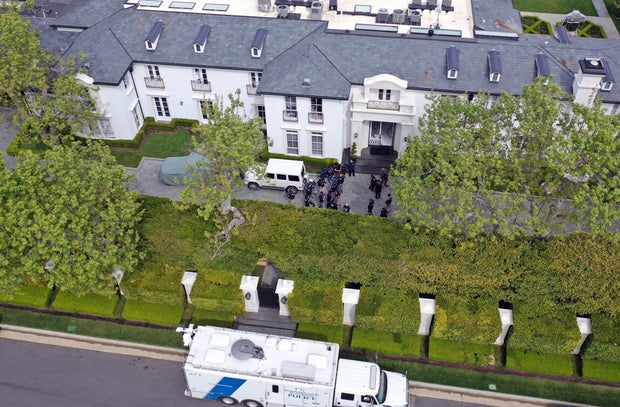 In an aerial view, the home of Sean "Diddy" Combs is seen during a raid by federal law enforcement agents on March 25, 2024 in Los Angeles, California. MEGA/GC Images/Getty Images
False claims about celebrity homes also spread after the Maui wildfire, with some users sharing baseless claims that Oprah Winfrey helped start those fires.
Addressing the spread of conspiracies
By coincidence, on the day the wildfires started, Facebook announced it was ending its third party fact checking program and loosening its automated systems that police policy violations, instead relying more on users to report issues before they take action. The platform is adopting a crowdsourced "community notes" system, similar to Elon Musk's X.
Dancy said conspiracy theorists are "benefitting from the information revolution" we live in. "It's an attention economy, and conspiracy theories get attention," Dancy said.
He advocates for regulating social media algorithms that prioritize sensational content.
Richards, who wrote a thesis about climate conspiracy theories circulating on TikTok, agreed.
"You're fighting against algorithms that are designed for profit and not for creating a well-informed and healthy society," she said.
Western Wildfires}:
---
https://theconversation.com/puerto-rico-has-a-once-in-a-lifetime-chance-to-build-a-clean-energy-grid-but-fema-plans-to-spend-9-4-billion-on-fossil-fuel-infrastructure-instead-169124
==
---
https://www.thenation.com/article/archive/why-blackwater-helping-train-brazils-world-cup-security/}:
no lnx
In news as shocking as it was unreported in the United States, the Brazilian press revealed earlier this week that Academi—the rebranded private militia once known as Blackwater—has been providing security training for the 2014 World Cup.The notorious company, responsible for the 2011 Nisour Square massacre in Iraq, has been training Brazilian security forces in North Carolina.
Hosting mega-events comes with astronomical costs. This summer’s World Cup in Brazil is the most expensive ever, with a tab so far of $11 billion to $13 billion. These costs promise to catapult even higher as unfinished projects linger long after the soccer fans have returned home, with some estimating the final price tag to crest at $15 billion. In addition to being the most expensive, the World Cup organizers plan to deploy more force than any previous tournament. More than 170,000 security personnel from the military, police and secret service will be on hand, 22 percent more than worked the previous World Cup in South Africa. Now we know that some of these forces will be trained by a private security firm with a dodgy history.
In Rio, the “pacification” of favelas is already hurtling ahead full throttle. Amnesty International described the Pacifying Police Unit’s recent incursion into the Maré complex of favelas as “a military occupation.” The suspicious disappearance of a young man named Amarildo Dias de Souza from his home favela of Rocinha sparked a public outburst and media-led investigation that spurred criminal charges against the neighborhood’s commanding officer and his minions. The security officials sit in prison awaiting trial, accused of torturing De Souza to death and discarding his corpse in the jungle. Not surprisingly, a recent national poll found that less than a quarter of Brazilians trust the police.
The conflation of terrorism and activism is also rampant. Lawmakers in Brazil are angling to use the state of exception that sports mega-events inevitably bring to pass drastic legislation. The Brazilian Congress is contemplating an antiterrorism bill that would impose hefty sentences—fifteen to thirty years in prison—for “causing or inciting widespread terror by threatening or trying to threaten the life, the physical integrity or the health or liberty of a person.” Human-rights groups have clamored that such proposals are overly broad and could be used to squelch all kinds of protest and actions during the World Cup.
For security mavens, Academi’s involvement training Brazilians at its company headquarters in North Carolina may come as no great surprise. After all, Wikileaks revealed in a 2009 cable from the US Embassy in Brasilia that the US government views the crises brought on by hosting sports mega-events as prime occasions to cash in.
After power outages rippled across Brazil in 2009, the US Mission wrote, “The newly heightened concerns about Brazil’s infrastructure as a result of this blackout, combined with the need to address infrastructure challenges in the run-up to the 2014 World Cup and 2016 Olympics, present the United States opportunities for engagement on infrastructure development as well critical infrastructure protection and possibly cyber security.” In short, Brazil’s misery created room for opportunism.
The cable encouraged US government agencies like the Department of Defense and Department of Homeland Security “to explore these opportunities in the near-term.” With Academi’s involvement in Brazil, this type of “opportunity” is taking shape.
The indomitable critic Eduardo Galeano recently said of FIFA, the world’s governing body for football, “There are visible and invisible dictators. The power structure of world football is monarchical. It’s the most secret kingdom in the world.” People across Brazil concur—disgruntlement with Fifa’s arrogance and opacity is widespread. Earlier this month, a poll found, quite remarkably, that in the football-crazy country of Brazil only 48 percent of the population favors hosting this summer’s World Cup, plummeting from 78 percent support in 2008. Meanwhile, 41 percent actively oppose it, up from only 10 percent. Last summer, the 2013 Confederations Cup provided a prime-time dress rehearsal for principled dissent. Almost everyone expects cross-country protests at this summer’s Copa do Mundo.
Under intense public pressure, Rio Mayor Eduardo Paes recently remarked, “We’re not going to build a Bird’s Nest [Stadium] in Rio de Janeiro. If you go to Beijing today, the Bird’s Nest has become a mausoleum to honor wasted public money. We are not going to do this here.” The mayor was right about the perils of white elephants. But another threat lingers: the intensified militarization of public space in the name of protecting the sports spectacle. Now it looks like private security firms like Academi are in on the deal, and that’s unsettling for anyone not under the spell of historical amnesia.
---
---
resign he lies ppl die
polar vortex AGW
wind blamed (by abbott?] ~ AOC GND
https://www.alternet.org/2021/02/texas-green-energy/
https://www.alternet.org/2021/02/gov-abbott/
https://www.alternet.org/2021/02/texas-power-grid
by Kate Galbraith, The Texas Tribune Feb. 8, 2011
"Texplainer: Why does Texas have its own power grid?" was first published by The Texas Tribune, a nonprofit, nonpartisan media organization that informs Texans — and engages with them — about public policy, politics, government and statewide issues.
Why does Texas have its own electric grid?
Texas' secessionist inclinations have at least one modern outlet: the electric grid. There are three grids in the Lower 48 states: the Eastern Interconnection, the Western Interconnection — and Texas.
The Texas grid is called ERCOT, and it is run by an agency of the same name — the Electric Reliability Council of Texas. ERCOT does not actually cover all of Texas. El Paso is on another grid, as is the upper Panhandle and a chunk of East Texas. This presumably has to do with the history of various utilities' service territories and the remoteness of the non-ERCOT locations (for example the Panhandle is closer to Kansas than to Dallas, notes Kenneth Starcher of the Alternative Energy Institute in Canyon), but Texplainer is still figuring out the particulars on this.
The separation of the Texas grid from the rest of the country has its origins in the evolution of electric utilities early last century. In the decades after Thomas Edison turned on the country's first power plant in Manhattan in 1882, small generating plants sprouted across Texas, bringing electric light to cities.
Later, particularly during the first world war, utilities began to link themselves together. These ties, and the accompanying transmission network, grew further during the second world war, when several Texas utilities joined together to form the Texas Interconnected System, which allowed them to link to the big dams along Texas rivers and also send extra electricity to support the ramped-up factories aiding the war effort.
The Texas Interconnected System — which for a long time was actually operated by two discrete entities, one for northern Texas and one for southern Texas — had another priority: staying out of the reach of federal regulators. In 1935, President Franklin D. Roosevelt signed the Federal Power Act, which charged the Federal Power Commission with overseeing interstate electricity sales. By not crossing state lines, Texas utilities avoided being subjected to federal rules. "Freedom from federal regulation was a cherished goal — more so because Texas had no regulation until the 1970s," writes Richard D. Cudahy in a 1995 article, "The Second Battle of the Alamo: The Midnight Connection." (Self-reliance was also made easier in Texas, especially in the early days, because the state has substantial coal, natural gas and oil resources of its own to fuel power plants.)
ERCOT was formed in 1970, in the wake of a major blackout in the Northeast in November 1965, and it was tasked with managing grid reliability in accordance with national standards. The agency assumed additional responsibilities following electric deregulation in Texas a decade ago. The ERCOT grid remains beyond the jurisdiction of the Federal Energy Regulatory Commission, which succeeded the Federal Power Commission and regulates interstate electric transmission....
---
---
We calculated emissions due to electricity loss on the power grid – globally, it’s a lot
Sarah Marie Jordaan, Johns Hopkins University and Kavita Surana, University of Maryland
Due to inefficiencies in global energy systems, energy falls short of even making it to the consumer, often lost in the form of waste heat.
==
ENERGY TRANSITIONS
Can Calif.'s smart grid double as wildfire defense?
Peter Behr, E&E News reporter
Published: Wednesday, December 11, 2019
Rooftop solar units, backup batteries, smart meters and automated grid controls in the Golden State could offer technological armor against future wildfires, some experts say.
---