WIND 2
see primary for older than 1/16
OOPS SEE 2A(has table)
no merri
SEE OFFSHORE WIND (tucker fox tppf BS)
aha note 4 of the reddest states are big in wind: But here's a fact you might not know. Just four states account for more than half of the wind electricity generation in the U.S.
---
---
an 725
Two Senate Republicans are now blocking a confirmation vote for three of President Donald Trump's nominees to positions in the U.S. Treasury Department in protest of one of the administration's newest policies.
Politico's Kelsey Tamborino and Josh Siegel reported Monday that Sens. Chuck Grassley (R-Iowa) and John Curtis (R-Utah) are now holding up votes for Treasury Department general counsel Brian Morissey, assistant Treasury Secretary Francis Brooke and Treasury Department undersecretary Jonathan McKernan. According to Politico, Grassley and Curtis are blocking the officials' confirmation to protect lucrative solar and wind energy projects in their states. And they're apparently not the only Senate Republicans willing to go to the mat for those projects.
"The pair, alongside other GOP senators, have escalated their pressure on the Trump administration in recent days to back off its efforts to strangle new solar and wind energy projects, warning that potential cancellations would make it harder to meet growing power demand," Tamborino and Siegel wrote.
READ MORE:'She is very very dumb': Fox News host mocked after flubbing basic civics lesson
One part of Trump's massive new tax and spending law is the repealing of renewable energy investments made possible by former President Joe Biden's Inflation Reduction Act. As New York Times columnist Thomas Friedman detailed last month, the legislation will "kneecap America’s renewable energy industry" while making China the de facto world leader in green energy technology.
In July, Trump issued an executive order instructing the Treasury Department to "strictly enforce" provisions in the new law that end tax credits for renewable energy development, which would be the responsibility of the Treasury officials Curtis and Grassley are blockading. The order also specified when a project was said to have begun construction, which Grassley said goes against what Congress has already passed.
“What it means for a project to ‘begin construction’ has been well established by Treasury guidance for more than a decade. Moreover, Congress specifically references current Treasury guidance to set that term’s meaning in law,” the Iowa Republican said in the Congressional Record. “This is a case where both the law and congressional intent are clear.”
According to Politico, the tax and spending law defunds all projects slated to start generating power after 2027. Several Republicans fought for compromise language that was included in the final bill that allowed more time for renewable energy projects beginning construction in the next six months.
}:
---
mma 2 23
Over the past several days Fox networks have aired numerous segments insinuating that the recent deaths of whales across New York and New Jersey beaches are due to the development of offshore wind turbines.
There is no evidence to back up these claims.
NOAA Fisheries, the office within the National Oceanic and Atmospheric Administration responsible for the management of marine life, specifically addressed the question on January 24. NOAA stated that the recent whale deaths are “not related to offshore wind development.” The agency further wrote, “Of the whales examined, about 40 percent had evidence of human interaction, either ship strike or entanglement. Vessel strikes and entanglement in fishing gear are the greatest human threats to large whales.” Indeed, nearly 3,000 ships passed through the Port of New York and New Jersey, near where whale deaths are occurring, in the last year — “a figure that vastly undercounts all the ocean traffic in the region and dwarfs the number of vessels that have anything to do with offshore wind.”
Importantly, NOAA Fisheries noted climate change as a contributing factor in the whale deaths. The world’s oceans are rapidly warming, with temperatures reaching a record high in 2022. This is forcing a change in the migration patterns of marine life, including whales, and “can lead to increased interactions with humans as some whales move closer to near shore habitats,” the agency writes.
Additionally, there aren’t even any wind turbines off of the coast of New Jersey. The whale deaths have also been happening at an increased rate since at least 2016, the NOAA reports, which long predates any offshore wind development in the region.
This is not stopping Fox from promulgating claims that offshore wind is killing these whales
On the January 30 edition of Tucker Carlson Tonight, Tucker Carlson sarcastically mocked a Politico article which stated that “there is no evidence the wind work and whale deaths are linked.”
“We have no idea why a dozen whales just turned up dead on the beaches of New Jersey,” Carlson said. “Does it have anything to do with the construction of wind turbines off the coast? ‘That's speculation,’ Politico reported. ‘Probably climate change.’ So the story was ridiculous, but what we didn’t get at first was that Politico was paid to run it.”
Carlson took issue with the fact that the article was featured in a newsletter sponsored by the Natural Resources Defense Council, later calling Politico “prostitutes” for publishing another article sponsored by offshore wind turbine manufacturers. In reality, Politico’s energy newsletters are typically sponsored by energy companies, not environmental groups — with the vast majority of these sponsorships coming from fossil fuel companies.
The next night, Carlson stated that “so-called green NGOs, supported of course by the people they give money to in the Biden administration, are backing the construction of massive offshore wind turbines that appear to bekilling large numbers of whales.” Carlson then hosted a local Republican politician from Nassau County, New York, who called “going all-electric” a “danger to our America,” and stated that “there will always be fossil fuels, at least in my lifetime.”
Carlson’s two recent segments follow a January 13 segment detailing “The Biden whale extinction.” (Another chyron during that episode read “Green New Deal wind farms are killing whales.”)
Questions about offshore wind development were also raised on Fox during the January 31 editions of both America’s Newsroom, with reporter Alexis McAdams stating, “As the whale deaths continue, some lawmakers and activists are calling for a hold on the preparations for offshore wind projects,” and The Story, with guest anchor Trace Gallagher stating, “It's the eighth whale to die along the shore of New Jersey and New York in the last two months, fueling the debate about whether the deaths are natural or maybe related to nearby offshore wind projects and the push to go green.”
Several more such segments covering the whale deaths ran on February 1. On Fox Business’ Varney & Co., correspondent Madison Alworth discussed the costs of offshore wind development without noting the massive economic benefits to local and state communities before stating, “All of this is the cost of this clean energy, but as you heard these conservationists saying it's costing our environment even more, and we're already seeing that expense.”
“Not in my backyard,” concluded host Stuart Varney.
Another segment on The Story began with Gallagher stating that, “The mayors of a dozen New Jersey towns [are] now calling for an immediate halt on plans to build thousands of offshore wind turbines as coastal communities raise concerns about the number of whales washing up dead on nearby beaches and soaring financial costs threaten the push to go green.”
Later, Alworth began a segment on Special Report with Bret Baier by claiming “conservationists say that offshore wind turbines are far from clean and may be doing more harm than good for the environment.” She ended the report by again mentioning the economic costs associated with wind turbines and none of the financial benefits.
Finally, Jesse Watters Primetime ran two segments linking offshore wind development to the whale deaths. In one, Alworth cited “conservationists” concerned with whale deaths saying “this clean energy might not be clean at all,” and she again brought up the economic costs of wind turbines without mentioning their benefits. In the second, host Jesse Watters interviewed ex-Greenpeace Canada member Patrick Moore to rail against renewable energy and complain that Greenpeace has been compromised by wind companies. Watters ended the segment by stating that wind turbines are “not good for the Jersey shore, for the Atlantic Ocean, and, as you said, it's not great for consumers either.”
Fox’s guests are not scientists — they have fossil fuel connections and an interest in blocking renewable energy development
Moore is a climate science denier who has consulted for polluting companies. He also (falsely) claims that he is a founder of Greenpeace, which allows Fox to paint him as a credible guest on climate, energy, and environmental issues.
Watters also tried this trick — obfuscating the credibility of an environmental advocate — in an earlier segment on offshore wind and whale deaths. On January 11, Mike Dean of Protect Our Coast NJ was labeled as an “ocean advocate,” and Dean went on to baselessly blame wind development for whale deaths, declaring, “The harms with these projects and the costs are limitless, and it’s really hard to find any benefits at all.” Fox did not note that Dean’s group appears to be backed by the Caesar Rodney Institute, a libertarian think tank with a history of hostility toward climate and environmental policies. The institute has also received funding from the fossil fuel industry, which has a long history of blocking renewable energy projects.
On the January 13 edition of Tucker Carlson Tonight, Carlson hosted Meghan Lapp, a fisheries liaison for the fishing company Seafreeze. Lapp claimed, without evidence, thatoffshore wind development means “essentially carpet bombing the ocean floor with intense sound.” In fact, Lapp has been appearing on Fox News since at least 2019 insinuating that offshore wind development is killing whales. She even appeared in Carlson’s 2021 anti-wind documentary which was chock full of misinformation and debunked talking points.
What has not been mentioned on Fox, and what has been excellently reported on by climate writer Michael Thomas, is that Lapp is a fossil fuel industry ally. Her campaign to stop offshore wind development has beenbankrolled by Texas Public Policy Foundatio**n, a fossil fuel-funded think tank that has fought climate policies tooth and nail. TPPF, of course, has spent decades advocating for offshore oil drilling — choosing to downplay the horrific environmental impacts of that practice while embellishing the impacts of offshore wind development.
Finally, Bonnie Brady of the Long Island Commercial Fishing Association appeared on the aforementioned Varney & Co., The Story, and Special Report segments on February 1. Brady, like Lapp, is being :{backed by TPPF in her campaign to stop offshore wind development. Last year, both Lapp and Brady appeared in a TPPF film entitled “A Heavy Wind: The Threat to an American Heritage,” which detailed commercial fishermen fighting offshore wind projects.}:
One recent Fox segment interspersed with their offshore wind coverage illustrates the complete hypocrisy of Fox’s climate-related programming
During Fox’s fearmongering about offshore wind development on February 1, America Reports ran a segment with Sen. Dan Sullivan (R-AK) that sang the praises of the Willow Project, a major oil and gas drilling project in Alaska’s national petroleum reserve. Sullivan called the project “actually really good for our environment,” while Fox anchor John Roberts noted some benefits of the project, including billions in revenue and hundreds of jobs created.
While Roberts did ask a question about climate advocates not wanting to lock the U.S. into more fossil fuel extraction, this segment did not mention the massive environmental costs associated with the project. Environmental advocate and journalist Bill McKibben noted in a recent article on the project that Alaska is “already warming faster than almost any place on the planet.Warming so fast that taxpayers are already having to pony up huge sums of money to relocate coastal villages inland. Emissions from the Willow project’s oil would cause $19.8 billion in climate damages; it would generate $3.4 billion in federal tax revenue, which is…a lot less.”
McKibben also cited a Center for American Progress analysis of the project which found that “allowing the Willow project to proceed would result in double the carbon pollution that all renewable progress on public lands and waters would save by 2030.”
Contrast Fox’s fawning coverage of an oil drilling project with its dismissive, conspiracy theory-laden, and climate denial-infused coverage of offshore wind, and you get a perfect sense of why Fox cannot be trusted on climate and environmental issues. While it’s true that there are valid concerns with offshore wind’s impacts on the environment and local marine life — something that has been taken into consideration by government authorities in reviewing previous offshore wind projects —the reality is that fossil fuel projects are significantly more detrimental to the environment and climate than renewable projects.
You will rarely if ever hear these facts reported on Fox, as the network has time and again proved to be nothing more than a mouthpiece for the fossil fuel industry, and its offshore wind coverage cannot be taken seriously.
---
HISTORY
timeline:
https://yyy.theguardian.com/environment/2008/oct/17/wind-power-renewable-energy
...July 1887, Glasgow, Scotland
The first windmill for electricity production is built by Professor James Blyth of Anderson's College, Glasgow (now Strathclyde University). The professor experiments with three different turbine designs, the last of which is said to have powered his Scottish home for 25 years.
Winter 1887 – Ohio, US
Professor Charles F. Brush builds a 12kW wind turbine to charge 408 batteries stored in the cellar of his mansion. The turbine, which ran for 20 years, had a rotor diameter of 50m and 144 rotor blades.
1890s – Askov, Denmark
Scientist Poul la Cour begins his wind turbine tests in a bid to bring electricity to the rural population of Denmark. In 1903, Poul la Cour founded the Society of Wind Electricians and in 1904 the society held the first course in wind electricity. La Cour was the first to discover that fast rotating wind turbines with fewer rotor blades were most efficient in generating electricity production.
1927 – Minneapolis, US
Joe and Marcellus Jacobs open the Jacobs Wind factory, producing wind turbine generators. The generators are used on farms to charge batteries and power lighting.
1920s
The first vertical axis wind turbine, the Darrieus turbine, is invented by Frenchman George Darrieus who in 1931 has it patented in the US. The design, often referred to as the "eggbeater windmill", due to the appearance of its two or three blades, is still used today.
1931 – Yalta, former USSR
A precursor to the modern horizontal wind generator is used in Yalta, generating 100kW. The turbine has a 30m tower and a 32% load factor, meaning it provides 32% of its potential energy output, pretty good even by today's standards.
1941 – Vermont, US
The world's first megawatt wind turbine is built and connected to the power grid in Castleton, Vermont. The turbine has 75-foot blades and weighs 240 tons.
1956 – Gedser, Denmark
The Gedser wind turbine is built by Johannes Juul, a former student of Poul la Cour. The 200kW, three-bladed turbine inspired many later turbine designs, and Juul's invention - emergency aerodynamic tip breaks – is still used in turbines today. The turbine operated until 1967 and was refurbished in the mid 1970s at the request of Nasa.
1970s – Ohio, US
The United States government, led by Nasa, begins research into large commercial wind turbines. Thirteen experimental turbines are put into operation and the research paves the way for many of the multi-megawatt technologies used today.
1980 – New Hampshire, US
The world's first windfarm consisting of 20 turbines is built in New Hampshire. The windfarm however, is a failure as the turbines break down and the developers overestimate the wind resource.
1981 – Washington and Hawaii, US
In 1981 the 7.5mW Mod-2 is build by Nasa, followed in 1987 by the 3.2mW, two-blade wind turbine Mod-5B. Both turbines break records for diameter and energy output.
1991 – Vindeby, Denmark
The first offshore windfarm is created in Vindeby, in the southern part of Denmark. The windfarm consists of 11 450kW turbines.
gmail 11 22
After years of lagging behind other countries, the United States is on the cusp of developing a real offshore wind industry. This is good news for the climate, as offshore wind is critical to effectively tackling dangerous warming.
What’s good for the climate, however, is usually bad for fossil fuels. So it’s no surprise that a fossil fuel industry-funded group is leading a combined legal and public relations effort to stop offshore wind development in its tracks.
More surprising may be the argument the group is using. In a lawsuit seeking to stop all ongoing U.S. offshore wind development, The Texas Public Policy Foundation (TPPF)–which has long advocated against climate and environmental policy–says the renewable energy projects should be stopped because they harm the environment.
TPPF has also launched a public relations effort to promote the lawsuit’s claims, including a dramatic three and a half minute “mini-documentary” on “the environmental impact of offshore wind
[vid]
there are, of course, legitimate ongoing conversations about the environmental impacts of offshore wind and how to mitigate them. But these aren’t the conversations TPPF is promoting.
With this effort, TPPF is attempting to trick environmentally-conscious voters into supporting a pro-fossil fuel agenda by co-opting the language of the progressive climate movement. The effort disguises anti-climate extremism as pro-environmentalism, using a common climate disinformation tactic called “woke-washing,” which experts say is on the rise.
TPPF’s long anti-environment history
tPPF is part of the State Policy Network (SPN), a group of conservative nonprofits that fight climate policies across the country. Its primary goal in the climate space is shifting public opinion to reject mainstream climate science and be more supportive of fossil fuels.
Fossil fuels, in turn, give TPPF a lot of support. Like many SPN affiliates, TPPF’s largest known donor is Charles Koch. The fossil fuel billionaire has given at least $7.6 million to TPPF, including a $1.3 million donation in 2020 and a $1.5 million donation in 2019. TPPF has also received money from ExxonMobil, Chevron, ConocoPhillips, Luminant, and other smaller fossil fuel companies.
These donors likely only scratch the surface of TPPF’s fossil fuel funding. In 2021, researchers at Brown University published a paper showing that between 2003 and 2018, 75 percent of donations to anti-climate nonprofits like TPPF came from undisclosed grants. “We literally know nothing about where that money came from. It's completely dark,” said Galen Hall, one of the authors of the paper.
Still, the group’s long history of extreme anti-climate rhetoric speaks for itself. TPPF has called the fight against climate change “deluded and illegitimate;” has decried climate science as “alarmism,” and likened decarbonization to a “crusade.” Last year, the group released an op-ed titled “Why Nobody’s Kids Need to be Scared of Climate Change,” which dismissed the dangers of warming while also arguing that nothing can be done to stop it. Many of former President Trump’s environmental appointees came from TPPF; according to E&E News, those officials “overwhelmingly reject climate science, promote more fossil fuel consumption and have run campaigns downplaying the value of renewable energy subsidies.”
TPPF has also long been critical of environmental laws, including the Endangered Species Act. In 2018, TPPF attacked "far-left environmental groups" over efforts to protect the Dunes Sagebrush Lizard in the Permian basin. "That this humble lizard could jeopardize what may be the greatest energy enrichment in human history is absurdly chilling,” TPPF’s Kathleen Hartnett White wrote.
In 2017, TPPF attorney Robert Henneke wrote an op-ed for The Hill titled, "The Endangered Species Act is an ineffective regulatory burden." In that article, he quoted a biologist who said, "'We don’t need to save endangered species' because'extinction is part of evolution.'”
Now, however, that same lawyer is using the Endangered Species Act to argue that all U.S. offshore wind development should be killed.
A disingenuous “pro-environment” lawsuit
Filed in December of last year, TPPF’s lawsuit targets the Vineyard Wind project, an 800-megawatt wind farm currently under construction off the coast of southern New England, which could cut 1.6 million tons of carbon dioxide emissions per year. It uses allegations against that project to call for pausing all wind farm construction currently happening under the federal “Smart From The Start” program–which is essentially all ongoing wind development in the U.S..
Though it was filed on behalf of commercial fishing groups who argue the project would harm their businesses, TPPF’s lawsuit largely focuses on claims of environmental harm and inadequate environmental review. It asserts violations of the Endangered Species Act, the Clean Water Act, the Marine Mammal Protection Act, and the National Environmental Policy Act.
TPPF’s lawsuit says the Vineyard Wind project would “likely kill, displace, or disturb local species,” would “likely result in massive devastation of the marine environment,” In particular, TPPF’s lawyers seem concerned about one endangered species: the North Atlantic right whale.
On the surface, these are legitimate concerns. According to the World Wildlife Foundation Fund (WWF), right whales are “one of the most endangered of all large whales,” largely due to commercial whaling operations that pushed them to the brink of extinction in the 19th century. Today, the remaining 350 North Atlantic right whales are mostly threatened by rope entanglements and vessel strikes, which could increase during offshore wind construction and operation.
Environmental groups like the NRDC and the Conservation Law Foundation warn that offshore wind energy, if not developed carefully, could harm or kill the few remaining right whales. But unlike TPPF, they believe it’s possible to build offshore wind turbines and protect endangered species at the same time.
In June 2022, National Wildlife Federation, the Natural Resources Defense Council and the Conservation Law Foundation signed a deal to support an offshore wind project off the coast of New York, so long as the developers engage in protective measures for the whales. The groups did this because climate change threatens whales and other endangered marine species, too.
“Development of renewable energy resources is vitally important to the health of the planet, and it's vitally important to addressing climate change,” said the Conservation Law Center’s Priscilla Brooks, who signed the agreement. “We can do this and we can do it responsibly in the ocean.”
TPPF’s real goal: turning public opinion against clean energy
TPPF doesn’t actually care about protecting endangered species. It cares about protecting the oil and gas industry–which is also a massive threat to many species, including humans.
By disguising their motive as pro-environment, the group is engaging in a form of disinformation called “woke-washing,” said Jennie King, a climate disinformation tracker at the Institute for Strategic Dialogue.
Woke-washing occurs when individuals or organizations use progressive or “woke” language to trick people into supporting fundamentally conservative outcomes. To do this, conservative woke-washers weaponize legitimate progressive concerns to discredit progressive solutions.
“The co-option of progressive language by those who oppose climate action is a big problem for the climate sector,” said King, who is part of a global coalition tracking climate disinformation online. That group recently found that woke-washing is on the rise–particularly from pro-fossil fuel groups trying to discredit clean energy solutions as anti-environment.
“We had case studies where we saw that posts from progressive green groups looked almost identical to dedicated anti-climate groups,” she said. “The only difference would be at the end, where the progressive group’s would say ‘And this is why we need to hold the sector to higher account,’ and the anti-climate group’s would say, ‘And this is why it’s a joke to pretend we can use anything but fossil fuels.’”
Woke-washing may not be a winning legal strategy, at least in TPPF’s case. “Winning any National Environmental Policy Act lawsuit is difficult,”said Michael Burger, the executive director of Columbia Law School’s Sabin Center. “I don't think that this is a strong lawsuit.”
But winning the lawsuit against offshore wind may not be TPPF’s ultimate goal.
“It's possible that a lawsuit that doesn't have a high likelihood of success on the merits might be brought in order to have indirect effects,'' Burger said. “If a think tank or an organization has as part of its mission to support the continued development of fossil fuels, then simply throwing monkey wrenches into the works of a large scale renewable energy project is a worthwhile project.”
9 22 almost daily headlines on solar and battery tech breakthrus?
gop BS on CA blackouts eg shillenberger; no mention that climate creates heatwave, or that ca got big % during peak demand from wind and solar?
https://www.alternet.org/2022/09/the-best-economic-choice-renewable/
'The best economic choice': Switching to :{renewable energy could save the world $12 trillion by 2050:(style="background-color:#ff9900;"):}:
Peer-reviewed research released Tuesday by a team at the University of Oxford reveals that transitioning to 100% clean energy within the next three decades could save not only live...
8 22 tx weekly
"Why the Texas grid causes the High Plains to turn off its wind turbines" was first published by The Texas Tribune, a nonprofit, nonpartisan media organization that informs Texans — and engages with them — about public policy, politics, government and statewide issues.
LUBBOCK — The state’s High Plains region, which covers 41 counties in the Texas Panhandle and West Texas, is home to more than 11,000 wind turbines — the most in any area of the state.
The region could generate enough wind energy to power at least 9 million homes. Experts say the additional energy could help provide much-needed stability to the electric grid during high energy-demand summers like this one, and even lower the power bills of Texans in other parts of the state.
But a significant portion of the electricity produced in the High Plains stays there for a simple reason: It can’t be moved elsewhere. Despite the growing development of wind energy production in Texas, the state’s transmission network would need significant infrastructure upgrades to ship out the energy produced in the region.
“We’re at a moment when wind is at its peak production profile, but we see a lot of wind energy being curtailed or congested and not able to flow through to some of the higher-population areas,” said John Hensley, vice president for research and analytics at the American Clean Power Association. “Which is a loss for ratepayers and a loss for those energy consumers that now have to either face conserving energy or paying more for the energy they do use because they don’t have access to that lower-cost wind resource.”
And when the rest of the state is asked to conserve energy to help stabilize the grid, the High Plains has to turn off turbines to limit wind production it doesn’t need.
“Because there’s not enough transmission to move it where it’s needed, ERCOT has to throttle back the [wind] generators,” energy lawyer Michael Jewell said. “They actually tell the wind generators to stop generating electricity. It gets to the point where [wind farm operators] literally have to disengage the generators entirely and stop them from doing anything.”
Texans have already had a few energy scares this year amid scorching temperatures and high energy demand to keep homes cool. The Electric Reliability Council of Texas, which operates the state’s electrical grid, warned about drops in energy production twice last month and asked people across the state to lower their consumption to avoid an electricity emergency.
The energy supply issues have hit Texans’ wallets as well. Nearly half of Texas’ electricity is generated at power plants that run on the state’s most dominant energy source, natural gas, and its price has increased more than 200% since late February, causing elevated home utility bills.
Meanwhile, wind farms across the state account for nearly 21% of the state’s power generation. Combined with wind production near the Gulf of Mexico, Texas produced more than one-fourth of the nation’s wind-powered electric generation last year.
Wind energy is one of the lowest-priced energy sources because it is sold at fixed prices, turbines do not need fuel to run and the federal government provides subsidies. Texans who get their energy from wind farms in the High Plains region usually pay less for electricity than people in other areas of the state. But with the price of natural gas increasing from inflation, Jewell said areas where wind energy is not accessible have to depend on electricity that costs more.
“Other generation resources are more expensive than what [customers] would have gotten from the wind generators if they could move it,” Jewell said. “That is the definition of transmission congestion. Because you can’t move the cheaper electricity through the grid.”
A 2021 ERCOT report shows there have been increases in stability constraints for wind energy in recent years in both West and South Texas that have limited the long-distance transfer of power.
“The transmission constraints are such that energy can’t make it to the load centers. [High Plains wind power] might be able to make it to Lubbock, but it may not be able to make it to Dallas, Fort Worth, Houston or Austin,” Jewell said. “This is not an insignificant problem — it is costing Texans a lot of money.”
Some wind farms in the High Plains foresaw there would be a need for transmission. The Trent Wind Farm was one of the first in the region. Beginning operations in 2001, the wind farm is between Abilene and Sweetwater in West Texas and has about 100 wind turbines, which can supply power to 35,000 homes. Energy company American Electric Power built the site near a power transmission network and built a short transmission line, so the power generated there does go into the ERCOT system.
But Jewell said high energy demand and costs this summer show there’s a need to build additional transmission lines to move more wind energy produced in the High Plains to other areas of the state.
Jewell said the Public Utility Commission, which oversees the grid, is conducting tests to determine the economic benefits of adding transmission lines from the High Plains to the more than 52,000 miles of lines that already connect to the grid across the state. As of now, however, there is no official proposal to build new lines.
“It does take a lot of time to figure it out — you’re talking about a transmission line that’s going to be in service for 40 or 50 years, and it’s going to cost hundreds of millions of dollars,” Jewell said. “You want to be sure that the savings outweigh the costs, so it is a longer process. But we need more transmission in order to be able to move more energy. This state is growing by leaps and bounds.”
A report by the American Society of Civil Engineers released after the February 2021 winter storm stated that Texas has substantial and growing reliability and resilience problems with its electric system.
The report concluded that “the failures that caused overwhelming human and economic suffering during February will increase in frequency and duration due to legacy market design shortcomings, growing infrastructure interdependence, economic and population growth drivers, and aging equipment even if the frequency and severity of weather events remains unchanged.”
The report also stated that while transmission upgrades across the state have generally been made in a timely manner, it’s been challenging to add infrastructure where there has been rapid growth, like in the High Plains.
Despite some Texas lawmakers’ vocal opposition against wind and other forms of renewable energy, the state has prime real estate for harnessing wind power because of its open plains, and farmers can put turbines on their land for financial relief.
This has led to a boom in wind farms, even with transmission issues. Since 2010, wind energy generation in Texas has increased by 15%. This month, the Biden administration announced the Gulf of Mexico’s first offshore wind farms will be developed off the coasts of Texas and Louisiana and will produce enough energy to power around 3 million homes.
“Texas really does sort of stand head and shoulders above all other states when it comes to the actual amount of wind, solar and battery storage projects that are on the system,” Hensley said.
One of the issues often brought up with wind and solar farms is that they may not be able to produce as much energy as the state needs all of the time. Earlier this month, when ERCOT asked consumers to conserve electricity, the agency listed low wind generation and cloud coverage in West Texas as factors contributing to a tight energy supply.
Hensley said this is where battery storage stations can help. According to the U.S. Energy Information Administration, utility-scale batteries tripled in capacity in 2021 and can now store up to 4.6 gigawatts of energy. Texas has been quickly developing storage projects. In 2011, Texas had only 5 megawatts of battery storage capacity; by 2020, that had ballooned to 323.1 megawatts.
“Storage is the real game-changer because it can really help to mediate and control a lot of the intermittency issues that a lot of folks worry about when they think about wind and solar technology,” Hensley said. “So being able to capture a lot of that solar that comes right around noon to [1 p.m.] and move it to those evening periods when demand is at its highest, or even move strong wind resources from overnight to the early morning or afternoon hours.”
Storage technology can help, but Hensley said transmission is still the big factor to consider.
Solar is another resource that could help stabilize the grid.According to the Solar Energy Industries Association, Texas has about 13,947 megawatts of solar installed and more than 161,000 installations. That’s enough to power more than 1.6 million homes.
This month, the PUC formed a task force to develop a pilot program next year that would create a pathway for solar panels and batteries on small-scale systems, like homes and businesses, to add that energy to the grid. The program would make solar and batteries more accessible and affordable for customers, and it would pay customers to share their stored energy to the grid as well.
Hensley said Texas has the most clean-energy projects in the works that will likely continue to put the region above the rest when it comes to wind generation.
“So they’re already ahead, and it looks like they’re going to be even farther ahead six months or a year down the road,” he said.
an 6 22
Renewable sources of energy are "bailing out" the Texas power grid as early summer temperatures spike and demand surges, CNN reported on Tuesday.
The boost has prevented a recurrence of the blackouts which plagued Texas during the winter months of 2021 when electricity usage exploded, overwhelming providers and transmission networks.
"Several experts told CNN that it's owed in large part to strong performances from wind and solar, which generated 27 gigawatts of electricity during Sunday's peak demand -- close to 40% of the total needed," the outlet said.
CNN noted that while Republicans in the politically crimson Lone Star State have been reliably outspoken about their opposition to sustainable sources such as wind and solar, Texas "has a massive and growing fleet of renewables. Zero-carbon electricity sources (wind, solar, and nuclear) powered about 38% of the state's power in 2021, rivaling natural gas at 42%."
Michael Webber, an energy expert and professor at the University of Texas at Austin, explained that "Texas is, by rhetoric, anti-renewables. But frankly, renewables are bailing us out. They're rocking. That really spares us a lot of heartache and a lot of money."
Perhaps somewhat ironically, CNN pointed out, "Texas generates the most wind energy in the country: In 2020, it produced more wind electricity than Iowa, Kansas, and Oklahoma — the next three highest states — combined, according to the US Energy Information Administration."
Solar, meanwhile, is viewed as an invaluable power source during the summer due to there being less wind and because "there's a good chance the sun is beating down," experts told CNN.
Joshua Rhodes, an energy researcher at the University of Texas in Austin, confirmed that renewables "are acting as a hedge against high fuel prices." He added, however, that "about half of the solar that could be produced is not being produced right now because there's no more room on the lines. The numbers for renewables would probably be higher if we had the transmission capacity to move them around."
Renewables have driven down prices because they are generated naturally, unlike fossil fuels, which require massive industrial refinement operations and energy-intensive efforts to be delivered to consumers. Oil and natural gas are also finite resources, a fact that has contributed to the increased costs of fuel worldwide.
Yet even with their much-needed cushioning, renewables are not a complete fail-safe against future collapses of the power grid.Texas is currently experiencing sweltering heat that normally arrives in August, causing people to crank up their air conditioners earlier in the season than in previous years.And engineers are facing additional challenges, like designing batteries that can store enough electricity to sustain communities when sunlight and wind are not immediately available.
But the biggest variable by far is climate change, which scientists have for decades warned will get catastrophically worse unless humanity's addiction to fossil fuels is curbed. More than 107 million Americans are experiencing record-shattering heat in the waning weeks of spring.
Andy Dessler, the director of the Texas Center for Climate Studies at Texas A&M University, stressed to CNN that "everything's getting hotter. August is getting hotter; June is getting hotter. It is hot and this is the future."
CNN's full report is available here.
APR 14, 2022
Wind was second-largest source of U.S. electricity generation on March 29
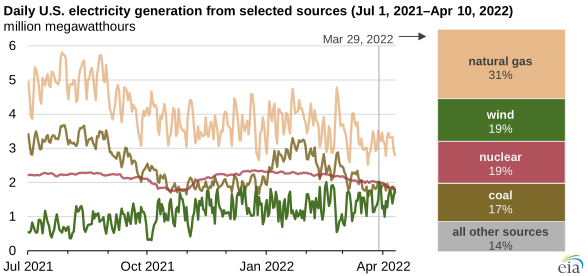
Source: U.S. Energy Information Administration, :{Hourly Electric Grid Monitor:(style="margin:0px;padding:0px;border:0px;font-weight:inherit;vertical-align:baseline"):}:
On Tuesday, March 29, wind turbines in the Lower 48 states produced 2,017 gigawatthours (GWh) of electricity, making wind the second-largest source of electric generation for the day, only behind natural gas, according to our :{Hourly Electric Grid Monitor:(style="margin:0px;padding:0px;border:0px;font-weight:inherit;vertical-align:baseline"):}:. Daily wind-powered electricity had surpassed coal-fired and nuclear electricity generation separately on other days earlier this year but had not surpassed both sources on a single day.
https://www.huffpost.com/entry/the-koch-brothers-are-sti_b_4396033
THE BLOG
The Koch Brothers Are Still Trying to Break Wind
The Koch brothers have turned loose their network of advocacy groups, think tanks and Capitol Hill friends to kill a key federal tax break for the wind industry, despite the fact that the oil and gas industry has been getting four times more in tax breaks and subsidies annually since 1918.
Elliott Negin, Contributor
Senior Writer, Union of Concerned Scientists
Dec. 9, 2013, 09:01 AM EST | Updated Dec. 6, 2017
This post was published on the now-closed HuffPost Contributor platform. Contributors control their own work and posted freely to our site. If you need to flag this entry as abusive, send us an email.
As Congress dithers for the umpteenth time over extending a key subsidy for wind energy, the industry once again is up in the air. Called theproduction tax credit (PTC), the subsidy helps level the playing field between wind and fossil fuels and has proven to be critical for financing new projects, helping to make wind one of the fastest growing electricity sources in the country. Given the planet needs to transition as quickly as possible away from coal and natural gas to carbon-free energy to avoid the worst consequences of climate change, who would be against renewing wind's tax credit.
The Koch brothers, that's who.
Charles G. and David H. Koch -- the billionaire owners of the coal, oil and gas Koch Industries conglomerate -- have enlisted their extensive network of think tanks, advocacy groups and friends on Capitol Hill to spearhead a campaign to pull the plug on the PTC. Never mind the fact that the oil and gas industry has averaged four times what the wind tax credit is worth in federal tax breaks and subsidies annually for the last 95 years.
The Koch network is fighting the wind industry on a number of fronts. Last month, Koch-funded Congressman Mike Pompeo (R-Kansas) sent a letter signed by 52 House members to the chairman of the House Ways and Means Committee, urging him to let the PTC expire. Meanwhile, a coalition of some 100 national and local groups organized by the Koch-founded Americans for Prosperity sent a letter to each member of Congress asking them to do the same. And earlier this month, the Koch-funded Institute for Energy Research launched an anti-PTC ad campaign and released a report claiming that only a handful of states actually benefit from the subsidy.
Malcolm Gladwell didn't include this battle in his new book David and Goliath because, given the odds, it's more like Bambi versus Godzilla.
The Kochs' Man in Congress
The fact that Kansas Rep. Mike Pompeo is the Kochs' point man to scuttle the PTC in the House is a bit ironic given his state is a wind energy leader. Kansas has the second highest wind potential in the country, it has already attracted more than $5 billion in wind industry investment, and last year wind generated 11.4 percent of its electricity. With stats like that, the industry has broad bipartisan support. Kansas Gov. Sam Brownback and Sens. Jerry Moran and Pat Roberts -- all Republicans -- are big fans.
Pompeo, who has been in Congress since only 2011, would argue that he's against all energy tax credits. For the second year in a row, he has introduced a bill that would eliminate tax breaks that benefit oil, natural gas, coal, nuclear, electric vehicles, alternative fuels, solar and wind, including the PTC, which gives wind developers a tax credit of 2.3 cents for each kilowatt-hour of electricity they produce.
But there's a catch. Although it appears evenhanded, Pompeo's bill would severely hamper wind and solar but preserve a number of oil, gas and coal subsidies, including the percentage depletion allowance, the ability to expense the costs of exploration, and the accelerated depreciation of certain kinds of "geologic property." These and other tax breaks he left out of his bill would be worth about $12.5 billion to the oil and gas industry from 2011 through 2015, according to a March 2012 Congressional Research Service report.
Why is Pompeo so down on wind? Perhaps it's because Koch Industries is headquartered in Wichita, smack-dab in the middle of his district -- and the fact that the company is by far and away his biggest campaign contributor. Since 2010, Koch Industries has given him $200,000, more than four times what his second highest contributor kicked in. Besides Koch Industries, three other oil companies are among Pompeo's top five contributors -- McCoy Petroleum, Mull Drilling and Richie Exploration -- and they're also based in Wichita.
What about the other 51 House members who signed Pompeo's letter? As it turns out, 65 percent of them received contributions from Koch Industries during the last two or three campaign cycles, according to Federal Election Commission data compiled by the nonpartisan Center for Responsive Politics. A quarter of them, meanwhile, cashed checks from ExxonMobil. And except for two congressmen who didn't take any energy industry money, the signatories received sizable contributions from a number of other corporations that compete with wind, including coal barons Arch Coal and Alpha Natural Resources; oil and gas giants Chesapeake Energy, Chevron, ConocoPhillips and Valero Energy; and Exelon, which owns the most nuclear reactors in the country.
Americans for (Koch) Prosperity Weighs In
Pompeo's letter came on the heels of a letter from the Kochs' flagship advocacy group, Americans for Prosperity, calling for Congress to kill the PTC. AFP's letter, which was signed by 102 organizations, claims that "the wind industry has very little to show after 20 years of preferential tax treatment" and declares that "Americans deserve energy solutions that can make it on their own in the marketplace -- not ones that need to be propped up by government indefinitely."
Is that right? Little to show? Preferential tax treatment?
In fact, until Congress left the wind industry hanging late last year, it had been doing quite well. Even with a deep recession and slow recovery, over the previous five years -- with the help of the PTC, stimulus spending and state renewable electricity standards -- the industry doubled its electricity output, employment and private investment. In 2012, domestic manufacturers produced roughly 72 percent of the wind turbine equipment erected across the country -- nearly triple the percentage in 2006 -- and more than 13,000 megawatts of new wind generation capacity was installed. By the end of last year, there were enough wind turbines to power 15 million typical American homes -- without toxic pollutants or carbon emissions.
But AFP's complaint that the wind industry has been on the dole far too long is even more galling. What about the oil and gas industry? It's been feeding at the federal trough since 1918! On average, the industry has benefited from $4.86 billion in tax breaks and subsidies in today's dollars every year since then, according to a 2011 study by DBL Investors, a venture capital firm. Renewable energy technologies, meanwhile, averaged only $370 million a year in subsidies between 1994 and 2009. The 2009 stimulus package did provide $21 billion for wind, solar and other renewables, but that support barely begins to balance the scales that have tilted toward nuclear power for more than 50 years, oil and gas for 95 years, and coal for more than two centuries.
So who signed the AFP letter? About half of the signatories are local tea party affiliates and anti-wind NIMBY groups of indeterminate size and funding. The other half are, for the most part, relatively obscure national groups, but there are a few that have attracted attention over the years for their contrarian views on climate science and renewable energy. Like AFP, those groups are awash in petrodollars. The American Energy Alliance (and its parent, the Institute for Energy Research), Competitive Enterprise Institute, Freedom Works, Frontiers of Freedom and Heritage Action (and its parent, the Heritage Foundation) collectively have received millions of dollars from Koch family foundations, ExxonMobil and the American Petroleum Institute, the oil and gas industry's premier trade association.
The Institute for Energy Research's Questionable Research
On December 3, the Institute for Energy Research and its political arm, the American Energy Alliance, sponsored what they dubbed the "wind welfare" summit in Washington, D.C., featuring IER founder and CEO Robert Bradley Jr., a Koch network veteran. AEA announced it would spend $40,000 on print and digital ads calling for an end to the PTC and is flying in anti-PTC advocates for meetings on Capitol Hill.
Bradley presumably highlighted the findings of a report IER released the day before claiming that a small number of states with wind resources -- Iowa, North Dakota, Oklahoma and Texas -- are reaping the benefits of the PTC while 30 states and the District of Columbia are "losing millions" to fund it.
The report's findings, however, don't hold up to scrutiny.Mike Jacobs, a senior energy analyst at the Union of Concerned Scientists, pointed out in a recent blog that IER ignored the fact that a number of the states it identified as "net payers" are home to wind industry manufacturing facilities. There are 62 companies in Ohio making turbine components, for example, 40 in Michigan and 21 in California. Jacobs also discovered that IER downplayed the fact that "the PTC benefits consumers where wind-generated electricity adds to the supply and lowers the price of electricity, landowners who receive lease payments from the wind turbines, and local communities that collect tax payments on installed wind farms."
Jeff Spross, blogging on the Center for American Progress' ThinkProgress website, also chided IER, pointing out that most industries are not equally distributed across the country. "The oil and gas industries, for instance, benefit from a wealth of federal tax carve-outs," he wrote, "but the economic activity they generate is concentrated in just a few key states."
In other words, it's disingenuous to single out the wind industry.
Twisting in the Wind
While Congress has generously provided the fossil-fuel and nuclear-energy industries a number of permanent subsidies, it has typically granted the wind industry the PTC on a short-term basis and then wavered over renewing it. Last year the PTC expired on December 31, but as part of the "fiscal cliff" budget deal the next day, Congress extended it for the seventh time since it debuted in 1992 -- for only one year.
This uncertainty over the PTC's status has put wind developers at a distinct disadvantage, making it difficult to attract investors and plan ahead. Last year's cliffhanger, for example, definitely did a number on the industry. Wind farm construction has fallen off dramatically compared with 2012: Only one utility-scale wind turbine was installed in the first six months of this year. Business picked up somewhat in the third quarter, with 68.3 megawatts installed, according to the American Wind Energy Association, but that's far below the average of more than 1,000 megawatts that the industry constructed in most quarters in recent years.
Given that it takes years to plan, finance and construct a wind farm, Congress is again undermining the industry's potential by slow-walking the PTC extension this year. And that potential is tremendous. Wind currently generates about 4 percent of U.S. electricity, but by 2030 it could produce more than 20 percent, according to the U.S. Department of Energy. The DOE's National Renewable Energy Laboratory also is bullish on wind and renewables writ large. Last year, it published a report that concluded today's commercially available renewable technologies could easily generate 80 percent of U.S. electricity by 2050, with nearly half coming from wind. If the Koch brothers and their allies have their way, however, it likely will take a lot longer to get there -- and it will cost a hell of a lot more.
Elliott Negin is the director of news and commentary at the Union of Concerned Scientists.
https://www.huffpost.com/entry/can-trumps-koch-funded-appointees-stall-clean-energy
huffpo no lnx
pOLITICS
DONALD TRUMP
SUSTAINABILITY
Can Trump’s Koch-Funded Appointees Stall Clean Energy Momentum?
By
Elliott Negin, Contributor
Senior Writer, Union of Concerned Scientists
May. 19, 2017, 09:02 AM EDT | Updated May. 19, 2017
This post was published on the now-closed HuffPost Contributor platform. Contributors control their own work and posted freely to our site. If you need to flag this entry as abusive, send us an email.
Energy Secretary Rick Perry and other Koch-funded appointees in his agency plan to put the squeeze on renewable energy.
When The Washington Post reported earlier this month that President Trump appointed Daniel Simmons to run the Office of Energy Efficiency and Renewable Energy at the U.S. Department of Energy (DOE), the paper called him a “conservative scholar.”
Conservative scholar? “Fossil fuel industry propagandist” would have been more accurate.
A veteran of Charles and David Koch’s climate science denier network, Simmons has spent much of his career disparaging clean energy.His most recent job was at the Institute for Energy Research (IER), where he served as the think tank’s vice president for policy. Prior to joining IER, he was the Natural Resources Task Force director for the American Legislative Exchange Council, a corporation-funded lobby group that, like IER, has been trying to repeal state standards that require electric utilities to use more renewable energy.
And before that, he was a research fellow at the libertarian Mercatus Center at George Mason University.All three organizations have received substantial funding from the Koch brothers, owners of the coal, oil and gas conglomerate Koch Industries, who have spent more than $100 million over the last two decades on dozens of think tanks and advocacy groups to spread climate disinformation.
IER and its advocacy arm, the American Energy Alliance (AEA), are particularly indebted to the Kochs for both funding and staffing. Between 2010 and 2014, they received more than $5 million from Koch-controlled funds. And, like Simmons, top IER-AEA officials are well-entrenched members of the Koch network. IER founder andCEO Robert L. Bradley, Jr., for example, is an adjunct scholar at the Koch-founded and -funded Cato Institute and the Koch-funded Competitive Enterprise Institute. He also has been a featured speaker at the Koch-funded Heartland Institute’s annual climate science-bashing conference. IER-AEA President Thomas Pyle, meanwhile, is a former lobbyist for Koch Industriesand the National Petrochemical and Refiners Association. Pyle oversaw the Trump Energy Department transition team, which included Simmons and Travis Fisher, an IER economist who also is now on the DOE staff.
Given Simmons’ résumé, it’s no surprise that he belittles efforts to address global warming, disingenuously asserting that the “economic damages” of curbing carbon emissions “would be greater than the damage caused by a warming world.” Never mind that if we continue to burn carbon at the same rate, U.S. property losses by 2050 from sea level rise alone would be astronomical, ranging from $66 billion to $106 billion.
Predictably, Simmons also is a staunch opponent of federal support for wind and solar power. He argues that the “government should get out of the business of betting taxpayer dollars on energy projects,” conveniently ignoring the fact that fossil fuels themselves are heavily subsidized.
According to a new analysis by Management Information Services for the Nuclear Energy Institute,fossil fuels have received $666 billion (in 2015 dollars) in federal incentives since 1950, four times what renewable energy sources, including wind, solar, biofuels and biomass, have received. More than 80 percent of that fossil fuel support went to the oil and gas industry, which, according to a 2011 study by DBL Investors, has been receiving an average of $4.86 billion (in 2010 dollars) in federal subsidies every year since 1918.
Perry’s Anti-Renewables Study
Simmons will serve as acting assistant secretary for the Office of Energy Efficiency and Renewable Energy until the Senate confirms someone for the post. He will then settle in as the office’s principal deputy assistant secretary. While it’s too early to find his fingerprints on anything, his former IER colleague, Travis Fisher, has already raised some concerns. Energy Secretary Rick Perry, who also has received generous contributions from the Kochs over the years, tapped Fisher to conduct a study to assess if federal support for renewable energy threatens baseload power generators — nuclear and coal plants — and undermines electricity grid reliability.
Seven members of the Senate Energy and Natural Resources Committee have questioned the rationale for the study. In a letter to Perry, they complained that the “study, as you have framed it, appears to be intended to blame wind and solar power for the financial difficulties facing coal and nuclear electric generators” and criticized the fact that Fisher, who is clearly biased against renewables, was tasked with leading the study. Historically low natural gas prices are largely responsible for recent nuclear and coal plant closures, the senators pointed out, and several recent studies have found that wind and solar power facilities strengthen grid reliability.
The irony here, of course, is Texas — where Perry served as governor from 2000 until 2015 — is the nation’s leading state for wind energy. Lone Star wind turbines generate enough electricity to power 7 million average U.S. households and provide more than 24,000 jobs. On top of that, 10,000 Texans work in the solar industry and another 70,000 work in the energy efficiency field. By comparison, the coal industry employs only 50,000 workers nationwide.
Regardless, Perry likely plans to use Fisher’s grid reliability study as a pretext for rolling back incentives for wind and solar and boosting coal, one of President Trump’s campaign promises. Likewise, the study could give the Trump administration ammunition to attack state standards requiring utilities to increase their use of renewables.
Clean Energy Progress at the State Level
States are where the action is — and likely will continue to be — given the Trump administration’s aversion to renewable energy and years of gridlock on Capitol Hill.
“There’s a lot of clean energy momentum across the country, including in states where you might not expect it,” said John Rogers, a senior energy analyst at the Union of Concerned Scientists (UCS) and lead author of a recent report rating state-by-state progress. “The federal government has been playing an important role in encouraging renewable energy, efficiency and vehicle electrification—at least until recently—but we found that the states that have shown leadership are already reaping economic and environmental benefits, including new jobs, cleaner air and lower public health risks.”
Indeed, the growth of clean energy across the country has been nothing short of stupendous. Wind power generation, for example, increased more than tenfold over the past decade, according to the UCS report, while its cost dropped by two-thirds over the last six years. Wind farms in 41 states now provide enough electricity to power more than 20 million average U.S. households. Solar power capacity, meanwhile, has jumped more than 900 percent since 2011, while the cost of residential solar electric power fell by more than 50 percent since 2009 and large-scale solar costs declined even more.
The public is, by and large, on board. A new Pew Research Center poll found that 83 percent of Americans say expanding the use of renewable energy is a “top” or “important” national priority. Further, 54 percent of the survey respondents agree that “government regulations are necessary to encourage businesses and consumers to rely more on renewable energy sources.”
Renewable energy’s remarkable track record has encouraged a number of states to up the ante. Just a few years ago, ambitious states set a goal of generating 25 percent to 30 percent of their electricity from renewable energy. Today, six of the 29 states with renewable energy standards are aiming to generate 50 percent or more of their electricity from wind, solar and other clean sources.
That’s the good news. The bad news is Koch surrogates have been targeting these state standards for years, and now two former IER staff members — not to mention their new boss — are in a position to do something about them. Certainly it would be the height of hypocrisy for an administration that extols states’ rights to try to scuttle state renewable energy standards, but for the Trump administration, hypocrisy is the norm. With so much clean energy momentum in blue and red states alike, the open question is just how much damage Trump’s DOE appointees will be able to do.
Elliott Negin is a senior writer at the Union of Concerned Scientists.
2 22 an noise:
In Kansas, State Sen. Mike Thompson has been a vocal critic of green energy and its proponents — including Christopher Ollson, a Toronto, Canada-based environmental health expert who testified before the Kansas Senate Utilities Committee (which Thompson chairs) on February 10. Thompson wanted to strike Ollson’s testimony in favor of wind turbines from the record and ban him from future appearances before the Committee. But the 64-year-old Republican reversed that decision during a February 15 meeting, although he urged fellow Utilities Committee members to “be very cautious in how we regard his testimony in the future.”
Thompson said that he made his decision because he wants to be compliant with the Kansas Open Records Act.
“I wanted to make sure that everyone knows it is not my intention to avoid the Open Records Act, so we are not banning the testimony from Mr. Ollson, at least online,” Thompson told other Utilities Committee members. “However, due to what I do believe was a misrepresentation of his testimony, that we are going to caution the Committee if Mr. Ollson were ever to come back.”
When Ollson testified on February 10, he voiced his opposition to a bill that Thompson has proposed: Kansas Senate Bill 353 — which, according to Kansas City Star reporter Lucy Peterson, would “establish minimum setbacks for wind turbines near property lines” and “also require wind producers to halt production if noise levels exceeded 35 decibels.”
No one will accuse Thompson of being a poster child for Rep. Alexandria Ocasio-Cortez’s Green New Deal proposals. An aggressive supporter of fossil fuels, Thompson has repeatedly voiced his opposition to wind energy.
Ollson told the Star, “What concerns me the most is that if the chair of the committee doesn’t agree with testimony, that he somehow feels it’s OK to make these baseless accusations against my professional conduct, I think it might make any other expert in the field think twice before they would agree to appear in front of the Committee again.”
It was Alan Claus Anderson, vice president of energy policy at the Kansas City-based law firm Polsinelli, who invited Ollson to testify at the February 10 hearing. Anderson, discussing Thompson with the Kansas Reflector, recently said, “He’s been very clear he is very, very opposed and would like to end renewable energy, and so, he brings these wolves-in-sheep-clothing bills to say, ‘Oh, these are just meant to do reasonable things,’ when quite clearly, they’re not.’”
During the February 10 hearing, Thompson and Ollson argued about the merits of wind energy — and Ollson pushed back against Thompson’s claim that wind energy is a source of excess noise pollution.
Ollson testified, “The levels we’re talking about from wind turbines, absolutely we can measure infrasound low-frequency sounds from wind turbines. I can measure it in the room right now because you have an HVAC system going on. We have infrasound, it’s in the room, if any of you drove here, unless any of you live around the block…the infrasound you experience in the car is far greater than you would have, even at a maximum, around a turbine.”
// texas?
https://www.alternet.org/2021/06/pro-trump-goper-and-coal-mine-advocate-finally-accepts-the-existence-of-climate-change/
For years now, Republican leaders and lawmakers have launched several attacks on Democratic and Progressive lawmakers' efforts to combat climate change. Now, one pro-Trump Republican is advocating for change and accepting the inevitable as he embraces the possible progression of climate change.
According to The Daily Beast, Rawlins, Wyo. Mayor Terry Weickum (R) is one of the Republican leaders publicly defending the wind industry as he understands how the climate evolution could stand to cripple this state. "I believe in climate change," Weickum said during the interview conversation. "It was about 40 degrees this morning, and it got warmer."
However, his beliefs appear to be more influenced by the financial aspects of climate change and its potential impact on the coal, oil, and gas industries.
Weikum noted that he opposes the idea of raising taxes as other Republican lawmakers have proposed "not because I'm a climate change believer at all,"but "because the quality of life begins with a paycheck. And if you're going to come here and meet the requirements and be a good neighbor, why shouldn't I want a successful business to come here? It's strictly pragmatic on my part."
As a local politician in Wyoming over the last two decades, Weikum has witnessed firsthand the evolution of the economic shift away from fossil fuels. While the coal, oil, and gas industries have been financial lifelines for the state of Wyoming, he has accepted that the state likely will not return to those glory days.
Speaking with the publication, Weikum explained how the lack of coal will impact Wyoming, financially.
Per The Daily Beast:
Wyoming produces 14 times more energy than it consumes, and the bulk of that is coal. The state mines nearly 40 percent of the coal produced each year, outpacing West Virginia and Kentucky as the largest coal-producing state. Without coal exports, Wyoming will have no money for schools and roads, and there is no tax structure to raise revenue from other sources. The state has no income tax, no corporate tax, very low property taxes, and a sales tax limited to goods that exempt services.
"It's not like it's an even trade," said Weikum. "It takes 3,000 people to build a wind farm and a hundred to run it. We lost 2,700 coal miners in the '80s—2,600 jobs are not there—and so when people talk about replacing this with that, it's not an exact replacement."
FROM YOUR SITE ARTICLES
- Naomi Klein: Why Science Is Telling All of Us to Revolt and Change ... ›
- Bill calling for winterization of Texas' energy grid sidesteps climate ... ›
- The real environmental crisis for humanity goes far beyond climate ... ›
RELATED ARTICLES AROUND THE WEB
- The burden of heat-related mortality attributable to recent human ... ›
- What is climate change? A really simple guide - BBC News ›
320 icn
I
inside Clean Energy: At a Critical Moment, the Coronavirus Threatens to Bring Offshore Wind to a Halt BY: DAN GEARINO The wind farms, in development off several East Coast states, are an essential part of how those states plan to meet emissions reduction targets. |
| Read More |
==
ew 120
there's a lot of good news about wind energy these days.
Costs keep falling. The sector keeps putting more and more people to work. And growing numbers of cities, states, countries and companies around the world are embracing wind as a powerful tool to cut emissions and create a sustainable future.
We even published an e-book about wind energy last year to share some incredible facts about wind power because it's such a win-win-win: good for our climate, good for our health and good for keeping the lights on.
But here's a fact you might not know. Just four states account for more than half of the wind electricity generation in the U.S.
Pretty shocking, right?
Let's dive in.
1. Texas
Wow. Everything really is bigger in Texas. The Lone Star State produces and consumes more energy overall than any other state in the country — in fact, its electricity production is double that of Florida, the next closest state.
Still, it's beyond impressive to see that the state accounted for more than 25 percent of the country's wind electricity generation in each of the past three years.
Wind also generated 22 percent of the state's electrical needs as of July 2019: notably, edging out coal (21 percent, as of July 2019, of the state's power). And just to show how quickly energy transition can happen with the right policies, this is a far cry from 2003 when wind made up just 0.8 percent of the Lone Star state's power.
Plus, Texas ranks first in the country for both installed and under-construction wind capacity — and supports more than 25,000 wind-related jobs.
2. Oklahoma
Way to go, Oklahoma! The bulk of Oklahoma's power generation for decades was from natural gas and coal, but in 2016 wind surpassed coal-fired generation in the state for the first time. And in 2018, wind energy provided 31.7 percentof all in-state electricity production.
Plus, Oklahoma's incredible wind resource also provides economic development — it supported more than 7,000 direct jobs in 2018.
3. Iowa
Iowa's also a big FAN of wind energy (get it? We're so sorry). In fact the Hawkeye State has almost doubled its wind generation since 2011. Wind provided 34 percent of total electricity generation in Iowa in 2018, putting the state second in the nation for wind energy as a share of total electricity generation. It produces more power than it consumes, and sends a surplus to nearby states.
Iowa also ranks second in the nation for installed capacity with more than 10,100 MW of wind online, And as of 2018, Iowa is home to more than 9,000 wind industry jobs.
4. Kansas
Rounding out the list is Kansas. Wind turbines accounted for 36 percent of the electricity generated in Kansas in 2018 — a larger share than any other state — reflecting a fivefold increase since just 2010. Wind energy is also only just slightly lagging behind coal, which makes up 39 percent of generated electricity in the state.
In 2018, developers installed 543 megawatts of new wind generation in Kansas, according to a new U.S. Department of Energy study.
What You Can Do
Are you looking for ways to make a difference and be part of the movement for renewable energy?
Our upcoming Climate Reality Leadership Corps training in San Antonio, Texas (the top producer of wind energy in the country!), is a good place to start. As a Climate Reality Leader, you'll join a network of more than 20,000 like-minded activists working to share the science of what's happening to our planet and secure the safe, sustainable tomorrow we all deserve.
We can't remain silent in the fight against the climate crisis. Learn more about a training today.
As we like to say: Give us three days. We'll give you the tools to change the world.
- 4 U.S. States With 30+ Percent Wind Power - EcoWatch ›
- Climate Solutions: Technologies to Slow Climate Change - EcoWatch ›
- The Guardian Bans Ads From the Fossil Fuel Industry - EcoWatch ›
==
note for context, djt killed electric car subsidy
https://www.alternet.org/2019/12/observers-stunned-after-trump-delivers-moronic-and-unhinged-diatribe-against-wind-power/
no lnx
Observers stunned after Trump delivers ‘moronic’ and ‘unhinged’ diatribe against wind power
Written by Jake Johnson / Common Dreams December 23, 2019
In a speech to the right-wing Turning Points USA conference in Florida on Saturday, President Donald Trump launched into an incoherent diatribe against wind power in which he said in the same breath that he “never understood wind” and has studied windmills “better than anybody,” pointed out for no apparent reason that the earth is “tiny” compared to the rest of the universe, and claimed there are “bird graveyards” under wind turbines.
“I never understood wind. You know, I know windmills very much,” Trump told the audience of mostly high school and college students. “It’s very expensive. They’re made in China and Germany mostly—very few made here, almost none. But they’re manufactured tremendous, if you’re into this, tremendous fumes, gases are spewing into the atmosphere.”
“You know we have a world, right?” the president added. “So the world is tiny compared to the universe. So tremendous, tremendous amount of fumes and everything. You talk about the carbon footprint. Fumes are spewing into the air, right? Spewing. Whether its in China, Germany, its going into the air. Our air, their air, everything. Right?”
Trump went on to rant about the threat wind turbines pose to birds, without noting that fossil fuel plants are far more deadly.
“They’re noisy. They kill the birds,” Trump said. “You want to see a bird graveyard? You just go. Take a look. A bird graveyard. Go under a windmill someday. You’ll see more birds than you’ve ever seen ever in your life.”
Watch:
Aaron Rupar
@atrupar
- 19h
If a guy at the bar sounded like this you’d slide a couple stools down as quickly as possible
Embedded video
Aaron Rupar
@atrupar
Trump’s nuts rant about wind energy: “I never understood wind. You know, I know windmills very much... Gases are spewing into the atmosphere. You know we have a world, right? So the world is tiny compared to the universe. So tremendous, tremendous amount of fumes & everything.”
Embedded video
Activist Matt Ortega tweeted in response to the president’s speech that “Trump says he doesn’t understand wind then proved it.”
Trump’s remarks were so bizarre that environmentalists and other observers had a difficult time critiquing them, aside from noting that they were completely “unhinged.” Vox‘s David Roberts wrote that while was no decipherable argument in Trump’s speech, that won’t stop mainstream media outlets from presenting the president’s remarks as a “coherent point about wind power.”
Earther‘s Matt Novak wrote Monday that Trump’s speech would “be almost funny if it wasn’t coming from the most powerful person in the world—a man who’s setting energy policy while climate change makes the world less inhabitable for all of us.”
“All in all, the speech was suitably unhinged for a president who has mostly lost touch with reality,” Novak added. “But President Trump has learned that he can say whatever he wants now and his supporters will stick with him.”
==
can America’s First Floating Wind Farm Help Open Deeper Water to Clean Energy?
BY: KRISTOFFER TIGUE
Floating wind turbines could be spinning off Maine’s coast by 2022, and serving as a model for other states with deep waters and deep local opposition.
$41 trillion in worker pension, need scale places to put in
green energy (wind) now cheaper than nat'l gas, thus massive stranded assets
local power grid resilient b/c it's local, not dependent on larger system.
3rd industrial revo non-hier; must be glob-LOCAL; feed-in tariffs let local ppl go to bank and get loan b/c knew could repay
merkel
china big green grid investment 12 wks after mtg w/ Jeremy Rifkin wrote The Green New Deal: Why the Fossil Fuel Civilization Will Collapse by 2028, and the Bold Economic Plan to Save Life on Earthaudio interview 9/19.
rifkin
==
icn 819
Government Delays First Big U.S. Offshore Wind Farm. Is a Double Standard at Play? BY: PHIL MCKENNA & DAN GEARINO The Trump administration ordered an expanded review for Vineyard Wind at the same time it's weakening environmental rules for fossil fuel projects that contribute to climate change. |
| Read More |
RENEWABLE ENERGY
Vestas' profits plunge as tariffs hit wind industry
By Carlos Anchondo in Energywire 7:04 AM EDT
:{:(style="background-color:#ffffff;"):}:
Vestas Wind Systems A/S said yesterday that tariffs and the ongoing trade war between the United States and China contributed to a sharp drop in its second-quarter profits.
==
e&e news 719
Strangled Ohio wind industry: 'We don't want to give up'
:{:(style="background-color:#ffffff;"):}:
Ohio wind developers are facing the possibility of a weakened renewable standard and some of the country's most restrictive turbine-siting rules. Consequence may be far-reaching.
https://www.ecowatch.com/trump-wind-turbines-cancer-2633591489.html
many lnx
Trump Falsely Claims Noise From Wind Turbines Causes Cancer
Olivia Rosane Apr. 03, 2019 12:08PM EST POPULAR
At a National Republican Congressional Committee event Tuesday night, President Donald Trump took his war on wind power to the next level.
"If you have a windmill anywhere near your house, congratulations, your house just went down 75 per cent in value," Trump said, as The Independent reported. "And they say the noise causes cancer. You tell me that one, okay? Rerrrr rerrrr!"
Watch the clip below:
The cancer claim, as Jonathan Chait pointed out in New York Magazine, is not true. There has been opposition to wind turbines on the basis of long-standing beliefs that low-frequency sound can disturb sleep, trigger anxiety and cause nausea and other health problems, The Atlantic explained. but no scientific experiments have verified these claims.
"Cancer is not caused by noises of any kind," Chait wrote.
Social media was quick to counter Trump's remarks, The Huffington Post reported. Wired columnist Maryn McKenna took the opportunity to link to a study published in March that found no connection between wind turbine noise and heart attack or stroke. Researchers had conducted the study because of claims that wind turbine noise was more annoying than noise from traffic.
During his remarks Tuesday, Trump repeated claims he has made about wind turbines before, that they reduce property values and harm birds.
"And of course, it's like a graveyard for birds," he said Tuesday, as The Washington Post reported. "If you love birds, you'd never want to walk under a windmill."
Wind turbines do kill birds, but at a much lesser rate than other forms of power. A 2009 study cited by Chait found that fossil-fuel plants killed nearly 15 times the number of birds as wind turbines. So why does Trump hate wind turbines so much?
The Washington Post's Philip Bump wrote that it dated back to Trump's fight against a wind farm that had been scheduled to go up off the coast of Aberdeenshire in Scotland, where he had bought land to start a gulf course in 2006. Trump sued to stop the farm, but was not successful. He also initiated a public relations campaign against Scottish politicians backing the project and against wind power itself, tweeting any negative coverage he could find. As part of that blitz, he did retweet a story in 2012 claiming that wind power had negative health impacts, though no such impacts have been confirmed by scientists. Tuesday likely marks the first time he has claimed wind power causes cancer, Bump said.
Chait observed that Trump is selective in his health concerns when it comes to energy.
A power source that does cause many health problems, including cancer, is coal, an extremely dirty fuel Trump loves and has attempted to bolster, with almost no success. Aside from costing more to produce than other sources of power, and in addition to enormous air pollution side effects, coal also emits greenhouse gases in large amounts. Though this, of course, is another aspect of science Trump rejects.
Bump also noted that Trump's anti-wind stance dovetailed neatly with Republican policy.
"As climate change became a sharply polarized issue, Trump was prepared for the fight thanks to his battle over that wind farm near his golf course in Scotland," Bump wrote.
RELATED ARTICLES AROUND THE WEB
Twitter Erupts Over Donald Trump's Latest Wild Conspiracy Theory ... ›
Does Windmill Noise Cause Cancer? Donald Trump Renews ... ›
===
==
October 10, 2017
Steven Haywardwas co-author of a report written for the Center of the American Experimentcritical of wind power in Minnesota. While the full report does not explicitly promote a fall back to coal-fired power plants, it claims that Minnesota has “little to show” for its investment in wind power, “except higher electricity bills.” [6], [11]
“Minnesota is actually failing to achieve the object of its policy, which is to reduce greenhouse gases,” said Hayward. [6]
==
https://www.desmogblog.com/2018/11/08/no-wind-farms-don-t-kill-75-birds-nearby-birds-just-don-t-hang-out-around-turbines
Deniers are crowing over a new study in Nature that’s supposedly claiming wind turbines are killing three-fourths of birds in the areas around them. Obviously that’s absurd, so what the flock is going on?
This new myth took flight with a Daily MailOnline story with a headline claiming “Wind farms are the 'new apex predators': Blades kill off 75 percent of buzzards, hawks and kites that live nearby, study shows.” The Global Warming Policy Foundation (GWPF) quickly posted the Mail story on its site, Watts Up With That? (WUWT) lazily copied GWPF’s copy of the Mail, and JoNova excerpted it.
The problem is that the study did not, at all, in any way or at any point, show that wind turbine blades “kill off 75 percent of buzzards, hawks and kites.” While it mentions once, in passing, that turbines can kill birds and bats by direct impact, the study has no tally of bird corpses or anything dealing with avian mortality at the study site.
What the study instead showed is that there were four times fewer birds flying around the 20-year-old wind farms than there were flying around adjacent plots of land without turbines. Per the study author in a press release, turbines act like predators “not in the sense of killing [birds], but by reducing the presence of raptors in those areas.”
This makes total sense. If you were a bird, and had to choose a place to hunt for lizards that’s either covered in wind turbines that might hurt you if you flew into it, or an area free from such hazards, where would you spend most of your time?
Obviously, the safer hunting spot is preferable, meaning that the lizards living their lives in the wind farm are going to be free from having those predators. This then triggers changes in their population and physiology, which was the true focus of the study.
Researchers set out to see how two decades of wind turbines changed the ecosystem, particularly the interactions between lizards that were commonly prey and their avian predators. They found that bird populations were lower around the wind turbines, and that had an effect similar to what biologists refer to as “apex predators.”
As the name suggests, apex predators are those carnivores who sit at the top of the food chain and dominate the landscape — for example by preventing smaller predators from hunting in their territory. Removing those predators lets the prey species flourish, growing in numbers as well as in comfort and relaxation in not having to worry about dive bombing birds of prey.
This is the context the scientists invoke when describing turbines as apex predators — a description of their impact on the species down on the food chain.
The study isn’t saying wind turbines literally kill off a majority of birds in the area, but you wouldn’t know that from the Mail’s coverage, mindlessly copied and pasted on to denier blogs around the world.
Apparently none of the eagle eyes at GWPF, WUWT, or JoNova could see the Mail’s murderous turbine angle was a flight of fancy.
==
American Electric Power last week abandoned its plan to build the largest wind farm in the United States, a victim of a complex mix of political, regulatory and market challenges.
The giant utility company gave up after the Texas Public Utility Commission rejected the 2,000 megawatt, $4.5 billion project known as Wind Catcher.
The project faced stiff opposition from interest groups whose formidable regional influence is bolstered with fossil fuel money. And it faced a shifting financial landscape, with cheap natural gas and shifting tax policies casting doubts on its economic merits. It also needed 350 miles of controversial new transmission lines, often a daunting obstacle to large-scale grid modernization.
Its demise, while a big deal in the world of wind energy, probably doesn't signal trouble ahead for the wind industry at large, which is thriving, analysts said. "Just in general, it's very difficult to get multiple regulatory jurisdictions to come to a conclusion and continue to have the economics make sense," said Andrew Bischof, an analyst who covers utilities for Morningstar. Wind Catcher needed regulatory approval required from Texas and three other states: Arkansas and Louisiana, which gave it the green light, and Oklahoma, which had not yet decided.
Texas Gets Cold Feet
Texas is the country's wind energy leader, but it seems to be increasingly skeptical of renewable energy, said David Spence, a professor of law, politics and regulation at the University of Texas at Austin.
"Up until recently, the general zeitgeist here has been we've been really proud that we're a big hub for wind," he said. "That's how (former Gov.) Rick Perry was until he got involved in national GOP politics."
Most of the state is on its own grid and has deregulated its electricity market, meaning regulators would not have a say in this type of decision. However, the AEP project serves two small parts of Texas that are in the much larger Southwest Power Pool grid, which runs from the South up through parts of the Midwest, and those parts of the state have traditional utility regulation, giving officials the power to accept or reject the plan.
Before voting it down, Texas commission members devoted much of their debate on questions about whether Wind Catcher would deliver the promised cost savings to consumers.
Much of this argument came down to a review of recent forecasts that low natural gas prices are here to stay. Wind Catcher's opponents seized on this, and regulators seemed to agree.
Spence questions this reasoning, saying that gas prices are volatile and wind prices are competitive. He cites a report from Lazard, an investment bank, showing that the levelized cost of wind energy, a key measure of its competitiveness, is continuing to go down, dropping 6 percent last year.

Fossil Fuel Opposition
Even if Texas had supported the plan, AEP still needed approval in Oklahoma, where a decision was still pending. And there was strong pushback there, including from the state's attorney general and fossil-fuel-connected groups.
Wind Catcher faced opposition from Americans for Prosperity, which was founded by the Koch Brothers, and the Windfall Coalition, whose co-founders include energy executive Harold Hamm. They were making their cases in states where the oil and gas industry has substantial influence.
"In its current form, the Wind Catcher Energy Connection Project is a risky scheme that is simply not a good deal for Oklahomans," John Tidwell, Americans for Prosperity's Oklahoma director, said in a statement earlier this month.
Some of the opposition in Oklahoma was also from people who live near the proposed transmission line. This underscores a familiar point: Transmission lines almost always run into local objections, but they're needed to get electricity from wind-rich areas to population centers.
Tax and Regulatory Uncertainty
A shifting landscape for federal taxes and regulations also undermined the project.
Despite the long odds, AEP initially projected that there would be a carbon tax affecting fossil fuels at some point in the wind farm's life, which would make the project more cost effective compared to natural gas.
The company changed this assumption under scrutiny from other parties, so the cost analysis now assumes that there will be no carbon tax for decades.
The Trump administration's corporate tax cut also reduced the project's federal tax rate in a way that diminishes the effects of the production tax credit for tax-equity investors in big wind projects. The tax credit, meanwhile, is set to be phased out. This reduces the projected tax savings the project, making its electricity more expensive, which further hurt AEP's case.
Adding to the uncertainty is the Trump administration's challenges to the Obama-era Clean Power Plan, which would have driven up demand for alternative energy sources to replace coal power plants.
What's Next?
Wind Catcher's challenges were specific enough to its circumstances that the failure is not likely to affect how developers approach other projects, said Jay Orfield, senior energy analyst for the Natural Resources Defense Council.
He noted that the industry's capacity has been growing year to year and that there are other projects in various stages of development that would be nearly as large or larger.
In the first fast half of this year, $17.5 billion was invested in wind energy projects, up 121 percent from the same period last year, according to Bloomberg New Energy Finance. Some of the increase is because companies are rushing to begin projects in time to take advantage of the federal production tax credit, which will phase out by 2020.
AEP was developing Wind Catcher with Invenergy, a Chicago-based company. There is still a chance that Invenergy could come back with a new version of the project, or have several smaller projects, with or without AEP. Invenergy did not respond to a request for comment.
Local leaders in the Oklahoma Panhandle are pinning their lingering hopes on the idea that some version can be salvaged. The mostly rural region has struggled to attract employers, and this would have been by far the largest investment in its history, with a projected 4,000 construction jobs and a dramatic increase in tax revenue for local governments.
Its demise is still sinking in for Michael Shannon, director of the region's economic development office. "I'm stunned," he said, adding, "There has to be a Plan B.
==
https://www.ecowatch.com/public-health-benefits-of-adding-offshore-wind-to-the-grid-ecowatch-2592094974.html
America's First Large Offshore Wind Farm to Offer $1.4B in Savings
Renewable energy is truly getting cheaper every day. The 800-megawatt wind farm Vineyard Wind project, the first large-scale offshore wind farm in the U.S., has offered a total levelized price of $65 per megawatt-hour (MWh)—a record low.
The planned wind farm, located 15 mies south of Martha's Vineyard, will be jointly developed by Avangrid Inc. and Copenhagen Infrastructure Partners. Their contract was filed Wednesday with the Massachusetts Department of Public Utilities.
...
==
https://insideclimatenews.org/news/11012018/offshore-wind-turbines-oil-gas-industry-renewable-energy-investment-shell-statoil-block-island
Transporting an offshore wind array from the factory floor to the ocean floor is no easy feat. Giant, specialized marine vessels must carry the blades and turbines—which sit atop rigs hundreds of feet tall—out miles from shore. Steel or concrete foundations are built to hold them in place, and underwater cables are laid on the seabed to transfer the power to land.
One other industry has spent decades constructing and maintaining such massive energy infrastructure that can survive the storms of the open ocean: oil and gas. Now, with global demand for wind power growing, major oil and gas companies like Shell and Statoil are diversifying their portfolios by developing offshore wind, and the companies that provide services to offshore fossil fuel platforms are seeing a new market rising in their wake.
"Offshore wind developing seemed like a natural skill set for offshore oil and gas companies," said Stephen Bull, senior vice president of wind and carbon capture storage for Statoil, a Norwegian oil and gas company. "From the Gulf of Mexico to Brazil and beyond, we see a similar supply chain and skill set and can grow within this area."
Statoil, which is building the world's first floating wind farm near Scotland, is planning development for its first offshore wind lease in the U.S., an 80,000-acre area off the coast of New York that could generate more than a gigawatt of power. Ørsted (formerly DONG Energy, short for Danish Oil and Natural Gas), has a 1.3 gigawatt wind farm under construction off the UK and is exploring developments off Massachusetts and New Jersey. Shell is leading the development of two wind farms in the Dutch North Sea.
Globally, 17.6 gigawatts of wind power capacity have been installed offshore, with most of it in Europe, and the industry is growing. Bloomberg New Energy Finance raised its offshore wind forecast this week, with an expectation that it will reach 115 gigawatts worldwide by 2030.
The U.S. market, however, has gotten off to a slow start.
:{:(style="display:inline"):}::{:(style="display:inline"):}:Cape Wind, a large-scale offshore wind project planned near Massachusetts, wasofficially killed late last year, leaving only one small working offshore wind farm in the U.S., and 13 offshore leases from Massachusetts to North Carolina, according to the Bureau of Ocean and Energy Management (BOEM). Other projects are in various stages in the South Atlantic and Pacific Ocean.

....
==
https://www.ecowatch.com/wind-production-tax-credit-2517400737.html
Who’s Behind a Letter Asking Congress to End the Wind Production Tax Credit?
By Dave Anderson
A new letter asking Congress to end the wind production tax credit has ties to the Institute for Energy Research, a group that has received funding from the fossil fuel and utility industry and is a close ally of the Trumpadministration.
The Energy and Policy Institute downloaded a pdf of the letter from WindAction.org, an anti-wind website run by the New Hampshire-based Lisa Linowes. A look at the "Document Properties" seemed to identify "Chris Warren" as the "Author" of the file:
:{:{
An individual named "Chris Warren" worked as the director of communications for the Institute for Energy Research (IER) from June of 2012 to May of 2017, according to Warren's LinkedIn profile. While at IER, Warren worked to oppose the wind PTC.
The Energy and Policy Institute attempted to contact Warren via his LinkedIn account about this new anti-wind letter to Congress, but has not received a response yet.
Robert Bradley, the CEO and founder of IER, promoted the new letter, which he dubbed the "Linowes Letter," in a post on his group's blog MasterResource.org. IER has received funding from fossil fuel and utility interests, including the Koch network,coal producer Peabody Energy, and the Edison Electric Institute. The group also has strong ties to the Trump administration.
"I'm not sure I know who Chris Warren is?" Linowes said in response to an email from the Energy and Policy Institute.
"In any event, a Chris Warren had nothing to do with the letter," she said.
Linowes claimed that she wrote the letter, and that no one helped to draft it.
Shortly after the Energy and Policy Institute emailed Linowes for comment, the pdf of the letter found on WindAction.org was replaced with a new version with "Chris Warren" removed from the "Author" section of the "Document Properties":
img]
Robert Bradley of IER also linked to a related petition posted by Janna Swanson, an Iowa-based anti-wind activist, that's so far been signed by more than 1,100 people.
"The letter that will be sent with this petition to the U.S. Congress on Tuesday Dec.12, 2017 can be seen through this link," according to Swanson's petition, which then provided a link back to the Linowes letter on WindAction.org.
Like an earlier letter from Tom Pyle, the president of IER and its affiliated organization the American Energy Alliance (AEA), the "Linowes Letter" goes beyond attacking the wind PTC, and also opposes a "carve-out" that would save the wind and solar power industry from the harmful Base Erosion Anti-Abuse Tax, or BEAT, provision found in the Senate version of the tax bill.
AEA/IER have a long history of teaming up with anti-wind activists against the wind PTC.
Chris Warren now works as a speechwriter for Texans for Greg Abbott, according to his LinkedIn profile. Warren's new job began around the time that Governor Abbott signed a bill that made wind farms located near military facilities ineligible for property tax exemptions.
IER has promoted overblown claims about the impacts of wind turbines on military radar operations made by Linowes on MasterResource.org.
Linowes is one of the "Principals" who writes regularly for IER's blog MasterResource.org, and her relationship with IER calls into question claims of independence found in the FAQ section of WindAction.org:
"WindAction is not funded in any way by others in the energy industry including coal, natural gas, nuclear power, or other renewable energy resources; nor are we affiliated with large political activists groups. Support for our efforts is entirely grass roots, coming from diversified environmentalists, energy experts, and ordinary citizens who share our concerns about industrial wind energy development."
IER disclosed a total of $151,625 in expenses for "CONSULTING—RESEARCH AND WRITING" on its IRS 990 for 2016, andanother $227,417 for 2015, but did not disclose to whom that money was being paid.
Asked if she has received funding from IER or AEA, Linowes responded, "No."
Members of Congress who receive the "Linowes letter" should know about Linowes' ties to the Institute for Energy Research, and the fossil fuel and utility interests that this group represents.
Dave Anderson is the policy and communications manager for the Energy and Policy Institute.
https://www.ecowatch.com/tax-bill-wind-solar-2514029749.html
Senate Tax Bill Could Be 'Devastating' to Wind and Solar Power
The tax bill heading barreling towards a vote in the Senate already includes a worrisome rider that would open up the pristine Arctic National Wildlife Refuge to oil and natural gas drilling.
Now, renewable energy trade associations are raising the alarm about a eleventh-hour provision called the Base Erosion Anti-Abuse Tax (BEAT) program that "would have a devastating, if unintended, impact on wind and solar energy investment and deployment," according to a letter addressed to the Senate.
The BEAT provisions "undermine our capacity to use renewable energy tax credits, which have value only if they can be monetized," a letter, signed by the Solar Energy Industries Association, the American Council on Renewable Energy, American Wind Energy Association and Citizens for Responsible Energy Solutions, warned.
As Utility Dive explained, while BEAT is meant to make it harder for corporations to dodge taxes, it also renders impractical the monetization of the Production Tax Credit (PTC) for wind power projects and the Investment Tax Credit (ITC) for solar projects.
Tax credits have fueled the renewable energy industry's boom. The current PTC and ITC allows developers to deduct 30 percent of the cost of installing a solar or wind energy system from their federal taxes.
Greg Wetstone, president and CEO of the American Council on Renewable Energy, told Utility Dive that the BEAT provision would affect $50 billion in annual investment in renewable energy projects.
"This should not be happening now," he said. "It came out of nowhere." Apparently, the provision was inserted on Thanksgiving eve during a last-minute markup of the tax bill in the Senate finance committee.
Greentech Media delved further:
That problem is the Base Erosion Anti-Abuse Tax (BEAT) provision, which targets "earnings strippings," where large companies with foreign operations reduce their tax bills through cross-border payments they can then deduct in the U.S. The BEAT provision aims to circumvent that stripping with a minimum tax of 10 percent of taxable income.
BEAT would require every company to do two calculations: one quantifying 10 percent of a company's taxable income, including cross-border payments, and another quantifying the corporation's tax liability, excluding any tax credits the company received from tax equity investments.
The BEAT provision applies to all but R&D; credits. If a company has invested in renewables, the second number could be lower than the first. If that's the case, the company would have to pay the difference in taxes.
"This is Defcon One," Wetstone also told TIME. "It would simply undermine the financial structure that is critical for renewable energy and bring a booming sector to a halt."
Environmental groups have also spoken out against the heavily contested tax bill.
Michael Brune, executive director of the Sierra Club, condemned the House version "for [gutting] incentives for renewable energy and electric cars while ignoring the tens of billions of dollars the government hands out to fossil fuel corporations (which, of course, would also see their taxes slashed)."
Here's the letter from the renewable energy trade groups in full:
We are writing on behalf of the thousands of leading investors, developers, manufacturers, and corporate energy consumers in the U.S. renewable energy sector to alert you to urgent concerns with the Base Erosion Anti-Abuse Tax (BEAT) provisions in the Senate Tax Cuts and Jobs Act. As drafted, the BEAT program would have a devastating, if unintended, impact on wind and solar energy investment and deployment.
While we are grateful that the Senate tax proposal leaves the current phase-down schedules for wind and solar energy tax credits unchanged, the bill's BEAT provisions undermine our capacity to use renewable energy tax credits, which have value only if they can be monetized. For multi-national companies covered under the BEAT provisions, the renewable tax credits would, as drafted, be subject to a new 100 percent tax. Not surprisingly, major financial institutions have indicated that, under such a regime, they would no longer participate in tax equity financing, the principle mechanism for monetizing credits. The tax equity marketplace would collapse under these provisions, leading to a dramatic reduction in wind and solar energy investment and development.
It is important to note that, while the BEAT provisions are intended to promote U.S. investment and job growth, the program's treatment of renewable energy tax credits – which are generated exclusively through investment in U.S. projects – would have the opposite impact, dramatically reducing American wind and solar energy investment and job creation. These sectors are important national economic drivers, generating nearly $50 billion in annual U.S. investment.
It is also extremely problematic that the BEAT provisions apply retroactively to tax credits generated by operating, as well as new, projects, and would penalize companies that have relied on the tax code. Companies holding tax credits would do their best to sell them immediately, even at great discounts, a phenomenon that would flood the marketplace and further damage tax equity markets. We do not believe it fair or appropriate for Congress to reduce the value of tax incentives that have been relied upon in good faith by investors and developers. Such a result is especially concerning in this case, given that the wind and solar power sectors agreed to the phase-down of their own tax credits as part of the bipartisan compromise captured in the PATH Act of 2015.
We respectfully, and urgently, ask that the BEAT program be amended to exempt the production and investment tax credits from the calculation of the base erosion tax, just as the research and development tax credit is exempted from the provision in the current draft. Please feel free to let us know if we can provide additional information regarding any aspect of this issue.
...Financial institutions that invest in renewables, many of which are members of ACORE, have indicated they need to bolt from the renewable investment market if that tax becomes law, Wetstone said.
Peter L. Kelley, vice president of public affairs at the American Wind Energy Association, added by email, "Otherwise it could kill over half the wind projects in America, cause factory layoffs and break construction contracts already signed, and deprive farming communities of a cash crop they’re counting on."
This month, a group of GOP senators from wind-swept states — Charles E. Grassley of Iowa, John Thune of South Dakota and Dean Heller of Nevada — said they wouldoppose the alteration that the House made to the production tax credit benefiting onshore wind energy. Their stance on the Senate language, however, is unclear.
Now, Grassley and other senators like Rob Portman (R) of Ohio, have asked the nonpartisan Joint Committee on Taxation to score the effect such an exemption would have on the overall tax package, according to a person who has spoken to one of the senator’s offices....
==
https://www.alternet.org/environment/scott-pruitt-declares-war-wind-and-solar-energy-while-fossil-fuels-get-billions
negin
EPA Administrator Scott Pruitt recently proposed eliminating federal tax credits for wind and solar power, that they should “stand on their own and compete against coal and natural gas and other sources” as opposed to “being propped up by tax incentives and other types of credits....”
Stand on their own?
Pruitt surely must be aware that fossil fuels have been feasting at the government trough for at least 100 years. Renewables, by comparison, have received support only since the mid-1990s and, until recently, have had to subsist on scraps.
Perhaps a review of the facts can set Administrator Pruitt straight. There’s a strong case to be made that Congress should terminate subsidies for fossil fuels and extend them for renewables, not the other way around.
A Century (or Two) of Subsidies
To promote domestic energy production, the federal government has been serving the oil and gas industry a smorgasbord of subsidies since the early days of the 20th Century. Companies can deduct the cost of drilling wells, for example, as well as the cost of exploring for and developing oil shale deposits. They even get a domestic manufacturing deduction, which is intended to keep U.S. industries from moving abroad, even though—by the very nature of their business—they can’t move overseas. All told, from 1918 through 2009, the industry’s tax breaks and other subsidies amounted to an average of $4.86 billion annually (in 2010 dollars), according to a 2011 study by DBL Investors, a venture capital firm. Accounting for inflation, that would be $5.53 billion a year today.
The DBL study didn’t include coal due to the lack of data for subsidies going back to the early 1800s, but the federal government has lavished considerably more on the coal industry than on renewables. In 2008 alone, coal received between $3.2 billion and $5.4 billion in subsidies, according to a 2011 Harvard Medical School study in the Annals of the New York Academy of Sciences.
Meanwhile, wind and other renewable energy technologies, DBL found, averaged only $370 million a year in subsidies between 1994 and 2009, the equivalent of $421 million a year today. The 2009 economic stimulus package did provide $21 billion for renewables, but that support barely began to level the playing field that has tilted in favor of oil and gas for 100 years and coal for more than 200.
A 2009 study by the Environmental Law Institute looked at U.S. energy subsidies since the turn of this century. It found that between 2002 and 2008, the federal government gave fossil fuels six times more than what it gave solar, wind and other renewables. Coal, natural gas and oil benefited from $72.5 billion in subsidies (in 2007 dollars) over that seven-year period, while “traditional” renewable energy sources—mainly wind and solar—received only $12.2 billion. A pie chart from the report shows that 71 percent of federal subsidies went to coal, natural gas and oil, 17 percent—$16.8 billion—went to corn ethanol, and the remaining 12 percent went to traditional renewables.
A new study by Oil Change International brings us up-to-date. Published earlier this month, it found that federal subsidies in 2015 and 2016 averaged $10.9 billion a year for the oil and gas industry and $3.8 billion for the coal industry. By contrast, the wind industry’s so-called production tax credit, renewed by Congress in December 2015, amounted to $3.3 billion last year, according to a Congress Joint Committee on Taxation (JCT) estimate. Unlike the fossil fuel industry’s permanent subsidies, Congress has allowed the wind tax credit to expire six times in the last 20 years, and it is now set to decline incrementally until ending in 2020. Similarly, Congress fixed the solar industry’s investment tax credit at 30 percent of a project’s cost through 2019, but reduced it to 10 percent for commercial projects and zeroed it out for residences by the end of 2021. The JCT estimates that the solar credit amounted to a $2.4-billion tax break last year. Totaling it up, fossil fuels — at $14.7 billion — still received two-and-a-half times more in federal support than solar and wind in 2016.
The Costs of Pollution
==
dance w/ stars
b43 signed wind law texas
https://www.dailykos.com/stories/2017/4/18/1654064/-Rick-Perry-forgets-that-wind-energy-works
First Rick Perry forgot about the Department of Energy. Then he forgot what the Department of Energy did. Now that he’s actually, unbelievably, in charge of that same department, ThinkProgress reports that Perry seems to have forgotten where energy comes from.
Perry wrote in the memo, first reported by Bloomberg, that the United States is “blessed as a nation to have an abundance of domestic energy resources, such as coal, natural gas, nuclear, and hydroelectric.” These sources provide a “stable, reliable and resilient grid,” he explained. Nowhere in the memo did Perry list wind, solar, or energy storage as options for grid reliability.
Rick Perry is from Texas. Texas now produces more than 20,000 MW of electricity from wind, making the state the largest producer of wind energy in the nation. Over 12 percent of power in the Lone Star State comes from the abundant breeziness that’s all too familiar to anyone who has spent time in the western part of the state. Wind power in Texas was boosted because thestate senate passed a renewable energy standard in 1999 that was actually signed by George W. Bush. In fact, the blog Knowledge Problem reports that wind power in West Texas grew so quickly that transmission capacity has been the real limiting factor and price of energy in the area has been so low that consumers were actually paid to use power.
In the first half of 2008, prices were below zero nearly 20 percent of the time.
Who was governor of Texas when consumers were getting power for less than free? That would be James Richard "Rick" Perry. But now Perry is not only carefully leaving wind out of his memos, he’s sliding in hints that he has an axe ready for windmills.
The former Texas governor has been tasked by President Donald Trump with prioritizing fossil fuels and nuclear energy over renewables.
While jogging his memory, Perry might want to note that the Bureau of Labor Statistics reports that wind already accounts for twice as many jobs in America as coal, and that while coal has been trending down, wind jobs have been rising.
As the wind energy industry continues to grow, it will provide many opportunities for workers in search of new careers. These careers extend beyond the wind farm: it also takes the efforts of workers in factories and offices to build and operate a turbine.
no link
http://www.ecowatch.com/offshore-wind-denmark-no-subsidies-2364911834.html
==
World's Cheapest Offshore Wind Farm to Power 600,000 Homes
Sweden's Vattenfall set a world record for the lowest price ever paid for offshore wind power. The state-owned energy company bid ... :{READ MORE:(style="-webkit-padding-start:0px"):}:
==
http://www.ecowatch.com/us-offshore-wind-2003160985.html
==
September, 2013
The National Black Chamber of Commerce was a signatory to a letter designed by the American Energy Alliance (AEA) asking Congress not to renew windenergy tax credits that would expire at the end of the year. [9]
Other signers of the letter included:
- American Coalition for Clean Coal Electricity
- The American Enterprise Institute
- The Cato Institute
- The Centre for the Study of Carbon Dioxide and Global Change
- The Coalition of Affordable American Energy
- The Competitive Enterprise Institute
- The Congress of Racial Equality
- Freedom Works
- The Heartland Institute
- The Heritage Foundation
- Koch Industries
- The Tax Foundation
==
http://ecowatch.com/2016/02/04/offshore-wind-farm-hornsea denmark 1 gig
==
}:}: