weber Shandwick Interpublic
PR Agency Catering to Oil Interests Led UK Climate Forum’s Communications
onJun 28, 2023
Weber Shandwick also hosted a roundtable on “authentic” climate communication.
===
UK/Dozens of Ad & PR Industry Directors Have Ties to Heavily Polluting Industries
:{ByTJ Jordan and Rachel SherringtononApr 3, 2024
Dozens of Ad & PR Industry Directors Have Ties to Heavily Polluting Industries - DeSmog
Insiders fear that conflicts of interest on the boards of the six largest communications firms are quashing effective climate action....
half of the board members at the world’s six largest advertising and public relations companies have ties to polluting industries, DeSmog can reveal.
Of the 64 total board members at Omnicom Group, WPP, Interpublic Group (IPG), Publicis Groupe, Dentsu and Havas, 32 have significant experience in carbon-heavy sectors such as fossil fuels, fossil fuel financing, plastics, utilities, and aviation. Twenty-two are still serving in roles at such companies.
With combined revenues of $67 billion in 2022, the six firms dominate the communications industry, and have hundreds of subsidiary agencies around the world. Over the past two years, they have collectively held at least 163 contracts with fossil fuel clients, according to research by DeSmog and campaign group Clean Creatives.
DeSmog’s findings highlight the extent to which some of the most powerful leaders in the communications industry may face conflicts of interest amid growing calls from campaigners, scientists, lawmakers, and their own employees to stop producing branding, marketing, PR, and lobby campaigns that promote and protect the fossil fuel industry, or portray climate-damaging companies as green.
“The tangled web of board memberships is a key barrier to agencies moving away from working with fossil fuel clients”, said Belinda Noble, founder of Comms Declare, an industry campaign against representing polluting companies.
All six companies in DeSmog’s analysis have made public commitments to slash the carbon emissions from their operations, creating an appearance of climate awareness. This may be helping them recruit a new generation of talent, as young creatives say they are more likely to join a company that has good sustainability credentials, and less interested when the company has fossil fuel industry clients.
In practice, however, the six do not seem to be giving up pursuit of lucrative contracts with oil and gas companies or related industries, and employees who raise issues around representing polluting brands have told DeSmog that they are meeting opposition at the highest levels of these companies.
“It makes me very ashamed to be in this industry”, said a WPP employee, who asked not to be named for fear of professional repercussions. “There are people in it who do genuinely want to use their skills and knowledge for positive change — lots actually — but unfortunately none of us hold positions of power and there’s only so much we can do.”
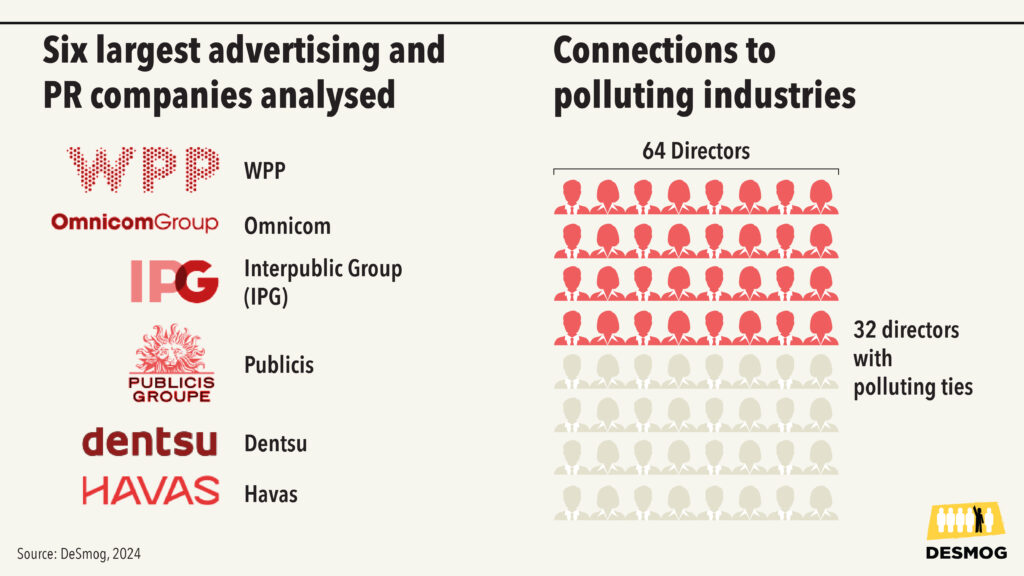 The PR industry’s six largest companies — WPP, Omnicom, IPG, Publicis, Dentsu, and Havas — have a combined total of 64 board members. DeSmog’s analysis reveals that half of these directors have connections to polluting industries. Credit: DeSmog
DeSmog sent requests for comment to the six holding groups and the directors named in this story via both company media teams and their personal company email addresses, as well as to the other companies named in this story. WPP declined to comment. None of the directors, other holding groups, or other companies responded.
“Disheartening”
Omnicom’s board stood out as the most climate-conflicted, with seven of its 11 directors having direct affiliations with polluting industries.
Among them, Valerie Williams holds a non-executive directorship at the Devon Energy Corporation and Leonard S. Coleman Jr. holds a non-executive directorship at Hess Corporation, both major U.S. oil and gas companies. Chevron is currently in the process of acquiring Hess in a $53 billion deal.
Ronnie S. Hawkins, a non-executive director at Omnicom, is currently a partner at Global Infrastructure Partners, which he joined from EIG Global Energy Partners. Both are fund managers that invest heavily in fossil fuel infrastructure, such as pipeline and refinery projects. DeSmog found that many of these projects are owned by current or recent Omnicom clients, including Shell, BP, ExxonMobil, and Repsol.
Hawkins spent 19 years as a senior member of the energy investment divisions at Citigroup and Credit Suisse, respectively the2nd and 20th largest private financers of fossil fuel projects from 2016 to 2022, according to BankTrack. BankTrack’s research also shows that both banks have a history of funding oil and gas majors that also employ Omnicom agencies. Hawkins also did a stint as managing director of Harbour Energy, a London-listed oil and gas company with interests in the UK, Indonesia, Vietnam, Mexico, and Norway.
Omnicom has held 54 fossil fuel contracts since the beginning of 2022, including three with Exxon, the third-largest oil and gas company in the world by revenue.
A series of videos published on Exxon’s YouTube page in 2023 promoted carbon capture and storage as a way to reduce carbon emissions from fossil fuel production — even though the technology largely has a two-decade record of failure at curbing CO2 pollution, and is mostly used by the oil industry to extract more oil. Scientists continue to cast doubt on whether carbon capture will ever function at the huge scale required to make a dent in climate change.
In another 2023 campaign, Mobil (Exxon’s automotive car fuel brand) launched an advert positioning petrol-powered cars as a way of “disconnecting”, in an apparent swipe at electric vehicles.
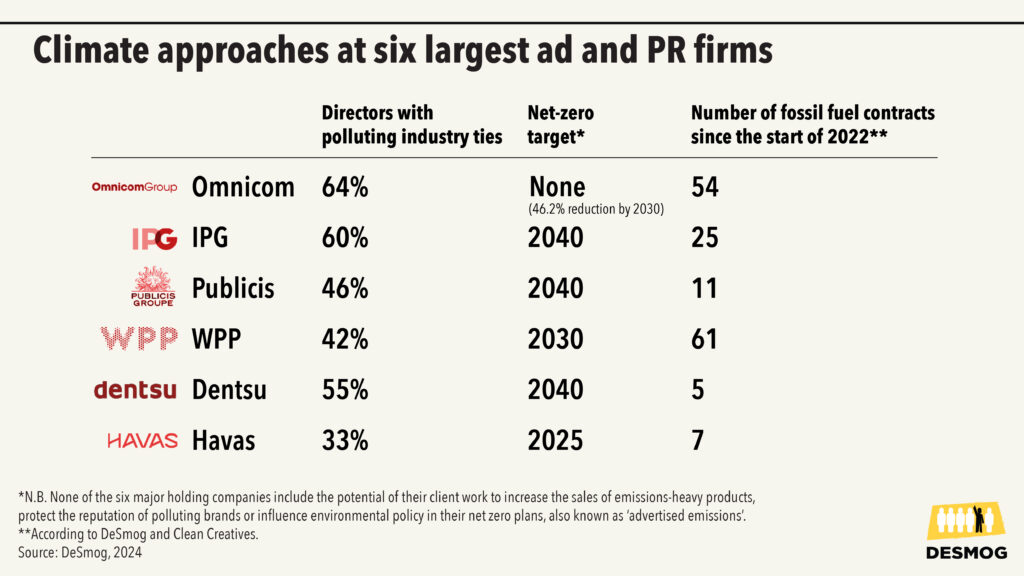 DeSmog’s analysis found that the proportion of board members with ties to polluting industries ranges from 33% at Havas to 64% at Omnicom Group. DeSmog also found that Omnicom agencies have had dozens of fossil fuel contracts since the start of 2022. Credit: DeSmog
“When you’re in a position like I am, trying to make change at an agency to make it more climate-minded, and you see this research, it makes you wonder whether it’s all a bit of a waste of time”, said an Omnicom employee who is involved in staff-led climate groups. “It helps you understand why we’re continuing to see agencies and holding companies like Omnicom take on fossil fuel briefs. It’s pretty disheartening.”
In its 2022 annual report, Omnicom stated that 2 percent of its revenues — around $286 million — came from the oil, gas, and utilities sectors.
Nadeem Khan, who leads the graduate program in Board Practice and Directorship at the University of Reading, said that accelerating climate action at a company such as Omnicom will require bold decisions.
“Currently, a director’s reputation is mainly judged on delivering short-term financial successes, rather than social and environmental wins”, Khan told DeSmog. “You need a board and CEO that are accepting of an organisation’s needs to adapt as renewed, evolved forms in the long-run, otherwise eventually it may not compete as markets themselves evolve.”
No Appetite for Change
New York-based IPG followed closely behind Omnicom in DeSmog’s analysis, with six of its 10 board members having experience in polluting industries such as natural gas, shipping, and plastics.
In 2022, IPG published a policy directly addressing the issue of working for fossil fuel clients — something the other five companies have yet to do. The policy has a number of requirements, including that clients must set specific emission reduction goals that are aligned with net-zero emissions by 2050.
However, IPG employees have previously told DeSmog that some elements of the policy mean it is weaker than it appears, such as the fact that it only applies to new clients. “You could drive an oil tanker through some of the loopholes in it”, said one IPG insider.
Another employee, who recently left one of IPG’s subsidiary agencies, told DeSmog that it was clear to staff engaging with leadership on polluting clients that “behind closed doors”, there was no genuine appetite for change at the top of the company.
Both employees asked not to be named for fear of professional repercussions.
In November, DeSmog reported that McCann, an IPG advertising agency, will pitch to retain its relationship with Saudi Aramco when the current contract runs out this year.
With 2022 revenues of $604 billion, Saudi Aramco is the largest oil and gas company in the world.
At WPP, board chair Roberto Quarta has seven current and past ties to polluting industries, the highest in DeSmog’s analysis, including two current partnerships at Gulf Capital and Clayton, Dubilier & Rice, fund management companies that have significant stakes in fossil fuel infrastructure and logistics companies. Many of those companies work closely with Exxon,TotalEnergies, Sabic, PTT Oil, Shell, BP, and Chevron. All are current or past clients of at least 10 WPP agencies, DeSmog found.
Another WPP board member, Simon Dingeman, is the former head of UK investment banking at Goldman Sachs. Since the establishment of the 2015 Paris Agreement, Goldman Sachs has provided $143 billion in fossil fuel finance, according to BankTrack, putting it in the top 15 private funders of the sector.
Dingeman is currently a senior advisor at the investment firm Carlyle Group, which has been criticised by campaigners for making claims about its climate leadership whilst doubling the emissions related to its investments between 2011 and 2021, according to research group Private Equity Climate Risks.
At Paris-based Havas, three out of nine board members have ties to polluting industries. They include Havas chairman-CEO Yannick Bolloré and board member Marie Bolloré, his sister, who have ties to the oil logistics division of the family-run Bolloré Group — which also owns Havas parent company Vivendi.
In 2023, Havas won a major contract with Shell to manage the company’s worldwide advertising spots. With $386 billion in revenue in 2022, Shell is the world’s fourth-largest oil company.
A DeSmog investigation, published in January, revealed growing discontent amongst Havas employees who saw the move as undermining Yannick Bolloré’s numerous public statements of concern about climate change. The investigation also documented a number of current or recent fossil fuel clients among Havas subsidiaries, as well as deep ties between the Bolloré Group and fossil fuel projects in Africa and Canada.
Five out of Dentsu’s nine directors have ties to polluting companies or sectors. Just under half of the 13 directors at Publicis and 12 directors at WPP have similar ties.
Board members at these companies have experiences at a range of companies with fossil fuel interests.
Dentsu’s board chairman, Tim Andree, was previously chief communications officer of BASF, the biggest chemical producer in the world and a major supplier of petrochemicals and services for the oil and mining industries. The German company has a history of lobbying against EU regulations on polluting chemicals.
At Publicis, board member André Kudelski was previously vice-chair of the Geneva Airport and a director at Swiss International Airlines. A number of Publicis agencies have produced campaigns supporting the aviation industry in recent years, including Publicis Sapient’s adverts for Swiss International Airlines’ premium economy class.
The aviation industry accounted for 2 percent of global carbon emissions in 2022, according to the International Energy Agency, with emissions in the sector growing faster than in road, rail, and shipping.
DeSmog’s analysis did not include similar examples below the parent company level. For example, John Dawkins is co-chair of GRACosway, one of Omnicom’s leading political lobbying agencies in Australia, whilst also holding chair and non-executive director roles at mining companies Precious Metal Resources Ltd and Tiaro Coal Ltd, respectively.
GRACosway and Dawkins did not respond to DeSmog’s requests for comment.
Low-Hanging Climate Commitments
Agencies and industry bodies have been slow to acknowledge the true climate impact of the industry, campaigners say. While five of the six holding companies have now set net-zero goals, these plans only account for emissions generated by their own business operations, such as employee travel, energy used to power office buildings, and the production of advertising campaigns.
All six are members of Ad Net Zero, a voluntary industry initiative whose members pledge to voluntarily reduce these sorts of in-house greenhouse gas emissions. Ad Net Zero’s five-step action plan does not ask members to consider the potential wider climate impacts of their work, such as the risk that producing campaigns that enhance the images of heavily-polluting clients could deflect pressure to cut emissions.
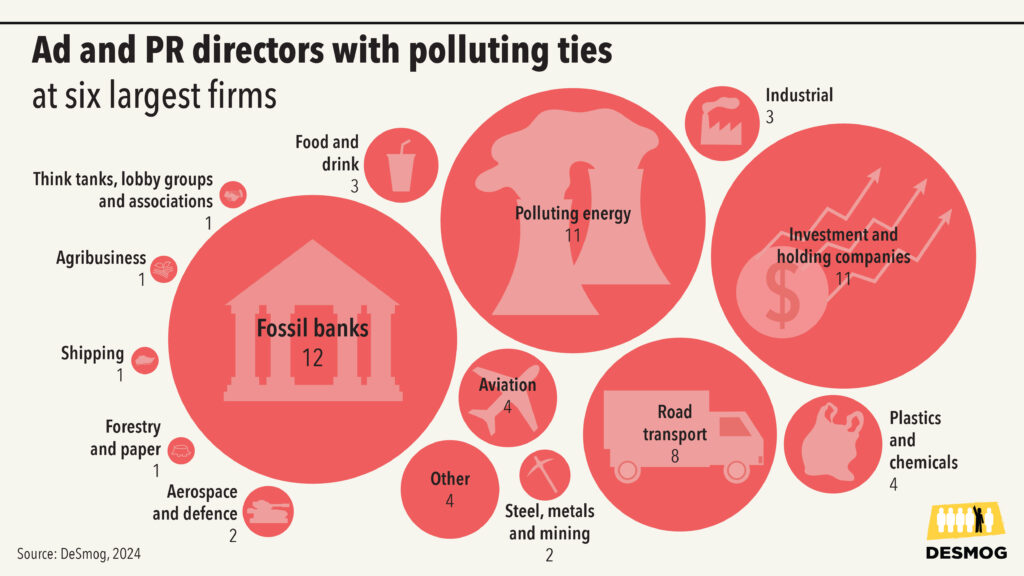 The polluting industry ties among the relevant 32 board members are concentrated in three sectors: banks that finance fossil fuel development, polluting energy production, and investment and holding companies. Credit: DeSmog
Purpose Disruptors, a campaign group focused on the ad and PR industry, defines the carbon pollution associated with an advertising-generated uplift in sales of heavily polluting products and services, such as SUVs or air travel, as “advertised emissions.” The concept has been recognised by the United Nations-led Race to Zero campaign, which focuses on getting businesses, universities, cities, and others to eliminate their carbon emissions no later than 2050.
A 2023 report by Dentsuestimated that the company’s 2022 advertised emissions were 32 times the size of its own operational carbon footprint.
“Board directors have been adamant publicly about their dedication to climate action and their companies’ pivot towards net zero”, said Sarah Chow, an investment analyst at the Sydney-based ethical pension fund Future Super. The fund has been trying to engage with Publicis and WPP on their work for high-carbon-emitting clients. “But behind closed doors and after public [annual general meetings], our relations with these directors have gone cold.”
Some experts argue that the pace of change in the industry is also constrained by the parent company structure of these six firms, which limits the power of subsidiary agencies to make their own decisions on issues such as climate strategy.
“You have to remember, these few leading directors are setting the tone and agenda not just for the overarching company, but multiple chains of companies”, said the University of Reading’s Khan.
Andreas von Angerer, head of impact investing at Zurich-based Inyova, led a group of investors in raising the issue of advertised emissions with the Publicis board at its annual general meeting in May 2023.
The group, which also includes French asset-manager Ecofi and Australia’s Future Super, collectively manages assets worth more than 16 billion euros.
Publicis’ board “told us that all of their clients are reducing emissions, even though their oil clients such as Saudi Aramco and ADNOC” — the Abu Dhabi National Oil Company — “are clearly not”, von Angerer told DeSmog.
“Currently these boards don’t have the progressive mindset needed to really set up a company for the future”, he said. “We really need new faces, new ideas and new minds on boards to make sure these old, established companies keep up with the transition [to net zero].”
Transitioning With the Times?
In a report released in April 2022, the United Nations Intergovernmental Panel on Climate Change referenced the communication industry’s role in protecting polluters.
Several months later, UN Secretary-General António Guterrestold the General Assembly that “we need to hold fossil fuel companies and their enablers to account [including] the massive public relations machine raking in billions to shield the fossil fuel industry from scrutiny.”
For the better part of two decades, advertising regulators in the UK, France, Australia, and some other jurisdictions have taken stands on greenwashing. In June 2023, the UK’s Advertising Standards Authority banned adverts by Shell, Repsol, and Petrobras that made misleading claims about their investments in renewable energy. Shell’s adverts had been created by WPP’s Wunderman Thompson (now VML), and Repsol’s by DDB Spain, an Omnicom agency.
In November, for the first time, the Advertising Standards Authority banned two ads for promoting driving that harms the environment. The adverts for the Toyota Hilux SUV were made by WPP agency The&Partnership, according to industry publication The Drum.
Experts say that these sorts of greenwashing complaints and regulatory bans pose legal risks to individual board members, because they have the potential to inflict reputational damage that could trigger financial losses.
“Directors of advertising agencies must have sufficiently robust governance structures to mitigate and respond to these [reputational and financial] risks”, said barrister Margherita Cornaglia of Doughty Street Chambers, a group of barristers focused on human rights and civil liberties. “Failure to identify or address risks as a result of their links with fossil fuel and other polluting companies could place them in breach of their fiduciary obligations.”
Communications companies may be taking note. In its 2022annual report, WPP mentioned the “increased reputational risk associated with working on client briefs perceived to be environmentally detrimental.” Dentsu has also mentioned these risks in public documents.
Experts say they expect action on issues such as climate change to increase as younger generations join these boards of directors.
“Boards tend to transition in decennial cycles”, the University of Reading’s Khan said. “There emerges a generational shift, a new way of thinking. You can see the difference of mindsets through faster evolving changes — for example at Google, Nvidia, or Microsoft in the tech industry — where boards are made up of more entrepreneurial attitudes and comparatively younger directors.”
But Sarah Chow of Future Super believes these changes need to happen now. “Board directors are often removed from the actual problems their employees face”, she said. “They need fresh blood that understands the pulse of a company’s workforce, and what the workforce wants.” Chow would also like to see union or other employee representatives on the agencies’ boards.
A former WPP employee shared Chow’s vision: “Why isn’t a creative holding company saving a board seat for a junior creative? They are the future of the industry.”
---
https://link-springer-com.oca.ucsc.edu/content/pdf/10.1007/s10584-021-03244-4.pdf
Table 5 PR frm engagements by sector, 1989–2020
sectors: Oil/Gas Coal/Steel RailEnvironmental Movement Utilities Renewable Energy
Edelman 40 47% 20 23% 1 1% 23 27% 1 1%
Burson Cohn & Wolfe 37 56% 4 6% 1 1% 24 36% 0 0%
Weber Shandwick 21 32% 0 0% 0 0% 44 67% 0 0%
Cerrell 33 79% 3 7% 0 0% 6 14% 0 0%
Dittus Communications/Story Partners 15 50% 2 6% 0 0% 13 43% 0 0%
Egypt's Feared Spy Agency Has Hired Some DC Lobbyists To Clean Up Its Image
The infamous mukhabarat is paying hundreds of thousands of dollars to PR shop Weber Shandwick and lobbying firm Cassidy and Associates, Treasury documents show.
https://www.buzzfeed.com/borzoudaragahi/egypts-feared-spy-agency-has-hired-some-dc-lobbyists-to-clea
Egypt’s powerful spy service recently hired a pair of high-powered Beltway lobbying firms on retainers of $50,000–$100,000 per month to influence the Trump administration.
Egypt’s General Intelligence Service, known in the Arab world as the infamous mukhabarat, has hired communications powerhouse Weber Shandwick and DC lobbying firm Cassidy and Associates to spruce up its image inside Washington and promote what it describes as its “strategic partnership” with the US, according to documents filed with the Treasury Department.
The documents, dated late January, appear to have first been reported late last month by the newsletter Intelligence Online.
Foreign governments frequently hire lobbyists to improve how they are viewed among Washington policymakers, build up commercial ties or strengthen military partnerships. But it is rather rare for an intelligence service to undertake its own lobbying effort, especially one with a reputation as sullied as Egypt’s mukhabarat. It has been accused by human rights monitors of torture and unlawful detention of perceived political enemies of the government of President Abdel-Fattah al-Sisi. Its very name in the Arab world conjures up images of naked men hanging from the ceilings of dungeons while screaming in agony from electric shocks.
According to the Treasury filings, the mukhabarat’s DC lobbyists are to help identify potential Washington insiders “supportive” of its agenda, massage the spy outfit’s public image using social media, provide crisis management help, and perhaps organize visits of Egyptian spymasters to Washington. Weber Shandwick, on retainer for $100,000 a month plus expenses, boasts on its website that it specializes in brand improvement. Cassidy, meanwhile, will be earning a quarterly fee of $150,000.
The Egyptian government has for years had a $2 million-a-year lobbying contract with the Glover Park Group. The mukhabarat’s venture may suggest competition between the country’s Foreign Ministry and intelligence services frustrated at the inability of career statesman to sell Egypt to foreign investors and governments.
“This is about the internal politics/rivalry between the intel service and the Foreign Ministry — the former bypassing the latter,” Mauritanian-American activist and scholar Nasser Wedaddy wrote on Twitter about the lobbying deals. “The intel service has been of late involving itself in attracting investors and reassuring those already something the Foreign Ministry failed at. This is about the intel service acting like a parallel foreign and economic affairs ministry.”
Egypt’s has suffered through years of hardship since a 2011 uprising ousted longtime ruler Hosni Mubarak. A 2013 coup led by the then-general Sisi toppled the country’s democratically elected Islamist president and led to thousands of deaths at the hands of the security forces. The murder last year of Italian scholar Giulio Regeni at the alleged hands of security officials, the downing of a Russian plane in 2015 by alleged jihadi militants, and other incidents have soured some foreign investors on Egypt and further darkened the reputation of its security forces.
The lobbying push could signal an effort by the mukhabarat to try to clean up its image. Ironically, Trump and Sisi have excellent relations. Sisi was the first foreign leader to call Trump after his November presidential victory and met with him in New York during the campaign. Egypt already receives $1.3 billion in US military aid per year, and Trump has signaled that he’s willing to overlook any concerns about Egyptian human rights violations or authoritarianism in favor of a shared battle against Islamist militants.
Others saw in the lobbying effort a worrying sign of fragmentation within Egypt’s security forces, a possible attempt by Egypt’s spies to use Washington to gain advantages over rival soldiers and cops.
“I’d be interested to see if the lobby focuses on the GIS reputation vs. Egypt’s,” Timothy Kaldas, a Cairo-based political scientist affiliated with the Tahrir Institute for Middle East Policy, told BuzzFeed News. “I find it interesting how so many institutions are working on their personal reputations. Food aid is distributed from the Interior Ministry or army or GIS rather than in the name of the Egyptian state. Access to the [Trump] administration could increase its power vis a vis other institutions in the state.”
Borzou Daragahi is a Middle East correspondent for BuzzFeed News and is based in Istanbul.
Contact Borzou Daragahi at borzou.daragahi@buzzfeed.com.
==
2011
After a year-long review, ExxonMobil has consolidated global advertising duties with Interpublic Group of Cos' Universal McCann for media, while global creative will largely be handled by Omnicom Group's BBDO, according to executives familiar with the matter.
Roster shop DDB, also an Omnicom firm, will hold onto below-the-line work for Exxon's fuel business, continuing to create signage for gas stations, among other things, executives said. As part of the consolidation, BBDO won the above-the-line fuels business, which accounts for all other advertising for fuels. BBDO will handle corporate advertising for Exxon as well as creative work that was previously handled by Interpublic's McCann Erickson and Havas' EuroRSCG.
==
Secrets and lies : the anatomy of an anti-environmental PR campaign / Nicky Hager and Bob Burton
Monroe, ME : Common Courage Press, 2000
McH Stacks HD9768.N42 H33 2000 NOT CHECKD OUT
Secrets and Lies, subtitled "the anatomy of an anti-environmental PR campaign", is a 1999 book by Nicky Hager and Bob Burton.
The book documents the public relations information put out by Timberlands West Coast Limited in order to win public support for logging of native forests on the West Coast of New Zealand.
The material is based on a large amount of documentation leaked by a staff member from the local branch of Shandwick (now Weber Shandwick Worldwide),[1] a global public relations company, which had been hired by Timberlands to run a secret campaign against environmental groups such as Native Forest Action between 1997 and 1999.
The book describes its tactics of surveillance of meetings, monitoring the press and responding to every letter to the editor, greenwashing, the use of SLAPPs, cleaning anti-logging graffiti and blotting out campaign posters in public places, and managing to install its pro-logging educational materials into schools.
The book alleges that almost every pro-logging letter or article was organized by this campaign.[2]
During a general Parliamentary debate in November 2006, when the book The Hollow Men had an injunction against its publication, the MP Gerry Brownlee said of the author and the book:
| “ | This is the same Nicky Hager who wrote the book Secrets and Lies in 1999, in which he spoke about the Timberlands scandal. None of it was true. Not one of the pages in that book carried a single truth. It was roundly discredited. He is a man who indulges in intrigue and in the activities of scurrilously besmirching any individual he does not like, without any care whatsoever.[3] | ” |
The Hollow Men documents behind the scenes activities of the National Party, of which Brownlee was deputy leader at the time.
References
- ^ Weber Shandwick. "History". Archived from the original on 2007-04-30. Retrieved 2007-05-13.
- ^ Hager, Nicky (1999). Secrets and Lies. New Zealand; Nelson: Craig Potton Publishing. p. 11. ISBN 0-908802-57-9.
- ^ New Zealand Parliament debates, 22 nov, 2006 (spoken by Gerry Brownlee) General Debate (accessed 2007-03-20)
External links
- PR watch article including large excerpts from the book.
- Detailed rebuttal of the book by Chris Perley a New Zealand forestry and agriculture consultant.
- Wilderness Society webpage for the book
Weber Shandwick Worldwide (WSW) is, in 2004, the world's largest public relations company. A subsidiary of the Interpublic Group, it was formed as the product of the mergers of Weber Public Relations and Shandwick Worldwide in late 2000. Weber Shandwick recently merged with BSMG to become the largest PR operation in the world.
WSW has been heavily criticised for its work for the Japanese Whaling Association and its work for the New Zealand government-owned logging company Timberlands. [1] WSW owns Planet 2050 [2], a PR firm marketed as "socially responsible", which claims to help businesses "navigate the environmental and social challenges needed to operate in a planet under pressure"[3].
Contents
[hide]
* 1 Campaigns
o 1.1 China's Olympics
o 1.2 Exxon's Earth Day
o 1.3 Post-9/11 crisis management for American Airlines
o 1.4 Got milk
* 2 Food issues
* 3 History
* 4 Clients
o 4.1 USA
o 4.2 Europe
o 4.3 Latin America
o 4.4 Asia Pacific
o 4.5 New Zealand
o 4.6 Australia
* 5 Personnel
* 6 Contact information
* 7 Case studies
* 8 Books
* 9 SourceWatch resources
* 10 External links
o 10.1 References
o 10.2 Articles
Campaigns
China's Olympics
"After China lost its Olympics bid in 1993 ... Olympic insiders advised it to hire a public relations firm before its next attempt," reported the New York Times in April 2008. "Weber Shandwick, owned by the Interpublic Group, won the contract, and, [Weber Shandwick China managing director David] Liu said, his advice was that China separate its human-rights record from its Olympics bid." [1]
Weber Shandwick "suggested to the Olympic committee ... that if Beijing were allowed to hold the Games, it might lead to some movement on a number of fronts. 'If you give China the Olympic hosting rights, then it is like you are engaging China, and naturally they will improve on a lot of things,'" Liu said. China's hosting of the Summer 2008 Olympics Games provided opportunities for advocacy groups to highlight China's human rights issues, including jailing reporters and dissidents, occupying Tibet and supporting Sudan's repressive regime. But China's government has yet to address these issues. [1]
Exxon's Earth Day
In September 2004, O'Dwyers PR Daily reported that Weber Shandwick is "handling the 'greening' of ExxonMobil Corp. by promoting an alliance forged between the energy giant and Earth 911, a government/private sector entity with the motto of 'making every day Earth Day.'"
"The partnership aims to educate consumers about the importance of recycling used motor oil. ExxonMobil will provide funding for Earth 911 in return for the right to slap the group's logo on its Exxon- and Mobil-branded products. Earth 911's public service announcements will feature the Mobil 1 logo and the location of used motor oil collection sites. Earth 911's corporate partners include Hewlett-Packard, Home Depot, Aluminum Association of America and Vertex Energy, a company that recycles petroleum products." [4]
Post-9/11 crisis management for American Airlines
On the morning of September 11, 2001, the Dallas office of Weber Shandwick, one of world’s largest public relations agencies, mobilized a nationwide network of public relations professionals to assist the American Airlines corporate communications department.
"Within minutes of the first terrorist attack involving American Airlines, Weber Shandwick put in motion a national strategic support network, comprising more than 75 Weber Shandwick professionals, to assist American Airlines during this unprecedented crisis situation. Over the following week, the W.S. team worked around the clock on site at the AA corporate headquarters in Fort Worth, Texas, as well as in New York, Washington, D.C., Boston and Los Angeles, providing strategic counsel and tactical support for both internal and external communications. Additionally, the Dallas office of W.S. was staffed 24 hours a day, monitoring breaking national broadcast and online news. Communications specialists in crisis management, consumer relations, internal communications, and government affairs provided support....Externally, AA faced the difficult challenge of controlling what was being said about the airline by unauthorized spokespeople. Flight attendants, pilots – and their unions - along with contracted security firms, airport authorities, government agencies including the FBI, FAA and National Transportation Safety Board, and local government agencies all issued statements regarding the events. Eyewitnesses, stranded passengers and post-September 11 travelers were also of concern. All of these external groups has an impact on American Airlines’ commnications strategy, requiring that the W.S. team ensure consistent communications with all audiences." [5]
Got milk
In May 2001, Weber Shandwick won what was reported to be $2 million issues management account with Dairy Management Inc, a trade association, to promote demand for U.S. dairy products. O'Dwyer's PR Daily reported that Sara Gavin heads the DMI account from Weber Shandwick's Minneapolis office with support from the Weber Shandwick's Washington, D.C office. The campaign had been expected to focus on concerns raised by foot-and-mouth and mad cow disease in Europe. According to the PR trade newsletter, the Holmes Report, DMI's executive vice president of public and industry relations Jean Regalie said the campaign will be broader than that, taking a long term view of "the way people look at food." Dairy Management Inc. also has accounts with Golin/Harris International and BSMG Worldwide, creator of the ubiquitous "Got Milk?" campaign. [6]
Food issues
In April 2008, Weber Shandwick announced it was launching a "a new food issues practice to assist food, beverage and agricultural organizations in handling complex issues," headed by Susan Ruland. The practice will address "environmental sustainability, food safety, food nutrition and obesity concerns, animal welfare, biotechnology" and related issues, through "legislative initiatives, as well as executive reputation and brand management" tactics. [2]
"In addition to having registered dietitians on-staff, Weber Shandwick offers a unique network of 100 registered dietitian spokespeople across the United States who are deployed on behalf of clients," noted the Holmes Report. [2]
History
Peter Gummer, the British chairman of Shandwick, is candid about why he started a PR firm. "When I started off in public relations, it was a business that people went into because they weren't good at anything else," he wrote.
While working at a London venture capital firm in the early 1970s, Gummer observed a parade of his peers establishing their own businesses and making serious money. "So I thought that I'd like to start my own business. And as I wasn't very good at anything, I decided I'd better start a PR firm," he explained. Peter Gummer was knighted in 1996 and is now known as Lord Chadlington. [7]
In October 1998, Shandwick was bought by the Interpublic Group of Companies, a U.S. firm that also owns the advertising agencies McCann Erickson Worldwide Group, Ammirati Puras Lintas and The Lowe Group. Following the takeover, Shandwick was merged with the Weber Group. The merged companies operated as Weber Shandwick from January 2001. [3]
Clients
Some of Shandwick's current or recent clients include:
USA
* 3M
* Aerospatiale
* American Cancer Society
* Bayer
* Brown & Williamson Tobacco
* Browning Ferris Industries
* Cancer United
* Central Maine Power
* Columbia Gas Systems
* Chase Manhattan Bank
* Ciba-Geigy
* Coca-Cola
* Compaq
* Council for Agricultural Science and Technology
* U.S. Department of Energy Office of Energy Efficiency and Renewable Energy
* Dairy Management Inc
* Dun & Bradstreet
* Earth Day USA
* Eastman Kodak
* ExxonMobil
* the Falkland Islands
* Federal Emergency Management Agency
* Ford Motor Company
* Gabon General Electric
* General Motors
* Georgia Pacific Corporation
* General Mills
* Global Climate Information Project
* Honeywell
* IBM
* KPMG Peat Marwick
* Kraft
* Lever Brothers
* Los Angeles Police Department[8] (sub req'd)
* Mastercard International
* Michelin
* Monsanto
* Mall of America
* Microsoft
* New Orleans Convention and Visitors Bureau [9]
* New York State Electric and Gas
* National Pest Control Association
* Northwest Airlines
* Novartis,
* Novo Nordisk
* Ray-Ban
* Remington and Sharp Electronics
* Sandefer Capital Partners [10]
* Shell Oil
* Symantec
In a listing on its website of PR companies with a crisis management capability, the American Meat Institute described the "Shandwick Public Affairs (formerly Powell Tate)" in the US as having "done crisis management work for Jack in the Box, Food Lion, Hudson Foods, Hooters of America, Denny's, Federal Express and the National Association of Convenience Stores. Shandwick Public Affairs' cadre of senior professionals, who have been in the trenches with the senior management teams of global corporations, are ready to offer assistance at a moment's notice." [11]
Europe
* Anglian Water
* British American Tobacco
* British Nuclear Fuels plc (BNFL)
* Coca Cola Great Britain [12] (sub req'd)
* Corporation of London
* ICI Paints
* Meat and Livestock Corporation
* MCI Worldcom
* Mercedes-Benz
* Nestle
* P&O Cruises
* Reckitt & Coleman
* Shell Oil
* Tesco
* Unilever
Latin America
* Government of Colombia
Asia Pacific
* Japanese Whaling Association
New Zealand
* Real Estate Institute of New Zealand
* Professional Firefighters Union
* Southern Cross Healthcare
* Timberlands (contract ended late 1999).
Australia
* Screen Producers Association of Australia
* Australian Chicken Growers Council.
* Mastercard International
Personnel
[4]
* Jack Leslie, Chairman
* Harris Diamond, CEO
* Andy Polansky, President
* Leslie Gaines-Ross, Chief Reputation Strategist (CEO reputations)
* Abby Gold, Senior Vice President, Human Resources
* Jill Murphy, Chief Business Development Officer
* Frank Okunak, Chief Financial Officer
* Colin Byrne, UK chief executive. Was hired by Peter Mandelson to work for the UK Labour Party in 1997. [13]
Contact information
919 Third Avenue
New York, NY 10022
USA
Phone: 212-445-8000
Web: http://www.webershandwick.com
Case studies
* Shandwick Works to Save the Fox, Kill the Whale
* Shandwick's Story: From Good-for-Nothing to Global Threat
* Secrets and Lies: How Shandwick PR Tried to Destroy the Rainforests of New Zealand
* Building Bridges and Splitting Greens
* When Helicopters Attack: A Near Accident Leads To Coverup
* Erasing the Writing on the Wall: Timberlands Censors Its Critics
* Shandwick Takes Aim at a Goldman Prizewinner
* Weber Shandwick and Nuclear Power
Books
* Nicky Hager and Bob Burton, Secrets and Lies: the anatomy of an anti-environmental PR campaign, Common Courage Press, Monroe, Maine, 2000.
SourceWatch resources
* Colin Byrne
* Labour Party
* Weber Shandwick (UK)
External links
References
1. ↑ 1.0 1.1 Stephanie Clifford, "Tibet Backers Show China Value of P.R.," New York Times, April 14, 2008.
2. ↑ 2.0 2.1 "Weber Shandwick Creates Food Issues Group," Holmes Report (sub req'd), April 27, 2008.
3. ↑ Gidon Freeman, "Shandwick/Weber in IPG global merger", PR Week, September 22, 2000.
4. ↑ Corporate Staff, Weber Shandwick, accessed January 2008.
Articles
* The entire edition of PR Watch of the first quarter of 2000 was devoted to a profile of Shandwick's activities on behalf of the New Zealand government-owned logging company, Timberlands, with a small additional amount of profile material. The edition of PR Watch is available at http://www.prwatch.org/prwissues/index.html
* Nicky Hager and Bob Burton, "Shandwick's Story: From Good-for-Nothing to Global Threat", PR Watch, First quarter 2000, page 7.
* Bob Burton, “Shandwick Works to Save the Fox, Kill the Whale”, ‘’PR Watch’’, First quarter 2001.
* “$2 million Dairy Issues Management Contract Awarded to Weber Shandwick”, ‘’Spin of the Day’’, May 21, 2001.
* American Meat Institute, "Public Relations Firms With Crisis Management Capabilities", accessed February 8, 2004.
* "ExxonMobil goes green", O'Dwyer's PR Daily (sub. req'd.), September 8, 2004.
* Anita Chabria, "WS helps LAPD use film trailers as recruitment tool", PR Week, January 3, 2005.
* "WS offers gratis comms support", PR Week, November 10, 2005. (Sub req'd).
* "Weber Shandwick Gudes Nuke Deal", O'Dwyers PR Daily, February 6, 2006. (Sub req'd)
* Press release, "New Orleans Convention and Visitors Bureau Selects Weber Shandwick as Public Relations Partner: Agency Hired to Spread the Word that Now is the Time for Tourists to Return to New Orleans," Weber Shandwick via Yahoo! Finance, February 16, 2007.
Search the Documents Archives of the Tobacco Industry
Legacy Tobacco Documents Library:
Retrieved from "http://www.sourcewatch.org/index.php?title=Weber_Shandwick"
Categories: Nuclear PR | Tobaccowiki | Public relations firms | Tobacco documents organizations | United States
http://www.sourcewatch.org/index.php?title=Shandwick
Interpublic Group of Companies, Inc. (IPG) is one of the largest advertising and marketing conglomerates in the world (along with Omnicom Group and WPP Group). It has offices in more than 100 countries, realizing worldwide revenue in 2007 of US$6.5 billion. IPG’s five main clients (Coca-Cola, General Motors Corporation, Johnson & Johnson, Nestle and Unilever), contributed roughly 14% of their revenue in 2001, representing $941 million of spending. The largest client spent a massive $457m purchasing services from IPG. Twenty of IPG’s clients accounted for about 25% of their revenue (Interpublic, 2001, p. 22).
Some subsidiaries are McCann Worldgroup, DraftFCB, Lowe & Partners, Campbell-Ewald, Deutsch, and Hill, Holliday. "Interpublic also offers direct marketing, media services, and public relations through such agencies as Initiative and Weber Shandwick." [1]
Contents
[hide]
* 1 History
* 2 Lobbying
* 3 Subsidiaries
o 3.1 Public Relations
o 3.2 Marketing services
* 4 Personnel
* 5 Contact details
* 6 Resources
o 6.1 Related SourceWatch articles
o 6.2 References
o 6.3 External articles
o 6.4 External resources
History
The group dates from 1902 when the Alfred W. Erickson agency was founded.
It merged with H.K. McCann - founded 1911 by Harrison King McCann (1880-1962) - in 1930 to form McCann-Erickson. Interpublic Inc. was established in 1960 as a holding company for McCann Erickson and Marschalk & Pratt (acquired by McCann in 1954). The group was rebadged as the Interpublic Group in 1960 and expanded through an aggressive acquisition program prior to going public in 1971.
Interpublic now includes the Lowe Group, Foote Cone & Belding Worldwide (founded by Emerson Foote (1906-1992)), and such US agencies as Bozell, Deutsch, and Temerlin McClain. It offers a range of marketing, media planning and buying, and public relationsservices through its Octagon, DraftWorldwide and Initiative Media subsidiaries. Source [1]
Lobbying
The company spent $60,000 for lobbying in 2007. [2]
Previously used lobby firms:
* Cassidy & Associates, Belgium, Russia, United States
* The Rhoads Group, United States
Subsidiaries
Public Relations
* Bragman Nyman Cafarelli, United States
* Carmichael Lynch Spong, United States
* DeVries Public Relations, United States
* GolinHarris, Belgium, China, England, France, Germany, Italy, Japan, Netherlands, Singapore, Spain, Switzerland, Taiwan, Thailand, United Arab Emirates, United States
* Initiative, Global
* MWW Group, United States
* Rogers & Cowan, England, United States
* Slay PR, United States
* Weber Shandwick Worldwide, Australia, Belgium, Canada, China, Czech Republic, England, France, Germany, Hungary, India, Indonesia, Ireland, Italy, Japan, Malaysia, Netherlands, Northern Ireland, Portugal, Russia, Scotland, Singapore, Spain, Switzerland, Taiwan, Thailand (2 more countries)
* PMK/HBH, United States
* The Rhoads Group, United States
* Tierney Communications, United States
* The Axis Agency, United States
* The Martin Agency, United States
* Mullen, United States
* Financial Relations Board, United States
* Rowan & Blewitt, United States
* FutureBrand, Argentina, Australia, Brazil, Canada, Chile, China, England, France, Germany, Italy, Japan, Malaysia, Singapore, Spain, Switzerland, United Arab Emirates, United States
* Gillespie, United States
* KRC Research, England, United States
* Howard Merrell & Partners, United States
Marketing services
* Advanced Marketing Services
* Bozell Worldwide
* Deutsch
* FutureBrand Worldwide
* Hill, Holliday
* Jack Morton Worldwide
* McCann Relationship Marketing Partners Worldwide
* McCann-Erickson WorldGroup
* Modem Media
* Mullen Advertising
* Temerlin McClain
* Bozell, Campbell-Ewald
* Foote, Cone & Belding
* Lowe and Partners
* Campbell Mithun
* Carmichael Lynch
Personnel
With 2007 pay:[3]
* Michael I. Roth, Chairman & Chief Executive Officer, $8,940,739[4]
* Frank Mergenthaler, Chief Financial Officer, $4,315,871[5]
* Philippe Krakowsky, Executive Vice President, Strategy and Corporate Relations, $2,570,085[6]
* Timothy A. Sompolski, Executive Vice President, Chief Human Resources Office, $2,420,399[7]
* Nicholas J. Camera, General Counsel and Secretary
* Christopher Carroll, Chief Accounting Officer
* Thomas Dowling, Chief Risk Officer
* Terry D. Peigh, Senior Vice President
Board of Directors
* Michael I. Roth, Chairman & Chief Executive Officer
* Frank J. Borelli, Retired Chief Financial Officer and Director, Marsh & McLennan Companies, Inc.
* Reginald K. Brack, Former Chairman & Chief Executive Officer, Time Inc.
* Jocelyn Carter-Miller, President, TechEdVentures
* Jill M. Considine, Chairman & Chief Executive Officer, The Depository Trust & Clearing Corporation
* Richard A. Goldstein, Former Chairman & Chief Executive Officer, International Flavors and Fragrances, Inc.
* H. John Greeniaus, Former Chairman & Chief Executive Officer, Nabisco, Inc.
* Mary J. Steele Guilfoile, Chairman of MG Advisors, Inc.
* William T. Kerr, Chairman, Meredith Corporation
* David M. Thomas, Chairman and CEO, IMS Health
Contact details
1114 Avenue of the Americas
New York, N.Y. 10036
Phone: (212) 704-1200
Fax: (212) 704-1201
Web: http://www.interpublic.com
Resources
Related SourceWatch articles
* Advertising
* Alliance for Climate Protection
* Climate Action Partnership
* Greenwashing/United States
References
1. ↑ Interpublic Group Profile, Hoovers, accessed June 2008.
2. ↑ Interpublic lobbying expenses, Open Secrets, accessed June 2008.
3. ↑ Management, Interpublic Group, accessed June 2008.
4. ↑ Michael I Roth, Forbes, accessed June 2008.
5. ↑ Frank Mergenthaler, Forbes, accessed June 2008.
6. ↑ Philippe Krakowsky, Forbes, accessed June 2008.
7. ↑ Timothy A Sompolski, Forbes, accessed June 2008.
External articles
* Stuart Elliott, "A New Venture for Jay-Z, on Madison Avenue", New York Times, February 8, 2008.
* Stephanie Clifford, "Agency Pays $12 Million to Settle Accounting Case", New York Times, May 2, 2008.
* Wendy A. Lee, "Mr. Bill Returns (in One Piece) to Pitch a Debit Card", New York Times, June 3, 2008.
External resources
* Interpublic Group Profile, Yahoo Finance, accessed June 2008.
* Interpublic Group Profile, BNet, accessed June 2008.
Retrieved from "http://www.sourcewatch.org/index.php?title=Interpublic_Group"
Categories: Advertising industry | International | Public relations firms | United States
#1 2001
Weber Shandwick Worldwide
A subsidiary of the Interpublic Group, Weber Shandwick Worldwide was formed as the product of the mergers of Weber Public Relations and Shandwick Worldwide in late 2000. Weber Shandwick recently merged with BSMG to become the largest PR operation in the world. WSW has been heavily criticised for its work for the Japanese Whaling Association[14] and its work for New Zealand logging interests[15]. Its known current clients include:[16]
Agilent Technologies, American Airlines, Archer Daniels Midland Co., Avaya, Bahamas Ministry of Tourism, Bristol-Myers Squibb Co., Burger King, California Fluid Milk Processor Advisory Board, Campbell Soup Co., Coca-Cola Co., Dairy Management Inc., Dunkin' Donuts, DuPont, General Electric Co., Hewlett-Packard, Ingersoll-Rand, Ingram Micro, Interbrew, Johnson & Johnson, Kraft Foods, Inc., Lawson Software Inc., Life and Health Insurance Foundation for Education, Marriott International, MasterCard, Mentor Graphics, Merck, Microsoft, National Pork Producers Council, Nestle S.A., Ocean Spray Cranberries/Ocean Spray Int'l Inc., Pfizer, Pharmaceutical Research & Mfrs. of America, Pharmacia, Philips, PMC-Sierra, Royal Caribbean Cruises Ltd., Siemens, Sprint, TMP Worldwide, Toshiba, Unilever, Unisys, Verizon Wireless