Deutch, Ted Rep
clean ir hero
corp person sponsor
==
180 co spon House - 03/04/2021 Referred to the Subcommittee on the Constitution, Civil Rights, and Civil Liberties. (All Actions)
https://oversight.house.gov/subcommittees/civil-rights-and-civil-liberties-117th-congressjamie raskin chair, jimbo jordan
Introduced in House (01/04/2021)
This joint resolution proposes a constitutional amendment authorizing Congress and the states to set reasonable limits on the raising and spending of money by candidates and others to influence elections.
The amendment grants Congress and the states the power to implement and enforce this amendment by legislation. They are allowed to distinguish between natural persons and corporations or other artificial entities created by law, including by prohibiting such entities from spending money to influence elections.
apr 2019
following the historic passage of the For the People Act (H.R. 1), the most extensive and powerful set of pro-democracy reforms to pass the House in decades, People For the American Way and our allies are working to build support for stand-alone reforms that are key to fixing our democracy and creating a political system that works for everyone.
One campaign finance reform that is particularly critical to addressing the influence of big money in politics is a constitutional amendment to overturn Citizens United and other related Supreme Court cases, which have allowed unlimited sums of money to be spent in our elections. The Democracy For All Amendment (H.J.Res. 2) has been introduced by Rep. Ted Deutch , D-Fla., and already has 101 cosponsors. This proposed amendment would allow Congress and the states to regulate and set limits on the raising and spending of money in our elections, as well as legally distinguish between the rights of people and corporations. It also provides the important clarification that nothing in the amendment should be construed to abridge the freedom of the press. Since the Citizens United decision in 2010, this amendment has emerged as a leading solution among reform-minded members of Congress,even getting afloor vote after a week of debate in the Senate, with 54 Senators voting in support during the 113thCongress in 2014.
Importantly, the Democracy For All Amendment also rejects the current Court’s misguided interpretation that the only basis for campaign finance regulation is to address corruption in the form of quid pro quo bribery. In fact, in addition to preventing corruption, there are multiple rationales that justify campaign finance regulation, including but not limited to: leveling the electoral playing field; advancing the fundamental principle of equality for all; and protecting the integrity of the governmental and electoral processes.
There is widespread support for an amendment to address the influence of big money in politics. Since the Citizens United ruling there have been 19 states that have gone on record in support of an amendment, in addition to nearly 800 localities. And earlier this year, through the passage of the For the People Act, the House of Representatives called for an amendment. Likewise, in the Senate, every Democrat has endorsed the H.R. 1 companion bill, which also calls for a constitutional amendment to overturn Citizens United.
Tags:
Citizens United v. FEC constitutional amendment Democracy For All Amendment Fighting Big Money in Politics For the People Act
http://teddeutch.house.gov/Biography/tedbio.htm
==
https://time.com/5613542/green-new-deal-carbon-tax/
JULY 12, 2019
How should we fight climate change? The most progressive Democrats say the answer is something like the Green New Deal, a massive government program aimed at reorienting American society. A more traditionally conservative answer is something like a carbon tax, making greenhouse gases more expensive and letting the market sort it out.
But for some Democrats, either one — or even better, both — will do.
A recent proposal for a carbon tax by Democratic Rep. Ted Deutch of Florida and supported by a group called Citizens’ Climate Lobby has attracted more than 50 co-sponsors, including nearly 30 House Democrats who also back the Green New Deal.
“I’m for anything and everything that moves the ball forward,” says Democratic Rep. Salud Carbajal of California, who supports both the Green New Deal and a carbon tax. “What the carbon pricing legislation does is move forward the only significant bipartisan legislation that seems to be out there."
the Deutch bill would require companies to pay $15 per ton of carbon dioxide they emit, a price that would rise by $10 each year after its been enacted and, according to supporters, reduce emissions by at least 40% in its first 12 years. The federal government would then distribute the revenue money back to American households in monthly payments, an approach known as a “carbon tax and dividend.”
“It’s about as stringent as we’ve seen in terms of a federal carbon tax proposal,” says Noah Kaufman, a researcher at Columbia University’s Center on Global Energy Policy.
Supporters say such an approach could attract appeal across parties. For one thing, a carbon tax is actually a conservative idea and has support from many large corporations as well as economists and influential D.C. think tanks. And some Republican members of Congress have hinted they be willing to come around to the idea.
Importantly, many supporters say the revenue generated by a carbon tax would create a significant lever to attract bipartisan support. Some of the money from a carbon pricing scheme could be used to help fund an industrial transition in communities with economies heavily dependent on fossil fuels. Or the money could help pay down the deficit. “There are lots of ways to spend — our estimate is $2.5 trillion over 10 years,” says Democratic Sen. Chris Coons of Delaware, who plans to introduce his own carbon pricing legislation.
Still, a carbon tax would face a significant uphill battle to become law under any president. The Senate is likely to remain in Republican hands in the near term, and even with a Democratic majority supporters would need to earn a significant number of GOP votes or rely on legislative maneuvers to pass the Senate.
Carbon tax and Green New Deal supporters alike say they expect the political circumstances surrounding global warming to change in the coming years, opening a door that may not seem conceivable today. Recent polling has shown that the vast majority of Americans understand that climate change is happening and a majority of voters in both parties want the government to take action to address it.
“The political debate in the world changes every single day,” says Democratic Rep. Chellie Pingree of Maine, who backs both a carbon tax and the Green New Deal. “The majority of the American public is basically saying, hurry and do something about this.”
Regardless of it chances of passing, members of Congress who support both a carbon tax and the Green New Deal are quick to point out that carbon pricing isn’t a silver bullet no matter what form it takes. Carbon pricing will do little to stop emissions in the transportation sector, which account for nearly a third of U.S. greenhouse gas emissions, and some fear that consumers might end up spending whatever dividend they receive on higher energy costs.
Nonetheless, carbon tax supporters say putting a price on carbon could serve as tool in the toolbox for to reach many of the aspirations of the Green New Deal. In the presidential race, Washington Gov. Jay Inslee has embraced that approach. The long-shot contender who has built his entire campaign around climate change has released more than 100 pages of plans to tackle climate change, but he has devoted only a handful of sentences to what he calls a “climate pollution fee.” Others, like South Bend, Ind., Mayor Pete Buttigieg and former Maryland Rep. John Delaney have both embraced a carbon tax as a central piece of climate policy.
Outside the presidential race, key supporters of the Green New Deal have struck a delicate balance discussing a carbon tax and other methods of carbon pricing. “Instead of simply saying we’re going to cap or put a price on carbon, the Green New Deal says, no, carbon pricing can be a small part of the sort of legislative package,” Sean McElwee of the progressive group Data for Progress told TIME earlier this year. “But we need to do more than that.”
Perhaps the biggest reason why prominent voices on climate change have avoided talking about a carbon tax is a fear that voters simply don’t back the concept — at least not to the same degree that they support other policy ideas. Protests erupted in Paris last year when President Emmanuel Macron tried to impose a gas tax. And with Inslee as governor Washington state twice considered enacting a carbon tax, but voters rejected it on both occasions.
“It’s clear they want a different suite of solutions other than that particular carbon tax,” he told TIME earlier this year.
And Green New Deal supporters point to polling to back up prioritizing spending measures over a carbon tax. Recent polling from Data for Progress found that support among Democrats for “new public investment” to tackle climate change was 15 percentage points higher than support for a carbon tax (though both measures enjoyed majority support among Democrats).
However the rhetoric plays out, supporters of the carbon tax bill say it is just a matter of time before the idea breaks through to the forefront of climate discussions again. Across the globe, from the United Nations’ climate science body to the leaders of the world’s biggest economies, carbon pricing is seen as a fundamental element of the fight against climate change.
“Everyone’s goal is to work to reshape our economy so that we’re not reliant on carbon fuels and the pollution that comes with it,” says Deutch. Carbon pricing “will reemerge when we get down to the finer points of how we’re going to achieve everything that the presidential candidates are rightly talking.”
Write to Justin Worland at justin.worland@time.com.
==
==
New Carbon Tax Bill Suggests a Future Republican Shift on Climate Change
On Thursday, July 19 The Hill reported that the Republican controlled Congress passed a non-binding resolution saying a tax on carbon-dioxide emissions "would be detrimental to American families and businesses, and is not in the best interest of the United States."
But the next Monday, a Republican duo introduced and co-sponsored the MARKET CHOICE Act (H.R. 6463) that would implement a carbon tax and funnel the proceeds towards improving infrastructure.
The two approaches, Time Magazine reported Thursday, could represent the past and future of the Republican party.
"The pendulum will swing," former Republican South Carolina congressman Bob Inglis, who heads the non-profit RepublicEn, which promotes conservative solutions for environmental problems, told Time. "And when that pendulum swings…it may just be the solution you don't want on climate."
The two congressmen who introduced and co-sponsored the carbon tax bill could be the beginning of that swing.
Carlos Curbelo, the Florida Representative who introduced the bill, represents a district stretching from Key West to outside Miami.
He has been a unique Republican voice on the reality and threat of climate change since he was first elected in 2014, according to Grist.
"I tell my skeptical colleagues: When my district is underwater, I'll move to their district and run against them," he told Grist. "That usually breaks the ice."
He formed the bipartisan Climate Solutions Caucus with fellow Floridian and Democratic Congressperson Ted Deutch, which is designed to have an even number of Republican and Democrat members.
As of now, Time reports it has 43 Republican members, even though many still vote against climate action despite claiming to believe in its necessity.
"We're seeing trends in the House that should give us all hope," Curbelo told Time.
The bill's co-sponsor, Brian Fitzpatrick of Pennsylvania, voted in line with the environment 71 percent of the time in 2017 according to the League of Conservation Voters' scorecard, the highest percentage of any Congressional Republican, Grist reported.
One reason a carbon tax might be a gateway climate proposal for Republicans is that it is actually favored by companies who see climate policy as inevitable, and prefer a tax to more complicated regulations, Time explained.
On Wednesday, 34 major companies including BP America, Shell and General Motors wrote a letter to Curbelo thanking him for introducing the bill, though they did not endorse it outright.
"We believe that an economy-wide, market-based approach to valuing or pricing carbon, when carefully crafted, can both strengthen our economy and reduce carbon emissions by encouraging technological innovation and stimulating new investments in infrastructure, products, and services," the letter said.
Curbelo's current bill is not likely to pass, given the opinions of the rest of the Republican majority in Congress, but it might model a way forward for the party in the future. Time reported two polls by the Alliance of Market Solutions and the Pew Research Center respectively that showed that more than half of younger Republicans care about climate change and that almost 25 percent of people under 30 who identified as Republican in 2015 had since left the party.
However, Emilie Prattico, director of development at We Mean Business, a private-sector climate mobilization non-profit, cautioned in a Huffington Post opinion piece that carbon tax supporters could do better than Curbelo's bill.
While it would reduce greenhouse gas emissions 27 to 32 percent by 2025 and 30 to 40 percent by 2030, its other provisions would not go far enough to adequately address climate change.
It would devote as much as 70 percent of generated revenue to updating existing fossil-fuel-based transportation infrastructure and only a small percent to developing carbon-free transport options and it would allow emitters a chance to perform their way out of having to obey Clean Air Act regulations if they followed the law.
"A successful carbon tax bill, whether it is proposed by Democrats, Republicans or both, would not only impose a levy on fossil fuels but steer the economy toward innovation, less-polluting alternatives for high-emitting sectors, and fairness to consumers and citizens," Prattico wrote.
==
==
g UK no link
failure of American politics to deal with, or even coherently discuss, climate change was perhaps best illustrated when James Inhofe, a Republican from Oklahoma, took to the floor of the US Senate in February 2015 with a Ziploc bag and a mischievous grin.
“We keep hearing 2014 has been the warmest year on record,” Inhofe said, pulling a snowball from the bag. “You know what this is? It’s a snowball, just from outside here. It’s very, very cold out, very unseasonal.” Inhofe, apparently content that 150 years of global warming research had been swatted away as nonsense, playfully tossed the snowball at the Senate president.
Two years later – both of which set new global records for heat – at least half a dozen former aides to Inhofe – the fiercest critic of mainstream climate science in Congress – have been hired to top positions at the White House and the Environmental Protection Agency. Scott Pruitt, the administrator of the EPA who has an erstwhile Inhofe aid as his chief of staff, recently erred by denying that carbon dioxide was a primary driver of global warming.
Donald Trump, meanwhile, has vacillated on the issue but has previously called climate science “bullshit” and a “hoax”. His actions since becoming president perhaps speak loudest: he has set about dismantling the Clean Power Plan, thrown open federal lands to coal mining, ordered the revision of clean air regulations and halted new vehicle emissions standards.
But amid climate activists’ despair, there are fresh shoots of hope that, as a party, Republicans’ climate intransigence is shifting. A growing group of Republicans in Congress are newly emboldened and are speaking out in favor of finally addressing a crisis that is starting to bite their constituents.
The Climate Solutions Caucus, set up just last year, now has 38 members, half of them Republicans. The congressional group, which is crafting bipartisan action on climate change, is bolstered by a new chorus of big business, faith groups and young college-based Republicans that are demanding the GOP drops the climate skepticism that has become a key part of its identity over the past decade.
If you want to join as a Democrat, you have to bring a Republican. It’s a Noah’s Ark approach, which is appropriate
Ted Deutch, a Florida Democrat
“The vast majority of Republicans in private buy the science – the likes of Inhofe are in the minority,” said Danny Richter, legislative director of the Citizens’ Climate Lobby, a non-profit group that painstakingly helped put together the caucus.
“What Republicans needed was safe passage to talk about climate action in public, to not be the the first one to walk down that rickety bridge. There’s now a group who can see their constituents are genuinely concerned about climate change.
“They are done with the denial. That should really shift something fundamental in American politics.”
The standard bearer in Congress is Carlos Curbelo, whose district includes the Florida Keys, an area in serious peril from the advancing seas. Curbelo, the son of Cuban migrants, said his generally moderate views and age – he’s 37 – make him “both an old-school Republican and also a new young Republican.”
Curbelo was the first Republican to join the Climate Solutions Caucus and co-chairs it alongside Ted Deutch, a Florida Democrat. In a bid to get beyond partisanship, members of the group are evenly split. “If you want to join as a Democrat, you have to bring along a Republican,” said Deutch. “It’s a Noah’s Ark sort of approach, which is appropriate given the subject matter. We don’t argue about the science. It’s all very respectful.”
Sea level rise: Miami and Atlantic City fight to stay above water
The wretched polarization of climate politics in the US showed signs of shifting last year when a group of 17 Republicans put their name to a resolution that called for “meaningful and responsible action” to the heatwaves, storms, floods and rising sea levels wrought by climate change. After surviving last year’s election despite committing what was thought to be a party heresy, this group is now attempting to break their colleagues’ collective fever over climate.
“There are a lot of Republicans who understand this is a real challenge, and the caucus is giving them a place where they can explore ideas,” Curbelo told Guardian US. “It was assumed that Republicans would take a position of denial, but that’s not the case. One of our main goals is to depoliticize environmental policy in the US.”
Curbelo admitted it is “labour intensive” to get some of his fellow Republicans on board, but the success of the small but expanding caucus is “spreading like wildfire. A lot of colleagues are now contacting us and wanting to learn more.”
Many Republicans were put off the climate issue by former vice-president turned activist Al Gore, according to Curbelo. The warming temperature of the planet has rarely ever been seen as an urgent issue by the party and the forceful campaigning by Gore and green groups was met with Republican hostility, almost as a reflex.
“Al Gore did all that without a Republican partner, so we got to a state of affairs where Republicans automatically oppose anything to do with the environment,” Curbelo said. “I don’t really blame Al Gore for that but there’s a lesson there. We need a proper, sober discussion on this issue.”
Despite Trump’s rhetoric, says Carlos Curbelo, ‘there are a lot of Republicans who understand this is a real challenge.’
Trump’s aggressive rollback of Barack Obama’s climate agenda casts a long shadow, but nagging forces are buffeting Republicans’ position on climate change. Polling shows hearty public support for the science and the need to cut greenhouse gases, while the position of fossil fuel companies – often viewed as the dastardly puppet masters of denial – has evolved to the point where Shell and BP can write to the president to demand that he stay within the Paris climate agreement.
“There are Republicans who can now say ‘I am conservative and care about conservation’ and that is an important signal to the base, that they can go back to the tradition of Teddy Roosevelt and the party that passed the Clean Air Act,” said Richter.
“The problem we are now facing is that the Republican party hasn’t exercized its muscles on this issue in a long time. The more they do that, the easier it will be.”
Agreeing on the need for action is easier than settling upon what that action should be. Curbelo said that the caucus is an “ideas factory” but there are no consensus solutions to go with the group’s name. Republicans remain largely opposed to federal regulation in the shape of the Clean Power Plan, and while imposing a tax on carbon and letting the market sort it out has some heavyweight Republican support, it too is a very hard sell.
All of this will require both sides breaking free of a destructive cycle that has made climate change a partisan cudgel
“I’m not for any sort of carbon fee. I like incentives more than being punished,” Scott Taylor, a Republican whose coastal Virginia district is slowly sinking into a rising Atlantic, told Guardian US. “I think it’s pompous to think man can stop an ice age. That’s ridiculous.
“That said, there are issues with sea level rise and how to defend against that. That is something Republicans are willing to debate now.”
Curbelo has called Pruitt “reckless” for his dismissal of climate science and the Climate Solutions Caucus has written to Trump to urge him to stick with the Paris deal. But with the administration dismantling measures to lower emissions, a replacement plan is needed soon if the US isn’t to abandon the challenge in a practical sense whether it stays in the agreement or not.
“The more real it gets the harder it gets,” said Richter. “But if we are able to get to the point where Republicans in Congress can pass something, it would be very difficult for Trump to veto that.
“There’s a strong economic and jobs narrative there. Republicans won’t want the Silicon Valley for solar, wind and battery storage to be outside the US.”
Richter said environmental groups also need to move beyond their entrenched position of attacking Republicans and instead applaud and encourage those willing to speak out on climate change. All of this will require both sides breaking free of a destructive cycle that has resulted in climate change becoming a partisan cudgel rather than an urgent cause for co-operation.
“The American people by and large want to see their leaders address the challenges of the 21st century and ignoring climate change is dangerous,” Curbelo said. “Are we going to be short sighted or are we going to be honest and build a sustainable country for future generations?”
==
Florida: Florida is represented by fifteen Dirty Air Villains: Senator Marco Rubio (R-FL) and
Reps. Sandra Adams (R-FL24), Vern Buchanan (R-FL13), Ander Crenshaw (R-FL4), John Mica
(R-FL7), Richard Nugent (R-FL5), Bill Posey (R-FL15), David Rivera (R-FL25), Tom Rooney
(R-FL16), Ileana Ros-Lehtinen (R-FL18), Dennis Ross (R-FL12), Steve Southerland (R-FL2),
Cliff Stearns (R-FL6), Daniel Webster (R-FL8) and Allen West (R-FL22).
:{Florida has four Clean
Air Heroes: Senator Bill Nelson (D-FL) and Reps. Theodore Deutch (D-FL19)}:, :{Debbie
Wasserman-Schultz }:(D-FL20), and Alcee Hastings (D-FL23).
==
180 co spon House - 03/04/2021 Referred to the Subcommittee on the Constitution, Civil Rights, and Civil Liberties. (All Actions)
https://oversight.house.gov/subcommittees/civil-rights-and-civil-liberties-117th-congressjamie raskin chair, jimbo jordan
Introduced in House (01/04/2021)
This joint resolution proposes a constitutional amendment authorizing Congress and the states to set reasonable limits on the raising and spending of money by candidates and others to influence elections.
The amendment grants Congress and the states the power to implement and enforce this amendment by legislation. They are allowed to distinguish between natural persons and corporations or other artificial entities created by law, including by prohibiting such entities from spending money to influence elections.
apr 2019
following the historic passage of the For the People Act (H.R. 1), the most extensive and powerful set of pro-democracy reforms to pass the House in decades, People For the American Way and our allies are working to build support for stand-alone reforms that are key to fixing our democracy and creating a political system that works for everyone.
One campaign finance reform that is particularly critical to addressing the influence of big money in politics is a constitutional amendment to overturn Citizens United and other related Supreme Court cases, which have allowed unlimited sums of money to be spent in our elections. The Democracy For All Amendment (H.J.Res. 2) has been introduced by Rep. Ted Deutch , D-Fla., and already has 101 cosponsors. This proposed amendment would allow Congress and the states to regulate and set limits on the raising and spending of money in our elections, as well as legally distinguish between the rights of people and corporations. It also provides the important clarification that nothing in the amendment should be construed to abridge the freedom of the press. Since the Citizens United decision in 2010, this amendment has emerged as a leading solution among reform-minded members of Congress,even getting afloor vote after a week of debate in the Senate, with 54 Senators voting in support during the 113thCongress in 2014.
Importantly, the Democracy For All Amendment also rejects the current Court’s misguided interpretation that the only basis for campaign finance regulation is to address corruption in the form of quid pro quo bribery. In fact, in addition to preventing corruption, there are multiple rationales that justify campaign finance regulation, including but not limited to: leveling the electoral playing field; advancing the fundamental principle of equality for all; and protecting the integrity of the governmental and electoral processes.
There is widespread support for an amendment to address the influence of big money in politics. Since the Citizens United ruling there have been 19 states that have gone on record in support of an amendment, in addition to nearly 800 localities. And earlier this year, through the passage of the For the People Act, the House of Representatives called for an amendment. Likewise, in the Senate, every Democrat has endorsed the H.R. 1 companion bill, which also calls for a constitutional amendment to overturn Citizens United.
Tags:
Citizens United v. FEC constitutional amendment Democracy For All Amendment Fighting Big Money in Politics For the People Act
duck 11 22
:{H.J.Res.1 - Proposing an amendment to the Constitution of the United ...:(style="margin:0px;padding:0px;border:0px;font-style:inherit;font-variant:inherit;font-weight:inherit;font-stretch:inherit;vertical-align:top;display:inline-block;max-width:100%;overflow:hidden;text-overflow:ellipsis;white-space:nowrap"):}:
Jan 4, 2021Introduced in House (01/04/2021) This joint resolution proposes a constitutional amendment authorizing Congress and the states to set reasonable limits on the raising and spending of money by candidates and others to influence elections. The amendment grants Congress and the states the power to implement and enforce this amendment by legislation.
:{Democracy For All Amendment Builds Support in the House:(style="margin:0px;padding:0px;border:0px;font-style:inherit;font-variant:inherit;font-weight:inherit;font-stretch:inherit;vertical-align:top;display:inline-block;max-width:100%;overflow:hidden;text-overflow:ellipsis;white-space:nowrap"):}:
The Democracy For All Amendment (H.J.Res. 2) has been introduced by Rep. Ted Deutch , D-Fla., and already has 101 cosponsors. This proposed amendment would allow Congress and the states to regulate and set limits on the raising and spending of money in our elections, as well as legally distinguish between the rights of people and corporations.
:{Democracy for All: Amending the U.S. Constitution:(style="margin:0px;padding:0px;border:0px;font-style:inherit;font-variant:inherit;font-weight:inherit;font-stretch:inherit;vertical-align:top;display:inline-block;max-width:100%;overflow:hidden;text-overflow:ellipsis;white-space:nowrap"):}:
One (of Rep. Pramila Jayapal) eliminates personhood for corporations with regard to all Constitutional prerogatives. The latter (of Rep. Ted Deutch) is more narrowly focused and allows for more wiggle room. It allows, but does not require, Congress to treat corporations as nonpersons with respect to campaign spending.
:{Democracy For All Amendment Activist Toolkit:(style="margin:0px;padding:0px;border:0px;font-style:inherit;font-variant:inherit;font-weight:inherit;font-stretch:inherit;vertical-align:top;display:inline-block;max-width:100%;overflow:hidden;text-overflow:ellipsis;white-space:nowrap"):}:
The Democracy for All constitutional amendment ( H.J.Res. 22 and S.J.Res. 5) restores the ability of Congress and state legislatures to regulate the raising and spending of money in elections. It overturns misguided Supreme Court decisions, including Buckley v. Valeo, Citizens United v. FEC and McCutcheon v.
:{Larson Joins Democratic Leaders to Introduce Democracy is for All Amendment:(style="margin:0px;padding:0px;border:0px;font-style:inherit;font-variant:inherit;font-weight:inherit;font-stretch:inherit;vertical-align:top;display:inline-block;max-width:100%;overflow:hidden;text-overflow:ellipsis;white-space:nowrap"):}:
Washington - Today, Rep. John B. Larson (CT-01), Chairman of the House Election Task Force, announced the introduction of H.J. Res 119, a companion to S.J. Res 19, the constitutional amendment slated for a historic vote in the U.S. Senate later this year.The Democracy is for All Amendment will reverse highly controversial Supreme Court decisions like Citizens United v.
:{ }

##
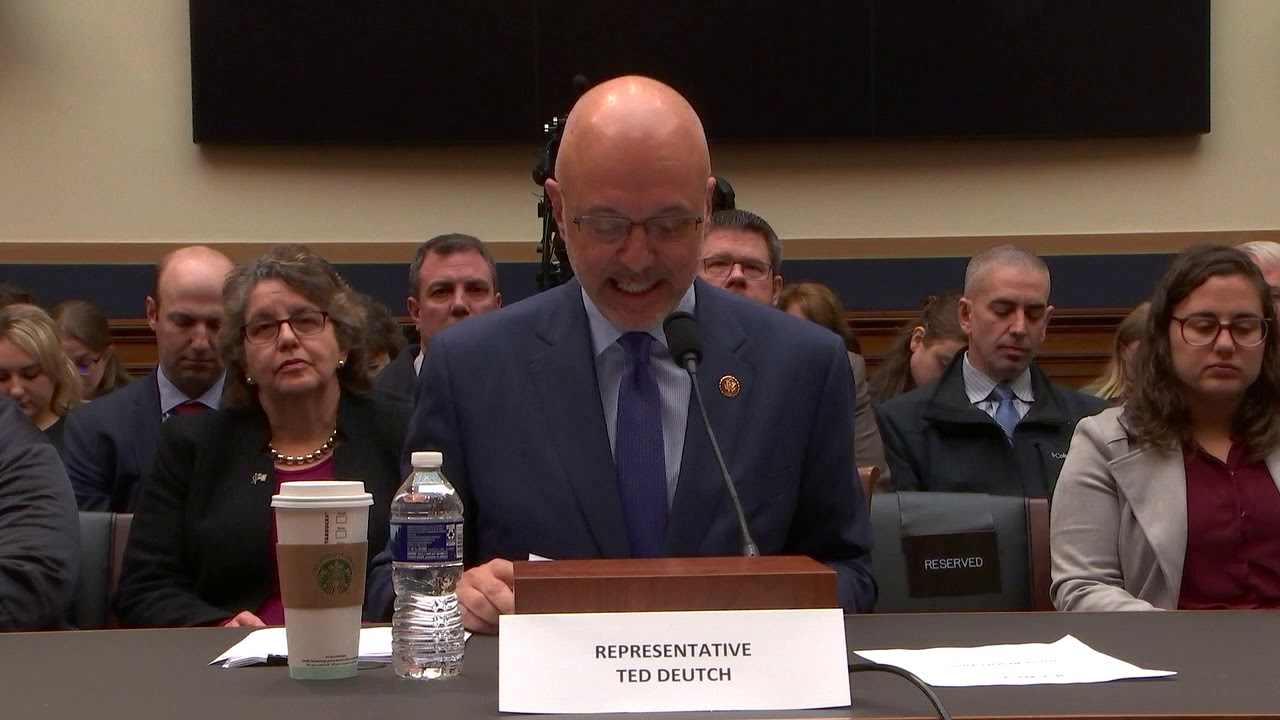
Rep. Ted Deutch, the sponsor of H.J. Res 119, the Democracy for All Amendment to overturn Citizens United and get money out of politics, urged his colleagues...
:{Democracy For All Amendment Reintroduced in House & Senate:(style="margin:0px;padding:0px;border:0px;font-style:inherit;font-variant:inherit;font-weight:inherit;font-stretch:inherit;vertical-align:top;display:inline-block;max-width:100%;overflow:hidden;text-overflow:ellipsis;white-space:nowrap"):}:
Days after the seven year anniversary of the U.S. Supreme Court's ruling in the Citizens United case, Congressman Ted Deutch (FL-22), Congressman Jim McGovern (MA-02), and Congressman Jamie Raskin (MD-08) joined Senator Tom Udall (D-NM) and Senator Michael Bennet (D-CO) in re-introducing the Democracy for All Amendment. Read More
:{Raskin Cosponsors Bipartisan Constitutional Amendment to Overturn ...:(style="margin:0px;padding:0px;border:0px;font-style:inherit;font-variant:inherit;font-weight:inherit;font-stretch:inherit;vertical-align:top;display:inline-block;max-width:100%;overflow:hidden;text-overflow:ellipsis;white-space:nowrap"):}:
The Democracy for All Amendment (H.J.Res. 1) affirms the right of states and the federal government to pass laws that regulate spending in elections, reversing the concentration of political influence held by the wealthiest Americans and large corporations capable of spending billions of dollars in our elections.
:{}
##
About Press Copyright Contact us Creators Advertise Developers Terms Privacy Policy & Safety How YouTube works Test new features Press Copyright Contact us Creators ...
HJR 119 ? sponsor
H.J.Res.119 - Proposing an amendment to the Constitution of the United States relating to contributions and expenditures intended to affect elections.113th Congress (2013-2014)
earlier try?
One such bill is the Outlawing Corporate Cash Undermining the Public Interest in our Elections and Democracy (OCCUPIED) Constitutional Amendment, which was introduced by Rep. Ted Deutch (D-Fla.) this past November. It overturns the Supreme Court's January 2010 Citizens United ruling which held that corporations have the constitutional right to spend unlimited sums of money to influence elections.
2011
DC, Nov 18, 2011 | Ashley Mushnick (202-225-3001)
---Today, Rep. Ted Deutch (FL-19), a Democrat on the House Judiciary Committee, introduced the Outlawing Corporate Cash Undermining the Public Interest in our Elections and Democracy (OCCUPIED) Constitutional Amendment. The OCCUPIED Amendment both overturns the Citizens United Supreme Court decision that wrongly awarded the Constitutionally-protected free speech rights of people to corporations and totally bans corporate money from America’s electoral process.
“No matter how long protesters camp out across America, big banks will continue to pour money into shadow groups promoting candidates more likely to slash Medicaid for poor children than help families facing foreclosure,” said Rep. Deutch. “No matter how strongly Ohio families fight for basic fairness for workers, the Koch Brothers will continue to pour millions into campaigns aimed at protecting the wealthiest 1%. No matter how fed up seniors in South Florida are with an agenda that puts oil subsidies ahead of Social Security and Medicare, corporations will continue to fund massive publicity campaigns and malicious attack ads against the public interest. Americans of all stripes agree that for far too long, corporations have occupied Washington and drowned out the voices of the people. I introduced the OCCUPIED Amendment because the days of corporate control of our democracy must end. It is time to return the nation’s capital and our democracy to the people.”
Though several amendments aimed at overturning Citizens United have been introduced in recent weeks, Rep. Deutch’s OCCUPIED Amendment is the only proposal that:
- Makes clear that free speech and other constitutionally protected rights are those of natural persons and not corporations or entities formed to promote their business interests.
- Reaffirms that corporations are formed under the laws of Congress and the States and are thus subject to laws enacted to protect the environment, ensure public health, and other safeguards for the people.
- Overturns Citizens United by ending corporations’ ability to spend unlimited amounts of their general treasury funds in elections.
- Sets the stage for real campaign finance reform by reasserting the authority of Congress to regulate all election contributions and expenditures, including those of individuals and groups funneling money anonymously to influence elections.
The introduction of Congressman Deutch’s amendment was applauded by several public interest leaders dedicated to stopping corporations from buying elections to pad their profits:
“Public Citizen enthusiastically applauds and endorses Representative Ted Deutch’s proposed constitutional amendment, which would comprehensively repair the damage done to our democracy by Citizens United,” said Robert Weissman, President of Public Citizen. “It would clarify that constitutional rights are intended for real, live, breathing human beings. It would end corporate spending on elections. And it would give Congress authority to adopt a sensible campaign finance system. It would make American stronger, more democratic and more just.”
“We join Americans across the nation in applauding Congressman Ted Deutch for affirming fundamental truths self-evident to almost everyone except five guys on the Supreme Court: For-profit corporations are not people and thus are not entitled to the same constitutional rights as people,” said Lisa Graves, Executive Director of the Center for Media Democracy, publisher of PRWatch.org and ALECexposed.org, and former Deputy Assistant Attorney General. “No other congressional effort has so directly confronted the twin problems created by judges who have arrogantly granted rights to corporations, without democratic consent, and overturned bipartisan laws that limited the corrupting influence of money in our elections.”
“The problems caused by the Supreme Court’s decision in Citizen’s United must be addressed – and we’re delighted to see Representative Deutch offer a comprehensive solution to stop the flood of corporate money in our electoral system,” said Marge Baker, Executive Vice President of Policy and Programs for People for the American Way. “Our democracy belongs to all of the people, not just the wealthy, and not to large and powerful corporate interests. Amending the constitution is the best tool we have to protect that democracy for the American people. Rep. Deutch’s amendment is a positive step toward ensuring that our elected officials remain accountable to the people they are in office to serve.”
Click here to read the OCCUPIED amendment.Click here for a backgrounder on the amendment.