lutnick COMMERCE
pow mofo pending
see CORRUPT 3
SEE CRYPTO
GOP STEAL ELECTION CENSUS FUCKERY NO RECORDS STATS DOGEBAGS AFPI TINA PETERS
SEE OFFSHORE OIL CA FUCKERY 9 26
SEE NEPOTISM SONS GRIFT DJ OIL? OCEAN MINING?
911 founding myth?
10 24 really vile lies M S G hate rally MUSK PLEDGE 2 TRILLION
-----
-=-=
-=-=
MMA
Guests on Steve Bannon’s podcast call for Commerce Secretary Lutnick to intervene in state elections
Guests Cleta Mitchell and Ed Martin, two lawyers involved in the election denial movement, argued that voting machines are not secure. Mitchell is already pointing at Georgia, a major hub of election denial in recent years.
Written by John Knefel
Published 10/07/26
Two guests on former Trump adviser Steve Bannon’s War Room podcast are calling for Commerce Secretary Howard Lutnick to intervene in state election systems on the grounds that voting machines are not secure.
Cleta Mitchell and Ed Martin are both lawyers who have been involved in election denial efforts. Mitchell was on the January 2021 call when President Donald Trump asked Georgia Secretary of State Brad Raffensperger to “find” votes for him to overturn the election. Martin is a former Trump Department of Justice official who claims to have worked on a “path” to get former Colorado county clerk and prominent election denial activist Tina Peters out of state prison.
Mitchell singled out Georgia’s election systems in her commentary, building on conspiracy theories that Trump concocted about vote tampering in that state following his loss in 2020. Trump’s administration has continued to pursue some of those theories, including federal agents seizing thousands of ballots and other voting records from Fulton County in January.
Appearing on Bannon’s October 6 show, Mitchell argued that the U.S. commerce secretary should intervene in state election administration, with Mitchell arguing that a 2019 national emergency declaration issued by Trump gives Lutnick “not only the authority but the duty to act” and calling for him “to order that the software in the Dominion systems in Georgia be replaced and upgraded.”
On October 1, Georgia State Election Board Executive Director James Mills sent letters to the Department of Justice and the Department of Homeland Security asking the administration to make changes to the state’s voting machines just weeks before the upcoming midterm elections. (Mills has generally pursued aims that align with Trump’s false claims of voter fraud in the 2020 election.)
The Atlanta Journal-Constitution explained that “there’s no indication the state’s voting machines have been tampered with during an election,” and a privacy concern raised in the letters “does not alter election results.” The only Democrat on the election board told the paper that Mills’ letters were “clearly a bad-faith attempt to set up a contest to election results that Republicans do not like.”
Video
Citation
From the October 6, 2026, edition of Real America's Voice's War Room
CLETA MITCHELL (GUEST): Well I think that one of the things that's really important is that a lot of people have said, well, the president needs to declare a national emergency for elections. Well, guess what? He already did. He did that in May of 2019. He declared that there was an emergency because foreign-owned -- it's called information and communications technology and services, and that includes election infrastructure -- manufactured in whole or in part or controlled by companies that are foreign adversaries, which includes China. And there's not a voting system in America today, an electronic voting system in America today that is not manufactured in whole or in part in China.
So the president in May of 2019 issued this emergency -- relying on the National Emergencies Act of 1976 issued an executive order ordering the Department of Commerce to promulgate regulations, which they did. The Department of Commerce regulations took effect in February of 2024, and they are the law.
And it gives Howard Lutnick, as secretary, not only the authority but the duty to act. And so here are some of the things that Secretary Lutnick can do today. And that he needs to do today.
He needs to order that the software in the Dominion systems in Georgia be replaced and upgraded, as all the other jurisdictions have done since 2022 when it was determined by Dr. Halderman that Dominion systems have nine vulnerabilities. The software was upgraded. It was to correct all of those vulnerabilities. And guess what? Georgia has yet to install the upgrades to guard against the vulnerabilities.
Secretary Lutnick should oversee that today.
...
The other thing he needs to do is, the Department of Homeland Security sent him, along with a letter that Ed is referring to -- the Department of Homeland Security doesn't have authority to mandate that states get rid of these vulnerable voting systems. But the Department of Homeland Security has created this fund -- they've created grant-funds through FEMA, they've written a mitigation plan.
All Secretary Lutnick has to do is take it and implement it. He has the authority to mandate it.
Martin similarly claimed that “Lutnick has a chance to step up and also be a player” in efforts “for states to change their election systems,” warning of “a red-hot crisis” and “a five-alarm fire” for the upcoming midterms.
Video
Citation
From the October 6, 2026, edition of Real America's Voice's War Room
ED MARTIN (GUEST): You mentioned the breaking news. There's a letter that came out a month ago and it didn't get much attention until yesterday when I was looking at it closely and I put it up. And it's a legal finding from Secretary Mullin of the DHS, a legal finding -- it's not Ed Martin's opinion, it's not Bannon's opinion, it's not Cleta's opinion, it's not a filing in a court -- it's a DHS finding that machines for election are using foreign parts and they cannot be secured.
And so much so that the letter from Mullin says, I've got a special fund -- it's a billion dollars, I went and found out, one billion with a B, dollars for states to change their election systems to protect themselves. So look, I think this is a red-hot crisis. I mentioned in an interview yesterday that Tina Peters was meeting with President Trump, and that happened. And I haven't talked to her since the meeting, but I know they didn't meet about the Colorado prison system.
We know we've got a five-alarm fire coming in less than four weeks, and all hands on deck.
...
I think Lutnick has a chance to step up and also be a player because of how the law is, but states are going to have to protect themselves too.
Questions about the security of Georgia’s elections have been a concern in the lead-up to the midterms. Local news station WTVM recently covered a town hall convened by former secretary of state chief operating officer Gabe Sterling to give Georgians confidence in the existing systems.
“Voting in this state, in your home county, and across the nation is safe, is run by professionals, they have redundancies, tons of safeguards, and it really is a secure, secure election,” said Sterling, who previously refuted Trump’s election conspiracy theories in 2020.
Georgia Public Radio also covered the subject, quoting an election system expert who agreed that the changes were not necessary and could be detrimental to a free and fair election.
Ben Adita, the executive director of Voting Works, a nonprofit that sells open-source voting systems, testified in front of the board Thursday. During the meeting, he told the committee that Raffensperger has already taken steps to mitigate the privacy flaw, and warned about changes close to the election.
"The proposal to upgrade software with two weeks to go is really fraught and risky," Adita said. "The proposal to alter the vote casting process statewide is fraught whether you have two weeks — or two or six months, frankly — of lead time."
-=-=
-=-=
noaa ocean sensor?
Backlog of unsigned contracts paralyzes NOAA
An agency official said “everything has ground to a halt,” waiting for Commerce Secretary Howard Lutnick to review more than 200 agreements.
By:
Scott Waldman
| 05/20/2025 06:21 AM EDT
CLIMATEWIRE | A growing backlog of hundreds of unsigned NOAA contracts has slowed agency operations to a crawl — so much so that even Sen. Ted Cruz, a staunch ally of the Trump administration, has raised concerns about the gridlock.
The bottleneck is due largely to one man: Commerce Secretary Howard Lutnick, whose portfolio includes the National Oceanic and Atmospheric Administration. After taking office in February, Lutnick insisted that he personally review any contract in excess of $100,000.
Intended as an attempt to identify waste and redundancy, the policy instead has sown chaos at the nation’s preeminent climate and weather agency, say former and current NOAA officials.
More than 200 NOAA contracts — including one aimed at helping local communities prepare for extreme weather events — are now stuck in limbo, waiting for Lutnick to make a decision. The impasse has forced NOAA to furlough employees, and it has created a work environment where NOAA staffers spend much of their time trying to justify their work — rather than doing it, they say.
...
-=-=-
YIKES OFFSHORE OIL AN 9 26
President Donald Trump has made numerous moves criticized as "power grabs" throughout his second term in the White House, but in a new piece for The Hill, a former Republican sounded the alarm about one that has potentially flown under the radar.
Christine Todd Whitman previously served as the first female governor of New Jersey from 1994 to 2001, before joining the administration of George W. Bush as head of the Environmental Protection Agency until 2003. As of 2022, however, she has departed the Republican Party to head up the Forward Party, an attempt to launch a centrist third party, alongside former Democratic candidate Andrew Yang.
On Sunday, Whitman published a new op-ed for The Hill in which she professed to be "extremely concerned" about Trump's efforts to manipulate the Coastal Zone Management Act in order "to impose a federal takeover of California’s coast." She praised the law, signed by Richard Nixon, for establishing a system of "state-federal partnership" in managing ocean and lake coastlines that helps states "advance their own priorities in federal decision making," rather than allowing decisions to be made via "presidential fiat."
"Under the guise of expanding offshore oil drilling and space launches, along with the establishment of seabed mining, this effort is supported by some of my Republican friends," Whitman wrote. "But political pendulums inevitably swing, and this short-sighted initiative creates a dangerous power grab for future presidents of any political stripe to exploit. It began when Commerce Secretary Howard Lutnick ordered the National Oceanic and Atmospheric Administration (NOAA) to reopen the routine evaluation of California’s coastal management program done, but not finalized, under the Biden administration. Lutnick’s order, citing economic factors and favoring select industries, signals this duplicative review is rigged."
Whitman added that "California has successfully worked alongside 10 presidents" in managing its coastlines under this law, and over the decades has "expanded access to its coast, preserved coastal parkland and wildlife, and ensured local governments have a voice in the approval of federal projects, including subsea fiber optic cables, offshore oil and gas production, and military training exercises." Under this newly ordered review, the state now stands to lose all of that progress.
"Over nearly 50 years, California has reviewed more than 3,700 federal actions impacting its coast and, in 96 percent of cases, either negotiated improvements or approved projects as submitted," Whitman explained. "Clearly, the state-federal partnership has worked.... This formula for success falls apart if Washington can supplant California’s priorities with its own, especially if the Trump administration’s rush for new offshore drilling results in oil spills. We’ve seen time and again that such spills close fisheries, beaches and harbors, and transform vibrant coastal communities into ghost towns overnight."
Whitman also noted that California's coastal management systems are widely regarded as the best in the nation. If Trump were to successfully wreck them, "then like dominos, other states will easily follow, destroying one of our best examples of federalist governance."
"This should alarm every American," Whitman concluded. "Our love of the ocean is universal, so the right to manage the coast should remain equal under the law for all coastal states. Instead we see the administration play favorites, demonstrated by the abandonment of its oil drilling plans off the Atlantic coast after significant opposition from the region’s Republican leaders. As the old saying goes, Washington doesn’t have a monopoly on wisdom. Hopefully, we won’t have to relearn this lesson the hard way."
==
-=-=
QUESTIONS CHANGED TO GET RID OF STATS
RWW
9 26
- Vittoria Elliott and David Gilbert @ Wired: A US Census Report on Noncitizen Voting Used Bad Data to Reach Faulty Conclusions
Trump has touted a recent Census report. WIRED found grave flaws in its analysis and the process behind it, and confirmed the identity of several of its authors—among them a one-time DOGE affiliate.
RWW -->
A reportpublished by the US Census Bureau last month purported to uncover evidence backing up President Donald Trump’s baseless claims that noncitizens voting cost him the 2020 election. It was the latest salvo in Trump’s broader assault on the safety of US elections. “I WON THE ELECTION,” Trump quickly declared on Truth Social after the publication of the report.
However, though Trump and other government officials quickly shared and praised the report, a WIRED investigation has uncovered significant flaws in the data used to compile the report, as well as in the approval process used prior to publication. WIRED has also learned that a number of the report’s authors have links to the Trump administration and the Republican party. They include one former affiliate of Elon Musk’s so-called Department of Government Efficiency and two researchers from the America First Policy Institute (AFPI), a highly influential think tank founded by veterans of Trump’s first administration.
The report, titled “Noncitizen Voting in the 2020 Election: A Beginning Analysis,” claims that an analysis of over 128 million voter records from the 2020 election identified 24,000 people tied to administrative records indicating noncitizen status. The numbers range from 4,300 in California to fewer than 15 in Wyoming—not nearly enough to have affected the outcome of the presidential race. But even these figures seem extremely questionable, and experts and Census Bureau employees who spoke to WIRED allege it is much likelier that they represent basic analytical errors than actual instances of noncitizen voting.
The Census Bureau did not respond to a request for comment. The White House directed WIRED to President Donald Trump’s post on Truth Social and Commerce Secretary Howard Lutnick’s post on X, where both officials praised the report.
The number of noncitizens voting in US elections has been repeatedly shown to be vanishingly small. In Utah, for example, the state’s top election official, Lieutenant Governor Deidre Henderson, reviewed the state’s approximately 2.1 million registered voters. The result was the discovery of 27 “confirmed noncitizens,” none of whom was ever confirmed to have voted. Studies in Pennsylvania and Idaho have returned similar outcomes. Still, the idea that a flood of noncitizens have been voting in US elections for over a decade, skewing the outcomes, has remained one of the central conspiracy theories promoted by Trump and his allies.
John Abowd, former associate director for research and methodology and chief scientist at the Census Bureau, called the Census report “statistical nonsense” and wrote on LinkedIn that “it is extremely uncommon for the US Census Bureau to publish a research report, even one of blog length, without the authors explicitly listed.”
Census Bureau sources who spoke to WIRED on the condition of anonymity could not say what prompted the report. Records reviewed by WIRED, though, show it originated at the Center for Economic Studies, a division within the Census Bureau that uses confidential data to conduct research.
According to those records, one of the authors was Dan Sweeney, currently a deputy general counsel at the Department of Commerce overseeing the Census Bureau. He previously worked as the “DOGE legal liaison and deregulatory attorney” at the Environmental Protection Agency, according to his LinkedIn profile. Michael Lachanski was also an author, according to two sources with knowledge of the report’s origins, and he was appointed to his current role as the deputy director for data, policy, and science at the Census Bureau just two months ago. Previously, he was a fellow at the Trump-aligned Claremont Institute.
The two America First staffers involved in authoring the report, according to records reviewed by WIRED, were Matthew Jensen and Jeff McCrea. McCrea previously served as campaign manager for former congresswoman Cathy McMorris Rodgers of Washington, who has expressed a belief in creationism and signed an amicus brief contesting the 2020 election results. Jensen previously worked for the American Enterprise Institute, where, according to his bio on the America First Policy Institute website, “contributed to the design of the Tax Cuts and Jobs Act,” the tax law passed during the first Trump administration.
Sweeney, Lachanski, Jensen, and McCrea did not respond to requests for comment.
Sources who spoke to WIRED on the condition of anonymity confirmed that Jensen and McCrea are working in government on loan from America First through what is known as the Intergovernment Personnel Act. The IPA is meant to allow people with specialized skill sets from certain institutions, like nonprofits and universities, to work for the government for up to two years on a temporary appointment.
Danah Boyd, a professor at Cornell University who studies the census, says that the Bureau has long used IPAs for scientific work. “But they do what the civil servants require them to do, not what the political [appointees] require them to do.”
Boyd says that the group of people who records indicate authored the noncitizen voting report appear to be of a different stripe. “These ultimately appear to be people coming from a Republican operation that’s pretending to be a 501c3,” she says. “Rather than doing the work for the agency, it appears they’re doing work in political interest.” The AFPI did not respond to a request for comment.
The report was approved by the Census Bureau’s disclosure review board on August 7 through an email vote, which is typically used for publications with tight deadlines or in response to demands from Congress or the White House. The members of the review board who approved the report were shown the three tables contained in the final publication, but not the analysis that accompanied them, according to one source within the bureau who had access to the materials submitted to the review board.
The report concludes that the author’s analysis “readily determined with high confidence that over 128 million of these voter records represented citizens, and that over 24,000 of these voter records represented noncitizens at the time of the election. Over 32 million voter records remain to be analyzed.”
According to documents viewed by WIRED, the authors used data from the DataClear 2020 voting file—a commercial dataset—as well as USCIS immigration records (both the 2025 extract and the February 2026 A-number and case files); USCIS DACA approvals from 2025; State Department immigrant and nonimmigrant visas for 2017 through 2023; ICE student, removal, and national-docket records; IRS form 1040 for 2020; Social Security Numident (2019 and 2020); and State Department passport issuances across 50 vintages from 1978 through 2025.
Former Census officials say the breadth of data used, as well as the lack of clear explanation of the methodology employed to analyze it, raises significant red flags.
“We don't know whether or how the sources are updating their citizenship info,” Amy O’Hara, a former official who used to run the administrative data linkage unit at Census, tells WIRED. “It is really hard to join and deduplicate these files, especially across a range of years.”
In order to match people between surveys and records without revealing their identities, the Census Bureau uses what are known as Protected Identification Keys (PIKs), which replace identifying information with a unique code. Sources who spoke to WIRED say that they are unsure which data points were used to match PIK data across the many datasets, though something like an address could be used for cross-referencing.
Though PIKs have been used for years to allow academics and government employees to conduct studies without compromising the privacy of the people whose data it is, they are not foolproof. A January 2026 study published by the Census earlier this year found that “while PIK assignment is generally accurate, some person records are not successfully assigned a PIK, which can lead to sample selection bias in analyses of linked data.”
“The brief says ‘high confidence,’ which indicates some probability,” one bureau source who spoke on the condition of anonymity over fears of retribution by the administration, tells WIRED. “However, no confidence intervals in the tables of the brief are shown. The supposed count of non-voters is small relative to the total state population.” The source alleges that there are probably PIK errors and not actual noncitizens who voted.
Abowd says that false match rates—in this case, when a voting record is assigned the wrong PIK, and then when it is “matched” with citizenship data–are likely to be higher when using commercial data like those used in the report. This means that the analysis is more likely to return a “false positive” showing that a noncitizen had voted. “You can’t estimate the false positive rate without more technical details” that were not included in the report, Abowd tells WIRED. “Because the false match rate is much greater than the estimated noncitizen voting rate, the alleged noncitizen voters are more likely to be data errors.”
All of this, Boyd worries, could undermine more than just trust in voting and elections—it could make academics and researchers doubt the quality and reliability of the products and data that the Census Bureau produces. “They're putting it out with the imprimatur of the Census Bureau so it looks legitimate,” she says. “But there’s no authors, no methods, no discussions of the limitations of the data, or the Bureau's approach.”
Republicans have already attacked the accuracy of the 2020 census, alleging that an algorithmic process used by the Bureau to protect data privacy had disproportionately favored Democrats in terms of the drawing of congressional districts. In August, WIRED reported that an internal memo circulated by the Department of Commerce, which oversees the Census Bureau, proposed excluding immigrants from the count, a move that could radically reshape how congressional districts are apportioned.
The report is also just one part of a broad attack on the integrity of American elections by the Trump administration, which includes weaponizing the Department of Justice, dismantling voter protections, attempting to wrest control of election administration from states, and pushing an endless barrage of baseless conspiracy theories about voting in America.
-=-=
NAME Came up 8 26?
predicted no rfk2
omg
Family Affair: Commerce Secretary's Sons Cash In on A.I. ...}:

The New York Times
https://www.nytimes.com › U.S. › Politics](https://www.nytimes.com/2025/11/20/us/politics/howard-lutnick-family-ai.html)
Nov 20, 2025 — Neugebauer turned to Kyle and Brandon Lutnick to help Fermi raise $107.6 million as an early step in plans to build the President Donald J.Read more
Family Affair: Commerce Secretary’s Sons Cash In on A.I. Frenzy
Howard Lutnick is helping push data center projects. His family companies are profiting from them.
A mammoth data center is rising in Amarillo, Texas. Firms controlled by the Lutnick family have helped finance it, banking millions in fees in the process.Credit...Paul Ratje for The New York Times
By Eric LiptonMichael RothfeldDavid Yaffe-Bellany and Ana Swanson
Eric Lipton reported from Miami; Michael Rothfeld from New York; David Yaffe-Bellany from Lugano, Switzerland; and Ana Swanson from Washington.
Nov. 20, 2025
Kyle Lutnick, the 29-year-old scion of his family’s real estate business, traveled in July to Amarillo, Texas, to walk a dusty tract of land with the head of an artificial intelligence start-up called Fermi America.
He was touring the site of a future data center with Toby Neugebauer, a billionaire who is building one of the behemoth facilities that will power the next generation of A.I. Mr. Lutnick’s company was helping raise capital for the center, banking millions in fees in the process.
“Polite young man,” Mr. Neugebauer said in an interview.
A month later, Kyle’s father, Howard Lutnick, was photographed with Mr. Neugebauer at an event near the White House that celebrated Fermi’s partnership with a South Korean company on the same data center project.
This sequence of events — a son making money on a project his father is boosting as a federal official — has come up repeatedly since President Trump tapped Howard Lutnick to head the Commerce Department, according to an investigation by The New York Times.
In that role, Mr. Lutnick has twisted the arms of American allies, dangling policy favors in exchange for investments in U.S. industrial projects. At times, these tactics have created opportunities for his family’s clients to gain access to much-needed foreign capital, The Times found.
Mr. Lutnick, for example, demanded that the South Korean government invest billions of dollars in U.S. industry to reduce tariffs. Mr. Neugebauer is vying for a share of those investment dollars to build the data center that Mr. Lutnick’s family is also helping to finance.
The job of commerce secretary has always been to promote American industry through deal-making at home and abroad, and the position has traditionally been populated with titans of industry who were expected to bring a business sensibility to meetings filled with career government workers.
But never in modern U.S. history has the office intersected so broadly and deeply with the financial interests of the commerce secretary’s own family, according to interviews with ethics lawyers and historians.
Since February, Kyle Lutnick and his younger brother Brandon, 27, have helped run a network of companies under the corporate umbrella of Cantor Fitzgerald L.P. The companies, led by their father until this year, include the Wall Street investment firm Cantor, the securities brokerage BGC Group and the real estate company Newmark Group.
Brandon is the chairman of Cantor Fitzgerald L.P., and Kyle is the executive vice chairman. The sons and their two younger siblings have a controlling ownership stake in all three companies in the network.
The family’s companies operate in a wide range of industries, from cryptocurrencies to data centers, that overlap with Mr. Lutnick’s work in government, raising concerns even among high-level staff members in the Commerce Department, according to five current and former officials and others familiar with the matter.
It is a blurring of lines that has become a defining characteristic of Mr. Trump’s second term, where top officials and their family members have retained major stakes in industries the government oversees. For months, the president’s two older sons and the sons of his Middle East adviser, Steve Witkoff, have traveled the world pursuing deals that have generated hundreds of millions in profits, at least on paper.
As for Mr. Lutnick, The Times did not find evidence that he had intervened in policy discussions with the intention of driving business to his family. But as he promoted data center construction, business has boomed at the Lutnick companies.
Newmark recently announced that it had completed more than $25 billion of data center deals in the past 12 months, taking a small cut in fees on each transaction. “We are having our best year ever,” Brandon Lutnick said in October at a conference in Switzerland.
Image
Brandon Lutnick speaking at a crypto conference in Lugano, Switzerland, last month. The family’s companies operate in a wide range of industries that overlap with Howard Lutnick’s work in government.Credit...Maurizio Fiorino for The New York Times
The White House and the Commerce Department said in statements that Mr. Lutnick had fulfilled his ethics requirements and took them seriously.
“The fact of the matter is that the only special interest guiding Secretary Lutnick and the rest of the Trump administration’s decision-making is the best interest of the American people,” said Kush Desai, a White House spokesman.
Representatives for Cantor and Newmark said the firms had business expertise and relationships that long predated Mr. Lutnick’s role in the administration.
Newmark’s chief executive, Barry Gosin, said in a statement that the company was the industry leader in raising capital and leasing for data centers.
“Newmark’s data center advisory work is independent of governmental and other private activities,” Mr. Gosin said. “Our success in this sector reflects the optimal outcomes we deliver for our clients.”
‘Enough Money’
Howard Lutnick first drew international attention in 2001, when 658 employees of Cantor, including his younger brother, were killed in the attacks on the World Trade Center. Mr. Lutnick was not at work that morning because he was dropping off Kyle for the first day of kindergarten.
Over the next two decades, he rebuilt the business in the wake of the tragedy. It now has more than 13,000 employees, and has expanded into new areas of the finance world, after acquiring Newmark in 2011.
At times, Mr. Lutnick has pushed boundaries and found his companies in the cross hairs of law enforcement. Cantor and affiliates agreed to pay more than $50 million over the last decade to settle at least eight separate investigations of illegal gambling and money laundering, incomplete, false or misleading statements in financial filings, and other issues, enforcement records show. In some cases, the firms settled without admitting or denying wrongdoing.
When Mr. Trump nominated him to lead the Commerce Department, Mr. Lutnick noted that at the age of 63, he wanted to serve the nation. “I’ve made enough money in my life,” he said at his confirmation hearing.
Mr. Lutnick has said he eliminated any ethics issues by turning over his ownership stake of the companies to his children, a process he announced in May, with an agreement that excluded him from any profits or losses after that date.
He has also claimed that he does not speak to his sons about their work. “I would love to talk to them about it, but I’m not allowed,” Mr. Lutnick said on a podcast in March.
The actual transfer of his ownership stake was not completed until early October, meaning he continued to have a financial interest in parts of the family’s business while he was commerce secretary, with his name on filings in full view of any client.
Until his divestment was completed, the Trump administration granted Mr. Lutnick an ethics waiver. That permitted him to participate in certain policy matters that might benefit the firms, while prohibiting him from working on specific deals in which they were involved.
Three ethics lawyers interviewed by The Times said it was not clear whether Mr. Lutnick had violated federal ethics rules or the terms of his waiver. But they said the Lutnick family’s connections to the same deals in both government and private spheres — like its involvement on different sides of Fermi’s data center project — raised questions about whether Mr. Lutnick was doing enough to distance himself from possible ethical conflicts.
“If there is a cloud of distrust over whether the action of that official is aimed at the public interest versus their family’s own interest, that’s a problem,” Kedric Payne, general counsel at the nonpartisan Campaign Legal Center, an ethics group, said after reviewing documents at the request of The Times. “You’re going to create a risk that the public will just start to really lose trust in the government.”
Pressuring the Emiratis
Artificial intelligence has become a vital engine of the U.S. economy in recent years, drawing hundreds of billions of dollars in investment from around the world. Much of that money has flowed into data centers — sprawling facilities that sit on vast swaths of land and run industrial-grade computers that power A.I.
So it is no surprise that major commercial real estate brokers like Newmark were attracted to the sector.
In 2023, when Mr. Lutnick was the company’s chairman, Newmark expanded its team of investment bankers specializing in data centers. The company helps select land for these colossal projects, find power supplies and line up billions of dollars worth of loans and other financing.
The data center boom is “a modern-day gold rush,” Chad Lavender, a top Newmark executive, said in a podcast interview in September, shortly before the company reported record earnings for the quarter. “We’re seeing a ton of activity.”
Now Mr. Lutnick is helping foster that activity from Washington. The Commerce Department is seeking to accelerate data center construction with tax breaks, grants and permits to build new power sources to fuel the facilities.
Mr. Lutnick has also repeatedly pressed foreign nations to send chunks of their own money to help build data center projects in the United States, at the same time that his family’s company serves as one of the data center industry’s leading deal makers, earning tens of millions in fees.
Image
Mr. Lutnick at an announcement of new tariffs in April. A blurring of lines has become a defining characteristic of President Trump’s second term, where top officials and their family members have retained major stakes in industries the government oversees.Credit...Haiyun Jiang for The New York Times
Among the nations that Mr. Lutnick has pressured is the United Arab Emirates.
This spring, the Emiratis approached the Trump White House, requesting access to advanced U.S.-made computer chips, which are crucial to the Emirates’ ambitions of dominating the A.I. industry.
It was a controversial ask.
During the Biden administration, the United States had established strict controls to limit access to the chips, fearing that the Emiratis might share them with China and allow the Chinese to create sophisticated weapons that could be turned on U.S. soldiers. Even some within Mr. Trump’s administration were reluctant to give the Emirates unfettered access to the most advanced chips.
Mr. Lutnick was open to exporting chips, with the right safeguards in place. But his position gave him the power to say “no” and the Emiratis knew it. That is because the Commerce Department oversees the nation’s export licenses.
So he made clear that he wanted the Emiratis to commit billions of dollars to the construction of data centers in the United States in return for the chips, according to administration officials involved in the process.
“You will invest in America and build data centers in America for an equal amount of chips,” Mr. Lutnick said, describing the terms of the deal with the Emiratis during Senate testimony in June.
Eventually the chips deal was approved. Newmark’s clients are one of the possible beneficiaries.
Early this year, the Emirates agreed to commit money to help build the U.S. portion of a global network of data centers. The flagship site of this network, named after the 1994 sci-fi movie “Stargate,” is rising in Abilene, Texas.
Newmark has helped finance construction of the Abilene facility, soon to become one of the largest data centers in the country. The firm brokered more than $9.4 billion in loans this year for a partnership working on the project.
The Emirati money ultimately might not be used on the Abilene data center, executives involved in the effort said. But it is already helping finance other Stargate sites.
Deals have also been struck with Saudi Arabia to invest at least $20 billion in energy and data center projects in the United States, helping bring yet more business to the real estate brokers who structure financing for these projects, though there is no indication whether it will benefit Newmark specifically.
A Commerce Department spokesman said Mr. Lutnick did not pressure Middle East partners to fund specific projects, just to spend money on data centers somewhere in the United States.
A similar instance of overlaps played out again in July.
That month, Mr. Lutnick joined Mr. Trump in Pittsburgh, boasting about the billions of dollars that private companies are spending on a slate of data centers, including a giant project in Lancaster, Pa.
“The A.I. revolution will change the way the world works, and we cannot lose,” Mr. Lutnick said at the event. “The Trump administration will not let us lose.”
What he did not mention was that Newmark was involved in the Lancaster project. A few weeks after Mr. Lutnick’s appearance in Pennsylvania, the company announced it had brokered a $4 billion joint venture to build a “state-of-the-art A.I. data center campus” there.
A Commerce Department spokesman said Mr. Lutnick had no role in any of the individual deals that he promoted in Pennsylvania, and attended the event simply to support the industry.
Pressuring the Koreans
Toby Neugebauer, who is building the Fermi data center that will power the next generation of artificial intelligence, said he chose Newmark because of the expertise of its staff, not its connection to the commerce secretary.Credit...Paul Ratje for The New York Times
The intersection of Mr. Lutnick’s work as commerce secretary and his sons’ as data center deal makers is most apparent in the Fermi America project in Amarillo.
Fermi was co-founded in January by Rick Perry, the former Texas governor who was Mr. Trump’s first-term energy secretary, and Mr. Neugebauer, a major Republican donor who has supported Mr. Trump. The company has not yet generated any revenue.
This year, Mr. Neugebauer turned to Kyle and Brandon Lutnick to help Fermi raise $107.6 million as an early step in plans to build the President Donald J. Trump Advanced Energy and Intelligence Campus, which would be powered in part by nuclear energy.
Mr. Neugebauer said he chose Newmark because of the expertise of its staff, not its connection to the commerce secretary. He said he knew that seeking favors would most likely backfire.
“Was never going to help me,” he said. “Makes it harder.”
In July, Mr. Neugebauer gave a tour of the Texas construction site to Kyle Lutnick, a Stanford graduate who has worked as a D.J. under the stage name Kxtz. Mr. Neugebauer said that he gave Kyle and other visitors Fermi-branded cowboy hats, and that Kyle later texted a picture of himself with the hat.
Soon Mr. Neugebauer was also engaging with Kyle’s father. Shortly after the Texas tour, Mr. Lutnick announced that South Korea had agreed to a trade deal that would funnel $350 billion into the United States.
Mr. Neugebauer coveted a piece of those investments.
His plan was to get the South Korean government, with the support of the Trump administration, to help finance a nuclear power plant to fuel his Amarillo data center. Components for the plant would be supplied by Doosan Enerbility, a South Korean industrial giant.
In August, Mr. Lutnick appeared alongside Mr. Neugebauer during a U.S.-Korean business summit at the historic Willard InterContinental hotel, where Fermi and Doosan announced plans to collaborate.
Mr. Neugebauer and his Doosan counterpart posed for a photo holding their memorandum of understanding, flanked by Mr. Lutnick and a Korean government official.
“You’re going to see a national and economic security fund built with the Japanese money, the Korean money and other countries’ money,” Mr. Lutnick said on CNBC the day after the event.
Image
A photo distributed in a news release by Fermi America showing Mr. Lutnick with Kim Jung-kwan, South Korea’s trade minister; Jongdoo Kim, the president of Doosan Enerbility Nuclear Power Plant BG; and Mr. Neugebauer.
Days after the Doosan announcement, Fermi unveiled its financing deal for the Amarillo project, with both Newmark and Cantor listed as advisers. The companies were paid $6 million for this work, according to a financial filing.
In a bigger coup for the Lutnick companies, Cantor jointly managed an initial public offering of Fermi’s stock in early October that valued the company at more than $12.5 billion. Millions of dollars in additional fees flowed to Cantor.
“Honored to co-lead the I.P.O. for such an innovative and inspiring company Fermi America,” Kyle Lutnick posted on social media at the closing of that deal.
Ben Kass, a Commerce Department spokesman, said no decision had been made on where to allocate the funds South Korea had agreed to spend in the United States. So far, he said, the department is planning to use part of the money to promote U.S. shipbuilding, rather than nuclear power.
Still, Mr. Kass added, the final terms of the trade deal remain under negotiation.
Image
Rick Perry, the former Texas governor who was Mr. Trump’s first-term energy secretary, co-founded Fermi with Mr. Neugebauer.Credit...Paul Ratje for The New York Times
At a recent meeting in Washington, Mr. Neugebauer pressed Deputy Commerce Secretary Paul Dabbar to direct money from the Korean trade deal toward Fermi’s nuclear plant.
Mr. Neugebauer has an important ally in Senator Ted Cruz, Republican of Texas and the chairman of the Senate Commerce Committee. Fermi is also seeking low-interest financing from the Energy Department, which is offering billions of dollars in nuclear-energy loans.
“Toby has been a close friend of mine for 20 years,” Mr. Cruz said last week, at a Cantor-sponsored conference at the Ritz-Carlton in Miami Beach, after he wrapped Mr. Neugebauer in a bear hug by the pool. “It is a powerful proposal to bring billions of investments to Texas and create a whole lot of jobs.”
Mr. Neugebauer remains optimistic that the Commerce Department will help him get the Korean funding.
“Do I think it probably gets done?” Mr. Neugebauer said. “Yes.”
He added, “We got no special treatment.”
Image
The site where a natural gas facility is being built to help power the Fermi data center. Artificial intelligence has become a vital engine of the U.S. economy in recent years, drawing hundreds of billions of dollars in investment from around the world.Credit...Paul Ratje for The New York Times
Cade Metz contributed reporting. Susan C. Beachy, Kitty Bennett and Laine Cibulskis contributed research.
Eric Lipton is a Times investigative reporter, who digs into a broad range of topics from Pentagon spending to toxic chemicals.
Michael Rothfeld is an investigative reporter in New York, writing in-depth stories focused on the city’s government, business and personalities.
David Yaffe-Bellany writes about the crypto industry from New York. He can be reached at davidyb@nytimes.com.
Ana Swanson covers trade and international economics for The Times and is based in Washington. She has been a journalist for more than a decade.
A version of this article appears in print on , Section A, Page 1 of the New York edition with the headline: Sons of Commerce Chief Cash In as He Pushes A.I.. Order Reprints
---
---
MOJO
Donald Trump’s network of family businesses—and network of US government deals with those businesses—is mind-bogglingly wide. A *New York Times*investigation reveals his sons’ latest venture: tungsten mining in Kazakhstan.
The US government recently cut a massive mining deal for the critical mineral with the government of Kazakhstan, whose leader recently said Donald Trump was “sent by Heaven.” Trump’s sons Eric and Donald Jr., and Commerce Secretary Howard Lutnick’s sons Brandon and Kyle, are all tied directly or indirectly to the American company, Kaz Resources, that plans to break ground on the tungsten mine. Kaz Resources is also slated to receive at least $1.6 billion in government funding.
Tungsten, a mineral widely used in missile warheads, fighter jets, and computer chips, has become increasingly difficult for the US to access since China put export restrictions on it in 2025. Since then, the Pentagon has selected contractors to build small tungsten refineries on US military bases, while also looking to expand overseas mining—because no onshore mines are currently operational, and likely won’t be for a long time. And those offshore mining deals may mean big money for Trump and Lutnick-affiliated companies: at least 14 different companies affiliated with one or both families are actively working with the federal government on critical mining deals.
The Kazakh deal was signed on November 6th, without disclosing the Trump or Lutnick families’ involvement. Eric Trump, Donald Trump Jr., Brandon Lutnick and Kyle Lutnick were “doing business with partners in a deal that their fathers were negotiating, continuing a pattern of self-enrichment in the second Trump administration that has few precedents in American history,” Paul Sonne and Eric Lipton of theTimes wrote.
“I can see how the optics might be disturbing to some people,” Pini Althaus, the CEO of Kaz Resources, said. “But that’s unfortunate because this company and this project goes way beyond any one president, let alone any family.”
---
---}:
report 6 26
dn
etp kelcy warren pipelines to data ctrs
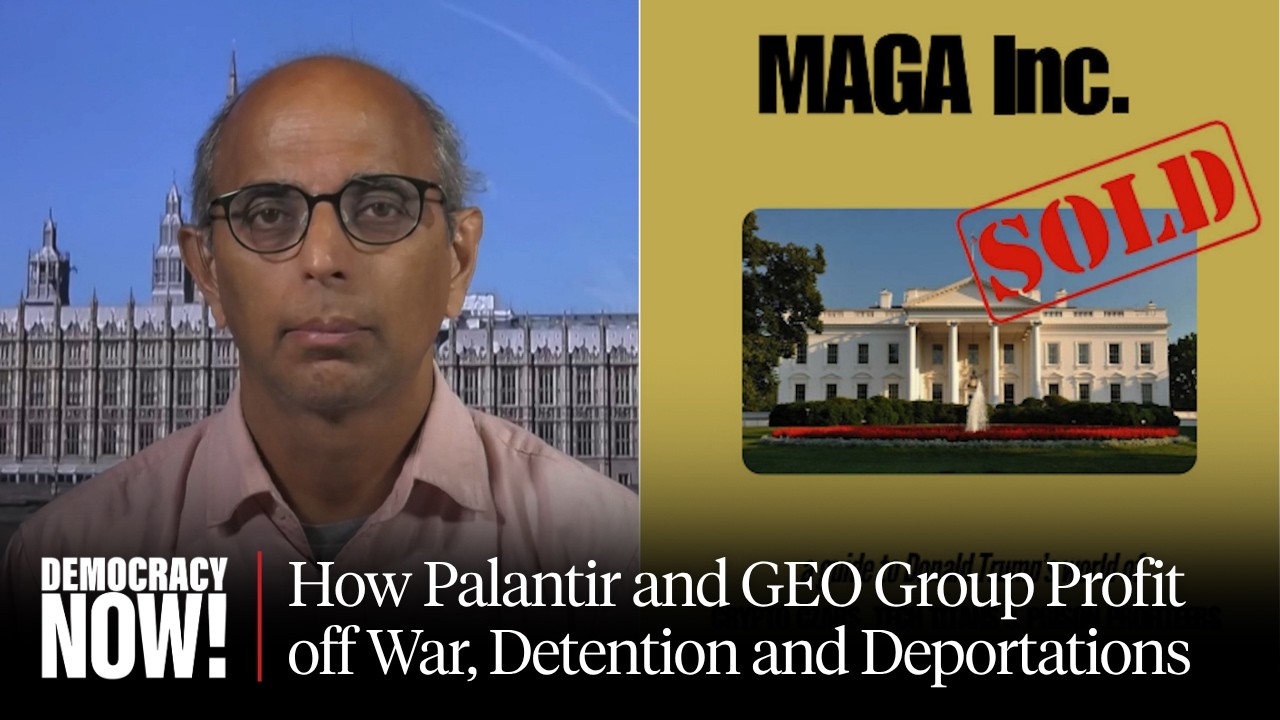
Jun 23, 2026 Latest Shows
Support our work: https://democracynow.org/donate/sm-de...A new report by CorpWatch titled "MAGA Inc." reveals which allies of President Trump are profiting off of the administration's policies. Pratap Chatterjee, executive director of CorpWatch, says that prison companies and Big Tech companies have cashed out on policies of mass deportation. "The people that we think are profiting the most out of MAGA [are in] the business of deportation, the business of gathering data," says Chatterjee. Palantir, in particular, has provided the government with information to support the surveillance of immigrants and data to support war efforts. The Trump family is also expanding their fortune through cryptocurrency, according to the report. "These are schemes by which you can move money anonymously around the world, something that drug dealers, gun manufacturers or gun dealers and criminals love," says Chatterjee. "This is the sort of business that is now benefiting the Trump family."
csi aviation deport alan wei trump findraiser got big contracts
pt 2
cantor fitzgerald lutnick data ctr
"MAGA Inc.": CorpWatch on Trump's World of Tech Titans, Crypto Czars & Prison Profiteers - YouTube
---
kickass 6 11 26
11 minutes, 42 seconds
404 parts per million. These are measurements, by the way, not opinions.
Today, President Trump, approaching the halfway point of his second term, calls climate change a hoax.
12:01
12 minutes, 1 second
Hoax.
12:04
12 minutes, 4 seconds
His EPA administrator, Lee Zeldon, rescended EPA's greenhouse gas endangerment finding, an action flatly
12:13
12 minutes, 13 seconds
at odds with known science and with the law, and then celebrated what he called
12:20
12 minutes, 20 seconds
driving a dagger straight into the heart of the climate change religion. Really?
12:29
12 minutes, 29 seconds
And to bring things full circle, earlier this spring, 40 years after a senior
12:36
12 minutes, 36 seconds
Reagan administration commerce official, acknowledged the reality of climate change, today's commerce secretary, Howard
12:45
12 minutes, 45 seconds
Letic, a strident opponent of affordable renewable energy, denies the science.
12:57
12 minutes, 57 seconds
The Republican party steps backward.
13:03
13 minutes, 3 seconds
Today, as I speak, the concentration of CO2 in the atmosphere is north of 430
13:09
13 minutes, 9 seconds
parts per million. 348 up to 404, now up to 430.
13:17
13 minutes, 17 seconds
In just four decades, atmospheric CO2 concentration has increased by nearly 25%.
13:27
13 minutes, 27 seconds
due to fossil fuel combustion.
13:32
13 minutes, 32 seconds
As climate deniers are fond of pointing out, CO2 doesn't harm or kill people.
13:41
13 minutes, 41 seconds
What it does is trap heat in the atmosphere.
13:47
13 minutes, 47 seconds
Enormous amounts of heat.
13:53
13 minutes, 53 seconds
And it is that heated atmosphere that harms and kills people through more
14:00
14 minutes
violent extreme weather events, wildfires, and rising seas.
---
AN 5 26
President Donald Trump's Commerce Secretary, Howard Lutnick, is set to appear before the House Oversight and Reform Committee on Wednesday, where he will talk about his relationship with trafficker Jeffrey Epstein. Ex-Trump lawyer Michael Cohen wrote on his Substack that Lutnick's appearance before the committee is an effort for "survival."
Questions have surfaced about Lutnick's relationship with Epstein after he said that he had no associations with Epstein.
Then it was discovered he lived next door to the infamous Manhattan mansion. He'd claimed in an interview that there was only one encounter he had with the infamous Wall Street influencer. However, he was later found to have met Epstein on the private island with his family while sailing in the Caribbean. Questions about other encounters have prompted other conversations on Capitol Hill, leading to a call to testify.
"Howard Lutnick is walking into the most dangerous room of his professional life," said Cohen.
"This is not some earnings call where you filibuster your way through uncomfortable questions and move on to the next slide," wrote Cohen. Not being in control makes things dangerous for Lutnick, said Cohen.
"Not because anyone is alleging he participated in Epstein’s crimes. They aren’t. But because credibility, once cracked, has a funny way of collapsing all at once," continued Cohen. "And Howard has a credibility problem the size of Central Park. His public story has shifted so many times it now resembles a choose your own adventure novel written by a crisis PR intern on three cans of Red Bull."
More investigation about Lutnick uncovered that even after Epstein went to prison in Florida for trafficking and other charges, Lutnick remained in contact with him for an event in 2017, documents show.
Cohen went on to say that he expects Democrats to "come loaded for bear."
Democrats will likely ask Lutnick about his statement that Epstein is the “greatest blackmailer ever," Cohen said. It will be a problem for Lutnick because the Justice Department previously sent out a memo saying that there was “no credible evidence” that Epstein blackmailed any prominent individuals.
"So naturally, Congress will ask the obvious question: if you believed Epstein was a master blackmailer, based on what? Was it hyperbole? Performance? Knowledge? Instinct? Loose lips on a podcast?" asked Cohen.
The "real story," he said, that folks shouldn't miss is that a hearing like this is an audition for Donald Trump.
"In Trumpworld, facts are secondary. Performance is everything," said Cohen. "Trump does not care whether Howard Lutnick is technically right, legally insulated, or morally defensible. Trump cares about one thing: weakness."
So, if Lutnick comes off poorly, it could become problematic for his future in Trumpworld.
"Right now, with the economy faltering, inflation still haunting consumers, and markets sending mixed signals, Trump may be looking for a sacrificial offering," said Cohen. Lutnick could become that guy and the ex-Trump lawyer thinks he knows it.
---
5 25 I MISSED SOMETHING?
---
CANTOR FITZGERALD LUTNICK SEEK TO PROFIT ON TARIFF REFUNDS, BET? 2 26/26 2 SONS RUN KYLE 20 ‘S
---
an 2 26
House Oversight Committee Chairman James Comer appears to be changing his tune on Howard Lutnick, now suggesting that it is "very possible" he might subpoena him after the Trump Commerce Secretary allegedly lied before Congress about the extent of his ties to convicted sex offender Jeffrey Epstein.
Just two weeks ago, MS NOW reported that Chairman Comer had dodged questions about subpoenaing Lutnick.
Asked at the time if his committee had any plans to subpoena the Commerce Secretary, Comer instead replied, "Well, we're going to try to get these five [witnesses] nailed down. We've got a lot of very important people we're trying to bring in to answer questions."
On Thursday, the question came up again, and Comer offered reporters a different perspective.
Asked if "in the spirit of bipartisanship" he would request Lutnick testify, Comer replied it was "very possible, and I think it's a good possibility his name will arise on some questioning today" as the Committee deposes former Secretary of State Hillary Clinton.
U.S. Rep. Nancy Mace (R-SC) said Lutnick was on her list to talk about with Clinton.
According to The Independent, Comer's "suggestion that Lutnick could soon be facing a congressional subpoena comes after weeks of increased scrutiny of his relationship with Epstein, his onetime next-door neighbor in New York, after documents released by the Justice Department showed that he’d lied during an interview with the New York Post in October."
Lutnick had "claimed to have cut off contact with Epstein after a 2005 encounter that he claimed had left him so unsettled that he’d vowed to 'never be in the room with that disgusting person ever again.'"
Documents from the Epstein files showed that Lutnick had continued to maintain a relationship with Epstein as recently as 2018 — "long after" Epstein had "spent time in jail for state-level offenses related to his preying on young girls," The Independent reported.
Q: “Would you ask the commerce secretary, Howard Lutnick, to come testify?”
Rep. Comer: “That’s very possible, I think it’s a good possibility that his name will arise in some questioning today.” pic.twitter.com/BF6YXBo2oa
— The Bulwark (@BulwarkOnline) February 26, 2026
an 2 26
So far, Secretary of Commerce Howard Lutnick has been able to score deals that make President Donald Trump happy. However, he's now alienated the rest of the powers that be.
According to Politico, politicians on both sides of the aisle are angry over Lutnick's name popping up in the investigation files around Jeffrey Epstein. Lutnick lived next to Epstein for a time, went to his home and to his private island with his family. He never engaged in anything untoward, he told reporters.
“He is thumbing a middle finger to anyone who thinks he’s on the outs because the president has really given a lot of his Cabinet the assurance that they’re not going anywhere until he wants them to go somewhere,” said one person close to the White House.
Other Cabinet-level officials don't like Lutnick's "style," the report said. And there are larger questions about how much Lutnick's children were profiting from his position in the Cabinet. Over the holidays, Trump confronted the secretary over the matter while at Mar-a-Lago.
Lutnick also promised Trump that he would deliver on $15 trillion to the government through Trump's tariffs. The problem with that now, however, is that the U.S. Senate stopped the retaliatory tariffs. So, Trump has issued a blanket 10 percent tariff on all countries.
Politico said that they spoke to 15 people for the report.
“The reality is that only a small fraction of that [promised sum] has any specifics behind it and can really be considered a new investment. So the rest of it is just repackaged stuff that they were already going to do, or stuff that’s related to the AI boom and has almost nothing to do with tariffs,” Scott Lincicome, the VP of general economics at the Cato Institute, which leans libertarian.
“If we’re sitting here in three years and the investment data show a really modest bump in domestic investment outside of the AI boom, then it’ll be a significant black mark against the tariff record and Lutnick himself to the extent that he’s the engineer of all of it,” said Lincicome.
Lutnick has also become a kind of gatekeeper, causing problems for other departments.
“No one’s allowed to talk to the interagency without Howard giving explicit approval,” said one administration official when speaking to Politico. “Even when his staff show up to meetings at the White House, they’re under a gag order, and they literally just say, ‘Hi, I don’t have a position from the Secretary on this, so Commerce has no position at this time.’”
They also said that if you're saying something Lutnick doesn't like, he just yells over you, whether or not it is helpful or a good idea.
“When you’re in a meeting with him, if he disagrees with what you’re saying, or if you are trying to offer, even diplomatically, an alternative view, he just completely shouts over you,” the official said. One of those discussions happened last year when there was a discussion about trade rules.
Three people confirmed that there appears to be a larger-than-normal turnover at the Commerce Department as a result of Lutnick's attitude. The department denies it, saying that it has one of the lowest rates across government. Given the government purges, however, that may not be a helpful indicator.
The other Lutnick problem has been that he had an outsized role when he was helping Trump form the Cabinet. He made huge promises about staffing without making it clear that the staff must pass background checks.
“He indicated [that] without even thinking about the vetting ramifications,” said the official with direct knowledge.
“This is a total outsider, and it was his show for a while, and he kind of thought he could do whatever he wanted,” the official who overheard Lutnick said.
Then the loyalty tests came into play. Experienced candidates were quickly sidelined by the process, even if they had close relationships with the Cabinet member they would serve under.
"Five Trump administration officials – four current and one former – interviewed for this article described a dynamic in which Lutnick would insert himself into negotiations of all kinds that are already underway, sometimes accelerating them, sometimes complicating them," Politico reported.
One described Lutnick poking his head into deals around on subjects he has little expertise. It could result in there being no enforcement or follow-through
The first administration official described Lutnick as "just chas[ing] a headline. And so if he thinks there’s a headline, he can seize quick victory.”
On the White House side, Lutnick's standards mean that even the top aides in the President's office must wait on Lutnick's approval for something.
One example comes from the Department of Energy, which spent months negotiating a nuclear reactor deal with the company Westinghouse. Lutnick then stepped in and began negotiating directly with the company instead of through Energy Secretary Chris Wright.
---
busted lie epstein island 2 26
---
SEE LUTNICK LIED, LUNCH ON ISLAND; BIZ PARTNER WEXNER?
---
GIZMODO
Commerce Secretary Howard Lutnick faced questions this week about his visit to the private island of the late sex trafficker Jeffrey Epstein, as well as the fact that stablecoin issuer Tether hasn’t been audited. At first glance, it may not seem like those two issues are related in any way. But they’re intertwined in an environment where crypto prices are plummeting, and Tether potentially poses a risk to the broader economy. Fundamentally, the question is: How much can you trust Howard Lutnick?
Previously, Lutnick has made a big show of saying that while he was Epstein’s next-door neighbor on Manhattan’s Upper East Side, he didn’t have anything to do with the sex offender after a 2005 visit to his home gave him the creeps. Lutnick said that he saw a massage table during a visit to Epstein’s home and was made uneasy by the fact that he said he got massages frequently.
“My wife and I decided that I will never be in the room with that disgusting person ever again,” Lutnick told the New York Post podcast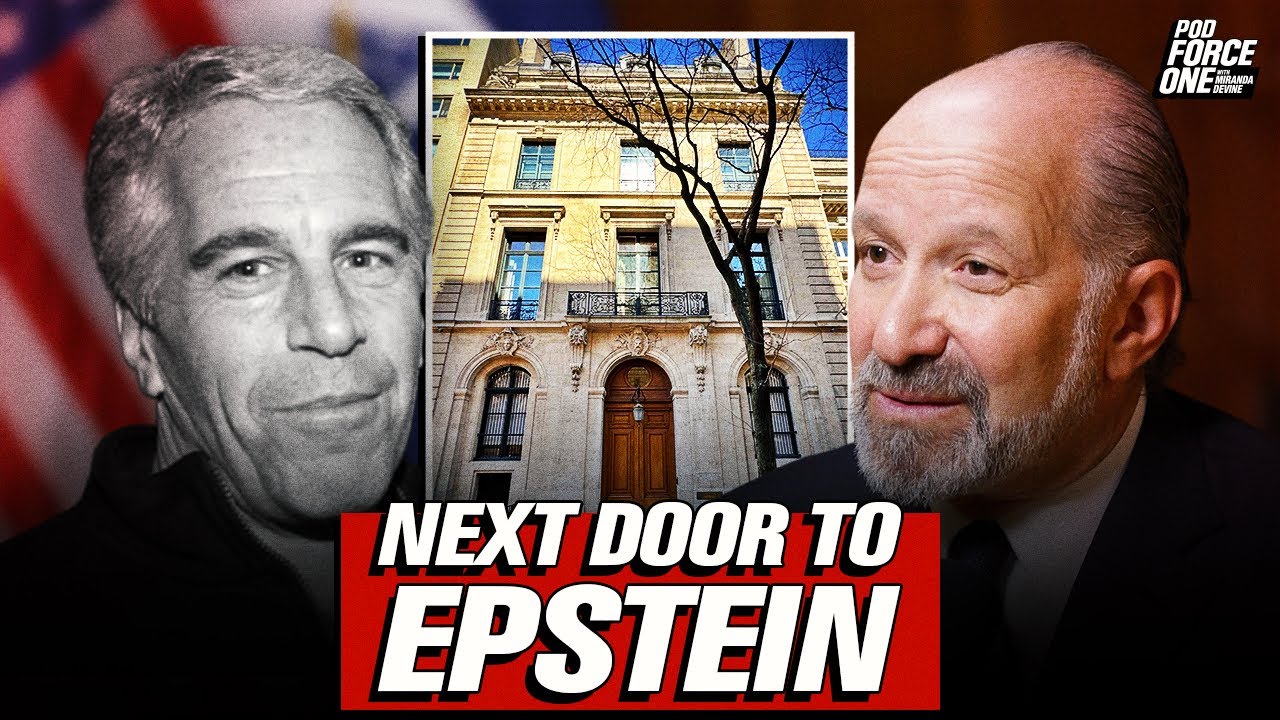 back in October. “So I was never in the room with him socially, for business, or even philanthropy.”
A visit in 2005 would have happened before Epstein was arrested for solicitation of a minor in 2006 and his sweetheart plea deal with federal prosecutors in 2008.
But this week, Lutnick was forced to acknowledge he did have interactions with Epstein well beyond 2005, including a visit to his Caribbean island, Little St. James, in 2012. Speaking at a Senate Appropriations Committee hearing on Tuesday, Lutnick was scheduled to testify on subjects like how the Commerce Department helps build broadband networks. Instead, he fielded questions about stuff like Epstein.
“I did have lunch with him, as I was on a boat going across on a family vacation,” Lutnick said about his 2012 visit to Epstein’s island. “My wife was with me, as were my four children and nannies. I had another couple, they were there as well, with their children. And we had lunch on the island. That is true. For an hour. And we left with all of my children, with my nannies, with my wife.”
Lutnick’s name appears in the Epstein files more than 250 times, according to the New York Times. The files show other interactions, including a meeting for drinks in 2011 and Epstein’s desire to meet Lutnick’s nanny in 2013. The Commerce Secretary testified Tuesday that he doesn’t know if Epstein met with the nanny and didn’t know what it was about.
As the Atlantic puts it, Lutnick’s story doesn’t make any sense. You can’t claim that you had nothing to do with Epstein after 2005 and then fess up to visiting the island of the most notorious sex criminal in modern American history in 2012, only after documents come out.
How much more is there to learn about Lutnick’s relationship with Epstein, whether it’s in the redacted Epstein files or from other sources? It’s a simple matter of credibility. Which brings us to questions that Lutnick faced about cryptocurrency.
Lutnick was asked about Tether during a hearing on , since the Commerce Secretary’s firm, Cantor Fitzgerald, holds a 5% stake in the company. Cantor Fitzgerald is also the asset manager for Tether.
“Generally speaking, I absolutely agree with you, Tether should be audited,” said Lutnick. “I don’t have anything to do with it, but I agree with you that tether should be audited.”
Lutnick has reportedly divested himself of his holdings, but his sons, Brandon and Kyle Lutnick, now run Cantor Fitzgerald. Brandon Lutnick, who’s just 27 years old, said during a conference in May 2025 that he personally checked Tether’s reserves. Your faith in the stability of Tether relies on the Lutnick family because there hasn’t been an independent audit of its books, no matter how much Howard Lutnick says he supports one.
Why does it matter what happens to Tether? Because it’s central to the crypto economy in a way that could create serious problems if it fails. Tether’s usefulness as a stablecoin is only sustained if people think it’s backed by something of value. If Tether is shown to not be backed by real assets and depegs, becoming worth significantly less than one American dollar for an extended period of time, faith in the entire system collapses. And that’s important because stablecoins are used to swap out cryptocurrencies like Bitcoin and Ether to convert them into fiat currency. They’re the dollar replacement in the system as people buy and sell crypto.
Democratic opposition has called out Howard Lutnick’s conflicts of interest and the dangers they pose to the broader economy. When Sen. Elizabeth Warren, a Democrat from Massachusetts, was opposing Lutnick’s nomination as Commerce Secretary, she specifically called out his relationship with Tether.
“You cannot serve as a booster for Tether while impartially fulfilling the Department of Commerce’s mission to ‘create the conditions for economic growth and opportunity for all communities’ as ‘economic growth has taken on increased importance for national security,’” Sen. Warren said in a statement at the time.
Crypto is teetering on the edge of the abyss these days. Bitcoin has fallen 50% since its all-time high in October, currently trading at around $65,000. And there are plenty of traders who expect it to fall even further, with some alt-coins getting hit even harder. The question is whether this collapse in price will spiral even further out of control should Tether’s reserves prove to be a mirage.
Tether says it’s backed by about $122 billion in U.S. Treasury bills, accounting for roughly 83% of its reserves. But without an audit, you just have to take the word of people like Howard Lutnick.
Lutnick is arguably under more pressure to resign than any other member of Trump’s cabinet. Semafor quoted an unnamed person “close to the White House” who acknowledged the heat, explaining that visiting Epstein’s island is “sort of the red line.” Even President Trump hadn’t been on the island, as far as anyone can tell based on the publicly available documents. Though, as Epstein’s “best friend,” Trump is certainly connected to the scandal in plenty of other ways. The president’s name appears in the new files over a million times, according to Rep. Jamie Raskin, a Democrat from Maryland.
Lutnick seemed to think it was exculpatory that he brought his family to Epstein’s island and invoked his wife in his defense on Tuesday.
“I know, and my wife knows, that I have done absolutely nothing wrong in any possible regard,” Lutnick said. “I have nothing to hide, absolutely nothing.”
---
1 day agoCommerce Secretary Howard Lutnick has acknowledged traveling to Jeffrey Epstein's island and meeting him on another occasion.
CBS News
https://www.cbsnews.com › news › howard-lutnick-jeffrey-epstein-in-business-together
Lutnick and Epstein were in business together, Epstein files show
Feb 7, 2026Lutnick, the former chairman of the financial services firm Cantor Fitzgerald who at one point lived next door to Epstein, told the New York Post in October that he and his wife Allison had cut ...
CNN
https://www.cnn.com › 2026 › 02 › 15 › politics › howard-lutnick-epstein-ties-trump
Lutnick's Epstein ties raise concerns on Wall Street - CNN
3 days agoHoward Lutnick, the highest-ranking Trump administration official prominently named in the Epstein files — outside of the president himself — has faced calls for his resignation on Capitol Hill.

AP News
https://apnews.com › article › jeffrey-epstein-files-howard-lutnick-2ead9f281ba2491e0581aced50a0533d
Howard Lutnick now says he met Epstein twice after 2008 conviction | AP ...
Feb 10, 2026Commerce Secretary Howard Lutnick has acknowledged that he had met with Jeffrey Epstein twice after the late financier's 2008 conviction for soliciting prostitution from a child.
---
MMA
---
an 2 26
Donald Trump's threats against a bridge connecting the U.S. and Canada flummoxed some of the leaders involved with its creation, but according to a New York Times report, the president's turn may be connected to the influence of a wealthy donor.
On Monday, Trump took to Truth Social with a threat to block the opening of the Gordie Howe International Bridge, a $4.7 billion project connecting Windsor, Ontario, and Detroit, which had been set to open soon. Trump claimed, falsely, that Canada would control both ends of the bridge and that it had been constructed using no American materials. Canadian Prime Minister Mark Carneytold reporters on Tuesday that he has called Trump and is working to resolve the matter.
“I explained that Canada paid for the construction of the bridge," Carney said. "That the ownership is shared between the state of Michiganand the government of Canada, and that in the construction of the bridge, obviously there’s Canadian steel and Canadian workers, but also US steel, US workers that were involved. This is a great example of cooperation between our countries.”
On Wednesday, the New York Times cited two anonymous administration sources who said that Trump's bridge outburst came only hours after Matthew Moroun, a Michigan-based billionaire and transportation magnate whose family owns the Ambassador Bridge, which also connects Windsor and Detroit. Moroun, the sources claimed, met with Trump's Commerce Secretary Howard Lutnick at the White House, with Lutnick later taking a call with the president shortly before his Truth Social post.
Moroun has been a prolific donor to Trump's political campaigns, and his business has long opposed the construction of the Gordie Howe International Bridge. Once opened, it will serve as a competitor to his family's own bridge and divert toll revenue away from it.
The new bridge, named for a late Detroit Red Wings hockey legend, was first proposed in the early 2000s and received approvals in the early 2010s, with construction finally commencing in the summer of 2018, during Trump's first term. As opposed to the Ambassador Bridge, the Gordie Howe is publicly owned. All throughout that time, the Moroun family, led by Matthew's father, Manuel Moroun, vigorously fought against it, alleging at one point that it violated the exclusive rights of his own bridge.
"The Moroun family has for decades mounted legal challenges to block or delay the competing project," the Times explained. "One of the challenges reached the Canadian Supreme Court, while the family has also lobbied extensively against it."
---
---
AN 12 25
Howard Lutnick, Donald Trump's Secretary of Commerce, seems to be "confused about rudimentary economic details," according to a new analysis from MS NOW, making verifiably false claims on a regular basis, and it's gotten worse with his most recent "completely wrong" defense of the economy.
Writing for MS NOW on Monday, Steve Benen, a producer for Rachel Maddow and regular contributor to the network, first highlighted claims Lutnick made back in September that "didn't make any sense." In a post to social media, the billionaire-turned-secretary claimed that the economy under former President Joe Biden "could never reach 3 percent."
However, as Benen pointed out, Biden's economy posted that level of growth "several times," and sometimes saw growth of 4-6 percent. In fact, the total growth for all of Biden's first year in office, 2021, was 6.2 percent, "the strongest in nearly four decades."
"Given that the Department of Commerce, which Lutnick ostensibly leads, is responsible for compiling and releasing GDP data, the secretary’s apparent confusion was difficult to defend," Benen wrote. Still, Lutnick's fundamentally incorrect claims got worse last week.
During an appearance on Fox News, the secretary cited recent preliminary economic data for the third quarter of 2025, including a 4.3 percent growth in the country's gross domestic product (GDP). Lutnick then claimed that this equated to American workers across the board getting a 4.3 percent raise in their income, a complete misrepresentation of what GDP actually is. As Benen explained, while wages and overall economic growth can often move in tandem, they are not inherently linked and move independently of each other all the time.
The question of why Lutnick says things like this, however, remains up in the air, but the trend suggests that he is either incompetent enough to believe the falsehoods he shares, or that he is deliberately using them to spin a narrative about Trump's economy, which voters have turned against considerably.
"The broader question is whether the head of the Commerce Department is genuinely confused about this, or whether he’s pretending to be genuinely confused about this," Benen wrote. "If it’s the former, how did Lutnick manage to get this job? (For that matter, how did he run an investment bank?) If it’s the latter, why would he deliberately choose to appear ignorant about basic information his own department released to the public?"
---
"GRIFTING NEPO-BABIES": The next generation of Trump ...}:

YouTube · MS NOW
30.2K+ views · 17 hours ago](https://www.youtube.com/watch?v=rChcwSozre8)
boulos sp husb tiffany
0:15
generation grifters or the grifting Nepo
0:17
babies. There's the adult sons of
0:19
Commerce Secretary Howard Lutnik, who
0:21
now help run their father's former Wall
0:22
Street firm, Caner Fitzgerald. Just
0:25
coincidentally, Canter Fitzgerald is on
0:27
track to have its best year ever. The
0:29
company has made more than double its
0:31
previous record in revenues. The Lutnik
0:34
boys made big bets on crypto crypto
0:36
which appear to have paid off. Then
0:38
there is Alex Witkoff, son of Steve
0:40
Witkoff, Trump's envoy to the Middle
0:41
East. According to the New York Times,
0:43
he's been quietly soliciting billions of
0:46
dollars from Gulf States including Qatar
0:48
on a planned investment fund focused on
0:50
commercial real estate projects in the
...
---
bannon 9 25
[## Steve Bannon: “Howard Lutnick, that blowhard is up there. That is — he should be fired. That is the worst performance out of a Secretary of Commerce.” 09/24/25
---
09/25/25 also on pdb
---
---
an 9 25
Steve Bannon – who was President Donald Trump's chief White House strategist in his first term — is now taking the gloves off in his criticism of one of Trump's most devoted Cabinet members.
The Daily Beast reported Tuesday that Bannon used the most recent episode of his "War Room" podcast to go after Commerce Secretary Howard Lutnick. Bannon particularly took issue with Lutnick's failure to explain the Trump administration's new policy of making employers pay a $100,000 fee for H-1B visas (which are used by companies hiring foreign workers). Lutnick said the fee would be $100,000 per year, prompting White House press secretary Karoline Leavitt to intervene and clarify that the $100,000 charge was a one-time fee, not an annual payment.
“These are not tiny details in the document,” Bannon said. “These are not in the footnotes. This is the deal. You’re supposed to be a deal guy. You’ve got to understand your own deal that you put before the president.”
Bannon has consistently maligned the H-1B visa program, arguing that its primarily used by tech companies to take jobs away from Americans and give them to workers brought in from overseas. Earlier this year he battled intensely with Tesla and SpaceX CEO Elon Musk over the H-1B visa program, which Musk insisted was necessary for companies who wanted to hire the most capable employees.
While the "War Room" host said he supported Trump's effort to make H-1B visas more costly, he reiterated that if it were up to him, he would axe the program entirely. And he slammed Lutnick for his apparent lack of knowledge about the most important details of the policy, which he chalked up to either stupidity or dishonesty.
"The Secretary [of] Commerce sat up there and gave not just erroneous information, but patently false information,” Bannon said. “During the show, in a hot take, I can sit and go, ‘that makes no sense,’ because, if that’s true, then, hey, we kind of won—the whole program, just shut the program down."
“That’s the heart of the deal,” he continued. “When you make a deal... This is the basic architecture. These are the key points. Those are the key points. You didn’t even know them. Either didn’t understand it or patently lied about it. You pick.”
“Don’t take it from me. See it with your own lying eyes," he added. "So if that’s the Secretary of Commerce, what information is the President of the United States going to get?”
---
WHEN WILL HE KILL THE STATS?
BASICALLY GO AROUND TABLE BROWN NOSING; BONDI WENT FROM 20M KIA TO 258! actually 70k last year
AN 525
NO LNX
Trump’s clown car cabinet is driving off a cliff
White House Press Secretary Karoline Leavitt reacts as she walks towards the White House, in Washington, D.C., U.S., April 10, 2025. REUTERS/Evelyn Hockstein
Sabrina Haake, Raw Story May 03, 2025
UPS, the United Parcel Service, just announced that it is laying off 20,000 employees and closing 73 of its buildings by the end of June. It attributes the downturn to reduced shipping volume from its largest customer, Amazon, due to Trump’s tariffs.
When a division of Amazon considered telling consumers the truth, by posting the costs tariffs added to the price of each imported product, the mere possibility set the White House on attack mode. Trump immediately called Amazon owner Jeff Bezos, who reassured him Amazon would never do such a thing, while Karoline Leavitt accused Bezos of a “political and hostile” act just for thinking about it.
When a presidential team of incompetent egoists calls truth-telling a “hostile act,” we’re in trouble.
Ruinous economic indicators prompt ruinous deflection
Trump’s first quarter report from the Bureau of Economic Analysis reflects a sharp contraction in the economy, showing an annual decrease in the GDP of 0.3 percent. Compared to Biden’s last quarter, when “real GDP increased 2.4 percent,” the data suggest that perhaps Trump isn’t the economic genius he claims to be.
These are not partisan data; that the Bureau falls under the US Department of Commerce suggests Trump may soon hobble its reporting capacity. For now, the data show economic contraction, reflecting a colossal reversal from Biden’s expansion. Wall Street sums up Trump’s first 100 days in office as the “worst for the stock market in half a century.”
On brand, when faced with these data, Trump lied, deflected, and blamed his predecessor, posting,“This is Biden’s Stock Market, not Trump’s. I didn’t take over until January 20th. This… has NOTHING TO DO WITH TARIFFS, only that (Biden) left us with bad numbers, but when the boom begins, it will be like no other. BE PATIENT!!!”
Trump continues to manufacture Biden’s “bad numbers”
Trump can’t stop parroting his own campaign lies about Biden’s economy. During the 2024 presidential campaign, when he wasn’t manufacturing a border invasion to enrage people, Trump repeatedly attacked Biden’s economy. It worked. While remaining mum on how his own COVID-19 mismanagement worsened the economy, he convinced 49% of voters that they were impoverished, despite economic indicators to the contrary.
After commerce reports came out this week, Trump doubled down. During an embarrassing televised cabinet meeting orchestrated to praise himself, Trump confirmed that he sought to undo everything Biden did to improve the economy, stating, “We came in and I was very against everything that Biden was doing in terms of the economy. … We took over his mess in so many different ways.”
Trump and his cabinet may drink their own economic Kool-Aid, but Wall Street is abstaining. Multiple indicators confirmed that Biden delivered the strongest post-COVID economic recovery in the world, including: growth and job creation that exceeded G7 and other advanced economies' growth in 2024; inflation control despite global inflationary pressures; avoidance of the post-COVID recession predicted by many; wage gains; strong market performance with record S&P 500 highs; and stellarinfrastructure investment that Trump, in a toddler-esque pique of jealousy, is scrambling to unravel.
During Biden’s term, the U.S. added 16 million jobs, low earners were experiencing wage growth, inflation levels approached the Federal Reserve’s target, and unemployment hit a 54-year low. By these metrics, Biden performed economic jujitsu, delivering an economy that The Economist called “the envy of the world.”
Teaching Trump media how to lie better
After Trump officially blamed Biden this week for economic contractions caused by his own ill-conceived tariffs, he went further, instructing right-wing media how to spin bad economic news of the future. During his televised “Praise Dear Leader” cabinet meeting, Trump told his preferred outlets (Fox, Newsmax, OAN) that they should also blame any economic downturns in the second quarter on Biden.
Trump showed similar intransigence during an interview with Terry Moran of ABC News about Kilmar Abrego Garcia, the man Trump is keeping in an El Salvador prison despite a Supreme Court order to facilitate his return. Trump insisted during the interview that an obviously photoshopped picture showed Garcia with “MS13” tattooed on his knuckles. When Moran told Trump that the image was clearly photoshopped, Trump acted like a tyrant. He first suggested Moran owed him something – it was thanks to Trump that Moran got the interview at all. Frustrated by Moran’s continuing refusal to lie, Trump told him, “you’re not being very nice,” before pivoting to attacking media as a whole, saying this “is why people no longer believe the news … It’s such a disservice…”
Discussing the Supreme Court order to facilitate Garcia’s return, Moran stated the obvious — that Trump could simply pick up the phone, call El Salvador’s President Nayib Bukele, and get him back. Trump confirmed that he is, indeed, flouting the Supreme Court’s authority, stating, “I could…. And if he were the gentleman that you say he is, I would do that.”
In one interview, Trump vacillated between being the all powerful Oz, and the cheap salesman behind the curtain. When Moran reminded him that the high court ordered him to return Garcia, Trump deflected, incredibly: “I'm not the one making this decision. We have lawyers who don't want to do this.”
Trump’s clown car cabinet is driving off a cliff
After the Supreme Court slapped the administration and ordered Garcia’s return with a 9-0 decision, White House adviser Stephen Miller simply lied about it. Miller claimed on Fox News that the administration had “won” the case, “clearly,” prompting a conservative columnist to retort, “Nope, you lost. Unanimously.” Fox viewers, of course, won’t hear that rejoinder as Fox anchors continue to throw falsehoods at the wall to see what sticks.
As Team Trump continues governing the country like a made-for-Fox-TV reality show, real-life consequences are piling up. China just canceled orders for American pork, soybeans, and lumber, putting US farmers in “full-blown crisis” mode.
Maybe, like dolls for Christmas, farmers can make do with selling one or two hogs instead of 30. As Trump put it during a town hall Wednesday night, he plans to defeat public skepticism over his tariffs through deception. “I just think that I’ll be able to convince people how good this is.”
NOW READ: Trump's rampage is out of control — but there's one way to stop it
Sabrina Haake is a 25+ year federal trial attorney specializing in 1st and 14th A defense. Her columns are or have been published in Alternet, Chicago Tribune, MSN, Out South Florida, Raw Story, Salon, Smart News, State Affairs, and Windy City Times. Her Substack, The Haake Take, is free.
---
6 25 no talk
Howard William Lutnick (born July 14, 1961) is an American businessman, philanthropist, and government official who has served as the 41st United States secretary of commerce since February 2025.
In 1983, Lutnick was hired at Cantor Fitzgerald under the mentorship of the firm's founder, B. Gerald Cantor. In 1990, Lutnick became president and chief executive of Cantor Fitzgerald. After a medical incident involving Cantor in 1995, he entered into a legal dispute with Cantor's wife, Iris, over Cantor's succession plans. Lutnick was appointed chairman of Cantor Fitzgerald after Cantor's death in 1996. He invested significantly in technology, establishing an electronic trading platform known as eSpeed. In the September 11 attacks, Cantor Fitzgerald lost 658 employees, including Howard's brother, Gary.
Lutnick was a fundraiser for Donald Trump's 2020 and 2024 presidential campaigns, as well as a vocal proponent of Trump's proposal to implement broad tariffs. In August 2024, he was named as the co-chair of Donald Trump's presidential transition. President-elect Trump named Lutnick as his nominee for secretary of commerce in November. A Senate Committee on Commerce, Science, and Transportation committee hearing for Lutnick was held in January 2025, and he was confirmed by the Senate in February. That year, Time listed Lutnick as one of the world's 100 most influential people.
Early life and education (1961–1983)
[
Howard William Lutnick[1] was born on July 14, 1961,[2] on Long Island, New York.[3] He was the second son of Solomon and Jane (née Lieberman) Lutnick.[a][8] Solomon was a professor of history at Queens College, City University of New York, while Jane was a painter and sculptor[1] who taught at the C.W. Post Campus of Long Island University.[9] Lutnick is of Jewish descent.[10] He was raised in Jericho, New York,[2] and attended Jericho High School.[11] In February 1978,[8] during Lutnick's junior year, Jane died of lymphoma. Lutnick attended Haverford College as a Division III tennis recruit.[12] In his first week of classes, Solomon died of a chemotherapy drug overdose, having suffered colon cancer that had metastasized to his lungs. Robert Stevens, the president of Haverford College, offered to waive his fees to the university. At Haverford, Lutnick became captain of the tennis team. He graduated in 1983 with a degree in economics.[3]
Career
Cantor Fitzgerald (1983–2025)
(left), Cantor Fitzgerald's corporate headquarters until its destruction.
After graduating, Lutnick worked at Noonan, Astley & Pierce as a broker for the United States dollar–Japanese yen exchange, where he met B. Gerald Cantor.[13] In 1983, Cantor took Lutnick as his protégé and hired him at his eponymous firm, Cantor Fitzgerald, encouraged by Rod Fisher, a partner at the firm and Cantor's nephew.[14] Within a year and a half, Lutnick had steadily ascended within the firm, becoming the chief executive of a division of Cantor Fitzgerald that managed the personal investments of Cantor and his associates. He brought additional clients, increasing its profitability to become one of Cantor Fitzgerald's most lucrative divisions.[15] By December 1990, Lutnick was appointed Cantor's successor in the event of his death.[14] In 1991,[16] after a failed attempt by Cantor Fitzgerald's president to oust him, Lutnick became the firm's chief executive[17] and president.[15] The following year, Cantor restructured Cantor Fitzgerald to a partnership and implemented a succession plan, abandoning his previous effort to give the company to a charitable foundation.[15]
In 1990, Cantor began undergoing kidney dialysis, and in December 1995, he was hospitalized in New York. Lutnick moved to implement a succession plan at Cantor Fitzgerald, allowing him to become a managing general partner at the firm. The lack of involvement of Cantor's family infuriated its members, including his wife, Iris Cantor, whose attorneys had argued with Lutnick's attorneys. In March 1996, Lutnick and his division, CF Group Management, filed a lawsuit in Delaware to enforce the plan, arguing that Cantor did not possess "sufficient mental capacity" to understand the legal documents he was signing. The New York Times noted that Lutnick had already lost the necessary support of the Cantors.[15] The partners settled in May, allowing Lutnick to retain management control while the Cantors hold a limited partnership stake.[18] In July, Cantor died.[19] As chairman[3] of Cantor Fitzgerald, Lutnick sought to broker deals with larger investment companies such as Deutsche Bank and Merrill Lynch.[20]
Lutnick heralded technology at Cantor Fitzgerald. In September 1998, the firm began electronic trading for futures contracts on Treasury bonds and notes,[21] developing eSpeed, an electronic trading platform, with an investment of US$250 million. eSpeed was released in March 1999.[16] In addition, Lutnick diversified Cantor's investments, seeking to establish a brokering business in Europe—spending at least US$43 million since 1994—and a futures exchange known as Cantor Exchange, though it traded significantly fewer contracts than its competitors, including the Chicago Board of Trade.[14] Businessman Michael Spencer noted that eSpeed had become a dominant market in Treasury securities trading, but had not achieved similar successes in other markets. By September 2001, eSpeed had created four dozen marketplaces, including TradeSpark, an exchange for natural gas and electricity.[13] After the Enron scandal, TradeSpark received a surge in usage.[22]
:{:{On September 11, 2001, al-Qaeda terrorists hijacked American Airlines Flight 11, crashing the plane into 1 World Trade Center, which contained Cantor Fitzgerald's corporate headquarters. Minutes later, a second hijacked plane United Airlines Flight 175 crashed into 2 World Trade Center. The plane crashes marked the beginning of the September 11 attacks. 960 employees worked for Cantor Fitzgerald in New York City;[23] All 658 employees who were in the office on the day of the attacks died.[24] Lutnick was scheduled to go into the office that day, but he had taken his son to kindergarten.}:
His brother, Gary, did not survive.[7] Cantor Fitzgerald's operations in London and New Jersey allowed eSpeed to continue trading.[25] Lutnick's interviews with Connie Chung on ABC News were widely publicized[26] and he became nationally recognized,[27] though he garnered controversy among the families of the victims for not paying deceased employees, whose paychecks had served as a safety net.[28] The American Red Cross offered as much as US$30,000 to the families of the victims after Lutnick appealed to the organization's president and chief executive, Bernadine Healy.[29]
Lutnick attended funerals for each employee killed for a month.[30] In October, Cantor Fitzgerald began distributing US$45 million to families.[31] In February 2002, the firm announced it would divide US$4.9 million in profit to survivors.[32]}:
[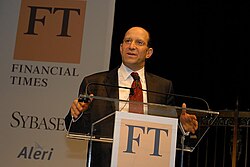 ](https://en.wikipedia.org/wiki/File:Howard_Lutnick,_Cantor_Fitzgerald_Chairman_and_CEO.jpg)Lutnick speaking at a Financial Times event in November 2007
:{:{A year after the attacks, Lutnick began negotiations to relocate Cantor Fitzgerald to Union Square, Manhattan, at 14th Street between Broadway and University Place, from the firm's temporary headquarters at 135 East 57th Street.[33][34] He requested US$50 million for the initiative from the United States Congress and formed a working relationship with Florida representative Bill Young, the chairman of the House Committee on Appropriations, but the final legislation signed by president George W. Bush did not explicitly mention Cantor Fitzgerald and was less than what Lutnick had requested at US$33 million.[33]}:
The deal later fell through, and Lutnick began considering 10 Hanover Square[35] before moving into 110 East 59th Street, fulfilling his vow to never return to Lower Manhattan.[36] By December 2002, Cantor Fitzgerald had 750 employees in New York.[23] In August 2004, the firm established a partnership, BGC Partners, for its voice brokerage business.[37] Lutnick was appointed the chief executive of Cantor Fitzgerald's fixed-income trading and sales business, succeeding Irvin Goldman, in October 2007.[38]}:
In January 2017, Anshu Jain, a former Deutsche Bank executive, joined Cantor Fitzgerald as its president;[39] Jain died in 2022.[40]:{:{ By September 2018, Lutnick was worth US$1.5 billion, according to the Bloomberg Billionaires Index.[41] Since 2020, Cantor Fitzgerald has invested in cryptocurrency, particularly Tether, a major cryptocurrency company which has been implicated in money laundering and sanctions evasion by regimes in Russia, Iran, and North Korea.[42]}:
In July 2024, Lutnick and presidential candidate Donald Trump spoke at a Bitcoin conference in Nashville, Tennessee, in which Lutnick announced Cantor Fitzgerald would open a US$2 billion lending facility with Bitcoin as collateral.[43] As of October, Cantor Fitzgerald manages the majority of Tether's reserve assets, including over US$80 billion in Treasury securities.[44] The firm has also invested in political endeavors, including by encouraging Rumble, an alt-tech video hosting company, to go public, advising a business operated by Omeed Malik, and investing in Strive Enterprises, an asset management company owned by Vivek Ramaswamy.[45]}:
In February 2025, after being confirmed by the Senate as the United States secretary of commerce, Lutnick named his sons, Brandon and Kyle, who were in their 20s, as chairman and executive vice chairman, respectively. In addition, Sage Kelly, Pascal Bandelier, and Christian Wall were named to lead Cantor's investment banking, equities, and fixed income divisions, respectively.[46]
Philanthropy (2001–present)
After the September 11 attacks, Lutnick donated US$1 million to the Cantor Fitzgerald Foundation.[7] He established the Cantor Fitzgerald Relief Fund, which began donating US$5,000 to families of victims with one or more children in October 2001.[31] Cantor Fitzgerald donated US$4 million to the fund in September 2002.[47] Cantor Fitzgerald and BGC Partners has held an annual charity day on September 11; by September 2014, the event raised US$101 million for non-profits dedicated to the attacks, including the September 11th Education Trust.[4] As of September 2006, the fund has donated US$180 million to families.[30] In 2008, Lutnick appeared on The Celebrity Apprentice, hosted by Donald Trump in a charity auction.[45] The Cantor Fitzgerald Relief Fund has also donated to hurricane relief, including Hurricane Harvey in 2017.[48] With senator Chuck Schumer, Lutnick appeared at P.S. 256 to personally donate US$1,000 debit cards to families affected by Hurricane Sandy.[49] He gave debit cards of an equal amount to victims of the 2013 Moore tornado.[50]
Lutnick is the largest benefactor to Haverford College.[51] As of October 2014, when he gave the largest single donation to the college—valued at US$25 million, he has donated US$65 million in total.[3] Lutnick's donations have gone towards the library, named after him; the Douglas B. Gardner Integrated Athletic Center; the Cantor Fitzgerald Gallery;[12] and the Gary Lutnick Tennis & Track Center, among other facilities.[52]
Political activities (2016–present)
[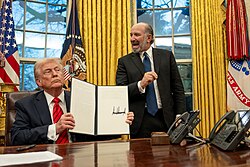 ](https://en.wikipedia.org/wiki/File:President_Donald_Trump_signs_Executive_Orders_%2854325856729%29.jpg)Lutnick with president Donald Trump in February 2025
Lutnick, a lifelong Democrat, is now a registered Republican; in an interview with The Wall Street Journal, he described himself as a fiscal conservative and social liberal who left the Democratic Party after he felt that the party had shifted further to the political left. In the 2016 United States elections, he donated to presidential candidate Hillary Clinton and Senate candidate Kamala Harris.[53] He later attributed those donations to his wife.[45] A Bloomberg News and OpenSecrets analysis found that the Lutnicks have given political donations since 1989.[45] In May 2019, The New York Times disclosed that Lutnick had hosted a fundraiser for U.S. president and presidential candidate Donald Trump that raised more than US$5 million.[54] Five years later, he hosted a fundraiser for South Carolina senator Tim Scott.[55]
Lutnick co-hosted a fundraiser for Donald Trump in London in June 2024 that was organized by Duke Buchan.[56] In August, he raised US$15 million[57] for Trump at his home in Bridgehampton, New York.[58] The event caused traffic delays from Riverhead to Amagansett through the night.[59] That month, Lutnick was appointed co-chair of Trump's transition team[60] overseeing personnel.[61] With Woody Johnson and Kimberly Guilfoyle, he committed to donate US$2.5 million and joined the Trump Victory Trust.[62] By September, he had raised US$11 million for Trump, according to Bloomberg News,[45] including a US$5 million donation to MAGA Inc.[63] He appeared at a rally for Trump at Madison Square Garden with Elon Musk in October.[53]
As co-chairman of Trump's transition team, Lutnick prioritized loyalty to Trump in his hiring decisions.[64] After meeting with Robert F. Kennedy Jr. in October, Lutnick claimed that he was convinced that vaccines cause autism, and that the National Childhood Vaccine Injury Act had allowed vaccine manufacturers to be reckless in the production process.[65] He told the New York Post that month that The Heritage Foundation, which led Project 2025, was "radioactive".[66]
Board memberships and assets
In January 2006, Lutnick was named to the board of the World Trade Center Memorial Foundation.[67] As of November 2024, he is a member of the Partnership for New York City's board[68] and Weill Cornell Medicine.[69] From July 2003 to June 2024, he served as a board member of the Horace Mann School.[70] Lutnick's financial disclosure form, released in January 2025, revealed that he had at least US$806 million in assets. He declared shares in GE Aerospace, GE Healthcare, The Walt Disney Company, Nasdaq, Inc., and the musical Kimberly Akimbo. In 2019 and 2023, he borrowed more than US$100 million from Bank of America.[71]
Secretary of Commerce (2025–present)
Nomination and confirmation
[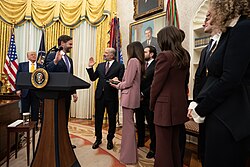 ](https://en.wikipedia.org/wiki/File:JD_Vance_administers_the_oath_of_Howard_Lutnick_as_Commerce_Secretary_%282025%29.jpg)Lutnick being sworn in by vice president JD Vance
Following the 2024 presidential election, Lutnick was being considered as secretary of the Treasury.[72] Within a week, discussions had narrowed to Lutnick and Scott Bessent, who was viewed as the front-runner until Lutnick began to advocate for himself. According to Politico, the decision was being delayed by Lutnick's role in providing information to Donald Trump.[73] The New York Times reported that Trump had expressed reservations about Lutnick, portraying him as a constant presence and a manipulator, leading to further delays as he broadened his list of candidates.[74] Lutnick was endorsed to the position by Elon Musk, a Trump advisor; Musk considered Bessent as a "business-as-usual choice".[75] On November 19, 2024, Trump selected Lutnick as his nominee for secretary of commerce.[76]
In the months after the election, Lutnick privately negotiated with companies and countries on Trump's economic policy. According to The New York Times, Lutnick privately encouraged Trump to seek a trade agreement with China, believing that he was in an advantageous position.[77] Lutnick appeared before the Senate Committee on Commerce, Science, and Transportation on January 29, 2025, where he promoted the second Trump tariffs and vowed greater action on China and its advances in artificial intelligence, particularly the release of DeepSeek R1.[78] In February 2025, The New York Times reported that he had been involved in discussions to offer Intel's manufacturing facilities to TSMC.[79]
Lutnick is sworn in as the 41st United States secretary of commerce, February 2025.
On February 18, 2025, Lutnick was confirmed by the Senate in a 51–45 vote.[80] Democratic senators Cory Booker and Gary Peters, and Republican senators Jerry Moran and Dan Sullivan did not vote.[81] He was sworn in on February 21.[82]
Tenure
Lutnick has supported Trump's trade policy, including the second Trump tariffs.[83] Prior to his confirmation, Lutnick was directed by Trump to impose reciprocal tariffs, telling reporters that the Department of Commerce's work would be completed by April 1.[84] In his first meeting with an international official, Lutnick—joined by United States Trade Representative nominee Jamieson Greer and National Economic Council chairman Kevin Hassett—discussed trade with Maroš Šefčovič, the European Commissioner for Trade and Economic Security.[85] Following his confirmation, Lutnick received a congratulatory letter from Wang Wentao, the Chinese minister of commerce, expressing dissatisfaction with U.S. tariffs on Chinese goods and that China was willing to resolve "respective concerns through equal dialogue and consultation."[86]
After Trump initiated a trade war with Canada and Mexico, Lutnick was involved in negotiations with foreign leaders.[87] In an interview on Meet the Press in March 2025, Lutnick said there was "no chance" of a recession due to Trump's economic policies.[88] According to Politico, he received internal criticism for the tariffs.[89] Later that month, Lutnick said the tariffs would be "worth it" even if they lead to a recession.[90] Lutnick explained the necessity of tariffs on Canada as follows, "If I move your factory where your grandfather worked and your father worked and you planned to work … to Canada, your life is ruined. Drugs, alcohol and suicide. And then fentanyl comes in and finishes the job."[42] Lutnick encouraged Fox News viewers to purchase stock in Tesla, stating that Tesla stock "will never be this cheap again", which allegedly violated federal ethics rules due to his federal government position.[91] In a podcast interview that month, he stated that only a "fraudster" would be concerned and complain about a missed Social Security check, so "the easiest way to find the fraudster is to stop payments and listen" for complaints.[92]
At the National Oceanic and Atmospheric Administration, Lutnick instituted a policy that all contracts over $100,000 had to be personally approved by him.[93] The policy caused a bottleneck and by April, contracts for maintenance and janitorial service at facilities, emergency alert translations, and web hosting had lapsed.[94] Later that month, Lutnick publicly promoted "great jobs of the future" for the United States, "where you work in these [factory] plants for the rest of your life, and your kids work here, and your grandkids work here", as he gave the example of factory robot technician jobs.[95]
Personal life
Marriage
In December 1994, Lutnick married Allison Lambert, a senior associate at Wilson Elser Moskowitz Edelman & Dicker.[1] Allison was appointed a trustee of the John F. Kennedy Center for the Performing Arts in February 2025 after President Donald Trump appointed himself as the center's chairman.[96] The Lutnicks have four children.[53]
Properties
In 1998, Lutnick purchased a Manhattan property at 11 East 71st Street, behind the Henry Clay Frick House, from the Comet Trust. The townhouse was previously owned by an entity associated with businessman Les Wexner and Jeffrey Epstein, a financier and child sex offender.[97] He had extensively renovated its interior renovations by May 2001.[98] Lutnick lived in Bridgehampton, New York, on a 40-acre property he purchased in 2003 for US$15 million.[11] In December 2024, he purchased Bret Baier's home in Washington, D.C., for US$25 million, setting the record for the most expensive house in the city. The property is inspired by the Château du Grand-Lucé.[99] According to The New York Times, the purchase—among others by wealthy members of the Trump administration—contributed to an increase in Washington, D.C.'s luxury real estate market.[100]
Health
In October 2021, Lutnick disclosed that he had been diagnosed with non-Hodgkin's lymphoma. He began chemotherapy shortly thereafter.[101] By September 2024, he was cancer-free.[45]
Awards
Lutnick is a recipient of the Navy Distinguished Public Service Award.[69] In 2025, he was named one of the world's 100 most influential people by Time.[102]
Notes
- Solomon and Jane had one child before and after Lutnick: Edith[4] "Edie"[5] (born 1959/1960[3][6]) and Gary (1964/1965–2001).[7]
References
---
NO LNX
'Gotta love billionaires': Trump official ripped after trying to 'gaslight' live audience
:{:{Howard Lutnick gestures as he speaks during a rally for Donald Trump at Madison Square Garden, in New York, U.S., October 27, 2024.}:
Commerce Secretary Howard Lutnick appeared to downplay the impact of President Donald Trump's tariffs while speaking at an event organized by Axios on Wednesday.
During his talk, Lutnick said, "You go to the store now, you feeling the pain of tariffs? No, because there is no pain."
"Do any of you feel anything? Seriously," he asked.
READ MORE: 'Really irresponsible': Outrage as White House has disappeared almost every Trump transcript
"Yes," members of the audience said in response.
A clip from the event showing this exchange went viral on social media, where the commerce secretary was accused of "gaslighting" the public.
"Put it in an ad ASAP," said political strategist Chris Jackson reacting to the clip on the social platform X.
"This is what it looks like when an out-of-touch administration gaslights ordinary Americans about rising prices," wrote the X account "Republicans against Trump."
READ MORE: There's a hidden provision in that big ugly bill that makes Trump king
"Gotta love billionaires telling everyday Americans they’re not actually feeling the pain of high prices in the grocery store," wrote MeidasTouch on its X account.
"Immediate harm and Trump budget blows out debt as they kill growth. Tariffs will be felt more over next 3, 6,9 months more and more. He knows it," wrote a user.
"Classic billionaire who has no idea how the rest of us live," said another.
In his remarks Wednesday, Lutnick acknowledged the hardship but maintained that tariffs on China were a necessary step — reiterating that consumer prices would remain stable.
READ MORE: 'Knew it was bad': Why a 'terrible idea' from Trump’s first admin is being blamed for air traffic woes
The secretary added that while the administration regrets the economic strain caused by the tariffs, it was a necessary part of addressing broader trade issues. He argued that resolving such challenges takes time.
Watch the video below or at this link.
---
2 25
When only a small group of people with extraordinary wealth have power over the government, our system is not responsive to the will of the people, but rather to the will of a handful of wealthy donors whose biggest concerns are lining their own pockets.
Yet, President Trump is rewarding his biggest donors with political favors and countless opportunities to enrich themselves at the expense of the American people.
In addition to funding his 2024 campaign, billionaires — with a combined net worth exceeding $1.2 trillion — also bankrolled President Trump’s inauguration.
But this was only the beginning. Case in point: Despite not being elected by the American people, billionaire Elon Musk's rise to power represents a dangerous new way Trump is manipulating our system so his biggest donors can use the government to line their own pockets.
Our government should not work this way. Presidents creating positions of power for and granting access to wealthy special interests as a thank you for their political donations is corruption and makes the executive branch less responsive to the will of the people.
Campaign Legal Center (CLC) has pushed for stronger campaign finance laws because the American people deserve a government that is transparent and responsive to all Americans, not just a tiny group of billionaires.
We hold all government actors — including Elon Musk — accountable to the laws that make sure public servants serve Americans and not their own business interests.
Elon Musk being gifted a position of power after financially supporting the Trump campaign makes our work fighting corruption more important than ever.
We must ensure that wealthy special interests cannot gain power through illegal coordination schemes, and we must hold all government officials to high ethical standards.
Americans are far too familiar with the ultra-rich using their wealth to access the halls of power. Campaign Legal Center has repeatedly sounded the alarm on the longstanding trend of presidents rewarding their biggest donors with powerful positions such as ambassadorships in their administration.
Now we’re witnessing President Trump reward his wealthy donors not only with ambassadorships, but also with positions in the Cabinet and new roles such as Musk’s unelected position that is influencing government decisions in the shadows.
While the public has little clarity on President Trump’s newly established “U.S. DOGE Service” (CLC has filed public records requests to bring clarity to the matter), Musk has already begun to exert sweeping control over agencies and the sensitive information they hold.
The experts in government agencies, like engineers, economists and scientists, help improve Americans’ daily lives and shouldn't be subject to threats and harassment by an unelected donor.
The Trump administration has already signaled that avoiding conflicts of interest will not be a priority for its political appointees.
The ethics pledge signed between his appointees and the Office of Government Ethics (OGE) has raised eyebrows by allowing several wealthy members of his administration to oversee matters they clearly have a vested interest in.
Perhaps nowhere are the dangers of conflicts of interest more apparent than with Elon Musk clearly standing to gain personal wealth from holding influence over the government’s approach to the federal budget and setting regulations.
He has many business interests intertwined with federal policy — from the hefty government contracts with his SpaceX rockets to the regulation of his electric vehicle company.
Now, in his largely undefined role with DOGE, Musk even has access to information about his company’s competitors.
While Musk only has money to gain, the American people have everything to lose — allowing a private citizen with billions in personal interest to dictate government actions threatens the public service mandate of our agencies.
The Supreme Court’s weakening of our campaign finance laws, the Federal Election Commission’s refusal to hold bad actors accountable and the lack of independent and enforceable ethics enforcement in our government have all played a key role in our country’s allowing only a few wealthy individuals to consolidate power.
However, we have the ability to uphold a government by the people and for the people before it is too late.
CLC will continue to hold the Trump administration accountable by uncovering and exposing corruption and self-dealing. We will also strenuously advocate for strong ethics laws and transparency requirements that ensure our officials remain beholden to the public good, not personal gain.
Now is the time to enforce the guardrails of democracy that will ensure that executive power cannot be auctioned off to the highest bidder by any president to come.
Campaign Legal Center will continue to push for transparent, accountable government at every turn.
Support CLC's work to make sure our government serves the American people, not the business interest of wealthy donors.
---
cnn
CNN —
Nearly three dozen of President-elect Donald Trump’s picks to serve in his incoming administration donated to his campaign or to the deep-pocketed outside groups that worked to elect him, a CNN analysis of federal campaign records shows.
They range from tech multibillionaire Elon Musk – who has emerged as the single largest, disclosed political donorof the 2024 presidential election – to others close to Trump tapped for key roles throughout government.
In all, eight of his Cabinet picks – led by Linda McMahon, the billionaire wrestling magnate Trump has selected to oversee the Education Department – and their spouses donated more than $37 million combined from their personal accounts to aid Trump, the review found, underscoring the proliferation of ultra-rich Americans now poised to shape US policy in the incoming second Trump administration.
(Two other Cabinet choices, New York Rep. Elise Stefanik and Florida Rep. Mike Waltz, transferred money from their campaign accounts to the pro-Trump effort.)
Musk has not been selected for a formal Cabinet job but is helping guide a new Department of Government Efficiency initiative and has played a pivotal role in the presidential transition – offering his views on job candidates, talking to world leaders and meeting with lawmakers on Capitol Hill as he weighs how to downsize the federal government.
In all, the SpaceX and Tesla chief executive donated more than $277 million to federal elections this cycle, the lion’s share of which – more than $262 million – benefited Trump. Most of Musk’s pro-Trump dollars flowed to a super PAC that the world’s richest man created to help turn out voters on the Republican’s behalf in key swing states.
Outside of self-funded presidential candidates, no individual has donated more to shape federal contests in a single election cycle, said Brendan Glavin, research director of OpenSecrets, a nonpartisan organization that analyzes money in politics.
Trump’s donors “are not just getting these sort of plum ambassadorships on the side,” Glavin said. “Major donors are getting positions that affect policy.”
The CNN analysis researched the more than 90 people that Trump had announced for high-level positions in the administration through Tuesday, which marked five weeks since his election victory. More than 30 of them had donated to his campaign or to one of the leading Trump-aligned outside groups, the review of FEC records found.
“Millions of Americans fed up with failure in the White House and federal government joined President Trump in the movement to restore our nation’s greatness. Some who will work with President Trump are among those millions of people who supported the campaign and helped the President win a decisive electoral victory,” Brian Hughes, a Trump transition team spokesman, said in a statement in response to CNN’s inquiry about donors joining the administration.
The total donations from Trump’s current Cabinet picks marks a surge from Trump’s first term. Five members of his original Cabinet had donated nearly $8 million to his committees or to the major outside groups supporting him, a review of campaign reports shows.
Donations from McMahon, who served as Trump’s SBA administrator in his first White House term, accounted for more than 90% of that total in the 2016 election.
The sums spent to aid Trump in 2024 far exceed the donations that President Joe Biden’s Cabinet members contributed to help him win the White House in 2020, FEC records show.
A dozen members of Biden’s Cabinet reported donations to his campaign or major super PACs involved in the 2020 election, giving less than $100,000 in total.
Billionaires in the administration
Musk’s spending dwarfed that of other supporters.
McMahon was the largest donor among Trump’s Cabinet picks and the second most generous contributor, after Musk, among the administration members announced through Tuesday, the review found.
Most of the $21.2 million she donated went to Make American Great Again, Inc., the main Trump-affiliated super PAC that spent heavily on advertising to aid his campaign.
Other seven-figure donors among Trump’s Cabinet picks include Cantor Fitzgerald chief Howard Lutnick, whom Trump has tapped to serve as Commerce secretary; Scott Bessent, the hedge fund executive Trump has selected to oversee the Treasury Department; and former Georgia Sen. Kelly Loeffler, his choice to head the Small Business Administration.
Loeffler’s husband, Jeff Sprecher, also was a major donor, contributing more than $2 million to the pro-Trump MAGA Inc. super PAC and Trump’s joint fundraising committee.
Sprecher is the CEO of the Intercontinental Exchange, which owns the New York Stock Exchange, and was at Trump’s side when the president-elect rang the opening bell at the exchange Thursday.
In an email, Loeffler’s communication director Caitlin O’Dea said, “Senator Loeffler is proud to be one of President Trump’s strongest supporters for the same reason a historic landslide of Americans voted to put him back in the White House: he will restore American prosperity, security, and opportunity.”
The billionaire embrace marks a turnaround of sorts for Trump, who saw corporate America recoil from him after the violent January 6, 2021, attack on the US Capitol. And he has seen new support from tech leaders who are pushing for fewer regulations from the federal government.
The staggering sums spent by Musk in this year’s election helped Trump close the financial advantage of his Democratic rival, Vice President Kamala Harris, who swiftly raised $1 billion after becoming her party’s standard-bearer in late July.
Super PACs face no limit on the size of donations they can receive or spend, but technically are not allowed coordinate their advertising decisions with the candidates they support.
However, a ruling this year by the FEC granting campaigns the ability to coordinate with outside political action committees on paid canvassing efforts freed up Musk to guide a ground game for Trump.
“The campaign finance system is a joke,” said Fred Wertheimer, who heads the Democracy 21 watchdog group and is a longtime advocate for limits on money in politics. “Musk is the example now of how campaign finance laws have failed.”
He said he worries about government departments led by billionaires who have no “interest in doing the job that the agency was assigned.”
Musk did not respond to inquiries from CNN.
But Tom Davis, a former congressman from Virginia who chaired the House Republicans’ campaign arm for several years, argues “there is nothing inherently wrong about people who made a lot of money wanting to give back through government.”
“The fact that they have contributed shows a degree of loyalty,” he added.
Friends and family
Presidents often reward donors and allies with plum positions – often dispatching them to glamorous, low-conflict posts in Europe or the Caribbean.
Some of Trump’s early picks for ambassadorships follow that pattern and include billionaires who donated to his reelection effort. Among them: Arkansas investor Warren Stephens, named as the US’ envoy to the UK, and Charles Kushner, Trump’s choice for ambassador to France – one of several extended family members or close friends who has been chosen for diplomatic gigs.
Kushner, who donated $2 million to pro-Trump efforts and received a presidential pardon at the end of Trump’s first term, is the father-in-law of Trump’s daughter, Ivanka. Another donor, Tom Barrack, who oversaw the fundraising for Trump’s first inauguration, is his choice as ambassador to Turkey.
And incoming special envoy to the Middle East, real-estate tycoon Steve Witkoff, is a longtime Trump friend and a partner in the cryptocurrency businesses that Trump launched with his sons earlier this year.
He donated $250,000 to a pro-Trump super PAC.
//
White House billionaires have no idea how Americans live (and don’t seem to care)
---
no lnx
Trump staffed his Cabinet with wealthy advisers. Some stand to gain even more from recent policy shifts
By Isabelle Chapman, Curt Devine, Majlie de Puy Kamp, Casey Tolan and Kyung Lah, CNN
Thu April 24, 2025}:
CNN
After staffing the wealthiest presidential Cabinet in modern American history with energy and banking titans, President Donald Trump has spent his first three months in office boosting those industries while dismantling long-established guardrails against government corruption.
A CNN review of Trump’s actions as he approaches the 100-day mark of his presidency found that as his administration has slashed the federal workforce and shaken the global economy with tariffs, the president’s team has made changes that could also directly benefit his Cabinet members or their former companies.
At the same time, by gutting traditional oversight bodies and embracing historically lax ethics rules, Trump has enabled conflicts of interest and greased the revolving door between government and the private sector. At least eight nominees for executive branch positions would have been banned or had limited roles under previous administrations – including Trump’s first term – due to their recent work as lobbyists, according to an analysis by the watchdog Campaign Legal Center that was reviewed by CNN.
Some potential conflicts have played out in plain view – like when Trump used the White House lawn last month to produce what seemed like an elaborate ad for key adviser and top donor Elon Musk’s struggling Tesla brand. The Trump administration has also cleared the way for Musk’s Starlink business to win new government contracts.
President Donald Trump and Elon Musk depart after looking at Tesla vehicles on the South Lawn of the White House on March 11, in Washington, DC.:
But other examples of possible conflicts are found deep in Cabinet members’ ethics reports, such as Energy Secretary Chris Wright’s disclosure that he would receive a million-dollar bonus – after his swearing-in – from the fracking company he founded, led and now plays a role in regulating.
Even as they’ve agreed to divest, some Cabinet members have found a loophole: giving control of certain assets to their adult children. Commerce Secretary Howard Lutnick handed the reins of his financial services firm Cantor Fitzgerald to his 27-year-old son, while Health and Human Services Secretary Robert F. Kennedy Jr. has said he would give his interest in litigation against a vaccine maker – part of an industry he is now tasked with regulating – to his adult son.
Some of Trump’s policies also could help his own business interests. By establishing a strategic Bitcoin reserve, the president is backstopping the value of the cryptocurrency, enriching existing holders of the asset, some of whom spent millions helping reelect the president. Meanwhile, Trump and his family have moved to expand their own crypto interests. And this week, Trump sent the value of his personal meme coin soaring by promising its top buyers a chance to dine with the president next month.
Many of the Trump administration’s early actions have pushed priorities that Republicans have sought for years, and the White House says its moves to slash regulations are needed to reduce spending and eliminate government inefficiency.
“The people elected me to do the job, and I’m doing it,” Trump said in March. “My administration will reclaim power from this unaccountable bureaucracy.”
But from cryptocurrency and energy policies to efforts as niche as rural internet access, some of the administration’s moves also closely align with the financial interests of his top advisers and the president himself.
“This administration seems entirely indifferent to ethics, and that contrasts certainly with the past several administrations, including Trump one,” said Richard Briffault, a Columbia University law professor who studies government ethics. “The level of complete indifference to it takes us back to before Watergate.”
‘Tearing down’ ethics rules
In the wake of the Watergate scandal, Congress passed sweeping ethics legislation to hold the executive branch more accountable.
Within weeks of beginning his second term, Trump flouted many of those decades-old protections – including by firing more than a dozen inspectors general and dismissing the head of the government’s ethics watchdog. He also signed an order making it easier for lobbyists to join agencies overseeing industries they used to represent.
The United States has spent years building up an “ethics infrastructure,” Briffault said. “In less than 90 days, this administration has been tearing (it) down.”
Trump’s unprecedented moves come as his Cabinet includes some of the richest people to ever hold the reins of power in the federal government. Many came straight from positions of power in key industries.
CNN analyzed dozens of financial disclosures and ethics statements filed by presidential appointees to track the wealth and potential conflicts of interest among Trump’s Cabinet members. The disclosures offer a limited picture of nominees’ finances: Officials are only required to list their assets in broad ranges.
Still, Trump’s leadership team appears to eclipse the wealth of any previous Cabinet going back decades. Of 21 Cabinet members, seven reported holding at least $10 million in assets, and some are even billionaires.
Lutnick – who has been a Wall Street power player since the mid-1990s – has an estimated net worth of $3.1 billion, according to Forbes. That’s roughly 15 times as much as the combined maximum reported net worth of former President Joe Biden’s entire outgoing Cabinet.
Five Trump Cabinet members reported holding individual assets worth more than $50 million, the highest range on disclosure forms. And that doesn’t include Musk, the world’s richest person with a net worth of about $371 billion, who as a special government employee is not required to publicly report anything about his wealth.
While Biden filled his Cabinet mostly with bureaucrats and politicians, Trump’s team also includes former CEOs who ran major energy and financial services companies before joining him in Washington.
“We’re seeing industry officials coming into the executive branch in a way that we’ve never seen in past administrations, including the first Trump administration,” said Danielle Caputo, senior ethics counsel for the Campaign Legal Center.
While supporters of Trump’s efforts say industry expertise helps officials better understand the fields they regulate, ethics watchdogs fear actions undertaken by highly-connected officials could benefit their former companies and colleagues instead of the American public.
Some moves could particularly benefit the super-wealthy. Musk’s Department of Government Efficiency, for instance, has taken a chainsaw to the Internal Revenue Service, which includes a unit that audits America’s ultrawealthy. Data obtained by CNN and first reported by the International Consortium of Investigative Journalists revealed that the Global High Wealth unit was hit by layoffs at a far higher rate through March of this year than the IRS as a whole.
Trump has also rescinded a Biden-era executive order creating ethics requirements for political appointees.
Members of the past three administrations — including those who worked under Trump during his first term — previously had to commit not to accept gifts from lobbyists. They were also banned from working on issues they lobbied on in the two years before their appointment, and after leaving government, couldn’t lobby on behalf of industries they’d recently regulated.
Those rules would have banned or limited the roles of eight Trump nominees, including three officials tapped for Environmental Protection Agency roles who lobbied for fossil fuel groups in recent years, according to an analysis by Campaign Legal Center shared with CNN.
Additionally, CLC found Trump has named at least six political appointees to serve as senior ethics officials, a role normally held by nonpartisan career officials.
Inspectors general across more than a dozen different agencies were fired during Trump’s first week in office. The IGs act as independent watchdogs, and the president is supposed to provide a 30-day notice to Congress before removing them, which Trump failed to do. Trump defended the move by suggesting some IGs had been “unfair” and firing them was “a very standard thing to do.”
The crypto stakes
On the campaign trail, Trump promised to make America the “crypto capital of the planet.” He kicked off his second term with moves to boost the crypto industry such as establishing a national bitcoin reserve, dissolving a Biden-era task force that investigated crypto criminals, installing a Musk ally as “crypto czar” and revoking a banking rule that discouraged financial institutions from owning crypto.
At the same time, Trump and his family have gotten deep into crypto by launching a new firm and the president’s own meme coin, a digital asset that has no underlying value and trades largely on hype. Trump also installed Lutnick, a banker who before his swearing-in was overseeing more than $1.5 billion in crypto-related investments, as his commerce secretary.
Lutnick has long pushed to legitimize bitcoin and other cryptocurrencies. Last October, while he was still CEO of Cantor Fitzgerald, he told a podcast host he had “hundreds and hundreds of millions” of exposure to bitcoin, presumably through crypto assets held by his firm.
Cantor Fitzgerald is now run by his son, which ethicists say leaves Lutnick with an improperly close tie to the firm’s success.
“By turning it over to a family member, you may not benefit directly, but you surely have an interest in the well-being of your child,” said Briffault.
Cantor Fitzgerald didn’t respond to requests for comment.
Howard Lutnick listens as President Donald Trump delivers remarks before Lutnick is sworn in as Commerce Secretary in February.
Meanwhile, Trump’s sons launched a digital currency company, World Liberty Financial, in 2024, and took an ownership stake in a bitcoin mining venture called American Bitcoin last month. Trump’s own media company announced plans earlier this year to potentially buy bitcoin and other cryptocurrencies.
At least eight top officials in the executive branch disclosed crypto holdings in their financial disclosures, although some agreed to divest the assets. Transportation Secretary Sean Duffy, HHS Secretary Kennedy and Center for Medicare & Medicaid Services Administrator Mehmet Oz each reported owning more than $500,000 in crypto assets.
An HHS spokesperson told CNN that “Secretary Kennedy continues to adhere to all ethical and legal requirements.”
So far, the Trump administration’s crypto moves haven’t led to a boom in valuations for digital assets. While the price of bitcoin, a bellwether for the $3 trillion crypto market, skyrocketed nearly 50% between Trump’s election victory and inauguration, it has fallen about 9% since then, mirroring broader stock market declines.
Still, Eric Talley, a Columbia University professor who studies corporate law, said he saw the Trump administration’s efforts to promote crypto, and specifically the strategic bitcoin reserve, as “particularly suspicious.”
“The economic stakes — if you were a heavy holder of crypto — would be huge and profoundly positive if you could cause the US government to essentially guarantee a big chunk of the stability of the market of at least some of the crypto issuances,” he said.
‘Energy dominance’
During his time in the private sector, former fracking executive Chris Wright was a zealous and vocal critic of government regulations meant to curb global warming. His company Liberty Energy filed a lawsuit that challenged a federal rule requiring companies to disclose details about greenhouse-gas emissions. In one video he posted on social media, Wright declared, “There is no climate crisis.”
Now, as energy secretary, Wright has authority to reverse some of the policies he railed against as Liberty’s CEO.
Wright has ordered the department to “build energy infrastructure and remove barriers to progress,” among other steps, to achieve US “energy dominance.” Under his leadership, the agency has ceased its pursuit of a net-zero carbon future, cut fossil fuel regulations and accelerated numerous natural gas export projects.
Inside the department, Wright has alarmed some staffers with his embrace of fracking over other energy projects. Four current Department of Energy employees, who spoke to CNN on the condition of anonymity for fear of retribution, described a general attitude of hostility toward most renewable energy. One staffer pointed to webpages that once promoted solar energy and have now been taken offline, and other employees described circulating lists of renewable energy programs that could be on the chopping block.
Having a former fracking executive run the energy department is “absolutely a conflict of interest,” one staffer said.
Some of Wright’s former Liberty colleagues have also followed him into the department, including his current scheduling director, one of his advisers and a Liberty board member who has been nominated to serve as an assistant energy secretary.
President Donald Trump holds an executive orders after signing a series of orders on American energy production during a ceremony in the East Room of the White House on April 8 in Washington, DC.
:
In the short term, falling oil prices due to economic turmoil under Trump could hurt fracking companies. But leaders at Wright’s former company have applauded the policy shifts. “We have an administration now that is working hard to remove some of the impediments that have been challenges,” Liberty Energy CEO Ron Gusek said at the New York Stock Exchange in March. “Those things give us a path forward to invest in our business.”
According to his ethics documents, Wright owned about $54 million worth of Liberty stock as of February, though disclosures show he sold off Liberty shares in recent weeks and moved money into general investment funds. He also disclosed that he would receive a roughly $1 million performance bonus for his work last year from the fracking company in March, after his swearing-in. A Liberty filing last month stated he received his bonus.
A Liberty spokesperson said, “To our knowledge, there has been no communication with Secretary Wright or any representative from the Department of Energy regarding Liberty Energy business.”
While the fossil fuel industry cheers Wright’s successes, some communities that expected financial help from the Department of Energy have faced roadblocks. Under a program funded by the bipartisan infrastructure law, for example, the department planned to disperse $500 million in grants to help schools in disadvantaged regions across the US improve their energy efficiency.
But multiple school district administrators told CNN that since Wright took over, the department has largely stopped communicating with them about federal funding from the program. Now, some districts fear they won’t receive all the money they were promised.
Brent Foster, who heads a committee to upgrade infrastructure at Mosier Community School in Oregon, points to the school’s century-old heater.
Mosier Community School, a public charter school in a rural Oregon county that voted for Trump, was awarded a roughly $870,000 grant from the program. That money could help replace the school’s unreliable century-old heater and windows that are currently held closed with tape, said Brent Foster, who leads a committee to upgrade the school’s infrastructure.
This year, the DOE has canceled meetings with the school about the grant and has not been processing requests related to the project, according to Foster, who said he doesn’t know whether the funds will ever come through.
Winning the grant “felt like a miracle,” Foster said. “The idea that the federal government would sign a contract… then pull the rug out from under us, it’s difficult to understand.”
An Energy Department spokesperson said the agency is reviewing all activities to ensure they follow the law and align with the administration’s priorities. “President Trump’s administration is advancing a strategy of energy addition – embracing all forms of energy that are affordable, reliable, and secure,” said the spokesperson, who added that Wright has complied with department ethics requirements.
A change that could help SpaceX
The federal government has earmarked tens of billions of dollars to close the digital divide, connecting millions of rural Americans to fast, reliable internet. And for years, Musk’s SpaceX has tried to become eligible for the funds, at times without success.
In 2022, the Federal Communications Commission rejected a nearly $900 million grant application by Starlink, SpaceX’s satellite internet system, saying the company failed to show it could deliver on the promised service.
Similarly, the $42 billion Broadband Equity Access and Deployment Program was specifically designed to prioritize the gold standard of broadband internet – fiber-optic cables – over other technologies such as satellite service.
But that changed rapidly after Trump took office. Lutnick announced last month that the Commerce Department would end “woke mandates” and “favoritism towards certain technologies.” In practice, that means potentially opening up billions in funding for satellite internet companies.
Lutnick’s directive could enable Musk’s company to earn up to $20 billion from the amended BEAD program, according the Wall Street Journal. Today, Starlink is uniquely positioned to provide commercial satellite-based internet. However, other companies, including Amazon, may compete for BEAD grants in the future.
Musk has long criticized the federal government’s rural internet efforts, claiming that had the FCC not rejected Starlink’s grant application in 2022, “it would probably have saved lives in North Carolina” after Hurricane Helene decimated the area. The BEAD program, Musk said, is an “an outrageous waste of taxpayer money” that is “utterly failing to serve people in need.”
SpaceX did not respond to requests for comment.
Experts say satellite-based internet service could play a useful role in connecting low-density remote areas. But many argue a fiber-optic connection is more reliable and weather resistant than what satellite service can offer today.
“Fiber can handle an almost unlimited amount of bandwidth. Fiber is scalable in terms of speed. Fiber is what we call ‘future proof,’” said Christopher Ali, a professor of telecommunications at Penn State University.
Lutnick’s move to change the program is now prolonging delays in getting shovels in the ground, even as the GOP has blasted the Biden administration over its failure to spend the money more quickly. Senate Majority Leader Sen. John Thune and 12 additional Republican senators, for example, have said the program has “onerous regulations” and moves slowly due to “unnecessary government interference.”
The Commerce Department didn’t respond to requests for comment.
Some states with approved BEAD proposals are waiting for the green light from the federal government before starting work while others are amending their proposals.
A final draft proposal dated March 2025 from West Virginia obtained by CNN details a plan to bring a fiber-optic internet connection to every resident in the state. But after Gov. Patrick Morrisey met with Lutnick later that month, he announced West Virginia would revise the proposal to “evaluate a broader range of technology options, including satellite.”
“The West Virginia Broadband Enhancement Council has always supported fiber deployment and continues to do so,” said Bill Bissett, who heads up the council.
“Every day we delay is another day that West Virginians who are underserved or unserved will not have access to this critical resource,” he added.
Because of Lutnick’s change, government officials will “re-run a process they’ve already completed solely to put satellite service in places that were going to get fiber,” said Evan Feinman, who until recently oversaw the rollout of the BEAD program. “That service will be dramatically slower, less reliable in bad weather … and will cost at least $800 more per year (per household) than the fiber connections would have been.”
The change in direction of the BEAD program is the “poster child for why people should be concerned about conflicts of interest” in this administration, said Briffault, the Columbia law professor, who spoke about how members of Trump’s inner circle could be putting a thumb on the scale.
“You cannot be confident that the decision is being made on the policy merits, as opposed to the influence of a self-interested individual who stands to make a ton of money on it,” he said.
CNN’s Yahya Abou-Ghazala and Anna-Maja Rappard contributed to this report.
---
---
MMA
MAGA media knives are out for Trump’s tariff advisers
Trump supporters are blaming some of Trump’s economic appointees — instead of Trump — for confusion and general turmoil over his tariffs
Written by Zachary Pleat
Published 04/14/25
Numerous right-wing media figures are placing blame for the chaos and confusion over Trump’s “reciprocal” tariffs on two of his top economic appointees — senior trade adviser Peter Navarro and Commerce Secretary Howard Lutnick — rather than on Trump himself.
When announced, Donald Trump’s April 2 “Liberation Day” tariffs amounted to one of the largest tax hikes in American history, and despite being labeled “reciprocal,” they had absolutely nothing to do with foreign tariff rates. These new rates, the highest in more than 100 years, caused widespread market volatility and are projected to raise costs for the average American family by thousands of dollars while also increasing the risks of a recession — if they go into effect.
A week after announcing the various tariff rates on dozens of countries, Trump announced a 90-day “pause” — after his press secretary previously called reports of such a pause “fake news” — aside from a universal 10% rate on every country except China, which now has a 145% tariff rate. The Trump administration then amended the tariff rate for Chinese-exported consumer electronics to 20%. This followed comments from Lutnick about a *different* tariff for electronics, specifically a sectoral tariff on semiconductors.
Pro-Trump media figures on Fox and elsewhere have been blaming Lutnick and Navarro for tariff-related confusion over the past week:
- Fox reporter Jacqui Heinrich: “Some confusion was spurred from the mixed messaging” from Commerce Secretary Howard Lutnick.Henrich aired a clip of Lutnick saying on ABC’s This Week that consumer electronics will be “exempt from the reciprocal tariffs” but will soon receive their own sectoral tariff. Earlier in the segment, Heinrich reported that Trump “said they are still subject to that 20% charge he imposed over fentanyl.” Fox News, *Fox & Friends*, [_{4/14/25}_]
- Fox Business anchor Maria Bartiromo blamed confusion on Lutnick and Navarro saying different things on different news programs. In an interview with Trump National Economic Council Director Kevin Hassett, Bartiromo said: “You had some of your colleagues out — Howard Lutnick was on one show, Peter Navarro was on the other show — and, you know, with some of them saying, well, there are no exemptions. And then somebody else saying, well, they’re going to be in a different bucket. It created some confusion.” Fox Business, *Mornings with Maria*, [_{4/14/25}_]
- Fox Business anchor Cheryl Casone: “I'm so glad he made that clarification on Air Force One. That's why it’s so good to have the president himself come out, because they’ve had some messaging missteps — not him, people underneath him.” Host Maria Bartiromo agreed with a guest who said, “I think this back-and-forth, this confusion that I feel after reading about this all weekend long is definitely part of the strategy in keeping the other side guessing what’s going on.” Fox Business, *Mornings with Maria*, [_{4/14/25}_]
- Former Trump adviser Steve Bannon: “Let me be blunt. Lutnick, who was Elon’s pick for secretary treasury, I think he’s close to being an unmitigated disaster. We should see a lot less of Lutnick on TV.” Real America’s Voice, *War Room*, [_{4/14/25}_]
- Fox Business host Charles Payne: “Mixed and confusing messaging” from Navarro and Lutnick “has the same gut-wrenching impact as an unnecessary holding penalty that negates a touchdown.” Payne also wrote: “Some people said I was too hard on my old friend Peter Navarro on Wednesday, but I was hard on messaging from him and Lutnick.” Twitter/X, [_{4/13/25}_]
- Fox Business senior correspondent Charles Gasparino quoted an anonymous “senior Wall Street executive w ties to the Trump White House,” saying: “Susie (Wiles) needs to get control of Lutnick. He is a wrecking ball.” Gasparino added that his source “described @howardlutnick’s comments about the temporary nature of the tariff exemptions as ‘off message.’” Gasparino’s quote continued: “Now the market will open way down again since it appears the administration is totally confused.” Twitter/X, [_{4/13/25}_]
- The Daily Wire’s Ben Shapiro: “If you wanna see a real bull market, the president should fire Peter Navarro today.” Shapiro added: “It would be stupid to continue running full speed into a wall in the name of Peter Navarro's benighted idiocy with regard to trade.” The Daily Wire, *The Ben Shapiro Show*, [_{4/10/25}_]
- Shapiro: Navarro “should be nowhere near trade policy.” Shapiro also said: “Peter Navarro, who is the architect of much of this trade policy, a man who used to be a zero-growther, actually, in his early career, and then called himself Ron Vara in his own writings to create a fake name under which to attribute many of his writings. It was like Voldemort. His last name is Navarro. Get it? Ron Vara? Get it? You don't? It's dumb.” The Daily Wire, *The Ben Shapiro Show*, [_{4/9/25}_]
- MAGA personality Ian Miles Cheong: “Navarro is out. He f’d everything up.” In an earlier post, Cheong wrote: “Navarro needs to go. Thank God Bessent was there.” Twitter/X, [_{4/10/25}_, 4/9/25]
- Trump operative Roger Stone: “The economy? More Bessent, less Lutnick.” Twitter/X, [_{4/9/25}_]
- Washington Examiner senior writer David Harsanyi: “Navarro is the Fauci of finance. I hope he's done.” Twitter/X, [_{4/9/25}_]
- Fox Business host Dagen McDowell ridiculed Navarro for “his reciprocal trade-girl math that's kneecapping the United States.” McDowell added: “The quicker that they get him off of TV and away from numbers, the better.” Co-host Jackie DeAngelis agreed, adding: “I actually think they realize that. I think they realize Bessent should be the point person on this, and they're putting him out there. I think they're gonna pull back on Lutnick, I think they're gonna pull back on Navarro a little bit too. They need to get clear on their messaging and make sure there's no nuance in there.” Fox Business, *The Bottom Line*, [_{4/7/25}_]
---
---
mma
Fox Business host ridicules “Peter Navarro and his reciprocal trade–girl math that's kneecapping the United States”
Dagen McDowell: “The quicker that they get him off of TV and away from numbers, the better”
Written by Media Matters Staff
Published 04/08/25
Video
From the April 7, 2025, edition of Fox Business' The Bottom Line
DAGEN MCDOWELL (CO-HOST): To be clear, I am all-in on a fair, level trading field. I am all-in on level tariffs with all nations. But I am not all-in on Peter Navarro and his reciprocal trade–girl math that's kneecapping the United States, because the trade deficit is not a hallmark of all the cheating that goes on. And I go back to something he said last week, that "we have calculated the tariff rate required to eliminate the trade deficit."
The United States issues the world's reserve currency. You can't eliminate the trade deficit. The quicker that they get him off of TV and away from numbers, the better. And I'm not going to call it girl math anymore, I'm going to call it Navarro math.
JACKIE DEANGELIS (CO-HOST): I actually think they realize that. I think they realize Bessent should be the point person on this, and they're putting him out there. I think they're gonna pull back on Lutnick, I think they're gonna pull back on Navarro a little bit too. They need to get clear on their messaging and make sure there's no nuance in there.
---
---
longtime hang ny? when ny elite and ceo shun?
an 4 25
Commerce Secretary Howard Lutnick, who passionately defendedthe administration's controversial tariff policy despite the resulting market chaos, is said to be the "most loathed" member of President Donald Trump's Cabinet.
According to a report by the New Republic published Tuesday, Lutnick has displaced tech billionaire Elon Musk as "the most loathed member of Trump's inner circle" for two reasons.
"The first is that he defeated efforts by Treasury Secretary Scott Bessent and National Economic Council Chair Kevin Hassett to limit the size and scope of Trump’s tariffs, which, if we’re lucky, will tip the United States economy into a recession. (If we’re unlucky, the tariffs will tip the global economy into a depression.)," the report said.
ALSO READ:'Strongman vibes': Trump plans military parade amid market crashes and federal job slashes
"The second reason Trump officials hate Lutnick is that nobody thinks he actually believes the hooey he spouts in furtherance of a maximalist tariff policy. In an administration overflowing with sycophants, no nose is burrowed more deeply inside Trump’s gluteus maximus than Lutnick’s," it added.
The report further notes that until last week, no one was more reviled within the Trump White House than "special government employee" Elon Musk. However, after Musk faced a significant setback with his $25 million investment in the Wisconsin Supreme Court election, which shattered his image of invulnerability, that disdain shifted to Lutnick.
Last moth, Politico quoted a source close to the administration as saying that the commerce secretary “is constantly auditioning for Trump’s approval."
ALSO READ:Trump nomination of crypto banker Howard Lutnick another 'win for the billionaire class'
“He’s trying to be a mini-Trump," the individual added.
Politico reported at the time that White House and administration officials were “growing increasingly frustrated with Lutnick." His “abrasive personality” and comments on the media displayed “a lack of understanding of even the basics about how tariffs and the economy work," the officials reportedly thought of Lutnick.
Meanwhile, Lutnick made an appearance on CBS News's "Face the Nation" on Sunday to advocate for the tariffs.
He said, “We’ve got to start to protect ourselves,” adding, “and we’ve got to stop having all the countries of the world ripping us off. We have a $1.2 trillion trade deficit, and the rest of the world has a surplus with us. They’re earning our money. They’re taking our money, and Donald Trump has seen this, and he’s going to stop it.”
ALSO READ:'We’re gonna do it': Commerce Secretary gives away Trump’s game plan on cutting Medicaid
---
TELLS FOX TO BUY TESLA B/C A BARGAIN
---
AN 3 25
One of President Donald Trump's closest advisors is now suggesting that most of the tens of millions of Americans who rely on Social Security wouldn't be concerned if they didn't receive their benefits.
During a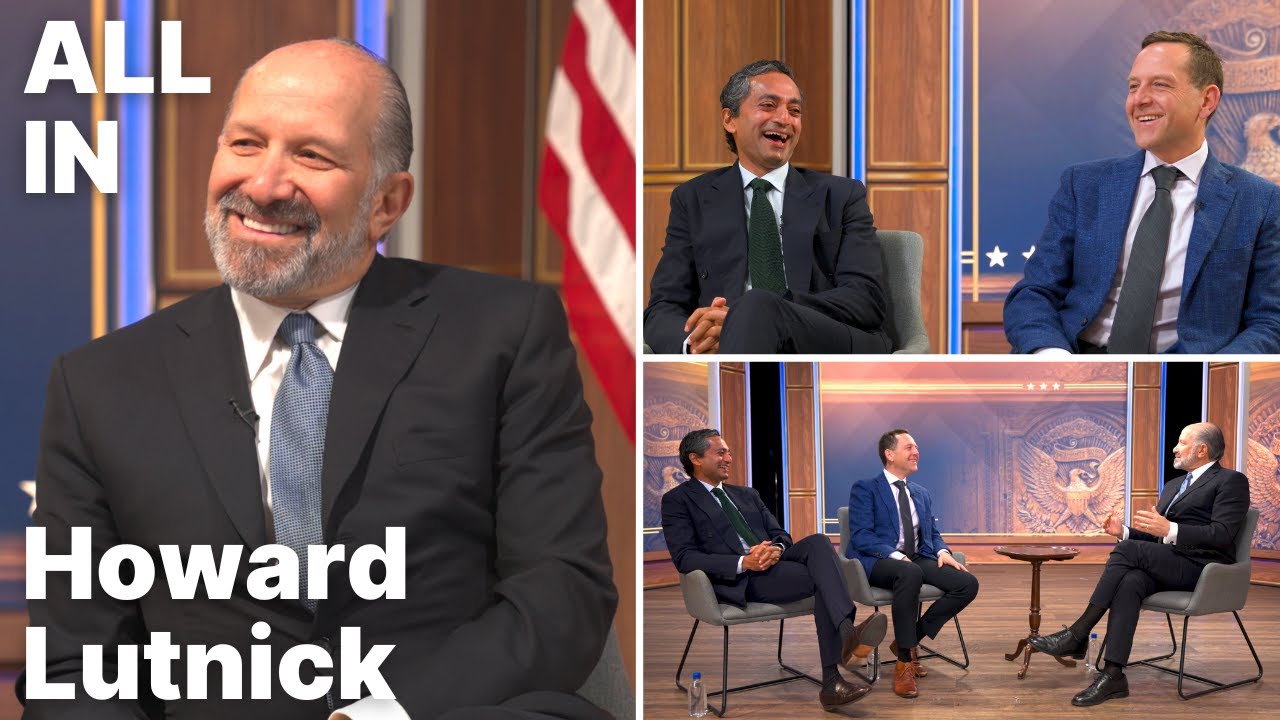 with Chamath Palihapitiya and David Friedberg, Commerce Secretary Howard Lutnick vociferously defended the Trump administration's mass firings and budget cuts to multiple federal agencies. He also heaped praise on South African centibillionaire Elon Musk's Department of Government Efficiency (DOGE) — particularly his controversial goal of cutting Social Security.
In one exchange, Lutnick — who has a net worth of approximately $2 billion according to Investopedia — suggested that the best approach to root out fraud within the Social Security Administration (SSA) was to "stop payments and listen." He also argued that only a "fraudster" would call the SSA if they missed their monthly Social Security payment.
READ MORE:'This is not right!' Elderly woman explodes at GOP senator over Social Security cuts
"I describe it to people this way: Let's say Social Security didn't send out their checks this month. My mother-in-law, who is 94, she wouldn't call and complain. She just wouldn't. She'd think something got messed up, and she'll get it next month," said Lutnick, who paid for his 16,250 square-foot mansion with $25 million in cash. "A fraudster always makes the loudest noise, screaming, yelling and complaining."
"Elon [Musk] knows this by heart," he continued. "Anyone who's been in the payment system and the process system knows the easiest way to find a fraudster is to stop payments and listen. Because whoever screams is the one stealing!"
Lutnick's assertion that Social Security beneficiaries would be unbothered by a missed payment ignores the fact that for millions of recipients, those monthly benefits are critical. According to the Center on Budget and Policy Priorities, nearly four in 10 American adults aged 65 and up would have incomes below the official poverty line without Social Security. Alex Lawson, who is executive director of the advocacy group Social Security Works, told AlterNet that Lutnick's remarks reveal "the problem with government by the billionaires for the billionaires."
"They have no idea what life is like for ordinary Americans. Living in lazy luxury means Lutnick cannot understand that for millions of Americans, missing a single Social Security check means they can’t eat, they can’t pay their rent, they can’t live," Lawson said. "I cannot imagine a more offensive and out of touch comment, it would be funny if it weren’t actually terrifying.”
READ MORE:'You work for us not Trump!' Protesters met with silence from Alaska U.S. senator
Watch the video of Lutnick's comments below, or byclicking this link.
---
an 3 25
One of the chief economic officials in President Donald Trump's administration recently admitted that prices for imported goods subjected to Trump's tariffs will indeed go up, and that the administration is in support of automating more factory jobs.
During a Thursday interview with CNBC host David Faber, Commerce Secretary Howard Lutnick was noticeably up-front when asked whether consumers would see higher sticker prices on store shelves. Faber asked Lutnick if prices will have to "eventually rise" if corporations move production back to the United States so companies can remain "competitive globally." Walmart, for example, imports roughly 70% of its non-food inventory from China.
"I think if you want to buy things from other countries, and you want to bring it into America, then the price is going to rise," Lutnick said. "But if you make it here, then of course the price won't rise! So make it here! Make. It. Here. How hard is that to say? You know, just keep repeating it to yourself: There's no tariff if you make it here."
READ MORE:'That's not a fact': CNN host cuts off Republican congressman after tense confrontation
"You're going to watch everyone come to that realization," he continued. "Apple builds it all in China. Why are they building it all in China and giving us our iPhone? Why don't they make it here?"
At that point, multiple voices cut in to remind Lutnick that it was "cheaper" for Apple to manufacture its products in China.
"Mr. Secretary, wages are lower over there!" CNBC correspondent Carl Quintanilla said.
"And now, there are robots who can do it!" Lutnick said after a brief pause. "You are going to see robotic production of iPhones, and the jobs that are going to be created. People who build those factories, the mechanics who work on those robots ... This is the re-creation of tradecraft in the United States of America."
---
AN 2 25
Although Trump promised not to touch Medicare, Medicaid, and Social Security last week, his new billionaire Commerce Secretary, Howard Lutnick, has now said otherwise.
“Social Security won’t be touched, other than if there’s fraud or something. It’s going to be strengthened. Medicare, Medicaid — none of that stuff is going to be touched,” Trump said last week.
Trump has also said he would "love and cherish" the programs. “We’re not going to do anything with that, unless we can find some abuse or waste,” he added. “The people won’t be affected. It will only be more effective and better.”
READ MORE:'Inaccuracies' on DOGE website suggest Trump admin is taking credit for cuts they did not make
Lutnick, who was co-chair of Trump’s transition team, said otherwise.
“When I set up DOGE with Elon, so back in October … I flew down to Texas, got Elon Musk to do it [set up DOGE], and here was our agreement: that Elon was gonna cut a trillion dollars of waste fraud and abuse,” Lutnick told Fox News’ Jesse Waters Wednesday.
“Think about it. We have almost $4 trillion of entitlements, and no one’s ever looked at it before. You know Social Security is wrong, you know Medicaid and Medicare are wrong. So he’s gonna cut a trillion and we’re gonna get rid of all these tax scams that hammer against America and we’re gonna raise a trillion dollars of revenue,” he continued.
“And our objective under Donald Trump is to balance this budget and I’m telling you, you watch and we’re gonna do it,” he said.
READ MORE:Busted: DOGE took credit for canceling $8 billion contract — but it was really $8 million
House Republicans’ budget plan, which Trump has endorsed, includes billions of cuts to Medicaid in order to finance Trump’s tax plan.
“Maybe he was lying during his Fox interview. Maybe he doesn’t know what’s in the House GOP plan he endorsed. Maybe he assumes the public won’t notice the contradiction,” writes Steve Benen at MSNBC. "Whatever the explanation, Trump’s incoherence both complicates his own party’s legislative strategy and imperils the future of a health care program that helps protect tens of millions of Americans," he added.
About 79 million people are enrolled in Medicaid, according to NPR.
"The level of cuts being discussed would be incredibly damaging and catastrophic for our hospitals," said Beth Feldpush, senior vice president of policy and advocacy at America's Essential Hospitals, a trade group, told NPR.
READ MORE:'Nobody knows what’s going on': Veteran calls out 'nerve-racking' government firings
---
First, it was over Trump’s nominee to be Treasury Secretary. The two finalists were Howard Lutnick, CEO of Cantor Fitzgerald and Trump’s co-transition chair, and Steven Bessent, the founder of the investment firm Key Square Capital Management.
Lutnick turned for help to Elon Musk, who posted on his X that Lutnick would be a better choice for treasury secretary than Bessent, because “Bessent is a business-as-usual choice, whereas @howardlutnick will actually enact change. Business-as-usual is driving America bankrupt, so we need change one way or another.”
I’ve spent quite some time around presidents and president-elects and even advised them about personnel decisions. The most basic rule of such advice-giving is you never make your advice public because it puts a president or president-elect in the awkward position of conspicuously backing you or not.
In this case, Trump didn’t back Musk’s candidate, and business-as-usual Bessent will be Treasury Secretary.
The problem for Musk isn’t that he lost this skirmish. It’s that he got into it publicly at all.
Strike one against Musk.
Then it was the matter of visas to foreign skilled workers.
Musk posted that they should be allowed into the United States. “The number of people who are super talented engineers AND super motivated in the USA is far too low,” Musk wrote on X. “If you want your TEAM to win the championship, you need to recruit top talent wherever they may be.”
But several notable MAGAs, such as Laura Loomer and Steve Bannon, disagreed, to put it mildly. Loomer told The New York Times that Musk is “not MAGA and he’s a drag on the Trump transition,” and said she believed that Musk was using his relationship with Trump to further enrich himself. “Elon wants everyone to think he’s a hero because he gave $250 million to the Trump campaign. But that’s not much of an investment if it allows him to become a trillionaire.”
Bannon warned Musk “we’re going to rip your face off.”
Trump seems to have sided with Musk on this one, at least for now, but it’s bad form to start or expose a rift among a president or president-elect’s key advisors.
Strike two against Musk.
Then there was the little matter of Musk’s apparent Nazi salute on stage before Trump’s arrival in Washington’s Capital One arena on Monday.
Musk says it was misinterpreted. Others condemned it as an intentional sign of solidarity with and outreach to far-right groups.
No matter. The last thing a president needs — even one who’s a neofascist like Trump — is to provoke public worry over his administration’s neo-Nazi leanings.
But let’s not call this a strike against Musk, at least just yet.
The bigger problem for Musk is he just cast doubt on Trump’s first major tech investment.
On Tuesday, with much fanfare, Trump announced a joint venture between OpenAI, SoftBank, and Oracle to create at least $100 billion in computing infrastructure to power artificial intelligence — dubbed “Stargate.”
Trump took credit for the companies’ decision to spend up to $500 billion building data centers, which are huge buildings full of servers that provide computing power.
But in two messages on X late last night, Musk said that the venture wouldn’t succeed because it didn’t have sufficient funding. “They don’t have the money," Musk wrote in reply to an OpenAI post on the announcement. “SoftBank has well under $10B secured. I have that on good authority.”
I don’t know if Musk is correct or if he’s just pissed off at OpenAI’s chief executive, Sam Altman. (Musk has his own AI company and has sued OpenAI and Altman for violating antitrust law. Altman took to X Wednesday morning to refute Musk’s assertion about insufficient funding.)
But that’s not the point. If you’re a president’s major advisor (and First Buddy, as Musk likes to say), you don’t do a public bowel movement on one of your boss’s first big initiatives.
Strike three.
Musk just moved into his office in the Old Executive Building next to the White House. but he’s already a loose cannon that makes Trump look weak and submissive. My guess is Musk is out within a week.
an common dr 11 24
Consumer advocacy group Public Citizen feigned surprise on Wednesday over President-elect Donald Trump's nomination of Wall Street CEO Howard Lutnick to lead the U.S. Department of Commerce.
"Oh look, another billionaire has made his way into Trump's Cabinet," said the group, noting Lutnick is also a promoter of cryptocurrency and a Trump megadonor. "The conflicts of interest are almost too many to count."
Among the conflicts are Lutnick's involvement in the crypto industry and federal and state cases against Cantor Fitzgerald.
In addition to running the Wall Street firm, Lutnick is a banker for the "stablecoin" company Tether; purchasers receive a Tether token for $1, with the proceeds invested in reserves and Treasury bonds managed by Lutnick's Cantor Fitzgerald.
As Public Citizennoted, New York Attorney General Letitia James found in 2021 that Tether and another crypto firm "recklessly and unlawfully covered up massive financial losses to keep their scheme going and protect their bottom lines."
The company is also reportedly under federal investigation over alleged criminal violations of anti-money laundering rules and sanctions.
Public Citizen also said that while co-chairing Trump's transition team, Lutnick "may also have helped arrange a meeting between Trump and Coinbase chief Brian Armstrong," who "helped steer a record amount of political spending from the crypto industry into the 2024 election."
Crypto firms poured over $119 million into directly influencing the 2024 federal elections, Public Citizenfound in August, making the industry's spending second only to that of fossil fuel companies.
As Politicoreported in October, even other members of Trump's inner circle have accused Lutnick of using his transition team co-chair position to take meetings on Capitol Hill and "talk about matters impacting his investment firm, Cantor Fitzgerald—including high-stakes regulatory matters involving its cryptocurrency business."
Lutnick's nomination, said former Labor Secretary Robert Reich, serves as a reminder that "Trump serves the oligarchy, not the people."
"Debris from crypto's political spending tsunami will jam up more halls in Washington than ever before if Lutnick is confirmed as secretary of commerce," said Bartlett Naylor, a financial policy advocate for Public Citizen. "The president-elect, who once correctly called bitcoin a scam, now surrounds himself with even more crypto enablers. Cryptocurrency won't return good jobs to the heartland or reduce food prices; it will only thin the wallets of those vulnerable to a now government-legitimized con."
Government watchdog Accountable.US pointed to more than $19 million in political donations Lutnick has made since 2009, nearly all of which went to GOP candidates and political action committees. He contributed $6 million to Trump's super PAC, Make America Great Again, Inc., in 2024 alone.
"Howard Lutnick's questionable qualifications to lead the Department of Commerce begin and end with his loyalty to the president-elect," said Accountable.US executive director Tony Carrk.
Tether isn't the only Lutnick-linked company that's been investigated for wrongdoing. The Securities and Exchange Commission fined Cantor Fitzgerald $1.4 million in 2023, saying the company repeatedly failed "to identify and report customers who qualified as large traders." The company also agreed to pay $16 million in fines to the SEC and the Commodity Futures Trading Commission in 2022 for using unauthorized communication channels.
Should Lutnick be confirmed as commerce secretary, Accountable.US said a "major regulatory conflict" could arise due to a dispute between the BGC Group, a spin-off brokerage of Cantor Fitzegerald, and futures and commodities exchange CME Group, over a competing trading platform BGC Group is launching.
"Lutnick's company's violations resulting in financial regulator fines and millions in right-wing political donations shows that political devotion takes precedence over actual experience to do the job in Trump's Cabinet," said Carrk.
Trump campaigned as a champion of working people as he railed against high grocery prices. As The New Republicreportedon Tuesday, Lutnick has showered Trump's plan for across-the-board tariffs with effusive praise—even as leading economists warn the plan to impose tariffs on foreign imports will pass higher costs onto consumers, not foreign countries.
"In September, Lutnick told CNBC that 'tariffs are an amazing tool for the president to use—we need to protect the American worker,'" wrote Edith Olmsted. "Lutnick also gushed about tariffs at Trump's fascistic rally in Madison Square Garden last month, claiming that America was better off 100 years ago, when it had 'no income tax and all we had was tariffs.' His high praise for tariffs came even as he admitted Americans would face higher prices as a direct result."
Lutnick's nomination, said Sen. Elizabeth Warren (D-Mass.), "is a win for the billionaire class at the expense of working people."
"The across-the-board tariff plan," she said, "is a distraction from the MAGA scam to extend tax giveaways for giant corporations and billionaires like Howard Lutnick."
an 11 24
Consumer advocacy group Public Citizen feigned surprise on Wednesday over President-elect Donald Trump's nomination of Wall Street CEO Howard Lutnick to lead the U.S. Department of Commerce.
"Oh look, another billionaire has made his way into Trump's Cabinet," said the group, noting Lutnick is also a promoter of cryptocurrency and a Trump megadonor. "The conflicts of interest are almost too many to count."
Among the conflicts are Lutnick's involvement in the crypto industry and federal and state cases against Cantor Fitzgerald.
In addition to running the Wall Street firm, Lutnick is a banker for the "stablecoin" company Tether; purchasers receive a Tether token for $1, with the proceeds invested in reserves and Treasury bonds managed by Lutnick's Cantor Fitzgerald.
As Public Citizennoted, New York Attorney General Letitia James found in 2021 that Tether and another crypto firm "recklessly and unlawfully covered up massive financial losses to keep their scheme going and protect their bottom lines."
The company is also reportedly under federal investigation over alleged criminal violations of anti-money laundering rules and sanctions.
Public Citizen also said that while co-chairing Trump's transition team, Lutnick "may also have helped arrange a meeting between Trump and Coinbase chief Brian Armstrong," who "helped steer a record amount of political spending from the crypto industry into the 2024 election."
Crypto firms poured over $119 million into directly influencing the 2024 federal elections, Public Citizenfound in August, making the industry's spending second only to that of fossil fuel companies.
As Politico reported in October, even other members of Trump's inner circle have accused Lutnick of using his transition team co-chair position to take meetings on Capitol Hill and "talk about matters impacting his investment firm, Cantor Fitzgerald—including high-stakes regulatory matters involving its cryptocurrency business."
Lutnick's nomination, said former Labor Secretary Robert Reich, serves as a reminder that "Trump serves the oligarchy, not the people."
"Debris from crypto's political spending tsunami will jam up more halls in Washington than ever before if Lutnick is confirmed as secretary of commerce," said Bartlett Naylor, a financial policy advocate for Public Citizen. "The president-elect, who once correctly called bitcoin a scam, now surrounds himself with even more crypto enablers. Cryptocurrency won't return good jobs to the heartland or reduce food prices; it will only thin the wallets of those vulnerable to a now government-legitimized con."
Government watchdog Accountable.US pointed to more than $19 million in political donations Lutnick has made since 2009, nearly all of which went to GOP candidates and political action committees. He contributed $6 million to Trump's super PAC, Make America Great Again, Inc., in 2024 alone.
"Howard Lutnick's questionable qualifications to lead the Department of Commerce begin and end with his loyalty to the president-elect," said Accountable.US executive director Tony Carrk.
Tether isn't the only Lutnick-linked company that's been investigated for wrongdoing. The Securities and Exchange Commission fined Cantor Fitzgerald $1.4 million in 2023, saying the company repeatedly failed "to identify and report customers who qualified as large traders." The company also agreed to pay $16 million in fines to the SEC and the Commodity Futures Trading Commission in 2022 for using unauthorized communication channels.
Should Lutnick be confirmed as commerce secretary, Accountable.US said a "major regulatory conflict" could arise due to a dispute between the BGC Group, a spin-off brokerage of Cantor Fitzegerald, and futures and commodities exchange CME Group, over a competing trading platform BGC Group is launching.
"Lutnick's company's violations resulting in financial regulator fines and millions in right-wing political donations shows that political devotion takes precedence over actual experience to do the job in Trump's Cabinet," said Carrk.
Trump campaigned as a champion of working people as he railed against high grocery prices. As The New Republicreportedon Tuesday, Lutnick has showered Trump's plan for across-the-board tariffs with effusive praise—even as leading economists warn the plan to impose tariffs on foreign imports will pass higher costs onto consumers, not foreign countries.
"In September, Lutnick told CNBC that 'tariffs are an amazing tool for the president to use—we need to protect the American worker,'" wrote Edith Olmsted. "Lutnick also gushed about tariffs at Trump's fascistic rally in Madison Square Garden last month, claiming that America was better off 100 years ago, when it had 'no income tax and all we had was tariffs.' His high praise for tariffs came even as he admitted Americans would face higher prices as a direct result."
Lutnick's nomination, said Sen. Elizabeth Warren (D-Mass.), "is a win for the billionaire class at the expense of working people."
"The across-the-board tariff plan," she said, "is a distraction from the MAGA scam to extend tax giveaways for giant corporations and billionaires like Howard Lutnick."
===
an rr 11 24
the two finalists to become Trump’s Treasury Secretary — the person will have a major hand in cutting taxes for the wealthy and raising tariffs so everyone pays more — are Howard Lutnick, who’s CEO of Cantor Fitzgerald and Trump’s co-transition chair, and Steven Bessent, the founder of the investment firm Key Square Capital Management.
Lutnick had been in the lead but a few days ago, according to the The Wall Street Journal, he heard from Trump’s allies that he might not get the nod.
So Lutnick turned for help to Elon Musk, who now calls himself Trump’s “First Buddy.” Bessent’s supporters also reached out to Musk to endorse Bessent, which tells you alot about the palace intrigue going on now in Mar-a-Lago, and how much power Musk is now wielding.
Yesterday, Musk, posted on his X that Lutnick would be a better choice for treasury secretary than Bessent:
“My view fwiw is that Bessent is a business-as-usual choice, whereas @howardlutnick will actually enact change. Business-as-usual is driving America bankrupt, so we need change one way or another.”
I’ve spent quite some time around presidents and president-elects and even advised them about personnel decisions. The most basic rule of such advice-giving is you never make your advice public.
Doing so puts the president-elect in an impossible position: If he does what you’ve publicly urged him to do — even if he was going to do it anyway — your public advocacy makes it lookas if you pushed him into it, so he seems to be your patsy.
If the president-elect is Donald Trump, who thinks mainly in terms of dominance and submission, you’re playing with fire.
Bad enough that Musk broke this basic rule. He went even further, publicly encouraging his nearly 205 million followers on X to weigh in, in favor of Lutnick.
So Musk has very publicly cornered Trump. If Trump names Lutnick, it looks as if all Musk needs to do from now on is publicly urge Trump to do this or that, with the implicit threat of getting his 205 million followers stirred up to follow suit, and Trump will do it. Musk becomes de facto President.
I don’t know what Trump will do but I’m sure he’s seething. The most likely outcome is Trump doesn’t offer the job to either Lutnick nor Bessent, and fires Musk.
Musk’s public advocacy of Lutnick because he will “enact change” rather than “business-as-usual” also signals Musk’s and Trump’s criterion for filling high-level positions (besides unbridled fealty to Trump): The picks don’t need to know anything or share any large vision of the public good. They just have to be bomb-throwers who’ll shake things up.
The worst that can be said of any candidate is he’ll govern as usual.
Trump is well on his way to “crush the system,” as he promised — which most Americans appear to want because the “as usual” system has for decades been rewarding big-money donors, monopolists, CEOs living off government contracts (like Musk) and fat-cat denizens of Wall Street (like Lutnick and Bessent) — all of whom have been siphoning off most economic gains for themselves.
But if the new system that Trump installs (with or without Musk’s help) siphons off even more of the gains for those at the top, while destroying what’s left of our democracy, most Americans will find themselves even worse off and more resentful.
===
===
Top Trump Aide Makes Terrifying Threat at Madison Square Garden Rally
A speaker at Donald Trump’s Madison Square Garden rally in New York City made it clear exactly what the Trump team thinks about Muslims.
At Donald Trump’s rally in New York’s Madison Square Garden Sunday, one speaker took a bigoted swipe at Muslims—and he holds an important position in the Trump campaign.
Howard Lutnick, the CEO of financial services firm Cantor Fitzgerald and a co-chair of the Trump campaign’s transition team, told the crowd why they should vote for the former president and, raising a fist, invoked Islamophobia.
“So, the first thing: We must elect Donald J. Trump president because we must crush jihad,” Lutnick shouted to cheers.
Lutnick’s use of the word “jihad” in this context is an allusion to bigoted views about Islam. The term is widely mistranslated as “holy war,” when the literal Arabic translation is “to strive” or “to struggle.” In a religious context, the word is used to describe a person’s internal or external struggle to do good deeds.
The comments undermine the Trump campaign’s recent efforts to woo Arab American and Muslim voters, particularly in the battleground state of Michigan. Trump has a narrow lead among Arab American voters over Kamala Harris, and has found an opening due to the Harris campaign’s neglect of the community.
Harris has campaigned in Michigan with former Representative Liz Cheney, the daughter of former Vice President Dick Cheney, drawing the ire of the state’s Arab American community, which includes 90,000 Iraqi Americans who remember the elder Cheney’s support for the U.S. invasion of Iraq in 2003 as well as his daughter’s reputation for supporting torture and anti-Muslim bigotry.
The state also boasts large Lebanese and Palestinian communities who are seeing the Biden administration’s staunch support for Israel’s brutal bombing campaign in Gaza and Lebanon as the Biden administration continues to make no progress on a cease-fire or arms embargo. At the Democratic National Convention in August, Harris’s campaign neglected to highlight Palestinian, Arab, or Muslim voices on the stage.
But Harris has some good news in Arizona, where last week more than 100 Palestinian, Arab, Muslim, and progressive Democrats and community leaders in the southwestern battleground state signed a letter supporting her campaign. The vice president’s campaign will have to hope that statements like Lutnick’s, as well as Trump’s own bigoted record on Islam and Muslims, will help her win over more of the crucial vote.
===
nat mag
10 24
when I told people I was planning to attend Donald Trump’s rally at Madison Square Garden yesterday afternoon, they all expressed worries about my safety. “You’re going to the Nazi rally? Be careful!” Somewhere in my bookshelves I have a dusty copy of *Under Cover*, the Armenian American journalist Arthur Derounian’s account of his travels among the German-American Bund and other homegrown fascist groups in the 1930s and ’40s. Famously, back in February 1939 the Bund held a big rally at the old Madison Square Garden—hence my friends’ concerns that I was putting myself in harm’s way.
Having attended dozens of Trump’s rallies since 2015, I’ve never once felt in any physical danger. It’s true that in 2016 some protesters were roughed up by the crowd—to the candidate’s evident approval. At times the staging of his events seems right out of the Leni Riefenstahl playbook—lots of motorcycle cops in shiny leather boots escorting the candidate’s limo, with big vertical banners flanking the stage. And reporters in the press pen often come in for verbal abuse by the candidate, an indignity I generally avoid by sitting up in the bleachers among the believers. (On Sunday, he goaded the Garden crowd into booing the “fake news.”) But the only injuries I’ve ever suffered on such occasions have been emotional—the ordeal of having to listen to so many lies, repeated so often, and with such apparent conviction.
Besides, after nine years I’ve grown numb to Trump’s mendacity. As for the Nazi menace, the first thing I saw turning the corner onto 33rd Street was a pack of young Yeshiva bochers with long payesscurled under their red MAGA caps watching the warm-up acts livestreamed onto their cell phones. This was a much less diverse crowd than showed up for Trump’s rally in Crotona Park in May—and also a less confident one. Back in the spring, with a Biden-Trump rematch in the offing and victory for their man seemingly preordained, the atmosphere was carnivalesque. At the Republican convention, the delegates were even more notably good-humored. All that ended, though, when Biden withdrew in favor of Kamala Harris.
What took its place? Outside the Garden, a kind of sullen impatience, enlivened only a little by the free T-shirts handed out by Kalshi, the political betting site whose operations werejust sanctioned by a federal appeals court last week. (The shirts, urging punters to “Bet on Trump” quoted him at 57 percent odds—though by the time the rally ended, that had risen to 62 percent.) Penned in by police barricades, it took us nearly three hours to trudge from 6th Avenue down toward the entrance to the arena on 7th. With Trump scheduled to begin speaking at 5, people began to leave—an exodus encouraged by the lack of any toilet facilities, and the proximity of the Long Island Railroad and New Jersey Transit terminals at Penn Station. Finally, the police announced that the Garden was full, and that no one else would be admitted. At which point, my strategy of blending in with the crowd began to seem like a mistake, and I asked for directions to the press entrance, only to find that it, too, had been closed down.
So I, too, went home (to Brooklyn), where I turned on the TV in time to catch Vivek Ramaswamy describe New York as a “swing state.” That’s a bet I would happily take. But then if you’d told me in 2020 that Tulsi Gabbard would be speaking at a Trump rally, describing the man who urged the US to let Bibi Netanyahu “finish the job” in Gaza as the peace candidate, I wouldn’t have believed that either. And if you’d offered me a trifecta of Gabbard, RFK Jr., and Trump on the same podium I’d probably have taken that bet, too.
Yet there he was, America’s favorite amateur taxidermist, peddling his patent blend of paranoia and preposterous bullshit (dipped in Kennedy charisma and served with a sprinkling of radical rage), looking only a little less out of place than Dr. Phil, who delivered a touching homily on the need to stand up to bullies. Was Elon Musk listening? Was anyone? The audience seemed mostly baffled, and though they dutifully clapped at Kennedy’s attacks on the medical establishment, big business, and the CIA, you could tell (even if Kennedy clearly can’t) that their hearts weren’t in it.
Which is something no one can say about Howard Lutnick, CEO of Cantor Fitzgerald—the Wall Street firm that lost 658 employees on 9/11—and the chair of Trump’s transition team. Bounding to the podium shouting,“We must elect Donald J. Trump because we must crush jihad!” (which must have come as a shock to the Trump faithful in Hamtramck), Lutnick then embarked on a long reverie outlining his version of Making America Great, which involved doing away entirely with income tax. In a less target-rich media environment, Lutnick’s whole speech—which included anti-Muslim hatred, making the world safe for Wall Street billionaires to hoard their wealth, and the kind of blatant self-dealing that has apparently even repelled some Trumpworld insiders—would have received the scrutiny it deserved. Instead, he functioned mainly as Elon Musk’s second banana, a bearded Pepper Potts to Musk’s smirking Tony Stark.
Having missed the obscure comedians and radio talk show hosts whose racist warm-ups made the headlines, I had to console myself with Musk, Hulk Hogan, and the Trump family love-in (which, bizarrely, was being broadcast live in its entirety on PBS). As usual at such events, the level of casual bigotry was high enough to deter the fainthearted. But then the ability to believe “they’re not talking about me” has always been the price of admission for people of color at Trump events. Standing on line behind the Hasidim, I overheard a man with an English accent and white nationalist tattoos explain to his companion—a young Pakistani man whose red cap proclaimed “Joe and the Ho Gotta Go”—how unfairly the press treat Tommy Robinson, whose anti-Muslim rhetoric helped set off days of deadly rioting this summer in Britain.
Whether Trump gets the chance to show he really “means it” when he says he wants to round up millions of immigrants, jail his political opponents, replace Social Security with private accounts (managed, perhaps, by his friends at Cantor Fitzgerald), and turn the military on domestic dissenters is a matter that may be settled in just over a week. For all our sakes, I hope we never find out.
===
ggl 10 24
Fox News
Howard Lutnick says 2024 is a 'fundamental' election: 'I'm all in for Donald Trump'
Cantor Fitzgerald chairman and CEO Howard Lutnick joins 'Fox & Friends' to discuss former President Trump's record on the economy and the...
.11 hours ago
Politico
Trump transition chief under fire for conflicts
Howard Lutnick, the Wall Street CEO heading up Donald Trump's transition operation, is facing accusations from some Trump insiders that he...
.5 days ago
The Nation
20,000 Out-of-Towners Fill Madison Square Garden for Trump
Calling Trump and his supporters Nazis misses the genuine danger the fake billionaire and his authentically plutocratic friends pose to our...
.5 hours ago
Inquirer.com
Howard Lutnick, Haverford College’s largest donor, could shape a second Trump administration
It's a significant leap into politics for the Cantor Fitzgerald CEO, who has given $65 million to Haverford over several decades.
.5 days ago
Blue Water Healthy Living
FILE PHOTO: CEO of Cantor Fitzgerald Howard Lutnick
FILE PHOTO: Howard Lutnick, CEO of BGC Partners, Inc., speaks during the Piper Sandler Global Exchange and FinTech Conference in New York...
.3 days ago
MarketWatch
Cantor Fitzgerald’s Howard Lutnick to launch new interest-rate futures exchange
Howard Lutnick, the head of investment bank Cantor Fitzgerald and financial-technology company BGC Group, is breaking into the interest-rate...
.1 month ago
Bloomberg.com
Howard Lutnick Emerges as Trump’s No. 1 Salesman on Wall Street
The pugnacious CEO of Cantor Fitzgerald has placed himself—and his business—at the center of Trump World...
.1 month ago
MSN
Lutnick Aims to Raise $10 Million for Trump at Hamptons Event
Howard Lutnick hopes to raise over $10 million at a fundraiser dinner for Donald Trump this week at the home of the Cantor Fitzgerald chief executive...
.1 day ago
Fox Business
Cantor Fitzgerald's Howard Lutnick remembers 9/11: We can't have people ever suffer the way our families suffered
Cantor Fitzgerald's Howard Lutnick remembers Sept. 11, 23 years since the attack on the United States, on 'The Claman Countdown.'
.1 month ago
The Block
Donald Trump names Cantor Fitzgerald CEO Howard Lutnick to lead his potential transition team
Former President Trump reportedly announced that Howard Lutnick, CEO of Cantor Fitzgerald which banks Tether, will join his team.
.Aug 16, 2024
===
an 10 24
Wall Street billionaire and Cantor Fitzgerald CEO Howard Lutnick has been a staunch ally of former President Donald Trump, aggressively fundraising for his 2020 and 2024 campaigns. Trump has tapped Lutnick and Linda McMahon to head his 2024 transition team, with Lutnick offering input on what a second Trump Administration would look like if he defeats Democratic presidential nominee Kamala Harris in November and returns to the White House on January 20, 2025.
But according to Politico reporters Rachael Bade and Jasper Goodman, some "Trump insiders" believe that Lutnick is "improperly mixing his business interests with his duties standing up a potential administration."
In an article published on October 23 — less than two weeks before the election — Bade and Goodman report, "The alarm among Trump's loyalists has been compounded by the belief that Lutnick has tried to sideline a host of aides and advisers who worked in the first Trump Administration in hopes of instead filling the second administration with new people who could be personally beneficial to him. The concerns were described by two people close to Trump, who said they have risen all the way to the ex-president himself."
READ MORE:Pro-Trump PAC canvassers 'pretend they have knocked on doors when they haven't': report
The reporters add, "They have prompted speculation that Lutnick might be demoted or made to report to another Trump loyalist on transition matters."
Lutnick, according to Bade and Goodman, "rejects the double-dealing allegations" and "suggests they are a smear pushed by some ex-Trump officials associated with Project 2025."
But a GOP official, presumably interviewed on condition of anonymity, describes the Cantor Fitzgerald CEO's role in Trump's campaign as "totally sketchy."
The official told Politico, "The onus is on him not to use the power in an abusive manner, and that has not been the case."
READ MORE:Trump told top aides he wanted the same kind of 'totally loyal' generals 'that Hitler had'
Richard W. Painter, who served as a White House ethics lawyer during George W. Bush's presidency, told Politico, "To have a guy who is in the crypto industry picking financial regulators, I think, is an invitation for trouble." And similarly, Aaron Scherb, senior director of legislative affairs for Common Cause, told Politico, "It looks and smells bad, even if it's not outright illegal."
READ MORE:A 'flood of GOP-aligned polls' are pushing 'election forecasts in Trump’s favor'
*Read Politico's full article at this link.
---
?ref
In Arizona, older people recently received a mailer declaring Medicare had been cancelled. It had a big red stamp that proclaimed, “Medicare Cancellation Notice.” Also emblazoned on its front was this: “Warning: Rates are going up & plans are being cancelled. Details enclosed.” Its return address was the “Department of Medicare Cancellation, Kamala Harris Administration.”
That return address should have been a tip-off that this was not an official notification—along with a scrawled add-on in cursive: “I hope you can afford to lose your insurance! — Kamala Harris XOXO.”
It’s hard to know whether any recipient saw this and received a shock, fearing their Medicare was being cut off. But the group that sent out this official-looking piece of campaign literature, Make America Great Again, Inc., a pro-Trump super PAC, was spreading false and misleading information about Medicare and about Harris.
 The mailer sent out by Make America Great Again, Inc., a pro-Trump super PAC. It is designed as a “Medicare cancellation notice,” but it’s a misleading piece of campaign literature.
The backside of the notice claimed that Harris is “destroying Medicare.” It said that due to Harris, Medicare premiums were skyrocketing and that she “has a new plan that would completely liquidate Medicare funds,” adding, “All the money you’ve paid into Medicare will be gone.” It dramatically asserted, “Your care [will be] cancelled.”
None of this is true. Medicare premiums are not skyrocketing. For instance, the standard monthly Part B premium went from $164.90 in 2023 to $174.70 this year. Harris has no “new” plan to “completely liquidate Medicare funds.” She recently proposed expanding Medicare to cover long-term, in-home health care and said the program would be paid for by negotiating lower drug prices. She also called for widening Medicare to include hearing and vision benefits.
 The backside of the mailer sent out by Make America Great Again, Inc., a pro-Trump super PAC.
The MAGA, Inc. mailer contained footnotes seemingly to back up its outlandish accusation. But they were vague and misleading. They appeared to point to references from years ago when Harris was a supporter of Medicare for All, which is no longer partof her policy agenda.
MAGA, Inc. is the top pro-Trump super PAC. It has raised over $300 million during the 2024 campaign, most of it from Republican billionaires, including Howard Lutnick, the CEO of Cantor Fitzgerald; Paul Singer, a hedge fund manager; Charles Kushner, the father of Jared Kushner and real estate magnate who went to jail for tax evasion and for retaliating against a federal witness (and whom Trump pardoned); and Timothy Mellon, the reclusive heir to the Mellon banking fortune, who has pumped in over $150 million. (Mellon also gave $25 million to Robert F. Kennedy Jr.’s failed presidential campaign.) MAGA, Inc., according to a memo it released this summer, aims to spend at least $100 million in ads to portray Harris as “the most radical liberal ever to run for President.”
MAGA, Inc., since its founding in 2022, has been a critical player in Trumpworld. Its first executive director was Taylor Budowich, a former Trump White House aide, who refused to cooperate with the House January 6 committee and who testified to the grand jury that investigated Trump’s alleged swiping of classified documents. He joined the Trump campaign in August. Other staffers have included Steve Cheung, now the Trump campaign’s combative spokesperson, and Chris LaCivita, co-manager of Trump’s current presidential bid.
Medicare is frequently a hot issue during a presidential campaign, in particular because seniors tend to vote at high rates. Harris’ campaign cites her accomplishments regarding Medicare, pointing out that the Biden-Harris administration capped out-of-pocket spending for Medicare beneficiaries and limited the cost of insulin for recipients at $35 a month. It also provided Medicare the authority to negotiate lower prescription drug costs. And Medicare solvency improved during the Biden years.
Repeatedly during the 2024 campaign, Trump has vowed not to cut Social Security or Medicare, though in March he did say in an interview, “There is a lot you can do in terms of entitlements, in terms of cutting.” (When he was president, Trump did propose Medicare cuts.) Tax experts have noted that Trump’s proposal to exempt taxes on Social Security would lead to Social Security and Medicare receiving $1.6 trillion less in revenue in the next ten years and push each into insolvency sooner. (Project 2025—which Trump has tried to distance himself from—calls for changes in Medicare that would move more recipients into Medicare Advantage plans that are run by private insurance companies, and, according to Fortune, this could increase the financial pressure on Medicare.)
Mother Jones contacted MAGA, Inc. and asked if the super PAC intended for the mailer to look like an official notice and if it was concerned a recipient might at first be scared, believing his or her Medicare had been cancelled. It did not respond.
Mailers often convey the most scurrilous political attacks. Yet they tend to receive little media attention and routinely escape fact-checking and rebuttal. (As I reported recently, in Michigan, Jewish Republicans mailed out campaign literature accusing Harris, whose husband is Jewish, of being bad for Jews.) So it’s unlikely that the seniors who saw this faux notice exclaiming Medicare has been shut down will subsequently receive a counter explaining that Medicare was not cancelled and is not being destroyed by Harris.
Political campaigns can be sleazy affairs. But there is something particularly odious about billionaires attempting to frighten Medicare recipients with phony messaging in order to persuade them to vote for a guy who has proposed Medicare cuts and who will shower the wealthy with large tax breaks. But to them, this must seem a solid investment.
---
10 24
Cantor Fitzgerald, L.P. is an American financial services firm that was founded in 1945. It specializes in institutional equity, fixed-income sales and trading, and serving the middle market with investment banking services, prime brokerage, and commercial real estate financing. It is also active in new businesses, including advisory[4] and asset management services, gaming technology, and e-commerce. It has more than 5,000 institutional clients.
Cantor Fitzgerald is one of 24 primary dealers that are authorized to trade US government securities with the Federal Reserve Bank of New York.[5]
Cantor Fitzgerald's 1,600 employees work in more than 30 locations, including financial centers in the Americas, Europe, Asia-Pacific, and the Middle East. Together with its affiliates, Cantor Fitzgerald operates in more than 60 offices in 20 countries and has more than 12,500 employees.[6]
Before 2001, the company's headquarters were located between the 101st and 105th floors of the North Tower of the World Trade Center in New York City, just above the impact site of American Airlines Flight 11 during the September 11 attacks. 658 Cantor Fitzgerald employees who were present that day were killed, representing the largest loss of life among any single organization in the attacks.
Early history
Cantor Fitzgerald was formed in 1945 by Bernard Gerald Cantor and John Fitzgerald as an investment bank and brokerage business. It later became known for its computer-based bond brokerage, the quality of its institutional distribution business model, and the market's premier government securities dealer.[7]
In 1965, Cantor Fitzgerald began "large block" sales/trading of equities for institutional customers. It became the world's first electronic marketplace for US government securities in 1972, and in 1983, it was the first to offer worldwide screen brokerage services in US government securities.
In 1991, Howard Lutnick was named president and CEO of Cantor Fitzgerald; he became chairman of Cantor Fitzgerald, L.P., in 1996.[8]
---