Baker Hostetler
---
MERRI OK
SEE LAW FIRMS BAD CORP
ENDANGERMENT LOST 2009 BACK ZELDIN CO2 COALITION 2026 TRUMP 2.0
JUSTIN SCHWAB PJT 2025 FUCKERY
SUMMER INTERN?
FREE SPEECH IN SCIENCE
pow rivkin [ALITO PAL, LEO] and grossman WEST Va v EPA RAGA
CATO CEI KOCH ALEC DEREG FRACK
DARTHMOUTH GWU
EXXON COAL
GOP GERRY VOTER SUPPRESS SUPERPAC
primary on rumsfeld and 501c4 social welfare
1996 let rjr on enstrom
BAYER
jones day
shook hardy james p hostetler no connection to this firm?
http://www.prevention.ch/515638685.pdf
---
---
GGL 6 26
AI Overview
The  CO2 Coalition is a 501(c)(3) non-profit advocacy organization that argues against the scientific consensus on climate change. Founded in 2015, they promote the view that additional carbon dioxide in the atmosphere provides significant benefits to ecosystems, agriculture, and humanity. [1, 2,, 4, 5]
Core Mission & Activities
- The Role of CO₂: The organization characterizes CO₂ as a "miracle molecule" and a vital plant nutrient rather than a pollutant.
- Advocacy: Under the direction of geologist Gregory Wrightstone, the group actively pushes back against government mandates and policies aimed at reducing carbon emissions.
- Membership: The coalition consists of nearly 200 members, including scientists, economists, and researchers from various disciplines. [1, 2, 3, 4,[
Location & Contact Information
The organization's historical headquarters in Arlington, VA is registered at the following address:
Official Resources & Background
- Website: For a deeper look at their white papers, statements, and research, visit the CO2 Coalition home page.
- Organizational Details: You can find out more about the non-profit's background and leadership through the
 About Us page.
- Non-profit Profile: View their organizational profile and community standing on
 Idealist or read neutral perspectives on
 Wikipedia. [1]
:{:{---}:
---
FF BS
CO2 Coalition Intervenes in Endangerment Finding - CO2 Coalition
CO2 Coalition Seeks to Defend Repeal of EPA Rule
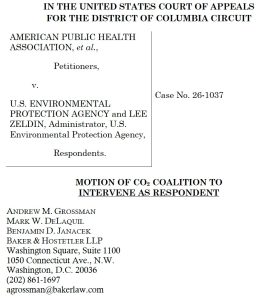
CO2 Coalition Motion to Intervene
FAIRFAX, Va. – The CO2 Coalition is requesting to join a federal D.C. Court of Appeals case to support the EPA’s repeal of a 2009 rule that classified carbon dioxide emissions from vehicles as a dangerous pollutant.
The Coalition’s March 20th motion to intervene is a response to environmental organizations and several states that filed legal challenges to the EPA repeal, which was announced in February. The agency had concluded that it did not have authority under the federal Clean Air Act to regulate carbon dioxide.
“The basis of the wrongheaded Endangerment Finding put ideology ahead of science,” said Gregory Wrightstone, Executive Director of the CO2 Coalition, a nonprofit organization of more than 200 scientists and researchers. “The rule has been an impediment to economic growth, a cause of rising energy costs and a destroyer of many thousands of jobs at power plants, coal mines and manufacturing facilities.
“Since its 2009 enactment, the Endangerment Finding’s scientific underpinnings have been found to be even weaker than previously believed and contradicted by empirical data, peer-reviewed studies and research.”
Founded in 2015, the CO2 ~Coalition is a nonprofit organization with a mission to advance the public understanding of carbon dioxide’s essential role in sustaining plant life, agriculture and the global ecosystem.
The Coalition filing includes statements of members engaged in activities like farming and forestry. They note the benefits of higher levels of atmospheric CO2 for plants and list negative effects of the Endangerment Finding, including higher costs for equipment and of doing business in general.
“EPA’s repeal of the Endangerment Finding is a welcome action based on sound legal reasoning,” said Executive Director Wrightstone. “The CO2 Coalition will present scientific facts and data demonstrating the fallacy underlying the rule – that carbon dioxide is a toxin. The planet is benefiting from rising CO2 levels and will continue to do so. There is no climate crisis.”
Attorneys Andrew Grossman, Mark Delaquil and Benjamin Janacek of Baker and Hostetler law firm filed the intervention on behalf of the CO2 Coalition.
Download here: CO~2 Coalition – Motion to Intervene with Declarations – As Filed
Contact: Gregory Wrightstone
Email:executivedirector@co2coalition.org
Phone:(703) 540-4700
Tags: Endangerment Finding, EPA
---
---
6 26 LI Ben Janacek - BakerHostetler | LinkedIn
Experience

[Litigation Associate BakerHostetler
Sep 2022 - Present · 3 yrs 10 mos
Washington, District of Columbia, United States](https://www.linkedin.com/company/10459/)
Specializing in appellate litigation.

[Judicial Law Clerk for The Honorable Paul B. Matey U.S. Courts of Appeals · Full-time
Aug 2021 - Sep 2022 · 1 yr 2 mos](https://www.linkedin.com/company/4654/)
[Alexander Hamilton Fellow The C. Boyden Gray Center for the Study of the Administrative State
Aug 2019 - May 2021 · 1 yr 10 mos
Arlington, Virginia](https://www.linkedin.com/company/20105836/)

[Summer Associate BakerHostetler
Jul 2020 - Aug 2020 · 2 mos
Washington, District of Columbia, United States](https://www.linkedin.com/company/10459/)
Law Clerk
United States Senate Judiciary Committee
Sep 2019 - Dec 2019 · 4 mos
Washington, District Of Columbia
Office of Senator Marsha Blackburn
[George Mason University - Antonin Scalia Law School Doctor of Law - JD
2018 – 2021](https://www.linkedin.com/school/1222497/)
Activities and societies: Law Review; Federalist Society; St. Thomas More Society
[Lafayette College Government and Law
2014 – 2018](https://www.linkedin.com/school/19308/)
Grade: Class of 2018

[Delbarton School High School
2010 – 2014](https://www.linkedin.com/school/5811166/)
scrape
More profiles for you
Nick Cordova
· 3rd+
Associate
Message
Andrew Strain
· 3rd
Associate at Holwell Shuster & Goldberg
Message
Sandra Saunders
· 3rd
Associate General Counsel
Message
Ryan Goodwin
· 3rd
Partner, FBT Gibbons LLP
Message
Andrew Adler
· 3rd
Law Clerk at Chiesa Shahinian & Giantomasi PC
Message
Ashlyn Roberts
· 3rd+
Attorney & Adjunct Professor of Trial Advocacy
Message
Bridget Wood
· 3rd
J.D. Candidate at Loyola University Chicago
Message
Santo Tiralosi
· 3rd
Associate at Latham & Watkins
Message
Mikayla Berliner
· 3rd
Associate Attorney @ Lowenstein Sandler | White Collar Litigation and Appellate Advocacy
Message
Elisabeth Neylan
· 3rd
Trial Attorney
Message
Brandon Posivak
· 3rd
Selected to Super Lawyers Rising Star 2026
Message
Allison Hauf, AUD
· 3rd
Research Neurophysiologist at Impulse Monitoring
Message
Caeli J.
· 3rd+
Patient Care Advocate at Centene Corporation
Message
Stephen Higgins
· 3rd+
Rep. Chief Counsel of Terrorism Sub at U.S. Senate, Judiciary Committee
Connect
Amber Janichek
· 3rd
Director, Hope Lodge Operations at American Cancer Society
Message
Seth Janechek is open to work
Seth Janechek
· 3rd+
Student at Madison Area Technical College
Connect
Zachery Rambur-Craig
· 3rd+
--
Message
Rebecca Janacek, FPQP®
· 3rd+
Client Service Associate at Financial Synergies Wealth Advisors
Connect
Bryan Freres
· 3rd
Assistant U.S. Attorney
Message
Kevin Case
· 3rd
Assistant General Counsel at Universal Service Administrative Co. (USAC)
---
---
Experience

Baker & Hostetler LLP 21 yrs 10 mos

[Summer Associate Baker & Hostetler LLP
May 2002 - Aug 2002 · 4 mos
Greater Orlando](https://www.linkedin.com/company/10459/)
Education

[Harvard Law School Doctor of Law (JD)
2001 – 2004](https://www.linkedin.com/school/1654/)

[University of Florida Bachelor of Arts (BA), History and Economics
1997 – 2001](https://www.linkedin.com/school/4282/)
2016 Law360 Rising Star
Issued by Law360, Portfolio Media · Apr 2016

Associated with Baker & Hostetler LLP
I was selected as one of the "Top Four Environmental Attorneys Under 40."
---
[### Students Back Off Lawsuit to Show Antisemitic Film at ...

American Jewish Committee (AJC)
https://www.ajc.org › news › students-back-off-lawsuit-...](https://www.ajc.org/news/students-back-off-lawsuit-to-show-antisemitic-film-at-washington-high-school)
May 8, 2024 — BakerHostetler in Washington, led by partner Paul Levine with assistance from Ken Reisenfeld, Jason Hoffman, and Ben Janacek, represented the ...Read more
May 8, 2024 — Washington, DC
A student group at Washington, DC’s largest high school, which had sued to compel the school to screen a documentary filled with antisemitic tropes and conspiracies, has agreed not to show the film. A coalition of Jewish groups and Jewish parents had supported the school’s decision to stop the film from being shown.
American Jewish Committee (AJC), the Louis D. Brandeis Center for Human Rights Under Law (the Brandeis Center) and the Jewish Community Relations Council of Greater Washington (JCRC), had filed an amicus brief in the case in the U.S. District Court of the District of Columbia.
The brief argued that Jackson-Reed High School was within its rights to prevent a screening of The Occupation of the American Mind because it was “an unabashed piece of hate propaganda” narrated by Roger Waters, “a virulent anti-Semite.” As the groups argued, the First Amendment does not give the right to present a film rife with hate speech in a high school setting.
Under its agreement with the high school, the Arab Student Union will withdraw its request for a preliminary injunction that, if granted, would have allowed it to show the film. Jackson-Reed will allow the group to show one of three other films that the school had previously determined were less objectionable and free of antisemitic rhetoric. According to the District of Columbia Public Schools’ (DCPS) filing, the Arab Student Union could have shown any of these movies even without filing suit.
“Jewish students and their families have felt threatened and demonized in the seven months since the Hamas massacre in Israel,” said Edna Friedberg (who provided a declaration with the brief), the parent of a Jackson-Reed student and who is a Holocaust historian. “There is still more work to be done, but this is a victory for all of us who cherish our public schools as safe and inclusive communities.”
“The school has become an intolerable place for Israeli and Jewish students, and I am thankful that at least this film will not be allowed to add flame to the fire and create an even more inhospitable place for many students,” said parent Jennifer Knoll.
The film has come under attack for being replete with factual errors and antisemitism. It includes accusations that American Jewish organizations met in Jerusalem in the 1980s to discuss how to manipulate the American media.
Claims of Jewish control over the media are part of a longstanding conspiracy theory of secret Jewish power, according to AJC’sTranslate Hate glossary of antisemitic terms.
“The school was right not to allow the screening of a film that would have further polarized a student body already divided over the Israel-Hamas war,” said AJC Chief Legal Officer Marc Stern. “High schools should be a place for constructive dialogue on important issues. This film would have prevented that.”
“High schools should not be sanctioning movies, teacher lesson plans, or any ‘educational’ activities that present a one-sided, biased perspective, often laced with antisemitic tropes about Israel and Jews. That is not education,” stated Kenneth L. Marcus, chairman of the Brandeis Center and the former U.S. Assistant Secretary of Education. “Schools have every right to exclude anti-Israel propaganda."
"We are gratified that this antisemitic film, the screening of which the JCRC has battled for years, will not be shown at Jackson-Reed. We appreciate DCPS for refusing to allow the film to be shown and defending its position in court,” said JCRC Associate Director Guila Franklin Siegel. “Most of all, we are relieved for the school’s Jewish and Israeli parents and students, who have endured persistent, searing harassment, often with little or no response from DCPS to protect them. Our goal must be to reduce conflict and increase mutual respect and empathy at Jackson-Reed, not to further inflame tensions.”
BakerHostetler in Washington, led by partner Paul Levine with assistance from Ken Reisenfeld, Jason Hoffman, and Ben Janacek, represented the Jewish groups and parents in writing the amicus brief.
---
an 8 23
leonard Leo, the co-chair of the conservative Federalist Society's board of directors, may not be a household name. But the fifty-eight-year-old lobbyist holds significant sway over Republican Party politics. For instance, The Guardian's Ed Pilkington recalls on Wednesday, all three associate justices who thrice-indicted former President Donald Trump nominated to the United States Supreme Court were names recommended by Leo.
According to Pilkington, Leo has also marketed himself as a defender of the First Amendment. But Pilkington points out that "a couple of eye-catching, and seemingly incongruous, events have led to speculation that his commitment to free speech might be more complicated than he professes, and more self-serving.If all American citizens are equal in front of this vital element of the US Constitution, could it be that some people – notably Leo himself – are more equal than others?"
Pilkington alludes to two instances that he says are evidence of Leo's "duality" regarding individual freedom of expression.
READ MORE: Dem Senators demand full accounting of gifts to SCOTUS justices from Paul Singer and Leonard Leo
"The first of the two events took place in the bailiwick of the Bangor Daily News, in Maine, where Leo has a $3m waterfront estate on an elite island community in Northeast Harbor. On 20 July, Jane Mayer of the New Yorkerreported on a new lawsuit that had been brought by a 23-year-old local resident for wrongful arrest," Pilkington writes. "Eli Durand-McDonnell, a landscaper, was part of a group of progressive activists who staged a series of peaceful protests outside Leo's home. They were angry about his role in securing a rightwing supermajority on the US supreme court, and the evisceration of fundamental rights that flowed from that."
Although "Leo isn't named as a defendant in the civil lawsuit, which accuses two local police officers of making an illegal and retaliatory arrest of Durand-McDonnell during one of the protests on 31 July 2022, a month after the devastating abortion ruling," Pilkington continues, "it does claim that the arrest was made 'at the direct behest of Leo, a powerful and wealthy conservative political activist who has used millions of dollars as political speech to influence American politics and courts.'"
Event number two "burst into public view five days after Mayer'sNew Yorkerarticle. On 25 July, Leo wrote a letter through his lawyer to two leading Democratic US senators on the judiciary committee, Dick Durbin and Sheldon Whitehouse,"Pilkington explains. "The senators wanted Leo to answer a series of questions about his ties to the Supreme Court justices as part of an ethics investigation they were conducting. Leo has long been a figure of interest for Congress, given his outsized influence on US politics and the courts."
Leo's attorney, RIVKIN however, argued that their client "is entitled by the First Amendment to engage in public advocacy, associate with others who share his views, and express opinions on important matters of public concern,'" Pilkington says, adding, "Leo declined to cooperate with Congress
lnk to pilk}}:
LTR 8 PP RIVKIN
https://www.documentcloud.org/documents/23886791-leonard-leo-letter
---
---
https://www.eenews.net/articles/meet-the-lawyers-teeing-up-the-supreme-court-climate-showdown/
1/22
as arguments approach in the most significant Supreme Court environment battle of the decade, teams of lawyers are already making their case for how the justices should view EPA’s climate authority.
When the justices take the bench on Feb. 28 to hear arguments in West Virginia v. EPA,they will arrive armed with information from reams of briefs prepared by some of the nation’s leading environmental lawyers.
Those attorneys’ arguments will lay the groundwork in a high-stakes case that has the potential to upend EPA’s ability to regulate greenhouse gases from power plants — one of the nation’s largest sources of carbon dioxide emissions.
the challenge — brought by Republican-led states and coal companies — asks the Supreme Court to overturn a ruling by the U.S. Court of Appeals for the District of Columbia Circuit that struck down a Trump-era EPA rule gutting the Obama-era Clean Power Plan.
The 2015 Obama rule invoked EPA’s authority under the Clean Air Act to set systemwide requirements for power plant emissions reductions.
After the D.C. Circuit ruling, President Biden’s EPA had a clean slate to craft its own rule. The agency had said it would not return to the Clean Power Plan, whose goals have already been met by the power sector, even though the regulation never took effect.
The justices then took the unusual step of agreeing to hear a dispute over a regulation that does not technically exist.
Their ruling in the case, which is expected by next summer, could not only constrain EPA from issuing a comprehensive new carbon rule but also prevent Congress from handing off broad regulatory authority to federal agencies.
Here are some of the lawyers to know in this year’s high court climate slugfest:
Lindsay See
Leading the briefs for West Virginia is Lindsay See, the state’s solicitor general.
The coal-rich state, joined by 18 others, filed the first plea for the Supreme Court to weigh in on EPA’s climate authority. It was followed by three other petitions, which are now consolidated in one massive case.
See has served as West Virginia’s leading litigator since 2017 and previously worked as an associate atGibson, Dunn & Crutcher LLP, a firm with a prominent Supreme Court practice.
She has appeared once before the nation’s highest bench, in a 2018 case related to a discrimination challenge against an exemption in West Virginia tax law that protected state and local — but not federal — employees from having their pension benefits taxed. West Virginia lost the case.
West Virginia Attorney General Patrick Morrisey (R) and other state lawyers said the D.C. Circuit should not have allowed EPA to regulate power plant emissions under a “rarely used, ancillary provision of the Clean Air Act.” They referred to Section 111(d) of the statute, which served as the basis for the carbon rule.
“Save for a few general factors EPA was to take into account, the lower court told EPA it has ‘no limits’ on the emission-related measures it can impose — on any economic sector or almost any actor,” says the states’ most recent brief, which was signed off on by See.
See is a Harvard Law School graduate and clerked for former D.C. Circuit Judge Thomas Griffith.
Paul Seby
One other state has echoed West Virginia’s arguments in a petition and brief led by a lawyer who has been involved in the EPA carbon rule battle since the Clean Power Plan days.
Paul Seby, a shareholder at the firm Greenberg Traurig LLP and special assistant to North Dakota Attorney General Wayne Stenehjem (R), signed off on a brief that said the D.C. Circuit ruling “undermines the cooperative federalism framework carefully crafted by Congress” by finding that EPA — rather than states — can set power plant performance standards.
North Dakota v. EPA is one of the four petitions in the consolidated Supreme Court case.
Seby has argued against EPA carbon regulations before, back when the Clean Power Plan was before the D.C. Circuit. The court held a marathon argument over the regulation in 2016 but never reached a ruling.
Earlier that year, the Supreme Court had blocked the rule from taking effect, which allowed the Trump administration to dismantle it.
Seby holds a bachelor’s degree from the University of San Diego and a law degree from Lewis & Clark College.
Andrew Grossman
One of the other lead petitioners in the climate case, Westmoreland Mining Holdings LLC, hired Andrew Grossman to make its case to the high court.
Grossman leadsBakerHostetler’s appellate practice and is a frequent conservative commentator on wide range of administrative and constitutional issues.
Grossman is an adjunct scholar at the libertarian Cato Institute and a former legal analyst at the Heritage Foundation. He’s also a familiar face on Capitol Hill, having testified several times before the House and Senate Judiciary committees.
In Westmoreland’s petition, Grossman raised what some environmental advocates referred to as a killer question: whether EPA may use Section 111(d) to create performance standards for existing stationary sources under the provision’s “hazardous air pollutants” program.
The justices granted the petition alongside others, but they said they would only consider the second question posed by Westmoreland’s petition: whether EPA’s carbon rule violated the major questions doctrine, which restricts federal agencies from deciding issues of “vast economic and political significance.”
Grossman attended Dartmouth College and theGeorge Mason University’s SCALIA School of Law.
Yaakow Roth
The fourth petition in the consolidated case comes from North American Coal Corp., represented byJones Daypartner Yaakov Roth.
Like the other challengers, the coal company argues that EPA and the D.C. Circuit have taken far too broad a view of federal climate authority under the Clean Air Act.
Roth comes to the EPA climate case with lots of experience before the Supreme Court. He was the brainchild behind an argument that led the Supreme Court to overturn convictions in the New Jersey “Bridgegate” scandal.
He has also fought to preserve restrictive voting laws in Arizona and to dismantle the Obama-era Affordable Care Act.
Roth has clerked for the late Supreme Court Justice Antonin Scalia and a federal appeals court judge.
He is a graduate of Harvard University and York University.
Elizabeth Prelogar
Before the Supreme Court agreed to hear West Virginia v. EPA, Elizabeth Prelogar had argued on behalf of the federal agency that it was too early for the justices to get involved.
The solicitor general noted in a brief filed in August that Biden’s EPA has not yet written a new carbon rule and has no plans to revive the Obama plan.
EPA instead intends to issue a new rule “after taking into account all relevant considerations, including changes to the electricity sector that have occurred during the last several years,” she wrote.
Prelogar, who was confirmed in late October, has already made several appearances before the Supreme Court, including in one case in which she argued on behalf of the federal government against abortion laws in Mississippi and Texas.
Since her appointment as acting solicitor general in January, Prelogar has also led Supreme Court briefs in several environmental cases, including one in which the Biden administration backed efforts by the developer of the PennEast natural gas pipeline to acquire state-owned land in New Jersey (Energywire, March 10, 2021). The pipeline company won its case, but the project was eventually canceled.
Prelogar, a Harvard Law School graduate, has previously served as assistant to the solicitor general and has worked in private practice. During a prior stint at the Justice Department, she served on the special counsel’s investigation into Russian meddling in the 2016 election.
She clerked for Attorney General Merrick Garland when he was a judge on the U.S. Court of Appeals for the District of Columbia Circuit and for Supreme Court Justices Ruth Bader Ginsburg and Elena Kagan.
Prelogar is the second woman to be confirmed as solicitor general. Kagan was the first.
Sean Donahue
Environmental groups that support broad EPA regulatory authority have turned to an experienced Supreme Court litigator to represent them in the case: Sean Donahue.
Donahue has been a go-to lawyer for environmental groups and public health advocates in some of the most high-profile litigation of the last decade, including Clean Air Act and climate cases.
He’s also represented environmentalists in key cases on the social cost of carbon for fuel economy and vehicle emissions standards.
Donahue and his team, including the Environmental Defense Fund’s Vickie Patton, will have a challenging task ahead of them. Several conservative justices have signaled skepticism of doctrines requiring them to defer to agency expertise, and the current case appears to be a coordinated effort to curtail EPA’s regulatory authority broadly.
In an interview, Donahue said once again it may be an environmental case that set an important precedent for administrative law.
"Statutes like the Clean Air Act," he said, "necessarily depend upon expert agencies to apply Congress’ health and environmental directives to complex factual records, developing technologies, about particular industries and pollutants."
Donahue, who works for Donahue, Goldberg & Littleton, clerked for former Supreme Court Justices Ginsburg and John Paul Stevens. He’s also a veteran of the Justice Department. He attended Columbia University and University of Chicago’s Law School.
Beth Brinkmann
Another attorney with Supreme Court experience is making the case for electric utilities that want to preserve the D.C. Circuit decision striking down the Trump-era carbon rule.
Before the justices granted the case, Covington & Burling LLP partner Beth Brinkmann led a brief on behalf of Consolidated Edison Inc. and other companies that said Supreme Court review of a nonexistent regulation would run the risk of a “ruling untethered to actual circumstances.”
Moreover, she wrote, the red states and coal companies are seeking relief from the justices even as the power industry has achieved the Clean Power Plan’s 2030 emissions reductions targets more than a decade in advance —even though the rule never officially took effect.
“Those changes, which include reductions in the cost of emission-reduction technologies and increasing consumer preferences for clean power, have only accelerated since adoption of the ACE Rule,” she wrote.
Brinkmann has argued more than two dozen times before the Supreme Court. As former deputy assistant attorney general at the Justice Department’s civil rights division, for example, she defended the Obama administration’s Affordable Care Act.
She has also worked in the appellate practice at the firm Morrison & Foerster and as an assistant federal public defender representing indigent criminal defendants.
Brinkmann is a graduate of the University of California, Berkeley, and Yale Law School. She clerked for the late Supreme Court Justice Harry Blackmun.
Elbert Lin
A utility industry group that opposes EPA’s ability to craft rules like the Clean Power Plan has staffed its legal team with an attorney who, at only 43 years old, has already made a significant impact on environmental law at the Supreme Court.
Elbert Lin was the lawyer who secured the unprecedented stay of President Obama’s climate regulatory regime, the Clean Power Plan, in 2016 while he was West Virginia’s solicitor general.
Lin said in an interview that his interest in environmental and administrative law was born out of necessity when he was West Virginia’s solicitor general. It was during Obama’s second term, and the administration was promulgating many major environmental rules, including the Clean Power Plan.
"Environmental regulations were of significant importance of the state," he said.
Now in private practice at the firm Hunton Andrews Kurth LLP, Lin is back in the EPA carbon rule litigation, representing America’s Power, a trade association of companies that produce electricity from coal.
Lin, who is the son of Taiwanese immigrants, has also argued key Clean Water Act cases at the high court. He argued on behalf of Maui, Hawaii, in a case over whether a federal permit is required for pollution that is pumped underground but eventually reaches the ocean.
The Supreme Court delivered a new test for determining whether a permit was needed, and a federal judge in Hawaii later sided with environmental groups arguing that Maui should have secured a Clean Water Act approval (Greenwire, Oct. 21, 2021). Legal experts say they are watching to see how other courts apply the Supreme Court’s test.
Lin attended Yale for undergrad and law school, and heclerked for a federal appeals court judge and Supreme Court Justice Clarence Thomas.
Reporters Lesley Clark and Niina H. Farah contributed.
---
---
off bs
Services
Industries
Overview
Mark DeLaquil is an experienced advocate who focuses on appellate practice, complex environmental and regulatory proceedings, and political law.
Mark has been recognized by Chambers USA for environmental litigation (2015), and has been named by Law360 as one of the "Top 5 Environmental Attorneys Under the Age of 40" on two occasions. He has also been designated as a Super Lawyers “Rising Star” (2014).
Select Experience
Environmental Regulatory Proceedings and Litigation
- Represented state and private clients in Clean Air Actadministrative proceedings and litigation, including preparing comments on proposed actions and contesting them in courts of appeals. Has extensive experience in actions concerning climate change, air quality standards, emission standards, preconstruction and operating permits, and state implementation plans.
- Represented state and private clients in Clean Air Act administrative proceedings and litigation, including preparing comments on proposed actions and contesting them in courts of appeals. Has extensive experience in actions concerning climate change, air quality standards, emission standards, preconstruction and operating permits, and state implementation plans.
- Represented a manufacturing company in an administrative proceeding defending the validity of its preconstruction and operating air permit.
- Counseled a leading electric utility on Clean Air Act compliance strategy and the potential legal implications of climate change for the U.S. industry.
Trial and Appellate Litigation
- Represented parties in appeals throughout the United States and argued numerous appeals in the Second, Seventh, Eighth, Ninth, and District of Columbia Circuits.
Political Law
- Represented clients in a full array of campaign finance matters, from counseling compliance to successfully challenging the enforcement of state campaign finance law.
- ...
Trial and Appellate Litigation
- Represented parties in appeals throughout the United States and argued numerous appeals in the Second, Seventh, Eighth, Ninth, and District of Columbia Circuits.
- Argued appeals on behalf of manufacturers in support of affirmance of a decision dismissing a citizen suit alleging violations of the Clean Air Act preconstruction permitting program.
- Argued an appeal on behalf of a nonprofit organization in support of affirmance of a preliminary injunction stopping a criminal investigation.
- Argued an appeal in support of the reversal of a decision confirming labor arbitration awards.
- Argued a challenge to a decision revising approval of a state implementation plan arising out of the Clean Air Act greenhouse gas regulation.
- Lead trial counsel or co-lead trial counsel in numerous federal court trials.
- Lead trial counsel in an action obtaining permanent injunction barring the enforcement of state law binding delegates to national party conventions to the results of a presidential preference primary.
- Co-lead trial counsel representing inventor in bench trial on whether the inventor was barred by prosecution laches from obtaining multiple patents. The court granted judgment on partial findings in favor of inventor.
- Lead or co-lead trial counsel in multiple federal court actions to obtain patents.
- Represented parties and amici curiae in proceedings before the U.S. Supreme Court and nearly all of the U.S. Courts of Appeals.
- Represented an amicus group composed of all former Secretaries of Defense and members of the Joint Chiefs of Staff in an appeal of a decision denying qualified immunity to former Secretary of Defense Donald Rumsfeld, helping secure a rehearing en banc.
- Represented an amicusgroup of law professors before the U.S. Supreme Court supporting a petition for certiorariand merits proceedings in a global climate change public nuisance suit against electric utilities.
Political Law
- Represented clients in a full array of campaign finance matters, from counseling compliance to successfully challenging the enforcement of state campaign finance law.
- Obtained a preliminary injunction barring the enforcement of a state law requiring certain social welfare organizations to register as political committees.
- Obtained a preliminary injunction barring the enforcement of a state law barring coordination between candidates and unaffiliated organizations concerning issues advocacy.
- Argued an appeal seeking affirmance of a decision enjoining acriminal investigation into alleged state campaign finance violations.
- Has counseled businesses and nonprofit entities on compliance campaign finance and ethics law requirements.
==
The Rule of Law Defense Fund
Pruitt was a member of the Rule of Law Defense Fund (RLDF) board of Directors since it was created in 2014 until late 2016. He chaired the group from 2015 until he stepped down in December 2016 following his nomination by Trump.
The RLDF is a 501C4 organization, and so it is not required to publicly disclose its sources of funding. It was created in 2014 by the Republican Attorneys General Association, with which it shares staff and office space and holds joint events.
RLDF is highly secretive about what it does. CMD obtained an agenda for one RLDF meeting, held in April 2016 which featured a session about blocking the Clean Power Plan. Pruitt was a speaker on the panel which also included David Rivkin, a partner at the law firm Baker Hostetler. Rivkin, who is a donor to Pruitt's Oklahoma Strong PAC, is representing the state of Oklahoma in the lawsuit against the Clean Power Plan.
Currently, only two funders of RLDF have been identified, both with deep ties to the fossil fuel industry. Freedom Partners, the mega-fund created by Charles and David Koch, gave RLDF $175,000 in 2014. The Edison Electric Institute (EEI) gave RLDF a $25,000 contribution in 2014. EEI is the trade association for the utility sector, and has engaged in litigation in an attempt to block the Clean Power Plan
Defending ExxonMobil
==
~CPP?
Baker & Hosteler Background
In Michigan v. EPA in which the U.S. Supreme Court in 5-4 vote struck down the EPA's carefully crafted rules to limit the emission of mercury and other toxic pollutants from oil and coal power plants, David B. Rivkin Jr. of Baker & Hostetler represented the Cato Institute, which in turn has received millions from energy interests including the David H. Koch Foundation and ExxonMobil. Rivkin worked in the Reagan Justice Department and was the associate general counsel at the Department of Energy under George H. W. Bush. More recently, he has been part of the legal effort to strike down Obamacare and also has defeated lawsuits aimed at holding former Secretary of Defense Donald Rumsfeld personally liable for alleged torture in Iraq.
Rivkin also argued the cause for petitioner State of Texas in Texas v. EPA, which was decided in July 2013. The U.S. Court of Appeals slapped down Texas’ attempt to block the EPA from controlling the state’s system for issuing permits to power plants.
---
==
DAVID B. RIVKIN, JR. (D.C. Bar No. 394446)
BRUCE D. BROWN (D.C. Bar No.457317)
MARK I. BAILEN (D.C. Bar No. 459623)
ANDREW M. GROSSMAN (D.C. Bar No.
985166)
BAKER HOSTETLER LLP
Washington Square, Suite 1100
1050 Connecticut Avenue, NW
Counsel for Defendants Competitive Enterprise
Institute and Rand Simberg also Nat Rev?
==
Mark Braden concentrates his work principally on the law of the political process, including work with election and campaign agencies, voting issues, redistricting, and ethics and lobbying regulations—areas in which he has substantial knowledge and unusual experience. He provides effective, and often highly innovative, legal guidance when representing individuals and organizations in the political arena and counseling some of the largest PACs and campaigns in the nation. Mark spent 10 years as Chief Counsel to the Republican National Committee prior to joining BakerHostetler. He is widely recognized for his knowledge on state election laws, having served as Chief Counsel to the Ohio Elections Commission and Election Counsel for the Secretary of State in Ohio. Mark has played a large part in the redistricting process and has argued at the Supreme Court level in redistricting litigation and, in campaign finance, was the father of "soft money" as originally used in national campaigns.
Mark is a member of the adjunct faculty of George Washington University and is Special Election Law Counsel to the United States House of Representatives' Administration Committee. He has testified before congressional committees and the Federal Election Commission and his experience in the legal and political arena has resulted in invitations to lecture at universities and institutes nationwide. Recently, he has authoredInternational Election Principles: Election, Chapter: Early and Absentee Voting (ABA Publishing, 2009) and Election Reform in the United States after Bush v. Gore, ed. Grofman & Alvarez, Chapter: "Entering the Political Thicket" (Cambridge University Press, 2013).
Select Experience
- Represented Republican members of or candidates for the United States Senate, United States House, Governors, former Cabinet Secretaries, and Presidential Candidates on campaign financing and ethical issues/criminal and civil enforcement.
- Assists trade associations and businesses in participation in governmental affairs, creation of PACs, state and federal lobbying regulations, gift rules, and state and local ballot initiatives. Assists nonprofit organization in such context, advising on issues related to fundraising restrictions, ethical concerns based on lobbying requirements, and completed campaign funding issues. Provides presentations on campaign financing.
- Supervised and directed corporate reorganization of large nonprofit fraternal organization, involving $500 million plus assets and 1.6 million organization members, for participation in governmental affairs.
experience
- Represented Republican members of or candidates for the United States Senate, United States House, Governors, former Cabinet Secretaries and Presidential Candidates on campaign financing, and ethical issues/criminal and civil enforcement.
- Assists trade associations and businesses in participation in governmental affairs, creation of PACs, state and federal lobbying regulations, gift rules, and state and local ballot initiatives. Assists nonprofit organization in such context, advising on issues related to fundraising restrictions, ethical concerns based on lobbying requirements, and completed campaign funding issues. Provides presentations on campaign financing.
- Supervised and directed corporate reorganization of large nonprofit fraternal organization, involving $500 million plus assets and 1.6 million organization members, for participation in governmental affairs.
- Lead counsel in redistricting/Voting Rights Acts litigation in recent cycles in Ohio, New York, Wyoming, New Mexico, Oklahoma, Georgia, Nevada, Maryland, and Connecticut. Has argued at the U.S. Supreme Court and state Supreme Courts throughout the country, in which the redistricting at issue was affirmed.
- Has been a principal lawyer in many of the largest recounts in political history, including recount and contests litigation in Ohio, Pennsylvania, Indiana, California, North Carolina, Virginia, Illinois, New Jersey, Washington, and New Mexico.
- Was key negotiator for convention contracts and site city agreements for the 1980, 1984, 1988, and 1995 Republican National Conventions.
- Served as international election consultant on a dozen different national election systems for International Republican Institute (IRI), International Foundation for Election Systems (IFES), National Democratic Institute (NDI), and the Organization for Security and Corporation in Europe (OSCE).
==
stub sw:
http://en.wikipedia.org/wiki/BakerHostetler
Other notable clients
- ABC, Inc.
- Airbus S.A.S.
- Bayer
- Cardinal Health, Inc.
- CNL Financial Group
- Colgate-Palmolive Co.
- Corning
- Electronic Data Systems
- The E.W. Scripps Co.
- ExxonMobil
- Thermo Fisher Scientific
- Ford
- Gruner + Jahr
- Hospital Corporation of America
- Hyatt
- IBM
- KeyCorp
- KLM
- Microsoft Corp.
- Morgan Stanley
- Schlumberger
- Sprint Nextel
- State Farm
- Progressive Corp.
- Trammell Crow Co.
- Verizon
- Wachovia[10]
---
prw:
A federal court will rule in coming weeks on Wisconsin's redistricting plan, after sharply criticizing Republican lawmakers for developing the maps under a veil of secrecy and shutting the public out of the process. Along with voter ID legislation inspired by an American Legislative Exchange Council (ALEC) model, GOP legislators in Wisconsin appear to be reshaping elections for partisan political advantage.
"What could have -- indeed should have -- been accomplished publicly instead took place in private, in an all but shameful attempt to hide the redistricting process from public scrutiny," wrote the three-judge panel in a February 16 order requiring the GOP turn over redistricting documents.
The court is considering whether the Republican maps unconstitutionally dilute the Latino vote, and whether 300,000 voters were unnecessarily moved into and out of districts, thereby delaying when they can vote in a Senate election. The trial, which concluded on Friday, February 24, included testimony about how the maps would negatively impact Latino and African-American voters.
ALEC Role in Shifting Electoral Landscape
The proposed redistricting maps are not the only threat to the voting power of Wisconsin's Latino and African-American populations. Where the GOP maps would weaken the electoral power of minority populations, new voter ID requirements will make it harder for many members of those communities to cast a ballot. Studies show that around half of Latinos and African-Americans in the state do not have a state-issued ID.
The Wisconsin voter ID law, like many of the other states that passed voter ID in 2011, is based off a model from the American Legislative Exchange Council (ALEC). The NAACP has singled out ALEC as the source of the outbreak of voter ID bills that were introduced in 34 state legislatures in 2011, noting that ALEC's founder said ."
Many of the states that passed ALEC's voter ID laws in the past year did so under Republican-controlled legislatures, with many of those legislative leaders also being ALEC members. And those same states are fighting redistricting battles over maps drawn by those same GOP legislatures.
Might ALEC have also played a role in the redistricting process?*
Mark Braden, former chief counsel to the Republican National Committee (who is now with the law firm Baker Hostetler) gave a presentation on redistricting to members of the Public Safety and Elections Task Force at the December 2010 ALEC meeting, according to documents obtained through open records requests. Wisconsin Senate Majority Leader Scott Fitzgerald is a member of that Task Force and attended the December meeting. Fitzgerald led the redistricting effort in Wisconsin and is the former ALEC state chair.

==
“There is a push in Minnesota to get so many people in the mail process,” Braden, former chief counsel for the Republican National Committee, said during an election law panel at CPAC. Because of local government resources there, cities rejected less than 1 percent of absentee ballots, while rural areas rejected more than 10 percent, Braden said. “This is a clear violation of the equal protection clause,” Braden said. “More mail-in votes results in many disenfranchised voters.” The Minnesota Senate race is likely headed to the U.S. Supreme Court. But beyond that single state, the Association of Community Organizers for Reform Now (ACORN) also poses a threat to clean elections, said Heather Heidelbaugh, vice president of the Republican National Lawyers Association, which brought suit against ACORN in Pennsylvania. Heidelbaugh said ACORN will probably get money to help conduct the 2010 Census. “The one thing worse than having Al Franken in the Senate is to have ACORN conducting the Census,” Heidelbaugh said during the CPAC panel. Former Ohio Secretary of State Ken Blackwell, who supervised that state’s election system, called the effort to move the Census under control of the White House an indicator that “team Obama has its sights set on the greatest accumulation of power we have ever witnessed.” - See more at: http://cnsnews.com/news/article/liberal-groups-are-undermining-voter-id-laws-say-conservative-election-experts#sthash.4ESbnbsy.dpuf
==
wiki
BakerHostetler is an American law firm founded in 1916. One of the firm's founders, Newton D. Baker, was U.S. Secretary of War during World War I and former Mayor of Cleveland, Ohio, United States.
In 2009, the firm was rated the 85th-largest law firm in the world.[5] In 2014, the law firm employs nearly 900 attorneys and has offices in 14 different markets including: New York, Washington, D.C., California (Los Angeles, Costa Mesa), Illinois(Chicago), Florida (Orlando), Texas (Houston), Colorado (Denver), and Ohio (Columbus, Cleveland, and Cincinnati).[6]BakerHostetler is a multidisciplinary firm with 11 practice groups and more than 55 areas of practice strength. In a 2005 survey by BTI Consulting Group, BakerHostetler was ranked among the top 24 firms considered to be the “Power Elite” in terms of providing superior client satisfaction.[7]
BakerHostetler's Washington office is home to former Chairman of the House Financial Services Committee, Michael G. Oxley. Mr. Oxley joined the firm after a 25-year career in the U.S. House of Representatives. He is best known as the co-author of the landmark Sarbanes-Oxley Act of 2002, which restored confidence in the capital markets and in the financial reporting of public companies.
In March 2010, BakerHostetler, represented Denbury Resources Inc. (NYSE: DNR), a member of the S&P 500, in amerger valued at $4.5 billion with Encore Acquisition Co. (NYSE: EAC). The transaction created one of the largest oil-focused independent exploration and production companies in North America. As a result of this and other similar deals, BakerHostetler was ranked among the top 10 U.S. law firms for merger and acquisition deals in the oil, gas and oilfield service industries for the period January 2009-First Quarter 2010 per The Deal magazine. The firm is generally known for counseling and representing clients in the hospitality, healthcare, financial services, media, energy, sports and technology fields.[8]
In January 2014, Intellectual Property law firm Woodcock Washburn LLP merged with BakerHosteter, adding three offices in Philadelphia, Atlanta, and Seattle.[9]
Contents
Major clients
BakerHostetler has represented the William Jefferson Clinton Presidential Foundation's HIV/AIDS Initiative since 2003.[10]
Major League Baseball has been a longstanding client of BakerHostetler.[11]
On August 25, 2014, House Republicans hired BakerHostetler's David Rivkin to provide legal representation to sue President Obama over the Affordable Care Act. ^[12]
Other notable clients
- ABC, Inc.
- Airbus S.A.S.
- Bayer
- Cardinal Health, Inc.
- CNL Financial Group
- Colgate-Palmolive Co.
- Corning
- Electronic Data Systems
- The E.W. Scripps Co.
- ExxonMobil
- Thermo Fisher Scientific
- Ford
- Gruner + Jahr
- Hospital Corporation of America
- Hyatt
- IBM
- KeyCorp
- KLM
- Microsoft Corp.
- Schlumberger
- Sprint Nextel
- State Farm
- Progressive Corp.
- Trammell Crow Co.
- Verizon
- Wachovia[13]
.
See also
References
- Jump up "About us - Facts". BakerHostetler. 2008. Retrieved 2007-02-05.
- Jump up "BAKER, NEWTON DIEHL". Encyclopedia of Cleveland History. Case Western Reserve University. 1997-07-11. Retrieved 2007-02-05.
- Jump up "HOSTETLER, JOSEPH C.". Encyclopedia of Cleveland History. Case Western Reserve University. 1997-07-18. Retrieved 2007-02-05.
- Jump up "SIDLO, THOMAS L.". Encyclopedia of Cleveland History. Case Western Reserve University. 1997-07-22. Retrieved 2007-02-05.
- Jump up The Lawyer Global 100 from The Lawyer published in association with The American Lawyer November 2009; see also List of 100 largest law firms globally
- Jump up http://bakerlaw.com/aboutus/history
- Jump up http://www.bticonsulting.com, see BTI Power Rankings: The BTI Client Relationship Scorecard for Law Firms 2005
- Jump up "Profile of Professional Organization Contributors Baker Hostetler". The National Law Review. The National Law Forum, LLC. 2012-04-15. Retrieved 2013-01-08.
- Jump up "A Whole New Look for Some Law Firms in 2014". The Wall Street Journal Law Blog. The Wall Street Journal. 2014-01-02. Retrieved 2014-01-02.
- Jump up Stephenson, Amanda (February 2007). "BakerHostetler facilitates deal for HIV/AIDS Initiative.(Inside Track: Law)". Inside Business (FindArticles). Retrieved2007-02-05.[dead ^link]
- Jump up http://www.bakerlaw.com/aboutus/marketleaderprofiles/majorleaguebaseball/
- Jump up http://www.huffingtonpost.com/2014/08/25/house-gop-obama-lawsuit_n_5711131.html
- Jump up http://www.bakerlaw.com/aboutus/facts/
External links
---