endangerment epa 2009
MASS v EPA 2
MERRI OK
TARGET
SEE CURRY RED TEAM CWG BS HACKS HACKADEMICS
AFPI bernhardt
also disambig
see main for older = mass v epa?
new target 12/17 age of trump pruitt
---
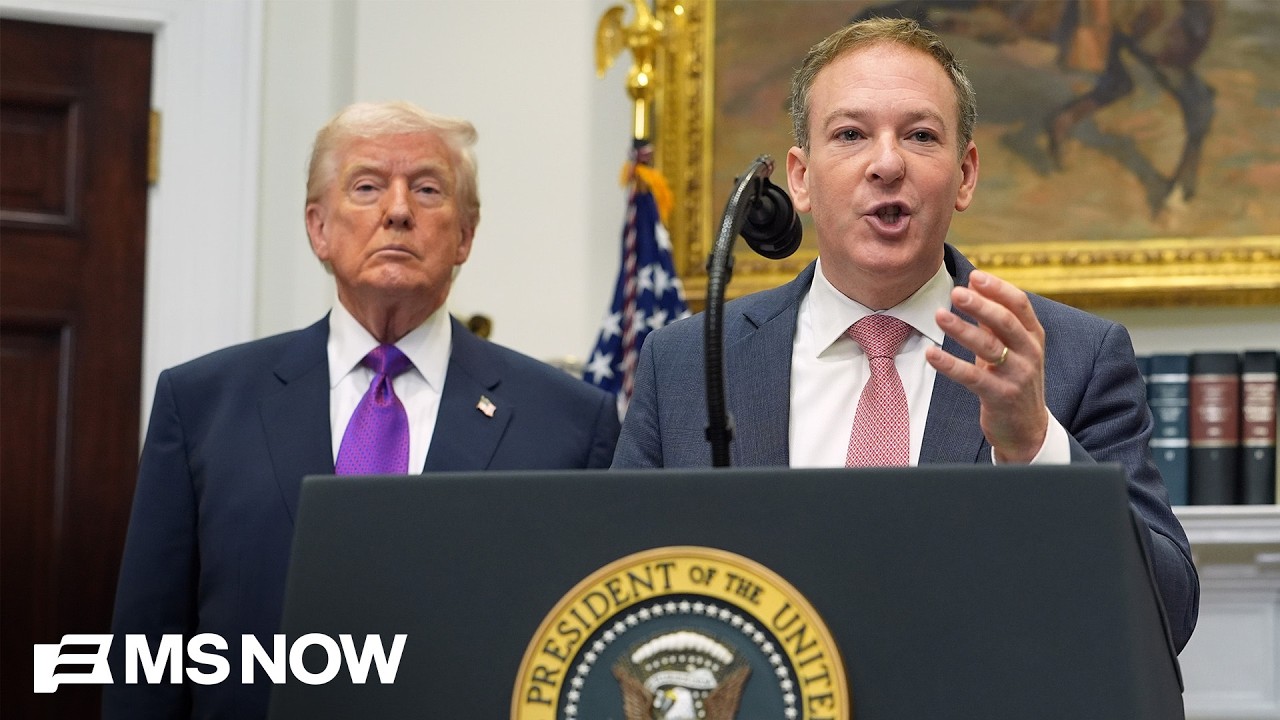
BIGGEST DEREG IN AM HIST BY FAR
SO CALLED END FINDING OBAMA ERA; PRICES WENT UP FOR WORSE PRODUCT; NO BASIS IN FACT OR LAW; FF SAVE LIVES; WIND INTERMITTENt MOST COSTLY; DIE NO AC HEATING; RADICal rule --> green new scam mebbe worse than rissia; jobs decimated but coming back bc tariffs; harmed car indist; ford plant wd be closed;
hated start sop feature; ev mandate; had to pay 5 trill$ for pwr stations for ev
car price up 22% biden fo gnscam; cut price 3k$
cut 129 1 vs 10?
#$
CAR START EZIER
---
OMFG 2 26 12TH DN

7:59
FAA, abruptly closed the airspace around
8:03
El Paso, Texas late Tuesday and reopened
8:06
it hours later after Customs and Border
8:09
Protection officials reportedly fired an
8:12
anti- drone laser shared by the Pentagon
8:15
without providing FAA officials enough
8:19
time to manage the risks to commercial
8:21
flights. According to the New York
8:24
Times, immigration officials thought
8:26
they were targeting a drug cartel drone,
8:30
but it turned out to be a party balloon.
8:34
Democratic Senator Jack Reid, who sits
8:36
on the Armed Services Committee, said,
8:38
quote, "The conflicting accounts coming
8:41
from different parts of the federal
8:43
government only deepen public concern
8:45
and raise serious questions about
8:48
coordination and decisionmaking,"
8:50
unquote. The House of Representatives
8:52
has approved a bill that seeks to repeal
8:54
President Trump's declaration of a
8:56
national emergency to impose punitive
8:59
tariffs on Canada. Six Republicans join
9:03
nearly all Democrats in supporting the
9:05
resolution, which appears to have enough
9:08
support to pass the Senate. President
9:10
Trump signaled he's prepared to veto the
9:12
bill and plans to punish defectors.
9:15
Trump wrote on social media, quote, "Any
9:18
Republican in the House or the Senate
9:20
that votes against tariffs will
9:23
seriously suffer the consequences come
9:25
election time, and that includes
9:28
primaries," Trump wrote.
9:31
President Trump accepted the Washington
9:33
Coal Club's inaugural award on
9:36
Wednesday, declaring him the quote
9:38
undisputed champion of beautiful, clean
9:42
coal, unquote.
9:44
Trump accepted the award, a statue of a
9:47
coal miner from Peabody Energy President
9:49
and CEO Jim Gretch during a White House
9:52
event where Trump announced he directed
9:54
the Pentagon to purchase electricity
9:56
from coal fired plants and said he'd
9:59
asked the energy department to provide
10:01
$175 million in federal funds for
10:05
upgrades at several US coal plants.
10:09
I've saved 74 coal power plants from
10:13
crushing restrictions and closures that
10:16
would have been forced to shut down in
10:18
the very immediate future. And today,
10:20
I'm proud to announce that the Tennessee
10:22
Valley Authority is taking action to
10:24
save two major coal plants in Tennessee.
10:27
Tennessee Valley Authority. In response,
10:30
the Natural Resources Defense Council
10:33
wrote, quote, "While Americans are
10:35
demanding clean, affordable energy, the
10:38
Trump administration's using our tax
10:40
dollars to prop up the nation's
10:42
dirtiest, least efficient power plants.
10:45
It's no wonder fossil fuel lobbyists are
10:48
handing Trump an award today." unquote.
10:51
The Consumer Financial Protection Bureau
10:53
has fired program manager Alexis
10:55
Goldstein for documenting a meeting last
10:58
year between the agency and Elon Musk
11:02
Department of Government Efficiency or
11:04
Doge. That's according to emails
11:07
obtained by Bloomberg News. In a
11:10
statement to Bloomberg, Goldstein said,
11:12
quote, "CFPB is illegally retaliating
11:15
against me for trying to do my job. I
11:18
acted to protect the sensitive data of
11:21
Americans and the trade secrets of some
11:24
of the nation's largest banks and
11:26
financial institutions from being
11:28
accessed by individuals from Doge
11:30
without CFPB credentials and required
11:33
training.
---
-=-=
ref 2 brennan Fossil Fuel Industry Donors See Major Returns in Trump’s Policies
owen b
fossil fuel interests donated heavily to President Trump’s 2024 reelection bid. Months after his victory, oil and gas moguls have continued to pump money into his political coffers. Now, as promised by Trump during the campaign, his administration is embracing their policy agenda and governing in a way that is netting the industry billions.
Part of
Corruption in America**
More on
Trump asked oil and gas executives in 2024 to raise $1 billion for his campaign and told them he’d grant their policy wish list if he won. The investment, he said, would be a “deal” given the taxes and regulation they would avoid under his presidency. He also offered to help fast-track fossil fuel industry mergers and acquisitions if he won.
The industry responded by spending lavishly to elect Trump, giving at least $75 million to his campaign and affiliated PACs, thereby making them a top corporate backer of his reelection bid and a crucial source of funding.
Several oil tycoons gave millions on their own and hosted fundraisers with Trump and his associates. Some oil and gas executives who hadn’t given Trump money during previous cycles made major donations after attending fundraisers where he pledged to start acting on the industry’s policy priorities as soon as he retook the White House.
That’s just the spending we know about. The 2024 election saw record levels of “dark money” spending, where wealthy interests keep their role secret by funneling money through groups that do not disclose their donors. The fossil fuel industry has a history of deploying dark money tactics, and any such spending in 2024 would inherently be obscured.
Even after Trump’s victory in 2024, oil and gas interests have continued to pour money into his political operation. They gave $11.8 million to his inauguration fund, and even though Trump cannot run for a third term, his main super PAC has raked in millions more from the industry since he took office — including $25 million from oil producer Energy Transfer Partners and its CEO, Kelcy Warren.
As promised, Trump is rewarding the industry by adopting its policy agenda as his own. His signature legislative package — which one executive deemed “positive for us across all of our top priorities” — gives oil and gas firms $18 billion in tax incentives while rolling back incentives for clean energy alternatives. He’s placed fossil fuel allies in charge of the agencies that oversee the industry and fast-tracked drilling projects on public lands. In just his first 100 days back in office, Trump took at least 145 actions to undo environmental rules — more than he reversed during his entire first term as president. Before Trump even reentered the White House, the industry was reportedly pre-drafting executive orders for him to issue.
The profits are already rolling in for the industry. Take Warren and Energy Transfer Partners. Trump ended a Biden-era pause on liquefied natural gas exports and cleared the way for Energy Transfer Partners (which extracts liquefied natural gas) to extend a major project. Warren’s personal wealth grew nearly 10 percent after the administration greenlit the project as Energy Transfer Partners reported a boost in profits.
There’s also Occidental Petroleum, which donated $1 million to Trump’s inaugural committee, and whose CEO cohosted a major fundraiser for Trump in May 2024. Occidental is especially well positioned to see boosted profits from the sprawling array of favorable subsidies and tax incentives in his signature bill, passed into law this summer.
Now the Trump administration is taking its biggest swing yet for fossil fuel interests: repealing the “endangerment finding,” the federal government’s formal acknowledgement that global warming from greenhouse gases, produced by burning fossil fuels, endangers the public. The finding gives the government legal authority to set clean air rules, and it’s long been the subject of the fossil fuel lobby’s ire, surviving more than 100 challenges in court. Revoking the finding would erase scores of clean air rules that the industry opposes.
The fossil fuel industry is reaping major returns on its investment in the Trump administration. But what about the costs? Extreme weather events such as flooding, wildfires, and severe storms — which overwhelming scientific consensus has concluded are driven by global warming from fossil fuel usage — are becoming increasingly common, inflicting billions of dollars of damage on American communities and costing thousands of people their lives and livelihoods each year. Life-threatening summer heat affected more than 255 million Americans this year alone. It does not appear that these concerns are having any major impact on government policy, and instead, the administration fired hundreds of scientists tasked with tracking these issues.
Trump is far from the first president to use the office in ways that reward wealthy donors. Decades of harmful Supreme Court decisions, decaying anticorruption and campaign finance guardrails, and inadequate enforcement of existing rules around money in politics have enabled an unprecedented concentration of wealth and political power. So while Trump’s embrace of the fossil fuel industry’s agenda isn’t breaking entirely new ground, it offers yet another stark example of how wealthy interests are shaping policies that affect the lives of all Americans.
-=-=
---
GGL 6 26
AI Overview
The  CO2 Coalition is a 501(c)(3) non-profit advocacy organization that argues against the scientific consensus on climate change. Founded in 2015, they promote the view that additional carbon dioxide in the atmosphere provides significant benefits to ecosystems, agriculture, and humanity. [1, 2,
, 4, 5]
Core Mission & Activities
- The Role of CO₂: The organization characterizes CO₂ as a "miracle molecule" and a vital plant nutrient rather than a pollutant.
- Advocacy: Under the direction of geologist Gregory Wrightstone, the group actively pushes back against government mandates and policies aimed at reducing carbon emissions.
- Membership: The coalition consists of nearly 200 members, including scientists, economists, and researchers from various disciplines. [1, 2, 3, 4,[
Location & Contact Information
The organization's historical headquarters in Arlington, VA is registered at the following address:
Official Resources & Background
- Website: For a deeper look at their white papers, statements, and research, visit the CO2 Coalition home page.
- Organizational Details: You can find out more about the non-profit's background and leadership through the
 About Us page.
- Non-profit Profile: View their organizational profile and community standing on
 Idealist or read neutral perspectives on
 Wikipedia. [1]
:{:{---}:
---
FF BS
CO2 Coalition Intervenes in Endangerment Finding - CO2 Coalition
CO2 Coalition Seeks to Defend Repeal of EPA Rule
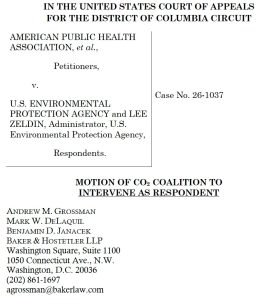
CO2 Coalition Motion to Intervene
FAIRFAX, Va. – The CO2 Coalition is requesting to join a federal D.C. Court of Appeals case to support the EPA’s repeal of a 2009 rule that classified carbon dioxide emissions from vehicles as a dangerous pollutant.
The Coalition’s March 20th motion to intervene is a response to environmental organizations and several states that filed legal challenges to the EPA repeal, which was announced in February. The agency had concluded that it did not have authority under the federal Clean Air Act to regulate carbon dioxide.
“The basis of the wrongheaded Endangerment Finding put ideology ahead of science,” said Gregory Wrightstone, Executive Director of the CO2 Coalition, a nonprofit organization of more than 200 scientists and researchers. “The rule has been an impediment to economic growth, a cause of rising energy costs and a destroyer of many thousands of jobs at power plants, coal mines and manufacturing facilities.
“Since its 2009 enactment, the Endangerment Finding’s scientific underpinnings have been found to be even weaker than previously believed and contradicted by empirical data, peer-reviewed studies and research.”
Founded in 2015, the CO2 ~Coalition is a nonprofit organization with a mission to advance the public understanding of carbon dioxide’s essential role in sustaining plant life, agriculture and the global ecosystem.
The Coalition filing includes statements of members engaged in activities like farming and forestry. They note the benefits of higher levels of atmospheric CO2 for plants and list negative effects of the Endangerment Finding, including higher costs for equipment and of doing business in general.
“EPA’s repeal of the Endangerment Finding is a welcome action based on sound legal reasoning,” said Executive Director Wrightstone. “The CO2 Coalition will present scientific facts and data demonstrating the fallacy underlying the rule – that carbon dioxide is a toxin. The planet is benefiting from rising CO2 levels and will continue to do so. There is no climate crisis.”
Attorneys Andrew Grossman, Mark Delaquil and Benjamin Janacek of Baker and Hostetler law firm filed the intervention on behalf of the CO2 Coalition.
Download here: CO~2 Coalition – Motion to Intervene with Declarations – As Filed
Contact: Gregory Wrightstone
Email:executivedirector@co2coalition.org
Phone:(703) 540-4700
Tags: Endangerment Finding, EPA
---
SEE CURRY RED TEAM CWG BS
UCS? AND --- SUED TO 86 COMM
ZOE LTR SEP 18 2025
:{:{Dr. Judith Curry Professor Emeritus Georgia Institute of Technology School of Earth and Atmospheric Sciences 311 Ferst Drive Atlanta, GA 30332}:
:{:{Dear Dr. Curry, I write to you to express my deep concern about the matters you brought to light in an interview for a September 11th, 2025, article in E&E News regarding the recently dissolved Department of Energy (DOE) Climate Working Group (CWG). 1}:
For months now,2 Democrats on the Committee on Science, Space, and Technology have sounded the alarm about the procedural irregularities in the Administration’s attempt to repeal the Environmental Protection Agency’s (EPA) Endangerment Finding.3 Given your public disclosures, I request that you participate in a formal interview to elaborate on your observations and experiences participating in the CWG during and after the preparation of the report entitled “A Critical Review of Impacts of Greenhouse Gas Emissions on the U.S. Climate.”4}:}:
In your interview with E&E News, you stated that DOE “really didn’t dot all the I’s and cross the T’s,” and that the Department “dropped the ball on really making us an official group affiliated with the DOE, rather than, you know, just sort of an ad hoc group.” The article paraphrased your 1 Scott Waldman, “Disbanded DOE climate group vows to continue work,” E&E News, September 11, 2025, accessed here:
:{:{https://subscriber.politicopro.com/article/eenews/2025/09/11/disbanded-doe-climate-group-vows-tocontinue-work-00556267.}:
2 “Ranking Member Lofgren calls Trump Administration out for risking public health with Endangerment Finding reconsideration,” House Committee on Science, Space, and Technology Democrats, March 13, 2025, accessed here: https://democrats-science.house.gov/news/press-releases/ranking-member-lofgren-calls-trump-administration-outfor-risking-public-health-with-endangerment-finding-reconsideration.
3 Letter from Ranking Members Zoe Lofgren and Gabe Amo to Environmental Protection Administrator Lee Zeldin, August 18, 2025, accessed here: https://democrats-science.house.gov/imo/media/doc/2025-08- 18%20SST%20RM%20Lofgren%20Amo%20-%20Letter%20to%20Administrator%20Zeldin%20- %20Endangerment%20Finding%20Repeal.pdf.
4 “A Critical Review of Impacts of Greenhouse Gas Emissions on the U.S. Climate,” Department of Energy, July 23, 2025, accessed here: https://www.energy.gov/sites/default/files/2025- 07/DOE_Critical_Review_of_Impacts_of_GHG_Emissions_on_the_US_Climate_July_2025.pdf.}:
P2....
---
---
NYT
NO LNX
Environmental Groups Sue Over D.O.E. Report Downplaying Climate Change
The lawsuit seeks to block the Trump administration from repealing the legal foundation for regulating climate pollution.
By Lisa Friedman
Aug. 15, 2025
A new lawsuit in federal court alleges that the Trump administration violated the law by secretly recruiting a group of people who reject the scientific consensus on climate change to write a report downplaying global warming.
The Environmental Defense Fund and the Union of Concerned Scientists, both environmental groups, accused the Department of Energy and the Environmental Protection Agency of “flagrant violations” of a law that governs advisory committees.
The lawsuit was filed in the United States District Court for the District of Massachusetts on Tuesday. It alleges that in March Chris Wright, the energy secretary, “quietly arranged for five handpicked skeptics of the effects of climate change” to form a committee called the Climate Working Group that then wrote a report downplaying the threat of rising greenhouse gas emissions. Lee Zeldin, the administrator of the Environmental Protection Agency, cited the report to justify a plan to repeal the legal foundation for regulating climate pollution.
But the Federal Advisory Committee Act of 1972 does not allow federal agencies to recruit or rely on secret groups when engaging in policymaking, according to the lawsuit. The law requires that any groups developed to advise federal policy must be disclosed and that meetings, emails and other records be made public.
“This is one of the most brazen violations of federal law on one of the single most consequential issues to the lives of millions of Americans,” said Vickie Patton, general counsel for the Environmental Defense Fund.
The lawsuit alleges that the agencies “have sought to manufacture a basis to reject” widespread scientific agreement that the burning of fossil fuels is the primary contributor to global warming, and that swift action is needed to avoid the worst consequences.
On Thursday the environmental groups filed a separate motion asking the court to block the E.P.A. from moving forward with a plan to repeal a scientific determination made by the government in 2009 that climate pollution harms public health and welfare. That assessment, known as the endangerment finding, is the basis for regulating greenhouse gas emissions under the Clean Air Act.
Officials with the Department of Energy did not respond to a request for comment. An E.P.A. official said the agency does not comment on current or pending litigation.
The authors of the Department of Energy report were Steven E. Koonin, a physicist and author of a best-selling book that calls climate science “unsettled”; Judith Curry, a climatologist who has cautioned of alarmism about warming; John Christy, an atmospheric scientist who doubts the extent to which human activity has caused global warming; Roy Spencer, a meteorologist at the University of Alabama, Huntsville; and Ross McKitrick, an economics professor at the University of Guelph in Canada.
Dr. Koonin said in an email that he is not an attorney and not qualified to offer an opinion on the lawsuit. Dr. Curry said in an email that the Climate Working Group “provided technical information to the DOE, not policy advice.” Dr. Christy and Mr. McKitrick declined to comment, and Dr. Spencer did not respond to a request for comment.
Documents obtained by the Environmental Defense Fund under public records laws show that Dr. Koonin began contacting Trump administration officials within weeks of President Trump’s inauguration. In one email exchange, Dr. Koonin reached out in February to Mr. Zeldin’s chief of staff, Eric Amidon.
“I was told (through a mutual friend of mine and the Administrator’s) that I should contact you to set up a meeting with Mr. Zeldin,” Dr. Koonin wrote. “The subject is to offer technical assistance from me and colleagues in the review of the Endangerment Finding.”
Mr. Amidon replied that the agency was “moving right along on this topic” and said he would set up a call for Dr. Koonin with E.P.A. officials. On Friday Dr. Koonin said the call never occurred, writing in an email, “A search of my records shows no further contact with the EPA (whether by phone, video, or in person)” after the Feb. 16 email exchange.
Dr. Koonin did send Mr. Amidon a memo of what he called “inconvenient truths” on climate change, including a claim widely rejected by mainstream scientists that “there is no basis to conclude that human emissions enhance natural ‘greenhouse’ warming in any amount.”
Lisa Friedman is a Times reporter who writes about how governments are addressing climate change and the effects of those policies on communities.
A version of this article appears in print on Aug. 16, 2025, Section A, Page 14 of the New York edition with the headline: Suit Says U.S. Used Skeptics for Report Dismissing Climate Change. Order Reprints | Today’s Paper | Subscribe
See more on: U.S. Politics, Environmental Defense Fund, Union of Concerned Scientists
---
---
SEPP open ltr usual retired, geology, meteorology, physics
---
OMFG
25
Washington D.C.—Today, AFPI Executive Vice President andformer Secretary of the Interior David Bernhardt released the following statement regarding U.S. Environmental Protection Agency (EPA) Administrator Lee Zeldin’s July 29, 2025, announcement of a proposed rule to rescind the 2009 Endangerment Finding:
“Under the decisive leadership of President Trump and Administrator Zeldin, the Left’s bureaucratic overreach is finally being rolled back. The effort to dismantle the Obama-era Endangerment Finding, a cornerstone of the radical climate agenda, has advanced. For over a decade, it has been the lynchpin for $1 trillion in crushing greenhouse gas regulations that have been weaponized against the American public. Unelected bureaucrats have imposed top-down mandates on light, medium and heavy-duty on-highway vehicles, harming consumers, small businesses, and rural communities.
If finalized, this proposal would strike at the heart of the regulatory regime. It will deliver more than $54 billion in savings annually, gutting costly mandates.
This is a victory for American jobs and will reclaim our economy from the grip of bureaucracy and regulation. America is on offense.”
---
OMFG
note temp
MMA 7 25
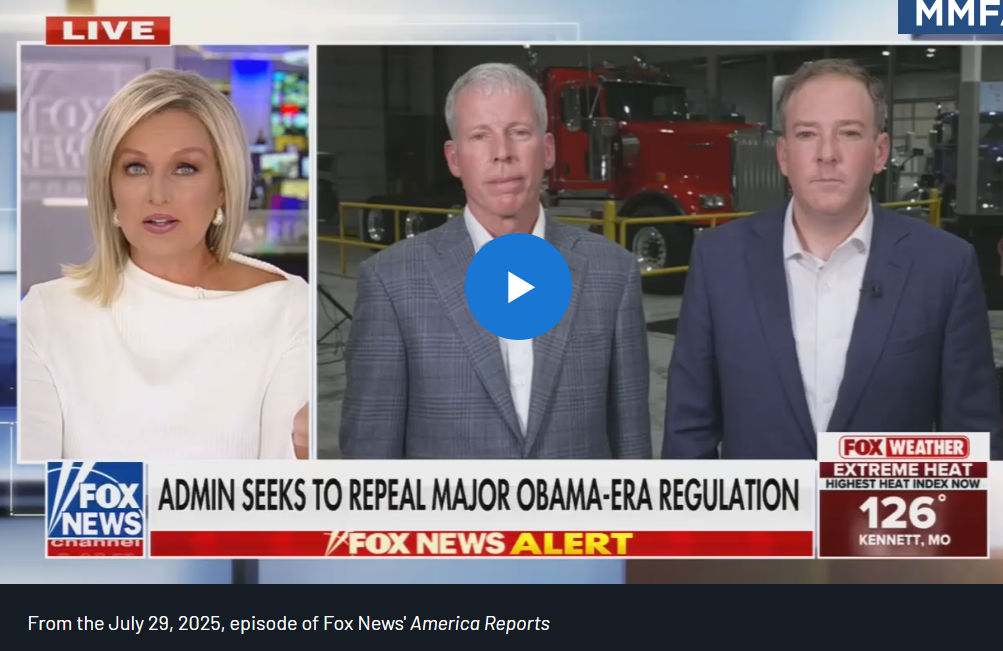
Fox News’ America Reports hosted Environmental Protection Agency Administrator Lee Zeldin and Energy Secretary Chris Wright to discuss the Trump administration's proposal to repeal the EPA’s 2009 endangerment finding, which affirmed that greenhouse gases endanger public health and welfare and which has served as the legal foundation for regulating emissions under the Clean Air Act.
Zeldin and Wright used the appearance to frame the repeal as a return to scientific integrity and regulatory restraint, ignoring the harms that this repeal would have on vulnerable communities. Fox anchor Sandra Smith did not challenge the claims and made no mention of the public health implications or regulatory consequences of revoking the finding. The exchange typified Fox’s pattern of amplifying Trump administration narratives about climate and energy while downplaying their real-world impacts.
Video
Citation
From the July 29, 2025, episode of Fox News' America Reports
The segment typified Fox’s role in obscuring the consequences of climate deregulation
During their appearance, Zeldin and Wright were not pressed on the public health, environmental, or legal implications of the proposal to reverse the endangerment finding. Instead, the host framed the discussion around economic themes and legal processes, asking whether repeal would make it easier to “undo a lot more of the Biden-Obama era climate rules.” Viewers heard nothing about the policy’s real-world impacts, but they did hear climate advocates characterized as ideological or extreme. Zeldin referred to them as “climate zealots,” while Wright framed the repeal as a return to “rationalism” — signaling to Fox’s audience that those who defend public protections are unserious.
This approach mirrors Fox’s longstanding pattern of covering regulatory actions through the lens of efficiency, growth, and personal freedom, while sidelining the communities most affected by the Trump administration's harmful actions. The result is a consistent minimization of climate risk and a distorted narrative in which climate and environmental outcomes are treated primarily as a political liability rather than a public necessity.
By allowing unchallenged repetition of misleading claims, and by omitting the central consequences of the policy under discussion, Fox News once again advanced a message strategy that serves to normalize and obscure the dismantling of basic climate and environmental protections.
Zeldin and Wright advanced a series of unsupported or misleading claims
During their appearance on the July 29 episode of Fox News' America Reports, Zeldin and Wright made a series of unsupported or misleading claims about the endangerment finding and what its repeal would mean for Americans.
Zeldin, for example, asserted that repealing the endangerment finding would yield “$1 trillion in savings”—a figure with no grounding in published EPA analyses or historical regulatory assessments. In contrast, EPA data has consistently shown that rules issued under the endangerment finding and the broader Clean Air Act generate substantial net benefits.
The agency’s Second Prospective Study of the Clean Air Act found that “the central benefits estimate exceeds costs by a factor of more than 30 to one," with most benefits stemming from reduced mortality linked to particulate pollution. By 2020, Clean Air Act programs were projected to prevent over 230,000 premature deaths, as well as millions of asthma attacks, heart attacks, and lost workdays annually.
More recently, the EPA’s Regulatory Impact Analysis for vehicle greenhouse gas standards projected net societal benefits of $272.7 billion between 2022 and 2050, with annualized gains of more than $14 billion, driven by fuel savings, reduced emissions, and avoidance of climate damages. These figures underscore that, far from being a financial burden, regulations grounded in the endangerment finding generate substantial and enduring public and economic value.
Similarly, Wright’s claim that the repeal reflects a return to scientific rigor collapses under scrutiny, relying on a report authored by a small group of contrarian scientists, including Steven Koonin and John Christy, who reject the well-established conclusion that greenhouse gas emissions from human activity are driving global warming and endangering public health. Their views stand in opposition to the broader scientific community, which includes the consensus positions of federal agencies such as the National Aeronautics and Space Administration and the National Oceanic and Atmospheric Administration, as well as the Fifth National Climate Assessment, which was produced by the U.S. Global Change Research Program.
Beyond economic distortions and scientific misrepresentation, Zeldin and Wright also ignored the far-reaching legal consequences of repeal — including for the fossil fuel industry itself.
As Grist reported, rescinding the endangerment finding would not only eliminate the federal government’s core authority to regulate greenhouse gases, it could also expose fossil fuel companies to a wave of climate liability lawsuits previously blocked by federal preemption. Some industry groups have reportedly urged the administration not to proceed, warning that repeal could unravel their legal defenses and leave them vulnerable to a patchwork of state regulations and courtroom challenges.
Fox viewers heard nothing about how repeal would harm the very communities most at risk
Zeldin and Wright also failed to mention what rescinding the endangerment finding would mean for public health, environmental protection, or the EPA’s ability to respond to pollution that threatens the air we breathe, the water we rely on, and the land we depend on to live and work. Viewers were not told that the standards targeted for repeal are central to reducing industrial emissions that worsen heat, flooding, and wildfire risk — or that dismantling these protections would increase illness, displacement, and hardship for older adults, children, low-income households, and rural communities, including many in Fox’s own audience.
REF 1
epa-endangerment-finding-repeal-proposal
NO LNX
In Game-Changing Climate Rollback, E.P.A. Aims to Kill a Bedrock Scientific Finding
The proposal is President Trump’s most consequential step yet to derail federal climate efforts and appears to represent a shift toward outright denial of the scientific consensus.
By Maxine Joselow and Lisa Friedman
Reporting from Washington
July 29, 2025
Lee Zeldin, the administrator of the Environmental Protection Agency, said on Tuesday the Trump administration would revoke the scientific determination that underpins the government’s legal authority to combat climate change.
Speaking at a truck dealership in Indianapolis, Mr. Zeldin said the E.P.A. planned to rescind the 2009 declaration, known as the endangerment finding, which concluded that planet-warming greenhouse gases pose a threat to public health. The Obama and Biden administrations used that determination to set strict limits on greenhouse gas emissions from cars, power plants and other industrial sources of pollution.
“The proposal would, if finalized, amount to the largest deregulatory action in the history of the United States,” Mr. Zeldin said. He said the proposal would also erase limits on greenhouse gas emissions from cars and trucks on the nation’s roads.
Without the endangerment finding, the E.P.A. would be left with no authority under the Clean Air Act to regulate the greenhouse gas emissions that are accumulating in the atmosphere from the burning of fossil fuels.
The proposal is President Trump’s most consequential step yet to derail federal climate efforts. It marks a notable shift in the administration’s position from one that had downplayed the threat of global warming to one that essentially flatly denies the overwhelming scientific evidence of climate change.
It would not only reverse current regulations, but, if the move is upheld in court, it could make it significantly harder for future administrations to rein in climate pollution from the burning of coal, oil and gas.
Without the United States working to reduce emissions, it becomes far tougher for the world to collectively prevent average global temperatures from rising by more than 1.5 degrees Celsius, or 2.7 degrees Fahrenheit, above preindustrial levels. That is the threshold beyond which climate scientists say there is significantly greater risk from increasingly destructive storms, droughts, wildfires and heat waves, as well as from species extinction.
In recent weeks, the Trump administration has also moved to scrap restrictions on pollution from power plants, halt key measurements of greenhouse gases in the atmosphere and delay approvals of wind and solar energy projects on federal lands.
“Today’s E.P.A. announcement ignores the blindingly obvious reality of the climate crisis and sidelines the E.P.A.’s own scientists and lawyers in favor of the interests and profits of the fossil fuel industry,” former Vice President Al Gore said in a statement.
To justify the proposal, the E.P.A. cited a report that the Energy Department commissioned from five scientists known for their rejection of the overwhelming scientific consensus on climate change, namely that it is being driven by the burning of fossil fuels, which releases greenhouse gases into the atmosphere.
The New York Times first reported that the Energy Department had hired these scientists, including Steven E. Koonin, a physicist and author of a best-selling book that calls climate science “unsettled,” and John Christy, an atmospheric scientist who doubts the extent to which human activity has caused global warming.
In their report, the scientists criticized the computer models used to predict climate change, saying they tend to overestimate warming. They also wrote that carbon dioxide, the most prevalent greenhouse gas in the atmosphere, has positive effects by helping plants grow and increasing agricultural productivity. And they asserted that overall, government climate regulations have a limited effect on global temperature rise.
The E.P.A. echoed this last argument in the proposed rule, saying greenhouse gases from cars on American roads do not contribute significantly to climate change because they are a small share of global emissions. Reducing these emissions to zero “would not have a scientifically measurable impact” on global climate trends or on public health and welfare, the agency said. Instead, the agency said, climate regulations are what pose the true threat to public health and welfare, because they increase the price of new vehicles and leave fewer choices for car buyers.
Many environmental activists and lawyers criticized those arguments, noting that transportation is the largest source of greenhouse gases in the United States. If the U.S. motor vehicle sector were a country, it would be the fourth-largest emitter of greenhouse gases in the world, according to the E.P.A.’s own data.
“If vehicle emissions don’t pass muster as a contribution to climate change, it’s hard to imagine what would,” said Dena Adler, a senior attorney at the Institute for Policy Integrity at New York University School of Law.
Dan Becker, who leads transportation policy for the Center for Biological Diversity, an environmental group, called the E.P.A. proposal a “cynical one-two punch” that will lead to more gasoline-burning vehicles on the road and fewer tools to reduce tailpipe pollution. He said that the auto-emissions rules being rescinded were projected to prevent 7 billion metric tons of emissions from entering the atmosphere while saving the average American driver about $6,000 in fuel and maintenance over the lifetime of vehicles built under the standards.
“The E.P.A. is revoking the biggest single step any nation has taken to save oil, save consumers money at the pump and combat global warming,” Mr. Becker said.
The administration’s plan has its backers. Daren Bakst, who directs the Center for Energy and Environment at the Competitive Enterprise Institute, a free-market research organization, said, “It is unreasonable to claim that pollutants contribute to endangerment if emissions are de minimis.”
Mike Braun, the governor of Indiana, said at the event in Indianapolis that the Biden administration’s vehicle emissions rules had burdened the auto industry in the state. “As a lifelong entrepreneur for 37 years actually in the automotive business, I think I know a thing or two about it, and you can count on Indiana being for common sense and reining in government,” he said.
John Bozzella, chief executive of the Alliance for Automotive Innovation, a lobbying group for most major carmakers, said in a statement that he was still reviewing the E.P.A.’s announcement. “At the same time, there’s no question the vehicle emissions regulations finalized under the previous administration aren’t achievable and should be revised to reflect current market conditions, to keep the auto industry in America competitive,” he said.
While the Chamber of Commerce and fossil fuel groups had fought the endangerment finding when it was first written, none have been clamoring in recent years for its reversal. This year Marty Durbin, who leads the chamber’s energy institute, called the finding “settled law” and said his group, which is a major business lobbying organization, was not seeking its repeal.
“I’m not aware of anyone in industry who has been pushing for it,” said Jeffrey Holmstead, an energy attorney with the law firm Bracewell who served in the E.P.A. during the administration of the first President George Bush and, later, that of President George W. Bush.
The plan to eliminate the endangerment finding showcases the political evolution of Mr. Zeldin, who for years took moderate positions on climate change and other environmental issues.
A former congressman from a coastal community on Long Island that is struggling with rising sea levels linked to global warming, Mr. Zeldin once joined a bipartisan caucus to address climate change. In 2019 he broke with fellow Republicans to vote against an amendment that would have prohibited the E.P.A. from reducing greenhouse gas emissions.
An ally of Mr. Trump who prominently defended him during House impeachment hearings, Mr. Zeldin moved to the right on energy and other issues during his unsuccessful bid for governor of New York in 2022. Just weeks after his nomination to lead the E.P.A., Mr. Zeldin declared that he would be “driving a dagger through the heart of climate-change religion” by repealing regulations on greenhouse gas emissions
“There are people who, in the name of climate change, are willing to bankrupt the country,” Mr. Zeldin said on the conservative podcast “Ruthless” earlier on Tuesday. One of the co-hosts of the program called the endangerment finding “the left’s tent pole to begin the whole climate grift,” to which Mr. Zeldin agreed.
The proposed repeal of the endangerment finding is all but certain to draw legal challenges, and David Doniger, a senior attorney at the Natural Resources Defense Council, an environmental group, said he expected that it would eventually be struck down in court. He noted that climate science has advanced significantly since 2009, when the finding was issued.
After the proposal is published in the Federal Register, the E.P.A. will solicit comments from the public for 45 days, Mr. Zeldin said. The agency will then finalize the rule, most likely in the next year.
Maxine Joselow reports on climate policy for The Times.
Lisa Friedman is a Times reporter who writes about how governments are addressing climate change and the effects of those policies on communities.
A version of this article appears in print on July 30, 2025, Section A, Page 1 of the New York edition with the headline: E.P.A. To Retract Bedrock Finding On Climate Crisis. Order Reprints
---
REF ALSO NYT
Trump Hires Scientists Who Doubt the Consensus on Climate Change
The three scientists joined the administration after it dismissed hundreds of experts who were assessing how global warming is affecting the country.
Steven E. Koonin, dressed in a dark suit and yellow tie, gestures as he speaks while sitting on a stage.
Steven E. Koonin, a physicist and author, was hired by the Energy Department. He previously worked as a physicist at New York University, as a scientist for the oil and gas company BP and as an under secretary at the Energy Department during the Obama administration.Credit...Aaron M. Sprecher/Bloomberg
By Maxine Joselow
Reporting from Washington
July 8, 2025
The Energy Department has hired at least three scientists who are well-known for their rejection of the overwhelming scientific consensus on climate change, according to records reviewed by The New York Times.
The scientists are listed in the Energy Department’s internal email system as current employees of the agency, the records show. They are Steven E. Koonin, a physicist and author of a best-selling book that calls climate science “unsettled”; John Christy, an atmospheric scientist who doubts the extent to which human activity has caused global warming; and Roy Spencer, a meteorologist who believes that clouds have had a greater influence on warming than humans have.
Their hiring comes after the Trump administration dismissed hundreds of scientists and experts who had been compiling the federal government’s flagship report on how climate change is affecting the country. The administration has also systematically removed mentions of climate change from government websites while slashing federal funding for research on global warming.
In addition, Trump officials have been recruiting scientists to help them repeal the 2009 “endangerment finding,” which determined that greenhouse gases pose a threat to public health and welfare, and which now underpins much of the government’s legal authority to slow global warming, according to two people briefed on the matter who spoke on the condition of anonymity because they were not authorized to comment publicly.
It was not immediately clear what the three scientists were working on or whether they were being paid. Representatives for Dr. Koonin, Dr. Spencer and the Energy Department did not respond to requests for comment.
In a brief phone interview and follow-up email, Dr. Christy said he was not working on the endangerment finding nor collecting a government salary. He declined to comment further.
A vast majority of scientists around the world agree that human activities — primarily the burning of fossil fuels such as oil, gas and coal — are dangerously heating the Earth. That has increased the frequency and intensity of heat waves, droughts and colossal bursts of rain like the storm that caused the deadly flooding now devastating central Texas.
A small minority of scientists, however, rejects this consensus. Dr. Koonin, who has said he is a friend of Energy Secretary Chris Wright, has been one of the loudest critics.
During President Trump’s first term, Dr. Koonin proposed that the Environmental Protection Agency conduct a “red-team, blue-team” exercise to challenge mainstream climate science. A “red team” of climate skeptics would critique major scientific reports on global warming, and a “blue team” of climate scientists would then rebut these claims. At the time, mainstream climate scientists said the proposal would make a mockery of scientific research and create a platform for marginal views that had already been disproved in the normal course of scientific debate.
Image
Roy Spencer, in a dark suit, blue shirt and tie, holds a microphone in one hand and points to a projection on a screen with the other hand.
Roy Spencer, a former NASA scientist and researcher at the University of Alabama, in 2012. He has argued that while human activity has caused some warming, its influence has been smaller than that of natural variations in global cloud cover.
Scott Pruitt, the E.P.A. administrator at the time, told coal industry executives that he planned to conduct the exercise. But John F. Kelly, then the White House chief of staff, ultimately blocked the effort.
Now, Dr. Koonin is listed as a “special government employee” in the Energy Department’s internal email system, the records show. Federal law says special government employees are executive branch appointees named to “perform important, but limited, services to the government, with or without compensation, for a period not to exceed 130 days” during a one-year period. Elon Musk had that classification when he began Mr. Trump’s cost cutting initiative, the so-called Department of Government Efficiency.
Dr. Koonin also serves as a fellow at the Hoover Institution, a conservative-leaning research organization on Stanford University’s campus. He previously worked as a physicist at New York University, a scientist for the oil and gas company BP and an under secretary at the Energy Department during the Obama administration.
In his 2021 book, “Unsettled: What Climate Science Tells Us, What It Doesn’t and Why It Matters,” Dr. Koonin argued that while the planet was warming and human activities had played a role, the scientific consensus was not as certain or as dire as it was frequently portrayed.
In a phone interview in November, Dr. Koonin said that the book had made an impression on Mr. Wright, who ran the oil and gas company Liberty Energy before he was confirmed as energy secretary in February.
“He reached out when I wrote the book and said, ‘This is great,’” Dr. Koonin recalled. “He asked me to come talk to his company at one point — it was a couple years ago — and we got to know each other.”
He added, “Chris and I have talked quite a bit over the last couple years, and I think he is well aligned with what I wrote in the book.”
Dr. Spencer, a research scientist at the University of Alabama in Huntsville, also has a connection to Mr. Wright. In a report published last year by Liberty Energy, Mr. Wright cited atmospheric temperature records that Dr. Spencer had collected. (The overall report, titled “Bettering Human Lives,” made the case that fossil fuels were “essential” to solving global poverty, a claim that some experts have called misleading.)
In addition to his role at the University of Alabama, Dr. Spencer is a policy adviser at the Heartland Institute, a conservative group that rejects mainstream climate science. He previously served as a scientist at NASA and as a visiting fellow at the Heritage Foundation, a right-wing group responsible for creating Project 2025, a conservative blueprint for the new administration.
Dr. Spencer has argued that while human activity has caused some warming, its influence has been smaller than that of natural variations in global cloud cover. While some of Dr. Spencer’s past work has been funded by the government, he has accused federal climate researchers of being biased because they receive taxpayer money.
“The popular opinion that government-funded research is unbiased must be considered quite naïve,” he wrote in his 2010 book “The Great Global Warming Blunder: How Mother Nature Fooled the World’s Top Climate Scientists.”
Image
John Christy, dressed in khaki shorts, sneakers and a blue polo shirt, sits on a chair in front of a large wall map of the world.
:{:{John Christy, an atmospheric scientist who doubts that human activity has caused global warming, in 2014}:
Dr. Christy has worked closely with Dr. Spencer to maintain atmospheric temperature records at the University of Alabama. He has also served as Alabama’s state climatologist since 2000. A vocal critic of climate models, he championed the “red-team, blue-team” exercise and served on an E.P.A. scientific advisory board during the first Trump administration.
When asked about his Energy Department role in a brief phone interview, Dr. Christy said he was an “unpaid person who’s available to them if they need it.”
Michael Mann, a climate scientist at the University of Pennsylvania, expressed alarm that the Energy Department had hired the three scientists.
“What this says is that the administration has no respect for the actual science, which overwhelmingly points in the direction of a growing crisis as we continue to warm the planet through fossil-fuel burning, the consequences of which we’ve seen play out in recent weeks in the form of deadly heat domes and floods here in the U.S.,” Dr. Mann wrote in an email.
Dr. Mann added that the Trump administration appeared to have fired hundreds of “actual government science experts” and replaced them with “a small number of reliable foot soldiers.”
Andrew Dessler, a climate scientist at Texas A&M University, said it would be troubling if these three scientists were involved in repealing the 2009 endangerment finding, which cleared the way for the government to regulate the planet-warming gases emitted by cars, power plants and other industrial sources.
On his first day back in the White House, Mr. Trump signed an executive order that charged the E.P.A. with reviewing the “legality and continuing applicability of” the endangerment finding. And last week, the agency sent a proposal to reconsider the finding to the White House budget office, a first step in repealing it.
An E.P.A. spokesman, Mike Bastasch, declined to comment on the proposal before its public release.
Brad Plumer contributed reporting from Washington.
Maxine Joselow reports on climate policy for The Times.
A version of this article appears in print on July 9, 2025, Section A, Page 16 of the New York edition with the headline: Energy Department Hires Skeptics of Climate Change
===
---
---
he upheld his prev position in mass v epa
https://www.edf.org/news/dc-circuit-court-appeals-affirms-its-decision-uphold-historic-epa-actions-reduce-climate-pollut
no lnx
DC. Circuit Court of Appeals Affirms Its Decision to Uphold Historic EPA Actions to Reduce Climate Pollution, Protect Public Health
December 20, 2012
(Washington, DC – December 20, 2012) Today, the United States Court of Appeals for the District of Columbia Circuit refused petitions to rehear a landmark carbon pollution case — once again affirming the U.S. Environmental Protection Agency’s (EPA) clean air measures to protect Americans’ health and well-being from climate-disrupting pollution.
The three-judge panel of the court heard the cases in June. Today, the court refused petitions requesting that the entire court rehear the challenges sitting en banc.
The panel opinion that was the subject of the rehearing petition dismissed challenges to the Climate Pollution Endangerment Finding and the Clean Car Standards as well as the Timing and Tailoring Rules (see below for details on the cases).
In the original panel opinion by Chief Judge David Sentelle, appointed to the Court by President Ronald Reagan,and Circuit Judges Judith Rogers and David Tatel, the court held EPA’s interpretation of the nation’s clean air laws was “unambiguously correct.”
The panel opinion also stated that, “[F]or the reasons set forth below, we conclude: 1) the Endangerment Finding and Tailpipe Rule are neither arbitrary nor capricious; 2) EPA’s interpretation of the governing CAA provisions is unambiguously correct; and 3) no petitioner has standing to challenge the Timing and Tailoring Rules. We thus dismiss for lack of jurisdiction all petitions for review of the Timing and Tailoring Rules, and deny the remainder of the petitions.”
Today, Judges Sentelle, Rogers, and Tatel issued a statement concurring in the Court’s decision not to rehear the case en banc. That statement points to the clear law and binding precedent of the United States Supreme Court, and says, “Here, Congress spoke clearly, EPA fulfilled its statutory responsibilities, and the panel, playing its limited role, gave effect to the statute’s plain meaning …To be sure, the stakes here are high. The underlying policy questions and the outcome of this case are undoubtedly matters of exceptional importance. The legal issues presented, however, are straightforward, requiring no more than the application of clear statutes and binding Supreme Court precedent. There is no cause for en banc review.”
Environmental Defense Fund (EDF), together with a large coalition of states and environmental organizations, intervened in defense of the vital clean air protections at stake in this litigation.
“America’s clean air laws are clear; EPA has the authority and the responsibility to address the carbon pollution that has profound consequences for our nation’s health, safety and prosperity,” said Vickie Patton, General Counsel of Environmental Defense Fund. “It is now time for EPA to address the dangerous carbon pollution that comes from power plants by working with the dozens of states that have forged common sense clean energy solutions, as well as the numerous businesses that asked the President to carry out cost-saving energy efficiency solutions in reducing carbon pollution, and the communities across our nation afflicted by the clear and present danger of extreme weather that’s linked to climate change.”
The lawsuits and petitions for rehearing were brought by major industrial polluters and states such as Texas.
The cases in question include:
The Climate Pollution Endangerment Finding — in which EPA, following the Supreme Court’s order in Massachusetts v. EPA, determined that climate pollution endangers human health and welfare on the basis of a rigorous review of the extensive body of climate science.
The Clean Car Standards — which establish cost-saving fuel efficiency and greenhouse gas emissions standards for passenger cars and light trucks. The standards are supported by U.S. auto makers and the United Auto Workers union, among others. They will save Americans thousands of dollars at the gas pump by enabling families to get more mileage out of each gallon of gas. They will also help break our nation’s addiction to imported oil and will cut the amount of dangerous pollution from vehicles.
Carbon Pollution Limits for Big New Power Plants and Industrial Sources (the Timing and Tailoring Rules) — in which EPA is phasing-in requirements for use of the best available cost-effective pollution controls, starting with new, large industrial emitters (like power plants) while shielding smaller emitters.
The U.S. auto makers and a dozen states (California, Delaware, Illinois, Iowa, Maine, Maryland, New Mexico, New York, Oregon, Rhode Island, Vermont and Washington) intervened in defense of EPA’s clean car standards (the second case listed above).
“EPA’s reasonable steps to reduce climate pollution will help secure a safe and prosperous future for our country.” said EDF’s outside legal counsel Sean Donahue, who presented oral arguments to the three judge panel in defense of these protections. “Today’s court ruling will help our country move forward toward the clean energy economy of the future.”
You can read more about the cases and the parties involved, find the court briefs, and get more information on our website.
---
---
CLIMATE:
Lawyers descend en masse for arguments on greenhouse gas rules
Lawrence Hurley, E&E reporter
Greenwire: Monday, February 27, 2012
If the importance and complexity of a court case can be established based on the number of lawyers at the lectern, then the battle over the Obama administration greenhouse gas regulations is of epic proportions.
When the three interlinked cases are argued over two days at the U.S. Court of Appeals for the District of Columbia Circuit this week, no fewer than 18 different attorneys will advocate for their clients before the three-judge panel.
By contrast, a typical appeals court argument over a U.S. EPA regulation usually takes less than an hour and tends to involve no more than a handful of attorneys.
The Lineup
The lawyers for the Obama administration, industry groups, states and environmental organizations who will be facing off in the U.S. Court of Appeals for the District of Columbia Circuit tomorrow and Wednesday over the lawfulness of EPA's greenhouse gas regulations.
Tuesday
The endangerment finding rule
Challengers Defenders
E. Duncan Getchell Jr.
solicitor general, Virginia
Patrick R. Day
Holland & Hart, for Coalition for Responsible Regulation
Jeffery Bossert Clark
Kirkland & Ellis, for U.S. Chamber of Commerce
Harry W. MacDougald
Caldwell & Watson, for Southeastern Legal Foundation, et al.
Jon M. Lipshultz & Angeline Purdy
Justice Department, for EPA.
Carol A. Iancu
Attorney General's Office, for Massachusetts
The tailpipe rule
Challengers Defenders
Peter S. Glaser
Troutman Sanders, for National Mining Association, Peabody Energy and American Farm Bureau Federation Eric Hostetler
Justice Department, for EPA
Raymond B. Ludwiszewski
Gibson, Dunn & Crutcher, for Alliance of Automobile Mfgs and Global Automakers
Gavin Geraghty McCabe
Attorney General's Office, for California
Wednesday
Timing and tailoring rules
Challengers Defenders
Jonathan Franklin Mitchell
solicitor general, for Texas
Peter Keisler
Sidley Austin, for National Association of Manufacturers, et al.
F. William Brownell
Hunton & Williams, for Utility Air Regulatory Group
Perry M. Rosen & Amanda Shafer Berman
for EPA
Michael J. Myers
New York Attorney General's Office, for states
Sean H. Donahue
Law Office of Sean Donahue, for environmental groups
Historic regulations
Challengers Defenders
Peter Keisler
Sidley Austin, for petitioners Perry M. Rosen & Amanda Shafer Berman
Justice Department, for EPA
Sean H. Donahue
Law Office of Sean Donahue, for environmental groups
Source: Court papers, the parties.]
In addition to the 18 attorneys who will actually speak -- representing EPA, industry groups, states and environmental organizations -- there are dozens behind the scenes who have been working on the litigation.
"This is one of the most complex and consequential sets of cases in the history of environmental law," said Michael Gerrard, director of the Center for Climate Change Law at Columbia Law School. "It involves not just one project, industry or regulation, but a whole structure of interlocking regulations that affect broad swaths of the economy."
There are four principal rules under the legal microscope before the court, although two, the "timing" and "tailoring" rules, have been consolidated into one case.
Arguments over the "endangerment" rule, which focuses on EPA's initial decision in which it held that greenhouse gases are harmful, and the "tailpipe" rule, which adopts new standards for car and light-truck emissions, will be argued tomorrow.
The arguments on the consolidated challenges to the timing and tailoring rule will be heard Wednesday, along with a separate challenge to EPA's existing regulations concerning the long-standing regulation of stationary sources, which petitioners say should not be applied to greenhouse gases or various other pollutants.
The timing rule required that new controls of greenhouse gas emissions from stationary sources would be triggered on Jan. 2, 2011, the day that new motor vehicle standards went into effect.
The tailoring rule interprets the Clean Air Act in such a way that only major polluters are required to obtain permits for greenhouse gas emissions. That rule is considered the most vulnerable to legal attack because EPA was forced to effectively rewrite the Clean Air Act in order to prevent the regulations from applying to nonindustrial sources like schools and apartment buildings.
Herding cats
It is an old joke that getting lawyers to agree on anything is like herding cats, but that is exactly what those involved had to do in order to figure out who was going to argue what over the two days.
This was likely more a problem for the various industry groups and several states challenging the rules, simply because there were so many of them sitting around the table, ranging from the U.S. Chamber of Commerce and the National Association of Manufacturers to the American Petroleum Institute and the states of Texas and Virginia.
Asked how they coordinated, one lawyer involved, who declined to be named, said: "A lot of meetings and conversations boiling down what issues needed to be argued and then trying to decide who would get what."
Ultimately, "it wound up being really one lawyer from each of the main parties interested in each of the issues," he added.
Discussions were similar for the environmental groups and the states that intervened in defense of the rule, according to Sean Donahue, who will be arguing Wednesday on behalf of the groups.
"We did work closely in deciding who was going to argue," he said.
One question the various lawyers agreed upon was that an attorney from Massachusetts should argue in defense of the endangerment finding. That's because Massachusetts was a key player in the litigation that led to the 2007 Supreme Court ruling in Massachusetts v. EPA, in which the justices ruled for the first time that greenhouse gases were a pollutant and could therefore be regulated under the Clean Air Act. The decision led directly to the endangerment finding.
In a similar vein, it made sense for a lawyer representing California -- which has been particularly active in regulating vehicle emissions -- to argue over the tailpipe rule, Donahue said.
Donahue's side also had discussions with the Obama administration's lawyers about how they could be of assistance, he added.
It was up to the administration to cede some of its argument time in order for the environmental groups and states in favor of the rules to have any say at argument.
"We talked to them, and they agreed to the argument time," Donahue said.
Ceremonial courtroom
As previously reported in Greenwire, the three judges presiding over the litigation have a history when it comes to both environmental cases in general and, more specifically, greenhouse gases.
They are Chief Judge David Sentelle, a conservative appointed by President Reagan, and two Clinton appointees: Judges Judith Rogers and David Tatel.
Sentelle and Tatel were both on the panel that considered Massachusetts v. EPA before the case ended up at the Supreme Court (Greenwire, Nov. 3, 2011).
The court ruled 2-1 against states that were seeking EPA action on global warming. Sentelle was in the majority, while Tatel was the dissenter.
When the massed ranks of attorneys congregate at the U.S. courthouse on Constitution Avenue in Washington tomorrow morning, the three judges will hear the arguments in a ceremonial courtroom that is much bigger than the more cramped space they normally use. Even that isn't thought to be big enough to accommodate all of those who want to tune in.
Donahue said that based on the lawyers lined up on both sides, the two-day argument will be worth watching.
"They are experienced, talented, able attorneys," he said.
As Daniel Farber, an environmental law professor at the University of California, Berkeley, School of Law, noted, while it may be unusual for so many lawyers to be arguing, there's an obvious reason why.
"That seems like a lot of lawyers to me," he said. "But of course the challengers are raising a lot of issues."
---
---
https://www.wired.com/story/facebook-joel-kaplan-washington-political-influence/
OMFG
KAPLAN REMAINED IN the Bush White House for all eight years. He rose to deputy chief of staff, managing a wide terrain of domestic policy issues, including federal surveillance law and immigration reform. He also proved adept at the Washington gamesmanship required to protect his boss.
In late 2007 the Environmental Protection Agency was on the brink of a historic feat: declaring that greenhouse gases posed a direct threat to the public through climate change. On the afternoon of December 5, an EPA official named Jason Burnett emailed the agency’s official but unpublished Endangerment Finding to the Office of Management and Budget, thus triggering a federal review process that would in all likelihood lead to the first-ever regulations of CO2 emissions from vehicles and, eventually, power stations. A half-hour later, Steven Johnson, Bush’s EPA administrator, walked into Burnett’s office. As Burnett recalls, Johnson had just gotten off the phone: Joel Kaplan was asking them not to send the report to the OMB. When Burnett said he’d already sent it, Johnson left, then came back five minutes later. “Joel is asking whether you can send a follow-on email, saying you sent it in error.”
“And I said, ‘Well, no—because I didn’t,’” Burnett recalls, laughing. “This is the key environmental issue of our time, the evidence is clear. No, I didn’t send it ‘by mistake.’” Johnson went back to the phone and again returned a few minutes later. “OK, Joel is going to tell Susan Dudley”—the OMB official who had received the EPA document—“not to open your email.” Burnett was speechless, and also somewhat impressed at Kaplan’s logic. Under a certain theory, if the email remained unopened, the OMB wasn’t in receipt of its contents. “And if you’re not in receipt of its contents, then you don’t have to take action that would flow from having received thisEndangerment Finding—literally, that the public is in danger from climate change.”
After the email sat unopened for weeks, Johnson drafted a letter directly to Bush. It read, “I have concluded that it is in the Administration’s best interest to move forward” with the EPA’s three-phase plan to regulate greenhouse gases. In January, Johnson sent the letter to the White House by courier. At the top, on EPA stationery, was a hand-scrawled note to Kaplan: “Joel, I really need your help in bringing these issues to closure. Thank you, Steve.” According to Burnett, Kaplan called a few days later and told Johnson to have someone from the EPA come over and take the letter back. Six months later, the EPA issued a new version of its findings; this time it did not make any formal recommendation.
When Bush’s term ended, Kaplan went to work for a Texas energy company. But he had kept in touch with Sheryl Sandberg, who was looking to build out Facebook’s small team in Washington. Kaplan joined in 2011, overseeing domestic policy. He understood little about how the internet worked and had to be taught by snickering staff. Yet the company’s main concern in DC at the time wasn’t fending off laws but building an image. In Washington, Facebook’s trajectory was reflected in its ever changing lease: from a cramped walk-up in DuPont Circle to swankier F Street digs in Penn Quarter to the Warner building on Pennsylvania Avenue—each move inching closer to the White House....
---
Amici Curiae Brief on CO2 case
Amici Curiae Brief of Climatologists and Scientists Sallie Baliunas, John R. Christy, Chris De Freitas, David Legates, Anthony Lupo, Patrick Michaels, Joel Schwartz, and Roy W. Spencer in Support of Respondents. by CEI Staff October 24, 2006http://www.cei.org/gencon/030,05572.cfm
Amicus brief written by Competitive Enterprise Institute
IN THE SUPREME COURT OF THE UNITED STATES COMMONWEALTH OF MASSACHUSETTS, et al., Petitioners, v. U.S. ENVIRONMENTAL PROTECTION AGENCY, et al., Respondents. On Writ of Certiorari to the United States Court of Appeals for the District of Columbia Circuit AMICI CURIAE BRIEF OF CLIMATOLOGISTS AND SCIENTISTS SALLIE BALIUNAS, JOHN R. CHRISTY, CHRIS DE FREITAS, DAVID LEGATES, ANTHONY LUPO, PATRICK MICHAELS, JOEL SCHWARTZ, AND ROY W. SPENCER IN SUPPORT OF RESPONDENTS SAM KAZMAN* HANS BADER CHRISTOPHER C. HORNER COMPETITIVE ENTERPRISE INSTITUTE 1001 Connecticut Ave., NW, #1250 Washington, D.C. 20036 (202) 331-2265 *Counsel of Recordhttp://www.cei.org/pdf/5572.pdf
==
---
https://cei.org/content/cei-submits-letter-epa-burdensome-endangerment-finding
CEI Submits Letter to EPA on Burdensome Endangerment Finding
October 17, 2017
Dear Administrator Pruitt:
On behalf of the Competitive Enterprise Institute (CEI) and the Science and Environmental Policy Project (SEPP), I am writing to transmit to you a letter signed by more than 60 climate and health experts in support of our February 2017 petition, and in support of a similar petition filed by the Concerned Household Electricity Consumers Council, asking the Environmental Protection Agency to reconsider the 2009 Endangerment Finding for greenhouse gases.
Since 2009, a number of the basic claims in that document have become increasingly questionable, and there are growing doubts about the computer models on which the finding was based. These seriously undercut the foundation for our government’s climate policies.
The Endangerment Finding is the basis for a host of incredibly burdensome and wide-ranging regulations, ranging from auto fuel economy standards to the Clean Power Plan. These threaten access to affordable energy, as well as millions of jobs, and countless lives around the world.
The finding has been used by other federal agencies to greatly expand their own regulatory programs, while other nations and international groups have relied on it to justify their own restrictions on affordable energy.
The Endangerment Finding needs to be reexamined to ensure U.S. energy policy is based on sound science. We would appreciate the opportunity to further discuss these petitions with you.
Thank you for your consideration.
Sincerely,
Sam Kazman
General Counsel, Competitive Enterprise Institute...see SEPP singer1
==
ucs 2018?
...
American Legislative Exchange Council: Fossil fuel industry ‘bill mill’
On July 12, ExxonMobil announced it had ended its longtime membership in the American Legislative Exchange Council after a disagreement over the corporate lobby group’s climate policy. From 1998 through last year — when Exxon Mobil reported it gave the group $60,000 — ALEC received $1.93 million from the oil company.
Over the last two decades, ALEC has routinely featured climate science deniers at its conferences and supplied state lawmakers with a range of fossil fuel industry-drafted sample legislation, including bills that would restrict investment in renewables, eliminate incentives for electric vehicles, and hamper the solar industry from selling electricity directly to residential and business customers.
Since 2012, more than 100 corporations, including BP, ConocoPhillips, Royal Dutch Shell and electric utilities Entergy, Pacific Gas & Electric and Xcel Energy, have severed ties with ALEC, in many cases because of its regressive policy positions.
ExxonMobil’s exit from ALEC came just months after the company fought to defeat a draft resolution sponsored by the Heartland Institute — an ExxonMobil grantee from 1998 through 2006 — calling on the Environmental Protection Agency to “reopen and review” its “flawed” conclusion that climate change poses a threat to human health. The EPA’s “endangerment finding” requires the agency to regulate carbon dioxide and other global warming emissions as hazardous pollutants under the Clean Air Act.
After ExxonMobil and the Edison Electric Institute (EEI), a utility trade group, objected to the resolution, the Heartland Institute withdrew it and accused the two of being in league with the likes of Greenpeace and the Sierra Club.
“Big corporations like ExxonMobil and trade groups like EEI have long been members of the discredited and anti-energy global warming movement,” Heartland’s president, Tim Huelskamp, said in a December 7 press release. “They’ve put their profits and ‘green’ virtue signaling above sound science and the interests of their customers.”
Huelskamp’s ludicrous assertion notwithstanding,some might construe ExxonMobil’s exit from ALEC as a welcome change in direction. The company’s money trail, however, clearly shows that it is still financing climate science denier groups that denigrate any and all climate policy options and provide cover for Congress and the current administration to do nothing. Until ExxonMobil stops funding these groups, its avowed support for a carbon tax, the Paris agreement and other climate initiatives can’t be seen as anything more than a cynical PR ploy.
Posted in: Energy, Global Warming Tags: carbon tax, Climate Denier, Climate Science, ExxonMobil, fossil fuel, Global warming
==
---
nola 818 why worry?
When climate science deniers and fossil fuel evangelists met Tuesday in New Orleans for the Heartland Institute's second "America First" conference on U.S. energy, they had every reason to celebrate the unprecedented influence they enjoy in the Trump administration.
Instead, they found plenty of reasons for dread.
With carbon tax proposals floating, climate lawsuits advancing, big corporations embracing the need for action and states and cities getting into the act, many of those gathered grappled with the reality that a fossil future was not secure—despite a largely pliant White House and Congress.
Contrarian scientists, policy professionals and lawyers affiliated with conservative interests contemplated the spread of the climate action agenda as if it were a malignancy. While speakers at the live-streamed sessions universally praised President Donald Trump and his regulatory rollbacks, the overwhelming diagnosis was that more aggressive policy surgery was needed.
High on their list of targets was the Environmental Protection Agency's finding that greenhouse gases are a danger to human health and welfare. That determination, affirmed by the Supreme Court, is what empowers the agency to regulate global warming pollution.
But the acting EPA administrator, Andrew Wheeler, has said he considers the endangerment finding "settled law" and does not wish to revisit it.
"Complete nonsense," said Atlanta lawyer Harry Macdougald,who was part of the legal team that unsuccessfully challenged the endangerment finding in court during the Obama administration. "It is a direct threat to the president's energy dominance agenda. And the next Democratic administration—and there will be one—will turn the screws."
Corporations 'Jumping on Climate Change'...
==
https://www.exposedbycmd.org/2017/12/07/alec-hires-former-koch-staffer-lead-energy-task-force
The Koch-funded American Legislative Exchange Council (ALEC) has hired Grant Kidwell, a former analyst from two major Koch-backed groups–Americans for Prosperity and the Charles Koch Institute–to lead its Energy, Environment and Agriculture (EEA) task force, a position that has been left vacant since July.
Funded by numerous fossil-fuel companies, ALEC and its EEA task force has a long history of passing “model bills” undermining environmental protections and opposing policies to combat climate change. The task force is made up of numerous corporate lobbyists and their trade groups that stand to benefit from measures weakening environmental protections: including Koch Industries, Exxon Mobil, Peabody Energy, the Edison Electric Institute, American Fuel & Petrochemical Manufacturers (AFPM), the American Gas Association.
Kidwell’s first week at ALEC comes as the group holds its States and Nation Policy Summit, currently taking place in Nashville, Tennessee. Among the measures being discussed is a resolution urging theEPA to scrap the 2009 endangerment finding for greenhouse gases, which formed the legal basis for the federal government to regulate greenhouse gas pollution.According E&E News, the fossil-fuel funded Heartland Institute is rumored to be behind the resolution.
Before Kidwell’s appointment, Kenneth Stein who now works for the Koch-backed Institute for Energy Research, briefly served as the task force director from April to July 2017. John Eick, who now works for AFPM, previously led the task force from 2012-2017. Todd Wynn, who now works at the Department of Interior and previously worked at the Edison Electric Institute, was Director from 2011 to 2013.
This story was originally published in Documented here.
---
ref
https://www.eenews.net/stories/1060066527
zcolman
Members of the American Legislative Exchange Council, a heavyweight conservative policy organization, are feuding about their approach to climate change.
ALEC's conservative wing says the organization — which convenes corporations, think tanks and legislators — is capitulating to left-of-center interests to regain funders after an exodus of corporate titans like Google LLC and Royal Dutch Shell PLC over the organization's climate change positions. Others, however, contend that the conversation on climate has shifted away from hard-liners, with a growing number of Republicans and conservatives embracing clean technology and climate science, according to several of the group's members.
"I think the attention they got on energy and environmental issues was so intense that that's where they focused on their outreach with the center-left," said Paul Blair, director of strategic initiatives with Americans for Tax Reform and a member of ALEC."You can't pass the laugh test with going center-left on tax issues. To me, you can't pass the laugh test with me by going center-left on energy and environment issues. But they apparently think they can."
It's a fight that reflects the broader conservative debate over climate change and the direction of the Republican Party during the Trump administration.
And it will soon come to a head, as ALEC members prepare to vote on a measure that takes aim at U.S. EPA's endangerment finding on greenhouse gases. The Obama-era finding is a compilation of scientific evidence that forms the legal basis for EPA greenhouse gas regulations. It's despised by many conservatives.
ALEC's Energy, Environment and Agriculture Task Force is slated to vote on a draft resolutionat a meeting in Nashville, Tenn., next month that calls "upon the Environmental Protection Agency to withdraw the 2009 endangerment finding for carbon dioxide and other greenhouse gases and conduct a new rulemaking on this issue."
If ALEC ultimately adopts the resolution, it will serve as a model resolution for state and federal lawmakers to express their disdain for the EPA finding. The vote will put big businesses and trade groups that sit on the ALEC task force on the spot regarding whether the endangerment finding is worth investigating.
"Robust debate comes from stakeholders engaging from a variety of perspectives. And that is precisely what's happening here," said ALEC spokesman Bill Meierling. He noted that the draft resolution could be amended or changed when the task force meets in Nashville.
The tug of war at ALEC mirrors the fight between voices skeptical of mainstream climate science — like the nonprofit Heartland Institute — and groups that are more moderate on climate change, like the U.S. Chamber of Commerce.
Heartland is rumored to be behind the endangerment resolution, with former North Dakota state Rep. Bette Grande (R) — who now freelances for Heartland and participates in ALEC matters — thought to have drafted it and handed off the language to a state lawmaker and ALEC member.
Heartland did not respond to a request for comment.
Heartland and its allies have pushed EPA Administrator Scott Pruitt to take on the endangerment finding, which the EPA chief has been reluctant to pursue. Corporate America, meanwhile, largely supported staying in the Paris climate agreement and retaining the Clean Power Plan — an Obama administration rule to curb power plant emissions — but ultimately lost those battles to far-right groups, though some hope Trump will ultimately remain in the global climate pact.
Bellwether moment?
The endangerment finding vote may serve as a bellwether for where ALEC stands on climate change.
Is ALEC part and parcel of a conservative movement that has questioned climate change and the policy responses to it? Or does it operate among the wider atmosphere of reputation-conscious corporations and even some moderates who have opposed the Trump administration on climate change?
But that calculation also belies a more fundamental point about ALEC — while it has a reputation as a far-right group advancing industry interests, it's also a member-driven organization. If ALEC is shifting on climate and energy, it's largely because its members have, too.
"If there were some grand conspiracy, I'd know about it, and there isn't," said Eli Lehrer, president of the free-market think tank R Street Institute, which supports a carbon tax. "To the extent things have changed, it's because opinions have changed."
At its core, ALEC is an organization about free markets and limited government. Thus, its members also have railed against and helped craft bills to roll back President Obama's climate and environmental measures, many of which were federal regulations, and local incentives for clean energy. At the same time, though, the group has come under fire for taking cash from fossil fuel companies threatened by the advance of clean energy while often neglecting to mention subsidies and incentives that legacy energy sources enjoy.
Longtime ALEC watchdogs view the endangerment finding draft resolution as an attempt by its conservative members to reorient the organization to its roots after several rudderless years on energy and environment matters. Part of that is a response to the Trump administration, said Nick Surgey, director of Documented, an organization that tracks the influence of corporations on public policy.
"This is a reflection of an organization that has shifted itself more into the mainstream of climate change in terms of rhetoric in the last three to four years," Surgey said. "Now they've got almost everything they want from Scott Pruitt and the EPA, and they have to justify their existence to their funders. And it seems like they're allying themselves with the more radical of the funders."
The cohesion between ALEC and the Trump administration is evident to ALEC CEO Lisa Nelson. She sent a congratulatory email to its members on Jan. 30 to celebrate the new administration, saying, "This administration does have the potential to be an ALEC administration. It is full of the people and ideas we've advanced since 1973."
But conservatives familiar with ALEC said they're concerned that the organization has gravitated to satisfying interests that aren't committed to the free-market principles upon which the group was created. They said that dynamic is most apparent in the energy and environment space.
"When it comes to the policies of the organization, ALEC does have strong positions on issues that are consistent with the free market," Blair said. "The issue is if they are planning to upend those principles to fundraise in the future."
They worry that ALEC is trying to plug a funding gap following thehigh-profile exits of Google, BP PLC, Enterprise Rent-A-Car, Royal Dutch Shell PLC and others, all of which blamed the organization's stance on climate change for their departure. Those companies left largely over pressure from shareholders who were spurred into action after activist groups harped on ALEC funding streams. The conservative billionaire industrialist Koch brothers are big donors; Exxon Mobil Corp., a member of the Energy, Environment and Agriculture Task Force, is also a major funder.
Conservatives revolt
ALEC's conservative members saw warning signs recently when feathers were ruffled over what they said in the past would have been a fairly easy decision.
The energy task force couldn't agree to move on a resolution that opposed property assessed clean energy, or PACE — a financing mechanism to fund clean energy or energy efficiency upgrades. Conservatives were worried about exposing taxpayers to losses, since municipal bonds underwrote many of the projects.
But many of ALEC's members also have PACE interests. One conservative source said those groups backing PACE angled to kill the resolution and criticized ALEC for trying to appease such funders. Rockwood Group CEO Scott Zajac, whose investment firm operates in the PACE world, was particularly vocal in opposing the resolution within ALEC, the source said.
Others, though, noted that's just how the energy space is these days — corporations are on board with clean energy. Rejecting mainstream climate science or trying to stymie growth of energy sources that compete with ALEC's old guard of coal, natural gas and oil companies doesn't fly anymore.
The PACE resolution foundered over much acrimony in ALEC's July meeting and was forbidden to ever return as a discussion point. That result has generated revolt from some of the more dogmatic conservatives.
"I'm concerned that there has been an effort more recently to try and table what in the past would have been considered straightforward proposals based on free-market principles," said Tom Pyle, president of the conservative energy think tank Institute for Energy Research. "That's what ALEC is supposed to be advancing."
That effort, though, is minor compared with the endangerment finding, which is a lightning rod in climate policy circles.
Publicly traded companies on the Energy, Environment and Agriculture Task Force are getting calls about the upcoming vote on the draft endangerment finding resolution, according to a source familiar with the situation. Companies on that task force include Exxon Mobil, Pfizer Inc. and United Parcel Service Inc.
"We have not received calls on it to my knowledge, but either way it is not an issue we would support," UPS spokeswoman Kara Ross said in an email. "As one of the leaders in sustainable and transparent logistics, our position on climate change is clear."
Aside from Exxon Mobil, Pfizer and UPS, the task force also includes lobby group heavyweights such as the Edison Electric Institute, American Fuel & Petrochemical Manufacturers, National Rural Electric Cooperative Association and American Gas Association.
E&E News contacted all those members. EEI, AGA, AFPM, Pfizer and Exxon Mobil did not respond to requests for comment. NRECA said it didn't want to challenge the endangerment finding because it supports "inside the fence" carbon emissions regulations on power plants to replace the Clean Power Plan, which Pruitt formally moved to repeal last month.
"Challenging the endangerment finding would lead to a different result, which we think would be unwise," spokesman Dan Riedinger said in an email.
==
sentelle ~ ESA b/c stops us from building hosp?! or from driving to them if bug on windshield was ES 192 strat ignor
==
icn 820
...Three months later, in June 2012, Cuccinelli also lost his case seeking to overturn the Obama administration's endangerment finding on greenhouse gases. Then Chief Judge David Sentelle, an appointee of President Ronald Reagan's, led the unanimous three-judge panel of the U.S. Circuit Court of Appeals in Washington, D.C.
The judges dismissed Cuccinelli's argument—that the Obama EPA had improperly "delegated" its authority to the Intergovernmental Panel on Climate Change by relying on its reports assessing the science—as "little more than a semantic trick."
"EPA simply did here what it and other decision-makers often must do to make a science-based judgment: it sought out and reviewed existing scientific evidence to determine whether a particular finding was warranted," the judges wrote in their decision, noting that the peer-reviewed assessments of the IPCC had synthesized the findings from more than 18,000 individual studies on climate change.
==
==
ON ON FEBRUARY 27, 2012 AT 10:28 AM
After Massachusetts v. EPA, where the Supreme Court held that greenhouse gases are air pollutants under the Clean Air Act, EPA has carried out its responsibility to control these harmful pollutants, with higher fuel economy standards that have rejuvenated the auto industry and technology standards for new power plants. “EPA’s common sense solutions have been attacked in a flood of litigation by some of the largest polluters in our nation,” EDF explains. Beginning Tuesday, “the U.S. Court of Appeals for the District of Columbia Circuit will hear two days of arguments” on four cases involving challenges to those rules.
UPDATE
“The list of petitioners includes coal-burning utilities, coal companies and affiliated trade associations, oil companies, trade groups for steel, cement and homebuilders, agribusiness interests, organizations that deny the science of climate change and Republican politicians connected with the Tea Party,” InsideClimate News reports.
---
might do the right thing on EPA GHG?
Mean right hook: Conservative judge deals blow to polluters in climate trial
By Josh Israel 29 feb 2012
cross-posted from ThinkProgress Green.
In 2009, the U.S. Chamber of Commerce called for the “Scopes monkey trial of the 21st century” to question the scientific fact of human-made climate change.
Tuesday, the U.S. Court of Appeals for the District of Columbia began consideration of alandmark case that consolidates a series of challenges to Environmental Protection Agency’s (EPA) 2009 finding that greenhouse gases are a threat to public healthand welfare and its related rule-makings. The cases, brought by energy companies, industry front groups, Gov. Rick Perry (R-Texas), and others, seek to stop the EPA from regulating greenhouse pollution. Their legal argument is that climate science is a hoax.
But the three-judge panel’s questions and comments during the first day of oral arguments showed enormous skepticism of the industry arguments. Acknowledging that by law, the panel must show deference to the EPA’s finding, the chief judge told one of the challenger’s lawyers: “You seem to be asking us to determine that the EPA is incorrect, but that is not the standard,” and even that “would not be enough to win the case for you.” Other arguments were similarly pooh-poohed by the panel.
Perhaps more significant for the EPA — and the Earth’s climate — is the fact that the chief judge is hardly a liberal lion. David B. Sentelle, a Ronald Reagan appointee, was a protege of the late arch-conservative Sen. Jesse Helms(R-N.C.). Best known as the person who installed Ken Starr as the independent council to investigate the Whitewater scandal (and President Clinton’s sex life) and who wrote the opinion overturning the conviction of Oliver North, Sentelle has a reputation [sub. req.] as one of the most right-wing judges in the federal court system. The other two judges on the panel were both appointed by a Democrat, President Bill Clinton.
The comments are not, of course, a formal ruling, but are certainly a strong indicator that the panel is unlikely to reject the EPA’s scientific finding that greenhouse gases are a threat.
The challengers involved with the cases include:
Industry front groups and trade associations
–Coalition for Responsible Regulation, Inc.
–Industrial Minerals Association – North America
:{–National :{Cattlemen’s Beef Association}:
–National Mining Association}:
–SIP/FIP Advocacy Group
–Utility Air Regulatory Group
Coal and energy companies
:{–:{Alpha Natural Resources, Inc.}:
–Peabody Energy Company}:
–Great Northern Project Development, L.P.
–Rosebud Mining Company
Republican-led state governments
:{–State of :{Texas}:
–State of Wyoming}:
Perhaps realizing that the law is not on their side, some of these industry groups have simultaneously taken a legislative approach to fighting EPA regulations, pushing for enactment ofHR 910, the “Energy Tax Prevention Act.” The bill, sponsored by Rep. Fred Upton (R-Mich.), would take away the EPA’s regulatory power over greenhouse gases. The Republican House endorsed the proposal last April, mostly along party lines, but the measure has stalled in the Democratic Senate. The Industrial Minerals Association, National Cattlemen’s Beef Association, National Mining Association, and Peabody Energy Company all reported lobbying on the bill in 2011 — part of their combined $9.8 million lobbying efforts on this and other subjects.
==