messaging
---
this was an outgrowth of badass pjt, which sought to come up with big picture political strategy; messaging is how to sell/spread it.
now i spoze it can be about how effective left is vs right (famously disciplined, and as i note below have 4 dovetail coherence advantage.
---
7 24 the ink gmail
What should have been said after the Trump shooting
Messaging expert Anat Shenker-Osorio on why unity statements let Republicans define the story, how to talk about violence, and what Democrats need to say if they want to win in November
THE INK
JUL 19
Now that the Republican National Convention has wrapped up, with the usual scare tactics, strongman promises, and all-purpose incendiary rhetoric on display rather than the leavened message many observers — for some inexplicable reason — thought might follow in the wake of last weekend’s shooting at a Trump rally in Butler, Pennsylvania, it should be clear that Democratic Unity Statements had their expected effect. That is to say, at best they had no effect at all, at least in terms of “lowering the temperature.” At worst, they meant Democrats, in a critical moment, abandoned the public conversation on gun violence to Republicans yet again.
But why do Democratic leaders keep saying such things? And what could (and should) they be saying and doing instead?
To get some guidance, we turned as usual to our messaging guru, Anat Shenker-Osorio, who walked us through a detailed analysis of this past week’s messaging breakdown, laid out a set of principles by which such failures could be avoided in the future, and spelled out exactly what Democrats need to be saying if they want to triumph over Trumpism in November.
Why, following the Trump assassination attempt, did Democrats decide to unilaterally embrace “unity,” issue these milquetoast statements, stop campaigning, and take it on themselves to turn down the temperature when it was pretty clear that any overtures to unity on the Republican side were going to be, at the very best, very short-lived. And that’s exactly what’s happened. So, why are they doing that? What's going on? What should they be doing?
So I think that, first of all, I'm going to start with a not-at-all ancillary wording point, which is that in the question, you said the “assassination attempt.”
First, I'm going to push back very hard on that phrase, because as we know as I like to tell people that words mean things. And the word “assassination” exists inside of a very particular semantic frame. When we say “assassination,” what comes to mind is Lincoln. What comes to mind is JFK, what comes to mind is MLK.
It conjures a scene in which a heroic individual has been intentionally targeted by their opponent in order to end their ability to pursue their platform. And that is the right-wing narrative that's developed. That story says that Trump is a hero. He is a strongman. He prevailed, barely scathed by this bullet, and look at him, he just got straight up and look at how strong he is and so on. And that this occurred because of overheated, demonic, terrible rhetoric on the part of Biden and the Democrats.
It is just as accurate to call it a “shooting.” Tragically, in our country, we have some concrete definitions of what constitutes a “mass shooting,” and a common one says it has to be four or more people. How sick is it that we live in a place where there’s an official designation? So with one dead and two injured, this isn't a mass shooting in that sense, but it's clearly part of a broader pattern of violence. And I will even say politicized violence.
That's another loaded phrase, though, in a lot of ways. True?
Yeah. And I mean, if ever the inherent violence of our language was more noteworthy, and I'm just noting the word “loaded” right here.
And at the risk of not immediately answering your question, which I promise I will, what is actually going on here, and it's absolutely vital for people to understand, is that MAGA Republicans in essence, when they say this occurred because of overheated, inappropriate, violent political rhetoric credit where due, they're right.
It’s their rhetoric. And it's absolutely vital to remember that this year and every year, prior to July 13th, comes January 6th. And prior to January 6th comes Charlottesville. And in between those things come ads where they are showing their great, great love of every kind of weapon and their language about having to fight like hell and not giving up this country and going after the left and going after the woke.
A bloodless revolution if you let us.
Exactly. And so it is, in fact, the case that this horrible event was caused by intentionally violent rhetoric, and that is the rhetoric of MAGA Republicans. And so what's occurred here is that they set and they stoked the fire and they got burned.
That is what this is. And so for the Democrats, to go back to your question, to kind of pre-capitulate, essentially, to use authoritarianism scholar Timothy Snyder's language to obey in advance. That's what Democrats have done. They have obeyed in advance.
And they do it in a very particular way, which is that they wall off any conversation about root causes, the things that you're talking about, the rhetoric, the history. It's a real thoughts-and-prayers kind of approach. Why is that specifically happening?
So I think there’s this endless desire to not get criticized or to avoid having criticism stick. They don't want to be criticized as socialists. So they're like, "We're not socialists. We're capitalists." They don't want to be criticized as too pro-immigrant. So they're like, "We're also going to crack down on the border." They don't want to be criticized as seeking to defund the police. So they're like, "We love the police. We'll put the police in our ads. We'll tell you how much more money we're going to give the police." They don't want to be criticized as having weaponized the DOJ. So they're like, "Here, you can have Hunter Biden."
So they don't want the criticism that this shooting is the result of their overheated language. So they're going to genuflect and say, "We hope you get well. We are so sorry. We are so sad for you. Let us send your ear a get-well card."
And it never, ever, ever works. First of all, it never stops the criticism. It never stops attacks from the right. I mean, why would it? The criticism has nothing to do with the content of what they're saying anyway.
Why do they continue to believe otherwise? Because there's no evidence for it that I've ever seen.
They do polls, and polls will say things like, "People think America's too divided. People think the rhetoric is too hot. People think incivility is at an all-time high." And, yeah, people think all of those things. And so Democrats are like, "Oh, people want civility. Oh, people want platitudes. Oh, people want "bipartisan solutions." And so that's the reason why they do it, not recognizing, I guess, even though it's exactly the same impetus every single time in every single situation, that it's not going to stop the attacks. The attacks will continue. It's not going to buy them more credibility with anyone who would believe the attacks.
They fear that if they tell the truth — the truth being that the heated, violent, angry, awful rhetoric does absolutely exist and has come to a head in our politics, and that's because of MAGA Republicans — they'll just be accused more of the same thing, not realizing they're going to be accused of it anyway.
They'll be accused of turning up the temperature at a time when it needs to be turned down.
Apologizing actually lends more credence to the attacks because it becomes the only story. The only story is they say, "You punched us," and we say, "We're so sorry you got punched. We're so sorry you got punched. We're so sorry you got shot. We're so sorry you got shot." That lets listeners who are conflicted and who are in a massive sense-making moment accept their origin story.
Because whenever something like this comes completely and totally unexpectedly out of nowhere, we come into what we call a “persuasion window.” People are trying to figure out what this means, why it occurred, what should happen next, and who's to blame.
So what should have been said out of the gate? What would have been a better response?
I'll start with a principle, and then I'll articulate it into a message.
First of all, as always, we have to, no matter what has just happened, make clear that we face a choice between two competing futures, that this election is a crossroads, it's a fork in the road, whatever journey metaphor you want to use.
And you want to say, "Yeah, this election is about choosing between competing futures, a future in which we have leaders who respect our freedoms, respect our families, and want to implement common-sense gun safety so that this happens in no place, at no time, to no person, and a future where MAGA Republicans continue in their very well-publicized project to control us, to decide our futures for us, and to unleash more violence time and time again."
The next principle is that we have to avoid feeding both-sides sentiments.
That’s when we use what are called “hedge phrases.” Hedge phrases are what you hear all the time in mission statements. “We are committed to a culture of,” or “we work to create,” or “we seek to empower.” It's the verb before the infinitive.
So what that sounds like in this context is “We need to remember to act peacefully.” “We need to recommit to a democratic process.” “We need to pledge to condemn hateful rhetoric.”
What happens when you say that? You're tacitly saying to the listener, "Oh, we've behaved badly, and we need to revisit our conduct and alter that conduct."
Yeah. The implication is we all have to do this, including everyone who is not part of this and not responsible and would never have wanted this kind of thing to be possible.
Right. In contrast to saying, for example, “As people always committed to the democratic process, we abhor violence in any circumstance and in any place.”
I'm not arguing that they shouldn't say, "This is terrible.” It is terrible. True things are true things. You should say true things." But there's a huge difference between saying “We should recommit to a democratic process,” which implies that you weren't in one now, which is a lie, to saying “As people who have always adhered to a democratic process, obviously, this has no place.”
And that’s another principle: seize the moral high ground. Really do it, don’t just issue an empty statement — actually use this as an opportunity to demand something that is extraordinarily popular, which is an assault weapons ban. Almost all kinds of common-sense gun reform, when you ask about them — Morning Consult just released new data on this — are wildly popular things.
And so this is an opportunity to seize the moral high ground and to present a popular solution and to get yourself a merited penumbra that we care about everyone, including our opponents.
So what they should say is “This should never happen. We are coming together, and we believe that every single lawmaker who loves this country very much should join us in passing an assault weapons ban in the name of this never happening again, in the name of the safety of every single one of us, including people who are running against us. We're doing this for our opposition. That is how much we care about this, how much we care about them, how much we care about the process.”
So if I'm understanding this correctly, the kind of unity that was expressed, unfortunately, saying, "We're sorry for what you did," is just giving away the narrative. What you're talking about is expressing a sense of unity that says, "We have figured this all out, and we want to help everybody."
And we invite you to get up here. The advantage of presenting an assault weapons ban is they can invite Republicans to vote for it, and then Republicans can expose themselves for exactly who they are.
I mean, it's somewhat shocking, actually, that in every previous instance of, I won't call it mass shooting because, like I said, in our country, we're pathological enough to have a definition of that that’s not met here. But I will say marquee violence. I think this qualifies as an instance of violence that happened in a community that got noticed. In every instance of marquee violence, there are always calls to pass gun legislation, except in this one. Doesn't that suggest that we don't care about these victims? Doesn't that suggest that somehow it's fine if it happens to this man who was actually killed in defense of his own children?
And isn't that kind of creepy and weird?
I want to believe — and this is based on pure hope and conjecture, this is not like insider intel — that it's because they're coming back into session, I believe, Monday, and announcing this before they come back into session is just going to invite a week of Republican pushback on it and would hinder the ability to do what I'm describing, which is like, "We're introducing this," and then you get the optics of House Republicans blocking even a floor vote. Like, "They won't even let us talk about this."
But the first 100 days plan that Biden announced in Michigan on Friday, which then completely got eclipsed — that included an assault weapons ban.
Though they haven’t brought it up again since.
Which makes absolutely no sense. Should have been part of that Lester Holt interview.
Since the Republican convention happened this week, immediately following the shooting, that gave a lot of Republicans a lot of airtime to say all kinds of things, and much of it is right back to the messaging that we saw before, plus, obviously, they nominated a pretty incendiary vice presidential candidate who has said a lot of things that have been, you could say, pretty violent.
It's please all, please none. That is the fundamental problem. And I don't know if you remember that Aesop fable, but to me, what's ironic — and I should say obviously I don't think Aesop intended this — is that the animal they're riding when they go to market is a donkey. Which of course is the Democratic Party mascot. In fact, that whole parable could just be like a short explanation of Democratic Party messaging, which is that if you're looking for the thing to say that doesn't offend anybody, you’re also not going to please anybody.
Thoughts and prayers.
Thoughts and prayers. If that is what you think your objective is, is not to anger anybody, then that's what you're going to come up with every time. If you want to serve a meal that no one is going to hate — plain noodles or whatever — no one is going to like it either.
And the entire political philosophy, at least of mainstream Democrats, is to find a thing that doesn't actually touch a nerve. And the trouble with that is the only way to actually break a signal through the noise, is to excite your base, and then, by the way, persuade the middle because that doesn't occur unless your base is actually acting as that choir, and to get that to happen you have to touch a nerve.
The only way to prebunk, debunk, or rebuff, depending on where in the process you're saying it, the odious, horrible things that your opposition repeats over and over again is by actually saying something that stands out.
Did anyone get it right who you've seen? Is any Democratic figure speaking to the press this past week or making any kind of statement on social anywhere? Even people who've been speaking to this over the years?
Not a leader but an organization. Everytown put out a statement that I thought was really excellent. And, as you would expect, given who they are and what they stand for, they did a great job of framing this as yet another instance of violence in our country that doesn't belong, that we don't want, and that we can stop by putting in place rules that the majority of us want. Like I thought that was really, really smart and strong.
And that’s another principle right there: the next thing you want to do is to avoid making this instance of violence exceptional.
Obviously, there are unique elements to this, but attempted shootings of this kind with this kind of weapon are sadly commonplace in our country. And to exceptionalize it is to feed that right-wing narrative that I talked about before.
And that’s another principle. You do not amplify right-wing hatred.
There is an understandable impulse. And actually, interestingly, the reaction to J.D. Vance being the VP nominee also has this impulse in it. The impulse is, "We're going to show you all the times that they said horrible things. Look, horrible thing. Look, horrible thing. Look, horrible thing. Look, horrible thing.”
And it is true that we want to make clear, as I said earlier, that they are the narrators of the horrible things.
But we have to do that carefully because if we expose people to too much of it — and this is frustrating, and I realize it's counterintuitive — what we know over and again is that fear is not a rational emotion, and people do not make good decisions from a fear basis. When people are feeling really afraid, they want Daddy.
And that brings us to yet another principle: you don’t want to feed the hunger for a strongman.
That’s part of why fear has been such a big part of the Republican message.
That's why. Political violence is a deliberate strategy on the part of authoritarians. And so the fact is that in this case, they detonated a bomb and they got hit by some of the shrapnel; they're in the business of detonating bombs because that is politically advantageous to them.
Creating a sense of fear, a sense of chaos, a sense that “We alone can protect you. We alone can stop this from happening. We alone can bring order. We alone can stop this.” So we have to tread lightly into how much, yes, we need to call them out.
We can't be exposing people to an endless cycle of, "This horrible thing, and this horrible thing, and this horrible thing, and this horrible thing." I can tell you right now from the focus groups that we just have had since the shooting — we have these all the time, and whatever just happened is what we talk about first, regardless of what we had on the plan — what's been interesting about them is, to my surprise, people have not volunteered anything about this. At the beginning of the session, we have open convo, which is like, "What are you thinking about? What's top of mind? What news has really penetrated for you?" People have not volunteered this. They have not wanted to talk about it.
Not that they didn't know, but they're so resigned. And to the extent that they've been willing to talk about it at all, where they’ve gone is that this means there's going to be violence on Election Day. That there's going to be more violence. And, sadly, what it has meant for some of our participants is, "I'm not going to say anything about politics. Like, I'm not going to talk about it on my socials. I'm not going to talk about it with people. I'm not going to talk about it. I live in such-and-such place. People have guns. I can't be I can't be getting into an argument with my neighbor about this.”
This is extraordinarily beneficial to the right because we know that the more people hear about Project 2025, the more they hate it and the more it overcomes whatever unwillingness or reluctance they have to vote for Biden.
So, overall, what is the right message here? What should Democrats be saying?
It's this: No matter our background, zip code, or political party, most of us believe that violence has no place in our political process and weapons of war have no place in our communities. Voters in this election have a chance to reject a MAGA movement that feeds, grows off, and promises more violence, and choose instead a country where no one fears for our lives or our loved ones, a country where we ban weapons of war so they're not used against elementary schoolers or politicians, moviegoers, or concert attendees. A place where the people who represent us respect our freedoms to live without fear of gun violence, to cast our votes and have them counted, and to decide for ourselves what our futures will hold.
And that's it. That's the message.
---
RW has PR advantage b/c of four simple interlocking isms: xian, free mkt, anti-commie, pro-military
==
https://www.alternet.org/2019/09/this-law-professors-research-maps-out-how-to-defeat-dog-whistle-politics-win-elections-and-build-a-progressive-majority
salon rosenberg
June of last year, I reported on an amazing public messaging research project that showed the surprising effectiveness of a suite of “race-class narratives” — political messages that call out scapegoating by greedy, wealthy special interests, and that call on people to unify across racial lines for the common good. Results from focus groups as well as national and state-level polls showed that such narratives were much more effective countering right-wing messages than traditional progressive messages that stressed economic populism on the one hand or racial justice alone on the other.
The project was a collaboration between Ian Haney López, author of “Dog Whistle Politics: How Coded Racial Appeals Have Reinvented Racism and Wrecked the Middle Class,” and communications expert Anat Shenker-Osorio, author of “Don’t Buy It: The Trouble with Talking Nonsense about the Economy” (my review here) and host of the just-launched Brave New Words podcast, with the support of the public policy nonprofit Demos.
Now López has a new book, to be published next week, “Merge Left: Fusing Race and Class, Winning Elections, and Saving America.” In it, he not only explains the logic of the race-class narrative project, but also provides a sweeping historical and political explanation of why the project was necessary and why applying its results are so essential to building an America that finally lives up to its promise of liberty and justice for all.
Salon sat down to interview López about the nature and history of dog-whistle politics, how it’s about much more than just race, how it’s changed and stayed the same from George Wallace through Donald Trump, why it’s so crucial to understand, and how the race-class narrative approach works to defeat it.
Our interview is in two parts: Part One concentrates on the history of dog-whistle politics through its latest incarnation via Donald Trump. Part Two focuses on how Trump is still engaged in dog-whistle politics, and how understanding that leads to understanding how to defeat it — not just as Trump practices it, but in any form whatever. This transcript has been edited for clarity and length....
==
https://grist.org/article/the-gops-most-famous-messaging-strategist-calls-for-climate-action
july 2019 yoder
Frank Luntz’s up-close encounter with our increasingly wild weather came at 3:15 a.m. one morning, when the GOP master messenger woke up to his phone blaring an emergency evacuation warning. Luntz saw flames outside his bedroom window. The famous pollster’s home in Los Angeles was in the path of the Skirball Fire, one of the many wildfires that destroyed parts of Southern California in December 2017.
Luntz, whose advice helped Republicans hold power for years and also keep their heads in the sand when it comes to climate change, cited the fire as an example of the climate crisis made personal. He’s the same political consultant who convinced conservatives to rebrand the “estate tax” as the “death tax.” He crafted talking points for the Koch brothers and reportedly convinced the Trump administration to talk about “border security” to drum up support for building a border wall.
But the reality of climate change is increasingly too hard to ignore. “The courageous firefighters of L.A., they saved my home, but others aren’t so lucky,” he said as he recounted the tale during a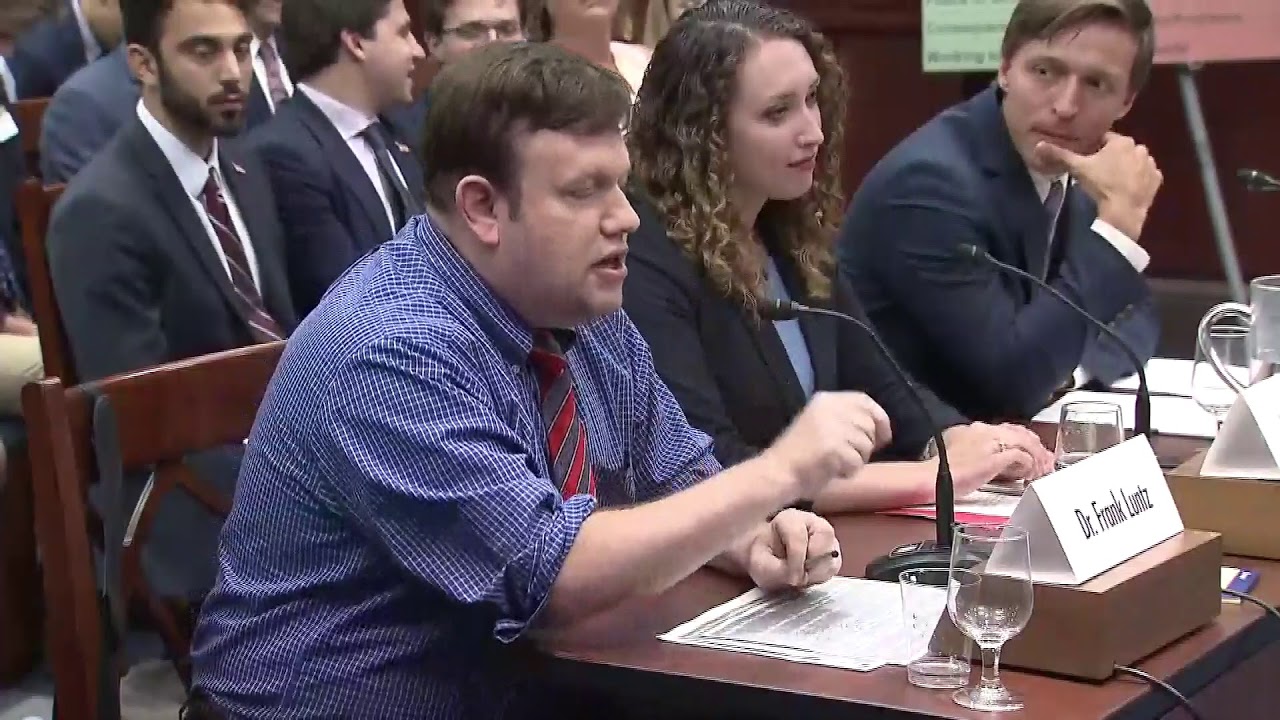 on Thursday. “Rising sea levels, melting ice caps, tornadoes, and hurricanes more ferocious than ever. It is happening.”
Luntz was one of three Republicans invited by Senator Brian Schatz, a Democrat from Hawaii, to speak to the Special Committee on the Climate Crisis about breaking down partisan barriers and taking action on climate change.“Elected Republicans are mostly awful on climate, but it wasn’t always that way, and it doesn’t have to be that way in the future,” Schatz said in a press release before the hearing, “The Right Thing To Do: Conservatives for Climate Action.”
The hearing came amid signs that Republican voters are increasingly out of step with their elected representatives on climate change. In parts of the country hit hardest by extreme weather, like Florida, Republicans are already changing their tune on environmental policy. According to a survey from the Yale Program on Climate Change Communication last year,52 percent of Republicans said if there’s a conflict between environmental protection and economic growth, the environment should come first.
Luntz played a role in turning the environment into a partisan battlefield. During President George W. Bush’s first term, his infamous memo warned Republican party leaders that they were losing “the environmental communications battle,” an issue on which Bush was “most vulnerable.” He advised them to emphasize a lack of scientific certainty around climate change and drop “global warming” for the less scary-sounding “climate change.”
Luntz is now offering his messaging services to the cause of climate action. “I’m here before you to say that I was wrong in 2001,” Luntz told the Senate committee. “Just stop using something that I wrote 18 years ago, because it’s not accurate today.”
“That was a lifetime ago,” he said. “I’ve changed.” He promised to help the Democrats on the climate committee, provided that they put “policies ahead of politics” and commit to nonpartisan solutions.
[pix
:[
It’s not the first time Luntz has taken up the cause of the environment. Back in 2010, he teamed up with the Environmental Defense Fund and laid out advice to persuade Americans take up the cause of clean energy. But that’s not to say he’s a fan of environmentalists, who he’s called “some of the most personally nasty people” and “mean.”
Luntz came to the hearing prepared to share advice for people pushing for action on the climate crisis. He offered a chart of “words to use and words to lose” based on what he’s learned from focus groups:
- USE: Cleaner, safer, healthier. LOSE: Sustainable/sustainability.
- USE: Solving climate change. LOSE: Ending global warming.
- USE: Principles and priorities. LOSE: Values.
- USE: Reliable technology/energy. LOSE: Ground-breaking/State of the art.
- USE: New careers. LOSE: New jobs.
- USE: Peace of mind. LOSE: Security.
- USE: Consequences. LOSE: Threats/Problems.
- USE: Working together. LOSE: One world.
Activists often point out that combating the climate crisis will create jobs, but Luntz said they should talk in terms of “careers” instead. “A job is something that you can’t wait to get out of. A career is something that you embrace.”
Another suggestion: Drop “sustainability,” because it rings of the “status quo,” he explained. “What American people really want is something that is cleaner, safer, healthier. What they’re asking for is improvement, not the status quo.”
It’s also important to frame climate action as a “no-regrets strategy,”Luntz said. Legislation would lead to cleaner air, cleaner water, less dependence on foreign fuels, enhanced national security, and more innovation in our economy. “And that’s if the scientists are wrong,” he said. “If the scientists are right, we get all of those things and begin to solve what could be the most catastrophic environmental problem that any of us have ever faced … That’s why it’s the right thing to do.”
Stay away from the complicated science of climate change and personalize the message instead, Luntz advised. “How many of you know of someone who either lost a house because of a hurricane, a tornado, a forest fire?” he turned to ask the audience at the hearing. Many raised their hands.
“If I can give you a solution that will prevent most of that from happening, would you invest in it? … What would you be willing to pay to get that home back, to get that opportunity back, to get that life back? The answer for most people is everything.”
==
---
burgess sp give them an argument
https://kpfa.org/episode/the-ralph-nader-radio-hour-june-3-2019/
---
==
https://www.alternet.org/trump-uses-race-and-culture-divide-and-distract-while-gop-government-corrupt-and-rich
I R D kos
I love to rile people up and then take their money.
A news analysis in the New York Times ominiously warned that House Democrats are “discarding the lessons of successful midterms past and pressing only a bare-bones national agenda.” The article notes that they’ve chosen a new slogan, “For the People” (“For All the People” would have been preferable) and issued some relatively thin policy statements. The article’s authors then speculated that failing to adopt something along the lines of 1994’s House Republican Contract with America or House Democrats’ Six for ‘06 plan from 2006 might “raise questions among voters about how Democrats would govern.” Then there was more of the usual blather about Dems in disarray, the kind our own Laura Clawson rightly skewered here.
Democratic strategist Ed Kilgore had a great response to the NYT’s handwringing. He pushed back on the idea that Democrats have offered only a “bare bones national agenda,” and pointed out that Republicans retook the House in 2010, and the Senate in 2014, without any noticeable unified policy agenda. He also questioned just how important those aforementioned national platforms really were, citing polls that showed most voters in 1994 hadn’t even heard of the Contract with America. As for Six for ‘06, Kilgore himself couldn’t remember a single plank from it, and writing about national politics is his job.
Going further, Kilgore pointed out that this year’s midterm elections, like every other one, would see voters making their decisions primarily based on their feelings about the president, in particular given just how much oxygen Mr. 46 Percent of the Popular Vote takes up in our national conversation. Kilgore concluded:
Democrats could publish 100-page agenda books and together croak out poll-tested message slogans like frogs after a summer storm — but it’s not going to override the basic fact that Democrats are the party that’s not the party of Donald J. Trump.
Kilgore’s right about agendas and slogans, and that’s one hell of a simile. But there is a message Democrats can embrace—one that must be tweaked, of course, for local circumstances—which can attract voters specifically by contrasting our values and priorities with those of the Man Who Lost the Popular Vote.
Some progressives have been arguing with one another about our message, in particular about how to deal with the issues of race and class. Without rehashing that whole debate, one in which people seem to often be talking past one another, it is clear that the progressive message must address head-on both inequality based on various forms of identity (race, ethnicity, gender, gender identity, and more) and economic inequality. Anyone saying we should talk about ‘class, not race,’ or ‘race, not class’ is just wrong, but it also seems very few people actually argue in those absolutist either/or terms.
What matters most is what kind of message is strategically most effective, i.e., what will win the elections that will put progressives in power, and thus give them the ability to change laws, and change the personnel who carry out those laws, etc. Recent data released by the progressive group Demos, which was presented at a Netroots Nation Panel led by Demos senior fellow (also law professor at Berkeley, and the author of Dog Whistle Politics: How Coded Racial Appeals Have Reinvented Racism and Wrecked the Middle Class) Ian Haney López, has a lot to say on the matter.
Demos surveyed voters in Indiana, California, Minnesota, and Ohio, and gave them initial questions in order to sort them into three groups: Democratic “base voters” (these voters stated that more attention must be paid to racial issues), “persuadables” (they expressed somewhat contradictory views on race, saying both that America must focus more on racial issues and that focusing on race won’t help), and “opposition.” Demos then presented members of each of these groups with a series of messages, some that were colorblind messages focused on economic populism and others that offered a combined “race-class” approach. You can download the whole report here, on the Demos website. A long article at The Atlantic, by Elaine Godfrey, described the report in detail as well.
One specific facet jumped out. The survey tested a color-blind message: “To make life better for working people we need to invest in education, create better paying jobs, and make healthcare more affordable for people struggling to make ends meet,” and tested another, the same exact one with only one change: “people” was replaced by “white, Black and brown people.” The latter rated three percentage points higher than the former among base voters and eight points higher among persuadables. Win-win. This is how you square the circle between a message that is universal (which can leave voters of color feeling ignored, that the party doesn’t care about them), and one that is targeted to non-whites (which leaves white voters feeling ignored, that the party doesn’t care about them). From Godfrey’s article:
For many activists, this is just what they wanted to hear. Camille Rivera, the national political and legislative director for the Retail, Wholesale, and Department Store International Union, said she’s seen this in action as a progressive organizer. Black, Latino, and white people are all united by class and economic issues, she told me, and in her experience, stressing that they’re all “suffering under the same kind of economic instability” moves voters.
The survey tested a collection of 11 messages that addressed race and/or class, and the two that tested most strongly among the base voter group (“Working People” and “America’s Strength”) also did well among persuadables, whereas a “Colorblind Economic Populism” message garnered the lowest ranking from the base among the 11 messages, and also did worse among persuadables than did the two aforementioned race-class messages.
Here’s the “Working People” narrative (which earned a rating of 73 out of 100 from base voters and 67 from persuadables):
“No matter where we come from or what our color, most of us work hard for our families. But today, certain politicians and their greedy lobbyists hurt everyone by handing kickbacks to the rich, defunding our schools, and threatening our seniors with cuts to Medicare and Social Security. Then they turn around and point the finger for our hard times at poor families, Black people and new immigrants. We need to join together with people from all walks of life to fight for our future, just like we won better wages, safer workplaces, and civil rights in our past. By joining together, we can elect new leaders who work for all of us, not just the wealthy few.”
Here’s “America’s Strength” (which earned 74 from base voters and 70 from persuadables, again a good deal higher than the rating both groups gave the color blind message. This message garnered the highest rating from both white (67) and black (71) respondents):
“America’s strength comes from our ability to work together—to knit together a landscape of people from different places and of different races into one nation. For this to be a place of freedom for all, we cannot let the greedy few and the politicians they pay for divide us against each other based on what someone looks like, where they come from or how much money they have. It’s time to stand up for each other and come together. It is time for us to pick leaders who reflect the very best of every kind of American. Together, we can make this a place where freedom is for everyone, no exceptions.”
The Demos report concluded that, based on the data produced by their research, an effective message is one that:
- Discusses race overtly and as including everyone
- Names racial scapegoating as a weapon that economically harms all of us
- Emphasizes unity and collective action to solve problem
- Invokes previous cross-racial solidarity wins to combat cynicism
- Connects working together to government for all
This research points the way forward. Racial scapegoating is at the heart of Donald Trump’s message as a politician, and it has been going back to the day he announced his White House run by attacking people coming to the U.S. from Mexico as “rapists” and “drug dealers.” Even he admits what he’s doing, as seen in April, when he decided to dump his prepared remarks about his tax plan—which he called “boring”—and turn instead to more racial scapegoating about Latino immigrants. Trump’s constant harping about NFL players (mostly black) kneeling during the national anthem also falls into this category. There are simply too many other incidents of racial scapegoating to begin recounting them here.
The larger point is that this is our national message, one that brings together our opposition to Trump and our larger message about standing up for justice and equal rights for all as well as greater economic equality by hammering the point that the Orange Julius Caesar is the opponent of all those things. He’s the one screaming and yelling about racially and culturally divisive issues—aka scapegoating—in order to win over white voters who are being hurt by his economic policies.
Who is helped by Trump’s tax plan? Millionaires. Workers aren’t helped at all, and in fact the greater economic inequality created by the plan hurts them and the broader economy in the long run, and only puts our country further in debt. Who is being hurt by Trump’s sabotage of Obamacare—and would have been hurt even more had he and the Republicans in Congress succeeded in repealing it? Those same workers. The list goes on and on.
Sen. Elizabeth Warren, at Netroots Nationearlier this month,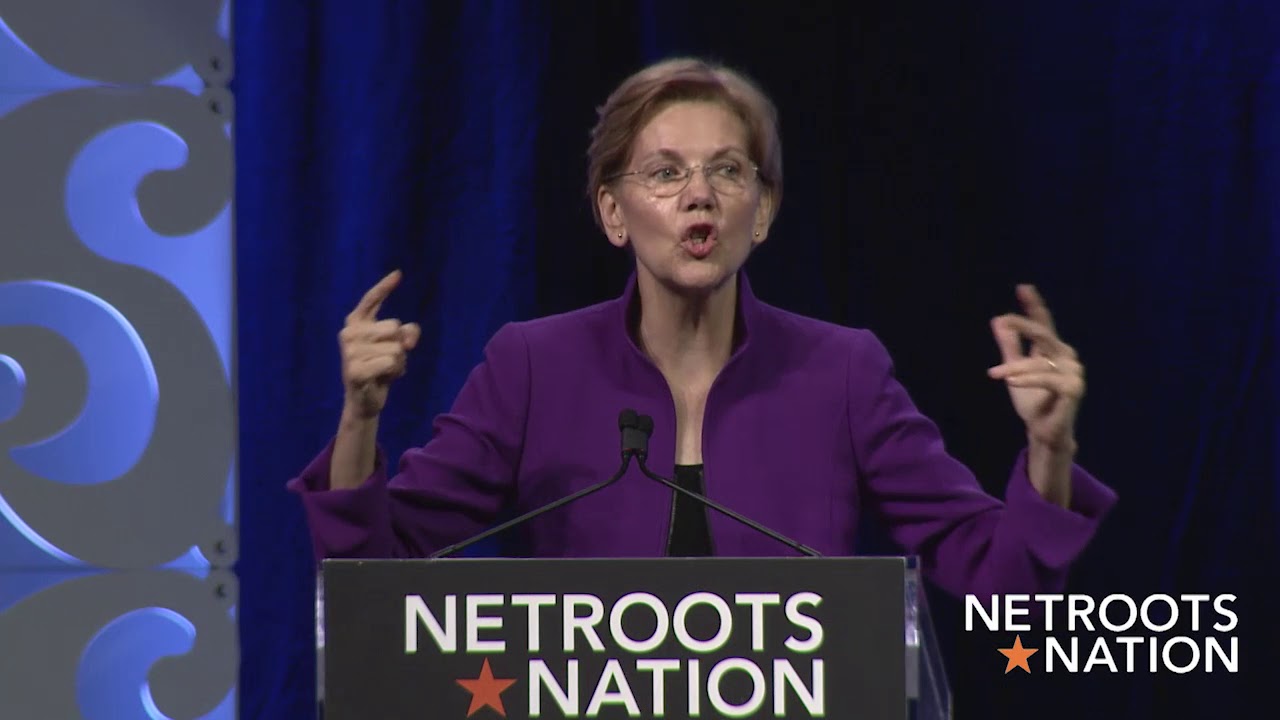 that she already gets the need to frame our message in the kinds of terms Demos talked about:
“According to Trump, the problem is other working people … black and brown, people who were born elsewhere, people who do not worship the same … or talk the same as Trump and his buddies … It is time to say no to the politics of division … We’re bringing the voices of working Americans—all working Americans—right along with us.”
Democrats are going to run on their opposition to Trump. We must give that opposition some badly needed content and heft by centering it on exactly this kind of message, one that works. Donald Trump wants to divide working and middle-class Americans along lines of race and culture while he and his corrupt administration send tens of billions of dollars up the economic ladder. If voters of every color see the election in those terms, there’s no way we can lose.
---
https://www.alternet.org/theres-science-successfully-talking-trump-supporters-heres-how
---
https://www.alternet.org/news-amp-politics/how-do-we-move-forward-after-era-post-truth-politics
j sherman
ybe, just maybe, citizens will come through the Trump era with better BS detectors, more healthy cynicism about political pandering. That’s the hope – not the unhealthy cynicism that makes people give up on citizenship as though they’re above it, not bothering to vote or care because politicians are all liars and we’re all doomed.
Though hoping for realism is usually unrealistic, maybe now is different. Maybe the convenient lies of the current administration will be enough to shock a majority into realism.
A nation can afford a few cynically indifferent citizens. We should reserve them for the overburdened. The rest of us should show up as realistic citizens, and there’s a chance we might if the GOP goes down in flames. It could be our nation’s rock bottom. Here, I’ll try to imagine how a politician can lead a sobered citizenry in the post-post-truth, post-pandering era.
Traditionally, politicians address a looming problem in ways that are either empty or boring.
Empty:
- Lamenting it: Trying to out-hand-wring their opponents.
- Yearning to solving it: Trying to show that they care more than their opponents.
- Pledging high resolve to solve it, and cockiness that they can.
Boring:
- Detailing some specific plan to solve it.
What lies between boring-detail minutia and grand empty gestures? A vision, but in a post-pandering era, it would have to be a realistic vision.
How do politicians make visions appear realistic? With vivid details. In fiction writing, journalism and politics, the rule is “don’t tell, show.” Avoid abstractions. Instead, simulate the experience. Here are the popular ways to make a vision seem realistic that might stop working in a post-pandering era.
- Picture through human interest stories the plight of those suffering from the problem.
- Picture, through human interest success stories that would result from your vision playing out.
- Picture the glory of victory.
- Picture the glorious blow to the enemies of your vision.
- Picture the panacea that will result from your vision being implemented.
Doing any combination of these has made politicians seem realistic in the past. In a post-post-truth era, they may no longer work. So what’s the alternative?
Paint a realistic picture of what it would take to solve the problem, a vision that assumes people can handle the sober reality of making a change in politics.
Here’s an illustration focused on a problem picked at random. Please don’t be distracted by the vision’s focus. Most people can name higher priorities. That we disagree about priorities is one challenge that leaders face.
A realistic job creation vision from a 2020 presidential candidate
Instead, here's the problem as I see it and our best chance at solving it. The tech boom is making old jobs disappear faster than ever. That’s what new tech has always done and now it’s doing it at lightning speed. We need rapid retraining for new tech jobs or we’re going to hit a wall, workers unprepared for the world that’s coming so fast it has already arrived.I'm not going to lament the loss of jobs, tell you how much I yearn for them come back, flame past leaders for failing to bring them back, or promise with unrealistic confidence that I'll bring them back. You know how it is. You've seen the same election movie over and over. Realistically, that's all just pandering and it’s worth nothing to you. Nor am I going to bore you with some measure I support.
Realistically, if I'm elected I'll have a brief chance to move one big issue forward before events and politics close in on me.
So that's my choice, throwing everything I've got behind job retraining to catch us up with the tech boom we all love even though it's killing our jobs. One example: Cashier ranks as the second most common job today and it’s about to be automated out of existence.
Realistically, we're screwed if we don't address this tech boom's job bust. So I'll use my narrow political window to address it through an all-out campaign to replace dying low-tech jobs with new high-tech jobs. Other countries have a head start on us, but being first isn’t always best. We can learn from their successes and failures, and anyway, we’ve had a head start on technology for centuries. We can build on that.
You know, in past eras, we handled unemployment with war. That’s a miserable solution we’ve got to avoid. So is nostalgia over the jobs that will never come back, or scapegoating others as though they’re stealing our jobs.
Tech is stealing our jobs while creating new ones we can fill if we retrain rapidly, thereby avoiding the temptation to war with other nations and between ourselves in misdirected finger-pointing.
We all love and welcome the tech boom. Just not the job loss. If we retrain, we’ll love the whole transition. New tech, new jobs and a country that knows how to grow with our changing technology.
---