Luntz, F
519 bak poster boy? newt evil on lang
180
promoted to primary, he's a pollster?
indoc u?
==
stroke 1/20
said trump lost debate?
fox bartiromo pollster border BS lee h carter
on an lately for ?
an 7 23
republican strategist Frank Luntz disagreed with a GOP voter who believed the 2020 election was stolen from then-President Donald Trump.
During theSunday edition of C-SPAN's Washington Journal program, Luntz changed roles and began asking questions of a Republican caller.
"Why do you think Donald Trump won?" Luntz wondered.
The caller urgedLuntzto acknowledge "the interference by Facebook in the election with [the] Hunter Biden laptop."
"You have a point of view. And that's the problem," Luntz shot back, "is that you're unwilling to see the evidence. You're unwilling to examine the facts. I've looked at this. I've gone and studied this."
Luntz pointed to professional websites spreading conspiracy theories about the 2020 election.
"Their stuff looks great," he lamented. "It looks professional. It looks like it's factual. It isn't."
Watch the video below from C-SPAN.
an raw 10 22
A new survey shows Republicans are more likely than any other political group to reject the results of a losing election, and a veteran pollster expressed alarm at those findings.
The new poll conducted by Yahoo News and YouGov found just 43 percent of Republicans say political candidates who got fewer votes should concede their loss, compared to 74 percent of Democrats and 57 percent of independents, and Republican pollster Frank Luntz told MSNBC's "Morning Joe" those results were chilling.
"Scary as hell," Luntz said. "I'm here at the Conservative Party Conference [in the United Kingdom], trying to say to them, be very careful what you wish for, be very careful of what kind of campaign you hold because you could end up like the U.S."
"When you lose faith and trust in elections itself, you've lost your democracy," he added, "and we are so close to the edge. I'm sitting in a room with students from Radley College and have to teach them, I have to explain to them this isn't the way democracy is supposed to work, that you have winners and losers, you accept the loss and then you move on. We are so poisoned, we are so toxic, and I don't want what's going on in the U.S. to happen here in the U.K. That would be a real tragedy."
Watch video below or at this link.
https://en.wikipedia.org/wiki/Frank_Luntz
==
===
sound sci ~ junk sci --> secret sci:
According to Chris Mooney in his book, The Republican War on Science,[1] "sound science", especially in conjunction with the Data Quality Act, often means "requiring a higher burden of proof before action can be taken to protect public health and the environment."
He also states that, "the sound science movement also confuses the quality of scientific analysis with the degree of scientific certainty that has been achieved on a given question" and manufactures uncertainty by "relying on scientific outliers to sow doubt about mainstream findings"
In a 2002 memo to President George W. Bush titled "The Environment: A Cleaner, Safer, Healthier America", obtained by the Environmental Working Group,[2] conservative political consultant Frank Luntz, said "sound science" arguments provide "a window of opportunity to challenge the science." and he has urged politicians to "be even more active in recruiting experts who are sympathetic to your view." In other words sound science advocates are not interested in "good science", objectivity, or even "sound" science practices, but in politicizing science to support a specific viewpoint, often relying on testimonials from their own hired, special interest "experts."
The intended result is often to delay or prevent government regulation....
===
https://www.**politico**.com/story/2019/03/27/frank-luntz-trump-white-house-1238283
no lnx
How Frank Luntz went from Trump enemy to White House insider
The famous GOP pollster clashed with Trump during the 2016 election but has helped shape his message thanks to a friendship with chief of staff Mick Mulvaney.
By NANCY COOK 03/27/2019
Frank Luntz had long been a loyal Republican insider — until Donald Trump came along. During the 2016 campaign, Luntz openly criticized Trump, who attacked the storied pollster as a “low class snob” and called for Fox News to dump him from its airwaves.
After Trump’s election, Luntz seemed likely to be shut out of the White House — a painful fate for a lover of the presidency who built replicas of the Oval Office and Lincoln Bedroom in his Los Angeles home.
But Luntz has now found a key way into the Trump White House. Thanks to his longtime friend and Trump’s acting chief of staff Mick Mulvaney, Luntz has provided advice of late about the political messaging of major issues like immigration and the budget.
Luntz made his name by advising Republicans to repackage their policies with language designed to play more to emotion than intellect. He convinced conservatives to say they oppose a “death tax” rather than an “estate tax” on the inheritances of the wealthy, and urged the Bush administration to call global warming “climate change.” Critics said such tactics only obscure and muddy the truth.
Since Mulvaney’s December arrival in the West Wing, Luntz has applied his signature rebranding tactics. Heading into the 35-day government shutdown, Luntz urged Mulvaney to move away from the dry phrase “funding the border wall” for the more evocative theme of “border security” — a language tweak the White House adopted.
Luntz has also given Mulvaney advice on Trump’s most recent budget proposal, and even turned up at an exclusive White House party with the president who once called for him to be fired.
Luntz’s surprising infiltration of the White House is a story about the way access works in Washington — and the way one valuable personal relationship in the West Wing can overcome even the enmity of a president. This account of the quiet influence Luntz has exerted at the Trump White House is based on interviews with more than a dozen current and former senior administration officials and close White House allies.
Luntz and Mulvaney have known one another since 2007 when Mulvaney served in the South Carolina General Assembly as a lawmaker. The two continued to see each other at annual Republican lawmaker retreats once Mulvaney was elected to Congress in 2010 and struck up a friendship.
When Mulvaney joined the Trump administration as director of the Office of Management and Budget in early 2017, Luntz visited the office three times over a nine-month period — including for a one-on-one lunch, according to agency visitor logs. The two men also spoke regularly by phone, with Luntz offering Mulvaney messaging advice on the president’s annual budget proposals to Congress.
Once Mulvaney landed his long-coveted gig as White House acting chief, he was in a position to give his friend even more entrée into Trump’s White House. Days after accepting the job, Mulvaney added Luntz’s name to the invitation list for one of the White House’s most exclusive Christmas balls.
More substantively, as Mulvaney helped to draw up Trump’s most recent budget proposal, Luntz counseled him to illustrate Trump’s idea of referring of a five percent reduction on domestic spending with a picture of a five-cent coin. Trump himself had wanted to refer to it as the “nickel plan.”
The White House press secretary did not respond to a request for comment.
Mulvaney allies stress that Luntz plays no formal or advisory role in the Trump administration, and over the past year, Luntz has also met with Jared Kushner and talked with Larry Kudlow, director of the National Economic Council, meetings that pre-dated Mulvaney’s arrival in the West Wing.
[Trump-Russia Superfans Contemplate Life After Mueller
By BEN SCHRECKINGER]
But there’s no disputing his rapport with Mulvaney. People who have seen Mulvaney and Luntz interact say they admire one another’s blunt personalities.
Luntz, in an email to POLITICO, described Mulvaney as a genuine friend, which is “tough to find in Washington.” He said he offered zero advice on the government shutdown and did not have any relationship with President Trump.
He did not respond to a later query about advice he’d given to Mulvaney as acting chief of staff. A person familiar with the White House’s budget planning said Luntz provided advice to Mulvaney several times in recent months.
Luntz’s entry into the Trump fold squares with his reputation among some detractors as a showman who craves the spotlight almost as much as the president — and whose primary concern is remaining relevant.
“For at least two decades, he has been trying to provide guidance to the GOP on how to communicate and simplify stories. Trump came in and immediately related to the American people and brushed Luntz aside,” said one Republican strategist.
But he retains legions of GOP admirers. Former House Speaker Newt Gingrich, who is close to Trump and worked with Luntz in the 1990s, says Luntz has played a huge role in the party’s politics.
“Frank had a remarkable way with words and on a number of occasions, he was able to shape language so that it had a big impact,” Gingrich said, adding that Luntz helped Republicans understand “the importance of building messages around small business rather than big corporations.”
It’s unclear whether Trump himself has come around on Luntz, or if he’s even aware that he has spoken words influenced by the message man.
Frnk Luntz and Donald Trump
Republican strategist Frank Luntz interviews then-candidate Donald Trump in 2015. | Scott Olson/Getty Images]
The bitter history between the two men dates to a July 2015 Iowa summit sponsored by the Koch brothers, at which Luntz interviewed Trump onstage.
“Don’t you feel that you went too far in what you called Mexicans coming across the border?” Luntz said moments after they took the stage.
“Oh no, not at all,” Trump said.
Later at the same event, Trump made his infamous declaration that Senator John McCain wasn’t a true hero “because he was captured. I like people who weren't captured.”
In the ensuing weeks, Trump urged Fox News via Twitter to fire Luntz, who conducted post-debate focus groups for the network that the candidate deemed “anti-Trump.”
Luntz is “a low class slob who came to my office looking for consulting work and I had zero interest. Now he picks anti-Trump panels!” Trump tweeted that August. (Trump told POLITICO that Luntz was angry at him because Trump had declined to hire his polling firm.)
Luntz told POLITICO at the time that Trump’s f--- you attitude resonated with voters but did not ultimately solve anything. “‘F—- you’ doesn’t make life any better. ‘F—- you’ makes you feel good, but it doesn’t get you where you need to go. ‘F—- you’ doesn’t make America strong,” he said.
Privately, some Mulvaney aides are aware that his friendship with Luntz comes with a potential risk of annoying the president, and many of the acting chief of staff’s allies downplay the relationship.
But since the 2016 election and Trump’s success in bending the GOP to his will, Luntz has launched something of an apology tour.
Following the 2018 State of the Union address, Luntz wrote on Twitter that he owed the president an apology. “Tonight, I was moved and inspired. Tonight, I have hope and faith in America again. It may go away tomorrow. But tonight, America is great again,” he wrote.
He added in a later tweet that “this speech represents the presidential performance that Trump observers have been waiting for — brilliant mix of numbers and stories, humility and aggressiveness, traditional conservatism and political populism. Only one word qualifies: Wow.”
Luntz’s rehabilitation tour seems to have worked to some extent. Luntz showed up at an election night watch party in November 2018 in Trump’s private residence as a guest of Mulvaney’s, schmoozing and watching the results alongside other close Trump allies including Treasury Secretary Steven Mnuchin, Corey Lewandowski, and Vice President Mike Pence.
When Trump announced Mulvaney’s promotion to chief-of-staff in a late afternoon tweet one Friday in mid-December, Luntz quickly responded to extol the hire’s brilliance on Twitter.
“No one understands how government works better than Mick,” Luntz wrote. “He is respected on Capitol Hill and in all the agencies – very smart choice.”
This article tagged under:
Newt Gingrich Mike Pence Donald Trump Donald Trump 2020 Frank Luntz Mick Mulvaney Koch Brothers Corey Lewandowski Jared Kushner Steven Mnuchin
==
https://www.ajc.com/news/local-govt--politics/gingrich-language-set-new-course/O5bgK6lY2wQ3KwEZsYTBlO/
By James Salzer jsalzer@ajc.com
Newt Gingrich described his first congressional opponent as corrupt and incompetent. His next one, according to Gingrich, supported welfare cheaters.
After being elected to Congress from Georgia in 1978, his target became the liberal welfare state. He called the Democratic leadership destructive and thugs, dubbed his opponents’ positions radical and said some Democrats were willing to kill jobs to help win an election.
Most of the italicized words appear in a 1990 training memo teaching Republican candidates how to “speak like Newt.” Newtspeak lives today — it issues regularly from Gingrich’s lectern at the GOP presidential debates — and if it’s effective now, it was downright revolutionary when Gingrich and others pioneered it in the 1980s. Many credit Gingrich — or blame him — for transforming American politics with words.
“The things that came out of Gingrich’s mouth ... we had never heard that before from either side,” said Steve Anthony, a Georgia State University lecturer who once headed the state Democratic Party. “Gingrich went so far over the top that the shock factor rendered the opposition frozen for a few years.”
Hardball rhetoric
Newtspeak has become part of the contrasting — some would say hyperbolic — language commonly heard in today’s political discourse.
Joseph Crespino, an Emory University historian, said Gingrich “has the ability to channel a certain disenchantment and to frame certain issues in a way that has a real visceral reaction to people.”
Gingrich’s debate performances in Florida last week got less-than-enthusiastic reviews. But his style was clear during the final South Carolina primary debate, which he started by getting a rousing ovation when he blamed the “destructive, vicious, negative nature” of the media for making it so hard to govern. He ended the debate calling President Obama “the most dangerous president of our lifetime” who, if re-elected, would bring a “level of radicalism” that would be “truly frightening.”
Some of those who both used and were on the receiving end of Gingrich’s language lessons say it made compromise more difficult and produced a political scene in which the center has largely disappeared.
“I am not sure we did the political system a favor,” said Rusty Paul, a former Georgia Republican Party chairman and onetime aide to U.S. Rep. Jack Kemp, who worked closely with Gingrich. “The language we have used over the past 20 years has so polarized Congress. ... The society is as divided as the political rhetoric.”
Former Georgia Democratic U.S. Rep. Buddy Darden, who served with Gingrich, said the Republican’s incendiary language has now become the norm in American politics.
“That probably has been his major contribution to the political discourse,” Darden said.
Massachusetts Congressman Barney Frank a longtime liberal critic of Gingrich’s, recently told the New York Times, “He transformed American politics from one in which people presume the good will of their opponents, even as they disagreed, into one in which people treated the people with whom they disagreed as bad and immoral. He was a kind of McCarthy-ite who succeeded.”
As Crespino noted, American politics has long been a bare-knuckled affair. In 1800, John Adams and Thomas Jefferson went after each other with a viciousness that remains the standard for presidential elections. Candidates were described as criminals, tyrants, cowards and, in the case of Jefferson, an atheist and “the son of a half-breed Indian squaw, sired by a Virginia mulatto father.”
Crespino said Gingrich’s brand of hardball rhetoric came out of an era when Republicans were a distinct minority in both Congress and the South.
“Gingrich was a Republican in a state and a region in which Republicans were trying to gain a foothold,” he said.
His first congressional opponent was longtime U.S. Rep. Jack Flynt, whom Gingrich considered part of the Democratic machine that had run Congress for decades.
Gingrich told The Atlanta Journal-Constitution that year, “Congressmen are not bribed anymore. They simply have a lot of friends who are willing to help them out whenever they find it necessary.”
Gingrich went after both parties, but he narrowly lost to Flynt twice. When Flynt decided to retire, Gingrich called for a “tax revolt” and put out campaign literature accusing his Democratic opponent of joining civil rights activist and Georgia lawmaker Julian Bond to protect “welfare cheaters.”
Once elected in 1978, Gingrich spent more than a decade as a provocative back-bench bomb-thrower, assailing taxes and government bureaucracy, denouncing what he saw as “radicalism” and portraying Democrats as “counterculture” backers of the “liberal welfare state. He compared some congressmen to Hitler appeasers and accused Democratic leaders of having “Mussolini-like” egos as well as being sick, muggers and thugs trying to “destroy our country.”
At one point Gingrich called the attacks by him and his colleagues “pin pricks” against the Democratic majority. The plan was to bleed the enemy. He promoted a partisan view that Republicans could stand to gain politically from portraying the majority as a corrupt party, which he repeatedly referred to as the “Democratic machine.”
Tactics for revolution
In the early years, he used the C-SPAN network as a televised bully pulpit to sell a Conservative Opportunity Society and hammer the Democratic majority. Gingrich drew a rebuke from House Speaker Tip O’Neill when he said the Republican questioned the patriotism of some Democrats. He criticized the “value system” of opponents and called 1988 Democratic presidential nominee Michael Dukakis “nuts.”
He took over leadership of GOPAC, which trained Republican candidates in the tactics and language of what Gingrich hoped would be a Republican revolution.
In 1990, he worked with pollster Frank Luntzto put out a memo of focus-group-tested words for GOP candidates to use.
The cover letter, signed by Gingrich, was titled “Language, a Key Mechanism of Control” and encouraged candidates to “speak like Newt.”
“This list is prepared so that you might have a directory of words to use in writing literature and mail, in preparing speeches, and in producing electronic media,” the memo said. “The words and phrases are powerful. Read them. Memorize as many as possible.”
The “optimistic positive governing words” included change, moral, courage, reform, freedom, common sense. Negative, contrasting words to be used on opponents included destructive, liberal, welfare, traitors, radical, corruption....
==
https://grist.org/article/the-gops-most-famous-messaging-strategist-calls-for-climate-action
july 2019 yoder
Frank Luntz’s up-close encounter with our increasingly wild weather came at 3:15 a.m. one morning, when the GOP master messenger woke up to his phone blaring an emergency evacuation warning. Luntz saw flames outside his bedroom window. The famous pollster’s home in Los Angeles was in the path of the Skirball Fire, one of the many wildfires that destroyed parts of Southern California in December 2017.
Luntz, whose advice helped Republicans hold power for years and also keep their heads in the sand when it comes to climate change, cited the fire as an example of the climate crisis made personal. He’s the same political consultant who convinced conservatives to rebrand the “estate tax” as the “death tax.” He crafted talking points for the Koch brothers and reportedly convinced the Trump administration to talk about “border security” to drum up support for building a border wall.
But the reality of climate change is increasingly too hard to ignore. “The courageous firefighters of L.A., they saved my home, but others aren’t so lucky,” he said as he recounted the tale during a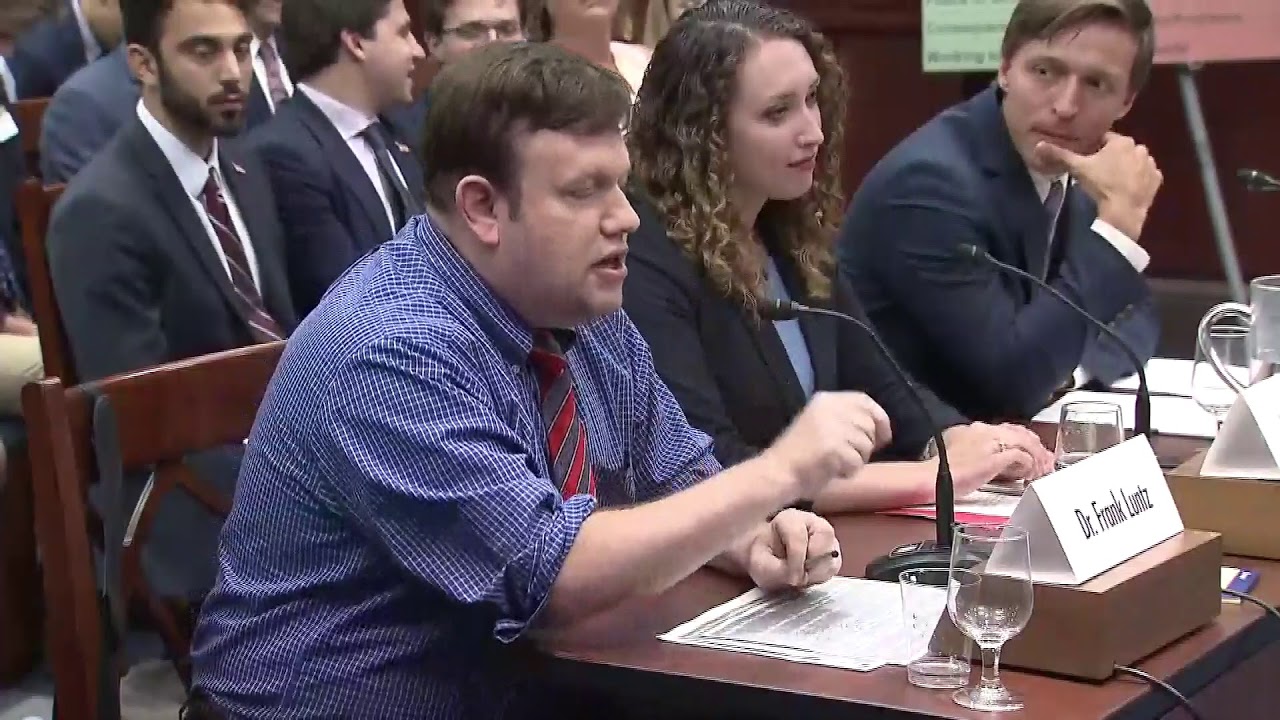 on Thursday. “Rising sea levels, melting ice caps, tornadoes, and hurricanes more ferocious than ever. It is happening.”
Luntz was one of three Republicans invited by Senator Brian Schatz, a Democrat from Hawaii, to speak to the Special Committee on the Climate Crisis about breaking down partisan barriers and taking action on climate change.“Elected Republicans are mostly awful on climate, but it wasn’t always that way, and it doesn’t have to be that way in the future,” Schatz said in a press release before the hearing, “The Right Thing To Do: Conservatives for Climate Action.”
The hearing came amid signs that Republican voters are increasingly out of step with their elected representatives on climate change. In parts of the country hit hardest by extreme weather, like Florida, Republicans are already changing their tune on environmental policy. According to a survey from the Yale Program on Climate Change Communication last year,52 percent of Republicans said if there’s a conflict between environmental protection and economic growth, the environment should come first.
Luntz played a role in turning the environment into a partisan battlefield. During President George W. Bush’s first term, his infamous memo warned Republican party leaders that they were losing “the environmental communications battle,” an issue on which Bush was “most vulnerable.” He advised them to emphasize a lack of scientific certainty around climate change and drop “global warming” for the less scary-sounding “climate change.”
Luntz is now offering his messaging services to the cause of climate action. “I’m here before you to say that I was wrong in 2001,” Luntz told the Senate committee. “Just stop using something that I wrote 18 years ago, because it’s not accurate today.”
“That was a lifetime ago,” he said. “I’ve changed.” He promised to help the Democrats on the climate committee, provided that they put “policies ahead of politics” and commit to nonpartisan solutions.
[pix
:[
It’s not the first time Luntz has taken up the cause of the environment. Back in 2010, he teamed up with the Environmental Defense Fund and laid out advice to persuade Americans take up the cause of clean energy. But that’s not to say he’s a fan of environmentalists, who he’s called “some of the most personally nasty people” and “mean.”
Luntz came to the hearing prepared to share advice for people pushing for action on the climate crisis. He offered a chart of “words to use and words to lose” based on what he’s learned from focus groups:
- USE: Cleaner, safer, healthier. LOSE: Sustainable/sustainability.
- USE: Solving climate change. LOSE: Ending global warming.
- USE: Principles and priorities. LOSE: Values.
- USE: Reliable technology/energy. LOSE: Ground-breaking/State of the art.
- USE: New careers. LOSE: New jobs.
- USE: Peace of mind. LOSE: Security.
- USE: Consequences. LOSE: Threats/Problems.
- USE: Working together. LOSE: One world.
Activists often point out that combating the climate crisis will create jobs, but Luntz said they should talk in terms of “careers” instead. “A job is something that you can’t wait to get out of. A career is something that you embrace.”
Another suggestion: Drop “sustainability,” because it rings of the “status quo,” he explained. “What American people really want is something that is cleaner, safer, healthier. What they’re asking for is improvement, not the status quo.”
It’s also important to frame climate action as a “no-regrets strategy,”Luntz said. Legislation would lead to cleaner air, cleaner water, less dependence on foreign fuels, enhanced national security, and more innovation in our economy. “And that’s if the scientists are wrong,” he said. “If the scientists are right, we get all of those things and begin to solve what could be the most catastrophic environmental problem that any of us have ever faced … That’s why it’s the right thing to do.”
Stay away from the complicated science of climate change and personalize the message instead, Luntz advised. “How many of you know of someone who either lost a house because of a hurricane, a tornado, a forest fire?” he turned to ask the audience at the hearing. Many raised their hands.
“If I can give you a solution that will prevent most of that from happening, would you invest in it? … What would you be willing to pay to get that home back, to get that opportunity back, to get that life back? The answer for most people is everything.”
==
619 dereg nation
The Wall Street Journal reports that “a small but growing number of Republican lawmakers are urging action on climate change, driven by shifting sentiment among GOP voters and the effects of global warming, from stronger hurricanes to more-destructive wildfires.”
According to the Journal, longtime Republicanpollster Frank Luntz (author of a now-infamous memo on how to confuse and divide votersabout climate change) has warned Republicans that their obstruction and anti-science rhetoric are driving away voters, particularly younger conservatives.
great: flood survivors want answers for unnatural disasters
- After her hometown flooded for the fourth time in three years, killing some of her neighbors,Missourian Susan Liley got mad.
- Liley and other De Soto residents founded the Citizen’s Committee for Flood Relief in 2015 with two initial goals, as Ensia, the solutions-focused digital magazine, reports:“figure out some kind of early warning system” and “understand the root causes of repeated flooding and address them”...
https://kpfa.org/episode/upfront-september-19-2017/
$raise occupation of the Am Mind mef.org
luntz I pjt terror not territory; hamas charter mantra
hamas reject long ago but "PR gold"
if land, israel loses PR, but if ideology, terror, wins
==
==
The political operation created by the billionaire conservative mega-donors Charles and David Koch is quietly investing millions of dollars in programs to win over an unlikely demographic target for their brand of small-government conservatism ― poor people.
The outreach includes everything from turkey giveaways, GED training and English-language instruction for Hispanic immigrants to community holiday meals and healthy living classes for predominantly African American groups to vocational training and couponing classes for the under-employed. The strategy, according to sources familiar with it and documents reviewed by POLITICO, calls for presenting a more compassionate side of the brothers’ politics to new audiences, while fighting the perception that their groups are merely fronts for rich Republicans seeking to game the political process for personal gain.
The efforts include a healthy dose of proselytizing about free enterprise and how it can do more than government to lift people out of poverty.
“We want people to know that they can earn their own success. They don’t need the government to give it to them,” Koch network official Jennifer Stefano told activists and donors during in Columbus, Ohio, at which she introduced one such project, Bridge to Wellbeing.
Housed within the foundation arm of Americans for Prosperity, the Koch network’s largest group, the program represents “the new way to advance freedom,” Stefano boasted. “And so that’s why, today, you’ll see Americans for Prosperity Foundation reaching out to new communities offering not just classes on the Constitution, and knowing your rights, but on couponing and how to turn your passion into profit by helping other people be successful, to not just tell them about the economy and economic freedom, but to show them that we want them to economically thrive, and how to do it.”
Bridge to Wellbeing last week served hot dinners to crowds of dozens of primarily African American attendees at a church in Miami and a community center in Orlando. A chef offered tips on how to prepare “dinner on a dime,” while attendees were guided into “learning about freedom,” according to the Twitter feed of one AFP staffer.
The Koch efforts can seem at times almost like a post-Citizens United version of turn-of-the-century political machines like Tammany Hall ― part privatized social-service agency, part voter mobilization. But liberal critics see it as a craven and patronizing gambit to bribe the disadvantaged into supporting a de-regulatory agenda that helps the haves at the expense of the have-nots.
"It won't work. They can't hide their agenda of lower wages, no unions and no health care, which would be devastating to these communities, merely by trying to 'help' them with a food coupon," said David Brock, who founded a liberal non-profit group that tracks the Koch network. He added, "It's also creepy. It sounds like something Hezbollah would do to get recruits."
Like most else in the Kochs’ expansive network, which plans to spend as much as $889 million from the industrialist Koch brothers and hundreds of allied mega-donors in the run-up to the 2016 election, the so-called well-being efforts, as they are known within the network, are only partly about electing Republicans.
Charles Koch has long argued ― mostly privately until recently ― that government welfare and regulation actually hold back many of its ostensible beneficiaries. His network's goal, he told hundreds of ultra-rich conservatives he had summoned to a tony Southern California resort this summer, “is to remove the shackles preventing all Americans, especially the disadvantaged, from pursuing their dreams. That’s what’s happening in this country. We are crushing ― these policies are crushing peoples’ dreams,” including by making "it nearly impossible for the poor to start a small business or, in many cases, even work.”
Koch went on to call his network "the most effective movement in history for helping people improve their lives and making the world a better place."
In addition to Bridge to Wellbeing, Koch-backed wellness efforts include the Hispanic-focused LIBRE Initiative, which has given away holiday turkeys and toys, as well as Spanish-language training for drivers’ licensing, GED exams and tax-preparation. Another network group,Concerned Veterans for America, is expected to begin offering similar well-being programs for veterans, according to sources. There are also initiatives aimed at the homeless, developmentally disabled and mentally ill. And there’s a new group called Stand Together for America focused partly on using well-being-related outreach to appeal to what network officials call “the middle third” ― persuadable voters who are mostly disengaged. And the Charles Koch Institute in 2013 launched a “Well-Being Initiative” to provideintellectual firepower for the overall network effort.
“Sometimes, we have not been as good at explaining the virtues of economic freedom and individual liberty to people who are struggling,” said Americans for Prosperity’s president Tim Phillips. He also conceded that well-being initiatives could help AFP’s main arm satisfy an Internal Revenue Service requirement that the group spend most of its money on educational or charitable purposes, not political or policy advocacy. “Part of it is we are a social welfare organization. And, so, yes, we do try to help folks live more prosperous lives. That’s not related to direct policy.”
“Could come off as not being genuine”
The well-being push includes causes that defy easy partisan typecasting ― such as a major criminal justice reform push and a fledgling fight to reduce occupational licensing ― on which Koch allies have worked with liberal groups and even lately with President Barack Obama’s administration. But messages about reining in government and empowering the private sector undergird all of the efforts ― even pitching in to help emergency victims.
After a chemical spill polluted the water supply in nine West Virginia counties last year, AFP Foundation gave away more than 100,000 gallons of bottled water to affected residents. Some environmentalists bristled, pointing out that Koch-backed groups have fought against stricter environmental regulations. But sources say that Stefano, the Bridge to Wellbeing leader, in a presentation to AFP staff, argued that charitable efforts like the one in West Virginia “allow us to demonstrate our values of individual responsibility and the private sector stepping up in times of need, instead of waiting for government.”
Inside the network, the well-being initiatives are viewed as a legacy project for Charles Koch and his longtime lieutenant Rich Fink. An executive at the brothers' multinational industrial conglomerate Koch Industries, Fink advocated for the creation of Stand Together for America, and has sat on the boards of Charles Koch Institute and Americans for Prosperity Foundation, though he left the AFPF board at the end of last month. Sources familiar with the network tell POLITICO that, in weekly meetings of top officials from across the expanding network, groups are urged to pursue outreach to disadvantaged groups.
“They’re trying to reshape the country, and they realize they can’t do that without changing the perception of conservatism,” said one operative who works with Koch-backed groups, who requested anonymity. In an internal network memo reviewed by POLITICO, though, in which AFP sought additional program funds, it predicted that the Bridge to Wellbeing initiative would allow the group and its foundation to “go on the offense against the current suggestions that AFPF is extreme, an arm of a political party or the front group for wealthy donors.”
Still, there’s a fair amount of concern inside the network that the efforts could be a costly boondoggle that is unlikely to yield any progress towards the Kochs' goals, and more likely risks backlash.
Stefano privately addressed those concerns during Bridge to Wellbeing's formative stages, according to sources familiar with the discussions, who said she warned network officials on multiple occasions that “capitalizing on these types of events could come off as not being genuine.”
And one former network executive said, “There are a lot of high-up lieutenants who roll their eyes when they talk about this and question whether it’s getting any bang for the buck. How does teaching people how to clip coupons or giving them free turkeys translate into convincing them that conservatives or Republicans have the best interests of the disadvantaged at heart? Is this really changing people's minds or are they just showing up for the free turkeys?”
The calculation, according to AFP spokesman Levi Russell, is that new audiences might be more receptive to the message if it’s presented in a less-political context. “If we're only engaging people on the latest piece of legislation being debated, we're starting too late in the process,” Russell said.
‘Care and intent’
After spending more than $400 million boosting conservative candidates and causes in the run-up to the 2012 election, only to see Democrats retain the White House and the Senate, the Koch network commissioned a forensic analysis to determine where their efforts had fallen short.
It identified a number of needed tactical and strategic adjustments. But it also concluded that its efforts were hampered by the widespread perception that conservatives don’t care about the plight of regular folks struggling to make ends meet ― let alone the underprivileged.
Sources tell POLITICO that, in post-election strategy sessions, Charles Koch and his inner circle fixated on an exit poll finding that highlighted a so-called “empathy gap” that plagued GOP presidential nominee Mitt Romney. Among voters seeking a candidate who “cares about people like me”, Obama clobbered Romney 81 percent to 18 percent ― by far the widest gap among the four traits commonly measured (the others are vision for the future, shares my values and strong leader).
“All we talked about post-2012 was that statistic,” said a former executive with one network group. “How Romney won on economics or national defense but lost like 80 to 20 on who cares about you. It spoke to a larger problem with the conservative movement. Romney just embodied that.”
Koch and Fink concluded that winning over empathy-seeking voters could help them tilt the electoral map in their favor.
“If we are successful, there will be enough … support to not only drive state policies, but also to elect a majority of freedom advocates in the House of Representatives and the U.S. Senate, and we need 317 electoral votes to elect a president who will advance” economic freedom, Fink argued to donors at a closed-door 2014 session. In his remarks, which were secretly recorded and posted online by a liberal blogger, he stressed that “intent matters to this middle third,” and pointed out “Mitt Romney won on leadership. He won on the economy. He won on experience. What did he lose on? He lost on care and intent.”
He conceded that the Koch network’s efforts to reach the coveted middle third have been clumsy.The focus has been on “telling them what’s important — what we think is important should be important to them. And they’re not responding and don’t like it, okay? Well, we get business — what do we do? We want to find out what the customer wants, right, not what we want them to buy.”
The network commissioned focus groups done by veteran GOP pollster Frank Luntz, a Koch favorite, to assess the concerns of the middle third, and determine how best to reach them, sources told POLITICO. On top of that, Fink told the donors the network gathered “20 years of objective research of left, right, middle scientists, and we’ve looked at 170,000 surveys of people around the world, in the United States — they were all people in the middle — and what they think is important.”
The result was an index of “six dimensions demonstrated to be key factors of well-being,” according to documents from the Charles Koch Institute. Among them were increasing the standard of living by providing for basic necessities, offering opportunity through strong job markets and entrepreneurship, bolstering personal freedom, encouraging family and community bonds, promoting physical and mental health and providing safety from war and crime.
It’s difficult to assess how much of the network’s $889-million budget for the 2016 cycle is slated for well-being initiatives, both because the efforts are spread across multiple groups and because the groups aren’t required to disclose detailed financial information.
But sources tell POLITICO that Fink has directed that a greater percentage of AFP’s overall budget be allocated to its foundation, which runs Bridge to Wellbeing and which tax filings show had a 2014 budget of $23 million (as compared to $82 million for AFP's main arm). And leaked documents reveal that the Koch network has pitched donors on well-being projects and concepts since at least last year.
At a June 2014 network gathering, donors were given the option of attending breakout sessions entitled “Well-Being: What It Is and Why It’s Important” and “Value-Added Events: Engaging the Middle Third.” The latter session, which refers to the precursor program to Bridge to Wellbeing, featured presentations by Stefano and Fink’s daughter Justine Fink, who helps run Bridge to Wellbeing. Stefano was listed as the “VP of Value Added Events” on AFP’s 2014 tax filings, which show she received an annual salary of $184,000.
“Not politics”
The Bridge to Wellbeing pilot program was launched in key swing states like Colorado, Florida, North Carolina and Virginia. And insiders profess that the hope is that some of those helped by the network’s social services will embrace free-enterprise conservatism and possibly even join the ground troops that Koch-backed groups deploy to get out the vote.
Yet, publicly, the Kochs and their allies downplay political motivations.
In a promotional video shot at a Bridge to Wellbeing turkey giveaway, an "instructor" named Nicole Thorton, who previously worked as a high school history teacher and now teaches courses for AFP Foundation about the Constitution and individual rights, explained that the purpose “is not politics. It’s to help citizens to have a better quality of life and that is something that everybody wants, regardless of your political affiliation.”
There’s an almost evangelical undercurrent to the group’s efforts, which came across during Stefano’s speech in Columbus this summer.
“We have to go out and we have to embrace people for who they are. We have to meet them where they’re at. We must personalize freedom so that it’s meaningful to them and not just to us,” Stefano said, after taking the stage to the Rocky theme song. “There is no community, no group of people, no barrier that the six states that have agreed to a test of this model would not overcome to advance this new way of introducing Americans again to freedom,” she said. “We have gone in to shelters, rescue missions. We have gone and taken our message to people with intellectual disabilities, those with mental illness.”
Bridge seeks to cultivate relationships with potential activists by holding smaller-group events that bring in “aligned but unengaged” people, according to sources familiar with the planning. A particular focus is women. An AFP survey found women would be more likely to attend events if childcare or child-friendly entertainment is offered, sources said. It also found that events using words like “everyday affordability” were popular with “aligned but unengaged women.”
Bridge’s events are typically held at churches or community centers. They offer “coaches” in areas including “budgeting and finance” and “health and lifestyle, nutrition” and “constitutional and personal rights.” Free workshops are geared towards teaching “how to save money and have economic freedom.” Specific skills have included couponing, healthy and affordable eating and tips for answering the question “Is My Child’s School Any Good?”
It held a “Business, Budgeting and Money Saving Tips” event at a conservative church in Richmond, Va., and a healthcare event in Phoenix, Ariz., where a local doctor discussed how women can lead healthier lives while also criticizing Obamacare as hindering healthcare delivery and medical advances.
One event attendee explained in a promotional video he’s “learned how to flip furniture” and use coupons, as well as better time management.
During the turkey giveaway featured in the video, a participant identified as Alyssa thanked Bridge to Wellbeing for helping her family recover from her husband's lay-off.
“If it wasn’t for you guys, I don’t know how we would have made it the past few months, if you guys hadn’t offered that couponing class, because I didn’t even know how I was going to put groceries in my cabinet,” she said. “And I am incredibly grateful and I really appreciate all the hard work that you guys do and you put into it.”
http://www.politico.com/story/2015/12/charles-david-koch-poverty-charity-216631
==
==
http://advocacy.calchamber.com/2015/10/13/pundit-pollster-frank-luntz-to-speak-at-fall-public-affairs-conference/
==
http://www.cbsnews.com/news/americans-more-concerned-with-global-warming-than-climate-change/
no link
If you're trying to get someone to care about the way the environment is changing, you might want to refer to it as "global warming," rather than "climate change," according to a new study.
The study shows that Americans are more concerned with global warming than climate change, despite the fact that the two phrases are generally used to describe the same thing. Scientists have largely started using the term climate change because it more accurately describes the myriad changes to the climate -- including sea level rise, the melting of the glaciers, and extreme weather, while global warming refers to a single phenomenon.
What can be done to combat climate change?
What can be done to combat climate change?
The study found that the term global warming evokes "intense worry," especially among men, members of Generation X and Generation Y, Democrats, liberals and moderates. Those groups seemed less concerned when asked about "climate change."
"The use of the term climate change appears to actually reduce issue engagement by Democrats, Independents, liberals, and moderates, as well as a variety of subgroups within American society, including men, women, minorities, different generations, and across political and partisan lines," said the study, released Tuesday.
Climate change already affecting lives, government report says
Climate change already affecting lives, government report says
Researchers from the Yale Project on Climate Change Communications and the George Mason University Center for Climate Change Communications compiled the data through a survey of 1,657 people conducted over the course of two weeks in 2013.
"While global warming has catastrophic connotations attached to it, climate change suggests a more controllable and less emotional challenge," the authors wrote. According to the study, Americans are 13 percent more likely to consider global warming a bad thing.
This is because saying global warming calls to mind glaciers melting, extreme weather events and other emotional images. When people hear climate change, meanwhile, they're more likely to tune out.
This news is not necessarily a surprise. More than a decade ago, Republican consultants advised President George W. Bush to start saying "climate change" in place of "global warming."
"It's time for us to start talking about 'climate change' instead of global warming ... 'climate change' is less frightening than 'global warming'," pollster Frank Luntz wrote in a 2002 pre-midterm elections memo mentioned in the new report.
When President Barack Obama took office, his first-term advisors consistently avoided using either term, instead referring to "clean energy" and "green jobs." Lately, he has been using the term climate change. This is interesting, especially since the report found that climate change garners more support for "medium-scale efforts, especially among Republicans," while global warming garners more support from liberals and Democrats.
As part of the report, the researchers analyzed how politicians use the terms today. Conservative think tanks are actually more likely to use global warming, while liberal think tanks generally say climate change.
Amongst the American public, "global warming" appears much more frequently in internet searches and general conversation.
==
http://time.com/4463751/donald-trump-victory-hurdle/
opinion on race strategy
==
Donald Trump’s feud with GOP pollster Frank Luntz escalated Monday – with Trump calling on Fox News to fire Luntz from overseeing its post-debate focus groups, and Luntz launching a profanity-laden tirade to describe the real estate showman turned renegade presidential candidate.
In an interview with POLITICO, Luntz said Trump — and Democratic presidential insurgent Bernie Sanders — are “delivering a big ‘f—- you’ to the elites in America.
“And that resonates on both sides,” Luntz said. “But ‘f—- you’ doesn’t solve anything. ‘F—- you’ doesn’t make life any better. ‘F—- you’ makes you feel good, but it doesn’t get you where you need to go. ‘F—- you’ doesn’t make America strong. ‘F—- you’ doesn’t solve anything.”
Trump responded by accusing Luntz of harboring a long-held vendetta because Trump refused to do business with Luntz’s polling firm.
“I caught him cold,” Trump told POLITICO. “And frankly, if I was [Fox News President] Roger Ailes, I’d fire that guy so fast for what he did that his head would spin.”
Monday’s war of words, another chapter in a series of Trump vs. Luntz moments, was touched off when POLITICO asked Luntz about private comments that seem to call into question his objectivity as the man who facilitates the focus groups that appear on Fox News.
Luntz has insisted in an interview with Business Insider he has nothing against Trump and is only interested in accurately assessing the race....
==
mann bk:
ch 12: 2007 big year: inc truth,
IPCC ARA 4, Nobel
even Luntz 180 after 2002 memo
ARA ~ pillars of deniers
but 2008 Nature jrnl artl misrepped, --> GW stopped meme --> Geo Will Wapo op ed; superFreakonomics 2009
Jrnl G res de freitas, carter amd ---
M&M PNAS
==
koch noble town hall luntz ACA: 2010 takeover? negads w/ macarhty
==
ELIANA JOHNSON March 31, 2014 4:00 AM @ELIANAYJOHNSON
A years-long campaign is bearing fruit. In one of the ads Americans for Prosperity (AFP) has put on the air this year, a thirtysomething actress stands against a white backdrop and looks into the camera. “People don’t like political ads,” she says plaintively. “I don’t like them either. But health care isn’t about politics, it’s about people, and millions of people have lost their health insurance, millions of people can’t see their own doctors, and millions are paying more and getting less.” At the close, a narrator urges viewers to “tell Mary Landrieu to stop thinking about politics and start thinking about people.” Such ads have also run against Mark Pryor in Arkansas, Mark Udall in Colorado, and incumbent Democratic House members in Arizona, Florida, and New Hampshire. Ads like the “white ad,” as it has become known, are not new to 2014. They are part of a sustained assault against Obamacare mounted with the help of the donor network organized by Charles and David Koch and the array of social-welfare groups it funds. The ads themselves, which have inflamed Democrats this election season, represent five years of knowledge, accumulated through polls and focus groups, about how to use the health-care issue to pull Americans into the GOP camp.
With AFP having spent over $30 million so far this year to bring down sitting Democratic senators, the ads also symbolize the changing nature of American politics. Since the Supreme Court’s 2010 Citizens United decision, unlimited outside spending by 501(c)(4) social-welfare groups has finally allowed Republicans to match the political muscle of labor unions, whose spending was also blown open by the decision, but which have long poured money into Democratic coffers. That newfound equity is one reason why the AFP ads have sent Democrats into a tailspin and led them to make the ads, and two of the people funding them, a major campaign issue of 2014. Senate majority leader Harry Reid devoted much of a news conference and an entire speech on the Senate floor to attacking the Koch brothers, calling their efforts “un-American” and accusing them of trying to rig the political system in their favor. The Democratic Senatorial Campaign Committee has launched a digital campaign around the rallying cry “The GOP is addicted to Koch!” “The Koch Brothers have already spent $30 million this year savaging Democratic Senate candidates in an effort buy a U.S. Senate that is good for their family and bad for just about every other family in America,” the group said. AFP president Tim Phillips dismisses attacks like this as the “villain approach” to politics and says he’s not only skeptical of their efficacy but finds them morally repugnant. “If you google AFP, you’ll find that we’ve never gone after George Soros. It’s the right of every American to be involved in the political process — and frankly, the responsibility.”
***
The Koch network’s anti-Obamacare assault began in 2009 with Sean Noble, a former chief of staff to Arizona congressman John Shadegg and then an adviser to the Koch brothers, and Randy Kendrick, the wifeof Arizona Diamondbacks part-owner Ken Kendrick and a prominent donor to the Kochs’ formidable fundraising network. Noble had worked with Arizona state legislators in 2008 on Proposition 101, an amendment to the state constitution that would have prohibited employer and individual mandates in health insurance. When it was defeated, Noble says, Kendrick urged him to take the health-care fight national. “Randy Kendrick said, ‘Who do I have to give money to? What organizations are doing this?’” Noble tells me. When he surveyed the landscape, Noble found only 501(c)(3) groups such as the Galen Institute and the Pacific Research Institute, which, unlike 501(c)(4)s, are prohibited from participating in campaign-related activity. There weren’t any groups operating in the (c)(4) space devoted to putting the brakes on a national health bill. For Kendrick, events added a sense of urgency to the cause.
It was November of 2008: President Obama had won the election, and rumors swirled that he was set to nominate former South Dakota senator Tom Daschle to serve as secretary of the Department of Health and Human Services — a nomination eventually derailed by news that Daschle had for years failed to pay taxes on a car and driver lent to him by a wealthy friend. Kendrick had read Daschle’s 2008 book Critical: What We Can Do About the Health-Care Crisis and saw it as a blueprint for the legislation the Obama administration would look to enact. She was alarmed. Daschle noted polls and research showing that the political climate in 2008 was more favorable to a fundamental reform of the nation’s health-care system than it was in the early 1990s, when Hillarycare sputtered out. He pointed to growing support for “a so-called individual mandate” and urged readers to help overcome “the mistaken belief that we have the best health care in the world.”
The result of Kendrick and Noble’s efforts was the Center to Protect Patient Rights (CPPR), which was incorporated in April 2009 and funded largely through donations from the Koch network. The two attended a June 2009 Koch donor seminar in Aspen, Colo., where, Noble says, a federal takeover of health care was for the first time introduced to donors as an issue of urgent importance. Before lunch on the third and final day of the seminar, Noble says, Kendrick delivered an “impassioned speech” on the topic. “People were moved to tears by how invested she was in this,” Noble says, and at the lunch that followed her remarks, donors spontaneously pledged $13 million to the cause. Since then, similar lunches have raised over $100 million. *** With that largesse, CPPR produced dozens of ads that targeted hundreds of Democratic congressmen in the 2010 midterm elections, when Republicans regained 63 seats and recaptured the House majority in the largest midterm romp since 1938. Noble coordinated the disbursement of over $50 million to several other groups that paid to put the ads on the air: Americans for Prosperity, the 60 Plus Association, Americans for Job Security, Americans for Limited Government, and the American Future Fund. Two years later, Californiaofficials? levied a $1 million fine on CPPR when they determined the group failed to disclose the intermediary sources of independent expenditures it made to oppose two ballot propositions in the state. CPPR funneled money to multiple groups, Noble says, both to protect the anonymity of donors and because IRS regulations prohibit any individual (c)(4) group from spending more than 50 percent of its time on candidate-related political activity.
In 2010, though, the activity of the groups was extraordinarily well-orchestrated, with no two groups airing ads in the same congressional district. Attack ads against Democratic incumbents blanketed the country: The 60 PlusAssociation spent to air ads in Arizona’s 1st congressional district, Florida’s 2nd and 24th, Indiana’s 2nd, Minnesota’s 8th, New York’s 20th, Ohio’s 16th, Pennsylvania’s 3rd, and Wisconsin’s 3rd and 8th, for example, while Americans for Job Security put up ads in New York’s 24th, North Carolina’s 2nd and 8th, Ohio’s 18th, and Virginia’s 9th. The American Future Fund put up spots in Alabama’s 2nd, Colorado’s 7th, New Mexico’s 1st, and Washington’s 2nd.
To craft and produce the ads,Noble brought in GOP pollster and wordsmith Frank Luntz and ad guru Larry McCarthy, the latter famous for producing the 1988 Willie Horton ad that helped to sink Michael Dukakis’s presidential campaign. In a series of focus groups, Luntz concluded that ads with an “ideological” feel to them wouldn’t work. “They weren’t credible or relevant to people in their day-to-day lives,” he says. “There was one political operative who thought rationing was the big issue. That wasn’t conceivable to people.” Neither was talk of death panels. Instead, Luntz found that emotional appeals were more effective and that women were considered more credible than men on the issue. “Women are more focused on quality of life and peace of mind,” Luntz says.
This year, all of AFP’s testimonial ads feature middle-class women speaking from their homes: Donna Marzullo and Helen DePrima in New Hampshire, Shannon Wendt and Julie Boonstra in Michigan, and a woman identified as Wanda in Marion, Ark. (Fact-checkers have called into question the accuracy of the testimonials delivered in some of these ads, as well as Reid’s contention that they are “absolutely false” and “made up from whole cloth.”) “What Frank did,” Noble says, “is he took political guys like me and like Larry and had to kind of shake us into understanding that we needed to treat this differently than we would a political campaign, that we had to do this not by beating someone over the head but by persuading.” Luntz, he says, “took the strengths of our arguments and amplified them.” CPPR’s initial efforts were aimed at preventing Obamacare’s passage, and one of the first ads Noble and McCarthy produced was a personalized warning about the dangers of nationalized health care. Over Memorial Day weekend in 2009, it went on the air in eight states that were home to crucial members of the Senate Finance Committee — including Republicans Susan Collins and Chuck Grassley — which was responsible for voting the bill that would become the Affordable Care Act out of committee and into the full Senate.
In the ad, “Survivor,” paid for by one of AFP’s 501(c)(4) arms, PatientsUnitedNow, Ontario native Shona Holmes told viewers about her experience with the Canadian health-care system. “I survived a brain tumor, but if I had relied on my government for health care, I’d be dead,” she said. “I am a Canadian citizen, and as my brain tumor got worse, my government health-care system told me I had to wait six months to see a specialist. In six months, I would have died.” The ad blanketed the airwaves on Fox News; CNN’s Dana Bash flew to Ontario to interview Holmes and tell her story; and Jake Tapper, then of ABC News, took questions about her case to Canadian prime minister Stephen Harper. Noble and his team at CPPR, which functioned out of the office of his consulting firm, DC London, in Washington, D.C., also worked with Americans for Prosperity and several other groups to turn out voters opposed to the emerging bill at the town-hall forums that senators were hosting in their home states during the 2009 August recess.
“We knew we had to make that summer absolute hell,” Noble says. Local AFP chapters activated their networks, and CPPR placed calls to seniors who were considered Republican base voters, people over the age of 65 who had voted consistently in GOP primaries, urging them to come out to the town halls and arming them with talking points. The Cook Political Report wondered in September 2009 whether 2010 would prove to be the year “angry white seniors” decided the election in favor of Republicans, much the way “angry white males” were said to have turned the tide in 1994. “We packed these town halls with people who were just screaming about this thing,” Noble recalls. Scenes from those meetings, of constituents blowing up at their elected representatives and of public forums descending into chaos, blanketed the news throughout August. At a forum in Philadelphia where Arlen Specter (since deceased) appeared with Health and Human Services secretary Kathleen Sebelius, the crowd, with spectators lining the walls, exploded when Specter admitted that he hadn’t personally read the legislation — which ran over 1,000 pages — but instead had assigned it out to his staff. “We expected we could turn out 250 people there,” Noble says. “Over 1,000 showed up.” “You have to make judgments very fast,” Specter explained as the audience shouted him down. Sebelius didn’t make any friends when she jumped to his defense. “The Senate bill isn’t written,” she said, “so don’t boo the senator for not reading a bill that isn’t written.” The crowd booed her in turn.
*** CPPR’s strategy changed when the House passed the Affordable Care Act and President Obama signed it into law in March 2010. Noble and his team set their sights on returning the House to the GOP. “We made a deliberate recommendation that you gotta focus on the House,” Noble says. “That’s where this bill passed. Pelosi broke so many arms of Democrats that had no business voting for that bill. Obamacare clearly was the watershed moment that provided the juice to deliver the majority back to the Republicans in the House.” On June 8, 2010, an Excel spreadsheet listed 64 Democratic congressmen in order of the likelihood of their defeat. The list of targets expanded to 88 in June and to 105 in August. Each of the House districts identified was given a“win potential” between 1 and 5 and a score between 1 and 40 based on the voting record of each member and the composition of the district, among other things. The 105 candidates were ultimately divided into three tiers based on the likelihood of a GOP victory, and resources were allotted accordingly. On Election Day, Republicans snatched 48 of the 50 seats in “tier 1” from Democrats and 61 of the 80 seats in the top two tiers. Noble and company went up with ads in June 2010, earlier than outside groups had ever gone on the air before.
By August, some of the most vulnerable Democrats had been damaged so badly that the ads were no longer needed. That was the case in Colorado’s fourth district, where Democratic incumbent Betsy Markey was running for reelection againstRepublican Cory Gardner.For a week in June and two weeks in August, Americans for Prosperity ran an ad against Markey that featured a series of her constituents, one of whom declared, “Markey betrayed us by voting for a government health-care plan.” With Markey’s own polling showing her approval rating at 38 percent, Noble says, “we did not spend another dime in that race from August until Election Day.” Between June and November, CPPR and the constellation of groups to which it disbursed millions of dollars in funds sought to tie Democrats not to President Obama, who inspires warm feelings among most Americans, but to House speaker Nancy Pelosi. They used her name like a dirty word.
The 60 Plus Association told Floridians that “Alan Grayson and Suzanne Kosmas are putting Nancy Pelosi’s liberal agenda ahead of seniors.” The American Future Fund told South Dakota voters that Stephanie Herseth Sandlin “votes to support Nancy Pelosi’s agenda more than 90 percent of the time.” Americans for Job Security put constituents from North Carolina’s second congressional district on the air to tell voters that their congressman, Bob Etheridge, “voted for Nancy Pelosi’s health-care plan.” Luntz’s research had demonstrated the need to tie Democratic congressmen to a more national figure. President Obama and Harry Reid proved far less likely than Pelosi to push swing voters into the Republican camp. “When we tied them to Pelosi, swing voters were more likely to vote against them 65 percent of them time,” Noble says. “She was absolutely toxic for her conference with swing voters.” Surprisingly, she produced a more negative reaction among women than did Reid and Obama. The political climate was so hostile to Democrats that Noble wound up running ads against Democrats who fell into tier 3, incumbents he’d determined it would be difficult to pick off. “There was some interesting stretching of the field that no one thought was possible,” he says. In late October, the 60 Plus Association dumped $100,000 into an ad buy in Minnesota’s eighth congressional district, where incumbent Jim Oberstar, the chairman of the Transportation Committee, had served for over three decades.
His opponent, a young Navy captain and virtually a political unknown, was deeply underfunded. The spot featured a picture of Oberstar with a grinning Pelosi looming in the background. “He votes with his party 97 percent of the time,” a narrator said, “for $500 billion in Medicare cuts, Nancy Pelosi’s budgets, and debts future generations can’t afford.” Cook Political Report analyst David Wasserman noted that “even many local Republicans can’t get their head around the idea that Navy Captain Chip Cravaack, who in July had $24,000 in the bank to Oberstar’s $1.1 million and warned that the U.S. was headed towards socialism under President Obama, is a serious threat to the 36-year House veteran and Transportation Committee chair.” On Election Day, Cravaack eked out a victory by 1.6 percentage points.
***
AFP has taken the lead in the ad wars again this year. The Center to Protect Patient Rights, under Noble’s leadership, recently rebranded itself as American Encore, a group that will focus on a broader set of issues including the proposed IRS regulations and the free-enterprise system. AFP’s goal is to help recapture the Senate. AFP president Tim Phillips thinks it’s possible to do so by pressing the Obamacare issue. “Some say the further you get from the passage of a law, the tougher it gets to move America,” he tells me, “but Obamacare is different because the impact is evolving, Americans’ experiences with the law are evolving, and most of them are bad.” Noble puts it more sharply. “What we warned people was going to happen is now happening,” he says, “so it’s a natural extension of the debate. Now we’re saying ‘We told you so’ without saying ‘We told you so.’” In the ads themselves, warnings from Canadians like Shona Holmes have been replaced by testimonials offered on a state-by-state basis from those who say they’ve been hurt by the health-care law. AFP has linked local victims with their lawmakers’ support for the bill. Noble is confident that just as the issue allowed Republicans to recapture the House in 2010, it will give the GOP the “juice” to reclaim the Senate in 2014. “It’s kind of like this great story,” he says. “We don’t know how it’s going to end, but Democrats are going to lose twice over it.” Much to the chagrin of angry Democrats, the ad war is one that shows no signs of letting up. According to Phillips, “We think of this as year five of what very well could be a decade-long or more effort to defeat government-run health care.” If Harry Reid thinks he’s fed up with the Kochs now, he may just be getting the first taste of what their political network has in stor Read more at:
http://www.nationalreview.com/article/374580/inside-koch-funded-ads-giving-dems-fits-eliana-johnson Read more at: http://www.nationalreview.com/article/374580/inside-koch-funded-ads-giving-dems-fits-eliana-johnson
http://www.nationalreview.com/article/374580/inside-koch-funded-ads-giving-dems-fits-eliana-johnson
==
cmd 20 min in
4/16
http://www.prwatch.org/news/2016/03/13072/chamber-commerce
no links
New materials provided to the Center for Media and Democracy/PRWatch reveal that a top GOP polling firm instructed state Chamber of Commerce lobbyists how to try to defeat popular measures like increasing the minimum wage, despite polling data from business leaders that shows overwhelming support for such progressive workplace policies.
California just passed a statewide measure to increase the minimum wage to $15 an hour over the next few years, as other cities have also embraced this and other key workplace reform measures, such as paid sick days.
Read more from the Washington Post's story by Lydia DiPillis here.
Below are key materials about this, including this short video from the webinar with analysis that CMD has prepared:
Here is the link to that snippet from the webinar.
Here is the poll, marked up by CMD.
Here is a copy of the slideshow, marked up by CMD.
Here is a transcript of the webinar, highlighted by CMD.
Here is the link to the longer version of the webinar.
Here is some information about who spoke during the webinar.
Here is a backgrounder on the U.S. Chamber of Commerce and the state chambers of commerce.
Here is CMD's press release summarizing key information about the materials.
Here is some analysis of the polling results by CMD.
Here is an interview on NPR's Fresh Air about the materials and the efforts to preempt local efforts to increase the minumum wage, paid sick, family leave, predictive scheduling and other popular measures.
Here is the long version with commentary by CMD:
- See more at: http://www.prwatch.org/news/2016/03/13072/chamber-commerce#sthash.tUOPmlNL.dpuf
--
ref
Madison, WI--Video footage of a closed-door webinar provided to the Center for Media and Democracy (CMD) reveals top GOP pollsters instructing Chamber of Commerce lobbyists to ignore internal survey data showing that Chamber members across the country overwhelmingly support progressive workplace policies including raising the minimum wage, providing paid sick days, and increasing paid family leave. (These and other materials are available here.)
In the video, pollsters with LuntzGlobal, the survey research firm of noted GOP pollster Frank Luntz, coach lobbyists from state and local Chambers on how to thwart the "empathy" that Chamber members feel for their employees in order to advance an anti-worker agenda aligned with the Koch Brothers and other corporate interests.
"This webinar reveals just how deeply corporate interests and their lobbyists are influencing the priorities of state Chambers of Commerce, even when that agenda contradicts the opinions of their local business members," said Lisa Graves, executive director of the Center for Media and Democracy,a national watchdog organization that monitors the hidden influence of corporate interests in politics. "Rather than listening to its members and crafting a policy agenda that reflects their priorities, Chamber lobbyists pick their policy positions behind closed doors and then figure out how to convince their members to fall in line."
"It's a warped, undemocratic process, and the Chambers should be held accountable for their claims to the public, press, and elected officials that businesses oppose raising the minimum wage, paid sick leave, increased family and medical leave and other common sense policies, when in fact substantial majorities of business executives actually support these public policies," she added.
During the hour-long webinar, which was hosted by the Council of State Chambersin February 2016, LuntzGlobal consultants present the results of an internal survey of 1,000 C-suite executives who are either current or prospective Chamber members. The poll finds that – contrary to the Chamber's lobbying agenda – 80 percent of current or prospective Chamber members support raising the minimum wage, 73 percent support paid sick days, 78 percent support predictive scheduling policies, 72 percent support increased maternity leave time, and 82 percent support increased paternity leave time, among other policies.
In the webinar, a LuntzGlobal consultant asks about the poll findings: "So what do these results all have in common? Well quite frankly, they're all empathetic." In response, the consultants advise Council of State Chamber lobbyists on messaging and strategies to help their members get over their empathy and to undermine and change their members' views: "So what we'll try to do is actually give you a few helpful hints on how to actually combat these [workplace reform efforts and their popularity among business leaders] in your states…"
"With their internal polls showing that business owners and executives support raising the minimum wage by an overwhelming 80-to-8 percent, it's unconscionable that the U.S. Chamber and state chambers continue to fight the wage increases that America's workers and our economy need,"said Christine Owens, executive director of the National Employment Law Project.
In state and cities where these policies have been debated, the local Chamber is almost always in the frontlines of the local opposition, working with other local affiliates of the National Restaurant Association, the American Hotel & Lodging Association, and other corporate trade groups to slow or stop the advances of these policies.
- See more at: http://www.prwatch.org/news/2016/04/13075/top-gop-pollster-chamber-commerce-lobbyists-poll-shows-your-members-support#sthash.LpeYhtYm.dpuf
==
Koch Organization Paid Frank Luntz's Firm Roughly $1.5 Million
Politico: Freedom Partners Chamber Of Commerce Is The "Central Group" In The Koch Brothers' Financial Network.Politico's Ken Vogel wrote that Freedom Partners Chamber of Commerce is the "central group in the increasingly powerful network of conservative public policy and political groups helmed by the billionaire brothers Charles and David Koch." Freedom Partners was created in 2011 and "raised $162 million in 2013 and 2014. Three quarters of that haul came in last year, almost entirely from six-figure membership dues of wealthy donors who the Kochs convene twice a year for summits that highlight the virtues of fiscally conservative, small government policies -- and that raise money for groups and candidates who support those policies." *Politico*, [11/17/15]
Freedom Partners Paid Luntz Global LLC Roughly $1.5 Million In 2014. An IRS filing for Freedom Partners Chamber of Commerce, publicly released on November 17, said that the Koch organization paid Luntz Global LLC $1,496,879 for market research in 2014. Luntz is the founder and president of Luntz Global. FreedomPartners.org, accessed [11/17/15, LuntzGlobal.com, accessed 11/17/15, via *Politico*]
==
strat ignor b2:
LUNTZ advised 94 newt: top 10 bills prop rights, warned 62% ppl want green (54% gop)
contract for am
==
http://mediamatters.org/research/2015/11/17/pro-koch-cbs-analyst-received-15-million-from-t/206918
A newly-released IRS filing reveals that a central group in Charles and David Koch's financial network paid CBS News analyst Frank Luntz's firm roughly $1.5 million in 2014 for messaging work. Luntz recently used his CBS platform to praise Koch donor conference attendees as symbolizing "the American dream," and defend the Kochs' spending -- without disclosing that he's benefited from their largesse.
Koch Organization Paid Frank Luntz's Firm Roughly $1.5 Million
Politico:Freedom Partners Chamber Of CommerceIs The "Central Group" In The Koch Brothers' Financial Network. Politico's Ken Vogel wrote that Freedom Partners Chamber of Commerce is the "central group in the increasingly powerful network of conservative public policy and political groups helmed by the billionaire brothers Charles and David Koch." Freedom Partners was created in 2011 and "raised $162 million in 2013 and 2014. Three quarters of that haul came in last year, almost entirely from six-figure membership dues of wealthy donors who the Kochs convene twice a year for summits that highlight the virtues of fiscally conservative, small government policies -- and that raise money for groups and candidates who support those policies." [Politico, 11/17/15]
Freedom Partners Paid Luntz Global LLC Roughly $1.5 Million In 2014. An IRS filing for Freedom Partners Chamber of Commerce, publicly released on November 17, said that the Koch organization paid Luntz Global LLC $1,496,879 for market research in 2014. Luntz is the founder and president of Luntz Global. [FreedomPartners.org, accessed 11/17/15, LuntzGlobal.com, accessed 11/17/15, via Politico]
Luntz Is A Regular Attendee At Koch Donor Seminars.Politico wrote that Luntz is "a regular guest at Koch donor seminars." This past summer, Luntz reportedly attended "a closed-door gathering of major conservative donors in Southern California ... which was organized by the political network helmed by billionaire industrialists Charles and David Koch." [Politico, 11/17/15, 8/18/15]
Mother Jones: Luntz Provides "Message Advice" For Koch Network. Campaign finance reporter Peter Stone wrote in Mother Jones of Luntz:
GOP operatives say that Luntz also provided message advice for Americans for Prosperity and Freedom Partners, the fundraising hub for the Koch network, for critical ad campaigns in Senate battleground states. "The Koch team seeded these Democratic Senate seats early with powerful anti-Obama and anti-Obamacare ads," one operative told me. (AFP told me its policy is not to comment on whether someone is a consultant; Freedom Partners failed to respond to my inquiries for this story.) [Mother Jones, 12/8/14]
Luntz Praised Koch-Backed Work In 2014 And 2015
Luntz Defended Koch BrothersIn August 2015 Appearance. On August 3, CBS This Morning hosted Luntz to talk about the influence of the Koch brothers. CBS began the segment by identifying him as a "Republican strategist" and "CBS News contributor." Luntz said he was going to be speaking to participants at the Koch gathering, but he and CBS did not disclose any details about their financial relationship. Luntz used his appearance to defend the Kochs, stating that the people who attend the Koch conference are examples of "the American dream that`s all brought into one place at one time." ...
CHARLIE ROSE: So what came out of the Koch brothers` weekend?
LUNTZ: I actually am going to be speaking there in a couple of hours and Im going to be curious to ask participants what they thought. I know that Carly Fiorina, who will not be part of the debate on Thursday night, that she was definitely a favorite of the people who were there. You know, everyone is trying to size up these candidates, and whats interesting about that Koch conference is that theyre not looking at each other based on who is more intellectually purer, whos a better speaker. They see these candidates versus Hillary Clinton because theyre so eager to have a replacement, a philosophical replacement in the White House. And they want to try to figure out whos the best person. Who`s the best candidate for that job?
ROSE: And Donald Trump was not invited?
LUNTZ: He was not invited, no.
GAYLE KING: So how important is an endorsement of the Koch brothers to a Republican candidate, Frank, do you think?
LUNTZ: Well, I dont think its the Koch brothers, and thats one of the misnomers that people dont realize that there are four hundred or five hundred people who are attending. And these are small business owners, very successful people. Most of them first generation. And this is kind of the American dream thats all brought into one place at one time. They all have different candidates that they support. The one thing that theyve got in common is that theyre all about economic freedom. And theyre looking for a candidate who`s going to support less rules, less taxes, less government spending, less government involvement, and more freedom and -- and they split. They split over a number of different candidates.
ROSE: But, Frank, it is true that a lot of the candidates have been making stops to -- to meet with the Koch brothers hoping to get their support because their financial support could mean a lot.
LUNTZ: No, you know theres a lot of money in -- thats very true, Charlie, and theres a lot of money in politics on both sides but theres no difference in going to see people who are in that room versus those who go to the AFL-CIO or those who go to see the teachers unions.:(style="background-color:#ffff66;"):}::{ That -- everyone whos running for president is desperate for two things, money and airtime. You cannot win a presidential campaign without having both.
KING: All right. Thank you, Frank Luntz. It certainly looks like a laidback California scene where you are. Thank you very much. [CBS, CBS This Morning, 8/3/15]
Luntz Praised Americans For Prosperity Ad As "One Of The Best Ads" Of The Cycle. During an April 2014 appearance on Hannity, Luntz praised an ad by Americans for Prosperity as "one of the best ads" of the cycle. He added: "It's good. It's very good ... It would have been actually more effective if they had talked about what the president had promised us and then focused on those broken promises." The Koch brothers founded Americans for Prosperity, which is considered their "main political arm." Luntz and Fox News did not disclose anything about Luntz's financial connections to the Koch brothers. [Fox News, Hannity, 4/3/14, via Media Matters; Politico, 5/9/14; Media Matters, 3/25/15]
CBS' Relationship With Frank Luntz Is An Ethical Mess
CBS Repeatedly Failed To Disclose Luntz's Financial Ties To Paul Ryan. Luntz has repeatedly praised Rep. Paul Ryan (R-WI) during CBS appearances, with neither Luntz nor the network disclosing that Ryan has paid Luntz's company over $100,000 in consulting fees in recent years. [Media Matters, 10/9/15]
CBS And Luntz Failed To Disclose His Financial Ties To Eric CantorIn 2014. Luntz used his CBS position to praise former House Majority Leader Eric Cantor (R-VA). CBS and Luntz didn't disclose that Luntz's firm received more than $15,000 in consulting fees since 2012 from Cantor's congressional campaign. [Media Matters, 6/11/14]
Luntz Responds To Conflict Of Interest Criticism: Media Matters Is "A Professional Bitch Organization Of The Left .... All They Do Is Bitch." Washington Post writer Erik Wemple interviewed Luntz after Media Matters criticized him over his appearance praising Paul Ryan:
"They put me on to talk about Kevin McCarthy," said Luntz, who noted, accurately, that the segment began with a disclosure about his relationship with McCarthy. As the conversation moved along, Luntz swiveled his artillery: "If you actually follow what Media Matters says, then I feel sorry for you...I'm not going to sit there and everything I say, 'Oh, by the way, 18 years ago, I had dinner with that person....' I can't believe you don't have better things to do," he ripped the Erik Wemple Blog for taking seriously a report from Media Matters. "They are a professional bitch organization of the left....All they do is bitch...They hire interns to watch TV every day. It's an embarrassment." [WashingtonPost.com, 10/9/15]
==
==
http://www.theatlantic.com/politics/archiv:{e/2014/}:01/the-agony-of-frank-luntz/282766/
The Agony of Frank Luntz
What does it mean when America's top political wordsmith loses faith in our ability to be persuaded?
Luntz does not want the buffet. We are on the top floor of the Capitol
Hill Club, the members-only Republican hangout a block from the Capitol,
where a meaty smell is emanating from steam trays. Today's main course is
ham, and Luntz shakes his head.
M O L L Y B A L L
J A N 6 , 2 0 1 4
http://www.theatlantic.com/politics/archive/2014/01/theagonyoffrankluntz/282766/ 2/12
There's also fish, the host offers—mahi mahi. No. "I'm 0 for 2," Luntz says
mournfully.
"Roast chicken," the host says, but it's too late; he's lost him. "Boring," Luntz
says, as we head for the elevator to the full-service dining room in the
basement.
America's best-known public-opinion guru hasn't suddenly gone vegan.
Luntz—the tubby, rumpled guy who runs the focus groups on Fox News after
presidential debates, the political consultant and TV fixture whose word has
been law in Republican circles since he helped write the 1994 Contract With
America—has always been a hard man to please. But something is different
now, he tells me. Something is wrong. Something in his psyche has broken,
and he does not know if he can recover.
Frank Luntz is having some kind of crisis.Ijust can't
quite get my head around it.
"I've had a headache for six days now, and it doesn't go away," he tells me as we take
our seats at a table downstairs. "I don't sleep for more than two or three hours at a
time. I'm probably less healthy now than I have ever been in my life." He's not sure
what to do. He's still going through the motions—giving speeches, going on television,
conducting focus groups, and advising companies and politicians on how best to
convey their message.
But beneath the surface, he says, is a roiling turmoil that threatens to
consume him. He orders a chicken pot pie, then berates himself for not
choosing something healthier. In recent months, he tells me, he has often
contemplated quitting everything; he has spent long weeks alone, unable to
sort out his thoughts. Frank Luntz, the master political manipulator, a man
who has always evinced a cheery certainty about who's right and who's
winning and how it all works, is a mess.
And yet, over the hour and a half I spend talking with him—the first time he
has spoken publicly about his current state of mind—it's hard to grasp what
the crisis is about. Luntz hasn't renounced his conservative worldview. His
belief in unfettered capitalism and individual self-reliance appears stronger
than ever. He hasn't become disillusioned with his very profitable career or
his nomadic, solitary lifestyle. His complaints—that America is too divided,
President Obama too partisan, and the country in the grip of an entitlement
mentality that is out of control—seem pretty run-of-the-mill. But his anguish
is too deeply felt not to be real. Frank Luntz is having some kind of crisis. I
just can't quite get my head around it.
A few weeks after our lunch, Luntz tells me he's made a move. He has
changed his principal residence from Northern Virginia to a condo
overlooking the Las Vegas Strip, and he's contemplating a sale of his
company, Luntz Global LLC, the details of which he is not at liberty to
discuss. Las Vegas, he says, represents "my chance to be intellectually
challenged again" by a place that is "the closest thing to a melting pot
America has to offer." As fresh starts go, it's not much, but Luntz hopes it will
bring some new clarity.
* * *
The crisis began, he says, after last year's presidential election, when Luntz
became profoundly depressed. For more than a month, he tried to stay
occupied, but nothing could keep his attention. Finally, six weeks after the
election, during a meeting of his consulting company in Las Vegas, he fell
apart. Leaving his employees behind, he flew back to his mansion in Los
Angeles, where he stayed for three weeks, barely going outside or talking to
anyone.
"I just gave up," Luntz says.
"I didn't work on Mitt Romney's campaign.It just
sucked, as a professional. And it killed me."
His side had lost. Mitt Romney had, in his view, squandered a good chance at
victory with a strategically idiotic campaign. ("I didn't work on the campaign.
It just sucked, as a professional. And it killed me because I realized on
Election Day that there's nothing I can do about it.") But Luntz's side had lost
elections before. His dejection was deeper: It was, he says, about why the
election was lost. "I spend more time with voters than anybody else," Luntz
says. "I do more focus groups than anybody else. I do more dial sessions than
anybody else. I don't know shit about anything, with the exception of what
the American people think."
It was what Luntz heard from the American people that scared him. They
were contentious and argumentative. They didn't listen to each other as they
once had. They weren't interested in hearing other points of view. They were
divided one against the other, black vs. white, men vs. women, young vs. old,
rich vs. poor. "They want to impose their opinions rather than express them,"
is the way he describes what he saw. "And they're picking up their leads from
here in Washington." Haven't political disagreements always been
contentious, I ask? "Not like this," he says. "Not like this."
Luntz knew that he, a maker of political messages and attacks and advertisements, had
helped create this negativity, and it haunted him. But it was Obama he principally
blamed. The people in his focus groups, he perceived, had absorbed the president's
message of class divisions, haves and have-nots, of redistribution. It was a message
Luntz believed to be profoundly wrong, but one so powerful he had no slogans, no
arguments with which to beat it back. In reelecting Obama, the people had spoken.
And the people, he believed, were wrong. Having spent his career telling politicians
what the people wanted to hear, Luntz now believed the people had been corrupted
and were beyond saving. Obama had ruined the electorate, set them at each other's
throats, and there was no way to turn back.
Why not? I ask. Isn't finding the right words to persuade people what you do?
"I'm not good enough," Luntz says. "And I hate that. I have come to the
extent of my capabilities. And this is not false modesty. I think I'm pretty
good. But not good enough." The old Frank Luntz was sure he could invent
slogans to sell the righteous conservative path of personal responsibility and
free markets to anyone. The new Frank Luntz fears that is no longer the case,
and it's driving him crazy.
* * *
Luntz has a squat build, a big slab of a face, and a mop of light-brown hair.
His affect is by turns boyish and hangdog. People meeting him for the first
time always comment on the loud sneakers he typically pairs with slacks or a
suit. This is by design: He began wearing them, he says, to divert people's
attention from his considerable girth. He found he enjoyed collecting
designer sneakers, and now has more than 100 pairs—all of which he wears,
even though some are rare editions worth more than $1,000. Luntz is a
collector. Before moving to Las Vegas this month, he spent most of his free
time in a$6 million mansion in Los Angeles crammed with American
political artifacts and politically themed decor. It also has a bowling alley.
Luntz's house in Northern Virginia is similarly crammed, but with popculture
collectibles. (He also keeps an apartment in New York City.)
Luntz lives alone. Never married, he tells me he is straight (and that no
reporter has ever asked him about his sexual orientation before), just unable
to sustain a romantic relationship because of all the time he spends on the
road. "My parents were married for 47 years. I'm never in the same place
more than 47 minutes," he says. When I point out he's chosen that lifestyle,
he says, "You sound like my relatives."
Luntz did political polling for Pat Buchanan's 1992 primary campaign and
Ross Perot's independent presidential bid, but he became truly famous when
he hitched his star to Newt Gingrich, helping draft the Contract With
America and advising Gingrich's crusading Republican majority. He
considers Gingrich and former New York Mayor Rudy Giuliani, another
former client, his most important political mentors. In the '90s, he became
known as the man who could sell any political message by picking the right
words. "Estate tax" sounds worthy and the right thing for a democracy to do,
but "death tax" sounds distasteful and unfair. "Global warming" sounds
scary, but "climate change" sounds natural or even benign. Luntz became a
well-compensated speaker, TV commentator, and convener of on-camera
focus groups, which he led with manic curiosity to shed light on what the
people really thought about political debates and presidential speeches. "It's
not what you say," goes his oft-repeated slogan, "it's what they hear."
Luntz is famous not just on television—he has talking-head contracts with both CBS
and Fox News, a rare arrangement—but among the political and business elite. When
he walks into the Capitol Hill Club, he is beset by Republican members of Congress
wanting to talk to him and soak up his aura of celebrity. He boasts that he speaks to at
least one Fortune 500 CEO every day. Yet, in his telling, he is still the little guy, the
outsider, the schlub—half anxious, half awed by the trappings of power. He tells of
being summoned for a conversation with Bill Clinton and being unable to enjoy the
honor of the occasion because of the panic he felt at the president's vise grip on his
shoulder. "This is Bill fucking Clinton, asking me to deliver a message to the Senate
majority leader, and I'm about to faint," he recalls, ruefully. "Because I understand the
significance of this conversation, and I am not worthy of it."
Luntz's work has always been predicated on a sort of populism—the idea that
politicians must figure out what voters want to hear, and speak to them in
language that comports with it. He proudly claims that his famous
catchphrases, like branding healthcare reform a "government takeover" in
2010, are not his coinages but the organic product of his focus groups. The
disheveled appearance, the sardonic wit, all add up to a sort of tilting against
the establishment, an insistence that it listen to the Real People.
But what if the Real People are wrong? That is the possibility Luntz now
grapples with. What if the things people want to hear from their leaders are
ideas that would lead the country down a dangerous road?
"You should not expect a handout," he tells me. "You should not even expect
a safety net. When my house burns down, I should not go to the government
to rebuild it. I should have the savings, and if I don't, my neighbors should
pitch in for me, because I would do that for them." The entitlement he now
hears from the focus groups he convenes amounts, in his view, to a
permanent poisoning of the electorate—one that cannot be undone. "We
have now created a sense of dependency and a sense of entitlement that is so
great that you had, on the day that he was elected, women thinking that
Obama was going to pay their mortgage payment, and that's why they voted
for him," he says. "And that, to me, is the end of what made this country so
great."
"It seems like the Democrats are going so far
overboard, and the Republicans are going nowhere.
So I'm mad at both ofthem."
To my ears, this sounds like rather standard-issue up-by-your-bootstraps
conservative dogma. But to Luntz, it not a matter of left or right. He
periodically comes under attack from the right for not toeing the Republican
line, and has been critical of the party's right wing. "It seems like the
Democrats are going so far overboard, and the Republicans are going
nowhere," he tells me. "So I'm mad at both of them." Increasingly, he says,
he seeks to maintain relationships with members of both parties. His closest
friendship in politics today, he says, is with a Democrat, Senator Michael
Bennet of Colorado (disclosure: Bennet is the brother of Atlantic editor in
chief James Bennet). "It's not weird," Luntz says. "He's just a decent guy. We
play foosball."
Luntz's political ideas, as far as I can tell, amount to a sort of Perotian rich
man's centrism, the type of thing you might hear from a Morning Joe panel or
a CEOs' retreat. We've got to do something about the deficit, for our
children's sake. We ought to have universal healthcare, but without forcing
people to buy insurance through the government. We need immigration
reform, but that doesn't have to include a path to citizenship. The bankers
who contributed to the financial crisis ought to be in jail, but we ought to stop
demonizing the financial-services industry. To the tycoons who embrace
them, these kinds of ideas are not partisan or ideological at all. They're the
common-sense plans we'd all be able to agree on if Congress would stop
bickering and devote itself to Getting Things Done.
Most of all, Luntz says, he wishes we would stop yelling at one another. Luntz
dreams of drafting some of the rich CEOs he is friends with to come up with a
plan for saving America from its elected officials. "The politicians have
failed; now it's up to the business community to stand up and be heard," he
tells me. "I want the business community to step up." Having once thought
elites needed to listen to regular people, he now wants the people to learn
from their moneyed betters.
Luntz's populism has turned on itself and become its opposite: fear and
loathing of the masses. "I am grateful that Occupy Wall Street turned out to
be a bunch of crazy, disgusting, rude, horrible people, because they were
onto something," he says. "Limbaugh made fun of me when I said that
Occupy Wall Street scares me. Because he didn't hear what I hear. He
doesn't see what I see." The people are angry. They want more, not because
we have not given them enough but because we have given them too much.
* * *
Luntz is not sure what to do with his newfound awareness. He's still best
known for his political resume, but politics hasn't been his principal business
for some time: He still advises his friends here and there, but he no longer
has any ongoing political contracts. (Corporations and television networks,
not politicians, are his main sources of income.) He goes to as many NFL
games as he can, where he sits in the owner's box courtesy of onetime client
Jerry Richardson, the owner of the Carolina Panthers, with whom he has
developed a close rapport. "I don't like this. I don't like this," he says,
meaning D.C., the schmoozing, the negativity, the division. At football
games, "People are happy, families are barbecuing outside, people are
playing pitch and toss. A little too much beer, but you can't have everything.
They're just happy and they're celebrating with each other and it's such a mix
of people." The first week of football season, he went to four games in eight
days: Sunday night, Monday night, Thursday night, and then Sunday again.
Luntz would also like to break into Hollywood as a consultant, but he can't
get his calls returned. He can't figure it out. He thinks it must be a partisan
thing. In every other industry, he says, 90 percent of his presentations result
in a contract. But in entertainment, he pitches and pitches and pitches (he
wouldn't tell me which studios or shows) and things seem to go well, but then
there's some excuse. Not this time. Not the right project.
If he could, Luntz would like to have a consulting role on The Newsroom,
Aaron Sorkin's HBO drama. "I know I'm not supposed to like it, but I love it,"
he says. He feels a kinship with Jeff Daniels' character, the gruff, guiltridden,
ostensibly Republican antihero, who is uncomfortable with small talk
and driven by a "mission to civilize." "I love that phrase," Luntz says. "That
doesn't happen in anything that we do."
When he's at home in Los Angeles, The Newsroom is the high point of Luntz's
week. He turns off his phone and gets a plate of spaghetti bolognese and a
Coke Zero and sits in front of his 85-inch television, alone in his 14,000-
square-foot palace. "That's as good as it gets for me," he says.
But today, Luntz is late for his afternoon talk to a D.C. lobbying shop. "Am I
whining?" he asks. "Just say it if I am." I tell him it sounds like he's going
7/26/2015 The Agony of Frank Luntz The Atlantic
http://www.theatlantic.com/politics/archive/2014/01/theagonyoffrankluntz/282766/ 12/12
through something very real, very human. "I am nothing if not human," he
says, breaking into a grin. "I'm super-human. I'm a human-and-one-fifth. My
God, if I'm not careful, I'll have to go not to the big and tall but the big and
bigger store!" And then he walks away toward the elevator, off to do his softshoe
routine for another audience of the rich and powerful.
A B O U T THE A U THO R
MOLLY BALL is a staff writer covering
==
Frank Luntz, the media-friendly Republican consultant and word wiz, told a group of college students this week that Rush Limbaugh and right-wing talk radio are "problematic" for the GOP and partly responsible for the stark polarization within the nation's political discourse. He only dared to speak so candidly about Limbaugh and other conservative hosts off the record. A secretly recorded video, though, captured Luntz's remark.
On April 22, Luntz was holding a talk at his alma mater, the University of Pennsylvania, and providing his essential take on political communication: "It's not what you say that matters. It's what people hear." At this event sponsored by College Republicans, Luntz (class of '84) cracked a joke about Nancy Pelosi and face-lifts and acknowledged his party needs to interact more effectively with a wider swath of Americans: "We can't talk to 51 percent of America. It just doesn't work." And, he emphasized, words matter. (In 2009, Luntz urged GOPers to decry President Barack Obama's health care reform proposal as a "government takeover" in order to defeat it.) Voters, Luntz told the students, respond more positively when a politician refers to "hardworking taxpayers" than to "the middle class." He warned that if his party did not resolve its internal divides, it could lose the House of Representatives next year.
At one point, Luntz was asked about political polarization. He replied that he had something important to say on this matter but was apprehensive about speaking openly; doing so, he explained, could land him in trouble. Members of the audience groaned; some called out for Luntz to continue off the record. Luntz asked if anyone was recording the event, and Eric Kaplan, a reporter from the college paper, theDaily Pennsylvanian, indicated that he was. Luntz requested that he turn off his recording device. Kaplan did so and agreed that this part of Luntz's talk would remain off the record. But one of the students present, Aakash Abbi, a junior majoring in philosophy, politics, and economics, started to record Luntz on his iPhone (without letting Luntz know), and Abbi has provided that recording to Mother Jones.
Believing he was speaking privately to the dozens of students present, Luntz proceeded to gripe about conservative talk radio and its impact on political polarization:
And they get great ratings, and they drive the message, and it's really problematic. And this is not on the Democratic side. It's only on the Republican side…[inaudible]. [Democrats have] got every other source of news on their side. And so that is a lot of what's driving it. If you take—Marco Rubio's getting his ass kicked. Who's my Rubio fan here? We talked about it. He's getting destroyed! By Mark Levin, by Rush Limbaugh, and a few others. He's trying to find a legitimate, long-term effective solution to immigration that isn't the traditional Republican approach, and talk radio is killing him. That's what's causing this thing underneath. And too many politicians in Washington are playing coy
http://www.motherjones.com/politics/2013/04/frank-luntz-rush-limbaugh-problematic-secret-tape
CBS Hires Frank Luntz, The Man Who Reportedly Shepherded The Plan To Defeat Obama
September 5, 2012 ›› BEN DIMIERO
CBS News has reportedly hired Frank Luntz, the Republican strategist and pollster best known for helping Republicans craft often-deceptive messaging to torpedo liberal policies. In his post announcing the move, Politico media reporter Dylan Byers writes that Luntz will "make a number of appearances across the network between now and Election Day." Luntz's hiring comes only a few months after New York Times Magazine contributor Robert Draper reported that Luntz orchestrated a 2009 meeting where prominent Republicans formulated a plan to win back Congress and the White House.
In his book Do Not Ask What Good We Do: Inside the U.S. House of Representatives, Draper reported that Luntz "organized a dinner" on Obama's inauguration night featuring a handful of "the Republican Party's most energetic thinkers." The attendees -- which included current vice presidential candidate Paul Ryan -- reportedly emerged from the nearly four hour dinner "almost giddily" after having agreed on "a way forward."
According to Draper, the Republican plan involved showing "united and unyielding opposition to the president's economic policies," with an eventual goal of defeating Obama and taking back the Senate in 2012:
Luntz had organized the dinner - telling the invitees, "You'll have nothing to do that night, and right now we don't matter anyway, so let's all be irrelevant together." He had selected these men because they were among the Republican Party's most energetic thinkers - and because they all got along with Luntz, who could be difficult. Three times during the 2008 election cycle, Sean Hannity had thrown him off the set at Fox Studios. The top Republican in the House, Minority Leader John Boehner, had nurtured a dislike of Luntz for more than a decade. No one had to ask why Boehner wasn't at the Caucus Room that evening.
[...]
The dinner lasted nearly four hours. They parted company almost giddily. The Republicans had agreed on a way forward:
Go after Geithner. (And indeed Kyl did, the next day: "Would you answer my question rather than dancing around it - please?")
Show united and unyielding opposition to the president's economic policies. (Eight days later, Minority Whip Cantor would hold the House Republicans to a unanimous No against Obama's economic stimulus plan.)
Begin attacking vulnerable Democrats on the airwaves. (The first National Republican Congressional Committee attack ads would run in less than two months.)
Win the spear point of the House in 2010. Jab Obama relentlessly in 2011. Win the White House and the Senate in 2012.
"You will remember this day," Newt Gingrich proclaimed to the others as they said goodbye. "You'll remember this days as the day the seeds of 2012 were sown." [Do Not Ask What Good We Do,pp. xvi-xix]
The inauguration night dinner was also reported in Election 2012: The Battle Begins by Real Clear Politics reporters Tom Bevan and Carl Cannon.
Now, less than four years after this meeting, CBS will be inviting Luntz onto their airwaves as an "analyst."
Luntz's influence in GOP politics isn't limited to organizing high-level strategy dinners -- he's been credited with coining some of the most infamous lines from conservative media figures and politicians.
In their article naming Republicans' labeling of health care reform a "government takeover of health care" as their 2010 "Lie of the Year," Politifact credited Luntz with spreading the phrase:
In the spring of 2009, a Republican strategist settled on a brilliant and powerful attack line for President Barack Obama's ambitious plan to overhaul America's health insurance system. Frank Luntz, a consultant famous for his phraseology, urged GOP leaders to call it a "government takeover."
"Takeovers are like coups," Luntz wrote in a 28-page memo. "They both lead to dictators and a loss of freedom."
Luntz has been a regular fixture on Fox News for years. His appearances have featured him praising**dishonest**conservative ads and asking focus groups questions about whether Obama is a socialist. During a 2010 appearance onThe O'Reilly Factor, Luntz**praised**the Chamber of Commerce for having "done some of the best advertising across the country" without disclosing that the Chamber was one of his corporate clients. media matters
fox effect: News corp hired Luntz on msg (sustainablebusiness.org jan 20) clear maj want gov't action, bo and mccain voters
worked on davis recall http://www.mombu.com/politics/politics/t-does-anyone-really-believe-ah-nuld-is-a-liberal-far-right-right-wing-13169563.html
===
lakoff on OWS lang http://www.huffingtonpost.com/george-lakoff/occupy-rhetoric_b_1133114.html?view=print&comm_ref=false
http://www.dkosopedia.com/wiki/Frank_Luntz
http://en:{.wikipedia:(style="background-color:#ffff66;"):}:.org/wiki/Frank_Luntz
Frank I. Luntz (born February 23, 1962) is an American political consultant and pollster.[^^1]^(http://en.wikipedia.org/wiki/Frank_Luntz#cite_note-0) His most recent work has been with the Fox News Channel as a frequent commentator and analyst, as well as running focus groups after presidential debates. Luntz's specialty is “testing language and finding words that will help his clients sell their product or turn public opinion on an issue or a candidate.”[^^2]^(http://en.wikipedia.org/wiki/Frank_Luntz#cite_note-1) He is also an author of business books dealing with communication strategies and public opinion. Luntz's current company, The Word Doctors, specializes in message creation and image management for commercial and political clients.
[edit] Background
Luntz grew up in West Hartford, CT and graduated from Hall High School (Connecticut). He graduated with a Bachelor of Arts degree in History and Political Science from the University of Pennsylvania and received his Doctorate in Politics from Oxford University.
Luntz has appeared as a consultant or panel member on a number of television news shows, including: Capital Gang, Crossfire, Good Morning America, Hannity and Colmes, Hardball with Chris Matthews, Meet the Press, The News Hour with Jim Lehrer, Nightline, The O'Reilly Factor, Real Time With Bill Maher and The Today Show. He has written op-eds for such publications as: *The Financial Times*, *The Los Angeles Times*, *The New York Times*, *The Wall Street Journal*, and *The Washington Post*.
He was an Adjunct Professor at the University of Pennsylvania from 1990 until 1996 and also taught at George Washington University and American University.
[edit] Publications
Luntz is the author of the 2007 New York Times Best Seller "Words That Work: It's Not What You Say, It's What People Hear." His most recent book, "What Americans Really Want ... Really: The Truth About Our Hopes, Dreams and Fears," climbed to #6 on the New York Times Business Best Sellers list.
[edit] Use of language
Luntz frequently uses focus groups and interviews to decide which words and phrases to use. In an article in The New Yorker Luntz is quoted as saying, "The way my words are created is by taking the words of others — average Americans, not politicians. I've moderated an average of a hundred plus focus groups a year over five years... I show them language that I've created. Then I leave a line for them to create language for me."[^^3]^(http://en.wikipedia.org/wiki/Frank_Luntz#cite_note-2)
In a January 9, 2007, interview on Fresh Air with Terry Gross, Luntz redefined the term "Orwellian" in a positive sense, saying that if one reads Orwell's Essay On Language (presumably referring to Politics and the English Language), "To be 'Orwellian' is to speak with absolute clarity, to be succinct, to explain what the event is, to talk about what triggers something happening… and to do so without any pejorative whatsoever."[^^4]^(http://en.wikipedia.org/wiki/Frank_Luntz#cite_note-FreshAir-3)
On the same program, he discussed his use of the term, "energy exploration" (oil drilling). His research on the matter involved showing people a picture of current oil drilling and asking if in the picture it "looks like exploration or drilling." He said that 90 percent of the people he spoke to said it looked like exploring. "Therefore I'd argue that it is a more appropriate way to communicate." He went on to say "if the public says after looking at the pictures, that doesn't look like my definition of drilling—it looks like my definition of exploring—then don't you think we should be calling it what people see it to be, rather than adding a political aspect to it all?" Terry Gross responded: "Should we be calling it what it actually is, as opposed to what somebody thinks it might be? The difference between exploration and actually getting out the oil—they're two different things, aren't they?"[^^4]^(http://en.wikipedia.org/wiki/Frank_Luntz#cite_note-FreshAir-3)
Other coinages claimed by Luntz include “death tax” instead of “estate tax” or “inheritance tax;” “opportunity scholarships” in lieu of “school vouchers;” and “electronic intercepts” instead of “eavesdropping.”[^^5]^(http://en.wikipedia.org/wiki/Frank_Luntz#cite_note-Questions_for_Frank_Luntz-4) James L. Martin, chairman of the conservative 60 Plus Association, has claimed that he (Martin) coined the phrase "death tax," and described Luntz's role as being that of pollster and popularizer of the phrase.
Martin gained an important ally in GOP pollster Frank Luntz, whose polling revealed that "death tax" sparked voter resentment in a way that "inheritance tax" and "estate tax" couldn't match. After all, who wouldn't be opposed to a "tax on death"? Luntz shared his findings with Republicans and included the phrase in the GOP's Contract with America. Luntz went so far as to recommend in a memo to GOP lawmakers that they stage press conferences "at your local mortuary" to dramatize the issue. "I believe this backdrop will clearly resonate with your constituents," he wrote. "Death is something the American people understand." Apparently, he's right. Spurred by Luntz, Republicans have employed the term "death tax" so aggressively that it has entered the popular lexicon. Nonpartisan venues like newspapers and magazines have begun to use it in a neutral context--a coup for abolitionists like Martin.[^^6]^(http://en.wikipedia.org/wiki/Frank_Luntz#cite_note-Meet_Mr._Death-5)
Global warming
Although Luntz later tried to distance himself from the Bush administration policy, it was his idea that administration communications reframe "global warming" as "climate change" since "climate change" was thought to sound less severe. Luntz has since said that he is not responsible for what the Bush administration did after that time. Though he now believes humans have contributed to global warming, he maintains that the science was in fact incomplete, and his recommendation sound, at the time he made it.[^^7]^(http://en.wikipedia.org/wiki/Frank_Luntz#cite_note-Meltdown-6)
In a 2002 memo to President George W. Bush titled "The Environment: A Cleaner, Safer, Healthier America", obtained by the Environmental Working Group, Luntz wrote: "The scientific debate is closing [against us] but not yet closed. There is still a window of opportunity to challenge the science....Voters believe that there is no consensus about global warming within the scientific community. Should the public come to believe that the scientific issues are settled, their views about global warming will change accordingly. Therefore, you need to continue to make the lack of scientific certainty a primary issue in the debate, and defer to scientists and other experts in the field."[^^8]^(http://en.wikipedia.org/wiki/Frank_Luntz#cite_note-7)
In 2010, Luntz announced new research that shows the American people are eager for Congress to act on climate legislationthat would promote energy independence and a healthier environment. "Americans want their leaders to act on climate change – but not necessarily for the reasons you think," Luntz said. "A clear majority of Americans believe climate change is happening. This is true of McCain voters and Obama voters alike. And even those that don't still believe it is essential for America to pursue policies that promote energy independence and a cleaner, healthier environment." In reference to recent political events, Luntz added: "People are much more interested in seeing solutions than watching yet another partisan political argument." [^^9]^(http://en.wikipedia.org/wiki/Frank_Luntz#cite_note-8)
[edit] 2005 UK Conservative leadership election
In 2005 Luntz conducted a focus group broadcast on the Conservative leadership race on the BBC current affairs show *Newsnight*. The focus group's overwhelmingly positive reaction to David Cameron was seen by many as crucial in making him the favorite in a crowded field. Cameron was the eventual victor.[^^10]^(http://en.wikipedia.org/wiki/Frank_Luntz#cite_note-9) In March 2007, Newsnight invited him back to gauge comparative opinions on Cameron, Gordon Brown and Sir Menzies Campbell in the city of Birmingham.
[edit] 2007 Irish general elections
Luntz led a focus group telecast with the Irish state broadcaster RTE to gather the opinions of the Irish people before the 24 May 2007 general elections. RTÉ hoped to show viewers some of the campaign techniques the political parties were using without their knowledge.[^^11]^(http://en.wikipedia.org/wiki/Frank_Luntz#cite_note-10)
[edit] 2007 Australian federal election
Another focus group of swing voters was analysed by Luntz in the lead-up to the November 2007 poll between the ruling Coalition and the opposition Labor party. Luntz noted that, like the Irish scenario, the Coalition was well established, presiding over the country for 11 years and overseeing continued economic growth for much of that period; and that unlike the lead-up to the Irish elections, Australia had a stronger and more popular opposition leader in Kevin Rudd: "This is much closer to the Irish election where the leader just barely scraped in, Bertie Ahern, because the economy was so good. But the big difference there was the opposition leader was not as good as Kevin Rudd." Luntz was brought in to conduct his research in a collaborative effort by Sky News Australia and *The Australian* newspaper.[^^12]^(http://en.wikipedia.org/wiki/Frank_Luntz#cite_note-11)
[edit] 2010 UK General Election
During the 2010 UK General Election, Luntz led focus groups during the Prime Ministerial debates between Gordon Brown, David Cameron and Nick Clegg, and wrote about his findings for the Sun newspaper,[^^13]^(http://en.wikipedia.org/wiki/Frank_Luntz#cite_note-12) and also appeared on the BBCs Daily Politics.
[edit] Criticism
In 1997, he was reprimanded by the American Association for Public Opinion Research for refusing to release poll data to support his claimed results "because of client confidentiality". Diane Colasanto, who was president of the AAPOR when it reprimanded Luntz, said
| “ | It is simply wanting to know, How many people did you question? What were the questions? We understand the need for confidentiality, but once a pollster makes results public, the information needs to be public. People need to be able to evaluate whether it was sound research.[^^14]^(http://en.wikipedia.org/wiki/Frank_Luntz#cite_note-13) | ” |
In 2000 he was censured by the National Council on Public Polls "for allegedly mischaracterizing on MSNBC the results of focus groups he conducted during the [2000] Republican Convention." In September 2004, MSNBC dropped Luntz from its planned coverage of that year's presidential debate, following a letter from Media Matters that outlined Luntz's GOP ties and questionable polling methodology.[^^15]^(http://en.wikipedia.org/wiki/Frank_Luntz#cite_note-14)[^(http://en.wikipedia.org/wiki/Frank_Luntz#cite_note-15)16]^(http://en.wikipedia.org/wiki/Frank_Luntz#cite_note-15)
In the wake of the 2008 Presidential election, fellow Republican and prominent pollster Bill McInturff criticized Luntz before journalists at a National Journal Breakfast, insisting that Luntz is "a moron" and lambasting him for mocking Senator McCain's inability to use a Blackberry, which McInturff attributed to the injuries that McCain sustained while a prisoner of war in Vietnam.[^^17]^(http://en.wikipedia.org/wiki/Frank_Luntz#cite_note-16)
[edit] Bibliography
- Luntz, Frank. Candidates, Consultants, and Campaigns: The Style and Substance of American Electioneering. New York: Blackwell, 1988.
- Luntz, Frank. *Words That Work: It's Not What You Say, It's What People Hear* New York: Hyperion, 2007.
- Luntz, Frank. *What Americans Really Want...Really* New York: Hyperion, 2009.
[edit] References
- **^** http://dyn.politico.com/printstory.cfm?uuid=130628F1-18FE-70B2-A81BBE8E2316F81D
- **^** "Interview Frank Luntz". PBS Frontline. http://www.pbs.org/wgbh/pages/frontline/shows/persuaders/interviews/luntz.html. Retrieved 2007-03-23.
- **^** Lemann, Nicholas (October 16, 2000). "The Word Lab: The mad Science Behind What the Candidates Say". The New Yorker
- ^ a(http://en.wikipedia.org/wiki/Frank_Luntz#cite_ref-FreshAir_3-0) b(http://en.wikipedia.org/wiki/Frank_Luntz#cite_ref-FreshAir_3-1) Fresh Air with Terry Gross, *Frank Luntz Explains 'Words That Work'*, January 9, 2007. Retrieved June 28, 2007.
- **^** Deborah Solomon "The Wordsmith", New York Times Magazine, May 21, 2009. Retrieved May 23, 2010.
- **^** Joshua Green "Meet Mr. Death", The American Prospect, May 20, 2001
- **^** *"Climate chaos: Bush's climate of fear"*. [TV Programme]. UK: BBC. 2006.
- **^** Memo exposes Bush's new green strategy
- **^** [1]
- **^** "How a celebrity pollster created Cameron" by Nick Cohen, The Observer, 10 December 2006
- **^** "The Luntz Effect". Irish Election. 2006-12-10. http://www.irishelection.com/12/the-luntz-effect/.:{ }:
- **^** Voters may return to Howard The Australian
- **^** http://www.thesun.co.uk/sol/homepage/news/election2010/2934852/US-pollster-uses-Instant-Response-method-to-rate-politicians-debate.html
- **^** Chinni, Dante (2000-05-26). "Why should we trust this man?". Salon.com. http://dir.salon.com/story/politics/feature/2000/05/26/luntz/index.html?pn=1. Retrieved 2007-09-30.
- **^** Morin, Richard (2000-08-28). "Famous for 15 Minutes". The Washington Post. http://www.washingtonpost.com/wp-srv/politics/polls/wat/archive/wat082800.htm. Retrieved 2007-09-30.
- **^** Luntz not appearing in Dem Forum Media Matters June 27, 2007
- **^** Sam Stein, McCain Pollster Explains Loss, Calls Frank Luntz a Moron, Huffington Post (November 20, 2008), at http://www.huffingtonpost.com/2008/11/20/mccain-pollster-explains_n_145139.html.
[edit] External links
- The Word Doctors, Luntz's Communication Company
- Luntz told the BBC he changed his mind about Global Warming
- Frank Luntz Accepts Global Warming Science
- Luntz on PBS Frontline, The Persuaders
- Luntz on NPR's Fresh Air
- Luntz interview on propaganda in American politics in *Salon.com* on 23 January 2007
sw
http://www.**sourcewatch**.org/index.php?title=Frank_Luntz
Frank Luntz, pollster and political consultant, is president and CEO of Luntz Research Companies, which offers "Strategic Consulting and Message Development," focus groups, surveys and other research for political and corporate campaigns.[1] He is a frequent commentator on Fox News.
Michael Smerconish, in a blog for the Daily Beast, said of Luntz,
Luntz is the wordsmith who coined the term "death tax" to replace the vague notion of an estate tax. In his world, vouchers are better known as "opportunity scholarships" and offshore oil drilling is better expressed as "deep-sea energy exploration." And he's the man who once advised the Bush administration to emphasize the "lack of scientific certainty" in the global warming debate.[1]^(http://www.sourcewatch.org/index.php?title=Frank_Luntz#cite_note-0)
Contents[hide] |
Record and controversies
Financial regulatory reform
In January, 2010, Luntz distributed a memo to Republicans with advice on language to use to kill financial; reform legislation before Congress.[2]^(http://www.sourcewatch.org/index.php?title=Frank_Luntz#cite_note-1) In the memo Luntz urged opponents of reform to say the legislation is filled withbank bailouts, lobbyist loopholes, and additional layers of complicated government bureaucracy.[3]^(http://www.sourcewatch.org/index.php?title=Frank_Luntz#cite_note-2)
"If there is one thing we can all agree on, it's that the bad decisions and harmful policies by Washington bureaucrats that in many ways led to the economic crash must never be repeated," Luntz wrote. "This is your critical advantage. Washington's incompetence is the common ground on which you can build support."
Luntz continued: "Ordinarily, calling for a new government program 'to protect consumers' would be extraordinary popular. But these are not ordinary times. The American people are not just saying 'no.' They are saying 'hell no' to more government agencies, more bureaucrats, and more legislation crafted by special interests."
Health care legislation
Luntz wrote a May, 2009 memo, THE LANGUAGE OF HEALTHCARE 2009[4]^(http://www.sourcewatch.org/index.php?title=Frank_Luntz#cite_note-3), to Republicans describing how to use language to kill President Obama's health care reform legislation that was before the Congress. The memo advised Republicans to:
(1) Humanize your approach.
(2) Acknowledge the “crisis” or suffer the consequences.
(3) “Time” is the government healthcare killer.
(4) The arguments against the Democrats’ healthcare plan must center around “politicians,” “bureaucrats,” and “Washington” … not the free market, tax incentives, or competition.
(5) The healthcaredenial horror stories from Canada& Co. do resonate, but you have to humanize them.
(6) Healthcare quality = “getting the treatment you need, when you need it.”
7) “One-size-does-NOT-fit-all.”
(8) WASTE, FRAUD, and ABUSE are your best targets for how to bring down costs.
(9) Americans will expect the government to look out for those who truly can’t afford healthcare.
(10) It’s not enough to just say what you’re against. You have to tell them what you’re for.
Global warming
Luntz wrote a memo recommending Republican politicians to say "climate change" instead of "global warming." He also advised, "...you need to continue to make the lack of scientific certainty a primary issue in the debate."[5]^(http://www.sourcewatch.org/index.php?title=Frank_Luntz#cite_note-4)
Reprimands & reputation for falsifying polling results
According to Salon.com, "In 1997, Luntz was formally reprimanded by the American Association for Public Opinion Research for his work polling on the GOP's 1994 'Contract with America' campaign document. Luntz told the media that everything in the contract had the support of at least 60 percent of the general public. Considering the elementary phrasing of that document (stop violent criminals, protect our kids, strong national defense), it seems almost laughably uncontroversial. But one of AAPOR's 1,400 members wasn't so amused, and filed a complaint requesting to see Luntz's research and a verification of the figure. Luntz's response? He couldn't reveal the information because of client confidentiality." [2]
In a March 18, 1999 deposition in the case of Ball v. Philip Morris, et al, Lydia Saad, Managing Editor for the Gallup Organization, stated her organization had reprimanded Luntz for misrepresenting polling information regarding the GOP's "Contract with America." In her testimony, Saad said,
as an [3] organization we formally reprimand[ed] or sent a letter to Frank Luntz, a Republican pollster I believe in 1994. Maybe the grievance was aired in 1995. He had made statements about the public support for various elements in the Contract With America and when asked about the question wording and to ask to see the actual results he failed to produce any documentation, so as an organization we chastised him for not following the practices we espouse that all public pollsters should follow.[6]^(http://www.sourcewatch.org/index.php?title=Frank_Luntz#cite_note-5)
Notable Work
Luntz's other notable work includes:[3]
- During the height of the war in Iraq, he conducted televised sessions in Cairo, Paris, and elsewhere for MSNBC.
- In April 2003 Luntz made headlines when a memo - **:{"The Environment: a cleaner, safer, healthier America":(style="background-color:#fff200"):}:** - he prepared for GOP leaders on how to win "the environmental communications battle" was leaked to the press.
- In May 2003 another memo attributed to The Luntz Research Companies and The Israel Project was leaked. It outlined how American Jewish leaders should incorporate the war in Iraq into their public comments about Israel: "Israeli Communications Priorities 2003"
- In March 2004, Grist magazine reported on an emphatic Luntz memo (PDF) sent out in February 2004 discussing Americans' intense feelings on the subject of water: "Young and old, Democrat AND Republican, the demand for clean water is universal. More importantly, the public is willing to pay for it . An overwhelming majority of Americans - 91 percent - agree that 'if, as a country, we are willing to invest BILLIONS of dollars annually in highways and airways, we certainly should be willing to make the necessary investments in our nation's waterways. '" [The italic and bold flourishes are Luntz Research's own.]
- "Communicating the Principles of Prevention and Protection in the War on Terror", mentioned on the PBS TV show "Now with Bill Moyers", apparently prepared for the Bush Administration, full of guidance on specific words, phrases, and context to use when talking about the policy of pre-emption and the war in Iraq." This advice included: "No speech about homeland security or Iraq should begin without a reference to 9/11"
- Media Matters for America wrote a letter to MSNBC urging that Luntz not be included in the station's presidential debate coverage, due to "Luntz's partisan Republican ties and history of questionable scientific methodology." MSNBC did decide to cancel Luntz's participation, two days before the first debate. "I think they [MSNBC] buckled to political pressure," Luntz said. "They caved. . . . Why is it that Democrats are allowed to do this, but Republicans aren't?"[4]
- Journalist and blogger Joshua Micah Marshall, fact-checking a Luntz claim that "he's done no GOP work since 2001,"[5] describes regular briefings Luntz gave to the House Republican Caucus, at least as recently as mid-2004, and concludes: "Sounds like Luntz provides regular strategy briefings for Republicans and does it, not suprisingly, in part to troll for work."[6] In a subsequent post, Marshall (expanding on others' reports) wrote, "According to the California Secretary of State's website, the Bill Simon (R) for Governor campaign paid Luntz about $80,000 in 2002 and 2003. He also got paid over $25,000 in 2003 by Darrell Issa's recall committee 'RESCUE CALIFORNIA'."[7]
- A memo titled "The 14 Words Never to Use," which, according to Luntz, was "originally prepared exclusively for Congressional spouses because they are your eyes and ears, a one-person reality check and truth squad combined…However, by popular demand, I have included and expanded that document because effectively communicating the New American Lexicon requires you to STOP saying words and phrases that undermine your ability to educate the American people. So from today forward, YOU are the language police. From today forward, these are the words never to say again." The verboten verbiage includes "government," "privatization," "global economy/globalization/capitalism," and "outsourcing." [8]
- Another memo titled "The Eleven Steps to Effective Trade Communication," in which Luntz writes, "Americans love being told we’re the best, that we’re number one. We will do anything—ANYTHING—to remain number one, and will oppose anything that undermines our superiority. It is essential in any discussion of trade to declare that we are 'the greatest economic power in the world' and that 'we will remain the greatest economic power in the world only so long as we continue to do business with other nations.'" [9]
- Luntz has also recently become involved in British politics. He ran a a focus group for the BBC which suggested that David Cameron would win the Conservative leadership election" and later his results were seen as a crucial factor behind Cameron's election. This year he did similar work for the BBC on the Labour Party leadership election- presumed to be happening at some point this year- which found that the Home Secretary John Reid would be more popular than the Chancellor Gordon Brown as the new Prime Minister.
- The DailyKos reported on May 25, 2006 that it has a copy of an October 2005 memo by Luntz about how to spin the immigration debate. “Americans are not only ready for an overhaul of illegal immigration policy, they are demanding it. It has become such an important issue that many are willing to vote against their traditional party if they disagree with a candidate’s position on immigration reform. Linguistically, as you enter the debate, there are four key themes that must represent the core of your message: prevention, protection, accountability and compassion.” [10]
Notable clients
Among Luntz's notable clients, for his memo on killing financial reform legislation[7]^(http://www.sourcewatch.org/index.php?title=Frank_Luntz#cite_note-6):
– Luntz client Ameriquest Mortgages: The proposed Consumer Financial Protection Agency (CFPA) would eliminate predatory mortgages. Ameriquest, America’s “sub-prime leader,” has been prosecuted by Attorney General Richard Blumenthal for inflating property values so borrowers could get bigger loans, imposing upfront fees without reducing interest rates as promised, and intentionally deceiving lenders with hidden penalties and interest rates on final loan documents.
– Luntz clients Merrill Lynch and Bear Stearns: Under proposed financial reform, big banks, like Luntz clients Merrill Lynch and Bear Stearns, would face a new structure designed to police financial products, prohibit predatory ones, and require clear forms and disclosures. The CFPA would also help regulate hidden bank fees and other bank abuses.
– Luntz client American Express:The CFPA would regulate the credit card industry, preventing predatory interest rates and fees.
Background information
In 2005, Luntz sold his firm to the Omnicom Group. He is the chair and CEO of the new firm, which is now called Luntz, Maslansky Strategic Research. [11]
According to his LRC bio, Luntz has worked for "more than a dozen Fortune 100 companies ... from Merrill Lynch to Federal Express, Disney to American Express, from AT&T to Pfizer, from Kroger supermarkets to McDonalds to the entire soft drink and motion picture industries. ... as well as some of the largest business associations, from the Chamber of Commerce to the National Association of Manufacturers to the Business Roundtable."[12]
He also runs The Word Doctors.
Contact info
- Luntz, Maslansky Strategic Research
1101 King St
Alexandria, VA 22314-2964
703.358.0080 begin_of_the_skype_highlighting 703.358.0080 end_of_the_skype_highlighting
- Website http://www.luntz.com/
- The Word Doctors, LLC
1800 Diagonal Road, Suite 600
Alexandria, VA 22314
(571) 299-2050 begin_of_the_skype_highlighting (571) 299-2050 end_of_the_skype_highlighting
- Website: http://www.theworddoctors.com/
See also
References
- ↑ Michael Smerconish A Global Warming Conversion The Daily Beast, Blogs and Stories, February 3, 2010
- ↑ Frank Luntz, Language of Financial Reform, January, 2010.
- ↑ Sam Stein, Frank Luntz Pens Memo To Kill Financial Regulatory Reform, Huffington Post, February 1, 2010
- ↑ Frank Luntz, THE LANGUAGE OF HEALTHCARE 2009, May 7, 2009
- ↑ Oliver Burkeman, Memo exposes Bush's new green strategy, Guardian UK, march 4, 2003. retrieved Feb. 3, 2010
- ↑ Deposition of LYDIA KAY SAAD, March 18, 1999, BALL v. PHILIP MORRIS INC., 43 pp. Bates No. SAADL031899. DATTA Collection. At page 66.
- ↑ Wall St Consultant Frank Luntz Pens Memo On How To Channel Economic Anxiety Into Protecting Wall St Abuses, Think Progress, Feb. 1, 2010
SourceWatch Resources
External resources
External links
- LuntzSpeak.com, website by the National Environmental Trust] critiquing the Luntz memo.
Interviews With Luntz
- "Interview with Frank Luntz," The Persuaders, PBS Frontline, December 15, 2003.
- "Ownership Society", Talk of the Nation, NPR, November 24, 2004.
- Frank Luntz, "It will be a hard night for Blair on May 5," Times Online (UK), April 4, 2005.
- "Political Glossary for the Midterm Elections", Talk of the Nation, NPR, September 27, 2006.
- "Frank Luntz Explains 'Words That Work'", NPR, January 10, 2007.
Columns by Luntz
- Frank Luntz, "Wartime linguistics: No one wins the Iraq war of words after the president's speech Wednesday night," Los Angeles Times op/ed, January 12, 2007.
Book
- Words That Work: It's Not What You Say, It's What People Hear, Hyperion, January 2007. ISBN-10 1401302599 (See an excerpt).
Memoranda
- Frank Luntz, "The Environment: A Cleaner, Safer, Healthier America," 2002 memo to Republican politicians.
- Frank Luntz, THE LANGUAGE OF HEALTHCARE 2009, May 7, 2009. The memo can be read in PDF at [13]
- Frank Luntz, Language of Financial Reform, January, 2010.
General Articles
- Dante Chinni, "Why should we trust this man?," Salon.com, May 26, 2000.
- Jennifer 8. Lee, "A Call for Softer, Greener Language," New York Times, March 2, 2003.
- Bill Berkowitz, profile for Media Transparency, October 2004.
- Howard Kurtz, "A Changed Political Landscape, or an Isolated Peak in the Polls?," Washington Post, October 4, 2004.
- Hilary Leila Krieger, Expert: Israeli PR improving, but..., Jerusalem Post, December 16, 2004.
- Nancy Snow, "The Language Police: Gettin’ Jiggy with Frank Luntz," Common Dreams, February 26, 2005.
- "The Luntz Research Companies sold to Omnicom", Media Release, July 14, 2005.
- Henry Norr, How the Next Generation Views Israel - we should be so lucky!, 22 Dec 2005. (contains a discussion of a Luntz/TheIsraelProject study)
- Samara Kalk Derby, "GOP pollster gives tips to Democrats", Capital Times, February 21, 2006.
- Bill Berkowitz, "Spurned by Washington Republicans, Frank Luntz turns to Canada", Media Transparency, May 27, 2006.
- Bill Berkowitz, "Frank Luntz calls Republican leadership in Washington 'One giant whining windbag': On the outs with the GOP, legendary degrader of discourse is moving to California", Media Transparency, February 11, 2007.
- Bill Berkowitz, "The Frank Luntz effect: 'Spraying perfume on dog turds'", Media Transparency, August 30, 2007.
- Sam Stein, Frank Luntz Pens Memo To Kill Financial Regulatory Reform, Huffington Post, February 1,2010.
- Wall St Consultant Frank Luntz Pens Memo On How To Channel Economic Anxiety Into Protecting Wall St Abuses, Think Progress, Feb. 1, 2010.
- Mary Bottari, Desperate Measures: Luntz Backs the Big Lie, Huffington Post, February 1, 2010.
NOW interview http://www.pbs.org/now/politics/luntz.html
==
frontline posted 2007
http://www.pbs.org/wgbh/pages/frontline/hotpolitics/interviews/luntz.html
1/2010
https://www.edf.org/news/pollster-frank-luntz-releases-new-polling-results-bipartisan-public-support-national-climate-le
NRG EDF
=
hoggan
luntz p 62 lang for deep sea oil well, gw challenge sci before window closes , hurt everyday ppl by laws, "climate change" admits on bbc 2006 p 72