Indiana Bak
---
merri ok
state legis a pow?
midwest flipped 2018? indiana some evil outlier? pence? charter devos, anti-union, voter suppression, swing state, ALEC, duke, edison...
---
Right-wing media launched a migrant witch hunt in rural Indiana
Hate groups, a local politician, and the Heritage Foundation tried to take advantage of the misinformation-fueled panic
Written by Olivia Little
Published 12/05/24 MMA
Months after the Trump campaign’s flagrant lies about Haitian immigrants in Springfield, Ohio, went viral, right-wing media continue to fuel fear of Haitian migration. In Indiana, a small city was the focus of a misinformation-fueled migrant witch hunt led by right-wing media that emboldened hate groups and is now being used as a case study to justify anti-immigrant policies.
Logansport is a rural city with a population of about 18,000 residents. In mid-September, Kayla Blakeslee, a right-wing talk radio host based out of Fort Wayne, Indiana, posted on Facebook screenshots of emails that claimed “20,000 plus Haitian immigrants” were “dropped off” in Logansport over the last six months. Blakeslee wrote, “Is Logansport, IN the new Springfield, OH???”
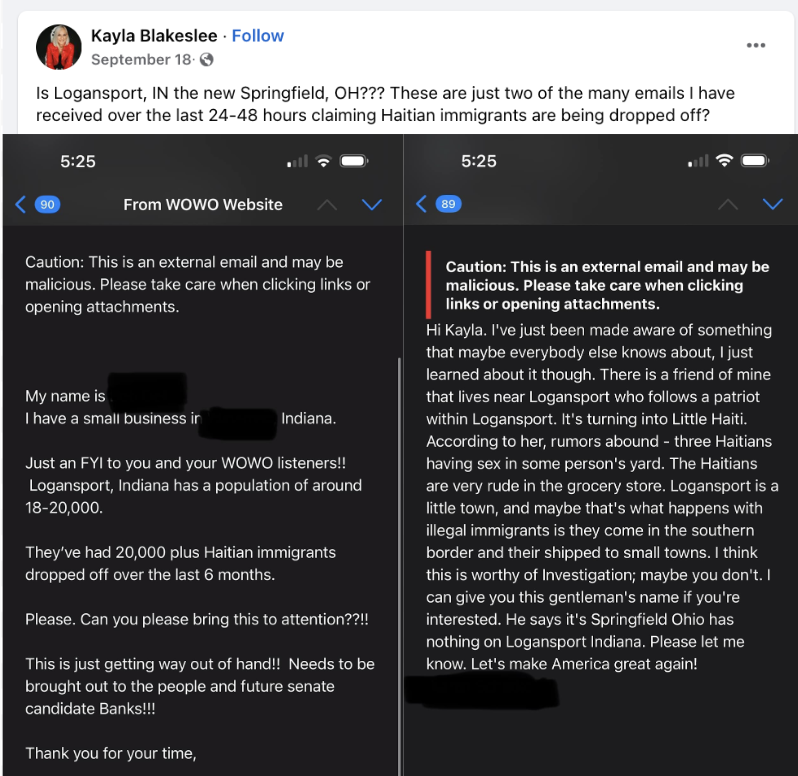
Blakeslee’s factually inaccuratepost — the mayor said the numbers originated from a social media satire page — was the first snowball in an avalanche of misinformation and hate that spread about Haitian migrants in Logansport.
Logansport's mayor acknowledged that there is an increased immigrant population, but noted that the community has been diverse for “a very long time.” According to census data, Logansport has about a 30 percent Latino population.
Story spreads through the right-wing ecosystem
Central Indiana’s Fox affiliate picked up the story on October 10, with the headline “Logansport officials say immigrant population growth is unsustainable.”
The report pointed to “strain on schools,” first quoting a county health department administrator who said she didn’t “think our school system can sustain what they are doing right now.” The district’s superintendent, the actual authority on the district’s capacity to handle new immigrant students, was optimistic, saying, “We can handle it.”
The report also pointed to strain on a local hospital because of increased births and emergency room visits, but the hospital responded by issuing a statement pointing in part to shuttered obstetrics departments at other area hospitals as a cause of increased births at Logansport Memorial Hospital.
Right-wing X account Libs of TikTok quickly shared the accompanying video segment.
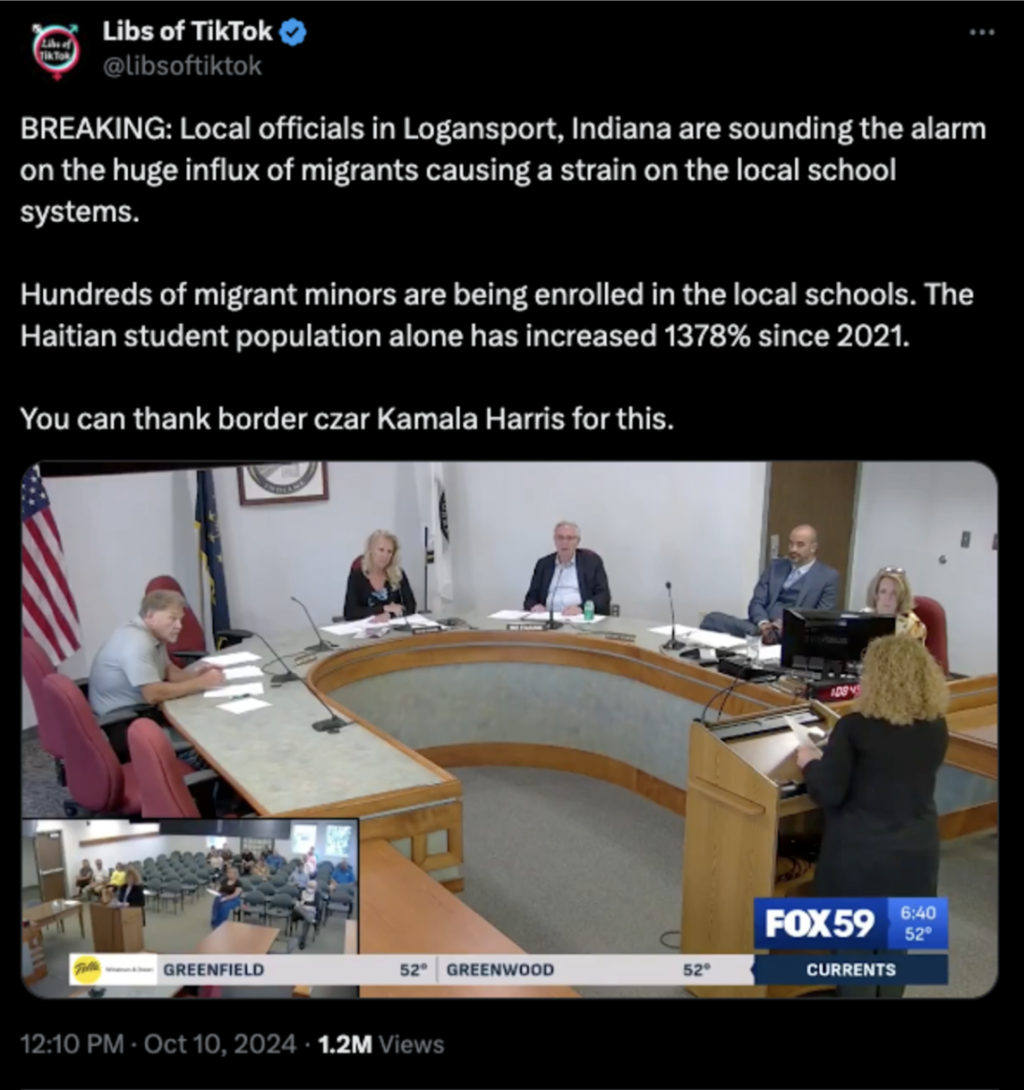
A slew of other right-wing X accounts then amplified the story, including RNC Research and Jack Posobiec.
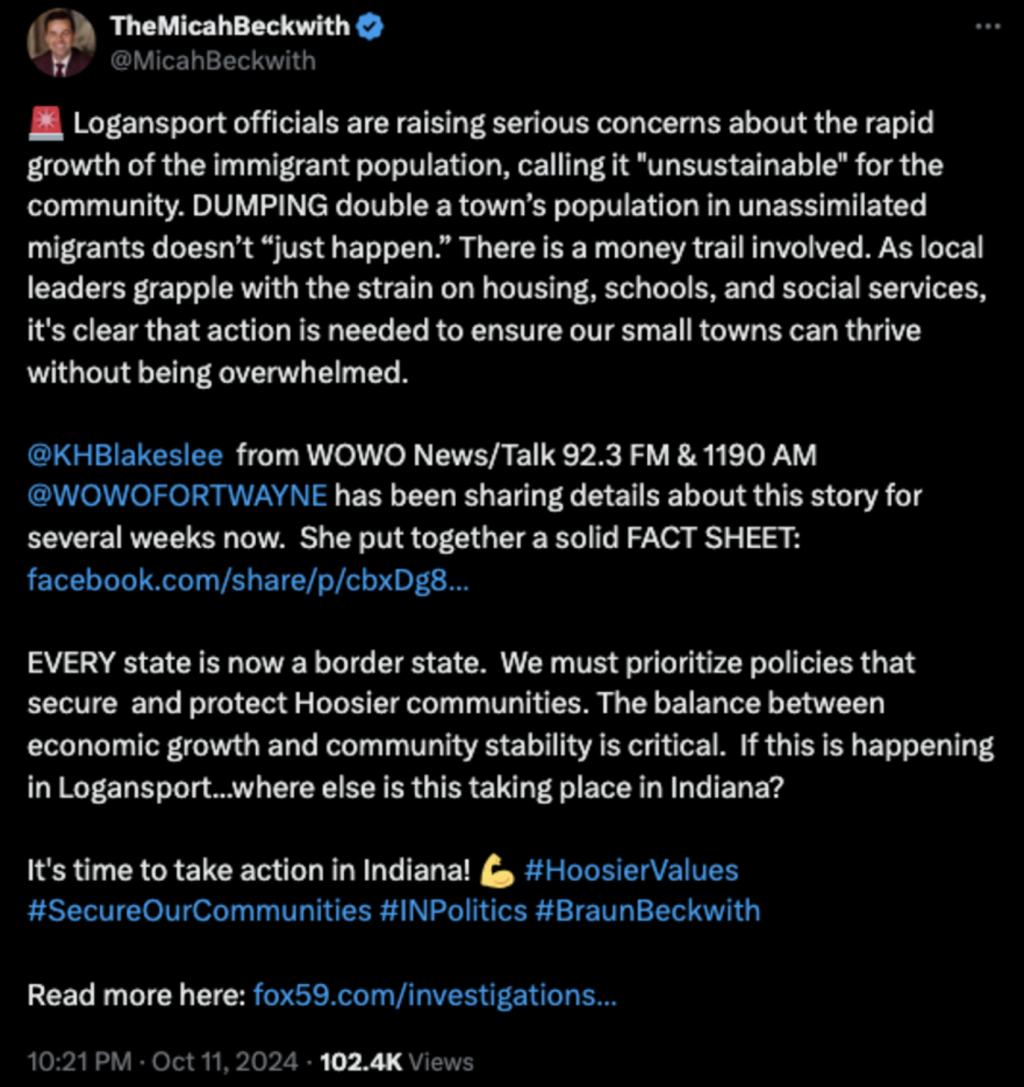
The day after the Fox affiliate’s report came out, Indiana’s now-newly elected lieutenant governor, Micah Beckwith, posted false claims about Logansport’s migrant population, including a conspiracy theory that a “money trail” was responsible for “DUMPING double a town’s population in unassimilated migrants.” Beckwith also cited Blakeslee’s coverage of the story.
On October 14, Breitbart published a story about Haitians in Logansport, claiming that the town has been “targeted by the Biden regime” and that “Biden has dumped thousands of Haitians there.”
On October 16, Fox News’ Fox & Friends hosted a segment about Logansport’s “migrant influx” and The New York Post spotlighted the segment in a separate report.
The following day, Blakeslee interviewed Beckwith, who described the increased Haitian population as “an invasion” and argued that Logansport officials should deport legal Haitian immigrants.
Newsmax aired a segment about Logansport’s “immigrant influx” on October 19.
Education quickly became the focal point of the manufactured migrant crisis, even though the district’s superintendent stated that the system can handle the additional students.
The New York Post published two pieces attacking migrant students in Logansport, claiming in an editorial that migrants are “robbing Logansport kids of an education” and in a news report that “kids are being pushed out of schools.”
On the same day, the Daily Mail published a piece about the “tiny Midwestern town where ‘explosion’ of Haitian migrants is overwhelming schools,” writing that “locals … say students are being muscled out of public schools by an influx of thousands of foreign newcomers.” The Daily Mail quoted a retired teacher, who said that “the native born are now a minority in the local school system.”
The next day, Fox News’ America Reports hosted a segment about Logansport, which Libs of TikTok later posted on X.
Hate groups take advantage
On October 23, Logansport’s local newspaper, the Pharos-Tribune, reported that stickers recruiting for white nationalist hate group Patriot Front were found in the city.
Around the same time, at least one Logansport resident received a flyer from the “Trinity White Knights of the Ku Klux Klan” reading “3RD WORLD IMMIGRANTS BRING 3RD WORLD CONSEQUENCES.”

Springfield residents faced a similar situation when hate groups swarmed the city after false claims about Haitian immigrants there went viral.
Indiana’s AG calls for investigation, and the Heritage Foundation uses Logansport to support anti-immigrant policies
Indiana Attorney General Todd Rokita responded by launching an investigation into the local health department, school system, and a Tysons Food plant (Logansport’s largest employer), seeking information about supposed human trafficking and other issues.
Rokita said the investigation is “focused on the coordinated efforts among international and local nonprofit ‘refugee resettlement’ organizations and employers, like Tyson Foods, to bring large numbers of migrants to Indiana.”
On November 19, the Heritage Foundation published commentary about Logansport, using the city to claim rural American towns are struggling due to an influx of immigrants.
Heritage proposed that Indiana and other states should “pass legislation prohibiting business licenses for organizations involved in facilitating illegal migration” and “prohibit the use of any state and local taxes from funding immigration [lawyers] and NGOs providing legal representation for aliens.”
President-elect Donald Trump has been emboldened by anti-migrant misinformation, threatening mass deportation and promising to end Temporary Protective Status, a program that allows people from select countries, including Haiti, to live and work in the United States. Ending TPS would likely force family separations and negatively impact communities, like Logansport, where TPS holders have lived and been employed for years.
---
an 1 24
twt
Indiana Rep. Jim Lucas shows high school students his gun during a conversation Tuesday at the Moms Demand Action Advocacy Day. Video provided by a student who recorded the interaction. See the full 10 minute video and our story at http://TheStatehouseFile.com
During a conversation with a group of high school student advocates against gun violence Wednesday, a state Republican representative thought showing them his gun would discourage their efforts.
IndyStar reports, Rep. Jim Lucas "struck up a conversation with the students, which resulted in a discussion about gun laws and school shootings, according to The Statehouse File."
The video shared to X/Twitter by The Statehouse File shows Lucas flashing his gun holster, then disregarding the concern of one student who said, "nothing about that makes me feel safe." The GOP leader replied, "those are feelings, I’m talking facts."
According to a CBS4Indy report, state Democrats released a statement following the incident, saying, "Indiana Republicans seemingly have enough time to belittle and intimidate high school students in between passing laws defunding the police, expanding child labor, and helping the gun lobby get off in court.
This supermajority puts the interests of the gun lobby over those of our local governments, and even the safety of Hoosier students. It’s wrong, and it’s time to check their power at the ballot box in November. Indiana Republicans say laws can’t stop gun violence. They have no plan to stop gun violence because they do not believe it is possible. We all deserve an Indiana where students – and everyone in our communities – feel safe and gun-owning Hoosiers can do so safely and responsibly."}:
CBS4Indy notes, "The exchange between Lucas and students comes after a bill that would expand the right to carry firearms into the state capitol was passed by the Senate Corrections Committee, and now heads to the House."
Last June, Lucas was arrested for driving under the influence, crashing his truck and ultimately fleeing the scene, according to WRTV. The GOP lawmaker accepted a plea deal to avoid jail time.
---
Indiana GOP targets LGBTQ Hoosiers with sweeping rewrite of state laws - Alternet.org
---
https://www.alternet.org/indiana-court-gop-abortion-ban/
---
Indiana Rep. Banks facing 'insurrection' ballot challenge
By TOM DAVIES, Associated Press - 5h ago
Provided by Associated Press
INDIANAPOLIS (AP) — An Indiana congressman who was rejected by House Speaker Nancy Pelosi as the top Republican for the committee investigating last year’s U.S. Capitol insurrection is fending off an effort to remove his name from this year's election ballot.
The challenge to Rep. Jim Banks’ candidacy is at least the second across the country against a Republican House member citing a portion of a post-Civil War amendment to the U.S. Constitution pertaining to insurrections against the United States.
Banks, an outspoken supporter of former President Donald Trump and leader of the influential Republican Study Committee, has denounced the ballot challenge as frivolous.
It was filed by a long-shot Democratic candidate for Banks’ congressional seat and likely has little chance of success when it goes before the state election commission on Friday, a former longtime commission member said.
A similar challenge is pending against North Carolina Rep. Madison Cawthorn, who spoke at the rally supporting Trump before the Jan. 6, 2021, Capitol riot that interrupted the certification of President Joe Biden’s victory.
The Indiana challenge petition filed by Democrat Aaron Calkins claims Banks is ineligible to be a candidate because of a “violation of the 14th Amendment supporting an insurrection.” The filing with the state election commission didn’t include additional information supporting the claim against Banks and Calkins didn’t return a telephone message from The Associated Press seeking comment.
The 14th Amendment says no one can serve in Congress “who, having previously taken an oath, as a member of Congress ... to support the Constitution of the United States, shall have engaged in insurrection or rebellion against the same.”
---
---
an 920
how a mask mandate might hurt the re-election chances of Indiana's Republican governor
September 27, 2020
The Associated Press recently reported that Indiana conservatives who are furious with Republican Gov. Eric Holcomb over his statewide mask mandate are cottoning to Libertarian Donald Rainwater as an alternative, which could make this fall's otherwise...
---
---
Indiana Bill Would Make it Harder to Close Coal Plants
:{:{BY: DAN GEARINO}:
If the bill passes, Indiana would become the third in the U.S. to pass a law aimed at combating market forces that make renewables and natural gas cheaper than coal. Read More}:
==
https://www.alternet.org/2020/01/a-hyperconservative-state-attorney-general-wants-unprecedented-control-over-local-prosecutions/
no lnx
A hyperconservative state attorney general wants unprecedented control over local prosecutions
Written by Filter January 31, 2020
by Rory Fleming
One might think Indiana has better things to do than police marijuana. According to US News and World Reports rankings, the state has the third-worst environmental quality, the 11th worst healthcare system, and the 14th worst roads and highways in the US. Until 2019, more people had been moving away from the state than moving to it for years.
But that’s not the way Republican Attorney General Curtis Hill sees things. He is supporting a bill introduced by Indiana State Senator Mike Young that would permit the AG to take over cases from county prosecutors when he believes there is a general declination policy for a certain charge—even when it’s a case of “don’t ask, don’t tell.”
The legislation is reportedly a reaction to new Marion County (Indianapolis) Prosecutor Ryan Mears’ declaration that he will no longer prosecute marijuana possession cases. Such a sweeping law would be the first in the nation, with prior attempts to rein in prosecutors being limited to specific cases and counties (like Philadelphia’s gun cases).
According to AG Hill’s spokeswoman Parvani Stover, his support is a result of a more general reaction to announced non-prosecution policies by chief local prosecutors around the country, like Rachael Rollins in Boston and Chesa Boudin in San Francisco. National pushback against reform prosecutors has recently been embodied by US Attorney General William Barr’s new presidential criminal justice commission and its woeful composition.
The Indiana Prosecuting Attorneys Association (IPAA) is one of the most conservative in the nation, and that says a lot.It published a shocking letter back in 2017, declaring “ both medicinal and recreational marijuana legalization are wrong for Indiana” and that medical marijuana is, in their profoundly non-medical opinions, “not medicine.”
But even the IPAA is not standing for this attack on its legal mandate to utilize prosecutorial discretion, according to WIBC reporter Eric Berman. In an argument at the Indiana Senate’s Corrections and Criminal Law Committee hearing on January 28, the IPAA described discretion as “essential” to carrying out its duties. In this instance, the IPAA seems to be prioritizing principle over its political persuasions.
In contrast, after Aramis Ayala, the chief prosecutor of Orlando, Florida, announced in 2017 that she would never seek the death penalty, the Florida Prosecuting Attorneys Association (FPAA) showed its willingness to get decidedly wishy-washy regarding uses of prosecutorial discretion that its members happen to dislike. (In fact, the association’s chief lobbyist Buddy Jacobs, who narrowly avoided white collar crime convictions twice, was so desperate to swiftly decry Ayala’s move that he plagiarized a private defense attorney’s blog in writing a friend-of-the-court brief to the Florida Supreme Court on the issue.)
People who keep track of legislative assaults on prosecutorial discretion should not be surprised if Indiana’s bill passes anyway, however. Attorney General Hill remains an influential and hyperconservative presence in Indiana’s state government (despite being credibly accused of sexually assaulting several women at the height of the #MeToo movement). The bill passed the aforementioned Committee by a 6-3 vote, with only one Republican joining the Democrats in dissent.
If the bill does indeed become law, law professors and criminal justice scholars ought to track how the Attorney General uses this newfound power. Giving the AG the ability to snatch cases away from local court systems on the mere suspicion of a non-declination policy, especially given the dearth of charging decision data from virtually every single county prosecutor office nationwide, would be a worrying departure.
==
Who's Missing?
But can the United States fight climate change with only half the states engaged? America's Pledge stresses that, yes, it has the potential. The states, cities, businesses and other institutions in its coalition represent 68 percent of U.S. GDP, 68 percent of the population, and 51 percent of U.S. greenhouse gas emissions.
But the most carbon-intensive economies in the U.S. are still not part of the fight.
Sixty-five percent of the remaining U.S. coal power capacity, for example, is located in the 25 states that arenot part of America's Pledge, led by Texas, Indiana and Kentucky. The America's Pledge analysis found that the U.S. could still make progress without the help of these states. It calculated that if just a handful of the states that have already shown some willingness to act adopted stronger policies, like those set by climate leaders like California, the U.S. could cut emissions up to 37 percent by 2030, even if the most carbon-intensive states and the federal government refuse to act. But that's not where the U.S. needs to be if it hopes to reach net zero emissions by mid-century, as the science says is necessary to stave off climate change's worst ravages.
"None of the states who are climate leaders would say that what they're doing is enough," said Arroyo. "But you've got to start to do what you can do, and prove the concept that you can do this without breaking the bank, and in fact you can do it while growing your economy, creating jobs and enhancing the quality of life."
RMI's Frisch said the real lesson of the state and local climate effort so far in the United States is that it is essential, but not sufficient.
"The states are the reason for the progress that we've had so far," she said. "And their effort will still be fundamental going ahead. But we can't get where we need to be without the federal government, and the federal government can't do it without the states. We need to have both."
---
---
The Clean Energy Jobs Act that was introduced Thursday would move Illinois to 100 percent renewable energy by 2050 and make the state a national leader in clean energy and climate action.
Clean Energy
The bill (SB2132) would rapidly ramp up renewable energy in Illinois towards the 100 percent target by 2050, starting with a target of generating 45 percent of our electricity from renewable sources — and none from fossil fuels — by 2030. That rapid expansion of clean energy would place Illinois at the forefront of job growth, investments, customer savings and health benefits from renewable energy.
The bill would also grow the Illinois Solar for All Program by as much as 500 percent, expand cost-saving energy efficiency programs, and help us plan our electric grid in ways that avoid unnecessary costs and take advantage of increasingly cheap renewable energy.
Clean Transportation
Putting more renewables on the electric grid also makes it easier to clean up our transportation sector, which is now the largest source of carbon pollution in Illinois. Although electric vehiclesalreadypollute less than gasoline-powered vehicles, as the electricity we use to charge those vehicles gets cleaner, we can reduce pollution even more. At the same time, electric vehiclespaired with smart charging technologies can help our electric grid run more efficiently. The Clean Energy Jobs Act aims to take advantage of these opportunities while removing the equivalent of one million gasoline-powered vehicles off the road.
New incentives and infrastructure to support electric vehicles would help spur this process, including support for "light duty" electric vehicles like cars and trucks, which can save drivers money and create 70 percent less pollution than similar gas-powered vehicles. It would also include incentives to transition towards electric medium- and heavy-duty vehicles, which is critical in part because many of today's heavy-duty vehicles run on diesel and cause serious health problems for people in communities with heavy truck traffic. The bill also pairs electric vehicle incentives with smart charging programs to ensure that electric vehicles can charge at "off-peak" hours (such as late at night) when electricity is relatively cheap, plentiful and clean. Finally: in addition to expanding electric vehicles, Illinois should expand non-motorized transportation options like walking, biking and mass transit, which could be included in a capital bill.
Jobs and Equity
The transition to a clean energy economy promises benefits to our health (as we saw in 2016), our climate and our pocketbooks. It also creates jobs: Illinois is already home to nearly 120,000 clean energy jobs. Statewide, about one in every 50 workers is in the clean energy sector. In rural Illinois, clean energy already employs twice as many people as fossil fuels, and those jobs are growing at 5 percent a year even as the total number of jobs in rural areas has declined. The massive expansion of renewable energy envisioned in this bill would grow those impressive numbers even further.
But the benefits of our energy transition must be equitably distributed, and the jobs it creates must be good-paying and accessible. The transition must prioritize economic opportunity for people of color, people who live in environmental justice communities, and workers impacted by the transition away from fossil fuels.
The Clean Energy Jobs Act centers these priorities through Clean Energy Empowerment Zones, which allocate economic development resources to communities impacted by the transition away from fossil fuels, and the creation of Clean Jobs Workforce Hubs. These hubs are workforce development pipelines that begin with recruitment conducted in partnership with community groups, unions and others, and which prioritize recruiting people of color, people from marginalized communities, and displaced fossil fuel workers. They include training programs with stipends to help trainees meet living expenses, transportation, child care, and other needs while they develop their skills. Renewable energy developers will be incentivized to hire diverse workers, including graduates of these training programs.
What's Next for the Clean Energy Jobs Act
The Clean Energy Jobs Act was developed with the input of people all over Illinois, in nearly 70 public discussions across rural, urban and suburban communities, from Chicago to Carbondale, with participants of all ages and racial backgrounds.
With a newly-elected governor who supports 100 percent renewable energy, recent national polls showing that 85 percent of registered voters want to move their states entirely to renewable energy by 2050, and the ambitious Clean Energy Jobs Act gathering sponsors in the legislature, Illinois is poised to be a model for clean energy leadership — not just in the Midwest, but in the world.
Beyond the numbers and the policy details, that would mean cleaner air and water, more jobs, healthier people and a livable world for our kids.
RELATED ARTICLES AROUND THE WEB
- Illinois ›
- 3 Midwestern States :(style="background-color:#ffff66ff"):}::{That Refuse to Abandon the Renewable ... ›
- Ambitious Plan Solidifies Illinois as Renewable Energy Leader ... ›
- Illinois Renewable Energy Association ›
---
Most of us have a growing sense that something’s deeply wrong with the way that digital data is used to track and monitor us. But most of us don’t realize that the poorest among us are particularly vulnerable. Virginia Eubanks argues that such data is used to criminalize and turn the poor away from public resources to which they are entitled.
Resources:
Virginia Eubanks, Automating Inequality: How High-Tech Tools Profile, Police, and Punish the Poor St. Martin’s Press, 2018
https://kpfa.org/episode/against-the-grain-july-18-2018/
partner attacked, hurt, ER bills, days later told had no coverage, no start date (a new policy) not married, painkillers, red flag for insurance fraud, suspend.
mitch daniels (pence mentor) billion? $ contract to automate snap b/c public sector workers make decison, thus collusions: church indianapolis fake acc'ts anecdote, ibm
sever connection to person, aplly online (1/2 have PC) call ctr i mill failure to cooperate in est'b eligibility 7-14 days, ppl in hosp w/ cancer missed appt
---
==
https://www.ecowatch.com/rooftop-solar-state-policies-2563502732.html
Ten of the nation's sunniest states get a failing grade for policies that actively block, or don't encourage, rooftop-solar development, according to Throwing Shade, a new report from the Center for Biological Diversity.
Alabama, Florida, Georgia, Indiana, Louisiana, Oklahoma, Tennessee, Texas, Virginia and Wisconsin account for more than 33 percent of the total rooftop-solar potential of small buildings in the contiguous U.S. but less than 8 percent of net generation in 2017. All of them get an "F" in today's report.
"Instead of leading us out of the climate crisis, these sunny states are casting a long shadow across our potential for rooftop solar," said Greer Ryan, a renewable energy and research specialist with the Center for Biological Diversity and author of the report. "The Trump administration certainly isn't going to fix our climate, so it's vital that these states step up."
...
===
---
'Blocking the Sun': New Report Documents Efforts to Undermine Rooftop Solar
While nearly 9 in 10 Americans support the development of more solar energy, electric utilities and fossil fuel-backed special interests are trying to hold off the inevitable renewable-energy future by promoting policies that would make rooftop solar harder to obtain.
A new report released Thursday by Environment America Research & Policy Center documents 20 entities, across 12 states, who sought to roll back key policies driving solar power over the past year.
"It's completely clear that Americans want more solar power, for the good of our environment, our health and our local economies," said Bret Fanshaw, solar program coordinator with Environment America and report co-author. "We cannot allow for a narrow set of interests to block the ability of everyday citizens to tap into clean and renewable solar power on the roofs of our homes and businesses."
Fueled by strong public policies, solar energy is growing by leaps and bounds, with enough solar capacity installed in the U.S. to power 1 in 14 American homes. The American public has demanded solar power because it is clean and increasingly affordable, with costs down two-thirds over the past decade.
The "Blocking the Sun" report shows, however, that electric utilities and special interests are actively undermining access to solar energy across the country.
According to a Frontier Group analysis of the most recent N.C. Clean Energy Technology Center '50 States of Solar' report, at least 90 policy actions in U.S. states could affect the growth of rooftop solar generation as of mid-2017. They include limits on net metering or new utility fees that make solar power less affordable.
"We're seeing a continued, concerted effort to knock down some of the best solar policies out there by some of the most powerful state utilities and fossil fuel actors" said Hye-Jin Kim, policy associate at Frontier Group and report co-author. "We've done this study three years in a row, and despite overwhelming public approval of solar power, the industry attacks on pro-solar policies continue."
Often operating in dense regulatory proceedings, electric utilities like Duke Energy, Rocky Mountain Power and Arizona Public Service have urged state officials to lower credits to solar users,add special charges to rooftop solar owners and force customers into rate plans that would reduce the benefits rooftop solar can provide on your electricity bill.
Efforts by electric utilities to stall solar progress have been coupled with, and in some cases, orchestrated by, fossil fuel front groups such as the Consumer Energy Alliance and utility trade groups such as the Edison Electric Institute.
In many cases, it's working.The Indiana Energy Association, an industry group, successfully lobbied on behalf of the state's biggest electric utilities to phase out Indiana's key rooftop solar program this year, replacing it instead with a new policy that limits compensation for generating rooftop power.
The Trump administration has appointed allies of the electric utilities and fossil fuel companies to key positions within the Department of Energy and other federal agencies. Those appointees are making a concerted effort to undermine solar power at the national level. Studies put forth by Energy Sec. Rick Perry question the value of rooftop solar and attempt to justify support for coal and nuclear plants over renewable energy.
The "Blocking the Sun" report recommends state and national decision-makers resist utility and fossil fuel industry attempts to reduce the economic viability of distributed solar energy, and reject policies to limit the use of this clean, renewable and increasingly economical source of power.
"To meet our major environmental challenges and reach 100 percent renewable energy, we must harness the power of the sun on exponentially more rooftops across America," said Fanshaw. "The people want this to happen—it's up to our public officials to stand up to powerful interests and make going solar easier, not harder."
==
--
http://www.alternet.org/election-2016/mike-pence-loves-alec-and-keeps-pushing-public-school-privatization-despite-lousy
... Pence is a hardcore right-winger playing the long game, especially when it comes to privatizing public schools.
It’s not just that the Republican vice-presidential nominee and Indiana governor last weekend told a roomful of deregulation-obsessed executives and lobbyists in Indianapolis, “You are the model for Washington, D.C., after this election. You really are.”
The nation is “at a fork in the road,” Pence said at the American Legislative Exchange Council’s annual meeting, referring not only to who would be president for the next four years but who would control the Supreme Court for the “next 40 years.”
The choice is “whether we will have justices appointed to the Supreme Court, as my partner in this endeavor is committed to doing, that reflect the brilliance and the greatness and the principles of the late justice Antonin Scalia,” he said. “So I would say to all of you, for the sake of the rule of law, for the sake of the sanctity of life, for the sake of our Second Amendment and all of our God-given liberties, we must ensure that the next president making appointments to the Supreme Court of the United States of America is President Donald Trump.”
Pence was no stranger to the stage of ALEC, a corporate-funded behemoth that drafts bills and finds right-wing lawmakers to carry them. He’s been an ALECfixture for years, touting deregulation, privatization and extreme social conservatism. But he’s best-known for a personal focus on supplantingtraditional public education, notably embracing taxpayer-funded vouchers so parents can send kids to K-12 private schools and aggressively expanding privately run charter public schools.
As is typical at ALEC, Pence praised enterprise and deregulation, and said a Trump administration would result in "empowering states with resources and flexibility.” But a closer look at his Indiana record of privatizing education, where the ALEC model has been in play, has shown it to be a brazen and failed experiment.
Charter School and Voucher Problems
A recent National Public Radio profile of Pence’s education record noted that he has been one of the leading governors pushing K-12 privatization. “Under Gov. Pence, the growth in the number of charter schools and the use of private school vouchers have exploded,” it said. “After the voucher program survived a state Supreme Court challenge in 2013, it's grown into one of the largest in the country. Pence helped to do that by advocating to expand the program to include middle-income, not just low-income families, and also by removing the cap on how many students qualify.”
Yet this May, when WTHR, Indianapolis’ NBC-TV affiliate, looked at the charter school experiment, itfound that “nearly half of the state's 76 charter schools are doing poorly or failing.” The scores were based on the state’s new accountability standards.
In one example, reporters quoted sources from Indiana Science Academy West who said, "Nothing is taught... nothing is learned,” and cited "unlicensed teachers,” high staff turnover and a textbook shortage. But under Indiana law, itnoted, “Those [charters] failing year after year, not only get a second chance but can fail six consecutive years before the state steps in.”
That investigative report was not unique, but it is quite a counterpoint to the rhetoric from Pence and the K-12 privatization movement that traditional schools are failing and that charters and vouchers are the answer.
At ALEC, the education agenda also includes tax credits to send children to private schools, impeding and dismantling labor unions, andcreating new state agencies to overrule locally elected school boards and communities. Soon after Pence gave a keynote at a 2013 ALEC summit, the group published its annual “Report Card on American Education.”
Pence wrote the 2014 report’s introduction, boasting, “We enacted the most ambitious school choice program in the country in 2011. Last year, nearly 20,000 low-income Hoosiers used vouchers, or what we call Choice Scholarships, to attend the school of their choice—a 500 percent increase from the year before. This year the number of applications has grown to nearly 30,000. In addition to the School Choice Scholarships, more than 35,000 Indiana students are attending public charter schools across our state.”
:{:{}:
But Indiana’s record on vouchers has been problematic. A May 2016 Brookings Institution report on vouchers in Indiana and Louisiana slammed the programs. In both states, “research… has found that public school students that received vouchers to attend private schools subsequently scored lower on reading and math tests compared to similar students that remained in public schools. The magnitudes of the negative impacts were large.”}:
Moreover, traditional public schools were doing a better job than voucher counterparts when it came to educating poorer students. “It is at least plausible that Louisiana and Indiana public schools have surpassed their private schools (for low-income students),” Brookings said.
Nonetheless, this year Pence is spending more money on vouchers than his state legislature appropriated, underscoring his zealotry as a pro-privatization ideologue.
Protecting Investors, Not Students
Meanwhile, under Pence the state has gone out of its way to keep failing charters from closing. Like many states that have granted the industry wide license, under Pence the various players in his state’s charter sector—a mix of private and public institutions—don’t want to close failing schools but instead look for new managers to run the schools and new regulators to sign off.
One Indiana public radio station, WFYI, called this tactic “authorizer shopping.” The highest-profile example was Thea Bowman Leadership Academy in Gary, Indiana, where problems ranged from low student test scores to deep governance issues, such as high staff turnover, not satisfying federal education standards and no terms for charter board members.
As WFYI reported this year, in 2013 seven “chronically failing schools were denied reauthorization from Ball State [University, their founding sponsor], yet three of the schools were granted new charters from a different authorizer to remain open.” That led the legislature to pass a law to require the state Board of Education to approve any such reprieve, a policy thatsounds like state accountability but in practice minimizes input from locally elected school boards. The state Board approved it in June.
But the negative impacts of these privatization experiments go beyond vouchers and charter schools. Diverting millions of taxpayer dollars to private, often religious schools takes resources away from traditional public schools. Pence, additionally, has created new state low-interest loans to benefit charters, and his last state budget included a new $1,500-per-student allocation to charters for non-academic expenses. His GOP majority legislature scaled it back to $500 per student.
According to the Washington Post, the cumulative negative impacts of privatization have created a shortage of qualified public school teachers in Indiana. “What’s going on? Pretty much the same thing as in Arizona, Kansas and other states where teachers are fleeing:a combination of under-resourced schools, the loss of job protections, unfair teacher evaluation methods, an increase in the amount of mandated standardized testing and the loss of professional autonomy,” the Post's education blogger wrote last year.
“According to the Indianapolis Star, the Republican chairmen of the House and Senate education committees have asked General Assembly leaders to approve having the legislative education study committee review what is causing the drop and how the state could respond,” the Post continued. “For one thing, they can look in the mirror.The Republican leadership of the state—including Gov. Mike Pence—showed their respect for teachers by working very hard this year to strip power from Indiana Superintendent of Public Instruction Glenda Ritz, a veteran educator who won election to the post in 2012 (by defeating Tony Bennett, the incumbent who was a protege of former Florida governor Jeb Bush). Oh, by the way, she is a Democrat.”
The pattern under Pence continues. Under the state’s new public school funding formula, richer school districts will get more money and poorer districts less,another education blogger noted. WaPo's education blogger summed it up like this: “For 2015-17, the state legislature gave less funding to urban schools and more to charter schools and private schools that accept students with vouchers.”
In other words, while Pence preaches privatization as the cure-all for K-12 education, his state's traditional school system is being undermined and supplanted, and the privateers' gains are the public's losses.
:{:{In recent years, Pence has been a featured speaker at libertarian forums to promote this agenda; audiences love the rhetoric but pay little attention to the resulting reality on the ground.}::{ Before Pence was named Trump's running mate, he attended a Republican Governors Association luncheon at David Koch's mansionin Florida with "about 60 wealthy backers.” And since joining the ticket, he was a "featured guest" at the Koch brothers network's semiannual libertarian donor retreat in Colorado.}:
}:
Which means Pence has become perhaps the nation's top evangelist for ALEC and education privateers across America.
==
Indiana: At least $2.2 million was awarded to charters that either closed or never opened. In addition, emails obtained by CMD through a public records request to Gov. Pence's office found troubling examples of how the private charter sector, notably for-profit chain Charter Schools USA, influences on policy-making.
==
nrdc toxic 20 states: Kentucky, Indiana, Georgia, Texas, Virginia, South Carolina, Alabama and Mississippi-- supported a resolution by Sen. James Inhofe, to limit mercury and other air emissions
---
center, which would be built next to the city's airport, is being touted as a job-creator and a source of revenue.
Gary mayor Karen Freeman-Wilson estimated that the facility would generate $1 million in annual property taxes. “I can use that,” she noted.
Councilwoman Linda Barnes-Caldwell agreed, saying, “I think it is a wonderful idea. It will bring revenue to the city and jobs. And I think it is an ideal location.”
GEO Group has long come under fire for practices within its facilities as well as its profiteering off of the criminal justice system. From 2008 to 2012, CEO George C. Zoley had a compensation of $22,315,704. Because the company largely contracts with the government, almost all of this money came from American taxpayers.
The Private Corrections Working Group notes that GEO has faced hundred of lawsuits over conditions within its facilities, with scores being settled before reaching trial. As Brendan Fischer notes, research has shown that “assaults on guards by inmates were 49 percent more frequent in private prisons than in government-run prisons. The same study revealed that assaults on fellow inmates were 65 percent more frequent in for-profit/private prisons.”
GEO has steadily expanded its operations due to its close political connections. It has close ties to Sen. Marco Rubio (R-FL), who has in the past employed several staffers tied to GEO, including a chief of staff who co-founded the same lobbying firm employed by GEO.
Some local residents are concerned. Tom Dubois of Concerned Citizens of Hobart, who opposes such detention facilities, said, “It's a moral issue as well as an economic one.”
Gary's unemployment rate has been persistently high, and it has been described by some of its residents as a “ghost town.” In 2011, Gary had to close its main library due to budget cutbacks. Building an economy and tax base based on detaining migrants is probably not the ideal strategy, but in an America where so much of the Midwest has been deindustrialized and left in decay, it's the sort of perverse idea that makes sense to local leaders.
==
94% electricity from coal
http://www.sourcewatch.org/index.php?title=Indiana_and_coal
---
Environmental assessment
In April 2007, Santee Cooper initiated the Environmental Impact Statement process on the plants. On October 9, 2007, the state Department of Health and Environmental Control (DEHC) issued a draft Prevention of Significant Deterioration permit for the project, provoking an October 25 protest by several environmental groups in Columbia.[2] On November 8, a Pamplico hearing on the DHEC permit was attended by dozens of project opponents – as well as by hundreds of Santee Cooper, Alcoa, and Nucor employees, who were brought in on a chartered bus.[3] On December 6, a group of local physicians protested outside the DHEC office in Florence, demanding that DHEC test Pee Dee River residents for mercury poisoning before the permit is approved; on December 14, a DHEC spokesperson stated that DHEC had not yet decided whether to follow up on the physicians’ requests.[4]
On December 7, the U.S. Department of the Interior requested that the project be put on hold, pending an analysis of the damage that the plant would cause to the Cape Romain National Wildlife Refuge. The DHEC extended the public comments period on the draft permit until January 22, 2008.[5]
---
Indiana Workers Stand against the ALEC Agenda and the Anti-Labor Bill Called the "Right to Work" (for Less)
Submitted by Lisa Graves on January 5, 2012 - 8:20am
Thousands of Indiana workers rallied outside, and inside, their state capitol on Wednesday to speak out against Governor Mitch Daniels' renewed effort to force through so-called "right to work" legislation designed to undermine labor unions and workers' rights protected by collective bargaining.
One Victory for Democracy--Restored Access to the Indiana Capitol
 A worker's sign reads: "I already have the right to work! I don't need your permission."Workers won a victory Wednesday when the Governor rescinded new restrictions that had been created to limit the rights of Indiana citizens to freely access their state capitol building. Prior to last year's protests, citizens in Indiana, Wisconsin, and other states had long enjoyed easy access to their state houses to express their views on legislation, but in Indiana as with Wisconsin and other states, partisan political leaders imposed supposedly "safety-based" restrictions to limit citizens exercising their freedoms of assembly and speech. On Wednesday, faced with thick lines of constituents winding down the streets of the capitol, the state lifted the low cap on the number of people who could enter the building where legislation is being pushed to restrict worker rights.
The Battle Against another Anti-Labor Bill with "ALEC" Corporate DNA
Thousands of taxpayers arrived from across the state, along with a small number of counter-protesters, in response to the announcement that the Indiana legislative leaders were planning to push through a so-called "right to work" bill, which has been called the "right to work for less" bill by opponents.
This bill is no native born Hoosier idea. It tracks key provisions of "model" legislation secretly voted on by corporations and politicians on a task force of the American Legislative Exchange Counsel (ALEC).
 Although ALEC calls itself the largest organization of state legislators, it is bankrolled by some of the biggest global corporations in the world, such as Koch Industries, Exxon Mobil, and other companies from outside of Indiana. About 99% of the funding for ALEC's operations come from corporations and sources other than legislative dues, which are $50 per year. ALEC legislators often introduce legislation, voted on behind closed doors by ALEC corporations and politicians, cleansed of any reference to the fact that the bills were pre-approved and pre-voted on by corporations. The current corporate co-chair for Indiana is the North Carolina-based Duke Energy Company, which is tasked by ALEC with raising money from corporations for "scholarships" for ALEC politicians to attend vacation conventions at fancy resorts with schmooze and booze events with corporate lobbyists.
Duke Energy came under fire last year in Indiana for trying to pass off onto customers hundreds of millions in over-budget costs for the Edwardsport Plant in Knox County. That coal gasification plant has gone so far over budget, to the tune of a billion dollars, that the state of Indiana has been looking into whether there was fraud or concealment. Duke has also been called out for paying no net taxes between 2008 and 2010 on over $5 billion in pre-tax profits, according to the Corporate Tax Dodgers Report of the Citizens for Tax Justice (which is uploaded below).
Duke's state co-chair for ALEC is Senator Jim Buck of Kokomo, who also sits on ALEC's Board of Directors, which approves "model" legislation in every area of the law. He is the co-chair of the ALEC Tax Task Force, which has previously opposed taxes on windfall profits of global energy companies and sought to eliminate combined reporting for corporations, thus making it easier for companies to use gimmicks to hide profits out of state.
State Rep. David Wolkins of Winona Lake is also an ALEC statewide co-chair, along with Senator Buck and Duke Energy. He is also the co-chair of ALEC's Energy Task Force, and in 2011 ALEC named him a "State Legislator of the Year" for advancing ALEC's vision. (In some prior years, legislators receiving this designation also received cash "awards," although it is not certain if Wolkins did.)
Indiana is now playing a central role in ALEC's agenda. The Chairman of ALEC's Public Sector Board this year is Representative David Frizzell of Indianapolis, who has also been a member of ALEC's Health Task Force. In all, at least 17 Indiana representatives and five state senators are members of ALEC Task Forces, along with an unknown number of other legislators who do not have these known leadership roles with ALEC corporate partners. Representative Richard McClain of Logansport, who introduced H.B. 1104, the latest version of "Right to Work" introduced in the state, is also a member of the ALEC Tax Task Force, along with Senator Buck.
How Close Is HB 1104 to the Bill Voted on by ALEC Corporations?
The Indiana bill, which was introduced on the first day of the legislative session this year, contains provisions very similar to the ALEC "model" bill. The Center for Media and Democracy (CMD), which publishes PRWatch, analyzed and exposed over 800 ALEC-approved bills or resolutions last year, including the "Right to Work Act." The Indiana bill, HB 1104, has key operative language that echoes the ALEC bill at CMD's ALECexposed.org. (A mark-up of the model Right to Work Act is also available below, along with a copy of HB 1104, with terminology in common highlighted on the Indiana version.)
 Workers in Indiana Opposing HB 1104Both "Right to Work" bills would make it a crime to violate the bills' bar on a union requiring a worker to pay dues when the worker's rights are protected by a union-negotiated collective bargaining agreement. Both bills would require state prosecutors to investigate violations and enforce the criminalization of dues collection that has historically protected against free-riders taking advantage of the benefits and rights negotiated by union representatives without paying any dues. And, both bills also authorize civil lawsuits for violating the new rules, if enacted, including damages, injunctive relief, and attorney's fees, "in addition to any other remedies and penalties." Protesters in Indiana and elsewhere have objected to such "punitive" legislation and consider this to be part of a "War on Workers."
Although the ALEC bill and the Indiana bill have some minor differences in the setting forth of these provisions, these three core elements of "Right to Work" legislation are substantively the same and have the same effect. The only major substantive difference is that the new Indiana bill would impose these restrictions as a "pilot program" rather than state-wide immediately, unlike the ALEC bill. In the view of CMD, the bills' core operative terms and requirements are sufficiently similar to say that the Indiana bill shares ALEC DNA, even though it is not identical in its layout or in every detail.
 Key Components of RTW according to ALECThe common operative components are not surprising because the ALEC "model" legislation for "Right to Work" was approved by ALEC corporations and politicians through one its task forces well over a decade ago. Its core components--criminalization, mandatory criminal enforcement, and civil liability--have been proposed in dozens of states, although they have not passed everywhere proposed. The so-called "Right to Work" agenda has also been pressed by long-time ALEC member, the Right to Work Committee, and the corporations that underwrite anti-labor legislation across the country.
In fact, one of ALEC's first agenda items after its founding in the mid-1970s was advancing the "Right to Work" agenda, as documented in the image below. Both ALEC and the Right to Work Committee also trumpeted the passage of the extremely controversial Idaho "Right to Work" legislation in 1985. At the time, an ALEC Board Member--the Speaker of the Idaho House of Representatives Tim Stivers--was instrumental in the adoption of the bill in his state and even defied a court order against its adoption, after the bill had been vetoed by the governor and challenged in court. The Idaho law is virtually identical to the ALEC model bill, and it has the same core provisions of criminal and civil liability and mandatory prosecution for violating the bar on union dues collection from free-riders, as does the Indiana bill.
 Clipped from ALEC's history in report available in the Tobacco Library
Criminalizing Union Dues Collection, even in Parts of Indiana?
Unless opponents of the bill continue to deny the legislature the quorum needed to pass the bill or secure additional allies, Governor Daniels may sign into law this punitive bill that essentially reverses over 60 years of protections for unions and the workers they represent. Indiana has a deep tradition of trade union activities in the state that have sought to protect working families from corporate abuses and unfair practices. Governor Daniels, who served as an advisor to President Ronald Reagan, was working for Senator Lugar when the President rebuked the Polish Soviet era regime for its criminalization of the Solidarity union activities, noting that "the right to belong to a free trade union" is "one of the most elemental human rights."
In rallying in Indianapolis, workers are seeking to have their voices heard on these rights in the halls of power. They are asking that their lives and experiences be respected and not simply ignored by the majority in the legislature who have received indoctrination against labor rights in ALEC workshops and from corporate lobbyists with virtually unlimited access to their representatives. They are asking their elected representatives to stand with the 99% and not the 1%.
Some proponents of the long-standing ALEC "Right to Work" agenda continue to cite studies making unreliable claims about the economic impact of such laws, studies that are almost always funded by corporate CEOS, their foundations, or companies that oppose "unionism" as an ideological matter. Meanwhile, numerous careful analyses have documented the claimed benefits and the actual consequences of such laws and have found the quite natural result of weakened unions to be diminished wages and benefits for workers.
Even some conservatives have objected to how such laws interfere with private contracts between employers and employees, because "[m]andating that employees should have the 'right' to work outside of those contracts is unfair to employers, unions, and individuals. Anyone considering themselves ideologically libertarian, or even a believer in small government and laissez-faire capitalism, should oppose "Right to Work" laws on the grounds that any employer should have the right and freedom to enter into labor contracts with whomever they wish." Even a "pilot" program would interfere with private contracts and unsettle negotiated agreements while setting a precedent for weakening this "essential human right" statewide. Indiana workers are asking their representatives not to take any actions that will further depress the wages of workers and harm working families struggling to make ends meet by embracing the siren song of the ALEC "Right to Work" agenda.
---
Lisa Graves is the Executive Director of the Center for Media and Democracy, which publishes PRWatch.org, SourceWatch.org, and BanksterUSA.org. Our latest investigation is ALECexposed.org. She previously served as Deputy Assistant Attorney General in the Office of Legal Policy at the U.S. Department of Justice and as Chief Counsel for Nominations for the U.S. Senate Judiciary Committee, among other leadership posts. CMD does not accept grants from for-profit corporations or government agencies.
---
Indiana Legislators Connected To ALEC
Many ALEC members are lawmakers. Indiana House Education Committee Chair Robert Behning’s resumé boasts of having held leadership positions within the group. And several organizations reported on Indiana State Superintendent Tony Bennett’s keynote address at a ALEC convention in Phoenix, AZ earlier this year. At the same conference, Indiana State Representative Dave Frizzell was appointed national chairman of the organization. The Evansville Courier Journal has a specific list of other Indiana legislators either working on or leading ALEC task forces.
State Sen. Jim Buck, R-Kokomo, meanwhile, chairs ALEC’s tax and fiscal policy committee. State Rep. David Wolkins, R-Winona Lake, chairs its energy, environment and agriculture committee.
In all, nine of the 150 members of the Indiana General Assembly attended the summit. About 20 more Indiana Republican legislators are members of ALEC but did not attend.