Tyson
See also Poultry page
polluter? extractive contracts?
---
Right-wing media launched a migrant witch hunt in rural Indiana
Hate groups, a local politician, and the Heritage Foundation tried to take advantage of the misinformation-fueled panic
Written by Olivia Little
Published 12/05/24 MMA
Months after the Trump campaign’s flagrant lies about Haitian immigrants in Springfield, Ohio, went viral, right-wing media continue to fuel fear of Haitian migration. In Indiana, a small city was the focus of a misinformation-fueled migrant witch hunt led by right-wing media that emboldened hate groups and is now being used as a case study to justify anti-immigrant policies.
Logansport is a rural city with a population of about 18,000 residents. In mid-September, Kayla Blakeslee, a right-wing talk radio host based out of Fort Wayne, Indiana, posted on Facebook screenshots of emails that claimed “20,000 plus Haitian immigrants” were “dropped off” in Logansport over the last six months. Blakeslee wrote, “Is Logansport, IN the new Springfield, OH???”
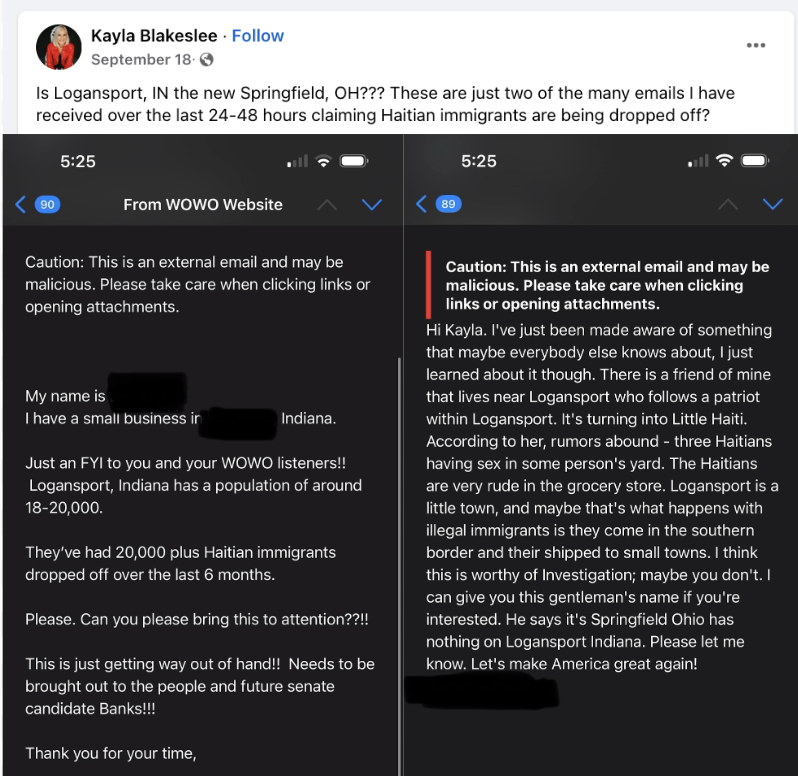
Blakeslee’s factually inaccuratepost — the mayor said the numbers originated from a social media satire page — was the first snowball in an avalanche of misinformation and hate that spread about Haitian migrants in Logansport.
Logansport's mayor acknowledged that there is an increased immigrant population, but noted that the community has been diverse for “a very long time.” According to census data, Logansport has about a 30 percent Latino population.
Story spreads through the right-wing ecosystem
Central Indiana’s Fox affiliate picked up the story on October 10, with the headline “Logansport officials say immigrant population growth is unsustainable.”
The report pointed to “strain on schools,” first quoting a county health department administrator who said she didn’t “think our school system can sustain what they are doing right now.” The district’s superintendent, the actual authority on the district’s capacity to handle new immigrant students, was optimistic, saying, “We can handle it.”
The report also pointed to strain on a local hospital because of increased births and emergency room visits, but the hospital responded by issuing a statement pointing in part to shuttered obstetrics departments at other area hospitals as a cause of increased births at Logansport Memorial Hospital.
Right-wing X account Libs of TikTok quickly shared the accompanying video segment.
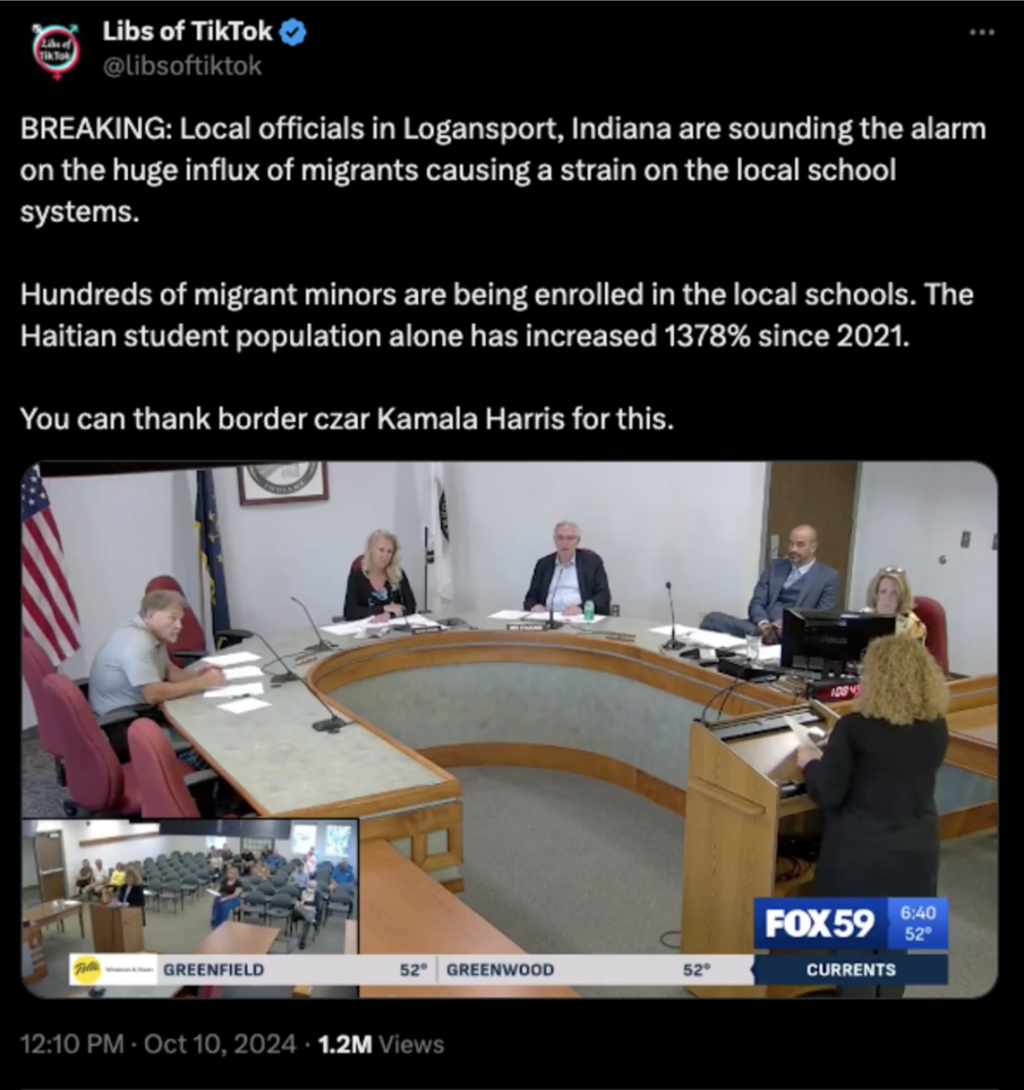
A slew of other right-wing X accounts then amplified the story, including RNC Research and Jack Posobiec.
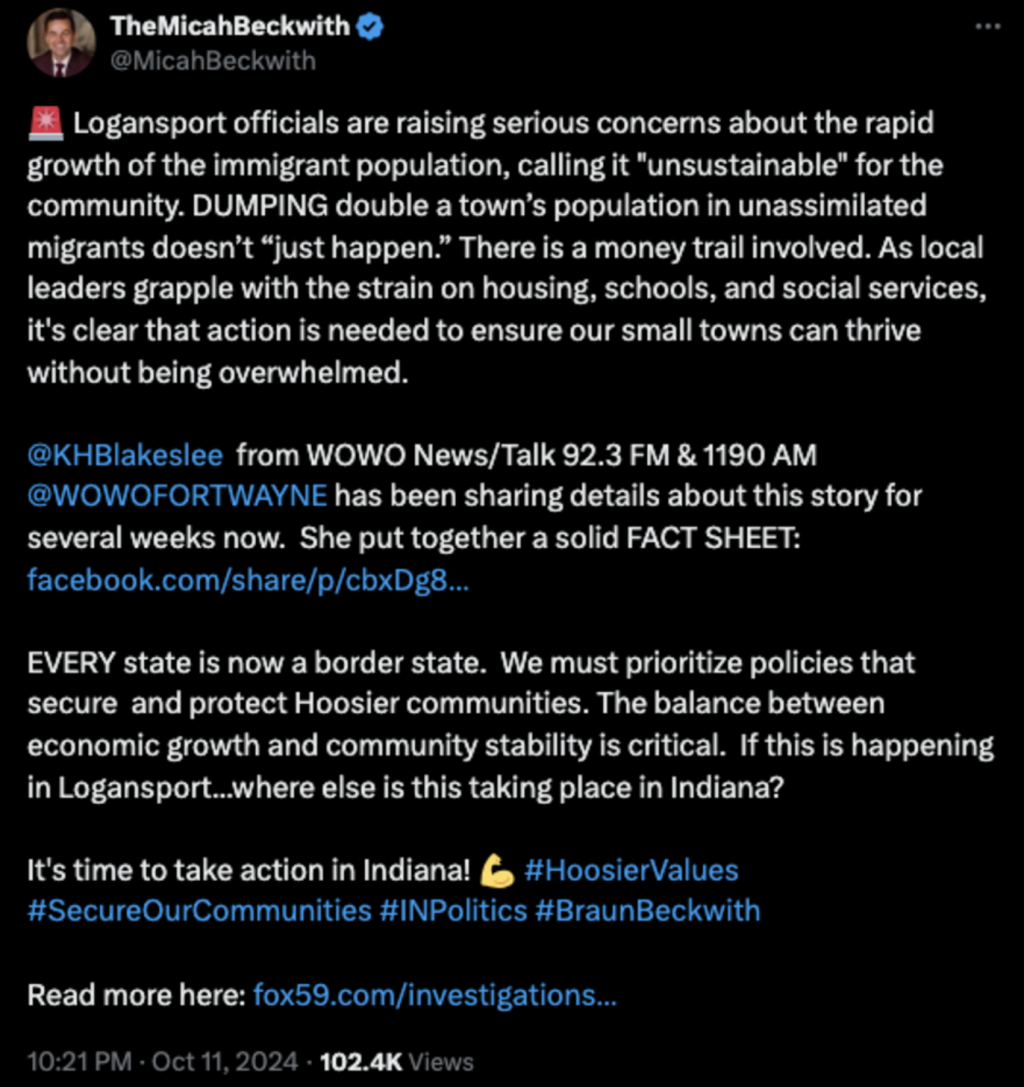
The day after the Fox affiliate’s report came out, Indiana’s now-newly elected lieutenant governor, Micah Beckwith, posted false claims about Logansport’s migrant population, including a conspiracy theory that a “money trail” was responsible for “DUMPING double a town’s population in unassimilated migrants.” Beckwith also cited Blakeslee’s coverage of the story.
On October 14, Breitbart published a story about Haitians in Logansport, claiming that the town has been “targeted by the Biden regime” and that “Biden has dumped thousands of Haitians there.”
On October 16, Fox News’ Fox & Friends hosted a segment about Logansport’s “migrant influx” and The New York Post spotlighted the segment in a separate report.
The following day, Blakeslee interviewed Beckwith, who described the increased Haitian population as “an invasion” and argued that Logansport officials should deport legal Haitian immigrants.
Newsmax aired a segment about Logansport’s “immigrant influx” on October 19.
Education quickly became the focal point of the manufactured migrant crisis, even though the district’s superintendent stated that the system can handle the additional students.
The New York Post published two pieces attacking migrant students in Logansport, claiming in an editorial that migrants are “robbing Logansport kids of an education” and in a news report that “kids are being pushed out of schools.”
On the same day, the Daily Mail published a piece about the “tiny Midwestern town where ‘explosion’ of Haitian migrants is overwhelming schools,” writing that “locals … say students are being muscled out of public schools by an influx of thousands of foreign newcomers.” The Daily Mail quoted a retired teacher, who said that “the native born are now a minority in the local school system.”
The next day, Fox News’ America Reports hosted a segment about Logansport, which Libs of TikTok later posted on X.
Hate groups take advantage
On October 23, Logansport’s local newspaper, the Pharos-Tribune, reported that stickers recruiting for white nationalist hate group Patriot Front were found in the city.
Around the same time, at least one Logansport resident received a flyer from the “Trinity White Knights of the Ku Klux Klan” reading “3RD WORLD IMMIGRANTS BRING 3RD WORLD CONSEQUENCES.”
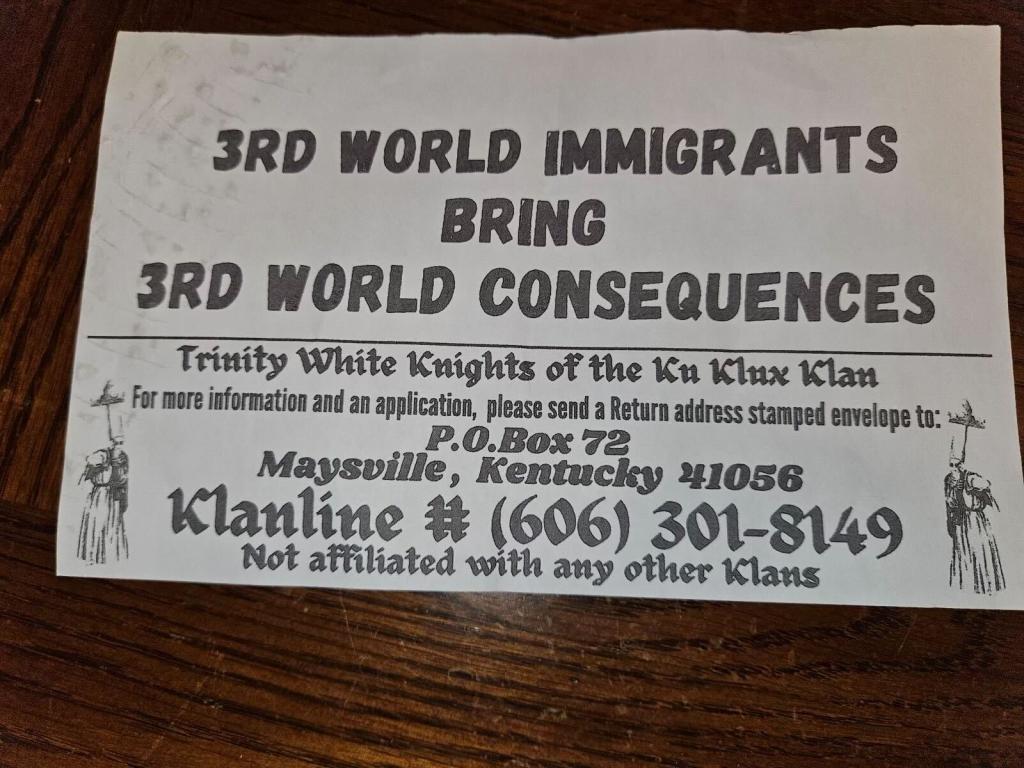
Springfield residents faced a similar situation when hate groups swarmed the city after false claims about Haitian immigrants there went viral.
Indiana’s AG calls for investigation, and the Heritage Foundation uses Logansport to support anti-immigrant policies
Indiana Attorney General Todd Rokita responded by launching an investigation into the local health department, school system, and a Tysons Food plant (Logansport’s largest employer), seeking information about supposed human trafficking and other issues.
Rokita said the investigation is “focused on the coordinated efforts among international and local nonprofit ‘refugee resettlement’ organizations and employers, like Tyson Foods, to bring large numbers of migrants to Indiana.”
On November 19, the Heritage Foundation published commentary about Logansport, using the city to claim rural American towns are struggling due to an influx of immigrants.
Heritage proposed that Indiana and other states should “pass legislation prohibiting business licenses for organizations involved in facilitating illegal migration” and “prohibit the use of any state and local taxes from funding immigration [lawyers] and NGOs providing legal representation for aliens.”
President-elect Donald Trump has been emboldened by anti-migrant misinformation, threatening mass deportation and promising to end Temporary Protective Status, a program that allows people from select countries, including Haiti, to live and work in the United States. Ending TPS would likely force family separations and negatively impact communities, like Logansport, where TPS holders have lived and been employed for years.
---
Young people, too, would acquire more “independence” thanks to Project 2025 — at least if what they want to do is work in more dangerous jobs where they are presently banned. As Berry explains:
“Some young adults show an interest in inherently dangerous jobs. Current rules forbid many young people, even if their family is running the business, from working in such jobs. This results in worker shortages in dangerous fields and often discourages otherwise interested young workers from trying the more dangerous job.”
The operative word here is “adults.” In fact, no laws presently exclude adults from hazardous work based on age. What Berry is talking about is allowing adolescents to perform such labor. Duvan Tomás Pérez, for instance, was a 16-year-old who showed just such an “interest” in an inherently dangerous job: working at a poultry plant in Mississippi, where he died in an industrial accident. The middle schooler, a Guatemalan immigrant who had lived in the United States for six years, was employed illegally by the Mar-Jac Poultry company. If there are “worker shortages in dangerous fields,” it’s because adults don’t want to take the risks. The solution is to make the work less dangerous for everyone, not to hire children to do it.
We’re Gonna Roll the Union Over
an 8 22
Pennsylvania U.S. Senate candidate John Fetterman made the case Sunday for prosecuting corporate executives as part of a broader government crackdown on unlawful price gouging and other business practices that have driven up the costs of medicine, groceries, and gas—padding company bottom lines at the expense of consumers.
"Take the massive oil companies, for example," the Democratic candidate wrote in an op-ed for the Pennsylvania Times Leader. "Chevron, Exxon, and Shell have seen their profits increase 200% since last year, but they're still charging us sky-high prices for gas. Companies like Tyson posted over a billion dollars in profits last quarter, while raising prices on meat products our families depend on."
"It's gross, and deeply unpatriotic, for the big corporations to be rolling around in cash while charging us record-high prices for gas and groceries," wrote Fetterman, who is currently Pennsylvania's lieutenant governor. "We'll crack down on this by prosecuting the executives of these huge corporations, including the Big Oil companies and meatpacking companies who are artificially driving up prices, gouging consumers at the pump and at the grocery store."
Fetterman's op-ed comes just over a week after he held his first major public event since suffering a stroke in mid-May, days before the Democratic primary contest that he won handily.
The Democrat's general election campaign in the critical battleground Pennsylvania—a state that could determine which party controls the U.S. Senate next year—currently enjoys a double-digit polling lead over his Republican opponent, the former celebrity television personality and ultra-millionaire Dr. Mehmet Oz.
Fetterman is looking to press his advantage by continuing to deploy populist messaging that presents Oz as a carpetbagger whose extreme wealth and ties to corporate interests such as Big Pharma render him unfit to deliver for the working class, whose earnings are being eroded by surging prescription drug prices, housing costs, and other inflationary trends.
According to one recent analysis, pharmaceutical companies in the U.S. have raised drug prices more than 1,100 times so far this year.
"Let's be clear: Dr. Oz just isn't connected to the struggles that Pennsylvanians are facing every day," Fetterman wrote in his new op-ed. "While he's been complaining about rising prices from his New Jersey Mansion, I've been meeting Pennsylvanians on grocery store runs, speaking with them about the challenges they're facing, and finding real policy solutions that get stuff done and make their lives better."
"Working Pennsylvanians are getting screwed," he continued. "While costs are rising and wages are failing to keep up, too many of our leaders in Washington simply aren't doing enough. Out-of-touch politicians got us into this mess, we can't trust an out-of-touch millionaire TV doctor to get us out of it."
In addition to prosecuting corporate executives for price-gouging and other abuses, Fetterman voices support for a range of policy solutions aimed at tackling rising costs and inequality, including:
- Enacting a financial transaction tax on trades of stocks, bonds, and derivatives;
- Ending the stranglehold of healthcare costs on American families by instituting a cap of a thousand dollars per year on out-of-pocket costs;
- Passing legislation to allow for the importation of lower-priced prescription drugs from other countries; and
- Putting a cap on prescription drug costs.
"If we start getting stuff done, starting with these priorities I've listed," Fetterman wrote, "we can make real change for the towns, cities, and people of Pennsylvania."
https://www.alternet.org/**2022/05**/trump-administration-meat-industry-covid/
former President Donald Trump's administration colluded with top-level meatpacking industry executives to exploit the COVID-19 pandemic in order to drive up prices and downplay the severity of the emergency, according to an exhaustive investigation released on Thursday by the United States House Select Oversight Subcommittee on the Coronavirus Crisis.
Representative Jim Clyburn (D-South Carolina), the House Majority Whip and chairman of the Subcommittee, said in a statement that "the shameful conduct of corporate executives pursuing profit at any cost during a crisis and government officials eager to do their bidding regardless of resulting harm to the public must never be repeated."
The probe began last year and uncovered a spider web of corruption and flagrant disregard for human life involving American corporate titans and individuals in the highest ranks of the federal government.
Officials at the Department of Agriculture – including Secretary Sonny Purdue and Under Secretary for Food Safety Mindy Brashears – "collaborated" with corporate bigwigs to prioritize profits and production over the safety of employees and the public despite being fully aware of the hazards.
"Infections and deaths among workers for five of the largest meatpacking companies—Tyson Foods, Inc. (Tyson), JBS USA Holdings, Inc. (JBS), Smithfield Foods (Smithfield), Cargill, Inc. (Cargill), and National Beef Packing Company LLC (National Beef)—were significantly higher than previously estimated, with over 59,000 workers for these companies being infected with the coronavirus andat least 269 dying," the report states.
The powerful cadre also "engaged in a concerted effort with Trump Administration political officials to insulate themselves from coronavirus-related oversight," it explains.
In one instance, the chief executive officers of the conglomerates told Purdue on a phone call that their workers “should not be entitled to unemployment benefitsif they are otherwise able to work through the pandemic” and cautioned against “creat[ing] an incentive, much less a path, for food industry workers to choose unemployment overproducing food.”
In that same conversation, they "implicitly acknowledged how dangerous plants were, asking for liability protection against lawsuits if workers were infected on the job."
There was also an aggressive campaign to skirt "pesky" local, state, and federal regulations that would have kept workers and their products safe and healthy.
"Companies lobbied the White House to make clear that—despite concerns by state and local health departments—meatpacking companies should not have to address coronavirus risks if it would impact productivity," the investigation revealed.
Alarmingly, the CEOs managed to successfully lobby Trump to draft and sign an executive order in April of 2020 that "would insulate meatpacking companies from oversight by state and local health departments and provide legal protection against lawsuits for worker illnesses and deaths."
The edict led to Trump "invoking the Defense Production Act to ensure meatpacking plants 'continue operations.'"
Shortly thereafter, records handed over to the Subcommittee show that "meatpacking industry representatives and companies—Smithfield and Tyson in particular—engaged in constant communications with Trump appointees at USDA, the National Economic Council, and the White House, including calls between Smithfield CEO Ken Sullivan and White House Chief of Staff Mark Meadows; a joint call with Sullivan, Meadows, and Tyson CEO Noel White;a call between White and Vice President Pence’s Chief of Staff Marc Short; and a call from Meadows to White asking if White would be willing to meet with President Trump."
Trump subsequently "held a call with officers of the meatpacking companies who had lobbied for it on the morning the order was issued."
After Trump granted their wish, an effort was undertaken between the administration and the industry to "coordinate closely on messaging concerning the order and its effects, apparently hoping to generate positive press coverage" for the ex-commander in chief.
Worker fatalities, meanwhile, were swept under the rug.
In a particularly egregious example, an outbreak at Foster Farms in Livingston,California that infected "at least" 392 workers and killed eight in August of 2020 prompted the company to "intimidate" the Merced County Department of Public Health from shutting down the plant.
"Foster Farms attempts to obfuscate the death count by labeling fatalities as 'resolutions,'" investigators learned. "MCPH officials told the Select Subcommittee that an unidentified person on the call from either Foster Farms or USDA said these cases could be considered 'toe tag resolutions,' referring to the toe tag that is often put on a corpse at the morgue. MCPH said that Brashears asked this individual to 'stop' and said they would 'talk about this separately.'"
Operations at Foster Farms in Livingston were eventually temporarily suspended on August 31st.
2 22 an jon s salon
White House is reportedly split on why American consumers are facing record inflation, with numerous officials apparently reticent to blame corporate greed despite remarks made by executives indicating that Corporate America is raising prices higher than it needs to.
According to The Washington Post, congressional testimony of asenior administration official was reportedly altered in recent weeks to omit claims linking inflation to monopoly power.The subtle move underscores the apparent tensions between officials in the White House around how to balance sound political messaging with what some see as hard economic realities.
"It's been the war of the 'track changes' inside the administration over how much the White House can lean in on the extent to which competition and greed are driving inflation," one official told the Post. ("Track changes" refers to a feature built into Microsoft Word that allows users to see who made what edits to a shareable document.)
In recent weeks, Democratic politicians and progressive groups have condemned Corporate America's role in driving inflation, which reached 7% by the end of 2021 – the largest 12-month increase since 1982.
"Giant corporations are making record profits by increasing prices, and CEOs are saying the quiet part out loud: they're happy to help drive inflation," Warren tweeted on Monday. "American families pay higher prices and corporate executives get fatter bonuses."
Warren highlighted remarks made by several executives at food and grocery companies like Kroger, Tyson, Procter & Gamble, who have openly crowed about inflation being good for business despite consumers feeling squeezed. According to the Bureau of Labor Statistics, the prices ofmeat, poultry, fish and eggs collectively shot up by 12.5% throughout last year. Meanwhile, meatpackers' profit margins skyrocketed by 300% during the pandemic, according to Reuters.
In recent months, the White House has made commitments to cracking down on meat producers, particularly when it comes to price-fixing. Back in September, Biden announced a broad vowed to heighten enforcement of antitrust laws and improve transparency in labeling.
Still, the administration has come short of blaming Big Business as the chief culprit for inflation on the whole.
"I think they've tried to be honest about the economic situation, and I, for one, appreciate that," liberal economist Dean Baker told the Post. "They have to make a political call about whether that's the right decision, but I think it's best for them to be honest and I think they've done that."
Officials in the Council of Economic Advisers have reportedly advised that financial opportunism only accounts for one component of the recent price increase, the Post reported. But according to a joint missive penned by American Economic Liberties Project and the Groundwork Collaborative, corporate consolidation costs the average American household $5,000 annually.
"There is now overwhelming evidence that large corporations with significant market power are exploiting the broader supply chain crisis to raise prices," the letter stated, "even when no bottleneck or shortage seems to exist."
no lnx see below
https://www.corporatecrimereporter.com/?s=raymond+james
Corporate Crime Reporter
NPR and the Corporate Criminal Element
By Editor Filed in Uncategorized October 21st, 2020 @ 1:49 pm
Ever wonder why you rarely hear serious discussion on National Public Radio (NPR) about corporate crime and violence?
pix John Lansing
CEO NPR]
For a hint as to why, pick up the most recent NPR annual report, and flip through the listing of corporate criminals and other major recidivist law violators on the corporate sponsor page.
ExxonMobil (guilty plea Exxon Valdez oil spill), Lumber Liquidators (guilty plea environmental crimes), Panasonic (guilty pleas antitrust crimes) and Tyson Foods (guilty plea clean water violations).
ExxonMobil, Lumber Liquidators, Panasonic, Tyson Foods — those are just some of the major corporate donors to NPR that have pled guilty to crimes.
And then there are many more major corporations on the NPR sponsors list that settle serious criminal charges with the watered down deferred and non prosecution agreements.
And then there are those major companies that settle major False Claims Act and other charges of major law violations with multi-million civil settlements.
Suffice it to say that the corporate criminal element has infused NPR with millions of dollars of donations.
now 1220 4 centabilioaires
fresh aire weds 12/20 chuck collins Inst for Pol studies
This is FRESH AIR. I'm Terry Gross. While millions of Americans have lost their jobs because of the pandemic, the combined wealth of just 10 billionaires has increased by more than $127 billion since the beginning of the pandemic. Those billionaires include the principal owners of Amazon, Instacart, Walmart and Tyson Foods. My guest, Chuck Collins, has been writing about that and how the pandemic has increased income inequality in the U.S. Economic inequality has been his subject since he was 26 and gave away his inheritance. Collins is the great-grandson of Oscar Mayer, the founder of the meatpacking company famous for its hot dogs, the Oscar Mayer wiener, and the Wienermobile.
Collins is the director of the Program on Inequality and the Common Good at the Institute for Policy Studies, where he co-edits inequality.org. His books include "Born On Third Base: A One Percenter Makes The Case For Tackling Inequality, Bringing Wealth Home, And Committing To The Common Good" and the forthcoming "The Wealth Hoarders: How Billionaires Pay Millions To Hide Trillions." That book is scheduled for publication in March. Chuck Collins, welcome to FRESH AIR. It's a pleasure to have you on our show.
CHUCK COLLINS: Thanks for having me.
GROSS: Who are the billionaires who made the most money since the start of the pandemic?
COLLINS: Well, there's an overall trend. You know, 657 billionaires have seen their combined wealth go up a trillion since mid-March. But there's a couple that have just seen their wealth surge. Elon Musk seen his wealth go up almost 500%, 120 billion. Jeff Bezos has seen his wealth go up about 74 billion, an increase of 65%. And there's a guy, Dan Gilbert, who's the Quicken Loans founder, CEO, his wealth has gone up 600% - almost 38 billion. So it's a surge of wealth for some. You know, some have ridden the stock market. But others have just seen - they've kind of delinked from the amount of wealth they had before.
GROSS: So is the numbers that you're giving us, is that linked to the stock market? - because the stock market fluctuates so much. It can go up, you know, hundreds of points or go down hundreds of points.
COLLINS: Yeah. The stock market has been steadily going up as well. But some of these billionaires have just seen their wealth surge, you know, in the double digits or much higher than the market itself. I mean, four billionaires - Jeff Bezos, Elon Musk, Bill Gates, Mark Zuckerberg - now have a net worth of about 550 billion combined. And the whole group of U.S. billionaires now has a combined wealth of 4 trillion, which is double the wealth of the bottom half of all U.S. households, you know, in the United States. So they are seeing their fortunes accelerateduring the pandemic....
https://www.businessinsider.com/meat-plant-covid-outbreak-tyson-foods-family-2020-5#the-company-has-made-headlines-throughout-april-and-may-for-coronavirus-outbreaks-at-its-us-meat-processing-plants-3
HOME EXECUTIVE LIFESTYLE
Meet the billionaire family behind Tyson Foods, the $42 billion meat company that's been hit by COVID-19 outbreaks at its plants and is warning of a meat shortage
Katie Warren May 13, 2020,
Meat processing company Tyson Foods has temporarily closed several of its plants across the US in April and May due to coronavirus outbreaks.
At least 4,585 cases of COVID-19 and 18 deaths have been linked to Tyson Foods, according to a Business Insider analysis.
The Arkansas-based company, which owns brands including Jimmy Dean, Hillshire Farm, and Aidells, had $42.4 billion in sales in 2019.
Tyson Foods has been family-run for three generations, making the Tyson family one of the wealthiest in the US.
Chairman John H. Tyson and his family are worth $2 billion, per Forbes.
As the coronavirus pandemic batters entire industries, one of America's favorite sectors has found itself particularly vulnerable: meat.
The US could be facing a meat shortage and higher prices as meat processing plants across the country have been forced to temporarily close because of coronavirus outbreaks. More than a dozen of beef, chicken, and pork plants closed in April due to outbreaks, per The Wall Street Journal.
Tyson Foods, which claims to produce approximately 20% of the beef, pork, and chicken in the US and saw $42.4 billion in sales in 2019, was forced to temporarily close some of its meat plants in April and May due to coronavirus outbreaks. Business Insider's Kate Taylor reports that, according to a BI analysis, at least 4,585 cases of COVID-19 and 18 deaths have been linked to Tyson Foods.
Gary Mickelson, a Tyson Foods spokesperson, declined to comment for this story on the number of cases and deaths but said the company takes the safety of its employees very seriously and that the "vast majority" of its facilities have had no cases.
"At some locations, we have been conducting testing of team members and will not hesitate to idle any plant to conduct additional deep cleaning and sanitization of the entire facility," Mickelson told Business Insider.
Tyson Foods, which is today one of the top three largest meat-producing corporations in the world, has been family-run for three generations, making the Tyson family one of the wealthiest in the US. The company's chairman, John H. Tyson, and his family are worth $2 billion, per Forbes.
Here's a look at the massive meat company and the billionaire family behind it.
Tyson Foods is an Arkansas-based meat company that owns brands including Jimmy Dean, Hillshire Farm, and Aidells.
Hillshire Brands Acquisition
Tyson Foods
The company, which employs 141,000 people across the US, reported $42.4 billion in sales in 2019.
The business has been family-run for three generations, making the Tyson family one of the wealthiest in the US.
John H. Tyson
John H. Tyson, chairman of Tyson Foods. Tyson Foods
The company's chairman, John H. Tyson, and his family are worth $2 billion, per Forbes.
In 2015, the Tysons made Forbes' Richest Families list with a fortune of $3.3 billion, alongside families like the Waltons, the Kochs, and the Sacklers.
The wealth of America's richest families varies widely. The Walton family, heir to the Walmart empire, is worth upwards of $155 billion. The Koch family fortune is more than $100 million, while the Sackler family, whose company makes the controversial prescription painkiller OxyContin, is worth an estimated $13 billion.
The company has made headlines throughout April and May for coronavirus outbreaks at its US meat processing plants.
At one of the company's pork processing plants in Logansport, Indiana, nearly 900 employees tested positive for the virus, forcing the plant to close on April 25 for nearly two weeks. Another plant in Waterloo, Iowa, was closed for two weeks after more than 1,000 workers tested positive. It reopened on May 7.
Business Insider's Kate Taylor reports that in total, at least 4,585 cases of COVID-19 and 18 deaths have been linked to Tyson Foods.
Meat packing plants are particularly vulnerable to outbreaks of the virus because of the cold, damp, and crowded work stations, according to Bloomberg.
Gary Mickelson, a Tyson Foods spokesperson, declined to comment on the number of cases and deaths but said the company takes the safety of its employees very seriously and that the "vast majority" of facilities across the US have had no cases.
"At some locations, we have been conducting testing of team members and will not hesitate to idle any plant to conduct additional deep cleaning and sanitization of the entire facility," Mickelson told Business Insider.
Other enhanced safety precautions include health screenings for every worker each time they arrive at the facility, requiring facial coverings, and assigning some employees to monitor and enforce proper social distancing.
All employees who have tested positive will remain on sick leave until they meet CDC health requirements to return to work, Mickelson said.
The company recently upped its short-term disability coverage from 60% of a worker's normal pay to 90% until June 30. Business Insider previously reported that Tyson Foods offers short-term disability leave, but not paid sick leave, to workers being treated for coronavirus.
On April 26, Tyson Foods took out a full page advertisement in major newspapers, including The Washington Post and The New York Times, warning that the US food supply chain is "breaking."
Workstation divider at Tyson Foods' Chick N Quick plant in Rogers, Ark. April 24, 2020 Tyson Foods]
"The food supply chain is breaking," chairman John H. Tyson wrote in the ad. "We have a responsibility to feed our country. It is as essential as healthcare. This is a challenge that should not be ignored. Our plants must remain operational so that we can supply food to our families in America. This is a delicate balance because Tyson Foods placesteam member safety as our top priority."
The company outlined its enhanced safety measures and said that closing processing plants would cause "millions of pounds of meat" to disappear from the supply chain.
Two days later, it was reported that President Donald Trump was planning on signing an executive order to keep meat processing facilities open by classifying their work as "critical infrastructure" under the Defense Production Act.
Tyson Foods' origins trace back to the Great Depression.
In 1931, John W. Tyson moved his family to Springdale, Arkansas, and started a business delivering chickens around the Midwest. In the 1940s, demand for poultry grew, and Tyson moved into raising chicks and grinding feed for local chicken farmers, incorporating his business as Tyson Feed and Hatchery, Inc.
In 1952, John W. Tyson's son, Don Tyson, joined the company as a general manager right out of college.
Don tyson
Tyson Foods
"I left the [University of Arkansas] in 1952, and from that day until 1963, the year I took the company public, I worked in the business six days a week and on Dad's farm on the seventh day," Don said, according to Tyson's website.
In 1958, the company opened its first processing plant in Arkansas at a cost of $90,000 — well over the original $75,000 budget.
The company went public as Tyson Foods in 1963 and began a series of acquisitions. In 1966, Don became president of the company.
The next year, John W. Tyson and his wife, Helen, died in a automobile-train accident, after which Don took over his father's role as chairman and CEO.
Tyson Foods continued to grow throughout the '70s and '80s, moving into new corporate offices and acquiring companies such as Mexican Original, a flour and corn tortilla company.
Between 1984 and 1989, the company doubled in size.
In the '80s, CEO Don Tyson's son, John H. Tyson — who is today the company's chairman — had a high-profile struggle with alcohol addiction.
But he stopped drinking in 1990, he told Forbes in 2004.
"Just got tired," he said. "It was God's grace that gave me a chance to be clean."
In the late '90s, Don Tyson retired, and his son, John H. Tyson, took over as chairman of the board, becoming the third generation of Tysons to lead the company. He was named CEO in 2000.
In the late '90s, Tyson Foods faced some legal trouble. The company had to pay $6 million in fines in 1997 after pleading guilty to making $12,000 in illegal gifts, including plane trips and football tickets, to the secretary of agriculture.
According to Tyson Foods, Don remained on the board of directors and stayed active in the company for many years until his death in January 2011 at age 80.
tyson foods don tyson
Don Tyson in 1991. Steve Jennings/The LIFE Images Collection via Getty Images/Getty Images
His New York Times obituary described him as "a risk-taking, bare-knuckle businessman who bought out dozens of competitors, skirted the edge of the law and transformed a Depression-era trucking-and-feed venture into a global enterprise with an army of employees and millions of customers in 57 countries."
As CEO from 2000 to 2009, John H. Tyson oversaw Tyson Foods' $4.6 billion acquisition of meatpacking company IBP, Inc., as well as the construction of a company "innovation center."
john h tyson
Tyson Foods CEO John H. Tyson speaks to employees in 2002. Greg Smith/Corbis via Getty Image
He stepped down as CEO in 2009 but remained chairman of the board.
Today, Tyson Foods' CEO is not a Tyson, but Noel White, who's been with the company for 37 years.
But John H. Tyson is not the only Tyson family member still involved in the company.
John H. Tyson's aunt, Barbara Tyson, sits on the company's board of directors.
Barbara Tyson
Tyson Foods
Per Forbes, Barbara inherited a fortune that's today worth an estimated $390 million after her husband, Randal, died in an accident in 1986 at age 34.
In September 2019, John H. Tyson's 29-year-old son, John R. Tyson, was promoted to chief sustainability officer.
John r tyson
John R. Tyson, chief sustainability officer at Tyson Foods. Tyson Foods
Tyson, who's leading a sustainability push for Tyson Foods, told The Wall Street Journal in January that he's been involved with the company in some capacity for his entire life.
While Tyson Foods has grown into one of the top three largest meat-producing corporations in the world, according to the Institute for Agriculture and Trade Policy, it doesn't seem to be straying from its family-run roots anytime soon.
https://marker.medium.com/welcome-to-the-hunger-games-economy-7e44665d88e1
Welcome to the Hunger Games Economy
An exclusive excerpt from Scott Galloway’s new book, ‘Post Corona’
https://www.alternet.org/2020/11/tyson-foods/
alexh
One of the worst coronavirus outbreaks in a meat-packing facility occurred in April at a Tyson Foods plant in Waterloo, Iowa, where more than 1000 employees were infected with COVID-19. At least five of them died. And a wrongful death lawsuit, according to Iowa Capital Dispatch reporter Clark Kauffman, alleges that managers at the Tyson plant "ordered employees to report for work while supervisors privately wagered money on the number of workers who would be sickened by the deadly virus."
Isidro Fernandez was among the Tyson employees who died from COVID-19 in April, and his family's lawsuit alleges that he was exposed to the novel coronavirus at the Waterloo plant. Tyson, the lawsuit alleges, showed a "willful and wanton disregard for workplace safety" by forcing employees to work in cramped conditions during a global pandemic and failing to observe social distancing guidelines at the Waterloo plant.
[twt]lack Hawk County Sheriff Tony Thompson visited the plant in mid-April — Fernandez died on April 20 — and said that the conditions he observed "shook (him) to the core." And according to Kauffman, it was during that period that plant manager Tom Hart "organized a cash-buy-in, winner-take-all, betting pool for supervisors and managers to wager how many plant employees would test positive for COVID-19."
Kauffman notes that John Casey, one of the plant's senior managers, "is alleged to have explicitly directed supervisors to ignore symptoms of COVID-19, telling them to show up to work even if they were exhibiting symptoms of the virus." Casey, according to Kauffman, allegedly told a sick supervisor who was on his way to get tested for COVID-19, "We all have symptoms — you have a job to do."
One Tyson employee, according to Kauffman, was so sick that he "vomited on the production line" — and managers "reportedly allowed the man to continue working and then return to work the next day."
"In late March or early April, as the pandemic spread across Iowa, managers at the Waterloo plant reportedly began avoiding the plant floor for fear of contracting the virus," Kauffman explains. "As a result, they increasingly delegated managerial authority and responsibilities to low-level supervisors who had no management training or experience. The supervisors did not require truck drivers and subcontractors to have their temperatures checked before entering the plant."
Here are some Twitter responses to the Iowa Capital Dispatch's reporting on the wrongful death lawsuit:...[twt]
==
tyson tells cty health and gov can't release covid # trms 5/5
==
==
https://www.ecowatch.com/tyson-foods-toxic-dead-zone-2504305201.html
Shana Gallagher
What comes to mind when you think of Tyson Foods? A chicken nugget? A big red logo?
How about the largest toxic dead zone in U.S. history? It turns out the meat industry—and corporate giants like Tyson Foods—are directly linked to this environmental catastrophe in the Gulf of Mexico, and many others.
Industrial-scale agriculture to support America's livestock is the number one source of water pollution in the country. But while industrial agriculture to feed animals raised for meat is currently resource-intensive and ecologically destructive, it doesn't have to be. Solutions exist which, if adopted, would allow the meat industry and agricultural corporations that sustain it to reduce their impact on water and the planet.
That's why Mighty Earth has launched the Clean It Up, Tyson campaign in order to hold this industry accountable to our communities and the environment. Corporations can and should respect the health and well-being of their customers, and the landscapes that allow them to profit. Considering America's current political climate, and the increasing severity of environmental problems across the globe, collective action and corporate-targeted campaigns like this one have never been more urgent.

[Soil erosion and agricultural run-off is currently America's top source of water pollution.]
In a country with five times as many livestock animals as humans, it takes a lot of land to grow feed for the meat that ends up on consumers' plates. More than a third of America's agricultural land is dedicated towards the production of corn and soy, but humans consume less than 10 percent of this, according to Mighty Earth's campaign report. The vast majority is consumed by livestock.
What many people don't realize is that this livestock feed production is controlled by a very small number of large and powerful corporations, making huge upstream profits, but creating massive downstream pollution. These companies—ADM, Bunge, Cargill (often referred to as the ABCs)—don't have much of a public reputation, as they don't sell directly to individual consumers. Under our current regulatory system, they're also not responsible for their run-off or excess fertilizer use, both of which are classified as "non-point source" pollution. In other words, soil erosion and run-off from enormous swaths of America's crop fields are washing into the waterways, and taxpayers shoulder the burden. These two factors mean that industrial agriculture companies operate with impunity while polluting the land, riversand oceans.
...
Scott Pruitt’s record reveals a long history of industry favoritism
As Oklahoma’s Attorney General, Pruitt has a history of slowing environmental regulation, cutting enforcement, and siding with industry.
NATASHA GEILING
JAN 18, 2017, 1:02 PM
Oklahoma Attorney General Scott Pruitt gestures as he answers a question during a news conference in Oklahoma City. CREDIT: AP Photo/Sue Ogrocki, File
OKLAHOMA ATTORNEY GENERAL SCOTT PRUITT GESTURES AS HE ANSWERS A QUESTION DURING A NEWS CONFERENCE IN OKLAHOMA CITY. CREDIT: AP PHOTO/SUE OGROCKI, FILE
In 2005, former Oklahoma Attorney General Drew Edmondson (D) filed a lawsuit against 14 poultry firms?—?including Tyson Foods, the largest meat processing company in the world?—?arguing that they were not holding up their end of a 2003 agreement aimed at reducing pollution into Oklahoma’s northeastern Illinois River.
That lawsuit was brought to federal court in 2009, with both sides resting after 52 days of arguments. The trial ended in February of 2010?—?just months before Scott Pruitt, President-elect Donald Trump’s pick to head the Environmental Protection Agency (EPA), took over as Oklahoma Attorney General.
Despite Pruitt’s claims that states are best positioned to be the arbitrators of air and water protections, there has never been a decision on the Oklahoma poultry pollution lawsuit because Pruitt never took further action on the case, despite some clear evidence that the Illinois River suffered from agricultural-related pollution.
Trump to tap vocal EPA opponent to head the EPA]
Instead of pursuing a resolution in court, Pruitt sidestepped the lawsuit. Two years later, when presented with a chance to deepen Oklahoma’s 2003 phosphorous pollution requirements, Pruitt chose instead to conduct a three year-long study into the problem. As part of that study, Oklahoma agreed to suspend the deadline for compliance with its phosphorus pollution limits.
The final report, released in December of this year, found that the state of Oklahoma had based its 2003 limits off the best available science. Put another way, the state’s chief law enforcement officer stalled state anti-pollution efforts for three years, conducting a study to reaffirm what the state already knew?—?while water quality in the Illinois watershed continued to fall short of state standards.
“Regulation through litigation is wrong in my view,” Pruitt said in an interview with the Oklahoman newspaper in 2015, explaining why his office chose not to pursue the case further. “That was not a decision my office made. It was a case we inherited.”
But legal experts and environmental advocates say Pruitt’s decision not to follow through on the poultry pollution lawsuit is evidence of his deference to polluting industries at the expense of the environment?—?a consistent thread in his continued opposition to the agency he now wants to head.
“This isn’t about regulation by litigation, this is about law enforcement,” Valerie Baron, ?Equal Justice Works Law Fellow at Natural Resources Defense Council, told ThinkProgress. “Pruitt’s actions speak very loud and clear. This is really, at its heart, about enforcing the law. Pruitt was the state’s chief law enforcement officer and he showed that he would rather polluters dictate their own terms rather than hold them accountable.”
Stalling on enforcement
In 1993, Oklahoma began gathering data on water pollution?—?especially phosphorus, which is found in high amounts in chicken manure. That data was compiled into a report, released in 1996, which found that phosphorus and other nutrients in the Illinois River were feeding algal blooms and endangering Lake Tenkiller, a reservoir in Oklahoma fed by the Illinois River. In 2003, as a result of that study, Oklahoma and Arkansas agreed to work together to reduce nutrient pollution in the Illinois River watershed, setting a goal of reducing phosphorus pollution by 40 percent.
Two years later, however, Edmondson filed a lawsuit in federal court, arguing that several poultry firms were not doing enough to help stop nutrient pollution from entering into Oklahoma’s waterways. The lawsuit claimed that there were 2,363 chicken houses in the Illinois watershed, and that those chicken houses produced enough manure to equal the waste from 10.7 million people per year.
That waste was then being spread onto farmland in the watershed?—?and while chicken manure is a great fertilizer, if too much is spread onto a small area, the ground can become saturated with nutrients, meaning things like phosphorus and nitrogen can easily wash into waterways during precipitation events.
Trump’s EPA pick stood by while human-caused earthquakes spread across his state
The lawsuit stalled in federal court as Pruitt took office in 2010. But in 2012, just as the initial 2003 phosphorus reduction agreement was set to expire, Arkansas regulators issued a report questioning Oklahoma’s phosphorus standards. In response, Pruitt got Arkansas to agree to let a researcher at Baylor University study the phosphorus levels in the Illinois River watershed. That study, which concluded in December of this year, found that Oklahoma’s phosphorus standards had been based on the best available science. Based on the results of that study, it’s unlikely Oklahoma’s phosphorus limits will be weakened, a Pruitt spokesperson told E&E News.
Critics argue that Pruitt basically spent three years studying an issue that had already been resolved years before?—?effectively slowing down the rate of improvement in phosphorus pollution of the Illinois River. And while phosphorus levels in the Illinois River have declined in recent years, the bulk of that improvement happened before Pruitt even took office.
A friend of industry
Pruitt’s stated reason for not pursuing the poultry lawsuit further was his insistence that regulation should not be decided through litigation?—?an interesting line of reasoning from a man who has been party to more than a dozen lawsuits against the EPA aimed at rolling back pollution regulations. But as the Environmental Working Group points out in an investigation released January 14, Pruitt might have had more than philosophical reasons for quietly letting the lawsuit against major poultry firms languish in court: political donations.
According to the EWG report, executives of the poultry companies named in the 2005 lawsuit, as well as the companies’ lawyers, gave more than $40,000 to Pruitt’s campaign for Attorney General in 2010. Moreover, more than 90 percent of those contributions came from people living in Arkansas?—?an interesting phenomenon for a state-wide political race.
“Scott Pruitt has said that he chose not to pursue that case because he felt like it was regulation through litigation,” Kristen van de Biezenbos, an associate professor at the University of Oklahoma, told ThinkProgress. “I suspect that Scott Pruitt felt that it would set a bad precedent?—?he doesn’t want to be seen as someone that is anti-agriculture, which is the other big industry here in Oklahoma.”
Senators dig into Scott Pruitt’s fossil fuel connections before confirmation hearings begin
The poultry lawsuit is not the only example of litigation that mixes Pruitt’s role as Attorney General with donors to his political campaigns and political action committees (PACs). According to the New York Times, Pruitt filed 14 cases as Oklahoma Attorney General challenging federal environmental regulations; in 13 of those cases, co-parties on the lawsuit had contributed money either to Pruitt’s political campaigns or a Pruitt-affiliated PAC.
==
One of the largest meat companies in the U.S. is ramping up its investment in lab-grown animal protein in response to growing demand for meat worldwide.
Tyson Foods, which supplies about one in five pounds of chicken, beef and pork produced in the U.S., announced Monday that their venture capital arm had purchased a minority stake in Memphis Meats, a San Francisco-based "clean" meat startup.
==
i assume:
https://www.ecowatch.com/antibiotic-apocalypse-livestock-force-fed-2509349786.html
'Antibiotic Apocalypse' as Livestock Is Force-Fed 80% of Prescribed Antibiotics Worldwide
#
By Sophie Linden
A recent report from the World Health Organization (WHO) describes the dangers humanity faces from overprescription of critical infection-fighting drugs, which has led to both superbugs and antibiotics' dwindling efficacy, making humans vulnerable to infections doctors otherwise regarded as benign. While overprescription in humans is a viable issue, recent statements from WHO express heightened concern over the ramifications from their misuse in the meat industry.
Stop Using Antibiotics in Healthy Animals to Prevent the Spread of Antibiotic Resistance is the title of WHO's latest press release, reiterating a message that has been clear for decades. The current culture of force-feeding antibiotics to livestock presents a danger to millions of humans. At present, animals used for livestock are fed around 80 percent of prescribed antibiotics worldwide. The measure has been perpetuated by the low cost of the medicines, as well as antibiotics' proven ability to accelerate growth and weight gain in livestock, effectively speeding up the process of food production. In 2015, the U.S. used 34.3 million pounds of antibiotics on animals. The result is antibiotic-resistant bacteria in animals and humans through food and airborne pathogens.
At present, 700,000 people die each year from antibiotic-resistant infections, and it is predicted that this number could increase to 10 million by 2050, making low-risk operations like hip replacements and treatable urinary tract infections a new health crisis. The Guardian called the collapse an "antibiotic apocalypse," wherein the world is set to face the same surgical risks it did before 1928, when penicillin was discovered. Essentially a century's worth of medical advances could be reversed.
As Tedros Adhanom Ghebreyesus, director-general of WHO, confirmed, "A lack of effective antibiotics is as serious a security threat as a sudden and deadly disease outbreak." This is due in part to a lack of replacement therapies. In its statement, WHO warns that "there are very few promising options in the research pipeline." The Guardian pointed out that this is precipitated by the "failure of pharmaceutical companies to investigate and develop new sources of general medicines for the future." Perhaps, because what's broken is still paying off.
The threat of antibiotic overprescription has been clear since the 1960s, according to Tom Philpott, co-author of*Big Chicken: The Incredible Story of How Antibiotics Created Modern Agriculture and Changed the Way the World Eats*. But it wasn't until this past January that the U.S. Food and Drug Administration (FDA) made any kind of regulatory change to address the escalating crisis, asking that the livestock industry no longer use antibiotics to accelerate the growth of animals. However, the language used by the FDA has left an opening for the agriculture industry to continue its use of antibiotic treatments, allowing them to be prescribed and used as preventative medicine—treating antibiotics as prophylactics, with plenty of room for indiscretion.
...
==
Tyson Foods Linked to the Largest Toxic Dead Zone in U.S. History America's largest meat producer must clean up its act. 10/17 see Meat and Ocean.
Tyson Foods Linked to the Largest Toxic Dead Zone in U.S. History America's largest meat producer must clean up its act. 10/17 see Meat and Ocean.
Tyson Foods? A chicken nugget? A big red logo? How about the largest toxic dead zone in U.S. history? It turns out the meat industry—and corporate giants like Tyson Foods—are directly linked with this environmental catastrophe in the Gulf of Mexico, and many others.
Industrial-scale agriculture to support America's livestock is the number one source of water pollution in the country. But while industrial agriculture to feed animals raised for meat is currently resource-intensive and ecologically destructive, it doesn't have to be. Solutions exist which, if adopted, would allow the meat industry and agricultural corporations that sustain it to reduce their impact on water and the planet.
Less oxygen dissolved in the water is often referred to as a “dead zone” (in red above) because most marine life either dies, or, if they are mobile such as fish, leave the area. Habitats that would normally be teeming with life become, essentially, biological deserts. (image: NOAA)
That's why Mighty Earth has launched the "Clean It Up, Tyson" campaign in order to hold this industry accountable to our communities and the environment. Corporations can and should respect the health and well-being of their customers, and the landscapes that allow them to profit. Considering America's current political climate, and the increasing severity of environmental problems across the globe, collective action and corporate-targeted campaigns like this one have never been more urgent.
In a country with five times as many livestock animals as humans, it takes a lot of land to grow feed for the meat that ends up on consumers' plates. Over a third of America's agricultural land is dedicated towards the production of corn and soy, but humans consume less than 10 percent of this, according to Mighty Earth's campaign report. The vast majority is consumed by livestock.
What many people don't realize is that this livestock feed production is controlled by a very small number of large and powerful corporations, making huge upstream profits, but creating massive downstream pollution. These companies—ADM, Bunge, Cargill (often referred to as "the ABCs")—don't have much of a public reputation, as they don't sell directly to individual consumers. Under our current regulatory system, they're also not responsible for their run-off or excess fertilizer use, both of which are classified as "non-point source" pollution. In other words, soil erosion and run-off from enormous swaths of America's crop fields are washing into the waterways, and taxpayers shoulder the burden. These two factors mean that industrial agriculture companies operate with impunity while polluting the land, rivers and oceans.
A recent report by Environmental Working Group (EWG) found that more than 200 million Americans—over half of the people in our country—are exposed to contaminated drinking water due to fertilizer pollution. The estimated clean water costs to taxpayers are over $2 billion per year. The nitrate and phosphorous in fertilizer that leaches into our drinking water are associated with various types of cancers, birth defects and other health problems. This burden disproportionately falls on rural communities, whose water treatment systems were not built to deal with the levels of chemicals they're now facing.
"The EPA ordered Pretty Prairie, Kansas, to build a new water treatment plant last year to lower nitrate levels that could cost $2.4 million—well over $3,000 for every person in town," EWG reports. "Eighty-five percent or more of the communities with elevated levels of nitrate have no treatment systems in place to remove the contaminant."
Another alarming characteristic of industrial agriculture is that because it's so intensive, fields are quickly exhausted, and the industry must continuously expand to new areas. For this reason, the American prairie and grassland ecosystems are being altered faster than the Amazon rainforest.
A recent University of Wisconsin study estimated that this loss of natural grassland "could have emitted as much carbon dioxide into the atmosphere as 34 coal-fired power plants operating for one year—the equivalent of 28 million more cars on the road," notes Mighty Earth. These unique landscapes are among the most threatened in the world, and are irreversibly damaged after conversion into crop fields, often to grow corn and soy. At a time in our country when public lands are being attacked from many angles, industrial-scale agriculture to support the meat industry is the biggest challenge these ecosystems face.
Luckily, there are a number of simple, cheap and effective ways in which the meat industry could adopt sustainability measures into supply chains to and protect clean water. For example, currently less than 30 percent of fertilizer applied to massive industrial-scale crop fields is actually absorbed by the plants. Instead, most of this washes off as fertilizer pollution and contaminates waterways.
This is what has caused the largest dead zone in U.S. history in the Gulf of Mexico. It is currently over 8,000 square miles, where no marine life can survive due to toxic fertilizer pollution. By using more precise application methods, farmers could save money on fertilizer, and less of it would contaminate the water. Additionally, techniques like using cover crops, diversifying crops beyond corn and soy, and limiting tillage are proven ways to reduce soil erosion.
A few months ago, Mighty Earth conducted a comprehensive study into which areas of America are experiencing the worst water contamination from fertilizer pollution (Figure 1), and the most dramatic land conversion into livestock feed crop fields (Figure 2). This groundbreaking research also identified the agricultural and meat industry corporations most present in these areas. The clear culprit driving these destructive agricultural impacts was identified: Tyson Foods.
The country's largest meat company, the second largest globally and the pioneer of the industrial meat system, Tyson Foods produces one in every five pounds of meat: over 20 percent of all chicken, beef and pork. They are therefore uniquely placed to drive solutions, incentivize their suppliers to farm more responsibly, and reduce the catastrophic effects that industrial-scale agriculture has on the environment and public health.
Figure 1
Figure 2
"Recent commitments from a growing number of food companies like Kellogg’s, General Mills, Walmart, PepsiCo, and even Tyson's competitor, Smithfield, are showing the way forward," reports Mighty Earth. "These companies have committed to improve fertilizer and soil-health practices in their U.S. crop supply chains and have launched programs and practices that Tyson and other meat producers can adopt to drive improvements in their supply chains."
Tyson Foods has the power to make these changes too, and therefore to change the entire meat industry for the better—and we have the power to ask them to do it.
Tyson's prior commitments to sustainability are admirable, but don't go far enough. With the demand for meat rising, and the threats to our environment increasing, the stakes could not be higher.
This issue affects all of us. As far back as 2013, the majority of American waterways were contaminated by fertilizer pollution, according to the EPA. That's why Mighty Earth is organizing in communities across the country to ask Tyson to protect our water and our environment. By signing the petition or making a call to Tyson’s corporate headquarters, you can add your voice to the rising chorus calling for cleaner meat. Tyson Foods must lead the way to a more sustainable food system and protect the one planet we have.
==
917
https://www.ecowatch.com/tyson-poultry-guilty-2490925659.html
fish kill
==
The agriculture industry also appears to have gotten favorable treatment.
Pruitt, who assumed the attorney general's post in 2011, has failed to pursue a 2005 lawsuit filed by his predecessor against Tyson Foods and a dozen other poultry companies, accusing them of polluting the scenic Illinois River in the northeastern part of the state. The Environmental Working Group, after taking a dive into campaign finance records, revealed thatexecutives and lawyers for those companies gave more than $40,000 to Pruitt's 2010 election campaign.
The dispute over water pollution in the area goes back decades, as Oklahoma and poultry producers upstream in Arkansas have battled over who is responsible for cleaning it up. In 2003, the states reached a resolution that gave Arkansas 10 years to impose mandatory limits on the amount of chicken manure that could be applied as fertilizer in the watershed. From 2000-10, levels of phosphorus, the primary pollutant in chicken manure, fell by 70 percent.
That drop represented progress, but didn't meet standards set by the EPA in the 2003 agreement. Rather than enforcing the standards, Pruitt amended the 2003 agreement, asking for further study to determine appropriate phosphorus targets and giving polluters additional time to meet them.
The National Chicken Council, which represents the poultry industry, did not return a request for comment.
In his confirmation hearing last week, Pruitt defended that decision, citing it as a victory for the state's waterways. But according to the language of the agreement, the states agreed "not to institute or maintain administrative enforcement action, judicial proceedings or take regulatory actions contrary" to the amendment.
"He extended the compliance period and said he wouldn't sue," Page said.
In his confirmation hearing, Pruitt also said he had done "nothing to undermine" the 2005 case against the poultry industry for polluting the river, and had only "filed briefs in support of the court."
A review of the docket, Page noted, shows no such briefs.
==
http://www.alternet.org/food/big-food-fights-reform
antibiotics
==
fox news
- ### Graphic Video Shows McDonald’s, Tyson Supplier Stabbing Chickens
- ### Tyson Foods Under Fire As Second Video Shows Chicken Abuse
==
http://chicago.suntimes.com/business/7/71/1116779/tyson-foods-chicago-plant-close says too old (union?)
==
- The HSUS has worked with dozens of the nation’s leading food retailers – from Costco to Kroger to Burger King – to phase out their purchase of pork from operations who confine the sows ingestation crates. This list now includes the biggest names in pig production – Smithfield, Cargill, and evenTyson – all of which have made pledges on this front. Berman’s calling card for years was his cachet with the food and restaurant industry, yet he’s been an abject failure in his attempt to preserve the status quo. His cynical attempt to rename gestation crates as “maternity pens” has gone nowhere. Our campaigns have also led the entirety of the veal industry to convert to crate-free by 2017. And we are seeing major movement in the egg industry away from extreme confinement, especially since we crushed Berman and others in the fight over Prop 2 in California in 2008.
Tyson Foods
PETA investigation of Tyson Foods. - 2007
In separate investigations in 2007, PETA documented Tyson Foods workers urinating in the "live hang" area and on the conveyor belt that carried birds to slaughter. Other abuses included breaking legs and wings, throwing birds against shackles, breaking a chickens back by beating it on a rail, stabbing birds in the neck and shackling birds by the neck instead of the legs. The investigation also documented supervisors who were either directly involved or refused to enforce animal welfare policies. For example, a supervisor was recorded telling the investigator that ripping the heads off live birds was acceptable. Another refused to intervene when after birds became trapped at the end of the conveyor belt and when birds were cut at the body (instead of the throat). Abuse was was documented at both the Georgia and Tennessee plants. [19] Tyson is also a major supplier of restaurant chains, including McDonalds [20] and Kentucky Fried Chicken.[21] Tyson also has a history of human rights abuses which include safety violations, workplace fatalities, substandard wages and benefits and harassment and physical assaults on striking workers.
See also Tyson Foods.
from berman?
http://www.sourcewatch.org/index.php?title=Tyson_Foods
yson Foods is the largest meat-processing company in the world. It sells chicken, beef and pork in the United States and over 90 other countries. Tyson also produces processed foods and animal feeds. Its chicken operations are vertically integrated. The company hatches eggs, supplies contract farmers with chicks and feed and processes the chickens. Former chairman Don Tyson is the controlling owner of the company, which is headquartered in Springdale, Arkansas.
In the fiscal year ending in September of 2009, the company reported sales of approximately $26.7 billion dollars and had 117,000 employees.[1]
Contents [hide] |
Overview & history
John Tyson, Sr. started Tyson Feed and Hatchery in 1935. His son, Donald John Tyson joined the company in 1952 and helped to fend off a take over bid by the Swanson Company. The company changed its name to Tyson Foods after it was taken public in 1963. Donald John Tyson took over the company after the death of his father in 1967. The company has expanded mainly through acquisition. Tyson became the the world's largest poultry and red meat provider after buying out Iowa Beef Processors (IBP) in 2001. [2] Tyson controls 27% of all meat and poultry sales in the U.S. One out of every four pounds of chicken, beef and pork consumed in the U.S. is a Tyson product. It is the largest poultry processing company in the U.S. with 59 plants and 50,000 employees. [3]
Brands under the Tyson parent company include Iowa Ham, Kettle Cooked Foods, ITC, Jordan's, Russer, Wright, Lady Aster, Tastybird, Weaver and Nature's Farm organic chicken. Tyson is also a major supplier of restaurant chains, including McDonalds [4] and Kentucky Fried Chicken.[5], [6]
Employee & human rights issues
Safety violations & workplace fatalities
In 1998 Tyson amassed 46 serious safety violations "indicating substantial probability of death or serious injury". In 1999, seven Tyson employees were killed in workplace related incidents. No other workplace fatalities in poultry plants were reported that year by other companies. In July of 1999 at the Robard, Kentucky plant; James Dame, Jr. and Mike Hallum fell into an open pit of decomposing chicken parts and suffocated from methane gas. In October of 1999 at the Berlin, Maryland plant; Charles Shepherd died from head trauma after a fall in the chiller room. There were also two workplace fatalities at the Harrisonburg, Virginia poultry plant. In addition,two workers died from electrocution at Tyson chicken houses in 1999. In February of 2000, Tyson's Henderson, Kentucky complex was fined an unprecedented $269,000 by Kentucky's Occupational Safety and Health Administration (OSHA) for 73 serious health and safety violations. Other safety violations include: $139,500 in fines by Kentucky OSHA for confined space violations in the Robards plant and $22,000 by Maryland OSHA for violation of the lock-out standard at Tyson's Berlin facility. [7]
Strikes
For almost one year, from February 2003 to January of 2004, workers at Tyson's Jefferson Wisconsin plant went on strike after the company demanded huge cuts in wages, insurance and retirement benefits. The strike ended only after workers accepted a sub-standard agreement. A UFCW members strike shut down a Tyson plant for over two months in Corydon Indiana after Tyson demanded the elimination of paid breaks, reduction of overtime rates and the gutting of union contract protections. Workers picketed and won living wages and decent working conditions. In the fall of 2005, thousands of workers went on strike at the company's Brooks, Alberta plant for three weeks; after waiting over a year for their first contract. Demands were for basic human rights and workplace safety. [8]
Workers assaulted by Tyson management
Over 600 Sudanese immigrants were lured to Alberta, Canada with promises of good jobs at Tyson. However, they soon became acquainted with Tyson's disregard for workplace safety for both immigrants and native workers. Picket lines went up on October 12, 2005 after Tyson Foods threw out a proposal by a mediator appointed by the government of Alberta. Demands included: an end to harassment, improved safety training and better handling of biological hazards. According to Joseph T. Hansen, International President of United Food and Commercial Workers:
"UFCW members and Tyson workers in the United States stand firmly in support of our Canadian brothers and sisters as they stand up against Tyson’s greed. We are committing every resource available to support our striking workers in Alberta on the front lines against Tyson’s inexcusable greed."
During the strike, provincial law enforcement officers stood by as replacement workers and management physically and verbally assaulted Sudanese workers with racial and anti-immigrant insults. It was reported that several strikers were beaten with metal pipes and left injured in a ditch before being taken to the hospital.[9]
Exploitation & harassment of foreign employees
According to of the United Food & Commercial Workers Union, Tyson’s operations in both the U.S. and Canada follow their typical pattern of keeping wages low, cutting benefits and reducing workplace standards; particularly for immigrants. According to President Joseph T. Hansen:
"Tyson recruits workers from all over the world to bring them to work in their North American operations in a race to the bottom. Exploitation of a vulnerable immigrant workforce is part of their business plan."[10]
Tyson plant recognizes Muslim Holiday
In the fall of 2007, Tyson allowed workers at a single plant to trade the traditional Labor Day for a Muslim religious holiday. This change was a result of a union contract negotiation. [11]
Animal welfare issues
PETA investigation of Tyson Foods. - 2007
Slaughter houses
Slaughterhouse workers known as "knockers", stun cows by driving a steel bolt into it's head. Other workers hang the cow by its hoof from chains and slit its jugular vein. According to the law, the animal must have bled to death before it proceeds down a disassembly line to be skinned eviserated and dismembered. However, according to a slaughterhouse worker in a Wallula, Washington, the IBP (now owned by Tyson) plant, cattle are processed so quickly that they are still conscious. According to an affidavit, "10% to 30% of animals at the IBP plant proceed through the skinning and dismemberment process in a fully conscious state."Workers are kicked by frantic animals, suffer contusions, serious stab wounds and loss of fingers and teeth. Workers have videotaped struggling animals being skinned alive while hanging from chains. [12]
Fowl, chickens, turkeys, ducks and geese are not protected under any laws regarding farm animals, including humane slaughter. [13], [14] Fully conscious chickens and turkeys are shackled by their ankles upside-down to a moving conveyor belt. The birds are then given intensely painful electric shocks, which are intended to immobilize and make it easier to slit their throats. (Often the shocks fail to render them unconscious). After being shocked, their throats are slashed by a mechanical blade. Inevitably, the blade misses some birds, who then proceed to the next station on the assembly line, the scalding tank. According to the U.S. Department of Agriculture (USDA), millions of birds per year are submerged in scalding water (about 143° F) while fully conscious. [15], [16] According to Virgil Butler, a former Tyson slaughterhouse worker:
"When this happens, the chickens flop, scream, kick, and their eyeballs pop out of their heads. Then, they often come out the other end with broken bones and disfigured and missing body parts because they've struggled so much in the tank." [17]
Kentucky Fried Chicken & McDonalds
A campaign sponsored by PETA called "Kentucky Fried Cruelty", has pressured KFC to drop Tyson Foods as its supplier, due to it's abusive animal practices and resistance to reforms.[18], [19]
In May of 2005, two animal welfare experts resigned after being asked to sign an agreement barring them from speaking publicly on such issues as animal slaughter. Dr. Temple Grandin and Dr. Ian Duncan stepped down from YUM! Brands animal welfare committee after being sent an agreement requiring them to refer all media inquiries to KFC corporate headquarters. YUM! Brands is the parent company of KFC. [20] See also YUM! Brands.
PETA has long campaigned against McDonald's lack of animal welfare standards, which violate even minimal government standards. After two years of frustrating discussions, PETA launched its international McCruelty to Go campaign in 1999.[21], [22]
"Federal standards require that 100 percent of cows be fully stunned before they are skinned, but (according to) a McDonald’s training video ...it’s acceptable if five cows in every 100 are conscious while skinned and dismembered." [23] See also McCruelty to Go.
Cruelty investigation in Heflin, Alabama
In 2004/05, PETA conducted an undercover investigation in a Tyson Foods slaughterhouse in Heflin, Alabama.[24]
Cruelty investigations in Georgia & Tennessee
In separate investigations in 2007, People for the Ethical Treatment of Animals (PETA) documented workers urinating in the "live hang" area and on the conveyor belt that carried birds to slaughter. Other abuses included breaking legs and wings, throwing birds against shackles, breaking a chickens back by beating it on a rail, stabbing birds in the neck and shackling birds by the neck instead of the legs. The investigation also documented supervisors who were either directly involved or refused to enforce animal welfare policies. For example, a supervisor was recorded telling the investigator that ripping the heads off live birds was acceptable. Another refused to intervene when after birds became trapped at the end of the conveyor belt and when birds were cut at the body (instead of the throat). Abuse was was documented at both the Georgia and Tennessee plants. [25]
Statement from Tyson
In January of 2008, Tyson announced an investigation led by Dr. Kelley Pfalzgraf, manager of Tyson’s "Office of Animal Well-Being". According to Tyson's press release:
"We train our workers on proper animal handling practices. In fact, workers who do not follow company policy in this area are subject to disciplinary action, including termination of employment. If the investigations into this matter determine some of our Team Members have acted inappropriately, they will be disciplined or discharged. We believe we know the identity of the PETA supporter who posed as a worker to take undercover video. This person was employed at each plant for about a month last year and signed a document confirming he had completed the company’s animal welfare training program. The training emphasizes that workers must immediately tell management of any animal abuse they observe." [26]
According to PETA, its operative "complained constantly to his superiors about the abuse." [27] Documentation included video footage footage of allegations and supervisors ignoring or endorsing animal cruelty. [28]
See also animals raised & hunted for food.
Contract farms
Tyson breeds and hatches chicks through its Cobb-Vantress division, which it resells to nearly 7,000 contract farmers, so-called "Tyson family farms", who also purchase feed from Tyson. These contractors then sell grown chickens back to the company. Though "nominally independent", they are in fact under Tyson's thumb. Tyson also owns and leases breeding sow farms and "finishing farms", where mature hogs are fattened. This model is becoming similar to their contract chicken farms. Cattle ranchers, who have traditionally been more independent; fear being forced into the same dependency. [29]
Sierra Club "Ten Least Wanted" list
In 2002, Tyson Foods made the Sierra Club's "Ten Least Wanted" list.
Just weeks after the second-largest beef recall in history, the Sierra Club released a report on hundreds of criminal and civil violations of America's largest corporate factory farms. The Rap sheet documented convictions for animal cruelty, bribery, records destruction, fraud, worker endangerment and pollution.
"Despite repeated violations of environmental and public health laws, many of the companies highlighted in the Rap Sheets continue to receive millions of dollars every year from the School Lunch Program and other federal food assistance programs." [30]
Corporate controlled food supply
In early 2009, corporations like Monsanto, Archer Daniels Midland (ADM), Sodexo and Tyson Foods wrote and sponsored "food safety" bills which, according to critics; hand control and policing of food to factory farms and corporations. They point out that bills impose industrial, anti-farming "standards" to independent farms. Also, that they subject those who do not use chemicals and fertilizers to severe penalties, which apply even to producers growing food for their own consumption. The Food Safety Modernization Act of 2009: HR 875 [31] was introduced by Rosa DeLauro, whose husband (Stanley Greenburg) works for Monsanto. According to critics, the bill includes criminalization of seed banking, prison terms and confiscatory fines for farmers; 24 hour GPS tracking of their animals and warrentless government entry. [32], [33]
Political contributions
Tyson Foods gave $$170,960 to federal candidates in the 2010 election period through its political action committee (PAC) - 51% to Democrats, 49% to Republicans. [34]
Public relations & lobbying
Tyson Foods spent $$1,823,476 on lobbying in 2010. $495,000 went to three outside lobbying firms with the remainder being spent using in-house lobbyists. Lobbying firms used were Breaux Lott Leadership Group ($315,000), Raffaniello & Associates ($90,000), and Jack L. Williams (90,000).[35]
Center for Consumer Freedom
Tyson uses deep pockets to finance front groups like the Center for Consumer Freedom (CCF), while staying out of the lime light and protecting their corporate image. CCF runs attack campaigns against health, food safety, animal rights and animal welfare advocates. [36]
Cargill, Pilgrim's Pride, Tyson Foods and two other "fresh meat" companies with major Arkansas operations donate at least $100,000 a year to CCF, according to documents obtained by PR Watch in 2003. Tyson confirmed financial support, but refused to elaborate on amounts or future donations. See also CCF selected campaigns.
Tyson is also member of the American Meat Institute and the Meat Promotion Coalition.
Finances
Donald John Tyson (former CEO & Chairman)
While Tyson is a public company, 80% of the voting stock is held by Donald John Tyson, the (former) CEO, Chairman and son of founder, John Tyson, Sr. [37]
According to a June of 2004 article by Eric Schlosser in The Nation,Don Tyson was paid $20.9 million in the year 2003. During a period of time when his company was demanding wage and benefit cuts from impoverished meat packing workers, Don Tyson's annual compensation nearly tripled. His corporate perks finally attracted the attention of the Securities and Exchange Commission (SEC), which launched a formal investigation. During an interview with Deborah Norville on May 26, 2004, he outlined his personal theory of labor management:
"One must have a moral compassion or a moral anchor; You have to serve the people that work for you...and in effect become a servant to the people that work for you."
This was said with a straight face. [38] Don Tyson, 78, retired as Sr. Chairman of the Board in 2001, after serving since 1952. According to Forbes, he is one of the 400 richest persons in the U.S., with a net worth of approximately one billion dollars (and growing). He passed the company reins to son John Tyson, Jr. in 2000, but still enjoys company perks. Don Tyson has paid over $2 million in SEC fines for misleading disclosure of personal benefits. [39]
Staff & board
Executives & officers
- Donnie Smith - President & CEO
- James Lochner - COO
- Dennis Leatherby - Executive VP & CFO
- Mike Baker - Senior VP, International
- Howell P. Carper - Group VP, Research & Development, Logistics & Technical Services
- Gary Cooper - Senior VP & CIO
- Richard A. Greubel, Jr. - Group VP & International President
- Craig J. Hart - Senior VP, Controller & CAO
- R. Read Hudson - VP, Associate General Counsel & Secretary
- Donnie D. King - Group VP, Refrigerated & Deli
- Kenneth J. Kimbro - Senior VP, Human Resources
- Bernard F. Leonard - Group VP, Food Service
- Sara Lilygren - Senior VP, External Relations
- Archie Schaffer III - Executive VP, Corporate Affairs
- David L. Van Bebber - Executive VP & General Counsel
- Jeff Webster - Group VP, Tyson Renewable Products Group
- Ruth Ann Wisener - Vice President, Investor Relations & Assistant Secretary [40]
Board members
- John Tyson (Son of Donald John Tyson) - Chairman
- Donald John Tyson (Son of founder John Tyson, Sr.) - former Chairman
- Barbara A. Tyson
- Lloyd V. Hackley
- Jim Kever
- Albert C. Zapanta
- Kevin McNamara
- Brad T. Sauer
- Robert C. Thurber[41]
Contact
Tyson Foods
2200 Don Tyson Pkwy.
Springdale, AR 72762
U.S.A.
Phone: 479-290-4000
Fax: 479-290-4061
[42]
Web address: http://www.tyson.com/
Articles & sources
SourceWatch articles
- American Meat Institute
- Avian flu pandemic
- CCF funding
- CCF selected campaigns
- Center for Consumer Freedom
- Humane Movement
- McCruelty to Go
- Meat & Dairy industry
- Meat Promotion Coalition
- People for the Ethical Treatment of Animals
- Processed food industry
- Richard Berman cares about animals: clients exposed
- U.S. Government's War on Animals
- U.S. Department of Agriculture
- War on Animals
- YUM! Brands
References
- ↑ Company Description: Tyson Foods, Hoovers, accessed February 2010
- ↑ Donald John Tyson: Forbes 400 Richest Americans, Forbes, accessed February 2009
- ↑ Tyson Foods: Overview, United Food & Commercial Workers Union, accessed May 2009
- ↑ Steve Hannaford Oligopoly profile: Tyson Foods, Oligopoly Watch, updated September 2007
- ↑ Kentucky Fried Cruelty: Cruelty USA, PETA.org, accessed January 2011
- ↑ Tyson Workers Torturing Birds, Urinating on Slaughter Line, People for the Ethical Treatment of Animals, accessed January 2011
- ↑ Tyson Foods: Overview, UFCW, accessed May 2009
- ↑ Tyson Foods: Overview, UFCW, accessed May 2009
- ↑ Tyson Foods Force Thousands of Workers onto Picket Lines in Alberta, Canada: Racist Jeers and Attacks Targeted at Striking Immigrant Workers, UFCW, Press room, October 2005
- ↑ Tyson Foods Force Thousands of Workers onto Picket Lines in Alberta, Canada: Racist Jeers and Attacks Targeted at Striking Immigrant Workers, UFCW, Press room, October 2005
- ↑ Tyson Foods: Muslim Holiday In Shelbyville, Labor Day Recognized, Hulaq News, August 2008
- ↑ David Case Investigation: Food That's not Safe to Eat, Erics Echo, accessed January 2011
- ↑ Factory Farming Campaign: Eating for Animals, Humane Society of the United States, accessed February 2009
- ↑ David J. Wolfson Beyond the Law: Agribusiness and the Systemic Abuse of Animals Raised for Food or Food Production, Farm Sanctuary, 1999
- ↑ Meat and Poultry Inspection Manual, Part 11, U.S. Department of Agriculture
- ↑ Chickens Condemned Postmortem in USDA inspected establishments, Animal Disposition Reporting System (ADRS), USDA, 2001
- ↑ Chickens and turkeys: bred for pain, Mercy for Animals, accessed January 2011
- ↑ Kentucky Fried Cruelty: Cruelty USA, PETA.org, accessed January 2011
- ↑ Tyson Workers Torturing Birds, Urinating on Slaughter Line, PETA.org, accessed January 2011
- ↑ Nichola Groom Animal Experts Quit KFC Over Confidentiality Pact", Reuters/CorpWatch, May 5, 2005
- ↑ McCruelty: I'm Hatin It, PETA.org, accessed January 2011
- ↑ Lynn Truong The Cost of Meat—The Market Demand Argument: PETA vs. McDonald's, Wisebread, May 2007
- ↑ John Robbins, Old McDonald Had a Factory: Did Somebody Say McLibel?, Celsias.com, October 2007
- ↑ Tyson Workers Torturing Birds, Urinating on Slaughter Line, PETA.org, accessed January 2011
- ↑ Tyson Workers Caught Torturing Birds, Urinating on Slaughter Line, PETA.org, accessed February 2009
- ↑ Tyson Office of Animal Well-Being examines bird handling allegations, Tyson, Press Release, January 2008
- ↑ Tyson probes PETA claim, Boston Globe, January 2008
- ↑ Is Georgia District Attorney Ignoring Cruelty at Tyson Slaughterhouse?, PETA.org, accessed February 2009
- ↑ Steve Hannaford Oligopoly profile: Tyson Foods, Oligopoly Watch, updated September 2007
- ↑ Report and Online Database Document Animal Cruelty, Pollution Spills, Indiana Sierra, Fall 2002
- ↑ Text of H.R. 875: Food Safety Modernization Act of 2009, govtrack.us, accessed March 2009
- ↑ Linn Cohen-Cole Goodbye farmers markets, CSAs, and roadside stands, Oped News, March 2009
- ↑ Lydia Scott HR 875 The food police, criminalizing organic farming and the backyard gardener, and violation of the 10th amendment, Campaign for Liberty, March 2009
- ↑ 2010 PAC Summary Data, Open Secrets, accessed September 2011
- ↑ Tyson Foods lobbying expenses, Open Secrets, accessed January 2011
- ↑ Adam Voiland Ten Things the Food Industry Doesn't Want You to Know, U.S. News and World Report, pg. 2, October 17, 2008
- ↑ Steve Hannaford Oligopoly profile: Tyson Foods, Oligopoly Watch, updated September 2007
- ↑ Eric Schlosser "Tyson's Moral Anchor", The Nation, June 24, 2004
- ↑ Donald John Tyson: Forbes 400 Richest Americans, Forbes, accessed February 2010
- ↑ Corporate Governance, Executives & Officers, Tyson Corporate, accessed February 2010
- ↑ Corporate Governance: Board of Directors, Tyson Corporate, accessed February 2010
- ↑ Company Description: Tyson Foods, Hoovers, accessed February 2010
External articles
- Annys Shin Court Orders Tyson to Suspend Ads For Antibiotic-Free Chicken, Washington Post, May 2, 2008
- Bob Burgdorfer, Marguerita Choy Tyson Foods to investigate claims of chicken abuse, Reuters, January 2008
- Tyson investigates PETA video claiming poultry abuse, Fox News, January 2008
- Tyson Foods checking PETA allegations of animal abuse at plant, Associated Press, January 2008
- Roberta Rampton UPDATE 2-Tyson dodges pickets to keep Alberta plant running, Yahoo News, October 13, 2005
- Steven Greenhouse "Meat Packing Industry Criticized on Human Rights Grounds", New York Times/CorpWatch, January 25, 2005
- Bill Poovey Tyson Foods Acquitted Of Illegal Hiring, CBS News, March 2003
- Michele Simon The Politics of Meat and Dairy: Corporate Influences on Congress: The 'Buck' Stops Here, Earthsave, Fall, 1998
External resources
- Blood, Sweat, and Fear: Workers’ Rights in U.S. Meat and Poultry Plants, Human Rights Watch, January 2005
- Global corporations
- Corporations
- Food
- Food industry
- United States
- Labor
- Animal commerce
- Gross Animal Welfare Violations
- Animal rights
- Environment
- Agriculture
- Human rights abuses
AlterNet [1] / By Ocean Robbins [2]
Unbelievable Ways Companies Are Trying to Keep You From Seeing Where Your Meat Comes From
August 9, 2013 |
Amy Meyer wanted to see for herself where her food was coming from. But in the state of Utah, she discovered, that was against the law.
On February 8, Meyer drove [3] to Dale Smith Meatpacking Company in Draper City, Utah, and took a look from the side of the road. She gasped as she peered through the barbed wire fence and saw what appeared to be a sick cow being treated like rubble as it was carried in a tractor. So she did what many people would do in this day and age. She got out her smartphone to begin recording.
For this, Meyer was arrested and prosecuted underUtah's new "ag-gag" law.
It turns out that similar laws are now in place not just in Utah, but also in Kansas, Arkansas, Iowa, and Missouri. And many other states are considering similar legislation.
The goal of these laws, it would appear, is to keep consumers from seeing where modern meat really comes from. Considering that 94 percent of the American public [4] believes that animals raised for food should be free from abuse and cruelty, the modern meat industry has some good reasons to fear the public finding out that Old MacDonald's farm isn't so happy these days.
Charges against Meyer were subsequently dropped [5], but Utah's law is still on the books. And now Amy Meyer is joining with award-winning author Will Potter and a team of organizations in filing a lawsuit [6] challenging her state's controversial law in the courts.
Soon thereafter, in Kansas on June 28th, a photographer working for a publication not generally seen as promoting a radical agenda, National Geographic, was arrested and briefly jailed [7] after taking aerial pictures of a feedlot for a series on food issues to be published some time next year.
George Steinmetz has taken award-winning photos in many dangerous situations, including a series depicting post-Gaddafi Libya. But it was his photographs of U.S. feedlots, taken from a paraglider in an area with hundreds of thousands of cattle [8], that got him put behind bars.
Kansas has its own "ag-gag bill," called the "Farm Animal and Field Crop and Research Facilities Protection Act [9]." This law makes it illegal to "enter an animal facility to take pictures by photograph, video camera or by any other means."
Apparently, the feedlot executives may have considered paragliding [7] to be a form of illegal entry, and they wanted Steinmetz to feel the force of the law. Industry officials said they believe his actions represent a "food security issue." Steinmetz had also parked and taken off from private property, so "trespassing" is central to the charge he now faces. But do you really think he'd have been arrested for parking there had he merely stopped to read a book?
The spread of ag-gag bills is alarming for many reasons. Aside from exposing specific incidents of animal abuse, undercover videos have also drawn attention [10] to industry practices such as housing chickens in cramped battery cages that hasten the sickening of birds and the spread of salmonella.
Elizabeth Holmes, an attorney with the nonprofit Center for Food Safety, comments: "The reason these are public health issues, and not just animal rights issues, is that those unsanitary conditions provide breeding grounds (for disease)."
Holmes has a point. Keeping animals alive in wretched conditions requires the use of massive amounts of pharmaceutical drugs. Nearly 80 percent [11] of the antibiotics used in the United States are given to animals, not people. The antibiotic overuse that allows meat producers to keep animals in filth and misery is spawning drug-resistant superbugs.
Earlier this year, an Environmental Working Group study [12] found antibiotic resistant "super bugs" on 81 percent of the ground turkey and 55 percent of the ground beef in America's supermarkets.
With antibiotic resistant bacteria costing us more than $55 billion [13] and killing tens of thousands [14] of people each year, you could even argue that today's factory farms have become a form of biological weapons factory.
But don't we have meat inspectors who monitor animal treatment? Isn't it their job to insure that the laws against excessive animal cruelty to animals, however weak they may be, are enforced? Aren't they being paid to look out for the public interest?
Unfortunately, thanks to the weight of agribusiness interests, even USDA meat inspectors don't always feel free to protect animals or public health.
After 29 years as a USDA meat inspector, Jim Schrier was recently stationed [15] at a Tyson Foodsslaughter facility in Iowa where he reported clear humane handling violations to his supervisor. That's what he was supposed to do -- report the violations to his superior in the chain of command. But when Schrier presented his concerns, the supervisor reportedly became very angry [16], and a week later required Jim to work at another facility 120 miles away. Then the USDA reassigned Jim permanently to a plant in another state.
In what looks an awful lot like a form of whistleblower retaliation, after 29 years of service, Schrier must now choose between his job, and his family.
When Jim's wife, Tammy, launched a petition on change.org [17] exposing this story and calling for Jim Schrier to get his old job back, some of the first signers were other employees who had worked at the same plant and who corroborated Schrier's findings. Instead of being punished, they said, he should be rewarded and the whole plant should be inspected.
The significance of all this is huge. The first amendment [18] to the United States constitution states: "Congress shall make no law... abridging the freedom of speech, or of the press."There are serious questions about whether ag-gag bills, and retaliation against whistleblowers like Jim Schrier, are even constitutional. But whatever the courts decide, we are already paying a terrible price for the climate of repression they institutionalize.
Shutting up people like Amy Meyer, George Steinmetz, and Jim Schrier makes it hard for any of us to know where our food comes from. Shutting them up also allows the meat industry to get away with treating animals terribly, and with jeopardizing public health by breeding antibiotic resistant bacteria. But there's more.
Tyrants of all stripes thrive in the darkness. As Thomas Jefferson once said, "A properly functioning democracy depends on an informed electorate."
If journalists and whistleblowers aren't allowed to speak the truth, we're going to have an awfully hard time retaining any semblance of a functioning democracy.
This story [19] first appeared on the Huffington Post.
"Ten Least Wanted" list
In 2002, Cargill, Smithfield Foods and Tyson Foods made the Sierra Club's "Ten Least Wanted" list.
AARON MATÉ: That undercover investigation by the Humane Society resulted in the largest meat recall in U.S. history. In the last two years, activists have also caught on camera employees of a Tyson Foods supplier in Wyoming flinging piglets into the air, workers at Bettencourt Dairies in Idaho shocking cows, and the searing of beaks off of young chicks at Sparboe Farms in Iowa. In the case of Tyson and Bettencourt, the employees were charged with cruelty to animals. In the case of Sparboe Farms, the company lost one of its biggest customers: the fast food giant McDonald’s.
http://www.sourcewatch.org/index.php?title=Tyson_Foods gives more to demos?
Sierra Club "Ten Least Wanted" list
In 2002, Tyson Foods made the Sierra Club's "Ten Least Wanted" list.
Just weeks after the second-largest beef recall in history, the Sierra Club released a report on hundreds of criminal and civil violations of America's largest corporate factory farms. The Rap sheet documented convictions for animal cruelty, bribery, records destruction, fraud, worker endangerment and pollution.
"Despite repeated violations of environmental and public health laws, many of the companies highlighted in the Rap Sheets continue to receive millions of dollars every year from the School Lunch Program and other federal food assistance programs." [12]^(http://www.sourcewatch.org/index.php?title=Tyson_Foods#cite_note-11)
Corporate controlled food supply
In early 2009, corporations like Monsanto, Archer Daniels Midland (ADM), Sodexo and Tyson Foods wrote and sponsored "food safety" bills which, according to critics; hand control and policing of food to factory farms and corporations. They point out that bills impose industrial, anti-farming "standards" to independent farms. Also, that they subject those who do not use chemicals and fertilizers to severe penalties, which apply even to producers growing food for their own consumption. The Food Safety Modernization Act of 2009: HR 875 [13]^(http://www.sourcewatch.org/index.php?title=Tyson_Foods#cite_note-12) was introduced by Rosa DeLauro, whose husband (Stanley Greenburg) works for Monsanto. According to critics, the bill includes criminalization of seed banking, prison terms and confiscatory fines for farmers; 24 hour GPS tracking of their animals and warrentless government entry. [14]^(http://www.sourcewatch.org/index.php?title=Tyson_Foods#cite_note-13), [15]^(http://www.sourcewatch.org/index.php?title=Tyson_Foods#cite_note-14) See also meat & dairy industry, sections 4, 5 & 6.
��
Political contributions
Tyson Foods gave $218,002 to federal candidates in the 2008 election period through its political action committee (PAC) - 61% to Democrats, 39% to Republicans. [16]^(http://www.sourcewatch.org/index.php?title=Tyson_Foods#cite_note-15)
Public relations & lobbying
The company spent $1,100,000 for lobbying in 2006. $450,000 went to three outside lobbying firms with the remainder being spent using in-house lobbyists. One of the lobbying firms used was Quinn Gillespie & Associates. [17]^(http://www.sourcewatch.org/index.php?title=Tyson_Foods#cite_note-16) In 2001 and 2002, Tyson Foods contributed a total of $200,000 to the Center for Consumer Freedom, a corporate front group and lobbyist for the restaurant, alcohol and tobacco industries. This information was obtained by the Center for Media and Democracy, through a whistle blower.
Tyson is a member of the American Meat Institute and the Meat Promotion Coalition.
Center for Consumer Freedom
While Tyson may be "committed to animal welfare" it also uses its deep pockets to finance front groups like the Center for Consumer Freedom (CCF), while staying out of the lime light and protecting their corporate image. CCF runs attack campaigns against health, food safety, animal rights and animal welfare advocates. [18]^(http://www.sourcewatch.org/index.php?title=Tyson_Foods#cite_note-17)
Finances
Donald Tyson
While Tyson is a public company, 80% of the voting stock is held by the son of its founder, Don Tyson. [19]^(http://www.sourcewatch.org/index.php?title=Tyson_Foods#cite_note-18) According to an article by Eric Schlosser in The Nation, the company's (former) CEO, Donald John Tyson (son of founder John Tyson) was paid $20.9 million in the year 2003. During a period of time when his company was demanding wage and benefit cuts from impoverished meatpacking workers, John Tyson's annual compensation nearly tripled. His corporate perks finally attracted the attention of the Securities and Exchange Commission, which launched a formal investigation. During an interview with Deborah Norville on May 26, Tyson outlined his personal theory of labor management:
"One must have a moral compassion or a moral anchor; You have to serve the people that work for you...and in effect become a servant to the people that work for you." He said it with a straight face.[20]^(http://www.sourcewatch.org/index.php?title=Tyson_Foods#cite_note-19)
Donald John Tyson, 78, retired as Senior Chairman of the Board in 2001 after serving since 1952. According to Forbes, he is one of the 400 richest persons in the United States with a net worth of approximately one billion dollars (and growing). He passed the company reins to son John in 2000, but still enjoyed company perks. He paid more than $2 million in Security and Exchange Commission fines for misleading disclosure of personal benefits. [21]^(http://www.sourcewatch.org/index.php?title=Tyson_Foods#cite_note-20)
----
IBP, Inc., formerly known as Iowa Beef Processors, Inc., now Tyson Fresh Meats, is now an American meat packing company based in Dakota Dunes, South Dakota, USA. IBP was the United States' biggest beef packer and its number two pork processor until it was acquired by Tyson Foods in 2001 for US$3.2 billion in cash and stock. To reflect the company's multiple operations, the company changed its name to Iowa Beef Processors, Inc. in 1970. After the company expanded operations to pork and other areas, Iowa Beef Processors, Inc., became IBP, Inc.
The original IBP features prominently in Eric Schlosser's *Fast Food Nation* as the company that closed down the Chicago meatpacking district as a result of its industrial practices. Founded as Iowa Beef Packers, Inc. in March 17, 1960 by Currier J. Holman and A.D. Anderson, it opened its first slaugherhouse in Denison, Iowa, and eliminated the need for skilled workers. In 1967, IBP introduced boxed beef and pork, which were vacuum packed and in smaller portions. It was a new option then, when the traditional method of shipping product was in whole carcass form. The boxed meat also saved energy and transportation costs by eliminating the shipment of fat, bones and trimmings.
When workers in the IBP plant in Dakota City went on strike in 1969, Holman and three top executives held secret meetings with Moe Steinman, a 'labour consultant' with close ties to La Cosa Nostra, in New York, who helped to end the New York butchers' boycott (in support of the meatpackers' strike). After a lengthy investigation of mob involvement in the New York City meat business, Currier J. Holman and IBP were tried and convicted in 1974 for bribing union leaders and meat wholesalers.[^^1]^(http://en.wikipedia.org/wiki/IBP,_Inc.#cite_note-0)
^^
Mr. C. Larry Pope has been the President of Smithfield Foods, Inc. since October 29, 2001 and its Chief Executive Officer since September 1, 2006. Mr. Pope served as the Chief Operating Officer of Smithfield Foods, Inc. from October 29, 2001 to September 01, 2006, its Vice President and Chief Financial Officer from September 1999 to October 2001. He served as Vice President, Finance of Smithfield Foods Inc. from July 1998 to September 1999 and as Vice President and Controllerfrom August 1995 to July 1998. He joined Smithfield Foods as Controller since 1980. He has been an Executive Director of Smithfield Foods, Inc. since August 30, 2006. He serves as a Director of Schneider Corp. and The Grocery Manufacturers Association.