parenteau
may 2023
honolulu has lost more than 5 miles of its famous beaches to sea level rise and storm surges. Sunny-day flooding during high tides makes many city roads impassable, and water mains for the public drinking water system are corroding from saltwater because of sea level rise.}:
The damage has left the city and county spending millions of dollars on repairs and infrastructure to try to adapt to the rising risks.
Future costs will almost certainly be higher. More than US$19 billion in property value, at today’s dollars, is at risk by 2100 from projected sea level rise, driven by greenhouse gas emissions largely from the burning of fossil fuels. Elsewhere in Honolulu County, which covers all of Oahu, many coastal communities will be cut off or uninhabitable.
Unwilling to have their taxpayers bear the full brunt of these costs, the city and county sued Sunoco LP, Exxon Mobil Corp. and other big oil companies in 2020.
Their case – one of more than two dozen involving U.S. cities, counties and states suing the oil industry over climate change – just got a break from the U.S. Supreme Court. That has significantly increased their odds of succeeding.
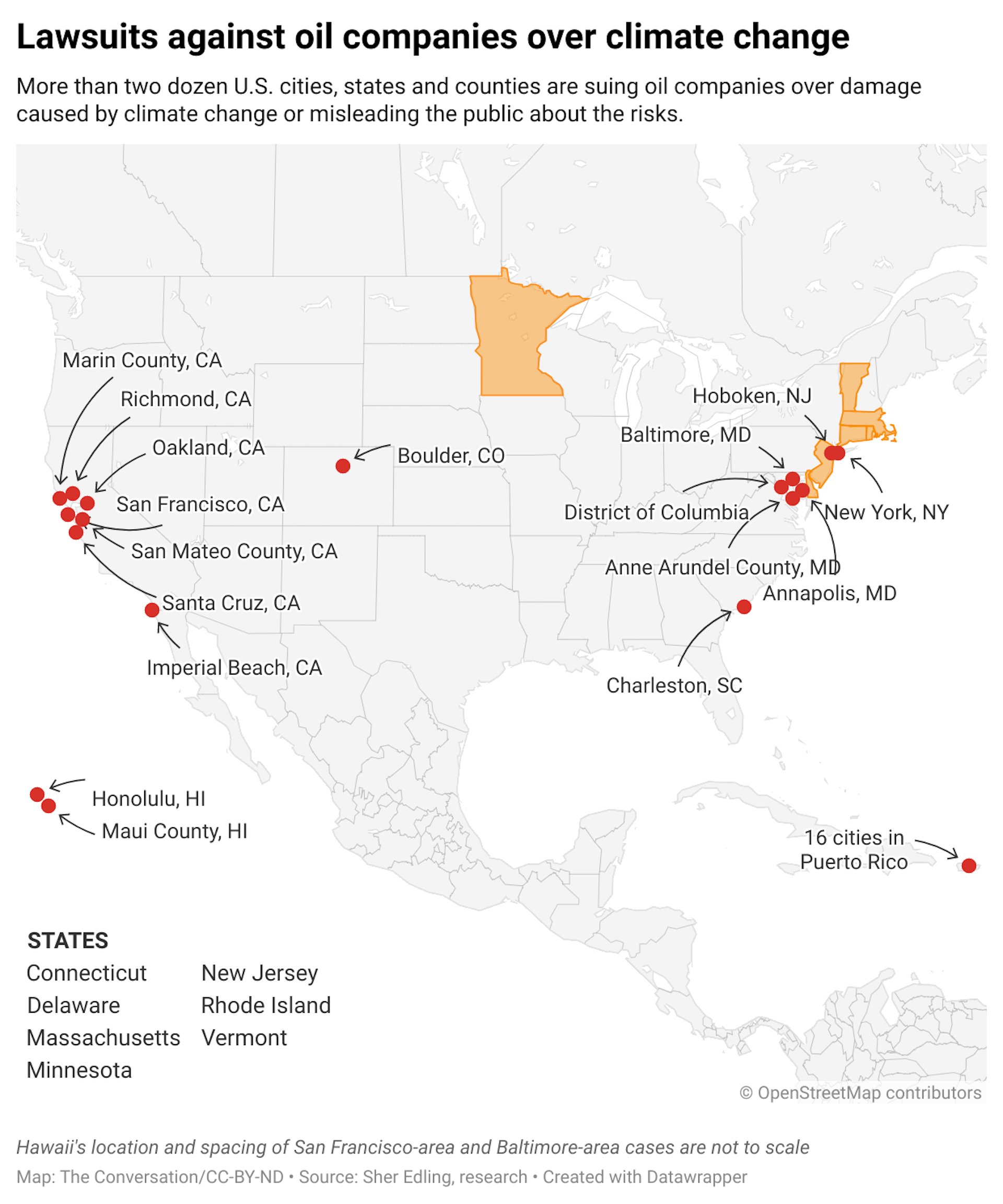
Suing over the cost of climate change
At stake in all of these cases is who pays for the staggering cost of a changing climate.
Local and state governments that are suing want to hold the major oil companies responsible for the costs of responding to disasters that scientists are increasingly able to attribute to climate disruption and tie back to the fossil fuel industry. Several of the plaintiffs accuse the companies of lying to the public about their products’ risks in violation of state or local consumer protection laws that prohibit false advertising.
IFrame Content nice map
The governments in the Honolulu case allege that the oil companies “are directly responsible” for a substantial rise in carbon dioxide emissions that have been driving climate change. They say the companies should contribute their fair share to defray some of the costs.
The gist of Honolulu’s complaint is that the big oil companies have known for decades that their products cause climate change, yet their public statements continued to sow doubts about what was known, and they failed to warn their customers, investors and the public about the dangers posed by their products.
Were it not for this deception, the lawsuit says, the city and county would not be facing mounting costs of abating the damage from climate change.
Importantly, the complaint is based on state – not federal – law. It alleges that the defendants have violated established common law rules long recognized by the courts involving nuisance, failure to warn and trespass.
The city and county want the companies to help fund climate adaptation measures – everything from building seawalls and raising buildings to buying flood-prone properties and restoring beaches and dunes.
Supreme Court could have killed these cases
Not surprisingly, the oil companies have thrown their vast legal resources into fighting these cases.
On April 24, however, they lost one of their most powerful arguments.
The U.S. Supreme Court declined to hear challenges in the Hawaii case and four others involving the seemingly technical question of which court should hear these cases: state or federal.
The oil companies had “removed” the cases from state court to federal court, arguing that damage lawsuits for climate change go beyond the limits of state law and are governed by federal law.
That theory would have derailed all five cases – because there is no federal common law for greenhouse gases.
The court made that position clear in 2011 in American Electric Power Co. v. Connecticut. Several state and local governments had sued five major power companies for violating the federal common law of interstate nuisance and asked for a court order forcing these companies to reduce their emissions. The Supreme Court refused, holding that the federal Clean Air Act displaced federal common law for these gases.
In Native Village of Kivalina v. Exxon Mobil Corp., a federal court of appeals extended that holding to also bar claims for monetary damages based on federal common law.

Several coastal communities, including in Honolulu County, facing increasing erosion want oil companies to help pay for protective infrastructure. AP Photo/Audrey McAvoy
To avoid this fate, Honolulu and the other plaintiffs focused on violations of state law, not federal law. Without exception, the federal courts of appeals sided with them and sent the cases back to state court.
What happens next?
The Honolulu case leads the pack at this point.
In 2022, the 1st Circuit Court in Hawaii denied the oil companies’ motion to dismiss the case based on the argument that the Clean Air Act also preempts state common law. This could open the door for discovery to begin sometime this year.
In discovery, senior corporate officers – perhaps including former Exxon Mobil CEO Rex Tillerson, who was secretary of state under Donald Trump – will be required to answer questions under oath about what the companies knew about climate change versus what they disclosed to the public.

In 2019, former Exxon Mobil CEO Rex Tillerson testified in a securities fraud lawsuit brought by the New York attorney general’s office. The judge ruled in Exxon’s favor. AP Photo/Seth Wenig
Evidence from Exxon documents, described in a recent study by science historians Naomi Oreskes and Geoffrey Supran, shows that the company’s own scientists “knew as much as academic and government scientists knew” about climate change going back decades. But instead of communicating what they knew, “Exxon worked to deny it,” Supran and Oreskes write. The company overemphasized uncertainties and cast doubt on climate models.
This is the kind of evidence that could sway a jury. The standard of proof in a civil case like Honolulu’s is “preponderance of the evidence,” which roughly translates to 51%. Ten of the 12 jurors must agree on a verdict.
Any verdict likely would be appealed, perhaps all the way to the U.S. Supreme Court, and it could be years before the Honolulu case is resolved.
Lawsuits don’t begin to cover the damage
It is unlikely that even substantial verdicts in these cases will come close to covering the full costs of damage from climate change.
According to the National Oceanic and Atmospheric Administration, in 2022 alone the U.S. sustained 18 weather and climate disasters that each exceeded $1 billion in damage. Together, they cost over $165 billion.
But for many of the communities most at risk from these disasters, every penny counts. We believe establishing the oil companies’ responsibility may also discourage further investments in fossil fuel production by banks and brokerage houses already nervous about the financial risks of climate disruption.
- Climate change
- Adaptation
- Erosion
- New York
- Consumer protection
- Extreme weather
- US Supreme Court
- Climate science
- ExxonMobil
- Coastal erosion
- Hawaii
- Minnesota
- US courts
- Baltimore
- Civil law
- Fossil fuel industry
- Big Oil
- Lawsuits
- Nuisance laws
- Climate change law
- Civil lawsuits
- storm damage
- Climate misinformation
- Extreme storms
---
fishing
September 15, 2021
Vermont Attorney General’s Office
109 State Street
Montpelier, VT 05609-1001
By Electronic Mail: ago.info@vermont.gov
Re: Certain Correspondence
Dear Sir or Madam:
On behalf of Energy Policy Advocates (EPA), recognized by the Internal Revenue Service as a non-profit public policy institute under § 501(c)(3) of the Internal Revenue
Code, and pursuant to the Vermont Public Records Act, 1 V.S.A. §§315-320, please
provide copies of the following records:
I. all electronic correspondence (including but not limited to e-mail, text
messages, iMessages, MMS, SMS, or any other electronic message sent or
received on any platform), and any accompanying information (see discussion of SEC
Data Delivery Standards, infra), including also any attachments, a) sent to or from or
which copies (whether as cc: or bcc:) i) Joshua Diamond, ii) Justin Kolber and/or ii)
Laura Murphy, that b) was also sent to or from or which copies (whether as cc: or bcc:),
or which includes anywhere in the correspondence, i) enckj@aol.com, ii) any email
address ending in @climateintegrity.org, iii) any email address ending in @vtcha.org,
and/or iv)pparenteau@vermontlaw.edu, which c) is dated from October 1, 2020 through
today, inclusive....
not the epa attack:
September 13, 2021
Rob Schilling
Executive Director
Energy Policy Advocates
By e-mail to: Schilling@allhookedup.com
Re: Vermont Public Records Act Request
Dear Mr. Schilling:
I write in response to your Vermont Access to Public Records Act
request dated September 7, 2021, which this office received on September 8,
- In that request, on behalf of Energy Policy Advocates, you sought:
I. all electronic correspondence . . . and any accompanying
information . . . including also any attachments, a) sent to or from or
which copies (whether as cc: or bcc:) i)Charity Clark, ii) Robert
McDougall and/or ii) Nick Persampieri, that b) was also sent to or from
or which copies (whether as cc: or bcc:), or which includes anywhere
in the correspondence, i) enckj@aol.com, ii) any email address ending
in @climateintegrity.org, iii) any email address ending in @vtcha.org,
and/or iv) pparenteau@vermontlaw.edu, which c) is dated from October
1, 2020 through today, inclusive; and
II. any i) “COMMON INTEREST AGREEMENT REGARDING THE
SHARING OF INFORMATION RELATED TOSTATE LAWSUITS
AGAINST FOSSIL FUEL COMPANIES FOR DECEPTIVE ACTSAND
PRACTICES AND OTHER STATE LAW CLAIMS” signed by OAG
since October 1, 2020, and of ii) any fee, representation, consulting, pro
bono, non-disclosure, confidentiality and/or common interest agreement
signed between your office and Pat Parenteau and/or Vermont Law
School that is presently in effect.
Please be advised that we have no records that are responsive to your
request.
If you feel any information or records have been withheld in error, you
may appeal to Deputy Attorney General Joshua Diamond at the following
email address: Joshua.Diamond@vermont.gov.
Sincerely,
/s/Nicholas F. Persampieri
Nicholas F. Persampieri
Assistant Attorney General
vid lancet richard horton
We are Vermont physicians, nurses, therapists, veterinarians, researchers, aides, and other medical/health professionals who share a deep concern about climate change and its impacts on our patients, our children, our communities, and our planet. We have joined together in response to a deepening conviction that, left unaddressed, climate change will become an immensely powerful threat to Vermont communities, and to rest of the world.
Like many of you, our families and our jobs keep us very busy in an increasingly busy world.
Like many of you, we have been sitting on the sidelines hoping that government and business would begin to move at the pace required.
That is not happening.
We have decided that it is time to make our voices heard.
Our mission is to use our expertise to inform the public and our lawmakers about the effects of climate change on human and animal health. We will use this information to support our urgent call to convert all energy use from fossil fuels to renewable sources as quickly as possible. Time is of the essence.
We are a home-grown Vermont based group.
We are people in your local community who care about your health,
and the health of the ones you love.
We are grateful for the support we have received from individual donors,
the High Meadows Fund and the New England Grassroots Environment Fund.