apollo global mgmt
BOARD OF PEACE
SEE LEON BLACK
10 2020 fbi
LA
acoSTA TOLD EPS IS ALLIED INTEL AGY; DERS AND EPS TALK --> MOSSAD WD CALL FOR DEBRIEF; EPS CLOSE TO BARAK AND TRAINED AS SPY UNDER HIM; BARAK THOT BB CRIM; EPS COOPEDTED MOSSAD AGENT;
DRUKOVA DAY ONE VENTURES STEAL TECH
CHABAD PUTIN JEW OLIG; RABBI SCHEERSOM; KSH STAKE IN CADRE NOT DISCL; JK MOVED RUSS $; CHABAD LAUNDER
CRAIG HOROWITZ ARTL 2004; KEN KURSON KNOWS;
KISSENGAR CHS KUSH INTRO TO CUI TUANAKAI CHIN AMB; ANBANG NEGOT 666 5TH AVE
M COHEN BEV HILL HSE UNDER MKT
RENDA REX TILLERSON NY POST SMEARS // STATE DEPT
LEON BLACK BWTR ARMS HU TRFFICK; CEO APOLLO 50M TO EPS 184M LOAN TO JK // 666
ELLIOT BROIDY PLED LANDER; PLAYBOY MODEL; JOEL MOWBRAY --> JEW; REP ED ROYCE, WIFE LOBBYIST;
GAWKER DISINFO 2016? --> ZERO HEDGE
---
WORLD SOC
...
Blackwater, since renamed ACADEMI, was acquired by the Constellis network in 2010. Former US Attorney General John Ashcroft, who provided the legal pretext for torture during the George W. Bush administration, is one of the current board members of ACADEMI. In 2016 Constellis was acquired by Apollo Global Management, LLC, an American equity firm.
The CEO and founder of Apollo Global, Leon Black, sits on the influential Council on Foreign Relations. His father, Eli Black, was the owner of United Fruit Brands, commonly known as Chiquita Brands International. Eli Black committed suicide in 1975 when he leapt from the 44th floor of the Pan Am building in New York City. It was later revealed that Eli Black was under investigation by federal regulators for bribing Honduran government officials.
Meanwhile, co-founder and fellow billionaire, Joshua Harris, made repeated visits to the White House earlier this year, according to the New York Times. During these visits it was reported that Harris was looking for a job within the administration, and that he met several times with special adviser to President Trump, his son-in-law Jared Kushner. During these meetings it was reported Harris was advising Kushner on “infrastructure policy.” Currently Harris does not serve in any official capacity in the White House, however Apollo provided Jared Kushner a $184 million gift in the form of a loan from the firm to Kushner Companies to refinance a skyscraper in downtown Chicago....
---
---
2 26
As details about President Donald Trump’s Board of Peace and its plans for the reconstruction of Gaza trickle out, two things become increasingly clear: Palestinians have barely, if at all, been consulted in these plans; and the people in Trump’s orbit stand to benefit from the project the most.
The U.N. Security Council approved the Board of Peace as a mechanism for implementing Trump’s 20-point peace plan for Israel and Gaza back in November, though its mandate now appears much broader. The BoP itself consists of high-level representatives from Gulf nations, Israel, Serbia, Albania, and Argentina, among others, with Trump himself as the chair and ultimate decision-maker. Absent from the Board of Peace are representatives from almost every EU country except Bulgaria and Hungary, and anyone representing Palestine.
The BoP’s executive board—tasked with putting the BoP’s vision into practice—is composed of billionaire businessmen like Marc Rowan, CEO of private equity firm Apollo Global Management; Trump’s son-in-law Jared Kushner; and Steve Witkoff, the real estate mogul turned Trump donor turned special envoy to the Middle East. There’s Ajay Banga, the World Bank president who prioritizes private-sector investment in global development, as well as U.S. Secretary of State and national security adviser Marco Rubio, deputy national security adviser Robert Gabriel, and former U.K. Prime Minister Tony Blair.
The special Gaza Executive Board adds Israeli-Cypriot real estate mogul Yakir Gabay, who enjoys a close friendship with Kushner, as well as representatives from the UAE, Qatar, Egypt, and Turkey. Sigrid Kaag, the Dutch U.N. coordinator for humanitarian aid into Gaza and the lone humanitarian-sector representative, and former U.N. special coordinator for the Middle East peace process Nickolay Mladenov lend the group a dash of gravitas—but just a dash.
The Palestinian role is reduced to a 15-member technocratic and “apolitical” governance body, led by engineer and former Palestinian Authority official Ali Shaath.
Details about how exactly Trump’s group plans to carry out Gaza’s reconstruction are limited thus far, but the number of real estate and finance bigwigs on the executive board indicates that it will likely be a highly privatized endeavor.
“When you look at the executive committee, I think it is absolutely unprecedented in multilateral organizations, which I guess the Board of Peace is supposed to be, even if it’s not really [multilateral] because of Trump’s dominance over it,” said Hugh Lovatt, senior policy fellow at the European Council on Foreign Relations. “I think it is nonetheless pretty much unprecedented to have such explicit power exerted by private individuals who are there by virtue of their business interests.” The Prospect reached out to two members of the Gaza Executive Board with questions about how board members would keep their business interests separate from their political role, but did not receive a response by press time.
Multilateral institutions like the U.N. are supposed to operate under cooperative and humanitarian principles; representatives to such bodies are supposed to represent the interests of their nations or regions, not their private businesses.
“President Trump does not seem to do anything unless it benefits the U.S., but more specifically, unless it seems to benefit himself,” Lovatt said. “And this is not something that is exclusive to Gaza or the Board of Peace, and I think is very much interwoven into his presidency.”
Among those private individuals, Kushner’s business activities have raised significant concern. He is now the owner and principal of Affinity Partners, an investment firm that doesn’t seem to be doing that much investing, according to findings from an investigation by the Senate Finance Committee. But Kushner still profits, with Affinity pocketing a 2 percent annual management fee from almost all his investors. “He’s able to get such enormous fees, as an investor with a pretty crummy record who’s just raking in money from sovereign wealth funds in the Gulf, regardless of how well he is shepherding those investments,” said Ryan Carey, chief communications adviser and deputy policy director at the U.S. Senate Committee on Finance.
The fund’s assets under management come almost exclusively from “the very Arab petrostates critical to the agreement and potential reconstruction—Saudi Arabia, Qatar and the United Arab Emirates,” journalist Mohamad Bazzi wrote in*The Guardian*. These nations have already begun investing in Syria and could be involved in rebuilding efforts in Lebanon, in a bid to exercise more influence in the region.
---
---
Marc Rowan, CEO of private equity firm Apollo Global Management;
The Moral Authority of Marc Rowan
The private equity billionaire is leading a boycott of an Ivy League oligarch factory over a Palestinian literary festival it held last month.
 by Maureen TkacikOctober 21, 2023
Two weeks ago, I happened to have a long chat with a nurse whose hospital is owned by the half-trillion-dollar private equity empire Apollo Global Management. I met this nurse, whose gender I am withholding due to their fear of retaliation, at the height of the pandemic, when they were terrified that the extreme cutbacks Apollo had imposed on staffing budgets were risking patient safety or even contributing to a preventable death in the hospital’s isolated rural community. Three years later, this nurse is largely preoccupied with their own basic survival: A virulent infection contracted during a routine surgery last year left them unable to walk without pain, and they walk 12,000 steps during an average shift.
The nurse knew it was unwise to undergo surgery in their own hospital, where there was a well-documented history of abysmal sanitation practices, the lone sterile technician on staff seemed to never leave the hospital, and corporate is so behind on its bills they had almost entirely eliminated the weekend housekeeping staff and were chronically short on basic supplies like IV tubing. But at some point following a restructuring two years ago, Apollo outsourced its health insurance administration to a company that placed onerous restrictions and preauthorization requirements on care received outside Apollo—and anyway, they felt they owed it to their colleagues and community to stay: “I wanted to show the docs and nurses here that I trust them, because they are wonderful people.” So they took the risk, and have since spent thousands of dollars out of pocket attempting to undo the damage.
Now, the nurse wonders if they will ever have time to heal. Only 24 hours passed after their last surgery before they were called back to work. Then in September, the hospital lost ten travel nurses in a single week; apparently, the hospital had slashed their weekly pay by $1,000 with no notice. The nurse has wanted to quit countless times, but it’s the only hospital for hours in any direction, and every month the patients get sicker and more reliant on what a colleague in their seventies told the nurse was “the most broken hospital” they have ever seen. “You know how you wring out a washcloth three or four times and the last time you squeeze it, you’ve got to squeeze really hard for maybe just a drop or two of water?” another of the nurse’s colleagues told me. Apollo “just never stops going back and trying to squeeze a little more.”
This campaign of deprivation has been extremely lucrative for Apollo, which over the past two years has extracted at least $1.6 billion from the nurse’s hospital chain, at an almost incalculable cost to workers, patients, and their small-town communities.
But that is what Apollo does. In the 33 years since a group of Michael Milken protégés founded the consummate modern private equity firm, Apollo has run its businesses ragged. The economic analysts at Moody’s have consistently found that Apollo portfolio companies plunged into distress or default around two-thirds of the time, the highest rate in the business. Since the pandemic began, the financial giant and its subsidiaries have been involved in at least 20 corporate bankruptcies, from the dramatic (and “perplexing,” in the Financial Times’ characterization) liquidation of the trucking company Yellow to the unexpectedly “messy” bankruptcy of serial looting victim Serta Simmons Bedding. (The company did not respond to a request for comment.)
Sometimes Apollo’s “investments” fail as a result of having made Apollo insiders unimaginably rich; other times, Apollo leverages its mastery of the bankruptcy code to enrich itself off other private equity firms’ failures. First-year associates, according to Business Insider, typically make a base salary of $450,000; Apollo founder Leon Black is worth more than $12 billion. And Black’s longtime disciple and current Apollo chief executive officer Marc Rowan is estimated to be worth $5.8 billion.
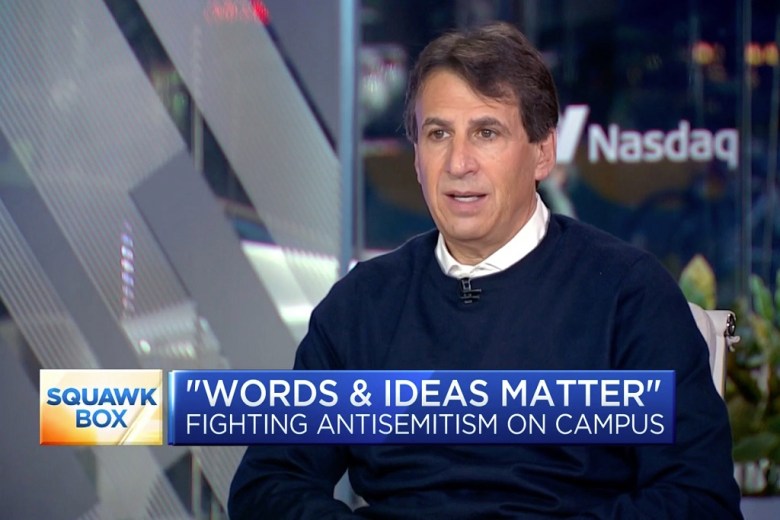
I bring this up today only because that same Marc Rowan has spent the past week casting himself on cable news and on the anti-woke celebrity publisher Bari Weiss’s Free Press website as some kind of moral authority. Rowan’s oligarch fellow travelers have hailed his “heroic” bid to inflict a campaign of boycott, divestment, and sanctions upon the University of Pennsylvania, over its administration’s “failure to condemn … anti-Semitic hate.”
Rowan, who assumed the reins after the Apollo board asked his predecessor Leon Black to step down amid revelations he had wired $188 million to the late child sex trafficker Jeffrey Epstein, lookslike a nice enough guy. He wears sweaters for all his media appearances, has spent the past year vowing to reform Apollo’s “ruthless” reputation, and draws a stark contrast with Black, who was sued over the summer for allegedly raping a 16-year-old with mosaic Down syndrome at Epstein’s mansion. (Black denies the allegations and sued the alleged victim’s law firm for the third time shortly after the complaint was filed.) The image rehabilitation has not come cheap: An Apollo investor alleged in an August lawsuit that the private equity firm made $570 million in unexplained payments to Black, Rowan, and their co-founder Josh Harris when Black left the company.
Politically, though, Rowan is a reflection of the financial institution he helms. He also chairs the board of Penn’s famous Wharton Business School, and in 2018 donated $50 million to the business school, $12 million of which was specifically earmarked to bankroll the “study” of a proprietary brand of voodoo economics dubbed the “Penn Wharton Budget Model,” whose proliferation in policy circles the Prospect explored in a recent feature. Penn produces more billionaires than any other undergraduate institution, almost wholly as a result of Wharton’s magnetism to 17-year-olds seeking to become billionaires, but this was the largest single donation in Wharton’s history.
Like most oligarchs, Rowan finances politicians who advocate slashing government spending on social welfare programs; but also like most oligarchs, he is not above lobbying for a multitrillion-dollar bailout of the financial sector when his own portfolio is on the line, as it was in early 2020 when he emailed Jared Kushner demanding the Federal Reserve drop its collateral requirements for emergency lending to include junk debt. (“We have a totally unique situation,” Rowan wrote Kushner, whose family business Apollo had recently lent $184 million and whose father-in-law’s 2020 re-election campaign would receive $1 million from Rowan and his wife, according to Forbes. “There has been no MORAL HAZARD.”)
As Rowan had reasoned years earlier in the foreword to a 2012 book: “Traditionally, we are taught to judge the success of a society by how it deals with the least able, most vulnerable members of that society. [But] shouldn’t we judge a society by how they treat the most successful? Do we vilify, tax, expropriate, and condemn those who have succeeded, or do we celebrate economic success as the engine that propels our society toward greater collective well-being?”
Now Rowan is calling on his fellow wealthy Penn alums to inflict the austerity he promotes for the American masses upon his (and very incidentally, my) alma mater, which relies on donors like Rowan to subsidize the educations of students who cannot afford the $90,000 annual cost of attending the Philadelphia university. “Join me and many others who love UPenn by sending the university $1 in place of your normal discretionary contribution,” Rowan wrote in his open letter, “so that no one misses the point.” In a vivid display of class solidarity, his call was immediately heeded by fellow billionaire Wharton alumnus and former U.S. ambassador to China Jon Huntsman, whose family’s eponymous chemical company sued Apollo for $3 billion in 2008, alleging fraud and tortious interference. Penn trustee Vahan H. Gureghian, a charter school mogul with a famously lavish real estate portfolio, also resigned from the board last week, while billionaire Ron Lauder on Tuesday said he was contemplating pulling funds.
ROWAN IS NOT THE ONLY BILLIONAIRE advocating BDS upon the Ivy League over alleged antisemitism, of course; more famously, railroad pillager and fellow bailout demander Bill Ackman, net worth $3.6 billion, called on his fellow oligarchs to assemble a “Do Not Hire” list comprising the listed members of all 34 Harvard University student groups that signed a letter holding Israel “entirely responsible for all unfolding violence.” Ackman’s move inspired a conservative dark-money group to send a “doxxing truck” around Cambridge, parading the names and faces of students it dubbed “Harvard’s Leading Antisemites” on an electronic billboard, a stunt that was quickly condemned by everyone from Larry Summers to Harvard Hillel.
In Ackman’s (extremely limited) defense, the Harvard letter, which failed to muster a single even lukewarm sentence acknowledging the sadism of the attacks on Israel or expressing sympathy for the grieving, was pretty offensive, its combination of absolutist tone and buzzword-laden content calling to mind something the NYU girls in White Lotus might have come up with following a brief consultation with ChatGPT. While ostensibly written to “call on the Harvard community to take action to stop the ongoing annihilation of Palestinians,” the letter seemed dismayingly unburdened by any genuine reflection as to the power imbalances enabling said annihilation—or for that matter, Harvard—and how fundamental “basic human decency” is to the project of overcoming such an imbalance.
Down the Acela corridor at Penn, Mark Rowan’s Ivy League BDS might seem like a me-too version of Ackman’s McCarthyist blacklist. But it is actually far more sinister. No Penn-affiliated organization produced any tone-deaf letters of note in the aftermath of the Hamas massacre; in fact, Rowan’s coup attempt has nothing whatsoever to do with the barbaric attacks on Israeli civilians—unless you buy into the logic, expressed in his opening sentence, that a Palestinian literary festival held three weeks ago on the Penn campus was somehow a prelude to the carnage.
“It took less than two weeks to go from the Palestine Writes literary festival on the University of Pennsylvania’s campus to the barbaric slaughter and kidnapping of Israelis,” Rowan asserts, relating the rise of wokeness at Penn to the unprecedented orgy of violence.
Reader, I spent days attempting to determine what exactly it was that Rowan and gang found so unspeakably blasphemous about this Palestine Writes literary festival, which was held the weekend of September 22 to honor the late poet and literary critic Salma Khadra Jayyusi. And it is difficult to discern anything other than the festival’s mere existence. Rowan’s letter accused panelists of having “advocated ethnic cleansing,” defending “substantial violence,” and uttering and “repeat[ing] various blood libels against the Jews,” but offered no evidence of any of that. Rowan initially submitted his letter to the campus newspaper, The Daily Pennsylvanian, which failed to immediately publish it, causing him to imply the paper had censored his speech; the DP said in a follow-up story that it had not been able to verify Rowan’s claims.
Contemporaneous media coverage suggested that Rowan might have been referencing Pink Floyd singer-songwriter Roger Waters, who apparently once used the K-word in an email; or possibly CUNY professor Marc Lamont Hill, who was fired from a job at CNN after delivering a speech using the phrase “from the river to the sea”; or possibly Aya Ghanameh, a children’s book author and illustrator who has argued on Twitter that “settlers aren’t civilians” and that violent resistance is necessary when “[peace] isn’t already the status quo.”
But the focus of the festival was literature, not inflammatory tweets, as an anti-Zionist Jewish group, Penn Chavurah, pointed out in an Instagram post endorsing the festival: “We do not unilaterally endorse every thing that every speaker at the upcoming event has ever said or done, [but] the festival is an important opportunity to celebrate, center and engage with a diversity of Palestinian voices.” Waters, for his part, claims he arrived at the event only to be told he was not welcome on Penn’s campus, so the single prospective attendee accused of engaging in a normal person’s definition of “antisemitism” was successfully purged from the event. (A Gaza university professor with relatives in Hamas who teaches Israeli poetry to his literature students, but has also posted inflammatory things about Jews on social media, was stricken from the lineup at least a week before the festival started.)
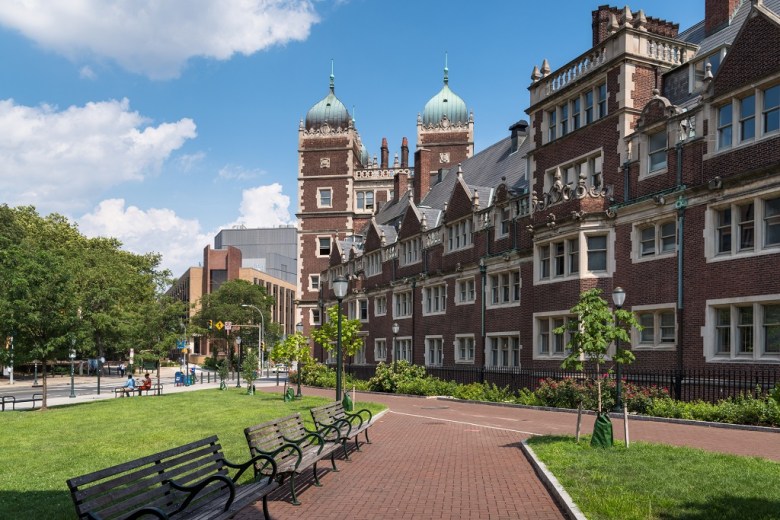
A closer look at the right-wing shitstorm that engulfed the Penn campus over the month of September was no more edifying. The Daily Caller accused the event’s organizers of “glorify[ing] Palestinian terrorism” in a September 10 piece noting that scheduled panelist Salman Abu Sitta had “accused Israel of ‘discrimination and apartheid [and] ethnic cleansing,’” accusations former Mossad chief Tamir Pardo made against the country just days earlier.
Three days later, Penn alum and fanatical private equity booster Rep. Josh Gottheimer (D-NJ), who also lobbied Fed chairman Jerome Powell to approve Rowan’s plan to bail out junk bonds in April 2020, wrote Penn president Liz Magill asking her to disinvite Waters and Hill, the latter of whom he claimed had “never adequately apologized” for saying “river to the sea” even though he publicly apologized at least three times. And two days after that, National Reviewcondemned Penn for “hosting an event packed to the gills with people who have time and again openly and unrepentantly called for the deaths of Jews,” while furnishing no evidence that anyone involved had done anything of the sort.
Magill issued a statement “unequivocally and emphatically” condemning antisemitism, but reiterating the university’s support for the “free exchange of ideas.” She hosted meetings on antisemitism, instructed the Penn police to provide additional security to Jewish student organizations, and pledged to funnel additional resources to combating antisemitism on campus in the future—which partially appeased some critics while rendering others still more furious. By September 18, The Jerusalem Postwas reporting that the event had split pro-Israel groups into two factions, one represented by Miriam Elman of the Academic Engagement Network, who said she felt the danger of anti-Israel rhetoric could be met with “better speech,” and the other exemplified by the Zionist Organization of America, which threatened to sue Penn if it did not cancel the festival.
Behind the scenes, pro-Israel groups pressured sponsors of the literary festival. Organizer Susan Abulhawa, a best-selling novelist who founded the event as an offshoot of a charity she runs to build playgrounds in historic Palestinian neighborhoods and refugee camps, said in an interview that she received an email from the Pennsylvania Council on the Arts two days before the festival started asking her to remove its logo from the event website, ostensibly because the grant it had contributed had been specifically earmarked to support an anthology of essays and short stories published in conjunction with the festival, as opposed to the event itself.
After clarifying the nature of the group’s grant on the festival website, she received a cease and desist letter demanding she remove the logo immediately. If she’d had any doubt as to who was ultimately behind the sudden request, the letter was immediately posted on the website of the Anti-Defamation League, a nonprofit organization with an annual budget well in excess of $100 million that has often in the past used its mission as an opponent of antisemitism as cover for spying on human rights and labor activists, in particular not just Palestinian rights activists but opponents of South African apartheid, according to multiple published sources in the 1990s.
Then something weird happened. On the eve of the festival’s first day, the Penn chapter of the Jewish campus group Hillel announced on Instagram that a person the organization described variously as a “student” and a “member of the campus community” had earlier that morning sneaked into the building and begun overturning tables and trash cans while muttering antisemitic diatribes; The Daily Pennsylvanian later quoted a Penn Police spokesman describing the perpetrator as a mentally disturbed individual “experiencing a crisis.” A student who witnessed the incident called the perpetrator someone too old to be a student, though a CBS News article on the incident continues to identify the individual that way. (An email to a Penn Police spokesperson seeking details on the incident was not answered.)
“What Did They Think Was Going To Happen?” blared a *National Review*headline on the incident, in a post reasoning that Penn president Liz Magill “bears responsibility” for the actions of the mentally disturbed individual because she failed to cancel the literary festival: “The Palestine Writes organizers have a right to voice their opinions, but they do not have the right to do so on Penn’s land,” author Zach Kessel concluded, likely unaware and unconcerned that the university used eminent domain to displace 4,500 Black residents a few years before the 1967 war.
That’s where Rowan stepped in. Together with two fellow private equity barons on the board of trustees and a long list of high-net-worth alumni, Rowan composed an open letter to Magill demanding that festival organizers remove all references to Penn from its marketing materials, that Penn-affiliated groups involved with the event (like the Kelly Writers House and the Near Eastern Languages and Civilizations program) disclose the precise nature of their involvement with the event and individually issue statements distancing them from the alleged antisemitism, and that Magill immediately implement “mandatory antisemitism awareness training across the University, including in new student orientation programming and DEI (diversity, equity and inclusion) programming—for students, faculty, and staff.”
In lieu of such a commitment, someone paid a truck with a digital billboard exactly like the one that appeared last week at Harvard, parading the headshots of various speakers next to captions like “SHAME on [Sponsoring Organization] at U Penn” for sponsoring “[Speaker] for promoting Genocide of the Jews.” Penn did not respond to a request for comment.
IN THE END, THE FESTIVALBILLIONAIRE hedge fund manager Cliff Asness characterized as an “antisemitic Burning Man” turned out to be strangely short on direct references to Jews or even Israel. Perhaps the most explicitly anti-Zionist feature was the screening of a Netflix film about a young girl’s experience being evicted from her village in 1948, which the American Jewish Committee has slammed as a “blood libel” and Israeli politicians have campaigned to cancel, but which the Palestine-focused news site Mondoweiss describes as a “mild depiction” of the 1948 Nakba, a historical event you can read about in this Israeli intelligence report.
Otherwise, the proceedings were mostly … uplifting. There were panels on Palestinian feminism and the experience of being queer in the Arab world, a lecture on Palestinian embroidery, performance poetry on the Australian aboriginal experience, a chat between Palestinian chefs discussing the region’s bread production techniques, a discussion of friendship and “the recognition that … Vietnamese refugees are settlers and alibis for the American Dream” featuring the novelist and professor Viet Thanh Nguyen, and a lecture on Palestinian resistance to Napoleon. It was essentially a feast of cultural topics that might not be at all political if blockades had not shuttered the textile mills, if children of Russian-Bulgarian immigrants had not won James Beard awards marketing hummus and lamb shoulder as “Israeli cuisine,” and if Israeli law had not criminalized gatherings of more than ten Palestinians to discuss topics “liable to be interpreted as political.”
Indeed, the real-life festival was so wildly at odds with the Nazi death rally promised by the antisemitism squad that a Jewish Exponentreporter dispatched to cover it seemed to come away distinctly underwhelmed bordering on charmed, summarizing its vibe with a quote from the husband of a Jordanian performance poet: “When we gather for Palestine, it’s always for protest or there’s war happening, Gaza being bombed, children being killed … This is more celebrating the culture.”
Mackenzie Fierceton, a recent Penn alum and subject of a New Yorker profile about the university’s bizarre campaign to revoke her bachelor’s degree and assassinate her character after her biological mother claimed she’d fabricated stories of being repeatedly physically and sexually abused to impress the admissions department, attended the festival and wrote in an email that she “witnessed only joy, love, and peace amidst the celebration of Palestinian voices, art, and literature.”
But if it was difficult to reconcile the jihad convention of right-wing fever dreams with the lovefest described by literally everyone in attendance, there’s a good reason for that: The methods and rhetoric Rowan and company deployed to smear Palestine Writes seem to have originated from a playbook specifically devised to undermine student groups advocating boycott, divestment, and sanctions actions on university campuses. The never-aired four-part Al Jazeera documentary  }, about a young Jewish journalist who went undercover as an operative for the Israel lobby at the height of the BDS campus movement, features a number of successful astroturf operations that share a spooky resemblance to September’s shitstorm at Penn.
In one case at University of California, Davis, two spray-painted swastikas mysteriously appeared on the walls of a Jewish fraternity house the week after a successful student senate vote to demand the college divest its Israel investments, and a consortium of Jewish student groups secretly coordinated with help from the Israeli embassy wrote a flurry of op-eds and social media posts using the incident to paint BDS as a “hate group.” But as an Israeli embassy campus operative in the documentary on a hidden camera, the Jewish groups believed a “random, like, white supremacist type people who just came in, did it, left”—not a student BDS supporter—was responsible for the vandalism.
Similar to anti-BDS operations staged at Purdue University and the University of Tennessee, the Penn media fracas and the doxxing trucks at both the literary festival and last week at Harvard were powered by the shadowy website Canary Mission, which scrapes social media platforms to pull together profiles on Palestinian rights supporters, no matter how young or inconsequential, and culls their Twitter feeds for inflammatory-sounding quotes it can use as “evidence” of antisemitism.
A dizzying network of national nonprofits like the Anti-Defamation League (where Marc Rowan is the chief benefactor of a fellowship program), campus organizations, and allied media outlets and dark-money groups are coordinated by a central command that scours the internet constantly for signs of Palestinian rights meetups. “Generally within about 30 seconds of one of these things popping up on campus,” said one operative in the film, “the system picks it up, it goes into a queue and alerts our researchers, and they evaluate it, they tag it, and if it rises to a certain level we issue early warning reports to our partners.”
In the six years since Al Jazeera filmed its documentary, BDS has largely _{ceased to be a thing}_, mostly because pro-Israel lobbyists have passed laws in at least 35 states effectively banning the movement. Last year saw just three campus votes to boycott Israel, down from 44 during the 2014-2015 school year.
Perhaps sheer boredom led the lobby to fix its echo chambers on Palestine Writes, though it may also stem from something specific to Penn, where students who identify as Jewish, who once comprised between a third and 40 percent of the student body, now represent just 16 percent. Earlier this year, Penn Hillel executive director Gabe Greenberg spoke with Inside Higher Ed about the “‘dozens if not a hundred’ conversations” he’d had in recent months “with parents concerned about the shrinkage of Penn’s Jewish population.”
Susan Abulhawa, the novelist and conference organizer, says she had been planning Palestine Writes—and the university had been aware of it—for more than a year, and the first sign of coordinated opposition only came during the first week of September. Abulhawa doubts Rowan’s attempted putsch has anything specific to do with Magill or even Penn. “When you make an example out of a university president, that ensures that not only every other university president falls in line, so does every dean, every provost, every professor,” she said. “It’s to strike terror [and] fear.”
The tactic will surprise no one familiar with Apollo, whose executives are so notorious for bullying creditors in bankruptcy court that investment bankers have historically charged an “Apollo premium” for underwriting deals like the $5 billion bond issuance that financed the firm’s takeover of the rural hospital chain. But that premium is ultimately borne by innocent bystanders like coal miners and factory workers, rural hospital patients and their overwhelmed nurses; the one at the beginning of this story is still owed thousands of dollars Apollo stiffed them for weeks they worked during a ransomware attack two years ago.
If Rowan were truly interested in rehabilitating the reputation of the firm he co-founded, he might forswear wage theft or dividends that leave large employers insolvent or strategic bankruptcies designed specifically to bust unions and plunder their pension funds. But that would require Rowan to acknowledge the carnage with which his company’s insatiable drive for speedy investment returns has littered flyover country. As the scheme to punish his alma mater illustrates, “bullying detractors into exhausted submission” is more amenable to his comfort zone.
Fierceton, who relied on scholarships endowed by rich donors to finance her Penn education after she ended up in foster care, believes lower-income Ivy League students are the ultimate targets of the private equity mogul’s billionaire boycott. “Students who rely on scholarships are forced to realize that their education is dependent on elite, conservative donors who can impose their political preferences on the University to silence speech on campus,” she wrote. “Penn, like other institutions, makes decisions based not in the best interest [of] students, but what billionaire donors tell them to do.”
Tagged:antisemitism, Books, Books, Culture & the Arts, Education in America, Health & Social Policy, hospitals, Israel-Palestine, Marc Rowan, Money, Politics & Power, Pennsylvania, Poverty & Wealth, Private Equity, Religion
Maureen Tkacik
moetkacik@gmail.com
Maureen Tkacik is investigations editor at the Prospect and a senior fellow at the American Economic Liberties Project. More by Maureen Tkacik
---
12 23 an
america’s prestigious universities play a big role in determining who gets into America’s wealthy elite.
A degree from Harvard, Penn, or M.I.T., to take three examples, is a meal ticket to a lucrative job on Wall Street or a corporate law firm and to the richest and most influential people in the land.
But as America becomes increasingly stratified by wealth, those tickets are easily abused.
Universities that give preference in admissions to the children or grandchildren of major donors serve to widen inequality even further.
Universities that allow major donors to influence what is taught or expressed on campus could be seen to suppress ideas that threaten the wealthy — which could chill freedom of expression and fuel social resentment.

Which brings us to the latest imbroglio.
Last Tuesday, the presidents of the University of Pennsylvania, Harvard, and M.I.T. tried to give precise answers to questions from members of Congress about whether their university cultures had encouraged hostility towards Jews — hostility that has surged since Hamas’s October 7 attack on Israel and Israel’s attack on Gaza in response.
In their opening remarks, all three denied it, and repeatedly condemned antisemitism.
Then Elise Stefanik, a Republican representative from New York (and herself a Harvard graduate) asked a yes or no question: would calls for genocide of Jews on campus violate their codes of conduct or harassment policies?
The presidents hedged. “If the speech turns into conduct, yes, it can be harassment,” Penn’s president, M. Elizabeth Magill, a former dean of Stanford Law School, replied in lawyer-like fashion.
“I’m asking if specifically calling for the genocide of Jews — does that constitute bullying or harassment?” Stefanik pressed her point.
“If it is directed and severe or pervasive, it is harassment,” said Magill.
“So the answer is yes?”
“It is a context-dependent decision, congresswoman,” Magill said.
Faced with the same question, Harvard’s president, Claudine Gay, also temporized. “It can be,” she said, “depending on the context.”
The university presidents should have answered unambiguously and unequivocally that calls for genocide of any group are intolerable.
Their failure to do so has fueled a firestorm.
Ross Stevens, a hedge fund manager, said he would withdraw a $100 million gift to Penn. Other wealthy Penn donors called for Magill to resign.
Even prior to the hearing, a campaign had been launched by some of Wall Street’s most powerful figures to oust all three university presidents for failing to adequately condemn Hamas’s October 7 attack on Israel.
The influential board of advisers of Penn’s Wharton School’s, chaired by Marc Rowan of Apollo Global Management, one of the world’s largest private equity firms, called on alumni to withhold donations to Penn.
The billionaire investor Bill Ackman, Harvard alumnus and head of New York hedge fund Pershing Square Capital Management, called for the three university presidents to be fired.
The day after their testimony, Magill and Gay issued statements in efforts to contain the damage.
But on Saturday evening, after an emergency meeting of Penn’s board of trustees, Magill resigned under pressure.
Over the weekend, calls from donors for Harvard’s Claudine Gay to resign grew louder, as prominent donors demanded her ouster, too.
I can well understand the anger and frustration of these donors. In their congressional testimony, the university presidents should have been clearer that their institutions do not tolerate calls for genocide. Period.
But to use their power as major donors to force or seek the ouster of these presidents is almost as repugnant as the failures of these presidents to unambiguously condemn calls for genocide. It endangers the autonomy of America’s universities.
Who’s kidding whom? Those of us who have spent our lifetimes teaching in prestigious universities are well aware of the influence of big donors. The major job of today’s university presidents is to solicit money, and their largest targets are typically denizens of Wall Street.
For the same reason, boards of trustees are packed with wealthy alumni, often from the Street, who routinely veto candidates for university presidentships harboring views they find offensive.
But not until now have major donors so brazenly used their financial influence to hound presidents out of office for failing to come out as clearly as the donors would like on an issue of campus speech or expression.
As a Jew, I cannot help but worry, too, that the actions of these donors will fuel the very antisemitism they claim to oppose — based on the perilous stereotype of wealthy Jewish bankers controlling the world.
*Robert Reich is a professor at Berkeley and was secretary of labor under Bill Clinton. You can find his writing at https://robertreich.substack.com/.*
---
Apollo Global Management - Wikipedia
talk
Hello, I work for Apollo, and would like to suggest an update for accuracy. Please amend the first sentence to clarify that Apollo is an alternative asset management firm, not a private equity firm. Here are recent sources that support this edit: ^[1] ^[2] ^[3] ^[4] ^[5] ^[6] ^[7]
10 25
Apollo Global Management, Inc. is an American asset management firm that primarily invests in alternative assets.[2][3][1] As of 2025, the company had $840 billion of assets under management, including $392 billion invested in credit, including mezzanine capital, hedge funds, non-performing loans, and collateralized loan obligations, $99 billion invested in private equity, and $46.2 billion invested in real assets, which includes real estate and infrastructure. The company invests money on behalf of pension funds, financial endowments, and sovereign wealth funds, as well as other institutional and individual investors.[1]
Apollo was founded in 1990 by Leon Black, Josh Harris, and Marc Rowan, former investment bankers at the defunct Drexel Burnham Lambert. The company is headquartered in the Solow Building in New York City,[1] with offices across North America, Europe, and Asia.[4] Founder and CEO Leon Black resigned as CEO in 2021 in the wake of sexual misconduct allegations and revelations that he had paid $158 million to Jeffrey Epstein.
In addition to its private funds, Apollo operates Apollo Investment Corporation (AIC), a US-domiciled publicly traded, private-equity, closed-end fund and Business Development Company. AIC provides mezzanine debt, senior secured loans, and equity investments to middle-market companies, including public companies, although it historically has not invested in companies controlled by Apollo's private-equity funds.[5][6]
In June 2024, Apollo Global Management ranked 29th in Private Equity International's PEI 300 ranking among the world's largest private equity firms.[7]
History
[History of private equity and venture capital](https://en.wikipedia.org/wiki/History_of_private_equity_and_venture_capital "History of private equity and venture capital") |
|---|
[ ](https://en.wikipedia.org/wiki/File:Wall_Street_Sign_%285899884048%29.jpg) |
| Early history |
| (origins of modern private equity) |
| The 1980s |
| (leveraged buyout boom) |
| The 1990s |
| (leveraged buyout and the venture capital bubble) |
| The 2000s |
| (dot-com bubble to the credit crunch) |
| The 2010s |
| (expansion) |
| The 2020s |
| (COVID-19 recession) |
Apollo, originally referred to as Apollo Advisors, was founded after the collapse of Drexel Burnham Lambert in 1990 by Leon Black, the former head of Drexel's mergers and acquisitions department, along with Josh Harris and Marc Rowan.[8] Tony Ressler, another former senior Drexel executive, was also among the firm's original members.[9][10][11][12]
Within six months after the collapse of Drexel, Apollo launched Apollo Investment Fund L.P., the first of its private-equity investment funds, formed to make investments in distressed companies. Apollo raised around $400 million of investor commitments based on Leon Black's reputation as a prominent lieutenant of Michael Milken and a key player in the buyout boom of the 1980s.[9]
Lion Advisors (or Lion Capital) was founded in 1990 to provide investment services to Credit Lyonnais and foreign institutions, seeking to profit from depressed prices in the high-yield market.[13] In 1992, Lion entered into a more formal arrangement to manage the $3 billion high-yield portfolio for Credit Lyonnais which together with a consortium of other international investors provided the capital for Lion's investment activities. Lion Advisors was replaced by Ares Management.[citation ^needed]
1990s
At the time of Apollo's founding, little financing was available for new leveraged buyouts and Apollo turned, instead, to a strategy of distressed-to-control takeovers.[14][15] Apollo purchased distressed securities, which could be converted into a controlling interest in the equity of the company through a bankruptcy reorganization or other restructuring. Apollo used distressed debt as an entry point, enabling the firm to invest in such firms as Vail Resorts,[16] Walter Industries,[17][18] Culligan, and Samsonite.[19]
Apollo acquired interests in companies that Drexel had helped finance by purchasing high-yield bonds from failed savings and loans and insurance companies. Apollo acquired several large portfolios of assets from the U.S. government's Resolution Trust Corporation.[20] One of Apollo's earliest and most successful deals involved the acquisition of Executive Life Insurance Company's bond portfolio. Using this vehicle, Apollo purchased the Executive Life portfolio, profiting when the value of high-yield bonds recovered, but also resulting in a variety of state regulatory issues for Apollo and Credit Lyonnais over the purchase.[21]
 AREA Property Partners logo
In 1993, Apollo Real Estate Advisers was founded in collaboration with William Mack to seek opportunities in the U.S. property markets.[22]
In April 1993, Apollo Real Estate Investment Fund, L.P., the first in a family of real estate "opportunity funds", was closed with $500 million of investor commitments. In 2000, Apollo exited the partnership, which continued to operate as Apollo Real Estate Advisers until changing its name to AREA Property Partners effective January 15, 2009. That firm was then owned and controlled by its remaining principals, including William Mack, Lee Neibart, William Benjamin, John Jacobsson, Stuart Koenig, and Richard Mack.[23]
In 1995, Apollo raised its third private-equity fund, Apollo Investment Fund III, with $1.5 billion of investor commitments from investors that included CalPERS and the General Motors pension fund.[24] Fund III was only an average performer for private-equity funds of its vintage. Among the investments made in Fund III (invested through 1998) were: Alliance Imaging, Allied Waste Industries, Breuners Home Furnishings, Levitz Furniture,[25] Communications Corporation of America, Dominick's, Ralphs (acquired Apollo's Food-4-Less), Move.com, NRT Incorporated,[26] Pillowtex Corporation,[27] Telemundo,[28] and WMC Mortgage Corporation.[29]
Also in 1995, Apollo's founding partner Craig Cogut left the firm to found Pegasus Capital Advisors. Since its inception, Pegasus has raised $1.8 billion in four private-equity funds focused on investments in middle-market companies in financial distress.
In 1997, Ares Management was founded by Antony Ressler and John H. Kissick, both partners at Apollo, as well as Bennett Rosenthal, who joined the group from the global leveraged finance group at Merrill Lynch, to manage a $1.2 billion market value collateralized debt obligation vehicle.[30] Ares I and II which were raised were structured as market value CLOs. Ares III-Ares X were structured as cash flow CLOs. In 2002, Ares completed a corporate spin-off from Apollo management. Although technically the founders of Ares had completed a spinout with the formation of the firm in 1997, they had maintained a close relationship with Apollo over its first five years and operated as the West Coast affiliate of Apollo. Shortly thereafter, Ares completed fundraising for Ares Corporate Opportunities Fund, a special-situations investment fund with $750 million of capital under management.[30][31]
In 1998, during the dot-com bubble, Apollo raised Apollo Investment Fund IV with $3.6 billion of investor commitments. As of April 8, 2008, the fund had generated a 10% IRR net of fees.[32] Among the investments made in Fund IV (invested through 2001) were: Allied Waste Industries,[33] AMC Entertainment,[34] Berlitz International,[35] Clark Retail Enterprises,[36] Corporate Express (Buhrmann), Encompass Services Corporation, National Financial Partners,[37] Pacer International,[38] Rent-A-Center, Resolution Performance Products, Resolution Specialty Materials, Sirius Satellite Radio,[39] SkyTerra Communications, United Rentals, and Wyndham Worldwide.[40]
2000–2005
 Apollo's headquarters in the Solow Building at 9 West 57th Street in New York City, formerly occupied by Tyco
 Apollo invested in AMC Theatres in 2001 and acquired the entire company in 2004.
In April 2001, Apollo raised Apollo Investment Fund V with $3.7 billion of investor commitments. As of April 8, 2008, the fund had generated a 54% IRR net of fees.[32] Among the investments made in Fund V (invested through 2006) were Affinion Group, AMC Entertainment, Berry Plastics, Cablecom, Compass Minerals, General Nutrition Centers (GNC), Goodman Global, Hexion Specialty Chemicals (Borden), Intelsat, Linens 'n Things, Metals USA, Nalco Investment Holdings, Sourcecorp, Spectrasite Communications, and Unity Media.
Although the founders of Ares had completed a corporate spin-off with the formation of the firm in 1997, they had initially maintained a close relationship with Apollo and operated as the West Coast affiliate of Apollo.[41][citation ^needed]. In 2002, when Ares raised its first corporate opportunities fund, the firm announced that it would separate from its former parent company. The timing of this separation also coincided with Apollo's legal difficulties with the State of California over its purchase of Executive Life Insurance Company in 1991.[42] The same year, Attorney General of California Bill Lockyer accused Leon and an investor group led by French bank Credit Lyonnais of violating California law by having a foreign government-owned bank acquire the assets and bond portfolio of Executive Life Insurance.[43]
In April 2004, Apollo raised $930 million through an initial public offering for a listed business development company, Apollo Investment Corporation.[44][5][6] In September 2004, investment funds managed by Apollo and Sterling Partners acquired Connections Academy. It was sold in 2011 for $400 million.[45]
2005–2010
In 2005, Apollo formed Hexion Specialty Chemicals through the merger of Borden, Inc., Resolution Performance Products LLC, and Resolution Specialty Materials, LLC, and the acquisition of Bakelite AG. Hexion announced in July 2007 that it was acquiring Huntsman Corporation, a major specialty-chemicals company, in a $6.5 billion leveraged buyout. Hexion announced in June 2008 it would refuse to close the deal, prompting a series of legal actions. The transaction was terminated in December after a settlement between Hexion and Huntsman, wherein they were required to pay Huntsman $1 billion to drop fraud charges.[46][47]
[ ](https://en.wikipedia.org/wiki/File:Caesars_Palace_-_Across_Bellagio_Lake.jpg)Caesars Palace, acquired as part of Apollo's LBO of Harrah's Entertainment
Between 2005 and 2007, the private equity market was booming.[48] Among Apollo's most notable investments during this period were Harrah's Entertainment, Norwegian Cruise Line, Claire's Stores, and Realogy.[49]
In 2006, Apollo acquired Rexnord Corporation for $1.825 billion,[50][51] Berry Plastics for $2.25 billion,[52] Momentive Performance Materials for approximately $3.8 billion,[53] and TNT N.V. for $1.9 billion.[54]
 AP Alternative Assets logo
In August 2006, Apollo launched a $2 billion vehicle in Europe, AP Alternative Assets.[6] It was a Guernsey-domiciled publicly traded, private-equity closed-end, limited partnership, managed by Apollo Alternative Assets, an affiliate of Apollo Management.[55] Apollo initially attempted to raise $2.5 billion for the public vehicle, but fell short when it offered the shares in June 2006, raising only $1.5 billion.[56] Apollo raised an additional $500 million via private placements in the weeks following that sale. AAA was formed to invest alongside Apollo's main private-equity funds and hedge funds.[5][6] AAA's investment portfolio was made up of a mix of private-equity and capital-markets investments. It was liquidated in 2020.[57]
In October 2006, Apollo announced a $990 million leveraged buyout of Jacuzzi Brands, a manufacturer of whirlpool baths.[58] In 2006, Apollo acquired International Paper's coated paper and supercalendered paper business for $1.4 billion, renaming the business Verso Paper. Verso is the second-largest producer of the North American magazine publishing and catalog/commercial print markets. In May 2008, Verso became a public company via an IPO.[59][60]
In February 2007, Apollo acquired Oceania Cruises for $850 million and provided additional capital to fund the expansion of the company with the purchase of two new cruise ships.![61]
In February 2007, Apollo announced the acquisition of the Smart & Final chain of warehouse-style food and supply stores. In June 2007, Smart & Final completed the acquisition of the Henry's Marketplace chain of "farmers market" style food retailers from Wild Oats Markets as part of that company's acquisition by Whole Foods Market. In 2011, the Henry's chain was merged with Sprouts Farmers Market, which, like the Henry's markets, had been founded by Henry Boney.[62][63][64][65]
In March 2007, Apollo announced the $3.1 billion leveraged buyouts of costume jewelry retailer Claire's Stores. In 2008, Claire's experienced financial difficulty amid the slump in consumer spending.[66][67]
In April 2007, Apollo acquired Noranda Aluminum, the US aluminum business of Xstrata for $1.15 billion. Noranda Aluminum includes a primary smelter and three rolling mills in Tennessee, North Carolina, and Arkansas along with other operations.[68]
In April 2007, Apollo acquired Realogy, a franchisor that owns Coldwell Banker, Century 21, and Sotheby's International Realty, for $8.5 billion. As the United States housing market correction accelerated in 2008, Realogy faced financial pressures due to its debt load. In November 2008, Realogy launched an exchange offer for a portion of its debt to provide additional flexibility, prompting a lawsuit from Carl Icahn.[69][70][71][72] In 2013, Apollo sold out of this investment, making a profit of $1.3 billion.[73]
In May 2007, Apollo acquired Countrywide plc, a provider of residential property-related services in the UK, formerly known as Hambro Countrywide (1988) and Countrywide Assured Group (1998) for $1.05 billion (not related to Countrywide Financial).[74]
In November 2007, the company sold 9% of itself to the Abu Dhabi Investment Authority.[56][6][75]
In January 2008, Apollo and TPG Capital acquired Harrah's Entertainment for $27.4 billion, including the assumption of existing debt.[76][77]
In January 2008, Apollo invested $1 billion in Norwegian Cruise Line to support a recapitalization of the company's balance sheet.[78] In December 2018, Apollo cashed out of this investment.[79]
In February 2008, Apollo acquired Regent Seven Seas Cruises from Carlson Companies for $1 billion. Following the purchase, Apollo ordered a new ship for Regent.[80]
In April 2008, Apollo, TPG Capital, and The Blackstone Group acquired $12.5 billion of bank loans from Citigroup. The portfolio comprised primarily senior secured loans that had been made to finance leveraged-buyout transactions at the peak of the market. Citigroup had been unable to syndicate the loans before the onset of the credit crunch. The loans were reported to have been sold in the "mid-80 cents on the dollar" relative to face value. In late 2008, Apollo received margin calls associated with the financing of its purchase of certain loan portfolios as the values of the loans decreased.[81][82]
In April 2008, Apollo filed a Form S-1 with the U.S. Securities and Exchange Commission in preparation for an IPO on the New York Stock Exchange.[32]
In May 2008, Apollo invested in Vantium, a company that buys residential mortgage assets as part of a strategy to profit from the United States housing market correction.[83]
In July 2008, the company closed a $758 million value-add fund.[84]
Also in 2008, Apollo opened an office in India, its first office in Asia.[85]
[ ](https://en.wikipedia.org/wiki/File:2008-11-22_Linens_%27n_Things_store_closing_in_Durham.jpg)Apollo lost its investment in retailer Linens 'n Things with the company's 2008 bankruptcy.[86]
During the 2008 financial crisis, several of Apollo's investments came under pressure. Apollo's 2005 investment in the struggling US retailer Linens 'n Things suffered from a significant debt burden and softening consumer demand. In May 2008, Linens filed for bankruptcy protection, costing Apollo all of its $365 million investment in the company.[86][87] In 2009, the company was sued by a noteholder claiming mismanagement.[88]
Apollo exercised its "PIK toggle" option at Claire's to shut off cash interest payments to its bondholders and instead issue more debt, to provide the company with additional financial flexibility.[89][90]
In December 2008, Apollo completed fundraising for its latest fund, Apollo Investment Fund VII, with roughly $14.7 billion of investor commitments.[91] Apollo had been targeting $15 billion, but had been in fundraising for more than 16 months, with the bulk of the capital raised in 2007.[92]
In November 2009, Liberty Global acquired Unity Media GMBH; funds managed by Apollo owned a 31% interest.[93]
In December 2009, Apollo announced the acquisition of Cedar Fair Entertainment Company for $635 million and assumed debt valuing the company at $2.4 billion.[94][95] In April 2010, the deal was terminated due to poor shareholder response.[96][97]
2011–2017
In January 2011, Apollo acquired 51% of Alcan Engineered Products from Rio Tinto Group.[98]
On March 29, 2011, Apollo became a public company via an IPO.[99][100][101]
In June 2011, Apollo acquired CKx.[102]
In March 2012, Apollo acquired the unprofitable Great Wolf Resorts for $703 million.[103][104][105]
In November 2012, Apollo acquired McGraw-Hill Education for $2.5 billion.[106][107]
In 2013, Apollo acquired Pitney Bowes Management Services (PBMS) for $400 million. From PBMS, Apollo formed Novitex Enterprise Solutions. Novitex is a document-outsourcing provider that manages business-critical services for over 500 companies across 10 industries.[108] In 2017, it was merged into Exela Technologies.[109]
On March 11, 2013, Apollo Global Management made the only bid for the snacks business of Hostess Brands, including Twinkies, for $410 million.[110]
In December 2013, Apollo bought a portfolio of Irish home loans from Lloyds Bank for €307 million, less than half their face value. The shares were bought by an Apollo Global Management subsidiary, Tanager Limited.[111]
In January 2014, Apollo acquired Chuck E. Cheese's for about $1 billion.[112][113] Apollo owned the company until 2020, when it was purchased by Monarch Alternative Capital.
In October 2014, Apollo merged its Endemol television studio with 21st Century Fox's Shine Group. The merged company became Endemol Shine Group, with AGM and Fox each owning half of the studio.[114]
In May 2015, Centerbridge Partners acquired Great Wolf Resorts from Apollo for $1.35 billion.[115][116]
In June 2015, Apollo agreed to acquire OM Group for $1.03 billion.[117]
Also in June 2015, Apollo won the bidding during an auction for Saint-Gobain's Verallia glass bottle-manufacturing unit for €2.95 billion.[118]
In February 2016, Apollo agreed to acquire The ADT Corporation for $6.9 billion.[119]
In April 2016, Apollo executive Stephanie Drescher donated $1000 to the presidential campaign of John Kasich, then Ohio governor. As governor, Kasich appointed a member to the Ohio state pension board. This donation violated an SEC pay-to-play pension rule. In 2019, the SEC chose not to enforce the rule.[12]
In June 2016, funds managed by Apollo Global Management acquired Diamond Resorts International.[120] It was sold to Hilton Worldwide in August 2021.[121][122]
In November 2016, investment funds managed by Apollo acquired Rackspace.[123][124]
In 2016, investment funds managed by Apollo acquired Constellis for $1 billion. Constellis is a private military contractor that was created as a result of a merger between rival contractors Triple Canopy and Academi in 2014. Academi, founded by Erik Prince and formerly known as Blackwater USA, is best known for its role in the Nisour Square massacre, where Blackwater guards killed 17 Iraqi civilians and injured 20.[125][126][127][128]
In February 2017, Apollo Education Group, the parent company of the University of Phoenix, was acquired by investment funds managed by Apollo and the Vistria Group, for $1.14 billion.[129][130][131][132]
In June 2017, investment funds managed by Apollo acquired 80.1% of Philips Lumileds division for $1.5 billion.[133][134]
In October 2017, Apollo acquired West Corp for about $2 billion.[135][136]
In November 2017, Apollo lent $184 million to Kushner Companies to refinance the mortgage on a Chicago skyscraper.[137][138]
2018–2019
In March 2018, Apollo acquired the Mexican-style restaurant chain Qdoba from Jack in the Box.[139][140]
In June 2018, funds managed by Apollo and Värde Partners acquired a majority of OneMain Financial.[141] Also in June 2018, Apollo acquired healthcare provider LifePoint Health for $5.6 billion. Following the acquisition, LifePoint merged with Apollo's RCCH HealthCare Partners.[142][143]
In October 2018, funds managed by Apollo Global Management acquired a portfolio of $1 billion in energy investments from GE Capital's Energy Financial Services unit.[144][145]
In February 2019, AGM was in talks to buy Nexstar Media Group for over $1 billion.[146] However, on February 14, 2019, Cox Media Group announced that it was selling its 14 television stations to Apollo.[147] In March 2019 filings with the Federal Communications Commission (FCC), Apollo disclosed that, through the newly formed Terrier Media, the Cox stations would be acquired for $3.1 billion (to be reduced by the value of a minority equity stake in Terrier that will be retained by Cox Enterprises); Terrier will also concurrently acquire Northwest Broadcasting, giving the company 25 television stations.[148] On June 26, 2019, Cox announced that its 60 radio stations, as well as its national advertising business CoxReps, and local OTT advertising agency Gamut, would also be acquired by the new company, which concurrently announced that it would retain the Cox Media Group name instead of Terrier Media.[149] On February 10, 2020, Cox Enterprises bought back the Ohio newspapers it sold to AGM. The FCC required Apollo to reduce the daily newspapers to three days or sell them.[150]
In February 2019, Apollo acquired Aspen Insurance for $2.6 billion.[151]
On April 16, 2019, Apollo announced that it would once again acquire Smart & Final for $1.1 billion.[152]
On June 10, 2019, Apollo announced that it would acquire Shutterfly for $2.7 billion, as well as its competitor Snapfish in a separate transaction valued at around $300 million, with District Photo as a minority stakeholder.[153]
In August 2019, Apollo agreed to provide around $1.8 billion of debt financing to support New Media Investment Group's acquisition of Gannett.[154] On October 23, 2019, AGM announced it signed agreements to take a 48.6% stake in Italian gambling group Gamenet SPA.[155][156]
In November 2019, investment funds managed by Apollo acquired Florida-based Tech Data Corp. for $5.4 billion from Warren Buffett's Berkshire Hathaway.[157][158]
In December 2019, investment funds managed by Apollo acquired Northwest Broadcasting and Cox Media Group for $3 billion, acquiring Northwest's 12 television stations, Cox's 13 television stations, 54 radio stations, three newspapers, national television advertising business – CoxReps, and local OTT advertising business – Gamut. Smart Media.[159][160][161][162]
2020–present
In February 2020, investment funds managed by Apollo acquired Covis from Cerberus Capital Management.[163]
In April 2020, AGM announced that it would invest $300 million in Cimpress, an Irish-domiciled printing group that owns Vistaprint.[164]
In May 2020, Apollo purchased $1.75 billion of preferred stock in Albertsons Companies.[165][166]
In July 2020, Apollo launched a $12 billion platform to make big loans.[167] The same month, Apollo and The Walt Disney Company sold Endemol Shine Group to the French studio Banijay Group.[168][169]
In September 2020, Apollo entered into a $5.5 billion real-estate investment partnership with the Abu Dhabi National Oil Company (ADNOC).[170]
In March 2021, Apollo Investment Corporation closed a $110 million mezzanine credit facility between LendingPoint and MidCap Financial Trust.[171]
In March 2021, Leon Black resigned as CEO and chairman after revelations that he paid Jeffrey Epstein $158 million for personal tax-related advice between 2012 and 2017. He was replaced as CEO by Marc Rowan.[172][173][174]
In April 2021, Apollo launched Apollo Origination Partnership, a $1.8 billion direct-lending fund seeking unleveraged returns of 8-10% and 12-14% leveraged returns.[175] The same month, funds managed by Apollo acquired The Michaels Companies, parent of Michaels.[176][177]
In May 2021, Apollo's Gamenet acquired the Italian gaming businesses of International Game Technology for €950 million.[178][179]
In July 2021, funds managed by Apollo acquired EmployBridge, a large industrial-staffing company that has been cited for dozens of safety violations and wage infractions.[180][181]
On July 22, 2021, it was announced that Legendary Entertainment was looking for a merger instead of a SPAC.[182] On January 31, 2022, a minority stake in Legendary was sold to Apollo Global Management, with Wanda Group still remaining the majority owner.[183]
In August 2021, Apollo announced the acquisition of the incumbent local exchange carrier operations in 20 states from Lumen Technologies for $7.5 billion, including $1.4 billion of assumed debt.[184][185] The same month, Apollo launched a $500 million fund to invest in SPACs.[186]
In September 2021, investment funds managed by Apollo acquired 90% of Yahoo!.[187][188]
In January 2022, Apollo acquired Athene, a retirement services business.[189][190][191][192][193] The same month, co-founder Josh Harris left the company to focus on other business ventures.[194]
In May 2022, Apollo acquired the US asset management business of Griffin Capital.[195][196]
In July 2022, investment funds managed by Apollo acquired Tenneco for $7.1 billion.[197]
In 2022, investment funds managed by Apollo acquired Chicago-based grocer Tony's Fresh Market,[198] California-based grocer Cardenas,[199] and Miller Homes from Bridgepoint Group.[200]
In 2023, Apollo announced it would acquire American industrial company Arconic.[201]
In October 2023, Apollo acquired London-based restaurant group The Restaurant Group for £506 million ($623 million).[202]
In June 2024, Apollo announced the acquisition of a 49% equity interest in a joint venture entity related to Intel Ireland's Fab 34 for €10.1 billion ($11 billion).[203] Apollo Global and Kyndryl Holdings are in talks to jointly bid for DXC Technology, considering an offer of $22 to $25 per share, which boosted DXC's stock by 11%. DXC, dealing with declining revenues, is also exploring selling its insurance software business but may stay independent under its new CEO Raul Fernandez.[204]
In November 2024, Apollo partnered with Shinhan Life, the life insurance arm of Shinhan Financial Group,[205] and opened an office in Seoul as part of its Asia-Pacific expansion.[206]
In January 2025, Apollo acquired Barnes Group.
In February 2025, Apollo Global Management announced that a fund managed by Apollo affiliates acquired a majority stake in Bold Productions Services, a production-linked provider.[207] Also that month, Apollo agreed to acquire real-estate investment company Bridge Investment Group for $1.5 billion.[208]
In July 2025, Apollo-backed insurance company Athora purchased Pension Insurance Corporation for $7.8 billion.[209]
In September 2025, Apollo announced plans to launch a £3.75bn investment vehicle focused on sport.[210]
In October 2025, Apollo came and talked with Paramount Skydance about joining David Ellison's possible bid to buy Warner Bros. Discovery – a megadeal that could cost upwards of $60 billion, The Post has learned.[211]
Private-equity funds
---
---