campus free speech
maybe belated, this refers to college and university policy on student expression and outside speakers
SEE TWO BAK
see student suppression
see acadmic bill of rights horowitz alec goldwater inst
see PC
see bak
---
TPUSA AM COMEBACK TOUR UCB 11 11 25 ROB SCHNEIDER
JDV TUCKER XIAN SPKR FRANK TURRETZ SP
bk manual for creating atheists
Archive
https://archive.org › details › manualforcreatin0000bogh
A manual for creating atheists : Boghossian, Peter G. (Peter Gregory ...
Favorite A manual for creating atheists by Boghossian, Peter G. (Peter Gregory) Publication date 2013 Topics Atheism, Rationalism, Faith and reason, Religion -- Controversial literature Publisher Durham, North Carolina : Pitchstone Publishing Collection internetarchivebooks; inlibrary;
American philosophy professor and author
Peter Gregory Boghossian is an American philosopher and college professor. He was an assistant professor of philosophy at Portland State University for ten years, and his areas of academic focus include atheism, critical thinking, pedagogy, scientific skepticism, and the Socratic method Continued in Wikipedia
DUCK
YT NTD
WEST CIV US LAST BASTION OF HOPE; EU BRING IN PPL WHO HATE THEM; IF NO ASSIM = INVASION; BRAINWASH REGURG; in own prison / mid; ALAN WATTS CLIMB LADDER GRADES ETC VS FDN BELIEF IN GOD NOTHING WORLD CAN DO TO YOU JOB, GOD WILL GIVE YOU ANOTHER FAM; DO WHAT YOU LOVE; TO LEAD IN TECH WE MUST PROTECT FREE SP; FACT EMPIRICAL EVIDENCE CANCELLED, VIOLENCVE ON UNIV CAMPUS; 60 MIN IN ; POLS MANIP YOU VIA SOC MEDIA EMOT --> GET AWAY W ANY ATTROCITY; BERK NIMBY VACANT LOTS; SPECULATION BLK ROCK ANTI-TRUST; PLUMBER NOT POL SCI BS FASTEST WAY TO MILLIOnAIRE, WELDER 6 FIG TO START; WE IMPORTED POVERTY DRYWALL; OMAHA FR PREIST JC ALREADY WON THIS IS MOP UP MISSION; THX YOU FOR COURAGE TO COME HERE; SNL 50 DINERO HATES TRUMP ONLY 1 PERFECT JC; TURN PPL INTO SCHMUCKS, HOW SUPPORT; I LIVE YOU CANNOT BEAT AT CANCEL CULT THEY ARE BETTER; KIRK LOVED U AND THIS CTY; GOD PICKS PPL WE WD NOT PICK; KING DAVID SO MUCH FOR EMPIR BS BEFORE; BS ADS HONEY FOR ALZ; ice recruit; fdr; draft; cannot take care of vets bc immigr; mic shill sicko
freedom t shirts
ANDREW not peter? SPIKE FR SP BIT BLOCKED; those outside setoff tear gas = authoritarian
brn student 1st amend censor rfk used tech; gaza suppr mistake, fcc but pivit to flag burn; rob s
uc stopped prot fpr buy tkr kid said; richard lyons chanc;
---
no lnx many pix
Anti-fascist protesters clash with attendees outside Turning Point event at UC Berkeley
Skirmishes led to at least three arrests, as protesters traded jeers with those attending the event — held two months after Charlie Kirk’s assassination.
by Natalie Orenstein
:{:{Nov. 10, 2025,}:
We work for you — reporting on the stories our community needs. Our journalists attend city council and school board meetings, follow tips and make the calls to keep you informed on the important issues in Berkeley. Will you chip in today to support that work during our year-end fundraising campaign?
Protesters hold signs and chant outside Turning Point USA’s campus tour event at UC Berkeley. Credit: Richard H. Grant for Berkeleyside
Dozens of anti-fascist protesters, some with faces wrapped in keffiyehs, pulled out microphones and noisemakers, crowding in on the people in Jesus shirts and MAGA hats lined up early to catch the final stop of Turning Point USA’s fall campus tour following the assassination of its founder Charlie Kirk at a Utah Valley University event two months ago.
As Kirk’s fans waited to enter Zellerbach Hall on Bancroft Way, some hoping to claim standby tickets, protesters alternated chants: “No Trump, No KKK, no fascist USA” with “antisemites, go home,” and, “Fuck your dead homie,” a reference to Kirk.
Around 5 p.m., a clash quickly broke out on Bancroft Way between the protesters and a man selling Kirk memorial “Freedom” t-shirts. The quick skirmish seemingly ended in the detention by Berkeley police of both the t-shirt vendor and a protester with whom he had fought. (It wasn’t immediately clear what set off the confrontation.)
“I was gay until Charlie Kirk showed me the way!” the vendor yelled.
Berkeley police officers separate two men fighting before the event. Both were taken away by police. Credit: AP/Noah Berger)
A man selling Charlie Kirk memorial “Freedom” t-shirts outside the event is detained by police. Credit: Richard H. Grant for Berkeleyside
A protester blows cigarette smoke at the t-shirt vendor, who was engaged in a shouting match with protesters before the fight began. Credit: Richard H. Grant for Berkeleyside
About a dozen Berkeley police in helmets corralled the crowd, while a number of UCPD officers stood at the ready inside the Zellerbach Hall plaza. Private security guards screened attendees as they entered the plaza. Nearby, two police officers held pepper ball launchers aimed at protesters.
The audience inside Zellerbach Hall, with many people wearing red hats, waits for the program to start. Credit: AP/Godofredo Vásquez
As attendees filed into the event, about 20 UCPD officers wearing riot gear and holding zip ties lined up outside Eshleman Hall — about 100 feet from an ongoing protest that alternated between a dance party vibe and screaming matches between protesters and those lining up for the event. One man in a freedom shirt screamed out, “Spray them, tase them, lock them up,” encouraging police to arrest anti-fascist protesters.
Protesters were also detained by police in the ticketed area outside the event venue.
Law enforcement face off against protesters from across a barrier outside Zellerbach Hall. Credit: Alex N. Gecan
During the speech, a crowd of about 200-300 remained outside the venue, facing off with law enforcement officers with BPD, UCPD and the California Highway Patrol.
The event, held before a packed crowd, many wearing freedom shirts and MAGA hats, wrapped up without disruption shortly before 9 p.m.
The event ended somewhat less dramatically than it began. By the time it began letting out, protesters had surrounded all four exit points, and yelled insults and chants at both the police and attendees. Some attendees screamed back at them as they walked out, but most filed out quickly without making eye contact as officers created a barrier between them and the protesters.
By 9:30 p.m., police seemed to outnumber protesters, and most of the activity had died down. The crowd outside of Yogurt Park was larger than the group still near the venue.
There were three arrests in total as of just after 7 p.m., according to a UC Berkeley spokesperson, two made by Berkeley police officers and one by UC police. Berkeley police spokesperson Byron White said one of the arrests was on suspicion of battery, but did not say what prompted the other arrest. Neither spokesperson shared further information about the arrests.
A protester is detained by police in the ticketed area inside the plaza outside Zellerbach Hall. Credit: AP/Noah Berger
A protester scuffles with a Berkeley police officer before the event as other officers separate two men fighting. Credit: AP/Noah Berger
There were many disagreements among the protesters on the left, some intentionally provoking people coming to see the Turning Point event, and others pleading with each other not to engage. “This is what they want — they want to see fights,” one protester told another.
Early Monday morning, UC police arrested four students on suspicion of felony vandalism, as they allegedly attempted to hang a large cardboard insect on Sather Gate and hung posters advertising a protest of the Turning Point event, highlighting incendiary quotes of Kirk’s.
Kirk was an adversary of the left because of his often overtly racist, misogynist, homophobic and xenophobic messaging, which ranged from calling the Civil Rights Act a “huge mistake” to claiming that birth control creates “bitter young women.”
Protesters face off against police. Credit: AP/Noah Berger
A protester waves a torn-apart Turning Point shirt. Credit: Richard H. Grant for Berkeleyside
Kirk launched Turning Point USA in 2012, aiming to spread conservatism at college and high school campuses. The organization takes aim at what they see as dominant liberal thinking and stymying of conservative students by universities, including keeping a “professor watchlist,” seeking to “expose and document college professors who discriminate against conservative students and advance leftist propaganda.” (Some professors on other campuses have seen an uptick in threats against their safety since Kirk’s death.)
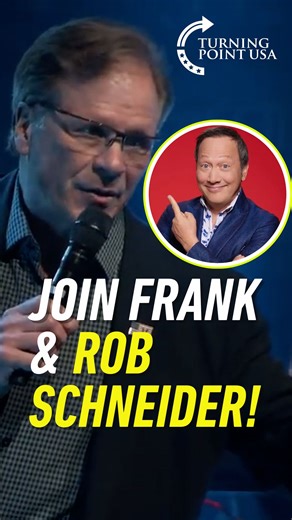
Headline speakers are Rob Schneider and Frank Turek
Kirk was originally scheduled to headline the Berkeley stop, debating students outdoors with his signature “Prove Me Wrong” format.
In his place, Christian apologist and Kirk mentor Frank Turek and comedian Rob Schneider gave addresses. Also speaking were comedian Jobob Taeleifi; Andrew Doyle, author of the book “Free Speech and Why it Matters”; philosopher Peter Boghossian; and John Paul Leon, the president of UC Berkeley’s Turning Point chapter, who came on stage doing a Trump dance.
Turek, who was present when Kirk was assassinated, compared Kirk to Christ, saying he was martyred, and said he’s gotten emails from people in Sweden saying they’ve converted to Christianity because of Kirk’s death.
“The folks here at Berkeley are big into justice,” he said. “There is no justice unless God exists, there are no rights unless God exists.”
Actor and comedian Rob Schneider speaks during the event. Credit:AP/Godofredo Vásquez
Many of the speakers criticized the protests in their remarks, arguing it was demonstrative of an opposition to free speech on the left.
Schneider, who rose to fame via Saturday Night Live and his sidekick roles in Adam Sandler movies, began by thanking “antifa” for their welcome outside and said protesters were coming from a place of emotion rather than reason. “We must be awake, we must be aware, and we must fight for” freedom, he said.
Speaker Andrew Doyle, second from the right, is joined by Schneider, far left, author Frank Turek, center, and Peter Boghossian, right. Credit: AP/Godofredo Vásquez
He also took a swipe at Berkeley. “Berkeley claims to be a liberal town,” he said. “They claim to want affordable housing. They have vacant lots they can build on, but they always get stopped. Why? Because they want affordability, just not in our backyard.”
Schneider’s comments don’t reflect Berkeley’s current housing politics: While the city’s often fraught debates over development once drew national attention, many of its leaders have come to embrace housing construction, and candidates endorsed by Yes-In-My-Backyard advocacy groups hold a majority on the City Council. Housing production has swelled to its highest levels in decades, according to data submitted to state regulators.
Many came from far away to see Turning Point event
Mary Pelican, with her fashion honoring Charlie Kirk. Credit: Richard H. Grant for Berkeleyside
While some Cal students were in attendance, many came from other universities or were non-students excited about the one California event on tour.
A number of people in line for the event Monday said they’d driven as far as five hours because they’re big fans of Kirk. Ella Klosek, 18, said she and her boyfriend had driven from Santa Maria to Sacramento Sunday to stay with family before coming to the event.
Like many of those who spoke to Berkeleyside, she said Kirk’s religious beliefs, not explicitly his politics, drew her to follow his work. She said his “traditional family values” inspired her — “what it looks like to be a godly husband or wife.”
The event was moved indoors for safety reasons, Leon told CalMatters.
He said the chapter’s membership has grown significantly since Kirk’s assassination.
The shooting also prompted UC President James B. Milliken to contact all UC chancellors, urging them to review their events policies and increase security measures.
“Universities are places where civil discussion and debate can and should occur, without the fear or threat of harm,” Milliken wrote.
Assistant Vice Chancellor Dan Mogulof declined to share details on the security plan ahead of Monday’s event, citing “obvious reasons.”
But he said the university’s Major Events policy applied due to the size of the gathering. That policy requires extra preparation by the student group hosting the event — in this case the Berkeley chapter of Turning Point — and triggers increased security. He said it would be several weeks before the total cost of the event to the university can be tallied and shared.
In addition to the protocols outlined in the plan, Turning Point is banning attendees from bringing bags inside the venue.
“UC Berkeley always works to support the rights and ability of all speakers to participate in events hosted by student organizations without regard for their beliefs and perspectives,” Mogulof said.
Monday arrests echo battles over far-right speakers during Trump’s first term
U.S. Army veteran Jefferson Silver, a protester, watches police line up outside the event. Credit: Richard H. Grant for Berkeleyside
Questions around controversial campus events and the university’s role in supporting or derailing them came to a head during the first Trump presidency.
In February 2017, when the Berkeley College Republicans brought far-right speaker Milo Yiannopoulos to Cal, about 150 activists — many identifying as “black bloc” antifa — descended on campus, setting fire to portable lights, throwing Molotov cocktails, and ultimately leading to the cancelation of the event.
The dramatic incident put a target on Cal and the city of Berkeley’s back. Repeated protests by largely non-student, conservative demonstrators overtook city parks and streets. At these events throughout 2017, “alt-right” activists, including members of now-prominent groups like the Proud Boys, duked it out with antifa and other counter-protesters on the left, with many skirmishes turning into bloody brawls and ending in injuries and arrests.
When the Berkeley College Republicans invited Ann Coulter to campus, UC Berkeley initially canceled the engagement, citing safety concerns given the violent protests happening at the school and city, then offered an alternative date.
A protester dressed in an animal costume outside Zellerbach Hall. One group of Bay Area activists described the protest they planned before the event as “our costume dance party for justice.” Credit: Richard H. Grant for Berkeleyside
The student group sued the university in response, claiming the administration was intentionally stifling conservative speech. The lawsuit ended in a settlement in 2018, with Cal agreeing to amend its events policy and pay attorney fees. But that agreement came after another attempt by the Berkeley College Republicans to “test” the university by inviting right-wing personality Ben Shapiro to campus. That event, also at Zellberbach, cost UC Berkeley $600,000 in security costs.
Just a couple of weeks later, Cal spent $800,000 on Yiannopoulos’ return to campus, which Mogulof at the time called “the most expensive photo-op in the university’s history.”
The current Major Events policy requires student or outside event hosts, in this case Turning Point, to pay for the venue rental, insurance, and “basic” but not “extraordinary” security costs.
Another, more recent event at Zellerbach also resulted in protests and cancellation. About 200 pro-Palestine demonstrators shut down a talk by conservative Israeli attorney Ran Bar-Yoshafat in February 2024, which was organized by pro-Israel student groups.
Anti-fascist protesters clash with attendees outside Turning Point event at UC Berkeley
---
In a campus full of gold and blue, red hats populated the south side of University of California, Berkeley as over 300 attendees arrived for a speaking event Monday where actor Rob Schneider and speaker and author Frank Turek appeared as featured guests for the Berkeley chapter of the conservative advocacy group Turning Point USA.
Watch More
Two months after the fatal shooting of TPUSA founder Charlie Kirk at Utah Valley University on Sept. 10, the final stop of the controversial college speaking tour happened Monday at UC Berkeley and was met by over 100 protesters looking to voice dissatisfaction about the organization and overall conservative movement.
The event and protests remained relatively peaceful, but multiple people were taken into custody by police. Two of those individuals were in a physical altercation that left one of them bloodied in the face before being separated by Berkeley police and placed into separate vehicles.
The brawl occurred after a protester allegedly threw the merchandise the Kirk supporter was selling onto the floor. As the argument between both men became physical, they began to fight by Bancroft Way. Police created a perimeter around the fight that blocked traffic for several city blocks.
Comedian and actor Rob Schneider responds to a question with panelists Frank Turek, Andrew Doyle, and Peter Boghossian during a Turning Point USA event at Zellerbach Hall on the UC Berkeley campus in Berkeley, Calif., on Monday, Nov. 10, 2025. (Photo by Carlos Avila Gonzalez/San Francisco Chronicle via Getty Images)
:
A car later traveled down Bancroft with the sound of loud banging trailing behind it, which spooked many protesters. The vehicle then stopped across from the gathering of over one hundred and proceeded to produce vast amounts of smoke and loud bangs. The vehicle then sped away, a police car in pursuit.
Turning Point USA is a nonprofit conservative advocacy group that has found a foothold across many college campuses. The chapter at UC Berkeley was founded in 2019 and has quickly become a vocal conservative group on a campus known for its largely progressive student body.
Protests against TPUSA's event were organized by several groups. Activists like By Any Means Necessary showed up with megaphones and signs in an attempt to disrupt the event and show the university that they didn't like TPUSA's presence.
UC Berkeley administrators have historically not set limits on what groups can come on to campus to speak. Campus spokesperson Dan Mogulof said the university worked with the school's chapter of Turning Point USA to ensure they could conduct their event safely.
Protesters confront University of California police outside of a Turning Point USA event at the University of California, Berkeley (UC Berkeley) on November 10, 2025 in Berkeley, California. The event was the last stop of a tour begun by group founder Charlie California. The event was the last stop of a tour begun by group founder Charlie Kirk that has since served as a series of memorials for Kirk, who was fatally shot at an event in September. (Photo by Justin Sullivan/Getty Images)
"UC Berkeley always works to support the rights and ability of all speakers to participate in events hosted by student organizations without regard for their beliefs and perspectives," said Mogulof in an email. "The campus relies on the professional security assessments and recommendations provided by UCPD so that events sponsored by student organizations can be held successfully and safely."
In preparation for the event, the university closed four adjacent buildings as a precaution and created five points of entry and exit that could be monitored by dozens of police and security forces. Private security was joined by law enforcement from the University of California Police Department, Berkeley and San Francisco police departments, the Alameda County Sheriff's Office, and the California Highway Patrol.
Student Anna Martinez found the presence of Turning Point USA advocates disruptive and said she was disappointed to see that a building she needed to enter was blocked due to the event.
"All of these student buildings are closed so a group of conservative speakers can feel safe, when we students don't feel safe when they come here," Martinez said.
:{:{Protesters confront University of California police outside of a Turning Point USA event at the University of California, Berkeley (UC Berkeley) on November 10, 2025 in Berkeley, California. The event was the last stop of a tour begun by group founder Charlie California. The event was the last stop of a tour begun by group founder Charlie Kirk that has since served as a series of memorials for Kirk, who was fatally shot at an event in September. (Photo by Justin}:
On the day of the event, both protesters and attendees traveled from across the state, with some coming as far as the Central Valley or Lake Tahoe.
Mario Fierro from Visalia said he wanted to show up and support TPUSA because he feels the conservative movement in California has been forgotten about.
"California is a diverse place, but there's still a place for conservative people and conservative values that we uphold," said Fierro. "We come willing, open-armed, willing to converse and willing to engage with the other side and hopefully do everything peaceful."
Grace Fortune, a high school teacher from Lodi, said she wanted to attend the event because she feels TPUSA supports her Christian faith.
"Ever since Charlie Kirk got assassinated, I support them," she said. "There should be clubs for anyone you know that can be proud of what they believe in and not feel ashamed for what they believe in."
Fortune said that the politics were not as important to her as what she said Kirk's Christian message was.
"It was more about the faith in Christ and being proud and courageous about his faith in Christ," she said.
The rest of the night remained relatively free of violence, but the tension between police and protesters was palpable. Police would swap positions in regular intervals and would hold their batons in case protesters broke across the barricade, while other officers waited to the side with empty projectile firearms.
On the opposite side, protesters chanted things like "fascists are not welcome here!" and "hey hey! Ho ho! Fascists have got to go!" directly into the faces of the police officers. They held steady with their chanting and occasionally paused to boo and yell "shame" at the officers.
Protester Christopher Jones decided to show up because the type of speech TPUSA promotes helps fuel hatred and bigotry, he said.
"Do we have free speech? Yes. But that doesn't mean we want hate speech to come to this campus and be full of rhetoric that targets those most vulnerable," said Jones. "It's a mockery to have them come here and say they are nonviolent when their very words create harm across the country."
2025 Bay City News, Inc.
---
2:09
Join Frank at UC Berkeley TONIGHT (MON. 11/10) in Zellerbach Hall as he teams up with TPUSA and author/comedian Rob Schneider for the American Comeback Tour. We'll continue Charlie Kirk's mission of bold faith, open dialogue, and honest conversation about culture, faith, and truth.The event starts at 6:30 PM PT but doors open at 5:00 PM so grab your spot early! Can't attend in person? Watch the livestream on TPUSA's Rumble account. . . . #UCBerkeley #DrFrankTurek #RobSchneider #TPUSATour | Cross
19h
0 views
Facebook](https://www.facebook.com/reel/1216429797207411/)
- More Videos
RedState
'Berserkeley': Antifa Thugs Violently Attack Attendees at TPUSA's 'This ...
TodayTurning Point USA's "This Is Turning Point" tour was held on Monday night at the University of California Berkeley. This event is the final stop for the re-branded tour following the assassination of TPUSA founder Charlie Kirk. Comedian Rob Schneider and Christian apologist Dr. Frank Turek were the featured speakers for the sold-out event held at Berkeley's Zellerbach Hall.
- Only include results for this siteRedo search without this siteBlock this site from all resultsNEW
Share feedback about this site

YouTube[
##
TodayThe American Comeback Tour, featuring American actor and comedian Rob Schneider and American author Frank Turek, hosted by Turning Point USA, takes place at ...
- Only include results for this siteRedo search without this siteBlock this site from all resultsNEW
Share feedback about this site
KRNV
Smoke bombs and chaos: Turning Point USA's final tour stop ... - KRNV
TodayTurning Point USA held its final stop of the "American Comeback Tour" UC Berkeley, which was met with a crowd of masked protesters who set off smoke bombs outside of the event.
- Only include results for this siteRedo search without this siteBlock this site from all resultsNEW
Share feedback about this site
NTD News
LIVE NOW: Turning Point USA Tour Featuring Rob Schneider ... - NTD News
TodayThe American Comeback Tour, featuring American actor and comedian Rob Schneider and American author Frank Turek, hosted by Turning Point USA, takes place at the University of California-Berkeley.
- Only include results for this siteRedo search without this siteBlock this site from all resultsNEW
Share feedback about this site
San Francisco Chronicle
Charlie Kirk's Turning Point presses on with UC Berkeley date
Sep 22, 2025Turning Point USA continues its tour after Charlie Kirk's assassination, with Rob Schneider and Frank Turek set to headline at UC Berkeley.
- Only include results for this siteRedo search without this siteBlock this site from all resultsNEW
Share feedback about this site
The Mercury News
How UC Berkeley is preparing for Turning Point's final tour stop after ...
7 days agoTwo months after conservative advocate Charlie Kirk's assassination during a tour stop at a Utah university, his organization, Turning Point USA, will conclude its "American Comeback Tour ...
- Only include results for this siteRedo search without this siteBlock this site from all resultsNEW
Share feedback about this site
KCRA Channel 3
https://www.kcra.com › article › turning-point-usa-continues-tour-uc-berkeley › 68026439
Turning Point USA will continue tour, end series at UC Berkeley
Sep 24, 2025Of the dates announced, the final stop will be at UC Berkeley on Nov. 10, featuring actor Rob Schneider and author Frank Turek.
- Only include results for this siteRedo search without this siteBlock this site from all resultsNEW
Share feedback about this site
theturningpointtour.com
https://theturningpointtour.com
Brainwashed Tour - This is the Turning Point
November 10th University of California - Berkeley - EVENING EVENT Berkeley, CA
- Only include results for this siteRedo search without this siteBlock this site from all resultsNEW
Share feedback about this site
memesita.com
https://www.memesita.com › america-tour-2025-rob-schneider-frank-turek-berkeley-tickets-info
America Tour 2025: Rob Schneider & Frank Turek - Berkeley | Tickets ...
5 days agoWhen you see "Rob Schneider" and "University of California, Berkeley" in the same sentence, your brain immediately starts generating questions. And after digging into the details of the "American Comeback Tour" stop on November 10th, hosted by the TPUSA Berkeley chapter, we have
---
---
12 23 an
america’s prestigious universities play a big role in determining who gets into America’s wealthy elite.
A degree from Harvard, Penn, or M.I.T., to take three examples, is a meal ticket to a lucrative job on Wall Street or a corporate law firm and to the richest and most influential people in the land.
But as America becomes increasingly stratified by wealth, those tickets are easily abused.
Universities that give preference in admissions to the children or grandchildren of major donors serve to widen inequality even further.
Universities that allow major donors to influence what is taught or expressed on campus could be seen to suppress ideas that threaten the wealthy — which could chill freedom of expression and fuel social resentment.

Which brings us to the latest imbroglio.
Last Tuesday, the presidents of the University of Pennsylvania, Harvard, and M.I.T. tried to give precise answers to questions from members of Congress about whether their university cultures had encouraged hostility towards Jews — hostility that has surged since Hamas’s October 7 attack on Israel and Israel’s attack on Gaza in response.
In their opening remarks, all three denied it, and repeatedly condemned antisemitism.
Then Elise Stefanik, a Republican representative from New York (and herself a Harvard graduate) asked a yes or no question: would calls for genocide of Jews on campus violate their codes of conduct or harassment policies?
The presidents hedged. “If the speech turns into conduct, yes, it can be harassment,” Penn’s president, M. Elizabeth Magill, a former dean of Stanford Law School, replied in lawyer-like fashion.
“I’m asking if specifically calling for the genocide of Jews — does that constitute bullying or harassment?” Stefanik pressed her point.
“If it is directed and severe or pervasive, it is harassment,” said Magill.
“So the answer is yes?”
“It is a context-dependent decision, congresswoman,” Magill said.
Faced with the same question, Harvard’s president, Claudine Gay, also temporized. “It can be,” she said, “depending on the context.”
The university presidents should have answered unambiguously and unequivocally that calls for genocide of any group are intolerable.
Their failure to do so has fueled a firestorm.
Ross Stevens, a hedge fund manager, said he would withdraw a $100 million gift to Penn. Other wealthy Penn donors called for Magill to resign.
Even prior to the hearing, a campaign had been launched by some of Wall Street’s most powerful figures to oust all three university presidents for failing to adequately condemn Hamas’s October 7 attack on Israel.
The influential board of advisers of Penn’s Wharton School’s, chaired by Marc Rowan of Apollo Global Management, one of the world’s largest private equity firms, called on alumni to withhold donations to Penn.
The billionaire investor Bill Ackman, Harvard alumnus and head of New York hedge fund Pershing Square Capital Management, called for the three university presidents to be fired.
The day after their testimony, Magill and Gay issued statements in efforts to contain the damage.
But on Saturday evening, after an emergency meeting of Penn’s board of trustees, Magill resigned under pressure.
Over the weekend, calls from donors for Harvard’s Claudine Gay to resign grew louder, as prominent donors demanded her ouster, too.
I can well understand the anger and frustration of these donors. In their congressional testimony, the university presidents should have been clearer that their institutions do not tolerate calls for genocide. Period.
But to use their power as major donors to force or seek the ouster of these presidents is almost as repugnant as the failures of these presidents to unambiguously condemn calls for genocide. It endangers the autonomy of America’s universities.
Who’s kidding whom? Those of us who have spent our lifetimes teaching in prestigious universities are well aware of the influence of big donors. The major job of today’s university presidents is to solicit money, and their largest targets are typically denizens of Wall Street.
For the same reason, boards of trustees are packed with wealthy alumni, often from the Street, who routinely veto candidates for university presidentships harboring views they find offensive.
But not until now have major donors so brazenly used their financial influence to hound presidents out of office for failing to come out as clearly as the donors would like on an issue of campus speech or expression.
As a Jew, I cannot help but worry, too, that the actions of these donors will fuel the very antisemitism they claim to oppose — based on the perilous stereotype of wealthy Jewish bankers controlling the world.
*Robert Reich is a professor at Berkeley and was secretary of labor under Bill Clinton. You can find his writing at https://robertreich.substack.com/.*
---
student/activist suppression, not 1st
an ah 4 22
since its formation 29 years ago in 1993, the far-right Alliance Defending Freedom (ADF) has consistently fought against gay rights — often equating anti-gay discrimination with religious freedom. When Kristen Waggoner, legal counsel for ADF, spoke at Yale University on March 10, about 120 students protested her appearance. And in Utah, two well-known Republicans — Sen. Mike Lee and State Attorney General Sean Reyes — have added their names to a letter demanding punishment for Yale students who**protested**the March 10 event.
Salt Lake Tribune reporter Bryan Schott explains, “More than half of the school’s students signed an open letter critical of the decision by the Federalist Society to invite Waggoner to speak and condemned the presence of armed police at the protest. Yale Law School Dean Heather Gerken said the protest was ‘unacceptable’ behavior from the students, but they had not violated the school’s free speech policy.”
Co-founded by Focus on the Family’s James Dobson, the ADF (formerly the Alliance Defense Fund) represents a far-right form of White evangelical Christian fundamentalism and is considered a hate group by the Southern Poverty Law Center (SPLC).
“In addition to Lee and Reyes,” Schott reports, “Texas Sen. Ted Cruz, several U.S. House of Representatives members, five governors, and more than two dozen other state attorneys general also signed on. The letter was drafted by the same group responsible for the Philadelphia Statement, a document that decries the persistence of ‘cancel culture’ in American society. More than 1400 people signed the letter to Yale.”
The letter reads, “Instead of engaging with the panelists, a shocking number of Yale Law students hurled constant insults and obscenities at them.” But according to Schott, “The letter’s depiction of the event is primarily based on an initial report from the conservative Washington Free Beacon. That reporting has been credibly debunked by other publications, multiple videos and the school’s official account of the incident.”
Some of the debunking came from Slate’s Mark Joseph Stern. On March 18, Stern reported, “The students made their point at the very start of the event and walked out before the conversation began. Their exercise in free speech, however rowdy or distasteful, did not prevent the panelists from expressing their views. And their demonstration did not — contrary to the Free Beacon’s reporting — require administrators to summon the police.”
==
state of Florida is under fire for trying to silence professors who want to testify about voting rights
October 31, 2021
After public outrage over its decision to block professors from testifying as expert witnesses about voting rights, the University of Florida tried to defend itself this week by issuing a statement claiming to support "academic....
omfg:
aha
univ is an institution (// "gov't schools") that does science, is rational , teaches critical thinking, questioning; but AM values Story 1 sacred, sacrosanct so evil to attack them.
trad DTricks is used in election to get pwr, now used to hold onto power, using tools of state = fascism [tho nixon]
aha: // mlk on switch out modifier: good trouble, gang of 5 we are the new/true radicals; appropriation/inversion/perversion of lefty god term[at the same time attacking woke, new PC]; for left/reality racial diversity does being intellecti\ial diversity dofferent POV; builds on Lichter? Horo BS of how lefty commie profs discriminate ~ conservatives; gop is in death spiral, at least demographically so must cheat to preserve minority power[states rights BS ~ HR1 ~ voter suppress, gerry, dark corp $); GOP can't win in mktplace of ideas[libtard bankrunpted by covid fail; must explain away fail by saying media, soc media and univ ~ them
msnbc moral panic: you raise kids w/ right values/american and univ makes them into liberals[and/or gay?]
https://www.alternet.org/2021/06/ron-desantis-2653505905/
Florida goes full fascist': Ron DeSantis sparks furious backlash with ‘authoritarian’ campus political surveys
Raw Story June 23, 2021
Gov. Ron DeSantis signed legislation requiring Florida students, faculty, and staff to register their political views in surveys in an effort to promote "intellectual diversity" at colleges and universities, and the measure set off backlash across social media.
Critics decried the law, which DeSantis claims will promote freedom of speech, as a "thoroughly Orwellian" attempt to gain control over academic debate at institutions of higher learning....
GP:
November 20, 2015
Exxon Vice President for Public and Government Affairs Kenneth P. Cohen sends a letter to Columbia University, accusing members of the Graduate School of Journalism of violating the school’s ethics policies regarding the recent articles regarding Exxon’s climate change-related research going back to the 1970s. The Dean of the Columbia Graduate School of Journalism,Steve Coll, issues a responsedefending the articles.
AHA DOH!
left gets accused of name-calling/ intolerance, we use these terms to beat down legit conservative thought/voices (cf campus freedom bs) BUT:
but sinclair weather guy ~ red alerts made me realize it's fox's biz model?! asl oright, certainly trump/ authoritarian (only I the Strong Man alone) can save you from: ISLAMOPHOBIA, XENOPHOBIA AFRO-PHOBIA, , HOMOPHOBIA, MISOGYNY (planned parenthood is selling baby body parts?!), COMMIE-PHOBIA mccarthy witch hunts, under the bed infiltrate state dept.
==
==
https://www.cjr.org/analysis/beloit-college-erik-prince-free-speech-college-campuses.php
Beloit is a small liberal arts college in southern Wisconsin, seemingly far from the front lines of the global press freedom battles. I spent a week there as the :{Weissberg Chair:(style="font-weight:400"):}: in human rights, speaking to students, faculty, and members of the local community about the threats to journalists around the world. As it happens, my visit to Beloit coincided with a debate over free speech that roiled the campus.
It started when a conservative student group called Young Americans for Freedom decided to invite Erik Prince to give a lecture. Prince is the founder of the private security firm Blackwater, which has been implicated in numerous human rights violations, including the killing of 17 civilians in Baghdad’s Nisour Square in 2007. Prince’s latest proposal is to provide private contractors to replace the US military in Afghanistan. YAF, which has only a handful of members on the Beloit Campus, is a national organization that often courts controversy by hosting provocative speakers.
The massacre of 49 worshippers in Christchurch, New Zealand, on March 15 elevated emotions around the Prince invitation. One student, Nate Acharya, expressed his anguish as a Muslim on a :{student-administered Facebook page:(style="font-weight:400"):}:, writing, “To everyone with a basic sense of human decency, let’s organize to repel the March 27th invasion of our college, lest we be complicit in it and all that it represents.” Acharya also re-posted a menacing message from an Islamic State follower, urging colleagues on campus to be aware of the threat and “stay safe.” In another post, he wrote, “Hey if you post on 4chan or [8chan] I don’t care what board you’re part of, you deserve to be shot for knowingly [participating] in one of the biggest breeding grounds for white supremacist terrorists of the modern era.”
The Beloit College administration began an investigation after being alerted to the posts by YAF president Andrew Collins. Collins, who was tagged in Acharya’s original Facebook post, told :{the Beloit student newspape:(style="font-weight:400"):}:r that he did not feel personally threatened but “wanted security to be aware of the heightened tensions surrounding the Erik Prince lecture following Christchurch so they could take adequate precautions.”
In fact, the college administration called the Beloit police, and suspended Acharya, requiring him to leave the campus while an investigation was carried out. A group of students rallied to support Acharya, marching on a meeting of the Faculty Senate and :{circulating a petition:(style="font-weight:400"):}: stating that Acharya’s posts were “not threatening, nor do they incite violence, which is more than can be said for the ideology (white supremacy) Nathaniel spoke out against.” After carrying out its investigation and holding a hearing, the administration allowed Acharya to return to campus but placed him on probation.
But the debate over Prince’s visit was far from over. While the college administration urged students to find ways to express their disagreement while allowing Prince to speak, anger boiled over. Last Wednesday, a group of students used drums and musical instruments to disrupt Prince’s talk. They piled chairs on the stage.
Erik Prince, founder of Blackwater, was supposed to speak at Beloit College more than 30 minutes ago. So far, protests seem to have delayed that...
Prince retreated off campus where he spoke to a small gathering of students, declaring in an interview with a local newspaper that the Beloit College president and the administration “lacked the moral courage to enforce free speech and to defend free speech,” adding, “Fortunately, President Trump will defend free speech and I think the college will be hearing from the court soon on this because enough is enough.” Prince was referring to a March 20 executive order signed by Trump that threatened to cut off federal funding to colleges and universities that failed to uphold free speech. In an :{analysis:(style="font-weight:400"):}:, PEN America called it “a thumb on the scale for conservative voices on campus.”
:{For his part, Prince seemed more than willing to stoke the controversy in order to advance a partisan political agenda. (Prince is the younger brother of Education Secretary Betsy DeVos).
}:
:{...
}:
==
fire ppl behind the scenes? cpac 2 hr rant (https://www.chicagotribune.com/news/nationworld/politics/factcheck/ct-trump-cpac-speech-fact-check-20190303-story.html)
https://www.alternet.org/2019/03/what-president-trumps-executive-order-on-campus-free-speech-is-really-meant-to-do/
The much anticipated executive order that President Donald Trump issued March 21 to protect free speech on campus is about politics, not policy.
The proof is in the executive order itself. The order implies that campuses that limit speech will lose federal grants. However, the free speech aspects of the order demand that universities to do what they do already.
The order directs 11 federal agencies that make research and education grants “to ensure institutions that receive Federal research or education grants promote free inquiry, including through compliance with all applicable Federal laws, regulations, and policies.”
Public institutions are already bound by law to uphold the First Amendment. And, as First Amendment watchdogs note, most private universities protect speech. Universities are already required to comply with numerous civil rights and equal protection laws to qualify for federal funding.
Political context
The order comes at a time when many of Trump’s core supporters are concerned with what they perceive to be a culture of political correctness in American higher education. In response to these political concerns,Trump first threatened to pull federal research funding from the University of California at Berkeley in 2017 after the school canceled a scheduled appearance by incendiary speaker Milo Yiannopoulos. The president repeated his promise to pull federal research dollars from campuses that do not protect the First Amendment in a speech to the Conservative Political Action Conference in February of this year.
The campus free speech executive order is the president’s attempt to make good on the promise to his political base.
It is not clear how the order would work or be enforced. But if the free speech order is political symbolism, why does it matter? As a scholar who studies the politics of higher education and research funding, I believe the order matters in the following ways.
Mostly about student outcomes
The biggest likely impact of the order has nothing to do with free speech.
Theorder directs the Department of Education to provide more granular information about student debt and earnings on the College Scorecard. The Obama administration set up the Scorecard to provide information about college affordability and outcomes.
Under the order, institutions will have to give the Department of Education program-specific information about how much their graduates earn and how well they are doing at paying back their student loans.
In this sense, the order is an extension of long-term and bipartisan federal market-based education policy. The idea is that college affordability and student outcomes can help students make better informed choices about which college to attend.
Federal research dollars at stake
The order may also have some potential consequences to scientific research.
In 2017 the federal government spent over US$40 billion on academic research, which supported included studies vital to improving health and public welfare. The University of California at Berkeley, for example, alone received $330 million in federal research funds. Pulling those funds to settle a political score would damage university finances and impede the course of science.
Holding a high standard for speech protection could also have consequences for the president’s base. Liberty University, headed by Trump ally Jerry Falwell Jr., has been cited by free speech advocates as having a repressive climate for free expression. However, in 2017 Liberty won only $120,000 in federal research grants – so it doesn’t have much to lose. [on pbs boasted about sp by jimmy carter and bernie, noted most turn down invite, kept pivot to low debt on grad 6K$)
Brendan Cantwell, Associate Professor of Higher, Adult, and Lifelong Education, Michigan State University
This article is republished from The Conversation under a Creative Commons license. Read the original article.
==
ref
https://www.wpxi.com/news/national-news/ap-top-news/proposed-order-on-campus-speech-follows-wave-of-complaints-1/927649130
WASHINGTON (AP) - President Donald Trump's proposed executive order to protect free speech on college campuses follows a growing chorus of complaints from conservatives that the nation's universities are attempting to silence their voices when they're heckled, disinvited or their presence on campus is otherwise discouraged.
Critics counter that conservatives are turning the shared goal of protecting free speech into a partisan fight.
It's unclear what Trump's order will contain, but the administration has been laying the groundwork for it for months.
The Justice Department has filed statements in various lawsuits siding with students who had alleged that schools had infringed on their right to freedom of speech. Former Attorney General Jeff Sessions opined at a forum last fall that the issue had reached a pivotal point, saying "it is time to stand up to the bullies on campus and in our culture."
Education Secretary Betsy DeVos made a similar assessment, saying "administrators too often attempt to shield students from ideas they subjectively decide are hateful or offensive or injurious, or ones they just don't like."
Trump's proposed executive order, unveiled Saturday during a speech to conservative activists, has drawn criticism from some higher education leaders including President Robert Zimmer of the University of Chicago, a frequent champion of free speech. In a campus email, Zimmer said new regulation would be "a grave error" and would give federal officials dangerous authority to interfere in campus speech issues.
"This opens the door to any number of troubling policies over time that the federal government, whatever the political party involved, might adopt on such matters," he said. "It makes the government, with all its power and authority, a party to defining the very nature of discussion on campus."
In his speech Saturday, Trump highlighted the case of Hayden Williams, who was recruiting on Feb. 19 at the University of California, Berkeley, for the conservative group Talking Points USA when two men approached and one punched Williams during a confrontation captured on student cellphones. Neither Williams nor the man arrested for the attack are affiliated with UC Berkeley.
Trump told the conservatives in the audience that Williams "took a hard punch in the face for all of us."
"If they want our dollars, and we give it to them by the billions, they've got to allow people like Hayden and many other great young people, and old people, to speak," Trump said. "And if they don't, it will be very costly."
The University of California system issued a statement Monday calling Trump's proposal "misguided and unnecessary."
"Free speech is a fundamental value of the University of California and we already have strong policies in place that protect the free expression of ideas, regardless of political persuasion," said Janet Napolitano, the system's president. "We do not need the federal government to mandate free speech on college campuses - that tradition is alive and thriving."
There were multiple hearings on campus free speech during the past two years when Republicans were in control of both chambers of Congress, though an attempt to legislate on the matter made little headway. A bill from former Sen. Orrin Hatch, R-Utah, that would have banned universities from restricting students' political speeches to certain outdoor areas on campus if that activity is lawful, did not make it through committee.
The hearings followed conservative commentator Ann Coulter canceling a speech at the University of California, Berkeley, amid fears of violent student protests. Texas Southern University in Houston canceled a speech from Sen. John Cornyn, R-Texas, in the face of student opposition.
Democratic lawmakers have said free speech infringement is just as likely to come from the political right as from the political left. Rep. Bobby Scott, D-Va., encouraged the administration during a congressional hearing last fall to take action on what he called a troubling rise in hate speech on campuses.
"We have seen active investigation of claims of campus free speech violations at public universities brought by conservative activists, but nothing investigating the explosion in incidences of racially motivated hate speech or actions on campus," Scott said.
Terry Hartle, senior vice president at the American Council on Education, called the proposed order a "solution in search of a problem," adding that free speech is already a core value in American higher education.
"I understand it's sort of a red meat issue for conservative political organizations, but in the real world it's not as big a deal as they would like to believe," he said.
Hartle worries an executive order would empower provocateurs who seek to roil campus audiences, and if campus events threaten to become violent, it could force schools to choose between preserving their federal funding and ensuring campus safety.
Debates over free speech have flared up at colleges across the country in recent years, often sparked by speakers with widely polarizing views. Protesters have shut down events featuring conservative speakers at schools including Berkeley, Middlebury College and several others.
In some cases, schools have canceled events over fears of violence. Several took that step following a 2017 white supremacist rally that started at the University of Virginia and later became violent. Days later, Texas A&M canceled a campus event billed as a follow-up to the Virginia march.
Danny Pugh, Texas A&M's vice president for student affairs, said the school is "in good shape" to handle any executive order, but he added that safety will continue be a priority when weighing free-speech questions. Still, he noted that the vast majority of campus events, even those featuring controversial speakers, go smoothly.
"We sort of get blinded by the provocative piece," he said. "For every one of those, there are thousands plus on our campus that happen without fanfare."
Some observers have raised concerns that an executive order could force religious institutions to host speakers with views that run counter to the school's values. But some prominent religious colleges said they support Trump's proposal, including leaders at Liberty University, a Christian school in Virginia.
"Not only do we encourage speakers with views conflicting with the university's to come, we pester them to come," said Scott Lamb, vice president at the school, adding that recent speakers have included former Democratic President Jimmy Carter and Sen. Bernie Sanders of Vermont, an independent.
The school's president, Jerry Falwell Jr., said in an opinion piece for Fox News that the "silencing of conservatives on college campuses is serious problem that has spread across our nation."
"Even when administrators don't actively prevent conservatives from speaking on campus, individual extremists sometimes take matters into their own hands by physically assaulting the speakers," he said.
==
https://yyy.theguardian.com/news/2018/jul/26/the-free-speech-panic-censorship-how-the-right-concocted-a-crisis
The free speech panic: how the right concocted a crisis– William Davies
Snowflake students have become the target of a new rightwing crusade. But exaggerated claims of censorship reveal a deeper anxiety at the core of modern conservatism.
mostly about UK, but brute truth on demographics true here
==
https://www.newyorker.com/magazine/2018/07/02/how-social-media-trolls-turned-uc-berkeley-into-a-free-speech-circus
Letter from Berkeley
July 2, 2018 Issue
How Social-Media Trolls Turned U.C. Berkeley Into a Free-Speech Circus
Public universities have no choice but to welcome far-right speakers seeking self-promotion. Should the First Amendment be reinterpreted for the digital age?
By Andrew Marantz
“Would I rather devote our precious resources to more class sections, overdue building repairs, or many other things we badly need?” the chancellor of U.C. Berkeley said. “Absolutely. But we have to make this work.”Photograph by Mark Peterson / Redux for The New Yorker
One afternoon last fall, I sat in the Free Speech Movement Café, on the campus of the University of California, Berkeley, drinking a fair-trade, shade-grown coffee. Students at nearby tables chatted in Spanish, Japanese, Russian, and English; next to me, a student alternated between reading a battered copy of “The Myth of Sisyphus,” by Camus, and checking Facebook on her phone. “This café,” a placard read, “is an educational reminder for the community that the campus freedoms we take for granted did not always exist, and, in the democratic tradition, had to be fought for.” In the fall of 1964, left-wing students at U.C. Berkeley demanded the right to hand out antiwar literature on Sproul Plaza, the red brick agora at the center of the campus. The administration refused, citing rules against the use of school property for external organizing. The students’ struggle, which became known as the Free Speech Movement, consumed the university’s attention for much of the academic year, and made minor national celebrities of the movement’s undergraduate leaders—especially Mario Savio, who was rakish enough to be a countercultural icon and articulate enough to be interviewed on television. Joan Baez went to Berkeley to show support for the students, singing “We Shall Overcome” from the steps of Sproul Hall. In the end, the students won, and some of them went on to join the next generation of professors and university administrators. “Freedom of speech,” Mario Savio once said, “is the thing that marks us as just below the angels.”
Fifty-three years later, the mood on campus was distinctly less celestial. Like the agitation throughout the country, the agitation at Berkeley had many long-roiling causes, but its proximate cause was easy to identify: a right-wing professional irritant named Milo Yiannopoulos. A former Breitbart editor and a self-proclaimed “Internet supervillain,” he was known less for his arguments than for his combative one-liners and protean, peroxide-blond hair. Another word for “Internet supervillain” is “troll,” and, whenever too many news cycles passed without any mention of him, Yiannopoulos showed up somewhere unexpected, such as the White House press briefing room or a left-leaning college campus, hoping to provoke a reaction.
In the process, he convinced his supporters that he should be a poster child for campus free speech, a principle that is universally lauded in theory but vexingly thorny in practice. In the 2017-18 academic year, Politico reported, an unusually large number of universities struggled “to balance their commitment to free speech—which has been challenged by alt-right supporters of President Donald Trump—with campus safety.” One expert on campus life called this “the No. 1 topic of the year.” Many college administrators were forced to devote their scarce time and money to securing on-campus venues for pugnacious right-wing speakers such as Ann Coulter and David Horowitz; arch-conservative policy entrepreneurs such as Heather Mac Donald and Charles Murray; and avowed racists such as Richard Spencer. These are names that a lot of Americans would prefer to forget. All of these figures hold views that are divisive, or worse. Yet this is precisely what makes them useful test cases. The Supreme Court’s most important First Amendment opinions often concern the lowliest forms of human expression: a burning cross, a homophobic slur, a “bong hits 4 jesus” banner.
Yiannopoulos, who claims to disdain identity politics but rarely forgoes an opportunity to call attention to his sexual orientation, spent much of 2016 and the early part of 2017 on what he called the Dangerous Faggot Tour, visiting dozens of colleges across the country. Each stop was part Trump rally, part standup show, part PowerPoint deck, and part bigoted rant. At U.C. Santa Barbara, a group of young men wearing red “Make America Great Again” hats carried Yiannopoulos into the venue on a litter; he then delivered, in a genteel Oxbridge accent, a lecture called “Feminism Is Cancer.” At the University of Wisconsin-Milwaukee, he projected a photo of a transgender student, subjecting her to public mockery. “It’s just a man in a dress, isn’t it?” he said.
The last stop on his tour, on February 1, 2017, was U.C. Berkeley, the nation’s preëminent public university, in one of its most proudly left-leaning cities. A week before Yiannopoulos’s arrival, the U.C. system had reaffirmed its promise to protect undocumented students from arrest and deportation. In response, Yiannopoulos called for Berkeley’s administrators to be criminally prosecuted. There were rumors that he planned to name undocumented students from the stage, alerting Immigration and Customs Enforcement to their presence. There was little that administrators could do. At a public institution, cancelling a speech because of what the speaker might say is called prior restraint, and the courts have generally deemed it unconstitutional.
On the afternoon of the event, fifteen hundred protesters amassed on Sproul Plaza. Some called themselves Antifa, for “anti-Fascist,” a loose collective of far-left vigilantes who draw inspiration from the European anarchist tradition. A few protesters, wearing black clothing and bandannas or masks over their faces, hurled metal police barricades through a plate-glass window of Berkeley’s student center; someone set fire to a lighting rig, and flames leaped several stories into the air. A Berkeley student, wearing a red hat that said “Make Bitcoin Great Again,” was interviewed by a local news crew as the mayhem escalated behind her. “I’m looking to just make a statement by being here, and I think the protesters are doing the same,” she said. “And props to them, for the ones who are doing it nonviolently.” Moments later, a masked protester ran up and pepper-sprayed her in the face.
Police evacuated Yiannopoulos from campus before he could speak. The next morning, the riot was the lead story on “Fox & Friends.” The show’s most prominent fan, Donald Trump, who had been President for less than two weeks, tweeted, “If U.C. Berkeley does not allow free speech and practices violence on innocent people with a different point of view - no federal funds?” The whole spectacle was such a boon to Yiannopoulos’s brand that some left-wing conspiracy theorists wondered whether he had hired the masked protesters himself.
Spring came, and then summer. The annual Berkeley Kite Festival took place at the marina. Biologists from Berkeley published a paper in Science explaining how chickens grow feathers. Yiannopoulos wrote a book that included some of the zingers he’d trotted out at his college talks, and it reached No. 2 on the Times nonfiction best-seller list.
Carol Christ, a scholar of Victorian literature and a former president of Smith College, took office as Berkeley’s new chancellor. She had been a Berkeley professor for many years, beginning in 1970—close enough to the Free Speech Movement to be touched by its spirit. A few days into the fall semester, she announced that a student group had invited Yiannopoulos back to Berkeley, and that she intended to let him speak. Citing the Bill of Rights and John Stuart Mill’s “On Liberty,” she declared that her first academic year as chancellor would be “a free speech year.” “We would be providing students with a less valuable education,” Christ wrote, “if we tried to shelter them from ideas that many find wrong, even dangerous.” The homage was surely unintentional, but “Dangerous” happened to be the title of Yiannopoulos’s book.
Whether a sophist like Milo Yiannopoulos may speak at a public university like Berkeley is less a question of what the law is than of what the law should be. The Supreme Court has been consistent, during the past half century or so, in its broad interpretation of the First Amendment. “Speech can’t be prevented simply because it’s offensive, even if it’s very deeply offensive,” Erwin Chemerinsky, the dean of the U.C. Berkeley School of Law and the co-author of a book called “Free Speech on Campus,” told me one morning in his office. He grimaced sympathetically as he talked, like a doctor delivering bad news. “I would argue that it’s generally a good idea to protect speech we don’t like, even when we’re not legally obligated to do so, but in this case we are.”
Voltaire, anti-Semite and sage of the Enlightenment, is credited with the aphorism “I disapprove of what you say, but I will defend to the death your right to say it.” Chemerinsky, arguably the foremost First Amendment scholar in the country, believes, in the Voltairean tradition, that free speech is the bedrock of a free society. I asked him about the Antifa activists who had vowed to shut down Yiannopoulos’s events by any means necessary. “Violence is never protected by the Constitution,” he said. “And preventing the speech of others, even by using one’s own speech, is called the heckler’s veto, and it is not protected, either.”
On talk radio and social media, many free-speech advocates lack Chemerinsky’s judiciousness. Some answer every challenge with a recitation of the First Amendment, as if its forty-five words were a magic spell that could settle any debate. Free-speech skeptics on the left can be equally predisposed to bad-faith arguments—misreading or ignoring the Constitution, dismissing the concept of free speech as inherently racist, or simply bypassing discourse and setting public property on fire.
There are better arguments. “No one is disputing how the courts have ruled on this,” john a. powell, a Berkeley law professor with joint appointments in the departments of African-American Studies and Ethnic Studies, told me. “What I’m saying is that courts are often wrong.” Powell is tall, with a relaxed sartorial style, and his manner of speaking is soft and serenely confident. Before he became an academic, he was the national legal director of the A.C.L.U. “I represented the Ku Klux Klan when I was in that job,” he said. “My family was not pleased with me, but I said, ‘Look, they have First Amendment rights, too.’ So it’s not that I don’t understand or care deeply about free speech. But what would it look like if we cared just as deeply about equality? What if we weighed the two as conflicting values, instead of this false formalism where the right to speech is recognized but the harm caused by that speech is not?”
Yiannopoulos and many of his defenders like to call themselves free-speech absolutists, but this is hyperbole. No one actually believes that all forms of expression are protected by the First Amendment. False advertising, child pornography, blackmail—all are speech, all are illegal. You’re not allowed to shout “Fire!” in a crowded theatre, make a “true threat,” or incite imminent violence. These are all exceptions to the First Amendment that the Supreme Court has made—made up, really—over time. The boundaries can and do shift. In 1940, a New Hampshire man was jailed for calling a city marshal “a damned Fascist.” The Supreme Court upheld the conviction, ruling that the words were not protected by the First Amendment, because they were “fighting words,” which “by their very utterance inflict injury or tend to incite an immediate breach of the peace.”
Are some of Yiannopoulos’s antics—say, his attempts to intimidate undocumented and transgender students—closer to fighting words than to intellectual discourse? Maybe. But the fighting-words doctrine has fallen out of favor with the courts. In 2006, the Westboro Baptist Church picketed a soldier’s funeral, carrying signs that read “Thank God for dead soldiers” and “You’re going to Hell.” Even factoring in almost seven decades of epithet inflation, this would seem more injurious than “damned Fascist.” And yet the Supreme Court ruled that the signs were protected by the First Amendment.
In the nineteen-seventies, when women entered the workplace in large numbers, some male bosses made salacious comments, or hung pornographic images on the walls. “These days, we’d say, ‘That’s a hostile workplace, that’s sexual harassment,’ ” powell said. “But those weren’t recognized legal concepts yet. So the courts’ response was ‘Sorry, nothing we can do. Pornographic posters are speech. If women don’t like it, they can put up their own posters.’ ” He drew an analogy to today’s trolls and white supremacists. “The knee-jerk response is ‘Nothing we can do, it’s speech.’ ‘Well, hold on, what about the harm they’re causing?’ ‘What harm? It’s just words.’ That might sound intuitive to us now. But, if you know the history, you can imagine how our intuitions might look foolish, even immoral, a generation later.”
In the media, and on his Facebook and Instagram feeds, Yiannopoulos tirelessly promoted his return to Berkeley. Instead of a mere lecture, he envisioned “a huge, multi-day event” called Milo’s Free Speech Week. A video had recently come to light in which he’d made some deeply ill-advised comments about pederasty. Afterward, he’d been widely condemned on both the left and the right. He seemed to hope that his Berkeley appearance would restore him to mainstream relevance, and perhaps marketability.
He posted a schedule, at FreeSpeechWeek.com, that culminated in the presentation of the first annual Mario Savio Award for Free Speech. (Savio died in 1996; his son Daniel told the Guardian that Yiannopoulos’s appropriation of his father’s legacy was “some kind of sick joke.”) When Yiannopoulos spoke privately to his influential friends on the far right, he often said, “This will be our Woodstock.” He released a list of more than twenty speakers, which included many of the usual free-speech warriors and also some surprising names, such as the secretive military-security magnate Erik Prince. In addition to Yiannopoulos, the four headliners would be Ann Coulter; Pamela Geller, a virulently Islamophobic blogger from Long Island; Mike Cernovich, a conspiracy theorist and vigilante journalist; and Steve Bannon, newly fired from his job as Trump’s chief strategist. To build anticipation, Yiannopoulos’s team made promotional videos about each headliner, in the style of an action-movie trailer. “Bannon Infiltrates Berkeley,” less than thirty seconds long, has been viewed more than thirty thousand times.
Mindful of the potential for violence, some students requested a robust police presence; others suggested that more police on campus would make them feel less safe, not more; still others demanded that the university cancel Free Speech Week. More than a hundred and fifty Berkeley faculty members and graduate students signed an open letter calling for a campus-wide boycott. Christ told me that she never considered cancelling the event. “The reputational cost would simply be too high,” she said. Reputational cost is impossible to quantify, but the literal cost to U.C. Berkeley, in security fees alone, was likely to exceed a million dollars. The university had a budget deficit of more than a hundred million dollars, with less funding coming from the state in recent years. “Would I rather devote our precious resources to more class sections, overdue building repairs, or many other things we badly need?” Christ continued. “Absolutely. But we have to make this work.” Others on campus speculated that Yiannopoulos’s real goal was to force a government-subsidized institution to expend as many resources as possible. On FreeSpeechWeek.com, there were T-shirts for sale reading “Defund Berkeley.”
Traditionally, outside speakers don’t have unilateral power to schedule their own events on college campuses—like vampires, they have to be invited in—and Yiannopoulos was the guest of a conservative student organization called the Berkeley Patriot. “We don’t want to seem like we support someone like Milo, because we don’t,” Pranav Jandhyala, one of the Patriot students, told the Daily Cal, the campus newspaper. “We’re simply inviting him because free speech is protected.” As the ostensible organizers of the event, the students had to sign contracts and waivers, assuming significant legal risk. At the time, the Berkeley Patriot had existed for only a few months. It had between five and twenty active members, depending on the definition of “active.” For a while, the administration and the Patriot students worked well together. “We’re treating them the way we’d treat any other students who are taking on something difficult and need our support,” Dan Mogulof, the assistant vice-chancellor for public affairs, told me. “We want to be sure that they don’t feel unsafe or marginalized.”
Then things began to fall apart. The university set several deadlines, and, amid negotiations over contracts, the Patriot students missed them all. It also became clear that Yiannopoulos’s lineup was not a list of confirmed speakers but a wish list. “Contrary to news reports, I have not been contacted about participating in Free Speech Week,” Heather Mac Donald tweeted. Erik Prince told The Atlantic that his presence on the list was “a typo.” Bannon said nothing publicly, but several people told me that he was scheduled to be in China that week. “I would never under any circumstances appear at an event that included Milo Yiannopoulos,” Charles Murray told The Chronicle of Higher Education. Asked why, Murray responded, “Because he is a despicable asshole.”
Carol Christ told me, “The metaphor I’ve been thinking about a lot is that of an object and its shadow. At first, I was imagining a conventional lecture: the lecture is the object; the digital recording is its shadow.” We were sitting in her office, which she hadn’t had time to finish unpacking. Several copies of the Norton Critical Edition of “The Mill on the Floss,” which she had edited, remained in a cardboard box on the floor. “By contrast,” she continued, “when I consider Milo’s—I’ll use the word ‘event,’ although I’m not sure that that’s exactly the right word—it’s becoming clearer that he’s actually trying to plant a narrative, a trail of impressions and images, that lives primarily in the digital world, and that we, this physical campus, are merely the shadow.”
Yiannopoulos is not the only orator who has figured out that a speaking gig at a public university, especially in the face of fierce ideological opposition, is an easy way to attract an audience. “My college tour began after the victory by Donald Trump,” Richard Spencer, a proponent of “peaceful ethnic cleansing,” said in a recent YouTube video. “I loved it. I thought it was a great success, and so did most everyone else.” Such speakers often portray themselves as soldiers for free speech, but more often they use the First Amendment as a convenient shield.
One fall afternoon at Berkeley, outside the Free Speech Movement Café, several undergraduates gathered in a semicircle around an oversized poster, Sharpies in hand, doing what their liberal-arts curriculum had trained them to do: dissecting a text. “This is so full of fallacies, I just assumed it was by a student,” one of them said. In fact, it was a transcription of a lecture that the conservative pundit Ben Shapiro had delivered on campus the previous week. A former Breitbart editor, he now runs a site called the Daily Wire and hosts “The Ben Shapiro Show,” the most popular right-wing podcast in the country. A first-year student with pink highlights in her hair pointed to one sentence: “The Constitution was not written by a bunch of people who speak Korean.” It was one step in Shapiro’s argument that there was no systemic racism in the United States. “As an Asian-American, I feel personally attacked,” she said, adding, “I’m, like, half joking.” Another sentence on the poster read, “Income inequality is not the big problem; nobody rich is making you poor.” Above the latter clause, a student had written, in blue, “False premise, no one suggests that.” Another student wrote, in red, “Read Marx plz.”
Shapiro tries to appeal to both the pro-Trump and the anti-Trump factions of the Republican base, spitting out indignant syllogisms in a rapid nasal delivery that sounds like a podcast played at double speed. He had reserved a lecture hall on Sproul Plaza, and a thousand protesters showed up outside the venue. Compared with Yiannopoulos’s appearance, there were far more police, and they were far more aggressive. They arrested nine protesters and confiscated a few sticks and other potential weapons. There was no violence—at least, not of the physical variety. “Speech is violent, we will not be silent!” a group of students, standing outside the Martin Luther King Jr. Student Union, chanted. Later, I asked Viana Roland, a political-science student who had joined the chant, what she’d meant. Roland is from Santa Maria, a farm town several hours south of Berkeley. “Folks in my family pick strawberries, and some of them are undocumented,” she said. “Shapiro says that systemic racism is a myth. That is an apologetics for white supremacy, an ideology with a long legacy of violence.” Because she was an Afro-Latina, she said, “that violence might be an abstraction to some people, but it’s not abstract to me.”
I asked john powell what he thought about the rhetorical tactic of conflating speech with bodily harm. “Consider the classic liberal justification for free speech,” he said. “ ‘Your right to throw punches ends at the tip of my nose.’ This is taken to mean that speech can never cause any kind of injury. But we have learned a lot about the brain that John Stuart Mill didn’t know. So these students are asking, ‘Given what we now know about stereotype threat and trauma and P.T.S.D., where is the tip of our nose, exactly?’ ”
Adam Jadhav, a Ph.D. student in Berkeley’s geography department, has little patience for the classic liberal approach. While lecturing in a course called Global Environmental Politics, he projected a slide arguing that Yiannopoulos’s event was “not about robust exchange of ideas” but “about a shadowy political element weaponizing a narrow interpretation of the First Amendment.” A conservative student took a photo, in which Jadhav is clearly identifiable; someone sent it to Yiannopoulos, who shared it on Instagram.
“Idiots in the comments were calling me a fat slob because I didn’t tuck in my shirt,” Jadhav told me at a taquería a couple of blocks from campus. “I was, like, dude, come on, it’s a kurta.” Jadhav has thick-framed glasses, a small hoop earring, and a tattoo of a parrot on his forearm. The parrot, in a speech bubble, quotes Marx: “The point, however, is to change it!” “It” refers to the world. Marx was expressing his exasperation with armchair philosophers who are all talk and no action.
“I consider myself an activist, not just an academic,” Jadhav continued, ordering a beer. “I align myself with Antifa, although that term is sometimes misunderstood. I’m not Black Bloc”—the masked, black-clad contingent that uses violence. “Most of us, percentage-wise, are not Black Bloc. I do, however, think it’s important to stand up against hypernationalism and Fascism in all its forms. That might entail breaking unjust laws, but that’s how progress has always been made.”
After Jadhav’s picture circulated online, Christ wrote him a warm e-mail expressing her sympathy. He thanked her, but urged her to “control the narrative” when it came to Yiannopoulos. “What I meant was: Let’s not get played,” Jadhav said. “He’s coming here to make people afraid, and to milk us for attention.” There were real victims of government overreach—dozens of protesters rounded up in mass arrests at Trump’s Inauguration; Desiree Fairooz, an activist who was arrested for laughing during the confirmation hearing of Attorney General Jeff Sessions—but Yiannopoulos, who has never been jailed or injured at his speeches, wasn’t one of them.
Recently, on Fox News, Ben Shapiro said, “Everything has been deemed hate speech on campus. . . . There is a big part of the left—and it’s growing—that says that it is incumbent to protect the campus from ideas that are dissenting.” This premise has become commonplace, even among liberals, but the evidence is mixed. One study, from 2015, did find that forty per cent of millennials, a greater proportion than in any other age group, would want the government to be able to censor speech that is “offensive to minority groups.” But another study, conducted the following year, found that only twenty-two per cent of college students wanted universities to ban offensive speech—a lower proportion than in the rest of the American adult population. In March, a political scientist named Jeffrey Sachs analyzed the most recent data, broken down by age. In conclusion, he tweeted, “There is no campus free speech crisis, the kids are all right, those that say otherwise have lost all perspective, and the real crisis may be elsewhere.”
It was a bright Friday morning, and Dan Mogulof, the Berkeley public-affairs administrator, was speed-walking to California Hall, a Beaux-Arts building where the chancellor and other top administrators have their offices. In theory, Free Speech Week was to begin in forty-eight hours. But, Mogulof had told me, “No speakers have been confirmed, no venues have been confirmed, no one on Milo’s team will answer simple questions.” Margo Bennett, the chief of campus police, said that “pretty much everything we know about Milo’s plans, at this point, we’re getting from his Instagram.”
At the entrance to California Hall, Mogulof took a call on his cell phone. His eyebrows shot up, and he pumped his fist like a golfer sinking a long putt. Then he hung up and paced the corridors, popping in through various doors and interrupting meetings. “Sorry, friends, but it’s rare that I get to bring good news,” he said to a roomful of deans and assistant chancellors. “I’m just now—as in, right now—learning that a Berkeley Patriot student is telling local media that the event is off.”
College administrators across the country were watching Free Speech Week closely. Richard Spencer was scheduled to speak soon at the University of Florida, and Charles Murray had been invited to the University of Colorado in Boulder. Officials from both schools were embedded with Berkeley’s administrators, Mogulof said, “to observe—see what works, see what doesn’t—and apply those lessons when it’s their turn in the hot seat.”
Mogulof hurried to Sproul Plaza, where he had called a press conference for print and TV reporters, both local and national. “I just texted someone from the Patriot,” one reporter said to another. “I asked if Free Speech Week was cancelled, and the response was ‘LOL, unclear.’ So that’s my headline, I guess: ‘LOL, Unclear.’ ”
As Mogulof spoke to the reporters, an undergraduate sociology student walked by, holding an iced coffee and a Rice Krispies Treats wrapper. She shouted a question at Mogulof: “Students have a right to go to their classes and feel safe in their classrooms, and you’re ready to compromise that for, like, the First Amendment that you’re trying to uplift?”
“Your concerns are right on the money,” Mogulof said. The student was not satisfied. She continued to ask questions, using her phone to film the interaction. As she talked, a few of the TV cameras swung toward her. “Please do not take video of me!” she said, holding up her phone like a talisman.
Mike Cernovich, a right-wing vigilante journalist, said of a planned rally at Berkeley, “If there’s a screaming Antifa crowd, and if I maybe have to street-fight my way in and break a few noses in self-defense, that’s all good optics for me.”Photograph by Mark Peterson / Redux for The New Yorker
“Um, it’s a press conference,” one of the camera operators said.
A newspaper reporter said, “How’s that for free speech?”
That night, I called Yiannopoulos and asked him where he was. “I’ve landed in San Francisco, but my specific location is top secret, I’m afraid,” he said. “I’m not even telling dear friends, much less the press. For security reasons. I’m sure you understand.”
It took me twenty minutes to discover his secret location, and another forty-five minutes to get there by bart. It was a chain hotel situated between a strip mall and an eight-lane highway, in the commuter suburb of Walnut Creek. I found Yiannopoulos and his entourage in a “Grill & Lounge” area decorated in at least five clashing shades of taupe. Yiannopoulos greeted me with a kiss on the cheek, as though he had no memory of our earlier conversation. “Normally, we stay at places that are far, far posher than this,” he said. “If you follow my Instagram, you know that already. But I’m afraid this trip had to be thrown together at the last minute. For security reasons, you understand.”
Ann Coulter and Steve Bannon were no-shows. Joining Yiannopoulos were a few of his employees and the two remaining headliners, Pamela Geller and Mike Cernovich. “I’ll do anything for Milo,” Geller said, sipping a cocktail. “He and I are the same piece of kishke, as my grandmother used to say.” Her persona is reminiscent of late-career Joan Rivers, but with more splenetic bigotry and fewer punch lines. “If Milo doesn’t have freedom of speech, nobody does,” she went on. “Besides, his company’s publishing my next book, so it’s good cross-promotion.”
“Milo, what’s the deal tomorrow, man?” Cernovich said. “Are we speaking on campus? Off campus? What the fuck is going on?”
“O.K., so this hasn’t been announced yet, but we’re giving a big press conference on Treasure Island,” Yiannopoulos said. “I’m going to make my entrance by speedboat, with a camera trailing me on a drone, and we’re going to be live-streaming it all on Facebook.”
“I don’t do boats,” Geller said. “I projectile-vomit. But I love it for you, Milo, it’s a fabulous idea. I predict two hundred and fifty thousand viewers watching that live stream, at least.”
“I’ll be wearing this gorgeous Balmain overcoat—I’ll show you—with this huge fur collar,” Yiannopoulos said.
Geller and Cernovich changed the subject to Internet censorship. “They kicked me off Google AdSense,” Geller said. “I was making six figures a year from that. You can’t even share my links on Pinterest now! I’m ‘inappropriate content.’ ”
Yiannopoulos looked bored. “You guys are so selfish,” he said. “We used to be talking about me.” He turned to his stylist, a glassy-eyed, wisp-thin man, and whispered, “Go get the coat.”
They continued hashing out plans. “So we’ll walk in with you, through the streets of downtown Berkeley,” Cernovich said. “If there’s a screaming Antifa crowd, and if I maybe have to street-fight my way in and break a few noses in self-defense, that’s all good optics for me.”
“Maybe we should line up on the Sproul steps,” Yiannopoulos said, “surrounded by Berkeley students wearing ‘Defund Berkeley’ T-shirts.”
“Why don’t we march in with our arms linked together, like the Martin Luther King people, singing ‘We Shall Overcome’?” Cernovich said.
“We’ll do our thing, and then at some point the protests will turn violent,” Yiannopoulos said. “That will become the focus, and then we can just get ourselves out of there.” He reclined in his chair and smiled. “It’s all coming together,” he said.
The stylist came back with the coat, and Yiannopoulos squealed. “Pamela, is this coat to die for or what?” he said.
“Oh, my God, Milo, I’m dying,” Geller said. “It’s sick.”
He put the coat on and turned around, again and again, examining his reflection in the darkened glass of a window.
“It’s fabulous,” Geller said. “It’s sick. I hate you.”
There was no speedboat, no drone footage, no press conference on Treasure Island. Yiannopoulos, live-streaming on Facebook from his hotel room, delivered what he called a press conference, although the only questions came from online commenters. He invited Christ “to participate in a debate with me.” Later, when I asked her whether she would consider accepting his offer, she laughed.
The next day, police escorted Yiannopoulos, Geller, and Cernovich onto Sproul Plaza through a back entrance. The plaza was ringed by police in riot gear; helicopters thumped overhead; snipers were visible on the rooftops. A crowd of supporters and protesters gathered outside the barricades, waiting to be let in. Yiannopoulos was not allowed onto the Sproul Hall steps. Instead, he stood on a concrete landing nearby, facing about thirty people. “I am here, in the name of Mario Savio, to make you stop!” one protester shouted.
Yiannopoulos addressed his audience. “I invite you to join me for a moment, on your knees, to pray,” he said. “Pray for each other, for the fortitude and strength to carry on, to fight for free speech in the face of overwhelming odds.” He knelt and clasped his hands. Few joined him. Geller tried to lead the crowd in a rendition of “We Shall Overcome,” but, beyond those three words, nobody could remember the rest of the song. After about fifteen minutes, Yiannopoulos took a couple of selfies and left. No arrests were made, and no violence was reported. “I don’t even know if this is gonna make it to air tonight,” a local TV reporter said.
As his caravan left town, Yiannopoulos live-streamed from the back seat of an S.U.V. “We don’t care if the police are throttling access to make sure there’s only thirty people there,” Yiannopoulos said. “None of that stuff is gonna deter us, because we don’t crave acceptance and publicity the way liberals do. We just want to be left alone.” I watched the stream with Mogulof, who was eating a York Peppermint Patty. “So I guess that was the most expensive photo op in Berkeley’s history, huh?” he said.
The day after his fifteen-minute Free Speech Week, Yiannopoulos left for Hawaii, and Berkeley tried, warily, to return to normal. In a classroom at the law school, john powell was teaching a seminar on civil rights. One student asked whether something like the intentional infliction of emotional distress, a concept from tort law, might be extended to free-speech cases. “It’s an interesting question,” powell said. “Why do we think, for example, that burning a cross is injurious? It’s just a symbol. And yet even Clarence Thomas, who is rarely sympathetic to such arguments, recognizes that the symbol itself is emotionally injurious.”
“Let’s make a pact—I won’t tell you about my day if you won’t tell me about yours.”
They discussed Plessy v. Ferguson, the 1896 case upholding a Louisiana law that segregated railcars by race. “The petitioner argued that segregation ‘stamps the colored race with a badge of inferiority,’ ” powell said. “But the Court rejected that and said, in effect, ‘If you feel stigmatized, it’s just in your mind.’ ” That changed in 1954, when the Court issued its unanimous decision in Brown v. Board of Education. “They finally found that segregation was, in fact, inherently harmful,” powell said. “And what was the harm? The Court was very explicit: it’s psychological harm.” He paused, arching an eyebrow slightly. “This means that there is precedent for weighing psychological injury as a real concern.”
Later that fall, Judith Butler, the cultural theorist and Berkeley professor, spoke at a forum sponsored by the Berkeley Academic Senate. “If free speech does take precedence over every other constitutional principle and every other community principle, then perhaps we should no longer claim to be weighing or balancing competing principles or values,” Butler said. “We should perhaps frankly admit that we have agreed in advance to have our community sundered, racial and sexual minorities demeaned, the dignity of trans people denied, that we are, in effect, willing to be wrecked by this principle of free speech.”
Butler’s partner, the political philosopher and Berkeley professor Wendy Brown, was teaching a course called Introduction to Political Theory. “It was an amazing experience to be discussing Mill while all this stuff was blowing up around us,” she said. “It’s one thing for a student to feel that, through the free exchange of ideas, ‘the truth will out.’ It’s another thing to defend that position while Milo is staging his political theatre outside your window.”
Shortly before winter break, Carol Christ recorded a YouTube video. “In many ways, it was a classic Berkeley semester,” she said, “as we dealt with complex, controversial issues that played out across the campus and the country.” A Berkeley student recorded a parody, holding a mug of tea and wearing a Carol Christ costume consisting of a gray wig and a sweater cape. In a chipper voice, she spoke of “a classic Berkeley semester” in which “Nazis frolicked across the campus”—a result, the Christ impersonator said, “of my neoliberal, Fascist-aligned white feminism.” She topped off her tea with a generous pour of whiskey.
Some speakers began to lose their taste for on-campus provocation. In March, Richard Spencer appeared at Michigan State University. Two dozen protesters and counterprotesters were arrested outside the venue—the Pavilion for Agriculture and Livestock Education—and Spencer ended up speaking to a near-empty hall. Afterward, he posted a video. “I really hate to say this, and I definitely hesitate to say this,” he said, “but Antifa is winning.”
The last time I checked, the only content on FreeSpeechWeek.com was a photo of Yiannopoulos and the words “milo will return to berkeley in spring 2018.” I texted Yiannopoulos, who had recently been shilling dietary supplements from the InfoWars studio, in Texas, to ask whether this was true. “Yes I am going back to Berkeley,” he responded. “Working it out with the students now.” No one at U.C. Berkeley had heard about any such plans.
Still, conservative speech at Berkeley continued in Yiannopoulos’s absence. In April, Charlie Kirk, the executive director of the national conservative student group Turning Point U.S.A. and a friend of Donald Trump, Jr., announced that he would give a talk at Berkeley. He tweeted:
My message will be quite clear:
Open borders are inhumane
We must build a militarized wall
There are only 2 genders
Berkeley should be defunded.
Speaking alongside Kirk was Turning Point’s communications director, Candace Owens, a vitriolic young conservative with a knack for creating viral moments. Before she went by her own name, Owens was a YouTuber who called herself Red Pill Black, a reference to the fact that she was an African-American who had “escaped the Democrat plantation.” Near the beginning of the talk, two hecklers stood up, and one of them shouted, “These aren’t ideas, this is Fascism.” They were ejected, and the audience cheered. “Antifa, if you really take a look at their platform . . . they seem to be the ones that are the white supremacists,” Owens said. “They feel like their ideas are so supreme to everybody else’s that they have the right to boycott, to be violent.”
Four days after the panel, Kanye West tweeted, “I love the way Candace Owens thinks,” followed by several tweets in which he expressed his “love” for Donald Trump. Despite widespread bewilderment and outrage, West refused to back down, insisting that his views were not about politics per se but about the higher principle of untrammelled expression. “Love who you want to love,” West tweeted. “That’s free thought.”
In late May, Congress held a hearing on “Challenges to the Freedom of Speech on College Campuses.” One of the witnesses was Bret Weinstein, a biologist who, until recently, taught at Evergreen State College, in Olympia, Washington. Last year, after he wrote a controversial e-mail, students protested and demanded that he be fired. Amid growing unrest on campus, a group of students posted a photo of themselves wielding baseball bats. Weinstein sued the college, alleging that it had failed to protect him from “threats of physical violence,” and left his teaching job. The college admitted no wrongdoing, but settled for half a million dollars. At the congressional hearing, Weinstein was introduced with the title Professor-in-Exile. “The First Amendment is simply not sufficient to protect the free exchange of ideas,” he said.
Near the end of the school year, I met Erwin Chemerinsky, the law-school dean, at a coffee shop in downtown Berkeley. “There is no guarantee that the marketplace of ideas will lead to truth, and that’s obviously a big problem,” he said. He is a Voltairean, not a Panglossian. Nonetheless, he continued, “My distrust of government is so great that I can’t think of a way to address that problem without making it worse.” Later, I talked to john powell. “There are any number of areas—gay rights, animal rights, housing—where legal reformers have set out to change the law,” he said. “If our speech laws looked more like Canada’s, would that be the end of democracy as we know it?”
Classes were over. The year of free speech, for all practical purposes, had come to a close. Outside California Hall, next to the Free Speech Bikeway, a grounds crew was spreading cedar mulch on the flower beds. The plate-glass window on Sproul Plaza had been replaced; nearby, seniors were putting on their caps and gowns and posing for photos. A shin-high self-driving robot scooted across the plaza with a sticker on its flank (“How’s my programming?”).
In 2014, at a teach-in commemorating the fiftieth anniversary of the Free Speech Movement, Wendy Brown spoke against trigger warnings and in favor of exposing students to new ideas. “When we demand, from the right or the left, that universities be cleansed of what’s disturbing,” she said, “we are complicit with the neoliberal destruction of the university.” Back then, Milo Yiannopoulos was still an obscure opinion journalist, and Donald Trump was still a reality-show magnate. “I haven’t radically shifted my position, but it’s fair to say that I’ve shifted my emphasis,” Brown told me. “I’ve become newly attuned to how free speech can be used as cover for larger political projects that have little to do with airing ideas.”
Carol Christ told me that the events of the past academic year hadn’t changed her faith in the First Amendment, but that they had made her wonder how an eighteenth-century text should be interpreted in the twenty-first century. “Speech is fundamentally different in the digital context,” she said. “I don’t think the law, or the country, has even started to catch up with that yet.” The University of California had done everything within its legal power to let Yiannopoulos speak without allowing him to hijack Berkeley’s campus. It was a qualified success that came at a steep price, in marred campus morale and in dollars—nearly three million, all told. “These aren’t easy problems,” Brown told me. “But I don’t think it’s beyond us to say, on the one hand, that everyone has a right to express their views, and, on the other hand, that a political provocateur may not use a university campus as his personal playground, especially if it bankrupts the university. At some point, when some enormous amount of money has been spent, it has to be possible to say, O.K. Enough.” ?
This article appears in the print edition of the July 2, 2018, issue, with the headline “Fighting Words.”
Andrew Marantz, a contributing editor, has written for The New Yorker since 2011
no lnx
ref
https://www.newyorker.com/news/daily-comment/the-mistake-the-berkeley-protesters-made-about-milo-yiannopoulos
America’s 'Free Speech Crisis' Just Took a Very Dark Turn For the Worse
From the “free speech” campaign of 2015 to cry-bully Brett Kavanaugh and the bombs of October: A brief history
By Jim Sleeper / Salon October 27, 2018, 3:25 AM GMT
During the 2015-16 academic year, when explosive packages and political street violence weren't on our minds,a lavishly funded, brilliantly orchestrated “free speech” campaign drew sensation-hungry media into dramatizing the grave danger to Americans’ freedoms of expression and inquiry posed by petulant, censorious “cry-bully” college students, their coddling campus mentors and parents, and an ideology of racial and sexual “political correctness” enveloping our society.
“Free speech” crusaders roamed the campuses, taping screaming students and ballyhooing overreach by university sexual-harassment tribunals, stereotyping and smearing thousands of #MeToo and Black Lives Matter supporters and debt-staggered students of every description who were protesting responsibly against wrongs they had plenty of good reasons to be frightened and angry about.
Even overly sensitive “snowflakes” and censorious “cry-bullies” have been fairly reliable barometers of a development – the business-corporatization of American life -- that’s far more dangerous to our freedoms of expression and inquiry than some students’ and professors’ overreactions to it. That’s seldom mentioned by the “free speech” crusade. Instead we’re told that the disease of political correctness has spread throughout corporate culture and the media. That’s getting it backwards, as I argue in a just-posted Los Angeles Review of Books essay on how hollow, seemingly anodyne commercial speech seeds and provokes the hostile speech that’s swirling ever more virulently all around us.
Wrong though the politically correct are to celebrate or excuse catapulting so many men into expulsion from their careers and into Orwellian silence and virtual non-personhood before accusations meet real due process, on campus or off, some corporate directors and managers have been even more wrong to do just that. #MeToo supporters shouldn’t expect much from a power shift between the sexes that at the same time tightens corporate image control and workplace control. Breaking a company’s glass ceiling while failing to reconfigure its walls and foundations can empower a Margaret Thatcher or a Carly Fiorina, but not most women or men. Maybe that’s why conservative “free speech” crusaders who’ve condemned university tribunals so loudly have been eerily quiet about analogous boardroom decisions.
Yet even before most Americans could see why the “free speech” crusade was wrong to blame so much on college kids and their deans, the crusade itself was hijacked in 2016 by candidate Donald Trump. He took up its cry against political correctness just as his own sexist, racist and other abuses were exposing his moral and political bankruptcy. He got away with posing as a champion of free speech while vowing action against free speech in the press -- and by his critics and opponents -- partly because, as some retired New York police officers who resented their “diversity” training and “sensitivity” sessions told me, they believed the free-speech crusade’s deceptions and think that Trump “speaks his mind” about what they’ve had to put up with while in uniform.
Nothing is more ironic – and telling – about this reversal of blame than that Brett Kavanaugh became the epitome of a Trumpian cry-bully during his histrionic testimony before the Senate Judiciary Committee or that Sen. Jeff Flake, R-Ariz., who’s quitting office instead of standing up to Trump, became Trump’s snowflake on his way out by giving Kavanaugh’s confirmation the fig leaf of a short-circuited FBI investigation.
Yet no matter how alarmed we are by the specter of Trumpian authoritarian censorship, we need to face the even-more dangerous, if subtle encroachment on our freedoms of speech – the commercial assault on truly free speech that has long seeded both the campus overreactions and Trumpism itself. We miss making the connection not only because we’ve been distracted from it but because we’re invested in it.
We should have noticed it the minute that Trump’s Business Advisory Council disbanded because of his indulgence of racist, fascist demonstrations in Charlottesville, and again when corporate managers began to respond with unprecedented alacrity to charges of sexual harassment. Like the conservative campus “free speech” crusaders who have worked to discredit dissent against free-market nostrums while waving “free speech” banners, corporations have been tightening their image control, workplace control, and even public-discourse control while waving First Amendment banners.
The Citizens United ruling of 2010 affirmed corporate “freedom of speech” in direct contributions to election campaigns, and the National Association of Manufacturers et al. v. The National Labor Relations Board ruling of 2012 affirmed companies’ supposed First Amendment right not to speak by refusing to post government notices of employees’ legal rights in their workplaces. Never mind that, in 2003, as Haley Edwards noted in a Washington Monthly analysis, the same federal district court had “confirmed the legality of President George W. Bush’s executive order requiring federal contractors to put up explicitly anti-union posters in their workplaces.”
Instead of such threats spreading from campuses to corporations, they’ve been spreading to the campuses and other institutions of civil society, quite obviously with the market-corporatization of universities and government. Donald Trump and Brett Kavanaugh did not causing this. They’re simply the most prominent carriers of the disease of corporatization that few dare to name because so many have contracted it – and contracted with it -- especially those of us whose careers and assets are so heavily invested in the casino-like financing, predatory lending and consumer bamboozling that has all but emptied democratic free speech of power and meaning.
Although Trump didn’t cause or mastermind this transformation, he was one of its accelerants long before he entered politics, through his reality-TV show “The Apprentice,” which instructed its adherents weekly in the arts of submission to the regime I’ve just sketched. Whatever he may intend for his critics if he keeps control of all three branches of government after Nov. 6, the regime I’ve described has no problem with raucous “free speech” that drowns deliberative, democratic speech in a cacophony of lies.
As I argued here in Salon and in The Baffler last summer, and in this podcast conversation with Yale Law School student Jacob Schriner-Griggs -- and as I'm arguing anew this week in the Los Angeles Review of Books -- our freedom of speech faces not only the dangerous slippery slope of government censorship but a second slippery slope of market sensor-ship that gropes and gooses us in ways that are designed almost mindlessly and delivered algorithmically to bypass our brains and hearts on the way to our lower impulses and our wallets. That’s what has prepared so many Americans to surrender their freedom as citizens in exchange for the illusory freedom of consumers.
Jim Sleeper, a lecturer in political science at Yale, is the author of "Liberal Racism" (1997) and "The Closest of Strangers: Liberalism and the Politics of Race in New York" (1990).
- Simon Maloy read the book by Turning Point USA'sCharlie Kirk. Kirk, a staple on Fox News, is relevant largely because of friendships with the Trump family.
Reading the mess of a book, Maloy comes to the following conclusion: "This is why the Trump family loves Kirk; he and his book are pure expressions of Trumpist politics. He leans intensely on white grievance while mocking the plights of minorities (one chapter is titled 'Black Victimization Bunco'); he demands the in-group (conservative students) receive protection and status ('safe spaces,' unchallenged expression of any idea) while also demanding that protection and status be denied to out-groups (liberals, minorities); and he makes zero effort to reconcile these contradictions while substituting aggressive combativeness for substantive heft. It’s a simple trick: posture as an alpha tough guy, but when the slightest offense arises, performatively howl like a whipped dog."
Kirk's group is best known for the time that its members wore diapers.
Also: After Taylor Swift endorsed Democrats in Tennessee, Kirk endorsed a 4chan conspiracy theory that she may not have formed political opinions on her own.
==
==
https://www.alternet.org/conservatives-rail-about-free-speech-college-campuses-real-threat-our-first-amendment
amanda m
Its a sign of the idiocy of Donald Trump-era politics thathundreds of thousands of words havebeen spent pushing what amounts to a hoax about "campus censorship," while genuine assaults on free speech -- especially by Trump himself, just don't attract the same amount of attention.But while the New York Times prefers to lavish attention on conservatives whose feelings are easily bruised might get, there are activists fighting genuine threats to free speech and pushing back against censorship that's far more serious than having someone scold you that racist thing you said.
Last week, a coalition of mostly left-leaning organizations — including theACLU, Greenpeace and Human Rights Watch — joined under the banner Protect the Protestto speak out against an increasingly worrisome tactic that wealthy private interests use to squelch free speech: SLAPP suits. "SLAPP" is short for "strategic lawsuits against public participation." While there are many variations, most SLAPP actions use defamation lawsuits — or even just the threat of them — to scare journalists, activists and even private citizens from speaking out against injustice. While these lawsuits are rarely on solid legal grounds, they are nonetheless highly effective at the goal of keeping critics silent.
The typical SLAPP suit, as Sen. Sheldon Whitehouse, D-R.I., explained last week on a press call, is filed by a wealthy corporation or individual and aimed at a smaller organization or less wealthy person. The wealthy party's suit is "designed primarily to outlast and outspend" those who are speaking out, Whitehouse said, "to go at their funding, to make them burn their resources in litigation."
The wealthier party, he added, "can basically win a breath-holding contest fighting in the courts."
No doubt the most famous of these cases was the 2016 lawsuit by former pro wrestler Hulk Hogan against the website Gawker, alleging that the site had invaded his privacy by publishing a leaked sex tape in which he allegedly appeared. While Hogan arguably had a sympathetic case on human grounds, it soon emerged that his lawsuit was the result of :{a multi-year SLAPP campaign waged by:(style="background-color:#ffffff;"):}::{ Silicon Valley billionaire Peter Thiel:(style="background-color:#ffff66;"):}:, who was bitter that Gawker had published unflattering articles about him in the past. Thiel's efforts led to a case that was winnable — he appeared determined to destroy Gawker — but much of the time SLAPP plaintiffs aren't really interested in the legal soundness of their cases.
"In almost all these cases, these lawsuits were never going to win," explained Trevor Timm, executive director of the Freedom of the Press Foundation. "But the problem is these powerful people and corporations don’t actually care about winning. They care about inflicting damage."
What free speech activists want is laws making it harder to sue someone for defamation without just cause. It gives the person who is being sued a chance to file a special motion for dismissal before the case can really get underway. That could help stop frivolous lawsuits before the defendant has spent too much money and could also, in many cases, discourage litigious, censorious people from bothering to sue in the first place.
The Public Participation Project has a map of the state laws protecting free speech from frivolous lawsuits, but what activists really want is a federal law. As Jeremy Rosen of the Public Participation Project argued in The Hill in 2016, "not all of the existing laws provide sufficient protection, and SLAPP plaintiffs have the ability to 'forum shop' for a state without adequate free speech protections in which to file their lawsuit," which means "legal fees from SLAPP suits can bankrupt individuals simply for exercising their First Amendment rights."
Typically, the discourse around SLAPP policy is focused on journalists and activists, who are often intimidated out of raising public awareness with lawsuits or even just the threat of lawsuit. But there's another group of people who need protection: Survivors who wish to speak out about their experiences.
“In light of the MeToo movement, when more and more women are speaking, we need to protect their rights to tell their stories," Bridget Mahoney, a former Youngstown, Ohio, news anchor who has become an advocate for survivors of domestic violence, told Salon.
Mahoney has been outspoken about her previous marriage, which she says was abusive, and her extensive and costly efforts to get out of it. After all that, she and her daughter helped join a campaign to pass the Tina Croucher Act, an Ohio law mandating that public schools make education and resources related to "dating violence" available to students. As part of their activism, they testified in front of the Ohio state legislature and, Mahoney said, her ex-husband sued both her and their daughter for defamation based on what they shared in the testimony.
“I simply ran out of money," Mahoney said. "It created a whole level of additional trauma. We had progressed so far in healing our wounds from the past, and this just added new ones.”
Mahoney's experience is all too common. As Tyler Kingkade of Buzzfeed reported in 2017, defamation lawsuits are "a new tool in the battle over Title IX enforcement and are proving to be serious obstacles to students filing sexual misconduct complaints."
"Sometimes the mere threat of a defamation suit is enough to deter a student from going ahead with a sexual assault claim," Kingkade wrote.
Mahoney said that after she does speaking events, "women come up to me and say they’re afraid to even speak publicly, for fear of getting sued."
These lawsuits don't just affect women speaking in public, to be clear. In many cases, they are triggered simply by a woman filing a complaint with police or with an educational institution. Anti-SLAPP legislation has already been used successfully to get defamation lawsuits dismissed that were filed in response to the victim doing nothing more than calling the police.
“It’s literally re-victimization, these retaliatory lawsuits," Mahoney said.
In defense of free speech, the Protect the Protest coalition held events early last week in multiple cities, in which activists picketed the front doors of some of the most SLAPP-friendly law firms in the country. With so much chatter in the press about "free speech," the hope is that attention can be diverted away from right-wing hoaxes and scare tactics and towards this genuine, systematic threat to free speech.
"There is no such thing as progress without protest,"May Boeve, executive director of the environmental group 350.org, said in a statement. "Our climate and communities depend upon people making their voices heard."
heather mcd complain on bookTV?
==
state lawmaker is warning the University of Nebraska that if it hires its first Vice Chancellor of Diversity and Inclusion, "White Christian conservative males" and "White professors" will suffer.
On his official Nebraska State Legislature page Republican Sen. Steve Erdman published a column called, "Straight Talk From Steve." In his lengthy diatribe he chastises University officials for even considering hiring a diversity director "when they are eliminating vital sports programs" at one campus.
Senator Erdman claims that "every word spoken by White Christian conservative males at the school will be excruciatingly scrutinized against the backdrop of the new Vice Chancellor’sextremist progressive worldview." To be clear, no candidate has been named, so Erdman believes that anyone focused on diversity and inclusion holds an "extremist progressive worldview."
By way of example, Erdman offers that "any student who dares to suggest that marriage should be defined as the union between a man and a woman will quickly find himself being beaten down by a torrent of LGBTQ complaints followed by psycho-analysis and reprogramming. If the student doesn’t understand the underlying reasons for his stereo-typical beliefs, one will be provided for him."
Sen. Erdman works to ensure his racist and homophobic diatribe isn't viewed as racist or homophobic.
"While nobody I know advocates for racial, gender or sexual orientation discrimination, we should still ask why NU needs a Vice Chancellor for Diversity and Inclusion, if not to impose favoritism upon these groups," he writes.
And he calls ensuring diversity and inclusion, "Favoring people by way of their genitalia, the color of their skin, and their sexual orientation."
Erdman tells The Washington Post, “I have black friends and I have Hispanic friends, but I don’t look at them as black and Hispanic, I look at them as American.”
This is far from the first time Erdman has entered public debate with the desire to push back against what he sees as progressive views. Or, as he recently said, "to defend the young people who are conservative."
==
==
democ in chains
ch 7 A world gone mad --
ends up at UCLA with Angela Davis?! biggest class at school (sorbonne train)
problem with univs: students do not pay full cost 2 those who make it (fac) do not sell it 3 those who pay/tax) do not control it 104
thus board shd control, eg expel students who protest;
seeds of current efforts to change college to non dissent labor, no fac on governance, lowest cost to taxpayers 105
Academia in Anarchy book sez blacks manip by Commies 106 vs authentic gripes like Vn war;
mark bray antifa bk see milo 2
https://www.salon.com/2018/01/31/antifa-vs-milo-yiannopoulos-who-won/
==
NPR 318
Jennifer Kabbany, editor of The College Fix, told NPR that the site's purpose is to train future journalists, not to foment hate. "The College Fix has publicly denounced any vile emails that a professor might get," she said. "I'm sorry if professors received that kind of backlash." In reference to Ponce, of Diablo Valley College, she added, "It appeared the lecture was not balanced and didn't do academic inquiry and debate justice."
The College Fix is run by the Student Free Press Association. The association has had Education Secretary Betsy DeVos' son listed on its board of directors and is funded by an anonymous conservative donor fund.
Campus Reform is a project the Leadership Institute, a conservative think tank. Professor Watchlist, which lists more than 250 professors who advance what it calls a "radical" left-wing agenda, is maintained by Turning Point USA, an on-campus group that has been labeled "alt-right."
Campus Reform and Professor Watchlist did not respond to requests for comment.
The Red Elephants is a pro-Trump "alt-right media collective" founded in November 2016. Founder Vincent James Foxx has reportedly denied the Holocaust and been accused of urging violence at rallies. The site posted an edited video of Ponce's talk on YouTube with commentary calling it "Marxist, Communist, disgusting rhetoric that they spew in these classrooms to indoctrinate these children." It used the video to kick off an initiative called "Film Your Marxist Professor."
The administrator of the "Film Your Marxist Professor" Facebook page, who gave his name as Aaron Burr, told NPR via Facebook message: "We receive around 10 submissions per day. Our goal is to stop the anti-white and anti-American rhetoric that is being spewed on college campuses all across the country."
From these specialized sites, content travels to alt-right media sources like Breitbart and Infowars and neo-Nazi sites like Stormfront, and then, sometimes, to Fox News and the New York Post, CNN and other outlets.
Meanwhile, harassment is coordinated out in the open on anonymous, uncensored forums like 4chan, 8chan and Reddit, where self-identified "trolls" uncover and post people's personal information, known as doxing, and try out strategies of attack. Cuevas at the University of North Georgia obtained screenshots of the 4chan forum on which people were fabricating social media posts in an attempt to paint him as anti-Semitic and racist or, alternatively, as pushing anti-Trump views onto his students.
"Their stated goal was to get me fired," he says, but he fears that is not the worst of it: "Georgia had just passed the campus carry law [for firearms], and what worried me was a lone nut case."
Flyers for Ponce's talk about white supremacy in the United States sit next to a flyer for Identity Evropa, a white supremacist group.
Anya Kamenetz/NPR
Ponce says he sees a fresh wave of abusive calls and letters every time a new media story hits. He has gotten letters in the mail, emails and Facebook messages, and his colleagues and administrators have gotten calls and emails.He has found his personal information on a Hungarian right-wing websiteand gotten calls from South America. He, like other professors, has called the police, but the messages keep coming.
Most troubling, he says, are "the real threats against my family" and "pictures on the Web of my 9-year-old daughter."
He and his wife are trying not to park their cars in the same places every day, peek out into the street at night and warn their daughter not to touch the mail....
===
https://theintercept.com/2018/03/14/campus-free-speech-bds-israel-boycott/
POLITICIANS AROUND THE country are seizing upon highly publicized episodes of conservatives faced with harassment and heckling on college campuses by responding with a wave of legislation supposedly aimed at preserving free speech rights for campus speakers. But that commitment, while draped in the mantle of a principled defense of the First Amendment, does not always extend to speakers who criticize Israel and its policies.
This renewed concern about free speech comes after a number of high-profile incidents in which students interrupted conservative speakers, and in a few cases, even used violence at protests. At a hearing on campus free speech in October, U.S. senators expressed bipartisan support for the First Amendment on college campuses, but lawmakers around the country are demanding free speech with one hand, and passing laws that punish boycotts of Israel with the other.
One of the most prominent examples comes from Wisconsin, where Republican state Sen. Leah Vukmir has used the issue of campus free speech to launch a campaign for U.S. Senate this year, challenging the incumbent, Democratic Sen. Tammy Baldwin.
Vukmir is the original sponsor of “free speech” legislation that calls for a strict disciplinary system for those who infringe on others’ free speech rights on college campuses in her state. “Students, professors, and administrators are using intimidation tactics to silence those they disagree with,” Vukmir said, after unveiling her legislation last May.
She went on to launch a campaign with the help of the American Legislative Exchange Council, or ALEC, for lawmakers in other states to duplicate her campus free speech efforts. “Senator Vukmir is a champion of free speech issues,” reads a press release from ALEC, which awarded Vukmir its “Iron Lady Award” for taking tough stands as a legislator.
But Vukmir, a strong supporter of Israel, is apparently selective in her championing of free speech.
Just months after sponsoring the free speech legislation last year, Vukmir sponsored a so-called anti-BDS law in Wisconsin, prohibiting the state from entering into contracts with businesses that choose to express themselves by engaging in a boycott to protest Israeli occupation of the West Bank. Gov. Scott Walker signed an executive order establishing the anti-BDS policy in October.
BDS refers to the Palestinian-led boycott, divestment, and sanctions movement that advocates for economic pressure to force Israel to end its occupation of the Palestinian territories. BDS campaigns have gained traction across the United States in recent years, particularly on college campuses. Palestine Legal, a nonprofit advocacy group, notes that boycotts have long played a significant role in U.S. history, and that the “Supreme Court has held that boycotts to effect political, social, and economic change are protected by the First Amendment of the Constitution.”
But pro-Israel advocacy organizations, including the America Israel Public Affairs Committee, known by its acronym AIPAC, have spearheaded an aggressive campaign to encourage lawmakers to stifle BDS activism. Twenty-four states have now passed legislation designed to penalize or prohibit BDS activity.
Rather than focus on the suppression of pro-Palestinian activism, legislators have almost singularly focused on a string of high-profile attacks on right-wing speakers on college campuses. One example is Milo Yiannopoulos, an “alt-right” provocateur who has collaboratedwith white supremacist figures. He was a relatively obscure figure until left-wing activists protested violently when he came to the University of California, Berkeley campus, elevating him as a national figure. At the October Senate hearing, Allison Stanger, a Middlebury College professor, testified about her experience moderating a talk with American Enterprise Institute scholar Charles Murray, whose book, “The Bell Curve,” on IQ as a determinant of socioeconomic status has been criticized as being racist. The protesters disrupted the speaking engagement, assaulting Stanger and leaving her hospitalized.These laws have been used to suppress the speech of a wide range of people and businesses. In Kansas, a star teacher was denied payment to train other teachers because she was following her church’s guidance and boycotting Israel. (A federal court struck down the Kansas law following that controversy.) In Texas, a town seeking contractors to rebuild after a devastating hurricane mistakenly used an anti-BDS clause to prevent the hiring of anyone who also boycotted Israel.
ACROSS THE COUNTRY, politicians are hoping to harness the outrage over such incidents into political benefit, supposedly in the name of securing free speech.
...
==
https://www.alternet.org/news-amp-politics/alt-right-verge-collapse
no link
March 5, 2018
Michael Edison Hayden
Posted with permission from Newsweek
The white supremacist, alt-right movement that rose during the presidential campaign of President Donald Trump appears to be splintering.
Kyle Bristow, an attorney and key ally to alt-right leader Richard Spencer said this weekend he was dropping out of politics a day before he was slated to host a white nationalism-themed conference in Detroit, Michigan. As this was happening, other key figures in the movement lashed out at one another in a public way, accusing each other in heated terms of sabotaging their efforts to organize.
The chaos, defection and infighting shows a political movement mired in turmoil seven and a half months after appearing united at the deadly Unite the Right event in Charlottesville, Virginia.
Bristow, a white nationalist lawyer based in Michigan, defected from the movement on Saturday just before his own organization, Foundation for the Marketplace of Ideas, was to hold an event in Detroit on Sunday. The event, which was billed as an opportunity to hash out the direction of the anti-immigrant, anti-Semitic alt-right movement, was cancelled. Spencer, who had been scheduled to attend Bristow’s event ahead of a speaking engagement on Monday at Michigan State University in East Lansing, was forced to hold a small gathering at a private residence as a substitute, he told Newsweek.
“I support Kyle in whatever path he chooses to take,” Spencer told Newsweek. “We’re in touch.”
Spencer spoke at Michigan State University in front of a sparse crowd of fewer than 50 people on Monday. He didn't address the subject of splintering in his movement, but acknowledged that the alt-right was going through “growing pains.” The meager turnout for Monday’s rally showed a significant decline from rallies the alt-right held as recently as last October, when slightly more than 200 people showed up to a “White Lives Matter” in Tennessee.
Bristow represented Spencer in his attempts to give speeches at several colleges throughout the country, and argued successfully to allow his client a chance to speak Monday at Michigan State University, his own alma mater. He was also an integral and unifying figure in the so-called racist right going back for the better part of a decade. Bristow published in 2010 a novel called White Apocalypse, which detailed violent fantasies directed at Jewish people, people of color and characters that eerily resembled staffers at the Southern Poverty Law Center. He also voiced big plans of creating his own rights group, as a way to defend the alt-right movement on grounds of free speech, and was in the middle of raising money on the crowdsourcing site Patreon toward that goal. Bristow did not respond to a request for comment, but he blamed his exit from the movement on journalists in a statement.
“In light of the recent relentless and unjustifiable vilification of me, as well as the mischaracterizations of who I am as a person, I have unilaterally made the decision to provide this clarification and to withdraw from politics,” Bristow wrote on Saturday in a parting statement to the alt-right, which was published on his wesbite.
Ryan Lenz of the Southern Poverty law Center told Newsweek Monday that Bristow's unexpected departure was significant for the movement in part because it would force Spencer to find new representation to continue his current efforts at galvanizing press attention, which typically occur when protesters mobilize to shut down his speaking engagements. Bristow has bragged in the past that Foundation for the Marketplace of Ideas was the “sword and shield of the Alt-Right.” ?
To be sure, recent turmoil in the alt-right movement has spread beyond Spencer's inner circle. Daily Stormer, a neo-Nazi website that once served as the de facto homepage for young white supremacists, was uncharacteristically silent Monday about Spencer’s speaking appearance at Michigan State University. When Spencer spoke at the University of Florida in October, in contrast, the website promoted that event. The shift may have something to do with Spencer’s recent alignment with the Traditionalist Worker’s Party, a small, neo-Nazi group that has become a regular fixture at alt-right protests throughout the country over the last few years.
Andrew Anglin, Daily Stormer’s editor, sniped publically at Matt Heimbach, the leader of the Traditionalist Worker’s Party, calling him a “good-natured but socially awkward fat kid” on a popular alt-right forum on Saturday, while denouncing his influence as a leader. Anglin, and his colleague, Andrew “Weev” Auernheimer, took turns ridiculing the presentation of Traditionalist Worker’s Party rallies, suggesting their uniforms and “communist” rhetoric were discouraging people from aligning with their cause.
“Everyone in the alt-right is a malignant contrarian,” Lenz said about the growing divisions in their movement following the united front the alt-right displayed in Charlottesville. “They come from a culture where insults are the coin of the realm.”
Anglin and Auernheimer were in turn criticized in a public way on the same forum throughout Saturday and Sunday for linking the alt-right to overt neo-Nazism, violence and misogyny. Auernheimer has publically praised Atomwaffen, for example, a neo-Nazi group linked to a string of brutal murders, a move that has caused embarrassment to Traditionalist Worker’s Party and members of the “Southern Nationalist” outfit League of the South, two groups that marched in Charlottesville last August. Anglin has spoken in sadistic terms about white women, going so far as to celebrate the idea of them being raped and physically abused.
Daily Stormer are “hypocrites who are clinging to failed reactionary politics,” Heimbach told Newsweek on Monday about the public collapse into infighting"
==
==
https://www.democracynow.org/2018/1/4/fordham_u_blocks_students_for_justice
==
https://ww2.kqed.org/forum/2018/01/15/linguist-robin-lakoff-on-how-gender-language-affect-public-discourse-in-trump-era/
milo art'l?
http://blogs.berkeley.edu/2017/02/03/more-speech/
More speech
Robin Lakoff, professor emerita of linguistics | February 3, 2017
I have not encountered very much of the discourse of the alt-right (e.g. Steve Bannon and Milo Yiannopoulos). But their utterances strike me as both infantile and anti-social: infantile, because their rallying cries are variants of the three year old’s “I, me, mine”; anti-social because their notion of humanity excludes pretty much everyone who is not white, male, Christian, straight and native-born.Yet I think that Milo Yiannopoulos should have been allowed to speak at Berkeley on February 1, both by protesters and by the university administration.
I am in perfect agreement with the protesters that what Yiannopoulos has to say is trite, harmful and above all stupid. His is a level of discourse that is out of place in a serious university, unimaginable in a classroom or any other location designed for teaching and learning. It sets a bad example for the kind of civil discourse a university hopes to instill in its students. And yet I wish he had been allowed to speak. Why?
My comments are addressed to both the protesters who wanted to stop the talk and the administrators who cancelled it. I hope that in the future (I am sure that this problem will recur many times over during the next several years) even a speaker as undeserving as Yiannopoulos will be permitted to speak. I am making this argument for several reasons.
First, in keeping any speaker from speaking, protesters should be aware that their actions, even if superficially successful, are apt to have negative unintended consequences .The aim of should be to change minds, not to prevent people from encountering ideas, however noxious or nonsensical. The aim of protest should be to encourage others, particularly uncommitted others, to listen to a speech critically and use their knowledge to provide ammunition against those noxious views.
Merely shutting a speaker down may have the unintended effect of creating sympathy for his or her views. We have already seen the president make illegitimate use of the events of Wednesday night to argue in favor of destroying the university, something he would undoubtedly like to do for plenty of reasons. But the chaos and destruction people saw on news programs probably brought more people to sympathy with both Trump and Yiannopoulos than won them over to the other side.
So demonstrating to keep a speaker from speaking is bad for at least two reasons: first, it is unlikely to persuade the uncommitted; and second, it gives aid and comfort to the very people who are the reasons for the protest.
An even more important reason to let such speakers speak is that the locus of his speech was a great public university. In such a place, even vile speech should be permitted, again for a number of reasons. For one thing, the university, more than any other institution, is about speech, in its many forms: lecturing, discussing, reading, writing, and conversing. Students come here to learn how to be better creators and users of language in its many forms, to learn to evaluate language, and to acquire the knowledge and sophistication to tell the good from the bad – what we call “critical thinking.” So in a university it is essential to permit students to encounter bad talk along with the good, to give them something to practice on in an intellectually supportive setting.
Besides, when administrators cancel a speech, or protesters shut it down, that can send an unintended negative message: You are not smart enough to know that this is bad speech; we have to protect you and make sure you are not corrupted by it. But that message is the worst kind to send to students, who, first, are smart enough to be at a great university; and second, are there to learn how to deal with all kinds of talk.
Reddit, Twitter, Facebook, and other social media have made a different choice: They have thrown speakers who misuse language off their sites. I think that these media have a more reasonable argument than the university for doing so, since their function is entertainment, not education.
When the university encounters a controversial speaker, it should use the speech as a “teachable moment.” Advertise it widely; encourage students to attend. In front of the building where it is to take place, small numbers of protesters should be encouraged to hand out information sheets with Web sites (and references to reading materials) that audience members can access for more reliable information. Plan, well in advance, to make use of that ancient stand-by, the teach-in. Several should be scheduled, some before the speech and some soon after it, where members of the university community can bring questions and arguments, and civilly and peaceably explore what was said. Experts from the faculty, graduate students, and authoritative community members should present opposing perspectives. The anarchists too should be offered the opportunity to present their positions calmly and civilly.
Constitutional scholars like to say that the remedy for bad speech is more speech; sunshine is the best disinfectant. Arguably this was truer when there was less access to information; with the Internet, it’s much harder to stop or argue against the spread of even the worst ideas. But more speech still the best way we have to deal with bad speech in a democracy.
Before too long, students will be out in the world, where they will continue to be exposed to all kinds of speech. But once they’re graduated, they will be on their own, and will have to make their own determinations about how to understand the political language they will be hearing for the rest of their lives. Ideally, their education has provided them with the necessary tools. By giving students access to all kinds of ideas, even dangerous ones, we immunize them against the attractions of glittering lies. And in so doing, we may immunize all of society as well, and create a more robust democracy.
[cf Lakoff gets to the heart of one of the most fascinating and pressing issues in who has power and who does not, the stories reflect the language war. This item:The Language War by Robin Tolmach Lakoff]
==
North Carolina Trustees Would “Defend” Free Speech by Attacking It
Hank Reichman / December 12, 2017
BY HANK REICHMAN
This summer the North Carolina Restore Campus Free Speech Act, passed earlier in the year by the state legislature, went into effect. Directly inspired by a proposal by the Goldwater Institute, a conservative think tank, the legislation’s premise is that free speech is under attack on American campuses. Among other provisions, the law mandates strict disciplinary measures against individuals accused of violating the free speech rights of others, says that universities ought to be neutral on public issues, and calls on public universities to issue annual reports on campus free speech.
On Friday, December 15, the Board of Governors of the University of North Carolina system will vote on the policy to implement the law across the 17 campuses of the UNC system. It would make dissent unsafe, will chill healthy academic debate, and creates a preference for some forms of speech over others. As Michael Behrent, Associate Professor of History at Appalachian State University and Vice President of the North Carolina state conference of the AAUP, reported on this blog in November, the policy would create new restrictions not found in the law itself,notably by inventing such terms as “acceptable forms of dissent.” William P. Marshall, William Rand Kenan, Jr. Distinguished Professor of Law at the UNC School of Law, called the proposed policy “overbroad and will work to chill constitutionally protected speech.”
The policy prohibits expression that “substantially interferes with the protected free speech rights of others,” a provision so broadly defined it could potentially be used to discipline any student who disagrees vocally with a speaker, anywhere on campus. As Behrent reported,
“Taken literally,” Professor Marshall explained, “this policy means that a student could be sanctioned for protesting (or maybe even just vehemently disagreeing) with an unscheduled speaker (which presumably could mean anybody including a fellow student) almost anywhere on campus—given that the word ‘speaker’ is not defined and most areas of college campuses are nonpublic fora. This means students could be disciplined if they attempted to shout down a speaker outside their dorm room or eating hall.”
Professor Marshall added that the “policy and statute are unclear as to what it means to interfere with the rights of others to “listen to expressive activity.’ Is speaking too loudly near an unscheduled speaker sanctionable? Is trying to talk over the speech of another person a possible subject of discipline? The policy discusses actual physical obstruction with access or egress to the location where the speaker is speaking but the language of both the policy and the statute reach far more than physical obstruction.” For these reasons, Professor Marshall fears the policy may be “inconsistent” with the First Amendment. “As the policy purports to recognize,” he says, “the first amendment protects both speech and counter speech. The approach taken by both the policy and the statute, however, creates a preference for only one type of speech that is inconsistent with first amendment principles and treads far too broadly into core first amendment expression.”
By focusing on disruption of speakers the policy demonstrates a marked preference for speech over counter-speech, in violation of the First Amendment. In a piece published today on NC Policy Watch, Behrendt and Jay Smith, Professor of History at UNC-Chapel Hill, note:
“All speech is free, but some speech is more free than others.” This seems to be the motto of the current members of the University of North Carolina’s Board of Governors and their General Assembly backers. Like the dictatorial pigs in Orwell’s Animal Farm—who declared “all animals are equal, but some animals are more equal than others”—the Board is putting a noble veneer on self-serving and disingenuous arguments. . . .
The Board . . . sees higher education as a hostile power. . . . But even as they champion freedom and diversity of opinion, they subscribe to the troubling notion that every social institution must be ideologically balanced. The idea of critical inquiry has undoubtedly attracted liberals to the academic profession. But academe is not the only institution with pronounced political sympathies. The military, for instance, overwhelmingly votes Republican. Should liberals insist on ideological balance among those to whom we entrust our protection? Yet this is precisely what the Board wants for UNC.
The great irony is that the very people who want to make universities “diverse” also embrace the conservative belief that the state always stumbles when it tells society what to do. The Board and the legislature are, in this respect, socialists—precisely in the sense that the Right uses the term. In attempting to inject the “correct” balance of opinion into university life, they are engaging in the kind of social engineering conservatives have always denounced. Reagan famously said that “government is the problem.” On the issue of campus free speech, the Board believes that government is the solution. When it comes to expressing your beliefs, the Board knows what’s best for you.
The North Carolina AAUP is collecting signatures from UNC faculty members and friends on an online petition urging the Board of Governors to reject the proposed policy. It may be accessed here.
==
NAS bs
==
charting aca freedom:
We hope it will be helpful not only to scholars interested in how the debate has shifted in the 100+ years following the AAUP’s foundational 1915 Statement of Principles, but to legislators, jurists, all participants in the current debates, and members of the general public. Even those of us who follow these debates closely can struggle at times to recall the many different reasons that have been put forward for protecting academic freedom—or for limiting those protections. Our chart, of course, does not take the place of careful reading of the original statements. It is merely a handy way to keep in mind some key distinctions. We intend it as a public service.
Its value lies in part in the highlighting of elements that are missing from some well-known and influential statements. For example, the AAUP’s 1915 Statement of Principles grounded academic freedom in the pursuit of truth, but the AAUP’s even more influential 1940 statement omitted the pursuit of truth, as did seven of the other nine statements analyzed in the chart.
Only four of the ten statements call for sanctions against those who willfully violate the principles of academic freedom. Eight of the ten statements make no mention of tenure for faculty members—a surprising absence in view of how often tenure comes into the public discussion of academic freedom.
We leave to the reader the discovery of other salient patterns and subtle differences.
We release “Charting Academic Freedom: 102 Years of Debate” knowing that it is not complete. We have in hand three other documents that could be added: The John William Pope Center’s 2016 “Academic Freedom in the age of Political Correctness;” the University of Chicago’s 2017 “Report of the Committee on University Discipline for Disruptive Conduct;”and the American Legislative Exchange Council’s “Forming Open and Robust University Minds Act.” Doubtless there are still others we have not found. Our intention is to release a “2.0 version” of the chart that includes such additional items as seem broadly comparable. We also trust that readers will point out to us any errors that have crept into this first version of the chart so that we may correct them....
==
https://www.nas.org/articles/will_the_other_claremont_colleges_defend_free_speech
A version of Rachelle Peterson's article originally appeared on Campus Reform. The full article is below.
When Claremont McKenna College announced it would punish seven students who blockaded the entrances to Heather Mac Donald’s speech in April, it did something few colleges have shown the backbone to undertake. It enforced campus policy in defense of free speech. In April President Hiram Chodosh said protesters had engaged in behavior that “violates College policy” and promised they “will be held accountable.” In July, the College suspended five students and placed two on conduct probation.
Claremont McKenna deserves some credit. I recently offered one-and-a-half cheers; to earn all three, Claremont should have prevented the blockade in the first place and kept order during Mac Donald’s talk. But at least the college followed through on President Chodosh’s vows to hold some students accountable.
We should now turn our attention to the other six institutions that, along with Claremont McKenna College, make up the Claremont University Consortium: Pitzer College, Pomona College, Claremont Graduate University, Keck Graduate Institute, Harvey Mudd College, and Scripps College. One hundred seventy students participated in the protest against Mac Donald. Claremont McKenna identified twelve of the 170 as Claremont McKenna students, of which it punished seven. The other 158 protesters either could not be identified, or were not Claremont McKenna students.
Where did these other speech obstructers come from? According to Claremont McKenna, some are students at the other Claremont consortium colleges. CMC claims to have sent the deans at these colleges “evidence of policy violations” by their students, and asked them “to review this evidence under their own conduct processes.” Claremont McKenna has banned four non-CMC students from visiting campus, on the grounds that they “played significant roles in the blockade.” But it is up to the administrators of the other colleges to take steps to suspend, fine, or otherwise punish students who broke college policy by disrupting Mac Donald’s talk.
Whether the other Claremont colleges follow President Chodosh’s lead in executing punishments will be a serious test of their commitment to free speech. A mob of protesters, many of them students, tore down a fence, swarmed police officers, and formed human chains across entrances out of spite for Mac Donald’s right to speak. Suspected policy-breakers should be given a fair investigation, with an opportunity to present any exculpatory evidence. But breaking college rules should come with consequences—especially when those rules concern a central purpose of higher education, the protection of intellectual freedom.
I asked each of the Claremont Consortium institutions whether they have investigated their students’ behavior during the April blockade. Three have begun reviewing evidence, and one plans to wait until the fall to investigate. Two believe none of their students participated or violated policies.
Here are the responses from each of the Claremont institutions.
Pitzer, Pomona, and Scripps are currently looking at evidence of potential student policy violations.
Pitzer CollegeVice President for Student Affairs Brian Carlisle:“Pitzer is in communication with Claremont McKenna College. We are currently reviewing all information provided.”
Pomona CollegeDean of StudentsMiriam Feldblum, via Marylou Ferry, Vice President, Chief Communications Officer:“We did receive photographs and information from CMC to review, as referred to by CMC in their recent statement, and that is in process of being reviewed with Dean Townes and Dean Waugh, who are the deans who oversee judicial affairs, and advise Judicial Council.
“With regard to our approach, this past spring, we had conversations in our campus Student Affairs Committee (SAC), which is a faculty committee, currently chaired by Prof. Paul Cahill, and SAC oversees the student handbook and can make changes to student judicial council processes and with ASPC student government, that our usual process when there are complaints about general behaviors during a demonstration (such as the use of bull horns in buildings or some disruptive behavior during a demonstration) often involve a dean's warning regarding the demonstration policy, whether to specific students or more generally when we cannot identify specific students, and that future violations could be addressed by the Judicial Council or a Dean's Sanction.
“With regard to an investigation, our general process with regard to claims of policy violations is that Dean Townes and Dean Waugh will determine the need for an investigation, oversee the investigation if appropriate, and then proceed from there, again, as appropriate.”
Scripps College Director of Media and Public Relations Karen Bergh:“Your query to President Lara Tiedens was forwarded to me as per our protocol for such inquiries. The statement you can use for Scripps regarding the student issue at CMC is that ‘we have received information from CMC and are reviewing the matter.’ There is no additional information at this time.”
Harvey Mudd College will review the evidence in the fall, when classes resume.
Harvey Mudd College Communications Officer Timothy L. Hussey:“In regard to your emails to President Klawe and Dean Jacobsen, the chair of our Disciplinary Board will follow up with CMC in the fall, when students return to campus, to discuss any allegations of HMC students violating the Demonstration Policy and any subsequent Honor Code actions.”
Claremont Graduate University and Keck Graduate Institute believe none of their students participated in the protests against Mac Donald.
Claremont Graduate University President Jacob Adams: “To the best of the university’s knowledge, no Claremont Graduate University (CGU) students were involved in the April 6 protest at Claremont McKenna College (CMC), and CMC has not turned over any evidence that CGU students were involved in the matter.”
Keck Graduate Institute Dean of Student Engagement and Enrollment ServicesSofia Toro:“We have reviewed the information by CMC and did not identify any KGI students.”
This means at least four of the Claremont institutions may have students who violated college policy. Harvey Mudd College President Maria Klawe, Pitzer College President Melvin L. Oliver, Pomona College President G. Gabrielle Starr, and Scripps College President Lara Tiedens, we’re watching you. Whether you investigate fairly and promptly, enforce order, and punish policy-breakers will show whether you respect free speech.
see earlier art'l
==
=
https://www.insidehighered.com/news/2005/03/30/politics
...American professors are overwhelmingly liberal, according to a new report on faculty political attitudes.
Previous surveys have reached similar conclusions, but this one suggests that the ideological divide on campuses may be greater than has previously been thought. And the authors of this survey say that their evidence suggests say that conservatives, practicing Christians and women are less likely than others to get faculty jobs at top colleges.
The research, published in The Forum, is being praised as path-breaking by some scholars and as garbage by others. But since the study is being released at a time of heightened debate over charges of classroom bias, the report is likely to be closely examined and critiqued.
The findings are based on a survey of 1,643 faculty members at 183 four-year colleges and universities, and the results were analyzed by three political scientists: Stanley Rothman of Smith College, S. Robert Lichter of George Mason University and Neil Nevitte of the University of Toronto. In the abstract to their report, they say that the research "suggests that complaints of ideologically based discrimination in academic advancement deserve serious consideration and further study."
Rosemary G. Feal, executive director of the Modern Language Association, said that the implication that liberal faculty members were keeping conservative scholars out was "rubbish," and said that anyone who has been on dozens of search committees, as she has, knows that. "It boggles my mind the degree to which this is rubbish."
The Findings
Faculty members in the study were asked to place themselves on the political spectrum, and 72 percent identified as liberal while only 15 percent identified as conservative, with the remainder in the middle. The professors were also asked about party affiliation, and here the breakdown was 50 percent Democrats, 11 percent Republicans, and the rest independent and third parties.
The study also broke down the findings by academic discipline, and found that humanities faculty members were the most likely (81 percent) to be liberal. The liberal percentage was at its highest in English literature (88 percent), followed by performing arts and psychology (both 84 percent), fine arts (83 percent), political science (81 percent).
Other fields have more balance. The liberal-conservative split is 61-29 in education, 55-39 in economics, 53-47 in nursing, 51-19 in engineering, and 49-39 in business.
Beyond general political identification, the professors were asked for views on specific issues, and here too, the authors find faculty backing for positions associated with liberal politics. Of professors, 84 percent somewhat or strongly agree that women should have the right to have abortions, and88 percent agree that policies should favor environmental protection even if those policies result in higher prices and fewer jobs.
The report's authors say that their findings suggest a "sharp shift to the left" from earlier studies, which found more ideological balance. But in fact numerous studies have made similar findings (although in many cases less detailed) in recent years.
"The American College Teacher" is a major study by the Higher Education Research Institute at the University of California at Los Angeles that features some questions on politics. The last survey, in 2001, found that 5.3 percent of faculty members were far left, 42.3 percent were liberal, 34.3 percent were middle of the road, 17.7 percent were conservative, and 0.3 percent were far right. Those figures are only marginally different from the previous survey, in 1998.
Unlike the survey released this week, the UCLA survey includes faculty members at community colleges, and those faculty members are more evenly split than their four-year counterparts, with 33.3 percent identifying as liberal, 41.1 percent as middle of the road, and 22 percent as conservative.
The new study published in The Forum also attempts to look at the impact of the ideological split on college faculties.
So the authors devised an "academic achievement index" of faculty members by looking at such factors as books written, journal articles and service on editorial boards. Then the authors looked at certain factors, such as political views, whether someone was religious (defined as attending services "at least once or twice a month"), and gender. The authors then tracked where scholars ended up to see whether there was a relationship between various factors in their backgrounds and whether they ended up at top colleges.
The authors report that among scholars with equivalent academic achievements, liberals are more likely than conservatives to be at top colleges. The scholars also found a negative correlation for being a practicing Christian to getting positions at top colleges (but not for observant Jews) and for women.
In the conclusion to the report, the authors acknowledge that their findings on possible discrimination against conservatives, Christians and women are "preliminary." But they go on to say that "these results suggest that conservative complaints of the presence and effects of liberal homogeneity in academia deserve to be taken seriously, despite their self-interested quality and the anecdotal nature of the evidence previously presented."
What It All Means
Stephen H. Balch, president of the National Association of Scholars, said that "the big news here is the first social science confirmation of the existence of discrimination in hiring and the personnel process." While previous studies have demonstrated the breadth of liberal support in the academy, he said, they have not made as direct a link to hiring and advancement.
Balch said there is now "very strong evidence" that there is bias in the hiring process against conservatives, whereas before this study, there was just "an enormous amount of anecdotal evidence."
College faculty members and presidents, "given their interest in diversity of all other kinds, and their professed desire to overcome discrimination, need to grapple with this."
Many academic leaders, however, say that the lopsided political identification totals are entirely predictable, and do not indicate discrimination of any kind. Feal, the MLA executive director, said that when humanities professors say that they are liberals, "the majority of us understand it to be not a narrow political ideology, but a conception of the world."
"We profess the liberal arts," she said. "That comes from freedom that we hold as a high value, from the pursuit of the truth, the pursuit of academic freedom, the belief that the learning and teaching of values will make us better citizens."
Prior to coming to the MLA, Feal was a professor and department chair in modern languages at the State University of New York at Buffalo, and she says that searches never focused on questions of religion or politics. "These things are irrelevant in a search."
"When all was said and done, we had conservative Christians, we had liberal atheists, we had everyone," Feal said.
The study is part of a broader campaign, she said, to question the qualifications and rights of faculty members, especially in the humanities. "This is such a dangerous moment," she said. "We are facing the kind of scrutiny on politics and religion that truly signals danger."
Cary Nelson, author of Manifesto of a Tenured Radical, said that he wasn't surprised that some disciplines were largely liberal. Nelson, an English professor at the University of Illinois at Urbana-Champaign, said that in his field, "which has devoted itself significantly to expanding the canon over the last 25 years, it's most likely that the people who are coming into the disciplines are going to have a liberal sentiment rather than a reactionary sentiment."
Nelson said, however, that even if most professors in some fields are liberal, you wouldn't know it from what goes on in classrooms, where he said most scholars are "bloody cowards about letting their politics out." Nelson said that he always tells his students that he is a liberal, and that conservative students will do well in his class as long as they speak up and challenge him.
When it comes to hiring, he says that some departments do engage in "PC hiring," which he defined as the kind of hiring "where a search committee will say, 'We need more women so we're going to give this slot to a woman' or 'We don't have enough gay people so we've got to hire a gay person.' " Nelson said this kind of hiring was wrong -- and foolish in the humanities -- where there is enough diversity in the total pool that "if you go for the very best people, you'll still end up with diversity."
In his department, he said, hiring is quality based, and even though many of his colleagues focus on issues of race and gender, "we hire people who work only on traditional authors, most of whom are dead white men." The question in hiring, he says, is are you excited by a person's work and its potential, not do you agree with it.
In the Minority
Not all scholars accept the premise that the ideological split is necessarily hurting higher education -- or at least not in a black-and-white way.
...
cited by FIRE boys:
http://www.latimes.com/opinion/la-op-shermer-lukianoff14apr14-story.html
Marxist professors or sensitive students?
Today, Shermer and Lukianoff weigh allegations of widespread political bias at American colleges. Later in the week, they'll debate ideological diversity in curricula, lifetime tenure for professors and more.
Faculty bias, by the numbers
By Michael Shermer
Students should complain about professorial indoctrination, because it is real and it is loaded heavily on the left, most notably in the social sciences and the humanities.
A 2005 study by George Mason University economist Daniel Klein found that Democrats outnumbered Republicans among the faculty by a staggering ratio of nearly 10 to 1 at UC Berkeley and 7.6 to 1 at Stanford. Measuring political attitudes through voter registration among faculty in 20 different departments, in the humanities and social sciences the ratio was 16 to 1 at both campuses (30 to 1 among assistant and associate professors), and in some departments, such as anthropology and journalism, there wasn't a single Republican to be found.
Another 2005 study by Stanley Rothman, S. Robert Lichter and Neil Nevitte discovered that only 15% of those teaching at American colleges and universities describe themselves as conservative, while 72% said they were liberal. That figure climbed to 80% in departments such as English literature, philosophy, political science and religious studies, with only 5% labeling themselves as conservative.
The bias exists even in law schools. In a 2005 article in the Georgetown Law Journal, Northwestern University law Professor John McGinnis reviewed the faculties of the top 21 law schools rated by the 2002 U.S. News & World Report graduate school rankings. He found that politically active professors at these top law schools overwhelmingly tend to be Democrats -- 81% contributed "wholly or predominantly" to Democratic campaigns while just 15% did the same for Republicans.
Given this reality, is it any wonder the academy has the reputation of being a bastion for bleeding-heart liberals? Unless they are openly teaching a course entitled, in effect, "Why Liberals Should Rule the World," professors have no business introducing their political bias to students. Their job is to teach the curriculum of their subject, not churn out a bunch of Marx-worshiping, Bush-hating, Che Guevara-loving, pinko graduates who will go out into the world woefully ignorant that most Americans think entirely differently from the way they do.
As for those mamby-pamby professors who whine about students who have the audacity to tell people on the outside what is actually going on in American classrooms, now you know what it's like to be in the real world where consumers are bosses and producers take orders. You've got the cushiest job on the planet, so buck up and take a little criticism like the rest of us have to on Planet Reality. Professors are like cloistered monks who spend their entire lives protected from the buffeting of the marketplace of ideas, where the rest of us work. Think about it: K-12, four years of undergraduate schooling, four to six years of graduate education, maybe a post-doctoral appointment or two, then assistant professor, associate professor, and finally full professor with tenure. It's womb-to-tomb socialized security. No wonder professors are paranoid about public disclosure of their work.
But thanks to the Internet, the gig is up!
Michael Shermer is the publisher of Skeptic magazine (skeptic.com), a monthly columnist for Scientific American, an adjunct professor in the School of Economics and Politics at Claremont Graduate University and the author of 10 books.
Being offended vs. being indoctrinatedBy Greg Lukianoff
Hello Michael,
I think you make a lot of important points in your post, but you tend to conflate the evidence of bias in academia with indoctrination. A better statistic can be found in a recent Chronicle of Higher Education-Gallup Poll. According to this poll, 29% of 25- to 34-year-olds, 41% of 45- and 54-year-olds, and 60% of those over age 65 responded that professors "often" use their classrooms to espouse their own political views. Whether the real number is closer to 29% or 60%, these are powerful statistics when you are dealing with millions of students.
But is having an opinionated professor really the same as indoctrination? I have seen claims -- often from conservative students -- that students have a right not to be "harassed" by the left-leaning opinions of their professors. This drives me nuts because if there is one thing conservatives should not be doing, it is legitimizing the idea that merely being exposed to different points of view is the same thing as harassment. Harassment rationales are used to shut down people with dissenting opinions (often the socially conservative, the un-PC, or the merely unlucky) far too often.
Certainly, there are gross abuses committed by university professors against the right of private conscience of their students. California had one spectacular example back in 2003, when an adjunct professor at Citrus College gave an extra-credit assignment in which students had to write and mail letters to President Bush (pdf)opposing the Iraq war. Students were not allowed to take any other stance. This was wrong on multiple levels: It was an abuse of power, it was coerced speech, and it was arguably indoctrination.
I must emphasize, however, that the worst abuses are not coming from the professoriate; they are coming from the ever-expanding army of college administrators. One recent ghastly example that received woefully inadequate press attention was a true thought reform program at the University of Delaware. In this program, all 7,000 residents of the university's dormitories were required to attend coercive and unabashedly ideological "treatments" (the actual term administrators used) with the explicit goal of getting students to adopt specific points of view with regard to issues such as morality, environmentalism and sexuality. Resident assistants were required to give students questionnaires on what races and genders they would date with the goal of getting students to be more open to dating other races or genders. One student, who in one of these exceedingly creepy "one on one" sessions answered "none of your damn business" to the question "When did you discover your sexual identity?" was written up by an RA and reported to the administration (pdf). That's only the tip of the iceberg and, shockingly, the Residence Life program at the University of Delaware still seems to believe this was a good program. It is chilling that we are raising a generation of citizens who believe it is their right to mandate the appropriate views that other citizens should have. It's a formula for totalitarianism.
You really must check out some of these other programs, too, Michael. The Michigan State University "Student Accountability in Community" punishment system is equally terrifying, as it required students who demonstrated aggressiveness (one example given was a girl who slammed a door in a fight with her boyfriend) to sit down for four mandatory sessions with a pseudo-psychologist in order to make them speak "correctly" about what they had supposedly done wrong. No wonder students over the last two decades have come to believe that they have the right to destroy -- and in some cases even burn -- student newspapers that have opinions they dislike. I shudder for the republic if the next generation of leaders brings such fundamentally anti-democratic thinking to America's institutions of power.
Greg Lukianoff is a constitutional lawyer and the president of the Foundation for Individual Rights in Education (thefire.org). He is a frequent guest on national TV news programs and a blogger at the Huffington Post.
==
http://www.alternet.org/education/right-wing-billionaires-are-funding-cynical-plot-destroy-dissent-and-protest-colleges
As s far-right speakers face loud student opposition at their university speaking gigs, conservative lawmakers in several states are introducing legislation that cracks down on protesters. As uncovered by UnKoch My Campus’ Ralph Wilson, numerous states have borrowed their so-called “campus free speech” bills from the rightwing Goldwater Institute, which is funded by conservative plutocrats including Charles Koch and the Mercer family.
The intent of these bills isn’t to protect student speech; it’s actually to suppress it in favor of guest speakers who, at times, support white nationalism, LGBTQ discrimination and other hateful worldviews. By funding the Phoenix-based Goldwater Institute, wealthy conservatives are enabling the promotion of hate speech while stifling student dissent. Whether or not Koch, for example, agrees with the hate speech he indirectly sponsors, he certainly benefits from a more friendly academic environment for far-right ideologues who often deny climate change and praise his extreme brand of tax- and regulation-free capitalism.
The Goldwater Institute’s model bill allegedly ensures “the fullest degree of…free expression,” but it explicitly states that “protests and demonstrations that infringe upon the rights of others to engage in or listen to expressive activity shall not be permitted and shall be subject to sanction.”
It goes on to say, “Any student who has twice been found responsible for infringing the expressive rights of others will be suspended for a minimum of one year, or expelled.”
Under this code, imagine that a student protests a climate change denier and gets a brief suspension. Then the College Republicans group brings in a full-on white nationalist. Will this student do what she thinks is right and protest a racist who’s given a platform at a respected university, or stay home because she's risking expulsion? This campus "free speech” legislation is essentially an attack on student speech and an elevation of ultra-conservative ideas that many people in university communities think have no place in American society.
“These laws would create a chilling effect on students who reject the idea that white supremacists or climate deniers are simply representing an ‘opposing viewpoint’ that should be tolerated, and who are rightfully relying on their first amendment freedoms to stop the rise of fascism and prevent global climate catastrophe,” Wilson, UnKoch’s senior researcher, told AlterNet. The group has been conducting research into Charles Koch’s considerable ideological donations to higher education, most of which goes toward free-market programs.
Charles Koch Foundation representatives say that conservative views are underrepresented in higher education, and the foundation’s massive university donations—which fund free-market academic centers, professorships, grad students and lecture series—are necessary for academic freedom. This view is shared by other conservative billionaires and higher ed donors including Education Secretary Betsy DeVos, who recently said to the crowd at the Conservative Political Action Conference, “The education establishment [tells you] what to think…the real threat is silencing the First Amendment rights of people with whom you disagree.”
What the Kochs and their allies really want, by amplifying the voices of far-right professors and guest speakers, is to steer society towards a tax- and regulation-free plutocracy. Charles and David Koch, who together are worth nearly $97 billion, have been working toward this goal for over 40 years.
In 2014, Virginia passed the nation’s first law banning so-called “free speech zones,” which restrict protected speech to designated areas often far away from events that students want to protest. The following year, Missouri enacted a Campus Free Expression Act forbidding “free speech zones” without imposing punitive measures.
But while more recent legislation bans free speech zones as well, it also restricts student free speech in scenarios where, lawmakers claim, free speech is protected.
The protest crackdown
Legislators in some states including Illinois and Tennessee have introduced bills in 2017 that explicitly mention sanctions on student protesters. Illinois’ bill, proposed by two Republicans, lifts this language, and additional passages, nearly verbatim from the Goldwater model. Also sponsored by Republicans, the bill in Tennessee—nicknamed the “Milo Bill” after an event at the University of California at Berkeley featuring the racist “alt-right” icon Milo Yiannopolous was canceled due to protests—directs universities to enact free speech policies that include “sanctions for anyone under the jurisdiction of the institution who interferes with the free expression of others,” and it gives faculty “the right to regulate class speech.”
In North Carolina, Republican Lt. Gov. Dan Forest intends to work with legislators on a Restore Campus Free Speech Act, which would create “a discipline policy that would punish students who shout down visiting speakers or deprive others of their right to free expression, a tactic commonly known as the ‘hecklers’ veto.'"
Last year,Forest floated a measure calling on the University of North Carolina’s board of governors to create a system-wide policy that would impose harsh penalties, including expulsion, on students, staff and faculty members who disrupt classes, public meetings or events. The Koch-funded Generation Opportunity lauded the effort at the time. Forest has said that yelling at a guest speaker “has never been free speech,” and he’s calledcampus protest methods “terrorist tactics.” No one introduced a free speech bill that year.
Other proposed laws, like North Dakota’s, which was introduced by six Republicans, omit sanctions provisions but state that a university may restrict student speech if it blocks entrances to buildings, obstructs traffic or interferes with events. Much of the North Dakota bill comes directly from the text of the Goldwater model legislation. A large group of most Republican legislators in Virginia has a new bill in play that includes much of the Goldwater language but stays away from restrictions on students.
Additional campus free speech bills have been introduced this year in Colorado (sponsored by two Republicans and one Democrat) and Utah (sponsored by 14 Republican state representatives). Florida could be next. Gov. Scott Walker of Wisconsin has a "free speech" provision in his proposed budget.
Big money driving campus 'free speech’ efforts
One of the model bill’s authors, Stanley Kurtz, is a longtime fellow at the Washington, D.C.-based Ethics and Public Policy Center,which applies “the Judeo-Christian moral tradition to critical issues of public policy,”according to its website. The center has received millions of dollars in donations from the foundations of the conservative Bradley, Scaife, Olin and Earhart families, as well as hundreds of thousands from two vehicles for wealthy right-wing donors, Donors Trustand Donors Capital Fund.
Billionaire industrialists Charles and David Koch are responsible for more than $9 million in contributions to the two groups from 2006 to 2015, according to the website Conservative Transparency and additional research by this author. Much of the $6.3 million that went to Donors Trust came in 2015. A now-defunct Koch nonprofit, the Claude R. Lambe Charitable Foundation, donated $190,000 to the Ethics and Public Policy Center, and the Charles Koch Foundation has given over $9,000.
The Goldwater Institute’s James Manley, senior attorney, and Jonathan Butcher, education director, also co-authored the “campus free speech” model legislation. The institute took in nearly $2.5 million from Donors Trust and Donors Capital Fund from 2002-2015, according Conservative Transparency and additional research. The Charles Koch Foundation has pitched in $75,000. Manley formerly worked at the Mountain States Legal Foundation, which has received hundreds of thousands of dollars from the two Donors funds. Butcher was a research assistant at the heavily Koch-funded Heritage Foundation from 2002 to 2006.
Says Wilson, “These bills take Koch's academic presence to the next level, creating protected space to reveal the white supremacist roots of Koch's free market crusade, like Koch's close friend and white nationalist Charles Murray who has taken to campuses to espouse the genetic superiority of white males.”
Another Koch-funded think tank, the American Enterprise Institute, reportedly has student groups at nearly 80 colleges and universities. These groups bring in AEI fellows like theeugenicist Murrayto speak on their campuses. Recently, Murray attempted to give a lecture at Middlebury College in Vermont but was stymied by vociferous protests. He had to end his speech early, and he and a liberal professor were attacked on their way out.
Students at UC Berkeley and area residents protested Yiannopoulos, whom the College Republicans had invited to speak. The protests led to fires, vandalism, and reportedly, fights. Until recently, Yiannopoulos was an editor at Breitbart News, known as the online “platform of the alt-right,” which happens to be funded by Robert Mercer and his daughter Rebekah, the far-right mega-donors who are major Donald Trump backers and whose family foundation has donated hundreds of thousands of dollars to the Goldwater Institute. The younger Mercer was even a member of Trump’s transition team. Violence against a speaker, a professor or an onlooker is certainly unacceptable. So is inviting a white supremacist to speak at an institution of higher learning, and so is preventing students and faculty from protesting such a speaker. Plenty of right-wing billionaires likely don’t agree with white nationalist ideas, and by funding these so-called campus free speech bills they’re trying to advance free-market principles. But regardless of motivation, this campus "free speech" movement is spreading the hate of white nationalism, the racist “alt-right,” Islamophobia and homophobia—not to mention climate change denial and economic policies that benefit only the very wealthy—on campuses filled with young students. Conservative, corporate millionaires and billionaires are at fault.
==