Stacey Abrams
---
renamed from stacey
target 3 25 zedin B; called out sotu // welfare queen bs, cli sci paid
---
bunch of corrupt stories in leadup to runoff Jan perdue
https://www.alternet.org/2020/11/kelly-loeffler/
https://www.alternet.org/2020/11/georgia-senators/
---
assemblyrequired@crooked.com
tim wu
"Don't Be Evil": How the Mega-Rich Hijacked the American Dream
3,509 views Dec 11, 2025 Assembly Required with Stacey Abrams
The internet was originally seen as a tool of progress and innovation, but the reality has turned out to be economically, politically, and morally fraught. The question isn’t whether technology is good or bad. It’s who it serves, who it harms, and who profits. Our dependence hasn’t just created better gadgets, it’s created a new economic ruling class. Companies that don’t just dominate the market; they are the market. Platforms that don’t just reflect culture; they steer it. This week, Stacey is joined by former Special Assistant to the President for Technology and Competition Policy, law professor, and author of The Age of Extraction, Tim Wu to break down how these dominant platforms manipulate attention, extract wealth, and deepen inequality.
Learn & Do More Be Curious: If you enjoyed Stacey’s conversation with Tim Wu check out his book, “The Age of Extraction” Solve Problems: Right now, Congress is again considering legislation that would prevent states from passing their own AI regulations, and Trump has floated an executive order that would override state laws. In contrast, Senator Richard Blumenthal has proposed a minimum set of federal regulations while also allowing states to add their own. Call your member of Congress and ask them to oppose any legislation that would block AI regulation. In addition, urge your state legislature and local leaders like your school board to pass legislation for policies that protect data and privacy. Urge them to do it now, before Congress takes action. Organizations like the Electronic Frontier Foundation, the ACLU, and the Center for Humane Technology can be resources for understanding good local tech policy. You also have power as a consumer. Look to alternative platforms for search like Duck Duck Go, and NPR has an excellent resource for ethical shopping options. Do Good: Take a tech mini-break. Go do something that exists off-screen. See a friend in person, take a workout class, sit in a park, go for a walk. If you’re game, try and set some real limits for yourself. CHAPTER - Is Big Tech Creating a Dystopia
 - How Did Tech Go Wrong
 - Net Neutrality and The Internet as a Utilit
 - How Tech is Weaponizing Inconvenienc
 - Ad Break
 - How Tech is Enabling Authoritarianis
 - The Enshittification of Facebook, Google, and Amazo
 - The Corruption of the Trump Administratio
 - Ad Break
 - The Intersection of AI and DE
 - Stacey’s Toolkit Subscribe to our channel! Photos courtesy of AP Photo Archive Crooked believes that we need a better conversation about politics, culture, and the world around us—one that doesn’t just focus on what’s broken, but what we can do to fix it. At a time when it’s increasingly easy to feel cynical or hopeless, former Obama staffers Jon Favreau, Jon Lovett, and Tommy Vietor have created a place where people can have sane conversations that inform, entertain, and inspire action. In 2017 they started Crooked with Pod Save America—a no-bullshit conversation about politics.
Since then, we continue to add shows, voices, and opportunities for activism, because it’s up to all of us to do our part to build a better world. That’s it. End of mission. Want some pep talks, the most important things to do/know, and the occasional dog pic? Shoot us a text at (323) 405-9944 Written content at http://www.crooked.com

newsletter
https://staceyabrams.substack.com/
12 25
---
ARI VID Former Georgia House Minority Leader Stacey Abrams joins the Weekend Primetime hosts to talk about the 10 steps to autocracy, how the democratic party moves forward and democratic infighting over Zohran Mamdani.
THEY WANT TO BRK DEMOV/GOV’T SO WE FORGET IT EVER WORKED
PVT JET V SCHOOL LUNCH 3K$ AMBO RIDE
DEM MSG JOE 10 MIN 
https://substack.com/@kimlanelaw SCHEPPLE
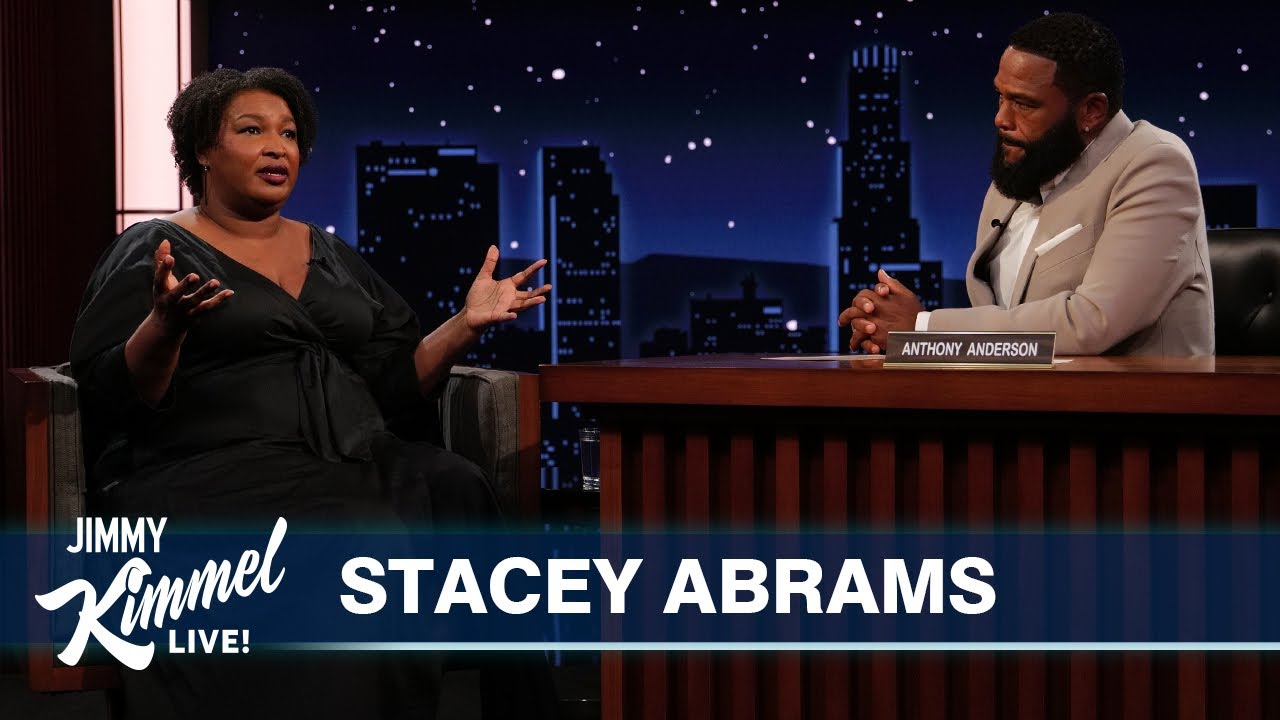
jimmy kimmel 268,978 views Jul 7, 2025 2:13 START NO NOTES
Former Georgia State Rep Stacey Abrams talks to Guest Host Anthony Anderson about serving as Minority Leader, her video with the “10 Steps to Autocracy” going viral
2 min in
from
Step 1: You have a free and fair election—but it’s the last one. Because once that person wins, they have no intention of letting go of power. Not for anyone. Not ever.
Step 2 :They exceed the bounds of executive power. You’ll see a flurry of executive orders, each one claiming new and expansive authority that goes well beyond what the Constitution allows.
Step 3 :They weaken competing powers. Congress forgets it has a job to do. The judiciary becomes either complicit or irrelevant—because courts don’t have enforcement power. If the executive stops playing by the rules, the judiciary can’t force them to.
Step 4 :They gut the government. Fire the experts. Dismantle agencies. Break public trust in the institutions people rely on every day—until democracy no longer feels worth defending.
Step 5: They install loyalists. Not public servants. Loyalists. People who will follow orders, not the law. People who won’t hire anyone who dares to think independently. And they place them in powerful positions across the system.
Step 6 :They go after the media. First, they demonize and discredit legitimate journalism, so the public loses trust. Then they build an echo chamber, pumping out propaganda and calling it truth—even when it’s not. Especially when it’s not.
Step 7: They pick scapegoats and weaponize DEI because it protects us. Women. Children. People of color. Immigrants. The disabled. Anyone who looks or thinks differently becomes the villain. It’s intentional. Because if we’re fighting each other, we’re not fighting for democracy.
Step 8: They target civil society that exists to defend our rights. Sue the lawyers. Attack philanthropies. Dismantle universities. Smear community organizers. Undermine the very people doing the work to hold the line.
Step 9: They incentivize private violence. Maybe they send in the National Guard or militarize federal agents. Maybe they abduct protestors or arrest elected officials in the opposition. The goal is the same: make people afraid to speak up. Make civic participation feel dangerous. Make silence feel safer than truth.
Step 10: And then—it’s over. Step 10 is the endgame. You make sure no one ever votes again. Because now, people are scared. They’re poor. They’re exhausted. And the autocrat has all the power.
---
colbert called out z on reframe of epa mission BS
mma
How Fox manufactured legitimacy for Zeldin’s destructive climate and environmental rollbacks
Special ProgramsClimate & Energy
Written by Evlondo Cooper
Research contributions from Harrison Ray
Published 03/13/25
Environmental Protection Agency Administrator Lee Zeldin has used his extensive appearances on Fox News and Fox Business to justify freezing environmental programs and slashing climate-related funding. A Media Matters analysis found that Zeldin has made at least 22 appearances on cable news since his confirmation on January 29, with 21 of those on Fox networks.
This pattern of strategic media appearances has enabled the Trump administration to reframe essential climate initiatives as corrupt and wasteful while avoiding substantive media scrutiny of its climate and environmental rollbacks, shielding it from the consequences of these harmful policy shifts. Moreover, Zeldin has used these appearances to create a feedback loop in which harmful narratives aimed at climate funding are repeatedly echoed by Fox personalities until they become conventional wisdom across the network.
Fox provided Zeldin a shield from scrutiny, echoing past Trump EPA media strategies}:
- Zeldin's Fox-heavy strategy has allowed him to avoid tough questioning and push misleading talking points without rebuttal. Zeldin's Fox appearances have been largely friendly and laudatory, with hosts rarely probing the consequences of cutting climate and environmental programs or challenging his characterization of climate initiatives as wasteful.
- Zeldin made at least 21 appearances on Fox News and Fox Business since his confirmation on January 29, including 2 appearances each on Varney & Co., The Story with Martha MacCallum, Mornings with Maria, and Sunday Morning Futures. He has appeared on The Ingraham Angle at least 3 times. This approach directly echoes former Trump EPA Administrator Scott Pruitt, who in 2017 appeared on Fox News twice as often as he did on CNN, MSNBC, ABC, CBS, and NBC combined. Media Matters, [8/15/17]
- During his sole CNN appearance during the studied period, Zeldin faced direct questioning about specific EPA actions and workforce reductions — a stark contrast to his numerous Fox appearances, where such scrutiny was consistently absent. This emerging pattern resembles the approach of Pruitt, who overwhelmingly favored conservative media outlets during his tenure at the EPA. CNN, *CNN Newsroom*, [2/4/25; Mother Jones, 7/14/17; Media Matters, 8/15/17]
- On March 12, Zeldin announced the most aggressive environmental rollbacks in EPA history, including rescinding pollution regulations and eliminating environmental justice programs, framing these actions as essential to lowering energy costs despite the widespread environmental and public health risks. Under his leadership, the agency has also moved to repeal the endangerment finding which underpins federal climate regulations, proposed slashing EPA staff by 65%, and paused the implementation of key pollution rules limiting “forever chemicals” in Americans’ drinking water. Fox has largely failed to ask Zeldin about these major actions. The New York Times, [3/12/25; The New York Times, 2/20/25; Inside Climate News, 2/16/25; Reuters, 2/27/25; Union of Concerned Scientists, 1/21/25; The Associated Press, 2/27/25; Inside Climate News, 3/2/25; Bloomberg Law, 3/10/25]
- ## With Fox’s help, Zeldin framed EPA policy rollbacks as economic necessity
- Zeldin and Fox hosts repeatedly framed environmental deregulation as a purely economic decision, shifting the conversation away from environmental protection to discussions of government efficiency and business growth.
- During Zeldin’s appearance on the February 25 episode of Varney & Co., host Stuart Varney pivoted the conversation toward the administration’s efforts to “speed up the permitting process for companies investing in America” over a chyron reading “EPA prioritizes deregulation, promotes investments.” Fox Business, *Varney & Co.*, [2/25/25]
- During Zeldin's February 27 interview on The Evening Edit, host Elizabeth MacDonald characterized his EPA cuts as focusing exclusively on eliminating “this shocking amount” of wasteful government spending, saying: “You are working to cut EPA spending by about two-thirds because you're finding waste.” Fox Business, *The Evening Edit*, [2/27/25]
- ## Fox and Zeldin politicized climate funding to justify cuts
- Fox hosts and Zeldin reframed climate and environmental initiatives as corrupt political projects, feeding into Fox’s larger misinformation loop.
- During his February 18 interview on Mornings With Maria, Zeldin bragged about canceling environmental justice funding, claiming federal grants were directed toward “left-wing ideologues” instead of addressing legitimate environmental concerns for communities in need. “It’s absolutely incredible,” Bartiromo said, demanding, “What were the Biden officials doing other than being asleep at the wheel?” Fox Business, *Mornings with Maria*, [2/18/25]
- Speaking with host Maria Bartiromo during the February 23 episode of Sunday Morning Futures, Zeldin suggested that grant recipients were selected based on political connections rather than merit and stated, “It’s a clear-cut case of waste and abuse. The entire scheme is criminal, in my opinion.” Fox News, *Sunday Morning Futures*, [2/23/25]
Zeldin used his Fox appearances to create a feedback loop in which these talking points were introduced, echoed by hosts, and then repeated in later segments — laundering false claims and misleading narratives into conventional wisdom spread across Fox networks.
- ## Fox provided a platform for Zeldin to inject, recycle, and amplify misinformation about climate programs
- A key example is Zeldin's misleading claim that $2 billion in climate funds were improperly awarded to an organization linked to Democratic politician Stacey Abrams, implying she personally received EPA funds. (Abrams was senior counsel for Rewiring America, a member of the Power Forward Communities coalition; there is no evidence she personally received EPA grant funds.) This specific accusation targeting Abrams later evolved into broader claims characterizing all climate funding as corrupt political payoffs to Democratic allies and donors, demonstrating how targeted accusations expanded into wholesale attacks on climate and environmental programs.
- February 18: Zeldin planted the seed for his attack on Abrams on America Reports, claiming that Biden's EPA structured the grants around “drastically reducing accountability and oversight” and alleging that it included "$20 billion going out the door up front." He framed protests against federal spending cuts as proof that “a lot of left-wing organizations … are beneficiaries of the money.” Fox News, *America Reports*, [2/18/25]
- February 20: On The Ingraham Angle, host Laura Ingraham explicitly suggested that Abrams criticized cuts to federal agencies because she personally received government funds, stating, “She’s worried about them getting DOGE’d — maybe it's because she was profiting from the EPA,” over a chyron reading “Stacey Abram’s Slush Fund.” Zeldin reinforced the claim, emphasizing that Power Forward Communities received $2 billion in grants after Abrams' affiliated group had only received $100 the previous year. He framed the funding as corrupt and implied mismanagement, further fueling the broader narrative that climate funding was being funneled to Democratic allies. Fox News, *The Ingraham Angle*, [2/20/25]
- February 21: Fox News’ Special Report repeated this framing of the EPA’s climate funding, with correspondent Steve Harrigan reporting, “Lee Zeldin claims the money was basically a slush fund to reward left-wing political groups, including one where Georgia Democrat Stacey Abrams worked as senior counsel.” Fox News, *Special Report*, [2/21/25]
- February 23: Zeldin sharpened the claim on Sunday Morning Futures, suggesting that the organization receiving the funds had no track record of handling large budgets. “This group in 2023 only received $100,” he claimed. “This isn't even like it’s a longtime group that has some reputation of handling large budgets. They received $2 billion in 2024.” Fox News, *Sunday Morning Futures*, [2/23/25]
- February 26: Fox & Friends enabled Trump administration officials to amplify the claim, with White House press secretary Karoline Leavitt telling viewers: “You look at what Lee Zeldin has found at the EPA — $20 billion that the Democrats pushed out the door in the final weeks of Joe Biden’s presidency, $2 billion of that went to an NGO that was run by Stacey Abrams. So there is real fraud taking place in our federal government.” Fox News, *Fox & Friends*, [2/26/25]
- March 6: Zeldin reiterated the claim on Jesse Watters Primetime, broadening it further: “It's going to people who are in the Obama and Biden administrations, it’s going to donors.” He added, “It's not going directly to remediate that environmental issue, to deliver clear air, land, and water. It's billions — tens of billions of dollars — going through their friends.” Fox News, *Jesse Watters Primetime*, [3/6/25]
- March 12: On The Ingraham Angle, the host escalated the framing of climate funding as Democratic fraud, amplifying Zeldin’s earlier claim that “$20 billion of your tax dollars were parked in an outside financial institution in a deliberate effort to limit government oversight.” She also explicitly called for criminal prosecutions, asserting that Democrats used the EPA to funnel money to political allies. Zeldin reinforced this narrative, tying his regulatory cuts — including the repeal of the Clean Power Plan 2.0 — to ending government waste, claiming that “you have self-dealing, conflicts of interest, unqualified recipients,” and alleging that a Stacey Abrams-linked group had signed agreements that “tied EPA's hands behind their back.” Fox News, *The Ingraham Angle*, [3/12/25]
- ## Fox’s propaganda shields Zeldin’s climate destruction from accountability
- Fox News has played a pivotal role in manufacturing legitimacy for the Trump administration’s climate and environmental rollbacks. By allowing Zeldin to spread questionable claims about climate funding, amplifying his misleading narratives, and repeating unverified accusations as established facts, Fox has functioned not just as a shield but as an active participant in the Trump administration’s attempts to reframe climate funding as corruption and environmental deregulation as necessary reform.
At the same time, Fox hosts consistently failed to challenge Zeldin on policy rollbacks targeting key environmental protections. Despite appearing on Fox twice after the Supreme Court’s March 4 ruling weakening the Clean Water Act, Zeldin was never asked about how the decision could impact the EPA’s ability to regulate pollution. Similarly, Fox did not press Zeldin on reports that he urged the Trump administration to reconsider the endangerment finding, the EPA’s determination that “planet-warming greenhouse gases endanger public health and welfare,” which forms the legal basis for regulating emissions.
This strategy doesn’t just obscure policy impacts — it actively misleads the public. By laundering misinformation through repetition and friendly framing, Fox creates an echo chamber in which attacks on climate programs are treated as fact while the real-world consequences of slashing climate funding are ignored, effectively shielding Zeldin from accountability for the full scope of his EPA agenda.
As the Trump administration advances its fossil fuel agenda, from gutting the Clean Water Act to dismantling the legal foundation for climate regulation, Fox's selective coverage ensures that the consequences of these policies remain hidden from public scrutiny — allowing the real impacts of these destructive environmental rollbacks to remain largely unexamined.
- :{## Methodology...
---
https://www.alternet.org/2020/10/william-barrs-bogus-voter-fraud-claims-are-part-of-a-long-history-of-republican-voter-suppression-reporter
alex h
With one national poll after another showing President Donald Trump losing to former Vice President Joe Biden in November, the president and Attorney General William Barr continue to obsess over "voter fraud." They baselessly claim the crime is promoted by mail-in voting, despite its history as a reliable practice. Journalist Pema Levy pointed out that Barr's actions are part of a long a seedy history in an article published in Mother Jones this week, describing them as thinly veiled attempts at voter suppression.
"A pattern has emerged in recent years that's easy to spot," Levy explains. "Right before an election, Republican officials in battleground states announce voter fraud investigations. The goal is obvious: suppressing turnout. But what's new this year is that this underhanded tactic is being employed by the president and the Justice Department."
Levy cites Georgia Gov. Brian Kemp as an example of a Republican who has used bogus voter fraud claims to suppress turnout, recalling that only two days before the 2018 midterms, Kemp — who was Georgia's secretary of state before becoming governor — "came out with an explosive announcement: he was investigating the state Democratic Party for attempting to hack into the state's voter registration system."
"At the time, Kemp was both the state's top election official and the Republican nominee for governor in a dead-heat race against Democrat Stacey Abrams," Levy notes. "Kemp had a history of bogus voter fraud allegations against his political opponents, and many recognized the brazen tactic this time. Election law expert Rick Hasen called it 'perhaps the most outrageous example of election administration partisanship in the modern era' and 'banana republic stuff.'"
But in May 2020, Levy adds, Georgia's Republican attorney general "confirmed what was suspected all along: there was no evidence of any crime." Republicans, Levy stresses, "have a long history of making false allegations of voter fraud, only to see their accusations fall apart once scrutinized. But airing such charges right before an election threatens to destabilize and delegitimize it."
This year, according to Levy, one is seeing "an increase in fraud allegations from the Justice Department itself — and it appears to be part of Barr's ongoing effort to transform the (DOJ) into an arm of the Trump campaign, ready to engage in a longstanding GOP voter suppression tactic."
Barr, Levy warns, is showing that he is ready to "possibly aid the Trump campaign's legal efforts to get ballots tossed during the vote-counting process."
When the U.S. Senate confirmed Barr as U.S. attorney general in 2019, Levy recalls, he was hailed as "by-the-book institutionalist" — only to show how much of a Trump loyalist he was when he "misrepresented" the findings of former Special Counsel Robert Mueller's Russia investigation and "interfered" in the DOJ's investigation of long-time Trump ally Roger Stone. And during this year's presidential election, Levy predicts, Barr will to do whatever he can to help Trump win reelection.
"Since Barr has torched his credibility," Levy writes, "any allegations of fraud emanating from the Justice Department in the coming weeks should be viewed skeptically. Barr is using an old playbook. You've been warned."
an 620
ProPub
===
https://www.alternet.org/2020/02/something-really-rotten-heres-the-evidence-of-extensive-voter-suppression-in-georgias-notorious-2018-election/
no lnx
‘Something really rotten’: Here’s the evidence of extensive voter suppression in Georgia’s notorious 2018 election
Written by Common Dreams February 28, 2020
As the 2020 presidential campaign cycle grinds on, there’s renewed concern about the 21st century’s newest form of warfare: cyber-sabotage of government systems, including elections and online disinformation intended to incite unrest. But as Suppressed: The Fight to Vote, a documentary from Brave New Films, makes clear, partisan voter suppression tactics with 20th-century roots remain and can thwart multitudes of voters from changing their state’s political leaders.
Suppressed: The Fight to Vote revisits the most visibly unfair election of 2018: the race for Georgia’s governor between Republican Brian Kemp—then Georgia secretary of state and supervisor of its election apparatus—and Democrat Stacey Abrams, an ex-state legislative leader and voting rights activist who led one of the most vibrant grassroots campaigns seen in Georgia in many years.
The election, which put Kemp in the governor’s seat and which Abrams did not concede, is a showcase of how legal technicalities and opaque bureaucracy ended up discouraging, disqualifying, and disenfranchising purple-state voters who sought a regime change.
“Pull back that veneer [of legal but opaque rules and officials who didn’t help voters], and you see something really rotten happening,” Carol Anderson, chair of African American Studies at Emory University in Atlanta, says as the film opens. “It’s almost like termites coming in. They’re in the wood. They’re eating the wood away. And you don’t even realize your house is getting ready to collapse until it’s almost too late.”
Suppressed’s storyline starts earlier in the decade. In 2013, a GOP-appointed majority on the Supreme Court gutted the core enforcement provision in the federal Voting Rights Act of 1965. Its opinion said that racism in American society had passed. Thus, states and counties that had histories of racial discrimination in elections no longer needed to have any change in election laws and procedures vetted by the U.S. Department of Justice.
As Suppressed and many voting rights groups have noted, numerous red-run states that play outsized roles in national elections quickly implemented mundane-sounding, overly bureaucratic—but, as Anderson says, “lethal”—rules to suppress Democratic voting blocs. (The documentary cites Alabama, Arkansas, North Carolina, Ohio, Kansas, North Dakota, Michigan, Wisconsin and Georgia as targets of suppression.)
This history has been told before, but there is an undeniable power with seeing the faces and hearing the words of people who personally bore the brunt of a menu of suppressive tactics—people who are predominantly non-white. One cannot help but note that race and party are almost always synonymous in Georgia, as they are across much of America.
The documentary follows a chronology that peels back layers of GOP-led suppressive tactics, starting with those that laid a foundation for disqualifying Democratic voters. These include efforts to close longtime polling places in predominantly black and lower-income neighborhoods in locales such as Randolph County, Georgia, which, in a rare glimmer of hope, saw the local populace reverse those poll closures. “The incident that we experienced threw the spotlight on everything else that had been going on,” Bobby Jenkins, a retired superintendent of schools, said. As the film notes, since 2012, Georgia has closed 214 polling places, with 75 percent of closed polls in African American communities.
The “everything else” that Jenkins refers to begins with the starting line of the voting process for individuals: voter registration. The voices of people who were infrequent voters but who received postcards saying that they could be taken off of county rolls followed. That little-understood process of purging rolls is legal, but not mandatory, under the 1993 National Voter Registration Act. Nonetheless, the intended recipients were confused, including seniors who started voting in the 1950s civil rights and the 1960s voting rights movements.
When these Georgians and others submitted more than 53,000 paper registration forms to county officials working under Kemp—instead of going online to register or to update their voter file information—they later found out that there was no state law requiring their applications be processed before the election that they wanted to vote in—2018’s governor’s race. That fall, crowds of otherwise eligible voters did not get a ballot.
There were other disqualifying moves that were legal but unethical. Thousands of infrequent voters were removed from official rolls because they hadn’t voted recently. Other voters were delisted because there were discrepancies in the spelling of their names in the state’s databases—notably driver’s license records did not match voter registration files. Other people were delisted if their mailing address and the address on their voter registration (their domicile for voting purposes) wasn’t the same—including soldiers in overseas war zones.
Again and again, the vast majority of those affected were from communities of color, not Georgia’s better-off white communities. One can argue, as Republicans have, that it is a voter’s responsibility to know the fine print of the process and to satisfy it. But the film makes clear that county election boards following Kemp’s directives were not offering customer service to voters—or, later, helping voters to cast ballots that got counted.
Similar barriers were seen with people seeking to vote by mail, but who never received an absentee ballot. The film notes that more than 280,000 people wanted to vote by mail, but “tens of thousands did not receive them.” The documentary has people recounting their phone calls to local election officials, who, in turn, replied that their request for an absentee ballot had been received, but they didn’t know where their ballot was.
The hurdles kept coming. When it came to voting in precincts on Election Day, many precincts in communities of color did not have enough voting machines compared to precincts in white communities. That shortage, atop delays caused when people learned that they weren’t listed on voter rolls—and protested—caused long lines to form. Many voters had to wait for hours. In some cases, people had to leave to take care of their family members or go to work.
When voters who were not on the rolls insisted on voting, they were given provisional ballots. These are ballots that combine registration information with a regular ballot. But the state requires those voters to return to county election offices within a few days with other ID before those votes are counted. For some people, doing that means lost wages, which is akin to a modern poll tax—the 19th-century practice of forcing black people to pay to vote.
These microaggressions kept coming and cascading. The film shows the grassroots energy of Abrams’ campaign, which was history-making when compared to past Georgia elections. Never before was the state poised to elect an African American woman as governor. But come election night, the results reported Kemp leading by more than 50,000 votes.
Abrams would not concede the race.(Afterward, her advocacy group, Fair Fight, filed one of the most comprehensive voting rights lawsuits in recent years to redress a catalog of suppressive tactics.) The film closes with Abrams’ defiant press conference that came after post-election challenges did not find enough votes for her. Recovering 50,000 votes is unheard of in post-election challenges.
“I acknowledge that former Secretary of State Brian Kemp will be certified as the victor in the 2018 gubernatorial election,” she said. “But to watch an elected official baldly pin his hopes for election on the suppression of the people’s democratic right to vote has been appalling. This is not a speech of concession, because concession means to acknowledge an action is right, true or proper. As a woman of conscience and faith, I cannot concede that.”
Suppressed: The Fight to Vote briefly continues to make the point that these partisan suppressive tactics are not unique to Georgia. The documentary is more than a cautionary tale about voter suppression in one state that, had elections been fairer, would be politically purple as its populace has become more multiracial. The film is a reminder that in 2020 there are many ways to tilt the playing field to game election results.
Many of those suppressive tactics have been around for decades and endure because they are effective. These tactics have nothing to do with Russians or cyber-sabotage. They are as old as America itself—but the victims, as Brave New Filmshas shown so vividly, are ordinary Americans who believe in democracy’s promise but typically are non-whites.
Steven Rosenfeld is the editor and chief correspondent of Voting Booth, a project of the Independent Media Institute. He has reported for National Public Radio, Marketplace, and Christian Science Monitor Radio, as well as a wide range of progressive publications including Salon, AlterNet, the American Prospect, and many others.
===
palast fresno talk 2019
https://kpfa.org/episode/upfront-october-16-2019/
hired by stacey abrams effort
===
Georgia GOP senator will resign at end of year, setting off a crucial 2020 special election
In huge news for the battle for the Senate , Georgia Republican Johnny Isakson announced Wednesday that he would resign from the chamber at the end of 2019 because of health reasons.
==
https://www.alternet.org/georgias-kemp-calls-stacey-abrams-disgrace-democracy-refusing-concede-while-votes-are-being-counted
==