Voting Machines
this is /will be general category about manipulation eg cyber hack
see disenfranchise
gerrymander
votingmach218
1119 bak
SEE SMARTMATIC
SEE HUGO CHAVEZ GHOST/KRAKEN
see ES&S pvt equity 2020
see ossoff
voter ID
experts say most cyber secure election ever, so trump may fire krebs/kreps sp
:{
}:
EASTMAN justifies election fuckery b/c deep state , also sayssecret compartment of bogus votes in machines GUK
https://www.alternet.org/2020/12/voting-2020/
After initially focusing on the surprisingly lopsided results of the senatorial election in Kentucky, DCReport broadened our scope to look at the electronic vote-counting software and electronic voting systems that we rely on to tally our votes. This prompted us to raise questions about Electronic Systems & Software (ES&S), America's largest voting machine company. What we found was a revolving door between government officials and ES&S.
Voting results in three states that saw surprising majorities by vulnerable incumbent Republican senators—Maine, North Carolina and South Carolina—were almost all tabulated on ES&S machines.
Trump and his inept legal team have barely mentioned ES&S, focusing almost exclusively on Dominion Voting Systems.
Rudy Giuliani, Sydney Powell and Fox hosts have been making such bold and naked claims against the ES&S competitors, without any substance or evidence, that Fox News, NewsMax and OAN have all been threatened with litigation unless they fully retract their claims and correct a number of egregious factual errors.
Team Trump has been so vigorous in going after Dominion that it prompted us to look into how ES&S operates. What we have found so far is far from comforting.
- Owned by a private equity firm, ES&S has been elusive about identifying the people in its ownership.
- A number of ES&S executives and lobbyists have ties to top GOP election officialsand politicians.
- The ES&S executive in charge of the security previously worked in the Trump administrationas a government executive at Health and Human Services before leaving under a cloud.
- Forty of the 50 states use ES&S to cast & count some of their votes.
- Of the 25 states Trump won, all but 3 either partially or fully relied on ES&S machines. The states where Trump won that didn't use ES&S machines were Oklahoma, Louisiana, and Alaska.
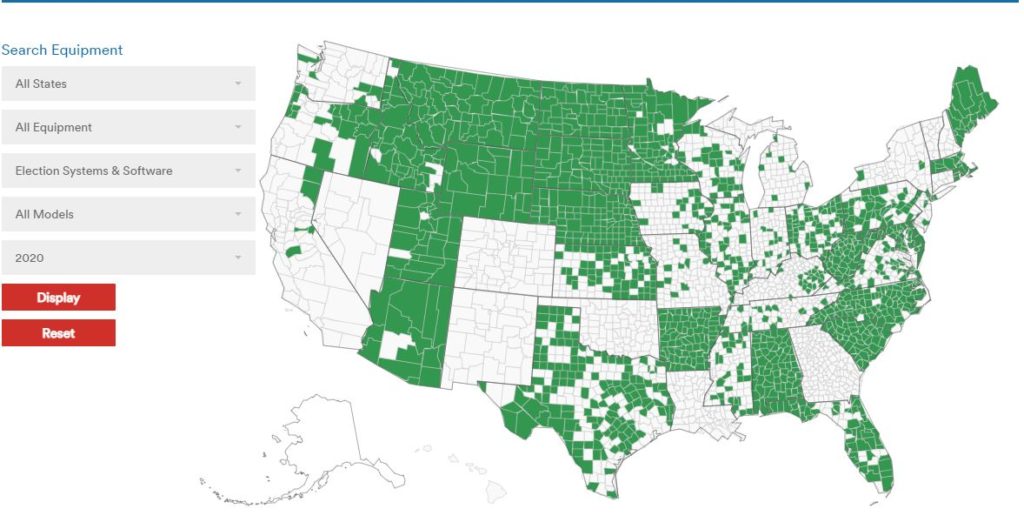 Counties that used ES&S equipment in the 2020 elections. (Verified Voting)
Concerns about the reliability of vote-counting software are not new, dating back to the 1980s. Having the ability to audit votes, and making sure ballots are counted properly, has long been a major concern of computer scientists, politicians and election officials.
In December 2019, Democratic lawmakers sought answers from those top three voting machine vendors which "facilitate voting for over 90% of all eligible voters in the United States."
Three separate letters were sent to the private equity firms who "reportedly own or control each of these vendors, with very limited 'information available in the public domain about their operations and financial performance.' "
Elections at Risk
In the second letter, addressed directly to the McCarthy Group, the private equity firm that owns ES&S, lawmakers wrote that "voting machines are reportedly falling apart across the country, as vendors neglect to innovate and improve important voting systems, putting our elections at avoidable and increased risk."
In requesting details about the ownership of ES&S, the lawmakers specifically noted "we are particularly concerned that secretive and 'trouble-plagued companies,' owned by private equity firms and responsible for manufacturing and maintaining voting machines and other election administration equipment, 'have long skimped on security in favor of convenience,' leaving voting systems across the country 'prone to security problems'."
DCReport placed numerous calls and emails to ES&S at its headquarters on John Galt Boulevard in Omaha. Only once was the phone answered by someone who would not put us through saying "they are not going to be able to talk to you.". DCReport was directed to ES&S's website. DCReport submitted the form repeatedly but got no reply.
Understanding the Software
Our democracy now relies on private companies, which build proprietary electronic systems, to reliably count our votes. It seems reasonable, if not crucial, to understand who is behind these companies as a standard to ensure election integrity. Without such knowledge, we run the risk that zealots, or investors with a financial stake in who wins elections, or those susceptible to bribery, have an incentive to use subtle software programming techniques to deliberately miscount votes to guarantee an outcome. In close elections, software code that invalidates or miscounts a mere sliver of ballots can change the outcome.
One of our concerns is ES&S providing junkets and gratuities to election officials, as uncovered in June 2018 by McClatchy newspapers. For at least 11 years, the voting equipment and software company curried favor with election officials by paying for trips to Las Vegas, tickets to shows and gifts.
"As many as a dozen election officials" attended a meeting in Las Vegas, with a number of them accepting airfare, lodging, and meals, McClatchy reported. A company spokeswoman told McClatchy that the junkets were "immensely valuable in providing customer feedback. One of our key results is customer satisfaction, and this is how we achieve that."
Marci Andino, the current executive director of the South Carolina State Election Commission, received more than $19,000 worth of flights, hotels and meals from ES&S since 2009, according to South Carolina Ethics Commission disclosure forms.
Andino's influence extends beyond the Palmetto State. She is also a member of the U.S. Election Assistance Commission's Standards Boardand has testified on election issues. She is a former President of the National Association of State Election Directors (NASED). To have an election official tied to a voting company creates concerns about conflicts.
Executives with Political Ties
DCReport also looked into the careers of some key ES&S executives. What we found is concerning.
Kathy Rogers, ES&S's senior vice president for government affairs, landed at ES&S after controversy over her work as a Georgia state elections official. She opposedlegislation trying to ensure vote counts could be verified.
In 2019, The New Yorker wrote about her actions in "How Voting-Machine Lobbyists Undermine the Democratic Process."
"In 2006, a bill requiring a verifiable paper record of each ballot, introduced in the Georgia legislature at the urging of election-integrity advocates, failed after the state's elections director, Kathy Rogers, opposed it," the magazine reported.
Georgia used ES&S machines in 2018 but now relies on Dominion equipment.
Georgia's 2018 gubernatorial race is noteworthy because it was overseen by Brian Kemp, who was then in charge of Georgia elections as secretary of state. That year, Kemp also ran for governor while overseeing his own election, a conflict of interest that he dismissed.
Kemp won a narrow victory over Democrat Stacey Abrams, but only after his office blocked 53,000 voter registration applications using a "strict" name matching protocol comparing state records to voter registration forms.
Kemp's Conflicts
Registrations were tossed if, for example, a person used a first name, middle initial and last name, on one form, but then used all three names in full on another. This invalidated a huge number of voter registration applications under Kemp's policy.
After Kemp won, a federal judge declared that Georgia had to implement a completely new voting system in time for the 2020 elections, replacing what the judge called "unsecure, unreliable and grossly outdated technology." Kemp tried to keep using the ES&S equipment for future elections, prompting Peach State Democrats to assert cronyism in the Kemp administration.
In January 2019, the Georgia Democratic Party challenged the integrity of voting machines that did not create an auditable paper trial, a policy he pursued through the creation of the Secure, Accessible & Fair Election or SAFE Commission.
The Democrats demanded a delay on recommendations for a new voting system "following the discovery that a leading vendor under consideration, whose machines are currently being investigated in a lawsuit due to errors in the 2018 election, has deep connections to Brian Kemp's office". That vendor was ES&S. The deep ties were due to Kemp having hired a longtime associate who was a registered lobbyist for ES&S.
As Politico characterized it at the time: "Georgia likely to plow ahead with buying insecure voting machines." It also reported that "Critics argued that the bill appeared to be written with one vendor in mind: the voting technology giant Election Systems & Software, whose former top lobbyist, is now Kemp's deputy chief of staff."
How many other states are conducting elections on "grossly outdated" or otherwise unreliable ES&S technology in 2018 and in 2020? This is an issue we are still investigating.
In Georgia, it was Brad Raffensperger, a Republican who succeeded Kemp as the elections overseer, who announced Dominion Voting Systems as the new elections vendor.
A Clean Election
The most recent Georgia election seems to be the first election in recent Georgian history not marred by voting-machine controversy other than Trump's nakedly false claims of vote stealing and corruption aimed at Republican Raffensperger.
The 2020 voting took place on a new system with an auditable paper ballot system. Three recounts, including an audit requiring "roughly 5 million votes in that contest to be recounted by hand" and as Secretary of State Raffensperger stated, showed results as close as imaginable.
"We have now counted legally cast ballots three times, and the results remain unchanged," Raffensperger said. Furthermore, a Judge declared Trump's legal team produced "precious little proof" in their pleadings.
ES&S's revolving door policy means its lobbyists taking top government official positions as well as government political appointees becoming ES&S executives.
One of these is Chris Wlaschin, who left the Trump Administration in March 2018. He was the chief information security official in the Health & Human Services Department. A few weeks later he landed at ES&S as "its new vice president of systems security responsible for the company's security efforts."
HHS to ES&S
Wlaschin abruptly left the Trump administration after HHS Secretary Alex Azar received a letter from a lawyer representing two HHS executives. The letter asserted that Wlaschin had improperly removed the pair and cited an eye-popping false claim Wlaschin used to justify disciplinary action.
"Mr. Wlaschin has stated that my clients were removed from their positions in order to protect an ongoing OIG investigation," wrote lawyer I. Charles McCullough, a former Inspector General for the National Security Community.
"You can, therefore, imagine the shock and surprise of my clients when they were both recently advised, unequivocally and categorically, by senior investigators from the HHS OIG, that neither of them are currently or were at any time in the past under investigation" by the inspector general's office, McCullough wrote.
The letter was dated March 12, 2018. Wlaschin's resume says he joined ES&S the next month.
The integrity of voting systems, and especially the ability to audit vote counts, has been the subject of public debate for more than four decades. But most of the recent attention has been focused on one company, Dominion Voting Systems, most recently because of frivolous lawsuits filed by Trump lawyers Rudy Giuliani and Sydney Powell and others. But is that simply a distraction.
We think the issue of who counts our votes, how they are counted, and what ties the companies selling these systems have to politicians deserves more attention. Politicians who must win elections, in order to wield power, must not be able to exert influence on the companies we rely on to tally our votes. We need serious scrutiny over our elections so we can be assured that they represent the will of the people, not of the politicians themselves, and the companies they hire to process our ballots.
FROM YOUR SITE ARTICLES
- Many new US voting systems for 2020 show troubling signs they ... ›
- Pre-Election Day voting already shattering past election statistics as ... ›
- The Ohio primary just raised a new red flag for the 2020 election ... ›
- Republicans have a friend in the company that counts their votes - Alternet.org ›
RELATED ARTICLES AROUND THE WEB
- Presidential Election Results and Electoral Map 2020 ›
- Everything You Need to Vote - Vote.org ›
- Voter turnout in 2020 election: U.S. has record turnout - Washington ... ›
https://www.alternet.org/2020/12/mitch-mcconnell-re-election/
no lnx
many maps tables
Busted? Why the numbers behind Mitch McConnell's re-election don't add up
Mitch McConnell slammed for repeatedly sabotaging stimulus negotiation efforts
Meaghan Ellis
DC Report December 19, 2020
On a Thursday in August in Louisville, months before the 2020 election, a parade of cars filled with Kentucky Teamster representatives and labor groups, showed their fury at Mitch McConnell's constant blocking of critical COVID aid. They drove by McConnell's office raucously honking and bearing signs saying "Mitch better have my money."
In 2017, a Public Policy Polling Survey asked Kentuckians, "Do you approve or disapprove of Senator Mitch McConnell's job performance?" Only 18% approved. He clawed his rating back up to 39% on the eve of the election.
McConnell, leader of Senate Republicans, rarely holds town hall meetings with Kentucky voters—not since a heated exchange with an angry constituent went viral.
1 out of 5 voters appear to have filled out their ballots with votes for both the female Democratic Amy McGrath and the Republican pussy-grabber Donald Trump.
So, what exactly drove these angry Kentuckians to reelect Mitch McConnell with a 19-point advantage over opponent Amy McGrath—57.8% to 38.2%?
Even as Republicans across the country still insist that the election was rife with fraudulent Democratic votes, no one's asking how McConnell managed one of the most lopsided landslides of the Nov. 3 election. They should. An investigation of Kentucky voting results by DCReport raises significant questions about the vote tallies in McConnell's state.
McConnell racked up huge vote leads in traditionally Democratic strongholds, including counties that he had never before carried.
There were wide, unexplained discrepancies between the vote counts for presidential candidates and down-ballot candidates.
Significant anomalies exist in the state's voter records. Forty percent of the state's counties carry more voters on their rolls than voting-age citizens.
Kentucky and many other states using vote tabulation machines made by Election Systems & Software all reported down-ballot race results at significant odds with pre-election polls.
[caption id="attachment_21747" align="aligncenter" width="625"] The 2020 Kentucky U.S. Senate election results map[/caption]
DCReport focused on the results in three counties in eastern Kentucky's Appalachian Mountains, two of which Democrats usually always win, but similar patterns emerge in other counties across the state. Even in counties that voted overwhelmingly for Democrats as recently as the 2019 gubernatorial election, there were a staggering number of Democrats voting Republican in 2020.
In rural Breathitt County, for instance, there are 9,508 registered Democrats and just 1,599 registered Republicans. The county has a history of close contests, but Amy McGrath got only 1,652 votes versus 3,738 for McConnell, a 67% to 29% trouncing. McGrath's votes, if accurate, equaled only 17% of registered Democrats in Breathitt County.
Conventional political wisdom in McConnell-land holds that these days "ancestral Kentucky Democrats" vote Republican, and analysts shouldn't correlate party registration with voting patterns. But simply dismissing any anomalies based on anecdotal hearsay ignores the data and other possible explanations. McConnell won Breathitt County in 2020 with 1,308 more votes than he received in the county's much closer 2014 race, which he won by fewer than 400 votes. The 2019 governor's race was also a squeaker in Breathitt County, but Democrat Andy Beshear eked out a 69-vote victory. Beshear won the race statewide.
McConnell's results were even more out of whack in two other nearby Appalachian counties. In his six previous Senate elections, Elliott and Wolfe counties had never voted for McConnell. Even up to last year, Elliott County remained reliably Democratic in non-presidential races, voting for the party's entire Democratic slate in both the 2015 and 2019 statewide elections. Yet in 2020, McConnell won 64% of the votes in Wolfe County and 66% of the votes in Elliott County. McGrath only got 21% of registered Democrats in Wolfe and 20% in Elliott.
Next, take the premise that there would be some basic logic in the voting patterns of those who did vote Democratic. One might expect a registered Democrat, who's going to vote Democratic, would walk into the booth and cast their vote for both Joe Biden and Amy McGrath. But the data tell another story. In 119 of 120 counties, Amy McGrath got more votes than Joe Biden. In some counties, the votes were close. But in counties like Breathitt and Elliott, 1 out of 5 voters appear to have filled out their ballots with votes for both the female Democratic Amy McGrath and the Republican pussy-grabber Donald Trump.
Then there is the question of why a county like Breathitt has more registered voters than it has people of voting age? 2019 population data shows that Breathitt County had 12,630 people with approximately 23% below the voting age of 18. This means approximately 9,700 people are of voting age, yet there are 11,497 registered voters. Having 100% of the voting-age population registered would be astounding enough, but Breathitt County appears to have almost 120% more registered voters than age-eligible citizens. And looking further, it appears this is not limited to Breathitt.
In November 2017, Judicial Watch, a right-wing non-partisan foundation promoting transparency, sued Kentucky over its "Dirty Voter Rolls" and its failure to maintain accurate voter registration lists.The suit argued that 48 of the 120 Kentucky counties had more registered voters than citizens over the age of 18 and alleged that Kentucky was one of only three states with a statewide active registration rate greater than 100% of the age-eligible citizen population. Kentucky's inflated voter rolls, and lack of transparency, provide a perfect cover for malfeasant behavior regarding the election results.
Turning an 18% approval into a 58% win may seem like a "turning water into wine"-style miracle, but a "smoke & mirrors" parlor trick seems more likely. To better understand how the data could have been manipulated, look no further than Trump's own legal filings. In an incompetent post-election lawsuit, the Trump team may have intended to accuse Democrats of election fraud, but in describing a possible plot, they attributed the cheating to Trump himself.
In a Dec. 4 filing in Georgia, Trump's legal team referred to a "machine-controlled algorithm deliberately run" by a voting machine vendor, Dominion Voting Systems. They allege this algorithm "generally took more than 2.5% of the votes from Mr. Biden and flipped them to Mr. Trump." So Trump's own legal team, instead of providing evidence of fraud by Biden's side, may have inadvertently revealed fraud benefiting Trump. In describing a deliberate, vendor installed, machine-controlled algorithm automatically taking a percentage of Biden's votes and giving them to Trump, they certainly are outlining how fraud could have been executed.
Trump's team claims Dominion was the machine vendor embedding algorithms to "flip" votes but is Trump pointing to one machine vendor to distract from another?
In Kentucky, when looking at counties where the numbers leap out on behalf of Mitch McConnell, none used Dominion machines. Most used machines from Election Systems & Software (ES&S), a Dominion competitor. If you swap ES&S for Dominion in the alleged vote-flipping scheme, you may arrive at an alternate explanation for why Amy McGrath's numbers weren't lining up and correlating with Biden's.
To steal an election it may make sense to use different algorithms for each race on the ballot so results did not appear to be uniform. Knowing the McGrath-McConnell race faced more nationwide scrutiny, schemers might have had to miscount votes by different margins in the presidential and Senate races. Flipping more votes from Biden to Trump than McGrath votes to McConnell would explain her getting approximately 20% more votes than the Democratic presidential candidate.
Significantly, Trump and his post-election legal team have pointed at Dominion voting machines and implored courts to look into this automated vote-flipping premise—but only in states that he lost. So, let's test it in ES&S states like Kentucky where Trump won.
McConnell had his biggest percentage of registered Democrats voting Republican in counties using ES&S machines. But he wasn't the only senator to perform so well. Other Republican incumbents, whom polls indicated would have close races, had similar luck to their majority leader on election day.
Lindsey Graham's race in South Carolina was so tight that he infamously begged for money, yet he won with a comfortable 10% lead—tabulated on ES&S machines throughout the state. In Susan Collins's Maine, where she never had a lead in a poll after July 2, almost every ballot was fed through ES&S machines. Kentucky, South Carolina, Maine, Texas, Iowa and Florida are all states that use ES&S machines. Maybe the polls didn't actually get it wrong.
When Trump says "look over here" at Dominion voting machines, maybe we should look at ES&S machines instead. When Republicans spout unfounded claims that Democrats stole the election, maybe we should be looking at Republican vote totals instead. And when Trump calls this the most fraudulent election in our history, maybe he knows of what he speaks.
You can follow Alison Greene on Twitter @GrassrootsSpeak.
FROM YOUR SITE ARTICLES
John Oliver breaks down how Dems can bring the pain to Mitch ... ›
McConnell's re-election campaign slapped with FEC flag over ... ›
Mitch McConnell is leaving endangered Republican senators ... ›
McConnell advances another Trump judge as COVID relief bill remains unfinished: 'His top priority' - Alternet.org ›
'It isn't even really a stimulus': Economists lament paltry $600 checks to citizens - Alternet.org ›
RELATED ARTICLES AROUND THE WEB
Senator Mitch McConnell reelected to 7th term in Kentucky - CBS ... ›
Republican Mitch McConnell defeats Democrat Amy McGrath in ... ›
Mitch McConnell - Wikipedia ›
Why Amy McGrath could cost Republicans the U.S. Senate, even if ... ›
Mitch McConnell wins reelection in Kentucky, defeating Democrat ... ›
https://www.alternet.org/2020/11/election-conspiracy-theories/
ME
a legal scholar on Fox News attempted to spew such a baseless conspiracy theory on Friday that even the network's conservative anchors had to stop him in his tracks.
On Friday, Jonathan Turley, who famously defended the president during impeachment, appeared onFox & Friendswhere he discussed a false conspiracy theory surrounding the Dominion voting machines. According to Turley "thousands" of President Donald Trump's votes in Michigan were switched to President-elect Joe Biden in Michigan — another claim the president is pushing to undermine his election defeat to his Democratic opponent.
Turley claimed the software had been used in multiple states including "half of the districts in Michigan" as he suggested that the "vulnerable" software may have impacted the outcome of the election. However, a Fox News co-host pushed back as he noted that he also researched Trump's claim. He explained that the so-called glitch was due to human error as he emphasized that it did not impact or compromise the vote count in any way. Like Trump's arguments, Turley's claims were also confirmed to be unfounded.
Jonathan Turley falsely claims Dominion voting machines in Michigan switched "thousands" of Trump votes to Biden vo… https://t.co/K8mNZJwWQI
— Bobby Lewis (@Bobby Lewis)1605267767.0
Turley's Fox appearance comes just one day after Trump tweeted a baseless conspiracy theory about the Dominion voting software. Trump claimed hundreds of thousands of votes had been stolen from him despite having no evidence to support his claims.
“REPORT: DOMINION DELETED 2.7 MILLION TRUMP VOTES NATIONWIDE. DATA ANALYSIS FINDS 221,000 PENNSYLVANIA VOTES SWITCH… https://t.co/PgrmoBcJib
— Donald J. Trump (@Donald J. Trump)1605198840.0
Almost immediately after the president tweeted about the conspiracy, his allies and supporters followed suit. The New York Times and other fact-checkers quickly released a report striking down the conspiracy. Election technology expert, Edward Perez, also pushed back against the claims as he condemned the spreading of misinformation.
"Many of the claims being asserted about Dominion and questionable voting technology is misinformation at best and, in many cases, they're outright disinformation," said Perez. "I'm not aware of any evidence of specific things or defects in Dominion software that would lead one to believe that votes had been recorded or counted incorrectly."
Even Trump's own administration has flatly debunked these false claims.
FROM YOUR SITE ARTICLES
- How The Right's Latest Conspiracy Theory Might Unleash a Wave of ... ›
- 10 Conspiracy Theories Hatched by Conservative Fearmongers As ... ›
- Here are the 3 most insane conspiracy theories Republicans are ... ›
- Despite Trump's conspiracy claims, Dominion voting machines did ... ›
- Former Trump Intel chief warns US democracy is threatened by ... ›
- False election claims: Here is a list of the latest election rumors you ... ›
- More Republicans are piling onto conspiracy theories about vote ... ›
RELATED ARTICLES AROUND THE WEB
- Facebook and TikTok block hashtags used to spread election ... ›
- Trump Latches On To Election Conspiracy Theories As Legal Fights ... ›
- How Conspiracy Theories Are Shaping the 2020 Election | Time ›
- Election officials contradict Trump's voter-fraud conspiracy theories ... ›
trump dominion millions of votes [cia secret super computer?!]
https://www.alternet.org/2020/11/dominion-voting-systems/
===
1020 truthout
Georgia Does Not Have Enough Backup Paper Ballots Ready if Voting Machines Fail
==
https://www.alternet.org/2020/09/new-report-paints-a-disturbing-picture-of-the-kremlins-ability-to-wreak-havoc-in-the-2020-election
russkie President Vladimir Putin and the Kremlin have a preference in the United States’ 2020 presidential election, and it isn’t former Vice President Joe Biden. Efforts by Russian operatives to interfere in this year’s election — just as they interfered in 2016’s presidential election — and help President Donald Trump win a second term have been well documented. Journalist Franklin Foer, this week in an article for The Atlantic, warns that the Kremlin will be relentless this time.
:{
}:
“Events in the United States have unfolded more favorably than any operative in Moscow could have ever dreamed,” Foer explains. “Not only did Russia’s preferred candidate win (in 2016), but he has spent his first term fulfilling the potential it saw in him — discrediting American institutions, rending the seams of American culture, and isolating a nation that had styled itself as indispensable to the free world. But instead of complacently enjoying its triumph, Russia almost immediately set about replicating it. Boosting the Trump campaign was a tactic; #DemocracyRIP remains the larger objective.”
The United States’ election vulnerabilities, Foer warns, have “widened, not narrowed, during the past four years.” And Trump, according to Foer, “has dismissed Russian interference as a hoax and fired or threatened intelligence officials who have contradicted that narrative, all while professing his affinity for the very man who ordered this assault on American democracy.”
Foer is, of course, referring to Putin.
"The Russians have learned much about American weaknesses and how to exploit them,” Foer notes. “Having probed state voting systems far more extensively than is generally understood by the public, they are now surely more capable of mayhem on Election Day — and possibly, without leaving a detectable trace of their handiwork. Having hacked into the inboxes of political operatives in the U.S. and abroad, they’ve pioneered new techniques for infiltrating campaigns and disseminating their stolen goods…. Russia’s interference in 2016 might be remembered as the experimental prelude that foreshadowed the attack of 2020.”
Foer specifies some of the United States’ election vulnerabilities, observing that the U.S. has “alluring targets: the vendors, niche companies that sell voting equipment to states and localities, the employees of those governments — each with passwords that can be stolen — voting machines that connect to the internet to transmit election results.”
Putin supporters in Russia, Foer adds, could use malware to go after U.S. voter databases.
“If the Russians attached such a bug to a voter registration database, they could render an entire election logistically unfeasible,” Foer warns. “Tracking who had voted and where they’d voted would be impossible.”
Foer adds, “But Russia need not risk such a devastating attack. It can simply meddle with voter registration databases, which are filled with vulnerabilities…. Such meddling could stop short of purging voters from the rolls and still cause significant disruptions: hackers could flip the digits in addresses, so that voters’ photo IDs no longer match the official records. When people arrived at the polls, they would likely still be able to vote, but might be forced to cast provisional ballots. The confusion and additional paperwork would generate long lines andstoke suspicion about the underlying integrity of the election.”
==
touch screen corona; LA cty built own 4 yrs 300K$ small fail 3/20?
==
https://theconversation.com/internet-of-things-could-be-an-unseen-threat-to-elections-132142
==
==
an 120
Voting system CEOs agree to work with government, not independent analysts
Steven Rosenfeld / Independent Media Institute
==
an 1219
New federal money will lock in America’s next wave of voting machine technology
Steven Rosenfeld / Independent Media Insti
==
https://www.alternet.org/2019/12/russian-owned-company-caught-trying-to-hack-ohio-voting-systems-on-election-day/
no lnx
Russian-owned company caught trying to hack Ohio voting systems on Election Day
Written by Igor Derysh / Salon December 3, 2019
A Russian-owned company tried to hack the Ohio office that oversees the state’s voting systems on Election Day, according to Ohio Secretary of State Frank LaRose.
LaRose told the Columbus Dispatch that the state’s internal systems detected an “SQL injection” attack that attempted to insert malicious code onto his office’s website.
LaRose said that the attack originated in Panama but was traced back to a Russian-owned company. He downplayed the attempted hack as “relatively unsophisticated.”
“Some of these unsophisticated attacks are ways that they probe for vulnerabilities. They are poking around for soft spots,” LaRose explained.
He went on to credit the state’s “Albert” alert system that quickly identified the attack. “The good guys won that day and the bad guys lost,” he said.
LaRose said that similar attacks are designed to disrupt or undermine the credibility of elections but he is confident that hackers cannot access voting machines because they are not connected to the internet.
LaRose’s announcement came several months after Florida Gov. Ron DeSantis revealed that Russian hackers had breached the voting systems of two counties in the state in 2016, though he said there was “nothing that affected the vote count.”
That attack was first revealed in the final report of former special counsel Robert Mueller, who later testified to Congress that Russia was planning to interfere in upcoming elections “as we sit here.”
A Senate Intelligence Committee report found that Russia targeted election systems in all 50 states in 2016. The report said that Russian hackers were “in a position to delete or change voter data” in Illinois. The investigation found no evidence that they did so, but the report warned that Russian operatives may have been cataloguing options “for use at a later date.”
Though voting machines are not supposed to connect to the internet for security reasons, some machine analysts have discovered remote-access software on machines in key swing states and other flaws that could expose the systems to hacking. Motherboard recently reported that election systems in 10 different states have connected to the internet in the last year.
“Some machines that officials insist don’t connect to the internet actually do connect to the internet, and even some machines that don’t connect directly to the internet are programmed with cards that have themselves been programmed on computers that connect to the internet,” HBO host John Oliver explained on a recent edition of “Last Week Tonight.” “So your voting machine isn’t connected to the internet the same way your Alexa isn’t recording everything you say and sending it directly to Jeff Bezos. It’s totally not doing that, except for when it’s totally sometimes doing that.”
While remote hacking may be difficult, hacking experts have shown numerous times that voting machines can easily be accessed and manipulated in person. One video taken at the hacking conference Def Con showed a hacker breaking into a Diebold voting machine, a model used in 18 different states, in a matter of minutes and with no special tools.
Websites that display election results, like the Ohio Secretary of State’s website, were able to be breached by hackers as young as six years old. “Unfortunately, it’s so easy to hack the websites that report election results that we couldn’t do it in this room because [adult hackers] would find it boring,” event organizer Jake Braun told CNN.
A report by the Brennan Center for Justice released days after the conference pointed to recommendations in the Senate report that called for replacing outdated machines and requiring paper backups to secure elections. The report showed that a third of all election systems used voting machines that were more than a decade old and that one in every eight ballots in 2020 would be cast on a machine with no paper backup.
The House of Representatives approved a bill over the summer that would provide $600 million for states to buy new voting machines that would not connect to the internet and would provide paper backups. The bill was blocked by Senate Majority Leader Mitch McConnell, who had also blocked multiple Senate election security bills before agreeing to back a bill that would provide $250 million — less than half the amount budgeted in the House version — to improve states’ election security.
Senate Minority Leader Chuck Schumer, D-N.Y., called McConnell’s announcement a “start” but added that the bill doesn’t provide “all the money we requested” and “doesn’t include a single solitary reform that virtually everyone knows we need.”
“If Americans don’t believe their elections are on the up-and-up,” he said, “woe is us as a country and as a democracy.”
As Congress continues to debate how much it will ultimately spend to shore up election systems, experts warn that efforts to secure next year’s elections should have started much earlier and with more urgency.
“Right now, Russia’s security services and their proxies have geared up to repeat their interference in the 2020 election,” Fiona Hill, the former top Russia expert on the National Security Council, told the House Intelligence Committee last month. “We are running out of time to stop them.”
Igor Derysh is a New York-based political writer whose work has appeared in the Los Angeles Times, Chicago Tribune, Boston Herald and Baltimore Sun.
==
an 1119
There are concerns for 2020’: Voting machine problems in a key swing state have officials panicked about upcoming election
==
Market for Voting Machines Is Broken. This Company Has Thrived in It.
Half the country votes on machines made by ES&S. Many experts and election officials say the manufacturer remains dominant because there’s little government regulation and almost no oversight.
by Jessica Huseman
==
https://www.alternet.org/2019/09/why-a-local-showdown-over-voting-technology-in-north-carolina-is-a-harbinger-for-elections-across-america/
...
The scene unfolding on September 17 in a drab conference room in Greensboro was a microcosm of the ongoing struggle for voting rights in America. Some issues brought up by Brown and others were descendants of the civil rights struggle that, in part, had begun two blocks away at an F.W. Woolworth lunch counter, where a historic sit-in unfolded in 1960. But other issues before its county BOE concerned the near future of what ballots and counting votes will be in their city and politically divided purple state.
“It’s become more and more frequent for voters to ask, ‘How do I know that the machines have my vote correct?’” Donna Peterson, a middle-aged white resident of nearby Jamestown, asked, turning to an immediate decision facing 23 North Carolina counties. What voting system will they buy and use for the 2020 presidential primaries and in the next dozen or so years?
“I understand that [with] the ones that I think Guilford County is looking at right now, there’s a bar code that’s going to be there that people can see,” Peterson continued, referring to a new form of ballot that presents votes in bar codes and text below. “There is no way that they know that the information in the bar code is indicative of the votes that have been cast.”
Those packing the courthouse hearing and spilling into the hallway demanded, pleaded and even prayed that their county BOE would “do the right thing” surrounding voting. They wanted student disenfranchisement to stop, but the chairman delayed that discussion for two weeks. And they wanted a voting system they could trust: one where voters, not printers, marked ballots.
“Please, please don’t manipulate the process,” implored Rev. Dr. Cardes H. Brown Jr. “Please don’t try to covertly keep people from exercising their constitutional right. I beg of you. Do the right thing. Let’s have a tracking mechanism by which we can see how people have voted, so we can have confidence in our system.”
Reinventing Ballots?
Across North Carolina and in many swing counties in swing states, locales like Guilford are racing to select and deploy new voting systems before 2020. Many are replacing the paperless voting systems that were acquired 15 years ago after Florida’s fraught presidential election and recount in 2000.
Ironically, as was the case then, the most critical and controversial issues revolve around the extent to which human actions and human judgments will be preserved and made more accountable—or will be replaced and masked by computer-driven automation.
Most of the new voting systems share comparable electronics that count votes, but there is one critical variable. Some allow voters to hand-mark a paper ballot, while others use software to mark their ballots for them. This decision point has serious repercussions.
This choice affects two key areas where human acts and judgments have been cornerstones in the voting process for many years. The first threshold is when voters record their choices: the ballot itself. The second is the finish line where election boards, acting like a jury, re-examine ballots in election challenges and recounts.
The starting line of this national debate is the ballot itself. It is indisputable that a hand-marked paper ballot is not the same as a computer printout that represents a voter’s intent. Human-made marks, while sometimes sloppy, are direct records tied to voters. Additionally, so-called canvassing boards, comprised of local election officials, reexamine ballots in post-Election Day challenges and recounts. As contentious as that process sometimes is, hand-marked paper ballots are an accepted baseline of voter intent—evidence linked to voters.
...
==
Democratic Party staffers are raising red flags about new voting technology for the coming primaries
Steven Rosenfeld / Independent Media Institute
https://www.alternet.org/2019/08/probe-of-missing-georgia-votes-finds-extreme-irregularities-in-black-districts/
no lnx
Probe of missing Georgia votes finds ‘extreme’ irregularities in black districts
Written by Andrew O'Hehir / Raw Story August 30, 2019
A trove of documents turned over in a congressional probe of missing votes in Georgia’s lieutenant governor race — along with other voting issues — revealed serious irregularities.
The House Oversight and Reform Committee is investigating whether voting machine errors caused a large drop-off in votes in the lieutenant governor race between Democrat Sarah Riggs Amico and Republican Geoff Duncan, who won the election by about 123,000 votes. The probe is looking at why so many fewer votes were recorded in the race compared to other statewide races, as well as the voter suppression issues that plagued the 2018 state elections.
There were 159,000 fewer votes cast in the lieutenant governor race than in the gubernatorial race between Democrat Stacey Abrams and Republican Brian Kemp. While it is common for down-ballot races to see fewer votes, the lieutenant governor race had twice as much drop-off as other statewide races, even though it was the second race on the ballot, The Atlanta Journal-Constitution reported.
There were 80,000 fewer votes cast for lieutenant governor than in other down-ballot races, which represents a 4 percent drop-off from the gubernatorial race, compared to a 2 percent drop-off among even less charismatic down-ballot races. For various reasons, this appears illogical. Historically, the lieutenant governor race has had a much lower drop-off rate than other statewide races in previous elections.
More than 15,500 pages of documents turned over the to Oversight Committee and obtained by the Journal-Constitution shows that the election was plagued by widespread irregularities.
:{
}:
In one case, a voting machine in Kemp’s home precinct recorded that Republicans won every race, while the other six machines in that same precinct showed that Democrats won every race. The machine showed Republicans winning by roughly the same margin by which Democrats won on the other machines. A statistician’s analysis cited in court documents said “odds of an anomaly that large are less than 1 in 1 million,” the Journal-Constitution reported.
But the problems were far more widespread. The documents show a decline in votes on electronic voting machines in 101 of the state’s 159 counties, even though paper absentee ballots in the same districts did not show a significant decline.
An analysis by the Democratic data-tracking firm TargetSmart found that the drop-off “grew even more extreme in precincts with large African American populations,” according to the report.
“I’ve never seen a drop-off pattern like this, ever,” TargetSmart data analyst Chris Brill told the Journal-Constitution.
The Georgia election as a whole was marred by Republican voter suppression efforts and aging, vulnerable voting machines. The Coalition for Good Governance, an election security group that sued to contest the lieutenant governor race, issued a report alleging that the extreme drop-off in black districts suggests the undervote could not be explained by voters simply skipping that race on their ballots.
“The rates of touchscreen machine–reported undervotes in such precincts in the Lt. Governor contest are far greater than the undervote rates in non–African American neighborhoods regardless of whether those neighborhoods lean Democratic or Republican,” the report said. “The undervote problem did not happen at the same exaggerated levels in many primarily White neighborhoods that overwhelmingly voted for Stacey Abrams and other Democrats, rebutting the argument that the difference can be explained by party-driven voter behavior.”
The group’s analysis found that the drop-off rate in some African-American areas was as high as 13 percent, much higher than the 4 percent statewide figure, The Root reported.
Brill told The Root that TargetSmart’s analysis showed that “as the percentage of the African-American vote would get higher, the undervote would also get higher.”
Brill said in an affidavit filed in court that the results are “extremely suspect and irregular and cast a serious doubt over the accuracy of the final vote and the certified outcome of the lieutenant governor’s contest,” adding that he “finds no reasonable, plausible explanation other than machine malfunction.”
Phillip Stark, a statistician at the University of California, Berkeley, said in a court filing that the undervote rate “strongly suggests that malfunction, misconfiguration, bugs, hacking, or other error or malfeasance caused some DREs [direct recording electronic voting machines] not to record votes in the lieutenant governor’s contest.”
Georgia is one of five states that exclusively uses electronic machines, with no paper backup. Most of the machines in the state are outdated touchscreen devices that are considered vulnerable to hacking. In a ruling earlier this month, federal Judge Amy Totenberg called the state’s machines “unsecure, unreliable and grossly outdated.” Totenberg ordered the state to start using machines with paper backups by next year.
Although there is no clear explanation for what happened to the votes in the lieutenant governor’s race, the Georgia Supreme Court is considering a lawsuit filed to challenge Duncan’s election.
Republican state officials, meanwhile, have been opposed to any sort of review. Secretary of State Brad Raffensperger has refused to open an investigation into the matter and state officials claimed that the undervote may have been caused by “low interest,” the Journal-Constitution reported, even though other races did not see anywhere near the same drop-off. The secretary of state’s office previously denied Amico’s request for a recount, arguing that it was common for voters to skip down-ballot races without addressing the much higher vote total in other races nor the racial disparity.
Eddie Perez of the Open Source Election Technology Institute, which has pushed for Georgia to adopt hand-marked paper ballots, questioned why officials were so resistant to investigating an election with an inexplicable vote total.
“I don’t know why the state of Georgia appears to be resisting an examination,” Perez told the Journal-Constitution. “They’re not getting any closer to the truth. This really is unusual, and it begs explanation.”
The Coalition for Good Governance is asking the Georgia Supreme Court to consider their lawsuit challenging Duncan’s election after a county judge dismissed the case, even while conceding that there were issues with the entire voting system.
“There is a real wall up and real obstacles to prevent sunshine from coming in and having any kind of election transparency,” Marilyn Marks, the executive director for the Coalition for Good Governance, told the Journal-Constitution. “Let’s find some facts. It’s crazy to think that the paper-ballot voters felt one way about the candidates and the machine voters felt another way.”
Stark, the Berkeley statistician, said in a court filing in the lawsuit that the irregularities are too large to ignore.
“Based on my analysis, described above, and my knowledge of Georgia’s DRE voting system used in the November 6, 2018 election,” he said in an affidavit, “it is my opinion that the certified results of the lieutenant governor’s race are in substantial doubt.”
==
McConnell Blocks Election Security, Takes Checks From Voting Machine Lobbyists
https://truthout.org/articles/mcconnell-blocks-election-security-takes-checks-from-voting-machine-lobbyists/
In 2016, Russian hackers targeted voting systems in 21 states and, according to Special Counsel Robert Mueller’s report, breached systems in Illinois and two counties in Florida, gaining access to information on millions of registered voters. In his report, Mueller described the Russian government’s interference in the 2016 elections as “sweeping and systematic.”
Three years later, security experts warn that not enough has been done to address vulnerabilities in the U.S. election system. The director of the Federal Bureau of Investigations recently told Congress that “the threats just keep escalating,” adding that he viewed the 2018 midterms as a “dress rehearsal for the big show in 2020.”
In fourteen states, some 2018 midterm voters submitted their votes on touchscreens that did not produce paper trails necessary to verify their votes or audit election outcomes. If votes had been inaccurately processed in these precincts — whether through equipment errors or foreign hacking operations — election officials wouldn’t have been able to find or correct the problems.
Several Democratic and Republican members of Congress have submitted legislation to shore up election security. Proposals from Sen. Ron Wyden (D-Ore.), Sen. James Lankford (R-Okla.) and Rep. John Sarbanes (D-Md.) include replacing paperless electronic voting machines with hand-marked paper ballots and optical scanners, subjecting voting equipment vendors to rigorous cybersecurity standards, and requiring vendors to report cybersecurity incidents.
But all the bills have hit a roadblock. Senate Majority Leader Mitch McConnell (R-Ky.) has reportedly told his colleagues that he will not allow the Senate to vote on election security legislation this session.
“At this point I don’t see any likelihood that those bills would get to the floor if we mark them up,” Senator Roy Blunt (R-Mo.) said recently when asked by Sen. Dick Durbin (D-Ill.) whether the Rules Committee, which Blunt chairs, would mark up any election security bills. The Hill asked McConnell’s office about Blunt’s comments regarding election security and was referred to the majority leader’s verdict on the Mueller report: “case closed.”
Senator Wyden told Sludge he thinks McConnell does not want to make elections more secure.
“The only logical conclusion is that Senator McConnell wants American elections to be vulnerable to hackers and foreign interference,” Wyden said. “It is unconscionable for Republicans to stick their heads in the sand and do nothing after what happened in 2016. If Congress doesn’t act, it’s only a matter of time before hackers successfully interfere again.”
The two largest voting machine vendors in the U.S., Election Systems & Software (ES&S) and Dominion Voting Systems, together supply more than 80% of the nation’s voting machines. The companies have operated extensive lobbying operations in states for years, and both companies recently hired new lobbyists to represent them at the federal level.
ES&S hired lobbying firm Peck Madigan Jones in Oct. 2018 and paid it a combined $150,000 to lobbythe U.S. Senate and House of Representatives in the fourth quarter of 2018 and the first quarter of 2019. ES&S did not employ any federal lobbyists in 2017, and when they reported lobbying in previous years it was at a much lower level, spending just $10,000 in many quarters.Dominion Voting Systems, which was recently acquired by New York-based hedge fund Staple Street Capital, signed its first-ever federal lobbying contract in January 2019 with Brownstein Hyatt Farber and Schreck and has paid the company at least $30,000 so far to lobby Congress.
Several of the lobbyists working for ES&S and Dominion Voting Systems have recently made contributions to McConnell’s campaign and joint fundraising committee.
Brownstein Hyatt Farber and Schreck lobbyist David Cohen, who lobbies for Dominion Voting Systems on issues related to election security and monitors federal legislation for the company, gave McConnell $2,000 on March 31: $1,000 to his campaign committee and $1,000 to his joint fundraising committee. Lobbyist Brain Wild, who works alongside Cohen on the Dominion contract, gave McConnell $1,000 on the same day.
Emily Kirlin, a lobbyist for Peck Madigan Jones who lobbies for ES&S on election security and H.R. 1, gave McConnell’s campaign committee $1,000 on February 19, and her colleague who works with her on the contract, Jen Olson, gave McConnell $1,000 on March 4.
“It’s not surprising to me that Mitch McConnell is receiving these campaign contributions,” the Brennan Center for Justice’s Lawrence Noren told Sludge. “He seems single-handedly to be standing in the way of anything passing in Congress around election security, and that includes things that the vendors might want, like money for the states to replace antiquated equipment.”
“Mitch McConnell’s conflicts of interest in blocking any and all election security legislation is not only shameful, it is placing our democracy at risk,” Craig Holman, government affairs lobbyist at Public Citizen, told Sludge. “The conflicts of interest arise from more than the campaign contributions he is receiving from voting machine vendors — contributions which certainly appear to be a reward from the industry for letting them off the hook — but it is also a self-serving act for strictly partisan purposes.
“McConnell believes this foreign interference in our democratic process will again favor the GOP, and so he is doing everything possible to make sure that window stays wide open for those who seek to do harm to our political system,” Holman said.
McConnell’s office did not immediately respond to a request for comment.
Voting machine vendors like ES&S and Dominion Voting Systems are not currently subject to any specific regulations or mandatory security standards.
“In contrast to other sectors, particularly those that the federal government has designated ‘critical infrastructure,’ there is almost no federal oversight of private vendors that design and maintain the systems that allow us to determine who can vote, how they vote, what voters see when they cast their vote, how votes are counted, and how those vote totals are communicated to the public,” Noren told Congress recently in a testimony. “In fact, there are more federal regulations for ballpoint pens and magic markers than there are for voting systems and other parts of our federal election infrastructure.”
Several of the bills that have been proposed in Congress would subject them to regulation and oversight for the first time, and some could result in the companies doing less business with the states as they encourage the use of hand-marked ballots instead of machines.
A bill from Senator Wyden — the Protecting American Votes and Election Act (PAVE Act) — would, for the first time, establish minimum cybersecurity requirements that election equipment vendors would have to comply with in order for their equipment to be eligible for use in federal elections. The rules would be established by the Department of Homeland Security, and systems would have to be tested and certified by the Election Assistance Commission (EAC).
The PAVE Act would also require voting systems to use an “individual, durable, voter-verifiable, paper ballot of the voter’s vote that shall be marked and made available for physical inspection and verification by the voter before the voter’s vote is cast and tabulated.” And while the bill does not explicitly ban electronic systems for marking paper ballots — something that both ES&S and Dominion Voting Systems have begun manufacturing — it specifies that funding it would give to states to replace their paperless systems could not be used “to acquire any electronic device that a voter can use to mark a paper ballot.”
If a paper ballot requirement were to become law, with or without a funding restriction such as the one included in Wyden’s bill, the increased costs and security risks of ballot-marking machines could make them less appealing to states looking to purchase new systems.
According to testimony from Alex Halderman, Professor of Computer Science and Engineering at the University of Michigan, equipping a precinct with ballot-marking electronic devices costs about three times as much as equipping it with a truly paper-based system along with a dedicated electronic device for voters with disabilities. “Fortunately, the most cost-effective approach is also the most secure: hand-marked paper ballots counted using optical scanners,” Halderman stated.
Another bill being blocked by McConnell, the House-passed H.R.1, includes a paper ballot requirement and would subject vendors to additional new security regulations. Voting machine vendors would be required to follow cybersecurity best practices that would be issued by the EAC’s Technical Guidelines Development Committee, and they would have to report election cybersecurity incidents and response plans to the EAC. They would also be forced to submit their equipment to independent security testing, and the EAC would be empowered to decertify any equipment that does not meet its security standards.
“I don’t know why Mitch McConnell is staging a full roadblock of election security legislation,” Wyden said. “But it is clear as day that there are politicians in the country who view insecure voting equipment as a benefit that helps them win elections. Instead of defending Americans’ constitutional rights, they are looking at this issue from a purely cynical and political standpoint.”
==
619 an
As he blocks election security bills, Mitch McConnell takes checks from voting machine lobbyists
written by June 12, 2019
This article was written by Donald Shaw and reprinted from Sludge, which produces investigative journalism on lobbying and money in politics. In 2016, Russian hackers targeted voting systems in 21…
This article was written by Donald Shaw and reprinted from Sludge, which produces investigative journalism on lobbying and money in politics.
In 2016, Russian hackers targeted voting systems in 21 states and, according to Special Counsel Robert Mueller’s report, breached systems in Illinois and two counties in Florida, gaining access to information on millions of registered voters. In his report, Mueller described the Russian government’s interference in the 2016 elections as “sweeping and systematic.”
Three years later, security experts warn that not enough has been done to address vulnerabilities in the U.S. election system. The director of the Federal Bureau of Investigations recently told Congress that “the threats just keep escalating,” adding that he viewed the 2018 midterms as a “dress rehearsal for the big show in 2020.”
In fourteen states, some 2018 midterm voters submitted their votes on touchscreens that did not produce paper trails necessary to verify their votes or audit election outcomes. If votes had been inaccurately processed in these precincts—whether through equipment errors or foreign hacking operations—election officials wouldn’t have been able to find or correct the problems.
Several Democratic and Republican members of Congress have submitted legislation to shore up election security. Proposals from Sen. Ron Wyden (D-Ore.), Sen. James Lankford (R-Okla.) and Rep. John Sarbanes (D-Md.) include replacing paperless electronic voting machines with hand-marked paper ballots and optical scanners, subjecting voting equipment vendors to rigorous cybersecurity standards, and requiring vendors to report cybersecurity incidents.
But all the bills have hit a roadblock. Senate Majority Leader Mitch McConnell (R-Ky.) has reportedly told his colleagues that he will not allow the Senate to vote on election security legislation this session
“At this point I don’t see any likelihood that those bills would get to the floor if we mark them up,” Senator Roy Blunt (R-Mo.) said recently when asked by Sen. Dick Durbin (D-Ill.) whether the Rules Committee, which Blunt chairs, would mark up any election security bills. The Hill asked McConnell’s office about Blunt’s comments regarding election security and was referred to the majority leader’s verdict on the Mueller report: “case closed.”
Senator Wyden told Sludge he thinks McConnell does not want to make elections more secure.
“The only logical conclusion is that Senator McConnell wants American elections to be vulnerable to hackers and foreign interference,” Wyden said. “It is unconscionable for Republicans to stick their heads in the sand and do nothing after what happened in 2016. If Congress doesn’t act, it’s only a matter of time before hackers successfully interfere again.”
The two largest voting machine vendors in the U.S., Election Systems & Software (ES&S) and Dominion Voting Systems, together supply more than 80% of the nation’s voting machines. The companies have operated extensive lobbying operations in states for years, and both companies recently hired new lobbyists to represent them at the federal level.
ES&S hired lobbying firm Peck Madigan Jones in Oct. 2018 and paid it a combined $150,000 to lobby the U.S. Senate and House of Representatives in the fourth quarter of 2018 and the first quarter of 2019. ES&S did not employ any federal lobbyists in 2017, and when they reported lobbying in previous years it was at a much lower level, spending just $10,000 in many quarters. Dominion Voting Systems, which was recently acquired by New York-based hedge fund Staple Street Capital, signed its first-ever federal lobbying contract in January 2019 with Brownstein Hyatt Farber and Schreck and has paid the company at least $30,000 so far to lobby Congress.
Several of the lobbyists working for ES&S and Dominion Voting Systems have recently made contributions to McConnell’s campaign and joint fundraising committee.
Brownstein Hyatt Farber and Schreck lobbyist David Cohen, who lobbies for Dominion Voting Systems on issues related to election security and monitors federal legislation for the company, gave McConnell $2,000 on March 31: $1,000 to his campaign committee and $1,000 to his joint fundraising committee. Lobbyist Brain Wild, who works alongside Cohen on the Dominion contract, gave McConnell $1,000 on the same day.
Emily Kirlin, a lobbyist for Peck Madigan Jones who lobbies for ES&S on election security and H.R. 1, gave McConnell’s campaign committee $1,000 on February 19, and her colleague who works with her on the contract, Jen Olson, gave McConnell $1,000 on March 4.
“It’s not surprising to me that Mitch McConnell is receiving these campaign contributions,” the Brennan Center for Justice’s Lawrence Noren told Sludge. “He seems single-handedly to be standing in the way of anything passing in Congress around election security, and that includes things that the vendors might want, like money for the states to replace antiquated equipment.”
“Mitch McConnell’s conflicts of interest in blocking any and all election security legislation is not only shameful, it is placing our democracy at risk,” Craig Holman, government affairs lobbyist at Public Citizen, told Sludge. “The conflicts of interest arise from more than the campaign contributions he is receiving from voting machine vendors—contributions which certainly appear to be a reward from the industry for letting them off the hook—but it is also a self-serving act for strictly partisan purposes.
“McConnell believes this foreign interference in our democratic process will again favor the GOP, and so he is doing everything possible to make sure that window stays wide open for those who seek to do harm to our political system,” Holman said.
McConnell’s office did not immediately respond to a request for comment.
Voting machine vendors like ES&S and Dominion Voting Systems are not currently subject to any specific regulations or mandatory security standards.
“In contrast to other sectors, particularly those that the federal government has designated ‘critical infrastructure,’ there is almost no federal oversight of private vendors that design and maintain the systems that allow us to determine who can vote, how they vote, what voters see when they cast their vote, how votes are counted, and how those vote totals are communicated to the public,” Noren told Congress recently in a testimony. “In fact, there are more federal regulations for ballpoint pens and magic markers than there are for voting systems and other parts of our federal election infrastructure.”
Several of the bills that have been proposed in Congress would subject them to regulation and oversight for the first time, and some could result in the companies doing less business with the states as they encourage the use of hand-marked ballots instead of machines.
A bill from Senator Wyden—the Protecting American Votes and Election Act (PAVE Act)—would, for the first time, establish minimum cybersecurity requirements that election equipment vendors would have to comply with in order for their equipment to be eligible for use in federal elections. The rules would be established by the Department of Homeland Security, and systems would have to be tested and certified by the Election Assistance Commission (EAC).
The PAVE Act would also require voting systems to use an “individual, durable, voter-verifiable, paper ballot of the voter’s vote that shall be marked and made available for physical inspection and verification by the voter before the voter’s vote is cast and tabulated.” And while the bill does not explicitly ban electronic systems for marking paper ballots—something that both ES&S and Dominion Voting Systems have begun manufacturing—it specifies that funding it would give to states to replace their paperless systems could not be used “to acquire any electronic device that a voter can use to mark a paper ballot.”
If a paper ballot requirement were to become law, with or without a funding restriction such as the one included in Wyden’s bill, the increased costs and security risks of ballot-marking machines could make them less appealing to states looking to purchase new systems.
According to testimony from Alex Halderman, Professor of Computer Science and Engineering at the University of Michigan, equipping a precinct with ballot-marking electronic devices costs about three times as much as equipping it with a truly paper-based system along with a dedicated electronic device for voters with disabilities. “Fortunately, the most cost-effective approach is also the most secure: hand-marked paper ballots counted using optical scanners,” Halderman stated.
Another bill being blocked by McConnell, the House-passed H.R.1, includes a paper ballot requirement and would subject vendors to additional new security regulations. Voting machine vendors would be required to follow cybersecurity best practices that would be issued by the EAC’s Technical Guidelines Development Committee, and they would have to report election cybersecurity incidents and response plans to the EAC. They would also be forced to submit their equipment to independent security testing, and the EAC would be empowered to decertify any equipment that does not meet its security standards.
“I don’t know why Mitch McConnell is staging a full roadblock of election security legislation,” Wyden said. “But it is clear as day that there are politicians in the country who view insecure voting equipment as a benefit that helps them win elections. Instead of defending Americans’ constitutional rights, they are looking at this issue from a purely cynical and political standpoint.”
https://www.alternet.org/2019/06/as-he-blocks-election-security-bills-mitch-mcconnell-takes-checks-from-voting-machine-lobbyists/
As he blocks election security bills, Mitch McConnell takes checks from voting machine lobbyistsno lnxAs he blocks election security bills, Mitch McConnell takes checks from voting machine lobbyists
==
==
https://www.alternet.org/2019/05/disgusting-chat-log-with-photos-show-alleged-tampering-with-absentee-ballots-in-miami/
ost of the chat log for a group, which named itself after the candidate they served, seemed to be the typical dry canvassing discussion you’d expect between campaign workers: coordinating lunch plans, meeting points, talking strategy, etc.
Until, that is, it suddenly wasn’t.
Alex Diaz de la Portilla used to be a GOP Florida Senator for 10 years. He ran in last year’s election against Zaraida Barreiro for Miami-Dade County Commissioner. Although the election is nominally nonpartisan, Barreiro is a Democrat, and Diaz de la Portilla is Republican.
The chat log was leaked to the *Miami New Times*. The chat showed pictures of absentee ballots accompanied by disturbing texts. These were first posted by a Miami blogger that I have linked to, but you can also see the photos on the main MNT story.
One showed a photo of an absentee ballot marked for Zoraida Barreiro with the text “*Byebye*.”
Another person in the group posted a different ballot and wrote “Stolen, hahahaa. I did not give it to the lady but what do we do if she voted for Zoraida????"
Below is a discussion between five people in the group:
:{Person 1: Tear up the ballot good.
Person 2: Are you sure?
Person 1: Take it to [NAME REDACTED].
Person 2: Take it better.
Person 3: She will know what to do.
Person 3: Okay, perfect!
Person 4: [Thumbs up and happy-face emojis]
Person 5: Take it to [TOWING COMPANY] at the end. Make sure that nobody sees it please.
Person 2: Nooo
Person 2: I already have it super hidden.
Person 5: [Thumbs-up emoji]
Person 2: Ready!
Person 2: Thank God we took away votes from two democrats, hahaha}:
Alex Diaz de la Portilla responded to the paper’s story by saying “None of this is from my campaign or my campaign workers,” he said. “Your article is libelous.”
As a reminder, the group called itself “Alex Diaz de la Portilla” and had 150 pages of political chat discussion that included photos of absentee ballots they acquired. I should also mention that Diaz de la Portilla was once fined $311,000 for 311 campaign violations. Moving on.
Zoraido Barreior responded as well:
“Proof they will do anything to steal an election!”
Diaz de la Portilla is currently running for the city of Miami’s commission, and is far ahead in the money game, as you can see.
This speaks to a wider issue. Absentee ballot fraud has been rampant in Miami for decades. Way back in 1997, the Miami mayor’s race was overturnedbecause of more than 5,000 fraudulent absentee ballots. “Boleteros”, or ballot brokers, who can have large teams of people working for them, get paid for collecting absentee ballots. This has been problematic. Rick Scott paid thousands to a shady boletero for his 2010 election, and despite losing with early and Election Day voting in liberal Miami-Dade, Scott suddenly surged there with thousands of absentee ballots.
Surprisingly, Scott always targeted the non-existent “in-person” voting fraud as governor; yet he never addressed the massive actual fraud with absentee ballots.
Odd that.
==
https://www.alternet.org/2019/05/new-report-shows-how-trump-and-mitch-mcconnell-have-teamed-up-to-thwart-efforts-to-secure-u-s-elections/
Special Counsel Robert Mueller’s final report for the Russia investigation is full of elaborate details on Russian interference in the 2016 election, and members of Congress who have read Attorney General William Barr’s redacted version of the report are fearful that Russian operatives will interfere in the 2020 election as well. Various bills promoting election security have been proposed in the Senate, but according to an in-depth report by Vox’s Li Zhou, Senate Majority Leader Mitch McConnell has no interest in bringing them up for a vote.
Sen. Roy Blunt of Missouri explained McConnell’s opposition last week, saying, “I think the majority leader just is of the view that this debate reaches no conclusion.” And according to Zhou, McConnell’s decision is driven, in part, by “Trump’s aversion to the subject, which the president sees as too closely tied to questions about the outcome of the 2016 election.”
Zhou goes on to say that “McConnell’s unwillingness to tackle election security” is not only “sending a political message,” but also, “has massive consequences.” And because of McConnell’s inaction on election security, Zhou asserts, the U.S. Senate “is now effectively promoting a do-nothing approach to a subject that Special Counsel Robert Mueller and countless national security officials have raised as a serious threat that requires additional action.”
Together, Minnesota Sen. Amy Klobuchar—one of the many candidates competing for the 2020 Democratic presidential primary—and Republican Sen. James Lankford of Oklahoma recently co-sponsored an election security bill. And Zhou reports that opposition to their bill came from both McConnell and former White House Counsel Don McGahn. According to Klobuchar, McGahn “called Republicans about the bill, didn’t want them to do it,” while McConnell “also didn’t want the bill to move forward. So it was a double-edged thing.”
Zhou reports that “Trump’s position on such bills—and McConnell’s longstanding resistance to advancing them—could mean that they’ll remain stalled.” And when it comes to election security bills, Zhou writes, the Senate majority leader “is just fine following Trump’s lead.”
==
hhmn
https://www.alternet.org/news-amp-politics/reporter-thinks-russian-hackers-changed-votes-trump-and-his-explanation-doesnt
==
RS
...By Torshin’s own account, his affiliation with the American gun lobby began around 2010, when he became a member of the NRA. His passion for firearms is genuine; Torshin counted Gen. Mikhail Kalashnikov, the inventor of the AK-47, as a friend, and has tweeted, “I love guns.” Nearly as soon as Torshin joined the NRA, he began targeting the gun lobby’s leadership, leaning on a friend, a Nashville lawyer named G. Kline Preston IV. “I’ve probably known him 10 years,” Preston says of Torshin. “He’s one of the finest people I know. He’s a very capable,intelligent, honest man, a very devout Orthodox Christian, very serious about his faith.”
Preston is a jovial Russophile. He studied abroad in Soviet Leningrad in the late Eighties on his way to an undergraduate degree in Russian language and literature. He has moonlighted as a vodka importer and a trader on the post-Soviet stock exchange. In 2006, Preston opened a sister law office in St. Petersburg, where his practice areas included “lobbying members of government bodies in the United States and the Russian Federation.” Torshin met Preston through mutual Russian contacts, and he invited the lawyer to speak to the Russian senate in 2009. “I’m very pro-Putin, honestly,” Preston says in a rich Southern drawl. “He’s been fantastic for Russia.”
A campaign banner from Putin’s 2012 election hangs in Preston’s Nashville office, also decorated with Russian nesting dolls of the Trump family.Preston believes Russia shares the values of the American South, but his own views are reactionary. He calls the Civil War “the War for Southern Independence“; the Confederate Constitution “an improvement“; and has blasted Lincoln as “a terrorist and awar criminal!” In 2013, he posted a meme on Twitter of Barack Obama looking unmanly in comparison to the buff, shirtless Russian leader. Preston wrote, “As long as U.S. is electing foreign-born presidents, I propose Vladimir [Vladimirovich] Putin.”
The Nashville lawyer saw nothing odd about his Russian friend’s desire to meet the NRA president: “Torshin is a gun enthusiast,” he says. And although Preston attends the annual NRA meetings, he didn’t know Keene personally. “I just called him out of the blue,” Preston says. “I told him, ‘Hey, I got a friend who is interested in the NRA, gun rights, that kind of stuff. Happens to be a Russian senator.’ ”
The NRA welcomed the outreach. “Russia’s essentially a gun-free zone since Bolsheviks took power,” Preston explains. (Rifles and shotguns are commonly owned; handguns are tightly restricted.) “You have Russian politicians and other citizens working to change that. Senator Torshin is one of those people.” He adds, “The obvious place to look, to see a successful gun-rights organization, is the United States and the NRA.”
Speaking on the phone from Tennessee and Moscow, where he traveled in March to act as an observer of the presidential election of Putin – which independent monitors have called “a sham” –Preston flatly denies that his Russian friends were meddling in the U.S. election. “These allegations are laughable,” he says. “I have no knowledge of it, never saw any indications. It’s a red herring, man. Like when we were kids, they sent us on snipe hunts – a bird that doesn’t exist.”
But as early as 2012, when Torshin attended the NRA convention as a “VIP” guest of “the NRA President,” his fascination with U.S. gun culture was twinned with an interest in presidential politics. That November, he was in Nashville as an observer of the contest between Obama and Romney. “I set that up,” says Preston, but Torshin’s bona fides with the rifle association smoothed his path: “My NRA card,” he boasted on Twitter, “opened the doors to any polling stations for me.” Torshin inspected electronic voting machines and election queues. Spotting posters of Obama hanging in one precinct – a violation of election norms – “Torshin, I think, snapped pictures and sent them to Moscow immediately,” Preston recalls.
https://twitter.com/torshin_ru/status/795269106341646341
pix of poll place
Torshin also traveled to D.C., making two intriguing stops: one at the headquarters of the NRA, the other at the residence of Sergey Kislyak, the Russian ambassador to the United States whose frequent contacts with Trump campaign figures have raised red flags with investigators.
...
==
code red jonathan simon update bk 5th ed
https://www.amazon.com/CODE-RED-Computerized-Election-American/dp/1500319856
ossoff recount sued for, not to contest b/c deadline passed, but to check; sertver degaussed, then moved to fed, next day 2 backups wiped;
election defnce alliance org
penn electronic; wi paper, in rect said he could not order manner of recount (with voting machine, just push same tab button again) so in wi 1/2? cty just did rescan?
only 2 vendors 80% of machines ES&S and __
sat co even more opaque; chips? can be updated en mase by +- wifi
columbus cty NY good model
kpfa 7/18/18 https://kpfa.org/episode/upfront-july-18-2018/
==
https://apnews.com/0b9004bc3828468d9dc636054140a047
TheGeorgia attorney general’s office will no longer represent the state’s top elections official in an elections integrity lawsuit filed three days before a crucial computer server was quietly wiped clean.
The lawsuit aims to force Georgia to retire its antiquated and heavily questioned touchscreen election technology, which does not provide an auditable paper trail.
The server in question was a statewide staging location for key election-related data. It made headlines in June after a security expert disclosed a gaping security hole that wasn’t fixed for six months after he first reported it to election authorities. Personal data was exposed for Georgia’s 6.7 million voters, as were passwords used by county officials to access files.
The assistant state attorney general handling the case, Cristina Correia, notified the court and participating attorneys Wednesday that her office was withdrawing from the case, according to an email obtained by The Associated Press. Spokeswoman Katelyn McCreary offered no explanation and said she couldn’t comment “on pending matters.”
Secretary of State Brian Kemp, the main defendant, is running for governor in 2018 and his campaign said in a statement emailed to the AP that the attorney general’s office has a conflict of interest and cannot represent either Kemp’s office or the state elections board. Campaign spokesman Ryan Mahoney said in a text message that the conflict stems from “too many co defendants with potential differences in strategy, approach, etc.”
The secretary of state’s office had said in an earlier statement that the law firm of former Georgia Gov. Roy Barnes [DEM]would represent Kemp and other state election officials. It made no mention of a conflict of interest.
The campaign statement quoted Mahoney as saying: “There is no scandal or vast conspiracy. This is a tasteless nothingburger cooked up by liberal activists who know their lawsuit is nothing short of stupid.”
Both Kemp andstate Attorney General Chris Carr are Republicans. Barnes is a Democrat.
The server’s data was destroyed July 7 by technicians at the Center for Elections Systems at Kennesaw State University, which runs the state’s election system, Correia informed attorneys in the case in an Oct. 18 email. Twelve days earlier, she had informed the same group of attorneys that the data on the server was wiped on March 17, the same day it was returned to the Center for Elections Systems at Kennesaw State University by the FBI after a probe into the security incident. No one at the state attorney general’s office has explained Correia’s source for the apparently erroneous information on timing. The AP obtained both emails.
KSU email records obtained by the AP last week in an open records request say the server data was destroyed July 7.
The erased hard drives are central to the lawsuit because they could have revealed whether Georgia’s most recent elections were compromised by hackers. Russian interference in U.S. politics, including attempts to penetrate voting systems, has been an acute national preoccupation since last year.
It’s not clear who ordered the server’s data irretrievably erased.
Kemp has denied ordering the data destruction or knowing about it in advance.His office’s general counsel issued a two-page report Monday claiming Kennesaw State officials followed “standard IT practices” in wiping the server that “were not undertaken to delete evidence.” It said it first learned of the wiping of the main election server on Oct. 24, when the AP first asked about it.
In a public statement on the server wiping two days later, Kemp’s office decried the KSU’s wiping of the server as reckless, inexcusable and inept.
The report released Tuesday says “current indications are” that the FBI retains an image of the server that it made in March when it investigated the security hole. The FBI has not responded to AP inquiries on whether it still has that image or has performed a forensic examination to determine whether data on the server might have been altered by hackers.
Executive Director Marilyn Marks of the Coalition for Good Governance, a plaintiff in the case, called the attorney general’s office’s withdrawal from the legal defense shocking but not unexpected.
She accused Kemp of hiding the facts of the case — perhaps even from the state attorney general’s office.
“There have been multiple conflicting stories of how and when the evidence on the servers was destroyed.”
Frank Bajak on Twitter: http://twitter.com/fbajak
Submit a confidential tip: https://www.ap.org/tips/
==
==
Atticus v. The Architect tells the story of how Alabama Governor Don Siegelman suffered a perfect storm of injustice that devoured his entire life, his family, his career, his finances, and ultimately his freedom after being railroaded to prison for a crime that does not exist.
And it started with hackable voting machines.
https://atticusvthearchitect.com/
==
==
https://www.alternet.org/election-03918/house-speaker-paul-ryan-ousts-head-us-elections-assistance-commission-because-he
Top congressional Republicans really don’t want to safeguard or improve voting in America.
This week, Republican House Speaker Paul Ryan revealed that he was not re-nominating Matthew Masterson, the current chairman of the four-member U.S. Election Assistance Commission (EAC) who was known for taking non-partisan approaches and led the agency’s efforts to help states enhance cyber-security and anti-hacking protocols.
Ryan’s decision came a few weeks after both chambers of Congress passed a two-year federal budget that did not have any new funds for replacing the nation’s aging voting machinery, which is running on operating systems older than the first iPhones. (In contrast, House Democrats proposed legislation to spend $1 billion on upgrades.)
But Masterson’s apparent forced retirement has prompted a range of groans from an unusually broad spectrum of election lawyers, technology experts and top state officials. He was, by many accounts, a civil servant who put the public interest before political party, which, apparently, is not what Ryan and the Trump administration seek.
“All in all, this is terrible news if true,” wrote Rick Hasen, a University of California Irvine election law scholar and curator of the best-read election law blog, in response to Reuters’ scoop. “And it suggests he’s being canned because he’s not a party hack.”
“Masterson, a Republican appointee has been completely nonpartisan and professional, and willing to work across the aisle on issues (unlike the other Republican commissioner, Christy McCormick, who was a member of Trump’s now-disbanded sham election fraud commission),” Hasen noted. “His work with Democratic Commissioner Tom Hicks and others is a rare bright spot of bipartisan professional cooperation in an otherwise politicized field.”
The reactions to Ryan’s decision—he recommends the next EAC nominee; the White House then appoints that person—showed that Masterson was a Republican who put country before party. Democrats like Connecticut Secretary of State Denise Merrill, a National Association of Secretaries of States past president, was mortified.
“The news that President Trump and Speaker of the House Ryan are choosing this moment to oust Matt Masterson from the Election Assistance Commission is frankly alarming, and gives lie to everything that the Director of National Intelligence and the Secretary of the Department of Homeland Security have said about the importance of cybersecurity and protecting the sanctity of free and fair United States elections from foreign interference,” Merrill said in a statement. “Coming just weeks after the Ryan-led Republican House majority voted to eliminate the EAC, and just days after President Trump undercut his own intelligence agencies to again downplay Russia’s interference in the 2016 election, it is clear that Republican Congressional leadership and the Trump administration simply aren’t interested in ensuring that our elections are protected from Russian interference.”
“This is insanity,” Joseph Lorenzo Hall, an election security expert who is the chief technologist at the Center for Democracy & Technology, told Politico. “Matt is extremely capable and has been a champion of more secure and better elections the entire time he's been on the EAC.”
The EAC is a little-known federal agency that has been in GOP crosshairs for years. The Help America Vote Act of 2004 created the EAC. Its purpose was to help disperse multimillion-dollar grants to the states for new voting machines, and to create voting system guidelines and technical standards.
In its early years, many Republican secretaries of states were very frustrated that the EAC would not readily approve upgrades to the largely paperless systems that the privatized voting machine industry pushed on states—but didn’t perform as advertised. For years, Republicans sought to defund or dismantle the agency. When Masterson, an ex-election official from Ohio, became EAC chairman 14 months ago, the House had just passed a bill to shut down the agency.
Under his chairmanship, the EAC went from being in survival mode to assisting states with better practices to improve cyber security and to adopt higher standards for auditing the results to verify the vote. That shift included a greater reliance on paper ballots—not entirely electronic systems, which are still used by one-fifth of the country.
Masterson’s departure means the four-member EAC will have two vacancies, with a much more partisan Republican representing the GOP. As the Sierra Club noted it its press release condemning Ryan’s decision, “Christy McCormick, the only other GOP member of the EAC, served on the highly controversial Pence-Kobach [election reform] commission and previously called the report on Russian interference in the U.S. election ‘deceptive propaganda.’”
That work will surely continue, but it won’t have the head of a federal election agency proactively championing it—at least not under the current regime in Washington.But Masterson’s legacy was not just taking cyber security issues seriously. He also championed what’s called risk-limiting audits, which are a better way to ensure the accuracy of vote counts, and went to Colorado to observe its first statewide risk limiting audit and see what lessons were to be learned. He blogged about doing these kinds of vote checks in higher-stakes elections, like primaries, and mentioned other states, like Rhode Island, that were about to implement the practice.
Steven Rosenfeld
==
https://www.alternet.org/election-03918/americas-voting-machinery-hackable-falling-apart-privatized-and-gop-doesnt-care
Democrats in Congress have issued what may be their most alarming report ever about the vulnerability of America’s voting machinery to sophisticated adversaries and the limited abilities of government at every level to stop Election Day chaos.
The “Congressional Task Force on Election Security Report,” from the party’s foremost experts on cyber threats in the House, gives new details on Russian hacking of the 2016 election and how the response across many layers of government was often poorly coordinated and marginally ineffective.
For example, as the 2016 presidential election came to a close, the Department of Homeland Security wanted to help states and counties by probing their computer systems to identify hacking vulnerabilities. But it noted that states and localities that sought help had to wait for weeks in October—a timeline out of sync with early November's Election Day. (The report said DHS is now trying to do better.)
The report also restated how and why the nation’s electronic voting infrastructure is aging, cannot universally be trusted to accurately count votes, is not accompanied by thorough post-election audits to verify vote counts, and is made and maintained by a monopoly of private firms and contractors with little regulation or marketplace pressure to do better.
:{Its authors are sponsoring legislation to spend hundreds of millions to patch a national system beset by hacking pathways and other vulnerabilities. Not a single Republican in Congress took part in the hearings that produced the report. Nor have Republicans shown interest in acknowledging the cyber threats to voting or the millions needed to fortify the machinery for more trustable elections.
}:
“The president and House Republicans have done nothing,” House Minority Leader Nancy Pelosi said at a press conference releasing the report and the legislation, where she recounted how every top intelligence official appointed by President Trump has recently said that Russia is already meddling in the upcoming 2018 election. “They have refused to take inventory of what our resources are and what they need to be. They have refused to assess what the danger is to our electoral system, while the intelligence community, clearly by consensus, has told them.”
Layers of Vulnerability
The report covers a lot of ground, starting with what Russia did in 2016 that was different from its past efforts to seed and spread political propaganda in the U.S.
It began by citing the outlines of what most people already know; that Russian agents posted “more than 1,000 YouTube videos, 130,000 tweets, and 80,000 Facebook posts. The latter were viewed by approximately 126 million people on Facebook platforms alone.” But the report quickly narrowed its focus to cyber probing of voting systems, starting with state voter registration databases.
“The 2016 election has shown us that these systems are vulnerable to attack,” the report said. “The Department of Homeland Security found that Russian hackers targeted these [registration] systems in 21 states. In Illinois, Russian hackers successfully breached the databases and attempted, but failed, to alter and delete voting records. In Arizona, hackers were able to successfully install malware on a county election official’s computer. That gave the hackers access to the official’s credentials which could have then been used to get into the county’s voter registration database. In addition, hackers targeted at least one election vendor with the hope of ultimately obtaining access into voter registration databases.”
The report described the kind of havoc that could have ensued had the Russians—or anyone else—scrambled voter data in those systems.
“The most significant threat posed by vulnerable voter registration databases is that an attacker could alter, delete, or add voter registration records which would then cause profound chaos on Election Day and potentially change the results of the election,” it said. “There is no federal law that governs what steps election vendors must take to safeguard their systems from attack. Instead, any obligations that vendors are subject to stem from the terms of their contracts with states and localities.”
The report also noted successful hacks by North Korea, China and Iran of U.S. companies, including defense contractors, banks and major media. However, it noted that none of those foreign governments were known to have meddled in U.S. elections. In comments at the press conference, report co-author Rep. Val Demings, D-FL, emphasized that America’s system ofprivatized contractors programming voting machines must be pushed to follow higher security standards.
“The [proposed] Election Security Act proactively strengthens our elections system by requiring election technology vendors to adopt specific cyber security standards that share threats with elections and security officials, intelligence officials, as well as running pre-election threat assessments to uncover vulnerabilities, with enough time to solve them,” Demings said. “Nowhere is that more evident than in my home state of Florida, where a voter registration vendor [VR Systems] for 57 of 58 counties was targeted in August of 2016. By October, at least 12 county elections officials had received information about it, but it was not until November first that all counties were notified of the attempted hack. To my knowledge there were no successful breaches, but Russia and others will be back with a vengeance. We must be ready.”
DHS and Critical Infrastructure
Demings alluded to some of the report’s most eyebrow-raising content, which discussed, in great detail, how difficult it was for DHS to work with state and county officials to try to detect and prevent attacks on the different computer systems overseeing voting. (Voter registration databases are one system; another system tabulates the votes.) That cooperation was also hampered by Republicans in Congress and states that didn’t trust the Obama administration—even though DHS is not a regulatory agency.
“DHS was slow to gain the trust and buy-in of its state partners,” the report said. “On September 28, 2016, with the election nearing and fewer than half the states requesting assistance from DHS, bipartisan congressional leadership wrote to state election officials to urge them to take advantage of resources to secure their network infrastructure, including those offered by DHS. At the same time Congressional leadership promised to ‘oppose any effort by the federal government to exercise any degree of control over the states’ administration of elections by designating these systems as critical infrastructure.’”
The report notes that DHS was unable to expeditiously help states as 2016’s election came to a close, even where its assistance—such as running tests to see if voting networks could be hacked—was wanted.
“On October 10, DHS once again warned election officials that: ‘[T]ime is a factor... There are only 29 days until Election Day,’” the report said. “Although cyber hygiene scans can be performed quickly and remotely, ‘it can take up to two weeks...to run the scans and identify vulnerabilities. It can then take at least an additional week for state and local election officials to mitigate any vulnerabilities on systems that we may find.’”
The report’s authors have drafted legislation in which DHS can play a significant role. As a result, the report alternates between critical passages like the above paragraph, and supportive passages about what DHS achieved, such as: “With consistent prodding, DHS provided cyber hygiene scans to election officials in 33 states and 36 local jurisdictions and shared over 800 cyber threat indicators officials could use to identify attempted intrusions, as well as other tactics, techniques and best practices, with officials in thousands of jurisdictions across the country.”
But the problems of DHS coordinating with states that want its help has persisted since the 2016 election, the report noted. In one example, states had to wait nine months to have the federal agency assess their cyber vulnerabilities. That track record, apart from promises of help by top DHS officials, was troubling, election officials told the report’s authors.
“Election officials also had difficulty squaring DHS’ offer of ‘priority access’ to services with the nine month waiting list for certain services like Risk and Vulnerability Assessments,” the report said. “These delays render the benefit useless in light of the compressed time frame of an election cycle.”
While these revelations don’t mean DHS officials aren’t trying to help states, they underscore how difficult it is to make systemic changes that are needed to safeguard elections. Another example given was that DHS kept telling governor’s offices what was needed, but the messages were never given to senior state election officials—because election offices use different computer systems for their data and communications.
“Although DHS officials testified in June 2017 that Russia targeted voting systems in 21 states, for example, it did not notify state election officials whether their election systems were targeted until late September, almost a year after the election,” the report said. “In part, DHS attributed these information sharing challenges to the nature of its existing information sharing channels and reporting structures within each state. As a general rule, DHS shares threat information at the state level through state Homeland Security Advisors, Fusion Centers, CIOs and other agents of the state governor. Each state government is organized differently, but for the most part, Secretaries of State and other chief election officials are independently elected officials who do not report to the governor and exist outside the executive branch chain-of-command. As a result, information shared by DHS did not automatically flow to them under existing information-sharing relationships.”
Little Political Will to Fix Voting Systems
These kinds of delays and communication snafus show a system that operates at a snail’s pace relative to the speed of cyber probes and attacks. To make matters worse, in many states—and in Congress, as seen in the just-passed federal budget—there’s no willingness to spend the funds needed to modernize voting in the United States.
“State and local election officials are acutely aware of the threats they are facing, but they lack the necessary funds to safeguard their voting infrastructure,” the report said. “In most states, legislatures are not increasing their election security budgets. In some cases, Governors [Florida, Ohio, Wisconsin] are actively undermining election security efforts. Moreover, state and local officials have expressed a desire for Congress to step in.”
The report recites the known vulnerabilities of electronic voting systems—problems that so-called election integrity activists have repeatedly raised for more than a dozen years. They note paperless systems, which are still used in 13 states for about one-fifth of the country’s voters, can mistakenly record votes and cannot be audited. The report recommends replacing all of the remaining paperless systems with paper ballot-based machines. It said ink-marked paper ballots are the best way to have a verifiable vote, one that could be audited for accuracy even if those ballots were electronically scanned. It cited one academic estimate that it would cost between $130 million to $400 million to make that transition in all remaining states with paperless systems, and noted that “over $300 million” remains in federal funds from a past law to buy voting machines.
It also said states should institute much more rigorous post-election audits to see if their machinery is properly counting votes. And Congress should empower and fully fund a little-known federal agency, the Election Assistance Commission, to help with developing and implementing the technical standards needed to meet cyber threats.
But mostly, the report said states have to spend more money “to replace outdated technology and hire IT support. It is important to note that cyber threats evolve at a rapid pace, and a one-time lump sum investment is not enough. States also need resources for maintenance and periodic upgrades, and cybersecurity training for poll workers and other election officials.”
Looking at 2018 and 2020
The report by House Democrats may be one of the most detailed and honest assessments of the vulnerabilities of America’s voting systems to be issued by a congressional panel in years. Its findings are truly frightening, from the cyber threats and the best responses, to the lack of political will to spend money to address the problems, and the sorry state of the privatized voting machinery industry.
The report gives no indication that elected officials with the power of the purse—mainly Republicans these days—have much inclination to make voting and elections more trustworthy. Perhaps because they are in power, they feel no need to patch the vulnerabilities in the system that helped elect them. But the political tides shift, and Americans across the political spectrum deserve to know that their voters are accurately cast and counted.
Sadly, the report notes that the tech sector has shown no inclination to step in. Consider these passages in the report describing the current monopoly held by voting machinery manufactures and contractors maintaining them:
“According to a recent study put out by the Penn Wharton Public Policy Initiative, the election technology industry is dominated by three firms whose products cover approximately 92% of the total eligible voter population. These firms are neither publicly nor independently held which limits the amount of publicly available information available about their operations. Smaller companies routinely get bought out and merged with one of the three larger companies, and biggest tech companies, including Apple, Dell, IBM, HP, and Microsoft have chosen to stay out of the election technology business. This may in part be because the sector generates approximately $300 million in annual revenue, a relatively modest amount when compared to the revenue of the largest technology companies. For example, Apple generates about $300 million in revenue every 12 hours.
“Currently, election technology vendors present serious security risks. The consolidation in the election technology industry means that ‘there is no meaningful competitive pressure from the suppliers to the vendors.’ In other words, there is no incentive for election technology vendors to prioritize security. This problem is compounded by the lack of regulation in this area. These vendors are not required to make financial disclosures to the Securities and Exchange Commission. The executives are not required to disclose political contributions to the Federal Elections Commission. State and local contracts do not necessarily require vendors to notify election officials in the event of a cyberattack. Under current law, there is no way to ensure that vendors are doing everything possible to keep their systems secure.”
This is the sorry state of voting infrastructure in America. The report by House Democrats is filled with best-practices that could be implemented, and even some lines of defense that might seem a bit far-fetched, such as training poll workers to look for cyber-security threats. But taken as a whole, it reveals that the voting system that will record and count the ballots in upcoming elections is marked with a range of vulnerabilities. And sadly, there’s little political will in America’s current ruling party, the Republicans, to improve things.
Steven Rosenfeld
==
https://www.alternet.org/election-03918/russian-hacking-isnt-biggest-threat-2018s-elections-its-conspiracies-spread-silicon
On Thursday, the Brennan Center for Justice at New York University Law School released a report declaring America’s electronic voting machinery is “crumbling.” The report red-flagged 41 states for systems that are more than a decade old, which is beyond the reliable lifespan of most computers, making “our elections more vulnerable to breakdown and malfunction, but to hacking as well.” The Center issued a similar warning in 2015, calling on Congress to allocate several hundred million dollars to update the machinery. But that didn’t happen then and it has not happened since, including in the two-year budget passed this week by Congress.
==
via rob:
stories from across the political spectrum question the integrity of our elections, Verifiable:Guide toResisting Voter Suppression and Hackable Voting Machines is a timely response that gives people tools to improve elections at the local level.
“There is strong evidence that voters who preferred Presidential candidate Bernie Sanders or Hillary Clinton to Donald Trump were probably victimized by voter suppression and hackable voting machines.” said Rob Means, principle author of the guide. “Clearly, the system is broken. Just look at who is in the White House today. We need to secure our broken election system before the 2018 midterms.”
Find the guide on-line at _{}_http://ElectionIntegrityCaucus.us/
===
1/18 commission disbands, but work goes on
==
lappe moore
daring democracy small planet inst kpfa 1/11/18
https://kpfa.org/episode/talkies-january-11-2018/
CA, machine upgrade after hanging chad, then we had activuists force paper record
VA?
ca voter fdn
===
https://www.alternet.org/activism/georgia-6th-house-district-special-election-case-gets-weirder-state-election-officials
fallout following a lawsuit filed in Georgia after its U.S. House Special Election last June get curiouser and curiouser, as we learned this week that the state attorney general's office has now quit its defense of the Secretary of State and the state's other top election official defendants in the case.
We've been covering this mess for months now (years, really), but particularly since the lawsuit [PDF] was filed in July, after the somewhat surprising results from June's U.S. House Special Election in Georgia's 6th Congressional District, where GA's former Republican Sec. of State Karen Handel reportedly defeated Democratic candidate Jon Ossoff, but only on the state's 100% unverifiable Diebold touch-screen voting systems. (He defeated her nearly 2 to 1 on the only verifiable ballots in the race, the mail-in paper votes. Everything else regarding the results is unverifiable speculation.)
Late last week, we learned via Frank Bajak at the Associated Press, that technicians at Kennesaw State University's Center for Elections, which has been contracted to program all ofGeorgia's computer voting and tabulation systems systems for some 15 years, "wiped clean" the election server that was used to program the elections, ballots and tabulators, just days after the suit was filed in July. Its two backup servers were also subsequently wiped and "degaussed three times" in August, the day after the suit was moved from state to federal court.
GA's chief election official, Republican Sec. of State Brian Kemp, who is running for governor in 2018, claims he knew nothing of the server deletions until AP's report last week. Previously, a huge fan of the Center for Elections at Kennesaw, Kemp cited the "gross incompetence" and "undeniable ineptitude" of the folks at KSU for whatever happened. Nobody has yet to take credit, however, for giving the instructions to delete the servers which held critical evidence that plaintiffs had hoped to have forensically investigated as part of the lawsuit. And then yesterday, in another flip-flop, Kemp called the entire matter "#fakenews."
All of that is disturbing on its own, but even more so in light of revelations earlier this year that the election server in question—which stored personal data for all of GA's 6.7 million voters and the electronic ballot programming and administrative passwords for the state's voting and tabulation systems—was left completely accessible online, no password necessary, for at least six months. Kennesaw was notified about the vulnerability by a data security researcher in August of 2016 (months before last year's Presidential election), but they failed to secure the server until after Politico's Kim Zetter revealed the vulnerability just prior to the GA-06 U.S. House race this year. (Samantha Bee's "Full Frontal" covered much of the story up to this point on her show last night.)
Then, on Wednesday evening, AP's Bajak offered another bombshell in reporting that the Republican state attorney general's office, which had been defending Kemp, Kennesaw and the state Elections Board in the matter, has now pulled out from defending them. The reasons offered by the state AG and Kemp's campaign for Governor (he's running in 2018) have conflicted with each other or with known evidence obtained during the multi-partisan lawsuit, which a Kemp campaign spokesperson describes to AP yesterday as "a tasteless nothingburger cooked up by liberal activists who know their lawsuit is nothing short of stupid."
One of those "liberal activist" plaintiffs, Republican Marilyn Mark, a longtime election integrity advocate and executive director of the Coalition for Good Governance, confirms that nobody still knows who ordered the server deletion, nor why the state AG has dropped out of the case. "It's an enormous mystery, and the mysteries continue to increase every day," she says.
"I think that Brian Kemp is, and rightfully so, getting a black eye here," Marks tells me. "What he has done is shameful. There's no way to explain it. So I'm sure his defenders and campaign managers are doing everything they can to go on the offensive and try to make other people look like they are to blame, and that their candidate is innocent. But I think when people step back and say, wait a minute, if they erased the servers—and they did it twice—they did it for some reason. And it wasn't because our lawsuit was stupid."
She goes on to explain the "number of conflicting stories that Brian Kemp's people are telling" about when and why the compromised servers were deleted and why the AG's office is no longer willing to defend the case. She also details whether any of the information plaintiffs had hoped to examine from the servers might still be available in what is believed to be a partial copy of the servers obtained by the FBI when they came in to examine the reported data breach that occurred earlier this year, when the servers were discovered to have been left vulnerable online.
Georgia voters head to the polls for municipal elections being held next Tuesday, which will also be overseen by Kemp, programmed by Kennesaw, and run on the same wildly hackable, 100% unverifiable touch-screen voting and tabulation systems that lead to this entire mess in the first place.
She recently wrote [PDF] to Kemp and other election officials to ask them to make paper ballots available to voters since, as she tells me today, if the system was contaminated during the months it had been left vulnerable on the Internet, "They wouldn't have had time, even within the last year, to have cleaned up everything. Because, as you know, that malware can travel down to the memory cards, the voting machines, the optical scanners, and the jump servers down in the counties. Things could have traveled there in the last six months, year, two years—there's been no effort to try to disinfect all of the various components. I mean, there are27,000 of these touch-screen voting machines in Georgia. There's no way that they should be in use when we know that this system was subject to a high degree of risk."
==
http://www.globalpossibilities.org/house-republilcans-just-voted-to-eliminate-the-only-federal-agency-that-makes-sure-voting-machines-cant-be-hacked/
In a little-noticed 6-3 vote today, the House Administration Committee voted along party lines to eliminate the Election Assistance Commission, which helps states run elections and is the only federal agency charged with making sure voting machines can’t be hacked. The EAC was created after the disastrous 2000 election in Florida as part of the Help America Vote Act to rectify problems like butterfly ballots and hanging chads. (Republicans have tried to kill the agency for years.) The Committee also voted to eliminate the public-financing system for presidential elections dating back to the 1970s.
“It is my firm belief that the EAC has outlived its usefulness and purpose,” said Committee chairGregg Harper (R-MS),explaining why his bill transfers the EAC’s authority to the Federal Election Commission.
Thirty-eight pro-democracy groups, including the NAACP and Common Cause, denounced the vote. “The EAC is the only federal agency which has as its central mission the improvement of election administration, and it undertakes essential activities that no other institution is equipped to address,” says the Brennan Center for Justice.
This move is particularly worrisome given reports that suspected Russian hackers attempted to access voter-registration systems in more than 20 states during the 2016 election. Moreover, the Presidential Commission on Election Administration set up by President Obama in 2014 outlined an “impending crisis” in voting technology and the Brennan Center found that 42 states used voting machines in 2016 that were at least a decade-old and at risk of failing. The EAC was the agency tasked with making sure these voting systems were both modernized and secure.
The EAC is not a perfect agency. It lacked a quorum of members from 2010 to 2014 and was paralyzed by inaction. Then, last year, its executive director unilaterally approved controversial proof-of-citizenship laws in Kansas, Georgia, and Alabama, which the federal courts subsequently blocked.
But given the threats to American democracy at this moment, the EAC needs to be strengthened, not replaced.
It’s particularly ironic that the Trump administration is preparing to launch a massive investigation into nonexistent voter fraud based on the lie that millions voted illegally while House Republicans are shutting down the agency that is supposed to make sure America’s elections are secure. It’s more proof of how the GOP’s real agenda is to make it harder to vote.
==
===
https://www.alternet.org/news-amp-politics/georgia-election-server-wiped
computer server that was used to store key elections data in the state of Georgia was completely wiped earlier this year after voting rights advocates filed a suit against Republican Secretary of State Brian Kemp.
The *Associated Press* reports that the server’s data was destroyed this past July by unnamed technicians at the Center for Elections Systems at Kennesaw State University, which is responsible for running Georgia’s entire elections system. What’s more, two backup servers were also wiped completely clean in August, which was right around the time when a lawsuit against Kemp moved to federal court.
The lawsuit, which the AP says was filed shortly before the data server was wiped, was filed to end the state’s current voting infrastructure, which the plaintiffs claim is far too vulnerable to fraud and tampering. Among other things, the lawsuit notes that the state’s 27,000 AccuVote touchscreen voting machines do not offer paper receipts and are vulnerable to hacking.
“The server data could have revealed whether Georgia’s most recent elections were compromised by malicious hackers,” the AP notes. “The plaintiffs contend that the results of both last November’s election and a special June 20 congressional runoff— won by Kemp’s predecessor, Karen Handel — cannot be trusted.”
Kemp’s office claims that it had nothing to do with the center’s decision to wipe the server, despite the fact that center answers directly to Kemp. However, at this point it is not clear who ordered both the primary server and the backup servers wiped clean of data.
But Richard DeMillo, a Georgia Tech computer scientist, tells the AP that this should raise suspicions of some kind of foul play going on behind the scenes.
“People who have nothing to hide don’t behave this way,” he said.
2016 3 state recount
rosenfeld count my vote and ohio book
https://kpfa.org/episode/letters-and-politics-november-28-2016/
==
2016
summaries of the questionable vote-count scenarios the recount team has been studying, their theories and then hurdles faced if a recount is filed. The sources are attorneys and others involved in the recount.
Wisconsin
Election night’s unofficial returns found Trump ahead of Clinton by 27,000 votes. But Trump's margins of victory appeared to be concentrated in counties using electronic voting systems rather than counties using paper ballots that were scanned and counted. Clinton only won counties using the paper ballots, the computer voting experts said. In the counties using a mix of electronic and paper-based voting systems that President Obama won in 2012, Clinton lost by 1 to 2 percent. In the counties Obama won using the paperless machines, she lost by 10 to 15 percent. (Five percent of the state’s 4.6 million voters, or 230,000 people, cast their ballots on paperless machines, state officials said last week.)
Some independent analysts have also found what they say are improbably high voter turnout figures in rural counties that went strongly for Trump. In 12 rural counties, the turnout was 86 percent of registered voters or more, a very high figure. “Either these voter turnout percentages are an historic achievement, unparalleled in my experience, or the unofficial results are not true and correct,” wrote Richard Hayes Phillips, a PhD who conducted similar analyses following the 2004 presidential election in Ohio.
On Monday, academics and election integrity activists posted screenshots from two Wisconsin counties showing more than 4,000 votes than ballots cast had been added to county totals. In one of those counties, local news reports said the clerk made an error manually adding up the figures.
Wisconsin also saw a record numbers of absentee ballots, with 831,000 ballots cast, about 30 percent of this fall’s vote. In past years, it was about 20 percent. Of that overall amount, about 134,000 were from people who mailed them in, instead of turning them in at polling places, state officials said. Those pursuing the recount want to ensure these ballots are all legitimate.
Michigan
Election Night’s unofficial returns found Trump ahead by 11,000 votes. But the Associated Press reported that 87,000 ballots did not show a presidential vote, which the election integrity team said was suspicious and broke a 49,000 empty-vote record from past presidential elections. A recount could clarify if all those ballots were improperly read by the state’s optical scan voting systems, in which computers process ink-marked paper ballots. They also would like to verify absentee ballots, as 25 percent of the state voted by mail. (Last week, Michigan Secretary of State Spokesman Fred Woodham dismissed the 2016 missing-vote figure, saying it came from the Associated Press in New York City, not his office, and was not credible.)
Filing for a Michigan recount would present other big hurdles for the Greens. The state has the nation's most local election jurisdictions, with 1,500 local clerks managing 4,800 precincts. That underscores how large an undertaking a recount in Michigan would be. The state would charge the Greens up to $125 per precinct to recount the presidential vote.
Pennsylvania
Election Night returns found Trump beating Clinton here by 68,000 votes. The state mostly uses older electronic voting machines with no paper trail (unlike Wisconsin, where a cash register-like paper receipt is printed). The concern is that 16 counties are still using aging countywide tabulators, which Finnish computer security specialist Harry Hursti has can be easily hacked to change the reported results. These computers use old versions of Microsoft operating systems, which have security vulnerabilities that have never been fixed.
In Pennsylvania, the secretary of state can order a recount or it's possible to initiate one on a precinct-by-precinct basis, as long as a petition is prepared with at least three electors for that jurisdiction, said Marybeth Kuznik of VotePA.us, and a $50 per precinct fee is paid. The window for that petition, however, is within the five days after the counties complete their official canvass. In rural counties, that is quickly approaching.
http://www.alternet.org/its-starting-green-party-launches-fundraising-drive-presidential-recounts-wi-pa-and-mi
==
http://www.alternet.org/election-2016/four-key-tips-understanding-election-2016
==
fec gop
He was nominated to the FEC by President George W. Bush on June 12, 2008, and unanimously confirmed by the United States Senate on June 24, 2008. He was unanimously elected to serve as the Chairman of the FEC starting in 2010 by his fellow members of the FEC in December 2009.
From 2005 until his appointment to the Commission, Mr. Petersen served as Republican chief counsel to the United States Senate Committee on Rules and Administration. In this capacity, Mr. Petersen provided counsel on issues relating to federal campaign finance and election administration laws as well as the Standing Rules of the Senate.
Prior to this, Mr. Petersen served as counsel to the U.S. House of Representatives Committee on House Administration. During his tenure, Mr. Petersen was extensively involved in the crafting of the Help America Vote Act of 2002 (HAVA) and the House-Senate negotiations that culminated in HAVA's passage. From 1999 to 2002, Mr. Petersen specialized in election and campaign finance law at the law firm of Wiley Rein LLP in Washington, D.C.
Mr. Petersen received his J.D. in 1999 from the University of Virginia School of Law, where he was a member of theVirginia Law Review. He graduated magna cum laude with a B.A. in philosophy from Brigham Young University in 1996. He also received an Associate of Science with high honors from Utah Valley State College.[2]
===
http://www.thenation.com/blog/171011/eleventh-hour-gop-voter-suppression-could-swing-ohio
Eleventh-Hour GOP Voter Suppression Could Swing Ohio
Ari Berman on November 4, 2012 - 9:35 AM ET
Cleveland—Ohio GOP Secretary of State Jon Husted has become an infamous figure for aggressively limiting early voting hours and opportunities to cast and count a ballot in the Buckeye State.
Once again Husted is playing the voter suppression card, this time at the eleventh hour, in a controversial new directive concerning provisional ballots. In an order to election officials on Friday night, Husted shifted the burden of correctly filling out a provisional ballot from the poll worker to the voter, specifically pertaining to the recording of a voter’s form of ID, which was previously the poll worker’s responsibility. Any provisional ballot with incorrect information will not be counted, Husted maintains. This seemingly innocuous change has the potential to impact the counting of thousands of votes in Ohio and could swing the election in this closely contested battleground.
“Our secretary of state has created a situation, here in Ohio, where he will invalidate thousands and thousands of people’s votes,” Brian Rothenberg, executive director of ProgessOhio, said during a press conference at the board of elections in Cuyahoga County yesterday in downtown Cleveland. Added State Senator Nina Turner: “‘SoS’ used to stand for ‘secretary of state.’ But under the leadership of Jon Husted, ‘SoS’ stands for ‘secretary of suppression.’ ”
In 2008, 40,000 of the 207,000 provisional ballots cast in Ohio were**rejected**. The majority of the state’s provisional ballots were cast in Ohio’s five largest counties, which are strongly Democratic. Moreover, provisional ballots are more likely to be cast by poorer and more transient residents of the state, who are also less likely to vote Republican.
The number of discarded provisional ballots could rise significantly due to Husted’s directive. It’s also very likely that more provisional ballots will be cast in 2012 than in 2008, thanks to a wave of new voting restrictions in Ohio and nationwide. The Associated Press reported that 31 percent of the 2.1 million provisional ballots cast nationwide in 2008 were not counted, and called provisional ballots the “hanging chads of 2012."
A series of missteps by the secretary of state and new rulings by the courts have increased the use of provisional ballots and could delay the outcome of the election and the legitimacy of the final vote.
In Cuyahoga County (Cleveland) and Franklin County (Columbus), voters who requested absentee ballots were wrongly told they were not registered to vote and should cast provisional ballots. The Cuyahoga County Board of Elections quickly followed up with 865 such voters, but in Franklin County a sample of rejected absentee ballot requests found that 38 percent were mistakenly listed as “not registered,” according to an analysis by Norman Robbins of Northeast Ohio Voter Advocates. An untold number of would-be absentee voters could fall into this category in Ohio’s other eighty-six counties. “The deadline has passed to send these voters absentee ballots,” writes Robbins. “Therefore, there needs to be an immediate and broad public announcement that all voters who have been officially informed that they are ‘not registered’ _{and}_who believe they truly are registered, should definitely vote a provisional ballot so that their votes might be counted when better searches are done on their provisional ballots.” (A computer glitch by the secretary of state’s office also delayed the processing of 33,000 voter registration forms, which Husted just sent to local boards of elections this week).
...
oct 9
Ohio's Secretary of State Subverts Voting Rights
Ari Berman on October 9, 2012 - 2:34 PM ET
Once again, political experts are predicting that the 2012 presidential election could be decided in the battleground state of Ohio, like it was in 2004.
Remember what happened that year? George W. Bush won the state by a narrow 118,000 votes in an election marred by widespread electoral dysfunction. “The misallocation of voting machines led to unprecedented long lines that disenfranchised scores, if not hundreds of thousands, of predominantly minority and Democratic voters,” found a post-election report by Democrats on the House Judiciary Committee. According to one survey, 174,000 Ohioans, 3 percent of the electorate,left their polling place without voting because of massive lines in urban precincts and on college campuses. Ohio’s Secretary of State that year was**Ken Blackwell**, co-chairman of the Bush-Cheney re-election campaign.
Ohio’s GOP secretary of state in 2012, Jon Husted, is proving to be a worthy successor to Blackwell.He has banned early voting hours on nights and weekends in Ohio, when it is most convenient for most Ohioans to vote, has fired Democratic election commissioners who challenge his voting restrictions, and is now appealing a court decision reinstating early voting on the three days prior to the election—which the GOP eliminated except for members of the military—to the US Supreme Court. Early voting has already begun in Ohio, but four weeks out until the election, Husted is doing his damndest to confuse the hell out of Ohio voters and undermine their voting rights.
Early voting emerged as a popular reform in Ohio in response to the 2004 election. Nearly 30 percent of Ohioans voted early in 2008. It was only after Barack Obama built a huge lead among early voters in 2008 that Republicans decided to curtail early voting following the 2010 election.
One hundred and forty-eight thousand votes were cast in 2008 during early voting hours eliminated by Husted and the Ohio GOP. The restrictions on early voting disproportionately harm African-American voters, who just so happen to be Obama’s strongest supporters in the state. African-Americans comprise 21 percent of the population in Franklin (Columbus) and Montgomery (Dayton) counties, 24 percent in Hamilton County (Cincinnati) and 28 percent in Cuyahoga County (Cleveland) but accounted for 31 percent, 52 percent, 42 percent and 56 percent of early voters in the respective counties in 2008. (Nearly half of early voters in Franklin County in 2008 cast ballots on nights or weekends.) “I guess I really actually feel we shouldn’t contort the voting process to accommodate the urban—read African-American—voter-turnout machine,” Franklin County Republican Chair Doug Preisse infamously told the Columbus Dispatch in August. Black voters in Cuyahoga County used in-person early voting at a rate twenty-six times greater than whites in 2008, according to a new study by the Lawyers Committee for Civil Rights.
97,000 votes were cast in Ohio in 2008 during the last three days of the election, which Husted and the Ohio GOP want to eliminate (except for Republican-learning members of the military), and two courts recently reinstated. “The majority (57 percent) of these 97,000 votes were cast in thirteen larger counties, disproportionately affecting African-Americans and low-income voters,” found a report from the Northeast Ohio Voter Advocates. The Obama campaign argued in court that it made no sense to allow early voting for members of the military but no one else in Ohio, which the Court of Appeals for the Sixth Circuit recently agreed with. By appealing the ruling to the Supreme Court, Husted is restricting the right of all voters, military voters included.
huffpo
here's mounting fall-out fromreports, first broken by The Free Press, that a Mitt Romney-linked company owns the Hart Intercivic voting machines used in key counties in Colorado, Ohio and other states. The stories have stoked new fears about a "stolen" election.
UPDATE: Those worries about a rigged election were given new urgency today as The Ohio-based Free Press editor-in-chief Robert Fitrakis, also a Green Partycandidate for Congress, announced plans to file a lawsuit later today seeking an immediate injunction against Ohio Secretary of State Jon Husted and the ES&Smanufacturer to halt the use of secretly installed, unauthorized "experimental" software in 39 counties' tabulators in an alleged violation of state election law. His attorney, Cliff Arnebeck, has also referred the case to the Cincinnati FBI for a criminal investigation. Arnebeck says, "It's a flagrant violation of the law. Before you add new software, you need approval of a state board. They are installing an uncertified, suspect software patch that interfaces between the a county's vote tabulation equipment and state tabulators."
He adds, "This may be criminal conduct. If they're not doing something wrong, why are they covering it up?"
As of this writing, this reporter's phone and email inquiries to the Secretary of State's office about the planned lawsuit, the FBI criminal referral or allegations of election law violations have not been returned.
The Free Pressoriginally reported:
Why did the Ohio Secretary of State Jon Husted's office, in an end run around Ohio election law, have "experimental" software patches installed on vote counting tabulators in up to 39 Ohio counties? Voting rights activists are concerned that these uncertified and untested software patches may alter the election results...
The Free Press has learned that Election Systems and Solutions (ES&S) installed the software patches that will affect 4,041,056 registered voters, including those in metropolitan Columbus and Cleveland (click here for spread sheet from verifiedvoting.org).
A call to the Ohio Secretary of State's office concerning the software patches was not returned by publication deadline. Previously, the Free Press requests for public records, including voting machine vendor contracts, have been stonewalled by Office Secretary of State John Husted's office through his public records officer Chris Shea. Through other channels, the Free Press has obtained and has posted the possibly illegal full contract online here (see page 17).
Indeed, these latest allegations will only fuel the Hart Intercivic controversy that has already pushed the issues of voting machine accuracy and tampering, still lampooned by such pundits as Chuck Todd as conspiracy "garbage," into mainstream news accounts. They've been featured in The Washington Post, Christian Science Monitorand Forbes, among others.
The growing concerns and progressive in-fighting over the prospect of an electronically stolen election are perhaps best expressed in Victoria Collier's high-profile Harper's Magazine article: "How to Rig an Election." Whether the election will actually be stolen remains an open question, but there are troubling signs that the mainstream Election Protection alliance, a host of Democratic Party officials and even many in the left-wing "election integrity" movement aren't paying enough attention to ensuring that state and local election officials actually implementcurrently available safeguards to accurately count and verify votes.
The result is that a fair election for president is now in jeopardy in the key states of Virginia, Pennsylvania, Florida and Ohio, among others, in part because of the lack of adequate state government preparation, laws or policies to truly ensure an accurate vote -- and they're not facing much outside pressure to do so. The comprehensiveCounting Votes 2012report by Common Cause and Verified Voting showed that only a few states are considered "exceptionally well-prepared" for voting machine problems -- but that's a ranking based on laws on the books, not actual practice.
As one progressive election protection leader told me privately, "Who is watching the election officials [on voting machines]? That's a good question. Where are the boots on the ground? We don't have watchdogs on election officials."
On top of that, prominent leftists, including Noam Chomsky and Tom Hayden, have helped form a new group called No More Stolen Elections. It's focusing most of its efforts on organizing a post-election dayprotest if Romney steals the election, a form of defeatism offered under the guise of awareness-raising and protest. They boldly declare: "WE PLEDGE to join nationwide pro-democracy protests starting on the next day, either in my community, in key states where fraud occurred, or in Washington, D.C., and if necessary, to demand a recount, investigation, and criminal prosecutions of those responsible."
But why don't they urge their followers to sign up with groups like Pollworkers for Democracy beforeElection Day to try to prevent election fraud in the first place?
And it's not at all clear that Democratic Party and Obama campaign officials, allowed inside polling places as partisan observers under state election laws, will be carefully monitoring voting machine practices, either. Will they, for instance, follow Brennan Center- recommended guidelines to guarantee that the ballots cast in precincts match the number of voters who signed in or that machines and their vote counts are handled securely? Democrats were widely seen as missing in action in 2004,especially in Ohio, but selectively more aggressive in 2008, fueled by the fresh enthusiasm for Obama and their eagerness to protect the vote.
Now Democrats are either silent about their plans or offer only relatively vague reassurances. "I have confidence in the count, my lack of confidence lies in other areas," says Caleb Faux, the executive director of the Hamilton County Democratic Party, citing the threat posed by Tea Party-trainedofficial poll workers and assorted other vote-suppressing schemes in Ohio.
He simply isn't worried about the reliance of his county election board exclusively on Hart Intercivic machines. He's remains "comfortable" with them although they were faulted as easily hacked in the 2007 Secretary of State-ordered "Everest" report, and haven't been improved since then, asSalonreported. He also strongly disputes the claims, in The Free Pressand elsewhere, that the private equity firm linked to Romney, H.I.G., could influence the election outcome after buying Hart Intercivic -- because, he says, the machines and software were purchased in 2006. "Bain and Romney are not going to get involved," he says. He also contends that all repairs on machines and software owned by the Hamilton County board are carried out by board staff, not private contractors.
When it comes to voting machines, the Democratic leader in Hamilton County is apparently echoing all thequestionable claims of the election board's Republican supervisor, Amy Searcy, an ally of the Tea Party and Vice Chair of the Hamilton County Republican Party. The Free Press has observed: "She seems to be well positioned to be the Kathleen Harris of Cincinnati in the 2012 presidential election. "
In contrast to Caleb Faux's assertions, The Free Pressreported recently, "A statement that Hart has nothing to do with the voting machines in Hamilton (Cincinnati) or Williams counties in the key swing state of Ohio is simply incorrect. Not only does Hart Intercivic have contracts to maintain some of their voting machines, but in Hamilton and Williams counties the tabulation software which will be used to count the votes on Election Day is also made and maintained by Hart, according to public records."
At the national level, while a party spokesman declined to comment, a former DNC consultant offered soothing reassurances about the party's promised vigilance this year -- based on the Obama campaign's 2008 actions. "I can promise you that there was extensive attention to best practices for machine setup and testing in 2008," he told me, although omitting any such claims for ballot counting and verification. He discounted the over 1,800 machine errors reported to Election Protection in 2008 as largely one-time glitches, quickly resolved. "Don't mistake a lack of publicity for a lack of attention, " he added. "I have no reason to believe that the approach has changed."
In some ways, at least in Ohio in 2008, the Obama campaign was nearly as active in monitoring voting systems as they claim, according to two surprising observers: Harvey Wasserman and Robert Fitrakis, The Free Presseditors who are hardly Democratic Party shills. Yes, they've written, "We can't count on the Democratic Party to do much about this [stolen votes]." But Fitrakis, for one, says an Obama staffer moved in to his home to prep for election protection in 2008 and Fitrakis, in turn, was able to join in recruiting "hundreds" of Obama volunteers to serve as Green Party polling place observers and "Video the Vote" monitors throughout Ohio. "The Obama campaign was afraid to admit publicly how concerned they were...But they were vigilant." he recalls. In contrast, "The Democratic Party seemed to be clueless."
As aGreen Party candidate for Congressthis year, his campaign and The Free Pressare again recruiting Green Party and "Video the Vote" observers. He's also created an in-depth observer's guide for polling place volunteers that incorporates several of the national"best practices" in voting machine monitoring; the Green Party observers' guide is so Ohio-specific that it hasn't been posted online yet. But there's a big difference between this year's election integrity drive and 2008. Nobody involved in the Obama campaign's election integrity team has reached out to him or The Green Party to collaborate, he says.
*************
What's particularly striking this year is that there may be a statistically sound methodto sample ballots to verify the outcome in Hamilton County, across the state of Ohio and in any other state with paper records or ballots. But practically no one's heard of this elegant "ballot-polling" technique, the voting verification equivalent of the E=MC2 formula, pilot-tested last year in just one California county. It's considered important enough that election officials in Ohio and other states are now reviewing it, but no one's committed to using it yet for this bitterly divided 2012 election-- in large part because of an absence of public pressure or awareness. Ironically, the same GOP partisan, Jon Husted, attacked as a nefarious vote suppressor has also issued one of the more progressive rulings in the country on using audits to determine an accurate vote count -- including allowing any of the hotly contested counties in Ohio to use this cost-effective method to confirm voting results.
A more complex version of what Verified Voting calls the "gold standard" of auditing is already going to be used in the Cleveland area, Cuyahoga County,because of failed scanning machines there. Although it can't be used to precisely measure the exact numbers of vote cast, this new, even simpler ballot sampling technique quickly determines whether the correct winner was selected, "It adds a lot of confidence to the vote," says Philip Stark , the chairman of U.C. Berkeley's statistics department and developer of the method endorsed by Common Cause, Verified Voting and the American Statistical Association.
The narrower the vote margin, the more hand-counted ballots have to be pulled and counted according to this audit's formula. Yet if there was a one percent difference in a Romney-Obama race in Ohio out of, say, five million or so votes cast,, this method would require even the biggest urban counties to sample roughly 11,000 or less votes each. Fortunately, the counting stops when it becomes clear that the voting machines results were either right or wrong in picking a winner.
Amazingly, if the margin of the declared winner is wide enough, as a survey of 255 state presidential elections between 1992 and 2008 found, the declared winner could be verified or disproven with a median sample size of just 307 hand-counted ballots across an entire state. It's a simple-to-use version of what's called a "risk-limiting" audit,and it's based on an update of a well-proven mathematical algorithm in sampling theory. Stark likens the approach to an exit poll that involves sampling ballots, not voters. He adds, "Another analogy is: if you want to know if a pot of soup is too salty you can stir it and then sample just a teaspoon to taste it." Throw in somediceto start generating a 20-digit random number, a scratch pad and a calculator, and, presto!, counties in Ohio and elsewhere county could be well on their way to verifying votes even on today's flawed machines.
Surprisingly, Husted has already issued a little-noticed directive in February, 2012that actually offers voting integrity activists and election boards an opportunity to better verify the accuracy of the election outcomes in such critical counties as Hamilton, home of Cincinnati -- even with those dubious Hart Intercivic machines. In fact, Husted's relatively generous 5 percent minimum hand-counted auditing requirement won't likely be able to detect subtler, smaller-scale machine failures in a high-turnout, very close election. "It's a good thing that you can look at a lot of ballots," Stark points out, "but it doesn't answer the right question. If there's a big problem with the machines, it will notice that. But the more important question is: `Did we get the right answer?' If the margin of victory is small, even 5 percent of the ballots cast won't tell you that."
County board of elections are now free to use these more advanced techniques if they make a request before Election Day to the Ohio Secretary of State, who has authorized their use. Such sophisticated but easy to implement methods could mean that they could serve as a double-check on Husted's latest gambit: he has okayed the use of unauthorized, experimental software "patches" that critics suspect might rig elections, asThe Free Press reported this week. But, the easy-to-use "ballot polling" techniqueto randomly sample paper ballots and records could spot even potential small-scale "red shifting" fraud. Of course, that won't happen unless election boards or the Secretary of State's office face outside pressure across the political spectrum to implement the higher quality, risk-limitingaudits that Husted has initially okayed. Even some Republicans might want an outcome that the public can trust, given the controversies over voting machines in Ohio.
But there's a political stalemate at work that means that few short-term solutions are considered when the voting machine issue is so polarized. Most mainstream advocacy groups, the two major political parties and conventional media outlets generally don't care about voting machine accuracy. In turn, the voting integrity movement has become so marginalized by its controversial, if well-researched, insistence that the 2002 and 2004 presidential elections were stolen by mastermind Karl Rove, and that all types of electronic voting machines are so easily rigged and unreliable that they should be scrapped. In this climate, moderate, incremental reforms like the now-deadvoting machine reform legislation sponsored by Rep. Rush Holt (D-NJ), or Professor Stark's handy auditing method don't stand much of a chance.
At the same time, as Harvey Wasserman and others contend, it's not really fair to blame the messenger of failed machines and rigged elections for the lack of meaningful reforms. "It doesn't matter how you present it," he says of he largely indifferent or even hostile response from public officials, Democrats and many progressives. "They can't face the reality that it challenges their presumption that this is a democratic system."
*******
Only a few mainstream, respected organizations -- led by Common Cause, NYU's Brennan CenterandVerified Voting, with its roots in the election integrity movement -- have paid any serious, sustained attention to voting machine accuracy and reliability.The Advancement Projecthas also played a vital role in lobbying state governments and local election boards in key states to provide sufficient supplies of working voting machines and emergency ballots. "We're focusing on adequate resources, but we're not taking on the battle of voting machine accuracy," says senior election protection attorney Denise Lieberman. But none of these groups have had either the resources or organizational priorities needed to field an army of electronic voting monitors, unlike the broader Election Protection alliance focusing on the overwhelming threat of disenfranchisement posed by the new wave of voter suppression laws.
Among the most important findings potentially affecting voting accuracy is the essential Counting Votes 2012 report that graded all the states on their preparation and voting integrity.
Oddly enough, one of those purportedly well-prepared states is Ohio, ground zero forGOP dirty election tricks in 2004. In addition, according to exit poll analysis by Richard Charnin, a pre-crashWall Street "quant" and author of thebook Matrix of Deceit, along with other researchers, there was a less-noticed "red-shift" in 2008 and 2010 as well, based on unadjusted exit polls that he says proves electronic vote-tampering. (Most -- mainstream statisticians disagree.)
Now the state election system is under the control of another highly partisan GOP Secretary of State, John Husted, among the most vociferous GOP election officials in thenine states dominated by Republicans.
That's why the voting integrity initiative of The Free Presseditors Wasserman and Fitrakis has potential national significance, even if it's a relatively small, shoe-string operation. They're not limiting themselves to rhetorical alarms about stolen elections, but also seeking to implement pragmatic checks-and-balances in close monitoring of election officials' handling of voting machines and results. It's work that Democratic Party officials should be doing, but with Obama campaign general counsel Bob Bauer, who heads the election protection "Victory Counsel," reportedly skeptical about the dangers of failed or rigged machines, they too often don't do so. Bauer, in fact, headed up the Democrats limp 2004"election protection" operation. Wasserman is recruiting citizen volunteers to monitor the vote count and machine technicians along with his colleague Robert Fitrakis's Green Party observer program.
In addition, scattered amalgam of liberal election protectionand integrity groups are recruiting people to be local poll workers and outside observers, but it is not a large-scale operation training people in voting system monitoring.
Such monitoring will be especially needed in such "toss-up" states as Pennsylvania and Virginia, where a total ten million people in both states can only vote at polling places on paperless, touch-screen machines. In fact, according to computer expert Barbara Simons, author of Broken Ballots , Virginia seems ready to be " the next Florida --only worse." "At least in 2000 there were paper ballots to recount in Florida," she writes. " But only seven out of 134 Virginia localities [counties and cities] do not use paperless Direct Recording Electronic (DRE) voting machines." Voters there even have to vote on some machines banned in other states, she notes.
Even more troubling, she points out, "The inadequate system of ballot accounting and reconciliation for DREs needs to be fixed. Currently, if the number of cast ballots recorded by the DREs exceeds the number of voters who signed the poll books, the DREs are assumed to be correct (emphasis added). This irrational practice could lead to ballot box stuffing and should be outlawed."
But in the most critical swing county in the state, ethnically diverse Prince William County, relying solely on paperless voting machines, the Democratic Party's leaders aren't really worried. Henry Wiggins, the local party's executive director, says, "We're limited in what we can do," adding, "I've never seen a problem." "If something of a gross magnitude happens, we'd notice it," he says, but he is more concerned about the dangers posed by voter-fraud scare mongering and deceptive fliers targeting Hispanics.
The glittering electoral prize of Florida, even with required paper ballots, could also be jeopardized. With itsgovernorand Secretary of Statedetermined to limit Democratic consitutiencies from voting, the state also has a notoriously weak auditing law. On top of that, any outside monitoring of its error-prone optical scan machines(widely used there and around the country) and election procedures is spotty at best.
Equally troubling, an astouding 25 states now allow overseas military and traveling citizens to vote by email and e-fax easily hacked and fabricated overseas ballots. The risk has only been heightened by the role of the shadowyBarcelona-based company, Scytl, slated to count votes in 26 states, as chronicled by The Free Press and former Rove operative Jill Robinson. It's not just activists who are alarmed: A few days before the District of Columbia was set to adopt such an e-vote system in 2010, a hacker demonstration team switched all the votes to its favored candidates in a test, leading to the system being scrapped.
Despite the risk of stolen elections in Virginia, Florida and other states, one of the people most concerned about vote theft, Ohio attorney Cliff Arnebeck, believes that Karl Rove and his GOP allies are less likely to get away with it this time around. He has gathered damaging information for lawsuits and public awareness campaignsabout Karl Rove's alleged behind-the-scenes role in rigging elections and voting machine results. "The dramatic difference between 2004 and 2012 is that Karl Rove doesn't control the White House, doesn't control the Justice Department and doesn't have all the things in place to intimidate, distract and divert," he says. Pointing to a quashed FBI investigation of Ohio election fraud in 2004, he cites optimistically a U.S. Department of Justice announcement that it will prosecute not just illegal voter suppression, but election fraud as well. If the cybersecurity unit of the FBI is involved, he believes, then "Karl Rove would be foolish to unleash his cyber attack team in this election."
So, it's possible that the 2012 election might not turn out to be rigged after all.
Update II: At The Brad Blog, you can read Brad Friedman's definitive exploration of the controversial question: " Why Was Uncertified 'Experimental' Software Installed on ES&S Tabulation Systems in 39 OH Counties Just Days Before Presidential Election?" Since 2004, investigative blogger Friedman has broken many of the major election protection and voting machine controversies. So he is well worth reading in these final days for a comprehensive overview of the latest breaking news on barriers to fair voting around the country.
###
This story was cross-posted at The Free Press that is featuring ongoing coverage of the latest Ohio and national election system controversies.
http://www.huffingtonpost.com/art-levine/mia-in-voting-machine-war_b_2054411.html
==
===
boss rove
govtech sec of state ohio fallover site; blackwell evangelical
diebold ez hack; gave 195K gop; eo pledge to deliver votes; gop state sen asked to not use diebold but blackwell did anyway 88 (40 of 88 counties in 2004
| Published on Thursday, March 10, 2005 by CommonDreams.org | Teresa Heinz Kerry - Hacking the "Mother Machine"? | by Thom Hartmann | "Two brothers own 80 percent of the [voting] machines used in the United States," Teresa Heinz Kerry told a group of Seattle guests at a March 7, 2005 lunch for Representative Adam Smith, according to reporter Joel Connelly in an article in the Seattle Post-Intelligencer. Connelly noted Heinz Kerry added that it is "very easy to hack into the mother machines." The two brothers Mrs. Kerry is referencing are, according to voting machine expert (and founder ofwww.BanVotingMachines.org) Lynn Landes, in an article for the Online Journal, Bob Urosevich, president of Diebold Election Systems, and Todd Urosevich, who was vice president for customer support of Chuck Hagel's old company, now known as ES&S. Presumably the "mother machines" Teresa was talking about are the "central tabulator" computers, like the Windows-based Diebold central tabulator PC that Howard Dean hacked into and untraceably changed an election on - in 90 seconds - live on the "Topic A With Tina Brown" CNBC TV show late last year. As Dean noted while hacking the Diebold machine on national television, "In 1998, only 7% of all U.S. counties used electronic voting machines." But, Dean noted of the 2004 race, "in the next presidential election, roughly 1 in 3 of us will use one." Dean added:
Democratic concern about electronic voting machines has floated around for several years, particularly since voting rights activist Bev Harris (of www.blackboxvoting.org) reported that she was Googling around the internet and stumbled across an FTP backdoor on Diebold's website that, just after the 2002 election, contained a folder titled "Rob Georgia." (Cleland's 2002 loss in Georgia helped hand control of the Senate back to the Republicans, who had lost it when Jim Jeffords of Vermont left the party to become an independent.) In Georgia and Florida, where paper had been totally replaced by touch-screen machines in many to most precincts during 2001 and 2002, the 2002 election produced some of the nation's most startling precursors to the alarming shift from an "exit poll win" for Kerry to the "voting-machine win" for Bush in 2004. USA Today reported on Nov. 3, 2002, "In Georgia, an Atlanta Journal-Constitution poll shows Democratic Sen. Max Cleland with a 49%\-to-44% lead over Republican Rep. Saxby Chambliss." Cox News Service, based in Atlanta, reported just after the election (Nov. 7) that, "Pollsters may have goofed" because "Republican Rep. Saxby Chambliss defeated incumbent Democratic Sen. Max Cleland by a margin of 53 to 46 percent. The Hotline, a political news service, recalled a series of polls Wednesday showing that Chambliss had been ahead in none of them." Just as amazing was the 2002 **Georgia governor's**race. "Similarly," the Zogby polling organization reported on Nov. 7, "no polls predicted the upset victory in Georgia of Republican Sonny Perdue over incumbent Democratic Gov. Roy Barnes. Perdue won by a margin of 52 to 45 percent. The most recent Mason Dixon Poll had shown Barnes ahead 48 to 39 percent last month with a margin of error of plus or minus 4 points." Almost all of the votes in Georgia were recorded on the new touch-screen computerized voting machines, which produced no paper trail whatsoever. Similarly, as the San Jose Mercury News reported in a Jan. 23, 2003 editorial titled"Gee Whiz, Voter Fraud?" "In one**Florida precinct last November, votes that were intended for the Democratic candidate for governor ended up for Gov. Jeb Bush, because of a misaligned touchscreen.** How many votes were miscast before the mistake was found will never be known, because there was no paper audit." ("Misaligned" touchscreens also caused 18 known machines in Dallas to register Republican votes when Democratic screen-buttons were pushed in 2002: it's unknown how many others weren't noticed.) Maybe it's true that the citizens of Georgia simply decided that incumbent Democratic Senator Max Cleland, a wildly popular war veteran, was, as Republican TV ads suggested, too unpatriotic to remain in the Senate, even though his Republican challenger, Saxby Chambliss, had sat out the Vietnam war with a medical deferment. Maybe, in the final two days of the race, those voters who'd pledged themselves to Georgia's popular incumbent Governor Roy Barnes suddenly and inexplicably decided to switch to Republican challenger Sonny Perdue. Maybe George W. and Jeb Bush,**Alabama's new Republican governor Bob Riley,** and a small but congressionally decisive handful of other long-shot Republican candidates around the country really did win those states where conventional wisdom and straw polls showed them losing in the last few election cycles, but computer controlled voting or ballot-reading machines showed them winning. Perhaps, after a half-century of fine-tuning exit polling to such a science that it's now used to verify if elections are clean in Third World countries, it really did suddenly become inaccurate in the United States in the past few years and just won't work here anymore. Perhaps it's just a coincidence that the sudden rise of inaccurate exit polls happened around the same time corporate-programmed, computer-controlled, modem-capable voting machines began recording and tabulating ballots. As the Washington Post noted in a January 20, 2005 article by Richard Morin and Claudia Deane ("Report Acknowledges Inaccuracies in 2004 Exit Polls"):
Mitofsky and Edison's work also showed that Ohio was one of the states where the discrepancies between the official tabulation and the exit polls were most noticeable. The Washington Post noted: "At the request of the media sponsors, Mitofsky and Lenski are continuing to examine exit polling in Ohio and Pennsylvania, two critical battleground states where the poll results were off." When four attorneys in Ohio sued that state to discover details of how voting was conducted in that state, they report they were slapped with a massive and expensive lawsuit engineered by the State of Ohio's Secretary of State, Ken Blackwell (also co-chair of the Ohio Bush For President campaign) and Ohio Attorney General, Republican Jim Petro. The Ohio lawyer/activists have launched a legal defense fund (information available athttp://freepress.org/store.php#donate) to help them fight both for an expos� of Ohio irregularities and to defend themselves against this attack by the Republican officials who control the voting systems in that state. Oddly, though, as statistics experts Steven Freeman and Josh Mittledorf noted in an article for In These Times, analyzing the data provided by exit polling companies Mitofsky and Edison, "only in precincts that used old-fashioned, hand-counted paper ballots did the official count and the exit polls fall within the normal sampling margin of error." In those places where computers were used to count the vote, oddly the exit polls showed Kerry winning but the voting machines had Bush winning. Mitofsky/Edison tried to explain this away with their "shy Republican" theory, suggesting that they'd hired young pollsters and older Republican voters were less willing to talk with them. Noted Freeman and Mittledorf:
Thus, say these two university experts: "The exit polls themselves are a strong indicator of a corrupted election." This analysis comes just as Bev Harris' organization www.blackboxvoting.org provided testimony to the House Judiciary Committee, as reported on their website:
So what to do? Here's a five-step process that Americans interested in clean elections - regardless of party affiliation - could start immediately, so it'll in place in time for the 2006 elections.
If you think this isn't viable, it is. It's already been done, in Ukraine, Belarus, the former Soviet state of Georgia, and Serbia. In three of those four elections, this very strategy succeeded in getting "official" vote tabulations changed and elections reversed. And, irony of ironies, it was largely funded by the United States. One would think that the United States Congress would be working for greater transparency in our elections. And, indeed, Congressman Rush Holt and Senator Hillary Clinton have introduced bills into the House and Senate that would call for that. But, inexplicably, Republicans in the House and Senate have blocked them from coming to a vote. At the same time, computer programmer Clinton Curtis charged, in a sworn affidavit before a U.S. House of Representatives Judiciary Committee investigation in Ohio, that Republican Congressman Tom Feeney of Florida participated in hiring Curtis to write "undetectable" (when compiled) voting-machine-rigging software. Republicans in the House have also blocked efforts to investigate this and other charges made during hearing held in Ohio by Congressman John Conyers. In Ukraine, an entrenched political machine dedicated to single-party rule laughed off the possibility that exit polls, colored scarves, a catchy slogan, and spray-painted logos could force a change in a national election. As Peter Finn reported in The Washington Post on November 22, 2004:
According to a survey released the day before the November 2, 2004 election by the Annenberg Public Policy Center of the University of Pennsylvania, one of the most respected and non-partisan groups to regularly take the pulse of the American electorate, "As of Election Eve, only 62 percent of registered voters are 'very confident' that their votes will be accurately counted." Perhaps Teresa Heinz Kerry was one of the skeptical voters Annenberg surveyed. And, if the fears she candidly expressed this week have any basis, Americans - of all political persuasions - who believe in democracy, fairness, and open elections must be prepared to act in 2006. *Thom Hartmann (thom at thomhartmann.com) is a Project Censored Award-winning best-selling author, psychotherapist and licensed NLP Trainer, and host of a nationally syndicated daily progressive talk show.www.thomhartmann.com His most recent books are "The Last Hours of Ancient Sunlight," "Unequal Protection," "We The People," "The Edison Gene", and "What Would Jefferson Do?"* |