Volcker, P
blank 1219
no merri
pete c 7 25
Consider the following events from the perspective of working people, who, in early 2024, are said by pollsters to align themselves more with Trump’s Republican Party than with Biden’s Democratic Party.
- President Nixon’s Secretary of Agriculture Earl Butz exhorts family farmers to “get big or get out,” urging them to take on new debt and buy heavy equipment to “farm fencerow to fencerow.” He derided their grandparents’ fiscal conservatism assuring them their loans would be protected by rising land values. They do so.
- Less than 10 years later, Paul Volcker, the Federal Reserve chair under President Jimmy Carter, raised interest rates five points in a single day to fight inflation. The unintended consequence was that hundreds of thousands of small farms were forced into bankruptcy. Farmers’ houses, land, and equipment were sold at auction as part of the court proceedings to relieve their debt. It frequently was snapped up by larger corporate agribusiness firms.
As displaced farmers moved to the cities, or sought employment from the new owners, the toll depleted rural America. Small towns in the Midwest and South became depressed zones, vulnerable to the opioid and crystal meth pandemics.[25] For every five farms that went down, a local business closed. Town after town in once stable farm belts hemorrhaged school principals, doctors and other professionals. Main streets became vacant and young people left home—and farming. Where do we suppose these citizens will place their faith in the future —in the government and its agencies that failed them? Or in charismatic conspiracists salving broken spirits by convincing them that they did no wrong, but were betrayed by the ‘Deep State’ and can return to past glory?
- As a result of Reagan’s bank deregulation, corruption in the community-oriented savings and loan industry became endemic. Loan officers were “loaning” themselves clients’ money. When the sector collapsed nationwide, it cost mom-and-pop investors more than $250 billion dollars of savings and pensions. Five people went to jail for a nationwide scandal.
- Two 1990s updated trade agreements, the General Agreement on Tariffs and Trade and the North American Free Trade Agreement, shipped American jobs and infrastructure—especially in manufacturing—to nations without health, safety, and environmental standards. Combined with cheaper wages, diminished costs proved to be an irresistible allure to America’s corporate sector. The exodus effectively doubled down on the damage wrought by the destruction the farm collapse and weakened union movement had already inflicted upon workers. What was good for corporations and shareholders was not so good for American workers.
- During the 1990s, Clinton administration Secretary of the Treasury Larry Summers and his top aide, Robert Rubin, determined that the Democratic Party would have access to more money for political campaigns if they adhered to the tenets of neoliberalism and made the party’s policies more attractive to banking, finance, insurance, real estate, and energy sectors.
A strategic adjustment ensued. As Democratic policies began to favor hedge funds, finance, insurance, real estate, technology, and energy interests, the money flowed into Democratic coffers. The internet boom swelled the economy temporarily. At the same time, mass incarceration of young non-white men (who Hillary Clinton had called “super predators”) decimated minority communities. A new and privatized prison industrial complex emerged. Amid the feeding frenzy, somehow urban and rural blue-collar folks were forgotten.
---
Paul Volcker helped shape an independent Federal Reserve – a vital legacy that’s under threat
Michael Klein, Tufts University
Volcker's legacy involves more than fighting inflation – he showed why central banks need to remain free of meddling from politicians, including the president.
==
3 months before his death, former Fed Chair Paul Volcker wrote a blistering critique of Trump and ‘nihilistic forces’ that threaten ‘the pillars of our democracy’ http://click1.e.alternet.org/hcsmwlfjfgnznwppzsbffzfppszpjchdmgfnbvlbbvcc_wfgldjzjbdgnsdswjww.html?a=&b=3219&c=21989&d=2) Paul Volcker, who was 92 when he died in New… |
7 25
Paul Adolph Volcker Jr. (September 5, 1927 – December 8, 2019) was an American economist who served as the 12th chairman of the Federal Reserve from 1979 to 1987. During his tenure as chairman, Volcker was widely credited with having ended the high levels of inflation seen in the United States throughout the 1970s and early 1980s,[3] with measures known as the Volcker shock.[4][5][6] He previously served as the president of the Federal Reserve Bank of New York from 1975 to 1979.
President Jimmy Carter nominated him to succeed G. William Miller as Fed chairman and President Ronald Reagan renominated him once. Volcker did not seek a third term at the Fed and was succeeded by Alan Greenspan. After his retirement from the Board, he chaired the Economic Recovery Advisory Board under President Barack Obama from 2009 to 2011 during the subprime mortgage crisis.[7]
...
career
In 1952, Volcker joined the staff of the Federal Reserve Bank of New York as a full-time economist. He left that position in 1957 to become a financial economist with the Chase Manhattan Bank. In 1962, Robert Roosa, who had been his mentor at the Federal Reserve, hired him at the Treasury Department as director of financial analysis.[16] In 1963, he became deputy under secretary for monetary affairs. He returned to Chase Manhattan Bank as vice president and director of planning in 1965.[17]
Appointed by the Nixon Administration, Volcker served under secretary of the Treasury for international monetary affairs from 1969 to 1974. He played an important role in President Richard Nixon's decision to suspend gold convertibility of the dollar on August 15, 1971, which resulted in the collapse of the Bretton Woods system. Volcker considered the suspension of gold convertibility "the single most important event of his career."[18] Because of his position as under secretary, Volcker served as a board member for OPIC and Fannie Mae.[19] Across the policies he worked on, he acted as a moderating influence on policy, advocating the pursuit of an international solution to monetary problems and acting as a negotiator with other nations' policymakers.[20] After leaving the U.S. Treasury, he spent a year as a senior fellow at Princeton's Woodrow Wilson School (his alma mater). In 1975, he became President of the Federal Reserve Bank of New York, and he retained that role until he became Federal Reserve Chairman in August 1979.[17]
Chairman of the Federal Reserve
[ ](https://en.wikipedia.org/wiki/File:Portrait_of_Paul_A._Volcker_by_Luis_Alvarez_Roure.jpg)Portrait of Paul A. Volcker by Luis Alvarez Roure
After G. William Miller's confirmation as Secretary of the Treasury, President Jimmy Carter's confirmation of Vice Chairman of the Federal Reserve Frederick H. Schultz's role as Acting Chairman sent markets panicking. Carter resultingly sought a reassuring, qualified nominee who would confront inflation head-on, and nominated Paul Volcker to serve as chairman of the Board of Governors of the Federal Reserve System on July 25, 1979.[21][22] He was confirmed by the U.S. Senate on August 2, 1979, and took office on August 6, 1979.[23] President Ronald Reagan renominated Volcker to a second term in 1983.[24][25]
Inflation emerged as an economic and political challenge in the United States during the 1970s. The monetary policies of the Federal Reserve board, led by Volcker, were widely credited with curbing the rate of inflation and expectations that inflation would continue. US inflation, which peaked at 14.8 percent in March 1980, fell below 3 percent by 1983.[26][3] The Federal Reserve board led by Volcker raised the federal funds rate, which had averaged 11.2% in 1979, to a peak of 20% in June 1981. The prime rate rose to 21.5% in 1981 as well, which helped lead to the 1980–1982 recession,[27] in which the national unemployment rate rose to over 10%.
In addition to the rises in key interest rates, the so-called 'Volcker shock' included monetarist-inspired policies, such as targeting the money supply. Despite the fact that monetarist economists did not recognize Volcker policies to be totally monetarist, some members of the Federal Open Market Committee (FOMC) claimed to follow monetarist principles.[28]
Volcker's Federal Reserve board elicited the strongest political attacks and most widespread protests in the history of the Federal Reserve (unlike any protests experienced since 1922), due to the effects of high interest rates on the construction, farming, and industrial sectors, culminating in indebted farmers driving their tractors onto C Street NW in Washington, D.C. and blockading the Eccles Building.[29] Aggrieved homebuilders mailed the Fed pieces of 2x4 lumber in protest.[30] The 'Volcker shock' also entailed strong disturbances within the European Monetary System and has therefore been deeply criticized in Europe.[31] US monetary policy eased in 1982, helping lead to a resumption of economic growth.
In July 1984, Volcker was summoned to a meeting with President Reagan and then White House Chief of Staff James Baker.[32] In the meeting, Baker ordered him not to raise rates in the lead-up to the 1984 presidential election. Volcker wrote in his memoir that he was "stunned," but since he had not intended to raise rates and felt the White House wouldn't publicize it, he did not speak of the meeting to the press.[32]
The US current account was in permanent deficit by the 1990s. Volcker himself tried to remedy the situation by the Plaza Accord in 1986, which called for Germany and Japan to revalue relative to the US dollar.[33]
The combination of the Fed's tight money policies and the expansive fiscal policy of the Reagan Administration (large tax cuts and a major increase in military spending) produced large federal budget deficits and significant macroeconomic imbalances in the U.S. economy. The combination of growing federal debt and high interest rates led to a substantial rise in federal net interest costs. The sharp rise of interest costs and large deficits led Congress to take some steps towards fiscal constraint.[34]
Nobel laureate Joseph Stiglitz said about him in an interview:
Paul Volcker, the previous Fed Chairman known for keeping inflation under control, was fired because the Reagan administration didn't believe he was an adequate de-regulator.[35]
Congressman Ron Paul, well known as a harsh critic of the Federal Reserve, offered qualified praise of Volcker:
Being in Congress in the late 1970s and early 1980s and serving on the House Banking Committee, I met and got to question several Federal Reserve chairmen: Arthur Burns, G. William Miller, and Paul Volcker. Of the three, I had the most interaction with Volcker. He was more personable and smarter than the others, including the more recent board chairmen Alan Greenspan and Ben Bernanke.[36]
In 1983, Volcker received the U.S. Senator John Heinz Award for Greatest Public Service by an Elected or Appointed Official, an award given out annually by Jefferson Awards.[37]
Post–Federal Reserve
[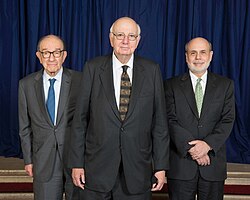 ](https://en.wikipedia.org/wiki/File:Alan_Greenspan,_Paul_Volcker_and_Ben_Bernanke_-_2014_%2813896577879%29.jpg)Volcker in 2014 with Alan Greenspan and Ben Bernanke
After leaving the Federal Reserve in 1987, he became chairman of the prominent New York investment banking firm, Wolfensohn & Co., a corporate advisory and investment firm run by James D. Wolfensohn (who later became President of the World Bank).[38][39]
In 1992, Volcker was elected to the American Academy of Arts and Sciences.[40]
In 1993 he chaired the Group of 30 Report on the Derivatives market entitled "Derivatives: Practices and Principles"[41] with several appendices and a survey on how practices may have changed since the original 1993 report.[42] The Group of 30 is a "consultative group on international economic and monetary affairs." Volcker was their Chairman emeritus.[43]
In 1996, he took up the chair of the Independent Committee of Eminent Persons (Volcker Commission) to look into the dormant accounts of Jewish victims of the Holocaust lying in Swiss banks. This included a "massive accounting of Swiss bank records." In the midst of a contentious process (the committee was formed by three Jewish representatives and three representatives of Swiss banks), he was able to bring about an agreement among the parties for a settlement of $1.25 billion.[44]
Volcker was elected to the American Philosophical Society in 1992.[40]
In 2000 he accepted the Chairmanship of the IFRS Trustees, the not-for-profit funding arm of the International Accounting Standards Board (later the IFRS Foundation). The IFRS Foundation is a private sector enterprise based in London which seeks to develop a single global accounting model, subject to adoption country by country under their rules of law.[45]
In 2001 Paul Volcker joined The Conference Board, an economic and business think-tank based in NY, as a senior advisor supporting research on corporate governance, analysis of business cylcles and economic policy. His activities there primarily focused on guiding the research staff and engaging global business leaders to support The Conference Board's activities promoting free-markets, economic analysis and responsible corporate governance. Other Federal Reserve Chairs affiliated with The Conference Board include Alan Greenspan, who was a researcher there from 1948 to 1953, when it was known as the National Industrial Conference Board.
In April 2004, the United Nations assigned Volcker to research possible corruption in the Iraqi Oil for Food program. In the report summarizing its research, Volcker criticized Kojo Annan, son of then-UN Secretary-General Kofi Annan, and the Swiss company Cotecna Inspection SA, Kojo's employer, for trying to conceal their relationship. He concluded in his March 2005, report that "there is no evidence that the selection of Cotecna, in 1998, was subject to improper influence of the Secretary General in the bidding or selection process."[46] While Volcker did not implicate the Secretary General in the selection process, however, he did cast serious doubt on Kofi Annan, whose "management performance ... fell short of the standards that the United Nations Organization should strive to maintain."[47] Volcker was a director of the United Nations Association of the United States of America between 2000 and 2004,[48][49] prior to his being appointed to the Independent Inquiry by Kofi Annan.[50]
As of October 2006, he was the chairman of the board of trustees of the influential Washington-based financial advisory body, the Group of Thirty, and a member of the Trilateral Commission. He had a long association with the Rockefeller family, not only with his positions at Chase Bank and the Trilateral Commission, but also through membership of the trust committee of Rockefeller Group, Inc., which he joined in 1987. That entity managed, at one time, the Rockefeller Center on behalf of the numerous members of the Rockefeller family. He was a chairman and an honorary trustee of International House, the cultural exchange residence and program center in New York City. He was a founding member of the Trilateral Commission and a long-time member of the Bilderberg Group.[citation ^needed]
In January 2008, he endorsed Democratic Party presidential candidate Barack Obama in the upcoming presidential election.[51]
On April 8, 2008, he was the featured speaker at The Economic Club of New York. Volcker discussed "what appears to be in substance a direct transfer of mortgage and mortgage-backed securities of questionable pedigree from an investment bank to the Federal Reserve," and offered his detailed analysis and evaluation of interrelationships among the U.S. capital markets, Federal Reserve policies, and the economy as whole.[52]
Paul Volcker appeared in the Charles Ferguson's movie Inside Job. He was interviewed about current Wall Street CEO pay, claiming it is "excessive."[53]
Volcker was an economic advisor to President Barack Obama, heading the President's Economic Recovery Advisory Board.[54][55][56] Volcker had also been Obama's first pick as United States Secretary of the Treasury, but he was considered too old.[57] During the financial crisis, Volcker was extremely critical of banks, saying that their response to the financial crisis was inadequate, and that more regulation of banks is called for.[58][59][60] Specifically, Volcker called for a break-up of the nation's largest banks, prohibiting deposit-taking institutions from engaging in riskier activities such as proprietary trading, private equity, and hedge fund investments (see Volcker Rule).[61][62] Volcker left the board when its charter expired on February 6, 2011, without being included in discussions on how the board would be reconstituted.[63]
On January 21, 2010, President Barack Obama proposed bank regulations which he dubbed "The Volcker Rule," in reference to Volcker's aggressive pursuit of these regulations.[64] Volcker appeared with the president at the announcement. The proposed rules would prevent commercial banks from owning and investing in hedge funds and private equity, and limit the trading they do for their own accounts.[65] According to SEC Commissioner Luis A. Aguilar, "[t]he success or failure of the Volcker Rule will depend on the manner in which banking entities comply with the letter and spirit of the rule, and on the willingness of regulators to enforce it."[66]
Volcker was known to defy the stereotype of a Wall Street insider. A profile in The Week for February 5, 2010, stated that Volcker does not agree with the conventional wisdom that "financial innovation" is necessary for a healthy economy. In fact, he likes to say, "the only useful banking innovation was the invention of the ATM."[67]
On April 6, 2010, at the New-York Historical Society's Global Economic Panel, Volcker commented that the United States should consider adding a national sales tax similar to the Value Added Tax (VAT) imposed in European countries, stating "If, at the end of the day, we need to raise taxes, we should raise taxes."[68]
In 2011, Volcker and former Secretary of State George Shultz authored an article in The Wall Street Journal voicing their opinion that the War on Drugs had failed. They did not advocate for the legalization of drugs, but rather for a reexamination of the costs of drug prohibition in the United States.[69]
In 2015, Volcker donated his public service papers to Princeton University's Seeley G. Mudd Manuscript Library.[70]
World Justice Project
Volcker served as an honorary co-chairman for the World Justice Project. The World Justice Project works to lead a global, multi-disciplinary effort to strengthen the rule of law for the development of communities of opportunity and equity.[citation ^needed]
Volcker Alliance
In 2013, Volcker founded the nonprofit organization the Volcker Alliance to address the challenge of effective execution of public policies and to rebuild public trust in government.[71][72] The nonpartisan Alliance works toward that objective by partnering with other organizations—academic, business, governmental, and public interest—to strengthen professional education for public service, conduct needed research on government performance, and improve the efficiency and accountability of governmental organization at the federal, state, and local levels.[73]
Committee for a Responsible Federal Budget
Volcker served on the board of directors of the Committee for a Responsible Federal Budget.[74] The nonpartisan organization is "committed to educating the public on issues with significant fiscal policy impact."[75]
Personal life
Volcker married Barbara Bahnson, the daughter of a physician, on September 11, 1954. They had two children, Janice, a nurse and a Georgetown University graduate,[76] and James, a research assistant and a New York University graduate[77] who was born with cerebral palsy. They also had four grandchildren.[78][79][80] His younger sister died young, and two of his three older sisters, Louise and Ruth, never married. His other older sister, Virginia, was married to and divorced from Harold Streitfeld; they have five children.[81]
Volcker was an avid fly-fisherman,[82] who recounted in 1987, "The greatest strategic error of my adult life was to take my wife to Maine on our honeymoon on a fly-fishing trip."[83][84] Volcker was known as "Tall Paul" for his height of 6 feet 7 inches (2.01 m),[85][86] standing exactly a foot (30 cm) taller than his first wife, Barbara, when they first met.[78] She died on June 14, 1998, having suffered from lifelong diabetes, as well as rheumatoid arthritis. Over Thanksgiving, 2009, he became engaged to Anke Dening, a long-time assistant.[87] They married in February 2010.[88]
Death
Volcker died in New York City on December 8, 2019, at age 92. He had reportedly been treated for prostate cancer since being diagnosed the year prior.[89]
Honorary degrees
Volcker received honorary degrees from several educational institutions, including: Baytown Christian Academy, Hamilton College (1980), University of Notre Dame, Princeton University, Dartmouth College, New York University, University of Delaware,[90] Fairleigh Dickinson University, Bryant College, Adelphi University, Lamar University, Bates College (1989), Fairfield University (1994), York University (2001), Williams College (2003),[91] Northwestern University (2004), Rensselaer Polytechnic Institute (2005), Brown University (2006), Georgetown University (2007), Syracuse University (2008),[92] Queen's University (2009), Amherst College (2011), and at the University of Toronto (2015).[93]
Maxwell School of Citizenship and Public Affairs at Syracuse University, where Volcker served on the advisory board from 2001 until his death, established the "Paul Volcker Chair" in Behavioral economics in 2011.[94][95]
Works
https://www.alternet.org/2019/12/the-death-of-a-giant-paul-volckers-vital-legacy-is-under-attack-by-trump/
The death of a giant: Paul Volcker’s vital legacy is under attack by Trump
Edmond J. Safra Center for Ethics https://creativecommons.org/licenses/by/2.0/
Written by The Conversation December 10, 2019
Paul Volcker, who died on Dec. 8, is the poster boy for central bank independence and why it matters.
One of his legacies, as you may have read in the many obituaries published since his death, is taming the runaway inflation that posed an existential threat to the U.S. economy in the late 1970s. Less discussed is just how important he was to establishing the principle of an independent Federal Reserve, which he led from 1979 to 1987.
As a graduate student in the early 1980s and as a researcher since then, I’ve conducted empirical research on how a firm, steady and independent hand at the helm of monetary policy has improved economic performance in the United States and elsewhere. Volcker’s chairmanship of the Fed provided me, and other economists, with a real-world example that backed up our theories.
At a time when the president is openly criticizing the central bank and demanding it lower interest rates ahead of his reelection bid, I believe remembering and reaffirming Volcker’s courageous legacy at the Fed is more important than ever.
Political pressure and runaway inflation
To understand the stakes and the sea change that Volcker brought about, it’s helpful to recall the soaring inflation of the 1970s and what caused it.
Arthur Burns, who ran the Fed from 1970 to 1978, helped ignite the inflationary spiral with his efforts to help President Richard Nixon win reelection in 1972 by keeping interest rates low to supercharge the economy.
Like today, an economy that is already near full employment does not need another dose of monetary stimulus. In the 1970s, this ignited inflation. Once the fire starts, it is hard to put out. Inflation rose from 3.2% at the end of that year to over 11% by 1975.
High inflation randomly redistributes gains and losses throughout the economy and, in so doing, makes the economy more ragged and less efficient. The uncertainty of volatile prices threw people’s plans for saving and spending into disarray. The only certainty was uncertainty.
Burns was ousted in 1978, but his replacement was also unwilling to aggressively combat the rising pace of inflation. And so by the time Volcker became Fed chairman in August 1979, inflation continued to accelerate, eventually peaking at over 13% in 1980.
To combat this, Volcker steered the Fed toward an aggressive series of interest rate hikes – harsh medicine that plunged the economy into what was then the deepest recession since the 1930s. The Federal Reserve set interest rates a hair’s breadth below 20% at the end of 1980.
This steadfast commitment made Volcker the target of opprobrium by politicians – one who accused him of “legalizing usury beyond any limits imaginable” – and the public alike.
In protest of the pain his policies were causing, home builders sent unused two-by-fours to the Fed in Washington, D.C., auto dealers mailed keys to the cars they couldn’t sell and farmers drove tractors around the bank’s headquarters.
And just like Burns under Nixon, Volcker faced pressure from the White House. In a secret 1984 meeting Volcker recounts in a biography published in 2018, he wrote that President Ronald Reagan’s chief of staff ordered him not to raise rates until after the 1984 election.
Ultimately, Volcker’s policy broke the back of inflation, not least by demonstrating that the Fed was, finally, serious about fighting this war. Inflation plunged to below 4% in 1983, and interest rates eventually followed. This laid the groundwork for an economic recovery that lasted until July 1990.
Inflation has remained tame ever since.A lasting legacy
Just as we want our judges to make decisions based on the law, not politics, we need our central bankers to steer the economy free of political pressures.
A few months ago, Volcker joined the other four living former heads of the Federal Reserve in arguing this point forcefully.
But this lesson seems to have been lost on the current president, who has relentlessly and very publicly attacked the Fed and current Chair Jerome Powell. And in an echo of the 1970s, President Donald Trump is urging large interest rate cuts that he hopes will drive up growth rates. This could, however, destablize the U.S. economy in the long run.
So let’s remember Volcker as the “knight who killed inflation,” but I also hope the tremendous value of an independent central bank becomes a part of his lasting legacy.
[ Insight, in your inbox each day. You can get it with The Conversation’s email newsletter. ]The Conversation
Michael Klein, Professor of International Economic Affairs at The Fletcher School, Tufts University