SEPP2
singer content rolled to singer1? guarg UK ?
Distinguished Research Professor, Institute for Humane Studies, George Mason University.
==
singer often claims there's no proof he took ff $ except early on as consult to co?
==
==
page 9
https://www.greenpeace.org/usa/wp-content/uploads/2015/11/exxon-denial-and-deception.pdf?a1481f
ExxonMobil - Funding the Skeptics
One of the most high profile skeptics in the climate change debate, S. Fred Singer, has recently denied receiving any oil company money, and claimed that his consulting for oil companies was solely “on the subject of oil pricing, some 20 years ago….”59
Yet Exxon’s own documents 60 show that in1998, the company gave a grant of $10,000 to the Science and Environmental Policy Project (SEPP), of which Singer is the founding president, and another $65,000 to the Atlas Economic Research Foundation, which promotes and supports Singer’s work.61 In addition, in the past Singer has acknowledged receiving funding from Exxon. 62 According to the Wall Street Journal 63,
ExxonMobil also funds the ultra-conservative and anti-environmentalist Frontiers of Freedom Institute, of which Singer is a staff member. Frontiers of Freedom was cited in the American Petroleum Institute (API) 1998 Global Science Communications Action Plan as a possible organization to help operationalize their antiKyoto strategy, to be funded by API and others in the fossil fuel industry. 64 Singer has a history of public attacks on the integrity of the IPCC process.65
He has fabricated quotes from the former chair of the IPCC, Dr. Bert Bolin, in an attempt to suggest that Dr. Bolin had changed his mind about climate change.66
Singer was also the mastermind behind a Committee for a Constructive Tomorrow (CFACT) project that took fifty Republican students from the United States, trained in the skeptics’ arguments, to the climate negotiations in Bonn in 2001, to demonstrate in favor of Bush’s abandonment of the Kyoto Protocol.67 CFACT was also listed in the 1998 API plan mentioned above...
See www.exxonmobil.com/contributions/ public_info.html.
61 See www.atlasusa.org/highlights/archives/1995/H1995- 02-Environment.html; and http://www.heatisonline.org/contentserver/objecthandlers/index.cfm?id=3645&method=full.
62 During a 1994 television appearance on Nightline, Singer acknowledged receiving funding from Exxon, Shell, Unocal and ARCO, and that his institute, the Science and Environment Policy Project (SEPP) is partially funded by Exxon. For more information, see http://www.heatisonline.org/contentserver/objecthandlers/index.cfm?ID=3207&method=full.
63 “Conservatives Seek IRS Inquiry on Environmental Group’s Status,” The Wall Street Journal, 21 June 2001. 64 API memo, 1998 – see appendix. 65 See interview with Fred Singer, “Hot
==
==
http://insideclimatenews.org/news/12032015/leaked-email-reveals-whos-who-list-climate-denialists-merchants-of-doubt-oreskes-fred-singer-marc-morano-steve-milloy
ICN reporters Lisa Song and Zahra Hirji contributed to this story.
In the months before the debut of thenew documentary film "Merchants of Doubt," long-time climate denialist Fred Singercontacted more than two dozen bloggers, public relations specialists and scientists asking for help in derailing the documentary’s release.
"Can I sue for damages?” Singer asked in an email last October. "Can we get an injunction against the documentary?"
Singer is one of the "merchants of doubt" identified in the documentary, as are a number of other recipients of his email. The documentary, released nationwide last week, exposes the small network of hired pundits and scientists helping to sow doubt about climate science and delay legislative action on global warming in the United States.
Singer's email became public earlier this week when it was leaked to journalists.
Many of those copied on the email thread, such as Singer and communications specialist Steven Milloy, have financial ties to the tobacco, chemical, and oil and gas industries and have worked to defend them since the 1990s. Others seem relatively new to the denialist camp, such as climate scientist Judith Curry. All, however, have been vocal before Congress, on broadcast news or on the Internet in arguing that human activity is not the primarily driver of climate change.
Here is InsideClimate News' guide to those who were on the emails, in alphabetical order:
Ron Arnold
Arnold is the executive vice president of the think tank the Center for the Defense of Free Enterprise, which has received funding from various conservative foundations and oil and gas companies, including ExxonMobil. Arnold used to have a weekly column in the Washington Examiner and is a frequent guest on Fox News. There is "vanishing public concern over 'dangerous man-made climate change' and growing discontent with the politicized rear guard's increasingly desperate search for new scare words and its bigoted hate speech hurled at skeptics ('deniers,' evoking the Holocaust)," he wrote in 2014.
Timothy Ball
A retired geography professor from the University of Winnipeg, Ball says he doesn't believe humans are behind climate change. The "claim" of the United Nations' Intergovernmental Panel on Climate Change that humans are almost solely responsible for global warming "is not proven except in their computer models and cannot be proven until we understand how much climate varies naturally," he wrote on his website.
Joseph "Joe" Bast
Bast is president and CEO of the Heartland Institute, a Chicago-based conservative think tank that supports climate change denial events and researchers. According to an essay he published in 2011, Bast attended the University of Chicago but never graduated. He started Heartland during college and dropped out to work there full-time. Last month, public documents revealed that Harvard-Smithsonian researcher Willie Soon failed to disclose funding from fossil fuel sources for some of his contrarian research. Bast has since said the Heartland Institute offers its full support to Soon. Bast called the researcher a "brilliant and courageous scientist" and said Soon's critics are, "all ethically challenged and mental midgets," according to Heartland Institute blog post.
Joe Bastardi
Bastardi has a bachelor's degree in meteorology and worked at Accuweather before joining WeatherBELL Analytics LLC, a meteorological consulting firm. Last September, Bastardi told the website beforeitsnews.com, "Nature, not man, rules the climate system." He said the people who participated in the People's Climate March were "more concerned with their political agenda than climate science," and that they shouldn't be "prostituting the weather and climate for [their] own needs."
Michael Bastasch
Bastasch is a reporter for The Daily Caller, a conservative news site. He covers energy and environmental news and often provides a platform for skeptics. In May 2014, he wrote, "The Obama administration and environmentalists have tried to make it seem like there are virtually no dissenting voices among scientists that mankind is causing the Earth to warm rapidly and towards a catastrophic end. But not all scientists are in lock-step with the White House on climate science."
William Briggs
Briggs is a statistician at Cornell University in Ithaca, N.Y., and a consultant at New York Methodist Hospital. More than two decades ago, he spent a year as a meteorologist for the National Weather Service. He is listed as anexpert on the Heartland Institute's website, where he wrote, "Climate change is of no real interest to anyone except climatologists." Earlier this year, he co-wrote an article in the peer-reviewed Chinese Science Bulletin with fellow climate denialists Christopher Monckton and Willie Soon arguing that the IPCC's models are inaccurate and the world won't warm dangerously this century.
Russell Cook
Cook is the editor of the website GelbspanFiles.com. According to Cook, he uses the site to "dig deeply into the accusation that scientists and others who express skepticism about the theory of man-made global warming are being paid by the fossil fuel industry to lie about the issue." Cook hasseveral connections to the Heartland Institute, a conservative think-tank: he serves as a contributing editor to Heartland's Environment & Climate News publication and the Somewhat Reasonable blog.
Judith Curry
Curry is a professor in the School of Earth and Atmospheric Sciences at Georgia Institute of Technology. During a January 2014 hearing before the Senate Committee on Environment and Public Works, Curry said the problem of climate change has been "vastly oversimplified." She said scientists should pay more attention to the role of natural variability in the climate system and the uncertainties in climate modeling. She also said the UN’s Intergovernmental Panel on Climate Change is overly confident in attributing most of the warming to human activity.
Joe D'Aleo
D'Aleo is a former Weather Channel meteorologist and executive director ofIcecap.us, a project that seeks to connect "respected scientists and journalists that are not deniers," but who don't believe human activity is the main driver of global warming. Last May, D'Aleo was one of 15 climate skeptics who wrote a rebuttal to the White House's National Climate Assessment report. "As this rebuttal makes clear, the NCA provides no scientific basis whatsoever for regulating CO2 emissions," they wrote.
James Delingpole
Delingpole is a British climate writer and author of the 2012 book "Watermelons: How Environmentalists are Killing the Planet, Destroying the Economy and Stealing Your Children's Future." He identifies himself as "libertarian conservative" and on his personal web page lists "the 'global warming' myth" as one of his dislikes. Delingpole's work has been published in the Daily Mail, Daily Express, The Times, The Daily Telegraph and The Spectator, among others.
David Paul Driessen
Driessen is senior policy adviser at the Committee for a Constructive Tomorrow, a Washington, D.C.-based libertarian think tank focused on environmental issues that has received funding from fossil fuel interests such as ExxonMobil and Chevron. A frequent contributor to the conservative news site Townhall.com, Driessen says he doesn't believe in anthropogenic global warming. "Every measure of actual evidence contradicts alarmist claims and computer model predictions," he wrote in January. "No matter how fast or sophisticated those models are, feeding them false or unproven assumptions about CO2 and manipulated or 'homogenized' temperature data still yields garbage output, scenarios and predictions."
James Enstrom
Enstrom is an epidemiologist and president of the Scientific Integrity Institute. He argues that air pollution doesn't lead to serious health effects and has challenged the California Air Resources Board and the California legislature's attempts to regulate car emissions. He was fired after 35 years at the University of California, Los Angeles in 2011.
Steve Goddard
Goddard is the pseudonym of climate denialist Tony Heller, who has been active in the anti-global warming action campaign since 2008. Heller has degrees in geology and electrical engineering. He currently runs the blog Real Science, where he comments on climate research and political news. He has called it "a massive lie" that 97 percent of climate scientists agree the world is warming. He also maintains that U.S. and global temperature records have been tampered with, rendering global warming projections inaccurate.
Pierre Gosselin
Gosselin is the author of the climate skeptic blog NoTrickZone.com. He said he thinks humans have a "modest" role in impacting the planet's climate, but ultimately he believes "the forces of nature overwhelm anything man puts out." Gosselin owns a small business involving communication work for various industries. He has an associate degree in civil engineering from Vermont Technical College and a bachelor's degree in mechanical engineering from the University of Arizona, according to his website.
Greenie Watch
The Greenie Watch blog is run by Australian social scientist John Ray. It questions the scientific evidence for global warming. "Climate is just the sum of weather. So if you cannot forecast the weather a month in advance, you will not be able to forecast the climate 50 years in advance," he wroteon his blog's home page. In response to the release of Fred Singer's emails about the film "Merchants of Doubt," Ray wrote, "We skeptics have got Warmists on the defense, a pathetic 'ad hominem' defense though it is."
William Happer
Happer is a physicist at Princeton University and an outspoken critic of global warming. He has repeatedly called global warming trends "exaggerated." In a TV interview last year, he compared the scientific community's treatment of carbon dioxide to 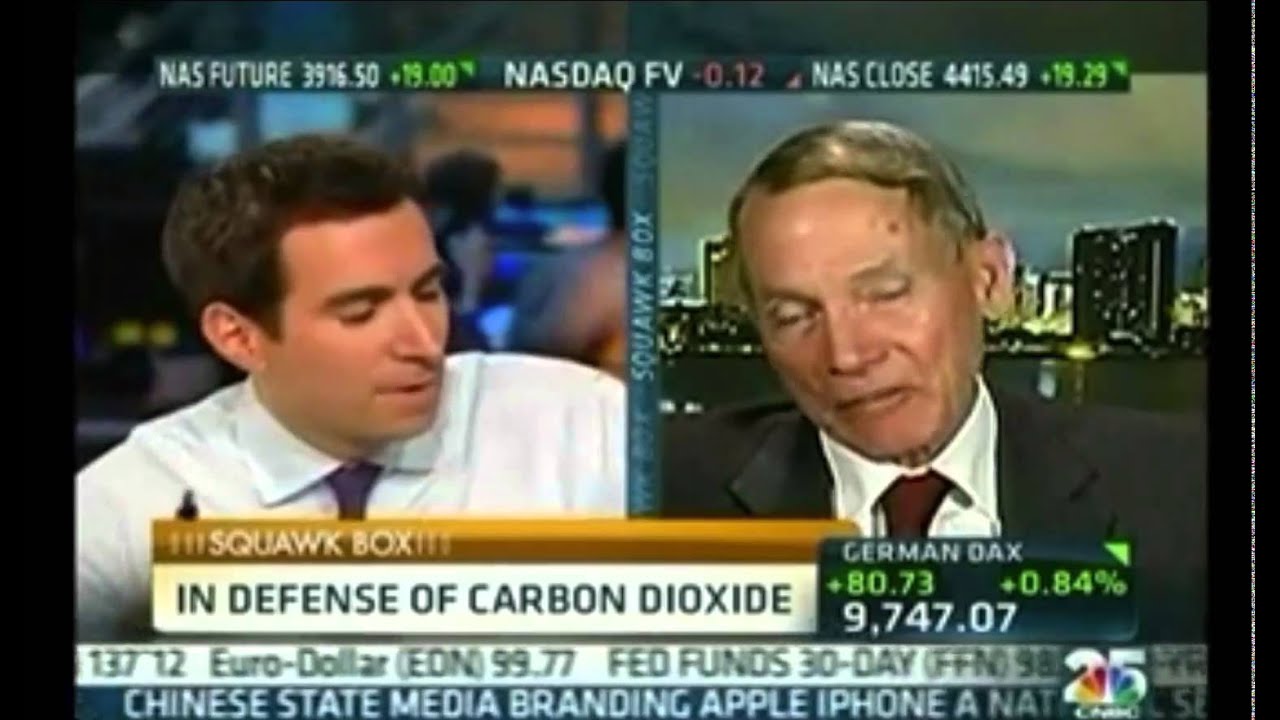 ." During President George H. W. Bush's term, Happer was director of the office of energy research at the Department of Energy.
Jim Lakely
Lakely runs the blog Somewhat Reasonable out of the Chicago-based libertarian think-tank the Heartland Institute. Lakely is also thecommunications director and co-director of the Center on the Digital Economy at the institute. Previously, he worked as a journalist covering politics and technology. He has a bachelor's degree from the University of Pittsburgh, according to his Heartland profile. In a December 2014 blog post, Lakely wrote, "The reason why the United Nations and the world's governments focus on fighting climate change is because that mission gives them license to control everything about the economy of every state in the world."
Patrick J. Michaels
Michaels is the director of the Center for the Study of Science at the Cato Institute, a libertarian think tank based in Washington, D.C. He was long considered the most credible scientist in the climate denial campaign. He was the president of the American Association of State Climatologists and an IPCC author, sharing the 2007 Nobel Peace Prize with other contributing scientists. But Michaels—who at one point estimated 40 percent of his funding came from the fossil fuel industry—has been caught repeatedly making inaccurate climate claims, including on Fox News and in the Washington Post and Forbes.
Steven J. Milloy
Milloy is the director of external policy and strategy for Murray Energy Corp., the largest privately held coal producer in the U.S. He also runs the website JunkScience, which aims to cast doubt on peer-reviewed climate research. He got his start as a denialist working for the tobacco and chemical industries in the 1990s. In 1998, he helped write the American Petroleum Institute's strategy to challenge climate science. Milloy is a former columnist for Fox News who now frequently appears as a guest to discuss energy and climate issues. His bio boasts that he has written "over 600 articles/columns published in major newspapers/web sites, including The Wall Street Journal, Investor’s Business Daily, FoxNews.com, Financial Times, National Post (Canada), USA Today, Los Angeles Times, Washington Times, New York Post, New York Sun and other print and web outlets."
Christopher Monckton
Monckton serves as chief policy adviser to the conservative think tank Science & Public Policy Institute. He has written several articles denouncing the severity of global warming and is a regular speaker at anti-climate action conferences. In testimony before Congress in 2010, he said climate change was a "non-problem." Earlier this year, he co-wrote an article in the peer-reviewed Chinese Science Bulletin with fellow climate denialists arguing that the IPCC's models are inaccurate and the world won't warm dangerously by the end of the century. Monckton also invented the "Eternity" puzzle, has a background in journalism, and in the early 1980s served an adviser to former U.K. Prime Minister Margaret Thatcher.
Marc Morano
Morano runs the denialist blog ClimateDepot. He's also the communications director of the Center for a Constructive Tomorrow, a Washington, D.C.-based libertarian think tank focused on environmental issues that's received funding from fossil fuel interests such as ExxonMobil and Chevron. He got his start on the climate issue working as communications director for Republican Sen. Jim Inhofe of Oklahoma from 2006 to 2009, and before that for conservative talk show host Rush Limbaugh. He's a frequent speaker at the Heartland Institute's International Conference on Climate Change and often appears on Fox News and other conservative media outlets. In 2010, after months of stoking Climategate on his blog, he said climate scientists "deserve to be publicly flogged."
Joanne Nova
Nova is an Australian climate denialist and author of "The Skeptic's Handbook," a crash course in false science claiming global warming isn't happening and isn't human-caused. The book has been translated into 16 languages. Nova and her husband, fellow climate denialist David Evans—whose name was attached to Nova's email address in Fred Singer's messages—also run Science Speak, a "scientific modeling and mathematical research company" that challenges evidence the world is warming.
Roger Pielke
Roger Pielke Sr., a controversial climate scientist, said he believes that "humans have altered the climate system." However, he also supports the idea that warming has recently stopped and has argued against some well-established points of climate science, such as observed sea level rise and glacier melting. Pielke holds the position of senior research scientist at theCooperative Institute for Research in Environmental Studies. He also is a senior research associate the University of Colorado in Boulder. It's unclear whether the intended recipient of an email thread concerning "Merchants of Doubt" was Pielke himself, or his son Roger Pielke Jr. His son is a policy researcher at the Center for Science and Technology in Colorado and has criticized those who have linked climate change to increasingly extreme weather.
Thomas P. Sheahen
Sheahen is a physicist and director of the Institute for Theological Encounter with Science and Technology. According to the Heartland Institute, he is also the vice chairman of Fred Singer's Science and Environmental Policy Project's board of directors. "The science is NOT settled at all," he said in testimony in West Virginia earlier this year challenging the teaching of man-made climate change as scientific fact. "It would be a great disservice to children to indoctrinate them with one currently fashionable theory."
S. Fred Singer
Singer is one of the earliest and most vocal scientists in the climate denial campaign. He was an academic and government space researcher for nearly four decades before working on behalf of the tobacco industry to discredit scientific evidence that smoking was bad for human health. In the early 1990s, he started attacking global warming. He founded an anti climate-action think tank, the Science and Environmental Policy Project, using fossil fuel funds. The group has denied the existence of man-made climate change for 25 years. He also created the Nongovernmental International Panel on Climate Change (NIPCC), a publication of junk science that counters the UN’s Intergovernmental Panel on Climate Change's work. He has called the IPCC's latest assessment "a wonderful paper weight or door stop."
Wei-Hock (Willie) Soon
Soon, a solar physicist at the Harvard-Smithsonian Center for Astrophysics, has posited that increased energy from the sun—not the burning of fossil fuels—is the biggest driver of modern climate change. His theory has been widely refuted by the scientific community, including the UN’s Intergovernmental Panel on Climate Change and the National Academy of Sciences. In February, public documents showed that Soon received hundreds of thousands of dollars from fossil fuel interests to publish "deliverables" in the form of articles about the solar-warming theory in scientific journals. He failed to disclose conflicts of interests to those journals and during congressional testimony. Soon also has ties to several conservative, climate-denying think tanks, including the Heartland Institute and the Committee for a Constructive Tomorrow.
Roy Spencer
Spencer is a scientist at the University of Alabama-Huntsville and a former senior scientist for climate studies at NASA's Marshall Space Flight Center. He says he believes natural fluctuations in the climate system could be the primary driver of global warming. During a Senate hearing in July 2013,Spencer told the committee humans "are having some influence" on climate change, "but it is impossible to know with any level of certainty how much influence."
James Taylor
Taylor is vice president of external relations and a senior fellow of environment and energy policy at the conservative think tank the Heartland Institute. He has a Bachelor of Arts degree from Dartmouth College and a law degree from Syracuse University. In 2012, it was revealed that the Heartland Institute had plans to spend $200,000 over two years to circulate materials sowing doubt about climate change in classrooms. In an interview with InsideClimate News, Taylor said the material would act as "a nice counterweight" to material with "an overtly political and alarmist message in regards to climate change."
Anthony Watts
Watts edits the blog Watts Up With That, which questions climate science and presents, "the untold story of the climate debate from the climate skeptic side." Watts studied electrical engineering and meteorology at Purdue University but never graduated. He then served as an on-air meteorologist for 25 years. He's a frequent speaker at anti-climate action events hosted by the Heartland Institute. "I believe that our [man-made] contribution [to climate change] may be far less than has been postulated," he told a California newspaper in 2007. "Our measurement network has been compromised—not intentionally, but accidentally and through carelessness."
PUBLISHED UNDER:
==
guardian uk problem
omg dozens:http://scienceandpublicpolicy.org/images/stories/papers/originals/2013_year.pdf
sepp bookstore includes:
The Many Benefits of Atmospheric CO2Enrichment:
How humanity and the rest of the biosphere will prosper from this amazing trace gas that so many have wrongfully characterized as a dangerous air pollutant!
Craig D. Idso & Sherwood B. Idso (Vales Lake book).
==
points to
http://www.spiegel.de/international/world/science-as-the-enemy-the-traveling-salesmen-of-climate-skepticism-a-721846.html
6/22/2015 Druckversion 'Science as the Enemy': The Traveling Salesmen of Climate Skepticism SPIEGEL ONLINE International
http://www.spiegel.de/international/world/scienceastheenemythetravelingsalesmenofclimateskepticisma721846druck.html 1/5
10/08/2010 11:44 AM
'Science as the Enemy'
The Traveling Salesmen of Climate Skepticism
By Cordula Meyer
A handful of US scientists have made names for themselves by casting doubt on global
warming research. In the past, the same people have also downplayed the dangers of passive
smoking, acid rain and the ozone hole. In all cases, the tactics are the same: Spread doubt and
claim it's too soon to take action.
With his sonorous voice, Fred Singer, 86, sounded like a grandfather explaining the obvious to a dimwitted
child. "Nature, not human activity, rules the climate," the American physicist told a discussion
attended by members of the German parliament for the businessfriendly Free Democratic Party (FDP)
three weeks ago.
MarieLuise Dött, the environmental policy spokeswoman for the parliamentary group of Angela Merkel's
centerright Christian Democratic Union (CDU), also attended Singer's presentation. She said afterwards
that it was "extremely illuminating." She later backpedaled, saying that her comments had been quoted
out of context, and that of course she supports an ambitious climate protection policy just like
Chancellor Merkel.
Merkel, as it happens, was precisely the person Singer was trying to reach. "Our problem is not the
climate. Our problem is politicians, who want to save the climate. They are the real problem," he says. "My
hope is that Merkel, who is not stupid, will see the light," says Singer, who has since left for Paris. Noting
that he liked the results of his talks, he adds: "I think I achieved something."
Salesman of Skepticism
Singer is a traveling salesman of sorts for those who question climate change. On this year's summer
tour, he gave speeches to politicians in Rome, Paris and the Israeli port city of Haifa. Paul Friedhoff, the
economic policy spokesman of the FDP's parliamentary group, had invited him to Berlin. Singer and the
FDP get along famously. The American scientist had already presented his contrary theories on the climate
to FDP politicians at the Institute for Free Enterprise, a Berlin-based freemarket think tank, last
December.
Singer is one of the most influential deniers of climate change worldwide. In his world, respected
climatologists are vilified as liars, people who are masquerading as environmentalists while, in reality,
having only one goal in mind: to introduce socialism. Singer wants to save the world from this horror. For
some, the fact that he made a name for himself as a brilliant atmospheric physicist after World War II
lends weight to his words.
Born in Vienna, Singer fled to the United States in 1940 and soon became part of an elite group fighting
the Cold War on the science front. After the collapse of the Soviet Union, Singer continued his struggle
mostly against environmentalists, and always against any form of regulation.
Whether it was the hole in the ozone layer, acid rain or climate change, Singer always had something
critical to say, and he always knew better than the experts in their respective fields. But in doing so he
strayed far away from the disciplines in which he himself was trained. For example, his testimony aided
the tobacco lobby in its battle with health policy experts.
'Science as the Enemy'
The Arlington, Virginiabased Marshall Institute took an approach very similar to Singer's. Founded in
1984, its initial mission was to champion then US President Ronald Reagan's Strategic Defense Initiative
(SDI), better known as "Star Wars." After the fall of the Iron Curtain, the founders abruptly transformed
6/22/2015 Druckversion 'Science as the Enemy': The Traveling Salesmen of Climate Skepticism SPIEGEL ONLINE International
http://www.spiegel.de/international/world/scienceastheenemythetravelingsalesmenofclimateskepticisma721846druck.html 2/5
their institute into a stronghold for deniers of environmental problems.
"The skeptics thought, if you give up economic freedom, it will lead to losing political freedom. That was
the underlying ideological current," says Naomi Oreskes, a historian of science at the University of
California, San Diego, who has studied Singer's methods. As scientists uncovered more and more
environmental problems, the skeptics "began to see science as the enemy."
Oreskes is referring to only a handful of scientists and lobbyists, and yet they have managed to convince
many ordinary people and even some US presidents that science is deeply divided over the causes of
climate change. Former President George H.W. Bush even referred to the physicists at the Marshall
Institute as "my scientists."
Whatever the issue, Singer and his cohorts have always used the same basic argument: that the scientific
community is still in disagreement and that scientists don't have enough information. For instance, they
say that genetics could be responsible for the cancers of people exposed to secondhand smoke, volcanoes
for the hole in the ozone layer and the sun for climate change.
Cruel Nature
It almost seems as if Singer were trying to disguise himself as one of the people he is fighting. With his
corduroy trousers, long white hair and a fish fossil hanging from a leather band around his neck, he comes
across as an amiable old environmentalist. But the image he paints of nature is not at all friendly. "Nature
is much to be feared, very cruel and very dangerous," he says.
At conferences, Singer likes to introduce himself as a representative of the Nongovernmental International
Panel on Climate Change (NIPCC). As impressive as this title sounds, the NIPCC is nothing but a collection
of likeminded scientists Singer has gathered around himself. A German meteorologist in the group, Gerd
Weber, has worked for the German Coal Association on and off for the last 25 years.
According to a US study, 97 percent of all climatologists worldwide assume that greenhouse gases
produced by humans are warming the Earth. Nevertheless, one third of Germans and 40 percent of
Americans doubt that the Earth is getting warmer. And many people are convinced that climatologists are
divided into two opposing camps on the issue which is untrue.
So how is it that people like Singer have been so effective in shaping public opinion?
Experience Gained Defending Big Tobacco
Many scientists do not sufficiently explain the results of their research. Some climatologists have also been
arrogant or have refused to turn over their data to critics. Some overlook inconsistencies or conjure up
exaggerated horror scenarios that are not always backed by science. For example, sloppy work was
responsible for a prediction in an Intergovernmental Panel on Climate Change (IPCC) report that all
Himalayan glaciers would have melted by 2035. It was a grotesque mistake that plunged the IPCC into a
credibility crisis.
Singer and his fellow combatants take advantage of such mistakes and utilize their experiences defending
the tobacco industry. For decades, Big Tobacco managed to cast doubt on the idea that smoking kills. An
internal document produced by tobacco maker Brown & Williamson states: "Doubt is our product since it is
the best means of competing with the 'body of fact' that exists in the minds of the general public."
In 1993, tobacco executives handed around a document titled "Bad Science A Resource Book." In the
manual, PR professionals explain how to discredit inconvenient scientific results by labeling them "junk."
For example, the manual suggested pointing out that "too often science is manipulated to fulfill a political
agenda." According to the document: "Proposals that seek to improve indoor air quality by singling out
tobacco smoke only enable bad science to become a poor excuse for enacting new laws and jeopardizing
individual liberties."
'Junk Science'
In 1993, the US Environmental Protection Agency (EPA) published what was then the most
comprehensive study on the effects of tobacco smoke on health, which stated that exposure to
secondhand smoke was responsible for about 3,000 deaths a year in the United States. Singer promptly
6/22/2015 Druckversion 'Science as the Enemy': The Traveling Salesmen of Climate Skepticism SPIEGEL ONLINE International
http://www.spiegel.de/international/world/scienceastheenemythetravelingsalesmenofclimateskepticisma721846druck.html 3/5
called it "junk science." He warned that the EPA scientists were secretly pursuing a communist agenda. "If
we do not carefully delineate the government's role in regulating ... dangers, there is essentially no limit to
how much government can ultimately control our lives," Singer wrote.
Reacting to the EPA study, the Philip Morris tobacco company spearheaded the establishment of "The
Advancement of Sound Science Coalition" (TASSC). Its goal was to raise doubts about the risks of passive
smoking and climate change, and its message was to be targeted at journalists but only those with
regional newspapers. Its express goal was "to avoid cynical reporters from major media."
Singer, Marshall Institute founder Fred Seitz and Patrick Michaels, who is now one of the best known
climate change skeptics, were all advisers to TASSC.
Not Proven
The Reagan administration also appointed Singer to a task force on acid rain. In that group, Singer insisted
that it was too early to take action and that it hadn't even been proven yet that sulfur emissions were in
fact the cause. He also said that some plants even benefited from acid rain.
After acid rain, Singer turned his attention to a new topic: the "ozone scare." Once again, he applied the
same argumentative pattern, noting that although it was correct that the ozone concentration in the
stratosphere was declining, the effect was only local. Besides, he added, it wasn't clear yet whether
chlorofluorocarbons (CFCs) from aerosol cans were even responsible for ozone depletion.
As recently as 1994, Singer claimed that evidence "suggested that stratospheric chlorine comes mostly
from natural sources." Testifying before the US Congress in 1996, he said there was "no scientific
consensus on ozone depletion or its consequences" even though in 1995 the Nobel Prize had been
awarded to three chemists who had demonstrated the influence of CFCs on the ozone layer.
The Usual Suspects
Multinational oil companies also soon adopted the triedandtrue strategies of disinformation. Once again,
lobbying groups were formed that were designed to look as scientific as possible. First there was the Global
Climate Coalition, and then ExxonMobil established the Global Climate Science Team. One of its members
was lobbyist Myron Ebell. Another one was a veteran of the TASCC tobacco lobby who already knew the
ropes. According to a 1998 Global Climate Science Team memo: "Victory will be achieved when average
citizens 'understand' (recognize) uncertainties in climate science."
It soon looked as though there were a broad coalition opposing the science of climate change, supported
by organizations like the National Center for Policy Analysis, the Heartland Institute and the Center for
Science and Public Policy. In reality, these names were often little more than a front for the same handful
of questionable scientists and Exxon funded the whole illusion to the tune of millions of dollars.
It was an excellent investment.
In 2001, the administration of then President George W. Bush reneged on previous climate commitments.
After that, the head of the US delegation to the Kyoto negotiations met with the oil lobbyists from the
Global Climate Coalition to thank them for their expertise, saying that President Bush had "rejected Kyoto
in part based on input from you."
Singer's comradeinarms Patrick Michaels waged a particularly sharptongued campaign against the
phalanx of climatologists. One of his books is called: "The Satanic Gases: Clearing the Air about Global
Warming." Michaels has managed to turn doubt into a lucrative business. The German Coal Association
paid him a hefty fee for a study in the 1990s, and a US electric utility once donated $100,000 to his PR
firm.
Inconsistent Arguments
Both Michaels and Ebell are members of the Cooler Heads Coalition. Unlike Singer and Seitz, they are not
anticommunist crusaders from the Cold War era, but smooth communicators. Ebell, a historian, argues
that life was not as comfortable for human beings in the Earth's cold phases than in the warm ones.
Besides, he adds, there are many indications that we are at the beginning of a cooling period.
6/22/2015 Druckversion 'Science as the Enemy': The Traveling Salesmen of Climate Skepticism SPIEGEL ONLINE International
http://www.spiegel.de/international/world/scienceastheenemythetravelingsalesmenofclimateskepticisma721846druck.html 4/5
The professional skeptics tend to use inconsistent arguments. Sometimes they say that there is no global
warming. At other times, they point out that while global warming does exist, it is not the result of human
activity. Some climate change deniers even concede that man could do something about the problem, but
that it isn't really much of a problem. There is only one common theme to all of their prognoses: Do
nothing. Wait. We need more research.
People like Ebell cannot simply be dismissed as cranks. He has been called to testify before Congress eight
times, and he unabashedly crows about his contacts at the White House, saying: "We knew whom to
call."
Ebell faces more of an uphill battle in Europe. In his experience, he says, Europe is controlled by elites who
unlike ordinary people happen to believe in climate change.
Einstein on a Talk Show
But Fred Singer is doing his best to change that. He has joined forces with the European Institute for
Climate and Energy (EIKE). The impressivesounding name, however, is little more than a P.O. box
address in the eastern German city of Jena. The group's president, Holger Thuss, is a local politician with
the conservative Christian Democratic Union (CDU).
Hans Joachim Schellnhuber, director of the respected Potsdam Institute for Climate Impact Research and
an adviser to Chancellor Merkel on climaterelated issues, says he has no objection to sharing ideas with
the EIKE, as long as its representatives can stick to the rules of scientific practice. But he refuses to join
EIKE representatives in a political panel discussion, noting that this is precisely what the group hopes to
achieve, namely to create the impression among laypeople that experts are discussing the issues on a
level playing field.
Ultimately, says Schellnhuber, science has become so complicated that large segments of the population
can no longer keep up. The climate skeptics, on the other hand, are satisfied with "a desire for simple
truths," Schellnhuber says.
This is precisely the secret of their success, according to Schellnhuber, and unfortunately no amount of
public debate can change that. "Imagine Einstein having to defend the theory of relativity on a German TV
talk show," he says. "He wouldn't have a snowball's chance in hell."
Translated from the German by Christopher Sultan
URL:
http://www.spiegel.de/international/world/scienceastheenemythetravelingsalesmenofclimateskepticisma721846.html
Related SPIEGEL ONLINE links:
The Expensive Dream of Clean Energy: Will High Costs Kill Merkel's Green Revolution? (09/23/2010)
http://www.spiegel.de/international/germany/theexpensivedreamofcleanenergywillhighcostskillmerkelsgreenrevolutiona718951.html
Not Under My Backyard: One German Town's Fight against CO2 Capture Technology (08/20/2010)
http://www.spiegel.de/international/germany/notundermybackyardonegermantownsfightagainstco2capturetechnologya710573.html
German Climatologist on Criticism of IPCC: 'We Received a Kick in the Pants' (08/17/2010)
http://www.spiegel.de/international/world/germanclimatologistoncriticismofipccwereceivedakickinthepantsa712113.html
Not So Much Trouble in Paradise: Are Coral Islands Really Doomed? (07/23/2010)
http://www.spiegel.de/international/world/notsomuchtroubleinparadisearecoralislandsreallydoomeda707884.html
The Climategate Chronicle: How the Science of Global Warming Was Compromised (05/14/2010)
http://www.spiegel.de/international/world/theclimategatechroniclehowthescienceofglobalwarmingwascompromiseda694484.html
SPIEGEL 360: Our Complete Climate Change Coverage
6/22/2015 Druckversion 'Science as the Enemy': The Traveling Salesmen of Climate Skepticism SPIEGEL ONLINE International
http://www.spiegel.de/international/world/scienceastheenemythetravelingsalesmenofclimateskepticisma721846druck.html 5/5
http://www.spiegel.de/international/topic/climate_change/
© SPIEGEL ONLINE 2010
All Rights Reserved
Reproduction only allowed with the permission of SPIEGELnet GmbH
==
pope flying squad
pope flying squad
Dr. Thomas P. Sheahen is vice president of the Science and Environment Policy Project (SEPP), Director of the Institute for Theological Encounter with Science and Technology (ITEST), and president/CEO of Western Technology, Inc., an independent consulting firm specializing in energy technology issues with business implications,
From 2005 – 2009, Dr. Sheahen served as Senior Analyst in the Systems Integration Office of the National Renewable Energy Laboratory. From 1993 - 2002 he was senior scientist in the Energy Systems Group for Science Applications International Corporation, where he led a team of evaluators in selecting renewable energy projects for support by NREL. He previously held positions with Argonne National Laboratory, Energy Research Advisory Board to the Department of Energy, SRI International (Stanford Research Institute),Congressional Office of Technology Assessment, National Bureau of Standards, and Bell Telephone Laboratories.
Dr. Sheahen is author of Introduction to High Temperature Superconductivity (Plenum Press: 1994). His research papers have appeared in many peer-reviewed science journals including Physical Review, Applied Optics, Journal of Technology Transfer, Reviews of Modern Physics, Energy the International Journal, Strategic Planning and Energy Management,andThe Science Teacher.
Dr. Sheahen has co-authored numerous reports on topics including rocket re-entry instrumentation (Bell Labs), industrial instrumentation and analysis of measurement economics (Industrial Nucleonics), research program plans (National Bureau of Standards), industrial energy conservation (Office of Technology Assessment),national energy policy planning (DOE), and renewable energy technology (SAIC).
==