singer1 f bak
recovered from old webodec (no #) not sure how much lost
many singer text on leno
NO MERRI
Distinguished Research Professor, Institute for Humane Studies, George Mason University.
some crap code
---
GGL 6 26
S. Fred Singer (a controversial physicist and prominent climate change skeptic) held a faculty position at the Institute for Humane Studies (IHS). The IHS is a libertarian academic nonprofit that has received extensive, long-term funding from billionaire Charles Koch. [1, 2, 3, 4]
Key details regarding their connection:
- Role: Singer served as a Research Professor at the IHS after retiring from the University of Virginia in 1994. [1]
- Charles Koch's Involvement: Koch has funded and chaired the board of directors for the IHS, utilizing the organization to build a well-financed network of free-market scholars and intellectuals. [1, 2, 3]
- The Koch Network & Climate Obstruction: The IHS is one of many Koch-backed groups (including the Cato Institute) that have been criticized by watchdogs for promoting climate change denial and opposing environmental regulations. [1, 2, 3]
---
DESMOG
Dr Fred Singer has announced his plans to retire as president of the Science and Environmental Policy Project (SEPP) after 25 years at the helm as one of his generation’s most influential climate deniers.
But it might be premature to breathe a sigh of relief just yet. After all, Frederick Seitz continued to serve as SEPP president for two years after he died according to tax records filed by Singer.
While the doctor of denial may have celebrated his 90th birthday this September, it doesn’t seem he’s about to slow down. His ties with SEPP – which argues against the existence of climate change – will not be severed any time soon. He plans to continue as chairman of the board “for as long as possible”.
So, in honour of his retirement as SEPP president, DeSmog UK takes a look back at the “granddaddy of fake science”, as Rolling Stone magazine has called him, and his relentless attempts to debunk global warming.
Against science
Singer was aware of the science of climate change from as early as 1968. It could all have been very different. He was undeniably a skilled rocket scientist with outstanding credentials.
While serving in the US Navy during the Second World War he designed computer technology to help ships avoid mines. He then designed instruments for satellites and produced the first calculation of methane increases caused by human activity.
It was during the 1970s and ‘80s, within the community of Koch funders and funded think tanks in Virginia, that his scepticism started to percolate.
Singer first began attacking the health science and harmful effects of tobacco when working alongside fellow physicist and cold-warrior Frederick Seitz.
He then moved on to attack ozone science and was among the first to challenge the science of acid rain, which he did during his time as professor of environmental sciences at the University of Virginia. By 1989 he had become increasingly interested in questioning the emerging science of climate change.
But even climate deniers are divided about Singer’s contribution to the science. Fellow sceptic Jack Barrett, whom Singer has occasionally consulted, describes the scientist as a “sad case”.
“He appreciates the science but he is somehow against it,” Barrett says.
Things moved quickly after this. Singer wasted no time in setting up SEPP in 1990, and four short years later he retired from the university to become a professor at the Institute of Humane Studies (IHS), a hardline neoliberal think tank funded by the oil billionaire Charles Koch.
Extensive Ties
Over the next half-century, Singer’s time at SEPP was continually fraught with controversy.
Both Singer and SEPP have extensive ties to fossil fuels. While engaged in activities denying the existence of man-made climate change, SEPP has received funding from numerous oil companies including Shell, Uniroyal and ARCO as well as USD$20,000 from ExxonMobil since 1998.
Singer himself has worked for at least 11 ExxonMobil-funded think tanks, including The Heritage Foundation. Yet he has famously flip-flopped between admitting and denying such funding, even going so far as to say the claims are an “absurd invention”.
In a February 2001 letter to *The Washington Post*, Singer denied receiving funding from the oil industry, except for some consulting work 20 years prior. This is despite acknowledging on the television programme *Nightline* in 1994 that he had received such funding.
Singer instead claimed that his connection to oil during the 1990s was more food than fossil while he worked “as a Wesson Fellow at the Hoover Institution; Wesson money derives from salad oil”.
His claims would hold more water, however, if he had not been employed by SEPP throughout this time, as well as being on a $5,000-a-month retainer from the oil- and Koch-funded Heartland Institute to spread disinformation about climate change.
As James Hoggan writes: “Singer has taken the amnesia defence: he says he gets so many cheques that he can’t remember who they’re all from.”
But it’s not just where he gets his money from but how he uses it that has proved questionable.
Misinformation campaign
One year into his professorship at the IHS, Singer and SEPP assisted in setting up the Leipzeg Declaration, stating there is no scientific consensus on climate change.
But an investigation into the Declaration by a Danish journalist a couple years later revealed that of the 33 European listed signatories, four could not be located, 12 denied ever having signed and some had not even heard of it before.
Among the some-80 signatories in total, 25 were weathermen and the list of those who confirmed they had signed included a medical doctor, a nuclear scientist and an expert on flying insects – not exactly an overwhelming slew of established climate scientists.
When confronted with these facts, Singer removed many from the list, but other names were subsequently added to make a total of more than 100 signatories, many of whom did not state whether they had any ongoing research links in climate science.
This would not be the only time Singer was challenged during his misinformation campaign.
Justin Lancaster, a student of the late-climate scientist Dr Roger Revelle, publicly criticised Singer for misappropriating Revelle’s work in 1991 in what has become one of the most controversial episodes in climate science.
In the now-infamous Cosmos article, Singer listed Revelle as a second author to an article directly contradicting Revelle’s scientific opinion that anthropogenic climate change was happening. But Lancaster’s claims that Singer leveraged the aging academic’s health problems to discredit climate science were swiftly silenced with a SLAPP lawsuit.
Incorrect again
Not only did Singer use an academic who was nearing the end of his life in an effort to debunk global warming, but later he would also use a friend’s death in his personal pursuit of wealth.
According to a *DeSmogBlog* investigation, Singer committed perjury in his tax filings to the IRS, the US government agency responsible for tax collection, by claiming that the climate denying physicist Fred Seitz continued to chair the tax-protected SEPP for two years after Seitz’s death in 2008.
It was around this time that Singer was also spreading misinformation on the state of the world’s glaciers. In a 2005 *Guardian* column, George Monbiot revealed a letter by UK climate sceptic David Bellamy, which claimed that 555 of all 625 glaciers under observation by the World Glacier Monitoring Service in Zurich have been growing since 1980.
When Monbiot phoned the World Glacier Monitoring Service they bluntly replied saying this claim was “complete bullshit”. As it turned out, this claim stemmed from the SEPP website. Eventually, Singer conceded the information “appears to be incorrect” and claimed to update the webpage.
Despite this, Singer’s ‘science’ has been featured in numerous papers questioning global warming and he is a regular speaker at the annual Heartland Institute’s International Conference on Climate Change.
Singer has even appeared in a documentary entitled “The Great Global Warming Swindle”. The 2007 film, which portrays global warming as a hoax, also includes notorious British climate sceptic Lord Nigel Lawson among several other prominent deniers.
But it’s not just deniers that feature Singer. He has also appeared in the New York Times, New Republic and theWashington Post and has given lectures on global warming at well-known universities such as Berkeley in California, Stanford and Imperial College London.
It seems, then, that the aging scientist will continue to wage his war against science; not even retirement – and certainly not being proved wrong – will slow him down.
---
CSM
By Stephanie Pappas LiveScience Senior Writer
Feb. 15, 2012
Leaked documents from the free-market conservative organization The Heartland Institute reveal a plan to create school educational materials that contradict the established science on climate change.
The documents, leaked by an anonymous donor and released on DeSmogBlog, include the organization's 2012 fundraising plan. It lists Heartland Institute donors, from the Charles G. Koch Charitable Foundation (established by Koch Industries billionaire Charles G. Koch), to Philip Morris parent company Altria, to software giant Microsoft and pharmaceutical company Eli Lilly.
The climate change education project is funded so far by an anonymous donor who has given $13 million to the Institute over the past five years. Proposed by policy analyst David Wojick, who holds a doctorate in epistemology and has worked for coal and electricity generation companies, the project would create education "modules" written to meet curriculum guidelines for every grade level.
"Many people lament the absence of educational material suitable for K-12 students on global warming that isn't alarmist or overtly political," the report reads. "Heartland has tried to make material available to teachers, but has had only limited success."
Funding skepticism
Heartland focuses on free-market issues across the board, including promoting charter schools, lobbying for business-friendly finance, insurance and real estate rules and promoting prescription drug availability before full Food and Drug Administration testing.
In the area of climate change, the leaked documents revealed that the group funds vocal climate skeptics, including Center for the Study of Carbon Dioxide and Global Change founder Craig Idso ($11,600 per month), physicist Fred Singer ($5,000 plus expenses per month), and New Zealand geologist Robert Carter ($1,667 per month). They've also pledged $90,000 to skeptical meteorologist Anthony Watts, who blogs at WattsUpWithThat.com.
The documents also reveal a communications strategy aimed at "keep[ing] opposing voices out" of publications such as Forbes Magazine, where the audience is "reliably anti-climate."
On the education front, Wojick would be paid $5,000 per module, or $25,000 per quarter, according to the report's tentative estimates, to produce the Heartland climate curricula. The Institute's anonymous donor has pledged $100,000 to the project, which the Institute hopes to match from other donors.
Each module would inject skepticism into the scientific consensus on climate change. Example statements in the report include: "Whether humans are changing the climate is a major scientific controversy;" "Models are used to explore various hypotheses about how climate works. Their reliability is controversial;" and "Whether CO2 [carbon dioxide] is a pollutant is controversial." The modules would also teach that the idea of carbon dioxide as a pollutant is "controversial," arguing that carbon dioxide is crucial to life on Earth and that natural emissions are 20 times those of human emissions.
Creating controversy
In fact, while some of these statements may be politically controversial, they are not particularly scientifically controversial. For example, the Intergovernmental Panel on Climate Change 2007 Fourth Assessment Report, which synthesizes global scientific findings about climate change, states: "Since the start of the industrial era (about 1750), the overall effect of human activities on climate has been a warming influence. The human impact on climate during this era greatly exceeds that due to known changes in natural processes, such as solar changes and volcanic eruptions."
Likewise, while models cannot represent the climate system perfectly (thus the uncertainly in how much the Earth will warm for a given amount of emissions), climate simulations are checked and re-checked against real-world observations and are an established tool in understanding the atmosphere.
And while carbon dioxide is crucial for plant life, the carbon balance on Earth is a delicate cycle, with oceans and land able to absorb only so much CO2. Humans do emit only a fraction of the 750 gigatons of CO2 that move through the atmosphere each year, but small changes in the total amount can overwhelm so-called carbon "sinks" such as the ocean, resulting in important, and cumulative, changes in the atmosphere. [10 Ways the Weather Changed History]
"These documents are breathtaking, and they reveal what many of us have long suspected: That there is a campaign afoot by groups directly funded by the fossil fuel industry and right-wing foundations such as Koch Industries to mislead the public about climate change," Pennsylvania State University climatologist Michael Mann wrote in an email to LiveScience.
---
2x? really about singer:
Fakenomics: The tobacco industry’s PR tactics proved inspirational for the army of climate change deniers,
writes BRENDAN MONTAGUE ience and Environmental Policy Project (SEPP) would become an increasingly important platoon in the army assembling against climate science.
Along with the late Dr Frederick Seitz – a founder of the Marshall Institute – the SEPP would use PR tactics developed by the tobacco industry to question and undermine climate science.
Seitz, for example, accused the UN Intergovernmental Panel on Climate Change (IPCC) of producing scientific summaries “exaggerating risk… solely – we suspect – to satisfy an ideological objective of aggressively constraining the use of energy.”
Meanwhile, Singer (pictured) was busy raising money. He proposed to one oil industry PR firm that they should support a $95,000 project. This would include lectures and publications designed to attack the IPCC and help “stem the tide towards ever more onerous controls on energy use.”
Shortly after, Singer testified at the US House of Representatives’ Energy and Commerce Committee’s Subcommittee on Oversight and Investigations that “there is no scientific consensus on ozone depletion or its consequences.”
Industry funded
Singer also appeared on the popular American programme Nightline to tell viewers that the climate change science had been exaggerated, but when pressed he was forced to admit that he had in the past received funding from oil companies Exxon, Shell and ARCO.
Ross Gelbspan, the American investigative journalist who first exposed Singer’s oil funding, at the time raised serious concerns about the “profound conflict of interest” which arises when a scientist claiming climate change is not happening is funded by Exxon.
He asked: “What would happen if the industry-funded ‘greenhouse skeptics’ just happened to stumble on a clue that the warming of the planet is, indeed, intensifying – and that the findings of the IPCC have validity? Would they be willing to change the direction of their research and, in the process, risk of cutting off their industry funding?”
But Singer used the SEPP not only to attack climate science but also to aggressively attack the latest research showing that even passive smoking could cause cancer, leading to millions of painful deaths – all the while being paid directly by the tobacco companies.
Tobacco benefits
The eminent scientist drafted a report called The EPA and the Science of Environmental Tobacco Smoke, which was commissioned and funded by the industry’s Tobacco Institute via the Alexis de Tocqueville Institution.
A private memo sent to Walter Woodson, senior vice president at the Tobacco Institute, provided Singer’s curriculum vitae and suggested the industry lobby pay $20,000 for support in challenging the impacts of environmental tobacco smoke. A further internal document shows that the Tobacco Institute forwarded the cash to the Alexis de Tocqueville Institute.
Singer also benefited less directly from the millions of dollars the tobacco firms were providing to American think tanks.
In January 1995, he moved into the offices of the Atlas Foundation, which had been set up by the libertarian think tank founder Antony Fisher in his tireless crusade against totalitarianism, the state and regulations.
Atlas posted on its website: “For those who believe public policy should be based on sound science, Dr. Singer offers a wealth of information, credibility and encouragement.”
The think tank was paid $475,000 by Philip Morris,the tobacco giant engaged in a fierce legal and public relations battle to deny the scientific consensus on tobacco smoke.
While Singer was just one pawn in a much bigger game being executed by the tobacco industry, it did not stop him learning from their public relations strategies. Later, he would apply their tactics to the task of undermining the public trust in climate science.
‘Sound science’
In June 1994, a year prior to Singer moving to Atlas, Philip Morris began working with the public relations firm APCO Associates to launch The Advancement of Sound Science Coalition (TASSC). This coalition falsely claimed to be a “grassroots” organisation advocating “sound science” in policy decision making.
Burson Marsteller – the same PR company advising the oil industry – was hired to organise and promote seminars as part of what they called the Sound Science Project. The public relations experts told the tobacco company that funding would have to be found from other interest groups if the project was to have any chance of succeeding in influencing scientists.
“It is absolutely vital that we succeed in getting funding of the seminar from a broader group of sponsors than just PM[Philip Morris],” stated one secret memo. “Otherwise we would not be able to ensure the credibility of the seminar in relation to the scientists.”
“And if the seminar has not got that credibility, then outcomes of the meeting will not have great value,” it continued. This advice would prove hugely significant.
Corporate America
The tobacco companies took it on board. They began to reach out to other corporate giants whose profits were threatened by scientific research proving their products were dangerous to public health and the natural environment.
Corporate America began to resist the calls for regulations, and in the process discovered the tremendous value of free market ideology with its distrust of the state, as promoted by Friedrich Hayek, John Blundell, Fisher, the Koch brothers, and so on.
The arguments presented by tobacco to protect its financial interests would echo the sincere beliefs of the libertarians.
“Science should never be corrupted to achieve political ends,” they planned to tell the public. “Economic growth cannot afford to be held hostage to paternalistic, overregulation.”
Big Tobacco spent $100,000 setting up the Restoring Integrity to Science Coalition “to educate the media, public officials and the public about the dangers of ‘junk science’.”
The industry would also “create a shadow version of the US Competitive Council… It would promote the need to balance environmental regulation with economic growth.”
British regulations
Across the pond, the tobacco industry in Britain found some firm friends at free market think tank, the Institute of Economic Affairs (IEA). The pipe-smoking Lord Harris of High Cross had formed FOREST to directly challenge the government’s attempt to set increasingly stringent regulations to reduce smoking in the interests of public health.
The measures being suggested were a ban on advertising and also the curtailing of smoking in offices, pubs and public spaces. FOREST argued that such regulations would undermine the economy, close down businesses and, most importantly, were a totalitarian infringement on the rights of the private individual to choose to smoke if they so wish.
FOREST published Through the Smokescreen of “Science”: The Dangers of Politically Corrupted Science for Democratic Public Policy in December 1994.
Harris also chaired the advisory council with his IEA colleague professor David Myddelton, the popular author and journalist Auberon Waugh, and the soon-to-be disgraced MP Neil Hamilton.
Obvious partner
The IEA, with its long history of receiving funding from tobacco, and institutional ties to the Atlas Foundation in the US, would be an obvious partner in any initiative to bring the Sound Science initiative to Britain.
Tom Hockaday from APCO sent an internal memo to Matt Winokur at Philip Morris in March 1994, advising that a “TASSC-like group” should also be formed in Europe to counter the formulation of regulations of smoking.
Winokur confirmed that he knew Roger Bate at the IEA’s Environment Unit,but claimed that after almost 20 years he could not remember he worked with him to establish the European Science and Environment Forum during the ‘90s.
He told me: “This sounds like a bad line from a movie but I really have no recollection.”
This Author
Brendan Montague is editor of The Ecologist,founder of Request Initiative and co-author of Impact of Market Forces on Addictive Substances and Behaviours: The web of influence of addictive industries (Oxford University Press).He tweets at @EcoMontague. This article first appeared at Desmog.uk.
==
==
2x no doubt
https://www.motherjones.com/politics/1997/12/wingnuts-sheeps-clothing/
...It’s not easy being green — the brown opposition is well-funded and sneaky, with fake populist tactics that make it hard to spot the wolf in sheep’s clothing. To learn more about the astroturf groups who are lobbying against the Kyoto global warming treaty, we contacted the Clearinghouse on Environmental Advocacy and Research (CLEAR). A project of the Environmental Working Group in Washington, D.C., CLEAR ferrets out anti-environmental groups and their funders: the mining, logging, petrochemical, and land-developing industries who profit from pollution and wilderness destruction. Starting with Henry Lamb’s perversely named Environmental Conservation Organization, we trace here the interlocking directorates — and corporate sponsors — of some of the extremist groups who’ll give up their carbon-spewing smokestack when you pry it out of their cold, dead hands:
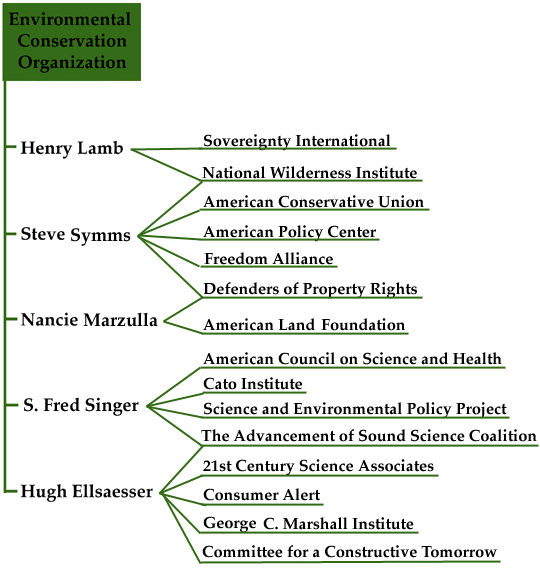
CHART COMPILED BY DAN BARRY, CLEARINGHOUSE FOR ENVIRONMENTAL ADVOCACY AND RESEARCH (CLEAR)
Environmental Conservation Organization (ECO) The brainchild of property-rights firebrand Henry Lamb, ECO is an anti-environmental umbrella outfit counting more than 300 Wise Use groups as members, with a phone and fax network and a monthly newsletter called Eco-logic, which promotes Wise Use efforts to stop the global warming treaty, and Lamb’s conspiracy theories of a United Nations New World Order. Funded by: Allnet Telecommunications, Land Improvement Contractors of America, American Farm Bureau Federation.
Henry Lamb A former executive with the Land Improvement Contractors of America, Lamb co-founded Environmental Conservation Organization (ECO) in 1990 as a front group for land developers to fight Clean Water Act protections for wetlands, then turned it into a network for Wise Use groups nationwide. He recently co-founded Sovereignty International Inc., an anti-United Nations property-rights group. Prominent in the anti-environmental and property-rights movements, Lamb publishes newsletters and gives radio interviews attacking the U.N.’s Man and the Biosphere Program, World Heritage Treaty, Convention on Biological Diversity, and Convention on Climate Change.
Staff Member of:
Environmental Conservation Organization (ECO), Executive Vice President
Board Member of:
Environmental Conservation Organization (ECO), Board of Directors
National Wilderness Institute, National Advisory Board
Sovereignty International, Chairman of the Board
,,,
Fred Singer A former University of Virginia professor and former chief scientist for the U.S. Department of Transportation, Dr. S. Fred Singer is one of a half-dozen preeminent doubters of ozone depletion and global warming science. Singer claims science skeptics like him are being silenced by a conspiracy of feds, enviros, and liberal journalists. Today he heads the Science and Environmental Policy Project, advises several corporate-funded science mills, and rails against global warming science. For this he’s amply rewarded: In 1994 Nightline revealed that Singer has accepted consulting fees from Exxon, Shell, Arco, Unocal, and Sun Oil.
Staff Member of:
Science and Environmental Policy Project, Director
Board Member of:
American Council on Science and Health, Board of Scientific and Policy Advisors
The Advancement of Sound Science Coalition, Scientist Advisor
Cato Institute, Editorial Advisory Board
Environmental Conservation Organization (ECO), Board of Advisors
National Policy Forum, Member of Environment Committee
Science and Environmental Policy Project, Board of Directors
Hugh Ellsaesser A meteorologist and guest scientist at California’s Lawrence Livermore nuclear laboratory, Dr. Hugh Ellsaesser is another widely quoted global warming skeptic. He doesn’t deny that CO2 buildup causes global warming — he argues that we should just sit back and enjoy it. He’s also a scientific advisor to the Lyndon LaRouche group 21st Century Science Associates, which publishes an anti-environmental magazine promoting LaRouche’s wacky Neo-Nazi cult.
Board Member of:
21st Century Science Associates, Scientific Advisory Board
Consumer Alert, Advisory Board
Environmental Conservation Organization (ECO), Board of Advisors
George C. Marshall Institute, Science Advisory Board
The Advancement of Sound Science Coalition, Advisor
Committee for a Constructive Tomorrow, Scientific Advisor
Sovereignty International Inc....
==
mojo wingnuts
4, 1997 - Fred Singer A former University of Virginia professor and former chief scientist for ... 21st Century Science Associates, Scientific Advisory Board
The Cosmic Ray Project - 21st Century
21sci-tech.com › Spring-2010_ONLINE › TCS_Sp_2010
1.
21st Century Winter 1999-2000
21sci-tech.com › highlights
The Singing Voice Demands a Scientific Middle C Kathy Wolfe We need a renaissance of Classical culture, to do away with the false distinction between art and ...
21st CENTURY
wlym.com › archive › fusion › tcs › 19890910-TCS
1.
by M Freeman - 1989 - Related articles
OZONE-HOLE SCARE IS JUST A SCAM - Deseret News
www.deseret.com › ozone-hole-scare-is-just-a-scam
Aug 29, 1995 - ... the Ozone Scare" by Rogelio A. Maduro and Ralf Schauerhammer, published by 21st Century Science Associates, Washington, D.C. (1992).
Sherry Rowland and the ozone denialists | Climate Science ...
www.climatesciencewatch.org › 2012/03/14 › sherry-ro...
1.
:{:(style="background-color:#ffffff;"):}:
Publications - The Ozone-CFC Debacle: Hasty Action, Shaky ...
www.heartland.org › publications-resources › the-ozon...
1.
Views of Lyndon LaRouche and the LaRouche movement ...
en.wikipedia.org › wiki › Views_of_Lyndon_LaRouch...
Scientific Integrity and Public Trust: The Science Behind ...
books.google.com › books
Subcommittee on Energy and Environment. Ozone - CFC debacle 4 . Singer . ... Century Science Associales : on DC : 21st Century Science Associates : 1992 .
United States, United States. Congress. House. Committee on Science. Subcommittee on Energy and Environment - 1996 - Chlorofluorocarbons
Merchants of Doubt: How a Handful of Scientists Obscured the ...
books.google.com › books
G; S. Fred Singer, “The Science Behind Global Environmental Scares,” ... Falling (Washington, D.C.: 21st Century Science Associates, 1992), intro. and chap. 1.
Naomi Oreskes, Erik M. Conway - 2011 - Science
==
https://cei.org/content/cei-submits-letter-epa-burdensome-endangerment-finding
CEI Submits Letter to EPA on Burdensome Endangerment Finding
October 17, 2017
Dear Administrator Pruitt:
On behalf of the Competitive Enterprise Institute (CEI) and the Science and Environmental Policy Project (SEPP), I am writing to transmit to you a letter signed by more than 60 climate and health experts in support of our February 2017 petition, and in support of a similar petition filed by the Concerned Household Electricity Consumers Council, asking the Environmental Protection Agency to reconsider the 2009 Endangerment Finding for greenhouse gases.
Since 2009, a number of the basic claims in that document have become increasingly questionable, and there are growing doubts about the computer models on which the finding was based. These seriously undercut the foundation for our government’s climate policies.
The Endangerment Finding is the basis for a host of incredibly burdensome and wide-ranging regulations, ranging from auto fuel economy standards to the Clean Power Plan. These threaten access to affordable energy, as well as millions of jobs, and countless lives around the world.
The finding has been used by other federal agencies to greatly expand their own regulatory programs, while other nations and international groups have relied on it to justify their own restrictions on affordable energy.
The Endangerment Finding needs to be reexamined to ensure U.S. energy policy is based on sound science. We would appreciate the opportunity to further discuss these petitions with you.
Thank you for your consideration.
Sincerely,
Sam Kazman
General Counsel, Competitive Enterprise Institute
October 17, 2017
The Honorable ScottPruitt
Administrator,
Environmental Protection Agency
1200 Pennsylvania Avenue, N.W.
Washington, DC 20460
Dear Administrator Pruitt:
You have pending before you two science-based petitions for reconsideration of the 2009 Endangerment Finding for Greenhouse Gases, one filed by the Concerned Household Electricity Consumers Council, and one filed jointly by the Competitive Enterprise Institute and the Science and Environmental Policy Project.
We the undersigned are individuals who have technical skills and knowledge relevant to climate science and the GHG Endangerment Finding. We each are convinced that the 2009 GHG Endangerment Finding is fundamentally flawed and that an honest, unbiased reconsideration is in order.
If such a reconsideration is granted, each of us will assist in a new Endangerment Finding assessment that is carried out in a fashion that is legally consistent with the relevant statute and case law.
We see this as a very urgent matter, and therefore, request that you send your response to one of the signers who is also associated with a petitioner, SEPP.
Thank you,
:{Kenneth Haapala
President, Science and Environmental Policy Projec}:t
P.O. Box 1126
Springfield, VA 22151
...
Kenneth Haapala, President
Science and Environmental Policy Project
P.O. Box 1126
Springfield, VA 22151
Supporting the Petitions – Experts in Climate Science and Related Fields
Dr. Ralph B. Alexander
Former Associate Professor, Wayne State University, Detroit
Author: “Global Warming False Alarm”
Ph.D., Physics, University of Oxford
B.S., Physics, University of Western Australia
El Dorado Hills, California
2
William D. Balgord, Ph.D.
President, Environmental & Resources Technology, Inc.
Ph.D. Geochemistry, Pennsylvania State University
M.A., Geology, University of Missouri
B.S., Chemistry, Millsaps College
Dr. Tim Ball
Ph.D., Historical Climatology
M.A., University of Manitoba
B.A., University of Winnipeg
Victoria, Canada
James R. Barrante, Ph.D.
Emeritus Professor of Physical Chemistry
Southern Connecticut State University
Author: "Global Warming for Dim Wits"
Joe Bastardi
B.S., Meteorology, The Pennsylvania State University
Chief Long Range Forecaster, Accuweather
Advisor on climate and weather issues for media and industry
Co-founder and Chief Meteorologist, WeatherBELL Analytics, LLC
David J. Benard
Co-inventor of the Chemical Oxygen-Iodine Laser
Ph.D., Physics, University of Illinois
Newbury Park, California
Dr. Edwin X Berry
Climate Physics, LLC
Certified Consulting Meteorologist
Ph.D., Physics, University of Nevada
M.A., Physics, Dartmouth College
B.S., Engineering, California Institute of Technology
Bigfork, Montana
John Blethen (Retired)
Following climate science closely since the 1970s
Ph.D., Physics, Stanford University
3
David Boleneus
Consulting geologist, geophysicist, and wheat grower (current)
U.S. Geological Survey research geologist (retired)
M.S., Geology, Louisiana State University
Thesis: Calcium carbonate precipitation in tropical oceans
B.S., Geology, Eastern Washington University
Vice Admiral Edward S. Briggs
United States Navy (Retired)
David J. Bufalo, P.E.
Retired Licensed Professional Engineer, Missouri and Colorado
B.S., Civil Engineering, Missouri University of Science and Technology
Denver, Colorado
Dr. Roger Burtner
Principle, Remote Sensing Exploration
Retired Senior Research Associate,Chevron Oil Field Research Company
Ph.D., Geology, Harvard
M.S., Geology, Stanford University
B.S., Geology, Franklin & Marshall College
Fullerton, California
Dr. Alan Carlin
Retired Senior Analyst and manager, U.S. Environmental Protection Agency, Washington, DC
Author: “Environmentalism Gone Mad,” Stairway Press, 2015
Ph.D., Economics, Massachusetts Institute of Technology, Cambridge, Massachusetts
B.S., Physics, California Institute of Technology, Pasadena, California
John Coleman
Retired, Former Professional Member of the American Meteorological Society
Broadcast Meteorologist of the Year in 1982, Founder of The Weather Channel
Meteorologist on television for 61 years including Good Morning America
B.S., Journalism, University of Illinois
Las Vegas, Nevada
William F. Condon, Ph.D.
Professor Emeritus and Past Chair of Chemistry
Southern Connecticut State University
Joseph S. D'Aleo
Certified Consulting Meteorologist, AMS Fellow
Chair AMS Committee on Weather Analysis and Forecasting
ABD, Air Resources, New York University
B.S., M.S., Meteorology, University of Wisconsin
4
Dr. Harold H. Doiron
Retired VP-Engineering Analysis and Test Division, InDyne, Inc.
Ex-NASA JSC, Aerospace Consultant
B.S., Physics, University of Louisiana - Lafayette
M.S., Ph.D., Mechanical Engineering, University of Houston
Terry W. Donze
Geophysicist for 46 years
Author: “Climate Realism: Alarmism Exposed,” Xulon Press
B.S., Geological Engineering, Missouri University of Science and Technology
John Droz, Jr.
Physicist
Founder of Alliance for Wise Energy Decisions (AWED)
Morehead City, North Carolina
Dr. Don J. Easterbrook
Emeritus Professor of Geology, Western Washington University
Author, editor of 10 books, over 150 journal publications
Ph.D., Geology, University of Washington, Seattle
M.S., Geology, University of Washington, Seattle
B.S., Geology, University of Washington, Seattle
Robert W. Endlich, Lt. Col. USAF, (Retired)
Advanced Weather Officer, Chi Epsilon Pi, Meteorology Honor Society
M.S., Meteorology, The Pennsylvania State University
Basic Meteorology, Texas A&M University
B.A., Geology, Rutgers University
Las Cruces, New Mexico
Dr. Neil Frank
Former Director, National Hurricane Center
Ph.D., Meteorology,Florida State University
Fulshear, Texas
Dr. Gordon J. Fulks
Gordon Fulks and Associates
Ph.D., Physics, The University of Chicago Laboratory for Astrophysics and Space Research
M.S., Physics, The University of Chicago
B.S., Physics, The University of Chicago
Corbett, Oregon
5
Melin O. Glerup
B.S., M.S., Geological Engineer and Petroleum Geologist
Retired Texaco, Inc. Executive and Consulting Geologist
Member of two Climate Study Groups (last 12 years) and geologist for 47 years
San Tan Valley, Arizona
Steve Goreham
Executive Director, Climate Science Coalition
Author: “Outside the Green Box: Rethinking Sustainable Development,” New Lenox Books
B.S., M.S., Electrical Engineering, University of Illinois, Urbana
MBA, University of Chicago
Laurence I. Gould, Ph.D.
Professor of Physics, University of Hartford
Past Chair (2004) New England Section of the American Physical Society
Dr. William Happer
Professor of Physics Emeritus, Princeton University
Ph.D., Physics, Princeton University, 1964
B.S., Physics, University of North Carolina, Chapel Hill, 1960
Dr. Howard C. Hayden
Prof. Emeritus of Physics, University of Connecticut
Ph.D., Physics, University of Denver
M.S., Physics, University of Denver
B.S., Physics, University of Denver
Pueblo West, Colorado
Admiral Thomas B. Hayward
Chief of Naval Operations
United States Navy (Retired)
Joe Hennessey
Consulting Meteorologist, Sacramento, California
Provided meteorological advice, data analyses, wind farm planning and WindPro modelling to
National Power which had over 2,000 MW of projects in Australia and Hawaii
M.S., Atmospheric Science, Oregon State University
B.S., Meteorology, University of Utah
B.S., Mathematics, Marquette University
Dr. Richard A. Keen (Emeritus)
Instructor of Atmospheric and Oceanic Sciences, University of Colorado, Boulder
Ph.D., Geography/Climatology, University of Colorado
6
William W. Little, Ph.D.
Professor of Geology at Brigham Young University
Owner of W.W. Little Geological Consulting
Ph.D., Geology, University of Colorado, Boulder
M.S., Geology, Brigham Young University
B.S., Geology, Brigham Young University
Rexburg, Idaho
Dr. David R. Legates
Professor of Geography, University of Delaware, CCM, American Meteorological Society
Ph.D., Climatology, University of Delaware
M.S., Geography, University of Delaware
B.A., Mathematics & Geography, University of Delaware
Jay Lehr
Science Director, The Heartland Institute, author/editor 30 books on science
Ph.D., University of Arizona Environmental Science
B.S.E., Princeton University
Ostrander, Ohio
Richard E. McFarland
Retired recursive computing expert
40 years NASA, ARC SimLab
Graduate studies in Math, Stanford University
B.A., Physics, UC Berkeley
Banning, California
Dr. Troy Milliken
Chemistry Professor, Holmes Community College
Ph.D., Polymer Chemistry, University of Massachusetts
B.S., Polymer Science, The Pennsylvania State University
Jackson, Mississippi
H. Michael "Mike" Mogil
Past President, National Council of Industrial Meteorologists (2015-2017)
Certified Consulting Meteorologist
Certified Broadcast Meteorologist
Cliff Ollier
Emeritus Professor, Geologist
University of Western Australia
B.Sc., M.Sc., D.Sc., Bristol
7
James M. Peacock
Charter Member of The Right Climate Stuff Research Team
NASA JSC Aerospace Engineer (Apollo Missions)
USAF R&D, Air Force Special Weapons Center
B.S., Mechanical Engineering, Texas A&M University
Ron W. Pritchett
Professional Geological Scientist (AIPG) #7063
Lone Tree, Colorado
Tom Quirk
Nuclear physicist, board member of electricity, gas and transport businesses
MSC Melbourne,
D Phil MA Oxford, fellow of three Oxford colleges
SMP Harvard Business School Melbourne
Victoria, Australia
Dr. Arthur G. Randol III
Co-Founder, VA Scientists and Engineers for Energy and Environment
Ph.D., Nuclear Engineering Sciences, University of Florida
M.S.E., Nuclear Engineering Sciences, University of Florida
B.S., Mechanical Engineering-Nuclear Option, University of Notre Dame
Dr. Chad Rodekohr
Professor of Physics, Presbyterian College
Ph.D., Mechanical Engineering, Auburn University
M.S., Physics, Auburn University
B.S., Aviation Management, Auburn University
Clinton, South Carolina
Richard L. Sauer, PE, MASCE, Col, Ret, USAR
M.S., Environmental Engineering, UC Berkeley
B.S., Civil Engineering, University of Notre Dame
S/C Environmental Systems Engineer, NASA, Retired, TRCS Member
League City, Texas
Dr. Thomas P. Sheahen
Ph.D., Physics, Massachusetts Institute of Technology
B.S., Physics, Massachusetts Institute of Technology
Dr. Willie Soon
Independent scientist, 26+ years’ experience in Sun and Climate Science research
Ph.D., University of Southern California, Aerospace Engineering, “Nonequilibrium kinetics in
high-temperature gases”
8
John Turner
B.Sc.; Dip. Ed.; M.Ed. (Hons); Grad. Dip. Ed. Studies
Australia
Dr. James P. Wallace III
Jim Wallace & Associates, LLC
Ph.D., Economics, Minor in Engineering, Brown University
M.S., Mechanical Engineering, Brown University
B.S., Aeronautical Engineering, Brown University
George T. Wolff, Ph.D.
Principal Scientist, Air Improvement Resource, Inc.
Former Chair of the Clean Air Scientific Advisory Committee
Ph.D., Environmental Sciences, Rutgers University
M.S., Meteorology, New York University
B.S., Chemical Engineering, New Jersey Institute of Technology
Macatawa, Michigan
Dr. Kenneth C. Young
Faculty member, Department of Atmospheric Sciences, University of Arizona
Ph.D., Geophysical Sciences, University of Chicago
M.S., Geophysical Sciences, University of Chicago
B.S., Chemistry, Arizona State University
Petrolia, California
Supporting the Petitions – Experts in Energy or Public Health and Welfare, and Related
Fields
Jerome C. Arnett, Jr., M.D.
Pulmonologist in private practice
Doctor of Medicine, WVU School of Medicine
Board Certified, Internal Medicine
Board Certified, Pulmonary Diseases
Helvetia, West Virginia
E. Calvin Beisner,Ph.D., Founder and National Spokesman
The Cornwall Alliance for the Stewardship of Creation
Author of numerous books regarding Climate Policy and the Poor
Expert witness on the ethics and economics of climate and energy policy, U.S. Senate
Environment & Public Works Committee, 2006, and Energy & Environment Subcommittee,
U.S. House of Representatives Committee on Energy & Commerce, 2009
Ph.D., History,University of St. Andrews, 2003
M.A., Economic Ethics, International College, 1983
B.A., Religion and Philosophy, University of Southern California, 1978
9
Dr. Roger H. Bezdek
President, MISI, Washington, D.C.
Founding Member, Cavendish Energy LLC, Fort Worth, Texas. Previously served as Senior
Advisor in the Office of the Secretary of the U.S. Treasury
Research Director at the U.S. Department of Energy
Author of four books and over 100 published papers on the economics of climate change and
related issues
Ph.D., Economics, University of Illinois at Urbana-Champaign
Donn Dears
Retired, General Electric Company senior executive, expert on energy issues
Author: “Clexit,” “Nothing to Fear,” and “Carbon Folly”
Graduate, GE’s three-year Manufacturing Management Program
Multiple general manager assignments including, GM of Engineering Department providing
technical support to worldwide network of GE facilities
USN Veteran Korean War
B.S. (with honors), United States Merchant Marine Academy
The Villages, Florida
John Dale Dunn, M.D., J.D.
Lecturer, retired Clinical Instructor, Department of Emergency Medicine, Carl R Darnall Army
Medical Center
Clinical Instructor Uniform Services University of the Health Sciences, Bethesda, Maryland
Policy advisor, American Council on Science and Health of New York City and Heartland
Institute of Chicago
Member, Louisiana and Texas Bar; Medical Officer, Sheriff, Brown County, Texas
James E. Enstrom
Interests include important effects of ozone and PM 2.5
MPH, Epidemiology, University of California, Los Angeles
M.S., Ph.D., Physics, Stanford University
B.S., Physics, Harvey Mudd College
Thomas D. Hennigan
Associate Professor of Ecology and Organism Biology
M.P.S., Environmental Science and Forest Biology, SUNY, Syracuse, New York
B.S., Natural Resources Management, University of Alaska, Fairbanks, Alaska
Paul D. Hoffman
Publicist, Hope Springs Media
Former Deputy Assistant Secretary of the Interior for Fish and Wildlife and Parks
Led the US Delegation to the World Heritage Committee, 2002-06
B.A., Economics/Biology, University of California at San Diego, Revelle College
10
Dr. Craig D. Idso
Chairman, Center for the Study of Carbon Dioxide and Global Change
Co-Editor, Nongovernmental International Panel on Climate Change (NIPCC)
Ph.D., Geography, Arizona State University, Tempe, Arizona
M.S., Agronomy, University of Nebraska, Lincoln, Nebraska
B.S., Geography, Arizona State University, Tempe, Arizona
Steve Milloy
Publisher, JunkScience.com
LLM, Securities Regulation, Georgetown University Law Center
J.D., University of Baltimore School of Law
MHS, Biostatistics, Johns Hopkins University School of Public Health
B.A., Natural Sciences, Johns Hopkins University
Franklin E. (Ed) Payne, M.D.
Associate Professor of Family Medicine (retired)
Medical College of Georgia, Augusta University
Augusta, Georgia
Cornelis J.F. Smit,
Founder and CEO (now retired), Environmental Health Services (Aust) Pty. Ltd
Co-founder and Director, The Galileo Movement
B.Sc., University of Melbourne,
Certified Industrial Hygienist (AIHA)
Noosaville, Qld., Australia
H. Leighton Steward
Geologist, environmentalist,author, and retired energy industry executive
Regional EPA Administrator's Award for environmental excellence
Chairman of the Board of The Institute for the Study of Earth and Man at SMU
Past Chairman of the National Wetlands Coalition
Twice Chairman of the Audubon Nature Institute
Serves on the boards of the M.D. Anderson Cancer Center, EOG Resources, The Buffalo Bill
Historical Center, and the Southwest Research Institute
Dr. S. Stanley Young
Worked in the pharmaceutical industry on all phases of pre-clinical research
Member of the American Council on Science and Health Board of Scientific Advisors
Authored or co-authored over 50 papers, including six “best paper” awards
Fellow of the American Statistical Association, American Association for the Advancement of
Science
Adjunct professor of statistics at North Carolina State University, the University of Waterloo and
the University of British Columbia where he co-directs thesis work
B.S., MES, Ph.D., North Carolina State University
==
https://www.causeiq.com/organizations/view_990/541645372/be985d9b09258bc2c6aa90ec84987cd6
PO BOX 1126
SPRINGFIELD, VA 22151-0126
+1 (703) 978-6025
NTEE: V99 - Social Science Research Institutes, Services N.E.C.
EIN: 54-16453722.5 million in assets/investments?! revenue = expense 115K?
(1) S Fred Singer
......................................................................
Chairman Emeritus
40.00
................. X 18,000 0 0
(2) Kenneth A Haapala
......................................................................
President
40.00
................. X X 60,000 0 0
(3) Donna Fitzpatrick Bethell
......................................................................
Secretary/Treasurer
5.00
................. X X 0 0 0
(4) Thomas P Sheahen
......................................................................
Chairman
1.00
................. X 0 0 0
(5) Ivan Bekey
......................................................................
Executive Vice President
1.00
................. X X 0 0 0
(6) Craig D Idso
......................................................................
Member
1.00
................. X 0 0 0
(7) Willie Soon
......................................................................
Member
1.00
................. X 0 0 0
(8) David R Legates
......................................................................
Member
1.00
................. X 0 0 0
(9) Howard C Hayden
........................................
==
Suffering Servant Scriptorium - Catholic Resource Directory: Crd
crd.catholicmarketing.com › crd › listing
1.
- For prior years, select the prior year listed under Archives.
| Mission Statement | Mission Statement |
|---|---|
Established in 1990 by S. Fred Singer to challenge government environmental policies based on poor science, The Science and Environmental Policy Project (SEPP) stands for objective science, based on hard evidence. SEPP examines questionable governmental policies, no matter how popular, to determine if policies are based on the rigorous application of the scientific method and not just a passing fad. SEPP’s mission is to educate politicians, the media, and the public on the importance of scientific rigor in establishing environmental and related policies, such as energy. SEPP examines the integrity of databases used to establish policies to determine if they have been manipulated without compelling reasons, to assess if the databases address the issues claimed, and to determine if databases used are comprehensive with no substantial data missing. SEPP questions the use of models for public policy unless the models have been appropriately verified and validated. No matter how elaborate, results from numerical models that are not thoroughly tested against hard evidence are speculative and cannot be relied upon. Testing the results of a model by using parts of the model against the results from the entire model is a ruse, used all too frequently. Comparing a model with similar models is not model validation. They may have similar errors. Logic can carry models only so far. If they fail any tests against relevant data, the models must be changed or discarded. Omitting critical data violates the scientific method. In 2007, SEPP established the Non-governmental International Panel on Climate Change (NIPCC) to respond to the false claims of the UN-IPCC, and its followers, who claim, without hard evidence, that the use of fossil fuels, and consequent CO2 emissions, will lead to climate disasters. The Heartland Institute is an outstanding contributor and publisher of these reports. Contrary to frequent attacks, SEPP does not receive support from oil, tobacco, or chemical companies – or government organizations. SEPP accepts donations from private individuals and small contributions from foundations. The appropriate IRS tax filings are made by an independent CPA and are “Open to Public Inspection.” The Science and Environmental Policy Project (SEPP) is a non-profit, 501-(c)-3, educational organization. incorporated in Virginia. Its Federal I.D. Number is 54-1645372 and donations are US tax deductible. SEPP is frugal. Its writings are clear from any outside influence. | Established in 1990 by S. Fred Singer to challenge government environmental policies based on poor science, The Science and Environmental Policy Project (SEPP) stands for objective science, based on hard evidence. SEPP examines questionable governmental policies, no matter how popular, to determine if policies are based on the rigorous application of the scientific method and not just a passing fad. SEPP’s mission is to educate politicians, the media, and the public on the importance of scientific rigor in establishing environmental and related policies, such as energy. SEPP examines the integrity of databases used to establish policies to determine if they have been manipulated without compelling reasons, to assess if the databases address the issues claimed, and to determine if databases used are comprehensive with no substantial data missing. SEPP questions the use of models for public policy unless the models have been appropriately verified and validated. No matter how elaborate, results from numerical models that are not thoroughly tested against hard evidence are speculative and cannot be relied upon. Testing the results of a model by using parts of the model against the results from the entire model is a ruse, used all too frequently. Comparing a model with similar models is not model validation. They may have similar errors. Logic can carry models only so far. If they fail any tests against relevant data, the models must be changed or discarded. Omitting critical data violates the scientific method. In 2007, SEPP established the Non-governmental International Panel on Climate Change (NIPCC) to respond to the false claims of the UN-IPCC, and its followers, who claim, without hard evidence, that the use of fossil fuels, and consequent CO2 emissions, will lead to climate disasters. The Heartland Institute is an outstanding contributor and publisher of these reports. Contrary to frequent attacks, SEPP does not receive support from oil, tobacco, or chemical companies – or government organizations. SEPP accepts donations from private individuals and small contributions from foundations. The appropriate IRS tax filings are made by an independent CPA and are “Open to Public Inspection.” The Science and Environmental Policy Project (SEPP) is a non-profit, 501-(c)-3, educational organization. incorporated in Virginia. Its Federal I.D. Number is 54-1645372 and donations are US tax deductible. SEPP is frugal. Its writings are clear from any outside influence. |
Thomas P. Sheahen, Ph.D. Chairman | Kenneth A. Haapala President |
July 1, 2019 | July 1, 2019 |
twtw newleters
https://www.sepp.org/twtwfiles/2020/TWTW%208-8-20.pdf
wow impressive output
The Week That Was: 2020-08-08 (August 8, 2020)
Brought to You by SEPP (www.SEPP.org)
The Science and Environmental Policy Project
Quote of the Week: “What we observe is not Nature itself but Nature exposed to our methods of
questioning.” – Werner Heisenberg, also “We have to remember that what we observe is not
nature itself, but nature exposed to our methods of questioning.” – Ludwig Wittgenstein
Number of the Week: Zero (0)
THIS WEEK:
By Ken Haapala, President, Science and Environmental Policy Project (SEPP)
July Summary Part V; General Conclusions: Four weeks ago TWTW reviewed Richard
Lindzen’s new paper summarizing what we know with reasonable certainty, what we suspect, and
what we know is incorrect about climate change, the greenhouse effect, temperature trends,
climate modeling, ocean chemistry, and sea level rise. Key parts included (with additions in
boldface):
1) The climate system is never in equilibrium.
2) The core of the system consists of two turbulent fluids interacting with each other and unevenly
heated by the sun, which results in transport of heat from the equator towards the poles
(meridional) creating ocean cycles that may take 1,000 years to complete.
3) The two most important substances in the greenhouse effect are water vapor and clouds, which
are not fully understood and are not stable.
4) A vital component of the atmosphere is water in its liquid, solid, and vapor phases and the
changes in phases have immense dynamic consequences.
5) Doubling carbon dioxide, (CO2), creates a 2% disturbance to the normal flow of energy into
the system and out of the system, which is similar to the disturbance created by changes in clouds
and other natural features. Given the turbulent conditions of the climate system that cannot be
described by equations, the concept of forcing has little meaning.
6) Temperatures in the tropics have been extremely stable. It is the temperature differences
between the tropics and polar regions that are extremely important. Calculations such as global
average temperature largely ignore this important difference.
Three weeks ago, TWTW used the work of William van Wijngaarden and William Happer (W &
H) to summarize what we know with reasonable certainty, what we suspect, and what we know is
incorrect about the greenhouse effect. Both the gentlemen are experts in Atomic, Molecular, and
Optical physics (AMO), which is far from simple physics, but is necessary to understand how
greenhouse gases interfere with (delay) the radiation of energy from the surface into space – that
is, to understand the mechanisms by which the earth loses heat every night.
1)There is no general understanding of the greenhouse effect sufficient to develop elegant
equations.
2) The optical depth or optical thickness of the atmosphere (transparency) changes as altitude
changes. The depth is measured in terms of a natural logarithm and, in this instance, relates to
distance a photon of a particular frequency can travel before it is absorbed by an appropriate
molecule (one that absorbs and re-emits photons of that frequency).
3) Unlike other natural greenhouse gases, water vapor, the dominant greenhouse gas, is not evenly
distributed in the atmosphere. [SEPP Comment: The variability of water vapor during the daytime
and the formation of clouds from H2O, etc., combine to make impossible theoretical
computations of "climate" dynamics with any value. Because water vapor varies hourly, daily,
and seasonally and by location, the Charney Report recognized a decent calculation was
impossible. So, it went down the erroneous path of ignoring H2O, and assumed a CO2
value; and then came back in with a "feedback" concept to try to account for H2O. The
concept fails and continues to be a poor modeling practice that produces failures.
4) There is a logarithmic relationship between greenhouse gases and temperature.
5) “Saturation” means that adding more molecules causes little change in Earth’s radiation to
space. The very narrow range in which methane (CH4) can absorb and emit photons is already
saturated by water vapor (H2O), the dominant greenhouse gas, below the tropopause, where the
atmosphere is thick. Thus, adding methane has little effect on temperatures.
6) The high-resolution transmission molecular absorption database (HITRAN) is a
compilation of spectroscopic parameters used to calculate and simulate the transmission
and emission of light in the atmosphere. The database project started by the Air Force
Cambridge Research Laboratories (AFCRL) in the late 1960s in response to the need for
detailed knowledge of the infrared properties of the atmosphere. “The goal of HITRAN is to
have a self-consistent set of parameters. However, at the same time the requirement is to
archive the most accurate parameters possible. It must be emphasized that the parameters
that exist in HITRAN are a mixture of calculated and experimental. Often the
experimentally determined values are more accurate than the calculated ones, and vice
versa.” From this database, W & H calculate that a doubling of CO2 will increase temperatures
by no more than 1.5 ° C – an upper bound, based on what we know about the atmosphere
today. This upper bound is similar to the one calculated by Apollo veteran scientists and
engineers in TRCS team. The Apollo veterans participated in the hallmark of NASA’s space
program.
Two weeks ago, TWTW reviewed the problems with models as discussed by established Japanese
climate modeler Mototaka Nakamura and as demonstrated in a new paper by Ross McKitrick and
John Christy. Previously, Tony Thomas summarized some of the main problems identified by
Nakamura:
• Ignorance about large and small-scale ocean dynamics.
• A complete lack of meaningful representations of aerosol changes that generate clouds.
• Lack of understanding of drivers of ice-albedo (reflectivity) feedbacks: “Without a
reasonably accurate representation, it is impossible to make any meaningful predictions of
climate variations and changes in the middle and high latitudes and thus the entire planet.”
• Inability to deal with water vapor elements.
• Arbitrary “tunings” (fudges) of key parameters that are not understood.
Further, Nakamura rejects the IPCC concept that the influence of humans adding CO2 can be
predicted by models. He states:
“I want to point out a simple fact that it is impossible to correctly predict even the sense or
direction of the change of a system when the prediction tool lacks and/ or grossly distorts
important nonlinear processes, feedbacks in particular, that are present in the actual
system.” [Boldface added.] In short, we simply do not know whether the feedbacks will
amplify or dampen disturbances to the system.
Nakamura further states that two major problems in the models are ocean flows (ocean
circulation) and water in the atmosphere. Both problems are stated by Lindzen.
McKitrick and Christy tested the values calculated from 38 new CMIP6 models for the time
period 1979 to 2014 with datasets from three different types of observations. 1) Four different sets
of Radiosonde (or sonde) data obtained from weather balloons. 2) Four different sets of data
obtained by microwave sensors onboard polar orbiting satellites which measure intensity of
microwave emissions from atmospheric oxygen which are directly proportional to temperature. 3)
Four different datasets known as Reanalyses, two from Europe, one from Japan and one from the
US, NASA.
The 12 datasets cover 35 years and have been available for at least 5 years. The three different
types of datasets from observations are grouped tightly both for global and the tropics. For most
of the models, the mean for satellite observations is below the lower part of the 95% confidence
interval for that model, indicating that the model cannot estimate atmospheric temperature trends.
As Nakamura has written, the global climate models have no predictive value. The UN IPCC and
its followers have clearly departed from the scientific method into the world of wild speculation.
The June 27 TWTW linked to Roy Spencer’s comparison of the results of 13 CMIP6 models
with surface temperature data, which are far less comprehensive than atmospheric data and
subject to many more human and natural influences than atmospheric data. The CMIP6
models produce significantly more warming than the older CMIP5 models and overestimate
the HadCRUT4 surface warming tend by about 50%. Thus, the Climate Models tested have
little or no demonstrated ability to predict surface temperature trends now or into the
future.
Last week, TWTW discussed two efforts to distort the influence of carbon dioxide: one, changing
ocean chemistry, so-called ocean acidification; and two, so-called accelerating sea level rise.
Some of the most fertile areas of the oceans are those that experience upwellings, prevailing deep
ocean currents come to the surface, bringing nutrients and increased carbon dioxide from the
bottom. In turn, these promote photosynthesis, plant and animal life, and the beginning of the
marine food chain. As described by Jim Steele, in 2006 to 2008 the US Pacific Northwest
experienced a particularly strong upwelling which caused an oyster die-off.
The die-off was not from atmospheric CO2, but from the oyster industry importing Pacific oysters
from Japan, which did not evolve in the Pacific Northwest. These oysters simply release their
eggs into the water because they evolved in waters that do not experience rapid changes in pH
from upwellings. Thus, in 2006-2008, during strong changes in pH, the eggs and larvae died.
Conversely, the Olympia oysters native to the Pacific Northwest “brood” their larvae in their
shells where the pH is more controlled. These natural conditions which caused the 2006-2008 dieoff
were complicated by actions by the Northwest oyster farmers.
In discussing the so-called acceleration of sea level rise, TWTW discussed the observed rate of
sea level change at geologically stable Newlyn, Cornwall, England, as presented in a paper by E.
Bradshaw in the Journal of Marine Geodesy. There are two different rates of change, one, a
hundred-year rate of change as measured by tidal gages of 1.8 mm/per year (7 inches per century).
The second rate of change is 3.8 mm/per year (15 inches per century) over a 11-year time period
(from 1993-2014) as measured by satellites. One cannot say that the second rate of change is the
correct one and sea level rise is accelerating, because over the one hundred-year tidal gage record
there have been several other periods with rates of change similar to the satellite one. Thus, a
claim of sea level rise increasing is a hasty conclusion based on a change of instrumentation.
*******************
Greenhouse Gases and the Greenhouse Effect: On July 18, TWTW discussed a paper by
William van Wijngaarden and William Happer (W & H) published by the CO2 Coalition. The
paper is based on calculations using the HITRAN database discussed above. The paper illustrates
the type of calculations involved, which John Kerry called simple physics, demonstrating he
knows not of what he speaks.
W & H present various figures demonstrating the idealized outflow of radiant energy from earth
to space and identify the frequencies in which specific greenhouse gases reduce that outflow,
warming the earth. The paper illustrates the importance of water vapor and that water vapor’s
absorption frequencies overlap those of certain greenhouse gases that can slow outgoing radiation.
One of those gases for which the absorption frequencies are already saturated by water vapor is
methane. Thus, as illustrated in Figure # 4 (p. 11) of the paper, a doubling of methane produces
little increase in the absorption of outgoing radiation. The fear of livestock creating dangerous
warming is not substantiated by observations.
Also, Figure # 5 (p. 12) illustrates the calculated increase in the greenhouse effect if CO2 is
doubled, slight; and the decrease in the greenhouse effect if CO2 is eliminated, significant. The
significant effect of eliminating CO2 as compared with doubling is consistent with the
logarithmic relationship between greenhouse gases and temperature.
Further, the figures illustrate that water vapor influences outgoing radiation over a broad range of
frequencies. Given the interrelationship between the influence of water vapor with other
greenhouse gases, the practice of the IPCC modelers to make estimates of the turbulent
atmosphere without water vapor first, then add a calculation for water vapor, is contrary to what
happens in nature. There is no logical reason to assume the greenhouse effect is calculated
correctly. Given the great overestimates of atmospheric warming by the global climate models, it
is doubtful that total greenhouse effect is properly calculated. See links under Challenging the
Orthodoxy.
*******************
General Conclusions[subject to change as data change]:
The oceans and the atmosphere are complex systems that cannot be accurately described
mathematically at this time.
The Greenhouse Effect in the atmosphere is complex and cannot be accurately described
mathematically at this time.
There is no physical evidence demonstrating that adding carbon dioxide in the atmosphere is
causing a dangerous greenhouse warming of the atmosphere, thus of the earth.
The claim of ocean acidification from increased atmospheric carbon dioxide is false and
misleading.
The claim that increasing atmospheric carbon dioxide is causing an acceleration of sea level
change is not substantiated by long-term sea level trends from geologically stable tidal gauges and
may be a temporary condition.
The global climate models predicting or forecasting dangerous warming in the future do not
describe what is happening in the atmosphere or on the surface, thus have no predictive value.
The benefits of increased CO2 to plant life and the environment are well established, but
frequently ignored.
The benefits of the greenhouse effect to life on the planet by keeping it warmer at night and
suitable for habitation are well established, but frequently ignored.
Thus, there is no compelling physical evidence that humanity should change its use of fossil fuels,
unless something more reliable and more affordable is developed that does not require costly
storage to make it reliable. See links under Challenging the Orthodoxy – NIPCC, Challenging the
Orthodoxy, and Seeking a Common Ground.
*******************
Atmospheric Temperature Trends: On their respective blogs, Roy Spencer and the Earth
System Science Center, UAH, have posted the atmospheric temperature trends for July 2020.
Spencer notes:
“The linear warming trend since January 1979 remains at +0.14 C/decade (+0.12 C/decade over
the global-averaged oceans, and +0.18 C/decade over global-averaged land).”
In the view of TWTW, the 40 year plus trends are not alarming. The trends indicate that the
claims that warming is hiding in the oceans of the Southern Hemisphere are spurious, bogus. See
links under Measurement Issues – Atmosphere.
*******************
Primary Productivity: As used in ecology, primary production is the ability of organic
compounds, through photosynthesis, to use light energy to convert inorganic chemical compounds
including carbon dioxide into organic compounds. Almost all life on Earth relies directly or
indirectly on primary production. CO2 Science reviews a paper on “Long-term Trends in Global
Gross Primary Productivity.” As the review states:
“In considering all of the above, it is clear that fears of a soon-to-be-collapsing terrestrial
biosphere are vastly overstated. Rather than declining in vigor as so many climate alarmists
falsely claim, the world's land vegetation is increasing its robustness, and has been doing so for
over at least the past eleven decades.
“Ironically, the reason for that enhancement is the very action climate alarmists claim should be
decimating it: humanity's increasing use of fossil fuels. [Boldface italics in the original.]
“The combustion of fossil fuels is the principal driver of the contemporary increase witnessed in
both atmospheric CO2 and nitrogen deposition. And, if you believe the climate alarmists that
rising CO2 is the sole cause of modern warming, well, you can add the positive effects from a
warming climate to CO2 and nitrogen deposition as an attributable factor driving the positive
trends in GPP.
“Humanity and nature should therefore be thankful for the use of fossil fuels instead of
demonizing it as so many climate alarmists do. They couldn't be more misguided.”
Further, after a 25-yearr study of Harvard Forest, in central Massachusetts, the researchers wrote:
“Since 2000, NPP [Net primary production] has increased by 26%. For the period 1992–2015,
NEP [Net ecosystem production] increased 93%. The increase in mean annual temperature and
growing season length alone accounted for ~30% of the increase in productivity.”
Amusingly, the researchers could not admit the benefits of more CO2. See links under Social
Benefits of Carbon Dioxide and Review of Recent Scientific Articles by CO2 Science.
*******************
Wind Power Failure: On her blog, Jo Nova presents two different weather conditions that result
in the failure of wind power in Australia. She writes:
“The sharpest power cuts are happening in between the high-pressure cells. As the wind picks up,
production maximizes, only to crash as turbines hit their safety cut off points and drop out of
production suddenly. About 50 times a year generation across the entire Australian wind farm
grid falls by 500MW or more within one hour or less.
“On the other hand, when large cell weather patterns traverse Australia whole windfarm regions
are becalmed and rendered useless within hours. This sort of failure can be as large as 2 to 4 GW
of power disappearing in less than nine hours. This is like a whole coal power plant or even two
(with 8 different units) producing virtually nothing. It never happens with coal, but it happens
about twenty times a year with wind power.”
Apparently, those politicians insisting on replacing reliable power from fossil fuels and nuclear
with offshore wind believe that such weather conditions do not appear near their friendly shores,
such as East Coast hurricanes or Nor’easters. See links under Alternative, Green (“Clean”) Solar
and Wind.
*******************
No TWTW Next Week: There will be no TWTW on the weekend of August 15. TWTW will
resume the weekend of August 22.
*******************
Vote for Aprils Fools Award: The voting for the SEPP’s April Fools Award will be continued
until August 10. The winner will be announced on August 22. The leading contenders are the
darling of global warming alarmists, Greta Thunberg;and the leader of stellar examples of what
not to do with numerical modeling, be definitive without double-checking assumption and data,
thecomputer modelers at Imperial College represented by Neil Ferguson.
Other nominees include Popular Naturalist David Attenborough, Professor and Political
Commentator Brian Cox, World Health Organization Director-General Tedros Adhanom
Ghebreyesus, Justin Trudeau, Prime Minister of Canada. Get your votes in by Monday.
*******************
Number of the Week: Zero – (0). All CMIP6 models tested against actual temperature trends,
both atmospheric and surface, failed to be within 5% of the data, a standard for reliability of
statistical estimates. Much worse, for the atmosphere, the 95% confidence intervals of almost all
the models failed to include the 95% confidence intervals of three different atmospheric datasets.
And these models are being used to make temperature predictions of 30, 80, and 180 years out?
Simply, as the Quotes of the Week suggest, the modelers and the government entities that sponsor
them are not asking the right questions.
NEWS YOU CAN USE:
Censorship
Australia’s Universities Face Sweeping Review Of Free Speech Code
By Staff, The Australian, Via GWPF, Aug 6, 2020
https://www.thegwpf.com/australias-universities-face-sweeping-review-of-free-speech-code/
NPR fires weatherman for comparing Seattle riots to Germany in 1938 on his personal blog
By Ari Hoffman, The Post Millennial, Aug 7, 2020
https://thepostmillennial.com/npr-fires-weatherman-for-comparing-seattle-riots-to-germany-in1938
"Dozens of police have been seriously injured by bottles and fireworks, or partially blinded by
lasers. Even in my neighborhood, graffiti calling for the killing of police have been sprayed at a
prominent location. No city can remain healthy if such anti-social activities are allowed to
continue unchecked."
Seattle: A City in Fear Can Be Restored
By Cliff Mass Weather Blog, Aug 5, 2020
https://cliffmass.blogspot.com/2020/08/seattle-city-in-fear-can-be-restored.html
See link immediately above.
VICTORY FOR SCIENCE! German Research Foundation Regrets Censorship, Reinstate’s
Critic’s Statement
By P Gosselin, No Tricks Zone, Aug 7, 2020
https://notrickszone.com/2020/08/07/victory-for-science-german-research-foundation-regretscensorship-reinstates-critics-statement/
Challenging the Orthodoxy -- NIPCC
Climate Change Reconsidered II: Physical Science
Idso, Carter, and Singer, Lead Authors/Editors, Nongovernmental International Panel on Climate
Change (NIPCC), 2013
https://www.heartland.org/media-library/pdfs/CCR-II/CCR-II-Full.pdf
Summary: https://www.heartland.org/_template-assets/documents/CCR/CCR-II/Summary-forPolicymakers.pdf
Climate Change Reconsidered II: Biological Impacts
Idso, Idso, Carter, and Singer, Lead Authors/Editors, Nongovernmental International Panel on
Climate Change (NIPCC), 2014
http://climatechangereconsidered.org/climate-change-reconsidered-ii-biological-impacts/
Summary: https://www.heartland.org/media-library/pdfs/CCR-IIb/Summary-for-Policymakers.pdf
Climate Change Reconsidered II: Fossil Fuels
By Multiple Authors, Bezdek, Idso, Legates, and Singer eds., Nongovernmental International
Panel on Climate Change, April 2019
http://store.heartland.org/shop/ccr-ii-fossil-fuels/
Download with no charge:
http://climatechangereconsidered.org/wp-content/uploads/2019/01/Climate-ChangeReconsidered-II-Fossil-Fuels-FULL-Volume-with-covers.pdf
Why Scientists Disagree About Global Warming
The NIPCC Report on the Scientific Consensus
By Craig D. Idso, Robert M. Carter, and S. Fred Singer, Nongovernmental International Panel on
Climate Change (NIPCC), Nov 23, 2015
http://climatechangereconsidered.org/
Download with no charge:
https://www.heartland.org/policy-documents/why-scientists-disagree-about-global-warming
Nature, Not Human Activity, Rules the Climate
S. Fred Singer, Editor, NIPCC, 2008
http://www.sepp.org/publications/nipcc_final.pdf
Global Sea-Level Rise: An Evaluation of the Data
ByCraig D. Idso, David Legates, and S. Fred Singer, Heartland Policy Brief, May 20, 2019
https://www.heartland.org/_template-assets/documents/publications/SeaLevelRiseCCRII.pdf
Challenging the Orthodoxy
An oversimplified picture of the climate behavior based on a single process can lead to
distorted conclusions
By Richard S. Lindzen, The European Physical Journal Plus, June 3, 2020
file:///C:/Users/Owner/AppData/Local/Microsoft/Windows/INetCache/Content.Outlook/D7A9Y4
3M/Lindzen-2020-The_European_Physical_Journal_Plus%20(003).pdf
Pervasive Warming Bias in CMIP6 Tropospheric Layers
By R. McKitrick and J. Christy,forthcoming: Earth and Space Science
https://www.rossmckitrick.com/uploads/4/8/0/8/4808045/cmip6-ess-acceptedversion.pdf
Methane and Climate
By W. A. van Wijngaarden and W. Happer, CO2 Coalition, April 2020
https://co2coalition.org/wp-content/uploads/2019/11/MethaneClimate_WijnGaardenHapper-1.pdf
CMIP6 Climate Models Producing 50% More Surface Warming than Observations since
1979
By Roy Spencer, His Blog, June 25, 2020
http://www.drroyspencer.com/2020/06/cmip6-climate-models-producing-50-more-surfacewarming-than-observations-since-1979/
How Climate Change Panic Costs us Trillions
Interview with Bjorn Lomborg, Heartland Daily Podcase, Via WUWT, Aug3, 2020
https://wattsupwiththat.com/2020/08/03/how-climate-change-panic-costs-us-trillions/
The Hidden Costs Of Net Zero
By Paul Homewood, Not a Lot of People Know That, Aug 5, 2020
https://notalotofpeopleknowthat.wordpress.com/2020/08/05/the-hidden-costs-of-net-zero/#more45807
“If Ministers pay heed to Travers on the costs and practicality of their policies, they will
reconsider de-carbonization and look instead at going nuclear or choosing adaptation over
mitigation. But practicality and government live increasingly separate lives—the former in this
world, the latter in Utopia. And a reconciliation between them is probably a catastrophe away.”
Emperor penguin numbers rise as biologists petition for IUCN Red List upgrade
By Susan Crockford, Polar Bears Science, Aug 6, 2020
https://polarbearscience.com/2020/08/06/**emperor-penguin-numbers-rise-as-biologists-petitionfor-iucn-red-list-upgrade/
Defending the Orthodoxy
In tackling the global climate crisis, doom and optimism are both dangerous traps
Overheated polemics won’t solve this emergency – and the apocalypse is a needlessly high bar for
action
By Zeke Hausfather and Richard Betts, The Guardian, Aug 6, 2020 [H/t Bernie Kepshire]
https://www.theguardian.com/commentisfree/2020/aug/06/global-climate-crisis-doom-optimismemergency
“Zeke Hausfather is director of climate and energy at the Breakthrough Institute in Oakland,
California. Richard Betts is head of climate impacts research at the Met Office Hadley Centre and
University of Exeter.”
[SEPP Comment: What global climate crisis?]
US could avoid 4.5M early deaths by fighting climate change, study finds
By Rebecca Beitsch, The Hill, Aug 5, 2020
https://thehill.com/policy/energy-environment/510726-us-could-avoid-45m-early-deaths-byfighting-climate-change-study
Possibly the recent research: Quantified, localized health benefits of accelerated carbon dioxide
emissions reductions
By Drew Shindell, Faluvegi, Seltzer, and Cary Shindell, Nature Climate Change, March 19, 2018
https://www.nature.com/articles/s41558-018-0108-y
[SEPP Comment: Unable to find any recent study supporting the wild claims of the lead
researcher formerly with NASA-GISS.]
Questioning the Orthodoxy
Physical Climate Science NOW Settled? (Dessler says yes)
By Robert Bradley Jr., Master Resource, Aug 6, 2020
https://www.masterresource.org/climate-sensitivity-climate-change/climate-science-is-nowsettled-dessler-says-so/
The EIA is Misleading Americans
By Donn Dears, Power For USA, Aug 4, 2020
https://ddears.com/2020/08/04/the-eia-is-misleading-americans/
[SEPP Comment: As reliable electricity is being forced out of the market by subsidized, low
variable cost wind and solar, the cost of electricity to the consumer will rise because the
subsidized generation needs reliable backup.]
New Video : Mid-Year Climate Crisis Report
By Tony Heller, His Blog, Aug 7, 2020
https://realclimatescience.com/2020/08/new-video-mid-year-climate-crisis-report/
Pure and Sterile
By Viv Forbes, The Australian Climate Sceptics Blog, Aug 8, 2020
http://theclimatescepticsparty.blogspot.com/2020/08/pure-and-sterile.html
Change in US Administrations
Trump faces another challenge to rewrite of bedrock environmental law NEPA
By Rebecca Beitsch, The Hill, Aug 6, 2020
https://thehill.com/policy/energy-environment/510847-trump-faces-another-challenge-to-rewriteof-bedrock-environmental
[SEPP Comment: Green groups that profit from litigation by increased fund raising don’t like
simplification.]
Social Benefits of Carbon Dioxide
In a warming world, New England's trees are storing more carbon
Unprecedented 25-year study traced forest carbon through air, trees, soil, and water
News Release, Harvard University, Aug 4, 2020
https://www.eurekalert.org/pub_releases/2020-08/hu-iaw080420.php
Link to paper: Carbon budget of the Harvard Forest Long-Term Ecological Research site: pattern,
process, and response to global change
By Adrien Finzi, et al, Ecological Monographs, Aug 4, 2020
https://esajournals.onlinelibrary.wiley.com/doi/abs/10.1002/ecm.1423
New Study: Rising CO2 Drives Post-1980s Greening…Which Cools The Earth And Offsets
29% Of Human Emissions
By Kenneth Richard, No Tricks Zone, Aug 6, 2020
https://notrickszone.com/2020/08/06/new-study-rising-co2-drives-post-1980s-greening-whichcools-the-earth-and-offsets-29-of-human-emissions/
Link to paper: Higher than expected CO2 fertilization inferred from leaf to global observations
By Vanessa Haverd, et al, Global Change Biology, Feb 4, 2020
https://onlinelibrary.wiley.com/doi/full/10.1111/gcb.14950
Watching CO2 feed the world
By David Wojick, CFACT, Aug 1, 2020 [H/t WUWT]
https://www.cfact.org/2020/08/01/watching-co2-feed-the-world/
Problems in the Orthodoxy
China’s Geostrategic Priorities Become Clear: Oil not Wind…
By John Constable, GWPF, Aug 7, 2020
https://www.thegwpf.com/chinas-geostrategic-priorities-become-clear-oil-not-wind/
“China’s offshore wind installations for 2019 and its plans for the end of the decade are catching
headlines. Less well reported, in the United Kingdom at least, is the vastly more significant
evidence that China is acting firmly to reduce western influence in the Persian Gulf and thus
secure Middle Eastern oil supplies on a scale dwarfing current and probable future wind energy
output. China’s offshore wind(ow) dressing should be discounted entirely; Beijing’s engineer
bureaucrats know that oil is the key to an energy policy that serves their national interest.”
China now has half of the worlds coal power fleet
By Jo Nova, Her Blog, Aug 5, 2020
http://joannenova.com.au/2020/08/china-now-has-half-of-the-worlds-coal-power-fleet/
By Leonie Kijewski, DPA Brussels, Gulf Times, Aug 6, 2020 [H/t WUWT]
https://gulf-times.com/story/670001/Is-the-EU-s-30-climate-budget-greenwashing
Seeking a Common Ground
U.S. Navy Weather and Ocean Prediction: A Conversation with Rear Admiral John Okon
By Cliff Mass Weather Blog, Aug 4, 2020
https://cliffmass.blogspot.com/2020/08/us-navy-weather-and-ocean-prediction.html
The HITRAN Database
By Staff, HITRAN online, Accessed Aug 7, 2020
https://hitran.org/about/
A Century of Sea Level Measurements at Newlyn, Southwest England
By E. Bradshaw, Journal of Marine Geodesy, Mar 18, 2020
https://www.tandfonline.com/doi/full/10.1080/01490419.2015.1121175
Science, Policy, and Evidence
Europe's Top Health Officials Say Masks Aren't Helpful in Beating COVID-19
The top medical experts in the world can’t decide if masks are helpful in reducing the spread of
COVID-19 or just make things worse.
By Jon Miltimore, Foundation for Economic Education, Aug 6, 2020 [H/t Bernie Kepshire]
https://fee.org/articles/europes-top-health-officials-say-masks-arent-helpful-in-beating-covid-19/
Los Angeles to cut off water, power to properties hosting large gatherings
Mayor Eric Garcetti is looking to shut offenders down 'permanently'
By Brittany De Lea, Fox News, Aug 5, 2020
https://www.foxnews.com/us/los-angeles-water-power-properties-large-gatherings
The conservative’s guide to acting on climate change
By Eric Worrall,WUWT, Aug 4, 2020
https://wattsupwiththat.com/2020/08/04/the-conservatives-guide-to-acting-on-climate-change/
Review of Recent Scientific Articles by CO2 Science
The Combined Influence of Temperature and CO2 on Powdery Mildew Disease in Zucchini
Gullino, M.L., Tabone, G., Gilardi, G. and Garibaldi, A. 2020. Effects of elevated atmospheric
CO2 and temperature on the management of powdery mildew of zucchini. Journal of
Phytopathology, DOI: 10.1111/jph.12905. Aug 7, 2020
http://www.co2science.org/articles/V23/aug/a3.php
Over Four Decades of Coral Reef Resilience in the Eastern Tropical Pacific
Romero-Torres, M., Acosta, A., Palacio-Castro, A.M., Treml, E.A., Zapata, F.A., Paz-García, D.A.
and Porter, J.W. 2020. Coral reef resilience to thermal stress in the Eastern Tropical Pacific.
Global Change Biology DOI: 10.1111/gcb.15126. Aug 5, 2020
http://www.co2science.org/articles/V23/aug/a2.php
Long-term Trends in Global Gross Primary Productivity
Schwalm, C.R., Huntinzger, D.N., Michalak, A.M., Schaefer, K., Fisher, J.B., Fang, Y. and Wei, Y.
- Modeling suggests fossil fuel emissions have been driving increased land carbon uptake
since the turn of the 20th century. Scientific Reports 10: 9059. Aug 3, 2020
http://www.co2science.org/articles/V23/aug/a1.php
Measurement Issues -- Atmosphere
UAH Global Temperature Update for July 2020: +0.44 deg. C
By Roy Spencer, His Blog, Aug 3, 2020
http://www.drroyspencer.com/2020/08/uah-global-temperature-update-for-july-2020-0-44-deg-c/
Global Temperature Report, Earth System Science Center, UAH, July 2020
Maps (Lower Troposphere):
https://www.nsstc.uah.edu/climate/2020/JULY2020/202007_map.png
Graph (Lower Troposphere): https://www.nsstc.uah.edu/climate/2020/JULY2020/202007_bar.png
Changing Weather
NOAA hurricane forecast predicts record number of storms in 2020
By Kaelan Deese, The Hill, Aub 6, 2020
https://thehill.com/policy/energy-environment/510886-noaa-hurricane-forecast-predicts-recordnumber-of-major-storms-in
Link to report: 'Extremely active' hurricane season possible for Atlantic Basin
NOAA urges preparedness as we enter peak months for hurricane development
By Staff, NOAA, Aug 6, 2020
https://www.noaa.gov/media-release/extremely-active-hurricane-season-possible-for-atlanticbasin
From the NOAA statement: “This is one of the most active seasonal forecasts that NOAA has
produced in its 22-year history of hurricane outlooks.”
[SEPP Comment: The Hill confuses the number of names of storms with the number of storms of
a given intensity, the report predicts 3 to 6 major hurricanes, 3, 4 and 5 on the Saffir-Simpson
scale. 1954 and 2005 had 7 major hurricanes, 1933 had 6. The team at Colorado State University
estimated 5 storms will be major hurricanes.]
First Time In 70 Years No [Western] Pacific Typhoon Forms In July… Alarmists Alarmed
Typhoon Trend Falling!
This year is the first time since 1951 the [Western] Pacific sees no typhoons in the month of July.
Typhoons have seen downward trend since 1951.
By Kirye and Pierre Gosselin, No Tricks Zone, Aug 1, 2020
https://notrickszone.com/2020/08/01/first-time-in-70-years-no-pacific-typhoon-forms-in-julyalarmists-alarmed-typhoon-trend-falling/
[SEPP Comment: Data are west of International Date Line. A hurricane (typhoon) formed in the
eastern Pacific last week.]
Isaias knocks out power for millions in Northeast as cleanup from the tropical storm begins
By Adriana Navarro, AccuWeather staff writer. Aug 6, 2020
https://www.accuweather.com/en/hurricane/northeast-takes-a-pummeling-as-isaias-storms-up-i95-corridor/789039
Predicting drought in the American West just got more difficult
News Release, University of Southern California, Aug 7, 2020 [H/t WUWT]
https://www.eurekalert.org/pub_releases/2020-08/uosc-pdi080720.php
Link to paper: Atmospheric dynamics drive most interannual U.S. droughts over the last
millennium
By M. P. Erb, et al, Science Advances, Aug 7, 2020
https://advances.sciencemag.org/content/6/32/eaay7268
Changing Climate – Cultures & Civilizations
Study: Ancient Volcanic Cooling Caused Wine Producing Towns in the Negev Desert to be
Abandoned
Eric Worrall, WUWT, Aug 8, 2020
https://wattsupwiththat.com/2020/08/03/study-ancient-volcanic-cooling-caused-wine-producingtowns-in-the-negev-desert-to-be-abandoned/
Changing Seas
The Final Years of Majuro—Are a Long Way Off
By E. Calvin Beisner, WUWT, Aug 5, 2020
https://wattsupwiththat.com/2020/08/05/the-final-years-of-majuro-are-a-long-way-off/
Changing Cryosphere – Land / Sea Ice
'There’s still a choice': New Zealand's melting glaciers show the human fingerprints of
climate change
By Graham Readfearn, The Guardian, Aug 3, 2020 [H/t Bernie Kepshire]
https://www.theguardian.com/environment/2020/aug/04/theres-still-a-choice-new-zealandsmelting-glaciers-show-the-human-fingerprints-of-climate-change
Link to paper: Anthropogenic warming forces extreme annual glacier mass loss
By Lauren J. Vargo, et al. Nature Climate Change, Aug 3, 2020
https://www.nature.com/articles/s41558-020-0849-2
[SEPP Comment: The missing fingerprints are found?]
Changing Earth
A brief tale of wind and steam
Guest Post by Ed Zuiderwijk, WUWT, Aug 6, 2020
https://wattsupwiththat.com/2020/08/06/a-brief-tale-of-wind-and-steam/
“Methinks the 150000 people dwelling on what once was the bottom of Lake Haarlem ought to be
told and asked for an opinion, whether they would rather keep their feet dry with windmills or
with pumps powered by gas and oil.”
Texas Cave Sediment Upends Meteorite Explanation for Global Cooling
Researchers say cooling 13,000 years ago is coincident with major volcanic eruption
News Release, Baylor University, July 31, 2020 [H/t Bill Balgord]
https://www.baylor.edu/mediacommunications/news.php?action=story&story=219716
Link to paper: Volcanic origin for Younger Dryas geochemical anomalies ca. 12,900 cal B.P.
By N. Sun, et al, Science Advances, July 31, 2020
https://advances.sciencemag.org/content/6/31/eaax8587
From the abstract: “The most likely explanation is that episodic, distant volcanic emissions were
deposited in Hall’s Cave sediments.”
Agriculture Issues & Fear of Famine
Extreme Floods / Covid-19 / China Food Shortage Fears
By Eric Worrall, WUWT, Aug 5, 2020
https://wattsupwiththat.com/2020/08/05/extreme-floods-covid-19-china-food-shortage-fears/
Lowering Standards
What Happened to ‘Without Fear or Favor’?
New York Times journalists want news stories vetted prior to publication. They want mandatory
& ongoing newsroom sensitivity training. The Gray Lady is now a place where journalists fear
each other.
ByDonna Laframboise, Big Picture News, Aug 3, 2020
https://nofrakkingconsensus.com/2020/08/03/what-happened-to-without-fear-or-favor/
Communicating Better to the Public – Exaggerate, or be Vague?
Analysis of renewable energy points toward more affordable carbon-free electricity
News Release, by California Institute of Technology, Aug 6, 2020 [H/t Bernie Kepshire]
https://techxplore.com/news/2020-08-analysis-renewable-energy-carbon-free-electricity.html
Role of Long-Duration Energy Storage in Variable Renewable Electricity Systems
By Jacqueline A. Dowling, Joule, Aug 6, 2020
https://www.cell.com/joule/fulltext/S2542-4351(20)30325-
1?_returnURL=https%3A%2F%2Flinkinghub.elsevier.com%2Fretrieve%2Fpii%2FS2542435120
303251%3Fshowall%3Dtrue
[SEPP Comment: The puff piece avoids the key question: other than hydro what provides long
duration storage, greater than 10 hours? How will it lower the cost of wind and solar?]
How climate change affects allergies, immune response and autism
The changes in the environment and biodiversity brought on by climate change could be
responsible for increases in allergies, autoimmune diseases and autism, according to a Rutgers
researcher
News Release, Rutgers University, Aug 5, 2020 [H/t WUWT]
https://www.eurekalert.org/pub_releases/2020-08/ru-hcc080520.php
[SEPP Comment: Confusing the benefits of increasing CO2 increasing photosynthesis with
temperature changes that not established.]
Communicating Better to the Public – Make things up.
'Worst-case' CO2 emissions scenario is best for assessing climate risk and impacts to 2050
By Woods Hole Research Center, Phys.org, Aug 3, 2020[H/t Bernie Kepshire]
https://phys.org/news/2020-08-worst-case-co2-emissions-scenario-climate.html
Link to paper: RCP8.5 tracks cumulative CO2 emissions
By Christopher R. Schwalm, Spencer Glendon, and Philip B. Duffy, PNAS, Aug 3, 2020
https://www.pnas.org/content/early/2020/07/30/2007117117
“Because future climate depends on future human behavior, which is inherently unpredictable,
scenarios are used to characterize a range of plausible climate futures and to illustrate the
consequences of policy choices.”
[SEPP Comment: In fantasyland, physical evidence impedes progress?]
Study: A Green Covid-19 Recovery will Save the World and Boost Growth
By Eric Worrall, WUWT, Aug 7, 2020
https://wattsupwiththat.com/2020/08/07/study-a-green-covid-19-recovery-will-save-the-worldand-boost-growth/
Link to paper: Current and future global climate impacts resulting from COVID-19
By Piers M. Forster, et al. Nature, Climate Change, Aug 6, 2020
https://www.nature.com/articles/s41558-020-0883-0
From the abstract: “We estimate that global NOx emissions declined by as much as 30% in April,
contributing a short-term cooling since the start of the year. This cooling trend is offset by ~20%
reduction in global SO2 emissions that weakens the aerosol cooling effect, causing short-term
warming. As a result, we estimate that the direct effect of the pandemic-driven response will be
negligible, with a cooling of around 0.01?±?0.005?°C by 2030 compared to a baseline scenario
that follows current national policies.”
[SEPP Comment: Boldface added. How silly! The claimed precision is absurd!]
Rising temperatures will cause more deaths than all infectious diseases – study
Poorer, hotter parts of the world will struggle to adapt to unbearable conditions, research finds
By Oliver Milman, The Guardian, Climate countdown, Aug 4, 2020 [H/t Bernie Kepshire]
https://www.theguardian.com/us-news/2020/aug/04/rising-global-temperatures-death-tollinfectious-diseases-study
“91 days to save the Earth” if the US completes its withdrawal from the Paris agreement.
Communicating Better to the Public – Do a Poll?
Poll: Plurality of Americans Call Coronavirus Most Important U.S. Problem, Climate
Change Among Least
By Hannah Bleau,Breitbart, Aug 6, 2020 [H/t Climate Depot]
https://www.breitbart.com/politics/2020/08/06/poll-plurality-of-americans-call-coronavirus-mostimportant-u-s-problem-climate-change-among-least/
“Notably, “climate change/environment/pollution” — green issues central to the progressive
agenda and embraced by Joe Biden — came at the very bottom of the list, garnering just one
percent support.”
Communicating Better to the Public – Use Propaganda
Green propaganda
By Mark Hendrickson, CFACT, July 26, 2020
https://www.cfact.org/2020/07/26/green-propaganda/
Communicating Better to the Public – Use Children for Propaganda
‘Office’ Star Rainn Wilson Hosting Docuseries with Greta Thunberg to Teach ‘Idiots’ about
Climate Change
By Ben Kew, Breitbart, Aug 5, 2020 [H/t WUWT]
https://www.breitbart.com/entertainment/2020/08/05/office-star-rainn-wilson-hosting-docuserieswith-greta-thunberg-to-teach-idiots-about-climate-change/
Questioning Green Elsewhere
Podcast: Biden’s Fantasy Land Climate-Energy plan would harm America
By Anthony Watts, WUWT, Aug 7, 2020
https://wattsupwiththat.com/2020/08/07/podcast-bidens-fantasy-land-climate-energy-plan-wouldharm-america/
About Those 'Green Energy' Unicorns...
By Michael Walsh, The Pipeline, Aug2, 2020 [H/t WUWT]
https://the-pipeline.org/about-those-green-energy-unicorns/
Report: Mines, Minerals, and "Green" Energy: A Reality Check
By Mark Mills,Manhattan Institute, July 9, 2020
https://www.manhattan-institute.org/mines-minerals-and-green-energy-reality-check
Biden’s 2-Trillion Dollar Blunder Imperils Economic Recovery
By Vijay Jayaraj, Master Resource, Aug 4, 2020
https://www.masterresource.org/vjayaraj/bidens-2-trillion-imperils-recovery/
Funding Issues
State-backed pension scheme Nest will divert nearly half of workers’ cash into green
investment strategy
By Paul Homewood, Not a Lot of People Know That, Aug 3, 2020
https://notalotofpeopleknowthat.wordpress.com/2020/08/03/state-backed-pension-scheme-nestwill-divert-nearly-half-of-workers-cash-into-green-investment-strategy/
The Political Games Continue
Harris, Ocasio-Cortez push climate equity bill with Green New Deal roots
By Rebecca Beitsch, The Hill, Aug 6, 2020
https://thehill.com/policy/energy-environment/510920-harris-aoc-push-climate-equity-bill-withgreen-new-deal-roots
“The Climate Equity Act requires legislation to be weighted with an “equity score” that would
estimate the impact on so-called front-line communities, often communities of color and lowincome communities that bear the brunt of environmental damage.”
[SEPP Comment: Not too hot, not too cold, with sunshine after 8 am?]
Litigation Issues
Court cancels shutdown of Dakota Access Pipeline
By Rachel Frazin, The Hill, Aug 5, 2020
https://thehill.com/policy/energy-environment/510748-court-cancels-shutdown-of-dakota-accesspipeline
Subsidies and Mandates Forever
Spanish Renewable Giant Iberdrola Enters Texas with a Thud
By Bill Peacock, Master Resource, Aug 5, 2020
https://www.masterresource.org/texas-wind-issues/iberdrola-texas-subsidies/
“The fact that Iberdrola’s “more affordable renewable energy option” is priced higher than the
average non-100% renewable plan lays bare the falsity of the claims from the renewable energy
industry that wind and solar generation is cost competitive with traditional generation sources like
coal and natural gas.”
Why Sustainable Aviation Fuel Should Play a Growing Role in Federal Legislation
By Fred Ghatala & Jennifer T. Gordon, Real Clear Energy, Aug 6, 2020
https://www.realclearenergy.org/articles/2020/08/06/why_sustainable_aviation_fuel_should_play
_an_growing_role_in_federal_legislation_501209.html
Link to report: Sustainable aviation fuel policy in the United States: A pragmatic way forward
By Fred Ghatala, Atlantic Council, Global Energy Center, April 2020
https://www.atlanticcouncil.org/wp-content/uploads/2020/04/AC_SAF_0420_v8.pdf
[SEPP Comment: Plea for special tax breaks for an unneeded concept.]
EPA and other Regulators on the March
CEI Submits Comment Letter in Support of EPA’s Benefit-Cost Analysis Rule
ByMarlo Lewis Jr. CEI, Aug 7, 2020
https://cei.org/blog/cei-submits-comment-letter-support-epa%E2%80%99s-benefit-cost-analysisrule
Energy Issues – Australia
Aussie Government Watchdog Alleges Sumo Power Misrepresented Renewable Energy
Costs
By Eric Worrall, WUWT, Aug 7, 2020
https://wattsupwiththat.com/2020/08/07/government-watchdog-alleges-sumo-powermisrepresented-renewable-energy-costs/
Energy Issues -- US
Initial Steps Being Taken To Protect Electric Grid From Electromagnetic Pulse Events
By Paul Steidler, Lexington Institute, July 17, 2020
https://www.lexingtoninstitute.org/initial-steps-being-taken-to-protect-electric-grid-fromelectromagnetic-pulse-events/
EIA Details Impact of Coal-to-Gas Switching
By Darrell Proctor, Power Mag, Aug 5, 2020
https://www.powermag.com/eia-details-impact-of-coal-to-gas-switching/
PSEG to Return to Regulation, Will Divest 6.7-GW Fossil, Solar Fleet
By Sonal Patel, Power Mag, Aug 6, 2020
https://www.powermag.com/pseg-to-return-to-regulation-will-divest-6-7-gw-fossil-solar-fleet/
[SEPP Comment: Regulated markets assure profits for high-cost ventures approved by
ideologically driven politicians.]
New Mexico Utility Regulators Approve Replacing Coal Power with Solar
By H. Sterling Burnett, Heartland News, August 3, 2020
https://heartlanddailynews.com/2020/08/new-mexico-utility-regulators-approve-replacing-coalpower-with-solar/
Oil and Natural Gas – the Future or the Past?
BP wants to become the world’s largest renewables producer (but still pump a lot of oil)
Its fossil fuel production will shrink by at least 1 million barrels of oil a day compared to what it
produced in 2019 as it expands its clean energy portfolio. But the company will still be a major
contributor to climate change.
By Adele Peters, Fast Company, Aug 4, 2020
https://www.fastcompany.com/90536607/bp-wants-to-become-the-worlds-largest-renewablesproducer-but-still-pump-a-lot-of-oil
U.S. Shale Faces Another Round Of Bankruptcies
By Irina Slav, Oil Price.com, Aug 3, 2020
https://oilprice.com/Energy/Crude-Oil/US-Shale-Faces-Another-Round-Of-Bankruptcies.html
[SEPP Comment: A drop in consumption bites everyone.]
Nuclear Energy and Fears
Arab World’s First Nuclear Plant Starts Up
By Darrell Proctor, Power Mag. Aug 1, 2020
https://www.powermag.com/arab-worlds-first-nuclear-plant-starts-up/
How to Build an On-Time, On-Budget Nuclear Power Plant
By Aaron Larson, Power Mag. Aug 2, 2020
https://www.powermag.com/how-to-build-an-on-time-on-budget-nuclear-power-plant/
“The REDCOST report says, ‘the most effective way to reduce construction costs in the near term
(early 2020s) is to develop a nuclear programme that takes advantage of serial construction with
multi-unit projects on the same site and/or the same reactor design on several sites.’”
Group to Cities: Get Out of Nuclear Project While You Can
By Aaron Larson, Power Mag, Aug 5, 2020
https://www.powermag.com/group-to-cities-get-out-of-nuclear-project-while-you-can/
Alternative, Green (“Clean”) Solar and Wind
Wind Power failure: on average every 3 days, there is a 500MW fail
By Jo Nova, Her Blog, Aug 6, 2020
http://joannenova.com.au/2020/08/wind-power-failure-100-times-a-year-we-get-a-500mw-outage/
Windfarms threaten peat bogs and turn them into carbon emitters
By Jo Nova, Her Blog, Aug 6, 2020
http://joannenova.com.au/2020/08/windfarms-threaten-peat-bogs-and-turn-them-into-carbonemitters/
Alternative, Green (“Clean”) Energy -- Other
Coronavirus accelerates the trend of declining US transit ridership
By Steve Goreham, Washington Examiner, Aug 6, 2020
https://www.washingtonexaminer.com/opinion/op-eds/coronavirus-accelerates-the-trend-ofdeclining-us-transit-ridership
Alternative, Green (“Clean”) Vehicles
The Dirty Secrets Of ‘Clean’ Electric Vehicles
By Tilak Doshi, Forbes, Aug 2, 2020
https://www.forbes.com/sites/tilakdoshi/2020/08/02/the-dirty-secrets-of-clean-electricvehicles/#1e1e287650bd
California Dreaming
California loses thousands of jobs and crucial fuel asMarathon Martinez refinery goes idle
By Ronald Stein, CFACT, Aug 4, 2020
https://www.cfact.org/2020/08/04/california-loses-thousands-of-jobs-and-crucial-fuel-asmarathon-matinez-refinery-goes-idle/?mc_cid=9c3bd9104d&mc_eid=ffd82d3222
Environmental Industry
To Climate Change Extremists, Free Speech on Facebook Is Dangerous
By Brian Maloney, Real Clear Energy, Aug 4, 2020
https://www.realclearenergy.org/articles/2020/08/04/to_climate_change_extremists_free_speech_
on_facebook_is_dangerous_500896.html
Other Scientific News
Carbon dating, the archaeological workhorse, is getting a major reboot
A long-anticipated recalibration of radiocarbon dating could shift the age of some prehistoric
samples hundreds of years
By Nicola Jones, Nature, May 19, 2020
https://www.nature.com/articles/d41586-020-01499-y
Snowball Mars?
By David Middleton, WUWT, Aug 4, 2020
https://wattsupwiththat.com/2020/08/04/snowball-mars/
BELOW THE BOTTOM LINE:
German Environmentalists: To Protect Climate “Shift Barbecue Times From Evening To
Early Morning”!
By P Gosselin, No Tricks Zone, Aug 5, 2020
https://notrickszone.com/2020/08/05/german-environmentalists-to-protect-climate-shift-barbecuetimes-from-evening-to-early-morning/
“Science Made Stupid” – Carbon Dioxide & Bird Nest Edition
By David Middleton, WUWT, Aug 5, 2020
https://wattsupwiththat.com/2020/08/05/science-made-stupid-carbon-dioxide-bird-nest-edition/
ARTICLES
The Tesla Secret
Why don’t Wall Street and the press talk about how the EV business really works?
By Holman Jenkins, WSJ, Aug 4, 2020
https://www.wsj.com/articles/the-tesla-secret-11596582407?mod=opinion_featst_pos3
TWTW Summary: The journalist writes:
“Wall Street is narrowly focused on Tesla’s stock price, the press on a brainless debate about
whether electric cars are good or very, very good. But try listening to Elon Musk.
“Last quarter the company lost $100 million on electric cars and reported a profit thanks to $400
million in mandated government gifts from other car makers who get their profits from trucks and
SUVs. Mr. Musk has stridently complained about regulators encouraging others to build their
own electric cars rather than buy fuel-economy credits from Tesla. He urged Detroit to farm out
its production of compliance vehicles to Tesla. He renewed the proposal again this week.
Essentially, he wants Tesla to help itself to a big share of the profits these companies are obliged,
under green mandates, to shift to EVs.”
After recognizing many readers may not wish details, Jenkins continues:
“Let’s understand: If a market opportunity exists for electric vehicles, it hardly requires an
existing car maker to exploit it—Tesla has proved that.
“If a public good is served by promoting electric cars, GM or other existing auto companies
hardly need to make them, any more than Exxon needs to make windmills and solar panels. This
is just a dumb category error, like saying a maker of arms for chairs must make arms for the
military.
“Unfortunately policy salesmanship often operates on such dumb errors. You need a story that
can be told to an idiot (the public) as well as a bunch of special interests eager to be greased. And
we live in a time of emboldened, self-confident stupidity. The press swooned at President Obama’s
vaporware target of 54.5 miles a gallon. The fairy tale was treated as the real thing while ignored
as too wonky to report was the actual practical, calculated effect: freeing Detroit to make big
pickups and SUVs under fuel-economy rules in return for producing token numbers of moneylosing EVs to be exploited for presidential photo-ops.
“Until the media starts doing its job, this slide toward policy idiocy will only accelerate. Such
government interventions always tend to cartelize the industry they take aim at. That’s the drift
here. Mandates that result in electric vehicles being dumped on the market are a deterrent to new
EV entrants. Tesla wants to shelter behind these barriers too, though you would never get Mr.
Musk to admit it.
“Not that these arrangements are ever likely to prove stable. In Europe, the scheme already is
unraveling as the previous diesel fetish did. Governments are pumping out desperate amounts of
money to make electric vehicles free to some buyers in hopes of relieving their auto companies of
enormous fines they will soon face for missing government-imposed EV targets.
“This silliness has nothing to with climate gains and everything to do with politicians trying to
stop their deranged artifices from blowing up on their companies and auto workers. Only two
developments in history have made a discretely detectable impact on global emissions: the
invention of fracking and the collapse of Soviet heavy industry. Both imparted a one-time boost to
the steady, consistent decline in global GDP energy intensity as manufacturing has given way to
service-based and then digitally based economies.
“Even greens now admit as much: These trends, unless interrupted by terrible policy mistakes,
virtually guarantee that emissions over the next century will fall far short of the worst-case
scenario (known as RCP 8.5).
“In the meantime, we lie to ourselves histrionically that electric cars will have any impact at all.
Take the big electric SUVs now flooding the market because, with their high price points,
manufacturers hope to recoup more of their losses. These vehicles are actually worse for the
environment, so energy-intensive is production of their large batteries.
“So what about Tesla’s stock price? The company is plainly valued as if tomorrow’s expected
profits won’t be coming from the car business but from some Musk magic yet to be revealed. And
that’s fine. Investors are entitled to bet, God bless them, that Mr. Musk is creating the next Apple,
not the next GM.
“This column supported Mr. Musk in his battle with the SEC. It urged him to raise capital in the
middle of the fight to show he still had investor support. Let technology and consumer tastes,
rather than regulatory actions, determine the outcome.
“But a bizarre sidelight is that Tesla’s market capitalization is now greater than GM, Ford,
Daimler, VW and Fiat Chrysler’s combined. Tesla is worth more than most of the industry that it
relies on for the subsidies that are the only reason it was able to report three consecutive quarters
of profit.”
| Aug 8, 2020 | July summary, W & H, general conclusions, fossil fuels, atmospheric temperature trends, primary productivity, wind power, zero |
|---|---|
| Aug 1, 2020 | July summary, ocean chemistry, sea levels, Steele, Newlyn, wind power, low costs, GWPF, hydrogen, Future Energy Scenarios, 33 to 1 |
| Jul 25, 2020 | July summary, III, equilibrium, greenhouse effect, models, Nakamura, testing models, McKitrick, Christy, CMIP6, Climate Change Research Centre, World Climate Research Programme (WCRP), Ridd, 12 datasets |
| Jul 18, 2020 | July Summary, greenhouse effect, van Wijngaarden, Happer, simple physics, slogan, elegant equations, theoretical molecular physics, elegant equations, convection, phase change, clouds, optical depth, water vapor added, logarithmic relationship, CO2 warming, cooling, loaded questions, Soon, ocean acidification, Steele, nutrition, photosynthesis, 23, 36 states. |
| Jul 11, 2020 | July summary, know, suspect, incorrect, Lindzen, McIntyre, good proxy, new human fingerprint, from 55% to 34% |
| Jul 4, 2020 | Lindzen, oversimplified, issues not resolved, science fiction, CMIP6, Shellenberger, hydrogen, Sowell, 0.086ºC/decade (0.155ºF/decade) |
| Jun 27, 2020 | Feynman, philosophers, oversimplified, Lindzen, IPCC, generally accepted, equilibrium, not complete, exploding models, Spencer, overestimates, warming clouds, NCAR, funding, contrarian, Shellenberger, wind magic, Denmark, 2% |
| Jun 20, 2020 | Tyndall, greenhouse warming, Lindzen, phases of water, Vallis, heat exposure, black mothers, tree rings, droughts, Homewood, Mars, daily temperature change, 100?C, 180?F, importance of greenhouse gas warming |
| Jun 13, 2020 | Curry, Webster, dynamics, tropics, book review, approaches, reductionism, holism, continued problems, shock value, carbon-free electricity, low cost, Truman, pumped hydro storage, El Hierro, King Island, snowstorms, 11,000 & 1,600, 0.003% |
| Jun 6, 2020 | Ignorance, uncertainty, inverse, NEPA, New Orleans, Katrina, regulatory relief, infrastructure, Covid models, climate models, modelers, bounding, alkalinity, Steele, extreme weather, 10% loss |
| May 30, 2020 | Political rhetoric, dashboards, physical evidence, Humlum, warming, troposphere temperatures, El Nino, oceans surface, sea levels, cryosphere ice, tropical storms, RSS, UAH, human fingerprint, climate velocity, dinosaurs, uncertainty, Disney, 140% more |
| May 23, 2020 | Disruptive wind, US power, UK wind, Denmark wind, needed questions, modeling for public policy, TRCS team, COVID-19, transparency, greenhouse gas index, NOAA, US laboratories, water vapor, 25 to 100 times greater, |
| May 16, 2020 | Red team v blue team, COVID-19, personal attacks, Soon, natural experiment, sun, planets, CO2, pollution, natural variation, solid models, solid data, hidden problem, zero |
| May 9, 2020 | Hal Doiron, TRCS, root cause, bounding analysis, NASA, Eisenhower, undersea volcanos, Plimer, ICECAP, NCAR, pH, McCarthy, Bloomberg, PM 2.5, £25/MWh v. £122/MWh |
| May 2, 2020 | Hal Doiron, Apollo, scientific method, petroleum drills, issues, modeling, dispatchable, non-dispatchable, unreliable power, wind power, hockey-sticking, elephant seals, droughts, ENSO |
| Apr 25, 2020 | USGCRP, CEI, CO2 emissions, sea level rise, Newlyn, Michael Moore, Northam, Virginia, medical facilities, air toxins, 3, 4, & 5. |
| Apr 18, 2020 | Solar cycles, limits of models, criteria, examples, erroneous modeling, McKitrick, epistemic trespass, McIntyre, water vapor, air pollution, clean air, funding, 2 cents, American Lung Association |
| Apr 11, 2020 | S. Fred Singer, integrity |
| Apr 4, 2020 | Spencer, Christy, McNider, 30 years, models, evidence, ENSO, Antarctica, pumped hydro, 20% loss, April Fools Award |
| Mar 28, 2020 | Feynman, scientific integrity, COVID-19 Response Team, Imperial College, Ferguson, UN Secretary-General, green non-deal, fossil fuels, life expectancy, PDO, subsidies, 4% of GDP (about $850 billion) |
| Mar 21, 2020 | Ioannidis, data, projecting, policy, two crises, ignoring data, IPCC, UN, climate crisis, talking trash, AMO, Happer, greenhouse effect, Venus, Mars, Earth, Kelly, UK, heating, vehicles, Driessen, oil market turmoil, 365.2422 days |
| Mar 14, 2020 | Tyndall, Happer, Dyson, Feynman. Benefits of greenhouse effect, benefits of CO2, methane, Sheahen, authoritarian progressives, Oregon, Virginia, 15,000 ppm |
| Feb 29, 2020 | Green dreams, costs, GWPF, CEI, green new deal, pumped hydro, model problems, Inhofe, Courtney, weather, climate, Mass, NOAA, NCAR, CSL, simulations, observations, Christy, divergence, $61,937, $75,000 |
| Feb 22, 2020 | Scientific method, Essex, ascent of man, Einstein, eliminate error, weather forecasting, D’Aleo, NOAA, NASA-GISS, computer resources, Mass, national climate assessment, raw data, ECMRWP, $140 million |
| Feb 15, 2020 | Emissions down, sensitivity up, Watts, AR6, nature variation, Curry, Milankovitch Cycles, CO2, Early Jurassic, climate crisis, NEJM, blacklist, Nuccitelli, China, India, 35% increase, unpredictable, January 1736 |
| Feb 8, 2020 | Project Syndicate, NAS, Nobel summit, life begets life, photosynthesis, CO2, tampering, surface data, COP26, Glasgow, Antarctic Peninsula, Clifford Ollier, Papua New Guinea, category pollutants, carbon monoxide, lead, nitrogen dioxide, PM 10, PM 2.5, sulfur dioxide, ozone |
| Feb 1, 2020 | Feynman, cult science, pseudoscience, fool yourself, separating ideas, scientific method, natural variation, USGCRP, no activity, concept of time, Manhattan, Pacific, acidic, human migration, US weather prediction, wines, 60% rule |
| Jan 25, 2020 | Davos, Mead, Trump, Soros, EEI, ECS, TCR, US models, benefits, CO2, NEPA, WOTUS, 50 million gallons per day |
| Jan 18, 2020 | Greenhouse effect, different results, atmosphere, surfaced, Christy, McNider, CERES, earth energy imbalance, ocean heat content, TCR, ECS, models, bushfires, 0.003 |
| Jan 11, 2020 | Green arrogance, Australia, Nevada, Virginia, greenhouse effect, CO2, methane, hurricanes, tropical cyclones, best of times, worst of times, solar and wind energy, fossil fuels, 16% |
| Jan 4, 2020 | Science, dynamic, scientific method, Arctic warming, D-O events, Singer, cancer risk, LNT, Calabrese, fingerprints, 14°F - 28°F, Greenland |
The phrase does not appear in the film, Kenner said. However, it does appear in media coverage of the film.
“I have some experience with libel suits,” Singer writes in the letter. “I would prefer to avoid having to go to court; but if we do, we are confident that we will prevail.”
He goes on to criticise Kenner for basing his film on the Oreskes book, saying: “It is rather too bad that you got mixed up with Naomi Oreskes. She claims to be a historian of science; unfortunately, she has only demonstrated that she’s a great polemicist with a rather well-defined bias.”
On 9 March, Enstrom also wrote to Kenner, echoing Singer’s claims. “I am concerned that your film makes statements about Dr Singer that could be considered defamatory,” he wrote. “Because your film is based on the book ‘Merchants of Doubt’ by Naomi Oreskes, PhD, you need to know about her contentious and controversial background.”
Enstrom called on Kenner to arrange a debate between Oreskes and Willie Soon, the Harvard-Smithsonian researcher exposed for taking industry funding, when his film is screened in Boston later this month.
Singer did not respond to requests for comment. Oreskes said such attacks were typical of Singer. “This is what he does.” she wrote in an email. “We are not intimidated because we know that our work is factual, based on years of research, and backed up by extensive documentation... And we never used the term he accuses us of using, so there is no basis for complaint.”
On Tuesday, meanwhile, Steve Milloy, a blogger who denies the existence of climate change published a blogpost about Kenner’s brother, a 60s era radical.
“I am really just coming on their radar as the film is coming out, and the attacks are just heating up,” Kenner said.
On screen, the man widely regarded as the grandfather of climate denial appears a genial participant in a newly-released expose about industry’s efforts to block action on global warming.
But behind the scenes, Fred Singer has lobbied fellow climate deniers to try to block the film, Merchants of Doubt, and raised the prospect of legal action against the filmmaker.
“It’s exactly what we talk about in the film. It’s a product of a playbook which is to go after the messengers and attack and try and change the conversation, and try to intimidate, and it is very effective,” said Robert Kenner, the filmmaker.
Since the film’s release, Kenner, and Naomi Oreskes, a Harvard professor and co-author of the book on which the documentary is based, have come under attack in climate denier blogs, and in email chains.
The backlash appears to have been initiated by Singer, 90, a Princeton-trained physicist who has a cameo in the film.-
--
Singer dismisses the dangers of secondhand smoking. He also denies human activity is a main cause of climate change. “It’s all bunk. It’s all bunk,” a seemingly jovial Singer says in the film.
By last autumn however Singer appeared to be having second thoughts about his participation in the project.
In a series of email exchanges with a global network of climate deniers fromChristopher Monckton to the Harvard-Smithsonian scientist Willie Soon, Singer raises the prospect of blocking the film’s release.
“Gents, Do you think I have a legal case against Oreskes? Can I sue for damages? Can we get a legal injunction against the documentary?” Singer wrote last October. “I need your advice.”
Advertisement
In another email, Singer asks the group: “Has she finally gone too far?...Maybe this is the right time for legal action. What say you?”
The cry for help got an immediate response. Monckton offered to help draft a legal complaint against Oreskes.
James Enstrom, an epidemiologist who dismisses the public health dangers of air pollution, advised Singer he had “a very strong case” for complaining to Oreskes’s employers.
“I suggest you attack Oreskes by filing short grievances with Harvard and Stanford,” Enstrom wrote.
“Good thought,” Singer said.

Climate change: why the Guardian is putting threat to Earth front and centre
Read more
DrFred Singer and his sceptic Science and Environmental Policy Project (SEPP) would become an increasingly important platoon in the army assembling against climate science.
Along with the late Dr Frederick Seitz – a founder of the Marshall Institute – the SEPP would use PR tactics developed by the tobacco industry to question and undermine climate science.
Seitz, for example, accused the UN Intergovernmental Panel on Climate Change (IPCC) of producing scientific summaries “exaggerating risk… solely – we suspect – to satisfy an ideological objective of aggressively constraining the use of energy.”
Meanwhile, Singer (pictured) was busy raising money. He proposed to one oil industry PRfirm that they should support a $95,000 project. This would include lectures and publications designed to attack the IPCC and help “stem the tide towards ever more onerous controls on energy use.”
Shortly after, Singer testified at the US House of Representatives’ Energy and Commerce Committee’s Subcommittee on Oversight and Investigations that “there is no scientific consensus on ozone depletion or its consequences.”
Industry-Funded
Singer also appeared on the popular American programme Nightline to tell viewers that the climate change science had been exaggerated, but when pressed he was forced to admit that he had in the past received funding from oil companies Exxon, Shell and ARCO.
Ross Gelbspan, the American investigative journalist who first exposed Singer’s oil funding, at the time raised serious concerns about the “profound conflict of interest” which arises when a scientist claiming climate change is not happening is funded by Exxon.
He asked: “What would happen if the industry-funded ‘greenhouse skeptics’ just happened to stumble on a clue that the warming of the planet is, indeed, intensifying – and that the findings of the IPCC have validity? Would they be willing to change the direction of their research and, in the process, risk of cutting off their industry funding?”
But Singer used the SEPP not only to attack climate science but also to aggressively attack the latest research showing that even passive smoking could cause cancer, leading to millions of painful deaths – all the while being paid directly by the tobacco companies.
Tobacco Benefits
The eminent scientist drafted a report called The EPA and the Science of Environmental Tobacco Smoke, which was commissioned and funded by the industry’s Tobacco Institutevia the Alexis de Tocqueville Institution.
A private memo sent to Walter Woodson, senior vice president at the Tobacco Institute, provided Singer’s curriculum vitae and suggested the industry lobby pay $20,000 for support in challenging the impacts of environmental tobacco smoke. A further internal document shows that the Tobacco Institute forwarded the cash to the Alexis de Tocqueville Institute.
Singer also benefited less directly from the millions of dollars the tobacco firms were providing to American think tanks.
In January 1995, he moved into the offices of the Atlas Foundation, which had been set up by the libertarian think tank founder Antony Fisher in his tireless crusade against totalitarianism, the state and regulations.
Atlas posted on its website: “For those who believe public policy should be based on sound science, Dr. Singer offers a wealth of information, credibility and encouragement.”
The think tank was paid $475,000 by Philip Morris, the tobacco giant engaged in a fierce legal and public relations battle to deny the scientific consensus on tobacco smoke.
While Singer was just one pawn in a much bigger game being executed by the tobacco industry, it did not stop him learning from their public relations strategies. Later, he would apply their tactics to the task of undermining the public trust in climate science.
‘Sound Science’
In June 1994, a year prior to Singer moving to Atlas, Philip Morris began working with the public relations firm :{APCO:(style="margin:0px;padding:0px"):}: Associates to launch The Advancement of Sound Science Coalition (TASSC). This coalition falsely claimed to be a “grassroots” organisation advocating “sound science” in policy decision making.
Burson Marsteller – the same PR company advising the oil industry – was hired to organise and promote seminars as part of what they called the Sound Science Project. The public relations experts told the tobacco company that funding would have to be found from other interest groups if the project was to have any chance of succeeding in influencing scientists.
“It is absolutely vital that we succeed in getting funding of the seminar from a broader group of sponsors than just PM [Philip Morris],” stated one secret memo. “Otherwise we would not be able to ensure the credibility of the seminar in relation to the scientists.”
“And if the seminar has not got that credibility, then outcomes of the meeting will not have great value,” it continued. This advice would prove hugely significant.
Corporate America
The tobacco companies took it on board. They began to reach out to other corporate giants whose profits were threatened by scientific research proving their products were dangerous to public health and the natural environment.
Corporate America began to resist the calls for regulations, and in the process discovered the tremendous value of free market ideology with its distrust of the state, as promoted by Friedrich Hayek, John Blundell, Fisher, the Koch brothers, and so on.
The arguments presented by tobacco to protect its financial interests would echo the sincere beliefs of the libertarians.
“Science should never be corrupted to achieve political ends,” they planned to tell the public. “Economic growth cannot afford to be held hostage to paternalistic, overregulation.”
Big Tobacco spent $100,000 setting up the Restoring Integrity to Science Coalition “to educate the media, public officials and the public about the dangers of ‘junk science’.”
The industry would also “create a shadow version of the US Competitive Council… It would promote the need to balance environmental regulation with economic growth.”
British Regulations
Across the pond, the tobacco industry in Britain found some firm friends at free market think tank, the Institute of Economic Affairs (IEA). The pipe-smoking Lord Harris of High Cross had formed FOREST to directly challenge the government’s attempt to set increasingly stringent regulations to reduce smoking in the interests of public health.
The measures being suggested were a ban on advertising and also the curtailing of smoking in offices, pubs and public spaces. FOREST argued that such regulations would undermine the economy, close down businesses and, most importantly, were a totalitarian infringement on the rights of the private individual to choose to smoke if they so wish.
FOREST published Through the Smokescreen of “Science”: The Dangers of Politically Corrupted Science for Democratic Public Policy in December 1994.
Harris also chaired the advisory council with his IEA colleague professor David Myddelton, the popular author and journalist Auberon Waugh, and the soon-to-be disgraced MP Neil Hamilton.
An Obvious Partner
The IEA, with its long history of receiving funding from tobacco, and institutional ties to the Atlas Foundation in the US, would be an obvious partner in any initiative to bring the Sound Science initiative to Britain.
Tom Hockaday from APCO sent an internal memo to Matt Winokur at Philip Morris in March 1994, advising that a “TASSC-like group” should also be formed in Europe to counter the formulation of regulations of smoking.
Winokur confirmed that he knew Roger Bate at the :{IEA:(style="margin:0px;padding:0px"):}:’s Environment Unit,but claimed that after almost 20 years he could not remember he worked with him to establish the European Science and Environment Forum during the ‘90s.
He told me: “This sounds like a bad line from a movie but I really have no recollection.”
Next time, DeSmog UK’s epic history series will focus on one humble pamphlet that would prove critical in the relentless critique of climate science.
1/15 desmog uk
With the dawn on the Rio Earth Summit in 1992, fossil-fuel funded scientists would launch a full-scale attack against the UN Intergovernmental Panel on Climate Change, finds the latest installment of DeSmog UK’s epic history series.
The impending Earth Summit in Rio could spell doom for coal and oil interests. So the industry’s hired scientists started to play louder to the sceptic tune.
Dr Fred Singer, then professor of environmental sciences at the University of Virginia, led the charge as he brought together the few scientific sceptics there were to publish a book shortly before Rio: The Greenhouse Debate Continued: An Analysis and Critique of the IPCC Climate Assessment.
His think tank, the Science and Environmental Policy Project (SEPP), also published aStatement by Atmospheric Scientists on Greenhouse Warming attacking the Earth Summit.
The Heidelberg Appeal
Then in June, Singer launched his Heidelberg Appeal to coincide with the Summit’s opening. The appeal warned of the emergence of “an irrational ideology which is opposed to scientific and industrial progress, and impedes economic and social development.”
It also accused the UN Intergovernmental Panel on Climate Change (IPCC) of “pseudo-scientific arguments” and argued that “the greatest evils which stalk our Earth are ignorance and oppression, and not Science, Technology and Industry.”
Professional scientists dismissed much of Singer’s work because he was not actively researching climate science and had not published any papers in respected journals.
What Singer was doing however, was appearing regularly in the American press. He may no longer have been an active researcher who contributed to the scientific debate in the professional literature, but the daily media featured him frequently.
Intentional, Annoying Misrepresentations
Bert Bolin, IPCC founding chairman, acknowledged that Singer's book did raise some legitimate questions that were later examined by the IPCC. However, Singer also included a series of allegations that were demonstrably untrue.
Bolin recalled: “These intentional misrepresentations of the IPCC report were annoying, and almost all scientists that I have met considered Singer's activities during the early 1990's, and actually ever since, to be a systematic attempt to discredit the IPCC's efforts by making incorrect or misleading statements both verbally and in the popular press.”
Singer's friends at the George C Marshall Institute also launched a salvo against the IPCCclaiming that scientific models had “substantially exaggerated its importance” of climate change.
The report blamed changes in the heat from the sun for the recent rise in global temperatures - a theory that had been ruled out by scientists publishing in the most respected journals but that would nonetheless be repeated throughout the next quarter century by sceptics.
Moral Obligation
Climate-change denier Richard Lindzen, then a meteorologist at the Massachusetts Institute of Technology (MIT), sent the report to President George Bush Senior with a covering letter using his academic credentials to lend weight to its findings.
“I thought it was important to make it clear that the science was at an early and primitive stage and that there was little basis for consensus and much reason for skepticism,” he told the *Scientific American* magazine. “I did feel a moral obligation.”
The energy industry also lobbied the IPCC directly. The Climate Council, the Edison Electric Institute and the National Coal Association wrote a letter to Bolin and submitted its own report.
Their complaints “all concerned procedural issues” according to Bolin. He noted: “The difference between the scientific, factual approach, on one hand, and this thinking by lawyers and industrial representatives defending special interests, on the other, was really no surprise.”
Up next: The DeSmog UK epic history series continues with a look at the outcome of the Rio Earth Summit - where participation was more symbolic than it was effective.
==
http://en.**wikipedia**.org/wiki/Fred_Singer
fluff?
Siegfried Fred Singer (born September 27, 1924) is an Austrian-born American physicist and emeritus professor of environmental science at the University of Virginia.[1] Singer trained as an atmospheric physicist and is known for his work in space research, atmospheric pollution, rocket and satellite technology, and as an outspoken critic of the mainstream scientific assessment of global warming. He is the author or editor of several books including Global Effects of Environmental Pollution (1970), The Ocean in Human Affairs (1989), Global Climate Change (1989), The Greenhouse Debate Continued (1992), and Hot Talk, Cold Science (1997). He has also co-authored Unstoppable Global Warming: Every 1,500 Years (2007) with Dennis Avery, and Climate Change Reconsidered (2009) with Craig Idso.[2]
---
9/14
Early life and education
Singer was born in Vienna, Austria, where his father was a jeweler and his mother a homemaker. When the Nazis invaded, the family fled, Singer leaving on a children's transport train with other Jewish children. He ended up in England, where he lived in Northumberland, working for a time as a teenage optician. Several years later he emigrated to Ohio and became an American citizen in 1944.[3][14] He received a B.E.E. in electrical engineering from Ohio State University in 1943, and an A.M. in physics from Princeton in 1944. He taught physics at Princeton while he worked on his masters and his doctorate, obtaining his Ph.D. there in 1948. His doctoral thesis was titled, "The density spectrum and latitude dependence of extensive cosmic ray air showers."[15] His supervisor was John Archibald Wheeler, and his thesis committee included J. Robert Oppenheimer and Niels Bohr.[16][well ^oral ^exam anyway] ^clains ^to ^have ^supported ^oppie
Career
1950: United States Navy
After his masters, Singer joined the Armed Forces, working for the United States Navy on mine warfare and countermeasures from 1944 until 1946. While with the Naval Ordnance Laboratory he developed an arithmetic element for an electronic digital calculator that he called an "electronic brain."[new claim, no cite] He was discharged in 1946 and joined the Upper Atmosphere Rocket Program at the Johns Hopkins University Applied Physics Laboratory in Silver Spring, Maryland, working there until 1950. He focused on ozone, cosmic rays, and the ionosphere, all measured using balloons and rockets launched from White Sands, New Mexico, or from ships out at sea. Rachel White Scheuering writes that for one mission to launch a rocket, he sailed with a naval operation to the Arctic, and also conducted rocket launching from ships at the equator.[3]
From 1950 to 1953, he was attached to the U.S. Embassy in London as a scientific liaison officer with the Office of Naval Research, where he studied research programs in Europe into cosmic radiation and nuclear physics.[17] While there, he was one of eight delegates with a background in guided weapons projects to address the Fourth International Congress of Astronautics in Zurich in August 1953, at a time when, as The New York Times reported, most scientists saw space flightas thinly disguised science fiction.[18]
Singer has had a varied career, serving in the armed forces, government, and academia. He designed mines for the U.S. Navy during World War II, before completing his Ph.D. in physics from Princeton University in 1948 and working as a scientific liaison officer in the U.S. Embassy in London.[3] He became a leading figure in early space research, was involved in the development of earth observation satellites, and in 1962 established the National Weather Bureau's Satellite Service Center. He was thefounding dean of the University of Miami School of Environmental and Planetary Sciences in 1964, deputy assistant administrator for the Environmental Protection Agency,and chief scientist for the Department of Transportation. He held a professorship with the University of Virginia from 1971 until 1994, and with George Mason University until 2000.[4]
Singer has been an advocate of the skeptical stance in the global warming controversy for a number of years. In 1990 he founded the Science & Environmental Policy Project to advocate this position,[5] and in 2006 was named by the Canadian Broadcasting Corporation as one of a minority of scientists said to be creating a stand-off on a consensus on climate change.[6] Singer argues there is no evidence that global warming is attributable to human-caused increases in atmospheric carbon dioxide, and that humanity would benefit if temperatures do rise.[7] He is an opponent of the Kyoto Protocol, and has said of the climate models that scientists use to project future trends that "models are very nice, but they are not reality and they are not evidence."[8]
...
Consultancies
Singer has worked as a consultant for several government agencies, including the House Select Committee on Space, NASA, the Government Accountability Office, the National Science Foundation, the United States Atomic Energy Commission, National Research Council, the Department of Defense Strategic Defense Initiative, Department of Energy Nuclear Waste Panel, and the Department of the Treasury. Other clients have included the states of Virginia, Alaska, and Pennsylvania. In the private sector he has worked for Mitre Corp., GE, Ford, General Motors; during the late 70's Singer consulted with Exxon, Shell, Unocal Sun Oil, and ARCO on oil pricing; and Lockheed Martin, Martin–Marietta, McDonnell-Douglas, ANSER, and IBM on space research.[37] He has also advised the Independent Institute, the American Council on Science and Health, and Frontiers of Freedom.[38]
[edit] Public debates
[edit] Writing
Singer has written frequently in the mainstream press throughout his academic career, including in The New York Times, The Washington Post, and Wall Street Journal, often striking up positions that go against mainstream thinking, his overall position one of distrust of federal regulations and a faith in the free market. He believes in what Rachel White Scheuering calls "free market environmentalism": that market principles and incentives should be sufficient to lead to the protection of the environment and conservation of resources.[34] Regular themes in his articles have been energy, oil embargoes, OPEC, Iran, and rising prices. Throughout the 1970s, for example, he downplayed the idea of an energy crisis and said it was largely a media event.[39] In several papers in the 1990s and 2000s he struck up other positions against the mainstream, questioning the link between UV-B and melanoma rates, and that between CFCs and stratospheric ozone loss.[40]
During Operation Desert Storm in 1991, he argued that smoke from the Kuwaiti oil fires would have little impact, in opposition to most commentators. He debated the astronomer Carl Sagan on ABC's Nightline, Sagan arguing that the smoke might loft into the upper atmosphere and lead to massive agricultural failures. Singer argued that it would rise to 3,000 feet (910 m) then be rained out after a few days.[41] Singer's position proved correct: the fires had little impact beyond the Gulf region.[42]
The public debates in which Singer has received most criticism have been about secondhand smoke and global warming. He has questioned the link between secondhand smoke and lung cancer, and has been an outspoken opponent of the mainstream scientific view on climate change; he argues there is no evidence that increases in carbon dioxide produced by human beings is causing global warming and that the temperature of the earth has always varied.[7] A CBC Fifth Estate documentary in 2006 linked these two debates, naming Singer as a scientist who has acted as a consultant to industry in both areas, either directly or through a public relations firm.[43] Naomi Oreskes and Erik Conway named Singer in their book, Merchants of Doubt, as one of three contrarian physicists—along with Fred Seitz and Bill Nierenberg—who regularly inject themselves into the public debate about contentious scientific issues, positioning themselves as skeptics, their views gaining traction because the media gives them equal time out of a sense of fairness.[44]
[edit] Secondhand smoke
According to David Biello and John Pavlus writing in 'Scientific American, Singer is "best known for his denial of the dangers of secondhand smoke".[45] He was involved in 1994 as writer and reviewer of a report on the issue by the :{Alexis de Tocqueville :(style="background-color:#ffff66;"):}:Institution, where he was a senior fellow.[46] The report criticized the Environmental Protection Agency (EPA) for their 1993 study about the cancer risks of passive smoking, calling it "junk science". Singer told CBC's The Fifth Estate in 2006 that he stood by the position that the EPA had "cooked the data" to show that secondhand smoke causes lung cancer. CBC said that tobacco money had paid for Singer's research and for his promotion of it, and that it was organized by APCO. Singer told CBC that it made no difference where the money came from. "They don't carry a note on a dollar bill saying 'This comes from the tobacco industry,'" he said. "In any case I was not aware of it, and I didn't ask APCO where they get their money. That's not my business."[43]
[edit] Global warming
[edit] Singer's position
In 2006, the CBC's Fifth Estate named Singer as one of a small group of scientists who have created what the documentary called a stand-off that is undermining the political response to global warming.[47] Singer argues there is no evidence that the increases in carbon dioxide produced by humans cause global warming, and that if temperatures do rise it will be good for humankind. He told CBC: "It was warmer a thousand years ago than it is today. Vikings settled Greenland. Is that good or bad? I think it's good. They grew wine in England, in northern England. I think that's good. At least some people think so."[48] "We are certainly putting more carbon dioxide in the atmosphere," he told The Daily Telegraph in 2009. "However there is no evidence that this high CO2 is making a detectable difference. It should in principle, however the atmosphere is very complicated and one cannot simply argue that just because CO2 is a greenhouse gas it causes warming."[7] He believes that radical environmentalists are exaggerating the dangers. "The underlying effort here seems to be to use global warming as an excuse to cut down the use of energy," he said. "It's very simple: if you cut back the use of energy, then you cut back economic growth. And believe it or not, there are people in the world who believe we have gone too far in economic growth."[49]
He was interviewed for the documentary, The Great Global Warming:{ Swindle:(style="background-color:#ffff66;"):}:, which aired on Britain's Channel 4 in 2007. The program presented the climate-change debate from the minority skeptical perspective.[50]
[edit] SEPP
Further information: Science & Environmental Policy Project
In 1990 he set up the Science & Environmental Protection Project (SEPP) to argue against preventive measures against global warming. After the 1991 United Nations Conference on Environment and Development, the Earth Summit, Singer started writing and speaking out frequently to cast doubt on the science. He predicted disastrous economic damage from any restrictions on fossil fuel use. He argued that the natural world and its weather patterns are complex and ill-understood, and that little is known about the dynamics of heat exchange from the oceans to the atmosphere, or the role of clouds. As the scientific consensus grew, Singer continued to argue from a skeptical position.[51]
He has repeatedly criticized the climate models that predict global warming. In 1994 he compared model results to observed temperatures and found that the predicted temperatures for 1950–1980 deviated from the temperatures that had actually occurred, from which he concluded in his regular column in The Washington Times—with the headline that day "Climate Claims Wither under the Luminous Lights of Science"—that climate models are faulty. In 2007 he collaborated on a study that found tropospheric temperature trends of 'Climate of the 20th Century' models differed from satellite observations by twice the model mean uncertainty.[52]
^--^
^["^
**Science and Environmental Policy Project**
This corporate science mill began in 1990 as an offshoot of the Moonie-funded think-tank Washington Institute for Values in Public Policy. Its goal is to discredit global warming, ozone depletion, and acid rain. Its director, physicist Dr. S. Fred Singer, is a former chief scientist for the Department of Transportation who has received thousands of dollars in "consulting fees" from Exxon, Shell, Arco, Unocal, and Sunoco. Singer lambastes global warming science in regular editorials in the Wall Street Journal and Washington Times. Funded by: Monsanto, Texaco, Philip Morris, and the Bradley, Forbes, and Smith Richardson foundations.]"
^"^
[edit] Funding
Rachel White Scheuering writes that, when SEPP began, it was affiliated to the Washington Institute for Values in Public Policy, a think tank run by the Unification Church.[53] A 1990 article for the Cato Institute identifies Singer as the director of the science and environmental policy project at the Washington Institute for Values in Public Policy, on leave from the University of Virginia.[54] Scheuering writes that Singer has since cut ties with the Washington Institute, and receives funding through consultancy work and grants from foundations and oil companies, such as ARCO, ExxonMobil, Shell, and Unocal. Singer has said his financial relationships do not influence his research. Scheuering writes that his conclusions concur with the economic interests of the companies who pay him, in that the companies want to see a reduction in environmental regulation.[53]
In August 2007 Newsweek reported that in April 1998 a dozen people from what it called "the denial machine" met at the American Petroleum Institute's Washington headquarters. The meeting included Singer's group, the George C. Marshall Institute, and ExxonMobil.
Newsweek said that, according to aneight-page memo that was leaked, the meeting proposed a $5-million campaign to convince the public that the science of global warming was controversial and uncertain. The plan was leaked to the press and never implemented.[55] The week after the story, Newsweek published a contrary view from Robert Samuelson, one of its columnists, who said the story of an industry-funded denial machine was contrived and fundamentally misleading.[56]
ABC News reported in March 2008 that Singer said he is not on the payroll of the energy industry, but he acknowledged that SEPP had received one unsolicited charitable donation of $10,000 from ExxonMobil, and that it was one percent of all donations received. Singer said that his connection to Exxon was more like being on their mailing list than holding a paid position.[57] The relationships have discredited Singer's research among members of the scientific community, according to Scheuering. Congresswoman Lynn Rivers questioned Singer's credibility during a congressional hearing in 1995, saying he had not been able to publish anything in a peer-reviewed scientific journal for the previous 15 years, except for one technical comment.[53]
[edit] Opposition to the IPCC
In 1995 the Intergovernmental Panel on Climate Change (IPCC) issued a report reflecting the scientific consensus that the balance of evidence suggests there is a discernible human influence on global climate. Singer responded with a letter to Science saying the IPCC report had presented material selectively. He wrote: "the Summary does not even mention the existence of 18 years of weather satellite data that show a slight global cooling trend, contradicting all theoretical models of climate warming."[58] Scheuering writes that Singer acknowledges the surface thermometers from weather stations do show warming, but he argues that the satellites provide better data because their measurements cover pole to pole.[citation needed] Despite these contrarian claims, the satellite data did not show surface temperatures directly, but had to be adjusted using models. When adjustment was made for transient events the data showed a slight warming, and research suggested that the discrepancy between surface and satellite data was largely accounted for by problems such as instrument differences between satellites.[59]
[edit] Leipzig Declaration
Singer wrote the "Leipzig Declaration on Global Climate Change in the U.S." in 1995, updating it in 1997 to rebut the Kyoto Protocol. The Kyoto Protocol was the result of an international convention held in Kyoto, Japan, during which several industrialized nations agreed to reduce their greenhouse gas emissions. Singer's declaration read:
Energy is essential for economic growth ... We understand the motivation to eliminate what are perceived to be the driving forces behind a potential climate change; but we believe the Kyoto Protocol—to curtail dioxide emissions from only a part of the world community—is dangerously simplistic, quite ineffective, and economically destructive to jobs and standards-of-living.
[edit] NIPCC
More recently, Singer has set up the Nongovernmental International Panel on Climate Change (NIPCC); the idea had occurred to him in 2004 when a group of scientists met at a United Nations climate conference in Milan. NIPCC organized an international climate workshop in Vienna in April 2007,[60] and calls itself an international coalition of scientists that provide what they say is an independent examination of the evidence for climate change.[61] Singer prepared an NIPCC report called "Nature, Not Human Activity, Rules the Climate," published in March 2008 by the Heartland Institute, a conservative think tank.[60] ABC News said the same month that unnamed climate scientists from NASA, Stanford, and Princeton who spoke to ABC about the report dismissed it as "fabricated nonsense." In a letter of complaint to ABC News, Singer said their piece used "prejudicial language, distorted facts, libelous insinuations, and anonymous smears."[57]
[edit] Climategate
In December 2009, after hundreds of e-mails from the University of East Anglia's Climatic Research Unit were leaked—a controversy that came to be known as "Climategate"—Singer wrote a Reuters blog entry accusing the scientists of suppressing data, smearing opponents, and misusing the peer review process. He argued that the incident exposed a flawed process, further arguing that the temperature trends were heading downwards even as greenhouse gasses like CO2 were increasing in the atmosphere. He wrote: "This negative correlation contradicts the results of the models that IPCC relies on and indicates that anthropogenic global warming is quite small," concluding "and now it turns out that global warming might have been 'man made' after all."[62] When the British House of Commons Science and Technology Select Committee issued a report largely exonerating the scientists concerned, Singer wrote an editorial for Watts Up With That? describing the result as a whitewash.[63]
[edit] Selected publications
Selected publications
- Global Effects of Environmental Pollution (Reidel, 1970)
- Manned Laboratories in Space (Reidel, 1970)
- Is There an Optimum Level of Population? (McGraw-Hill, 1971)
- The Changing Global Environment (Reidel, 1975)
- Arid Zone Development (Ballinger, 1977)
- Economic Effects of Demographic Changes (Joint Economic Committee, U.S. Congress, 1977)
- Cost-Benefit Analysis in Environmental Decisionmaking (Mitre Corp, 1979)
- Energy (W.H. Freeman, 1979)
- The Price of World Oil (Annual Reviews of Energy, Vol. 8, 1983)
- Free Market Energy (Universe Books, 1984)
- Oil Policy in a Changing Market (Annual Reviews of Energy, Vol. 12, 1987)
- The Ocean in Human Affairs (Paragon House, 1989)
- The Universe and Its Origin: From Ancient Myths to Present Reality and Future Fantasy (Paragon House, 1990)
- Global Climate Change: Human and Natural Influences(Paragon House, 1989)
- The Greenhouse Debate Continued (ICS Press, 1992)
- The Scientific Case Against the Global Climate Treaty (SEPP, 1997)
- Hot Talk, Cold Science: Global Warming's Unfinished Debate(The Independent Institute, 1997)
- with Dennis Avery. Unstoppable Global Warming: Every 1500 Years (Rowman & Littlefield, 2007)
- with Craig Idso. *Climate Change Reconsidered: 2009 Report of the Nongovernmental International Panel on Climate Change (NIPCC)* (2009).
Notes
- :{Jump up:(style="top:-99999px;clip:rect(1px 1px 1px 1px);overflow:hidden;position:absolute !important;padding:0px !important;border:0px !important;height:1px !important;width:1px !important;-webkit-user-select:none"):}:^ "Retired faculty", University of Virginia, accessed December 28, 2010.
- ^ :{Jump up to::(style="top:-99999px;clip:rect(1px 1px 1px 1px);overflow:hidden;position:absolute !important;padding:0px !important;border:0px !important;height:1px !important;width:1px !important;-webkit-user-select:none"):}:^a b(http://en.wikipedia.org/wiki/Fred_Singer#cite_ref-Ozone.2C_Skin_Cancer.2C_and_the_SST_2-1) Singer, S. Fred. "Ozone, Skin Cancer, and the SST", Science & Environmental Policy Project, July 1994, accessed May 18, 2010.
- Singer, S. Fred. "The hole truth about CFCs", Science & Environmental Policy Project, March 21, 1994, accessed May 18, 2010.
- Singer, S. Fred. "Five Scientific Questions On The CFC-Ozone Issue", Science & Environmental Policy Project, October 16, 2009, accessed May 18, 2010.
- ^ :{Jump up to::(style="top:-99999px;clip:rect(1px 1px 1px 1px);overflow:hidden;position:absolute !important;padding:0px !important;border:0px !important;height:1px !important;width:1px !important;-webkit-user-select:none"):}:^a b(http://en.wikipedia.org/wiki/Fred_Singer#cite_ref-scheuering2004_3-1) c(http://en.wikipedia.org/wiki/Fred_Singer#cite_ref-scheuering2004_3-2) d(http://en.wikipedia.org/wiki/Fred_Singer#cite_ref-scheuering2004_3-3) e(http://en.wikipedia.org/wiki/Fred_Singer#cite_ref-scheuering2004_3-4) f(http://en.wikipedia.org/wiki/Fred_Singer#cite_ref-scheuering2004_3-5) g(http://en.wikipedia.org/wiki/Fred_Singer#cite_ref-scheuering2004_3-6) h(http://en.wikipedia.org/wiki/Fred_Singer#cite_ref-scheuering2004_3-7) i(http://en.wikipedia.org/wiki/Fred_Singer#cite_ref-scheuering2004_3-8) j(http://en.wikipedia.org/wiki/Fred_Singer#cite_ref-scheuering2004_3-9) k(http://en.wikipedia.org/wiki/Fred_Singer#cite_ref-scheuering2004_3-10) l(http://en.wikipedia.org/wiki/Fred_Singer#cite_ref-scheuering2004_3-11) m(http://en.wikipedia.org/wiki/Fred_Singer#cite_ref-scheuering2004_3-12) n(http://en.wikipedia.org/wiki/Fred_Singer#cite_ref-scheuering2004_3-13) o(http://en.wikipedia.org/wiki/Fred_Singer#cite_ref-scheuering2004_3-14) p(http://en.wikipedia.org/wiki/Fred_Singer#cite_ref-scheuering2004_3-15) q(http://en.wikipedia.org/wiki/Fred_Singer#cite_ref-scheuering2004_3-16) r(http://en.wikipedia.org/wiki/Fred_Singer#cite_ref-scheuering2004_3-17) s(http://en.wikipedia.org/wiki/Fred_Singer#cite_ref-scheuering2004_3-18) Scheuering, Rachel White, "S. Fred Singer," in *Shapers of the Great Debate on Conservation: A Biographical Dictionary*, Greenwood Press, 2004, p.115-127
- :{Jump up:(style="top:-99999px;clip:rect(1px 1px 1px 1px);overflow:hidden;position:absolute !important;padding:0px !important;border:0px !important;height:1px !important;width:1px !important;-webkit-user-select:none"):}:^ S. Fred Singer, Ph.D. at the Wayback Machine(archived January 25, 2009), Science & Environmental Policy Project, accessed May 13, 2010.
- Zeller, Tom. "And in This Corner, Climate Contrarians", The New York Times, December 9, 2009; the NYT article calls him an "atmospheric physicist".
- :{Jump up:(style="top:-99999px;clip:rect(1px 1px 1px 1px);overflow:hidden;position:absolute !important;padding:0px !important;border:0px !important;height:1px !important;width:1px !important;-webkit-user-select:none"):}:^ "Astrophysics: Capturing a Moon and Other Diversions", Time magazine, February 21, 1969, p. 2.
- :{Jump up:(style="top:-99999px;clip:rect(1px 1px 1px 1px);overflow:hidden;position:absolute !important;padding:0px !important;border:0px !important;height:1px !important;width:1px !important;-webkit-user-select:none"):}:^ Levy, Lillian. Space, Its Impact on Man and Society. Ayer Publishing 1973, p. xiii for general background.
- S. Fred Singer, Ph.D., Science and Environmental Policy Project, accessed May 13, 2010, for founding of SEPP.
- :{Jump up:(style="top:-99999px;clip:rect(1px 1px 1px 1px);overflow:hidden;position:absolute !important;padding:0px !important;border:0px !important;height:1px !important;width:1px !important;-webkit-user-select:none"):}:^ For an early article of Singer's on this issue, see Singer, S. Fred. "On Not Flying Into a Greenhouse Frenzy", The New York Times, November 16, 1989.
- :{Jump up:(style="top:-99999px;clip:rect(1px 1px 1px 1px);overflow:hidden;position:absolute !important;padding:0px !important;border:0px !important;height:1px !important;width:1px !important;-webkit-user-select:none"):}:^ "The Denial Machine", The Fifth Estate, CBC, November 15, 2006, updated October 24, 2007. Dead link, 9/28/10.
- Also see Revkin, Andrew. "Skeptics Dispute Climate Worries and Each Other", The New York Times, March 8, 2009.
- ^ :{Jump up to::(style="top:-99999px;clip:rect(1px 1px 1px 1px);overflow:hidden;position:absolute !important;padding:0px !important;border:0px !important;height:1px !important;width:1px !important;-webkit-user-select:none"):}:^a b(http://en.wikipedia.org/wiki/Fred_Singer#cite_ref-Gray_9-1) c(http://en.wikipedia.org/wiki/Fred_Singer#cite_ref-Gray_9-2) Gray, Louise. "Fred Singer to speak at climate change sceptics conference", The Daily Telegraph, November 18, 2009.
- :{Jump up:(style="top:-99999px;clip:rect(1px 1px 1px 1px);overflow:hidden;position:absolute !important;padding:0px !important;border:0px !important;height:1px !important;width:1px !important;-webkit-user-select:none"):}:^ Tierney, John. "Lessons from the Skeptics' Conference", The New York Times, March 4, 2008.
- Stevens, William K. "Global Warming: The Contrarian View", The New York Times, February 29, 2000.
- See Scheuering 2004, p. 115ff for Singer's views on the Kyoto Protocol, esp. pp. 122–123.
- ^ :{Jump up to::(style="top:-99999px;clip:rect(1px 1px 1px 1px);overflow:hidden;position:absolute !important;padding:0px !important;border:0px !important;height:1px !important;width:1px !important;-webkit-user-select:none"):}:^a b(http://en.wikipedia.org/wiki/Fred_Singer#cite_ref-CBCsmoking_11-1) c(http://en.wikipedia.org/wiki/Fred_Singer#cite_ref-CBCsmoking_11-2) "The Denial Machine", The Fifth Estate, Canadian Broadcasting Corporation, November 15, 2006, updated October 24, 2007, 16:01–16:35 mins.
- :{Jump up:(style="top:-99999px;clip:rect(1px 1px 1px 1px);overflow:hidden;position:absolute !important;padding:0px !important;border:0px !important;height:1px !important;width:1px !important;-webkit-user-select:none"):}:^ Oreskes, Naomi and Erik M. Conway, Merchants of Doubt: How a Handful of Scientists Obscured the Truth on Issues from Tobacco Smoke to Global Warming, New York: Bloomsbury Press, 2010
- :{Jump up:(style="top:-99999px;clip:rect(1px 1px 1px 1px);overflow:hidden;position:absolute !important;padding:0px !important;border:0px !important;height:1px !important;width:1px !important;-webkit-user-select:none"):}:^ Singer, S. Fred. "The Revelle-Gore Story: Attempted Political Suppression of Science" in Michael Gough (ed.) Politicizing Science: The Alchemy of Policymaking. Hoover Press, 2003.
- :{Jump up:(style="top:-99999px;clip:rect(1px 1px 1px 1px);overflow:hidden;position:absolute !important;padding:0px !important;border:0px !important;height:1px !important;width:1px !important;-webkit-user-select:none"):}:^ Stevens, William Kenneth. The Change in the Weather. Delta 2001, p. 245. Some of the details given by Scheuering and Stevens of Singer's flight from Vienna and the timing of it appear inconsistent.
- :{Jump up:(style="top:-99999px;clip:rect(1px 1px 1px 1px);overflow:hidden;position:absolute !important;padding:0px !important;border:0px !important;height:1px !important;width:1px !important;-webkit-user-select:none"):}:^ Singer, S. Fred (1949). *The density spectrum and latitude dependence of extensive cosmic ray air showers*.Princeton University.
- :{Jump up:(style="top:-99999px;clip:rect(1px 1px 1px 1px);overflow:hidden;position:absolute !important;padding:0px !important;border:0px !important;height:1px !important;width:1px !important;-webkit-user-select:none"):}:^ S. Fred Singer, Ph.D., Science & Environmental Policy Project, accessed May 13, 2010; Smithsonian Institution Research Information Service. "S. Fred Singer Papers, 1953–1989 (bulk 1960–1980)", accessed May 15, 2010.
- For material about his supervisor and thesis committee, see Misner, Charles W. "John Archibald Wheeler and the recertification of General Relativity as True Physics", University of Maryland, October 3, 2006, accessed July 27, 2013.
- Also see Singer, S. Fred. "The Father of the H-Bomb Tells His Story", Hoover Digest, 2002, No. 1, accessed May 15, 2010. 404 http://web.archive.org/web/20080705130705/http://www.hoover.org/publications/digest/4484126.html
- For his teaching while he obtained his degrees, and the title of his PhD thesis, see Scheuering 2004, pp. 116–117.
- :{Jump up:(style="top:-99999px;clip:rect(1px 1px 1px 1px);overflow:hidden;position:absolute !important;padding:0px !important;border:0px !important;height:1px !important;width:1px !important;-webkit-user-select:none"):}:^ Current biography yearbook, Volume 10, H. W. Wilson Company, 1956; S. Fred Singer, Ph.D., Science & Environmental Policy Project, accessed May 15, 2010.
- :{Jump up:(style="top:-99999px;clip:rect(1px 1px 1px 1px);overflow:hidden;position:absolute !important;padding:0px !important;border:0px !important;height:1px !important;width:1px !important;-webkit-user-select:none"):}:^ Hillaby, John. "Astronauts soar in eyes of science", The New York Times, August 3, 1953.
- ^ :{Jump up to::(style="top:-99999px;clip:rect(1px 1px 1px 1px);overflow:hidden;position:absolute !important;padding:0px !important;border:0px !important;height:1px !important;width:1px !important;-webkit-user-select:none"):}:^a b(http://en.wikipedia.org/wiki/Fred_Singer#cite_ref-mouse_19-1) "Satellite, MOUSE, Concept Model", Smithsonian National Air and Space Museum, accessed May 15, 2010; for a diagram of the MOUSE and Baltimore News Postreference, see Diagram of MOUSE satellite, Corbis Images, accessed May 16, 2010.
- ^ :{Jump up to::(style="top:-99999px;clip:rect(1px 1px 1px 1px);overflow:hidden;position:absolute !important;padding:0px !important;border:0px !important;height:1px !important;width:1px !important;-webkit-user-select:none"):}:^a b(http://en.wikipedia.org/wiki/Fred_Singer#cite_ref-NYTJuly1962_20-1) The New York Times. "Physicist to Help U.S. Speed Weather Satellite System", July 6, 1962.
- :{Jump up:(style="top:-99999px;clip:rect(1px 1px 1px 1px);overflow:hidden;position:absolute !important;padding:0px !important;border:0px !important;height:1px !important;width:1px !important;-webkit-user-select:none"):}:^ S. F. Singer and R. C. Wentworth, "A method for the determination of the vertical ozone distribution from a satellite," J. Geophys. Res., Vol. 62, pp. 299-308, 1957.
- :{Jump up:(style="top:-99999px;clip:rect(1px 1px 1px 1px);overflow:hidden;position:absolute !important;padding:0px !important;border:0px !important;height:1px !important;width:1px !important;-webkit-user-select:none"):}:^ Christos S. Zerefos, Ivar S. A. Isaksen, and Ioannis Ziomas, Chemistry and Radiation Changes in the Ozone Layer, Proceedings of the NATO Advanced Study Institute, Kolympara Crete, NATO Science Series, 1999, ISBN 0-7923-6513-5; p. 309.
- :{Jump up:(style="top:-99999px;clip:rect(1px 1px 1px 1px);overflow:hidden;position:absolute !important;padding:0px !important;border:0px !important;height:1px !important;width:1px !important;-webkit-user-select:none"):}:^ Schumach, Murray. "Planet Scientists Collide, Break Up", The New York Times, December 3, 1956.
- :{Jump up:(style="top:-99999px;clip:rect(1px 1px 1px 1px);overflow:hidden;position:absolute !important;padding:0px !important;border:0px !important;height:1px !important;width:1px !important;-webkit-user-select:none"):}:^ "Maryland U. Fires Three New Rockets," The Washington Post, November 8, 1957.
- :{Jump up:(style="top:-99999px;clip:rect(1px 1px 1px 1px);overflow:hidden;position:absolute !important;padding:0px !important;border:0px !important;height:1px !important;width:1px !important;-webkit-user-select:none"):}:^ "President Lauds Physicist Singer," The Washington Post, February 4, 1958.
- :{Jump up:(style="top:-99999px;clip:rect(1px 1px 1px 1px);overflow:hidden;position:absolute !important;padding:0px !important;border:0px !important;height:1px !important;width:1px !important;-webkit-user-select:none"):}:^ "Singer Appointed Space Consultant," The Washington Post, April 6, 1958.
- "Md. U. Physicist Receives Award," The Washington Post, May 3, 1958: the reward was for his "widely recognized research contributions in the fields of cosmic rays, upper atmosphere and space flight, and for the recognition he has brought to university and government research organizations through his outstanding and prolific work."
- :{Jump up:(style="top:-99999px;clip:rect(1px 1px 1px 1px);overflow:hidden;position:absolute !important;padding:0px !important;border:0px !important;height:1px !important;width:1px !important;-webkit-user-select:none"):}:^ S. Fred Singer, Ph.D., Science & Environmental Policy Project, accessed May 13, 2010; Smithsonian Institution Research Information Service. "S. Fred Singer Papers, 1953–1989 (bulk 1960–1980)", accessed May 15, 2010.
- For his Junior Chamber of Commerce award, see The New York Times. "10 Young Men Cited by Junior Chamber", January 5, 1960; and "TOYA Part Honorees", United States Junior Chamber, accessed May 22, 2010.
- :{Jump up:(style="top:-99999px;clip:rect(1px 1px 1px 1px);overflow:hidden;position:absolute !important;padding:0px !important;border:0px !important;height:1px !important;width:1px !important;-webkit-user-select:none"):}:^ Osmundsen, John A. "Scientist 'looks' 40,000 miles out", The New York Times, January 30, 1960.
- :{Jump up:(style="top:-99999px;clip:rect(1px 1px 1px 1px);overflow:hidden;position:absolute !important;padding:0px !important;border:0px !important;height:1px !important;width:1px !important;-webkit-user-select:none"):}:^ Plumb, Robert K. "Scientists' Calculations Indicate Shell of Dust Surrounding Earth", The New York Times, December 28, 1960.
- :{Jump up:(style="top:-99999px;clip:rect(1px 1px 1px 1px);overflow:hidden;position:absolute !important;padding:0px !important;border:0px !important;height:1px !important;width:1px !important;-webkit-user-select:none"):}:^ "M.U. Professors get NASA grants," Associated Press, March 22, 1961.
- :{Jump up:(style="top:-99999px;clip:rect(1px 1px 1px 1px);overflow:hidden;position:absolute !important;padding:0px !important;border:0px !important;height:1px !important;width:1px !important;-webkit-user-select:none"):}:^ I. S. Shklovsky, The Universe, Life, and Mind, Academy of Sciences USSR, Moscow, 1962.
- :{Jump up:(style="top:-99999px;clip:rect(1px 1px 1px 1px);overflow:hidden;position:absolute !important;padding:0px !important;border:0px !important;height:1px !important;width:1px !important;-webkit-user-select:none"):}:^ Iosif S. Shklovski and Carl Sagan. Intelligent Life in the Universe, San Francisco: Holden-Day, 1966.
- :{Jump up:(style="top:-99999px;clip:rect(1px 1px 1px 1px);overflow:hidden;position:absolute !important;padding:0px !important;border:0px !important;height:1px !important;width:1px !important;-webkit-user-select:none"):}:^ S. F. Singer, "More on the Moons of Mars", Astronautics, February 1960, American Astronautical Society, page 16.
- :{Jump up:(style="top:-99999px;clip:rect(1px 1px 1px 1px);overflow:hidden;position:absolute !important;padding:0px !important;border:0px !important;height:1px !important;width:1px !important;-webkit-user-select:none"):}:^ E. J. Öpik, "News and Comments: Phobos, Nature of Acceleration". Irish Astronomical Journal 6: 40, March 1963.
- :{Jump up:(style="top:-99999px;clip:rect(1px 1px 1px 1px);overflow:hidden;position:absolute !important;padding:0px !important;border:0px !important;height:1px !important;width:1px !important;-webkit-user-select:none"):}:^ Mars Exploration Program: Mariner 8 & 9
- :{Jump up:(style="top:-99999px;clip:rect(1px 1px 1px 1px);overflow:hidden;position:absolute !important;padding:0px !important;border:0px !important;height:1px !important;width:1px !important;-webkit-user-select:none"):}:^ "Andrew Kelleher, "Phobos: the odd moon of Mars", in Alienation News #211 Nov 2002." (PDF). Retrieved 2010-05-26.
- ^ :{Jump up to::(style="top:-99999px;clip:rect(1px 1px 1px 1px);overflow:hidden;position:absolute !important;padding:0px !important;border:0px !important;height:1px !important;width:1px !important;-webkit-user-select:none"):}:^a b(http://en.wikipedia.org/wiki/Fred_Singer#cite_ref-Time1969_37-1) Time magazine. "Astrophysics: Capturing a Moon and Other Diversions", February 21, 1969.
- :{Jump up:(style="top:-99999px;clip:rect(1px 1px 1px 1px);overflow:hidden;position:absolute !important;padding:0px !important;border:0px !important;height:1px !important;width:1px !important;-webkit-user-select:none"):}:^ Sullivan, Walter. "World's Space Scientists Take Look at the Future", The New York Times, May 19, 1966.
- S. Fred Singer. "A Manned Mission to the Mysterious Moons of Mars", Philosophical Society of Washington, November 22, 2002, accessed May 13, 2010.
- :{Jump up:(style="top:-99999px;clip:rect(1px 1px 1px 1px);overflow:hidden;position:absolute !important;padding:0px !important;border:0px !important;height:1px !important;width:1px !important;-webkit-user-select:none"):}:^ Lehr, Jay H. Rational Readings on Environmental Concerns. John Wiley and Sons 1992, p. 393.
- Levy, Lillian. Space, Its Impact on Man and Society. Ayer Publishing 1973, p. xiii.
- Singer, S. Fred. The Changing Global Environment. Springer Publishers 1975, p. 401.
- :{Jump up:(style="top:-99999px;clip:rect(1px 1px 1px 1px);overflow:hidden;position:absolute !important;padding:0px !important;border:0px !important;height:1px !important;width:1px !important;-webkit-user-select:none"):}:^ Terte, Robert H. "A Dean for Earth and Space", The New York Times, March 15, 1964.
- :{Jump up:(style="top:-99999px;clip:rect(1px 1px 1px 1px);overflow:hidden;position:absolute !important;padding:0px !important;border:0px !important;height:1px !important;width:1px !important;-webkit-user-select:none"):}:^ Sullivan, Walter. "Scientists Trace Birth of Universe With Light Waves", The New York Times, December 20, 1965.
- :{Jump up:(style="top:-99999px;clip:rect(1px 1px 1px 1px);overflow:hidden;position:absolute !important;padding:0px !important;border:0px !important;height:1px !important;width:1px !important;-webkit-user-select:none"):}:^ Long duration exposure facility (LDEF) interplanetary dust experiment (IDE) impact detector results
- ^ :{Jump up to::(style="top:-99999px;clip:rect(1px 1px 1px 1px);overflow:hidden;position:absolute !important;padding:0px !important;border:0px !important;height:1px !important;width:1px !important;-webkit-user-select:none"):}:^a b(http://en.wikipedia.org/wiki/Fred_Singer#cite_ref-CV_43-1) S. Fred Singer, Ph.D. Professional background, Science & Environmental Policy Project, accessed May 13, 2010.
- :{Jump up:(style="top:-99999px;clip:rect(1px 1px 1px 1px);overflow:hidden;position:absolute !important;padding:0px !important;border:0px !important;height:1px !important;width:1px !important;-webkit-user-select:none"):}:^ Oreskes, Naomi and Erik M. Conway, "Chapter 3: Sowing the Seeds of Doubt," in Merchants of Doubt: How a Handful of Scientists Obscured the Truth on Issues from Tobacco Smoke to Global Warming, New York: Bloomsbury Press, 2010: p66-106.
- :{Jump up:(style="top:-99999px;clip:rect(1px 1px 1px 1px);overflow:hidden;position:absolute !important;padding:0px !important;border:0px !important;height:1px !important;width:1px !important;-webkit-user-select:none"):}:^ S. Fred Singer: The Independent Institute, accessed May 15, 2010.
- Scientific advisors, American Council on Science and Health, May 15, 2008, accessed May 15, 2010;
- Frontiers of Freedom—Staff at the Wayback Machine(archived December 15, 2003), December 15, 2003, accessed May 15, 2010.
- :{Jump up:(style="top:-99999px;clip:rect(1px 1px 1px 1px);overflow:hidden;position:absolute !important;padding:0px !important;border:0px !important;height:1px !important;width:1px !important;-webkit-user-select:none"):}:^ "S. Fred Singer Ph.D.", Scientific & Environmental Protection Project, accessed May 18, 2010.
- :{Jump up:(style="top:-99999px;clip:rect(1px 1px 1px 1px);overflow:hidden;position:absolute !important;padding:0px !important;border:0px !important;height:1px !important;width:1px !important;-webkit-user-select:none"):}:^ Singer, S. Fred. "Looking Back From A.D. 2007", The Washington Post, October 1, 1967.
- :{Jump up:(style="top:-99999px;clip:rect(1px 1px 1px 1px);overflow:hidden;position:absolute !important;padding:0px !important;border:0px !important;height:1px !important;width:1px !important;-webkit-user-select:none"):}:^ "First Israeli scud fatalities oil fires in Kuwait", Nightline, ABC News, January 22, 1991.
- :{Jump up:(style="top:-99999px;clip:rect(1px 1px 1px 1px);overflow:hidden;position:absolute !important;padding:0px !important;border:0px !important;height:1px !important;width:1px !important;-webkit-user-select:none"):}:^ "Environmental Exposure Report: Oil Well Fires". U.S. Department of Defense. 2 August 2000. Retrieved 15 September 2014.
- :{Jump up:(style="top:-99999px;clip:rect(1px 1px 1px 1px);overflow:hidden;position:absolute !important;padding:0px !important;border:0px !important;height:1px !important;width:1px !important;-webkit-user-select:none"):}:^ Hobbs PV, Radke LF (May 1992). "Airborne studies of the smoke from the kuwait oil fires". Science 256 (5059): 987–91. doi:10.1126/science.256.5059.987.PMID 17795001.
- :{Jump up:(style="top:-99999px;clip:rect(1px 1px 1px 1px);overflow:hidden;position:absolute !important;padding:0px !important;border:0px !important;height:1px !important;width:1px !important;-webkit-user-select:none"):}:^ Brown, Seth. "'Merchants of Doubt' delves into contrarian scientists", USA Today, May 31, 2010.
- :{Jump up:(style="top:-99999px;clip:rect(1px 1px 1px 1px);overflow:hidden;position:absolute !important;padding:0px !important;border:0px !important;height:1px !important;width:1px !important;-webkit-user-select:none"):}:^ Biello, David and Pavlus, John. "Even Skeptics Admit Global Warming is Real", Scientific American, March 18, 2008.
- :{Jump up:(style="top:-99999px;clip:rect(1px 1px 1px 1px);overflow:hidden;position:absolute !important;padding:0px !important;border:0px !important;height:1px !important;width:1px !important;-webkit-user-select:none"):}:^ Singer, S. Fred and Jeffreys, Kent. "The EPA and the Science of Environmental Tobacco Smoke", courtesy of the University of California, San Francisco, see page 18 for the authors, undated, accessed May 18, 2010. A prepublication draft of the report was archived in the files of Walter Woodson, Vice President-Public Affairs of the Tobacco Institute: scan (accessed Dec. 26 2012). Interestingly, when the report was released by the de Tocqueville institution as the first chapter of the reportScience, Economics, and Environmental Policy: A Critical Examination, Singer's credit was changed from lead author to "reviewer."
- For the final version of the report, see "Science, Economics, and Environmental Policy: A Critical Examination", Alexis de Tocqueville Institution, August 11, 1994, accessed Dec. 26 2012
- :{Jump up:(style="top:-99999px;clip:rect(1px 1px 1px 1px);overflow:hidden;position:absolute !important;padding:0px !important;border:0px !important;height:1px !important;width:1px !important;-webkit-user-select:none"):}:^ Singer, S. Fred. "Secondhand Smoke, Lung Cancer, and the Global Warming Debate", American Thinker, December 19, 2010.
- :{Jump up:(style="top:-99999px;clip:rect(1px 1px 1px 1px);overflow:hidden;position:absolute !important;padding:0px !important;border:0px !important;height:1px !important;width:1px !important;-webkit-user-select:none"):}:^ "The Denial Machine," 01:55 mins, 13:12 mins, 16:01–16:35 mins.
- :{Jump up:(style="top:-99999px;clip:rect(1px 1px 1px 1px);overflow:hidden;position:absolute !important;padding:0px !important;border:0px !important;height:1px !important;width:1px !important;-webkit-user-select:none"):}:^ Gibson, Owen and Adam, David. "Watchdog's verdict on Channel 4 climate film angers scientists", The Guardian, July 22, 2008.
- :{Jump up:(style="top:-99999px;clip:rect(1px 1px 1px 1px);overflow:hidden;position:absolute !important;padding:0px !important;border:0px !important;height:1px !important;width:1px !important;-webkit-user-select:none"):}:^ "The Denial Machine," 20:10 mins.
- :{Jump up:(style="top:-99999px;clip:rect(1px 1px 1px 1px);overflow:hidden;position:absolute !important;padding:0px !important;border:0px !important;height:1px !important;width:1px !important;-webkit-user-select:none"):}:^ Douglass, David H.; Christy, John R.; Pearson, Benjamin D.; Singer, S. Fred. "A comparison of tropical temperature trends with model predictions", International Journal of Climatology, 28: 1693, December 5, 2007.
- :{Jump up:(style="top:-99999px;clip:rect(1px 1px 1px 1px);overflow:hidden;position:absolute !important;padding:0px !important;border:0px !important;height:1px !important;width:1px !important;-webkit-user-select:none"):}:^ Singer, S. Fred. "Environmental Strategies with Uncertain Science" at the Wayback Machine (archived January 10, 2008), Regulation 13(1), Winter 1990, Cato Institute.
- :{Jump up:(style="top:-99999px;clip:rect(1px 1px 1px 1px);overflow:hidden;position:absolute !important;padding:0px !important;border:0px !important;height:1px !important;width:1px !important;-webkit-user-select:none"):}:^ Begley, Sharon. "The Truth About Denial", Newsweek, August 13, 2007.
- :{Jump up:(style="top:-99999px;clip:rect(1px 1px 1px 1px);overflow:hidden;position:absolute !important;padding:0px !important;border:0px !important;height:1px !important;width:1px !important;-webkit-user-select:none"):}:^ Samuelson, Robert. "Greenhouse Simplicities",Newsweek, August 20–27, 2007.
- ^ :{Jump up to::(style="top:-99999px;clip:rect(1px 1px 1px 1px);overflow:hidden;position:absolute !important;padding:0px !important;border:0px !important;height:1px !important;width:1px !important;-webkit-user-select:none"):}:^a b(http://en.wikipedia.org/wiki/Fred_Singer#cite_ref-Harris_62-1) Harris, Dan et al. "Global Warming Denier: Fraud or 'Realist'?", ABC News, March 23, 2008; Singer, S. Fred."Letter to ABC News from Dr. S. Fred Singer", Science & Environmental Policy Project, March 28, 2008, accessed May 16, 2010.
- :{Jump up:(style="top:-99999px;clip:rect(1px 1px 1px 1px);overflow:hidden;position:absolute !important;padding:0px !important;border:0px !important;height:1px !important;width:1px !important;-webkit-user-select:none"):}:^ Michaels, P. J.; Singer, S. F.; Knappenberger, P. C. (27 May 1994). "Analyzing Ultraviolet-B Radiation: Is There a Trend?". Science 264 (5163): 1341–1342.doi:10.1126/science.264.5163.1341.
- :{Jump up:(style="top:-99999px;clip:rect(1px 1px 1px 1px);overflow:hidden;position:absolute !important;padding:0px !important;border:0px !important;height:1px !important;width:1px !important;-webkit-user-select:none"):}:^ Singer, Fred. "Letter to Science: Changes in the Climate Change Report", Science & Environmental Policy Project, July 3, 1996, accessed October 30, 2010. Archived on October 30, 2010.
- :{Jump up:(style="top:-99999px;clip:rect(1px 1px 1px 1px);overflow:hidden;position:absolute !important;padding:0px !important;border:0px !important;height:1px !important;width:1px !important;-webkit-user-select:none"):}:^ Parson, Edward A., and Dessler, Andrew E. *The Science and Politics of Global Climate Change: A Guide to the Debate*. Cambridge University Press, 2006, pp. 35–37.
- ^ :{Jump up to::(style="top:-99999px;clip:rect(1px 1px 1px 1px);overflow:hidden;position:absolute !important;padding:0px !important;border:0px !important;height:1px !important;width:1px !important;-webkit-user-select:none"):}:^a b(http://en.wikipedia.org/wiki/Fred_Singer#cite_ref-nature1_66-1) Singer, S. Fred (ed.). "Nature, Not Human Activity, Rules the Climate", Nongovernmental International Panel on Climate Change, March 2, 2008, accessed May 17, 2010.
- :{Jump up:(style="top:-99999px;clip:rect(1px 1px 1px 1px);overflow:hidden;position:absolute !important;padding:0px !important;border:0px !important;height:1px !important;width:1px !important;-webkit-user-select:none"):}:^ Johnson, Harriette and Bast, Joseph L. "Climate Change Conference Invigorates Global Warming Debate",Environment News, The Heartland Institute, May 7, 2008.
- :{Jump up:(style="top:-99999px;clip:rect(1px 1px 1px 1px);overflow:hidden;position:absolute !important;padding:0px !important;border:0px !important;height:1px !important;width:1px !important;-webkit-user-select:none"):}:^ "Summary for Policymakers". The Heartland Institute. September 2013. Retrieved 14 March 2014.
- :{Jump up:(style="top:-99999px;clip:rect(1px 1px 1px 1px);overflow:hidden;position:absolute !important;padding:0px !important;border:0px !important;height:1px !important;width:1px !important;-webkit-user-select:none"):}:^ Suzuki, David (25 September 2013). "Climate Change Deniers Don't Deserve an Equal Voice". Huffington Post. Retrieved 14 March 2014.
- :{Jump up:(style="top:-99999px;clip:rect(1px 1px 1px 1px);overflow:hidden;position:absolute !important;padding:0px !important;border:0px !important;height:1px !important;width:1px !important;-webkit-user-select:none"):}:^ McKelway, Doug (19 September 2013). "New study says threat of man-made global warming greatly exaggerated".Fox News Channel. Retrieved 16 March 2014.
- :{Jump up:(style="top:-99999px;clip:rect(1px 1px 1px 1px);overflow:hidden;position:absolute !important;padding:0px !important;border:0px !important;height:1px !important;width:1px !important;-webkit-user-select:none"):}:^ McKelway, Doug (18 September 2013). "Fox Equates Faux UN Climate Report With The Real Thing". Media Matters for America. Retrieved 16 March 2014.
- :{Jump up:(style="top:-99999px;clip:rect(1px 1px 1px 1px);overflow:hidden;position:absolute !important;padding:0px !important;border:0px !important;height:1px !important;width:1px !important;-webkit-user-select:none"):}:^ S. Fred Singer, Climate Deniers Are Giving Us Skeptics a Bad Name, American Thinker, February 29, 2012 (accessed March 21, 2013).
- :{Jump up:(style="top:-99999px;clip:rect(1px 1px 1px 1px);overflow:hidden;position:absolute !important;padding:0px !important;border:0px !important;height:1px !important;width:1px !important;-webkit-user-select:none"):}:^ Singer, Fred S. "Climate skeptic: We are winning the science battle", Reuters, December 14, 2009.
- :{Jump up:(style="top:-99999px;clip:rect(1px 1px 1px 1px);overflow:hidden;position:absolute !important;padding:0px !important;border:0px !important;height:1px !important;width:1px !important;-webkit-user-select:none"):}:^ Gillis, Justin. "British Panel Clears Climate Scientists",The New York Times, July 7, 2010.
Further reading
- Canadian Broadcasting Corporation. "The Denial Machine",Fifth Estate, featuring Fred Singer, November 15, 2006.
- Cohen, Bonner and Lehr, Jay. An interview with Dr. S. Fred Singer, Environment & Climate News, February 2001, accessed May 13, 2010.
- Cushman, John H. "Industrial group plans to battle climate treaty", The New York Times, April 26, 1998.
- Gleick, James. "Science and Politics: 'Nuclear Winter' Clash",The New York Times, February 17, 1987.
- Jacoby, Jeff. "The jury is still out on global warming", The New York Times, August 20, 2007.
- NASA, *Vanguard—A History*, "Chapter 1 Background of Space Exploration" mentions S. Fred Singer's role in early US space exploration.
- Monbiot, George. "Junk science", The Guardian, May 10, 2005.
- Needall, Alan A. and DeVorkin, David. "Oral History Transcript—Dr. S. Fred Singer", Niels Bohr Library & Archives, Center for History of Physics, April 23, 1991.
- Revkin, Andrew C. "Cool View of Science at Meeting on Warming", The New York Times, March 4, 2008.
- The Science & Environmental Policy Project, accessed May 13, 2010.
- Singer, S. Fred. "Lessons of the Split in OPEC", The New York Times, May 21, 1977.
- Singer, S. Fred. "A Crisis for OPEC", The New York Times, March 31, 1981.
- Singer, S. Fred. "Against Sending Troops to the Gulf", The New York Times, March 7, 1984.
- Singer, S. Fred. "Intervening in the Oil Market", The New York Times, April 13, 1986.
- Singer, S. Fred. "Rays and Fumes in the Air and in the News", The New York Times, April 1, 1988.
- Singer, S. Fred. "Environmental Strategies with Uncertain Science", Regulation 13(1), Winter 1990, Cato Institute.
- Singer, S. Fred; Revelle, Roger; and Starr, Chauncey. "What To Do about Greenhouse Warming: Look Before You Leap",Cosmos, Volume 5, No. 2, Summer 1992.
- Singer, S. Fred. "Global Warming's Doomsday Nowhere in Sight", The New York Times, September 28, 1993.
- Singer, S. Fred. (1995-09-20). "Scientific integrity and public trust: the science behind federal policies and mandates : case study 1, stratospheric ozone, myths and realities". Hearing before the Subcommittee on Energy and Environment of the Committee on Science, U.S. House of Representatives, One Hundred Fourth Congress, first session, September 20, 1995. Retrieved 2012-03-23.
- Singer, S. Fred.; Kent Jeffereys (1999-05-10). "The EPA and the science of environmental tobacco smoke (pwc42f00)".The Legacy Tobacco Documents Library (LTDL). Retrieved 2012-03-23.
- Singer, S. Fred "Testimony of Prof. S. Fred Singer", Senate Committee on Commerce, Science, and Transportation on Climate Change, July 18, 2000, accessed May 16, 2010.
- Singer, S. Fred. "Yes, the Ice Is Melting, But Not Because of Us", The New York Times, September 14, 2000.
- Singer, S. Fred. "The Revelle-Gore Story: Attempted Political Suppression of Science" in Michael Gough (ed.) Politicizing Science: The Alchemy of Policymaking. Hoover Press, 2003.
- Singer, S. Fred. "The End of the IPCC", American Thinker, February 10, 2010.
- Singer, S. Fred. "Secondhand Smoke, Lung Cancer, and the Global Warming Debate", American Thinker, December 19, 2010.
- Singer, S. Fred. "What do Climate Data Really Show? The Berkeley Climate Data Project". American Thinker, February 19, 2011
- Smithsonian Institution Research Information Service. "S. Fred Singer Papers, 1953–1989 (bulk 1960–1980)", accessed May 15, 2010.
- Solomon, Lawrence. The Deniers. Richard Vigilante Books, 2008, pp. 194–198.
- Sullivan, Walter. "Scientists Wonder If Shot Nears Moon",The New York Times, November 5, 1957
- Woodwell, George M. and Holdren, John P. "Climate-Change Skeptics Are Wrong", The New York Times, November 14, 1998.
External links
- Archive of articles by S. Fred Singer on American Thinker
- Climate Change Reconsidered: The website of the Nongovernmental International Panel on Climate Change (NIPCC)
- Stratospheric ozone, myths and realities: Testimony of S. Fred Singer, Scientific Integrity and Public Trust: The Science Behind Federal Policies and Mandates: Case Study 1—Stratospheric Ozone: Myths and Realities, Hearing before the Subcommittee on Energy and the Environment of the Committee on Science, US House of Representatives, 104th Congress, 1st Sess., September 20, 1995 [No. 31] (Washington, DC: United States Government Printing Office, 1996).
- *The Climate Contrarians* August 16, 2012 by S. Fred Singer, reply by William D. Nordhaus in The New York Review of Books
http://books.google.com/books?id=vngGt6mA30AC&pg=PA116#v=onepage&q&f=false
Shapers of the Great Debate on Conservation: A Biographical Dictionary (Google eBook)
Rachel White Scheuering
Greenwood Publishing Group, Jan 1, 2004
p115-
rocket scientist credentials
ohio state elect engr bs 1943, princeton ma 44 naval ord, elect brain/calc white sands, arctic and equator
designed sat to collect data(ike commend)
dept on int on watert got rolled into epa, where he got how polocy worked 118
1971 u va ozone, acid rain, climate, population, OPEC led to ink; 1970 Iran curt US off, JC energy indep "mortal equiv of war" ~ FS said no crisis, media fabrication 119 or if real, high price will force conservatiom, mkt magic
by odd route, fs ideas on ozone made it to rush (also cited dixie lee ray book trashing the planet) fs says volcanoes tho sci alreary RO 119 recanted 1993 but warned iol co's that they could be next tareget of Montreal protocaol sort of action 120
post rio 1992 lots of press so fs umped/cashed in (Moonie wa values) 1994 reg col in wa times (moon) art'l crit models that he manipulated (left out 80's data, warmest at that pt cf Ehrlich Betrayal of sci and reason); if done right wd have ben remarkably accurate 122
1995 IPCC ~ in a ltr to Sci mag, sat says no warm, but only goes back to 1979, problem with orbit decay, when corrected match surface warming trend; 123
1997 Kyoto not binding on dev countries/ fs said simplistic, flawed, Leibzeig 100 signers, tho profs often had no stated affil, many 20 plus TV weather, a number said they had been duped by excerpt 124
OREGON?]
SEPP claims to be watchdog on poltization of sci; since gov't funds nearly all of the climate research, danger of sellout/corruption [src of bad sci/junk sci meme?] 125 but ff threat by agw, so pay fs to ~ 125
FFoF ~ sierra club, Gore explictly 125 ... end preview, next ch on ehrlichs
==
http://web.archive.org/web/20080705130705/http://www.hoover.org/publications/digest/4484126.html
Hoover Digest 2002 No. 1
2002 No. 1
HISTORY AND CULTURE:
The Father of the H-Bomb Tells His Story
By S. Fred Singer
Hoover fellow S. Fred Singer on Edward Teller, "the most politically influential scientist of the 20th century.
I have now read several reviews of the autobiography of Edward Teller, Memoirs: A Twentieth-Century Journey in Science and Politics. The reviewers appear to be not only negative but also mean-spirited. For example, Jeremy Bernstein in the Washington Times even belittles Teller’s many contributions to modern physics. (Perhaps he resents the fact that he never heard from Teller again after a job interview in 1952.
Born in pre–World War I Budapest in 1908, Teller not only witnessed the development of quantum theory but also the rise and fall of the Bolsheviks in the Soviet Union. He developed a great liking for modern physics and an intense dislike for communism. Now a senior fellow at the Hoover Institution, his life has been dominated by science and politics. In the process, he has championed what a review in Science terms as "unpopular" causes: a promoter and inventor of the hydrogen bomb, an opponent of the Nuclear Test Ban Treaty, and, most recently, a champion of the Strategic Defense Initiative against ballistic missiles ("Star Wars").
But by labeling these causes as unpopular, the reviewer clearly betrays his own bias. Just why should an H-bomb based on the principle of nuclear fusion of hydrogen be any less popular than the nuclear fission bombs based on enriched uranium and plutonium that won the war against Japan? In fact, had Teller not pushed for the development of the H-bomb, we would have had no reply when the Soviets—benefiting from the information from British spy Klaus Fuchs, who had worked at Los Alamos—exploded the first one. Fortunately, we were able to respond to the Soviet challenge within a few months, thanks to Teller. If we had followed the path of the opponents of H-bomb development, including Los Alamos director J. Robert Oppenheimer, we would have been naked and the Cold War standoff—based as it was on rough equality of weapons capability—might have ended with a defeat for the United States.
In fact, it was the U.S. plan to develop Star Wars during the Reagan administration—again promoted by Teller—that finally led the USSR to throw in the towel and thus won the Cold War. Our country owes a huge debt to Edward Teller.
Instead, we find unfriendly reviewers nitpicking about how much of the credit for H-bomb technology should go to his Los Alamos coworker Stan Ulam. Frankly, I don’t care how much credit Ulam or Richard Garwin or others get for neat technical solutions. It was Teller who single-handedly pushed the nation into developing the weapon, allowing us to close the gap with the Soviets.
But it was the Oppenheimer case that really split the scientific community and caused the resentment against Teller that is only now beginning to heal. In 1954, the U.S. Atomic Energy Commission removed Oppenheimer’s security clearance and, effectively, ended his association with atomic weapons work. Teller’s testimony may have been crucial in the AEC decision. In any case, he got the blame.
I remember those days well. Like many other young physicists, I supported Oppie. We were influenced by our disgust with Senator Joseph McCarthy’s witch-hunts and imagined that this was just another example. We didn’t know, of course, that Oppenheimer had lied to army security officials about being contacted in 1943 to spy for the Russians, a fact he admitted only much later. Teller learned of it just before giving his testimony.
But Oppenheimer, who had moved to Princeton and was one of the examiners at my Ph.D. oral exam, had always been disdainful of military security despite Klaus Fuchs and other spies working at Los Alamos while he was director. Teller, by contrast, was shocked by this attitude. As the reviewer in Science relates: "Their conflict escalated, fueled in part by two wildly different personalities but also by their antipodal political views. Oppenheimer was a committed left-winger whose relatives and friends were members of the Communist Party; Teller a stalwart anticommunist."
But even an unfriendly reviewer had to admit that Teller "was, quite simply, the most politically influential scientist of the 20th century."
Special to the Hoover Digest.
Available from the Hoover Press is The Collapse of Communism, edited by Lee Edwards. Also available is The Greening of U.S. Foreign Policy, edited by Terry L. Anderson and Henry I. Miller. To order, call 800-935-2882.
S. Fred Singer is the Robert Wesson Fellow in Scientific Philosophy and Public Policy at the Hoover Institution.
TALK minimal and civil tho monitoerd?
put back:
Confusing Ethics part of Global Warming section
I've moved this here, as it is very confusing and unencyclopedic -- though better than what was there before, so thanks! There might be something here we can use, but I'm not sure.
Excised bit:
In 1992, then-Senator Al Gore, who had become the leading candidate for the vice presidential slot of the Democratic party, faced sudden scrutiny over a paper on global warming written by Singer and by Dr. Roger Revelle, whom Gore had claimed, as his mentor at Harvard, had introduced him to the problem of climate change. The contradiction between what Gore had written that he learned from Revelle, and what Revelle had written in the paper was noted by the Press. Revelle had died since the paper had first been published, and Gore wanted Revelle's name removed from an upcoming republication of the paper. Gore contacted Dr. Justin Lancaster, a Research Fellow at Harvard University School of Public Health and former colleague of Revelle's, who publicly charged Singer with unethical conduct. Lancaster alleged that Singer had tricked Revelle, who had undergone heart surgery several months prior to publication, and had not been mentally competent enough to understand what he was doing. Singer sued Lancaster for libel, and, after undergoing discovery, in 1994, Lancaster issued a full retraction.[1]
--Pete Tillman (talk) 04:28, 3 January 2014 (UTC)
===
SINGER
MoD: challenged Nobel winner S Rowland on CFC p 7
Singer sued J Lancaster who defended Revelle, ruined career and finances p 7
bio p 82 //Revelle
1978 dev cost-bene for Mitre corp 84
wanted to run nasa
pal of nierenberg
http://www.newyorker.com/archive/2005/06/27/050627crbo_books kahn
delay credits singer on ozone 133
1989 singer says eco is ploy to change to int'l gov't 134 even after Rowland won Nobel, said process tainted by pol 135
wife candace crandall write on sci alarmists 146
new strat, plant factoids in op-ed, then quote publication (rep? not mention it's op-ed?) 146
publ in wa times (moon)
Merchants of Doubt
epi: adlai stev; the trouble w/ Americans is that they haven't read the minutes of the previous mtg
IPCC partner is world meteor soc p 2, exceptionally inclusive and peer rev p3
MoD germans proved cancer in 30's but tainted by nazi assoc (antismoke campaign, hitler forbade in presence
co's met to plan stategy 1953, reacting to tar on mice stuidy, created "research body" , hired CC little
discoverd create doubt just by asking questions (even if you know answer not helpful or irrelevant ) 18
p 22 dropped 'industry' from name
used fairness doctirine to get = time!
met with publishers, Luce, scripps, hearst etc 16
created ties to medical schools , public health officals etc 20
by early 60's tob co's knew cancer, addictive etc 21, brit co admitted no controv
busted for racketeering RICO 31
by end of 90's most ppl know tob harmful, but 30% could not name specific illness 33, 25% said no harm p 33
acid rain 1979, some int'l action and bi-lat Carter 73, undermined by RR
Nierenberg RR, pete wilson acoustic anti-sub res p 79, Scripps did defense work
edison inst inserted propaganda into comm? 89
Fortune mag ran version of singer written by hudson inst 94 Liken ~ in sci mag, but not pop --> pattern p 100
singer claimed fix acid rain difficult, expensive, hurt economy, opposite has happened 103 bush1 cap and trade?
regulation drives innovation 105
OZone Hole: blame volcanos
hole found 4 yrs before, but no one could believe data so thrown out 118
panel included DuPont, which decided to quit cfc's 123
RR sec of int hodel proposed shirts to protect, canned (for Watt?!)
all thinktanks anti eco, pro biz but Heritage grew out of SST controv p 125 coors, scaife, GM, Chase mAN BANK AND mOBIL
sci bs on ozone to bump funding charge 126, twist sci 127
pattern: sci uncertain, sci corrupt, hard and $ to fix 129
singer's SEPP affil w/ Moon funded IVPP 130
ch 5 secondhand smoke
Brown and Wm paid .5 mil $ to stallone to smoke in 4 films 139
sietz and singer ~ 142
scam: fake conf endrun peer review 154
1995 PM had record profits, best yield on dow 162
FOREST thatcherite UK group smoking = freedom
ch6 gw
polls 169, hist 170 150 yrs tyndall
Jasons study Carter 172
EPA rept nierenberg meese 182 gep keyworth advisor
'89 berlin wall falls, GMI picks eco as new villain 186
Jastrow claims GMI killed carbon tax in ltr to API 190
Revelle, singer scam 190-, used against Gore 194 by G Easterbrook in New rep
singer sued lancaster for libel, forced him to fold 196
Larry gates at Livermore got all models to run same data to check 199
santer wigley , ch reformated to be uniform, led to singer/ alter charge 205
singer wash times
jrnlists fooled 214 bullied. max and jules boykoff found 1/2 arts 1988-02 had balance. 1/3 gave space to deniers p 215 p 242
1999 UCSF study found 2/3 coverage 2nd h smoke 92-4 said controversy // acid rain
dod paid retired gen'l to be pundits 243
bogus jrnls to cite 244 r proctor researched
oregon 244
rmn got rid of pres sci advis comm 246
cf gelbspan, mooney (on exxon) and mckibben of gw skeptics and funding
ch 7 anti Carson used a poster child anti-reg; also imp b/c RC marked shift from aesthetics to realization that biz needed regulation p 237 acid rain, o3 co2 all lessons
to fight commie, you have to save mkt/biz; irony is ended up as stalinist defenders of lies 238; kept it up 40 years 241. if no eco growth, rationing = commie 252 world gov ironically, stall will req drastic action soon 254
rmn supported epa b/c he knew it wd be advantage in elections 222
Lomborg 223
ddt 5x breast cancer
dixie lee ray
j gordon edwards sjsu, oregon inst affil
court case 1977 http://cases.justia.com/us-court-of-appeals/F2/556/113/68241/
cribbed by crichton state of fear novel
capitalism, like marxism cliams to be sci 249
santer attacked, mann by barton 264
positivism redux 267
5x up anti-eco books 90's:
Pooley:
SINGER 83 yo , conf sponsors Heartland (chic) AFP, Am Tax payer Reform, FoF, GCMI, CEI all these review each other's work, conf eg endrun around legit,
basic arg is that if any error, whole thing wrong [mirror of Bible attacks, grist?]
Denialsphere really kicked in 1988
'90 singer founded SEPP, leipzeig
GCC founded '89, big early player, NAM $
not tough enough for some, so Info Council on Envir ICE by edison, nat coal assoc, western fuels; a reaction to b1 acid rain cap, block upcoming rio p 40 and succeeded
ice goal to doubt, older less ed males and yng poor women form dist that get elec from coal
sepp teamed w/ arthur robinson dvd on homeland defense and survive nuke war 41 homeschool vs socialist educ.
oregon: more plant and animal life
eur heat wave 2003 50K dead, crop damage 12 bill, wildfire in portugal 43, plant growth down 1/3 b/c of carbon starvation
west fuels ceo fred palmer; driving is doing the work of the lord 43
sect 5 Ebell
cooler heads coalition, FoF --> CEI, worked with cooney, singer, milloy 46
--
Philip Morris joined the climate-change fight in 1993. They were already heavily invested in strewing confusion about science, having spent decades defending a product that is lethal when used as directed. But no one was taking them seriously anymore, so they established a fake grassroots organization—an “Astroturf group”—called The Advancement of Sound Science Coalition (TASSC). They recruited other businesses, like oil companies, that had a stake in undermining public faith in science. Together, they started hiring and promoting willing scientists like Dr. S. Fred Singer, who was equally happy to argue for the safety of secondhand smoke or to deny that climate change was real.
Fred Singer
was also a Senior Fellow at the Heritage Foundation, a Distinguished Visiting Fellow at the
Hoover Institution, and later a Robert Wesson Fellow in Scientific Philosophy and Public Policy
at the Hoover Institution.
http://www.:{exxonsecrets:(style="background-color:#ffff66;"):}:.org/html/personfactsheet.php?id=1
President, The Science & Environmental Policy Project.
Editorial Advisory Board Member, Cato Institute. Advisory Board Member, American Council on Science and Health. Adjunct Scholar, National Center for Policy Analysis. Research Fellow, Independent Institute. Distinguished Research Professor, Institute for Humane Studies, George Mason University. Former Adjunct Fellow, Frontiers of Freedom. Former Fellow, Hoover Institution. Former Fellow, Heritage Foundation. Former Fellow, The Advancement of Sound Science Coalition. Editor, Global Climate Change newsletter.
Singer, a leading climate change skeptic, is a frequent contributor to the Wall Street Journal and other publications.
In a February 2001 letter to the Washington Post, Singer denied receiving funding from the oil industry, except for consulting work some 20 years prior. SEPP, however, received multiple grants from ExxonMobil, including 1998 and 2000. In addition, Singer's current CV on the SEPP website states that he served as a consultant to several oil companies. The organizations Singer has recently been affiliated with - Frontiers of Freedom, ACSH, NCPA, etc. - have recieved generous grants from Exxon on an annual basis. Singer Letter to the Editor -Washington Post February 12, 2001 It is ironic that the attempt by two environmental activists to misrepresent my credentials [letters, Feb. 6] coincides with a sustained cold spell in the United States that set a 100-year record. As for full disclosure: My resume clearly states that consulted for several oil companies on the subject of oil pricing, some 20 years ago, after publishing a monograph on the subject. My connection to oil during the past decade is as a Wesson Fellow at the Hoover Institution; the Wesson money derives from salad oil. S. FRED SINGER Singer is listed as a $500 plus contributer to the Center for Individual Rights. Singer's publications include "The Scientific Case Against the Global Climate Treaty" (SEPP, 1997), "Hot Talk, Cold Science: Global Warming's Unfinished Debate" (The Independent Institute, 1997) Singer signed the Leipzig Delcaration.
PhD in Physics, Princeton. Former Director, US National Weather Satellite Center. Former Professor of Environmental Sciences, Univeristy of Virginia (1971-94). Former Deputy Administrator EPA (1970-71). See: http://www.sepp.org/about%20sepp/bios/singer/cvsfs.html
[desmog?]
...
KEY DEEDS
Wrote the Leipzig Declaration in 1996, arguing that there was no scientific consensus on global warming and therefore no grounds for an international agreement regulating greenhouse gas emissions. Singer claimed the Declaration was signed by "more than 100 European and American climate scientists". In fact, most of the signers were not climate experts, and many were not scientists.
Source: "A Fred of All Trades," Ozone Action, 1999
29 July, 1998
Testified before the House Small Business Committee that climate science did not justify the Kyoto Protocol and that climate change was not a legitimate concern.
Source: Transcript, S. Fred Singer's testimony before House Small Business Committee 7/29/98
8 March, 2007
Appeared in documentary "The Great Global Warming Swindle"
Source: The Great Global Warming Swindle (Documentary)
28 July, 2003
Co-author of Indpendent Institute report "New Perspectives in Climate Change: What the EPA Isn't Telling Us" criticizing the EPA's 2001 Climate Action Report.[ctw, w/ cei?]
Source: Independent Institute report 2003
Wrote the Leipzig Declaration in 1996, arguing that there was no scientific consensus on global warming and therefore no grounds for an international agreement regulating greenhouse gas emissions. Singer claimed the Declaration was signed by "more than 100 European and American climate scientists". In fact, most of the signers were not climate experts, and many were not scientists.
Source: "A Fred of All Trades," Ozone Action, 1999
29 July, 1998
Testified before the House Small Business Committee that climate science did not justify the Kyoto Protocol and that climate change was not a legitimate concern.
Source: Transcript, S. Fred Singer's testimony before House Small Business Committee 7/29/98
DEEDS
Source: ExxonMobil 2007 Worldwide Giving Report
KEY EVENTS
Experts Discuss Why United States Should Withdraw Its Signature From Kyoto; Whatever Happened To Global Warming Anyway?
http://www.:{usnewswire:(style="background-color:#ffff66;"):}:.com/topnews/first/0514-108.html
The relationship of S. Fred Singer to the event: Speaker
Experts Discuss Why United States Should Withdraw Its Signature From Kyoto; Whatever Happened To Global Warming Anyway?
http://www.usnewswire.com/topnews/first/0514-108.html
The relationship of S. Fred Singer to the event: Speaker
ORGANIZATIONS
**Science and Environmental Policy Project**
Source: SEPP website
**American Council on Science and Health**
Source: ACSH website 4/04
**The Advancement of Sound Science Coalition**
Source: CLEAR d-base
Source: Cato Institute website 4/04
**ECO or Environmental Conservation Organization**
Source: CLEAR d-base
Source: CLEAR d-base
**Frontiers of Freedom Institute and Foundation**
Source: Frontiers of Freedom website 5-06
**Hoover Institution on War, Revolution and Peace, Stanford University**
Source: Hoover Institution website 4/04
**National Center for Policy Analysis**
Source: NCPA website 4/04
**Weidenbaum Center on the Economy, Government, and Public Policy**
Source: Weidenbaum Center website 4/04
**Federalist Society for Law and Public Policy Studies**
Source: Federalist Society website 4/04
Source: Independent Institute website 4/04
Source: Heritage Foundation "Policy Experts" website
Source: Singer talk at CNE: "Climate Policy from Rio to Kyoto" 9/6/00
Source: Heartland Institute - HeartlandGlobalWarming.org
Fred Singer A former University of Virginia professor and former chief scientist for the U.S. Department of Transportation, Dr. S. Fred Singer is one of a half-dozen preeminent doubters of ozone depletion and global warming science. Singer claims science skeptics like him are being silenced by a conspiracy of feds, enviros, and liberal journalists. Today he heads the Science and Environmental Policy Project, advises several corporate-funded science mills, and rails against global warming science. For this he's amply rewarded: In 1994 Nightline revealed that Singer has accepted consulting fees from Exxon, Shell, Arco, Unocal, and Sun Oil.
Staff Member of:
Science and Environmental Policy Project, Director
Board Member of:
American Council on Science and Health, Board of Scientific and Policy Advisors
The Advancement of Sound Science Coalition, Scientist Advisor
Cato Institute, Editorial Advisory Board
Environmental Conservation Organization (ECO), Board of Advisors
National Policy Forum, Member of Environment Committee
Science and Environmental Policy Project, Board of Directors
text recover all
singer
see 914, which is from webodec no #
capture 6/7/2013
see also singer
==
rep
Oil Industry Contractor
In a September 24, 1993, sworn affidavit, Dr. Singer stated that he had two meetings with Robert Balling in Pheonix for which his expenses were re-imbursed. Singer believed the the funding, which he received from Balling, originated from the Western Fuels Association.[22] Singer also admitted to working as a consultant on approximately half a dozen occasions for the Global Climate Coalition and that payments to him came either from the firm of John Shlaes, the coalition's director or the PR firm, E. Bruce Harrison, which worked for the coalition.[23] He also stated that he had undertaken consulting work on "perhaps a dozen or so" energy companies. This included work on behalf of oil companies, such as Exxon, Texaco, Arco, Shell, Sun, Unocal, the Electric Power Research Institute, Florida Power and the American Gas Association.[24]
In February 2001, Ronald Collins from the Center for Science in the Public Interest chided a Washington Post for citing Singer but not disclosing his consulting work. "Although The Post's readers were told of some of Mr. Singer's more impressive credentials, they were not informed that he has served as a consultant to Exxon, Shell, Unocal, Sun Oil, ARCO, Ford and GM. All of those companies, of course, have vested interests in fighting off reductions of carbon dioxide emissions. At a time when industry is buying greater influence in the scientific community, it is essential for the press to provide full disclosure," Collins wrote.[25]
However, on February 12, 2001, Singer wrote a letter to The Washington Post in which he denied receiving any oil company money in the previous 20 years when he had consulted for the oil industry. " As for full disclosure: My resume clearly states that I consulted for several oil companies on the subject of oil pricing, some 20 years ago, after publishing a monograph on the subject. My connection to oil during the past decade is as a Wesson Fellow at the Hoover Institution; the Wesson money derives from salad oil."[26]
Singer Profiled in Rolling Stone Magazine
In the January 2010 edition of Rolling Stone Magazine, journalist Tim Dickinson profiled the top 17 United States "polluters and deniers who are derailing efforts to curb global warming". Below is an excerpt from the article titled "Climate Killers" about Fred Singer.[27]
A former mouthpiece for the tobacco industry, the 85-year-old Singer is the granddaddy of fake "science" designed to debunk global warming. The retired physicist — who also tried to downplay the danger of the hole in the ozone layer — is still wheeled out as an authority by big polluters determined to kill climate legislation. For years, Singer steadfastly denied that the world is heating up: Citing satellite data that has since been discredited, he even made the unhinged claim that "the climate has been cooling just slightly." Last year, Singer served as a lead author of "Climate Change Reconsidered" — an 880-page report by the right-wing Heartland Institute that was laughably presented as a counterweight to the Intergovernmental Panel on Climate Change, the world's scientific authority on global warming. Singer concludes that the unchecked growth of climate-cooking pollution is "unequivocally good news." Why? Because "rising CO2 levels increase plant growth and make plants more resistant to drought and pests." Small wonder that Heartland's climate work has long been funded by the likes of Exxon and reactionary energy barons like Charles Koch and Richard Mellon Scaife.[27]
Tue, 2007-12-18 08:54 — Justin Lancaster
Alex, the source is directly from Fred Singer, in his sworn testimony. See: http://home.att.net/~espi/S-F-Singer_Deposition.pdf
This evidence is at the web site "The Cosmos Myth: The Real Truth about the Revelle-Gore Story". See in particular Singer's deposition at page 67 and page 125, where he acknowledges Balling's contribution to the drafting. Singer admits he cannot recall any contributions or feedback from Revelle during any of the drafting, but there were numerous contributions from Balling, Michaels, Lindzen, Ellsaesser and Nordhaus. Previous to this group act, it is documented that Singer, Balling and Michaels had meetings hosted by factions of the energy industry focused on "public relations", which was the cover for an intentional misinformation campaign to sway the views of the public, journalists and the U.S. Government.
===
mashey:
Allegations IRS
SEPP and Singer: I allege that Singer:
- committed perjury by claiming a dead Chairman, §2, §A.1,
a red flag for long-term governance problems. IRS-9M, IRS-6G
- Filed 990s with unusual characteristics that let money easily be
handled in ways that violated the rules, §3, §B, §C. IRS-7F
- acted to influence public opinion, perhaps on legislation, and hence
may run afoul of lobbying limits, §E, §W. IRS-5L?
- rarely produced real science or education, but rather voluminous antiscience,
often climate, sometimes for tobacco, for the public in OpEds,
articles, talks, not in peer-reviewed journals, §W, §D. IRS-0E
- was commissioned to create the NIPCC [heartland: http://www.skepticalscience.com/news.php?n=1295] anti-science reports for its
channels to legislators and public, §E. IRS-0E
Any of the above may be sufficient to revoke SEPP charity status, and
http://en.wikipedia.org/wiki/Fred_Singer
Siegfried Fred Singer (born September 27, 1924) is an Austrian-born American physicist and emeritus professor of environmental science at the University of Virginia.[1] Singer trained as an atmospheric physicist and is known for his work in space research, atmospheric pollution, rocket and satellite technology, and as an outspoken critic of the mainstream scientific assessment of global warming. He is the author or editor of several books including Global Effects of Environmental Pollution (1970), The Ocean in Human Affairs (1989), Global Climate Change (1989), The Greenhouse Debate Continued (1992), and Hot Talk, Cold Science (1997). He has also co-authored Unstoppable Global Warming: Every 1,500 Years (2007) with Dennis Avery, and Climate Change Reconsidered (2009) with Craig Idso.[2]
Singer has had a varied career, serving in the armed forces, government, and academia. He designed mines for the U.S. Navy during World War II, before completing his Ph.D. in physics from Princeton University in 1948 and working as a scientific liaison officer in the U.S. Embassy in London.[3] He became a leading figure in early space research, was involved in the development of earth observation satellites, and in 1962 established the National Weather Bureau's Satellite Service Center. He was the founding dean of the University of Miami School of Environmental and Planetary Sciences in 1964, deputy assistant administrator for the Environmental Protection Agency, and chief scientist for the Department of Transportation. He held a professorship with the University of Virginia from 1971 until 1994, and with George Mason University until 2000.[4]
Singer has been an advocate of the skeptical stance in the global warming controversy for a number of years. In 1990 he founded the Science & Environmental Policy Project to advocate this position,[5] and in 2006 was named by the Canadian Broadcasting Corporation as one of a minority of scientists said to be creating a stand-off on a consensus on climate change.[6] Singer argues there is no evidence that global warming is attributable to human-caused increases in atmospheric carbon dioxide, and that humanity would benefit if temperatures do rise.[7] He is an opponent of the Kyoto Protocol, and has said of the climate models that scientists use to project future trends that "models are very nice, but they are not reality and they are not evidence."[8]
...
Consultancies
Singer has worked as a consultant for several government agencies, including the House Select Committee on Space, NASA, the Government Accountability Office, the National Science Foundation, the United States Atomic Energy Commission, National Research Council, the Department of Defense Strategic Defense Initiative, Department of Energy Nuclear Waste Panel, and the Department of the Treasury. Other clients have included the states of Virginia, Alaska, and Pennsylvania. In the private sector he has worked for Mitre Corp., GE, Ford, General Motors; during the late 70's Singer consulted with Exxon, Shell, Unocal Sun Oil, and ARCO on oil pricing; and Lockheed Martin, Martin–Marietta, McDonnell-Douglas, ANSER, and IBM on space research.[37] He has also advised the Independent Institute, the American Council on Science and Health, and Frontiers of Freedom.[38]
[edit] Public debates
[edit] Writing
Singer has written frequently in the mainstream press throughout his academic career, including in The New York Times, The Washington Post, and Wall Street Journal, often striking up positions that go against mainstream thinking, his overall position one of distrust of federal regulations and a faith in the free market. He believes in what Rachel White Scheuering calls "free market environmentalism": that market principles and incentives should be sufficient to lead to the protection of the environment and conservation of resources.[34] Regular themes in his articles have been energy, oil embargoes, OPEC, Iran, and rising prices. Throughout the 1970s, for example, he downplayed the idea of an energy crisis and said it was largely a media event.[39] In several papers in the 1990s and 2000s he struck up other positions against the mainstream, questioning the link between UV-B and melanoma rates, and that between CFCs and stratospheric ozone loss.[40]
During Operation Desert Storm in 1991, he argued that smoke from the Kuwaiti oil fires would have little impact, in opposition to most commentators. He debated the astronomer Carl Sagan on ABC's Nightline, Sagan arguing that the smoke might loft into the upper atmosphere and lead to massive agricultural failures. Singer argued that it would rise to 3,000 feet (910 m) then be rained out after a few days.[41] Singer's position proved correct: the fires had little impact beyond the Gulf region.[42]
??
The public debates in which Singer has received most criticism have been about secondhand smoke and global warming. He has questioned the link between secondhand smoke and lung cancer, and has been an outspoken opponent of the mainstream scientific view on climate change; he argues there is no evidence that increases in carbon dioxide produced by human beings is causing global warming and that the temperature of the earth has always varied.[7] A CBC Fifth Estate documentary in 2006 linked these two debates, naming Singer as a scientist who has acted as a consultant to industry in both areas, either directly or through a public relations firm.[43] Naomi Oreskes and Erik Conway named Singer in their book, Merchants of Doubt, as one of three contrarian physicists—along with Fred Seitz and Bill Nierenberg—who regularly inject themselves into the public debate about contentious scientific issues, positioning themselves as skeptics, their views gaining traction because the media gives them equal time out of a sense of fairness.[44]
[edit] Secondhand smoke
According to David Biello and John Pavlus writing in 'Scientific American, Singer is "best known for his denial of the dangers of secondhand smoke".[45] He was involved in 1994 as writer and reviewer of a report on the issue by the Alexis de Tocqueville Institution, where he was a senior fellow.[46] The report criticized the Environmental Protection Agency (EPA) for their 1993 study about the cancer risks of passive smoking, calling it "junk science". Singer told CBC's The Fifth Estate in 2006 that he stood by the position that the EPA had "cooked the data" to show that secondhand smoke causes lung cancer. CBC said that tobacco money had paid for Singer's research and for his promotion of it, and that it was organized by APCO. Singer told CBC that it made no difference where the money came from. "They don't carry a note on a dollar bill saying 'This comes from the tobacco industry,'" he said. "In any case I was not aware of it, and I didn't ask APCO where they get their money. That's not my business."[43]
[edit] Global warming
[edit] Singer's position
In 2006, the CBC's Fifth Estate named Singer as one of a small group of scientists who have created what the documentary called a stand-off that is undermining the political response to global warming.[47] Singer argues there is no evidence that the increases in carbon dioxide produced by humans cause global warming, and that if temperatures do rise it will be good for humankind. He told CBC: "It was warmer a thousand years ago than it is today. Vikings settled Greenland. Is that good or bad? I think it's good. They grew wine in England, in northern England. I think that's good. At least some people think so."[48] "We are certainly putting more carbon dioxide in the atmosphere," he told The Daily Telegraph in 2009. "However there is no evidence that this high CO2 is making a detectable difference. It should in principle, however the atmosphere is very complicated and one cannot simply argue that just because CO2 is a greenhouse gas it causes warming."[7] He believes that radical environmentalists are exaggerating the dangers. "The underlying effort here seems to be to use global warming as an excuse to cut down the use of energy," he said. "It's very simple: if you cut back the use of energy, then you cut back economic growth. And believe it or not, there are people in the world who believe we have gone too far in economic growth."[49]
He was interviewed for the documentary, The Great Global Warming Swindle, which aired on Britain's Channel 4 in 2007. The program presented the climate-change debate from the minority skeptical perspective.[50]
[edit] SEPP
Further information: Science & Environmental Policy Project
In 1990 he set up the Science & Environmental Protection Project (SEPP) to argue against preventive measures against global warming. After the 1991 United Nations Conference on Environment and Development, the Earth Summit, Singer started writing and speaking out frequently to cast doubt on the science. He predicted disastrous economic damage from any restrictions on fossil fuel use. He argued that the natural world and its weather patterns are complex and ill-understood, and that little is known about the dynamics of heat exchange from the oceans to the atmosphere, or the role of clouds. As the scientific consensus grew, Singer continued to argue from a skeptical position.[51]
He has repeatedly criticized the climate models that predict global warming. In 1994 he compared model results to observed temperatures and found that the predicted temperatures for 1950–1980 deviated from the temperatures that had actually occurred, from which he concluded in his regular column in The Washington Times—with the headline that day "Climate Claims Wither under the Luminous Lights of Science"—that climate models are faulty. In 2007 he collaborated on a study that found tropospheric temperature trends of 'Climate of the 20th Century' models differed from satellite observations by twice the model mean uncertainty.[52]
--
"
Science and Environmental Policy Project
This corporate science mill began in 1990 as an offshoot of the Moonie-funded think-tank Washington Institute for Values in Public Policy. Its goal is to discredit global warming, ozone depletion, and acid rain. Its director, physicist Dr. S. Fred Singer, is a former chief scientist for the Department of Transportation who has received thousands of dollars in "consulting fees" from Exxon, Shell, Arco, Unocal, and Sunoco. Singer lambastes global warming science in regular editorials in the Wall Street Journal and Washington Times. Funded by: Monsanto, Texaco, Philip Morris, and the Bradley, Forbes, and Smith Richardson foundations.]"
??
"
[edit] Funding
Rachel White Scheuering writes that, when SEPP began, it was affiliated to the Washington Institute for Values in Public Policy, a think tank run by the Unification Church.[53] A 1990 article for the Cato Institute identifies Singer as the director of the science and environmental policy project at the Washington Institute for Values in Public Policy, on leave from the University of Virginia.[54] Scheuering writes that Singer has since cut ties with the Washington Institute, and receives funding through consultancy work and grants from foundations and oil companies, such as ARCO, ExxonMobil, Shell, and Unocal. Singer has said his financial relationships do not influence his research. Scheuering writes that his conclusions concur with the economic interests of the companies who pay him, in that the companies want to see a reduction in environmental regulation.[53]
In August 2007 Newsweek reported that in April 1998 a dozen people from what it called "the denial machine" met at the American Petroleum Institute's Washington headquarters. The meeting included Singer's group, the George C. Marshall Institute, and ExxonMobil.
Newsweek said that, according to an eight-page memo that was leaked, the meeting proposed a $5-million campaign to convince the public that the science of global warming was controversial and uncertain. The plan was leaked to the press and never implemented.[55] The week after the story, Newsweek published a contrary view from Robert Samuelson, one of its columnists, who said the story of an industry-funded denial machine was contrived and fundamentally misleading.[56]
ABC News reported in March 2008 that Singer said he is not on the payroll of the energy industry, but he acknowledged that SEPP had received one unsolicited charitable donation of $10,000 from ExxonMobil, and that it was one percent of all donations received. Singer said that his connection to Exxon was more like being on their mailing list than holding a paid position.[57] The relationships have discredited Singer's research among members of the scientific community, according to Scheuering. Congresswoman Lynn Rivers questioned Singer's credibility during a congressional hearing in 1995, saying he had not been able to publish anything in a peer-reviewed scientific journal for the previous 15 years, except for one technical comment.[53]
[edit] Opposition to the IPCC
In 1995 the Intergovernmental Panel on Climate Change (IPCC) issued a report reflecting the scientific consensus that the balance of evidence suggests there is a discernible human influence on global climate. Singer responded with a letter to Science saying the IPCC report had presented material selectively. He wrote: "the Summary does not even mention the existence of 18 years of weather satellite data that show a slight global cooling trend, contradicting all theoretical models of climate warming."[58] Scheuering writes that Singer acknowledges the surface thermometers from weather stations do show warming, but he argues that the satellites provide better data because their measurements cover pole to pole.[citation needed] Despite these contrarian claims, the satellite data did not show surface temperatures directly, but had to be adjusted using models. When adjustment was made for transient events the data showed a slight warming, and research suggested that the discrepancy between surface and satellite data was largely accounted for by problems such as instrument differences between satellites.[59]
[edit] Leipzig Declaration
Participation in the Kyoto Protocol as of June 2009: green are the nations that have ratified it, grey are undecided, red have said no.
Singer wrote the "Leipzig Declaration on Global Climate Change in the U.S." in 1995, updating it in 1997 to rebut the Kyoto Protocol. The Kyoto Protocol was the result of an international convention held in Kyoto, Japan, during which several industrialized nations agreed to reduce their greenhouse gas emissions. Singer's declaration read:
Energy is essential for economic growth ... We understand the motivation to eliminate what are perceived to be the driving forces behind a potential climate change; but we believe the Kyoto Protocol—to curtail dioxide emissions from only a part of the world community—is dangerously simplistic, quite ineffective, and economically destructive to jobs and standards-of-living.
[edit] NIPCC
More recently, Singer has set up the Nongovernmental International Panel on Climate Change (NIPCC); the idea had occurred to him in 2004 when a group of scientists met at a United Nations climate conference in Milan. NIPCC organized an international climate workshop in Vienna in April 2007,[60] and calls itself an international coalition of scientists that provide what they say is an independent examination of the evidence for climate change.[61] Singer prepared an NIPCC report called "Nature, Not Human Activity, Rules the Climate," published in March 2008 by the Heartland Institute, a conservative think tank.[60] ABC News said the same month that unnamed climate scientists from NASA, Stanford, and Princeton who spoke to ABC about the report dismissed it as "fabricated nonsense." In a letter of complaint to ABC News, Singer said their piece used "prejudicial language, distorted facts, libelous insinuations, and anonymous smears."[57]
[edit] Climategate
In December 2009, after hundreds of e-mails from the University of East Anglia's Climatic Research Unit were leaked—a controversy that came to be known as "Climategate"—Singer wrote a Reuters blog entry accusing the scientists of suppressing data, smearing opponents, and misusing the peer review process. He argued that the incident exposed a flawed process, further arguing that the temperature trends were heading downwards even as greenhouse gasses like CO2 were increasing in the atmosphere. He wrote: "This negative correlation contradicts the results of the models that IPCC relies on and indicates that anthropogenic global warming is quite small," concluding "and now it turns out that global warming might have been 'man made' after all."[62] When the British House of Commons Science and Technology Select Committee issued a report largely exonerating the scientists concerned, Singer wrote an editorial for Watts Up With That? describing the result as a whitewash.[63]
[edit] Selected publications
SINGER
http://www.merchantsofdoubt.org/resources.html extensive
http://www.merchantsofdoubt.org/keydocs.html
...
In conducting research for our book, we have come across many important and revealing documents. Below are several of these key documents, which are available online for free, public viewing: Tobacco:
Bad Science: A Resource Book, 26 March 1993, Bates Number: 2074143969, Legacy Tobacco Documents Library.
http://www.legacy.library.ucsf.edu
Fred Singer and Kent Jeffreys, The EPA and the Science of Environmental Tobacco Smoke, Alexis De Tocqueville Institution, University of Virginia, 1994, Bates Number: TICT0002555, Legacy Tobacco Documents Library. http://www.legacy.library.ucsf.edu
U.S. Complaint Against the Tobacco Industry, filed September 22, 1999 -United States of America v. Philip Morris, R.J. Reynolds, et al. http://www.usdoj.gov
House Committee on Energy and Commerce, Subcommittee on Health and the Environment,The Hill and Knowlton Documents, Waxman Report: How the Tobacco Industry Launched its Disinformation Campaign, Majority Staff Report, May 26, 1994.
Smoking and Health Proposal, 1969, Bates Number: 680561778, Legacy Tobacco Documents Library.
http://www.legacy.library.ucsf.edu
Strategic Defense Initiative:
Central Intelligence Agency, National Intelligence Estimate NIE 11-3/8-75: Soviet Forces for Intercontinental Conflict, Through the mid-1980s, Volume 1, Key Judgments and Summary, Advance Dissemination, crated November 17, 1975, CIA, 40.
National Intelligence Estimate
Curt Covey et al., “Global Atmospheric Effects of Massive Smoke Injections from a Nuclear War: Results from General Circulation Model Simulations,” Nature 308 (March 1, 1984): 21-25.
Wiliam Burr and Svetlana Savranskaya, eds., “Previously Classified Interviews with Soviet Officials Reveal U.S. Strategic Intelligence Failure over Decades,” The Nuclear Vault, The National Security Archive, released online September 11, 2009.
Acid Rain:
Jack Calvert, Chair, Acid deposition: Atmospheric Processes in Eastern North America: A Review of Current Scientific Understanding, Committee on Atmospheric Transport and Chemical Transformation in Acid Precipitation, Environmental Studies Board, Commission on Physical Sciences, Mathematics, and Resources, National Research Council (Washington, DC: National Academy Press, 1983).
David W. Schindler, Chair, Atmosphere –Biosphere Interaction: Toward a Better Understanding of the Ecological Consequences of Fossil Fuel Combustion, Committee on the Atmosphere and Biosphere, Board on Agriculture and Renewable Resources, Commission on Natural Resources, National Research Council (Washington DC: National Academy of Sciences, 1981).
William Nierenberg, chairman, Report of the Acid Rain Peer Review Panel, July 1984(Washington DC: White House Office of Science and Technology Policy, 1984).
[National Service Center for Environmental Publications](http://nepis.epa.gov/Exe/ZyNET.exe/20013U0E.TXT?ZyActionD=ZyDocument&Client=EPA&Index=1981+Thru+1985&Docs=&Query=450R84505+Report+of+the+Acid+Rain+Peer+Review+Panel%2C+July+1984&Time=&EndTime=&SearchMethod=3&TocRestrict=n&Toc=&TocEntry=&QField=pubnumber%22450R84505%22&QFieldYear=&QFieldMonth=&QFieldDay=&UseQField=pubnumber&IntQFieldOp=1&ExtQFieldOp=1&XmlQuery=&File=D%3A\zyfiles\Index%20Data\81thru85\Txt\00000012\20013U0E.txt&User=ANONYMOUS&Password=anonymous&SortMethod=h|-&MaximumDocuments=10&FuzzyDegree=0&ImageQuality=r75g8/r75g8/x150y150g16/i425&Display=p|f&DefSeekPage=x&SearchBack=ZyActionL&Back=ZyActionS&BackDesc=Results%20page&MaximumPages=1&ZyEntry=1&SeekPage=x)
Ozone:
Testimony of S. Fred Singer, Scientific Integrity and Public Trust: The Science Behind Federal Policies and Mandates: Case Study 1—Stratospheric Ozone: Myths and Realities, Hearing before the Subcommittee on Energy and the Environment of the Committee on Science, US House of Representatives, 104th Congress, 1st Sess., September 20, 1995 [No. 31] (Washington, DC: United States Government Printing Office, 1996).
Second Hand Smoke:
US Department of Health and Human Services, Centers for Disease Control and Prevention, The Health Consequences of Involuntary Exposure to Tobacco Smoke: A Report of the Surgeon General (Washington, DC: US Government Printing Office, 2006).
The Health Consequences of Involuntary Smoking: A Report of the Surgeon General, US Department of Health and Human Services (Washington, DC: US Government Printing Office, 1986).
The ETS Program for 1991, 1990, Bates Number: 2023856052, Legacy Tobacco Documents Library.
http://www.legacy.library.ucsf.edu
“Fact Sheet: Respiratory Health Effects of Passive Smoking,” Smoke-free Homes and Cars Program, US Environmental Protection Agency, January 1993.
Global Warming:
Intergovernmental Panel on Climate Change, Summary for Policy Makers in Climate Change 2007, the Physical Science Basis, Contribution of Working Group I to the Fourth Assessment Report of the Intergovernmental Panel on Climate Change (Cambridge: Cambridge University Press, 2007).
Naomi Oreskes, “Behind the Ivory Tower: The Scientific Consensus on Climate Change,” Science 306, no.5702 (Dec. 2004): 1686.
Jule Charney et al,Carbon Dioxide and Climate: A Scientific Assessment, Report of an Ad-Hoc Study Group on Carbon Dioxide and Climate, Woods Hole, Massachusetts, July 23-27, 1979 to the Climate Research Board, National Research Council (Washington, DC: National Academy Press,1979.
Anthony Leiserowitz, principal investigator, “American Opinions on Global Warming: A Yale University/Gallup/ClearVision Institute Poll,” 2007.
Supreme Court of the United States, Massachusetts et al. vs. Environmental Protection Agency, No. 05-1120, (Washington DC, November 29, 2006).
DDT / Revisionist Attack:
Zuoyue Wang “Responding to Silent Spring: Scientists, Popular Science Communication, and Environmental Policy in the Kennedy Years,”Science Communication 19, no. 2 (1997): 141-163.
“Eradication of Malaria in the United States (1947-1951),” Center for Disease Control and Prevention, Department of Health and Human Services.
Consolidated DDT Hearings,Opinion and Order of the Administrator, 30 June, 1972,Federal Register 37, no.131 (July 7, 1972):13369-13376.
Merchants of Doubt
MoD: challenged Nobel winner S Rowland on CFC p 7 ??
Singer sued J Lancaster who defended Revelle, ruined career and finances p 7
bio p 82 //Revelle
1978 dev cost-bene for Mitre corp 84 on green issues eg corp does consult on energy? pg 84
wanted to run nasa
pal of nierenberg[ 1953 naval ord, where fs had been in ww2?]
http://www.newyorker.com/archive/2005/06/27/050627crbo_books kahn
delay credits singer on ozone 133
1989 singer says eco is ploy to change to int'l gov't 134 even after Rowland won Nobel, said process tainted by pol 135
wife candace crandall write on sci alarmists 146[rip?] separate 1999, div few yrs later http://www.sciencecorruption.com/ATN167/01357.html
new strategy, plant factoids in op-ed, then quote publication (rep? not mention it's op-ed?) 146
publ in wa times (moon) regular col
epi: ad stev; the trouble w/ Americans is that they haven't read the minutes of the previous mtg
IPCC partner is world meteor soc p 2, exceptionally inclusive and peer rev p3
MoD germans proved cancer in 30's but tainted by nazi assoc (antismoke campaign, hitler forbade in presence
co's met to plan strategy 1953, reacting to tar on mice study, created "research body" , hired CC little
discovered create doubt just by asking questions (even if you know answer not helpful or irrelevant 18
p 22 dropped 'industry' from name
used fairness doctrine to get = time!
met with publishers, Luce, scripps, hearst etc 16
created ties to medical schools , public health officials etc 20
by early 60's tob co's knew cancer, addictive etc 21, brit co admitted no controv
busted for racketeering RICO 31
by end of 90's most ppl know tob harmful, but 30% could not name specific illness 33, 25% said no harm p 33
acid rain 1979, some int'l action and bi-lat Carter 73, undermined by RR
Nierenberg RReagan, pete wilson acoustic anti-sub res p 79, Scripps did defense work
edison inst inserted propaganda into Nier's acid rain comm? 89 some used FS talking pts (incl good for some crops?!)
mandate of comm was to summarize the science, but FS kept inserting qualifiers and references to economics; Nordhaus and economists were sep, and split w/ the sci? cf wiki sum
likens said comm was taking economics into act. eg $ value of lake, but FS aid if not quantifiable not real? p 90
could not win over other sci on commiss, so did end run (ltr up the chain of command, on heritage ltrhead
fs supposed to write last ch on economics, but twist to mean to do nothing costs nothing (value of nature is zero); rahter than fight, they chucked in into the appendix
Fortune mag ran version of singer written by hudson inst 94 Gene Likens ~ in sci mag, but not popular press --> pattern p 100
wsj echo FS, RR wants to ignore acid rain, so release of report, rwi based stoires on interim?
danadian care about acid rain and wanted action but Bill Ruck siad we do not know cause when comm said we did?
new WWW picked up Krug soil sci publ by CTT
singer claimed fix acid rain difficult, expensive, hurt economy, opposite has happemned 103 bush1 cap and trade?
Fortune mag echo FS bs, likens tried to ~
regulation drives innovation 105
OZone Hole:fs blame volcanos
hole found 4 yrs before, but no one could believe data so thrown out 118
panel included DuPont, which decided to quit cfc's 123
RR sec of int hodel proposed shirts to protect, canned (for Watt?!)
all thinktaknks anti-ecol, pro biz but Heritage grew out of SST controv p 125 coors, scaife, GM, Chase mAN BANK AND mOBIL
sci bs on ozone to bump funding charge 126, twist sci 127
pattern: sci uncertain, sci corrupt, problem is hard and $ to fix 129
singer's SEPP affil w/ Moon funded IVPP 130
ch 5 secondhand smoke
Brown and Wm paid .5 mil to stallone to smoke in 4 films 139
sietz and singer ~ 142
scam: fake conf endrun peer review 154
1995 PM had record profits, best yield on dow 162
FOREST thatcherite UK group smoking = freedom
ch6 gw
polls 169, hist 170 150 yrs tyndall
Jasons study Carter 172 ann finkbiener also __ psychol of 3 deniers
http://www.epw.senate.gov/109th/Oreskes_Testimony.pdf
n 1974, in the wake of the Arab Oil Embargo, Alvin Weinberg, Director of the
Oak Ridge National Laboratory, realized that climatological impacts might limit
oil production before geology did.
6 In 1978, Robert M. White, the first
administrator of NOAA and later President of the National Academy of
Engineering, put it this way:
We now understand that … carbon dioxide released during the burning of
fossil fuels, can have consequences for climate that pose a considerable threat
to future society.…The potential…impacts [are] ominous.”7
In 1979 the subject was addressed by the JASON committee—the reclusive group
of highly cleared scientists who gather annually to evaluate scientific and technical
problems for the U.S. government—and whose members have included some of
the most brilliant scientists of our era, including physics Nobel Laureates Hans
Bethe and Murray Gell-Mann.
The JASON scientists predicted that atmospheric CO2 might double by the year
2035, resulting in mean global temperature increases of 2-3o C, and polar warming
of as much as 10-12o C. This report also reached the White House, where Frank
Press, Science Advisor to President Carter, asked the National Academy of Sciences
for a second opinion. An Academy committee, headed by MIT meteorologist Jule
Charney, affirmed the JASON conclusion:....
EPA rept nierenberg meese 182 george keyworth advisor
'89 berlin wall falls, GMI picks ecol as new villain 186
Jastrow claims GMI killed carbon tax in ltr to API 190
nier ~ IPCC despite their ~; spoke at petrol conf ~ directly by Bolin, increase expon, not linear
Revelle, singer scam 190-, used against Gore 194 by G Easterbrook in New rep
191 revelle talk?suggest mitigation ex nuke, conseervation, boreal forests, could expand, so must have thot a problem
1st sent of talk AAAS N Orelans bit vague, gave FS opening; discussed co-author wa post ar'l; on way home massive heart attack, triple bypass
did not recovoer well, additional compliations; work day limit 30 min even mos later
walter munk collegauge says rev hardtime saying no, lept before he looked 192
three drafts came in march while in hosp; later? fs wd call, draft on top of to do pile, he kept burying again,
asked why "some ppl don't think fs is a very good scientist" in affidavit note 185 p192
july died of heart attack
Cosmaos artl emb RRev but not peer rev ans scientists did not read it, so maybe let drop
justin L had taken RRev crs so knew that RRev knew paleoclimate bit bogus?
but in 1992 election, cosmos artl (and following one in Independent used to attack Gore/ his book by Easterbrook, claimed before his death Rev said sci too uncertain for action [me: (implying gore out of date or biased?] actually quoting not RRev but singer 1990 ppr p 194
geo will picked up attack almost verbatim [end online in ggle]
singer sued lancaster for libel, forced him to fold 196
Larry gates at Livermore got all models to run same data to check 199
santer wigley , ch reformated to be uniform, led to singer/ alter charge 205
singer wash times
jrnlists fooled p214 bullied.
max and jules boykoff found 1/2 arts 88-02 had balance. 1/3 gave space to deniers p 215 p 242 1999 UCSF study found 2/3 coverage 2nd h smoke 92-4 said controversy // acid rain
dod paid retired gen'l to be pundits 243
bogus jrnls to cite p244 r proctor researched
oregon 244
rmn got rid of pres sci advis comm 246
cf gelbspan, mooney (on exxon) and mckibben of gw skeptics and funding
ch 7 anti Carson used a poster child anti-reg; also imp b/c RC marked shift from aesthetics to realization that biz needed regulation p 237 acid rain, 03 CO2 all lessons
to fight commie, you have to save mkt/biz; irony is ended up as stalinist defenders of lies 238; kept it up 40 years 241. if no eco growth, rationing = commie 252 world gov ironically, stall will req drastic action soon 254
rmn supported epa b/c he knew it wd be advantage in elections 222
Lonborg 223 258-9 cornucopian; old scam, not x or y but both
??
ddt 5x breast cancer
dixie lee ray 130- cites fs; trashing bk did well so f/u best seller 1993 Env overkill; 231 DTT left out imp facts; ~doomsday bs
j gordon edwards sjsu, oregon inst affil
court case 1977 http://cases.justia.com/us-court-of-appeals/F2/556/113/68241/
cribbed by crichton state of fear novel p232 AEI boosted bk
p64 after sagan died, rwi still ~; seitz attack on nuke winter picked up by Rush and crichton
capitalism, like marxism clians to be sci 249
santer attacked, mann by barton 264
positivism redux 267
5x up anti-eco books 90's:
Sony Pictures Classics has acquired worldwide rights from Participant Media and Omidyar Network for Robert Kenner’s pundit documentary “Merchants of Doubt.”
Producers are Kenner and Melissa Robledo. Jeff Skoll and Diane Weyermann of Participant Media, and Pierre Omidyar of Omidyar Network exec produced.
The film will be released by the end of the year.
The pic is inspired by the book of the same name by Naomi Oreskes and Erik Conway. It explores a secretive group of pundits-for-hire who present themselves in the media as scientific authorities – yet have the contrary aim of spreading confusion about toxic chemicals, pharmaceuticals and climate change.
Weyermann said, “Robby’s terrific film ‘Food, Inc.’ is one of Participant’s most successful, impactful documentaries, and we anticipate audiences will also embrace ‘Merchants of Doubt.'”
==
wiki 9/14
Merchants of Doubt is a 2010 non-fiction book by American historians of science Naomi Oreskes and Erik M. Conway. It identifies parallels between the climate change debate and earlier controversies over tobacco smoking, acid rain and the hole in the ozone layer. Oreskes and Conway write that in each case "keeping the controversy alive" by spreading doubt and confusion after a scientific consensus had been reached, was the basic strategy of those opposing action.[1] In particular, they say that Fred Seitz, Fred Singer, and a few other contrarian scientists joined forces with conservative think tanks and private corporations to challenge the scientific consensus on many contemporary issues.[2]
The Marshall Institute and Fred Singer, two of the subjects, have been critical of the book, but most reviewers received it favorably. One reviewer said that Merchants of Doubt is exhaustively researched and documented, and may be one of the most important books of 2010. Another reviewer saw the book as his choice for best science bookof the year.[3]
Contents
Themes
Oreskes and Conway write that a handful of politically conservative scientists, with strong ties to particular industries, have "played a disproportionate role in debates about controversial questions".[4] The authors write that this has resulted in "deliberate obfuscation" of the issues which has had an influence on public opinion and policy-making.[4]
The book criticizes the so-called Merchants of Doubt, some predominantly American science key players, above all Bill Nierenberg, Fred Seitz, and Fred Singer. All three are physicists: Singer was a rocket scientist, whereas Nierenberg and Seitz worked on the atomic bomb.[5] They have been active on topics like acid rain, tobacco smoking, global warming and pesticides. The book claims that these scientists have challenged and diluted the scientific consensus in the various fields, as of the dangers of smoking, the effects of acid rain, the existence of the ozone hole, and the existence of anthropogenic climate change.[4] Seitz and Singer helped to form institutions such as theHeritage Foundation, Competitive Enterprise Institute and Marshall Institute in the United States. Funded by corporations and conservative foundations, these organizations have opposed many forms of state intervention or regulation of U.S. citizens. The book lists similar tactics in each case: "discredit the science, disseminate false information, spread confusion, and promote doubt".[6]
The book states that Seitz, Singer, Nierenberg and Robert Jastrow were all fiercely anti-communist and they viewed government regulation as a step towards socialism and communism. The authors argue that, with the collapse of the Soviet Union, they looked for another great threat to free market capitalism and found it in environmentalism. They feared that an over-reaction to environmental problems would lead to heavy-handed government intervention in the marketplace and intrusion into people's lives.[7]Oreskes and Conway state that the longer the delay the worse these problems get, and the more likely it is that governments will need to take the draconian measures that conservatives and market fundamentalists most fear. They say that Seitz, Singer, Nierenberg and Jastrow denied the scientific evidence, contributed to a strategy of delay, and thereby helped to bring about the situation they most dreaded.[7] The authors have a strong doubt about the ability of the media to differentiate between false truth and the actual science in question, however stop short of endorsing cencorship in the name of science.[8] The journalistic norm of balanced reporting has helped, according the authors, to amplify the misleading messages of the contrarians. Oreskes and Conway state: "small numbers of people can have large, negative impacts, especially if they are organised, determined and have access to power".[6]
The main conclusion of the book is that there would have been more progress in policymaking, if not for the influence of the contrarian experts, which tried on ideological reasons to undermine trust in the science base for regulation.[8] Similar conclusion were already drawn, among others on Frederick Seitz and William Nierenberg in the book Requiem for a Species: Why We Resist the Truth about Climate Change (2010) by Australian academic Clive Hamilton.
Reception
Philip Kitcher in Science says that Naomi Oreskes and Erik Conway are "two outstanding historians".[4] He calls Merchants of Doubt a "fascinating and important study". Kitcher says that the apparently harsh claims against Nierenberg, Seitz, and Singer are "justified through a powerful dissection of the ways in which prominent climate scientists, such as Roger Revelle and Ben Santer, were exploited or viciously attacked in the press".[4]
In The Christian Science Monitor, Will Buchanan says that Merchants of Doubt is exhaustively researched and documented, and may be one of the most important books of 2010. Oreskes and Conway are seen to demonstrate that the doubt merchants are not "objective scientists" as the term is popularly understood. Instead, they are "science-speaking mercenaries" hired by corporations to process numbers to prove that the corporations’ products are safe and useful. Buchanan says they are salesmen, not scientists.[9]
Bud Ward published a review of the book in The Yale Forum on Climate and the Media. He wrote that Oreskes and Conway use a combination of thorough scholarly research combined with writing reminiscent of the best investigative journalism, to "unravel deep common links to past environmental and public health controversies".[10] In terms of climate science, the authors' leave "little doubt about their disdain for what they regard as the misuse and abuse of science by a small cabal of scientists they see as largely lacking in requisite climate science expertise".[10]
Phil England writes in The Ecologist that the strength of the book is the rigour of the research and the detailed focus on key incidents. He said, however, that the climate change chapter is only 50 pages long, and recommends several other books for readers who want to get a broader picture of this aspect: Jim Hoggan’s Climate Cover-Up, George Monbiot’s Heat: How to Stop the Planet Burning and Ross Gelbspan’s The Heat is On and Boiling Point. England also said that there is little coverage about the millions of dollars which Exxon Mobil has put into funding groups actively involved in promoting climate change denial and doubt.[11]
A review in The Economist calls this a powerful book which articulates the politics involved and the degree to which scientists have sometimes manufactured and exaggerated environmental uncertainties, but opines that the authors fail to fully explain how environmental action has still often proved possible despite countervailing factors.[12]
Robert N. Proctor, who coined the term "agnotology" to describe the study of culturally induced ignorance or doubt, wrote in American Scientist that Merchants of Doubt is a detailed and artfully written book. He set it in the context of other books which cover the "history of manufactured ignorance":[13] David Michaels’s Doubt is their Product (2008), Chris Mooney’s The Republican War on Science (2009), David Rosner and Gerald Markowitz’s Deceit and Denial (2002), and his own book Cancer Wars (1995).[13]
Robin McKie in The Guardian states that Oreskes and Conway deserve considerable praise for exposing the influence of a small group of Cold War ideologues. Their tactic of spreading doubt has confused the public about a series of key scientific issues such as global warming, even though scientists have actually become more certain about their research results. McKie says that Merchants of Doubt includes detailed notes on all sources used, is carefully paced, and is "my runaway contender for best science book of the year".[3]
Sociologist Reiner Grundmann's review in BioSocieties journal, is rather critical. He raises doubts about the beliefs of the authors that science serves as a factual basis of regulation.[8] Grundmann assumes a lack of basic understanding of the political process and the mechanisms of knowledge policy. While the book provides all the (formal) hallmarks of science, Grundmann sees it less as a scholarly work than a passionate attack with a biased perspective. He doubts whether it helps the causes it advocates.[8]
William O’Keefe and Jeff Kueter from the George C. Marshall Institute, an American politically conservative think tank founded by Seitz[14] provide negative commentary on Merchants of Doubt. They say that although it has the appearance of a scholarly work, it discredits and undermines the reputations of people who in their lifetime contributed greatly to the American nation. They say that it does this by questioning their integrity, impugning their character, and questioning their judgement.[15]
Authors
Naomi Oreskes is Professor of History and Science Studies at Harvard University. She has degrees in geological science and a Ph.D. in Geological Research and the History of Science. Her work came to public attention in 2004 with the publication of "The Scientific Consensus on Climate Change," in Science, in which she wrote that there was no significant disagreement in the scientific community about the reality of global warming from human causes.[16] Erik M. Conway is the historian at NASA's Jet Propulsion Laboratory at the California Institute of Technology in Pasadena.[16]
See also
| Global warming portal |
- Climate change controversy
- Climate change policy of the United States
- Fear, uncertainty and doubt
- Health effects of tobacco
- List of books about the politics of science
- List of scientists opposing the mainstream scientific assessment of global warming in contrast with Scientific opinion on climate change
- Media coverage of climate change
- Tobacco control movement
- Tobacco politics
- Climate Capitalism
==
Pooley:
SINGER 83 yo , conf spnsors Heartland (chic) AFP, Am Tax payer Reform, FoF, GCMI, CEI
all these review each other's work, conf eg end-run around legit,
basic arg is that if any error, whole thing wrong [mirror of Bible attacks, grist?]
Denialspere really kicked in 1988
'90 singer founded SEPP, leipzeig
GCC founded '89, big early player, NAM $
not tough enough for some, so Info Council on Envir ICE by edison, nat coal assoc, western fuels; a reaction to b1 acid rain cap, block upcoming rio p 40 and succeeded
ice goal to doubt, older less ed males and yng poor women from distr that get elec from coal
sepp teamed w/ arthur robinson dvd on homeland defense and survive nuke war 41 homeschool vs socialist educ.
oregon: more plant and animal life
eur heat wave 03 50K dead, crop damage 12 bill, wildfire in portugal 43, plant growth down 1/3 b/c of carbon starvation
west fuels ceo fred palmer; driving is doing the work of the lord 43
sect 5 Ebell
cooler heads coalition, FoF --> CEI, worked with cooney, singer, milloy 46
--
Philip Morris joined the climate-change fight in 1993. They were already heavily invested in strewing confusion about science, having spent decades defending a product that is lethal when used as directed. But no one was taking them seriously anymore, so they established a fake grassroots organization—an “Astroturf group”—called The Advancement of Sound Science Coalition (TASSC). They recruited other businesses, like oil companies, that had a stake in undermining public faith in science. Together, they started hiring and promoting willing scientists like Dr. S. Fred Singer, who was equally happy to argue for the safety of secondhand smoke or to deny that climate change was real.
---
Fred Singer
was also a Senior Fellow at the Heritage Foundation, a Distinguished Visiting Fellow at the
Hoover Institution, and later a Robert Wesson Fellow in Scientific Philosophy and Public Policy
at the Hoover Institution.
---
http://www.exxonsecrets.org/html/personfactsheet.php?id=1
President, The Science & Environmental Policy Project.
Editorial Advisory Board Member, Cato Institute. Advisory Board Member, American Council on Science and Health. Adjunct Scholar, National Center for Policy Analysis. Research Fellow, Independent Institute. Distinguished Research Professor, Institute for Humane Studies, George Mason University. Former Adjunct Fellow, Frontiers of Freedom. Former Fellow, Hoover Institution. Former Fellow, Heritage Foundation. Former Fellow, The Advancement of Sound Science Coalition. Editor, Global Climate Change newsletter.
Singer, a leading climate change skeptic, is a frequent contributor to the Wall Street Journal and other publications.
In a February 2001 letter to the Washington Post, Singer denied receiving funding from the oil industry, except for consulting work some 20 years prior. SEPP, however, received multiple grants from ExxonMobil, including 1998 and 2000. In addition, Singer's current CV on the SEPP website states that he served as a consultant to several oil companies. The organizations Singer has recently been affiliated with - Frontiers of Freedom, ACSH, NCPA, etc. - have recieved generous grants from Exxon on an annual basis. Singer Letter to the Editor -Washington Post February 12, 2001 It is ironic that the attempt by two environmental activists to misrepresent my credentials [letters, Feb. 6] coincides with a sustained cold spell in the United States that set a 100-year record. As for full disclosure: My resume clearly states that consulted for several oil companies on the subject of oil pricing, some 20 years ago, after publishing a monograph on the subject. My connection to oil during the past decade is as a Wesson Fellow at the Hoover Institution; the Wesson money derives from salad oil. S. FRED SINGER Singer is listed as a $500 plus contributer to the Center for Individual Rights. Singer's publications include "The Scientific Case Against the Global Climate Treaty" (SEPP, 1997), "Hot Talk, Cold Science: Global Warming's Unfinished Debate" (The Independent Institute, 1997) Singer signed the Leipzig Delcaration.
PhD in Physics, Princeton. Former Director, US National Weather Satellite Center. Former Professor of Environmental Sciences, Univeristy of Virginia (1971-94). Former Deputy Administrator EPA (1970-71). See: http://www.sepp.org/about%20sepp/bios/singer/cvsfs.html
...
KEY DEEDS
Wrote the Leipzig Declaration in 1996, arguing that there was no scientific consensus on global warming and therefore no grounds for an international agreement regulating greenhouse gas emissions. Singer claimed the Declaration was signed by "more than 100 European and American climate scientists". In fact, most of the signers were not climate experts, and many were not scientists.
Source: "A Fred of All Trades," Ozone Action, 1999
29 July, 1998
Testified before the House Small Business Committee that climate science did not justify the Kyoto Protocol and that climate change was not a legitimate concern.
Source: Transcript, S. Fred Singer's testimony before House Small Business Committee 7/29/98
8 March, 2007
Appeared in documentary "The Great Global Warming Swindle"
Source: The Great Global Warming Swindle (Documentary)
28 July, 2003
Co-author of Indpendent Institute report "New Perspectives in Climate Change: What the EPA Isn't Telling Us" criticizing the EPA's 2001 Climate Action Report.
Source: Independent Institute report 2003
Wrote the Leipzig Declaration in 1996, arguing that there was no scientific consensus on global warming and therefore no grounds for an international agreement regulating greenhouse gas emissions. Singer claimed the Declaration was signed by "more than 100 European and American climate scientists". In fact, most of the signers were not climate experts, and many were not scientists.
Source: "A Fred of All Trades," Ozone Action, 1999 [sadly not online]
29 July, 1998
Testified before the House Small Business Committee that climate science did not justify the Kyoto Protocol and that climate change was not a legitimate concern.
Source: Transcript, S. Fred Singer's testimony before House Small Business Committee 7/29/98
DEEDS
Source: ExxonMobil 2007 Worldwide Giving Report
KEY EVENTS
Experts Discuss Why United States Should Withdraw Its Signature From Kyoto; Whatever Happened To Global Warming Anyway?
http://www.usnewswire.com/topnews/first/0514-108.html
The relationship of S. Fred Singer to the event: Speaker
Experts Discuss Why United States Should Withdraw Its Signature From Kyoto; Whatever Happened To Global Warming Anyway?
http://www.usnewswire.com/topnews/first/0514-108.html
The relationship of S. Fred Singer to the event: Speaker
ORGANIZATIONS
Science and Environmental Policy Project
Source: SEPP website
American Council on Science and Health
Source: ACSH website 4/04
The Advancement of Sound Science Coalition
Source: CLEAR d-base
Cato Institute
Source: Cato Institute website 4/04
ECO or Environmental Conservation Organization
Source: CLEAR d-base
National Policy Forum
Source: CLEAR d-base
Frontiers of Freedom Institute and Foundation
Source: Frontiers of Freedom website 5-06
Hoover Institution on War, Revolution and Peace, Stanford University
Source: Hoover Institution website 4/04
National Center for Policy Analysis
Source: NCPA website 4/04
Weidenbaum Center on the Economy, Government, and Public Policy
Source: Weidenbaum Center website 4/04
Federalist Society for Law and Public Policy Studies
Source: Federalist Society website 4/04
Independent Institute
Source: Independent Institute website 4/04
Heritage Foundation
Source: Heritage Foundation "Policy Experts" website
Centre for the New Europe
Source: Singer talk at CNE: "Climate Policy from Rio to Kyoto" 9/6/00
Heartland Institute
Source: Heartland Institute - HeartlandGlobalWarming.org
-----
Fred Singer
A former University of Virginia professor and former chief scientist for the U.S. Department of Transportation, Dr. S. Fred Singer is one of a half-dozen preeminent doubters of ozone depletion and global warming science. Singer claims science skeptics like him are being silenced by a conspiracy of feds, enviros, and liberal journalists. Today he heads the Science and Environmental Policy Project, advises several corporate-funded science mills, and rails against global warming science. For this he's amply rewarded: In 1994 Nightline revealed that Singer has accepted consulting fees from Exxon, Shell, Arco, Unocal, and Sun Oil.
Staff Member of:
Science and Environmental Policy Project, Director
Board Member of:
American Council on Science and Health, Board of Scientific and Policy Advisors
The Advancement of Sound Science Coalition, Scientist Advisor
Cato Institute, Editorial Advisory Board
Environmental Conservation Organization (ECO), Board of Advisors
National Policy Forum, Member of Environment Committee
Science and Environmental Policy Project, Board of Directors
Science and Environmental Policy Project
This corporate science mill began in 1990 as an offshoot of the Moonie-funded think-tank Washington Institute for Values in Public Policy. Its goal is to discredit global warming, ozone depletion, and acid rain. Its director, physicist Dr. S. Fred Singer, is a former chief scientist for the Department of Transportation who has received thousands of dollars in "consulting fees" from Exxon, Shell, Arco, Unocal, and Sunoco. Singer lambastes global warming science in regular editorials in the Wall Street Journal and Washington Times. Funded by: Monsanto, Texaco, Philip Morris, and the Bradley, Forbes, and Smith Richardson foundations.
gp
1995 - the Second Assessment Report (SAR)
When the IPCC released its Second Assessment Report (SAR) in 1995, it met a similarly aggressive response.
Among the key findings of the IPCC was the acknowledgement of a ‘discernable’ human impact on climate
and a prediction that sea levels could rise 15 to 95cm by 2100, in line with temperature increases ranging from
1°C to 3.5°C (1.8°F to 6.5°F)36.
The SAR’s Summary for Policymakers contained the conclusion that, ‘The balance of evidence suggests a
discernible human influence on global climate.’ That one sentence set the sceptics on fire. One called it the
‘most disturbing corruption of the peer-review process in 60 years’.37
Charles DiBona, president of the American Petroleum Institute, called the report ‘inflammatory’ 38, while oilproducing
countries such as Kuwait and Saudi Arabia tried to delay the report’s release because of this
‘strong language’, and argued against the use of the words ‘appreciable’, ‘notable’, ‘measurable’ and
???detectable’ in place of ‘discernable’.39
However the attacks weren’t restricted to the science or the report. This time the scientists were fair game.
The GCC co-ordinated vicious personal attacks on Dr Ben Santer, one of the key authors of the report.
The aim was to discredit the process by which the IPCC worked. This and other personal attacks are detailed
in Part Two of this report.
Fred Singermeanwhile used the 1997 climate negotiations to launch an attack on the chair of the IPCC,
Bert Bolin. Following a debate at the talks, Singer fabricated quotes from Bolin, attempting to suggest that he
had changed his mind about climate change, saying ‘Bolin remained adamant that there has been some human
influence on climate, but conceded that ‘man-made increases in temperature are so small as to be barely
detectable’.’ 40
:{Bolin, the chair of both the World Meteorological Organisation and the IPCC for nine years, was forced to
release a press statement rejecting the allegations as ‘inaccurate and misleading}:’. He said ‘Regarding Singer's
self-congratulatory statement that the ‘discussion appeared to go decidedly against Dr. Bolin's IPCC position,’
I had rather the impression that Dr. Singer’s views did not convince those present.. 41I find it most
[see orkeskes bolin took on fs)
GP 2010 koch:
American Council on Science and Health (ACSH)
$125,000 received from Koch foundations 2005–2008
[No Koch foundation grants received prior to 2005]
In 1997, ACSH released a position paper217 titled, “Global Climate Change and Human Health,” which claims that cutting
green house gas emissions, because it would hurt the economy, would be more detrimental to public health than global
warming. “...policymakers can safely take several decades to plan a response, and scientists will have enough time to
develop cost-effective and anti-climate-change strategies.” Among the reviewers of the report were famous climate deniers
Sallie Baliunas218 and Fred Singer.219
:{SEPP, founded in 1990, has generally been composed of Singer and wife (1990-1999, separated, then
divorced) Crandall, with a little help from others. Seitz was Chairman, and [Chauncey fr of risk assessment] Starr and Nierenberg were
Science Advisors. Oddly, as of 10/21/09, although deceased, all 3 were still listed:}:
http://www.sourcewatch.org/index.php?title=Chauncey_Starr
SEPP has long been close ally of GMI, except with more funding flexibility. It seems like a way to do any
sort of consulting with lower taxes, no accountability, and an impressive name.
See [HOG2009] Chapter eight, --Denial by the pound? regarding --petition science? as such petitions are
hardly new. Singer has been involved in creating such petitions since 1992, often with others listed here.
Singer has strong ties to similar organizations in Europe, especially in The Netherlands and Sweden.
Crescendo to ClimateGate Cacophony V1.0 03/15/10
Chauncey Starr was born on April 14, 1912 in Newark (NJ).[1] [2] and died April 17 2007. He is recognised as the 'father' of Risk Analysis/Assessment, and as an important figure in the promotion of nuclear power
He received an electrical engineering degree in 1932 and a Ph.D. in physics in 1935 from Rensselaer Polytechnic Institute in Troy, New York, and then became a research fellow in physics at Harvard University. Later he worked with Oppenheimer on the Manhattan project (atomic bomb development) and after the war he designed nuclear reactors, including the first reactor in space.
Starr was Vice President of Rockwell International and President of its Atomic International Division. In 1967 he became the Dean of the UCLA School of Engineering and Applied Science. Two years later he published an article in Science magazine which promoted the concept of risk-benefit analysis in the regulation of dangerous products -- a concept which became popular with economists and with large corporations and trade groups having poisoning and polluting problems. This article played a foundation role in the creation of the Society of Risk Analysis [3] and led to consulting roles for industry groups [4] [5].
In 1972 he was recruited to establish the 'Electric Power Research Institute' (EPRI) which conducts research of different kinds (particulaly nuclear energy), while also becoming the electrical power industry's main lobby group. He was the EPRI's first president, and he coined the term "nuclear hypochondriacs" to describe those opposed to the use of nuclear technology. The announcement of his appointment said:
"Dean Chauncey Starr announces in late 1972 that he will accept a position as president of the Electric Power Research Institute effective Jan. 1, 1973. The Institute is a non-profit organization financed by all segments of the electric power utility industry to undertake technical research end development in the energy field and to help establish long range national plans on power technology." [6]
After Floyd L. Culler took over the helm, Starr became President Emeritus of EPRI; a position he held until his death.
Chauncey Starr was a member of the Board of Directors at the George C. Marshall Institute which is largely funded by the nuclear power and space-weapons development industries. Along with his old associate Frederick Seitz and many others at this Institute, he was a prominent climate-change denier. He was also a member of the Board of Science Advisors of S. Fred Singer's Science and Environmental Policy Project (SEPP) and, like most other members of that board, he signed the Leipzig Declaration on Global Climate Change. Since both SEPP and the EPRI receive extensive funding form the oil industry, it is strange that he signed a declaration starting with "As independent scientists concerned with atmospheric and climate problems ..."
Related Links
- Jesse H. Ausubel, "A 90th Birthday Tribute to Chauncey Starr," Rockefeller University, April 19, 2002
- "Biographical Information for Chauncey Starr," Lawrence Livermore National Laboratory
- "Chauncey Starr," Hall of Fame for Engineering, Science and Technology
S. Fred Singer
S. Fred Singer's early career includes a string of respected positions in the progress and advancement of science. Somewhere along the line, it seems something changed. His efforts apparently turned to advocacy of the agenda of the tobacco and the fossil fuel industry. The latter part of his career seems to fall in the vein of what might be called a sort of serial denialism with respect to his positions on second hand smoke and human caused global warming.
S. Fred Singer http://ossfoundation.us/projects/environment/global-warming/myths/s.-fred-singer
Fred Singer has been arguing that global warming is 'all bunk'. To give some perspective on whether or not you should trust what he is saying, one should know that he has also argued that second hand smoke is not unhealthy. His perspectives and related connections are well illustrated in 'The Denial Machine'.
His organization The Science and Environmental Policy Project has been used as a platform to support his assertions. The fact that 'second hand smoke' and 'human caused global warming' are well understood scientifically to be 'dangerous' for varied reasons, seems to have been missed entirely by Singer.
One of the efforts that may be seen more as a plot to subvert, or misrepresent, was Singer's extraordinary effort to associate his perspectives with Roger Revelle, who was a very well respected scientist. His persistence in this effort enabled him to subvert the views of Roger Revelle and exploit that misrepresentation to fit his own views and/or agenda. This has come to be known as the Revelle Gore Story, because it was used to discredit the work of Al Gore in relation to perspectives on global warming.
Singers manipulations led to a tremendous amount of misunderstanding regarding Roger Revelle's perspectives and understanding pertaining to the dangers of human caused global warming.
It is safe to say that when a scientist is willing to say something that is not supported by science, it degrades the reputation of that scientists. But worse, it can degrade the reputation of science itself. I also may be safe to say that S. Fred Singer, may very well epitomize the apex of what one would expect from such a scientist.
Consider the Following:
What can you really say of S. Fred Singer, a climate denialist, and is also quite well known for his actions lobbying for the tobacco industry with his claims that second hand smoke is not bad for your health, contradicting the well established medical evidence. But S. Fred Singer did not let the evidence bias his perspective.
In the Denial Machine Singer was asked about his funding sources supporting his lobbying efforts for the tobacco industry; and he answered:
Singer: "They don't carry a note on on a dollar bill saying this comes from the tobacco industry. In any case I was not aware of it and I didn't ask where they get their money, that's not my business."
When addressing the issue of human-caused climate change pertaining to why scientists don't see things the way S. Fred Singer does, he replied:
Singer: "They're ignorant."
Reporter: "All of them!"
Singer: "All of us that hold that view yes, the others have not studied the data the way I have."
Reporter: "Why would they not?"
Singer: "I don't know you have to ask them, don't ask me."
For the sake of clarity, Singer has conveniently worded his answer to limit his resultant understanding to 'the way I have studied the data'. A nearly perfect answer in form, that fails in all areas of scientific reason and method. In other words, it looks fine to him from his point of view. This of course completely ignores the body of evidence and understanding.
The Crime
Aside from the legal definition, a crime is also:
: a grave offense especially against morality
: something reprehensible, foolish, or disgraceful
Identifying the greater crime is sometimes a matter of relevance. One crime is in the fact that even after extensive proceedings, and findings, illustrating the deceptive practices involved and testimony showing that Roger Revelle was not an author of the Cosmos article; that confusion about the issue continues to resonate in the debate about human-caused global warming with misleading information about what Roger Revelle 'really' said about global warming.
Another crime is the offense to the reputation of science itself. That a scientist would willfully or happily ignore evidence and scientific knowledge in order to support his own myopic view is not only unscientific it is scientifically unethical. For Singer to state "the others have not studied the data the way I have" is effectively an admission from S. Fred Singer that: 'I am ignorant of the relevant facts and choose to remain ignorant'. And 'by the way, I don't know who is sending me money, and I don't care'.
In the summer of 1992, an article appeared in Cosmos that startled anyone familiar with Roger Revelle and his work in understanding the effects of human-caused global warming. That article generally illustrated that we don't know enough to justify any action on greenhouse gas emissions. In its conclusion (see below), it states:
"Drastic, precipitous and, especially, unilateral--steps to delay the putative greenhouse impacts can cost jobs and prosperity and increase the human costs of global poverty, without being effective."
This of course was contrary to the evidence, as presented in consequent hearings on the matter, and in fact contrary to the understanding of one of the articles authors, Roger Revelle. The statement, even in 1992 was without substantial reason to support the conclusion. It was already well understood what the potential impacts of warming would be. Simply put, Singer was wrong.
The Truth
Revelle did not write the Cosmos article.
S. Fred Singer claimed sole authorship of the major statements of the article in his ES&T paper months before he put the finishing touches on his Cosmos Masterpiece.
If S. Fred Singer is sole author of this material, then Revelle cannot be an author.
If S. Fred Singer is not sole author of this material, then he has admitted in his deposition to ethical concern about one author publishing under his own sole authorship material that was co-authored.
Revelle appears not to have had full information --- not about the ES&T publication and not about the many energy-industry agents who were busy at work here.
The Evidence:
The chain of events that led up to the publishing of the Cosmos article, the article itself (see below), and the hearings and testimonies thereafter, can be reviewed in The Revelle Gore Story, The Cosmos Myth, and What my Father Really Said, by Carolyn Revelle.
Consider the crime of misleading the world based on S. Fred Singers opinion and apparent ignorance of scientific understanding as well as his previous record and associated funding sources connected to special interests:
The Cosmos article as follows:
What To Do about Greenhouse Warming:
Look Before You Leap
by S. Fred Singer, Roger Revelle and Chauncey Starr
Cosmos: A Journal of Emerging Issues Vol. 5, No. 2, Summer 1992
Greenhouse warming has emerged as one of the most complex and controversial environmental and foreign-policy issues of the 1990s.
It is an environmental issue because carbon dioxide (CO2), generated from the prolific burning of oil, gas and coal, is thought to enhance, by trapping heat in the atmosphere, the natural greenhouse effect that has kept the planet warm for billions of years. Some scientists predict drastic climatic changes in the 21st century.
It is a foreign-policy issue because, for a number of reasons, the United States has taken a more cautious approach to dealing with CO2 emissions than have many industrialized nations. Wide acceptance of the Montreal Protocol, which limits and rolls back the manufacture of chlorofluorocarbons (CFCs) to protect the ozone layer, has encouraged environmental activists at international conferences in the past three years to call for similar controls on CO2 from fossil-fuel burning.
These activists have expressed disappointment with the White House for not supporting immediate action. But should the United States assume "leadership" in a hastily-conceived campaign that could cripple the global economy, or would it be more prudent to assure first, through scientific research, that the problem is both real and urgent?
We can sum up our conclusions in a simple message: The scientific base for a greenhouse warming is too uncertain to justify drastic action at this tine.
There is little risk in delaying policy responses to this century old problem since there is every expectation that scientific understanding will be substantially improved within the next decade. Instead of premature and likely ineffective controls on fuel use that would only slow down but not stop the further growth of CO2, we may prefer to use the same resources trillions of dollars, by some estimates to increase our economic and technological resilience so that we can then apply specific remedies as necessary to reduce climate change or to adapt to it.
That is not to say that prudent steps cannot be taken now; indeed, many kinds of energy conservation and efficiency increases make economic sense even without the threat of greenhouse warming.
The Scientific Base
The scientific base for greenhouse warming (GHW) includes some facts, lots of uncertainty and just plain lack of knowledge requiring more observations, better theories and more extensive calculations. Specifically, there are reliable measurements of the increase in so-called greenhouse gases in the earth's atmosphere, presumably as a result of human activities. There is uncertainty about the strength of sources and sinks for these gases, i.e., their rates of generation and removal.:{ There is major uncertainty and disagreement about whether this increase has caused a change in the climate during the last century. There is also disagreement in the scientific community about predicted future changes as a result of further increases in greenhouse gases. The models used to calculate future climate are not yet good enough because the climate balancing processes are not sufficiently understood, nor are they likely to be good enough until we gain more understanding through observations and experiments.
As a consequence, we cannot be sure whether the next century will bring a warming that is negligible or a warming that is significant. Finally, even if there are a global warming and associated climate changes, it is debatable whether the consequences will be good or bad; likely some places on the planet would benefit, some would suffer.}:
Greenhouse Gases (GHG)
It has been common knowledge for about a century that the burning of fossil fuels would increase the normal atmospheric content of carbon dioxide (CO2), causing an enhancement of the natural greenhouse effect and a possible warming of the global climate. Advances in spectroscopy in the last century produced evidence that CO2 and other molecules made up of more than two atoms absorb infrared radiation and thereby would impede the escape of such heat radiation from the earth's surface. In fact, it is the greenhouse effect from naturally occurring CO2 and water vapor (H2O) that has warmed the earth's surface for billions of years; without the natural greenhouse effect ours would be a frozen planet without life.
Precise measurements of the increase in atmospheric CO2 date to the International Geophysical Year of 1957-58. More recently it has been discovered that other greenhouse gases, i.e., gases that absorb strongly in the infrared, have also been increasing at least partly as a result of human activities. They currently produce a greenhouse effect nearly equal to that of CO2, and could soon outdistance it.
Methane (CH4) is produced in large part by sources that relate to population growth; among these are rice paddies, cattle, landfills, forest fires, coal mines and oil field operations. Indeed, methane, now 20 percent of the greenhouse effect but growing twice as fast as CO2, has more than doubled since pre-industrial times; it would soon become the most important greenhouse gas if CO2 emissions were to stop.
Nitrous oxide (N2O) has increased by 10 percent, most likely because of soil bacterial action promoted by the increased use of nitrogen fertilizers.
Ozone (O) from urban air pollution adds about 10 percent to the global greenhouse effect. It may decrease in the U.S. as a result of Clean Air legislation but increase in other parts of the world.
CFCs manufactured for use in refrigeration, air conditioning and industrial processes are making an important contribution but will soon be replaced by less-polluting substances.
Water vapor (H2O) turns out to be the most effective greenhouse gas by far. It is not manmade, but is assumed to amplify the warming effects of the gases produced by human activities. We don't really know whether H2O has increased in the atmosphere or whether it will increase in the future although that's what all the model calculations assume. Indeed, predictions of future warming depend not only on the amount but also on the horizontal and especially the vertical distribution of H2O, and on whether it will be in the atmosphere in the form of a gas or as liquid cloud droplets or as ice particles. The current computer models are not complete enough to test these crucial points.
Link to a larger version of this graph (K)
The Climate Record
The issue now is whether the 25 percent increase of CO2 in the atmosphere, mainly since World War II, calls for immediate and drastic action to limit and roll back global energy use. Taking account of increases in the other trace gases that produce greenhouse effects, we have already gone halfway to an effective GHG doubling something that cannot be reversed in our lifetime and, according to the prevailing theory, locked in a temperature increase of about 1.6 degrees Celsius.
But has there been a climate effect caused by the increase of greenhouse gases in the last decades? The data are ambiguous to say the least. Advocates for immediate action profess to see a global warming of about 0.5 degrees C since 1880, and point to record global temperatures in the 1980s and the warmest year on record in 1990. Most atmospheric scientists tend to be cautious, however; they call attention to the fact that the greatest temperature increase occurred before the major rise in greenhouse gas concentration. It was followed by a quarter-century decrease between 1940 and 1965 when concern arose about an approaching ice age! Following a sharp increase during 1975-80, there has been no clear upward trend during the 80s despite some very warm individual years and record GHG increases. Similarly, global atmospheric (rather than surface) temperatures measured by Tiros weather satellites show no trend in the last decade.
Scientists Kirby Hanson, Thomas Karl and George Maul of the National Oceanic and Atmospheric Administration (NOAA) find no overall warming in the U.S. temperature record, contrary to the global record assembled by James Hansen of the National Aeronautics and Space Administration (NASA). Using a technique that eliminates urban "heat islands" and other local distorting effects, ITS. climatologist Thomas Karl and colleagues confirm the temperature rise before 1940, followed, however, bye general decline. Reginald Newell and colleagues at the Massachusetts Institute of Technology (MIT) report no substantial change in the global sea-surface temperature in the past century; yet the ocean, because of its much greater heat inertia, should control any atmospheric climate change.
Perhaps most interesting are the NOAA studies that document a relative rise in night temperatures in the U.S. in the last 60 years, while daytime values stayed the same or declined. This is just what one would expect from the increase in atmospheric greenhouse gas concentration. But its consequences, as University of Virginia climatologist Patrick Michaels and others have pointed out, are benign: A longer growing season, fewer frosts, no increase In soil evaporation.
It is therefore fair to say that we haven't seen the huge greenhouse warming, of between 0.7 degrees and 2.5 degrees C, expected from the conventional theories. Why not? This scientific puzzle has many suggested solutions:
The warming has been "soaked up" by the ocean and will appear after a delay of some decades. Plausible but there is no evidence to support this theory until deep-ocean temperatures are measured on a routine basis, as suggested by Scripps Institution oceanographer Walter Munk. Feasibility tests are currently underway, using a sound source at Heard Island in the South Indian Ocean and a global network of microphones, but data over at least a decade will be needed to provide an answer.
The warming has been overestimated by the existing models. Meteorologists Hugh Ellsaesser (Livermore National Laboratory) and Richard Lindzen (MIT) propose that the models do not take proper account of tropical convection and thereby overestimate the amplifying effects of water vapor over this important part of the globe. Other atmospheric scientists suggest that the extent of cloudiness may increase as ocean temperatures try to rise and as evaporation increases. Clouds reflect incoming solar radiation; the resultant cooling could offset much of the greenhouse warming. Most intriguing has been the suggestion by British researchers that sulfates from smokestacks the precursors of acid rain may have played a role in producing an increase in bright stratocumulus clouds.
The warming exists predicted, but has been hidden by offsetting climate changes caused by volcanoes, solar variations, or other natural causes as yet unspecified such as the cooling from an approaching ice age. (Some, like Robert Balling of Arizona State University, consider the warming before 1940 to be a recovery from the "Little Ice Age" that prevailed from 1600 to about 1850; if correct, this would imply no net warming at all in the past century due to GHW)
Each hypothesis has vocal proponents and opponents in the scientific community; but the jury is out until better data become available.
Another Ice Age Coming?
Global temperatures have been declining since the dinosaurs roamed the earth some 70 million years ago. About 2 million years ago, a new "ice age" began- most probably as a result of the drift of the continents and the buildup of mountains. Since that time, the earth has seen 17 or more cycles of glaciation, interrupted by short (10,000 to 12,000 years) interglacial or warm periods. We are not in such an interglacial interval, the Holocene, that started 10,800 years ago. The onset of the next glacial cycle cannot be very far away.
It is believed that the length of a glaciation cycle, about 100,000 to 120,000 years, is controlled by small changes in the seasonal and latitudinal distribution of solar energy received as a result of changes in the earth's orbit and spin axis. While the theory can explain the timing, the detailed mechanism is not wed understood especially the sudden transition from full glacial to interglacial warming. Very likely an ocean-atmosphere interaction is triggered and becomes the direct cause of the transition in climate.
The climate record also reveals evidence for major climatic changes on time scales shorter than those for astronomical cycles. During the past millennium, the earth experienced a "climate Optimum" around 1100 A.D., when Vikings found Greenland to be green and Vinland (Labrador?) able to support grape growing. The "Little Ice Age" found European glaciers advancing well before 1600 and suddenly retreating starting in 1860. The warming reported in the global temperature record since 1880 may thus simply be the escape from this Little Ice Age rather than our entrance into the human greenhouse.
Mathematical Models
Indeed, there is much to complain about when it comes to predictions of future climate, but there is really no alternative to global climate models. "Models are better than handwriting," claims Stephen Schneider of the National Center for Atmospheric Research (NCAR) but how much better, Half a dozen of these General Circulation Models (GCM) are now running mostly in the United States. Even though they use similar basic atmospheric physics, they give different results. There is general agreement among them that there should be global warming; but, with an effective GHG doubling, the calculated average global increase ranges between 1.5 degrees and 4.5 degrees C! These predicted values were unchanged for many years, then crept up and have recently dropped back to the lower end of the range. Just during 1989 some of the modelers cut their predictions in half as they tried to include clouds and ocean currents in a better way. Further, there is serious disagreement among the models on the regional distribution of this warming and on where the increased precipitation will go.
The models are "tuned" to give the right mean temperature and seasonal temperature variation, but they fall short of modeling other important atmospheric processes, such as the poleward transport of energy via ocean currents and atmosphere from its source in the equatorial region. Nor do they encompass longer scale processes that involve the deep layers of the oceans or the ice and snow in the earth's cryosphere, nor fine-scale processes that involve convection, cloud formation, boundary layers, or that depend on the earth's detailed topography.
There are serious disagreements also between model results and the actual experience from the climate record of the past decade, according to Hugh Ellsaesser. Existing models retroactively predict a strong warming of the polar regions and of the tropical upper atmosphere, and less warming in the southern hemisphere than the northern all contrary to observations. Yet there is hope that research, including satellite observations and ocean data, will provide many of the answers within this decade. Faster computers will also allow higher spatial resolution and incorporate the detailed and more complicated interactions that are now neglected.
Impacts of Climate Change
Assume what we regard as the most likely outcome: A modest average warming in the next century well below the normal year-to-year variation and mostly at high latitudes and in the winter. Is this necessarily bad? One should perhaps recall that only a decade ago when climate cooling was a looming issue, economists of the National Academy of Sciences' National Research Council calculated a huge national cost associated with such cooling. More to the point perhaps, actual climate cooling, experienced during the Little Ice Age or in the famous 1816 New England "year without a summer," caused large agricultural losses and even famines.
If cooling is bad, then warming should be good, it would seem provided the warming is slow enough so that adjustment is easy and relatively cost-free. Even though crop varieties are available that can benefit from higher temperatures with either more or less moisture, the soils themselves may not be able to adjust that quickly. But agriculturalists, like Sherwood Idso of the U.S. Department of Agriculture and Yale professor William Reifsnyder, generally expect that with increased atmospheric CO2 which is, after all, plant food plants will grow faster and need less water. The warmer night temperatures suggested by Patrick Michaels, using the data of Thomas Karl, translate to longer growing seasons and fewer frosts. Increased global precipitation should also be beneficial to plant growth.
Keep in mind also that year-to-year changes at any location are far greater and more rapid than what might be expected from greenhouse warming; and nature, crops and people are already adapted to such changes. It is the extreme climate events that cause the great ecological and economic problems: Crippling winters, persistent droughts, extreme heat spells, killer hurricanes and the like. But there is no indication from modeling or from actual experience that such extreme events would become more frequent if greenhouse warming becomes appreciable. The exception might be tropical cyclones, which Balling and Randall Cerveney argue would be more frequent but weaker, would cool vast areas of the ocean surface and increase annual rainfall. In sum, climate models predict that global precipitation should increase by 10 to 15 percent, and polar temperatures should warm the most, thus reducing the driving force for severe winter-weather events.
There is finally the question of sea-level rise as glaciers melt and fear of catastrophic flooding. The cryosphere certainly contains enough ice to raise sea level by 100 meters; and, conversely, during recent ice ages, enough ice accumulated to drop sea level 100 meters below the present value. But these are extreme possibilities; tidal-gauge records of the past century suggest that sea level has risen modestly, about 0.3 meters. But the gauges measure only relative sea level, and many of the gauge locations have dropped because of land subsidence. Besides, the test locations are too highly concentrated geographically, mostly on the U.S. East Coast, to permit global conclusions. The situation will improve greatly, however, in the next few years as precise absolute global data become available from a variety of satellite systems.
In the meantime, satellite radar-altimeters have already given a surprising result. As reported by NASA scientist Jay Zwally in Science, Greenland ice-sheets are gaining in thickness a net increase in the ice stored in the cryosphere and an inferred drop in sea level leading to somewhat uncertain predictions about future sea level. Modeling results suggest little warming of the Antarctic Ocean because the heat is convected to deeper levels. It is clearly important to verify these results by other techniques and also get more direct data on current sea-level changes.
Summarizing the available evidence, we conclude that even if significant warming were to occur in the next century, the net impact to the entire planet may well be beneficial with some regions enjoying improved climate, some encountering worse. This would be even more true if the long-anticipated ice age were on its way.
In view of the uncertainties about the degree of warming, and the even greater uncertainty about its possible impact what should we do? During the time that an expanded research program reduces or eliminates these uncertainties, we can be putting into effect policies and pursue approaches that make sense even if the greenhouse effect did not exist.
Energy Policies
Conserve energy by discouraging wasteful use locally. Conservation can best be achieved by pricing rather that by command-and -control methods. If the price can include the external costs that are avoided by the user and loaded onto someone else, this strengthens the argument for proper pricing. The idea is to have the polluter or the beneficiary pay the cost. An example would be peak-pricing for electric power. Yet another example, appropriate to the greenhouse discussion, is to increase the tax on gasoline to make it a true highway-user fee instead of having most capital and maintenance costs paid by various state taxes, as is done now. Congress has lacked the courage for such a direct approach, preferring instead regulation that is mostly ineffective and produces large indirect costs for the consumer.
Improve efficiency in energy use. Energy efficiency should be attainable without much intervention, provided it pays for itself. A good rule of thumb: If it isn't economic, then it probably wastes energy in the process and we shouldn't be doing it. Over-conservation can waste as much energy as under-conservation. (For example, destroying all older cars would certainly raise the fuel efficiency of the fleet, but replacing these cars would consume more energy in their manufacture.) If energy is properly priced, i.e., not subsidized, the job for government is to remove the institutional and other road blocks:
Provide information to consumers, especially on life-cycle costs for home heating, lighting, refrigerators and other appliances.
Encourage but not force the turnover and replacement of older, less efficient (and often more polluting) capital equipment: Cars, machinery, power plants. Some existing policies that make new equipment too costly go counter to this goal.
Stimulate the development of more efficient systems, such as a combined-cycle power plant or a more efficient internal-combustion engine.
Use non-fossil-fuel energy sources wherever this makes economic sense. Nuclear power is competitive now, and in many countries is cheaper than fossil-fuel power yet it is often opposed on environmental grounds. The problems cited against nuclear energy, such as disposal of spent nuclear fuel, are more political and psychological than technical. To address safety concerns, nuclear engineers are focusing on an "inherently" safe reactor. Nuclear energy from fusion rather than from fission may be a longer-term possibility, but the time horizon is uncertain.
Solar energy, and other forms of renewable energy, should also become more competitive as their costs drop and as fossil-fuel prices rise. Solar energy applications are restricted not only by cost; solar energy is both highly variable and very dilute; it takes a football field of solar cells to supply the total energy allocated to the average U.S. household. Wind energy and biomass are other forms of solar energy, competitive in certain applications. Schemes to extract energy from temperature differences in the ocean have been suggested as inexhaustible sources of non-polluting hydrogen fuel, once we solve the daunting technical problems.
Direct Interventions
If greenhouse warming ever becomes a problem, there are a number of proposals for removing CO2 from the atmosphere. Rebuilding forests is widely talked about, but may not be cost-effective; yet natural expansion of boreal forests those in high-latitude regions in a warming climate would sequester atmospheric CO2. A novel idea, proposed by California oceanographer John Martin, is to fertilize the Antarctic Ocean and let plankton growth do the job of converting CO2 into big-material. The limiting trace nutrient may be iron, which could be supplied and dispersed economically.
If all else fails, there is always the possibility of putting "Venetian blind" satellites into earth orbit to modulate the amount of sunshine reaching the earth. These satellites could also generate electric power and beam it to the earth, as originally suggested by space pioneer Peter Glaser of A.D. Little, Cambridge, Mass. Such schemes may sound farfetched, but so did many other futuristic projects in the past and in the present, like covering the Sahara with solar cells or Australia with trees.
Conclusion
Drastic, precipitous and, especially, unilateral--steps to delay the putative greenhouse impacts can cost jobs and prosperity and increase the human costs of global poverty, without being effective. Stringent controls enacted now would be economically devastating particularly for developing countries for whom reduced energy consumption would mean slower rates of economic growth without being able to delay greatly the growth of greenhouse gases in the atmosphere. Yale economist William Nordhaus, one of the few who have been trying to deal quantitatively with the economics of the greenhouse effect, has pointed out that ". . . those who argue for strong measures to slow greenhouse warming have reached their conclusion without any discernible analysis of the costs and benefits. . . ." It would be prudent to complete the ongoing and recently expanded research so that we will know what we are doing before we act. "Look before you leap" may still be good advice.
REFERENCES
Baking, R.C. Jr., The Heated Debate: Greenhouse Predictions vs. Climate Reality, San Francisco, Pacific Research Institute, 1992.
Houghton, J.T., G.J. Jenkins, and J.J. Ephraums, Climate Change: The IPCC Scientific Assessment, Cambridge: Cambridge University Press, 1990.
Idso, S.B., 1989. Carbon Dioxide and Global Change: Earth in Transition, Tempe, Arizona: IBR Press.
Schneider, S.H.,Global Warming: Are We Entering the Greenhouse Century?, San Francisco: Sierra Club Books, 1989.
Singer, S. Fred, Global Climate Change: Human and Natural Influences, New York: Paragon House Publishers, 1989.
Links
http://en.wikipedia.org/wiki/Roger_Revelle
http://en.wikipedia.org/wiki/Fred_Singer
1992 Singer Article: SCIENCE & ENVIRONMENTAL POLICY PROJECT
http://www.desmogblog.com/s-fred-singer
http://www.exxonsecrets.org/html/personfactsheet.php?id=1
http://www.realclimate.org/index.php/archives/2006/11/avery-and-singer-unstoppable-hot-air
http://www.realclimate.org/index.php/archives/2007/06/curve-manipulation-lesson-2/
Related content
The Cosmos Myth
Carolyn Revelle, What My Father Really Said
Documents
S Fred Singer
(Siegried Frederick Singer)
— Best known as a climate denier. However Singer also was available for contract work with many poisoning and polluting companies. He is also the author of the Heidelberg Appeal scam. —
An atmospheric scientist from the University of Virginia with strong pro-market neo-liberal ideas who set up a number of think-tanks and decided to make a career in assisting corporations challenge the ideas of global warming. He was responsible for a number of very dubious scams — in particular, the Heidelberg Appeal — and a lot of even-more-dubious propaganda.
Despite the way in which his opinions are dismissed by his contemporaries today, Prof. S. Fred Singer has a long and fairly distinguished career in the area of climate change. He is an Austrian-born Doctor of Physical Science and a genuine atmospheric scientist who was the former Director of the Weather Satellite Program and Dean of the School of Environmental Sciences at the University of Miami.
He was also Deputy Assistant Administrator of US Environmental Protection Agency (EPA) which appears to be a political appointment, awarded by President Nixon at a time when the reluctant president had just been pushed into creating the EPA — and was beginning to regret it.
Singer first broke with other climate scientists over their claims that the polar's protective ozone levels were being depleted, and about this time he appears to have thrown in his lot with the chemical companies which manufactured CFC's which were then (and now) believed to be the major cause of the depletion problem. His theory was the ozone depletion was entirely a consequence of volcanic activity.
[Climate activist over-react to this connection with the chemical companies. It is likely that the only serious research money available at this time was from these companies. The question is, how much did the source of these funds influence his later views.]
In the late 1980s he and Candace Crandall (his partner) became associated with the Washington Institution for Values in Public Policy which had been set up, funded and supported by the Moonies Unification Church. At this time he also began writing regularly for the Moonie's newspaper, The Washington Times, which was President Reagan's favourite news source.
Singer appears to have progressively abandoned financial support from his university [he has been 'on leave' for decades] and embarked on a career of running and promoting neo-conservative/ulta-libertarian ideas through think-tanks and policy institutes. Virtually all of those he dealt with have had substantial ExxonMobile funding, and most have had strong associations with the tobacco and chemical industries.
A sceptic may doubt the theory, methods, or evidence.
A denier throws out the proof.
Science & Environmental Public Policy
In 1990 he took leave from his post as professor of environmental sciences at the University of Virginia and set up his most infamous climate-denial/junk-science operation, the Science & Environmental Public Policy (SEPP). This was organised with
Candace C Crandwell ( his wife — since divorced)
Gerhard Stohrer (a biological research chemist),
later:
Fred Seitz, (an ex-nuclear scientist)
Michel Salomon, (PR for Winthrop-Sterling Pharacueticsls)
When Seitz joined them he provided SEPP with the tobacco link: he was the Emeritus-President of the Rockefeller University, and also a secret consultant to RJ Reynolds Tobacco. All of the SEPP leaders were active in the Republican conservative circles and zealous Cold War warriors.
A Frontline documentary says that SEPP was initially organised and promoted by APCO & Associates a PR firm which, at that time, was totally directed and controlled by Philip Morris (through its corporate lawfirm Arnold & Porter). [APCO also created The Advancement of Sound Science Coalition (TASSC), and the junkscience.com web site for Philip Morris.]
However, Singer clearly was a reluctant shill for the tobacco industry: he only agreed to work for them in attacking the Environmental Protection Agency's Risk Assessment of passive smoking [ETS — as a Class A carcinogen] and was only persuaded when British-American Tobacco's PR firm, Shadwick, suggested that he could remain at arms-length by putting out (in January 1995) a press-release along the lines of the "The 5 Scientific Myths of 1995".
This narrowed attack was directed at the scientific establishment (rather than being in support of tobacco) and it used 'junk-science' claims and highly dubious material from other tobacco-lobby sources (namely the CRS report) to suggest that passive smoke was not a problem. This approach allowed SEPP to hide behind 'scientific' claim that the EPA had over-reacted on such questions as the health threat from radon and ozone depletion, and had relied on the impossible standards of "zero-risk" (Delaney Clause).
Before long his new organization attracted funding from a large number of industrial groups which were interested in climate-denial and anti-activism attacks in areas of the environment and public-health.
APCO specialised in this sort of 'coalition-building' activity for the tobacco industry, but Singer was not willing to be identified as a tobacco-friendly scientist, so he only worked for the cigarette industry at a distance — always careful to put at least one policy/scientific organisation between himself and the source of his funds.
In 1992 he was the principle author of a report prepared for the Tobacco Institute (via the Alexis de Tocqueville Institution) entitled "The EPA and the Science of Environmental Tobacco Smoke". However when the document finally appeared it was buried in a longer and more varied attack on the EPA, and supposedly authored by Kent Jeffreys, one of the staffers at the Institute. Singer was only credited as "Principle Researcher".
SEPP's President, Fred Seitz, another climate denier, worked primarily through the gung-ho, Star-Wars, nuclear-energy promoting, George C Marshall Institute which was heavily funded by the main contractors to the Department of Defence. It's main agenda was to attack communism both from the USSR, and from 'liberal activists' in the USA, which it portrayed as "fellow travellers". Seitz was much closer to tobacco than Singer since he had worked for RJ Reynolds Tobacco as a consultant for decades, and had also done some work for Philip Morris.
International Center for a Scientific Ecology (CIES)
SEPP's attacks on environmental science also raise the interest of Big Pharma and the chemical companies (Winthrop-Sterling was also into pesticides), and eventually this bought to the surface a French ex-military radical conservative Michel Salomon who had a medical degree and operated as a lobbyist and PR expert for Winthrop-Sterling, and later for the European pharmaceutical industry.
This cabal of neo-conservative science lobbyists were then backed by funding from the asbestos and tobacco industries to organise of a conference in Heidelberg on the handling of hazardous materials. It was directed principly at defeating the US government's Delaney Clause which had been written in a way which forced the regulating agencies (EPA, OSHA) to ensure the complete removal of carcinogenic materials (asbestos fibres from schools, tobacco smoke from workplaces) from human environments. The industries wanted this replaced with the concept that, at low levels, carcinogens could be tolerated because the costs of complete elimination was simply too high.
At that time, it was a reasonable argument (especially with asbestos). And participants at the conference were presented with an already-drafted (by Michel Salomon) Heidelberg Appeal document which stressed the need for governments to pay more attention to scientific opinion, and not allow themselves to be pressured into costly and ineffective toxic clean-up actions by non-scientific doomsayers and overzealous activists. The Heidelberg document originally had nothing to do with climate denial; it was little more than a broad 'motherhood statement' by scientists seeking more influence in such decisions.
SEPP and ICSE, however, took the Heidelberg Appeal to the Rio Earth Summit, and released it through the energy-funded Global Climate Coalition (Candace Crandall was PR for them in Rio) in a way that suggested the signatories were climate deniers. So the context of the release, rather than the statement or the signatories, were interpreted as a major scientific counter to the climate-change discussions.
The media sensed the thrill of a scientific controversy when previously only dull consensus existed at Rio, and they then took up the vague demands of Heidelberg Appeal and promoted them worldwide as if a major group of top scientists were contradicting the scientific findings being discussed. In a convoluted way, this then fed (via Seitz and the George C Marshall Institute), into the later Oregon Petition and Leipzig Declaration which had specific and direct climate denial intentions.
So the consequences of the Heidelberg Appeal were substantial, and Singer and SEPP had a major win which established his reputation, and attracted substantial funds. The later pseudo-scientific petitions, and the rash of 'sound-science institutes' and 'junk-science' web-sites and institutes that were floated by the big corporations, were then carefully crafted to appeal to legitimate scientists with a conservative slant. The scientists became convinced that political extremists had taken control of the scientific establishment.
For many years [before climate denial became untennable] SEPP maintained in the media the fiction that "most climate scientists" didn't believe the global-warming alarmists, and that global warming activism was just the amplified sounds of a "very vocal minority". This is the classic Looking-Glass ploy of maintaining that your opposition is an illusion, when in fact it is your own image which is without substance.
Singer may believe what he says, but he is clearly also a professional shill for the big energy corporations. SEPP, the George C Marshall Institute, and various other climate denial organisations have since been exposed and dissected in numerous articles and a few major television documentaries. However there is still enough ignorance about some of sub-categories of climate change, and still far too many exaggerated claims by the activists.
He is therefore able to continue in his chosen profession as a loudspeaker for the lunatic right of the Republican party, and because of people like Singer, American think-tanks have increasingly gained a reputation as inhabiting a world not entirely divorced from Lewis Carrol.
Singer's latest book "Hot Talk, Cold Science: Global Warming's Unfinished Debate" was published in late 1997 ... but only by the Independent Institute [A right-wing publishes-on-payment think tank]. Clearly he now has no credibility with conventional publishers when he has to resort to this sort of vanity publishing venture.
Postscript
Singer still operates through SEPP even though it has been well exposed as little more than a front for ExxonMobile and other poisoning and polluting industries.
Crandall divorced him and resigned from SEPP in 2001, and she is now an Associate Producer with PBS producing a far-right-wing talk show. And Singer's old partner Gerhard Stohrer runs the faux- Risk Policy Institute out of his home in New York. Seitz recently died.
Some key documents
Singer was born September 27, 1924, in Vienna, Austria. He was in America during the years of World War II, and received a Batchelor in Electrical Engineering. from Ohio State University in 1943. Later he earned a PhD from Princeton University in 1948.
In the early 1990s, Singer's wife, Candace Carolyn Crandall, was Executive Vice President of SEPP and is currently a Research Associate of SEPP.
The Competitive Enterprise Institute lists Singer as "expert" on their website.
1989: He is the founder, director, and president of the Science and Environmental Policy Project (SEPP), "a foundation-funded, independent research group, incorporated in 1992, to advance environment and health policies through sound science. SEPP is a non-profit, education organization." (according to their press releases).
1993: Member of the board of the International Center for a Scientific Ecology.(Which SEPP set up and controlled.)
1994?? Distinguished Research Professor, Institute for Humane Studies at George Mason University, Fairfax, VA.
2002: Advisory Board Member, American Council on Science and Health
Editorial Advisory Board, The Cato Institute
Adjunct Scholar, National Center for Policy Analysis
Adjunct Fellow, Frontiers of Freedom
2006– Member of the Science Advisory Committee for the Natural Resources Stewardship Project.
It should be noted that, according to Environmental Defense, October 26, 2005: ]
The Cato Institute received $55,000 from ExxonMobil in [2002-2003.]
The National Center for Policy Analysis received $105,000 from ExxonMobil in [2002-2003.]
The Frontiers of Freedom organizations received $282,000 from ExxonMobil in [2002-2003.]
The American Council on Science and Health received $35,000 from ExxonMobil in [2002-2003.]
1992 Feb 21: Bonner Cohen's EPA Watch newsletter (funded by Philip Morris) notes that Singer is critical of the NASA actions on ozone depletion. Cohen lists him as the director of the Washington Institute for Values in Public Policy. This is a year after the founding of SEPP
1991: Mar/E Possible ghost-bylines
) Dr. Fred Singer — University of Virginia. Charged that the EPA-supported theories of global warming and global ozone depletion are not backed up by the scientific evidence. Has charged that several major government studies that found information contrary to "politically correct" issues (acid rain), was ignored . At a Consumer's Research seminar in D.C. that dealt with official regulations frequently have little basis in scientific fact, being instead driven instead by political/social factors. "The tendency not only to misuse science but to ignore it is very strong" in policy decisions concerning global warming, ozone depletions, and acid rain. Has spoken on issue of cost of other environmental problems. Singer was director of the Washington Institute for Values in Public Policy, on leave from Uva's department of environmental science.
1991 Mar 15: Gerhard Stohrer wrote as director of the Washington Institute's Chemical Risk Program ("which aims to affirm practical and scientifically sound environmental standards") to the Council for Tobacco Research (CTR) requesting funding for arsenic research. He was also the Director of Chemical Risks at SEPP, and later a key member of the ICSE (Heidelberg Appeal organisation).
1991: Guest scholar at Smithsonian +Woodrow Wilson Intl Center for Scholars
1992: with Alexis d toq and Jeffreys in 1992
1992 Feb 21: - EPA WATCH [2501050015/0018] still head of Washington Institute for Values in Public Policy (on leave from Uni of Virg) fighting the idea that the ozone hole problem was worse than anticipated.
In the first Vol 1 No 1 EPA Watch
1992 April: THE OZONE SCARE: POLICY BY PRESS RELEASE
[2074144038] "It took careful reading to discover that nothing at all was happening to the ozone" Took up cudgels on behalf of the CFC manufacturers.
1992 May: WASHINGTON, D.C. EXPERTS QUESTION SCIENCE BEHIND HEALTH AND SAFETY REGULATIONS 2074144188/4189A
?? "the tendency not only to misuse science but to ignore it is very strong" in policy decisions concerning global warming, ozone depletion and acid rain.
1993 March 8: Tom Hockaday of APCO Associates (at this time the PR company owned and controlled by Philip Morris) is ghostwriting and/or doctoring up articles for Dwight Lee and S Fred Singer. Hockaday writes to his contact Ellen Merlo at PM (and her associates):
As you know we have been working with Dr Fred Singer and Dr Dwight Lee, who have authored articles on junk science and indoor air quality, (IAQ), respectively.
Attached you will find copies of the junk science and IAQ articles whiich have been approved by Drs Singer and Lee. You will also find attached copies of biographies for Drs Singer and Lee.
We discussed with Dr Singer, Ellen [Merlo]'s suggestion for the junk science article to have a more personal, introduction, however he is adamant that this would not be his style.
We are planning to send to you by close ot business today, draft copies of three
?? additional articles that are being prcpared on the following, topics:
the economic impact of excessive rcgulation and junk science — based on my conversation with Tina [Walls] regarding the hearings in California.
effects of government regulation on business, and
civil/personal liberties
1993 March 4: WS article ENVIRONMENTAL FEAR-MONGERS EXPOSED
[2025528264] NOTE SENT BY APCO ON SAME DAY AS ABOVE
1993 MAR 8: APCO also send Junk Science at the EPA JUNK SCIENCE AT THE EPA [2021178206/8208] At this time he is Visiting fellow at the Hoover Institute'
1993 March 16: ICSE guidelines for linear risk seminar in Paris list Professor Gerhard Stohrer as speaking on the risks of arsenic. (see above)
1994: Singer was the Principal Reviewer of a report authored by Kent Jeffreys titled Science, economics, and environmental policy: a critical examination which was published by the Alexis de Tocqueville Institution (AdTI), a conservative think tank of which he was a Senior Fellow.[17] The report attacked the United States Environmental Protection Agency for their 1993 study about the cancer risks of passive smoking and called it "junk science". Singer also appeared on a tobacco industry list of people who could write op-ed pieces defending the industry's views, according to a peer-reviewed commentary by Derek Yach and Stella Aguinaga Bialous
1994 Aug: — Oct Alexis de Tocqueville release a summary of (mainly) Fred Singers activities on behalf of the climate deniers. This is an amazing flurry of anti-climate output in a few months. This has been sent to Philip Morris [who probably paid for the activity (as a diversion??)
1994: Briefing Congress on sound science with Fred Singer and Ken Jeffreys of the Alexis de Toqu Insitute 1994 [503098402]
1994: exposed by Nightline accepting money from Exxon, etc.
- Prof. S. Fred Singer, Doctor of Physical Science ; President of the Science & Environmental Policy Project : former Director Weather Satellite Program : Dean of the School of Environmental Sciences. University of Miami : Deputy Assistant Administrator of US Environmental Protection Ageny (EPA)
1996 Jan 12: Joe Helewicz of B&W Corporate Communications advises his Executive Committee: "Mick asked that I brief you on our most recent effort to publicize the Congressional Research Service (CRS) report which was critical of the EPA's findings on environmental tobacco smoke."
He list: SEPP's publication of its "Top Five Environmental Policy Myths" which endorsed the CRS report saying:
"SEPP reviewed the CRS report on the recommendation of our public relations agency, Shandwich, which served as intermediary for B&W. SEPP initially was reluctant to publicly take the lead on a tobacco issue, so Shandwick recommended the concept of creating a "myth list." Although the CRS report would be the focal point of publicity activities, SEPP packaged four other issues — global warming, radon, "zero risk" and stratospheric ozone."
The publicity plan was launched January 10 with a national press release. Dr S Fred Singer, SEPP president, agreed to an aggressive media interview schedule arranged by Shandwick. [] Dr Singer has agreed to additional news media interviews and will incorporate the CRS messages into future speeches. Dr Singer also plans to write articles for editorial papers. The Shandwick public Relations agency will continue to coordinate."
2001 Feb: Divorced from Candice Crandall
Possible use of his name as a by-line (See Crandall)
The original letter from APCO to Philip Morris in March 1993 proposing a list of scientists and academics who were possible candidates to allow their names to be used in op-ed articles, etc. Note that it uses some of the same material that was developed in the final list:
The full list of scientists who would be approached to allow their names to be used as bylines on op-ed articles, etc.
ICSE coordinator. [2028385656]
Doctor of Physical Science
Pres of SEPP
former Director US Weather Satellite Program
Dean of School of Environmental Sciences, Uni of Miami
Dept Ass Admin of US EPA
—S. Fred Singer (1924- ), a physicist at the University of Maryland, proposed a Minimum Orbital Unmanned Satellite of the Earth (MOUSE) at the fourth Congress of the International Astronautics Federation in Zurich, Switzerland, in the summer of 1953. It had been based upon two years of previous study conducted under the auspices of the British Interplanetary Society, which had built on the post-war research of the V-2 rocket. The Upper Atmosphere Rocket Research Panel at White Sands discussed Singer's plan in April 1954. In May, Singer presented his MOUSE proposal at the Hayden
Planetarium's fourth Space Travel Symposium. MOUSE was the first satellite proposal widely discussed in non-governmental engineering and scientific circles, although it never was adopted. See
"Singer, S. Fred," biographical file, NASA Historical Reference Collection.
Involved in the development of early satellite weather systems.
Member of TASCC anti environmentalist who runs SEPP. He was a former University of Virginia professor, and has extensive ties to the fossil fuels industry. On a Nightline program (feb 1994) it was revealed that he acted as a consultant to Exxon, Shell, Arco, Unocal and Sun Oil. His organisation also receives funding from Philip Morris, Texaco and Monsanto.
His wife is publicist Candice Crandall, and close associates are Patrick Michales, Michel Salomon, and Frederick Seitz
At a Congressional ozone depletion hearing in 1995 he was caught out in a lie — claimed to have published several peer-reviewed papers on ozone holes — but none were found.
According to the Environmental Research Foundation: "For years, Singer was a professor at the University of Virginia where he was funded by energy companies to pump out glossy pamphlets pooh-poohing climate change. Singer hasn't published original research on climate change in 20 years and is now an `independent' consultant, who spends his time writing letters to the editor, and testifying before Congress, claiming that ozone-depletion and global warming aren't real problems.
1992 Feb 19: Article on Rio in WSJ [2074144017] 19 Feb 1992
1993 May: Claims about Alar, Times Beach, Delaney Clause [2025492663]
1994: Principle Reviewer at Alex de Toqu institute involved in SCIENCE, ECONOMICS, AND ENVIRONMENTAL POLICY: A CRITICAL EXAMINATION
Bates Number: [91826391/6460]
1994 Aug 11: Still listing Professor Emeritus of Environ Sciences, Uni of Virg
+ President of SEPP
AdeToq report ETS, Radon, Superfund [TI16791055]
Physicist, former Director US Weather Satellite Program
[2028443741]
* Singer, S Fred
Editorial in WSJ on Earth Summit [2074144017] 19 Feb 1992
* Singer, S Fred
Listed as Uni of VA
running the Science A Basis for Environmental Policy section [2025813954/3959] 1990 (Fred Singer's workshop at AAAS meeting)
1993: Editorial Advisory Board 1993 Cato Instutute, Regulation magazine, Editors [2065193947/4038]
1992 Apr 27: Writing on ozone in Detroit News' Denying any problem existed
A more likely explanation is that tf NASA waited until the end of the experiment and did not find an ozone hole, any announcement would immediately lose its publicity value.
By holding out the possibility, however slim, that a hole might develop, the NASA project could improve its budget outlook and perhaps even have a policy impact. NASA's game plan has proved successful
See page 70
[He suggests SO2 might be the cause of high readings. Credentials: "He designed the currently used instrument for measuring ozone from satellites" ]
1992 Nov 21: Scripps Howard News Service (St Louis Post Distpach)b Mark Schlinkann. Scientists ripped as alarmists in ecology warning.
'It's the usual hype we've come to expect" from the Union of Concerned Scientists, said Candace Crandall, executive director of the Science and Environmemal Policy Center a research group. These kinds of tactics do little to clarify the reality and extent of our environmental problems and even help to bring about effective costings of some solutions.
?? S. Fred Singer. director of the Science and Environmental Policy Project. said the US environment is improving and population growth is stabilizing. He added that various parts of the world have problems, but that most are local in nature — such as a Iack of space for garbage in the United States.
Mr. Singer a former professor of environmental sciences at the University
of Virginia. said the concerned scientists union's statement was part of a "numbers game[. He said the group might have been trying to offset the Heidelberg Appeal . a statement signed by 1,800 scientists last year which said "adequately managed science and technology are "indespensible tools" in overcoming problems such as overpopulation, starvation and worldwide diseases.
Singer said that the appeal amounted to "a revolt by scientists tired of seeing science constantly politicized, used and mistreated."
See page 66
1996 Feb 2: SEPP and Singer being used to promote the CRS report. Claims that meta-analysis is a suspect technique.
1998 Apr: Newsweek reported "In April 1998 a dozen people from the denial machine — including the Marshall Institute, Fred Singer's group and Exxon — met at the American Petroleum Institute's Washington headquarters. They proposed a $5 million campaign, according to a leaked eight-page memo, to convince the public that the science of global warming is riddled with controversy and uncertainty." The plan was reportedly aimed at "raising questions about and undercutting the 'prevailing scientific wisdom'" on climate change. According to Newsweek, the plan was leaked to the press and therefore was never implemented.[15
ABC News has reported that Singer insists he is not on the payroll of the energy industry, but admits he once received an unsolicited $10,000 from Exxon.[16]
1999: Blue Smoke, Mirrors, and Designer Science: How the Public Relations Industry Compromises Democracy by Brian Siano (Skeptic magazine)
The Washington Times runs a regular column by Fred Singer, director of the Science and Environmental Policy Project [SEPP]. He's been a paid consultant to ARCO, Exxon, Shell, Sun Oil, and Unocal, and many of his column inches are expended in denouncing claims of global warming. In one 1994 column, Singer claimed that climate models had overestimated increases in temperature; Paul Ehrlich notes that Singer hadn't included 1980's data in his graph ("the warmest years in recorded history,") and that the models Singer attacked hadn't incorporated the cooling effect of aerosols. The models that did do this were closer to the recorded trends. (Ehrlich and Ehrlich 1996) http://www.briansiano.com/Science%20and%20PR%20article.htm
2007,: the nonprofit advocacy group Union of Concerned Scientists called Singer a "climate contrarian.
A 2007 Newsweek cover story on climate change denial reported that: "In April 1998 a dozen people from the denial machine — including the Marshall Institute, Fred Singer's group and Exxon — met at the American Petroleum Institute's Washington headquarters. They proposed a $5 million campaign, according to a leaked eight-page memo, to convince the public that the science of global warming is riddled with controversy and uncertainty." The plan was reportedly aimed at "raising questions about and undercutting the 'prevailing scientific wisdom'" on climate change. According to Newsweek, the plan was leaked to the press and therefore was never implemented.[15] ABC News has reported that Singer insists he is not on the payroll of the energy industry, but admits he once received an unsolicited $10,000 from Exxon.[16]
http://www.sciencecorruption.com/ATN183/00972.html
===
Extracts from Appendix C: Backgrounds of the Contributors to the Programme
C.1.5
ISI WoS
The ISI Web of Science (WoS) is a database of almost 9000 peer-reviewed journals – see: http://scientific.thomson.com/products/wos/. The database covers publications between 1970 and the present day.
All references to “ISI WoS” in the following section mean that the source of the information being cited was this database.
C.10
Dr Frederick Singer
Contrary to his billing in the programme, Singer was never a director of the US National Weather Service. In fact, he was Director of the US National Weather Satellite Center, and only between 1962 and 1964 (see http://tinyurl.com/yqbmjl).
He is also no longer a Professor, having retired as Professor of Environmental Sciences, University of Virginia, in 1994.
He has published 43 articles since 1970 (ISI WoS). However few of these papers have presented original scientific research, and even fewer concerned climate: most have concerned policy.
Two papers on climate that he co-authored in 2004 have been found to have used cherry-picked data and to have been seriously flawed on a number of other counts (see http://tinyurl.com/2jf7l4).
As well as global warming, he also expresses scepticism about the link between CFCs and the ozone hole (see http://tinyurl.com/26guvf); and between second- hand smoke and cancer (see http://tinyurl.com/3by65a).
He has also oscillated rapidly between claiming in 2005 that there is no evidence that global warming is happening (see http://tinyurl.com/2jqe6y), to claiming in 2006 that it’s happening and it’s unstoppable (see http://tinyurl.com/33bk2t) to claiming in 2007 that “climate is not warming significantly” (see http://tinyurl.com/383tk5).
Dr Singer cannot therefore be objectively regarded as a leading scientist, nor as an expert on climate.
C.10.1
Direct Corporate Funding
1.
He founded and is currently President of the Science and Environmental Policy Project (see http://tinyurl.com/2tqgp2, and the entry on SEPP [below]).
2.
In a September 24, 1993 sworn affidavit (which is at http://tinyurl.com/2rrqz7, PDF), Dr. Singer admitted to conducting climate change research on behalf of oil companies, such as Exxon, Texaco, Arco, Shell and the American Gas Association. However, on February 12, 2001, Singer wrote a letter to The Washington Post in which he denied receiving any oil company money in the previous 20 years (http://tinyurl.com/39nm8b).
C.10.2
Links to Corporate-funded Lobby Groups
(For information about the following organisations and the funding they receive, see Appendix D: Corporate-funded Organisations Linked to Contributors to the Programme).
1.
He is a Scientific Advisor to the American Council on Science and Health (see http://tinyurl.com/2wtdvp).
2.
He has been a Science Adviser to The Advancement of Sound Science Coalition (see http://tinyurl.com/359hf3).
3.
He is on the Editorial Advisory Board of the Cato Institute (see http://tinyurl.com/3xnmpa).
4.
Until at least June 2004, he was an Adjunct Fellow of the Frontiers of Freedom Institute and Foundation (see http://tinyurl.com/2xhdem and http://tinyurl.com/2orgp6).
5.
He is an E-Team Adjunct Scholar at the National Center for Policy Analysis (see http://tinyurl.com/26lp95).
6.
He is a Research Fellow of, and is sponsored by, the Independent Institute (source http://tinyurl.com/2f7t78). He has also written reports on behalf of The Independent Institute, e.g. New Perspectives in Climate Change: What the EPA Isn’t Telling Us, July 28, 2003, http://tinyurl.com/34rp8y.
7.
He is on the Board of Advisors of the Environmental Conservation Organization (see http://tinyurl.com/2x68el).
8.
He is a Featured Expert of the Centre for the New Europe (see Singer, S.F., Climate Policy – from Rio to Kyoto: A Political Issue for 2000 and Beyond, Centre for the New Europe: PDF file at http://tinyurl.com/3atp5b).
9.
He is a Featured Expert of the Federalist Society for Law and Public Policy Studies (see Singer, S.F., 2000, The Road from Rio to Kyoto: How Climate Science was Distorted to Support Ideological Objectives, published in Environmental Law and Property Rights, Washington, DC, http://tinyurl.com/2pjbf4, PDF).
10.
He was a Robert Wesson Endowment Fund Fellow and Featured Author of the Hoover Institution on War, Revolution and Peace between 1997–99 and 2001–02 (source: Singer, S.F., Letter to the editor, Washington Post, February 12, 2001, http://tinyurl.com/39nm8b).
11.
Singer has also been involved in campaigns to promote the views of the tobacco industry (see http://tinyurl.com/yloyf2).
rational wiki:
iegfried Fred Singer is a physicist who formerly held posts at the University of Virginia and George Mason University until 2000 and is the definition of an expert for hire.
Contents
[hide]
1 Actual science
2 Transition to corporate mouthpiece
3 Climate denial, or, Singer rides again
4 Singer's Bad Science
5 See also
6 External links
7 Footnotes
[edit] Actual science
Early in his career, Singer did prolific work in technology and engineering. After defecting from Austria, he graduated from Princeton and served in the US Navy during the end of World War II and the beginning of the Cold War. There, he worked on mine detection technology as well as studying atmospheric physics, concentrating on the ionosphere and the ozone. In the '50s and '60s, he held various positions at governmental agencies including the EPA and NOAA. He was most famous for designing satellites, satellite instrumentation, and related technology.
[edit] Transition to corporate mouthpiece
In the 1980s and '90s, Singer decided to sell his soul and become a corporate shill. Despite not having published on atmospheric issues since the last decade with the exception of two papers, Singer entered the ozone fray and attempted to pass himself off as a cutting-edge researcher. He decided he didn't need no steenkin' peer-review, employing the classic denialist tactic of side-stepping scientific journals to publish op-eds and give testimonies before Congress. He liberally quote mined the science on ozone depletion and claimed that the measurements were incorrect, that there had always been a hole in the ozone and it was natural. What he "forgot" to mention was that he was being heavily bankrolled by petroleum companies at the time, including Exxon and Shell, through his think tank called The Science and Environmental Policy Project (SEPP).[2] Singer also downplayed the threat of acid rain in his role on the Acid Rain Peer Review Panel during this period and SEPP has been labeling acid rain as a fake crisis since then. As we now know, Singer was on the wrong side of history – in 1995, the scientists who discovered the chemistry behind the ozone hole were awarded the Nobel Prize for their work.[3] Strike one.
In addition to ozone denial, Singer became involved in Philip Morris front groups as well as other tobacco-backed think tanks in the early '90s. He helped lead the charge in second-hand smoke denial. He wrote a number of articles denying or minimizing any link between second-hand smoke and cancer and accused the EPA of cooking its data when it determined that second-hand smoke posed a risk.[4][5] Singer, of course, denied any connection to tobacco companies. Strike two for Singer.
[edit] Climate denial, or, Singer rides again
Singer used SEPP to open up his final frontier of scientific denialism: Global warming. Besides funding from oil interests, SEPP was taking in money from a Moony front group.[6] Singer later decided that even he shouldn't sink that low and cut ties with them. In 1995, after the second IPCC report was released, Singer put out a bogus petition called the Leipzig Declaration. While not quite as big as the more famous Oregon Petition, it did include a number of people who denied signing it, TV meteorologists, and industry shills.[7] Singer went on to churn out mountains of bullshit throughout the '90s and 2000s through SEPP. In 2004, he set up a denialist version of the IPCC called the Nongovernmental International Panel on Climate Change (NIPCC). The NIPCC excreted a report primarily authored by Singer in 2008 through the conservative Heartland Institute. In the report, he managed to roll two decades' worth of crankery into one paper, citing his own junk as often as possible. On top of that it referenced nearly every piece of discredited, bogus, or outright fraudulent denialist "research" including papers by such luminaries as Steve McIntyre, Ross McKitrick, Richard Lindzen, Edward Wegman, the Idso family, Patrick Michaels, Christopher Booker, and Bjorn Lomborg. It manages to roll just about every denier talking point into one paper, from solar cycles to "CO2 is plant food!" It is truly a masterwork of denialism.[8] And Singer's out on three consecutive strikes!
Singer has been associated with other libertarian think tanks known for their denialism at various points, including the Cato Institute and the Competitive Enterprise Institute.[9] Frederick Seitz also held a position at SEPP for some time and the two published some "research" together.
In 2009, Singer distributed a bogus climate petition asking the American Physical Society (APS) to change its stance on global warming. All he got was a bunch of signatures from other deniers and the APS subsequently blew him off.[10]
Despite being dead wrong on every issue he wrote on since the 1980s and having his shady connections brought to light, Singer still manages to be taken seriously by the media as an "expert," most likely due to their obsession with creating a false equivalence. When the Climategate story broke, Reuters allowed him to declare victory for skeptics deniers and do a little victory dance in their news outlet.[11] However, it seems that his blatherskite nowadays is limited mostly to wingnut outlets like American Stinker Thinker where he still claims he was right about the ozone layer, second-hand smoke, and climate change, and that those pointing out his industry ties are merely spreading conspiracy theories to discredit his magnificent work.[12]
It's tough work, but Singer makes guys like McIntyre seem almost honest in comparison. Singer is thought to be responsible for the destruction of thousands of bullshit detectors, possibly being even more shilltacular than Steve Milloy.
[edit] Singer's Bad Science
“”Too often, science is manipulated to fulfill a political agenda. Science that is used to guide public policy must be based on sound science -- not on emotions or beliefs that are viewed by some as "politically correct."[13]
In 1993, Singer wrote a book called Bad Science.[14] The tract is essentially a how-to guide for bullshitters. In it, he claims that science has been hijacked by liberal do-gooders seeking to impose their will on people through the tyranny of the EPA and other governmental bodies. He muddies the waters by mixing media-driven health scares with actual health and environmental problems (indeed, much of his "research" includes newspaper clippings from the likes of Investor's Business Daily). It is quite a good read if you want to see the typical rhetorical techniques and memes of the anti-environmental movement packed into a single publication. It often includes weapons-grade projection as in the quote above, in which he masterfully invokes sound science.
[edit] See also
The Great Global Warming Swindle
[edit] External links
SourceWatch entry
SEPP homepage
DeSmog Blog has a category for Fred Singer to keep tabs on his copious amounts of bullshit.
Real Climate: Not the IPCC ("NIPCC") Report, Avery and Singer: Unstoppable Hot Air
Fred Singer is a lot like George Costanza, Prof. Mandia
Singer profile at OSS
Hard Times, Eli Rabett
Fred Singer's Lousy Prediction on Oil, another truthy prediction from Singer
[edit] Footnotes
? Climate Killers
? Skeptics vs.the Ozone Layer
? Press release: The 1995 Nobel Prize in Chemistry.
? A 1994 paper by Singer on second-hand smoke
? Junking Science to Help Tobacco
? Wingnuts in Sheep's Clothing
? How many climate scientists support the "Leipzig Declaration"?, Natural Science
? Nature, Not Human Activity, Rules the Climate
? Some of Singer's articles at Cato and CEI
? Another Silly Climate Petition Exposed
? We are winning the Science Battle
? Secondhand Smoke, Lung Cancer, and the Global Warming Debate
? Bad Science by Fred Singer, archived at the Legacy Tobacco Documents Library
? No relation to the book or blog by Ben Goldacre. In fact, they are diametric opposites.
Categories:
Physicists
Denialists
Enablers
Shysters
Global warming
About
Wander
Share
Arrange Thoughts by
Preferences
Tag report
Name
Type
Unlink
Tags
Thought Type
Create Child
Create Jump
Create Parent
Rename
Forget
Set as Home Thought
Create Pin
New Tag
1970's
1990's
1994 Newt Revo
2000's
2001
2004
2004 democrat dnc
2007
2008
2009
2010
2012
academic
Activist
alec
api
ati
bailled
bank
Berman
bogus
CEI
CFG
Christian
climatehawk
coal
CoC
conference
crypto
DCI
Defunct
democrat
Denier
energy
Enforcer
environment
EPA
evil
Exxon
flack
flanked
Four Sisters
Fox
Front
funder
global warming
GOP2
Hack
house
hub
judicial
Koch
legal
legislation
legit
libertarian
lobbyist
Mod
moderate
Moonie
Norquist
Pioneer
PR
Primary
revolving door
rove
scaife
scientist
sellout
SLAPP
Staffer
superpac
Texas
tobacco
TP
Uber
UK
Veteran
Wise Use
wsj
New Type
untyped
primary
secondary
tertiary
history
HISTORY
http://en.wikipedia.org/wiki/Fred_Singer
Siegfried Fred Singer (born September 27, 1924) is an Austrian-born American physicist and emeritus professor of environmental science at the University of Virginia.[1] Singer trained as an atmospheric physicist and is known for his work in space research, atmospheric pollution, rocket and satellite technology, and as an outspoken critic of the mainstream scientific assessment of global warming. He is the author or editor of several books including Global Effects of Environmental Pollution (1970), The Ocean in Human Affairs (1989), Global Climate Change (1989), The Greenhouse Debate Continued (1992), and Hot Talk, Cold Science (1997). He has also co-authored Unstoppable Global Warming: Every 1,500 Years (2007) with Dennis Avery, and Climate Change Reconsidered (2009) with Craig Idso.[2]
Singer has had a varied career, serving in the armed forces, government, and academia. He designed mines for the U.S. Navy during World War II, before completing his Ph.D. in physics from Princeton University in 1948 and working as a scientific liaison officer in the U.S. Embassy in London.[3] He became a leading figure in early space research, was involved in the development of earth observation satellites, and in 1962 established the National Weather Bureau's Satellite Service Center. He was the founding dean of the University of Miami School of Environmental and Planetary Sciences in 1964, deputy assistant administrator for the Environmental Protection Agency, and chief scientist for the Department of Transportation. He held a professorship with the University of Virginia from 1971 until 1994, and with George Mason University until 2000.[4]
Singer has been an advocate of the skeptical stance in the global warming controversy for a number of years. In 1990 he founded the Science & Environmental Policy Project to advocate this position,[5] and in 2006 was named by the Canadian Broadcasting Corporation as one of a minority of scientists said to be creating a stand-off on a consensus on climate change.[6] Singer argues there is no evidence that global warming is attributable to human-caused increases in atmospheric carbon dioxide, and that humanity would benefit if temperatures do rise.[7] He is an opponent of the Kyoto Protocol, and has said of the climate models that scientists use to project future trends that "models are very nice, but they are not reality and they are not evidence."[8]
...
Consultancies
Singer has worked as a consultant for several government agencies, including the House Select Committee on Space, NASA, the Government Accountability Office, the National Science Foundation, the United States Atomic Energy Commission, National Research Council, the Department of Defense Strategic Defense Initiative, Department of Energy Nuclear Waste Panel, and the Department of the Treasury. Other clients have included the states of Virginia, Alaska, and Pennsylvania. In the private sector he has worked for Mitre Corp., GE, Ford, General Motors; during the late 70's Singer consulted with Exxon, Shell, Unocal Sun Oil, and ARCO on oil pricing; and Lockheed Martin, Martin–Marietta, McDonnell-Douglas, ANSER, and IBM on space research.[37] He has also advised the Independent Institute, the American Council on Science and Health, and Frontiers of Freedom.[38]
[edit] Public debates
[edit] Writing
Singer has written frequently in the mainstream press throughout his academic career, including in The New York Times, The Washington Post, and Wall Street Journal, often striking up positions that go against mainstream thinking, his overall position one of distrust of federal regulations and a faith in the free market. He believes in what Rachel White Scheuering calls "free market environmentalism": that market principles and incentives should be sufficient to lead to the protection of the environment and conservation of resources.[34] Regular themes in his articles have been energy, oil embargoes, OPEC, Iran, and rising prices. Throughout the 1970s, for example, he downplayed the idea of an energy crisis and said it was largely a media event.[39] In several papers in the 1990s and 2000s he struck up other positions against the mainstream, questioning the link between UV-B and melanoma rates, and that between CFCs and stratospheric ozone loss.[40]
During Operation Desert Storm in 1991, he argued that smoke from the Kuwaiti oil fires would have little impact, in opposition to most commentators. He debated the astronomer Carl Sagan on ABC's Nightline, Sagan arguing that the smoke might loft into the upper atmosphere and lead to massive agricultural failures. Singer argued that it would rise to 3,000 feet (910 m) then be rained out after a few days.[41] Singer's position proved correct: the fires had little impact beyond the Gulf region.[42]
The public debates in which Singer has received most criticism have been about secondhand smoke and global warming. He has questioned the link between secondhand smoke and lung cancer, and has been an outspoken opponent of the mainstream scientific view on climate change; he argues there is no evidence that increases in carbon dioxide produced by human beings is causing global warming and that the temperature of the earth has always varied.[7] A CBC Fifth Estate documentary in 2006 linked these two debates, naming Singer as a scientist who has acted as a consultant to industry in both areas, either directly or through a public relations firm.[43] Naomi Oreskes and Erik Conway named Singer in their book, Merchants of Doubt, as one of three contrarian physicists—along with Fred Seitz and Bill Nierenberg—who regularly inject themselves into the public debate about contentious scientific issues, positioning themselves as skeptics, their views gaining traction because the media gives them equal time out of a sense of fairness.[44]
[edit] Secondhand smoke
According to David Biello and John Pavlus writing in 'Scientific American, Singer is "best known for his denial of the dangers of secondhand smoke".[45] He was involved in 1994 as writer and reviewer of a report on the issue by the Alexis de Tocqueville Institution, where he was a senior fellow.[46] The report criticized the Environmental Protection Agency (EPA) for their 1993 study about the cancer risks of passive smoking, calling it "junk science". Singer told CBC's The Fifth Estate in 2006 that he stood by the position that the EPA had "cooked the data" to show that secondhand smoke causes lung cancer. CBC said that tobacco money had paid for Singer's research and for his promotion of it, and that it was organized by APCO. Singer told CBC that it made no difference where the money came from. "They don't carry a note on a dollar bill saying 'This comes from the tobacco industry,'" he said. "In any case I was not aware of it, and I didn't ask APCO where they get their money. That's not my business."[43]
[edit] Global warming
[edit] Singer's position
In 2006, the CBC's Fifth Estate named Singer as one of a small group of scientists who have created what the documentary called a stand-off that is undermining the political response to global warming.[47] Singer argues there is no evidence that the increases in carbon dioxide produced by humans cause global warming, and that if temperatures do rise it will be good for humankind. He told CBC: "It was warmer a thousand years ago than it is today. Vikings settled Greenland. Is that good or bad? I think it's good. They grew wine in England, in northern England. I think that's good. At least some people think so."[48] "We are certainly putting more carbon dioxide in the atmosphere," he told The Daily Telegraph in 2009. "However there is no evidence that this high CO2 is making a detectable difference. It should in principle, however the atmosphere is very complicated and one cannot simply argue that just because CO2 is a greenhouse gas it causes warming."[7] He believes that radical environmentalists are exaggerating the dangers. "The underlying effort here seems to be to use global warming as an excuse to cut down the use of energy," he said. "It's very simple: if you cut back the use of energy, then you cut back economic growth. And believe it or not, there are people in the world who believe we have gone too far in economic growth."[49]
He was interviewed for the documentary, The Great Global Warming Swindle, which aired on Britain's Channel 4 in 2007. The program presented the climate-change debate from the minority skeptical perspective.[50]
[edit] SEPP
Further information: Science & Environmental Policy Project
In 1990 he set up the Science & Environmental Protection Project (SEPP) to argue against preventive measures against global warming. After the 1991 United Nations Conference on Environment and Development, the Earth Summit, Singer started writing and speaking out frequently to cast doubt on the science. He predicted disastrous economic damage from any restrictions on fossil fuel use. He argued that the natural world and its weather patterns are complex and ill-understood, and that little is known about the dynamics of heat exchange from the oceans to the atmosphere, or the role of clouds. As the scientific consensus grew, Singer continued to argue from a skeptical position.[51]
He has repeatedly criticized the climate models that predict global warming. In 1994 he compared model results to observed temperatures and found that the predicted temperatures for 1950–1980 deviated from the temperatures that had actually occurred, from which he concluded in his regular column in The Washington Times—with the headline that day "Climate Claims Wither under the Luminous Lights of Science"—that climate models are faulty. In 2007 he collaborated on a study that found tropospheric temperature trends of 'Climate of the 20th Century' models differed from satellite observations by twice the model mean uncertainty.[52]
[edit] Funding
Rachel White Scheuering writes that, when SEPP began, it was affiliated to the Washington Institute for Values in Public Policy, a think tank run by the Unification Church.[53] A 1990 article for the Cato Institute identifies Singer as the director of the science and environmental policy project at the Washington Institute for Values in Public Policy, on leave from the University of Virginia.[54] Scheuering writes that Singer has since cut ties with the Washington Institute, and receives funding through consultancy work and grants from foundations and oil companies, such as ARCO, ExxonMobil, Shell, and Unocal. Singer has said his financial relationships do not influence his research. Scheuering writes that his conclusions concur with the economic interests of the companies who pay him, in that the companies want to see a reduction in environmental regulation.[53]
In August 2007 Newsweek reported that in April 1998 a dozen people from what it called "the denial machine" met at the American Petroleum Institute's Washington headquarters. The meeting included Singer's group, the George C. Marshall Institute, and ExxonMobil. Newsweek said that, according to an eight-page memo that was leaked, the meeting proposed a $5-million campaign to convince the public that the science of global warming was controversial and uncertain. The plan was leaked to the press and never implemented.[55] The week after the story, Newsweek published a contrary view from Robert Samuelson, one of its columnists, who said the story of an industry-funded denial machine was contrived and fundamentally misleading.[56]
ABC News reported in March 2008 that Singer said he is not on the payroll of the energy industry, but he acknowledged that SEPP had received one unsolicited charitable donation of $10,000 from ExxonMobil, and that it was one percent of all donations received. Singer said that his connection to Exxon was more like being on their mailing list than holding a paid position.[57] The relationships have discredited Singer's research among members of the scientific community, according to Scheuering. Congresswoman Lynn Rivers questioned Singer's credibility during a congressional hearing in 1995, saying he had not been able to publish anything in a peer-reviewed scientific journal for the previous 15 years, except for one technical comment.[53]
[edit] Opposition to the IPCC
In 1995 the Intergovernmental Panel on Climate Change (IPCC) issued a report reflecting the scientific consensus that the balance of evidence suggests there is a discernible human influence on global climate. Singer responded with a letter to Science saying the IPCC report had presented material selectively. He wrote: "the Summary does not even mention the existence of 18 years of weather satellite data that show a slight global cooling trend, contradicting all theoretical models of climate warming."[58] Scheuering writes that Singer acknowledges the surface thermometers from weather stations do show warming, but he argues that the satellites provide better data because their measurements cover pole to pole.[citation needed] Despite these contrarian claims, the satellite data did not show surface temperatures directly, but had to be adjusted using models. When adjustment was made for transient events the data showed a slight warming, and research suggested that the discrepancy between surface and satellite data was largely accounted for by problems such as instrument differences between satellites.[59]
[edit] Leipzig Declaration
Participation in the Kyoto Protocol as of June 2009: green are the nations that have ratified it, grey are undecided, red have said no.
Singer wrote the "Leipzig Declaration on Global Climate Change in the U.S." in 1995, updating it in 1997 to rebut the Kyoto Protocol. The Kyoto Protocol was the result of an international convention held in Kyoto, Japan, during which several industrialized nations agreed to reduce their greenhouse gas emissions. Singer's declaration read:
Energy is essential for economic growth ... We understand the motivation to eliminate what are perceived to be the driving forces behind a potential climate change; but we believe the Kyoto Protocol—to curtail dioxide emissions from only a part of the world community—is dangerously simplistic, quite ineffective, and economically destructive to jobs and standards-of-living.
[edit] NIPCC
More recently, Singer has set up the Nongovernmental International Panel on Climate Change (NIPCC); the idea had occurred to him in 2004 when a group of scientists met at a United Nations climate conference in Milan. NIPCC organized an international climate workshop in Vienna in April 2007,[60] and calls itself an international coalition of scientists that provide what they say is an independent examination of the evidence for climate change.[61] Singer prepared an NIPCC report called "Nature, Not Human Activity, Rules the Climate," published in March 2008 by the Heartland Institute, a conservative think tank.[60] ABC News said the same month that unnamed climate scientists from NASA, Stanford, and Princeton who spoke to ABC about the report dismissed it as "fabricated nonsense." In a letter of complaint to ABC News, Singer said their piece used "prejudicial language, distorted facts, libelous insinuations, and anonymous smears."[57]
[edit] Climategate
In December 2009, after hundreds of e-mails from the University of East Anglia's Climatic Research Unit were leaked—a controversy that came to be known as "Climategate"—Singer wrote a Reuters blog entry accusing the scientists of suppressing data, smearing opponents, and misusing the peer review process. He argued that the incident exposed a flawed process, further arguing that the temperature trends were heading downwards even as greenhouse gasses like CO2 were increasing in the atmosphere. He wrote: "This negative correlation contradicts the results of the models that IPCC relies on and indicates that anthropogenic global warming is quite small," concluding "and now it turns out that global warming might have been 'man made' after all."[62] When the British House of Commons Science and Technology Select Committee issued a report largely exonerating the scientists concerned, Singer wrote an editorial for Watts Up With That? describing the result as a whitewash.[63]
[edit] Selected publications
SINGER
MoD: challenged Nobel winner S Rowland on CFC p 7 Singer sued J Lancaster who defended Revelle, ruined career and finances p 7
bio p 82 //Revelle
1978 dev cost-bebe for Mitre corp 84
wanted to run nasa
pal of nierenberg
http://www.newyorker.com/archive/2005/06/27/050627crbo_books kahn
delay credits singer on ozone 133
1989 singer says eco is ploy to change to int'l gov't 134 even after Rowland won Nobel, said process tainted by pol 135
wife candace crandall write on sci alarmists 146
new strat, plant factoids in op-ed, then quote publication (rep? not mention it's op-ed?) 146
publ in wa times (moon)
Pooley:
SINGER 83 yo , conf spnsors Heartland (chic) AFP, Am Tax payer Reform, FoF, GCMI, CEI all these review each other's work, conf eg endrun around legit,
basic arg is that if any error, whole thing wrong [mirror of Bible attacks, grist?]
Denialspere really kicked in 1988
'90 singer founded SEPP, leipzeig
GCC founded '89, big early player, NAM $
not tough enough for some, so Info Council on Envir ICE by edison, nat coal assoc, western fuels; a reaction to b1 acid rain cap, block upcoming rio p 40 and succeeded
ice goal to doubt, oler less ed males and yng poor women form dist that get elec from coal
sepp teamed w/ arthur robinson dvd on homeland defense and survive nuke war 41 homeschool vs socialist educ.
oregon: more plant and animal life
[Oregon : homeschool creationist, how to survive nuke attack, arthur robinson, cutting back on energy is UN et al scam to reduce pop 89. nat aca denounced april 08 200 climate res never published in peer 91 sci petiton scam used previous w/ Rio (coopt Hiedelberg) leipzieg 92-3 then one sponsored by Heartland 94]
eur heat wave 03 50K dead, cropddamage 12 bill, wildfire in portugal 43, plant growth down 1/3 b/c of carbon starvation
west fuels ceo fred palmer; driving is doing the work of the lord 43
sect 5 Ebell
cooler heads coalition, FoF --> CEI, worked woth cooney, singer, milloy 46
hoggan: Philip Morris joined the climate-change fight in 1993. They were already heavily invested in strewing confusion about science, having spent decades defending a product that is lethal when used as directed. But no one was taking them seriously anymore, so they established a fake grassroots organization—an “Astroturf group”—called The Advancement of Sound Science Coalition (TASSC). They recruited other businesses, like oil companies, that had a stake in undermining public faith in science. Together, they started hiring and promoting willing scientists like Dr. S. Fred Singer, who was equally happy to argue for the safety of secondhand smoke or to deny that climate change was real.
Fred Singer
was also a Senior Fellow at the Heritage Foundation, a Distinguished Visiting Fellow at the
Hoover Institution, and later a Robert Wesson Fellow in Scientific Philosophy and Public Policy
at the Hoover Institution.
http://www.exxonsecrets.org/html/personfactsheet.php?id=1
President, The Science & Environmental Policy Project.
Editorial Advisory Board Member, Cato Institute. Advisory Board Member, American Council on Science and Health. Adjunct Scholar, National Center for Policy Analysis. Research Fellow, Independent Institute. Distinguished Research Professor, Institute for Humane Studies, George Mason University. Former Adjunct Fellow, Frontiers of Freedom. Former Fellow, Hoover Institution. Former Fellow, Heritage Foundation. Former Fellow, The Advancement of Sound Science Coalition. Editor, Global Climate Change newsletter.
Singer, a leading climate change skeptic, is a frequent contributor to the Wall Street Journal and other publications.
In a February 2001 letter to the Washington Post, Singer denied receiving funding from the oil industry, except for consulting work some 20 years prior. SEPP, however, received multiple grants from ExxonMobil, including 1998 and 2000. In addition, Singer's current CV on the SEPP website states that he served as a consultant to several oil companies. The organizations Singer has recently been affiliated with - Frontiers of Freedom, ACSH, NCPA, etc. - have recieved generous grants from Exxon on an annual basis. Singer Letter to the Editor -Washington Post February 12, 2001 It is ironic that the attempt by two environmental activists to misrepresent my credentials [letters, Feb. 6] coincides with a sustained cold spell in the United States that set a 100-year record. As for full disclosure: My resume clearly states that consulted for several oil companies on the subject of oil pricing, some 20 years ago, after publishing a monograph on the subject. My connection to oil during the past decade is as a Wesson Fellow at the Hoover Institution; the Wesson money derives from salad oil. S. FRED SINGER Singer is listed as a $500 plus contributer to the Center for Individual Rights. Singer's publications include "The Scientific Case Against the Global Climate Treaty" (SEPP, 1997), "Hot Talk, Cold Science: Global Warming's Unfinished Debate" (The Independent Institute, 1997) Singer signed the Leipzig Delcaration.
PhD in Physics, Princeton. Former Director, US National Weather Satellite Center. Former Professor of Environmental Sciences, Univeristy of Virginia (1971-94). Former Deputy Administrator EPA (1970-71). See: http://www.sepp.org/about%20sepp/bios/singer/cvsfs.html
...
KEY DEEDS
Wrote the Leipzig Declaration in 1996, arguing that there was no scientific consensus on global warming and therefore no grounds for an international agreement regulating greenhouse gas emissions. Singer claimed the Declaration was signed by "more than 100 European and American climate scientists". In fact, most of the signers were not climate experts, and many were not scientists.
Source: "A Fred of All Trades," Ozone Action, 1999
29 July, 1998
Testified before the House Small Business Committee that climate science did not justify the Kyoto Protocol and that climate change was not a legitimate concern.
Source: Transcript, S. Fred Singer's testimony before House Small Business Committee 7/29/98
8 March, 2007
Appeared in documentary "The Great Global Warming Swindle"
Source: The Great Global Warming Swindle (Documentary)
28 July, 2003
Co-author of Indpendent Institute report "New Perspectives in Climate Change: What the EPA Isn't Telling Us" criticizing the EPA's 2001 Climate Action Report.
Source: Independent Institute report 2003
Wrote the Leipzig Declaration in 1996, arguing that there was no scientific consensus on global warming and therefore no grounds for an international agreement regulating greenhouse gas emissions. Singer claimed the Declaration was signed by "more than 100 European and American climate scientists". In fact, most of the signers were not climate experts, and many were not scientists.
Source: "A Fred of All Trades," Ozone Action, 1999
29 July, 1998
Testified before the House Small Business Committee that climate science did not justify the Kyoto Protocol and that climate change was not a legitimate concern.
Source: Transcript, S. Fred Singer's testimony before House Small Business Committee 7/29/98
DEEDS
Source: ExxonMobil 2007 Worldwide Giving Report
KEY EVENTS
Experts Discuss Why United States Should Withdraw Its Signature From Kyoto; Whatever Happened To Global Warming Anyway?
http://www.usnewswire.com/topnews/first/0514-108.html
The relationship of S. Fred Singer to the event: Speaker
Experts Discuss Why United States Should Withdraw Its Signature From Kyoto; Whatever Happened To Global Warming Anyway?
http://www.usnewswire.com/topnews/first/0514-108.html
The relationship of S. Fred Singer to the event: Speaker
ORGANIZATIONS
Science and Environmental Policy Project
Source: SEPP website
American Council on Science and Health
Source: ACSH website 4/04
The Advancement of Sound Science Coalition
Source: CLEAR d-base
Cato Institute
Source: Cato Institute website 4/04
ECO or Environmental Conservation Organization
Source: CLEAR d-base
National Policy Forum
Source: CLEAR d-base
Frontiers of Freedom Institute and Foundation
Source: Frontiers of Freedom website 5-06
Hoover Institution on War, Revolution and Peace, Stanford University
Source: Hoover Institution website 4/04
National Center for Policy Analysis
Source: NCPA website 4/04
Weidenbaum Center on the Economy, Government, and Public Policy
Source: Weidenbaum Center website 4/04
Federalist Society for Law and Public Policy Studies
Source: Federalist Society website 4/04
Independent Institute
Source: Independent Institute website 4/04
Heritage Foundation
Source: Heritage Foundation "Policy Experts" website
Centre for the New Europe
Source: Singer talk at CNE: "Climate Policy from Rio to Kyoto" 9/6/00
Heartland Institute
Source: Heartland Institute - HeartlandGlobalWarming.org
Fred Singer A former University of Virginia professor and former chief scientist for the U.S. Department of Transportation, Dr. S. Fred Singer is one of a half-dozen preeminent doubters of ozone depletion and global warming science. Singer claims science skeptics like him are being silenced by a conspiracy of feds, enviros, and liberal journalists. Today he heads the Science and Environmental Policy Project, advises several corporate-funded science mills, and rails against global warming science. For this he's amply rewarded: In 1994 Nightline revealed that Singer has accepted consulting fees from Exxon, Shell, Arco, Unocal, and Sun Oil.
Staff Member of:
Science and Environmental Policy Project, Director
Board Member of:
American Council on Science and Health, Board of Scientific and Policy Advisors
The Advancement of Sound Science Coalition, Scientist Advisor
Cato Institute, Editorial Advisory Board
Environmental Conservation Organization (ECO), Board of Advisors
National Policy Forum, Member of Environment Committee
Science and Environmental Policy Project, Board of Directors
Science and Environmental Policy Project
This corporate science mill began in 1990 as an offshoot of the Moonie-funded think-tank Washington Institute for Values in Public Policy. Its goal is to discredit global warming, ozone depletion, and acid rain. Its director, physicist Dr. S. Fred Singer, is a former chief scientist for the Department of Transportation who has received thousands of dollars in "consulting fees" from Exxon, Shell, Arco, Unocal, and Sunoco. Singer lambastes global warming science in regular editorials in the Wall Street Journal and Washington Times. Funded by: Monsanto, Texaco, Philip Morris, and the Bradley, Forbes, and Smith Richardson foundations.
http://en.wikipedia.org/wiki/Fred_Singer
Siegfried Fred Singer (born September 27, 1924) is an Austrian-born American physicist and emeritus professor of environmental science at the University of Virginia.[1] Singer trained as an atmospheric physicist and is known for his work in space research, atmospheric pollution, rocket and satellite technology, and as an outspoken critic of the mainstream scientific assessment of global warming. He is the author or editor of several books including Global Effects of Environmental Pollution (1970), The Ocean in Human Affairs (1989), Global Climate Change (1989), The Greenhouse Debate Continued (1992), and Hot Talk, Cold Science (1997). He has also co-authored Unstoppable Global Warming: Every 1,500 Years (2007) with Dennis Avery, and Climate Change Reconsidered (2009) with Craig Idso.[2]
Singer has had a varied career, serving in the armed forces, government, and academia. He designed mines for the U.S. Navy during World War II, before completing his Ph.D. in physics from Princeton University in 1948 and working as a scientific liaison officer in the U.S. Embassy in London.[3] He became a leading figure in early space research, was involved in the development of earth observation satellites, and in 1962 established the National Weather Bureau's Satellite Service Center. He was the founding dean of the University of Miami School of Environmental and Planetary Sciences in 1964, deputy assistant administrator for the Environmental Protection Agency, and chief scientist for the Department of Transportation. He held a professorship with the University of Virginia from 1971 until 1994, and with George Mason University until 2000.[4]
Singer has been an advocate of the skeptical stance in the global warming controversy for a number of years. In 1990 he founded the Science & Environmental Policy Project to advocate this position,[5] and in 2006 was named by the Canadian Broadcasting Corporation as one of a minority of scientists said to be creating a stand-off on a consensus on climate change.[6] Singer argues there is no evidence that global warming is attributable to human-caused increases in atmospheric carbon dioxide, and that humanity would benefit if temperatures do rise.[7] He is an opponent of the Kyoto Protocol, and has said of the climate models that scientists use to project future trends that "models are very nice, but they are not reality and they are not evidence."[8]
...
Consultancies
Singer has worked as a consultant for several government agencies, including the House Select Committee on Space, NASA, the Government Accountability Office, the National Science Foundation, the United States Atomic Energy Commission, National Research Council, the Department of Defense Strategic Defense Initiative, Department of Energy Nuclear Waste Panel, and the Department of the Treasury. Other clients have included the states of Virginia, Alaska, and Pennsylvania. In the private sector he has worked for Mitre Corp., GE, Ford, General Motors; during the late 70's Singer consulted with Exxon, Shell, Unocal Sun Oil, and ARCO on oil pricing; and Lockheed Martin, Martin–Marietta, McDonnell-Douglas, ANSER, and IBM on space research.[37] He has also advised the Independent Institute, the American Council on Science and Health, and Frontiers of Freedom.[38]
[edit] Public debates
[edit] Writing
Singer has written frequently in the mainstream press throughout his academic career, including in The New York Times, The Washington Post, and Wall Street Journal, often striking up positions that go against mainstream thinking, his overall position one of distrust of federal regulations and a faith in the free market. He believes in what Rachel White Scheuering calls "free market environmentalism": that market principles and incentives should be sufficient to lead to the protection of the environment and conservation of resources.[34] Regular themes in his articles have been energy, oil embargoes, OPEC, Iran, and rising prices. Throughout the 1970s, for example, he downplayed the idea of an energy crisis and said it was largely a media event.[39] In several papers in the 1990s and 2000s he struck up other positions against the mainstream, questioning the link between UV-B and melanoma rates, and that between CFCs and stratospheric ozone loss.[40]
During Operation Desert Storm in 1991, he argued that smoke from the Kuwaiti oil fires would have little impact, in opposition to most commentators. He debated the astronomer Carl Sagan on ABC's Nightline, Sagan arguing that the smoke might loft into the upper atmosphere and lead to massive agricultural failures. Singer argued that it would rise to 3,000 feet (910 m) then be rained out after a few days.[41] Singer's position proved correct: the fires had little impact beyond the Gulf region.[42]
The public debates in which Singer has received most criticism have been about secondhand smoke and global warming. He has questioned the link between secondhand smoke and lung cancer, and has been an outspoken opponent of the mainstream scientific view on climate change; he argues there is no evidence that increases in carbon dioxide produced by human beings is causing global warming and that the temperature of the earth has always varied.[7] A CBC Fifth Estate documentary in 2006 linked these two debates, naming Singer as a scientist who has acted as a consultant to industry in both areas, either directly or through a public relations firm.[43] Naomi Oreskes and Erik Conway named Singer in their book, Merchants of Doubt, as one of three contrarian physicists—along with Fred Seitz and Bill Nierenberg—who regularly inject themselves into the public debate about contentious scientific issues, positioning themselves as skeptics, their views gaining traction because the media gives them equal time out of a sense of fairness.[44]
[edit] Secondhand smoke
According to David Biello and John Pavlus writing in 'Scientific American, Singer is "best known for his denial of the dangers of secondhand smoke".[45] He was involved in 1994 as writer and reviewer of a report on the issue by the Alexis de Tocqueville Institution, where he was a senior fellow.[46] The report criticized the Environmental Protection Agency (EPA) for their 1993 study about the cancer risks of passive smoking, calling it "junk science". Singer told CBC's The Fifth Estate in 2006 that he stood by the position that the EPA had "cooked the data" to show that secondhand smoke causes lung cancer. CBC said that tobacco money had paid for Singer's research and for his promotion of it, and that it was organized by APCO. Singer told CBC that it made no difference where the money came from. "They don't carry a note on a dollar bill saying 'This comes from the tobacco industry,'" he said. "In any case I was not aware of it, and I didn't ask APCO where they get their money. That's not my business."[43]
[edit] Global warming
[edit] Singer's position
In 2006, the CBC's Fifth Estate named Singer as one of a small group of scientists who have created what the documentary called a stand-off that is undermining the political response to global warming.[47] Singer argues there is no evidence that the increases in carbon dioxide produced by humans cause global warming, and that if temperatures do rise it will be good for humankind. He told CBC: "It was warmer a thousand years ago than it is today. Vikings settled Greenland. Is that good or bad? I think it's good. They grew wine in England, in northern England. I think that's good. At least some people think so."[48] "We are certainly putting more carbon dioxide in the atmosphere," he told The Daily Telegraph in 2009. "However there is no evidence that this high CO2 is making a detectable difference. It should in principle, however the atmosphere is very complicated and one cannot simply argue that just because CO2 is a greenhouse gas it causes warming."[7] He believes that radical environmentalists are exaggerating the dangers. "The underlying effort here seems to be to use global warming as an excuse to cut down the use of energy," he said. "It's very simple: if you cut back the use of energy, then you cut back economic growth. And believe it or not, there are people in the world who believe we have gone too far in economic growth."[49]
He was interviewed for the documentary, The Great Global Warming Swindle, which aired on Britain's Channel 4 in 2007. The program presented the climate-change debate from the minority skeptical perspective.[50]
[edit] SEPP
Further information: Science & Environmental Policy Project
In 1990 he set up the Science & Environmental Protection Project (SEPP) to argue against preventive measures against global warming. After the 1991 United Nations Conference on Environment and Development, the Earth Summit, Singer started writing and speaking out frequently to cast doubt on the science. He predicted disastrous economic damage from any restrictions on fossil fuel use. He argued that the natural world and its weather patterns are complex and ill-understood, and that little is known about the dynamics of heat exchange from the oceans to the atmosphere, or the role of clouds. As the scientific consensus grew, Singer continued to argue from a skeptical position.[51]
He has repeatedly criticized the climate models that predict global warming. In 1994 he compared model results to observed temperatures and found that the predicted temperatures for 1950–1980 deviated from the temperatures that had actually occurred, from which he concluded in his regular column in The Washington Times—with the headline that day "Climate Claims Wither under the Luminous Lights of Science"—that climate models are faulty. In 2007 he collaborated on a study that found tropospheric temperature trends of 'Climate of the 20th Century' models differed from satellite observations by twice the model mean uncertainty.[52]
--
["
Science and Environmental Policy Project
This corporate science mill began in 1990 as an offshoot of the Moonie-funded think-tank Washington Institute for Values in Public Policy. Its goal is to discredit global warming, ozone depletion, and acid rain. Its director, physicist Dr. S. Fred Singer, is a former chief scientist for the Department of Transportation who has received thousands of dollars in "consulting fees" from Exxon, Shell, Arco, Unocal, and Sunoco. Singer lambastes global warming science in regular editorials in the Wall Street Journal and Washington Times. Funded by: Monsanto, Texaco, Philip Morris, and the Bradley, Forbes, and Smith Richardson foundations.]"
"
[edit] Funding
Rachel White Scheuering writes that, when SEPP began, it was affiliated to the Washington Institute for Values in Public Policy, a think tank run by the Unification Church.[53] A 1990 article for the Cato Institute identifies Singer as the director of the science and environmental policy project at the Washington Institute for Values in Public Policy, on leave from the University of Virginia.[54] Scheuering writes that Singer has since cut ties with the Washington Institute, and receives funding through consultancy work and grants from foundations and oil companies, such as ARCO, ExxonMobil, Shell, and Unocal. Singer has said his financial relationships do not influence his research. Scheuering writes that his conclusions concur with the economic interests of the companies who pay him, in that the companies want to see a reduction in environmental regulation.[53]
In August 2007 Newsweek reported that in April 1998 a dozen people from what it called "the denial machine" met at the American Petroleum Institute's Washington headquarters. The meeting included Singer's group, the George C. Marshall Institute, and ExxonMobil.
Newsweek said that, according to an eight-page memo that was leaked, the meeting proposed a $5-million campaign to convince the public that the science of global warming was controversial and uncertain. The plan was leaked to the press and never implemented.[55] The week after the story, Newsweek published a contrary view from Robert Samuelson, one of its columnists, who said the story of an industry-funded denial machine was contrived and fundamentally misleading.[56]
ABC News reported in March 2008 that Singer said he is not on the payroll of the energy industry, but he acknowledged that SEPP had received one unsolicited charitable donation of $10,000 from ExxonMobil, and that it was one percent of all donations received. Singer said that his connection to Exxon was more like being on their mailing list than holding a paid position.[57] The relationships have discredited Singer's research among members of the scientific community, according to Scheuering. Congresswoman Lynn Rivers questioned Singer's credibility during a congressional hearing in 1995, saying he had not been able to publish anything in a peer-reviewed scientific journal for the previous 15 years, except for one technical comment.[53]
[edit] Opposition to the IPCC
In 1995 the Intergovernmental Panel on Climate Change (IPCC) issued a report reflecting the scientific consensus that the balance of evidence suggests there is a discernible human influence on global climate. Singer responded with a letter to Science saying the IPCC report had presented material selectively. He wrote: "the Summary does not even mention the existence of 18 years of weather satellite data that show a slight global cooling trend, contradicting all theoretical models of climate warming."[58] Scheuering writes that Singer acknowledges the surface thermometers from weather stations do show warming, but he argues that the satellites provide better data because their measurements cover pole to pole.[citation needed] Despite these contrarian claims, the satellite data did not show surface temperatures directly, but had to be adjusted using models. When adjustment was made for transient events the data showed a slight warming, and research suggested that the discrepancy between surface and satellite data was largely accounted for by problems such as instrument differences between satellites.[59]
[edit] Leipzig Declaration
Participation in the Kyoto Protocol as of June 2009: green are the nations that have ratified it, grey are undecided, red have said no.
Singer wrote the "Leipzig Declaration on Global Climate Change in the U.S." in 1995, updating it in 1997 to rebut the Kyoto Protocol. The Kyoto Protocol was the result of an international convention held in Kyoto, Japan, during which several industrialized nations agreed to reduce their greenhouse gas emissions. Singer's declaration read:
Energy is essential for economic growth ... We understand the motivation to eliminate what are perceived to be the driving forces behind a potential climate change; but we believe the Kyoto Protocol—to curtail dioxide emissions from only a part of the world community—is dangerously simplistic, quite ineffective, and economically destructive to jobs and standards-of-living.
[edit] NIPCC
More recently, Singer has set up the Nongovernmental International Panel on Climate Change (NIPCC); the idea had occurred to him in 2004 when a group of scientists met at a United Nations climate conference in Milan. NIPCC organized an international climate workshop in Vienna in April 2007,[60] and calls itself an international coalition of scientists that provide what they say is an independent examination of the evidence for climate change.[61] Singer prepared an NIPCC report called "Nature, Not Human Activity, Rules the Climate," published in March 2008 by the Heartland Institute, a conservative think tank.[60] ABC News said the same month that unnamed climate scientists from NASA, Stanford, and Princeton who spoke to ABC about the report dismissed it as "fabricated nonsense." In a letter of complaint to ABC News, Singer said their piece used "prejudicial language, distorted facts, libelous insinuations, and anonymous smears."[57]
[edit] Climategate
In December 2009, after hundreds of e-mails from the University of East Anglia's Climatic Research Unit were leaked—a controversy that came to be known as "Climategate"—Singer wrote a Reuters blog entry accusing the scientists of suppressing data, smearing opponents, and misusing the peer review process. He argued that the incident exposed a flawed process, further arguing that the temperature trends were heading downwards even as greenhouse gasses like CO2 were increasing in the atmosphere. He wrote: "This negative correlation contradicts the results of the models that IPCC relies on and indicates that anthropogenic global warming is quite small," concluding "and now it turns out that global warming might have been 'man made' after all."[62] When the British House of Commons Science and Technology Select Committee issued a report largely exonerating the scientists concerned, Singer wrote an editorial for Watts Up With That? describing the result as a whitewash.[63]
[edit] Selected publications
SINGER
MoD: challenged Nobel winner S Rowland on CFC p 7 Singer sued J Lancaster who defended Revelle, ruined career and finances p 7
bio p 82 //Revelle
1978 dev cost-bebe for Mitre corp 84
wanted to run nasa
pal of nierenberg
http://www.newyorker.com/archive/2005/06/27/050627crbo_books kahn
delay credits singer on ozone 133
1989 singer says eco is ploy to change to int'l gov't 134 even after Rowland won Nobel, said process tainted by pol 135
wife candace crandall write on sci alarmists 146
new strat, plant factoids in op-ed, then quote publication (rep? not mention it's op-ed?) 146
publ in wa times (moon)
Merchants of Doubt
epi: ad stev; the trouble w/ Americans is that they haven't read the minutes of the previous mtg
IPCC partner is world meteor soc p 2, exceptionally inclusive and peer rev p3
MoD germans proved cancer in 30's but tainted by nazi assoc (antismoke campaign, hitler forbade in presence
co's met to plan stategy 1953, reacting to tar on mice stuidy, created "research body" , hired CC little
discoverd create doubt just by asking questions (even if you know answer not helpful or irrelevant 18
p 22 dropped 'industry' from name
used fairness doctirine to get = time!
met with publishers, Luce, scripps, hearst etc 16
created ties to medical schools , public health officals etc 20
by early 60's tob co's knew cancerm addictive etc 21, brit co admitted no controv
busted for racketeering RICO 31
by end of 90's most ppl know tob harmful, but 30% could not name specific illness 33, 25% said no harm p 33
acid rain 1979, some int'l action and bi-lat Carter 73, undermined by RR
Nierenberg RR, pete wilson acoustic anti-sub res p 79, Scripps did defense work
edison inst inserted prop into comm? 89
Fortune mag ran version of singer written by hudson inst 94 Liken ~ in sci mag, but not pop --> pattern p 100
singer claimed fix acid rain difficult, expensive, hurt economy, opposite has happemned 103 bush1 cap and trade?
regulation drives innovation 105
OZone Hole: blame volcanos
hole found 4 yrs abefore, but no one could believe data so thrown out 118
panel included DuPont, which decided to quit cfc's 123
RR sec of int hodel proposed shirts to protect, canned (for Watt?!)
all thinktaknks anti eco, pro biz but Heritage grew out of SST controv p 125 coors, scaife, GM, Chase mAN BANK AND mOBIL
sci bs on ozone to bump funding charge 126, twist sci 127
pattern: sci uncertain, sci corrupt, hard and $ to fix 129
singer's SEPP affil w/ Moon funded IVPP 130
ch 5 secondhand smoke
Brown and Wm paid .5 mil to stallone to smoke in 4 films 139
sietz and singer ~ 142
scam: fake conf endrun peer review 154
1995 PM had record profits, best yield on dow 162
FOREST thatcherite UK group smoking = freedom
ch6 gw
polls 169, hist 170 150 yrs tyndall
Jasons study Carter 172
EPA rept nierenberg meese 182 gep keyworth advisor
'89 berlin wall falls, GMI picks eco as new villain 186
Jastrow claims GMI killed carbon tax in ltr to API 190
Revelle, singer scam 190-, used against Gore 194 by G Easterbrook in New rep
singer sued lancaster for libel, forced him to fold 196
Larry gates at Livermore got all models to run same data to check 199
santer wigley , ch reformated to be uniform, led to singer/ alter charge 205
singer wash times
jrnlists fooled 214 bullied. max and jules boykoff found 1/2 arts 88-02 had balance. 1/3 gave space to deniers p 215 p 242 1999 UCSF study found 2/3 coverage 2nd h smoke 92-4 said controversy // acid rain
dod paid retired gen'l to be pundits 243
bogus jrnls to cite 244 r proctor researched
oregon 244
rmn got rid of pres sci advis comm 246
cf gelbspan, mooney (on exxon) and mckibben of gw skeptics and funding
ch 7 anti Carson used a poster child anti-reg; also imp b/c RC marked shift from aesthetics to realiztion that biz needed regulation p 237 acid rain, o3 co2 all lessons
to fight commie, you have to save mkt/biz; irony is ended up as stalinist defenders of lies 238; keot it up 40 years 241. if no eco growth, rastioning = commie 252 world gov ironically, stall will req drastic action soon 254
rmn supported epa b/c he knew it wd be advantage in elections 222
Lonborg 223
ddt 5x breast cancer
dixie lee ray
j gordon edwards sjsu, oregon inst affil
court case 1977 http://cases.justia.com/us-court-of-appeals/F2/556/113/68241/
cribbed by crichton state of fear novel
capitalism, like marxism clians to be sci 249
santer attacked, mann by barton 264
positivism redux 267
5x up anti eco books 90's:
Pooley:
SINGER 83 yo , conf spnsors Heartland (chic) AFP, Am Tax payer Reform, FoF, GCMI, CEI all these review each other's work, conf eg endrun around legit,
basic arg is that if any error, whole thing wrong [mirror of Bible attacks, grist?]
Denialspere really kicked in 1988
'90 singer founded SEPP, leipzeig
GCC founded '89, big early player, NAM $
not tough enough for some, so Info Council on Envir ICE by edison, nat coal assoc, western fuels; a reaction to b1 acid rain cap, block upcoming rio p 40 and succeeded
ice goal to doubt, oler less ed males and yng poor women form dist that get elec from coal
sepp teamed w/ arthur robinson dvd on homeland defense and survive nuke war 41 homeschool vs socialist educ.
oregon: more plant and animal life
eur heat wave 03 50K dead, cropddamage 12 bill, wildfire in portugal 43, plant growth down 1/3 b/c of carbon starvation
west fuels ceo fred palmer; driving is doing the work of the lord 43
sect 5 Ebell
cooler heads coalition, FoF --> CEI, worked with cooney, singer, milloy 46
--
Philip Morris joined the climate-change fight in 1993. They were already heavily invested in strewing confusion about science, having spent decades defending a product that is lethal when used as directed. But no one was taking them seriously anymore, so they established a fake grassroots organization—an “Astroturf group”—called The Advancement of Sound Science Coalition (TASSC). They recruited other businesses, like oil companies, that had a stake in undermining public faith in science. Together, they started hiring and promoting willing scientists like Dr. S. Fred Singer, who was equally happy to argue for the safety of secondhand smoke or to deny that climate change was real.
Fred Singer
was also a Senior Fellow at the Heritage Foundation, a Distinguished Visiting Fellow at the
Hoover Institution, and later a Robert Wesson Fellow in Scientific Philosophy and Public Policy
at the Hoover Institution.
http://www.exxonsecrets.org/html/personfactsheet.php?id=1
President, The Science & Environmental Policy Project.
Editorial Advisory Board Member, Cato Institute. Advisory Board Member, American Council on Science and Health. Adjunct Scholar, National Center for Policy Analysis. Research Fellow, Independent Institute. Distinguished Research Professor, Institute for Humane Studies, George Mason University. Former Adjunct Fellow, Frontiers of Freedom. Former Fellow, Hoover Institution. Former Fellow, Heritage Foundation. Former Fellow, The Advancement of Sound Science Coalition. Editor, Global Climate Change newsletter.
Singer, a leading climate change skeptic, is a frequent contributor to the Wall Street Journal and other publications.
In a February 2001 letter to the Washington Post, Singer denied receiving funding from the oil industry, except for consulting work some 20 years prior. SEPP, however, received multiple grants from ExxonMobil, including 1998 and 2000. In addition, Singer's current CV on the SEPP website states that he served as a consultant to several oil companies. The organizations Singer has recently been affiliated with - Frontiers of Freedom, ACSH, NCPA, etc. - have recieved generous grants from Exxon on an annual basis. Singer Letter to the Editor -Washington Post February 12, 2001 It is ironic that the attempt by two environmental activists to misrepresent my credentials [letters, Feb. 6] coincides with a sustained cold spell in the United States that set a 100-year record. As for full disclosure: My resume clearly states that consulted for several oil companies on the subject of oil pricing, some 20 years ago, after publishing a monograph on the subject. My connection to oil during the past decade is as a Wesson Fellow at the Hoover Institution; the Wesson money derives from salad oil. S. FRED SINGER Singer is listed as a $500 plus contributer to the Center for Individual Rights. Singer's publications include "The Scientific Case Against the Global Climate Treaty" (SEPP, 1997), "Hot Talk, Cold Science: Global Warming's Unfinished Debate" (The Independent Institute, 1997) Singer signed the Leipzig Delcaration.
PhD in Physics, Princeton. Former Director, US National Weather Satellite Center. Former Professor of Environmental Sciences, Univeristy of Virginia (1971-94). Former Deputy Administrator EPA (1970-71). See: http://www.sepp.org/about%20sepp/bios/singer/cvsfs.html
...
KEY DEEDS
Wrote the Leipzig Declaration in 1996, arguing that there was no scientific consensus on global warming and therefore no grounds for an international agreement regulating greenhouse gas emissions. Singer claimed the Declaration was signed by "more than 100 European and American climate scientists". In fact, most of the signers were not climate experts, and many were not scientists.
Source: "A Fred of All Trades," Ozone Action, 1999
29 July, 1998
Testified before the House Small Business Committee that climate science did not justify the Kyoto Protocol and that climate change was not a legitimate concern.
Source: Transcript, S. Fred Singer's testimony before House Small Business Committee 7/29/98
8 March, 2007
Appeared in documentary "The Great Global Warming Swindle"
Source: The Great Global Warming Swindle (Documentary)
28 July, 2003
Co-author of Indpendent Institute report "New Perspectives in Climate Change: What the EPA Isn't Telling Us" criticizing the EPA's 2001 Climate Action Report.
Source: Independent Institute report 2003
Wrote the Leipzig Declaration in 1996, arguing that there was no scientific consensus on global warming and therefore no grounds for an international agreement regulating greenhouse gas emissions. Singer claimed the Declaration was signed by "more than 100 European and American climate scientists". In fact, most of the signers were not climate experts, and many were not scientists.
Source: "A Fred of All Trades," Ozone Action, 1999
29 July, 1998
Testified before the House Small Business Committee that climate science did not justify the Kyoto Protocol and that climate change was not a legitimate concern.
Source: Transcript, S. Fred Singer's testimony before House Small Business Committee 7/29/98
DEEDS
Source: ExxonMobil 2007 Worldwide Giving Report
KEY EVENTS
Experts Discuss Why United States Should Withdraw Its Signature From Kyoto; Whatever Happened To Global Warming Anyway?
http://www.usnewswire.com/topnews/first/0514-108.html
The relationship of S. Fred Singer to the event: Speaker
Experts Discuss Why United States Should Withdraw Its Signature From Kyoto; Whatever Happened To Global Warming Anyway?
http://www.usnewswire.com/topnews/first/0514-108.html
The relationship of S. Fred Singer to the event: Speaker
ORGANIZATIONS
Science and Environmental Policy Project
Source: SEPP website
American Council on Science and Health
Source: ACSH website 4/04
The Advancement of Sound Science Coalition
Source: CLEAR d-base
Cato Institute
Source: Cato Institute website 4/04
ECO or Environmental Conservation Organization
Source: CLEAR d-base
National Policy Forum
Source: CLEAR d-base
Frontiers of Freedom Institute and Foundation
Source: Frontiers of Freedom website 5-06
Hoover Institution on War, Revolution and Peace, Stanford University
Source: Hoover Institution website 4/04
National Center for Policy Analysis
Source: NCPA website 4/04
Weidenbaum Center on the Economy, Government, and Public Policy
Source: Weidenbaum Center website 4/04
Federalist Society for Law and Public Policy Studies
Source: Federalist Society website 4/04
Independent Institute
Source: Independent Institute website 4/04
Heritage Foundation
Source: Heritage Foundation "Policy Experts" website
Centre for the New Europe
Source: Singer talk at CNE: "Climate Policy from Rio to Kyoto" 9/6/00
Heartland Institute
Source: Heartland Institute - HeartlandGlobalWarming.org
Fred Singer A former University of Virginia professor and former chief scientist for the U.S. Department of Transportation, Dr. S. Fred Singer is one of a half-dozen preeminent doubters of ozone depletion and global warming science. Singer claims science skeptics like him are being silenced by a conspiracy of feds, enviros, and liberal journalists. Today he heads the Science and Environmental Policy Project, advises several corporate-funded science mills, and rails against global warming science. For this he's amply rewarded: In 1994 Nightline revealed that Singer has accepted consulting fees from Exxon, Shell, Arco, Unocal, and Sun Oil.
Staff Member of:
Science and Environmental Policy Project, Director
Board Member of:
American Council on Science and Health, Board of Scientific and Policy Advisors
The Advancement of Sound Science Coalition, Scientist Advisor
Cato Institute, Editorial Advisory Board
Environmental Conservation Organization (ECO), Board of Advisors
National Policy Forum, Member of Environment Committee
Science and Environmental Policy Project, Board of Directors
Science and Environmental Policy Project
This corporate science mill began in 1990 as an offshoot of the Moonie-funded think-tank Washington Institute for Values in Public Policy. Its goal is to discredit global warming, ozone depletion, and acid rain. Its director, physicist Dr. S. Fred Singer, is a former chief scientist for the Department of Transportation who has received thousands of dollars in "consulting fees" from Exxon, Shell, Arco, Unocal, and Sunoco. Singer lambastes global warming science in regular editorials in the Wall Street Journal and Washington Times. Funded by: Monsanto, Texaco, Philip Morris, and the Bradley, Forbes, and Smith Richardson foundations.
gp
1995 - the Second Assessment Report (SAR)
When the IPCC released its Second Assessment Report (SAR) in 1995, it met a similarly aggressive response.
Among the key findings of the IPCC was the acknowledgement of a ‘discernable’ human impact on climate
and a prediction that sea levels could rise 15 to 95cm by 2100, in line with temperature increases ranging from
1°C to 3.5°C (1.8°F to 6.5°F)36.
The SAR’s Summary for Policymakers contained the conclusion that, ‘The balance of evidence suggests a
discernible human influence on global climate.’ That one sentence set the sceptics on fire. One called it the
‘most disturbing corruption of the peer-review process in 60 years’.37
Charles DiBona, president of the American Petroleum Institute, called the report ‘inflammatory’ 38, while oilproducing
countries such as Kuwait and Saudi Arabia tried to delay the report’s release because of this
‘strong language’, and argued against the use of the words ‘appreciable’, ‘notable’, ‘measurable’ and
‘detectable’ in place of ‘discernable’.39
However the attacks weren’t restricted to the science or the report. This time the scientists were fair game.
The GCC co-ordinated vicious personal attacks on Dr Ben Santer, one of the key authors of the report.
The aim was to discredit the process by which the IPCC worked. This and other personal attacks are detailed
in Part Two of this report.
Fred Singer meanwhile used the 1997 climate negotiations to launch an attack on the chair of the IPCC,
Bert Bolin. Following a debate at the talks, Singer fabricated quotes from Bolin, attempting to suggest that he
had changed his mind about climate change, saying ‘Bolin remained adamant that there has been some human
influence on climate, but conceded that ‘man-made increases in temperature are so small as to be barely
detectable’.’ 40
Bolin, the chair of both the World Meteorological Organisation and the IPCC for nine years, was forced to
release a press statement rejecting the allegations as ‘inaccurate and misleading’. He said ‘Regarding Singer's
self-congratulatory statement that the ‘discussion appeared to go decidedly against Dr. Bolin's IPCC position,’
I had rather the impression that Dr. Singer’s views did not convince those present.. 41I find it most
end of 914 recover
**Science and Environmental Policy Project**
This corporate science mill began in 1990 as an offshoot of the Moonie-funded think-tank Washington Institute for Values in Public Policy. Its goal is to discredit global warming, ozone depletion, and acid rain. Its director, physicist Dr. S. Fred Singer, is a former chief scientist for the Department of Transportation who has received thousands of dollars in "consulting fees" from Exxon, Shell, Arco, Unocal, and Sunoco. Singer lambastes global warming science in regular editorials in the Wall Street Journal and Washington Times. Funded by: Monsanto, Texaco, Philip Morris, and the Bradley, Forbes, and Smith Richardson foundations.
gp
1995 - the Second Assessment Report (SAR)
When the IPCC released its Second Assessment Report (SAR) in 1995, it met a similarly aggressive response.
Among the key findings of the IPCC was the acknowledgement of a ‘discernable’ human impact on climate
and a prediction that sea levels could rise 15 to 95cm by 2100, in line with temperature increases ranging from
1°C to 3.5°C (1.8°F to 6.5°F)36.
The SAR’s Summary for Policymakers contained the conclusion that, ‘The balance of evidence suggests a
discernible human influence on global climate.’ That one sentence set the sceptics on fire. One called it the
‘most disturbing corruption of the peer-review process in 60 years’.37
Charles DiBona, president of the American Petroleum Institute, called the report ‘inflammatory’ 38, while oilproducing
countries such as Kuwait and Saudi Arabia tried to delay the report’s release because of this
‘strong language’, and argued against the use of the words ‘appreciable’, ‘notable’, ‘measurable’ and
‘detectable’ in place of ‘discernable’.39
However the attacks weren’t restricted to the science or the report. This time the scientists were fair game.
The GCC co-ordinated vicious personal attacks on Dr Ben Santer, one of the key authors of the report.
The aim was to discredit the process by which the IPCC worked. This and other personal attacks are detailed
in Part Two of this report.
Fred Singer meanwhile used the 1997 climate negotiations to launch an attack on the chair of the IPCC,
Bert Bolin. Following a debate at the talks, Singer fabricated quotes from Bolin, attempting to suggest that he
had changed his mind about climate change, saying ‘Bolin remained adamant that there has been some human
influence on climate, but conceded that ‘man-made increases in temperature are so small as to be barely
detectable’.’ 40
Bolin, the chair of both the World Meteorological Organisation and the IPCC for nine years, was forced to
release a press statement rejecting the allegations as ‘inaccurate and misleading’. He said ‘Regarding Singer's
self-congratulatory statement that the ‘discussion appeared to go decidedly against Dr. Bolin's IPCC position,’
I had rather the impression that Dr. Singer’s views did not convince those present.. 41I find it most
webodec3
WebofDCeit
GLOBAL WARMING
SKEPTIC/DENIER
FUNDER$
FRONTS
POLITICIANS
INDUSTRIE$
LOBBYIST$
MEDIA
FLACKS
HACKS
DIRTY TRICKS
REVOLVING DOOR
MacIver Institute
MILLOY, S
Timeline
Keeling
EXXON MOBIL
National Legal Center for Public Interest
Revelle, R
Balling, R
Harrison, EB
SLAPP
FOIA/SLAPP
Buffet, W
Myhrvold, N
climatehawk
Kerry
Koch
American Enterprise Institute/AEI
Four Sisters
Bradley Fdn
ClimateGate
api, DCI, SLAPP, Uber
EXXON MOBIL
api, Koch
Anschutz, P
Berman, crypto, Front, TP
Center for Consumer Freedom
bogus, hub, Uber
ICCC/Heartland
hub, Koch, revolving door, TP, Uber
KOCH
Pioneer
Limbaugh
Monsanto
flack, Uber
MORANO, M
Four Sisters
SCAIFE $
CoC, legal, scaife
Starr, K
Pioneer
Wise Use
Four Sisters, Pioneer
Coors
CRC PR
PR
Creative Response Concepts
DeVos $
Exxon
National Journalism Center
hub, Pioneer
Young/College Republicans
Coulter, A
Texaco
Phillips Th Foundation
Media Research Center
SINGER, F/SEPP
api, Hack, SLAPP, Uber
SINGER, F/SEPP
EPA
scientist
Santer, B
1990's
Kyoto
api, revolving door, Uber
American Petroleum Institute API
Hack
Baliunas
Koch
Cato
api, flack
Ebell, M
hub, legal, Uber
FEDERALIST SOCIETY
legal, SLAPP
FOIA/SLAPP
Koch
George Mason Univ. GMU
Uber
GLOBAL WARMING
Pioneer
Goldwater, B
Pioneer
Nixon
Pioneer
Reagan
1994 Newt Revo, lobbyist
ABRAMOFF
Koch, TP
AFP AMs FOR PROSPERITY Koch
GOP2, Pioneer
Ailes
alec, api, Denier
ALEC2
CoC, scaife, Uber
American Spectator
GOP2
Apostates
TP, Uber
BECK, G
GOP
HACKS
Koch
HEARTLAND
1994 Newt Revo, hub, Pioneer, tobacco, Uber
TOBACCO
Pioneer
Anti-Commie
Pension Plan
scientist
Dessler, A
antagonist
antagonist
antagonist
works with
SINGER, F/SEPP
S. Fred Singer
http://www.sourcewatch.org/index.php/Fred_Singer
==