PR2 bak
capt 4 24
publicrelationsII424
MAIN see shops PR
NO MERRI
see dark $ money shop
see edelman BM
see DESMOG series 3 24 greenwash, sportswash
see clean creatives
capt 419
html newsbrief
===
===
UK/Dozens of Ad & PR Industry Directors Have Ties to Heavily Polluting Industries
:{ByTJ Jordan and Rachel SherringtononApr 3, 2024
Dozens of Ad & PR Industry Directors Have Ties to Heavily Polluting Industries - DeSmog
Insiders fear that conflicts of interest on the boards of the six largest communications firms are quashing effective climate action....
half of the board members at the world’s six largest advertising and public relations companies have ties to polluting industries, DeSmog can reveal.
Of the 64 total board members at Omnicom Group, WPP, Interpublic Group (IPG), Publicis Groupe, Dentsu and Havas, 32 have significant experience in carbon-heavy sectors such as fossil fuels, fossil fuel financing, plastics, utilities, and aviation. Twenty-two are still serving in roles at such companies.
With combined revenues of $67 billion in 2022, the six firms dominate the communications industry, and have hundreds of subsidiary agencies around the world. Over the past two years, they have collectively held at least 163 contracts with fossil fuel clients, according to research by DeSmog and campaign group Clean Creatives.
DeSmog’s findings highlight the extent to which some of the most powerful leaders in the communications industry may face conflicts of interest amid growing calls from campaigners, scientists, lawmakers, and their own employees to stop producing branding, marketing, PR, and lobby campaigns that promote and protect the fossil fuel industry, or portray climate-damaging companies as green.
“The tangled web of board memberships is a key barrier to agencies moving away from working with fossil fuel clients”, said Belinda Noble, founder of Comms Declare, an industry campaign against representing polluting companies.
All six companies in DeSmog’s analysis have made public commitments to slash the carbon emissions from their operations, creating an appearance of climate awareness. This may be helping them recruit a new generation of talent, as young creatives say they are more likely to join a company that has good sustainability credentials, and less interested when the company has fossil fuel industry clients.
In practice, however, the six do not seem to be giving up pursuit of lucrative contracts with oil and gas companies or related industries, and employees who raise issues around representing polluting brands have told DeSmog that they are meeting opposition at the highest levels of these companies.
“It makes me very ashamed to be in this industry”, said a WPP employee, who asked not to be named for fear of professional repercussions. “There are people in it who do genuinely want to use their skills and knowledge for positive change — lots actually — but unfortunately none of us hold positions of power and there’s only so much we can do.”
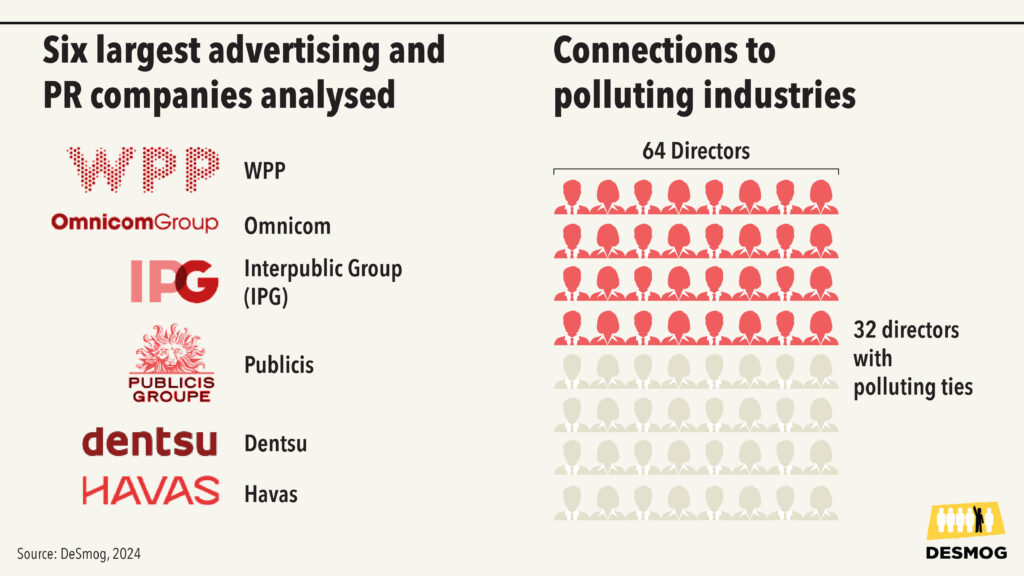 The PR industry’s six largest companies — WPP, Omnicom, IPG, Publicis, Dentsu, and Havas — have a combined total of 64 board members. DeSmog’s analysis reveals that half of these directors have connections to polluting industries. Credit: DeSmog
DeSmog sent requests for comment to the six holding groups and the directors named in this story via both company media teams and their personal company email addresses, as well as to the other companies named in this story. WPP declined to comment. None of the directors, other holding groups, or other companies responded.
“Disheartening”
Omnicom’s board stood out as the most climate-conflicted, with seven of its 11 directors having direct affiliations with polluting industries.
Among them, Valerie Williams holds a non-executive directorship at the Devon Energy Corporation and Leonard S. Coleman Jr. holds a non-executive directorship at Hess Corporation, both major U.S. oil and gas companies. Chevron is currently in the process of acquiring Hess in a $53 billion deal.
Ronnie S. Hawkins, a non-executive director at Omnicom, is currently a partner at Global Infrastructure Partners, which he joined from EIG Global Energy Partners. Both are fund managers that invest heavily in fossil fuel infrastructure, such as pipeline and refinery projects. DeSmog found that many of these projects are owned by current or recent Omnicom clients, including Shell, BP, ExxonMobil, and Repsol.
Hawkins spent 19 years as a senior member of the energy investment divisions at Citigroup and Credit Suisse, respectively the2nd and 20th largest private financers of fossil fuel projects from 2016 to 2022, according to BankTrack. BankTrack’s research also shows that both banks have a history of funding oil and gas majors that also employ Omnicom agencies. Hawkins also did a stint as managing director of Harbour Energy, a London-listed oil and gas company with interests in the UK, Indonesia, Vietnam, Mexico, and Norway.
Omnicom has held 54 fossil fuel contracts since the beginning of 2022, including three with Exxon, the third-largest oil and gas company in the world by revenue.
A series of videos published on Exxon’s YouTube page in 2023 promoted carbon capture and storage as a way to reduce carbon emissions from fossil fuel production — even though the technology largely has a two-decade record of failure at curbing CO2 pollution, and is mostly used by the oil industry to extract more oil. Scientists continue to cast doubt on whether carbon capture will ever function at the huge scale required to make a dent in climate change.
In another 2023 campaign, Mobil (Exxon’s automotive car fuel brand) launched an advert positioning petrol-powered cars as a way of “disconnecting”, in an apparent swipe at electric vehicles.
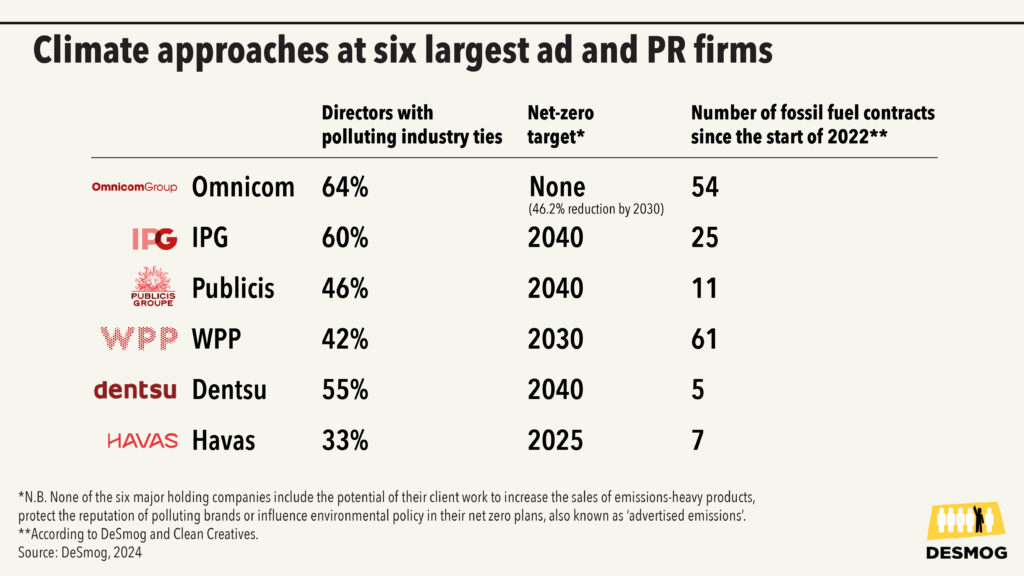 DeSmog’s analysis found that the proportion of board members with ties to polluting industries ranges from 33% at Havas to 64% at Omnicom Group. DeSmog also found that Omnicom agencies have had dozens of fossil fuel contracts since the start of 2022. Credit: DeSmog
“When you’re in a position like I am, trying to make change at an agency to make it more climate-minded, and you see this research, it makes you wonder whether it’s all a bit of a waste of time”, said an Omnicom employee who is involved in staff-led climate groups. “It helps you understand why we’re continuing to see agencies and holding companies like Omnicom take on fossil fuel briefs. It’s pretty disheartening.”
In its 2022 annual report, Omnicom stated that 2 percent of its revenues — around $286 million — came from the oil, gas, and utilities sectors.
Nadeem Khan, who leads the graduate program in Board Practice and Directorship at the University of Reading, said that accelerating climate action at a company such as Omnicom will require bold decisions.
“Currently, a director’s reputation is mainly judged on delivering short-term financial successes, rather than social and environmental wins”, Khan told DeSmog. “You need a board and CEO that are accepting of an organisation’s needs to adapt as renewed, evolved forms in the long-run, otherwise eventually it may not compete as markets themselves evolve.”
No Appetite for Change
New York-based IPG followed closely behind Omnicom in DeSmog’s analysis, with six of its 10 board members having experience in polluting industries such as natural gas, shipping, and plastics.
In 2022, IPG published a policy directly addressing the issue of working for fossil fuel clients — something the other five companies have yet to do. The policy has a number of requirements, including that clients must set specific emission reduction goals that are aligned with net-zero emissions by 2050.
However, IPG employees have previously told DeSmog that some elements of the policy mean it is weaker than it appears, such as the fact that it only applies to new clients. “You could drive an oil tanker through some of the loopholes in it”, said one IPG insider.
Another employee, who recently left one of IPG’s subsidiary agencies, told DeSmog that it was clear to staff engaging with leadership on polluting clients that “behind closed doors”, there was no genuine appetite for change at the top of the company.
Both employees asked not to be named for fear of professional repercussions.
In November, DeSmog reported that McCann, an IPG advertising agency, will pitch to retain its relationship with Saudi Aramco when the current contract runs out this year.
With 2022 revenues of $604 billion, Saudi Aramco is the largest oil and gas company in the world.
At WPP, board chair Roberto Quarta has seven current and past ties to polluting industries, the highest in DeSmog’s analysis, including two current partnerships at Gulf Capital and Clayton, Dubilier & Rice, fund management companies that have significant stakes in fossil fuel infrastructure and logistics companies. Many of those companies work closely with Exxon,TotalEnergies, Sabic, PTT Oil, Shell, BP, and Chevron. All are current or past clients of at least 10 WPP agencies, DeSmog found.
Another WPP board member, Simon Dingeman, is the former head of UK investment banking at Goldman Sachs. Since the establishment of the 2015 Paris Agreement, Goldman Sachs has provided $143 billion in fossil fuel finance, according to BankTrack, putting it in the top 15 private funders of the sector.
Dingeman is currently a senior advisor at the investment firm Carlyle Group, which has been criticised by campaigners for making claims about its climate leadership whilst doubling the emissions related to its investments between 2011 and 2021, according to research group Private Equity Climate Risks.
At Paris-based Havas, three out of nine board members have ties to polluting industries. They include Havas chairman-CEO Yannick Bolloré and board member Marie Bolloré, his sister, who have ties to the oil logistics division of the family-run Bolloré Group — which also owns Havas parent company Vivendi.
In 2023, Havas won a major contract with Shell to manage the company’s worldwide advertising spots. With $386 billion in revenue in 2022, Shell is the world’s fourth-largest oil company.
A DeSmog investigation, published in January, revealed growing discontent amongst Havas employees who saw the move as undermining Yannick Bolloré’s numerous public statements of concern about climate change. The investigation also documented a number of current or recent fossil fuel clients among Havas subsidiaries, as well as deep ties between the Bolloré Group and fossil fuel projects in Africa and Canada.
Five out of Dentsu’s nine directors have ties to polluting companies or sectors. Just under half of the 13 directors at Publicis and 12 directors at WPP have similar ties.
Board members at these companies have experiences at a range of companies with fossil fuel interests.
Dentsu’s board chairman, Tim Andree, was previously chief communications officer of BASF, the biggest chemical producer in the world and a major supplier of petrochemicals and services for the oil and mining industries. The German company has a history of lobbying against EU regulations on polluting chemicals.
At Publicis, board member André Kudelski was previously vice-chair of the Geneva Airport and a director at Swiss International Airlines. A number of Publicis agencies have produced campaigns supporting the aviation industry in recent years, including Publicis Sapient’s adverts for Swiss International Airlines’ premium economy class.
The aviation industry accounted for 2 percent of global carbon emissions in 2022, according to the International Energy Agency, with emissions in the sector growing faster than in road, rail, and shipping.
DeSmog’s analysis did not include similar examples below the parent company level. For example, John Dawkins is co-chair of GRACosway, one of Omnicom’s leading political lobbying agencies in Australia, whilst also holding chair and non-executive director roles at mining companies Precious Metal Resources Ltd and Tiaro Coal Ltd, respectively.
GRACosway and Dawkins did not respond to DeSmog’s requests for comment.
Low-Hanging Climate Commitments
Agencies and industry bodies have been slow to acknowledge the true climate impact of the industry, campaigners say. While five of the six holding companies have now set net-zero goals, these plans only account for emissions generated by their own business operations, such as employee travel, energy used to power office buildings, and the production of advertising campaigns.
All six are members of Ad Net Zero, a voluntary industry initiative whose members pledge to voluntarily reduce these sorts of in-house greenhouse gas emissions. Ad Net Zero’s five-step action plan does not ask members to consider the potential wider climate impacts of their work, such as the risk that producing campaigns that enhance the images of heavily-polluting clients could deflect pressure to cut emissions.
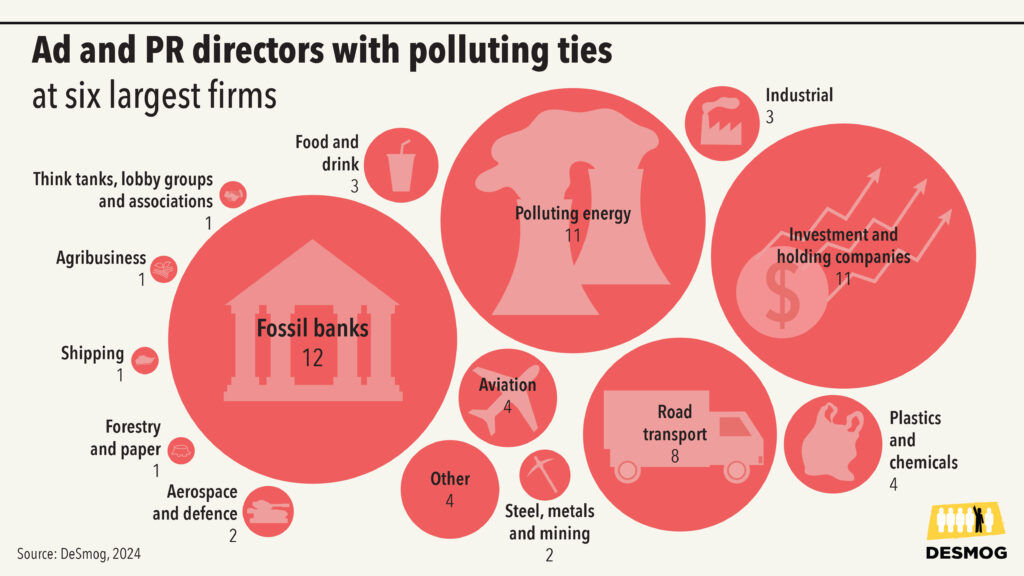 The polluting industry ties among the relevant 32 board members are concentrated in three sectors: banks that finance fossil fuel development, polluting energy production, and investment and holding companies. Credit: DeSmog
Purpose Disruptors, a campaign group focused on the ad and PR industry, defines the carbon pollution associated with an advertising-generated uplift in sales of heavily polluting products and services, such as SUVs or air travel, as “advertised emissions.” The concept has been recognised by the United Nations-led Race to Zero campaign, which focuses on getting businesses, universities, cities, and others to eliminate their carbon emissions no later than 2050.
A 2023 report by Dentsuestimated that the company’s 2022 advertised emissions were 32 times the size of its own operational carbon footprint.
“Board directors have been adamant publicly about their dedication to climate action and their companies’ pivot towards net zero”, said Sarah Chow, an investment analyst at the Sydney-based ethical pension fund Future Super. The fund has been trying to engage with Publicis and WPP on their work for high-carbon-emitting clients. “But behind closed doors and after public [annual general meetings], our relations with these directors have gone cold.”
Some experts argue that the pace of change in the industry is also constrained by the parent company structure of these six firms, which limits the power of subsidiary agencies to make their own decisions on issues such as climate strategy.
“You have to remember, these few leading directors are setting the tone and agenda not just for the overarching company, but multiple chains of companies”, said the University of Reading’s Khan.
Andreas von Angerer, head of impact investing at Zurich-based Inyova, led a group of investors in raising the issue of advertised emissions with the Publicis board at its annual general meeting in May 2023.
The group, which also includes French asset-manager Ecofi and Australia’s Future Super, collectively manages assets worth more than 16 billion euros.
Publicis’ board “told us that all of their clients are reducing emissions, even though their oil clients such as Saudi Aramco and ADNOC” — the Abu Dhabi National Oil Company — “are clearly not”, von Angerer told DeSmog.
“Currently these boards don’t have the progressive mindset needed to really set up a company for the future”, he said. “We really need new faces, new ideas and new minds on boards to make sure these old, established companies keep up with the transition [to net zero].”
Transitioning With the Times?
In a report released in April 2022, the United Nations Intergovernmental Panel on Climate Change referenced the communication industry’s role in protecting polluters.
Several months later, UN Secretary-General António Guterrestold the General Assembly that “we need to hold fossil fuel companies and their enablers to account [including] the massive public relations machine raking in billions to shield the fossil fuel industry from scrutiny.”
For the better part of two decades, advertising regulators in the UK, France, Australia, and some other jurisdictions have taken stands on greenwashing. In June 2023, the UK’s Advertising Standards Authority banned adverts by Shell, Repsol, and Petrobras that made misleading claims about their investments in renewable energy. Shell’s adverts had been created by WPP’s Wunderman Thompson (now VML), and Repsol’s by DDB Spain, an Omnicom agency.
In November, for the first time, the Advertising Standards Authority banned two ads for promoting driving that harms the environment. The adverts for the Toyota Hilux SUV were made by WPP agency The&Partnership, according to industry publication The Drum.
Experts say that these sorts of greenwashing complaints and regulatory bans pose legal risks to individual board members, because they have the potential to inflict reputational damage that could trigger financial losses.
“Directors of advertising agencies must have sufficiently robust governance structures to mitigate and respond to these [reputational and financial] risks”, said barrister Margherita Cornaglia of Doughty Street Chambers, a group of barristers focused on human rights and civil liberties. “Failure to identify or address risks as a result of their links with fossil fuel and other polluting companies could place them in breach of their fiduciary obligations.”
Communications companies may be taking note. In its 2022annual report, WPP mentioned the “increased reputational risk associated with working on client briefs perceived to be environmentally detrimental.” Dentsu has also mentioned these risks in public documents.
Experts say they expect action on issues such as climate change to increase as younger generations join these boards of directors.
“Boards tend to transition in decennial cycles”, the University of Reading’s Khan said. “There emerges a generational shift, a new way of thinking. You can see the difference of mindsets through faster evolving changes — for example at Google, Nvidia, or Microsoft in the tech industry — where boards are made up of more entrepreneurial attitudes and comparatively younger directors.”
But Sarah Chow of Future Super believes these changes need to happen now. “Board directors are often removed from the actual problems their employees face”, she said. “They need fresh blood that understands the pulse of a company’s workforce, and what the workforce wants.” Chow would also like to see union or other employee representatives on the agencies’ boards.
A former WPP employee shared Chow’s vision: “Why isn’t a creative holding company saving a board seat for a junior creative? They are the future of the industry.”
---
DESMOG PR Series 3 24}:}:
We're holding the advertising and PR industry accountable - DeSmog
about the Series
When it comes to identifying the culprits responsible for the delay and denial of climate solutions, most people are likely to think of fossil fuel companies rather than the slick world of advertising and public relations. But in the words of UN Secretary-General Antonio Guterres, a “massive public relations machine” is “raking in billions to shield the fossil fuel industry from scrutiny.”
We take readers inside the world’s most influential creative and reputation management firms to show just how deep their ties with Big Oil run, and expose where lofty climate rhetoric runs afoul of commercial realities. And we document the struggles of a younger generation of climate-conscious employees to steer their industry onto a sustainable path — despite resistance from the top.
UK/Dozens of Ad & PR Industry Directors Have Ties to Heavily Polluting Industries
:{ByTJ Jordan and Rachel SherringtononApr 3, 2024
Dozens of Ad & PR Industry Directors Have Ties to Heavily Polluting Industries - DeSmog
Insiders fear that conflicts of interest on the boards of the six largest communications firms are quashing effective climate action.
OPINION
Polluters Are Melting the Winter Sports They Sponsor
:{ByAndrew Simms and Anna JonssononMar 16, 2024
Corporations are using sport to sell the high-carbon products that are killing our winters, and now we can put a figure on the damage their money does.
ANALYSIS
Oil and Gas Companies Want You to Think They Care About Women — but It’s Just PR
:{ByEllen Ormesher, Emily Gertz, Kathryn Clare and Cartie WerthmanonMar 8, 2024
Their ad campaigns for International Women’s Day champion empowerment even as climate change makes women’s lives harder and more dangerous.
Ellen Ormesher and Kathryn Clare Join DeSmog to Investigate Advertising Industry
:{ByDeSmogonFeb 26, 2024
Climate accountability in creative and PR agencies is the focus of our growing team.
Investors Challenge ‘Blind Spots’ in Climate-Friendly Ratings for Ad and PR Giants
:{ByHugh Wheelan and TJ JordanonFeb 25, 2024
DeSmog investigation finds multiple financial risks of work for fossil fuel clients aren't being assessed.
OPINION
TotalEnergies Has no Place in African Football
:{BySamm Farai MonroonJan 31, 2024
Kick Polluters Out says the French oil major wants to sportswash climate-wrecking mega-projects.
UK/Havas London Targeted by Climate Activists Over Agency’s Relationship with Shell
:{ByEllen Ormesher onJan 25, 2024
The protest followed a tip-off that the global comms agency may take on more work for the oil major.
UK/Havas CEO Yannick Bolloré Staked His Brand on Caring About the Climate. So Why Is His Company Working for Shell?
:{ByGeoff Dembicki, Dana Drugmand, Emily Gertz, Ali Lyon and Isobel MoseleyonJan 23, 2024
The Bolloré family’s business empire — which includes Havas, one of the world’s biggest ad agencies — has longtime ties to the fossil fuel industry.
Illustration of Havas CEO Yannick Bolloré in front of a background of shells.
ANALYSIS
Revealed: Three-quarters of Prestigious Green Advertising Awards Go To Agencies Working for Fossil Fuel Industry
:{ByTJ JordanonJan 4, 2024
DeSmog analysis finds majority of Ad Net Zero’s accolade-winners also represent major polluters.
Instagram Influencers Paid to Boost UAE’s Climate Credentials Over COP28
:{ByJoey GrosternonDec 14, 2023
The individuals who spoke to DeSmog said they were ‘deeply disappointed’ by the summit and had not fully understood the relationship between UAE and the organisers.
'Inoculate From Criticism': A Closer Look at the Public Relations Companies Active at COP28
:{ByCartie WerthmanonDec 9, 2023
Controversies surrounding Sultan Ahmed Al Jaber have underscored the role of reputation management in climate diplomacy.
Reuters, New York Times Top List of Fossil Fuel Industry’s Media Enablers
:{ByAmy Westervelt, Matthew Green and Joey GrosternonDec 5, 2023
New report by DeSmog and Drilled reveals extent of commercial partnerships between trusted outlets and Big Oil.
OPINION
Why Saudi Arabia Wins Top Prize in the Bad Sport Awards 2023
:{ByAndrew SimmsonNov 28, 2023
Major polluters are wielding sponsorship as a weapon to make polluting products and lifestyles appear acceptable.
OPINION
Badvertising: How Promoting Pollution Prevents Climate Action
:{ByLeo Murray and Andrew SimmsonNov 22, 2023
Left unaddressed, the warping of our collective consciousness by fossil industry propaganda will make it impossible to achieve the civilisation level transformation required for life as we know it to survive the 21st century.
UK Advertising Watchdog Bans Toyota SUV Ads on Environmental Grounds
:{ByTJ JordanonNov 22, 2023
The adverts “had not been prepared with a sense of responsibility to society,” regulator finds.
McCann to Make New Pitch for Aramco Oil and Gas Advertising Work
:{:{BySam Bright and TJ JordanonNov 16, 2023}:
There is ‘growing unease’ within the PR company about its continued work for one the world’s biggest polluters.
US/Havas Wins Shell Advertising Contract, Drawing Fire from Climate Campaigners
:{ByDana DrugmandonSep 19, 2023
Clean Creatives says move is "huge step backward" for the French ad and public relations company.
WPP Has More Fossil Fuel Clients Than Any Other Advertising Company, Report Finds
:{ByTJ JordanonSep 19, 2023
Clean Creatives’ ‘F-List’ reveals links between creative agencies and polluting industries around the world.
US/American PR Firm Edelman Enabled Oil Baron Al Jaber’s Ascension to Lead COP28 Climate Conference
:{ByCartie WerthmanonSep 13, 2023
Edelman earned millions polishing the UAE’s green image — which helped propel Sultan Ahmed Al Jaber to the top levels of climate diplomacy.
UK/How Shell Used a ‘Granfluencer’ to Promote its Brand
:{ByDimitris Dimitriadis, Joey Grostern and Sam BrightonAug 15, 2023
A Filipino grandma with two million followers is among the hundreds of influencers who have posted content promoting fossil fuel giants.
UK/Revealed: Fossil Fuel Giants Are Using British Influencers to go Viral
:{:{ByDimitris Dimitriadis, Joey Grostern and Sam BrightonJul 27, 2023}:
Some of the world’s biggest polluters are paying social media celebrities and environmentalists to promote their brands to billions of people.
Litigation Over Misleading Climate Claims Has 'Exploded' Over the Past Few Years
:{:{ByDana DrugmandonJul 3, 2023}:
New report details how more “climate-washing” lawsuits and complaints are being filed against corporations’ greenwashing than ever before, and experts warn complicit PR and ad firms could face legal risks.
PR Agency Catering to Oil Interests Led UK Climate Forum’s Communications
:{ByBrendan DeMelleonJun 28, 2023
Weber Shandwick also hosted a roundtable on “authentic” climate communication.
Climate Innovation Forum 2023 website showing event details, sponsors/partners, and London Climate Action Week.
Confronting Big Oil at Cannes Lions: The Viral Moment That Exposed the Ad Industry's Complicity in the Climate Crisis
:{ByTolmeia GregoryonJun 19, 2023
Climate activist Tolmeia Gregory sparked a social media sensation when she challenged a Shell executive at last year's festival. Now she's back, and urging other creatives to take disruptive action.
---
random grab 4 24
US/Where Was Exxon Planning to Inject CO2 in Louisiana? It’s a Trade Secret.
US/Big Oil Clouded the Science on Extreme Weather. Now It Faces a Reckoning.
Will The UK’s Flagship Climate ‘Solution’ Be Used to Pump More North Sea Oil?
US/Fossil Fuel Lobby Kicks off Disinformation Campaign Against EPA Auto Emissions Rule
US/How $9 Billion From Taxpayers Fueled Plastics Production – and Illegal Pollution
---
===
https://www.opendemocracy.net/en/un-climate-champions-pr-brunswick-saudi-aramco/
UN climate campaign leaders are taking advice from a PR firm that works extensively
for fossil fuel giants – including the world’s biggest oil company, Saudi Aramco.
The international public relations firm Brunswick has helped the UN’s “high-level climate champions” – a small but influential team led by the UK and Egypt, the hosts of COP26 and COP27 – to develop five UN-backed climate policies and campaigns.
One of these campaigns is Race to Zero, which encourages companies to rapidly reduce emissions, with its flagship initiative, Business Ambition for 1.5°C, calling on corporations to help limit global warming to that level.
But while advising the climate champions, and having signed up as a member of Race to Zero, Brunswick also spins for fossil fuel companies developing dozens of new oil and gas prospects.
these developments will make the 1.5°C goal – which requires a complete stop to new oil and gas projects – much harder to attain.
Duncan Meisel, executive director of Clean Creatives, a campaign calling for PR and advertising agencies to boycott fossil fuel companies, told openDemocracy: “Working for oil drillers and fossil fuel power companies makes Brunswick an opponent of the action that UN high-level climate champions are trying to promote.”
PR companies’ role in the climate crisis has been under renewed scrutiny in recent months, afterAntonio Guterres, the UN secretary general, condemned the “massive public relations machineraking in billions to shield the fossil fuel industry from scrutiny”.
‘Enabling deception’
Brunswick’s chief executive Neal Wolin has said the company wants “to be part of the solution [to the climate crisis] through the advice we give our clients and, importantly, how we operate as a firm”.
But critics have questioned whether Brunswick can live up to that claim, while working for some of the world’s biggest carbon emitters.
Last month, Brunswick client Saudi Aramco said it would increase its oil production capacity by one million barrels per day by 2027 – bringing its total daily output to 13 million barrels.
Another Brunswick client, Harbour Energy, the biggest oil and gas producer in the UK, said in March that it would participate in the drilling of 23 new oil wells this year, and would double the number of rigs it has in operation, from four to eight.
Brunswick client Capricorn Energy is currently exploring new oil prospects in the North Sea, Mauritania, Mexico and Suriname.
In October, Brunswick announced the opening of an office in Riyadh, the Saudi Arabian capital. Days later, the firm helped oil contractor Arabian Drilling and gas power company Marafiq to launch successful initial public offerings (IPO) on the Saudi stock exchange.
In 2019, Brunswick worked on the IPO of Saudi Aramco, when the oil giant raised $25.6bn in the biggest initial stock offering in history.
With the help of Brunswick… oil and gas companies have continued to make sky-high profits while generating heat-trapping emissions
Kathy Mulvey, Union of Concerned Scientists
openDemocracy has also found that Brunswick has previously worked for a host of other oil and gas companies includingBP; Centrica; fracking company Cuadrilla; Sinopec, which is China’s largest oil company; BG Group, which is now part of Shell; and KazMunayGaz, the state-owned Kazakhstan gas company.
Brunswick, which has more than 1,400 employees at 29 offices worldwide, uses its UN work to tout for business from corporate clients, with a video on the firm’s website boasting that it works with “the entire eco-system of actors in the climate space”.
Kathy Mulvey, accountability campaign director at the Union of Concerned Scientists, told openDemocracy that “skilled communications professionals” such as Brunswick are “enabling the fossil fuel industry’s deception”.
She added: “With the help of Brunswick and other powerful PR firms, major oil and gas companies have continued to make sky-high profits while generating ever more heat-trapping emissions and stepping up greenwashing campaigns.
“In the face of the climate emergency, PR agencies must stop attempting to secure social licence for fossil fuel polluters and instead come down clearly on the side of climate action.”
Sending the wrong message
In June, the Race to Zero campaign strengthened its membership criteria to require firms “to align their lobbying and advocacy activities with net zero by proactively supporting climate policies”.
Existing members – including Brunswick – were given up to a year to meet this new criteria, and Race to Zero published guidance on how to do so. This made clear that all “public relations campaigns” by members should be consistent with halving emissions by 2030.
Brunswick did not respond to questions from openDemocracy on whether it would align its lobbying and advocacy with net zero by June 2023.
But Duncan Meisel told openDemocracy that by working with Brunswick, the Race to Zero sends the wrong message.
Meisel said: “These guidelines are vital to building a clean energy future, and as long as the high-level champions employ Brunswick, they are sending a message that the guidelines should not be taken seriously.”
[Related story
Government waives £10bn in green ‘tax’ for UK’s biggest polluters
25 October 2022 | Lucas Amin
Exclusive: ExxonMobil among oil & gas firms handed ‘pollution permits’ under little-known Emissions Trading Scheme]
Tom Hale, a professor of public policy at Oxford University and an expert adviser to Race to Zero, said the campaign’s new membership criteria still failed to capture the impact of service providers such as Brunswick.
While Race to Zero members must have “a 1.5°C-compliant business model”, the rules do not require them to quantify the impact of the work they do for fossil fuel clients.
Speaking to openDemocracy, Hale said: “As net zero is operationalised, one huge area in need of more work is what standards service providers – PR companies, but also lawyers, accountants, management consultants etc – should follow.
“Current carbon accounting tools – including those used by initiatives like Business Ambition for 1.5°C – were not designed to capture the footprint of these kinds of companies, even though their impact on the direction of the economy can be substantial.”
Hale called on “leaders in these industries” to “step up and lay out a credible pathway for what net zero-aligned PR looks like”.
‘Proud of the advice we provide’
A spokesperson for Brunswick told openDemocracy that the firm is “proud of the advice we provide clients across a range of industries on the transition to a resilient net-zero economy, and of our role in advising the UN Climate Change High Level Champions and the Race to Zero campaign.”
They added that it is “vital to be engaged with companies in the most complex sectors to decarbonise. Our climate advice is based on science-based pathways for transition and we advise many businesses in these sectors on the actions it takes to build credibility and trust on climate change.
“Brunswick itself is committed to aligning our firm with a robust science-based 1.5°C pathway by 2028, in line with the Science-Based Targets initiative.”
Frances Way, executive director of the climate champions team, said: “We collaborate with a wide-range of organisations, including Brunswick, that are working to achieve a resilient, 1.5°C-aligned future, requiring actors across all sectors of the economy to transition, including among the most systemically important industries that need to decarbonise.”
The climate champions did not respond to questions about whether Brunswick was in breach of the Race to Zero guidelines.
Last month, more than 400 scientists called on the PR firm Hill+Knowlton Strategies to drop its fossil fuel clients after openDemocracyrevealed it was also working for the Egyptian presidency of COP27.
Some 636 fossil fuel industry representatives registered to attend COP27, according to research by Global Witness, leading to claims that the conference had been hijacked.
===
gaslit series
https://www.desmog.com/**2022/06/**16/climate-deniers-fossil-fuel-language-obstruction/
stella l
On a recent episode of the Fox Business show “Mornings with Maria,” American Petroleum Institute CEO and President, Mike Sommers, said that “the most important environmental movement in the world is the American oil and gas industry.”
“A super absurd example of oil and gas companies appropriating and weaponizing the language of climate advocates for their own greenwashing,” commented author and climate activist Genevieve Guenther on Twitter.
Sommers’ statement may be, in fact, one of the most literal examples of how fossil fuel companies are using language to perpetuate their climate denial and fend off action. And because public perception and awareness of the climate crisis are, at least in part, driven by how we talk about it, the fossil fuel industry has used language “to create smoke and mirrors and false impressions around what they’re really doing,” said Christine Arena, author, expert on climate disinformation, and former Executive Vice President at the PR firm Edelman. Arena was one of six employees to resign in 2015 following revelations of the firm’s greenwashing work with fossil fuel lobbies and associations.
PR firms — or “the enablers,” as Arena calls them — have played a key role in exploiting communication and manipulating language to their advantage, all while working on behalf of the fossil fuel industry and using a tobacco industry playbook. Ultimately, they’ve been using it to obstruct climate action, a longtime goal of the oil, gas, and coal industries. “If we take a step back and ask ourselves, why has meaningful action to avert the climate crisis proven to be so difficult? It is at least in part because of communications and because of the language coming from the fossil fuel industry,” said Arena.
Today, the fossil fuel industry and its allies are “appropriating and weaponizing” language from climate advocates, usually in ways that are much less obvious than Sommers’ recent comment.
“The industry is repeating the same phrases it’s hearing from the climate movement to use for their own advertising purposes. They are commandeering the language of sustainability and of the climate movement,” Arena said of fossil fuel companies, adding that they are doing so “to create a false perception that they’re on our side.”
Fossil Fuel Solutionism
Language around climate solutions is particularly susceptible to this treatment, especially as polluting companies invest in strategies and tactics to present themselves as part of the solution to climate change when, clearly —as they continue to prioritize drilling for globe-warming fuels — they are not. That’s ExxonMobil touting its “lower-emission solutions” and staff working to “develop our global strategy for creating sustainable energy” while planning a $10 billion investment in new oil and gas reserves in South America. Some researchers have called this “fossil fuel solutionism."
exxon twit]
This sort of inevitability of fossil fuels — I think that’s a place where language is really important,” said Timmons Roberts, social scientist and executive director of the Climate Social Science Network at Brown University. He says the fossil fuel industry encourages this perception that everyone is complicit in climate change by using its products and is therefore too reliant on them to ever transition away
The strategy is part of a broader communications shift among polluters and their advocates. No longer are oil and gas executives straight-up “denying” that the climate is changing; instead the message becomes one that ultimately slow-walks real climate action — saying, it’s too expensive to address, it’s too late to do anything. “We call these ‘climate delay’ discourses, since they often lead to deadlock or a sense that there are intractable obstacles to taking action,” write Roberts and his colleagues in their “**Discourses of climate delay**” analysis.
Fossil fuel companies and their allies may use delay arguments and tactics across a range of platforms: in promotional campaigns, public declarations, online ads, social media, or political lobbying. Nowadays, the messaging may contain “a blend” of factual omissions and rhetorical distortions, according to Arena, that can be more confusing to people and, therefore, more dangerous than outright lies.
“If you say ‘clean coal’ a lot of people are going to know that there’s no such thing, so that’s easier for the audience to identify,” said Arena. “But then when you look at ExxonMobil’s language around carbon capture, for example, they’ll say things like ‘it’s going to take an all-of-the-above approach,’ and when the oil and gas industry says ‘all of the above,’ they mean oil and gas first.”
Arena considers this type of wording to be a form of greenwashing, where a company uses “selective micro truths,” she explained, in order to create a misleading impression. This type of language is more insidious because it’s creating the perception that oil and gas companies really are “part of the solution” and don’t need regulatory intervention — which they are often lobbying against elsewhere.
“Cleaner burning.” “Lower emissions fuels.” “Lower carbon future.” These phrases are all examples of this, Arena said.
Many of these terms appear on fossil fuel companies’ social media accounts or websites. ExxonMobil uses the phrase “advancing climate solutions” and “lower emission energy future.” Shell is “working…to accelerate the transition to net-zero emissions.” Chevron is “advancing a lower carbon future.”
By participating in the public discourse in this way, fossil fuel companies can manipulate public perceptions by making “support” seem like action. “‘Supporting the Paris agreement’ is also deceptive because it makes it look like they are in line with Paris,” said Arena. “They’re not.”
A new report from more than 40 groups, published by Oil Change International, has found that major U.S. and European oil and gas companies “still fail to meet the bare minimum for alignment with the Paris Agreement.” These companies’ pledges and commitments are far from credible, the report concludes, when they are planning more than 200 fossil fuel expansion projects between now and 2025.
[oil ch intl twt]
the History of Junk Science, Alarmists, and Climate Prophets
Denier and delayer communication strategies aren’t new; in fact they have always been central to the fossil fuel industry and its allies’ climate obstruction.
In the 1990s, for example, “sound science” was an expression used by climate deniers to attack and counter climate science — or “junk science,” as some deniers, such as former Fox News columnist and founder of the website JunkScience.com Steve Milloy, referred to the work of climate scientists like Michael E.Mann.
In another past strategy, that’s now regaining steam, climate deniers and delayers have been employing the terms “realists” and “alarmists.” In 2020, Cambridge University researcher Giulio Corsi and I analyzedthe use of these terms on Twitter, finding a 900 percent increase in their use over the previous four years. As the climate movement was gaining international attention with massive protests between 2018 and 2019, we saw that spikes in tweets about “alarmism” and “realism” often corresponded to high-profile speeches by activist Greta Thunberg. The trend also coincided with the Heartland Institute, a U.S. think tank and notorious promoter of climate disinformation, enlisting young German YouTuber Naomi Seibt as a counter-figure to Thunberg to denounce her and climate scientists’ “alarmism.”
[greta pix w/ indig]
This framing exploits the negative connotation of the term “alarmist” in order to discredit a legitimate scientific warning, while trying to associate backers of fringe theories about, say, sunspots causing global warming, with rationality and realism.
Milloy employed a combination of these terms when he wrote in 2002: “When the Clean Air Act was enacted in 1970, air pollution in the U.S. was more of an aesthetic than a public health problem. […] Few people realize this after 30 years of non-stopjunk science-fueled alarmism from environmental activists.” [Emphasis added.]
For decades, deniers have used rhetoric likening those who warn about the catastrophic impacts of the climate emergency to someone who is “out of touch with reality.” You can find it in the 1998 American Petroleum Institute “action plan,” born just a few months after the Kyoto Protocol and developed by Exxon, Chevron, Southern Company, and representatives from conservative organizations, including Milloy. The memo clearly stated that: “Victory will be achieved when those promoting the treaty on the basis of extant science appear to be out of touch with reality.” [Emphasis added.]
Both uses of language – “sound science” versus “junk science” and “alarmists” versus “realists” – create an “us versus them” dynamic. The result is two polarizing, and utterly fabricated, positions on climate science.
We can see the fossil fuel industry using language in a similar way in its public-facing propaganda, projecting political meaning on its opponents.
“Propaganda is about manipulating public opinions, stoking fears, and sewing divisions,” said Arena. “When they talk about ‘the woke’ or the ‘climate industrial complex’ or ‘activist extremists,’ that is all propaganda. The industry is blaming rising gas prices on ‘woke liberals’ or on renewables or on climate activism. Those are false narratives and they are propaganda-based."
According to John Cook, founder of Skeptical Science and research fellow at Monash Climate Change Communication Research Hub in Australia, fossil fuel industry propaganda has been intensifying the “othering” of climate scientists and advocates for climate action for some time.
“There’s a lot of terminology that has become more powerful in sending that signal that climate advocates are different,” said Cook. “Labels to say, ‘these people who care about climate change are trying to change society.’” Climate denial is intimately connected to values like individual freedom and free market fundamentalism,he explained. That’s why those labels are often extended in meaning to accuse climate advocates of a “radical liberal agenda,” said Arena.
The “othering” of climate advocates isn’t only by fossil fuel companies. In September 2021, the Italian Minister of the Ecological Transition called climate activists “radical chic” and said that the “extremist and ideological ones” are “worse than the climate catastrophe.”
Over time, the language of climate deniers and delayers has evolved from “basic climate denial” to “culture wars,” said Arena.
Culture wars are strictly linked to political ideology: that’s why some words are chosen by deniers and delayers over others, because they “tap into broader values” and “activate” their supports, added Cook. For example, deniers might pose the argument that “[climate action] is going to impinge on their freedom,” he said.
The Supposed Church of Climate Change
Another linguistic tactic used to denigrate those who support climate action is to cast an issue with roots in science — climate change — as one of religion. In Italy, for example, the daily newspaper Il Foglio uses pseudo-religious terms when referencing climate change: ecology becomes “a religion to replace canceled Christianity” where “you kiss trees and worship whales;” switching to an electric car is “fanatical;” climate change is referred toas “dogma.” And Friday, the Italian paper writes, has becomethe day of “forced conversion to sustainability” when youth climate activists go on strike from school, as part of Greta’s “children’s crusade.”
Associating climate change with religion reinforces the denier message that the build-up of greenhouse gases and its far-reaching global impacts is actually a matter of faith and has nothing to do with a factual, physical reality in the form of heatwaves and hurricanes. In this scenario, climate advocates seem unreasonable, disconnected from reality and unable to see things clearly. The effect is to relegate those supporting climate science to one end of the spectrum, one where we don’t need to address the intensifying impacts of heating the globe.
But this zealous religious framing happens beyond the pages of Il Foglio. According to Cook, deniers also use words like “cult” and “high priests” to describe climate advocates, while emphasizing that they themselves are “treated like heretics.”
“They are framing themselves as the rational scientific person and the scientists or advocates as the hysterical, biased, faith-based and not evidence-based,” said Cook of climate deniers. “They’re trying to flip reality because ideology is driving their denial.” [heartland reverse engr]
Don’t Worry, Just Adapt!
Another narrative emerging from the denial anddelayer camp is that “adapting” to climate change will be our lifeline: Those perpetuating it end up downplaying the impacts of the climate crisis because they say we will be able to adapt to it.
In a May 31 Slate article about Alex Epstein’s new book Fossil Future, which advocates for fossil fuels, Nitish Pahwa writes: “The new style of climate denial is here: It’s not that carbon emissions aren’t increasing, or aren’t warming the world, but look, you’re doing fine right now, right? So, we’ll be just fine!”
On May 20, Stuart Kirk, the head of responsible investing for HSBC’s asset management division, “Who cares if Miami is six meters underwater in 100 years? Amsterdam has been six meters underwater for ages, and that’s a really nice place. We will cope with it.” Kirk was later suspended for his comments.
[vid]
stuart Kirk, head of responsible investing for HSBC’s asset management division, was suspended for his comments to investors in which he downplayed the risks of climate change.
This argument implies that working to slow climate change is futile and offers adaptation as “the only possible response” to the climate crisis, according to Roberts and his colleagues in their “Discourses of delay” analysis.
“Every day there’s new discourses being invented either by the actors in these industries that don’t want to make the energy transition or by their public relations firms with tremendous capacity in terms of developing new language discourses,” said Roberts.
Effective PR is a key element to designing a convincing greenwashing campaign. “The PR and ad industry plays a central role in enabling climate obstruction,” said Arena. And the American Petroleum Institute’s is the perfect example of this. “They’re not on it. The only thing that they’re on is architecting and spreading more disinformation, which they are the quarterbacks of doing,” she added.
From fossil fuel solutionism to adaptation-only narratives, these climate obstruction tactics commandeer language in an attempt to undermine one of the most urgent and far-reaching challenges of our day. And the momentum behind such deceptive language is only building.
“We are on a dangerous trajectory,” Arena said. “I would say broadly that climate disinformation and greenwashing are getting much worse, and today we have many more examples to point to than we even did back when the industry was trying to deny climate change altogether.”
Understanding how opponents of climate action employ these discourses of delay is essential to recognizing climate disinformation and misinformation, Arena said, and ultimately to disrupting it. “We have to redouble our efforts to hold these companies and their enablers accountable.”
On Wednesday, a key congressional ally of former President Donald Trump broke with him over the legitimacy of the Saudi-sponsored golf tournament he is hosting on his Trump National Bedminster property in New Jersey.
The argument came after Nick Adams, a pro-Trump social media influencer, took to Twitter to complain that the golfers participating in the tournament weren't getting top billing. "I really have no interest in the PGA Tour FedEx Cup Playoffs without the top LIV Tour golfers being included," he wrote. "Brooks Koepka, Dustin Johnson, Bryson DeChambeau, Patrick Reed, and Jason Kokrak should ALL be playing."
Rep. Chip Roy (R-TX), however, disagreed.
"I have no interest in watching these guys play after selling their souls to the highest bidder when that bidder is a foreign country known to have financed 9-11 and other terrorist activity," wrote Roy. "But whatever… somehow this is MAGA or something."
Fifteen of the 19 hijackers involved in the coordinated attacks on New York and Washington were Saudi nationals. An FBI memo released last year hinted at official Saudi involvement.
Trump himself claimed in 2016 while he was running for president that Saudi Arabia was responsible, without providing any evidence.
"(Now) he chooses to host the kingdom at his course in the backyard where 750 people were blown away," said Brett Eagleson, who was 15 when his dad died in the rubble of the World Trade Center, referencing the number of New Jersey residents killed on 9/11.
"It's incredibly infuriating," he said.
Bankrolled by Saudi Arabia's Public Investment Fund, LIV has sought to lure top golfers from the establishment PGA and DP World tours with contracts that have run into the hundreds of millions of dollars.
Human Rights groups say the venture is a "sportswashing" exercise being used to boost Saudi Arabia's international reputation. Organizers insist their intention is to boost golf's popularity worldwide.
Trump has come under heavy criticism, particularly from the families of 9/11 victims, for agreeing to host the Saudi-backed golf tournament, with many openly protesting the tournament.
For Tim Frolich, who was injured on 9/11, the tournament has reopened old wounds.
"I had trouble sleeping last night, just the anger," the 58-year-old told AFP.
Trump, for his part, has defended Saudi Arabia's involvement in the tournament, claiming to reporters that "nobody's gotten to the bottom of 9/11."
With additional reporting by AFP
===
===
https://www.climateone.org/audio/enablers-firms-behind-fossil-fuel-falsehoods
february 11th, 2022
Public perception is important to any company, and fossil fuel companies are no different. Every year, they spend large amounts of money to make sure that the public is abundantly aware of all of the work fossil fuel companies are doing to help with the transition to clean energy. The problem is, the money spent on the messaging outpaces the money spent on the decarbonization.
PR firms, ad agencies, and law firms work behind the scenes to protect the fossil fuel industry and slow down the clean energy transition. Despite the industry having knowledge of the climate crisis as early as 1959, they continue to resist any change.
For example, many large oil and gas companies say they support a price on carbon pollution. Yet large oil companies invest a small fraction of their profits promoting carbon pricing policies and low carbon energy. The House oversight committee reports that less than half of 1% of their lobbying effort over the past decade focused on carbon pricing. The committee also reports that from 2010 to 2018, BP spent about 2% of its capital expenditures on low carbon investments. Exxon spent less than a quarter of 1% on cleaner energy. Jamie Henn, founder and director ofClean Creatives, gives some insight into these expenditures:
“I think it tells a story that big oil’s supposed commitment to climate action is little more than greenwashing. ExxonMobil just made record profits because of high gas prices. And what are they doing with it? They are telling their shareholders that they are going to increase oil and gas production, and they're doing a $10 billion stock buyback to reward their shareholders. In comparison ExxonMobil spent maybe upwards of about $300 million on algae research, which over the last 10 years, so that's about 30 million a year maybe. Yet that's the focus of all their advertising.”
Despite how much money these companies have to spend, they are still losing the battle of public perception. 60% of Americans say that fossil fuel companies are to blame for the climate crisis and about 50% of them want them to pay damages.Christina Arena, former VP at the global PR firm Edelman, argues that proponents of clean energy can use this reality to help deal with the climate crisis.
“This industry is kind of losing control of the narrative, even though it is trying so hard to direct it. And so, I think that opens the door for clean tech marketers and clean energy marketers to come in with a more compelling narrative. Tell your story better be more creative. Capture America's hearts and minds.”
Law firms also help fossil fuel companies' limit their legal liabilities. Michaela Anang, a research coordinator for Law Students for Climate Accountability and a law student at UC Davis, says the group grew out of a desire by law students to bring more scrutiny to their future employers.
“The top 100 law firms which we called the Vault 100 firms or Big Law are significantly contributing to furthering issues within our climate as opposed to mitigating those issues which we as students and as future legal professionals hope that they would be moving towards. ”
Related Links:
===
https://www.desmog.com/2022/02/03/pr-big-oil-attitudes-aronczyk-bernays/
no lnx ix
How the PR Industry Has Helped Big Oil Transform the Way We Think About the Environment
Powered by fossil fuel funding, PR agents have used astroturfing, “manufactured consent,” and other techniques to furtively shape public perceptions in favor of their polluting clients.
OPINION
ANALYSIS
Stella Levantesi
Feb 3, 2022
Series: GASLIT
Editor’s Note: This is the first article in a new column, Gaslit, which will navigate society’s dysfunctional relationship with fossil fuel disinformation. Have a tip or idea? Get in touch.
Since 2008, the American Petroleum Institute (API), which is the U.S.’s largest oil and gas trade group, has paid the world’s largest PR firm, Edelman, $439.7 million. API isn’t the only group in the oil and gas sector to have paid a PR firm for its services. And Edelman isn’t the only PR firm to have received money from the oil and gas sector.
For decades, fossil fuel companies have been using PR firms to polish, reinvent, and fabricate their image; protect their reputation; and greenwash their activities, in ways that we are still trying to fully understand.
It’s not just that they need to, it’s also that they have the power and money to do so.
“When you make a fortune producing fossil fuels and you don’t wanna give it up, you will spend a lot of money to be able to do that. You’ve got ample funding, so you can afford the best PR firms and huge campaigns,” Oklahoma State University emeritus professor and sociologist Riley Dunlap said. “So, that’s why they do it. To protect their interests and because they can easily afford it.”
And because oil and gas companies and their trade groups know that PR agents will carry out their work in the shadows. PR firms have developed what authors Melissa Aronczyk and Maria I. Espinoza refer to in their bookStrategic Nature as “strategies of silence”: the role of PR agents has been to create and execute strategies for their clients while remaining completely invisible.
In fact, they have done this so well that, to this day, there is very little literature on the role of PR firms in shaping climate policy and discourse.
As DeSmog has reported, a recent study, co-authored byBrown University researchers Robert Brulle and Carter Werthman, has begun “lifting the veil of secrecy that envelops PR firms and their work.” Their study challenges the notion that PR agents are neutral mediators merely working to carry out their clients’ wishes. To the contrary, PR agents are actors involved in the processes of shaping environmental culture, policy, and public discourse, as well as creating corporate-image and marketing strategies.
“The PR agencies themselves are the active developers of these techniques,” Brulle said. “We’re not giving the whole picture if we don’t include them.”
According to the study, the origins of PR in the political context can be found, among others, in the work of Edward Bernays, often referred to as “the father of public relations” (although Ivy Ledbetter Lee, who started his PR firm 25 years before Bernays, might be better suited to hold this title). Developing his ideas in the 1920s, Bernays’ thought built on existing theories about the role of the public and its relationship to PR within the democratic political context.
He was the first to imagine the public as a “strategic resource,” Aronczyk and Espinoza write in Strategic Nature. The public, in other words, was not an end in itself but “a means for other ends.”
Using the public as a “strategic resource” would become a popular strategy for corporate propaganda. PR firms developed a tactic which engaged “third-party mobilization” such as grassroots involvement in order to create the perception of widespread support for an issue, position, campaign, or policy. According to the study by Brulle and Werthman, third-party mobilization is the second-most common PR tactic.
“The idea of a third party spokesperson is that you get somebody else that’s credible to say what you want them to say,” Brulle said. “It creates this idea that there’s grassroot support for [something], when in reality, it’s all a fabrication of the PR agency or the corporation.”
Bernays also transformed the phrase “manufacturing consent,” which writer Walter Lippmann originally intended as a critique of political propaganda. One of Bernays’ publicity ideas was so effective that it became a way of life.
black and white illustration of a woman in 1900 smoking and riding a bicycle
]
Working on behalf of the tobacco industry in 1929, he hired women to march in the Easter Sunday Parade in New York City while smoking their “torches of freedom,” a symbolic phrase used to push women to smoke in public despite social taboos at the time. The “Torches of freedom” campaign was created to target women consumers and exploit their desires for freedom, when freedom was, in fact, considered transgression. Campaigns like this one led to higher rates of smoking among women.
Not only did Bernays make “manufacturing consent” possible, he made it “desirable,” Aronczyk and Espinoza argue. The public was PR’s best resource. Even Bruce Harrison, a pioneer of “corporate environmentalism” — when companies consider environmental themes in their decision-making process — thought that grassroots involvement was crucial for building public support for the oil and gas industry and that without it, the industry would suffer.
But to succeed, fossil fuel companies also needed to be seen as “trustworthy” and “socially responsible,” Brulle said. In other words, they needed legitimacy.
At its core, PR is about legitimacy, and about using “the concepts of truth or facts to persuade others that your view is the best one” as a way to garner support, according to Strategic Nature. Ideas and information, in this context, aren’t absolute categories; they need to be constructed and shaped in order to appeal to different “publics” — or audiences — in different contexts.
This is why PR isn’t only invested in communication. It also creates dimensions where certain ideas and information, such as “clean coal” or “carbon footprints,” can be chosen over others and made to seem legitimate — what Aronczyk and Espinoza call the creation of “contexts of communication.”
Third-party mobilization was especially popular after Barack Obama was elected U.S. President in 2008, when fossil fuel companies funded — and PR firms designed — so-called astroturf campaignsto create the perception of existing grassroots efforts to oppose climate change policies. Astroturfing hit a peak around 2009, when Congress was about to pass climate legislation, which is generally when they “crank up their PR machines,” Brulle said.
But recently, such PR frenzies around legislative efforts have become less common. According to Dunlap, this is because obstruction efforts have become so effective that astroturf campaigns just aren’t as necessary these days.
“I think one of the reasons we’ve seen some decline in the importance of astroturf groups is that the oil corporations and big conservative philanthropists like the Koch brothers have been so successful in getting the Republican party to buy into their agenda and do their bidding that perhaps there’s no need for these other activities,” Dunlap said.
One of the reasons Big Oil’s disinformation campaign has been, in fact, so effective is that it has succeeded in turning a physical problem — the planet warming — into political propaganda by means of “social technology,” as Brulle calls it. According to Strategic Nature, the environmental problem became “the wrong kind of problem” when PR firms turned it into a problem of politics, of “individual attention,” of information — of anything other than what it actually was: “a problem of existence.”
However, before the environment could become any kind of problem, the notion of “the environment” had to be created in the first place. This wording implies that there is something “the environment” is, in fact, external to, that it is separated from human beings. And not only that the environment is separate, but that it can be legitimately used, exploited, owned.
Separation from “the environment,” encouraged by what is historically defined in Western thought as dualism — basically, nature on one side, humankind on the other — has promoted the illusion that there is an “outside.” (This idea sits in contrast to many Indigenous perceptions of human-nature relationships). British philosopher Timothy Morton says that if you begin to think of the biosphere as a dreaming mind, you will find that everything in that biosphere is a symptom and expression of the biosphere itself. There is no outside. The environment is only perceived as external.
This framing was convenient for PR firms who needed to put space between “the environment” and its degradation and those responsible for it — especially, corporations.
Some PR agents in the early 1970s understood that managing environmental problems wasn’t enough. If they wanted to control the social perception of companies’ responsibility for the environment, and consequent political action for it, they had to anticipate problems, and construct them.
Aronczyk and Espinoza write that W. Howard Chase, founding member of the Public Relations Society of America, was one of the proponents of this idea of “issue management.”
Chase’s idea for the 1970s Crying Indian ad campaign can be considered a key moment in constructing one of the most flawed cultural narratives around the climate crisis: that just like individuals are singularly responsible for emissions and pollution, it’s individuals — not corporations — who are singularly responsible for solving these problems.
In the ad, a caricature of an American Indian man (played by an Italian-American actor) paddles a canoe into an industrial waterway. Coming upon a littered shoreline, he sheds a single tear when a person tosses trash out of a passing vehicle and it lands at his feet. A narrator proclaims, “People start pollution. People can stop it.”
The oil, gas, and plastics industry was more than happy to deviate attention from production (its sphere) to consumption (the general public’s). And we know today that the myth of individual responsibility, which PR agents developed — by using the public as a resource, nonetheless — has been one of the most successful communications strategies of all time.
PR has played a key — and undeniable — role in both the way we perceive the fossil fuel industry and the way we understand environmentalism and environmental issues today. And it’s done so to the extent that, as Strategic Nature argues, it’s impossible to comprehend the role of the environment in our everyday lives “without understanding how something called ‘the environment’ has been invented and communicated to us throughout our lives” in the first place.
ANALYSIS OPINION SCIENCE DENIAL
===
===
see CIC:
Edelman and Blue Advertising
Burson-Marsteller (Burson Cohn & Wolfe, as of 2018)
Democracy, Data & Communications Advocacy (DDC Advocacy)
CIC’s Trade Associations PR Investigation in the Media
Posted: April 8, 2019
In early March 2019, the Climate Investigations Center (CIC) launched its Trade Associations and the Public Relations Industry report, which revealed the almost $1.4 billion energy and business trade associations spent over the past decade on advertising, communications, and advocacy via contracts with public relations (PR) companies. Since the publication of the report, CIC’s Kert …
https://climateinvestigations.org/trade-associations-pr-investigation-media/
no lnx graphs
CIC’s Trade Associations PR Investigation in the Media
Climate Investigations Center on April 8, 2019
cic pr trade association report summarization photo
In early March 2019, the Climate Investigations Center (CIC) launched its Trade Associations and the Public Relations Industry report, which revealed the almost $1.4 billion energy and business trade associations spent over the past decade on advertising, communications, and advocacy via contracts with public relations (PR) companies.
Since the publication of the report, CIC’s Kert Davies has been interviewed by online media outlets and podcasts discussing which PR firms were contracted, the various campaigns spawned from these connections, and the impacts these campaigns have on the public and lawmakers.
HuffPost
In a HuffPost article titled Big Business Spent $1.4 Billion On PR, Advertising Over The Last Decade, Chris D’Angelo wrote about CIC’s findings on trade associations and their public relations contracts. Additionally, D’Angelo interviewed Robert Brulle, an environmental sociologist at Brown University who has tracked corporate spending and climate change denial groups. Regarding trade association PR contracts, Brulle says, “I don’t think you can understand the opposition to climate action unless you take this massive amount of activity into account.” Brulle called these PR campaigns the “sinews of the political operations and the cultural operations surrounding climate politics.”
Drilled Podcast
“In a lot of ways, PR firms have been sort of the linchpin of the fossil fuel industry’s plan for a long, long time.”
The true crime podcast, Drilled, hosted Davies on an episode titled, Big Oil Is Ramping Up PR Spending and Oil Production, which focused on the relationship between the fossil fuel industry and public relations firms. The episode covered both CIC’s trade association PR investigation as well as a report published by Influence Map.
Host Amy Westervelt described PR firms as being “the linchpin of the fossil fuel industry’s plan for a long, long time,” highlighting their extensive use by trade associations that represent the corporate interests of their membership. These trade associations allow member companies to push their political and anti-environmental agendas without a direct connection to their brand which might tarnish their reputation.
Westervelt highlighted trade associations such as the American Petroleum Institute (API), the National Association of Manufacturers (NAM), and the US Chamber of Commerce as some of the biggest offenders. During the interview, Davies explained that the visible PR campaigns are part of larger goals and targets that have been “agreed upon by the members of that trade association” and are a “window into their political game.” He notes that this tactic includes “very little overt climate denial” and instead is about “laying the groundwork for the campaigns that are against policies on climate change.” For instance, by “making fracking look good” people may begin to “question these policies like the Green New Deal,” Davies says.
Example of trade association advertising, this is API’s Vote4Energy campaign: “We can produce the energy America needs and protect the environment – it doesn’t have to be either/or. There’s already been a lot of progress.” Member companies of API include ExxonMobil, BP, and Shell.
The Real News Network
Kert Davies interviewed by Dharna Noor on the Real News Network, April 2019. View the video above to watch the full Real News Network segment on CIC’s trade associations and public relations spending report.
Davies was also recently interviewed on the Real News Network where he outlined the origins of CIC’s 2019 trade association PR investigation, showcased the report’s findings, and discussed the purpose of trade association campaigns.
As discussed on the show, the money spent on PR contracts by renewable energy associations and fossil fuel associations was a major finding of CIC’s investigation. Of the almost $1.4 billion spent by trade associations in the past decade, only $98.4 million of it (7%) was spent by renewable energy associations. In his interview, Davies elaborated, stating:
…it turns out that if you add all of [the renewable energy trade association PR contracts] up, including the ones that do biofuels and ethanol… they are a fraction of the total spending… API alone is six times the total spending of all the renewable energy associations combined.
API alone spent over six times more than the renewable energy trade associations we analyzed.
Davies also explains that this 2019 report was a continuation of a 2014 CIC investigation, which started with a survey to PR firms asking questions about their internal climate action plans, carbon tracking initiatives, and any client projects focused on climate change issues. As Davies explained, “Turns out, nobody had ever asked the PR companies these questions before, but we got some very interesting responses, including the biggest company, Edelman, who accidentally sent me an email saying ‘there are only wrong answers here, don’t respond.’”
Edelman PR email replying to Kert Davies, "There are no right answers for this guy."
Dharna Noor, host of the Real News Network segment, also highlighted Edelman’s connection to Koch Industries, “a key funder of climate change denial messaging.” As detailed in CIC’s investigation, Edelman was a frequent contractor to the American Fuel and Petrochemical Manufacturers, of which Koch Industries and its subsidiary, Flint Hills Resources, is a member.
The Intercept
…companies are “using stories that appear to be part of a journalistic publication, but are actually paid for by advertisers in attempt to improve an image…”
In early April 2019, the Intercept published an article by Sharon Lerner titled, How the Media Launders Fossil Fuel Industry Propaganda Through Branded Content. The Intercept article warns against the rise of ”native advertising”, which is a form of advertising where an ad is written in article form and published on credible news sites to look like an article.
Lerner explains that fossil fuel and other companies are “using stories that appear to be part of a journalistic publication, but are actually paid for by advertisers in attempt to improve an image suffering in the coverage done by actual journalists.” Lerner cites CIC’s research, saying, “Industry trade groups spent almost $1.4 billion on PR, advertising and communications contractors over the past decade, according to the Climate Investigations Center, almost half of which came from the American Petroleum Institute.”
Click here to read CIC’s full Trade Associations and the Public Relations Industry report
https://climateinvestigations.org/trade-association-pr-spending/
no lnx graphs
Trade Associations and the Public Relations Industry
How much money have the corporate and fossil fuel industry’s powerful trade association allies spent to convince the American public that its products are beneficial and necessary – and to stymie progress on climate change that could harm its financial interests?
To find out, Climate Investigations Center researchers analyzed the public relations expenditures of these trade associations going back to 2008, using data from publicly-available federal Form 990 tax records. The expenditures provide unique insight into trade association priorities and the willingness of public relations firms to represent socially harmful industries.
The trade associations we analyzed spent almost $1.4 billion on contracts with public relations, advertising, and communications contractors since 2008.
Between 2008 and 2017, these trade associations spent almost $1.4 billion on public relations, advertising, and communications contractors. The American Petroleum Institute eclipses all spenders at $663 million over this time period, accounting for nearly half the total trackable spending from all trade associations. The US Chamber of Commerce ranked second at $244 million spent. We found that the public relations firms with the most lucrative contracts over the time period of our dataset were Edelman, DDC Advocacy, FleishmanHillard, and Blue Advertising (once part of Edelman).
Many of the trade associations we analyzed are fossil fuel associated but represent different sectors of the industry, such as oil, gas, coal, petrochemical, mining, and utility companies. Trade associations spend their revenue, from members’ dues, on salaries, rent, and services such as lobbying and legal counsel, to forward the goals of the industry they represent.
Trade associations routinely utilize the advertising andfront group — astroturf— services that public relations firms can provide. Top trade associations spend millions on public relations work each year, often targeting the Washington DC media market and political decision makers. Some prominent PR campaigns are launched nationwide, while others create front groups that will intentionally never bear the trade association’s name.
To view the spending by individual trade associations or to see a profile of the PR firms we analyzed,
click on the links below:
Trade Associations
American Coalition for Clean Coal Electricity
American Fuels & Petrochemical Manufacturers
America’s Natural Gas Alliance
American Petroleum Institute
Edison Electric Institute
National Association of Manufacturers
National Mining Association
National Propane Gas Association
National Rural Electric Cooperative Association
Nuclear Energy Institute
United States Chamber of Commerce
Western Energy Alliance
Renewable Energy associations
Public Relations Firms
Edelman and Blue Advertising
Burson-Marsteller (Burson Cohn & Wolfe, as of 2018)
DCI Group
Democracy, Data & Communications Advocacy (DDC Advocacy)
FleishmanHillard
FTI Consulting
Hawthorn Group
Hill+Knowlton
Kivvit
Porter Novelli
Something Else Strategies
Our analysis also reveals that fossil fuel trade associations far exceed the PR and advertising spending of renewable energy trade associations. One fossil fuel industry trade association, the American Petroleum Institute, spent over six times more than four prominent renewable energy trade associations combined. In total, the American Wind Energy Association (AWEA), Growth Energy, the National Biodiesel Board (NBB), and the Solar Energy Industry Association (SEIA) spent $98.4 million on PR and advertising during the 2008 to 2017 period. API alone dwarfs all four associations, spending a total of $663.2 million during the same time period.
API alone spent over six times more than the renewable energy trade associations we analyzed.
In addition to a comprehensive analysis of how industry utilizes these sizable contracts, CIC has made available all the IRS 990 tax forms used in this analysis, and produced interactive data visualizations and downloadable spreadsheets with the raw data.
In this report, the Climate Investigations Center has extended and updated the Center for Public Integrity’s groundbreaking 2015 report on public relations spending by trade associations. Spending data we have compiled since the CPI analysis confirms that public relations firms remain in a lucrative and influential partnership with big business and energy trade associations.
The Center for Public Integrity published “Who needs lobbyists? See what big business spends to win American minds,” which was the most thorough analysis of trade association spending to date in January 2015. The report compiled IRS 990 data from 2008 through 2012 to reveal that trade associations were often spending more on public relations firms than lobbyists. For some industries, advertising and front groups seemed to be the most powerful chosen means of achieving policy goals, putting public relations firms at the center of the policy debate over clean air, climate solutions, and good governance.
Download our data here (.csv file), or view in the table below:
Trade Association Contract Recipient Year Amount Paid
Western Energy Alliance Resonate Networks 2014 $175,000.00
Western Energy Alliance FTI Consulting 2017 $217,317.00
Western Energy Alliance Resonate Networks 2013 $200,000.00
Western Energy Alliance FTI Consulting 2018 $243,000.00
Western Energy Alliance Clear Channel 2013 $125,360.00
United States Chamber of Commerce Revolution Agency 2018 $4,834,422.00
United States Chamber of Commerce Something Else Strategies 2018 $5,270,805.00
United States Chamber of Commerce Revolution Media Group 2017 $1,150,000.00
United States Chamber of Commerce R Street Films 2018 $1,554,650.00
United States Chamber of Commerce Albright Stonebridge Group LLC 2017 $712,888.00
United States Chamber of Commerce Something Else Strategies 2017 $2,919,990.00
United States Chamber of Commerce R Street Films 2016 $4,500,000.00
United States Chamber of Commerce Revolution Media Group 2016 $9,204,150.00
United States Chamber of Commerce Something Else Strategies 2016 $10,400,000.00
United States Chamber of Commerce Glass House Strategy 2016 $797,550.00
United States Chamber of Commerce Integrated Web Strategy 2015 $1,756,009.00
United States Chamber of Commerce Revolution Media Group 2015 $1,734,327.00
United States Chamber of Commerce Revolution Media Group 2014 $14,456,184.00
United States Chamber of Commerce Something Else Strategies 2015 $1,200,000.00
United States Chamber of Commerce Something Else Strategies 2014 $7,050,000.00
many more pages]
Energy and Corporate Trade Associations Spend $1.4 Billion on PR Campaigns
Posted: March 14, 2019
How much money have the fossil fuel industry’s powerful trade association allies spent to convince the American public that its products are beneficial and necessary – and to stymie progress on climate change that could harm its financial interests? To find out, Climate Investigations Center researchers analyzed the public relations expenditures of these trade association
===
whole season on PR
https://www.desmog.com/drilled-climate-podcast-episodes/
US/Drilled S3Ep2: The Oil-Nazi-Propaganda Triangle
ByGuestonApr 26, 2020 @ 12:12 PDT
Hosted and reported by climate journalist Amy Westervelt, DrilledNews. Featuring: Bob Brulle, environmental sociology researcher at Brown University, and Naomi Oreskes, science historian at Har...
US/Drilled S3Ep1: The Father of Public Relations
ByGuestonApr 26, 2020 @ 10:55 PDT
Hosted and reported by climate journalist Amy Westervelt, DrilledNews. Featuring: Bob Brulle, environmental sociology researcher at Brown University; and clips from Naomi Oreskes, science histo...
===
https://rigged.ghost.io/start/
NO LNX
RIGGED
START HERE: INFORMATION POLLUTION — A BRIEF HISTORY
To understand how each spinmaster, technique, and industry contributed to the current state of disinformation in the U.S., it helps to know the history of how and why the PR industry was created.
LATEST POST
Get 'Em While They're Young
by Rigged
TO UNDERSTAND HOW EACH SPIN MASTER, TECHNIQUE, AND INDUSTRY CONTRIBUTED TO THE CURRENT STATE OF DISINFORMATION IN THE U.S., IT HELPS TO KNOW THE HISTORY OF HOW AND WHY THE PR INDUSTRY WAS CREATED.
In response to a protest, the country’s largest oil company sent in private security teams, who wound up killing several protestors, including women and children. The company’s spokesperson claimed the protestors were hired by a labor union trying to stir up trouble.
Sounds like it could have been written about any of a half dozen recent pipeline protests, right? But these are the basic details of a mining strike in 1914, in Ludlow, Colorado. The mine was owned by Standard Oil, and the Rockefeller family had only a few years prior been raked over the coals by a messy antitrust lawsuit and a series of investigative features about their monopoly on the country’s burgeoning oil industry.
They needed help burnishing their image, so they called on another industry that was just emerging at the time: Public relations.Ivy Ledbetter Lee, the first modern PR guy, came up with that idea that the protestors were hired agitators. Today we would call them “crisis actors” and it’s an accusation thrown at almost every protest, but few people know the whole thing was created by a PR guy working for an oil company back in 1914.
Lee invented all sorts of other tricks of the trade too. The press release, for a start. Before Lee, companies had a pretty adversarial relationship with the press and vice versa. Lee thought businesses would do better to tell journalists more of their story themselves. It was so unusual that when he first began sending press releases to The New York Times, the paper printed them verbatim. On behalf of rail, coal, oil and tobacco clients Lee also created seemingly independent information bureaus, like the Bureau of Railroad Economics, whose experts were regularly quoted criticizing railroad tax proposals. Again, this was more than 100 years ago. And Lee was followed by generation after generation of PR experts, each adding another bell or whistle to America’s disinformation machine—some on behalf of oil, others on behalf of the chemical or tobacco industries, often on behalf of all three at the same time.
For years, the story about disinformation has been that Big Tobacco created it all and then Big Oil copied them. And there's a thread of truth there. Some of the same phony scientists who sold America on the idea that smoking was safe turned around and told them not to worry about climate change. But it’s not the whole story. To get that, we need to look at the context that enabled climate denial to flourish, an information system polluted by 100 years of propaganda. And we need to look at who was hiring those phony scientists—not companies, but PR firms. When people focus on one particular form of science denial, or on one technique that this or that industry copied from another, this is the big picture they miss: the disinformation machine driving everything from QAnon conspiracies to climate denial, vaccine hesitation to white nationalism. It’s bigger than any one industry, but it was built on behalf of all of them, and if we want to have any hope of addressing the large, intersecting, complex problems facing us today, it must be better understood. And then reconfigured, or dismantled altogether.
***
Just as Ivy Lee was building the modern PR industry, the U.S. government realized it needed a bit of propaganda to help sell American citizens on World War I. President Woodrow Wilson had made staying out of the war a key part of his campaign, and now he needed to convince Americans that it was a good idea to join in...without looking like a hypocrite. He tapped George Creel, a journalist turned political campaigner who had helped with Wilson's electoral bid, to build out what was eventually called the Committee on Public Information and generally referred to as The Creel Committee or the Creel Commission. Creel tapped some of the nation's greatest journalists (Ida Tarbell, for one!), filmmakers, artists, and publicity men to create a 360-degree assault on the American public. They made films, created compelling posters, and even launched the world's first "influencers." In cities and towns across the country, Creel and his team found influential members of society and trained them to give 4-minute pro-war speeches before screenings of silent films or big events. They were known as the "4-Minute Men".
Several members of the Creel Committee went on to be major influences on the burgeoning PR industry. One of them was a young publicity agent from the theater, Edward Bernays. Bernays had done some creative promotion of plays with particular social missions and had worked for major ballet companies as well, and his work caught the eye of Creel. It didn't hurt that Bernays's uncle was Sigmund Freud—on both sides, in a bizarre and some might say Freudian twist (Edward's mother was Freud’s sister, and Freud was also married to Bernays’ father’s sister). Bernays grew up in Vienna, hearing all about Freud’s theories on the deeply buried human impulses that drive behavior. While Ivy Lee was not part of the Creel Committee, he handled publicity for the American Red Cross during the war effort, and he and Bernays worked together often through their respective positions. Bernays became a trusted colleague of Lee's during the war, the only other PR guy that Lee thought his equal. It was after WWI thatBernays famously said, “If propaganda could be used so effectively in war, why could we not use it in peace?”
At the time, democracy was still a relatively new idea, and those in power were almost universally terrified of it. Propaganda—which Bernays later renamed “public relations” because “the Germans had given it a bad name”—was created as a reaction to growing public criticism of the titans of industry who had once been hailed as heroes. But it was also created to provide those in power with the tools to manipulate the masses. Bernays, Lee, and a client they both shared—Adolf Hitler—were all close readers of French philosopher Gustav Le Bon, who posited that the public, or as Le Bon put it “the crowd,” could only be both satisfied and safe when it was controlled. Like Le Bon, Bernays had a real disdain for the public, writing in his seminal book Propaganda:
Those who manipulate the unseen mechanism of society constitute an invisible government, which is the true ruling power of our country. We are governed, our minds molded, our tastes formed, our ideas suggested largely by men we have never heard of. In almost every act of our lives, whether in the sphere of politics or business, in our social conduct or our ethical thinking, we are dominated by a relatively small number of persons who understand the mental processes and social patterns of the masses. It is they who pull the wires that control the public mind.
To be clear, Bernays saw himself as part of that “ruling power,” and he relished the role of manipulator.
Ivy Lee died fairly young, in his 50s, and when he did Edward Bernays inherited many of his clients, including both The American Tobacco Company and The American Petroleum Institute, the fossil fuel industry trade group that Lee had helped Standard Oil create as World War I was ending. While Ivy Lee largely focused on shaping and controlling the way the media got information as a way to mold public opinion, Bernays tried to manipulate the masses more directly. His best known trick was obliterating the taboo against women smoking in about six months, a feat he pulled off for American Tobacco.
They tasked Bernays with increasing sales, and he actually went to a psychoanalyst to talk about what cigarettes signified. You guessed it, phalluses. This got Bernays thinking about the “penis envy” women supposedly feel and an emergent push for women’s rights, and boom he had it: he would make smoking a women’s empowerment issue. He convinced a few young women he knew to stage a smoking “protest” in New York, calling cigarettes “freedom torches,” then alerted the press to the protest. It made headlines across the country and within a few months women all over the country were smoking and American Tobacco’s sales were soaring.
So, to recap, PR emerged as a way for industry to deal with a three-pronged threat: the rise of investigative journalism and activism shining a light on the misdeeds of industry, the emergence of regulation (which previously left industry to its own devices), and the expansion of the vote to members of society that had little in common with captains of industry. It was wildly successful. The first wave of PR effectively put a stop to the muckrakers’ early calls for corporate accountability.
Then the Depression hit and once again America’s bosses were the bad guys. Publicists like John W. Hill helped companies like American Steelpaint labor unions, social security, and the New Deal as socialist. Hill paid commentators like George Sokolsky to write op-eds in newspapers and magazines, or join panel discussions on the radio, ginning up fear about these ideas. (At one point, Hill’s firm Hill & Knowlton was paying Sokolsky $40,000 a year to write pieces criticizing Social Security and the New Deal—that's a high six-figure salary in today's dollars). Hill would go on to mastermind the Tobacco Industry Research Committee (TIRC), a hub of science denial around smoking...that sounds an awful lot like the research bureaus Ivy Lee had set up some 40 years before. Not a huge shock given that Hill idolized Lee.
Hill’s client roster also included the American Petroleum Institute, Texaco, and Monsanto during those years, so it's no surprise that you see the same tactics deployed by TIRC then used by oil companies to combat rising concern over "the greenhouse effect" or by agribusiness to combat rising concern over GMOs. In fact Hill would have folks from the tobacco companies and chemical companies join the API, because he spotted ways for all three industries to work together—to lobby together for or against regulation, to trade strategies and ideas, even to create new products together. Without PR firms bringing them together, these industries and companies may have tended to stay in their own worlds, but the type of cross-pollination Hill enabled was hugely influential.
In fact it’s how the cigarette filter came about.
Cigarette filters are one of the reasons oil and gas companies were named defendants in the tobacco litigation of the 1990s. “When tobacco companies needed to assess the toxics in their cigarettes and in cigarette smoke, the people they turned to to do it were the oil companies,” says Carroll Muffett, President and CEO of the Center for International Environmental Law. Oil companies had been testing exhaust and refinery smoke for years because of the Clean Air Act, so they were the ones that had the sophisticated equipment and the knowledge to test for toxins in cigarette smoke.
“And when the oil companies reported back to the tobacco companies on the toxins they were in fact finding in that smoke, you know, what did they do with the information?" Muffett said. "Did they go public and say there's a massive risk here? No. They entered into joint enterprises, joint ventures with the tobacco companies to produce cigarette filters.”
Since the inception of the PR industry, its most expert practitioners have deployed a handful of techniques on behalf of multiple industries and really in service of all industry: to paint business as a good faith member of the community, to sway public opinion, to avoid what infamous PR guy Rick Berman calls "public judgement," and to create political will in their favor. But they weren't operating in a vacuum. In deploying these techniques on behalf of industry, they fundamentally shifted the information ecosystem in America.
Today, it's not just industries that want to avoid regulation or deal with a crisis who use PR techniques, it's everyone from your local county government to your favorite musician to the most earnest nonprofit. It's the filter through which all information flows to the public. Which doesn't have to be a bad thing, but it has certainly led to the information pollution we have in the U.S. today, where trust in journalists and experts is at an all-time low, the public is tremendously confused, people can (and do) just consume "news" that tracks with their opinions, and so on. To clean up that pollution, it helps to know how to spot these techniques. Our hope with this archive and its corresponding podcast is to help people do just that—not to make people even more suspicious of everything they see, or double down on getting their information only from one trusted YouTuber, but to pull the mask off a bit and help people find their way through the filters to the information they need to make important decisions about their lives.
https://www.desmog.com/2019/10/22/empowerment-alliance-dark-money-natural-gas-industry/
no lnx many. vids
The Empowerment Alliance’ and Other New Dark Money Groups Sound a Lot Like the Natural Gas Industry
By Dana Drugmandon Oct 22, 2019
Amid the crescendo of calls for climate action and rising rage directed at the fossil fuel industry, petroleum producers and their allies are engaging in an aggressive promotional push focused on natural gas. The same month that the American Petroleum Institute (API) started running ads emphasizing gas’s role in reducing carbon emissions, a new dark money group has launched under the patriotic guise of promoting “America’s energy independence” by promoting, you guessed it, natural gas.
That group, called The Empowerment Alliance (TEA), is a registered 501(c)4 that does not disclose its donors (and is not required to under law). TEA launched on September 30 with a news release filled with natural gas industry talking points and attacks on the Green New Deal. The organization describes natural gas as “essential to our shared prosperity” in terms of jobs, national security, energy costs, and even air quality, while the Green New Deal is labeled as “radical and unachievable” and a “risky tax scheme.”
This anonymously funded organization, from its leaders to its messaging, is part of a broader chorus of misleading talking points that goes beyond the “natural gas and oil” industry (as the API ads say) to conservative media pundits and top strategists and officials within the Trump administration and the GOP.
Key Players and Plans
The Empowerment Alliance is known to be run by two top figures and lobbyists for the Republican Party.
James Nathanson, the executive director, is a longtime Republican operative and apparent dark money extraordinaire. Nathanson’s business consulting firm in Dayton, Ohio, James S. Nathanson & Associates, has funded various conservative candidates and Republican Party groups and SuperPACs. But while these donations are transparent, Nathanson has also headed a group called Freedom Vote, Inc. — another 501(c)(4) dark money organization. Freedom Vote (FV) has been accused of failing to report more than $1.1 million spent on political attack ads during the 2016 U.S. Senate race in Ohio.
Watchdog group Citizens for Responsibility and Ethics in Washington (CREW) filed official complaints against Freedom Vote to the IRS and Federal Election Commission (FEC), and even filed a lawsuit in June seeking to compel the FEC to take enforcement action against the organization. Nathanson was also a central subject to a 2004 complaint to the FEC for violating campaign finance law in Ohio election campaigns.
Terry Holt, partner at the PR firm HDMK, is TEA’s communications director and spokesman. He was senior communications strategist for the George W. Bush presidential campaigns and has worked for former House Speaker John Boehner. According to his HDMK profile, he has “provided long-term communications and media strategy for several chief executives at leading trade associations and corporations.” Notably, HDMK was hired in 2010 to do communications and PR for the American Coalition for Clean Coal Electricity (ACCCE), a coal industry lobby group.
HDMK boasts on its website about its work to build localized support for expanding big energy infrastructure: “To reset the conversation about the construction of energy infrastructure at the national level, HDMK built a grassroots coalition of workers, small and medium sized businesses, civic leaders, unions, and other local supporters. By activating local supporters and giving them a voice at the national level, we created favorable news coverage during the heated debate about the expansion of America’s energy infrastructure.”
The Empowerment Alliance appears poised to undertake this sameindustry-funded “grassroots” strategy. Holt told Politico the group plans to “run ads, engage in grassroots work and reach out to the media and may set up a lobbying operation down the road.” The group’s anonymous donors are hoping it will be a “significant factor” in the 2020 election.
The group also revealed that it intends to “mount an aggressive fundraising campaign in the coming months with plans to announce a formal leadership structure and new initiatives before the end of the year.” TEA has started running paid ads on Facebook spending a total of more than $8,000 so far.
Anonymous Donors?
A parade in Everett, Washington, in 2017 features an anti-dark money sign]
TEA says it intends to “engage the American people in an open and honest dialogue” and decries the “billionaire mega donors” and “deep pockets” supporting policies to curb fossil fuel production. Yetthe organization is notably opaque about its own funding sources and donors. TEA explicitly states its “policy is to not disclose its donors to the general public.” It also clarifies that there are no limits on donation amounts “by an individual, corporation, union, or trade association.” In other words, unlimited dark money is welcome.
Holt explained to Politico that the group’s donors are kept secret to protect them from opposition and protesters. And as E&E News reported, Holt also claimed donors feared safety risks from anti-fossil fuel activists, or as he called them — “eco-terrorists”: “Because ofviolence and trespassing and other criminal behavior, the Empowerment Alliance is going to protect its donors from that kind of risk,” he said. “We are offering donors this protection out of the concern that we would have should they come forward and the scrutiny of some of these eco-terrorists.”
Oil and gas industry veteran David Blackmon (who was involved in creating petroleum advocacy groups Energy In Depth and the American Natural Gas Alliance) praised TEA for “filling a void” left by the industry itself, but questioned why the industry wasn’t promoting and advocating for itself.
“However, it remains a wonder why the companies whose bottom lines depend on increasing the use of natural gas in this economy aren’t mounting a well-funded national effort of their own,” said Blackmon. Blackmon noted TEA’s lack of transparency invites skepticism and negative perceptions: “But the desire to hold its list of contributors confidential also opens TEA up to being labeled a ‘dark money’ operation in media reports, with all the attendant negative news coverage and public perceptions that inevitably come along with that designation.”
Gaslighting and the Green New Deal
One of the primary objectives of the Empowerment Alliance is attacking the comprehensive climate policy framework known as the Green New Deal. TEA seems to be pushing natural gas as some kind of Green New Deal alternative, its answer to energy security, economic growth, and climate change concerns.
This narrative contradicts the scientific reality of the climate crisis — which the United Nations says requires “rapid, far-reaching and unprecedented changes in all aspects of society.”
As Bill McKibben recently wrote in the New Yorker, “Many of [the gas defenders] will say that, thanks to natural gas, our ‘emissions’ have declined. But that will be themost literal gaslighting imaginable, a lie of real gravity.”
Chevron's LinkedIn ad promotes a common industry talking point about natural gas and reducing U.S. carbon emissions.
A Chevron ad on LinkedIn promotes a common industry talking point about natural gas and reducing U.S. carbon emissions.]
The fracking boom has led to an explosion in natural gas production over the past decade, contributing to the decline of coal power — as well as a decline in U.S. carbon dioxide emissions — as gas power plants have popped up. While burning natural gas releases fewer pollutants than burning coal, natural gas is comprised almost entirely of the potent greenhouse gas methane, and leaks in gas systems and industry venting and flaring are common. After accounting for these leaks, researchers at Cornell University have warned that fracked gas may be even worse for the climate than coal.
In contrast to TEA and industry messaging, U.S. carbon dioxide emissions actually rose last year by 3.4 percent, which included a nearly 2 percent increase in power-sector emissions. According to a 2019 report spearheaded by Oil Change International, continued oil and gas exploitation from new reservescould result in new carbon pollution equivalent to building nearly 1,000 coal-fired power plants.
Echoes of Industry
Nevertheless, conservative media and officials and associates of the Trump administration repeat these kinds of myths early and often. While some right-wing attacks on serious climate plans are clearly hyperbolic, like the false claim that Green New Deal proponents want to ban hamburgers or air travel, others are more cautiously veiled in concerns around economic impacts.
For example, the acting director of the Bureau of Land Management, William Perry Pendley,recently told a room full of environmental journalists that resource extraction is deeply tied to the region’s economy and jobs, calling it a “life or death issue” for communities. While oil and gas does have a heavy economic presence in the region, that framing downplays the ways fracking has also devastated local communities with documented negative health and safety impacts.
[gorgeos BS navajo ideo: farlyle begay ex rep, gowan ex spr, lots of cowboy hats, peterson spox]
And Dina Gilio-Whitaker, an Indigenous studies scholar and member of the Colville Confederated Tribes, countered Pendley, pointing to the massive social impact of “man camps” in booming oil and gas fields, which have led to the exploitation and abuse of women.
Pendley also said that a “keep it in the ground” policy for fossil fuels would be “absolutely insane.” But that is in fact a prescription from scientists and experts analyzing the impact of fossil fuel exploitation on the carbon budget, with the goal of avoiding catastrophic climate disruption.
Mandy Gunasekara attacking the Green New Deal on Fox News
Former Trump EPA official and current pro-Trump dark money group founder, Mandy Gunasekara attacked the Green New Deal resolution on Fox News. Credit: Fox News via Mandy Gunasekara on Facebook
Speaking at the same conference, former Trump Environmental Protection Agency (EPA) official and founder of the pro-Trump 501(c)(4) Energy 45 Fund, Mandy Gunasekara also defended oil and gas, echoing the industry message about natural gas reducing emissions. Gunasekara, who was the aide that handed a snowball to Sen. James Inhofe during his infamous climate science denial speech on the Senate floor, claimed that climate proposals like the Green New Deal or carbon pricing are “premised on making energy more expensive.” This prompted fellow panelist Heather McTeer Toney of Moms Clean Air Force (and a regional EPA administrator under Obama) to push back.
“That is not true,” Toney said. “It’s information like that that gets put into the sphere of voters all over this country, and they believe rhetoric.” She explained that higher energy costs are the result of energy companies passing along their costs to consumers. “It’s that little piece you leave out about what’s really going on and does not connect all the dots,” Toney said.
The key, she added, is figuring out a way to not pass these costs on to ratepayers, “so that people are not paying for it and our children are not paying for it, and we stop lying to the American public.”
Like TEA, Gunasekara’s Energy 45 group does not disclose its donors, but the talking points coming from these dark money groups sound like a perfect echo of the oil and gas industry itself.
===
===
https://www.nytimes.com/2005/02/13/business/yourmoney/spinning-frenzy-prs-bad-press.html
wiki ref
Spinning Frenzy: P.R.'s Bad Press
By Timothy L. O'Brien
Feb. 13,2005
Correction Appended
FOR years, Armstrong Williams, co-founder of Graham Williams Group, a public relations agency in Washington, has catered to clients in politics, business and entertainment. His partner at the agency is Stedman Graham, the boyfriend of Oprah Winfrey. Mr. Williams is also a popular and ubiquitous political commentator, advocating individual accountability and ethical rectitude as a leading African-American conservative.
One of the Web sites of this P.R.-specialist-cum-commentator captures the flavor of his professional portfolio: "Williams has become a multimedia wonder, taking stands for what's right on radio and television, in print and in cyberspace. Focusing on issues such as the work ethic, personal responsibility and especially the restoration of morality in today's society, Williams brings an independent view with a refreshing twist to the central issues of our day."
But in early January, Mr. Williams's independence and ethical bearings came under scrutiny. He acknowledged that the Department of Education had paid him $240,000 to promote its "No Child Left Behind" initiative during radio and television appearances. Until USA Today reported the arrangement last month, anyone watching or listening to him discuss White House policy would probably have been under the impression that his opinions were unsponsored.
While Mr. Williams enjoys a free-floating job profile -- spin doctor, commentator, entrepreneur -- many public relations executives and industry critics say his activities fell outside the ethical fold. And the fact that a major public relations firm, Ketchum, helped to orchestrate the education department's stealthy sales pitch has prompted a heated debate within one of the country's most influential businesses.
The controversy comes as other changes are roiling the information business. Public relations specialists are scrambling to adjust to a time in which the Internet revolution and a boom in alternative media sources are rewriting the parameters of the communications industry and challenging traditional sources of authority. So, despite an avalanche of freely available information, the truth is becoming harder to discern.
"P.R. has a P.R. problem," said Brenda J. Wrigley, an associate professor of public relations at Syracuse University. "We have to get our own house in order before we go around advising corporations what to do. We are advocates and there's no shame in that as long as it's grounded in ethics and values.
"This has to be seen against a very partisan political background in which both parties are doing anything they can to get points of view across at a time when almost anyone can start blogging and call themselves a journalist," she added. "I can't imagine Armstrong Williams will be the only story to emerge from all of this. I think there's got to be more."
MR. WILLIAMS'S fee was part of a $950,000 government contract that Ketchum signed last June. The agency, a division of the Omnicom Group, agreed to enlist Mr. Williams as an advocate and hired his firm to produce advertisements promoting the Bush administration's education policy.
Federal law prohibits covert government publicity or propaganda campaigns. And Congressional Democrats, spotting an excellent opportunity to generate buzz, have introduced legislation seeking to curtail government-financed publicity. The Department of Education and the General Accounting Office are investigating the Williams matter.
President Bush said in a recent news conference that he had been unaware of either the arrangement with Mr. Williams or the payments the government made to another commentator, Maggie Gallagher, to give advice on White House policies. The president ordered federal agencies not to replicate those arrangements and, shortly thereafter, the government disclosed that it had ended payments to a third commentator, Michael McManus, who had also advised the government. Omnicom and Ketchum, which the General Accounting Office criticized last year for producing fake news videos promoting the White House's prescription drug plan, did not respond to repeated requests for interviews.
Mr. Williams, who began his career in public relations before emerging as a radio personality in the 1990's, declined to be interviewed for this article. He has told reporters that he regretted accepting the $240,000 payment, but he has refused to return his fee to the government, telling USA Today that to do so "would be ludicrous because they bought advertising, and they got it."
Ketchum and three other public relations agencies owned by Omnicom appear to have delivered the bulk of the White House's messages. According to a study prepared by Congressional Democrats, those four agencies snared about $223 million of the $250 million that the federal government spent on public relations contracts from 2001 to 2004.
Five federal agencies accounted for the bulk of federal spending on public relations: the Centers for Medicare and Medicaid Services, the National Institutes of Health, the Minerals Management Service, the Centers for Disease Control and Prevention and the Health Resources and Services Administration. The report also noted a sharp increase in public relations contracts awarded by the government on a noncompetitive basis.
The Bush White House is hardly the first to contract with such firms. The same Congressional study noted that from 1997 to 2000, during President Bill Clinton's second term, the government spent $128 million on public relations. At issue, however, is not the amount of money spent; it is the amount of spin deployed.
"The Armstrong Williams scandal is an example of the close coordination between the advertiser and the commentator," said Sheldon Rampton, research director at the Center for Media and Democracy, a left-leaning nonprofit group that tracks abuses in the public relations business. "In terms of journalistic traditions, that violates disclosure and conflicts-of-interest principles."
Many public relations executives said that they aspired to be honest information brokers and that Ketchum's activities were atypical. They said that their government work often involved promotion of vital policy issues, and that passionate advocacy is fine as long as the sponsor of a message or product is not hidden from public view.
"At the end of the day, P.R. is about trying to communicate a message on someone's behalf," said Harris Diamond, chief executive of Weber Shandwick, one of the largest public relations firms in the country. "It is very important that we have transparency in our practices. We have to give very clear guidance on where information is coming from."
What is clear, though, is that the number of large firms communicating those messages has been shrinking. Sweeping consolidation has transformed public relations over the last two decades, with such publicly traded global communications giants as Omnicom, the WPP Group, the Interpublic Group, and Publicis Groupe acquiring a bevy of large, formerly independent firms. These behemoths have picked off well-known companies like Ketchum, Fleishman-Hillard, Hill & Knowlton, Weber Shandwick and Burson-Marsteller, placing them inside holding companies that also operate advertising, strategic consulting and marketing businesses.
Even before the consolidation began, public relations had grown from a business populated by stereotypical spinmeisters trying to chalk up glowing coverage for their clients into a more lucrative and sophisticated field inhabited by advisers who occupy a vaunted "seat at the C.E.O.'s table." (Still, courting the news media remains the primary task of most smaller public relations firms).
Some firms' duties have evolved to encompass political lobbying, legal advice, pitches to the media and public relations campaigns that span continents. Burson-Marsteller and APCO Worldwide, for example, have served as particularly aggressive advocates for Russia's controversial business elites, while Qorvis Communications is one of the Saudi Arabian government's chief American advisers.
As a result of these changes, publicists are pulling in more money than ever. In 2002, the country's top 10 public relations firms billed clients about $2.5 billion, compared with top-10 billings of just $192 million in 1968, according to inflation-adjusted data compiled by the Council of Public Relations Firms, an industry trade group. Because communications conglomerates have stopped breaking out public relations billings, 2002 was the last year for which reliable industry-wide data is available.
But reaching an audience has become much more challenging for public relations firms, just as it has for traditional news media. The Internet, declining newspaper readership and the growth of cable television and niche magazines have combined to splinter the news and television audience. Public relations has had to find new ways to connect with people, whether through much-maligned video news releases, event marketing or the use of third-party advocates like Mr. Williams.
Temptations to push the ethical envelope abound. "We're going through a period of a huge jolt, and now more than ever we have to teach our account people a moral compass," said Richard W. Edelman, president of Edelman, the nation's largest independent public relations firm. "Every piece of information we put out, in theory, can go directly to the end user without any mediation. But our job today is still to bring to the media a credible story."
Communications conglomerates, however, make much more money from advertising than from public relations. As a result, critics say, firms like Ketchum that operate inside conglomerates are pushing harder to fatten the bottom line -- which may lead them to cross ethical boundaries.
Critics also say that the billions of dollars in debt the conglomerates have incurred during their acquisition spree has made them pursue fees more aggressively. "It's our belief that the masters of the universe, if you will -- WPP and these other guys -- are pressing for higher profits," said Daniel J. Edelman, father of Richard and founder of the company that bears his name. "They have standards for what they want, usually 17 percent margins. We like to do well, but we're not trying to hit those kinds of numbers. It takes away from our historic relationship with the media."
Executives at WPP, Publicis and Interpublic said that their public relations units operate with great latitude. They also contended that independent firms had a self-interested reason for promoting themselves as less profit-hungry than those inside conglomerates: it is good public relations.
The three companies also said that they emphasized ethics in their corporate cultures and denied that there was pressure exerted on their public relations units to hunt recklessly for large fees. "I'd like to see some evidence of that," said Howard Paster, a WPP director. "I don't think that's the case. I've heard that argument before and I think it's specious."
Mr. Paster said that it is "axiomatic that you don't pay for coverage" and that Ketchum and Mr. Williams's activities do not represent systemic problems within the public relations field.
Howard Rubenstein, a veteran New York publicist, said his firm, has received buyout offers from conglomerates over the years but that he has demurred. Running an independent, private company, he said, gives him greater flexibility and freedom from short-term profit pressure. He said he thought the controversy surrounding Ketchum and Mr. Williams might have a salutary affect on the public relations field.
"The good part is that people who do unethical things will be exposed more quickly, and I think it will create a standard that did not exist in our industry for a long time," said Mr. Rubenstein, who entered the field in 1954. "In my early years, if you couldn't get a column into Walter Winchell you were nobody. How things have changed. We're much more strategically important now."
PUBLIC relations as a formal endeavor first took shape early in the 20th century, when another seismic communications shift was under way: the rapid growth of the newspaper business, with New York as its epicenter. P.R. piggybacked on the news boom as well as on another newfangled entity: the corporation. John D. Rockefeller Sr., architect of both the modern corporation and the Standard Oil monopoly, retained the services of thefather of public relations, Ivy Lee, after being blindsided by critical and sometimes inaccurate articles.
:{
}:
According to "Titan," the Rockefeller biography by Ron Chernow, Mr. Lee tried to repackage the industrialist as a humane philanthropist, and in so doing became an important counsel to John D. Rockefeller Jr. as well. Mr. Lee, whose career later foundered when it was revealed that he did promotional work for the Nazis, advised the Rockefellers to be frank and direct when discussing their business practices with the press -- a relief to a family averse to the practice, then common, of bribing reporters for coverage.
In the 1920's, Edward Bernays, a relative of Sigmund Freud, led publicists into new waters by emphasizing psychological research and advocating the use of seemingly objective third-party authorities to sway public opinion. He professionalized the business while introducing other new forms of manipulation, like establishing bogus front groups to promote the benefits of smoking.
Arthur Page, an in-house public relations adviser to AT&T from the 1920's through the 1940's, embraced the concept of good corporate citizenship and pushed AT&T to be open and honest in its press dealings.The tension between proponents of Bernays-like manipulation and Page-style transparency has existed in the business ever since.
Many involved in the government's psychological warfare and public information campaigns during World War II became part of a new crop of publicity agents in postwar America. Some of them established public relations agencies that blossomed in the 1960's, when the rise of television created another monumental communications dislocation and a publicity gold rush. Most of those firms are among those that conglomerates have acquired in the recent consolidation.
PUBLIC relations scandals have cropped up periodically over the years. Hill & Knowlton, which WPP acquired in 1987, came under heavy criticism for the misleading video news releases it produced for the government of Kuwait in 1990. The videos, which included false reports of atrocities committed by Saddam Hussein, were intended to drum up public opposition in the United States to the Iraqi leader before the Persian Gulf War of 1991. Today, Fleishman-Hillard, an Omnicom company, is enmeshed in a scandal involving accusations by the Los Angeles city controller that the firm and a former executive overbilled the city for their services.
The former Fleishman executive is contesting the accusations. A Fleishman spokesman said that the incident was an aberration involving a small number of employees and that the firm maintained high ethical standards.
But others say the incident may echo of larger forces at work in the public relations industry.
"There's no question in my mind that the padding of bills has to do with firms chasing higher profits,"Daniel J. Edelman said. "I think bill-padding is a reflection of consolidation."
Yet it is Ketchum's imbroglio with Mr. Williams and the Education Department that seems to have struck a particularly indignant nerve among some longtime public relations analysts. "This is the Three Mile Island of the P.R. business," said Jack O'Dwyer, a public relations gadfly in New York who heads a research firm and publishes a newsletter bearing his name. "The industry began selling its soul when it sold out to these advertising companies because the public relations business should be about the truth, not about sales."
Senior executives at the conglomerates said they thought such criticism was alarmist and reiterated their view that consolidation had brought increased sophistication and more resources to public relations efforts, without a loss of integrity.
According to 2002 data collected by the Council of Public Relations Firms, a trade group, only 9 percent of the industry's revenue came from work performed for governments and nonprofit groups. The remainder derived from corporate advocacy.
BUT it is government contracts that have raised the current specter of the industry's involvement with covert propagandizing. Public relations executives say that much of their government work is bipartisan and that political clients believe fervently in the truth of their messages, no matter how much those messages may seem like spin to people on the opposite side of the political divide.
"There are 20,000 new bills in Congress each year and all of those programs require communications support," said Louis Capozzi, chief executive of Manning Selvage & Lee, a unit of Publicis. "Questions are much more difficult in a political environment because one man's propaganda is another man's truth."
Or, as in Mr. Williams's case, another man's controversy. Omnicom initially said that Ketchum had done nothing wrong and that it was Mr. Williams's responsibility to disclose his federal financing.
"We would assume that the commentator-pundit would disclose," said Lorraine Thelian, Omnicom's head of North American operations, in a January interview with PRWeek, a trade publication. "That's an assumption that you make.
"It's not like we were pitching him to other media as a spokesperson," Ms. Thelian added. "Whatever he did once that contract was put together, he did on his own."
Since Omnicom made this statement, it and Ketchum have remained silent, a risky tactic given that public relations wisdom traditionally holds that staying quiet during a crisis only prolongs media scrutiny and creates an appearance of culpability.
"They should have come clean right away and not tried to pin all of this on Williams," said Paul A. Argenti, a professor of corporate communications at the Tuck School of Business at Dartmouth. "It's an example of the same kind of bad advice they give their clients every day."
Many in the public relations field, meanwhile, say their industry's future hinges on the values that Mr. Williams has espoused in his media appearances: ethics and responsibility.
"It's an opportunity for people in the industry to stand up and say, 'Here's the right way to do things, here's the ethical way to do things, and we're in a very new media world and we need to map out a new course of action,"' said Judy Phair, president of the Public Relations Society of America, another trade group. "For public relations to be effective, it has to be built on public trust."
Correction: February 20, 2005, Sunday An article last Sunday about the public relations industry misstated the title of Lorraine Thelian, an executive at the firm that arranged for a television commentator to serve as a paid advocate of the federal government's education policy. Ms. Thelian is head of North American operations for Ketchum, a public relations unit of the Omnicom Group; she does not hold that title for Omnicom itself.
===
9/19 ~ jrnl fail surge 200 co's
==
from new book ggl doc
Public Relations
The first use of modern public relations was the Creel Commission, which had the task of convincing a deeply skeptical public to fight in WWI. Bernays hired models to carry “torches of freedom” in parades in the Twenties. He later extinguished democracy in Guatemala, but fronting for the oppressive United Fruit Company in CIA backed coup (itself something of a theatrical).
Tobacco companies were pioneers in public relations because they had to be; they had a product that killed people and they knew it, plus they need to replace their dead customers. Hired PR pioneers Edward Bernays (freud's nephew) , “Poison” Ivy Lee and John Hill (we'll see much more of Hill & Knowlton: Gulf War 1 incubators). Lee was hired in 1914 by John D Rockefeller, who owned the Colorado Fuel and Iron Company, to cope with the Ludlow Massacre. 1500 miners went on strike, forced out of company housing, they built a tent city, sometimes built on top of pits. The company hired detectives, armed “goons,” so the strikers were heartened when the governor took the unusual step of sending in the national Guard; however, hopes for protection were short-lived when the soldiers destroyed the tent camp while people were at the funeral for infants. Later, the national guard was withdrawn because of budget, though the company hired some and put in uniforms. On April 20, daylong firefight; the militia had machine guns, including one on an armored car, the “Death Special” A passenger train allows some to escape the camp, but eleven women and children died in a tent where they had taken cover from company snipers. Outraged, the union miners sent out the call, and they swept the goons out of camp after camp and burned company buildings, only stopped when President Wilson sent in federal troops. Although Rockefeller had no direct involvement, he needed PR. He wrote bulletins arguing the incident had been misreported in the press, experts like CPA's and newspaper editors said wages were fair, and the union leaders condones if they did not instigate attacks on loyal employees and property. He also attacked Mother Jones.
Before the Fifties, as pointed out by Stauber and R, tobacco companies claimed their product was healthy, endorsed by doctors and celebrities.
Fought off both lawsuits and FDA regulation. Oreskes and Conway in Merchants of Doubt trace the evolution. The Germans had proved cigarettes caused cancer in the 30's (Hitler did not allow smoking in his presence), but not helpful in American PR efforts. By the early 60's American companies knew their product was addictive and caused cancer; by 90's most people knew it was harmful, but doubt strategy working because a third could not name a specific illness, and a quarter thought harmless.
Lawsuits began in the Fifties ( 1953 report settling off PR crisis, met with Hill's effort that evolved into the Tobacco Institute; collected papers from 2,500 medical journals, as well as press clippings and government reports), fought fiercely every one a refused to settle. A new wave in the Eighties added addiction, only wins in third wave, when incriminating internal documents were leaked.
In the Eighties, PR companies begin elaborate astroturf campaigns [origins in Bruce hit on Carson 1962?] . 1989 GCC; 1993 National Smoker's Alliance by Burson-Marsteller.
[Oreskes, Naomi and Erik M. Conway. Merchants of Doubt: How a Handful of Scientists Obscured the Truth on Issues from Tobacco Smoke to Global Warming ]
Secondhand smoke also developed people and strategies that would get rolled over into the climate “debate” stalling action for decades, both in terms of lawsuits and regulations, as it had for the tobacco companies. The two Freds, Singer and Seitz, began defending Reagan's Star Wars missile defense, rolled over into fight the Supersonic transport effect on atmosphere, and from there a very short jump to hired guns debunking harm of secondhand smoke. Several Koch front groups were involved in the astroturfing for tobacco companies (for example Citizens for a Sound Economy) , and this morphed into the Tea Party.
Stanton Glantz A Fallin et al;
==
occupy ~ stratfor
...
The playbook in action for Nestle
Speaking at the April 1982 Public Affairs Council conference to his colleagues in the PR industry, Pagan revealed the skeleton of the playbook that would last all the way through the Stratfor days.
Pagan International arose out of the ashes of a controversial Nestle public relations campaign named, in Orwellian fashion, the “Nestle Coordination Center for Nutrition.” It was co-run by Pagan and Jack Mongoven.
Mongoven was once a reporter for The Chicago Tribune and served as an executive editor of Pioneer Newspapers before becoming a spokesman for the Department of Health, Education and Welfare and then the Republican National Committee.
Nestle’s Coordination Center for Nutrition began in 1980 as a major public relations effort designed to fend off complaints and an eventual international boycott. Criticism of Nestle was spearheaded by the British group War on Want, which tracked the company’s marketing of powdered baby milk in the developing world in a 1974 investigation called “The Baby Killer.”
Nestle had decided the developing world would be a good place to sell its baby formula, despite the fact that the formula interrupted women’s lactation process and prevented their breasts from producing enough milk.
“Women who were induced to use [the] formula in place of breast milk often had no choice but to dilute the formula with contaminated water, leading to diarrhea, dehydration and death among … infants,” explain John Stauber and Sheldon Rampton in their book, “Toxic Sludge Is Good for You! Lies, Damn Lies and the Public Relations Industry.”
This behavior by Nestle created a global uproar and eventually planted the seeds of a boycott by more than 700 churches and activist groups.
Mongoven and Pagan — under the auspices of the Coordination Center for Nutrition, which shared office space with The Tobacco Institute,according to Legacy Tobacco Archive Library documents — decided the best response to the burgeoning social movement was to divide and conquer it.
One of their first strategies was to peel off some of strongest supporters of the anti-Nestle campaign — educators.
“Some of the boycott’s strongest support came from teachers, represented by the National Teachers Association, so NCCN courted support from American Federation of Teachers, a smaller, more conservative rival union,” wrote Stauber and Rampton.
Nestle also won over an ally from the inside of another institutional opponent: churches.
“To counter the churches involved in the boycott, they needed to find a strong church that would take their side,” Stauber and Rampton further explained. “The United Methodists were supporting the boycott, but through negotiations and piecemeal concessions, Nestle gradually succeeded in winning them over.”
To make amends, Nestle worked with the Infant Formula Audit Commission to ensure its global marketing practices were in line with World Health Organization rules. It was chaired by Edmund Muskie, a former U.S. senator and U.S. secretary of state under President Jimmy Carter.
The problem: Nestle created the commission, funded it and called all the shots. Few equipped with this knowledge were surprised when the commission concluded “the company has not been improperly ‘dumping’ baby formula on Third World hospitals,” as explained in The Los Angeles Times.
Muskie’s audit commission — or, better put, Nestle’s — is now seen as a “model” for corporations seeking to defuse sticky communication crises, as documented in a 1986 article in the Journal for Business Strategy.
For his successful efforts running what he would later describe as “a responsive, accurate corporate issue and trends warning system [with] analysis capability,” Pagan received the Public Relations Society of America’s prestigious Silver Anvil Award. Other industries have followed similar strategies, such as the shale gas industry’s“Energy in Depth” and corporate education reform’s “Stand for Children.”...
===
===
https://en.wikipedia.org/wiki/Mohawk_Valley_formula
The Mohawk Valley formula is a plan for strikebreaking purportedly written by the president of the Remington Rand company James Rand, Jr. around the time of the Remington Rand strike at Ilion, New York in 1936/37.
The plan includes discrediting union leaders, frightening the public with the threat of violence, using local police and vigilantes to intimidate strikers, forming associations of "loyal employees" to influence public debate, fortifying workplaces, employing large numbers of replacement workers, and threatening to close the plant if work is not resumed.[1][2]
The authenticity of the written plan has never been clearly established. Although it was allegedly published in the National Association of Manufacturers Labor Relations Bulletin, no original copy has been found, nor does NAM list it among its pamphlets from that era.[3][non-primary ^source needed] Parts of the plan use language sympathetic to the views of labor organizers. The Remington Rand company did indeed ruthlessly suppress the strikes, as documented in a ruling by the National Labor Relations Board, and the plan has been accepted as a guide to the methods that were used. At least one source names the strikebreaker Pearl Bergoff and his so-called "Bergoff Technique" as the origin of the formula.[4] Rand and Bergoff were both indicted by the same federal grand jury for their roles in the Remington Rand strike.
Noam Chomsky has described the formula as the result of business owners' trend away from violent strikebreaking to a "scientific" approach based on propaganda. An essential feature of this approach is the identification of the management's interests with "Americanism," while labor activism is portrayed as the work of un-American outsiders. Workers are thus persuaded to turn against the activists and toward management to demonstrate their patriotism.[5][6]
Elements of the formula[
The following is the text of the Mohawk Valley formula as quoted in the labor press:
- When a strike is threatened, label the union leaders as "agitators" to discredit them with the public and their own followers. Conduct balloting under the foremen to ascertain the strength of the union and to make possible misrepresentation of the strikers as a small minority. Exert economic pressure through threats to move the plant, align bankers, real estate owners and businessmen into a "Citizens' Committee".
- Raise high the banner of "law and order", thereby causing the community to mass legal and police weapons against imagined violence and to forget that employees have equal rights with others in the community.
- Call a "mass meeting" to coordinate public sentiment against the strike and strengthen the Citizens' Committee.
- Form a large police force to intimidate the strikers and exert a psychological effect. Utilize local police, state police, vigilantes and special deputies chosen, if possible, from other neighborhoods.
- Convince the strikers their cause is hopeless with a "back-to-work" movement by a puppet association of so-called "loyal employees" secretly organized by the employer.
- When enough applications are on hand, set a date for opening the plant by having such opening requested by the puppet "back-to-work" association.
- Stage the "opening" theatricallyby throwing open the gates and having the employees march in a mass protected by squads of armed police so as to dramatize and exaggerate the opening and heighten the demoralizing effect.
- Demoralize the strikers with a continuing show of force.If necessary turn the locality into a warlike camp and barricade it from the outside world.
- Close the publicity barrage on the theme that the plant is in full operation and the strikers are merely a minority attempting to interfere with the right to work.With this, the campaign is over—the employer has broken the strike.[2]
A similar, although more nuanced and longer, version was published in The Nation in 1937.[1]
==
see drilled
https://heated.world/p/big-oils-first-publicist-advised
Lee’s real legacy: The American Petroleum Institute
Lee’s most controversial legacy may be the advice he gave to the Nazis in the 1930s. But his most lasting legacy is his creation of the oil and gas industry’s first trade group—the American Petroleum Institute—over a decade before, in 1919.
“After the war ended, there was an interest in sort of coordinating an industry position for the petroleum industry to represent their interests to the public,” environmental sociologist Robert Brulle tells Westervelt in Season 3, episode 2 of the podcast. “Ivy Lee draws on his experience in the war propaganda board effort to start developing larger institutional public relations efforts. And he works with the head of Standard Oil of New Jersey, which we now know as ExxonMobil, to form the American Petroleum Institute in 1919.”
Today, the American Petroleum Institute remains a powerful PR force for fossil fuels in an era of climate emergency. Representing more than 600 corporations, it is the largest U.S. trade group for the oil and gas industry—and its members spend a cumulative billions of dollars a year trying to convincing the public that oil is good, and American, and necessary for progress.
In fact, earlier this month, Ivy Lee’s brainchild API announced a new “seven figure” PR campaign and advertising push to convince the public that the oil and gas industry is a good-faith partner in the fight against climate change. The group’s campaign comes after decades of funding climate science denial and climate policy delay.
The API has deemed the push “Energy for Progress.” According to the group’s president, Mike Sommers, "What it really is all about is going on offense to tell the story of this industry.”
Sounds familiar, doesn’t it.
If you see something, say something
Today, the American Petroleum Institute’s ads run in nearly every respected media outlet. The New York Times; the Washington Post; on Vox and Politico and MSNBC. They also run on buildings; on billboards; on public transit and elsewhere.
HEATED is tracking these ads on an Instagram account called @fossilfuelads, to visually demonstrate how the industry’s deceptive messaging infiltrates our daily lives.
If you see any fossil fuel ads in your daily life, please send them to fossilfuelads@heated.world....
==
==
new phase: / fallback pos:
not real, real but nat'l, hu cause but wreck economy to fix --> look what cool stuff w make for you w/ it! [api superbowl vid not get hungergames //?]
https://www.desmog.co.uk/2019/09/16/fossil-fuel-ad-campaigns-climate-science-denial-pr-exxon-lawsuits
no lnx pix twt
Fossil Fuel Ad Campaigns Emphasize 'Positives' After Climate Science Denial PR Lands Industry in Hot Seat
By Sharon Kelly • Monday, September 16, 2019 - 19:09
This story is part of Covering Climate Now, a global collaboration of more than 250 news outlets to strengthen coverage of the climate story.
Public relations experts keep a careful eye on the multitude of ways that PR can go wrong: tracking the year’s biggest “PR blunders,” assessing flopped ads for lessons learned, and noting when to remain silent and when to circulate a particular point of view.
PR blunders have been blamed for causing stock prices to dip, powerful executives to lose jobs, and occasionally even forced public apologies from PR representatives themselves.
But it takes a special kind of PR nightmare — a particularly unusual kind in the U.S., with its broad protections for free speech — to prompt investigations by state attorneys general into whether a company’s public messaging was so misleading and harmful that it should be considered illegal.
That is the situation facing one of the world’s most powerful industries, on one of the most consequential issues of our time, climate change. The subject of these investigations isn’t the direct harm from the fossil fuel industry’s actions, it’s the ways that companies communicated about their actions, and how that misled investors or the public.
And right on cue, the fossil fuel industry's PR professionals have been stepping in to help reshape the narratives propping up their bottom lines.
What #ExxonKnew
Exxon Knew billboard
Sign about what Exxon knew about climate change. Credit: John Duffy, CC BY 2.0
ExxonMobil, for example, currently faces investigations by multiple state attorneys general centering on how the oil giant communicated about climate change and the risk of climate regulation to investors and to the public.
In 2015, the New York state attorney general subpoenaed ExxonMobil and Peabody Energy, following an InsideClimate News investigative series, eight months in the making, that was one of three finalists for the 2016 Pulitzer Prize for Public Service.
Last year, New York’s investigation ripened into a lawsuit, still pending.
“Investors put their money and their trust in Exxon — which assured them of the long-term value of their shares, as the company claimed to be factoring the risk of increasing climate change regulation into its business decisions,” New York Attorney General Barbara Underwood said in a statement roughly a year ago, when her investigation turned into a lawsuit that claims ExxonMobil defrauded its investors. “Instead, Exxon built a facade to deceive investors into believing that the company was managing the risks of climate change regulation to its business when, in fact, it was intentionally and systematically underestimating or ignoring them, contrary to its public representations.”
In January, the U.S. Supreme Court declined to block a different investigation into ExxonMobil’s climate communications, this one by Massachusetts Attorney General Maura Healey.
Alexander Kaufman
?
@AlexCKaufman
Big news: SCOTUS just rejected Exxon Mobil's appeal to stop Massachusetts' attorney general from forcing the oil giant to turn over documents detailing what and when it knew about burning fossil fuels causing climate change. http://news.trust.org/item/20190107143238-u421z/ …
U.S. top court rejects Exxon in climate change document dispute
Ruling clears the way for Massachusetts attorney general to obtain records from Exxon Mobil to probe whether it concealed its knowledge of the role fossil fuels play in climate change
news.trust.org
In March, a report by the Climate Investigations Center tallied $1.4 billion worth of public relations, advertising, and communications contracts signed by energy and business trade associations from 2008 to 2017. One organization, the American Petroleum Institute (API), accounted for nearly half of that sum.
The Evolution of Fossil Fuel Messaging — and Climate Science Denial
Amid the investigations into their communications on climate change, many fossil fuel companies have been slowly re-tooling their messaging.
Some have acknowledged a need to transition away from fossil fuels — but at what critics respond would be a very slow pace.
Others have continued to push natural gas as a climate-friendly fossil fuel, despite the industry’s severe climate-changing methane problems. API, for example, has placed ads claiming natural gas can “help meet the growing global demand for sustainable energy” under the Washington Post’s “branded content platform,” as The Intercept’s Sharon Lerner reported in April.
Other campaigns ditch mention of climate change and pollution all together, instead focusing on the benefits of products made from fossil fuels.
During the Super Bowl in 2017, the American Petroleum Institute released an ad campaign called Power Past Impossible, touting the many uses of oil and natural gas and highlighting how dependent modern life is on the byproducts of these fossil fuels.
“Oil majors are projecting themselves as key players in the energy transition while lobbying to delay, weaken, or oppose meaningful climate policy,” Edward Collins of the UK-based think tank InfluenceMap said in a March statement accompanying a report he authored on public relations campaigns by oil and gas giants. “They advocate gradual implementation of market-based and technological climate solutions, but the latest [United Nations Intergovernmental Panel on Climate Change] report makes clear that urgent policy action and limitations on fossil fuel use are needed to avoid dangerous climate change.”
The shift doesn’t spell the end of climate science denial — DeSmog’s database of individuals and organizations that seek to cast doubt on climate science or oppose action to prevent some of the worst effects of warming the world includes roughly 225 organizations — and that list continues to grow.
Climate sciences deniers, many with ties to the oil, gas, and coal industries, have also climbed to dizzying heights within the Trump administration, placing them in positions where they can wield power directly and also communicate doubt to the public. Vice President Mike Pence is closely tied to the Koch network and in 2016 said, regarding climate change, “I don't know that that is a resolved issue in science today.”
And of course, there's President Trump himself, who in June responded, “I believe that there’s a change in weather and I think it changes both ways,” when asked by Good Morning Britain if he believed in climate change.
Donald J. Trump
?
@realDonaldTrump
Any and all weather events are used by the GLOBAL WARMING HOAXSTERS to justify higher taxes to save our planet! They don't believe it !
But some of the organizations and think tanks in DeSmog's database have gotten a lot quieter when it comes to questioning climate science, even during the Trump administration — and a handful have dissolved entirely.
Take, for instance, the National Center for Policy Analysis (NCPA), a free market think tank that co-authored a 1991 report that read: “Currently, scientists disagree on whether global warming has already occurred, whether significant global warming will occur in the future, whether warming would be harmful or somewhat beneficial to humans and whether, if harmful, it is better to adjust to the warming or try to prevent it.”
A quarter century later, the organization carried a very different message to an industry conference. “It is no secret that the oil and gas industry has an image problem,” Jacki Pick of the NCPA reportedly told the Tyler Area Energy Summit in Texas in March 2017. “We don't do a very good job of explaining the value of the industry.”
Later that year, the NCPA folded,citing “significant financial challenges over the last three years.”
'A Crisis of Perception'
This year, the state-owned oil company Saudi Aramco’s chief executive similarly warned of the oil and gas industry’s image problem.
“My encounters in Davos showed me that fewer and fewer of our stakeholders accept logic and facts, least of all from us. We are therefore facing what I would call a crisis of perception,” Amin Nasser told an industry audience in February, according to The Guardian. “Because it threatens our industry’s very relevance, it puts our ability to supply ample, reliable, and affordable energy to billions around the world at risk, which in turn risks their energy security.”
Ethical oil ad
The oil industry has had image problems before. The “Ethical Oil” ad campaign pitted Canadian oil [peacekeeper un cdn soldier?!] against Middle Eastern oil producers. Credit: EthicalOil.org
In August, a top Chevron executive hinted that a group of major oil and gas companies plans to launch a new branding campaign, which she suggested would be modeled after the “Got Milk?” ad campaigns that launched in 1993.
“I think as an industry, we have an image that we need to change, where people equate what we do to their everyday life,” Kimberly S. McHugh, a Chevron vice president, said at the Summer NAPE Expo in Houston.
“What we do is noble,” she added, “we help humankind.”
That's a message that the fossil fuel industry, particularly as investigations into their past communications continue, may be trumpeting a lot more loudly in coming days.
Or, in the words of McHugh at the NAPE Expo: “The world needs what we have.”
==
==
==
awards silver anvil bernays, e bruce harrison but not poison ivy?
http://www.awpagesociety.com/
https://www.prsa.org/
===
maybe this is more historical. abstract
http://www.prwatch.org/topics/public-relations
===
| 1 | Waterfront Strategies | $136,704,026 | $11,147,408 | $125,556,618 |
|---|---|---|---|---|
| 2 | Great American Media | $119,870,370 | $2,275,577 | $117,594,793 |
| 3 | National Media Research | $91,583,810 | $359,985 | $91,223,825 |
| 4 | Main Street Media | $53,783,031 | $180,247 | $53,602,784 |
| 5 | Screen Strategies Media | $46,690,599 | $45,112,813 | $1,577,786 |
| 6 | Mentzer Media Services | $46,212,642 | $22,989,866 | $23,222,776 |
| 7 | Canal Partners Media | $41,062,537 | $38,730,915 | $2,331,622 |
| 8 | OnMessage Inc | $36,423,356 | $31,206,517 | $5,216,839 |
| 9 | Automatic Data Processing Inc | $35,592,211 | $35,592,211 | $0 |
| 10 | Buying Time LLC | $34,277,478 | $25,179,775 | $9,097,703 |
| 11 | Strategic Media Placement | $33,592,889 | $23,968,470 | $9,624,419 |
| 12 | Strategic Media Services | $33,392,104 | $30,022,198 | $3,369,906 |
| 13 | GMMB | $32,267,310 | $31,375,401 | $891,909 |
| 14 | SKDKnickerbocker | $26,404,278 | $20,175,823 | $6,228,455 |
| 15 | Strategic Fundraising | $26,286,396 | $26,286,396 | $ |
---
In fact, we can tell you just how well certain media companies, consultants, pollsters and others in the “election-industrial complex” are doing. In the 2014 elections, for instance, the Democratic media firm Waterfront Strategies took in over $136 million from campaigns and committees — easily the biggest haul for any vendor. At least 82 other vendors raked in $5 million or more.
This week, the Center for Responsive Politics is making this information more accessible. Expenditures, like contributions, must be reported to the FEC by campaigns and other committees; but they’ve always been the poor stepchild of campaign finance, typically receiving far less attention than the other side of the ledger. They’re often ignored simply because of the size and complexity of the data set. Filers tend to describe their spending as vaguely as possible (e.g. “Media” or “Postage”) and will refer to the same recipient any number of ways (e.g. “USPS,” “Post Office,” “Postal Service,” among dozens of possibilities). To make matters worse, the FEC’s expenditures file is full of duplicates and difficult to interpret correctly.
CRP has spent years wrestling with these issues, and at last we’re putting expenditures data in the spotlight with a dedicated section on our site.
The front page of the section will highlight the cycle’s top overall vendors — the huge media-buying and fundraising firms favored by the parties and their allies. The “Top Vendors” tab at left shows a longer list that can be broken down by type of vendor (media, polling, fundraising and online media) or by party, since many firms do business exclusively with Democrats or Republicans. Clicking on a vendor’s name will take you to a profile showing all firms that used that vendor and the amount they spent. This is a great way to identify when ostensibly independent groups, such as super PACs, and candidates, rely on the same firms. For example,Mentzer Media Services, 2014’s sixth-ranked vendor, was a favorite of both Sen.Mitch McConnell‘s campaign and conservative outside groups that spent money on his behalf, like Crossroads GPS and 60 Plus Association.
The expenditures section also shows a pie chart breakdown of all expenditures for the cycle. CRP divides expenditures into seven major categories: Administrative, Campaign Expenses, Fundraising, Media, Strategy & Research, Salaries & Wages, and Unclassifiable. (We also have categories for contributions and transfers, but don’t include those here because in aggregate that money is just being passed from group to group.) As the chart shows, campaign spending is dominated by media, and to a lesser extent by money spent on fundraising and personnel.
At the bottom of the page is a list of the cycle’s top-spending candidate committees. Click on any of the campaigns to see a breakdown of their expenditures as well as their top vendors, or click on the “Top Committees” tab at left for a longer list that includes other types of committees.
==
In fact, the Employment Policies Institute operates from the same office suite [8] as Berman and Company, a public relations firm owned by Richard Berman [8]. This is not an opinion; it’s a fact anyone can verify by viewing EPI and Berman and Company’s websites. The 990 for the Employment Policies Institute Foundation (EPIF) lists Rick Berman as the CEO; in 2011 his for-profit firm was paid $1.5 million of EPIF's total $2.1 million budget. If you’re wondering how a PR company could so easily fool newspapers across the country—including the Post, which regularly pats itself on the back for breaking Watergate—then you haven’t woken up to the crisis of American journalism.
According to Pew Research Center [9], newspaper newsrooms have shrunk 30% since 2000, leaving fewer than 40,000 newspaper employees across the country, the lowest number since 1978. In such a depressed media environment — where there are four public relations flacks for every reporter, compared to a 1-to-1 ratio in the 1960s – it is not surprising that a P.R. company could successfully rebrand itself as a think tank and capitalize on an acronym held by an actual think tank, the Economic Policy Institute, with 20 staff and 36 respected research associates. Unilke the Berman group, the Economic Policy Institute lists its staff, its raft of experts, its board, its annual report and its annual audit, which shows its funders, right on its website [10].
==
The Junkyard Dogs
Global Warming Is Good For You
excerpted from the book
Trust Us, We're Experts!
by Sheldon Rampton and John Stauber
Jeremy P. Tarcher / Putnam Publisher, 2001, paper

The Junkyard Dogs
p222
Major corporations and petty hustlers O alike use the mantle of science to market all kinds of potions and remedies, many of which have no demonstrable efficacy and some of which are harmful. The history of psychiatry and the other social sciences is also riddled with scientific-sounding explanations for human behavior, on the basis of which innocent people have been sterilized, lobotomized, drugged against their will, or imprisoned.
The concept of "junk science," however, is a particular term coined by corporate attorneys, lobbyists, PR firms, and industry-funded think tanks. It has very little to do with the quality of the research in question. In the hotly contested terrain of regulatory and liability law, "junk science" is the term that corporate defenders apply to any research, no matter how rigorous, that justifies regulations to protect the environment and public health. The opposing term, "sound science," is used in reference to any research, no matter how flawed, that can be used to challenge, defeat, or reverse environmental and public health protections.
"Junk science" first emerged in the courtroom as a disparaging term for the paid expert witnesses that attorneys hire to testify on behalf of their clients. In many cases, of course, an expert witness is unnecessary. If one person shoots another in front of witnesses, you don't need a rocket scientist to know who is responsible. During the twentieth century, however, courts expanded the system of tort law under which personal-injury lawsuits are filed in order to cover cases in which proof of causation is somewhat more complicated. Many of these cases require a scientist's testimony particularly when the injury in question comes from environmental or toxic causes-for example, cancer in army veterans subjected to radiation from atomic bomb tests; asbestos-related mesothelioma; Reyes Syndrome caused by taking aspirin; or the link between swine flu vaccinations and Guillain-Barre Syndrome. By expanding the system of tort law, courts made it possible for people injured through these sorts of causes to collect damages from the companies responsible.
p229
Tobacco Science Meets Junk Science
For big tobacco, the industry campaign against "junk science" presented an interesting opportunity-a chance to reposition itself as something other than a pariah in the scientific community.
Just as every action in the physical world begets an equal and opposite reaction, every risk to public health seems to beget an equal and opposite effort at denial from the industry whose products are implicated. The tobacco industry, which U.S. Surgeons General have cited since the 1 960s as "the greatest cause of illness, disability and premature deaths in this country," helped invent the strategy of using scientists as third-party advocates, and if Oscars were given for such campaigns, tobacco would certainly win a lifetime achievement award. Prior to the 1950s, tobacco companies routinely advertised tobacco's alleged health "benefits" with testimonials from doctors and celebrities. When the first scientific studies documenting tobacco's role in cancer and other fatal illnesses began to appear, the industry was thrown into a panic. A 1953 report by Dr. Ernst L. Wynder heralded to the scientific community a definitive link between cigarette smoking and cancer, creating what internal memos from the industry-funded Tobacco Institute refer to as the " 1954 emergency." Fighting for its economic life, the tobacco industry launched what must be considered the costliest, longest-running, and most successful PR crisis management campaign in history. In the words of the industry itself, the campaign was aimed at "promoting cigarettes and protecting them from these and other attacks," by "creating doubt about the health charge without actually denying it, and advocating the public's right to smoke, without actually urging them to take up the practice."
For help, the tobacco industry turned in the 1950s to what was then the world's largest PR firm, Hill & Knowlton, which designed a brilliant and expensive campaign that was later described as follows in a 1993 lawsuit, State of Mississippi vs. the Tobacco Cartel:
As a result of these efforts, the Tobacco Institute Research Committee (TIRC), an entity later known as The Council for Tobacco Research (CTR), was formed.
The Tobacco Industry Research Committee immediately ran a full-page promotion in more than 400 newspapers aimed at an estimated 43 million Americans . . . entitled "A Frank Statement to Cigarette Smokers." . . . In this advertisement, the participating tobacco companies recognized their "special responsibility" to the public, and promised to learn the facts about smoking and health. The participating tobacco companies promised to sponsor independent research.... The participating tobacco companies also promised to cooperate closely with public health officials....
After thus beginning to lull the public into a false sense of security concerning smoking and health, the Tobacco Industry Research Committee continued to act as a front for tobacco industry interests. Despite the initial public statements and posturing, and the repeated assertions that they were committed to full disclosure and vitally concerned, the TIRC did not make the public health a primary concern.... In fact, there was a coordinated, industry-wide strategy designed actively to mislead and confuse the public about the true dangers associated with smoking cigarettes. Rather than work for the good of the public health as it had promised, and sponsor independent research, the tobacco companies and consultants, acting through the tobacco trade association, refuted, undermined, and neutralized information coming from the scientific and medical community.
p265
Defining Terms
The absence of real standards for distinguishing between junk science and sound science allows corporate apologists to use the term with confidence, while simultaneously managing to amicably disagree about an issue as fundamental and important as tobacco. The concept of junk science serves as a convenient way of reconciling their pro-corporate bias with pretensions of scientific superiority, while simultaneously glossing over ethical conflicts of interest.
Equally disturbing is the sheer amount of rhetorical venom and bile that the junkyard dogs of science have injected into public policy discussions, polarizing debates and lowering rather than elevating the tone of public scientific discourse. Some of the most respected voices in public life have been targeted for attack. Since its founding in 1936, Consumers Union and its monthly publication, Consumer Reports, have been icons of integrity, offering impartial scientific testing of consumer products and also serving as advocates for real consumer protection. None of this matters to "Junkman" Steven Milloy. In l999 he launched a second website, called "Consumer Distorts" (www.consumerdistorts.com), which accuses Consumer Reports of socialism, sensationalism, and "scaring consumers away from products." ACSH has also gone to war repeatedly with Consumers Union, accusing it of "irresponsible fear-mongering" for its reports on health threats represented by pesticides and other chemicals found in foods and common household items.
The failure of the self-proclaimed "sound science" movement to provide a sound methodology is doubly disappointing because, in the end, the critics of junk science have a certain amount of truth on their side. There is indeed a great deal of bad science in the news media and in courtrooms, and not all of it comes from corporations. Over the years, both business marketers and advocacy groups have become highly skilled at inventing and exaggerating fears, dealing in dubious statistics and using emotional appeals to sell products or mobilize public support for causes. The time constraints and visual nature of television make simple messages stand out more easily than complex ones, and marketers have learned to exploit this reality of the modern mass media. In addition to the political goals that underlie these appeals, sometimes there are commercial motives as well. Great profits can be made by selling overhyped "natural" food supplements like shark cartilage and melatonin.
***
Global Warming Is Good For You
p268
Automobile exhausts, coal-burning power plants, factory smoke stacks, and other vented wastes of the industrial age now pump six billion tons of carbon dioxide and other "greenhouse gases" into the earth's atmosphere each year. They are called greenhouse gases because they trap radiant energy from the sun that would otherwise be reflected back into space. The fact that a natural greenhouse effect occurs is well-known and is not debated. Without it, in fact, temperatures would drop so low that oceans would freeze and life as we know it would be impossible. What climatologists are concerned about, however, is that increased levels of greenhouse gases in the atmosphere are causing more heat to be trapped. Concentrations of greenhouse gases in the atmosphere are currently at their highest level in 420,000 years.
"The basic science of global warming has not changed since the topic was raised earlier in this century," notes a December 1999 open letter by the directors of the U.S. National Oceanic and Atmospheric Administration and the British Meteorological Office. "Furthermore, the consensus of opinion has been growing, within both the scientific and the business communities. Our new data and understanding now point to the critical situation we face: to slow future change, we must start taking action soon. At the same time, because of our past and ongoing activities, we must start to learn to live with the likely consequences-more extreme weather, rising sea levels, changing precipitation patterns, ecological and agricultural dislocations, and the increased spread of human disease.... Ignoring climate change will surely be the most costly of all possible choices, for us and our children."
"There is no debate among statured scientists of what is happening," says James McCarthy, who chairs the Advisory Committee on the Environment of the International Committee of Scientific Unions. "The only debate is the rate at which it's happening." Between 1987 and 1993, McCarthy oversaw the work of the leading climate scientists from 60 nations as they developed the IPCC's landmark 1995 report.
There are, of course, areas of considerable outstanding dispute and genuine scientific uncertainty. No one knows how rapid or drastic global warming will turn out to be, or how severely it will affect food production, ocean levels, or the spread of disease. There is also debate over the extent to which global warming has already contributed to droughts, intense hurricanes, and environmental degradation such as coral bleaching. Given these uncertainties, it is difficult to talk of a "worst-case scenario," but the scenarios that are plausible include many that are dire enough.
... For the oil, coal, auto, and manufacturing industries, warnings of the sort involve another kind of high stakes. Any measures to control emissions of greenhouse gases threaten their long-standing habits of doing business.
They view scientists' conclusions about global warming with the same interest-driven hostility that the tobacco industry shows toward scientists who study lung cancer. Like the tobacco industry, they have pumped millions of dollars into efforts to debunk the science they hate. They have found little support, however, among the "statured scientists" to whom McCarthy refers-the people who are actually involved in relevant research and whose work has been published in peer-reviewed scientific journals. The global warming consensus among these scientists is so strong that the oil and auto industries have been forced far afield in their search for voices willing to join in their denial. What is remarkable, given this fact, is the extent to which industry PR has been successful in creating the illusion that global warming is some kind of controversial, hotly disputed theory.
Lobbying for Lethargy
In 1989, not long after James Hansen's highly publicized testimony before Congress and shortly after the first meeting of the UN's Intergovernmental Panel on Climate Change, the Burson-Marsteller PR firm created the Global Climate Coalition (GCC). Chaired by William O'Keefe, an executive for the American Petroleum Institute, the GCC operated until 1997 out of the offices of the National Association of Manufacturers. Its members have included the American Automobile Manufacturers Association, Amoco, the American Forest & Paper Association, American Petroleum Institute, Chevron, Chrysler, the U.S. Chamber of Commerce, Dow Chemical, Exxon, Ford, General Motors, Mobil, Shell, Texaco, Union Carbide, and more than 40 other corporations and trade associations. The GCC has also used "Junkman" Steven Milloy's former employer, the EOP Group, as well as the E. Bruce Harrison Company, a subsidiary of the giant Ruder Finn PR firm. Within the public relations industry, Harrison is an almost legendary figure who is ironically considered "the founder of green PR" because of his work for the pesticide industry in the 1960s, when he helped lead the attack on author Rachel Carson and her environmental classic Silent Spring.
GCC has group in the United States battling reductions in greenhouse gas emissions. Its activities have included publication of glossy reports, aggressive lobbying at international climate negotiation meetings, and raising concern about unemployment that it claims would result from emissions regulations. Since 1994 GCC alone has spent more than $63 million to combat any progress toward addressing the climate crisis. Its efforts are coordinated with separate campaigns by many of its members, such as the National Coal Association, which spent more than $700,000 on the global climate issue in 1992 and 1993, and the American Petroleum Institute, which paid the Burson-Marsteller PR firm $1.8 million in 1993 for a successful computer-driven "grassroots" letter and phone-in campaign to stop a proposed tax on fossil fuels.
These numbers may not seem huge compared to the billions that corporations spend on advertising. The Coca-Cola company alone, for example, spends nearly $300 million per year on soft drink advertisements. But the Global Climate Coalition is not advertising a product. Its propaganda budget serves solely to influence the news media and government policymakers on a single issue and comes on top of the marketing, lobbying, and campaign contributions that industry already spends in the regular course of doing business. In 1998, the oil and gas industries alone spent $58 million lobbying the U.S. Congress. For comparison's sake, environmental groups spent a relatively puny total of $4.7 million-on all is- a sues combined, not just global warming.
Industry's PR strategy with regard to the global warming issue is also eminently practical, with limited, realistic goals. Opinion polls for the past decade have consistently shown that the public would like to see something done about the global warming problem, along with many other environmental issues. Industry's PR strategy is not aimed at reversing the tide of public opinion, which may in any case be impossible. Its goal is simply to stop people from mobilizing to do anything about the problem, to create sufficient doubt in their minds about the seriousness of global warming that they will remain locked in debate and indecision. Friends of the Earth International describes this strategy as "lobbying for lethargy".
"People generally do not favor action on a non-alarming situation when arguments seem to be balanced on both sides and there is a clear doubt," explains Phil Lesly, author of Lesly's Handbook of Public Relations and Communications, a leading PR textbook. In order for the status quo to prevail, therefore, corporations have a simple task: "The weight of impressions on the public must be balanced so people will have doubts and lack motivation to take action. Accordingly, means are needed to get balancing information into the stream from sources that the public will find credible. There is no need for a clear-cut' victory.' ... Nurturing public doubts by demonstrating that this is not a clear-cut situation in support of the opponents usually is all that is necessary."
p283
Hot Talk, Slow Walk
During the 1 990s, Clinton-bashing was a common theme in industry's appeals to conservatives, using the argument that the global warming issue was a liberal attempt to replace private property with "socialism," "bureaucracy," and "big government." Particularly strong criticisms were leveled at then-Vice President Al Gore, who has spoken with occasional eloquence about the greenhouse effect and wrote about it in his book Earth in the Balance. Ironically, industry's attacks on Clinton and Gore helped conceal the Clinton administration's own complicity in the effort to prevent any effective regulations on greenhouse emissions.
On the eve of Earth Day in April 1993, Clinton announced his intention to sign a treaty on global warming, only to spend the rest of his two terms in office waffling and backpedaling. His "Climate Change Action Plan" of October 1993 turned out to be a "voluntary effort," depending entirely on the goodwill of industry for implementation. By early 1996, he was forced to admit that the plan was off track and would not even come close to meeting its goal for greenhouse gas reductions by the year 2000.
In June 1997, Clinton addressed the United Nations Earth Summit and pledged a sustained U.S. commitment to stop global warming. Painting a near-apocalyptic picture of encroaching seas and killer heat, he acknowledged that America's record over the past five years was "not sufficient.... We must do better and we will." Four months later, however, he announced that realistic targets and timetables for cutting greenhouse gas emissions should be put off for 20 years, prompting Australian environmental writer Sharon Beder to comment that "champagne corks are popping in the boardrooms of BP, Shell, Esso, Mobil, Ford, General Motors, and the coal, steel and aluminum corporations of the US, Australia and Europe.... The new limits are so weak, compared with even the most pessimistic predictions of what the US would offer in the current negotiations, that two years of hard work by 150 countries towards reaching an agreement in December are now irrelevant."
During negotiations in Kyoto, the United States lobbied heavily and successfully to weaken the treaty's actual provisions for limiting greenhouse gases. The resulting treaty proposed a reduction of only 7 percent in global greenhouse emissions by the year 2012, far below the 20 percent cut proposed by the IPCC and European nations or the 30 percent reduction demanded by low-lying island nations that fear massive flooding as melting polar ice leads to rising sea levels. The United States also successfully won a provision that will allow countries to exceed their emission targets by buying right-to-pollute credits from nations that achieve better-than-targeted reductions.
Greenpeace called the resulting Kyoto treaty "a tragedy and a farce." It was condemned as "too extreme" by U.S. industry, declared dead on arrival by Senate Republicans, and praised by some environmental groups; and it provided all the political wiggle room that the Clinton administration needed to have its cake and eat it too. Clinton embraced the agreement but simultaneously said he would not submit it to the Senate until impoverished Third World nations agreed to their own cutbacks in greenhouse gas emissions.
There is a method to this madness that is well understood in Washington lobbying circles, although it is rarely discussed in public. By talking tough about the environment while sitting on the Kyoto treaty, Clinton and Gore were able to preserve their "green credentials" for political purposes while blaming the treaty's demise on anti-environmental Republicans and an apathetic public. For Democrats, it was a "win-win situation." They could stay on the campaign-funding gravy train by doing what their corporate donors wanted, while giving lip service to solving the problem. The December 12,1997 New York Times reported that Clinton was "in the risk-free position of being able to make a strong pro-environmental political pitch while not having to face a damaging vote in the Senate.... One senior White House official . . . said it was possible that the treaty would not be ready for submission . . . during the remainder of Mr. Clinton's term in office." And indeed, this prediction proved correct. Industry's "lobbyists for lethargy" had succeeded.
Stormy Weather
While Nero fiddles, the burning of Rome is proceeding and even appears to be occurring faster than some climatologists expected. The twelve warmest years in recorded history have all occurred since 1983. The U.S. National Oceanic and Atmospheric Administration (NOAA) and the World Meteorological Association concurred that 1997 was the hottest year ever, only to be surpassed by 1998, which was in turn surpassed by 1999. In January 2000, the National Research Council of the National Academy of Sciences Fred Seitz's former stomping grounds issued a major report concluding that global warming is an "undoubtedly real" problem and is in fact occurring 30 percent faster than the rate estimated just five years earlier ...
A series of extreme weather events also seemed to corroborate the IPCC's predictions. In 1998, a January ice storm caused widespread power outages in eastern Canada and the northeastern United States. In February, Florida was hit by the deadliest tornado outbreak in its history. April through June was the driest period in 104 years of record in Florida, Texas, Louisiana, and New Mexico, and May through June was the warmest period on record. Heat and dry weather caused devastating fires in central and eastern Russia, Indonesia, Brazil, Central America, and Florida. Massive floods hit Argentina, Peru, Bangladesh, India, and China, where the flooding of the Yangtze River killed more than 3,000 people and caused $30 billion in losses. Droughts plagued Guyana, Papua New Guinea, Pakistan, the Ukraine, Kazakhstan, and southern Russia. On October 4, 1998, Oklahoma was hit by 20 tornadoes, setting a national record for the most twisters ever during a single day. Three hurricanes and four tropical storms caused billions of dollars of damage to the United States. In late September, Hurricane Georges devastated the northern Caribbean, causing $4 billion in damages. A month later, Central America was devastated by Hurricane Mitch, Central America's worst natural disaster in 218 years, which killed more than 11,000 people and displaced another 2.4 million. In the Pacific, October's Super typhoon Zeb inundated the northern Philippines, Taiwan, and Japan. Only eight days later, Super typhoon Babs struck the Philippines, submerging parts of Manila.
In 1999, farmers in the northeastern and mid-Atlantic regions of the United States suffered through a record drought. A prolonged heat wave killed 271 people in the Midwest and Northeast. Hurricane Floyd battered North Carolina, inflicting more than a billion dollars in damages, while Boston marked a record 304 consecutive days without snow. In India, a supercyclone killed some 10,000 people. Torrential rains and mudslides killed 15,000 in Venezuela. Hurricane-force windstorms destroyed trees, buildings, and monuments in France, leaving more than $4 billion in damages. The South Pacific islands of Tebua Tarawa and Abunuea in the nation of Vanuato disappeared beneath the ocean, the first victims of the global rise in sea levels. The wave of catastrophes continued in 2000, with a prolonged drought in Kenya while wet, warm weather spawned billions of crop-threatening locusts in Australia and drought driven fires devastated Los Alamos. The melting and fissuring of Antarctica's ice shelf, which first became dramatically evident in 1995, led in l May 2000 to the calving of three enormous icebergs with a combined surface area slightly smaller than the state of Connecticut.
p287
"You can't stop climate change given what we're doing right now,'' said Michael MacCracken in February 2000. MacCracken is director of the National Assessment Coordination Office of the U.S. Global Climate Change Research Program, which was launched by President Bush in 1989. It is already too late to stop global warming, he said, due to the accumulated carbon-dioxide emissions that have already entered the atmosphere. The best that can be hoped for is to minimize the problem and adapt to the changes. In the United States, necessary measures will include changing the way water supplies are managed in the western United States, beefing up public health programs, building higher bridges, and rethinking massive environmental restoration projects.
For years, the PR apparatus of big coal and big oil persuaded many key decision-makers that global warming was a phantom-that it was not even happening. As the scientific data proving otherwise has accumulated, the contrarian line of argument has also shifted. Industry voices have begun to admit that the industrial greenhouse effect is real, and some are attempting to argue, like Arthur Robinson of the Oregon Institute of Science and Medicine, that it is actually a good thing-that it will enhance plant growth or that it will be of no consequence because the anticipated temperature changes will be relatively slight. Other voices are stepping forward with industry's standard lament, claiming that even if global warming is a bad thing, fixing the problem is impossible because it will cost trillions of dollars, ruin the economy, and eliminate jobs.
---
 Trust Us, We're Experts!
 Index of Website
 Home Page
---
http://www.thirdworldtraveler.com/Public_Relations/ToxicSludge.html
 Toxic Sludge is Good for You -- The Torturers' Lobby

 The Torturers' Lobby, Propaganda, & Public Relations
 The Torturers' Lobby & Grenada
 The Torturers' Lobby & Nicaragua
 The Torturers' Lobby & Central America

===
liquid truth from book sheldon and rampton
Liquid Truth: Advice from the Spinmeisters
In 1992, the food industry’s International Food Information Council (IFIC) retained Dr. G. Clotaire Rapaille,
“an international market research expert,” to research
“how Americans relate to food biotechnology and
genetic engineering.” IFIC, an ardent
enthusiast for the use of biotechnology
in agriculture, wanted to know how it
could overcome consumer apprehensions about the new technology.
A “core team” was assembled to
aid in the research, consisting of representatives from the Monsanto Agricultural Company, NutraSweet, Kraft
General Foods, Ajinomoto, Du Pont
and Calgene. Other research sponsors
included Frito-Lay, Coca-Cola,
Nestlé, Procter & Gamble, and the
M&M/Mars candy company. The
goal of the research team was to
“develop actionable strategies, messages, and language that will express
information positively about the
process and products—without stirring fears or negative connotations.”
Dr. Rapaille is a Jungian psychologist who uses a technique that he
calls “Archetype Studies” which
claims to delve into the “primordial
cause for . . . opinions, attitudes or
motivations.” As his report to IFIC
explained, “For each element in the
world, there is a first meaningful experience called the Imprinting Moment.
The Archetype is the pattern which underlies this
Imprinting Moment. The Archetype is completely preordained by the culture, and it is common to everyone
in a given culture. . . . The Archetype is the Logic of
Emotion that forms the Collective Unconscious.” Discover these Archetypes, Rapaille’s theory promised, and
“You can ‘read’ the consumers like a book, and you can
understand their unconscious ‘logic.’”
Rapaille’s process for uncovering Archetypes was
similar in most respects to what another advertising or
PR person might term a “focus group,” but Rapaille liked
to refer to them as “Imprinting Groups.” Each group
consisted of 20-30 everyday Americans, which Rapaille’s
team of “Archetypologists” led through a series of “relaxation exercises and visualization” aimed at eliciting their
innermost feelings about biotechnology.
The result of these exercises, the team concluded, was
that the biotech industry stood at a crossroads. “In one
case, we have tremendous public support—we can be
viewed as farmers bringing new varieties and improved
foods to consumers. But if we do not position ourselves
and our products correctly, we can just as easily be
viewed in the same class as Hitler and
Frankenstein.”
The difference depended on which
“imprint” provided the Archetype for
public perception of the new foods.
And the public would choose its
Archetype based largely on the food
industry’s choice of words.
“In communicating about food
biotechnology and genetic engineering, we now know a variety of ‘trigger’
words that will help consumers view
these products in the same vein as
farming, hybrids, and the natural
order, rather than as Frankenfoods,”
the study concluded. In the category
of “words to use,” Rapaille suggested
terms such as beauty, bounty, children, choices, cross-breeding, diversity, earth, farmer, flowers, fruits,
future generations, hard work, heritage, improved, organic, purity, quality, soil, tradition and wholesome.
“Words to lose” included: biotechnology, chemical, DNA, economic,
experiments, industry, laboratory,
machines, manipulate, money, pesticides, profit, radiation, safety and
scientists.
In a memo accompanying the completed study,
IFIC’s Libby Mikesell and Tom Stenzel summarized the
lessons learned. “The technology in biotechnology has
‘scary’ overtones in connection with life in any form. …
Biotechnology may not be the optimal term to use in our
discussions,” they wrote. “Clotaire recommends that we
‘sandwich’ the word genetic between other words that
create an association with tradition and nature. Some
possible terms he suggested were ‘biogenetic gardening,’
‘natural genetics’ or ‘natural genetic gardening.’ He composed this sentence as an example of how to use the
terms: New genetic discoveries allow us to be successful gardeners of the 21st century and to accomplish cross-breeding
at a highly sophisticated level, fulfilling a vision of the gardeners of the 19th century.”
It is worth noting that many of the terms in Rapaille’s
list of “words to lose” are straightforward characterizations of the actual scientific process used in developing
10 PR Watch / Fourth Quarter, 2000
genetically engineered foods, while many of the “words
to use” are vague, pleasant-sounding euphemisms
designed to obscure the details about everything that is
new and unique about the process.
It is also worth noting the irony in IFIC’s choice of
someone like Rapaille to help design its strategy for
defending biotech foods. Whatever dangers biotechnology may or may not present to the public, it is undeniably an example of modern science in
action. When
talking among themselves, biotech’s promoters frequently invoke the name of science, characterizing their
opponents as irrational, fear-driven technophobes.
“We all are frustrated by the public’s emotional
response to scientific, factual issues,” stated the IFIC
report. Yet Rapaille’s advice to IFIC was not only calculated to evoke an emotional response and to avoid any
mention of science, his very methodology for arriving at
his analysis is at best a parody of the scientific method.
HARD SCIENCE AND FLUID TRUTH
The power that science wields in modern society is a
reflection of its ability to create knowledge that is as close
to infallible as any product of human endeavor. Reasonable people may disagree in their opinions about
Shakespeare or religion, but they do not disagree with
the laws of thermodynamics. This is because the theories
of science, especially the hard sciences, have been developed through methodologies that require verification by
multiple, independent researchers using clearly defined,
replicable experiments. If the experiments do not
bear out a hypothesis, the hypothesis must be rejected
or modified.
The very prestige that science enjoys, however, has
also given rise to a variety of scientific pretenders—disciplines such as phrenology or eugenics that merely claim
to be scientific. The great philosopher of science Karl
Popper gave a great deal of consideration to this problem and coined the term “pseudoscience” to help separate the wheat from the chaff. The
difference between
science and pseudoscience, he concluded, is that genuinely scientific theories are “falsifiable,”—i.e., they are
formulated in such a way that if they are wrong, they can
be proven false through experiments. By contrast,
pseudosciences are formulated so vaguely that they can
never be proven or disproven.
“The difference between a science and a pseudoscience is that scientific statements can be proved wrong
and pseudoscientific statements cannot,” says Robert
Youngson in his book, Scientific Blunders: A Brief History
of How Wrong Scientists Can Sometimes Be. “By this criterion you will find that a surprising number of seemingly scientific assertions—perhaps
even many in which
you devoutly believe—are complete nonsense. Rather
surprisingly this is not to assert that all pseudoscientific
claims are untrue. Some of them may be true, but you
can never know this, so they are not entitled to claim the
cast-iron assurance and reliance that you can have, and
place, in scientific facts.”
“You always try—you always serve
the truth. But again—but the truth
is often, you know, is often not
necessarily a solid. It can be a liquid.”
—public relations counselor John Scanlon
Judged by this standard, many of the “social sciences”
—including the psychoanalytic theories of Freud, Jung
and others—are actually pseudosciences rather than the
real thing. This does not mean that Freud and Jung were
charlatans or fools. Both were creative thinkers with fascinating insights into the human psyche, but a research
methodology that derives its data from the dreams of
mentally ill patients is a far cry from the orderly system
of measurements that we associate with hard sciences like
physics and chemistry.
Regardless of their scientific limitations, theories of
human psychology figure prominently in the thinking of
the public relations industry. What is more important
than their actual effectiveness is the seemingly authoritative justification that they provide for the PR worldview—a belief that people are
fundamentally irrational
and that therefore a class of behind-the-scenes manipulators is necessary to shape opinion for the public’s own
good. But this belief is at odds not only with the ideals
of democracy but also with the fundamental and necessary ideological underpinnings of the scientific method
itself. Before scientists can reach any conclusions whatsoever about the elements in the periodic table or the
space-time continuum, they have to first believe that “the
truth is out there” and that their investigations will take
them closer to it.
The public relations worldview, however, envisions
truth as an infinitely malleable, spinnable thing. For consultants like Clotaire Rapaille, the truth is not a thing to
be discovered but a thing to be created, through artful
word choices and careful arrangement of appearances.
“Given a choice, do you serve your client or the
truth?” a reporter asked John Scanlon, one of today’s
leading spinmeisters, during a 1991 interview.
“You always try—you always serve the truth,” Scanlon replied. “But again—but the truth is often, you know,
is often not necessarily a solid. It can be a liquid. . . .What
PR Watch / Fourth Quarter, 2000 11
seems to be true is not necessarily the case when we look
at it and we dissect it and take it apart, and we turn it
around and we look at it from a different perspective. ...
Whose truth are we talking about, your truth or
my truth?”
John Scanlon specializes in representing high-profile
clients, especially clients embroiled in controversy. In
1997, the trade publication Inside PR ranked him as the
number two expert in the world at “crisis management”—the PR field that specializes in helping clients
fend off scandals and repair bad reputations. In 1999,
for example, he represented famed fellatrix and self-proclaimed liar Monica Lewinsky as she embarked on a
media tour to promote her book, Monica’s Story. Lewinsky too, it seems, had a version of the truth to tell, as did
the president whose sexual relationship with her
depended on what your definition of “is” is.
Scanlon’s other assignments have included PR for
CBS when it was sued for libel by Vietnam-era general
William Westmoreland. Later, he squared off against 60
Minutes when he went to work for the Brown &
Williamson tobacco company in its effort to discredit
tobacco-industry whistleblower Jeffrey Wigand, whose
story was dramatized in the recent movie, The Insider.
Scanlon also represented Ivana Trump during her
divorce from The Donald. “What we did was quite scientific,” he said. By “scientific,” however, he meant
something quite different from what a particle physicist
would mean. “I mean we sat down with Mrs. Trump,
with Ivana early on with her attorneys and talked about
what was the specific critical message that she wanted to
communicate. I mean, we had a very, very clear position.” But having a “very, very clear position” is an
entirely different thing than seeking the truth, which is
what an actual scientist would be doing.
It would be nice to imagine that Scanlon’s fluid attitude toward the truth is some kind of aberration, but it
is not. Richard Edelman, his one-time boss at Edelman
Worldwide, goes even further. Not only are there different versions of the truth, “In this era of exploding media
technologies,” Edelman says, “there is no truth except
the truth you create for yourself.”
One of the rules of PR is that spin cannot be a demonstrable lie, a point driven home in every PR textbook.
“Never lie to a reporter” has become an industry
mantra. Fortunately, there is a loophole. Spin is the art
of appearances, not substance. When there is no truth
except what you create for yourself, lies become unnecessary, even irrelevant. To lie is to respect reality enough
to falsify it. The practitioners of public relations do
not falsify the truth, because they do not believe that it
even exists.
BAMBI KILLERS
The PR industry’s preoccupation with imagery over
substance was evident again in its reaction to the May
1999 release of a Cornell University study showing that
pollen from Monsanto’s genetically-engineered Bt corn
could drift onto milkweed plants and poison Monarch
butterflies.
The Monarch is “sort of the Bambi of the insect
world,” according to Marlin Rice, a professor of entomology at Iowa State University in Ames. “It’s big and
gawdy and gets a lot of good press. And you’ve got school
kids all across the country raising them in jars.” The BtMonarch controversy came on the heels of other recent
studies showing that Bt crops kill non-target beneficial
insects such as lacewings and ladybugs, kill beneficial soil
microorganisms, damage soil fertility, and may harm
insect-eating birds. However, it was the image problems
associated with killing Bambi that sent industry
spokespersons scurrying to counter the damage. Discoveries like this could end consumer complacency “in
an instant,” worried one source quoted in PR Week,
which described the Cornell study as “a wake-up call”
for industry.
Perhaps the most interesting aspect of PR Week’s
response to the Monarch butterfly study is the narrow
range of options that it considered possible for the public
relations industry. “Are we only limited to a defensive
role in talking about GE foods?” it asked, answering that
PR pros can also make a positive case by arguing that
biotechnology is “needed to adequately feed a growing
world population.” The choice, in other words, was
between playing defense or offense for the biotech team.
“The law of unintended consequences means studies
like the butterfly study are likely to surface, focusing on
something company researchers may never have considered,” PR Week admitted, but rather than take such
“unintended consequences” seriously, it advised public
relations professionals to treat them as “brush fires” to
be “quickly dealt with.” ■
12 PR Watch / Fourth Quarter, 2000
===
mapcruzin:
GREENWASH: Perspectives on right-wing and libertarian think-tanks, free-market and common-sense environmentalists, and their corporate sponsors
Sponsors
Also on This Page --> - Introduction - Steve Milloy & JunkScience.com - Eye-Opening Articles - Anti-Environmental Organizations - Research Resources - Links In Progress - Add a Link
 Greenbiz.com puts McDonalds on steering committee: Paul Hawken resigns.
 Bad on the Environment? Need to Look Green on Earth Day? Try LuntzSpeak.Com - "Despite poll numbers showing overwhelming concern for the environment, some members of the Republican leadership have decided it's easier to spend time, money and political capital on obscuring a bad record and bad policies than to develop sound environmental policies that protect public health and public lands."
"But don't take our word for it! To appreciate the amount of spin here, use this guide to help decode some of the sneakier communications tips, or read the memo for yourself."
 ActivistCash.com "This is just the beginning! Over the course of 2002, ActivistCash.com will continue to grow, and continue to root out the funding sources of the most notorious anti-consumer groups. We will keep adding profiles on the first of every month, by the end of the year you'll be able to get the facts on more than 50 activist groups that are responsible for the vast majority of anti-consumer activism in North America. We'll also be tracking over 750 foundations and hundreds of key players and celebrities."
 The Chlorophiles are an independent non-profit organisation of workers in the chlorine and PVC industry who want to react on the allegations against their work. We find that we are working responsibly and with responsible care to make products for the well-being of humanity. Humanity may not be excluded from the benefits of chlorine on the base of prejudices and false or erroneous information.
CHLOROPHILES-USA is a grass-roots, not-for-profit group modelled after the European founding group. The purpose of these groups and similar groups throughout the world is to spread the truth about chlorine and polyvinyl chloride in benefitting people. Additional efforts in the areas of safety, the environment, and health are of concern from time to time.
(Nothing especially new in either of the above websites - similar tiring "arguments" that you will find at some of the other websites below, JunkScience et al.)
Here's a new (to me at least) website that I just ran across: http://environmental.networkroom.com/ - they say, "Welcome to ... The online clearing house and conference room for activists and insiders in the free-market environmental movement."
This website is a project of the http://www.free-market.net/ - to quote, "F R E E - M A R K E T . N E T is the libertarian portal. We are the world's most comprehensive source for information on liberty."
The free-market.net claims as its senior partner the Cato Institute, http://www.cato.org/ . By the way, Steve Milloy, publisher of http://www.junkscience.com/ , is an adjunct scholar at the CATO Institute. Small world!
 New Anti-Enviro Website:
The National Center for Public Policy Research, a conservative "think-tank" launched their new envirolie.org -- oops, I mean --envirotruth.org website on May 6, 2002. Amy Ridenour, cofounder of the NCPPR, says, "The website will provide details about the "jihad" that environmental organizations are waging against corporate America." Click here for the entire story.
Example of recent NCPPR report: Press Release: Opening the Yucca Mountain Nuclear Storage Facility is Important to National Security; Action Would Eliminate the Only Serious Vulnerability of Nuclear Plants to Terrorism - January 12, 2002. http://www.nationalcenter.org/NPA383.html.
NCPPR websites include (descriptions are from the NCPPR web pages):
The National Center for Public Policy Research is a communications and research foundation dedicated to providing free market solutions to today's public policy problems. We believe that the principles of a free market, individual liberty and personal responsibility provide the greatest hope for meeting the challenges facing America in the 21st century. http://www.nationalcenter.org/.
Envirotruth is dedicated to injecting badly needed truth into the debate about our environment. For too long, some environmental groups have seized the world stage and the public's attention by distorting facts, bending the truth and even committing acts of terrorism against innocent citizens. http://www.envirotruth.org/.
Project 21 is an initiative of The National Center for Public Policy Research to promote the views of African-Americans whose entrepreneurial spirit, dedication to family and commitment to individual responsibility has not traditionally been echoed by the nation's civil rights establishment. http://www.nationalcenter.org/P21Index.html.
The National Center launched the John P. McGovern M.D. Center for Environmental and Regulatory Affairs, originally named the Environmental Policy Task Force, to help arm conservatives with tools for the environmental policy debate it had been lacking, among them: 1) a forum for coordination and sharing of strategy and information; 2) numerous accounts of how environmental regulations work in practice; 3) explanations of the perspectives of various groups on environmental issues; 4) a marketing apparatus to help grassroots environmental activists, persons knowledgeable about environmental regulations and reputable economists and scientists gain greater access to the media; 5) a system for countering "junk science" when it appears, especially in the media, with accurate facts. http://www.nationalcenter.org/eptf.html.
SCOOP® Newsletter - An Irreverent Look at the Policies Behind the News. http://www.nationalcenter.org/ScoopLtr.html.
The Center for Environmental Justice - Reviewing the impact of environmental policies on minorities and the poor. http://www.nationalcenter.org/CEJ.html.
The Relief Report covers environment issues and monitors regulation of people & the economy. http://www.nationalcenter.org/ReliefRprt.html.
Budget Watch - Providing a truth dectector in the ongoing battle over federal spending. http://www.nationalcenter.org/Watch.html.
Legal Briefs - The newsletter that monitors the legal system that rules our lives. http://www.nationalcenter.org/LegalBriefs.html.
Earth Day Information Center. http://www.nationalcenter.org/EarthDay98.html.
Global Warming Information Center - A project of the John P. McGovern M.D. Center for Environmental and Regulatory Affairs of The National Center for Public Policy Research. http://www.nationalcenter.org/Kyoto.html.
---
Introduction
Sheldon Rampton and John Stauber have been at the forefront of the effort to expose the corporate funding and right-wing "free-market" environmentalism of Steve Milloy's JunkScience website. Their recent book,Trust Us, We're Experts: How Industry Manipulates Science and Gambles With Your Future, is a must read for background on this subject. Check out a recent review of this book, *Science for Sale* and his recent article, *How Big Tobacco Helped Create "the Junkman"*.
Here is their definition of "Junk Science":
... "junk science" is the term that corporate defenders apply to any research, no matter how rigourous, that justifies regulations to protect the environment and public health. The opposing term, "sound science," is used in reference to any research, no matter how flawed, that can be used to challenge, defeat, or reverse environmental and public health protection. (p. 222-223, Trust Us, We're Experts)
Steve Milloy & JunkScience.com
According to Milloy'sJunkScience website:
"Junk science" is faulty scientific data and analysis used to used to (sic) further a special agenda. The junk science "mob" includes:
The MEDIA may use junk science for sensational headlines and programming. Some members of the media use junk science to advance their and their employers' social and political agendas.
PERSONAL INJURY LAWYERS may use junk science to bamboozle juries into awarding huge verdicts. Large verdicts may then be used to extort even greater sums from deep-pocket businesses that may be fearful of future jury verdicts.
SOCIAL ACTIVISTS, such as the "food police," environmental extremists, and gun-control advocates, may use junk science to achieve social and political change.
GOVERNMENT REGULATORS may use junk science to expand their authority and to increase their budgets.
BUSINESSES may use junk science to bad-mouth competitors' products or to make bogus claims about their own products.
POLITICIANS may use junk science to curry favor with special interest groups or to be "politically correct."
INDIVIDUAL SCIENTISTS may use junk science to achieve fame and fortune.
INDIVIDUALS who are ill (real or imagined) may use junk science to blame others for causing their illness.
Background on Milloy & JunkScience.com
According to PR Watch, Milloy became executive director of The Advancement of Sound Science Coalition (TASSC), an organization that was covertly created by Philip Morris for the express purpose of generating scientific controversy regarding the link between secondhand smoke and cancer. The Integrity in Science file on TASSC:
THE ADVANCEMENT OF SOUND SCIENCE COALITION (TASSC) [defunct]
"Support comes from companies like Procter & Gamble, Exxon, Dow Chemical, and Philip Morris." (Village Voice, 4/23/97)
Milloy’s office is in the headquarters of APCO Associates, a Washington, D.C., PR firm that specializes in creating coalitions like TASSC. (Village Voice, April 29, 1997, p. 39)
[Environmental Working Group’s (EWG) Web site, August 16, 1998] [T]his "sound science" coalition is supported by hundreds of corporations, including 3M, Amoco, Chevron, Dow Chemical, Exxon, General Motors, Occidental Petroleum, Philip Morris, Proctor & Gamble and W.R. Grace. Its objective is to act as a speakers bureau to deliver the corporate message that environmental public policy is not currently based on "sound science," and to counter excessive regulations that are based on what it considers "junk" science. O’Dywer’s PR Services reports that TASSC is "leading the charge against what it views as the unholy alliance between environmentalists and the media" (Feb. 1996).
TASSC claimed to have 250 to 300 scientists as active members (Tulsa World, April 25, 1996).
TASSC was created in 1993 to promote "sound science" in policy decision making. TASSC is chaired by former New Mexico governor Garrey Caruthers, and claims a membership of over 400 corporations. In addition to many corporate representatives, TASSC’s extensive advisory board contains well known "science skeptics" S. Fred Singer, Bruce Ames, Dr. Patrick Michaels, Michael Sanera, and Hugh Ellsaesser. (EWG)
Steven Milloy, executive director of TASSC, is a self styled "junk science" critic who previously launched the Junk Science Page through the Environmental Policy Analysis Network (EPAN), a group he started in 1996. Milloy is also a lobbyist for the EOP Group, a DC-based lobbying firm that represents the American Crop Protection Association, the Chlorine Chemistry Council, Edison Electric Institute, among others. Under Milloy’s personal listing of groups he represents through the EOP Group in 1996 were Fort Howard Corp., the International Food Additives Association, and Monsanto. According to the most recent edition of Washington Representatives, Milloy’s client list has grown to include the National Mining Association, among others. (EWG)
Sponsors
Eye-Opening Articles
**How Big Tobacco Helped Create "the Junkman"**
In the biographical sketch that accompanies "The Fear Profiteers" (see cover story of this issue), Steven Milloy describes himself as the publisher of the Junk Science Home Page and an adjunct scholar at the Cato Institute. "Milloy appears frequently on radio and television; has testified on risk assessment and Superfund before the U.S. Congress; and has lectured before numerous organizations," it adds, noting that he has also "written articles that have appeared in the New York Post, USA Today, Washington Times, The Chicago Sun-Times, and the Investors' Business Daily."
These facts are all accurate as far they go, but they say nothing about how Milloy came to be a prominent debunker of "junk science." This omission is undoubtedly by design, because it would certainly be embarrassing to admit that a self-proclaimed scientific reformer got his start as a behind-the-scenes lobbyist for the tobacco industry, which has arguably done more to corrupt science than any other industry in history ... (Read entire article)
**JUNK SCIENCE AND THE ART OF SPIN-DOCTORING**
Who produces the 'junk-science' claims, and who decides what is junk?
One of the most disturbing effects of globalisation, and the economic rationalist policies which accompany it, is that scientific research has been usurped by corporations and industry associations around the world.
There's a growing dependence on corporate-sector financing of all kinds of research -- and much of this is designed to produce a predetermined outcome. As a result, there's a glut of dubious data permeating the media and the Internet which appears to be independent and informed, but which has its origins in partisan think-tanks, public relations companies, entrepreneurial science organisers, and pay-for-service public-polling organisations ... (Read entire article)
**Pro-GM scientists and the right**
In the wake of the massive defeats suffered over their promotion of GM foods, pro-GM lobbyists in the UK have regrouped and with the help of a clique of right wing journalists and academics are coordinating a still more aggressive campaign of disinformation ... (Read entire article)
**Cato Institute: "Libertarian" in a Corporate Way**
In the autumn of 1997, when Rupert Murdoch joined the board of directors at the Cato Institute, the announcement went unreported in major news outlets. Perhaps it seemed routine for one of the world's most powerful media moguls to take a leadership post at one of the most influential think tanks in Washington ... (Read entire article)
**Show Me The Science! Corporate Polluters and the 'Junk Science' Strategy**
The battle over the Environmental Protection Agency's new proposed clean air standards is the latest example in a long line of similar efforts by environmental backlash groups to weaken, repeal or prevent passage of strong environmental protections.1 In the clean air debate no fewer than 12 backlash groups have weighed in with their views on the "soundness" of the EPA's science.2 Of those groups, two were established specifically for the purpose of combating the air standards ... (Read entire article)
**An interview with Steven J. Milloy**
(from Heartland.org)
Public health expert Steven J. Milloy is executive director of The Advancement of Sound Science Coalition (TASSC) and publisher of the Junk Science Home Page (http://www.junkscience.com). He is the author of several books and reports, including Choices in Risk Assessment: The Role of Science Policy in the Environmental Risk Management Process, a widely acclaimed publication that resulted from his work for the U.S. Department of Energy examining the relative roles of science and policy in regulatory risk assessment ... (Read entire article)
Anti-Environmental Organizations -A-E F-L M-Q R-Z
 Argentine Foundation for Scientific Ecology - (english), (spanish).
**The Abundant Wildlife Society of North America** - "Inform yourself - help wildlife - protect your freedom."
**Access to Energy** - "A pro-science, pro-technology, pro-free enterprise monthly newsletter."
**Accuracy In Academia** - "A nonprofit public service organization based in Washington, D.C., seeks the reassertion of traditional academic ethics in our universities. We contend that academic freedom is threatened by a progressive ideological orthodoxy."
**Accuracy in Media** - "A non-profit, grassroots citizens watchdog of the news media that critiques botched and bungled news stories and sets the record straight on important issues that have received slanted coverage.."
At **ActivistCash.com**, we follow the money -- for you. This site, a part of the ConsumerFreedom.com Network, is committed to providing detailed and up-to-date information on where anti-consumer organizations and activists get their money. We have analyzed and compiled over 100,000 pages of IRS documents to create this database, and will be adding more information every month.
**Acton Institute** - "Environmental Stewardship is an approach to the earth and its resources that attends both to the demands of human freedom and flourishing and to the Biblical call for human beings to exercise caring "dominion" over creation..."
**Alaska Support Industry Alliance**
**Alliance for America** is a coalition of grassroot organizations concerned with protecting the constitution, property rights, humans, and the environment. Conservationists involved in preserving natural resources and the natural beauty of the environment without destroying the lives of the people closest to it.
 **Alliance for Better Foods** - "The Alliance supports biotechnology as a safe way to provide for a more abundant, nutritious and higher quality food supply."
**American Council on Science and Health**, Inc. (ACSH) is a consumer education consortium concerned with issues related to food, nutrition, chemicals, pharmaceuticals, lifestyle, the environment and health. ACSH is an independent, nonprofit, tax-exempt organization.
**ACSH** list of science advisors.
**America's Future** - "We believe in, we stand for, above all, the God-given freedom of the individual. We hold that the Constitution of the United States is the most profoundly important instrument ever devised by man for the protection of that freedom..."
**American Recreation Coalition** - Dedicated to the protection and enhancement of everyone's right to health and happiness through recreation...
**Americans for Balanced Energy Choices** (ABEC) is a national, non-profit organization designed to promote a dialogue with community leaders across the U.S. on issues involving America’s growing demand for electricity. ABEC will advocate in support of policies that strike the proper balance between protecting the environment and providing for continued economic growth and prosperity for America’s working families.
**Cato Institute** seeks to broaden the parameters of public policy debate to allow consideration of more options that are consistent with the traditional American principles of limited government, individual liberty, and peace. Toward that goal, the Institute strives to achieve greater involvement of the intelligent, concerned lay public in questions of policy and the proper role of government.
**Center for Consumer Freedom** is a coalition supported by restaurant operators, food and beverage companies, and concerned individuals, working together to promote personal responsibility and protect consumer choices.
Unlike the anti-consumer activists we monitor and keep in check, we stand up for common sense and personal choice. The growing fraternity of "food cops," health care enforcers, militant activists, meddling bureaucrats, and violent radicals who think they can decide better than you "what's best for you" are not just attacking restaurants -- they're attacking liberty.
**Coalition for Affordable and Reliable Energy** (CARE) was formed to build support for a comprehensive and balanced energy policy that will enable the United States to meet its energy needs while striking a sensible balance among social, economic, national security, environmental and energy goals.
**Coalition for Vehicle Choice** (CVC) is a non-profit organization created to preserve the freedom of Americans to choose motor vehicles that meet their needs and their freedom to travel. CVC includes individuals and groups from all walks of life who believe freedom of choice and mobility are important values that must be considered when society develops polices intended to protect the environment, encourage energy efficiency and promote traffic safety.
**Committee For A Constructive Tomorrow** The (CFACT) was created to offer a new voice on consumer and environmental issues. The Committee boldly proclaims that the Western values of competition, progress, freedom, and stewardship can and do offer the best hope for protecting not only the earth and its wildlife, but even more importantly, its people. So therefore, CFACT is working to promote free-market and safe technological solutions to such growing concerns as waste-management, food production and processing, electrical generation, air and water quality, wildlife protection and much more. With an impressive advisory board of more than 40 academic and scientific experts in various fields along with a rapidly expanding citizen membership, CFACT is a catalyst that is helping carry our nation and our world toward a more constructive tomorrow.
**Commonwealth Foundation** supports sound environmental policies based on factual evidence. We believe that regulators must clearly demonstrate that the environmental benefits such policies will produce will outweigh the costs they impose on businesses, property owners, and other taxpayers before imposing them.
**Comptetitive Enterprise Institute** - advancing the principles of free enterprise and limited government.
**Consumer Alert** was founded in 1977 as a national, non-profit, non-partisan, membership organization for people concerned about the excessive growth of government regulation at the national and state levels. Consumer Alert is dedicated to informing the public about the consumer benefits of competitive enterprise and to promoting sound economic, scientific, and risk data in public policy decisions. Our organization is the only free-market public interest group whose sole mission is to represent average consumers as purchasers of goods and services in a dynamic and competitive marketplace.
**Doctors for Disaster Preparedness** promotes homeland defense and prudent preparedness for disasters of all kinds, including war or terrorism. Its annual meeting brings together America's foremost authorities on strategic and civil defense as well as prominent scientists speaking on real threats or manufactured scares. Recent topics: global warming, ozone "depletion," radiation hazards and radiation hormesis.
**Freedom.org** - Eco-logic on-line.
**Free-Market.net** is the libertarian portal. We are the world's most comprehensive source for information on liberty.
**Free Republic** - "An online gathering place for independent, grass-roots conservatism on the web. We're working to roll back decades of governmental largesse, to root out political fraud and corruption, and to champion causes which further conservatism in America."
**Frontiers of Freedom** is solely dedicated to maintaining and restoring the American system of limited government and individual rights. Founded in 1995 by Malcolm Wallop upon his retirement from the U. S. Senate, Frontiers regards the Constitution, not as Congress sees it-an impediment to more efficient government-but as the pole star of America's future. Frontiers seeks to lead the conservative movement from the front line of the battle against an ever more powerful and intrusive federal government. Frontiers of Freedom is the antithesis to the Sierra Club and Vice President Al Gore's Earth in the Balance.
**Global Climate Coalition** is an organization of trade associations established in 1989 to coordinate business participation in the international policy debate on the issue of global climate change and global warming.
**Global Warming News and Views** - dedicated to disproving global warming and its negative effects.
**Greening Earth Society** promotes the optimistic scientific view that CO2 is beneficial to humanking and all of nature.
**Heartland Institute** is a nonprofit public policy research organization dedicated to meeting the information needs of the nation's state and national elected officials, journalists, and its members. Heartland's mission is to be its customers' fastest, most convenient, most comprehensive, and most reliable source of public policy information.
From their environment section - "Welcome to the Common-Sense Environmentalist's Suite! We have brought together in one place the best research and commentary on sound science and market-based environmental protection from the nation's leading think tanks and advocacy groups. Hundreds of complete documents--even two entire books!--are available here, usually in Adobe Acrobat's easy-to-view and print PDF format".
**Heritage Foundation** is a research and educational institute - a think tank - whose mission is to formulate and promote conservative public policies based on the principles of free enterprise, limited government, individual freedom, traditional American values, and a strong national defense.
**JunkScience.com** - "All the junk that's fit to debunk."
**Media Research Center** ...bringing political balance to the nation’s news media and responsibility to the entertainment media, the Media Research Center (MRC) has grown into the nation’s largest and most respected conservative media watchdog organization.
**National Anxiety Center Online** - "...the National Anxiety Center is a response to all the "Earth is Doomed!" stories in the media. Every April the Center gives our "Chicken Little Awards" to those individuals and groups who have scared the daylights out of millions of people."
**National Consumer Coalition** list of member organizations.
**National Wilderness Institute** - The Voice of Reason on the Environment.
**The New American** - "That Freedom Shall Not Perish."
**NoMoreScares.com** - "Throughout the years, there have been numerous health scares that have ruined our faith in science, our government, and the integrity of our people. Few of these scares have had even a minutia of scientific merit." ("The Fear Profiteers"). It's time to put a stop to those who profit from fear. (Steve Milloy of JunkScience.com is a frequent contributor)
**Oregon Institute of Science and Medicine** - Claim that global warming has produced no negative effects and that increasing CO2 has positive effects.
**Pacific Research Institute for Public Policy** promotes the principles of individual freedom and personal responsibility. The Institute believes these principles are best encouraged through policies that emphasize a free economy, private initiative, and limited government. By focusing on public policy issues such as education, the environment, law, economics, and social welfare, the Institute strives to foster a better understanding of the principles of a free society among leaders in government, academia, the media, and the business community.
 **Pandora's Poison** - "Once again, environmental activists are attempting to cloak their political agenda in the guise of rational rhetoric. But open the lid on Pandora's Poison, a new book from former Greenpeace campaigner Joe Thornton, and you will find that Thornton's "new" environmental strategy for banning chlorine ignores reality and merely repackages ideas and positions that have been proselytized by Greenpeace for more than 20 years."
**Petition Project** - Claims that 17,000+ scientists have signed their petition urging that the U.S. NOT sign the Kyoto Protocal. They say that increase CO2 will be good for the planet.
**Reason Foundation** - A national research and education organization that explores and promotes public policies based on rationality and freedom.
 **The Science Center** - "The Science Center is sponsored by the Chlorine Chemistry Council (CCC)TM and represents the latest effort by the CCC to help bring objective and balanced discussion of environmental and scientific issues to classrooms around the country. Working with premier education organizations like the Science Education for Public Understanding Program (SEPUP) and Project Learning Tree (PLT), the Chlorine Chemistry Council helps equip educators with the knowledge and tools needed to educate the country's students."
**Science & Environmental Policy Project** - "The Science & Environmental Policy Project was founded in 1990 by atmospheric physicist S. Fred Singer on the premise that sound, credible science must form the basis for health and environmental decisions..."
**Town Hall** is the first truly interactive community on the Internet to bring Internet users, conservative public policy organizations, congressional staff, and political activists together under the broad umbrella of "conservative" thoughts, ideas and actions.
 **TRIfacts.org** - "Putting 2000 TRI Dioxin Data in Perspective."
**U.S. Chamber of Commerce** - "Whether it's lobbying the Federal Government, fighting in the courts, or offering special member benefits and discounts, the U.S. Chamber is working for you."
The U.S. Chamber of Commerce said, "...use of the Internet by extreme environmentalists and greater amounts of public disclosure law will create fear and allow the sabotage of industries..." (read full story)
**Women In Mining** is dedicated to educating students, teachers and the general public about the importance of minerals.
**World Climate Report** - "... the nation's leading publication covering the breaking news concerning the science and political science of global climate change."
Research Resources
**Center for Media & Democracy** is a nonprofit, public interest organization funded by individuals and nonprofit foundations and dedicated to investigative reporting on the public relations industry. The Center serves citizens, journalists and researchers seeking to recognize and combat manipulative and misleading PR practices.
**Center for Science in the Public Interest** has posted on the Internet a database of over 1,100 professors and scientists who consult for or have other affiliations with chemical, gas, oil, food, drug, and other companies. The web site also provides partial information about nonprofit and professional organizations that receive industry funding. Both parts of the database will be regularly expanded in the future.
**CLEAR** tracked the industry-supported backlash against environmentalism, commonly called the "Wise Use" Movement from 1993 through 1999. Check the their old website for archives. For about 2 years CLEAR was not active, but they have now reorganized and they have a new website, **www.clearproject.org**.
**CorpWatch: Holding Corporations Accountable** - Provide a research guide for those looking for information on corporations.
**Fairness and Accuracy in Reporting** - FAIR, the national media watch group, has been offering well-documented criticism of media bias and censorship since 1986. They work to invigorate the First Amendment by advocating for greater diversity in the press and by scrutinizing media practices that marginalize public interest, minority and dissenting viewpoints. As an anti-censorship organization, they expose important news stories that are neglected and defend working journalists when they are muzzled.
**Institute for Public Accuracy** - As a nationwide consortium of policy researchers, the Institute for Public Accuracy seeks to broaden public discourse by gaining media access for those whose perspectives are commonly drowned out by corporate-backed think tanks and other influential institutions.
Jim Norton's Anti-Environmental Myths website.
Links In Progress
We have compiled lists of many more anti-environmental organizations. As time allows, we will be posting these groups here. Here are a few that we are working on:
- Alliance for Environment and Resources
- Alliance for a Responsible CFC Policy
- Blue Ribbon Coalition
- B.C. Forest Alliance
- Business Council for Sustainable Development
- California Desert Coalition
- Center for the Defense of Free Enterprise
- Citizens Coalition for Sustainable Development
- Citizens for the Environment
- Citizens for Total Energy
- Defenders of Property Rights
- Environmental Conservation Organization
- The Evergreen Foundation
- Foundation for Research on Economics and the Environment
- Information Council for the Environment
- The Institute for Justice
- Keep America Beautiful
- Mothers' Watch
- Mountain States Legal Foundation
- Multiple Use Land Alliance
- National Federal Lands Conference
- National Inholders Association
- National Legal Center for the Public Interest
- National Wetlands Coalition
- Northern Community Advocates for Resource Equity
- Oregon Lands Coalition
- Oregonians for Food and Shelter
- Pacific Legal Foundation
- People for the West!
- Political Economy Research Center
- The President's Council on Competitiveness
- Public Lands Council
- Putting People First
- Sahara Club USA
- Science and Environmental Policy Report
- Scientists and Engineers for Secure Energy (SE2)
- The Sea Lion Defense Fund
- Share B.C.
- Society for Environmental Truth
- US Council for Energy Awareness
- Wilderness Impact Research Foundation
- Yellow Ribbon Coalition
- ... and many more ...
Add A Link
Whenpublic opinion on the big social and political issues changes, the trends tend to be relatively gradual. Abrupt shifts, when they come, are usually precipitated by dramatic events. Which is why pollsters are so surprised by what has happened to perceptions about climate change over a span of just four years. A 2007 Harris poll found that 71 percent of Americans believed that the continued burning of fossil fuels would cause the climate to change. By 2009 the figure had dropped to 51 percent. In June 2011 the number of Americans who agreed was down to 44 percent—well under half the population. According to Scott Keeter, director of survey research at the Pew Research Center for People and the Press, this is “among the largest shifts over a short period of time seen in recent public opinion history.”
Even more striking, this shift has occurred almost entirely at one end of the political spectrum. As recently as 2008 (the year Newt Gingrich did a climate change TV spot with Nancy Pelosi) the issue still had a veneer of bipartisan support in the United States. Those days are decidedly over. Today, 70–75 percent of self-identified Democrats and liberals believe humans are changing the climate—a level that has remained stable or risen slightly over the past decade. In sharp contrast, Republicans, particularly Tea Party members, have overwhelmingly chosen to reject the scientific consensus. In some regions, only about 20 percent of self-identified Republicans accept the science.
Equally significant has been a shift in emotional intensity. Climate change used to be something most everyone said they cared about—just not all that much. When Americans were asked to rank their political concerns in order of priority, climate change would reliably come in last.
But now there is a significant cohort of Republicans who care passionately, even obsessively, about climate change—though what they care about is exposing it as a “hoax” being perpetrated by liberals to force them to change their light bulbs, live in Soviet-style tenements and surrender their SUVs. For these right-wingers, opposition to climate change has become as central to their worldview as low taxes, gun ownership and opposition to abortion. Many climate scientists report receiving death threats, as do authors of articles on subjects as seemingly innocuous as energy conservation. (As one letter writer put it to Stan Cox, author of a book critical of air-conditioning, “You can pry my thermostat out of my cold dead hands.”)
klein on heartland conf
http://www.thenation.com/article/164497/capitalism-vs-climate?page=full
=
Industry Facts & Figures
Industry Size and Growth
- According to private-equity firm Veronhis Suhler Stevenson:
- Spending on traditional and digital (word-of-mouth marketing) public relations services in the U.S. totaled $5.7 billion in 2010, a 12.8-percent year-over-year increase.
- Spending on traditional public relations services grew by 4.9 percent from 2005-10, to $3.7 billion.
- Annual U.S. spending on combined public relations and word of mouth marketing services will increase at a compound annual growth rate of 14 percent between 2010 and 2015, to $10.96 billion.
- Annual spending on traditional public relations services will increase at a compound annual growth rate of 8 percent, to $5.4 billion.
- Annual spending on word of mouth marketing services will increase at a compound annual growth rate of 22.3 percent, to $5.6 billion (up from $2 billion in 2010).
- Related: According to *The Holmes Repor*t 2011 Global Rankings, the global public relations industry grew by slightly more than 8 percent in 2010, ending the year with fee income of at least $8.8 billion and employing about 60,000 people.
- Edelman had the highest revenue for public relations agencies in 2010, with $531.5 million in income,according to *The Holmes Repor*t.
- The average annual public relations budget in a publicly-owned company is $9.9 million.
- The average annual public relations budget for a government agency is $16.4 million.
- Spending on word-of-mouth marketing services, which is often managed by public relations, grew by more than 10 percent in 2009 and is fueling much of the industry’s growth.
- According to the 2011 *PRWeek*/PRCA Industry Census, the U.K. public relations industry contributes £7.5 billion to the economy and employs 61,000 professionals.
- Despite current economic uncertainties, a recent survey by mergers-and-acquisitions firm Stevens Gould Pincus reveals that U.S. public relations firms are optimistic for 2010.
- 64 percent expect increased revenues, while only 14 percent expect the slump to continue.
- 14 percent say client budgets haven’t been affected and are holding steady.
- According to the U.S. Bureau of Labor Statistics, there are more than 7,000 public relations firms in the United States. The public relations community is even larger when considering the public relations function within America’s corporations, government bodies, health care institutions, military branches, professional services firms, associations, nonprofit organizations, and other public and private entities.
- In 2008, there were 64,000 individuals employed as public relations managers (up from 63,000 in 2007) and 135,000 employed as public relations specialistts (up from 132,000 in 2007).
http://media.prsa.org/prsa+overview/industry+facts+figures
==
Lakewood Public Library
Wild Ideas Lecture Series — The Battle for Your Mind
Propaganda, PR and PsyOps
Quotron
presented by Kenneth Warren and John Guscott
October 15, 2000
——————————————————————————–
Propositions in Play
“No enlightened person wishes to be duped by his desires, his fantasies, his glands.” Gordon W. Allport
“All coercive techniques involve, on one level or another, frightening, or threatening, or intimidating a person, so that they move into survival mode.” Douglas Rushkoff
“If we understand the mechanisms and motives of the group mind, it is now possible to control and regiment the masses according to our will without their knowing it.” Edward L. Bernays
“Everytime you watch someone else doing something(or even starting to do something), the corresponding mirror neuron might fire in your brain…” Arleen Raymond
“I think the subject which will be of most importance politically is mass psychology….Although this science will be diligently studied, it will be rigidly confined to the governing class. The populace will not be allowed to know how its convictions were generated.” Bertrand Russell
“What we observe in the population today are the three destructive symptoms of persons whose minds are controlled by alien forces: 1. Amnesia, i.e. loss of memory. 2. Abulia, i.e. loss of will. 3. Apathy, i.e. loss of interest in events vital to one’s own health and survival.” Michael A. Hoffman II
“It would not be impossible to prove with sufficient repetition and psychological understanding of the people concerned that a square is in fact a circle. They are mere words and words can be molded until they clothe ideas in disguise.” – Joseph Goebbels
“We shall assume that what each man does is based not on direct and certain knowledge, but on pictures made by himself or given to him…But what is propaganda, if not the effort to alter the picture to which men respond, to substitute one social pattern for another?” – Walter Lippmann
“The notion of rational man, capable of thinking and living according to reason, of controlling his passions and living according to scientific patterns, of choosing freely between good and evil–all this seems opposed to the secret influences, the mobilizations of myths, the swift appeals to the irrational, so characteristic of propaganda.” – Jacques Ellul
“There are no facts.” – Michel Foucault
“You shall know the truth and the truth shall make you mad.” – Aldous Huxley
Propaganda
Context and Definitions
“If you think about how you think, you will find your mind is made of memories, facts, and that sort of thing; you picked these up through continual reinforcement… Using a computer metaphor, your mind is hardware (the grey matter, providing you with senses, nerve endings, neurons) and software (combined from that odd core of your being that is doing the reflecting, and the material it is reflecting upon, kind of like a computer program and its data). That isn’t the whole story, of course; there is an unidentified extra component, the ‘wetware,’ that gives you free will, volition, self-awareness. We know next to nothing about how this piece works; it appears to be an odd combination of chaotic and stochastic processes, transcending both. About the only thing we know for certain about the human mind is that we haven’t even begun to utilize it to its full potential.” Michael Wilson, from: “Memetic Engineering PsyOps and Viruses for the Wetware”
Propaganda – “systematic manipulation of public opinion, generally by the use of symbols such as flags, monuments, oratory, and publications. Modern propaganda is distinguished from other forms of communication in that it is consciously and deliberately used to influence group attitudes; all other functions are secondary. Thus, almost any attempt to sway public opinion, including lobbying, commercial advertising, and missionary work, can be broadly construed as propaganda.” Columbia Encyclopedia
Propaganda – “The deliberate attempt to influence mass attitudes on controversial subjects by the use of symbols rather than force. 2. A systematic effort to persuade a body of people to support or adopt a particular product, opinion, attitude, or course of action. Propaganda and Persuasion Techniques A Guide to Identifying Manipulative Information by Virginia Stewart, M.Ed.
“Words are the new weapons, satellites the new artillery. . . . Caesar had his officers; Napoleon had his armies. I have my divisions: TV, news, magazines.” — Archvillain Elliot Carver to James Bond in Tomorrow Never Dies
“As generally understood, propaganda is opinion expressed for the purpose of influencing actions of individuals or groups… Propaganda thus differs fundamentally from scientific analysis. The propagandist tries to “put something across,” good or bad. The scientist does not try to put anything across; he devotes his life to the discovery of new facts and principles. The propagandist seldom wants careful scrutiny and criticism; his object is to bring about a specific action. The scientist, on the other hand, is always prepared for and wants the most careful scrutiny and criticism of his facts and ideas. Science flourishes on criticism. Dangerous propaganda crumbles before it.” Alfred McLung Lee & Elizabeth Bryant Lee, from: The Fine Art of Propaganda
“Propaganda seeks to induce action, adherence, and as little thought as possible. According to propaganda, it is useless, even harmful for man to think …. Action must come directly from the depths of the unconscious ….. This is the basic condition of the political organization of the modern world, and propaganda is the instrument to attain this effect. An example that shows the radical devaluation of thought is the transformation of words in propaganda; there, language, the instrument of the mind, becomes “pure sound,” a symbol directly evoking feelings and reflexes. This is one of the most serious disociations that propaganda causes. Propaganda sometimes deliberately separates from man’s real world the verbal world that it creates; it tends to destroy man’s conscience” Jacques Ellul, from Propaganda: The Formation of Men’s Attitudes
“It is the emergence of mass media which makes possible the use of propaganda techniques on a societal scale. The orchestration of press, radio and television to create a continuous, lasting and total environment renders the influence of propaganda virtually unnoticed precisely because it creates a constant environment. Mass media provides the essential link between the individual and the demands of the technological society.” Jacques Ellul, from Propaganda: The Formation of Men’s Attitudes
“… every day we are bombarded with one persuasive communication after another. These appeals persuade not through the give-and-take of argument and debate, but through the manipulation of symbols and of our most basic human emotions. For better or worse, ours is an age of propaganda.” Anthony Pratkanis and Elliot Aronson, Age of Propaganda: The Everyday Use and Abuse of Persuasion
“Our contemporaries only see the presentations which are given them by the press, the radio, propaganda, and publicity. . . . In his eyes, a fact becomes true when he has read an account of it in the paper, and he measures its importance by the size of the headlines!” Jacques Ellul, from: The Presence of the Kingdom
“Propagandists love short-cuts — particularly those which short-circuit rational thought. They encourage this by agitating emotions, by exploiting insecurities, by capitalizing on the ambiguity of language, and by bending the rules of logic.” Aaron Delwiche, from: “Why Think About Propaganda?
Categories of propaganda techniques are: “1. Characteristics of the content self-evident -No additional information is required to recognize the characteristics of this type of propaganda. “Name calling” and the use of slogans are techniques of this nature. 2. Additional information required to be recognized – Additional information is required by the target or analyst for the use of this technique to be recognized. “Lying” is an example of this technique. The audience or analyst must have additional information in order to know whether a lie is being told. 3. Evident only after extended output – “Change of pace” is an example of this technique. Neither the audience nor the analyst can know that a change of pace has taken place until various amounts of propaganda have been brought into focus. 4. Nature of the arguments used – An argument is a reason, or a series of reasons, offered as to why the audience should behave, believe, or think in a certain manner. An argument is expressed or implied. 5. Inferred intent of the originator – This technique refers to the effect the propagandist wishes to achieve on the target audience. “Divisive” and “unifying” propaganda fall within this technique. It might also be classified on the basis of the effect it has on an audience.” Dorje Carl, from “Propaganda Techniques”
“The five propaganda techniques generally used in advertisements: a. Bandwagon: persuading people to do something by letting them know others are doing it; b. Testimonial: using the words of a famous person to persuade you; c. Transfer: using the names or pictures of famous people, but not direct quotations; d. Repetition: the product name is repeated at least four times; e. Emotional words: words that will make you feel strongly about someone or something.” Lorraine Tanaka
“Command propaganda” seeks an immediate, specific response: NOW. Most commercial advertising does this. In much political advertising,* persuaders also use this same 5-part pattern of “the pitch”: Attention-getting starts with simple “name recognition”; Desire-Stimulating refers to the issues discussed (if any), the social (not individual) benefits promised; Urgency and Response focus on a simple act, “Vote for Me. Now.” Thus, election campaign rhetoric is a form of command propaganda. “Command Propaganda and Conditioning”
“Conditioning propaganda” seeks a future response: LATER. Conditioning propaganda is designed to mold public opinions, basic assumptions, attitudes, beliefs, myths, and world views, on a long-term basis, as the necessary prelude, climate, or atmosphere for eventually getting a response, later. Observers disagree on terms here: Jacques Ellul, the French scholar, in the classic study, Propaganda, called this “sub-propaganda”; the Nazi leader, Goebbels, called it “basic propaganda”; the Soviet leader, Lenin, called it “political education.” Recently, the terms “consciousness raising” and “awareness building” have been used by various cause groups (anti-abortionists, feminists, environmentalists, civil rights) in the United States. And, everyone argues over the distinctions and borderlines between “conditioning propaganda” and “indoctrination” and “education.” However, some political and social command propaganda uses a related 4-part pattern (the “pep talk”) which not only calls for immediate action, but also calls for “committed, collective action”: to join a group, to fight for a cause.” “Command Propaganda and Conditioning”
Agencies and Applications
Since WWII the U.S. government’s national security campaigns have overlapped with the commercial ambitions of major advertisers and media companies and with the aspirations of an enterprising stratum of university administrators and professors. Military intelligence and propaganda agencies such a the Department of Defense and the Central Intelligence Agency helped bankroll substantially all of the post – WWII generation’s research into techniques of persuasion, opinion measurement interrogation, political and military mobilization, propagation of ideology and related questions. The persuasion studies, in particular, provided much of he scientific underpinning for modern advertising and motivational techniques.” Christopher Simpson, from: The Science of Coercion
“What is the propaganda model and how does it work? The crucial structural factors derive from the fact that the dominant media are firmly imbedded in the market system. They are profit-seeking businesses, owned by very wealthy people (or other companies); they are funded largely by advertisers who are also profit-seeking entities, and who want their ads to appear in a supportive selling environment. The media are also dependent on government and major business firms as information sources, and both efficiency and political considerations, and frequently overlapping interests, cause a certain degree of solidarity to prevail among the government, major media, and other corporate businesses. Government and large non-media business firms are also best positioned (and sufficiently wealthy) to be able to pressure the media with threats of withdrawal of advertising or TV licenses, libel suits, and other direct and indirect modes of attack.” Edward S. Herman, from: “The propaganda model revisited” Monthly Review, July, 1996
“Nazism, the myth of Germanic racial superiority, is an interesting look at a common historical occurrence. Hitler provided the skeleton, but Goebbels and the Propaganda Ministry put flesh on the bones. Use of constant reinforcement, triggering an amazing number of cultural responses such as ‘noble sacrifice’ and ‘total commitment,’ use of the ‘elite chosen by God’ metaphor, indoctrination of the young, all were a masterful implementation by a natural talent. The meme, however, had the roots of its destruction built in, with non-tolerance, the inability to conceive of losing, and the perpetration of unspeakable acts as side effects that combined to kill off those infected. Nazism also gives an example in recent history of a successful meme actually managing to become an operational paradigm for continuing generations.” Michael Wilson, from: “Memetic Engineering PsyOps and Viruses for the Wetware”
“Jacques Ellul, author of “Propaganda: The Formation of Men’s Attitudes” (1965) defines psychological warfare like this — “the propagandist is dealing with an adversary whose morale he seeks to destroy by psychological means so that the opponent begins to doubt the validity of his beliefs and actions.” “The incestuous relationship of the Monopoly Media Cartel and psychological warfare has a long history. Veterans of World War II, for example, the US Army’s Psychological Warfare Division, became the Cold War’s media giants. OSS agent William S. Paley became a CBS executive. C.D. Jackson worked at Time/Life. W. Phillips Davison became a Rand Corporation think-tanker. William Casey was an executive at Capital Cities, which merged with ABC and subsequently devoured by Disney. Casey himself, of course, became Director of the CIA. In other words, when former intelligence operatives get a new job in the media, does their psychological warfare ever stop? Mind control by mass media manipulation is just another variation of the Hegelian Dialectic, the concept that “conflict creates history.” The theory is simple — if you control the conflict, you control the outcome. In other words, an existing force (the thesis) generates an opposing force (the antithesis) and the conflict between the two creates the final effect (the synthesis). ” Uri Dowbenko, from “The General’s Daughter: Psyops & the Military Career Criminal”
“The alchemical processing of humans is performed with the props of time and space: what happens ritually in a series of significant places can “bend” reality. That’s what “wicker” means in its most subterranean signification. Wicca (witchcraft) is just a description of the end-result of the function of bending reality. How is reality bent? By the placing of ritual props in ceremonial places. These places exist both in the mind and in physical space.” Michael A. Hoffman II, from: “Profiling the FBI’s Unabom Charade”
Messages and Targets
“The average American is exposed to at least three thousand ads every day and will spend three years of his or her life watching television commercials.” Jean Kilbourne, from: Deadly Persuasion
Dell Computer and Web PC – (ca. January, 2000) Different people speak in turn. One says, “I was born to be bombarded by information.” Another says, “I was born to turn my mind over to the web.” –Nobody was born to be bombarded by information, or to turn their mind over to anything or anyone. A truly disgusting and Big Brotherish ad.” Mark Seely, from “Propaganda Watch It’s in the commercials Second Edition”
“Few Americans, however, know of a hidden government effort to shoehorn anti-drug messages into the most pervasive and powerful billboard of all — network television programming.” Daniel Forbes, from “Prime-time propaganda How the White House secretly hooked network TV on its anti-drug message”
“OnStar – (ca. January and February, 2000) A married couple talks about an incident where they were driving through the desert, got a flat tire, and the ground was crawling with rattlesnakes. They pushed the “OnStar” button on the car’s console, and “within seconds the OnStar advisor pinpointed our location and sent a tow truck… called the paramedics…” The announcer says, “The one touch connection to people who can help.” A caption on the screen reads, “Wherever you go, here we are.” –You bet they are. What they didn’t tell you was that they knew your location even before you pressed that button.This ad is rumored to be the first step in the establishment’s plan to put a tracking device in every car.” Mark Seely, from “Propaganda Watch It’s in the commercials Second Edition”
“In the summer of 1959, just before McCloy took his family for an extended trip to Europe, C.D. Jackson wrote to remind McCloy that later that summer a World Youth Festival was scheduled to take place in Vienna. Jackson asked McCloy to contribute an article, perhaps on the “benign and constructive aspects” of the U.S. occupation of Germany. The piece would appear in a daily newspaper to be published in Vienna in conjunction with the festival. McCloy agreed, and the article was published (in five languages) in a newspaper distributed by a twenty-five-year-old Smith graduate named Gloria Steinen… McCloy’s connection to Steinem went beyond contributing an article to the propaganda operation of which she was an editor in Vienna. Late in 1958, he and Jackson had discussed how the United States should respond to the expected Soviet propaganda blitz in Vienna. Previous gatherings of this kind had always been held in Moscow, East Berlin, or other cities in Eastern Europe. These events were major propaganda circuses, and the CIA was determined, in the words of Cord Meyer, a career CIA officer, ‘to compete more effectively with this obviously successful Communist apparatus.” Kai Bird, from The Chairman: John J. McCloy and the Making of the American Establishment (New York: Simon & Schuster, 1992), pp. 483-84, 727 as quoted by Daniel Brandt in “Gloria Steinem and the CIA”
“Lynne Cheney describes an incident at Vassar College where several male students were charged and then found innocent of date rape. Afterward, assistant dean Catherine Comins declared of the men: “They have a lot of pain, but it is not a pain I would necessarily have spared them. I think it ideally initiates a process of self-exploration. ‘How do I see women?’ ‘If I didn’t violate her, could I have?’ ‘Do I have the potential to do to her what they say I did?’” Two University of Pennsylvania instructors explicitly justify such strategies in the Journal of Social History. “We are all engaged in writing a kind of propaganda,” they insist. “Rather than believe in the absolute truth of what we are writing, we must believe in the moral or political position we are taking with it.” Karl Zinsmeister, from “Propaganda in America?”
“Disinformation rules in The Siege. Here are the most obvious propaganda factoids. 1. Demonizing the Militia. Continuing the mainstream-media propaganda, Denzel Washington asks his fellow feds in the FBI office, “You think it’s militia?” “Not their style,” they answer, as if most militas were capable of “terrorism” without the active participation by undercover CIA, FBI, or BATF agent provocateurs. 2. Demonizing the Internet. “Everybody on the Internet knows explosives,” says Washington, spreading the lie about how the Internet is a tool of subversion and therefore must be controlled. Department of Justice has lobbied long and hard for anti-internet, anti-cryptography legislation. 3. Demonizing Cash. “Where does a guy like you come up with ten thousand dollars?” the FBI man berates the Arab suspect, implying that cash anywhere is immediately suspect. According to US State Propaganda, only “terrorists” or “money launderers” use cash. This reinforces the suspicion in moviegoers’ minds that only “criminals” would have any concerns about privacy.” Uri Dowbenko, from: “The Siege: PsyOps Movie Prepares U.S. for Martial Law”
PR
Industry History and Profile
“The PR industry employs 200,000 people in the US. The PR industry in the UK employs more than 48,000 people, most of them in London. While in Australia there are 2,400 full-time members of the Public Relations Institute.” “The Rise of Corporate Propaganda”, new internationalist issue 314 – July 1999″
“…what makes advertising and PR work is that people see their own personal needs or interests being stoked, and … unless you acknowledge the appeal of this stuff — its eroticism — and the self-interest of the receiver of the message, it’s like presenting a machine without anything driving it; there’s no sense of what propels the apparatus.” Stuart Ewen
“An estimated $1.4 trillion is spent every year marketing goods and services worldwide.” Kim Cassino, American Demographics, November 1997.
“The first wave of PR strategy… is… rational reportage…laying out facts to persuade people the corporate position was in their best interest. It wasn’t particularly successful. Meanwhile, another intellectual tradition began to raise its head in the late nineteenth century. It has as its founder aFrench sociologist named Gustav Le Bon who wrote in 1895 a book called The Crowd: A Study of the Popular Mind. Le Bon was an anguished French middle-class academic who saw the growth of democratic politics and the old systems of hierarchy and deference breaking down. Particularly after the Paris Commune of 1871 he felt that the mob at any moment could seize society and destroy all he held sacred. Le Bon starts to examine the social psychology of the crowd. For him the crowd is not driven by rational argument, but by its spinal cord. It responds solely to emotional appeals and is incapable of thought or reason. Somebody interested in leading the crowd needs to appeal not to logic but to unconscious motivation. For Le Bon, the most effective way to do this is through the use of images. In a period of great social turmoil Le Bon’s ideas began to have a tremendous impact. The Crowd was available in 19 languages a year after publication. In the US it influenced everyone from Teddy Roosevelt to the founders of the modern PR movement. By the First World War rational journalistic PR gave way to a propaganda designed to pluck people’s heartstrings.” Stuart Ewen
“By World War I, middle-class fears of the rising tide of immigrants and the social turbulence borne on their wake were overtaking the progressive agenda; the Enlightenment faith in a reasoning “public,” susceptible to arguments founded on fact, was giving way to a vision of the masses as an irrational, unmanageable “crowd.” Informed by social science, public relations emerged as a tool for controlling cultural chaos and maintaining the status quo.” Mark Dery, from “Hidden Persuaders”
“PR was originally a tool for damage control or crisis management. If a company committed a wrongdoing or had some other disaster on its hands, it would employ PR defensively to save face. Managing image perception (or “manufacturing consent,” to use the words of PR pioneer/pollster Walter Lippmann) soon became a much more active process. Now crisis management is but a small subset of the ever-expanding field of public relations.” Carrie McLaren
“Press releases were invented by public-relations expert Ivy Leein the early years of the twentieth century in an effort to control media coverage of railway accidents for his client, Pennsylvania Railway. He decided that if the press was going to report the accidents it would be better to make sure they reported them from the company point of view. The strategy was so successful that by the late 1940s almost half the news was based on press releases from public-relations departments and firms.” Sharon Beder, from “The Best Coverage Money Can Buy”
“The daily tonnage output of propaganda and publicity… has become an important force in American life. Nearly half of the contents of the best newspapers is derived from publicity releases; nearly all the contents of lesser papers… is directly or indirectly the product of PR departments.” Fortune magazine 1949 as cited by Sharon Beder in Global Spin
“Edward L. Bernays…became one of the most influential pioneers of American public relations…In the twenties, Bernays fathered the link between corporate sales campaigns and popular social causes, when-while working for the American Tobacco Company-he persuaded women’s rights marchers in New York City to hold up Lucky Strike cigarettes as symbolic “Torches of Freedom.” In October of 1929, Bernays also originated the now familiar “global media event,” when he dreamed up “Light’s Golden Jubilee,” a worldwide celebratory spectacle commemorating the fiftieth anniversary of the electric light bulb, sponsored-behind-the-scenes-by the General Electric Corporation.” Stuart Ewen, “Visiting Edward Bernays” from PR!: A Social History of Spin
“The Torches of Freedomcampaign was a classic instance of using sexual liberation as a form of control. It proposed addiction as a form of freedom. In this, it was an early version of the Virginia Slims, “You’ve Come a Long Way, Baby” campaign, which made repeated reference to the suffragette movement as a way of associating cigarettes with freedom…All the gullible consumer saw was women wanting to be free, whereas in reality the women who marched in the parade smoking their Luckies were being manipulated by the Tobacco Industry into a sort of bondage that was both literal, in terms of physical addiction, and moral in the sense that it was motivated by a subliminal understanding of sexual liberation.” E. Michael Jones, Ph.D., from: “The Torches of Freedom Campaign: Behaviorism, Advertising, and the Rise of the American Empire”
“Bernays regarded Uncle Sigmund as a mentor, and used Freud’s insights into the human psyche and motivation to design his PR campaigns, while also trading on his famous uncle’s name to inflate his own stature. There is, however, a striking paradox in the relationship between the two. Uncle Sigmund’s “talking cure” was designed to unearth his patients’ unconscious drives and hidden motives, in the belief that bringing them into conscious discourse would help people lead healthier lives. Bernays, by contrast, used psychological techniques to mask the motives of his clients, as part of a deliberate strategy aimed at keeping the public unconscious of the forces that were working to mold their minds.” John Stauber and Sheldon Rampton on The Father of Spin: Edward L. Bernays & The Birth of PR
“The conscious and intelligent manipulation of the organized habits and opinions of the masses is an important element in democratic society…Those who manipulate this unseen mechanism of society constitute an invisible government which is the true ruling power of our country. . . . In almost every act of our daily lives, whether in the sphere of politics or business, in our social conduct or our ethical thinking, we are dominated by the relatively small number of persons . . . who understand the mental processes and social patterns of the masses. It is they who pull the wires which control the public mind.” Edward Bernays, from: Propaganda
Applications and Effects
“By initiating the story, PR people are better able to shape the angle it gets told from and determine which people get interviewed. The ultimate pre-packaged news is the video news release. This is sent to TV stations and often aired with little change or indication to the audience that what they are watching is not independent reporting. Most broadcasters, whether in Europe or the US, make use of these releases in putting together the news. Sharon Beder, from “The Best Coverage Money Can Buy”
“…public relations, broadly defined, includes advertising. The difference being that, while advertising appears as an explicit commercial message, good PR is invisible. If PR is done right, you can’t tell it’s PR, it just looks like good business.” Carrie McLaren
“The vast increase in corporate and government PR worldwide means that those with power are falling over themselves to let us in on the good things they are doing for us… It’s an enterprise whose collective purpose is to ‘administer’ democracy, eliminating risks for clients. The key ‘project’ is not to reform reality, but to manage our perceptions of it.” Richard Swift, from “Mindgames It’s just a short step from political propaganda to corporate public relations”
“The powerful techniques of coercion — from Carnegie’s classic How to Win Friends and Influence People to Neuro Linguistic Programming (NLP) to the diabolical CIA Interrogation Manual — have poisoned our lives. All personal interactions, from our daily workday encounters to our most intimate relationships, have been tagged, even perverted, by the meta-language of “sales.” Uri Dowbenko, from “Media, Manipulation and the Cult of Consumerism An Interview with Douglas Rushkoff”
.”The logic is clear — propaganda is to a democracy what the bludgeon is to a totalitarian state and that’s wise and good because again the common interests elude the bewildered herd, they cant figure them out. The public relations industry not only took this ideology on very explicitly but also acted on it, that’s a huge industry, spending hundreds of..by now probably on the order of a billion dollars a year on it or something and its commitment all along was to controlling the public mind. “Chomsky on Propaganda”
“Using the latest communications technologies and polling techniques, as well as an array of high-level political connections, PR flacks routinely “manage” issues for government and corporate clients and “package” them for public consumption. The result is a “democracy” in which citizens are turned into passive receptacles of “disinfotainment” and “advertorials” and in which critics of the status quo are defined as ignorant meddlers and/or dangerous outsiders.”Carmelo Ruiz, from Burson-Marsteller: PR For the New World Order”
“Founded in 1923, Hill & Knowlton (H&K) are an international public relations company…H&K… fabricated the story that Iraqi soldiers had removed 312 babies from their incubators and left them to die on the cold hospital floor of Kuwait City’… The story was first reported to the London Daily Telegraph (September 5th, 1990) by exiled Kuwaiti housing minister and member of CFK Yahya al-Sumait. Because of the high emotional content of the story, it was repeated globally by much of the media, none of whom adequately checked the source… the senior account people on the Kuwaiti account included Craig Fuller, Bush’s former chief of staff when Bush was Vice President’. Using this connection, H&K set up a hearing with the Congressional Human Rights caucus on October 10th 1990 where they produced Nayirah’, a 15-year Kuwaiti who gave the following statement: ‘I saw the Iraqi soldiers come into the hospital with guns, and go into the room where 15 babies were in incubators. They took the babies out of the incubators, took the incubators, and left the babies on the cold floor to die.’..According to MacArthur (1993), H&K ‘made a brilliant little video news release out of it, which they beamed all over the world. It was on NBC Nightly News and millions and millions of people saw this’. This story was then presented to the United Nations Security Council during an audio-visual presentation on the 27th November 1990. In addition to Nayirah’, seven other witnesses were produced, five of whom ‘coached by Hill & Knowlton – had used false names without saying they were doing so’ …Nayirah was, in fact, ‘the daughter of the Kuwaiti Ambassador to the United States’ (1), and had been coached by Lauri Fitz-Pegado to deliver the testimony which (according to Strauber & Rampton) ‘even the Kuwaitis’ own investigators later confirmed was false’. Not only had she never seen the atrocity she had alleged to, but had never been to the hospital, much less worked there.” Darl Turner, from “Hill & Knowlton: Exporting Propaganda Engineering Warfare through Public Relations”
“Advertising at its best is making people feel that without their product, you’re a loser,” explained Nancy Shalek, president of the Shalek Agency.” Gary Ruskin, from: “Why They Whine: How Corporations Prey on Our Children”
More than anything, they want your children’s minds. “Kids marketing in general is becoming more sophisticated,” says Julie Halpin, CEO of Gepetto Group, which specializes in marketing to kids. It is a competition for what she calls “share of mind.” Gary Ruskin, from: “Why They Whine: How Corporations Prey on Our Children”
‘‘Persuasion, by its definition, is subtle. The best PR ends up looking like news. You never know when a PR agency is being effective; you’ll just find your views slowly shifting.” A PR executive
“You have pollsters and demographers going around asking people questions, usually more about what they feel than what they think. From that fairly fragmentary data they put together an agglomeration called ‘public opinion’.” Stuart Ewen
“It was in the post-War period that the PR industry, the advertising industry, the press agent industry, what the psychologist Robert Shalldini calls ‘the compliance industries’, really took off. These things grew exponentially in the 1920s in the US and provide the world with a model – and the world of course includes Germany. Goebbels himself was a reader of the work of Edward Bernays. Bernays was Freud’s nephew on both sides of his family. Here is a guy for whom the idea of the unconscious was his mother’s milk. What makes Bernays important is that he is the first PR guy to apply social psychology strategically and use theories of the unconscious in propaganda technique. Bernays is no mere theorist. He put his ideas to work for a number of corporations as well as for government.” Stuart Ewen
“:… to make the transition from effective policy interlocutor to effective public communicator, it is essential to shift from issues-based communications to stories-based communications. There are no issues-oriented media with any broad appeal, and the selling of complex issues coverage is a difficult task in any event because it contains little or no news value. Good stories, on the other hand, go around the world in minutes. That’s the way adversaries play. That’s the way industry must play.” Leaked Document on Europabio PR Strategy”
“The 1930s and then the 1960s were periods in which the challenge to the business system became widespread. If you want to see the flowering of corporate public relations strategies look at the decade following those periods. After World War Two a kind of gung-ho corporate public-relations strategy tries to present the private business system as the quintessence of the American Way – a kind of commercialistic rendition of democracy. This became almost a national ideology used to roll back policies and ideas that came out of the 1930s New Deal – for example, the very idea that government might compete with business by providing public housing. In the 1960s people began to wonder if democracy was being violated by a destabilized business system. In the 1970s and 1980s, with the triumph of Reagan and Thatcherism, there comes to fruition a set of national public relations strategies catalyzed by the political issues of the Sixties.” Stuart Ewen
Perhaps the biggest – and certainly the most expensive – PR effort on a Southern issue was the campaign undertaken by the Wexler Group for the ratificaction of the Northern American Free Trade Agreement (NAFTA) with Mexico in 1993. Wexler worked for a coalition of Fortune 500 companies to reassure a worried US public about job losses and environmental deterioration. NAFTA’s broken promises were so under-reported that Project Censored named them ‘one of the top-ten censored stories of the year’, just one year after Wexler’s successful sales job.Richard Swift, from “Mindgames It’s just a short step from political propaganda to corporate public relations”
Subliminals and Technology
“High-tech mass persuasion has achieved levels of sophistication far beyond what most individuals imagine. Most still desperately cling to the delusion that they think for themselves, determine their own destinies, exercise both individual and collective free will (the great myth that underlies democratic ideology); that advertising works in the interest of the consumer; and perhaps the greatest self-deception of all — that they can easily discriminate between fantasy and reality.” Wilson Bryan Key
“With the onset of the machine technology known by the interesting sobriquet, “Virtual Reality,” the immersion of mankind into the counterfeit, computer-generated cryptosphere, intensifies, and the march of induced hallucination, digital money, junk from Wal-Mart and miracles by priests in lab coats, accelerates, commensurate with the spiritual and mental deaths of animated corpses of the walking dead in America.” Michael A. Hoffman II, from: Secret Societies and Psychological Warfare
“Subliminal visuals surround us as well. They’re airbrushed into print ads and billboards, they flicker past during commercials at a hardly noticeable, barely legal rate. To heighten the hypnotic effects of moving video, producers need only place one blank, black frame for every 32 frames of film. Every hour that you spend watching tv, your right-brained, endorphin-numbed, glassy-ass trance state is deepened. So don’t be too hard on yourself for accidentally “staying tuned” all the way through 7th Heaven—you were literally held against your will.” Sven Golly, from “Learn the Deadly Secrets of Mind Control”
“Wayne Chilicki, a General Mills executive, agrees: “When it comes to targeting kid consumers, we at General Mills follow the Proctor & Gamble model of ‘cradle to grave,’” he says. “We believe in getting them early and having them for life.”" Gary Ruskin, from: “Why They Whine: How Corporations Prey on Our Children”
“Advertising targeted at elementary school children,” Professor McNeal says, “on programs just for them works very effectively in the sense of implanting brand names in their minds and creating desires for the products.” Gary Ruskin, from: “Why They Whine: How Corporations Prey on Our Children”
“”I was working with one firm that was doing focus groups with cult members about how they got pulled into their cult and what the cult did… They interviewed some people from Scientology. Some of them were still in. And [they interviewed] those who were in cult-like organizations like Amway or Hells Angels…They were looking for ways to apply the techniques of cult indoctrination to ‘cult brands.’ They’re called ‘cult brands.’ In other words — how to take a brand and have an off-the-shelf set of rules that they can apply. If a client comes in and says ‘We want our brand to be a cult brand,’ they say, ‘Well, this is how to do it.’” Douglas Rushkoff
“Advertising is everywhere, and people everywhere are united by it. Perhaps for the first time, young people of all ethnic and geographic origins share images and experiences, thanks in large measure to mass media and mass advertising. Advertising offers youth entertainment, diversion, a way to manage their mood states, and information on how to satisfy personal needs. Its first-class graphics, music, and humour give advertising the potential to teach children language, cognitive, social, and artistic skills… What youngsters get are ideas for satisfying their needs for identity, belonging, and independence. They use information in commercials, and the commercials themselves, to help them achieve their personal goals. ” Jeffrey Goldstein, Ph.D., Department of Mass Communications, University of Utrecht, from: “Children and advertising – the research”
“Recent tests by researcher Herbert Krugman showed that, while viewers were watching TV, right-brain activity outnumbered left-brain activity by a ratio of two to one. Put more simply, the viewers were in an altered state, in trance, more often than not. They were getting their Beta-endorphin “Fix.” To measure attention spans, psycho – physiologist Thomas Mulholland of the Veterans Hospital in Bedford, Massachusetts, attached young viewers to an EEG machine that was wired to shut the TV set off whenever the children’s brains produced a majority of alpha waves. Although the children were told to concentrate, only a few could keep the set on for more than 30 seconds! Most viewers are already hypnotized. To deepen the trance is easy. One simple way is to place a blank, black frame every 32 frames in the film that is being projected. This creates a 45 beat ñ per – minute pulsation perceived only by the subconscious mind, the ideal pace to generate deep hypnosis. The commercials or suggestions presented following this alpha-inducing broadcast are much more likely to be accepted by the viewer. The high percentage of the viewing audience that has somnambulistic-depth ability could very well accept the suggestions as commands, as long as those commands did not ask the viewer to do something contrary to his morals, religion, or self-preservation.” “Battle for Your Mind: Subliminal Programming”
“McDonald’s spends $1.8 billion a year on various PR.” Joel Kovel, Z magazine, September 1997.
“The biotech industry has chosen a slam dunk strategy to gain public acceptance for its products: Slip unlabeled genetically engineered food into the food supply and hope too many people don’t notice or object. Deal with those who do notice and object with an army of “experts” that stand ready to refute any criticisms or critics of the technology….If plans run awry for some reason, mount a full public relations offensive…” Karen Charman, from: “Force Feeding Genetically Engineered Foods”
Europe’s most powerful biotechnology industry has contracted the government and public affairs PR agency, Burson Marsteller, to manage the crisis that the biotech market is facing as a result of the widespread resistance to genetic engineering and its products in this part of the world. “Leaked Document on Europabio PR Strategy”
“Subliminal perception occurs whenever stimuli presented below the threshold or limen for awareness are found to influence thoughts, feelings, or actions. The term subliminal perception was originally used to describe situations in which weak stimuli were perceived without awareness. In recent years, the term has been applied more generally to describe any situation in which unnoticed stimuli are perceived.” Philip M. Merikle, from “Subliminal Perception”
“Mental illness, the Twentieth Century Plague, may be related to subliminal stimuli. What is vaguely called schizophrenia, for example, could be involved with an individual’s perception of subliminal stimuli.” Wilson Bryan Key, from: Subliminal Seduction
“According to research by the Roper Organization in 1992, fifty-seven percent of American consumers still believe that subliminal advertising is practiced on a regular basis, and only one in twelve think it “almost never” happens. To protect themselves from the techniques they believe are being used against them, the advertising audience has adopted a stance of cynical suspician.” Douglas Rushkoff, from Coercion: Why We Listen to What “They” Say
“Kilbourne, Painton and Ridley created a test of subliminals using an original Chivas Regal ad with a subliminal nude and an additional picture retouched to take out the nude. They reported their results in Psychology Today. The picture with the subliminal nude was preferred over the picture without the subliminal nude (Natale, 1988; Kilbourne et. al., 1984). They point out that part of the problem with Key’s reports is his ambiguous use of the word subliminal. Key makes no distinction between innuendo, metaphor, embeds and subliminals. The phenomenon that Key is most concerned with are actually visual embeds, also known as hidden pictures.” B. Diane Miller Blackwood, from: Sex and the Single Sociologist: An Essay on Subliminal Advertising”
“In March of 1994, someone discovered that Jessica Rabbit had no underwear for a very short time during the animated movie Who Framed Roger Rabbit? (Globe & Mail, March 17, 1994). In this example, there were at least three offending frames-unnoticeable unless the tape is advanced frame by frame. Were they deliberately planted there for some nefarious reason, or were the artists just saving some ink or playing a practical joke? It’s hard to know, but the physical presence of an uncovered Jessica tells us nothing about the perceptual or psychological consequences of her undressed state. It is probable that under normal viewing conditions the contents of the frames are completely and thoroughly masked by the subsequent material. In the absence of the appropriate tests, however, one cannot simply assert that stimuli are (or are not) subliminal. In none of these examples is it possible to know definitively if the signal or image was subliminal, nor if it was deliberately planted.” Timothy E. Moore, from: “Scientific Consensus and Expert Testimony: Lessons from the Judas Priest Trial”
“Certain studies seem to show that subliminal visual or aural conditioning in movie theaters can increase sales of refreshments. However, the results are not significant enough to be regarded as evidence of a real effect. Additionally, experiments have shown that any changes in behavior occur only immediately after the subliminal message is given and they disappear just as quickly. It is only a temporary modification of the subject’s reactions, and not a durable conditioning.” Jean-Marie Abgrall, from Soul Snatchers: The Mechanics of Cults
“In fact, the man who claims to have developed subliminal persuasion, James Vicary, admitted to Advertising Age in 1984 that he had fabricated his evidence that the technique worked in order to drum up business for his failing research company.” Douglas Rushkoff, from Coercion: Why We Listen to What “They” Say
“Gore staffers alerted at least one news organization and were contacting others about an RNC ad in which the word “RATS” appears briefly on screen in an ad that criticizes Gore’s prescription drug plan. A Bush spokesman brushed aside suggestions of subliminal advertising as “bizarre, ridiculous and absurd.” The RNC had no immediate comment.” Candy Crowley, from “Gore campaign smells ‘rats’ in RNC ad”
“…on a slow news day in a laggardly news week, the Gore campaign called Berke with its “scoop.” It said a clever viewer in Seattle had noticed the “r” word in a Republican ad, insinuating that the rodentine reference constituted dirty, lowdown, filthy politics at its worst. Berke snapped at the bait. He wrote a piece, which the Times splashed across its front page. It alleged deep and troubling ugliness in the heart of the Republican camp — all because of four letters only a highly vigilant viewer would notice. The story fingered Alex Castellanos, a GOP ad man, and fulsomely quoted some of Castellanos’ most ardent enemies. It gave him a sentence or two for rebuttal. The original item carried no mention of Fox News, meaning Berke had no idea he had been fooled into touting a stale story about an ad scheduled to go off the air the day his piece appeared. Gore operatives thus transformed the Times into a purveyor of all the news that’s fit to reprint.” Tony Snow, from “Rodentine Reference”
“Kathleen Hall Jamieson, dean of the Annenberg School of Communication at the University of Pennsylvania and author of several books on political ads, told MSNBC.com that the technique used in the GOP spot is known in psychological literature as “priming” — a word or image is flashed at the viewer to predispose him to view a subject negatively.” Tom Curry, ‘Rats’ joins famous ad gallery”
“As the presidential campaign gives every sign that it can’t wait to be upstaged by the Olympics, we are suddenly thrust back into the 1950s with the hyped-up fear that subliminal advertising is tampering with our brains. A Republican commercial deriding Al Gore’s prescription-drug plan flashes the word “RATS” on the screen for one-thirtieth of a second, right after the phrase “Bureaucrats Decide.” Detected by Fox News two weeks ago, then given front-page treatment by The New York Times Tuesday, this ad flap suggests a 3-D movie about a mad social scientist. The whole thing makes about as much sense as the widespread 1950s belief that crouching under a schoolroom desk would protect children against a Russian atomic attack. The only coherent explanation was belatedly provided by Alex Castellanos, who made the 30-second spot for the Republican National Committee (RNC). He claimed that the rodent language was coincidental and that the oversize letters were designed to create visual interest. “People get bored watching TV,” Castellanos told the Associated Press. “You’re trying to get them interested and involved.” Walter Shapiro, from “Fear of subliminal advertising is irrational”
“A research project by Jacob Jacoby, a Purdue University psychologist, found that of 2,700 people tested, 90 percent misunderstood even such simple viewing fare as commercials and “Barnaby Jones.” Only minutes after watching, the typical viewer missed 23 to 36 percent of the questions about what he or she had seen. Of course they did, they were going in and out of trance! If you go into a deep trance, you must be instructed to remember, otherwise you automatically forget.” “Battle for Your Mind: Subliminal Programming”
PsyOps
Definitions
“PSYCHOLOGICAL OPERATIONS: (DOD) Planned operations to convey selected information and indicators to foreign audiences to influence their emotions, motives, objective reasoning, and ultimately the behavior of foreign government, organizations, groups, and individuals. The purpose of psychological operations is to induce or reinforce foreign attitudes and behavior favorable to the originator’s objectives. Also called PSYOP. See also perception management.
PSYCHOLOGICAL OPERATIONS: (NATO) Planned psychological activities in peace and war directed to enemy, friendly, and neutral audiences in order to influence attitudes and behavior affecting the achievement of political and military objectives. They include strategic psychological activities, consolidation psychological operations and battlefield psychological activities.
PSYCHOLOGICAL OPERATIONS: (IADB) These operations include psychological warfare and, in addition, encompass those political, military, economic, and ideological actions planned and conducted to create in neutral or friendly foreign groups the emotions, attitudes, or behavior to support the achievement of national objectives.” Propaganda And Psychological Warfare Studies: Glossary Department of Defense Military and Associated Terms”
The PSYOPS “process”… is divided into six parts: intelligence gathering, target audience analysis, product development, media selection, media production, and dissemination.” Benjamin Richardson, from: “The Use of the Psyops Against High School Terrorism”
Brains and Targets
“Once you have a brain harnessed to imitation, you can transmit behavior non-genetically, thus giving rise to “culture” or “memes.” Richard van Ort, on “Mirror Neurons”
“Santa Claus is a meme that parents deliberately infect their children with; the purpose for it is quite unfathomable, and seems to run along two paths–it didn’t seem to hurt the parent when they had it, and it helps to explain the odd behavior that people go through once a year. The Claus meme in a child helps the way cowpox helped with smallpox; part of growing up is the ‘trauma’ of learning, once old enough, that Santa is a myth, and that people, including one’s own parents, have systematically lied to you. This may seem a callous way to view it, but from the viewpoint of building cognitive mechanisms, this is one of the earliest we gain that fosters the ability of disbelief.” Michael Wilson, from: “Memetic Engineering PsyOps and Viruses for the Wetware”
“…the astonishing truth is that any given mirror neuron will also fire when the monkey in question observes another monkey (or experimenter performing the same action), e.g., tasting a peanut!” Arleen Raymond, on “Mirror Neurons 2″
“In the study of mind control and psychological warfare, it is not enough to simply review the latest technology of coercion, the most recent gadgetry and techno-junk littering the hardware and supply depots of governments and cults. Far more dangerous PSYOPS “use specially constructed communications to manipulate the actions of target groups without the use of physical force. PSYOPS, in one form or another has been used against the enemies of the United States for hundreds of years. Most people think of PSYOPS as something directed at the nation’s foreign enemies. Today, however, there are new, domestic threats to United States’ security that may also pose legitimate targets for such operations. The sudden surge in high school terrorism in the last five years has created a conundrum for the nation. The youths that commit such violence are American citizens. They are teens that, on the surface, differ very little from the millions of other high school students in the United States. The federal government cannot simply order anti-terrorist units like Delta Force to hunt them down. The public would find such tactics too drastic. These are, after all , just kids. Thus, the need for less severe countermeasures makes PSYOPS very attractive. These techniques are well grounded in research and have been copied by others like advertisers and marketers. If properly implemented, the legitimate use of PSYOPS to reduce future high school terrorism would be both appropriate and effective.” Benjamin Richardson, from: “The Use of the Psyops Against High School Terrorism”
“Naval Reserve United States Atlantic Command Psychological Operations Unit is a special purpose radio/television production unit whose dedicated mission is to train audiovisual personnel for mobilization and to produce audiovisual products in response to CINCUSACOM Special Operation Requirements.” Mission Statement
“In 1950 the CIA’s budget for “psychological warfare was $34 million; over the next two years that figure quadrupled.” Laura Brahm, from “The Culture Vultures,” In These Times, May 15, 2000
Applications, High Technology, Memes and the Religious Impulse
“Religious strivings…often originate in the desires of the body, in the pursuit of meanings beyond the range of our intellectual capacity, and in the longing that values be conserved. Do we not then merely “rationalize” our yearnings with manufactured beliefs that are egomorphic, fashoioned to satisfy private desire or inner compulsion? Does not the very prominance of the fear motive indicate that we have invented a God to protect us against anxiety? And if life or society demands many renunciations from us, are we not prone to invent an after-life that will compensate us for present deprivation? Gordon W. Allport, from The Individual and His Religion
“Back in the 1950s, during the rebellion in the Philippines, U.S. Air Force General Edward Lansdale, then head of CIA PsyOps in the islands, used the legend of Philippine vampires to chase the Huk rebels from their various areas of operation. The asuag, or Philippine vampire, struck terror in the hearts of the superstitious population, a fact exploited by the CIA. When a Huk patrol would pass by, the last member of the patrol was silently captured, and then killed. Two holes were punctured in the Huk’s neck, and he was hung upside down to drain the blood from his body. The corpse would then be left where it would be found by his comrades – a victim of the vampire.” W. Adam Mandelbaum, from: The Psychic Battlefield
“In occult crimes the objective is not linear, that is to say, is not solely bound to the achievement of the immediate effects of the attack on the victim, but may in fact be a part of a larger, symbolic ritual magnified by the power of the electronic media, for the purpose of the alchemical processing of the subconscious Group Mind of the masses. If we are observing a ritual working, we should be looking for relevant synchronicities (coincidences that have meaning) in the days following ‘Unabom’s’ explosive attacks, which would form a pattern, on the hypothesis that his bombing is the Introit to a kind of public, subliminal Black Mass that plays for days. Consciously we don’t apprehend the connection, but our subconscious may and it is the subconscious that is being addressed in occult ritual, in a process CIA behavioral scientist Dr. Ewan Cameron termed, “psychic driving.” Like other Group Mind imprinting, such as the Son of Sam series, the ‘Unabomber’ has a high media profile as a communicator, as someone having a message for the masses.” Michael A. Hoffman II, from: “Profiling the FBI’s Unabom Charade”
“PSYOP has a vital role to play in the effective use of military force. This is especially so as the world becomes increasingly urban and interconnected through the internet and satellite television, media which decrease the likelihood that US forces can use force against an adversary indiscriminately. PSYOP’s role is also magnified as the US military finds itself more involved in protracted struggles at the lower end of the spectrum of conflict. As a US Army study once noted, “Low-intensity conflict is basically a struggle for people’s minds . . . . And in such a battle, psychological operations are more important than fire power.” Steven Collins, from: “Army PSYOP in Bosnia: Capabilities and Constraints”
“Historically in Haiti, any change of power was a very bloody deal. This was accomplished with minimal bloodshed,” Crawmer said. “…I personally feel that because of [the psyop soldiers'] ability to influence the media environment in Haiti, the effect was to soothe the Haitians and get their cooperation.” Katherine McIntire Peters, from Haitian Mission Is Smoothed By Psyops Getting Out The Word”
“Military personnel from the Fourth Psychological Operations Group based at Fort Bragg, in North Carolina, have until recently been working in CNN’s hq in Atlanta. CNN is up in arms about our report in the last issue of CounterPunch concerning the findings of the Dutch journalist, Abe de Vries about the presence of US Army personnel at CNN, owned by Time-Warner. We cited an article by de Vries which appeared on February 21 in the reputable Dutch daily newspaper Trouw, originally translated into English and placed on the web by Emperor’s Clothes. De Vries reported that a handful of military personnel from the Third Psychological Operations Battalion, part of the airmobile Fourth Psychological Operations Group based at Fort Bragg, in North Carolina, had worked in CNN’s hq in Atlanta.” Alexander Cockburn, from “CNN AND PSYOPS”
“Think of this new domain as ‘applied sociology’ or ‘cultural engineering.’ Neither name is sufficient description to a field that encompasses information theory, general semantics, semiotics, cybernetics, neurolinguistics, statistical theory, advertising/propaganda, conditioning, epistemology, epidemiology, game theory, cognitive psychology, sociology, and evolutionary biology. If your eyes have glazed over, or you have already decided that you shouldn’t be reading such ‘trash’ as this, then resign yourself to being one of the sheep. Careful study of Nazism (and Goebbels), Marxism, or Scientology (and Hubbard) give clear indications that the concepts work; from there, it is simply a matter of analysis of the phenomenon to build a new form of engineering, which in deference to its roots, can be referred to as memetic engineering.” Michael Wilson, from: “Memetic Engineering PsyOps and Viruses for the Wetware”
“A meeting sponsored by Defense & Foreign Affairs and the International Strategic Studies Association was held in Washington DC in 1983. High-level officials from many countries met for this conference. They discussed psychological strategies related to government and policymaking. A summary of the agenda reads: “The group will be discussing the essence of future policymaking, for it must be increasingly clear to all that the most effec- tive tool of government and strategy is the mind… If it’s any consolation to the weapons-oriented among defense policymakers, the new technologies of communications — satellites, television, radio, and mind-control beams — are ‘systems’ which are more tangible than the more philosophically based psychological strategies and operations.” Judy Wall, from “Aerial Mind-Control: The Threat to Civil Liberties”
“Those are things ranging from using low-frequency [electromagnetic] waves in battlefield situations to intimidate your enemy to using smells. There’s a lot of scents now that chemo-reception scientists have figured out make people upset and make people intimidated…And those are real, and more than enough to talk about. I’ve seen them being [used in field test situations] or read research reports about them being used. I’ve interviewed people in the military who have used them. I’ve read the public relations materials — bill collection agencies that use pheromones in the ink in collection letters.” Douglas Rushkoff
“The March 23, 1991 newsbrief, “High-Tech Psychological Warfare Arrives in the Middle East”, describes a US Psychological Operations (PsyOps) tactic directed against Iraqi troops in Kuwait during Operation Desert Storm. The manoeuvre consisted of a system in which subliminal mind-altering technology was carried on standard radiofrequency broadcasts. The March 26, 1991 newsbrief states th
Logged