greenwash 2
===
NOW two 1024
primary 320 on lies/hypocrisy
neglected cat
created by EBH after busted on astroturF
see native advertising
see youthwash
see recyclingexxon slapp lawsuits
see ALSO MIS-EDUC
see delayism/ solutionism
bak 10 22
see algae BS/ CCS
===
sept event w climate town yt foghorn channel Climate Town
green goo algae not work they know
Please Don’t Watch This Senate Hearing
sen rep 65 pp: https://www.budget.senate.gov/imo/media/doc/fossil_fuel_report1.pdf
Citations reference first appearance, without repeating for subsequent usage:
- US Congress Joint Staff Report: Denial, Disinformation, and Doublespeak: Big Oil’s Evolving Efforts to Avoid Accountability for Climate Change (2024)
- Axios: Democrats unveiled Big Oil report after 3-year investigation (2024)
- NBC News Democrats say Big Oil misled public for decades about climate change (2024)
- The Guardian: Trump pulled out the oil industry playbook and players for Paris (2017)
- Science: Record-high CO2 emissions from boreal fires in 2021 (2023)
- IEA: Global Energy Review: CO2 Emissions in 2021 (2022)
- US Congress: False Statements and Perjury: An Abridged Overview of Federal Criminal Law (accessed 2026)
- The Guardian: Republican John Kennedy: southern plain-talk or Foghorn Leghorn shtick? (2023)
- EIA: Louisiana (accessed 2026)
- Open Secrets: Oil & Gas Recipients (accessed 2026)
- Frontline: U.S. Cities and States Are Suing Big Oil Over Climate Change. Here’s What the Claims Say and Where They Stand. (2022)
- The New York Times: Oil Industry Lawyers Fight a $50 Billion Climate Case in Oregon (2026)
- Democracy Now: States Sue Tobacco Industry over Costs of Treating Smoking-Related Illnesses (1996)
- The New York Times: House Committee Releases 39,000 Tobacco Documents (1998)
- The New York Times: Republicans Seek Protections for Oil Giants Against Climate Lawsuits (2026)
- The New York Times: Trump Administration Sues Minnesota to Block Climate Lawsuit (2026)
- The Guardian: Justice Department sues Michigan and Hawaii over climate suits against big oil (2025)
- 119th US Congress: A Bill from Senator Ted Cruz (accessed 2026)
Episode Credits
Creator/Host: Rollie Williams
Writers: Rollie Williams & Matt Nelsen
Director: Matt Nelsen
Editors: Rollie Williams & Paul Ramsdell
Executive Producers: Rollie Williams, Matt Nelsen & Daniella Philipson
===
gmail 3 26 heated
Fossil fuel propaganda is evolving
A new analysis of nearly 2,000 fossil fuel ads finds Big Oil has moved from green promises to insisting oil and gas are inevitable. (They're not).
A side effect of the war in Iran is that fossil fuels are falling out of favor. People are starting to realize that sunlight can’t get stuck in the Strait of Hormuz; that EVs can’t have their fuel supply held hostage on a tanker; and that there’s no such thing as a barrel of wind.
It’s probably no coincidence, then, that Big Oil is working overtime to polish its reputation as prices surge and black clouds of poison fill Tehran’s skies. Take this ad from the American Petroleum Institute that aired last week on The New York Times podcast The Daily, during an interview with climate writer and activist Rebecca Solnit.
[
Dr. Ayana Elizabeth Johnson on Instagram: "A++ greenwashing for…
“Today, America’s natural gas and oil keeps the country moving, growing and building, and makes every day a little easier,” the ad’s narrator says. “But energy demand is growing, and the infrastructure built today will help secure a more affordable, reliable future, with enough energy to go around.”
It’s strange, given the current geopolitical situation, hearing the oil industry tell us that the only way we’re going to have an affordable, safe, and consistent future is to continue to invest in fossil fuels (reminder: even “American” oil is still priced on a volatile global market).
But this type of messaging is not just limited to this political moment, or toThe Daily.A new report from the advocacy group Clean Creatives reveals that the oil industry has systematically reshaped its advertising over the past four years to portray fossil fuels as permanent, indispensable, and necessary for economic stability and national security.
Put another way, fossil fuel companies are no longer trying to convince us they are good-faith partners in the fight to preserve a safe and stable climate.
Now, they are focused on convincing us that the world is only safe and stable if they are in charge.
---
GMAIL HEATED 12 25
ExxonMobil has a new plan to sell more methane gas in a warming world: Frame it as a climate-friendly solution for artificial intelligence.
The fossil fuel giant is proposing to build massive gas-fired data center campuses—complete with power plants and pipeline infrastructure—to power the immensely energy-intensive AI boom. It’s also promising that this will be totally fine for the planet, because Exxon will remove 90 percent of the emissions from those facilities with taxpayer-funded carbon capture.
“We can offer a low-carbon data center where more than 90 percent of the emissions are captured and abated,” Exxon CEO Darren Woods said in an October earnings call.
He repeated the claim a few weeks later in an interview with the Wall Street Journal. “We can provide low-carbon data centers,” Woods said, “removing about 90 percent plus of the carbon to help solve the emissions associated with this short-term need and demand.”
Woods’s claims were not challenged in either venue. But according to energy experts, they should have been, because carbon capture has never been used successfully at a commercial gas-fired power plant in the U.S., and no existing carbon capture facility has ever consistently achieved a 90 percent capture rate.
“I’d like to see a commercial scale facility that runs for a period of time that’s actually capturing that level of CO2,” said Anika Juhn, an energy data analyst at the independent think tank Institute for Energy Economics and Financial Analysis. “But I think we are seeing an example of the great greenwashing that [carbon capture] is, and people jumping on that bandwagon.”
And people are indeed jumping on the bandwagon, despite carbon capture’s shaky track record. Last week, major utility company NextEra Energy told investors it would work with Exxon to build a “carbon-abated” gas-powered facility at a yet-to-be-determined site in the Southeast, where it will be connected to the oil giant’s existing carbon dioxide pipeline network running through Texas, Louisiana, and Mississippi. The companies will then sell the 1.2 gigawatt site to a potential big tech customer that will use the capacity—enough to power 750,000 homes.
It remains to be seen whether Exxon and NextEra will actually be able to capture all the carbon emissions they say they will. But if they can’t, their promise of “low-carbon” AI could easily transform into a sprawling build-out of high-polluting methane gas infrastructure—one with lasting consequences for both the climate and communities nearby.
HEATED is a reader-supported publication. To receive new posts and support my work, consider becoming a free or paid subscriber.
A taxpayer-funded greenwashing campaign
Exxon isn’t the only fossil fuel company powering the AI boom. Other companies including Chevron, Energy Transfer, and Enbridge have made their own forays into directly supplying data centers with gas pipelines and power plants.
But Exxon is one of the only companies explicitly telling investors that it will build “low-carbon data centers” using carbon capture. Woods said that “in the near to medium term, [Exxon is] probably the only realistic game in town” to accomplish that feat.
It’s unclear where Woods’s confidence comes from, as Exxon has never used carbon capture on a commercial-scale gas-fired power plant. Its only major operating carbon capture project, the Shute Creek facility near its gas field in LaBarge, Wyoming, is used to capture emissions from gas processing. But as of 2022, about 95 percent of the carbon captured there was sold for enhanced oil recovery—a process of injecting carbon underground in order to extract more oil. Around 3 percent was sequestered, and the remaining 50 percent was vented into the atmosphere.
As a whole, carbon capture technology has been plagued by a history of failure. Half of the carbon capture projects announced over the past decade have been cancelled or delayed, according to data and analysis firm Wood Mackenzie. And when it has worked, the technology has mostly been used to drill for more oil.
“Everywhere and anywhere it’s been applied, [carbon capture] has been a financial boondoggle,” said Tyson Slocum, director of the energy program at the consumer advocacy group Public Citizen. “There’s nothing sustainable about this proposal.”
Even if they did launch and work as promised, carbon capture projects would likely fall short of companies’ emissions-saving claims. Projections typically exclude emissions produced by the equipment itself,methane leaks during gas extraction and transport, or when the carbon capture system is offline. The EPA also does not independently verify the capture rates companies self-report—and that was before the agency proposed to stop collecting greenhouse gas reporting data altogether.
There’s also ample evidence that oil companies know carbon capture won’t work as promised. Beginning in 2016, Exxon discussed ways to avoid publicly acknowledging that carbon capture was limited in its capacity to reduce emissions, according to internal documents and company whistleblowers. But the company marketed the technology to the public and policymakers as a climate solution anyway.
To make this risky investment, Exxon will have help from taxpayers. Today, companies receive $85 per ton of carbon captured in tax credits under 45Q, a federal tax incentive the company spent years lobbying for under the premise that it would encourage significant emissions reductions.
What, exactly, would happen to the carbon once it’s captured? That’s unclear. While Exxon says it would store the carbon emissions produced at its data center site, there are frequently no details from the company as to where its captured carbon actually wound up. And there are few places to securely store captured carbon, according to a study published in the journal Nature. Typically, the carbon is stored in depleted oil and gas fields or saline aquifers deep underground in sedimentary rock formations. But the majority of those are off limits because they are likely to leak the carbon back into the atmosphere, contaminate groundwater, or trigger earthquakes (among other geographical and practical limitations).
Without federal oversight and often operating in states with lax regulatory enforcement, those details might not matter much to companies. The technology has primarily been used for enhanced oil recovery, which is usually considered storage by industry, even though the process results in more emissions. Enhanced oil recovery is now equally rewarded by tax credits, thanks to restructuring of 45Q by the Trump administration and Congress.
“Once the CO2 gets into that pipeline, we don’t really know where it’s going, what is going to be done with it,” said Juhn.
Exxon did not respond to requests for comment for this story by the time of publication.
What happens if Exxon’s “low-carbon” data centers fail?
The stakes are high if Exxon’s carbon capture promises don’t come to fruition, as has been the fate of some of the company’s other “low-carbon” investments.
Powering AI requires staggering amounts of energy and produces equally staggering emissions. Data centers could make up anywhere from 6.7 to 12 percent of total U.S. electricity consumption by 2028, the Lawrence Berkeley National Laboratory calculated. Another study, published last month by researchers at Cornell University, found that at its current rate of growth and without “substantial reliance on highly uncertain carbon offset” mechanisms, U.S. data centers could annually emit as much carbon dioxide as 10 million cars by 2030.
Energy experts have warned that building new fossil fuel projects is incompatible with preserving a livable climate, and that carbon capture “cannot be used to maintain the status quo.”
At the local level, advocates worry the buildout will come with new and compounded harms to nearby communities. Exxon says its new data center will be sited in Mississippi or Louisiana—close to the company’s expansive carbon dioxide pipeline network, which is used to transport the carbon captured from industrial sources. This year, the Trump administration revoked federal safety regulations over carbon dioxide pipelines, which have caused disastrous ruptures and leaks in both states.
The companies have acquired 2,500 acres of land for the project, according to NextEra, the largest renewable developer in the country (perhaps lesser known for its long list of controversies or for helping fund Trump’s ballroom).
Carbon capture is facing increasing backlash across the political aisle in Louisiana, where the Louisiana Department of Energy and Natural Resources—an agency that has faced scrutiny for failing to enforce regulations on the oil and gas industry—now has regulatory oversight over the state’s CO2 injection wells. Already burdened by pollution from extensive petrochemical development along the Gulf Coast, residents have found themselves battling additional pipelines and “low-carbon” facilities in their backyards.
Now come gargantuan data centers. This year, three new Entergy gas plants were approved in northeast Louisiana to power a $10 billion data center owned by Meta. After the first 15 years, the cost of those plants will fall onto ratepayers.
James Hiatt, a former oil and gas worker and founder of the local advocacy group For A Better Bayou, said communities have had little say in the fate of such projects. “It’s these economic developers and these profiteers from elsewhere that continue to come into our state and promise jobs and prosperity and deliver nothing,” he said, except for “the climate chaos that we are experiencing every day.”
For A Better Bayou was one of more than 230 local and national advocacy groups last week urging Congress to impose a national moratorium on data centers over their massive electricity and water consumption, contributions to climate change, and role in driving up energy prices. Voters inpolitical battlegrounds across the country are also protesting the buildout, which could saddle ratepayers with liabilities if the AI investment bubble bursts.
For Hiatt, the Exxon deal is an ominous sign of things to come. After decades of fossil fuel development in the state, “Louisiana should have streets paved with gold,” he said. “The reality is, we’re subsidizing billion-dollar corporations to cause harm to our own communities.”
===
gmail 12 25 icc
- Climate deception starts young.Over the past decade, a Shell subsidiary has paid the Queensland Museum in Australia _millions of dollars to fund children’s educational programs_ that do not identify fossil fuels as a primary driver of climate change.
---
GMAIL 10 25
NO LNX MANY
In this issue:
Record breaking climate disasters in 2025 ⬇️
Big Oil’s predicted “catastrophic events” are coming true in Jamaica ⬇️
A major win in French court ⬇️
Let’s get into it.
Here's the Latest
Americans are spending more than ever on climate disasters. Of the $20 trillion in GDP growth the U.S. has seen since 2000, $7.7 trillion — or about 36% — stems from spending to recover from or prepare for climate disasters. No wonder Big Oil is scared of paying its fair share.
Climate disasters during the first half of 2025 were the costliest on record, new data shows. Fourteen different weather disasters battered the U.S. in the first six months of the year, racking up $101 billion in damages — and taxpayers are being left to foot the bill.
“We’ve got extremely lucky we’ve not had any bigger disasters than we’ve already had this year. We are basically sitting ducks for when the next major disaster hits.”
Emergency management expert Samantha Montano
Hurricane Melissa is barreling toward Jamaica, bringing an estimated 40 inches of rain and the threat of “catastrophic” flooding. Sound familiar? That’s because Exxon warned in 1982 that if the use of fossil fuels was not reduced, it could cause “potentially catastrophic” climate events.
Voters want to hold Big Oil accountable
Across the U.S., voters of all stripes — and political ideologies — support holding fossil fuel companies accountable for climate change costs. When people hear more about Big Oil’s decades-long deception and the actual dollar costs of climate change, support often increases.
CCI’s polling has found that more than two-thirds of nationwide voters support suing oil companies to pay for climate damages.
READ THE POLLS
Dig Deeper
Big Oil is not a partner in the energy transition, new research shows
Big Oil companies are contributing minuscule amounts of renewable energy to the global market, a new study found — contradicting industry claims that fossil fuel companies are partners in climate solutions. The research comes at a time when fossil fuel companies such as ExxonMobil, BP, Shell, and Chevron are facing a growing number of lawsuits that argue the companies are deceiving the public about their role in the climate crisis through false or misleading advertising and other means.
The study, published in Nature Sustainability, found that, despite years of advertising to the contrary, the largest 250 oil and gas companies own just 1.42% of global renewable energy capacity in operation, more than half of which can be attributed to renewable energy operations that the fossil fuel companies acquired.
Of the Big Oil companies headquartered in North America and Europe — including ExxonMobil, Shell, BP, and Chevron — renewable energy makes up less than half a percent of each company’s energy generation.
READ THE BLOG
On The Record
TAP INTO THE CLIMATE ACCOUNTABILITY CONVERSATION
Imagine how much more progress could have been made to secure cheaper and cleaner energy if these giant polluters had not fought so hard to keep us hooked on their dirty products. Now the local costs of fossil-fueled climate change are falling on our residents while the corporations that imposed them on us pay nothing."
Maryland Senator Pamela Beidle in the Baltimore Sun.
Legal Action Against Big Oil
French oil giant TotalEnergies is misleading consumers with claims about its "net-zero ambitions" and role in the energy transition, a Paris court ruled this month. The ruling is the first of its kind.
ExxonMobil sued the state of California last week over new laws that would require the oil giant to disclose its greenhouse gas emissions and climate-related financial risks. “They’re scared they won’t be able to greenwash anymore,” California Senator Scott Wiener said about the suit. California already has two ongoing lawsuits that seek to hold Exxon accountable for deceiving the public about climate change and plastic recycling.
More than 60 survivors of Super Typhoon Odette are suing Shell in UK court, demanding the fossil fuel major pay for the damages the climate-charged disaster caused in the Philippines. The lawsuit is the first civil claim to directly link polluters to deaths and personal injuries that have already happened in the global south.
ICYMI
(IN CASE YOU MISSED IT)
🥤 Big Soda wants to turn MAGA against MAHA — and Big Oil’s fingerprints are all over it.
🤨 A Los Angeles Times investigation into how Exxon went "from embracing the science of climate change to publicly questioning it" was published 10 years ago last week. Evidence unearthed in that piece has been cited in a growing number of lawsuits against the oil giant.
🔎 READ: Trump and Republicans Join Big Oil’s All-Out Push to Shut Down Climate Liability Efforts
Check out this post ⬇️
You may have heard that the pesticide industry is seeking a liability shield from Congress — but did you know that the fossil fuel industry is also seeking legal immunity from Congress? Big Oil is fighting tooth and nail to escape a growing number of lawsuits that could make them pay for lying about the climate and health harms of their polluting products.
CCI’s President Richard Wiles explains why every American should oppose efforts to put these powerful industries above the law.
WATCH HERE
Who is cheerleading for Big Oil?
John Yoo thinks that communities shouldn’t have the right to sue Big Oil for lying about the safety of their products.
The law professor has also been accused of war crimes and been investigated for violations of domestic and international law. 🙄
WATCH HERE
Until next time 👋,
Isabella Garcia
Communications Strategist, Center for Climate Integrity
---
1 15
e xxon resorts to “intimidation” in legal battle over plastics recycling
The oil giant is accusing its opponents of engaging in a “deliberate smear campaign” at the cost of Exxon’s reputation and business prospects.
Months after California Attorney General Rob Bonta and a group of nonprofits separately sued ExxonMobil for a “decades-long campaign of deception” about the viability of plastic recycling, Exxon is suing them back, accusing Bonta and the nonprofits of defaming the oil giant and intentionally harming its efforts to develop new “advanced” recycling technologies.
Bonta’s lawsuit argues that despite knowing that recycling couldn’t effectively handle significant amounts of plastic waste, Exxon marketed it to the public to assuage environmental concerns and delay limits on plastic production. Now that it’s clear traditional recycling methods are insufficient, California’s lawsuit says, Exxon is once again deliberately misleading the public to believe that “advanced” or chemical recycling technologies are a safe and effective solution to plastic waste. A group of environmental nonprofits — including Sierra Club, Surfrider, Heal the Bay, and Baykeeper — filed a similar lawsuit against Exxon on the same day in September.
Exxon’s new complaint says those cases and accompanying public statements amount to a conspiracy between Bonta, advocates, and “foreign interests” to falsely “attack and defame ExxonMobil’s integrity and reputation.” But others say Exxon’s case is a textbook SLAPP — or strategic lawsuit against public participation — intended to ensnare its opponents in lengthy legal battles and prevent them from speaking out.
“This is a classic lawfare and SLAPP suit,” said Pat Parenteau, an environmental law professor and senior fellow at Vermont Law School. “Intimidation is the whole point of lawsuits like this.”
Exxon’s chemical recycling claims have come under sharp scrutiny in recent years, with government and nonprofit reports and Exxon’s own internal documents obtained by California’s attorney general revealing a widening gap between the company’s promotion of chemical recycling and the technology’s capacity to work as promised, even in the future. Those reports also documented the harm caused by the process of chemical recycling, which involves releasing toxic and carcinogenic pollutants, in close proximity to people — and how these facilities have been most often sited in low-income communities and communities of color.
According to Exxon’s complaint, such criticism — and the legal actions that followed — have derailed Exxon’s existing and prospective business deals, and “further threaten to derail advanced recycling by preventing it from achieving the scale necessary to ensure effective and efficient recycling.” But advocates say that’s a diversion from the fact that chemical recycling doesn’t work to significantly reduce plastic waste, and would only perpetuate the increased production of plastic.
"There is consistent data showing that plastics recycling does not achieve a high level of recycling and that chemical recycling is not a real solution to the growing problem of plastic waste,” said Judith Enck, president of U.S. nonprofit Beyond Plastics and former EPA regional administrator. “It would be so much more productive if ExxonMobil simply told the truth and refrained from attempting to intimidate elected officials and advocates who are working to actually solve the problem."
In the complaint against Bonta, Exxon reports having recycled 70 million pounds of plastic waste to date — just 7% total of its goal of recycling one billion pounds per year via chemical recycling by year-end 2026, which appeared on its website as recently as October 31, 2024. Their website now says that goal will be reached by 2027.
A history of retaliation
The new lawsuit was filed Monday in a federal court in Texas, where Exxon’s chemical recycling operations are focused and where the company says defendants’ “disparaging and defamatory conduct” was targeted. According to law professor Parenteau, the venue was more likely seen as a friendlier court than where the original cases were filed, as “California has one of the strongest anti-SLAPP laws in the country to protect constitutional rights of free speech and access to justice.”
It isn’t the first time that Exxon has dragged its critics into a Texas court. In 2016, the company asked a federal court in Dallas to block investigations by New York and Massachusetts attorneys general into whether Exxon deceived investors and the public about climate change. That case was eventually transferred to New York, where it was dismissed.
After California municipalities sued Exxon for climate deception in 2017, the company requested that a Texas state court allow pre-suit depositions of municipal officials and lawyers involved in the case to determine whether they were aiming “to suppress the Texas energy sector’s Texas-based speech.” Their request was ultimately denied.
Since California brought its plastics suit against Exxon, the oil giant has been named in two separate class-action suits that focus on plastic recycling deception, one filed by Ford County, Kansas, and the other by four individuals in a federal court in Missouri. By Exxon’s own admission, the oil giant “is likely to become involved in additional legal matters bringing similar allegations against ExxonMobil in the near future.” To protect the company from facing “a multiplicity of suits in various forums throughout the country,” Exxon is asking the Texas court to issue a declaratory judgement making clear that the company has a legal right to “engage in and promote advanced recycling.”
That may be an unusual request. “Courts do not normally issue that kind of blanket declaration on an emerging technology with all kinds of technical, economic and environmental considerations that are better left to the legislative and executive branches,” said Parenteau.
The case could be part of a growing trend — by Exxon and other fossil fuel majors including Chevron, Italian oil giant Eni, and oil pipeline company Energy Transfer — to use SLAPPs, and defamation claims in particular, as a way to silence opposition and dodge accountability.
Rebecca Tushnet, a First Amendment professor at Harvard Law School, said Exxon’s lawsuit against Bonta and advocates should be considered a SLAPP. “Under current doctrine, the First Amendment strongly protects the speech at issue,” she said. “Even though we're in a period of rapid constitutional change, speech in connection with a lawsuit is really at the core of First Amendment protection, and this is pretty appalling (though perhaps not surprising).”
A matter of public concern
In its complaint, Exxon argues that chemical recycling is in fact “part of the solution to plastic waste,” and that the company “has not engaged in a decades-long secret mission to brainwash or deceive the public.” But the complaint hinges on another central point: that criticisms about chemical recycling have gotten in the way of Exxon’s business deals.
“As a result of Defendants’ false statements, major international brands have refused to jointly promote advanced recycling with ExxonMobil,” the complaint reads. “Potential customers have expressed concern and hesitancy to work with ExxonMobil and explicitly referenced statements by Bonta and the US Proxies as the cause of that concern. And, a number of companies have backed out of proposed transactions with ExxonMobil for advanced recycling.”
Exxon claims Attorney General Bonta worked in concert with U.S. nonprofits and Australian-based Intergenerational Environmental Justice Fund (IEJF) — a charity initiative of nonprofit group Minderoo, funded by Australian mining company Fortescue, a competitor of Exxon’s in the “low carbon solution” sector — to falsely malign Exxon’s chemical recycling business and file their lawsuits as “proxies.” Exxon also accuses IEJF of hiring the nonprofits’ law firm, Cotchett, Pitre, & McCarthy, LLP, to “recruit and enlist willing plaintiffs to stand in for the foreign interests’ agenda.” Bonta, IEJF, Minderoo, Fortescue, and the law firm have refuted Exxon’s descriptions of their connections and work
The company is now asking for an injunction requiring the named parties to “take down and retract defamatory statements and to cease interfering with existing and prospective business relationships.”
Michael Gerrard, director of the Sabin Center for Climate Change Law at Columbia University, suggested that the case could face challenges for its attempts to rein in public debate — even in Texas. “The anti-SLAPP laws adopted by almost every state, including Texas, are designed to protect citizens from defamation and similar claims over matters of public concern,” he said. “The viability of plastics recycling is certainly a matter of public concern.”
exxonknews
A new Pennsylvania bill aims to prevent corporations from engaging in greenwashing, or misleading environmental marketing.
===
10 24
for the first time, a gas utility could be on the hook for its role in deceiving the public about the climate crisis. Multnomah, Oregon, has added NW Natural — Oregon’s oldest and largest supplier of “natural” gas, also known as fossil or methane gas — to the list of defendants in a lawsuit that seeks to make fossil fuel companies pay $52 billion for their role in the deadly 2021 Pacific Northwest heat dome.
NW Natural “has routinely misrepresented” the climate harms of gas while undermining the energy transition “in an effort to frighten customers and discourage policy makers from using their authority to protect the public,” according to the county’s amended complaint. The company has portrayed gas as “safe, clean, and environmentally friendly,” despite the fact that methane, its primary component, is 80 times more potent as a greenhouse gas than carbon dioxide.
In its original complaint, Oregon’s most populous county argued that oil and gas companies’ decades-long climate deception helped lead to the heat dome that killed 69 people in Multnomah — an event scientists said would have been “virtually impossible” without climate change. The 2023 lawsuit seeks to recover costs incurred from other extreme weather events and make Exxon, Chevron, McKinsey, and other defendants pay for a range of adaptation measures to protect residents from future ones. The updated complaint now adds that NW Natural “engaged in an enterprise of misrepresentation about the effects its products would have on the climate, and that the use of its products could cause an extreme heat event to occur.”
That enterprise has reportedly ramped up in recent years as the company fights a growing push for policies to limit emissions and phase out their product. The utility has run advertising campaigns touting “renewable natural gas,” targeted children through school books depicting gas as safe and clean, and created front groups posing as local grassroots advocates to fight electrification and promote “consumer choice,” according to evidence cited by the complaint and further detailed in additional reporting, investigations, and challenges to state regulators.
“As we learned in this country when we took on big tobacco, this is not an easy step or one I take lightly but I do believe it’s our best way to fight for our community and protect our future,” Multnomah County Chair Jessica Vega Pederson said in a press release.
Like many fossil fuel and petrochemical companies, NW Natural sponsors sporting events, concerts, and small nonprofits in the region reliant on external funding. The utility’s embedded presence in the community makes it all the more important for the county to “highlight the insidious nature of their communications,” said Carra Sahler, a Multnomah County resident and Director and Staff Attorney at the Green Energy Institute at Lewis & Clark Law School, which has represented advocacy groups in cases against NW Natural for customer rate hikes.
Sept 13, 2024 via X
“People want to trust that their utility is doing the right thing, that the utility is providing the information necessary for them to make choices about their energy use,” Sahler said. “It feels like we’ve crossed into a new era where there is no way forward but to stop [NW Natural] from spreading misinformation.”
“Renewable natural gas”
On a “low carbon energy future” page on its website, NW Natural claims it “has an important role to play in helping our region move to a lower-carbon, renewable energy future in a more resilient and affordable way.” The company goes on to boast its investments in so-called “renewable natural gas,” or gas acquired from decomposing organic matter at livestock operations and landfills.
For years, the utility has used customers’ money to fund ad campaigns promoting “renewable natural gas,” blasting out the slogan “Less We Can,” and insinuating that the company is already providing the “renewable” energy source to Oregon homes. The utility calls RNG a “carbon neutral resource,” but its own filings with Oregon regulators show that’s not true: two of its extraction sites at Tyson slaughterhouses in Nebraska, for example, have a climate footprint.
The company also appears to overstate its use of RNG in its operations. At the Tyson slaughterhouses, the Nebraska-sourced gas is piped mainly to Nebraska customers rather than Oregonians, ProPublica reporters found. And according to the company’s reports, RNG makes up less than 1% of the total gas acquired by NW Natural — a statistic the company blames on “uncertain support from policy makers and regulators, coupled with ongoing barriers created by certain climate advocates.”
According to ads and internal powerpoints scrutinized by DeSmog and documents revealed by ProPublica, the RNG ad campaigns were part of a strategy to beat back the growing “anti-fossil fuel chorus.” That strategy also involved convincing the state legislature to greenlight a state-produced inventory of Oregon’s “technical potential” for “RNG,” and using the highest possible estimates — the amount of RNG Oregon could produce if it had unlimited money — to successfully lobby for another bill to make ratepayers cover the added costs of the biogas, and establish voluntary goals for its use, which the utility would then use to battle regulation.
Targeting schools
NW Natural’s campaign to “promote the continued use and consumption of fossil fuel gas by influencing public opinion” also “targets the next generation through children,” according to Multnomah’s complaint, which cites “gas-related” activity workbooks sent by NW Natural to schools. The books, which target children as young as kindergartners, use puzzles, word games, cartoons, and other activities depicting fossil gas as safe, clean, and beneficial for society, reporting from DeSmog found.
Screenshot from formal testimony to the PUC on April 22, 2022, cited in Multnomah’s complaint.
A group funded by the utility, called Bonneville Environmental Foundation, also planned an event for teachers — which was ultimately canceled after students planned to protest— called “Clean Energy Teacher Training: Exploring Renewable Gas.” The utility promised each teacher who attended the session in Portland a $200 stipend, plus reimbursement for mileage if they traveled more than 50 miles.
In 2022, a coalition of nonprofits and state representatives sent a letter calling on Oregon Attorney General Ellen Rosenblum to investigate the utility’s “misleading advertising,” stating that “it is particularly concerning that school children are being subjected to misinformation from corporate entities of any kind, but especially by a fossil fuel corporation selling a product that is harmful to children’s health.” In 2023, the group once again called on the AG to “investigate and sue NW Natural if appropriate.”
In response to concerns raised by a coalition of local environmental and consumer advocates, the state Public Utility Commission ruled in April that NW Natural can no longer charge ratepayers for pro-gas advertising targeting schoolchildren.
Battling climate action
NW Natural hasn’t just advertised fossil gas as a cleaner, “renewable” fuel — it has also fought policies to reduce emissions and shift toward electrification. Reports show the utility hired a scientist to oppose bans on gas in new construction, worked with a public relations firm and its front group to “defeat policies detrimental to the natural gas industry,” and sued the Oregon Environmental Quality Commission over the state’s landmark Climate Protection Program that aimed to reduce emissions.
The company even posed as a local grassroots group to oppose a partial ban on new natural gas construction by Eugene’s City Council in 2023. Just days after the ban was passed, “Eugene Residents for Energy Choice” was registered with the Oregon Secretary of State. Funded by NW Natural to the tune of nearly $950,000 in a span of two weeks, the group collected signatures to revoke the ban — which was ultimately repealed by the city council.
Recently, state regulators accused NW Natural of misleading consumers about Oregon’s carbon crediting program after the utility claimed in a newsletter that the program would raise rates without reducing greenhouse gas emissions.
NW Natural’s actions are part of a much larger push by the gas industry to fight regulations, including longstanding campaigns by the American Gas Association — an industry trade group of which it is a member, and where its CEO, David Anderson, [sits on the board]
https://substack.com/redirect/29c56708-84aa-4364-b1fc-3a6c46f36cba?j=eyJ1IjoiN3ltancifQ.i0HJl3aVWG8sHp566T-pebMssFGKcgvxVOFLuZyEDpw
. As more communities pass laws to tighten standards for appliances and limit new construction of gas pipelines to homes and businesses, the group’s campaigns to counter scientific evidence that using gas stoves is harmful to human health have resurfaced.
Another new defendant
Multnomah County’s amended complaint adds one more new defendant to the case: the Oregon Institute of Science and Medicine. The nonprofit ran the 1998 “Oregon Petition,” which claimed to capture signatures from 17,000 scientists who agreed there was “no convincing scientific evidence that human release of greenhouse gasses is causing or will, in the foreseeable future, cause catastrophic heating of the Earth’s atmosphere and disruption of the Earth’s climate.”
In reality, the petition was not signed by 17,000 scientists, but included fictitious names, deceased persons, and celebrities, according to the complaint. The project was designed to look as though it was approved by the National Academy of Scientists, but was actually authored by Fred Seitz, cofounder of the Exxon-backed think tank GMI.
“A signal to the gas industry”
In June, the county won a procedural victory when a federal courtruled that its lawsuit could move forward in state court.
Pat Parenteau, an environmental law professor and senior fellow at Vermont Law School, said the evidence of the utility’s deception cited in the complaint fell short of the “massive” amount of evidence plaintiffs have cited against oil companies. Further evidence of NW Natural’s deception could expand through the course of discovery and additional reporting, he added.
Michael Gerrard, director of the Sabin Center for Climate Change Law at Columbia University, agreed that gas utilities’ “histories of climate deception have not been as thoroughly mined as those of the oil companies,” but noted that additional evidence could land more utilities in court for climate deception.
“It does send a signal to the gas industry that these sorts of plaintiffs are looking at them more closely than they have in the past,” Gerrard said.
===
10 24 MAIL HEATED
hy Chevron is sponsoring Hurricane Helene journalism
The oil giant wants to convince the public that its new ultra-high-pressure offshore drilling project, Anchor, is climate-friendly.
Arielle Samuelson
Oct 4
A viral tweet showing the Chevron sponsorship in Politico’s recent Power Switch newsletter. Source: X
For a list of Hurricane Helene mutual aid resources, click here.
One day after Hurricane Helene dissipated, the Politico newsletter Power Switch ran a story detailing the terrifying nationwide implications of fossil-fueled storms.
“Nowhere is safe from climate disaster,” the headline roared. “Presented by Chevron,” the next line read.
What followed was a back-and-forth between Politico’s reporters and Chevron’s marketing team. For a few paragraphs, readers were given journalism about Helene’s astronomical human and economic toll. Then, they were given a break for a paid message about Chevron’s new “Anchor” project—an ultra-deepwater drilling endeavor that the oil giant claims will deliver “some of the world’s lowest carbon intensity oil and gas.
A screenshot from Chevron’s website about the Anchor project. Ads placed in Politico, Axios, the New York Times, and across social media link to this website. Source: Chevron
Chevron’s sponsorship in Politico was perhaps its most dystopian example of climate-focused advertising about the Anchor project in recent weeks, but it was far from the only one.
During Climate Week NYC—the annual event that brings together diplomats, politicians, activists and corporate leaders to talk climate solutions—Chevron placed Anchor ads in The New York Times, NPR, and sponsored the Axios climate newsletter. It also advertised Anchor across social media.
chevron
A post shared by @chevron
But what is the Anchor project, exactly, and why is Chevron marketing it to climate-focused audiences?
The $5.7 billion facility, located 140 miles off the coast of Louisiana, is the first time an oil company has cracked the code on how to drill in previously untouched, dangerously high pressure deep sea environments. The technological achievement, which took Chevron a decade, will allow the fossil fuel industry to reach underwater oil and gas fields up to 20,000 pounds per square inch pressures, a third greater than any prior well.
Chevron estimates that Anchor could produce up to 440 million barrels of oil over 30 years, roughly equal to 187 million metric tons of carbon dioxide, or the same amount of emissions as running 499 methane gas plants in one year. But those millions of barrels are only the beginning of the company’s ambition; Chevron hopes Anchor will pioneer a new type of oil production that could yield billions of gallons of oil and gas from ultra-high-pressure fields across the world.
Chevron’s ambition, however, is coming amid global calls for a massive societal transition away from fossil fuels. Scientists say such a transition is the only way to solve the worsening climate crisis, which is wreaking havoc on human health and the economy.
So in order to achieve its dream of unmitigated oil production, Chevron must sell the public on a ludicrous idea: that drilling deep into the ocean floor is a climate solution.
For five years, HEATED has been digging deep into fossil fuel industry greenwashing—and doing it entirely with reader support. Join the small but mighty group of people who make HEATED’s independent journalism possible, and become a subscriber today.
Upgrade to paid
“Lower carbon” oil and gas
Even before the first barrel of oil was produced from Anchor on August 12, Chevron had spent at least $400,000 placing ads about it on social media and traditional news media, according to a HEATED analysis of data from ad insights firm Media Radar.
The amount is almost certainly an underestimation: Many of the Anchor ads currently on social media, podcasts, and other media outlets were not included in Media Radar’s data. A closer estimation may be the nearly $7 million the company has spent on ad placements over the past three months—outspending competitors like Shell and ExxonMobil by at least 50 percent.
The Anchor project media blitz, which has included press releases and interviews with executives, often claims that ultra-high-pressure deepwater fossil fuel projects are better for the planet than other fossil fuel projects.
“The Anchor project provides…lower carbon intensity oil and natural gas to help meet energy demand,” said Bruce Niemeyer, president of Chevron’s U.S. oil exploration and production, in a press release.
The claim rests in part on a simple fact: The Anchor project no longer uses diesel-powered rigs and fracking equipment, but uses electric-powered drilling rigs and fracking equipment instead.
“To reduce carbon emissions, the Anchor FPU was designed as an all-electric facility with electric motors and electronic controls,” its website reads. The oil giant also touts its re-use of waste heat and captured vapor to move oil and gas through existing pipelines, rather than constructing new ones.
Greenwashing experts told HEATED that these claims amount to paltering: they may be technically true, but purposefully obscure a larger picture. Yes, using electric rigs may make it less carbon-intensive to produce a barrel of oil. But since Chevron intends to use the new technology to produce even more oil and gas, any reductions would likely be offset, and Chevron would pollute even more than it does today. (The company is already one of the world’s biggest polluters, accounting for 3 percent of historic global greenhouse gas emissions).
“You can bring [the carbon intensity] down by a minuscule amount and still make that claim that it's cleaner than before,” said Wren Montgomery, an associate professor of sustainability at Western University in Ontario, Canada. “But they're trying to increase production. So overall, they're not actually reducing their carbon footprint even if they have made some small reduction per barrel.”
Chevron isn’t making these claims in isolation; other fossil fuel companies like BP and Exxon are also using bogus carbon-intensity marketing to justify increased production, while claiming to be tackling climate change.
But Montgomery says that Chevron’s ads, which simultaneously hype its new oil production while claiming that oil is better for the planet, are a sign of an industry hanging on by its fingernails as renewable energy continues to be cheaper than coal and gas.
“I see a lot of these as sort of grasping at straws,” she said. Fossil fuel companies are “driving for new audiences that will support them…so they can keep operating a little bit longer and not be shut down, which we all know is what needs to happen.”
Upgrade to paid
The new frontier of deepwater drilling
Chevron’s “lower carbon” claims aren’t the only concern experts have with the Anchor project. Indeed, some say the entire new field of ultra-high-pressure drilling poses massive environmental risk.
All of Chevron’s ads take care to describe the Anchor project as “safe,” a claim backed up by the Bureau of Ocean Energy Management’s environmental assessment. The BOEM concluded that offshore spills “are possible if an accident were to damage a storage tank onboard the offshore support vessels,” but said the agency’s oversight and Chevron’s safety precautions make it “reasonable to conclude that an accidental spill event is not likely to occur.”
But overshadowing any deepwater drilling project is the infamous rig that caused one of the worst marine oil spills in history: Deepwater Horizon.
Before Deepwater Horizon became synonymous with disaster, killing 11 people and releasing about 300 Olympic-swimming pools-worth of crude oil into the Gulf of Mexico, it successfully drilled the deepest oil and gas well at the time. Three years before it exploded, Deepwater Horizon was described as “one of the most powerful rigs in the world.”
Chevron’s Anchor project is drilling at pressures a third higher than Deepwater Horizon, where the margins for error are smaller. But for Big Oil, the reward is worth the risk because deeper wells produce more oil and gas.
Anchor’s seven deepsea wells sit 34,000 feet below sea level, where temperatures can hit 121 degrees Celsius and the pressure can reach up to 20,000 pounds per square inch. That subsurface pressure “is essentially equivalent to an elephant standing on a quarter,” Chevron CEO Mike Wirth told CNBC.
The ultra-high-pressure technology is “a breakthrough for the energy industry” that “allows us to unlock previously difficult-to-access resources,” said Nigel Hearne, Chevron’s executive vice president, in a press release.
If successful, energy industry analysts told Reuters that the Anchor project could open the door to developing ultra-high pressure, deepwater oil fields around the world, including off the coasts of Brazil, Angola, and Nigeria. Access to new oil fields could also push the Gulf of Mexico’s fossil fuel production above its previous record output of 2019, according to the same analysts.
Altogether, the Anchor project’s technology could help tap more than 5 billion barrels of oil and gas globally. That’s roughly equivalent to a whopping 2 billion metric tons of carbon emissions, an amount so large that it is about equal to the emissions from all of South America and Africa, combined.
To say this new fossil fuel frontier is a significant threat to a livable climate is an understatement. The International Energy Agency warned in 2021 that all new fossil fuel developments must stop if the world wants to prevent the worst effects of climate change.
“There’s no way to make offshore drilling safe, and especially not projects like this one that involve drilling at such depths and under such high pressure,” said Kristen Monsell, oceans legal director and senior attorney at the Center for Biological Diversity, who sharply criticized the BOEM’s assessment. “And the further offshore oil and gas activities occur, the more difficult oil spill or other responses are, as the Deepwater Horizon disaster highlights all too well.”
The probability of a serious accident or explosion increases by 8.5 percent with each additional 100 feet of depth at which an offshore platform operates, according to a peer-reviewed analysis of fossil fuel production in the Gulf of Mexico. Offshore drilling also represents a risk to critically endangered species like Rice’s whales, and endangered Kemp’s ridley sea turtles.
“The project would also lock in decades of fossil fueled climate destruction from oil that should most definitely stay in the ground,” Monsell pointed out. “We need to be phasing drilling out of our oceans, not allowing oil companies to take drilling to risky new lows.”
===
5 24
algae pgm cancelled 2023
randall davis methane
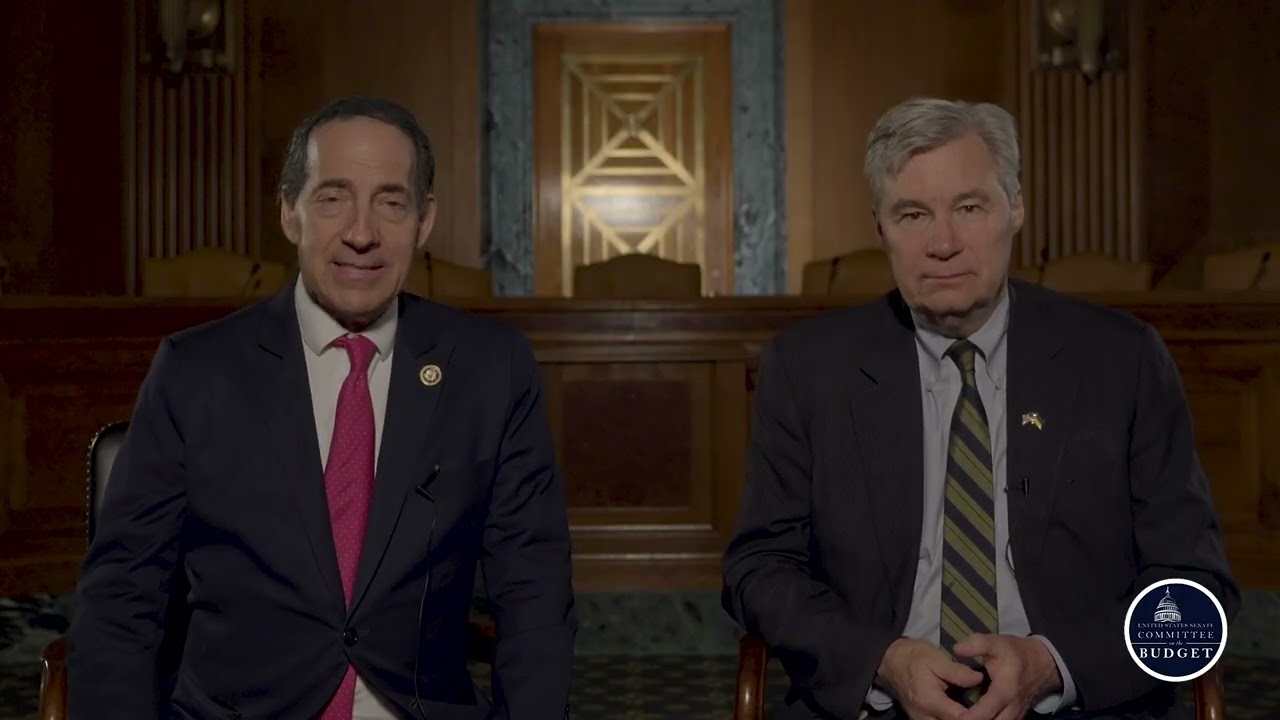
representative Jamie Raskin, left, and Senator Sheldon Whitehouse, right, speak in a video played during today’s hearing, Denial, Disinformation, and Doublespeak: Big Oil’s Evolving Efforts to Avoid Accountability for Climate Change.
A congressional investigation into Big Oil’s ongoing climate deception was revived yesterday with the release of thousands of documents and a joint report by the House and Senate members that further exposed the industry’s campaigns of “deception, disinformation, and doublespeak.”
In a Senate Budget Committee hearing chaired by Sheldon Whitehouse, witnesses drew parallels between Big Oil and Big Tobacco, lawmakers demanded accountability for the fossil fuel industry, and a former U.S. Department of Justice attorney suggested the agency could bring legal action against Big Oil.
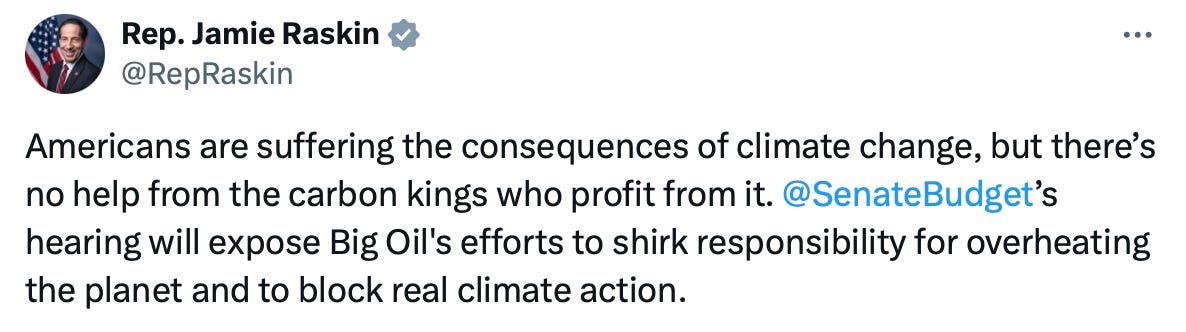
“Fossil fuel companies publicly claim to be partners, if not leaders, in fashioning climate solutions, but our investigation exposed that as a fraud,” said House Oversight and Accountability Committee ranking member Jamie Raskin, who co-released the latest congressional findings and was the lead witness at today’s hearing. “Big Oil is not addressing the climate crisis, but profiting from it.”
The newly released documents reveal a lengthy pattern of oil companies publicly pledging their commitment to climate solutions while privately dismissing any intention to follow through.
One 2017 email from a BP executive ruminating on whether the U.S. might stay in the Paris Agreement offers a glimpse into the company’s view of participation in actions to address the climate crisis.
“All the benefits and few of the risks… no one is committed to anything, other than to stay in the game,” wrote global head of Sustainability and Climate Policy, Partnerships, and Stakeholder Relations Paul Jefferiss.
That same attitude was present in the companies’ own tactic of handling climate pledges. In an internal discussion two years later on how to respond to a press request for comment, Jefferiss said that “it goes a bit too far to state or imply support for net zero by 2050, because that would require policy likely to put some existing assets at risk, and we haven’t discussed that internally.” Still, he noted, “we need to stand by our public support for the Paris goals and the achievement of net zero.”
The evidence was first obtained after the House Oversight Committee subpoenaed Exxon, Chevron, Shell, BP, the American Petroleum Institute, and the U.S. Chamber of Commerce after launching that investigation in 2021, adding to a growing arsenal of proof that the companies and trade associations worked to minimize the dangers they knew fossil fuels would cause.
 |
“Talk green, act dirty”
The latest release of documents show oil companies using partnerships in academia to launder their greenwashing of fossil fuel products as climate solutions under the guise of university credibility — despite the companies’ internal knowledge of those products’ harm. One 2018 draft presentation from BP marked “Confidential” lays out a plan by the company to “advance and protect the role of gas — and BP — in the energy transition,” and recommends that BP fund Princeton University and Imperial College white papers that would posit “the role of gas as a friend to renewables.”
But BP knew that “Gas doesn’t support climate goals when you take methane emissions into account,” as stated by the title of another slide in that same presentation, featuring articles tying methane emissions from gas to climate change.
The committee’s probe is already having an impact. After E&E questioned Stanford about pre-publication access to research the university offered the American Petroleum Institute in 2017, as revealed in one of the committee’s unearthed documents, Stanford said it would begin an investigation into that research program.
The report also detailed the companies’ promotion of “pie in the sky technologies,” as Raskin put it this morning, like carbon capture and storage (CCS) and algae biofuels.
ExxonMobil spent upwards of $175 million dollars advertising their research into algae as a climate fix — almost half the $350 million it spent on actual research and development — even while admitting internally that the technology was “still decades away from the scale we need,” according to documents previously released through Congress’s investigation. After years of campaigns to promote algae and, in so doing, distract from the company’s growing investments in fossil fuels, the company dropped its funding of algae research projects last year.
New documents show Exxon employees hedging over algae advertisements they knew were misleading. “Need to be mindful that we’re not suggesting it’s ready to go large scale demo,” one employee emailed in a thread on a TV ad on algae that CEO Darren Woods had already “endorsed.”
“They were careful about the words to make sure it is indicating we hope to one day get there,” another employee responded. “The challenge is that the images have to be visually stimulating to get the audience engaged… it tested very well.”
Other documents spotlight Exxon’s CCS advertising campaigns that both feature and target young people through a “Kids series.”
“Kids is an over-performer in terms of our content. It humanizes ExxonMobil and is in an unexpected format,” said the company’s Digital and Social Media Manager, Jayme Meyer, in a 2019 email chain with Exxon’s Public and Government Affairs group.
“De-emphasize concept that catching carbon is difficult or hard,” Meyer writes in a summary of the group’s feedback. The solution provided in the email: end cards that say “Carbon capture and storage: Making a difference for future generations.”
As ExxonKnews and The Leverreported last week, Exxon is one of many oil and gas companies pushing to scale back new safety rules for carbon dioxide pipelines as the industry races for IRA tax credits from experimental CCS projects. Previous documents obtained by Congress show the companies internally admitting that though CCS is “complex, costly, and will require additional power,” it will “enable the use of petroleum and natural gas” for years to come.
“As a scholar of disinformation, I do not use the word ‘lie’ lightly, but no other word adequately describes the oil industry’s brazen efforts to mislead the public,” said Geoffrey Supran, a scholar of climate disinformation and director of Climate Accountability Lab at University of Miami, told Senators this morning during testimony.
The investigation further revealed how oil companies internally viewed the crisis their products were causing while they touted their ambitions to fight climate change. “The Challenge of Climate Change,” according to one 2016 presentation created by a Princeton researcher funded through BP’s Climate Mitigation Initiative, is the risk it posed to BP’s “core business” through a transition to cleaner sources of energy. That’s because “effective climate policies can emerge that discourage fossil fuel consumption… and that subsidize or otherwise promote efficiency and low carbon energy.”
BP, along with the other major oil companies, would use trade associations to lobby “against pro-climate legislation and regulations that they publicly claimed to support,” according to the House and Senate committees’ report. During a prior Congressional hearing in 2021, CEOs from all six entities refused to stop spending money to oppose climate action.
It’s “greenwashing 101,” said Supran: “talk green, act dirty.”
As payoff for its efforts to keep Americans hooked on a fossil fuel economy, the industry now reaps $750 billion in subsidies each year, Senator Whitehouse said in his opening remarks.
“What is protecting the massive fossil fuel subsidies? And what is preventing policies to reduce danger? It’s the same thing: the fossil fuel industry itself,” Whitehouse said.
All six entities obstructed the investigation, redacting thousands of documents unnecessarily and completely withholding many more, Whitehouse said.
The case for DOJ to step in
Sharon Eubanks, the former lead counsel for the Department of Justice who won the agency’s historic lawsuit against Big Tobacco, said during her testimony today that she observed “striking similarit[ies]” between the actions of the tobacco industry and those of the oil industry today — including the funneling of money into promoting “fake science,” and lying to the public and regulators “about what they knew about the harms of their products and when they knew it.”
Following the new revelations, Eubanks said there was “solid evidentiary basis to support more information being gathered on these companies, just as the Department of Justice investigated the tobacco industry and ultimately filed a civil racketeering case.”
“Complaints against the industry have similarities in the fraudulent acts and the government was successful in the tobacco case, so there is certainly an adequate legal foundation for litigation against this industry,” she said.
Last year, nearly two dozen House and Senate members wrote letters to Attorney General Merrick Garland urging the Department of Justice to either sue or investigate Big Oil for potential violations of federal law. In January, Representative Ted Lieu told*ExxonKnews* that new evidence of Shell’s early knowledge of climate change “provide additional evidence and make our calls for an investigation even more urgent.”
The mounting evidence released by Congress could provides even more fuel behind those requests.
As Raskin pointed out, holding the tobacco industry accountable in court had major implications for public health and safety. “The companies were ordered to cease and desist their propaganda and to start telling the truth,” he said. “Just insisting upon the truth has saved millions of lives.”
New lawsuits have been filed against Big Oil since Congress began its investigation — and some of those complaints cite documents obtained through congressional subpoenas, including by the City of Chicago, Pennsylvania’s Bucks County, Puerto Rico municipalities, and the Shoalwater Bay Indian Tribe.
Patrick Parenteau, a law professor at Vermont Law School, said the latest evidence could play a role in the lawsuits and eventually be considered at trial. “The case for recovery of damages is getting stronger all the time,” he said.
===
---
PR Series 3 24
We're holding the advertising and PR industry accountable - DeSmog (https://www.desmog.com/ad-pr-industry-greenwashing-accountability/)
about the Series
When it comes to identifying the culprits responsible for the delay and denial of climate solutions, most people are likely to think of fossil fuel companies rather than the slick world of advertising and public relations. But in the words of UN Secretary-General Antonio Guterres, a “massive public relations machine” is “raking in billions to shield the fossil fuel industry from scrutiny.”
We take readers inside the world’s most influential creative and reputation management firms to show just how deep their ties with Big Oil run, and expose where lofty climate rhetoric runs afoul of commercial realities. And we document the struggles of a younger generation of climate-conscious employees to steer their industry onto a sustainable path — despite resistance from the top.
UK/Dozens of Ad & PR Industry Directors Have Ties to Heavily Polluting Industries
:{:{ByTJ Jordan and Rachel SherringtononApr 3, 2024 }:
Dozens of Ad & PR Industry Directors Have Ties to Heavily Polluting Industries - DeSmog (https://www.desmog.com/2024/04/03/dozens-of-ad-pr-industry-directors-have-ties-to-heavily-polluting-industries/)
Insiders fear that conflicts of interest on the boards of the six largest communications firms are quashing effective climate action.
OPINION
Polluters Are Melting the Winter Sports They Sponsor
:{:{ByAndrew Simms and Anna JonssononMar 16, 2024 }:
Corporations are using sport to sell the high-carbon products that are killing our winters, and now we can put a figure on the damage their money does.
ANALYSIS
Oil and Gas Companies Want You to Think They Care About Women — but It’s Just PR
:{:{ByEllen Ormesher, Emily Gertz, Kathryn Clare and Cartie WerthmanonMar 8, 2024 }:
Their ad campaigns for International Women’s Day champion empowerment even as climate change makes women’s lives harder and more dangerous.
Ellen Ormesher and Kathryn Clare Join DeSmog to Investigate Advertising Industry
:{:{ByDeSmogonFeb 26, 2024 }:
Climate accountability in creative and PR agencies is the focus of our growing team.
Investors Challenge ‘Blind Spots’ in Climate-Friendly Ratings for Ad and PR Giants
:{:{ByHugh Wheelan and TJ JordanonFeb 25, 2024 }:
DeSmog investigation finds multiple financial risks of work for fossil fuel clients aren't being assessed.
OPINION
TotalEnergies Has no Place in African Football
:{:{BySamm Farai MonroonJan 31, 2024 }:
Kick Polluters Out says the French oil major wants to sportswash climate-wrecking mega-projects.
UK/Havas London Targeted by Climate Activists Over Agency’s Relationship with Shell
:{:{ByEllen Ormesher onJan 25, 2024 }:
The protest followed a tip-off that the global comms agency may take on more work for the oil major.
UK/Havas CEO Yannick Bolloré Staked His Brand on Caring About the Climate. So Why Is His Company Working for Shell?
:{:{ByGeoff Dembicki, Dana Drugmand, Emily Gertz, Ali Lyon and Isobel MoseleyonJan 23, 2024 }:
The Bolloré family’s business empire — which includes Havas, one of the world’s biggest ad agencies — has longtime ties to the fossil fuel industry.
Illustration of Havas CEO Yannick Bolloré in front of a background of shells.
ANALYSIS
Revealed: Three-quarters of Prestigious Green Advertising Awards Go To Agencies Working for Fossil Fuel Industry
:{:{ByTJ JordanonJan 4, 2024 }:
DeSmog analysis finds majority of Ad Net Zero’s accolade-winners also represent major polluters.
Instagram Influencers Paid to Boost UAE’s Climate Credentials Over COP28
:{:{ByJoey GrosternonDec 14, 2023 }:
The individuals who spoke to DeSmog said they were ‘deeply disappointed’ by the summit and had not fully understood the relationship between UAE and the organisers.
'Inoculate From Criticism': A Closer Look at the Public Relations Companies Active at COP28
:{:{ByCartie WerthmanonDec 9, 2023 }:
Controversies surrounding Sultan Ahmed Al Jaber have underscored the role of reputation management in climate diplomacy.
Reuters, New York Times Top List of Fossil Fuel Industry’s Media Enablers
:{:{ByAmy Westervelt, Matthew Green and Joey GrosternonDec 5, 2023 }:
New report by DeSmog and Drilled reveals extent of commercial partnerships between trusted outlets and Big Oil.
OPINION
Why Saudi Arabia Wins Top Prize in the Bad Sport Awards 2023
:{:{ByAndrew SimmsonNov 28, 2023 }:
Major polluters are wielding sponsorship as a weapon to make polluting products and lifestyles appear acceptable.
OPINION
Badvertising: How Promoting Pollution Prevents Climate Action
:{:{ByLeo Murray and Andrew SimmsonNov 22, 2023 }:
Left unaddressed, the warping of our collective consciousness by fossil industry propaganda will make it impossible to achieve the civilisation level transformation required for life as we know it to survive the 21st century.
UK Advertising Watchdog Bans Toyota SUV Ads on Environmental Grounds
:{:{ByTJ JordanonNov 22, 2023 }:
The adverts “had not been prepared with a sense of responsibility to society,” regulator finds.
McCann to Make New Pitch for Aramco Oil and Gas Advertising Work
:{:{BySam Bright and TJ JordanonNov 16, 2023}:
There is ‘growing unease’ within the PR company about its continued work for one the world’s biggest polluters.
US/Havas Wins Shell Advertising Contract, Drawing Fire from Climate Campaigners
:{:{ByDana DrugmandonSep 19, 2023 }:
Clean Creatives says move is "huge step backward" for the French ad and public relations company.
WPP Has More Fossil Fuel Clients Than Any Other Advertising Company, Report Finds
:{:{ByTJ JordanonSep 19, 2023 }:
Clean Creatives’ ‘F-List’ reveals links between creative agencies and polluting industries around the world.
US/American PR Firm Edelman Enabled Oil Baron Al Jaber’s Ascension to Lead COP28 Climate Conference
:{:{ByCartie WerthmanonSep 13, 2023 }:
Edelman earned millions polishing the UAE’s green image — which helped propel Sultan Ahmed Al Jaber to the top levels of climate diplomacy.
UK/How Shell Used a ‘Granfluencer’ to Promote its Brand
:{:{ByDimitris Dimitriadis, Joey Grostern and Sam BrightonAug 15, 2023 }:
A Filipino grandma with two million followers is among the hundreds of influencers who have posted content promoting fossil fuel giants.
UK/Revealed: Fossil Fuel Giants Are Using British Influencers to go Viral
:{:{ByDimitris Dimitriadis, Joey Grostern and Sam BrightonJul 27, 2023}:
Some of the world’s biggest polluters are paying social media celebrities and environmentalists to promote their brands to billions of people.
Litigation Over Misleading Climate Claims Has 'Exploded' Over the Past Few Years
:{:{ByDana DrugmandonJul 3, 2023}:
New report details how more “climate-washing” lawsuits and complaints are being filed against corporations’ greenwashing than ever before, and experts warn complicit PR and ad firms could face legal risks.
PR Agency Catering to Oil Interests Led UK Climate Forum’s Communications
:{:{ByBrendan DeMelleonJun 28, 2023 }:
Weber Shandwick also hosted a roundtable on “authentic” climate communication.
Climate Innovation Forum 2023 website showing event details, sponsors/partners, and London Climate Action Week.
Confronting Big Oil at Cannes Lions: The Viral Moment That Exposed the Ad Industry's Complicity in the Climate Crisis
:{:{ByTolmeia GregoryonJun 19, 2023 }:
Climate activist Tolmeia Gregory sparked a social media sensation when she challenged a Shell executive at last year's festival. Now she's back, and urging other creatives to take disruptive action.
---
===
4 24
three-quarters of prizes at the UK’s top sustainable advertising awards went to agencies who work for the fossil fuel industry, a DeSmog analysis has revealed.
The second annualAd Net Zero awards wer in partnership
vid]
with industry magazine Campaign in London in November to recognise internal agency sustainability practices and green campaigns on behalf of clients including Heineken, Vodafone, and Sky.
By cross-referencing winners with research from advocacy group Clean Creatives, DeSmog found that 17 of the 23 awards for agencies (or 74 percent) went to companies who represent oil and gas producers or utilities. Those agencies included M&C Saatchi, Wunderman Thompson (now part of VML), Iris Worldwide, and the media group Dentsu.
“Grand Prix” awards went to Grey, which has worked for BP and Indian Oil in the last two years, and EssenceMediacom, which has represented Shell since at least 1995, according to Clean Creatives. Both agencies are owned by the London-based global media group WPP.
In total, nine of the 15 agencies who won awards at the November 2 gala (or 60 percent) hold or have recently held contracts with a combined 21 fossil fuel and utility companies, including ExxonMobil, Chevron, Saudi Aramco, and TotalEnergies.
Climate advocates said that giving green accolades to companies who continue to produce adverts and public relations campaigns for major polluters undermines the credibility of Ad Net Zero, an advertising industry body formed in 2020 amid a broader push by the business world to show it was serious about tackling the climate crisis. The group’s members include six of the major advertising networks that dominate the industry —WPP, Omnicom Group, Interpublic Group (IPG), Publicis, Dentsu, and Havas.
“For Ad Net Zero to reward agencies for environmentally friendly work, when those same agencies are managing campaigns to promote the long-term future of fossil fuels, is disingenuous and removes any credibility from their corporate positions,” said Dominic Lyle, director of communications at financial think tank Planet Tracker.
In response to DeSmog’s findings, Ad Net Zero said its award entry forms ask for specific evidence of real-world impact from sustainability campaigns in areas such as food waste or greenhouse gas emissions, and that promoting such work could inspire change in the industry.
“It is possible — and probable — at this stage of the industry’s climate journey that the best work is produced by an agency that is also connected in some way to the types of companies you [DeSmog] highlight,” said an Ad Net Zero spokesperson. “But will it help anyone if that work is considered to be invalid or of no value as a learning opportunity for fellow advertising professionals?”
Co-host Campaign said it was aligned with Ad Net Zero’s responses.
 Credit: Sam Whitham.
Mixed Messages
Some agencies’ winning campaigns at the Ad Net Zero awards, which were sponsored by Google, pushed sustainability messaging that appeared to be in direct conflict with some of their other clients’ less than planet-friendly business models.
Independent agency M&C Saatchi won an award for its plastic pollution awareness campaign The Plastic Forecast, made for Australian philanthropic organisation the Minderoo Foundation, which visualises the weight of microplastics falling from the sky in raindrops on a given day.
M&C Saatchi’s website says it has a 16-year relationship with Coca-Cola, the world’s worst plastic polluter according to research by environmental group Break Free From Plastic. Coca-Cola also has a record of actively fighting against plastic pollution legislation, according to a report by U.S.-based investigative newsroom The Intercept.
Clean Creatives research shows M&C Saatchi also represents Origin Energy, which operates Australia’s largest coal-fired power station, and South African fuel brand Astron Energy.
M&C Saatchi told DeSmog that less than two percent of its revenue came from fossil fuel clients in 2022, and that it has three environmental commitments relating specifically to client work: building “climate literate teams”; growing revenue from “planet-positive campaigns”, and reviewing the environmental approaches of potential new clients.
Agencies have, however, been criticised for only applying environmental reviews to prospective clients — allowing them to continue doing business with existing polluting clients. In November, DeSmog reported that this loophole had enabled McCann, part of the IPG network, to begin pitching to retain their client Saudi Aramco, the largest oil company in the world.
Supporting Shell
Wunderman Thompson, part of the WPP network, won an award for its Vodafone e-waste campaign, with the entry noting that smartphones will contribute to approximately 10 percent of global carbon emissions by 2040.
According to Clean Creatives, Wunderman Thompson has made adverts for Shell, one of the biggest corporate contributors to global carbon emissions in history, since at least 1929.
Wunderman Thompson, Dentsu and WPP did not respond to requests for comment.
Ad Net Zero judges also praised Iris Worldwide for its “actions not ambitions” campaign to promote Scottish energy company SSE’s £12.5 billion investment in the UK’s green energy transition.
Clean Creatives’ records show Iris Worldwide also works for Shell, which announced in June that it was “stepping back from renewable power investments that don’t fit our strategy or do not generate enough returns.” In September, Reuters reported that several employees had written an open letter to Shell CEO Wael Sawan, protesting the renewable energy cutbacks.
The following month, climate protesters staged a “die-in” at the London headquarters of agency network Havas after the company won a bidding war for a portion of Shell’s advertising account.
Web archives show Iris Worldwide, part of the Cheil Worldwide network owned by Samsung, has recently worked on brand awareness and social strategy for the oil major.
Iris said in response to DeSmog’s findings that it was “vital” that case studies for promoting green action through advertising were shared — whoever created them.
“Inclusivity is a core pillar of the awards and to that end we don’t think any companies should be excluded from sharing the work they do for their clients,” said an Iris spokesperson.
 Credit: Sam Whitham.
‘Advertised Emissions’
The extent of fossil fuel ties among the Ad Net Zero award winners underscore the challenges of transitioning an industry facing growing scrutiny over its work for climate-damaging companies.
Ad Net Zero members pledge to follow a five-step action plan to reduce emissions from business operations and supply chains, advertising production, advertising placement, and events, as well as promote sustainability through campaigns. Members must also report on their progress towards implementing net zero goals set in line with the 2015 Paris climate agreement.
“You may say compared to the scale of an energy company it [the industry’s operational and supply chain emissions] is small, but it is millions of tonnes of carbon, and we have to take care of that,” Stephen Woodford, CEO of the Advertising Association, one of Ad Net Zero’s founder organisations, told a panel at the Cannes Lions Festival of Creativity in June.
Critics say, however, that Ad Net Zero’s focus on operational emissions obscures a much bigger problem: The role of advertising in exacerbating the climate crisis by driving demand for damaging products, from flights to SUVs — a phenomenon defined by advocacy group Purpose Disruptors as “advertised emissions.” The concept was adopted by the UN’s corporate decarbonisation campaign Race to Zero in 2022, but is not recognised by Ad Net Zero.
Dentsu — which won the Ad Net Zero award for best internal sustainability practices at a large agency — published an estimate of its “advertised emissions” in July, which found they were 32 times higher than its operational emissions.
Other major advertising companies have yet to follow suit, and Ad Net Zero’s industry backers have questioned the methodology behind the concept. ” In June, the Advertising Association and two other trade associations that established Ad Net Zero published a joint article in Campaign arguing that calculating “advertised emissions” would lead to “a significant overstating of emissions attributable to an advertising campaign by ignoring advertising’s displacement effects — the sale of one product or service means the lost sale of another in most markets.”
However, the latest Advertising Pays report, published by the Advertising Association and Deloitte, says that “advertising encouraging market growth is one of the reasons why £1 spent on advertising generates £6 to the UK economy” — a claim that critics say undermines the “displacement effects” theory.
‘Denial and Delay’
Climate advocates argue that advertising and public relations companies also play an often overlooked role in hindering climate action by working on behalf of oil and gas companies to influence both government policy and public opinion. Advertising campaigns have created exaggerated impressions of the fossil fuel industry’s investments in renewable energy or other climate solutions, helping todeflect pressure to slash emissions by fostering the false impression that the industry has the crisis in hand.
In September 2022, UN Secretary-General Antonio Guterres told the UN General Assembly: “We need to hold fossil fuel companies and their enablers to account. [This] includes the massive public relations machine raking in billions to shield the fossil fuel industry from scrutiny.”
None of the major advertising networks in Ad Net Zero have published targets to address “advertised emissions” by winding down campaigns promoting polluting products, or stopping work to portray fossil fuel companies in a climate-friendly light — and Ad Net Zero does not require them to do so.
Experts fear that, as a result, the vast majority of the industry is working towards a definition of net zero that represents only a fraction of the advertising and public relations industry’s overall contribution to the climate crisis.
“The Ad Net Zero awards do credit to the creatives involved and enable some positive societal behaviour shifts, but they are dwarfed by the overarching issue of denialism in the industry,” said Victoria Harvey, a PhD researcher in advertising and climate at the University of East Anglia. “If we ignore the issue of oil and gas clients, at a time when other industries are disengaging with them, then the UK advertising industry is complicit in the denial and delay of real climate action.”
With concern growing around the role of advertising in the climate crisis, more than 900 agencies around the world have signed a Clean Creatives pledge to refuse contracts from fossil fuel companies, including large agencies such as GALE and Forsman & Bodenfors.
Ad Net Zero says it cannot mandate which companies its members can work with since this could breach competition law governing trade associations.
“Who member companies choose to work with depends on their own internal policies and we encourage — and campaign for — all our supporters to take steps to accelerate the transition to net zero both in their own businesses, in their supply chains and with their customers,” the Ad Net Zero spokesperson said.
‘Neon-lit Conflict’
In a
vid
https://youtu.be/-1bjlI9tB6g) filmed on the night of the awards, Ad Net Zero Chair Sebastian Munden underlined the organisation’s ambitions to grow advertising campaigns designed to promote sustainability.
“I think these awards really add something, which is showing what can be done,” he said. “What I’m hoping is that every year as we look back, this year’s awards will dwarf last year’s achievements because the whole industry is learning and really striding forward.”
Nevertheless, a series of rulings by UK watchdog the Advertising Standards Authority (ASA) have underscored the reputational risks facing agencies who continue to work with polluting clients. In June, the regulator banned adverts by Shell, Repsol and Petronas for misleading consumers about renewable energy commitments.
The ASA took similar action against ads for Toyota SUVs in November, ruling that the imagery condoned a style of off-road driving that “disregarded” the impact on nature. In December, the ASA banned Norwegian oil company Equinor from repeating claims that wind, oil and gas, and carbon capture play a balanced role in its energy mix, since most of the company’s revenues still come from oil and gas, the Financial Times reported.
“If you greenwash for Big Oil you can’t soak the climate stain away by carrying a couple of eco clients,” said Andrew Simms, co-founder of the Badvertising campaign. “Agencies playing both sides leave themselves open not just to reputational and regulatory risk, but also ridicule, because people will see it for the neon-lit conflict of interest that it is.”
random grab 4 24
US/Where Was Exxon Planning to Inject CO2 in Louisiana? It’s a Trade Secret. (https://www.desmog.com/2024/03/29/exxon-location-inject-co2-ccs-wells-louisiana-trade-secret/)
US/Big Oil Clouded the Science on Extreme Weather. Now It Faces a Reckoning. (https://www.desmog.com/2024/04/02/global-climate-coalition-accuweather-science-extreme-weather-lawsuits/)
Will The UK’s Flagship Climate ‘Solution’ Be Used to Pump More North Sea Oil? (https://www.desmog.com/2024/03/19/uk-north-sea-oil-carbon-capture-enhanced-oil-recovery-eor-rishi-sunak-shell-exxonmobil-bp/)
US/Fossil Fuel Lobby Kicks off Disinformation Campaign Against EPA Auto Emissions Rule (https://www.desmog.com/2024/03/22/afpm-api-disinformation-epa-ev-car-emissions-rule/)
US/How $9 Billion From Taxpayers Fueled Plastics Production – and Illegal Pollution (https://www.desmog.com/2024/03/14/9-billion-public-subsidies-plastics-production-pollution/)
---
===
y mail 6 23
Corporate Accountability released a hard-hitting exposé calling out Chevron’s junk climate action and how its purported green actions are likely intensifying global harm. It was released alongside an exclusive in The Guardian GUK, which wrote an incredible piece about the report and the actions taking place this week. And with thousands of members like you taking action, we also called on BlackRock, one of Chevron’s biggest investors, to divest from Chevron.
===
CCS exxon texas?
===
delayism/ solutionism
https://www.desmog.com/2022/06/16/climate-deniers-fossil-fuel-language-obstruction/
===
https://influencemap.org/report/Climate-Change-and-Digital-Advertising-a40c8116160668aa2d865da2f5abe91b#
A breakdown of the different messaging categories and their frequency can be found below
https://influencemap.org/report/Climate-Change-and-Digital-Advertising-a40c8116160668aa2d865da2f5abe91b#7
Categories
Explanation
Number of ads (and percentage of sample), Spend, Impression*
Examples of key narratives
Community & Economy
Includes narratives about the role of the oil and gas industry in local communities and the broader economy.
Number (%): 5542 (22%)
Spend: $2,575,779
Impressions: 134,626,737
Entity/Industry helps the economy
:{:{}:
}:
Entity/Industry provides jobs
Entity/Industry helps community through philanthropic efforts
Climate Solutions [GREENWASH]
Includes narratives promoting the ‘green/clean’ climate efforts of the industry and is designed to capture narratives suggesting the oil and gas industry is ‘part of the solution’ on climate change.
Number (%): 12140 (48%)
Spend: $1,893,080
Impressions: 122,248,437
Entity/Industry supports reducing greenhouse gas emissions
Entity/Industry supporting transitioning the energy mix
Entity/Industry supports the use of gas as, a clean/green/low-carbon energy source or a climate solution.
Pragmatic Energy Mix
Includes narratives which promote the benefits of oil and gas as energy sources to the functioning of people’s everyday lives.
:{:{}:
}:
Number (%): 7749 (31%)
Spend: $4,354,825
Impressions: 174,545,645
Oil & gas are affordable
Oil & gas are reliable
Other narratives promoting the benefits and/or uses of using oil and gas
Patriotic Energy Mix
Includes narratives tying the production of domestic oil and gas to energy independence and energy leadership for the US.
Number (%): 2904 (12%)
Spend: $1,482,998
Impressions: 55,474,052
Energy Independence
Energy Leadership
Distribution of Ads over Time
...
| Includes narratives which promote the benefits of oil and gas as energy sources to the functioning of people’s everyday lives. | Number (%): 7749 (31%) Spend: $4,354,825 Impressions: 174,545,645 | Oil & gas are affordable |
|---|---|---|
| Oil & gas are reliable | Oil & gas are reliable | Oil & gas are reliable |
| Other narratives promoting the benefits and/or uses of using oil and gas | Other narratives promoting the benefits and/or uses of using oil and gas | Other narratives promoting the benefits and/or uses of using oil and gas |
| Patriotic Energy Mix | Includes narratives tying the production of domestic oil and gas to energy independence and energy leadership for the US.... In line with the strategic deployment of ads, the geographic distribution of the ads shows that the ads most targeted states with high levels of oil and gas production, such as Texas and New Mexico, and swing states, including Pennsylvania, Iowa, and Ohio. States with specific policy battles affecting the oil and gas sector in 2020, such as Alaska, also sustained significant advertising campaigns....he Advertisers XYX... InfluenceMap used data from 25 advertisers, covering the 10 companies and 5 industry associations from the oil and gas sector with the highest spend on social issues, electoral, and political ads in 2020 on Facebook's US platform. The research also included 10 advocacy groups, all with a spend of over $5000 in 2020, that have reported ties to oil and gas companies and industry associations. ...https://influencemap.org/company/Exxon-Mobil/projectlink/Exxon-Mobil-In-Climate-Change ExxonMobil | $5,040,642 |
| Industry Association | ||
| Advocacy Group | OneAlaska | $329,684 |
Regional Distribution of Oil and Gas Sector Advertising
In line with the strategic deployment of ads, the geographic distribution of the ads shows that the ads most targeted states with high levels of oil and gas production, such as Texas and New Mexico, and swing states, including Pennsylvania, Iowa, and Ohio. States with specific policy battles affecting the oil and gas sector in 2020, such as Alaska, also sustained significant advertising campaigns.
[grf]
Top 15 states by ad impressions
The Advertisers
InfluenceMap used data from 25 advertisers, covering the 10 companies and 5 industry associations from the oil and gas sector with the highest spend on social issues, electoral, and political ads in 2020 on Facebook's US platform. The research also included 10 advocacy groups, all with a spend of over $5000 in 2020, that have reported ties to oil and gas companies and industry associations.
[no graf]
Type Entity (with links to InfluenceMap profiles where applicable) Spend on Social issue, Election, and Politics Ads in 2020
Corporation ExxonMobil $5,040,642
Industry Association American Petroleum Institute $2,965,254
Advocacy Group OneAlaska $329,684
Corporation The Williams Companies $252,977
Industry Association Texas Oil & Gas Association $160,511
Corporation ConocoPhillips (including Power in Cooperation) $76,938
Advocacy Group Partnership for Energy Progress $75,691
Corporation Enbridge $64,345
Advocacy Group Coloradans for Responsible Energy Development $57,983
Corporation Energy Transfer $56,805
Advocacy Group Texans for Natural Gas $53,353
Advocacy Group Great Lakes. Michigan Jobs $53,145
Corporation Wink to Webster Pipeline LLC (Joint Venture between ExxonMobil and additional corporations) $53,027
Corporation BP $51,652
Industry Association New Mexico Oil and Gas Association $41,614
Advocacy Group Californians for Energy Independence $29,457
Industry Association American Gas Association $22,248
Advocacy Group Californians for Affordable and Reliable Energy $13,693
Advocacy Group Alliance for Michigan Power $11,528
Corporation Noble Energy (acquired by Chevron in Oct 2020) $10,485
Advocacy Group American Energy Alliance $8,396
Corporation Island Energy Services (including Hoala) $7,042
Corporation Phillips 66 $5,248
===
===
agribiz BS greenwash?
https://www.desmog.com/2022/10/06/aim4c-under-fire/
===
gaslit series
https://www.desmog.com/**2022/06/**16/climate-deniers-fossil-fuel-language-obstruction/
stella l
On a recent episode of the Fox Business show “Mornings with Maria,” American Petroleum Institute CEO and President, Mike Sommers, said that “the most important environmental movement in the world is the American oil and gas industry.”
“A super absurd example of oil and gas companies appropriating and weaponizing the language of climate advocates for their own greenwashing,” commented author and climate activist Genevieve Guenther on Twitter.
Sommers’ statement may be, in fact, one of the most literal examples of how fossil fuel companies are using language to perpetuate their climate denial and fend off action. And because public perception and awareness of the climate crisis are, at least in part, driven by how we talk about it, the fossil fuel industry has used language “to create smoke and mirrors and false impressions around what they’re really doing,” said Christine Arena, author, expert on climate disinformation, and former Executive Vice President at the PR firm Edelman. Arena was one of six employees to resign in 2015 following revelations of the firm’s greenwashing work with fossil fuel lobbies and associations.
PR firms — or “the enablers,” as Arena calls them — have played a key role in exploiting communication and manipulating language to their advantage, all while working on behalf of the fossil fuel industry and using a tobacco industry playbook. Ultimately, they’ve been using it to obstruct climate action, a longtime goal of the oil, gas, and coal industries. “If we take a step back and ask ourselves, why has meaningful action to avert the climate crisis proven to be so difficult? It is at least in part because of communications and because of the language coming from the fossil fuel industry,” said Arena.
Today, the fossil fuel industry and its allies are “appropriating and weaponizing” language from climate advocates, usually in ways that are much less obvious than Sommers’ recent comment.
“The industry is repeating the same phrases it’s hearing from the climate movement to use for their own advertising purposes. They are commandeering the language of sustainability and of the climate movement,” Arena said of fossil fuel companies, adding that they are doing so “to create a false perception that they’re on our side.”
Fossil Fuel Solutionism
Language around climate solutions is particularly susceptible to this treatment, especially as polluting companies invest in strategies and tactics to present themselves as part of the solution to climate change when, clearly —as they continue to prioritize drilling for globe-warming fuels — they are not. That’s ExxonMobil touting its “lower-emission solutions” and staff working to “develop our global strategy for creating sustainable energy” while planning a $10 billion investment in new oil and gas reserves in South America. Some researchers have called this “fossil fuel solutionism."
exxon twit]
This sort of inevitability of fossil fuels — I think that’s a place where language is really important,” said Timmons Roberts, social scientist and executive director of the Climate Social Science Network at Brown University. He says the fossil fuel industry encourages this perception that everyone is complicit in climate change by using its products and is therefore too reliant on them to ever transition away
The strategy is part of a broader communications shift among polluters and their advocates. No longer are oil and gas executives straight-up “denying” that the climate is changing; instead the message becomes one that ultimately slow-walks real climate action — saying, it’s too expensive to address, it’s too late to do anything. “We call these ‘climate delay’ discourses, since they often lead to deadlock or a sense that there are intractable obstacles to taking action,” write Roberts and his colleagues in their “**Discourses of climate delay**” analysis.
Fossil fuel companies and their allies may use delay arguments and tactics across a range of platforms: in promotional campaigns, public declarations, online ads, social media, or political lobbying. Nowadays, the messaging may contain “a blend” of factual omissions and rhetorical distortions, according to Arena, that can be more confusing to people and, therefore, more dangerous than outright lies.
“If you say ‘clean coal’ a lot of people are going to know that there’s no such thing, so that’s easier for the audience to identify,” said Arena. “But then when you look at ExxonMobil’s language around carbon capture, for example, they’ll say things like ‘it’s going to take an all-of-the-above approach,’ and when the oil and gas industry says ‘all of the above,’ they mean oil and gas first.”
Arena considers this type of wording to be a form of greenwashing, where a company uses “selective micro truths,” she explained, in order to create a misleading impression. This type of language is more insidious because it’s creating the perception that oil and gas companies really are “part of the solution” and don’t need regulatory intervention — which they are often lobbying against elsewhere.
“Cleaner burning.” “Lower emissions fuels.” “Lower carbon future.” These phrases are all examples of this, Arena said.
Many of these terms appear on fossil fuel companies’ social media accounts or websites. ExxonMobil uses the phrase “advancing climate solutions” and “lower emission energy future.” Shell is “working…to accelerate the transition to net-zero emissions.” Chevron is “advancing a lower carbon future.”
By participating in the public discourse in this way, fossil fuel companies can manipulate public perceptions by making “support” seem like action. “‘Supporting the Paris agreement’ is also deceptive because it makes it look like they are in line with Paris,” said Arena. “They’re not.”
A new report from more than 40 groups, published by Oil Change International, has found that major U.S. and European oil and gas companies “still fail to meet the bare minimum for alignment with the Paris Agreement.” These companies’ pledges and commitments are far from credible, the report concludes, when they are planning more than 200 fossil fuel expansion projects between now and 2025.
[oil ch intl twt]
the History of Junk Science, Alarmists, and Climate Prophets
Denier and delayer communication strategies aren’t new; in fact they have always been central to the fossil fuel industry and its allies’ climate obstruction.
In the 1990s, for example, “sound science” was an expression used by climate deniers to attack and counter climate science — or “junk science,” as some deniers, such as former Fox News columnist and founder of the website JunkScience.com Steve Milloy, referred to the work of climate scientists like Michael E.Mann.
In another past strategy, that’s now regaining steam, climate deniers and delayers have been employing the terms “realists” and “alarmists.” In 2020, Cambridge University researcher Giulio Corsi and I analyzedthe use of these terms on Twitter, finding a 900 percent increase in their use over the previous four years. As the climate movement was gaining international attention with massive protests between 2018 and 2019, we saw that spikes in tweets about “alarmism” and “realism” often corresponded to high-profile speeches by activist Greta Thunberg. The trend also coincided with the Heartland Institute, a U.S. think tank and notorious promoter of climate disinformation, enlisting young German YouTuber Naomi Seibt as a counter-figure to Thunberg to denounce her and climate scientists’ “alarmism.”
[greta pix w/ indig]
This framing exploits the negative connotation of the term “alarmist” in order to discredit a legitimate scientific warning, while trying to associate backers of fringe theories about, say, sunspots causing global warming, with rationality and realism.
Milloy employed a combination of these terms when he wrote in 2002: “When the Clean Air Act was enacted in 1970, air pollution in the U.S. was more of an aesthetic than a public health problem. […] Few people realize this after 30 years of non-stopjunk science-fueled alarmism from environmental activists.” [Emphasis added.]
For decades, deniers have used rhetoric likening those who warn about the catastrophic impacts of the climate emergency to someone who is “out of touch with reality.” You can find it in the 1998 American Petroleum Institute “action plan,” born just a few months after the Kyoto Protocol and developed by Exxon, Chevron, Southern Company, and representatives from conservative organizations, including Milloy. The memo clearly stated that: “Victory will be achieved when those promoting the treaty on the basis of extant science appear to be out of touch with reality.” [Emphasis added.]
Both uses of language – “sound science” versus “junk science” and “alarmists” versus “realists” – create an “us versus them” dynamic. The result is two polarizing, and utterly fabricated, positions on climate science.
We can see the fossil fuel industry using language in a similar way in its public-facing propaganda, projecting political meaning on its opponents.
“Propaganda is about manipulating public opinions, stoking fears, and sewing divisions,” said Arena. “When they talk about ‘the woke’ or the ‘climate industrial complex’ or ‘activist extremists,’ that is all propaganda. The industry is blaming rising gas prices on ‘woke liberals’ or on renewables or on climate activism. Those are false narratives and they are propaganda-based."
According to John Cook, founder of Skeptical Science and research fellow at Monash Climate Change Communication Research Hub in Australia, fossil fuel industry propaganda has been intensifying the “othering” of climate scientists and advocates for climate action for some time.
“There’s a lot of terminology that has become more powerful in sending that signal that climate advocates are different,” said Cook. “Labels to say, ‘these people who care about climate change are trying to change society.’” Climate denial is intimately connected to values like individual freedom and free market fundamentalism,he explained. That’s why those labels are often extended in meaning to accuse climate advocates of a “radical liberal agenda,” said Arena.
The “othering” of climate advocates isn’t only by fossil fuel companies. In September 2021, the Italian Minister of the Ecological Transition called climate activists “radical chic” and said that the “extremist and ideological ones” are “worse than the climate catastrophe.”
Over time, the language of climate deniers and delayers has evolved from “basic climate denial” to “culture wars,” said Arena.
Culture wars are strictly linked to political ideology: that’s why some words are chosen by deniers and delayers over others, because they “tap into broader values” and “activate” their supports, added Cook. For example, deniers might pose the argument that “[climate action] is going to impinge on their freedom,” he said.
The Supposed Church of Climate Change
Another linguistic tactic used to denigrate those who support climate action is to cast an issue with roots in science — climate change — as one of religion. In Italy, for example, the daily newspaper Il Foglio uses pseudo-religious terms when referencing climate change: ecology becomes “a religion to replace canceled Christianity” where “you kiss trees and worship whales;” switching to an electric car is “fanatical;” climate change is referred toas “dogma.” And Friday, the Italian paper writes, has becomethe day of “forced conversion to sustainability” when youth climate activists go on strike from school, as part of Greta’s “children’s crusade.”
Associating climate change with religion reinforces the denier message that the build-up of greenhouse gases and its far-reaching global impacts is actually a matter of faith and has nothing to do with a factual, physical reality in the form of heatwaves and hurricanes. In this scenario, climate advocates seem unreasonable, disconnected from reality and unable to see things clearly. The effect is to relegate those supporting climate science to one end of the spectrum, one where we don’t need to address the intensifying impacts of heating the globe.
But this zealous religious framing happens beyond the pages of Il Foglio. According to Cook, deniers also use words like “cult” and “high priests” to describe climate advocates, while emphasizing that they themselves are “treated like heretics.”
“They are framing themselves as the rational scientific person and the scientists or advocates as the hysterical, biased, faith-based and not evidence-based,” said Cook of climate deniers. “They’re trying to flip reality because ideology is driving their denial.” [heartland reverse engr]
Don’t Worry, Just Adapt!
Another narrative emerging from the denial anddelayer camp is that “adapting” to climate change will be our lifeline: Those perpetuating it end up downplaying the impacts of the climate crisis because they say we will be able to adapt to it.
In a May 31 Slate article about Alex Epstein’s new book Fossil Future, which advocates for fossil fuels, Nitish Pahwa writes: “The new style of climate denial is here: It’s not that carbon emissions aren’t increasing, or aren’t warming the world, but look, you’re doing fine right now, right? So, we’ll be just fine!”
On May 20, Stuart Kirk, the head of responsible investing for HSBC’s asset management division, “Who cares if Miami is six meters underwater in 100 years? Amsterdam has been six meters underwater for ages, and that’s a really nice place. We will cope with it.” Kirk was later suspended for his comments.
[vid]
stuart Kirk, head of responsible investing for HSBC’s asset management division, was suspended for his comments to investors in which he downplayed the risks of climate change.
This argument implies that working to slow climate change is futile and offers adaptation as “the only possible response” to the climate crisis, according to Roberts and his colleagues in their “Discourses of delay” analysis.
“Every day there’s new discourses being invented either by the actors in these industries that don’t want to make the energy transition or by their public relations firms with tremendous capacity in terms of developing new language discourses,” said Roberts.
Effective PR is a key element to designing a convincing greenwashing campaign. “The PR and ad industry plays a central role in enabling climate obstruction,” said Arena. And the American Petroleum Institute’s is the perfect example of this. “They’re not on it. The only thing that they’re on is architecting and spreading more disinformation, which they are the quarterbacks of doing,” she added.
From fossil fuel solutionism to adaptation-only narratives, these climate obstruction tactics commandeer language in an attempt to undermine one of the most urgent and far-reaching challenges of our day. And the momentum behind such deceptive language is only building.
“We are on a dangerous trajectory,” Arena said. “I would say broadly that climate disinformation and greenwashing are getting much worse, and today we have many more examples to point to than we even did back when the industry was trying to deny climate change altogether.”
Understanding how opponents of climate action employ these discourses of delay is essential to recognizing climate disinformation and misinformation, Arena said, and ultimately to disrupting it. “We have to redouble our efforts to hold these companies and their enablers accountable.”
===
https://www.nytimes.com/2022/09/14/climate/oil-industry-documents-disinformation.html
no lnx
Oil Executives Privately Contradicted Public Statements on Climate, Files Show
The documents, subpoenaed in a House investigation of climate disinformation, show company leaders contravening industry commitments.
By Hiroko Tabuchi
Sept. 14, 2022
Documents obtained by congressional investigators show that oil industry executives privately downplayed their companies’ own public messages about efforts to reduce greenhouse gas emissions and weakened industry-wide commitments to push for climate policies.
:{:{}:
}:
Internal Exxon documents show that the oil giant pressed an industry group, the Oil and Gas Climate Initiative, to remove language from a 2019 policy statement that “could create a potential commitment to advocate on the Paris Agreement goals.” The Paris Agreement is the landmark 2015 pact among nations of the world to avert catastrophic global warming. The statement’s final version didn’t mention Paris.
:{:{}:
}:
At Royal Dutch Shell, an October 2020 email sent by an employee, discussing talking points for Shell’s president for the United States, said that the company’s announcement of a pathway to “net zero” emissions — the point at which the world would no longer be pumping planet-warming gases into the atmosphere — “has nothing to do with our business plans.”
These and other documents, reviewed by The New York Times, come from a cache of hundreds of thousands of pages of corporate emails, memos and other files obtained under subpoena as part of an examination by the House Committee on Oversight and Reform into the fossil fuel industry’s efforts over the decades to mislead the public about its role in climate change, dismissing evidence that the burning of fossil fuels was driving an increase in global temperatures even as their own scientists warned of a clear link.
On Thursday, the House committee is expected to discuss some of its early findings. “It’s well established that these companies actively misled the American public for decades about the risks of climate change,” said Representative Ro Khanna, a Democrat from California who spearheaded the investigation with Carolyn B. Maloney, the New York Democrat who leads the House committee. “The problem is that they continue to mislead,” Mr. Khanna said.
At a hearing last year, oil industry executives stressed their support for a transition to clean energy and denied that they have misled the public. They acknowledged that the burning of their products was driving climate change, although none pledged to end their financial support for efforts to block action on climate change, and they said that fossil fuels were here to stay.
The committee’s subpoena has sought documents related to companies’ role in contributing to climate change, their marketing and lobbying efforts on climate, and the funding of third parties accused of spreading climate disinformation. Several of the companies and organizations subpoenaed — which include Shell, Exxon Mobil, Chevron, BP, the American Petroleum Institute and the U.S. Chamber of Commerce — have yet to produce some of the key documents that have been requested, according to committee staff members.
According to the staff, a significant part of the material submitted so far includes news clippings and other materials that were already public. Still, the documents gathered so far show that the companies’ internal discussions in recent years haven’t always matched up with their public statements and marketing campaigns, and that some of the companies’ leading climate strategies rely on unproven technologies.
In the Exxon memo describing the edits it sought in the oil industry policy statement, which was drawn up ahead of the 2019 United Nations global climate talks, Peter Trelenberg, Exxon’s manager of environmental policy and planning, wrote: “Need to remove reference to Paris Agreement” from the statement because “Creating a tie between our advocacy/engagements and the Paris Agreement could create a potential commitment to advocate on the Paris Agreement goals.”
[The Spread of Misinformation and Falsehoods
Election Fraud Claims: A new report says that major social media companies continue to fuel false conspiracies about election fraud despite promises to combat misinformation ahead of the midterm elections.
Russian Falsehoods: Kremlin conspiracy theories blaming the West for disrupting the global food supply have bled into right-wing chat rooms and mainstream conservative news media in the United States.
Media Literacy Efforts: As young people spend more time online, educators are increasingly trying to offer students tools and strategies to protect themselves from false narratives.
Global Threat: New research shows that nearly three-quarters of respondents across 19 countries with advanced economies are very concerned about false information online.]
The memo, addressed to Exxon chief executive, Darren Woods, and other top executives, went on to indicate that Chevron had “expressed that they are generally aligned with these edits.”
Exxon and Chevron did not respond to requests for comment. A representative for the Oil and Gas Climate Initiative did not comment on the advocacy document but said that “advocacy for Paris goals underpins everything that O.G.C.I. does.”
Separate files from Exxon show the company grappling with a multimillion-dollar advertising campaign promoting the potential for fuels made from algae. The campaign focused on the promise of the technology and featured images of vast pools of algae, along with a scientist looking forward to calling herself an “energy farmer.” (Versions of the ads have appeared in The New York Times.)
A set of presentation notes that had been prepared for a September 2018 engineering talk by one of its executives stated that the technology is “still decades away from the scale we need.” And in a November 2016 email, an Exxon employee said that an early draft for the ad, prepared by the advertising agency BBDO Worldwide, needed to “replace any lines that imply the technology is live today.”
BBDO did not respond to a request for comment.
The Shell internal documents discussing the company’s “net zero” pathway also included guidelines for employees that stated, “Please do not give the impression that Shell is willing to reduce carbon dioxide emissions to levels that do not make business sense.”
[Algae at a greenhouse in La Jolla, Calif., in 2010. The operation was sponsored by Exxon Mobil.Credit...Sunday Huffaker for The New York Times
Curtis Smith, a spokesman for Shell, said in a statement that the company had provided nearly a half-million pages of documents to the committee and that “the small handful they chose to highlight are evidence of Shell’s extensive efforts to set aggressive targets.” Included in those documents are “challenging internal and external discussions,” he said.
He added that it was widely understood that Shell’s net zero scenarios “are not prescriptions, predictions or meant to represent Shell’s current business plan” and instead represent “the scale of the challenge and levers policymakers might pull.”
The committee’s work comes as Democrats’ climate agenda has been re-energized by the passage of a climate and tax bill that includes nearly $370 billion in tax incentives and programs intended to speed up the nation’s transition from an economy based on oil, gas and coal to one powered by wind, solar and other renewable forms of energy.
A number of cities and states have sued oil companies, alleging that they misled the public about fossil fuels’ role in warming the planet, with detrimental effects on local communities. Last year, a Dutch court ruled that Shell must substantially accelerate its efforts to reduce carbon dioxide emissions. Shell has appealed the ruling.
The House committee was scheduled to hold a hearing on Thursday to examine recent record-breaking oil industry profits, hear from industry experts and from people affected by recent extreme weather events. It had also requested board members from the oil companies to attend. The companies declined.
At Thursday’s hearing, members also plan to highlight emails that appear to show oil executives making light of climate extreme-heat records. In an August 2017 email exchange, for example, two BP executives found humor in the news at the time that scientists had reported Earth’s warmest year on record.
“I’ll buy the first round Monday night before we say our goodbyes,” Joe Ellis, then BP vice president and head of U.S. government affairs, wrote to colleagues.
“A ‘hot toddy’ maybe?” Bob Stout, then vice president and head of regulatory affairs, wrote back.
The former BP executives didn’t respond to requests for comment.
J.P. Fielder, head of U.S. communications at BP, described the exchange as “inartful attempts at humor that do not reflect the values of BP and should not distract from our actions.” He noted that BP has committed to a net zero emissions target across its sales, operations and production by 2050 or sooner.
Hiroko Tabuchi is an investigative reporter on the Climate desk. She was part of the Times team that received the 2013 Pulitzer Prize for explanatory reporting. @HirokoTabuchi • Facebook
---
===
much on greenwash ccs and algae
https://oversight.house.gov/sites/democrats.oversight.house.gov/files/2022.09.14%20FINAL%20COR%20Supplemental%20Memo.pdf
p 13
[CCS] underperformed or failed.48Exxon recently announced ten potential new facilities around the
world. 49
Exxon spent $86 million in 2010 to expand its carbon capture facility in Wyoming and
plans to spend another $400 million on a further expansion of the facility. 50 Exxon claimed $240
million in carbon capture tax credits over the last decade of the facility’s use. However, experts
estimate that Exxon may only be capturing less than 1% of its total emissions through carbon
capture technology.51
In a May 2018 email exchange, Exxon CEO Darren Woods and Exxon’s Vice President
of Corporate Strategic Planning, Mr. Wojnar, discussed “emissions avoided” through carbon
capture technology. Mr. Wojnar wrote to Mr. Woods that he was “[c]oming back on your
question on GHG emissions avoided,” including through carbon capture technology, and
provided “options for how to respond to a query” on this topic. Mr. Wojnar suggested that Mr.
Woods say that “over the last decade, ExxonMobil has taken action to reduce GHG emissions by
approximately 75 million tons.”52 In reality, nearly all the carbon dioxide Exxon has captured
through CCS has been sold to other fossil fuel companies to inject into their depleted oil fields to
help extract even more oil. As a result, the carbon captured by Exxon through CCS technology
likely has not meaningfully reduced total carbon emissions.53
Exxon has heavily advertised its efforts to develop carbon capture technology. Three
carbon capture television ads from 2016 through 2019 aired 9,058 times nationally, generated 4.1
billion impressions, and are estimated to have cost Exxon over $68 million to run. 54 Draft ...
Chevron’s and Exxon’s Attempt to Use OGCI to Greenwash Big Oil
The Oil and Gas Climate Initiative (OGCI) is a voluntary organization co-led by
members from the oil and gas industry and environmental groups. Its stated intent is “to deliver
tangible, transparent and integrated contributions to climate change solutions.”76
Documents obtained by the Committee show that in 2019, employees from Exxon and
Chevron edited a messaging document from OGCI ahead of the annual Conference of Parties to
the United Nations Framework Convention on Climate Change. The document was meant to
“serve as the basis for communication & press release as well as talking points for the CEO
event.” The documents suggest that despite several attempts to weaken the language, OGCI
pushed back,saying that Exxon’s and Chevron’s CEOs already committed to the stronger
language. The edits from Exxon and Chevron attempted to weaken OGCI’s ambition on targets
for achieving net-zero emissions, methane emissions, carbon intensity, carbon capture
implementation, among other things. 77
In particular, a memorandum from Peter Trelenberg, Exxon’s Manager of Environmental
Policy & Planning, to CEO Darren Woods highlighted “critical edits” proposed by Exxon and
noted that “Chevron has expressed that they are generally aligned with these edits.” Among
other issues, the memo to Exxon’s CEO addresses the following:
• Avoiding a commitment to advocate for the Paris Agreement. Regarding OGCI’s
“Statement on responding to the climate challenge,” Mr. Trelenberg wrote:
“Need to remove reference to Paris Agreement as support for the Paris
Agreement goals and member company advocacy are separate concepts and not
directly related. Creating a tie between our advocacy/engagements and the Paris
Agreement could create a potential commitment to advocate on the Paris
Agreement goals.”
• Avoiding a commitment to advocate for climate policies that Exxon and Chevron
claim to support. The memo raised a concern that one OGCI annual report
“includes explicit commitment for OGCI companies to align their advocacy with
their climate related positions. We have raised concerns with this linkage
through previous comments.”
• Refusing to commit to enhanced climate-related governance.The memo
continued, “Need to remove language that potentially commits members to
enhanced climate-related governance, strategy, risk management, and
performance metrics and targets.” ESG?!
• Concern about a commitment to reduce downstream emissions. Discussing an
OGCI “September Announcement package,” the memo states: “The carbon
...
---
===
===
https://insideclimatenews.org/news/30052022/watchdogs-tackle-the-murky-world-of-greenwash/
Watchdogs Tackle the Murky World of Greenwash
Government enforcers are on the hunt for companies making misleading claims about their so-called ‘eco-friendly’ products.
By Patrick Temple-West, The Financial Times
May 30, 2022
Related
Q&A: The Activist Investor Who Shook Up the Board at ExxonMobil, on How—or if—it Changed the Company
From dubious claims about bamboo-based products to climate funds that are not quite what they seem, regulators have been increasing their scrutiny of corporate claims to be green.
Financial watchdogs worldwide have been taking aim at so-called “greenwashing” as investing in line with environmental, social and governance (ESG) principles surges in popularity.
During a punishing first three months of the year for markets, assets held in sustainable funds fell by 4 percent, according to research agency Morningstar. They still proved more resilient than the wider U.S. market, though, where assets fell by 6 percent during the quarter.
But investors might not be getting what they think they are paying for. While some markets have long had unambiguous rules about which eco-claims are acceptable—“organic” food, for example, must meet very strict labeling criteria—the situation with ESG funds is less clear cut.
That has enabled some fund managers, eager for investor cash, to overstate their ESG credentials. Now, however, financial regulators are fighting back.
In March, Joe Longo, the chair of the Australian Securities and Investments Commission (Asic), said his agency was looking closely at fund managers that offer green products to check that they actually do what they claim.
Company boards, he said, also had to assess whether their businesses’ environmental disclosures and green product promotions accurately reflected corporate practices. Greenwashing, he added, was “very much in our sights.”
Singapore, too, is probing the overlap between practice and promotion. It is developing ESG requirements covering investment funds’ names, prospectuses and disclosures.
“We expect asset managers to ‘walk the talk’ and ensure that their sustainability commitments reflect actual capabilities and practices on the ground,” said Tan Keng Heng, executive director of the country’s Monetary Authority, in January. “Greenwashing poses a real and present danger to our collective efforts to date and ambitions in the long run.”
Other regulators are using rules already in place to target companies over greenwashing.
A draft recommendation from the U.K.’s Advertising Standards Authority, for example, recently proposed a warning for HSBC about advertisements touting its green accomplishments.
These ads—which were displayed at bus stops last year—said the bank was financing clients’ net zero initiatives and planting lots of trees to capture carbon. The ASA draft said that people seeing them would conclude that HSBC was making “a positive overall environmental contribution as a company”—whereas, in fact, it also finances companies with big carbon footprints.
Some watchdogs have already taken action.
Last month, the Securities and Exchange Commission sued Brazilian miner Vale for allegedly making false and misleading claims before the fatal collapse of the Brumadinho dam in 2019. Vale, it said, had misled investors and the public through its ESG disclosures. The company is fighting the SEC’s complaint in court.
The Vale case may be a harbinger of more to come. The SEC has set up a task force in its enforcement division to hunt for material gaps or misstatements in climate risk disclosures.
According to Christina Thomas, a former SEC staffer who is now a partner at law firm Mayer Brown, the task force is “not only focused on public companies but also looking at investment advisers as well.” Following the Vale complaint, it is “certainly looking for more cases,” she added.
Separately, SEC chair Gary Gensler has said the regulator is working on a rule that will require funds with names containing terms such as “green” or “sustainable” to disclose how their investments satisfy those descriptions.
For ESG, “there’s currently a wide range of what asset managers might mean by certain terms and what criteria they might use,” noted Gensler. “It’s easy to tell if milk is fat-free, it might be time to make it easier to tell whether a fund is really what they say they are.”
===
recycle puffery greenwash?
https://theintercept.com/2022/04/26/plastic-recycling-bottled-water-poland-spring/
==
===
api seems odd but it provides talking points and coordination for all other corp efforts
===
not sure i get distinction
https://www.desmog.com/2022/02/14/climate-litigation-greenwashing-climatewashing-lawsuits-shell-bolsonaro/
no lnx many twt
A Growing Wave of Litigation Spurs Climate Action
A new report suggests that lawsuits alleging false or misleading “climate-washing” claims are increasing and “pushing the cause forward.”
Stella Levantesi
Feb 14, 2022
Series: CLIMATE CHANGE LAWSUITS
:{:{}:
}:
In France, three non-governmental organizations sued the oil company Total over alleged “inadequate” environmental and human rights assessments of its oil project in Uganda and Tanzania. In Australia, a student filed a consumer complaint with Ad Standards against the financial services organization HSBC for claiming to support the protection of the Great Barrier Reef despite its links to fossil fuel operations. In South Africa, three civil society organizations launched a case alleging that the government’s plans to obtain new coal power threaten various constitutional rights.
These are just a handful of the hundreds of cases of climate litigation that have arisen worldwide over the past few years. These cases signal a move away from the idea that only scientific experts can speak for climate change, and other professionals, including lawyers, “are pushing the cause forward,” historian and climate accountability researcher Benjamin Franta argues.
Franta co-authored a new report examining the growing trend of climate litigation, published in January by the Climate Social Science Network, an international network of social science scholars headquartered at Brown University’s Institute for Environment and Society. Globally, the number of climate-change-related lawsuits has more than doubled since 2015. Between 1986, when the first climate lawsuit was filed, and 2014, approximately 800 cases were brought. In the past six years alone, more than 1,000 cases have hit courts. This growth of litigation has even inspired a new podcast from investigative journalist Amy Westervelt, host of the popular Drilled podcast; Damages, launching this week, will follow the swarm of climate cases currently working through courts worldwide.
According to Franta, this shift is indicative, in part, of how evident the impacts of climate change have become in recent years. But it also reflects a deeper evolution in the politics of climate change and in the attitude of activists, social scientists, media professionals, and lawyers.
“I think the last 10 years has seen a growth in a worldview that says the problem is not just fossil fuels as a thing, but the fossil fuel industry as an actor, that this industry has agency and they have made decisions to entrench fossil fuels and, and in doing so, have made the problem much, much worse,” Franta said. “It’s one of the reasons I think these lawsuits have emerged when they have, because of that greater attention on the fossil fuel industry.”
In fact, the fossil fuel industry’s climate denial and obstruction efforts have been so effective that they long obscured these companies’ roles in causing the climate crisis. But that began to change with the #Exxonknew investigation in 2015 and actions like the divestment movement, which was “unique,” Franta said, because “it focused specifically on the fossil fuel industry as the origin of the problem.”
Although the actions of states, governments, financial institutions, and others also drive climate change, many lawsuits thus far have focused on fossil fuel companies’ efforts to spread misleading advertising and messaging. Deceptive advertising can come in different forms, but greenwashing — “unsubstantiated or misleading” claims about an actor’s sustainability performance — is perhaps one of the most common.
From Greenwashing to Climate-Washing
Legal complaints alleging greenwashing aren’t new. According to the CSSN report, the first legal claims of greenwashing regarded companies marketing products as environmentally sustainable while making “misleading environmental claims.”
Instead, today, many legal cases are brought on the grounds that marketing campaigns, for example, are misleading or overstating performance in the context of climate change. The report refers to this gap between PR and real climate commitments as “climate-washing,” and gives the example of fossil fuel companies and major polluters that adopt communication strategies to create the perception that their activities are part of the solution to climate change, rather than the primary cause. A major advertising theme for fossil fuel companies, according to Franta, is portraying their positive impact on developing countries or stating misleading energy transition objectives.
“When a company like Exxon says, ‘We invested $100 million last year in renewables,’ even if that is true, it can be misleading because they omitted the context, which is, ‘But last year we invested $20 billion in fossil fuels,” Franta said.
Supporters of the Youth Climate Lawsuit Against the Government Chicago Illinois 10-29-18 4993]
A young protester shows support for Juliana v. United States. The lawsuit, filed by 21 youth, alleges that the federal government’s contribution to climate change violated the plaintiffs’ constitutional rights. Credit: Charles Edward Miller (CC BY-SA 2.0)
According to the report, climate-washing can go beyond specific environmental issues. The difference between greenwashing and climate-washing is similar to “viewing climate change as an environmental issue, versus seeing it as a human-rights or a civil rights issue,” Franta said. “Both frames are relevant.”
The report also argues that climate-washing cases are likely to increase, especially if net-zero pledges, which it says have been accused of “giving license to a ‘burn now, pay later’ approach to tackling climate change,” are not backed by tangible action.
According to Franta, climate-washing lawsuits are considered “strategic” litigation because the claimants’ motives go beyond individual concerns and aspire to push forward broader societal changes. A Grantham Research Institute (GRI) report found that strategic litigation is on the rise, suggesting that climate litigation as “an activist strategy” is becoming increasingly popular. The report argues that the goals of claimants in strategic cases include creating public awareness and encouraging public debate, changing the behaviors of government and industry players, and advancing climate policies.
Pushing for Prevention
Climate-washing frames climate litigation in a new way, and it may be useful to keep polluters in check in relation to climate goals. More generally, climate litigation has become a fundamental instrument to enforce political climate commitments, such as the Paris Agreement.
According to the GRI report, litigation that is aligned with climate objectives is “seeing success” especially in the past 12 months, with cases such as Milieudefensie et al. v. Royal Dutch Shell alleging that Shell’s contributions to climate change violate Dutch and human rights law. In May 2021, the Hague District Court ordered Shell to reduce its emissions by 45 percent by 2030, relative to 2019, across all activities. Although Shell is appealing this decision, this case is historically important because it established precedent: For the first time, a court demanded a change in policy from a polluting company, instead of compensation.
During an online seminar organized by the non-profit L’Affaire Climat, Roger Cox, attorney on the Shell case, said lawsuits based on preventive action, like this one, which aim to get an actor to change its course rather than pay damages, have a better chance of success. However, Cox warned that preventive action cannot work in all cases, and that “any pressure is good.”
“I think there will be a mutually reinforcing effect where different countries will pursue different legal strategies and different kinds of remedies, and they’re gonna play off of each other,” Franta said. “In the United States, the idea is that by making somebody pay for the damage, you’re also preventing them from engaging in that behavior in the future, because you’re deterring them from doing that.”
“Of course, damages are sometimes irreversible. Many of the impacts [of climate change] are irreversible,” Franta added, “so they can’t be completely remedied by money, and that’s an argument in favor of an injunction.”
Climate cases are also increasingly targeting financial actors and the private sector. In April 2021, the non-profit ClientEarth filed a lawsuit against the Belgian National Bank for failing to meet climate and human rights requirements when “purchasing bonds from fossil fuel and other greenhouse-gas intensive companies.”
This is not an isolated example. According to the GRI report, today there is more diversity in the arguments being used in climate cases, incorporating themes of greenwashing, due diligence, fiduciary duty, or even human rights law.
In October 2021, for example, the non-governmental organization All Rise filed a request asking the Office of the Prosecutor of the International Criminal Court (ICC) to open an investigation into Brazil’s President Jair Bolsonaro for crimes against humanityresulting from increasing deforestation and other related activities in the Amazon. This is one of many climate-related lawsuits that alleges violations of human rights. According to Franta, this can be an effective approach because international human rights principles and laws can be enforced and incorporated in climate change lawsuits.
Regardless of what argument cases rely on, Franta believes the rise in climate-related litigation is the consequence of different social, cultural, and political processes. But, above all, it stems from an agency vacuum. People, especially young people, know that politicians aren’t acting on climate like they should, Franta explained, and legal instruments are crucial drivers of change.
“Faith in the national and international governance to deal with [climate change] is eroding, a lot of young people especially see it’s not working,” Franta added. “So I think that’s also why they’re looking for alternatives, from social movements to lawsuits to other creative ways to engage professionally to try to address the problem.”
===
===
beyond greenwash?
BP api exxon funded astro front crypto wetlands orgs to punk congress into paying for gulf spill cleanup but also derg ~ wetlands
// awf
Wikipedia, the free encyclopedia
Jump to navigationJump to search
The National Wetlands Coalition, founded in 1989,[1] has opposed U.S. wetlands policy, saying "the federal government, while seeking to protect wetlands, casts a wide net and imposes burdensome and ineffective regulations on private property that does not function as or provide the ecosystem benefits of high-value wetlands".[2] Time Magazine called it "a big-biz coalition against wetlands".[3]
In 1995, the organization consisted of about 60 municipal associations, utilities and major industrial companies, such as Exxon, Texaco and Kerr-McGee.[4]
The National Wetlands Coalition has been characterized as the quintessential astroturf organization, which is an organization that presents itself as a grassroots organization, but was actually founded by (and is largely funded by) a separate commercial or political organization in order to promote its own agenda, while keeping its relationship to the new organization hidden.
A study by the University of Oklahoma used the National Wetlands Coalition as a specific example to examine the influence of corporate front-group stealth campaigns, in which corporations form associations that, in turn, adopt names that are designed to misrepresent their true intentions.[5] The results of the study indicated that front-group stealth campaigns were effective in enhancing public perceptions of the front group itself. The National Wetlands Coalition campaigns successfully undermined perceptions of the targeted attitude object, eroding support for any federal efforts to restrict wetlands’ development or regulate developers.
The organization has been relatively inactive since around the late 1990s.[6] The website was being "reworked" from February 2001 through November 2005;[7] it went offline in December 2005.[8]
===
===
new term variant:
===
https://harvardpolitics.com/the-myth-of-algae-biofuels/
===
https://news.mongabay.com/2021/07/playing-the-long-game-exxonmobil-gambles-on-algae-biofuel/
no lnx [pix
Mongabay Series: Bioenergy
Playing the long game: ExxonMobil gambles on algae biofuel
by Carly Nairn on 6 July2021
Algae biofuel initially looked promising, but a few key problems have thwarted major research efforts, including development of a strain of algae able to produce plentiful cheap fuel, and scaling up to meet global energy demand.
Other alternative energy solutions, including wind and solar power, are outpacing algae biofuel advances.
Much more investment in money and time is needed for algae biofuel to become viable, even on an extended timeline out to mid-century. While big players like Shell and Chevron have abandoned the effort, ExxonMobil continues work.
In 2017, ExxonMobil, with Synthetic Genomics, announced they had used CRISPR gene-editing technology to make an algal strain that could pave the way to a low-carbon fuel and a sustainable future. But many environmentalists met the claim with skepticism, suspecting greenwashing.
Algae biofuel research had an early surge in the 1970s-90s. Then, during a brief window of time, from roughly 2009 to around 2017, this alternative fuel technology became the darling of the renewable alternative energy industry. It was hailed as a solution to many of the world’s climate woes due to algae’s ability to capture carbon without significantly raising food prices, as was potentially the case with other biomass fuels sourced from corn, soy and sugarcane.
Predicted to be a big winner, algae biofuel was fast-tracked into research and development by biotech companies in league with major corporations, including Shell, Chevron and Exxon.
But, after numerous setbacks, failed tests and enormous unanticipated production costs, algae biofuel today is no longer a firm favorite, with many companies dropping out of the race, including both Chevron and Shell.
Still, even with its initial shine dulled, it remains today a tantalizing nature-based climate change solution, with some companies — including ExxonMobil — still actively pursuing it.
Ryan Davis and Sandia National Laboratories colleagues have developed a method to recycle critical and costly algae cultivation nutrients phosphate and nitrogen. Image courtesy of Sandia Labs.]
What are algae and algae biofuels?
“What are algae?” proves to be a surprisingly complex question. They are among the simplest organic producers in the world, using light and carbon dioxide to make biomass. Green algae, for example, use photosynthesis to grow. But algae aren’t only classed as plants. Rather, they’re a highly varied and genetically diverse group of organisms hailing from across four biological kingdoms: Bacteria, Chromista, Plantae, and Protozoa.
Latest research estimates that there are anywhere between 30,000 and 1 million algae species on Earth, with diversity that astounds, ranging from microscopic diatoms (single-celled marine organisms that produce more than 20% of the world’s oxygen), to giant sea kelp (reaching heights of 100 feet, or 30 meters). Algae contain the building blocks of all organic life: proteins, lipids, carbohydrates and nucleic acids — with lipids especially and potentially useful in energy production
Making algae into biofuel starts in a lab, where each strain is tested and then modified genetically to grow faster and be richer in lipids, the non-water-soluble fatty acids that produce algae oil, the essential ingredient of the hoped-for liquid biofuel. According to recent research by the Indian Institute of Technology, microalgae can contain 15 to 77% oil, making it an attractive candidate for biodiesel.
Finding, testing and finessing algae strains to grow stronger and faster — turning them into biofuel superstars — is what’s called bioprospecting. And doing so is both expensive and time-consuming.
Over the years, achieving a revolutionary algae biofuel technology breakthrough (rapidly growing and developing lipid-rich algae in the lab) was seen by the industry as the equivalent of being dealt a royal straight flush in poker: something to be worked and hoped for, but very hard to achieve in the alternative fuels game, and always a long shot.
But creating the perfect microalgae would be just the first step. Then researchers needed to harvest the algae, break down the cell walls with chemical solvents, then extract the inner lipids, proteins and carbs, which undergo a final processing step to convert them into biofuel. Then, of course, there was the need to scale up the entire process, growing the microalgae at an industrial scale in vast outdoor pools requiring huge amounts of land and tremendous quantities of fresh or salt water.
This daunting complexity explains why the algae biofuel industry today continues to be a specialized and very expensive game, only played by those who can afford and tolerate high risk. Whether it’s scientists playing against time; venture capitalists betting for big short-term gains over distant long-term profits; or biotech firms trying to make a fast buck, without spending two, to achieve a viable product — most are ultimately losing against the house.
Some major players stymied by the science
Most innovation in algae biofuel technology is funded and pursued by private companies such as Algenol in Florida, or Synthetic Genomics in Southern California. However, the U.S. government has also played a major part in funding projects and partnering with private organizations in the quest to find the ultimate algae strain (or several together) that will compete successfully on a cost-effective level with fossil fuels.
Historically, for most companies, that winning hand never came, or may be still decades away. Companies including Algenol and TerraVia Holdings (formerly Solazyme) that initially invested heavily in algae biofuel in the first decade of the aughts pivoted away from the search several years ago, instead producing algae-based consumer goods. Some, like Sapphire Energy, despite the pivot, folded. As already noted, both Shell and Chevron, which originally invested heavily in the technology, have abandoned the effort.
Why the frenzy, then decline? What has been learned across companies and organizations, in labs and government offices, is that the science is a lot tougher than initially thought.
While other renewable energy alternatives, namely solar, wind and geothermal, have made big strides over the last 15 years in terms of innovation, cost reduction and implementation, algae biofuel still languishes in the research and development phase.
Even with advancements in gene editing such as CRISPR technology, it will likely take a lot more investment — many millions of dollars — to make the algae biofuel science work, say experts. And most companies, initially backed by venture capitalists, don’t have the second- and third-round funding needed to stay in the game.
Government support critical
In the early Wild West days of alternative energy investment, algae biotechnology looked so promising that the U.S. government ponied up in a major way.
Biotech firm Solazyme, for example, was awarded approximately $22 million to construct an algae biorefinery project by the U.S. Department of Energy (DOE). During its meteoric rise, Solazyme also received a Department of Defense contract to provide the U.S. Navy with algae-based fuel, while also collecting numerous national renewable energy accolades. Then, in 2017, TerraVia Holdings, formerly Solazyme, filed for Chapter 11 bankruptcy.
[The decommissioned Spruance-class destroyer Paul F. Foster (EDD 964) conducts a successful demonstration of shipboard alternative fuel use while underway in the Pacific Ocean on a 50-50 blend of an algae-derived, hydro-processed algal oil and petroleum. Image courtesy of the U.S. Navy.
Today, after the pullout of many private companies, and a number of costly failed attempts at producing a working liquid fuel out of algae at scale, it’s a lot harder to create lasting partnerships, or to acquire federal funds.
U.S. government officials, such as Daniel Fishman, the technology manager at the DOE’s Bioenergy Technology Office (BETO), remain pensive but hopeful for algae’s future. “We are really excited about the decarbonizing products coming into the economy and are driving our efforts,” he says, referring to U.S. President Joe Biden’s goal to greatly reduce greenhouse gas emissions via a massive overhaul in climate change policy.
In fact, the administration is turning again to biofuels to help answer some of the nation’s more head-scratching energy problems. “Alternatives that might make sense for cars don’t really work with the aviation industry,” notes Fishman.
As recently as April, the DOE had committed $61.4 million to new biofuel research, and is currently taking proposals. “Biofuels are one of our most promising paths to zero-carbon aviation and shipping,” said Secretary of Energy Jennifer M. Granholm.
Still, Fishman says he is hesitant to make any precise algae biofuel forecasts, but says the DOE and its partners are on track to meet a commitment to demonstrate significant algae growth on a specified amount of land, and to scaling up production in outdoor ponds by 2025.
A 2050 goal, reached via public and private partnerships, is to discover, finesse and produce an algae strain that proves itself to be cost-competitive with fossil fuels on the energy market.
Raceway ponds where algae is grown for biofuel. Image courtesy of the Office of Energy Efficiency and Renewable Energy.]
How the science works
Amanda Barry is the research and development manager at Sandia National Labs in Albuquerque, New Mexico. She is also the primary investigator of LEAF (Leveraging Algae Traits for Fuel) projects under DOE’s BETO program.
For her, a good day in the lab is when the algae stay green, because many, she explains, die while in the genetic-testing phase.
Once a well-growing strain is found in one lab, it can be shared, tested and integrated nationally with the DOE BETO-funded Development of Integrated Screening, Cultivar Optimization, and Verification Research (DISCOVR) project, a consortium of national laboratories (of which Sandia National Laboratories is one) that are dedicated to testing algae strains for productivity potential in the research pipeline.
Along with tailoring algae cultivation systems, researchers at Sandia are also trying out methods to make algae grow faster, and capable of being grown outdoors in large raceway ponds, where a paddle keeps the water in constant motion.
The royal straight flush Sandia Labs is seeking is a strain of algae capable of growing quickly and robustly with minimal nutrients outdoors — one perhaps with precisely the right lipid chain to one day be used as a jet fuel.
Algae biofuel was predicted to be a big winner and was fast-tracked into research and development by biotech companies in league with major fossil fuel corporations and others — but success has been elusive. Image by Honeywell via Wikimedia Commons.]
Synthetic Genomics teams up with ExxonMobil
Synthetic Genomics, a biotech company founded 15 years ago, is headquartered in La Jolla, California, a locale rich in both sun and saltwater, making it ideal for algae research.
The company has another big biofuel industry edge, however. Synthetic Genomics is one of the last major biotech labs to have an invaluable partnership with a large corporation that can throw millions of dollars into research and development. That partner is ExxonMobil, the world’s largest publicly traded oil and gas company.
In 2017, ExxonMobil announced that it, along with Synthetic Genomics, had used CRISPR gene-editing technology to produce an algal strain that the oil company said could pave the way to a low-carbon fuel and a sustainable future that would “reduce the risk of climate change.”
But after years of research, and so many other high-tech industry failures, some environmentalists question the motives of ExxonMobil’s ongoing funding of research to find the Holy Grail: the ultimate energy-producing microalgae strain.
Critics particularly wonder whether the fossil fuel giant (known for its long-running climate disinformation campaigns) may be more interested in the PR and greenwashing opportunities offered by being associated with the alternative biofuel technology.
Ever since the 2017 CRISPR announcement, ExxonMobil has used social media — including Facebook, Instagram and Twitter — to share its “Miniature Science” campaign, claiming that microalgae could “fuel the trucks, ships and planes of tomorrow,” while taking CO2 out of the environment, according to a critique by Joseph Winters, published in the Harvard Political Review.
Analysts point out that algae biomass, whether used as fuel, a food or drink supplement — all algae, everywhere, in fact — will indeed take CO2 out of the environment. But critically, everything depends on scale. Current algae biofuel cultivation capabilities cannot even remotely offset the massive amounts of carbon that ExxonMobil’s nonrenewable fuels pump into the atmosphere annually — the company’s net greenhouse gas releases totaled approximately 120 million metric tons of carbon dioxide equivalent emissions in 2019.
[At St. Marys Cement plant, Pond Biofuels is taking carbon dioxide from raw smoke stack emissions and growing algae to reduce pollution and produce a useful product. Image by David Dodge/Green Energy Futures via Flickr (CC BY-NC-SA 2.0).]
Regardless of ExxonMobil’s motives, Synthetic Genomics seems secure in its partnership, and even continued its research during the pandemic. Michele Rubino, a Synthetic Genomics representative, said the company has doubled down on its algae research in the last three or four years, divesting from other programs to commit solely to finding a solution to the algae problem.
However, he is straightforward and realistic about algae’s potential to replace nonrenewable fuel. “We don’t think it will ever compete, it’s just not going to happen,” Rubino says. “Oil and petroleum have a 150 years head start.”
So why keep at it? Rubino explains that while the work is slow and steady, progress is being made. The company went outdoors two years ago, and its pond-grown strains are showing promise of keeping the company’s and ExxonMobil’s goal of producing 10,000 barrels per day of algae fuel by 2025. According to its latest report, ExxonMobil’s current daily output includes4 million barrelsof oil and natural gas.
The long road ahead
Whatever happens with the ExxonMobil-Synthetic Genomics collaboration, their path to fruition is fraught with troublesome stumbling blocks.
Contamination is one concern: What happens, ask environmentalists, if and when gene-altered algae find their way into the natural world? Could a robust microalgae, genetically modified to grow super-fast, disrupt ecosystems, wreaking havoc on native algae and other aquatic organisms?
Rubino assured Mongabay that the algae developed in the Synthetic Genomics labs are more threatened by the natural world than the opposite. “Because they are grown in a lab, it makes them remarkably disadvantaged in the real world,” he says.
The U.S. Environmental Protection Agency seems to agree with that assessment. It recently approved one of Synthetic Genomics’ strains for outdoor use. To obtain that approval, the algae needed to be tested in air, soil and water.
Other questions: water, land, fertilizer and energy consumption. When biotech companies began experimenting with large outdoor algae ponds, freshwater usage was a major concern, though most research today, including that by Synthetic Genomics, is using plentiful saltwaterto grow algae. The use of large amounts of synthetic nitrogen and phosphorus fertilizer for cultivation is another worry, as global overuse has already drastically destabilized Earth’s biogeochemical natural cycles of nitrogen and phosphorus, causing vast ocean dead zones. Another large issue is the amount of energy and land area needed to bring algae biofuel production up to scale.
[An experimental acre-sized outdoor algae growing saltwater pond in California where ExxonMobil and Synthetic Genomics are taking the next step toward their goal of producing biofuel at scale. Image courtesy of Synthetic Genomics.
That question of scale may be the ultimate sticking point: even if ExxonMobil and Synthetic Genomics achieve their 10,000 barrels per day production goal by 2025, that is just a drop in the bucket compared to the97,103,871 barrels of oil used planetwide every day. Upscaling algae biofuel to compete against the oil produced worldwide is clearly a long time away.
Which begs the question again: why keep investing? Why continue down this long, hard road, when payout may be minimal, falling far short of the grand dream of a world-saving renewable fuel empowered by human ingenuity — a royal straight flush for the ages?
Just like algae’s potential, the end game remains to be seen.
===
ccdh
ntbcw the fed
The Federalist Papers has pushed misinformation about the US elections and Covid, including unproven claims
about anti-malaria drug hydroxychloroquine being an effective treatment for Covid.74
The Federalist Papers frequently syndicates content from The Western Journal, another of the Toxic Ten identified
by this report.75 The publication also comments on or publishes content from various other outlets, with some stories
treating social media posts as their primary sources.76
The site claims its mission is to “use social media to educate Americans on… what’s going on with government today,
and how to push back”.77
The Federalist Papers, whose domain was registered in 2011, generates revenue from advertising and is owned and
operated by Steve Straub.78 According to his LinkedIn page, Straub is also CEO at a processing solutions company
which offers “success secrets of the fastest growing companies”.79
This Federalist Papers article included in our sample claims that leftists “use
climate change to scare people into submission” and that their predictions
have been “wrong every time”.80 The article has carried Google ads for the
mining company Glencore which state the business’s “commitment to protect
the environment”
===
guk
===
https://yyy.theguardian.com/environment/2021/sep/09/big-oil-delay-tactics-new-climate-science-denial
Big oil’s ‘wokewashing’ is the new climate science denialism
‘Discourses of delay’ by the fossil fuel companies.
Academic researchers say the fossil fuel industry has a new tool to delay efforts to curb emissions – a social justice strategy
Amy Westervelt
@amywestervelt
Thu 9 Sep 2021
ExxonMobil has been touting its commitment to “reducing carbon emissions with innovative energy solutions”. Chevron would like to remind you it is keeping the lights on during this dark time. BP is going#NetZero, but is also very proud of the “digital innovations” on its new, enormous oil drilling platform in the Gulf of Mexico. Meanwhile Shell insists it really supports women in traditionally male-dominated jobs.
A casual social media user might get the impression the fossil fuel industry views itself as a social justice warrior, fighting on behalf of the poor, the marginalized, and women – at least based on its marketing material in recent years.
These campaigns fall into what a handful of sociologists and economists call “discourses of delay”. While oil and gas companies have a long track record of denying climate change, even after their own scientists repeatedly warned of the harm caused by burning fossil fuels, now the industry’s messaging is far more subtle and in many ways more effective than outright climate science denial.
By downplaying the urgency of the climate crisis, the industry has new tools to delay efforts to curb fossil fuel emissions. And worse yet: even industry critics haven’t fully caught up to this new approach.
“If you just focus on climate denial, then all of this other stuff is missed,” explains Robert Brulle, an environmental sociologist and visiting professor at Brown University.
Brulle, who published a peer-reviewed study in 2019 that analyzed major oil corporations’ advertising spending over a 30-year period, says the “lion’s share” of ad dollars were directed not toward denial, or even toward the industry’s products, but toward pro-fossil fuel propaganda – campaigns that remind people over and over again about all the great things oil companies do, how dependent we are on fossil fuels, and how integral the industry is to society. //API ROWE]
“They’re spending probably five or 10 times more on all this corporate promotion advertising,” he says. “And yet the climate movement seems to only focus on the science denial part.”
ExxonMobil has used Twitter campaigns to emphasize progress on addressing climate change while also downplaying the urgency of the crisis. Source: Twitter
Oil companies stopped pushing overt climate denial more than a decade ago. And while conspiracy theories claiming climate change is a hoax may surface occasionally, they are no longer an effective strategy.
Instead, the fossil fuel industry, utilities and the various trade groups, politicians and think tanks that carry water for both, have pivoted to messages that acknowledge the problem, but downplay its severity and the urgency for solutions. Instead companies are overstating the industry’s progress toward addressing climate change.
In a paper published in the journal Global Sustainability last July, economist William Lamb and nearly a dozen co-authors catalogued the most common messaging from those who would prefer to see inaction on climate for as long as possible. According to Lamb’s team, the industry’s “discourses of delay” fall into four buckets: redirect responsibility (consumers are also to blame for fossil fuel emissions), push non-transformative solutions (disruptive change is not necessary), emphasize the downside of action (change will be disruptive), and surrender (it’s not possible to mitigate climate change).
“This was a paper that was born on Twitter, funnily enough,” Lamb says. Lamb and collaborators Giulio Mattoli and Julia Steinberger began compiling the fossil fuel messaging they saw repeatedly on social media. Then they asked other academics from various fields to add what they were seeing too, and patterns soon emerged.
Lamb says they explicitly left denial out of the equation. “What we tried to do was really examine delay as something distinct,” he says. “From our view, delay had not received the kind of attention it deserves.”
Of all the messaging geared toward delaying action on climate, or assurances that the fossil fuel industry has a grip on possible solutions, Lamb and other authors agreed that one theme was far more prevalent than the rest: “the social justice argument.”
This strategy generally takes one of two forms: either warnings that a transition away from fossil fuels will adversely impact poor and marginalized communities, or claims that oil and gas companies are aligned with those communities. Researchers call this practice “wokewashing”.
Twitter ads, like this video by ExxonMobil, reflect popular messaging around social justice, implying that the company is aligned with diverse communities. Researchers call this practice ‘wokewashing’.]Composite: Twitter]
An email Chevron’s PR firm CRC Advisorssent to journalists last year is a perfect example. It urged journalists to look at how green groups were “claiming solidarity” with Black Lives Matter while “backing policies which would hurt minority communities”. Chevron later denied that it had anything to do with this email, although it regularly hires CRC and the bottom of the email in question read: “If you would rather not receive future communications from Chevron, let us know by clicking here.”
Another common industry talking point argues a transition away from fossil fuels will be unavoidably bad for impoverished communities. The argument is based on the assumption that these communities value fossil fuel energy more than concerns about all of its attendant problems (air and water pollution, in addition to climate change), and that there is no way to provide poor communities or countries with affordable renewable energy.
Chevron also claimed solidarity with Black Lives Matter last year, although it is also responsible for polluting the Black-majority city it’s headquartered in: Richmond, California,where Chevron also pays for a larger-than-average police force. Meanwhile the American Petroleum Institute, Big Oil’s largest trade group and lobbyist, funds diversity in stem programs, but it also declines to acknowledge the disproportionate impacts on communities of color.
Discourses of delay don’t just show up in advertising and marketing campaigns, but in policy conversations too.
“We’ve gone through thousands of pieces of testimony on climate and clean energy bills at the state level, and all of the industry arguments against this sort of legislation included these messages,” says J Timmons Roberts, professor of environment and sociology at Brown University, and a co-author on the “discourses of delay” paper.
People need a sort of field guide to these arguments so they’re not just duped.
In a recently published study focused on delay tactics in Massachusetts, for example, Roberts and his co-authors catalogued how fossil fuel interest groups and utility companies in particular used discourses of delay to try to defeat clean energy legislation. Another recent study found similar campaigns against clean energy and climate bills in Connecticut. “The social justice argument is the one we’re seeing used the most,” he says.
Lamb sees the same thing happening in Europe. “Often you do see those arguments come from right of center politicians, which suggests hypocrisy in a way because they’re not so interested in the social dimension on parallel issues of social justice like education policy or financial policy.”
While the social justice argument stands out as a favorite at the moment, Lamb says the others are in regular rotation too, from focusing on what individual consumers should be doing to reduce their own carbon footprints to promoting the ideas that technology will save us and that fossil fuels are a necessary part of the solution.
“These things are effective, they work,” Roberts says. “So what we need is inoculation – people need a sort of field guide to these arguments so they’re not just duped.”
This story is published as part of Covering Climate Now, a global collaboration of news outlets strengthening coverage of the climate story.
===
exxon greenwash desmog
The report focuses on the world’s five largest listed oil and gas companies, ExxonMobil, Shell, BP, Total, and Chevron, leaving out state-controlled oil giants like Saudi Aramco and China’s Sinopec.
InfluenceMap examined the extent to which each company’s branding efforts and advertising campaigns focused on climate change.
Shell's branded content about its emissions scenario in The New York Times
Shell’s branded content about its “Sky” emissions scenario in The New York Times.
“The research suggests that Total maintains the highest proportion of its branding activities on climate (29 percent),” the new report finds. “Following this, ExxonMobil, which has faced significant negative media attention in 2018, allocates 19 percent. Shell and BP followed with 16 percent and 14 percent respectively. Chevron appears far less concerned, using approximately 2 percent of its branding budget on climate issues in 2018.”
The think tank’s research also looked at what the companies were saying to government regulators, either directly or through industry groups funded by the oil majors.
“Since Paris, Chevron, BP and ExxonMobil have led in opposition to a range of climate-motivated policy stands,” InfluenceMap wrote. “For example, in 2018 both BP and Chevron have directly lobbied U.S. policymakers for a rollback on U.S. methane requirements.” (Methane is a powerful greenhouse gas and the major constituent in natural gas.)
The report credits Shell and Total for becoming “more positive on a number of climate policy issues” since 2015, but adds that they “continue to support policies that will extend the role for fossil fuels in the energy mix and remain part of highly climate-oppositional trade associations.”
Mixed Messages and Industry Trade Groups
At times, the public stances of a corporation’s leadership stand starkly at odds with the messages from industry groups funded by that same corporation.
For example, on electric vehicles, Shell’s CEO Ben Van Beurden had a very direct and simple message in July 2018. “We need battery electric vehicles,” he said. And a year earlier, at the oil industry conference, CERAWeek, in 2017, he expressed support for “regulations that speed up investment in low carbon technologies and ? at the same time ? move consumer demand.”
Oil and gas lobbying on climate policies through trade associations. Credit: InfluenceMap, 2019
In May 2018, the American Petroleum Institute, the largest U.S. trade group for oil and gas, pushed the U.S. Congress to move in the opposite direction by rolling back incentives for electric vehicles.
“American Petroleum Institute (API) opposes mandates and subsidies,” API testified before the U.S. House of Representatives, according to InfluenceMap’s new report. The fossil fuel trade group voiced its opposition for subsidies for electric vehicles, adding that “the level of market penetration achieved by electric vehicles should not rely on government interference.”
The report also notes the difficulty in tracking corporate lobbying in the U.S. given the rise of so-called “dark money” groups and the lack of transparency surrounding political contributions in the U.S. “Political contributions that were made without full disclosure of their ultimate source totaled $539 [million] in the 2018 election cycle according to OpenSecrets.org,” the report says.
Social Influencers
InfluenceMap also dives deep into how companies usedsocial media to influence Americans during the mid-term elections last year.
“During this time ExxonMobil was by far the most prolific spender, racking up over $400K in four weeks on over 360 individual political ads,” InfluenceMap wrote. “The ads urge rejecting specific ballot initiatives whilst promoting the benefits of increased fossil fuel production. Facebook’s data indicates that ExxonMobil’s ads made over 10 million ‘impressions’ in this time with users in Colorado, Texas, and Louisiana.”
Oil industry spending on Facebook and Instagram ads leading up to the 2018 U.S. midterm elections. Credit: InfluenceMap, 2019
All of this spending has implications for shareholders, InfluenceMap observed — and some shareholder groups appear to be listening.
“InfluenceMap’s research confirms a widely held suspicion that Big Oil’s glossy sustainability reports and shiny climate statements are all rhetoric and no action,” Catherine Howarth, Chief Executive of ShareAction, a UK charity focused on responsible investment, said in a statement accompanying the report. “These companies have mastered the art of corporate doublespeak — by boasting about their climate credentials while quietly using their lobbying firepower to sabotage the implementation of sensible climate policy and pouring millions into groups that engage in dirty lobbying on their behalf.”
DeSmog has reached out to ExxonMobil, Shell, BP, Total, and Chevron for comment....
===
===
most dangerous, energy
https://www.alternet.org/2021/05/jp-morgan/
The International Energy Agency (IEA) is the world's most influential energy forecaster. Providing in-depth policy advice to dozens of national governments, the IEA has long been a friend of fossil fuel executives, regularly encouraging evermore fossil fuel development, even in the face of evermore dire climate warnings. But all that started to change last week.
The IEA released a special report that represents the agency's first attempt at modeling an energy pathway that is compatible with limiting global warming to 1.5°C, the aspirational goal of the Paris Agreement.
Perhaps the single most important sentence in the 224-page report is this one: "There is no need for investment in new fossil fuel supply in our net zero pathway." In other words, if we want to curtail global warming to 1.5°C―and thus slow the rate of species extinction and prevent millions of early deaths―we cannot invest a single dollar more in expanding the fossil fuel industry.
Compare this with JPMorgan Chase. In October of last year, Chase, the world's largest funder of fossil fuels, announced that it was going to align its business model with the Paris Agreement. The pledge came only after years of campaigning by activists and was widely welcomed. The most exciting part of the announcement was Chase's promise to release 2030 climate targets.
Well, Chase just released those targets―and they are worse than even the most pessimistic among us feared.
Rather than actually reducing the overall greenhouse gas emissions associated with its lending, Chase has created a convoluted accounting trick known as "carbon intensity", pledging that by 2030, it will achieve a 15% reduction in the "carbon intensity" of the oil and gas firms it finances.
The most important thing to know here is that reductions in "carbon intensity" and reductions in "actual greenhouse gas emissions" are two very different things.
Imagine you are the CEO of an oil firm. Your company owns 1,000 oil wells; it doesn't own any windmills. Now Chase gives you a $10 billion loan. You use that loan to buy 400 new oil wells and 200 windmills. You now own 400 additional oil wells. This means you are digging up and burning more oil than ever before; your overall contributions to climate change have gone up significantly. But because you are now also profiting from wind power, the "carbon intensity" of your company has gone down―an accounting trick that enables your oil company to both expand oil production and meet Chase's callow climate targets.
What it boils down to is this: While the IEA states that there can be no new investment in the expansion of fossil fuels, Chase doesn't plan to reduce its investments in new fossil fuel supply at all within the next decade.
This is concerning (not to mention deeply immoral) for a number of reasons: Chase is the first major US bank to commit to 2030 climate targets; by setting the bar so devastatingly low they have made it easier for other Wall Street banks to engage in similar acts of greenwashing. Just 100 fossil fuel companies are responsible for 71% of all history's climate pollution; if Wall Street is willing to give them a pass, it is basically passing on climate action of any sort.
The fact that the media has largely fallen for Chase's big climate lie is also of concern. "JPMorgan Chase Pledges to Cut Carbon Emissions in Lending Portfolios," read one uncritical Bloomberg headline. Even the normally rigorous Guardian recently fawned about how Wall Street is acting on the climate crisis.After years of the media's failure to accurately report on the climate crisis, it is upsetting to see major media outlets fail like this.
All of this would, of course, be less alarming if the White House understood that companies like JPMorgan are a major part of the problem―and that regulating them is a major part of the solution. But that is far from the case."No government is going to solve this problem," said US Special Climate Envoy, John Kerry in arecent interview. "The solutions are going to come from the private sector."
Kerry's words are especially alarming. Whether it's sustainable investing funds that are riddled with fossil fuels, insurance companies building coal mines, or banks making empty climate pledges, it's clear that Wall Street cannot be counted on to solve the climate crisis for us.
We need a government that is willing to step in, stop the money pipeline to climate chaos, and force Wall Street to treat global warming like the crisis it is. As the IEA has made abundantly clear that starts with ensuring that not a single dollar more goes toward expanding the fossil fuel industry.
Alec Connon is the coordinator of the Stop the Money Pipeline coalition, a coalition of over 160 organizations working to stop the flow of money from Wall Street to the fossil fuel industry. He is also a writer. His first novel, The Activist, was published in 2016. Follow him on Twitter: @alecconnon
FROM YOUR SITE ARTICLES
- Meet the American Hedge Fund Billionaire Who Could Start a 'Holy ... ›
- Biden's agenda on China needs a reality check - Alternet.org ›
- New report shows how the GOP tax scam could destabilize the ... ›
RELATED ARTICLES AROUND THE WEB
==
===
interesting new use for term: pols
greenwash
https://theintercept.com/2020/10/03/steve-daines-montana-climate-change/
===
https://theintercept.com/2020/12/08/great-reset-conspiracy/
...
The Great Reset is an attempt to create a plausible impression that the huge winners in this system are on the verge of voluntarily setting greed aside to get serious about solving the raging crises that are radically destabilizing our world.
So no, the Great Reset is not just another name for the Green New Deal, as many a right-winger with a digital chalkboard and an unhealthy AOC obsession is absurdly claiming. It is, first and foremost, about blocking a real Green New Deal, which most assuredly would not have the support of BP, Mastercard, the Prince of Wales, and all of the other Great Reset partners.
And yet, in recent weeks, a slew of right-wing commentators on Fox News, as well as Brazil’s minister of foreign affairs and prominent opposition politicians in Australia and Canada, have claimed to be confused about this and are suddenly giving oxygen to what was, until recently, amarginal conspiracy. Laura Ingraham, Tucker Carlson, and Ben Shapiro have all been terrifying their huge audiences with claims that green socialism is about to be forced down their throats via Schwab’s Great Reset, which, they explain, is the very same thing as President-elect Joe Biden’s “Build Back Better” plan, which is itself a thin cover for Rep. Alexandria Ocasio-Cortez’s Green New Deal. (Like an early fan of an indie punk band, Glenn Beck has been using his perch at The Blaze to point out that he was ranting about the Great Reset when it was just a gleam in Schwab’s eye.)
Do these people honestly think that Schwab is in cahoots with AOC and using the pandemic to put BP out of business — with the full cooperation of BP? Of course not. But President Donald Trump is on his way out, and the Green New Deal is popular — precisely because it is as far away from Davos as it could be, grounded in a polluter-pays ethos and in programs like a jobs guarantee and universal health care that enjoy broad working-class support. For right-wing politicians and the oil companies that back them, the more climate action can be conflated with an organization known for its traffic jams of private jets and its Bond villain founder, the easier it will be to resist any climate plan at all. That’s why the earliest alarmism about the Great Reset came from the Heartland Institute, ground zero of the climate change denial machine.
[Jason Kenney, leader of the United Conservative Party,speaks during a news conference in Calgary, Alberta, Canada, on Friday, April 5, 2019. Kenney said he would create a C$1 billion ($750 million) crown corporation to support Indigenous resource projects including pipelines if he's elected to lead Alberta's government this month, according to an emailed statement. Photographer: Todd Korol/Bloomberg via Getty ImagesJason Kenney, leader of the United Conservative Party, speaks during a news conference in Calgary, Canada, on April 5, 2019. Photo: Todd Korol/Bloomberg/Getty Images
This messaging is gaining traction not because people are suckers but because they are mad — and they have every right to be. Lockdown policies have demanded months of individual sacrifice for the collective good without providing the most basic collective protections to keep families from slipping into starvation and homelessness, or to keep small businesses afloat. Meanwhile, trillions have been spent to backstop markets and bail out multinationals, and pandemic profiteering is rampant. Is it any wonder that so many find it entirely plausible that the same elites who expect them to swallow all the coronavirus-related sacrifices while they party in the Hamptons and on private islands would also be willing to exaggerate the risks of the disease to get them to the accept more bitter “green” medicine, for the common good? As that first Davos theme made clear, trust between the people and the mountaintop has been broken — and it most certainly has not been rebuilt.
For a glimpse of how all of this fits together, take a look at what is going on in Alberta, Canada, under its truly reprehensible premier, one Jason Kenney. Kenney came to power pledging to serve as a shameless valet for the Alberta oil patch, specifically its extra-fast-planet-cooking tar sands. He promised to ram through all pipelines, no matter the opposition, and create a “war room” to surveil all opponents....
===
https://www.alternet.org/2020/09/study-reveals-how-stakeholder-capitalism-fails-to-live-up-to-promises-as-corporations-continue-putting-profits-over-people/
no linx twt
Study reveals how ‘stakeholder capitalism’ fails to live up to promises as corporations continue putting profits over people
Written by Kenny Stancil / Common Dreams September 23, 2020
When the Business Roundtable issued a statement on corporate purpose and promised to “deliver value to all of… our stakeholders” in 2019, some applauded the attention paid to social and environmental concerns by 181 CEOs as a significant improvement from neoliberal economist Milton Friedman’s 1970 dictate that “the social responsibility of business is to increase its profits,” which marked the beginning of an era of shareholder primacy.
But a study (pdf) published Tuesday by the Test of Corporate Purpose (TCP) initiative showed that amid 2020’s disastrous public health, economic, social, and environmental challenges—the coronavirus pandemic, massive unemployment and worsening inequality, persistent police violence and racial injustice, and intensified climate crisis—”stakeholder capitalism” has failed to follow through on its promises to do more to benefit workers and communities, continuing to “put profits ahead of people” instead.
Joshua Bolten, president of the Business Roundtable (BRT), told the New York Times that he thinks corporations “have done exceptionally well” in supporting employees during the unprecedented crisis set in motion by Covid-19.
But Times reporter Peter Goodman painted a different picture. When large technology company Salesforce “celebrated more than $5 billion in quarterly sales… in late August,” its chief executive, Marc Benioff—a self-styled “evangelist for stakeholder capitalism”—declared victory, explained Goodman. “The next day, in the midst of the pandemic, Salesforce informed 1,000 employees that their jobs were no longer needed.”
In March, Arne Sorenson—president and CEO of Marriott International and co-chairman of a BRT task force convened to address Covid-19—”announced that he was furloughing tens of thousands of employees, asserting that his hand had been forced by the swift deterioration of the business,” wrote Goodman. “Less than two weeks later, Marriott paid out $160 million in dividends to shareholders.”
TCP’s study, which was conducted with KKS Advisors and supported by the Ford Foundation, summarized the “conundrum” this way: “The interests of stockholders and other stakeholders will not always align.”
The analysis showed that U.S. companies that signed the BRT statement “performed no better than their nonsignatory counterparts through the 2020 crises.”
Researchers pointed to stock buybacks, political spending, tax evasion, and unchecked pollution as additional examples of practices reflecting the continued prioritization of shareholder interests despite pledges to pursue “inclusive prosperity” for all stakeholders.
In the words of the report’s authors, many companies still “campaign for one world while publicly proclaiming a vision of another.”
The report noted that only a handful of the signatories to the BRT statement even submitted it to their companies for approval, which is why some scholars have argued that the promises made by proponents of “stakeholder capitalism” are a public relations gimmick that will not improve social welfare.
On social media, commentators such as Krystal Ball and Bharat Ramamurti concurred. Ramamurti, the managing director of the Roosevelt Institute’s Corporate Power Program, wrote: “The way to change corporate behavior is with new laws. Press releases won’t cut it.”
According to Goodman, “The study enhances doubts that corporations can be depended upon to moderate their quest for profits to pursue solutions to challenges like climate change, racial injustice, and economic inequality.”
Proponents of a genuinely just and sustainable society like Marjorie Kelly, executive vice president of The Democracy Collaborative, have criticized the BRT statement while arguing that what’s known as the triple-bottom-line approach to business—people, planet, and prosperity—is a step in the right direction.
Kelly cautioned against viewing companies’ simultaneous pursuit of multiple interests as inherently disingenuous, pointing to “national brands as diverse as Ben & Jerry’s, Amalgamated Bank, and King Arthur Baking” that govern themselves according to formal commitments giving “social and environmental benefits equal standing with profit goals.”
One key to differentiating the mission-driven enterprises truly committed to the creation of an equitable and ecological economy from those corporations for whom social responsibility is a marketing ploy is to analyze the gap between rhetoric and practice, Kelly argued.
The study noted: “Given the enormous influence major corporations have over the trajectory of policy and regulation, no analysis of corporate purpose and its alignment with a stakeholder primacy model would be complete without incorporating an evaluation of companies’ lobbying and political spending activities,” which often contradict the information coming from marketing departments.
Fidelity to progressive economic and environmental policies, or lack thereof, provides another clue. In addition to well-known instances of greenwashingand pinkwashing, political scientist Cedric Johnson has called attention to the ‘blackwashing‘ at play when, for example, Amazon CEO Jeff Bezos adamantly pledged his support for Black Lives Matter even though “the company fired Chris Smalls, a black Amazon worker who led a walkout at the end of March demanding more protective gear and hazard pay.”
Economists Emily Kawano, former director of the Center for Popular Economics, and Julie Matthaei, co-founder of the U.S. Solidarity Economy Network, argued that profit-maximization is intrinsic to capitalism and the privately owned corporations that characterize it, so even the “stakeholder” variety is incapable of balancing moneymaking with competing objectives like greater equality and sustainability.
According to Kawano, Matthaei, and other proponents of public goods and a cooperative model of social wealth-building, successfully prioritizing human and environmental well-being will require moving toward a non-capitalist economy based around democratic ownership.
Now “would be a great time to push for real reforms,” Chuck Collins, director of the Institute for Policy Studies’ Program on Inequality, told Common Dreams. “Why shouldn’t Amazon or any of the hundreds of companies that are benefiting from pandemic conditions share their ownership with employees?”
“Any talk of corporations being responsive to a broad spectrum of stakeholders is just that—talk—as long as stakeholders don’t have power,” said Kelly. “And power means ownership.”
==
==
occupy ~ stratfor
...
The playbook in action for Nestle
Speaking at the April 1982 Public Affairs Council conference to his colleagues in the PR industry, Pagan revealed the skeleton of the playbook that would last all the way through the Stratfor days.
Pagan International arose out of the ashes of a controversial Nestle public relations campaign named, in Orwellian fashion, the “Nestle Coordination Center for Nutrition.” It was co-run by Pagan and Jack Mongoven.
Mongoven was once a reporter for The Chicago Tribune and served as an executive editor of Pioneer Newspapers before becoming a spokesman for the Department of Health, Education and Welfare and then the Republican National Committee.
Nestle’s Coordination Center for Nutrition began in 1980 as a major public relations effort designed to fend off complaints and an eventual international boycott. Criticism of Nestle was spearheaded by the British group War on Want, which tracked the company’s marketing of powdered baby milk in the developing world in a 1974 investigation called “The Baby Killer.”
Nestle had decided the developing world would be a good place to sell its baby formula, despite the fact that the formula interrupted women’s lactation process and prevented their breasts from producing enough milk.
“Women who were induced to use [the] formula in place of breast milk often had no choice but to dilute the formula with contaminated water, leading to diarrhea, dehydration and death among … infants,” explain John Stauber and Sheldon Rampton in their book, “Toxic Sludge Is Good for You! Lies, Damn Lies and the Public Relations Industry.”
This behavior by Nestle created a global uproar and eventually planted the seeds of a boycott by more than 700 churches and activist groups.
Mongoven and Pagan — under the auspices of the Coordination Center for Nutrition, which shared office space with The Tobacco Institute,according to Legacy Tobacco Archive Library documents — decided the best response to the burgeoning social movement was to divide and conquer it.
One of their first strategies was to peel off some of strongest supporters of the anti-Nestle campaign — educators.
“Some of the boycott’s strongest support came from teachers, represented by the National Teachers Association, so NCCN courted support from American Federation of Teachers, a smaller, more conservative rival union,” wrote Stauber and Rampton.
Nestle also won over an ally from the inside of another institutional opponent: churches.
“To counter the churches involved in the boycott, they needed to find a strong church that would take their side,” Stauber and Rampton further explained. “The United Methodists were supporting the boycott, but through negotiations and piecemeal concessions, Nestle gradually succeeded in winning them over.”
To make amends, Nestle worked with the Infant Formula Audit Commission to ensure its global marketing practices were in line with World Health Organization rules. It was chaired by Edmund Muskie, a former U.S. senator and U.S. secretary of state under President Jimmy Carter.
The problem: Nestle created the commission, funded it and called all the shots. Few equipped with this knowledge were surprised when the commission concluded “the company has not been improperly ‘dumping’ baby formula on Third World hospitals,” as explained in The Los Angeles Times.
Muskie’s audit commission — or, better put, Nestle’s — is now seen as a “model” for corporations seeking to defuse sticky communication crises, as documented in a 1986 article in the Journal for Business Strategy.
For his successful efforts running what he would later describe as “a responsive, accurate corporate issue and trends warning system [with] analysis capability,” Pagan received the Public Relations Society of America’s prestigious Silver Anvil Award. Other industries have followed similar strategies, such as the shale gas industry’s“Energy in Depth” and corporate education reform’s “Stand for Children.”...
===
===
https://www.desmog.co.uk/2020/07/06/big-oil-forest-fever
Elon Musk, Greta Thunberg, Rishi Sunak, Donald Trump — trees suddenly have an eclectic mix of fans, all drawn to the apparent simplicity of their carbon-locking power. Now Big Oil has joined the party, in a big way.
Over the past year, BP, Total, Eni, Equinor and ConocoPhillipshave invested millions of dollars in forest projects to offset their greenhouse gas emissions. Shell, in particular, has taken a lead, promising to spend $300 million on “natural ecosystems” as part of its market-leading net-zero emissions plan.
The recent surge in corporate pledges gives the impression that nature-based solutions (NBS) provide the key to a decarbonised future. But given oil companies’ status as some of the world’s largest emitters, and the industry’s long history of lobbying against climate action, Big Oil’s push for more trees has been met with scepticism.
There is little doubt that planting trees — often cited as a cheaper and more readily available complement to carbon capture technology — must form part of the solution to climate change. But are trees really the answer to Big Oil’s climate conundrum? Or are schemes that rely on preserving and planting millions, billions or trillions of trees (depending on who you ask) just an excuse to continue drilling for more fossil fuels?
A close inspection suggests that as the projects and regulations currently stand, the trees that Big Oil plans to plant simply can’t live up to the hype. Planting trees may be part of the solution, but not at the expense of widespread systemic change in the energy sector.
This investigation reveals:
- The details of Big Oil’s tree planting plans, and the NGO partners they are cooperating with;
- How Shell has been gaming the voluntary carbon credit market, claiming credits that may be double counted, or that may not qualify to be counted towards their climate goals;
- How renewed interest in nature-based projects has reignited debates around the effectiveness of forestry projects to reduce global emissions;
- And how national agencies, including the Dutch Forestry Commission (Staatsbosbeheer) and Forestry and Land Scotland (FLS) continue to partner with Shell, despite concerns they are helping the company greenwash its image.
Investing in nature
Nature-based solutions (NBS) can be anything that involves the use of the natural world — such as forests, grasslands and wetlands — to remove harmful emissions from the atmosphere. The creation and preservation of these lands is enabled by big polluters purchasing credits to offset their emissions.
Corporations’ forest offset fever was in part sparked by the 2015 Paris Agreement, the global climate treaty that committed nations to curbing warming to at most 2°C above pre-industrial levels. The agreement made clear that natural carbon sinks would be vital for countries to hit the goal.
Alongside the Paris Agreement, a joint study co-authored by NGO The Nature Conservancy (TNC) in 2017 was particularly influential in shaping the NBS narrative. It claimed natural solutions could mitigate 37 percent of emissions (or 11 billion tonnes of carbon dioxide) by 2030 to reduce warming to well below 2°C. The report is frequently cited by corporate-friendly global organisations, from the World Economic Forum (WEF) to the World Business Council for Sustainable Development (WBCSD).
But the TNC study came under fire from critics of projects that fall under the umbrella of ‘Redd+’ (reducing emissions from deforestation and forest degradation, plus conservation). They claimed that it ignored the major social and environmental implications of such extensive land use, and is fundamentally infeasible.
Such concerns did little to stem the rising popularity of nature offsets, however, which is most evident in the recent upswing of the voluntary credits market.
Between 2016-2018, sales of Forestry and Land Use (FALU) and Redd+ offsets soared by 264 percent — compared to a 21 percent increase in all other categories. Airlines and oil companies have helped fuel this trend, according to the report by EcoSystem Marketplace (ESM), which singles out the “emergence of major voluntary buyers, such as Shell”.
Significantly, in the past year, Shell, BP and Total updated their climate plans to include ‘Scope 3’ emissions — a major shift.
Historically, polluters have only reported output from their own operations (Scope 1) and from the electricity purchased and used by the company (Scope 2). But these two categories account for just five to 10 percent of emissions. Scope 3, however, includes all harmful gases from fossil fuel products sold to customers.
Without a rapid transition away from fossil fuels, these energy companies will have to rely heavily on carbon offsets to fulfil these expanded targets. That’s where forests come in.
Big Oil investments
Many of the NGOs that partner with Big Oil to deliver the companies’ much-needed forest projects say the corporate partnerships are vital to provide the necessary investment for nature-based emissions programmes. The projects cost money and Big Oil has it, the argument goes.
But these investments should be treated with extreme caution, and only be accepted once all other avenues have been explored, campaigners argue.
TNC, which works with Shell and a number of other corporations on climate strategies, told DeSmog, “many of these nature-based solutions are available for support and investment now, but there is not enough public investment.”.
“Big businesses have an opportunity to scale these environmental benefits on a global scale,”, a spokesperson said, though they acknowledges this must be “with dual investment in natural climate solutions and through ambitious and immediate changes in energy systems, transportation and other activities.”
[graf]
Big Oil has certainly suddenly become committed to the NBS cause.
A long-term Redd+ investor, Shell appears to be going further in how it presents its natural climate solutions to the public than any other company. Shell’s newly updated 1.5°C climate strategy – to be fully mapped out later this year – will rely heavily on NBS, following last year’s $300 million investment in natural ecosystems.
Meanwhile, rival BP has donated $5m to US carbon company Finite Carbon to generate its own voluntary carbon market for businesses. BP, which has also previously invested in Redd+ projects, is also set to unveil its net-zero plans in late-2020.
Of all the oil majors, Italian giant Eni appears the most committed to the traditional Redd+ model, with investments planned in Zambia, Mozambique, Ghana, Angola, the Democratic Republic of Congo (DRC), Vietnam and Mexico. To help reduce the energy intensity of its products by 80 percent by 2050, Eni plans to store 20 million tonnes per year of carbon dioxide equivalent in forests and wetlands by 2030.
France’s Total has also launched a new fund to invest $100 million a year in NBS, but has estimated these will provide only five million tonnes per year in greenhouse gas reductions by 2030 – just 12 percent of its current Scope 1 emissions.
Taking a different approach, state-owned Equinor in Norway has indicated it is “readying” itself to buy the equivalent of one million tonnes of carbon dioxide per year from Emergent, a “catalyst” that claims it is “priming the market pump that will drive capital toward forest protection on a global scale”.
Norway has long invested in Redd+ projects to offset carbon from its North Sea oil cash cow. But Equinor’s move signals that companies increasingly have an interest in controlling how future offsets are processed.
In contrast, Spanish major Repsol is focusing on investing in carbon capture and storage technology (CCS) — an expensive technology that has been around for decades but is yet to be proven at-scale, and which campaigners regularly reference as a false solution to climate change — to meet its ambitious 2050 net zero target. Repsol has indicated it would additionally offset emissions through reforestation and other natural climate sinks “if necessary”.
European majors’ pledges are far more significant than their US and international counterparts, where NBS barely register in investor reports.
Spokespeople for ExxonMobil and Chevron told DeSmog they had no current plans to invest in NBS, with both companies heavily funding CCS to attempt to align with the Paris Agreement’s goals. Meanwhile, Saudi Aramco, the biggest fossil fuel polluter in the world, announced the planting of one million trees at home, but has not clarified whether these will go towards creating offsets.
Tracey Cameron from sustainability NGO Ceres, which works with the world’s biggest polluters to cut emissions through the Climate Action 100+ initiative, says a nuanced approach is important when it comes to using nature for offsetting.
“NBS should definitely be part of the solution. It should be thoughtful, but also judicious in where it’s used,” she told DeSmog.
However, “it should be used in those areas where there are no alternatives, or where the final mile can’t be hit. It’s part of the strategy but not thestrategy. That has to be that the fundamental business has to change,” she argues.
Right now, there’s little evidence that fundamental business model is shifting. Big Oil’s NBS investments are tiny when compared to their fossil fuel business.
Before the coronavirus pandemic, Shell alone planned more than 35 new oil and gas projects by 2025. And the company invested just £2 billion in renewables last year, compared to £30 billion in oil and gas.
So far Total and Eni are the only companies to have declared their nature-based targets in full. Together these equate to just 25 million tonnes of carbon dioxide equivalent by 2030, only 60 percent of their respective Scope 1 emissions, and less than half of Shell’s.
New pastures
Shell more than any other has leapt at the possibility of forestry offsets helping it meet its ambitious climate targets. While continuing to buy credits from tropical forests in Peru and Indonesia, Shell is the first energy company to explore creating carbon credits within Europe.
Its $300 million investment in “natural ecosystems” includes two forestry projects in Spain and the Netherlands. The projects highlight a key problem with the current system — it is still unclear who gets credit for the emissions offsets created by forestry projects (or even who can legally claim them).
In 2019, Shell paid the Dutch Forestry Commission (Staatsbosbeheer) €17.4 million to plant five million trees over the next 12 years, in areas where an aggressive fungal disease had destroyed the ash tree population. Shell’s press release clearly stated that both projects are “expected to generate carbon credits within five years”.
This appears to be speculation, however, as a Dutch Forestry Commission spokesman acknowledged that the plan was “a work in progress and credits are not yet possible”. That’s because the EU’s Land Use, Land Use Change and Forestry (LULUCF) regulation means all emissions savings from forestry and land use (FALU) projects in the EU are channelled into meeting national climate targets (NDCs), and cannot be counted towards corporate goals.
The EU regulation has been implemented since the Kyoto Protocol (first adopted in 1997), but will be enshrined into national targets under the Paris Agreement from next year until 2030 — making Shell’s initial promise to generate credits by 2024 implausible.
...[grafs]
==
aha recall that exxon claimed to stop $ to deniers, then kept doing, is this //?
420 srch
About 106 results (0.20 seconds)
Search Results
Politico
Oil sector skeptical of Trump plans
TRUMP WANTS TO LOOK INTO ANWR 'DISCRIMINATION': Alaska Sen. ... Citigroup both ruled out financing oil and gas projects in the Arctic last week, ... including no longer underwriting any coal projects and divesting any ...
4 hours ago
Alaska Public Media News
Wells Fargo becomes third major US bank to nix Arctic oil ...
Wells Fargo says it won't finance oil development in the Arctic ... have been campaigning for banks to divest from Arctic fossil fuels. In the 2017 tax bill, Congress ordered the government to auction off drilling rights in ANWR.
Mar 2, 2020
EcoWatch
Goldman Sachs Is First U.S. Big Bank to Divest From Arctic Oil and Gas
Goldman Sachs, one of the world's largest investment banks, gave a minor victory to the divestment movement by declaring that it will not fund ...
Dec 16, 2019
MultiBriefs Exclusive (blog)
As 2020 begins, news from the Arctic offers scant ...
There's perhaps no better litmus test for climate health than Arctic ice, which is ... to save the Arctic National Wildlife Refuge (ANWR) from drilling. ... and Liberty Mutual to divest from some dirty energy projects like Arctic oil and ...
Jan 1, 2020
Common Dreams
Even 'Worst Fossil Fuel Banker' JPMorgan Chase Will No Longer Fund This Way of Destroying the Planet
"For the world's biggest banker of Arctic oil and gas to stop funding new fossil ... of the Arctic National Wildlife Refuge (ANWR) to fossil fuel extraction. ... management, the bank should be divesting "from any companies that are ...
Feb 25, 2020
NPR
As Climate Warnings Grow Dire, Energy Companies Face A ...
Litigation and global divestment campaigns ... But drilling in the Arctic National Wildlife Refuge is a "reputational minefield," he said.
Dec 2, 2019
EnviroNews (blog)
Trump Admin Opens Arctic National Wildlife Refuge to Oil ...
Democrats had been able to successfully protect the ANWR from Republican attacks — until Trump's tax bill. “Arctic Refuge drilling passed, not ...
Sep 14, 2019
===
==
amazonwatch 320
Last week, we released a groundbreaking report exposing five major financial institutions – JPMorgan Chase, Citigroup, BlackRock, HSBC and Goldman Sachs – which continue to pour billions into oil extraction in the western Amazon despite their recently celebrated climate commitments.
==
theconv 220
company’s good deeds can make consumers think its products are safer
Valerie Good, Michigan State University
New research shows that when companies do things like give to charity or reduce their carbon footprint, consumers perceive their products as less risky.
==
‘:{Bee-washing:(style="margin:0px;padding:0px;border:0px;outline:0px;vertical-align:baseline;background-image:initial;background-position:initial;background-size:initial;background-repeat:initial;background-attachment:initial;background-origin:initial;background-clip:initial;white-space:nowrap"):}:’ hurts bees and misleads consumers
Lila Westreich, University of Washington
'Bee-washing,' marketing claims that purport to help bees, can diminish the important distinction between a honey bee and native bee.
===
intercept
https://theintercept.com/2019/12/13/youth-climate-movement-fossil-fuel-industry/
no lnx
HOW THE FOSSIL FUEL INDUSTRY IS ATTEMPTING TO BUY THE GLOBAL YOUTH CLIMATE MOVEMENT
Alleen Brown
December 13 2019, 9:30 a.m.
THE SAME DAY that 16-year-old climate activist Greta Thunberg gave a stirring speech at the United Nations Climate Action Summit in September, in which she criticized delegates for “stealing my dreams and my childhood with your empty words,” the architects of the climate crisis welcomed select youth participants from the summit to dine.
CEOs from fossil fuel corporations including BP, Royal Dutch Shell, and Norway’s Equinor were attending the annual gathering of the Oil and Gas Climate Initiative in New York, which includes industry leaders who claim to be committed to taking “practical” action on climate change. On the agenda for lunch was to “explore options for long-term engagement” with young people the industry could trust. Student Energy, a nonprofit based in Alberta, near Canada’s tar sands region, helped organize the event, which included time for students to grill the CEOs about their inaction on climate change.
Tension in the room was high, Student Energy’s executive director, 30-year-old Meredith Adler, told The Intercept. “The whole discussion started off with one of our participants talking about why youth don’t trust oil and gas companies,” she said. But by the end of the meeting, Adler tweeted that she was “very impressed” with OGCI. “I don’t feel they had all the answers or strong enough answers but they are really listening,” she wrote.
The students’ questions may have been tough, but the event was great PR for the fossil fuel industry.Gone are the days when CEOs openly questioned the existence of climate change. Today, industry leaders are feigning a sense of climate urgency while pushing forward proposals for climate action that will allow companies to keep harvesting carbon-emitting products well into the future. Subjecting themselves to a cohort of skeptical students was an opportunity for oil and gas executives to boost their credibility in an era when many young activists will only engage with them with picket signs.
Young activists say they’re seeing more of this “youth-washing” as the global youth climate movement gains momentum, including at the U.N. annual climate conference, known as COP 25, which is wrapping up in Madrid this week. With “youth” becoming synonymous with climate action, corporations and politicians are increasingly using young people to portray themselves as climate serious.
“There’s a real dangerous tokenism of youth for the benefit of public image.”
“The use of youth in campaigning is becoming more and more overt,” said 24-year-old Eilidh Robb, a member of the U.K. Youth Climate Coalition, who has been involved in pushing the U.N. to adopt a conflict of interest policy that would prevent fossil fuel industry representatives from exercising influence at COP. “There’s a real dangerous tokenism of youth for the benefit of public image.”
The OGCI gathering was a particularly egregious example of youth-washing.OGCI has provided funding to Student Energy, and OGCI ventures director Rhea Hamilton is on the group’s board of directors. Among the “partners” listed in Student Energy’s 2018 annual report are Royal Dutch Shell and Suncor, one of Canada’s biggest tar sands producers.Fossil fuel companies consistently fund the organization’s annual conference.
Although Student Energy’s leaders often echo the talking points of activists like Thunberg, the group’s membership — a network it claims includes 40,000 young people — is largely made up of people who want to work in the energy industry.
Student Energy is among the youth groups granted observer status at COP 25, meaning that its members can gain access to negotiation spaces, speak with the negotiating parties, and participate in events. Its presence at the U.N.’s international climate talks is only expected to grow. Student Energy’s 2018 report noted that the group had seen a 73 percent increase in active chapters. Next year, the oil and gas major BP has pledged to send 50 Student Energy delegates to COP26. The funding would double the size of the group’s usual delegation, according to a BP press release. In a conference space that serves as a battleground of ideas about how to address the climate crisis, BP apparently sees Student Energy’s presence as beneficial to the corporation.
But Student Energy’s funders, some of the corporations most responsible for the climate crisis, show no signs of slowing down. Suncor’s production portfolio, which includes mostly tar sands extraction, is the most carbon intensive of the 100 largest fossil fuel companies in the world, and the company has pushed hard for new pipelines that would allow it to continue to increase production. Shell, the world’s 11th-largest greenhouse gas-emitting oil and gas company, is projected to increase its fossil fuel output by 38 percent by 2030. BP, the 14th-largest emitter, will up production by 20 percent.
The corporations’ projections fly in the face of the measures scientists say are required to meet the U.N.’s goal of cutting greenhouse gas emissions by 45 percent by 2030. The point of the COP is to move toward that goal.
Adler told The Intercept that Student Energy participated in the OGCI event in order to challenge the oil and gas industry face to face. She said the organization follows strict partnership principles that prevent funders from wielding influence over the group’s activities. A large proportion of the organization’s members want to work in the renewables industry, not for a fossil fuel company, she added, and next year they will be diversifying their funding sources significantly.
As for BP’s COP26 funding, Adler said that Student Energy has not officially accepted the money. “We’re examining what that looks like and the implications of that and if they’re the right partner.”
To Taylor Billings, a spokesperson for the nonprofit Corporate Accountability, it’s no surprise that the industry is seeking a youth movement to collaborate with. As she put it, “If zebras were leading the march, fossil fuel corporations and global north governments would be clambering to get into the zoo.”
Youth-Washing at the United Nations
The U.N. has done little to eliminate opportunities for youth-washing at its conferences. Since 2015, the international governing body has held an annual Global Youth Video Competition, in which participants submit short films highlighting climate action. The prize this year: a fully funded trip to COP 25.
youth-climate-cop-1576254018Youth delegates from SustainUS during an action at COP 25 on Dec. 4, 2019. The group has been a key youth voice against corporate influence at the climate talks. Photo: Courtesy of David Tong]
But alongside several U.N. agencies sponsoring the project was the BNP Paribas Foundation, which is funded by a bank that spent more than $50 billion in fossil fuel investments between 2016 and 2018. In response, 29 climate organizations that work with young people sent a letter to the U.N. organizers of the project.
“This kind of corporate capture of a youth empowerment initiative is not only disappointing, but outright criminal,” the letter said, noting that BNP Paribas is the fifth-largest fossil fuel financier in Europe. The organizations called on the U.N. to “immediately terminate their partnership with BNP Paribas to ensure that youth engagement remains free from the influence of big polluters and their financiers.”
“Do not be responsible for the corruption of our courage and action,” the authors urged.
The U.N. dismissed the letter. “We share your views on the need to decarbonize the world and to that end also decarbonize investment portfolios of financial institutions as soon as possible,” said Niclas Svenningsen, the U.N.’s manager of Global Climate Action. However, he added, “We believe that it is also important to open the dialogue and look at how stakeholders from different sectors are transitioning their business models.”
To many, the response is typical. When it comes to youth-washing, “the biggest example and most egregious is the United Nations,” said Jonathan Palash-Mizner, the 17-year-old co-coordinator of Extinction Rebellion Youth U.S., who is attending COP 25. He said that youth spaces at the U.N. often feel like a “kids’ table,” with participants holding little decision-making power.
Meanwhile, “you go into any negotiation and every negotiator will invoke Greta Thunberg,” said Sarah Dobson, a 23-year-old member of the U.K. Youth Climate Coalition. “It’s embarrassing because they’re not going to live up to that vision.”
Youth strikers to stage sit-in at un climate talks during the Conference of the Parties to the United Nations Framework Convention on Climate Change -COP25 on day 6, in December 6, 2019 in Madrid, Spain. (Photo by Rita Franca/NurPhoto via Getty Images)Youth strikers stage a sit-in during COP 25 on Dec. 6, 2019, in Madrid. Photo: Rita Franca/NurPhoto via Getty Images]
Dobson has been involved with a long-running youth effort to expel conflicts of interest from the COP.The official youth arm of the U.N., YOUNGO, bars its local chapters from entering partnerships with companies “that stand in conflict with the interests of young people.” The group has pushed for years for a policy that would keep anyone who has worked for a fossil fuel company out of future climate conferences and require disclosure of meetings between the fossil fuel industry and negotiating nations or U.N. officials.
Related
Why VSCO Girls are Going on Strike for the Climate]
They point to the World Health Organization’s Framework Convention on Tobacco Control, which states that parties “need to be alert to any efforts by the tobacco industry to undermine or subvert tobacco control efforts” and must protect the agreement from “commercial and other vested interests of the tobacco industry.”
YOUNGO argued again for a conflict of interest policy at a June U.N. gathering where COP logistics were discussed — but with the U.S., the European Union, and other global north delegates dismissive of the idea, they lost.
“Politicians and CEOs are making it look like real action is happening when in fact almost nothing is being done apart from clever accounting and creative PR.”
So, as COP 25 kicked off in Madrid last week, an array of representatives of the fossil fuel industry roamed the hallways alongside the negotiators who will decide the shape of the most important international climate agreement. Leaders from BP, Shell, Total, and Suncor all received accreditation to attend the conference via the industry-led International Emissions Trading Association, which has observer status. Other delegations invited representatives from Chevron, Petrobras, and other fossil fuel corporations. Meanwhile, among the sponsors of COP 25 was the utility company Endesa, the largest carbon emitter in Spain.
The fossil fuel industry has attempted to obstruct a strong climate agreement since the U.N. began negotiating the issue in the 1990s. This year, industry trade associations weighed in most heavily on a section of the agreement known as Article 6, which includes rules for emissions trading schemes. Overall, international carbon trading systems have failed to significantly reduce emissions where they’ve been implemented. Instead of simply forcing cuts via regulations, the markets allow companies to invest in climate offset projects that, in many cases, have been found to have little genuine climate impact.
The shape of the markets will make a huge difference in how much the fossil fuel industry will have to pay. At the COP, as Dobson put it, “Corporations are literally everywhere.”
Fossil Fuel Companies #MaketheFuture
Youth-washing has proliferated beyond the U.N.’s climate gatherings.
Robb pointed to Canadian Prime Minister Justin Trudeau’s meeting with Thunberg in September, held before he participated in a youth-led Fridays for Future march, where he was heckled by Canadians who labeled him a climate criminal. Trudeau has tried hard to frame himself as serious about the climate, but last year his government purchased Kinder Morgan’s proposed Trans Mountain pipeline, a highly contested and carbon-intensive project key to keeping Canada’s tar sands industry profitable.
Canadian Prime Minister Justin Trudeau speaks Swedish environmental activist Greta Thunberg in Montreal on Friday, Sept. 27, 2019. (Ryan Remiorz/The Canadian Press via AP)Canadian Prime Minister Justin Trudeau speaks to Swedish environmental activist Greta Thunberg in Montreal on Sept. 27, 2019. Photo: Ryan Remiorz/The Canadian Press via AP]
Of course, the most disturbing examples of youth-washing involve the fossil fuel industry. This year, BP sponsored the annual One Young World conference, sometimes referred to as “Young Davos,” and paid for 30 students focused on low-carbon energy issues to attend. At the October event, BP’s CEO and its chief economist took turns on stage. “But hang on — I’m chief economist at BP, one of the world’s largest oil and gas companies. What’s BP doing here? Aren’t we part of the problem? Now, I truly believe we’re not,” the economist, Spencer Dale, pitched the audience. “Companies like BP can be, and indeed need to be, part of the solution.”
And Shell has launched a #MaketheFuture campaign, suggesting that it’s building a better future rather than destroying it.The campaign promotes Shell as a driver of low-carbon technology and features images of young people as well as social media posts about the company’s funding of youth engineering and science programs.
Even the far-right CO2 Coalition, funded by the Kochs’ fossil fuel money and led by former Trump advisers who claim that CO2 emissions are good for the earth, is attempting to recruit young people. After struggling to attract support from young Republican staffers, the group has reportedly sought out students on college campuses in an attempt to “reach them a little earlier.”
“They have pretty much endless money to go out and try to move whichever constituency is most resistant to their agenda,” said 26-year-old Julian Brave NoiseCat, vice president of the progressive think tank Data for Progress.
Related
Greta Thunberg on the Climate Fight: “If We Can Save the Banks, Then We Can Save the World”]
Indeed, the tar sands giant Suncor was also the “founding partner” of Student Energy’s first Indigenous Student Energy Summit, held last January — an opportunity for the company to reach two demographics associated with fossil fuel resistance at once. Other funders of the Indigenous youth conference included Enbridge, TC Energy, and LNG Canada, all of which stand to profit from tar sands pipelines that have been halted by Indigenous-led coalitions.
Adler said that, until recently, it was only the fossil fuel industry that showed interest in funding the group’s programming. “The reality is there were very few types of organizations that were interested in youth until about a year ago,” she said.
As COP 25 wound down, with key issues unresolved, Thunberg was named Time magazine’s Person of the Year. In a speech at the U.N. the same day, she referenced the way corporations and politicians have co-opted her words. “Those phrases are all that people focus on. They don’t remember the facts, the very reasons why I say those things in the first place,” she said. “I still believe that the biggest danger is not inaction — the real danger is when politicians and CEOs are making it look like real action is happening when, in fact, almost nothing is being done apart from clever accounting and creative PR.”
What’s at stake, said Dobson, is the watering down of a forceful youth movement. “For corporations to take our images, to take the symbols of our movement and use them to validate their own activities completely disrespects the effort we put into building this grassroots movement,” she said. “It gives the illusion that the youth have sold out their values to support the activities of horrible businesses.”
===
==
"forever fuel" nat gas?
==
https://insideclimatenews.org/news/05122019/lawyers-challenge-bp-over-greenwashing-advertising-campaign
Environmental lawyers have made their boldest move to date against "greenwashing" in advertising campaigns by oil and gas companies.
ClientEarth, a non-profit legal group, submitted an official complaint under international guidelines on Tuesday arguing that the oil giant BP is misleading consumers about its low-carbon credentials in recent advertisements—the company's first global campaign in 10 years.
The ads, which emphasize BP's role in the transition to cleaner energy, create a "potentially misleading impression" that distracts the public from their core business of hydrocarbons, ClientEarth said.
"BP is spending millions on an advertising campaign to give the impression that it's racing to renewables, that its gas is cleaner and that it is part of the climate solution," said Sophie Marjanac, a lawyer at ClientEarth. "This is a smokescreen."
The complaint, submitted to the British authority that handles alleged breaches of rules on corporate conduct set by the OECD, the organization of leading world economies, focuses on the oil major's "Keep Advancing" and "Possibilities Everywhere" advertising campaigns shown digitally and across billboards, newspapers and television in the UK, the United States and Europe.
If successful, the OECD could call upon BP to take down its ads or to issue a corrective statement.
Duncan Blake, director of brand at BP, told the Financial Times this year that the company sought to focus not just on the "new, interesting shiny stuff but the core business that keeps the world moving day to day."
BP's Message: More Energy, Lower Emissions
Critics have said the majority of the ads give the impression that BP is seeking to burnish its green credentials without any meaningful change to how it conducts its operations.
The energy major has invested in solar power, wind farms and biofuels and used its venture capital arm to plough cash into low-carbon technologies. But its traditional businesses still generate the biggest returns and attract the most spending.
"While BP's advertising focuses on clean energy, in reality more than96 percent of the company's annual capital expenditure is on oil and gas," Marjanac said.
BP in recent years has focused its messaging on the "dual challenge" of providing the world with more energy while reducing emissions.
The company said that it "strongly rejects" the suggestion that its advertising is misleading and that "one of the purposes of this advertising campaign is to let people know about some of the possibilities" to advance a low-carbon future.
Other Oil Majors' Claims Also Challenged
It will be up to Bernard Looney, who is set to take over from Bob Dudley as chief executive of BP in early 2020, to spell out what this means for corporate strategy.
Other oil majors have also been challenged over misleading advertising. In September, the UK Advertising Standards Authority told Equinor, the Norwegian energy company, not to imply that gas is a "low-carbon energy" source.
To address "greenwashing" more broadly, ClientEarth said it was launching a campaign calling on the next UK government to require tobacco-style labels warning that fossil fuels contribute to climate change on all advertising by oil companies.
===
==
https://www.desmogblog.com/2019/12/04/bp-legal-challenge-client-earth-health-warning
===
https://www.desmogblog.com/2019/12/03/imperial-oil-arrow-spill-public-relations-exxon
==
https://theintercept.com/2019/10/31/exxon-mobil-massachusetts-climate-change-lawsuit-greenwashing/
eXXON MOBIL’S RELATIONSHIP with the New York Times is a case study in how the fossil fuel industry’s climate denialism has evolved over the past 20 years. Beginning in the 1970s, Exxon Mobil published an “advertorial” every Thursday on the New York Times editorial page. The quarter-page, essay-style ads were designed to mimic a Times op-ed. Starting in the 1980s, doubt about the seriousness of human-driven climate change was a repeated theme. The ads came with titles including “Apocalypse no,” “Reset the alarm,” “Less heat, more light on climate change,” and “Climate change: a degree of uncertainty.”
According to a lawsuit Massachusetts Attorney General Maura Healey filed against Exxon Mobil last week, the oil company’s use of the New York Times editorial section “to shift public perception was among the most significant and longest regular — in this case, weekly — uses of media to influence public and stakeholder opinion in modern U.S. history.”
The ads failed to mention that Exxon’s products’ emissions risked effects that would be “catastrophic (at least for a substantial proportion of the earth’s population),” as an Exxon scientist advised in 1981.
Related
How the Media Launders Fossil Fuel Industry Propaganda Through Branded Content
Today, the message has changed, but the method is the same. Exxon Mobil’s contemporary equivalent is native ads produced by T Brand Studio, which sells “the New York Times’s proven recipe for storytelling” created by “talent that’s drawn from media, marketing and journalistic backgrounds.”
A recent Exxon ad published on the New York Times website was titled “The Future of Energy? It May Come From Where You Least Expect.” The heavily designed, article-style ad focused on Exxon’s biofuels research. “We’re aiming to have the technical ability to produce 10,000 barrels of algae-based biofuel a day by 2025,” Rob Brown, an algae researcher, is quoted as saying.
The ad does not mention that the goal only equates to 0.2 percent of the corporation’s current refinery capacity, nor does it note Exxon’s plans for fossil fuel production in the years to come. Last March, the company estimated that by 2024, it would produce 1 million barrels per day of oil and gas in the Permian Basin of West Texas and New Mexico — five times more than what it produces today. And it certainly doesn’t mention scientists’ assertion that governments and corporations need to cut carbon emissions by 45 percent before 2030 to have a shot at avoiding catastrophic climate impacts.
According to Healey, Exxon ads like the one by T Brand Studios are “false and misleading” and violate the Massachusetts Consumer Protection Act.
[A native advertisement for Exxon on the New York Times website, which focuses on Exxon’s biofuels research.
Screenshot: The Intercept
Exxon’s Evolving Denialism
On October 24, Healey became the second state attorney general to file a climate liability lawsuit against Exxon Mobil. The suit is broader than similar litigation in New York, where a trial began last week, centered on alleged Exxon securities fraud. Healey alleges that, in addition to the Times ads, the corporation’s marketing of “green” petroleum products under brands like Mobil 1 and Synergy illegally deceives consumers into believing that Exxon’s products can protect the world against the ravages of carbon emissions, without disclosing that the corporations’ products are an existential threat to humanity.
Like the New York case, the Massachusetts case highlights the way the corporation has deceived investors by using a misleading proxy cost of carbon. The cost of carbon is a price meant to account for the regulatory expense of carbon emissions. Exxon told investors it was deciding which projects to invest in according to one carbon price, while it actually used a different, lower price. In effect, investors believed that Exxon was taking climate change more seriously than it actually was, as it invested in some of the most carbon-emitting projects in the world.
Exxon’s history of denialism is key to the two climate liability cases. The corporation’s predecessor conducted serious climate research as early as the 1950s, and by the late 1970s, Exxon was well aware of coming crisis and its cause. In fact, in 1982, the corporation predicted with incredible accuracy 2019’s disturbingly high atmospheric carbon dioxide concentration and the 1 degree Celsius temperature rise we’ve already met. Yet by the 1990s, its CEO was making statements that flew in the face of that research, sowing doubt about whether climate change was real and funding a wide network of politicians and institutions meant to challenge regulatory regimes that might have prevented extinctions, cultural collapses, hydrological crises, and generations of death and suffering.
The suits center on a more insidious form of modern-day denialism, though. Today, corporations like Exxon spend vast amounts of resources dressing up as climate realists, while at the same time obstructing climate policy behind the scenes and accelerating the crisis by continuing to pull oil out of the tar sands of Canada, the shale formations of Texas, and the deep-water oil deposits of the Gulf of Mexico. The Massachusetts complaint describes Exxon Mobil’s evolving deception playbook.
The “green” Mobil 1 brand — a motor oil dyed a garish green — is a case in point. In 2018, Exxon Mobil was part of a coalition that fought and killed federal policy that would have increased car fuel efficiency and significantly cut down on fossil fuel emissions from the transportation sector. Meanwhile, the corporation has promoted its Mobil 1 product as key to increasing fuel efficiency, by using a new low-viscosity formula. Exxon says another brand, Synergy, which includes an additive to all gasoline in Massachusetts, can “help customers reduce their emissions and improve their energy efficiency” in part by reducing engine deposits.
According to Sharon Eubanks, who led the Justice Department’s racketeering litigation against Big Tobacco, the moment is reflective of Tobacco’s turn to “light” or “mild” cigarettes. “After they realized there was this huge scare, they thought their product was going to become extinct,” Eubanks said. “They were afraid people would quit.”
Greenwashing Petroleum Products
The five largest publicly traded oil majors — Exxon Mobil, Shell, BP, Total, and Chevron — together invested more than $1 billion in climate branding and lobbying in the three years after the landmark Paris climate agreement was signed, according to a study by the British nonprofit InfluenceMap. Exxon spent at least $56 million on climate messaging.
“The Paris Climate Accord was a watershed in terms of corporate engagement and investor engagement,” said Ed Collins, the report’s author. Many shareholders began pressuring the corporations to account for their climate impact, and it became increasingly unviable to explicitly advertise climate doubt.
Exxon Mobil began touting its support for a carbon tax (but only under a very specific set of circumstances), and in 2018, it joined the Oil and Gas Climate Initiative, a coalition of oil and gas CEOs who promote climate solutions like voluntary methane reductions, carbon capture and storage, and energy efficiency — all approaches that would allow them to continue producing oil and gas.
Ultimately, behind the new branding is the same deadly advocacy for deregulation that the corporations have always carried out. In a new InfluenceMap report on advertising by the oil majors on Facebook, Exxon Mobil was far and away the biggest spender, investing $9.6 million, 10 times more than any other oil company, in political ads. A large proportion was spent to defeat state ballot initiatives in the 2018 midterm elections, including a carbon tax in Washington and limits to oil and gas development in Colorado.
Collins argues that deceptive climate messaging matters. “It mixes up the public knowledge and conversation enough to have a detrimental impact on the overall efforts to try to tackle climate change,” he said.
In the federal racketeering case against Big Tobacco, Justice Department lawyers were able to prove that the corporations knew that light cigarettes offered no clear health benefit compared to regular cigarettes. A judge agreed in 2006 that they were designed to “keep smokers smoking; to stop smokers from quitting; to encourage people, especially young people, to start smoking; and to maintain or increase corporate profits.” She forced tobacco companies to publish corrective statements in newspapers and on TV stating that “there is no safe cigarette” and the corporations had “deliberately deceived the American public.” She also ordered companies to stop branding their products as light, mild, or low tar. Corresponding legislation finally went into effect in 2010, banning the labels.
Prior to the federal lawsuit, the four largest tobacco companies signed a massive settlement agreement with state attorneys general. Eubanks is optimistic about the Exxon cases. “If they’re not prepared to come to the table at all, this will go on for quite some time, and I think you’re going to see success in some of these state cases,” she said. “We’re not going to have to wait 50 years to see one of these companies lose.”
Of course, Big Tobacco ultimately survived the litigation. There’s far less room for the oil industry to do the same. Tobacco companies may have continued to cause users to develop cancer, but continued oil production at anywhere near today’s rates will mean, as the lawsuit puts it, “a substantial increase in deadly extreme weather events, coastal property damage, disruptions of fisheries, the spread of vector-borne diseases, large-scale ecosystem disruption, and other unprecedented threats to human populations.”
==
==
https://www.alternet.org/2019/08/wokewashing-companies-are-using-social-causes-to-promote-their-brands-and-consumers-are-increasingly-skeptical-about-these-partnerships/
no lnx
‘Wokewashing’: Companies are using social causes to promote their brands — and consumers are increasingly skeptical of them
Written by Kim Sheehan, The Conversation August 12, 2019
More consumers want companies to address societal problems, including climate change and crumbling infrastructure.
Additionally, more than half want to buy from brands that take stands on social issues.
At the same time, consumers are increasingly skeptical about these partnerships, seeing them as marketing stunts. It’s called wokewashing.
I’m a professor of brand responsibility, and my forthcoming research investigates brands and their relationships with social issues, including the importance of both allies and advocates.
Allies or advocates
In marketing terms, allies are members of a dominant social group that bring attention to important social issues.
A company can serve as an ally when it works to increase awareness about issues affecting marginalized groups.
Advocates take a more active role, working to change political, economic and social systems.
Companies can be advocates when they create campaigns to promote institutional change and provide financial support for groups engaged in creating social change.
Yoplait’s campaign to address patronizing attitudes toward moms is an example of corporate advocacy.
Another is Stella Artois’ partnership with Water.org to end the global water crisis. This partnership has already raised more than US$3 million in donations to bring almost a million people access to clean water, according to a spokesperson from Water.org.
The brand Stella Artois advocates to end the global water crisis.
Pride month
However, corporate adventures into social issues aren’t always well thought out or received.
For example, consider this year’s Pride celebrations. The number of brands participating in Pride was at an all-time high in 2019. Brands, including T-Mobile, Alaska Airlines and MasterCard, featured supportive messages and announced donations to support the queer community.
Pride sponsors also included brands Equinox and SoulCycle. Customers organized a boycott of the brands on Aug. 7, 2019 after the chairman of their parent company announced that he is hosting a fundraiser for Donald Trump, who advocates say is anti-LGBTQ.
Some LGBTQ community members did not welcome large brand sponsorships to Pride, arguing that sponsorships take the focus away from issues of LGBTQ marginalization. These brands were not seen as authentic advocates, as they were not contributing directly to LGBTQ causes, but instead were paying for exposure.
They argued that brands don’t really care about the community, pointing to a lack of supportive messages throughout the rest of the year.
There are also concerns from members of the community that brands Pride while taking political stances that harm the LGBTQ community. More companies may be facing criticism of this kind as we approach the upcoming election cycle.
The importance of allies
Some companies may use causes to pander to consumers and deserve to be called out, but my research shows that corporate allies and advocates can have an important role in society.
Both engagement through allyship and advocacy continue to be important to keep issues in the spotlight in order to create significant social change.
I’m finding in my research that brands connecting with social issues can be a win-win: Consumers become aware of important social issues that may lack media exposure and brands connect with like-minded consumers in a more authentic way.The Conversation
Kim Sheehan, Professor of Journalism and Communication and Director of the Master’s Program in Brand Responsibility, University of Oregon
===
see energy corps 2 for grafs and lnx
https://www.desmog.co.uk/2019/03/22/paris-oil-exxon-chevron-bp-total-shell-billion-climate-lobbying-advertising-influencemap
all rhet
A new report by a British think tank estimates that since the 2015 Paris Agreement, the world’s five largest listed oil and gas companies spent more than $1 billion lobbying to prevent climate change regulations while also running public relations campaigns aimed at maintaining public support for climate action.
Combined, the companies spend roughly $200 million a year pushing to delay or alter climate and energy rules, particularly in the U.S. — while spending $195 million a year “on branding campaigns that suggest they support an ambitious climate agenda,” according to InfluenceMap, a UK-based non-profit that researches how corporations influence climate policy.
InfluenceMap cites as an example ExxonMobil’s heavily-touted algae-biofuels research, which the oil giant says “offers some of the greatest promise for next-generation biofuels” with significant climate benefits and has made it the focus of its “The Tiny Organism” ad campaign.
:{:{}:
}:
InfluenceMap notes that “detailed disclosures from the company show its goal of 10,000 barrels of bio-fuel a day would equate to only 0.2 percent of its current refinery capacity.
"
[algae tiny vid]
Oil majors are projecting themselves as key players in the energy transition while lobbying to delay, weaken, or oppose meaningful climate policy,” Edward Collins, author of the new report, said in a statement. “They advocate gradual implementation of market-based and technological climate solutions, but the latest [United Nations Intergovernmental Panel on Climate Change] report makes clear that urgent policy action and limitations on fossil fuel use are needed to avoid dangerous climate change.”
Today’s report updates the group’s 2016 report that estimated these companies spent $115 million a year lobbying against climate regulations — even policies companies said they supported.
“Say one thing,” said Senator Sheldon Whitehouse, as he described InfluenceMap’s 2016 research on the floor of the U.S.Senate, “do another.”
The new estimates suggest that spending to influence climate policy by the five oil giants has increased sharply over the last two years.
It also comes as global banks are investing more in fossil fuel projects since the Paris Agreement. In addition, the five oil companies are spending heavily on finding and producing more fossil fuels — and putting only a tiny fraction of their budgets into efforts to transition away from climate-altering fuels.
“This spending accompanies the expansion of the companies’ operations with combined annual sales of over $1 [trillion] and profits of $55 [billion in] 2018, the vast majority of which is oil and gas related,” InfluenceMap wrote. “Combined capital investment will increase to $115 [billion] in 2019 but only about 3 percent of this will go to low carbon investments, according to company disclosures.”
Lobbying One Message While Advertising Another
The report focuses on the world’s five largest listed oil and gas companies, ExxonMobil, Shell, BP, Total, and Chevron, leaving out state-controlled oil giants like Saudi Aramco and China’s Sinopec.
InfluenceMap examined the extent to which each company’s branding efforts and advertising campaigns focused on climate change.
Shell's branded content about its emissions scenario in The New York Times
Shell's branded content about its “Sky” emissions scenario in The New York Times.
“The research suggests that Total maintains the highest proportion of its branding activities on climate (29 percent),” the new report finds. “Following this, ExxonMobil, which has faced significant negative media attention in 2018, allocates 19 percent. Shell and BP followed with 16 percent and 14 percent respectively. Chevron appears far less concerned, using approximately 2 percent of its branding budget on climate issues in 2018.”
The think tank's research also looked at what the companies were saying to government regulators, either directly or through industry groups funded by the oil majors.
“Since Paris, Chevron, BP and ExxonMobil have led in opposition to a range of climate-motivated policy stands,” InfluenceMap wrote. “For example, in 2018 both BP and Chevron have directly lobbied U.S. policymakers for a rollback on U.S. methane requirements.” (Methane is a powerful greenhouse gas and the major constituent in natural gas.)
The report credits Shell and Total for becoming “more positive on a number of climate policy issues” since 2015, but adds that they “continue to support policies that will extend the role for fossil fuels in the energy mix and remain part of highly climate-oppositional trade associations.”
Mixed Messages and Industry Trade Groups
At times, the public stances of a corporation’s leadership stand starkly at odds with the messages from industry groups funded by that same corporation.
For example, on electric vehicles, Shell’s CEO Ben Van Beurden had a very direct and simple message in July 2018. “We need battery electric vehicles,” he said. And a year earlier, at the oil industry conference, CERAWeek, in 2017, he expressed support for “regulations that speed up investment in low carbon technologies and ? at the same time ? move consumer demand.”
Oil and gas lobbying on climate policies through trade associations. Credit: InfluenceMap, 2019
In May 2018, the American Petroleum Institute, the largest U.S. trade group for oil and gas, pushed the U.S. Congress to move in the opposite direction by rolling back incentives for electric vehicles.
“American Petroleum Institute (API) opposes mandates and subsidies,” API testified before the U.S. House of Representatives, according to InfluenceMap’s new report. The fossil fuel trade group voiced its opposition for subsidies for electric vehicles, adding that “the level of market penetration achieved by electric vehicles should not rely on government interference.”
The report also notes the difficulty in tracking corporate lobbying in the U.S. given the rise of so-called “dark money” groups and the lack of transparency surrounding political contributions in the U.S. “Political contributions that were made without full disclosure of their ultimate source totaled $539 [million] in the 2018 election cycle according to OpenSecrets.org,” the report says.
Social Influencers
InfluenceMap also dives deep into how companies used social media to influence Americans during the mid-term elections last year.
“During this time ExxonMobil was by far the most prolific spender, racking up over $400K in four weeks on over 360 individual political ads,” InfluenceMap wrote. “The ads urge rejecting specific ballot initiatives whilst promoting the benefits of increased fossil fuel production. Facebook’s data indicates that ExxonMobil’s ads made over 10 million ‘impressions’ in this time with users in Colorado, Texas, and Louisiana.”
Oil industry spending on Facebook and Instagram ads leading up to the 2018 U.S. midterm elections. Credit: InfluenceMap, 2019
All of this spending has implications for shareholders, InfluenceMap observed — and some shareholder groups appear to be listening.
“InfluenceMap’s research confirms a widely held suspicion that Big Oil’s glossy sustainability reports and shiny climate statements are all rhetoric and no action,” Catherine Howarth, Chief Executive of ShareAction, a UK charity focused on responsible investment, said in a statement accompanying the report. “These companies have mastered the art of corporate doublespeak — by boasting about their climate credentials while quietly using their lobbying firepower to sabotage the implementation of sensible climate policy and pouring millions into groups that engage in dirty lobbying on their behalf.”
DeSmog has reached out to ExxonMobil, Shell, BP, Total, and Chevron for comment.
“We firmly reject the premise of this report. We are very clear about our support for the Paris agreement, and the steps that we are taking to help meet society’s needs for more and cleaner energy,” Shell said in a statement provided to The Guardian. “We make no apology for talking to policymakers and regulators around the world to make our voice heard on crucial topics such as climate change and how to address it.”
“We have not been afforded the opportunity to review the data but we disagree with the assertion that Chevron has engaged in ‘climate-related branding and lobbying’ that is ‘overwhelmingly in conflict’ with the Paris Agreement,” Chevron said in a statement provided to DeSmog, adding that the company was taking “prudent, cost-effective actions” and seeking “balanced and transparent” policies to reduce greenhouse gas pollution. “We believe climate change is real and human activity contributes to it. We accept the findings of the Intergovernmental Panel on Climate Change.”
Updated: This article has been updated on March 22, 2019 to reflect a statement from Chevron.
===
==
2016
Companies like Pepsi, DuPont, and Google might say that they support climate action, but in reality, they are funding lawmakers opposed to President Obama’s climate agenda, according to a Reuters report released Tuesday morning.
Over the last year, more than 150 companies have signed on to the “American Business Act on Climate Pledge,” a commitment created by Obama to encourage businesses to adopt sustainable practices and show their support for the Paris climate agreement. But in looking at the 25 largest donations made during the 2016 election cycle by the political action committees of the 30 largest publicly traded companies involved in the pledge, Reuters found a discrepancy between the businesses’ outward support for climate action and their private political spending.
13 Giant Companies Just Made Big Climate Pledges]
**Twenty-five of the thirty companies funded campaigns of lawmakers considered climate deniers** byOrganizing for Action, a nonprofit created by former Obama staffers. According to a Center for American Progress Action Fund report released in March, 182 members of Congress do not accept the mainstream scientific consensus on man-made climate change.
Pepsi and DuPont are the biggest funders of climate deniers out of the companies that have signed the president’s pledge, according to Reuters. Both companies gave more than half of their largest donations in support of lawmakers that qualify as climate deniers. In the 2016 election cycle, Pepsi PAC gave $56,500 to climate deniers, while DuPont’s PAC gave $40,000.
Lawmakers that received funds from some companies on the list include legislators like Sen. Jim Inhofe (R-OK) who infamously brought a onto the Senate floor in February of 2014 to disprove global warming, and Rep. Kevin Cramer (R-ND), Donald Trump’s energy adviser and self-declared “climate skeptic.”
Reuters noted that it’s not uncommon for companies to spread their donations across the political spectrum, but quoted Jon Lukomnik, head of the Investor Responsibility Research Center Institute, in saying that companies which support climate action but fund those opposed to it might need to have a better oversight and “a process that looks at these issues.”
Environmental groups have long cautioned against the concept of greenwashing, where a company uses public pledges to obfuscate their questionable environmental record. Greenwashing was a major issue at the Paris climate talks last December, which were funded in large part by companies like Engie, a massive energy company that, as an entity, emitted as much greenhouse gases in 2014 as the entire country of Belgium.
Companies in the United States have also been trying to bolster their green image by leaving the American Legislative Exchange Council (ALEC), a Koch-funded organization that has worked to oppose pro-renewable legislation across the country. In 2014, a handful of tech companies like Google, Facebook, and Microsoft all left ALEC due to its opposition to climate action — and last summer, oil and gas giant Shell followed suit, refusing to renew its membership with the council over the council’s climate policy. Dropping ALEC did not stop Shell, however, from pursuing its highly-controversial bid to drill for oil in the Arctic — exploration that eventually ceased in September of last year.
===
The impacts of the government shutdown on the nation's national parks have been widely reported: overflowing bathrooms, decimated habitat and widespread litter resulted in parks that remained open without staff oversight and management. In response, individuals, organizations and corporations have volunteered to help out with the clean-up. One of these is Nestlé Waters North America, which released this statement last week:
"At Nestlé Waters North America, we believe that even one bottle or can that is not recycled properly is one too many. When we heard about the need in our national parks, we wanted to help."...
===
==
https://www.alternet.org/news-amp-politics/corporations-may-take-credit-environmental-action-their-lobbying-shows-true-story
Today most large companies like Exxon Mobil, Ford and GM issue slick reports extolling their efforts to conserve resources, use renewable energy or fund clean water supplies in developing countries. This emphasis on efforts to curb environmental harm while benefiting society is called corporate sustainability.
Once uncommon but now mainstream, this show of support for a greener and kinder business model might seem like a clear step forward. But many of these same companies are quietly using their political clout, often through industry trade associations, to block or reverse policies that would make the economy more sustainable. And because public policy raises the bar for entire industries, requiring that all businesses meet minimum standards, lobbying to block sound public policies can outweigh the positive impact from internal company initiatives.
This kind of corporate hypocrisy – what we calltalking green while lobbying brown – is a form of greenwashing, in which companies trumpet their good deeds while hiding their efforts to block progress. As the past and present presidents of the Alliance for Research on Corporate Sustainability, we are concerned that this greenwashing may delay by years or even decades steps that might solve sustainability problems, such as slowing the pace of climate change or ending the ocean plastic pollution crisis.
Sounding good yet lacking impact
We and our colleagues in the alliance have documented many business initiatives that fall short of the impact they claim. One of the best known was the chemical industry’s **Responsible Care**program, created after an explosion at Union Carbide’s plant in Bhopal, India,killed thousands of people in 1984. Strategy professors Andy King and Mike Lenox showed that participants actually made less progress in reducing their emissions of toxic chemicals than did nonparticipants. That prompted the industry to overhaul the program.
Or consider the Climate Challenge program. The Energy Department created this now-defunct partnership between business and government to encourage electric utilities to voluntarily reduce their greenhouse gas emissions. When one of us teamed up with Management Professor Maria Montes-Sancho to evaluate its track record, we found that there was no difference overall between participants and non-participants in their emissions reductions.
Both of thesevoluntary initiatives failed to solve environmental problems, so why were they created?
In the case of Responsible Care, chemical industry documents show that one of the program’s main goals was preempting tighter regulations. Likewise, public statements the electric utility industry and the Energy Department made indicate that they formed Climate Challenge to stave off new regulations.
Even though these and other voluntary initiatives accomplish little of substance, they help call attention to the good steps industries appear to be taking instead of the environmental damage they are causing – which is exactly how greenwashing works.And following the Trump administration’s plan to spike the Clean Power Plan, a federal rule that would have limited air pollution from power, utilities have essentially avoided federal climate regulation to date.
Talking green while lobbying brown
As we and our colleagues explain in an upcoming article in the business journal California Management Review, it is easy to get away with greenwashing in part because it’s hard to detect what companies lobby for in the U.S., as there is no requirement to disclose the positions they espouse.
“Despite the statements emitted from oil companies’ executive suites about taking climate change seriously and supporting a price on carbon, their lobbying presence in Congress is 100 percent opposed to any action,” Sen. Sheldon Whitehouse, a Rhode Island Democrat, lamented in Harvard Business Review.
Exxon Mobil’s hypocrisy may not be surprising given the company’s long history of funding climate deniers. However, it is far from alone in talking green while lobbying brown. Indeed, even companies with much stronger records on sustainability than Exxon do this, often through industry trade groups.Exxon Mobil has clearly engaged in this doubletalk. The corporation declared in its 2016 Corporate Citizenship Report that “climate change risks warrant action by businesses, governments and consumers, and we support the Paris Agreement as an effective framework for addressing this global challenge.” Yet the nonprofit group InfluenceMap recently found that Exxon was one of the top three global corporations in lobbying against effective climate policy.
For example, Ford said in its 2017 sustainability report that “we know climate change is real, and we remain committed to doing our part to address it by delivering on CO2 reductions consistent with the Paris Climate Accord.” GM’s sustainability report stated that “General Motors is the only automaker on the 2017 Dow Jones Sustainability Index for North America, and is also on the World Index.”
Yet as Alliance for Automotive Manufacturers members, Ford and GM both lobbied the Trump administration to weaken fuel economy standards – a strong tool for reducing vehicle emissions.
More political transparency needed
When companies hide their political opposition to sustainability policies, it deprives investors of the right to know how their funds are being used. This obfuscation also denies consumers the right to vote with their wallets for greener products.
We believe the best way to expose this duplicity is by requiring corporations to disclose more details about their political actions. For instance, new laws might demand that companies, both individually and as part of industry associations, make their lobbying stances public, and reveal which politicians they have called on to take a given position.
And companies could be forced to reveal what they spend on so-called “independent” political advertisements, also known as issue ads.
In the U.S., one good option would be to update the Lobbying Disclosure Act to require more detailed reporting, including spending on astroturf lobbying, the practice of using fake grass-roots groups to influence public opinion.
 The private sector can take action too. In Europe, the Vigeo Eiris rating agency has begun to assess corporate political transparency. Such evaluations would become much more powerful if required by leading investment managers. That is why we see the recent call by BlackRock, the world’s largest asset manager, for companies to “benefit all their stakeholders” as a step in the right direction.
Tom Lyon, Dow Professor of Sustainable Science, Technology and Commerce; Professor of Business Economics; Public Policy Professor of Environment and Sustainability, University of Michigan and Magali (Maggie) Delmas, Professor of Management Institute of the Environment and Sustainability, Anderson School of Management, University of California, Los Angeles
This article was originally published on The Conversation. Read the original article.
==
Rick Perry to Climate Activists: Fossil Fuels Save Lives
Protestors showed up to the National Petroleum Council's meeting in Washington, DC on Monday to call outSecs. Rick Perry and Ryan Zinke for their controversial stances on climate change.
After an activist expressed, "climate change is killing people," the Secretary of Energy remarked in the conference room full of oil industry representatives and executives that fossil fuels save lives.
"This industry is leading the world in affecting the climate and affecting the climate in a positive way," Perry said, according to Bloomberg. "I'm proud to be a part of this industry. You want to talk about saving lives, that's what we are doing."
The former Texas governor praised Texas' efforts in reducing carbon dioxide and other pollution and that U.S. liquefied natural gas, which produces fewer greenhouse gas emissions compared to coal, is replacing dirty coal plants.
He also insisted that energy access saves lives in Africa, an industry talking point, Bloomberg noted.
"It upsets me when some guy stands up and says, 'What are you going to do, you're killing people,'" Perry said to applause. "No sir. You want to kill people, you take energy away from them and you see how those north African countries will be treated."
Some of the fossil fuel industry's biggest names, including Exxon Mobil and Shell, were present at the annual meeting.
According to Bloomberg, the protestors were removed from the hotel conference room after their remarks.
The Trump administration's environmental PR problem has been under heavy scrutiny in the wake of devastating Atlantic hurricanes that destroyed parts of Texas, Florida and the Caribbean.
Earlier this month, Perry dismissed the link between climate change and its effect on extreme weather after Hurricane Harvey wrecked Houston.
"We can line up scientists on both sides of this," he told CBS News, but "this is not the time to be having this conversation."
Rather, Perry said, the focus should be on helping Hurricane Harvey victims.
"Everyone wants to run to the climate change debate, but that is very secondary at this particular time," he said.
This week happens to be Washington's inaugural " National Clean Energy Week," an event touted to bring together "high-profile elected leaders and national clean energy organizations for substantive discussions around commonsense solutions that directly address America's need for abundant, reliable forms of energy."
Perry is one of the featured speakers at Tuesday's star event, the Symposium & Demonstration Fair on Capitol Hill.
But environmental organizations criticized the weeklong event as an "ultimate corporate greenwashing experience."
In a letter addressed to members of Congress, the groups called out some of the sponsors of National Clean Energy Week as "some of the dirtiest actors in the energy industry," such as the American Gas Association, American Petroleum Institute, Biomass Power Association, Energy Recovery Institute (garbage incineration), and the Nuclear Energy Institute.
The letter was signed by organizations including 350.org, Friends of the Earth and Oil Change International....
==
Tactics: Greenwashing and Astroturf
NPR story on how products pretend to be green. (Audio).
Stop Greenwash.org from Greenpeace. Greenwashing discussed in Earthbeat Radio segment (audio).
Greenwash Watch on Guardian UK newspaper.
Brief article on greenwash with links
Big Box stores greenwash editorial
Chevron makes fake 60 Minutes segment.
To counter greenwash such as Chevron's We Agree ads and consumption, see technique of Culture Jamming.
===
olympic greenwash exxon
https://act.climatetruth.org/sign/EnergyLiesHere_fshare?t=2&akid=4183.100725.NjIIBl
==
==
http://www.alternet.org/environment/climate-pledges-walmart-bank-america-and-11-other-companies-are-mostly-symbolic
the White House announced the "American Business Act on Climate Change" pledge, which contains pledges to reduce carbon emissions from 13 of the country's largest corporations. Together their pledges amount to "$140 billion in new low-carbon investment" and "1,600 megawatts of new renewable energy" projects.
The July 27 announcement of these pledges has been widely heralded as a game-changing, important move by major industry players in the fight to reduce the harmful effects of anthropogenic climate change. ThinkProgress described the move as "meant to demonstrate industry support for strong carbon reduction goals."
This certainly rings true for some on the list, though the growth-oriented model that they all share suggests that none will actually do all that is necessary to roll back the negative effects of climate change.
Nevertheless, industry policies do make some difference. Google has a demonstrated track record of increasing its reliance on renewable energy and has participated in lobbying for investment in it. Google has also lobbied for easier access to renewable energy in parts of the United States, where it is currently restricted by pro-fossil fuel interests. And General Motors was awarded a perfect score in 2014 by the Carbon Disclosure Project for its efforts to reduce greenhouse gas emissions and foster a sustainable business model, which suggests that its stated goals for 2020 are already in process.
However, for some other companies on the list, the gesture, when considered in the context of overall business operations and carbon impact, seems mostly symbolic. Bank of America, though it vowed in 2014 to cut investments in coal in response to the fossil fuels divestment movement, voted down a proposal that would have required it to make transparent the carbon impact of its other substantial investments in fossil fuel initiatives. On this issue, Ceres, a nonprofit dedicated to fostering a sustainable economy, wrote, "a bank's financed emissions typically dwarf its other climate impacts." This reality raises the question of how significant Bank of America's pledge to fund up to $125 billion in sustainable business initiatives by 2025 really is.
The same critique can be made of Berkshire Hathaway Energy (primarily owned by Berkshire Hathaway) and Goldman Sachs, which have larger portfolios of investments that do not signal "strong carbon reduction goals."
PepsiCo, Coca-Cola and Cargill are framed as climate change leaders for signing on to the act, despite the fact that their manufacturing operations and sourcing policies are well-known to be massively destructive to the earth's environment in terms of resource extraction, soil and forest depletion and pollution — all of which fuel anthropogenic climate change.
Alcoa, one of the world's largest aluminum manufacturers, has directed its pledge of reducing greenhouse gas emissions by 50 percent by 2025 (over 2005 numbers) at its U.S. facilities, although a substantial portion of its extractive and smelting operations — and thus carbon emissions — happen overseas.
Meanwhile, Alcoa remains a member of the anti-renewable energy coalition, the American Legislative Exchange Council, known as ALEC, as does UPS, which raises questions about the veracity of the pledges made by both.
Microsoft's set of "commitments" is so vague as to not even include any target dates, and any real evidence that it is in fact moving to power its data centers with renewable energy is lacking. As Greenpeace observed in its 2015 "Clicking Clean" report, "Microsoft's strategy for reaching its 'carbon neutral' commitment remains primarily reliant on the purchase of unbundled renewable energy credits and carbon offsets, which have little if any impact on the energy powering its data centers."
And finally, there's Apple and Walmart, both of which continue to direct attention to energy efficiency and carbon reduction at their U.S. operations, despite the fact that the vast majority of their greenhouse gas emissions impact on the world stems from the manufacture of the products they sell. In both cases, manufacture of goods mostly takes place in China, where production is powered by dirty coal. And in the case of Apple, the production of those goods is increasing in carbon intensity.
So while it's certainly a good thing that Apple will add 280 megawatts of renewable energy to power its retail, corporate and data facilities in the United States and China by 2016, these initiatives represent just 1 percent of the company's 2014 carbon footprint. If Apple's leaders were truly serious about reducing the company's impact on climate change, they would invest in renewable energy sources for production facilities. The rest is really just child's play. Especially considering that the total industry pledge of 1,600 megawatts of renewable energy would power just three medium-sized factories.
Copyright, Truthout.org. Reprinted with permission.
YOU MIGHT ALSO LIKE
Google to Convert Coal Power Plant Into Data Center Powered by 100% Renewable Energy
Why Won't Corporate America Take a Stand on Climate Action?
How China Is Helping Reduce Pollution in the United States
Audi Has Made a Carbon-Neutral Diesel, But Is It a Game-Changer?
Nicki Lisa Cole, Ph.D. is a research fellow at the Institute for Advanced Studies on Science, Technology and Society in Graz, Austria. A sociologist with expertise in global capitalism and consumerism, she is currently writing a book about the popularity and hidden costs of Apple products. You can follow her on Facebook and Twitter, and find more of her writing here. Contact her at nickilcole@gmail.com.
===
whole issue?
---
vol 3 grnwash:
Keep America Beautiful: Grassroots
Non-Profit or Tobacco Front Group?
by Walter Lamb
Keep America Beautiful (KAB) is the best-known litter awareness
group in the United States, thanks largely to its 1971 “crying Indian”
public service announcement. KAB’s stated mission is to “empower
individuals to take greater responsibility for enhancing their local community
environment.” Yet KAB has shown a singular disinterest in
empowering these communities to address the growing problem of cigarette
litter, the most prolific form of litter in the world.
Recently uncovered tobacco industry documents help explain this
seeming paradox. They show a pattern of industry funding and collusion
between KAB and the tobacco industry, which uses its relationship
with Keep America Beautiful to help downplay the global
environmental issue of litter from cigarette butts.
This is not the first time that KAB has been accused of betraying
the public trust on behalf of corporate polluters. In the 1970s and
1980s, a coalition of environmentalists and watchdog groups accused
it of opposing various state and national efforts to establish mandatory
bottle and can recycling. These bottle bills would have helped the litter
problem but gored the ox of KAB’s corporate sponsors such as CocaCola,
Anheuser-Busch and the Reynolds Metal Company. KAB’s track
record on the issue of bottle bills earned it a spot in Mark Megalli
CMD: Public Interest Reporting on the PR/Public Affairs Industry
Volume 8, Number 3 Third Quarter 2001
==
http://www.alternet.org/print/environment/why-big-coal-pretending-be-savior-developing-world
==
hmmn
Along with its warning this week that delaying action on climate change would cause enormous economic losses, the White House has announced a series of data-related initiatives to prepare US food and water supplies – along with the industries and jobs that rely on them – for climate challenges.
The White House hopes the data will spur and enhance efforts by industry, communities and other sectors to improve water and food security, as well as overall resilience to climate change.
A new report from president’s council of economic advisors found that the costs of cutting greenhouse gas pollution and coping with global warming’s impacts would rise by 40% for every decade of delay. It is “clear that not taking action has far greater costs” than prompt action, White House counselor John Podesta told reporters on a press call this week.
The newly announced initiatives feature public-private collaborations that aim to render government data on agriculture, weather, climate and water more informative and accessible to businesses and the general public.
Three major technology firms have committed to helping researchers crunch the vast amounts of data needed to develop climate models and other analytical tools:
- Microsoft will competitively select food resilience research projects to receive 12 months of free super-computing time.
- Amazon will donate 50m hours of computing time and support to researchers, which it will select from applicants to its climate research grants program.
- IBM will expand its existing World Community Gridprogram, which harnesses the “spare cycles” from home computers and mobile devices into virtual supercomputers, to make 100,000 years of computing time (worth about $60m, according to an IBM statement) freely available to scientists, along with “a platform to engage the public on their research”.
Microsoft has also put US Department of Agriculture data sets online via its Azure Marketplace, and is partnering with the agency to encourage software developers to create new tools for using them.
Among the other projects listed:
- An investment group that includes Rockefeller & Co and European-based institutional investors PGGM, Aberdeen Asset Management, Hermes, MN and Nordea will work with around 50 major food, beverage and apparel companies to improve their resilience to strains in the world’s fresh water supply. The group, formed by the United Nations-related Principles for Responsible Investment, will use water risk data and tools developed by the World Wildlife Fund and PwC (formerly Pricewaterhouse Coopers).
- Monsanto, which has controversially promoted genetically modified crops and taken small farmers to court to protect its seed patents, stated that it will release data from a multi-year, multi-site corn breeding project into the public sphere, to enhance efforts at forecasting crop production under changing water and climate conditions.
There are also a number of university-corporate partnerships, as well as commitments from big data firms Quandl, The Climate Corporation and SWIIM.
Several other well-known corporations made commitments that – while admirable in aspiration – were light on detail, or seemed to represent ongoing efforts that were shoehorned into the White House’s food-resilience framing:
- Coca-Cola pledged to expand efforts at quantifying and analyzing various aspects of its global corn supply chain – including water, energy, and fertilizer use – towards lowering its overall environmental and climate impacts.
- Nestle pledged to set “greenhouse gas reduction targets that are based upon science and incorporating both absolute-carbon and carbon-intensity aspects”. It has already announced a reduction target of 35% per metric ton of goods by 2015.
- Mars stated it would “continue to make major investments in ... food safety and plant science, to create resilience across its agricultural supply chains”, as well as renewable energy.
- Walmart noted that it is already working with“eight of the largest food companies to ensure that tomorrow’s food supply is more sustainable” - in part by expanding its sustainable agriculture programs by 8 mn acres, although no time frame was mentioned.
The White House’s announcement was part of President Obama’s broader “Climate Action Plan” – announced in June 2013 – to lower greenhouse gas emissions and prepare American communities for the effects of human-propelled climate change.
Emily Gertz is a freelance journalist covering the environment, science and technology. She is a contributing writer to PopSci.com and part of the independent climate reporting project Bracing for Impact. Follow her on Twitter: @ejgertz
==
jh:
Excellent news, consumers: Biotech giants that've been secretly inserting genetically engineered organisms into thousands of food products you buy, have just announced that they're coming clean!
Wow, you mean no more GMO Frankenfood ingredients will be slipped into our diets? Oh, come on – these are food profiteers, so they're not about to come that clean. So maybe they're agreeing at last (and at least) to label any products that contain ingredients with tampered DNA. No, no – right-to-know labeling is what food tamperers fear most, for they know we won't buy those items if we know what's in them. Okay then, what do they actually intend to do?
They're giving us a website.
Say what? Yes, the entirety of their grand gesture of "corporate transparency" is to put a mess of PR and useless gobbledygook on a slick site called GMOAnswers.com. They say we can ask "virtually any question," and their "experts" will be happy to tell us why GMOs are good for us. In other words, "come clean" is an industry euphemism for "whitewash."
The website will be controlled by – and its "answers" written by – agents of Monsanto and a handful of other corporations that control the dangerous and deceitful genetic manipulation industry. "We want to get into the conversation" with those opposed to GMOs, stated a biotech exec – ignoring the fact that these same industry schemers did not allow any opponents into "the conversation" they had in back rooms with our government officials when they conspired to foist these nasties on our families without our knowledge.
Monsanto and Gang are notorious liars, political manipulators, and thugs. They can put all the propaganda they want on their Wizard-of-Oz website, but – like putting earrings on a hog – it can't hide their ugliness.
"In Bid for Support, Biotech Companies Vow More Transparency," The New York Times, July 29, 2013.
==
http://grist.org/list/taco-bell-is-making-its-meat-healthier-by-refusing-to-call-it-meat/
===
candy bar label http://grist.org/news/green-labels-on-candy-bars-are-designed-to-trick-you/
===
http://grist.org/news/mcdonalds-new-sustainable-fish-is-surprise-not-so-sustainable/
[http://www.huffingtonpost.com/2013/02/13/sustainable-seafood-labeling_n_2677195.html?view=print&comm_ref=false Sustainable Seafood Labeling Brings On Host Of Challenges: NPR Report] (audio) 2/13.
==
ucs
change. Michigan-based DTE Energy Company
(Figure 12, p. 30), for example, has been commended
for its professional practices on climate
change disclosure and the company claimed to
be taking climate mitigation actions in its annual
report to the SEC. Meanwhile, DTE undermined
the scientific consensus on climate change in its
===
top 28 skeptic funders http://www.guardian.co.uk/environment/2012/may/30/companies-block-action-climate-change/print
Top US companies shelling out to block action on climate change
Fourteen companies were inconsistent in regard
to their statements about climate change. While
all companies in our sample stated they were
taking voluntary internal action to reduce carbon
emissions, half of them also misrepresented some
element of established climate science in their
public communications.
These companies included
Ameren Corporation, Chesapeake Energy Corporation,
ConocoPhillips, DTE Energy Company, Exxon
Mobil Corporation, FMC Corporation, Marathon
Oil Corporation, Murphy Oil Corporation, Occidental
Petroleum Corporation, Peabody Energy
Corporation, Progress Energy, Inc., TECO Energy,
Inc., Valero Energy Corporation, and Waste Management,
Inc.
Analysis of 28 companies finds cases of support for thinktanks that misrepresent climate science, including Heartland Institute
Suzanne Goldenberg, US environment correspondent
guardian.co.uk, Wednesday 30 May 2012 13.49 EDT
US oil and Energy major companies lobby in Washington against green policies ( lobbyist )
Oil company heads during the US Senate finance hearing on oil and gas tax incentives on 11 May 2011. Photograph: Scott J. Ferrell/Getty Images
Some of America's top companies are spending heavily to block action on climate change or discredit climate science, despite public commitments to sustainable and green values, a new report has found.
An analysis of 28 Standard & Poor 500 publicly traded companies by researchers from the Union of Concerned Scientists exposed a sharp disconnect in some cases between PR message and less visible activities, with companies quietly lobbying against climate policy or funding groups which work to discredit climate science.
The findings are in line with the recent expose of the Heartland Institute. Over the years, the ultra-conservative organisation devoted to discrediting climate science received funds from a long list of companies which had public commitments to sustainability.
The disconnect in this instance was especially stark in the researchers' analysis of oil giants ConocoPhillips and ExxonMobil, and the electricity company DTE energy.
But even General Electric Company, which ranks climate change as a pillar of its corporate policy on its website, had supported trade groups and thinktanks that misrepresent climate science, the researchers found.
Caterpillar Inc, despite its public commitment to sustainability, also worked behind the scenes to block action on climate change. The company spent more than $16m (£10.3m) on lobbying during the study, with nearly five times as much of that spent lobbying to block climate action than on pro-environmental policies.
Other big corporate players were fairly consistent with their public image. Nike and NRG Energy Inc lobbied in support of climate change policy and supported conservation groups.
Peabody Energy Corporation, which produces coal, was ranked the most obstructionist of any of the companies. It spent more than $33m to lobby Congress against environmental measures and supporting trade groups and think tanks which spread disinformation about climate science, the researchers found.
"The thing we found most surprising in doing this research is just how all 28 companies expressed concern about climate change," said Francesca Grifo who heads the UCS scientific integrity programme. "But when we took a deeper look we found that a lot of the actions they took weren't connected to the messages."
The result of the disconnect was growing confusion about climate science, the researchers said. That made it more difficult to push for environmental protections.
The study was focused on the years 2009 and 2010, and looked at the companies' responses to moves by the Environmental Protection Agency to regulate carbon emissions and the failed attempt by Congress to pass a climate change law.
It also looked at lobbying and political contributions surrounding the 2010 referendum to overturn California's climate change regulations.
But the researchers acknowledged that they were handicapped by a lack of transparency about corporate donations and lobbying, which made it difficult to determine exactly how companies were trying to exert political influence.
"Given the inconspicuous ways in which companies can utilize supposedly independent groups to further their own agendas, the funding of industry groups is an important pathway through which corporations influence the national climate conversation without accountability," the analysis said.
ucs study: These companies included
Ameren Corporation, Chesapeake Energy Corporation,
ConocoPhillips, DTE Energy Company, Exxon
Mobil Corporation, FMC Corporation, Marathon
Oil Corporation, Murphy Oil Corporation, Occidental
Petroleum Corporation, Peabody Energy
Corporation, Progress Energy, Inc., TECO Energy,
Inc., Valero Energy Corporation, and Waste Management,
Inc.
---
Oil companies like Chevron work with the Washington Post, the Wall Street Journal and other newspapers to place their advertisements directly opposite the paper’s environmental reporting. Discussing the corporate control of environmental reporting is Kert Davies, Greenpeace’s Research Director and Sut Jhally, a professor in the communications department at the University of Massachusetts at Amherst.
Earth Day – the State of the World, BP One Year Later, US Whistleblower Says Fukushima Could Happen Here & Oil Companies’ Control Over Media
April 21st, 2011
===
1995
| Public Relations Targets Environmentalism | Public Relations Targets Environmentalism | Public Relations Targets Environmentalism | Public Relations Targets Environmentalism | Public Relations Targets Environmentalism | Public Relations Targets Environmentalism | Public Relations Targets Environmentalism | Public Relations Targets Environmentalism | Public Relations Targets Environmentalism | Public Relations Targets Environmentalism | Public Relations Targets Environmentalism | Public Relations Targets Environmentalism | Public Relations Targets Environmentalism | Public Relations Targets Environmentalism | Public Relations Targets Environmentalism | Public Relations Targets Environmentalism | Public Relations Targets Environmentalism | Public Relations Targets Environmentalism | Public Relations Targets Environmentalism | Public Relations Targets Environmentalism | Public Relations Targets Environmentalism | Public Relations Targets Environmentalism | Public Relations Targets Environmentalism | Public Relations Targets Environmentalism | Public Relations Targets Environmentalism | Public Relations Targets Environmentalism | Public Relations Targets Environmentalism | Public Relations Targets Environmentalism |
|---|---|---|---|---|---|---|---|---|---|---|---|---|---|---|---|---|---|---|---|---|---|---|---|---|---|---|---|
Environmental public relations, or 'greenwash' as environmentalists call it, dates back to the 1960s. When Rachel Carson's Silent Spring was published in 1962, Monsanto responded by distributing its own publication The Desolate Year, which was a parody of Carson's book, to assorted media outlets. Velsicol Chemical Company, manufacturer of DDT, sued Carson's publisher and Bruce Harrison, now owner of a major environmental PR firm with clients such as Monsanto and Dow Chemicals, helped distribute thousands of damning book reviews on behalf of the Agricultural Chemical Association. By 1990 US firms were spending about $500 million a year on public relations advice on how to green their own image and deal with environmental opposition. By 1995 that figure had doubled to about $1 billion per year on environmental public relations activities. There are now at least 42 firms in the US specialising in environmental PR. The top fifteen environmental PR firms collected about $90 million in fees in 1993 for their environmental work. The top seven firms providing environmental PR are shown below: | Firm | 1993 net income fromenvironmental PR | Burson-Marsteller | $17,959,000 | Ketchum PR | 15,300,000 | Hill and Knowlton | 10,000,000 | Fleishman-Hillard | 9,125,000 | Shandwick | 6,689,000 | E. Bruce Harrison Co. | 6,550,991 | Edelman PR Worldwide | 5,501,000 |
A survey conducted in 1993 by the Opinion Research Corporation, which asked US executives what the key public relations challenges for 1994 would be, found that 23% of the 248 respondents named environmental issues (more than any other topic) compared with 21% who named promoting company image. |
==