ES&S voting mach
https://www.alternet.org/2020/12/voting-2020/
After initially focusing on the surprisingly lopsided results of the senatorial election in Kentucky, DCReport broadened our scope to look at the electronic vote-counting software and electronic voting systems that we rely on to tally our votes. This prompted us to raise questions about Electronic Systems & Software (ES&S), America's largest voting machine company. What we found was a revolving door between government officials and ES&S.
Voting results in three states that saw surprising majorities by vulnerable incumbent Republican senators—Maine, North Carolina and South Carolina—were almost all tabulated on ES&S machines.
Trump and his inept legal team have barely mentioned ES&S, focusing almost exclusively on Dominion Voting Systems.
Rudy Giuliani, Sydney Powell and Fox hosts have been making such bold and naked claims against the ES&S competitors, without any substance or evidence, that Fox News, NewsMax and OAN have all been threatened with litigation unless they fully retract their claims and correct a number of egregious factual errors.
Team Trump has been so vigorous in going after Dominion that it prompted us to look into how ES&S operates. What we have found so far is far from comforting.
- Owned by a private equity firm, ES&S has been elusive about identifying the people in its ownership.
- A number of ES&S executives and lobbyists have ties to top GOP election officialsand politicians.
- The ES&S executive in charge of the security previously worked in the Trump administrationas a government executive at Health and Human Services before leaving under a cloud.
- Forty of the 50 states use ES&S to cast & count some of their votes.
- Of the 25 states Trump won, all but 3 either partially or fully relied on ES&S machines. The states where Trump won that didn't use ES&S machines were Oklahoma, Louisiana, and Alaska.
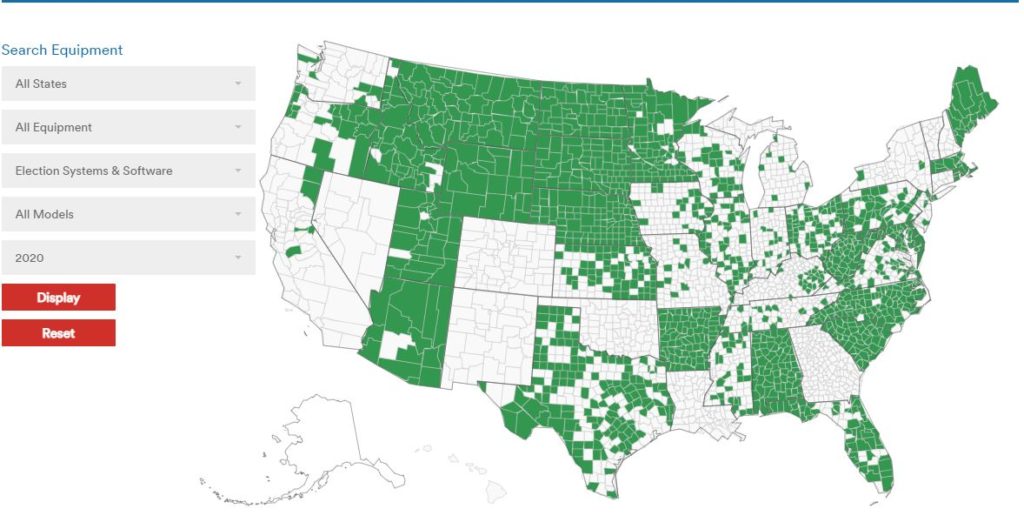 Counties that used ES&S equipment in the 2020 elections. (Verified Voting)
Concerns about the reliability of vote-counting software are not new, dating back to the 1980s. Having the ability to audit votes, and making sure ballots are counted properly, has long been a major concern of computer scientists, politicians and election officials.
In December 2019, Democratic lawmakers sought answers from those top three voting machine vendors which "facilitate voting for over 90% of all eligible voters in the United States."
Three separate letters were sent to the private equity firms who "reportedly own or control each of these vendors, with very limited 'information available in the public domain about their operations and financial performance.' "
Elections at Risk
In the second letter, addressed directly to the McCarthy Group, the private equity firm that owns ES&S, lawmakers wrote that "voting machines are reportedly falling apart across the country, as vendors neglect to innovate and improve important voting systems, putting our elections at avoidable and increased risk."
In requesting details about the ownership of ES&S, the lawmakers specifically noted "we are particularly concerned that secretive and 'trouble-plagued companies,' owned by private equity firms and responsible for manufacturing and maintaining voting machines and other election administration equipment, 'have long skimped on security in favor of convenience,' leaving voting systems across the country 'prone to security problems'."
DCReport placed numerous calls and emails to ES&S at its headquarters on John Galt Boulevard in Omaha. Only once was the phone answered by someone who would not put us through saying "they are not going to be able to talk to you.". DCReport was directed to ES&S's website. DCReport submitted the form repeatedly but got no reply.
Understanding the Software
Our democracy now relies on private companies, which build proprietary electronic systems, to reliably count our votes. It seems reasonable, if not crucial, to understand who is behind these companies as a standard to ensure election integrity. Without such knowledge, we run the risk that zealots, or investors with a financial stake in who wins elections, or those susceptible to bribery, have an incentive to use subtle software programming techniques to deliberately miscount votes to guarantee an outcome. In close elections, software code that invalidates or miscounts a mere sliver of ballots can change the outcome.
One of our concerns is ES&S providing junkets and gratuities to election officials, as uncovered in June 2018 by McClatchy newspapers. For at least 11 years, the voting equipment and software company curried favor with election officials by paying for trips to Las Vegas, tickets to shows and gifts.
"As many as a dozen election officials" attended a meeting in Las Vegas, with a number of them accepting airfare, lodging, and meals, McClatchy reported. A company spokeswoman told McClatchy that the junkets were "immensely valuable in providing customer feedback. One of our key results is customer satisfaction, and this is how we achieve that."
Marci Andino, the current executive director of the South Carolina State Election Commission, received more than $19,000 worth of flights, hotels and meals from ES&S since 2009, according to South Carolina Ethics Commission disclosure forms.
Andino's influence extends beyond the Palmetto State. She is also a member of the U.S. Election Assistance Commission's Standards Boardand has testified on election issues. She is a former President of the National Association of State Election Directors (NASED). To have an election official tied to a voting company creates concerns about conflicts.
Executives with Political Ties
DCReport also looked into the careers of some key ES&S executives. What we found is concerning.
Kathy Rogers, ES&S's senior vice president for government affairs, landed at ES&S after controversy over her work as a Georgia state elections official. She opposedlegislation trying to ensure vote counts could be verified.
In 2019, The New Yorker wrote about her actions in "How Voting-Machine Lobbyists Undermine the Democratic Process."
"In 2006, a bill requiring a verifiable paper record of each ballot, introduced in the Georgia legislature at the urging of election-integrity advocates, failed after the state's elections director, Kathy Rogers, opposed it," the magazine reported.
Georgia used ES&S machines in 2018 but now relies on Dominion equipment.
Georgia's 2018 gubernatorial race is noteworthy because it was overseen by Brian Kemp, who was then in charge of Georgia elections as secretary of state. That year, Kemp also ran for governor while overseeing his own election, a conflict of interest that he dismissed.
Kemp won a narrow victory over Democrat Stacey Abrams, but only after his office blocked 53,000 voter registration applications using a "strict" name matching protocol comparing state records to voter registration forms.
Kemp's Conflicts
Registrations were tossed if, for example, a person used a first name, middle initial and last name, on one form, but then used all three names in full on another. This invalidated a huge number of voter registration applications under Kemp's policy.
After Kemp won, a federal judge declared that Georgia had to implement a completely new voting system in time for the 2020 elections, replacing what the judge called "unsecure, unreliable and grossly outdated technology." Kemp tried to keep using the ES&S equipment for future elections, prompting Peach State Democrats to assert cronyism in the Kemp administration.
In January 2019, the Georgia Democratic Party challenged the integrity of voting machines that did not create an auditable paper trial, a policy he pursued through the creation of the Secure, Accessible & Fair Election or SAFE Commission.
The Democrats demanded a delay on recommendations for a new voting system "following the discovery that a leading vendor under consideration, whose machines are currently being investigated in a lawsuit due to errors in the 2018 election, has deep connections to Brian Kemp's office". That vendor was ES&S. The deep ties were due to Kemp having hired a longtime associate who was a registered lobbyist for ES&S.
As Politico characterized it at the time: "Georgia likely to plow ahead with buying insecure voting machines." It also reported that "Critics argued that the bill appeared to be written with one vendor in mind: the voting technology giant Election Systems & Software, whose former top lobbyist, is now Kemp's deputy chief of staff."
How many other states are conducting elections on "grossly outdated" or otherwise unreliable ES&S technology in 2018 and in 2020? This is an issue we are still investigating.
In Georgia, it was Brad Raffensperger, a Republican who succeeded Kemp as the elections overseer, who announced Dominion Voting Systems as the new elections vendor.
A Clean Election
The most recent Georgia election seems to be the first election in recent Georgian history not marred by voting-machine controversy other than Trump's nakedly false claims of vote stealing and corruption aimed at Republican Raffensperger.
The 2020 voting took place on a new system with an auditable paper ballot system. Three recounts, including an audit requiring "roughly 5 million votes in that contest to be recounted by hand" and as Secretary of State Raffensperger stated, showed results as close as imaginable.
"We have now counted legally cast ballots three times, and the results remain unchanged," Raffensperger said. Furthermore, a Judge declared Trump's legal team produced "precious little proof" in their pleadings.
ES&S's revolving door policy means its lobbyists taking top government official positions as well as government political appointees becoming ES&S executives.
One of these is Chris Wlaschin, who left the Trump Administration in March 2018. He was the chief information security official in the Health & Human Services Department. A few weeks later he landed at ES&S as "its new vice president of systems security responsible for the company's security efforts."
HHS to ES&S
Wlaschin abruptly left the Trump administration after HHS Secretary Alex Azar received a letter from a lawyer representing two HHS executives. The letter asserted that Wlaschin had improperly removed the pair and cited an eye-popping false claim Wlaschin used to justify disciplinary action.
"Mr. Wlaschin has stated that my clients were removed from their positions in order to protect an ongoing OIG investigation," wrote lawyer I. Charles McCullough, a former Inspector General for the National Security Community.
"You can, therefore, imagine the shock and surprise of my clients when they were both recently advised, unequivocally and categorically, by senior investigators from the HHS OIG, that neither of them are currently or were at any time in the past under investigation" by the inspector general's office, McCullough wrote.
The letter was dated March 12, 2018. Wlaschin's resume says he joined ES&S the next month.
The integrity of voting systems, and especially the ability to audit vote counts, has been the subject of public debate for more than four decades. But most of the recent attention has been focused on one company, Dominion Voting Systems, most recently because of frivolous lawsuits filed by Trump lawyers Rudy Giuliani and Sydney Powell and others. But is that simply a distraction.
We think the issue of who counts our votes, how they are counted, and what ties the companies selling these systems have to politicians deserves more attention. Politicians who must win elections, in order to wield power, must not be able to exert influence on the companies we rely on to tally our votes. We need serious scrutiny over our elections so we can be assured that they represent the will of the people, not of the politicians themselves, and the companies they hire to process our ballots.
FROM YOUR SITE ARTICLES
- Many new US voting systems for 2020 show troubling signs they ... ›
- Pre-Election Day voting already shattering past election statistics as ... ›
- The Ohio primary just raised a new red flag for the 2020 election ... ›
- Republicans have a friend in the company that counts their votes - Alternet.org ›
RELATED ARTICLES AROUND THE WEB
- Presidential Election Results and Electoral Map 2020 ›
- Everything You Need to Vote - Vote.org ›
- Voter turnout in 2020 election: U.S. has record turnout - Washington ... ›
https://www.alternet.org/2020/12/mitch-mcconnell-re-election/
no lnx
many maps tables
Busted? Why the numbers behind Mitch McConnell's re-election don't add up
Mitch McConnell slammed for repeatedly sabotaging stimulus negotiation efforts
Meaghan Ellis
DC Report December 19, 2020
On a Thursday in August in Louisville, months before the 2020 election, a parade of cars filled with Kentucky Teamster representatives and labor groups, showed their fury at Mitch McConnell's constant blocking of critical COVID aid. They drove by McConnell's office raucously honking and bearing signs saying "Mitch better have my money."
In 2017, a Public Policy Polling Survey asked Kentuckians, "Do you approve or disapprove of Senator Mitch McConnell's job performance?" Only 18% approved. He clawed his rating back up to 39% on the eve of the election.
McConnell, leader of Senate Republicans, rarely holds town hall meetings with Kentucky voters—not since a heated exchange with an angry constituent went viral.
1 out of 5 voters appear to have filled out their ballots with votes for both the female Democratic Amy McGrath and the Republican pussy-grabber Donald Trump.
So, what exactly drove these angry Kentuckians to reelect Mitch McConnell with a 19-point advantage over opponent Amy McGrath—57.8% to 38.2%?
Even as Republicans across the country still insist that the election was rife with fraudulent Democratic votes, no one's asking how McConnell managed one of the most lopsided landslides of the Nov. 3 election. They should. An investigation of Kentucky voting results by DCReport raises significant questions about the vote tallies in McConnell's state.
McConnell racked up huge vote leads in traditionally Democratic strongholds, including counties that he had never before carried.
There were wide, unexplained discrepancies between the vote counts for presidential candidates and down-ballot candidates.
Significant anomalies exist in the state's voter records. Forty percent of the state's counties carry more voters on their rolls than voting-age citizens.
Kentucky and many other states using vote tabulation machines made by Election Systems & Software all reported down-ballot race results at significant odds with pre-election polls.
[caption id="attachment_21747" align="aligncenter" width="625"] The 2020 Kentucky U.S. Senate election results map[/caption]
DCReport focused on the results in three counties in eastern Kentucky's Appalachian Mountains, two of which Democrats usually always win, but similar patterns emerge in other counties across the state. Even in counties that voted overwhelmingly for Democrats as recently as the 2019 gubernatorial election, there were a staggering number of Democrats voting Republican in 2020.
In rural Breathitt County, for instance, there are 9,508 registered Democrats and just 1,599 registered Republicans. The county has a history of close contests, but Amy McGrath got only 1,652 votes versus 3,738 for McConnell, a 67% to 29% trouncing. McGrath's votes, if accurate, equaled only 17% of registered Democrats in Breathitt County.
Conventional political wisdom in McConnell-land holds that these days "ancestral Kentucky Democrats" vote Republican, and analysts shouldn't correlate party registration with voting patterns. But simply dismissing any anomalies based on anecdotal hearsay ignores the data and other possible explanations. McConnell won Breathitt County in 2020 with 1,308 more votes than he received in the county's much closer 2014 race, which he won by fewer than 400 votes. The 2019 governor's race was also a squeaker in Breathitt County, but Democrat Andy Beshear eked out a 69-vote victory. Beshear won the race statewide.
McConnell's results were even more out of whack in two other nearby Appalachian counties. In his six previous Senate elections, Elliott and Wolfe counties had never voted for McConnell. Even up to last year, Elliott County remained reliably Democratic in non-presidential races, voting for the party's entire Democratic slate in both the 2015 and 2019 statewide elections. Yet in 2020, McConnell won 64% of the votes in Wolfe County and 66% of the votes in Elliott County. McGrath only got 21% of registered Democrats in Wolfe and 20% in Elliott.
Next, take the premise that there would be some basic logic in the voting patterns of those who did vote Democratic. One might expect a registered Democrat, who's going to vote Democratic, would walk into the booth and cast their vote for both Joe Biden and Amy McGrath. But the data tell another story. In 119 of 120 counties, Amy McGrath got more votes than Joe Biden. In some counties, the votes were close. But in counties like Breathitt and Elliott, 1 out of 5 voters appear to have filled out their ballots with votes for both the female Democratic Amy McGrath and the Republican pussy-grabber Donald Trump.
Then there is the question of why a county like Breathitt has more registered voters than it has people of voting age? 2019 population data shows that Breathitt County had 12,630 people with approximately 23% below the voting age of 18. This means approximately 9,700 people are of voting age, yet there are 11,497 registered voters. Having 100% of the voting-age population registered would be astounding enough, but Breathitt County appears to have almost 120% more registered voters than age-eligible citizens. And looking further, it appears this is not limited to Breathitt.
In November 2017, Judicial Watch, a right-wing non-partisan foundation promoting transparency, sued Kentucky over its "Dirty Voter Rolls" and its failure to maintain accurate voter registration lists.The suit argued that 48 of the 120 Kentucky counties had more registered voters than citizens over the age of 18 and alleged that Kentucky was one of only three states with a statewide active registration rate greater than 100% of the age-eligible citizen population. Kentucky's inflated voter rolls, and lack of transparency, provide a perfect cover for malfeasant behavior regarding the election results.
Turning an 18% approval into a 58% win may seem like a "turning water into wine"-style miracle, but a "smoke & mirrors" parlor trick seems more likely. To better understand how the data could have been manipulated, look no further than Trump's own legal filings. In an incompetent post-election lawsuit, the Trump team may have intended to accuse Democrats of election fraud, but in describing a possible plot, they attributed the cheating to Trump himself.
In a Dec. 4 filing in Georgia, Trump's legal team referred to a "machine-controlled algorithm deliberately run" by a voting machine vendor, Dominion Voting Systems. They allege this algorithm "generally took more than 2.5% of the votes from Mr. Biden and flipped them to Mr. Trump." So Trump's own legal team, instead of providing evidence of fraud by Biden's side, may have inadvertently revealed fraud benefiting Trump. In describing a deliberate, vendor installed, machine-controlled algorithm automatically taking a percentage of Biden's votes and giving them to Trump, they certainly are outlining how fraud could have been executed.
Trump's team claims Dominion was the machine vendor embedding algorithms to "flip" votes but is Trump pointing to one machine vendor to distract from another?
In Kentucky, when looking at counties where the numbers leap out on behalf of Mitch McConnell, none used Dominion machines. Most used machines from Election Systems & Software (ES&S), a Dominion competitor. If you swap ES&S for Dominion in the alleged vote-flipping scheme, you may arrive at an alternate explanation for why Amy McGrath's numbers weren't lining up and correlating with Biden's.
To steal an election it may make sense to use different algorithms for each race on the ballot so results did not appear to be uniform. Knowing the McGrath-McConnell race faced more nationwide scrutiny, schemers might have had to miscount votes by different margins in the presidential and Senate races. Flipping more votes from Biden to Trump than McGrath votes to McConnell would explain her getting approximately 20% more votes than the Democratic presidential candidate.
Significantly, Trump and his post-election legal team have pointed at Dominion voting machines and implored courts to look into this automated vote-flipping premise—but only in states that he lost. So, let's test it in ES&S states like Kentucky where Trump won.
McConnell had his biggest percentage of registered Democrats voting Republican in counties using ES&S machines. But he wasn't the only senator to perform so well. Other Republican incumbents, whom polls indicated would have close races, had similar luck to their majority leader on election day.
Lindsey Graham's race in South Carolina was so tight that he infamously begged for money, yet he won with a comfortable 10% lead—tabulated on ES&S machines throughout the state. In Susan Collins's Maine, where she never had a lead in a poll after July 2, almost every ballot was fed through ES&S machines. Kentucky, South Carolina, Maine, Texas, Iowa and Florida are all states that use ES&S machines. Maybe the polls didn't actually get it wrong.
When Trump says "look over here" at Dominion voting machines, maybe we should look at ES&S machines instead. When Republicans spout unfounded claims that Democrats stole the election, maybe we should be looking at Republican vote totals instead. And when Trump calls this the most fraudulent election in our history, maybe he knows of what he speaks.
You can follow Alison Greene on Twitter @GrassrootsSpeak.
FROM YOUR SITE ARTICLES
John Oliver breaks down how Dems can bring the pain to Mitch ... ›
McConnell's re-election campaign slapped with FEC flag over ... ›
Mitch McConnell is leaving endangered Republican senators ... ›
McConnell advances another Trump judge as COVID relief bill remains unfinished: 'His top priority' - Alternet.org ›
'It isn't even really a stimulus': Economists lament paltry $600 checks to citizens - Alternet.org ›
RELATED ARTICLES AROUND THE WEB
Senator Mitch McConnell reelected to 7th term in Kentucky - CBS ... ›
Republican Mitch McConnell defeats Democrat Amy McGrath in ... ›
Mitch McConnell - Wikipedia ›
Why Amy McGrath could cost Republicans the U.S. Senate, even if ... ›
Mitch McConnell wins reelection in Kentucky, defeating Democrat ... ›