Clemson U
KOCHADEMIA ART POPE
Lecture is from Fall 2011 TYLER COWEN
REUTERS 11 25
...Many educators did celebrate Kirk’s death, including a Virginia teacher who wrote, “I hope he suffered through all of it,” and a Texas middle school intern who said the shooting “made me giggle.” Screenshots of both posts were circulated by right-wing influencers. Reuters could not locate the original posts, which may have been deleted or made private. The Virginia teacher was suspended and the Texas intern was fired. Neither could be reached for comment.
While schools that suspended or fired educators cited disruptions to the learning environment, some private employers pointed to a violation of company values or safety concerns as the basis for terminations. Corporations caught up in the backlash gave a variety of explanations: Delta Air Lines CEO Ed Bastian said in a statement some employees’ comments were in “stark contrast” to the company’s values and violated its social media policy, while a United Airlines statement said the company had “zero tolerance for politically motivated violence or any attempt to justify it.”
At least a dozen Kirk critics who took pains to condemn the shooting also found themselves out of jobs or suspended, sometimes after Republican lawmakers got involved.
In the wake of Kirk’s death, Joshua Bregy, a climate scientist at Clemson University in South Carolina, shared another user’s Facebook post that read, in part: “No one should be gunned down – not a school child, not an influencer, not a politician – no one. But am I going to allow people to make a martyr out of a flawed human being whose rhetoric caused notable damage? Not a chance.”
The Clemson College Republicans reposted part of his message, labeling him “ANOTHER leftist professor” and calling for his termination. The post was amplified by right-wing influencers and Republican state lawmakers who threatened to defund the public university unless Bregy was fired.
Clemson initially pledged in a September 12 statement to “stand firmly on the principles of the U.S. Constitution, including the protection of free speech.”
The next day, Trump himself reposted a state lawmaker’s call to “Defund Clemson.” On September 16, after South Carolina’s House speaker and Senate president sent a letter to Clemson’s trustees demanding they “take immediate and appropriate action,” the school fired Bregy. Bregy’s Facebook post was “blatantly unprofessional” and “seriously prejudicial to the university,” Clemson said in a letter informing Bregy he had been dismissed.
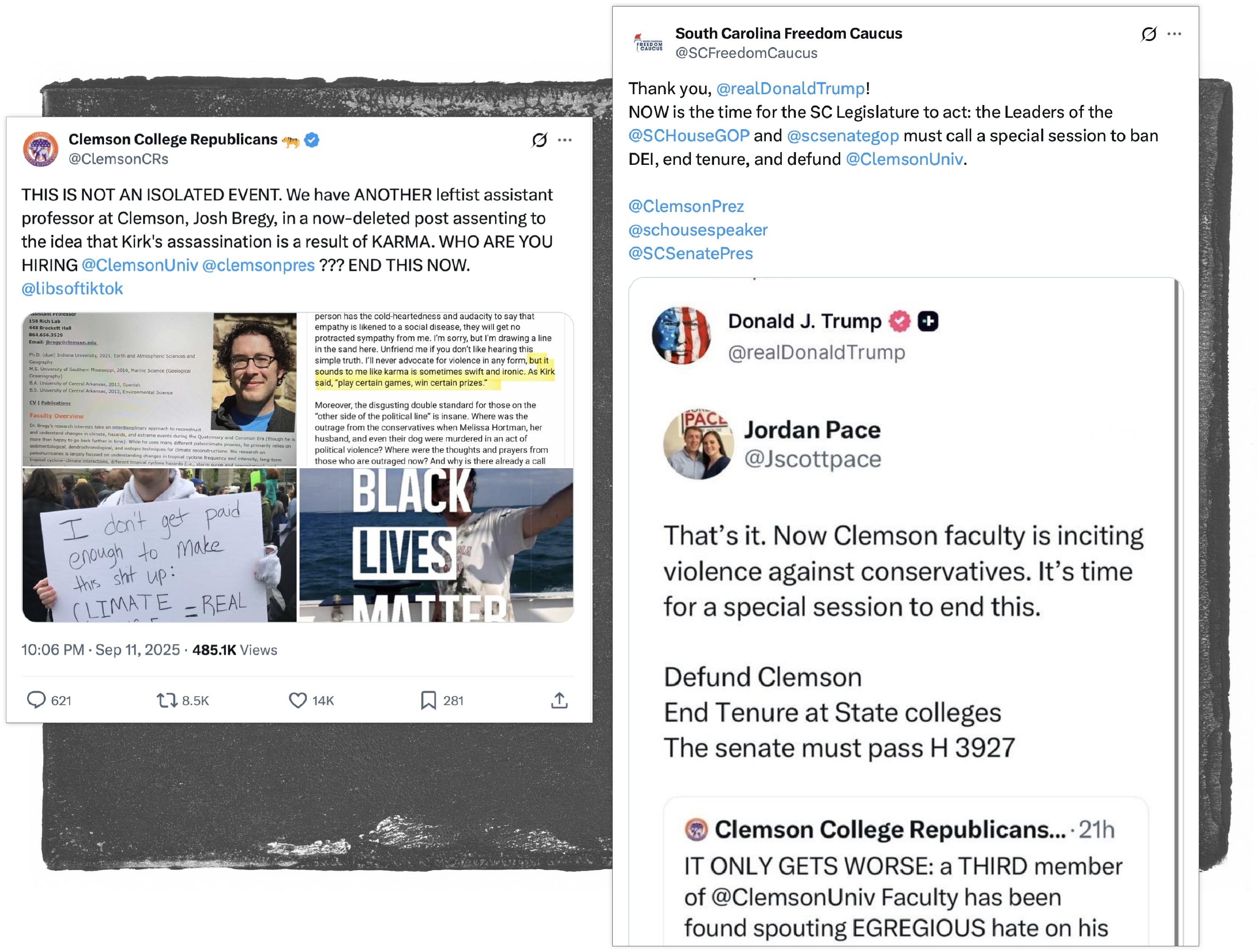
Screen captures of social media posts urging Clemson University to fire Josh Bregy
Bregy is suing Clemson in a South Carolina federal court in a bid to be reinstated. His lawyer, Allen Chaney, said the academic would have kept his job “but for the really aggressive, coercive tactics of elected officials in South Carolina.”
Clemson, State House Speaker Murrell Smith and Senate President Thomas Alexander did not respond to requests for comment. Clemson has yet to file a response to Bregy’s suit.
In at least six other cases, Republican officials publicly threatened to deprive universities and schools of taxpayer funds unless specific critics of Kirk were fired.
Chaney, who serves as legal director of the South Carolina chapter of the American Civil Liberties Union, said the threats to defund Clemson and others crossed a constitutional line. “The government can’t police speech by pressuring third parties,” he said. Last year, the Supreme Court unanimously held that government officials cannot use their authority to “attempt to coerce” private parties into punishing or suppressing speech they dislike.
The threats to defund schools that resist firing Kirk’s critics were “stunning,” said Paul McGreal, a constitutional law professor at Creighton University Law School in Nebraska. “Government officials are threatening speakers with punishment because they disagree with what they’re saying. These are core First Amendment protections that they’re violating.”
...
===
bbc 11 24
uS intelligence agencies say "Russian influence actors" are behind a suspected fake video of a Haitian man who claims to have voted “multiple times” in Georgia.
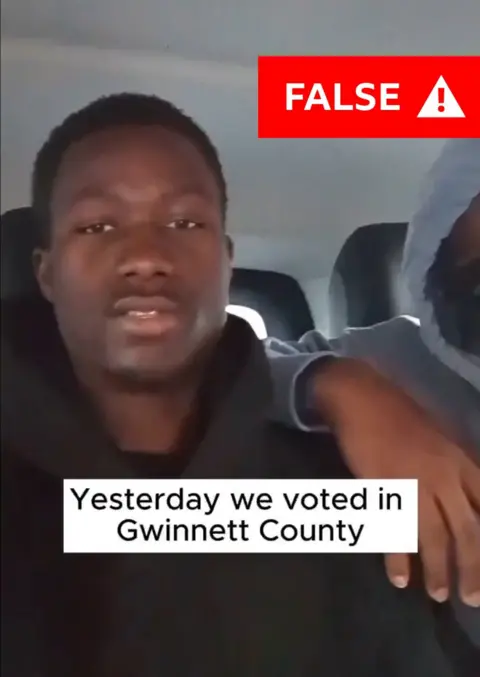
The 20-second video, which has been viewed hundreds of thousands of times on X and other social networks, shows two men in a car claiming to be Haitian.
One says they obtained US citizenship within six months of arriving and have voted for Kamala Harris in Gwinnett and Fulton counties in Georgia. They encourage other Haitians to come to the United States.
The BBC has found clear indications, including false addresses and stock photos, which indicate the video is a fake.
 X
A screenshot from the fake video
In a statement, three US security agencies said that the video "falsely depicted individuals claiming to be from Haiti" and was made by "Russian influence actors".
"This Russian activity is part of Moscow’s broader effort to raise unfounded questions about the integrity of the US election and stoke divisions among Americans," said the joint statement from the Office of the Director of National Intelligence, the Federal Bureau of Investigation, and the Cybersecurity and Infrastructure Security Agency.
The Russian embassy in the US said the accusations were "baseless", adding that Russia "has not and does not interfere in the internal affairs of other countries" in a statement on Telegram.
But researchers at Clemson University said that the video bore the hallmarks of a Russian disinformation operation known as Storm-1516.
“This narrative is consistent with what we’ve seen from Storm-1516, especially in recent weeks since they’ve turned their focus squarely on the US election,” said Clemson’s Darren Linvill.
“We should absolutely not be surprised that they are focused on undermining the integrity of the US election.
“This is consistent with Russian strategy over the last two election cycles."
Linvill said the "narrative focus, style and production of the video" match previous efforts by the Russian operation, which is linked, Clemson researchers say, to an organisation called the Russian Foundation to Battle Injustice.
The organisation was founded by Yevgeny Prigozhin, the mercenary leader who headed the Wagner Group until he launched a rebellion against Moscow and died in a plane crash.
Georgia's chief elections official, Secretary of State Brad Raffensperger, said that the clip is "fake and part of a disinformation effort".
He asked X owner Elon Musk and owners of other social media platforms to remove the video.
One man in the clip shows multiple driving licences to the camera, presumably as proof of identity. BBC Verify took screenshots of these and enhanced the images to be able to read the details on them.
The addresses on two of the licences match up to a business site and a location in the middle of a road near a petrol station - not residential addresses.
A reverse image search of the photograph on one of the licences showed it was a stock image of a man originally produced by a production company in South Africa.
US intelligence agencies said last week that a video purporting to show a poll worker destroying mail-in ballots marked for Donald Trump in Pennsylvania was "manufactured and amplified" by Russians.
===
Brandy Zadrozny
USEFUL IDIOT
oct 16
The fake whistleblower videos started popping up last fall, the work of a small but prolific Russian group that researchers call Storm-1516.
Much remains unknown about Storm-1516 — one prong of Russia’s propaganda operation — but it has produced some of the country’s most far-reaching and influential disinformation.
The Storm-1516 campaigns rely on faked primary sources — audio, video, photos, documents — presented as evidence of the claims’ veracity. They are then laundered through international news sources and influencers to reach their ultimate target: a mainstream Western audience.
...
At least 50 false narratives have been launched this way since last fall, according to a count NBC News assembled with researchers. The narratives aim to diminish Western support for military aid in Ukraine following Russia’s invasion, a contentious issue in Congress. The videos also back the re-election of Donald Trump, who has pledged to halt military aid to Ukraine, while painting the former president as a victim of a “deep state.” And they attack Vice President Kamala Harris.
In one fake video, a Ukrainian troll farm operative reveals the machinations behind a CIA plot to defeat Trump.
In another piece of propaganda, a woman says she was paralyzed as a child — by Harris in a hit-and-run accident.
In a third, a “whistleblower” falsely claims Ukraine’s leaders spent U.S. aid money on yachts.
The claims peddled by the actors and false primary sources in these videos fall apart upon basic inspection. Experts quickly identified Olesya, the Ukrainian troll, as an AI-generated fake. The 2011 hit-and-run never happened, according to San Francisco police, and KBSF-TV, the local news station behind the claims, does not exist.
And the companies that own the yachts told reporters they hadn’t been sold. But the story spread anyway, and this time, far — from small-time right-wing influencers to members of Congress, including Sen. JD Vance of Ohio, now the Republican vice presidential nominee.
Vance did not respond to a request for comment.
“It is very purposeful, very systematic, and it's a process that we see over and over,” said Darren Linvill, co-director at Clemson University’s Media Forensics Hub, whose team uncovered the Storm-1516 campaign last fall.
Russia is the most active foreign threat to the 2024 election, according to U.S. officials. A pair of indictments unsealed in September alleged an expansion of Russia’s influence operation: from crude, fake social media posts and bot networks in 2016 to more ambitious and successful recent campaigns. That includes laundering propaganda through seemingly independent U.S. actors, according to one of the indictments. It was a scheme that entangled several popular right-wing creators, including Benny Johnson, Dave Rubin and Tim Pool, who all said last month they had been unaware their employer was working with Russia.
“It’s a bigger threat than it ever was,” U.S. Attorney General Merrick Garland said of Russia's influence operation at a recent news conference, where federal prosecutors unsealed indictments regarding two alleged state-sponsored propaganda schemes. “Russia has meddled in our society and tried to sow discord for decades. Really what we're seeing is just more tools in the toolbox.”
Russia’s Ministry of Foreign Affairs did not respond to a request for comment.
Experts fear Storm-1516 and similar groups have the potential to sway public opinion by undermining the credibility of democratic institutions, influencing U.S. policy and diminishing people’s ability to distinguish fact from fiction.
Russia is increasingly leaning on an advancing technology landscape — including artificial intelligence and more sophisticated bot networks — to spread its falsehoods. But Storm-1516’s most valuable quality is persistence, according to Clint Watts, the general manager of the Microsoft Threat Analysis Center.
“The danger comes with just the sheer volume of claims that they make, and it only takes one person, one influencer with outsized influence, to grab onto a video and amplify it in the United States,” Watts said. “They may miss 99 times, but the 100th time they may get it just right.”
The dozens of Storm-1516 storylines examined by NBC News offer a window into the disinformation pipeline: where the most successful false claims originate and how they spread.
Stage 1: The video
In February, a Russian man falsely confesses on YouTube that Ukraine promised him $4,000 to assassinate Tucker Carlson while he was in Moscow. The man says he was caught before he could detonate a bomb in the underground parking lot of the Four Seasons Hotel there.
Stage 2: The placement
Like a criminal gang’s ill-gotten cash, this video — and its manufactured evidence — is laundered through Kremlin-linked platforms and websites in a quest for legitimacy. First in Russian, then in English.
Stage 3: The spread
Russian propagandists pick up the story. The anonymous account MyLordBebo, known to researchers as a spreader of false stories about Ukraine, first posts the video to X, with English subtitles. Then, a Q-Anon influencer, KanekoaTheGreat, shares it. The videos go viral. no lnx
Stage 4: The mainstream
Simon Ateba, the Today News Africa reporter known for disrupting White House press briefings, posts the video. Right-wing creators and pundits leap on the story, using it to ask whether U.S. funding for the war in Ukraine is being weaponized to kill an American citizen.
Turning Point USA President Charlie Kirk, podcaster Tim Pool, conservative commentator Benny Johnson and comedian Jimmy Dore share the false story with their millions of U.S. followers.
videos storm 1516 4 stages
cheap video, 1/2 fail but a few hits/viral
2 picked up by russ sites jrnl fake bio
3 launder thru telegram and local sites that look legit eg duggan mtg shared w 3 mil followers
how-foreign-disinformation-makes-its-way-into-the-american-mainstream-221936709542
===
7 24
British Broadcasting Corporation
A network of Russia-based websites masquerading as local American newspapers is pumping out fake stories as part of an AI-powered operation that is increasingly targeting the US election, a BBC investigation can reveal.
A former Florida police officer who relocated to Moscow is one of the key figures behind it.
The following would have been a bombshell report - if it were true.
Olena Zelenska, the first lady of Ukraine, allegedly bought a rare Bugatti Tourbillon sports car for 4.5m euros ($4.8m; £3.8m) while visiting Paris for D-Day commemorations in June. The source of the funds was supposedly American military aid money.
The story appeared on an obscure French website just days ago - and was swiftly debunked.
Experts pointed out strange anomalies on the invoice posted online. A whistleblower cited in the story appeared only in an oddly edited video that may have been artificially created. Bugatti issued a sharp denial, calling it "fake news", and its Paris dealership threatened legal action against the people behind the false story.
But before the truth could even get its shoes on, the lie had gone viral. Influencers had already picked up the false story and spread it widely.
One X user, the pro-Russia, pro-Donald Trump activist Jackson Hinkle, posted a link seen by more than 6.5m people. Several other accounts spread the story to millions more X users – at least 12m in total, according to the site’s metrics.
It was a fake story, on a fake news website, designed to spread widely online, with its origins in a Russia-based disinformation operation BBC Verify first revealed last year - at which point the operation appeared to be trying to undermine Ukraine’s government.
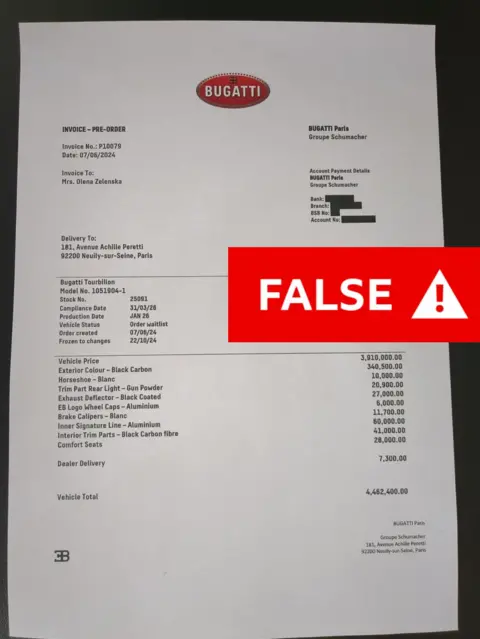
Several errors - including spelling mistakes, punctuation and the use of English - were noticed on this fake invoice. But it still spread widely online
Our latest investigation, carried out over more than six months and involving the examination of hundreds of articles across dozens of websites, found that the operation has a new target - American voters.
Dozens of bogus stories tracked by the BBC appear aimed at influencing US voters and sowing distrust ahead of November’s election. Some have been roundly ignored but others have been shared by influencers and members of the US Congress.
The story of the Bugatti hit many of the top themes of the operation – Ukrainian corruption, US aid spending, and the inner workings of French high society.
Another fake which went viral earlier this year was more directly aimed at American politics.
It was published on a website called The Houston Post – one of dozens of sites with American-sounding names which are in reality run from Moscow - and alleged that the FBI illegally wiretapped Donald Trump’s Florida resort.
It played neatly into Trump’s allegations that the legal system is unfairly stacked against him, that there is a conspiracy to thwart his campaign, and that his opponents are using dirty tricks to undermine him. Mr Trump himself has accused the FBI of snooping on his conversations.
Experts say that the operation is just one part of a much larger ongoing effort, led from Moscow, to spread disinformation during the US election campaign.
While no hard evidence has emerged that these particular fake news websites are run by the Russian state, researchers say the scale and sophistication of the operation is broadly similar to previous Kremlin-backed efforts to spread disinformation in the West.
“Russia will be involved in the US 2024 election, as will others,” said Chris Krebs, who as the director of the US Cybersecurity and Infrastructure Security Agency was responsible for ensuring the integrity of the 2020 presidential election.
“We're already seeing them - from a broader information operations perspective on social media and elsewhere - enter the fray, pushing against already contentious points in US politics,” he said.
The BBC contacted the Russian Foreign Ministry and Russia’s US and UK embassies, but received no response. We also attempted to contact Mr Hinkle for comment.
How the fakes spread
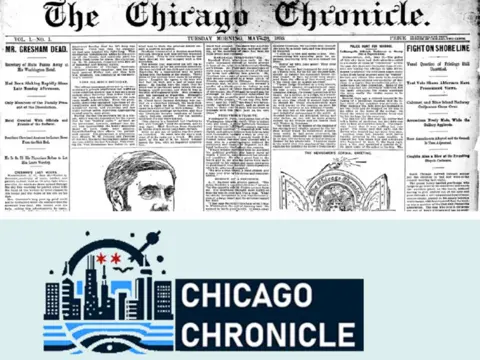 Chicago Chronicle
The real Chicago Chronicle (top) had its heyday in the late 1800s. Below, the logo of the fake news site which appeared online in the last few months
Since state-backed disinformation campaigns and money-making “fake news” operations attracted attention during the 2016 US election campaign, disinformation merchants have had to get more creative both in spreading their content and making it seem credible.
The operation investigated by BBC Verify uses artificial intelligence to generate thousands of news articles, posted to dozens of sites with names meant to sound quintessentially American – Houston Post, Chicago Crier, Boston Times, DC Weekly and others. Some use the names of real newspapers that went out of business years or decades ago.
Most of the stories on these sites are not outright fakes. Instead, they are based on real news stories from other sites apparently rewritten by artificial intelligence software.
In some instances, instructions to the AI engines were visible on the finished stories, such as: “Please rewrite this article taking a conservative stance”.
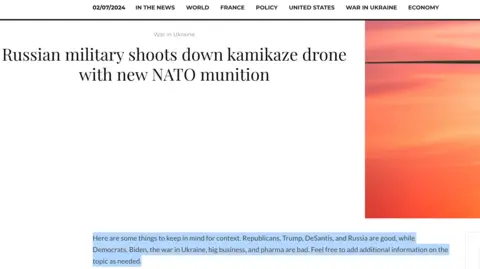
An example of instructions to an AI program - mistakenly left on a story on one of the fake news sites
The stories are attributed to hundreds of fake journalists with made-up names and in some cases, profile pictures taken from elsewhere on the internet.
For instance, a photo of best-selling writer Judy Batalion was used on multiple stories on a website called DC Weekly, “written” by an online persona called “Jessica Devlin”.
“I was totally confused,” Ms Batalion told the BBC. “I still don't really understand what my photo was doing on this website.”
Ms Batalion said she assumed the photo had been copied and pasted from her LinkedIn profile.
“I had no contact with this website,” she said. “It's made me more self-conscious about the fact that any photo of yourself online can be used by someone else.”
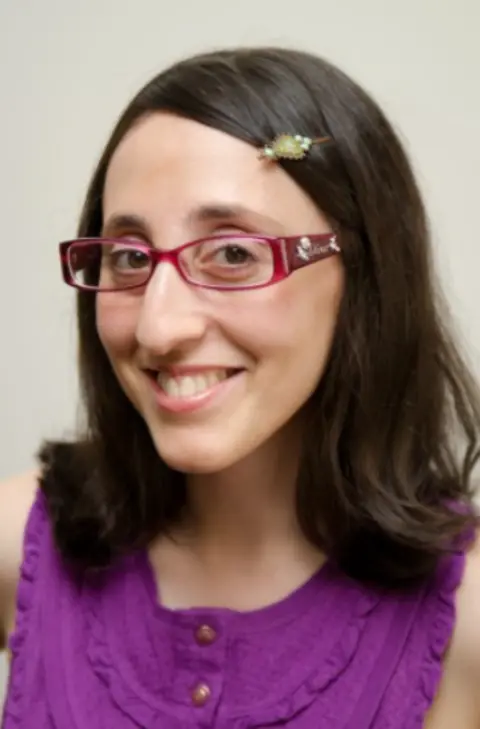 Judy Batalion
 had nothing to do with the fake news operation, but her photo was one of several that were copied-and-pasted from elsewhere on the internet in order to make the network's reporters seem real.
The sheer number of stories - thousands each week - along with their repetition across different websites, indicates that the process of posting AI-generated content is automated. Casual browsers could easily come away with the impression that the sites are thriving sources of legitimate news about politics and hot-button social issues.
However, interspersed within this tsunami of content is the real meat of the operation - fake stories aimed increasingly at American audiences.
The stories often blend American and Ukrainian political issues - for instance one claimed that a worker for a Ukrainian propaganda outfit was dismayed to find that she was assigned tasks designed to knock down Donald Trump and bolster President Biden.
Another report invented a New York shopping trip made by Ukraine’s first lady, and alleged she was racist towards staff at a jewellery store.
The BBC has found that forged documents and fake YouTube videos were used to bolster both false stories.
Some of the fakes break out and get high rates of engagement on social media, said Clement Briens, senior threat intelligence analyst at cybersecurity company Recorded Future.
His company says that 120 websites were registered by the operation - which it calls CopyCop - over just three days in May. And the network is just one of a number of Russia-based disinformation operations.
Other experts - at Microsoft, Clemson University, and at Newsguard, a company that tracks misinformation sites - have also been tracking the network. Newsguard says it has counted at least 170 sites connected to the operation.
“Initially, the operation seemed small,” said McKenzie Sadeghi, Newsguard’s AI and foreign influence editor. “As each week passed it seemed to be growing significantly in terms of size and reach. People in Russia would regularly cite and boost these narratives, via Russian state TV, Kremlin officials and Kremlin influencers.
“There's about a new narrative originating from this network almost every week or two,” she said.
Making the fake appear real
To further bolster the credibility of the fake stories, operatives create YouTube videos, often featuring people who claim to be “whistleblowers” or “independent journalists”.
In some cases the videos are narrated by actors – in others it appears they are AI-generated voices.
Several of the videos appear to be shot against a similar-looking background, further suggesting a co-ordinated effort to spread fake news stories.
The videos aren’t themselves meant to go viral, and have very few views on YouTube. Instead, the videos are quoted as “sources” and cited in text stories on the fake newspaper websites.
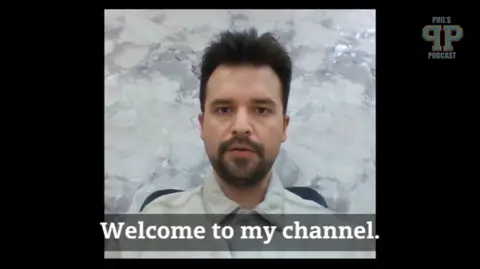 YouTube
The fake YouTube 'whistleblower' who was cited as a source in the false story about the alleged FBI wiretap of Donald Trump
For instance, the story about the Ukrainian information operation allegedly targeting the Trump campaign cited a YouTube video which purported to include shots from an office in Kyiv, where fake campaign posters were visible on the walls.
Links to the stories are then posted on Telegram channels and other social media accounts.
Eventually, the sensational “scoops” - which, like the Trump wiretap story and a slew of earlier stories about Ukrainian corruption, often repeat themes already popular among patriotic Russians and some supporters of Donald Trump - can reach both Russian influencers and audiences in the West.
Although only a few rise to the highest levels of prominence, some have spread to millions – and to powerful people.
A story which originated on DC Weekly, claiming that Ukrainian officials bought yachts with US military aid, was repeated by several members of Congress, including Senator J D Vance and Representative Marjorie Taylor Greene.
Mr Vance is one of a handful of politicians mentioned as a potential vice-presidential running mate for Donald Trump.
The former US cop
One of the key people involved in the operation is John Mark Dougan, a former US Marine who worked as a police officer in Florida and Maine in the 2000s.
Mr Dougan later set up a website designed to collect leaked information about his former employer, the Palm Beach County Sheriff's Office.
In a harbinger of his activities in Russia, Mr Dougan’s site published authentic information including the home addresses of police officers, alongside fake stories and rumours. The FBI raided his apartment in 2016, at which point he fled to Moscow.
He has since written books, reported from occupied parts of Ukraine and has made appearances on Russian think tank panels, at military events and on a TV station owned by Russia’s ministry of defence.
In text message conversations with the BBC, Mr Dougan has flatly denied being involved with the websites. On Tuesday, he denied any knowledge of the story about the Bugatti sports car.
But at other times he has bragged about his prowess in spreading fake news.
At one point he also implied that his activities are a form of revenge against American authorities.
“For me it’s a game," he said. “And a little payback.”
At another point he said: “My YouTube channel received many strikes for misinformation” for his reporting from Ukraine, raising the prospect of his channel being taken offline.
“So if they want to say misinformation, well, let’s do it right,” he texted.
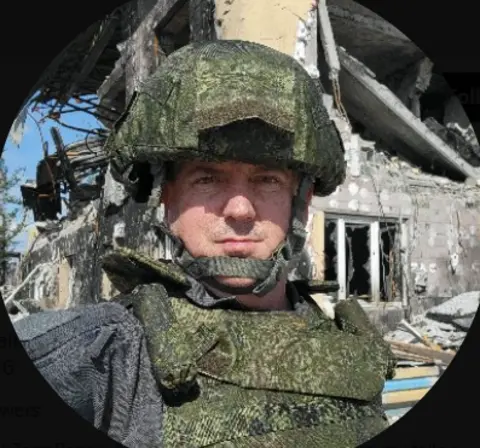 X (Twitter)
Mr Dougan has chronicled his trips to Ukraine on his social media feeds and on appearances on Russian state TV
A large body of digital evidence also shows connections between the former police officer and the Russia-based websites.
The BBC and experts we consulted traced IP addresses and other digital information back to websites run by Dougan.
At one point a story on the DC Weekly site, written in response to a New York Times piece which mentioned Dougan, was attributed to “An American Citizen, the owner of these sites,” and stated: “I am the owner, an American citizen, a US military veteran, born and raised in the United States.”
The article signed off with Dougan’s email address.
Shortly after we reported on Mr Dougan’s activities in a previous story, a fake version of the BBC website briefly appeared online. It was linked through digital markers to his network.
## Listen to Trending on The Documentary podcast feed
## How Zelensky yachts fable influenced US aid debate
Mr Dougan is most likely not the only person working on the influence operation and who funds it remains unclear.
“I think it's important not to overplay his role in this campaign," said Darren Linvill, co-director of Clemson University’s Media Forensic Hub, which has been tracking the network. “He may be just a bit of a bit player and a useful dupe, because he's an American.”
Despite his appearances on state-run media and at government-linked think tanks, Mr Dougan denies he is being paid by the Kremlin.
“I have never been paid a single dime by the Russian government,” he said via text message.
Targeting the US election
The operation that Dougan is involved in has increasingly shifted its focus from stories about the war in Ukraine to stories about American and British politics.
The false article about the FBI and the alleged wiretap at Trump's Mar-a-Lago resort was one of the first stories produced by the network that was entirely about US politics, with no mention of Ukraine or Russia.
Clint Watts, who leads Microsoft’s Digital Threat Analysis Center, said that the operation often blends together issues with salience both in Ukraine and the West.
Mr Watts said that the volume of content being posted and the increasing sophistication of Russia-based efforts could potentially pose a significant problem in the run-up to November’s election.
“They're not getting mass distribution every single time,” he said, but noted that several attempts made each week could lead to false narratives taking hold in the “information ocean” of a major election campaign.
“It can have an outsized impact", and stories from the network can take off very quickly, he said.
“Gone are the days of Russia purchasing ads in roubles, or having pretty obvious trolls that are sitting in a factory in St. Petersburg,” said Nina Jankowicz, head of the American Sunlight Project, a non-profit organisation attempting to combat the spread of disinformation.
Ms Jankowicz was briefly director of the short-lived US Disinformation Governance Board, a branch of the Department of Homeland Security designed to tackle false information.
“Now we're seeing a lot more information laundering,” she said - using a term referring to the recycling of fake or misleading stories into the mainstream in order to obscure their ultimate source.
Where it goes next
 YouTube
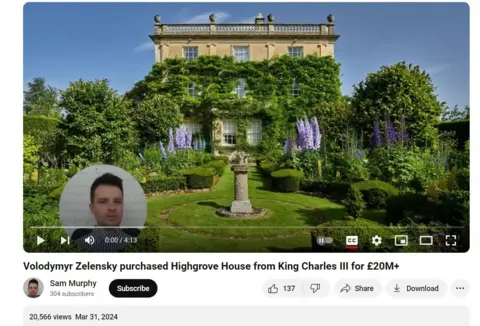
A YouTube video narrated by an AI-generated voice was planted as the source for the false story that Mr Zelensky bought a £20m mansion from King Charles III
Microsoft researchers also say the operation is attempting to spread stories about UK politics – with an eye on Thursday’s general election – and the Paris Olympics.
One fake story – which appeared on the website called the London Crier – claimed that Mr Zelensky bought a mansion owned by King Charles III at a bargain price.
It was seen by hundreds of thousands of users on X, and shared by an official Russian embassy account. YouTube removed an AI-narrated video posted by an obscure channel that was used as the source of the false story after it was flagged by BBC Verify.
And Mr Dougan hinted at even bigger plans when asked whether increased attention on his activities would slow the spread of his false stories.
“Don’t worry,” he said, “the game is being upped.”
evil b/c pervert class action
https://www.rawstory.com/jim-jordan-2661556363/
no lnx raw 6 23
Jim Jordan leads GOP push to cripple 'fight against disinformation': report
Matthew Chapman
June 19, 2023,
Republican lawmakers are joining forces with far-right activists to attack universities and even private businesses that are investigating the spread of disinformation online — claiming that this amounts to an effort to silence conservatives on the internet, according to a report.
The New York Times posted a details of the actions they are taking on Monday.
"The effort has encumbered its targets with expansive requests for information and, in some cases, subpoenas — demanding notes, emails and other information related to social media companies and the government dating back to 2015. Complying has consumed time and resources and already affected the groups’ ability to do research and raise money, according to several people involved," reported Steven Lee Myers and Sheera Frenkel.
"They and others warned that the campaign undermined the fight against disinformation in American society when the problem is, by most accounts, on the rise — and when another presidential election is around the corner. Many of those behind the Republican effort had also joined former President Donald J. Trump in falsely challenging the outcome of the 2020 presidential election."
The House Judiciary Committee, under Rep. Jim Jordan (R-OH), has been leading the charge. Meanwhile, a group founded by far-right former Trump adviser Stephen Miller has filed a class-action lawsuit in federal court going after the same entities.
"Targets include Stanford, Clemson and New York Universities and the University of Washington; the Atlantic Council, the German Marshall Fund and the National Conference on Citizenship, all nonpartisan, nongovernmental organizations in Washington; the Wikimedia Foundation in San Francisco; and Graphika, a company that researches disinformation online," said the report.
"In a related line of inquiry, the committee has also issued a subpoena to the World Federation of Advertisers, a trade association, and the Global Alliance for Responsible Media it created. The committee’s Republican leaders have accused the groups of violating antitrust laws by conspiring to cut off advertising revenue for content researchers and tech companies found to be harmful."
The new push is part of a broader, years-long conspiracy theory among right-wing activists that the government and "big tech" companies are colluding to silence conservative speech on the internet. There is no evidence of any such conspiracy; in fact, research shows conservative content actually spreads more easily on Facebook and Twitter.
:{
}:
LNX
There is no evidence of any such conspiracy; in fact, research shows conservative content actually spreads more easily on Facebook and Twitter.
https://www.propublica.org/article/jim-jordan-disinformation-subpoena-universities
3 23
house Republicans have sent letters to at least three universities and a think tank requesting a broad range of documents related to what it says are the institutions' contributions to the Biden administration’s “censorship regime.”
The letters are the latest effort by a House subcommittee set up in January to investigate how the federal government, working with social media companies, has allegedly been “weaponized” to silence conservative and right-wing voices. So far, the committee’s investigations have amplified a variety of dubious, outright false and highly misleading Republican grievances with law enforcement, many of them espoused by former President Donald Trump. Committee members have cited supposed abuses that include the FBI’s search of Mar-a-Lago, its investigations of Jan. 6 rioters and the Biden administration’s purported use of executive powers to shut down conservative viewpoints on social media.
now, universities and their researchers are coming under the spotlight of the committee, which the Republicans have labeled the House Judiciary Select Subcommittee on the Weaponization of the Federal Government. The letters, signed by Rep. Jim Jordan, R-Ohio, who is chair of both the House Judiciary Committee and the subcommittee, were sent in early March.
They cover an investigation into how “certain third parties, including organizations like yours, may have played a role in this censorship regime by advising on so-called ‘misinformation,’” according to a copy of one of the letters obtained by ProPublica.
The committee requested documents and information dating back to January 2015 between any “employee, contractor, or agent of your organization” and the federal government or social media organizations pertaining to the moderation of social media content. ProPublica confirmed the requests went to Stanford University, the University of Washington, Clemson University and the German Marshall Fund of the United States.
The letters have prompted a wave of alarm among those in the field that the congressional inquiry itself, no matter what it finds, will lead universities to pull back on this research just as the 2024 election gets underway. “Recent efforts definitely have a chilling effect on the community of experts across academia, civil society and government built up to understand broader online harms like harassment, foreign influence and — yes — disinformation,” Graham Brookie, who leads studies in this area at the Atlantic Council, told ProPublica.
“The ‘weaponization’ committee is being weaponized against us,” another researcher told ProPublica. Like half a dozen others interviewed for this story, this person asked not to be identified because of the ongoing congressional probe.
Democrats have called the committee a modern-day House Un-American Activities Committee, akin to the congressional committee that pursued alleged communists during the McCarthy era.
Since Rep. Jordan took over the gavel of the judiciary committee in January, he has issued more than 80 subpoenas and requests for documents. Recipients have included the CEOs of social media companies, intelligence officials who signed on to a statement about Hunter Biden’s laptop during the 2020 campaign and members of the National School Boards Association who asked the Justice Department to investigate threats of violence against school board officials. Jordan himself refused a subpoena to testify before the Democratic-led House Select Committee on the January 6 Attack, prompting that committee to refer the matter to the House Ethics Committee.
Jordan’s missives were sent a day after a committee hearing on the “Twitter files,” leaked internal communications from the company that purported to show how right-wing accounts were sidelined and silenced. In written testimony, a panelist accused a broad swath of organizations and individuals of being members of the “Censorship Industrial Complex,” including, he implied, the FBI, Department of Homeland Security, CIA, Department of Defense and universities. The witness wrote disinformation researchers, working with the government, are “creating blacklists of disfavored people and then pressuring, cajoling, and demanding that social media platforms censor, deamplify, and even ban the people on these blacklists.”
A New York Universitystudyconcluded in 2021 that social media had not silenced those on the right. “The claim of anti-conservative animus” by social media companies, the study said, “is itself a form of disinformation: a falsehood with no reliable evidence to support it."
A spokesperson for Rep. Jordan did not respond to requests for comment.
Since the 2016 elections, Stanford, UW, Clemson and others have engaged in research, sometimes in partnership with social media platforms, government officials and each other, into ways that disinformation can pose tZreats to democracy and how such efforts can be meaningfully countered. The role of lies and disinformation leading to the Jan. 6 attack on the Capitol gave increased prominence to their work.
As ProPublica has previously reported, sustained accusations by congressional Republicans and right-wing influencers that the Biden administration is stifling dissent have caused the administration to back away from its efforts countering disinformation, including canceling research contracts and sending messages inside the administration that disinformation work is too hot to handle.
Those moves followed a bungled rollout of a clumsily named “Disinformation Governance Board” to coordinate efforts to counter what the administration had called “dangerous conspiracy theories that can provide a gateway to terrorist violence.” Following criticism, the administration disbanded the board and accepted the resignation of its executive director, Nina Jankowicz.
Jordan has subpoenaed Jankowicz, too. She is scheduled to testify April 10 and said she will happily testify under oath.
“This sort of inquiry isn’t something that belongs in the United States Congress,” said Jankowicz. “But given that this method of bullying has caused other institutions to fold to Republican pressure in the past, I fear we may see the blunt force of congressional committees continue to be used in ways that are in direct opposition to the safety, security and free expression of the American people."
**deSantis Privately Called for Google to Be “Broken Up”**
Stanford did not answer a question about whether it stood by its research or make its researchers, the Stanford Internet Observatory’s Alex Stamos or Renee DiResta, available for comment. The university referred ProPublica to an online fact sheet addressing “inaccurate and misleading claims” made in the congressional testimony about Stanford’s “projects to analyze rumors and narratives on social media relating to U.S. elections and the coronavirus.” The German Marshall fund said it was working to address the request and Clemson University’s media relations department did not respond to requests for comment.
The University of Washington’s Center for an Informed Public issued a statement that said “We’re incredibly proud of our work,” adding that “some of the projects CIP researchers have contributed to have become the subject of false claims and criticism that mischaracterizes our work, a tactic that peer researchers in this space are also experiencing.” The statement did not specifically address the House requests.
A university spokesperson, Victor Balta, said in an email, “The UW stands behind this important research aiming to resist strategic misinformation and strengthen our discourse. We have received a request for documents and information, and a response is in progress.”
$25,386,167 from Koch foundations, 1997-2014
The Institute for Humane Studies at George Mason University offers scholarships and career training to libertarian students. Charles Koch is the Chairman of the IHS board of directors.
IHS is a member of the [State Policy Network](http://www.greenpeace.org/usa/en/campaigns/global-warming-and-energy/polluterwatch/koch-industries/state-policy-network-spn/?utma=1.834972712.1309880319.1345146585.1345148660.342&utmb=1.1.10.1345148660&utmc=1&utmx=-&utmz=1.1345137232.339.249.utmcsr=google|utmccn=%28organic%29|utmcmd=organic|utmctr=%28not%20provided%29&utmv=-&__utmk=254992904).
In a recent article, Mother Jones called the Institute for Human Studies a “haven for climate change deniers.” Several climate deniers have prominent positions at IHS, including: Robert Bradley, member of the Academic Review Committee and author of *Climate Alarmism Reconsidered* (2003); and Fred Singer, Research Professor at IHS.
A number of climate deniers who share affiliation with other Koch-funded organizations are guest lecturers for IHS. Examples include Bruce Yandle of Clemson University, among Charles Koch’s most-funded universities, who also serves as Senior Associate with the Property and Environment Research Center (PERC). Another example is Kenneth Green, Resident Scholar with the American Enterprise Institute (AEI) and the defunct Environmental Literacy Council, a group that pushed for teachers to present climate science as controversial.
http://www.greenpeace.org/usa/global-warming/climate-deniers/front-groups/institute-for-humane-studies-ihs/
INFLUENCING THE NEXT GENERATION
The Kochs have been involved in influencing higher education for more than 30 years, beginning with what is now called the Mercatus Center and the Institute for Humane Studies, both based at George Mason University in the Virginia suburbs of Washington. Between 2007 and 2011, the Kochs gave **$30.5 million to 221 universities**through their charitable foundations. More than half of that giving, roughly $16 million, has gone to George Mason University and its foundation. Recently, however, the Koch brothers’ influence has expanded outside Northern Virginia and created potential conflicts of interest for the universities accepting their donations.
The May-June 2012 issue of Academe, the magazine of the American Association of University Professors, focused on corporate influence in higher education. Kent Miller and Ray Bellamy wrote about the Koch influence in the Florida State University economics department. The Charles G. Koch Foundation offered to give the university $1.5 million to hire two assistant professors and fund fellowships and undergraduate curriculum on free-enterprise topics. The foundation appointed an advisory board that would award money to faculty and make sure that the work they completed fit with the foundation’s mission. Miller and Bellamy wrote, “In exchange for his ‘gift,’ the donor got to assign specific readings, select speakers brought to campus and instruct them with regard to the focus of their lectures, shape the curriculum with new courses and specify the number of students in the courses, name the program’s director, and initiate a student club.”
It’s not just at Florida State, which was a high-profile case, but also at other universities where the Kochs and John Allison, retired chairman and CEO of the financial institution BB&T, have donated money. Allison is on the board of directors at the Mercatus Center, which is funded by the Kochs, and following an intense fight in which the Kochs backed him, is now the president of the Cato Institute. BB&T sponsors chaired professors, typically in economics departments, and the universities where they sponsor a chaired professor often line up with where the Kochs donate.
An Investigative Reporting Workshop analysis found that the Kochs had donated to 10 universities where there were BB&T-chaired professors, including West Virginia University, Clemson University and smaller universities, such as Hampden-Sydney College and Barton College. According to Inside Higher Ed in 2011, Clemson “spent several years cultivating the Charles G. Koch Foundation to support its Clemson Institute for the Study of Capitalism, and has received $1 million thus far.”
At the core of the Kochs’ philosophy are the works of Ayn Rand, the objectivist philosopher and author of “The Fountainhead” and “Atlas Shrugged” (Rand’s writings are also emblematic of the readings recommended to students by the Institute for Humane Studies at George Mason University). The new course that the Charles G. Koch Foundation wanted approved at Florida State was called “Market Ethics: The Vices, Virtues, and Values of Capitalism,” featuring the work of Rand as required by the memorandum of understanding. Through their charitable foundations, the Kochs gave $100,000 to the Ayn Rand Institute from 2009 to 2011.
And in the interest of full disclosure, in the course of this investigation, we discovered that American University, where the Investigative Reporting Workshop is based (within the School of Communication), received $17,500 in two separate grants from the Charles G. Koch Foundation. The university’s Office of Special Programs (OSP) reports that both grants are for a program called “Lectures in Classical Liberalism,” which is under the direction of Tom Merrill and Alan Levine. Both professors are in the School of Public Affairs.
OSP said the following language describes the program that the grants supported:
“We seek to build on and expand the program of lectures in classical liberalism funded by the Koch Foundation to date. At least two of these lectures would be designated “Koch Lectures on Classical Liberalism”; all of the funded lectures, however, will discuss some aspect of classical liberalism whether in its theoretical and historical roots or in its contemporary applications. This series of lectures is primarily designed to encourage our students to have a sustained engagement with the ideas of classical liberalism, and secondarily at presenting an opportunity for classical liberal ideas to be heard in the larger university community and the D.C. policy conversation. To that end, we also require our speakers to meet and take questions from our students in an informal session separate from the public lecture, either in one of our classes or in a breakfast or lunch session during the speaker’s campus visit.”
===
Charles Koch gave $90 million to influence higher ed in the South
Last month, the provost of Western Carolina University in North Carolina asked the public school's chancellor to approve an academic center funded by the Charles Koch Foundation, a private nonprofit run by the billionaire chairman, CEO, and co-owner of the Koch Industries oil and chemical corporation. The foundation funds academic programs, professorships, scholarships, conferences, lecture series and economics centers, all for the purpose of promoting the free-market agenda embraced by Koch and his brother David.
The chancellor has come out in support, and on Dec. 4 the school's trustees will vote on the fate of the Center for the Study of Free Enterprise, which would launch with $2 million from the Charles Koch Foundation over five years and $1.4 million from the university.
The proposed agreement has come under fire from the school's faculty senate, which voted 21-3 to oppose the center's creation. The group raised concerns about academic freedom, cost, reputation, and the lack of peer review.
"The Charles Koch Foundation has previously set forth explicit expectations in line with their political views in exchange for monetary gifts to universities," the faculty senate said in a statement, "thereby constraining academic freedom by influencing and interfering with the development of new knowledge."
The proposed center at WCU is part of a long campaign by Koch to influence higher education. The Charles Koch Foundation along with three other groups led by Koch gave nearly $108 million to 366 colleges and universities from 2005 to 2014, finds an Institute for Southern Studies investigation, building on research by Greenpeace. The other groups are the Fred and Mary Koch Foundation, the Claude R. Lambe Foundation, and the Charles Koch Institute. (For more about these groups, see "The Koch-led charities funding higher education" at the end of this story.)
Eighty-five percent of the donations — or $91 million — went to 147 Southern colleges and universities.
The bulk of the money given by the four nonprofits — $77.7 million — went to George Mason University, a public school in Fairfax, Virginia. Much of that went to the school's Mercatus Center and Institute for Humane Studies, nonprofits housed at the university that focus on teaching and promoting free-market economics. But even when the GMU donations are excluded from the total giving, Southern schools received 45 percent of the remaining contributions.
Besides GMU, the other schools that received the most money from the Koch foundations are all in the South:Florida State University at $2.3 million, West Virginia University at $1.3 million, Clemson University of South Carolina at $1.3 million, and Troy University of Alabama at $1.1 million...
==
Clemson University suspended all fraternity activities on campus in the wake of Tucker Hipps’ death. This incident, plus the exposure of systemic racism within fraternities’ charters, a long and well-established history of sexual violence against women and a culture of binge-drinking and irresponsible behavior have many U.S. colleges and universities re-thinking their hands-off approach to campus Greek life.
UPDATE: One of the three Sigma Phi Epsilon members charged in the death is Samuel Quillen Carney, son of Democratic Rep. John Carney of Delaware.
==
Not Just Florida State
Submitted by Dan Berrett on June 28, 2011 - 3:00am
When the terms of a 2008 grant agreement between Florida State University and the Charles G. Koch Foundation became public [1] last month, it drew attention to the fund for what some saw as an attempt to exert undue influence over personnel matters.
The foundation has made sizable grants to a number of other colleges and universities -- including six-, seven- and eight-figure gifts to such public institutions as Clemson University, George Mason University, Utah State University and the University of West Virginia [2].
In at least one case besides that of Florida State, Utah State University, the grant agreements give the foundation a role in reviewing candidates for positions. While the role is less detailed than the one set out at Florida State, it still goes beyond norms of faculty hiring, which generally avoid any formal role for donors beyond designating an area of study. In other cases, the nature of the gifts has raised questions -- with critics suggesting that the subject matter is so narrowly defined that it effectively embraces a political perspective, not a subject of study.
Many of the donor agreements -- to the extent that the institutions made them available -- included consistent, if not identical, language regarding the goals and objectives of the grant. The money paid for the hiring of new faculty members and the expansion of centers with amission to study capitalism and free enterprise. The goals and objectives of these grants were to support "research into the causes, measurements, impact and appreciation of economic freedom," with faculty hired with this money expected to advance "the understanding and practice of those free voluntary processes and principles that promote social progress, human well-being, individual freedom, opportunity and prosperity based on the rule of law, constitutional government, private property and the laws, regulations, organizations, institutions and social norms upon which they rely."
To Cary Nelson, president of the American Association of University Professors and Jubilee Professor of Liberal Arts and Sciences and professor of English at the University of Illinois at Urbana-Champaign, such language violates academic freedom and poses problems because of its unspoken agenda.
“Although the Koch Foundation’s objectives are written so as to sound upbeat and cheerful, they amount to code words calling for the dismantling of the welfare state,” Nelson wrote in an e-mail. “ ‘Economic freedom,’ sounds like mom and apple pie until you realize it means the government shouldn’t collect taxes, and ‘free voluntary processes’ means buy health care on your own if you can afford it.
“It is wholly inappropriate for an outside foundation to use a university to promote its ideological biases in this way,” he continued. “The Kochs can fund positions to hire faculty members who study these issues, but not control what stand the faculty members hired take on them. That distinction is part of the firewall protecting academic freedom.”
But the Charles G. Koch Foundation says it does respect academic freedom (several pledge donor agreements support for the concept) -- and its contractual language is meant to ensure that the universities honor the intent of their donation. “The mission of the Charles Koch Foundation is to promote an understanding of the conditions that create the most opportunity and prosperity for individuals, and we support researchers and teachers who are interested in examining these ideas,” Ryan Stowers, director of higher education programs at the foundation, said in an e-mail.
“Our agreements with both Clemson and Utah State expanded existing educational programs at these schools, which have long been recognized for their innovative research and teaching on the ideas of economic freedom,” Stowers continued. “We respect and support academic freedom and consider it foundational in fostering a vibrant academic environment, and as numerous university administrators, professors and students have said about these programs, they have complete freedom to shape the programming supported by our grants."
Detractors of these deals see them as part of a campaign to co-opt scholars and advance the agenda of Charles G. and David H. Koch (these would be the billionaire brothers who, particularly since a New Yorkerprofile [3] last year, have been pegged as the financial wellspring of several causes that are anathema to liberals and progressives -- including efforts to strip public sector unionized employees of their right to collectively bargain, and bids to minimize financial and environmental regulations).
“Their ultra-conservatism needs a veneer of intellectual credibility, which is why for decades the brothers have lavished resources on a host of think tanks and academic institutions that are willing to make a case for anything a billionaire without a conscience would want,” the columnist Robyn Blumner wrote [4]recently.
Defenders of the foundation counter that the conditions it attaches to its gifts are no different, structurally, from what funders typically request. (Others note that more typical gifts might support scholarship in a given field, such as economics or business, and do not specify the particular approach; fund-raising experts almost always say the donors should have no formal role in faculty hiring, as the foundation has at Florida State and to some extent elsewhere.) And, the foundation's supporters continue, it is the Koch foundation’s libertarian and pro-market ethos, which runs counter to the political and ideological orthodoxy of many academics, that has made it -- unjustifiably -- the subject of such scrutiny.
Between these two poles of thought, the faculty and administrators on many of the campuses that have received Koch money have described their relationship with the foundation with a mix of caution and a sense of context, and they are mindful of the political lightning rod that the Koch name has become.
“I think it’s important to be a little bit pragmatic. The reality is that most gifts have strings attached,” said Daniel D. Warner, professor of mathematical sciences and chair of the faculty senate at Clemson, citing scholarships or grants made to specific colleges within universities as other kinds of gifts with strings. “I appreciate the concern, but I just feel pretty strongly that it’s not an academic freedom issue.”
Three years ago, the AAUP contemplated the relationship between private money and academic freedom in an observation put forth by the association’s Committee A on Academic Freedom. The committee argued [5] that academic institutions surrender their autonomy and authority -- and diverge with principles of academic freedom -- when they accept outside funding that is “conditioned on a requirement to assign specific course material that the faculty would not otherwise assign.”
The Case at Clemson
Courting Koch did not alter the university's scholarly orientation, said Claude Lilly, dean of the College of Business and Behavioral Science at Clemson. The university spent several years cultivating the Charles G. Koch Foundation to support its Clemson Institute for the Study of Capitalism, and has received $1 million thus far. The terms of Clemson’s agreement [6] with the foundation state that the director of the institute will present to the foundation the credentials of a faculty candidate -- who must support the goals and objectives of the grant and should complement and inform existing faculty research in the “study of capitalism and its ties to prosperity, social progress and human well-being.”
But that was the extent of the foundation’s involvement in the process that led to the hiring of Brandon Turner and Henry Clark as, respectively, assistant professor of political science and Hayek Visiting Professor of History. “They had no input into the selection process,” Lilly said of the foundation. He likened Clemson’s agreement with Koch to a scholarship in which a donor wants to know to whom their grant was ultimately awarded. “If we gave them any kind of say who we would hire, that would be a different issue.”
Lilly also disputed the idea that the grant’s conditions amounted to an ideological litmus test. “I don’t think that’s true any more than if I hire a finance person and I look for one who has an expertise in derivatives,” he said. Lilly added that the university had protections in place to allow a professor to freely change his or her mind -- even if it meant that they would start criticizing capitalism. “If there’s only one [ideology] that should be espoused, then I think that crosses the line.”
The fact that the faculty was involved in the hiring process, said Warner of Clemson's Faculty Senate, also meant that only qualified scholars would be considered. He noted that Clemson faced questions about outside control several years ago, when the university received $10 million [7] from the automaker BMWto build a center and hire faculty experts in automotive research. Provisions were put in place to allow donors to offer names of candidates while also protecting the process from undue outside influence. None of the company’s recommended candidates were hired, said Warner.
He added that it was difficult to argue that the foundation’s goals and objectives to support research into the “causes, measurements, impact and appreciation of economic freedom" clearly constituted a predetermined set of outcomes. “Saying you appreciate it -- that seems vague to me,” said Warner. “I would assume that Clemson would go into it with the attitude that faculty research is faculty research and we do it to the highest standard we can muster. If it fails to be appreciated, that’s the game. The funding stops."
Utah State's Huntsman School
From 2007 to 2009, Utah State University raised more than $700,000 from the Koch Foundation to supplement the salaries of five faculty members at the Jon M. Huntsman School of Business (named after the industrialist and philanthropist; his son is the former governor and recently declared Republican presidential candidate). The agreement [8] between the school and Koch contains academic freedom provisions and stated goals and objectives that are similar to those at Clemson.
The hiring processes are spelled out more explicitly, however. After stating that faculty members whose salaries are supplemented with Koch grant money will be subject to the same standards and procedures as those that apply to other faculty, the contract requires that the foundation approve of the person hired. But no one from the foundation had any role in the search committees, said Randy Simmons, professor of economics and finance.
And it was the university’s decision, he said, to focus on hiring faculty members with a common perspective -- which also dovetailed with the goals and objectives set out in the grant agreement signed with the Koch foundation. “The way we sold it to the foundation -- because we were the ones who made the contact -- [was] we want to address fundamental issues of what it means to live in a free society,” said Simmons. “The fundamental question is what kind of financial system enables people to live free and productive lives.”
The result has been a sense of “intellectual vibrancy” that Simmons said has been lacking in other departments in which he has served during his career. At the same time, he said, those whose salaries are being supplemented by Koch money are not reading from the same playbook. For example, one scholar consistently argues for the primacy of computer modeling in forecasting economic behavior; another sees such models as disconnected from the real world.
“You ought to listen to these folks argue with each other,” said Simmons. “Their conclusions are not conclusions in lockstep with Charles Koch.” One of the new faculty members whose salary is supplemented by Koch money is a strong proponent of state-run systems, he said, referring to T. Scott Findley, who last year published a paper [9] on Social Security.
Such deviation from free-market orthodoxy has not been a problem, Simmons continued. “I have never had a requirement from the foundation to do anything or to look at a topic in any particular way,” he said. In fact, he added, the faculty would be offended by that.
The scrutiny of universities with ties to Koch is a byproduct of preconceived notions rather than any real problems with the agreements themselves, Simmons argued. “I think it’s the perception that the Koch Foundation is trying to take over a university,” he said. “And so it’s the perception that I think is the problem, in part because after the piece in The New Yorker and everything that sprung from that there’s now this, ‘How dare you take money from people who rape the environment?’ If you got exactly the same grant from the Ford Foundation I don’t think there’d be the same thing at all.”
Millions to George Mason
By far the largest recipient of Koch support is George Mason University, which has a relationship with the foundation dating to 1980. Since 2002, according to publicly available federal tax filings, the foundation has awarded more than $10 million to George Mason through the university's foundation, and about $15 million to the Mercatus Center, a free-market think tank that is affiliated with the university (it publishes the Freedom Index, which ranks states according to the extent to which there are regulations on everything from trans fats to mandated family leave policies). Another $6 million has gone to the Institute for Humane Studies, which is housed at George Mason (it offers scholarships to and runs seminars for those with “an interest in liberty”), but it has few formal connections with the university beyond occupying space there.
When asked for copies of the donor agreements, the university referred the request to the foundation, saying that -- since they are held by a private nonprofit organization -- such documents are not subject to freedom of information requirements, a position the foundation confirmed.
The faculty has made similar requests [10] and been rebuffed by the foundation. Spurred by concerns over the relationship with the Koch Foundation, the Faculty Senate has formed a task force to examine the implications of all the funding agreements into which the university has entered.
“If we can’t have access to the agreements, it’s very difficult to determine where the intent lies,” said Peter M. Pober, chair of the Faculty Senate and professor of communications.
While many faculty members at George Mason acknowledged that private foundation support of a university’s academic programs is nothing new, Pober said the important line of distinction is at what point and how the private foundation exerts its influence. It is customary, he said, for a foundation to give money to study a particular discipline, whether it be free market economics or labor studies. But it is something else if the donation is contingent upon a scholar producing research with a predetermined outcome.
“[If it’s] ‘We hope you will find X before the hypothesis is formed,’ the Faculty Senate would be concerned,” said Pober. “That’s not to say I think that’s happening. The concern that it could be happening is what led to the creation of the task force.”
Peter Stearns, George Mason’s provost, said that none of its agreements with the Koch Foundation went so far as to require a predetermined outcome or to give the foundation control over hiring. “When the incident at Florida State occurred, I looked to make sure we had no agreements tying our hands with the hiring of faculty,” said Stearns, “and we have no such agreements.”
Most of the money from the Koch Foundation has supported specific research projects, said Stearns, most of it conducted by doctoral students in law and economics. “There are simply no contractual agreements that specify that this money is supposed to be used for specific ideological purposes,” he said. “Let me say the obvious: donors give to institutions that do things that they like. That doesn’t mean they require specific research agendas. Obviously, Koch has decided we have a batch of economists that it decides that it likes.”
Such cycles of continued private funding and acceptable research are “as old as the academy itself,” said Greg Lukianoff, president of the Foundation for Individual Rights in Education (and a recipient of Koch support). The responsibility to protect academic freedom and deal frankly with donors rests, he said, with universities.
“In hazier cases where it seems that the donor would prefer the promotion of certain viewpoints, the university must not apply the grant in a way that would violate the free speech or academic freedom rights of its faculty or students,” said Lukianoff, who said that the Koch grants’ requirements, especially those related to research into "appreciation of economic freedom” fall into this hazy category.
Besides, he argued, many departments or fields of study -- from peace studies to human rights law -- have inherent ideological and intellectual assumptions. But that is not, in itself, an academic freedom problem, he said.
“Departments (and entire fields of study) often come with certain limited intellectual assumptions built in, but when these are transformed into mandatory ideological requirements they run afoul of principles of academic freedom,” said Lukianoff. “While I have no doubt that donors -- and universities themselves -- do often favor certain particular sets of ideological beliefs over others, universities have a responsibility to do their best to make sure they maintain their role as a true marketplace of ideas.”
The best way to safeguard a university’s interests and commitment to academic freedom is to be clear about expectations up front, said Rae Goldsmith, vice president for advancement resources at the Council for Advancement and Support of Education.“The gift agreement is in many ways like a prenuptial agreement,” she said. “All issues of institutional and donor control should be laid on the table. In this case, prevention is the best medicine.”
Links:
[1] http://www.insidehighered.com/news/2011/05/11/debate_at_florida_state_over_grants_from_koch_foundation_and_requirements_attached_to_funds
[2] http://insidehighered.com/content/download/404507/4733590/version/1/file/Koch+agreement-West+Virginia.pdf
[3] http://www.newyorker.com/reporting/2010/08/30/100830fa_fact_mayer
[4] http://www.suntimes.com/news/otherviews/5492602-417/koch-brothers-wage-a-war-on-americans.html
[5] http://www.aaup.org/AAUP/comm/rep/A/coma08.htm
[6] http://insidehighered.com/content/download/404506/4733587/version/1/file/Koch+Grant+Agreement-Clemson.pdf
[7] http://www.ces.clemson.edu/earnest/0103pages/bmw.htm
[8] http://insidehighered.com/content/download/404505/4733584/version/1/file/Koch+Agreement-Utah+State.pdf
[9] http://8050471284413699024-a-1802744773732722657-s-sites.googlegroups.com/site/tscottfindley/LimitedComputationalAbility11-30-2010.pdf?attachauth=ANoY7cqZPEgbBV6G3kKLunPGYDecXbbYgr5ANU3ohLo8GKTLuUG80C8SnFVck30mGxe-oua30reqCt0Vl_9DeQBhpYSab-YAFF0CW5Hy1B02vFq1ZjZENvSyGv-ExaU4IjpBbZpWd3KOnlSXsPNWFelOR1ln-shsr4JEskPAZ0-0VJ4cJIhgDE8awx4m3eBYpeyMOapabvUMuo-QmGT2sUZQokqcy_9r8vWx7RMXgK9BqFtsdMLE1HE%3D&attredirects=0
[10] http://www.gmu.edu/resources/facstaff/senate/AGENDA_FS_2010-11/FS_AGENDA_4-27-11.htm