ACAD SUPPRESS 2
4 25 neglect on trump attack columbia, maine, ... most cave?
MERRI OK
see main pre 3/17 capt 817 hang 5 25?
see harvard vs columbia cave
DARTMOUTH?
SEE FLORIDA DESANTIS VAXX
SEE FOIA HORNER NOT GAO // SCI SUPPRESS
see CRT rufo pbs univ anti-sem violate civil rights BS
see fasc 5
see say gay
see campus free sp BS
see anti-commie cultural marxism PINKO LIBERAL PROF MYTH
~FASC SCHOLARS LEAVE US MARK BRAY STANLEY SNYDER
see fascism recall hartmann 5 steps oligarch
see ~ disinfo
see DEI
see canary mission dox deport
capt 318
see climate lawsuits
see SAAG
SEE STUDENT SUPPRESSION (ORIG MOSTLY VOTER SUPPRESS)
hasset punish for study he disliked
BAK
---
-=-=
AN 9 26 TDB
Joanna Coles explained, the book explores the "Great Capitulation" across American society in 2025, as numerous powerful individuals and entities caved to Trump's new demands, falling in line and lining his pockets all at once. Weisberg explained that he sought to drill down past "the flacks and flunkies" around the president, finding eight of the worst cowards, including Sen. Mitch McConnell, Chief Justice John Roberts, former Fox host Megyn Kelly, lawyer Brad Karp, Blackstone CEO Stephen Schwarzman, former President George W. Bush, and Dartmouth president Sian Beilock.
-=-=
-=-=
intercept 9 26
The grief Emily Taylor had been holding at bay finally washed over her in January. It had been four months since a lone gunman shot Charlie Kirk in the throat at Utah Valley University, killing the conservative commentator in minutes. That winter “was the first time in my entire life that I didn’t go back to school,” said the former English professor, holding back tears.
Taylor had resigned from her tenured position in December to save her tiny college in South Carolina from a political witch hunt in which lawmakers threatened to pull her school’s funding because she’d written a brief essay acknowledging that before his violent death, Kirk had employed violent rhetoric.
“I was a first-generation college student, and I worked my entire life to be an English professor,” said Taylor, who has spent most of the last year scrolling bare job boards since leaving Presbyterian College. “The chances that I ever have tenure-track employment again doesn’t seem likely.”
She’s one of the more than 600 people who had their lives upended in the wake of Kirk’s assassination, when a free-speech crackdown led by the Trump administration sought revenge on anyone critical of the deceased far-right podcaster.
“I don’t think any other era has had the tools to do the sort of purging that is available now.”
A year after Kirk’s killing, The Intercept spoke with five people who lost their jobs in the wake of the Kirk firings and four attorneys representing seven more clients, most of whom are still not back at work after finding themselves ensnared in one of the biggest mass censorship campaigns in modern history.
Their stories represent a chilling sea change that has become a hallmark of the second Trump administration: an inversion of the assumption that, for the most part, Americans are protected by their right to free speech. They illustrate what happens when an overzealous online army propped up by some of the most powerful people in the country are given free rein to terrorize their perceived political enemies.
 Related
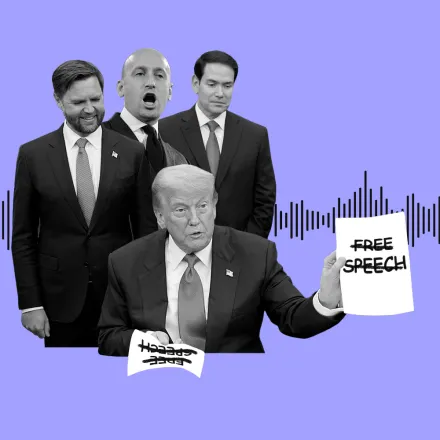
Trump’s Cult of Power Cancels Free Speech
“One of the things that was really interesting and very destructive about the post-Charlie Kirk purge was how coordinated and manufactured the outrage was,” said Allen Chaney, who serves as legal director of the ACLU of South Carolina and represents both Taylor and fired Clemson University professor Joshua Bregy, who was reinstated in January.
While the U.S. has suffered speech crackdowns before — like in the McCarthy and post-9/11 eras — the saturation of online life seems made to supercharge a backlash. “I don’t think any other era has had the tools to do the sort of purging that is available now,” said Chaney.
Taylor was waiting for her children to finish their piano lessons on September 10, 2025, when she heard the news that Kirk was shot while answering a question about a conspiracy theory he perpetuated suggesting there is an epidemic of transgender mass shooters. “Counting or not counting gang violence?” were his final words.
Soon there were murals and memorials. President Donald Trump called Kirk “our greatest evangelist for American liberty” to a packed crowd at his memorial service. And Vice President JD Vance said anyone perceived to be “celebrating” Kirk’s murder should be targeted. “When you see someone celebrating Charlie’s murder, call them out,” Vance said on his podcast. “And hell, call their employer.”
 Related
He Tweeted Charlie Kirk “Won’t Be Remembered as a Hero.” The State Dept. Revoked His Visa.
Online troll accounts and politicians alike took up the cause to begin targeting anyone even mildly critical of Kirk. Lists circulated naming people accused of “celebrating” Kirk’s death, making it easy to harass people en masse. Less sophisticated users could simply search the name “Charlie Kirk” on X and harass anyone who made a negative post. Big accounts like Libs of TikTok doxed critics and amplified hate to their millions of followers.
Jimmy Kimmel’s show was temporarily pulled off the air by ABC, after the host quipped in a monologue that MAGA was weaponizing Kirk’s death. Washington Post opinion columnist Karen Attiah was fired for pointing out Kirk’s deep anti-Blackness.
Kimmel is back on, and Attiah was recently reinstated by an arbitrator. But most of the people who were targeted, doxed, fired, and harassed were not public figures.
“My clients really were not high-income earners; we’re talking about support staff,” said Melody Fowler-Green, an attorney who represents several people fired in the wake of the Kirk killing. “A lot of the people who lost their jobs, they are people who are not in positions of power.”
“A lot of the people who lost their jobs, they are people who are not in positions of power.”
Kimberly Hunt, then a 31-year-old HR professional from Scottsdale Arizona, made a short video questioning the assertion that Kirk “didn’t deserve” his fate.
“He said a few deaths a year are worth it if it meant preserving our God-given right to bear arms. He actively fought against women’s rights. He’s openly Islamophobic, and he spreads anti-trans rhetoric,” Hunt said into the camera, accurately capturing Kirk’s rhetoric. “How many hate crimes happened because of him? Spare me the empathy because he didn’t believe in it either.” She said she had sympathy for his children but not his wife, Erika, who is now the CEO of his organization Turning Point USA.
Hunt said she never listed her job on her social media, but internet sleuths found where she worked, and the phones began to ring off the hook. When her boss asked her to meet, she knew the writing was on the wall. “He explained that I had put him in a tough position because there were so many phone calls coming into our business that it was disrupting their operations,” she recalled, “And that he had to let me go.”
The harassment didn’t stop. Hunt said at one point she received a call from her local sheriff that she was said to be on a “hit list.” Officers surveilled her home for two weeks.
None of the employers of the people who were fired or placed on leave in this story responded to The Intercept’s requests for comment.
Taylor had no way of knowing what was to come when she sat down to draft a response to the shooting the morning after, on September 11, 2025. “My initial reaction to it was just so angry that the students on campus were subject to another school shooting,” said Taylor. “I was also sad that he died because I don’t believe in violence, and I don’t think anybody should be murdered.”
In her essay, “Dying to Be Men: American Masculinity as Death Cult,” Taylor argues that the type of “violent discourse espoused by Charlie Kirk, and many and others” ultimately led to his tragic shooting in front of thousands of traumatized students.
“I’m sorry for Charlie Kirk and all the other men like him that have been raised in this America and with these ideals of masculinity,” she wrote. “I’m sorry that he decided to adopt this hateful ideology and to profit from it. And as the mother to a boy and a girl, my heart breaks for the America these children are growing up in. Here’s hoping we can save ourselves.”
She sent the piece to an editor at Ms. Magazine, the publication founded by recently deceased feminist leader Gloria Steinem, and within hours it was online. The hate began to roll in.
“One of the things that was really interesting and very destructive about the post-Charlie Kirk purge was how coordinated and manufactured the outrage was.”
Republican state Rep. Thomas Beach targeted Taylor on social media, and Republican Lt. Gov. Pamela Evette called for Taylor to lose her tenure. People began to dox her online.
Presbyterian College had to hire an outside firm to manage crisis communication and student safety. “They were telling me I needed to get personal security for my home,” said Taylor, “which you’ll be surprised to hear I couldn’t afford on a professor salary.”
Taylor said she bought security cameras, and after she received a death threat, the local police began to regularly check house. She called the principal of her children’s school to talk about what to do in case someone tried to harm her kids.
On September 18, 29-year-old Republican state Rep. Luke Rankin, who did not respond to The Intercept’s request for comment, called for the state to pull its funding from the small private Christian college. His colleagues co-signed a letter to formalize their threat.
Presbyterian College only has about 1,000 undergraduates. It would be devastated by that kind of hit, said Taylor, who walked away from a job that could support her family and offer future tuition benefits for her children. “I also support my mom. So, walking away was really hard,” she said. “But I also couldn’t have lived with myself if they had taken away money from students.”
Chilling Dissent
For Dave Handler, the message from HR came as he was getting ready to teach a class on the First Amendment to his students at Minnesota Connections Academy, an online high school where he was a teacher until Kirk was killed.
“I post basically 10 words and an article, and I lost my career.”
On Facebook, Handler had written that he was not going to mourn a “Nazi” in a since-deleted post. He shared an article listing some of the offensive things Kirk had said over the years, then deactivated his account.
By that point, it was too late. According to Handler, he was told that someone had emailed the corporation who owned his school to complain, and soon he was out of a job.
 Related
Hegseth Leads Push to Punish Military Service Members Over Charlie Kirk Comments
Handler said his girlfriend, also a teacher, has been able to help support them both, and he has been able to find some part-time work, but his firing still stings. “I post basically 10 words and an article, and I lost my career,” he said. He doesn’t have the money to hire a lawyer.
Some who did manage to get attorneys have gotten their jobs back
— like Phillip Michael Hook, a tenured art professor at the University of South Dakota who was placed on leave after calling Kirk “a hate spreading Nazi” on Facebook.
“I’m sorry for his family that he was a hate spreading Nazi and got killed. I’m sure they deserved better. Maybe good people could now enter their lives,” Hook wrote. “But geez, where was all this concern when the politicians in Minnesota were shot? And the school shootings? And Capitol Police?”
Hook was “really lucky,” said his attorney, Jim Leach, because they were able to get into court before he was officially fired.
“You contrast him to all these other people who did lose their jobs, and now are in this really long legal process,” said Leach, “maybe they have some relief, or maybe they don’t, but they’ll never have what they had, which is the ability to do their work and teach. Which for most teachers, I think it’s what they always wanted to do with their lives and what they love doing.”
Karen Leader, a tenured art history professor at Florida Atlantic University, said she first became familiar with Kirk for a relevant project of his: the “Professor Watchlist,” a list that he started in 2016 of purported left-leaning professors on college campuses. Despite the activist’s purported insistence on free-speech, the list drew harassment toward left-leaning professors for their views.
“Seeing this kind of whitewashing narrative made me mad, and I wasn’t going to have it,” said Leader. She said she began quote-tweeting people’s posts sharing racists, sexist, and transphobic things said by Kirk, with the caption “This is Charlie Kirk.”
 Related
StopAntisemitism Takes Credit for Getting Hundreds Fired. A Music Teacher Is Suing.
Leader said she probably reposted roughly 48 posts about Kirk. On the Friday after his death, former Ron DeSantis staffer Jordan Chamberlain screenshotted her posts and tagged Florida Atlantic University, asking, “do these statements represent the views of your university?” She was placed on leave by 5 p.m. Saturday. Libs of TikTok shared a post of Leader’s headshot with the caption, “Another one bites the dust!” By Sunday morning, Leader’s home address was shared, and she was inundated by death threats.
Leader has been reinstated, but she says she is a long way from being made “whole.”
“I always, for the rest of my life, will be looking over my shoulder.”
“I always, for the rest of my life, will be looking over my shoulder in case one person is still stewing over this who has my address,” Leader said. “It’s a year now Thursday, a year since this all started, and I’m not 100% back.”
“I think everyone was eager for an excuse to punish people for making them uncomfortable,” said Gretchen Felker-Martin, a horror author who lost a contract with DC Comics after her posts calling Kirk a “Nazi bitch” had gone viral. “When something like Kirk’s assassination happens, you see a really regressive crackdowns from authority figures who just don’t want to think about this shit anymore.”
Shortly after she lost her work, Felker-Martin said her personal phone number was leaked, and she began to receive phone calls from people threatening to come kill her.
 Related
The Right Wing Desperately Wants to Make Charlie Kirk Its MLK
But like most of the people who spoke to The Intercept for this story, Felker-Martin said she didn’t regret what she’d posted, despite the consequences.
“I think it’s unconscionable to throw your artists to the Nazis to appease these people,” Felker-Martin said.
Leader agreed. “I used my privilege, which is a lot of privilege to be forthcoming and honest about what was really going on,” she said. “He did enormous harm, and his organization continues to do enormous harm.”
“He did enormous harm, and his organization continues to do enormous harm.”
In March, Taylor filed a lawsuit with the ACLU of South Carolina against the four state lawmakers who threatened to deny funding to her college. The lawsuit asks the court to declare the lawmakers’ actions as unconstitutional, force them to rescind the letter and threats, and provide compensation for back pay, lost benefits, and compensatory and punitive damages. In response, Rankin and the other lawmakers denied having an impact “on her quote employment status,” arguing that she chose to resign.
Lawsuits like these have already resulted in big payouts — at least $2 million in disclosed settlements for employees fired or penalized in the wake of Kirk’s death so far. And in June, Rankin, Taylor’s lead antagonist, lost his primary reelection by roughly 20 percentage points.
“That’s the only thing our justice system can offer, right?” said Fowler-Green, whose client is still fighting for restitution — which, if it arrives, will come from public dollars. “Paying money can influence people’s behavior. One concern I have, though, is that the people who are making the decision are not paying the money. It’s not their money; it’s my money.”
“I don’t think dying absolved him of the stochastic terrorism that he inflicted on people.”
Hunt, who said she hasn’t been able to find a full-time job since September “would have done it again,” she told The Intercept.
“I don’t think dying absolved him of the stochastic terrorism that he inflicted on people,” Hunt said. And in her view, the backlash was clarifying, too. “I think it painted a bigger picture of the right and the mob mentality.”
-=-=
RWW 8 26
- Glenn Thrush and Michael C. Bender @ The New York Times: From Top Civil Rights Post, She Spars With the Left, and Her Colleagues
Harmeet Dhillon, who leads the Justice Department’s civil rights unit, has extracted flashy agreements and personnel moves from big universities and sought to force states to turn over confidential voter data.
-=-=
-=-=
AN PHOENIX FLA 7 26
“‘It was a bright cold day in April, and the clocks were striking thirteen.’”
That’s how federal judge Mark Walker began his 2022 injunction blocking enforcement of Ron DeSantis’ “Stop Woke Act” in Florida institutions of higher education.
In case you don’t recognize the quotation, it’s from George Orwell’s “1984:” You know, the novel where the Ministry of Truth rewrites history and forbids free enquiry.
Certain words are banned; wrong thinking is punished. Even hearing about disfavored ideas is considered an attack on decency and order.
As defendant in the case, the State of Florida argued (apparently with a straight face) university professors have the right to free speech, sure, but only if the state approves of that speech.
The law forbade teaching anything that explores racial or gender injustice.
You weren’t allowed to say, given how we still struggle to overcome discrimination against minorities, women, and the disabled, that maybe diversity, equity and inclusion programs helped a lot of people; you must embrace color-blindness in all things (because we all know race doesn’t matter in America!); yet, woe betide you if you ever made a white person feel “guilt, anguish, or other forms of psychological distress because of actions, in which the person played no part, committed in the past by other members of the same race, color, national origin, or sex.”
Like many of us teaching in the state university system, the judge was unimpressed.
DeSantis and the legal team from his Ministry of Truth appealed up the food chain to the 11th Circuit, and what do you know?
‘Breathtaking assertion of power’
The majority opinion, by a Trump appointee, is unsparing.
Judge Britt C. Grant wrote, “If the First Amendment offers any boundary of protection at all for public university classrooms, this statute crosses it.”
She called the Stop Woke law “a breathtaking assertion of power to ban unpopular ideas from public discourse.”
Naturally, the governor pitched a little hissy fit, taking to social media to say, “State universities are funded by taxpayers and directed by elected officials and their appointees. The state has both a right and a responsibility to ensure instruction at these universities is consistent with the underlying mission and to exclude indoctrination and ideological agendas.”
He called the decision “judicial overreach.”
Let’s talk about gubernatorial overreach. Or, to put it another way, what is this guy’s problem with education?
Is he really that frightened of ideas?
If he and his education appointees are so convinced their positions — slavery had an upside, gender is 100% biological, capitalism is divinely ordained, a woman’s highest destiny is to be a mother, vaccines are unnecessary, climate change isn’t real — are valid, surely they’d welcome testing them with historical records, expert reports, and empirical evidence.
Facts, even.
Reading books by and about, say, gay people, teaching the history of Stonewall, or examining central Supreme Court decisions such as Obergefell v. Hodges, do not mean straight people will somehow become gay, any more than studying Shakespeare’s “Julius Caesar” will necessarily inspire you to assassinate any official you think has gotten too big for his britches.
Gender studies will not destroy heterosexuality; it’s simply a way to talk about the ways people understand who they are, how they present themselves, how other people see them.
Snowflakes
Universities are supposed to be where you encounter people who aren’t like you, unfamiliar, maybe upsetting, points of view, tricky topics, and ideas your parents don’t approve of.
Intellectual freedom means we should be able to discuss almost anything.
Yet the DeSantis administration act like snowflakes, hypersensitive, unwilling to contemplate anything outside their very white, very Christian, pathetically nationalist, bubble.
DeSantis is especially nervous America’s racial history, trying to outlaw “The 1619 Project,” a brilliant collection of writings about how the arrival of the first slaves on the Virginia shore has informed and shaped our country, shutting down or crippling African American Studies programs.
I guess white people are so used to considering themselves the “real” Americans who had all the good ideas, invented all the good stuff, and “built this country,” the reality that Africa is as central to our identity as Europe is scary.
The governor and his crew seem especially freaked out by the possibility students might encounter Critical Race Theory. Listening to them, you’d think CRT is to blame for everything from high gas prices to the common cold.
CRT is pretty simple: Race is socially constructed (not biological) and racism is not merely a product of individual bias (though that’s part of it) but embedded in our legal, educational, medical, and financial systems.
Say a white person and a Black person commit the same crime. It would make sense if they got the same sentence, right?
But in most cases the Black person will get a longer sentence.
‘The perfect villain’
The Kaiser Family Foundation, a nonpartisan health policy think tank, has repeatedly shown structural racism (conscious or not) in the medical profession means doctors and nurses misdiagnose Black, Latino, and members of other ethnic communities far more often than they do whites, and, unlike with white patients, tend to dismiss their pain.
Infant mortality among people of color is at least twice as high than it is for whites.
There’s nothing sinister or anti-American in acknowledging, as Justice Thurgood Marshall said, the original Constitution was “defective from the start,” given that it upheld slaveholders’ rights in their human property and protected the slave trade.
Slavery was at the heart of our republic since its beginning.
It still reverberates in our culture.
There’s nothing anti-white in pointing this out. The Founders installed in the Constitution ways to amend it, fix social problems, even change American society.
The country is an ongoing project: We’re still striving for that “more perfect union,” and acknowledging the blindingly obvious ways in which our deals don’t match up with our reality is not a heinous assault on patriotism.
CRT was developed by legal scholars, and has long been part of law school curricula. Nobody much noticed it until 2021, when a right-wing activist called Christopher Rufo kicked off a national moral panic.
You might remember Rufo from the 2024 presidential campaign, amplifying J.D. Vance’s lies about Haitians in Ohio eating cats and dogs.
Before that, Rufo had made a name for himself as a warrior against anything he saw as “woke,” especially in higher education.
DeSantis appointed Rufo to New College’s Board of Trustees (he’s since left) to help destroy what once was an admired, creative, and tolerant liberal arts school, labeling any teaching he didn’t like “Critical Race Theory.”
CRT, he said, is “the perfect villain.”
Army of lefties
Having tried to banish CRT along with sociology, the unpleasant parts of American history, the novels of Toni Morrison, and any science that might reveal things are more complicated than they’d like, DeSantis, the various mediocrities running Florida’s Department of Education, and fellow travelers such as Moms for Liberty, have convinced themselves universities are hotbeds of “Marxist indoctrination.”
Apparently, professors — especially in the Humanities and Social Sciences — are not merely “woke,” we’re a bunch of commies, determined to brainwash the Youth of Florida into hollering “Workers of the World Unite!” — assured they have nothing to lose but their chains.
Or something like that.
Alas, all my colleagues and I must be really lousy at indoctrination. I don’t know anybody who’s been successful in producing even one committed Marxist.
But DeSantis et al. are convinced higher education is a plot to produce an army of lefties.
Not that they can produce much evidence of this.
They’re more ideologically rigid than the most committed Trotskyite, and less logical than the American officer who, standing in the ruins of a Vietnamese provincial capital in 1968, told reporter Peter Arnett, “It became necessary to destroy the town to save it.”
Maybe the administration’s idea is to destroy higher ed in order to save it.
Hypotheticals
No doubt DeSantis took some comfort from the dissent in the 11th Circuit’s ruling.
Judge Barbara Lagoa, a former member of the Florida Supreme Court, (indeed, a DeSantis appointee and often mentioned as a potential U.S. Supreme Court justice), argues, what if “a professor who says that Hamas’s October 7th attack on Israel was ‘exhilarating’ and something to be celebrated and encouraged?”
She goes on to say, “Florida acts well within its authority to curb professorial endorsements of that kind within its own classrooms.”
First of all, if someone were stupid enough to say such a thing, that professor could be disciplined for creating a hostile educational environment.
But taking a hypothetical case of poor judgment and concluding somehow professorial speech must always be equivalent to the views of the state violates the First Amendment.
The First Amendment protects offensive speech — even hate speech.
In George Orwell’s essay “Freedom of the Press,” he writes, “If liberty means anything at all it means the right to tell people what they do not want to hear.”
Or to quote again from the majority opinion, the university’s mission is to get students to “puzzle through ideas that are good and bad, easy and hard, ideally getting ever closer to the truth.”
Professors call this “teaching.”
---
148 pp may 2024
toc
Part 1: The Context 13 Chapter 1: From Black Lives Matter to Executive Orders 14 Executive Order 13958 16 Executive Order 13950 19 Chapter 2: Culture War, Think Tanks, and the Dark Money that Funds Them 25 National Think Tanks 26 Center for Renewing America and the Conservative Partnership Institute Manhattan Institute for Policy Research American Legislative Exchange Council (ALEC) Heritage Foundation State-Level Think Tanks 38 James G. Martin Center for Academic Renewal Texas Public Policy Foundation (TPPF) Idaho Freedom Foundation (IFF) Cultural Conservative Think Tanks 43 Claremont Institute (CI) Ethics and Public Policy Center (EPPC) Higher Education Governance Think Tanks 47 American Council on Trustees and Alumni (ACTA) National Association of Scholars (NAS) and the Civics Alliance The State Policy Network (SPN) 51 Part 2: The Legislation 63 Overview 64 Chapter 3: Academic Gag Orders 68 2021 Gag Orders: The Roll Out 70 2022 Gag Orders: The Intensification 73 2023 Gag Orders: Doubling Down 80...
Manufacturing_Backlash_final_0
Manufacturing Backlash Right-Wing Think Tanks and Legislative Attacks on Higher Education, 2021–2023 Isaac Kamola, Director, Center for the Defense of Academic Freedom American Association of University Professors ikamola@aaup.org
:{Introduction
Today higher education is under attack. Since 2021 we have witnessed what one scholar correctly called an “unusually brazen series of challenges to academic freedom,” unleashed by conservative activists and a “national-level political machine” closely aligned with the Republican Party (Brint 2023). Since 2021 more than one hundred and fifty bills have been introduced in state legislatures seeking to actively undermine academic freedom and university governance. This includes nearly one hundred academic gag orders seeking to ban the teaching of “critical race theory” (CRT) or other so-called “divisive concepts.” Florida Governor Ron DeSantis has appointed partisan activists to the Board of Trustees of New College in Florida, }:
who fired the college president, replaced her with a political ally, denied tenure to five professors deemed outside the institutional mission, and began shuttering academic programs, starting with gender studies (Bartlett 2023; Pettit 2023). Tennessee, North Dakota, Texas, Florida, and North Carolina have passed laws dismantling institutional efforts to increase diversity, equity, and inclusion (DEI) on college campuses. Republican lawmakers in Florida and Texas have sought to weaken tenure protections for faculty, making them more vulnerable to external pressure. Florida and North Carolina have undermined the accreditation process after accreditors raised concerns over the possibility of undue political interference in the states’ university systems.
Bills have passed in Florida and Ohio, and action taken by governing boards in North Carolina and elsewhere, to establish academic programs, centers, and whole schools designed to teach conservative content. Taken together, these bills constitute an evolving, interlocking, and intensifying effort by Republican politicians and well-funded think tanks to undermine academic freedom and university autonomy. This legislation is often understood as an effect of America’s highly polarized politics (see for example: Anderson 2023; Busteed 2023; Mintz 2021).
Since the election of Donald Trump, the argument goes, American politics have become overly partisan, with polarization affecting university campuses and college classrooms. As this white paper demonstrates, however, this legislation is largely the outgrowth of efforts by right-wing and libertarian think tanks, working closely with Republican politicians, to manufacture a culture-war backlash ...
NAS organizes the Civics Alliance, a project premised on the claim that civics education in K-12 and higher education has become a “recruitment tool of the progressive left,” as exemplified in the adoption of the 1619 Project (Civics Alliance n.d. b.). The Civics Alliance brings together educators and policymakers to promote a civics education that presents America as embodying “an exceptional heritage of freedom” (Civics Alliance n.d. a.). In reality, Civics Alliance is populated by members of conservative and libertarian think tanks.
Coalition members include Christopher Rufo (MI), Keith Whitaker (NAS), Ryan Williams (Claremont), Peter Wood (NAS), Jenna Robinson (Martin Center), Stanley Kurtz (EPPC), Scott Yenor (Claremont), George Leef, (Martin Center), and dozens of other individuals affiliated with rightwing publications, think tanks, foundations, or conservative activist organizations.22
The Civics Alliance monitors state-level legislation pertaining to K-12 civics curriculum. In addition to the GEA (described above), the Civics Alliance has written seventeen model bills focused on K-12 and higher education, including legislation giving states greater “accreditation autonomy,” requiring “syllabus transparency,” and mandating “intellectual diversity” (Civics Alliance n.d.).23
Between 2020 and 2022, NAS has received $2.7 million from eleven of the top twentyfive donors listed in Appendix 2, including the Sarah Scaife Foundation ($7.2 million) and the Bradley Foundation ($2.9 million) (DeSmog NAS). In addition to sharing funders, sitting on shared boards, and circulating each other’s content, many of the think tanks explored in this chapter are also institutionally connected through the SPN.
The State Policy Network (SPN)
Seven of the organizations discussed in this report are members of SPN (see Table 2.2). SPN creates strategic coordination between national think tanks—such as the Heritage Foundation and ALEC—and state-level think tanks, such as TPPF and IFF.
Started by ALEC in 1992, SPN originally included only a small handful of think tanks but rapidly expanded during the mid2000s. By 2022, SPN claimed sixty-three state-level think tanks partners (at least one in each state), more than ninety “national partners,” and more than sixty-six “state partners in key capacities like litigation, advocacy, and investigative journalism” (SPN 2023, 5).
The SPN specializes in connecting think tanks with donors and helping state-level think tanks implement local legislative strategies developed at the federal level. At the 2013 annual meeting in Oklahoma City, SPN president Tracie Sharp described SPN as an IKEA catalog of policy proposals and lobbying support. As summarized by Jane Mayer, Sharp told the audience that “instead of pictures of furniture arranged in rooms,” the SPN offers “state policy projects that align with the group’s agenda,” including opposition to “President Obama’s health-care program and climate-change regulations,” the reduction of “union protections and minimum wages,” cuts to “taxes and business regulations,” additional “voting restrictions,” and privatizing education” (Mayer 2013).
While national think tanks work to shape the national conversation, state-level think tanks take up such issues with local media, legislators, and publics. In so doing they produce state-specific content for state-specific audiences in coordination with national think tanks and activist donors. The composition of SPN’s board reflects their primary role of bringing donors together with state and national think tanks. The board includes representatives from conservative megadonors, including DonorsTrust and Donors Capital Fund, the Commonwealth
Foundation, the JM Foundation, the John William Pope Foundation, the Adolph Coors Foundation, Philanthropy Roundtable, the Roe Foundation, and Charles Koch’s Stand Together Foundation. The remaining board positions consist of representatives from think tanks, including the American Institute for Full Employment, the Bill of Rights Institute, and the Heritage Foundation (State Policy Network 2023, 30). The SPN also provides financial support
...
---
omg
The Ploys of the Climate Deniers – Janata Weekly
...Scholarly Freedom at Risk
In February 2013, the prestigious psychology journal Frontiers in Psychology published a research paper by scientist Stephan Lewandowsky and his colleagues. The paper was titled “Recursive Fury: Conspiracist Ideation in the Blogosphere in Response to Research on Conspiracist Ideation.” It argued that people who reject climate science are more likely to believe in conspiracy theories. The authors had reached this conclusion through a detailed survey and analysis of statements made on climate-skeptic blogs.
After Recursive Fury was published, Frontiers received threats of multiple lawsuits. The journal removed the paper from its website (although it remained available on the University of Western Australia’s website). The paper was then re-examined and found to be scientifically and ethically sound, with no errors. Nonetheless, out of fear of legal complications, Frontiers permanently withdrew it from their website on March 31, 2014. This incident became a striking example of how scientific research can be undermined by the threat of lawsuits.
In its statement, Frontierssaid: after receiving several complaints, the journal conducted a thorough review of the academic, ethical, and legal aspects of the paper and found no faults in any of those areas. Even so, they claimed the legal situation was not sufficiently clear and chose to retract the published article. The researchers involved expressed regret over the legal obstacles to exercising scholarly freedom.
The decision by Frontiers regarding Recursive Fury sparked intense criticism in the scientific community. Many scientists who had submitted papers to the journal sent strongly worded emails, demanding assurances that their work would not be withdrawn under similar circumstances. Some questioned Frontiers’ commitment and judgment in upholding scholarly freedom. The controversy caused significant upheaval in academic circles.
Greenpeace’s Sting Operation...
---
AN 3 26
When President Donald Trump and his allies targeted pro-Palestinian activists for deportation, civil libertarians were quick to sound the alarm. Trump, they stressed, had every right to criticize their views, but targeting them for deportation because of those views was anti-First Amendment.
Now, a federal judge appointed by President Ronald Reagan, Judge William G. Young, is taking the Trump administration to task.
In a ruling handed down on Wednesday, March 11, Young ruled that targeting pro-Palestinian activists for deportation because of their views "was unconstitutional, abhorrent to a society that cherishes free speech."
Young wrote, "As this Court recognizes, the entire theory of this administration is that of a unitary executive with no agency independence where every single employee within the Article II executive dances to the tune of the President…. This conduct must never happen again."
President Reagan first nominated Young, now 85, for the United States District Court for the District of Massachusetts in September 1984 during his reelection campaign. Reagan enjoyed a landslide victory that year, winning 525 electoral votes and defeating Democratic nominee Walter Mondale by 18 percent in the national popular vote. And Young was confirmed by the U.S. Senate in April 1985 a few months into Reagan's second term.
---
---
WAPO SAME DAY NO LNX
The oil industry takes its critics to court
The oil and gas industry is ramping up its attacks on climate Superfund laws.
March 27, 2025
Jodi Kelly and her husband, Dan Kelly, use a canoe to remove surgical supplies from a flooded area in Montpelier, Vermont, on July 11, 2023. (Steven Senne/AP)
By Maxine Joselow and Anna Phillips
At the White House last week, the nation’s top oil executives asked President Donald Trump for help fighting state laws that seek billions of dollars from fossil fuel companies.
In Michigan, a group with ties to the fossil fuel industry is suing to obtain the emails of a professor who supports these laws.
And in North Dakota, the oil company that operates the Dakota Access pipeline last week won a $667 million defamation judgment in its lawsuit against an environmental group.
Across the country, fossil fuel firms are ramping up a decades-long fight against policymakers, academics and activists who have sought to make them pay for their role in causing climate change. They are taking particular aim at “climate Superfund laws,” which seek billions of dollars from oil companies to help cover the costs of coping with stronger storms, rising seas and other weather disasters fueled by rising global temperatures.
“I’m seeing a tectonic shift in the way the fossil fuel industry is now going on the offense,” said Pat Parenteau, an emeritus professor and senior fellow for climate policy at Vermont Law School.
Follow Trump’s second term
New York and Vermont have each enacted climate Superfund laws modeled after the 1980 federal Superfund law, which requires polluting companies to pay for cleaning up hazardous waste sites. At least seven other Democratic-led states are considering similar bills, according to the Federalist Society, a conservative legal group.
Vermont became the first state to pass a climate Superfund law in June — nearly a year after catastrophic flooding caused millions of dollars in damage to roads, bridges, homes and businesses. Scientists have said global warming increased the likelihood of the extreme rainfall that triggered the flooding, since a warmer atmosphere holds more moisture.
Vermont’s measure, which Republican Gov. Phil Scott allowed to become law without his signature, charges fossil fuel firms for the greenhouse gas emissions they produced between 1995 and 2024. It doesn’t specify how much money should be paid. Instead, it tasks the state treasurer with calculating the costs of responding to past climate damage and preparing for future climate disasters. The final tally is expected to be comprehensive, factoring in possible expenses such as lower worker productivity amid extreme heat.
In contrast, the climate Superfund law signed by New York Gov. Kathy Hochul (D) in December would fine the largest greenhouse gas emitters $3 billion annually for the next 25 years. The charges would be based on the companies’ contributions to overall emissions between 2000 and 2018.
Seeking Trump’s support
As Trump sat with the nation’s top oil and gas executives at the White House last week, he asked what was on their minds.
In response, the executives asked for help battling climate Superfund laws, according to two oil industry representatives who spoke on the condition of anonymity to describe a private conversation. The Wall Street Journal first reported this request.
Executives also complained about dozens of climate lawsuits brought by state and local governments against oil companies, the two industry representatives said. The lawsuits accuse the companies of deceiving the public for decades about the harms they knew their petroleum products would cause — an allegation the industry rejects.
Interior Secretary Doug Burgum, left, and Energy Secretary Chris Wright deliver remarks outside the White House after meeting with oil executives on March 19. (Kevin Dietsch/Getty Images)
After listening to the executives’ concerns, Trump told a White House staffer to look for ways the administration could help, the two industry representatives said. The president did not commit to taking any specific actions, they said.
Some industry executives want the Justice Department to sue New York and Vermont over their climate Superfund laws. The American Petroleum Institute (API), the U.S. oil and gas industry’s top lobbying arm, has already sued over Vermont’s law, alleging that it encroaches on the federal government’s power to regulate greenhouse gas emissions.
The U.S. Chamber of Commerce, the nation’s biggest business lobby, joined the lawsuit filed in December. The two groups argued that Vermont lacked the authority to impose penalties on greenhouse gas emissions beyond its borders — an authority, they said, that the Clean Air Act reserves for the federal government.
“This partisan legislation illegally and retroactively penalizes U.S. oil and natural gas producers for delivering the energy consumers need, and that should be a concern for our leaders in Washington,” Justin Prendergast, an API spokesman, said in an email. “We are exploring all options to correct this overreach by certain states.”
Representatives for several executives who attended last week’s meeting — including the CEOs of Chevron, ConocoPhillips, ExxonMobil and Phillips 66 — declined to comment or did not return requests for comment. A White House official said the meeting focused on boosting oil production on federal lands in red states.
:Republican-led states are also coming to the industry’s defense. A coalition of 22 red states, led by West Virginia, sued New York over its climate Superfund law in February, arguing that it would put coal and oil producers out of business.
Critics of climate Superfund laws also argue that they unfairly punish oil companies instead of consumers who use fossil fuels, whether to drive their cars or heat their homes.
“It’s actually not the companies’ production of fossil fuels that created the emissions — it’s the use of the fuels,” said Jeff Holmstead, a partner at the law and lobbying firm Bracewell LLP, which represents energy industry clients. “You can’t have one without the other.”
Proponents of these laws counter that they would raise funds desperately needed for withstanding the worsening effects of warming. They argue this money is already coming out of the pockets of taxpayers, who might not be able to afford it — and who have produced far fewer emissions than fossil fuel firms.
“The idea that the companies who bear responsibility are now scheming with the president in order to avoid being held accountable is sickening,” said Paul Burns, executive director of the Vermont Public Interest Research Group, an advocacy group that supported Vermont’s law. “For those whose homes were washed away, whose farms were destroyed, it’s the worst kind of insult to injury.”
Targeting an academic
The industry’s allies have targeted climate Superfund laws, as well as an academic who has advocated for them.
In May, the nonprofit Government Accountability and Oversight sued the University of Michigan in an effort to obtain emails between Rachel Rothschild, an assistant law professor, and a collection of environmental advocacy groups in 2023. The group accused the university, which is subject to state public records requests, of refusing to search for the emails before ultimately denying its request.
While Government Accountability and Oversight does not disclose its funding sources, bankruptcy filings show that it received $300,000 from Murray Energy, a coal company now operating under the name American Consolidated Natural Resources. When the group was incorporated in D.C. in 2018, business filings also listed its CEO as Chris Horner, a lawyer who previously worked for the coal company Alpha Natural Resources.
The group later followed up with a second public records request, this time for correspondence related to a “Climate Superfund Act Memorandum” that Rothschild had written. Zach Larsen, a lawyer for Government Accountability and Oversight, said the group should be able to view such correspondence because Rothschild is a public employee.
“This suit seeks to enforce the Legislature’s promise of transparency by sorting out whether Professor Rothschild’s work on Climate Superfund Acts, about which she regularly speaks, advocates, and publishes scholarship all using her University title … is related to her official duties as a public employee such that the public has a right to know about it,” Larsen said in an email.
Rothschild has testified in support of climate Superfund legislation in several states, including Vermont. In her work, she has examined potential flaws in the oil industry’s legal arguments against these measures. She has raised doubts about the industry’s claim that, under the Constitution, federal law preempts states from passing statutes that seek to hold fossil fuel companies accountable for damage linked to climate change.
“Part of the reason that I think these companies are going to President Trump with their concerns is because the preemption argument right now is fairly weak,” Rothschild said in an interview.
Rothschild declined to comment on the lawsuit, which is pending in state court. Horner and a lawyer for the University of Michigan did not respond to requests for comment.
Ann Carlson, an environmental law professor at the UCLA School of Law, said the same group had previously targeted her, her colleagues and law school donors with more than a dozen public records requests seeking emails related to climate lawsuits against fossil fuel companies. After the university released the records, Carlson said a conservative dark-money group used them to attack her nomination to lead the National Highway Traffic Safety Administration. In the end, with her Senate confirmation in doubt, President Joe Biden named her acting administrator of the agency.
Carlson said the campaign against her had a chilling effect.
“It absolutely gives people pause about what they’re willing to work on,” she said. “It may chill outside groups, like nonprofits, and their willingness to work with academics at public institutions.”
---
NYT
NO LNX
She Inspired Laws to Hold the Fossil Fuel Industry Accountable. Now She’s a Target.
A conservative group is suing for emails of a law professor who helped create legislation to force oil, gas and coal companies to pay for climate damage.
By Coral Davenport
March 27, 2025
Fresh out of law school in 2022, Rachel Rothschild wrote a memo laying out the legal justification for a new strategy to fight climate change: States could force oil and gas companies to pay for the damage caused by extreme floods and wildfires that are made worse by the use of their products.
Ms. Rothschild’s work was foundational. It provided the basis for the nation’s first “climate superfund” laws, which were passed in New York and Vermont last year and could be adopted by as many as six more states as soon as this year. If implemented, they could cost oil companies billions of dollars.
Her work made Ms. Rothschild a target. She is one of a number of lawyers, law professors and judges who have been the focus of a campaign to discredit them led by a conservative group with ties to the fossil fuel industry and the Trump administration.
Shortly after the passage of the Vermont law last June, the group sued the University of Michigan, where Ms. Rothschild now teaches, after the university refused its request for Ms. Rothschild’s emails related to “climate superfunds.” As a public institution, the university is subject to the state’s public records law. The group, called Government Accountability and Oversight, has also sought to have Ms. Rothschild undergo a deposition.
The university, which has filed a motion to dismiss the lawsuit, maintains Ms. Rothschild’s communications are not subject to public records requests because they were written on her private email account. Still, the university told Ms. Rothschild that she must comply with the request for a deposition.
Experts said the actions against Ms. Rothschild seemed designed to discourage her or others from similar work.
“Legal actions and public records requests may be used in a manner that can intimidate or silence scholars, and when that happens, it threatens not only the targeted individuals but also the progress of knowledge and informed debate,” Kyle Logue, the interim dean of the University of Michigan Law School, said in a statement.
The actions regarding Ms. Rothschild appear to be part of a campaign by the fossil fuel industry to quash new legal tools for holding companies accountable for climate pollution. As President Trump moves to end federal efforts to fight climate change, the new state-level “polluter-pays” laws and lawsuits are seen as the next frontier in the battle over global warming.
Image
Protesters unfurl a banner sign outside an office building that shows the Statue of Liberty partially submerged in rising waters. The sign says, "Gov. Hochul: Sign or Sink! Make Polluters Pay!"
Climate activists held a rally outside New York Gov. Kathy Hochul’s office in Manhattan to deliver thousands of petitions asking her to sign the Climate Change Superfund Act last year.Credit...Erik McGregor/Sipa USA, via Reuters Connect
Executives from nearly two dozen oil and gas companies raised their concerns about the climate superfund laws at a meeting last week with President Trump at the White House. They want the Justice Department to file briefs in support of their litigation against the state laws, said two people familiar with the matter who spoke on the condition of anonymity because they were not authorized to publicly discuss the private meeting.
The campaign is being waged by a group that has largely been funded by the foundation created by Joseph Craft III, chief executive of the nation’s third largest coal company and an ally of and campaign donor to President Trump.
Ms. Rothschild’s initial memo — now making its way through statehouses — laid out the case for states to use the model of the 1980 Superfund law, which requires polluters to pay to clean abandoned toxic waste sites, and apply it to the climate damage caused by emissions from the burning of oil, gas and coal. Lawmakers in California, Maryland, Massachusetts, New Jersey, Oregon, Rhode Island and Connecticut are now considering climate superfund legislation.
In addition, more than 30 lawsuits have been filed by states and municipalities aimed at forcing oil and gas companies to pay for repairs or adaptations linked to damage from climate change. Many of those cases, some of which could end up before the Supreme Court, argue that the companies knew for years about the dangers of climate change linked to their products but concealed that information.
The approach is similar to those of past lawsuits that led to landmark settlements with the tobacco industry and opioid manufacturers.
The fossil fuel industry counters that climate change is a global problem and that individual state laws are an unconstitutional attempt to assert control over the nation’s energy system.
“These extraordinary, unprecedented laws impose massive retroactive penalties going back decades for lawful, out-of-state conduct that was regulated by Congress,” said Daryl Joseffer, executive vice president and chief counsel for the litigation arm of the United States Chamber of Commerce, which has sued both New York and Vermont to overturn the climate superfund laws.
Twenty-two other states, led by their Republican attorneys general, are challenging the New York law in federal court.
Ryan Meyers, senior vice president and general counsel at the American Petroleum Institute, an industry group that is also fighting to overturn the climate superfund laws in New York and Vermont, said they were part of “a coordinated campaign against an industry that is vital to everyday life and serves as the engine of America’s economy.”
A key player in the campaign to stop the effort to hold fossil fuel companies financially accountable for damages is Christopher Horner, a lawyer and conservative activist who served on the transition team for the Environmental Protection Agency during Mr. Trump’s first term.
For years, Mr. Horner has used public records laws to unearth emails of climate scientists and disseminate them in ways that aim to undermine their work.
“Chris Horner is the nation’s most prolific user of FOIA and its state equivalents to go after anyone fighting climate change who works for a public entity,” said Michael Gerrard, an expert in climate law at Columbia University.
In 2011, the board of the American Association for the Advancement of Science complained that Mr. Horner was making “unreasonable, excessive Freedom of Information Act requests for personal information and voluminous data that are then used to harass and intimidate scientists.”
When President Barack Obama tried to pass a climate law, allies of Mr. Horner worked to spread the emails of climate scientists, gathered by Mr. Horner, to Republicans in Congress.
In a 2017 interview with The New York Times, Mr. Horner said that had helped kill the bill.
Now, Mr. Horner and his allies are focused on the architects behind the “polluter pays” laws.
Mr. Horner did not respond to several requests for comment.
From 2018 to 2021, Mr. Horner served as a board member for Government Accountability and Oversight, the group that filed suit against Ms. Rothschild. As recently as January, Mr. Horner wrote an article for The Washington Reporter, a conservative media website, in which he said he represented the Government Accountability and Oversight group in federal and state open records matters.
According to public records, a major donor to the group is a nonprofit foundation formed by Mr. Craft, the chief executive of Alliance Resource Partners, the country’s third largest coal company. The Joseph Craft III Foundation contributed $300,000 a year to the Government Accountability and Oversight group from 2020 to 2023, for a total of $1.2 million, according to its public tax filings. That appears to make it a major funder of the group’s activities: During those years, G.A.O.’s total annual revenue averaged $576,172.
Mr. Craft and his wife, Kelly, who served as ambassador to the United Nations in the first Trump administration, have given nearly $3 million to Mr. Trump’s presidential campaigns, the Republican Party and a Republican super PAC.
Image
Joseph Craft III, dressed in a dark sports jacket, white shirt, dark pants and sunglasses, walks on a brick sidewalk next to Kelly Craft, who is wearing a white blouse, a black and white polka-dot skirt and pointy shoes.
Joseph Craft III with his wife, Kelly, in Washington in 2018.Credit...Brendan Smialowski/Agence France-Presse — Getty Images
The Craft foundation and Alliance Resource Partners did not respond to requests for comment.
Matthew Hardin, who serves on the board of Government Accountability and Oversight, wrote in a statement, “Like all nonprofits, G.A.O. relies on contributions from donors to fulfill its independent, charitable mission of seeking transparency in public institutions and educating the public.”
The group’s interest in Ms. Rothschild appears focused on her communications with Lee Wasserman, the director of the Rockefeller Family Fund, a philanthropy that has supported efforts to sue oil companies over what it calls climate deception.
It was Mr. Wasserman who first wondered if lawmakers could combine the old Superfund law with new penalties for climate polluters.
Mr. Wasserman brought the idea to the Institute for Policy Integrity, a nonprofit research organization that is housed in New York University’s law school, where Ms. Rothschild was then working as a fellow. She researched whether the idea could stand up legally. The Rockefeller Family Fund donated $50,000 to the Institute for Policy Integrity to fund her research, which led New York and Vermont lawmakers to propose legislation.
When it comes to climate and environmental matters, states often rely on academics for legal advice because many private law firms represent fossil fuel companies, which can create a conflict of interest.
After writing her memo, Ms. Rothschild joined the faculty at the University of Michigan, where she continued to work on climate superfund legislation in her free time, briefing lawmakers and testifying before legislative committees.
“I’m proud of the fact that I do a lot of pro bono work in areas where I have particular expertise, and I was glad I could help states like Vermont and New York draft these laws,” she said in a statement.
Ms. Rothschild’s pro bono work was “critical” to passage of the law in New York, said Justin Flagg, director of environmental policy for Liz Krueger, a Democratic New York state senator who sponsored the legislation. “This was something that had not yet been tested in court,” he added. “So we really hung our hat on her analysis.”
Environmental law professors at other public universities have been targets of similar campaigns. During the Biden administration, Mr. Horner used the state public records law to obtain the emails of Ann Carlson, who teaches at the University of California, Los Angeles.
Ms. Carlson, who had consulted on climate damage lawsuits, was nominated by President Joseph R. Biden Jr. to run a federal agency that writes rules aimed at reducing climate-warming tailpipe pollution — a position requiring Senate confirmation.
Government Accountability and Oversight gave Ms. Carlson’s emails to Fox News, which published stories about her on its website including one titled, “Biden nominee coordinated dark money climate nuisance lawsuits involving Leonardo DiCaprio.”
Image
Ann Carlson, who has shoulder-length wavy brown hair and large glasses, looks into the distance.
Professor Ann Carlson at the University of California, Los Angeles.Credit...Joyce Kim for The New York Times
Senator Ted Cruz, Republican of Texas, used the emails to fight Ms. Carlson’s confirmation, at one point calling her an “ethically challenged, environmental zealot.” He introduced an amendment on the Senate floor to strip the salary from her position.
While the amendment failed, she ultimately withdrew her nomination, although she did end up serving in the role in an acting capacity.
“It was ruthless, relentless and baseless,” Ms. Carlson said of the experience of having her emails used against her. “This is a tactic designed to dissuade people from working on important climate policies.”
The campaign has extended to at least one judge. In 2023, Mark Recktenwald, the chief justice of the Hawaii Supreme Court, wrote a unanimous decision that the local government in Honolulu could move forward with a climate liability lawsuit against major oil companies.
Justice Recktenwald gave a remote presentation to the Environmental Law Institute, a Washington, D.C.-based nonprofit group that runs seminars on environmental litigation.
Conservative media outlets including as The Daily Caller and Fox News ran stories noting that a member of the institute’s board had worked at a law firm that defended the climate law in the Honolulu case. The stories did not mention that oil executives also serve on the institute’s board. Justice Recktenwald had also asked both parties in the Honolulu lawsuit for any concerns about his plans to speak at the seminar, and neither side had objected.
But in virtually every story, a group called Energy Policy Advocates, which has named Mr. Horner as its lawyer, charged that Justice Recktenwald’s participation showed improper bias.
Justice Recktenwald declined to comment. The effort to devalue the legal scholars involved in the climate cases reflects the potential impact of the new laws and litigation, experts said.
“These new state laws and this avalanche of lawsuits are threatening the survival of these fossil fuel companies,” said Patrick Parenteau, an emeritus professor at the Vermont Law and Graduate School.
Karen Zraick contributed reporting.
Coral Davenport covers energy and environment policy, with a focus on climate change, for The Times.
A version of this article appears in print on March 29, 2025, Section A, Page 11 of the New York edition with the headline: Her Work Inspired Climate Superfund Laws. Now She’s a Target..
---
hasset2 26
thug shd be disciplined
acad econ suppress?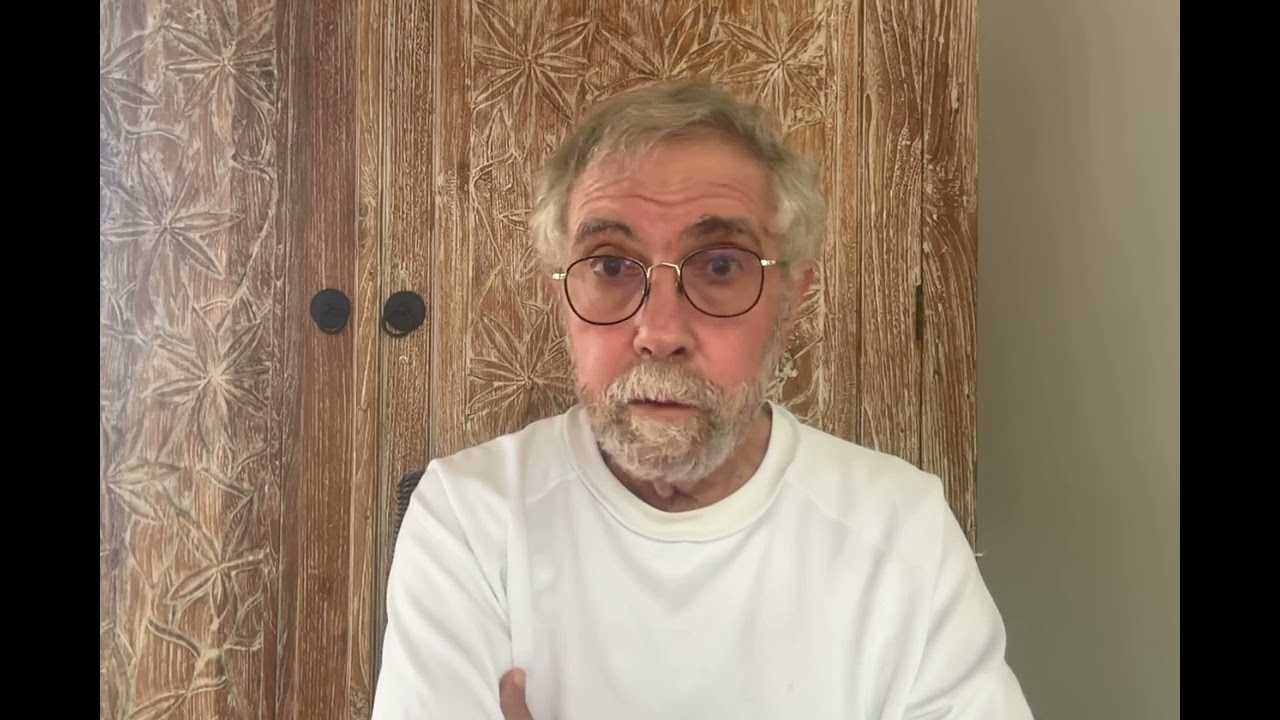 ](https://www.youtube.com/watch?v=lzZdxmSmBaM)
---
NYT
NO LNX
Law Firm Pressures Brown University to Erase Research on Anti-Wind Groups
The firm, which represents opponents of offshore wind, said it would complain to Brown’s federal and private funding sources.
Lisa Friedman
By Lisa Friedman
Aug. 25, 2025
A law firm representing opponents of offshore wind farms is demanding that Brown University retract research that details links between the fossil fuel industry and anti-wind groups.
The firm, Marzulla Law L.L.C., which has close ties to the conservative legal movement, called the research “false and injurious” and said it would complain to Brown’s public and private funders, including the Energy Department, the National Science Foundation and the Mellon Foundation.
A spokesman for the university, Brian E. Clark, did not comment directly on the law firm’s demands but said the university intended to uphold its principles of academic freedom.
“Scholars shape their own research and course of instruction at Brown,” Mr. Clark said in a statement. “One principle that is core to research at Brown is the ability for scholars to discuss contested topics and themes and to have those topics openly debated.”
Roger J. Marzulla, a founding partner of the firm, did not respond to email and telephone requests for comment.
The demands come at a precarious time for the nation’s universities, which have become targets of a pressure campaign conducted by the Trump administration. Last month, Brown struck a deal with the government to restore lost federal research funding and end investigations into alleged discrimination.
The Trump administration is trying to stop the country’s nascent wind industry, a source of energy that President Trump has disparaged since he failed to stop an offshore wind farm from being built within view of one of his Scottish golf courses.
Marzulla Law L.L.C. is representing several groups that are fighting offshore wind, including Green Oceans, a nonprofit organization that is trying to overturn federal permits for Revolution Wind, a 65-turbine wind farm off the coast of Rhode Island.
That $6.2 billion project is nearly built, but on Friday the Trump administration ordered construction to stop, citing unspecified concerns.
In an Aug. 11 letter to Brown’s general counsel, Mr. Marzulla objected to research published by the Climate and Development Lab at Brown that found that Green Oceans had spread misinformation about climate change and operated as part of “a fossil-fuel-funded disinformation network.”
Mark Herr, a spokesman for Green Oceans, said in a statement that Green Oceans was a local and nonpartisan group, adding, “We have no association with the fossil fuel industry nor any conservative political groups.”
“These oft-repeated lies are designed to discredit the messenger while preventing the public from absorbing the substance of our valid and well-researched concerns,” he said.
J. Timmons Roberts, who leads the Climate and Development Lab, said in an interview that his students had found that groups fighting offshore wind “have chosen to get in bed with some of the most anti-environment and anti-climate actors.” He called the letter “strategic harassment to shut me up and waste my time and make me more cautious.”
Lauren Kurtz, the executive director of the Climate Science Legal Defense Fund, a nonprofit organization that provides legal aid to climate scientists, called the letter academic harassment.
“It definitely struck me that they were dangling the possibility of getting the Trump administration involved,” Ms. Kurtz said. “It seems to me like they’re trying to bully Brown and their researchers.”
The Climate and Development Lab, founded in 2010, is a student and faculty research organization. Nearly three years ago, students began looking into groups fighting offshore wind off the coast of Rhode Island.
Their research does not accuse Green Ocean of accepting money from fossil fuel companies, but it highlights the similarities between arguments made by Green Ocean and those advanced by fossil fuel groups that spread climate misinformation.
A new publication issued by the Climate Development Lab on Friday maps connections between groups that oppose offshore wind and the law firms that represent them, and uses Marzulla Law as a case study. It describes the firm as having “a history of advancing anti-environmental lawsuits and significant ties with the fossil fuel industry.”
Mr. Marzulla and his wife, Nancie, who together founded the firm in 1997, both previously worked at Mountain States Legal Foundation, a conservative public interest law firm based in Colorado.
Mr. Marzulla took over as head of the foundation in 1981, and later the couple founded the Defenders of Property Rights, which defended private property owners from what they viewed as cumbersome environmental regulations. Defenders of Property Rights joined the Cooler Heads Coalition, a group of organizations that rejected the scientific finding that the burning of fossil fuels was driving climate change.
Lisa Friedman is a Times reporter who writes about how governments are addressing climate change and the effects of those policies on communities.
A version of this article appears in print on , Section A, Page 9 of the New York edition with the headline: Right-Wing Firm Presses Brown Over Wind Study.
---
---
Managing Editor
September 14, 2025
This past July, Brown made a deal with the Trump administration to restore the University’s federal funds. But the deal was not the end of threats to Brown’s research funding.
On Aug. 11, Brown received a letter from Marzulla Law, a law firm with close ties to the conservative legal movement, on behalf of Green Oceans, a local anti-offshore wind group. In the letter, the law firm demanded the University retract three publications from 2023 and 2024 authored by researchers at the Climate and Development Lab, claiming that the publications contained “materially false claims” about the nonprofit and caused “significant harm.”
In the letter, which was obtained by The Herald, the firm stated they are “preparing coordinated reports to key public and private funding bodies,” including the National Science Foundation, Department of Energy and the Mellon Foundation. The letter stated that “Green Oceans will consider all available legal remedies” if the University does not comply.
In an email to The Herald, Barbara Chapman P’18 P’20, a Green Oceans trustee and member of the litigation team, wrote that the organization believes it has the grounds for further legal action.
“The publications contain provably false statements that have damaged Green Oceans’ reputation and fundraising and have been amplified by others,” Chapman wrote.
In a statement to The Herald, University Spokesperson Brian Clark affirmed Brown’s commitment to “academic freedom” and the right of faculty to “shape their own research and course of instruction at Brown.”
Marzulla Law’s threats of endangering federal funding would likely not apply to the CDL, which is privately funded and does not receive support from the sources that the law firm listed in its letter, according to the head of the center, Timmons Roberts, who is a professor of environment, society and sociology.
As a think tank that studies climate change policy based within the Institute at Brown for Environment and Society, one of the CDL’s primary research areas is the “seemingly grassroots and sometimes actually grassroots” organizations that oppose the development of offshore wind plants in the northeastern United States, said undergraduate CDL researcher Charlotte Calkins ’27.
This includes tracking the connections between anti-offshore wind groups, their lawyers, the fossil fuel industry and right-wing think tanks, Calkins continued.
In an interview with The Herald, Roberts said the CDL aims to understand what players are blocking climate change and how they are doing so. The original assumption of climate researchers was that as scientists discovered solutions to climate change, people would “naturally, automatically” shift away from using fossil fuels, he said.
“But of course, that was quite naive,” Roberts added.
Fossil fuel companies stand to lose revenue as reliance on renewable energy grows, he said. “So they are actively engaged in trying to undermine, stop, slow and roll back that transition that just has to happen.”
Since the CDL began publishing research about Green Oceans a few years ago, they have received multiple complaints from the group, which organizes against the development of offshore wind turbine farms in Rhode Island and Massachusetts. Green Oceans has also demanded that academic journals remove research conducted by the CDL. But the August letter was the first time they directly threatened Brown’s research funding, according to Roberts.
Isaac Slevin ’25, the first author on two of the targeted papers, called anti-wind groups’ criticism of his research “unsubstantiated.” The CDL has also sent letters pushing back against the claims and have faced no subsequent legal action.
Roberts feels confident that the CDL will be safe against legal threats.
“There’s some language in here about documented, ongoing harm, and it’s quite hard to imagine that this is real harm,” he said. He pointed to the “hundreds of thousands of dollars” raised by Green Oceans and their substantial national influence as evidence of the group’s success.
Green Oceans disagrees.
“The harm has escalated,” Chapman wrote. “The CDL publications have been widely amplified, used to exclude our participation in public forums, and have contributed to a hostile environment.”
It remains unclear if Marzulla Law actually has the sway necessary with public or private sources to pose an actual threat to Brown’s research funding. The firm did not respond to a request for comment.
Chapman wrote to The Herald that Green Oceans is “not asking anyone to stop supporting research at Brown,” but rather “asking funders and administrators to ensure that work bearing Brown’s name meets basic standards of accuracy, disclosure, and fairness.”
On Sept. 2, Green Oceans filed a memorandum in support of the Trump administration’s order halting construction on Revolution Wind, a $4 billion project to construct a wind farm that would have powered over 350,000 homes across Rhode Island and Connecticut. The construction of Revolution Wind was 80% complete when construction was halted.
Nancie and Roger Marzulla, co-founders of Marzulla Law, were listed as their attorneys on Green Oceans’s memorandum. Green Oceans also provided recommendations to senior officials in the Interior Department about how to cancel offshore wind leases, according to emails obtained by Politico.
In an Aug. 27 statement, they claimed that they “have never received funding from the fossil fuel industry or related organizations.”
But the CDL’s research never claimed that Green Oceans directly received funding from fossil fuel companies, according to Roberts, Slevin and Calkins. A key point in the research, Slevin said, is that the connections between local anti-offshore wind groups and fossil fuel companies extend far beyond the money.
Following the funds that groups receive from companies with anti-renewable energy interests, such as fossil fuel corporations is useful, but “cannot be the only framework that we work through, because it writes local agencies out of the picture,” Slevin told The Herald.
The CDL’s research instead explores “information subsidies,” which are lines of reasoning, talking points and terminology that “trickle down” to local groups from fossil fuel-funded think tanks, Calkins explained. Although the local groups may not directly be tied to fossil fuel companies, their lawyers and information sources may be closer, the CDL’s research posits.
In their statement to The Herald, Green Oceans maintains that the CDL’s research is false.
“Questioning whether offshore wind delivers real climate benefits while inflicting undeniable environmental harm is not spreading misinformation; rather it represents responsible science and public advocacy,” Chapman wrote.
According to Roberts, legal complaints like the Aug. 11 letter appear to have the “intent to silence our voices.” But he and his team feel even more inclined to continue their work.
Less than two weeks after the Aug. 11 letter, the CDL published a new report showing the Marzullas at the center of a web of “anti-environmental litigation and lobbying, and deep ties to fossil fuel interests,” the report says. The firm has a history of environmental litigation in federal courts, defending clients such as developers and local coalitions, according to the CDL report.
A version of the paper had already been drafted when they received the letter, Roberts said, and the notice “made me want to quickly put it up.”
Slevin said he feels that it symbolizes a bigger “political vibe shift” where universities are targets of “bullying.”
“I think if you’re doing effective environmental work, I would hope that you’re pissing off arms of the fossil fuel industry and their allies,” he added.
ELise Haulund
Elise Haulund is the managing editor of production and development for The Herald's 136th Editorial Board. She is from Redondo Beach, CA. Concentrating in English and biology, she has a passion for exploring the intersection between STEM and the humanities. Outside of writing, researching and editing, she enjoys ballet-dancing, cafe-hopping and bullet-journaling.
---
(Bloomberg) — Timmons Roberts is used to receiving legal complaints about his work examining groups who oppose offshore wind.
Article content
What was surprising about the letter he received earlier this month wasn’t that one of those groups was asking Roberts and his employer, Brown University, to retract some of his research. It was that the group was represented by a Washington, DC law firm, that said it was preparing to send “coordinated reports” about his work to the US National Science Foundation and Energy Department.
The move parallels the recent targeting of universities over alleged antisemitism and for their diversity initiatives, suggesting climate and clean energy research could be another line of attack.
Article content
Article content
Roberts’ research focuses on opposition to offshore wind and other forms of climate obstruction. In a 2023 report, he and his research team chronicled how arguments made by the group Green Oceans — based in Little Compton, Rhode Island — echoed claims made by fossil fuel-funded opposition groups.
Article content
In response, Green Oceans enlisted a different law firm and asked him to take down the research, saying it was causing reputational harm. The group and Roberts met in May 2024, but there was no resolution. Roberts said his research was already in peer review at the time, and it was subsequently published in a journal later that year. (In its most recent letter, Green Oceans said Roberts “threatened to publish the same material in a peer-reviewed journal.”)
Article content
The group sent the latest letter via Marzulla Law, dated Aug. 11, 2025. Green Oceans asked for “immediate corrective action by Brown University” to take down three publications from Roberts’ group and conduct a formal review into “publishing and oversight practices.”
In the letter, Green Oceans also said it sent a request to the journal to retract the study, which was denied, as was a request for a local environmental newsroom to retract a story on the findings.
Article content
Green Oceans declined to comment, saying the letter laid out its position.
Article content
“Everything in this letter, practically, they’ve said before” in previous letters, Roberts said. But the warning about escalating the matter to the administration was a shift. The letter notes that “Brown University has received significant federal funding,” and that Green Oceans was drafting reports chronicling “the pattern of misconduct and institutional risks of continued association with research units that engage in political targeting.”
Article content
Roberts said his lab isn’t funded by the NSF or the Energy Department, nor is the Climate Social Science Network, an international constellation of researchers who study climate politics. Bloomberg has contacted the agencies for comment.
Article content
The letter “sounds like going to the Trump administration to do what in fact the Trump administration has done with universities: That is, threaten them and their funding,” Roberts said. He added that he’s been in touch with the Union of Concerned Scientists and the Climate Science Legal Defense fund, nonprofits that defend academic freedom.
Article content
In response to questions about how Brown was handling the new communication from Green Oceans, a university spokesperson said, “scholars shape their own research and course of instruction at Brown. One principle that is core to research at Brown is the ability for scholars to discuss contested topics and themes, and to have those topics openly debated.”
Article content
The letter was sent by Marzulla Law, a boutique property-rights firm run by husband and wife duo Roger and Nancie Marzulla. Both worked for the US Department of Justice under former President Ronald Reagan, and Roger Marzulla served as assistant attorney general in charge of the Environment and Natural Resources division. The firm has argued a number of anti-offshore wind cases, including one brought by Green Oceans challenging the Revolution Wind Project off the Rhode Island coast. Roberts published new research on Aug. 22 that includes exploring Marzulla Law’s connections with the offshore wind opponents.
Article content
The firm didn’t respond to a request for comment.
Article content
The request to take down research and the proposed escalation of the complaint to the administration is “extraordinary,” said Veena Dubal, a law professor at the University of California at Irvine and general counsel of the American Association of University Professors.
The Trump administration has assailed universities for a host of issues, including allegations of failing to confront antisemitism and promoting diversity programs. Columbia and Brown universities reached deals with the White House to unfreeze hundreds of millions of dollars in US funding. The University of Pennsylvania was the first to settle for allowing a transgender swimmer on the women’s team.
Article content
The NSF has cut more than 100 climate research grants since Trump took office and has said it “will not support research with the goal of combating ‘misinformation,’ ‘disinformation,’ and ‘malinformation.’”
Researchers whose work doesn’t align with administration policy are finding “their jobs, their funding, their futures” at risk, Dubal said.
Article content
The Trump administration has also taken actions to cut support for renewables, particularly offshore wind. Since taking office in January, President Donald Trump has put forward a barrage of policies designed to stop offshore wind development. Those include halting the sale of new offshore wind leases and removing millions of acres of ocean that had been set aside for future wind projects.
The Interior Department on Aug. 22 halted the mostly built Revolution Wind project off the Rhode Island coast, citing the need for further review. Green Oceans opposes the project.
Article content
In April, the administration temporarily stopped work on the $5 billion Empire Wind project off the coast of New York, sending a shudder through the industry. (It allowed construction to resume in May.) Trump has repeatedly attacked wind farms, saying they have ruined the views of some of his golf properties.
Article content
Offshore wind has also been the subject of numerous attacks and lawsuits by local coastal residents. Those efforts have been successful in some cases; one notable example is Cape Wind, which was canceled in the face of opposition from wealthy homeowners on Martha’s Vineyard and Nantucket who included the Kennedy family and industrialist William Koch.
Article content
Kit Kennedy, a managing director for power, climate and energy at the Natural Resources Defense Council, said there’s broad bipartisan support for wind — including from a majority of Republicans, according to a June poll commissioned by pro-offshore wind group Turn Forward — and that building more projects may help assuage any concerns. She said the Brown research has been “very, very valuable” to understanding anti-wind influence groups.
Article content
But according to Parrish Bergquist, an energy policy researcher at the University of Pennsylvania, the administration’s push against offshore wind may mean “we’re going to start to see deeper polarization on this, in a way that mirrors attitudes about climate change more generally.”
---
---
eletrek
Scientist exposes anti-wind groups as oil-funded. Now they want to silence him.
:{ Jameson Dow | Aug 25 2025 -
Oil-funded groups are engaging in strategic harassment to stop scientists from revealing the nature of their politically-linked disinformation networks – in what should be a surprise to nobody.
A new report came out last week from the Climate & Development Lab (CDL) at Brown University, titled “Legal Entanglements: Mapping Connections of Anti-Offshore Wind Groups and their Lawyers in the Eastern United States.”
The study focuses on several examples of law firms with connections to anti-wind groups, the fossil fuel industry, and the American political right wing. These fossil-funded groups have spread disinformation to slow the adoption of clean and cheap wind power, in order to keep America addicted to the poison that the fossil fuel industry wants to keep selling us.
The lab is headed by J Timmons Roberts, but the research was done by various students and faculty at at the lab. The new report builds onformer research by the CDL cataloguing extensive connections between these groups and the dark money networks that fund the anti-wind movement.
Why the East Coast needs offshore wind
Offshore wind, especially in the North Atlantic, is a cheap and abundant form of energy that is heretofore relatively untapped in the US. It also has very little environmental cost, given that its carbon emissions and land use are both zero, and wind tends to be quite consistent over the ocean, making it more reliable as a power source.
Many other countries have successfully implemented offshore wind projects to bring this cheap and clean power to their populaces, with particular booms in China, the UK, Vietnam, Germany and several other Northern European countries (like Denmark, where many large wind power companies are based).
And wind is important for the global transition to renewable energy and the fight against climate change. As a zero-emission power source, it’s essential for meeting the US East Coast’s climate and renewable energy goals, and could provide a huge chunk of the power needs for the entire US Eastern seaboard, where the country’s population is clustered.
However, offshore wind has recently encountered setbacks due to the spread of disinformation from fossil-funded networks, which has made its way into the popular conception and into right-wing politics. (Nevertheless, Americans of all political stripes still support greater deployment of offshore wind)
How and why fossil fuel companies oppose wind
Fossil fuel companies oppose wind power because it would help to wean America off of fossil fuels, displacing coal and methane generation for electricity and enabling greater electrification of the vehicle fleet to wean us off of oil. All of these would result in air quality improvements, cost reductions, health improvements and avoidance of climate change – which are all anathema to themost deadly industry the world has ever seen.
So, fossil fuel companies have developed and funded a complicated network of fake public interest groups, politicians and lawyers to oppose wind power by spreading disinformation. And the CDL’s report highlights how certain legal firms have received funding from fossil fuel companies and/or given support to these fake public interest groups in attempts to sue wind projects out of existence.
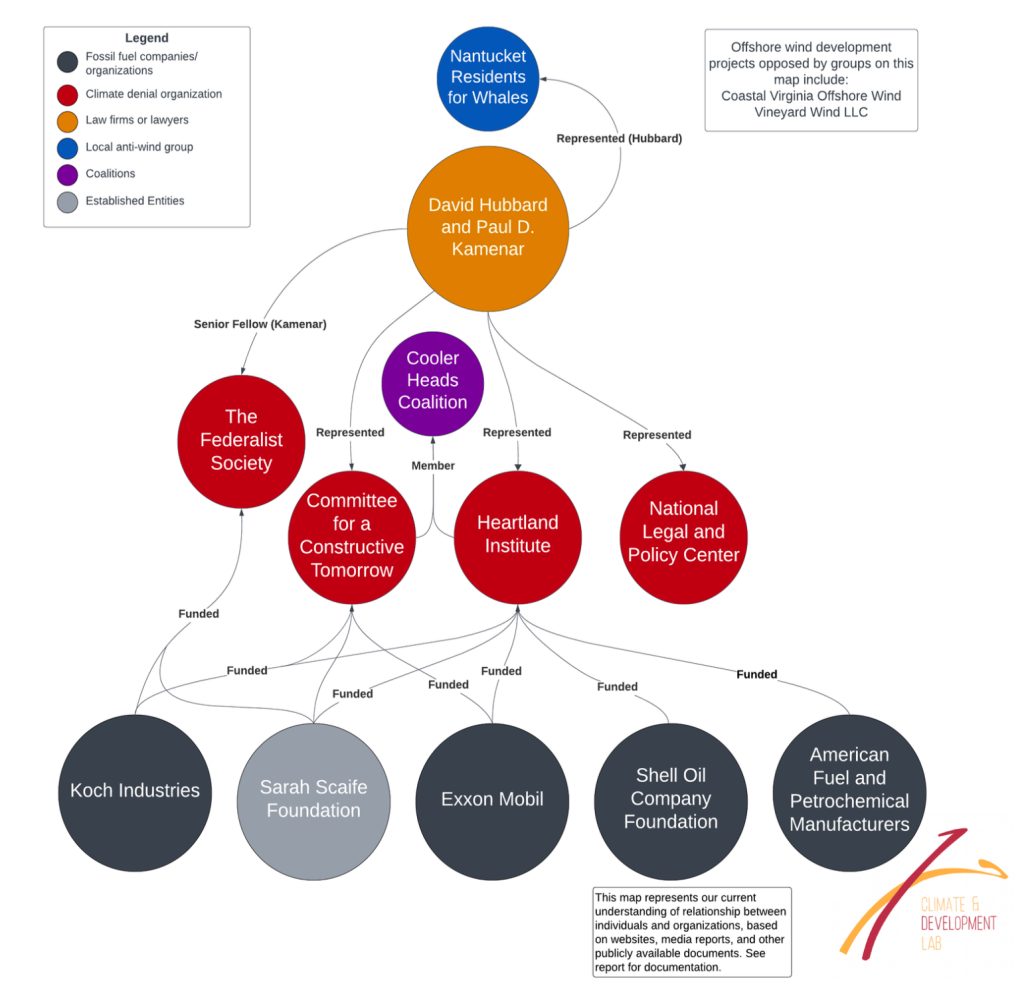 One of many diagrams in the report showing these anti-wind legal networks
While many of these lawsuits have been unsuccessful, they can still add delays to a project, making it more expensive and slower to deploy (which then makes your electricity more expensive). In some cases, the delays can result in project cancellation, like when oil billionaire William Koch sued Cape Wind out of existence via a fake public interest group called the Alliance to Protect Nantucket Sound.
In the report, five specific legal networks are highlighted in particular, showing how each is related to fossil fuels and science denial. The networks have provided representation, written comments, filed lawsuits and otherwise spread disinformation in an attempt to stop the public good that offshore wind power represents.
The nature of the disinformation
The disinformation largely focuses on the North Atlantic Right Whale, a whale whose population is currently experiencing an “unusual mortality event” due to changing climate and Atlantic shipping and fishing.
Anti-wind groups have invoked laws like the Endangers Species Act and Marine Mammal Protection Act, despite the fact that the products of the industry they are funded by are the deadliest thing for marine life.
Burning oil raises both the temperature and acidity of our oceans, disrupting marine ecosystems in profound ways. For example, North Atlantic krill populations have dropped by 50% due to ocean warming driven by fossil fuel use. Krill are the main food source for the North Atlantic Right Whale, which anti-wind groups claim to be interested in protecting, but are in fact aiding the decline of.
Further, whale populations are directly harmed by vessel strikes, which are the leading direct cause of death for North Atlantic Right Whales in recent years. And29% of those vessels are carrying oil across the globe – shipments that would be unnecessary if transportation were powered by clean renewable energy instead of deadly oil. Not only that, but some of the exact same groups that oppose wind also opposed draft regulations to reduce vessel strikes, showing that they are actually interested in continuing to harm whales, not protecting them.
Law firm responds to the truth by pressuring university to hide it
One of the law firms highlighted in the report, Marzulla Law, sent a letter threatening its authors. Marzulla Law said it would complain to mommy… I mean, Brown’s funding sources, including the US Department of Energy which a former oil executive is currently squatting as the head of, in an attempt to get the entirety of Brown University’s funding pulled if the CDL doesn’t self-censor its research findings.
The CDL itself is not funded by the Department of Energy, Roberts said to Bloomberg, so the threat isn’t even related to CDL’s funding sources, but to Brown University’s as a whole.
Marzulla Law represented one of the disinformation groups which the CDL has highlighted before, the deceptively-named “Green Oceans.” Green Oceans opposed the Revolution Wind project, which was halted on Friday over fake national security concerns by a convicted felon who is Constitutionally barred from holding office in the US, despite the project already being 80% finished, costing the US billions in waste and increased utility bills.
Mike Herr, a spokesman for Green Oceans said “these oft-repeated lies are designed to discredit the messenger while preventing the public from absorbing the substance of our valid and well-researched concerns,” which is itself an example of the very thing he’s wrongly accusing the researchers of.
Herr’s organizationlies about offshore wind, and their attack on science (through their law firm) is designed to discredit the messenger while preventing the public from absorbing the substance of valid and well-researched concerns: the connection between fossil fuels, the republican party, and disinformation that keeps us from embracing superior forms of cheaper, cleaner energy like wind.
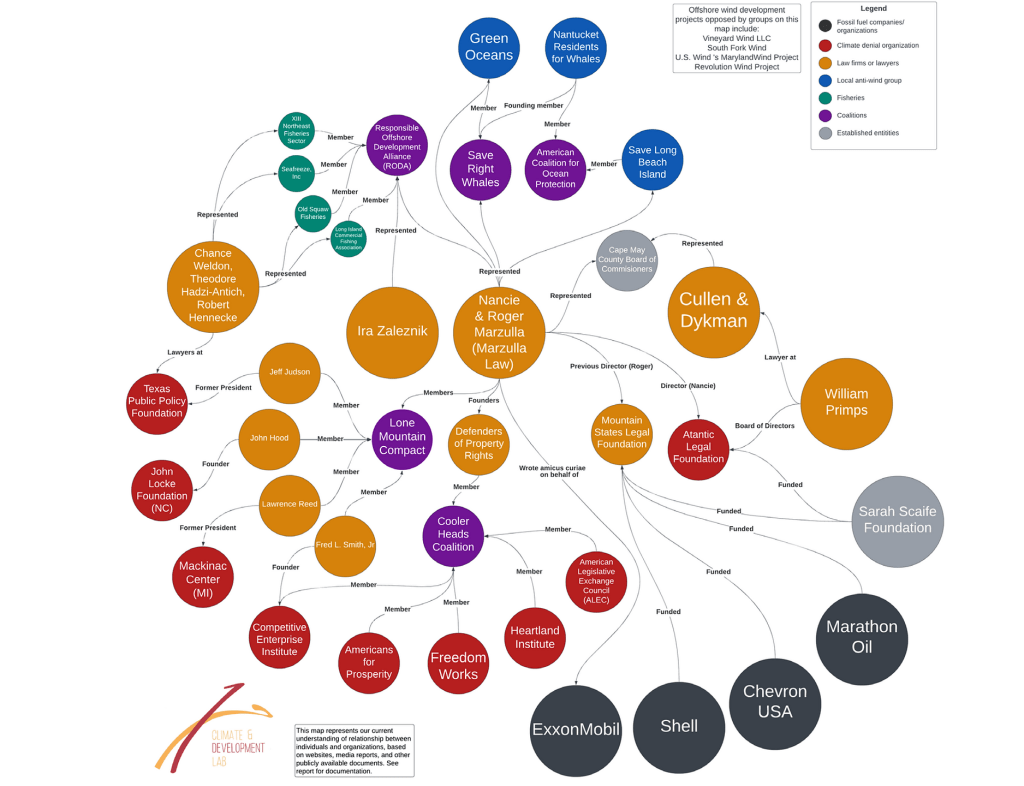 Marzulla Law is deeply tied to anti-wind networks, far-right and climate denial foundations, and oil companies
Discrediting science and knowledge is increasingly becoming a feature of the American right wing, which is currently on a crusade against universities as it tries to make America stupider.
Roberts called Marzulla’s response “strategic harassment to shut me up and waste my time and make me more cautious,” which is a common reaction faced by truth-tellers in this day and age, particularly when funding from the largest and most deadly industry on the planet, which has repeatedly shown its interest in propaganda, is involved.
Top comment by Lee
Liked by 30 people
Everything wrong with the USA right now is because Trump has made lying acceptable. Imagine if USA believed in the Truth. All these law companies and Fossil Fuels companies would be prosecuted.
For its part, Brown University did not comment on Marzulla’s demands, but did state that “Scholars shape their own research and course of instruction at Brown. One principle that is core to research at Brown is the ability for scholars to discuss contested topics and themes and to have those topics openly debated.”
However, Brown is one of the universities which recently kowtowed to the idiotic demands of an inept moron, making its words about academic independence ring somewhat hollow. We’ll have to see if they step up to defend truth this time around, or bend the knee to one of the dumbest people on the planet once again, if it comes to that.
---
---
wind whale BS

The New York Times
https://www.nytimes.com › 2025/08/25 › climate › bro...](https://www.nytimes.com/2025/08/25/climate/brown-university-offshore-wind-marzulla.html)
Aug 25, 2025 — Marzulla Law L.L.C. is representing several groups that are fighting offshore wind, including Green Oceans, a nonprofit organization that is ...Read more
[### Law firm threatens Brown's funding over research about ...

The Brown Daily Herald
https://www.browndailyherald.com › article › 2025/09](https://www.browndailyherald.com/article/2025/09/law-firm-threatens-browns-funding-over-research-about-anti-offshore-wind-groups)
Sep 14, 2025 — Representing local anti-offshore wind group Green Oceans, Marzulla Law sent a letter to the University demanding research by the Climate and ...Read more
[### Case: Green Oceans v. US Department of the Interior

Civil Rights Litigation Clearinghouse
https://clearinghouse.net › case](https://clearinghouse.net/case/46981/)
This case challenges agency approval of two energy projects, South Fork Wind Project and Revolution Wind Project, that have purported detrimental ...Read more
[### Green Oceans Asks Brown University to Retract Reports ...

ecoRI News
https://ecori.org › green-oceans-asks-brown-university-t...](https://ecori.org/green-oceans-asks-brown-university-to-retract-reports-about-anti-wind-organization/)
Aug 25, 2025 — PROVIDENCE — A law firm representing the anti-wind energy group Green Oceans sent a letter to Brown University earlier this month, ...Read more
Missing: MARZULA | Show results with: MARZULA
---
MMA
Fox News contributor blames DEI for shooting deaths at Brown University
Nicole Parker: “I believe that Brown University's prioritization was not on the safety and security of their students. They were more focused on things like DEI efforts, and that has been catastrophic and led to the death of two students.”
Written by Media Matters Staff
:{Published 12/17/25
Video
Citation
From the December 17, 2025, edition of Fox News' The Faulkner Focus
JULIE BANDERAS (ANCHOR): What does this video say to you, and how shocked are you, first of all, that this video has produced nothing? I mean, nobody has come in, as of this video being released, for questioning.
NICOLE PARKER (FOX NEWS CONTRIBUTOR): I'm actually not shocked at all because I know that Brown University is now trying to defend their posture on their security statements that they have made. But it's been an epic fail, the fact that there is no security footage from the campus and that the justification was it was an older building. Both the attorney general and the police chief of Providence police department have said we have no video surveillance. That is inexcusable. I believe that Brown University's prioritization was not on the safety and security of their students. They were more focused on things like DEI efforts, and that has been catastrophic and led to the death of two students.
---
---
// RETALIATE BC JDV? BUT ALSO // THUGSWARM
AN 11 25
Two months after the assassination of MAGA podcaster Charlie Kirk, over 600 people have been targeted by the government with firings, suspensions, investigations and other actions, Reuters reports.
Educators, they note, are the main target, noting that "more than 350 education workers were fired, suspended or investigated in the days following the assassination, including 50 academics and senior university administrators, three high school principals, two cheerleading coaches and a theology instructor."
Reuters reports that "Republican officials publicly threatened to deprive universities and schools of taxpayer funds unless specific critics of Kirk were fired."
One of those people, Lauren Vaughn, a kindergarten assistant in South Carolina, was fired from her job after posting a Kirk quote defending the Second Amendment on social media followed by the now ubiquitous liberal rallying cry for gun control, "thoughts and prayers."
According to a Reuters review of court records, public statements, local media reports and interviews with two dozen people who were fired or otherwise disciplined, Vaughn "was one of more than 600 Americans fired, suspended, placed under investigation or disciplined by employers for comments about Kirk’s September 10 assassination."
At least 15 people were punished for "allegedly invoking 'karma' or 'divine justice,'" they note, "and at least nine others were disciplined for variations on 'good riddance.'"
"Other offending posts appeared to exult in the killing or express hope that other Republican figures would be next," they add.
But others like Vaughn were disciplined for simplycriticizing Kirk's politics, they note.
"This account is the most comprehensive to date of the backlash against Kirk’s critics, tracing how senior officials in President Donald Trump’s administration, local Republican lawmakers and allied influencers mobilized to enforce the Trump movement’s views," Reuters explains.
"The story maps the pro-Trump machinery of retaliation now reshaping American political life, detailing its scale and tactics, ranging from shaming on social media to public pressure on employers and threats to defund institutions," they add.
While Reuters notes that "Americans sometimes lose their jobs after speaking out in heated political moments," the post-Kirk situation was different "because of its reach and its public backing from Trump, Vice President JD Vance and other top government officials."
"It represents a striking about-face for Republicans, who for years castigated the left for what they called 'cancel culture' – the ostracism or punishment of those whose views were deemed unacceptable," they add.
Vaughn is challenging her dismissal in a federal lawsuit filed September 18, seeking reinstatement, they write, but the school district maintains that her post “appeared to endorse Mr. Kirk’s murder or indicate that it was ‘worth’ him losing his life to protect Americans’ constitutional rights.”
Like Vaughn, Julie Strebe, a sheriff’s deputy in Salem, Missouri, lost her job after posting comments on Facebook about the shooting, including, “Empathy is not owed to oppressors.'
"She said her bosses were besieged with calls for her dismissal and that, at one point, a hand-drawn sign appeared across from her home reading, 'Julie Strebe Supports the Assassination of Charles Kirk,'" and has since had to install five surveillance cameras at her house to protect herself.
Reuters notes that "many Republican officials have embraced the punitive campaign," proposing "extraordinary measures," from lifetime social media bans to revoking visas over those they deem to have reveled in Kirk's death.
"Some academics compared the backlash to the 'Red Scare,' the anti-Communist purge that peaked in the 1950s, when officials, labor leaders and Hollywood figures were accused of Communist ties," Reuters notes.
Landon Storrs, a University of Iowa history professor, agrees, saying, "there are very disturbing parallels."
Even Trump loyalist Sen. Ted Cruz (R-TX) says it has gone too far, warning on his podcast that letting government decide “what speech we like and what we don’t” sets a dangerous precedent. Silencing voices like Jimmy Kimmel's might feel good, he said, but “when it’s used to silence every conservative in America, we will regret it.” BC DEMS GUBMINT EVIL SO THEY WILL USE PWR WE GIVE THEM FOR EVIL, AND WE ARE ALREADY PERSUCUTED VICTIMS OF BIG TECH WOKISM
Far right social media influencers like the X account Libs of TikTokstarted the revenge campaign almost immediately following Kirk's death, Reuters says.
"In the week after the shooting, Libs of TikTok shared the names and profiles of at least 134 people accused of celebrating violence or mocking Kirk’s memory, frequently tagging Trump administration officials including Defense Secretary Pete Hegseth and Attorney General Pam Bondi. At times, the influencer posted disciplinary actions taken against specific government employees," they write.
The people Reuters has identified may not be accurate, they say, noting that "the tally of more than 600 people punished for criticizing Kirk is likely an undercount. Many companies and government organizations haven’t publicly disclosed terminations or suspensions."
The fallout has led to many peoples' silence, they report, saying, "The retaliation has silenced many voices. Scores of people who posted anti-Kirk comments have since scrubbed or locked their accounts, Reuters found. Others said in interviews that they are pushing back."
One of those, Kimberly Hunt, an HR worker in Arizona who was fired for her Kirk comments, is doing just that.
Hunt says she has raised more than $88,000 from a GoFundMe campaign titled, “Doxxed, Fired, but Not Silenced," saying she wants to use the money to further her education, become a content creator, and keep calling out people like Kirk.
“It’s definitely just emboldened me,” she says.
Not so for Florida Atlantic University associate professor Karen Leader, who was placed on administrative leave for her comments after a former staffer of Governor Ron DeSantis (R-FL) shared screenshots of her posts and tagged her employer.
“Whether my career is over or not, I don’t know,” Leader says. “But my life has changed.”
REF
REUTERS 11 25
...Many educators did celebrate Kirk’s death, including a Virginia teacher who wrote, “I hope he suffered through all of it,” and a Texas middle school intern who said the shooting “made me giggle.” Screenshots of both posts were circulated by right-wing influencers. Reuters could not locate the original posts, which may have been deleted or made private. The Virginia teacher was suspended and the Texas intern was fired. Neither could be reached for comment.
While schools that suspended or fired educators cited disruptions to the learning environment, some private employers pointed to a violation of company values or safety concerns as the basis for terminations. Corporations caught up in the backlash gave a variety of explanations: Delta Air Lines CEO Ed Bastian said in a statement some employees’ comments were in “stark contrast” to the company’s values and violated its social media policy, while a United Airlines statement said the company had “zero tolerance for politically motivated violence or any attempt to justify it.”
At least a dozen Kirk critics who took pains to condemn the shooting also found themselves out of jobs or suspended, sometimes after Republican lawmakers got involved.
In the wake of Kirk’s death, Joshua Bregy, a climate scientist at Clemson University in South Carolina, shared another user’s Facebook post that read, in part: “No one should be gunned down – not a school child, not an influencer, not a politician – no one. But am I going to allow people to make a martyr out of a flawed human being whose rhetoric caused notable damage? Not a chance.”
The Clemson College Republicans reposted part of his message, labeling him “ANOTHER leftist professor” and calling for his termination. The post was amplified by right-wing influencers and Republican state lawmakers who threatened to defund the public university unless Bregy was fired.
Clemson initially pledged in a September 12 statement to “stand firmly on the principles of the U.S. Constitution, including the protection of free speech.”
The next day, Trump himself reposted a state lawmaker’s call to “Defund Clemson.” On September 16, after South Carolina’s House speaker and Senate president sent a letter to Clemson’s trustees demanding they “take immediate and appropriate action,” the school fired Bregy. Bregy’s Facebook post was “blatantly unprofessional” and “seriously prejudicial to the university,” Clemson said in a letter informing Bregy he had been dismissed.
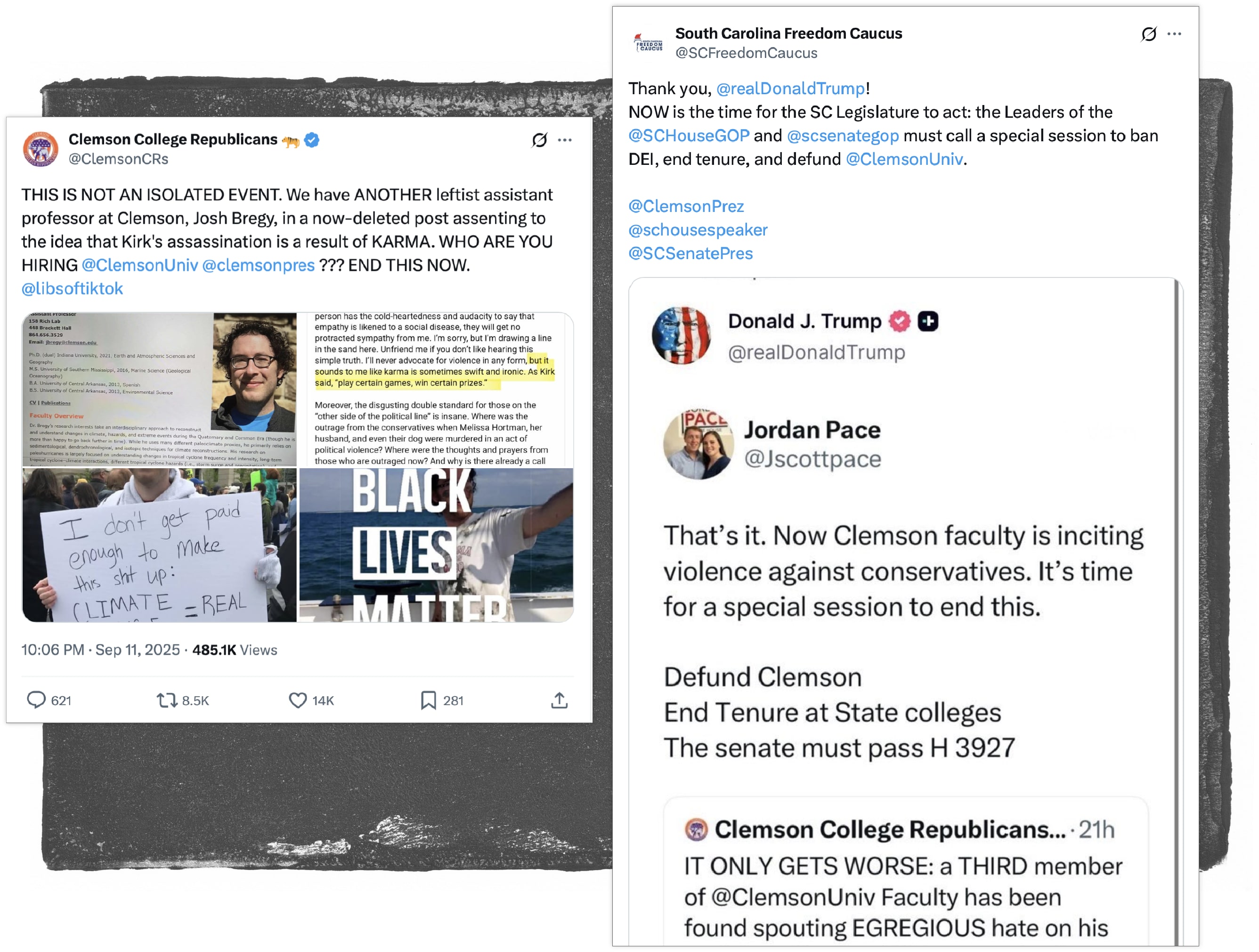
Screen captures of social media posts urging Clemson University to fire Josh Bregy
Bregy is suing Clemson in a South Carolina federal court in a bid to be reinstated. His lawyer, Allen Chaney, said the academic would have kept his job “but for the really aggressive, coercive tactics of elected officials in South Carolina.”
Clemson, State House Speaker Murrell Smith and Senate President Thomas Alexander did not respond to requests for comment. Clemson has yet to file a response to Bregy’s suit.
In at least six other cases, Republican officials publicly threatened to deprive universities and schools of taxpayer funds unless specific critics of Kirk were fired.
Chaney, who serves as legal director of the South Carolina chapter of the American Civil Liberties Union, said the threats to defund Clemson and others crossed a constitutional line. “The government can’t police speech by pressuring third parties,” he said. Last year, the Supreme Court unanimously held that government officials cannot use their authority to “attempt to coerce” private parties into punishing or suppressing speech they dislike.
The threats to defund schools that resist firing Kirk’s critics were “stunning,” said Paul McGreal, a constitutional law professor at Creighton University Law School in Nebraska. “Government officials are threatening speakers with punishment because they disagree with what they’re saying. These are core First Amendment protections that they’re violating.”
...
At least 19 lawsuits have been filed against employers who punished Kirk critics, state and federal court records show. At least two plaintiffs have succeeded, including an academic in South Dakota who got his teaching job back.
Karen Leader, an associate professor at Florida Atlantic University, took to social media after Kirk’s death to protest a narrative that he “was a shining inspiration to youth and a noncontroversial figure who just wanted to have open and civil dialogue,” she said. “Anyone who’s in higher education knows that it’s not that simple.”
She noted that Turning Point rose to prominence through its Professor Watchlist, a site that encouraged students to report faculty for allegedly holding “radical left” views or being a “terror supporter.”
Kirk had described the Watchlist as an awareness tool, not a blacklist. Those on it have said in interviews, social media posts and public forums that it fostered harassment and intimidation. In 2023, a Turning Point reporter was accused of assaulting an Arizona professor who was on the watchlist after confronting him on camera about his sexuality and shoving him to the ground. The reporter admitted to harassment, assault and disorderly conduct and was ordered to complete a diversion program. A Turning Point cameraman admitted to harassment in the case.
Karen Leader, an associate professor of art history at Florida Atlantic University, was placed on administrative leave after she posted about Kirk on social media. REUTERS/Marco Bello
On September 10, Leader began posting Kirk’s past statements on X. She said she made a mistake by incorrectly accusing Kirk of having uttered an ethnic slur and then deleted it. The rest of her posts she said she stands behind, including one highlighting Kirk’s claim that Black Americans were “better” during Jim Crow.
“None of it was me encouraging violence,” Leader said. “I was sharing evidence.”
Jordan Chamberlain, a former staffer of Florida Governor Ron DeSantis, shared screenshots of several of Leader’s posts and tagged her university, asking if it approved of the content. Libs of TikTok shared Leader’s faculty headshot. The university’s president announced she had been put on administrative leave. Her address and phone number appeared online, and menacing messages followed.
A voicemail left in September for associate professor Karen Leader after she posted online about Kirk
In one voicemail reviewed by Reuters, the caller said: “We’re coming to get you. Karen Leader, we know where you work. We’re gonna come to your home as soon as we have your location.” Leader said she has rarely left her apartment since.
She reported the threats to Boca Raton police, which referred the case to campus officers, according to a police report. Florida Atlantic University police said their report could not be released because of an active criminal investigation.
Florida Atlantic University confirmed Leader was one of three academics who were on leave pending investigations. It declined further comment. Chamberlain also didn’t return an email seeking comment.
“Whether my career is over or not, I don’t know,” Leader said. “But my life has changed.”
The Reuters Daily Briefing newsletter provides all the news you need to start your day. Sign up here.
Additional reporting by Phil Stewart, Jana Winter, and Courtney Rozen in Washington and Isaac Vargas in Los Angeles. Edited by Jason Szep and Linda So.
---
===
---
---
AN 11 25
A Rutgers University professor who teaches a course on anti-fascism has become one of the highest profile targets of President Donald Trump's war on antifa, *The Guardian* reports, and his family’s ordeal has become part of a wider strategy by the Trump administration to target the movement to advance its authoritarian goals.
Mark Bray, whose 2017 book "Antifa: The Anti-Fascist Handbook," made the professor a leading expert in the movement, says that his crusade took on new life after the murder of far right podcaster Charlie Kirk when President Donald Trump, "without any evidence to show a link between the suspected assassin and antifa," signed an executive order designating the movement as a “domestic terrorist organization.”
“I’m anti-fascist insofar as I don’t like fascism and I would really like us to organise against fascism,” Bray tells The Guardian. “But that’s the extent of it. I have never been part of a group.”
But far-right activists targeted Bray, calling him a "domestic terrorist professor" and calling for him to be fired. Then came the death threats.
As a father of two young children, Bray says he was finally rattled when he was doxxed and his address was made public.
“I kept battling this notion that you’re playing into their hands by getting scared of this,” Bray says. “But the difference between this time and last time, among other things, was having little children and if it was like a 0.001 percent chance that someone would drive by our house and spray that house with an automatic weapon, I can’t take that chance.”
That's when he and his professor wife packed up the kids and moved to Spain until the end of the academic year. When they attempted to board the plane, they were turned away.
“Someone’ cancelled my family’s flight out of the country at the last second,” Bray posted on Bluesky. “We got our boarding passes. We checked our bags. Went through security. Then at our gate our reservation ‘disappeared.'"
Hours before Bray’s flight was cancelled, "Trump and his top officials had held a meeting at the White House, vowing to use the full force of the government to crush antifa, which they likened to some of the world’s most violent gangs and drug cartels," The Guardiannotes.
“On the day I was leaving the country, the far-right influencers who targeted me were at the White House meeting with Trump about antifa and they’re in touch with him directly,” Bray says.
Although the family got on a plane the following day, prior to boarding, however, "they were held for about an hour by customs and border patrol agents who peppered Bray and his wife with questions, asked to see his phone and peered into the family’s carry-on luggage," The Guardiansays.
They grilled Bray on how he donated half of his proceeds from the 2017 book to the International Anti-Fascist Defense Fund, which supports the legal and medical costs for people around the world charged with offenses related to anti-fascist actions.
“It’s not an antifa group,” Bray told them. The agents backed off when he said he would need his attorney present to answer such questions, The Guardian notes.
“The authoritarian fascist playbook is well documented and it thrives on crisis and emergency,” Bray tells The Guardian. “It’s well-documented that figures like this want to squelch opposition resistance and usually will try to come up with a catch-all bogeyman category to do so.”
And as much as antifa is a movement to fight fascism, Bray says, MAGA is the new face of fascism.
“I do think that Maga is a fascist movement, I do think that the intent of the administration is to destroy opposition and protest and is to create an authoritarian system,” Bray says.
Trump's targeting of anti-fascists may have temporarily upended Bray's life, but it sends a greater, dire message to more than just him and his family.
“It was really not about me, per se, so much as using a bogeyman to try and target anyone that the administration doesn’t like. That’s how I see it,” Bray says, "pointing to the far-right media ecosystem that had amplified these claims, leaving him fending off death threats."
“But it was aggravating that someone could just fire off an email and change my life," he adds.
---
---}:
10 25 an
SARASOTA, Fla. — Florida plans to end nearly a half-century of required childhood immunizations against diseases that have killed and maimed millions of children. Many critics of the decision, including doctors, are afraid to speak up against it.
With the support of Republican Gov. Ron DeSantis, Surgeon General Joseph Ladapo on Sept. 3 announced his plan to end all school-age vaccination mandates in the state.
“Every last one of them is wrong and drips with disdain and slavery,” he told a cheering crowd of vaccination foes in Tallahassee. “Who am I, as a government or anyone else,” he said, “to tell you what you should put in your body?”
History shows that mandates increase the use of vaccines. Lower vaccination rates will mean increased rates of diseases like measles, hepatitis, meningitis, and pneumonia — and even the return of diphtheria and polio. Many of these diseases threaten not just the unvaccinated but also those they come in contact with, including babies and older people with weakened immunity.
But that scientific fact is being left unsaid in Florida. Health officials have largely been silent in the face of Ladapo’s campaign — and not because they agree with him. The University of Florida muzzled infectious disease experts, said emeritus professor Doug Barrett, formerly the university’s chief of pediatrics and senior vice president for health affairs.
“They’re told not to speak to anyone without permission from supervisors,” he said. University spokespeople didn’t respond to requests for comment.
County-level Department of Health officials across the state got the same message, said John Sinnott, a retired professor at the University of South Florida who is friends with one of the county health leaders.
Sarasota County’s health department referred a reporter to state officials in Tallahassee, who responded with a statement that vaccines will “remain available” to families who want them. The state did not respond to other requests for comment or for an interview with Ladapo.
Many pediatricians are silent, too, at least in public.
“A lot of them don’t take a strong stance on whether kids need to be vaccinated,” said Neil Manimala, a urologist and the president-elect of the Hillsborough County Medical Association. “They don’t want to lose business. And there are enough anti-vax people who can lambaste you on Google, spreading stories about clinicians who ‘want to instill the poison jabs.’”
History of Modern Vaccine Mandates
Several states ended vaccination mandates early last century when smallpox was the only widely given vaccine, said historian Robert Johnston of the University of Illinois-Chicago. None has done so since other vaccines were added to the schedule. (Routine smallpox vaccination ended in 1972).
In the 1970s, persistent measles outbreaks provoked officials to strengthen child protection with enforced school mandates in every state. Today the partisan split on vaccine policy in the wake of the covid outbreak has changed the equation. This is nowhere more the case than in Florida, although legislators in Texas and Louisiana are also considering ending mandatory vaccination, and Idaho enables parents to get an exemption just by asking for it.
“This is really going to be a watershed moment for families who already were not sure they want to do vaccines and now are being told they don’t need them,” said Jennifer Takagishi, vice president of the Florida branch of the American Academy of Pediatrics.
It’s hard to know how fast vaccine-preventable diseases might return if Florida ends its mandates — or how the public will respond. Asked whether his office had modeled disease outcomes before his September announcement, Ladapo said “Absolutely not.” Parental freedom of choice isn’t a scientific matter, he said. “It’s an issue of right and wrong.”
Ladapo’s Department of Health did not respond a month later when asked whether it was making contingency plans for outbreaks. During a 2024 measles outbreak in Broward County, Ladapo sent parents a letter granting them permission to send unvaccinated children to school, defying the science-supported advice from the federal Centers for Disease Control and Prevention.
In 1977, a measles epidemic that killed two children in Los Angeles County spurred a dramatic crackdown on vaccine-shunning across the country. But during an epidemic this year that killed two Texas children and 14 people in Mexico, Republican Gov. Greg Abbott of Texas signed a bill making it easier for parents to opt out of getting required shots.
“When are we going to have enough of a groundswell of people dying or becoming severely ill that leads people to push back and say, ‘No, no, we want the vaccines?’” Takagishi said. “I don’t know if we know the tipping point yet.”
“I don’t have the answer,” said Emory University emeritus professor Walter Orenstein, who worked on measles for many of his 26 years at the CDC and led the agency’s immunization program from 1988 to 2004. “Measles resurgences created the political will to support our overall immunization program. For some reason it hasn’t worked this time. It’s just sad.”
Youngsters in Florida are already among the least vaccinated in the nation, because of relatively lax enforcement, the post-covid backlash against shots, and the libertarian attitude of state officials. Statewide, only about 89% of kindergartners are fully vaccinated, with Sarasota County having the lowest rate, at about 80%. To be safe from the spread of measles, a community must be 95% immunized.
With Health and Human Services Secretary Robert F. Kennedy Jr. cutting vaccine research, filling the health agency with anti-vaccine activists and spreading doubt about vaccination’s safety and value, little stands in the way of decisions by Florida officials that are likely to cause rates to sink further.
Ladapo’s department is ending mandates for shots against hepatitis B, chickenpox, and the bacteria causing meningitis and pneumonia. Early next year, the Florida Legislature is expected to take up reversal of a 1977 law requiring kids at school and day care to be vaccinated against seven other diseases that can kill children: whooping cough, measles, polio, rubella, mumps, diphtheria, and tetanus.
After Measles, Which Disease Returns Next?
In the face of these attacks, scientists are attempting to predict which diseases are likely to make a resurgence and when.
A study published in April by Stanford epidemiologist Mathew Kiang and colleagues estimated that even at current vaccination levels, measles, declared eliminated from the United States in 2000, is likely to become a routine illness again. If measles vaccination rates drop by an additional 10%, there could be an average of about 450,000 cases yearly, with hundreds of deaths and cases of brain damage.
But the study may exaggerate the threat, said Shaun Truelove, an epidemic disease modeler at Johns Hopkins University who said he’s worried about losing public trust with alarmist predictions. Still, he said, an intensification of measles outbreaks seems certain. The country is already in the midst of its worst measles year in three decades, with more than 1,500 cases and current outbreaks in South Carolina and Minnesota.
“You don’t really need to model measles if vaccines stop,” Truelove said. “In the pockets where there are outbreaks, every kid who isn’t vaccinated will get infected.”
Measles is the “canary in the coal mine” for other vaccine-preventable diseases, said Sal Anzalone, a pediatrician with Healthcare Network in Naples, Florida. “When you start seeing measles, there’s more to come behind that.”
People who want vaccinations will still be able to get them if mandates are eliminated, Ladapo has said.
But the state’s message confuses parents, especially the poor and underserved, Anzalone said. It’s typically hard for them to get children to appointments unless they have to, he said, noting that 80% of his patients are insured through Medicaid. If policies put more of the payment burden on parents, fewer will vaccinate, he said.
And if vaccinations fall and infections increase, children won’t be the only people affected. Cancer patients and people in Florida’s numerous elderly communities would be at risk. Schools and businesses would be disrupted. Disease could disrupt the tourism industry, which brought 143 million people to the state last year. (The Florida Chamber of Commerce did not respond to requests for comment.)
“Infectious diseases don’t stop with the people who say they are willing to bear the risk,” said Meagan Fitzpatrick, a University of Maryland vaccinologist. Because of their unpredictable spread, she said, “with an infectious disease, vaccination is never an individual choice.”
Clinicians fear that an end to mandates could allow hepatitis B, a chronic liver disease, to return with force, since an estimated 2 million Americans carry the virus. They also foresee a return to the days when infants with high fever had to undergo a painful and risky lumbar puncture and blood draw to rule out meningitis, as well as a blood infection caused by the bacteria Haemophilus influenzae type B that routine vaccination has prevented since the 1990s.
Barbara Loe Fisher, who co-founded the modern movement against vaccine mandates in the early 1980s after her son suffered a reaction to the pertussis vaccine then in use (and since replaced with a safer shot), is skeptical that Floridians will abandon vaccination en masse, despite the end to mandates.
Fisher, president of the National Vaccine Information Center, moved from Virginia to southwestern Florida in 2020. She said she believes that vaccine injuries are undercounted and that children are vaccinated without informed consent. She acknowledged that mandates have increased coverage but said their removal will increase trust in public health and medicine.
“It is time to allow biological products like vaccines to be subject to the law of supply and demand,” she said, “just like any other product sold in the marketplace.”
Sinnott, for his part, anticipates measles will come roaring back, along with intensified whooping cough, influenza, and covid outbreaks.
“They think nothing will happen. Maybe they’re right,” said Sinnott, the retired professor. “It’s an experiment.”
Polio could return, and that is not an abstraction for Sinnott, 77.
He was 7 years old when he contracted the disease, spending six months in a wheelchair. In recent years he’s suffered from post-polio syndrome — difficulty swallowing, and tightness and pain in his limbs.
The first polio vaccine was licensed in 1955, the year he got sick. “I remember one time my mother telling me, ‘The line was too long,’” he said.
Sinnott forgives his parents, and parents today who waver on vaccination. He’s less tolerant of certain public health leaders. They should know better, he said.
*KFF Health News is a national newsroom that produces in-depth journalism about health issues and is one of the core operating programs at KFF—an independent source of health policy research, polling, and journalism. Learn more about KFF.
---
---
AN 10 25
The 27-page settlement proposal of demands sent by President Donald Trump to UCLA in exchange or $1.2 billion in funding, made public Friday, is being called a "gross federal overreach," according to anew report in Cal Matters.
The document was made public after public after the UCLA Faculty Association and the Council of University of California Faculty Associations sued the public university to disclose the information under the California Public Records Act.
The proposal outlines the administration’s vision for higher education that is free from efforts to promote diversity and transgender inclusion, according to Cal Matters.
While the university system argued that making the proposal public would cause it “irreparable harm” during ongoing negotiations with the Trump administration, it was released after a California superior court judge ordered it to do so, and the state Supreme Court rejected its appeal.
The list of demands was the result of the U.S. Department of Justice in July accusing the university of not doing enough to combat antisemitism during last year’s pro-Palestine protests, and for allegedly violating federal civil rights law.
Governor Gavin Newsom has characterized the fine as “extortion,” and UC President James Milliken said that paying the settlement would “completely devastate” the university system.
So far, Brown University, Dartmouth College, Massachusetts Institute of Technology (MIT), University of Arizona, University of Pennsylvania, University of Southern California (USC) and University of Virginia (UVA) have rejected Trump's compact due to concerns over academic freedom and institutional independence.
"In issuing the demands, the Trump administration initially withheld more than $500 million in research grants to UCLA. But its leverage remains unclear now after a federal judge ordered the administration to restore nearly all those grants in August and September," Cal Matters reports.
Among Trump's demands of UCLA:
*Hire a senior administrator to review UCLA’s policies related to diversity, equity and inclusion efforts, and eliminate “identity-based preferences” in faculty hiring and scholarship programs.
Prohibit the use of “personal statements, diversity narratives, or any applicant reference to racial identity as a means to introduce or justify discrimination” in its admissions process. (A 2023 U.S. Supreme Court ruling already prohibits race-based admissions, though students are free to submit essays that detail how race affected their lives.)
Prohibit the UCLA School of Medicine and its affiliated hospitals from performing gender affirming surgeries or hormone therapy for patients under 18.
Issue a public statement saying that it will comply with Trump’s executive order that recognizes male and female as the only two sexes.
Ban female transgender student athletes from participating in women’s sports.
Establish a process so that “foreign students likely to engage in anti-Western, anti-American, or antisemitic disruptions or harassment” are not admitted to UCLA. (That seems to be at odds with the letter’s goal of protecting UCLA “faculty and students from retaliation for expressing minority opinions or engaging in free expression.”)
Develop training materials to “socialize international students to the norms of a campus dedicated to free inquiry and open debate.”*
Cal Matters notes that some of these, including the elimination of diversity statements in faculty hiring and banning overnight demonstrations, are already UC policy.
In regards to the Trump administration's use of "antisemitism" as an impetus for these demands, over 600 Jewish students, faculty and alumni publicly opposed the settlement in an open letter published in August titled, "Jews in defense of UC."
The UCLA Faculty Association agrees.
“It is not just today’s students and workers who will be harmed by this gross federal overreach — but generations of Californians," said association president Anna Markowitz.
---
---
AN NO LNX
The college Charlie Kirk left is facing demands to punish his critics
Turning Point USA's Charlie Kirk at California State University, Northridge in Southern California on March 6, 2025 (Sua Sponte Photography/Shutterstock.com)
:{:{Alexandria JacobsonOctober 21, 2025}:
Charlie Kirk never graduated college. He also wrote a book called The College Scam: How America's Universities are Bankrupting and Brainwashing Away the Future of America's Youth.
Nonetheless, after the right-wing activist was killed last month, shot dead aged 31, administrators at the Illinois community college where he enrolled for five semesters fielded calls to both honor Kirk and discipline an employee who criticized his views, records obtained by Raw Story show.
Kirk attended Harper College in Palatine, Illinois, a northwest Chicago suburb, from 2013 to 2014, before dropping out to co-found Turning Point USA, a national student group.
On Sept. 10, Kirk was killed while speaking at a Turning Point event at Utah Valley University in Orem, Utah.
In the aftermath, as conservative activists incited a wave of firings of Kirk critics, Harper’s Board of Trustees received an email from “A very concerned Father,” threatening legal action if the school didn’t consider removing an instructor who posted criticism of Kirk.
Another emailer expressed concerns about a nursing student’s posts. The message landed in the inboxes of the school’s president, provost and vice president of diversity, equity and inclusion, records obtained through an Illinois Freedom of Information Act request show.
Eugene Volokh, a First Amendment scholar and senior fellow at the Hoover Institution at Stanford University, said such emails could hamper free expression.
People, he said, “may be worried about expressing their views on all sorts of topics … especially if it's a successful attempt to get someone fired or expelled or disciplined.”
Records from Harper also show an alumnus encouraging the school to establish a tribute or memorial to Kirk.
Other emails showed a professor attempting to recruit students to reactivate the school’s Turning Point chapter prior to Kirk’s death, as well as a request by a visitor to the Provost’s Office to “recruit 25 female students” for “a Charlie Kirk type of event,” which the school deflected.
“Harper students want to know that campus is a place where they can safely learn, engage with others and express themselves,” Bryan Wawzenek, a college spokesperson, told Raw Story.
“Our college remains committed to being a place where every individual is treated with dignity and where safety, belonging and civil discourse are paramount.
“In these difficult times, Harper will continue to center our mission and remain focused on fostering care, understanding and opportunity for all.”
‘Certainly not incitement’
On Sept. 15, Harper’s trustees received an email threatening legal action if the college did not investigate and “consider removing” Isaiah Carrington, a Leveraging Equity in Academia through Diversity (LEAD) Faculty Fellow and speech instructor.
A month later, Harper confirmed Carrington was still an employee but declined to comment further.
Carrington declined to comment.
In the email, a “very concerned Father” alleged Carrington posted “derogatory comments and harmful rhetoric that appear to justify violence, such as the assassination of Charlie Kirk, and persistently label[ed] individuals or groups who disagree with his views as Nazis, hate groups, or supporters of hate.”
The emailer’s name was redacted. Screenshots of Carrington’s posts were not included in the public records response.
Jeff Julian, Harper’s chief of staff and vice president of external affairs, suggested the chair of the board, Bill Kelley, reply to the email, saying the message would be forwarded to “college administration for awareness and consideration.”
A Raw Story review of Carrington’s public Facebook posts made clear he did not support Kirk’s murder but called into question Kirk’s past public comments, particularly about children watching public executions, and his history of racist remarks.
In one Sept. 11 post, Carrington shared a link to a Wired article about Kirk’s plans to discredit the Civil Rights Act.
“This is who Charlie Kirk is. I absolutely do not agree with a man being shot to death but I will not allow people to rewrite history,” Carrington wrote.
“Charlie Kirk actively fought against common sense gun laws, and literally said that passing the Civil Rights Act of 1964 was a mistake. If you are mourning the loss of him, then you have to acknowledge that you are also supporting his views. There is no such thing as separating the personal from the political.”
The “concerned father” alleged Carrington’s comments passed the test established in Brandenburg v. Ohio, ruling that inflammatory speech intending to incite illegal action can be restricted.
Volokh disagreed.
“Nothing in [the posts] is constitutionally unprotected,” he said.
“There are some exceptions to First Amendment protection, but none of them are in play here. This is certainly not incitement.”
‘Wrong message’
Another community member emailed Harper about posts criticizing Kirk, this time from a nursing student.
Derek Leiter, dean of Harper's Health Careers Division, encouraged professors to neither respond nor reach out to the student.
“The posts included multiple derogatory remarks, including labeling people who expressed grief over his passing as ‘stupid,’ along with other content that could be interpreted as promoting hate or intolerance,” the emailer wrote.
“As someone who may or may not share the same political beliefs, I found the posts troubling — especially considering that [redacted] provide compassionate, unbiased care to people of all backgrounds and belief systems.”
The emailer claimed the student’s posts “could reflect poorly on the [nursing] program.”
Volokh said it was “not a student's duty” to represent their program in social media posts.
“There can be no obligation, given the First Amendment, for students to refrain from constitutionally protected speech because it’s not inclusive enough,” he said.
While community members have First Amendment rights to report posts, pushes for people to be fired or disciplined for criticizing Kirk are “sad,” said Zach Greenberg, faculty legal defense and student association counsel at the Foundation for Individual Rights and Expression (FIRE).
“It absolutely has a chilling effect, and it sends the wrong message on college campuses, which are supposed to be areas where free speech is zenith, where you're the most free to discuss these issues,” Greenberg said.
‘Culturally diverse’
Harper’s President, Avis Proctor, emailed colleagues the day after Kirk’s death, acknowledging the anniversary of Sept. 11 terror attacks and “pain and uncertainty … from reports of increased immigration enforcement in the Chicago area, to the tragic shooting in Utah that claimed the life of Harper alumnus Charlie Kirk.”
“My heart is heavy for his wife and two young children. While perspectives may differ, violence must never be the response to disagreement,” Proctor wrote.
“As an institution of higher education, we strive to foster civil discourse and uphold the dignity of every person. We are strongest when we engage one another with humanity. I am deeply saddened by this senseless act of violence and remain steadfast in our commitment to a safe, inclusive and compassionate society.”
Proctor’s message, titled “Lifting Up Our Shared Humanity Amid Immigration Challenges and Political Violence,” prompted emails of appreciation from staff.
Ilknür Ozgür, a new faculty member in Communication Arts Department, responded to Proctor’s email about ways the department could “uplift the stories” of students who historically “haven't been very socially active,” she told Raw Story.
Ozgür said raids by U.S. Immigration and Customs Enforcement (ICE) have directly affected her students, one giving a recent speech about her uncle becoming “a viral sensation in the worst way possible” when he was wrongfully detained.
ICE took a student into custody at a nearby school, Elgin Community College, in September, making Ozgür “really proud” of her students for still coming to campus.
“It is such a powerful time to be able to hold a safe space for students to learn how to use their voice to create change,” she said.
Wawzenek said Harper students had “express[ed] concern regarding the manner in which immigration enforcement is currently being implemented in the Chicagoland area.”
“These circumstances are causing anxiety for members of the Harper community,” he added. “As such, Harper seeks to support our community with a variety of resources while communicating clearly about guidance for immigration enforcement at the college.”
Ozgür, who also runs a nonprofit, Artstillery, said she would mount a production of “Dirty Turk AKA. Dirty Immigrant” at Harper in March. The piece is based on her family's story of immigrating to Chicago and weaves in narratives from other refugee and migrant families, she said.
As the Trump administration has pulled billions of dollars from universities, some small colleges have kept quiet, Raw Story reported. Ozgür commended Harper for embracing diversity when diversity, equity and inclusion programs are under attack.
Calling Harper “such a rich, culturally diverse campus,” Ozgür said: “With so many college campuses losing their funding based on what they're teaching and what they're doing, I'm so proud of Harper for … not being scared.”
‘A memorial or tribute’
Harper records also show Kirk’s death prompted calls to honor him and inspired interest in events similar to debates he took to campuses across the country.
“Regardless of political views, Charlie was a nationally recognized figure whose impact reached far beyond our campus,” read an email to administrators sent on the evening of Sept. 10.
“As a Harper alumnus, he represented the diversity of thought and the real-world engagement that our institution encourages. In light of his passing, I strongly believe that Harper College should consider establishing a memorial or tribute in his honor.
“Such a gesture would not only acknowledge his connection to our college but also show that Harper respects and remembers its alumni, particularly those who have had a significant impact on public life.”
Wawzenek said: “Harper does not have any plans for a memorial or tribute at this time.”
The school’s Turning Point USA chapter has been reactivated after meeting the required threshold of seven students, Wawzenek said.
Melanie Duchaj, student engagement coordinator, said Steve Gomez, a psychology professor, had been recruiting students to the group prior to Kirk’s death, according to a Sept. 12 email.
Gomez did not respond to a request for comment.
As for the man who visited the Provost's Office to request the school’s help with recruiting female students for a “Charlie Kirk type of event,” Provost Ruth Williams said a staff member “expertly” referred the person to the school’s “Free Speech tables and that if he wanted a room to hold an event he would have to rent it.”
“She also stated we would not recruit students for him,” Williams wrote.
Greenberg said it was important for colleges to remain neutral.
“Although many people may be offended by … Charlie Kirk commentary, it remains fully protected by the First Amendment,” Greenberg said.
“In order to have a more tolerant open society, we should be accepting of a wide array of political viewpoints, including commentary about public figures like Charlie Kirk.”
---
---
AN 10 25
Hours after the assassination of MAGA influencer Charlie Kirk, medical research director and professor Anna Kenney opened Facebook and wrote words that the Atlanta Journal-Constitution reports made her “a cautionary tale.”
“Should I feel bad that I don’t feel bad about Charlie Kirk? Reading his sayings, he seems like a disgusting individual,” Kenney wrote. “Good riddance.”
MAGA free-speech arsonists immediately went on the attack on social media, with one posting “Meet Anna Kenney. Here she celebrates Charlie Kirk being murdered, and attempts to justify his murder. She is an associate professor in the Department of Pediatrics at @EmoryMedicine.”
“[Kenney’s] work came to a halt. Her office was cleaned out. Some of its contents were stuffed in a cardboard box,” reports the Atlanta Journal-Constitution. At 56, Kenney was a distinguished scientist with a Ph.D. from Yale and a postdoctoral fellowship at the Dana-Farber Cancer Institute who was now out of a job.
“Kenney’s sudden departure from Emory … weakened the collective effort to cure pediatric cancer, the single most deadly disease among American children,” AJC reports. “Kenney was a leader in that fight for decades, a researcher probing the vulnerabilities of brain-cancer cells and looking for better ways to destroy them.”
But Emory uses federal research grants, having recently received nearly $500 million from the National Institutes for Health last year. And the Trump administration had already canceled some grants, and is threatening to cut further funding at many prominent universities over issues including diversity policies and alleged antisemitism.
“People are afraid,” said Noëlle McAfee, president of Emory’s faculty senate.
As a private institution, Emory says it is not subject to the First Amendment but it does have an Open Expression Policy that protects some speech by giving “broad latitude to speak, write, listen, challenge, and learn.”
McAfee said she believes Kenney’s termination violated this policy, and a preliminary investigation by a senate committee reached the same conclusion. Administrators are not bound by this ruling, however, reports AJC, and Kenney’s case has had a chilling effect on the rest of the faculty.
But Kenney is not making any apologies so far. She insists she was saying “good riddance” to the Kirk’s rancid philosophy, not his life.
“I would hate to say that in this country, you shouldn’t be able to say what you believe. And I am proud to say that although I was fired, it’s not because I was a bad scientist. I didn’t fake data. I didn’t abuse students. I was fired for exercising my right to freedom of speech,” Kenney said.
---
IHE
at least eight faculty and staff members have been fired or suspended so far for comments they made in response to the death of Turning Point USA founder and conservative firebrand Charlie Kirk, who was shot and killed Wednesday during an event at Utah Valley University.
Investigators announced Friday they arrested a suspect, 22-year-old Tyler Robinson, who is now being held in a Utah jail without bail. Utah governor Spencer Cox said during a press conference Friday that a family friend turned Robinson in to authorities after the suspect suggested to a relative that he’d killed Kirk. Robinson was not a student at Utah Valley.
The Utah Board of Higher Education said in a statement that Robinson is a third-year student in the electrical apprenticeship program at Dixie Technical College and that he attended Utah State University for one semester in 2021.
Most Popular
- Researchers, Colleges Face Federal Shutdown Impacts
- CSU Campuses Reel From Blow to HSI Funding
- Penn State Coach Gets $45M Buyout
Dozens of Republican politicians and other conservatives spent the weekend calling for Clemson University to fire three employees who they believed disparaged Kirk in social media posts. The campaign for their ouster caught the attention of President Donald Trump, who reposted a Truth Social message from South Carolina state representative Jordan Pace that said, “That’s it, now Clemson faculty are inciting violence against conservatives. It’s time for a special session to end this. Defund Clemson. End Tenure at State colleges.”
In a statement Saturday, Clemson officials said one employee had been suspended while the university continues to investigate their social media posts. “We understand the frustration, and we share the deep concern over the nature of these posts. However, we will continue to act within the bounds of the law and our University policies to ensure accountability and integrity.”
Among other college employees terminated for their responses to Kirk’s killing, Austin Peay State University dismissed a theater professor Friday for resharing “a post on social media that was insensitive, disrespectful and interpreted by many as propagating justification for unlawful death,” university president Mike Licari said in a statement. University of Miami officials announced Saturday they removed an unnamed employee for “unacceptable public commentary.”
Lisa Greenlee was removed as a part-time instructor from Guilford Technical Community College in Jamestown, N.C., on Thursday after she made comments criticizing Kirk to students during an online class, saying, “I’ll praise the shooter; he had good aim.” A video of her remarks made the rounds on X, where right-wing accounts encouraged the college to fire her.
“We deeply regret that students, employees, and the community were impacted by her comments. Greenlee’s behavior is not consistent with the college’s values and mission to serve Guilford County. Her statement regarding the assassination of Charlie Kirk does not support the open and respectful learning and working environment that GTCC provides every day,” GTCC president Anthony Clarke said in a statement. “We want to reiterate that supporting violence is reprehensible and will not be tolerated at the college.” Greenlee did not respond to Inside Higher Ed’s request for comment.
Two employees at Cumberland University in Lebanon, Tenn., were dismissed Thursday for making “inappropriate comments on the internet related to the tragic shooting of Charlie Kirk,” university president Paul Stumb wrote in a statement posted on X. He identified the employees as Michael Rex, an English and creative writing professor, and Max Woods, an assistant esports coach, but he did not share what they said. Like Greenlee, both had been the subject of online campaigns advocating for their firing.
“This decision was not made lightly,” Stumb wrote. “We understand the importance and the impact of this action, and we want to emphasize that we conducted a comprehensive investigation prior to making our decision.”
Before Stumb’s statement was publicized, Rex posted an apology on his Facebook page. “No one deserves to be murdered,” he wrote. “I did not think about the pain and anger that my words would create. My comments were not meant to celebrate nor to foster political violence and for any traums [sic] my words caused, I am truly sorry.” Rex and Wood did not respond to Inside Higher Ed’s request for comment.
The recent firings follow the dismissals of Laura Sosh-Lightsy, a student affairs administrator at Middle Tennessee State University, and an unnamed staff member at the University of Mississippi.
Editor's Picks
- MIT Rejects Proposed Federal Compact
- Nearly 500 Education Dept. Employees Fired
- Texas Systems Review Course Descriptions, Syllabi, as Critics Scrutinize Them
---
ccr
in Solidarity With Katherine Franke, Our Former Board Chair
Contact: press@ccrjustice.org
Prof. Franke Will No Longer Teach at Columbia Law School, Stemming from her Defense of Palestinian Students
Jan 10, 2025, New York – In response to the end of Professor Katherine Franke’s 25-year career as a highly-esteemed member of the Columbia University Law School faculty, the Center for Constitutional Rights issued the following statement:
In an egregious attack on both academic freedom and Palestinian rights advocacy, Columbia University has entered into an “agreement” with Katherine Franke to leave her teaching position after an esteemed 25-year career. The move – “a termination dressed up in more palatable terms,” according to Franke’s statement – stems from her advocacy for students who speak out in support of Palestinian rights.
Her ostensible offense was a comment expressing concern about Columbia’s failure to address harassment of Palestinians and their allies by Israeli students who come to campus straight from military service – after Israeli students sprayed Palestinian rights protestors with a toxic chemical. For this, she was investigated for harassment and found to be in violation of Columbia’s policies. The actual cause of her forced departure is the crackdown on dissent at Columbia resulting from historic protests opposing Israel’s genocide of Palestinians in Gaza. Franke’s fate was sealed when former Columbia president Minouche Shafik threw her under the bus during her cowardly appearance before Congress.
That charged moment has passed, but the climate of repression on college campuses is only intensifying, and Israel’s genocide of Palestinians continues unabated. The goal of the crackdown on Palestinian rights advocacy is to silence criticism of Israel’s barbaric assault, which has killed at least 46,000 Palestinians. The actual total, according to a new study, could be as high as 65,000. This is where our attention should be, and where Franke will now be able to refocus her efforts.
Read Katherine Franke’s full statement here
 Statement from Katherine Franke.docx.pdf
*The Center for Constitutional Rights works with communities under threat to fight for justice and liberation through litigation, advocacy, and strategic communications. Since 1966, the Center for Constitutional Rights has taken on oppressive systems of power, including structural racism, gender oppression, economic inequity, and governmental overreach. Learn more at ccrjustice.org.
---
guk
...A month later, Trump won the presidential election. Since then, what the Free Press editors termed “this new elite consensus” has been under siege from the federal government, which has openly sought to purge anything it considers “wokeness” from universities, newspapers and NGOs, and in particular has sought to criminalize pro-Palestinian activism and criticism of Israel. Weiss, who has presented herself as a leading defender of free speech, has in effect leveraged her publication to help the government suppress it.
If you work at a liberal institution and you want the Trump-controlled federal government to step in and discipline it, Bari Weiss is there to help
The Free Press’s involvement in the administration’s war on Columbia University, Weiss’s alma mater (and, full disclosure, mine; I socialized with Weiss as an undergraduate, though we have not spoken in years) has been a case in point. Trump’s joint task force to combat antisemitism chose the Free Press to break the news on 7 March that the administration was withholding $400m in federal grants to Columbia over the university’s alleged failure to combat antisemitism in the wake of the 7 October attacks – essentially the opening volley in Trump’s assault on elite higher education. Two weeks later, on 21 March, Columbia conceded to Trump’s blackmail, agreeing to place its Middle East studies department – which Weiss has been crusading against since she was an undergraduate two decades ago – under academic receivership. Just four days after that, the Free Press published a leaked transcript of a private Zoom call in which the university’s then president, Katrina Armstrong, told about 75 faculty members that she did not intend to comply with all of Trump’s demands, despite her public surrender. Three days later, Armstrong resigned – and according to the New York Times, a key reason why was that Trump’s antisemitism task force expressed concern over the transcript leaked to the Free Press.
Weiss’s publication, in short, was the preferred vehicle for conveying information from Columbia insiders who wanted to purge all criticism of Israel from the university to Trump administration officials who were using unprecedented financial pressure to help them do exactly that. Just as with CBS a year ago, Weiss and the Free Press were there to help reactionaries at elite institutions advance their internal turf wars – and unlike a year ago, those reactionaries can now count on the full weight of Trump’s authoritarian administration to back them up.
david klion
---
---
10 25
velshi fasc author TO 40 academics fired (diff fields wapo AA woman?) much worse than maccarthy
---
fox bs
e president of the Turning Point USA chapter at the University of Chicago wants repercussions for a faculty member who was arrested for suspected violent crimes on Oct. 3 at an anti-ICE rally.
"Professor Eman Abdelhadi’s history of inflammatory and anti-American rhetoric is deeply concerning. Students deserve a safe and open campus environment where they can express their views without fear of intimidation or retaliation from faculty," Tyler Shasteen told Fox News Digital.
Abdelhadi, an associate professor in the school's Department of Comparative Human Development, was arrested on Oct. 3 and charged with two felony counts of aggravated battery to a government employee and two misdemeanor counts of resisting/obstructing peace stemming from a rally outside the Broadview, Illinois ICE facility.
A mugshot of Eman Adbelhadi from Oct. 3, 2025. (Cook County Sheriff's Office)
Rallies, some of which have turned violent, have been ongoing there for weeks.
"Professor Abdelhadi’s statements, which clearly endorse violence, are unacceptable and undermine the safety and well-being of our community," said Shasteen. "I call on the University of Chicago to review her position and ensure accountability for any actions that violate university policy or the law."
Last week, the school condemned violence, but has resisted answering questions about whether Abdhelhadi has been disciplined.
Abdelhadi has been largely silent, too. However, she thanked her supporters on Bluesky early last week.
"Thank you so much everyone for the messages of love and support," she said on the platform. "I feel fortified by your presence in my life and in the world. I keep thinking about all our neighbors and siblings—hundreds in Chicago alone—who’ve been detained into the unknown of horrendous facilities. We owe them resistance."
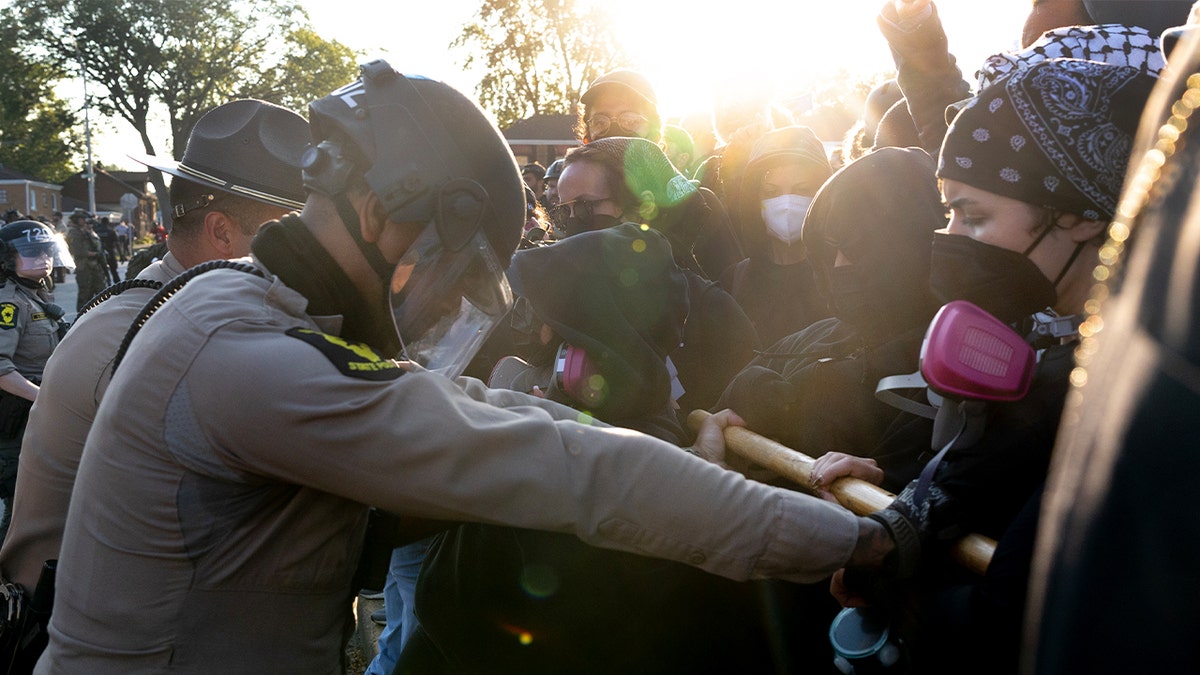
Police clash with demonstrators during a protest outside an immigrant processing and detention center on Oct. 03, 2025 in Broadview, Illinois. The site has been the target of frequent protests as federal law enforcement agents continue Operation Midway Blitz in the Chicago area, an operation designed to apprehend and deport undocumented immigrants living in the area. (Scott Olson/Getty Images)
Just a day before her arrest, she accused ICE of "terrorizing our communities" on a far-left podcast.
"I mean, in Broadview, ICE has been setting up shop in our backyard. Just brazenly taking up community resources to terrorize this very same community," she said.
She also put out a call for resistance, and lambasted those who she believes aren't taking extreme enough action.
"At this point, you are either on the side of protecting our neighbors and protecting our community, or you’re on the side of this administration. There is no neutral ground in this moment. There’s no center left. You’re either resisting or you’re complicit," she said.
At the Socialism 2025 conference earlier this year, she also slammed her employer.
"F--- the University of Chicago, it’s evil, you know it’s a colonial landlord. Like, why would I put any of my political energy into this space? I kind of had a little bit of disdain for people who spent their time doing that," she said on a panel during the far-left gathering.
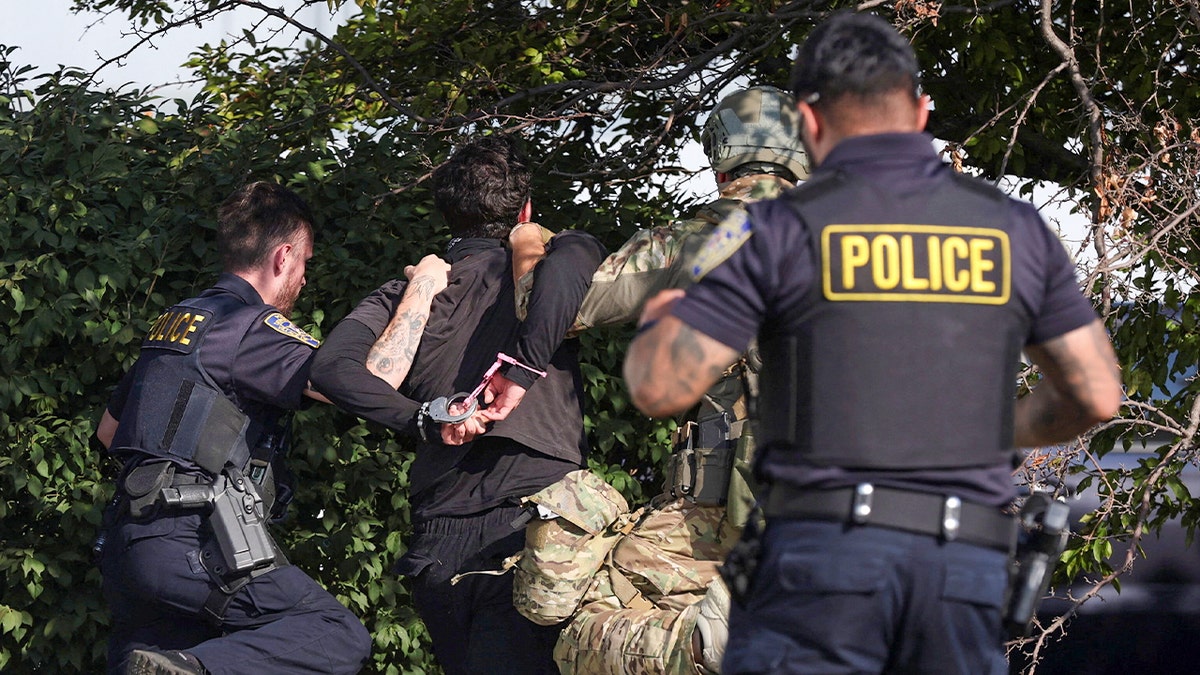
A demonstrator is detained as people protest outside the U.S. Immigration and Customs Enforcement (ICE) Broadview facility in Chicago, Ill., Oct. 3, 2025. (Jim Vondruska/Reuters)
LICK HERE TO GET THE FOX NEWS APP](//www.foxnews.com/apps-products?pid=AppArticleLink)
"Turns out, I work at one of the biggest employers in the city of Chicago. I work at a place that is a landlord, a healthcare provider, a police force, f--- that s---, but, they are, and a place where I have access to thousands of people that I could potentially organize… actually, this is where I need to build power. That’s possible structural leverage," she said.
The University of Chicago and Abdelhadi did not return comment requests.
Peter D'Abrosca joined Fox News Digital in 2025. Previously, he was a politics reporter at The Tennessee Star.
Follow Peter on X at @pmd_reports. Send story tips to peter.dabrosca@fox.com.
Related Topics
---
AN 9 25
The Los Angeles Times has reviewed a previously unreleased 28-page letter from the Trump administration to UCLA demanding an overhaul to adhere to a more conservative agenda and it's littered with grammatical and factual errors.
These demands, which include $1.2 billion fine over allegations of antisemitism and civil rights violations, also calls on the California university "to make public declarations that it has agreed to significant elements of President Trump’s vision of higher education."
The president, who has previously said he "loves the poorly educated," doubled down on that sentiment Sunday, saying, "smart people don't like me."
READ MORE:UK TV to air entire night dedicated to Trump's 'untruths' and 'distortions' ahead of visit
Adding fuel to that fire is the UCLA document, which, the LAT reports, "shows signs of being hastily put together."
Some of the more egregious errors besides the grammatical ones in which "nouns and verbs occasionally do not match in tense," are more factual, or, rather, lack thereof.
"There are references to the “president” of UCLA, but the top campus administrator, Julio Frenk, is a “chancellor," the LAT notes.
"A sentence about medical facilities references the “Feinberg School of Medicine,” which is at Northwestern University", not UCLA.
This isn't the first time the administration has shown why grammar and fact-checking matter.
In letters posted to his Truth Social account in July demanding world leaders sign on to his tariffs, Trump made an embarrassing error, according to the Daily Beast.
" Despite correctly referring to Željka Cvijanović, the Chairwoman of the Presidency of Bosnia and Herzegovina as “Her Excellency,” the letter to her begins with “Dear Mr President.”
In another Truth Social post in which he thanked the B-2 pilots who took part in the attack on Iran, Trump, in all caps, misspelled his own name as, " “DONAKD J. TRUMP, PRESIDENT OF THE UNITED STATES!”
More concerning that garden variety typos, however, is what The Guardiancalls "governing by mistake."
"Have we ever seen a more error-prone, incompetent and fumbling presidency? In their rush to implement a barely concealed authoritarian agenda, this administration is producing a litany of blunders, gaffes and slip-ups. At times, they’ll seek to hide those mistakes by projecting a shield of authoritarianism. At other times, they’ll claim the mistake as a method of walking back an unpopular authoritarian agenda item. Either way, it’s a unique style of rule, one that I call “rule by error," says The Guardian'sMoustafa Bayoumi.
---
AN 9 25
Citing state policy on tenure, elimination of diversity, equity, and inclusion initiatives, and the cost of living, Florida faculty laid out their frustrations in a recent survey.
In a Faculty in the South survey conducted by various conferences of the American Association of University Professors, 31% of Florida respondents said they have applied for a job outside of Florida since 2023. That number was 25% among all survey respondents in the South.
The same, 31% of Florida respondents, said they plan to seek employment in another state during the next hiring cycle.
“The governor of Florida threatens at every turn to take funding away so administration at colleges don’t stand up to him or board of education. I no longer have any motivation or creativity to make courses better,” a tenured professor at a public community college wrote.
The survey focused on policy affecting employment, including whether faculty would recommend working in their state to up-and-coming academics, and trends in applications for faculty positions. It included nearly 200 responses from Florida faculty among its nearly 4,000 responses across Alabama, Arkansas, Georgia, Kentucky, Louisiana, Mississippi, North Carolina, South Carolina, Tennessee, Texas, and Virginia.
The survey concluded with an open-ended question asking faculty to provide examples of how “attacks on higher education are directly impacting your work.” It did not report respondents’ identities beyond basic demographics like gender, race, tenure status, years of experience, and type of institution they teach at.
‘Walking on egg shells’
“Students report any classroom discussion they don’t like directly to the Governor’s office. Everyone is afraid all the time,” one woman teaching at a public four-year school wrote. “I have stopped teaching books that might be in any way controversial. I don’t open up general discussion in class but ask only direct questions that will elicit non-controversial answers. I need health insurance so I can’t just quit.”
The state scanning course materials for disfavored viewpoints was a widespread stressor for many faculty.
Florida DOGE to ‘deep dive’ into state universities, ‘prune’ ‘ideological study stuff’
“Most of the courses I’ve taught for decades now violate state and university mandates,” a man teaching at a Florida tier-one research university said.
As of earlier this year, Florida institutions’ general education courses no longer contained “indoctrinating concepts,” State University System Chancellor Ray Rodrigues proclaimed in January.
Florida universities have conducted a review, required by a 2022 law, of general education courses to ensure that they do not “distort significant historical events or include a curriculum that teaches identity politics.”
“I’m continually worried that the content of my clases [sic] will be flagged as “DEI” because I am a historian of the Caribbean, a region mostly populated by non-white people,” one professor said.
One women’s studies professor described the effect as “Constant anxiety, walking on egg shells trying to anticipate what would be used against me/us.”
More than a third, 34%, of Florida respondents said administrators have questioned syllabi or curricula choices for their courses. Among all states surveyed, half as many, 17%, indicated administrators questioned their curricula.
One professor said that since the state and federal government have made illegal “a wide range of Constitutionally protected components of speech and expression,” “I must break the law in order to tell the truth. Because I’m hired to tell the truth, and because I’m much more committed to the truth than to the law, I break the law. This means I am expecting to be arrested in front of a classroom any day, for actions that are illegal only as a result of the right-wing fad of the most recent decade.”
Nearly three in four, 71%, of faculty in Florida who were surveyed said they would not encourage a graduate student to seek employment in Florida.
“I am going to take early retirement despite a great job and salary. The threats are real and I am exhausted, between fighting this and fighting AI and poorly prepared, lazy, unethical students,” a tenured professor at a four-year public university wrote.
Higher education funding cuts have been the subject of nationwide political debate, including Florida State University reporting that it lost $100 million in federal grants, although $83 million of that has since been reinstated, the school’s president said last week.
About one-in-10, 11%, said they have had a federal contract ended by the Trump administration.
“The loss of vital federal grants has removed opportunities from me and my colleagues,” one professor wrote. “Attacks on LGBTQ students, immigrants, and diversity have also made it difficult to recruit promising graduate students or to guarantee their health and safety. Florida colleges being forced to remove diversity languages has destroyed years of valuable work, overturned an incredible general education curriculum, taken power and governance away from faculty, and wasted a lot of valuable time.”
Tenure troubles
Since 2023, professors in Florida with tenure have been subject to post-tenure review, graded on standards crafted by university trustees relating to research performance, teaching, service, and compliance with state laws and university policies.
Of the nearly-one-third who recently applied for an out-of-state job, tenure and DEI issues, academic freedom, the political climate, and cost of living were among the most common concerns.
Respondents said the number of applications for coworkers’ positions, as well as the quality of applicants, have decreased.
“Our department is trying to improve, but we have had several failed searches in recent years because candidates don’t want to move to Florida because of the broad political climate and the fact that tenure protections functionally no longer exist here,” a tenured public university professor said.
Some faculty said they have not experienced problems with “attacks on higher education,” one stating, “I haven’t felt any — Florida is great!.” Another said, “They’re not, and freedom in the classroom still persists, and I am at a public university in… wait for it… FLORIDA…”
“I find that I’m having to spend more time explaining to students why they need to use evidence to support their views and why clear arguments are important,” a professor at a private institution wrote.
One professor complained that “our board of trustees stacked with heritage foundation members, our president was forced out and replaced by a republican politician.” Course materials face heightened scrutiny, this professor added.
“The climate of persecution, retaliation, and ideological imposition makes it impossible to teach my discipline accurately or well without opening oneself to disciplinary measures,” that professor said. “While New College got a lot of headlines, similar invasions of public universities are happening with no national press, leaving those of us who work here isolated and vulnerable to attack.”
‘Academic freedom is on life support,’ say professors surveyed on tenure, censorship
Gov. Ron DeSantis orchestrated a shake-up of the University of West Florida Board of Trustees in a more conservative light earlier this year and that institution is now led by a former GOP lawmaker.
Results for the survey were collected throughout August and more than 60% of respondents said they are tenured. Last year’s iteration of the survey featured responses from about 350 Florida professors.
“There is a lower threshold of critical thinking because everyone is fearful about what is ‘allowed’ vs. ‘banned’ by law. The fear and the self-censorship is widespread. Our administration, now saddled with a governor-imposed, unqualified hire as a President, is understandably more cautious rather than vocal about protecting academic freedom,” one professor wrote.
---
---
note not xo?
an 8 25
Trump will sign a memorandum ordering colleges and universities to submit information on their admissions to ensure they are complying with a 2023 U.S. Supreme Court order banning affirmative action and gutting race-conscious admissions. The order would expand the current admissions data the government collects.
“Admissions data has increasingly become a focus of the Trump administration as part of its effort to change the ideological balance of the higher education system, which the president views as hostile to conservatives,” The New York Times reported.
Several Ivy League schools have agreed to hand over to the Trump administration certain admissions data, including “standardized test scores and grade point averages of all applicants, as well as information about their race, a measure that could profoundly alter the competitive college admissions process,” according to the Times.
READ MORE: Governor Wants Maps to Reflect State’s ‘Christian Conservative Majority’ Says GOP Lawmaker
The 2023 6-3 Supreme Court ruling banned public and private colleges and universities from considering race as a factor in its admissions decisions. Schools had said they needed to do so to protect the constitutional guarantee of equal protection, as Justice Sonia Sotomayor said in her dissenting opinion.
Bloomberg News called Thursday’s order “a new and expansive front” in the Trump administration’s “pressure campaign against colleges.”
Angel Perez, CEO of the National Association for College Admission Counseling, Bloomberg added, “said the data transparency mandate could drive institutions away from the kinds of holistic admissions practices that have helped them increase diversity on campuses.”
“The bottom line,” Perez said, “is that colleges that don’t admit enough White students will be punished.”
READ MORE: Trump Revives Constitutionally Conflicting Census Overhaul Plan
---
---
ink 7 25
After Columbia University deal, Trump Administration puts the screws on Harvard and other prominent universities.
In the wake of Columbia University’s $220 million settlement with the Trump Administration to restore federal funding, the Administration is now putting pressure on other universities around the country to make similar deals. Vox explains why Columbia’s agreement is a troubling blueprint for higher education as more schools face pressure from the Trump Administration to concede not just money but also federal oversight over programs and admissions that erode academic freedom and autonomy. Columbia also adopted the controversial IHRA definition of ‘antisemitism’ into its antidiscrimination policy, which lists criticism of the Israeli government as ‘antisemitic’ and
---
---
an 7 25
no lnx
One Trump court case will determine whether America will still have a democracy
Sabrina Haake, Raw Story July 26, 2025
Oral arguments were heard this week in Harvard v. Trump’s cross motions for summary judgment. Summary judgment, or “judgment on the papers,” means both sides agree on the facts but disagree on how the law applies to those facts.
Neither Harvard nor the Trump administration dispute that Trump made certain unprecedented written demands to the University, accompanied by unprecedented threats if they refused to comply.
Harvard refused to comply, and sued instead.
Whichever party loses summary judgment will appeal, and the final disposition will likely, eventually, come from the Supreme Court. If the high court’s republican majority further empowers Trump’s edicts under their misguided “unitary executive theory,” our 249 year history of ideological freedoms will come to an end and the nation will yield to Trump’s revenge.
Trump’s pressure campaign against Harvard
The Trump administration, ostensibly seeking to reduce campus antisemitism following widespread protests over Gaza, threatened to withhold billions in federal funding from Harvard, place a lien on University assets, and put academic departments in receivership, unless Harvard agreed to:
Exclusively promote faculty committed to Harvard’s mission and Trump’s viewpoints;
Submit the university to a Trump administration review of “viewpoint diversity;”
Scrutinize any “programs and departments” that might, in Trump’s judgment, fuel ‘antisemitic harassment;’
Submit all faculty to outside review for alleged ‘plagiarism;’
Submit to a comprehensive hiring and review audit conducted by the federal government;
Implement a comprehensive mask ban and suspend anyone who wears a mask;
Report to the federal government on any faculty members who “discriminated against” Jewish or Israeli students;
Screen student applicants to reject those with viewpoints “hostile” to Trump/ Israel’s policies;
Establish outside review for Harvard programs that reflect “ideological capture” ie, programs where classroom messaging does not reflect Trump-supportive dogma;
Diminish the influence of its own professors and faculty over the university; or
Establish “merit based” hiring and admissions policies that pleased the Trump administration.
The oral argument
Oral argument was both testy and basic. The lone DOJ lawyer arguing the motion, Michael Velchik, asserted that the administration “has the power to decide” where it will spend taxpayer money and that, “the government does not want to fund research at institutions that fail to address antisemitism to (the government’s) satisfaction.” According to Velchik, when Harvard refused to go along with Trump’s demands, Trump was free to terminate any and all contracts with the university.
Trump essentially argues that the federal government can terminate or withhold funds under a contract for any reason at all, even if that reason violates free speech, the right of free association, or any other rights protected under First Amendment.
Steven Lehotsky, Harvard’s counsel, countered that Trump’s attempts to control the University, including telling the University what it can teach and how it can teach it, represents Trump’s blatant “and unrepentant” violation of the First Amendment. The Supreme Court has long held viewpoint discrimination to be such a serious violation of the 1st A that it is treated as ‘presumptively unconstitutional.’ Lehotsky argued plainly that, “It’s the constitutional third rail, or it should be, for the government to insist it can engage in viewpoint discrimination.”
Trump has been consistent in his belief that he can punish speech and political conduct he doesn’t like, notwithstanding clear and unequivocal legal precedent to the contrary. He has applied the same strong-arm tactics to boardrooms and corporations, national media outlets, law firms, and, most recently, comedians. If the Roberts court continues to enable him, Trump will extend the same reasoning to imprison or otherwise punish anyone who criticizes him, following the same authoritarian playbook that produced such hits as Nazi Germany, Viktor Orban’s Hungary, and Putin’s Russia.
How does Trump tie withdrawal of medical research funding to the civil rights of Jewish people?
Even if Harvard allowed the expression of antisemitic views on campus—despite a strong Jewish presence among Harvard faculty—there still has to be some nexus, or some connection, between what the government is trying to fix (antisemitism) and the methods it uses to fix it. The judge went to the heart of this concept when she asked Trump’s counsel to explain the relationship between antisemitism and cutting off unrelated cancer research funding, noting that Trump is “not taking away grants from labs that have been antisemitic.”
An amicus brief filed in the case by Jewish scholars also points out that Trump routinely uses “antisemitism” as a ruse to attack freedom of speech, freedom of thought, and freedom of association. As noted in their amici brief, many Jewish scholars reject the notion that being Jewish “requires adherence to a specific conception of Zionism or support for the Israeli government or its policies and practices.”
Judge Burroughs noted that if Trump, or any federal administration, could punish a university without due process simply because they don’t like their politics, or their message, or the substance of their curriculum, the constitutional consequences would be “staggering.”
The outcome of Harvard v. Trump will determine whether we still have a democracy
Harvard v. Trump asks the most fundamental questions one can ask about the relationship between the government and the governed. Under the First Amendment, can the federal government control what is taught in the classroom and what is said on campus at various universities? Can the federal government withhold federal funds if it doesn’t like what it hears, or doesn’t agree with the viewpoints expressed?
If the answer is no, then our Constitution stands. Trump will join a 249 year line-up of presidents who have to grin and bear it when students call them ugly names and protest their policies. Who knows, Trump might even someday learn why the framers made free speech and association the very first amendment to the Constitution.
But if the answer is yes, the First Amendment will fall under the Roberts court, and there’s no reason to believe any other Constitutional protection will stand. Trump will forcibly insert his right-wing ideology onto campuses, boardrooms, and legacy media nationwide. That ideology will serve a madman’s lust for power and revenge, and America’s democracy will cease to exist.
Sabrina Haake is a columnist and 25+ year federal trial attorney specializing in 1st and 14th A defense. Her Substack, The Haake Take, is free.
---
---
AN 7 25
In its clash with Columbia University, the Trump administration is touting a historic $221 million settlement as a major triumph for conservative ideology—even though it had originally framed the case as a response to antisemitism on college campuses. On Thursday, Education Secretary Linda McMahon hailed the outcome as a “monumental victory for conservatives” while condemning “far-left-leaning professors.”
“Under the terms of the deal to resolve several federal probes into allegations that it had violated anti-discrimination laws,” CNN reported, “Columbia did not admit to wrongdoing but agreed to pay the government a $200 million settlement over three years and an additional $21 million to settle US Equal Employment Opportunity Commission investigations.”
Secretary McMahon, CNN added, “heralded the outcome as a ‘seismic shift in our nation’s fight to hold institutions that accept American taxpayer dollars accountable for antisemitic discrimination and harassment,'” and called it “a roadmap for elite universities that wish to regain the confidence of the American public by renewing their commitment to truth-seeking, merit, and civil debate.”
READ MORE: Tuberville: Dems Must ‘Lawyer Up’ for Plot to Make America ‘Communist’
Thursday morning on Fox News Business, Secretary McMahon offered a different explanation.
“I think that this is a monumental victory for conservatives who’ve wanted to do things in these elite campuses for a long time, because we had such far-left-leaning, you know, professors, and we had 27% of the students that are coming in, you know, are from outside of the United States,” McMahon told host Maria Bartiromo. She noted that the 27% was a statistic from Harvard.
“I’m really pleased with this victory,” McMahon continued. “It wouldn’t have happened if Donald Trump were not president, then I’m really pleased to execute his vision for this, that our campuses are now, what they should be. They are places for debate, they are places for education.”
“They’re not places for left-leaning riots and antisemitism, and I’m really pleased with this result.”
Amy Spitalnick, CEO of the Jewish Council for Public Affairs, wrote in response to McMahon’s remarks: “This is about advancing an extreme agenda.”
READ MORE: GOP Congressman: ‘Round Everybody Up and Deport Them All’
“This administration,” Spitalnick said, “continues to exploit real concerns about antisemitism to undermine our core democratic norms & institutions. This is not about keeping Jews safe — if it were, they wouldn’t have gutted OCR [Office for Civil Rights] & other key protections.”
Constitutional law professor and political scientist Anthony Michael Kreis warned, “Columbia has now allowed itself to be regulated by a deal. A complete capitulation to the state, yielding their academic freedom to select their students, appoint their faculty, and adopt their curriculum. The Fellows of Magdalen College had more courage against James II in 1687.”
Jordan Acker, who serves on the University of Michigan’s Board of Regents noted:
“Three things can be true here: -Campus faculty, especially in the humanities, needs reform -Antisemitism is a problem on campus -Trump simply cares about destroying higher ed. One and two are fixable. The third is a dire threat to the American way of life and must be fought.”
Watch the video below or at this link.
---
---
AN 7 25
The Trump regime’s battle with Harvard University will be aired in court today when a federal judge hears arguments in Harvard’s lawsuit challenging Trump’s attack on it.
At stake is not just $2.2 billion in grants for scientific research, but the larger question of whether Trump can impose his agenda on independent universities in America — forcing them to bring their admissions, disciplinary procedures, academic hiring, and curricula in line with his priorities.
With the Trump regime ramping up its attacks on colleges and universities across America — using the pretexts of “DEI,” antisemitism, and transgender athletes to undermine academic freedom — it would seem more important than ever for universities to join together to stop him.
There is strength in solidarity. If each college and university seeks only to protect itself, the dictator-in-chief can pick off one after another — as he’s trying to do with law firms, the media, judges, and every other institution of civil society.
Which brings me to Dartmouth College.
I graduated from Dartmouth in 1968. It gave me a wonderful education. I was also a Dartmouth trustee in the 1980s when its president, James O. Freedman, who was Jewish, endured the antisemitic barbs of an ascendant right-wing student group that included such people as Laura Ingraham, Dinesh D’Souza, and Harmeet Dhillon.
Now, Dartmouth is headed by Sian Beilock, who has turned Dartmouth into a Trumpy academic outpost.
Beilock declined to join more than 600 other academic institutions —including all of Dartmouth’s Ivy League peers — in signing a letter in defense of Harvard, which proclaimed “one voice against the unprecedented government overreach and political interference now endangering American higher education.”
This March, as Trump escalated his threats against universities, Beilock hired the former top lawyer at the Republican National Committee, Matt Raymer, as the college’s general counsel. (Raymer is a Dartmouth alumnus who, as recently as January, argued in a conservative online publication called The Federalist that Trump was right about birthright citizenship.)
Around the time Beilock declined to sign the letter defending Harvard, Beilock met with Harmeet Dhillon, Trump’s recently confirmed assistant attorney general for civil rights, who posted on X after their meeting: “I was so impressed to learn how Dartmouth (my alma mater) is getting it right, after all these years. Kudos to Dartmouth!”
In 1988, as editor of The Dartmouth Review, Dhillon became momentarily notorious for publishing a column depicting Dartmouth’s then president Freedman as Adolf Hitler under the headline “Ein Reich, Ein Volk, Ein Freedmann” — a play on a Nazi slogan, “One Empire, One People, One Leader,” but substituting and misspelling Freedman’s name for “Fuhrer.”
Using the analogy of Nazi Germany and the Holocaust, the column satirically described how “Der Freedmann” and his associates rid the campus of conservatives. The column referred to the “‘Final Solution’ of the Conservative Problem” and to “survivors” of the Dartmouth “holocaust” and described Dartmouth conservatives being “deported in cattle cars in the night.”
A drawing on the cover of the following issue, on October 26, also depicted Freedman, who had been critical of The Review, as Hitler.
As I said, I was a trustee of Dartmouth at the time. I saw up close how much Dhillon’s publication hurt Freedman. The student newspaper The Dartmouthtook The Reviewto task: “The column is anti-Semitic; its impact rings through this community today and will remain long after its publishers have completed their stints in Hanover.”
Several faculty members wrote to outside advisers of The Review, asking them to reconsider allowing their names to be associated with the publication. The regional office of the Anti-Defamation League of B’nai B’rith, in Boston, condemned the column.
Now, twenty-seven years later, as assistant attorney general for civil rights, Dhillon is investigating most of the Ivy League for antisemitism. Notably, she is not investigating Dartmouth.
Dartmouth has so far avoided the sort of threats Trump has leveled against Harvard, which are being litigated today. In fact, Dartmouth is the only Ivy aside from Yale to escape targeted attacks to its funding.
Presumably that’s because Beilock has appeased Trump, at least for now.
This week’s New Yorker contains a piece by Rob Wolfe titled “How Dartmouth Became the Ivy League’s Switzerland.” I don’t think the analogy holds. Dartmouth isn’t like Switzerland, which stayed neutral in World War II. It’s more like Neville Chamberlain’s Great Britain just before the war, which sought to appease the tyrant.
As the world painfully learned, tyrants can’t be appeased. Tyrants view appeasement as weakness, and always want more.
Were it not for FDR’s United States and Winston Churchill’s Britain, Hitler might have won, and both Dartmouth and Harvard might now be teaching Nazi versions of history, science, and everything else.
Which is why Sian Beilock gets this week’s Neville Chamberlain award.
---
---
mma
lie about medicare cuts BBB
Laura Ingraham says American universities have “sold their souls to the CCP”
06/03/25
---
---
an 6 25
We speak with esteemed historian scholar Ellen Schrecker about the Trump administration’s assault on universities and the crackdown on dissent, a climate of fear and censorship she describes as “worse than McCarthyism.”
“During the McCarthy period, it was attacking only individual professors and only about their sort of extracurricular political activities on the left. … Today, the repression that’s coming out of Washington, D.C., it attacks everything that happens on American campuses,” says Schrecker. “The damage that the Trump administration is doing is absolutely beyond the pale and has never, never been equaled in American life with regard to higher education.”
Schrecker is the author of many books about the McCarthy era, Cold War politics and right-wing attacks on academic freedom. Her recent piece for The Nation is headlined “Worse Than McCarthyism: Universities in the Age of Trump.”democracynow.org
AMY GOODMAN: President Trump’s crackdown on academic institutions in the United States was the focus of protests and commencement speeches this week as universities like Harvard held commencement ceremonies.
The Trump administration has now directed federal agencies to review all remaining contracts with Harvard, after it already canceled nearly $3 billion in federal research grants for the university and moved last week to revoke its ability to enroll international students. Harvard has two separate suits pending against Trump, arguing the moves violate due process, as well as free speech protections under the First Amendment because they target the university’s staff, curriculum and enrollment.
In his address at Harvard’s commencement ceremony Thursday, Stanford University professor, doctor and novelist Abraham Verghese praised the school’s defiance of Trump and spoke to students facing threats of deportation or having their visas revoked.
DR. ABRAHAM VERGHESE: When legal immigrants and others who are lawfully in this country, including so many of your international students, worry about being wrongly detained and even deported, perhaps it’s fitting that you hear from an immigrant like me. Perhaps it’s fitting that you hear from someone who was born in Ethiopia when it was ruled by an emperor, someone who then lived under the harsh military leader who overthrew the emperor, someone who had at least — who had at least one his medical school classmates tortured and disappear. … More than a quarter of the physicians in this country are foreign medical graduates. … So, a part of what makes America great, if I may use that phrase, is that it allows an immigrant like me to blossom here, just as generations of other immigrants and their children have flourished and contributed in every walk of life, working to keep America great.
AMY GOODMAN: That’s the novelist and medical doctor, Ethiopian Indian American, Dr. Abraham Verghese addressing Harvard’s commencement ceremony on Thursday. His latest book, The Covenant of Water.
Meanwhile, down the road in Cambridge, the Indian American class president at MIT, the Massachusetts Institute of Technology, spoke about how MIT’s undergraduate body and Graduate Student Union had voted overwhelmingly to cut ties with Israel. Megha Vemuri wore a red-and-white keffiyeh and said MIT students would never support a genocide, and praised them for continuing to protest despite, quote, “threats, intimidation and suppression coming from all directions, especially,” she said, “your own university officials.”
MEGHA VEMURI: Last spring, MIT’s undergraduate body and Graduate Student Union voted overwhelmingly to cut ties with the genocidal Israeli military. You called for a permanent cease fire in Gaza, and you stood in solidarity with the pro-Palestine activists on campus. You faced threats, intimidation and suppression coming from all directions, especially your own university officials. But you prevailed, because the MIT community that I know would never tolerate a genocide.
Right now while we prepare to graduate and move forward with our lives, there are no universities left in Gaza. We are watching Israel try to wipe Palestine off the face of the Earth, and it is a shame that MIT is a part of it. The Israeli occupation forces are the only foreign military that MIT has research ties with. This means that Israel’s assault on the Palestinian people is not only aided and abetted by our country, but our school. As scientists, engineers, academics and leaders, we have a commitment to support life, support aid efforts and call for an arms embargo and keep demanding now, as alumni, that MIT cuts the ties.
AMY GOODMAN: That was MIT class president Megha Vemuri, now Indian American graduate of MIT.
This comes as Jelani Cobb, the dean of Columbia University’s Graduate School of Journalism — another school facing attacks by the Trump administration — writes for The New Yorker magazine this week about how, quote, “Academic freedom in the United States has found itself periodically under siege.” In his piece headlined “A Tumultuous Spring Semester Finally Comes to a Close,” he describes how he consulted with Ellen Schrecker, a historian and the author of No Ivory Tower: McCarthyism and the Universities, along with other deans at Columbia. They spoke about government repression on college campuses in the 1950s through to the present. Schrecker told him, quote, “I’ve studied McCarthyism’s impact on higher education for 50 years. What’s happening now is worse,” he quoted her saying.
Well, we begin today with Ellen Schrecker in person, joining us in our New York studio. She’s the author of Many Are the Crimes: McCarthyism in America, No Ivory Tower: McCarthyism and the Universities. Schrecker is also the author of The Right to Learn: Resisting the Right-Wing Attack on Academic Freedom. And she just wrote a piece for The Nation headlined “Worse Than McCarthyism: Universities in the Age of Trump.” Schrecker has been active in the American Association of University Professors, AAUP, since the 1990s. I should note she has three degrees from Radcliffe Harvard and formerly taught there. She’s a graduate of Radcliffe 1960.
Ellen Schrecker, welcome to Democracy Now! It’s great to have you with us. As we look at these universities under attack, you’ve studied higher education for over half a century. Let’s talk about what was happening then and what’s happening today.
ELLEN SCHRECKER: OK. The main thing that happened then to universities was that about a hundred faculty members, most of them with tenure, were fired and blacklisted. That happened in every major institution of civil society within the United States. And although the universities pride themselves on academic freedom — whatever that means — they collaborated with the forces of repression through — that were actively imposing a climate of fear and self-censorship throughout American society.
Today, what’s happening is worse, so much worse that we have to really find a new phrase for it. I don’t know what it’ll be. But during the McCarthy period, it was attacking only individual professors and only about their sort of extracurricular political activities on the left, in the past and in the present, then present. Today, the repression that’s coming out of Washington, D.C., it attacks everything that happens on American campuses.
AMY GOODMAN: I’d like you to start off — we have a very young audience. We also have their parents and their grandparents around the world. And I’d like you to start off by talking about who McCarthy is. What do we mean by the McCarthyism of, for example, the 1950s?
ELLEN SCHRECKER: OK, that’s a very good way to start, because McCarthyism, unfortunately, is misnamed. It is not just the career of Senator Joseph McCarthy, who came in onto the stage of history in 1950 after the “ism” that he gave his name to had been really dominating American domestic politics since the late 1940s. ’47 is when the Truman administration imposed a loyalty test, an anti-communist loyalty test, on its employees.
So, if we wanted to name this phenomenon of political repression, anti-communist political repression — and I want to specify that it didn’t attack randomly people on the left, but very specifically people who had some kind of connection, usually in the past, with the communist movement, that during the 1930s and ’40s was the most dynamic force on the left, even though it was a very flawed, very flawed political group. It was nonetheless very influential on the left. And if we wanted to give that political repression of the 1940s and ’50s a name, it should have been Hooverism, after the FBI Director J. Edgar Hoover.
AMY GOODMAN: You know, the movie Good Night and Good Luck, they showed real black-and-white footage of McCarthy, and test audiences thought he was too harsh, unrealistic, not realizing it was actual footage. And now you have Good Night and Good Luck on Broadway, George Clooney starring in it, and it is the financially most successful Broadway show we’ve seen, is going to be now for free on CNN in a few days. But the significance of that, that that — what people feel today was a cartoon character was, in fact, much harsher and sharper than people ever dreamed?
ELLEN SCHRECKER: Yeah, he was beyond the pale, because, like the current president, he had no guardrails, as it were.
AMY GOODMAN: Not to mention Roy Cohn, his sidekick in the hearings, who would later go on to mentor Donald Trump, until, at the very end of his life, Donald Trump rejected him when he was dying of AIDS.
ELLEN SCHRECKER: Exactly. So, there are lots of similarities with the fact that there’s this very aberrant character at the heart, or at the sort of public heart, of this repressive movement. But what we should have known in the '40s and ’50s, and should know now, is it's not just a one-man show. It has been this moment of trying to crack down on dissent, constitutional dissent, free speech, the ability to say what Israel is doing in Gaza is a terrible thing. That is something that has been building up for decades. And that was the same thing during McCarthyism. There was a kind of network of right-wing activists, similar to groups today, like the Heritage Society, that brought us the 2025 Project blueprint for Trump’s attack on the institutions of civil liberties and civil society, that has come to fruition since he entered the White House.
AMY GOODMAN: So, I mean, you speak as a Jewish author, active member of the American Association of University Professors. Would you say that the McCarthyism of yesteryear is the charges that President Trump, with his sidekick Elon Musk giving the “Heil Hitler” salute, charging antisemitism for what he’s doing?
ELLEN SCHRECKER: Antisemitism is a pretext. We know that. Trump has been all his life a racist, clearly befriending these fascist individuals and groups for years. And what we’re seeing is a kind of a melding of Trump’s own right-wing proclivities, reactionary proclivities, pro-fascist proclivities, with a long-term attempt within some pro-Zionist organizations to eliminate all support for Palestinian freedom and Palestinian liberation from American universities, in particular, but from within American society.
AMY GOODMAN: You have, earlier this month, a federal judge, Geoffrey Crawford, ordering the release of Columbia University graduate, Palestinian activist Mohsen Mahdawi from a prison in Vermont. He was picked up by masked, hooded ICE agents at his naturalization interview in Vermont. He was beyond holding a green card. The judge writing in his ruling, quote, “Our nation has seen times like this before, especially during the Red Scare and Palmer Raids of 1919-1920” and during the McCarthy period of the 1950s. And I wanted to take it beyond that. You note that, you know, that we’re not just talking about individual professors anymore. We’re talking about current attacks being much broader. And you write that — this interesting paradox, quote, “despite higher education’s much larger footprint within American society, today the academy is in a much weaker position to resist political intervention.” Why is it weaker?
ELLEN SCHRECKER: It’s weaker for two reasons. One, because the state is stronger. The state does much more with regard to higher education than it did in the 1950s. You know, it supports most important basic scientific research. It regulates things on campus with regard to, shall we say, diversity, equity and inclusion, with trying to ensure that all Americans have a good shot at higher education. That was a push by the federal government. So, you can see that the government is much more involved. It funds student loans. Most smaller universities without huge endowments rely on students who have to get federal loans in order to pay tuitions. So, what he’s doing by withdrawing federal money from higher education is, essentially, threatening to destroy American higher education today.
AMY GOODMAN: I wanted to turn to the clip of Secretary of State Marco Rubio speaking in March following the arrest of the Columbia graduate student, now graduated graduate student, albeit he was in jail in Louisiana when he got his diploma at Columbia, Mahmoud Khalil.
SECRETARY OF STATE MARCO RUBIO: If you tell us, when you apply, “Hi. I’m trying to get into the United States on a student visa. I am a big supporter of Hamas, a murderous, barbaric group that kidnaps children, that rapes teenage girls, that takes hostages, that allows them to die in captivity, that returns more bodies than live hostages,” if you tell us that you are in favor of a group like this, and if you tell us when you apply for your visa, “And by the way, I intend to come to your country as a student and rile up all kinds of anti-Jewish student, antisemitic activities. I intend to shut down your universities,” if you told us all these things when you applied for a visa, we would deny your visa. I hope we would. If you actually end up doing that, once you’re in this country on such a visa, we will revoke it. And if you end up having a green card — not citizenship, but a green card — as a result of that visa while you’re here and those activities, we’re going to kick you out.
AMY GOODMAN: Of course, the Trump administration not proven any of this. And a number of students have been released from prison, with very angry judges talking about “Where are the grounds for these people to be imprisoned?” Mahmoud Khalil has been now imprisoned for three months as his little baby was born here in New York. If you can talk about what this leads to, these kind of harsh attacks, when it comes to speech and when it comes to universities? You were just addressing the deans at Columbia University. Some compare Harvard not fighting — Harvard fighting back against the Trump administration, and Columbia conceding, and the pressure it’s put on its students.
ELLEN SCHRECKER: Yeah, this has been a constant in the history of American higher education to collaborate with political repression. They, universities, do not fight back. They didn’t fight back during the McCarthy period. They’re not — were not fighting back, until this miracle. It really was a miracle, totally unexpected, of the president at Harvard saying, “No, I cannot go along with what you were asking.” And what they were —
AMY GOODMAN: The Jewish president at Harvard, right?
ELLEN SCHRECKER: He’s Jewish, right.
AMY GOODMAN: Alan Garber, who President Trump is accusing of antisemitism.
ELLEN SCHRECKER: Well, of course, we’re all antisemites, as long as we feel that maybe you shouldn’t be killing babies in Gaza every day.
But what we’re seeing is the beginning of a pushback against what Trump is doing, what his entire apparatus of hoodlums, I think, is trying to do to the universities. And that wonderful quote you had from Secretary of State Rubio, when he said, you know, paraphrasing these supposed terrorists, that they wanted to shut down the universities, he’s doing more to shut down the universities than probably anybody else in America at this moment.
AMY GOODMAN: Threatening to revoke the visas of all —
ELLEN SCHRECKER: Exactly.
AMY GOODMAN: — international students. What about the role of your organization, the AAUP, the American Association of University Professors?
ELLEN SCHRECKER: Right. We are a group that is over a hundred years old. And when we were founded, it was a period very much like today, where outsiders, politicians and especially very wealthy businesspeople on boards of trustees, were interfering with what faculty members were saying and doing with regard to — at that point, there was a lot of labor unrest and attempts to create unions. And university professors were sort of saying, “Well, look at the working conditions under which American workers are being oppressed. Let’s do something about industrial accidents and things like that.” Today, we’re seeing that, in every way, the federal government, state legislators interfering with the academic work of university professors. And that is what my organization is trying to do, is to protect the integrity and the educational value of what goes on on American campuses.
AMY GOODMAN: Do you hold out hope, in this last minute we have together?
ELLEN SCHRECKER: Yes, because, unfortunately, we have no model we can follow from McCarthyism, because there was no pushback, but today we’re seeing people marching to commencement at Harvard wearing labels saying, you know, “Enough is enough, President Trump. “We’re seeing huge crowds showing up to welcome Mohsen coming back from Vermont after having been picked up by ICE.
We’re seeing a growing movement within civil society, that has to be maintained, and has to be maintained for years. I mean, the damage that the Trump administration is doing is absolutely beyond the pale and has never, never been equaled in American life with regard to higher education. So, we’ve got to get out there in the trenches and even begin to think some more about: OK, if they’re not paying attention to the judges, if the Supreme Court folds — and let us pray that it does not — what do we have to do?
AMY GOODMAN: We’re going to have to leave it there, Ellen Schrecker, author of Many Are the Crimes: McCarthyism in America, No Ivory Tower: McCarthyism and the Universities, also the author of The Right to Learn: Resisting the Right-Wing Attack on Academic Freedom. We’ll link to your piece in The Nation headlined “Worse Than McCarthyism: Universities in the Age of Trump,” as well as Jelani Cobb’s piece in The New Yorker that extensively quotes you, Ellen Schrecker, at democracynow.org.
---
---
anti-sem BS politico
...Harvard isn’t the only school facing the administration’s ire. Terrell’s task force in February announced a list of 10 institutions that it planned to investigate for allegedly allowing antisemitism on their campuses. In addition to Harvard, the universities include: Columbia; George Washington; Johns Hopkins; New York University; Northwestern; the University of California, Berkeley; the University of California, Los Angeles; the University of Minnesota; and the University of Southern California.....
---
AN 5 25
New York Magazine columnist Ross Barkan urged against Americans bolting to the shores of foreign nations to escape Trump’s many attacks on civil liberties.
“[F]leeing the U.S. isn’t the answer,” said Barkan. “This is not the Vietnam War, when young men of draft age fled to Canada to avoid dying in an unpopular conflict thousands of miles away. … Fleeing is a cheap, ego-flattering maneuver; it helps no one.”
READ MORE: Inside MAGA's real motive for trying to destroy America
“Death camps are not being constructed, and opposition political parties are not being outlawed. This isn’t Xi’s China, Putin’s Russia, or Viktor Orbán’s Hungary. America is, for all its flaws, a republic that has lasted more than 200 years,” Barkan said. “In nations bereft of any genuine democratic traditions — or those, like Hungary, that are quite small in population — versions of fascism are possible. But it’s very hard, despite the claims made by these histrionic academics, for it to actually happen here.”
Fascism “has happened here: in bursts, over and over again,” Barkan concedes, referring to former president Franklin Roosevelt tossing Japanese Americans into internment camps, and Abraham Lincoln suspending habeas corpus. Woodrow Wilson, a segregationist who appointed racist Southern politicians to cabinet positions, ordered the arrests of thousands of left-wing immigrants. And then there’s the rampant destruction of the House Un-American Activities Committee, and J. Edgar Hoover’s “long reign at the FBI” and “George W. Bush’s surveillance state.”
Barkan referenced three prominent Yale professors who announced with much fanfare they were emigrating the United States for positions at the University of Toronto to escape Trumpism.
“If every left-leaning American adopted the posture of the Yale academics and trundled abroad, the nation would be hollowed out, with MAGA left to pick over its carcass,” he points out. “The U.S. is larger than MAGA and Trump and will outlast him. Trump is unpopular, and his party will not control the federal government in perpetuity. There are more elections to come, and Republicans could very well lose many of them. And the destruction Trump has wrought on the federal bureaucracy can eventually be undone: Executive orders, unlike legislation, are easy enough to reverse.”
READ MORE:'Going to get worse': Conservative says Trump's biggest power now 'slipping away from him'
Read the full New York Magazine column here.
---
---
an 5 25 the conv
In the most non-controversial and basic sense, the rule of law means formal legality. The law binds citizens and governments. When it comes to nation states, law is enacted by democratically elected legislatures; legal statutes are openly available and sufficiently clear to follow. State actions can be judicially reviewed for compliance with a constitution.
In its more ambitious conceptualization, the rule of law can also be understood to include substantive human rights and equity. In Canada, The Constitution Act of 1982 references the rule of law in its preamble.
The modern Canadian iteration of the rule of law — which includes substantive ideas about human rights as well as Indigenous treaty rights — is based on liberal ideas shared by many countries, including, historically, the United States. What distinguishes a rule-of-law state from an authoritarian one to a large extent is whether state actions can be judicially reviewed for compliance with a constitution.
Although rule of law scholars debate the parameters of the concept of the rule of law, few would debate that what is happening during U.S. President Donald Trump’s second term presents anything other than a wholesale attack on the rule of law both domestically in the U.S and internationally.
I am a rule of law researcher, educator and lawyer. Since Trump was elected to his first term in 2016, I’ve relied on American scholars, from a variety of disciplines, to understand what is happening.
These include two prominent Yale professors, philosopher Jason Stanley and historian Timothy Snynder, both of whom have recently announced they’re moving to the Munk School of Global Affairs at the University of Toronto.
Authoritarian impulse
In their scholarship, Stanley and Snyder have sought to explain the authoritarian impulses of the first Trump administration and how to resist it.
Stanley’s father, a German Jew who fled Germany for America in 1939, carries the remembrance of fascism.
Both Stanley and Snyder explore the similarities between what is occurring in Trump’s America, Viktor Orban’s Hungary, Vladimir Putin’s Russia, Xi Jinping’s China and, equally chillingly, between Trump’s America and Adolf Hitler’s Germany. Even prior to the first Trump presidency, Stanley already asked in his 2015 book, How Propoganda Works, whether the U.S., “the world’s oldest liberal democracy,” might already have become a liberal democracy “in name only?”
Examination of propaganda, rhetoric
In his 2018 book, The Road to Unfreedom: Russia, Europe, America, Snyder described Trump as a “sado-populist, whose policies were designed to hurt the most vulnerable people of his own electorate.”
Stanley’s focus on propaganda and rhetoric were especially useful for framing the politics of Trump.
Similarly, Snyder’s focus on the similarities between Trump and other authoritarian leaders, through their attachment to extreme illiberal ideologies, helped frame public discourse in the U.S. during the first Trump presidency. “Illiberal” does not imply conservative in opposition to “being liberal” (with the resonance of “leftist”); rather, it denotes a repudiation of liberal democracy, in the words of political scientist Thomas J. Main.
Both Stanley and Snyder are on the public record explaining their decision to immigrate to Canada, on the basis that they can no longer continue their scholarly activities in an American university, even a premier one like Yale. Jason Stanley speaks with Amanpour and Company.
Improper interference
This is an admission by important thinkers that civil society, intellectuals and critical scholars, in particular, are under assault.
It comes as no surprise given other developments. Trump’s executive orders, threats to some university funding and crackdowns on activists and academics — as well as the attempted deportations of those without U.S. citizenship — have used the idea of combatting campus antisemitism as cover for an attack on free expression, academic independence and student activism.
From my perspective as a Jewish person, a post-secondary teacher and as someone with a legal education, all of these developments have hit hard, especially alongside accounts of some of America’s most prestigious law firms caving to improper interference by the Trump administration.
What ‘fascism’ means
In the introduction to his bestselling 2020 book, How Fascism Works, Stanley wrote: “In recent years, multiple countries across the world have been overtaken by a certain kind of far-right nationalism; the list includes Russia, Hungary, Poland, India, Turkey and the United States.”
He explains the choice of the word “fascism” to speak about each of these countries, despite their differences of degree and context:
“I have chosen the label ‘fascism’ for ultra nationalism of some variety (ethnic, religious, cultural), with the nation represented in the person of an authoritarian leader who speaks on its behalf. As Donald Trump declared in his Republican National Convention speech in July 2016, ‘I am your voice.’”
In his similarly bestselling book, On Tyranny, published in 2017, Snyder wrote: “To abandon facts is to abandon freedom. If nothing is true, then no one can criticize power, because there is not basis upon which to do so. If nothing is true, then all is spectacle. The biggest wallet pays for the most blinding lights.”
Now that Trump is back in office, Stanley and Snyder, as well as Snyder’s Yale colleague and spouse, Marie Shore, the celebrated author of The Ukrainian Night, are leaving Yale for Canada with good reason. Author Timothy Snyder speaks about Democracy and the Risk of Tyranny with Public Policy Forum.
Shared mutual concern
While the departure of a handful of prominent academics is hardly a trend, it raises questions about whether there will be an accelerated academic “brain drain”, or more American students in Canada.
As a Canadian, I would like to say America’s loss is our gain, and I wish these scholars well. I am also aware that narratives of flight to Canada as refuge have historically bolstered national myths while obscuring Canadian inequities. My hope is that Canadians will not observe the arrival of U.S. scholars with smugness, but instead with shared concern.
We should not be blind to this unique moment in which Canada is called to revisit why we care about Canada and keep watch on the rule of law. Yet, we must also recognize our own profound historical blind spots.
For example, while an overt threat to sovereignty is new for some Canadians, it is nothing new for Canada’s Indigenous Peoples. Today it’s important to understand the distinctively Canadian importance of Indigenous law to any reaffirmation of the rule of law tradition in Canada in the 21st century.
Too much cynicism might prevent us from acknowledging the importance of these three scholars’ decisions to leave their country and come to ours at this particular time in history. However, my hope is also that we are also inspired by their considerable truth-telling skills to demand Canada also do better.
Jeffrey B. Meyers, Instructor, Legal Studies and Criminology, *Kwantlen Polytechnic University
This article is republished from The Conversation under a Creative Commons license. Read the original article.
---
what set off new retaliation? other colleges follow lead?
an 525
Harvard University pushed back forcefully Friday after President Donald Trump declared in a social media post that "we are going to be taking away Harvard Tax Exempt Status," adding that is "what they deserve."
Trump's comment came just hours after Democratic senators sent a letter demanding a probe into whether the administration is acting illegally by trying to compel the U.S. Internal Revenue Service to yank the university's tax exemption.
Trump's post did not specify whether the IRS, the entity that has the power to remove an organization's tax-exempt status, is opting to remove Harvard's designation. Multiple outlets noted they got no immediate response from the IRS when they asked the agency for comment.
"There is no legal basis to rescind Harvard's tax-exempt status," a university spokesperson said in a statement, according toPolitico. "Such an unprecedented action would endanger our ability to carry out our educational mission."
It is illegal for the president, vice president, or other top officials to request, indirectly or directly, that the IRS audit a particular taxpayer.
Senate Minority Leader Chuck Schumer (D-N.Y.) and multiple other Democratic senators on Friday asked the Acting Treasury Inspector General for Tax Administration (TIGTA) to probe whether the IRS has received illegal pressure from the administration when it comes to Harvard, and to provide information about whether the agency is looking into other entities at the direction of the president or other top officials.
"It is both illegal and unconstitutional for the IRS to take direction from the president to target schools, hospitals, churches, or any other tax-exempt entities as retribution for using their free speech rights," the senators wrote in a letter dated Friday to the Acting TIGTA Heather Hill.
"It is further unconscionable that the IRS would become a weapon of the Trump administration to extort its perceived enemies, but the actions of the president and his operatives have now made this fear a reality. We request that you review whether the president or his allies have taken any step to direct or pressure the IRS to take politically-motivated actions regarding the tax-exempt status of the president's political targets," they continued.
Loss of tax-exempt status, something that would only typically occur after an audit process that allows the university opportunity to defend itself and appeal, would be extremely significantfor the university. Tax-exempt status means the school does not pay federal income tax on charitable contributions to the school and other income. It also means that donations to the school are tax-exempt for those who make them.
Trump mused publicly on April 16 that Harvard should lose its tax-exempt status, after the university's president said the institution would not comply with a list of policy demands from the president, that included, according to the Harvard Crimson, derecognizing pro-Palestine student groups and auditing academic programs for viewpoint diversity. The pushback from Harvard prompted the administration to freeze over $2 billion in federal funding for the school.
That same week, it was reported that the IRS was making plans to revoke Harvard's tax-exempt status.
In response to Trump's bullying tactics, Harvard sued the administration, calling the freeze on funding unlawful and asking the court to restore it.
The tangling between Harvard and the Trump administration is part of a broader wave of scrutiny by the White House on higher education.
---
---
BS
realclear invest links to EID?!
no docs
https://eidclimate.org/failure-to-disclose-new-report-exposes-academics-with-financial-ties-to-law-firms/
no lnx see realclear invest
FAILURE TO DISCLOSE: NEW REPORT EXPOSES ACADEMICS WITH FINANCIAL TIES TO LAW FIRMS
MAY 24, 2021| WILLIAM ALLISON
Just a week after the bombshell admission that a Harvard academic is working under a retainer agreement with a top plaintiffs’ attorney firm without any previous disclosure,a new report puts the spotlight on this practice happening at universities across the country.
The report, “Private Funders, Public Institutions: ‘Climate’ Litigation and a Crisis of Integrity,” published by [NOT THE REAL] Government Accountability & Oversight, P.C. (GAO), uncovers the coordination taking place between public officials, activist organizations, wealthy donors, and university faculty to bring climate change-related cases against energy companies, with a specific focus on the lawsuit filed by Minnesota Attorney General Keith Ellison in June 2020.
Why the Naomi Oreskes-Sher Edling Retainer Presents Multiple Conflicts of Interest
The GAO report’s release couldn’t have come at a more apt time. Earlier this month, news broke that Harvard professor and longtime climate litigation activist Naomi Oreskes is on retainer with Sher Edling, LLP, the environmental plaintiffs’ law firm representing the majority of municipalities and states, including Minnesota, that have filed climate change lawsuits against the energy industry in recent years.
When Oreskes and fellow Harvard researcher Geoffrey Supran released a new study focused on climate change communications (that was just as flawed as their previous work), they did not seem prepared for the news that Oreskes is on retainer with Sher Edling to break. Notably, this wasn’t disclosed via a game of telephone, either, but Oreskes herself said so while under oath in a recent deposition.
It now appears that Oreskes sought to redefine her business relationship with Sher Edling after it hit the press, as she and Supran provided several different explanations to reporters when asked about her retainer disclosure. While Oreskes may be uncertain about the nature of her involvement with Sher Edling and its implications, others are not.
Academics took to Twitter to point out that this relationship should absolutely been disclosed:
A significant (an undisclosed) conflict of interesthttps://t.co/IPX2PgtsJ8
— Judith Curry(@curryja) May 14, 2021
Shot ‘n Chaser
LEFT – Authors of new paper about Exxon-Mobil complicity in downplaying climate states they have no relevant financial ties
RIGHT – Same author disclosing in a recent deposition (Mann vs CEI) that she is on retainer for a law firm suing Exxon-Mobil
This is fine pic.twitter.com/UGTxjAPizf
— Roger Pielke Jr.(@RogerPielkeJr) May 14, 2021
The Academic-Activist Behind the Curtain in Minnesota
The report shows that Oreskes is far from the only academic who is working directly with top attorneys involved in the climate litigation campaign.
In Minnesota, the report outlines the critical role that University of Minnesota law professor Alexandra Klassplayed in orchestratingAttorney General Ellison’s lawsuit. In April 2019, she signed a memo titled “Potential Lawsuit against Fossil Fuel Companies for Minnesota Climate Change Damages” to be shared with the newly sworn-in Ellison.
Newly released documents in the report show that Klass was approached by anoutside activist groupthat provided funding for her students to write the memo, reviewed by other attorneys supporting climate litigation, and backed by theRockefeller network that has manufactured entire national litigation campaign.
None of this involvement by Klass was ever disclosed to the public, whether when moderating a forum on campus with Ellison, providing quotes in local newspapers, or in podcasts discussing the lawsuit.
Highlighting emails obtained through public records requests, the report shows that in late 2018, Klass was approached by Michael Noble, executive director of local activist group Fresh Energy about enlisting her help with potential litigation in Minnesota. In conversations with Klass, Noble spoke of a “big idea” and sent along climate pleadings from previously filed cases, and that he was looking for Klass’s “reaction (and hopefully enthusiasm).”
Roughly one month later, in December 2018, Noble asked if Klass wanted “to do a phone call with the lawyers advising the Rockefeller family fund” (sic) and the climate case was off to the metaphorical races.
Image via GAO
By early 2019, Klass had a contract through Fresh Energy to hire several law students to assist her in drafting the legal memo focused on a potential Minnesota climate change lawsuit that was eventually sent to Ellison.
Image via GAO]
In October 2019, Klass helped to host a panel discussion at the University of Minnesota Law School on “the legal and scientific case for recovering climate change damages in Minnesota from fossil fuel companies” which featured both Minnesota Attorney General Keith Ellison and Sher Edling’s Vic Sher, whose law firm now represents Minnesota in its climate change deception case.
At the time, the event was framed as an academic discussion. But what the public didn’t know was that Klass had already written a memo to Ellison earlier that year laying out the proposed legal theories that could back a climate change-focused lawsuit targeting the energy industry. Furthermore, the event was coordinated by Sam Duggan – one of the students who helped write the memo.
Despite her direct involvement in the drafting of the lawsuit, Klass has continued to present herself as an impartial expert on Minnesota state law. When Ellison initially filed his climate case last summer, Klass was quoted in news stories, including coverage from the Minneapolis Star Tribune as a professor of environmental law and thus, a neutral third-party expert. To date, she has not publicly spoken about her lack of disclosure regarding her involvement in helping put the idea of climate litigation in front of Ellison.
Efforts to keep government actions hidden from the public has even extended to Ellison’s office.Earlier this year, Ellison wrote an op-ed in the Star Tribune touting his office’s transparency, but the hiring of two Bloomberg-funded Special Assistant Attorneys General from another university – the NYU Law School’s State Energy & Environmental Impact Center – raises serious questions. Ellison’s claim that these SAAGs “report to me and no one else,” and thus solely loyalty is to Minnesota taxpayers, is hard to believe when the job description for a similar position with the New York Attorney General explained:
“Fellows hosted by the OAG as special assistants will have responsibilities that include… preparing periodic reports of activities and progress for the State Impact Center.”
The Group in the Middle of It All? The Rockefellers
To the surprise of no one who has is even remotely familiar with the climate litigation campaign, the Rockefellers are one of the common threads between Oreskes and Klass.
The Rockefeller Family Fund supported all three of Oreskes’ major studies focused on the energy industry,and if there was any doubt that the wealthy foundation that supports climate litigation wouldn’t have any subjective effect on this research, then let Oreskes herself explain how the source of a researcher’s funding can lead to unconscious bias.
As Oreskes stated in published a letter she co-authored in 2015:
“But the issue is deeper than one of obeying rules; the important question is why those rules are necessary. The answer is that even if we think of ourselves as honest, objective, and independent, scientific evidence demonstrates that our research can be influenced by the sources of our funding… Many of us are reluctant to accept this funding because it seems to imply that our colleagues—including individuals we may know and respect—have been corrupted. Corruption exists, but the funding effect may more often be the result of unconscious bias.” (emphasis added)
In Minnesota, the Rockefeller Family Fund has been just as active. The group, and its director Lee Wasserman in particular, put the idea of a climate lawsuit in front of Michael Noble right after Ellison was elected in November 2018, as the report shows:
Image via GAO]
In turn, Noble then went to Klass where he explained the Rockefeller Family Fund’s role in supporting a climate lawsuit in Minnesota:
Images via GAO]
The “lawyers advising Rockefeller family fund” that Noble mentions is the Center for Climate Integrity, an activist group that’s supporting climate lawsuits across the country and which has received more than $3 million from the Rockefeller Family Fund. The group was also a sponsor of the 2019 panel that Ellison and Klass attended, and two senior officials from the group, Judith Enck andAlyssa Johl, provided feedback on Klass’s memo:
Images via GAO
With the memo prepared, Noble then went about bringing all the threads togethers by arranging a meeting of the key players, including Klass and officials with the Rockefeller Family Fund and the Center for Climate Integrity:
Finally, shortly after Ellison introduced the lawsuit, Noble couldn’t help but tout his own work when he admitted on a public webinar that he and the Rockefeller-funded Center for Center for Climate Integrity convinced the attorney general to file the case.
West Coast Edition
The coordination among academics and law firms is indeed happening from coast to coast, includingAnn Carlson, the UCLA Law professortaking a leave of absence to serve in the Biden Administration.
Previously, Carlson has worked as a consultant with Sher Edling, the same firm that has Naomi Oreskes on retainer. Carlson also appeared on a panel discussion on climate litigation alongside Vic Sher at the University of Hawai’i Richardson School of Law in May 2019, just ten months before the City & County of Honolulu filed its own climate lawsuit.
The report outlines Carlson’s work at theUCLA Law School and the financial support she received:
“Consider another relevant example, revealed in a recent public-record production obtained from UCLA Law School by Government Accountability & Oversight, P.C. That production of documents revealed certain details of how donors named Dan Emmett and Ralph and Shirley Shapiro gave a combined $1.5 million to a ‘Carlson discretionary fund’ which, according to the Shapiros’ instruction, is ‘to be used at the discretion of Professor Ann Carlson… in her sole discretion as she deems appropriate.’” (emphasis added)
Conclusion
As Energy In Depth as shown for years, the Rockefellers have manufactured the entire climate litigation campaign and their work hasn’t slowed down.
This new paper from Government Accountability & Oversight, P.C. uncovers the role that academics have played in supporting these lawsuits with Minnesota the latest example of the lack of disclosure between government officials, activist groups, and college professors.
Added on top of the bombshell news that Harvard professorNaomi Oreskes is on retainer with a top plaintiffs firm, this nationally coordinated campaign becomes more interconnected by the day.
---
---
ihe
just weeks after a tense White House exchange between Maine’s Democratic governor and the nation’s Republican president, the U.S. Department of Agriculture said Tuesday it would temporarily halt all spending on programs in the University of Maine system.
The funding freeze, announced in an email and confirmed by a department spokesperson, amounts to $100 million, USDA said. The University of Maine System has nearly $63 million in active grants from the agriculture department, and is expecting $35 million to be paid out for ongoing statewide education, research and extension activities, a system spokesperson said. *(This paragraph was corrected to reflect the amount of money that the system received from the USDA.)
The money withheld for grants and contracts will affect projects ranging from local 4-H programming to research initiatives, the USDA said.
Most Popular
- Where Students Have Had Their Visas Revoked
- 2 Killed and 7, Including Suspect, Injured in FSU Shooting
- Government Defends Itself Against Visa Revocations
Trump first threatened to withhold federal funding from Maine on Feb. 21 at a National Governors Association event. He was caught on camera in a dispute with Governor Janet Mills and argued that the state must comply with Title IX of the Education Amendments of 1972, a federal law prohibiting sex-based discrimination in schools, and his recent executive order that bars trans women from competing in women’s sports.
“You better do it because you’re not going to get federal funding,” Trump said.
To which Mills replied, “We’re going to follow the law, sir. We’ll see you in court.” [he said i am the law?]
But now, the Pine Tree State is feeling the repercussions well before a case has even been filed.
According to the USDA order, “the pause will remain in effect until further notice” until all “actions related to prospective Title VI or Title IX violations” are evaluated.
The reference to Title VI of the Civil Rights Act of 1964 is a shift from the USDA’s other public statements about its investigation into the University of Maine system, which focused on Title IX.
“We’re still assessing the total amount of active awards across the System impacted,” Warren added in a later email.
Dannel Malloy, chancellor of the system, said in an interview with the Press Herald that the notice from the USDA was “disappointing.”
“The letter that we got didn’t give a reason,” Malloy said. “‘We’re going to hurt kids because somebody didn’t like what somebody else said …’ Doesn’t make a whole lot of sense.”
This is the second time in the past week that the Trump administration has pulled funding from a higher education institution for doing something that doesn’t align with the president’s priorities and policies. Columbia University, a Manhattan-based Ivy League institution, was the first to be hit, losing $400 million Friday as a result of “continued inaction” in response to claims of antisemitism on campus.
Editors' Picks
- Florida Universities Sign Agreements With ICE
- Trump’s Demands of Harvard Escalate His War on Higher Ed
- Trump Admin Downplays Impact of Terminating International Students From Key Database
As was the case with Columbia, observers have been expecting some sort of punishment for Maine, though it was unclear how the penalty would be doled out or to what extent. The USDA launched a Title IX compliance review within 24 hours of the White House dispute, citing “indications” that the state was “disregarding” Trump’s order.
“President Trump has made it abundantly clear,” Secretary of Agriculture Brooke Rollins said in a statement, “taxpayers’ hard-earned dollars will not support institutions that discriminate against women.”
In a written response to the USDA on Feb. 26, the system said it confirmed its athletic programs were in compliance with relevant state and federal laws. The system did not receive any further communication from the USDA between filing that response and receiving notice of the $100 million funding cut.
That said, lawmakers, policy experts and Maine higher ed officials were frustrated but not surprised by the announcement.
In a Facebook post Tuesday, U.S. Representative Chellie Pingree, a Maine Democrat, called the USDA’s actions “vindictive” and said she was “appalled” by the informal email, which shared no findings to support the funding freeze and offered no opportunity for any recourse.
“Let’s be clear about what this latest funding freeze will do: It will hurt farmers and rural Mainers, it will halt critically needed research innovation, and it will slash educational opportunities for students throughout Maine,” Pingree said. “Once again, it appears as though this administration is targeting our state for retribution—all because our elected officials are standing up for the rule of law.”
Agricultural experts say that funding pulled by the agency could compromise research on biofuels, vegetables, animal health, renewable fuels and more.
“If all of their funding was removed from USDA, that would have a really big impact on farmers on the ground here,” Sarah Alexander, executive director of the Maine Organic Farmers and Gardeners Association, told Reuters.
To Mills, even before the USDA announced its cuts, the issue is more than just a policy debate about transgender rights or a funding issue that will impact local farming—it’s about the health of America’s democracy.
“In America, the president is neither a king nor a dictator, as much as this one tries to act like it,” the governor said in a written statement shortly after her initial exchange with Trump. “I imagine that the outcome of this politically directed investigation is all but predetermined,” she added, “but do not be misled: This is not just about who can compete on the athletic field, this is about whether a president can force compliance with his will, without regard for the rule of law that governs our nation. I believe he cannot.”
Next Story
GovernanceExecutive Leadership
Harvard Resists Trump’s Demands
University leaders said the administration's demands are an attack on its independence.
---
===
mma
April 17, 2025, edition of Real America's Voice's War Room
STEVE BANNON (HOST): A world on fire as President Trump continues to hammer in every different vertical and take on the institutions of this country to make sure that they are — that the DEI wokeness, anti-American, neo-Marxist — I don't know what we're going to call it, is wringed from them. It's really magnificent. He's breaking the big law firms that run the country. He is breaking these big universities, the Ivy Leagues.
I'm just waiting to go to the Bannon pivot to the public ivies, which is essential, to get to the University of Michigan and the University of Wisconsin in Madison.
And the way he's doing this is cutting off everyone from the public trough. All the pigs feed. What, $9 billion to Harvard, all these people getting billions and billions of your taxpayer money. And guess what taxpayers, middle class, working class taxpayers, they've had it, not interested.
I also think that they got to de-em— It's not about anti-Semitism. That's a big — that's a part of it. In some cases, a big part of it. That's not the reason.
The reason is that these are radically — radical progressive, neo-Marxist faculties and administrations and we have to purge that. Or just go do it — if you want to do it privately, finance it privately, go for it. Harvard, you got $52 billion. I don't even think that counts the business school and the other colleges. I think that's just Harvard College and the university. I don't think the individual — I think the business schools got a $10 billion. I'm not sure they just rolled that up and that's what it is. I think it's bigger. I think Harvard may have $100 billion. And only 1 year ago, 2 years ago, they started using it for letting kids that couldn't afford to go there, go there.
Cut them off. They're not so tough. Law firms are not so tough when you cut them off the federal, off your tax dollars, when you cut it off from the trough. You want to drain the swamps, start by taking the pig trough and draining that. They're not, they're not, they're not so big. They're not big shots anymore.
//
04/10/25 2:52 PM EDT
04/10/25 11:36 AM EDT
04/03/25
---
---
an 4 25
NBC News reports the 2028 election is already underway with U.S. Rep. Ro Khanna (D-Calif.) unleashing a blistering attack on Vice President JD Vance at the prestigious Connecticut university where he obtained his law degree.
“Let me say this as clearly as I can: JD Vance, your cold indifference to the lives of vulnerable immigrants betrays every principle that this law school was built to uphold,” Khanna said in a speech at Yale Law School. “Your affiliation with this law school is now a stain on the degree of every Yale graduate.”
“Vance has not only declared war on the courts, but on the universities. And it is no accident,” he continued. “As Stephen Kotkin observed in his study of Stalin, strongmen do not fear recessions or even failed wars as much as they fear the university.”
READ MORE: Legal expert details 'nightmare' that lies ahead if Trump uses 'military against Americans'
His speech came a day after the Trump administration froze more than $2 billion in grants to Harvard University after it rejected Trump’s demands to address so-called campus “antisemitism,” which also happens to mandate the elimination of Harvard’s diversity, equity and inclusion programs. The demands also include banning masks at campus protests, merit-based hiring and admissions reforms and the targeting and disempowering of faculty and administrators the administration views as “more committed to activism than scholarship.”
Almost 900 Yale faculty members published a letter to their leadership this week expressing support for standing up to the Trump administration alongside Harvard.
“We stand together at a crossroads,” the letter read. “American universities are facing extraordinary attacks that threaten the bedrock principles of a democratic society, including rights of free expression, association, and academic freedom. We write as one faculty, to ask you to stand with us now.”
Khanna noted Vance’s response to the mistaken deportation and offsite incarceration of Kilmar Abrego Garcia in El Salvador. Vance falsely refers to Garcia as a “convicted MS-13 gang member,” despite Garcia having no record here or abroad. He also falsely calls him “an illegal immigrant with no right to be in our country,” despite a 2019 protection order against his removal from the U.S.
READ MORE:'Pretending not to know': Musician corners 'Yale-educated' Vance for 'playing dumb' on SCOTUS ruling
“When Americans asked for due process, [Vance] answered not with reason, but with feigned rage — accusing us of sympathy for a gang member,” Khanna said.
Read the full NBC article at this link.
---
---
an 4 25
Historian and presidential biographer Jon Meacham says the United States is not a stable and safe environment for scientists and builders anymore, because they can no longer pursue ideas that "may not find favor with" the Republican Party.
He referred to the Trump administration's recent steps to cut funding for the National Institutes of Health (NIH), which will lead to a decline in crucial scientific research, as a "self-inflicted wound" during an appearance on MSNBC's "Morning Joe" on Tuesday.
"I think that's one of the particular tragedies," he said, adding that several things are "unfolding at the moment, but it's a self-inflicted wound and one that may or may not be generational."
ALSO READ:'Unconstitutional usurpation of power': Small businesses sue Trump over 'devastating' tariffs
Meacham, who serves as the Canon Historian of the Washington National Cathedral, said that former Presidents Harry Truman and Dwight D. Eisenhower, who served between the 1940s and 1960s, could not "stand each other," but were still able to agree to invest government resources in research.
"We might not see instant returns on a dollar, but that's what research is," Meacham said, referring to the views held by leaders during the Cold War period.
He added that many supporters of President Donald Trump don't want to "undo" the America that was "built by the institutions, the impulses, the investments."
"I don't think they really voted for that. They voted for this man. And whatever this man does, they're willing to follow," he said.
ALSO READ:The 'war on vaccines has started': Scientists blast 'ridiculous' Trump admin request
The cancellations of NIH-funded scientific projects “tears the long-standing fabric of the government’s contract to pursue medical research that seeks to better the healthspan and lifespan for all Americans”, Francis Collins, a geneticist who led the NIH, based in Bethesda, Maryland, for 12 years, told scientific journal Nature last week.
On Monday, the Trump administration said it would suspend $2.2 billion in multi-year grants and $60 million in multi-year contract funding for Harvard University after the institution indicated it would not comply with the administration's policy requests. Earlier that day, Harvard announced its decision to decline the administration's demands for policy modifications.
ALSO READ:'Bloodbath': Shock as Trump fires thousands at HHS amid outbreaks
Watch the video below or at this link.
---
---
an 3 25
Another academic has been arrested by President Donald Trump's Department of Homeland Security (DHS) on legally dubious grounds, according to a new report.
Politico reported Wednesday that Indian national Dr. Badar Khan Suri was recently arrested outside of his Virginia home by "masked agents" who said they were with the DHS. Suri — who is in the United States legally on a student visa and who is married to a U.S. citizen — was not charged with any crime and has no criminal record, yet he is being targeted for deportation and awaiting transfer to Texas.
Suri is being put into deportation proceedings under the same vaguely worded statute that the Trump administration invoked after it arrested Palestinian activist Mahmoud Khalil (a legal permanent resident and Columbia University graduate student who led pro-Palestine protests last year). That statute claims that an administration has the authority to deport any foreign-born resident who it suspects could be a threat to U.S. foreign policy.
READ MORE:Justices' 'cozy ties' to right-wing kingpin sparks outrage as critics demand recusal
“We’re trying to speak with him. That hasn’t happened yet,” Hassan Ahmad, who is Suri's lawyer, told Politico. “This is just another example of our government abducting people the same way they abducted Khalil.”
Ahmad is alleging that Suri is being targeted because his wife, Mapheze Saleh, is of Palestinian heritage and that the couple have been outspoken about the United States' continued support of Israel. He also told Politico that the two have been repeatedly doxxed on far-right websites over their criticism of the Israeli government. The Hindustan Times (one of the largest English-language newspapers in India) reported in a 2018 article that Saleh's father, Ahmed Yousef, was once a "senior political adviser to the Hamas leadership."
According to his faculty page on the Georgetown University website, Suri is a postdoctoral fellow at the Alwaleed Bin Talal Center for Muslim-Christian Understanding at the Edmund A. Walsh School of Foreign Service. His LinkedIn profile shows that he has a Ph.D. in peace and conflict studies from an Indian university. A Georgetown University spokesperson told Politico in a statement that Suri was "duly granted a visa to enter the United States to continue his doctoral research on peacebuilding in Iraq and Afghanistan."
“We are not aware of him engaging in any illegal activity, and we have not received a reason for his detention," the spokesperson continued. "We support our community members’ rights to free and open inquiry, deliberation and debate, even if the underlying ideas may be difficult, controversial or objectionable. We expect the legal system to adjudicate this case fairly.”
READ MORE:French scientist denied entry to the US because he 'expressed a personal opinion' about Trump
Click here to read Politico's article in its entirety.
---
---
mma
Right-wing media cheer Trump administration’s arrest of Mahmoud Khalil
The Trump team is trying to deport a permanent resident of the United States and revoke his green card, and right-wing media are celebrating the effort
Written by Gideon Taaffe & Jack Winstanley
Published 03/13/25
Legal resident Mahmoud Khalil was arrested and detained by Immigration and Customs Enforcement following his activism for Gaza at Columbia University, and Secretary of State Marco Rubio shared a story about him online, writing, “We will be revoking the visas and/or green cards of Hamas supporters in America so they can be deported."
Such arrests are a policy goal of the Heritage Foundation and Khalil's arrest reportedly followed some online targeting of him. Right-wing media have responded to his arrest by calling for more arrests and deportations, arguing that the administration needs to “send a message” and that students are “going to lose."
ICE arrested Khalil after the Trump administration cracked down on college protests
- Mahmoud Khalil was detained by ICE following his pro-Palestinian activism at Columbia University. According to his attorney, ICE agents initially claimed his student visa had been revoked, but when Khalil noted he is a lawful permanent resident with a green card, they detained him anyway. Khalil’s wife, who is a U.S. citizen, was also threatened with arrest. The Washington Post, [3/9/25]
- The Department of Homeland Security told CBS News that Khalil’s arrest was “in support of President Trump's executive orders prohibiting anti-Semitism” and claimed he “led activities aligned to Hamas,” but it did not provide any charges or alleged crimes. The executive order called for the deportation of “pro-jihadist” protesters. Secretary of State Marco Rubio wrote on social media that the U.S. will revoke green cards of anyone who “supports Hamas.” According to legal scholar Steve Vladeck, “To sustain the lawfulness of Khalil’s arrest, the government has to identify the specific basis on which it believes that Khalil is subject to removal.” CBS, [3/10/25; NPR, 1/30/25; The Daily Beast, 3/10/25; One First with Steve Vladeck, 3/10/25]
- Khalil is being held in a Louisiana detention center, and his lawyers have objected to that location. Khalil’s lawyer called his move to Louisiana “a blatantly improper but familiar tactic designed to frustrate the New York federal court's jurisdiction, and isolate Mahmoud far from his lawyers, his home, and his local community of support.” A U.S. district judge ordered Khalil to remain in the U.S. “to preserve the court's jurisdiction” and is scheduled to oversee a detention hearing on Wednesday. NBC News, [3/10/25]
- ## Deporting activists such as Khalil is a policy goal of the Heritage Foundation’s “Project Esther” and reportedly followed online targeting
- Project Esther, a Heritage Foundation-backed plan to “combat antisemitism,” calls for “Foreign HSO [Hamas Support Organizations] leaders and members” to be “deported from the U.S.” The Jewish magazine Forward notes, “The plan’s first targets are pro-Palestinian organizations like Students for Justice in Palestine, American Muslims for Palestine and Jewish Voice for Peace.” The Heritage plan also suggests that these organizations are “dedicated to the destruction of capitalism and democracy” and benefit “from the support and training of America’s overseas enemies.” According to the plan, such organizations have “infiltrated their ideology into the U.S. education system across all levels. ... The U.S. education system fosters antisemitism under the guise of ‘pro-Palestinian,’ anti-Israel, anti-Zionist narratives across universities, high schools, and elementary schools, often under the umbrella or within the rubric of diversity, equity, and inclusion (DEI) and similar Marxist ideology.” Heritage Foundation, [10/7/24; Forward, 11/19/24]
- Khalil’s detention and his arrest was reportedly preceded by a series of online posts that identified him as a protester and “SUSPECTED FOREIGN NATIONAL.” At least one of the posts tagged Rubio and asked him to “revoke Mahmoud Khalil’s visa.” Drop Site News, [3/9/25]
- ## Right-wing media and guests cheered the arrest and argued that the Trump administration “needs to go further” to tamp down pro-Palestinian protests
- OnFaulkner Focus, former Fox contributor Leo Terrell, who is on the White House task force combating “anti-Semitic harassment in schools and on college campuses,” stated that Khalil’s arrest “is the beginning of a series of victories.” Terrell added, “This arrest of this individual is an indication and should serve as a deterrent that the Trump administration is not going to allow individuals on a student visa with a green card to commit antisemitic behavior on our college campuses.” Fox News, *The Faulkner Focus*, [3/10/25; Department of Justice, 2/3/25]
- On Newsmax, right-wing political activist Kennedy Goetz argued that if you support pro-Palestinian protests, “your visa should be provoked,” after she was asked about whether Khalil's green card should be revoked.She also said that “if you come into our country, it is a privilege, and it is an absolute privilege to be a United States citizen.” Newsmax, *The National Report*, [3/10/25]
- Fox News’ Aishah Hasnie said the Trump administration has to “send a message” and “make an example of somebody” to get college protests to end. Hasnie continued, “You can’t keep behaving this way, especially if the universities don't do anything about it.” Co-anchor John Roberts commented that the student protests are “trespassing at the very least along with potentially giving support and comfort to a terrorist organization.” Fox News, *America’s Newsroom*, [3/10/25]
- Right-wing radio host Hugh Hewitt called Khalil’s arrest “a warning shot as well to anyone supporting Hamas,” despite admitting the government has “not produced evidence showing he has made a specific statement of support of Hamas.” Hewitt explained that the Trump administration is testing the waters with Khalil, saying, “I think they've begun with Mr. Khalil. He has the highest level of protection that a noncitizen can have, legal permanent resident.” Fox News, *America’s Newsroom*, [3/11/25]
- OnFox & Friends, co-host Lawrence Jones noted to attorney Chris Swecker that Trump administration officials “haven't even explored the criminal element” regarding Khalil yet. Swecker argued that “they need to go further” and stated that the arrest “sends the right message,” adding, “Resources need to be devoted to this, and I think this is just the beginning, Lawrence. I think this was just a shot across the bow.” Fox News, *Fox & Friends*, [3/11/25]
- Fox host Brian Kilmeade warned, “Students, you are going to lose,” due to the Trump administration’s “relentless” actions, adding that no Democrat is “going to stand up for you.” Jones, added, “If the Democrats want to make this kid their martyr, I don’t think it’s going to go well for them. I want them to target the rest of them.” Fox News, *Fox & Friends*, [3/11/25]
- On Newsmax, The Daily Wire’s Andrew Klavin said that Khalil is “better off getting out of here” and he hopes “all the people who were with him who are not American nationals are sent home in a big, big hurry.” Host Rob Schmitt also called Khalil a “serious pro-Hamas agitator” and commented that he hopes ICE “can get this guy and many more out of this country.” Newsmax, *Rob Schmitt Tonight*, [3/10/25]
- Conservative writer Brigitte Gabriel celebrated the arrest on X, stating “ONE DOWN!” Twitter/X, [3/9/25]
- During a panel discussion of Khalil’s case,The Fiveco-host Greg Gutfeld claimed, “You can deport him. He doesn't have to be a criminal.” Gutfeld also baselessly claimed that Khalil “has seen some USAID money.” Fox News, *The Five*, [3/11/25]
- Fox News host Laura Ingraham claimed, “There are a lot more Mahmoud Khalil's out there.”She added, “And they are living here. They are working here. They are studying here on student visas, on work visas, and it is their goal — the left's goal — to normalize this notion of foreigners coming here and then advocating for the overthrow of our government.” Fox News, *The Ingraham Angle*, [3/11/25]
//
04/25/24
04/24/24
12/14/23
---
---
pjt 2025
November 27, 2024, edition of UnHerd, streamed on YouTube
FREDDIE SAYER (HOST): Ivy League colleges. You don't have many nice words to say about the Ivy League schools.
KEVIN ROBERTS (HERITAGE FOUNDATION): Very few.
SAYER: You're very uncompromising about that. It's not that they need radical reform and being turned upside down. You say in terms that you think they should be destroyed.
ROBERTS: I say that unless they end the implementation of the woke mind virus, and if they continue to live off the teats of government -- through research grants, through participating in Title IV federal student loans and grants -- then it's perfectly appropriate, as the Vice President-elect said in his senatorial campaign, for the federal government to seize their endowments. Because they are using that money to fund nonsense. Actually, to empower the Chinese Communist Party's infiltration of our institutions, which is yet another problem that motivates my aggressiveness. And thirdly, educational attainment at those colleges -- those colleges in particular has gone down.
SAYER: So what the federal government, in this scenario, would seize the entire endowment of a college like Harvard University, for example?
ROBERTS: Unless Harvard wants to stop living off the public dole, it would be perfectly appropriate.
---
===
an 10 24
The U.S. Naval Academy is under fire after it invited — then uninvited — a distinguished expert on authoritarianism and fascism to give a lecture.
Dr. Ruth Ben-Ghiat is a professor of history and Italian Studies at New York University, where her bio says she “writes about fascism, authoritarianism, propaganda, and the threats these present to democracies around the world.” She is the author of books on fascism and serves as an advisor to the nonpartisan nonprofit organization Protect Democracy. She is also an MSNBC opinion columnist, where she appears as a commentator, as she does on other news networks.
For weeks, since early October, right-wing media has been criticizing the U.S. Naval Academy for inviting her to speak.
The Daily Caller, founded by Tucker Carlson, described Dr. Ben-Ghiat as “an outspoken anti-Trump guest” who was invited to “give the keynote speech at a high-level lecture this month.”
“Ben-Ghiat announced that she’d be speaking at the event in an op-ed last month and further claimed that former President Donald Trump was an ‘authoritarian ‘and drew comparisons between him and world dictators,” The Daily Caller’s Jake Smith wrote in an opinion piece.
“Anti-Trump historian Ruth Ben-Ghiat is scheduled to lecture midshipmen on ‘authoritarianism,'” two Heritage Foundation officials, Mathew Lee and Wilson Beaver, wrote at The Daily Signal in a piece marked commentary. They called for the Naval Academy to retract the invitation to Dr. Ben-Ghiat.
The Heritage Foundation is the headquarters of Project 2025. The ACLU calls Project 2025, “a federal policy agenda and blueprint for a radical restructuring of the executive branch authored and published by former Trump administration officials in partnership with The Heritage Foundation, a longstanding conservative think tank that opposes abortion and reproductive rights, LGBTQ rights, immigrants’ rights, and racial equity. Project 2025’s largest publication, ‘Mandate For Leadership,’ is a 900-page manual for reorganizing the entire federal government agency by agency to serve a conservative agenda.”
Dr. Ben-Ghiat in her Substack piece also wrote about Trump’s visit to Arlington National Cemetery, where a cemetery official was “pushed,” allegedly by Trump campaign staffers, according to an Army report. A judge on Tuesday ordered the Pentagon to release its records related to Trump’s visit there in August, by the end of this week.
“The conduct of Trump and his campaign on those hallowed grounds violated federal prohibitions against election-linked activities at military cemeteries,” Ben-Ghiat wrote. “The photos and videos they took there also showed graves of U.S. service members whose families had not given permission. Additionally, a Trump aide shoved an Arlington employee who was trying to enforce the rules, and Trump spokesperson Steven Cheung claimed she initiated the aggression and was having a ‘mental health episode.'”
“It seems counter-intuitive when you are running for president and commander-in-chief to insult the U.S. military,” she added. “But that hasn’t stopped Trump: insulting and mocking the military are among his most consistent habits.”
On Tuesday, in an opinion piece in the Baltimore Banner, Rick Hutzell slammed the Heritage Foundation and Project 2025 for getting Dr. Ben-Ghiat’s lecture canceled. (The U.S. Naval Academy is based in Annapolis, Maryland.)
“If Trump wins, the right-wing thought police will come for the Naval Academy,” Hutzell wrote in a scorching editorial.
“You could hear the spittle fly as the Heritage Foundation shouted out its latest intellectual assault on the Naval Academy,” he wrote. “All over Ruth Ben-Ghiat and a lecture the midshipmen likely will never hear.”
“Her politics were the problem, not her lecture.”
“As controversies go, it was easy to miss this one. It all took place within the conservative media ecosystem. But it could foreshadow what might happen to the U.S. service academies if Trump is elected next month,” he added. “Deep within Project 2025, the Heritage Foundation’s 925-page roadmap for the next Republican president, its authors say they want the service academies scrubbed of anything and anyone deemed insufficiently pure of thought — exactly what they did to Ben-Ghiat.”
Ben-Ghiat in an email told Hutzell: “The lecture had nothing to do with contemporary America and I was not going to mention Mr. Trump at all in this strictly nonpartisan event at an institution, the U.S. Naval Academy, which I greatly admire.”
Hutzell wrote that Heritage “Foundation ‘researchers’ Matthew Lee andWilson Beaver made the connection a month after Ben-Ghiat’s announcement and simply made up the rest, assuming she planned to attack Trump.” He also pointed to another piece at The Daily Signal by “Heritage Foundation mouthpieces Hans von Spakovsky and Cully Stimson,” and n0ted that “U.S. Rep. Keith Self — a West Point graduate who represents a district north and northeast of Dallas — wrote Vice Adm. Yvette M. Davids, the academy superintendent, and demanded that she cancel the lecture.”
READ MORE: ‘God, Religion and Teaching of the Commandments’: Eric Trump Says Dad Saved ‘Christmas’
He also reports The Daily Signal’s managing editor called for an apology from the Naval Academy, and Republicans on the House Armed Services Committee “called for an explanation.”
“The harrumph over Ben-Ghirat smacks of hamfisted stagecraft. It’s not about protecting young minds from learning what tools authoritarians use, it’s about preparing the case for an intellectual bloodletting,” Hutzell concluded.
Others lashed out at the Naval Academy.
“This is a shameful move by @NavalAcademy. If our armed services are truly training people to be loyal to the Constitution, not to an individual, this is one lecture they need to hear. Very disappointing,” declared attorney and former FBI Special Agent Asha Rangappa, a legal and national security expert.
She also blasted the “members of Congress who do not want students at service academies to learn what happens when you turn into Hitler’s generals,” likely a response to news of Trump allegedly praising Hitler and saying he had wanted “Hitler’s generals.”
Former U.S. Attorney Joyce Vance, a professor of law and MSNBC/NBC News legal analyst, pointing to Ben-Ghiat being disinvited, warned: “This is exactly what she’s been warning about—caving in to the demands of authoritarian leaders, even before they’re in place. Dangerous & shameful.”
Historian and professor of strategic studies Phillips P. O’Brien, author of several books including, “How the War Was Won: Air-Sea Power and Allied Victory in World War II,” called Hutzell’s editorial a “terribly worrying story about how MAGA pressure is already leading to censorship in the US military. The US Naval Academy disinvited the distinguished historian @ruthbenghiat from delivering a major lecture because of Heritage-MAGA pressure.”
READ MORE: Trump’s Current Campaign Manager Shared Statements Blaming Him for J6 ‘Insurrection’
===
---
HARV BLK WOMan pres resign plag BS stefanik 2 dn 1 to go?
---
---
yikes trump = offense = fascism
AN 12 23 thom 3
if Trump is re-elected, he’d be America’s 47th president, so he’s named the plans for his second term “Agenda 47.” At best, it’s a dystopian nightmare: at worst it means ending our current system of American government; aligning the US with Russia and other autocratic nations; and the USA leading the charge against democracy and in favor of authoritarian, strong-man forms of government across the world.
Over at his website, Trump lays out the details of his governing agenda, complete with short videos promoting each of the steps he plans to take. They, and his many statements about future plans, include:
Part of Agenda 47, Trump says, is “finishing the job” he started as president between 2017 and 2021.
Just two hours after he and Pence were sworn into office, they removed all mention of LGBTQ+ issues from the White House website.

Two days later, his State Department deleted former Secretary of State John Kerry’s apology to the nation for the “Lavender Scare” government persecution of gays and lesbians during the McCarthy era 1950s and early 1960s. A month later, Trump’s Justice Department announced they’d no longer defend the civil rights of trans kids.
His Education and HUD offices both withdrew their court defenses of queer people, particularly students and those in homeless shelters, and his Secretary of State refused to mention to the Russian Foreign Minister the detention and brutal executions of gay men by Russian soldiers in Chechnya. On May 4, 2017 Trump signed an executive order letting the DOJ ignore claims of illegal discrimination against queer people and women throughout every single one of the nation’s federal agencies.
In September, 2017, Trump’s Secretary of Education, billionaire Betsy DeVos, officially ended that agency’s Title IX guidance requiring schools to do something about sexual harassment, including sexual violence, against women and LGBTQ+ kids. In response to a question from the media about the change in policy and gay men, Trump said that his Vice President “wants to hang them all.”
In January of 2018, Trump rolled out the “Division of Conscience and Religious Freedom” at HHS, which would backstop people who wanted to use the excuse of “deeply held religious beliefs” to justify explicit discrimination against queer people and women, or to simply to make life difficult for government agencies.
All of this is just the beginning. The Human Rights Campaign has documented page after page of anti-queer policies put into effect by Trump that will be resurrected and put on steroids in a second term.
In the Agenda 47 section of his website, Trump explains how he’s going to use our schools and colleges to indoctrinate young Americans in rightwing ideology. He explicitly says:
“When I return to the White House, I will fire the radical Left accreditors that have allowed our colleges to become dominated by Marxist Maniacs and lunatics. We will then accept applications for new accreditors who will impose real standards on colleges once again and once and for all.”
Any colleges that continue to teach “under the guise of [racial] equity will not only have their endowment taxed, but through budget reconciliation, I will advance a measure to have them fined up to the entire amount of their endowment.”
In other words, just like Viktor Orbán did in Hungary and Putin did in Russia, he’s going to bankrupt the nation’s schools and colleges if they continue to teach the true history of America and promote egalitarian values. As Trump notes at his website:
“[W]e are going to get this anti-American insanity out of our institutions once and for all.”
Back in the 1970s, Richard Nixon said he was going to use “impoundment” to strip funding from agencies his donors didn’t like, claiming that, even though Congress had appropriated budgets for them, he could, as head of the Executive Branch, simply “impound” the money and refuse to spend it. His plan to remake the federal government was interrupted by Watergate.
In 1974, Democrats in Congress got together and passed legislation outlawing this and Jerry Ford signed it into law. But Trump’s lawyers apparently think they can get it overturned through their appointees on the courts or even, if they can take both branches of Congress, through new legislation. As Trump says on his website:
“I will use the president’s long-recognized Impoundment Power to squeeze the bloated federal bureaucracy for massive savings.”
Since the fossil fuel companies, banks, refineries, anti-union big employers, and their billionaires who fund the GOP hate all of these agencies, it’ll be a bonanza for them.
Not so much for working people, retirees, and those of us concerned about a livable future environment for our kids and grandkids, though.
First, he wants to make it illegal for the federal government’s security services to notify social media platforms about Russian disinformation and other foreign efforts to swing elections, since nearly 100% of those efforts are coming from authoritarian countries in support of Trump and against democracy.
“I will ban federal money from being used to label domestic speech as “mis-” or “dis-information,” Trump proclaims on his Agenda 47 website.
He also wants to force social media to carry his buddy Putin’s trolls’ lies and attempts to pit Americans against each other, and limit the companies’ ability to label or block lies and propaganda. As Trump puts it:
“I will ask Congress to send a bill to my desk revising Section 230 to get big online platforms out of censorship business.”
In Hungary, one way Viktor Orbán got rid of actual news media and replaced the ownership of all the nation’s major radio and TV networks, websites, and newspapers was by changing the libel laws so that public figures (like Orbán himself) could sue for libel when they thought they were treated unfairly.
They then sued company after company, commentator after commentator, reporter after reporter, into bankruptcy.
Orbán’s rightwing buddies could buy the media properties out of bankruptcy which is why now virtually all the media in Hungary is like Fox “News,” broadcasting suck-ups to Orbán and criticism of “liberals,” immigrants, and gays 24/7.
Trump wants to do the same here in the US.
When Michael Wolff’s book Fire and Fury came out with some unflattering characterizations of Trump in it, the then-president said:
“We are going to take a strong look at our country’s libel laws so that when somebody says something that is false and defamatory about someone, that person will have meaningful recourse in our courts. And if somebody says something that’s totally false and knowingly false, that the person that has been abused, defamed, libeled, will have meaningful recourse.”
Simply reporting on what Trump’s up to could bring lawsuits that would bankrupt even the Times or the Post, and, like in Hungary and Russia, pretty much end the existence of a free and independent press in America.
Trump has promised to pardon the January 6th insurrectionists who tried to murder the Vice President and Speaker of the House (and whose actions led to the death of four police officers), and put into place a national “stop and frisk” law that upends the 4th Amendment protections against unreasonable searches and seizures.
It would also — like Duterte in the Philippines who executed over 10,000 people during his reign of terror — authorize the federal government to immediately execute anybody convicted of trafficking in drugs without further due process or appeals.
Republicans in Texas have already pioneered using vigilantes to hunt down women who’ve had abortions and the people who’ve helped them. Expect these vigilante-enforced laws to spread across the country with a second Trump administration, with groups like the Proud Boys and III Percenters becoming the modern-day equivalent of the old west’s 19th century bounty hunters.
In a flashback to Hitler’s “work camps” that preceded the death camps by five years, Trump’s also proposed building concentration camps around the country to house “millions” of undocumented aliens and his political enemies. As he noted in a speech on Veterans’ Day this year:
“We pledge to you that we will root out the communists, Marxists, fascists and the radical left thugs that live like vermin within the confines of our country that lie and steal and cheat on elections,” adding that Russia isn’t a problem. Instead, he said, “the threat from outside forces is far less sinister, dangerous, and grave than the threat from within. Our threat is from within.”
Presumably that means people like me and you, who would oppose his fascist agenda.
Way back in 1881, a man named Charles Guiteau thought he’d properly bribed President James Garfield by giving the president, during an in-person visit in the White House, a speech he’d written for Garfield to use. Garfield was polite but didn’t offer Guiteau a federal speechwriter’s job, which provoked a murderous rage: shortly thereafter, Guiteau met Garfield’s train and shot him twice, killing him.
The explicit and institutionalized practice of exchanging gifts and personal loyalty for federal jobs dated back to the presidency of Andrew Jackson (1829-1837), arguably the second-most depraved president in American history behind Trump (which is probably why Trump hung his picture in the Oval Office; Jackson’s favorite nickname for himself — given him by the Cherokee he slaughtered — was “The Indian Killer”).
Jackson had elevated the practice of bribing the president — himself, at the time — to get federal jobs into an art-form: it was called the “spoils” or patronage system and was insanely corrupt. It was also, by Garfield’s presidency in 1881, routine.
After Guiteau failed to gain his “spoil” or “patronage” from Garfield and killed him, President Chester Arthur oversaw the writing and passage of the Pendleton Civil Service Reform Act of 1883.
It separated all those government jobs from the administration in power, turning federal workers from patrons of the president into permanent bureaucrats, whose first loyalty was to the nation instead of the guy who happened to be in the White House at any particular time.
It also explicitly outlawed bribing the president for a job. The goal, which it accomplished and has held for 140 years, was to end corruption in the bureaucratic branches of the federal government.
Donald Trump wants to functionally end the Civil Service system and replace the top levels of the nation’s 2.7 million federal workers with people loyal exclusively to himself.
He tried to do this in the last months of his presidency through an October 21, 2020 executive order, Schedule F, (which Biden reversed on his first day in office) that reclassified those workers out of their Civil Service jobs and into political appointee positions, doing the same work but now entirely dependent on the good will of the president to keep their jobs.
The next Republican administration will almost certainly put Schedule F back into force, reestablishing the 1829 spoils system for the federal government, and ending any possibility that people in the government will push back against Trump the way they did during his presidency.
The Department of Justice was established by President Ulysses S. Grant after the Civil War, in part to enforce federal laws protecting the rights of people who’d recently been freed from slavery.
After Richard Nixon tried to use it against his enemies (and his Attorney General, John Mitchell, went to prison for his efforts), Congress in 1978 passed the Ethics in Government Act which put a wall of separation between the DOJ and the White House.
Trump has explicitly proclaimed his intention to tear that wall down and go farther than Nixon ever imagined in using our armed investigative services for personal revenge and harassment of people he perceives as his enemies.
He wants the nation’s premiere police agencies to become his own personal enforcers, and has already said they will be hunting down “liberals,” Black Lives Matter protest participants, and Joe Biden, his family, and members of his administration.
He wants to imprison them, as well as the prosecutors and judges who have been participating in the effort to hold him to account for the crimes he committed over the past 7 years.
This politicization of law enforcement has been a first-order and primary feature of every authoritarian or totalitarian regime that’s risen to power over the past few hundred years, worldwide. It’s always one of the first things fascist leaders do when they seize power.
In an apparent attempt to portray himself as a visionary like JFK, with his promise to send men to the moon and bring them back safely, Trump is promising to build “freedom cities” in his second term. The main feature he’s discussed is that people will get around in them in “flying cars.”
While it’s being portrayed as a goofy stunt designed to make him seem like an imaginative idealist, in fact there has been a movement among rightwing billionaires for some time to create cities that they basically run as little feudal fiefdoms, the same way the morbidly rich run their companies and their football teams.
Some libertarian billionaires assert that the only reason there’s never been a successful libertarian nation in the history of the world is because true libertarianism — government doing nothing but running the police, army, and courts and everything else left to private charity and business owners — “has never been tried.”
The ”freedom cities” could be a new libertarian experiment, or they may be the 21st century version of the old “company town,” where nobody has rights or protection of the law but is subject to the whims of the local billionaire owner. A group backed by Silicon Valley billionaires has already put forward what appears to be a plan to build a new city in California that they may or may not envision running along these lines. The group has so far purchased more than 53,000 acres of land, an area larger than the entire city of Beaumont, Texas, or Sioux Falls, South Dakota.
Trump is also promising that he’ll end the brutal attacks against Ukraine on “day one” by simply turning the country over to his good friend, Vladimir Putin.
For the first time since World War II, this would legitimize a nation attacking another nation simply to seize their land, resources, and people.
It would greenlight China to do the same with Taiwan, and encourage every other tinpot dictator in the world to grab nearby territory that he wants. It would encourage war, and could very easily lead to a world war.
Abandoning Ukraine like this, along with Trump’s oft-stated preference to leave or end NATO and stop support for the UN, would lead the autocracies of the world — particularly Russia, China, Saudi Arabia, Iran, and North Korea — to destroy the democracies in their sphere of influence, replacing those democracies with strongman autocracies.
The democratic experiment on this planet is only 250 years old, more or less, and this would signal a return to the way the world had been ruled for the 7,000 years prior to that: by kings, popes, mullahs, strongman warlords, and the morbidly rich.
Between Agenda 47 and Project 2025, Donald Trump and the rightwing billionaires who own the GOP have big plans for this nation, regardless of which Republican takes the White House next. They’re dead serious and far more well-funded than any of the groups that fight for and advocate democracy.
If you thought it can’t happen here, I have an old Sinclair Lewis book to share with you.
Triple check your voter registration, especially if you live in a Red state where the voter purges have already begun, and make sure everybody you know is registered to vote.
---
---
12 23 an
america’s prestigious universities play a big role in determining who gets into America’s wealthy elite.
A degree from Harvard, Penn, or M.I.T., to take three examples, is a meal ticket to a lucrative job on Wall Street or a corporate law firm and to the richest and most influential people in the land.
But as America becomes increasingly stratified by wealth, those tickets are easily abused.
Universities that give preference in admissions to the children or grandchildren of major donors serve to widen inequality even further.
Universities that allow major donors to influence what is taught or expressed on campus could be seen to suppress ideas that threaten the wealthy — which could chill freedom of expression and fuel social resentment.

Which brings us to the latest imbroglio.
Last Tuesday, the presidents of the University of Pennsylvania, Harvard, and M.I.T. tried to give precise answers to questions from members of Congress about whether their university cultures had encouraged hostility towards Jews — hostility that has surged since Hamas’s October 7 attack on Israel and Israel’s attack on Gaza in response.
In their opening remarks, all three denied it, and repeatedly condemned antisemitism.
Then Elise Stefanik, a Republican representative from New York (and herself a Harvard graduate) asked a yes or no question: would calls for genocide of Jews on campus violate their codes of conduct or harassment policies?
The presidents hedged. “If the speech turns into conduct, yes, it can be harassment,” Penn’s president, M. Elizabeth Magill, a former dean of Stanford Law School, replied in lawyer-like fashion.
“I’m asking if specifically calling for the genocide of Jews — does that constitute bullying or harassment?” Stefanik pressed her point.
“If it is directed and severe or pervasive, it is harassment,” said Magill.
“So the answer is yes?”
“It is a context-dependent decision, congresswoman,” Magill said.
Faced with the same question, Harvard’s president, Claudine Gay, also temporized. “It can be,” she said, “depending on the context.”
The university presidents should have answered unambiguously and unequivocally that calls for genocide of any group are intolerable.
Their failure to do so has fueled a firestorm.
Ross Stevens, a hedge fund manager, said he would withdraw a $100 million gift to Penn. Other wealthy Penn donors called for Magill to resign.
Even prior to the hearing, a campaign had been launched by some of Wall Street’s most powerful figures to oust all three university presidents for failing to adequately condemn Hamas’s October 7 attack on Israel.
The influential board of advisers of Penn’s Wharton School’s, chaired by Marc Rowan of Apollo Global Management, one of the world’s largest private equity firms, called on alumni to withhold donations to Penn.
The billionaire investor Bill Ackman, Harvard alumnus and head of New York hedge fund Pershing Square Capital Management, called for the three university presidents to be fired.
The day after their testimony, Magill and Gay issued statements in efforts to contain the damage.
But on Saturday evening, after an emergency meeting of Penn’s board of trustees, Magill resigned under pressure.
Over the weekend, calls from donors for Harvard’s Claudine Gay to resign grew louder, as prominent donors demanded her ouster, too.
I can well understand the anger and frustration of these donors. In their congressional testimony, the university presidents should have been clearer that their institutions do not tolerate calls for genocide. Period.
But to use their power as major donors to force or seek the ouster of these presidents is almost as repugnant as the failures of these presidents to unambiguously condemn calls for genocide. It endangers the autonomy of America’s universities.
Who’s kidding whom? Those of us who have spent our lifetimes teaching in prestigious universities are well aware of the influence of big donors. The major job of today’s university presidents is to solicit money, and their largest targets are typically denizens of Wall Street.
For the same reason, boards of trustees are packed with wealthy alumni, often from the Street, who routinely veto candidates for university presidentships harboring views they find offensive.
But not until now have major donors so brazenly used their financial influence to hound presidents out of office for failing to come out as clearly as the donors would like on an issue of campus speech or expression.
As a Jew, I cannot help but worry, too, that the actions of these donors will fuel the very antisemitism they claim to oppose — based on the perilous stereotype of wealthy Jewish bankers controlling the world.
*Robert Reich is a professor at Berkeley and was secretary of labor under Bill Clinton. You can find his writing at https://robertreich.substack.com/.*
---
---
https://www.alternet.org/texas-am-leaders-text-messages/
an 8 23 no lnx
Texas A&Mleaders’ text messages reveal desire to counteract perceived liberal agenda in higher education
Kate McGeeandThe Texas Tribune August 05, 2023
"Texas A&M leaders’ text messages show desire to counteract perceived liberal agenda in higher education" was first published by The Texas Tribune, a nonprofit, nonpartisan media organization that informs Texans — and engages with them — about public policy, politics, government and statewide issues.
:{:{}:
}:
Two years ago during M. Katherine Banks’ first six months as the president of Texas A&M University, she announced a major academic reorganization of the flagship campus to help it become an internationally recognized top-tier institution. Her plans included dozens of structural changes meant to streamline and better organize the largest public university in the state.
:{:{}:
}:
But text messages released by the Texas A&M University System this week revealed another largely unspoken focus among system leaders that might have also been at play as the school reorganized.
“Kathy [Banks] told us multiple times the reason we were going to combine [the colleges of] arts and sciences together was to control the liberal nature that those professors brought to campus,” regent Jay Graham wrote to regent David Baggett in June as they were discussing the university’s plans to hire journalism professor and former New York Times editor Kathleen O. McElroy. “[W]e were going to start a journalism department to get high-quality conservative Aggie students into the journalism world to help direct our message. This won’t happen with this type of hire!”
Those messages were released as part of an internal investigation conducted to review the failed attempt to hire McElroy, which has rattled the Aggie community in recent weeks amid concerns over how political considerations impact A&M’s operations and academic freedom.
The messages show that many board members, who are gubernatorial appointees, had concerns with McElroy’s perceived left-leaning credentials, including that she taught at the University of Texas at Austin and previously worked at the New York Times. At least some of them displayed a desire to promote conservative causes at the flagship campus and a blatant resistance to recruiting someone who they believed would work counter to those goals.
“While it is wonderful for a successful Aggie to want to come back to Texas A&M to be a tenured professor and build something this important from scratch, we must look at her résumé and her statements made an opinion pieces and public interviews,”regent Mike Hernandezwrote to former president Banks and Chancellor John Sharp, expressing disappointment that the board learned of the hire after it had been announced.
:{:{}:
}:
“The New York Times is one of the leading main stream media sources in our country. It is common knowledge that they are biased and progressive leaning. The same exact thing can be said about the university of Texas,” he continued.
Those perspectives are consistent with Texas conservatives’ recent attempts to counteract what they view as a liberal agenda within Texas’ public universities.
“People on the right think that the left controls education and they've been trying to wrestle that control away,” said Jennifer Mercieca, a communications professor at Texas A&M who focuses on the intersection of democracy and communication. “Unfortunately, our journalism program got caught in the middle of that.”
In Texas, Lt. Gov. Dan Patrick has largely led that crusade within the state’s public universities. A few years ago, he was part of initial discussions with UT-Austin leaders and donors to create a conservative-leaning think tank that would bring “intellectual diversity” to the school. This year, he championed legislation that eliminates diversity, equity and inclusion offices on college campuses, offices that are largely viewed by conservatives as pushing left-leaning ideologies onto students. Patrick also tried to eliminate tenure for faculty, a longstanding tenet meant to bolster academic freedom on campuses.
“People have had it with the intolerance of any ideas but progressive, DEI, propaganda-ish kinds of ideas on campus,” said Sherry Sylvester, a former aide for Patrick who now works as a public policy fellow at the conservative-leaningTexas Public Policy Foundation and was an ardent supporter of the legislation to eliminate DEI programs this past session. “That is a big effort, a big movement.”
The impact of that movement was on display in the records Texas A&M released this week surrounding the failed effort to recruit McElroy.
Soon after making an initial offer to McElroy, Banks communicated that she wanted to push the announcement until after the most recent legislative session ended. At the time, university leaders, including those at Texas A&M, were negotiating with lawmakers over the DEI legislation, as well as state funding for public universities.
“Bottom line is that the NYT connection is poor optics during this particular legislative session,” Jose Bermúdez, interim dean of the college of arts and science, said to Hart Blanton, chair of the communications and journalism department, via text message on May 11.
Meanwhile, regents expressed disdain for media and academics they saw as liberal leaning. While regents approve tenure, it is typically unusual for them to get involved in university-level hires. The Texas A&M regents oversee 11 public universities and eight state agencies that employ more than 26,000 faculty across the state.
Higher education experts say that education has long been characterized as political. Recent efforts in places likeTexas, North Carolina and Florida have picked up partially due to how well the Republican base responds to the accusations.
:{:{}:
}:
“The notion of woke ideology, and how it supposedly has done all this damage to things has just risen as a political talking point,” said Holden Thorp, former chancellor of the University of North Carolina at Chapel Hill and a current professor at George Washington University. “It's easy to say the universities are the places that you want to attack this,” citing that the argument has increasingly shown to poll well among conservatives.
According to the internal report A&M released Thursday, Banks received calls from six to seven regents after Texas Scorecard, a conservative website, wrote an article about McElroy that painted her as a “DEI proponent” for her prior research to improve diversity in newsrooms. Board member Sam Torn emailed a quote from the article to Board Chair Bill Mahomes stating he wanted an explanation before he could approve McElroy’s tenure.
The internal report revealed that Banks was heavily involved in behind-the-scenes discussions to walk back the original offer given to McElroy, contradicting Banks’ previous public statements that she had no knowledge of changes to the offer. Banks resigned two weeks before her text messages were made public.
The internal report showed that regents also raised questions about whether they could approve tenure for McElroy, even though she already had been selected through the university’s standard hiring process.
:{:{}:
}:
“Granting tenure to somebody with this background is going to be a difficult sell for many on the [board of regents],” Hernandez said in an email to Banks and Sharp. “My sincere hope is that you both will figure out a way to completely put the brakes on this, so we all can discuss this further. If it’s truly too far down the road for you all to agree to that, the board majority can decide how to proceed and take the heat for the final call.”
Thorp said the regents’ meddling in the university’s hiring process overstepped their role.
“When they approve tenure, what they're doing is saying that they have confidence in the administration to carry out the process that they said,” Thorp said. “The role of the board is to rule against it, if for some reason they think the process wasn't followed. Well, in this case, the process wasn't followed, not because of the content or anything, but because [Banks] didn't put the case forward because of politics.”
Some of the regents also took issue with what they perceived as McElroy’s bias toward conservative viewpoints.
“We can’t just give people a set of facts anymore,” McElroy said in an interview on the public radio program "Here & Now” in 2021. “I think we know that and we have to tell our students that. This is not about getting two sides of a story or three sides of a story, if one side is illegitimate. I think now you cannot cover education, you cannot cover criminal justice, you can’t cover all of these institutions without recognizing how all these institutions were built.”
Sylvester with TPPF pointed to that quote as the reason she was against McElroy’s hiring for the journalism program. She declined to comment on the regents’ text messages but said her organization wants to see more free inquiry within higher education.
“No one is looking for a conservative ideology to drive higher ed,” she said. “But taxpayers and conservative leaders no longer want to underride a left wing divisive ideology that permeates so much of the curriculum.”
Thorp said as the politicization of higher education increases and decisions are made based on politics over policy and procedure, it makes universities “ungovernable.”
“I'm certainly not defending Kathy Banks and her dishonest actions in this, but part of the reason why she resorted to that, probably, is that she didn't have many other choices,” said Thorp, referring to her role in watering down McElroy’s job offer. “Every time you have to do something you're facing this intractable situation where you're either going to get the campus against you or get the board against you. And that's how not functional organizations work.”
Mercieca at Texas A&M said the internal report revealed how McElroy’s hiring was a victim of intervention that creates distrust within what are supposed to be democratic processes within universities.
“What we learned yesterday is that all of those institutional processes and procedures can be overruled by fiat, by powerful others,” she said. “It's not democratic.”
Disclosure: Texas A&M University, Texas Public Policy Foundation, New York Times, Texas A&M University System and University of Texas at Austin have been financial supporters of The Texas Tribune, a nonprofit, nonpartisan news organization that is funded in part by donations from members, foundations and corporate sponsors. Financial supporters play no role in the Tribune's journalism. Find a complete list of them here.
This article originally appeared in The Texas Tribune at https://www.texastribune.org/2023/08/04/texas-am-mcelroy-texts/.
The Texas Tribune is a member-supported, nonpartisan newsroom informing and engaging Texans on state politics and policy. Learn more at texastribune.org.
'It all came flooding back': Trump indictment hard on lawmakers left in House Gallery on January 6
FROM YOUR SITE ARTICLES
Ron DeSantis’ 'hostile takeover' could cost a Florida college $29 million in donations: report ›
Critics warn 2024 will be 'Dems vs. 6 GOP members' of SCOTUS after affirmative action ruling ›
Why SCOTUS’ 'inaccurate' affirmative action ruling may not be 'devastating in practice': columnist ›
RELATED ARTICLES AROUND THE WEB
Ron DeSantis threatens academic freedom in Florida with these ... ›
At A&M, Diversity Increases Without Affirmative Action | The Texas ... ›
Attempt to Boost Diversity at Texas Colleges Could Kill Affirmative ... ›
---
---
no lnx an 7 23 tex trib
Texas A&M suspended professor accused of criticizing Lt. Gov. Dan Patrick in lecture
Kate McGee,James Barragán andThe Texas Tribune July 25, 2023
"
Texas A&M suspended professor accused of criticizing Lt. Gov. Dan Patrick in lecture" was first published by The Texas Tribune, a nonprofit, nonpartisan media organization that informs Texans — and engages with them — about public policy, politics, government and statewide issues.
Joy Alonzo, a respected opioid expert, was in a panic.
The Texas A&M University professor had just returned home from giving a routine lecture on the opioid crisis at the University of Texas Medical Branch when she learned a student had accused her of disparaging Lt. Gov. Dan Patrick during the talk.
In the few hours it took to drive from Galveston, the complaint had made its way to her supervisors, and Alonzo’s job was suddenly at risk.
:{:{}:
}:
“I am in a ton of trouble. Please call me!” she wrote to Chandler Self, the UTMB professor who invited her to speak.
Alonzo was right to be afraid. Not only were her supervisors involved, but so was Chancellor John Sharp, a former state comptroller who now holds the highest-ranking position in the Texas A&M University System, which includes 11 public universities and 153,000 students. And Sharp was communicating directly with the lieutenant governor’s office about the incident, promising swift action.
Less than two hours after the lecture ended, Patrick’s chief of staff had sent Sharp a link to Alonzo’s professional bio.
Shortly after, Sharp sent a text directly to the lieutenant governor: “Joy Alonzo has been placed on administrative leave pending investigation re firing her. shud [sic] be finished by end of week.”
The text message was signed “jsharp.”
For free speech advocates, health experts and students, Texas A&M’s investigation of Alonzo was a shocking demonstration of how quickly university leaders allow politicians to interfere in classroom discussions on topics in which they are not experts — and another example of increasing political involvement from state leaders in how Texas universities are managed.
The revelation comes as Texas A&M is reeling over concerns that the university allowed politically motivated outsiders to derail the hiring of Kathleen McElroy, a Black journalism professor at the University of Texas at Austin, to revive the journalism school at Texas A&M. The subsequent outcry over how Texas A&M handled the situation prompted the university president to resign last week, and the interim dean of arts and sciences stepped down from that role but will remain a professor.
In an email obtained by The Texas Tribune through a public records request, Alonzo told Self the investigation had been kicked off by a student “who has ties to Texas A&M Leadership.”
The Texas A&M system confirmed the series of phone calls and text messages that led to Alonzo’s investigation was kicked off by Texas Land Commissioner Dawn Buckingham, a graduate of UTMB’s medical school. The Tribune confirmed her daughter, a first-year medical student at the time, attended Alonzo’s lecture. Buckingham served six years in the Texas Senate with Patrick, who endorsed her run for land commissioner last year, and she recently attended Sharp’s wedding in May.
Buckingham declined to comment.
A few hours after Texas A&M started looking into the complaint, course leaders at UTMB sent an email to students in the class saying Alonzo’s comments “about Lieutenant Governor Dan Patrick and his role in the opioid crisis” did not represent the opinion of the university.
The email also included a “formal censure” of Alonzo, although it did not specify what she said that was offensive.
Neither UTMB nor Texas A&M would confirm what Alonzo said that prompted such a reaction, and UTMB students interviewed by the Tribune recalled a vague reference to Patrick’s office but nothing specific.
UTMB declined to comment for this story, and Alonzo declined to be interviewed.
Ultimately Texas A&M allowed Alonzo to keep her job after an internal investigation could not confirm any wrongdoing.
In a statement, Texas A&M University System spokesperson Laylan Copelin said Sharp’s text to Patrick was a “typical update,” saying it is not unusual for the chancellor to “keep elected officials informed when something at Texas A&M might interest them.”
“It is not unusual to respond to any state official who has concerns about anything occurring at the Texas A&M System,” said Copelin, who said the system followed standard procedure to look into the claim.
Patrick did not respond to a request for comment.
Adam Steinbaugh, an attorney with the Foundation for Individual Rights and Expression, a nonprofit legal group focused on protecting free speech on college campuses, said “it would be highly inappropriate for a university to conduct an investigation if a faculty member says something critical of a state leader or a government official.”
“That is, I think, a misuse of institutional resources, and it’s one that will have a chilling effect and that has a chilling effect even if you wind up clearing the professor,” Steinbaugh said.
A day after the complaint about Alonzo’s talk, Marcia Ory, a professor at Texas A&M Health and co-chair of the university’s Opioid Task Force with Alonzo, warned about the long-term consequences.
“The incident in Galveston yesterday is probably an indicator of how sensitive and politically charged this topic is and the need to tread lightly and be aware that anything can be taken out of context,” Ory wrote in an email to Jon Mogford, vice president of Texas A&M Health.
“It’s a shame because all we want is to make people aware of harm-reduction strategies that can save lives, especially among youth and young adults who are especially vulnerable these days,” wrote Ory, who did not respond to a request for comment.
An expert with a solid reputation
Alonzo has spent more than two decades as a pharmacist in Japan, Missouri and elsewhere, and has taught college students in Texas for more than a decade. She now teaches at Texas A&M while working as an ambulatory care pharmacy director at a free health clinic in Bryan.
:{:{}:
}:
She has helped bring millions of federal research dollars to the university, and last year Texas A&M’s pharmacy school named her the early career researcher of the year.
One of Alonzo’s recent projects focuses on training people to use Narcan, a nasal spray that reverses opioid effects and can save lives in overdose cases. She’s also advised state leaders on other public policies that could improve the fight against opioid overdoses.
Fentanyl, a synthetic opioid often illegally manufactured by Mexican drug cartels, is a growing problem. Between 2019 and 2021, overdose deaths involving fentanyl in the state rose nearly 400%.
This year, Gov. Greg Abbott declared cracking down on fentanyl as one of his seven priority issues for the legislative session.
Lawmakers allocated $18 million over the next two years toward providing naloxone, an opioid-reversing drug, to police, schools and community organizations on the front lines of the epidemic. To improve the government’s response to overdose spikes, they also passed laws requiring police and other public entities to report overdoses to a public health agency.
But instead of backing other recommended strategies to reduce overdose deaths, such as legalizing test strips that can detect the presence of fentanyl in other drugs, lawmakers focused on a more punitive approach, approving laws that increase criminal penalties for providing fentanyl that leads to an overdose death.
Public health experts like Alonzo have largely supported harm-reduction efforts rather than increasing punishments for drug users. As the crisis intensified, Alonzo often received urgent emails from Texas school districts and law enforcement agencies eager for training and naloxone kits. In the past, she estimated she had given away more than $4.5 million worth of naloxone through her training sessions.
Statement of formal censure
Self, the professor at UTMB, scheduled Alonzo to give the lecture to the first-year medical students months in advance.
“I can’t tell you enough how much the students value this presentation,” Self wrote in October, according to emails obtained through an open records request. “I get feedback all the time from them telling me how important they view this talk. They’ll come up to me even months later to tell me.”
On March 7, the two started the day with breakfast at the laid-back Mosquito Cafe in Galveston before heading to the lecture, which was mandatory for students to attend.
The lecture was not recorded, but according to presentation slides obtained by the Tribune through an open records request, Alonzo gave students a broad overview of the opioid crisis and the science behind opioids. She walked them through how to prevent opioid deaths, how to recognize an overdose and how to administer naloxone. She even touched on what to do if a police dog was exposed to fentanyl.
The slides show that Alonzo discussed how a lack of infrastructure limits the state’s ability to respond to the crisis, noting that many Texas counties lack a medical examiner; reporting on opioid deaths by emergency rooms is infrequent; and many law enforcement agencies and local health departments don’t track opioid deaths.
This means the U.S. Centers for Disease Control and Prevention considers Texas a nonreporter when it comes to opioid data, which makes it more difficult for researchers to receive grants to tackle the issue. (Alonzo gave her presentation before the Legislature passed new reporting laws this year.)
The lecture ended around noon. Afterward, students gathered at the front of the class to grab free naloxone kits provided by Alonzo. Some stuck around to ask Alonzo questions.
:{:{}:
}:
The course’s instructors gave no indication anything had gone awry.
Alonzo got in her car and started her two-and-a-half-hour journey home.
At 4:22 p.m., as Alonzo was learning that a controversy was brewing, a course coordinator sent an email to the entire class distancing UTMB from comments Alonzo allegedly made about Patrick. The subject line read, “STATEMENT OF FORMAL CENSURE.”
“The statements made by the guest lecturer do not represent the opinion or position of the University of Texas Medical Branch, nor are they considered as core curriculum content for this course,” the email said.
“UTMB does not support or condone these comments. We take these matters very seriously and wish to express our disapproval of the comment and apologize for harm it may have caused for members of our community,” the email continued. “We hereby issue a formal censure of these statements and will take steps to ensure that such behavior does not happen in the future.”
The email did not specify what comments had led to the censure.
The trouble had started several hours earlier when Buckingham called Patrick to alert him that an A&M professor had made negative comments about him during a guest lecture at UTMB, said Copelin, the A&M system spokesperson. Buckingham then called Jenny Jones, the university system’s vice chancellor for governmental relations.
Copelin said a text message had alerted Buckingham of the comments, but he did not provide information on who sent the text message.
Patrick then called Sharp and Kevin Eltife, the chair of the University of Texas System’s board, Copelin said. The call between Sharp and Patrick was short. Patrick’s chief of staff, Darrell Davila, followed with the text to Sharp that linked to Alonzo’s faculty page. Eltife declined to comment.
Sharp asked then-A&M President M. Katherine Banks to investigate Alonzo’s comments.
Copelin said Sharp’s request went through the chain of command at A&M’s Health Science Center and ended up with Kevin McGinnis, the system’s vice president and chief compliance officer.
At the same time, the government relations team alerted the Health Science Center and the pharmacy school, which are affiliated with Alonzo, Copelin said.
A&M officials received a copy of UTMB’s censure statement and reached out for more information, but UTMB did not cooperate, Copelin said.
“By the close of the day, McGinnis decided to put Alonzo on paid leave and investigate to determine what really happened,” Copelin said in a statement.
As the situation developed, A&M officials updated Patrick and his team.
At 4:43 p.m., just 15 minutes after UTMB sent its official censure letter, Jones alerted Patrick’s deputy chief of staff, Marian Wallace, that the investigation was underway.
“joy alonzo placed on administrative leave pending firing investigation this week js,” read the message from Jones obtained by the Tribune through a public records request.
Copelin said the university’s handling of the complaint against Alonzo followed standard procedure and appropriately updated the relevant lawmakers on the investigation’s progress.
“The investigation into the matter was a reasonable step to take, particularly after UTMB issued a public statement ‘censuring’ one of our faculty members,” he said. “In fact, it would have been irresponsible not to look into it.”
Texas A&M would not answer questions about what specific policy Alonzo may have violated with her comments or provide documents pertaining to the investigation, citing state law that allows a university to withhold such information if a person is cleared of wrongdoing.
The timing of the complaint came as the legislative session was heating up. Universities, including Texas A&M, were making pitches to lawmakers to devote some of the state’s multibillion-dollar surplus to fund special projects.
Alonzo’s predicament also comes as Texas universities are dealing with increasing government involvement in ostensibly independent public universities, particularly at the hand of Patrick, whom Alonzo was accused of criticizing. This year, Texas lawmakers banned diversity, equity and inclusion offices on college campuses, a priority for Patrick.These offices target underrepresented groups on campus to help them succeed, but critics accused them of pushing “woke,” left-leaning ideology on students and faculty.
:{:{}:
}:
Patrick also prioritized a bill that would limit certain conversations about race and gender in college classrooms. When professors at UT-Austin publicly reaffirmed their academic freedom to teach critical race theory last year, Patrick pledged to ban tenure in public universities. Ultimately, that proposal was unsuccessful, but faculty say the broad attack on higher education has made Texas a less appealing and more difficult place to work.
Students scramble to understand what happened
When students at UTMB received the email hours after the lecture, several started texting each other, trying to figure out what Alonzo had said that was so offensive.
According to one student who asked to remain anonymous for fear of retaliation from the school, some students wondered if it was when Alonzo said that the lieutenant governor’s office was one of the reasons it’s hard for drug users to access certain care for opioid addiction or overdoses.
A second student who also asked to remain anonymous for the same reason said Alonzo made a comment that the lieutenant governor’s office had opposed policies that could have prevented opioid-related deaths, and by doing so had allowed people to die.
:{:{}:
}:
A third student who also spoke on the condition of anonymity said Alonzo talked about how policies, like the state’s ban on fentanyl test strips, have a direct impact on the ability to prevent opioid overdoses and deaths.A push to legalize the test strips died earlier this year in the Patrick-led Senate despite support from top Republicans, including Abbott.
All of the students interviewed said they felt Alonzo’s comments were accurate and they were not offended by anything in the presentation.
In a statement provided by Copelin, the A&M system spokesperson,Alonzo said “her remarks were mischaracterized and taken out of context,” but she did not confirm exactly what the comments were.
“She added that she had no issue with how the university handled the situation,” Copelin said.
The third student at UTMB said the email from the school was frustrating because it was unclear which comments the university found problematic.
“We’ve been left wondering exactly what it was they objected to,” the student said. “That vagueness just leads to some more self-censorship, since it’s hard to tell what is and isn’t allowed.”
Steinbaugh, an attorney with the legal nonprofit FIRE, said schools have the right to criticize an employee or guest speaker for statements they make, but issuing a formal censure sends a strong and unambiguous message.
“That is a suggestion that if you repeat this language or these criticisms, then you will be subject to disciplinary consequences that go beyond formal censure,” he said. “That is a way to really put an exclamation point on the chilling effect.”
In a statement last week to faculty who were upset about the fallout over the botched hiring of McElroy to the journalism department, Sharp expressed concern about outside influences in the hiring and promotion of faculty, saying it was “never welcome, nor invited.”
Sharp said he only participates in hiring questions over the school’s president and vice chancellors for agriculture and engineering.
“Other than that, I don’t believe it is my place to be part of the hiring process for faculty,” he wrote.
Fear of a chilling effect on life-saving information
A few hours after Alonzo reached out to Self about the trouble she was in, she finally heard back. But the tone of the email was notably different from the earlier cordial exchanges.
:{:{}:
}:
Self said she did not record the lecture and noted that “all further correspondence will be funneled through our Office of Education.”
Self referred a request for comment by the Tribune to UTMB’s media relations department, which declined to discuss the situation.
Meanwhile, emails obtained through an open records request show that opioid experts and advocates across the state started sending Alonzo letters of support that evening.
“I’ve never seen her to be anything other than professional, knowledgeable, and compassionate,” wrote Kathy Posey, who helped start the Montgomery County Overdose Prevention Endeavor, an opioid overdose awareness group made up of people whose family members have been addicted to opioids or died from an overdose.
Lucas Hill, a clinical associate professor of pharmacy at the University of Texas at Austin, wrote in his letter that Alonzo was not a divisive educator.
“While I was not present during her guest lecture at the University of Texas Medical Branch this morning, my interactions with Dr. Alonzo gives me great confidence that she engages learners in discussions of controversial topics with the professionalism and restraint described in established principles of academic freedom,” he wrote.
The stakes are high for professors who simultaneously work in their fields and teach, many of whom, like Alonzo, do not have tenure. And it raises concerns that medical experts working on high-stakes issues like the opioid crisis might withhold important, life-saving information out of fear of reprimand or punishment.
“When we’re dealing with basic life-saving interventions, chilling effects can have much more deep consequences,” said Aaron Ferguson, an addiction treatment expert in Austin who works with researchers at public universities to combat opioid overdoses. “People don't feel emboldened to share basic science that could save people’s lives.”
“Some members of the audience” were offended
On March 21, two weeks after she was placed on paid leave, Alonzo received an email saying her leave had been lifted.
:{:{}:
}:
The following day, pharmacy school Dean George Udeani said in a memo to Alonzo that during the lecture she “related an anecdote and an interaction with a state official.”
:{:{}:
}:
“I understand that your comment did not assign blame. However, some members of the audience felt that your anecdote was offensive,” he wrote.
“While it is important to preserve and defend academic freedom and as such be able to discuss and present to students and the public the results of research observations and strategies, you should be mindful of how you present your views,” Udeani said.
---
evil b/c pervert class action
https://www.rawstory.com/jim-jordan-2661556363/
no lnx raw 6 23
Jim Jordan leads GOP push to cripple 'fight against disinformation': report
Matthew Chapman
June 19, 2023,
Republican lawmakers are joining forces with far-right activists to attack universities and even private businesses that are investigating the spread of disinformation online — claiming that this amounts to an effort to silence conservatives on the internet, according to a report.
The New York Times posted a details of the actions they are taking on Monday.
"The effort has encumbered its targets with expansive requests for information and, in some cases, subpoenas — demanding notes, emails and other information related to social media companies and the government dating back to 2015. Complying has consumed time and resources and already affected the groups’ ability to do research and raise money, according to several people involved," reported Steven Lee Myers and Sheera Frenkel.
"They and others warned that the campaign undermined the fight against disinformation in American society when the problem is, by most accounts, on the rise — and when another presidential election is around the corner. Many of those behind the Republican effort had also joined former President Donald J. Trump in falsely challenging the outcome of the 2020 presidential election."
The House Judiciary Committee, under Rep. Jim Jordan (R-OH), has been leading the charge. Meanwhile, a group founded by far-right former Trump adviser Stephen Miller has filed a class-action lawsuit in federal court going after the same entities.
"Targets include Stanford, Clemson and New York Universities and the University of Washington; the Atlantic Council, the German Marshall Fund and the National Conference on Citizenship, all nonpartisan, nongovernmental organizations in Washington; the Wikimedia Foundation in San Francisco; and Graphika, a company that researches disinformation online," said the report.
"In a related line of inquiry, the committee has also issued a subpoena to the World Federation of Advertisers, a trade association, and the Global Alliance for Responsible Media it created. The committee’s Republican leaders have accused the groups of violating antitrust laws by conspiring to cut off advertising revenue for content researchers and tech companies found to be harmful."
The new push is part of a broader, years-long conspiracy theory among right-wing activists that the government and "big tech" companies are colluding to silence conservative speech on the internet. There is no evidence of any such conspiracy; in fact, research shows conservative content actually spreads more easily on Facebook and Twitter.
:{:{}:
}:
LNX
There is no evidence of any such conspiracy; in fact, research shows conservative content actually spreads more easily on Facebook and Twitter.
---
ref nyt
bing steal nno lnx
G.O.P. Targets Researchers Who Study Disinformation Ahead of 2024 Election
A legal campaign against universities and think tanks seeks to undermine the fight against false claims about elections, vaccines and other hot political topics.
By Steven Lee Myers and Sheera Frenkel
June 19, 2023
On Capitol Hill and in the courts, Republican lawmakers and activists are mounting a sweeping legal campaign against universities, think tanks and private companies that study the spread of disinformation, accusing them of colluding with the government to suppress conservative speech online.
The effort has encumbered its targets with expansive requests for information and, in some cases, subpoenas — demanding notes, emails and other information related to social media companies and the government dating back to 2015. Complying has consumed time and resources and already affected the groups’ ability to do research and raise money,according to several people involved.
They and others warned that the campaign undermined the fight against disinformation in American society when the problem is, by most accounts, on the rise— and when another presidential election is around the corner. Many of those behind the Republican effort had also joined former President Donald J. Trump in falsely challenging the outcome of the 2020 presidential election.
“I think it’s quite obviously a cynical — and I would say wildly partisan — attempt to chill research,” said Jameel Jaffer, the executive director ofColumbia University’s Knight First Amendment Institute,an organization that works to safeguard freedom of speech and the press.
:{:{}:
}:
The House Judiciary Committee, which in January came under Republican majority control, has sent scores of letters and subpoenas to the researchers — only some of which have been made public. It has threatened legal action against those who have not responded quickly or fully enough.
A conservative advocacy group led by Stephen Miller, the former adviser to Mr. Trump, filed a class-action lawsuit last month in U.S. District Court in Louisiana that echoes many of the committee’s accusations and focuses on some of the same defendants.
:{:{}:
}:
Targets include Stanford, Clemson and New York Universities and the University of Washington; the Atlantic Council, the German Marshall Fund and the National Conference on Citizenship, all nonpartisan, nongovernmental organizations in Washington; the Wikimedia Foundation in San Francisco; and Graphika, a company that researches disinformation online.
In a related line of inquiry, the committee has also issued a subpoena to the World Federation of Advertisers, a trade association, and the Global Alliance for Responsible Media it created. The committee’s Republican leaders have accused the groups of violating antitrust laws by conspiring to cut off advertising revenue for content researchers and tech companies found to be harmful.
A House subcommittee was created to scrutinize what Republicans have charged is a government effort to silence conservatives. Credit...Kenny Holston/The New York Times
The committee’s chairman, Representative Jim Jordan of Ohio, a close ally of Mr. Trump, has accused the organizations of “censorship of disfavored speech” involving issues that have galvanized the Republican Party: the policies around the Covid-19 pandemic and the integrity of the American political system, including the outcome of the 2020 election.
Much of the disinformation surrounding both issues has come from the right. Many Republicans are convinced that researchers who study disinformation have pressed social media platforms to discriminate against conservative voices.
[The Spread of Misinformation and Falsehoods
The Titanic Truthers of TikTok: On the app, long-established facts about the 1912 disaster are being newly litigated as musty rumors merge with fresh misinformation and manipulated content.
A Global Effort: A group of scholars introduced an international panel to study online misinformation, inspired by the way scientists documented the global effect of carbon emissions.
A Hub for Conspiracy Theories: The Denver airport is a magnet for tall tales inspired by the paranormal — and an experiment into whether, sometimes, institutional fabulism can just be fun.
Climate Lies: In 2021, Google said that it would stop running ads alongside content that denied climate change. But a report shows that one of its platforms, YouTube, has continued to profit from videos pushing misinformation on the topic.]
Those complaints have been fueled by Twitter’s decision under its new owner, Elon Musk, to release selected internal communications between government officials and Twitter employees. The communications show government officials urging Twitter to take action against accounts spreading disinformation but stopping short of ordering them to do, as some critics claimed.
Patrick L. Warren, an associate professor at Clemson University, said researchers at the school have provided documents to the committee, and given some staff members a short presentation. “I think most of this has been spurred by our appearance in the Twitter files, which left people with a pretty distorted sense of our mission and work,” he said.
Last year, theRepublican attorneys general of Missouri and Louisiana sued the Biden administration in U.S. District Court in Louisiana, arguing that government officials effectively cajoled or coerced Twitter, Facebook and other social media platforms by threatening legislative changes. The judge, Terry A. Doughty, rejected a defense motion to dismiss the lawsuit in March.
The current campaign’s focus is not government officials but rather private individuals working for universities or nongovernmental organizations. They have their own First Amendment guarantees of free speech, including their interactions with the social media companies.
The group behind the class action, America First Legal, named as defendants two researchers at the Stanford Internet Observatory, Alex Stamos and Renée DiResta; a professor at the University of Washington, Kate Starbird; an executive of Graphika, Camille François; and the senior director of the Atlantic Council’s Digital Forensic Research Lab, Graham Brookie.
If the lawsuit proceeds, they could face trial and, potentially, civil damages if the accusations are upheld.
Mr. Miller, the president of America First Legal, did not respond to a request for comment. In a statement last month, he said the lawsuit was “striking at the heart of the censorship-industrial complex.”
The researchers, who have been asked by the House committee to submit emails and other records, are also defendants in the lawsuit brought by the attorneys general of Missouri and Louisiana. The plaintiffs include Jill Hines, a director of Health Freedom Louisiana, an organization that has been accused of disinformation, and Jim Hoft, the founder of the Gateway Pundit, a right-wing news site. The court in the Western District of Louisiana has, under Judge Doughty, become a favored venue for legal challenges against the Biden administration.
The attacks use “the same argument that starts with some false premises,” said Jeff Hancock, the founding director of the Stanford Social Media Lab, which is not a party to any of the legal action. “We see it in the media, in the congressional committees and in lawsuits, and it is the same core argument, with a false premise about the government giving some type of direction to the research we do.”
The House Judiciary Committee has focused much of its questioning on two collaborative projects. One was the Election Integrity Partnership, which Stanford and the University of Washington formed before the 2020 electionto identify attempts “to suppress voting, reduce participation, confuse voters or delegitimize election results without evidence.” The other, also organized by Stanford, was called the Virality Project and focused on the spread of disinformation about Covid-19 vaccines.
Both subjects have become political lightning rods, exposing the researchers to partisan attacks online that have become ominously personal at times.
In the case of the Stanford Internet Observatory, the requests for information — including all emails — have even extended to students who volunteered to work as interns for the Election Integrity Partnership.
A central premise of the committee’s investigation — and the other complaints about censorship — is that the researchers or government officials had the power or ability to shut down accounts on social media. They did not, according to former employees at Twitter and Meta, which owns Facebook and Instagram, who said the decision to punish users who violated platform rules belonged solely to the companies.
No evidence has emerged that government officials coerced the companies to take action against accounts, even when the groups flagged problematic content.
“We have not only academic freedom as researchers to conduct this research but freedom of speech to tell Twitter or any other company to look at tweets we might think violate rules,” Mr. Hancock said.
The universities and research organizations have sought to comply with the committee’s requests, though the collection of years of emails has been a time-consuming task complicated by issues of privacy. They face mounting legal costs and questions from directors and donors about the risks raised by studying disinformation. Online attacks have also taken a toll on morale and, in some cases, scared away students.
In May, Mr. Jordan, the committee’s chairman, threatened Stanford with unspecified legal action for not complying with a previously issued subpoena, even though the university’s lawyers have been negotiating with the committee’s lawyers over how to shield students’ privacy. (Several of the students who volunteered are identified in the America First Legal lawsuit.)
The committee declined to discuss details of the investigation, including how many requests or subpoenas it has filed in total. Nor has it disclosed how it expects the inquiry to unfold — whether it would prepare a final report or make criminal referrals and, if so, when. In its statements, though, it appears to have already reached a broad conclusion.
“The Twitter files and information from private litigation show how the federal government worked with social media companies and other entities to silence disfavored speech online,” a spokesman, Russell Dye, said in a statement. “The committee is working hard to get to the bottom of this censorship to protect First Amendment rights for all Americans.”
The partisan controversy is having an effect on not only the researchers but also the social media giants.
:{:{}:
}:
Twitter, under Mr. Musk, has made a point of lifting restrictions and restoring accounts that had been suspended, including the Gateway Pundit’s. YouTube recently announced that it would no longer ban videos that advanced “false claims that widespread fraud, errors or glitches occurred in the 2020 and other past U.S. presidential elections.”
Steven Lee Myers covers misinformation for The Times. He has worked in Washington, Moscow, Baghdad and Beijing, where he contributed to the articles that won the Pulitzer Prize for public service in 2021. He is also the author of “The New Tsar: The Rise and Reign of Vladimir Putin.” @stevenleemyers • Facebook
Sheera Frenkel is a prize-winning technology reporter based in San Francisco. In 2021, she and Cecilia Kang published “An Ugly Truth: Inside Facebook's Battle for Domination.” @sheeraf
---
---
---
68 pp basis for benghazi attack?
https://judiciary.house.gov/sites/evo-subsites/republicans-judiciary.house.gov/files/evo-media-document/shellenberger-testimony.pdf
The Censorship Industrial Complex U.S. Government Support For Domestic Censorship And Disinformation Campaigns, 2016 - 2022 Testimony by Michael Shellenberger to The House Select Committee on the Weaponization of the Federal Government March 9, 2023
---
Executive Summary 4
The Censorship Industrial Complex Today 8
Definition and Mission 8
National Science Foundation Funding 8
Defense Advanced Research Projects Agency (DARPA) Roots 9
Key Organizations 10
Key Individuals 15
The Complex’s Disinformation Campaigns 18
- The Trump-Russian Collusion Conspiracy Theory, 2016 - 19 18
- Delegitimizing the Covid Lab Leak Theory, 2020 – 2021 22
- The Hunter Biden Laptop Conspiracy Theory, 2020–21 22
Ideology, Strategy, And Origins 25
Ideology 25
Strategy 30
Origins 34
Key Events 36
2017 36
New Knowledge runs disinformation campaign against Republican Senate
Candidate in Alabama 36
Former FBI employee web site that falsely accuses ordinary Twitter users of
being Russian bots 38
2018 39
Senate Intelligence Report On Russian Interference 39
2020 40
“Election Integrity Partnership” 40
Aspen Institute Workshop Trains Top Journalists To Pre-Bunk “Hack and Leak” 42
Covid Censorship 45
Lab Leak Theory 45
Mask Skepticism 46
2021 46
DHS Expands Its Censorship Powers 46
Under Pressure From White House, Facebook and Twitter Censor Accurate Vaccine
Information 47
Climate Change and Energy 50
2022 53
U.S. government funds “Disinformation Index” and “News Guard” to drive
advertisers away from disfavored news media 53
Creation of Department Of Homeland Security’s “Disinformation Governance
Board” 54
2023 54
Diresta and Stamos hype “foreign disinformation” threat 55
Recommendations 56
- Defund the Censorship Industrial Complex 56
- Mandate instant reporting of all communications between government
officials and contractors with social media executives relating to content
moderation 56
- Reduce Scope of Section 230 56
---
Shellenberger Testimony March 9, 2022 p. 4
Executive Summary
In his 1961 farewell address, President Dwight Eisenhower warned of
“the acquisition of unwarranted influence… by the military-industrial
complex.” Eisenhower feared that the size and power of the “complex,” or
cluster, of government contractors and the Department of Defense would
“endanger our liberties or democratic processes.” How? Through “domination
of the nation's scholars by Federal employment, project allocations, and the
power of money.” He feared public policy would “become the captive of a
scientific-technological elite.”1
Eisenhower’s fears were well-founded. Today, American taxpayers are
unwittingly financing the growth and power of a censorship-industrial complex
run by America’s scientific and technological elite, which endangers our
liberties and democracy. I am grateful for the opportunity to offer this
testimony and sound the alarm over the shocking and disturbing emergence
of state-sponsored censorship in the United States of America.
The Twitter Files, state attorneys general lawsuits, and investigative
reporters have revealed a large and growing network of government agencies,
academic institutions, and nongovernmental organizations that are actively
censoring American citizens, often without their knowledge, on a range of
issues, including on the origins of COVID2
, COVID vaccines3
, emails relating to
Hunter Biden’s business dealings4
, climate change5
, renewable energy6
, fossil
fuels7
, and many other issues.
I offer some cautions. I do not know how much of the censorship is
coordinated beyond what we have been able to document, and I will not
speculate. I recognize that the law allows Facebook, Twitter, and other private
companies to moderate content on their platforms. And I support the right of
governments to communicate with the public, including to dispute inaccurate
and misleading information.
But government officials have been caught repeatedly pushing social
media platforms to censor disfavored users and content. Often, these acts of
censorship threaten the legal protection social media companies need to exist,
Section 230
Shellenberger Testimony March 9, 2022 p. 5]
“If government officials are directing or facilitating such censorship,”
notes George Washington University law professor Jonathan Turley, “it raises
serious First Amendment questions. It is axiomatic that the government cannot
do indirectly what it is prohibited from doing directly.”8
Moreover, we know that the U.S. government has funded organizations
that pressure advertisers to boycott news media organizations and social
media platforms that a) refuse to censor and/or b) spread disinformation,
including alleged conspiracy theories.
:{:{The Stanford Internet Observatory, the University of Washington, the}:
Atlantic Council’s Digital Forensic Research Lab, and Graphika all have
inadequately-disclosed ties to the Department of Defense, the C.I.A., and
other intelligence agencies. They work with multiple U.S. government agencies
to institutionalize censorship research and advocacy within dozens of other
universities and think tanks.}:
It is important to understand how these groups function. They are not
publicly engaging with their opponents in an open exchange of ideas. They
aren’t asking for a national debate over the limits of the First Amendment.
Rather, they are creating blacklists of disfavored people and then pressuring,
cajoling, and demanding that social media platforms censor, deamplify, and
even ban the people on these blacklists.
:{Who are the censors? They are a familiar type. :{Overly confident in their}:
ability to discern truth from falsity, good intention from bad intention, the}:
instinct of these hall monitor-types is to complain to the teacher— and, if the
teacher doesn’t comply, to go above them, to the principal. Such an approach
might work in middle school and many elite universities, but it is anathema to
freedom and is an abuse of power.
These organizations and others are also running their own influence
operations, often under the guise of “fact-checking.” The intellectual leaders
of the censorship complex have convinced journalists and social media
executives that accurate information is disinformation, that valid hypotheses
are conspiracy theories, and that greater self-censorship results in more
accurate reporting. NOTE LACK OF EVIDENCE
In many instances, censorship, such as labeling social
[Shellenberger Testimony March 9, 2022 p. 6
media posts, is part of the influence operation aimed at discrediting factual
information.
The censorship industrial complex combines established methods of
psychological manipulation, some developed by the U.S. Military during the
Global War on Terror, with highly sophisticated tools from computer science,
including artificial intelligence. The complex’s leaders are driven by the fear
that the Internet and social media platforms empower populist, alternative,
and fringe personalities and views, which they regard as destabilizing. Federal
government officials, agencies, and contractors have gone from fighting ISIS
recruiters and Russian bots to censoring and deplatforming ordinary Americans
and disfavored public figures.
Importantly, the bar for bringing in military-grade government
monitoring and speech-countering techniques has moved from “countering
terrorism” to “countering extremism” to countering simple misinformation.
The government no longer needs a predicate of calling you a terrorist or
extremist to deploy government resources to counter your political activity.
The only predicate it needs is simply the assertion that the opinion you
expressed on social media is wrong.
These efforts extend to influencing and even directing conventional
news media organizations. Since 1971, when the Washington Post and New
York Times elected to publish classified Pentagon papers about the war in
Vietnam, journalists understood that we have a professional obligation to
report on leaked documents whose contents are in the public interest, even
:{when they had been stolen. :{And yet, in 2020, the Aspen Institute and}:
Stanford’s Cyber Policy Center urged journalists to “Break the Pentagon
Papers principle” and not cover leaked information to prevent the spread of
“disinformation.”}:
Government-funded censors frequently invoke the prevention of realworld
harm to justify their demands for censorship, but the censors define
harm far more expansively than the Supreme Court does. The censors have
defined harm so broadly, in fact, that they have justified Facebook censoring
accurate information about COVID vaccines, for example, to prevent “vaccine
hesitancy.” Their goal, clearly, is not protecting the truth but rather persuading
Shellenberger Testimony March 9, 2022 p. 7]
the public. That is the purpose of open debate and the free exchange of ideas.
Persuasion by covert means is censorship.
And, increasingly, the censors say their goal is to restrict information
that “delegitimizes” governmental, industrial, and news media organizations.9
That mandate is so sweeping that it could easily censor criticism of any part of
the status quo from elected officials to institutions to laws. This extreme,
reactionary attitude is, bluntly, un-American.
Congress should immediately cut off funding to the censors and
:{investigate their activities. :{Second, it should mandate instant reporting of all}:
conversations between social media executives, government employees, and
contractors concerning content moderation. Third, Congress should limit the
broad permission given to social media platforms to censor, deplatform, and
spread [GUBMINT PRESUMABLY] propaganda.}:
Whatever Congress does, it is incumbent upon the American people to
wake up to the threat of government censorship via behind-the-scenes
pressure on media corporations. “Only an alert and knowledgeable citizenry,”
Eisenhower noted, “can compel the proper meshing of the huge industrial and
military machinery of defense with our peaceful methods and goals so that
security and liberty may prosper together.”
---
p11
Key Organizations
CISA: The Cybersecurity and Infrastructure Security Agency,
an agency within the Department of Homeland Security (DHS). On January 6, 2017, outgoing Obama Administration DHS Secretary Jeh Johnson designated “election infrastructure” as “critical infrastructure,” opening up CISA’s mission to censoring alleged “disinformation.”15 Congress created CISA in November 2018 to defend the U.S. from cybersecurity threats from hostile foreign actors (e.g., Russian hackers).16
Digital Forensics Research (DFR) Lab at the Atlantic Council.
The lab is one of the most established and influential full-time censorship institutions in the world.17 Atlantic Council DFR Lab created the foreign-facing DisinfoPortal in June 2018, working directly with the National Endowment for Democracy (NED) and 23 organizations to censor election narratives leading up to the 2019 elections in Europe.18 In 2018, Facebook named Atlantic Council, an official partner in “countering disinformation” worldwide.19 US taxpayer funding to the Atlantic Council comes from the Defense Department, the US Marines, the US Air Force, the US Navy, the State Department, USAID, the National Endowment for Democracy, as well as energy companies and weapons manufacturers.20
Graphika:a private network analysis firm. Graphika published a report for the Senate Intelligence Committee in December 2018, which claimed to have uncovered “in unusually rich detail the scope of Russia's interference not only in the 2016 U.S. presidential election but also in our day-to-day democratic dialogue.”21 Graphika hired as its director of investigations Ben Nimmo away from DFR lab.22
The Defense Department's Minerva Initiative, which focuses on psychological warfare, and DARPA, both gave grants to Graphika.23 In 2021, the Pentagon awarded nearly $5 million in grants and nearly $2 million in contracts to the organization.24 Last fall, Graphika alleged that cartoons on a fringe website were “suspected Russian actors” that were
p12
Shillenberger Testimony March 9, 2022 p. 11]
Shellenberger Testimony March 9, 2022 p. 12]
“engaged in a renewed effort” to interfere in the 2022 midterm elections.25
The New York Times picked up on the story.26
Moonshot CVE is private firm to redirect right-wing people online away
from radicalism27 but was found to have pushed right-wing people toward an
anarchist leader. “They sent people who were already looking for violence to a
convicted felon with anarchist and anti-Semitic views,” Rep. Morgan Griffith (RVa.)
said to Google’s CEO. “Who is vetting the vetters? We continue to need
more transparency and accountability.”28 Moonshot includes Elizabeth
Neumann, former DHS Asst. Sec. for Counter Terrorism.
FITF: Foreign Influence Task Force, a cyber-regulatory agency
comprised of members of the FBI, DHS, and ODNI
GEC: Global Engagement Center,an analytical division of the U.S. State
Department which systematically launders domestic censorship by working
through “counter-disinformation” NGOs and foreign firms.
Hamilton 68: A dashboard created with U.S. government funding and
the support of New Knowledge claiming to reveal Russian bots on Twitter but
was mocked by Twitter staff because all or almost all belonged to American
citizens
HSIN: Homeland Security Information Network, a portal through which
states and other official bodies can send “flagged” accounts
EIP: Election Integrity Project, a partnership between four government
funded censorship organizations: Stanford Internet Observatory, Graphika,
University of Washington Disinformation Lab, and the Atlantic Council’s Digital
Forensic Research Lab. EIP has served as CISA’s deputized domestic
disinformation flagger
IRA: Internet Research Agency, the infamous Russian “troll farm”
headed by “Putin’s chef,” Yevgheny Prigozhin
MISP: Malware Information Sharing Platform.Used by cyber security
operatives to share malware, tools around bots, coordinated and inauthentic
ops. “When DFR wanted to apply cybersec tools to misinformation,” said a
government disinformation specialist, “they used MISP.”29
NewsGuard and the Global Disinformation Index, both taxpayer-funded,
are urging advertisers to boycott disfavored publications, and direct
their funding to favored ones The organizations have been caught spreading
disinformation, including that the COVID lab leak theory is a debunked
conspiracy theory, and seeking to discredit publications which accurately
reported on Hunter Biden’s laptop, such as the New York Post
Cognitive Security Collaborative and Adversarial Misinformation and
Influence Tactics and Techniques.
These are online platforms for describing
and coordinating disinformation attacks. “It works like other security
operations focused on threat actors,” noted the specialist. “If they have a
threat actor who has launched a coordinated inauthentic information attack,”
said a source, “they would log the threat actor and start mapping the actor
just as they would a cyber attack. They then coordinate social media
takedowns” [removals].30
University of Washington (UW),one of two academic institutions that
DHS worked directly with and had as its partner, to censor information on
social media platforms during the 2020 election.31 It received a $3 million
government grant, shared with Stanford Internet Observatory, from the Biden
Administration in 2021, to continue its “election misinformation” flagging.32
Stanford Internet Observatory (SIO).
One of the four members of the
Election Integrity Project (and later the Virality Project) with UW, Graphika, and
DFR. It was created in June 2019 by director Alex Stamos and research
manager Renee DiResta. SIO monitors social media and promotes Internet
censorship. For the 2020 election, as part of its partnership with CISA, SIO had
50 “misinformation” analysts assigned to monitor social media.33 SIO was
originally funded by Craig Newmark Philanthropies, the Omidyar Network, and
the Charles Koch Foundation.34
Key Individuals
● Graham Brookie, leader of the Atlantic Council’s DFR Lab. Brookie
served in the Obama White House on the National Security Council.35
● Renee DiResta, Stanford Internet Observatory. DiResta was the research
director for the organization caught creating bot accounts and spreading
disinformation about Alabama Republican Senate Candidate Roy
Moore.36 In her 2018 Senate testimony DiResta advocated “legislation
that defines and criminalizes foreign propaganda” and allowing law
enforcement to “prosecute foreign propaganda.”37 According to
recorded remarks by DiResta’s supervisor at Stanford, Alex Stamos, she
had previously “worked for the CIA.”38
● Jen Easterly, CISA Director. A former military intelligence officer and the
National Security Agency (NSA) deputy director for counterterrorism.
“One could argue we’re in the business of critical infrastructure,” said
Easterly in November 2021, ”and the most critical infrastructure is our
cognitive infrastructure, so building that resilience to misinformation and
disinformation, I think, is incredibly important.”39 The month before,
Easterly said during a CISA summit that Chris Krebs's construction of a
“counter-misinformation” complex with the private sector was a high
priority for DHS.40 A U.S. District Court ruled in October of last year that
Easterly could be deposed because of her “first-hand knowledge” of the
CISA “nerve center” around disinformation.41
● Chris Krebs. CISA Director (2018 to 2020). Chair of Aspen Institute
“Commission on Information Disorder,” helped organize DHS’s “whole-of-society”
approach to censorship.42 Krebs administered the federal
side of the 2020 election after DHS effectively nationalized election
security on January 6, 2017, via the declaration of elections as “critical
infrastructure.” Krebs then declared that “misinformation” was an attack
on election security. Krebs said in April 2022 that the Hunter Biden
laptop still looked like Russian disinformation and that what mattered
was that news media did not cover the laptop during the 2020 election
cycle.43 Krebs advocated for censoring critics of government COVID-19
protocols44 and said “misinformation” is the largest threat to election
security.45
● Ben Nimmo, Head of Global Threat Intelligence for Facebook, and thus
one of America’s most important censors. Nimmo was the technical lead
for censorship at the Atlantic Council's Digital Forensics Research Lab,
was employed by Graphika in the fall of 2020 46, and worked in NATO
information operations.47 In 2018, Nimmo publicly reported an
anonymous Twitter account, “Ian56”, as a Russian disinformation bot
account because it expressed left-of-center populist anti-war views when
in reality Ian56 was a real person.48 After Nimmo's report, “Ian56” was
reported to the UK government.49
● Kate Starbird, who runs the University of Washington disinformation lab,
has for years been funded primarily by U.S. government agencies to do
social media narrative analytics of political groups, or insurgency
movements, of interest or concern to U.S. military intelligence or
diplomatic equities. Starbird acknowledged that the censorship focus of
CISA and EIP moved from “foreign, inauthentic” social media users to
“domestic, authentic” social media users between 2016 to 2020.50
Starbird is now the head of CISA’s censorship advisory subcommittee.
Alex Stamos was the senior leader at EIP and VP, which served as the
deputized domestic “disinformation” flagger for DHS via Chris Krebs’
CISA. Stamos in 2020 proposed that DHS centralize government
censorship.51 Stamos was the Chief Security Officer of Facebook and led
Facebook's response to alleged Russian disinformation after the 2016
election. Stamos left Facebook, now Meta, in 2018, after reportedly
conflicting with other Facebook executives over how much to censor.52
Stamos says he favors moving away from a free and open Internet
toward a more controlled “cable news network” model. A huge part of
the problem is “large influencers,” said Stamos.53
● Claire Wardle cofounded and directed, First Draft News. a nonprofit
coalition, in June 2015, to build the censorship complex. “In September
2016, our original coalition expanded to become an international Partner
Network of newsrooms, universities, platforms and civil society
organizations.” In 2017, while at the Shorenstein Center for Media,
Politics and Public Policy at Harvard’s Kennedy School, Wardle helped
develop the “Information Disorder Lab,” a framing that Aspen Institute
would embrace. In June 2022, First Draft closed, but its work lives on at
the Information Futures Lab at Brown University’s School of Public
Health.
The Complex’s Disinformation Campaigns
Many of the leaders and participants in today’s censorship industrial ex
have been involved in spreading disinformation, including conspiracy
theories compl, while discrediting accurate information and alleging that valid
theories were debunked conspiracy theories.
1. The Trump-Russian Collusion Conspiracy Theory, 2016–2019
:{:{The complex’s first major disinformation campaign was the conspiracy}:
theory that Donald Trump colluded with Vladimir Putin and the Russian
government to steal the 2016 election.}:
:{:{There is no evidence that Russia’s social media investments, or its}:
hacking and leaking of emails, had any impact, much less a decisive one, on
the outcome of the 2016 election.54 Most neutral analysts, as well as many}:
Democratic strategists, believe that they did not.55
:{:{Two of the four leading censorship organizations, New Knowledge and}:
Graphika, provided the Senate Intelligence Committee provided the academic
foundation for the claim that the Russians had elected Trump. They pointed to
evidence that ten million people in the U.S. had seen the ads.56}:
“The Russian disinformation operations that affected the 2016 United
States presidential election are by no means over,” wrote DiResta in the New
York Times in December 2018. “Russian interference through social media… is
a chronic, widespread and identifiable condition that we must now
aggressively manage.”57
:{:{Her findings were widely respected and publicized. Former director of}:
national intelligence James Clapper called the evidence that Russia had
influenced the election "staggering." University of Pennsylvania
communication professor Kathleen Hall Jamieson pointed to the evidence to
conclude that Trump would not have been president without the Russians.58}:
But there is no evidence that the Russians had any influence on the
2016 campaign, much less that they won it for Trump.Robert Faris, Hal
Roberts and Yochai Benkler of Harvard's Berkman Klein Center for Internet and
Society analyzed millions of articles from 2015 to 2018 using network analysis
to measure how audiences paid attention to media coverage, text analysis to
see which sites wrote about what and when, and wrote detailed case studies of
:{the most salient issues in the election. “:{The Russians are there,” wrote Benkler.}:
“They are trying. But in all these cases, American right-wing media did the
heavy lifting to originate and propagate disinformation.”....}:
---
---
https://www.propublica.org/article/jim-jordan-disinformation-subpoena-universities
3 23
house Republicans have sent letters to at least three universities and a think tank requesting a broad range of documents related to what it says are the institutions' contributions to the Biden administration’s “censorship regime.”
The letters are the latest effort by a House subcommittee set up in January to investigate how the federal government, working with social media companies, has allegedly been “weaponized” to silence conservative and right-wing voices. So far, the committee’s investigations have amplified a variety of dubious, outright false and highly misleading Republican grievances with law enforcement, many of them espoused by former President Donald Trump. Committee members have cited supposed abuses that include the FBI’s search of Mar-a-Lago, its investigations of Jan. 6 rioters and the Biden administration’s purported use of executive powers to shut down conservative viewpoints on social media.
now, universities and their researchers are coming under the spotlight of the committee, which the Republicans have labeled the House Judiciary Select Subcommittee on the Weaponization of the Federal Government. The letters, signed by Rep. Jim Jordan, R-Ohio, who is chair of both the House Judiciary Committee and the subcommittee, were sent in early March.
They cover an investigation into how “certain third parties, including organizations like yours, may have played a role in this censorship regime by advising on so-called ‘misinformation,’” according to a copy of one of the letters obtained by ProPublica.
The committee requested documents and information dating back to January 2015 between any “employee, contractor, or agent of your organization” and the federal government or social media organizations pertaining to the moderation of social media content. ProPublica confirmed the requests went to Stanford University, the University of Washington, Clemson University and the German Marshall Fund of the United States.
The letters have prompted a wave of alarm among those in the field that the congressional inquiry itself, no matter what it finds, will lead universities to pull back on this research just as the 2024 election gets underway. “Recent efforts definitely have a chilling effect on the community of experts across academia, civil society and government built up to understand broader online harms like harassment, foreign influence and — yes — disinformation,” Graham Brookie, who leads studies in this area at the Atlantic Council, told ProPublica.
“The ‘weaponization’ committee is being weaponized against us,” another researcher told ProPublica. Like half a dozen others interviewed for this story, this person asked not to be identified because of the ongoing congressional probe.
Democrats have called the committee a modern-day House Un-American Activities Committee, akin to the congressional committee that pursued alleged communists during the McCarthy era.
Since Rep. Jordan took over the gavel of the judiciary committee in January, he has issued more than 80 subpoenas and requests for documents. Recipients have included the CEOs of social media companies, intelligence officials who signed on to a statement about Hunter Biden’s laptop during the 2020 campaign and members of the National School Boards Association who asked the Justice Department to investigate threats of violence against school board officials. Jordan himself refused a subpoena to testify before the Democratic-led House Select Committee on the January 6 Attack, prompting that committee to refer the matter to the House Ethics Committee.
Jordan’s missives were sent a day after a committee hearing on the “Twitter files,” leaked internal communications from the company that purported to show how right-wing accounts were sidelined and silenced. In written testimony, a panelist accused a broad swath of organizations and individuals of being members of the “Censorship Industrial Complex,” including, he implied, the FBI, Department of Homeland Security, CIA, Department of Defense and universities. The witness wrote disinformation researchers, working with the government, are “creating blacklists of disfavored people and then pressuring, cajoling, and demanding that social media platforms censor, deamplify, and even ban the people on these blacklists.”
A New York Universitystudyconcluded in 2021 that social media had not silenced those on the right. “The claim of anti-conservative animus” by social media companies, the study said, “is itself a form of disinformation: a falsehood with no reliable evidence to support it."
A spokesperson for Rep. Jordan did not respond to requests for comment.
Since the 2016 elections, Stanford, UW, Clemson and others have engaged in research, sometimes in partnership with social media platforms, government officials and each other, into ways that disinformation can pose tZreats to democracy and how such efforts can be meaningfully countered. The role of lies and disinformation leading to the Jan. 6 attack on the Capitol gave increased prominence to their work.
As ProPublica has previously reported, sustained accusations by congressional Republicans and right-wing influencers that the Biden administration is stifling dissent have caused the administration to back away from its efforts countering disinformation, including canceling research contracts and sending messages inside the administration that disinformation work is too hot to handle.
Those moves followed a bungled rollout of a clumsily named “Disinformation Governance Board” to coordinate efforts to counter what the administration had called “dangerous conspiracy theories that can provide a gateway to terrorist violence.” Following criticism, the administration disbanded the board and accepted the resignation of its executive director, Nina Jankowicz.
Jordan has subpoenaed Jankowicz, too. She is scheduled to testify April 10 and said she will happily testify under oath.
“This sort of inquiry isn’t something that belongs in the United States Congress,” said Jankowicz. “But given that this method of bullying has caused other institutions to fold to Republican pressure in the past, I fear we may see the blunt force of congressional committees continue to be used in ways that are in direct opposition to the safety, security and free expression of the American people...."https://www.propublica.org/article/desantis-google-teneo-video-big-tech-breakup" ...https://cyber.fsi.stanford.edu/io">Stanford Internet Observatory’s Alex Stamos or Renee DiResta, zxz available for comment. The university referred ProPublica to an online fact sheet addressing “inaccurate and misleading claims” made in the congressional testimony about Stanford’s “projects to analyze rumors and narratives on social media relating to U.S. elections and the coronavirus.” The German Marshall fund said it was working to address the request and Clemson University’s media relations department did not respond to requests for comment.
The University of Washington’s Center for an Informed Public issued a statement that said “We’re incredibly proud of our work,” adding that “some of the projects CIP researchers have contributed to have become the subject of false claims and criticism that mischaracterizes our work, a tactic that peer researchers in this space are also experiencing.” The statement did not specifically address the House requests.
A university spokesperson, Victor Balta, said in an email, “The UW stands behind this important research aiming to resist strategic misinformation and strengthen our discourse. We have received a request for documents and information, and a response is in progress.”
==the Associated Press reports on a rising tide of attacks on free speech in America: not the "Twitter shadowbanned my anime alt" kind of thing that MAGA cares about, but the "government banning books and drag" kind of thing that everyone else cares about.
"This year, we're seeing a wave of bills targeting drag performances, where simply being gender nonconforming is enough to trigger the penalty. We're also seeing a wave of bills regulating what can be in public or K-12 school libraries," [FIRE's Joe] Cohn said. "On college campuses, we have been tracking data about attempts to get faculty members punished or even fired for speech or expression and the numbers are startling — it's the highest rate that we've seen in our 20 years of existence."
States banning abortion have also banned vague things like "promoting" abortion, leading to art and literature about abortion being disappeared.
Four documentary video and audio works by artist Lydia Nobles that showed women talking about their own experiences with abortion were also removed. And part of artist Michelle Harney's series of 1920s-era letters written to Planned Parenthood founder Margaret Sanger were stricken from the show.
"To be censored like that is shocking and surreal," said Majkut, who designs her art to be educational rather than confrontational. "If the most even-keeled, bipartisan artwork around this topic is censored, then everything is going to be censored."
That thought, along the lines of But I'm non-confrontational and bipartisan, and they censored me?, is such a wonderful illustration of another, immediately adjacent problem.
===
https://www.alternet.org/victory-florida-desantis-censorship-block/
an 3 23
the 11th U.S. Circuit Court of Appeals on Thursday kept in place a preliminary injunction against Florida GOP policymakers' school censorship law in what rights advocates celebrated as "an important victory for professors, other educators, and students."
The appellate court denied a request from Florida Republican Gov. Ron DeSantis' administration and higher education officials to block a district judge's injunction that is currently preventing enforcement of the Stop Wrongs Against Our Kids and Employees (WOKE) Act—rebranded by its supporters as the Individual Freedom Act—in the state's public colleges and universities.
DeSantis' Stop WOKE Act "limits the ways concepts related to systemic racism and sex discrimination can be discussed in teaching or conducting training in workplaces or schools," parroting a Trump administration executive order that was ultimately rescinded by President Joe Biden, the ACLU explained last year.
The plaintiffs in one of the relevant cases, Pernell v. Florida Board of Governors, are represented by the national and state ACLU along with the Legal Defense Fund (LDF) and Ballard Spahr, who first filed the federal suit last August—the same day U.S. District Judge Mark Walker, an appointee of former President Barack Obama, issued a separate injunction against the law related to employers.
The new appeals court order upholds the injunction Walker issued in November, which began by quoting George Orwell's novel 1984. Calling the controversial law "positively dystopian," the judge wrote at the time that "the powers in charge of Florida's public university system have declared the state has unfettered authority to muzzle its professors in the name of 'freedom.'"
Leah Watson, a senior staff attorney with the ACLU Racial Justice Program, said Thursday that "the court's decision to leave in place the preliminary injunction is a recognition of the serious injury posed to educators and students by the Stop WOKE Act."
"All students and educators deserve to have a free and open exchange about issues related to race in our classrooms," Watson argued, rather than censored discussions that erase "the history of discrimination and lived experiences of Black and Brown people, women and girls, and LGBTQ+ individuals."
LDF assistant counsel Alexsis Johnson similarly stressed that "institutions of higher education in Florida should have the ability to provide a quality education, which simply cannot happen when students and educators, including Black students and educators, feel they cannot speak freely about their lived experiences, or when they feel that they may incur a politician's wrath for engaging in a fact-based discussion of our history."
the order also pertains to a challenge filed by the Foundation for Individual Rights and Expression (FIRE) in September.
"Professors must be able to discuss subjects like race and gender without hesitation or fear of state reprisal," FIRE said Thursday. "Any law that limits the free exchange of ideas in university classrooms should lose in both the court of law and the court of public opinion."
The Stop WOKE Act is part of a nationwide effort by Republican state lawmakers and governors—especially DeSantis, a potential 2024 GOP presidential candidate—to curtail what content can be shared and discussed in classrooms and workplaces.
"Since January 2021, 44 states have introduced bills or taken other steps that would restrict teaching critical race theory or limit how teachers can discuss racism and sexism,...;Education Week analysis updated on Monday. "Eighteen states have imposed these bans and restrictions either through legislation or other avenues." [twt]
aCLU of Florida staff attorney Jerry Edwards warned Thursday that "lawmakers continue to threaten our democracy by attempting to curtail important discussions about our collective history and treatment of Black and Brown communities."
"This is an important step in preserving the truth, civil liberties, and a better future," Edwards said of the 11th Circuit's decision.
though legal groups welcomed the order, the battle over the law is ongoing. The court will eventually rule on the merits of the case—which DeSantis' press secretary Bryan Griffin highlighted Thursday, adding, "We remain confident that the law is constitutional. Opponents of the law are also undeterred, as Ballard Spahr litigation department chair Jason Leckerman made clear.
"The movement to restrict academic freedom and curtail the rights of marginalized communities is as pervasive as it is pernicious," he said. "We are proud of the work we have done so far with our partners, the ACLU and Legal Defense Fund, but the fight is far from over. Today, we'll take a moment to savor this result—and then we'll keep working."zzz This post has been updated with comment from FIRE and Gov. Ron DeSantis' press secretary.
===
proxy for pinko prof? strict fr?
mma 3 23
As the Biden administration defends the president’s policy of canceling up to $20,000 of student debt for millions of Americans against a Republican-backed challenge before the Supreme Court, some right-wing commentators are going beyond their old arguments against the policy to make truly outrageous claims about it.
When President Joe Biden first announced his administration’s plan in August to address the very real problem of student debt doubling in the past decade, which affects tens of millions of Americans, conservatives tried arguing that the policy was unfair, would raise inflation, would favor the rich, and had no legal basis.
But when arguments about the policy reached the Supreme Court yesterday, some right-wing media figures went far beyond their previous opposition to the policy and levied some egregious new attacks:
- Fox News host Mark Levin called Biden’s student loan cancellation policy “a fascistic act by an out-of-control man” who is “cheered by the Marxists in the country.”
- OutKick founder Clay Travis: “This was a transparent political attempt by Joe Biden to rig in his favor the 2022 election.”
- Travis again portrayed the student debt cancellation policy as a voter turnout scheme: Biden “wanted to drive up young voters’ turnout as much as he could.”
- Fox contributor Liz Peek: “You can't just dole out $400 billion to get votes, which is basically what this is all about.”
- Media Research Center’s Stephanie Hamill said “it’s almost like a bribery” of voters.
- Newsmax host Rob Schmitt said it’s a “vote-buying scheme” to get people “on the narcotic of social welfare.”
- Schmitt later portrayed student debt cancellation as Biden wanting “to dump hundreds of billions of dollars that we don't have on 8-balls, Jack Daniels, and flights to Mexico.”
- Fox contributor Marc Thiessen claimed student debt cancellation is “an act of stolen valor,” and that Biden is “turning millions of Americans into people who are engaged in stolen valor.”
- Turning Point USA President Charlie Kirk used student debt cancellation to attack college education in general, claiming he might not be so opposed if colleges were “producing fruit that loved America.” Instead, he said, they’re the “Wuhan Institute of Virology equivalent of idea pathogens in our country” and asked, “Is this a alleged money laundering scheme to pay off colleges for their Marxist indoctrination?”
- Kirk also wrote on Twitter that “college is a scam!”
===
===
his lane? one up? unfixable?
https://www.mediamatters.org/charlie-kirk/charlie-kirk-christopher-rufo-says-we-should-make-colleges-better-how-where-has-ever
===
===
https://www.mediamatters.org/ron-desantis/hungarys-viktor-orban-targeted-central-european-university-gov-ron-desantis-following
florida Gov. Ron DeSantis and anti-civil rights activist Christopher Rufo are waging a campaign against New College of Florida that strongly resembles actions taken by Hungary’s authoritarian prime minister Viktor Orbán in 2017 and 2018 to shut down Central European University.
DeSantis appointed Rufo, known for his anti-Black and anti-LGBTQ messaging propaganda, to the board of trustees at New College of Florida in early January. Since then, Rufo has engaged in what amounts to a hostile takeover of the school, forcing the president out and attempting to reinvent the school as a conservative institution. The scheme echoes Orbán’s plot to force CEU out of Hungary just years earlier.
Right-wing media personalities and activists in the United States have extensively praised Orbán in recent years, including after he gave what his own adviser called a “pure Nazi speech” in which he decried “race mixing” among Hungarians. During a May 2022 Conservative Political Action Conference event in Hungary, Orbán referred to Fox News star Tucker Carlson as a “friend” whose show should be “broadcasted day and night.” (Carlson passionately defended Orbán in 2021, characterizing his views as “moderate and conventional.”) A separate event known as the National Conservatism Conference also served to strengthen the ties between the illiberal Hungarian leader and his stateside admirers.
Whether DeSantis and Rufo are deliberately modeling their efforts on Orbán’s — or the similarities have arisen naturally from the authoritarian ideologies all three men share — isn’t clear. Regardless, Rufo himself appeared to endorse Orbán’s targeting of CEU in a tweet to conservative writer and Orbán fanboy Rod Dreher.
[twts]
other members of DeSantis’ inner circle have praised Orbán’s administration. During the National Conservatism Conference in Miami last September, Christina Pushaw, a longtime DeSantis aide, “told the audience that Orbán’s government gave her inspiration” for icing out mainstream journalists, as reported in New York magazine.
“The New Yorker wrote to Orbán and asked for comment on their hit piece, and they received a response that was just perfect. It said, ‘We are not going to participate in the validation process for liberal propaganda,’ ” she recounted, “and I don’t think we need to participate in that validation process either.” Instead, she noted, DeSantis gives access to conservative sites, which then get quotes and scooplets they can use to build their audience.
At the same conference, an Orbán adviser praised DeSantis and used the governor’s policies to justify and normalize Hungary’s own. From New York magazine:
At one panel, The Federalist’s Sean Davis asked Balázs Orbán, an adviser (no relation) to Viktor Orbán, how his government is preventing the fake-news media from poisoning the minds of the youth. “Just as is done in Florida,” Orbán replied, explaining that the Hungarian regime used state power to prevent the left from indoctrinating the country in its ideology. (His spokesperson explained that he was referring specifically to “gender propaganda.”) He mocked the idea that the regime was behaving autocratically: “You can say I am autocratic, pro-Putin, pro-everything that is bad, but look, in Florida, in the United States, the Republicans are doing the same.”
The similarities in the campaigns that DeSantis and Rufo in Florida, and Orbán in Hungary, have waged against a particular institution of higher learning are striking. Beginning in 2017, Orbán set his sights on CEU, one of Budapest’s top universities. Founded in 1991 by liberal philanthropist George Soros, who was born in Hungary, the school was meant to serve as a model of post-Cold War openness and cosmopolitanism. Orbán saw it as a threat — a bastion of liberalism that threatened his far-right regime.
Orbán, who studied law at István Bibó, a college in Budapest, moved to impose requirements on CEU that appeared to be impossible to meet by design. As The Atlantic reported:
Although the legislation didn’t mention CEU by name, the school was its obvious—and only—target. The bill would suddenly make CEU’s existence in the country dependent on quickly meeting a series of impossible-seeming requirements. As a foreign university, it would have to operate a campus in its country of origin. (CEU was chartered in the state of New York, but it didn’t have any faculty or facilities there.) Its national government would need to enter into a bilateral accreditation agreement with Hungary. (In the U.S., accreditation agreements are the jurisdiction of the states, not the federal government.)
The law passed, ultimately forcing CEU to close its campus and relocate to Vienna, Austria.
Orbán’s broader intrusions into school curricula also anticipate DeSantis’ own attempts to exert control over classroom instruction. The Atlantic writes:
Textbooks and curricula, once the domain of municipalities, have been centralized and now inculcate the regime’s politics. “The government is quite clear that patriotic education is as important as transferring knowledge,” Péter Kréko, the political analyst, told me. An eighth-grade history book praises Orbán as a “foundational figure.” A high-school textbook opens a section on “multiculturalism” with an image of refugees huddled at the Budapest train station, accompanied by a quotation from the prime minister: “We consider it a value that Hungary is a homogeneous country.”
Rufo has been alternately open and cryptic about his plans for New College. He sometimes describes his efforts almost modestly, as in a closing paragraph on his blog at City Journal:
My proposals include redesigning the curriculum to align with the classical model; abolishing DEI programs and replacing them with “equality, merit, and colorblindness” principles; adopting the Kalven statement on institutional neutrality; restructuring the administration and academic departments; recruiting new faculty with expertise in the classical liberal arts tradition; and establishing a graduate school for training teachers in classical education.
But in the same post, he endorsed DeSantis’ chief-of-staff’s comment that the goal is to remake New College into a “Hillsdale of the South,” referencing the far-right Christian college in Michigan.
As New York Times columnist Michelle Goldberg wrote (emphasis in original):
The new majority’s plan, Rufo told me just after his appointment was announced, is to transform New College into a public version of Hillsdale. “We want to provide an alternative for conservative families in the state of Florida to say there is a public university that reflects your values,” he said.
Rufo has made clear that New College is just the beginning. “If we are successful, the effort can serve as a model for other states,” he wrote at City Journal.
Orbán was successful in driving CEU out of Hungary. Whether DeSantis and Rufo can remake New College remains to be seen, much less whether their actions are scalable. Regardless, Rufo has stated that his ambitions do not end with the DeSantis administration. In a recent video titled “The Strategy Behind the Campaign to Abolish DEI Bureaucracies in Public Universities” posted to his YouTube page, he that his goal is to “get it done in one state, in the state of Florida, and then see a domino effect of other states following suit.”
But it would be wise to take warning from CEU’s president, Shalini Randeria.
“We are a textbook case because what we need to realise is that all of these ‘soft authoritarian’ regimes, as I call them, are learning from one another. There is a playbook they are carefully watching to see what works in one case or another,” she said in an interview with University World News. “We need to study this carefully to see there is a certain toolbox they’re using, and no university is safe.”
===
===
https://www.politico.com/news/2023/01/31/florida-new-college-conservative-trustees-00080541
taLLAHASSEE, Fla. — The newly-installed conservative board of trustees at New College of Florida ousted its current president in favor of former state education commissioner Richard Corcoran Tuesday, launching the initial move in reshaping the campus under the vision of Gov. Ron DeSantis.
The decision came at the first board meeting since DeSantis appointed six new trustees with the idea of overhauling the liberal arts college in Sarasota into a more conservative-leaning institution. That track was accelerated Tuesday when the board paved the way for new leadership as students and parents protested the major changes that appear bound for New College.
“Some have said these recent appointments amount to a partisan takeover of the college. This is not correct,” said trusteeMatthew Spalding, a constitutional government professor and vice president at Hillsdale College’s D.C. campuswho was appointed by DeSantis. “It’s not a takeover — it’s a renewal.”
A leadership switch from President Patricia Okker to Corcoran as interim leader is one of several moves made Tuesday by the board, which also signaled its intent to abolish diversity, equity and inclusion programs on campus — all policies pushed by DeSantis. The changes are major developments at the school spurred by the new appointees, including Christopher Rufo, a conservative activist who has advised DeSantis on critical race theory, and Eddie Speir, the co-founder of Inspiration Academy, a Christian charter school in Bradenton, Fla.
Tuesday’s meeting was met with apprehension from dozens of students and parents who protested what they called a “hostile takeover” at New College. They urged Okker to stay on as president and push back against the new mandates from the DeSantis administration to model the school as a“Hillsdale of the South” in reference to the private conservative religious “classical“ college in Michigan.
Okker in an emotional address told the board — and the campus — that she couldn’t continue to serve as president amid accusations that the students are being inundated with liberal indoctrination.
“The reality is, and it’s a hard reality and it’s a sad reality, but the vision that we created together is not the vision I have been given as a mandate here,” Okker said.
In remaking the board at New College, the DeSantis administration said the school was “completely captured by a political ideology that puts trendy, truth-relative concepts above learning” and in need of change following downward enrollment trends. To move on from Okker, trustees agreed to a “generous” exit package that includes at least 12 months of paid professional development leave and benefits. Corcoran is unable to begin serving until March, leaving Okker’s chief of staff Bradley Thiessen in charge until then.
“New leadership is the expectation and I think it makes sense,” Rufo said at the meeting. “I don’t think it’s a condemnation of Dr. Okker, scholarship or skills or character.”
DeSantis’ changes at New College follow other efforts to reshape higher education in Florida. Earlier Tuesday, the GOP governor proposed several changes to Florida’s university system, including pressing the GOP-led Legislature to cut all funding for diversity, equity and inclusion programs and to allow university leaders to launch tenure review of professors. Last year, DeSantis and state Republicans placed GOP allies in top university posts and pushed legislation that could limit how professors teach race.
New College is also now set to review its Office of Outreach & Inclusive Excellence at the request of Rufo as part of the state’s stance against diversity, equity and inclusion programs in schools. Rufo originally pushed to abolish the office outright, including four positions, and take other actions tied to diversity and equity, but decided to request further details on the program for a discussion in February.
New College trustees also want former Senate President Bill Galvano to serve as their general counsel and attorney. They asked the interim president on Tuesday to enter negotiations with the former Republican lawmaker who practices law in Sarasota.
Tuesday’s meeting was tense at times, with audience members frequently shouting over and at the new trustees as they spoke. Several parents and students addressed the board before they huddled, often criticizing their plans to retool the university and asking them to leave the college alone.
Some faculty said students felt “hopeless” about what could happen at the school, which is a unique college of under 700 undergraduates where students craft personalized education plans and don’t receive letter grades.
“Many students came here to feel safe and access the education that is their right as Floridians,” Diego Villada, Assistant Professor of Theater and Performance Studies, told the board. “And the impulse to make this a place where race, intersectionality and DEI are banned indicates to them that you want everyone to be the same – to be like you.”
Trustees, though, made it clear that the New College overhaul is fully underway, a message that came the same day DeSantis pledged to invest millions of dollars into recruiting faculty to the school.
“The campus needs a deep culture change. You sat up here, you called us racists, sexists, bigots, outsiders,” said trustee Mark Bauerlein, professor emeritus of English at Emory University who was appointed by DeSantis. “We are now in a position of authority in the college. And the accusations are telling us that something is wrong here.”
- Filed under:
- Florida,
- College,
- Ron DeSantis,
- College Board
===
===
sieg heil
left-leaning media outlets have villainized Florida’s Republican governor, Ron DeSantis, painting his recent moves in the Sunshine State’s education system as a hostile takeover from the Right. So Matthew Spalding, a professor at Hillsdale College whom DeSantis recently appointed to the New College of Florida’s board of trustees, decided to set the record straight.
“DeSantis Allies Plot the Hostile Takeover of a Liberal College,” Michelle Goldberg wrote in The New York Times. Goldberg referred to Hillsdale College as “the template for this reimagined New College” and noted that the conservative Hillsdale—based in southern Michigan—worked with then-President Donald Trump to create a patriotic education curriculum.
“DeSantis moves to turn a progressive Fla. college into a conservative one,” runs the headline on Valerie Strauss’s Washington Post**story. The subheadline: “His administration says he aims to make it a ‘Hillsdale of the South.’” Strauss brands Hillsdale a “bastion of far-right conservatism.”
“A Tiny Christian College in Michigan Is Infiltrating Florida’s Schools” runs the headline on Mary Harris’ Slate story.
The New Republic‘s Jack McCordick also slammed DeSantis’ appointment of Spalding, writing that Hillsdale and the Claremont Institute “eagerly hitched their wagons to Trump” and are “home to some of the country’s most notorious coup plotters and insurrectionists.”
McCordick suggested that Spalding’s appointment by DeSantis represents a threat to the “uniquely proactive nature of the New College’s student body.” He quoted alumnus Derek Black, who credited that student body with his conversion from a “white nationalist activist,” implying that the governor’s new appointments might enable white nationalism to emerge at the school.
These media outlets eagerly cited remarks from Christopher Rufo, a Manhattan Institute scholar best known for combating critical race theory and homelessness. DeSantis also named Rufo to New College’s board. In remarks to The New York Times, Rufo said he aimed toreverse a Marxist “march through the institutions.”
“If we can take this high-risk, high-reward gambit and turn it into a victory, we’re going to see conservative state legislators starting to reconquer public institutions all over the United States,” Rufo told the Times.
The media outlets also cited James Uthmeier, DeSantis’ chief of staff, who told the Daily Caller: “It is our hope that New College of Florida will become Florida’s classical college … more along the lines of a Hillsdale of the South.”
“Florida is where woke goes to die,” DeSantis said in his victory speech following his nearly 20-point reelection victory in November.
The Republican governor has taken aim at critical race theory, a framework that claims to find “systemic racism” in American institutions and that critics say leads educators to treat white students as oppressors and treat black students and other minorities as oppressed. DeSantis also has opposed transgender ideology and signed a bill protecting parental rights in education and preventing institutionalized instruction of LGBT lessons in kindergarten through third grade.
Spalding, vice president of Washington operations and dean of the Van Andel Graduate School of Government at Hillsdale’s satellite campus in the nation’s capital, did not address DeSantis’ program but insisted that the political controversy is “overwrought.”
Spalding, a former director of the B. Kenneth Simon Center for American Studies at The Heritage Foundation, parent organization of The Daily Signal, also said he doesn’t aim to turn New College into a carbon copy of Hillsdale College. Rather, he told The Daily Signal, he intends to champion liberal arts and classical education at the historic Florida institution.
“The political controversy surrounding recent appointments to the board of New College of Florida is overwrought,” Spalding said in a written statement provided to The Daily Signal. “I am honored by the appointment and look forward to engaging in reform to achieve educational excellence.”
“As a professor, dean, and vice president at asuccessful liberal arts college, my focus is on the work at hand: restoring New College’s ‘distinctive mission’ as the ‘residential liberal arts honors college’ of Florida,” Spalding said. “I appreciate the complimentary nods to Hillsdale College, but we are not going to serve New College’s mission by remaking it into a carbon copy of another institution.”
“In the liberal arts, the college—which means a partnership, one between students and faculty—works together and comes into conversation with great thinkersand writers who’ve asked timeless questions about human purpose, about the good and justice, and how to live well,” he added. “The very aim of liberal arts education is to liberate the mind from current fads and popular ideologies by inviting students to address these questions in pursuit of the truth about what it means to be fully human. That pursuit transcends contemporary politics.”
Getting “such an education teaches one how to think, not what to think,” Spalding added. “The surging enrollment at my home institution and others like it shows that students hunger for such serious academic inquiry.”
The author of this article, Tyler O’Neil, is a Hillsdale College alumnus.
Have an opinion about this article? To sound off, please email letters@DailySignal.com and we’ll consider publishing your edited remarks in our regular “We Hear You” feature. Remember to include the url or headline of the article plus your name and town and/or state.
The Daily Signal depends on the support of readers like you. Donate now
---
===
https://gmwatch.org/en/news/latest-news/18757-aaas-reassessing-award-to-public-interest-scientists
press release announcing award to Sri Lankan researchers is suppressed
The American Association for the Advancement of Science (AAAS) says it's "reassessing" its previous decision to give the 2019 Award for Scientific Freedom and Responsibility to two Sri Lankan scientists who uncovered an association between glyphosate herbicide exposure and chronic kidney disease in farmers in areas with hard water.
In a series of peer-reviewed papers, Drs Sarath Gunatilake and Channa Jayasumana presented their hypothesis that glyphosate, marketed mostly by Monsanto as Roundup, was transporting arsenic, cadmium and other heavy metals to the kidneys of those drinking contaminated water, causing chronic kidney disease.
Just a few days ago, on 4 February, the AAAS announced it was giving the award to Drs Gunatilake and Jayasumana, whom it characterised as "Two public health researchers who battled powerful corporate interests to uncover the deadly effects of industrial herbicides, solving a medical mystery and protecting the health of farming communities across the world".
The AAAS press release continued, "Drs. Sarath Gunatilake and Channa Jayasumana faced death threats and claims of research misconduct while working to determine the cause of a kidney disease epidemic that has claimed tens of thousands of lives in their home country of Sri Lanka and around the world. Ultimately, their advocacy led to the culprit, a herbicide called glyphosate, being banned in several affected countries."
In a strange reversal, by 6 February, the AAAS had removed its press release from the Internet – but not before GMWatch republished it. You can read it here.
In response to a Twitter storm from defenders and foes of glyphosate, the AAAS tweeted, "We are taking steps to reassess the 2019 Award for Scientific Freedom and Responsibility, after concerns were voiced by scientists and members. This award will not be presented next week as originally planned while we further evaluate the award selection."
Who exactly were the people who voiced these "concerns"? We know who one of them was: Kevin Folta, the University of Florida promoter of GMOs and pesticides, and a member of the AAAS. On 5 FebruaryFolta wrote a blog post which was republished on the website of the Genetic Literacy Project, under the heading, AAAS fumble? Prestigious scientists’ organization endorses ‘data-less’ study suggesting links between glyphosate and kidney disease in Sri Lanka.
Citing the Sri Lankan authors' first paper, Folta wrote, "The paper presented a hypothesis. There were no data. There were no experiments. It was a semi-well-crafted hypothesis that could be tested."
However, Folta's claim that there are "no data" in the paper is false.There are plenty of data in this and the authors' follow-up papers – from epidemiological and case-control studies, as well as geographical surveys – that support the idea that glyphosate herbicides should be withdrawn from use as a precautionary measure until they can be proven safe.
Are these data conclusive? No. They point to an association. It's true that the link between glyphosate exposure and chronic kidney disease will always remain a "hypothesis" until it is proven in controlled long-term animal feeding studies. Such studies would count as the "experiments" that Folta complains haven't been done. The truth is that they are unlikely to be done, due to the massive expense and the unwillingness of industry and governments to fund studies that could show that they were responsible for exposing people to poisons over many years.
Drs Sarath Gunatilake and Channa Jayasumana, asFolta admits, have in no way overstated their case. They are conservative and careful in forming their conclusions.
:{:{ }:
The AAAS's press release likely overstated things in calling glyphosate herbicides "deadly" and "lethal", as such words tend to imply acute toxicants that kill with immediate effect. It would be more accurate to call them slow poisons, though there is little doubt that the end result of exposures can be "deadly".}:
But a less than ideal choice of words on the part of the author of a press release is an argument for modifying the press release, not reconsidering an award given to honest public interest researchers, particularly ones who have already been the victims of industry-linked intimidation.
And in the case of this particular award, the conclusiveness of the researchers' findings on glyphosate is irrelevant. As Prof Jack Heinemann of the University of Canterbury, New Zealand, said on Twitter, "Whether or not the link between glyphosate (or formulation) and kidney disease is right misses the point. A scientific freedom award is given for persecution. If you only give it for proven science, it would be delayed decades and it would only benefit those who persecute."
Folta's record
Now let's look at the record of their accuser. Kevin Folta took a $25,000 grant from Monsanto to promote GMOs and took steps to avoid disclosing it to the public, while all the time falsely telling the public that he had "nothing to do with Monsanto".
Folta has allowedan agrochemical industry PR firm to ghostwrite for him, but then denied it.The PR firm ghostwrote answers to questions on GMOs, which were then published on the industry's public relations website, GMO Answers, under Folta's name.
He had to stand down as Chair of his university department after his then wife accused him of violent abuse. She also accused him of taking money forconsulting for Bayer.He was deserted by several of his former close associates after that turned out to be true. He has also publicly defended drunk driving and published advice on how to get away with it.
Finally, although Folta has no known medical or toxicology background, he regularly pontificates on food and chemical safety as if he were an expert, often inaccurately. And in his defence of Monsanto's glyphosate-based herbicide Roundup, Folta has not only made a series of false claims,but irresponsibly, has even drunk it publicly, supposedly to demonstrate its "harmlessness”.
The AAAS's record
Let's hope the AAAS stands up to the likes of Folta – and stands by its decision to honour the Sri Lankan scientists, who have endured too much victimisation already for their brave work.
The AAAS has a mixed record when it comes to public interest issues. In 2013 the AAAS's board of directors issued a statement opposing the labelling of GM foods in the US. The statement argued that such labelling “can only serve to mislead and falsely alarm consumers”. The AAAS was at the time chaired by Nina Fedoroff, who has close ties to the GMO industry.
But in an incident that showed that the AAAS is not monolithic but contains scientists who do not toe the GMO lobby's line, a group of scientists and physicians that included many long-standing AAAS members condemned the AAAS board of directors’ statement as “an Orwellian argument that violates the right of consumers to make informed decisions”. They pointed to evidence showing that Roundup, the herbicide used on most GM crops, could pose risks that consumers might reasonably want to avoid.
Sadly, the AAAS board seems more likely than its membership to have the power to decide on the fate of the award that was to be given to the Sri Lankan scientists. Whatever they decide, the row kicked up by the antics of the likes of Folta has served to bring the risks of glyphosate herbicides to the notice of a wider public.
If the AAAS does decide to withdraw its award to the Sri Lankan scientists, that will send a clear message to the public about the suppression of science. Ironically, of course, it was the now-suppressed AAAS press release which noted that jeopardizing the profits of the glyphosate industry has come with serious “consequences” for Drs Gunatilake and Jayasumana.
===
==
state of Florida is under fire for trying to silence professors who want to testify about voting rights
October 31, 2021
After public outrage over its decision to block professors from testifying as expert witnesses about voting rights, the University of Florida tried to defend itself this week by issuing a statement claiming to support "academic....
---
intercept 921
Israeli Diplomat Pressured UNC to Remove Teacher Who Criticized Israel
Murtaza Hussain
===
821 common dr
no lnx
The secret corporate memo behind today's guerilla war on campus progressives
Nancy MacLean , Lisa Graves and Common Dreams August 25, 2021
As college students return to classes this fall, the latest culture war campaigns will join the pandemic in upsetting campus life. If recent experience is any guide, their proximate cause will be well-funded right-wing groups that thrive on provoking and publicizing conflicts: "Campus Reform" (part of the Leadership Institute), Turning Point USA, and more.
:{:{}:
}:
When the University of North Carolina tried to hire a distinguished journalist, for example, Turning Point USA's Charlie Kirk had this to say: "Nikole Hannah-Jones is a racist and a liar." He urged allies to "find the names of the biggest donors at your school and email them"—and monitor faculty with his ProfessorWatchlist.org. Campus Reform obtained the offer letter sent to Hannah-Jones and Fox News cranked up its outrage machine. We know the rest of the story.
Such groups have actively targeted professors who teach about structural racism in American history. The latest buzzword is "CRT," critical race theory, which they claim is dividing students at all educational levels, even though CRT is mainly a law school elective.
Such clashes have multiple sources, but the least understood one is how they serve a long-term strategy to disrupt and transform higher education so it better serves corporate interests.
The initial mission statement was a confidential memorandum issued 50 years ago this week, on August 23, 1971, by a tobacco lawyer named Lewis Powell, Jr., at the behest of his neighbor Eugene Sydnor, a leader in the U.S. Chamber of Commerce. Powell's memo, which was shared with numerous CEOs, only became public after it was leaked to a reporter.
The memo carried the foreboding title "Attack on the American Enterprise System." It was filled with socialist fear mongering akin to the political rhetoric of 2020. Powell alleged "a wide-ranging attack from many in the media, in politics, and on the campus." His proposed corporate counterattack put higher education in the crosshairs. Powell recommended that donors and trustees exert power over education "to address the campus origin of this hostility." He urged "constant surveillance" of textbooks.
Powell upbraided corporations for enabling popular animus by "appeasement, ineptitude and ignoring the problem." He urged CEOs to engage in a long war to embed ideas then regarded as radical into the mainstream. "Strength lies in organization," he counseled, "and the scale of financing only available by joint effort." He also urged corporate funding of new institutions to advance the mission.
Less than two months later, President Richard Nixon nominated Powell to the U.S. Supreme Court, where he spent the next 15 years re-shaping the Constitution to give corporations more rights.
Soon after Powell's memo, an heir to the Coors fortune helped create the Heritage Foundation. The new American Legislative Exchange Council (ALEC), created to advance the corporate agenda in the states, moved in with Heritage.
But such advocacy was not enough for the young leader of one of the largest privately held companies in America, Charles Koch. In 1974, he issued "The Anti-Capitalist Mentality," a blistering follow up to Powell's memo contending that taxes were forcing corporations to subsidize universities hostile to their agenda and that CEOs were putting too few strings on their giving.
America has seen these seeds grow since the 1970s into action by the wealthiest few on the political right to create pro-corporate centers and institutes, fund faculty hires and research, pay for lectures and seminars, change curricula, and even underwrite fields such as law and economics. They have also engaged in collective power plays, as with the American Council of Trustees and Alumni, launched in 1995 to coordinate the muscle of donors.
The corporate donors most committed to disrupting higher education have been those also known for polluting debate with disinformation that serves their bottom lines while endangering the rest of us.
A case in point is Koch Industries, a fossil fuel conglomerate that has spent three decades as a key funder of climate science denial. The Koch family has spent nearly half a billion dollars at more than 500 colleges and universities since 2001, and millions more before that.
It's a shrewd pincers' action: push to cut taxes that fund public universities and then appeal to trustees to accept Koch's ideologically driven campus investments. Meanwhile, the Koch-funded Leadership Institute publishes Campus Reform, which targets professors. Koch's foundation has publicly condemned "inciting harassment of scholars" and said it does not fund Campus Reform but it has long funded the Leadership Institute, whose selling point is its campus network.
So, where is the 50-year plan to counter Powell's memo and Koch's implementation of it? For the health of our democracy, we need to disarm the war on knowledge and reason, now painfully evident in the widespread resistance to life-saving vaccines and masking.
One step is to expose the theories and money fueling disinformation. Another step is to restore public funding for public universities so that self-interested donors cannot distort what is taught and who teaches it. Robust public funding can rescue the pursuit of knowledge that supports evidence-based public policy rather than the coin-operated output preferred by some CEOs.
===
===
msnbc moral panic: you raise kids w/ right values/american and univ makes them into liberals[and/or gay?]
https://www.alternet.org/2021/06/ron-desantis-2653505905/
Florida goes full fascist': Ron DeSantis sparks furious backlash with ‘authoritarian’ campus political surveys
Raw Story June 23, 2021
Gov. Ron DeSantis signed legislation requiring Florida students, faculty, and staff to register their political views in surveys in an effort to promote "intellectual diversity" at colleges and universities, and the measure set off backlash across social media.
Critics decried the law, which DeSantis claims will promote freedom of speech, as a "thoroughly Orwellian" attempt to gain control over academic debate at institutions of higher learning.
Well, this is thoroughly Orwellian. ?? Faculty and students of Florida, you know what to do! Freep Mini-Trump's stup… https://t.co/N2nEE5UzuM**
— Betty Cracker ?? (@Betty Cracker ??)1624454881.0
Well that's got to be unconstitutional: Florida students required to register political views with the state to pro… https://t.co/b1Bh8p98uN**
— David Rothkopf (@David Rothkopf)1624455537.0
DeSantis wants to survey university students and staff, with the threat of budget cuts if he doesn't get his way???… https://t.co/IWfcM8nGhI**
— Witty Librarian In a Mask (@Witty Librarian In a Mask)1624455089.0
Our new authoritarian overlords like @RonDeSantisFL (who is a smart version of Trump) are coming for the universiti… https://t.co/Wupp1WG0Y9**
— Rachel Bitecofer ?????? (@Rachel Bitecofer ??????)1624450474.0
Florida is becoming too dangerous full of right wing extremists. Floridians are shooting each other every day whil… https://t.co/bTj5qSkwJq**
— Natives&ImmigrantsAreUS (@Natives&ImmigrantsAreUS)1624454706.0
Fascist authoritarianism takes another step forward in Florida. https://t.co/aRnOdvOQvS**
— Rusty Cannon (@Rusty Cannon) 1624454946.0
The Florida education “intellectual diversity,” survey is one question - it’s a picture of Reagan with the caption… https://t.co/a9WS5fdp0h**
— Eldritch Millennial (@Eldritch Millennial)1624451688.0
@TeaPainUSA Since the survey is not anonymous and since results will not be aggregated without identifying informat… https://t.co/CGTr7rYUMt**
— Mary Buggie-Hunt ?????????? (@Mary Buggie-Hunt ??????????) 1624454430.0
Also if you don’t think they’ll sell your survey answers connected to your ID to the highest bidders, well, perhaps… https://t.co/uKBiKSSf7U**
— Heather Flyte (@Heather Flyte) 1624456751.0
@GinnyMcDonald8 I raised two smart-asses. If they were going to be in a Florida University, they would find great p… https://t.co/rTTgKo8nXJ**
— Israel Jablonski (@Israel Jablonski) 1624454688.0
Defending liberalism from illiberal wokeness by *checks notes* administering ideological tests and threatening budg… https://t.co/FwnsHBe1KA**
— Zack Beauchamp (@Zack Beauchamp) 1624455675.0
FROM YOUR SITE ARTICLES
Here's how Floridians are defying Ron DeSantis' Jim Crow voter ... ›
Florida's Ron DeSantis wages war on the CDC - Alternet.org ›
Ron DeSantis signs 'outrageous and blatantly unconstitutional' bill ... ›
RELATED ARTICLES AROUND THE WEB
Republican Gov. DeSantis is taking credit as Florida booms a year ... ›
So when is Trump going to turn on Gov. Ron DeSantis? - The ... ›
===
// antifa concept?
https://www.alternet.org/2021/05/republicans-fact-free/
The right-wing media apparatus, which is global in scale, has lately been making a fetish of something called "critical race theory" (CRT). This has prompted academics to defend it. It's not a radical political ideology, they say. It's merely a form of critical inquiry. It is not the boogeyman it's being made out to be. There's nothing to fear.
I understand the need to defend critical race theory. Colleges and universities are beset on one hand by Republican fascists accusing scholars of indoctrinating students, on the other by anti-left liberals accusing the same of hostility toward freedom of speech. Meanwhile, administrations act more like corporations that privilege efficiency over research and teaching. It's enough to think CRT is an appropriate hill to die on.
This, however, overlooks the larger dynamic at work. The more you defend CRT as an ideologically neutral mode of seeing and thinking about the world, the more the propagandists are going to do what they do best, which is terrifying the ignorant. More importantly, CRT defenders are not seeing the true nature of their opponents. From the authoritarian perspective, modes of seeing and thinking about the world are never ideologically neutral because once you learn to see and think about the world on your own, you don't need authoritarian leaders to tell you what to see and think.
I risk making them seem like cartoons. I risk making people who treasure "traditional" and "conservative" and "Judeo-Christian" values look like they yippy-skippied over the Enlightenment on their way from the Spanish Inquisition to the 21st-century America. But it's worth the risk given that most respectable white people, in my opinion, tend to overestimate the societal effects of liberal arts education. Critical thinking is so uncontroversial among respectable white people as to be barely worth mentioning. The authoritarians, however, see it quite clearly for what it is—an existential threat.
This is why the particulars of critical race theory don't matter.1 (You don't care about the particulars when you're fighting for survival!) This is also why explaining those particulars to people who seem to fear them won't change their minds if you don't also take into account that explaining the particulars of critical race theory can itself be seen as intolerable aggression. What most of them fear is loss of social control. What most fear is loss of authority. Where you see an individual merely muddling through life the best she can, coming to the best conclusions she can, most of them see an individual whose ideological aggression is so monstrous as to justify any response.
Respectable white people look at the right-wing media apparatus, which is global in scale, and marvel at the fact that Americans consuming its propaganda inhabit a fact-free world. I think what they misunderstand is lying isn't a bug. It's a feature. Facts are available to individuals to see and think about on their own, free and independent of authorities licensed to say what individuals see and think. Facts, therefore, are aligned politically with perceived enemies. A rationalresponse to facts is nonstop lying. So "alternate facts" are not a result of authoritarian politics. They are a first principle.
Critical race theory is not a political ideology, but it may as well be to the world of the right-wing media apparatus, which is global in scale. It might as well be because anything that teaches individuals to see and think about facts independent and free of groupthink compromises the integrity of the authoritarian's grip on the group. Case in point is Wyoming Congresswoman Liz Cheney. The Republican believes the former president tried bringing down the republic. She is factually correct. For the "crime" of seeing and thinking about the world on her own, she's now being punished. The House Republicans are poised to purge her from the House conference leadership. The Republicans are not individualists. They are collectivists enforcing groupthink.
Respectable white people marvel at the fact that Americans consuming right-wing propaganda inhabit a fact-free world. As a consequence, they do not take it seriously. People who insist on inhabiting a fact-free world are not just ignorant—not when democracy depends on the ability of individuals to associate and organize themselves for the purpose of self-rule. When huge numbers of people inhabit a fact-free world, and collectivist leaders police the integrity of that groupthink, they threaten not only democracy's ability to function minimally, but its survival. Liz Cheney is now being reassimilated into the collective. Democracy itself faces the very same fate. Do not marvel at these people and their fact-free world. Regard them as the danger they are.
FROM YOUR SITE ARTICLES
- It Won't Be Easy as the GOP Hoped to Hijack Democracy in ... ›
- Ted Cruz told the truth for once when he admitted that voter ... ›
- A GOP senator's dumb, reckless, and immoral words reflect a ... ›
RELATED ARTICLES AROUND THE WEB
- Democrats strongly favor tuition-free college, GOP divided by age ... ›
- Donald Trump's Fact-Free Claims Draw Republican Fire | Time ›
- Republicans, especially Trump supporters, see free trade deals as ... ›
- Inside the GOP's Fact-Free Nation – Mother Jones ›
===
Aha: this is an extension of pinko prof brainwashing and campus conserv student silencing b/c of PC cancel culture; gin up hype in front of election (TP kirk bloody revenge coming for your kids?! also reaction to BLM for end of systemic racism.
https://www.alternet.org/2020/09/loving-your-country-is-not-the-same-as-loving-trump-how-the-right-makes-a-mockery-of-us-patriotism
on September 17, in a speech delivered at the National Archives Museum, President Trump announced he was signing an executive order establishing the 1776 Commission, aimed at promoting what he called a “patriotic” and “pro-America” education.The announcement was a direct attack on the 1619 Project, a New York Times initiative that explores the legacy of slavery in the United States. For Trump, teaching critical race studies is akin to committing child abuse “in the truest sense of those words.”
“Our youth will be taught to love America with all of their heart and souls,” Trump announced. He accused the left of destroying children’s love of their country by teaching the facts of its history — facts, he claimed, wrongly “rewrite” American history as founded on oppression rather than freedom. He’s demanded that schools “teach American exceptionalism” and said that schools are teaching students to “hate their own country.”
This was just the latest show of Trump’s blatant conflation of racism with patriotism and it served as yet another example of how Trump has turned patriotism into a self-serving performance free of any connection to facts. From the start, Trump has attempted to define patriotism not as loving the country, but rather as loving Trump. All we need to do is remember that the same man who dodged military service spent over $2.5 million on a Fourth of July military parade designed to be primarily a celebration of himself.
Before analyzing the damage Trump has done to U.S. patriotism, let me be blunt: “loving” your country is stupid. Patriotism, when it is nothing more than blind adoration of a country, is idiotic at best and fascist at worst. Countries don’t need to be loved; they need to be built, critiqued, developed and improved. They need to be held to the highest ideals and they need to face their shortcomings so that they can strive to be better. The relationship citizens have to their nations may always include some affect, but real support for a nation thrives when citizens emote less and reflect and engage more. So, when patriotism is synonymous with loving your country, it is always, already a bad idea. but setting aside the question of whether it even makes sense to debate who does or doesn’t love their country, there seems little doubt that the time has come to push back on the way that the right has conflated loving the United States with loving Trump.
It may have been the case that in the early days of Trump his supporters could rationalize backing a man with an absent moral compass, a profound disrespect for our public institutions, and a deeply and openly narcissistic personality. But the moment when a Trump supporter could hold him up as a welcome alternative to the traditional political establishment has long gone. Any hope that Trump signaled anything positive for this country has now been eclipsed by the avalanche of proof that he holds all of the core values we associate with our nation — whether from the left or the right — in profound disdain.
Take, for example, the information that has poured in just over the last month.
We learned that Trump was aware of reports of financial incentives given to Taliban fighters by officials linked to the Russian government to target and kill American troops in Afghanistan, and he did nothing about it.
We have had multiple confirmations of Trump’s inability to appreciate the value of military service, to respect veterans, and to understand the sacrifices those in the military make for their country. And that wasn’t all. Trump went after military leadership, claiming that they wage wars in order to boost the profits of defense manufacturing companies, somehow forgetting that, as President, he is Commander-in-Chief of the military.
Trump didn’t just attack the military; he attacked our electoral system as well. We have read reports of his concerted efforts to derail the electoral process and suppress voter turnout by criticizing mail-in voting and encouraging voters to vote twice. He has also repeated an expectation that election results could be delayed by months, stoking fears over a peaceful transition.
Then we also learned via Bob Woodward’s new book “Rage” that Trump only cares about himself and that he is willing to lie and deceive the American public when it suits him. Woodward reports that Trump knew well that COVID-19 posed a serious health threat, yet he deliberately downplayed it, saying he did so to avoid stoking public “panic.”
Yet, he is more than happy to foster public panic if it can help him win re-election. He has specifically suggested that if he isn’t elected in November, citizens will be in grave danger.
These more recent developments simply build on years of examples of his profoundly selfish desire to put himself before his office and above the national interest. Only last week we had further confirmation of his self-aggrandizing, unpatriotic behavior when we learned that he manipulated the Department of Homeland Security to downplay the threat of Russian election interference and minimize the threat of white supremacists.
This is a man who hasn’t protected our citizens, our health care workers, our military, our national security, or our elections. This is a man who has openly sown social division and purposefully put the future of the nation at risk. Without question, Donald Trump is the least patriotic man to have ever held the office of President. And, what’s more, he is entirely transparent about it.
How, then, to explain the fact that he still enjoys such an astonishing level of support by Republicans? Sure, there are dissenters, but the latest Gallup poll numbers still show Trump earning support of 90 percent of Republicans.
So, supporting Trump when he is obviously doesn’t care a wit about the United States means you can no longer claim to “love” your country.
By every metric that matters, Republicans’ ongoing support for Donald Trump officially ends any claim they have to anything resembling patriotism. Supporting Trump in the wake of these revelations suggests that your patriotism has turned into nothing more than blind fanaticism for a demagogue. There isn’t any other way to explain it.
For many, the idea that Trump and his supporters have ruined U.S. patriotism may not matter much given the fact that for many of us patriotism is too closely aligned with an uncritical American exceptionalism. The notion, though, that the rise of Trump signals the demise of Republican patriotism is a big deal for the simple fact that the Republican party has equated itself with U.S. patriotism for decades. In fact, the mere suggestion that they might not be the patriots they claim to be is likely to seem shocking even to those who are not in the party.
But that’s the thing. The left has generally allowed the Republicans to be the party of those who “love” their country because, for the left, the idea of loving your country uncritically rather than trying to make it better is ignorant and narrow-minded. If being patriotic means you can’t ask questions about the flaws in the system, interrogate injustices past and present, account for the facts of history, and point out deep hypocrisies in the national narrative, then who wants to be patriotic? So, if patriotism means loving your country, then it’s no wonder that the left gave free rein to Republicans to have at it.
And that’s exactly what they did. The story of how Republicans came to dominate the notion of U.S. patriotism is long and complex, but, as Geoffrey Nunberg points out in “Talking Right,” the key to understanding conservative control of U.S. patriotism lies in the deliberate ways that their party worked to merge conservative values with national ones.
According to Nunberg, conservatives exercised a methodical plan to co-opt terms like values, freedom, and patriotism so that these words were uniquely associated with the right — a plan that allowed them to increasingly paint the left as being unpatriotic, against freedom, and morally bankrupt.
This story is key to understanding the twisted patriotism of Trump supporters today, because it wasn’t just that the left let the right merge conservative values with patriotism; it was also that the left let the right suggest that anyone sharing a progressive platform hated their country. This was how it came to be that protesting the Iraq War or demanding accountability for systemic racism or claiming that health care in Canada was better than it is here meant you hated your country.
The love-hate patriotic drama that the right was allowed to develop meant that all thoughtful conversations about what it means to support the United States were absent, replaced, instead, by the right’s increasingly hysterical claims that they were the only ones who even knew what our nation’s values were. For decades the left avoided claims about their country being great, offering, instead, visions for hope and change and a better future.
The distinction makes sense: the right loves their country in a narrow minded and fanatical way while the left strives to take the best of America’s ideals and make them reality. The problem, though, as Nunberg explains in his book, was that the left forgot that they also needed to fight for their critical approach to nationalism to be understood as offering a set of patriotic values too. Absent that, the right was free to own the idea and mold it to their desires.
It is thanks to these developments that Trump was able to claim Ronald Reagan’s slogan and suggest that he was going to make America great again. Everyone was already used to seeing these sorts of claims from the right.
The problem, though, is that Trump has not ever wanted to make America great in any way at all. He has wanted to make it his to do with as he wishes. He has openly idolized despots and dictators. He has bemoaned that he is limited by our democratic process and commented glibly that he should be able to stay in office beyond eight years. And none of that unpatriotic, un-American behavior has caused his supporters to waver.
Because Trump’s base has spent decades forgetting what it actually means to uphold national values, they’ve been easily swayed into associating a selfish, self-aggrandizing, unethical and morally repugnant human with a patriot. Content to equate flag waving, eating hot dogs, going to football games and buying guns while wearing a red hat with being patriotic, Trump’s base has lost sight of what it means to uphold national values. For them, to love their country means loving Trump.
It’s time to push back on this love affair and call out Trump supporters for their anti-American values. No one should be able to claim that they love their country and still support him. We might disagree on whether schools should focus on teaching students the symbolism of 1619 and we might disagree on whether or not we should idolize the association of 1776 with freedom, but it’s time to agree that our nation deserves better than Trump.
==
==
the fed wacko blog
https://thefederalist.com/2020/08/13/new-paper-confirms-just-how-rigged-higher-education-is-against-the-right/
no lnx
new Paper Confirms Just How Rigged Higher Education Is Against The Right
A devastating new policy report provides data on how conservatives are sidelined in western academia. Now, conservatives have to decide what to do about it.
Sumantra Maitra
AUGUST 13, 2020
A U.K. report finds that academia is severely damaged, has become a revolutionary institution within narrow and stifling ideological echo-chamber, and cannot be easily fixed with a simple “self-correction” pushed by market forces. Given how much the game is already rigged, legislation and other external interventions are needed to balance the scale.
The policy paper from Policy Exchange, a London-based think-tank, highlights the major trends in British higher-ed and has implications for similar problems in the United States. The report indicates that, compared to the 1960s when the British higher-ed system was divided between around 35 percent supporting Conservative causes and around 50 percent supporting the Labour Party, academia currently is almost wholly skewed to the left.
Conservative professoriate numbers are often in single digits. In the United States, also, several studies have found results similar to those of a 2018 survey, which found ten times as many Democrat-affiliated professors than Republican-affiliated at the top 60-ranked campuses. Worse, the U.K. paper finds, is that “soft totalitarianism” has increased, ranging from academic bullying and campaigns against scholars with unconventional views, to even outright seclusion in certain fields and disciplines.
About only half of academics would feel comfortable sitting next to someone who supported Britain’s right to leave the European Union, for example. Just 37 percent say they would feel comfortable being around someone critical of gender and trans-rights. One-third of academics would not hire a “Vote-Leave” supporter of Brexit.
The report also finds that active discrimination against conservatives happens in hiring, background checks, grant and scholarship applications, and committee memberships. Needless to mention, this is ideological discrimination in its purest form.
Naturally, it has resulted from institutions turning into a leftist fantasy world detached from reality. “Many academics thus choose to self-censor. This is again most marked for those who identify as ‘fairly right’ or ‘right’, 32 percent of whom have refrained from airing views in teaching and research,” the paper concludes.
Professor Matthew Goodwin, author of the best-selling National Populism: The Revolt Against Liberal Democracy, wrote about the report and gave an example of how conservatives are ostracized in academia. Conservative or nationalist professors not only face massive abuse on social media but also are sidelined in their careers solely for their political views. In real life, writes Goodwin, this means:
…being disinvited from workshops in my core research area; being asked about my personal political views during interviews for research grants; being asked to account for inviting a conservative onto campus; being accused of ‘going native’ or being an ‘apologist’ for Brexiteers and populists; being made aware that I was considered ‘problematic’; and, more generally, experiencing social ‘distancing’ from colleagues.
Naturally, senior and established academics can better weather such abuse, but junior academics are often sidelined or censored severely. Almost worse, many resort to self-censorship in an effort to preserve their career prospects.
The report argues that legislation is critically important to address issues of balance, establish positions to monitor academic freedom, and make sure that universities address freedom of speech and actual viewpoint diversity, rather than accumulating men and women who look different outwardly but all share the same ideas internally.
The report is important as it provides direct evidence for what most conservatives know to be instinctively true. Some of these issues are exactly similar in the United States, where campus free speech has been an increasingly partisan issue with conservatives trying to restore some semblance of equality in an atmosphere hostile to their views.
The Foundation for Individual Rights in Education maintains a whole database of how many times speakers have been disinvited on campuses. The University of Chicago is the only major university that has charted principles to defend free speech and freedom of expression on campus. So, while there have been many efforts by university leftists to shore up ethnic and racial diversity, the only diversity that is not visible is one of viewpoint.
Across the Anglosphere, three key issues ail academia. One, since ideological bias skews results, grants and scholarships are not falling sway to normal market conditions. Unfortunately, in this regard, despite much conventional conservative faith in markets, the market alone will not remedy what is wrong with academia. In fact, flawed as the current conditions are, a purely market “solution” would further treat students as consumers, encouraging them to feel even more entitled to whatever they desire from higher education.
Two, experience and history tell us that bureaucracy will do whatever is needed to survive and expand. University bureaucracy is no different and caters more to these entitled groups while expanding and filling their ranks. During the last three decades, administrative growth at universities has eclipsed 200 percent, compared to faculty growth in double digits.
Finally, add to these a very minor but extremely vocal group of activists acting as an ideological vanguard trying to discredit and ostracize opponents and grab power. Combined, these three create a perfect storm.
To defund activists in academia, and to ensure viewpoint diversity, external intervention is needed to enforce appropriate legislation and establish rules. South Dakota‘s new law on campus free speech and viewpoint diversity for public universities is a good model.
Assuredly, there are limits to whether governments can or should intervene. Governments can, however, reset the playground rules. They can, and should, help make universities better and more competitive while ensuring free-speech and viewpoint diversity and a level playing field. If it needs to be a battle of ideas, ideas need to openly compete with each other, without fear of ostracism or overt bullying.
Sumantra Maitra is a doctoral researcher at the University of Nottingham, UK, and a senior contributor to The Federalist. His research is in great power-politics and neorealism. You can find him on Twitter @MrMaitra.
tags:
academic bias academic debate academic freedom Bureaucracy campus activism campus administrators Campus Reform education freedom self-censorship viewpoint discrimination viewpoint diversity
==
ref hr1087
https://sdlegislature.gov/docs/legsession/2019/Bills/HB1087ENR.pdf
---
https://www.thecollegefix.com/south-dakota-legislature-passes-intellectual-diversity-bill/
The College Fix
Original. Student reported. Your daily dose of Right-minded news and commentary from across the nation
==
https://yyy.theguardian.com/us-news/2020/jan/10/college-professor-fired-trump-52-cultural-sites-tweet-joke
paging greg l
college professor fired for joking about Trump's 52 cultural sites tweet
Asheen Phansey jokingly listed 52 US cultural sites for Iran to bomb, including Mall of America and the ‘Kardashian residence’
Poppy Noor
@PoppyNoor
Fri 10 Jan 2020 11.37 ESTLast modified on Fri 10 Jan 2020 12.43 EST
The Mall of America in Bloomington, Minnesota – one of 52 US ‘cultural sites’ listed by Professor Asheen Phansey of Babson College in a satirical Facebook post.
A professor who jokingly listed 52 cultural sites in America that Iran should bomb has been fired from his job at a private Massachusetts college.
Donald Trump claimed on 4 January that the US had earmarked 52 Iranian cultural sites for destruction – warning the country not to strike back after a US drone killed Iran’s top general, Qassem Suleimani, last week.
Donald J. Trump
@realDonaldTrump
· Jan 4, 2020
Replying to @realDonaldTrump
....hundreds of Iranian protesters. He was already attacking our Embassy, and preparing for additional hits in other locations. Iran has been nothing but problems for many years. Let this serve as a WARNING that if Iran strikes any Americans, or American assets, we have.....
Donald J. Trump
@realDonaldTrump
....targeted 52 Iranian sites (representing the 52 American hostages taken by Iran many years ago), some at a very high level & important to Iran & the Iranian culture, and those targets, and Iran itself, WILL BE HIT VERY FAST AND VERY HARD. The USA wants no more threats!
274K
2:52 PM - Jan 4, 2020
Twitter Ads info and privacy
127K people are talking about this
Trump appeared to backtrack on those comments on Tuesday, probably because attacks against cultural property are a violation of the rules of warfare stated by the Hague Convention.
But following Trump’s post, Professor Asheen Phansey posted to his own Facebook page, saying: “[The Supreme Leader of Iran] should tweet a list of 52 sites of cultural American heritage that he would bomb … Um … Mall of America? … Kardashian residence?”
The Facebook post, which has since been deleted, was subject to a “prompt and thorough investigation” by Babson College, also Phansey’s alma mater.
On Wednesday, Phansey apologized through his attorney for the Facebook post, saying it was a poor attempt to poke fun at the United States’ lack of history. The statement said the post was a “bad attempt at humor” rather than an incitement to violence.
“I am sorry that my sloppy humor was read as a threat … I am completely opposed to violence and would never advocate it by anyone,” the statement said.
Babson College announced on Thursday that Phansey was no longer employed by the college, as a result of the investigation into his Facebook post. The statement sread: “[The Facebook post] does not represent the values and culture of the College. Babson College condemns any type of threatening words and/or actions condoning violence and/or hate.”
Phansey released a statement on Thursday evening, saying that he was “disappointed” at the decision to terminate his employment.
“I am disappointed and saddened that Babson has decided to abruptly terminate my 15-year relationship with the college just because people willfully misinterpreted a joke I made to my friends on Facebook.”
He said that he loved the institution, had put much into it and hoped it “would have defended and supported my right to free speech”.
He added that the incident gave him cause for concern about freedom of speech.
“Beyond my own situation, I am really concerned about what this portends for our ability as Americans to engage in political discourse without presuming the worst about each other.”
===
==
elec intifada
In recent weeks, two professors at the University of Michigan have declined to write recommendation letters for two separate students seeking to join study abroad programs in Israel.
The professors cited Israel’s discriminatory laws and policies of occupation and apartheid against Palestinians in their decisions to not write the letters. They have expressed their support for the call to boycott Israeli institutions as long as Israel continues to violate Palestinian rights.
In September, after he refused to write a recommendation letter, professor John Cheney-Lippold received death threats. The threats were not publicly addressed by the university.
But the administration did choose to comment on the professor’s actions, charging him with interfering in the student’s request with his own “personal views and politics.”
Israel lobby groups pressured the university to discipline Cheney-Lippold, claiming that his choice was an act of discrimination and anti-Semitism.
In an apparent effort by the university to appease Israel advocates, an advisory committee declared in late September that “a student’s merit” must be “the primary guide for determining how and when to provide letters of recommendation.”
On 3 October, the university again bowed to the demands of Israel supporters, sanctioning him with the loss of his earned sabbatical for two years and no merit pay raise for the academic year.
Cheney-Lippold is being threatened with further sanctions if his politics guide future decisions about recommendation letters.
Another University of Michigan instructor recently refused to write a letter of recommendation for a student wishing to study abroad in Israel.
Doctoral student instructor Lucy Peterson said that she had “pledged myself to a boycott of Israeli institutions as a way of showing solidarity with Palestine.”
Last week, she was questioned by the administration. Peterson also faces potential discipline, according to civil rights group Palestine Legal.
“This is an alarming violation of the professor’s First Amendment and 14th Amendment due process rights under the US constitution,” Palestine Legal’s Radhika Sainath told The Electronic Intifada Podcast.
As an employee of a public university, Cheney-Lippold has full constitutional protections, she said, “and that means that the university may not punish him for his viewpoint supporting Palestinian rights, or because he is taking this principled stance to support the boycott for Palestinian rights.”
Sainath said that the administration’s punishment is a “really extreme measure, and it will have a chilling effect” on political speech.
Moreover, Sainath noted, by refusing to write the letters for a program that inherently discriminates against students of Palestinian ancestry, Cheney-Lippold and Peterson are merely “abiding by the university’s really strict anti-discrimination and diversity policies by refusing to write recommendations for institutions that all of their students cannot study at.”
Appeals
Approximately 800 individuals have signed a petition in support of the professors, urging the university to rescind Cheney-Lippold’s punishment and ensure that Peterson not be subjected to similar sanctions.
Academics, scholars, graduate students, alumni and human rights advocates are appealing to the university to drop the punishments as well....
===
https://www.alternet.org/2019/09/the-right-wings-massive-free-speech-hypocrisy-bret-stephens-and-mo-brooks-are-the-tip-of-the-iceberg/
no lnx
The right-wing’s massive free-speech hypocrisy: Bret Stephens and Mo Brooks are the tip of the iceberg
Written by Sophia Tesfaye / Salon September 1, 2019
Last week’s embarrassing “bedbug” saga, in which a harmless joke finally drove New York Times columnist Bret Stephens off Twitter, is a perfect example of the incredibly thin skin possessed by most of the vocal “free speech warriors” who have used fear-mongering over the supposed silencing of discourse on college campus to leapfrog from the right wing into the mainstream. The hilarious anecdote also usefully breaks down the false premise upon which this particular battle in the culture wars is built on.
After it was reported this week that the New York Times headquarters has a bedbug infestation, David Karpf, an associate professor at George Washington University, tweeted: “The bedbugs are a metaphor. The bedbugs are Bret Stephens.”
Without even being tagged in a tweet that had initially garnered zero retweets, Stephens noticed. He then wrote an email to Karpf to bemoan his lack of civility, sending a copy to the provost of Karpf’s university.
“I’m often amazed about the things supposedly decent people are prepared to say about other people — people they’ve never met — on Twitter,” Stephens wrote in a now-infamous email to Karpf. “I would welcome the opportunity for you to come to my home, meet my wife and kids, talk to us for a few minutes, and then call me a ‘bedbug’ to my face.”
Stephens later explained on MSNBC that he snitched to Karpf’s boss not in an effort to get him fired, but because “managers should know” about their employee’s private speech. This is the same Bret Stephens who has warned against trigger warnings in the classroom: “If you can’t speak freely, you’ll quickly lose the ability to think clearly.”
A day before Stephens’ Twitter-induced meltdown, a right-wing Republican congressman called for a university professor to be fired for his speech.
After Allen Frances, former chair of the Duke University department of psychiatry, appeared on CNN last weekend, Rep. Mo Brooks, R-Ala., took to Twitter to call for his firing. Brooks objected to Frances’ argument that “Trump is as destructive a person in this century as Hitler, Stalin and Mao were in the last century.”
Brooks, who has previously compared Democrats and the media to Hitler, declared in a recent press release: “I support freedom and free enterprise. I oppose free speech suppression and Socialism.”
Both calls for suppression of speech from prominent voices on the right come about a week after a targeted campaign by right-wing media resulted in a professor actually losing his job because of political speech and association.
Conservative websites piled on Jeff Klinzman, an adjunct English professor at Kirkwood Community College in Cedar Rapids, Iowa, over a post on a Facebook page named “Iowa Antifa.” After someone shared a tweet in which Trump referred to antifa protesters as “Radical Left Wack Jobs who go around hitting … people over the heads with baseball bats,” Klinzman commented, “Yeah, I know who I’d clock with a bat,” ABC affiliate KCRG reported.
Trump said in July that his administration was considering designating anti-fascists as a terrorist organization after GOP Sens. Bill Cassidy of Louisiana and Ted Cruz of Texas introduced a non-binding resolution to label members of antifa groups as “domestic terrorists.”
Klinzman was forced to resign from his teaching position following the national outcry.
Few so-called free speech advocates came to Klinzman’s defense. Not New York Times columnist Thomas Friedman, who once wrote, “Political correctness on college campuses has run ridiculously riot,” or his colleague Ross Douthat, who complained about the “fainting-couch politics of recent campus and online progressivism.”
Even fewer have taken up the cause of Ismail B. Ajjawi, a 17-year-old Palestinian student recently detained at Boston’s Logan Airport on his way to Harvard University. The Harvard Crimson reported that U.S. officials interrogated Ajjawi, who was arriving to begin his freshman year at Harvard on a full scholarship, for eight hours. After searching his phone and computer, authorities eventually revoked his visa and sent him home to Lebanon, where he had lived as a refugee. Ajjawi’s visa cancellation came just days before the U.S. State Department removed Palestine from its official list of countries.
According to a written statement by Ajjawi, an immigration officer claimed she “found people posting political points of view that oppose the U.S.,” though she discovered nothing Ajjawi had posted himself.
Not enough details are available on Ajjawi’s case to know whether any of his friends’ offensive posts were threatening in nature. But since there was no official boasting about having stopped a potential terrorist, it seems highly unlikely there was any imminent threat or any apparent history of radicalism. Indeed, Ajjawi is not even being punished for something he said — but for something his friends apparently said.
And his case comes the same week an inspector general released a report on political targeting within the State Department.
That investigation was launched following media reports of political retribution and the administering of a sort of loyalty test after Donald Trump’s inauguration. The State Department inspector general’s office found a pattern of inappropriate actions by Kevin Moley, assistant secretary of state for the department’s Bureau of International Organization Affairs, and his senior adviser, Mari Stull.
According to Foreign Policy, Stull’s job had been to “scour the social media accounts of employees, diplomatic staffers, and employees of international organizations connected to the US, to determine if they’re devoted and dutiful to Trump and his agenda.”
Moley and Stull were also accused of deciding not to fill a bureau role that dealt with human rights because they did not like the leading candidate for the role, possibly because of the person’s relationship with the LGBTQ community. The person’s past work with a UN agency that deals with Palestinian refugees was also said to have bothered Stull, who felt the agency was anti-Semitic.
The IG’s report found that Stull had referred to her colleagues in the IO Bureau as the “swamp” on her personal Twitter account. On the allegation that Stull retaliated against career officials perceived as politically disloyal, the inspector general “found evidence of leadership and management deficiencies and mistreatment of career employees in the Bureau of International Organization Affairs.”
The majority of the employees the inspector general’s office interviewed, the report stated, “either directly experienced hostile treatment or witnessed such treatment directed at others.” Many of the bureau’s staffers said Stull “made positive or negative comments about employees based on perceived political views,” including referring to career employees as “‘Obama holdovers,’ ‘traitors,’ or ‘disloyal.’”
Stull told Foreign Policy that the inspector general’s “report is politically motivated payback for my efforts to implement President Trump’s agenda over the resistance of Deep State bureaucrats who opposed his reform agenda.”
Free speech is just a tool for conservatives, who have no serious commitment to the First Amendment or any other doctrine of basic human rights. The moment such freedom doesn’t further their ideology, it magically disappears.
==
==
https://www.alternet.org/2019/08/the-history-professor-who-was-ostracized-for-saying-the-civil-war-was-about-slavery/
==
https://www.desmogblog.com/2019/01/26/competitive-enterprise-institute-climate-denial-target-nbc-cities-liability-suits
ref
https://www.climateliabilitynews.org/2018/12/12/ucla-law-professor-ann-carlson-cara-horowitz-cei/
Marco Poggio
A conservative think tank with deep ties to the fossil fuel industry has sued UCLA to obtain email correspondence between two UCLA climate law professors and pro-environment individuals involved in climate change litigation.
The lawsuit was filed last month in California Superior Court by the Competitive Enterprise Institute (CEI), a libertarian group that lobbies against limits on greenhouse gas emissions and claims that CO2 is good for the environment. CEI argued the university hasn’t complied with two public record requests made in February and May under the California Public Records Act.
According to the lawsuit, Competitive Enterprise Institute v. Regents of the University of California*,the emails show *environmental law professors Cara Horowitz and Ann E. Carlson discussed future meetings with others, including staffers from several attorney general offices, to discuss new legal actions against major carbon producers.
The lawsuit mimics the ones filed to obtain email correspondence by several climate scientists, including prominent climatologist Michael Mann of Penn State, which was ended by the Virginia Supreme Court in 2012. Another continues to embroil University of Arizona scientists Jonathan Overpeck and Malcolm Hughes, who were recently ordered to release 13 years of emails demanded by another fossil fuel ally.
“This appears to be yet another effort by hired guns funded by polluting interests to badger, intimidate, and silence scientists whose findings prove inconvenient to those who continue to profit from our dependence on fossil fuels,” Mann said of the suit against UCLA.
Among the emails Horowitz and Carlson have been asked to release are those exchanged with litigators in direct contact with offices of pro-environment attorneys general around the country. That includes former New York Attorney General Eric Schneiderman, who in 2015 began investigating Exxon for possible climate change-related fraud.
Carlson told Climate Liability News that UCLA is working on complying with CEI’s record request, sorting through hundreds of emails.
“I don’t feel intimidated. I don’t have anything to hide,” Carlson said, “I don’t have a problem, so far, with what I’ve been required to turn over.
“I do worry that these tactics, more broadly, are designed to discourage public discourse about important topics, like climate change and who should pay for climate damages.”
Specifically, CEI has asked for correspondence between the two UCLA scholars andShaun Goho, a Harvard lecturer and environmental lawyer with a record of environmental litigation in state and federal court.
Goho said the lawsuit is just an harassment tactic meant to divert the energy and resources of people fighting climate change away from their work.
“I don’t see how academics speaking with government officials about matters of public concern is a conspiracy. It doesn’t seem to make sense to me,” Goho said.
“This lawsuit doesn’t stand alone. It’s really part of a broader campaign by fossil fuels companies and their allies to harass people who are taking action trying to try to address climate change in various ways, whether it’s climate scientists, lawyers or others who are researching legal issues related to climate change and the relationship between climate change and the fossil fuel industry.”
CEI has deep ties to the fossil fuel industry. Exxon was its biggest funder until 2006, when public criticism pushed the company to distance itself from CEI’s climate denial campaigns.
CEI has also sought emails containing the names of other pro-environment lawyers and climate scientists, including Peter Frumhoff, the director of science and policy at the Union of Concerned Scientists,and Sharon Eubanks, one of the attorneys involved in the federal tobacco litigation against Philip Morris.
Additionally, CEI demanded emails regarding two separate events—one held at Harvard and one at UCLA—attended by Carlson and Horowitz and employees of various state attorney general offices, private lawyers,academics and environmental activists, who were set to discuss causes of action against major carbon producers.
“Public records show that Professors Horowitz and Carlson are using their positions at your public university to coordinate with certain activists groups in organizing andpursuing law enforcement and civil investigations and litigation against private opponents of a particular political agenda.We seek correspondence and other records illuminating this use of a public university faculty position and resources,” the request’s text reads.
Frumhoff declined to comment for this story.
Central to the lawsuit are the UCLA and Harvard meetings, in which Carlson, Horowitz and other parties discussed legal actions against polluters.
The “secret meetings” as they were described in some of the emails, were attended byFrumhoff and Matthew Pawa, a lawyer with Hagens Berman, which is involved in several climate liability suits filed by communities against the fossil fuel industry. Those meetings also included staffers from attorney general offices around the country, including those of New York and California.
A CEI representative declined to comment, citing pending litigation, but referred to the organization’s website for a statement concerning the lawsuit.
“This ‘secret meeting’ agenda shows UCLA faculty briefed the attorneys general and prospective donors on potential legal actions they could pursue. Attorneys general are now pursuing the types of investigations urged by UCLA faculty,” Chris Horner, a senior fellow at CEI who signed the petition, wrote in the statement.
“Thisdonor-funded scheme of using law enforcement to pursue a failed political agenda, raises significant constitutional and other legal issues,as well as ethics concerns. With the revelation that this involves the use of public institutions in this mercenary campaign, the public has a right to knowwhat their employees are doingin their name, and on their dime,” Horner’s statement said the statement continues.
In its lawsuit, CEI claimed the subject matter contained in the emails is of “great public interest”and that the university has violated the California Constitution because delays in handing over the records practically meant a refusal to comply with the request.
The lawsuit presents new challenges to law practitioners in the field of environmental litigation, paving the way for an aggressive use of public record access law that some fear would stymie the process of accountability of carbon producers.
“I don’t know exactly where this is all leading. I do think it’s part of a broader campaign to try to divert attention away from oil industry’s own activities and own efforts to try to dissuade the public about the legitimacy and validity of climate science, and I worry about that,” Carlson said.
The use of public record access laws as a tool to hit back critics in the academic world is a fairly recent practice embraced by trade groups of several industries, not just oil and gas, to target opponents.
“Requests can be burdensome on government agencies,” said David Snyder, an expert in California public record access law who directs the First Amendment Coalition, a nonprofit nonpartisan advocacy group that promotes free speech and public access to government information.
The law effectively puts academics in the same position as public officials that might have strong interests in not having their communications disclosed to the public.
“It seems like an odd fit, I acknowledge, for a college professor to sit in the same category as officials at city hall or at the governor’s office,” Snyder said. “Nonetheless, UCLA is a public agency, and employees of that public agency are subject to the public records act.”
A study compiled by the Climate Science Legal Defense Fund, a nonprofit providing legal assistance to researchers, ranked each of the 50 states based on the level of protection from open records laws they grant to scientists working at publicly-funded institutions.
Only three states, Delaware, Maine, and Pennsylvania, exclude some forms of scientific and academic research from their open records laws. Laws in four other states, including Arkansas, Montana, New Mexico and North Carolina, contain no protection for researchers whatsoever. The remaining states guarantee different types of statutory exemption, deliberative process exemption and balancing tests that offer different degrees of protection.
“The breadth and strength of state open records laws and the federal equivalent Freedom of Information Act (FOIA) have made them powerful tools, but have also made them vulnerable to misuse and abuse by groups who try to harass researchers and stifle scientific research they dislike,” the study reads.
The right to exemption from having to turn over documents is often hard to balance with the right to access public records, which is critical to ensure transparency in institutions, Snyder said.
“It’s tricky,” Snyder said. “Under the public records act, by design, government agencies are not allowed to single out the requesters based on the reasons for which they want the records.”
“They can’t say, ‘we’re not gonna give you the records because we know that you espouse these views, because you want to use the records for this purpose,’ that’s expressly forbidden,” Snyder said. “You don’t want the government picking sides.”
==
==
ref
Industries Turn Freedom of Information Requests on Their Critics
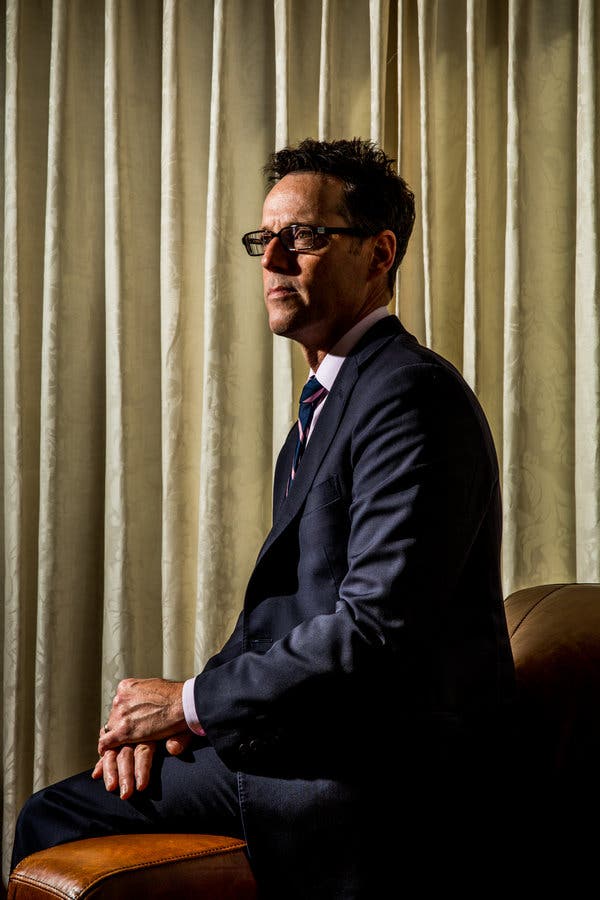
Image
- Nov. 5, 2018
- -
-
WASHINGTON — Dennis J. Ventry Jr., a law professor at the University of California, Davis, drew the ire of tax preparation companies like Intuit and H&R Block this summer by criticizing a deal they have to provide a free tax filing service through the Internal Revenue Service.
The companies promptly hit back with a tactic that corporations, lobbyists and interest groups are increasingly using against academic researchers: Their trade coalition filed a public records request with the university in July seeking everything Mr. Ventry had written or said about the companies this year, including emails, text messages, voice mail messages and hand-jotted notes.
The university estimated that it spent 80 to 100 hours complying with the request, filed under the California Public Records Act, which requires employees of any state agency or institution to produce, upon request from any member of the public, any record that relates to “the conduct of the public’s business” that is “prepared, owned, used or retained” by the university.
The request generated 1,189 pages of documents, university officials said. And it was just one example of how both state-level public records laws and the federal Freedom of Information Act, written to ensure transparency and accountability in government, have morphed into potent weapons in legal and business disputes, raising questions about the chilling effects — and costs — they impose on targets who are doing research in controversial or sensitive fields.
A 2017 analysis of requests filed under the Freedom of Information Act found that “public-oriented inquiries by concerned citizens and their advocates” account for “only a small fraction of the 700,000-plus FOIA requests submitted each year,” wrote David Pozen, a law professor at Columbia University, whose paper reviewed studies on the issue. “The bulk of requests come from businesses seeking to further their own commercial interests by learning about competitors, litigation opponents or the regulatory environment.”
Public records requests have long been an important tool for a wide variety of groups, like journalists, political opposition researchers, climate-science skeptics, animal rights advocates and anti-abortion activists keen to dig into research and the work of people in the government.
But the sheer scale of the requests in recent years, and their growing use by advocacy groups and business interests to challenge academic work at public universities, has alarmed some experts, who say the commitment to openness embodied by freedom of information laws could be tested.
The weaponization of such requests poses “a real danger that we’ll hit a tipping point, where the cost and burden of open records laws will overcome the benefits and we’ll have a retrenchment of transparency rights,” said Margaret Kwoka, a University of Denver professor with expertise in government transparency litigation. “This kind of abuse fuels the political will to do that.”
The University of California system, with nearly 45,000 faculty and academic appointees on its campuses and in its laboratories and medical centers, sits at the center of this trend.
In 2009, the system received a total of 3,266 public records requests. In 2017, it received 16,921, an increase of 418 percent.
A significant portion of the requests are from activists and industry groups “using public records requests as one part of a strategy to undermine the work of researchers in controversial fields,” Maria Shanle, managing counsel for education affairs and governance at the University of California, said in an interview.
These have included a 2011 request for every document a visiting scholar produced related to “chemical substances, including flame retardants”; a 2012 demand by an anti-abortion group for the names of researchers working on an abortion safety study; and a 2015 request for every email to and from a journalism professor that contained words like “biotech” and “Monsanto.”
Image
“What we need is a dividing line between financial and ministerial accountability, and the university’s function as an intellectual and teaching institution,” Claudia Polsky, an assistant law professor who directs the Environmental Law Clinic at the University of California in Berkeley, said in an interview.
In a paper titled “Open Records, Shuttered Labs: Ending Political Harassment of Public University Researchers,” Ms. Polsky argued for legislative protections, already offered in some states, for unpublished emails and other personal records that can be used to stymie research.
“Digging into professors’ email inboxes has nothing to do with democratic accountability or fiscal transparency,” she said, “and everything to do with creating ideologically based mischief.”
In Mr. Ventry’s case, he said he did not have anything to hide — he has been a critic of the tax preparation program, Free File, and an outspoken advocate for no-cost, simplified, government-provided tax preparation for years. But he said that the request had made collaborators in his research wary of communicating with him and amounted to intimidation by the industry.
“They are trying to bully me,” Mr. Ventry said of the industry group. “More importantly, they are trying to chill my research and scholarship, whether it has to do with tax law reform or not.”
The industry group, the Free File Alliance, whose legal name is Free File Inc., defended the request as a proper use of public records law.
Mr. Ventry, the group said, had a conflict of interest because he also serves as the chairman of an outside advisory group to the I.R.S. and was intent on promoting an alternative plan under which the government would offer its own tax preparation service through the I.R.S. The alliance defends its program as benefiting low- and middle-income Americans who would otherwise have to pay for tax preparation services.
Freedom of information requests “are a legitimate, legal method to determine what public officials are doing and saying in their official capacity,” the alliance said in an emailed statement. “Professor Ventry holds a strong preconceived bias against the I.R.S. Free File program.”
Mr. Ventry is not employed by the I.R.S. He is the chairman of the Internal Revenue Service Advisory Council, a public forum on tax administration issues that advises the I.R.S. commissioner and is composed of outside experts who volunteer their time. He was a published critic of Free File for years before joining the council.
Mr. Ventry; Joseph Bankman, a tax law professor at Stanford University; and others have worked over the years to create a model for free tax-filing programs administered by a half-dozen states, while advocating a free, streamlined federal e-filing system.
In July, Mr. Ventry, Mr. Bankman and other colleagues wrote op-eds taking aim at Free File, which the I.R.S. offers to many taxpayers through an agreement with the Free File Alliance, which includes Intuit, makers of TurboTax and other software; H&R Block; and 10 additional commercial tax preparation companies.
After the House passed a bill that included a provision making the Free File agreement permanent, the academics raised alarms. Citing research, I.R.S. statistics and investigations by ProPublica, The Wall Street Journal and others, Mr. Ventry wrote that Free File is a “failed program” that “inflicts substantial harm on taxpayers” by confusing them, pushing them toward paid products and failing to fully protect their personal data.
The companies in the Free File program are not compensated by the I.R.S. for providing their services. But ending the program and replacing it with a government-run electronic filing service for all taxpayers would threaten the industry.
Image
In a July opinion piece in The Hill titled “Free File Providers Scam Taxpayers; Congress Shouldn’t Be Fooled,” Mr. Ventry originally included his affiliation as chairman of the tax agency’s advisory council as well as his academic post. (After a complaint from the industry group, he removed the affiliation to the council.)
In a subsequent commentary, the academics criticized the I.R.S. for poor oversight of the industry agreement, saying that Free File “puts tax preparation companies first and taxpayers last.” Some of the criticism echoed the I.R.S.’s independent taxpayer advocate, Nina E. Olson, who said in an interview that Free File was a “poorly designed” program that only 3 percent of eligible taxpayers used after 15 years in existence.
Days later, the University of California received the request for all of Mr. Ventry’s communications about the op-eds, including his contacts with the I.R.S. taxpayer advocate’s office.
In addition to its public records requests, the alliance wrote directly to the I.R.S. about Mr. Ventry in July, saying he “improperly used his I.R.S. affiliation to lend credibility to this attack.” The alliance questioned whether Mr. Ventry should be able to speak out publicly on the issue given his role on the I.R.S. advisory council.
Mr. Ventry said that role was strictly advisory and that he received no compensation aside from his university salary. After the industry alliance leveled the complaint, he says he voluntarily recused himself from the council’s analysis of the Free File program, due out in November.
Responding to the academics’ criticism in a letter to the editor published in the policy journal Tax Notes, Tim Hugo, a Republican member of the Virginia House of Delegates who serves as the alliance’s executive director, wrote that the partnership between the I.R.S. and Free File had saved taxpayers “an estimated $1.6 billion in tax preparation and filing fees” since its inception in 2003.
The program was under attack, he wrote, “by a handful of ideologues” who “want a centralized system of direct government tax preparation.”
Representatives for Intuit and H&R Block said the companies did not participate in the records requests by the industry group, but the alliance confirmed that the member companies received the documents produced by the university.
Stanford is a private institution not subject to public records requests under the California law, but the alliance’s lawyers used the University of California request to obtain Mr. Ventry’s communications with Mr. Bankman, too.
“There’s nothing really that interesting in my emails,” Mr. Bankman said in an interview. But worries about such requests, he said, stifle the peer review process, a freewheeling exchange of views, often by email, in which academics around the world evaluate one another’s work.
Companies often request such emails “to intimidate people like us, because it really raises the ante and makes it very scary just to email stuff,” he added. For the industry, “it’s a freebie,” he said. “But imagine you’re some young professor somewhere — you don’t know what hit you.”
Mr. Ventry said he was more worried that Mr. Bankman and other colleagues would shy away from collaborating with him.
“We went from emailing multiple times a day over the course of a couple months to not emailing at all,” he said. The request “stifled not just academic freedom but the deliberative and beneficial process of thinking through problems with others.”
If that constitutes winning for the tax industry, he said, “they won.”
===
===
alec 5 nola 2018 campus watch
https://www.exposedbycmd.org/2018/08/08/common-cause-exposes-alec-influence-louisiana
ALEC is registered as a tax-exempt charitable organization and claims not to spend any money on lobbying. But according to a new report from Common Cause, a national nonpartisan government reform group, a number of ALEC-backed and -drafted bills have been introduced and enacted by ALEC-affiliated legislators in Baton Rouge in recent years.
“ALEC in Louisiana” uncovers the power that “the secretive special interest lobbying group” has already utilized in the southern state. According to the report, nearly 50 members of the Louisiana Senate and House of Representatives have ties to ALEC.[ now gov john bel edwards ?] Common Cause found that legislative language in Louisiana is commonly copied and pasted from the ALEC “model bills,” making the group’s influence “extremely prominent.”
“Shining a light on ALEC’s undemocratic and secretive operations helps voters know who is really calling the shots in their state legislature,” said Karen Hobert Flynn, president of Common Cause. “ALEC’s history of rigging the rules against everyday Louisianans on behalf of their corporate funders is not how democracy is supposed to work.”
ALEC is a powerful corporate-funded pay-to-play organization that brings lawmakers, lobbyists, and other groups in the Koch’s influence machine together to vote side-by-side on bills that legislators then take back and introduce in their home states, usually without any public disclosure of their source. The Center for Media and Democracy teamed up with Common Cause in 2012 to file an IRS whistleblower complaint against ALEC, charging the group with tax fraud and massively underreporting its lobbying activity.
This week’s ALEC annual meeting is chock full of union-busting, gerrymandering, fossil fuel promoting, and school privatizing legislation that benefits the economic interests of ALEC’s patrons.
While the exact issues the Louisiana bills address are varied, the bills fulfill ALEC’s admitted purpose, “to strengthen relationships between ‘business leaders’ and legislators” and “satisfy corporate needs,” according to Common Cause.
For instance, HB 727, was introduced by dues-paying ALEC member, Sen. Joseph H. Major Thibaut, Jr. Thibaut’s bill shares text with an ALEC model bill, “The Critical Infrastructure Protection Act.” It was signed into law in May of this year amidst growing local opposition to the construction of the Bayou Bridge pipeline, which will bring fracked oil from North Dakota to Louisiana’s Gulf Coast.
Senate Bill 364, intended to deal with recent conflicts over controversial speakers on college campuses, is based on ALEC’s “Forming Open And Robust University Minds (Forum) Act.” In June, Louisiana Governor John Bel Edwards signed the act into law, after vetoing a similar bill last year.
With ALEC’s assistance, similar bills have been pushed and enacted around the country at the behest of the right-wing Goldwater Institute and State Policy Network.The American Association of University Professors has criticized the legislation’s approach as “a political agenda masquerading behind ‘free speech'” and objects to its “preference for punishment as a means for ending protests and disruptions that obstruct free speech.”
Meg Logue, a 350 New Orleans activist, told Common Cause that, through ALEC, “our legislators jeopardize our democracy by bending toward the priorities of corporations while undermining the peoples’ right to self-determination and justice.”
==
===
https://www.npr.org/sections/ed/2018/04/04/590928008/professor-harassment
no linx pix
THE NEW CLASH BETWEEN FREE SPEECH AND PRIVACY
Professors Are Targets In Online Culture Wars; Some Fight Back
5:09
Download
Transcript
April 4, 201811:52 AM ET
Heard on All Things Considered
Anya Kamanetz
There is a red light flashing in professor Albert Ponce's cubby-sized office. The light comes from an old-fashioned answering machine.
Lately, he doesn't like to listen to the messages by himself. When he presses play, it's obvious why. Here are a couple of messages:
"Albert Ponce, you are a piece of s*** f****** gutter slug that needs his neck snapped, OK? Call me if you need me. I'll do it for ya.
"F****** race-baiting f****** piece of trash."
Ponce teaches political science at Diablo Valley College, a community college in California's East Bay. It all started in October when he was invited to give a public lecture on campus on an area he specializes in: race and politics.
In the speech, which was filmed, he called the United States "a white supremacist, patriarchal, heteronormative, capitalist system." He also mentioned Karl Marx in passing, praised civil disobedience and referred to a white supremacist in the White House. The result: attacks on Facebook and threatening voice messages and emails.
Colleges are meant to be a home for free inquiry. But these days, not all professors feel that freedom. Across the country, in the past year and a half, at least 250 university professors, including Ponce, have been targeted via online campaigns because of their research, their teaching or their social media posts. Conservative professors have been attacked from the right and the left, both with equally dire language.
Some have lost their jobs, and others say they fear for their families' safety.
Ponce says his ideas, in context, are "not controversial at all" in his circles of academia. For example, when he talks about white supremacy, he says, he is talking about a system of power, not about individual white people.
But in today's highly polarized political climate, almost any statement about race or diversity can prove extremely controversial. Here are a few examples:
Josh Cuevas, an associate professor in the school of education at the University of North Georgia, came under inquiry from his congressional representative after getting into an argument on Facebook about President Trump and voter turnout.
Eve Browning, the chair of the department of philosophy and classics at the University of Texas, San Antonio, was targeted, as was her entire department, when a student surreptitiously recorded a disciplinary conversation that touched on his negative comments about Islam.
Laurie Rubel, a professor of education at Brooklyn College, published a National Science Foundation-funded research paper about race and mathematics education. Rubel tells NPR that she was looking at how to support high school math teachers who teach in hypersegregated urban schools, in part by being critical of the concept of meritocracy. The on-air take of Fox News commentator Greg Gutfeld was: "A math professor ... claimed that merit-based education is ... a tool of evil whiteness."
George Ciccariello-Maher, an associate professor of politics and global studies, was placed on leave and ultimately resigned from Drexel University in Philadelphia last fall after tweeting, "all I want for Christmas is white genocide." "White genocide" is a white nationalist conspiracy theory; Ciccariello-Maher says he meant to be satirical.
People on the right don't have a monopoly on threats to free speech or academic freedom. Campuses like the University of California, Berkeley, the home of the Free Speech Movement in the 1960s, have become national flashpoints with sometimes violent responses to conservative speakers.[they mean broken windows and some trash lit on fire?]
And professors have sometimes been subject to attacks and harassment from the left. Bruce Gilley at Portland State University in Oregon, for example, was attacked online and over the phone when he published an academic paper titled "The Case for Colonialism." His paper on colonialism, he tells NPR, argues that "there is a wealth of evidence ... that shows quite overwhelmingly positive benefits in terms of democracy, public health, human rights."
He calls the response "a mass global mob." The article was withdrawn after threats of violence were made against both him personally and the editor of the journal that published it, Third World Quarterly.
Experts who study the spread of hate speech online say there is a difference in patterns of online harassment between the right and the left. Attacks from the left tend to originate from within campus communities. Thousands of self-identified academics, for example, signed online petitions calling for Gilley's article to be retracted.
On the right, though, a network of outside groups and sites has mobilized against academics. Their views range from libertarian to conservative to white nationalist.
Sites such as The College Fix and Campus Reform pay student reporters to contribute stories titled: "Meritocracy is a 'tool of whiteness,' claims math professor" (Campus Reform) or "History professor calls for repeal of Second Amendment" (The College Fix).
Professor Cancels Course On Hate Speech Amid Contention Over His Use Of Slur
THE TWO-WAY
Professor Cancels Course On Hate Speech Amid Contention Over His Use Of Slur
Jennifer Kabbany, editor of The College Fix, told NPR that the site's purpose is to train future journalists, not to foment hate. "The College Fix has publicly denounced any vile emails that a professor might get," she said. "I'm sorry if professors received that kind of backlash." In reference to Ponce, of Diablo Valley College, she added, "It appeared the lecture was not balanced and didn't do academic inquiry and debate justice."
The College Fix is run by the Student Free Press Association. The association has had Education Secretary Betsy DeVos' son listed on its board of directors and is funded by an anonymous conservative donor fund.
Campus Reform is a project the Leadership Institute, a conservative think tank. Professor Watchlist, which lists more than 250 professors who advance what it calls a "radical" left-wing agenda, is maintained by Turning Point USA, an on-campus group that has been labeled "alt-right."
Campus Reform and Professor Watchlist did not respond to requests for comment.
The Red Elephants is a pro-Trump "alt-right media collective" founded in November 2016. Founder Vincent James Foxx has reportedly denied the Holocaust and been accused of urging violence at rallies. The site posted an edited video of Ponce's talk on YouTube with commentary calling it "Marxist, Communist, disgusting rhetoric that they spew in these classrooms to indoctrinate these children." It used the video to kick off an initiative called "Film Your Marxist Professor."
The administrator of the "Film Your Marxist Professor" Facebook page, who gave his name as Aaron Burr, told NPR via Facebook message: "We receive around 10 submissions per day. Our goal is to stop the anti-white and anti-American rhetoric that is being spewed on college campuses all across the country."
From these specialized sites, content travels to alt-right media sources like Breitbart and Infowars and neo-Nazi sites like Stormfront, and then, sometimes, to Fox News and the New York Post, CNN and other outlets.
Meanwhile, harassment is coordinated out in the open on anonymous, uncensored forums like 4chan, 8chan and Reddit, where self-identified "trolls" uncover and post people's personal information, known as doxing, and try out strategies of attack. Cuevas at the University of North Georgia obtained screenshots of the 4chan forum on which people were fabricating social media posts in an attempt to paint him as anti-Semitic and racist or, alternatively, as pushing anti-Trump views onto his students.
"Their stated goal was to get me fired," he says, but he fears that is not the worst of it: "Georgia had just passed the campus carry law [for firearms], and what worried me was a lone nut case."
Flyers for Ponce's talk about white supremacy in the United States sit next to a flyer for Identity Evropa, a white supremacist group.
Anya Kamenetz/NPR
Ponce says he sees a fresh wave of abusive calls and letters every time a new media story hits. He has gotten letters in the mail, emails and Facebook messages, and his colleagues and administrators have gotten calls and emails. He has found his personal information on a Hungarian right-wing website and gotten calls from South America. He, like other professors, has called the police, but the messages keep coming.
Most troubling, he says, are "the real threats against my family" and "pictures on the Web of my 9-year-old daughter."
He and his wife are trying not to park their cars in the same places every day, peek out into the street at night and warn their daughter not to touch the mail.
Hans-Joerg Tiede of the American Association of University Professors says no matter what side you're on politically, it's clear that academic freedom is under assault, as it has been many times in the past.
"There have always been instances of faculty being targeted in particular for what they say, for what they teach," says Tiede, a former computer science professor at Illinois Wesleyan University.
Anti-communist academic blacklists go back to the 1930s, and professors were targeted for taking desegregationist stances in the 1960s, he adds. The difference is that momentum builds very fast, and it doesn't take time to reach far-flung destinations. The AAUP has been tracking this latest wave of targeted harassment and issuing recommendations for policymakers.
Milo Yiannopoulos' 'Free Speech Week' At Berkeley Falls Apart, Organizers Say
HERE & NOW COMPASS
Milo Yiannopoulos' 'Free Speech Week' At Berkeley Falls Apart, Organizers Say
Jessie Daniels, a professor of sociology at Hunter College, is among scholars who say the rise of the Web and social media have given right-wing groups new means for targeted harassment and for spreading their ideology.
"With the rise of the popular Internet, everybody's an expert," she says. "White supremacists really saw that as an opportunity."
In contrast to the sometimes-violent confrontations on campus around speakers like Milo Yiannopoulos, NPR was not able to find a case of an online harassment campaign, targeting a professor for his or her work, that resulted either in violent threats being carried out or in any legal action against the perpetrators.
What concerns experts like Tiede is the potential chilling effect on researchers, especially untenured graduate students and adjuncts, who might fear broaching any topic that could touch off a firestorm.
But as this pattern of behavior becomes better known, professors like Rubel and Ponce are no longer keeping quiet. They are fighting back. Rubel responded by posting many of the foul voicemails and emails and messages she received on Twitter and Facebook and by collecting statements of support from colleagues. "I think they messed with the wrong person," she tells NPR.
For his part, Ponce, who does not have tenure, and his colleagues are urging the board of governors of his community college's district to adopt a resolution in support of academic freedom, making clear that the colleges will stand behind its scholars no matter how provocative their work, as long as they are grounded in research and evidence.
"In a democracy, these places of higher learning should be the spaces where we engage in a rigorous scholarship, not necessarily an ideological one," Ponce says. College, he says, is the place for a quest for truth, not merely opinion.
States Consider Legislation To Protect Free Speech On Campus
===
https://www.alternet.org/education/college-campus-richard-spencer
associate professor of politics and global studies at Drexel University was effectively forced out of his position after describing the Las Vegas massacre as a product of a "white supremacist patriarchy" that must be dismantled. This is actually a fairly standard narrative among progressives in response to mass shootings or political violence. However, George Ciccariello-Maher and his university found themselves facing a particularly harsh campaign of harassment, intimidation and coercion in the wake of these comments, in part because this was not their first run-in with the right-wing media outrage machine.
Although Ciccariello-Maher was intentionally trying to mock and provoke the right, what happened to him could happen to any progressive social researcher today.
Ciccariello-Maher was first thrust into the national spotlight for comments he made on Twitter in December 2016.
In response to a State Farm advertisement featuring an interracial couple, many far-right online personalities took to social media to lament the "white genocide" they believe is being brought about through immigration, interracial unions, multiculturalism and "radical" civil rights activism. In response, Ciccariello-Maher mockingly tweeted to them that all he wanted for Christmas was #WhiteGenocide.
These comments were deliberately taken out of context in right-aligned media, where it was implied that rather than merely trolling the racial anxieties of alt-right sympathizers, Ciccariello-Maher sincerely supported carrying out (violent) genocide against whites, sparking major backlash against himself and the institutions he was affiliated with.
At that time, Drexel University sharply condemned his remarks, but insisted that no action should be taken against Ciccariello-Maher because his comments constituted protected free speech.
Ciccariello-Maher found himself in the crosshairs of the right just a few months later, after declaring on social media that seeing a customer give his first-class seat to a uniformed soldier on a flight made him want to vomit. Right-leaning pundits once again blew up his comments, arguing that Ciccariello-Maher hated America, despised its men in uniform and that the sentiments he expressed were typical of what students were exposed to in the classroom—not just in his courses, but in colleges across the country.
As the threats and complaints once again rolled in, Ciccariello-Maher appeared on Fox News and insisted that this time his comments were not satirical: he was nauseated, he explained, by what he perceived as people “blindly” supporting wars abroad for the sake of supporting the troops, and also by the “smug and self-congratulatory” demeanor of the passenger who offered his seat. He argued that if people really wanted to support the troops they should work on providing better healthcare and services to veterans, and avoiding needless conflict abroad.
...
===
ref
http://heterodoxacademy.org/professors-must-now-fear-intimidation-from-both-sides/
haidt
string of recent cases in which professors have been fired, sanctioned, or placed on leave by their universities in response to public outrage generated by right-wing media sites is an alarming turn of events for the academy and for the country. The Chronicle of Higher Ed just published a summary of these recent cases, as has Inside Higher Ed. Some of the more high-profile cases include George Ciccariello-Maher (Drexel), Johnny Eric Williams (Trinity College), and most recently Lisa Durden (Essex Community College).
The basic pattern is:
1) Left-wing professor says something provocative (and sometimes truly inflammatory), usually about race, on Twitter or Facebook or in a speech or media interview.
2) Right wing media sites, particularly Campus Reform and Fox News, pick up the story and report it in a way designed to cause maximum outrage, sometimes distorting or ignoring the context.
3) Readers and viewers of such media become outraged; some of them write racist or sexist social media posts, including rape threats and death threats; many demand that the university fire the professor.
4) The university’s president and other administrative leaders are paralyzed by the public relations crisis; they do nothing to stand up for the professor, and sometimes they move quickly to condemn the professor and put him or her “on leave” in order to begin the process of termination, particularly if the professor is not tenured.
5) Everyone who tunes in to the story, on either side, concludes that their disgust with the other side has been fully confirmed. Each side is now even more certain that the other side is racist, violent, and intellectually bankrupt… which means that their own side must be even more vigilant against the outrages perpetrated by the other side.
6) Repeat, with even more passion, anger, and sense of victimization.
Before 2017, the threats to professors and their freedom to speak and write came mostly from the left. The right simply is not much of a presence at most of our universities. At Heterodox Academy we have covered several of the high-profile cases in which students used mob tactics to surround a professor, accuse the professor of racism, and then demand that the professor be fired or punished. See, for example, the Christakis case at Yale, Dean Mary Spellings at Claremont-McKenna, and Bret Weinstein at Evergreen. Such events are particularly chilling because in none of these cases had the professor or dean said anything that seems remotely racist to observers off-campus. The message is: the mob can come for you at any time, so be careful; don’t say or do anything that might provoke students on the left. The eruption of actual violence at Berkeley and Middlebury, the moral justifications of violence given by some students, and the presence of Antifa among protestors makes student mobs now truly dangerous — physically dangerous — for any professor who faces one.
But in 2017, it’s clear that the threat profile is now bipartisan. It still comes primarily from the left on campus, but now it comes from the right as well, off campus. committed by the other side, while reading far less — or reading justifications — for the mob actions perpetrated by their own side.
The bipartisan nature of intimidation is likely to have a chilling effect on speech, and on the quality of teaching. Professors must think twice before trying any provocative teaching exercise or line of questioning. But given the nature of social media and mob mentalities, being careful is not enough. Anything you say can be distorted and misreported, potentially destroying your reputation and your career. So why take chances, why say anything controversial at all? Socrates would not last a month at a modern American university.
Given the dynamics of the larger American culture war, I believe that things are likely to get worse on campus. In future posts and essays, I and other members of Heterodox Academy will write about what can be done to break this cycle of escalation and restore a culture of free and fearless inquiry on campus. For now, I just want to note that many of us at Heterodox Academy are deeply disturbed that so many professors are getting mobbed and threatened and fired in the 6-step process I laid out above.
I’d like to close with a simple request to university leaders: Please stop giving in to mobs and their demands. It may seem like the easy way out of your predicament in the moment, but it encourages more mobs to form in the future – student mobs on campus, and right-wing internet mobs off campus. When professors say something truly offensive and irresponsible (and sometimes they do), consider simply talking to them. Or establishing a procedure with clear standards – ideally one that takes a while so that the Internet circus can move on and the rage can dissipate.
Real leadership in the age of outrage requires the ability to stand up to a mob and say: “No. We have procedures in place, and we will use them, but we start with a strong presumption of academic freedom and free speech. We will not be goaded or threatened into punishing a professor for something she said or wrote.”
===
For more than a century, the university system has been guided by the Wisconsin Idea, a tradition first enunciated by University of Wisconsin President Charles Van Hise in 1904. Van Hise declared that he would "never be content until the beneficent influence of the university reaches every family in the state". Today that belief permeates the UW System's work, fostering close working relationships within the state, throughout the country, and around the world.
In 2015, Wisconsin Governor Scott Walker's budget proposal included the removal of the Wisconsin Idea from the University of Wisconsin's mission statement. Walker proposed replacing the mission's goal to "extend knowledge and its application beyond the boundaries of its campus" and to "serve and stimulate society" with a goal "to meet the state's workforce needs". After negative reaction from politicians and the public, the Wisconsin Idea was restored to the budget proposal.[4]
===
==
https://www.alternet.org/right-wing/how-white-nationalists-hide-academia
Even in the world of academia, a punchy headline can be everything.
As subaltern analysis heads from the margins to the center of critical discourse, the kind of post-colonialism that was previously centered on a college campus has been popularized across the left. Within a popular culture shifting to decolonization ideas, someone at the Third World Quarterly likely knew a title like "The Case for Colonialism" was going to gain some traction. The paper, penned by controversial Portland State University faculty member Bruce Gilley, argued that Western colonial expansion into the Global South, specifically Africa, was a net positive, and that the 20th century liberation struggles were a catastrophe that should be reversed. Ignoring the mountains of scholarship that outlines the brutal cruelty of colonial exploitation, slavery and genocide, Gilley has taken an avenue that is popular amongst the academic segment of the radical right: transvaluation. With a mind towards defending white settler colonialism, Gilley did not deny the tragedies, he just decided they were worth it.
While it was shocking to many that a respected Ro...[hist]
==
==
90 min
https://www.c-span.org/video/?308816-1/subversives
==
https://www.c-span.org/video/?324828-1/patriotic-betrayal
MARCH 4, 2015
Patriotic Betrayal Karen Pagettalked about her book Patriotic Betrayal: The Inside Story of the CIA’s Secret Campaign to Enroll American Students in the Crusade Against Communism, in which she recounts the Central Intelligence Agency’s (CIA) surreptitious involvement in the U.S. National Student Association in the 1960s. In her book, the author suggests that the agency used the student organization as a conduit in its efforts against communism. Ms. Paget, a member of the student organization in 1965, spoke about the CIA’s plans and the report by Ramparts magazine in 1967, which exposed the agency’s involvement. Ms. Paget spoke with author and Berkeley Graduate School of Journalism lecturer Adam Hochschild.
==
https://www.democracynow.org/2017/11/6/after_texas_massacre_drexel_prof_asks
http://www.aljazeera.com/indepth/features/2017/08/texas-organiser-vows-hold-white-lives-matter-rally-170814072936129.html
4 rally tamu, curry death threats: http://www.aljazeera.com/indepth/features/2017/07/threats-attacks-white-supremacists-target-campuses-170708055258069.html**
many link not:
Last week, I sent a string of relatively uncontroversial tweets in the aftermath of the Las Vegas massacre, in which I sought to answer a question about mass shootings in the United States: Why are these crimes almost always carried out by white men? “It’s the white supremacist patriarchy, stupid,” I tweeted, before then diagnosing a sense of double entitlement — as white people and as men — that, when frustrated, can occasionally lead to violent consequences.
My argument was not new, but rather reflects decades of research on how race and gender function in our society. To be both white and male is to be subject to a potent cocktail of entitlement to economic and political power, and to dominate nonwhite and female bodies. When that entitlement is frustrated, it can lead to what the criminologist Mike King calls “aggrieved whiteness,” an ambient furor based on the idea that white Americans have become oppressed victims of politically correct multiculturalism.
[I invited Ann Coulter to speak at UC Berkeley. Here’s why.]
In my view as a researcher and professor of politics, these tweets were neither provocative in tone nor controversial in content. Rather, the insight they provided felt all the more pressing now that President Trump has brought this aggrieved whiteness into daily headlines. As a scholar and teacher, giving context and depth to contemporary debates is an important part of what I do, and it’s a calling I take seriously. But more and more, professors like me are being targeted by a coordinated right-wing campaign to undermine our academic freedom — one that relies on misrepresentation and sometimes outright lying, and often puts us and our students in danger.
This time, the outrage machine geared up as it often does, with a minor conservative media outlet — in this case, the Daily Caller — chopping my tweets up into a misleading mishmash that transformed a nuanced diagnosis of white male frustration into an attack on white people in general. When the Daily Caller posted the article to Facebook, moreover, the intention was clearly to incite: “Absolutely unforgiveable” (sic) read the post, which by now has been shared nearly 2,000 times and commented upon more than 3,000 times.
Hate mail and death threats began to roll in. “I will beat your skull in till there is no tomorrow.” “Soon all you p-----s will get exactly what you deserve.” “Do the world a favor, and kill yourself … I’ll help you find death sooner than later.” One called me a “pig f---er like Obama,” adding homophobic slurs for good measure. Many called me a “cuck” — a favorite racial and sexual insult of the alt-right — while others urged me to move to North Korea or Venezuela. One “love note from a WHITE American” wrongly identified me as a “greasy South American a--hole.”
From there, the contagion was rapid, with Stephen Bannon’s Breitbart News and even Milo Yiannopoulos’s own website running their own cribbed copies of the same story. Then came FrontPage, the Blaze, the College Fix and the campus mercenaries at Turning Point. Soon, the manufactured story had hit the conspiratorial fringes of Infowars and online forums across the right: from “blue lives matter” to those preparing for the inevitable rapture.
[Could everyone please stop melting down about college kids?]
Finally, the story crossed the mainstream-fringe barrier at its most permeable point: Fox News. Fox claimed that not only do I blame Trump for the Las Vegas massacre, but that I even somehow blame the victims. Threatening emails increased to a flood. An invitation to appear on Tucker Carlson’s show arrived in short order, only confirming the insular nature of the machine, which amplifies to a furious roar the same small group of voices. I declined.
I am by no means the first, and will not be the last target of this kind of smear campaign by conservatives aimed at academics. In every case, it is the same right-wing media outlets leading the charge, and campuses are increasingly the target. Universities and colleges have become the perfect target for such crusades: Purportedly hotbeds of multiculturalism, “safe spaces” and political correctness, campuses represent everything the resentful right is afraid of. At the same time that the right-wing media smears professors like myself, decrying our tenure and demanding our heads, they breathlessly chronicle the supposed intolerance of the left when confronted with provocative campus tours by Yiannopoulos, Richard Spencer, Charles Murray, Ann Coulter and others.
And things aren’t letting up. While noteworthy cases such as Saida Grundy and Zandria Robinson in 2015 gave a glimpse of what was to come, the months since Trump’s election have seen a generalized assault on anti-racist academics. In May, Tommy Curry at Texas A&M was targeted for a years-old podcast; Princeton’s Keeanga-Yamahtta Taylor was forced to cancel public events after threats following a commencement speech; and Johnny Eric Williams at Trinity College was targeted and suspended reposting someone else’s words on Facebook. Increasingly, leftist professors are being targeted for “things they never really said.” As Princeton’s Eddie Glaude has put it, when the right is so easily triggered by anti-racism and feminism, they make it perfectly clear who the “real snowflakes” are.
[Free speech on campus is not as simple as everyone seems to think]
Caught in this wave of right-wing threats and provocations, many universities are scrambling to keep up with the coordinated onslaught. In the best of cases, university administrations and departments have publicly condemned threats against faculty and made clear that they do not cave to intimidation campaigns. The American Association of University Professors (AAUP) has even responded to our cases with new guidelines urging universities to resist the targeted online harassment of their faculty.
In response to such illegal threats of violence, Drexel has chosen to place me on administrative leave. Earlier in the week, I asked my students to explain the relation between white masculinity and mass killings, and they offered in a few short minutes of class discussion far more insight than any mainstream media outlet has offered all week. But now, their own academic freedom has been curtailed by their university, and they are unable to even attend the classes they registered for.
By bowing to pressure from racist internet trolls, Drexel has sent the wrong signal: That you can control a university’s curriculum with anonymous threats of violence. Such cowardice notwithstanding, I am prepared to take all necessary legal action to protect my academic freedom, tenure rights and most importantly, the rights of my students to learn in a safe environment where threats don’t hold sway over intellectual debate. Alongside organizations like the Campus Antifascist Network, I will continue to challenge white supremacists in an effort to make Drexel and all universities safe space for an intellectual debate among equals.
===
http://www.alternet.org/education/right-wing-billionaires-are-funding-cynical-plot-destroy-dissent-and-protest-colleges
As s far-right speakers face loud student opposition at their university speaking gigs, conservative lawmakers in several states are introducing legislation that cracks down on protesters. As uncovered by UnKoch My Campus’ Ralph Wilson, numerous states have borrowed their so-called “campus free speech” bills from the rightwing Goldwater Institute, which is funded by conservative plutocrats including Charles Koch and the Mercer family.
The intent of these bills isn’t to protect student speech; it’s actually to suppress it in favor of guest speakers who, at times, support white nationalism, LGBTQ discrimination and other hateful worldviews. By funding the Phoenix-based Goldwater Institute, wealthy conservatives are enabling the promotion of hate speech while stifling student dissent. Whether or not Koch, for example, agrees with the hate speech he indirectly sponsors, he certainly benefits from a more friendly academic environment for far-right ideologues who often deny climate change and praise his extreme brand of tax- and regulation-free capitalism.
The Goldwater Institute’s model bill allegedly ensures “the fullest degree of…free expression,” but it explicitly states that “protests and demonstrations that infringe upon the rights of others to engage in or listen to expressive activity shall not be permitted and shall be subject to sanction.”
It goes on to say, “Any student who has twice been found responsible for infringing the expressive rights of others will be suspended for a minimum of one year, or expelled.”
Under this code, imagine that a student protests a climate change denier and gets a brief suspension. Then the College Republicans group brings in a full-on white nationalist. Will this student do what she thinks is right and protest a racist who’s given a platform at a respected university, or stay home because she's risking expulsion? This campus "free speech” legislation is essentially an attack on student speech and an elevation of ultra-conservative ideas that many people in university communities think have no place in American society.
“These laws would create a chilling effect on students who reject the idea that white supremacists or climate deniers are simply representing an ‘opposing viewpoint’ that should be tolerated, and who are rightfully relying on their first amendment freedoms to stop the rise of fascism and prevent global climate catastrophe,” Wilson, UnKoch’s senior researcher, told AlterNet. The group has been conducting research into Charles Koch’s considerable ideological donations to higher education, most of which goes toward free-market programs.
Charles Koch Foundation representatives say that conservative views are underrepresented in higher education, and the foundation’s massive university donations—which fund free-market academic centers, professorships, grad students and lecture series—are necessary for academic freedom. This view is shared by other conservative billionaires and higher ed donors including Education Secretary Betsy DeVos, who recently said to the crowd at the Conservative Political Action Conference, “The education establishment [tells you] what to think…the real threat is silencing the First Amendment rights of people with whom you disagree.”
What the Kochs and their allies really want, by amplifying the voices of far-right professors and guest speakers, is to steer society towards a tax- and regulation-free plutocracy. Charles and David Koch, who together are worth nearly $97 billion, have been working toward this goal for over 40 years.
In 2014, Virginia passed the nation’s first law banning so-called “free speech zones,” which restrict protected speech to designated areas often far away from events that students want to protest. The following year, Missouri enacted a Campus Free Expression Act forbidding “free speech zones” without imposing punitive measures.
But while more recent legislation bans free speech zones as well, it also restricts student free speech in scenarios where, lawmakers claim, free speech is protected.
The protest crackdown
Legislators in some states including Illinois and Tennessee have introduced bills in 2017 that explicitly mention sanctions on student protesters. Illinois’ bill, proposed by two Republicans, lifts this language, and additional passages, nearly verbatim from the Goldwater model. Also sponsored by Republicans, the bill in Tennessee—nicknamed the “Milo Bill” after an event at the University of California at Berkeley featuring the racist “alt-right” icon Milo Yiannopolous was canceled due to protests—directs universities to enact free speech policies that include “sanctions for anyone under the jurisdiction of the institution who interferes with the free expression of others,” and it gives faculty “the right to regulate class speech.”
In North Carolina, Republican Lt. Gov. Dan Forest intends to work with legislators on a Restore Campus Free Speech Act, which would create “a discipline policy that would punish students who shout down visiting speakers or deprive others of their right to free expression, a tactic commonly known as the ‘hecklers’ veto.'"
Last year, Forest floated a measure calling on the University of North Carolina’s board of governors to create a system-wide policy that would impose harsh penalties, including expulsion, on students, staff and faculty members who disrupt classes, public meetings or events. The Koch-funded Generation Opportunity lauded the effort at the time. Forest has said that yelling at a guest speaker “has never been free speech,” and he’s called campus protest methods “terrorist tactics.” No one introduced a free speech bill that year.
Other proposed laws, like North Dakota’s, which was introduced by six Republicans, omit sanctions provisions but state that a university may restrict student speech if it blocks entrances to buildings, obstructs traffic or interferes with events. Much of the North Dakota bill comes directly from the text of the Goldwater model legislation. A large group of most Republican legislators in Virginia has a new bill in play that includes much of the Goldwater language but stays away from restrictions on students.
Additional campus free speech bills have been introduced this year in Colorado (sponsored by two Republicans and one Democrat) and Utah (sponsored by 14 Republican state representatives). Florida could be next. Gov. Scott Walker of Wisconsin has a "free speech" provision in his proposed budget.
Big money driving campus 'free speech’ efforts
One of the model bill’s authors, Stanley Kurtz, is a longtime fellow at the Washington, D.C.-based Ethics and Public Policy Center, which applies “the Judeo-Christian moral tradition to critical issues of public policy,” according to its website. The center has received millions of dollars in donations from the foundations of the conservative Bradley, Scaife, Olin and Earhart families, as well as hundreds of thousands from two vehicles for wealthy right-wing donors, Donors Trust and Donors Capital Fund.
Billionaire industrialists Charles and David Koch are responsible for more than $9 million in contributions to the two groups from 2006 to 2015, according to the website Conservative Transparency and additional research by this author. Much of the $6.3 million that went to Donors Trust came in 2015. A now-defunct Koch nonprofit, the Claude R. Lambe Charitable Foundation, donated $190,000 to the Ethics and Public Policy Center, and the Charles Koch Foundation has given over $9,000.
The Goldwater Institute’s James Manley, senior attorney, and Jonathan Butcher, education director, also co-authored the “campus free speech” model legislation. The institute took in nearly $2.5 million from Donors Trust and Donors Capital Fund from 2002-2015, according Conservative Transparency and additional research. The Charles Koch Foundation has pitched in $75,000. Manley formerly worked at the Mountain States Legal Foundation, which has received hundreds of thousands of dollars from the two Donors funds. Butcher was a research assistant at the heavily Koch-funded Heritage Foundation from 2002 to 2006.
Says Wilson, “These bills take Koch's academic presence to the next level, creating protected space to reveal the white supremacist roots of Koch's free market crusade, like Koch's close friend and white nationalist Charles Murray who has taken to campuses to espouse the genetic superiority of white males.”
Another Koch-funded think tank, the American Enterprise Institute, reportedly has student groups at nearly 80 colleges and universities. These groups bring in AEI fellows like the eugenicist Murray to speak on their campuses. Recently, Murray attempted to give a lecture at Middlebury College in Vermont but was stymied by vociferous protests. He had to end his speech early, and he and a liberal professor were attacked on their way out.
Students at UC Berkeley and area residents protested Yiannopoulos, whom the College Republicans had invited to speak. The protests led to fires, vandalism, and reportedly, fights. Until recently, Yiannopoulos was an editor at Breitbart News, known as the online “platform of the alt-right,” which happens to be funded by Robert Mercer and his daughter Rebekah, the far-right mega-donors who are major Donald Trump backers and whose family foundation has donated hundreds of thousands of dollars to the Goldwater Institute. The younger Mercer was even a member of Trump’s transition team. Violence against a speaker, a professor or an onlooker is certainly unacceptable. So is inviting a white supremacist to speak at an institution of higher learning, and so is preventing students and faculty from protesting such a speaker. Plenty of right-wing billionaires likely don’t agree with white nationalist ideas, and by funding these so-called campus free speech bills they’re trying to advance free-market principles. But regardless of motivation, this campus "free speech" movement is spreading the hate of white nationalism, the racist “alt-right,” Islamophobia and homophobia—not to mention climate change denial and economic policies that benefit only the very wealthy—on campuses filled with young students. Conservative, corporate millionaires and billionaires are at fault.
Alex Kotch is an independent investigative journalist based in Brooklyn, NY.
==
===