Heather Macdonald
---
basically tries to make racism respectable
NAS
PRO COP ~blm
stanford law
no merri
mma tag Heather Mac Donald | Media Matters for America
April 25, 2024 rww
- Yvonne Wingett Sanchez @ The Washington Post: Meadows, Giuliani and other Trump allies charged in Arizona 2020 election probe
An Arizona grand jury on Wednesday indicted seven attorneys or aides affiliated with Donald Trump’s 2020 presidential campaign as well as 11 Arizona Republicans on felony charges related to their alleged efforts to subvert Joe Biden’s 2020 victory in the state, according to an announcement by the state attorney general. Those indicted include former Trump White House chief of staff Mark Meadows, attorneys Rudy Giuliani, Jenna Ellis, John Eastman and Christina Bobb, top campaign adviser Boris Epshteyn and former campaign aide Mike Roman.
- Pema Levy @ Mother Jones: The GOP’s “Election Integrity” Lawyer Was Just Indicted for Election Subversion
Christina Bobb tried to overturn the 2020 election, and Arizona just charged her for it.
- Kate Briquelet @ The Daily Beast: Bogus Furry Panic Overtakes Utah School District
Group chats viewed by The Daily Beast reveal that parents were involved in planning students’ anti-furry protests—and securing right-wing media attention.
- Angry White Men: Heather Mac Donald: ‘The Great Replacement Theory Is Real’
On The Megyn Kelly Show, Heather Mac Donald endorsed the white supremacist “Great Replacement” conspiracy theory. Mac Donald, a fellow at the right-wing Manhattan Institute, declared that the “Great Replacement theory is real,” and that we’ve “decided to destroy our birthrate” and “flood our country with cultures” that are “not compatible.”
- Media Matters: Trump ally Laura Loomer: “You are an enemy to this country if you do not vote for Donald Trump”
Loomer: Jews who support Democrats “might as well just go put yourself in a gas chamber yourself if this is how you’re gonna behave.”
- Nikki McCann Ramirez @ Rolling Stone: Trump Lawyer Says Having Political Rival Killed Could Constitute ‘Official’ Presidential Act
The Supreme Court heard oral arguments Thursday on the former president’s bid to secure sweeping immunity from criminal prosecution.
Heather Mac Donald is the Thomas W. Smith Fellow at the Manhattan Institute and a contributing editor of City Journal. She is a recipient of the 2005 Bradley Prize
wiki
Heather Lynn Mac Donald (born 1956) is an American political commentator, essayist, attorney and journalist. She is described as a secular conservative.[1][2] She has advocated positions on numerous subjects including victimization, philanthropy,[3] immigration reform,[4] crime prevention,[5][6][7] racism, racial profiling,[8] rape, politics,[9][10]welfare,[11][12] and matters pertaining to cities[10] and academia.
She is a Thomas W. Smith Fellow of the Manhattan Institute.[13] In addition, she is a contributing editor to New York's City Journal[14] and a lawyer by training.[15] She has written numerous editorials and is the author of several books. Born in California,[10] she graduated from Phillips Academy in Andover in 1974. In 1978 she graduated from Yale (where she was in Berkeley College).[16] She then attended Cambridge and graduated from Stanford University Law School in 1985.
no lnx 1 24
Heather Mac Donald is a fellow at conservative think tank the Manhattan Institute and a frequent guest on Fox News, where she has made racist comments about Black people and other extreme statements. She has written for National Review.
Featured
ff-heathermacdonald.jpg
Fox guest: Affirmative action causes “racial division on campuses because” many Black and Latinx students “struggle academically”
10/15/18 10:53 AM EDT
MacDonaldBlackStudentsMoreViolent.png
Heather Mac Donald: “Same lack of socialization” that leads black teenagers to commit murder “is also affecting student behavior”
04/06/18 9:21 PM EDT
school-hallway.jpg
NRO Paints Black Students As Criminals With Poor Impulse Control
04/03/14 3:13 PM EDT
The Latest
Heather Mac Donald to Charlie Kirk: “White civilization has decided to engage in the great replacement theory, and to go down without a fight”
Heather Mac Donald to Charlie Kirk: “White civilization has decided to engage in the great replacement theory, and to go down without a fight”
01/03/24 3:18 PM EST
Laura Ingraham praises antivax guest after he claims "America doesn't want the vaccine. It's a menace"
Laura Ingraham podcast guest: “You have Biden running on a anti-white platform”
05/08/23 2:21 PM EDT
Charlie Kirk falsely claims that Black people commit more crimes than non-Black people
01/30/23 3:53 PM EST
Fox News guest: “Blacks are, in fact, addicted to and abuse marijuana at much higher rates” than white people
10/12/22 9:20 PM EDT
Fox News guest blames lower income of Black Americans on “gang banging, getting involved in drugs, dropping out of school”
04/07/22 8:13 PM EDT
Fox News guest says racial inequality in the economy is justified due to the “vast academic skills gap” between Black and white people
02/22/22 8:47 PM EST
Laura Ingraham praises antivax guest after he claims "America doesn't want the vaccine. It's a menace"
Laura Ingraham: Due to racial quotas, white children can’t get into college “even if you’re wealthy”
08/13/21 8:03 PM EDT
Heather Mac Donald
Laura Ingraham guest Heather Mac Donald downplays white supremacy by pointing to crimes “overwhelmingly committed by ghetto Blacks”
08/10/21 6:04 PM EDT
Heather Mac Donald speaks using her hands
Tucker Carlson guest: “The oppositional culture of the ghetto and hip hop” made Black Americans stop “striving for bourgeois normalcy”
04/28/21 8:22 PM EDT
still of Heather Mac Donald
Tucker Carlson guest denounces investigations into Giuliani and January 6 attack, calls for focus on “rioting”
04/28/21 8:00 PM EDT
Heather Mac Donald and Tucker Carlson sit across from each other in front of "Tucker Carlson Today" logo
Tucker Carlson guest: The U.S. military “is completely being feminized, so I don't know how we would fight a hot war”
04/28/21 7:42 PM EDT
chyron reads, "DEMS PASS ANTI-POLICE BILL AS MURDER RATE SPIKES NATIONWIDE"
Tucker Carlson guest says police are “forced” to arrest Black men at higher rates “by the facts of crime”
03/04/21 9:22 PM EST
Pagination
Current page1
Page2
Next page
---
CHARLIE KIRK (HOST): Here's what's upsetting to me, Heather, is if I'm dealing with somebody in customer service who's a moronic Black woman, I don't -- I wonder is she there because of her excellence, or is she there because affirmative action? It almost creates thought patterns that are not necessarily wholesome. It creates resentment, doesn't it, Heather? This is not a way to design society.
HEATHER MAC DONALD (GUEST): Yeah. We have to stop being scared by the race hustle. We have to stop --
KIRK: Yes --
MAC DONALD: Being called a racist and just say, sorry, the facts are these. You cannot have racial proportionality and excellence at the same time, not because necessarily there's any inherent difference that -- we don't -- we can put that question aside for now, but just because if you look at the fact that 66% of all Black 12th graders do not possess even partial mastery of the most basic math skills defined as doing geometry -- doing arithmetic or reading a graph, 66% of Black 12th graders don't possess even partial mastery of that. It is absurd to think that if you look at a air traffic control room, which depends on being able to do very fast calculations, being able to handle a lot of data on an instantaneous basis. If that isn't, you know, 13% Black, it's because somewhere there's discrimination going on, that is completely fallacious. It is against what is the obvious fact of the world that we live in, and yet I'm just stunned. Like, when is this gonna end?
:{So, at some point, it's gonna end -- especially when young white males say we are not gonna be canceled any longer. We know the facts. We know the fact that this is a society now that has done a 180 degree about face from a period where it was, in fact, white supremacy. When it was, in fact, an apartheid state, when it treated Blacks with gratuitous cruelty, heartlessness, heartbreaking nastiness and sadism, that was the reality, but we are not gonna cop to that reality today.
We have to stand up against this, Charlie, because white -- there's no other civilization like Western civilization that is engaged in this deliberate self-immolation. No other culture has turned on itself with such fury. You don't see this happening in China. You don't see it happening in Africa. You don't see it happening in India where those cultures are saying, oh, because we have historically been Chinese or African or Indian, we must be a colonialist, oppressive, apartheid state. No. It's only happening in the West out of some perverse instinct that if we get to the heart of it, we would understand much about Western civilization. But right now, it is a totally suicidal instinct.}:
KIRK: It is. And so, about a minute and a half remaining here, Heather. I was having difficulty persuading somebody who is more in the middle over this because they said, yeah, I don't like the woke stuff, but I don't understand why they're doing it. There must be a good reason. Can you just elaborate in about a minute here, Heather? This is suicide. This is I don't want this to exist any longer.
MAC DONALD: There is something about European civilization that is highly susceptible to blackmail. We are now being blackmailed. The reality is Black privilege, not white privilege. It used to be white privilege. I am not denying that. But for some reason, white civilization has decided to engage in the great replacement theory, and to go down without a fight. And I'm gonna fight, you're gonna fight, Charlie.
KIRK: Yes.
---
booktv 918 ~AA
*Diversity Delusion*
Manhattan Institute senior fellow Heather Mac Donald argued that diverse thinking is being challenged at the collegiate level and called for a return to open-minded inquiry and expression.
==
Documents examined by the Center for Media and Democracy (CMD) expose a national effort funded by the$835 million Milwaukee-based Bradley Foundation to assess and expand right-wing “infrastructure” nationwide, including in the area of media. (For more on Bradley funding for Watchdog.org and the Franklin Center, seedetails of CMD’s in-depth report here.)
Bradley has long bemoaned the “corrosive effects of leftist ideology and the popular culture to which it gave rise.” Bradley is critical of what it says is the left’s “domination” of the American educational system, Hollywood, and the mainstream media.
So for decades, Bradley has invested heavily in book and magazine publication, film production, and $250,000 awards to individuals in media to advance its right-wing agenda. In more recent years, it has worked to beef up the “communications infrastructure” of think tanks and other grantees, including funding opposition research and attack-dog media operations.
BRADLEY FUNDS PRINT MEDIA AND THE CULTURE WARS
As early as the 1990s, the Bradley Foundation decided to engage deeply in the culture wars with heavy investments in print media. The Bradley files document $19.47 million in grants to the media firm called “Encounter for Culture and Education” between 1992-2015 (Encounter for Culture and Education, Grant History Document, 2015). The firm publishes and houses Encounter Books, which Bradley helped found in 1998.
A report on Encounter Books in the Bradley documents from July 2015 by former Board Member and Bradley Prize recipient George Willdetails Bradley’s aim in investing millions in Encounter. The goal is “not only to provide an independent means to support books and authors whose work contributed to the educational mission of the Foundation,” but also “to foster an institution whose energies could help promote the values of democratic capitalism, ordered liberty, and individual responsibility” (Report on Encounter Books, July 2015).
“Bradley has been the central force in enabling Encounter to become America’s premier publisher of serious conservative non-fiction,” wrote Roger Kimball,current publisher of Encounter, in a letter to the Bradley Foundation in 2016.
Kimball publishes a host of right-wing authors in politics, history, religion, biography, education, public policy, and current affairs.
Recently, Encounter published The War on Cops:How the New Attack on Law and Order Makes Everyone Less Safe, by the Manhattan Institute andBradley Prize winner Heather MacDonald. “This book provides a vivid, meticulously researched account of how the Black Lives Matter movement has reignited racially-biased violence in cities across the country,” Kimball notes.
Kimball “long wanted to publish” an American history text that can be used in high schools as an alternative to Howard Zinn’s A People’s History of the United States. The right wing has long hated Zinn’s monumental text for its honest and frank description of U.S. history starting with the genocide of indigenous peoples in 1492.
University of Oklahoma Professor Bill McClay, author of Religion Returns to the Public Square: Faith and Policy in America, has been contracted to write the counternarrative with support from the CharlesKoch Foundation, the letter reads. According to Kimball, he is “in discussion with Koch people about strategies to get the book adopted by school districts in Texas and Oklahoma.”
Kimball is a strong partner in Bradley’s effort to advance a new, right-wing version of American history and culture. Between 1986 and 2015, Bradley has also given over $5.1 million to the Foundation for Cultural Review specifically to support The New Criterionedited and published by Kimball (FCR, Grant Proposal Record, 7/20/16). The New Criterion touts itself as a monthly review of arts and intellectual life “on the front lines of the battle for culture.”
Other spin published by Kimball includes: The Campus Rape Frenzy:The Attack on Due Process at America’s Universities (2017), Campus Speech in Crisis:
What the Yale Experience Can Teach America (2016), Climate Confusion: How Global Warming Hysteria Leads to Bad Science (2008), and The Anti-Chomsky Reader (2004).
Bradley documents quote The Sunday Telegraph: “If they issued medals for the ‘culture wars,’ Roger Kimball’s chest would be covered with ribbons.”
BRADLEY FUNDS FILM AND VIDEO AGITPROP
==
MMA
All-White Fox Business Panel Agrees: Obama Administration Trying To Make America Look Racist
Blog ››› April 22, 2014 10:58 AM EDT ››› THOMAS BISHOP
Fox Business panel Fox Business host Lou Dobbs and an all-white panel used proposed changes to federal sentencing guidelines to accuse President Obama of trying to "accentuate the idea that America is a racist society."
The panelists were discussing new rules proposed by Attorney General Eric Holder that would allow more non-violent offenders convicted of drug laws -- which disproportionately sent black offenders to prison for long sentences -- eligible for presidential clemency. The panel suggested that the administration's acknowledgement of racial disparities proved the "race industry's" success in making the country look racist.
In 2010, Congress passed and President Obama signed into law the Fair Sentencing Act of 2010 to reduce the federal mandatory minimum sentencing disparities between those convicted of powdered cocaine possession versus crack cocaine possession. As the Washington Post noted, prior to the law's passage, "those arrested for crack offenses -- mostly young, African American men--faced far harsher penalties than the white and Hispanic suspects most often caught with powder cocaine." In 2013, President Obama commuted sentences for eight individuals who were convicted of non-violent crack cocaine offenses under the old sentencing guidelines.
On April 21, Holder announced that Obama "wants to consider additional clemency applications, to restore a degree of justice, fairness, and proportionality for deserving individuals who do not pose a threat to public safety." The new effort would focus on prisoners serving longer sentences than they would if they were arrested under current law.
Dobbs' panel of experts on the whether Obama and Holder were accentuating racial tensions included National Review columnist John Fund and City Journal contributing editor Heather Mac Donald, a roundtable with a history of racially-charged remarks.In March, Mac Donald dismissed research finding black students were more harshly punished than their white counterparts by claiming it "common sense that black students are more likely to be disruptive" than whites. Earlier this month, Mac Donald doubled down on her remarks, explaining that disproportionate school suspensions for black students stemmed from their "lack of self-discipline." Dobbs himself has accused Obama of "fomenting unrest" to incite racism and accused the Department of Justice of doing the same in the George Zimmerman case.
Watch:
==
Free speech requires regular enforcement. That’s why Claremont McKenna College’s decision to punish seven speech obstructers is—for the most part—worth celebrating.
On April 6, 170 people marched to Claremont McKenna’s Athenaeum, disassembled a fence newly built to restrain protests and blocked the entrances. Claremont’s security officers failed to control the crowd. Manhattan Institute Senior FellowHeather Mac Donald, scheduled to address a live audience regarding her book, “The War on Cops,” was forced to speak to a camera.
Months later, Claremont announced it has identified twelve students as protest participants, of which it formally charged ten and punished seven. The college will suspend three students for one year, suspend two for one semester and place another two on “conduct probation.” A three-member panel determined the severity of discipline “based on the nature and degree of leadership in the blockade, the acknowledgment and acceptance of responsibility, and other factors.”
Holding seven people responsible for the conduct of 170 seems to fall short of the ordinary standards of justice. But perhaps Claremont found the ringleaders.
Still, the presence of any discipline at all marks a refreshing homage to the ideals of free speech and civility. Shortly after the event, College President Hiram Chodosh acknowledged protesters had engaged in behavior that “violates College policy” and promised they “will be held accountable”—words that on many colleges stand as mere parchment barriers to violence. National Association of Scholars President Peter Wood wrote to President Chodosh, urging him to take steps to protect free speech and show the Claremont community that such intolerance is inappropriate. Chodosh never responded, but congratulations to him for following through and enforcing the rules under his charge.
Few of the recent campus outrages have resulted in accountability for the perpetrators. In February, at the University of California-Berkeley, a 1,500-person mob prevented Milo Yiannopoulos from speaking. Masked Molotov-cocktail throwing rioters assaulted bystanders, lit fireworks and smashed windows. Berkeley officials announced they “condemn in the strongest possible terms the violence and unlawful behavior,” and Chancellor Nicholas Dirks vowed, “We will not stand idly by while laws or university policies are violated, no matter who the perpetrators are.” But campus police arrested only one agitator that night. There have been no reports of students punished. (In April, when a Berkeley event featuring Ann Coulter was scheduled, then canceled, then reinstated, police did arrest five protesters and confiscate multiple weapons.)
Middlebury College recently made a stunt of handing out wrist slaps after students shut down a speech by Charles Murray, injured his interlocutor Middlebury professor Alison Stanger, and rocked Murray’s car as he attempted to leave. The college disciplined 67 students. The strongest punishment? A mark on students’ records. Some received even milder sentences, such as a disciplinary letter that would be removed from their records at semester’s end. All this President Laurie Patton hailed in the Wall Street Journal as “The Right Way to Protect Free Speech on Campus.”
At the Claremont protests, some mob members were students of other colleges within the Claremont consortium. Claremont McKenna College says it has referred evidence of these students’ misbehavior to their respective deans. It remains to be seen whether they will respond with disciplinary measures.
For the moment, Chodosh stands out as a president who has actually enforced some rules. In the wake of campus protests nationwide to which campus authorities repeatedly caved, power-hungry student activists have grown inebriated with the appearance of their victory over docile administrators. President Chodosh should be praised for standing against this tide.
But we should also remember that Claremont McKenna’s attempts to keep order at Heather Mac Donald’s talk were feeble. It deployed a campus safety team supplemented with only two Claremont Police Department officers. They were overwhelmed within minutes. And the punishments fall short of strong deterrence. One suspended student, it is rumored, may have graduated this spring. Why did Claremont wait until after graduation to issue suspensions? Why did it not turn to the other punishments authorized by the official Student Conduct Process, such as fines?
President Chodosh’s reaction immediately following the protests seemed to imply that shunting Mac Donald off to a camera was a successful backup plan: Because 250 people had managed to watch Mac Donald’s talk via live-stream, and many others have seen her talk since it was posted online, he declared that “the effort to silence her voice effectively amplified it to a much larger audience.”
Perhaps Chodosh has now learned his lesson. Two years ago, when the college erupted in protests over race and inequality, he responded by capitulating to students’ demands. He declared the college a safe space and idly watched a dean endure harassment and then resign over allegations she was insensitive. At a moment when Black Lives Matter protesters nationwide were elbowing into college presidents’ offices for sit-ins, Chodosh actually invited protesters to camp out.
Restraining rule-breaking students ought not to require special courage. The turmoil at Claremont and elsewhere was entirely avoidable. Colleges have been neglecting their basic responsibilities for a long time, trading intellectual diversity for political conformity. Is it any wonder that students now feel entitled to erupt in self-righteous anger at the first sign of real intellectual disagreement?
Students who learned at orientation to respect intellectual differences would not grow violent at the sight of a speaker they disliked. Perhaps if fewer classes extolled political activism and championed instead the pursuit of truth, colleges would not need to call out the police. Administrators and professors should regularly defend—not merely declaim—the importance of intellectual freedom.
So one-and-a-half cheers for Claremont McKenna College. President Chodosh’s newfound courage is a step in the right direction. May it be the first of many.
Rachelle Peterson is director of research projects at the National Association of Scholars.
==
Rachelle Peterson - National Association of Scholars
https://www.nas.org/authors/rachelle_peterson
2.
Staff & Boards | National Association of Scholars
https://www.nas.org/about/staff_boards
2.
Rachelle Peterson | Professional Profile - LinkedIn
https://www.linkedin.com/in/rachelle-peterson-7a885333
1.
Greater New York City Area - Director of Research - National Association of Scholars
Rachelle Peterson – Foreign Policy
https://foreignpolicy.com/author/rachelle-peterson/
1.
Rachelle Peterson - PJ Media
https://pjmedia.com/columnist/rachelle-peterson/
1.
Who We Are - Rachelle Peterson | Heartland Institute
https://www.heartland.org/about-us/who-we-are/rachelle-peterson
1.
Rachelle Peterson - The Claremont Institute
www.claremont.org/crb/contributor-list/2001/
1.
###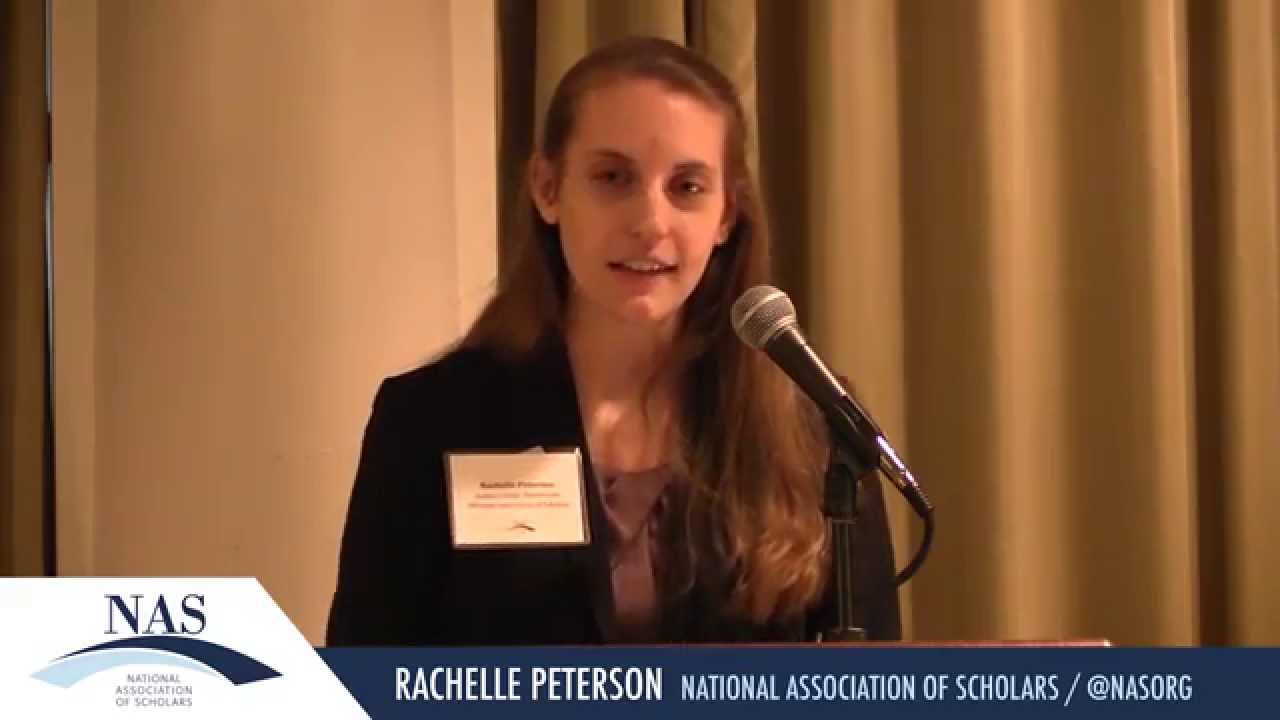
https://www.youtube.com/watch?v=DR3mP2SZbdU
1.
Nov 17, 2015 - Uploaded by National Association of Scholars
Rachelle Peterson | Minding The Campus
www.mindingthecampus.org/author/rdejong/
2.
Rachelle Peterson | In the Name of Confucius
inthenameofconfuciusmovie.com/tag/rachelle-peterson/
1.
https://www.nas.org/articles/will_the_other_claremont_colleges_defend_free_speech
A version of Rachelle Peterson's article originally appeared on Campus Reform. The full article is below.
When Claremont McKenna College announced it would punish seven students who blockaded the entrances to Heather Mac Donald’s speech in April, it did something few colleges have shown the backbone to undertake. It enforced campus policy in defense of free speech. In April President Hiram Chodosh said protesters had engaged in behavior that “violates College policy” and promised they “will be held accountable.” In July, the College suspended five students and placed two on conduct probation.
Claremont McKenna deserves some credit. I recently offered one-and-a-half cheers; to earn all three, Claremont should have prevented the blockade in the first place and kept order during Mac Donald’s talk. But at least the college followed through on President Chodosh’s vows to hold some students accountable.
We should now turn our attention to the other six institutions that, along with Claremont McKenna College, make up the Claremont University Consortium: Pitzer College, Pomona College, Claremont Graduate University, Keck Graduate Institute, Harvey Mudd College, and Scripps College. One hundred seventy students participated in the protest against Mac Donald. Claremont McKenna identified twelve of the 170 as Claremont McKenna students, of which it punished seven. The other 158 protesters either could not be identified, or were not Claremont McKenna students.
Where did these other speech obstructers come from? According to Claremont McKenna, some are students at the other Claremont consortium colleges. CMC claims to have sent the deans at these colleges “evidence of policy violations” by their students, and asked them “to review this evidence under their own conduct processes.” Claremont McKenna has banned four non-CMC students from visiting campus, on the grounds that they “played significant roles in the blockade.” But it is up to the administrators of the other colleges to take steps to suspend, fine, or otherwise punish students who broke college policy by disrupting Mac Donald’s talk.
Whether the other Claremont colleges follow President Chodosh’s lead in executing punishments will be a serious test of their commitment to free speech. A mob of protesters, many of them students, tore down a fence, swarmed police officers, and formed human chains across entrances out of spite for Mac Donald’s right to speak. Suspected policy-breakers should be given a fair investigation, with an opportunity to present any exculpatory evidence. But breaking college rules should come with consequences—especially when those rules concern a central purpose of higher education, the protection of intellectual freedom.
I asked each of the Claremont Consortium institutions whether they have investigated their students’ behavior during the April blockade. Three have begun reviewing evidence, and one plans to wait until the fall to investigate. Two believe none of their students participated or violated policies.
Here are the responses from each of the Claremont institutions.
Pitzer, Pomona, and Scripps are currently looking at evidence of potential student policy violations.
Pitzer CollegeVice President for Student Affairs Brian Carlisle:“Pitzer is in communication with Claremont McKenna College. We are currently reviewing all information provided.”
Pomona CollegeDean of StudentsMiriam Feldblum, via Marylou Ferry, Vice President, Chief Communications Officer:“We did receive photographs and information from CMC to review, as referred to by CMC in their recent statement, and that is in process of being reviewed with Dean Townes and Dean Waugh, who are the deans who oversee judicial affairs, and advise Judicial Council.
“With regard to our approach, this past spring, we had conversations in our campus Student Affairs Committee (SAC), which is a faculty committee, currently chaired by Prof. Paul Cahill, and SAC oversees the student handbook and can make changes to student judicial council processes and with ASPC student government, that our usual process when there are complaints about general behaviors during a demonstration (such as the use of bull horns in buildings or some disruptive behavior during a demonstration) often involve a dean's warning regarding the demonstration policy, whether to specific students or more generally when we cannot identify specific students, and that future violations could be addressed by the Judicial Council or a Dean's Sanction.
“With regard to an investigation, our general process with regard to claims of policy violations is that Dean Townes and Dean Waugh will determine the need for an investigation, oversee the investigation if appropriate, and then proceed from there, again, as appropriate.”
Scripps College Director of Media and Public Relations Karen Bergh:“Your query to President Lara Tiedens was forwarded to me as per our protocol for such inquiries. The statement you can use for Scripps regarding the student issue at CMC is that ‘we have received information from CMC and are reviewing the matter.’ There is no additional information at this time.”
Harvey Mudd College will review the evidence in the fall, when classes resume.
Harvey Mudd College Communications Officer Timothy L. Hussey:“In regard to your emails to President Klawe and Dean Jacobsen, the chair of our Disciplinary Board will follow up with CMC in the fall, when students return to campus, to discuss any allegations of HMC students violating the Demonstration Policy and any subsequent Honor Code actions.”
Claremont Graduate University and Keck Graduate Institute believe none of their students participated in the protests against Mac Donald.
Claremont Graduate University President Jacob Adams: “To the best of the university’s knowledge, no Claremont Graduate University (CGU) students were involved in the April 6 protest at Claremont McKenna College (CMC), and CMC has not turned over any evidence that CGU students were involved in the matter.”
Keck Graduate Institute Dean of Student Engagement and Enrollment ServicesSofia Toro:“We have reviewed the information by CMC and did not identify any KGI students.”
This means at least four of the Claremont institutions may have students who violated college policy. Harvey Mudd College President Maria Klawe, Pitzer College President Melvin L. Oliver, Pomona College President G. Gabrielle Starr, and Scripps College President Lara Tiedens, we’re watching you. Whether you investigate fairly and promptly, enforce order, and punish policy-breakers will show whether you respect free speech.
see earlier art'l
==
==
https://www.fed-soc.org/experts/detail/heather-mac-donald
==
SW hacked brochure; posted by mike, who pulls all refs to bahai faith
http://www.sourcewatch.org/index.php/Heather_MacDonald
==
https://www.city-journal.org/html/don%E2%80%99t-fund-college-follies-12874.html
It is easy to give money foolishly to colleges and very hard to give it wisely.
But at a handful of schools, enlightened alumni not only have learned how to avoid misguided benevolence but are also figuring out how to re-introduce serious scholarship to their campuses. Their initiatives are doing what presidents and trustees have failed to do: break the Left’s illiberal stranglehold on their institutions’ intellectual life and restore true academic freedom to campus.
Their strategies are very different from most big-time college giving, which too often funds some of today’s more regrettable violations of scholarly seriousness. One of Harvard’s most prominent benefactors, Sidney R. Knafel (Harvard AB ’52, MBA ’54), is a prime example of misguided philanthropy. Chairman of Insight Communications, the nation’s ninth-largest cable company, with a market value of some $2.1 billion, Knafel has recently forked over a juicy $1.5 million to the Radcliffe Institute for Advanced Study, a font of feminist grievance and left-wing posturing.
The Radcliffe Institute supports some of the silliest academic orthodoxies around—a belief that knowledge, gender, and race are “socially constructed” rather than based on any reality, a fascination with homosexuality, and an obsession with endemic American sexism and racism. At the end of this past academic year, the institute brought two prominent feminist journalists to lecture on campus. Susan Faludi—whose 1991 bestseller, Backlash, argued that the “patriarchy” was trying to re-enslave women—claimed preposterously to her Radcliffe audience that 9/11 had triggered yet another “backlash against feminism.” Barbara Ehrenreich, who lectured on “Weird Science: Challenging Sexist Ideology since the 1970s,” is a fierce critic of the economic system that made donor Knafel a megamillionaire. American capitalism, in her eyes, is a racket whereby the privileged perpetually exploit the underprivileged.
Faludi and Ehrenreich might form one side of an interesting debate about women’s equality, but the Radcliffe Institute shows no inclination to invite speakers who would argue the other side: not only that American women are the freest in history, but that they are free, period, thanks to the Western tradition of individual rights. Instead, many of the institute’s humanities and social-science fellows pursue left-wing topics, from discussing “how feminist knowledge travels” through a close analysis of the 1970s women’s-health book Our Bodies, Ourselves, to “exploring the intense interest in female same-sex relations” in seventeenth- and eighteenth-century Europe. Branching out into ethnic advocacy, a lecture this spring claimed that the U.S. subjected Mexican immigrant workers (read: “illegals”) to “terror” and “surveillance.”
But the Radcliffe Institute’s most enduring contribution to American academia will be its role as command center for the pillorying of Harvard president Lawrence Summers. In January, Summers had hypothesized that the distribution of mathematical skills in men and women might possibly influence the ratio of male to female scientists at elite institutions. Outraged, the Radcliffe Institute organized a March conference to discuss the “receding mirage” of “equity” for female scientists and in May published the Report of the Task Force on Women Faculty (see following article). Radcliffe Institute dean Drew Gilpin Faust, the task-force chair, predicted that the recommendations would “transform . . . the culture of the entire university community.” Alas, they will. They will further dilute meritocratic hiring standards at Harvard (and across the country) by embedding gender and race quotas even deeper into academic culture.
Earlier this year, Sidney Knafel endowed two fellowships at the Radcliffe Institute in honor of his mother and mother-in-law. Why would this capitalist entrepreneur do such a thing? Did he fully understand what his $1.5 million would be funding? Knafel described his mother-in-law, namesake of the new Mildred Londa Weisman Fellowship, as someone who had “high ideals and little tolerance for self-centered obstacles that seemed to thwart the realization of those ideals.” What would Mrs. Weisman have made of the institute’s many speakers who see “obstacles” to women’s progress everywhere in American society? Radcliffe Institute lecturer Rebecca Walker, for example, created the “I Spy Sexism” initiative, which asks young women between the ages of 15 and 30 to keep logs of the “sexism, racism, and homophobia” that they see as they walk down the street or go to movies. Mildred Weisman’s “most salient motivation [was] truth,” added Knafel. She would have felt quite out of place at the institute, then, whose scholarship too often embraces the postmodern view that “truth” is merely an artificial construct created by the dominant power structure.
Knafel’s other honoree—his mother, Lillian Gollay Knafel—would probably have been just as bewildered by the Radcliffe Institute. Whereas Mrs. Knafel, a founder of a League of Women Voters chapter in suburban New York, worked on World War II war-bond drives, the Radcliffe Institute will be deconstructing war and gender next fall with a conference entitled “In the War Zone: How Does Gender Matter?” Topics will include “Home Front / Battle Front: The Gendered Geography of War.”
Knafel claimed that if his mother had known “what Radcliffe is about in giving shape to the Radcliffe Institute, she would have proclaimed that this is clearly just right. What more effective direction could one take with the rich assets developed under the Radcliffe name?” In fact, quite a few more effective directions suggest themselves, such as studying how Western ideals of freedom and women’s rights can be exported to repressive societies, or how to strengthen marriage in the inner city so that children can be raised with the guidance of their fathers and women don’t live in poverty.
Such mismatches as the Knafel fellowships will continue, however, for most donors can’t possibly decode the jargon of constructivism and wouldn’t believe its premises if they could. An academic insider hears such Radcliffe research topics as “how the conceptualizations of race and poverty have shaped discourses of social mobility, cultural difference, and nation building,” or how the “twenty-first century reenactments of [a slave couple’s story] illuminate the constructions of black masculinity and femininity they help to fabricate,” and immediately knows the worldview that these mannered phrases connote. But how could a businessman who graduated from college back in 1952 guess that beneath the ubiquitous “discourses,” “constructions,” and “negotiated meanings”—behind the coy hyphens, parentheses, and slashes—lies the belief that there is no such thing as the “self,” or “truth,” or “males” and “females,” or “good” and “bad,” that all are arbitrary categories designed by an oppressor class of white male heterosexual capitalists to keep a victim class of minorities, women, and poor people silenced and powerless? How could he know that, according to the dominant campus ideology, Western civilization is merely a factory for “colonialism, slavery, empire and poverty,” as a Yale English professor puts it, and that the purpose of studying its great works is to unmask the various defenders of white male privilege?
Now it is of course possible that Knafel shares the institute’s belief that America still saddles its women with institutionalized sexism. But he wouldn’t say. He refused an interview about his giving, because “he’s a very private man,” as his secretary explained. Other donors to the institute were also inaccessible, including Richard M. Cashin, Jr. (Harvard AB ’75, MBA ’80), chairman of One Equity Partners, which manages over $2 billion in investments for JPMorgan Chase & Co. Cashin gave $750,000 this year for a Radcliffe Institute fellowship. Explained his wife, Lisa, to Harvard’s press office: “The institute provides us all with the tremendous opportunity to stretch our horizons.” Rita Hauser, a philanthropist and international lawyer with a strong history of public service, was too busy to speak about her financial support for the institute. In 1971, as an advisor to the Nixon White House, Hauser had called on the administration to support “responsible feminism,” as opposed to the radical version propounded by the bra burners yelling about sexist pigs. The Radcliffe Institute’s outlook, however, owes more to the bra burners than to the responsible feminists.
Even if Harvardhawked the Radcliffe Institute to Knafel as a mom-and-apple-pie expression of women’s progress, he still had ample opportunity to look beyond the bromides before he showered such largesse upon an enterprise whose victim politics were readily knowable. And gifts like his make academic reform much harder, since universities have less reason to reconsider the value of activities that attract big bucks, while graduate students, always looking for the next new thing, see that studying the construction of black masculinity, say, rather than the influence of Montesquieu on the American Founders, can lead to prestigious fellowships.
Princeton’s class of 1943 made a less obvious kind of error when it endowed a religion chair for its 20th reunion. Universities in 1963 were at the zenith of their prestige, having sponsored remarkable scientific breakthroughs, as well as humanities research and teaching of high seriousness. No one could have predicted how debased higher education would become. But by creating a chair, the class gave up any say about who would occupy it. The Princeton administration bestows chairs; allowing class members merely to express an opinion about whom they fund would supposedly violate academic freedom. By now, remarks class member John Brinster, “there is usually some controversy in these matters, as you can well expect.” Perhaps victimologist Cornel West, the chair’s current occupant, was just what the class had in mind when it created the chair; but some members, at least, may not have been expecting to support a neo-Marxist poseur who records rap lyrics and advises Al Sharpton.
The class of 1943 may have made an unavoidable mistake, but today’s donors have no excuse for creating empty vessels, such as endowed chairs, that their colleges may fill at will. Worse still is to pour in unrestricted money to fund every betrayal of serious learning that the college is currently sponsoring. But many alumni seem blind to that danger. “The willingness of alumni to give large sums of money—often without restrictions on its use—to colleges and universities that teach nothing but contempt for the values they hold dear is the best evidence I know for the failure of these institutions to teach students how to think,” sighs Princeton’s McCormick Professor of Jurisprudence, Robert George. “I’ve concluded with sadness that there is no atrocity a university can commit that will cause large numbers of alumni to say ‘enough is enough.’ ”
The editorial choices of Yale’s alumni magazine support George’s observations about alums’ indifference. The magazine, which operates independently from the university, regularly highlights the most radical aspects of campus life, without apparent risk of alumni backlash. The April 2003 cover story, for example—“Larry Kramer Couldn’t Be Happier”—opened thus: “In 1997, Larry Kramer ’57 loudly declared that his alma mater was homophobic. Six years, one new liver, and a million dollars later, Yale has a Larry Kramer Initiative for Lesbian and Gay
Studies, and everyone is happy. For now.” Playwright Kramer’s new center at Yale, endowed by his brother, hopes to be the country’s locus for queer studies. Queer theory, as the Yale article helpfully explains, views “gender and sexual identity” as “a kind of performance, [which] changes with circumstances.” In other words, there are no “men” and “women” but just individuals who at any given time are performing socially constructed roles as “men” and “women.”
College trustees seem even more determined than alumni to see and hear no evil. Nothing produces more discomfort and denial in your average trustee than being told about the excesses at his college. Federal appellate judge Jose Cabranes has served as a trustee at Yale and Colgate, and is currently on the Columbia board. Have you ever heard your fellow trustees express an interest in the curriculum? I asked him. “Not only never, but such questions make them anxiety-ridden. If the question comes up, most trustees stare vacantly into space.” (The one exception to this rule, however, would be an attempt to discard Columbia’s core curriculum, Cabranes guesses, which would likely produce a trustee counteroffensive.) A Brown trustee explains: “The culture wars are vicious; most trustees don’t want to be involved. They don’t care about the curriculum. All they want to know is if SATs are up.”
To test this claim, I asked a New York University trustee what she thought about Andrew Ross, a royally paid American studies professor. American studies “core” courses include “Marxist Thought and Critical Practice” and “Queer Historiographies.” Ross has or should have embarrassed the university many times over—if not for his public declaration in 1994 that he eschews reading books in favor of popular culture, then certainly for his falling for one of the most delicious hoaxes in modern academic history.
Until recently, Ross edited Social Text, a journal of the nonsensical jargon that today substitutes for knowledge of history or literature among humanities professors. In 1996, Social Text published an issue devoted to the trendy claim that scientific “knowledge” is merely a rhetorical construct like “gender,” the “self,” or “history.” Included in that issue was “Transgressing the Boundaries: Toward a Transformative Hermeneutics of Quantum Gravity,” by NYU physicist Alan Sokal. The essay flawlessly parroted the received wisdom in Ross’s world: “It has become increasingly apparent,” Sokal wrote, “that physical ‘reality,’ no less than social ‘reality,’ is at bottom a social and linguistic construct.” And throwing in the obligatory bow to Michel Foucault, Sokal added that “scientific ‘knowledge,’ so far from being objective, reflects and encodes the dominant ideologies and power relations of the culture that produced it.”
The essay was a perfect contribution to Social Text, no different from Ross’s own work or that of Sokal’s co-contributors. Only problem was: the piece was a hoax, designed to expose the vapidity of the “cultural studies” racket that Andrew Ross championed. As Sokal himself wrote afterward, his article lacked “anything resembling a logical sequence of thought; one finds only citations of authority, plays on words, strained analogies, and bald assertions.” But though Sokal’s hoax won wide press coverage, including a front-page New York Times story, the NYU trustee had never heard of Andrew Ross. She quickly changed the subject to NYU’s rising place in U.S. News and World Report’s annual college rankings.
Such unruffled acquiescence in whatever folly one’s university has cooked up is not surprising. A board is a creature of the college president, nominated by people close to him or by alumni associations whose members are also chosen for their loyalty. Trustees are usually so grateful for the honor and prestige of the position that they shy away from rigorous oversight. As one big donor observed, the “anxiety for status among what should be self-confident businessmen is remarkable. Once on college boards, they grovel.”
Colleges assume—apparently rightly—that academic matters are the last thing that trustees or the alumni who elect them care about. Witness the 2005 ballots to elect alumni fellows to the Yale Corporation. They gave short biographies of candidates Will Miller and Paul Steiger, but no hint about their educational philosophies or their goals for the university. Alumni who thought about such matters were left to try to read between the lines. Did Miller’s trusteeship on the John D. and Catherine T. MacArthur Foundation, for example, signify trendy ideological leanings? One could only guess. Yale’s vice president explained in the ballot what Yale itself valued in its trustees, besides money and connections. “As you can see from the biographies [read: ‘pictures’] of the current Fellows,” announced Linda Koch Lorimer, “Yale has achieved important gender and ethnic diversity with six women and four individuals of color among their number.”
Even conscientious trustees, determined to oversee their colleges’ quality of education, face numerous barriers—from stonewalling administrations to inhibiting peer pressure. A renegade regent at the University of California, San Diego Padres owner John Moores, Sr., has taken up the cause of a colorblind, meritocratic admissions policy. Even though race-neutral admissions are now the law in California, thanks to courageous former regent Ward Connerly, the university has tried a series of feints to circumvent the mandate, and it fiercely resisted Moores’s efforts to learn about actual admissions practices.Moores finally had to commission, at his own expense, a private study, which discovered that the Berkeley campus—the system’s most competitive—was indeed admitting minority students with radically lower scores than those of non-minority students whom it had rejected.
Rather than backing up Moores’s campaign to pry admissions data from the university, his fellow regents stood icily on the sidelines and then rebuked him for publishing the numbers. “The regents are furniture,” he says. “They do absolutely nothing. If they were a board of directors of a corporation, they would fire people on the spot for not revealing material information. But the regents don’t want to know about admissions standards. They accept with a sort of biblical inerrancy the revealed truth that ‘diversity’ is always good.”
If trustees are subservient to the administration, they are positively supine before the faculty. Aspirations to influence the curriculum wilt before the “academic freedom” taboo, placed like a fire at a temple’s gates to prevent the uninitiated from entering. Silicon Valley entrepreneur T. J. Rodgers won a seat on the Dartmouth College board in 2004 as an insurgent write-in alumni candidate. During the heated campaign, he had blasted the race and gender orthodoxies at the school, arguing that excellence should be the sole concern of colleges. He had even dared to notice that Dartmouth offered little instruction on the history of American democracy. Since then, however, he has dropped his vocal interest in what he calls “left/right issues”: “I have scrupulously avoided left/right issues to be effective. If I immersed myself in an attack on far-out disciplines . . . [and] if I ran up the flag about ethnic or women’s studies, I would be sucked up into a debate that would soak up my bandwidth.” He has even dropped his agitation for colorblind admissions standards. “I agreed to leave diversity alone when I came in,” he says. “I don’t talk about it.”
Faced with their own seeming powerlessness, conservative trustees can develop a case of existential doubt. A trustee at one of the most notoriously liberal private universities in the country sounds anguished discussing his service. “Being a trustee is hard to do if you want to live an examined life,” he says. “It’s a very problematic equation. Maybe I should just walk away. It would be completely rational, because so much is so bad.” Like Rodgers and nearly every other college trustee, he says that he refuses to fight the “culture wars.”
The Harvard Corporation displayed precisely this naked and abject fear of the faculty during the Larry Summers women-in-science debacle. In February, after Summers had already begun his serial apologies for having referred to scientific research on sex differences, board chief James Houghton wrote to the faculty about the matter: “We know that [President Summers] genuinely and deeply regrets having spoken as he did. . . . More generally, we know him as someone very much determined to learn from experience, to encourage discussion and debate, and to help Harvard pursue academic excellence in all of its many forms.”
Here’s the letter Houghton should have written: “The Corporation supports the president without reservation. President Summers’s willingness to explore in good faith all possible explanations for the gender imbalance in science faculties is in the greatest tradition of this university. We hope that he continues to show the same commitment to evidence and reasoned debate in the future.”
How did trustees get so emasculated? After all, they once ran the colleges. A Northwestern University trustee expressed the blithe self-confidence typical of his peers in 1900: “As to what should be taught in political science and social science, [the professors] should promptly and gracefully submit to the determination of the trustees when the latter find it necessary to act.” Legal opinion throughout the nineteenth century held that trustees had the power to dismiss professors at will, write Richard Hofstadter and Walter P. Metzger in The Development of Academic Freedom in the United States. Presidents, too, retained sole authority to hire faculty, though in the late nineteenth century, in some eastern colleges, faculty started recommending or at least consenting to new hires.
What changed was the rise of the doctrine of academic freedom. Progressive-era college benefactors and trustees did not appreciate their professors’ railing against the private concentration of power or calling for government regulation of the economy. The first president of the University of Chicago, William Rainey Harper, complained that he couldn’t go to his social clubs without getting pounced on for a Chicago professor’s radical ravings. All told, six professors nationwide were disciplined or fired for challenging laissez-faire economic orthodoxy.
In response, in 1915, economics and social-science professors formed the American Association of University Professors, which formulated the doctrines of academic freedom and tenure. As these notions gradually became the norm, professors came to occupy a uniquely privileged position in the American workforce, essentially untouchable by their putative bosses. By the middle of the twentieth century, writes National Association of Scholars president Stephen Balch,colleges had effected a wholesale transfer of intellectual power from their overseers to their faculties.
By now, the doctrine of academic freedom has expanded far beyond its original scope of protecting professors from being fired for their opinions. It now means that no one outside the faculty fortress may even comment on what gets taught, as the demise of the $20 million Lee Bass gift to Yale in 1995 notoriously showed. The idea behind the grant—to strengthen Yale’s Western-civilization courses—was originally the president’s and the dean’s, not the donor’s; the new program would have added to Yale’s curriculum, not taken away from it. After faculty opposition to more Western-culture courses—“The major export of Western civilization is violence,” as one Yale history professor put it—and after foot-dragging by a new administration, Bass rightly began to worry whether his intention of creating an apolitical program of scholarship would be honored. Accordingly, he asked to approve (though not to nominate) new hires—a condition that the administration, defending the faculty’s interests, would not allow.
Though at first glance, the prospects that trustees and alumni donors can recall the universities from their descent into narcissistic know-nothingism look grim, donors nevertheless have two possible levers for change. One is as yet unused, but the other is already exerting effective pressure.
Unused is the power that trustees could wield—if they had the courage to do so. All boards have academic committees, meant to advise the president on academic matters, and university bylaws usually vest final say over hiring in the trustees. Nothing prevents trustees from actually reading the course catalog; doing so would be eye-opening. While no trustee today would dare to challenge an appointment, there is no reason that boards can’t start conversations with provosts about why, for example, their colleges no longer offer courses in American revolutionary history. They might also ask why their colleges require each student to take a “diversity” offering rather than an overview of European and American history, or why English departments offer far more courses in theory and “underrepresented” voices than in the greats of English literature. Asking questions is no violation of academic freedom, though professors and administrators will doubtless complain that it is.
Trustees could also hire presidents who understand the value of a liberal education and are committed to improving the curriculum. Unlike the Harvard Corporation, they should then back up their choices unequivocally. Liberal education, they should explain, has nothing to do with the party affiliations of professors. Rather, it means a willingness to engage the legacy of the past with seriousness, rather than condescension, and to understand the achievements of Western civilization—science, prosperity, freedom, and artistic marvels—rather than only moan over its failings. Will the faculty howl? Sure, but that does not mean that their “academic freedom” has been violated.
For now, though, the alumni are the most likely agents for change. A few savvy alumni entrepreneurs are already creating a blueprint for breaking the monopoly of the academic Left and bringing traditional scholarship and intellectual diversity back to campus.
The model is as follows: find a tenured professor committed to classical learning. Give him resources to expand his jurisdiction by bringing in new faculty or offering new courses. A tenured prof, it turns out, often has leeway to recruit faculty on a temporary basis and to set them to teaching—as long as the prof is highly respected and has his own pot of money independent of the university budget, and as long as he, not the donor, is the actual and the perceived force behind the new program.
The James Madison Program in American Ideals and Institutions at Princeton is the flagship of all such cartel busters, a conservative version of the left-wing research institutes, like the Radcliffe Institute, that have proliferated on campuses in recent years. Directed by the charismatic Robert George and funded entirely by foundation and alumni money, the program focuses on constitutional law and political thought. George selects six fellows a year to come from other campuses to pursue research in such topics as the nature of free institutions, to offer public lectures, and to supervise student writing projects. Sometimes a fellow may teach a preexisting undergraduate course that has lain fallow in the catalog for years, or he may devise a new course and offer it on a one-time basis, subject to the approval of the chairman of the politics department, where the Madison Program is housed.
The program, which has attracted an enthusiastic student following, has altered the political debate on campus. No longer can a speaker at a conference assume that everyone in the audience shares the view that America is the world’s prime source of evil; some of George’s fellows may be there and will ask uncomfortable questions. Students interested in American ideals now have a body of thinkers they can draw on to expand their knowledge and encourage them, and they have a mutually reinforcing peer group sharing their generally conservative worldview.
In a similar vein is the Political Theory Project at Brown, also under the complete control of an energetic professor and backed by a strong-minded alumnus. Political theory professor John Tomasi, a free-market libertarian, had watched in frustration as the political assumptions on campus and in the curriculum narrowed and ossified. He had his own scars from that close-minded culture. When he had dared to question Brown’s minorities-only freshman-orientation program, a powerful tool for indoctrinating students into the reigning anti-white, anti-capitalist orthodoxies, Brown’s diversity police launched a hate campaign against him, he recounts. His colleagues wrote letters to the campus newspapers denouncing his “insensitivity”; anonymous diversity commissars made harassing late-night calls to his family; “anti-hate” activists hung his picture, with the label “racist,” throughout campus; and vandals smeared slurs on his car.
Alumnus Curtin Winsor, President Reagan’s ambassador to Costa Rica, had seen the results of Brown’s doctrinaire left-wing culture up close. His daughters, in collecting their Brown degrees, had also picked up a set of political assumptions that he found “distressing.” “I’m still trying to detox them,” he says. “They look at the world from a socialist perspective, which is alien to their upbringing.”
Tomasi’s and Winsor’s benevolent revenge? Introducing free-market thinking to Brown freshmen. With financing from Winsor, Tomasi created the Political Theory Project, an umbrella for courses and student discussion groups in liberty and democratic values. The project brings in five ideologically diverse postdoctoral fel-lows from other universities to teach freshman seminars—a task that most of Brown’s own faculty regard as beneath them. The fellows, who stay at Brown for two years, create their own courses, based on their scholarly interests. The result: ten new courses a year in perspectives that Brown would otherwise lack.
Tomasi plays to the typical Brown student’s desire for the avant-garde. “I tell freshmen that if they want radical funky ideas, here are some new courses, such as in de Tocqueville, Locke, or the philosophical ideas of the American Founding. Students are not getting these books anywhere; they just get critiques of free-market politics and the canon. The classics are so untaught that they become trendy.” Tomasi wants to create undergraduates who’ve read different books from the faculty. “After a whole semester of Hayek, it’s hard to shake them off that perspective over the next four years,” he says slyly.
The alumnus-funded Gerst Program in Political, Economic, and Humanistic Studies at Duke University provides one last variation on this formula: it uses faculty already in place to offer courses and conferences on the topics of liberty, democracy, and morally responsible behavior. The Duke engineering department had been putting the screws on Gary Gerst for a major contribution. But Gerst, chairman emeritus of Jones Lang LaSalle, a Chicago real-estate money-management firm, knew that a gift to the engineering school wouldn’t stay in the engineering school. A donation to one part of the university benefits the entire gamut of radical scholarship (which at Duke has been particularly concentrated in its English department), by allowing the university to shift resources from the newly funded program to other parts of campus.
Gerst had soured on Duke after a student newspaper-stealing incident, in which the leftist undergrads who burned the entire run of an offending conservative publication went scot-free, while the security guard who caught them was forced to attend sensitivity training. Gerst decided that he would only fund something that would otherwise not exist and that would break the campus dogmas. The American Council of Trustees and Alumni introduced him to Michael Gillespie, a professor of political thought and German philosophy who shared Gerst’s interests in democracy and personal responsibility.
Gillespie and Gerst chose to work with an existing first-year program at Duke, called Focus, in which groups of 30 freshmen lived together and took four thematically related seminars together. Some existing Focus topics were predictable in their politics—a women’s studies professor directed a series called “Forging Social Ideals,” for example. The Gerst Focus program, Visions of Freedom (which the Templeton Foundation also supports), introduces students to the seminal works in the Western philosophical and literary tradition, in order to explore concepts of freedom and moral authority. In addition to the freshman Visions of Freedom courses, the Gerst program also brings in a postdoctoral fellow to teach two new courses a year, offers upper-level classes, and provides course-development grants for Duke faculty.
Gillespie is cautious about characterizing the Gerst Program in Political, Economic, and Humanistic Studies. “We’re not making an obvious ideological statement; we just want to make sure that students read good books,” he says. “If you want to turn students into serious readers and thinkers, you have to get them in their freshman year.” As the price of foregrounding Aristotle, Locke, Hobbes, Kant, and Adam Smith, Gillespie has to add a sprinkling of the conventional left-wing ideologues, such as Marx and Bakunin, anti-colonialist revolutionary Frantz Fanon, and Italian Marxist terrorist Antonio Negri. “I could design the perfect program, but I couldn’t get it through faculty committees,” Gillespie explains. “I told Gerst that the students will read some books that we wouldn’t pick, but at least they’ll be reading serious books.”
Indeed, there’s a certain stealth quality to the Gerst program, like that of early Christians huddling in the catacombs. “The program wouldn’t be approved if we called it ‘Western Culture,’ ” says Gillespie. “People would say it needs to be more balanced.” No black studies or post-colonial studies program would ever be asked to show “balance,” of course, but for now, academic reformers simply have to accept that the deck is stacked against them. Similarly, Brown’s John Tomasi says he needs to speak “in code”; talking about free markets would not fly at Brown, he says.
The secrecy in which reformers are working is the clearest proof of how desperately academe needs change. At one Ivy League school, a government professor hoping to replicate Princeton’s Madison Program begged me to keep his college’s identity blank, “as this is something the feminists will try to quash as soon as they hear of it.” Alumni and a professor at another Ivy League college want to create an institute for researching the seventeenth- and eighteenth-century Battle of the Ancients and Moderns. The institute will be a home for people who want to do non-political scholarship without being subject to discrimination, a donor explained. He might as well have been trying to set up a center for making anthrax. “We are reaching a crucial stage,” he said, in requesting anonymity, “and it will be extremely important that nothing be done that would mobilize the campus left in opposition.”
The challenges to re-introducing liberal scholarship are considerable. If the key to creating a Madison-type program is to find a tenured scholar in place who can run it, few are the colleges that still have such traditional thinkers—and fewer still that have anyone with the star power and organizing skills of a Robert George. A philanthropist looked into starting an Alexander Hamilton institute at what was once the premier American history faculty in the country, for example, and quickly concluded that there was no one left in the department who would champion such a program.
Yet the prospects for change have never been more auspicious. Activist David Horowitz’s nationwide academic-freedom campaign, complete with an Academic Bill of Rights, has provided the perfect entrée for alumni who seek to better their colleges’ education (see “On Campus, Conservatives Talk Back,” Winter 2005). Presidents are starting to get nervous that their campuses may be the next to be blasted by Horowitz’s bullhorn. The Center for Freedom and Western Civilization at Colgate University, established in 2003 by political scientist Robert Kraynak and funded by Colgate alumni, announces boldly on its website that it “seeks to challenge the prevailing [campus] conformity by presenting a ‘conservative voice’ and a genuine exchange of ideas.” Why this unusual honesty? Colgate president and feminist theologian Rebecca Chopp asked the center to designate itself as “conservative” to demonstrate Colgate’s intellectual diversity, according to the NAS’s Stephen Balch, writing in the June Philanthropy.
The Ward Churchill affair at the University of Colorado at Boulder has also started administrators worrying about whether their own campus radicals may blow up and expose their left-wing ravings to all the world. Desperately trying to recover after the press unearthed Professor Churchill’s comparison of the 9/11 victims to “little Eichmanns,”Boulder can look to its new Center for Western Civilization as a needed counterweight. (The center was also a beneficiary of Horowitz’s agitation.)
Would-be alumni entrepreneurs should seize the moment. The model for starting a revolution has already been forged: fund professors already in place. If you can’t find anyone committed to liberal education at your own university, send your money instead to places that are more open to traditional scholarship. The National Association of Scholars and the American Council of Trustees and Alumni have databases of worthy candidates. If your alma mater sees that it is losing philanthropic dollars to institutions that support the traditional liberal arts, it may figure out a way to win back your donations. (Even universities with billion-dollar endowments hate to forgo significant alumni grants: in the 1980s, Harvard Law School alumni, angry over the Critical Legal Studies faction’s lock on tenure decisions, stopped giving money. The left-wing tyranny ended within a year.) Never give to a college’s general-support budget; it is money down the drain.
And always observe the donor’s Hippocratic oath: first, do no harm. If enough alumni start to pay attention to what they fund, colleges may eventually be so transformed that even philanthropists like Sidney Knafel will make wise investments, in spite of themselves.
venue not stated
Testimony by Heather Mac Donald on Immigration and the Alien Gang Epidemic: Problems and Solutions
Heather Mac Donald
April 13, 2005
OtherImmigrationEconomicsOther
My name is Heather Mac Donald. I am a senior fellow at the Manhattan Institute for Policy Research, a think tank in New York City. I have analyzed illegal immigration for City Journal and the Los Angeles Times, among other publications. I have also written a book on policing called Are Cops Racist? I appreciate the opportunity to testify today on this important topic.
Sanctuary laws are a serious impediment to stemming gang violence and other crime. Moreover, they are a perfect symbol of this country’s topsy-turvy stance towards illegal immigration.
---
off bs
Heather Mac Donald is the Thomas W. Smith Fellow at the Manhattan Institute and a contributing editor of City Journal. She is a recipient of the 2005 Bradley Prize. Mac Donald’s work at City Journal has covered a range of topics, including higher education, immigration, policing, homelessness and homeless advocacy, criminal-justice reform, and race relations. Her writing has appeared in the Wall Street Journal, Washington Post, New York Times, Los Angeles Times, The New Republic, and The New Criterion. Mac Donald's newest book, The War on Cops (2016), warns that raced-based attacks on the criminal-justice system, from the White House on down, are eroding the authority of law and putting lives at risk.
Other previous works include The Burden of Bad Ideas (2001), a collection of Mac Donald’s City Journal essays, details the effects of the 1960s counterculture’s destructive march through America’s institutions. In The Immigration Solution: A Better Plan than Today’s (2007), coauthored with Victor Davis Hanson and Steven Malanga, she chronicles the effects of broken immigration laws and proposes a practical solution to securing the country’s porous borders. In Are Cops Racist? (2010), another City Journal anthology, Mac Donald investigates the workings of the police, the controversy over so-called racial profiling, and the anti-profiling lobby’s harmful effects on black Americans.
A nonpracticing lawyer, Mac Donald clerked for the Honorable Stephen Reinhardt, U.S. Court of Appeals for the Ninth Circuit, and was an attorney-advisor in the Office of the General Counsel of the U.S. Environmental Protection Agency and a volunteer with the Natural Resources Defense Council. She has frequently testified before U.S. House and Senate Committees. In 1998, Mac Donald was appointed to Mayor Rudolph Giuliani’s task force on the City University of New York. She has received numerous awards for her writing:
Civilian Valor Award (2004), from the New Jersey State Association of Chiefs of Police.
Integrity in Journalism Award (2008), from the New York State Shields.
Eugene Katz Award for Excellence in the Coverage of Immigration (2008), from the Center for Immigration Studies.
Quill & Badge Award for Excellence in Communication (2012), from the International Union of Police Associations.
Excellence in Media Award (2016), from the State Troopers Coalition.
Excellence in Media Award (2017), from the National Law Enforcement Officers Memorial Fund.
Kenneth Y. Tomlinson Award for Outstanding Journalism (2017), from TheFund for American Studies.
Heroism Award (2017), from the NYPD Sergeants Benevolent Association.
A frequent guest on Fox News, CNN, and other TV and radio programs, Mac Donald holds a B.A. in English from Yale University, graduating with a Mellon Fellowship to Cambridge University, where she earned an M.A. in English and studied in Italy through a Clare College study grant. She holds a J.D. from Stanford University Law School.
==
wiki
Heather Lynn Mac Donald (born 1956) is an American political commentator, essayist, attorney and journalist. She is described as a secular conservative.[1][2] She has advocated positions on numerous subjects including victimization, philanthropy,[3] immigration reform,[4] crime prevention,[5][6][7] racism, racial profiling,[8] rape, politics,[9][10]welfare,[11][12] and matters pertaining to cities[10] and academia.
She is a Thomas W. Smith Fellow of the Manhattan Institute.[13] In addition, she is a contributing editor to New York's City Journal[14] and a lawyer by training.[15] She has written numerous editorials and is the author of several books. Born in California,[10] she graduated from Phillips Academy in Andover in 1974. In 1978 she graduated from Yale (where she was in Berkeley College).[16] She then attended Cambridge and graduated from Stanford University Law School in 1985.
Positions
Mac Donald identifies herself as a secular conservative. She has argued that conservative thinking is superior to liberalism by virtue of the ideas alone, and that religionshould not affect the argument and is unnecessary for conservatism.[1] She has criticized the notion of treating boys as a new victim group, and criticized universities for seeking to hire so-called diversity consultants to help boys succeed.[17] She has criticized welfare and blamed philanthropic institutions such as the Ford:{Foundation and the Carnegie Corporation for suggesting that welfare is a right; in particular, she has criticized welfare as having a negative impact in the sense that "generations have grown up fatherless and dependent".[3] }:
She has written that welfare programs serve as a "dysfunction enabler"[10] and that food stamps cause an "unhealthy dependence".[11][12] She has criticized American immigration policy as "importing another underclass", referring to Hispanics, which has the "potential to expand indefinitely".[4] She has argued that the reduction in crime seen in American cities since 1991 is a result of efficient policing, high incarceration rates, more police officers working, data-driven approaches such as CompStat in which police efforts target high-crime areas, and holding precinct commanders accountable for results.[7]
On the subject of terrorism prevention, Mac Donald has defended thePatriot Act and argued a case for secrecy and speed in handling problems as well as the sharing of information between departments within the intelligence community, and advocated that the benefits of government power be balanced against the risks of abuse.[6]
She has advocated for religious profiling by the police on the grounds that "you cannot be an Islamic terrorist unless you're a member of the Muslim faith".[8] She has said that the Abu Ghraib prison scandal's fallout was overblown and that opponents of then-President Bush used it to construct an exaggerated "master narrative"; she said that Abu Ghraib was "torture lite" compared with more brutal atrocities such as those of Pol Pot.[5] She defended using torture as an interrogation technique as being necessary in selected circumstances.[5]
In a break with some other conservatives, she has criticized talk radio for fueling "heightened rhetoric" and argued that criticism of President Obama on talk radio programs was overdone.[9] She views Obama as a moderate or "standard-issue" liberal, not a radical.[9] She has also condemned conservative "hate gestures", such as an incident in which the doors and windows of Democrats who voted in favor of a health care bill were broken, as "cowardly and juvenile" acts.[9]
She has been a very vocal critic of the Black Lives Matter movement, and was among the first proponents of the "Ferguson effect".[18][19] She is also an outspoken critic of criminal justice reform, such as the Sentencing Reform and Corrections Act, which she testified against in October 2015.[20]
Reviews of her books
Critic Robin Finn of the New York Times described her as an "influential institute thinker".[10]Columnist George F. Will praised her thinking about urban problems.[10] New York Times critic Allen D. Boyer gave a positive review of her book, The Burden of Bad Ideas (2000), writing "among discussions of urban malaise, where so much hot air has been recycled, this book has the freshness of a stiff, changing breeze".[3] Tim Lynch, the director of the Cato Institute's project on criminal justice, gave her 2016 book The War on Cops a negative review in Reason. Lynch concluded that "What Mac Donald calls a 'war on cops' is better described as a much-needed debate about crime, law enforcement tactics, and how to deal with systemic police misconduct," adding, "Conservatives have some worthwhile ideas to offer in this debate, but Mac Donald's polemics add heat, not light."[21]
Opposition
In the spring of 2017, a protest group announced plans to "shut down" her speech on the Black Lives Matter movement at a college campus in California, on the grounds that Mac Donald is, they allege, racist, fascist, and anti-Black.
On April 7, around 250 protesters surrounded and prevented audience members from entering the building where she was speaking at Claremont McKenna College, whose president Hiram Chodosh stated afterwards: "Based on the judgment of the Claremont Police Department, we jointly concluded that any forced interventions or arrests would have created unsafe conditions for students, faculty, staff, and guests." Mac Donald ultimately gave the talk to a small audience in the Marian Miner Cook Athenaeum which was also live-streamed on the Claremont McKenna website. Chodosh added: “In the end, the effort to silence her voice effectively amplified it to a much larger audience.”[22]
Publications
- The Burden of Bad Ideas: How Modern Intellectuals Misshape Our Society. Ivan R. Dee. 2000. ISBN 1-56663-337-0.
- Are Cops Racist?. Ivan R. Dee. 2003. ISBN 1-56663-489-X.
- The Illegal-Alien Crime Wave, "City Journal" Winter 2004
- The Immigration Solution, by Heather Mac Donald, Victor Davis Hanson, and Steven Malanga[14]
- The War on Cops: How the New Attack on Law and Order Makes Everyone Less Safe. Perseus Distribution Services. 2016. ISBN 1594038759.
References
- ^ :{Jump up to::(style="user-select:none;top:-99999px;clip:rect(1px 1px 1px 1px);overflow:hidden;position:absolute !important;padding:0px !important;border:0px !important;height:1px !important;width:1px !important"):}:^a b(https://en.wikipedia.org/wiki/Heather_Mac_Donald#cite_ref-Oppenheimer_1-1) Mark Oppenheimer (February 18, 2011). "A Place on the Right for a Few Godless Conservatives". New York Times. Retrieved 2011-02-19.
- :{Jump up:(style="user-select:none;top:-99999px;clip:rect(1px 1px 1px 1px);overflow:hidden;position:absolute !important;padding:0px !important;border:0px !important;height:1px !important;width:1px !important"):}:^ CHARLES C. W. COOKE, February 26, 2014, National Review, Yes, Atheism and Conservatism are Possible: You needn’t believe in God to believe in the American constitutional order, Retrieved November 6, 2015, "...If atheism and conservatism are incompatible, then I am not a conservative. And nor, I am given to understand, are George Will, Charles Krauthammer, Anthony Daniels, Walter Olson, Heather Mac Donald, James Taranto, Allahpundit, or S. E. Cupp...."
- ^ :{Jump up to::(style="user-select:none;top:-99999px;clip:rect(1px 1px 1px 1px);overflow:hidden;position:absolute !important;padding:0px !important;border:0px !important;height:1px !important;width:1px !important"):}:^a b(https://en.wikipedia.org/wiki/Heather_Mac_Donald#cite_ref-twsNovD15_3-1) c(https://en.wikipedia.org/wiki/Heather_Mac_Donald#cite_ref-twsNovD15_3-2) Allen D. Boyer, reviewing Mac Donald's The Burden of Bad Ideas(December 24, 2000). "Books in Brief: Nonfiction". The New York Times. Retrieved 2010-11-04.
- ^ :{Jump up to::(style="user-select:none;top:-99999px;clip:rect(1px 1px 1px 1px);overflow:hidden;position:absolute !important;padding:0px !important;border:0px !important;height:1px !important;width:1px !important"):}:^a b(https://en.wikipedia.org/wiki/Heather_Mac_Donald#cite_ref-twsNovD24_4-1) George F. Will (May 24, 2007). "A Bill That Earned Its Doubters". Washington Post. Retrieved 2010-11-04.
- ^ :{Jump up to::(style="user-select:none;top:-99999px;clip:rect(1px 1px 1px 1px);overflow:hidden;position:absolute !important;padding:0px !important;border:0px !important;height:1px !important;width:1px !important"):}:^a b(https://en.wikipedia.org/wiki/Heather_Mac_Donald#cite_ref-twsNovD14_5-1) c(https://en.wikipedia.org/wiki/Heather_Mac_Donald#cite_ref-twsNovD14_5-2) Lance Morrow (January 29, 2006). "Necessity or Atrocity?". The New York Times: Books. Retrieved 2010-11-04.
- ^ :{Jump up to::(style="user-select:none;top:-99999px;clip:rect(1px 1px 1px 1px);overflow:hidden;position:absolute !important;padding:0px !important;border:0px !important;height:1px !important;width:1px !important"):}:^a b(https://en.wikipedia.org/wiki/Heather_Mac_Donald#cite_ref-twsNovD44_6-1) Julian Sanchez (September 10, 2003). "PATRIOTism Debated: Heather Mac Donald and Julian Sanchez discuss government power in the War On Terror". Reason Magazine. Retrieved 2010-11-04.
- ^ :{Jump up to::(style="user-select:none;top:-99999px;clip:rect(1px 1px 1px 1px);overflow:hidden;position:absolute !important;padding:0px !important;border:0px !important;height:1px !important;width:1px !important"):}:^a b(https://en.wikipedia.org/wiki/Heather_Mac_Donald#cite_ref-twsNovD25_7-1) A transcript of the weekend's program on FOX News channel – Paul Gigot, Heather Mac Donald (February 8, 2010). "Hey, Big Spender". Wall Street Journal. Retrieved 2010-11-04.
- ^ :{Jump up to::(style="user-select:none;top:-99999px;clip:rect(1px 1px 1px 1px);overflow:hidden;position:absolute !important;padding:0px !important;border:0px !important;height:1px !important;width:1px !important"):}:^a b(https://en.wikipedia.org/wiki/Heather_Mac_Donald#cite_ref-twsNovD45_8-1) Mike Pesca (August 3, 2005). "NYC Mulls Effectiveness of Racial Profiling". NPR. Retrieved 2010-11-04.
- ^ :{Jump up to::(style="user-select:none;top:-99999px;clip:rect(1px 1px 1px 1px);overflow:hidden;position:absolute !important;padding:0px !important;border:0px !important;height:1px !important;width:1px !important"):}:^a b(https://en.wikipedia.org/wiki/Heather_Mac_Donald#cite_ref-twsNovD51a_9-1) c(https://en.wikipedia.org/wiki/Heather_Mac_Donald#cite_ref-twsNovD51a_9-2) d(https://en.wikipedia.org/wiki/Heather_Mac_Donald#cite_ref-twsNovD51a_9-3) "Are Smashed Windows Signs Of Cultural Divide?". NPR. March 25, 2010. Retrieved 2010-11-04.
- ^ :{Jump up to::(style="user-select:none;top:-99999px;clip:rect(1px 1px 1px 1px);overflow:hidden;position:absolute !important;padding:0px !important;border:0px !important;height:1px !important;width:1px !important"):}:^a b(https://en.wikipedia.org/wiki/Heather_Mac_Donald#cite_ref-twsNovD21_10-1) c(https://en.wikipedia.org/wiki/Heather_Mac_Donald#cite_ref-twsNovD21_10-2) d(https://en.wikipedia.org/wiki/Heather_Mac_Donald#cite_ref-twsNovD21_10-3) e(https://en.wikipedia.org/wiki/Heather_Mac_Donald#cite_ref-twsNovD21_10-4) f(https://en.wikipedia.org/wiki/Heather_Mac_Donald#cite_ref-twsNovD21_10-5) ROBIN FINN (November 28, 2000). "Excoriating the Enablers, in 12 Chapters". The New York Times. Retrieved 2010-11-04.
- ^ :{Jump up to::(style="user-select:none;top:-99999px;clip:rect(1px 1px 1px 1px);overflow:hidden;position:absolute !important;padding:0px !important;border:0px !important;height:1px !important;width:1px !important"):}:^a b(https://en.wikipedia.org/wiki/Heather_Mac_Donald#cite_ref-twsNovD22_11-1) Geofferey Campden (August 14, 1999). "Food-Stamp Decline Is a Real Concern". The New York Times. Retrieved 2010-11-04.
- ^ :{Jump up to::(style="user-select:none;top:-99999px;clip:rect(1px 1px 1px 1px);overflow:hidden;position:absolute !important;padding:0px !important;border:0px !important;height:1px !important;width:1px !important"):}:^a b(https://en.wikipedia.org/wiki/Heather_Mac_Donald#cite_ref-twsNovD23_12-1) Mary Ellen Burns (Aug 12, 1999). "Food-Stamp Decline Is a Real Concern". The New York Times. Retrieved 2010-11-04.
- :{Jump up:(style="user-select:none;top:-99999px;clip:rect(1px 1px 1px 1px);overflow:hidden;position:absolute !important;padding:0px !important;border:0px !important;height:1px !important;width:1px !important"):}:^ "Heather Mac Donald". Manhattan Institute.
- ^ :{Jump up to::(style="user-select:none;top:-99999px;clip:rect(1px 1px 1px 1px);overflow:hidden;position:absolute !important;padding:0px !important;border:0px !important;height:1px !important;width:1px !important"):}:^a b(https://en.wikipedia.org/wiki/Heather_Mac_Donald#cite_ref-twsNovD13_14-1) Morrow, Lance (2010-11-04). "Articles about Heather Mac Donald". The New York Times. Retrieved 2010-11-04.
- :{Jump up:(style="user-select:none;top:-99999px;clip:rect(1px 1px 1px 1px);overflow:hidden;position:absolute !important;padding:0px !important;border:0px !important;height:1px !important;width:1px !important"):}:^ Manhattan Institute Scholar | Heather Mac Donald
- :{Jump up:(style="user-select:none;top:-99999px;clip:rect(1px 1px 1px 1px);overflow:hidden;position:absolute !important;padding:0px !important;border:0px !important;height:1px !important;width:1px !important"):}:^ 1985 Yale Alumni Directory, p. 501.
- :{Jump up:(style="user-select:none;top:-99999px;clip:rect(1px 1px 1px 1px);overflow:hidden;position:absolute !important;padding:0px !important;border:0px !important;height:1px !important;width:1px !important"):}:^ Heather Mac Donald (2006-05-29). "Not another class of victims". USA Today. Retrieved 2010-11-04.
- :{Jump up:(style="user-select:none;top:-99999px;clip:rect(1px 1px 1px 1px);overflow:hidden;position:absolute !important;padding:0px !important;border:0px !important;height:1px !important;width:1px !important"):}:^ Russello, Gerald J. (8 July 2016). "The Dangerous War on Cops". National Review. Retrieved 24 October 2016.
- :{Jump up:(style="user-select:none;top:-99999px;clip:rect(1px 1px 1px 1px);overflow:hidden;position:absolute !important;padding:0px !important;border:0px !important;height:1px !important;width:1px !important"):}:^ Mac Donald, Heather (24 October 2016). "The Myth of the Racist Cop". Wall Street Journal. Retrieved 24 October 2016.
- :{Jump up:(style="user-select:none;top:-99999px;clip:rect(1px 1px 1px 1px);overflow:hidden;position:absolute !important;padding:0px !important;border:0px !important;height:1px !important;width:1px !important"):}:^ Mac Donald, Heather (22 October 2015). "The Myth of Criminal-Justice Racism". City Journal. Retrieved 24 October 2016.
- :{Jump up:(style="user-select:none;top:-99999px;clip:rect(1px 1px 1px 1px);overflow:hidden;position:absolute !important;padding:0px !important;border:0px !important;height:1px !important;width:1px !important"):}:^ Lynch, Tim (2016-07-16) [2016]. "There Is No War on Cops". Reason.
- :{Jump up:(style="user-select:none;top:-99999px;clip:rect(1px 1px 1px 1px);overflow:hidden;position:absolute !important;padding:0px !important;border:0px !important;height:1px !important;width:1px !important"):}:^ Blume, Howard (April 8, 2017). "Protesters disrupt talk by pro-police author, sparking free-speech debate at Claremont McKenna College". Los Angeles Times. Retrieved April 10, 2017.
External links


- "Excoriating the Enablers, in 12 Chapters", by Robin Finn, New York Times, November 28, 2000
- Mac Donald biography at NNDB
- Heather Mac Donald on IMDb
- Video of conversation between Heather Mac Donald and Glenn Loury at Bloggingheads.tv
- Video (and audio) of debate/discussion with Heather Mac Donald and Mark Kleiman on Bloggingheads.tv
- The Campus Rape Myth: The reality: bogus statistics, feminist victimology, and university-approved sex toys by Heather Mac Donald in 2008
- Appearances on C-SPAN
| Authority control |
- 1956 births
- Living people
- American anti–illegal immigration activists
- American essayists
- American political pundits
- American political writers
- American women journalists
- American women lawyers
- Critics of Islam
- Conservatism in the United States
- Hispanophobia
- Lawyers from New York City
- New York (state) Republicans
- Opposition to Islam in the United States
- Phillips Academy alumni
- Race and crime in the United States
- Race and intelligence controversy
- Scientific racism
- Stanford Law School alumni
- Writers from New York City
- Yale University alumni
http://claremontindependent.com/cmc-refuses-to-back-down-will-hold-students-accountable/
In an open letter to top officials and the Board of Trustees at Claremont McKenna College, a group of students identified as the “CMCers of Color” criticizes the college’s effort to punish students who violated college policy while protesting conservative scholar Heather Mac Donald as the “further criminalization of already marginalized students” and calls upon the college to end its “investigation.”
The letter comes as Hiram Chodosh, the president of CMC, fulfills his vow to punish students who defied college regulations in the course of the protests.
“Blocking access to buildings violates College policy,” he wrote in an April 7 email, one day after protesters shut down Heather Mac Donald’s talk by blockading the entrances to the Marian Miner Cook Athenaeum, where the Manhattan Institute scholar was scheduled to appear. “CMC students who are found to have violated policies will be held accountable. We will also give a full report to the other Claremont Colleges, who have responsibility for their own students.”
Multiple sources report that the college analyzed photo and video evidence supplied by onlookers and student journalists to identify the individuals who violated campus rules at the protest and target them for sanctions.
The CMCers of Color, however, complain that these efforts to uphold college policy are “distressing” and amount to “acts of violence” by the administration against students of color, whom they allege are the principal targets of the investigation:
“CMC has threatened to prevent students from walking at graduation and holds the power to withhold transcripts, barring students entrance into a competitive job market. CMC has also threatened suspension and expulsion. For low-income and first generation students, graduation is a culminatory moment that should not be revoked. On campuses where students of color already feel unsafe, it is distressing that these institutions resort to punitive measures to resolve issues resulting from their own negligence. These are acts of violence, and if advanced, would severely harm the survival of these students, particularly those of whom are graduating this coming week.”
The CMCers of Color also criticize the college for inviting speakers like Mac Donald, speakers who, according to the group, endanger students of color:
“While inflammatory speakers are framed as generating open dialogue on campus, they merely create dangerous campus environments for students of color. The institution’s financial backing of speakers who examine Black livelihood, suggesting its debatability, shows that fraudulent calls for open dialogue take precedence over students of color. CMC is effectively complicit in threats to the safety of students of color by legitimating the very politics that denies their humanity.”
The letter further claims that “[t]here has been no talk of investigation for violent counter protesters — only talk of further criminalization of already marginalized students.” But Chodosh’s original statement announcing the investigation stated that policy violators would be punished, and violence is :{against the student code:(style="border:0px;font-style:inherit;margin:0px;outline:0px;padding:0px;vertical-align:baseline"):}:.
Moreover, several eyewitnesses consulted by the Independent recall seeing no violent counter protest at the event, and multiple videos taken at the scene corroborate this account. The witnesses also confirm that the protesters engaged in various forms of physical intimidation, including “shoving, blocking,” and “forming human walls” to ensure that no one could enter the Athenaeum to view Mac Donald’s talk. Additionally, student journalists and onlookers, including but not limited to writers for the Independent, reported receiving threats of violence from students protesting Mac Donald. CMC’s student code prohibits “actions which cause, or could cause, personal injury or death,” actions which include “threatening to assault” or “intimidating another person.”
Concluding their letter, the CMCers of Color call for an end to CMC’s investigation. “We stand in solidarity with the actions taken against Mac Donald,” they write, “and we demand that the investigation and criminalization of CMC students stop immediately.”
The signatories to the letter of the CMCers of Color are private; as such, it is unclear how many have signed it.
Requests for comment from President Chodosh and other CMC officials were unanswered at the time of publication.
Claremont Students Plan to :{Protest:(style="margin:0px;padding:0px;border:0px;font-style:inherit;font-variant:inherit;font-weight:600;font-stretch:inherit;vertical-align:baseline"):}: 'Anti-Black Fascist ...
Students at the Claremont Colleges plan to protest and "shut down" a speech by prominent political commentator Heather Mac Donald tonight. Mac Donald, a member of ...
[](https://duckduckgo.com/?q=protest%20of%20scholar%20Heather%20Mac%20Donald+site:claremontindependent.com&atb=v31-5__ "Search domain claremontindependent.com"):{claremontindependent.com:(style="margin:0px;padding:0px;border:0px;font-style:inherit;font-variant:inherit;font-weight:inherit;font-stretch:inherit;vertical-align:baseline;display:inline"):}::{/students-plan-to-protest-anti-black-fasci...:(style="margin:0px;padding:0px;border:0px;font-style:inherit;font-variant:inherit;font-weight:inherit;font-stretch:inherit;vertical-align:baseline;opacity:1;visibility:visible"):}:
'War on Cops' author :{Heather:(style="margin:0px;padding:0px;border:0px;font-style:inherit;font-variant:inherit;font-weight:600;font-stretch:inherit;vertical-align:baseline"):}: :{Mac:(style="margin:0px;padding:0px;border:0px;font-style:inherit;font-variant:inherit;font-weight:600;font-stretch:inherit;vertical-align:baseline"):}: :{Donald:(style="margin:0px;padding:0px;border:0px;font-style:inherit;font-variant:inherit;font-weight:600;font-stretch:inherit;vertical-align:baseline"):}: ... - The College Fix
Mac Donald, a Manhattan Institute scholar who spoke on ... to The College Fix, Mac Donald ... the protest that state: "Heather Mac Donald has been ...
[](https://duckduckgo.com/?q=protest%20of%20scholar%20Heather%20Mac%20Donald+site:www.thecollegefix.com&atb=v31-5__ "Search domain www.thecollegefix.com"):{https://www.thecollegefix.com:(style="margin:0px;padding:0px;border:0px;font-style:inherit;font-variant:inherit;font-weight:inherit;font-stretch:inherit;vertical-align:baseline;display:inline"):}::{/post/32035/:(style="margin:0px;padding:0px;border:0px;font-style:inherit;font-variant:inherit;font-weight:inherit;font-stretch:inherit;vertical-align:baseline;opacity:1;visibility:visible"):}:
:{Heather:(style="margin:0px;padding:0px;border:0px;font-style:inherit;font-variant:inherit;font-weight:600;font-stretch:inherit;vertical-align:baseline"):}: :{Mac:(style="margin:0px;padding:0px;border:0px;font-style:inherit;font-variant:inherit;font-weight:600;font-stretch:inherit;vertical-align:baseline"):}: :{Donald:(style="margin:0px;padding:0px;border:0px;font-style:inherit;font-variant:inherit;font-weight:600;font-stretch:inherit;vertical-align:baseline"):}: - Wikipedia
Heather Lynn Mac Donald (born 1956) is an American political commentator, essayist, attorney and journalist. She is described as a secular conservative.
[ ](https://duckduckgo.com/?q=protest%20of%20scholar%20Heather%20Mac%20Donald+site:en.wikipedia.org&atb=v31-5__ "Search domain en.wikipedia.org"):{https://en.wikipedia.org:(style="margin:0px;padding:0px;border:0px;font-style:inherit;font-variant:inherit;font-weight:inherit;font-stretch:inherit;vertical-align:baseline;display:inline"):}::{/wiki/Heather_Mac_Donald:(style="margin:0px;padding:0px;border:0px;font-style:inherit;font-variant:inherit;font-weight:inherit;font-stretch:inherit;vertical-align:baseline;opacity:1;visibility:visible"):}:
Why We Were Right to :{Protest:(style="margin:0px;padding:0px;border:0px;font-style:inherit;font-variant:inherit;font-weight:600;font-stretch:inherit;vertical-align:baseline"):}: Against :{Heather:(style="margin:0px;padding:0px;border:0px;font-style:inherit;font-variant:inherit;font-weight:600;font-stretch:inherit;vertical-align:baseline"):}: :{Mac:(style="margin:0px;padding:0px;border:0px;font-style:inherit;font-variant:inherit;font-weight:600;font-stretch:inherit;vertical-align:baseline"):}: :{Donald:(style="margin:0px;padding:0px;border:0px;font-style:inherit;font-variant:inherit;font-weight:600;font-stretch:inherit;vertical-align:baseline"):}:
Heather Mac Donald, a self-proclaimed secular conservative, is a journalist and scholar whose 2016 book The War on Cops stirred widespread controversy.
[](https://duckduckgo.com/?q=protest%20of%20scholar%20Heather%20Mac%20Donald+site:claremontradius.com&atb=v31-5__ "Search domain claremontradius.com"):{claremontradius.com:(style="margin:0px;padding:0px;border:0px;font-style:inherit;font-variant:inherit;font-weight:inherit;font-stretch:inherit;vertical-align:baseline;display:inline"):}::{/defense-protest-heather-mac-donald/:(style="margin:0px;padding:0px;border:0px;font-style:inherit;font-variant:inherit;font-weight:inherit;font-stretch:inherit;vertical-align:baseline;opacity:1;visibility:visible"):}:
CMC May Expel Student Policy Violators | The Claremont ...
Students may face expulsion for violating college policy during a protest of conservative scholarHeather Mac Donald back in April.
[](https://duckduckgo.com/?q=protest%20of%20scholar%20Heather%20Mac%20Donald+site:claremontindependent.com&atb=v31-5__ "Search domain claremontindependent.com"):{claremontindependent.com:(style="margin:0px;padding:0px;border:0px;font-style:inherit;font-variant:inherit;font-weight:inherit;font-stretch:inherit;vertical-align:baseline;display:inline"):}::{/cmc-may-expel-student-policy-violators/:(style="margin:0px;padding:0px;border:0px;font-style:inherit;font-variant:inherit;font-weight:inherit;font-stretch:inherit;vertical-align:baseline;opacity:1;visibility:visible"):}:
'War on Cops' Author :{Heather:(style="margin:0px;padding:0px;border:0px;font-style:inherit;font-variant:inherit;font-weight:600;font-stretch:inherit;vertical-align:baseline"):}: :{Mac:(style="margin:0px;padding:0px;border:0px;font-style:inherit;font-variant:inherit;font-weight:600;font-stretch:inherit;vertical-align:baseline"):}: :{Donald:(style="margin:0px;padding:0px;border:0px;font-style:inherit;font-variant:inherit;font-weight:600;font-stretch:inherit;vertical-align:baseline"):}: Shouted Down at UCLA ...
'War on Cops' Author Heather Mac Donald Shouted Down at UCLA By Hysterical Black Lives Matter Protest. ... Mac Donald, a Manhattan Institute scholar who ...
[](https://duckduckgo.com/?q=protest%20of%20scholar%20Heather%20Mac%20Donald+site:nation.foxnews.com&atb=v31-5__ "Search domain nation.foxnews.com"):{nation.foxnews.com:(style="margin:0px;padding:0px;border:0px;font-style:inherit;font-variant:inherit;font-weight:inherit;font-stretch:inherit;vertical-align:baseline;display:inline"):}::{/2017/04/07/war-cops-author-heather-mac-do...:(style="margin:0px;padding:0px;border:0px;font-style:inherit;font-variant:inherit;font-weight:inherit;font-stretch:inherit;vertical-align:baseline;opacity:1;visibility:visible"):}:
College Students :{Protest:(style="margin:0px;padding:0px;border:0px;font-style:inherit;font-variant:inherit;font-weight:600;font-stretch:inherit;vertical-align:baseline"):}: Mike Pence, Chick-fil-A & :{Heather:(style="margin:0px;padding:0px;border:0px;font-style:inherit;font-variant:inherit;font-weight:600;font-stretch:inherit;vertical-align:baseline"):}: ...
Quivering students at the University of Notre Dame launched a protest last week against the ... Cops author Heather Mac Donald ... Who's unsafe on campus?
[](https://duckduckgo.com/?q=protest%20of%20scholar%20Heather%20Mac%20Donald+site:www.nationalreview.com&atb=v31-5__ "Search domain www.nationalreview.com"):{nationalreview.com:(style="margin:0px;padding:0px;border:0px;font-style:inherit;font-variant:inherit;font-weight:inherit;font-stretch:inherit;vertical-align:baseline;display:inline"):}::{/article/446660/college-students-protest-m...:(style="margin:0px;padding:0px;border:0px;font-style:inherit;font-variant:inherit;font-weight:inherit;font-stretch:inherit;vertical-align:baseline;opacity:1;visibility:visible"):}:
BLM At Claremont McKenna College :{Protest:(style="margin:0px;padding:0px;border:0px;font-style:inherit;font-variant:inherit;font-weight:600;font-stretch:inherit;vertical-align:baseline"):}: :{Heather:(style="margin:0px;padding:0px;border:0px;font-style:inherit;font-variant:inherit;font-weight:600;font-stretch:inherit;vertical-align:baseline"):}: MacConald ...
BLM At Claremont McKenna College Protest Heather ... The protesters forced Manhattan Institute scholar and "The War on Cops" author Heather Mac Donald to ...
[](https://duckduckgo.com/?q=protest%20of%20scholar%20Heather%20Mac%20Donald+site:alt-rewrite.com&atb=v31-5__ "Search domain alt-rewrite.com"):{https://alt-rewrite.com:(style="margin:0px;padding:0px;border:0px;font-style:inherit;font-variant:inherit;font-weight:inherit;font-stretch:inherit;vertical-align:baseline;display:inline"):}::{/2017/04/07/blm-at-claremont-mckenna-colle...:(style="margin:0px;padding:0px;border:0px;font-style:inherit;font-variant:inherit;font-weight:inherit;font-stretch:inherit;vertical-align:baseline;opacity:1;visibility:visible"):}:
Antifa :{Protest:(style="margin:0px;padding:0px;border:0px;font-style:inherit;font-variant:inherit;font-weight:600;font-stretch:inherit;vertical-align:baseline"):}: Movement & the Roots of Left-Wing Political ...
The Roots of Left-Wing Violence ... Heather Mac Donald was physically blocked from an auditorium at Claremont ... Mac Donald is a scholar at the Manhattan ...
[](https://duckduckgo.com/?q=protest%20of%20scholar%20Heather%20Mac%20Donald+site:www.nationalreview.com&atb=v31-5__ "Search domain www.nationalreview.com"):{nationalreview.com:(style="margin:0px;padding:0px;border:0px;font-style:inherit;font-variant:inherit;font-weight:inherit;font-stretch:inherit;vertical-align:baseline;display:inline"):}::{/article/448275/antifa-protest-movement-ro...:(style="margin:0px;padding:0px;border:0px;font-style:inherit;font-variant:inherit;font-weight:inherit;font-stretch:inherit;vertical-align:baseline;opacity:1;visibility:visible"):}:
:{Heather:(style="margin:0px;padding:0px;border:0px;font-style:inherit;font-variant:inherit;font-weight:600;font-stretch:inherit;vertical-align:baseline"):}: :{Macdonald:(style="margin:0px;padding:0px;border:0px;font-style:inherit;font-variant:inherit;font-weight:600;font-stretch:inherit;vertical-align:baseline"):}: Black Students At Pomona 2017 | 2016 17 ...
Heather Macdonald Black Students At ... in response to Pomona College Institute scholar HeatherMacDonald. ... of the protest as editor of the ...
[](https://duckduckgo.com/?q=protest%20of%20scholar%20Heather%20Mac%20Donald+site:www.scholarshipeasy.com&atb=v31-5__ "Search domain www.scholarshipeasy.com"):{scholarshipeasy.com:(style="margin:0px;padding:0px;border:0px;font-style:inherit;font-variant:inherit;font-weight:inherit;font-stretch:inherit;vertical-align:baseline;display:inline"):}::{/tags/heather-macdonald-black-students-at-...:(style="margin:0px;padding:0px;border:0px;font-style:inherit;font-variant:inherit;font-weight:inherit;font-stretch:inherit;vertical-align:baseline;opacity:1;visibility:visible"):}:
The Microaggression Farce | City Journal
The Microaggression Farce ... announced a protest against its "hostile and unsafe climate for Scholars of ... Heather Mac Donald is a contributing editor ...
[](https://duckduckgo.com/?q=protest%20of%20scholar%20Heather%20Mac%20Donald+site:www.city-journal.org&atb=v31-5__ "Search domain www.city-journal.org"):{https://www.city-journal.org:(style="margin:0px;padding:0px;border:0px;font-style:inherit;font-variant:inherit;font-weight:inherit;font-stretch:inherit;vertical-align:baseline;display:inline"):}::{/html/microaggression-farce-13679.html:(style="margin:0px;padding:0px;border:0px;font-style:inherit;font-variant:inherit;font-weight:inherit;font-stretch:inherit;vertical-align:baseline;opacity:1;visibility:visible"):}:
Angry mob shuts down Blue Lives Matter ... - The College Fix
Heather Mac Donald, ... The College Fix in a message Thursday that he believes ... UCLA by hysterical Black Lives Matter protest. MORE: Heather Mac Donald drops truth ...
[](https://duckduckgo.com/?q=protest%20of%20scholar%20Heather%20Mac%20Donald+site:www.thecollegefix.com&atb=v31-5__ "Search domain www.thecollegefix.com"):{https://www.thecollegefix.com:(style="margin:0px;padding:0px;border:0px;font-style:inherit;font-variant:inherit;font-weight:inherit;font-stretch:inherit;vertical-align:baseline;display:inline"):}::{/post/32050/:(style="margin:0px;padding:0px;border:0px;font-style:inherit;font-variant:inherit;font-weight:inherit;font-stretch:inherit;vertical-align:baseline;opacity:1;visibility:visible"):}:
:{Heather:(style="margin:0px;padding:0px;border:0px;font-style:inherit;font-variant:inherit;font-weight:600;font-stretch:inherit;vertical-align:baseline"):}: :{Mac:(style="margin:0px;padding:0px;border:0px;font-style:inherit;font-variant:inherit;font-weight:600;font-stretch:inherit;vertical-align:baseline"):}: :{Donald:(style="margin:0px;padding:0px;border:0px;font-style:inherit;font-variant:inherit;font-weight:600;font-stretch:inherit;vertical-align:baseline"):}: Talks About Her Essential Book: The War on ...
Heather Mac Donald Talks About Her Essential Book: The ... to break down in tears and say everybody protests when a ... We welcome back Heather Mac Donald, ...