Chomsky
==
SEE 1119 bak noam
TARGET?
===
===
climate plus putin nukes
https://www.alternet.org/2022/04/most-dangerous-point-human-history/
===
===
an 12 24
Noam Chomsky, one of the world’s most famous and respected intellectuals, will be 96 years old on Dec. 7, 2024. For more than half a century, multitudes of people have read his works in a variety of languages, and many people have relied on his commentaries and interviews for insights about intellectual debates and current events.
Chomsky suffered a stroke in June 2023 that has severely limited his movement, impaired his speech and impeded his ability to travel. His birthday provides an occasion to consider the tremendous corpus of works that he created over the years and to reflect on the many ways that his texts and recordings still critically engage with contemporary discussions all across disciplines and realms.
Chomsky’s vast body of work includes scientific research focused on language, human nature and the mind, and political writings about U.S. imperialism, Israel and Palestine, Central America, the Vietnam War, coercive institutions, the media and the many ways in which people’s needs are subjugated in the interest of profit and control.
As a scholar of humanities and law, I’ve engaged with Chomsky’s work from an array of perspectives and authored a biography called “Noam Chomsky: A Life of Dissent” and a book on Chomsky’s influence called “The Chomsky Effect: A Radical Works Beyond the Ivory Tower.” One important theme in his broad corpus is his lifelong fascination with human creativity, which helps explain his vociferous attacks on those who seek to keep the rabble in line.
Early days
Avram Noam Chomsky was born on Dec. 7, 1928, in Philadelphia. He and his younger brother, David Chomsky, were raised in a lively household by Elsie Simonofsky and William (Zev) Chomsky, progressive educators who were deeply immersed in wide-ranging Jewish and Zionist cultural activities.
Chomsky often dates his own interest in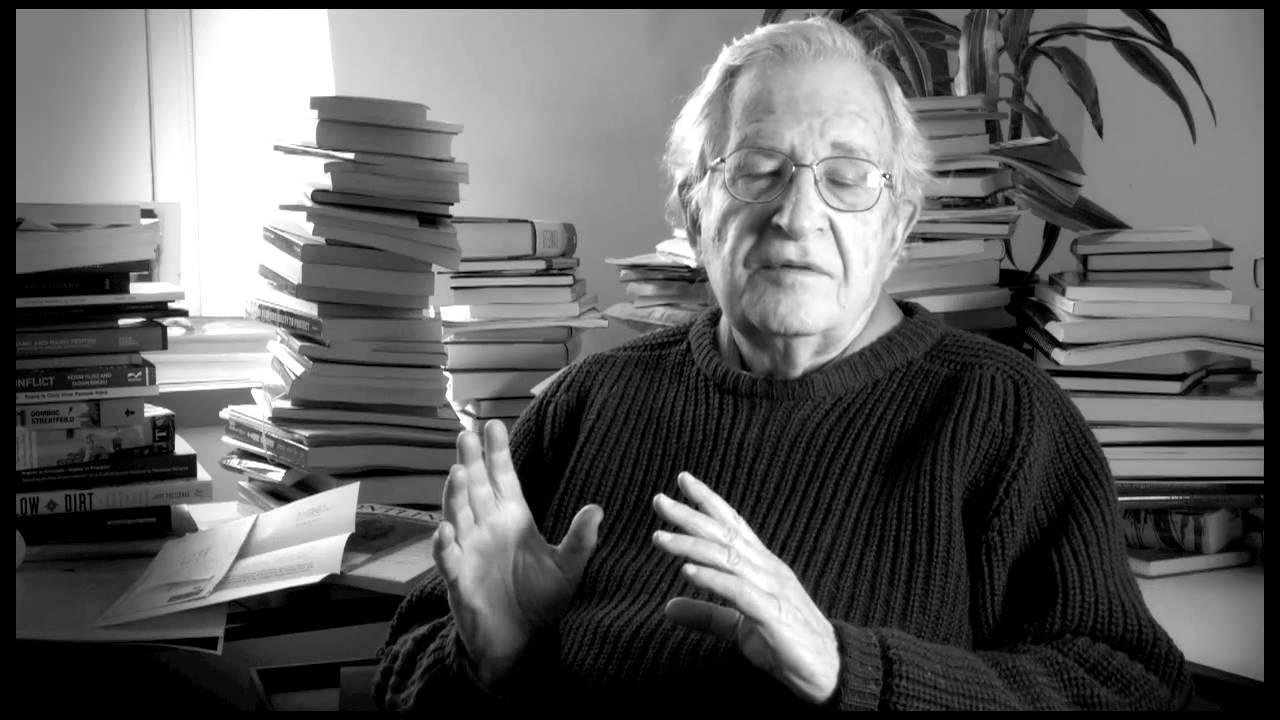 to his close readings of Hebrew works with his parents and to the lively educational experiences he enjoyed at the Oak Lane County Day School, an experimental school that subscribed to
 and promoted individual creativity over competition with other students.
A precocious learner, Chomsky at 12 years old read the proofs for his father’s book about a 13th-century Hebrew grammarian named David Kimhi. It was an auspicious beginning to a life immersed in philology, philosophy and the study of . From very early on, he sought to understand innate human propensities for freedom, dignity and creativity, which inspired his interest in fostering those properties of human nature.
While Chomsky’s parents were what he called normal Roosevelt Democrats, he was drawn to more radical approaches to society and to the promotion of . At age 10, he read about the Spanish Civil War, which inspired him to write an editorial about the fall of Barcelona for his school’s newspaper. This was an early harbinger of his public intellectual work and his vociferous challenges to systems of oppression and illegitimate authority.
As a young man, Chomsky joined a socialist wing of the Zionist youth movement that opposed a Jewish state, and from his readings and discussions he came to favor Arab-Jewish class cooperation in a socialist Palestine. His deep knowledge of Palestine and Israel, bolstered by his ability to read and speak Arabic and Hebrew, helped inform his many vehement critiques of Israeli state power. Chomsky on John Dewey’s approach to education: how to produce free, creative, independent human beings.
Radical pedagogy
After an early education focused on self-discovery and free-ranging exploration, Chomsky was introduced in [vids]to rote learning, competition with other students and a mainstream system of values. In reaction, he began to make regular trips to New York City, where he explored bookstores. He also made regular visits with a relative who ran a newsstand on 72nd Street that served as a lively intellectual center for emigrés interested in more radical approaches to society.
In 1944, Chomsky completed high school and enrolled in the University of Pennsylvania. Although he has expressed some dismay about the structures of conformity and status quo thinking he encountered there, he did find inspiration in courses with philosopher C. West Churchman, linguist Giorgio Levi Della Vida and, moreover, linguist . Chomsky knew members of the Harris family because Zellig Harris’ father hosted Jewish services in the Harris home that the Chomsky family occasionally attended.
Chomsky’s father’s approach to the study of language bore similarities to Zellig Harris’ work in Semitics, the study of Arabic, Hebrew and other Semitic languages. Harris invited Noam to read the proofs of his “Methods in Structural Linguistics.” This highly anticipated book was rooted in the idea that the function and the meaning of linguistic elements are determined by their their relationship to other components that make up sentences. After working hard to understand Harris’ linguistics paradigm, Chomsky eventually abandoned it, but he remained fascinated by Harris’ political views and by the unstructured, lively and creative debates that he promoted.
Chomsky met Carol Doris Schatz at the Hebrew School where her mother taught and Chomsky’s father was principal. Years later, when they were both students at the University of Pennsylvania, they started dating. They were married in 1949, and four years later they decided to move to an Israeli kibbutz, or communal agricultural settlement. They had expected to find a culture of creative free thinking there. Instead, they were deeply disappointed to find what Chomsky described as ideological conformity to Stalinist ideology. They returned to the U.S. after only six weeks.
The young couple settled in Boston and . Noam pursued graduate work, while Carol paused her own studies to raise the children. She later returned to research on language acquisition, which she eventually taught and researched at MIT and Harvard. Carol Chomsky died in 2008. Noam remarried in 2014, to the Brazilian translator Valeria Wasserman Chomsky.
Chomskian revolution
When Chomsky was a student, most academic psychologists described human language as a system of habits, skills or dispositions to act that are acquired through extensive training, induction, generalization and association. By this account, language grows incrementally with experience, .
This framework was at the heart of a structuralist paradigm, which analyzed the form and meaning of texts as different parts of the same thing. Any language, from this standpoint, restricts how phonemes and morphemes – the smallest units of sound and meaning in language – and other constituents are assembled and distributed. By this view, humans have the capacity to learn language in ways akin to how they acquire .
Chomsky’s Ph.D. work, the resulting 1957 book “Syntactic Structures” and his New York Review of Books review of B.F. Skinner’s “Verbal Behaviour” challenged this paradigm and heralded the Chomskian linguistics revolution. Chomsky’s theory of universal grammar in the history of how philosophers have viewed the human mind and language acquisition.
Chomsky’s starting point was that humans are endowed with universal grammar, which is activated by exposure to natural language. Children gain proficiency in a language by building on innate knowledge. This means that the capacity for language quite literally grows in the mind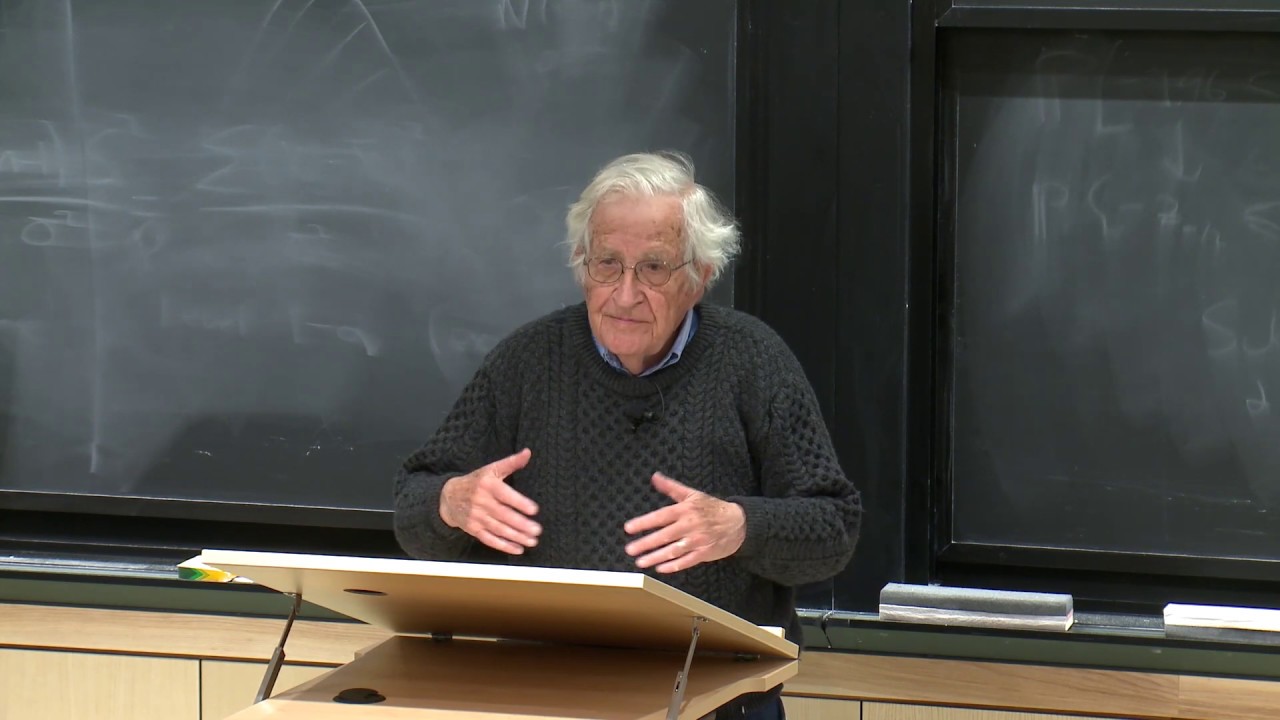 .
Chomsky’s interest in innate human abilities draws in part from a range of philosophical treatises penned in the 17th and 18th centuries and associated with the Port Royal system of logic and Enlightenment philosophy, which emphasized science, individual liberty and the rule of law. He developed these ideas in a book called “Cartesian Linguistics,” which outlined his intellectual debt to the writings of, among others, , Kant, Rousseau and.
By the early 1960s, Chomsky’s work had gained him recognition in linguistics, philosophy and psychology. His own research, and that conducted by the growing number of linguists who adopted his approach, led to significant advances in the study of syntax, generative grammar, language and the mind, semantics, form and the interpretation of language.
His political engagement was documented in what I believe is a remarkable collection of interviews and books about U.S. imperialism, the Cold War, the Middle East, Central America and Southeast Asia, including “Problems of Knowledge and Freedom” and “For Reasons of State.” Puzzled by Americans’ spirit of resigned consensus, he began to collaborate with Edward S. Herman on books including “Counter-Revolutionary Violence,” “The Political Economy of Human Rights” and “Manufacturing Consent,” which was turned into a popular film by the same name.
Common thread
The common thread connecting Chomsky’s many intellectual projects are that were the focus of much of his life’s work. One is Plato’s problem, which considers why it is that humans, whose contact with the world is brief and limited, can come to know so much. The second is Orwell’s complementary problem, which asks how is it that human beings know so little given the amount of information to which they have access. The third is Descartes’ problem, which pertains to the human capacity to freely express thoughts in constantly novel ways over an infinite range by means that are appropriate to circumstances but not caused by them. Finally, there’s Humboldt’s problem, which focuses on
 .
These problems are connected in different ways to , and to speculations about the initial state of the language faculty, which he outlined in a range of texts, including “Knowledge of Language: Its Nature, Origin, and Use,” “Language and Problems of Knowledge: The Managua Lectures,” “The Minimalist Program” and “Why Only Us? Language and Evolution,” with Robert C. Berwick.
Chomsky’s legacy
‘Manufacturing Consent’ is one of Noam Chomsky’s best-known political works. courtesy Penguin Random House
Remarkably tenacious and active, Chomsky continued to publish and to speak out on contemporary issues into his mid-90s. His ideas evolved but were rooted in a series of deeply seated ideas about the nature of the human mind. He is one of the most cited intellectuals in history, and he was voted the leading living public intellectual in The 2005 Global Intellectuals Poll. Millions of people have watched his debates and discussions with , Angela Davis,
 ,
 ,
 ,
 ,
 ,
 ,
 and even
 .
As the figure widely viewed as the founder of cognitive sciences, Chomsky has been critical of the hype surrounding big data, artificial intelligence and ChatGPT.
As a voice for the downtrodden and the oppressed, he has spoken from the perspective of human rights, intellectual self-defense and the popular struggle through independent thinking against structures of power and subjugation.
Chomsky’s extraordinary achievements resonate far and wide – and are likely to continue to do so into the future.
Robert F. Barsky, Professor of Humanities and Professor of Law, Vanderbilt University
This article is republished from The Conversation under a Creative Commons license. Read the original article.
===
===
https://www.alternet.org/2020/10/author-noam-chomsky-trump-is-taking-the-us-down-the-road-toward-autocracy-and-will-go-to-extreme-lengths-to-stay-in-power
Chomsky laid out why he considers President Donald Trump a major threat to democracy during an interview with Truthout's C.J. Polychroniou published this week.
Although countless polls have found the president losing to former Vice President Joe Biden in this year's presidential election, Trump has refused to acknowledge the possibility of his own loss. Instead, he has insisted that Biden can only win if rampant voter fraud occurs, suggesting he may not accept the election results if the former vice president is victorious.
Chomsky, now 91, has lived through many historic events — from the Great Depression and World War II to Watergate to 9/11. And during the Truthout interview, the left-wing author stressed that he considers Trump the most authoritarian U.S. president of his lifetime — which is saying a lot when one considers that Republican Calvin Coolidge was still president when Chomsky was born in Philadelphia on December 7, 1928.
Chomsky is no fan of President Richard Nixon. But he says, without hesitation, that Trump is much worse.
"We may recall that Richard Nixon, not exactly revered for his integrity, had some reason to suppose that victory in the 1960 election had been stolen from him by Democratic Party machinations," Chomsky told Polychroniou. "He did not challenge the results, placing the welfare of the country above personal ambition. Al Gore did the same in 2020. The idea of Trump placing anything above his personal ambition — even caring about the welfare of the country — is too ludicrous to discuss."
Trump's authoritarianism, according to Chomsky, was painfully evident during recent anti-racism protests in Portland, Oregon.Chomsky observed, "When Trump decided to terrorize Portland, Oregon, he didn't send the military, probably expecting that it would refuse to follow his orders, as had just happened in Washington, D.C. He sent paramilitaries, the most fierce of them the tactical unit BORTAC of the Border Patrol, which is given virtually free rein with the 'damned of the earth' as its targets."
To make matters worse, Chomsky added, Trump's "private army" also includes well-armed militia groups, domestic terrorists and white nationalists. Chomsky warned, "Those are the forces that may be upholding 'law and order' if, in fact, the top military command decides to be 'complicit in a coup d'état.' It seems unimaginable, but regrettably, not inconceivable."
The left-wing author added, "Meanwhile, Trump and his Republican cohorts are working overtime to implement their strategy of undermining the election or discrediting it if it comes out the wrong way, setting the stage for a possible coup. In preparation, an 'army for Trump' is being mobilized to descend on polls to intimidate the wrong voters."
Trump, Chomsky told Polychroniou, considers Biden's supporters "the wrong voters" and will go to great lengths to bully them or have their votes thrown out.
Chomsky noted that a tide of nationalist authoritarianism is making its presence felt all around the world, from President Jair Bolsonaro in Brazil to Prime Minister Narendra Modi in India. But according to Chomsky,the U.S. is worse off than Brazil from a checks-and-balances standpoint because at least Bolsonaro was "blocked" by the Brazilian Supreme Court.
The author told Polychroniou: "The U.S. has gone farther down the road toward autocracy (than Brazil). When inspectors general tasked with overseeing executive malfeasance followed the same course, the would-be dictator in the White House simply fired them. He did so without a peep from the Republican Senate."
===
==
https://www.alternet.org/2020/09/author-noam-chomsky-trump-is-a-sociopathic-maniac-capable-of-provoking-a-civil-war-if-he-doesnt-win-the-electoral-college-in-november/
===
https://www.alternet.org/2020/09/noam-chomsky-the-world-is-facing-the-most-dangerous-moment-in-human-history/
==
noam c says yanis and bernie bulwark ~ authoritarian 420
==
==
DN bernie biden gnd covid
===
GOODMAN: Today, a Democracy Now! special, an hour with Noam Chomsky, the world-renowned dissident and father of modern linguistics. In April, Noam Chomsky visited his hometown of Boston, where he was a professor at the Massachusetts Institute of Technology for more than half a century. He now teaches at the University of Arizona, Tucson. Over 700 people packed into the Old South Church to hear him speak. Later in the broadcast, we’ll air my on-stage interview with him, but first we turn to his speech....
no lnx
Noam Chomsky: We must confront the ‘ultranationalist, reactionary’ movements growing across the globe
By S - Own work, CC BY-SA 4.0, https://commons.wikimedia.org/w/index.php?curid=63784138
Written by Amy Goodman, Democracy Now February 8, 2020
AMY GOODMAN: Today, a Democracy Now! special, an hour with Noam Chomsky, the world-renowned dissident and father of modern linguistics. In April, Noam Chomsky visited his hometown of Boston, where he was a professor at the Massachusetts Institute of Technology for more than half a century. He now teaches at the University of Arizona, Tucson. Over 700 people packed into the Old South Church to hear him speak. Later in the broadcast, we’ll air my on-stage interview with him, but first we turn to his speech.
NOAM CHOMSKY: If you’ll indulge me, I’d like to start with a brief reminiscence of a period which is eerily similar to today in many unpleasant respects. I’m thinking of exactly 80 years ago, almost to the day, happened to be the moment of the first article that I remember having written on political issues. Easy to date: It was right after the fall of Barcelona in February 1939.
The article was about what seemed to be the inexorable spread of fascism over the world. In 1938, Austria had been annexed by Nazi Germany. A few months later, Czechoslovakia was betrayed, placed in the hands of the Nazis at the Munich Conference. In Spain, one city after another was falling to Franco’s forces. February 1939, Barcelona fell. That was the end of the Spanish Republic. The remarkable popular revolution, anarchist revolution, of 1936, ’37, ’38, had already been crushed by force. It looked as if fascism was going to spread without end.
It’s not exactly what’s happening today, but, if we can borrow Mark Twain’s famous phrase, “History doesn’t repeat but sometimes rhymes.” Too many similarities to overlook.
When Barcelona fell, there was a huge flood of refugees from Spain. Most went to Mexico, about 40,000. Some went to New York City, established anarchist offices in Union Square, secondhand bookstores down 4th Avenue. That’s where I got my early political education, roaming around that area. That’s 80 years ago. Now it’s today.
We didn’t know at the time, but the U.S. government was also beginning to think about how the spread of fascism might be virtually unstoppable. They didn’t view it with the same alarm that I did as a 10-year-old. We now know that the attitude of the State Department was rather mixed regarding what the significance of the Nazi movement was. Actually, there was a consul in Berlin, U.S. consul in Berlin, who was sending back pretty mixed comments about the Nazis, suggesting maybe they’re not as bad as everyone says. He stayed there until Pearl Harbor Day, when he was withdrawn—famous diplomat named George Kennan. Not a bad indication of the mixed attitude towards these developments.
It turns out, couldn’t have known it at the time, but shortly after this, 1939, the State Department and the Council on Foreign Relations began to carry out planning about the postwar world, what would the postwar world look like. And in the early years, right about that time, next few years, they assumed that the postwar world would be divided between a German-controlled world, Nazi-controlled world, most of Eurasia, and a U.S.-controlled world, which would include the Western Hemisphere, the former British Empire, which the U.S. would take over, parts of the Far East. And that would be the shape of the postwar world. Those views, we now know, were maintained until the Russians turned the tide. Stalingrad, 1942, the huge tank battle at Kursk, a little later, made it pretty clear that the Russians would defeat the Nazis. The planning changed. Picture of the postwar world changed, went on to what we’ve seen for the last period since that time. Well, that was 80 years ago.
Today we do not—we are not facing the rise of anything like Nazism, but we are facing the spread of what’s sometimes called the ultranationalist, reactionary international, trumpeted openly by its advocates, including Steve Bannon, the impresario of the movement. Just had a victory yesterday: The Netanyahu election in Israel solidified the reactionary alliance that’s being established, all of this under the U.S. aegis, run by the triumvirate, the Trump-Pompeo-Bolton triumvirate—could borrow a phrase from George W. Bush to describe them, but, out of politeness, I won’t. The Middle East alliance consists of the extreme reactionary states of the region—Saudi Arabia, United Arab Emirates, Egypt under the most brutal dictatorship of its history, Israel right at the center of it—confronting Iran. Severe threats that we’re facing in Latin America. The election of Jair Bolsonaro in Brazil put in power the most extreme, most outrageous of the right-wing ultranationalists who are now plaguing the hemisphere. Yesterday, Lenín Moreno of Ecuador took a strong step towards joining the far-right alliance by expelling Julian Assange from the embassy. He’s picked up quickly by the U.S., will face a very dangerous future unless there’s a significant popular protest. Mexico is one of the rare exceptions in Latin America to these developments. This has happened—in Western Europe, the right-wing parties are growing, some of them very frightening in character.
There is a counterdevelopment. Yanis Varoufakis, the former finance minister of Greece, a very significant, important individual, along with Bernie Sanders, have urged the formation of the Progressive International to counter the right-wing international that’s developing. At the level of states, the balance looks overwhelmingly in the wrong direction. But states aren’t the only entities. At the level of people, it’s quite different. And that could make the difference. That means a need to protect the functioning democracies, to enhance them, to make use of the opportunities they provide, for the kinds of activism that have led to significant progress in the past could save us in the future.
==
==
https://www.alternet.org/2019/11/noam-chomsky-warns-a-centrist-democratic-nominee-will-result-in-the-tragedy-of-a-second-trump-term/
===
https://www.alternet.org/2019/11/noam-chomsky-weighs-in-on-impeachment-2020-election-and-syria-withdrawal-trump-is-impeachable-100-times-over/
no lnx
Noam Chomsky weighs in on impeachment, 2020 election and Syria withdrawal: ‘Trump is impeachable 100 times over’
Noam Chomsky
Written by Alex Henderson November 1, 2019
Noam Chomsky was railing against far-right Republicans and neoliberal corporate Democrats long before Donald Trump became president, but the Trump era has certainly given the veteran journalist/author plenty to talk about. And Chomsky, now 90, weighed in on everything from impeachment to the 2020 presidential election during a late October appearance on The Intercept’s “Deconstructed” podcast.
The interview was conducted by liberal/progressive British journalist and anti-Trump firebrand Mehdi Hasan. When asked about the impeachment inquiry that Trump is facing in the U.S. House of Representatives, Chomsky asserted that while Trump certainly deserves impeachment, it is important to analyze the economic and political forces that have led to Trumpism.
“Trump is impeachable 100 times over,” Chomsky told Hasan. “You know, he’s a major crook. There’s no doubt about it.”
Chomsky quickly added, however, that he seriously doubts the Senate will remove Trump from office — and Trump might even use impeachment to his political advantage in 2020.
“What’ll happen is probably the House will impeach, goes to the Senate,” Chomsky predicted. “The Republican senators are utterly craven. They’re terrified of Trump’s voting base; so, they’ll vote to turn down the impeachment request. Trump will come along, say, ‘I’m vindicated.’ Say it was the deep state and the treacherous Dems trying to overturn the election — ‘oh, vote for me.’”
Chomsky asserted that while Trump is “off the spectrum,” so is “the Republican Party generally.” The Philadelphia native noted, “Two well-known commentators from the American Enterprise Institute, Thomas Mann and Norman Orenstein years ago, described the Republican Party since Newt Gingrich as a radical insurgency that has abandoned parliamentary politics.”
But Chomsky was also highly critical of the Democratic Party during the interview. Discussing the 2020 presidential election, Chomsky told Hasan that corporate Democratic neoliberals will do everything they can to “get rid of” Sen. Bernie Sanders and Sen. Elizabeth Warren and prevent either of them from receiving the party’s nomination.
“What’s actually happened is that during the neoliberal period, both of the political parties have shifted to the right,” Chomsky observed. “So, the mainstream Democrats — the ones who are now meeting with their billionaire friends to try to figure out how to get rid of Sanders and Warren — they’re basically what used to be called moderate Republicans. The Democrats abandoned the working class by the late ’70s.”
Chomsky told Hasan that if he were voting in the 2020 Democratic presidential primary, he would vote for Sanders — adding, “I think Warren would be a reasonable candidate.”
Chomsky said of Warren, “I think many of her plans are perfectly reasonable. She’s working with quite serious economists, some of them friends….. (But) she has not organized a mass political movement , which Sanders did. And it’s had a lot of effect. That’s how you get people in Congress like (Rep. Alexandria) Ocasio-Cortez and others: because of this movement.”
Over the years, Chomsky has often been a blistering critic of U.S. foreign policy. But Chomsky has opposed Trump’s recent decision to withdraw U.S. troops from northeastern Syria — which Hasan found surprising in light of how anti-interventionist he has been so many times.
Chomsky clarified his position, telling Hasan, “From the left at least, the call for withdrawal was based on anti-imperialist principles. But principles have to be understood in connection with the human reality of the existing circumstances. A small, U.S. contingent with the sole mission of deterring a planned Turkish invasion, which was obvious, is not imperialism. It’s protecting the Kurds from an expansion of the atrocities and massacres that (Turkish President Recep Tayyip) Erdogan has been carrying out both within Turkey itself and in the areas of Syria that he’s already conquered.”
==
...“That requires reversing the course of the U.S. in dismantling arms control agreements and proceeding — along with Russia — to develop ever more lethal and destabilizing weapons systems; and in not only refusing to join the world in trying to do something about the severe environmental crisis but even aggressively seeking to escalate the threat, a form of criminality with literally no historical antecedent,” he said.
Unfortunately, both those prospects look particularly dismal at the moment. The United States’ trade war with China is emblematic of its failure to come together in an aggressive way to address climate change, especially after President Donald Trump pulled out of the Paris Climate Accord. And National Security Adviser John Bolton has been successfully pushing for the United States to pull out of arms control agreements and it is now believed that Russia is working on building nuclear-powered cruise missiles— to disastrous effect. At least until Trump is out of office — and perhaps not even then — it’s difficult to see how the United States will get its act together regarding these global threats.
“Not easy,” Chomsky said of reversing course, “but it can be done.”
He continued: “There have been other severe crises in human history, even if not on this scale. I’m old enough to remember the days when it seemed that the spread of fascism was inexorable — and I’m not referring to what is referred to as fascism today but something incomparably more awful. But it was overcome.”
...
===
https://www.alternet.org/2019/06/noam-chomsky-democrats-may-have-handed-trump-the-2020-election/
As Attorney General William Barr releases Robert Mueller’s long-anticipated report into Russian interference in the 2016 election, we speak with world-renowned political dissident, linguist and author Noam Chomsky about what he sees as the political perils of “Russiagate.”
AMY GOODMAN: Can you share your analysis of President Trump? You have lived through so many presidents. Explain President Trump to us and assess the massive response to him.
NOAM CHOMSKY: Well, Trump is—you know, I think there are a number of illusions about Trump. If you take a look at the Trump phenomenon, it’s not very surprising. Think back for the last 10 or 15 years over Republican Party primaries, and remember what happened during the primaries. Each primary, when some candidate rose from the base, they were so outlandish that the Republican establishment tried to crush them and succeeded in doing it—Michele Bachmann, Herman Cain, Rick Santorum. Anyone who was coming out of the base was totally unacceptable to the establishment. The change in 2016 is they couldn’t crush him.
But the interesting question is: Why was this happening? Why, in election after election, was the voting base producing a candidate utterly intolerable to the establishment? And the answer to that is—if you think about that, the answer is not very hard to discover. During the—since the 1970s, during this neoliberal period, both of the political parties have shifted to the right. The Democrats, by the 1970s, had pretty much abandoned the working class. I mean, the last gasp of more or less progressive Democratic Party legislative proposals was the Humphrey-Hawkins Full Employment Act in 1978, which Carter watered down so that it had no teeth, just became voluntary. But the Democrats had pretty much abandoned the working class. They became pretty much what used to be called moderate Republicans. Meanwhile, the Republicans shifted so far to the right that they went completely off the spectrum. Two of the leading political analysts of the American Enterprise Institute, Thomas Mann, Norman Ornstein, about five or 10 years ago, described the Republican Party as what they called a “radical insurgency” that has abandoned parliamentary politics.
Well, why did that happen? It happened because the Republicans face a difficult problem. They have a primary constituency, a real constituency: extreme wealth and corporate power. That’s who they have to serve. That’s their constituency. You can’t get votes that way, so you have to do something else to get votes. What do you do to get votes? This was begun by Richard Nixon with the Southern strategy: try to pick up racists in the South. The mid-1970s, Paul Weyrich, one of the Republican strategists, hit on a brilliant idea. Northern Catholics voted Democratic, tended to vote Democratic, a lot of them working-class. The Republicans could pick up that vote by pretending—crucially, “pretending”—to be opposed to abortion. By the same pretense, they could pick up the evangelical vote. Those are big votes—evangelicals, northern Catholics. Notice the word “pretense.” It’s crucial. You go back to the 1960s, every leading Republican figure was strongly, what we call now, pro-choice. The Republican Party position was—that’s Ronald Reagan, George H.W. Bush, all the leadership—their position was: Abortion is not the government’s business; it’s private business—government has nothing to say about it. They turned almost on a dime in order to try to pick up a voting base on what are called cultural issues. Same with gun rights. Gun rights become a matter of holy writ because you can pick up part of the population that way. In fact, what they’ve done is put together a coalition of voters based on issues that are basically, you know, tolerable to the establishment, but they don’t like it. OK? And they’ve got to hold that, those two constituencies, together. The real constituency of wealth and corporate power, they’re taken care of by the actual legislation.
So, if you look at the legislation under Trump, it’s just lavish gifts to the wealth and the corporate sector—the tax bill, the deregulation, you know, every case in point. That’s kind of the job of Mitch McConnell and Paul Ryan, those guys. They serve the real constituency. Meanwhile, Trump has to maintain the voting constituency, with one outrageous position after another that appeals to some sector of the voting base. And he’s doing it very skillfully. As just as a political manipulation, it’s skillful. Work for the rich and the powerful, shaft everybody else, but get their votes—that’s not an easy trick. And he’s carrying it off.
And, I should say, the Democrats are helping him. They are. Take the focus on Russiagate. What’s that all about? I mean, it was pretty obvious at the beginning that you’re not going to find anything very serious about Russian interference in elections. I mean, for one thing, it’s undetectable. I mean, in the 2016 election, the Senate and the House went the same way as the executive, but nobody claims there was Russian interference there. In fact, you know, Russian interference in the election, if it existed, was very slight, much less, say, than interference by, say, Israel. Israel, the prime minister, Netanyahu, goes to Congress and talks to a joint session of Congress, without even informing the White House, to attack Obama’s policies. I mean, that’s dramatic interference with elections. Whatever the Russians tried, it’s not going to be anything like that. And, in fact, there’s no interference in elections that begins to compare with campaign funding. Remember that campaign funding alone gives you a very high prediction of electoral outcome. It’s, again, Tom Ferguson’s major work which has shown this very persuasively. That’s massive interference in elections. Anything the Russians might have done is going to be, you know, peanuts in comparison. As far as Trump collusion with the Russians, that was never going to amount to anything more than minor corruption, maybe building a Trump hotel in Red Square or something like that, but nothing of any significance.
The Democrats invested everything in this issue. Well, turned out there was nothing much there. They gave Trump a huge gift. In fact, they may have handed him the next election. That’s just a—that’s a matter of being so unwilling to deal with fundamental issues, that they’re looking for something on the side that will somehow give political success. The real issues are different things. They’re things like climate change, like global warming, like the Nuclear Posture Review, deregulation. These are real issues. But the Democrats aren’t going after those. They’re looking for something else—the Democratic establishment. I’m not talking about the young cohort that’s coming in, which is quite different. Just all of that has to be shifted significantly, if there’s going to be a legitimate political opposition to the right-wing drift that’s taking place. And it can happen, can definitely happen, but it’s going to take work.
AMY GOODMAN: The world-renowned linguist and political dissident Noam Chomsky, speaking at the Old South Church in Boston last Thursday night. Go to democracynow.org to see more of the interview and to see his speech. You can go to democracynow.org for our video and audio podcasts, as well as transcripts of all of our shows.
===
https://www.alternet.org/2019/06/noam-chomsky-the-real-election-meddling-isnt-coming-from-russia
jrnl crit
long interview
... said, “Well, this doesn’t mean anything, it is just because the media focused on one thing at a time, and they happened to be focusing on Poland, not El Salvador.” So, out of curiosity, I went to the New York Times index, and it turned out there was more coverage of El Salvador than of Poland during that period. But it does not matter, because this is a world of alternative facts. The media commentary is mostly propaganda and ideology. There were a few other critiques rather like that…but in the mainstream, it was basically ignored.
The first book that Ed and I wrote together, *Counterrevolutionary Violence*, was published by a small publisher that was doing quite well. They published 20,000 copies of it, and were ready to distribute it. The publisher was owned by a big conglomerate, Warner Brothers, now part of Time Warner. One of the Warnerexecutives saw the advertising for the book, and did not like it. He asked to see the book, and when he saw it, he went berserk and ordered them to stop distributing it immediately.
The publisher at first did not agree. They said they would publish a critical volume with contrary views, but that was not enough. To prevent it from being published, in the course of the discussion, he just put the whole publisher out of business, destroying all their stock—not only our book, but all their books.
We brought this to the attention to some civil libertarians at the American Civil Liberties Union. They did not see any problem. It is not government censorship; it is just a corporation deciding to destroy a publisher to prevent them distributing a book. ... >We immediately started working on an expansion of the book: *The Political Economy of Human Rights*. The reaction to that was quite interesting. Many things were discussed, but there were two major chapters where we compared two huge atrocities going on at the same time in the same place, in South East Asia: one in Cambodia under Pol Pot; the other in East Timor, after the Indonesian invasion.
They were very similar. Per capita, the East Timor atrocities were worse, as they killed a larger portion of the population; but they were comparable. The fundamental difference between them was that in one case, you could blame it on an official enemy and there was absolutely nothing to do about it—nobody had a proposal as to how to stop it.
In the other case, we were responsible. The United States and its allies were crucially responsible. The US blocked action at the United Nations, provided the arms for Indonesia. The more the atrocities increased, the more the arms flowed. And there was everything you could do about it: You could just call it off.
The reaction was, not a word on our chapter about East Timor; that disappeared. But there was a huge attack on our discussion of Cambodia. There was a huge literature on this, trying to show that we were apologists for Pol Pot. The reason for this was that we went through the media and said, “We don’t know what the facts are, we can’t know, but we will compare the facts available with what came out of the media filter,” and it was grotesque: There was lying at a level that would have astonished Stalin. So we went through that record. That led to total hysteria. Look it up, you will find a ton of literature about it. We recently published a new edition of the book, and we didn’t change a comma, because there was nothing wrong with it. But that is the kind of reaction you get with Manufacturing Consent.
...
Let’s take the Russia business. Let’s say all the claims are true. Suppose Russia tried to interfere in the American elections. That ought to make people laugh hysterically. There is huge interference in American elections. It comes from the corporate sector. They practically buy the elections. In fact, there is extensive work in mainstream academic political science that demonstrates very convincingly that you can predict the electability, hence largely the votes, of people in Congress on major issues just by looking at their campaign funding. That is one factor, let alone lobbying and everything else. That is massive interference in elections.
About 70 per cent of the population of the US is not even represented, meaning that their own representatives pay no attention to their views, and follow the views of the major funders. This is manipulation on an enormous level! Whatever the Russians might have done is not even a toothpick on a mountain compared to that, quite apart from the fact that the US not only intervenes in elections (including in Russia), but overthrows governments. The whole thing is a bad joke, and a sign of the collapse of the Democratic Party as a serious institution. They are focusing on this marginal phenomenon as a way to discredit Trump, and almost totally ignoring the really devastating things carried out by the Trump administration.
Fairness & Accuracy In Reporting did a study a little while ago of interviews with Trump by the major media since his election. It turns out that climate change was not mentioned. That is the most serious thing that he is doing!
It should be a major headline every day that, alone in the world, the most powerful country in human history is not only refusing to participate in the efforts to deal with an existential crisis, but, in fact, is acting to exacerbate the crisis, pouring funds and money into more use of fossil fuels. Try and find an example in history of any political organization that was dedicated with passion to trying to destroy the prospect for organized human life. Even the Nazis were not doing that!
And that is the Republican Party under Trump. It is the most dangerous organization in human history, for this reason alone. It is not asked about, not discussed. It is hard to find words to describe it. Instead of that, and plenty of other things that they are doing, what the media is trying to do is find some Russian interference in the election. It is hard to know what to say about it!
...
AM: I wanted to ask about clickbait and fake news as well. In the context of decreased revenues, we have seen an increase in inflammatory and often simply false reporting. Even organizations that do not rely on the traditional financing structure, like the BBC, have told their staff to “emulate Buzzfeed.” What is your opinion on fake news today, its uses and abuses?
NC: The use of just invented news—Breitbart, for example—is not new, but it used to be on supermarket shelves. You would see the National Enquirer, that would tell you Obama had an affair with whomever. That is fake news. But now it has spread quite widely, but not really in the major media. I think they do pretty much what they did before. It is true that advertising revenues had declined for a time, but they increased with Trump. The television media in particular are delighted with the Trump phenomenon—you cannot turn on the television set without seeing something about Trump. And it is bringing in many more viewers. One of the CEOs of CBS said during the presidential campaign that “for us, economically, Trump’s place in this election is a good thing,” that he has “never seen anything like it” and it is “going to be a very good year for us.”
I happened to be overseas when the election took place, and I watched BBC for several days. It was 100 percent Trump! Nothing else in the world! Actually, the election was important, but it was important for quite different reasons that were not reported. For example, November 8, the day of the election, was an extremely important day in history. The World Meteorological Organization was meeting in Morocco and trying to put some teeth in the Paris negotiations. It had presented a dire picture of the impact of climate change on the world. As soon as the election results came in, the meeting basically stopped, and the question was, “Can we even continue when the most powerful country in human history is deciding to destroy our efforts?” That was the major news of the day, not the fact that some half-mad billionaire with huge media support managed to win an election. But it was not even mentioned. A couple of weeks later, I found some mentions in the back pages.
As far as the election itself was concerned, the most striking feature was the Sanders campaign.The Sanders campaign was the first time in over a century of American political history that a candidate was able to get to where he did. Sanders probably would have been nominated if it had not been for the machinations of the Obama/Clinton party managers. But he did this with no name recognition, no funding from wealth or corporate power, and no media support or recognition—that is astonishing! That has never happened in American political history. In the United States, elections are basically bought, as I mentioned previously. This was a really striking phenomenon, but was barely mentioned in the media.
By now, he is by far the most popular political figure in the country, but you hardly see a mention of him anywhere. He and his movement are doing lots of things, but they cannot get any reporting on it. Those are the really important things. And the BBC is the same; it is “Trump did this,” “Trump did that.”
What Trump actually is doing is pretty clever. It is a dual program underway; Trump carries out one ridiculous antic after another. The media focus on it, the factcheckers start, and a couple of days later they say, “Well, this and that fact were wrong,” but by then, everyone has forgotten about it, and he is on to some new antics.
Meanwhile, while media attention is focused on the megalomaniac conman who is working to attract their attention, the really savage wing of the Republican Party, the Paul Ryan wing, is busy dismantling every element of government that might help the general population, and dedicating themselves to their real constituency: the super wealthy and corporate power. That is happening in the background, while everyone is focusing on Trump’s latest antics. It is a good system and is working very well.
Meanwhile, he is maintaining his base, who are under the illusion that somehow he is going to bring back jobs or that he is standing up for America. It is working quite well, and the media and the Democrats are in particular responsible for allowing it to continue.
AM:As many old media companies struggle to maintain advertising incomes due to increased competition from online marketing companies, like Google AdSense, does this make the second filter of the propaganda model weaker, or, perversely, stronger, as media are more desperate than ever to appease their remaining sponsors? Furthermore, journalism appears to be becoming a less professionalized field, with fewer and fewer full-time staff journalists employed by newspapers and TV, and more freelancers and citizen journalists. In this context, what is journalism’s future?
NC: Media coverage is shrinking, but the part that is there is still professionalized. There are very good, professional correspondents in the field, analysts and so on, but there are much fewer of them. Take Boston, where I have lived for many years. The Boston Globe was a major, leading newspaper. It had international bureaus; it did the best coverage of Central America during Reagan’s wars. Now there are a few things apart from local news in it, and the rest is what they pick up from wire services. It is essentially hardly a newspaper anymore.
That kind of thing is happening around the country, but it is not deprofessionalization, it is just a decline in the model of the media that had functioned. In part, it is being undermined by social media. If people can turn on the computer and get a couple of headlines, then go on with their lives, it is a lot easier than reading a newspaper and trying to figure out what is happening. So there is a general cheapening of the culture that is affecting the media. But I see no evidence that the media are more influenced in their news coverage and analysis by advertisers than was the case before. It may be so, but I do not have any evidence for it.
AM: Are the five explanatory filters more than an arbitrary list of possible causes for the declawing of media? Are they all even “filters,” given that at least one of them, flak, requires conscious activity (more like an injection of poison than a filter), and the fifth is more a very broad idea about ideology?
NC: The fifth one, the anti-Communist filter, was too narrow. In our [2002] edition of Manufacturing Consent, we expanded it to invented threats to try to control opinion and discussion. Iran is a good example; the war on terror is another. It is not just anti-Communism.
...
==
https://www.alternet.org/2019/06/noam-chomsky-reveals-how-the-old-school-propaganda-model-still-works-to-manufacture-consent-in-the-information-age/
AH
Chomsky, now 90, has witnessed many technological changes over the years. The leftist academic started his career in the days of 78s and black-and-white films, and he is still keeping busy in an era of digital communications, Twitter, smartphones and YouTube. But the more things change, the more they stay the same — and Chomsky, in an interview for Alan MacLeod’s book, “Propaganda in the Information Age: Still Manufacturing Consent,” asserted that “the propaganda model” is still alive and well in the digital age.
Via Skype, MacLeod interviewed Chomsky for his book on March 13, 2018, and a lightly edited transcript of their conversation has been published on the website of the liberal/progressive media watchdog group Fairness and Accuracy in Reporting (FAIR). The interview came 30 years after Chomsky’s 1988 book, “Manufacturing Consent: The Political Economy of the Mass Media,” which Chomsky co-wrote with Edward S. Herman. The book examined the ways in which mainstream media can serve as government propaganda agencies, and Chomsky asserted during his interview with MacLeod that digital technology hasn’t ended the “propaganda model” he described in 1988.
“I don’t think the Internet and social media changes the propaganda model at all,” Chomsky told MacLeod. “The propaganda model was about the major media institutions, and they remain —with all the social media and everything else — the primary source of news, information and commentary. The news that appears in social media is drawn from them. So, if you look at the news on Facebook, it comes straight from the major media. They don’t do their own investigations.”
Chomsky went on to say that “fundamentally,” the mainstream media are as vulnerable to propaganda in the late 2010s as they were in the 1980s.
“As far as the major media are concerned,” the Philadelphia native told MacLeod, “there is no fundamental difference. In fact, in some ways, they are a little more independent than they were back in the 1980s, partly because of changes in the society — which have opened things up to an extent. But fundamentally, they are the same.”
One change in the digital age, Chomsky noted, is that Americans have an easier time staying in political “bubbles."
"People tend to go to things that just reinforce their own opinions,” Chomsky explained. “So, you end up with bubbles. And it is all across the spectrum. The people on what is called the left see the left media, the people on the right see the right media. And the level of material is, of course, much more shallow.”
Chomsky observed that in the late 2010s, the major dailies that were around in the 1980s still aren’t offering a broad range of views.
“If you read the New York Times — which, incidentally, young people did not read much in the 1980s, either — but if you read the New York Times or the Washington Post, or even if you watch television news, you get a certain range of opinion: not very broad,” Chomsky asserted. “It goes from center to far-right, but at least there is some discussion. And occasionally, you get a critical voice here and there.”
===
video
https://www.alternet.org/2018/12/noam-chomsky-social-media-outlets-have-become-major-forces-undermining-democracy/
"The Internet does allow us to….overcome the impact of the concentration of media—and in fact, can be done pretty effectively.”
###
One of the most ludicrous—and debunked—claims of the far right is that the mainstream media in the United States has an inherent liberal/progressive bias. But Noam Chomsky tore that claim apart in his 1988 book, “Manufacturing Consent: The Political Economy of the Mass Media” (which he co-wrote with the late economist/media scholar Edward S. Herman). The real media bias, Chomsky stressed, was a corporate bias dictated by advertising and soundbites. And 30 years later, the 90-year-old Chomsky revisited his book during a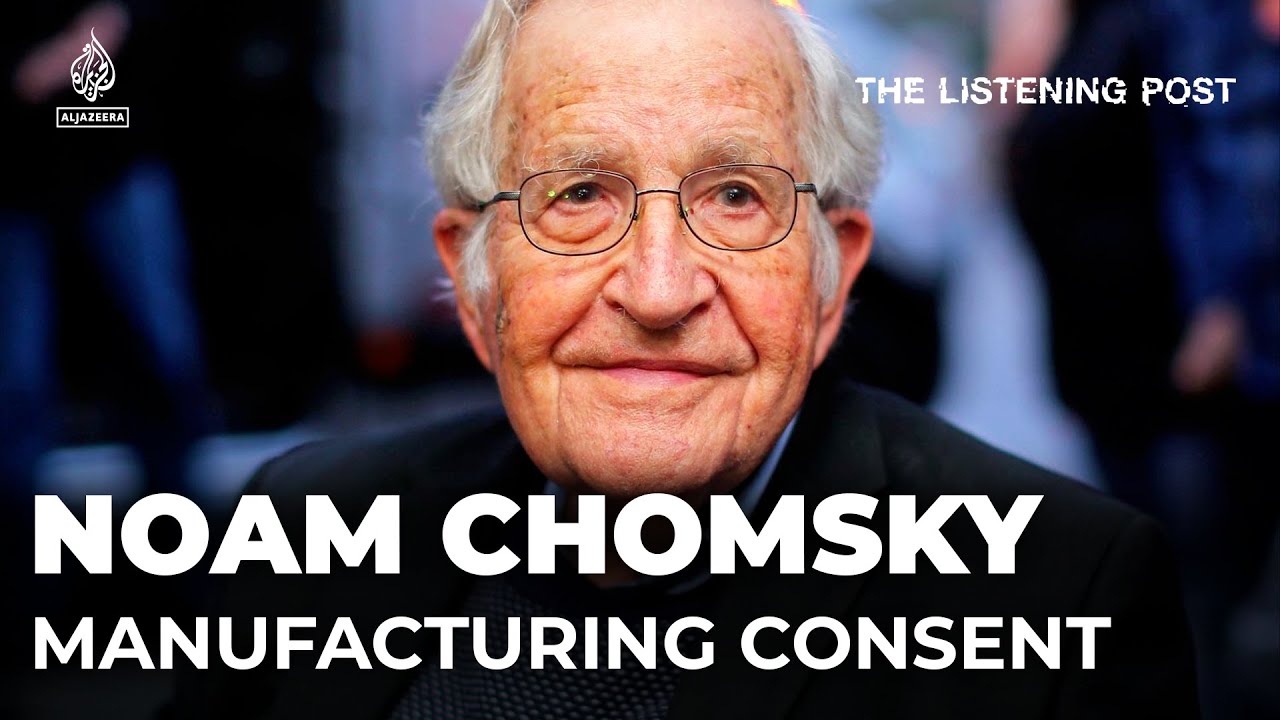 with Al Jazeera English.
“The myth is that the media are independent, adversarial, courageous, struggling against power,” Chomsky told Al Jazeera, stressing what while the United States often has “very fine reporters, correspondents” who do “an honest, courageous job,” they “must operate within a framework that determines what to discuss, what not to discuss. What we try to demonstrate in the book is that if you simply look at the institutional structure of the media within a state capitalist society like ours, they are performing pretty much the way you would expect.”
Soundbites, Chomsky told Al Jazeera, are an effective propaganda tool because propagandists “can say anything they want in two minutes, but they can’t be exposed in two minutes.”
Much has changed technologically since the release of “Manufacturing Consent” 30 years ago, including the rise of the Internet. Chomsky told Al Jazeera that having so much of the mainstream media owned by giant corporations “cheapens and reduces the access to information.” But he quickly added, “There is a way to compensate for that. The Internet does allow us to….overcome the impact of the concentration of media—and in fact, can be done pretty effectively.”
Chomsky described social media outlets like Facebook as “double-edged,” noting, “Sometimes, they are used for constructive purposes. But they have also become major forces for undermining democracy.” Chomsky cited Brazil as an example, noting how effectively the far-right Jair Bolsonaro used social media to win Brazil’s presidential election this year.
In addition to interviewing Chomsky, Al Jazeera spoke to some contemporary journalists who were influenced by “Manufacturing Consent”—include Israeli journalist Amira Hass and Rolling Stone’s Matt Taibbi, who recalled that the book “had a big influence on me as a young reporter. I had always thought that we lived in a completely free society where the reporting was outstanding and the free press model worked exactly the way it should. And when I read that book, I realized there were significant problems.”
Hass told Al Jazeera that Chomsky’s book “unveiled America of the myth of being such a splendid democracy.”
Al Jazeera concluded its interview with Chomsky by asking him where, in 2018, he usually gets his news. Chomsky responded that he consumes everything from the Washington Post to “the foreign press” to Democracy Now. And he praised the New York Times, saying that “with all of its flaws….it still has the broadest and most comprehensive coverage of, I think, any newspaper in the world.”
==
classic on sports
https://www.alternet.org/noam-chomsky-heres-why-americans-know-so-much-about-sports-so-little-about-world-affairs
QUESTION: You've written about the way that professional ideologists and the mandarins obfuscate reality. And you have spoken -- in some places you call it a "Cartesian common sense" -- of the commonsense capacities of people. Indeed, you place a significant emphasis on this common sense when you reveal the ideological aspects of arguments, especially in contemporary social science. What do you mean by common sense? What does it mean in a society like ours? For example, you've written that within a highly competitive, fragmented society, it's very difficult for people to become aware of what their interests are. If you are not able to participate in the political system in meaningful ways, if you are reduced to the role of a passive spectator, then what kind of knowledge do you have? How can common sense emerge in this context?
The following is a short excerpt from a classic, The Chomsky Reader, which offers a unique insight on a question worth asking -- how is it that we as a people can be so knowledgable about the intricacies of various sports teams, yet be colossally ignorant about our various undertakings abroad?
CHOMSKY: Well, let me give an example. When I'm driving, I sometimes turn on the radio and I find very often that what I'm listening to is a discussion of sports. These are telephone conversations. People call in and have long and intricate discussions, and it's plain that quite a high degree of thought and analysis is going into that. People know a tremendous amount. They know all sorts of complicated details and enter into far-reaching discussion about whether the coach made the right decision yesterday and so on. These are ordinary people, not professionals, who are applying their intelligence and analytic skills in these areas and accumulating quite a lot of knowledge and, for all I know, understanding. On the other hand, when I hear people talk about, say, international affairs or domestic problems, it's at a level of superficiality that's beyond belief.
In part, this reaction may be due to my own areas of interest, but I think it's quite accurate, basically. And I think that this concentration on such topics as sports makes a certain degree of sense. The way the system is set up, there is virtually nothing people can do anyway, without a degree of organization that's far beyond anything that exists now, to influence the real world. They might as well live in a fantasy world, and that's in fact what they do. I'm sure they are using their common sense and intellectual skills, but in an area which has no meaning and probably thrives because it has no meaning, as a displacement from the serious problems which one cannot influence and affect because the power happens to lie elsewhere.
Now it seems to me that the same intellectual skill and capacity for understanding and for accumulating evidence and gaining information and thinking through problems could be used -- would be used -- under different systems of governance which involve popular participation in important decision-making, in areas that really matter to human life.
There are questions that are hard. There are areas where you need specialized knowledge. I'm not suggesting a kind of anti-intellectualism. But the point is that many things can be understood quite well without a very far-reaching, specialized knowledge. And in fact even a specialized knowledge in these areas is not beyond the reach of people who happen to be interested.
...
QUESTION: Do you think people are inhibited byexpertise?
CHOMSKY: There are also experts about football, but these people don't defer to them. The people who call in talk with complete confidence. They don't care if they disagree with the coach or whoever the local expert is. They have their own opinion and they conduct intelligent discussions. I think it's an interesting phenomenon. Now I don't think that international or domestic affairs are much more complicated. And what passes for serious intellectual discourse on these matters does not reflect any deeper level of understanding or knowledge.
One finds something similar in the case of so-called primitive cultures
...
[punditry?]
QUESTION: I asked a while ago whether people are inhibited by the aura of expertise. Can one turn this around -- are experts and intellectuals afraid of people who could apply the intelligence of sport to their own areas of competency in foreign affairs, social sciences, and so on?
CHOMSKY: I suspect that this is rather common. Those areas of inquiry that have to do with problems of immediate human concern do not happen to be particularly profound or inaccessible to the ordinary person lacking any special training who takes the trouble to learn something about them. Commentary on public affairs in the mainstream literature is often shallow and uninformed. Everyone who writes and speaks about these matters knows how much you can get away with as long as you keep close to received doctrine. I'm sure just about everyone exploits these privileges. I know I do. When I refer to Nazi crimes or Soviet atrocities, for example, I know that I will not be called upon to back up what I say, but a detailed scholarly apparatus is necessary if I say anything critical about the practice of one of the Holy States: the United States itself, or Israel, since it was enshrined by the intelligentsia after its 1967 victory. This freedom from the requirements of evidence or even rationality is quite a convenience, as any informed reader of the journals of public opinion, or even much of the scholarly literature, will quickly discover. It makes life easy, and permits expression of a good deal of nonsense or ignorant bias with impunity, also sheer slander. Evidence is unnecessary, argument beside the point. Thus a standard charge against American dissidents or even American liberals -- I've cited quite a few cases in print and have collected many others -- is that they claim that the United States is the sole source of evil in the world or other similar idiocies; the convention is that such charges are entirely legitimate when the target is someone who does not march in the appropriate parades, and they are therefore produced without even a pretense of evidence. Adherence to the party line confers the right to act in ways that would properly be regarded as scandalous on the part of any critic of received orthodoxies. Too much public awareness might lead to a demand that standards of integrity should be met, which would certainly save a lot of forests from destruction, and would send many a reputation tumbling.
The right to lie in the service of power is guarded with considerable vigor and passion. This becomes evident whenever anyone takes the trouble to demonstrate that charges against some official enemy are inaccurate or, sometimes, pure invention. The immediate reaction among the commissars is that the person is an apologist for the real crimes of official enemies. The case of Cambodia is a striking example. That the Khmer Rouge were guilty of gruesome atrocities was doubted by no one, apart from a few marginal Maoist sects. It is also true, and easily documented, that Western propaganda seized upon these crimes with great relish, exploiting them to provide a retrospective justification for Western atrocities, and since standards are nonexistent in such a noble cause, they also produced a record of fabrication and deceit that is quite remarkable. Demonstration of this fact, and fact it is, elicited enormous outrage, along with a stream of new and quite spectacular lies, as Edward Herman and I, among others, have documented.
...
==
https://www.alternet.org/noam-chomsky-turns-90-how-controversial-activist-survived-become-one-most-influential-anarchists-us
bio
==
https://www.democracynow.org/2018/11/5/noam_chomsky_the_future_of_organized
Noam Chomsky: The Future of Organized Human Life Is At Risk Thanks to GOP’s Climate Change Denial
==
AN
Noam Chomsky Explains How 'Criminally Insane' Republicans Quietly Filed 'The Most Evil Document In History'
The Republican philosophy seems to be "let’s rob while the planet burns, putting poor Nero in the shadows."
By Martin Cizmar / Raw Story November 3, 2018, 2:00 PM GMT
Progressive intellectual Noam Chomsky famously called the Republican party the “the most dangerous organization in world history" after the election of Trump.
In a new interview with Scientific American, Chomsky expounded on those thoughts, and gave some disturbing examples of how Trump-era Republicans now qualify as "criminally insane."
One example is Trump's legal filing to build a wall on his gold course in Ireland for the stated purpose of battling the threat of global warming, "while at the same time he withdrew from international efforts to address the grim threat and is using every means at his disposal to accelerate it."
He also points to Republicans who seemed to recognize the danger of Trump in the 2016 primaries only to kiss the ring upon his ascention to the top of the party's ticket and then the White House.
"Without exception, they either denied that what is happening is happening—though any ignorance is self-induced—or said maybe it is but we shouldn’t do anything about it," he said. "The moral depths were reached by the respected 'adult in the room,' Ohio governor John Kasich, who agreed that it is happening but added that 'we are going to burn [coal] in Ohio and we are not going to apologize for it.'"
Chomsky pointed out that the Trump administration filed paperwork to get rid of auto emissions standards arguing that we are headed "over the cliff," and auto emissions are a minor part.
Chomsky described that filing as "the most evil document in history."
The Republican philosophy seems to be "let’s rob while the planet burns, putting poor Nero in the shadows," he said.
Read the interview here. https://blogs.scientificamerican.com/cross-check/noam-chomsky-calls-trump-and-republican-allies-criminally-insane/
==
ref
Idon’t really have heroes, but if I did, Noam Chomsky would be at the top of my list. Who else has achieved such lofty scientific and moral standing? Linus Pauling, perhaps, and Einstein. Chomsky’s arguments about the roots of language, which he first set forth in the late 1950s, triggered a revolution in our modern understanding of the mind. Since the 1960s, when he protested the Vietnam War, Chomsky has also been a ferocious political critic, denouncing abuses of power wherever he sees them. Chomsky, who turns 90 on December 7, remains busy. He spent last month in Brazil speaking out against far-right politician :{Jair Bolsonaro}:, and he recently discussed the migrant caravan on the radio show “:{Democracy Now}:.” Chomsky, whom I first interviewed in 1990 (see :{my profile here}:), has had an enormous influence on my scientific and political views. His statement that we may always "learn more about human life and human personality from novels than from scientific psychology” could serve as an epigraph for my most recent book, Mind-Body Problems. Below he responds to my emailed questions with characteristic clarity and force. -- John Horgan
Do you ever chill out?
Would rather skip personal matters.
Your ideas about language have evolved over the decades. In what ways, if any, have they remained the same?
Some of the earliest assumptions, then tentative and only partially formed, have proven quite robust, among them that the human language capacity is a species property in a double sense: virtually uniform among humans apart from serious pathology, and unique to humans in its essential properties. The most basic property of the language faculty is that each internal language generates an unbounded array of structured expressions, each of which yields an interpretation at the interface with other cognitive systems (basically a linguistically-articulated thought) and can be externalized in some sensorimotor system, usually speech, in ways that allow others to access our thoughts – a property of language that Galileo and his contemporaries rightly regarded with awe and wonder. Basic ideas about the mechanisms that have these remarkable properties have also proven fairly stable, though there has been great progress in refining them and reducing them to principles simple enough to provide sound explanations for many surprising aspects of language and to suggest a plausible evolutionary scenario. From the outset, 65 years ago, the languages investigated closely were typologically varied, and in tandem with theoretical advances inquiry has proceeded to unprecedented typological range and depth.
Your claims about the innateness of language helped inspire evolutionary psychology and behavioral genetics, which attempt to trace human thought behavior to their biological roots. And yet you’ve been critical of these fields. Why?
Not so much of the fields, which are surely legitimate and important, but of some of the practices within them.
You once said we will probably “always learn more about human life and human personality from novels than from scientific psychology.” Is that still your view?
Another thought that has proven robust.
John Ioannidis and other scholars have discovered that many peer-reviewed scientific claims cannot be replicated. Do you have an explanation, and possible cure, for the so-called replication crisis?
Nothing beyond the obvious. Sometimes failure of replication has to do with complexity of what is being studied and with inadequate tools and ideas. The intense pressure to publish and sometimes ugly competitiveness are other factors. As compared with other domains, the scientific culture is quite admirable I think, though hardly without flaws that can and should be corrected.
Do you take seriously the Singularity, the idea that artificial intelligence and other fields will soon radically transform humanity?
One can certainly imagine how, in principle, systems that can detect patterns with massive data processing might find hitherto unknown ways of constructing theories that surpass those within the reach of human intelligence. And that could have all sorts of effects. But among the concerns we face, this doesn’t seem to me to rank high. Even tasks mastered almost reflexively by infants are far beyond the capacities of contemporary AI.
In his recent book Enlightenment Now, your former MIT colleague Steven Pinker argues that life has gotten better and better, morally and materially, and he scolds other intellectuals for knocking western civilization. What's your view of his perspective?
I don’t find these broad-brush observations very helpful or informative. The devil is in the details.
There is work on these matters that seems to me much more compelling. In his very important study on the rise and fall of American growth, Robert Gordon observes that there was virtually no economic growth for millennia until 1770, slow growth for another century, and then a “special century” until 1970, dependent largely on specific inventions. Since the 1970s the picture is much more mixed: in the US, with actual decline in real wages for non-supervisory workers over 40 years and even increased death rates in recent years. These are among the features of the neoliberal era that have led to the rise of the kind of “morbid symptoms” that Gramsci warned about from Mussolini’s prison cell, as we see all too clearly in the western world today. Elsewhere we find different patterns. Thus Russia suffered severe economic decline and demographic collapse when market reforms were introduced in the ‘90s. China has been different again. As Amartya Sen has shown, Maoist China saved about 100 million people – not a small number – as compared with democratic capitalist India from independence to 1980, not from “enlightenment” in the usual sense, but from rural health programs and other reforms. And since then it has undergone spectacular growth and provided the bulk of the reduction in global poverty, in a society that’s not a model of enlightened values. Nazi Germany experienced very rapid growth in the ‘30s, not a triumph of enlightenment. There are numerous other complexities that are of major significance, but that disappear in unanalyzed statistical tables.
As for “moral growth,” there are even greater complexities. The American Revolution introduced the novel and important idea (put aside the fact) that “we the people” should take control of our fate –- and at the same time developed the most vicious system of slavery in human history, the foundation of much of US-British wealth and economic development. Or take Germany again. In the 1920s, it was at the peak of western civilization in the arts, the sciences and mathematics, and even political development, regarded as a model of democracy. Ten years later it was descending to the depths of human savagery. A decade later it was recovering what had been lost.
As for the Enlightenment and modern science, no serious analyst can question their major achievements – or overlook their role in the age of discovery that brought untold horrors to much of the world, devastating the Western Hemisphere and Africa, crushing the leading world centers of civilization in India and China.
With all that, a good case can be made I think that moral horizons are, overall, slowly widening, including recent years, when the activism of the ‘60s has had a considerable civilizing effect in many areas.
Pinker, Richard Wrangham and Edward Wilson have suggested that human males are innately warlike. Do you agree? Can humanity move past militarism once and for all?
Since humans (males and females) are sometimes warlike, it follows that their intrinsic nature permits this outcome under certain circumstances. Under other circumstances they prefer peace – normally I think. But it’s highly misleading to say that they are “innately warlike” or “innately peaceloving.” I don’t know of any argument showing that we cannot create circumstances under which warlike tendencies will be suppressed – as has often been the case in history.
Are you a pacifist? Is violence sometimes justified in pursuit of justice?
Not an absolute pacifist. I didn’t object to entering World War II after Japan attacked military bases in two virtual colonies and Germany declared war, and in fact thought that the US should have intervened more forcefully before. But it’s also worth bearing in mind that the Nazi plague could have been contained before it led to war.
Why did you recently call the Republican Party “the most dangerous organization in world history”?
Take its leader, who recently applied to the government of Ireland for a permit to build a huge wall to protect his golf course, appealing to the threat of global warming, while at the same time he withdrew from international efforts to address the grim threat and is using every means at his disposal to accelerate it. Or take his colleagues, the participants in the 2016 Republican primaries. Without exception, they either denied that what is happening is happening – though any ignorance is self-induced – or said maybe it is but we shouldn’t do anything about it. The moral depths were reached by the respected “adult in the room,” Ohio governor John Kasich, who agreed that it is happening but added that “we are going to burn [coal] in Ohio and we are not going to apologize for it.” Or take a recent publication ofTrump’s National Highway Traffic Safety Administration, a detailed study recommending an end to regulations on emissions.It presented a rational argument: extrapolating current trends, by the end of the century we’ll be over the cliff and automotive emissions don’t contribute very much to the catastrophe – the assumption being that everyone is as criminally insane as we are and won’t try to avoid the crisis. In brief, let’s rob while the planet burns, putting poor Nero in the shadows.
This surely qualifies as a contender for the most evil document in history.
There have been many monsters in the past, but it would be hard to find one who was dedicated to undermining the prospects for organized human society, not in the distant future -- in order to put a few more dollars in overstuffed pockets.
And it doesn’t end there. The same can be said about the major banks that are increasing investments in fossil fuels, knowing very well what they are doing. Or, for that matter, the regular articles in the major media and business press reporting US success in rapidly increasing oil and gas production, with commentary on energy independence, sometimes local environmental effects, but regularly without a phrase on the impact on global warming – a truly existential threat. Same in the election campaign. Not a word about the issue that is merely the most crucial one in human history.
Hardly a day passes without new information about the severity of the threat. As I’m writing, a new study appeared in Nature showing that retention of heat in the oceans has been greatly underestimated, meaning that the total carbon budget is much less than had been assumed in the recent, and sufficiently ominous, IPCC report. The study calculates that maximum emissions would have to be reduced by 25% to avoid warming of 2 degrees (C), well above the danger point. At the same time polls show that -- doubtless influenced by their leaders who they trust more than the evil media -- half of Republicans deny that global warming is even taking place, and of the rest, almost half reject any human responsibility. Words fail.
Wasn’t Richard Nixon worse than Donald Trump?
Nixon had a mixed record. In some respects, he was the last liberal president: OSHA and EPA for example. On the other hand, he committed terrible crimes. Arguably the worst was thebombing of rural Cambodia, a proposed article of impeachment but voted down though it was incomparably more important than the others. And the article was much too weak, focusing on the secrecy. There has been little attention to the orders that Nixon delivered, relayed to the Pentagon by his faithful servant Henry Kissinger: “A massive bombing campaign in Cambodia. Anything that flies on anything that moves.”It is not easy to find comparable orders for genocide in the archival record. But all of Nixon’s crimes pale in comparison with the decision to race towards the precipice of environmental catastrophe.
Are the U.S. media doing their job?
It depends on what we think their job is. They are businesses, so by accepted standards their job is profit. By other standards, they have a duty to the public to provide “all the news that’s fit to print,” under a concept of “fitness” that is as free as possible from submission to power interests or other distorting factors. About this there is a great deal to say – I’ve devoted many words to the topic elsewhere, as have many others. But in today’s strange climate of Trumpian “alternative facts” and “false reality,” it is useful to recognize that with all their flaws, which are many, the mainstream media remain an indispensable source of information about the world.
Can incremental reforms transform the U.S. into a just, prosperous society, or are more drastic measures required? In other words, are you a reformer or a revolutionary?
Both. Generalizations are misleading; too much depends on specific circumstances. But some have a fair degree of validity, I think. One is that there is both justification and pressing need for radical changes in the socioeconomic and political orders. We cannot know to what extent they can be achieved by incremental reforms, which are to be valued on their own. But unless the great mass of the population comes to believe that needed change cannot be implemented within the existing system, resort to “drastic measures” is likely to be a recipe for disaster.
My students are pretty gloomy about the future. What can I tell them to cheer them up?
Apart from the truly existential threats of nuclear war and global warming – which can be averted – there have been far more difficult challenges in the past than those young people face today, and they have been overcome by dedicated effort and commitment. The historical record of struggle and achievement gives ample reason to take to heart the slogan that Gramsci made famous: “pessimism of the intellect, optimism of the will.”
What’s your utopia?
I don’t have the talent to do more than to suggest what seem to me reasonable guidelines for a better future. One might argue that Marx was too cautious in keeping to only a few general words about post-capitalist society, but he was right to recognize that it will have to be envisioned and developed by people who have liberated themselves from the bonds of illegitimate authority.
Further Reading:
Is Chomsky's Theory of Language Wrong?
===
https://www.alternet.org/noam-chomsky-facebook-and-google-pose-manifest-danger
In “Manufacturing Consent: The Political Economy of the Mass Media”(1988), authors Edward S. Herman and Noam Chomsky identified what they called the “five filters of editorial bias”: Size, Ownership and Profit Orientation; the Advertising License to Do Business; Sourcing Mass Media News; Flak and the Enforcers; and Anti-Communism.
While the Soviet Union has since been relegated to the dustbin of history, Herman and Chomsky’s text has proved indispensable, with multinationals like Google, Amazon and Facebook tightening their stranglehold on the news industry and the economy at large. As Chomsky warns, these corporations’ eagerness to appease their advertisers and manipulate their users’ behavior has “very serious distorting effects” on the stories we consume. “I don’t think that’s a healthy development, but it is happening,” he says. “And that means essentially dividing much of the population … into cocoons [or] bubbles, into which they receive the information conducive [only] to their own interests and commitments.”
Last week, Chomsky explored this topic and more in an exhaustive interview (“American Dissident”) with The Intercept’s Jeremy Scahill. What follows are just a few of the activist author’s more trenchant observations and digressions.
On the Republican White House
There’s an authentic constituency of corporate power and private wealth, and they’re being served magnificently by the executive orders [and] legislative programs that are being pushed through. [These] represent the more savage wing of the traditional Republican policies catering to private interests, private wealth, and dismissing the rest as irrelevant and easily disposed of.
At the same time, [Trump] is managing to maintain the voting constituency by pretending, very effectively, to be the one person in the world who stands up for them against the hated elites. And this is quite an impressive con job. How long he can carry it off? I don’t know.
On Trump’s handling of North Korea
He’s being lambasted for taking positions which, in my view, are pretty reasonable. So, for example, in the case of Korea: The two Koreas, last April 27th came out with a historic declaration, in which they laid out fairly explicit plans for moving towards reconciliation, integration, and denuclearization of the peninsula.
They pretty much pleaded with outsiders—that means the United States—to permit them to proceed, as they put it, on their own accord. And so far Trump has not interfered with this very much, calling off temporarily at least the military exercises, which he has correctly said are highly provocative. He’s been lambasted for that, but it’s exactly the right position I think. Right now, President Moon is in North Korea, [and] if they can make positive moves on their own accord—as they’ve requested—that should be beneficial.
On the continued existence of NATO
Raising questions about NATO, for example, is quite a reasonable thing to do. One might certainly ask why NATO even exists after the collapse of the Soviet Union—not that there weren’t questions before, there were—but the official story was that NATO was in place to defend the West against the Russian hordes, which, putting aside the validity of that claim, was the official stand.
What is true is that after the collapse of the Soviet Union in 1990, 1991, there was a period under Yeltsin in which the United States pretty much dominated what was happening in Russia and the region around Russia. NATO was expanded. The Russian economy totally collapsed under the imposed harsh market reforms. There was a radical collapse of the economy, sharp increase in the mortality rate. Russia was really devastated. … I would not like to have dinner with [Putin], but you can understand his policies. His policies were to try to restore some role for Russia at least in its own region of the world. … We might recall the traditional invasion routes through which Russia was attacked [were] virtually destroyed several times in the last century.
On the Syrian Civil War
Well, the first point to bear in mind … is that Assad is a horrible war criminal. The bulk of the atrocities, which are enormous, are his responsibility. There’s no justifying Assad. On the other hand, the fact of the matter is that he is essentially in control of Syria now, thanks largely to Russian [and] partially to Iranian support.
The Russians actually entered Syria extensively after the CIA had provided the rebel forces, which are mostly run by Jihadi elements, with advanced anti-tank missiles which were stymieing the Syrian Army, at which point the Russians came in with air power and overwhelmed the opposition. The current situation is that Assad has pretty much won the war. Like it or not. There was in the early stages a Democratic, secular, quite respectable opposition, but they were very quickly overwhelmed by the Jihadi elements, supported from the outside — Saudi Arabia, Qatar, the United States, and others.
…
The United States, like other great powers, does not pursue humanitarian objectives. It pursues objectives determined by power considerations, and they lead to different positions with regard to the Kurds or others at different times.
On the imminent dangers of Big Tech
If you read a major newspaper, say the New York Times, you get a certain range of opinion. It’s narrow. It’s basically centrist to far right, but at least it’s a range of opinion. Those who are more addicted to social media tend to turn directly to what supports their own views, not to hear other things, that’s not a good thing. Google, Facebook and the rest, those are commercial institutions. Their constituency is basically advertisers, and they would like to establish the kinds of controls over their consumers that will be beneficial to [a] business model that enabled them to get advertising. That has very serious distorting effects. And we know that they provide massive information to the corporate system, which they use in their own efforts to try to shape and control behavior and opinion. All of these are dangerous developments. The power of these private corporations to direct people in particular [is] a serious problem which requires considerable thought and attention.
Listen to the interview on the Intercepted podcast or read a copy of its transcript here.
==
==
AN DN
...ALEXANDRIA OCASIO-CORTEZ: And the issues I ran on were very clear, and I think it was an important part to us winning: improved and expanded Medicare for all; tuition-free public colleges and universities, as well as trade schools; a Green New Deal; justice for Puerto Rico; an unapologetic platform of criminal justice reform and ending the war on drugs; and also speaking truth to power and speaking about money in politics not just in general, but how it operates in New York City.
AMY GOODMAN: In a moment, I’m going to play her clip talking about immigration activism. Yes, Alexandria Cortez—Alexandria Ocasio-Cortez went to the border right before Election Day. In fact, her plane was delayed. I was concerned she wouldn’t be back in New York for the Primary Day. But if you could start by responding to this? And then we’ll hear what she has to say about immigration activism.
NOAM CHOMSKY: Well, I think there’s—her victory was a quite spectacular and significant event. I think what it points to is a split in the Democratic Party between the—roughly speaking, between the popular base and the party managers. The popular base is increasingly, essentially, social democratic, following, pursuing the—concerned with the kinds of progressive objectives that she outlined in those—in her remarks, which should be directed not only to expanding the electorate but to the general working-class, poor population of the world, of the middle-class population of the country, for whom these ideals are quite significant. They can be brought to that. That’s one part of the party. The other part of the party is the donor-oriented, managerial part of the New Democrats, so-called, the Clintonite Democrats, who are pretty much what used to be called moderate Republicans. The Republican Party itself has drifted so far to the right that they’re almost off the spectrum. But the split within the Democratic Party is significant, and it’s showing up in primary after primary.Will the party move in the direction of its popular base, with a, essentially, social democratic, New Deal-style programs, even beyond? Or will it continue to cater to the donor class and be essentially a moderate wing—a more moderate wing of the Republican Party? And unless that issue is resolved, I don’t think they have a very good chance in the forthcoming elections.
I think she was right in saying that the policies she’s outlined should have broad appeal to a very large segment of the population. We should bear in mind that, for now almost 40 years, since the neoliberal assault began, taking off with Reagan, on from there, a large majority of the population are living in conditions of stagnation or decline. Real wages are—for, say, male real wages—are about what they were in the 1960s. It’s been—there has been productivity growth. Hasn’t gone to working people. It’s gone into the very few extremely overstuffed pockets. And that continues. So, the Labor Department just came out with its report for wages in the year ending May 2018. Now, they actually slightly declined. All sorts of talk—real wages, that is, wages measured against inflation. And it’s apparently continuing, with an even further drop. This is a time when a lot of crowing about the marvelous economy, you know, full employment and so on, but wages continue to stagnate. And furthermore, it’s plainly going to get worse. The Republicans are on a binge of pursuing the most savage form of class warfare. The tax scam is a good example, the attacks on workers’ rights, on—Public Citizen just came out with a report on corporate impunity, which is almost comical when you read it.The administration has simply cut back radically on any kind of dealing with corporate crimes. And, of course, the EPA has practically stopped working. It’s as if grab whatever you can, stuff it in your pocket, before—while you have a chance. Under those conditions, the kind of appeal that she was talking about should mean a lot to the general population.
Notice, as everybody’s well aware, the tax scam was a purposeful effort not only to enrich the super-rich and the corporate sector—corporate profits, of course, are overflowing—but it was also an effort to sharply increase the deficit, which can be used—and Paul Ryan and others kindly announced to us right away what the plans were—the deficit could be used to undermine any elements of government structure which benefit the general population—Medicare, Social Security, food for poor children. Anything you can do to shaft the general population more can now be justified under the argument that we have a huge deficit, thanks to stuffing the pockets of the rich. This is an astonishing phenomenon. And under those conditions, a properly designed progressive program should appeal to a large majority of the population. But it has to be done correctly and not shaped in ways which will appease the donor class.
AMY GOODMAN: I wanted to go back to the interview with Alexandria Ocasio-Cortez, who has really upended the Democratic Party, and the kind of message this candidate of Puerto Rican descent in New York has sent to the entire party, I think the Republican Party, as well. But this is what she says about immigration.
...
==
https://www.alternet.org/news-amp-politics/chomsky-mainstream-media-basically-joke-now-and-fox-news-state-media
===
https://www.alternet.org/news-amp-politics/chomsky-mainstream-media-basically-joke-now-and-fox-news-state-media
New York Times reports special counsel Robert Mueller is scrutinizing President Trump’s tweets as part of Mueller’s expanding probe into Trump’s ties to Russia. This latest revelation in the Mueller investigation is part of a nearly 24-hour stream of headlines about Trump, Russia and the administration’s various scandals. But is the mainstream media missing the real stories amid its obsession with “Russiagate”? For more, we speak with world-renowned political dissident, linguist, author and professor Noam Chomsky on media manipulation in the Trump era.
Transcript
AMY GOODMAN: We continue our interview with Noam Chomsky, world-renowned dissident, linguist and author, now in Tucson at the University of Arizona. I asked him about a recent mix-up on Fox & Friends, in which the hosts thought they were interviewing former Democratic congressional candidate, a current one, Ann Kirkpatrick of Arizona, who supports Immigration and Customs Enforcement agency, known as ICE, but, in fact, they were actually speaking to a Massachusetts Democratic congressional candidate, Barbara L’Italien, who opposes ICE. Here is how the interview started.
SEN. BARBARA L’ITALIEN: Good morning. I’m actually here to speak directly to Donald Trump. I feel that what’s happening at the border is wrong. I’m a mother of four. And I believe that separating kids from their parents is illegal and inhumane. I’m actually Barbara L’Italien. I’m a state senator representing a large immigrant community. I’m running for Congress in Massachusetts. I keep thinking about what we’re putting parents through, imagining how terrifying that must be for those families, imagining how it would feel not knowing if I’d ever see my kids again. We have to stop abducting children and ripping them from their parents’ arms —
ROB SCHMITT: OK —
SEN. BARBARA L’ITALIEN: — stop putting kids in cages —
ROB SCHMITT: You want to —
SEN. BARBARA L’ITALIEN: — and stop making 3-year-olds defend themselves in court.
AMY GOODMAN: Well, Barbara L’Italien said a lot there, but she was then cut off, with the shock of the Fox & Friends crew in the morning that they had the wrong Democratic congressional candidate. But this kind of media activism also just goes to the whole issue of the media, Noam Chomsky, the issue of Fox News becoming really state media, with — you have the person who supported the sexual harasser Roger Ailes, Bill Shine, now a top aide to President Trump in the White House. That’s gotten little attention. So you have Fox being a mouthpiece for Trump and a place for him to hear what people have to say, and the other networks very much running counter to Trump, on certain issues, CNNand MSNBC. But your thoughts?
NOAM CHOMSKY: Well, my frank opinion is that — I must say I don’t pay much attention to television, so I don’t know a great deal about it. But, in general, I think the media — first of all, Fox News is, by now, basically a joke. It’s, as you said, state media. The other media, I think, are focusing on issues which are pretty marginal. There are much more serious issues that are being put to the side. So, the worst of — even on the case of immigration, once again, I think the real question is dealing with the roots of immigration, our responsibility for it, and what we can do to overcome that. And that’s almost never discussed. But I think that’s the crucial issue. And I think we find the same across the board.
So, of all Trump’s policies, the one that is the most dangerous and destructive, in fact poses an existential threat, is his policies on climate change, on global warming.That’s really destructive. And we’re facing an imminent threat, not far removed, of enormous damage. The effects are already visible but nothing like what’s going to come. A sea level rise of a couple of feet will be massively destructive. It will make today’s immigration issues look like trivialities. And it’s not that the administration is unaware of this. So, Donald Trump, for example, is perfectly aware of the dangerous effects, in the short term, of global warming. So, for example, recently he applied to the government of Ireland for permission to build a wall to protect his golf course in Ireland from rising sea levels. And Rex Tillerson, who was supposed to be the adult in the room before he was thrown out, as CEO of ExxonMobil, was devoting enormous resources to climate change denial, although he had, sitting on his desk, the reports of ExxonMobil scientists, who, since the ’70s, in fact, were on the forefront of warning of the dire effects of this accelerating phenomenon. I don’t know what word in the language — I can’t find one — that applies to people of that kind, who are willing to sacrifice the literal — the existence of organized human life, not in the distant future, so they can put a few more dollars in highly overstuffed pockets. The word “evil” doesn’t begin to approach it. These are the kinds of issues that should be under discussion. Instead, what’s being — there is a focus on what I believe are marginalia.
So, take, say, the huge issue of interference in our pristine elections. Did the Russians interfere in our elections? An issue of overwhelming concern in the media. I mean, in most of the world, that’s almost a joke. First of all, if you’re interested in foreign interference in our elections, whatever the Russians may have done barely counts or weighs in the balance as compared with what another state does, openly, brazenly and with enormous support. Israeli intervention in US elections vastly overwhelms anything the Russians may have done, I mean, even to the point where the prime minister of Israel, Netanyahu, goes directly to Congress, without even informing the president, and speaks to Congress, with overwhelming applause, to try to undermine the president’s policies — what happened with Obama and Netanyahu in 2015. Did Putin come to give an address to the joint sessions of Congress trying to — calling on them to reverse US policy, without even informing the president? And that’s just a tiny bit of this overwhelming influence. So if you happen to be interested in influence of — foreign influence on elections, there are places to look. But even that is a joke.
I mean, one of the most elementary principles of a functioning democracy is that elected representatives should be responsive to those who elected them. There’s nothing more elementary than that. But we know very well that that is simply not the case in the United States. There’s ample literature in mainstream academic political science simply comparing voters’ attitudes with the policies pursued by their representatives, and it shows that for a large majority of the population, they’re basically disenfranchised. Their own representatives pay no attention to their voices. They listen to the voices of the famous 1 percent — the rich and the powerful, the corporate sector. The elections — Tom Ferguson’s stellar work has demonstrated, very conclusively, that for a long period, way back, US elections have been pretty much bought. You can predict the outcome of a presidential or congressional election with remarkable precision by simply looking at campaign spending. That’s only one part of it. Lobbyists practically write legislation in congressional offices. In massive ways, the concentrated private capital, corporate sector, super wealth, intervene in our elections, massively, overwhelmingly, to the extent that the most elementary principles of democracy are undermined. Now, of course, all that is technically legal, but that tells you something about the way the society functions. So, if you’re concerned with our elections and how they operate and how they relate to what would happen in a democratic society, taking a look at Russian hacking is absolutely the wrong place to look. Well, you see occasionally some attention to these matters in the media, but very minor as compared with the extremely marginal question of Russian hacking.
And I think we find this on issue after issue, also on issues on which what Trump says, for whatever reason, is not unreasonable. So, he’s perfectly right when he says we should have better relations with Russia. Being dragged through the mud for that is outlandish, makes — Russia shouldn’t refuse to deal with the United States because the US carried out the worst crime of the century in the invasion of Iraq, much worse than anything Russia has done. But they shouldn’t refuse to deal with us for that reason, and we shouldn’t refuse to deal with them for whatever infractions they may have carried out, which certainly exist. This is just absurd. We have to move towards better — right at the Russian border, there are very extreme tensions, that could blow up anytime and lead to what would in fact be a terminal nuclear war, terminal for the species and life on Earth. We’re very close to that. Now, we could ask why. First of all, we should do things to ameliorate it. Secondly, we should ask why. Well, it’s because NATO expanded after the collapse of the Soviet Union, in violation of verbal promises to Mikhail Gorbachev, mostly under Clinton, partly under first Bush, then Clinton expanded right to the Russian border, expanded further under Obama. The US has offered to bring Ukraine into NATO. That’s the kind of a heartland of Russian geostrategic concerns. So, yes, there’s tensions at the Russian border — and not, notice, at the Mexican border. Well, those are all issues that should be of primary concern. The fate of — the fate of organized human society, even of the survival of the species, depends on this. How much attention is given to these things as compared with, you know, whether Trump lied about something? I think those seem to me the fundamental criticisms of the media
.
AMY GOODMAN: Noam Chomsky, world-renowned political dissident, author and linguist, now a laureate professor in the Department of Linguistics at the University of Arizona, Tucson. He taught for 50 years at the Massachusetts Institute of Technology in Cambridge, Massachusetts. Tune in next week when we continue our conversation with Noam Chomsky about Gaza, Israel’s new nationality law, the recent Trump-Putin summit, Iran, North Kora, the war in Yemen and more. In December, Noam Chomsky will be celebrating his 90th birthday.
:{
}:
===
==
https://www.alternet.org/news-amp-politics/they-cannot-get-votes-their-actual-policies-noam-chomsky-explains-how-republican
"They Cannot Get Votes on Their Actual Policies': Noam Chomsky Explains How the Republican Party Is Rotten to the Core
"It’s an intriguing spectacle, and not a little worrisome."
By Cody Fenwick / AlterNet July 6, 2018, 7:04 AM GMT
In a recent interview with Truthout, renowned MIT professor Noam Chomsky gave an incisive explanation of the current state of American politics, touching on the failures of President Barack Obama and the rise of President Donald Trump.
Chomsky argued that contrary to many narratives, Trump was a natural outgrowth of a rightward shift in political currents.
The GOP's "dedication to wealth and corporate power is so extreme that they cannot get votes on their actual policies — which are now being revealed to us daily — and so have had to mobilize a voting base on issues unrelated to their service to their actual constituency," he explained. "These include religious fundamentalism — a major phenomenon in the US unlike other developed societies — white supremacy, xenophobia and other latent anti-social attitudes that tend to break through to the surface during periods of disillusionment and distress. This is partly a matter of 'search for scapegoats,' the actual sources concealed in the usual manner of propaganda; thus, the public vastly exaggerates the number of immigrants, even more than in Europe.
Disaffection began with Obama's insufficient response to the 2008 financial crisis, he said, and racial animus to his presidency also boosted the Republican Party.
And while many are surprised that Trump maintains strong approval within his own party, Chomsky argued that this is just par for the course.
"Trump’s roughly 90 percent support among Republicans is actually not unusual for an incumbent party at this stage in office — about the same as Obama among Democrats, though the fervor and passion are different, presumably reflecting the general atmosphere of anger, hatred and fear. And frightening," he said.
He even noted that the fervent support for Trump brings back "childhood memories of hearing Hitler’s Nuremberg rallies on the radio" — though he acknowledged that there were "great differences" between the two time periods.
Yet even as the GOP base gets swept up in the tides of extremism of all sorts, the business class is relishing the political moment, he argued.
:{
}:
"For the actual Republican constituency of wealth and corporate power, these are glory days, so why object, even if his antics sometimes cause some grimaces?" he ask
==
https://www.alternet.org/noam-chomsky-fascism-showmanship-and-democrats-hypocrisy-trump-era
==
https://www.alternet.org/noam-chomsky-explains-exactly-whats-wrong-libertarianism
...
Chomsky: Well,anarchism is, in my view, basically a kind of tendency in human thought which shows up in different forms in different circumstances, and has some leading characteristics. Primarily it is a tendency that is suspicious and skeptical of domination, authority, and hierarchy. It seeks structures of hierarchy and domination in human life over the whole range, extending from, say, patriarchal families to, say, imperial systems, and it asks whether those systems are justified. It assumes that the burden of proof for anyone in a position of power and authority lies on them. Their authority is not self-justifying. They have to give a reason for it, a justification. And if they can’t justify that authority and power and control, which is the usual case, then the authority ought to be dismantled and replaced by something more free and just. And, as I understand it, anarchy is just that tendency. It takes different forms at different times.
Anarcho-syndicalism is a particular variety of anarchism which was concerned primarily, though not solely, but primarily with control over work, over the work place, over production. It took for granted that working people ought to control their own work, its conditions, [that] they ought to control the enterprises in which they work, along with communities, so they should be associated with one another in free associations, and … democracy of that kind should be the foundational elements of a more general free society. And then, you know, ideas are worked out about how exactly that should manifest itself, but I think that is the core of anarcho-syndicalist thinking. I mean it’s not at all the general image that you described — people running around the streets, you know, breaking store windows — but [anarcho-syndicalism] is a conception of a very organized society, but organized from below by direct participation at every level, with as little control and domination as is feasible, maybe none.
Wilson: With the apparent ongoing demise of the capitalist state, many people are looking at other ways to be successful, to run their lives, and I’m wondering what you would say anarchy and syndicalism have to offer, things that others ideas — say, for example, state-run socialism — have failed to offer? Why should we choose anarchy, as opposed to, say, libertarianism?
Chomsky: Well what’s calledlibertarian in the United States, which is a special U. S. phenomenon, it doesn’t really exist anywhere else — a little bit in England — permits a very high level of authority and domination but in the hands of private power: so private power should be unleashed to do whatever it likes. The assumption is that by some kind of magic, concentrated private power will lead to a more free and just society. Actually that has been believed in the past. Adam Smith for example, one of his main arguments for markets was the claim that under conditions of perfect liberty, markets would lead to perfect equality. Well, we don’t have to talk about that! That kind of —
Wilson: It seems to be a continuing contention today …
Chomsky: Yes, and so well that kind of libertarianism, in my view, in the current world, is just a call for some of the worst kinds of tyranny, namely unaccountable private tyranny. Anarchism is quite different from that. It calls for an elimination to tyranny, all kinds of tyranny. Including the kind of tyranny that’s internal to private power concentrations. So why should we prefer it? Well I think because freedom is better than subordination. It’s better to be free than to be a slave. It's better to be able to make your own decisions than to have someone else make decisions and force you to observe them. I mean, I don’t think you really need an argument for that. It seems like … transparent.
As forstate socialism, depends what one means by the term. If it’s tyranny of the Bolshevik variety (and its descendants), we need not tarry on it. If it’s a more expanded social democratic state, then the comments above apply. If something else, then what? Will it place decision-making in the hands of working people and communities, or in hands of some authority? If the latter, then — once again — freedom is better than subjugation, and the latter carries a very heavy burden of justification.The thing you need an argument for, and should give an argument for, is, How can we best proceed in that direction? And there are lots of ways within the current society. One way, incidentally, is through use of the state, to the extent that it is democratically controlled. I mean in the long run, anarchists would like to see the state eliminated. But it exists, alongside of private power, and the state is, at least to a certain extent, under public influence and control — could be much more so. And it provides devices to constrain the much more dangerous forces of private power. Rules for safety and health in the workplace for example. Or insuring that people have decent health care, let’s say. Many other things like that. They’re not going to come about through private power. Quite the contrary. But they can come about through the use of the state system under limited democratic control … to carry forward reformist measures. I think those are fine things to do. they should be looking forward to something much more, much beyond, — namely actual, much larger-scale democratization. And that’s possible to not only think about, but to work on. So one of the leading anarchist thinkers, Bakunin in the 19th cent, pointed out that it’s quite possible to build the institutions of a future society within the present one. And he was thinking about far more autocratic societies than ours. And that’s being done. So for example, worker- and community- controlled enterprises are germs of a future society within the present one. And those not only can be developed, but are being developed. There’s some important work on this by Gar Alperovitz who’s involved in the enterprise systems around the Cleveland area which are worker and community controlled. There’s a lot of theoretical discussion of how it might work out, from various sources. Some of the most worked out ideas are in what’s called the “parecon” — participatory economics — literature and discussions. And there are others. These are at the planning and thinking level. And at the practical implementation level, there are steps that can be taken, while also pressing to overcome the worst … the major harms … caused by … concentration of private power through the use of state system, as long as the current system exists. So there’s no shortage of means to pursue.
Wilson: Many people know you because of your and Edward Herman’s development of the Propaganda Model. Could you briefly describe that model and why it might be important to [college] students?
...
Chomsky: Well first look back a bit — a little historical framework — back in the late 19th-, early 20th century, a good deal of freedom had been won in some societies. At the peak of this were in fact the United States and Britain. By no means free societies, but by comparative standards quite advanced in this respect. In fact so advanced, that power systems — state and private — began to recognize that things were getting to a point where they can’t control the population by force as easily as before, so they are going to have to turn to other means of control. And the other means of control are control of beliefs and attitudes. And out of that grew the public relations industry, which in those days described itself honestly as an industry of propaganda.
The guru of the PR industry, Edward Bernays— incidentally, not a reactionary, but a Wilson-Roosevelt-Kennedy liberal — the maiden handbook of the PR industry which he wrote back in the 1920s was called Propaganda. And in it he described, correctly, the goal of the industry. He said our goal is to insure that the “intelligent minority” — and of course anyone who writes about these things is part of that intelligent minority by definition, by stipulation, so we, the intelligent minority, are the only people capable of running things, and there’s that great population out there, the “unwashed masses,” who, if they’re left alone will just get into trouble: so we have to, as he put it, “engineer their consent,” figure out ways to insure they consent to our rule and domination. And that’s the goal of the PR industry. And it works in many ways. Its primary commitment is commercial advertising. In fact, Bernays made his name right at that time — late 20s — by running an advertising campaign to convince women to smoke cigarettes: women weren’t smoking cigarettes, this big group of people who the tobacco industry isn’t able to kill, so we’ve got to do something about that. And he very successfully ran campaigns that induced women to smoke cigarettes: that would be, in modern terms, the cool thing to do, you know, that’s the way you get to be a modern, liberated woman. It was very successful —
Chomsky: These are just a few examples. These are the origins of what became a huge industry of controlling attitudes and opinions. Now the oil industry today, and in fact the business world generally, are engaged in comparable campaigns to try to undermine efforts to deal with a problem that’s even greater than the mass murder that was caused by the tobacco industry; and it was mass murder. We are facing a threat, a serious threat, of catastrophic climate change. And it’s no joke. And [the oil industry is] trying to impede measures to deal with it for their own short-term profit interests. And that includes not only the petroleum industry, but the American Chamber of Commerce — the leading business lobby — and others, who’ve stated quite openly that they’re conducting … they don’t call it propaganda … but what would amount to propaganda campaigns to convince people that there’s no real danger and we shouldn’t really do much about it, and that we should concentrate on really important things like the deficit and economic growth — what they call ‘growth’ — and not worry about the fact that the human species is marching over a cliff which could be something like [human] species destruction; or at least the destruction of the possibility of a decent life for huge numbers of people. And there are many other correlations.Wilson: Is there a correlation between that campaign and what’s happening with the big oil industry right now and climate change?
In fact quite generally, commercial advertising is fundamentally an effort to undermine markets. We should recognize that. If you’ve taken an economics course, you know that markets are supposed to be based on informed consumers making rational choices. You take a look at the first ad you see on television and ask yourself … is that its purpose? No it’s not. It’s to create uninformed consumers making irrational choices. And these same institutions run political campaigns. It’s pretty much the same: you have to undermine democracy by trying to get uninformed people to make irrational choices. And so this is only one aspect of the PR industry. What Herman and I were discussing was another aspect of the whole propaganda system that developed roughly at that period, and that’s “manufacture of consent,” as it was called, [consent] to the decisions of our political leaders, or the leaders of the private economy, to try to insure that people have the right beliefs and don’t try to comprehend the way decisions are being made that may not only harm them, but harm many others. That’s propaganda in the normal sense. And so we were talking about mass media, and the intellectual community of the world in general, which is to a large extent dedicated to this. Not that people see themselves as propagandists, but … that they are themselves deeply indoctrinated into the principles of the system, which prevent them from perceiving many things that are really right on the surface, [things] that would be subversive to power if understood. We give plenty of examples there and there’s plenty more you can mention up to the present moment, crucial ones in fact. That’s a large part of a general system of indoctrination and control that runs parallel to controlling attitudes and … consumeristic commitments, and other devices to control people.
You mentioned students before. Well one of the main problems for students today — a huge problem — is sky-rocketing tuitions. Why do we have tuitions that are completely out-of-line with other countries, even with our own history? In the 1950s the United States was a much poorer country than it is today, and yet higher education was … pretty much free, or low fees or no fees for huge numbers of people. There hasn’t been an economic change that’s made it necessary, now, to have very high tuitions, far more than when we were a poor country. And to drive the point home even more clearly, if we look just across the borders, Mexico is a poor country yet has a good educational system with free tuition. There was an effort by the Mexican state to raise tuition, maybe some 15 years ago or so, and there was a national student strike which had a lot of popular support, and the government backed down. Now that’s just happened recently in Quebec, on our other border. Go across the ocean: Germany is a rich country. Free tuition. Finland has the highest-ranked education system in the world. Free … virtually free. So I don’t think you can give an argument that there are economic necessities behind the incredibly high increase in tuition. I think these are social and economic decisions made by the people who set policy. And [these hikes] are part of, in my view, part of a backlash that developed in the 1970s against the liberatory tendencies of the 1960s. Students became much freer, more open, they were pressing for opposition to the war, for civil rights, women’s rights … and the country just got too free. In fact, liberal intellectuals condemned this, called it a “crisis of democracy:” we’ve got to have more moderation of democracy. They called, literally, for more commitment to indoctrination of the young, their phrase … we have to make sure that the institutions responsible for the indoctrination of the young do their work, so we don’t have all this freedom and independence. And many developments took place after that. I don’t think we have enough direct documentation to prove causal relations, but you can see what happened. One of the things that happened was controlling students — in fact, controlling students for the rest of their lives, by simply trapping them in debt. That’s a very effective technique of control and indoctrination. And I suspect — I can’t prove — but I suspect that that’s a large part of the reason behind [high tuitions]. Many other parallel things happened. The whole economy changed in significant ways to concentrate power, to undermine workers’ rights and freedom. In fact the economist who chaired the Federal Reserve around the Clinton years, Alan Greenspan — St. Alan as he was called then, the great genius of the economics profession who was running the economy, highly honored — he testified proudly before congress that the basis for the great economy that he was running was what he called “growing worker insecurity.” If workers are more insecure, they won’t do things, like asking for better wages and better benefits. And that’s healthy for the economy from a certain point of view, a point of view that says workers ought to be oppressed and controlled, and that wealth ought to be concentrated in a very few pockets. So yeah, that’s a healthy economy, and we need growing worker insecurity, and we need growing student insecurity, for similar reasons. I think all of these things line up together as part of a general reaction — a bipartisan reaction, incidentally — against liberatory tendencies which manifested themselves in the 60s and have continued since.
Wilson: [Finally, ]I’m wondering if you could [end with some advice for today's college students].
Chomsky: There are plenty of problems in the world today, and students face a number of them, including the ones I mentioned — the joblessness, insecurity and so on. Yet on the other hand, there has been progress. In a lot of respects things are a lot more free and advanced than they were … not many years ago. So many things that were really matters of struggle, in fact even some barely even mentionable, say, in the 1960s, are now … partially resolved. Things like women’s rights. Gay rights. Opposition to aggression. Concern for the environment — which is nowhere near where it ought to be, but far beyond the 1960s. These victories for freedom didn’t come from gifts from above. They came from people struggling under conditions that are harsher than they are now. There is state repression now. But it doesn’t begin to compare with, say, Cointelpro in the 1960s. People that don’t know about that ought to read and think to find out. And that leaves lots of opportunities. Students, you know, are relatively privileged as compared with the rest of the population. They are also in a period of their lives where they are relatively free. Well that provides for all sorts of opportunities. In the past, such opportunities have been taken by students who have often been in the forefront of progressive change, and they have many more opportunities now. It’s never going to be easy. There’s going to be repression. There’s going to be backlash. But that’s the way society moves forward.
==
https://www.alternet.org/noam-chomskys-political-analysis-comes-life-graphic-novel
==
Noam Chomsky’s Political Analysis Comes to Life in Graphic Novel
An admirer of Noam Chomsky, Jeffrey Wilson interviewed him and then created The Instinct for Cooperation, a graphic novel, with Eliseu Gouveia, on the implications of creating spaces of resistance.
By Mark Karlin / Truthout June 4, 2018, 2:31 AM GMT
What was the importance of the Occupy Movement? What lessons does it hold for future activism? What is the importance of solidarity movements? Truthout interviewed Jeffrey Wilson about the answers to these questions that he learned from Noam Chomsky.
Mark Karlin: In your conversation with Noam Chomsky, there seemed to be a great deal of emphasis on the importance of group activism. Why is this so important?
Jeff Wilson: Coming together through activism is one way to imagine and experiment with creating a better future. The Occupy Wall Street Movement is one example we explore in the book. Chomsky begins by discussing aspects of mutual aid and solidarity he views as present within certain formations in Occupy. For instance, during the interview he specifically takes note of the organizing work done within The People’s Library, which was a part of the larger New York City occupation. With that discussion in mind, I went back and interviewed some of the librarians involved in Occupy. Here they offer important insights about what it means to practice mutual aid and solidarity and the necessity of a physical space for groups to come together to work against alienation. It’s important to note that the librarians interviewed offer the reader a critical take on Occupy, one that recognizes its potential, but also its significant shortcomings. Including these stories reflects a central structure or theme of the book, and one I believe aligns with Chomsky’s insistence that the voices of everyday people matter. This comic book is not simply Chomsky talking about activism; I worked to bring in the voices and perspectives of those at the center of movements seeking to create a more just world.
You offer the Occupy movementas an example of the energy and impact that a group can have. Why did you decide to focus on Occupy?
The project was actually not intended as a book. I set out to interview Chomsky to use in a course I was teaching. This was early 2012 and I wanted to create a 10-page comic based on a short interview with Chomsky about the deeper social history, for lack of a better descriptor, of the Occupy Movement. I was interested to hear Chomsky discuss, for example, the roots of consensus-based decision-making. My own political activism started around 2000 with anti-racist organizing and working on my college campus with United Students Against Sweatshops, so I was familiar with processes like consensus, taken up during occupy. For many of my students, however, occupy was a very different type of political movement. During our conversations, issues like consensus became both a point of critique and curiosity. So, as a pedagogical resource, I wanted to create a short comic based on an interview with Chomsky to help my students delve deeper into questions they had about the movement.
Yet, upon transcribing the interview, I quickly realized enough material existed for an entire book. For example, when I asked him about the history of Occupy, he responded by discussing human nature. Typically, during a Chomsky interview, these types of comments are simply glossed over. But this discussion about human nature is really important and signals a core philosophical position held by Chomsky. Part of the work I’ve done in the book is to expand upon these complexities and provide depth. I believe this makes the comic an important contribution to the Chomsky interview literature.
What are some ways that Chomsky and you see that a capitalist society tries to mold the individual to keep groups from creating change?
Alienation is a key concept here, and while not specifically taken up as a term in the book, nevertheless still underlines much of our conversation. Chomsky at one point reflects on the ways consumerism works to mold individuals. He discusses how our society is geared toward individuals creating meaning in their lives through the consumption of products. This impacts the possibility for change, as it directs peoples’ energies toward obtaining things rather than building communities based around ideas of mutual aid and solidarity.
What did Chomsky mean when he said Social Security is based on solidarity?
For Chomsky, I believe, Social Security functions as a kind of intergenerational solidarity. It is one way we as a society come together to care for each other. In the book, Chomsky makes the point that Social Security is under attack for this very reason and not for any fiscal problem as often claimed by market fundamentalists. He makes a similar point about the hysteria in the US around paying taxes. In a similar way to Solidarity Security, paying taxes could be viewed as society coming together to fund projects the population cares about. And yet it is quite the opposite.
What is Chomsky’s view on student debt?
In a candid scene from the book, I reveal that my partner and I are nearly a quarter of a million dollars in debt from school loans. Chomsky bluntly says, “You are slaves and it’s for the rest of your life.” Here, I believe he means that the work, time and energy it will take for us to shed those loans functions to limit what we can do with our lives. An interview included in the book with Professor George Caffentzis develops this point. He details how student loans have the effect of limiting political organizing while students are in school and also curtails one’s options after graduation. If a student is saddled with significant debt, Caffentzis remarked during our conversation, they are more likely to shelve political organizing or ideals they held in college in order to pursue a job. In many ways, both Caffentzis and Chomsky detail the ways student loan debt in a capitalist society works to discipline students in a variety of ways.
What do Mario Savio and the Sproul Plaza protests at Berkeley in the ’60s represent to Chomsky?
During the interview, Chomsky and I discussed the importance of public meeting spaces. In fact, this is a central theme of the book. Chomsky and other interviewees note that Occupy was important, in part, because it allowed people a physical meeting space in which they could come together and discuss issues that concerned them. In the interview, Chomsky said, “You don’t have Sproul Plaza,” and then went on to discuss how the geography of universities changed specifically to limit meeting space. Here he meant that big open areas on college campuses were changed to limit the possibility of large protests. It was a very interesting comment, but I was left wondering what he meant by “you don’t have Sproul Plaza.” I used that single statement to then go back and do research to tell a little bit of the history of Sproul Plaza, which includes Savio’s famous and inspiring speech.
The Instinct for Cooperation: A Graphic Novel Conversation with Noam Chomsky A graphic novel that brings Chomsky’s political analysis to bear on real people’s stories on the front lines of America’s struggle for economic justice and human dignity. The Instinct for Cooperation innovatively balances those real-life stories of struggle with a conversation the author had with Chomsky on how best to understand them.
==
==
trump 5/18
https://www.alternet.org/noam-chomsky-donald-trump-and-me-first-doctrine
Trump's sudden cancellation of the upcoming denuclearization summit with North Korean leader Kim Jong Un is just the latest example of Trump's wildly erratic approach to foreign policy.
While Trump's domestic policies seem to be guided by clear objectives -- increasing corporate profits, undoing every policy made by the Obama administration, and appeasing Trump's anti-immigrant base -- the imperatives driving US foreign policy under Trump remain something of a mystery.
In this exclusive interview, renowned linguist and public intellectual Noam Chomsky sheds light on the realities and dangers of foreign relations in the age of "gangster capitalism" and the decline of the US as a superpower.
Polychroniou: Noam, Donald Trump rose to power with "America First" as the key slogan of his election campaign. However, looking at what his administration has done so far on both the domestic and international front, it is hard to see how his policies are contributing to the well-being and security of the United States. With that in mind, can you decode for us what Trump's "America First" policy may be about with regard to international relations?
Noam Chomsky: It is only natural to expect that policies will be designed for the benefit of the designers and their actual -- not pretended -- constituency, and that the well-being and security of the society will be incidental. And that is what we commonly discover. We might recall, for example, the frank comments on the Monroe Doctrine by Woodrow Wilson's Secretary of State, Robert Lansing: "In its advocacy of the Monroe Doctrine the United States considers its own interests. The integrity of other American nations is an incident, not an end. While this may seem based on selfishness alone, the author of the Doctrine had no higher or more generous motive in its declaration." The observation generalizes in international affairs, and much the same logic holds within the society.
There is nothing essentially new about "America First," and "America" does not mean America, but rather the designers and their actual constituency.
In Trumpian lingo, "America First" means "me first" and damn the consequences for the country or the world.
A typical illustration is the policy achievement of which the Trump-Ryan-McConnell administration is most proud: the tax bill -- what Joseph Stiglitz accurately called "The US Donor Relief Act of 2017." It contributes very directly to the well-being of their actual constituency: private wealth and corporate power. It benefits the actual constituency indirectly by the standard Republican technique (since Reagan) of blowing up the deficit as a pretext for undermining social programs, which are the Republicans' next targets. The bill is thus of real benefit to its actual constituency and severely harms the general population.
... israel, korea
==
https://www.alternet.org/noam-chomsky-explains-exactly-what-went-wrong-2016-presidential-election-brand-new-interview
co-ops
occupy
==
https://www.alternet.org/here-are-7-brilliant-insights-noam-chomsky-american-empire
Chomsky is an expert on many matters -- linguistics, how our economy functions and propaganda, among others. One area where his wisdom especially shines through is in articulating the structure and functioning of the American empire. Chomsky has been speaking and publishing on the topic since the '60s. Below are seven powerful quotes on the evils, atrocities and ironies of the American empire taken from his personal site and from a fan-curated Web site dedicated to collecting Chomsky's observations.
- [In early 2007] there was a new rash of articles and headlines on the front page about the "Chinese military build-up." The Pentagon claimed that China had increased its offensive military capacity -- with 400 missiles, which could be nuclear armed. Then we had a debate about whether that proves China is trying to conquer the world or the numbers are wrong, or something. Just a little footnote. How many offensive nuclear armed missiles does the United States have? Well, it turns out to be 10,000. China may now have maybe 400, if you believe the hawks. That proves that they are trying to conquer the world.
It turns out, if you read the international press closely, that the reason China is building up its military capacity is not only because of U.S. aggressiveness all over the place, but the fact that the United States has improved its targeting capacities so it can now destroy missile sites in a much more sophisticated fashion wherever they are, even if they are mobile. So who is trying to conquer the world? Well, obviously the Chinese because since we own it, they are trying to conquer it. It's all too easy to continue with this indefinitely. Just pick your topic. It's a good exercise to try. This simple principle, "we own the world," is sufficient to explain a lot of the discussion about foreign affairs. -- from "We Own the World" January 1, 2008.
- “Could we stop the militarization of space? It certainly looks like we could. The reason is that the U.S. is alone, literally alone, in pressing for it. The entire world is opposed, because they’re scared, mainly. The U.S. is way ahead. If other countries are not willing to even dream of full-spectrum dominance and world control, they’re way too far behind; they will react, undoubtedly. But they’d like to cut it off. And there are several treaties, which are in fact already in place, that are supported literally by the entire world and that the U.S. is trying to overturn. One is the Outer Space Treaty of 1967, which bans placing weapons in outer space. Everyone signed it, including the United States. Nobody has tried to put weapons in outer space. It has been observed and would be easily detected if anyone broke it. In 1999, the treaty came up at the UN General Assembly, and the vote was around 163 to 0 with 2 abstentions, the U.S. and Israel, which votes automatically with the U.S.” -- “Militarizing Space ‘to protect U.S. interests and investment,” International Socialist Review Issue 19, July-August 2001
- "Globalization is the result of powerful governments, especially that of the United States, pushing trade deals and other accords down the throats of the world’s people to make it easier for corporations and the wealthy to dominate the economies of nations around the world without having obligations to the peoples of those nations." -- Profit over People: Neoliberalism and the Global Order
- "[The U.S. still names] military helicopter gunships after victims of genocide. Nobody bats an eyelash about that: Blackhawk. Apache. And Comanche. If the Luftwaffe named its military helicopters Jew and Gypsy, I suppose people would notice." -- Propaganda and the Public Mind: Conversations with Noam Chomsky and David Barsamian
- "If something is right (or wrong) for us, it’s right (or wrong) for others. It follows that if it’s wrong for Cuba, Nicaragua, Haiti, and a long list of others to bomb Washington and New York, then it’s wrong for Rumsfeld to bomb Afghanistan (on much flimsier pretexts), and he should be brought before war crimes trials." -- “On Terrorism,” Noam Chomsky interviewed by John Bolender, Jump Arts Journal, January 2004
- "Suppose that, say, China established military bases in Colombia to carry out chemical warfare in Kentucky and North Carolina to destroy this lethal crop [tobacco] that is killing huge numbers of Chinese." -- Noam Chomsky on the irony of the drug war waged by the United States in Central and South America
Recall that Washington's support for its former friend was more than tacit; the U.S. military command even denied rebelling Iraqi officers access to captured Iraqi equipment as the slaughter of the Shiite population proceeded under Stormin' Norman's steely gaze. -- "Stability," excerpted from The Fateful Triangle,19997. The U.S. is, of course, concerned over Iranian power. That is one reason why the U.S. turned to active support for Iraq in the late stages of the Iraq-Iran war, with a decisive effect on the outcome, and why Washington continued its active courtship of Saddam Hussein until he interfered with U.S. plans for the region in August 1990. U.S. concerns over Iranian power were also reflected in the decision to support Saddam's murderous assault against the Shiite population of southern Iraq in March 1991, immediately after the fighting stopped. A narrow reason was fear that Iran, a Shiite state, might exert influence over Iraqi Shiites. A more general reason was the threat to "stability" that a successful popular revolution might pose: to translate into English, the threat that it might inspire democratizing tendencies that would undermine the array of dictatorships that the U.S. relies on to control the people of the region.
For further reading, check out AlterNet's collection of Chomsky’s best quotes on how the corporate media really works in the United States.
Laura Gottesdiener is a freelance journalist and the author of "A Dream Foreclosed: Black America and the Fight for a Place to Call Home," forthcoming from Zuccotti Park Press.
==
top 14
Well known linguist and scientist Noam Chomsky spoke out numerous times in 2017 for the sake of the environment. In an interview with Truthout in March, Chomsky called out the Trump administration for cutting federal spending to the U.S Environmental Protection Agency and the Department of Energy, stating that his actions are an "attack against future generations." In May he spoke out again, telling BBC Newsnight that the Republican Party's denial of climate change has made them the most dangerous organization "in human history." Chomsky's criticisms opened up an intellectual dialogue for conservative voters and encouraged the scientific community to weigh in.
==
ref nelson actually looks fair
http://www.washingtonexaminer.com/noam-chomsky-antifa-is-a-major-gift-to-the-right/article/2631786
==
revolutionized linguistics in 50's, leading public intellectual, especially on foreign policy, critique of media Manufacturing consent
===
===
http://www.alternet.org/news-amp-politics/noam-chomsky-antifa-major-gift-right
Chomsky has criticised the anti-fascist movement and argued its actions are wrong in principle and it is a “major gift to the right”.
The eminent intellectual, who is described as the father of modern linguistics, argued the movement was self-destructive and constituted a tiny faction on the periphery of the left.
Antifa, shorthand for anti-fascist organisations, refers to a loose coalition of militant, decentralised, grassroots groups which are opposed to the far-right.
The movement, which was founded in Europe in the 1920s, has dominated headlines in the wake of a white supremacist rally in Charlottesville earlier this month. Neo-Nazis, KKK members and “alt-right” supporters clashed with anti-fascists and a woman was left dead after a car ploughed into a crowd of anti-fascist protesters.
In the wake of the deadly violence, President Donald Trump has prompted anger for drawing a moral parity between white supremacists and anti-fascists, saying counter-protesters were as violent as the far-right and the "alt-right" groups included some "very fine" people.
Chomsky, a leading voice on the left who is famed for his critique of US foreign policy, neoliberalism and the mainstream media, has now criticised Antifa.
"As for Antifa, it's a minuscule fringe of the Left, just as its predecessors were," the linguist and political philosopher told the *Washington Examiner*. "It's a major gift to the right, including the militant right, who are exuberant."
"What they do is often wrong in principle – like blocking talks – and [the movement] is generally self-destructive,” the 88-year-old told the conservative paper.
He added: "When confrontation shifts to the arena of violence, it's the toughest and most brutal who win – and we know who that is. That's quite apart from the opportunity costs – the loss of the opportunity for education, organising, and serious and constructive activism."
While many only associate the anti-fascist movement with militant direct action, it is worth noting it adopts a wide variety of tactics. This includes union organisation, migrant solidarity, public education programmes, ousting white supremacists and neo-Nazis to their neighbours and employers, and urging venues to cancel far-right events.
Chomsky has previously stated he is against the shutting down of far-right meetings, arguing it is tacitly self-destructive and the emphasis needs to instead be on education.
Chomsky, who recently left his post as Institute Professor Emeritus at the Massachusetts Institute of Technology to become a laureate professor at the University of Arizona, has prompted criticism for his assessment of Antifa.
...
==
==
https://medium.com/@frenchornot/requiem-for-the-american-dream-a3f4e64b5d1f
https://medium.com/@frenchornot/requiem-for-the-american-dream-a3f4e64b5d1f
Aug 21, 2016
Requiem for the American Dream
A dark picture of American government, big business and social inequality in the United States brilliantly painted by Noam Chomsky
Requiem for the American Dream is a very powerful documentary featuring Noam Chomsky, an American activist and professor of linguistics widely regarded as the most intellectual of our time. As I just finished watching it for the third time in 2 weeks I felt the need to transcribe most of the documentary into a summarized copy of what Mr. Chomsky calls the “10 principles of concentration of wealth and power” that expose corruption, wealth and power deeply embedded into the U.S. government by comparing previous generations to today’s in a somewhat obvious yet groundbreaking analysis of society and enterprise.
Most of the following copy is taken directly from the documentary. Thoughts and comments are either Mr. Chomsky’s or from external sources and therefore not my own (although I try to contribute wherever I can). It’s a (very) long read but well worth it.
Introduction
During the First Great Depression there was an expectation that things were going to get better?—?a real sense of hopefulness. Sadly today, such expectations are nonexistent. Inequality is unprecedented and comes from the extreme wealth in a tiny sector of the population; a fraction of 1% which Mr. Chomsky refers to as the super wealthy?—?the top one tenth of a percent. And not only is it extremely unjust in itself, but inequality also has highly negative consequences on the society as a whole because the very fact of inequality has a corrosive, harmful effect on democracy.
In the United States there are professed values like democracy. In a democracy, public opinion is going to have some influence on policy and then the government carries out actions determined by the population… That’s what democracy means. It’s important to understand that privileged and powerful sectors have never liked democracy for very obvious reasons: democracy puts power into the hands of the general population and takes it away from them. It’s kind of a principle of concentration of wealth and power.
Vicious Cycle of Concentration of Wealth and Power
Concentration of wealth yields concentration of power… Particularly so as the cost of elections skyrockets which forces the political parties into the pockets of major corporations. And this political power quickly translates into legislation that increases the concentration of wealth.
Think fiscal policies like tax policy, deregulation… Rules of corporate governance and a whole variety of measures… Political measures designed to increase the concentration of wealth and power which in turn yields more political power to do the same thing over and over again. We then have this kind of vicious cycle in progress.
This cycle is so traditional and was already described by Adam Smith in 1776 in “The Wealth of Nations”. Adam Smith says that in England, the principal architects of policy are the people who own society?—?in his day, merchants and manufacturers?—?and they make sure that their own interests are very well cared for, however grievous the impact on the people of England or others. Today it’s no longer merchants and manufacturers but financial institutions and multinational corporations; people who Adam Smith calls the “masters of mankind” who follow the vile Maxim “all for ourselves and nothing for other people”. In a nutshell, they’re just going to pursue policies that benefit them and will harm everyone else.
Principal #1: Reduce Democracy
Right through American history there’s been an ongoing clash between pressure for more freedom and democracy coming from below and efforts of elite control and domination coming from above, which goes back to the founding of the United States. James Madison, the main framer, felt the U.S. system should be designed so that power should be in the hands of the wealthy because they’re the more responsible set of men. Therefore, the structure of the formal constitutional system placed most power in the hands of the Senate. At the time the Senate was not elected; it was selected from the wealthy?—?men as Madison put it had sympathy for property owners and their rights.
During the Constitutional Convention of 1787, Madison expressed that the major concern of the society had to be to “protect the minority of the opulent against the majority”. Indeed, suppose everyone had to vote freely… If they had the liberty to do so, then the majority of the poor would get together and organize to take away the property of the rich, which to Madison would have obviously been unjust. Therefore, the constitutional system had to be set up in a way to prevent democracy.
If you look at the history of the United States, there’s been a constant struggle with this democratizing tendency that has mostly been coming from the population (pressure from below). The 1960s are a perfect example of a great period of democratization where sectors of the population that were usually passive and apathetic became more organized, active and increasingly involved in decision-making, activism, and so on. This changed consciousness in a lot of ways with minority rights, women’s rights, concern for the environment, opposition to aggression, concern for other people, etc. These were all civilizing effects that caused great fear and retribution.
Principle #2: Shape Ideology
There has been an enormous, concentrated and coordinated business offensive beginning in the ’70s to try to beat back the egalitarian efforts that went right through the Nixon years. Over on the Right side you see it in things like the famous Powell memorandum titled “Attack on the American Free Enterprise System”. Sent to the Chamber of Commerce in 1971, Lewis Powell?—?Associate Justice of the Supreme Court?—?warned that business was losing control over society and that something had to be done to counter these forces, which he called “defending ourselves against outside power” (meaning society).
“No thoughtful person can question that the American economic system is under broad attack. This varies in scope, intensity, in the techniques employed, and in the level of visibility (…) It hardly need be said that the views expressed above are tentative and suggestive. The first step should be a thorough study. But this would be an exercise in futility unless the Board of Directors of the Chamber accepts the fundamental premise of this paper, namely, that business and the enterprise system are in deep trouble, and the hour is late.
This is basically a call for Business to use its resources to carry out a major offensive to beat back this growing democratizing wave.
Then over on the Liberal side you see something exactly similar to the Powell memorandum with a report by the Trilateral Commission titled “The Crisis of Democracy”.
The Trilateral Commission is made up of liberal internationalists who pretty much staffed the Carter administration (Brown, Vance, Blumenthal, Mondale, Young) and who were also appalled by the democratizing tendencies of the ’60s and concerned that there was an “excess of democracy” developing in the United States. The report goes:
“Al Smith once remarked that ‘the only cure for the evils of democracy is more democracy’. Our analysis suggests that applying that cure at the present time could well be adding fuel to the flames. Instead, some of the problems of governance in the United States today stem from an excess of democracy?—?an “excess of democracy” in much the same sense in which David Donald” used the term to refer to the consequences of the Jacksonian revolution which helped to precipitate the Civil War. Needed, instead, is a greater degree of moderation in democracy.”
Previously passive and obedient parts of the population (sometimes called the “special interests”) were beginning to organize and try to enter the political arena, and that scared the internationalists who felt it imposed “too much pressure on the state.” Therefore, the general population had to return to passivity and become depoliticized, but they were even more particularly concerned with what was happening to young people: “The young people are getting too free and independent.” The way they put it, there’s failure on the part of the schools, the universities, the churches, etc. The institutions responsible for the “indoctrination of the young”.
If you look at their study, however, there’s one interest they never mention: private business. That makes sense because they’re not special interest, they’re the national interest. They’re allowed to have lobbyists, buy campaigns, staff the executive, make decisions?—?all that is fine. But it’s the rest?—?the special interests, the general population?—?who have to be subdued.
Principle #3: Redesign the Economy
Since the 1970s there’s been a concerted effort on the part of the masters of mankind to shift the economy in two crucial respects, the first of which is to increase the role of financial institutions (banks, investment firms, insurance companies, etc.), also known as financialization of the economy. If you look at the share of corporate profits in America in 2007, financial institutions had about 40% of all corporate profits?—?far beyond anything in the past. Back in the 1950s, as for many years before, the U.S. economy was based largely on production which turned the country into the great manufacturing center of the world. Financial institutions, on the other hand, used to have a fairly small role in the development of the economy; their tasks was to distribute unused assets like bank savings to productive activity?—?now that’s a contribution to the economy.
Back then, a regulatory system had been established and banks were regulated. Commercial and investment banks were separated and cut back their risky investment practices that could harm private people. During this period of regulation there had been no financial crashes, but that changed starting in the 1970s with a large increase in the flows of speculative capital and enormous changes in the financial sector, from traditional banks to risky investments, complex financial instruments, money manipulations, and so on.
Source: Requiem for the American Dream (Stats: Bureau of Economic Analysis)
In 1950, Manufacturing represented approximately 28% of the total value of GDP in the U.S. while Finance only accounted for 11% of the economy. By 2010 those numbers shifted to 11% and 21% respectively.
“By the 1970s, large corporations like General Electric could make more profits playing games with money than you could by producing in the United States”?—?Noam Chomsky
The second crucial respect has to do with increasing off-shoring of production. The trade system was reconstructed with a very explicit design of putting working people in competition with one another all over the world. And what it’s led to is a reduction on the share of income on the part of the working people. It means that an American worker is in competition with the super-exploited workers in China. Meanwhile highly paid professionals are protected?—?they’re not placed in competition with the rest of the world… Far from it.
Policy is designed to increase insecurity, which Alan Greenspan (famously named one of the “25 People to Blame for the Financial Crisis” by Time Magazine) expressed while testifying to Congress in 1997. During his testimony Greenspan explained his success in running the economy as based on what he called “greater worker insecurity”. Basically, keep workers insecure and they’re going to be under control… If they’re insecure then they won’t ask for decent wages or decent working conditions or the opportunity of free association (meaning to unionize). For the masters of mankind, that’s fine as long as they keep on making their profits, but for the population it’s devastating.
“A typical restraint on compensation increases has been evident for a few years now, but as I outlined in some detail in testimony last month, I believe that job insecurity has played the dominant role.”?—?Alan Greenspan, Chairman of the Federal Reserve
These two processes?—?financialization and off-shoring?—?are part of what led to this vicious cycle of concentration of wealth and power.
Principle #4: Shift the Burden
The American dream, like many ideals, was partly symbolic but also partly real. The 1950s and ’60s saw the biggest growth in American economic history?—?the Golden age. It was pretty egalitarian growth, meaning the lowest fifth of the population was improving about as much as the upper fifth. There were also some welfare state measures that improved life for much of the population. For example, it was possible for a black worker to get a decent job in an auto plant, buy a home, get a car, have his children go to school, etc.?—?and the same across the board.
When the U.S. was primarily a manufacturing center, it had to be concerned with its own consumers in America?—?famously, Henry Ford raised the salary of his workers so they would be able to buy cars (although this argument has received skepticism). But when you’re moving into an international “plutonomy” as the banks like to call it (the small percentage of the world’s population that is gathering increasing wealth), what happens to American consumers is much less a concern since most of them aren’t going to be consuming your product anyway?—?at least not on a major basis. Your goals as a business are: profit in the next quarter (even if it’s based on financial manipulations), high salary, high bonuses, produce overseas if you have to, and produce for the wealthy classes here and their counterparts abroad.
What about the rest of the population?
Well there’s a term coming into use for them too; they’re called the “precariat” or precarious proletariat?—?the working people of the world who live increasingly precarious lives, and it’s related to the attitude toward the country altogether. During the period of great growth of the economy in the ‘50s and ‘60s, taxes on the wealthy were far higher. Corporate taxes were much higher, taxes on dividends were much higher... The tax system has since been redesigned so that the taxes that are paid by the very wealthy are reduced and correspondingly the tax burden on the rest of the population has increased. Now the shift is towards trying to keep taxes just on wages and on consumption which everyone has to do?—?not, say, dividends which only go to the rich.
Source: Requiem for the American Dream (Stats: Tax Foundation)
Source: Requiem for the American Dream (Stats: The Congressional Research Service Analysis of 1996 and 2006 IRS Data)
Of course there’s a pretext for this. The pretext in this case is that a reduction of taxes on corporate dividends and capital gains increases investment and increases jobs, although there is no actual evidence for that. If you want to increase investment, give money to the poor and the working people; they have to keep alive so they spend their incomes. That in turn will stimulate productions, stimulate investment, lead to job growth and so on.
Although they have money coming out of their pockets, the major American corporations shifted the burden of sustaining the society onto the rest of the population (I’m thinking of Apple which was recently called out by Marketing Week for keeping hundreds of billions of dollars in cash abroad where it can’t be taxed).
Principle #5: Attack Solidarity
Solidarity is quite dangerous. From the point of view of the masters of mankind, you’re only supposed to care about yourself and not about other people. This is quite different from the people they claim are their heroes like Adam Smith, who based his whole approach to the economy on the principle that sympathy is a fundamental human trait but to the masters, that has to be driven out of people’s heads. It’s taken a lot of effort to drive these basic human emotions out of people’s heads, and we see it today in policy formation?—?for example, in the attack on social security.
Social security is based on the principle of solidarity?—?caring for others. Social security basically means, “I pay payroll taxes so that the widow across town can get something to live on.” And for much of the population that is what they survive on, but it’s of no use to the very rich, therefore there’s a concerted attempt to destroy it. One of the ways to do this is by defunding it: if you want to destroy a system, first defund it. Once it’s defunded, the system won’t work, people will be angry and they will want something else. It’s a standard technique for privatizing a system.
We see it in the attack on public schools, which are based on the principle of solidarity. The principle of solidarity says, “I happily pay taxes so that the kid across the street can go to school”. This is normal human emotion, but you have to drive that out of people’s heads. “I don’t have kids in school. Why should I pay taxes? Privatize it”, so on. The public education system in the United States, all the way from kindergarten to higher education is under severe attack.
Education is one of the jewels of American society. Going back to the golden age again?—?the great growth period in the ’50s and ’60s?—?a lot of that is based on free public education. One of the results of the second world war was the GI bill of rights, which enabled veterans (a large part of the population at the time) to go to college. They wouldn’t have been able to, otherwise. They essentially got free education. The U.S. was way in the lead in developing extensive mass public education at every level. By now, in more than half the states, most of the funding for the colleges comes from tuition, not from the state. That’s a radical change and that’s a terrible burden on students. It basically means that students who don’t come from very wealthy families will leave college with big debts.
Student Loan Hero paints a general picture of the student loan debt landscape for this year and shows scary results for this year’s graduating class: 43.3 million Americans have student loans, representing $1.26 trillion in total U.S. student loan debt for 2016 alone with a delinquency rate of 11.6%.
The U.S. from the 1950s was a much poorer society than it is today, but nevertheless could easily handle essentially free mass higher education. Today, a much richer society claims it doesn’t have the resources for it… That’s the general attack on principles that not only have humane but are the basis of the prosperity and health of our society.
Principle #6: Run the Regulators
If you look at the history of regulation (railroad regulation, financial regulation, etc.), you will find that it’s quite commonly either initiated by the economic concentrations that are being regulated, or it’s supported by them. And the reason is because they know that sooner or later, they can take over the regulators. This ends up with what is called “regulatory capture”?—?the business being regulated is in fact running the regulators. Today, bank lobbyists are actually writing the laws of financial regulation… It gets to that extreme.
As the business world moved sharply to try to control legislation, one of the movements that expanded enormously in the ’70s is lobbying. The business world was upset by the advances in public welfare in the ’60s, in particular by Richard Nixon who was the last New Deal president which they (businesses) regarded that as class treachery. In Nixon’s administration, you had the consumer safety legislation, safety and health regulations in the workplace, the EPA (Environmental Protection Agency). And Business didn’t like it, of course?—?they didn’t like the high taxes; they didn’t like the regulation... So they began a coordinated effort to try and overcome it. Lobbying sharply increased; deregulation began with a real ferocity. There were no financial crashes in the ’50s and ’60s because the regulatory apparatus of the New Deal was still in place. As it began to be dismantled under business and political pressure, however, we began to experience more and more crashes.
All this is quite safe for Big Business as long as you know the government’s going to come to your rescue. Instead of letting them pay the cost, Reagan bailed out the banks like Continental Illinois for $7.5 billion in aid (the biggest bailout in American history at the time). In 1999 regulation was dismantled to separate commercial banks from investment banks, then came more and more bailouts through the Bush and Obama administrations (Fannie Mae and Freddie Mac asked for more than $100 billion from the US government)… And they’re building up the next one.
Each time, the taxpayer is called on to bail out those who created the crisis?—?increasingly the major financial institutions. In a capitalist system, that would wipe out the investors who made risky investments. But the rich and powerful don’t want a capitalist system. They want to be able to run to the nanny state as soon as they’re in trouble, and get bailed out by the taxpayer. This is called “too big to fail”.
The people picked to fix the crisis were those who created it?—?the Robert Rubin crowd, the Goldman Sachs crowd, etc. Although they created the crisis they are now more powerful than ever before. This is no accident when you pick those people to create an economic plan. Meanwhile for the poor, let market principles prevail and don’t expect any help from the government. The government’s the problem, not the solution, and so on. That’s essentially Neo-liberalism. It has this dual character which goes right back in economic history: one set of rules for the rich, an opposite set of rules for the poor.
That’s what happens when you put power into the hands of a narrow sector of wealth, which is dedicated to increasing power for itself.
Principle #7: Engineer Elections
As previously discussed, concentration of wealth yields to concentration of political power, particularly as the cost of elections skyrockets which forces the political parties into the pockets of major corporations. Citizens United v. FEC (Federal Election Commission) is a very important Supreme Court decision that basically “gave corporations and unions the green light to spend unlimited sums on ads and other political tools, calling for the election or defeat of individual candidates.” But this decision has a history.
The 14th Amendment has a provision that says “no person’s rights can be infringed without due process of law.” Although the intent of this amendment was to protect freed slaves, it was almost immediately used for corporations?—?their rights can be infringed without due process of law, so they gradually became persons under the law.
Corporations are state-created legal fictions. Maybe they’re good or maybe they’re bad, but to call them persons is kind of outrageous. So eventually they got personal rights back about a century ago which extended through the 20th century. The government essentially gave corporations rights way beyond what actual persons have, so if, says, General Motors invests in Mexico, they get national rights of the Mexican business.
While the notion of person was expanded to include corporations, it was also restricted. If you take the 14th Amendment literally, then do undocumented alien can be deprived of rights if they’re persons. Undocumented aliens who are living in the United States and building your buildings, cleaning your lawns and so on… They’re not persons. But a company like General Electric is a person?—?an immortal super-powerful person. This perversion of the elementary morality and the obvious meaning of the law is quite incredible.
In the 1970s the Buckley v. Valeo ruling by the U.S. Supreme Court was a significant decision that introduced the notion that spending money on behalf of a candidate or a political party was in fact a form of protected speech and struck down provisions of the 1971 Federal Election Campaign Act (FECA) that had imposed limits on various types of expenditures by or on behalf of candidates for federal office. Then you go on through the years to Citizens United which says that the right of free speech of corporations (mainly to spend as much money as they want) can’t be curtailed. This means that corporations which have been pretty much buying elections are now free to do it with virtually no constraint. That alone is a tremendous attack on the residue of democracy.
The ruling of Justice Anthony Kennedy in the Citizens United v. FEC case is very interesting… His ruling basically said “Well look, after all, CBS is given freedom of speech and they’re a corporation, so why shouldn’t a company like, say, General Electric be free to spend as much money as they want?” It’s true that CBS is given freedom of speech but they’re supposed to be performing a public service?—?that’s why… That’s what the press is supposed to be, while GE is just trying to make money for the Chief Executive and some of the shareholders.
The majority ruled that the Freedom of the Press clause of the 1st Amendment protects associations of individuals in addition to individual speaks and that it doesn’t allow prohibitions of speech based on the identity of the speaker, thereby giving corporations (identified here as associations of individuals) free speech rights under the 1st Amendment.
It’s an incredible court decision and put the U.S. in a position where business power is greatly extended beyond what it always was. The Supreme Court Justices are put in by reactionary presidents, who get in there because they’re funded by business. It’s the way this vicious cycle works.
Principle #8: Keep the Rabble in Line
Organized labor were traditionally put in place to improve the lives of the general population, but they also represent a barrier to corporate tyranny; so it’s the one barrier to this vicious cycle going on, which does lead to corporate tyranny. A major reason for the concentrated, almost fanatic attack on unions and organized labor is they are a democratizing force?—?they provide a barrier that defends workers’ rights, but also popular rights generally. And that interferes with the prerogatives and power of those who own and manage the society.
Source: Requiem for the American Dream (Peter D. Hutchison, Kelly Nyks)
Anti-union sentiment in the United States among elites is so strong that the fundamental core of labor rights?—?the basic principle in the international labor organization?—?is the right of free association (C098?—?Right to Organise and Collective Bargaining Convention, 1949) which would mean the right to form unions. Sadly, the U.S. has never ratified that. It’s considered so far out of the spectrum of American politics that it has never been considered.
The U.S. has a long and very violent labor history as compared to comparable societies, but the labor movement had been very strong. By the 1920s, in a period not unlike today, it was virtually crushed. But by the mid ’30s it began to reconstruct. Strikes broke out all over the country.
“Historically, government, whether in the hands of Republicans or Democrats, conservatives or liberals, has failed its responsibilities, until forced to by direct action: sit-ins and Freedom Rides for the rights of black people, strikes and boycotts for the rights of workers, mutinies and desertions of soldiers in order to stop a war. Voting … is a poor substitute for democracy, which requires direct action by concerned citizens.”?—?Howard Zinn, American Historian
Franklin D. Roosevelt himself saw his hands forced by civil disobedience and became rather sympathetic to progressive legislation that would be in the benefit of the general population?—?but it had to find a way to get it passed. So he informed labor leaders that in order to do so, they would have to force him to by going out and demonstrating, organizing, protesting and developing the labor movement.
“I am not for a return to that definition of Liberty under which for many years a free people were being gradually regimented into the service of the privileged few. I prefer and I am sure you prefer that broader definition of Liberty under which we are moving forward to greater freedom, to greater security for the average man than he has ever known before in the history of America.”?—?Franklin D. Roosevelt, Fireside Chat 6 on Government and Capitalism
By the mid-’30s there was very substantial popular activism and industrial actions would take place. There were sit-down strikes which were very frightening ownership because those were basically one step before saying “We don’t need bosses… We can run this by ourselves.” Business was appalled. Immediately after WWII the business offensive began in force with the Taft-Hartley Act of 1947 which restricted the activities and power of labor unions to “restore justice and equality in labor-management relations”. This exploded even further throughout the Reagan Administration which pretty much told the business world “If you want to illegally break organizing efforts and strikes, go ahead.”
“[Workers on strike] are in violation of the law, and if they do not report for work within 48 hours, they have forfeited their jobs and will be terminated.”?—?Ronald Reagan.
According to the American Sociological Association, from 1973 to 2007, private sector union membership in the United States declined from 34 to 8 percent for men and from 16 to 6 percent for women. During this period, inequality in hourly wages increased by over 40 percent.
Principle #9: Manufacture Consent
The Public Relations and Advertising industries have been dedicated to creating consumers since day one and are a phenomenon that first developed in the U.K. and the U.S. for very obvious reasons. It became clear by a century ago that it was not going to be so easy to control the population by force. Too much freedom had been won. Labor organizing, parliamentary labor parties in many countries, women starting to get the franchise, and so on. So you had to have other means of controlling people. And it was understood and expressed that you have to control them by control of beliefs and attitudes. And one of the best ways to control people in terms of attitudes is what the great political economist Thorstein Veblen called “fabricating consumers”.
If you can fabricate wants… Make obtaining things that are just about within your reach the essence of life, then people are going to be trapped into becoming consumers. If you read the business press in the 1920s it talks about the need to direct people to the superficial things of life like “fashionable consumption”. People are to be spectators, not participants.
The idea is to try to control everyone to turn the whole society into the perfect system. The perfect system would be a society based on a dyad, a pair. The pair is us and our television set or maybe now us and the Internet?—?this represents what the proper life would be, what kind of gadgets we should have. And we spend our time and effort gaining those things which we don’t need and we don’t want. But that’s the measure of a decent life. Like the saying goes, “We buy things we don’t need with money we don’t have to impress people we don’t like.”
In a TV spot for the Lexus LX 570, the S.U.V. goes off road to arrive at a mountain resort. Source: Lexus
Take advertising on television, for example. Economics 101 teaches us that markets are supposed to be based on “informed consumers making rational choices.” If we had a market system like that, then a television ad would consist of, says, General Motors putting up information saying “here’s what we have for sale.” But that’s not what an ad for a car is. And ad for a car is a football hero; an actress; the car doing some crazy thing like going up a mountain or something. The point is to create uninformed consumers who will make irrational choices.
And when the same institution?—?the PR system?—?runs elections, they do it the same way. They want to create an uninformed electorate, which will make irrational choices, often against their own interests. Right after the election, President Obama won an award from the Advertising industry for the best marketing campaign and the International Business Press executives were euphoric.
They said “We’ve been selling and marketing candidates like toothpaste ever since Reagan, and this is the greatest achievement we have.” According to Mr. Chomsky, there was very little discussion of policy issues in Obama’s campaign in 2008 and for a very good reason: public opinion on policy is sharply disconnected from what the two-party leadership and their financial backers want. Policy is more and more focused on the private interests that fund the campaigns… With the public being marginalized.
Principle #10: Marginalize the Population
One of the leading political scientists, Martin Gilens, came out with a study of the relation between public attitudes and public policy which shows that about 70% of the population has no way of influencing policy. They might as well be in some other country… And the population knows it.
This has led to an angrier and more frustrated population that hates institutions and is not acting constructively to respond to this. There is popular mobilization and activism, but in very self-destructive directions. It’s taking the form of unfocused anger, attacks on one another, and on vulnerable targets. That’s what happens in cases like this. It is corrosive of social relations, but that’s the point. The point is to make people hate and fear each other, and look out only for themselves, and don’t do anything for anyone else.
One place you see it strikingly is on April 15th. April 15th is kind of a measure?—?the day you pay your taxes?—?of how Democratic the society is. If a society is really Democratic, April 15th would be a day of celebration. It’s a day when the population gets together, decides to fund the programs and activities that they have formulated and agreed upon. What could be better than that? So, you should celebrate it.
In the United States it’s a day of mourning. It’s a day in which some alien power that has nothing to do with you is coming down to steal your hard-earned money, and you do everything you can to keep them from doing it. That is a kind of measure of the extent to which, at least in popular consciousness, democracy is actually functioning… Not a very attractive picture.
Trump supporters wearing “Make America White Again” at a rally. Source: Snopes.com
What is happening today with Trump and his supporters is a much scarier phenomenon of part of the population’s hatred toward others?—?an unprecedented anger geared towards others to the extent of extreme violence and death threats, as seen below.
In Conclusion
Unless the tendencies that have been described above within American society are reversed, we’re going to be faced with an extremely ugly society based on Adam Smith’s vile maxim “All for myself, nothing for anyone else.” A society in which normal human instincts and emotion of sympathy, solidarity and mutual support will need to be driven out of people’s heads.
“That’s a society so ugly, I don’t even want to know who would live in it.”?—?Noam Chomsky
If the society is based on control by private wealth, it will reflect the values that are greed and the desire to maximize personal gain at the expense of others. Any small society based on that principle is ugly, but it can survive... A global society based on that principle is headed for massive destruction.
Tune in November 8th.
===
april 2017 talk Requiem for Am Dream
https://www.democracynow.org/2017/5/29/noam_chomsky_in_conversation_with_amy
==
http://www.alternet.org/news-amp-politics/noam-chomsky-wants-you-wake-american-dream
==
http://www.alternet.org/media/fox-news-makes-outrageous-accusation-about-noam-chomsky
After decades of being virtually ignored by the mainstream, Noam Chomsky is getting his due—sort of. According to a May 17 Fox News op-ed, the prolific author and lifelong activist is largely to blame when leftist protests turn violent.
In an op-ed titled "Liberals (and the media) are finally getting the violence they wanted," Dan Gainor, a vice-president of the politically conservative Media Research Center, references Chomsky's Understanding Power (2002) in the first line of his assertion.
"Liberal commentator Noam Chomsky once wrote, 'people with power understand exactly one thing: violence,'" Gainor writes. "His alt-left supporters must have been paying attention."
"As a result," explains Gainor, "the liberal cold war against the right has escalated from demonization to intimidation, harassment and violence, with Trump administration officials and members of Congress as prime targets."
However, Chomsky was referring to a possibility of the U.S. reassessing its policies toward Israeli-occupied territories, "just as you can see the Israeli leadership reassessing them—because violence isn't working anymore," Chomsky continued in the book.
With regards to resistance, Chomsky has repeatedly condemned violent protests of any kind.
"The argument that resistance to the war should remain strictly nonviolent seems to me overwhelming," Chomsky stated at the height of the Vietnam War.
"As a tactic, violence is absurd," Chomsky added. "No one can compete with the government in violence, and the resort to violence, which will surely fail, will simply frighten and alienate some who can be reached, and will further encourage the ideologists and administrators of forceful repression."
==
http://www.alternet.org/books/requiem-american-dream-chomsky-income-inequality
Chomsky: The Economic Facts of American Life in the 21st Century
Chomsky looks at the 10 principles of concentration and power at work in America today.
By Noam Chomsky, Peter Hutchison, Kelly Nyks, Jared P. Scott / Seven Stories Press, BillMoyers.com May 16, 2017
The following is an excerpt from the new book Requiem for the American Dream: The 10 Principles of Concentration of Wealth & Power by Noam Chomsky and edited by Peter Hutchison, Kelly Nyks, and Jared P. Scott (Seven Stories Press, 2017). This excerpt was previously published at BillMoyers.com:
Running the Regulators
If you look over the history of regulation — railroad regulation, financial regulation and so on — you find that, quite commonly, it’s either initiated by the economic concentrations that are being regulated, or it’s supported by them. And the reason is because they know that, sooner or later, they can take over the regulators and essentially run what they do. They can offer what amounts to bribes — offer them jobs or whatever it may be — it’s an advantage to the regulators to accommodate themselves to the will of the powerful. It happens naturally in many ways, and ends up with what’s called “regulatory capture.” The business being regulated is in fact running the regulators. The banks and bank lobbyists are actually writing the laws of financial regulation — it gets to that extreme. That’s been happening through history and, again, it’s a pretty natural tendency when you just look at the distribution of power.
Glass-Steagall
During the Depression, one of the regulations instituted was to separate commercial banks, which are where deposits are federally guaranteed, from investment banks, which just take risks and there are no federal guarantees. They were separated in what was called the Glass-Steagall Act.
In the 1990s, the economic programs of the Clinton administration were run pretty much by Robert Rubin and his associates — people who basically came out of the financial industries — and they wanted to overrule this law from back in the ’30s. They succeeded, in 1999, by undermining Glass-Steagall with the cooperation of right-wing Republicans, Phil Gramm and others. That meant that, essentially, the risky operations of investment banks ended up being guaranteed by the government. Well, you can see where that was going to lead — and it did. At the very same time, they also barred regulation of derivatives — exotic financial instruments — which meant that they could take off unregulated. Now all of this is quite safe as long as you know the government is going to come to your rescue.
Revolving Door
In fact, what Robert Rubin himself did after having achieved this, he went and became a director of Citigroup — one of the biggest banks — and made use of the new laws. He helped them take over a big insurance company and so on — made a lot of money — and it crashed. He went off with all his money, came back as Obama’s chief adviser, and then the government bailed out Citigroup — as they’ve been doing for years, in fact, since the early ’80s. As senators, representatives and advisers in the government leave the government and go into the commercial industrial (by now mostly financial) systems that they’ve been theoretically regulating, it is almost a consequence to have regulatory capture. That’s where their associations are, that’s where they belong. So they move in and out of these systems, and what it means is that there’s the same very close interaction — one aspect of which is the “revolving door.” So you’re a legislator and you become a lobbyist, and as a lobbyist, you want to control legislation.
Lobbying
One of the things that expanded enormously in the 1970s as the business world moved sharply to try to control legislation is lobbying. There was a huge effort with lobbyists to try even to write legislation. The business world was pretty upset by the advances in public welfare in the ’60s, in particular by Richard Nixon — it’s not too well understood, but he was the last New Deal president, and they regarded that as class treachery.
In Nixon’s administration, you get the consumer safety legislation (CPSC), safety and health regulations in the workplace (OSHA) and the EPA — the Environmental Protection Agency. Business didn’t like it, of course — they didn’t like the higher taxes, didn’t like the regulation. And they began a coordinated effort to try to overcome it. Lobbying sharply increased. New think tanks were developed to try to control the ideological system, like the Heritage Foundation. The spending on campaigns went way up — in part, the result of television. And there was just fantastic growth of the role of finance in the economy. With this, deregulation began with a real ferocity.
[black manafort and stone____(atwater) pioneered pol op revolve out to lobbying] netflix who rules AM]
Deregulation and Financial Crashes
Remember, there were no financial crashes in the ’50s and the ’60s, because the regulatory apparatus of the New Deal was still in place. As it began to be dismantled under business pressure and political pressure, you get more and more crashes, and it goes on right through the years — the ’70s is where deregulation starts, and the ’80s is where crashes really take off.
Take Reagan — instead of letting them pay the cost, Reagan bailed out the banks, like Continental Illinois, the biggest bailout of American history at the time, 1984. In the early 1980s, the US went into the deepest recession since the Great Depression, only to be pulled out by various forms of subsidy, and so on. In 1987, there was another financial crash — well, pretty close, Black Monday. Reagan actually ended his term with a huge financial crisis — the savings and loan crisis — and, again, the government moved in and bailed it out.
Too Big to Jail
The savings and loan crisis was a little different from the 2008 financial crisis, because the perpetrators were brought to court and tried, and a lot was learned from the trials about the chicanery, shenanigans, trickery and crimes that were carried out. Not this last time. Power has become so concentrated that not only are the banks “too big to fail,” but as one economist put it, they are also “too big to jail.” The only kind of criminal investigations that can be undertaken are, for instance, insider trading, where the criminal is actually harming other businesses — that you can do something about. But where they’re just robbing people, that’s done with impunity.
Deregulation went on through the Clinton years. Clinton came along, and there was a tech boom — but by the end of the 1990s there was another bubble that broke, the dot-com bubble. In 1999, regulation separating commercial banks from investment banks was dismantled. Bush came along and we had the housing boom, which, amazingly, the policy economists didn’t notice — or they ignored the fact that there was about an $8 trillion housing bubble that held no relation to the relevant facts about cost of housing. Of course, that broke in 2007, and trillions of dollars of capital just disappeared — fake wealth. That led to the biggest financial crisis since the Great Depression. Then comes the Bush and Obama bailout, which reconstructed the powerful institutions — the perpetrators — and left everyone else floating. There was severe harm to people, who had houses taken away from them, jobs diminished, and so on. That’s where we are now. It was done with impunity, and they’re building up to the next one.
The Nanny State
Each time, the taxpayer is called on to bail out those who created the crisis, increasingly the major financial institutions. In a capitalist economy, you wouldn’t do that. In a capitalist system, that would wipe out the investors who made risky investments. But the rich and powerful, they don’t want a capitalist system. They want to be able to run to the “nanny state” as soon as they’re in trouble, and get bailed out by the taxpayer. They’re given a government insurance policy, which means that no matter how often you risk everything, if you get in trouble, the public will bail you out because you’re too big to fail — and it’s just repeating over and over again.
Their power is so enormous that any attempt to deal with it is essentially beaten back. There have beenmild attempts, like the Dodd-Frank regulatory proposal, but that’s whittled down in the implementation by lobbyists — and it doesn’t go after the main issues anyway. And the reasons for this are pretty well understood. There are Nobel laureates in economics who significantly disagree with the course that we’re following — people like Joseph Stiglitz, Paul Krugman and others — and none of them were even approached or consulted. The people picked to fix the crisis were those who created it — the Robert Rubin crowd, the Goldman Sachs crowd. They created the crisis and are now more powerful than before. Is that an accident? Well, not when you pick those people to create an economic plan. I mean, what do you expect to happen?
The last bailout was unprecedented in scale. These corporations were kept viable in a period where, in a capitalist economy, they would’ve crashed. But we don’t have a capitalist economy — business wouldn’t accept that, and they have enough power to prevent it — so, therefore, the public comes in to pour literally trillions of dollars into the hands of failing corporations and maintain them. And that’s true in all sorts of ways. There’s one major technical study of bailouts over several years that concludes that probably 25 percent — a study of the hundred biggest corporations on the Fortune list by two well-known economists — 25 percent of them survived thanks to public subsidy at some point, and most of the rest gained from it. So while this is unprecedented in scale, there’s nothing new about it. The same is true after all financial crises.
Externalities and Systemic Risk
The financial system is close to a market system — it does approximate a market, unlike the production system, which has enormous state dynamism and intervention to keep it going — and in a market system there are well-known inherent problems, namely the participants in a transaction try to take care of only themselves. They don’t pay attention to the effect on others. Let’s say you sell me a car. You’ll try to make a profit, I’ll try to get a decent car, but we’re not considering the impact on others: environmental problems, congestion, rising price of fuels and so on. Those may be individually small, but they mount up. Those are called “externalities” in economic terminology.
Now, in the case of a big investment bank like Goldman Sachs, if they make an investment or a loan, they try to calculate in the risk to themselves — of course, that’s pretty easy to do when they know they’re going to be bailed out because they’re too big to fail. What they don’t take into account is what’s called “systemic risk.” The risk that if their investments collapse, the whole system may collapse. Well, that’s what happened, has repeatedly happened, and is probably going to happen again. And that’s been exacerbated by the deregulatory mania and also by the development of very complex financial instruments, which, again, have no known contribution to the economy, but make it possible to distribute risks in complex ways.
That’s what happened with the mortgage crisis. Mortgage sellers were offering subprime mortgages to people who they knew would never be able to pay them back, and the banks were picking them up as mortgage-backed securities (MBSes). But they didn’t have to worry, because they did what’s called “securitizing” — they broke them up into many small parts and handed them off to someone else as collateralized debt obligations (CDOs). Now, those investors often didn’t even know what they were buying and, meanwhile, the instruments that allowed the buying were essentially the insurance against the failure of what you’re doing. Technically that was supposed to reduce risk. What it in fact did was magnify risk in such a way that when the system suffered a break — as it did with the collapse of the housing crisis — then the effects were enormous. And again, the taxpayers were called in to bail it out. That’s not just bailing out the banks, that’s hundreds of billions of dollars coming out of the Fed and Treasury, providing cheap credit and so on.
There’s nothing surprising about this — it’s exactly the dynamics you expect. If the population allows it to proceed, it’s just going to go on and on like this. Until the next crash — which is so much expected that credit agencies, which evaluate the status of firms, are now counting into their calculations the taxpayer bailout that they expect to come after the next crash. This means that the beneficiaries of these credit ratings, like the big banks, can borrow money more cheaply, they can push out smaller competitors, and you get more and more concentration.
Everywhere you look, policies are designed this way, which should come as absolutely no surprise to anyone. That’s what happens when you put power into the hands of a narrow sector of wealth, which is dedicated to increasing power for itself — just as you’d expect.
Let the Market Prevail
The simplest definition of “neoliberalism” is “let the market run everything.” Get the government out of policy formation except to support market activities. Nobody really means that. Those are measures applied to the poor and the weak but not to yourself. And that runs all through modern economic history back to the 17th century. They didn’t call it neoliberalism then.
Take Adam Smith’s recommendations to the newly liberated colonies. He was the great economist of the day, and he gave the colonies advice — which is essentially what the World Bank and IMF tell poor countries today, and the poor in the United States too. He said that the colonies should concentrate on what they’re good at — that was later called “comparative advantage” — export primary products, like agricultural products, fish and fur, and import superior British goods. Furthermore, don’t try to monopolize your resources. The main resource in those days was cotton. That was like the fuel of the early Industrial Revolution. He pointed out to the colonies that that would improve the total economic product, and so on.
Of course, the colonies were liberated, so they were free to completely ignore “sound economics” as it was called. They imposed high tariffs to block superior British goods — at first textiles, later steel and so on — and therefore were able to develop domestic industry. They tried very hard and, in fact, almost succeeded in monopolizing cotton — that was a large part of the point of the conquest of Texas and half of Mexico. The reasons were very explicit — the Jacksonian presidents said if we can monopolize cotton, we can bring Britain to their knees. They won’t be able to survive if we control the main import that they need. So, without going further into the details, the colonies did exactly the opposite of the neoliberal prescriptions (which, incidentally, Britain had also done as it developed). Meanwhile the poor and oppressed, they had these principles rammed down their throats. So India, Egypt, Ireland and others, they were deindustrialized, deteriorated — something that continues even now.
And that’s happening right in front of our eyes. Take inside the United States — for the large majority of the population, the principle is you’ve got to “let the market prevail.” Cut back entitlements, cut back or destroy Social Security, cut back or reduce the limited health care — just let the market run everything. But not for the rich. For the rich, the state is a powerful state, which is ready to move in as soon as you get into trouble and bail you out. Take Reagan, he’s the icon of neoliberalism, free markets and so on. He was the most protectionist president in postwar American history. He doubled protectionist barriers to try to protect incompetent US management from superior Japanese production. Again, he bailed out banks instead of letting them pay the costs. In fact, government actually grew during the Reagan years relative to the economy, and that’s the icon of neoliberalism. I should add that his “Star Wars” program, SDI, was advertised openly to the business world as a government stimulus, a kind of cash cow that they could milk. But that was for the rich — meanwhile, for the poor, let market principles prevail, don’t expect any help from the government, the government is the problem, not the solution and so on. That’s essentially neoliberalism. It has this dual character, which goes right back in economic history. One set of rules for the rich. Opposite set of rules for the poor.
This has been an excerpt from the new book Requiem for the American Dream: The 10 Principles of Concentration of Wealth & Power by Noam Chomsky and edited by Peter Hutchison, Kelly Nyks, and Jared P. Scott (Seven Stories Press, 2017). This excerpt was previously published at BillMoyers.com.
==
http://www.alternet.org/news-amp-politics/noam-chomsky-trumps-first-75-days
==
http://www.globalpossibilities.org/noam-chomsky-unveils-americas-deplorable-history-of-playing-footsie-with-fascism/
==
http://www.alternet.org/documentaries/noam-chomsky-stars-new-documentary-about-major-risks-humanity-faces-pesticides
American companies are legally permitted to manufacture dangerous pesticides for export—even after the chemicals have been banned in the U.S.? There are policies that create a "circle of poison"; toxic chemicals traveling around the world, ironically imported back to the U.S. through foodstuffs we eat.
Circle of Poison, a groundbreaking documentary by Nick Capezzera, Evan Mascagni and Shannon Post, unveils the unrelenting corruption of this cycle. The film features interviews with Jimmy Carter, Vandana Shiva, Noam Chomsky, Patrick Leahy, and the Dalai Lama, as well as footage from India, Mexico, Argentina, Bhutan, and the United States, in order to illustrate the global impact of the pesticide trade and how communities are fighting back.
==
brazil coup
May 16, 2016
==
http://www.alternet.org/activism/noam-chomsky-propaganda-system-corporate-media-uses-dominate-society
latin america
==
http://www.alternet.org/election-2016/5-reasons-why-human-species-deep-trouble-if-trump-becomes-president-according-noam
---
http://www.globalpossibilities.org/noam-chomsky-why-the-republican-party-is-a-threat-to-human-survival/
===
http://www.alternet.org/books/murder-theft-exploitation-how-american-neoliberal-economics-and-imperialism-conquered-latin
chomsky
===
labor race history
===
http://www.alternet.org/print/chomsky-theres-overt-corporate-effort-indoctrinate-american-children
===
https://www.youtube.com/watch?v=FJUA4cm0Rck
CoC, max short-term profit, ceo's know screw grandkids; know it's a class war vs atomized angry public, bad mix
energy co's CoC look at ins co beat obama rx reform as model; govt can't negot on rx $ by law, no worry about deficit there!;
dems = gop mod in past, gop off map; make rich richer or shutdown
financialization of economy, offshore jobs done on purpose; economists backed, scandalous; stay afloat" by asset bubble eg houses
Noam Chomsky: How Climate Change Became a 'Liberal Hoax'
:{
}:
xian wacko hse
:{
}:
:{
}:
1/11
the nation
:{
}:
In this sixth video in the series "Peak Oil and a Changing Climate" from The Nation and On The Earth Productions, linguist, philosopher and political activist Noam Chomsky talks about the Chamber of Commerce, the American Petroleum Institute and other business lobbies enthusiastically carrying out campaigns "to try and convince the population that global warming is a liberal hoax." According to Chomsky, this massive public relations campaign has succeeded in leading a good portion of the population into doubting the human causes of global warming.
:{
:{
}:
Known for his criticism of the media, Chomsky doesn't hold back in this clip, laying blame on mainstream media outlets such as the New York Times, which will run frontpage articles on what meteorologists think about global warming. "Meteorologists are pretty faces reading scripts telling you whether it's going to rain tomorrow," Chomsky says. "What do they have to say any more than your barber?" All this is part of the media's pursuit of "fabled objectivity."
:{
}:
:{
Of particular concern for Chomsky is the atmosphere of anger, fear and hostility that currently reigns in America. The public's hatred of Democrats, Republicans, big business and banks and the public's distrust of scientists all lead to general disregard for the findings of "pointy-headed elitists." The 2010 elections could be interpreted as a "death knell for the species" because most of the new Republicans in Congress are global warming deniers. "If this was happening in some small country," Chomsky concludes, "it wouldn't matter much. But when it's happening in the richest, most powerful country in the world, it's a danger to the survival of the species."
}:}:
==
http://www.alternet.org/print/media/noam-chomsky-tells-chris-hedges-how-our-ruling-elite-leading-america-catastrophe
hedges interv
The Real News Network [1] / By Chris Hedges [2]
Chomsky: The System We Have Now Is Radically Anti-Democratic
July 16, 2014 |
All three videos featuring Chris Hedges' interview with Noam Chomsky are embedded at the bottom of this post.
CHRIS HEDGES, INVESTIGATIVE JOURNALIST: Let's begin with a classic paradigm which is throughout the Industrial Revolution, which has been cited by theorists from Marx to Kropotkin to Proudhon and to yourself, that you build a consciousness among workers within the manufacturing class, and eventually you lead to a kind of autonomous position where workers can control their own production.
We now live in a system, a globalized system, where most of the working class in industrial countries like the United States are service workers. We have reverted to a Dickensian system where those who actually produced live in conditions that begin to replicate almost slave labor--and, I think, as you have written, in places like southern China in fact are slave [labor]. What's the new paradigm for resistance? You know, how do we learn from the old and confront the new?
NOAM CHOMSKY, LINGUIST AND POLITICAL COMMENTATOR: Well, I thinkwe can draw many very good lessons from the early period of the Industrial Revolution. It was, of course, earlier in England, but let's take here in the United States. The Industrial Revolution took off right around here, eastern Massachusetts, mid 19th century. This was a period when independent farmers were being driven into the industrial system--men and women, incidentally, women from the farms, so-called factory girls--and they bitterly resented it. It was a period of a very free press, the most in the history of the country. There was a wide variety of journals, ethnic, labor, or others. And when you read them, they're pretty fascinating.
The people driven into the industrial system regarded it as an attack on their personal dignity, on their rights as human beings. They were free human beings who were being forced into what they called wage slavery, which they regarded as not very different from chattel slavery. In fact, this was such a popular view that it was actually a slogan of the Republican Party, that the only difference between working for a wage and being a slave is that working for a wage is supposedly temporary--pretty soon you'll be free. Other than that, they're not different.
And they bitterly resented the fact that the industrial system was even taking away their rich cultural life. And the cultural life was rich. You know, there are by now studies of the British working class and the American working class, and they were part of high culture of the day. Actually, I remembered this as late as the 1930s with my own family, you know, sort of unemployed working-class, and they said, this is being taken away from us, we're being forced to be something like slaves. They argued that if you're, say, a journeyman, a craftsman, and you sell your product, you're selling what you produced. If you're a wage earner, you're selling yourself, which is deeply offensive. They condemned what they called the new spirit of the age: gain wealth, forgetting all but self. Sounds familiar.
And it was extremely radical. It was combined with the most radical democratic movement in American history, theearly populist movement--radical farmers. It began in Texas, spread into the Midwest--enormous movement of farmers who wanted to free themselves from the domination by the Northeastern bankers and capitalists, guys that ran the markets, you know, sort of forced them to sell what they produced on credit and squeeze them with credit and so on. They went on to develop their own banks, their own cooperatives. They started to link up with the Knights of Labor--major labor movement which held that, as they put it, those who work in the mills ought to own them, that it should be a free, democratic society.
These were very powerful movements. By the 1890s, you know, workers were taking over towns and running them in Western Pennsylvania. Homestead was a famous case. Well, they were crushed by force. It took some time. Sort of the final blow was Woodrow Wilson's red scare right after the First World War, which virtually crushed the labor movement.
At the same time, in the early 19th century, the business world recognized, both in England and the United States, that sufficient freedom had been won so that they could no longer control people just by violence. They had to turn to new means of control. The obvious ones were control of opinions and attitudes. That's the origins of the massive public relations industry, which is explicitly dedicated to controlling minds and attitudes.
The first--it partly was government. The first government commission was the British Ministry of Information. This is long before Orwell--he didn't have to invent it. So the Ministry of Information had as its goal to control the minds of the people of the world, but particularly the minds of American intellectuals, for a very good reason: they knew that if they can delude American intellectuals into supporting British policy, they could be very effective in imposing that on the population of the United States. The British, of course, were desperate to get the Americans into the war with a pacifist population. Woodrow Wilson won the 1916 election with the slogan "Peace without Victory". And they had to drive a pacifist population into a population that bitterly hated all things German, wanted to tear the Germans apart. The Boston Symphony Orchestra couldn't play Beethoven. You know. And they succeeded.
Wilson set up a counterpart to theMinistry of Information called the Committee on Public Information. You know, again, you can guess what it was. And they've at least felt, probably correctly, that they had succeeded in carrying out this massive change of opinion on the part of the population and driving the pacifist population into, you know, warmongering fanatics.
And the people on the commission learned a lesson. One of them was Edward Bernays, who went on to found--the main guru of the public relations industry. Another one was Walter Lippman, who was the leading progressive intellectual of the 20th century. And they both drew the same lessons, and said so.
The lessons were that we have what Lippmann called a "new art" in democracy, "manufacturing consent". That's where Ed Herman and I took the phrase from. For Bernays it was "engineering of consent". The conception was that the intelligent minority, who of course is us, have to make sure that we can run the affairs of public affairs, affairs of state, the economy, and so on. We're the only ones capable of doing it, of course. And we have to be--I'm quoting--"free of the trampling and the roar of the bewildered herd", the "ignorant and meddlesome outsiders"--the general public. They have a role. Their role is to be "spectators", not participants. And every couple of years they're permitted to choose among one of the "responsible men", us.
And the John Dewey circle took the same view. Dewey changed his mind a couple of years later, to his credit, but at that time, Dewey and his circle were writing that--speaking of the First World War, that this was the first war in history that was not organized and manipulated by the military and the political figures and so on, but rather it was carefully planned by rational calculation of "the intelligent men of the community", namely us, and we thought it through carefully and decided that this is the reasonable thing to do, for all kind of benevolent reasons.
And they were very proud of themselves.
There were people who disagreed.Like, Randolph Bourne disagreed. He was kicked out. He couldn't write in the Deweyite journals. He wasn't killed, you know, but he was just excluded.
And if you take a look around the world, it was pretty much the same. The intellectuals on all sides were passionately dedicated to the national cause--all sides, Germans, British, everywhere.
There were a few, a fringe of dissenters, like Bertrand Russell, who was in jail; Karl Liebknecht and Rosa Luxemburg, in jail; Randolph Bourne, marginalized; Eugene Debs, in jail for daring to question the magnificence of the war. In fact, Wilson hated him with such passion that when he finally declared an amnesty, Debs was left out, you know, had to wait for Warren Harding to release him. And he was the leading labor figure in the country. He was a candidate for president, Socialist Party, and so on.
But the lesson that came out is we believe you can and of course ought to control the public, and if we can't do it by force, we'll do it by manufacturing consent, by engineering of consent. Out of that comes the huge public relations industry, massive industry dedicated to this.
Incidentally, it's also dedicated to undermining markets, a fact that's rarely noticed but is quite obvious. Business hates markets. They don't want to--and you can see it very clearly. Markets, if you take an economics course, are based on rational, informed consumers making rational choices. Turn on the television set and look at the first ad you see. It's trying to create uninformed consumers making irrational choices. That's the whole point of the huge advertising industry. But also to try to control and manipulate thought. And it takes various forms in different institutions. The media do it one way, the academic institutions do it another way, and the educational system is a crucial part of it.
This is not a new observation. There's actually an interesting essay by--Orwell's, which is not very well known because it wasn't published. It's the introduction to Animal Farm. In the introduction, he addresses himself to the people of England and he says, you shouldn't feel too self-righteous reading this satire of the totalitarian enemy, because in free England, ideas can be suppressed without the use of force. And he doesn't say much about it. He actually has two sentences. He says one reason is the press "is owned by wealthy men" who have every reason not to want certain ideas to be expressed.
But the second reason, and the more important one in my view, is a good education, so that if you've gone to all the good schools, you know, Oxford, Cambridge, and so on, you have instilled into you the understanding that there are certain things it wouldn't do to say--and I don't think he went far enough: wouldn't do to think. And that's very broad among the educated classes. That's why overwhelmingly they tend to support state power and state violence, and maybe with some qualifications, like, say, Obama is regarded as a critic of the invasion of Iraq. Why? Because he thought it was a strategic blunder. That puts him on the same moral level as some Nazi general who thought that the second front was a strategic blunder--you should knock off England first. That's called criticism.
And sometimes it's kind of outlandish. For example, there was just a review in The New York Times Book Review of Glenn Greenwald's new book by Michael Kinsley, and which bitterly condemned him as--mostly character assassination. Didn't say anything substantive. But Kinsley did say that it's ridiculous to think that there's any repression in the media in the United States, 'cause we can write quite clearly and criticize anything. And he can, but then you have to look at what he says, and it's quite interesting.
In the 1980s, when the major local news story was the massive U.S. atrocities in Central America--they were horrendous; I mean, it wasn't presented that way, but that's what was happening--Kinsley was the voice of the left on television. And there were interesting incidents. At one point, the U.S. Southern Command, which ran--you know, it was the overseer of these actions--gave instructions to the terrorist force that they were running in Nicaragua, called theContras--and they were a terrorist force--they gave them orders to--they said "not to (...) duke it out with the Sandinistas", meaning avoid the Nicaraguan army, and attack undefended targets like agricultural cooperatives and, you know, health clinics and so on. And they could do it, because they were the first guerrillas in history to have high-level communications equipment, you know, computers and so on. The U.S., the CIA, just controlled the air totally, so they could send instructions to the terrorist forces telling them how to avoid the Nicaraguan army detachments and attack undefended civilian targets.
Well, this was mentioned; you know, it wasn't publicized, but it was mentioned. And Americas Watch, which later became part of Human Rights Watch, made some protests. And Michael Kinsley responded. He condemned Americas Watch for their emotionalism. He said, we have to recognize that we have to accept a pragmatic criterion. We have to ask--something like this--he said, we have to compare the amount of blood and misery poured in with the success of the outcome in producing democracy--what we'll call democracy. And if it meets the pragmatic criterion, then terrorist attacks against civilian targets are perfectly legitimate--which is not a surprising view in his case. He's the editor of The New Republic. The New Republic, supposedly a liberal journal, was arguing that we should support Latin American fascists because there are more important things than human rights in El Salvador, where they were murdering tens of thousands of people.
That's the liberals. And, yeah, they can get in the media no problem. And they're praised for it, regarded with praise. All of this is part of the massive system of--you know, it's not that anybody sits at the top and plans at all; it's just exactly as Orwell said: it's instilled into you. It's part of a deep indoctrination system which leads to a certain way of looking at the world and looking at authority, which says, yes, we have to be subordinate to authority, we have to believe we're very independent and free and proud of it. As long as we keep within the limits, we are. Try to go beyond those limits, you're out.
HEDGES: But that system, of course, is constant. But what's changed is that we don't produce anything anymore. So what we define as our working class is a service sector class working in places like Walmart. And the effective forms of resistance--the sitdown strikes, you know, going back even further in the middle of the 19th century with the women in Lowell--I think that was--the Wobblies were behind those textile strikes. What are the mechanisms now? And I know you have written, as many anarchists have done, about the importance of the working class controlling the means of production, taking control, and you have a great quote about how, you know, Lenin and the Bolsheviks are right-wing deviants, I think, was the--which is, of course, exactly right, because it was centralized control, destroying the Soviets. Given the fact that production has moved to places like Bangladesh or southern China, what is going to be the paradigm now? And given, as you point out, the powerful forces of propaganda--and you touched upon now the security and surveillance state. We are the most monitored, watched, photographed, eavesdropped population in human history. And you cannot even use the world liberty when you eviscerate privacy. That's what totalitarian is. What is the road we take now, given the paradigm that we have, which is somewhat different from, you know, what this country was, certainly, in the first half of the 20th century?
NOAM CHOMSKY, LINGUIST AND POLITICAL COMMENTATOR: I think it's pretty much the same, frankly. The idea still should be that of the Knights of Labor: those who work in the mills should own them. And there's plenty of manufacturing going on in the country, and probably there will be more, for unpleasant reasons. One thing that's happening right now which is quite interesting is that energy prices are going down in the United States because of the massive exploitation of fossil fuels, which is going to destroy our grandchildren, but under the, you know, capitalist morality, the calculus is that profits tomorrow outweigh the existence of your grandchildren. It's institutionally-based, so, yes, we're getting lower energy prices. And if you look at the business press, they're, you know, very enthusiastic about the fact that we can undercut manufacturing in Europe because we'll have lower energy prices, and therefore manufacturing will come back here, and we can even undermine European efforts at developing sustainable energy because we'll have this advantage.
Britain is saying the same thing. I was just in England recently. As I left the airport, I read The Daily Telegraph, you know, I mean, newspaper. Big headline: England is going to begin fracking all of the country, even fracking under people's homes without their permission. And that'll allow us to destroy the environment even more quickly and will bring manufacturing back here.
The same is true with Asia. Manufacturing is moving back, to an extent, to Mexico, and even here, as wages increase in China, partly because of labor struggles. There's massive labor struggles in China, huge, all over the place, and since we're integrated with them, we can be supportive of them.
But manufacturing is coming back here. And both manufacturing and the service industries can move towards having those who do the work take over the management and ownership and control. In fact, it's happening. In the old Rust Belt--you know, Indiana, Ohio, and so on--there's a significant--not huge, but significant growth of worker-owned enterprises. They're not huge, but they're substantial around Cleveland and other places.
The background is interesting. In 1977, U.S. Steel, the, you know, multinational, decided to close down their mills in Youngstown, Ohio. Youngstown is a steel town, sort of built by the steelworkers, one of the main steel-producing areas. Well, the union tried to buy the plants from U.S. Steel. They objected--in my view, mostly on class lines. They might have even profited from it. But the idea of worker-owned industry doesn't have much appeal to corporate leaders, which means bankers and so on. It went to the courts. Finally, the union lost in the courts. But with enough popular support, they could have won.
Well, the working class and the community did not give up. They couldn't get the steel mills, but they began to develop small worker-owned enterprises. They've now spread throughout the region. They're substantial. And it can happen more and more.
And the same thing happened in Walmarts. I mean, there's massive efforts right now, significant ones, to organize the service workers--what they call associates--in the service industries. And these industries, remember, depend very heavily on taxpayer largess in all kinds of ways. I mean, for example, let's take, say, Walmarts. They import goods produced in China, which are brought here on container ships which were designed and developed by the U.S. Navy. And point after point where you look, you find that the way the system--the system that we now have is one which is radically anticapitalist, radically so.
I mean, I mentioned one thing, the powerful effort to try to undermine markets for consumers, but there's something much more striking. I mean, in a capitalist system, the basic principle is that, say, if you invest in something and, say, it's a risky investment, so you put money into it for a long time, maybe decades, and finally after a long time something comes out that's marketable for a profit, it's supposed to go back to you. That's not the way it works here. Take, say, computers, internet, lasers, microelectronics, containers, GPS, in fact the whole IT revolution. There was taxpayer investment in that for decades, literally decades, doing all the hard, creative, risky work. Does the taxpayer get any of the profit? None, because that's not the way our system works. It's radically anti-capitalist, just as it's radically anti-democratic, opposed to markets, in favor of concentrating wealth and power.
But that doesn't have to be accepted by the population. These are--all kinds of forms of resistance to this can be developed if people become aware of it.
HEDGES: Well, you could argue that in the election of 2008, Obama wasn't accepted by the population. But what we see repeatedly is that once elected officials achieve power through, of course, corporate financing, the consent of the governed is a kind of cruel joke. It doesn't, poll after poll. I mean, I sued Obama over the National Defense Authorization Act, in which you were coplaintiff, and the polling was 97 percent against this section of the NDAA. And yet the courts, which have become wholly owned subsidiaries of the corporate state, the elected officials, the executive branch, and the press, which largely ignored it--the only organ that responsibly covered the case was, ironically, The New York Times. We don't have--it doesn't matter what we want. It doesn't--I mean, and I think, you know, that's the question: how do we effect change when we have reached a point where we can no longer appeal to the traditional liberal institutions that, as Karl Popper said once, made incremental or piecemeal reform possible, to adjust the system--of course, to save capitalism? But now it can't even adjust the system. You know, we see cutting welfare.
CHOMSKY: Yeah. I mean, it's perfectly true that the population is mostly disenfranchised. In fact, that's a leading theme even of academic political science. You take a look at the mainstream political science, so, for example, a recent paper that was just published out of Princeton by Martin Gilens and Benjamin Page, two of the leading analysts of these topics, what they point out is they went through a couple of thousand policy decisions and found what has long been known, that there was almost no--that the public attitudes had almost no effect. Public organizations that are--nonprofit organizations that are publicly based, no effect. The outcomes were determined by concentrated private power.
There's a long record of that going way back. Thomas Ferguson, a political scientist near here, has shown very convincingly that something as simple as campaign spending is a very good predictor of policy. That goes back into the late 19th century, right through the New Deal, you know, right up till the present. And that's only one element of it. And you take a look at the literature, about 70 percent of the population, what they believe has no effect on policy at all. You get a little more influence as you go up. When you get to the top, which is probably, like, a tenth of one percent, they basically write the legislation.
I mean, you see this all over. I mean, take these huge so-called trade agreements that are being negotiated, Trans-Pacific and Transatlantic--enormous agreements, kind of NAFTA-style agreements. They're secret--almost. They're not secret from the hundreds of corporate lawyers and lobbyists who are writing them. They know about it, which means that their bosses know about it. And the Obama administration and the press says, look, this has to be secret, otherwise we can't defend our interests. Yeah, our interests means the interests of the corporate lawyers and lobbyists who are writing the legislation. Take the few pieces that have been leaked and you see that's exactly what it is. Same with the others.
But it doesn't mean you have to accept it. And there have been changes. So take, say--in the 1920s, the labor movement had been practically destroyed. There's a famous book. One of the leading labor historians, David Montgomery, has a major book called something like The Fall of the House of Labor. He's talking about the 1920s. It was done. There had been a very militant labor movement, very effective, farmers movement as well. Crushed in the 1920s. Almost nothing left. Well, in the 1930s it changed, and it changed because of popular activism.
HEDGES: But it also changed because of the breakdown of capitalism.
CHOMSKY: There was a circumstance that led to the opportunity to do something, but we're living with that constantly. I mean, take the last 30 years. For the majority of the population it's been stagnation or worse. That's--it's not exactly the deep Depression, but it's kind of a permanent semi-depression for most of the population. That's--there's plenty of kindling out there which can be lighted.
And what happened in the '30s is primarily CIO organizing, the militant actions like sit-down strikes. A sit-down strike's very frightening. It's a step before taking over the institution and saying, we don't need the bosses. And that--there was a cooperative administration, Roosevelt administration, so there was some interaction. And significant legislation was passed--not radical, but significant, underestimated. And it happened again in the '60s. It can happen again today. So I don't think that one should abandon hope in chipping away at the more oppressive aspects of the society within the electoral system. But it's only going to happen if there's massive popular organization, which doesn't have to stop at that. It can also be building the institutions of the future within the present society.
HEDGES: Would you say that the--you spoke about propaganda earlier and the Creel Commission and the rise of the public relations industry. The capacity to disseminate propaganda is something that now you virtually can't escape it. I mean, it's there in some electronic form, even in a hand-held device. Does that make that propaganda more effective?
CHOMSKY: Well, and it's kind of an interesting question. Like a lot of people, I've written a lot about media and intellectual propaganda, but there's another question which isn't studied much: how effective is it? And that's--when you brought up the polls, it's a striking illustration. The propaganda is--you can see from the poll results that the propaganda has only limited effectiveness. I mean, it can drive a population into terror and fear and war hysteria, like before the Iraq invasion or 1917 and so on, but over time, public attitudes remain quite different. In fact, studies even of what's called the right-wing, you know, people who say, get the government off my back, that kind of sector, they turn out to be kind of social democratic. They want more spending on health, more spending on education, more spending on, say, women with dependent children, but not welfare, no spending on welfare, because Reagan, who was an extreme racist, succeeded in demonizing the notion of welfare. So in people's minds welfare means a rich black woman driving in her limousine to the welfare office to steal your money. Well, nobody wants that. But they want what welfare does.
Foreign aid is an interesting case. There's an enormous propaganda against foreign aid, 'cause we're giving everything to the undeserving people out there. You take a look at public attitudes. A lot of opposition to foreign aid. Very high. On the other hand, when you ask people, how much do we give in foreign aid? Way beyond what we give. When you ask what we should give in foreign aid, far above what we give.
And this runs across the board. Take, say taxes. There've been studies of attitudes towards taxes for 40 years. Overwhelmingly the population says taxes are much too low for the rich and the corporate sector. You've got to raise it. What happens? Well, the opposite.
It's just exactly as Orwell said: it's instilled into you. It's part of a deep indoctrination system which leads to a certain way of looking at the world and looking at authority, which says, yes, we have to be subordinate to authority, we have to believe we're very independent and free and proud of it. As long as we keep within the limits, we are. Try to go beyond those limits, you're out.
HEDGES: Well, what was fascinating about--I mean, the point, just to buttress this point: when you took the major issues of the Occupy movement, they were a majoritarian movement. When you look back on the Occupy movement, what do you think its failings were, its importance were?
CHOMSKY: Well, I think it's a little misleading to call it a movement. Occupy was a tactic, in fact a brilliant tactic. I mean, if I'd been asked a couple of months earlier whether they should take over public places, I would have said it's crazy. But it worked extremely well, and it lit a spark which went all over the place. Hundreds and hundreds of places in the country, there were Occupy events. It was all over the world. I mean, I gave talks in Sydney, Australia, to the Occupy movement there. But it was a tactic, a very effective tactic. Changed public discourse, not policy. It brought issues to the forefront.
I think my own feeling is its most important contribution was just to break through the atomization of the society. I mean, it's a very atomized society. There's all sorts of efforts to separate people from one another, as if the ideal social unit is, you know, you and your TV set.
HEDGES: You know, Hannah Arendt raises atomization as one of the key components of totalitarianism.
CHOMSKY: Exactly. And the Occupy actions broke that down for a large part of the population. People could recognize that we can get together and do things for ourselves, we can have a common kitchen, we can have a place for public discourse, we can form our ideas and do something. Now, that's an important attack on the core of the means by which the public is controlled. So you're not just an individual trying to maximize your consumption, but there are other concerns in life, and you can do something about them. If those attitudes and associations and bonds can be sustained and move in other directions, that'll be important.
But going back to Occupy, it's a tactic. Tactics have a kind of a half-life. You can't keep doing them, and certainly you can't keep occupying public places for very long. And was very successful, but it was not in itself a movement. The question is: what happens to the people who were involved in it? Do they go on and develop, do they move into communities, pick up community issues? Do they organize?
Take, say, this business of, say, worker-owned industry. Right here in Massachusetts, not far from here, there was something similar. One of the multinationals decided to close down a fairly profitable small plant, which was producing aerospace equipment. High-skilled workers and so on, but it wasn't profitable enough, so they were going to close it down. The union wanted to buy it. Company refused--usual class reasons, I think. If the Occupy efforts had been available at the time, they could have provided the public support for it.
This happened when Obama virtually nationalized the auto industry. There were choices. One choice was what he took, of course, was to rescue it, return it to essentially the same owners--different faces, but the same class basis--and send them back to doing what they had been doing in the past--producing automobiles. There were other choices, and if something like the Occupy movement had been around and sufficient, it could have driven the government into other choices, like, for example, turning the auto plants over to the working class and have them produce what the country needs.
I mean, we don't need more cars. We need mass public transportation. The United States is an absolute scandal in this regard. I just came back from Europe--so you can see it dramatically. You get on a European train, you can go where you want to go in no time. Well, the train from Boston to New York, it may be, I don't know, 20 minutes faster than when I took it 60 years ago. You go along the Connecticut Turnpike and the trucks are going faster than the train. Recently Japan offered the United States a low-interest loan to build high-speed rail from Washington to New York. It was turned down, of course. But what they were offering was to build the kind of train that I took in Japan 50 years ago. And this was a scandal all over the country.
Well, you know, a reconstituted auto industry could have turned in that direction under worker and community control. I don't think these things are out of sight. And, incidentally, they even have so-called conservative support, because they're within a broader what's called capitalist framework (it's not really capitalist). And those are directions that should be pressed.
Right now, for example, the Steelworkers union is trying to establish some kind of relations with Mondragon, the huge worker-owned conglomerate in the Basque country in Spain, which is very successful, in fact, and includes industry, manufacturing, banks, hospitals, living quarters. It's very broad. It's not impossible that that can be brought here, and it's potentially radical. It's creating the basis for quite a different society.
And I think with things like, say, Occupy, the timing wasn't quite right. But if the timing had been a little better (and this goes on all the time, so it's always possible), it could have provided a kind of an impetus to move significant parts of the socioeconomic system in a different direction. And once those things begin to take off and people can see the advantages of them, it can become quite significant.
There are kind of islands like that around the country. So take Chattanooga, Tennessee. It happens to have a publicly organized internet system. It's by far the best in the country. Rapid internet access for broad parts of the population. I suspect the roots of it probably go back to the TVA and the New Deal initiatives. Well, if that can spread throughout the country (why not? it's very efficient, very cheap, works very well), it could undermine the telecommunications industry and its oligopoly, which would be a very good thing. There are lots of possibilities like this.
HEDGES: I want to ask just two last questions. First, the fact that we have become a militarized society, something all of the predictions of the Anti-Imperialist League at the end of the 19th century, including Carnegie and Jane Addams--hard to think of them both in the same room. But you go back and read what they wrote, and they were right how militarized society has deformed us economically--Seymour Melman wrote about this quite well--and politically. And that is a hurdle that as we attempt to reform or reconfigure our society we have to cope with. And I wondered if you could address this military monstrosity that you have written about quite a bit.
CHOMSKY: Well, for one thing, the public doesn't like it. What's called isolationism or one or another bad word, as, you know, pacifism was, is just the public recognition that there's something deeply wrong with our dedication to military force all over the world.
Now, of course, at the same time, the public is frightened into believing that we have to defend ourselves. And it's not entirely false. Part of the military system is generating forces which will be harmful to us, say, Obama's terrorist campaign, drone campaign, the biggest terrorist campaign in history. It's generating potential terrorists faster than it's killing suspects.
You can see it. It's very striking what's happening right now in Iraq. And the truth of the matter is very evident. Go back to the Nuremberg judgments. I'm not telling you anything you don't know, but in Nuremberg aggression was defined as "the supreme international crime," differing from other war crimes in that it includes, it encompasses all of the evil that follows. Well, the U.S.-British invasion of Iraq is a textbook case of aggression. By the standards of Nuremberg, they'd all be hanged. And one of the things it did, one of the crimes was to ignite a Sunni-Shiite conflict which hadn't been going on. I mean, there was, you know, various kinds of tensions, but Iraqis didn't believe there could ever be a conflict. They were intermarried, they lived in the same places, and so on. But the invasion set it off. Took off on its own. By now it's inflaming the whole region. Now we're at the point where Sunni jihadi forces are actually marching on Baghdad.
HEDGES: And the Iraqi army is collapsing.
CHOMSKY: The Iraqi army's just giving away their arms. There obviously is a lot of collaboration going on.
And all of this is a U.S. crime if we believe in the validity of the judgments against the Nazis.
And it's kind of interesting. Robert Jackson, the chief prosecutor, a U.S. justice, at the tribunal, addressed the tribunal, and he pointed out, as he put it, that we're giving these defendants a "poisoned chalice", and if we ever sip from it, we have to be treated the same way, or else the whole thing is a farce and we should recognize this as just victor's justice.
HEDGES: But it's not accidental that our security and surveillance apparatus is militarized. And you're right, of course, that there is no broad popular support for this expanding military adventurism. And yet the question is if there is a serious effort to curtail their power and their budgets. They have mechanisms. And we even heard Nancy Pelosi echo this in terms of how they play dirty. I mean, they are monitoring all the elected officials as well.
CHOMSKY: Monitoring. But despite everything, it's still a pretty free society, and the recognition by U.S. and British business back 100 years ago that they can no longer control the population by violence is correct. And control of attitude and opinion is pretty fragile, as is surveillance. It's very different than sending in the storm troopers. You know, so there's a lot of latitude, for people of relative privilege, at least, to do all sorts of things. I mean, it's different if you're a black kid in the ghetto. Yeah, then you're subjected to state violence. But for a large part of the population, there's plenty of opportunities which have not been available in the past.
HEDGES: But those people are essentially passive, virtually.
CHOMSKY: But they don't have to be.
HEDGES: They don't have to be, but Hannah Arendt, when she writes about the omnipotent policing were directed against the stateless, including ourself and France, said the problem of building omnipotent policing, which we have done in our marginal neighborhoods in targeting people of color--we can have their doors kicked in and stopped at random and thrown in jail for decades for crimes they didn't commit--is that when you have a societal upheaval, you already have both a legal and a physical mechanism by which that omnipotent policing can be quickly inflicted.
CHOMSKY: I don't think that's true here. I think the time has passed when that can be done for increasing parts of the population, those who have almost any degree of privilege. The state may want to do it, but they don't have the power to do it. They can carry out extensive surveillance, monitoring, they can be violent against parts of the population that can't defend themselves--undocumented immigrants, black kids in the ghetto, and so on--but even that can be undercut. For example, one of the major scandals in the United States since Reagan is the huge incarceration program, which is a weapon against--it's a race war. But it's based on drugs. And there is finally cutting away at the source of this and the criminalization and the radical distortion of the way criminalization of drug use has worked. That can have an effect.
I mean, I think--look, there's no doubt that the population is passive. There are lots of ways of keeping them passive. There's lots of ways of marginalizing and atomizing them. But that's different from storm troopers. It's quite different. And it can be overcome, has been overcome in the past. And I think there are lots of initiatives, some of them being undertaken, others developing, which can be used to break down this system. I think it's a very fragile system, including the militarism.
HEDGES: Let's just close with climate change. Like, I read climate change reports, which--.
CHOMSKY: Well, unfortunately, that's--may doom us all, and not in the long-distance future. That just overwhelms everything. It is the first time in human history when we not only--we have the capacity to destroy the conditions for a decent survival. And it's already happening. I mean, just take a look at species destruction. Species destruction now is estimated to be at about the level of 65 million years ago when an asteroid hit the earth and ended the period of the dinosaurs, wiped out huge numbers of species. Same level today, and we're the asteroid. And you take a look at what's happening in the world, I mean, anybody looking at this from outer space would be astonished.
I mean, there are sectors of the global population that are trying to impede the catastrophe. There are other sectors that are trying to accelerate it. And you take a look at who they are. Those who are trying to impede it are the ones we call backward: indigenous populations, the First Nations in Canada, you know, aboriginals from Australia, the tribal people in India, you know, all over the world, are trying to impede it. Who's accelerating it? The most privileged, advanced--so-called advanced--educated populations in the world, U.S. and Canada right in the lead. And we know why.
There are also--. Here's an interesting case of manufacture of consent and does it work? You take a look at international polls on global warming, Americans, who are the most propagandized on this--I mean, there's huge propaganda efforts to make it believe it's not happening--they're a little below the norm, so there's some effect of the propaganda. It's stratified. If you take a look at Republicans, they're way below the norm. But what's happening in the Republican Party all across the spectrum is a very striking. So, for example, about two-thirds of Republicans believe that there were weapons of mass destruction in Iraq and all sorts of other things. You know. So it's stratified. But there's some impact of the propaganda, but not overwhelming. Most of the population still regards it as a serious problem.
There's actually an interesting article about this in the Columbia Journalism Review which just appeared, current issue, the lead critical review of journalism. They attribute this to what they call the doctrine of fairness in the media. Doctrine of fairness says that if you have an opinion piece by 95, 97 percent of the scientists, you have to pair it with an opinion piece by the energy corporations, 'cause that'd be fair and balanced. There isn't any such doctrine. Like, if you have an opinion piece denouncing Putin as the new Hitler for annexing Crimea, you don't have to balance it with an opinion piece saying that 100 years ago the United States took over southeastern Cuba at the point of a gun and is still holding it, though it has absolutely no justification other than to try to undermine Cuban development, whereas in contrast, whatever you think of Putin, there's reasons. You don't have to have that. And you have to have fair and balanced when it affects the concerns of private power, period. But try to get an article in the Columbia Journalism Review pointing that out, although it's transparent.
So all those things are there, but they can be overcome, and they'd better be. This isn't--you know, unless there's a sharp reversal in policy, unless we here in the so-called advanced societies can gain the consciousness of the indigenous people of the world, we're in deep trouble. Our grandchildren are going to suffer from it.
HEDGES: And I think you would agree that's not going to come from the power elite.
CHOMSKY: It's certainly not.
HEDGES: It's up to us.
CHOMSKY: Absolutely. And it's urgent.
HEDGES: It is. Thank you very much.
===
CounterPunch [1] / By Noam Chomsky [2]
Chomsky: How America's Great University System Is Getting Destroyed
February 28, 2014 |
The following is an edited transcript of remarks given by Noam Chomsky via Skype on 4 February 2014 to a gathering of members and allies of the Adjunct Faculty Association of the United Steelworkers [3] in Pittsburgh, PA. The transcript was prepared by Robin J. Sowards and edited by Prof. Chomsky.
On hiring faculty off the tenure track
That’s part of the business model. It’s the same as hiring temps in industry or what they call “associates” at Wal-Mart, employees that aren’t owed benefits. It’s a part of a corporate business model designed to reduce labor costs and to increase labor servility. When universities become corporatized, as has been happening quite systematically over the last generation as part of the general neoliberal assault on the population, their business model means that what matters is the bottom line. The effective owners are the trustees (or the legislature, in the case of state universities), and they want to keep costs down and make sure that labor is docile and obedient. The way to do that is, essentially, temps. Just as the hiring of temps has gone way up in the neoliberal period, you’re getting the same phenomenon in the universities. The idea is to divide society into two groups. One group is sometimes called the “plutonomy” (a term used by Citibank when they were advising their investors [4] on where to invest their funds), the top sector of wealth, globally but concentrated mostly in places like the United States. The other group, the rest of the population, is a “precariat,” living a precarious existence.
This idea is sometimes made quite overt. So when Alan Greenspan was testifying before Congress [5] in 1997 on the marvels of the economy he was running, he said straight out that one of the bases for its economic success was imposing what he called “greater worker insecurity.” If workers are more insecure, that’s very “healthy” for the society, because if workers are insecure they won’t ask for wages, they won’t go on strike, they won’t call for benefits; they’ll serve the masters gladly and passively. And that’s optimal for corporations’ economic health. At the time, everyone regarded Greenspan’s comment as very reasonable, judging by the lack of reaction and the great acclaim he enjoyed. Well, transfer that to the universities: how do you ensure “greater worker insecurity”? Crucially, by not guaranteeing employment, by keeping people hanging on a limb than can be sawed off at any time, so that they’d better shut up, take tiny salaries, and do their work; and if they get the gift of being allowed to serve under miserable conditions for another year, they should welcome it and not ask for any more. That’s the way you keep societies efficient and healthy from the point of view of the corporations. And as universities move towards a corporate business model, precarity is exactly what is being imposed. And we’ll see more and more of it.
That’s one aspect, but there are other aspects which are also quite familiar from private industry, namely a large increase in layers of administration and bureaucracy. If you have to control people, you have to have an administrative force that does it. So in US industry even more than elsewhere, there’s layer after layer of management—a kind of economic waste, but useful for control and domination. And the same is true in universities. In the past 30 or 40 years, there’s been a very sharp increase in the proportion of administrators to faculty and students; faculty and students levels have stayed fairly level relative to one another, but the proportion of administrators have gone way up. There’s a very good book on it by a well-known sociologist, Benjamin Ginsberg, called The Fall of the Faculty: The Rise of the All-Administrative University and Why It Matters [6] (Oxford University Press, 2011), which describes in detail the business style of massive administration and levels of administration—and of course, very highly-paid administrators. This includes professional administrators like deans, for example, who used to be faculty members who took off for a couple of years to serve in an administrative capacity and then go back to the faculty; now they’re mostly professionals, who then have to hire sub-deans, and secretaries, and so on and so forth, a whole proliferation of structure that goes along with administrators. All of that is another aspect of the business model.....
===
---
Noam Chomsky: Are We on the Verge of Total Self-Destruction?
June 4, 2013 |
To stay on top of important articles like these, sign up to receive the latest updates from*TomDispatch.com here* [3].
What is the future likely to bring? A reasonable stance might be to try to look at the human species from the outside. So imagine that you’re an extraterrestrial observer who is trying to figure out what’s happening here or, for that matter, imagine you’re an historian 100 years from now -- assuming there are any historians 100 years from now, which is not obvious -- and you’re looking back at what’s happening today. You’d see something quite remarkable.
For the first time in the history of the human species, we have clearly developed the capacity to destroy ourselves. That’s been true since 1945. It’s now being finally recognized that there are more long-term processes like environmental destruction leading in the same direction, maybe not to total destruction, but at least to the destruction of the capacity for a decent existence.
And there are other dangers like pandemics, which have to do with globalization and interaction. So there are processes underway and institutions right in place, like nuclear weapons systems, which could lead to a serious blow to, or maybe the termination of, an organized existence.
How to Destroy a Planet Without Really Trying
The question is: What are people doing about it? None of this is a secret. It’s all perfectly open. In fact, you have to make an effort not to see it.
There have been a range of reactions. There are those who are trying hard to do something about these threats, and others who are acting to escalate them. If you look at who they are, this future historian or extraterrestrial observer would see something strange indeed. Trying to mitigate or overcome these threats are the least developed societies, the indigenous populations, or the remnants of them, tribal societies and first nations in Canada. They’re not talking about nuclear war but environmental disaster, and they’re really trying to do something about it.
In fact, all over the world -- Australia, India, South America -- there are battles going on, sometimes wars. In India, it’s a major war over direct environmental destruction, with tribal societies trying to resist resource extraction operations that are extremely harmful locally, but also in their general consequences. In societies where indigenous populations have an influence, many are taking a strong stand. The strongest of any country with regard to global warming is in Bolivia, which has an indigenous majority and constitutional requirements that protect the “rights of nature.”
Ecuador, which also has a large indigenous population, is the only oil exporter I know of where the government is seeking aid to help keep that oil in the ground, instead of producing and exporting it -- and the ground is where it ought to be.
Venezuelan President Hugo Chavez, who died recently and was the object of mockery, insult, and hatred throughout the Western world, attended a session of the U.N. General Assembly a few years ago where he elicited all sorts of ridicule for calling George W. Bush a devil. He also gave a speech there that was quite interesting. Of course, Venezuela is a major oil producer. Oil is practically their whole gross domestic product. In that speech, he warned of the dangers of the overuse of fossil fuels and urged producer and consumer countries to get together and try to work out ways to reduce fossil fuel use. That was pretty amazing on the part of an oil producer. You know, he was part Indian, of indigenous background. Unlike the funny things he did, this aspect of his actions at the U.N. was never even reported.
So, at one extreme you have indigenous, tribal societies trying to stem the race to disaster. At the other extreme, the richest, most powerful societies in world history, like the United States and Canada, are racing full-speed ahead to destroy the environment as quickly as possible. Unlike Ecuador, and indigenous societies throughout the world, they want to extract every drop of hydrocarbons from the ground with all possible speed.
Both political parties, President Obama, the media, and the international press seem to be looking forward with great enthusiasm to what they call “a century of energy independence” for the United States. Energy independence is an almost meaningless concept, but put that aside. What they mean is: we’ll have a century in which to maximize the use of fossil fuels and contribute to destroying the world.
And that’s pretty much the case everywhere. Admittedly, when it comes to alternative energy development, Europe is doing something. Meanwhile, the United States, the richest and most powerful country in world history, is the only nation among perhaps 100 relevant ones that doesn’t have a national policy for restricting the use of fossil fuels, that doesn’t even have renewable energy targets. It’s not because the population doesn’t want it. Americans are pretty close to the international norm in their concern about global warming. It’s institutional structures that block change. Business interests don’t want it and they’re overwhelmingly powerful in determining policy, so you get a big gap between opinion and policy on lots of issues, including this one.
So that’s what the future historian -- if there is one -- would see. He might also read today’s scientific journals. Just about every one you open has a more dire prediction than the last.
“The Most Dangerous Moment in History”
http://www.alternet.org/print/news-amp-politics/noam-chomsky-nuclear
==
nation video on how became lib hoax https://www.youtube.com/watch?feature=player_embedded&v=FJUA4cm0Rck
corp ceo and bd legally obligated to ignore science
bloomberg mag worried about house zombies (god will take care of it) may take out species if US does not take lead; cooperation is natural (eg unions --> cda 50's rx care)
Jan 24, 2011
:{
}:
In this sixth video in the series "Peak Oil and a Changing Climate" from The Nation and On The Earth Productions, linguist, philosopher and political activist Noam Chomsky talks about the Chamber of Commerce, the American Petroleum Institute and other business lobbies enthusiastically carrying out campaigns "to try and convince the population that global warming is a liberal hoax."According to Chomsky, this massive public relations campaign has succeeded in leading a good portion of the population into doubting the human causes of global warming.
Known for his criticism of the media, Chomsky doesn't hold back in this clip, laying blame on mainstream media outlets such as the New York Times, which will run frontpage articles on what meteorologists think about global warming. "Meteorologists are pretty faces reading scripts telling you whether it's going to rain tomorrow," Chomsky says. "What do they have to say any more than your barber?" All this is part of the media's pursuit of "fabled objectivity."
Of particular concern for Chomsky is the atmosphere of anger, fear and hostility that currently reigns in America. The public's hatred of Democrats, Republicans, big business and banks and the public's distrust of scientists all lead to general disregard for the findings of "pointy-headed elitists." The 2010 elections could be interpreted as a "death knell for the species" because most of the new Republicans in Congress are global warming deniers. "If this was happening in some small country," Chomsky concludes, "it wouldn't matter much. But when it's happening in the richest, most powerful country in the world, it's a danger to the survival of the species."
Visit www.TheNation.com to learn more about "Peak Oil and a Changing Climate," and to see the other videos in the series.
===
Noam Chomsky: The Fate of Humanity Is at Stake -- Why Are Romney and Obama Too Cowardly to Talk About What Really Matters?
October 5, 2012 |
With the quadrennial presidential election extravaganza reaching its peak, it’s useful to ask how the political campaigns are dealing with the most crucial issues we face. The simple answer is: badly, or not at all. If so, some important questions arise: why, and what can we do about it?
There are two issues of overwhelming significance, because the fate of the species is at stake: environmental disaster, and nuclear war. The former is regularly on the front pages. On Sept. 19, for example, Justin Gillis reported in The New York Times that the melting of Arctic sea ice had ended for the year, “but not before demolishing the previous record – and setting off new warnings about the rapid pace of change in the region.” The melting is much faster than predicted by sophisticated computer models and the most recent U.N. report on global warming. New data indicate that summer ice might be gone by 2020, with severe consequences. Previous estimates had summer ice disappearing by 2050. “But governments have not responded to the change with any greater urgency about limiting greenhouse emissions,” Gillis writes. “To the contrary, their main response has been to plan for exploitation of newly accessible minerals in the Arctic, including drilling for more oil” – that is, to accelerate the catastrophe. This reaction demonstrates an extraordinary willingness to sacrifice the lives of our children and grandchildren for short-term gain. Or, perhaps, an equally remarkable willingness to shut our eyes so as not to see the impending peril. That’s hardly all. A new study from the Climate Vulnerability Monitor has found that “climate change caused by global warming is slowing down world economic output by 1.6 percent a year and will lead to a doubling of costs in the next two decades.” The study was widely reported elsewhere but Americans have been spared the disturbing news. The official Democratic and Republican platforms on climate matters are reviewed in Science magazine’s Sept. 14 issue. In a rare instance of bipartisanship, both parties demand that we make the problem worse. In 2008, both party platforms had devoted some attention to how the government should address climate change. Today, the issue has almost disappeared from the Republican platform – which does, however, demand that Congress “take quick action” to prevent the Environmental Protection Agency, established by former Republican President Richard Nixon in saner days, from regulating greenhouse gases. And we must open Alaska’s Arctic refuge to drilling to take “advantage of all our American God-given resources.” We cannot disobey the Lord, after all. The platform also states that “We must restore scientific integrity to our public research institutions and remove political incentives from publicly funded research” – code words for climate science. The Republican candidate Mitt Romney, seeking to escape from the stigma of what he understood a few years ago about climate change, has declared that there is no scientific consensus, so we should support more debate and investigation – but not action, except to make the problems more serious. The Democrats mention in their platform that there is a problem, and recommend that we should work “toward an agreement to set emissions limits in unison with other emerging powers.” But that’s about it. President Barack Obama has emphasized that we must gain 100 years of energy independence by exploiting fracking and other new technologies – without asking what the world would look like after a century of such practices. So there are differences between the parties: about how enthusiastically the lemmings should march toward the cliff. The second major issue, nuclear war, is also on the front pages every day, but in a way that would astound a Martian observing the strange doings on Earth.