gp rico bak
===
7 Things You Need to Know About ETP’s Lawsuit Against Greenpeace - Greenpeace USA
12 2017
Learn how an abusive lawsuit is part of a dangerous trend of companies trying to silence dissent.
Energy Transfer Partners (ETP) – the company behind the Dakota Access Pipeline – has filed a lawsuit against Greenpeace and others, in its latest attempt to silence advocacy work and attack the fundamental right to free speech.
In response to the powerful alliance of Indigenous communities and climate activists who stood in opposition to the Dakota Access pipeline at Standing Rock, ETP has filed this SLAPP lawsuit claiming nearly a billion dollars in damages. on behalf of Energy Transfer. Here’s what you need to know about the suit.
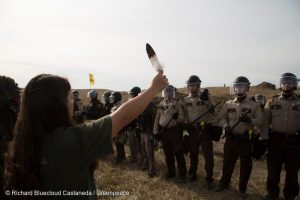
A phalanx of National Guard and police advance toward water protectors in Standing Rock.
1. What is a ‘SLAPP’ suit?
SLAPP stands for “Strategic Lawsuit Against Public Participation.” As the name implies, corporations, using this tactic are trying to shut down public participation. SLAPPs are generally filed without any kind of legal merit. The purpose of a SLAPP is to censor, intimidate, and silence critics by burdening them with legal claims and costs until they’re forced to abandon their criticism or opposition.
2. Why is ETP using a SLAPP?
ETP is SLAPPing its critics in an attempt to shut them up – or even better, to shut them down. ETP is suing Greenpeace for at least USD $900million. The corporation’s hope is that the prospect of having to pay this – or at least of spending a lot of time and legal costs on fighting the lawsuit – will intimidate Greenpeace and others into silence.
The goal of this suit is to silence opposition by misrepresenting what happened on the ground at Standing Rock — making outrageous and racist claims that big environmental organizations like Greenpeace orchestrated the Indigenous-led movement at Standing Rock.
3. This is a worrying trend
In 2016, Canadian company Resolute filed a SLAPP suit against Greenpeace, which was dismissed in full by a US federal judge. But the use of this dirty tactic by corporations is on the rise. As we face an upswing in a new global right-wing agenda, governments and corporations around the world are attempting to chip away at free speech. And it’s not just about environmental groups, either. The SLAPP suit is designed to send a loud message so that any activist or public-interest advocacy group that takes on giant corporations will have to think twice before standing up for what they believe in.
4. Who’s behind this suit
Just like the Resolute case, this one was filed by Michael Bowe. Bowe is also a member of Trump’s personal legal team, and part of the law firm Kasowitz Benson Torres – founded and run by Marc E. Kasowitz, Trump’s personal lawyer. The Times once described Kasowitz as “the Donald Trump of lawyering”. Bowe has publicly stated that he’s in conversations with other corporations considering filing their own SLAPPs against Greenpeace – suggesting this bullying and anti-democratic tactic is being shopped around to the highest bidder.
5. This is not a one-off.
There are many, many examples of SLAPP suits, here are a couple you may have heard of.
Earlier this year, coal magnate Bob Murray sued John Oliver after*Last Week Tonight*ran a segment on Coal – which prominently featured Murray. In the last 15 years, Murray and/or his company have also sued various other journalists.
The ACLU represented individuals in Uniontown, Alabama — a poor town predominantly made up of people of color — who were sued by Green Group Holdings for $30 million for standing up to a coal ash landfill in their town. The company revealed its motives when its lawyers approached the individuals in an attempt to cut a deal – if they agreed to give Green Group access to their electronic devices, access to their future social media postings, and extensive details about their group’s membership, advocacy and communications with other environmental groups.
Due to public outcry and the support of the ACLU, the residents reached a settlement in February and Green Group Holdings agreed to better environmental protections — but they shouldn’t have had to deal with this corporate bullying in the first place. There are hundreds of others across America and beyond who won’t be so lucky.
[pix ]
People march in support of the Standing Rock Nation at the Civic Center Plaza of San Francisco. The protest was one of many in a global day of action against the Dakota Access Pipeline (DAPL) calling on the U.S. Army Corps of Engineers to cancel the permit for the project.
6. They’re clutching at straws… [vid]
Just like in the , ETP is using the Racketeering Influenced and Corrupt Organizations Act (RICO) – a law which was originally created to prosecute the mafia – to claim treble damages and inflate the amount of money it is able to demand. In their lawsuit, ETP claims thatGreenpeace led a corrupt environmentalist enterprise that “cynically planted radical, violent eco-terrorists on the ground amongst the protesters, and directly funded their operations” – a baseless attempt to mislabel legal advocacy as criminal conduct through the use of these racketeering laws, and present constitutionally-protected free speech as defamatory. It’s as ridiculous as it sounds…
7. We can fight this
ETP and other corporate bullies are blatantly trying to stifle free speech and our right to peacefully protest. So let’s show them that that’s not going to happen: Refuse to be silent. Defend free speech. And let’s continue standing up for what is right.
You can take action against this SLAPP here and find more information about how you can fight back against SLAPPs generally.
===
bloomberg
Energy Transfer Partners LP accused Greenpeace International, Earth First! and other groups of inciting terrorist acts and vandalism to generate publicity and raise money for their causes while hampering the Dakota Access pipeline operator’s ability to raise money for projects.
Energy Transfer is the second company to attack Greenpeace and its allies in court for engaging in what they claim is a racketeering scheme far beyond ordinary environmental advocacy. Resolute Forest Products Inc. made similar allegations over Greenpeace’s campaign against logging in a May 2016 lawsuit. Both companies are represented by Kasowitz Benson Torres LLP, a New York-based law firm whose managing partner Marc Kasowitz is President Donald Trump’s longtime personal attorney.
https://theintercept.com/**2022/09/**16/fossil-fuel-industry-climate-free-speech/
REPS. JAMIE RASKIN, D-Md., and Katie Porter, D-Calif., probably didn’t plan for their committee hearings to run at the exact same time this week, but the hearings sure were talking to each other.
In her Committee on Natural Resources hearing, Porter highlighted the role PR firms play in blocking climate policy. Rep. Blake Moore, R-Utah, and his selected witness, Amy Cooke, CEO of the conservative John Locke Foundation, expressed concern that preventing companies and their hired PR firms from spreading misinformation about climate change would have a chilling effect on free speech.
Meanwhile, the House Oversight Subcommittee on Civil Rights and Civil Liberties, chaired by Raskin, focused on free speech attacks against environmentalists, digging into the fossil fuel industry’s attempts to curb citizens’ speech rights via strategic litigation and laws that criminalize protest. Taken together, the two are a perfect illustration of the industry’s First Amendment strategy: expand free speech for corporations, curb it for citizens.
:{:{raskin’s free speech hearing focused on two key tactics: the increased filing of strategic lawsuits against public participation, or SLAPPs— defamation suits aimed at penalizing citizens or citizen groups for exercising their First Amendment rights — and theproliferation of so-called critical infrastructure bills, which pile on fines and criminal sentences for those caught trespassing or vandalizing near pipelines, power plants, railroads, or other infrastructure. }:
These anti-protest bills were a}: direct industry backlash to the Standing Rock protests in 2016 and 2017. Starting with a law passed in Oklahoma in 2017, they proliferated with the help of the industry group American Fuel and Petrochemical Manufacturers and the American Legislative Exchange Council, which drafts and disseminates pro-corporate model legislation for adoption by state governments. Seventeen states now have critical infrastructure laws on the books, with several more considering proposals.
“SLAPPs and anti-protest bills are really two sides of the same coin,” said Deepa Padmanabha, deputy general counsel for Greenpeace and a witness at Raskin’s hearing. “They’re tactics used by the same corporate actors to quash dissent. They’re pushing legislation to silence us, to criminalize our critiques through anti-protest bills. And they’re also filing SLAPP suits to silence dissent.”
Greenpeace has dealt with both. Greenpeace USA activists were arrested in 2019 under Texas’s felony critical infrastructure law for unfurling banners on a bridge, which temporarily blocked shipping. The goal of the action was to highlight the connection between the oil industry and climate change.
Greenpeace is engaged in active litigation in a couple of SLAPP suits too. In one, Energy Transfer, the company behind the Dakota Access Pipeline, sued the organization for its role in the Standing Rock protests. The suit was initially filed in federal court and invoked the Racketeer Influenced and Corrupt Organizations Act, orRICO, a law designed to prosecute organized crime. “Energy Transfer was alleging that our advocacy work to uplift Indigenous voices at Standing Rock constituted organized crime,” Padmanabha said.
Because RICO allows for damages to be tripled if a defendant is found guilty, Greenpeace faced a $1 billion fine. Losing that suit would have had a truly chilling effect on free speech. A federal judge threw out the case, but Energy Transfer filed again in North Dakota (minus the RICO charge), a state that doesn’t have an anti-SLAPP law on the books.
“SLAPPs and anti-protest bills are really two sides of the same coin.”
Anti-SLAPP laws allow defendants a quick way to get SLAPP suits dismissed, minimizing the time and money spent on meritless cases. Currently, 31 states and the District of Columbia have adopted anti-SLAPP statutes, which makes it fairly easy for corporate entities to go venue shopping for a court in a state without such a law. To address that gap, Raskin proposed new legislation this week to create federal anti-SLAPP protection. While some players in the fossil fuel industry may oppose Raskin’s bill, others have actually sought to avail themselves of anti-SLAPP protections. Exxon Mobil, for example, in its final attempt to thwart the fraud case against it in Massachusetts, argued that the suit was a SLAPP.
The oil company’s attorney Justin Anderson maintained that Massachusetts Attorney General Maura Healey’s fraud complaint against Exxon was not valid because the company’s public statements on climate policy should be considered political opinion (“petitioning activity,” in legal parlance), not misleading advertising — even when Exxon falsely claimed that climate change wasn’t real and overstated the company’s investments in low-carbon technology.
When one judge asked why Exxon would file an anti-SLAPP complaint rather than make a First Amendment argument in court, Anderson made clear that the point was to avoid discovery, when the corporation would be asked to hand over files and make its executives available for depositions. “The anti-SLAPP statute provides a mechanism to have a case that is brought against someone for petitioning activity dismissed at the outset before burdensome discovery is imposedon the party,” he argued.
The “petitioning activity” argument is one that the industry and its allies have trotted out repeatedly, both in court and in congressional hearings like those held this week. It’s a broad interpretation of free speech rights for corporations, the very sort of protection these same companies are opposed to extending to individuals. In his testimony before Raskin’s subcommittee, Daren Bakst, a senior research fellow on environmental policy and regulation for the Heritage Foundation, said, “The chilling effects are states bringing lawsuits against people for their speech.” It’s hard to tell because he said “people,” but he meant oil companies. Which he made clear by immediately referencing “what municipalities are doing, the government is doing against these fossil fuel companies. And I also see that Massachusetts is doing.”
This view of an oil company as a person who is being silenced for simply sharing their views on climate policy is the basic argument oil companies are making in dozens of cases across the country. These cases, brought by both municipalities and states, hinge either on fraud or nuisance claims and effectively ask that fossil fuel companies pay up for delaying action on climate, which increased both the impacts of the climate crisis and the price of adapting to a warming world. In all of them, the corporate defendants make some version of a free speech argument. They maintain that their public speech about global warming differed from their internal knowledge because their public statements were “petitioning speech,” related to their political views and desires and thus, protected. The industry has been building the foundation for such an argument for about as long as it has known about climate change — since the late 1960s.
“They will try to defend their misinformation efforts as political speech covered by the First Amendment and not subject to false advertising laws.”
The argument arose out of a situation not unlike the one playing out today, with war driving up prices at the pump and oil companies desperate to control public perception.
According to documents from Mobil’s corporate archive at the University of Texas at Austin, the company’s longtime PR whiz Herbert Schmertz and then-CEO, Rawleigh Warner, came up with an idea to help wrestle back control of the narrative. Using Mobil’s PR and advertising budget, they would create “idea advertising” to push the company’s take on key issues of the day and create the sense of Mobil as a citizen with a distinct personality.
They ran weekly :{advertorial:(style="background-color:#ffff66;"):}:s in the New York Times as well as regular placements in a wide range of other publications, from the Los Angeles Times and the Wall Street Journal to Time and Fortune. Then Schmertz proposed TV and radio too. Why not?
In the early 1970s, Mobil took their TV and radio advertorials to all the big broadcast stations and only one, NBC, agreed to run them. CBS and ABC said they preferred to have their journalists cover energy issues. For Schmertz and Warner, it was a battle they had to win. What if the newspapers, or PBS, started to rethink playing nice with Mobil? In a media blitz, the two blasted CBS and ABC from every angle, in their NYT spot, on radio and TV programs, at events. Warner went to various business clubs to talk about the importance of protecting corporate free speech. Schmertz testified before Congress in 1978, urging First Amendment protection for Mobil’s ads and arguing that there was no difference between Mobil advertorials and New York Times editorials, because after all the Times was a business too.
Mobil helped rally support and funding for the first big Supreme Court case on the matter, First National Bank of Boston v. Bellotti, the precursor to Citizens United. The court ruled that corporations could spend whatever money they wanted to influence politics, overruling a Massachusetts statute that said otherwise. “If the restricted view of corporate speech taken by the Massachusetts court were accepted,” Justice Lewis A. Powell wrote, “government would have the power to deprive society of the views of corporations.”
Related
How the Media Launders Fossil Fuel Industry Propaganda Through Branded Content
“I don’t think people really appreciate how big of a deal that was in shifting the rules of speech in the public space,” environmental sociologist Robert Brulle said. “Now, suddenly, corporations could use their budgets — which are enormous, you know, much larger than individuals — to advocate their position in the public space. … It allowed for a systematic distortion of the public space that gives corporations basically a loudspeaker to amplify their voice above everybody else’s.”
The 2010 Citizens United ruling, of course, intensified that dynamic. Whereas Bellotti allowed corporations to publicly campaign for particular ballot initiatives or candidates, Citizens United allowed political speech of any sort without disclosure of who was paying, who was actually speaking. Oil companies have been working to broaden corporate free speech rights even more in recent years, as their arguments in climate litigation and before Congress show.
“They will try to defend their misinformation efforts as political speech covered by the First Amendment and not subject to false advertising laws,” said Brulle, who has co-authored briefs in some of these cases.
Robert Kerr, who’s researched Mobil’s role in the corporate free speech movement for years, said to side with the oil companies’ arguments in these cases, the Supreme Court would have to turn its back on about a century’s worth of legal precedent. “It’s really deeply established even by some of the members of the current Supreme Court that the First Amendment will never protect expression that is fraud,” he said. “The worry now is that with this court there seems to be a majority that wants to say yes to almost any question the corporate interests raise.”
It makes sense then, that the industry and its allies would be working hard to rebrand climate denialism as simply a difference of opinion, to put some distance between greenwashing and fraud, to collectively gasp about the “chilling effect” (a phrase that came up so often in minority witness testimony this week that it’s hard to believe someone somewhere wasn’t disseminating talking points) that tackling misinformation might have on free speech. The fact that those efforts are happening alongside coordinated attempts to criminalize protest is more of the same: corporations drowning out the public.
===
===
https://www.greenpeace.org/usa/news/resolute-to-pay-almost-1-million-dollars-to-greenpeace/
San Francisco, April 23, 2020 — Logging Giant Resolute Forest Products, which has waged meritless lawsuits against multiple Greenpeace offices and individual staff members since 2013, was ordered yesterday to reimburse defendants a total of about $816,000 USD to cover attorneys’ fees and costs [1] related to dismissed legal claims that were intended to silence critics of the company’s controversial environmental record.}:
This is the latest favorable decision for Greenpeace in the U.S. federal lawsuit that started over four years ago. Resolute’s lawsuits are clear examples of Strategic Lawsuits Against Public Participation (SLAPPs) [2]. :{The goal of a SLAPP suit is not to win in court, but instead to intimidate defendants into silence and exhaust them of their resources. In addition to Resolute undoubtedly spending vast sums on its own lawyers, it now must cover a large portion of the attorneys’ fees incurred by those it sued.
Despite }:almost the entirety of the lawsuit already being dismissed in January 2019, Resolute continues to pursue this SLAPP tactic in an attempt to drain Greenpeace resources and distract the organization from other valuable work. But, in this case, the bully is left to foot the bill. The two Greenpeace entities in the United States [3] that Resolute sued requested the payment of their attorneys’ fees and costs as allowed under California’s anti-SLAPP statute, most of which were granted in the court’s order. This historical award is one of the highest monetary figures ever under California’s anti-SLAPP statute.
Greenpeace USA General Counsel Tom Wetterer said in response to the decision:
“This decision shows that Resolute made a very expensive mistake coming after Greenpeace for our work protecting Canada’s boreal forest. The judge’s decisions both to dismiss the majority of the claims in this case and now awarding substantial attorneys’ fees affirm that Resolute’s divisive and bullying tactics are a waste of time and resources. The court’s decision should be a warning to other corporations and powerful interests that legal attacks on free speech and public advocacy are bad business decisions.”
==
===
yay rare win? FAIL
2 2019
https://www.desmogblog.com/2019/02/14/energy-transfer-racketeering-claims-greenpeace-dakota-access-pipeline-dismissed
A North Dakota federal judge dismissed Energy Transfer’s racketeering lawsuit against Greenpeace and all its co-defendants in a sharply worded ruling issued today, finding that the pipeline builder’s allegations fell “far short of what is necessary to establish a [racketeering] claim.”
In August 2017, Energy Transfer filed a Racketeer Influenced and Corrupt Organization (RICO) Act civil complaint against Greenpeace and other environmental groups who had opposed the company’s Dakota Access pipeline, claiming that the protests had caused $300 million in damages (and requesting three times that amount from the defendants).
Today’s ruling flatly rejected Energy Transfer’s claims.
“Donating to people whose cause you support does not create a RICO enterprise,” District Judge Billy Roy Wilson wrote in a terse 12-page opinion dismissing all state and federal claims in the suit. “Posting articles written by people with similar beliefs does not create a RICO enterprise.”
The company labeled opponents “eco-terrorists” in its 187-page complaint, DeSmog reported at the time; Greenpeace responded that the lawsuit should be considered a Strategic Lawsuit Against Public Participation (a so-called SLAPP suit) and was nothing more than an attempt to deter legitimate organizing work.
Other civil society organizations agreed with Greenpeace’s stance.
“Defendants employed time-honored, lawful means to advance their views, protected by core constitutional rights of free speech and association,” the American Civil Liberties Union (ACLU) wrote in a friend-of-the-court brief objecting to Energy Transfer's (then Energy Transfer Partners, or ETP) claims of racketeering, defamation, and conspiracy. “Under ETP’s theories, ordinary political speech that runs counter to a corporation’s business interests could expose the speaker to enormous, unwarranted liability.”
Judge Wilson ruled today that Energy Transfer’s lawsuit could not go forward, dismissing all of the federal claims with prejudice (so that they cannot be re-filed), writing that “any additional amendments [by the plaintiff] would be futile.” He also dismissed the state claims, though without prejudice.
Energy Transfer said it planned to pursue futher action in state court, given that the federal judge had declined to hear their state law claims. “We are disappointed, but because the judge dismissed the state claims without deciding their merits, we intend to quickly pursue those in the appropriate venue,” Lisa Dillinger, an Energy Transfer spokesperson, said in a Friday email to DeSmog.
The federal judge dismissed Energy Transfer’s allegations of “wire fraud and mail fraud” in a single sentence. “There appear to be problems with both causation and the fact that most (if not all) of the alleged ‘false and sensational’ claims are either subject to debate, matters of opinion, or inconsequential.”
The judge’s Valentines Day 2019 ruling describes the case’s history, observing that claims against two of Greenpeace’s co-defendants were dismissed in July. Plaintiffs then added individual defendants, named in today’s ruling as “Greenpeace’s employee Charles Brown, and alleged protesters Cody Hall, Krystal Two Bulls, Jessica Reznicek and Ruby Montoya.”
“This is a huge victory not just for Greenpeace but for anyone and everyone who has ever stood up against powerful corporate interests,” Greenpeace USA General Counsel Tom Wetterer said in a statement.
“Today’s decision to dismiss Energy Transfer's baseless lawsuit against Greenpeace and others sends a clear message to companies trying to muzzle civil society that corporate overreach will not be tolerated,” he said. “It is also a check on corporate efforts to silence dissent.”
The ruling comes just one month after RICO claims against Greenpeace by Resolute Forest Products –- a case also filed by attorneys from Kasowitz Benson Torres (a law firm used by President Donald Trump) – were similarly dismissed in January.
Greenpeace hailed the federal court decision as showing that, in their words, “[j]ustice has been served.”
“We must and will continue to hold Energy Transfer accountable for its corporate behavior on current risky pipeline projects like Bayou Bridge,” Wetterer said, referring to the Energy Transfer oil pipeline being built in Louisiana, “where the company is continuing to use private security to intimidate protestors and has aggressively used eminent domain laws to secure land.”
==
===
ADDITIONAL MISREPRESENTATIONS THAT DAPL WAS ROUTED AND APPROVED WITHOUT ADEQUATE CONSULTATION WITH SRST OR REQUISITE ENVIRONMENTAL REVIEW 6 11/2/2016
Earthjustice (Jan Hasselman) Website Publication:
Why It's Right To Keep The Brakes On The Dakota Access Oil Pipeline “[T]he original route of the pipeline crossed the river just north of Bismarck, N.D. -- a capital city that is nearly 90 percent white -- and was moved to Standing Rock only when regulators expressed concern over the risk of a spill to the city's water supply.” 11/2/2016 Earthjustice (Jan Hasselman) Website Publication: Why It's Right To Keep The Brakes On The Dakota Access Oil Pipeline Dakota Access “didn’t have needed federal permits, hoping either that the permits would be an afterthought or that it could pressure regulatory agencies into acquiescing.” 11/2/2016
Earthjustice Website Publication: Earthjustice Echoes Standing Rock Sioux Tribe’s Leader, Applauds President Obama “We also want to reiterate the Chairman’s call for a full environmental impact statement. No such careful review has occurred to date. Considering all that’s at stake, that’s simply unacceptable.” 10/29/2016 350.org (Bill McKibben) Tweet “NYTimes reminds us that Dakota pipeline was originally going to go by Bismarck. But, white people. #NoDAPL http://nyti.ms/2dUFMTt” 10/28/2016 350.org (Bill McKibben) Website Publication: Why Dakota Is the New Keystone “Originally, the pipeline was supposed to cross the Missouri just north of Bismarck, until people pointed out that a leak there would threaten the drinking water supply for North Dakota's second biggest city. The solution, in keeping with American history, was obvious: make the crossing instead just above the Standing Rock reservation, where the poverty rate is nearly three times the national average.” 10/6/2016 Earthjustice (Trip Van Noppen)
Website Publication: Making History at Standing Rock: Tribes Are Leading Action To Preserve The Planet “[T]he pipeline's original route was shifted toward Standing Rock when it became clear that a leak or a spill would contaminate drinking water in the relatively prosperous, overwhelmingly white city of Bismarck.” 9/13/2016 Sierra Club (Timothy Hill)
Website Publication: A Tribal Activist War Rages On: The Dakota Access Pipeline and The Fight for Justice Permits for DAPL were subject “fast-track approval . . . [which] seems to be the oil companies’ perfect skirt around the fervent backlash from opposing parties”; the Corps demonstrated “flagrant disregard for both tribal and Case 1:17-cv-00173-CSM Document 1-5 Filed 08/22/17 Page 6 of 10
APPENDIX E ADDITIONAL MISREPRESENTATIONS THAT DAPL WAS ROUTED AND APPROVED WITHOUT ADEQUATE CONSULTATION WITH SRST OR REQUISITE ENVIRONMENTAL REVIEW 7 environmental rights, as well as a lack of compliance with federal consultation policies.” 9/13/2016 Sierra Club Website Publication: Thousands Nationwide Show Solidarity with the Standing Rock Sioux and #NoDAPL The Corps “rushed to approve this dangerous pipeline using a process that deliberately avoids adequate environmental reviews or consultation with the tribe . . .” 9/9/2016 Sierra Club (Jonathan Berman)
Website Publication: Obama Administration Sides With the Standing Rock Sioux “While construction will be halted on a portion of the project, the U.S. Army Corps of Engineers should finish the job and reject this dirty and dangerous pipeline once and for all. It should never have taken legal action by the Tribe to require that this or any pipeline receive a common sense, thorough environmental and climate review of the effects they pose, but we are thankful that the Administration acted swiftly after the deeply flawed decision was made.” 9/9/2016 Greenpeace USA (Rachel Prokop)
Website Publication: How You Can Help Standing Rock Activists Stop the Dakota Access Pipeline “The pipeline was approved without adequate environmental reviews or consultation from the community . . . .” 9/9/2016 Bold Iowa (Mark Hefflinger) Website Publication: Pipeline Fighters React to Obama Administration’s Call for Construction Halt on Dakota Access Pipeline at Key Areas Near Sacred Stone Camp That Threaten Water, Sacred Sites “[P]roper consultation was never done with Tribes . . . .” 9/1/2016 Bold Iowa (Mark Hefflinger) Website Publication: 30 Iowans Arrested in Peaceful Demonstration Against Dakota Access Pipeline and Risks to Water “With Dakota Access moving aggressively to build the pipeline while ignoring . . . the concerns of the Standing Rock Sioux . . . .” (quoting Ed Fallon, Bold Iowa) Case 1:17-cv-00173-CSM Document 1-5 Filed 08/22/17 Page 7 of 10
APPENDIX E ADDITIONAL MISREPRESENTATIONS THAT DAPL WAS ROUTED AND APPROVED WITHOUT ADEQUATE CONSULTATION WITH SRST OR REQUISITE ENVIRONMENTAL REVIEW 8 9/1/2016 Earthjustice Website Publication: Standing with Standing Rock “[T]he pipeline wasn't originally supposed to take this route. The original route crossed the Missouri River upstream of Bismarck. An oil spill at that location would have threatened the drinking water supply of the state capital. The pipeline route was moved south--to just a half-mile upstream of the Tribe's reservation.” 9/1/2016 Michael Brune (Sierra Club) Website Publication: Time to Stop a Bad Idea “[T]he Army Corps of Engineers granted the general permit that allowed construction to begin (using a little-known loophole called Nationwide Permit 12 that allows the process to be fast-tracked without adequate environmental review, tribal consultation, or public input).” Case 1:17-cv-00173-CSM Document 1-5 Filed 08/22/17 Page 8 of 10
APPENDIX E ADDITIONAL MISREPRESENTATIONS THAT DAPL WAS ROUTED AND APPROVED WITHOUT ADEQUATE CONSULTATION WITH SRST OR REQUISITE ENVIRONMENTAL REVIEW 9 8/25/2016 Rainforest Action Network; Bold Alliance; 350.org; Minnesota 350; 350 Madison; Greenpeace Letter: Halt Construction and Repeal the Army Corps of Engineers Permits for the Dakota Access Pipeline Project “DAPL is yet another example of an oil pipeline project being permitted without adequate public engagement or sufficient environmental review . . . . DAPL is a major project that should have required more thorough review and analysis under the Clean Water Act and the National Environmental Policy Act, the National Historic Preservation Act and the Native American Graves Protection and Repatriation Act, as well as federal trust responsibilities guaranteed in the 1851 and 1868 United States treaties with the Lakota, Dakota and Nakota tribes. . . . Given the size, scale, environmental risks and controversy of this project, Nationwide Permit 12 should not have been applied.
The Corps’ individual permit process is the only way to ensure that the risks and impacts from these projects have been identified, analyzed and properly mitigated, and ensure that the families and communities that stand to be impacted by a disaster have an opportunity to have their voices heard in the pipeline review process. As long as Nationwide Permit 12 is being used to rubberstamp oil pipelines, it ignores the intent of our laws and presents an ongoing threat to our water resources, our communities, and our climate. Pipelines must be evaluated fully and in a transparent manner with opportunity for public input in order to be held to the same national interest and climate standards as the Keystone XL tar sands pipeline, which we applaud you for rejecting last year.” Case 1:17-cv-00173-CSM Document 1-5 Filed 08/22/17 Page 9 of 10
APPENDIX E ADDITIONAL MISREPRESENTATIONS THAT DAPL WAS ROUTED AND APPROVED WITHOUT ADEQUATE CONSULTATION WITH SRST OR REQUISITE ENVIRONMENTAL REVIEW 10 7/27/2016 Earthjustice Website Publication: Standing Rock Sioux Tribe Takes Action to Protect Culture and Environment From Massive Crude Oil Pipeline “The Corps effectively wrote off the Tribe's concerns and ignored the pipeline's impacts to sacred sites and culturally important landscapes.” 7/27/2016 Earthjustice Website Publication: Standing Rock Sioux Tribe Takes Action to Protect Culture and Environment From Massive Crude Oil Pipeline “There have been shopping malls that have received more environmental review and Tribal consultation than this massive crude oil pipeline.” (quoting Jan Hasselman, Earthjustice) 5/18/2016 Earthjustice (Niria Garcia)
Website Publication: Opposing the Dakota Access Pipeline: An InterTribal Spiritual Relay “The Standing Rock Sioux Tribe . . . is one of many tribes that weren't consulted properly under the National Historic Preservation Act and other laws . . . .” 5/18/2016 Earthjustice (Niria Garcia) Website Publication: Opposing the Dakota Access Pipeline: An InterTribal Spiritual Relay "[I]t's not just Standing Rock that wasn't consulted; none of the Sioux tribes were consulted. For example, the Oglala Sioux tribe, they get the majority of their water intake from the Missouri river and they were not consulted. The lack of tribal consultation is a violation of the relationship that tribes have with the federal government." (quoting Waniya Locke, People Over Pipelines) Undated Greenpeace USA (Perry Wheeler)
Website Publication: Indigenous Youth Travel From Standing Rock to Clinton Headquarters to Demand Answers on Dakota Access Pipeline “The fast-track process of approval disregarded key U.S. legislation, including the Clean Water Act . . . . And no proper Environmental Impact Statement, with substantive tribal consultation, was performed.” Undated Greenpeace USA (Perry Wheeler) Website Publication: Greenpeace Statement of Solidarity With Standing Rock Water Protectors “The fast-track process of approval disregarded key U.S. legislation, including the Clean Water Act, the National Environmental Policy Act, and the National Historic Preservation Act, and offered no proper Environmental Impact Statement or substantive tribal consultation.” Case 1:17-cv-00173-CSM Document 1-5 Filed 08/22/17 Page 10 of 10
APPENDIX F ADDITIONAL MISREPRESENTATIONS THAT ENERGY TRANSFER INTENTIONALLY DESECRATED CULTURAL RESOURCES 1 Date Author Description Statements 2/14/2017 Earthjustice Website Publication: The Standing Rock Sioux Tribe's Litigation on the Dakota Access Pipeline “[T]he lawsuit challenges the Corps' hasty and unexplained departure from its previous decision, and explains how the Corps ignored the Tribe's treaty rights and seeks to destroy culturally significant and sacred sites. It also explains how the Corps violated federal statutes requiring close environmental analysis of significant and controversial agency actions.” 2/10/2017 Rainforest Action Network (Laurel Sutherlin) Website Publication: RAN Statement on Final Loan Disbursements for Dakota Access Pipeline “These 17 banks . . . have chosen to stand behind this abusive corporation . . . despite . . . months of savage abuses by security forces against nonviolent demonstrators, the destruction of sacred native American burial sites and documented threats to critical drinking water supplies for downstream communities.” (quoting Lindsey Allen, Rainforest Action Network) 2/7/2017 Greenpeace USA (Jason Schwartz)
Website Publication: NoDAPL: Greenpeace Responds to Granting of Easement [quoting Mary Sweeters:] “[DAPL's] construction has already desecrated sacred burial grounds and other historical sites nearby.” 2/1/2017 350.org (Sabelo Narasimhan) Website Publication: #NoDAPL: We Fight On “The Standing Rock Sioux tribe, whose drinking water and sacred sites have been desecrated by this pipeline . . . .” 11/30/2016 BankTrack (Johan Frijns) Website Publication: Global call on banks to halt loan to Dakota Access Pipeline “Harm to Native areas has now already occurred when DAPL personnel deliberately desecrated documented burial grounds and other culturally important sites.” 11/7/2016 BankTrack (Johan Frijns) Website Publication: An open letter to the Equator Principles Association “[T]he pipeline trajectory is cutting through Native American sacred territories and unceded Treaty lands. Harm to Native areas has already occurred when DAPL personnel deliberately desecrated documented burial grounds and other culturally important sites.” Case 1:17-cv-00173-CSM Document 1-6 Filed 08/22/17 Page 1 of 3
APPENDIX F ADDITIONAL MISREPRESENTATIONS THAT ENERGY TRANSFER INTENTIONALLY DESECRATED CULTURAL RESOURCES 2 11/7/2016 BankTrack (Johan Frijns) Website Publication: An open letter to the Equator Principles Association Alleging that Energy Transfer engaged in “the desecration of burial grounds . . . .” 11/6/2016 350.org (Bill McKibben) Website Publication: There Is Still Time to Stop the Injustice at Standing Rock “And the company that built [DAPL] fast-tracked their bulldozing operation the day after the tribe identified for a federal court the sacred sites and graves along the pipeline route; it was as if the Sioux had handed over a treasure map.” 11/4/2016 350.org (Lee Chisholm) Website Publication: #NoDAPL: KEEP IT IN THE GROUND: Reflections on the Call of Standing Rock at this Moment in History “[T]he workers and heavy machinery operators burying the pipe disturb sacred burial sites and other areas of cultural and historical significance to the tribe.” 10/30/2016 Bold Alliance (Jane Kleeb) Tweet “Yes, Dakota Access pipeline has destroyed sacred sites. You can come up to ND and we would be happy to show you #NODAPL “ 10/28/2016 350.org (Bill McKibben)
Website Publication: Why Dakota Is the New Keystone “Construction has already desecrated indigenous burial sites . . . .” 9/22/2016 350.org (Bill McKibben) Website Publication: A Strategy to Stop the Funding Behind the Dakota Access Pipeline “[G]uard dogs [ ] attacked Native Americans as they tried to keep bulldozers from mowing down ancestral grave sites.” 9/22/2016 350.org (Bill McKibben) Website Publication: A Strategy to Stop the Funding Behind the Dakota Access Pipeline “It's unlikely that Citibank customers support poisoning indigenous peoples’ water, desecrating sacred burial sites, or contributing to global climate change.” (quoting Gloria Fallon, Rising Tide Chicago) 9/21/2016 350 Action Tweet “Dakota Access destroys sacred burial ground. It must be stopped. #NoDAPL http://thenaturalhistorymuseum.org/archaeologists-andmuseums-respond-to-destruction-of-standing-rock-siouxburial-grounds/ …” Case 1:17-cv-00173-CSM Document 1-6 Filed 08/22/17 Page 2 of 3
APPENDIX F ADDITIONAL MISREPRESENTATIONS THAT ENERGY TRANSFER INTENTIONALLY DESECRATED CULTURAL RESOURCES 3 9/16/2016 Bold Alliance (Jane Kleeb) Website Publication: Dakota Access Pipeline Opposition Continues To Grow “[T]he day after the discovery of these sacred sites, the pipeline company intentionally bulldozed the sites before they could be inspected, as well as ramping up their violent confrontations of peaceful protesters.” 9/7/2016 350.org (Bill McKibben) Website Publication: Bill McKibben: Hillary Clinton needs to take a stand on the Dakota Access Pipeline “Worse yet, digging the pipeline corridor requires destroying Sioux burial grounds and sacred sites. In fact, last week, hours after the tribe had supplied a federal court with a list of those sites, the company building the pipeline brought in bulldozers and did its best to obliterate them. (Some speculate that it used the court list as a roadmap.).” 9/7/2016 Bold Nebraska (Mark Hefflinger)
Website Publication: Tribal Nations, Pipeline Fighters to Rally at Omaha Army Corps HQ Thursday to Tell Pres. Obama to Halt Construction of the Dakota Access Pipeline “[T]he construction of the Dakota Access pipeline[ ] has already desecrated burial sites . . . .” 9/6/2016 350.org Tweet “As bulldozers destroy burial sites, oil industry bullies try to provoke violence from native leaders saying #NoDAPL” 9/5/2016 Earthjustice Tweet “BREAKING: Standing Rock Sioux filed an emergency motion for TRO against DAPL after sacred site destroyed #nodapl http://ejus.tc/2bOADzY” 9/3/2016 Bold Alliance (Jane Kleeb) Tweet “A Marine Corps veteran looks on in disbelief at #NoDAPL destroying sacred sites https://flic.kr/p/LJ9g4D tweet @potus ask him to step in”
===