Matthew Whitaker
---
corkery, sessions
see 2025
see FACT
pension plan is fail proof
---
YIKES BACK TRUMP CABINET
maddow p S A djt i do not know who he is; scam co threat sue if BBB complaint
===
AN 11 24
President-elect Donald Trump has surprised and even alarmed many across the country, and “puzzled” and “baffled” some within his own party, with his Cabinet and other top White House nominations. Critics on the left have denounced his picks for their apparent lack of experience or qualifications for the roles they are expected to take on, noting some hold controversial or even false positions in the fields they may soon direct policy on. Meanwhile, experts in the fields of government, fascism, and democracy, are raising serious concerns about the potential “danger” some nominees represent, drawing comparisons to the “professional propagandists” often found in authoritarian regimes.
Dr. Ruth Ben-Ghiat, an NYU professor of history and a recognized expert on fascism and authoritarianism, on Wednesday pointed to this report on one of Trump’s most-recent nominations, Linda McMahon:
McMahon was Trump’s former administrator of the Small Business Administration, and is a former CEO of WWE (World Wrestling Entertainment), a major GOP donor, and has recently been the chair of a pro-Trump Super PAC, the board chair of a pro-Trump think tank, and the co-chair of Trump’s second transition team.
“Trump’s cabinet picks are a declaration of war on expertise and facts (that’s why there are several Fox hosts in the mix). The con artists, fraudsters, and professional propagandists that populate authoritarian governments see facts and laws as impediments to their goals,” Dr. Ben-Ghiat wrote.
READ MORE: JD Vance Accidentally Reveals FBI Director Wray Is Likely Being Replaced
Trump, announcing McMahon’s nomination, claimed, “Linda will use her decades of Leadership experience, and deep understanding of both Education and Business, to empower the next Generation of American Students and Workers, and make America Number One in Education in the World.”
McMahon’s only brush with the field of education came about 15 years ago, when she served on the Connecticut State Board of Education. She resigned after 15 months. At the time, her appointment was controversial, with one lawmaker lamenting, “her depth of knowledge regarding education is lacking.”
McMahon is far from the only controversial nominee.
On Tuesday, the vice chair of the powerful House Rules Committee Jim McGovern (D-MA) blasted Trump’s nominees as “beyond insane.”
“Someone who is credibly accused of having sex with an underage girl. Someone who sucks up to foreign dictators and has attracted major concern that they can’t be trusted to protect America’s secrets from our adversaries. Someone who paid hush money to cover up a sexual assault accusation, you know, to lead our military, he’s picked because Donald Trump likes him on Fox News? Someone who says that tap water turns kids gay? I mean, this is the dream team? This is the dream team? Really?”
He appeared to be referring to Attorney General presumptive nominee Matt Gaetz, Director of National Intelligence presumptive nominee Tulsi Gabbard, Defense Secretary presumptive nominee Pete Hegseth, and HHS Secretary presumptive nominee Robert F. Kennedy Jr.
The Democratic Association of Secretaries of State posted video calling Trump’s nominees “a trainwreck.”
READ MORE: Key GOP Senators Start Paving the Way for Gaetz’s Attorney General Confirmation
“Gaetz, Gabbard, RFK – none of them have the experience or qualifications for the positions they’re seeking, in addition to the fact they’re all dangerous MAGA zealots,” the organization declared. They posted a video clip (below) from MSNBC with a chyron that noted opposition from the right to Trump’s Attorney General nominee, Matt Gaetz.
MSNBC’s justice and legal affairs analyst Anthony Coley told viewers that Gaetz, the recently resigned U.S. Congressman, “has no national security experience—not anything meaningful—little anti-trust experience, and he certainly has no experience with criminal law, except for being the target of a federal criminal investigation looking into inappropriate sexual contact, allegedly, with a minor.”
Trump has also just appointed his former acting U.S. Attorney General Matthew Whitaker, a strong Trump loyalist, to be the U.S. Ambassador to NATO.
“Whitaker has little evident foreign policy or national security experience, making him an unknown to many in U.S. security circles,” The Associated Press reports. “Previous ambassadors to NATO have generally had years of diplomatic, political or military experience.”
“Before serving Trump,” Mother Jones notes, “he helped a company hawk bizarre products like a ‘masculine toilet’ to help ‘well-endowed men’ avoid unwanted contact with water.”
But The Atlantic’s Tom Nichols, a former U.S. Naval War College professor and an expert on Russia and nuclear weapons, served up this warning: “This is just hilarious, but the danger here is that it makes him Senate-confirmed and available for other stuff later.”
In other words, assuming Whitaker is confirmed, Trump could nominate him to another, even more critical role, declaring he’s qualified because he’s already been Senate-confirmed.
Last week, Nichols declared that Trump’s “nominations for intelligence, defense, and justice were revenge on people he thinks are his enemies. This is just endangering millions of innocent people.”
On Monday on MSNBC, Nichols went much further, delivered a scathing analysis of Trump’s nominees, calling them “an all-fronts assault on American democracy,” in another warning.
Trump, he said, is “trying to break the institutions of American government and American society, and what you’ve been seeing for the past few weeks is an all-fronts assault on American democracy, especially with these nominations.”
“I think the most dangerous of these nominations is actually [Pete] Hegseth,” Nichols explained. “And I’m kind of startled that we’re not sitting here talking more about taking a morning Fox [News] host and sticking him in the nuclear chain of command, to lead the largest—one of the largest—bureaucracies in the United States, in the world, including the person that’s supposed to look after the most powerful fighting force on the planet.”
And he concluded, “it’s also important to recognize that we could be in the first phases of a major constitutional crisis, even before Trump is sworn in.”
Watch the video above or at this link.
READ MORE:[‘Damaging’: Unredacted Sealed Sworn Testimony in Gaetz Case Accessed by Alleged Hacker]
---
an 12 23
during his four years in the White House, former President Donald Trump clashed with a long list of conservative Republicans who served in his administration — including a secretary of state (Rex Tillerson), a national security adviser (John Bolton), a U.S. attorney general (Jeff Sessions) and a White House Chief of Staff (John F. Kelly). Former Vice President Mike Pence and former U.S. Attorney General Bill Barr (a Sessions successor) were, for months, regarded as dedicated Trump allies, but in the end, even Pence and Barr became Trump critics.
Trump allies' Project 2025 agenda, according to reporting in the New York Times and the Washington Post, seeks to avoid such clashes during a possible second Trump Administration by making sure that only avowed loyalists are hired.
In a report published on December 15, the Wall Street Journal's Alex Leary describes some of the MAGA Republicans and loyalists who are helping Trump with plans for a possible return to the White House in 2025.
"When Donald Trump sat down in the office of his Bedminster, NJ golf club late this summer to flesh out his trade and border policy," Leary reports, "familiar faces were across from him: Robert Lighthizer and Russell Vought, two of the architects of the former president's populist first-term record. Trump's former trade representative and White House budget director, respectively, are part of a cadre of allies helping him shape policy proposals across a range of topics, laying the groundwork for what would be an aggressive and controversial second-term agenda."
Leary continues, "The group — which also includes Stephen Miller, driver of hardline immigration policies, former Housing Secretary Ben Carson and John Ratcliffe, former director of national intelligence, among others — is stocked with veterans of Trump's first term who are closely aligned with his vision of protectionist economic policies and an isolationist approach to foreign policy."
The WSJ reporter stresses that Trump and his allies want to make sure people picked for a second administration would be "on the same page" when it comes to immigration, foreign policy and economic policy.
According to Leary, other "key people" who "Trump and his team are in regular communication with over policy ideas" range from Brandon Judd (president of the National Border Patrol Council), Kevin Hassett (who formerly chaired the Council of Economic Advisers) and former Acting U.S. Attorney General Matt Whittaker (who came after Sessions and before Barr).
READ MORE:Mehdi Hasan slams 'unhinged' MAGA lawyer who'd make 'Trump’s darkest fascist impulses' a reality
Leary notes that Trump's "policy agenda" has "excited core supporters while alarming Democrats and some Republicans."
One of those Republicans is Marc Short, who served in Trump's administration and later became an adviser for Pence's presidential campaign before Pence dropped out of the race.
Short told WSJ, "He's been pretty clear in saying he will use the levers of government to go after his political opponents, which is anathema to conservatives."
READ MORE:Biden impeachment will 'backfire' against GOP and be 'good news' for his reelection: journalist
*Read the Wall Street Journal's full report at this link (subscription required).
---
---
ref no lnx
https://www.thedailybeast.com/even-donald-trump-cant-make-sense-of-his-own-dark-money-maze
[Pay Dirt is a weekly foray into the pigpen of political funding. Subscribe here to get it in your inbox every Thursday.
An inquiry from the feds has thrown new light on the murky relationships between a dozen Trump-aligned groups. And the problem traces back, as do so many other problems in Trumpworld, to a familiar name: former top aide Corey Lewandowski.
When Lewandowski got himself fired from a pro-Trump super PAC last fall—after allegedly sexually assaulting a big donor—the group brought in a clean-up crew. When Lewandowski refused to step down, they opened up a new super PAC without him.
That super PAC—the preposterously titled “Make America Great Again, Again!”—was the 12th in a sprawling labyrinth of political groups and nonprofitsthat comprise the Trump fundraising network. And in terms of the incestuous confusion, it may have been the one that finally tipped the scales; federal election officials now want to know why some of the super PAC’s payments aren’t being properly reported.
[Trump’s Dark-Money Machine Gets a Makeover—and New Owners
BILL OF GOODS
Roger Sollenberger]
Brendan Fischer, deputy executive director of good government group Documented, said the extent of Trump’s network is unparalleled.
“It is worth emphasizing: All of this is totally unprecedented for a former president,” Fischer told The Daily Beast. “Even if Trump kept it simple, and just had one hard money PAC, a single super PAC, and a pair of 501(c)(3)/501(c)(4) nonprofits, there would be no parallel with any former president in American history.”
Anyone who’s taken even the quickest of peeks at Trump’s personal financial disclosures would recognize the pattern.
His first such disclosure revealed positions with more than 500 entities, nearly 400 of which used his name or initials. And Trump has “organized” the mess in a stultifying Russian-nesting-doll structure—companies within companies within companies. Frequently, one company will be held under multiple Trump companies at the same time, each with stakes in still other Trump companies.
This isn’t an accident. The structure gave the Trump Organization an enormous amount of financial flexibility, while making it difficult to follow the billions of dollars that Trump, his family, and his accountants move across the organization.
When Trump hauled his private life into politics, he brought this practice with him, too.
The full Trump-aligned apparatus counts a dozen separate political committees and dark money organizations. Almost all of them share one of three names.
Here they are:
Make America Great Again PAC (converted from the old Trump campaign)
Make America Great Again Action (super PAC)
Make America Great Again, Again! (super PAC)
Trump Make America Great Again (small-dollar joint fundraising committee)
Make America Great Again Policies Inc (a 501(c)(4) nonprofit)
America First Policy Institute (a 501(c)(3) nonprofit)
America First Works (formerly America First Policies; a 501(c)(4) nonprofit)
America First Legal Foundation (a 501(c)(3) nonprofit)
America First Action (super PAC)
Save America (leadership PAC)
Save America JFC (joint fundraising committee)
Trump Victory (high-dollar joint fundraising committee)
“Typically, former presidents focus on their presidential library, or start a charitable foundation, but Trump is staying in the political game and raising a staggering amount of cash,” Fischer said.
It is staggering.
Want a closer look inside the pockets of the government’s most powerful players? Subscribe to the Pay Dirt newsletter here for exclusive reporting every Thursday.
For instance, the Trump-endorsed America First Action super PAC pulled in nearly $200 million between 2017 and 2020. Its sister nonprofit, America First Works—formerly America First Policies—posted $51.3 million in revenue for 2020, doling out nearly $40 million in grants.
[Dark-Money Group Paid Former Trump AG to Ask for Pardons
BEG YOUR PARDON
Roger Sollenberger]
The TMAGA PAC raised $884 million for 2020, with Trump Victory tossing in another $336.3 million. Those guns mostly fell quiet last year, while Trump’s three new PACs built up a $124.4 million stash, with another $12.5 million in the MAGAA! super PAC.
And we won’t know how much those other dark money nonprofits raised in 2021, or what they did with it, until after the midterms.
As Trump and the Republican Party gear up for 2024, these groups are in various stages of repair. However, that also appears to have created some internal problems. In fact, according to a filing on Wednesday, even the Trump campaign admits it isn’t always able to follow its own money.
Fischer chalked up the mess to a few factors, including Trump’s will-he-or-won’t-he candidate status, his relationship with the Republican National Committee, and disarray among his associates.
But Brett Kappel, a specialist in campaign finance and nonprofit law at Harmon Curran, perceived something more designed.
“The central lesson of Watergate is ‘Follow the money,’” Kappel told The Daily Beast. “And this byzantine structure of different types of legal entities—which are subject to different fundraising restrictions and file different reports with different agencies according to different filing schedules—appears to be designed to make that task as difficult as possible.”
To illustrate, these organizations can be divided into two groups: PACs and joint fundraising committees, and “dark money” nonprofits.
The PACS and joint fundraising committees are Trump’s political organizations. They disclose their finances to the Federal Election Commission. But they don’t all follow the same filing schedule, and, depending on what kind of committee they actually are, they can raise and transfer different amounts of money from different types of people and organizations.
[The GOP Dark Money Group Giving Big to White Supremacists
UNWORTHY CAUSES
Roger Sollenberger]
Of these groups, Save America leadership PAC is currently Trump’s main squeeze. Most of the money he raises goes there.The Save America JFC is a joint committee that splits donations between Save America and MAGA PAC, which used to be the Trump campaign. Weirdly, MAGA PAC doesn’t get much out of this joint arrangement—more than 90 percent of every contribution goes to the Save America PAC.
And the super PACs are, as mentioned above, something of a mess.
As for the “dark money” nonprofits, unlike the PACs, these groups file with the IRS. They don’t have to disclose their donors at all (hence “dark money”). They also only file once a year, and because those deadlines are so late, it can take nearly two years for a transaction to become visible to the public.
The IRS restricts their activities, too. Some groups have leeway to be political (the 501(c)(4) groups). Some must focus on social welfare (the 501(c)(3) groups). The Trump network has a healthy helping of both.
Sometimes, however, these PACs and nonprofits can overlap, even sharing employees and office space, like America First Action and America First Policies did during the Trump administration.[shuffle?]
And while they appear to be giving that another go, as the FEC found, it hasn’t been so clean this time.
Enter Lewandowski.
After Trump left the White House, the industriously sycophantic Lewandowski wormed his way back into his graces, winning the right to run the Make America Great Again Action super PAC. At the same time, he quietly created a Florida nonprofit, Make America Great Again Policies Inc.
But MAGA Policies didn’t appear to do anything—at all. There has been no reporting on any actual activity since it was created. Zero. It is a black box.
Then Lewandowski reportedly sexually assaulted a Trump donor and got himself booted from orbit. More experienced hands took over the new MAGAA! super PAC, led by former Florida attorney general Pam Bondi, and that also got complicated.
[Trump PAC Lavishing $37K a Month on Trump Tower Rent: WaPo
DONATIONS WELL SPENT
According to a new corporate filing in Florida, Bondi—who also happens to lead the massive America First Policy Institute nonprofit—also took over Lewandowski’s mysterious MAGA Policies nonprofit, adding former Trump administration officials Ric GrenellandMatt Whitaker, as well as Donald Trump Jr. paramour Kimberly Guilfoyle. All of those people are also on the new super PAC’s payroll.
But here’s the rub: The super PAC hasn’t been paying them directly. The nonprofit has, as part of a “cost share agreement.”
On Tuesday, the FEC sent the super PAC a letter saying that’s not cutting it. The group needs to explain exactly what they mean by “cost share agreement,” the letter said, because what they provided is not adequate.
Kappel said the FEC may be trying to figure out whether the two groups are “financially and operationally independent.” If the super PAC was found to be “connected” to the MAGA Policies nonprofit, he said, that meansit can only raise money from people tied to the nonprofit—and not from the general public. That would be a death blow, and the group would be forced to reorganize itself yet again.
Fischer said he wouldn’t be surprised to see more groups strategically shut down, like Trump Victory began doing last year.
“It might be more straightforward for Trump to shut down MAGA PAC,” he said, though he pointed out that MAGA PAC appears to own the campaign’s valuable supporter data, which might make it more cost-effective to retain for joint fundraising efforts.
But, Fischer pointed out, even though the constellation of Trump-aligned groups is basically unnavigable, it always could have been worse.
“Recall that Brad Parscale also started the ‘American Greatness’ super PAC in 2021, which never really got off the ground,” he said.
---
---
https://www.sltrib.com/news/politics/2020/04/22/fec-complaint-alleges/
no lnx
FEC complaint alleges a Utah candidate illegally coordinated with outside group to attack Rep. Chris Stewart
(J. Scott Applewhite | AP file photo) In this Sept. 19, 2019, file photo, Rep. Chris Stewart, R-Utah, a member of the House Intelligence Committee, leaves a meeting with national intelligence inspector general Michael Atkinson about a whistleblower complaint, at the Capitol in Washington.
By Thomas Burr
·
Published: April 22
Updated: April 23, 2020
Washington • Just days before the Utah Republican Convention, a watchdog group is filing a complaint with the Federal Election Commission alleging a congressional candidate in Utah illegally accepted an in-kind contribution by coordinating with an outside group to attack Rep. Chris Stewart.
:{:{}:
}:
Foundation for Accountability & Civic Trust (FACT) says in a letter to the FEC that a person once identified as a campaign manager and spokesman for Republican challenger Mary Burkett’s campaign was behind a mass anti-Stewart text message from a group called Stronger America Fund Inc. Stewart is a fellow Republican.
Stronger America Fund Inc., based in the District of Columbia, lists Patrick Krason as its founder and “governor.” Krason is also listed as the treasurer of Burkett’s campaign and had been identified as a campaign manager and spokesman in news releases.
Federal law prohibits coordination between campaigns and political advocacy groups registered as nonprofits — which can take in unlimited funds from contributors and corporations without identifying their donors.
“There is reason to believe Stronger America Fund made, and Burkett and Burkett for Utah accepted, an illegal in-kind contribution in the form of a coordinated communication,” the complaint to the FEC says.
“The two entities both appear to be affiliated with the same individual during the time Stronger America Fund disseminated and paid for a communication beneficial to Burkett,” the complaint continues. “If so, it would constitute an illegal in-kind contribution to Burkett’s campaign. We request the Commission immediately investigate and if a violation is found, act immediately and impose appropriate penalties.”
The complaint stems from a text message apparently sent earlier this month urging GOP delegates to oust Stewart from office for voting to raise the nation's debt limit while in office.
“Anybody else would be a better choice at convention,” the text reads, adding that it was paid for by Stronger America Fund, Inc. and not authorized or paid for by any campaign.
Burkett, of St. George, is running a second time for the 2nd Congressional District seat held by Stewart.
She said the accusations against her “are false. Neither I, nor my campaign, have ever coordinated with any outside group.”
She said Wednesday that Krason had worked on her campaign but left its payroll in November and now is a volunteer. Burkett adds that she had no knowledge of the text message that went out from the group tied to Krason.
Burkett, who had previously posted on Facebook that she had nothing to do with the text message and reiterated that Wednesday, said the irony is that she’s being attacked for something she didn’t do.
“He's doing the very thing he accused me of doing, by the way,” Burkett said of Stewart. “He accused me of hiding behind a third group. He's doing exactly what he accused me of. And I had nothing to do with it.”
Burkett says she had “absolutely” no involvement in the text message that was sent and went online as soon as she heard about it to ask the group to stop attacking Stewart.
She says the FEC complaint shows “Chris is vulnerable and he knows it.”
“A Washington, D.C., group questioning a little grassroots campaign in southern Utah?” she said. “Come on. You know, this had to come from Chris’ people somehow, someway.”
FACT says it was filing the complaint on its own and not in concert with Stewart's campaign.
Stewart’s campaign said it was unaware of the complaint and was not involved.
Stewart won the GOP nomination in 2010 under what his competitors complained were questionable circumstances surrounding allegations of collusion against other candidates.
Then-Eureka Mayor Milt Hanks, who was vying for the open seat, alleged right before delegates began casting ballots that four contenders had conspired to drop negative information about Stewart — charges that those candidates denied and claimed was foul play by Stewart’s camp.
Other candidates running for the GOP nod alleged Hanks was a Stewart plant who had never spent any money in the race and then made unsubstantiated, 11th-hour allegations. A Utah Republican Party investigation overseen by then-Chairman Thomas Wright found no criminal wrongdoing, but did chastise Hanks.
FACT, which touts itself as a group “dedicated to promoting accountability, ethics, and transparency in government and civic arenas," says it is nonpartisan and has filed complaints against Democrats and Republicans.
The group came into the national spotlight when its former president, Matt Whitaker, was named acting attorney general after the resignation of Jeff Sessions. Whitaker, a former U.S. attorney, had led FACT, which The Washington Post said “is part of a national network of nonprofits that often work in concert to amplify conservative messages.”
Whitaker received more than $1.2 million during his three years as the head of the nonprofit.
The Post reported that FACT's address in D.C.'s K Street is a virtual office and mailing address shared by 200 other organizations.
The FEC now has only three of the six commission seats filled, meaning it can still investigate complaints filed with the agency but lacks a quorum to issue fines or make rulings.
---
---
twt
@mrspanstreppon
·
Nov 27, 2018
Replying to
@mrspanstreppon
@runPattirun
and
@RobertMaguire_
Maybe the Corkerys w/an assist from CPA Thomas Conlon, are hiding the names of the Wellspring Committee board members so no one asks them any q.s about the committee's operations. Or to disguise related party transactions.....
Nov 27, 2018
Kathleen Marie Corker married Thomas S. Mellon in Nov '16 & is,of course, a George Mason U. grad. She is now developmental director at her father's "not-for-profit" , the Sudan Relief Fund. Curious what Mr. Mellon does for a living....
https://www.opensecrets.org/news/2016/04/new-nonprofit-tied-to-stealthy-circle-of-dark-money-groups/
april 2016
Leading the pushback from the outside against President Obama’s attempt to bring the Supreme Court back up to its full complement of nine justices, the Judicial Crisis Network claims to have spent $4 million on a TV, radio and digital campaign attacking nominee Merrick Garland and arguing that the next president should fill the vacancy.
Additional politically active, nondisclosing nonprofits, such as the Independent Women’s Forum, the Susan B. Anthony List and the NRA’s Institute for Legislative Action, have also made noise to try to shore up Senate Republicans who want to forestall voting on Garland’s confirmation.
One right-leaning group has weighed in more quietly:The Foundation for Accountability and Civic Trust (FACT) has demanded Harvard University release records having to do with Garland’s role in the debate in the early 1970s over whether to allow ROTC recruiters on that campus. In late March, FACT’s executive director, Matthew Whitaker, wasquoted saying that “Americans have a right to know about Garland’s views of the military.”
Turns out JCN and FACT have something in common, beyond a penchant for keeping the names of their donors secret: Neil Corkery, who is treasurer of the judicial group and also the treasurer and a member of the board of directors at FACT, a 501(c)(3) organization.
Longtime readers of OpenSecrets News or The Daily Beast may remember that Corkery’s wife, Ann, had a big hand in getting JCN off the ground, back in early 2005 when the “C” in its initials stood for “confirmation,” not “crisis.” At the time, Justice Antonin Scalia himself — whose death two months ago precipitated the current battle over the vacancy — attended a small dinner that included JCN organizers and at least one funder.
JCN originally promoted President George W. Bush’s nominations to the high court; conversely, it has attacked Obama’s. But many observers were surprised last fall when the group mounted an ad campaign criticizing Justice Anthony Kennedy and Chief Justice John Roberts, both appointed by GOP presidents, in an apparent effort to pressure them to take a harder conservative line. In addition, JCN has been involved in several state supreme court elections as well as attorneys general races.
FACT is a much newer creation, organized in 2014 as a conservative counterweight to watchdog groups viewed as more left-of-center, such as Citizens for Responsibility and Ethics in Washington. The newer outfit took its first public action about a year ago when it filed acomplaint with the Federal Election Commission against Democratic voter data firm Catalist.
Since then, FACT has, on rare occasions (possibly just once), gone after a Republican, but most frequently accuses Democrats — particularly frontrunner and former Secretary of State Hillary Clinton — of ethical or legal violations.
Its funding — $600,000 in 2014, according to the only tax return it has filed to date — comes entirely from a conservative donor-advised fund called DonorsTrust,which means it could come from anywhere. DonorsTrust is a pass-through vessel that manages the charitable contributions of wealthy individuals and foundations to organizations that are “dedicated to the ideals of limited government, personal responsibility, and free enterprise,” according to its website while allowing the donors to remain anonymous. Charles Koch is among the many conservatives who have filtered money through DonorsTrust.
In other words, an organization “dedicated to promoting accountability, ethics, and transparency” gets 100 percent of its funds from a group that exists mainly as a vehicle for donors to elude transparency.
Meanwhile, Corkery adds FACT to a long list of nondisclosing nonprofits at which he holds or has held, a key position, often treasurer, and which often have overlapping slates of directors or officers.For instance, at two other groups where Corkery is treasurer, theJudicial Education Project and Catholic Voices, a close family ally by the name of Dan Casey is president and director, respectively. Casey is also the secretary of JCN. At the Sudan Relief Fund, Corkery is president, Casey is treasurer, and Ann Corkery, Neil’s wife, is a director.
Ann Corkery is also president of the Wellspring Committee, from which JCN receives substantial funding, including more than $6.6 million in 2014; Kathleen Corkery, the couple’s daughter, is on Wellspring’s board of directors, and its secretary-treasurer is Casey’s son. Neil Corkery draws salaries from several of the groups where he’s an office; Ann is paid by Wellspring. (Venn diagram in the works.)
Many of the groups list the same Georgetown address as their office, with different suite numbers. In reality, the address is that of a UPS store, and the suite numbers are post boxes. FACT’s listed address, in downtown Washington, D.C., has no markings; it appears to be an address that is cited by more than one organization without actually being physically used by any of them, with a receptionist who answers the phone with the names of various groups depending on which line is called.
Neither Corkery nor Whitaker, FACT’s executive director, returned calls seeking comment.
---
---
ah an 1019
Former Acting AG Whitaker defends Trump against impeachment inquiry with laughable claim: ‘Abuse of power is not a crime’
==
trms trump serially and comically denies knowing him rachel sez tell
==
https://www.opensecrets.org/news/2018/11/trump-inauguration-money-links-secretive-dark-money/
Notorious “dark money” conduit Wellspring Committeegave $14.8 million to the primary spender on Supreme Court Justice Brett Kavanaugh’s confirmation and paid $919,900 to the mysterious LLC that made a $1 million donation to President Donald Trump’s inaugural committee, according to a new tax return obtained Nov. 27 by the Center for Responsive Politics.
Wellspring has acted as a conduit for large contributions from secretive donors since it was set up, effectively laundering multi-million dollar donations with no substantive disclosure or accountability.
Despite operating behind the scenes with a name unknown to most of the American public, Wellspring is at the crux of Ann and Neil Corkery’s network of politically active dark money groups, funneling millions from anonymous financiers to political causes they don’t want their names attached to — and doing ostensibly little else.
Wellspring has continued to be the chief financier of the Judicial Crisis Network (JCN), with a $14,814,998 contribution last year.
JCN is another nondisclosing politically active nonprofit linked to the Corkerys’ network of conservative dark money groups. It has become the predominant dark money spender in Supreme Court confirmation fights as a vehicle for deep-pocketed donors to funnel millions of dollars behind or against judicial nominees.
Since 2010, Wellspring has funneled more than $54.2 million to JCN, according to tax returns obtained by CRP.
The bulk of Wellspring’s funds that came from three multi-million dollar secret donors in 2017, a shift from prior years in which the biggest amount the group received from a single mystery donor increased with each passing year. The largest donor accounted for $8.9 million, another gave $5.5 million and a third secret donor provided $2 million — but all of their identities remain hidden from the public.
The biggest anonymous contribution to Wellspring in 2016 was nearly $28.5 million, a jump from $8.5 million in 2015 and $6.96 million in 2014. That one secret donor accounted for around 90 percent of Wellspring’s funding in 2016, a year it gave $23 million to JCN.
As a 501(c)(4) social welfare organization, JCN is not required to report its donors to the IRS — and chooses not to disclose its funders’ identities to the public — so its only discoverable donors are other entities like Wellspring that act as conduits for the anonymous money directed at JCN.
JCN was back in the limelight this year as the biggest spender in support of Trump’s second Supreme Court nominee, Brett Kavanaugh. Following its tried and true playbook, JCN launched its first ad about Kavanaugh before Trump even finished announcing his nomination and soon after announced plans to spend $10 million on his confirmation. JCN pledged $10 million to support the successful confirmation of Trump’s first Supreme Court nominee, Neil Gorsuch, the prior year and reported spending $7 million to block the confirmation of Merrick Garland before President Barack Obama left office.
JCN has also spent substantial sums on lobbyists, including Jon Kyl,who lobbied to help JCN marshall in Gorsuch’s nomination before becoming the official White House “sherpa” guiding Kavanaugh through that same process.He was later appointed to fill the late Sen. John McCain’s seat — ultimately enabling him to vote for the confirmation he was once tasked with helping Kavanaugh secure.
JCN spent $483,246 in total on Facebook ads and just $1,900 on Google platforms around the fight to confirm Kavanaugh with an estimated reach of potentially millions of Facebook users.
TV advertising made up the bulk of JCN’s reported spending on Kavanaugh with around $3.9 million going TV ads, according to Kantar Media/CMAG estimates — leaving millions of dollars JCN had pledged to spend unaccounted for.
The puzzle of Trump’s mysterious inaugural gift
The only contractor paid by Wellspring last year was BH Group, the mysterious LLC created four months to the day before it made a $1 million donation to the Trump inaugural committee on Dec. 22, 2016.
The newly discovered payment for “public relations” follows a $750,000 payment to the newly minted BH Group the prior year as well as $947,000 from JCN to the BH Group around when the LLC made its inaugural donation.
While it initially appeared that BH Group was merely a shell company created solely for the purpose of laundering money into the Trump inaugural committee, more information about the LLC has only added to its mystery.
New tax returns reviewed by CRP reveal thatJudicial Education Project, JCN’s sister 501(c)(3) nonprofit organization,also paid an additional $1.3 million to BH Group LLC last year. Judicial Education Fund keeps its donors anonymous but CRP tracked the bulk of the group’s recent funding to DonorsTrust, which accounted for more than 99 percent of its money last year. Like JCN, Judicial Education Fund has also been funded by Wellspring in prior years.
One name that CRP has tied to the mysterious LLC is Leonard Leo, the executive vice president at the Federalist Society, an influential conservative and libertarian legal organization, who listed “BH Group” as his employer in a campaign finance filing reported to the Federal Election Commission.
Leo’s more widely known affiliation with the Federalist Society has gained attention after reports that it played a substantial role guiding the hand of Trump’s White House in its judicial nomination process, including in the selection of Supreme Court justices.
Ann Corkery,the Wellspring Committee’s former president and wife of current president Neil Corkery, has reportedly worked closely with him in this process and Leo has been “directly involved” in raising much of the anonymous money the Wellspring Committee brings in every year.
A public records request revealed that Leo and another Federalist Society vice president have also been involved in a nonprofit called the BH Fund, which was set up to enforce a donor agreement between an anonymous $20 million donor and the Antonin Scalia Law School at George Mason University, whose president came under fire for allowing donors to dictate conditions in return for financial gifts.
:{Incorporation records list BH Group’s address as a virtual office in Arlington, Va. and the only identified point of contact is Donna Smith, whose name matches that of a longtime paralegal at Holtzman Vogel Josefiak Torchinsky, the law firm that shared a Warrenton, Va. office with the address the Trump inaugural committee on its tax return.:{}:
}:
Continuing the money churn
Staying the course from prior years, Wellspring also gave $400,000 to the Catholic Association, $48,000 to the Annual Fund and $350,000 to the Foundation for Government Accountability’s 501(c)(4) arm, FGA Action.
Another appendage of the Corkerys’ dark money web is the Foundation for Accountability and Civic Trust (FACT),a nonprofit run by acting Attorney General Matthew Whitaker before he became Jeff Sessions’ chief of staff, as CRP first reported in 2016. Like Wellspring, JCN and the Judicial Education Project, Neil Corkery is also the treasurer of FACT. Nearly 100 percent of FACT’s funding came from a single anonymous donor each year since the group was created in 2014, which CRP discovered came entirely from a donor-advised fund called DonorsTrust.
In addition to longstanding dark money stalwarts that have realigned their priorities for the Trump era, new groups spending heavily in support of Trump’s agenda also weighed in on Kavanaugh’s Supreme Court confirmation battle but are not entirely isolated from the Washington swamp Trump pledged to drain.
:{Wellspring was one of the early donors of 45Committee, another 501(c)(4) social welfare nonprofit that primarily exists to support Trump’s agenda which spent on ads supporting Supreme Court Justice Brett Kavanaugh’s confirmation this year.:{}:
}:
Another spender was America First Policies, the 501(c)(4) nonprofit organization staffed by former Trump campaign and White House personnel that has become the main dark money group supporting Trump’s agenda.
Although America First Policies itself does not reveal donors’ identities, CRP traced over a quarter of its funding to major corporate players, including Reynolds American and Pharmaceutical Research and Manufacturers of America (PhRMA), a trade group representing the drug company industry’s lobbying interests.
New tax documents filed by another pro-Trump nonprofit, Great America Alliance, show it raised and spent around $3.4 million during that period. Unlike America First Policies, which reported millions more in previously undisclosed political spending it its new tax return, Great America Alliance claimed that it “educated voters through direct and indirect political advocacy messaging nationwide within the scope of applicable laws and regulations.”
This highlights one of the many legal grey areas emerging in the wake of Trump’s unprecedented move to register as a candidate for the 2020 presidential election on his first day in office — leaving the vast majority of financiers behind the growing network of dark money groups spending on his agenda a mystery.
---
==
https://truthout.org/articles/one-six-figure-donor-funds-whitaker-nonprofit-with-dark-money/
Asingle six-figure donor accounted for 100 percent of funding raised by a nonprofit run by acting Attorney General Matthew Whitakerbefore he became Jeff Sessions’ chief of staff last year, new tax documents obtained by the Center for Responsive Politics reveal.
President Trump tapped Whitaker to become acting Attorney General earlier in November after Jeff Sessions was asked to resign.
The Foundation for Accountability and Civic Trust (FACT) is a self-proclaimed 501(c)(3) “watchdog” nonprofit.
This is not the first year a single big donor has accounted for the entirety of FACT’s funding, according to an exclusive new analysis by CRP. Nearly 100 percent of FACT’s funding — all but a few dollars in interest accrued on money left-over from prior years — came from a single anonymous donor again in 2015, 2016 and again last year.
CRP discovered FACT’s first tax return back in 2016, revealing its funding — $600,000 for 2014, its first year of operation — came entirely from a donor-advised fund called DonorsTrust, which acts as a pass-through vessel managing the money flow from wealthy individuals and foundations to nonprofit organizations while allowing the donors to remain anonymous. Beneficiaries of DonorsTrust include a breadth of conservative and libertarian initiatives. Due to DonorsTrust’s design, although CRP is able to reveal the direct funder of FACT by piecing together grants from different tax returns, the ultimate donor remains hidden.
New tax returns obtained by CRP show that wasn’t the only time DonorsTrust was FACT’s main funder. In fact, DonorsTrust accounted for 100 percent of FACT’s income from donations again in 2015, in 2016 and its most recent tax return — meaning Whitaker’s organization that claimed to be “dedicated to promoting accountability, ethics, and transparency” has gotten all of its funds from a group that exists mainly as a vehicle for donors to elude transparency every year since its inception.
deep Ties to Dark Money Networks
In their application for tax-exempt status, FACT — then called the Free Market America Educational Foundation — told the Internal Revenue Service (IRS) that its purpose was to “conduct research and provide informational studies on free market concepts in relation to environmental regulations and policy.” The IRS approved the group’s application for tax-exempt charity status on July 21, 2014, according to its determination letter.
:{Tax-exempt status in hand, the nonprofit changed its address to a UPS store and its name just weeks later, according to Virginia incorporation records. The nonprofit changed its name again that October, first to the Working for Rights to Express & Communication before finally landing on its current name — ultimately changing its name three times in the months following IRS approval for tax-exempt status, twice in just one day. That month, Whitaker, took control of the organization after losing his bid for a U.S. Senate seat in Iowa. :{}:
}:
As the Free Market America Educational Foundation, the group was started by Ray Wotring, an operative who had long ago been tied to another shadowy network of politically active nonprofits. Wotring also served on another conservative nonprofit, Americans for Limited Government, which has close financial ties to the network and shared the same UPS story mailing address as FACT’s first iteration as the Free Market America Educational Foundation as well as Free Market America’s 501(c)(4) nonprofit arm.
Free Market America’s nonprofit arm has remained active and began to spend on lobbying in 2018, reporting six-figure spending.
FACT’s dark money ties don’t end there.
The treasurer and a member of the board of directors at FACT is Neil Corkery. Corkery, along with his wife Ann, sit at the helm of a network of conservative “dark money” groups organized to influence public policy and has become a key player promoting Trump’s agenda.
The network has become well-known for the Judicial Crisis Network(JCN), a nondisclosing group that emerged as the predominant dark money spender in Supreme Court confirmation fights since its launch in 2005, allowing deep-pocketed donors to funnel millions of dollars opposing or supporting judicial nominees, including a pledge to spent $10 million on the confirmation of Supreme Court Justice Brett Kavanaugh. JCN’s primary benefactor over the years has been the Wellspring Committee, an even more opaque nonprofit run by the Corkerys that accounted for over 80 percent of its total revenue in 2016.
Many of the groups tied to the network list the same address as their office, with different “suite” numbers. In reality, the address is also a UPS store and the suite numbers are PO boxes.
Links to Trump’s Mysterious Inaugural Donor
In addition to its ostensible political spending fueled by secret donors, disclosures by groups in the Corkery’s network have also raised question about other vehicles of influence behind the scenes, most notably in ties to a $1 million gift to President Donald Trump’s inaugural committee from a mysterious Northern Virginia company called BH Group, LLC.
Little is known about the LLC other than the seven-figure check on Dec. 22, 2016, almost a month before President Trump was sworn in, and a trail of clues pieced together from tax documents and other disclosures.
These clues have also led to Leonard Leo, the executive vice president at the Federalist Society, who listed “BH Group” as his employer in a filingwith the Federal Election Commission.
Tax documents previously obtained by CRP show that the Wellspring Committee made a $750,000 payment to BH Group for “public relations” and that JCN made an additional cash infusion of $947,000to the BH Group around when the LLC made its inaugural donation.
New tax documents first obtained by Maplight and reviewed by CRP reveal that Judicial Education Project, JCN’s sister 501(c)(3) nonprofit organization, paid an additional $1.3 million to BH Group LLC last year.
As a 501(c)(3) organization, Judicial Education Fund is not required to reveal its donors and chooses to keep them secret. However, CRP has been able to trace the source of the bulk of the group’s 2017 funding. Like FACT, Judicial Education Fund received millions of dollars coming from DonorsTrust accounting for more than 99 percent of the group’s funding.
That newly revealed payment from Judicial Education Fund brings the total known income for the BH Group to more than $3 million, according to CRP’s analysis — over three times the $1 million it gave to President Trump’s inaugural committee and raising more questions about its other activities that have yet to be reported.
Whitaker’s Watchdog
FACT’s own activities since 2014 have largely revolved around legal and ethics complaints, mostly targeting Democrats and with a particularly aggressive focus on Hillary Clinton during the 2016 presidential election.
FACT has paid more than half-a-million dollars to Republican opposition research firm America Rising LLC,according to its most recent three tax returns.
FACT raised just over $3.4 million since it was conceived in 2014, according to tax filings obtained by CRP. Whitaker’s salary accounts for more than a third of FACT’s entire revenue since its exception, making him its single largest expense.
Whitaker received more than $1.2 million from FACT over the three years he led the organization, according to CRP’s analysis of the group’s tax returns, with the salary he drew from FACT rising precipitously — in some cases increasing by more than six-figures with each passing year.
Whitaker made $502,000 in 2017 — around half of FACT’s spending — despite having left the organization to take a position at the Justice Department as then-Attorney General Jeff Sessions’ chief of staff in September of that year.
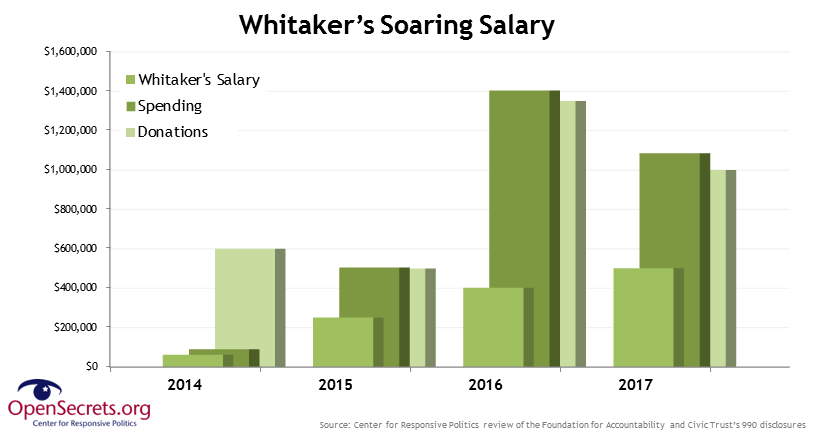
FACT provided the vast majority of Whitaker’s income for the entire span of time covered by his financial disclosures on file with the Office of Government Ethics and released by the Justice Department the Tuesday before Thanksgiving, following weeks of scrutiny and multiple requests.
Whitaker’s selection as acting Attorney General has been contested on multiple fronts, and the release of his financial disclosures has only fueled the dumpster fire.
Disclosures revealed that Whitaker’s unsuccessful 2014 campaign received four donations totaling $8,800 this year — years after he lost the election and just months after he joined the Justice Department. The donations were the only money the campaign has received in over two years, raising questions about the potential implications of the donations under the Hatch Act, a federal law that generally prohibits federal officials from knowingly soliciting or accepting campaign donations and a separate Justice Department memo further restricting political activity by its personnel in the hopes of keeping the agency as apolitical as possible.
A provision of the Hatch Act allows officials to raise money to retire campaign debt, but the campaign’s only reported spending was 2018 were $228 to reimburse “data services” and $500 to Whitaker’s old law firm for renting office space, according to the New York Times.
Whitaker’s law partner of eight years, William Gustoff,who was treasurer for Whitaker’s unsuccessful 2014 Senate campaign and also serves on the board of FACT, signed off on the FEC filings.
“The checks came in. I, as the treasurer, deposited the checks, and I retired the debt that I knew I could without talking to Matt,” Gustoff told the New York Times, “I don’t talk to Matt about the campaign.”
Gustoff did say that FACT had been “well received” by Republican donors.
2017 Form 990 tax returns for DonorsTrust and Judicial Education Project were first obtained by Maplight’s Andrew Perez and reviewed by the Center for Responsive Politics.
---
https://www.democracynow.org/2018/11/21/headlines/wapo_dark_money_charity_paid_acting_ag_matthew_whitaker_12_million
Washington Post reports that acting Attorney General Matthew Whitaker was paid more than $1.2 million to lead a charity funded by dark money that bills itself as a nonpartisan watchdog, even as it worked exclusively to advance conservative causes. The charity, known as FACT—or the Foundation for Accountability and Civic Trust—is a nonprofit that refuses to reveal its funding sources, but one of the funders is known to be conservative billionaire Charles Koch. Whitaker worked as the charity’s sole employee for three years, beginning in 2014, until he moved to Washington to work as chief of staff to former Attorney General Jeff Sessions.
==
https://www.washingtonpost.com/investigations/conservative-nonprofit-with-obscure-roots-and-undisclosed-funders-paid-matthew-whitaker-12-million/2018/11/20/25ff987e-e9db-11e8-bd89-eecf3b178206_story.html?utm_term=.0f71ff898f7a
no lnx
The Washington Post
Investigations
Conservative nonprofit with obscure roots and undisclosed funders paid Matthew Whitaker $1.2 million
By Robert O'Harrow Jr. ,
Shawn Boburg and
Aaron C. Davis November 20 at 4:20 PM
In the three years after he arrived in Washington in 2014, Matthew G. Whitaker received more than $1.2 million as the leader of a charity that reported having no other employees, some of the best pay of his career.
The Foundation for Accountability and Civic Trust described itself as a new watchdog nonprofit dedicated to exposing unethical conduct by public officials. For Whitaker, it became a lucrative steppingstone in a swift rise from a modest law practice in Iowa to the nation’s top law enforcement job. As FACT’s president, he regularly appeared on radio and television, often to skewer liberals.
But FACT’s origins and the source of funding used to pay Whitaker — now the acting attorney general — remain obscured. An examination of state and federal records, and interviews with those involved, show that the group is part of a national network of nonprofits that often work in concert to amplify conservative messages.
Contrary to its claims in news releases and a tax filing, the group was created under a different name two years before Whitaker’s arrival, according to incorporation and IRS records. At least two of the organizers were involved in another conservative charity using the same address.
In its application to the IRS for status as a tax-exempt organization, the organizers reported that the group would study the impact of environmental regulations on businesses, records show. In that incarnation, the group took no action and “only existed on paper,” one man named in IRS filings as a board member told The Washington Post. Another named in a state filing as a board member said he never agreed to be on the board.
Whitaker’s 2017 pay from the charity — more than $500,000 for the first nine months, or half the charity’s receipts for the year, according to tax filings — and the group’s earlier, dormant incarnation have not been previously reported by media.
Whitaker did not respond to requests for interviews. Justice Department spokeswoman Kerri Kupec declined to answer detailed questions about his involvement in FACT, referring a reporter to the charity.
A FACT spokesman who provided a statement on the condition that his name not be used declined to disclose the source of its funding.
“Like nearly all non-profit organizations — including those with similarly stated missions — FACT does not and is not required to release its donor information,” the statement said. “This protects free speech rights of all of these groups’ supporters as outlined in the First Amendment.”
The statement said that FACT “properly notified the IRS of its name change.”
“It is not unusual for a corporation, not for profit or profit, to refine its name and purpose, and since its inception FACT’s purpose has always been consistent with non-profit law and all appropriate notifications were made,” the statement said.
The spokesman did not respond to questions about whether the group told the IRS about its change in mission, as is required by IRS rules.
When the nonprofit was launched in 2012, Whitaker was a former U.S. attorney with a modest legal practice in Iowa that paid him $79,000 that year, according to a later disclosure he filed for a failed Senate bid. He also had several local side businesses, including a day-care center and a trailer manufacturer.
A Virginia resident named Raymond Wotring and two others filed papers to create the Free Market American Educational Foundation, state and federal records show. Its stated mission was to “conduct research and provide informational studies on free market concepts in relation to government regulations and policy.”
Wotring and one of the other founding members had also served on another conservative nonprofit, Americans for Limited Government, which shared the same mailing address, records show.
Wotring did not respond to multiple phone calls or to a note left at his home.
James Crumley, who provides marketing services to conservative nonprofits and campaigns, was listed in an IRS filing as one of the directors. In a phone call, he initially said he did not remember anything about the group, including why it was formed.
“I can only speculate since I didn’t even remember this group existed,” he wrote in an email later.
Crumley said he’d learned that the group held no meetings and apparently had no bank account in its first two years. “The organization only existed on paper and didn’t do anything at all,” he wrote.
Noah Wall, now a vice president of advocacy for a conservative nonprofit called FreedomWorks, was listed in Virginia state filings as a director of the group in 2014. Wall said he was surprised to learn of his role. He said he was approached by Wotring but never agreed to join.
“I never signed anything,” he said. “I’m not entirely sure what any of this is.”
On July 21, 2014, the IRS approved the group’s application for tax-exempt charity status, which was also signed by Wotring, the group’s secretary. In its application, the group said it would be nonpartisan and aim “to develop unbiased research on how government regulations on environmental policy can impact business.” The group by then had changed its address to a UPS Store in Fairfax, which was also used by Americans for Limited Government.
But just six weeks later, the newly approved charity changed its name, according to corporate records in Virginia. It was briefly called Working for Rights to Express & Communication.
The name was changed again in October of that year, to the Foundation for Accountability and Civic Trust, according to records in Virginia. That same month, Whitaker, who had lost a primary bid for a U.S. Senate seat, became the group’s leader, according to Kupec, the Justice spokeswoman.
The charity’s mailing address was moved from Virginia to an office suite at a prestigious spot on K Streetin the nation’s capital — a virtual office and mailing address shared by 200 organizations.
Kupec did not respond to questions about how Whitaker connected with the nonprofit.
Marcus Owens, a lawyer and nonprofit specialist who oversaw the IRS’s exempt-organizations division for a decade, said that in its first years the nonprofit appears to have been a “shell charity” that “was not utilized and remained on the shelf” until Whitaker’s arrival.
Taking over an existing charity makes it easier for groups to quickly stand up the operation and accept tax-deductible donations, he said. But charities that change their names and missions are required to alert the IRS, he said, to ensure they are still operating within guidelines for charities.
“It’s very possible that this organization is misusing its status as a charity,” said David Nelson, a specialist on nonprofit organizations and a former tax partner at the Ernst & Young accounting firm, who reviewed the group’s tax filings at The Post’s request. “It appears the IRS never gave approval to FACT.”
In its federal tax filing for 2014, FACT declared that it had not changed its name or its mission that year, records show, and there was no mention of the prior names. The spokesman for FACT declined to provide documents that he said showed it had notified the IRS of the name change.
In the 2014 filing, FACT reported that it had no employees and that it paid Whitaker $63,000 for three months of work, 30 hours a week, as president and director. It received $600,000 in donations, the document shows.
The Post determined from other tax filings that the money came from DonorsTrust,a large nonprofit organization that wealthy contributors have used to anonymously give millions to conservative nonprofits in recent years.
The president of DonorsTrust, Lawson Bader, declined to identify the source of the funding contributed to FACT through his organization.
FACT launched its advocacy efforts shortly after Whitaker took over, describing itself in a news release as a “new watchdog group.”
On its website and in tax filings in 2014, FACT said that its mission was “to educate the public about unethical conduct on the part of public officials by publicizing these actions through media outlets throughout the country” and through its own website.
The new three-member board now comprised Whitaker, Whitaker’s former law partner and a conservative activist,Neil Corkery, who is involved in operating or funding multiple conservative charities.
Whitaker’s former partner, William Gustoff, did not return calls for comment. Corkery did not respond to phone messages seeking comment.
The IRS prohibits charities from directly or indirectly participating in political campaigns, for or against candidates. The prohibition is rarely enforced.
The FACT spokesman said the group is nonpartisan and focuses on Democrats and Republicans alike.
A Post analysis of more than 200 television and radio appearances by Whitaker from 2014 to September 2017, when he was named chief of staff to then-Attorney General Jeff Sessions, shows that Whitaker was overwhelmingly focused on Democrats.
Whitaker or the often-conservative television hosts interviewing him uttered the name of one of the five Republican lawmakers that the group has targeted in elections complaints a combined 37 times, compared with more than 750 mentions of Hillary Clinton.
Most of those Clinton references — more than 600 — came in the run-up to the 2016 election, and nearly all were comments critical of Clinton’s tenure, including her email scandal or possible ethical conflicts surrounding the Clinton Foundation.
After the election, Whitaker’s focus in those interviews turned to another target, special counsel Robert S. Mueller III. Whitaker or hosts named Mueller 185 times.
Tax filings show that one of FACT’s biggest contractors was America Rising, a research and communications firm in Arlington, Va., “whose mission is to help its clients defeat Democrats,” according to its website. FACT paid America Rising at least $500,000 for research from 2015 to 2017, tax filings show.
FACT paid another half-million dollars to CRC Public Relations in Alexandria, Va.The FACT representative who declined to be named in this report is a CRC executive.
In December 2014, FACT began posting news items and commentary on its new website, including the prediction that a super PAC formed to promote Clinton’s presidential aspirations might someday illegally coordinate with her future campaign.
“These moves will likely draw [Federal Election Commission] complaints due to possible federal election law violations,” the post says.
Whitaker, the face of the organization, was often in Iowa in those early months, according to a review of interviews he conducted at the time. But being the president of a nonprofit conferred legitimacy on him, helping to raise his profile in Washington even as it allowed the group’s backers to claim tax deductions.
He was increasingly appearing as a commentator on conservative media outlets — includingNewsmax TVand Fox TV — and last year became a paid legal analyst on CNN.
In addition to targeting Clinton, Whitaker took aim at Sen. Bernie Sanders (I-Vt.) while filing election law complaints against Democrats and some Republicans. When asked by a radio host about the group’s pursuit of Democrats, Whitaker said, “It is a target-rich environment.”
In the three years he worked at the charity, Whitaker’s pay rose sharply each year, tax filings show. Last year, he was paid $55,000 a month. In all, he earned $1,219,000 — more than a third of the donations the group received from 2014 to 2017.
An IRS spokesman declined to comment, citing federal privacy law.
==
==
https://www.alternet.org/doj-justifies-appointment-unconfirmed-ag-citing-1866-case-almost-resulted-presidents-impeachment
==
https://www.alternet.org/news-amp-politics/trumps-new-attorney-general-slammed-fcking-fool-and-suck-inside-doj-report
==
https://thinkprogress.org/matthew-whitaker-grotesque-incoherent-ab07fbb09c84/
In a 2014 interview, the man Donald Trump just picked to run the Department of Justice appeared to claim that Social Security is unconstitutional and that basic labor laws like the minimum wage must be struck down. Yet he also seemed to argue that the Supreme Court should not decide constitutional cases at all.
The interview reveals that Acting Attorney General Matthew Whitaker is easily taken in by conspiracy theories — he claims he was “quite possibly targeted for my political beliefs via the IRS.” Whitaker launches into a Trumpian rant against “chain immigration” and “people trying to bring illegal people and illegal drugs into our country.” He claims that climate change “doesn’t appear to be that significant or quite possibly isn’t man made,” and calls for the Department of Education to be “disbanded.”
But the most revealing part of the interview, which was published by the conservative blog Caffeinated Thoughts while Whitaker was a candidate for the United States Senate, is a paragraph where Whitaker lays out his incoherent understanding of the Constitution.At best, this paragraph suggests that the man running the Justice Department does not understand some very basic legal concepts. At worst, it indicates that he has a disorganized mind that is unable to keep track of what he said just a few seconds ago.
The courts are supposed to be the inferior branch of our three branches of government. We have unfortunately off loaded many of our tough public policy issues onto the court and they’ve decided hem [sic]. Unelected judges are deciding many of the issues of the day. There are so many (bad rulings). I would start with the idea of Marbury v. Madison. That’s probably a good place to start and the way it’s looked at the Supreme Court as the final arbiter of constitutional issues. We’ll move forward from there. All New Deal cases that were expansive of the federal government. Those would be bad. Then all the way up to the Affordable Care Act and the individual mandate.
To break this down, Whitaker makes two mutually exclusive claims. He first claims that Marbury v. Madison, a seminal Supreme Court decision holding that federal courts are allowed to review state and federal laws and strike them down if they are inconsistent with the Constitution, was wrongly decided.
Two sentences later, however, Whitaker then suggests that “all New Deal cases that were expansive of the federal government” — that is, decisions where the Supreme Court did not strike down laws creating Social Security, regulating the workplace, or otherwise enacting progressive policies — were also wrongly decided.
It should be obvious that these two viewpoints cannot exist together at the same time. If Marbury was wrongly decided, that means that courts do not have the power to engage in judicial review of laws that allegedly violate the Constitution — which would mean that the Supreme Court lacks the power to strike down New Deal era laws.
Marbury rested on two foundational legal principles. The first is that “it is emphatically the duty of the Judicial Department to say what the law is” — that is, when litigants present a dispute over what the law requires, the judiciary is the body which resolves that dispute. The second principle is that “the Constitution is superior to any ordinary act of the legislature.” Taken together, these two principles establish that the courts shall decide when the Constitution overrides a legislative act.
A minority of legal academics, many of them left-of-center, criticize *Marbury* and argue that judicial review is, at the very least, undesirable. This leftward opposition to Marbury makes sense. As I argue in my own book, Injustices: The Supreme Court’s History of Comforting the Comfortable and Afflicting the Afflicted, the Court is, with rare exceptions in American history, a deeply reactionary institution that most often used judicial review to impose conservative policies on the nation. The current Court, with its deeply conservative majority and two Trumpian members, is likely to continue this practice.
Nevertheless, after a brief period in middle of the twentieth century when liberals dominated the Supreme Court and often struck down conservative laws, several prominent conservatives also became critics of judicial review. Few went so far as to claim that Marburyis wrongly decided, but conservative legal rhetoric in the Nixon, Reagan, and Bush years typically emphasized the need for judicial restraint.
As then-Secretary of Homeland Security Michael Chertoff told the Federalist Society in 2006, “in large part because of the work that the Society and others have done, the claim for judicial modesty is sufficiently well-established that everybody understands, even the critics of that claim, that they have to take it seriously and they have to address it.”
Then President Obama happened, and many of the same Federalist Society voices became vocal critics of judicial restraint. Fringe figures within the conservative legal community started speaking of “judicial engagement,” a euphemism for reviving long-discredited legal theories that early twentieth century justices used to strike down minimum wage laws, laws protecting the right to unionize, and similar progressive legislation.
Whitaker’s rant against both Marbury and the Roosevelt Era decisions upholding the New Deal echo the lunatic fringes of both conservative critics of judicial review and conservative proponents of “judicial engagement.” Whitaker is simultaneously tossing red meat to wild-eyed radicals who think that courts should be stripped of the power of judicial review, while also tossing red meat to a different set of radicals who believe that the Supreme Court’s right flank should .
It’s unclear whether Whitaker is a cynic or a fool. That is, it is genuinely difficult to tell whether the former candidate understood that he was expressing two mutually contradictory viewpoints, or whether he was just echoing words that he does not comprehend, but that he probably heard somewhere from other conservative lawyers.
Either option, however, paints him as unfit to lead the Justice Department. Either Whitaker is a man of no conviction beyond “the right should always win,” or he lacks the knowledge and intellectual capacity to do his job.
==
https://www.wsj.com/articles/washington-gets-ready-for-matthew-whitaker-at-justice-department-1541699792
no lnx
ASHINGTON—Acting Attorney General Matthew Whitaker is unlikely to recuse himself from overseeing special counsel Robert Mueller’s Russia investigation, associates said, though it remains unclear how much of an impact he may have on that probe and others stemming from it.
Mr. Whitaker publicly criticized the Mueller probe before arriving at the Justice Department last year as Attorney General Jeff Sessions’ chief of staff. That prompted Democrats to call Thursday for his recusal from oversight of the 18-month-old investigation, which he assumed a day earlier when he was named acting attorney general after the White House pushed Mr. Sessions to resign.
The White House declined to say Thursday whether, before naming Mr. Whitaker to the temporary post, it had determined he wouldn’t recuse himself, referring questions to the Justice Department.
Mr. Sessions’ recusal from the Russia investigation, because of his own prominent role in the Trump campaign, was a source of friction with the president. One White House official described it as Mr. Sessions’ “original sin,” from which he never recovered.A Justice Department spokeswoman declined to say whether Mr. Whitaker had consulted with the agency’s ethics office on the issue.
MORE
Sessions Pushed Out as Attorney General
Giuliani, Azar Among Top Candidates to Replace Sessions
Whitaker Advised Company Shut Down by FTC
At Justice, Sessions Saw Chance to Champion Law-and-Order Agenda]
As acting attorney general, Mr. Whitaker assumes oversight of Mr. Mueller’s investigation into alleged Russian interference in the 2016 election and whether there were any links to the Trump campaign. He can request briefings on any investigative or prosecutorial steps. Mr. Whitaker can also conclude any such action is “so inappropriate or unwarranted” that it shouldn’t be pursued, but would be required to give “great weight” to Mr. Mueller’s views and notify Congress about his decision, according to regulations governing Mr. Mueller’s appointment.
Many lawmakers, including leading Republicans, have called for the investigation to be allowed to proceed without interference. Sen. John Kennedy (R., La.), a member of the Senate Judiciary Committee, said in an interview Thursday: “I don’t think Mr. Mueller ought to be fired. I do think Mr. Mueller needs to wrap it up, though. He’s been working on this for a long time and it’s time to bring it to a conclusion.”
Until now, the investigation has been overseen by Deputy Attorney General Rod Rosenstein. Mr. Rosenstein has been viewed within the department as a protector of the probe from the president’s criticisms and from some Republicans in Congress who have attacked it as politically biased. He also approved the generation of new cases by other U.S. Attorney’s offices on matters that stemmed, at least in part, from the Mueller probe, such as the Manhattan U.S. Attorney’s investigation into Mr. Trump’s longtime lawyer and fixer Michael Cohen. Mr. Cohen in August pleaded guilty to charges including two campaign-finance violations and implicated the president in a federal crime. The president denied any wrongdoing.
Trump: Mueller Investigation Is Very Bad for Our Country
Trump: Mueller Investigation Is Very Bad for Our Country
President Trump responds to questions regarding the Mueller investigation into Russian interference in the 2016 elections, saying "I could have ended it anytime I wanted." Photo: AP
It isn’t clear how much influence, either formal or informal, Mr. Rosenstein will continue to have regarding the probe.
Mr. Whitaker, a former U.S. attorney in Iowa during the GOP administration of former President George W. Bush, occasionally clashed with Mr. Rosenstein since the two men began working together at the Justice Department, according to a person familiar with their relationship. Mr. Rosenstein once pointedly gave Mr. Whitaker a book on effective management, the person said. Another official played down the extent of the tension, saying such disagreements are common in any administration and Mr. Rosenstein had given management books to other staffers as well.
Mr. Whitaker’s ability to influence the course of the special-counsel investigation may depend in part on how close Mr. Mueller is to wrapping up his probe. Mr. Mueller hasn’t publicly commented on the status of his inquiry, but outward signs suggest he may be close to wrapping up much of it. The Special Counsel’s team is in negotiations with Mr. Trump’s lawyers over how the president will answer questions from the investigation.
In a Thursday letter to Mr. Whitaker, Democrats on the House Judiciary Committee called on Mr. Rosenstein to continue oversight of the probe, noting Mr. Whitaker’s previous statements on the investigation. They also instructed the Justice Department to preserve “all materials” related to the special counsel investigation and Mr. Sessions’ departure. After Tuesday’s midterm election, Democrats will control the House in January; Republicans are expected to have an expanded majority in the Senate.
Among other comments, Mr. Whitaker before joining the Justice Department had urged that the inquiry’s scope be limited, saying that otherwise it could start to look like a “political fishing expedition.”
In appointing Mr. Mueller, Mr. Rosenstein authorized him to investigate whether there was any coordination between Trump campaign associates and Russia as well as matters that “may arise directly” from that investigation. Mr. Whitaker and other Mueller critics said the special counsel’s pursuit of matters such as the Trump Organization’s finances exceed that mandate, while his supporters disagree.
Sen. Kennedy said: “I don’t know Mr. Whitaker. I do think it’s a little disingenuous of my Democratic colleagues to start to hammer on him even before he has a chance to find the Men’s Room.”
Federal ethics regulations governing the Justice Department are more generally focused on financial or legal conflicts of interest, rather than past commentary.Justice Department ethics lawyers offer advice, but not strict orders, about whether an official should recuse, though other officials have typically followed their guidance.
Mr. Whitaker has sometimes had a difficult relationship with other department officials, people familiar with the department’s leadership said. He was tapped to replace Jody Hunt, Mr. Sessions’ former chief of staff, who was a longtime Justice Department employee with a more relaxed management style than Mr. Whitaker’s more aggressive approach, people who know both men said.
:{:{}:
}:
He had no relationship with Mr. Sessions or the rest of the department brass before arriving. He was installed at the suggestion of Leonard Leo, head of the influential Federalist Society, upon whom Mr. Trump relies when it comes to picking judges, who admired his style and connections to the conservative legal world, people familiar with the matter said. He has allies in the White House. When Mr. Rosenstein’s departure seemed imminent last month, White House and Justice Department officials crafted a plan to have Mr. Whitaker replace him, people familiar with it said.
Outward signs of the leadership shift were already evident Thursday. Mr. Whitaker attended a formal investiture for new Supreme Court Justice Brett Kavanaugh in Mr. Sessions’ stead, reciting the lines from the lectern before the sitting justices. When a court clerk read aloud Justice Kavanaugh’s commission, the text concluded with the name of the signatory, Mr. Sessions.
Later Thursday, a federal appeals court heard a case on whether Mr. Mueller’s appointment was constitutional, telling lawyers representing both the special counsel’s office and a person subpoenaed by that office to pretend the arguments were actually taking place before Mr. Sessions’ ouster. U.S. Circuit Judge Karen Henderson added that the court would likely request further briefing on what the change would mean for Mr. Mueller’s authority.
Mr. Whitaker can serve for up to 210 days, or longer if the Senate is still considering a different nominee. He isn’t likely to be a leading nominee for the post, according to one White House adviser, and cannot continue to serve as acting attorney general if he is nominated, under rules governing such nominations.
The White House is considering several candidates to nominate to replace Mr. Sessions. They include former federal prosecutor and former New Jersey Gov. Chris Christie, a person familiar with the matter said. A person close to Mr. Christie said he is aware that he is under consideration for the attorney general post and would consider it seriously if he was offered the job.
Mr. Mueller’s inquiry has resulted in guilty pleas from a series of Trump campaign aides, primarily for lying to investigators or financial crimes, and the indictment of two dozen Russian nationals. His investigative team also has been focusing on whether several conservative political figures knew in advance about WikiLeaks’ planned release of thousands of hacked Democratic emails in the 2016 campaign.
==
https://www.washingtonpost.com/politics/before-he-led-the-justice-department-matthew-g-whitaker-promoted-company-accused-of-deceiving-clients/2018/11/08/f46e6db8-e380-11e8-ab2c-b31dcd53ca6b_story.html?utm_term=.2b097c9df289
no lnx
wapo
Politics
Before he led the Justice Department, Matthew G. Whitaker promoted company accused of deceiving clients
By Carol D. Leonnig ,
Rosalind S. Helderman and
Robert O'Harrow Jr. November 8
When federal investigators were digging into an invention-promotion company accused of fraud by customers, they sought information in 2017 from a prominent member of the company’s advisory board, according to two people familiar with the probe: Matthew G. Whitaker, a former U.S. attorney in Iowa.
It is unclear how Whitaker — who was appointed acting attorney general by President Trump on Wednesday — responded to a Federal Trade Commission subpoena to his law firm.
In the end, the FTC filed a complaint against Miami-based World Patent Marketing, accusing it of misleading investors and falsely promising that it would help them patent and profit from their inventions, according to court filings.
In May of this year, a federal court in Florida ordered the company to pay a settlement of more than $25 million and close up shop, records show. The company did not admit or deny wrongdoing.
Whitaker’s sudden elevation this week to replace fired Attorney General Jeff Sessions has put new scrutiny on his involvement with the shuttered company, whose advisory board he joined in 2014, shortly after making a failed run for U.S. Senate in Iowa.
At the time, he was also running a conservative watchdog group with ties to other powerful nonprofits on the right and was beginning to develop a career as a Trump-friendly cable television commentator.
World Patent Marketing — founded by Miami businessman Scott J. Cooper, who had donated $2,600 to Whitaker’s Senate campaign — prominently highlighted Whitaker’s résumé as a former U.S. attorney, which helped lend the company credibility.
But Whitaker seems to have been more than a figurehead. He spoke about inventions of the company’s clients in online videos — including a special hot-tub seat for people with mobility issues. He also penned a response to at least one complaint — writing a threatening email in which he cited his role as a former U.S. attorney, according to court filings.
“It’s really upsetting to know that guy will be attorney general,” said Ryan Masti, 26, who lost $77,000 after paying World Patent Marketing to help him bring to market his idea for a social media app to help the disabled. “It’s so offensive. It’s like a stab in the back.”
Whitaker did not respond to requests for comment about World Patent Marketing or the investigation. “We’ll decline,” Justice Department spokeswoman Sarah Isgur Flores said in an email to The Washington Post.
A partner at Whitaker’s former Iowa law firm declined to comment. A spokesman for the FTC also declined to comment.
[In Matthew G. Whitaker, Trump has a loyalist at the helm of the Justice Department]
There was no evidence that Whitaker knew company salespeople were making false promises to inventors, court receiver Jonathan Perlman said in an interview.
“I have no reason to believe that he knew of any of the wrongdoing,” Perlman said.
Whitaker was paid at least $10,000 by the company, according to court filings.
At the conclusion of the FTC investigation, Perlman sent a demand letter to Whitaker — along with other advisory board members — seeking repayment of the fees they received. Whitaker did not respond, Perlman said.
When Whitaker was appointed to the board of World Patent Marketing in October 2014, a company spokesman said in a press release that he would provide “vision and direction.” Later, the company touted Whitaker’s legal background and said he was working with the company to help investors avoid patent marketing fraud.
“As a former U.S. Attorney, I would only align myself with a first class organization,” Whitaker said in a 2014 company news release. “World Patent Marketing goes beyond making statements about doing business ‘ethically’ and translate those words into action.”
According to the FTC, however, the company falsely promised clients it would patent and market their ideas in exchange for hefty fees — and then pocketed the money.
“For the last three years, Defendants have operated an invention-promotion scam that has bilked thousands of consumers out of millions of dollars,” the agency alleged in a recently unsealed court filing. “In truth and in fact, Defendants fail to fulfill almost every promise they make to consumers.”
Neither Cooper nor his current attorney responded to requests for comment.
In court documents, Cooper told the court that the company did provide some services and said the company’s website warned customers that most inventions are not commercially successful, according to the Fort Lauderdale, Fla., Sun-Sentinel.
World Patent Marketing salespeople would persuade prospective clients to sign a confidentiality agreement and then ask them to explain their idea, according to court documents.
Whatever the concept, no matter how banal or improbable, investigators found, the salesperson would pronounce the idea fantastic and encourage the customer to pay for a package to market and patent the idea, documents show.
Many people ended up in debt or lost their life savings, according to the FTC.
Promotional material highlighted the meaty résumés of board members like Whitaker, which seemed to be a key component of the business operation. The company said the board would help review inventors’ ideas to maximize their ability to get rich.
“Innovators are today’s revolutionaries — forward-thinking visionaries that have come together to form the powerful and influential World Patent Marketing advisory board,” the narrator of one promotional video intoned, as photos of Whitaker and other board members filled the screen.
Masti, who said he struggled with ADHD as a child and hoped his invention would help others like him, said in an interview that he trusted the company in part because he was told that advisory board members, including Whitaker, had reviewed his idea and thought it would be successful.
“They said he’s very high up. He’s a professional. He’s got a lot of power,” said Masti, a resident of Cameron, N.Y., who said he voted for Trump in 2016. “That’s how they sold you.”
Now, Masti said he is living with his parents and facing crushing debt from loans he took out to pay the company.
Another former customer, Penn Mason, an airline employee from Nashville, said he paid World Patent Marketing $21,000 to help him patent and market a real estate app he had invented.
The company failed to patent his product and quickly stopped returning his phone calls, he said.
Mason said he believes that paid advisory board members like Whitaker essentially pocketed money from unsuspecting victims.
“That was our money,” said Mason, 52. Of Whitaker’s selection as acting attorney general, he said, “It makes me sick to my stomach .?.?. It’s like a punch in the gut.”
[Acting attorney general Whitaker has no intention of recusing from Russia probe, associates say]
When investors began to complain that they had paid the company large sums with little to show for it, they were threatened, according to interviews and court documents.
Mason said that after he began to complain, he got a call from Cooper, the CEO, who threatened to sue him for slander.“He really scared me,” Mason said. “You feel like you’re dealing with all these bigwigs.”
The Miami New Times, which published in an in-depth investigation of the company last year, reported that Cooper would sometimes tell people who had posted negative reviews of the company that he had security with specialized training in the Israeli martial art Krav Maga.
In an August 2015 email included in court documents, Whitaker wrote to a complainant who threatened to go to the Better Business Bureau, “I am assuming you understand that there could be serious civil and criminal consequences for you.” He noted he was a former U.S. attorney.
Another board member, Aileen M. Marty, a professor of infectious disease at Florida International University in Miami, said she was told when she joined the board that she would be sent interesting patent ideas to review — but never received any.
Marty said she received one check for her board service, which she returned when she heard the company could be committing fraud.
“I wish I had never heard of the company and I wish that my name were not in any way associated with it. I can’t turn back time and not accept the offer to be on their board — believe me if I could, I would,” she said in an email to The Post.
As he was advising World Patent Marketing, Whitaker ran a conservative watchdog group called the Foundation for Accountability and Civic Trust. The group lodged numerous ethics complaints and calls for investigations, targeting Hillary Clinton and Supreme Court nominee Merrick Garland, as well as some Republicans.
:{:{}:
}:
On its website, FACT lists a downtown Washington address. But it is one of some 200 “virtual members” who use a K Street location to claim a presence in the nation’s capital, according to Brian Bullock, assistant general manager of Carr Workplaces, the firm that operates the site.
“They only come in every six months or so,” Bullock said. “We pretty much just accept their mail.”
FACT was formed in 2014 with a large donation from another tax-exempt charity that has served as a fountainhead of cash for organizations affiliated with the conservative movement — an arrangement that helps further mask the identity of donors.
The group received more than $1 million in recent years from a donor-advised fund called Donors Trust Inc., which is a source of funding for scores of other conservative groups, including Judicial Watch, Project Veritas, the Claremont Institute, the Federalist Society and the David Horowitz Freedom Center, tax filings show.
Whitaker received $402,000 in 2016 as FACT’s president and director — nearly a third of the donations the group received that year, according to its tax filings. He received $252,000 in 2015, more than half the charity’s receipts that year, tax filings show.
FACT officials declined to comment, but they described the group as a nonpartisan ethics watchdog that holds accountable government officials from both parties.
Alice Crites and Tom Hamburger contributed to this report.
==
nyt
Acting Attorney General Matthew G. Whitaker Once Criticized Supreme Court’s Power
Protesters marched in New York and other cities across the country on Thursday evening to protect the investigation led by Robert S. Mueller III, the special counsel.
By Charlie Savage
Nov. 8, 2018
WASHINGTON — The acting attorney general, Matthew G. Whitaker, once espoused the view that the courts “are supposed to be the inferior branch” and criticized the Supreme Court’s power to review legislative and executive acts and declare them unconstitutional, the lifeblood of its existence as a coequal branch of government.
In a Q. and A. when he sought the Republican nomination for senator in Iowa in 2014, Mr. Whitaker indicated that he shared the belief among some conservatives that the federal judiciary has too much power over public policy. He criticized many of the Supreme Court’s rulings, beginning with a foundational one: Marbury v. Madison, which established its power of judicial review in 1803.
:{:{}:
}:
“There are so many” bad rulings, Mr. Whitaker said. “I would start with the idea of Marbury v. Madison. That’s probably a good place to start and the way it’s looked at the Supreme Court as the final arbiter of constitutional issues.”
The interview was among evidence that shed new light on Mr. Whitaker’s views, including disparagement of the Russia investigation, which he now oversees, and an expansive view of presidential power. Congressional aides, journalists and other observers scoured his record after Mr. Trump fired Attorney General Jeff Sessions on Wednesday and replaced him with Mr. Whitaker, instantly raising questions about whether the president wanted a loyalist in charge at the Justice Department with the power to end the Russia investigation.
Groups throughout the nation marched on Thursday to support the inquiry of Robert S. Mueller III, the special counsel, and to protest Mr. Whitaker’s appointment. Thousands demonstrated in dozens of cities, including in Washington, Philadelphia, Omaha and Salt Lake City.
In New York, about 4,000 people marched from Times Square to Union Square, the police said. Protesters held signs and chanted “Trump is not above the law.” On Twitter, #ProtectMueller was trending.
Though Democrats called on Mr. Whitaker to recuse himself from overseeing the investigation into Russian interference in the 2016 election and whether any of Mr. Trump’s associates conspired, the Justice Department has said he will supervise Mr. Mueller. Past statements suggest that Mr. Whitaker has already made up his mind that the investigation will fail to show that Mr. Trump or his advisers aided Russia’s disruption.
“The truth is there was no collusion with the Russians and the Trump campaign,” Mr. Whitaker said in an interview on “The Wilkow Majority,” a conservative political talk radio show, in summer 2017. His remarks were reported earlier by The Daily Beast.
“There was interference by the Russians into the election, but that is not collusion with the campaign,” he added, views that dovetailed with Mr. Trump’s longstanding complaints about the investigation. “That’s where the left seems to be just combining those two issues.”
He also argued last year that the president could not have obstructed justice by asking the F.B.I. director, James B. Comey, to end an investigation into his first national security adviser, a broad notion of executive power that Mr. Trump’s lawyers have also embraced. Mr. Whitaker dismissed the outcry over Mr. Trump’s request as overkill during a radio interview in June 2017 on the conservative “David Webb Show.”
Video
The acting attorney general, a vocal critic of the special counsel investigation into Russian meddling, was associated with a shadowy company fined nearly $26 million.
“This hyperventilation of what we see here is just, I don’t think, sustainable based on these facts,” he said in comments reported earlier by Mother Jones. And he once said Mr. Mueller’s appointment “smells a little fishy,” according to a radio segment unearthed by CNN.
While the Justice Department was treating Mr. Whitaker’s installation as acting attorney general as a done deal, prominent legal experts insisted that it was unconstitutional. Justice Department officials have pointed to the Vacancies Reform Act, a law that Congress passed in 1998, which set out the procedures that Mr. Trump used to name Mr. Whitaker as acting attorney general without Senate confirmation.
But only someone whom the Senate has confirmed can run the Justice Department, even on an interim basis, according to an opinion column in The New York Times by Neal K. Katyal, a former acting solicitor general in the Obama administration, and George T. Conway III, a conservative lawyer who is married to Mr. Trump’s adviser Kellyanne Conway.
“We cannot tolerate such an evasion of the Constitution’s very explicit, textually precise design,” they wrote, adding, “For the president to install Mr. Whitaker as our chief law enforcement officer is to betray the entire structure of our charter document.”
Other aspects of Mr. Whitaker’s record also came under sharper scrutiny on Thursday as Mr. Whitaker huddled with Justice Department officials in a lengthy briefing about its major cases and other activities.
Before joining the Trump administration last fall, Mr. Whitaker sat on the advisory board of a patent marketing company in Florida that was shut down and ordered this year to pay consumers nearly $26 million. The Federal Trade Commission accused the company, World Patent Marketing, of bilking thousands of customers who believed they were receiving patents.
But Mr. Whitaker’s answers to the 2014 Senate candidate questionnaire offered the broadest look at his approach to government and the law, showing that he holds strongly conservative views across a range of issues. The answers were published by the journalist Jacob Hall on the Caffeinated Thoughts website alongside answers by the other Republican primary contenders.
Mr. Hall said he interviewed Mr. Whitaker over the phone, writing down his answers. A spokeswoman for the Justice Department declined to comment.
Mr. Whitaker’s criticism of Marbury aligned with the view of some conservatives that the 1803 case — or at least how it came to be interpreted — gave the courts too much power to strike down laws. But Mr. Whitaker also criticized famous decisions in which the Supreme Court declined to strike down laws that conservatives do not like, including 1930s cases involving President Franklin D. Roosevelt’s New Deal programs and the 2012 case in which the court declined to strike down President Barack Obama’s health insurance law.
He also criticized the Supreme Court for “all New Deal cases that were expansive of the federal government. Those would be bad. Then all the way up to the Affordable Care Act and the individual mandate.”
Laurence H. Tribe, a constitutional law professor at Harvard Law School, said that Mr. Whitaker’s expressed views of the Constitution and the role of the courts “are extreme and the overall picture he presents would have virtually no scholarly support” and would be “destabilizing” to society if he used the power of the attorney general to advance them.
Simultaneously criticizing the Supreme Court’s power of judicial review while criticizing cases where it declined to strike down laws regulating economic and health insurance matters was a sign of an “internally contradictory” and “ignorant” philosophy, Mr. Tribe said. Because the attorney general oversees decisions about which laws the Justice Department will defend and can decide which ones not to enforce, he said, Mr. Whitaker’s views were likely to have faced sharp scrutiny even from Republicans in a confirmation hearing.
“He seems to think much of the fabric of federal law that is part of our ordinary lives violates the Constitution of the United States to which he is evidently going to take an oath,” Mr. Tribe said.
Mr. Whitaker’s 2014 interview also suggested that he is likely to hold fast to Mr. Sessions’s position in a lawsuit brought by Republican-controlled states seeking to have the Affordable Care Act’s insurance protections for people with pre-existing conditions struck down. Under Mr. Sessions, the department sided with the plaintiffs instead of fighting to keep the law intact.
“We need to do everything we can to repeal it, defund it, delay it — we need to do whatever it takes,” Mr. Whitaker said of the Affordable Care Act in 2014.
He also signaled opposition to abortion rights, saying that he believed “life begins at conception,” and to same-sex marriage rights, saying that “it’s traditionally been up to the churches and to God to define that.” He expressed frustration that the Iowa Legislature had not pushed back against a State Supreme Court ruling in 2009 that permitted same-sex couples in Iowa to marry.
Mr. Whitaker voiced a hard line on immigration, saying he did not believe in “amnesty” for undocumented immigrants who are already inside the country — he did not address the so-called Dreamers, or people brought to the United States as children — and talked about visiting the southwestern border while he was the United States attorney for the Southern District of Iowa during the second term of President George W. Bush.
“I was able to see what our border looks like and the fact it is under assault on a daily basis from people trying to bring illegal people and illegal drugs into our country,” he said. “What do I think the solution is? We need to secure the border first and then look at ways to reform the system, whether that’s getting rid of chain immigration,” in which migrants trace the paths of relatives or others they know to come to the United States, “or increasing the number of skilled-worker visas.”
He indicated that he did not believe mass shootings justified more restrictive gun control laws, and said he believed the federal government should play no role in public education.
“The Department of Education should be disbanded and the resources either returned to the taxpayers or put into the schools,” he said. “Bureaucrats in Washington, D.C., shouldn’t know how to better educate my kids than I do.”
On the issue of climate change, Mr. Whitaker said he was “not a climate denier,” but also said that while the globe may be warming and human activities may contribute, “the evidence is inconclusive” and “that’s very small and itmay be part of the natural warming or cooling of the planet.” As a result, he said, he did not believe in regulations aimed at curbing carbon emissions that could “hamstring” the American economy.
“I don’t believe in big-government solutions to a problem that doesn’t appear to be that significant or quite possibly isn’t man-made,” he said.
==
https://www.thedailybeast.com/jeff-sessions-replacement-matthew-whitaker-led-secretive-anti-dem-group
no lnx
Acting Attorney General Mark Whitaker, named to head the Justice Department after Jeff Sessions was fired Wednesday, has a close relationship with President Trump and has expressed hostility toward special counsel Robert Mueller’s probe—which he may now oversee.
“Whitaker is on record as being more interested in propping up Trump than in upholding the rule of law,” one DOJ trial attorney told The Daily Beast. “It’s hard to have confidence that he’ll do anything other than what the president had said in his tweets.”
It’s been a meteoric rise for the 48-year-old Republican, an ex-prosecutor and failed political candidate who less than two years ago was the head of a little-known conservative nonprofit with designs on a judgeship in his home state of Iowa.
FONDEST BEAUREGARDS
Trump Fires Jeff Sessions, Imperiling Mueller
Scott Bixby,
Asawin Suebsaeng,
Jackie Kucinich
Through that nonprofit, and with the help of a PR firm later tied to a bizarre conspiracy theory, Whitaker ran interference for Sessions at one of the most fraught moments in his tumultuous time as attorney general.
In March 2017, The Washington Post reported that Sessions had neglected to tell the Senate at his confirmation hearing about prior conversations he had with the Russian ambassador.
The attorney general came under blistering criticism, especially as he had not yet recused himself from supervising the FBI’s investigation into Russian meddling in the 2016 election.
Then Whitaker spoke up. As executive director of the Foundation for Accountability and Civic Trust, an organization that served primarily to level ethics complaints against Democrats, he released a statement defending Sessions.
RELATED IN POLITICS
‘He’s a F*cking Fool’: Justice Dept Officials Trash Whitaker
Trump Will End the Mueller Probe—Here’s What Dems Should Do
U.S. President Donald Trump speaks to reporters as he departs the White House en route to Paris from Washington, U.S., November 9, 2018.
Speed Read: The 6 Most Batsh*t Bits as Trump Left for Paris]
“If we are going to have a national discussion about Senators meeting with ambassadors it is appropriate for all Senators to disclose who they met with so the public, and apparently the media, understand that all Senator Sessions did was his job,” Whitaker said in the statement.
:{:{}:
}:
The statement was blasted out to reporters by CRC Public Relations, a conservative group based in Alexandria, Virginia, which represented FACT and Whitaker throughout 2017, according to press releases.
More recently, CRC faced scrutiny and criticism during Justice Brett Kavanaugh’s confirmation process for reportedly stoking media interest in a discredited conspiracy theory about Kavanaugh’s chief accuser.
Two people familiar with CRC’s communications at the time told The Daily Beast that people at the firm tipped off reporters that conservative activist Ed Whelan would be tweeting interesting material relevant to Kavanaugh’s confirmation.
NO-BRAINER
Judge Kavanaugh’s Defender Just Committed Defamation
Jay Michaelson
Whelan then posted a tweetstorm claiming that Dr. Christine Blasey Ford, who had accused Kavanaugh of sexual assault, mistook him for a similar-looking high school classmate. Whelan, who even posted house blueprints and yearbook photos to support his theory, later had to apologize for accusing the other man of sexual assault.
By then, Whitaker had left FACT and become Sessions’ chief of staff.
At Justice, Whitaker was seen as Sessions’ right-hand man but often disagreed with the now former attorney general on a range of policy issues, according to two current DOJ officials.
Integral to the day-to-day operations of the department, Whitaker sat in on most high-level meetings and frequently visited the White House, where he developed a close rapport with Trump, according to more than half a dozen current and former officials in the department.
Whitaker and Sessions often disagreed on policy matters, officials said, and sparred in particular over the chief of staff’s increasingly close relationship with Trump and his staff.
In his new role, Whitaker is poised to assume oversight of special counsel Robert Mueller’s probe from Deputy Attorney General Rod Rosenstein. That’s raised questions about whether Whitaker might interfere with the probe, which is investigating Russian interference in the 2016 election and possible coordination with the Trump campaign.
“We have had so many leaks from everywhere, including the Mueller team and those in the Department of Justice, that I think we would know if there was a smoking gun or any gun or any smoke.”
— Matthew Whitaker
Whitaker has previously expressed serious reservations about the Mueller probe, criticizing its direction in numerous cable news interviews over the past year.
He has called the investigation a drain on the department’s resources and claimed Mueller’s team leaked information to make the special counsel “look productive and on top of things.”
“We have had so many leaks from everywhere, including the Mueller team and those in the Department of Justice, that I think we would know if there was a smoking gun or any gun or any smoke,” he said in an August 2017 radio interview.
In a radio interview in May 2017, he described former Trump national security adviser Michael Flynn’s phone calls with the Russian ambassador during the presidential transition as potentially “friendly get-to-know-you” conversations. Flynn pleaded guilty to lying to the feds two months later.
In July 2017, Whitaker tweeted that it would be a “mistake” for Congress to pass legislation to protect Mueller from the White House, claiming Mueller was “already protected enough.”
A month later, he wrote an op-ed for CNN saying the Mueller investigation had gone too far.
“It does not take a lawyer or even a former federal prosecutor like myself to conclude that investigating Donald Trump’s finances or his family’s finances falls completely outside of the realm of his 2016 campaign and allegations that the campaign coordinated with the Russian government or anyone else,” Whitaker wrote. “That goes beyond the scope of the appointment of the special counsel.”
Whitaker, who is from Iowa, played football for the University of Iowa and graduated from its law school. He started his career in politics in 2002, when he ran unsuccessfully for Iowa state treasurer. Whitaker later headed Minnesota Gov. Tim Pawlenty’s presidential bid in Iowa before working as the state co-chairman of Texas Gov. Rick Perry’s 2012 White House bid.
KNOCKOUT FIRST
New A.G. Used His Justice Bona Fides to Tout ‘Scam’ Business
Michael Daly
In 2014, Whitaker unsuccessfully sought the Republican nomination for a U.S. Senate seat that was won by Joni Ernst. That same year, he was the chairman of Sam Clovis’ campaign for Iowa state treasurer. Clovis, whom Mueller’s team questioned last year, is the former Trump campaign official who oversaw George Papadopoulos, an aide who pleaded guilty to lying to investigators about his contact with individuals tied to Russia in 2016.
In the years after Whitaker ran for Senate, he built up his political connections, often meeting with influential lawmakers and think-tank leaders, two individuals who worked alongside him in the Department of Justice said.
St. John’s University law professor John Q. Barrett said he met Whitaker several times in the “green room” at CNN when both were appearing to discuss Mueller’s investigation.
He said Whitaker told him he was shuttling back and forth to New York to raise his profile in the hopes the White House would notice him.
“I said, ‘What are you interested in? And he said,‘A judgeship,’” Barrett said, adding that he got the impression he wanted an appointment in Iowa.
A few months later, Whitaker became chief of staff to Sessions. “I guess something led to something,” Barrett said.
John Q. Barrett
@JohnQBarrett
- Nov 7, 2018
Replying to @JohnQBarrett
In the 2016 Iowa caucuses, Whitaker supported Senator @marcorubio for president against @realDonaldTrump and the other GOP candidates (including the winner, @SenTedCruz).
John Q. Barrett
@JohnQBarrett
Whitaker told me in June 2017 that he was flying out from Iowa to NYC to be on CNN regularly because he was hoping to be noticed as a Trump defender, and through that to get a Trump judicial appointment back in Iowa.
4,825
4:49 PM - Nov 7, 2018
Twitter Ads info and privacy
3,326 people are talking about this
Twitter Ads info and privacy
Whitaker’s TV appearances were in his role as head of FACT. The organization’s funding is opaque: In 2014, it received $600,000 from a fund called DonorsTrust, whose donors are mostly anonymous, but for Charles Koch. But in 2016, Open Secrets could only find one example of FACT targeting a Republican.
At FACT, Whitaker often accused Hillary Clinton of ethics violations, and in 2017, said he believed her handling of classified emails amounted to a “strong” case against her.
“She should be extremely grateful that has not happened,” Whitaker said.
Despite his ambition, those close to him say Whitaker was approachable and collaborative, even if they had different political views.
“My impression of Matt is that he is a very normal guy,” said one former official from the Department of Justice. “He is a pretty nice way about him.”
“Matt is a conservative Republican. That is who he is. No doubt about that.”
— Former U.S. Attorney
Whitaker is also known for his deeply conservative views of the law. He wrote several opinion pieces in the national media, including one that said he would have indicted Clinton for her emails. In an interview while campaigning in Iowa, he said he thought Marbury vs. Madison—a landmark decision that gives courts the power to declare legislative and executive acts unconstitutional—was a “bad ruling.”
“Matt is a conservative Republican. That is who he is. No doubt about that,” said one former U.S. attorney who has known Whitaker for years.
Whitaker’s appointment follows months of speculation that Trump was set to make major changes in his Cabinet after the midterms. Trump has become increasingly frustrated with Justice and Mueller.
Over the past year, he has repeatedly mused to lawyers, confidants, and West Wing aides about his desire to sack Sessions, whom he felt failed to protect him from the Russia probe.
Sessions indicated he wanted to stay at Justice, writing to Trump, “At your request, I am submitting my resignation.” The White House didn’t respond to questions on why Trump and his team are not saying Sessions was fired.
Justice Department staffers gathered in the courtyard Wednesday to say goodbye to Sessions as he left the office for the last time. Whitaker shook his predecessor’s hand before Sessions was driven off amid a standing ovation.
Erin Banco
Erin.Banco@thedailybeast.com
Betsy Woodruff
@woodruffbets
betsy.woodruff@thedailybeast.com
Will Sommer
William.Sommer@thedailybeast.com
Asawin Suebsaeng
@swin24
asawin.suebsaeng@thedailybeast.com
Maxwell Tani
@maxwelltani
Maxwell.Tani@thedailybeast.com
Got a tip? Send it to The Daily Beast here.
==
https://www.vox.com/policy-and-politics/2018/11/9/18080656/matthew-whitaker-trump-hillary-clinton-sessions-attorney-general
Matthew Whitaker, whom President Donald Trump named as his acting attorney general on Wednesday, privately provided advice to the president last year on how the White House might be able to pressure the Justice Department to investigate the president’s political adversaries, Vox has learned.
Whitaker was an outspoken critic of special counsel Robert Mueller’s probe before he became the chief of staff to Attorney General Jeff Sessions in September 2017. That has rightfully raised concerns that Whitaker might now attempt to sabotage Mueller’s investigation. But new information suggests that Whitaker — while working for Sessions — advocated on behalf of, and attempted to facilitate, Trump’s desire to exploit the Justice Department and FBI to investigate the president’s enemies.
In May 2018, President Donald Trump demanded that the Justice Department open a criminal investigation into whether the FBI “infiltrated or surveilled” his presidential campaign and whether Obama administration officials were involved in this purported effort. Trump, his Republican allies in Congress, and conservative news organizations — most notably Fox News — were making such claims and amplifying those of others, even though they offered scant evidence, if any, that these allegations were true.
Sessions, Rosenstein, and other senior department officials believed that if they agreed to Trump’s wishes, doing so would constitute an improper politicization of the department that would set a dangerous precedent for Trump — or any future president — to exploit the powerful apparatus of the DOJ and FBI to investigate their political adversaries. Those efforts, in turn, coincided with the president’s campaign to undermine Mueller’s investigation into whether the president’s campaign aides, White House advisers, and members of his own family colluded with Russian to help Trump win the 2016 election.
During this period of time, Whitaker was the chief of staff to Attorney General Jeff Sessions, and in that role was advising Sessions and Deputy Attorney General Rod Rosenstein on how to counter the president’s demands. But according to one former and one current administration official, Whitaker was simultaneously counseling the White House on how the president and his aides might successfully pressure Sessions and Rosenstein to give in to Trump’s demands.
Sources say that Whitaker presented himself as a sympathetic ear to both Sessions and Rosenstein — telling them he supported their efforts to prevent the president from politicizing the Justice Department. A person close to Whitaker suggested to me that the then-chief of staff was only attempting to diffuse the tension between the president and his attorney general and deputy attorney general, and facilitate an agreement between the two sides.
But two other people with firsthand information about the matter told me that Whitaker, in his conversations with the president, presented himself as a vigorous supporter of Trump’s position and “committed to extract as much as he could from the Justice Department on the president’s behalf.”
One administration official with knowledge of the matter told me: “Whitaker let it be known [in the White House] that he was on a team, and that was the president’s team.”
Whitaker’s open sympathizing with Trump’s frequent complaints about the Mueller investigation resulted in an unusually close relationship between a president and a staffer of his level. The president met with Whitaker in the White House, often in the Oval Office, at least 10 times, a former senior administration official told me. On most of those occasions, Sessions was also present, but it’s unclear if that was always the case.
During this period, Whitaker frequently spoke by phone with both Trump and Chief of Staff John Kelly, this same official told me. On many of those phone calls, nobody else was on the phone except for the president and Whitaker, or only Kelly and Whitaker. As one senior law enforcement official told me, “Nobody else knew what was said on those calls except what Whitaker decided to tell others, and if he did, whether he was telling the truth. Who ever heard of a president barely speaking to his attorney general but on the phone constantly with a staff-level person?”
Despite this being the case, on Friday as he was leaving on a trip to Paris, Trump told reporters, “I don’t know Matt Whitaker.” He also claimed that he never spoke to the then-DOJ chief of staff about the Mueller investigation: “I didn’t speak to Matt Whitaker about it,” he said.
Whitaker was a White House ally in building the case to investigate Hillary Clinton
Whitaker also counseled the president in private on how the White House might be able to pressure the Justice Department to name a special counsel to investigate not only allegations of FBI wrongdoing but also Hillary Clinton. Trump wanted the Justice Department to investigate the role that Clinton purportedly played, as secretary of state, in approving the Russian nuclear energy agency’s (Rosatom) purchase of a US uranium mining company.
The FBI had earlier investigated the allegations, concluded that there was no evidence of wrongdoing, and closed out its investigation. Trump presented no new evidence to the Justice Department that would justify reopening the investigation, and thus senior Justice Department officials considered the president’s request to be a blatant attempt to improperly use the Department and FBI to discredit a political adversary.
Yet Whitaker suggested to the White House that he personally was sympathetic to the appointment of a special counsel to investigate these matters, according to the two officials with knowledge of the matter. A Justice Department official told me: “You have to have a predicate to open an investigation, or to reopen a closed case. You have an even higher one, an extraordinary threshold, to appoint a special counsel. If you don’t, what you are doing is unethical as a lawyer.”
A person close to Whitaker suggested that he did what so many others around Trump do, which is tell the president what he wants to hear: “With Sessions and Rod, [Whitaker] said he was on their side, and thought the appointment of a special counsel was ludicrous.”
Whitaker was a longtime Mueller skeptic
It had long been feared that the president would fire either Sessions — who had recused himself from involvement in the Russia investigation, to Trump’s ire — or Rosenstein, and appoint someone to replace one or both of them, which would lead to the Mueller probe being overseen by a loyalist to the president who would curtail or even sabotage the investigation. Those fears were realized with lightning speed on Wednesday when the president demanded Sessions resign and named Whitaker as the acting attorney general. The Justice Department said in a statement that Whitaker would now supervise the special counsel’s investigation.
Before he became Sessions’s chief of staff, Whitaker was one of the staunchest critics of Mueller’s investigation. In a July 2017 appearance on CNN, for example, Whitaker spoke of various ways the White House might sabotage Mueller’s probe. Whitaker suggested that if Sessions were to resign or be fired, his replacement might be able to curtail the investigation by simply refusing to fund it further.
“I could see a scenario where Jeff Sessions is replaced with a recess appointment and that attorney general doesn’t fire Bob Mueller, but he just reduces his budget to so low that his investigation grinds to almost a halt,” Whitaker said.
The previous month, Whitaker, , said he was sure that the president and his men did nothing wrong: “The truth is there was no collusion with the Russians and the Trump campaign,” he declared.
John Q. Barrett, a professor at St. John’s Law School and a former associate Iran-Contra prosecutor, tweeted after the president named Whitaker acting attorney general: “Whitaker told me in June 2017 that he was flying out from Iowa to NYC to be on CNN regularly because he was hoping to be noticed as a Trump defender, and through that to get a Trump judicial appointment back in Iowa.”
In August 2017, as a CNN legal commentator, Whitaker authored an op-ed titled “Mueller’s investigation of Trump is going too far.” He wrote: “It is time for Rosenstein, who is the acting attorney general for the purposes of this investigation, to order Mueller to limit the scope of his investigation.” The following month, Whitaker was named Sessions’s chief of staff.
The president’s relationship with Sessions and Rosenstein has famously been largely one of animosity and disdain. But in Whitaker, the president found a reliable and compliant friend. As the New York Times reported, “The president has long regarded Mr. Whitaker as his eyes and ears inside a department that he considers an enemy institution.” The Washington Postsimilarly reported, “As Sessions’s chief of staff, Whitaker met with the president in the Oval Office more than a dozen times, normally accompanying the attorney general. ... When Trump complained about the Mueller investigation, Whitaker often smiled knowingly and nodded in assent.”
But even for a Trump loyalist, the facts stymied further investigation
In May, after Trump demanded the Justice Department investigate the FBI, several members of Congress, after reviewing classified information on the matter, said they could find no evidence to lend credence to the allegations that the FBI possibly “infiltrated or surveilled” his presidential campaign.
Rep. Tom Rooney (R-FL), who sits on the House Intelligence Committee and is a reliable Trump supporter, said he concluded the allegations were “untrue.” House Speaker Paul Ryan said he could find no evidence of wrongdoing. Even Trump’s attorney, Rudy Giuliani, has concededthat the president made his claims about campaign “spying” based on unsubstantiated information he didn’t know to be true.
As I previously reported for Vox, after Trump’s demands of the Justice Department, Sessions, Rosenstein, and other senior department officials were in a bind. To accede to a presidential demand — especially one based on specious evidence — would politicize and compromise the independence and integrity of the department, some senior DOJ officials strongly believed.
But there was also good reason to believe that Trump, if he did not get his way, would retaliate. Officials feared that Trump might fire the attorney general or Rosenstein, jeopardizing Mueller’s investigation.
Rosenstein came up with what appeared to be an adroit compromise to diffuse the situation. He decided that — rather than the DOJ itself opening the criminal investigation the president had demanded — he would instead ask the Justice Department’s inspector general to look into the matter. Trump, placated, agreed to the arrangement, and stood down.
By requesting the inspector general conduct an inquiry of the FBI, Rosenstein and other senior department officials believed they were acting ethically. Although an investigation by the DOJ’s IG could result in criminal charges, the agency conducts reviews of systematic failures within the department. Thus, there is no predicate of criminal behavior necessary to begin such a review.
As the New York Times reported at the time, Rosenstein’s supporters saw his response to Trump as a “deft deflection” that achieved three immediate needs: “It neutered a troubling request, appeared responsive to the president’s demands and allowed Mr. Rosenstein to keep his job.”
But critics — among them senior current and former Justice Department officials — argued that by acceding, Rosenstein did irreparable damage to the department. Matthew Miller, who served as the Justice Department’s spokesperson during the Obama administration, told me, “The inspector general does not exist to disprove presidential conspiracy theories, or even legitimize them by investigating them in the first place. And the deputy attorney general should not be participating in a presidential attempt to conduct an investigation based on no evidence — and sought only to discredit the lawful investigations of the president and his campaign aides.”
The fig leaf comes off
To placate the president’s demand that a special counsel be named to investigate Hillary Clinton’s role in the uranium deal, Rosenstein and other Justice Department officials came up with a similar compromise: Instead of naming a special counsel, Sessions agreed to appoint John Huber, the US attorney for Utah, to review the department’s earlier investigation. If he found evidence of any serious wrongdoing, Huber could then recommend the opening of a formal criminal investigation or even the appointment of a special counsel.
A long-time Justice Department trial attorney told me, “This is the first time, perhaps since Watergate, that the department has been asked to review old, closed files about a president’s political opponents. It’s not right that it should have been done at all. Yet you can argue that Sessions did this in the most benign way possible. He did refuse to open a criminal investigation without cause, and he stood firm by refusing to appoint a special counsel.”
Sessions wrote to several Republican members of Congress in March to say that Huber’s review was a top priority: “I receive regular updates from Mr. Huber and upon the conclusion of his review,” so as to consider “whether any matters merit the appointment of a special counsel.” At the highest levels of the Justice Department, Huber’s review has been considered to be little more than a publicity or political stunt to placate Trump.
Now, however, with Whitaker as acting attorney general, and the future of the Mueller investigation in jeopardy, it will be up to him to make the final decision on whether a special prosecutor will investigate Hillary Clinton.
---
U.S. midterm elections may be over but things have by no means calmed down. Just a day later, President Trump asked Attorney General Jeff Sessions to resign and replaced him with Sessions’ chief of staff, Matthew Whitaker.
From 2014 to 2016, Whitaker, Trump's new acting attorney general, was paid over $700,000 by an “accountability” organization funded almost entirely by the dark money group, DonorsTrust. DeSmog’s Sharon Kelly broke the story of the troubling dark money ties to the man who is supposed to be “the people’s lawyer.”
https://www.desmogblog.com/2018/11/07/dark-money-donors-trust-trump-attorney-general-matthew-whitaker-jeff-sessions
Donald Trump announced on Twitter that Matthew G. Whitaker, who served as chief of staff for Attorney General Jeff Sessions, would replace his boss. Sessions was forced from office a day after the midterm elections, which were rough for climate and anti-fracking measures around the country.
Whitaker was appointed as Session’s chief of staff on September 22, 2017. Before that, he served for three years as the executive director of the Foundation for Accountability and Civic Trust (FACT), which describes itself as “a nonprofit organization dedicated to promoting accountability, ethics, and transparency in government and civic arenas.”
FACT has come under fire for its own lack of transparency, with the Center for Responsive Politics calling attention to FACT’s funding, which in some years came entirely from DonorsTrust, an organization also known as the “Dark Money ATM of the Conservative Movement” and whose own donors include the notorious funders of climate denial, Charles and David Koch.
“In other words, an organization ‘dedicated to promoting accountability, ethics, and transparency’ gets 100 percent of its funds from a group that exists mainly as a vehicle for donors to elude transparency,” the Center for Responsive Politics wrote in 2016.
In 2014, FACT received $600,000 from DonorsTrust — the only donation it reported that year, according to OpenSecrets.org. An additional $500,000 flowed from DonorsTrust to FACT in 2015. And in 2016, DonorsTrust gave $800,000 to FACT, tax records show, as well as two additional donations, one for $100,000 and another for $450,000. That $2.45 million represents virtually all of FACT's entire reported receipts for those years (except for a total of $456 from 2015 to 2016).
In 2016, Whitaker earned $402,000 as FACT’s director and president, according to the organization’s tax filings. That followed reported compensation from FACT for Whitaker of $63,000 in 2014, and $252,000 in 2015.
His work included advocacy for causes backed by the fossil fuel industry.
As FACT’s executive director, Whitaker sought documents from the Attorneys General United for Clean Power Coalition, alleging in a 2016 op-ed that the Coalition “launched a campaign to silence many public policy organizations and even individuals for their work challenging liberal views on climate change, as well as private companies like ExxonMobil.”
That coalition, representing attorneys general from 17 states, included Eric Schneiderman, then attorney general for New York state, Maura Healey of Massachusetts, and Claude Walker of the Virgin Islands, who were all reportedly investigating ExxonMobil for failing to disclose what it knew about climate change to its investors for decades.
Whitaker labeled the probe of ExxonMobil, which has funded climate denial efforts to the tune of at least $33 million, “both unconstitutional and unethical” — but it recently led to charges against the company.
Last month, following three years of investigation, Schneiderman’s successor Barbara Underwood filed a 91-page lawsuit alleging that ExxonMobil had engaged in four counts of fraud.
“Investors put their money and their trust in Exxon — which assured them of the long-term value of their shares, as the company claimed to be factoring the risk of increasing climate change regulation into its business decisions,” Underwood said in a statement, according to Courthouse News. “Instead, Exxon built a facade to deceive investors into believing that the company was managing the risks of climate change regulation to its business when, in fact, it was intentionally and systematically underestimating or ignoring them, contrary to its public representations.”
FACT has also come under fire for its right-wing partisan bent.
“It’s perhaps worth noting that although FACT describes itself as a ‘non-partisan ethics watchdog,’ its ethics complaints are targeted overwhelmingly (though not exclusively) at Democrats, and it is funded entirely by an anonymous trust fund (a so-called ‘pass-through) favored by ultra-wealthy conservative donors, including Charles Koch,” the Global Anti-Corruption Blog wrote in September of this year.
As Acting Attorney General, Whitaker will replace Jeff Sessions, described as a “climate change skeptic” by the Washington Post for saying on the floor of Congress in 2015 that “Carbon pollution is CO2, and that’s really not a pollutant; that’s a plant food, and it doesn’t harm anybody except that it might include temperature increases.”
The Department of Justice's Office of Public Affairs has not yet responded to questions about Whitaker and FACT sent by DeSmog.
In a New York Times op-ed pubished November 8, attorneys Neal K. Katyal and George T. Conway III, questioned whether the appointment of Whitaker as acting attorney general without the advice and consent of the Senate was constitutional.
“Because Mr. Whitaker has not undergone the process of Senate confirmation,” they wrote, “there has been no mechanism for scrutinizing whether he has the character and ability to evenhandedly enforce the law in such a position of grave responsibility. “
UPDATED 11/9/18: This report has been updated to reflect two additional 2016 contributions to FACT listed in
---