Team Blue
---
possibly neglected, see exxon knew, Healey. Lamar Smith...
see team red gop ~ CPP
rico GW
note big 3 CTT support exxon on corp personhood ("circling the wagons?) CEI subpoena
neglected? note overlapping nodes
see CLIMATE LAWSUITS
SEE TRUMP LAWSUITS
SEE ARIZ KRIS MAYES
no bak?
===
heated 12 21 ref to 7 AG // healey
===
---
AN 7 26
Democratic Arizona AG Kris Mayes walked into office all but declaring war on President Donald Trump and his policies. But apparently, she’s done more than declare war — she’s killing it.
“The Democrat has filed 43 lawsuits against the Trump administration since he took office one year ago,” reports the Phoenix New Times. “She’s been a frequent filer since … Trump took office in January, pushing back on his attempts to systematically change the entire U.S. government.”
The Times reports Trump used the Department of Government Efficiency as a “machete” to slash grants, lay-off thousands of employees and dismantled entire government agencies. And while “a Republican-controlled Congress has essentially stood by and let it happen,” Democratic state attorneys general — including Mayes — have picked up the slack.
“Arizona has filed several lawsuits over the Trump administration’s attempt to freeze federal funding, much of which is previously allocated in Arizona. [Mayes] has also filed suit to protect the personal data of Arizona residents and successfully sued to stop the Trump administration’s attempt to rewrite birthright citizenship, which is enshrined in the Constitution,” the Times reports.
And “every other day, it seems, Mayes is announcing another lawsuit against Trump,” said the Times, with Mayes claiming her office’s “success rate is 80 percent, with wins, temporary restraining orders, permanent injunctions or the government dropping the change entirely.”
Most recently, Mayes helped beat back Trump’s bid to end birthright citizenship, having joined four other blue states in trouncing his plan this week.
In a separate case involving Trump’s attempt to block federal funding, on March 2026, the U.S. Court of Appeals largely affirmed a lower court’s decision to grant Mayes’ preliminary injunction to block the administration’s policy to freeze funding while the case plays out. As of now, nearly $1.4 billion in federal funding remains unfrozen for several Arizona state agencies.
In a separate bid to protect Social Security numbers and veteran benefits from DOGE snoops, a district judge granted a preliminary injunction in February to block Musk and employees from accessing sensitive personal information.
Trump also moved to cut “indirect cost” reimbursements that cover medical and public health research at universities and research institutions. But Mayes argued in court that the cuts would cause Arizona students and universities to “miss out on millions of dollars in critical funding and research support” that is “owed to Arizonans by law.” In January, the Court of Appeals affirmed a lower court’s ruling to permanently prevent the Trump administration from cutting NIH grants, preventing Trump from slicing $35 million in NIH grants in Arizona.
Trump and his cohorts also worked to dismantle the federal Department of Education, but guess who jumped up to be a nuisance? Mayes filed her lawsuit to stop the dismantling in March of 2025, and In May 2025, the district judge hearing the case granted Mayes and other plaintiffs’ request for a preliminary injunction. That decision alone prevents the government from firing department staff while the case plays out.
The administration must also reinstate employees and “restore the Department to the status quo,” reports the Times. That case is still moving toward trial.
One of Mayes’ cases that infuriated Trump the most was a Supreme Court order upholding a lower court’s decision to strike down Trump’s use of the International Emergency Economic Powers Act to impose his widely panned tariffs.
---
01/17/2025
Attorney General Tong Leads Amicus Brief Defending Nationwide PFAS Forever Chemical Drinking Water Standards
(Hartford, CT) – Attorney General William Tong today led a coalition of 18 attorneys general filing an amicus brief in the U.S. Court of Appeals for the D.C. Circuit defending a U.S. Environmental Protection Agency rule establishing nationwide drinking water standards for certain per- and polyfluoroalkyl “PFAS” forever chemicals under the Safe Drinking Water Act.
The federal rule expands nationwide drinking water protections for four new PFAS and sets enforceable standards for six PFAS chemicals found in drinking water across the country: PFOA, PFOS, PFHxS, GenX, PFNA, and PFBS. The rule sets regulations for each chemical individually, and as mixtures, recognizing appropriately that these threats cannot be addressed in isolation. Under the rule, public water systems across the United States are required to test and, if necessary, treat drinking water for these contaminants.
“Enforceable, federal drinking water standards for PFAS are a necessary measure to protect public health from the pervasive threat of forever-chemicals. EPA’s rules are fully lawful and backed by sound science, and should be upheld,” said Attorney General Tong.
:{:{The states have powerful interests in protecting the health of their residents from the harms of PFAS consumption through drinking water. These toxins were used for decades in myriad industrial and military settings, including airports and fire departments, and they continue to be used in countless consumer products, from car seats and strollers to non-stick cookware and food packaging. PFAS will remain as pollutants in the environment without degrading, earning them the nickname “forever chemicals.”}:
Decades of research shows that the presence of PFAS in drinking water threatens public health and safety. PFAS are highly toxic to humans and animals, with even minimal exposures over time associated with deleterious effects to human health, including various types of cancer, liver impacts, and ulcerative colitis. Dangerous and highly-mobile, PFAS wind their way from numerous sources into our drinking water systems, and then into our bodies—where they accumulate and persist.}:
In the amicus brief, the states argue that the rule would significantly improve public health and should be upheld. The brief supports EPA’s decision to regulate PFAS contaminants both individually and as mixtures using a well-established hazard index approach, as well as the economic analysis underpinning the regulations, and EPA’s compliance with all procedural requirements.
Several states, including Connecticut, have repeatedly urged Congress and EPA to take prompt and aggressive actions to respond to the national PFAS crisis. Testing has already revealed thousands of contaminated drinking water sources across every state and the District of Columbia. Resources are available for public water systems to install treatment for PFAS, including billions in congressional funding from the Bipartisan Infrastructure Law, but more work is needed to secure our public water supply.
Connecticut has taken its own actions to protect against PFAS contamination and to hold chemical manufacturers accountable for knowingly contaminating our waters and natural resources. Attorney General Tong brought two lawsuits on behalf of Connecticut against 28 chemical manufacturers in January 2024, seeking both injunctive and monetary relief—compelling the companies to dispose of their toxic chemical stocks, abate all pollution in Connecticut, disclose all research, and to compensate the state for past and future remediation and testing expenses. The complaints seek substantial penalties for widespread violations of numerous state laws dating back decades. In December 2024, a federal judge granted Connecticut’s motion to remand one of the lawsuits back to state court.
The attorneys general of Connecticut, California, New Jersey led the brief, joined by the attorneys general of Arizona, Colorado, Delaware, District of Columbia, Hawaii, Illinois, Maryland, Massachusetts, Michigan, Minnesota, New York, North Carolina, Oregon, Rhode Island, and Wisconsin.
Assistant Attorney General Christopher Kelly and Deputy Associate Attorney General Matthew Levine, Head of the Environment Section, assisted the Attorney General in this matter.
Twitter: @AGWilliamTongFacebook: CT Attorney General
Media Contact:
Elizabeth Benton
elizabeth.benton@ct.gov
AN 2 26
Another state agency is smelling weakness after President Donald Trump’s humiliating court loss over frozen funds, reports the Gothamist.
Earlier this month, a Manhattan federal judge ruled the Trump administration must release funding for an expensive road infrastructure project connecting New York and New Jersey, after Trump tried to use the funding to pressure the states to put his name on major travel centers.
Now, mere weeks after Judge Jeannette Vargas ordered the Trump administration to “unfreeze” the funding and NY AG Letitia James ordered him to be quick about it, another New York agency is threatening a lawsuit over yet another of Trump’s funding freezes.
This freeze involves a suit to release money for crucial subway construction if Trump doesn’t hand it over by March 6.
“If we don't have the resumption of reimbursements … We're going to have to actually follow our friends in the Gateway program and pursue a solution through the federal court, through the court process,” MTA Chair Janno Lieber said during a Wednesday board meeting.
In August, The Gothamist reports New York’s Metropolitan Transportation Authority approved a nearly $2 billion contract to complete most of the work for the project. Over the next year, MTA officials plan to issue two more contracts to complete the work, but Trump and his lieutenants are holding up that money for reasons similar to the unconnected project for which Judge Vargas dinged Trump.
Roughly a year into Trump’s second term, U.S. judges are beginning to turn on the president. Trump’s war on illegal searches and seizures of journalists took a blow in court this week after a judge blocked the Justice Department from conducting further action in the "outrageous" seizure of a journalist's phone. That judge also accused the administration of misleading him about the law to get the original warrant.
Another U.S. District judge invoked anti-totalitarian author George Orwell to rebuke the Trump administration’s removal of items recognizing the history of slavery in the United States from a Philadelphia exhibit.
In addition to countless little cuts, judges are delivering to Trump, his own conservative Supreme Court handed him a devastating blow over the illegality of his unilateral tariffs under emergency orders.
These many decisions appear to be emboldening Trump’s perceived enemies into further legal action.
---
AN 5 25 STATES N
Since taking office in January, President Donald Trump, with the help of billionaire Tesla CEO Elon Musk, has sought to vastly reduce the number of government workers through mass firings, drawing concern, criticism and several legal challenges.
According to a report from Reuters, Musk’s Department of Government Efficiency, an advisory body created through an executive order, has prompted the firing, severance and early retirement of more than 260,000 government employees. However, U.S. District Judge Susan Illston has issued a temporary restraining order, blocking efforts to restructure the federal government.
In March, Department of Health and Human Services Secretary Robert F. Kennedy Jr. announced his own DOGE-related cuts, aiming to terminate 20,000 full time employees and reorganize the department’s 28 divisions to 15. The department has also closed its regional offices in Boston, Chicago, New York City, San Francisco and Seattle, halving its total regional facilities.
Robert F. Kennedy Jr., the secretary of Health and Human Services, testifies during his Senate Finance Committee confirmation hearing at the Dirksen Senate Office Building on Jan. 29, 2025, in Washington, D.C. (Photo by Win McNamee/Getty Images)
However, a coalition of 20 attorneys general, including Michigan Attorney General Dana Nessel, have taken legal action against Kennedy and several department officials, arguing these cuts would functionally dismantle the DHHS.
If the court doesn’t provide immediate relief, and the case is allowed to play out, Nessel warned that these cuts could cause “immeasurable harm” to the nation and its health system.
“You’re essentially leaving the agency, as a whole, completely dysfunctional by eliminating so many departments or regions, you know entire offices just wiped off the map and, of course, getting rid of some people with some incredible expertise,” Nessel told the Michigan Advance
The DHHS is eliminating roughly 3,500 employees at the Food and Drug Administration, 2,400 at the Centers for Disease Control, 1,200 at the National Institutes of Health and 300 at the Centers for Medicare & Medicaid Services.
It will also work to consolidate the Office of the Assistant Secretary for Health, Health Resources and Services Administration, Substance Abuse and Mental Health Services Administration, Agency for Toxic Substances and Disease Registry and National Institute for Occupational Safety and Health under the new Administration for a Healthy America.
Public health and infectious diseases know no borders, Nessel said, warning that the decision to shutter regional health programs, close CDC labs and close all 10 of the Substance Abuse and Mental Health Services’ regional offices jeopardizes public health in every community.
“Also it’s just a flagrant violation of the law. Disregards the separation of powers, and it places this new burden now, of course, on the states, because there are certain things that you rely upon the federal government to do, especially in terms of coordinating efforts between the states,” Nessel said.
GET THE MORNING HEADLINES. SUBSCRIBE
“Let’s say you have an outbreak of a new variant in bird flu that could impact the entire country. Maybe that happens in Vermont. Is Vermont supposed to coordinate that response with Michigan? You know, it’s the CDC that does that. How are we supposed to make up for that?” Nessel questioned.
While the state has its own lab testing capabilities, the federal government and its labs act as a conduit for sharing data with the states and across the nation, as well as monitoring other countries.
“They fill this incredibly important role in terms of preventing the next global pandemic and mitigating it here in Michigan. And it’s a burden that, frankly, the state simply can’t sustain. It’s the reason why we have a federal government,” Nessel said.
Additionally, it’s the federal government’s job to ensure its laws are enforced, Nessel said, and Congress delegates money to ensure those laws are complied with. Deciding to withhold those funds and cut staffing without regard for which workers are essential, and shutting down offices without regard for whether the department can continue to comply with federal law not only violates the law and the Constitution in a myriad of ways, Nessel contends, but it compromises the safety and health of people in Michigan.
While Kennedy said the intent of the cuts was to address waste and inefficiency within the department, Nessel said the argument doesn’t hold water due to the way the DHHS approached its firings.
“It’s not as if it took any significant period of time to evaluate, you know, is this really a necessary function of the government, and do we really need this to fulfill the mission of this agency? There were no determinations of any kind made like that” Nessel said, pointing to comments Kennedy made to the media where he admitted 20% of cuts at the agency were a mistake, and would need to be reinstated.
[VID] He he had forgone a line-by-line review of each employee’s jobs because “it takes too long, and you lose political momentum.”
Among those cuts were doctors and the administrator of the World Trade Center Health program, which certify illnesses in first responders and survivors of the 9/11 terrorist attacks as part of the requirements of the Zadroga Act, with the New York Daily News reporting nearly all 16 employees cut from the program had been rehired as of May 7, including the program’s director, James Howard.
“If you were more careful and cautious before you fired them in the first place, maybe we wouldn’t have this issue,” Nessel said.
The case filed by the attorneys general points to several other examples of offices impacted by the cuts, including the Food and Drug Administration missing a vaccine application deadline and canceling a critical test for the bird flu virus, suspending the testing program for a year.
The case also points to Kennedy’s anti-vaccine views and history of promoting misinformation about vaccination.
According to the filing, some FDA employees were told to go home following the March 27 downsizing announcement and prepare for the possibility that they would not be back. If they received a termination email, they would lose access to the building.
“Beginning in the early morning of April 1, 2025, HHS employees in all offices, administrations, agencies and sub-agencies began to receive termination notices. Some employees had not seen their early morning termination email before leaving for the office, and were surprised when they arrived at work to find their access cards had been deactivated,” the case reads.
“Many notices contained errors. For example, some listed incorrect information about workers’ recent performance ratings. At FDA, the listed point of contact for the Equal Employment Opportunity office had departed a month earlier,” it says.
While this case doesn’t directly address that lack of support and protection for employees, several unions and groups of federal employees have taken legal action on these concerns.
“It’s embarrassing and disturbing to see any workers treated like this, but especially, you know, ones that have worked so hard to protect the American people,” Nessel said.
She also pointed to the ways these firings would impact the economy, calling them “penny wise but pound foolish.”
In the announcement, Kennedy promised to lower costs for taxpayers, with the 10,000 person layoff expected to cut down on $1.8 billion a year. However, Nessel said these costs would crop up in other ways.
“What has a bigger impact on the economy than people’s health, you know? If people are too sick to be able to work, that’s a problem,” Nessel said, noting that widespread infectious disease can have a devastating impact on the economy.
“It’s not just that we’re not really saving money. We’re going to lose an unknown amount of money, an untold amount of money, if people who could otherwise have been healthy are not healthy,” Nessel said.
While Michigan is still assembling its state-specific declarations, these firings will also impact the state’s efforts on issues like mental health and create issues in how they distribute resources within their budgets, Nessel said.
“If we’re trying to prioritize and say, ‘Well, how much money are we going to spend on substance abuse, or how much money are we going to spend on mental health treatment?’ It’s kind of important to know how much of it you’re going to get from the federal government. And because this is done in such a chaotic manner, it’s really hard to know,” Nessel said.
In addition to their case on the mass firings, Nessel and 23 other attorneys general filed suit against Kennedy and the DHHS for terminating almost $11 billion in critical public health grants across the country.
That includes $379.3 million in grant funding awarded and owed to the State of Michigan for certain mental health and substance abuse grants and grants from the Centers for Disease Control and Prevention meant to support infectious disease control and vaccinations for children and vulnerable adults, among other programs.
Michigan Advance is part of States Newsroom, a nonprofit news network supported by grants and a coalition of donors as a 501c(3) public charity. Michigan Advance maintains editorial independence. Contact Editor for questions: info@michiganadvance.com.
---
---
an 2 25
In 2023, Target's Pride Collection became the subject of an intense legal battle between Republicans and Democrats. Seven GOP state attorneys general sent Target a letter attacking the merchandise as "obscene," claiming the company featured "anti-Christian" designs on t-shirts. But 15 state attorneys general, in a letter to Target CEO Brian Cornell, vowed to stand up for the retail chain and its gay-themed merchandise.
The letter read, "As Attorneys General with a strong commitment to protecting the civil rights of LGBTQIA+ individuals, we write to express our resolute and unequivocal support for the LGBTQIA+ community as well as our concern regarding recent events in Target stores involving intimidation and destruction of certain Pride-related merchandise and Target's resulting decision to remove some Pride merchandise from its stores."
READ MORE:'This will kill people': GOP blasted for gutting Medicaid to pay for $4.5 trillion tax cut
Now, in 2025, Florida Attorney General James Uthmeier is attacking Target's Pride Collection in a new lawsuit.
The lawsuit, according to Miami New Times reporter Alex DeLuca, accuses Target of "defrauding investors" with the merchandise and accuses the company of "not properly disclosing to investors the risk" of "offensive" products.
"In a 163-page lawsuit filed in federal court last week," DeLuca explains, "the (Florida) State Board of Administration, which manages Florida's pension fund and other investments, alleges that Target — which it describes as the 'self-proclaimed store of the boomer mom who drives a minivan and lives in the suburbs' — 'betrayed' its core customer base of 'working families and investors' by 'making false and misleading statements about Target's Environmental, Social and Governance (ESG) and Diversity, Equity, and Inclusion (DEI) mandates that led to its disastrous 2023 children-and-family themed LGBT-Pride campaign."
Attorney Ari Cohn, lead counsel for tech policy at the Foundation for Individual Rights and Expression (FIRE), is a scathing critic of Uthmeier's lawsuit.
READ MORE:'Grave moral evil': Republicans are moving to impeach judges over anti-DOGE rulings
In a February 20 thread on X, formerly Twitter, Cohn wrote, "This is asinine, performative buffoonery and an attack on the First Amendment Uthmeier has a problem with products (described in my article linked downthread) based on the messages they convey — all of which are First Amendment-protected, and none of which 'sexualize children.'"
Cohn also tweeted, "It's beyond question that these expressive items are protected, as is Target's decision to sell them. That Florida's retirement fund holds shares of Target is irrelevant and meaningless. Government does not gain the power to regulate speech because it's a shareholder."
READ MORE:WSJ blasts Trump for threatening swing state's economy with tariffs
===
---
lawsuits 2 5 25
sdSrtoepno6l 6c5:F32tPm1a856tr7uc93 1ba1Mtue407a1u 8cl3ycmr
Hello! I'm posting in response to the many sincerely anguished claims that not enough is being done to stop Trump. This is not reflected in the facts.
- Represented by Public Citizen Litigation Group and State Democracy Defenders Fund, the Alliance for Retired Americans, the American Federation of Government Employees (AFGE), and the Service Employees International Union (SEIU) filed suit on Monday against the Treasury Department “for sharing confidential data with the so-called Department of Government Efficiency (DOGE), run by Elon Musk.” Go to Public Citizen's website to learn all about this lawsuit, which is very likely to prevail.
- On USAID, appearing with other Democratic lawmakers outside USAID offices on Monday, Representative Jamie Raskin (D-Md.) shouted, “Elon Musk, you didn't create USAID. The United States Congress did for the American people … like Elon Musk did not create USAID, he doesn't have the power to destroy it. And who's going to stop him? We are... This a constitutional crisis that we are in today.” Lawsuits have also been filed in this matter, and are also likely to prevail.
- Hakeem Jeffries has announced lawsuits have been filed regarding the firings of inspectors general.
- On Jan 21, Democracy Forward, was filed at 12:01 p.m. ET on Monday and accused Elon Musk's DOGE of being a "shadow operation led by unelected billionaires" that flouts federal transparency rules. That should win.
- National Security Counselors filed a suit arguing that DOGE meets the requirements to be a federal advisory committee and is therefore legally required to have "fairly balanced" representation, keep regular minutes of meetings and allow public access to meetings. Clearly accurate.
- Eighteen state attorneys general and a slew of immigrants' rights groups brought swift legal action against Trump after he signed his executive order seeking to ban birthright citizenship for some children born in the U.S., arguing that it violates the Fourteenth Amendment. Obviously, clearly unconstitutional.
- "Schedule F" has been challenged in court by the National Treasury Employees Union, which represents employees in 37 agencies and departments.
- Several immigrant rights groups in the United States, as well as the American Civil Liberties Union (ACLU), have filed a lawsuit challenging President Donald Trump’s ban on asylum claims.
- GLAD Law and the National Center For Lesbian Rights (NCLR) have sued to stop Trump's ban on trans people in the military.
And there are many more - I'll link to a great list of them in the comments.
Yes, there are Trump judges in the courts, and if Aileen Cannon types get these cases, Trump may prevail. But most judges are not like her. These actions are clearly illegal and/or unconstitutional, and they WILL be stopped.
Just like the tariffs were not meant to prevail -- Trump won that round, "forcing" Canada and Mexico to take "action" on fentanyl -- these actions are not meant to prevail. They're meant to flood the zone with shit, confuse and immobilize us. They said they'd do "Shock and Awe" and that's what they've done. Nothing here should be surprising.
Shock and Awe is up to YOU. I am not shocked, I am not in awe.
Oh, and the "mainstream media" has reported on all of these. The info above has come from Newsweek, the NY Times, and other mainstream sources. Please stop attacking journalists when we are being threatened by the FBI. Who do you think you're helping by doing that?
Stop it with the doomsaying and gloomsaying. Want to make a difference? Give thousands of dollars to Public Citizen, the ACLU, and similar groups. Show up at marches. Put your ass on the line and help protect people from ICE. If you're safe, do simple symbolic things (like changing your social media pictures) to support people who are not safe. Just like we should not obey in advance, we should not panic in advance either. This is not the end of democracy. That is just what the bad guys want you to think. Get over it and fight.
===
===
an 11 24
Ohio Attorney General Dave Yost said in a release Monday that he and 50 other attorneys general are “calling for peace nationwide” with regard to the results of the Tuesday presidential election.
In a press release on Monday, Yost said he and other AGs were responding to national polls “highlighting widespread concerns among Americans about potential post-election unrest.”
“Regardless of the outcome of Tuesday’s election, we expect that Americans will respond peacefully and we condemn any acts of violence related to the results,” the release stated. “A peaceful transfer of power is the highest testament to the rule of law, a tradition that stands at the heart of our nation’s stability.”
The release did not specify the national polls referenced by the coalition. At the end of October, an Associated Press-NORC Center for Public Affairs Research poll showed 4 in 10 registered voters were “extremely” or “very” concerned about the use of violence in response to the results of the November general election.
The fellow AGs that Yost said he was collaborating with represent Connecticut, Kansas, Oregon, Alabama, Alaska, American Samoa, Arizona, Arkansas, California, Colorado, Delaware, the District of Columbia, Florida, Georgia, Hawaii, Idaho, Illinois, Iowa, Kentucky, Louisiana, Maine, Maryland, Massachusetts, Michigan, Minnesota, Mississippi, Missouri, Nebraska, Nevada, New Hampshire, New Jersey, New Mexico, New York, North Carolina, North Dakota, the Northern Mariana Islands, Oklahoma, Pennsylvania, Rhode Island, South Carolina, South Dakota, Tennessee, Utah, Vermont, the Virgin Islands, Virginia, Washington, West Virginia, Wisconsin and Wyoming.
Violence, the coalition stated, “has no place in the democratic process; we will exercise our authority to enforce the law against any illegal acts that threaten it.”
The comments come after former president and GOP presidential candidate Donald Trump said he “shouldn’t have left” office after he lost the 2020 election, among other comments, including some already questioning whether the Tuesday election will be legitimate. Trump has consistently refused to accept the results of the 2020 election.
Yost haspublicly put his support behind Trump, calling the former president and his VP candidate, Ohio U.S. Senator J.D. Vance, “the law and order ticket.”
Ohio Capital Journal is part of States Newsroom, a nonprofit news network supported by grants and a coalition of donors as a 501c(3) public charity. Ohio Capital Journal maintains editorial independence. Contact Editor David Dewitt for questions: info@ohiocapitaljournal.com. Follow Ohio Capital Journal on Facebook and X.
===
:{ref 2
CLIMATEWIRE | In a win for local governments suing oil and gas majors over climate change, a federal appeals court Wednesday became the seventh to reject the industry’s bid to move a lawsuit to federal court.
In a unanimous ruling, three judges with the 2nd U.S. Circuit Court of Appeals sided with the state of Connecticut, upholding a lower court decision that said the state’s lawsuit against Exxon Mobil should be heard in state court.
In a twist, the decision was written by Judge Richard Sullivan, who wrote a 2021 decision for the appeals court that found that New York City’s claims in a climate lawsuit were preempted by federal law.
The industry has relied on the 2021 ruling to argue that it represents a split among the courts. An industry attorney cited it as recently as Tuesday in an effort to get a similar case in Delaware dismissed.
But Sullivan, who called the Connecticut and New York lawsuits “very different” in oral arguments last September, noted in Wednesday’s opinion that the court was joining its sister circuits in rejecting the company’s request to move the cases.
Connecticut’s lawsuit is one of more than two dozen filed by municipalities that accuse the industry of lying to the public about the dangers of burning fossil fuels. The industry has sought to move the cases to federal court where producers believe they have a better chance to toss the cases under the Clean Air Act.
But Sullivan wrote that the Connecticut case presents a “total mismatch” between the business practices that Exxon Mobil argued were subject to federal control and the behavior that Connecticut is challenging.
Connecticut’s claims, Sullivan wrote, “ultimately concern neither extracting oil and gas nor burning them, but talking about what happens to the environment when they are burned.”
Connecticut Attorney General William Tong (D), who filed the case in 2020, welcomed the decision and said his office is ready to “aggressively prosecute” the lawsuit in state court.
“Our case is simple and strong — Exxon Mobil amassed billions of dollars in profits off a decadeslong campaign of lies, and they must be held accountable,” Tong said.
He called the case a “straightforward consumer deception case” and said it was built on the state’s Unfair Trade Practices Act, which was argued in cases involving the tobacco and opioid industries.
The industry said the decision “misses” the real issue.
“The nature of climate change, this whole litigation and the remedies that Connecticut and other jurisdictions seek are all beyond the scope of any state law,” said Phil Goldberg, special counsel to the Manufacturers’ Accountability Project, an initiative of the National Association of Manufacturers.
He argued that determining how best to address climate change is a “major national and international priority that cannot be decided piecemeal by state judges based on which companies each state or locality decides to sue.”
Sullivan, an appointee of former President Donald Trump, wrote that the Supreme Court has cautioned that judges should “be reluctant” to find the authority that “converts an ordinary state common law complaint into one stating a federal claim.”
And he added that the judges were “wholly unpersuaded by Exxon Mobil’s efforts to push the boundaries of the exceptions” it claimed.
He said the judges agreed with the lower court decision that found Connecticut accuses Exxon Mobil of lying to the state’s consumers and the “fact that the alleged lies were about the impacts of fossil fuels on the Earth’s climate is immaterial.”
He noted that the sides “vigorously dispute” whether federal pollution law is at play in the case. But he added the allegation that Exxon Mobil’s statements ran afoul of Connecticut’s “truth in advertising” laws, “have absolutely nothing to do with the federal common law of transboundary pollution.”
The company had argued the case should be heard in federal court because it leases oil drilling sites from the federal government and is subject to “myriad” federal regulations.
But the court was not convinced, with Sullivan writing that “Exxon Mobil has made this very argument to five of our sister circuits, all of which have squarely rejected it. We find their reasoning persuasive, and we now join them.”
Sullivan wrote that Exxon Mobil had argued the federal government had “significant control” over the means of oil and gas production during World War II.
“But World War II ended in 1945,” he wrote, adding that the conduct Connecticut cites dates to no earlier than the 1950s. “We are aware of no authority for the proposition that once a private company has acted under the close supervision of the federal government for some discrete period in its history, it may claim ‘acting-under’ status for the rest of time.”
He was joined in the case by Judge William Nardini, another Trump appointee, and Judge Myrna Pérez, an appointee of President Joe Biden.
The ruling comes as the Supreme Court earlier this year boosted a raft of similar cases by rejecting the oil industry’s latest efforts to derail them. Those rulings could pave the way for a flood of lawsuits against the industry to be heard in state courts from Maryland to Hawaii.
California earlier this month became the eighth and largest state to file a climate deception lawsuit.
The state of Delaware defended its lawsuit against the industry Tuesday in a three-hour hearing before Superior Court Judge Mary Miller Johnston.
Ted Boutrous, a partner at Gibson, Dunn & Crutcher who represents Chevron in a number of the climate liability cases, raised Sullivan’s 2021 opinion in the New York case, telling Johnston it “provides a road map” for her court and that federal law should govern the case.
He noted Delaware argues that the cases are different, but he insisted the cases contained “the very same allegations.”
Victor Sher of the law firm Sher Edling, who represented the state, said the New York lawsuit was based on a different liability standard.
---
--
...With Exxon CEO In Trump Spotlight, A Primer On The Company's Climate Court Fight
[
By David Halperin, Contributor
Attorney, advocate, writer at RepublicReport.org
Dec 12, 2016,
|Updated Dec 13, 2017
This post was published on the now-closed HuffPost Contributor platform. Contributors control their own work and posted freely to our site. If you need to flag this entry as abusive, send us an email.
Donald Trump's public contemplation of picking ExxonMobil CEO Rex Tillerson to be U.S. Secretary of State raises a range of controversies, including Tillerson's dealmaking with Russia and close ties to Vladimir Putin. It also intensifies attention on ExxonMobil's escalating court battle with the attorneys general of New York and Massachusetts over the question of whether the company improperly concealed information about climate change.
Just today, a federal judge in Texas, Ed Kinkeade, cancelled his controversial order directing the Massachusetts AG, Maura Healey, to come to his Dallas courtroom tomorrow morning to be questioned by ExxonMobil's lawyers.
Here's a summary of ExxonMobil's legal dispute with the attorneys general, so far:
Investigative reporting in the past year demonstratedthat Exxon scientists have known and had told Exxon management for decades that burning fossil fuels was heating up the planet. But rather than educate the public on the dangers and change its business strategy, Exxon instead spent millions supporting efforts to question and deny the science of climate change. There also are questions as to whether ExxonMobil has properly accounted for its oil reserves in the wake of global price drops and evidence of global warming.
Responding to those reports and other evidence, New York attorney general Eric Schneiderman issued a subpoena to ExxonMobil in November 2015. ExxonMobil has produced more than 700,000 pages of documents to Schneiderman in response to his subpoena. On October 26, 2016, a New York judge ordered ExxonMobil and its auditor, PwC, to comply with a subpoena issued by Schneiderman seeking additional information regarding PwC's auditing of the oil company.
A group of state attorneys general met in New York on March 29, 2016, and consulted with several outside lawyers and experts on climate change issues. Following the meeting, the AGs, along with former Vice President Al Gore, held a press conference under the banner "AGs United for Clean Power" and announced they had formed a coalition to investigate ExxonMobil's conduct. The coalition included the attorneys general of California, Connecticut, Illinois, Iowa, Maine, Maryland, Massachusetts, Minnesota, New Mexico, New York, Oregon, Rhode Island, Virginia, Vermont, Washington, the District Of Columbia, and the U.S. Virgin Islands.
Soon after, in April 2016, Massachusetts attorney general Maura Healey issued a civil investigative demand (CID) to ExxonMobil. U.S. Virgin Islands attorney general Claude Walker issued a subpoena to the company the same month.
ExxonMobil promptly sued Walker in Texas state court in Fort Worth to block the Virgin Islands subpoena.
Then, on June 15, 2016, ExxonMobil sued Healey in federal court in Dallas to block her civil investigative demand.
On June 29, Walker, facing expensive litigation against ExxonMobil's legal team, agreed to withdraw his subpoena, and Exxon dropped its suit. Walker said then that he planned to continue to investigate ExxonMobil and would keep his eye on Healey's effort.
ExxonMobil argues in its suit against Healey that the Massachusetts AG is acting out of political motivation, and there is no legitimate basis for the AG probes, and that the First Amendment shields the company from scrutiny for its public statements -- a claim that leading constitutional law experts sharply dispute, because it is a settled legal principle that the First Amendment doesn't protect fraud.
In August 2016, fourteen attorneys general -- from Maryland, New York, Illinois, Iowa, Maine, Minnesota, Mississippi, New Mexico, Oregon, Rhode Island, Vermont, Washington, the District of Columbia, and Virgin Islands -- filed a friend-of-the-court brief supporting Healey, while eleven AGs -- Texas, Louisiana, South Carolina, Alabama, Michigan, Arizona, Wisconsin, Nebraska, Oklahoma, Utah, and Nevada -- filed a brief supporting ExxonMobil.
On October 13, citing ExxonMobil's arguments, U.S. District Judge Ed Kinkeade issued an order permitting ExxonMobil to take limited discovery regarding attorney general Healey's comments and actions, in order to examine whether Healey served the CID in bad faith. Armed with this ruling, ExxonMobil, on October 24, served on attorney general Healey more than a hundred discovery requests.
Exxon also asked Judge Kinkeade for permission to add New York attorney general Schneiderman as a defendant in the case, a motion the judge granted. On November 4, ExxonMobil sought depositions of Healey, Schneiderman, and two assistant attorneys general in each of their offices.
On November 17, Judge Kinkeade issued an order directing Healey and Schneiderman to come to his courtroom in Dallas on December 13 to face depositions from ExxonMobil's legal team.
On November 29, Exxon withdrew its deposition notice for Schneiderman; it continues to seek other discovery from Schneiderman's office, including depositions of two top environmental enforcement officials in that office.
ExxonMobil also has subpoenaed in the Texas lawsuit some of the non-profit organizations and lawyers who have provided Healey and Schneiderman with information and expertise regarding the matter.
Healey said she would "vigorously oppose" Judge Kinkeade's order for her to be deposed. "Our position in this ligation is that the authorities in Texas, and specifically the federal court down there, has no jurisdiction over state attorneys general and the work of their offices," Healey told reporters in Boston on November 21. "It's been disappointing to see Exxon fight the request for basic information. Our job as attorneys general is to be able to ask questions."
Healey filed amotion asking the judge to reconsider his rulings. On December 6, 2016, Healey petitioned the United States Court of Appeals for the 5th Circuit for a writ of mandamus to reverse the order.
Schneiderman, as well as the outside groups and lawyers, are also opposing Exxon's efforts to take discovery in the Texas case. (Disclosure: I have advised some of these groups.)
On December 9, Judge Kinkeade denied Healey's motion to suspend Exxon's discovery in the case pending review by the 5th Circuit and also denied Schneiderman's motion to quash discovery.
On December 9, Schneiderman filed a motion with Judge Kinkeade to stay discovery against him pending appellate review -- the same type of motion that Kinkeade had denied Healey earlier that same day. In his papers, Schneiderman said that he intended to seek mandamus before the 5th Circuit on December 12.
On December 12, Judge Kinkeade issued a one-line order cancelling his prior order that Healey be deposed on December 13. The judge did not block any other discovery or indicate whether or when he would revisit the issue of deposing Healey.
ExxonMobil's lawsuit is a virtually unprecedented effort by a corporation to sue and investigate state prosecutors who are conducting an investigation of that corporation. Although Judge Kinkeade stated that he found sufficient grounds for ExxonMobil to investigate whether the AGs had acted in bad faith, in fact the AGs have been engaged in activities that are commonplace and entirely appropriate for state prosecutors: (1) cooperating with AGs from other states, (2) consulting with experts about possible unlawful activity, (3) seeking documents to investigate that activity, and (4) speaking in public about the matters under review.
To the extent that ExxonMobil has substantive and procedural objections to the attorneys general demands for information, it has every right to raise those objections in the Massachusetts and New York state courts, and indeed ExxonMobil is already doing just that.
ExxonMobil now also faces an investigation from the U.S. Securities and Exchange Commission, initiated in August 2016, examining a similar set of issues. In addition, in January 2016, the U.S. Department of Justice, responding to a congressional request to investigate ExxonMobil, referred the matter to the FBI.
Meanwhile, U.S. Representative Lamar Smith (R-TX), chairman of the House Science Committee, has subpoenaed documents from Healey, Schneiderman, and other state attorneys general, as well as lawyers and outside groups connected to the ExxonMobil matter. Over the summer, Smith held a committee hearing regarding his demands. For the most part, the AGs, groups, and attorneys have declined to provide any information in response to the subpoenas.
UPDATE 12-14-16: The U.S. Court of Appeals for the 5th Circuit yesterday dismissed Healey's mandamus petition and motion for a stay of Judge Kinkeade's orders as moot, meaning overtaken by events. It's unclear how the 5th Circuit judges think Healey's claims are moot, when all Judge Kinkeade did was cancel the deposition of Healey set for December 13; he didn't expressly stop all the other discovery that was part of Healey's motion. However, when he cancelled the Healey deposition, Judge Kinkeade issued a separate order directing all parties to submit new briefs by January 4 on the issue of whether his court has personal jurisdiction over the two AGs -- suggesting he might be reconsidering issues in the case.
UPDATE 12-15-16: This morning Judge Kinkeade has issued a one-line order: "The Court hereby stays all discovery pending further order from this Court." Coupled with his order Monday cancelling Exxon's deposition of Attorney General Healey, this represents a dramatic reversal by Judge Kinkeade of his unusual prior rulings favoring ExxonMobil. The reversal came after Healey had petitioned the U.S. Court of Appeals to block Kinkeade's orders (and of course after Trump's nomination of Tillerson increased public scrutiny of the matter). But this could be only a temporary reversal while Judge Kinkeade reconsiders some of the legal issues, including whether he has jurisdiction over the AGs in the first place.
*This article also appears on Republic Report.
===
5/17
in Young People’s Climate Lawsuit Against U.S., Federal Magistrate Recommended Denial of Motions to Certify Case for Appeal. A magistrate judge in the federal district court for the District of Oregon recommended denial of motions by federal defendants and by intervenor oil and gas trade groups to certify the district court’s denial of motions to dismiss the lawsuit brought by young people alleging that the defendants violated rights protected by the Constitution by allowing greenhouse gas emissions to accumulate. The magistrate rejected the intervenors’ contention that the issue of whether the political question doctrine barred the plaintiffs’ claims should be certified. The magistrate judge said that the court would be capable of granting equitable relief that would not “micro manage” federal agencies or make policy judgments in the event the plaintiffs prevailed. The magistrate “emphatically rejected” any contention that the topic of “climate change” was “formed and determined by political values and is thus a non-justiciable political question” and said that climate change was “quintessentially a subject of scientific study and methodology, not solely political debate” and that courts were “particularly well-suited for the resolution of factual and expert scientific disputes.” The magistrate further indicated that the issues in the case “and the fundamental constitutional rights presented” would not be “well served by certifying a hypothetical question to the Court of Appeals bereft of any factual record or any record at all beyond the pleadings.”
:{
}:
The magistrate judge indicated that the federal defendants’ significant admissions regarding the threats posed by human-induced climate change had, “if anything, … enhanced” the plaintiffs’ due process claim and that any appeal would be premature because the taking of evidence was necessary to “flesh out… critical issues.” The magistrate judge also was not persuaded that certification should be granted for the public trust claim, indicating that the federal defendants were relying on an overly expansive reading of Supreme Court precedent to narrow the scope of the federal public trust obligations. In recommending denial of certification on the issue of the plaintiffs’ standing, the magistrate said that the alleged harms to the plaintiffs from climate change should not be “minimalized by the fact that vast numbers of the populace are exposed to the same injuries.” The magistrate noted that numerous factual questions would be addressed at trial (e.g. “Is climate change occurring?” “If so, to what extent is it being caused by fossil fuel production?), and said the defendants and the intervenors “would put the cart before the horse” by certifying hypothetical questions before the relevant factual issues were addressed. The parties were given 14 days to file written objections to the magistrate judge’s recommendation, followed by 14 days to file a response to the objections.
22 PP
STEVE MARSHALL Attorney General of AlabamaEdmund G. LaCour Jr. (AL Bar No. 9182-U81L) Solicitor General Thomas A. Wilson (AL Bar No. 1494-D25C) Deputy Solicitor General STATE OF ALABAMA OFFICE OF THE ATTORNEY GENERAL 501 Washington Ave. Montgomery, AL 36130 Telephone: (334) 242-7300 Fax: (334) 353-8400 Edmund.LaCour@AlabamaAG.gov Thomas.Wilson@AlabamaAG.gov Counsel for Proposed Defendant-Intervenor State of Alabama [additional counsel listed on signature page] UNITED STATES DISTRICT COURT DISTRICT OF OREGON EUGENE DIVISION KELSEY CASCADIA ROSE JULIANA, et al., Plaintiffs, v. UNITED STATES OF AMERICA, et al., Defendants. Case No. 6:15-cv-01517-AA
PROPOSED DEFENDANT-INTERVENORS: STATES OF ALABAMA, ALASKA, ARKANSAS, GEORGIA, INDIANA, KANSAS, LOUISIANA, MISSISSIPPI, MISSOURI, MONTANA, NEBRASKA, NORTH DAKOTA, OHIO, OKLAHOMA, SOUTH CAROLINA, TEXAS, UTAH, AND WEST VIRGINIA’S REPLY
MEMORANDUM IN SUPPORT OF MOTION FOR LIMITED INTERVENTION. (ECF Nos. 475, 508, 509)
7/21
Natural Resources Defense Council (NRDC) sought to file an amicus brief that argued that the court should deny the intervention motion without prejudice. NRDC reasoned that the states would not be prejudiced if intervention were deferred until the time of any proposed consent decree that might affect the states’ interests.
natural Resources Defense Council (NRDC) sought to file an amicus brief that argued that the court should deny the intervention motion without prejudice. NRDC reasoned that the states would not be prejudiced if intervention were deferred until the time of any proposed consent decree that might affect the states’ interests.
07/06/2021 Amicus Motion Download Motion filed by New York and other states for leave to file brief as amici curiae. Six states, led by New York,filed a motion for leave to file a brief as amici in support of the plaintiffs; they asserted an “interest in correcting proposed intervenors’ erroneous assertions about purported collusion between the parties” in two lawsuits referenced in the motion to intervene, as well as an interest in correcting the proposed intervenor states’ “incomplete picture of the effects that federal action to address climate change will have on States and state residents.”
https://www.alternet.org/2021/10/dejoy-2655265251/
exxon knew lamar nuked claude and team blue (AG for __)
ref 3 aLSO 404
https://science.house.gov/news/letters/gop-member-letter-state-attorneys-general-coordinated-efforts-deprive-scientists-first
https://web.archive.org/web/20161223154928/https://science.house.gov/news/letters/gop-member-letter-state-attorneys-general-coordinated-efforts-deprive-scientists-first
doz states
https://web.archive.org/web/20161222210749/https://science.house.gov/sites/republicans.science.house.gov/files/documents/05.18.16%20SST%20Letter%20to%20USVI%20AG.pdf
no cut txt, thus DL pdf, nor in adobe but cites wfb, wsj and WT on conspir.
https://www.nationalreview.com/2016/05/climate-change-attorneys-general/
no lnx
POLITICS & POLICY
The Climate-Change Gang
By SCOTT PRUITT
& LUTHER STRANGE
May 17, 2016
The Obama administration lawlessly rewards its supporters and punishes its enemies.
The United States was born out of a revolution against, in the words of the Declaration of Independence, an “arbitrary government” that put men on trial “for pretended offences”and “abolish[ed] the Free System of English laws.” Brave men and women stood up to that oppressive government, and this, the greatest democracy of them all, one that is governed by the rule of law and not by men, is the product.
Some of our states have forgotten this founding principle and are acting less like Jefferson and Adams and more like George III. A group of Democratic attorneys general has announced it intends to criminally investigate oil and gas companies that have disputed the science behind man-made global warming. Backed bygreen-energy interests and environmentalist lobbying groups, the coalition has promised to use intrusive investigations, costly litigation, and criminal prosecutions to silence critics of its climate-change agenda. Pretended offenses, indeed.
We won’t be joining this coalition, and we hope that those attorneys general who have joined will disavow it. Healthy debate is the lifeblood of American democracy, and global warming has inspired one of the major policy debates of our time. That debate is far from settled. Scientists continue to disagree about the degree and extent of global warming and its connection to the actions of mankind. That debate should be encouraged — in classrooms, public forums, and the halls of Congress. It should not be silenced with threats of prosecution. Dissent is not a crime.
RELATED: Obama’s Latest Executive Action: Spend Hundreds of Billions to Not Help the Environment]
Sadly, this isn’t the first time we’ve seen this tactic of advancing the climate-change agenda by any means necessary. President Obama’s Clean Power Plan is a particularly noteworthy example. This EPA regulation, one of the most ambitious ever proposed, will shutter coal-fired power plants, significantly increase the price of electricity for American consumers, and enact by executive fiat the very same cap-and-trade system for carbon emissions that Congress has rejected.
The Clean Power Plan was promulgated without any consultation with Congress.No bills were debated, no votes were taken, and the representatives of the American people had no opportunity to object or offer their own suggestions. The checks and balances built into our system of government were simply ignored as inconvenient impediments to the president’s agenda.
The Clean Power Plan was promulgated without any consultation with Congress. No bills were debated, no votes were taken.
But in our states, we believe in and govern with respect for the rule of law, rather than by ambition to use the power of our governments to stifle political opponents. That is why we are part of a very different kind of coalition, a coalition of 29 states seeking to vindicate the rule of law by challenging the legality of the Clean Power Plan in our courts. The 29 states and state attorneys general who are part of this effort respect our proper role, which is neither to pick winners and losers in the energy sectornor to silence those with whom we disagree. Rather, our job is to hold the EPA accountableto the laws that created it and to fulfill our statutory duties to ensure that consumers in our states have access to reliable, affordable energy. We will continue to pursue those goals and to present our arguments in the courts and in the public square, treating our opponents with the respect they deserve.
RELATED: Obama’s ‘Clean Power Plan’ Punishes Workers, Consumers, and States That Voted for Romney]
It’s unfortunate that this respect is not always returned. In their press conference, the group of state attorneys general called themselves an “unprecedented coalition.” On this point, they are correct. Rarely in our nation’s history has the police power of the state been so eagerly used to intimidate citizens [corporations?] into silence.
But even more troubling are internal e-mails and other documents that indicate that this coercion was orchestrated not by the attorneys general themselves, but by green-energy advocacy groups using these officials as puppets to further their extreme agendas. This should frighten us all. Outside groups should not be able to use the power of the government as a sword to go after their political opponents.
We do not doubt the sincerity of the beliefs of our fellow attorneys general about climate change and the role human activity plays in it. [why/how could you? thy can and shd doubt yours?] But we call upon them to press those beliefs through debate [like in a courtroom?], not through governmental intimidation of those who disagree with them. Few things could be more un-American.
— Scott Pruitt is the attorney general of Oklahoma. Luther Strange is the attorney general of Alabama.
==
an 220
https://www.alternet.org/2020/03/19-state-attorneys-general-file-lawsuit-slamming-trumps-unconstitutional-and-unlawful-border-wall-scheme/
==
https://www.drillednews.com/post/growing-group-of-states-backs-rhode-island-s-climate-suit-vs-big-oil
1/20
More than a dozen states filed an :{amicus brief:(style="margin:0px;padding:0px;border:0px;font-style:inherit;font-variant:inherit;font-weight:700;font-stretch:inherit;vertical-align:baseline;-webkit-tap-highlight-color:rgba(0, 0, 0, 0);box-sizing:inherit"):}: on Friday supporting Rhode Island’s :{climate lawsuit:(style="margin:0px;padding:0px;border:0px;font-style:inherit;font-variant:inherit;font-weight:700;font-stretch:inherit;vertical-align:baseline;-webkit-tap-highlight-color:rgba(0, 0, 0, 0);box-sizing:inherit"):}: against fossil fuel companies. The coalition of states supporting Rhode Island’s case is the largest yet, with Maine, Delaware, and Hawaii weighing in for the first time on litigation seeking to hold Big Oil accountable for climate change impacts.
“The climate crisis is impacting Maine in a number of ways, from ocean temperatures affecting our fisheries to extreme weather damaging our infrastructure and costing taxpayers,” :{said:(style="margin:0px;padding:0px;border:0px;font-style:inherit;font-variant:inherit;font-weight:700;font-stretch:inherit;vertical-align:baseline;-webkit-tap-highlight-color:rgba(0, 0, 0, 0);box-sizing:inherit"):}: Maine Attorney General Aaron M. Frey. “Big oil companies played a big role in creating this crisis and inhibiting an effective, evidence-based policy response. They should be held accountable for their actions.”
Rhode Island is the first state to bring a climate lawsuit against major fossil fuel companies. The companies are appealing a :{decision remanding:(style="margin:0px;padding:0px;border:0px;font-style:inherit;font-variant:inherit;font-weight:700;font-stretch:inherit;vertical-align:baseline;-webkit-tap-highlight-color:rgba(0, 0, 0, 0);box-sizing:inherit"):}: the case back to state court, where it was :{originally filed:(style="margin:0px;padding:0px;border:0px;font-style:inherit;font-variant:inherit;font-weight:700;font-stretch:inherit;vertical-align:baseline;-webkit-tap-highlight-color:rgba(0, 0, 0, 0);box-sizing:inherit"):}: in July 2018. Appeals are also pending in similar climate lawsuits brought by municipalities, including two cases that were dismissed in federal district courts. The fossil fuel companies want the cases in federal courts, where they have historically had an easier path to dismissal, while the communities argue the cases arise under state law and belong in state courts.
The 13 states supporting Rhode Island are California, Connecticut, Delaware, Hawaii, Maine, Maryland, Massachusetts, Minnesota, New Jersey, New York, Oregon, Vermont and Washington.
The attorneys general say Rhode Island’s claims, such as nuisance and failure to warn, are state law tort claims that are widely applicable to manufacturers of harmful products. They cite litigation against opioid manufacturers as an example, noting that states and local governments are pursuing state law claims in those cases. “Just like with the opioid crisis, the consequences of climate change often are felt locally, and state and local governments play a critical role in crafting and implementing solutions,” the AGs’ brief states.
In its suit, Rhode Island alleges that the major fossil fuel producing companies knowingly contributed to climate change and failed to warn regulators and the public about the harms of fossil fuel use. Instead, these companies questioned legitimate climate science to confuse the public and maintain their profits. The complaint argues that Big Oil should be liable for infrastructure-related damages resulting from their actions.
“Whatever measures are undertaken, the cost of sea-level and temperature rise to state and local governments will be massive,” the states write in their brief.
Most of these states have previously signed amicus briefs supporting climate lawsuits brought by a handful of California communities, New York City, and Baltimore. One :{brief:(style="margin:0px;padding:0px;border:0px;font-style:inherit;font-variant:inherit;font-weight:700;font-stretch:inherit;vertical-align:baseline;-webkit-tap-highlight-color:rgba(0, 0, 0, 0);box-sizing:inherit"):}: filed in March last year in support of Oakland and San Francisco was signed by 10 states plus the District of Columbia.
Hawaii was not part of that coalition that previously filed amicus briefs, but Hawaii Attorney General Clare E. Connors :{did sign:(style="margin:0px;padding:0px;border:0px;font-style:inherit;font-variant:inherit;font-weight:700;font-stretch:inherit;vertical-align:baseline;-webkit-tap-highlight-color:rgba(0, 0, 0, 0);box-sizing:inherit"):}:the brief supporting Rhode Island. Hawaii is joining as the local governments of :{Honolulu:(style="margin:0px;padding:0px;border:0px;font-style:inherit;font-variant:inherit;font-weight:700;font-stretch:inherit;vertical-align:baseline;-webkit-tap-highlight-color:rgba(0, 0, 0, 0);box-sizing:inherit"):}: and :{Maui:(style="margin:0px;padding:0px;border:0px;font-style:inherit;font-variant:inherit;font-weight:700;font-stretch:inherit;vertical-align:baseline;-webkit-tap-highlight-color:rgba(0, 0, 0, 0);box-sizing:inherit"):}: recently initiated lawsuits of their own against fossil fuel companies.
It remains to be seen whether any of these states will :{join Rhode Island:(style="margin:0px;padding:0px;border:0px;font-style:inherit;font-variant:inherit;font-weight:700;font-stretch:inherit;vertical-align:baseline;-webkit-tap-highlight-color:rgba(0, 0, 0, 0);box-sizing:inherit"):}: in suing fossil fuel companies. New York and Massachusetts have both sued ExxonMobil for misleading investors, and while New York’s case was unsuccessful, the :{Massachusetts case:(style="margin:0px;padding:0px;border:0px;font-style:inherit;font-variant:inherit;font-weight:700;font-stretch:inherit;vertical-align:baseline;-webkit-tap-highlight-color:rgba(0, 0, 0, 0);box-sizing:inherit"):}:, which also contends the company misled consumers, will be one to watch this year.
The attorneys general of Maryland and California, two states where municipalities are already suing fossil fuel companies, have expressed interest in holding polluters accountable under state law.
“Maryland, like other states, should have the right to pursue these fossil fuel polluters under state law, even when the danger to the environment and public health is widespread,” :{said:(style="margin:0px;padding:0px;border:0px;font-style:inherit;font-variant:inherit;font-weight:700;font-stretch:inherit;vertical-align:baseline;-webkit-tap-highlight-color:rgba(0, 0, 0, 0);box-sizing:inherit"):}: Maryland Attorney General Brian E. Frosh.
“Corporations promoted the use of fossil fuels that accelerate climate change and hurt our coastal states,” :{added:(style="margin:0px;padding:0px;border:0px;font-style:inherit;font-variant:inherit;font-weight:700;font-stretch:inherit;vertical-align:baseline;-webkit-tap-highlight-color:rgba(0, 0, 0, 0);box-sizing:inherit"):}: California Attorney General Xavier Becerra. “For the sake of our communities’ and our children’s futures, we cannot let polluters off the hook.”
By Dana Drugmand
==
==
==
cadawaller esq
...When it comes to corporations, who are the most aggressive Attorneys General now?
“By far, Maura Healey in Massachusetts and Bob Ferguson in Washington state. In that grouping you would add Karl Racine in DC, Brian Frosh in Maryland, William Tong in Connecticut and Xavier Beccera in California.”
You didn’t mention the New York Attorney General. Why not?
“Because she’s new. She is going to be equally as aggressive as her three predecessors. She may have different priorities. But remember, the new folks just took office in January of this year. There are growing pains. No one is an Attorney General until they are. It’s an enormous office with enormous power. It’s the second most powerful position in state government. It takes a little bit of a runway to get up to speed, but also to get your own people in.”
“Maura Healey was in the office with her predecessor Martha Coakley. She has been in the office for a long time. This is her second term.”
“I represent companies that have issues with state Attorneys General. I know where my plane lands. And my plane lands in Boston and Seattle a lot more than it lands in some other states.”...
==
https://www.commondreams.org/news/2019/08/13/stave-climate-disaster-29-states-and-major-cities-sue-trump-epa-over-dirty-power
no lnx doc
August 13, 2019
byCommon Dreams
To Stave Off 'Climate Disaster,' 29 States and Major Cities Sue Trump EPA Over 'Dirty Power' Rule
"President Trump's attempt to gut our nation's Clean Power Plan is foolish. It's also unlawful."
by Jessica Corbett, staff writer
A coalition of 22 states and seven major American cities sued the Trump administration Tuesday over its repeal of the Obama-era Clean Power Plan and a replacement that critics have dubbed the "Dirty Power" rule.
"My office, and this groundbreaking coalition of states and cities from across the nation, will fight back against this unlawful, do-nothing rule in order to protect our future from catastrophic climate change."
—New York Attorney General Letitia James
The lawsuit (pdf), filed in the U.S. Court of Appeals for the District of Columbia Circuit, targets the administration's so-called Affordable Clean Energy (ACE) rule, which eases restrictions on coal plants imposed by the Obama plan, the first national policy to limit power plants' carbon emissions.
Shortly before Environmental Protection Agency Administrator Andrew Wheeler, a former coal lobbyist, signed the ACE rule in June, the administration attempted to bolster the case for its plan by, as Common Dreams reported, "effectively rescinding the EPA's own estimate that it could lead to 1,400 premature deaths per year."
Critics of the Trump plan warn of its anticipated effects not only on people but also the planet, which is rapidly warming as a result of human activity.
"The science is indisputable; our climate is changing. Ice caps are melting. Sea levels are rising. Weather is becoming more and more extreme," New York Attorney General Letitia James, who is spearheading the suit, said in a statement Tuesday. "Without significant course correction, we are careening towards a climate disaster."
"Rather than staying the course with policies aimed at fixing the problem and protecting people’s health, safety, and the environment, the Trump administration repealed the Clean Power Plan and replaced it with this 'Dirty Power' rule," said James. "My office, and this groundbreaking coalition of states and cities from across the nation, will fight back against this unlawful, do-nothing rule in order to protect our future from catastrophic climate change."
James was joined by the attorneys general of California, Colorado, Connecticut, Delaware, Hawaii, Illinois, Maine, Maryland, Massachusetts, Michigan, Minnesota, New Jersey, New Mexico, North Carolina, Oregon, Pennsylvania, Rhode Island, Vermont, Virginia, Washington, Wisconsin, and the District of Columbia as well as the chief legal officers of Boulder, Chicago, Los Angeles, New York City, Philadelphia, and South Miami.
California Attorney General Xavier Becerra, in a statement Tuesday, specifically called out President Donald Trump for his administration's coal-friendly plan.
"[Trump's] fossil fuel protection plan fails everyone who stands for cleaner air. And it fails our economy, which depends on clean energy now more than ever."
—California Attorney General Xavier Becerra
"President Trump's attempt to gut our nation's Clean Power Plan is foolish. It's also unlawful," Becerra said. "His fossil fuel protection plan fails everyone who stands for cleaner air. And it fails our economy, which depends on clean energy now more than ever."
"We know what our energy future must look like, and we won't get there by following President Trump's misguided proposal," he added. "Because we're prepared to confront the climate crisis head-on, we're prepared to confront President Trump head-on in court."
The states and cities aren't alone in legally challenging the Trump rule, The New York Times reported Tuesday.
A coalition of environmental groups including the Natural Resources Defense Council, the Sierra Club, and the Environmental Defense Fund are expected to file their own legal challenge this week.
Two leading public health groups, the American Public Health Association and the American Lung Association, have already filed suit to block the Trump administration plan.
The cases could ultimately reach the U.S. Supreme Court—which, if the justices ruled in favor of Trump's EPA, could have sweeping implications for future efforts to implement federal restrictions on the energy industry.
"It would have a devastating effect on the ability of future administrations to regulate greenhouse gases under the Clean Air Act," Richard L. Revesz, a professor at New York University who specializes in environmental law, told the Times. "It would essentially make it extremely difficult to regulate greenhouse gases effectively."
===
Exxon Lawsuit Signals the Start of a Big Tobacco-Style Showdown for Oil and Gas
The oil and gas giant has filed a lawsuit to keep lawmakers and environmentalists in the dark.
By Sarah Emerson
Apr 19 2016
Exxon (now ExxonMobil) is showing signs that it's gearing up for history's largest ever battle over the future of fossil fuels and climate change.
The oil and gas titan has been sowing the seeds of climate change denial since the 1980s, when it and other energy giants created the Global Climate Coalition to aggressively lobby Congress and lawmakers to their side, and away from environmentalists concerned over early evidence of global warming.
As the seeds began to grow, doubt and a fierce anti-science mentality flowered among public opinion. In 2002, the coalition disbanded, explaining that it had "served its purpose by contributing to a new national approach to global warming." Since then, Exxon has funneled hundreds of millions of dollars to powerful climate change denial organizations both through traceable funds and secret "dark money" transactions filtered through veiled third-parties.
But all the while, the corporation has been sitting on a hidden cache of scientific evidence that starkly contradicts the very idea it has fought so hard to snuff out. Evidence, that if brought into the light, could allow Exxon to be tried for criminal violations.
As InsideClimate News revealed last year after an eight month investigation into company documents, Exxon itself had quietly funded some of the first cutting-edge climate research ever conducted, as early as the 1970s.
According to an email from Exxon's former scientific advisor, the company was aware of climate change and CO2's adverse effects by 1981, which was seven years before the issue came into public focus. But when NASA scientist James Hansen brought climate change to the fore in 1988, Exxon was already starting to reverse its position on the validity of the science it helped to put forth.
Now, multiple probes into the energy giant's decades of alleged deceit have blossomed out of the ICN investigation. Most recently, the attorney general of the US Virgin Islands issued a subpoena for nearly 40 years of climate change documents from Exxon through a Washington, DC law firm. Attorney General Claude Walker's push for additional information makes the Virgin Islands the fourth party to launch a legal investigation into the corporation's knowledge of fossil fuel's role in global warming, joining US states New York, California, and Massachusetts.
Exxon attempted to block the subpoena last week by suing over allegations that Walker's request violates the corporation's First and Fifth Amendment constitutional rights, and compels it to present documents that extend beyond the five-year statute of limitations.
While some of the technicalities around Exxon's stand-off are easily lost in the weeds, here's what you need to know about why the corporation's legal flexing is so significant.
Who is the group leading the investigation into Exxon's alleged criminal activity?
Earlier this year, a coalition of 17 state attorneys general formed an alliance to press Exxon on its knowledge of climate science and the negative impacts of fossil fuel burning. The group includes the top legal authorities from California, Connecticut, Washington, DC, Illinois, Iowa, Maine, Maryland, Massachusetts, Minnesota, New Mexico, Oregon, Rhode Island, Virginia, Vermont, Washington, and the US Virgin Islands. All of the attorneys general are Democrats.
Every member has vowed to open an investigation into whether Exxon knowingly deceived shareholders and the public for decades about the catastrophic consequences of anthropogenic climate change. What the multistate effort hopes to find is evidence of fraud on the basis that Exxon allowed the production and consumption of its product with full knowledge of its dangerous effects, and also played a key role in the manufacturing of climate change denial.
In other words, the states' attorneys general believe that Exxon put the environment at risk while knowingly deceiving people by manufacturing climate science doubt, and profiting off that manufactured disbelief.
"Every attorney general does work on fraud cases, and we are pursuing this as we would any other fraud matter. You have to tell the truth, you can't make misrepresentations of the kinds we've seen here,"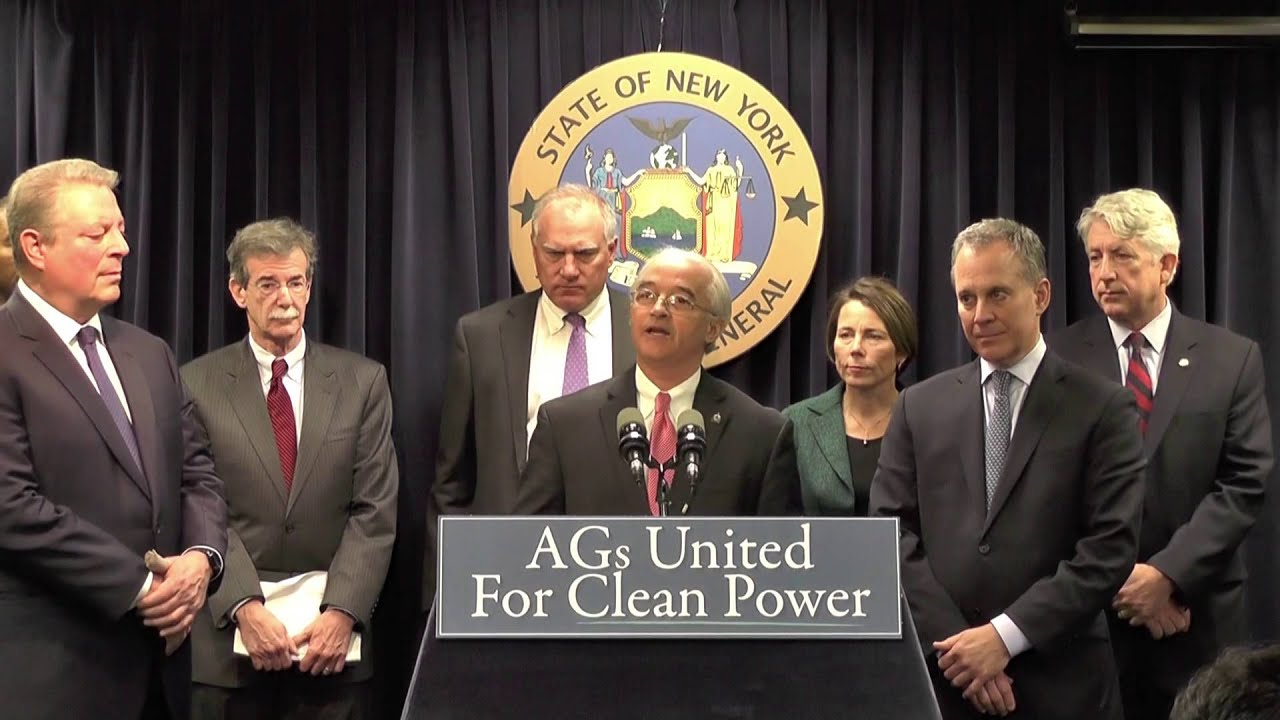 . "The scope of the problem we are facing, the size of the corporate entities and their alliances, the trade associations and other groups, is massive and it requires a multistate effort."
The coalition has been supported by former vice president Al Gore, who remarked that Exxon and other climate change denial lobbyists "are likely now, finally, at long last, to be held to account."
Each state's laws and investigative authorities are different, but through their joint probes, the attorneys general hope to create a nexus between Exxon's alleged deception and the damages that have been inflicted upon consumers.
What kinds of documents would Exxon have to hand over according to the subpoena?
According to Attorney General Walker's subpoena, Exxon is required to submit documents sent from or received by Exxon regarding climate change and its impacts; communications regarding the likelihood that Exxon products played a role in climate change; studies, research, and reviews published by Exxon or any of the third-parties acting on its behalf; information regarding Exxon sales and revenue that would have been impacted by acting on climate change; and meetings with or funding of third-parties.
If compelled to hand over 100 percent of the requested material, Exxon would be sharing nearly 40 years of memos, emails, studies, speeches, publications, and strategy reports, dating back to January 1, 1977.
Attorney General Walker has also included in his subpoena all communications regarding last year's investigation into Exxon's climate science funding conducted by ICN and the Los Angeles Times.
In his subpoena, what is Attorney General Walker accusing Exxon of having done?
Attorney General Walker has accused Exxon of violating two state laws under the Virgin Islands' anti-racketeering legislation called the "Baby RICO" statute.
As presented in the subpoena, Exxon is suspected to have engaged in, or be engaging in, "conduct misrepresenting its knowledge of the likelihood that its products and activities have contributed and are continuing to contribute to Climate Change" in order to defraud the government and consumers by obtaining money under false pretenses and conspiring to do so.
The "Baby RICO" statute that Walker has invoked was adopted by the Virgin Islands and other states and territories after Congress enacted the Racketeer Influenced and Corrupt Organizations Act (RICO) in 1970, which it created to try Mafia enterprises as a whole, rather than singular cases of lesser criminal associates. What the federal law allows prosecutors to do is build cases from lots of broader evidence.
The Virgin Islands' RICO statute, while not identical to the federal law that preceded it, can potentially be even more broad sweeping. In order for federal prosecutors to use the RICO Act, they must first prove reasonable suspicion that patterns of racketeering activity exist, and that the defendant obtained money through false pretenses.
Last year, New York Attorney General Eric Schneiderman also issued a subpoena for similar documents—with which Exxon has complied—but did so using the state's powerful securities fraud law called the Martin Act. Some legal experts believe that Attorney General Schneiderman is in a much better position to subpoena Exxon for evidence than Walker and other attorneys general in the coalition.
"I don't think the Virgin Island statutes are nearly as comprehensive. They don't speak directly to the subpoena power given to the attorney general of New York. I have some doubts about what the Virgin Islands attorney general is doing," Pat Parenteau, a professor of environmental law at the Vermont Law School, told me.
According to ICN, this marks the first time "a prosecutor has cited racketeering law to probe Exxon over its longtime denial of climate change and its products' role in it."
Several influential prosecutors, and even Al Gore, have encouraged the Department of Justice (DOJ) to launch an investigation into Exxon over potential violations of the RICO Act.
How is Exxon using existing laws to push back against Attorney General Walker?
Exxon is not about to hand over thousands of potentially confidential documents without a legal fight. In their lawsuit against Walker and the Washington, DC firm that issued the subpoena, Exxon alleges the request for information violates its constitutional rights.
The corporation's complaint, which was filed in its homebase of Texas, accusesWalker of infringing on its First Amendment right to freedom of speech by asking it to participate in the national discussion around its alleged fraud by deception. Exxon is allowed to make this claim because of the Supreme Court's 2010 ruling in favor of corporate personhood. Invoking the First Amendment may sit well in Texas, and an early ruling that Walker's subpoena is baseless due to an infringement of corporate free speech would be an undue win for Exxon, according to Parenteau.
Exxon has also cited the Fifth Amendment in its suit, which exists to protect people from being forced to incriminate themselves but does not generally apply to corporations, and would likely not be a persuasive defense against Walker's subpoena.
Additionally, the corporation claims the probe requests documents that extend past a five-year statute of limitations. While the statute of limitations in territories such as the Virgin Islands is more nuanced than it is in US states, if upheld, it could drastically curtail the volume of potential evidence that Exxon is required to submit.
Walker's subpoena, the lawsuit also alleges, "constitutes an abuse of process, in violation of common law," because the documents requested, Exxon's lawyers claim, appear to target individuals who hold policy viewpoints that stand in direct opposition to those supported by the attorney general.
"The First Amendment does not shield any company from being investigated for fraud," said Walker in a statement.
What this complaint suggests is that Exxon is posturing itself for future inquiries into its alleged knowledge of anthropogenic climate change and fraudulent behavior. While the corporation may be forced to comply with Walker's subpoena,it could still be years before any battle with Exxon escalates to a lawsuit. The risk in pushing too hard, said Parenteau, would be courts ruling in Exxon's favor over misuse of criminal law or political retaliation.
Will the documents subpoenaed by state attorneys general become public?
When, and whether or not, the Exxon documents acquired through current and future subpoenas become available to the public depends entirely on how the offices of the attorneys general negotiate their exchange. Some pieces of evidence may very well be confidential under the Privacy Act or heavily redacted, but Exxon can be expected to hand over material with the stipulation that it never becomes public.
Has this type of large-scale, corporate investigation ever happened before?
The main reason why legislators and environmentalists have encouraged the DOJ to use the RICO Act against Exxon is because the powerful law was previously invoked to bring down the tobacco industry in the 1990s.
In the United States v. Philip Morris, the DOJ successfully sued the country's most influential tobacco companies over fraudulent and unlawful conduct. The companies were held liable for violating RICO by deliberately concealing the health risks of smoking and marketing their products to the public.
"In the tobacco case, people were harmed by false beliefs propagated by the companies and were tricked into dangerous behavior," **former state attorney general Sen. Sheldon Whitehouse** told ICN. "In the case of climate change, there is the general harm, the damage that carbon is wreaking, and the cost to the government of flooding, wildfires and other disasters."
But if the case against Exxon is anything like the one involving the tobacco industry, it would also require strong bipartisan support among a class of politicians who have strong ties to the oil industry.[WHY?]
Ultimately, there are various legal options that prosecutors could pursue to venture deeper into Exxon's decades of darkness. Investigators have only just begun to dig, but look at how much they've been able to uncover so far.
- TAGGED:
- TECH
- MOTHERBOARD
- GLOBAL WARMING
- FOSSIL FUELS
- EXXON
- EXXONMOBIL
- VIRGIN ISLANDS
- ATTORNEY GENERAL
- TOBACCO INDUSTRY
- MOTHERBOARD SHOW
- RICO ACT
- RACKETEERING
- SUBPOENA
==
==
SUPPRESSION FOIA THE EMPIRE STRIKES BACK
Karen Savage
A nonprofit with ties to the fossil fuel industry has filed an ethics complaint against the New York attorney general’s office, alleging that Attorney General Barbara Underwood and two special assistant attorneys general are violating state ethics laws in their climate-related litigation against Exxon.
The Government Justice Center, led by board members who work for organizations that have received funding from oil industry and climate denial groups, alleges that Underwood is “accepting funding from an entity to conduct litigation by New York State on that entity’s behalf.”
The complaint alleges that Matthew Eisenson and Gavin McCabe, two special assistant attorneys general working on the office’s securities fraud case against Exxon as well as other work, are violating state law because they are paid through the NYU School of Law’s:{State Energy & Environment Impact Center:(style="box-sizing:inherit"):}:.
Known as the State Impact Center, it wasestablished last year with funding fromBloomberg Philanthropies, a nonprofit founded by former New York Mayor Michael Bloomberg to support state attorneys general in “defending and promoting clean energy, climate and environmental laws and policies.”
Eisenson and McCabe were both hired by the New York attorney general’s office through the State Impact Center’s fellows program. According to the Center’s website the Center “has offered all state attorneys general the opportunity to hire NYU Law Fellows to work under their direction as special assistant attorney generals on clean energy, climate change, and environmental issues.”
The Government Justice Center contends that Underwood’s office hired Eisenson and McCabe specifically to “help pursue a private party’s political and litigation agenda.” The Center says the use of the NYU fellows program also violates the law by giving the impression that Underwood’s office can be improperly influenced by Bloomberg.
The attorney general’s office said the arrangement violates no ethics laws and has been cleared by the state’s Joint Commission on Public Ethics.
The Government Justice Center said the alleged violations stem from Eisenson’s and McCabe’s names being included in signature blocks of recent climate change-related litigation, including Underwood’ssuit against Exxon for securities fraud, and a friend-of-the-court brief supporting New York City’s climate liability suit against five major oil companies.
“The presence of the special assistants in those cases, funded by Mr. Bloomberg, raises questions regarding whether Mr. Bloomberg and the Center are unduly influencing decision-making and litigation,” wrote Cameron J. Macdonald, executive director and general counsel for the Government Justice Center, who wrote the complaint.
Paul Nolette, a political science professor at Marquette University who studies state attorneys general and their role in national policy making, said it is common for attorneys general to tap into the expertise of various interest groups.
“Overall I don’t see it [the complaint] as a particularly strong argument, in part because this type of arrangement has been very common amongst AGs for quite some time and that includes situations where AGs have worked with private class actionattorneys on a contingency fee basis, which has also raised ethics concerns, but generally speaking, courts across the country have allowed that arrangement to occur,” Nolette said.
“Clearly the [State Impact] Center has an agenda of ‘we want to fight climate change’ but that alone is not particularly unusual or what I would consider unethical,” he said.
“We don’t hide anything that we do,” said Christopher Gray, communications director for the State Impact Center. “We are not securities lawyers, we work on environmental policy. The idea that we’re directly involved in a meaningful way, doesn’t meet the facts.”
“This is another attempt by what appears to be a dark money group to de-legitimize the ExxonMobil investigation, which pre-existed the founding of the State Impact Center and which we don’t have any oversight or influence over,” Gray said.
According to its charity registration statement, the Government Justice Centerwas founded in 2016 to provide “public interest litigation focused on government waste, negligence, misappropriation and other improper actions.”
The organization’s board members include director James Copeland, a senior fellow and director of legal policy at the Manhattan Institute. Exxon gave $115,200 to the Manhattan Institute in 2017 for public information and policy research. The group posted a Youtube video in March that was made to look like a real news story titled “The ‘Overheated’ Costs of Climate Change.” It featured former TV newscaster John Stossel, who interviewed senior fellow Oren Cass, who maintains that the costs of the climate crisis are overestimated.
Treasurer for the Government Justice Center is Brandon Muir, who is also the executive director ofReclaim New York, an organization**chaired**by Rebekah Mercer.Since at least 2015, the Mercer Family Foundation:{ has :(style="box-sizing:inherit"):}::{funded:(style="box-sizing:inherit"):}:numerous organizations known for:{promoting:(style="box-sizing:inherit"):}: climate denial, including the Manhattan Institute and the Heartland Institute.
Tim Hoefer is president of the Government Justice Center and director of the Empire Center for New York State Policy, which was a:{project:(style="box-sizing:inherit"):}: of the Manhattan Institute.
Government Justice Center director and retired judge Robert S. Smith, spent more than 25 years as:{partner:(style="box-sizing:inherit"):}: at Paul, Weiss, Rifkind, Wharton & Garrison, the firm hired by Exxon to defend itself against a growing number of climate change-related lawsuits, including Underwood’s securities fraud case.
The ethics complaint echoes a report published earlier this year by the Competitive Enterprise Institute, which relied on public records requests to allege that attorneys general are involved in a coordinated scheme by private interests to persuade elected officials to hold oil giants responsible for climate change. That alleged conspiracy includes Massachusetts Attorney General Maura Healey, who is also investigating Exxon for possible fraud.
“This seems to me to be just one additional part of this massive brawl between the New York attorney general’s office, the Massachusetts attorney general and ExxonMobil. I’m not terribly surprised that they filed this ethics complaint, but it doesn’t strike me as something that’s really going to go anywhere,” Nolette said.
==
==
ref
https://cei.org/AGclimatescheme
Law Enforcement for Rent (note series, gov't etc)
How Special Interests Fund Climate Policy through State Attorneys General
Christopher C. Horner • August 28, 2018
Author’s Note
This paper is based on documents obtained over two and a half years fromopen records requests and, in some cases, subsequent litigation. Due to the volume of records, not all cited records are included in the body of this paper. Key documents are provided in the paper’s appendix, which can be accessed at CEI.org. The complete collection of documents cited in this paper is available at ClimateLitigationWatch.org, a project of the nonprofit public interest law firm Government Accountability & Oversight.
Executive Summary
This paper details an extensive and elaborate campaign using electivelaw enforcement offices, in coordination with major donors and activist pressure groups, to attain a policy agenda that failed through the democratic process. The plan is revealed in emails and other public records obtained during two and a half years of requests under state open records laws. Most are being released now for the first time. Many were obtained only by court order in the face of a determined and coordinated resistance that one deputy attorney general foresaw, expressing early concerns over “an affirmative obligation to always litigate” requests looking into the effort.The paper details how donor-financed governance has expanded into dangerous and likely unconstitutional territory: state attorney general (AG) offices.
The plan traces back to 2012 when activists agreed to seek “a single sympathetic attorney general” to assist their cause. AGs began subpoenaing private parties’ records in service of a campaign of litigation against opponents of their climate policy agenda. The public records date to a July 2015 email in which Peter Frumhoff of the Union of Concerned Scientists confided the group’s involvement with AGs.
Those public records reveal the following:(a) donors introduced plaintiffs’ lawyers to AG offices (OAGs),
(b) a slideshow tour by plaintiffs’ lawyers recruiting OAGs to the effort, and
(c) senior attorneys from OAGs flying in—some at taxpayer expense and others on the donors’ tab, which had been run through a pressure group— for a briefing with “prospective funders” about “potential state causes of action against major carbon producers.” One presenter described this briefing as a“secret meeting.”It was secret enough that one AG litigated to withhold the agenda— under implausible claims of privilege—for a year and a half before being compelled by a court to release the lineup for what turned out to have been an AG-assisted fundraiser.
Those public records reveal the anatomy of what began as an “informal coalition” of AGs to use the legal system in pursuit of anovertly political agenda in coordination with activists and plaintiffs’ lawyers. That coalition disbanded under open records and media scrutiny, but it has now reconstituted through a program by which donors fund, privately hire, and place investigators and prosecutors in AG offices. It uses a nonprofit organization to pass the funding through and to provide the OAGs with a network of “pro bono” attorneys and public relations services. In return, OAGs provide office space to the privately hired prosecutors; agree they are there to “advanc[e] progressive clean energy, climate change, and environmental legal positions”; and provide regular reports about their work.
Led and funded by former New York Mayor Michael Bloomberg, this scheme hires “Research Fellows,” which it then places as activist “Special Assistant Attorneys General.” All of the participating OAGs had to promise that this work would not get done but for this private funding. All OAGs also certified they are not violating the law by accepting privately funded prosecutors. At best, as several OAGs tacitly admit, this unprecedented arrangement operates in a gray area with neither prohibition nor authority. One state where the scheme is arguably illegal is New York, where disgraced former Attorney General Eric Schneiderman had a leading and organizing role at every stage of the campaign this paper describes.
The New York OAG openly boasted to a donor that its “need” for privately funded prosecutors was driven in part by the “significant strain on staff resources” that had been caused by its “non- litigation advocacy”—that described as its having “led” the resistance to the Trump administration. Importantly, the NYOAG also cited its campaign “building models for two different types of common law cases to seek compensation” from industries for supposedly having caused global warming; moreover, it “needs additional attorney resources to assist with this project.”On these bases and with a claim to having statutory authority to enter the unprecedented arrangement—a claim which on its face appears to be an invention—the NYOAG was awarded not one but two privately underwritten prosecutors.
This is the most dangerous example of a modus operandi we have found: it uses nonprofit organizations as pass-through entities by which donors can support elected officials to, in turn, use their offices to advance a specific set of policies favored by said donors. It also uses resources that legislatures will not provide and that donors cannot legally provide directly. The budget for climate policy work alone is in the tens of millions of dollars per year.
Across various levels of government—including mayors and governors—the bulk of this money is budgeted for pass-through nongovernmental organizations (NGOs) and off-the-books consultants, report writers, and public relations (PR) firms that are hired through an NGO. The NGO takes a percentage as its fee (up to 24 percent in some cases). Another component involves privately hiring and then placing in-house, non- official personnel as advisors when they are actually employed by a donor’s group.
The extension of this billion-dollar per year climate industry to privately fund AG investigations sets a dangerous precedent. It represents private interests commandeering the state’s police powers to target opponents of their policy agenda and to hijack the justice system as a way to overturn the democratic process’s rejection of a political agenda.
As a subsequent report will affirm, this model of using nonprofit groups as cutouts for donors to finance elected officials’ activism is, in fact, widely adopted generally by the axisof donors, elected officials, and NGOs and by the climate litigation industryspecifically. The de facto law enforcement for hire by private interests raises concerns beyond mere political opportunism, obvious appearances of impropriety, or even compliant 501(c)3s that seeminglyrent out their tax-exempt status on behalf ofactivist donors.
The use of this approach by AGs carries legal, ethical, and constitutionalimplications, as well as for the integrity of law enforcement and the constitutional policy process. The public–private partnership of law enforcement for hire revealed in this report, in which the partnership uses public office to expend resources not appropriated or approved by their legislatures, raises significant constitutional and other legal issues—as well as ethics concerns—and should be the subject of prompt and serious legislative oversight.
Introduction
BEFORE YOU GASP, PLEASE NOTE that foundations are currently spending over $1 billion a year on climate work.”1 So wrote Dan Carol, a senior aide to California Governor Jerry Brown(D), on October 3, 2017, to his colleagues and staff members for New York Governor Andrew Cuomo (D) and Washington Governor Jay Inslee (D) regarding charitable foundation spending that promotes their climate policy agenda (see Figure 1). This figure dwarfs spending in opposition to that agenda—efforts to portray matters otherwise notwithstanding.2
Carol offered this sum to make his case that $50 million per year is reasonable to ask so donors can privately underwrite an off-the-books network of “support functions” for a handful of governors’ climate policy advocacy.
In further support of his position, Carol attached a “draft agenda, presentation slides, and budget worksheet.”Those items are among a large cache of public records that were obtained by the Competitive Enterprise Institute (CEI), along with other public policy groups, and that detail and propose the exploitation of a “plethora of funder interest” in secretly bankrolling the public office holders’ use of their positions to take a more aggressive role concerning climate politics and policy.
This years-long campaign by substantial, left-leaning donors revealed in Carol’s email correspondence and in other emails produced under state open records laws has now expanded into dangerous and likely unconstitutional territory. Led and funded by former New York Mayor Michael Bloomberg, this scheme centers
..[long]
==
==
chevron takes lead in defense b/c exxon and others KNEW; using 1st amend defense cf drilled season 2
https://www.alternet.org/2019/03/heres-why-trumps-giveaways-to-dirty-industries-are-literally-deadly/
A new study out Tuesday backs up a series of legal challenges launched by Democratic state attorneys general alarmed by President Donald Trump’s deregulatory rollbacks designed to benefit polluting industries at the expense of public health, the environment, and the economy.
Climate & Health Showdown in the Courts: State Attorneys General Prepare to Fight (pdf) was published by the State Energy & Environmental Impact Center at the NYU School of Law, which provides support to state attorneys general working to defend and promote clean energy, climate, and environmental policies.
“This special report unmasks the Trump administration’s plan to give a climate pollution pass to industries that represent almost half of all greenhouse gas emissions in the United States,” David J. Hayes, the center’s executive director, said in a statement.
“State attorneys general will not let the administration get away with its brazen attempt to turn major industries’ legal obligations to reduce damaging pollution into an invitation to continue to pollute—climate effects and adverse health impacts be damned,” he added.
[im g]
"In California, where we’re number one in clean energy and sell more zero-emission vehicles than any other state, we can’t afford to backslide,” said California Attorney General Xavier Becerra. “We’ve seen the effects of climate change, from record wildfires to massive mudslides.”
As New Jersey Attorney General Gurbir S. Grewal summarized, “This report confirms what we already feared—that the federal government’s environmental rollbacks will have a devastating impact on our climate and our health.”
“As the Trump administration continues to advance policies that will cause even greater harm to our resources and our health, it is up to state attorneys general to lead the fight to stop these policies and protect Americans,” concluded New York Attorney General Letitia James.
James and Hayes, along with Massachusetts Attorney General Maura Healey and Maryland Attorney General Brian Frosh, discussed the report and the ongoing legal battles against Trump’s pro-polluter agenda at a Tuesday afternoon press conference in Washington, D.C.:
==
Republican state AGs were in the majority...until this months election, when the majority flipped, with the most climate-denying AGs (in Michigan, Colorado, Wisconsin and Nevada) losing their jobs to Dems who ran on strong environmental platforms.
The outgoing climate-deniers pioneered a strategy of coordinated lawsuits and legal action (such as amicus briefs) to hold back action on climate and liability for fossil-fuel companies.
Now that Dems hold those offices, they could deploy the same tactics to grind the climate-wrecking looters' plans to a halt -- for example, Michigan's new Democratic AG Dana Nessel has vowed to shut down the Enbridge pipeline that carries Canada's planet-destroying, filthy tar-sands oil to US markets.
In addition to the New York suit, which relies on a 1921 anti-fraud act aimed at curbing Wall Street excesses, and a suit by Rhode Island, which uses its anti-nuisance laws to hold 14 oil and gas companies liable for pollution, Massachusetts is using consumer protection laws to argue that the industry’s failure to alert the public to the long-term risks of its products amounted to false and unfair advertising.
“One thing that’s really interesting in working with Democratic attorneys general across the country is that every office is a little bit different in how it’s structured, what powers they’ve been given, what their budgets are, what sort of authority they have,” Ulmer said. “When it comes to issue-specific questions, it truly is going to depend on the state.
“But I can tell you a number of these candidates have talked about the importance of climate change, protecting the environment, protecting natural resources, making sure that the citizens of their states have clean water and really clean air and protecting the future during their campaigns. We know that’s something they’re going to continue…once they’re fully transitioned into office.”
Legal Blue Wave? New Democratic AGs Could Change the Face of Climate Fight[Seamus McGraw/Climate Liability News]
on track to 2x by 2025; 17-19 state team blue; what about states's rights and fed overreach?
:{
}:
https://www.alternet.org/news-amp-politics/trump-administration-collision-course-california-over-vehicle-emissions-rules
Trump administration on Aug. 2 formally announced a proposal to freeze fuel economy standards and tailpipe emission standards for new cars. In addition, it is proposing to revoke California’s authority to set more stringent rules.
This move by the Environmental Protection Agency and the National Highway Traffic Safety Administration, while expected for months, is the most significant action yet in rolling back efforts by the Obama administration and California to cut greenhouse gas emissions that contribute to climate change. It also sets up an unprecedented legal battle between California and the federal government while breaking with decades of practice on regulating tailpipe pollution.
In fact, only hours after the announcement California Attorney General Xavier Becerra has indicated he intends to file a lawsuit in conjunction with 19 other state attorneys general to challenge the proposal.
Taking aim at California’s waiver
....
==
rhode island sues
==
superpollutants:
Eleven states and the District of Columbia sued the Trump administration on Wednesday, demanding enforcement of regulations on super-polluting greenhouse gases in air conditioners and refrigerators.
A similar lawsuit was filed by environmentalists on Tuesday. Both challenge an attempt by Environmental Protection Agency Administrator Scott Pruittto roll back federal regulations on the class of chemicals known as hydrofluorocarbons, or HFCs.
The HFC lawsuits are the latest in a string of legal challenges to the Trump administration's far-reaching agenda of rolling back environmental regulations, especially those relating to climate change.
...the
attorneys general who sued over HFCs represent New York, California, Delaware, Illinois, Minnesota, New Jersey, Oregon, Vermont, Washington and the District of Columbia, and they were joined by the Pennsylvania Department of Environmental Protection. Earlier this year, Californiaregulators adopted their own state prohibition on HFCs in new air-conditioning and refrigeration.
https://www.ecowatch.com/climate-litigation-california-big-oil-2571971191.html
Climate Litigation Against Big Oil Heats Up
By Jason Mark
Can any one group of actors be held responsible for the damages caused by global climate change?
That was the central question argued in federal court on Thursday as attorneys representing San Francisco and Oakland tried to beat back efforts by ExxonMobil, BP, Chevron, ConocoPhillips and Royal Dutch Shell to have a judge throw out a potentially groundbreaking climate change related lawsuit.
The nearly three-hour hearing was the latest round in a burgeoning effort by cities and counties nationwide to hold major fossil fuel producers accountable for climate change-related damages. Last year, seven California cities and counties sued the oil majors, claiming that their production and sale of fossil fuels—even as they were aware of the risks of CO2 emissions—constitute a public nuisance. Since then, similar suits have been filed by New York City; Boulder and two Colorado counties; and King County, Washington, home to the city of Seattle. (For more, see SIERRA's May/June cover story, "The Case for Climate Reparations.")
Thursday's hearing represented the first major test of such lawsuits as Judge William Alsup considered whether the Oakland and San Francisco complaint should move forward. The defendants challenged the lawsuit on a broad range of grounds, forcing Judge Alsup, a Clinton-appointee known for being an idiosyncratic jurist, to say at one point, "There are a lot of arguments here. As soon as I focus on one, you run off to another one."
The defendants' arguments for dismissing the suit centered on two main questions: whether the Federal District Court for Northern California is an appropriate jurisdiction to decide the case, and, of larger concern, whether the lawsuits might be displaced by existing federal laws and policies.
Arguments hinged on a welter of legal terms such as "general jurisdiction" versus "personal jurisdiction" versus "specific jurisdiction," while also touching on the distinctions between a holding company and an operating company. (Lawyers for Royal Dutch Shell maintained that the Netherlands-based multinational corporation is a holding company, and therefore has no agents in California.) In the course of the arguments it became clear that the very scale of the contested issue—global climate change—further complicates the questions of jurisdiction. The defendants argued that it's hard, if not impossible, to establish direct causation for a specific harm when the source of that harm is billions of people burning fossil fuels worldwide.
"[The plaintiffs] have decided that they do not want to and cannot disaggregate the conduct that leads to their harm," Jaren Janghorbani, an attorney representing ExxonMobil, said. "They cannot attribute any of the harm they are alleging to the company's activities in California."
Jonathan Hughes, a lawyer representing BP, echoed that point. "The amount [of CO2 emissions from its California operations] that could be attributed to BP would be a fraction of a fraction of a fraction of a percent. And under the but-for argument, if BP hadn't produced any fossil fuels, would they have still suffered an injury? The answer is yes. We are talking about a speck in the ocean."
In response, Benjamin Krass, a lawyer representing San Francisco and Oakland, said the oil company attorneys were "muddying up" the but-for argument—the principle of tort law that establishes liability. "The end result of the defendants' argument is that a company that does business everywhere should be held accountable nowhere."
In the end, Judge Alsup said he didn't have enough information to make a decision on the jurisdiction question. He gave both sides at least 60 days for a discovery process and depositions to establish whether each of the defendants has sufficient business operations in California for the two California cities to claim injury.
That left Chevron, the only defendant headquartered in California, to argue for dismissal based on the merits of the case. Chevron attorney Theodore Boutrous, Jr. began by saying that the cities' claims stretch federal common law and that "the plaintiffs are asking this court to throw caution to the wind." Boutrous went on to argue that a complex issue like climate change "should be committed to those who write the laws rather than those who interpret them." And Congress, Boutrous argued, has again and again passed laws in favor of fossil fuel production. "Congress has made clear that energy production is not a public nuisance; it is a public necessity."
As a rebuttal, Steve Berman, the lead counsel for the two cities, argued that the cities' complaints are not nearly as novel as the defendants make it seem—but instead merely the application of ancient laws to contemporary circumstances. "The law of nuisance has been around forever, and it has responded to changes in mankind. What we are doing is applying hundreds of years of law to a new situation." Berman later said, "We allege that this was a deliberate nuisance, based on phony science."
The San Francisco and Oakland case has generated a great deal of attention among legal scholars and climate change activists. In March, Judge Alsup held an unusual "climate science tutorial" as a preliminary step in the case—an event that attracted so big a crowd, the court had to reserve an overflow room. The case has also become a proxy battle of sorts. Fifteen states with Republican attorneys general—including Indiana, Colorado, Kansas and Louisiana—filed an amicus brief in support of the oil corporations' position. Meanwhile, California, New Jersey and Washington filed their own brief backing the cities' arguments.
The federal government has also weighed in. Two weeks ago the U.S. Department of Justice filed a brief supporting the five oil companies, and on Thursday, Eric Grant, a deputy assistant attorney general, was given time to express the federal government's opposition to the San Francisco and Oakland suits."It is upon Congress, not the courts, to prescribe policy in areas of special interest," Grant said. "As this court knows, in respect to domestic emissions, the kind of national policy-making sought by plaintiffs is inappropriate … [Climate change] is a complex issue involving trade-offs affecting a nation of more than 300 million people. Individual federal district courts lack the competence to undertake that task."
The federal government's arguments appeared to give Judge Alsup pause, even as he continued to express exasperation with the legal maneuverings of some of the defendants. "There is no court in the history of the universe that has extended this [federal common law] to global warming," the judge said. "The United States is pointing to Supreme Court language that judges like me have to move slowly … There's no doubt there will be some sea rise. But will it be in 75 years or 25 years? We don't know."
To which Berman, the plaintiff's attorney, responded, "That's what the trial is for. Today we're talking about a motion to dismiss."
Whether the case will ever make it to a trial is, of course, now in the hands of Judge Alsup....
==
eric quit:
https://insideclimatenews.org/news/09052018/new-york-attorney-general-eric-schneiderman-assualt-allegations-resigned-exxon-climate-investigation-environment-lawsuits
New York Attorney General Eric Schneiderman's abrupt resignation after allegations surfaced that he had physically assaulted four women has complicated, but probably not derailed, a series of high-profile environmental investigations and lawsuits that his office spearheaded.
Being the chief law enforcement officer for the state of New York gave Schneiderman a bully pulpit from which he attacked the environmental policies of the Trump Administration and challenged ExxonMobil and its political allies.
His admirers had seen him as a guardian of environmental and social justice—including protections for women. But the detailed allegations, published May 7 in *The New Yorker* magazine, that he assaulted and emotionally abused women in several relationships have sunk his reputation. He announced a few hours after publication that he was resigning. Schneiderman wrote that he contests the women's accounts, but that he cannot continue in office.
It may be too early to assess the damage to the environmental causes he was pursuing. Much depends on who replaces him as attorney general, how robustly his staff carries on, and how effectively other state officials take up the slack.
Schneiderman spent three years digging into a possible fraud case against Exxon over what the oil giant told investors and the public about climate change, sparking round after round of litigation in which he has been allied with Attorney General Maura Healey of Massachusetts. The work is far from complete.
He also scored some success against Trump policies, including but not exclusively those involving the environment and climate change, and he has filed one case after another challenging the administration in its broad assault on environmental protections.
New York's national clout, its advantageous laws and its big, skillful corps of state prosecutors are all powerful advantages that survive him.
But it was Schneiderman who assembled acoalition of attorneys generalunder the banner of AGs United for Clean Power and proclaimed them "dedicated to coming up with creative ways to enforce laws being flouted by the fossil fuel industry and their allies in their short-sighted efforts to put profits above the interests of the American people."
That put him squarely in the public spotlight and in the sights of the fossil fuel industry.
State AGs: Investigations Aren't Stopping
Although his resignation may not derail the state's investigation of Exxon, it could add fuel to the campaign by Exxon and its supporters to weaken public confidence in the New York and Massachusetts investigations.
Healey's staff said Schneiderman's resignation will not affect her commitment to pursuing the Exxon probe.
"The American people deserve answers from executives at Exxon about what they knew about the impact of burning fossil fuels on our climate, when they knew it, and what they told their investors and the world," Healey said. "We look forward to continuing our critical investigation."
Maryland Attorney General Brian Frosh, who frequently allied with Schneiderman on environmental issues, said other states will step in if there is any void to fill.
"Schneiderman was very influential; smart and dynamic," he said. "But this has been a collaborative effort from the beginning, and I expect it will continue."
Frosh called the allegations against Schneiderman "unacceptable and horrifying" but emphasized the policy issues should not be lost.
"This is not about any one individual," he said. "It is about the threat to the health and safety of every single American."
May Boeve, executive director of the environmental group 350.org, issued a statement saying her group supported the Exxon investigations Schneiderman led, but that it felt a duty to speak out against violence. "We applaud the courage of all the women who spoke up to bring these abuses to light," she wrote. "We refuse to turn a blind eye on violence against women and vulnerable communities."
A spokesman for the New York attorney general's office did not respond to calls for comment.
Behind the Scenes, It Is Staff Executing the Work
Schneiderman, 63, was seeking a third term as attorney general. The New York State Legislature will select a new attorney general who will serve until the start of the new term on January 1. Until the interim attorney general is appointed, the state's solicitor general, Barbara D. Underwood, has been appointed acting attorney general.
Underwood issued a statement on Wednesday, saying, "The work of this office is critically important. Our office has never been stronger, and this extraordinarily talented, dedicated and tireless team of public servants will ensure that our work continues without interruption."
The New York and Massachusetts investigations sparked intense legal battles with Exxon and the ire of the company's political and industry allies. The House Science committee subpoenaed Schneiderman and Healey, while a coalition of Republican state attorneys general went to court in support of Exxon's attempts to block Schneiderman's investigation.
Exxon's furious legal battle to block the investigations has been dealt serious blows in the past two months. First, aNew York federal judge refused to block the investigations, and then the Supreme Judicial Court of Massachusetts rebuffed Exxon.
Those rulings open the door for the investigations to continue. In Massachusetts and New York, that means the heavy lifting will be done by experienced legal staffs.
Exxon Probe 'Has a Life of Its Own'
While Schneiderman set the tone and was the public face in New York, it will be the staff that executes the investigation, legal experts say. And at this point, legal experts say, it's doubtful the course will change.
It's likely Schneiderman was briefed periodically, but was not hands-on at this stage of the Exxon investigation, said Martha Coakley, an attorney for the Boston law firm of Foley Hoag who served as the attorney general of Massachusetts for eight years before being succeeded by Healey in 2015.
"As the attorney general, he certainly would have known what was going on but not have been in the weeds,"Coakley said. "He'd sign off on critical matters, but at this stage most of the work would be being done would by the staff."
Pat Parenteau, a professor of environmental law at the Vermont Law School, said the resignation may amount to a little bump in the road for the investigation. The investigation has a "life of its own," Parenteausaid, and momentum now that the courts have brushed aside Exxon's attempts to stop it."
"Another AG may not be out front as much, but the investigation will continue to track on a schedule," he said.
The allegations may still be used to try to tar the investigation and other work by Schneiderman to uphold environmental policies.
"In some political circles, I think you'll see an attempt to use this to undermine public confidence," Parenteau said. "It's hard enough to explain to the public why an investigation is important and not a political stunt the way Exxon has portrayed it.
"Then all of sudden you get something like this, and it damages the effort."
Nearly a Dozen Environment-Related Cases
Just hours before he announced his resignation, Schneiderman put himself at theforefront of a coalition of eight state attorneys general calling on EPA Administrator Scott Pruitt to halt hisproposed science transparency rule that would prevent EPA's use of studies that promised subjects confidentiality, including health studies showing damage from pollution.
Schneiderman had filed nearly a dozen lawsuits against the federal government seeking legal protections of the environment, energy and climate, according to informationcollected by the State Energy & Environmental Impact Center at the New York University School of Law. They include targeting attempts to roll back auto emissions standards and government failures to control smog pollution.
While Schneiderman has vacated his office, he has left a legal blueprint for others to follow, said David Shapiro, an assistant professor of Public Management at New York's John Jay College of Criminal Justice.
"He has stepped up," he said. "If I were Exxon, I would rather give up Schneiderman and take the unknown."
PUBLISHED UNDER:
https://www.desmogblog.com/2018/04/10/koch-nichols-scott-pruitt-strip-california-waiver-regulate-auto-emissions
...In the weeks leading up to his announcement about the emissions standards, Pruitt had taken a more antagonistic tone towards California, signaling that he might attempt to revoke the waiver that was granted by the Obama administration, per legal mandate, in 2009.
“California is not the arbiter of these issues,” Pruitt told Bloomberg News in March, adding that the state “shouldn’t and can’t dictate to the rest of the country what these levels are going to be.”
With the waiver in hand, California can continue to enforce current greenhouse gas emissions standards, despite whatever the EPA sets as the new national standards for model years 2022-2025. On top of that, any other state can choose to adopt California’s standards, which 13 other states and the District of Columbia currently have.
Because these states represent roughly one-third of the country’s personal vehicle market, automakers would have to decide whether to set up two different production lines for states following the California standards and the rest of the country, or whether to treat California’s targets as a de facto national standard.
Predictably, the automakers, through the powerful Auto Alliance and Global Automakers trade groups, are calling for one national regime, which could result from a grand bargain like the one that Pruitt just scrapped, or could be delivered by Pruitt stripping California of its waiver.
Any attempt at such a repeal would be hugely controversial, and possibly illegal, due to many nuances in the Clean Air Act and the history of its application and enforcement. A waiver granted to California under the Clean Air Act has never been revoked, and has only been denied once.
Notably, that lone denial came in December 2007 when William (Bill) Wehrum, who ran the EPA’s clean air division at the time, convinced then-EPA Administrator Stephen Johnson to reject the state’s request to set its own greenhouse gas standards for vehicles, the very issue at hand today.
(California was later granted that same waiver in 2009 under the Obama administration, after the state sued the EPA, and after the Supreme Court had held in 2007 that the EPA was required to regulate greenhouse gas emissions. For a much more comprehensive background on California’s waiver and Wehrum’s opposition, see this recent Desmog article.)
Today, Wehrum is again the air chief at the EPA, and is again in a position to attempt to strip California of its unique authority to set its own air pollution limits. As Wehrum, Pruitt, and EPA policymakers work to figure out the new national emissions standards for cars and light trucks, they are hearing from groups including the American Consumer Institute and its Koch-tied coalition on the importance of revoking the California waiver.
Who Are the Groups Fighting California’s Clean Air Act Waiver?
The ACI letter to Pruitt, dated March 28, 2018, was signed by representatives from 11 groups, eight of which have known ties to the Koch network, and all of which are routine commenters on conservative issues.
The :{American Consumer Institute (ACI):(style="font-weight:700"):}: is credited with organizing the coalition, and the letter is signed by its President Steve Pociask. The group is best known for opposing net neutrality efforts while being funded by a major internet service provider (ISP) lobby, as journalist Lee Fang detailed for VICE. More recently, Pociask has turned his attention to attacking electric vehicles, writing on Forbes that “the science on electric vehicles does not support continuing California’s waiver.”
:{Less Government:(style="font-weight:700"):}:is an “organization dedicated to reducing the power of government and protecting the First Amendment from governmental assault,” which was founded and run by Seton Motley, who is also listed as a Policy Adviser to the climate science-denying Heartland Institute. Though Motley and his Less Government org have their roots in telecom and media issues, he has in recent years engaged more on climate and energy issues, signing some anti-wind energy letters organized by the Koch-backed Americans for Prosperity and writing a bit on electric vehicles.
The :{Taxpayers Protection Alliance (TPA):(style="font-weight:700"):}: is part of the network of front groups funded by the Koch brothers and their donor network through the Center to Protect Patient Rights (now called American Encore), and Freedom Partners. As the Energy and Policy Institute has described, “TPA essentially exists as a shell for its advocacy, based on its own IRS form 990s: 'The Taxpayers Protection Alliance has given control of the management duties and the daily activities of the organization to MLM Consulting, LLC (MLM). MLM will be responsible for managing the organization and work to support the exempt purposes of TPA. The President of TPA, David Williams, is the sole owner of MLM Consulting LLC.'” Williams signed the ACIletter to Pruitt. TPA has fought clean energy policy in the past using the website SolarSecrets.org and has published white papers arguing against solar energy tax credits.
:{Consumer Action for a Strong Economy :(style="font-weight:700"):}:is run by Matthew Kandrach, and has been linked to a number of coalition efforts stemming from the FreedomWorks organization, which was born of a merger between the Koch-founded Citizens for a Sound Economy (CSE) and Empower America.
American Commitment is run by Phil Kerpen, a former Vice President of Americans for Prosperity. The organization was founded by Sean Noble, a right-wing operative with close ties to the Koch brothers who also runs the Center to Protect Patient Rights (American Encore), a major funnel for Koch donor network money to front groups.
FreedomWorks was, as mentioned above, born of a merger between the Koch-founded Citizens for a Sound Economy (CSE)and Empower America, though it has no known Koch ties at present day. The group was described in a 2012 article in Mother Jonesas “one of the main political outfits of the conservative movement and an instrumental force within the tea party.” It pushes free market policies and has questioned the well-established science linking human activity to a warming planet.
The :{Competitive Enterprise Institute (CEI):(style="font-weight:700"):}: is a conservative advocacy group dedicated to “economic freedom” that has received funding from ExxonMobil, Texaco, and the family foundations of the Koch brothers.
Americans for Tax Reform (ATR) is an anti-tax group that has received funding from the oil and gas lobbying group, the American Petroleum Institute, along with various groups in the Koch network such as the Claude R. Lambe Charitable Foundation and the Center to Protect Patient Rights, as well as DonorsTrust.
The :{60 Plus Association:(style="font-weight:700"):}: describes itselfas the conservative alternative to the American Association of Retired Persons (AARP) and receives significant funding from groups connected to the Koch brothers. The group has also received funding from the American Petroleum Institute, and was created by Sean Noble (see American Commitment above). Noble was until recently a consultant for the Arizona Public Service utility company, and has led efforts in Arizona to kill solar-friendly legislation.
Frontiers of Freedom, run by George Landrith, has received significant funding from Exxon, the Koch brothers, and dark money organizations like Donors Trust. In 2015, Landrith launched the Energy Equality Coalition to battle against the federal electric vehicle tax credit. The coalition also includes David Williams of the Taxpayer Protection Alliance and Horace Cooper, a senior fellow at the Heartland Institute. Landrith is also a directorof the National Center for Public Policy Research (NCPPR).
The Center for Freedom and Prosperity was once funded by the Charles Koch Foundation and has actively lobbied for more liberalized tax laws, and for less scrutiny towards offshore tax havens.
Seven of the organizations that signed this letter to Pruitt — and five of the actual representatives who signed — also recently penned a letter to the U.S. Food and Drug Administration (FDA) defending “electronic and heat-not-burn” tobacco products (or vaping products), indicating that this network is defending the tobacco industry as well as oil and gas companies.
California and Partner States Fight Back
Nichols has signaled that California will not be retreating from its strong standards.
“California will not weaken its nationally accepted clean car standards, and automakers will continue to meet those higher standards, bringing better gas mileage and less pollution for everyone,” Nichols wrote in a statement emailed to reporters. “This decision takes the U.S. auto industry backward, and we will vigorously defend the existing clean vehicle standards and fight to preserve one national clean vehicle program.”
California Attorney General Xavier Becerra has also said that California is prepared to sue if the EPA moves to weaken the vehicle emissions standards.
“We are going to do everything that can been done to defend these standards,” Becerra toldReuterslast week. “So far, when we have been challenged on environmental standards we have had a good record in court. We haven’t lost a case.”
Under the Clean Air Act, the EPA is required to grant California a waiver on air pollution emissions standards if the state has “compelling and extraordinary circumstances,” which California argued a decade ago, and which the Obama administration agreed that it does. To revoke the waiver, the EPA would legally have to prove that those circumstances are no longer there. To satisfy the courts in California's inevitable legal challenge, this would require a comprehensive and scientifically rigorous analysis.
At the BNEF Future of Energy Summit on April 10, Nichols said, “The document that came out a week ago from the administrator did nothing to change the nature of the debate. It expressed Mr. Pruitt's view but there was absolutely nothing new in the way of data or analysis to support that view.”
She did indicate that she would be willing to sit down with the EPA and automakers to look at some “minor adjustments” to the technical changes measuring how companies could comply, but not the targets themselves. She provided an example related to electric vehicles. “Under the 2012 rules [car companies are] responsible for upstream emissions of power plants for charging EVs [electric vehicles]. I don't think that's a great idea. I didn't think so at the time.”
However, “if the whole system is up for reexamination,” said Nichols, “then that's a whole different story … That's a different fight. And we would win it.”
It’s also clear that other states would have California's back and join a legal fight, or start their own.Attorneys general from 11 states said last week in a statement that they would defend California's right to set firm standards.
“By cooking the books on its review of national auto emissions standards, the Trump administration is putting special interests ahead of New Yorkers’ health and wallets,” said New York Attorney General Eric Schneiderman. “We stand ready to take legal action to block the Trump administration’s reckless and illegal efforts to reverse these critical standards and the gains we’ve made in ensuring cars are more fuel-efficient and less polluting.”
TAGS:
competitive enterprise institute
2x? great detail on walker setback
With Bare Knuckles and Big Dollars, Exxon Fights Climate Probe to a Legal Stalemate
A shift in venue and lost emails now present new challenges for the company’s lawyers who buy time and protect profits by playing defense with offense.
june 2017
https://insideclimatenews.org/news/05062017/exxon-climate-change-fraud-investigation-eric-schneiderman-rex-tillerson-exxonmobil
==
https://www.ecowatch.com/exxon-climate-lawsuit-2554739359.html
Court Tosses Exxon's 'Implausible' Lawsuit Seeking to Stop Climate Probe
A federal judge on Thursday threw out Exxon Mobil's lawsuit that sought to derail New York and Massachusetts' probe into whether the oil giant misled investors and the public about its knowledge of climate change.
Exxon tried to convince U.S. District Court Judge Valerie A. Caproni that New York Attorney General Eric Schneiderman and Massachusetts Attorney General Maura Healey were infringing on the company's free speech rights and the AGs were pursuing politically motivated investigations.
But in a searing ruling, Caproni called the company's claims "implausible" and "a wild stretch of logic."
"The relief requested by Exxon in this case is extraordinary: Exxon has asked two federal courts—first in Texas, now in New York—to stop state officials from conducting duly-authorized investigations into potential fraud," she wrote. "It has done so on the basis of extremely thin allegations and speculative inferences."
Exxon's allegations rested on statements made at the AGs' United for Clean Power in March 2016. The company tried to paint Schneiderman and Healey's participation in the event as a evidence of their political bias against the company.
However, Caproni dismissed that argument, which she considered a result of "cherry-picking snippets from the transcript of the press conference."
"Some statements made at the press conference were perhaps hyperbolic, but nothing that was said can fairly be read to constitute declaration of a political vendetta against Exxon," she wrote.
The company's claims that the AGs "are pursuing bad faith investigations in order to violate Exxon's constitutional rights are implausible," the judge continued. She called it a "a wild stretch of logic" for Exxon to contend that the AGs' comments about public confusion relative to climate change showed any intent to "chill dissenting speech."
Caproni dismissed the lawsuit with prejudice, meaning Exxon cannot file it again.
Schneiderman and Healey celebrated the ruling.
"I am pleased with the court's decision to dismiss Exxon's frivolous, nonsensical lawsuit that wrongfully attempted to thwart a serious state law enforcement investigation into the company," Schneiderman said.
...
==
https://www.democracynow.org/2018/3/13/state_election_leaders_to_senate_armed
==
https://www.usnews.com/news/best-states/articles/2017-10-27/state-attorneys-general-lead-the-charge-against-president-donald-trump
There are 194 Democrats in the House, and another 46 Democrats in the Senate.
But since Donald Trump took office, 22 state attorneys general have played among the most pivotal roles slowing and stopping the march of the Trump agenda.
Nineteen state AGs sued to stop the administration from withholding Obamacare subsidies from states, 16 to halt the rollback of environmental regulations, and 20 to reverse its decision to rescind a program that had protected young immigrants brought to the U.S. illegally as children from deportation.
In what remains their most visible victory, the lawyers won court orders that effectively froze three versions of Trump's travel ban, which had largely sought to bar residents of certain Muslim majority nations from entering the U.S.
Most of the lawsuits, just weeks or months old, are still making their way through the courts. Few so far have had the rapid and resounding success of the early victories that halted the travel ban. But the pace has been unrelenting – and, it would seem, unprecedented, with nearly two-dozen multistate lawsuits brought against Trump in his first nine months alone.
"Who's going to be there to defend students or residents or consumers or the environment when this administration is upending so many long-standing protections and turning the rule of law on its head?" Massachusetts Attorney General Maura Healey, a Democrat, says. "The role of AG has never been more important."
With Republicans in control of not only the White House and Congress, but most state legislatures, the Democrats serving in the office of attorney general – once a staid backwater mostly seen as a political steppingstone – have become the bulwark to Trump, doing more to resist than any march or petition or tweet storm could hope.
And with the Justice Department's special counsel having apparently teamed up with New York's attorney general in the investigation into Russian meddling in the 2016 presidential election, efforts at the state level might not merely frustrate the presidency, but perhaps even prove even fatal.
Yet not all Democrats are cheering. Some fear that each new lawsuit along party lines threatens to further fray the rope that had – at least ostensibly – held AGs' offices above the day-to-day politics that were once relegated to other offices like governor or senator or president. It's a trend that's undoubtedly transforming how the states' top legal officers – the people's lawyers – do business, shifting the U.S. legal and political landscape in ways that have yet to be fully understood and may very well prove irrevocable.
"The more AGs act like congressmen, the more they'll be treated like congressmen," says James Tierney, a former Democratic attorney general of Maine and a lecturer at Harvard Law School who's carved a niche consulting both Republican and Democratic AGs and studying the office he once held. "It's endangering the very function of attorney general."
Rise of the Activist AG
State legal challenges against the federal government are hardly new. But the GOP could be said to have built the modern template for the coordinated, multistate challenges being unleashed today.
Among the first and most prominent was the 26-state challenge to the Affordable Care Act – an action that had been in the works months before it was finally filed in March 23, 2010, minutes after President Barack Obama signed the act into law. More legal challenges quickly followed.
As the GOP wrested control of the House from Democrats and gained crucial seats in the Senate in the 2010 midterms, Republican lawmakers embarked on a campaign to stop Obama's legislative priorities at virtually every turn. As the Senate's top Republican, Mitch McConnell of Kentucky, told the National Journal one month before the election, "the single most important thing we want to achieve is for President Obama to be a one-term president."
The strategy forced the president to carry out much of his agenda through the executive branch, pushing regulations through agencies such as the Environmental Protection Agency or issuing enforcement directives and executive orders. With Congress deadlocked and largely unable to stop these measures, Republican attorneys general from Texas to South Carolina began filing lawsuits to halt the measures from taking effect.
From 2009 through 2016, state attorneys general brought 59 multistate lawsuits against the federal government – most by Republicans, but a handful by Democrats, too, according to data compiled by Paul Nolette, a political scientist at Marquette Universitywho studies the office of attorney general. Texas, alone, was listed as a lead plaintiff in nearly a third of the cases.
"I go into the office in the morning. I sue Barack Obama, and then I go home," former Texas Gov. Greg Abbott, who served as state attorney general before moving to the governor's mansion, said while serving as AG in 2013, a line he used often.
President George W. Bush's administration, by comparison, faced 45 multi-state lawsuits. President Bill Clinton's administration was named in 18.
...[hockey stick 2014]
Much of the GOP's legal effort during the Obama years was aided by the Republican Attorneys General Association, a group formed in 1999 to help elect GOP AGs in states across the nation. In the 18 years since its launch, it's brought in millions of dollars of year in donations,much of it from private corporations.
RAGA says that the surge in litigation by its members has simply been a reaction to the excesses of the Obama administration, which Executive Director Scott Will accused of "deciding to govern by executive fiat."
"You could look at the number of regulations and executive actions that the president put forth, and Congress couldn't do as much that state AGs could," Will says. "You saw Republican candidates begin to campaign on pushing back against that overreach in general. And that's allowed for us, RAGA, to increase not just our fundraising advantage, but the quality of our candidates as well."
Democrats, by contrast, contend that the Republican strategy was simply an outgrowth of the "obstructionism" that GOP lawmakers were pursuing in Congress. But with the two sides' roles now switched, and Republicans now in control of the White House, left-leaning AGs maintain that their side's legal challenges are seeking more than to simply frustrate the administration, despite any similarities their strategy may have to the Republican playbook.
"You saw a number of frivolous lawsuits that were just obstructionist and attempts to obstruct in any way the Obama administration," Healey, the Massachusetts AG, says. "This isn't about obstructing, it's about standing up for the rule of law. You see that in standing up for women's access to birth control, you see that in standing up against the travel ban."
Trump, in his first two weeks in office, was hit with more than 50 lawsuits from state AGs and others. By May, he'd been sued in federal court more than 130 times. At least 25 of those challenges have been led by state AGs. Many of the lawsuits, which once could take weeks to put together, are now being filed in a matter of days.
"Given the trendline, the total number of suits will likely surpass all of Obama's total in just Trump's first couple of years," Nolette, of Marquette, says.
Democrats aren't alone in ramping up the pace of their legal challenges – including filings that don't even make it before a court. Texas Attorney General Ken Paxton, for example, said this week that he'd had an amicus brief ready to file in the event the Trump administration decided to continue opposing a ruling allowing an undocumented teenager in federal custody to get an abortion. Paxton, a Republican who expressed "profound disappointment" in the court's decision to allow the abortion to proceed, took the highly unusual step of making the draft of his brief public, which stirred concern among some legal observers.
Greg Zoeller, who served as the Republican attorney general of Indiana from 2009 to 2017, says that the state AGs' new activism is "a reflection of the failure of the legislative branch to check executive authority. The need for states to check federal authority is only necessary because of our dysfunctional Congress."
The Trump administration, in particular, has been bedeviled by infighting among the president's top aides, internecine warfare between the White House and Capitol Hill, and fractious disagreements among GOP lawmakers in Congress. High-profile bills on marquee issues such as health care have suffered devastating losses as Republican senators defected. Legislation on other priorities like immigration reform remain far beyond the horizon, although Trump and congressional Republicans say such measures are coming soon. And most recently, Sen. Jeff Flake and Sen. Bob Corker, Republicans from Arizona and Tennessee, respectively, have blasted Trump's leadership as they've announced their decisions not to seek re-election.
Frustrated in Congress, Trump and his Cabinet members have taken up their pens and phones, harnessing the authority of the executive branch to enact their goals through other means – even as Trump criticized Obama for doing the same – such as by threatening federal funding for cities that do not fully comply with immigration enforcement or rolling back regulations that would limit power plant pollution.
Trump signed his 50th executive order Oct. 12, nearly twice the number that his predecessor signed by the same point in his presidency. And each, it seems, has been met with a lawsuit.
"It's quite dramatic just in terms of the sheer number of multistate lawsuits that have picked up over the last several months. But the thing that really stands out to me that does seem to be really a new development is just the speed," Marquette's Nolette says. "Even in contrast to the [George] W. Bush administration, the Democratic AGs – 16 or 18 of them – are this solid coalition that constantly communicate with one another about strategies and getting other AGs to sign on. It's almost like a rapid-response group now in the way that it wasn't before."
The Democratic Attorneys General Association says it's played a crucial role bringing about that shift. In the past year, as RAGA announced it wouldend an informal agreementbetween the two groups not to attack each other's incumbents, DAGA has sought to turbocharge its fundraising and outreach, in effect playing catch-up after launching some 15 years after its Republican counterpart.
"We're looking for competitive advantage; we're going to fight more in this cycle than AGs have ever fought, and the fights matter," DAGA Executive Director Sean Rankin says of the coming year. "If Donald Trump understood the rule of law, if he were to enforce the regulations that are there, Democratic AGs would not be filing the way they are. But we face a situation where the president is stepping on the rights of people at every turn and seemingly not understanding that he's doing it, so we're forced to act."
DAGA and RAGA have together poured more than $6 million into the Virginia attorney general's race alone. And when the Republican group announced Thursday that it was spending $550,000 – bringing the group's total spending in the race to $4.1 million – DAGA answered the same day that it would dish up another $725,000, bringing its total to $2.25 million.
"This is the arms race," Rankin says, "not a litigation arms race" but "bigger donors" and "real infrastructure."
Last year, DAGA brought in about $5.2 million in donations, and through the first half of this year collected roughly $3.1 million. It's also expanded its footprint, relocating last year from Denver to a shiny new office in downtown Washington, reaching out to companies in Silicon Valley, and hiring Rankin, a longtime Democratic political operative, as its first full-time executive director, along with a new communications director and a policy director.
DAGA's fundraising efforts still trail far behind those of its rival. Last year, RAGA raked in about $14.5 million in donations – nearly three times what DAGA raised – and through the first half of this year brought in about $7.4 million, more than twice DAGA's total. (DAGA points out that it did not have a finance team in place until the second quarter of this year.) Like DAGA, RAGA has also hired up, bringing aboard the spokesman from House Speaker Paul Ryan's political team.
Some legal observers are mostly untroubled by the trend – either the influx of donor money or the vast increase in litigation brought by Democrats and Republicans. State attorneys general, they say, are filling a crucial role in the country's democratic system, checking the power of the executive branch in lieu of a broken Congress.
"States are filling the vacuum," says Jed Shugerman, a professor at the Fordham University School of Law who's written about the role that state AGs may play in the Justice Department's Russia investigation. "Our system is designed to have a lot of flexibility for these checks and balances. So state AGs in my view are playing their role in our constitutional system."
RAGA and DAGA, meanwhile, have largely shrugged off concerns about how state AGs' newfound prominence on the national stage may be fundamentally changing the work of their offices, which was once largely grounded in local issues like consumer protection.
"It's fair to say that the role of the AG has changed significantly over the last nine or 10 years, and a lot of that change was brought on by what we're talking about today – Republican AGs finding success in challenging federal regulations that hamper business and the jobs climate and the states' ability to govern themselves," Will, RAGA's executive director, says. "What I'm focused on, and what our group talks about, is the impact they've been having in continuing to repeal the regulations that came down over the last eight or nine years."
Others, though, are not so sure. The office was always political – after all, attorneys general are elected in 43 states and appointed by the governor in six. (In Maine, the attorney general is elected by the state legislature.) Even so, compared to other political offices, theirs is one that's traditionally been treated with deference, both by the courts and the general public. It was an office that, at least aspirationally if not in practice, tried to rise above politics.
Some legal scholars worry that the trend toward greater political polarization risks throwing all that away.
"My long-term concern is that the AGs become seen as one more lawyer, one more politician on the make, and that undercuts the credibility of the office itself," says Tierney, the lecturer at Harvard Law who served as Maine's AG from 1980 to 1990.
It's an impact that could reverberate beyond the AG's suite, implicating other political appointments to the office and perhaps coloring even the actions of the career employees who do most of a state AG's work. Any action an AG's office takes – whether it's ending a prosecution, bringing a civil lawsuit, or shifting an office's resources from, say, financial fraud to opioid deaths – could end up being cast as an inherently political act.
"I'm worried about the next level: when you get beyond the AG, to the solicitor general, and go down the ranks," Tierney says. "This is deadly, deadly serious."
Big Money, Bigger Office
There are still areas of agreement between the Democrats and Republicans serving as AG: Some 41 state attorneys general, for example, launched a joint investigation of pharmaceutical companies in September to learn more about what role the they may have played in contributing to the nation's opioid crisis.
"This has the potential to be, if not quite the same scope of the tobacco litigation of the late '90s, a big resolution a couple years from now. And that's being done very much on a bipartisan basis," Nolette, of Marquette, says.
What's more, while AGs are the most prominent members of their offices, the vast majority of employees who work there are civil servants, not political appointees.
"They come in every day, they do a hard job, they don't care who the president of the United States is. For 90 percent of them, there's probably no change," Tierney says.
Even the attorneys general themselves may not be as partisan as they seem: While there were 10 Republican AGs who sent a letter threatening to sue the Trump administration if it didn't end the Deferred Action for Childhood Arrivals program, there were another 17 who chose not to sign on.
Yet there is broad concern that these areas of bipartisanship – or nonpartisanship – are swiftly becoming exceptions, tokens that illustrate just how partisan the office of state attorney general has become, especially amid the tide of money unleashed by the Supreme Court's decision in Citizens United v. Federal Election Commission in 2010. That decision lifted limits on political spending by corporations and labor unions.
An investigation byThe New York Times in 2014, for example, revealed how state AG investigations of companies such as 5-Hour Energy, T-Mobile and Bank of America were shut down, dismissed or minimized in the wake of lobbying efforts aimed directly at the office of state AG, and often channeled through groups like RAGA and DAGA. Oil companies and other energy firms werereportedly especially active in such efforts, heavily lobbying state AGs to oppose federal environmental regulations.
Environmental Protection Agency Administrator Scott Pruitt, for example, repeatedly sued the agency he now leads, as well as the Interior Department, while working as the Republican attorney general of Oklahoma. Pruitt at the time was serving as president of RAGA, and a New York Times investigation in 2014 revealed that many of the letters he sent to the EPA, Interior Department and White House were originally drafted by energy industry lobbyists.
"Unlike the governor, unlike other state level officials, AGs have an incredible amount of discretion to either bring litigation or shut down investigations, and may even in many states be exempt from public disclosure rules," Nolette says. "It raises these questions that, behind the scenes, there are all these conflicts of interest that fundamentally change the office from being focused on what it really should be focused on – public interest – to one that is focused on the interests lobbying them and giving them money."
Groups like DAGA and RAGA maintain that the deluge of money and growing partisanship are simply now part of the reality of U.S. politics, an environment that they may not like, but that they're forced to act in. How it affects the office of attorney general is beside the point – especially if it means a victory for the cause.
"This is the nature of our politics, and being elected officials themselves, AGs have to play a role, both in the political process, as well as being able to say, 'I'm taking care of the people in my state,'" Rankin says.
A New National Platform
If there's one thing that's clear about the office of state attorney general, its new visibility has transformed it into one of the most desirable political offices at any level. Under Trump in particular, it's become a way to appear on the national stage as a champion of the opposition to the current administration, and perhaps even a leader of the so-called "resistance."
Earlier this year, Rep. Xavier Becerra, D-Calif., agreed to leave the House – and a potential leadership post as the outgoing caucus chairman – to become California's new attorney general, a role that's given him at least as much time in the public eye as when he was holding national office.
"I don't need to be a member of Congress to fight and make sure our government is doing the right thing," he says.
New York Attorney General Eric Schneiderman's office, meanwhile, has arguably become the most visible and vocal AG's office to oppose the Trump administration – a result no doubt of the office's sprawling size and its location, but it's also not one known to be press-averse. Schneiderman so far has brought or joined more than a dozen lawsuits against the Trump administration on education, health care, environmental protections and immigration, including challenges to each of the three travel bans.
His office has also launched an inquiry of the Weinstein Company in response to a raft of sexual assault and sexual harassment allegations against its co-founder, Hollywood mogul and Democratic megadonor Harvey Weinstein.
But Schneiderman's lawsuits against the Trump administration may ultimately pale in comparison to his reported role in the Russia investigation.
Schneiderman's office is reportedly working with Justice Department special counsel Robert Mueller to investigate Trump confidant and one-time campaign chairman Paul Manafort – a bid that could be aimed at spurring Manafort to cooperate with Mueller's team in its broader investigation of both Russian interference in the 2016 election and potential collusion between the Kremlin and the Trump campaign team. Notably, while Trump would be able to pardon Manafort of any charges he'd face in the federal probe, the president wouldn't be able to do so for any state charges brought by Schneiderman's offices.
"Schneiderman could be playing one of the most significant roles in this entire story now," Shugerman, of Fordham Law, says. "Mueller is the most powerful force working against the Trump administration, but Mueller's power depends significantly on the assistance and cooperation of state prosecutors and state AGs."
It wouldn't be Schneiderman's first tangle with Trump. Last November, Schneiderman won a $25 million settlement ending a 3-year-old lawsuit that accused Trump University of defrauding students. In September, his office launched an investigation of Trump Foundation for making potentially unlawful campaign contributions and committing other financial improprieties.
Trump and his team have previously dismissed Schneiderman as a "hack" simply trying to take down a political enemy and make a name for himself. The attorney general has maintained that the investigations are not politically motivated. The fate of these conquests and others remain far from certain – and in the case of Russia, months if not years away.
Democratic AGs, in the meantime, have more recently faced some setbacks. A federal judge on Wednesday declined to block Trump's order to end certain Obamacare subsidies. And the Supreme Court this summer allowed parts of the administration's travel ban to take effect, signaling that the justices might be inclined to side with the Trump administration on the ban overall if and when the legal challenges eventually wind their way back to the court – a fate that seems all but inevitable. Indeed, with the Supreme Court firmly in conservative hands, it's far from clear how many of the Democratic AGs' wins in court will end up sticking.
For now, though, they've vowed to press on. On Thursday, they announced their latest lawsuit, an impending challenge by New York's Schneiderman against the EPA for failing to protect residents from smog pollution drifting across state lines.
"If the EPA won't follow the law," Schneiderman said in a statement, "we'll sue to protect the health of New Yorkers."
Tags: politics, legislation, lawsuits, Donald Trump, Republican Party, Democratic Party, executive orders, Department of Justice
==
3/17
A state lawmaker in Maine has introduced a bill that would affirm climate change denial as free speech in the state, and shield deniers ? notably Exxon Mobil ? from prosecution by the state’s attorney general.
Republican Rep. Lawrence “Larry” Lockman introduced LD 771, titled “An Act To Protect Political Speech and Prevent Climate Change Policy Profiling” earlier this month, at the behest of Jonathan Reisman, a self-described “prominent ‘denier’” and associate professor of economics and public policy at the University of Maine at Machias.
Lockman has earned a reputation in the state house as a polarizing political figure. In 2014, he faced down calls for his resignation after comments surfaced in which he argued men should be able to rape women if abortion is legal.
“If a woman has [the right to an abortion], why shouldn’t a man be free to use his superior strength to force himself on a woman?” Lockman wrote. “At least the rapist’s pursuit of sexual freedom doesn’t [in most cases] result in anyone’s death.”
[
Maine State Representative Lawrence Lockman gives a speech at the ]University of Southern Maine in this undated file photo.
Reisman told The Huffington Post in an email Wednesday that the bill was drafted and submitted at his request in an effort to stymie Maine Attorney General Janet Mills, whom he says “has a serial record of abusing the 1st Amendment.”
It’s unclear how the bill further protects free speech beyond what’s already guaranteed under the First Amendment. A question to that effect from HuffPost went unanswered by Reisman.
According to an analysis by the Portland Press Herald, the legislation is clearly intended to hinder Attorney General Mills, who has expressed her support for a civil suit. Along with 17 other Attorneys General, Mills wants an investigation into Exxon Mobil for potentially defrauding investors and the public with false statements on climate change.
“Here the Attorney General has made quite clear that she believes that opposition to the climate change policy of the Obama administration is a criminal offense,” Reisman told the Press Herald. “Her investigation is attempting to criminalize political speech that they disagree with.”
Reisman elaborated on his position in an op-end sent to HuffPost, arguing that Mills is gagging free speech as defined by the Citizens United Supreme Court case in 2010. The case effectively classified financial contributions as free speech, opening the floodgates for corporate interests to pour money into political campaigns.
The bill would also prevent Maine from taking a person’s “climate change policy preferences” into account when purchasing goods or services or in awarding grants or contracts.
“This bill is a head scratcher,” Oamshri Amarasingham, advocacy director at the ACLU of Maine, told HuffPost. “All it seems to do is protect speech that is already protected by the First Amendment.”
“If Rep. Lockman has heard from anyone who was denied a government job because of their position on climate change, he should send them our way.”
Lockman emphasized to the Associated Press that his bill isn’t only about protecting climate change deniers. It would also protect the free speech of people concerned about climate change.
For example, he said, “I don’t want to see a Republican state attorney general issuing subpoenas for the records of progressive or liberal think tanks or public policy groups to chill their free speech.”
==
8/17 win
EPA Reverses Decision to Delay Obama-Era Ozone Regulation After 15 States Sue
U.S. Environmental Protection Agency (EPA) Administrator Scott Pruitt reversed course on plans to delay an Obama-era ozone pollution regulation, announcing Wednesday that EPA would comply with the rule's original Oct. 1 deadline.
The move comes a day after 15 states and the District of Columbia filed suit against EPA for the delay, claiming that Pruitt's original plan to put a one-year stay on implementation would endanger "the health and safety of millions."
https://www.ecowatch.com/epa-ozone-pollution-2468656270.html
==
http://www.alternet.org/education/these-top-prosecutors-are-threatening-legal-action-against-betsy-devos
rape
==
Attorneys for ExxonMobil have revealed a plan to ratchet up pressure on state attorneys general who have vowed to hold Exxon and fossil fuel companies accountable for their conduct on climate change.
Exxon attorney Theodore Wells told a New York judge that the company is working on deposing at least17 attorneys general and their staffs who earlier this year joined with New York Attorney General Eric Schneiderman under the banner of AGs United for Clean Power.
By pulling those attorneys general into the fight, Exxon could trigger years of legal wrangling over disclosure of its understanding of climate risks.
That plan came to light during a hearing in Exxon's battle with Schneiderman over his office's investigation into whether the company violated consumer fraud laws in connection with climate change-related disclosures.
Massachusetts Attorney General Maura Healey, who is locked in a court battle with Exxon in Texas over her investigation of the company, said Exxon's legal strategy is "calculated to initiate no-holds-barred discovery" against the attorneys general, according to a motion her office filed in the Texas case.
Neither an Exxon spokesman nor company lawyers returned calls for comment.
This recent round of saber rattling is the latest in a year of escalation since the New York attorney general's office hit Exxon with a subpoena for records spanning four decades of Exxon's research findings and communications about climate change. The subpoena came in the wake of reporting, including an InsideClimate News investigative series, that the company was warned by its own researchers in the late 1970s about the possible catastrophic consequences of climate change and then led efforts to block solutions.
Schneiderman was first to open an investigation under the state's consumer protection laws. Massachusetts' Healey and Claude Walker, attorney general of the U.S. Virgin Islands, followed, although Walker has since suspended his investigation.
The three are part of a coalition announced by Schneiderman during a news conference in March. Members of the coalition—known as the Green 17—also include the attorneys general from California, Maryland, Vermont, Oregon and nine other states and the District of Columbia.
Although until recently Exxon had been cooperating with New York investigators, turning over 1.2 million pages of records, it now seeks to block the investigation through the same Texas court where it is battling Massachusetts.
Now Exxon is using a discovery order issued by the judge overseeing the Texas case as a weapon in a possible wide-ranging attack on its opponents.
In a ruling last month, Judge Ed Kinkeade said Healey may have acted in "bad faith" when she issued a criminal investigation demand, an order similar to a subpoena, to the oil company for 30 years of documents.
To allow Exxon the opportunity to explore whether Healy was prejudiced against the company, Kinkeade granted the company's request for the discovery order.
That appeared to set the stage for an extensive review of Healey's internal records associated with her investigation.
But Wells, the Exxon lawyer, told a New York judge last month that the company was interpreting Kinkade's order more broadly.
"Right now we have the right, as we read the order, to take the deposition of both the Mass. AG, people and really everybody, as we read it, that was at that March 29th conference," Wells said, according to a transcript of the hearing.
"We are going to try to take depositions of the state AGs."
Wells was speaking during a hearing to contest a subpoena Schneiderman's office issued to the company's auditors, PricewaterhouseCoopers (PWC), for records related PWC's review of Exxon's books.
Exxon wanted to prohibit disclosure of the documents based on auditor-client privilege, but the New York judge ordered PWC to comply with the subpoena. The decision has been appealed by Exxon and PWC.
So far Exxon has only targeted the New York and Massachusetts attorneys general and their staffs, but Healey predicts other state attorneys general will "vigorously object" if Exxon uses the Texas ruling to go on a wider fishing expedition.
If the court endorses Exxon's effort, Healey said in her latest motion in Texas court, it will likely achieve "Exxon's goal of putting off as long as possible any investigation into the critically important question of whether Exxon broke the law and deceived consumers and investors about the role of its products in causing climate change."
The company has also instructed non-governmental groups, including the Union of Concerned Scientists, to keep communications related to climate change they have had with the attorneys generals coalition, other environmental groups, former Vice President Al Gore and the media.
"We believe that you may have documents that are relevant to pending and potential litigation involving the investigations of ExxonMobil, including but not limited to materials concerning the events and communications leading up to the investigations," according to the letter to the Union of Concerned Scientists.
https://insideclimatenews.org/news/09112016/exxon-climate-change-investigation-research-scandal-state-attorneys-general
==
vs green 17
13 AG:
==
push back on subpoenas:
https://ag.ny.gov/sites/default/files/2016_07_26_nyoag_letter_to_sst_objecting_to_subpoena.pdf
==
tells smith to jam it
http://insideclimatenews.org/news/02062016/lamar-smith-exxon-information-request-house-science-panel-environmental-groups-climate-change
By Sam Kazman and Kent Lassman April 22
Sam Kazman is general counsel and Kent Lassman is president of the Competitive Enterprise Institute.
With seven state attorneys general and Al Gore sharing a New York City stage , there was no doubt about it: It was showtime for a whodunit. The crime being investigated? Dissent.
The March 29 news conference unveiled, according to New York Attorney General Eric T. Schneiderman, an “unprecedented” coalition to fight not only climate change but also allegedly deceptive speech about climate change. The group, which dubbed itself AGs United for Clean Power, promised to “use all the tools at our disposal” to battle for progress on “the most consequential issue of our time.”
Schneiderman was blunt about his goal of shutting down debate: “You have to tell the truth. You can’t make misrepresentations of the kinds we’ve seen here.”
This isn’t a law-and-order drama. It’s politics clothed in messianic garb, and its primary tools are censorship and intimidation.
The AGs are following a familiar script here: target an unpopular, deep-pocketed business, harass that business’s potential allies with overly broad investigations, run roughshod over the target’s First Amendment protections and settle once the politically weakened company tires of fighting the endless resources of the state.
ExxonMobil was singled out by name at the news conference, but the coalition appears to be following the script perfectly. Now it’s on to the fishing-expedition stage.
On April 7, our organization, the Competitive Enterprise Institute, was subpoenaed by coalition member and U.S. Virgin Islands Attorney General Claude Walker for all CEI material on climate change and energy policy, as well as information on our supporters, over 10 years beginning in 1997. The subpoena’s purported focus is on our contacts with ExxonMobil, a former CEI donor that publicly ended its support for us after 2005. Nonetheless, the subpoena calls for practically all of our material on climate change and energy policy, as well as information on any donors who directly or indirectly supported that work.[NOTE horner is still foiaing sci right now?]
[Opinions newsletter
Thought-provoking opinions and commentary, in your inbox daily.]
That’s one hell of a burden to slap on a nonprofit. The coalition’s purported justification is that the risks of global warming are so important and the scientific basis for them so settled that disputing them constitutes fraud. But the rhetoric of the AGs is blissfully oblivious to the First Amendment.
Court rulings make it clear that broad subpoenas aimed at restricting speech, especially in the context of policy debates, are invalid. Time and again, the Supreme Court has held that the remedy for unwanted speech is more speech in response. The chief law-enforcement officers of several states should know better, but their reaction to a dissenting policy position is punitive, coercive and unconstitutional.
As for breaching donor confidentiality, the obvious aims here are intimidation and to limit future use of the constitutionally protected right of anonymous donation. In 1958, in NAACP v. Patterson, the Supreme Court held that such attempts were illegal under the First Amendment’s right of association.
You might think that if the law is that clear, we have nothing to worry about. But fighting a subpoena is incredibly costly and time-consuming, especially when the attorneys general behind them have promised to “use all the tools” at their disposal, courtesy of their states’ taxpayers.
Regardless of where you stand on global warming policy, the notion of a multi-state campaign to end the debate ought to make you worry.After all, there are many science-driven policy debates out there, on topics ranging from genetically modified food to population control. It is not as if the government has a sterling reputation when it comes to science. From Galileo to today’s food plate, we know government politicizes science. It ought not to punish dissent, too.
Read more on this topic:
Robert J. Samuelson: The war against Exxon Mobil
The Post’s View: 2015: A year of progress and buffoonery on climate change
Sheldon Whitehouse: The fossil-fuel industry’s campaign to mislead the American people
==
AN
http://www.alternet.org/environment/exxon-using-tobaccos-failed-free-speech-defense-decades-deception-climate-change
he past week has seen a barrage of opinion pieces carrying water for the fossil fuel industry, defending against the ongoing fraud investigations. The Washington Post had two pieces, Newsweek had one and the Financial Times had an editorial, in addition to op-eds in a couple of other conservative outlets. Of those six, half were penned by groups funded at least in part by fossil fuel companies.
The arguments are all by and large the same, claiming that the investigations infringe on fossil fuels companies’ right to free speech while steadfastly ignoring the fact that ExxonMobil funded climate denial to protect their business model.Only the Financial Times editorial actually acknowledges the “misleading claims from fossil fuel interests and their allies” but concludes that it is “because the stakes [of the debate] are so high that all arguments must be heard.” While that sounds fair at first Glantz, it quickly sounds silly when applied to a recent example: the tobacco industry’s denial of the fact that its carcinogenic product is addictive.
All but one of the pieces similarly ignored the tobacco industry precedent and the only person who mentioned it was one of the few voices not plugged into the professional denial apparatus.
As for the pros, Newsweek ran a blog post from the Hoover Institution, which rambled on about climate science that’s supposedly still uncertain, lamenting that fair debate is impossible if one side can bring the other to court. Not mentioned is how a fair debate can be possible if one side launches multi-million dollar PR campaigns to mislead the public about the science.
Feds Refer Exxon #Climate Investigation to FBI: https://t.co/MS5BfY7PNp via @EcoWatch pic.twitter.com/mBWybUPmVb
— DeSmogBlog (@DeSmogBlog) March 7, 2016
Heritage’s Hans von Spakovsky’s piece in the Washington Times misses the tobacco precedent, but went all the way back to the Spanish Inquisition for his First Amendment fear mongering. George Will used his column in the **Washington Post** to offer a lesson on how this campaign is part of a larger progressive strategy to shut down debate. But apparently it’s Will that needs a history lesson, as he uses as evidence a story about a 2013 IRS investigation accusing the agency of targeting conservatives. But that investigation “found no evidence” that the IRS actions were politically motivated. No doubt his column is similarly bereft of evidence.
The Washington Postalso gave space to the Competitive Enterprise Institute (CEI)to defend itself by pretending it is being investigated for political dissent, not its years of Exxon funding for climate denial. Worth noting CEI’s careful phrasing about its relationship with Exxon, which CEI says “publicly ended its support for us after 2005.” With Donors Trust and others making it possible to anonymize giving, the key word is “publicly.”
Ironically, despite the admission that its Exxon funding is a perfectly legitimate reason to look into its communications, CEI considers its subpoena to be a fishing expedition. Meanwhile, CEI’s own coal-funded Chris Horner continues to engage in nuisance FOIAs for climate scientists.
Exxon’s defense is a hot topic in denierland, as it advances the narrative that the fossil fuel industry is an embattled population facing government persecution. But here’s a reality check: Before Honduran activist Berta Cáceres was murdered on March 2, she reported receiving 33 death threats after years of intimidation. Instead of investigating a man who had previously bragged about his plans to murder her, authorities claim the prime suspects are two of her fellow activists.
Heartbreaking! @GoldmanPrize Activist Berta Cáceres Murdered in Honduras https://t.co/Zj97cmwQi3 @FoEint @greenpeace pic.twitter.com/tAujvEGtMR
— EcoWatch (@EcoWatch) March 3, 2016
Looks like the fossil fuel industry isn’t the one facing persecution after all.
http://insideclimatenews.org/news/30032016/climate-change-fraud-investigation-exxon-eric-shneiderman-18-attorneys-general
The coalition includes Attorneys General from
California,
Connecticut,
District Of Columbia,
Illinois,
Iowa,
Maine,
Maryland,
Massachusetts,
Minnesota,
New Mexico,
New York,
Oregon,
Rhode Island,
Virginia,
Vermont,
Washington state and
the U.S. Virgin Islands.
A new coalition of state attorneys general gave vocal notice to fossil fuel companies on Tuesday that obfuscating the realities of climate change has put ExxonMobil and its peers under the searchlight of a broadening multistate investigation.
Announcing an alliance of top state law enforcement officers to press for urgent climate action on multiple legal fronts, New York Attorney General Eric Schneiderman was joined by six of his counterparts, their ranks bolstered by aides from nine additional states and the District of Columbia. The group met in New York to plan strategies and share information.
One after another, the top legal officials from Vermont, Virginia, Massachusetts, Maryland, Connecticut and the Virgin Islands vowed to hold fossil fuel companies accountable if their words and deeds on climate change had crossed into illegality.
"The First Amendment, ladies and gentlemen, does not give you the right to commit fraud," said Schneiderman, who in November issued a subpoena to ExxonMobil under the state's far-reaching securities and consumer protection statutes.
"Every attorney general does work on fraud cases, and we are pursuing this as we would any other fraud matter. You have to tell the truth, you can't make misrepresentations of the kinds we've seen here," he said on Tuesday. "The scope of the problem we are facing, the size of the corporate entities and their alliances, the trade associations and other groups, is massive and it requires a multistate effort."
Attorney General Maura Healey of Massachusetts explicitly disclosed that she, too, has opened an investigation into ExxonMobil's actions and statements involving climate change. Attorney General Claude Walker of the Virgin Islands said he had launched a fossil fuel investigation as well. Schneiderman later suggested that it involved Exxon, and also said that California has undertaken a probe of Exxon, although that state's attorney general, Kamala Harris, was represented by staff.
All of those attorneys general are Democrats, and as the group stood at a podium bearing the words "AGs United for Clean Power" they made clear that their agenda also extended to supporting the centerpiece of President Obama's climate policies, the Clean Power Plan. The group wrote a brief defending those regulations, which have been put on hold by the Supreme Court pending litigation at a federal appeals court in Washington, D.C.
"Everyone from President Obama on down is under a relentless assault from well-funded, highly aggressive and morally vacant forces that are trying to block every step by the federal government to take meaningful action," Schneiderman said. "So today we are sending a message that at least some of us, actually a lot of us, in state government are prepared to step into this battle with an unprecedented level of commitment and coordination."
"If there are companies—whether utilities or fossil fuel companies—committing fraud in an effort to maximize their short-term profit at the expense of the people we represent," he continued, "we want to find out about it and want to expose it and we want to pursue them to the fullest extent of the law, prosecute them to the fullest extent of the law."
Schneiderman has demanded that Exxon turn over documents on climate science research and communications covering a span of almost four decades. He acted after InsideClimate News and the Los Angeles Times disclosed decades-old documents describing Exxon's early understanding of the emerging science of climate change.
"The investigations targeting our company threaten to have a chilling effect on private sector research," Exxon's vice president of public and government affairs, Suzanne McCarron, said in a lengthy statement on its website. The company also responded on Twitter, saying the allegations of climate deceit are "preposterous" and "politically motivated and baseless," and that it is assessing its legal options.
The attorneys general were joined by former vice president Al Gore, who predicted that the formation of their alliance would be a turning point.
"We cannot continue to allow the fossil fuel industry or any industry to treat our atmosphere like an open sewer or mislead the public about the impact they have on the health of our people and the health of our planet," Gore said.
"Those who are using unfair and illegal means to try to prevent the change are likely now, finally, at long last, to be held to account," he said.
Gore compared the activities of Exxon to the tobacco industry in the 1990s, conduct that also faced a legal onslaught sparked by state attorneys general.
It's a similarity that Gore said "may well hold up rather precisely."
Gore and Schneiderman called it unconscionable that the fossil fuel industry has spent millions of dollars on polished public relations campaigns to muddle the truth, employing legions of lobbyists to stymie regulation and financing organizations devoted to discrediting prevailing climate science.
For all the saber-rattling, the attorneys general did not describe any specifics of their investigations. Schneiderman noted that each state's laws and powers are different, and said that law enforcement officials preferred not to show their hands, at least for now.
Nor was there any sign of federal participation in the alliance.
Demands for a federal investigation of Exxon have come from federal and state lawmakers, the Democratic presidential candidates, environmentalists and climate scientists. So far, the U. S. Department of Justice has asked the FBI to evaluate whether the company's actions might justify legal action under RICO, the federal Racketeering Influenced and Corrupt Organizations law, which is aimed at illegal conspiracies.
In his remarks, Gore praised InsideClimate News and cited the L.A. Times and the Columbia School of Journalism for their investigative reporting that, after independent investigations, reached similar conclusions about Exxon's role in climate research and its attempts to undermine the consensus on climate science.
"The facts that were publicly presented in those series of articles that I have mentioned are extremely troubling," Gore said.
Schneiderman said he was not surprised that Exxon and the fossil fuel industry would fight back.
"It's too early to know what we're going to find with Exxon, but we intend to work as aggressively as possible, but also as carefully as possible," he said.
"We're very aware of the fact that everything we do here is going to be subject to attack by folks who have a huge financial interest in discrediting us," he said. "So we're going to be aggressive and creative but we're also going to be as careful and meticulous and deliberate as we can."
All of the attorneys general talked about the impact of climate change on their states, including flooding, severe weather and sea level rise. Climate change is already responsible for significant and worsening damages, they said.
"Our natural resources are the lifeblood of our state's economy and our quality of life," said Attorney General Janet Mills of Maine, who was not at the podium but issued a supportive statement. "Global climate change demands immediate action and I am committed to using the authority of my office to address the problem in a meaningful way."
The speakers faulted partisan politics in Washington for slowing efforts to fight global warming and for allowing the fossil fuel industry almost free rein to deceive the public about the harm of global warming.
"We can stand up and take action where others will not," said Connecticut Attorney General George Jepsen.
The full press conference is here:
--
http://ecowatch.com/2016/04/01/amicus-brief-clean-power-plan/
y Amazon, Apple, Google and Microsoft filed an amicus brief in support of the U.S. Environmental Protection Agency’s (EPA) Clean Power Plan, showing the importance of the plan to major electricity consumers and the growing political advocacy by major technology companies for renewable energy.
Today Amazon, Apple, Google and Microsoft filed an amicus brief in support of the EPA’s Clean Power Plan, showing the importance of the plan to major electricity consumers and the growing political advocacy by major technology companies for renewable energy.
In response, Gary Cook, senior energy campaigner for Greenpeace said:
“Amazon, Apple, Google and Microsoft have each committed to powering their operations with 100 percent renewable energy and they know that achieving these corporate commitments will not be possible without state and federal policy solutions such as the Clean Power Plan that will drive new investment in renewable energy.
“Contrary to claims by Clean Power Plan opponents that these policies will drive business outside of the U.S., some of the largest and fastest growing companies are saying explicitly that they want policies that will lead to a renewable energy future. It’s past time that the governors who have challenged the Clean Power Plan and utilities themselves respond by joining the transition from coal to clean energy.”
As the brief highlights, these companies operate data centers across 12 states and have already been using a range of strategies to successfully deploy renewable energy, strategies that could be pursued by utilities who are covered under the Clean Power Plan.
Greenpeace has challenged major technology companies to help build an internet powered by renewable energy, including by engaging with state and federal policymakers to support policies that would increase renewable energy investment.
==