never trump-er
---
see lincoln pjt
see Bulwark for more recent eg covid rush
belated, RINO //? recently officially called GOP capture 1018
do we need a cat for gop MOC bail who grow spine/balls/conscience?
someone recently said reason that romney etc crits get no traction in GOP is that grift/rot long time coming? (prev story was primaried by base?]
deep-ish into impeachment anyone (including ppl who work in trump admin) who crit get called, // fake news
===
---
joe walsh on cnn tapper 9 25 said kids was norm conservative, made consc choice to go trump; walsh said he was mentor in TP days, now dem, pro democ
---
---
an 6 25
Conservative Peter Wehner, now 64, was a speechwriter in the administrations of three Republican presidents: Ronald Reagan, George H.W. Bush and George W. Bush. But Wehner's relationship with the Republican Party started to go sour when, in January 2016, he wrote a New York Times op-ed headlined, "Why I Will Never Vote for Donald Trump." And unlike all the prominent Republicans who were major Trump critics in 2016 but went on to become strong supporters — a group that includes now-Secretary of State Marco Rubio, Sen. Ted Cruz (R-Texas), Rep. Elise Stefanik (R-New York) and now-Vice President JD Vance — Wehner has remained firmly in the Never Trump camp.
In a scathing article published by The Atlantic on May 31, Wehner describes Trump's second administration as a "thugocracy" that defies "constitutional conservatism."
"Not too long ago," Wehner explains, "many Republicans proudly referred to themselves as 'constitutional conservatives.' They believed in the rule of law; in limiting the power of government, especially the federal government; in protecting individual liberty; and in checks and balances and the separation of powers…. One of the reasons Roe v. Wade was viewed as a travesty by conservatives is that they believed the 1973 Supreme Court decision twisted the Constitution to invent a 'right to privacy' in order to legalize abortion. The decision, they felt, was driven by a desired outcome rather than a rigorous analysis of legal precedent or constitutional text, which is why it’s hard to think of a more anti-conservative figure than President Donald Trump or a more anti-conservative movement than MAGA."
READ MORE: 'Made a mistake': George Conway points out 'irony' in Trump's attack on Federalist Society
Wehner adds, "Trump and his supporters evince a disdain for laws, procedures, and the Constitution. They want to empower the federal government in order to turn it into an instrument of brute force that can be used to reward allies and destroy opponents."
The Never Trump conservative cites a variety of ways in which Trump is rejecting "constitutional conservatism" during his second presidency.
"Trump and his administration have abolished agencies and imposed sweeping tariffs even when they don't have the legal authority to do so," Wehner observes. "They are deporting people without due process. Top aides are floating the idea of suspending the writ of habeas corpus, one of the most important constitutional protections against unlawful detention. Judges, who are the target of threats from the president, fear for their safety. So do the very few Republicans who are willing to assert their independence from Trump."
Wehner continues, "In one of his first official acts, Trump granted clemency to more than 1500 people charged in connection with the violent attack on the Capitol on January 6, 2021, including those convicted of seditious conspiracy. The president and his family are engaging in a level of corruption that was previously unfathomable. And he and his administration have shown no qualms about using the federal government to target private companies, law firms, and universities; suing news organizations for baseless reasons; and ordering criminal probes into former administration officials who criticized Trump. The Trump Administration is a thugocracy, and the Republican Party he controls supports him each step of the way. Almost every principle to which Republicans once professed fealty has been jettisoned. The party is now devoted to the abuse of power and to vengeance."
READ MORE:'Part of you dies a little': MAGA-supporting FBI official admits he hates his job
*Peter Wehner's full article is available at this link (subscription required).
===
an 7 24
Despite facing three criminal indictments, Donald Trump campaigned on a law-and-order message during the 2024 Republican National Convention. Now, with President Joe Biden having dropped out of the race and endorsed Vice President Kamala Harris for president, Trump may be up against a candidate with a long resumé as a prosecutor — first as San Francisco district attorney, then as California state attorney general.
Never Trump conservative David French examines Trump's law-and-order promises in a scathing New York Times column published on July 21 — emphasizing that he promises "peace and stability" despite a history of causing "violence" and "chaos."
"If past performance is any indicator of future results," French warns, "Americans should brace themselves for more chaos if Trump wins. The most egregious example of Republican deception centered around crime. The theme of the second night of the convention was 'Make America Safe Again.' Yet the public mustn't forget that the murder rate skyrocketed under Trump."
READ MORE:**Kentucky's Andy Beshear 'auditions' for Kamala Harris' running mate**
French continues, "According to the Pew Research Center, 'The year-over-year increase in the U.S. murder rate in 2020 was the largest since at least 1905 — and possibly ever.' That's a human catastrophe, and it's one that occurred on Trump’s watch. Republicans want to erase 2020 from the American mind, but we judge presidents on how they handle crises."
:{The Never Trump conservative:(style="background-color:#ff0000"):}:** argues that it is "particularly rich for" Trump to campaign as "the candidate of order" even though the "crime rate rose during his presidency and is plunging during Joe Biden's."
French notes that Democrats have been the aggressive ones from a foreign policy standpoint, adding that "it's the Democrats who are facing down Russian aggression."
"Trump wants you to be a goldfish," French laments. "He wants you to empty your mind of the past so that he can fill it with his own 'alternative facts.' The Republican National Convention was one long exercise in creating memories of a Trump term that never existed."
READ MORE: Trump's tone is 'noticeably different' with possible Harris debate: analysis
French adds, "The real Trump term was chaotic and dangerous from start to finish, and if Americans' memories don't improve soon, the voters who seek peace and stability will instead bring us violence and tears."
READ MORE: Missouri editorial board praises Biden for 'doing the right thing': 'You put the country first'
===
an ah 10 22
Although Sen. Ben Sasse of Nebraska isn’t a full-fledged Never Trumper like the Washington Post’s Max Boot, MSNBC’s Joe Scarborough, attorney George Conway or former GOP strategist Rick Wilson, the conservative senator has been highly critical of former President Donald Trump at times and voted “guilty” during Trump’s second impeachment trial — a move that has resulted in Sasse being labeled a RINO (Republican In Name Only) by Trump and other far-right MAGA Republicans. Sasse has decided he would rather be in academia than politics, applying for a position as president of the University of Florida.
Sasse is the sole finalist for the position, and his departure from the U.S. Senate is almost certain. GOP strategist and Never Trump conservative Sarah Longwell is sorry to see Sasse leaving politics, although not surprised. In an article published by The Bulwark on October 17, the founder of the Republican Accountability Project (formerly Republican Voters Against Trump) laments that in the GOP of 2022, there is little or no room for those who are not far-right MAGA extremists and total devotees of Trumpism.
“Ben Sasse is retiring from the Senate at the youthful age of 50,” Longwell writes. “We know why. Politicians who thought they could wait out Trump now see the writing on the wall. The party’s over. For years, we watched the GOP defenestrations: Will Hurd, Jeff Flake, George W. Bush, the memory of John McCain, Paul Ryan, Liz Cheney, Adam Kinzinger, and any other Republican who stood up to Donald Trump — or even just opposed Trump’s attempted coup. Some fell on their swords. Some were tossed aside involuntarily. The result was the same.”
READ MORE: **Why Ben Sasse garners hostility from both Trump loyalists and liberals in academia**
Trump continues, “Simultaneously, we watched the progress on the other side of the spectrum as normie Republican moderates such as Lindsey Graham, Kevin McCarthy, Elise Stefanik, Ronna Romney McDaniel, and J.D. Vance became unquestioning Trump maximalists. What these two dynamics proved was a simple fact: In the Republican Party as it is currently constituted, political power emanates completely and totally from Donald Trump…. The end result of this truth is that it has driven the Good Republican — that rare animal who was supposed to be the post-Trump future of the GOP — to near extinction.”
Longwell adds that Florida Gov. Ron DeSantis is “not a Good Republican,” but rather, a “despicable human being” and “a performative culture warrior who uses the levers of government against companies who engage in speech he doesn’t like.”
The Never Trumper cites Virginia Gov. Glenn Youngkin and Arizona Gov. Doug Ducey as examples of Republicans who weren’t Big Lie promoters after the 2020 election but are now “stumping” for Kari Lake — an “election-denying lunatic” and far-right Big Lie promoter — in Arizona’s gubernatorial race because they want to remain “in good standing” with their party.
“To be a Republican in good standing today,” Longwell laments, “you have to make a devil’s bargain…. Did Glenn Youngkin move Republican voters? Or did Republican voters move Glenn Youngkin? Ask Kari Lake. She knows. And that’s the choice for the remaining Good Republicans. You can play ball with the base, with Trump, with (Steve) Bannon, with Lake, with your new lunatic colleagues. Or, like Ben Sasse, you can tap out. Either way, you can’t ignore the truth: The Good Republicans are gone. Probably for good.”
When then-Texas Gov. George W. Bush was running for president in 2000, he often described himself as a “compassionate conservative” — which was Bush’s way of trying to win over swing voters, moderates and suburban soccer moms and convince them to vote for him instead of then-Vice President Al Gore. But the MAGA movement has angrily rejected such messaging, opting instead to project a fake machismo. Never Trump conservative David French discusses that “toughness” in an article published by The Atlantic this week, explaining why he finds it so troubling.
French opens his article by citing attorney Josh Hammer as an example of someone who is promoting “toughness” and a “less libertarian American right.” At the recent National Conservatism conference, French notes, Hammer railed against “fusionism” as “inherently effete, limp” as well as “unmasculine.”
On the right, the term “fusionism” refers to President Ronald Reagan’s fragile coalition of the early 1980s, when a variety of right-wingers — including libertarians, fiscal conservatives, evangelical Christian fundamentalist social conservatives and neocons — rallied around Reagan. There was plenty of infighting within that coalition; although Sen. Barry Goldwater of Arizona and the Moral Majority’s Rev. Jerry Falwell, Sr. were both Reagan supporters, they couldn’t stand one another. Goldwater, in fact, believed that Falwell and others of his ilk were terrible for the GOP and terrible for the conservative movement. But Goldwater and Falwell were both glad to see Reagan in the White House.
According to Hillsdale College’s David Azerrad, the MAGA right views Trump as “manly” because he forcefully speaks his mind — which French finds peculiar.
READ: The real history of US anti-abortion politics began in 1662 — and is bound to the legacy of slavery]
“This is a curious definition of manliness,” French writes. “Saying what you think or what others seem afraid to say isn’t inherently ‘manly.’ Speaking your mind isn’t even inherently virtuous, much less inherently masculine. Trump has said many false and harmful things, and the fact that other people might whisper them does not mean that they should be shouted from the presidential bully pulpit.”
The MAGA cult of “toughness,” according to French, manifests itself in the form of “the increased prevalence of open-carried AR-15s at public protests, the increased number of unlawful threats hurled at political opponents, and outbreaks of actual political violence, including the large-scale violence of January 6.”
French writes, “The author and academic Freddie deBoer has compiled a depressing list of articles, essays and interviews in prominent publications excusing and justifying violent civil unrest. The right-wing cult of toughness, in its distinctly Trumpist version, is no exception to this trend. When it is drained of limiting principles and tied to a man who would rather seek to upend our nation’s constitutional order than relinquish power, then the threat to the republic is plain.That threat will remain until the supposedly weak classical liberals on the left and the right do what they’ve always done at their best: rally in defense of liberty, the rule of law, and the American order itself.”
921
anarchists and authoritarians are two different things. While authoritarians want a heavy-handed government — whether they're far-right fascists or far-left communists — dedicated anarchists have an intense disdain for government in general. But Never Trump conservative Max Boot, this week in his Washington Post column, argues that MAGA Republicans have managed to combine elements of anarchy with far-right authoritarianism.
Boot, a former Republican who supported now-President Joe Biden in the 2020 presidential election, writes, "Are Republicans anarchists or authoritarians? They are both…. Most on the right refuse to accept the authority of any institution they do not control,and they will go to any lengths to undermine it…. Once right-wingers take command of an institution — whether the Supreme Court or the 23 states where Republicans control the governorship and both chambers of the legislature — they will do everything possible to ensure compliance with their diktats.[twt]
51-year-old Boot is politically right-wing himself, but he believes that the Republican Party took a dangerously authoritarian turn when it embraced Trumpism in 2016. The Post columnist has often said that one doesn't have to be a liberal to support liberal democracy. And in his Post column, Boot argues that the Trumpified GOP is combining elements of anarchy and far-right authoritarianism — at least for now — in the hope of establishing a "white Christian" state in the U.S. But they would gladly do away with the anarchy part after taking control, according to Boot.
"Republicans are fighting…. to establish a state in which conservative white Christians are in charge," Boot explains. "But until that happens, they will undermine every institution that they perceive as being under the control of their progressive foes. That is a long list, since Republicans are ludicrously convinced that the left has hijacked even institutions such as big business and the military."
MAGA Republicans, according to Boot, behave like anarchists when they support "attacks on the police officers who defended the U.S. Capitol on January 6" and "even oppose mask and vaccine mandates while COVID-19 is ravaging red states." But they show their authoritarianism, Boot writes, by supporting Texas' draconian new anti-abortion law, which forbids abortion after about six weeks even in cases of rape or incest.
"What can appear to be a contradictory outlook is actually typical of authoritarian movements," Boot observes. "When they are out of power, they will attack the state with every weapon at their disposal. Once they take power, however, they will entrench their own authority and repress dissent. Look at the right-wing ruling parties in India, Turkey, Hungary and Poland, which the GOP increasingly resembles. Like them, Republicans combine support for the free market — or at least crony capitalism — with an illiberal social agenda."
Boot concludes his column by warning that Trump "came perilously close to overturning the 2020 election results."
"Republicans could achieve greater success in toppling U.S. democracy in the future under a more disciplined demagogue," Boot warns. "They are maligning and undermining one 'liberal' institution after another so they can enshrine in power a regime that imposes the values of white, rural, conservative America on a fast-changing, urban, diverse and progressive nation that will soon be 'majority minority.' You might say they are practicing tactical anarchism with the strategic goal of instituting right-wing authoritarianism."
Geo will:
an 1120
September 11, 2018
Conservative commentator and ex-Republican George Will appeared on MSNBC with Chris Matthews Monday to discuss the bizarre relationship between Vice President Mike Pence and President Donald Trump.
https://www.alternet.org/2020/09/beware-republicans-bearing-gifts-heres-why-this-gop-must-be-destroyed-yes-even-the-never-trumpers
https://www.alternet.org/2020/06/trumps-confederacy-loving-fans-accused-of-treason-in-brutal-new-lincoln-project-ad/
another no-holds-barred ad from the Lincoln Project — headed up by Republicans Rick Wilson, George Conway and Steve Schmidt — Donald Trump is linked to the Confederacy and, by extension, treason against the United States.
The ad notes the prevalence of the Confederate flag at Trump rallies — some even bearing his name — and notes, “The men who followed this flag 150 years ago knew what it meant: Treason against their country. Death of the United States,” in the voiceover.
With clips showing the neo-Nazis in Charlottesville, the ad goes on to ask, “What does it say that they’re all in for Trump?”
The ad concludes with what might likely become a campaign slogan against the president asking voters, “This is a time for choosing: America or Trump?"
according to CNN, the Lincoln Project isinvesting $500,000 to air that ad in the battleground states of Florida, Wisconsin and Michigan.
Watch below:
==
https://www.alternet.org/2020/05/ralph-nader-here-is-trumps-top-betrayal/
...Devastating critics like Dana Milbank, Republican Michael Gerson, Eugene Robinson, Margaret Sullivan, and conservative Max Boot of the Washington Post, or Charles Blow, Paul Krugman, David Brooks, Maureen Dowd and Nicholas Kristof of the New York Times have cogently taken Trump apart on very serious matters since 2017, yet they leave their readers without the obvious conclusion -Trump has to go. A clear daily peril to innocent Americans “I’m in total control”, why not try bleach, etc. The country cannot wait until January 2021 – assuming dictatorial Donald and his determined GOP don’t criminally suppress enough votes to postpone Trump’s departure until January 2025.
,,,
==
===
4/20
https://www.alternet.org/2020/04/conservative-writer-accuses-rush-limbaugh-of-having-blood-on-his-hands-for-dismissing-the-coronavirus-crisis/
jon last bulwark
==
GAME OVER?!
https://www.alternet.org/2019/11/welcome-to-the-new-mainstream-gop-conservative-website-delivers-sobering-news-about-republicans-descent-into-the-alt-right/
no lnx
'Welcome to the new mainstream GOP': Conservative website delivers sobering news about Republicans' descent into the alt-right
Written by Alex Henderson November 27, 2019
Founded by Charlie Sykes and Bill Kristol in December 2018, The Bulwark has become a refuge for conservatives who are disdainful of Donald Trump's presidency. And contributor Laura K. Field, in a November 27 article, delivers some sobering news to The Bulwark's right-wing anti-Trump readers: the alt-right fringe has become the mainstream of the Republican Party.
Most of The Bulwark's readers probably knew that already, but Field (who has held faculty positions at Georgetown University and American University) offers a lot of evidence to drive the point home. Under Trump, Field laments, alt-right figures like Steve Bannon, Sebastian Gorka and Stephen Miller have become "the face of today's conservatism and today's Republican Party."
Field demonstrates the prominence that extremists have achieved in the GOP by discussing an event held during Donald Trump Jr.'s recent book tour in support of "Triggered: How the Left Thrives on Hate and Wants to Silence Us." The writer notes that when the tour took Trump Jr. to the University of California, Los Angeles (UCLA), Trump Jr. and the group Turning Point USA were described as "mainstream conservatives" - and Trump Jr. was heckled by supporters of antisemite Nick Fuentes.
"This shift in language represents a victory for Don Jr., as well as for the extremists who attacked him," Field explains. "Now that Junior has been upstaged by the neo-fascist far right, he gets to be cast as mainstream. And if Turning Point USA counts as establishment, it means that the extremists aren't so far out there anymore. It's a win-win for them all."
Field goes on to say that many of the people who defined "movement conservatism" in the past have been marginalized in the modern GOP.
"You don't have to lionize the old GOP to see that many of the think tanks, magazines and intellectuals that made up movement conservatism since the Reagan years have slid into irrelevance under Trump, while talk radio and Fox News have grown in influence," Field observes. "Individuals and organizations dedicated to defending Trump and promoting Trumpism have prospered."
Field also laments that recently, "e-mails were leaked that definitively proved Stephen Miller's white supremacy, and not a single Republican member of Congress has joined the call for his resignation."
The leaked e-mails that Field is referring to were exchanges between Miller and journalist Katie McHugh, formerly of Breitbart News, in 2015 and 2016. Some of the e-mails show Miller recommending that McHugh use white nationalist websites like VDare and American Renaissance as sources of information.
Field wraps up her article on a troubling note, warning that extremists such as Fuentes won't be disappearing from the GOP anytime soon.
"The extreme environmentalists and Green New Dealers are fighting for the future of life on this planet; Nick Fuentes and his ilk want a white Christian ethnostate," Field writes. "That conservatives today aren't reeling at this difference tells us all we need to know about the successes of the alt-right…. Ladies and gentlemen, welcome to the new mainstream GOP."
==
==
no lnx
John Bolton is not a hero of the #resistance — not even in Trump’s gritty mob-thriller
Written by Andrew O'Hehir / Salon October 27, 2019
In the forthcoming movie version of the downfall of the Trump administration — which may be more fun than watching the actual event in real time — no character will be more compelling, or more coveted by name actors, than John Bolton. (Who do you like for the role? I mean, if for some reason Jeff Bridges turns it down.) President Trump’s former national security adviser has evidently turned against the boss, and the consequences could be devastating. It seems clear that Bolton has already played a pivotal backstage role in exposing the Ukraine scandal, and that sooner or later he will be a star witness at impeachment hearings.
As Shakespearean or “Game of Thrones”-style revenge drama, this makes for an irresistible narrative. As a political power struggle in the real world, it’s so full of contradictions and so overloaded with irony that it’s much harder to read. Two truisms may be helpful here, which are overused because they are true: The enemy of my enemy is not necessarily my friend, and not every story has a good guy and a bad guy.
Is John Bolton now a hero of the anti-Trump “resistance”? Well, the short answer is, Ha ha ha, oh hell no. Anybody who is trying to sell that line, even with a nod and a wink, is either trolling themselves or trolling the rest of us.
Bolton is only slightly more likely to support the Democratic Party on anything, ever, than he is to sign up with ISIS — and in his heart of hearts, he might think the latter course of action was less cowardly.
But the longer and more truthful answer is more like, Hmm, it depends what those words mean. If the principal or primary goal of “resistance” is to get rid of Trump by whatever means necessary, and worry about the other stuff later, and if you see this as one of those plot points in a comic-book movie where superhero and supervillain must forge a temporary alliance to battle a galactic menace, then, sure, I guess the walrus-mustached warmonger is one of the Avengers now.
Bit of a puzzler, am I right? I think where I come down is in a different film genre: Bolton is like the renegade antihero of a mob thriller, who is now plotting a hit on his corrupt former overlord, knowing full well he is likely to go down in the crossfire. His motives and worldview are almost entirely reprehensible, and the world is much better off with him far away from the levers of political and military power. Yet within that frame, it’s fair to say that Bolton has conducted himself with integrity and honor, as he understands those things. He has certainly never been dishonest about his principles or goals, which are largely about reasserting American hegemony everywhere in the world, at almost any cost.
Bolton was reportedly outraged by the Trump administration’s back-door amateur-hour diplomacy with Ukraine, partly on policy grounds and partly on process grounds. In an NPR interview last week, former Bolton aide Mark Groombridge described him as a stickler for proper procedure, as a way of forcing weak-willed libtard foes to engage him on policy. That’s an important key to understanding his recent decisions.
Although it does not appear that Bolton was the whistleblower who eventually alerted Congress to Trump’s infamous July phone call with Volodymyr Zelensky, I’d be shocked if he didn’t know it was coming, and not the least bit surprised if he orchestrated it. He urged subordinates and diplomats — including Fiona Hill, then the National Security Council’s Russia expert, and Bill Taylor, the acting U.S. ambassador in Ukraine — to create paper trails to protect themselves. Those two people have already given congressional depositions that were immensely damaging to Trump. According to Hill, Bolton described Rudy Giuliani, the president’s personal lawyer, as a “hand grenade who’s going to blow everybody up.” (Admittedly, that falls under the heading of “no shit, Sherlock.”)
Writing what sounds like Aaron Sorkin’s next screenplay in advance, Bolton also supposedly told his staff he wanted no part of “whatever drug deal [Gordon] Sondland and [Mick] Mulvaney are cooking up.” That was a reference to the malevolent but idiotic scheme, personally directed by the president and his most loyal underlings — including his EU ambassador and acting chief of staff, respectively — to use $391 million in military aid to arm-twist the Ukrainian government into launching phony investigations of Joe and Hunter Biden, the Democratic National Committee’s mythical server and God knows what else.
This is undeniably delicious material: You can hear the withering contempt in the phrase “whatever drug deal.” Bolton is encrusted with many hardened layers of neocon ideology, but he also went to Yale Law School, and no one has ever suggested he was a low-grade crook or a dumbass.
I’m quite sure he has zero problem with the “unitary executive” theory holding that the president of the United States is essentially an elected monarch. But he found this particular elected monarch unbearably stupid, sloppy and underhanded, and resented seeing his “muscular” foreign policy goals — staging a coup in Venezuela, invading Iran and nuking North Korea into smoldering ruins — undermined by a global snipe-hunt conducted by untrustworthy morons. So Bolton got out of the burning building with his head held high (according to him), and now he’s gonna make those bastards pay.
Beyond the appealing concept that karma is a bitch and that what goes around comes around, and beyond the delightful irony that Trump’s decision to hire the most hawkish commentator on Fox News may have been a fatal mistake — well, where the hell are we? Some commentators on the left have suggested that after his Trump divorce Bolton could become the next object of liberals’ long-running romance with foreign policy hawks (and/or war criminals) like Henry Kissinger, Madeleine Albright and Zbigniew Brzezinski.
Anything’s possible, in an upside-down world where Democrats have somehow convinced themselves that the CIA and FBI are their friends. But Bolton would probably tell you that Kissinger and Albright were insufferable hypocrites on the subject of human rights. (He would have a point.) As mentioned above, he might rather self-deport to Tajikistan than knowingly consort with liberals.
Bolton might fit in slightly better, actually, as a fringe member of what Salon columnist Bob Cesca has dubbed the “coalition of normals” — that is, a short-term alliance of liberals, moderates and NeverTrump conservatives determined to address two near-term goals: Getting Trump out of the White House and correcting the failures of constitutional democracy that allowed him to get there in the first place. Bolton’s critique of Trump, as far as I can tell, is perfectly aligned with the CoN agenda: Trump is an embarrassing clown who breaks the rules and commits dipshit little crimes. (Whereas John Bolton has his paperwork in order, and prefers crimes on a global-historical scale.)
I grasp the pragmatic impulse at work behind the CoN project, which is no doubt admirable: We have to repair the machinery of democracy before it gets wrecked for good, and can get back to fighting over policy and ideology after that. I also don’t trust it. NeverTrumpers like Bill Kristol, George Will and Tom Nichols (and most certainly John Bolton) were not innocent bystanders during the process by which the Republican Party transformed itself into an authoritarian, white supremacist cult of personality. At best, they politely ignored the racist paranoia, the woman-hating, the gay-bashing, the pandering to religious fundamentalism, the know-nothingism and all the rest of it. There is no reason to believe they are now less duplicitous and self-serving because they couldn’t stomach the vulgarity of Donald Trump.
What fully-online NeverTrumpers like Nichols and Rick Wilson want, to be fair, is no secret: They want to rebuild or rebrand the conservative movement, either by reconquering the post-Trump Republican Party, or if they can’t do that, by constructing a new party from its ruins, or if they can’t do that, by pulling the Democratic Party as far in their direction as it’s willing to go, which based on recent history is pretty fucking far. It goes without saying that they’re welcome to advocate for their views and support whomever they like — but it’s hopelessly naive to claim that any coalition that includes that faction has no ideology or no policy goals. I see no reason why leftists or progressives who have a dramatically different vision of post-Trump America and its priorities should play along.
Furthermore, I can’t help perceiving an implicit (and ambitious) policy goal behind the entire conception of a return to “normal,” which is the same policy goal behind Joe Biden’s presidential campaign: Restoring the unquestioned validity of the “Washington consensus,” meaning the set of interlocking economic and foreign-affairs policies that have dominated the Western world since at least the end of the Cold War.
One accidental byproduct of the Trump presidency has been the revelation that U.S. foreign policy largely is conducted by “unelected bureaucrats,” according to principles that are hardly ever discussed in public, and almost never debated in election campaigns. None of which is even remotely an endorsement of Trump’s erratic drift from one photo-op to the next, his incoherent trade wars, his on-again, off-again relationship with traditional U.S. allies or his bromances with tyrants of all persuasions. But I don’t think anyone would deny that he’s making these decisions himself.
Do you and I understand why the United States is so deeply involved in sustaining the precarious, corruption-plagued Ukrainian government, and supporting its border war with Russia? Because I definitely don’t remember getting to vote on that, or any presidential candidate explaining to us why it was a matter of urgent national security. Whatever you make of Russian intervention in the 2016 election and whether it made a decisive difference in electing Trump (something we will never know for sure), most Americans appear unaware that it didn’t come out of nowhere, and from the Russian point of view was partial payback for a long campaign of aggression and subversion conducted right on Vladimir Putin’s doorstep.
Maybe this newer, quieter version of the Cold War is necessary to maintain international order, and maybe it’s not.My point is that people like Hillary Clinton and Joe Biden and Jim Clapper, and John Bolton and the NeverTrumpers, whatever their internal disagreements, all believe they belong to the class of people qualified to make such decisions, and the rest of us do not. If a return to “normal,” following the defenestration of the Idiot King, means returning that mandarin caste to power in the secret rooms at the top of the castle, so the peasantry can Netflix-and-chill in peace, I’d have to say I’m not down.
In fact, I think the greatest respect I can show to John Bolton, at this moment, is to suggest that he’s far too intelligent not to view that entire line of reasoning with contempt, and not to understand that, in walking away from the Trump White House, he has almost certainly surrendered power for the last time. (Yes, there’s an argument that President Mike Pence might be more congenial to Bolton’s dreams of world conquest. I don’t think Bolton is shallow enough to put all his chips on that number.)
If I’m writing Bolton’s character from here on out, he tells the #resistance and the NeverTrumpers and the can’t-we-just-get-along Democrats to kiss the fine Corinthian leather of his entire ass. If they want to run American foreign policy by girly-man consensus where everyone gets an orange slice, they are welcome to it. If I’m not misusing the expression, he is fresh out of fucks. He just wants to shiv the incompetent orange lard-ass in the prison yard and stand over him while he bleeds out and his henchmen disappear into the shadows.
What happens after that is anyone’s guess. But at the end of the movie, after the credits roll, we might get one of those coda sequences: John Bolton, in a bar somewhere on the other side of the world. Buy him an expensive brandy and a good cigar — a Cuban, for Christ’s sake — and he’ll tell you the whole story. OK, yeah, his version of it anyway.
==
919 intercept
The Big Difference
On Tuesday, though, one key difference emerged between the men: Johnson still faces resistance on the right. Conservative Member of Parliament Phillip Lee, for example, deprived the prime minister of his razor-thin majority when he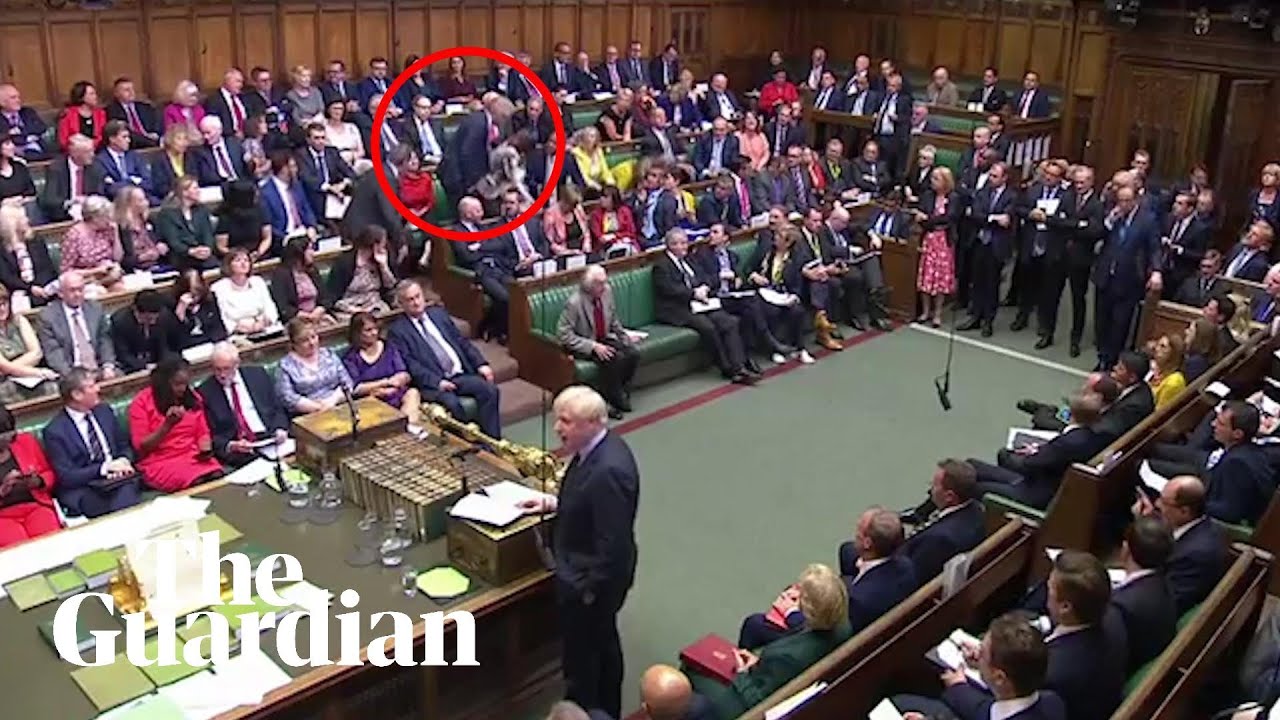 of the House of Commons and defected to the Liberal Democrats, the third party of British politics, while Johnson was mid-speech.Then, 21 Conservative MPs, including two former finance ministers and the grandson of Winston Churchill, voted with the opposition to wrest back control of the parliamentary agenda and try and delay Brexit, for which they were promptly expelled from the party. “This is not how any of us expected our careers in the Conservative Party to end,” said former Conservative minister Sam Gyimah, before adding that he was “proud” of his role in helping to halt a “damaging” no-deal Brexit.
Compare and contrast such behavior with that of the congressional Republican Party, which has been shamefully complicit in all of Trump’s open bigotry, dishonesty, corruption, and authoritarianism.
Take the U.S. Senate, where Trump’s former GOP opponents have either left the scene or rolled over. John McCain is dead; Bob Corker and Jeff Flake have retired; Mitt Romney likes to issue pained statements but little else; Ben Sasse long ago went quiet online; and Lindsay Graham and Rand Paul have morphed from Trump critics to Trump apologists. Ted Cruz, whose father and wife were smeared and mocked by Trump, now hosts rallies with the president and gushes over his “achievements on behalf of ordinary Americans” and — don’t laugh — “strong stand against North Korea.”
In the House, Rep. Justin Amash quit the party after becoming the sole Republican to call for the president’s impeachment, but the rest of his (former) GOP colleagues have stayed in the party — and stayed silent. Racist tweets about “the Squad”? See no evil. Crying kids separated from their parents at the border? Hear no evil. Condemning American Jews as “disloyal” and Latino immigrants as invaders? Speak no evil.
These are the spineless sycophants who have allowed a former reality TV star to hijack their Grand Old Party.
Not that there hasn’t been a slow trickle of converts, including former Republicans and never-Trumpers like Joe Walsh, Max Boot, Jennifer Rubin, Justin Amash, Jeff Flake, Bill Kristol, Michael Cohen, George Conway, and lately Anthony Scaramucci.
Fox to msnbc?! https://www.alternet.org/2019/08/why-are-establishment-dems-afraid-of-the-hard-left/ no lnx Why are establishment Dems afraid of the ‘hard left’? Written by Paul Rosenberg August 25, 2019 In my interview last week with political scientist Rachel Bitecofer, who predicted a 42-seat “blue wave” four months in advance, she also discussed the groundbreaking campaigns of Stacey Abrams and Beto O’Rourke, even though neither was elected. Neera Tanden, president of the Center for American Progress, offered a curious response on Twitter: “Stacey Abrams and Beto ran liberal campaigns, not hard left campaigns.” As Bitecofer replied, “I don’t advocate hard left campaigns, that’s not what my research argues.” She later added that “my thesis IS the Beto/Abrams turnout model, not something else.” Ideology wasn’t the issue she focused on — mobilizing base voters was. Tanden’s response is both curious and troubling because literally no one argues for “hard left” campaigns. As retired intelligence analyst James Scaminaci tweeted in the ensuing conversation: “Hard Left” is Marxists, Marxist-Leninist, Trotskyists, Leninists, Stalinists, Maoists, Spartacus League, Guevaras. Bernie, AOC, DSA, Warren, FDR ain’t “hard left.” If you use “HL,” you are grossly misinformed about left-wing politics. You might have missed the Cold War. In short, “hard left” is a bogeyman term so far as American politics is concerned — one meant to put Democrats constantly on the defensive, either cowering or fighting with each other. It recalls the worst days of McCarthyism. Which is why I responded: Whenever someone says, “hard left,” I hear “brainwashed.” Sorry. Repeating right-wing frames is a no-no. It’s as simple as that. Tanden’s hardly the only one to do this, but she’s the president of the Center for American Progress, and closely associated with the leadership of the Democratic Party. CAP’s Think Progress blog has caught right-wingers using this attack phrase for years — like this entry, noting Newt Gingrich using it to smear legendary PBS journalist Bill Moyers. Tanden should know better. Not in spite of being a close ally and longtime supporter of Hillary Clinton, but because of it. After all, the right-wing media has used the “hard left” label to attack Clinton since August 1992, when the American Spectator ran a tone-setting attack story: “The Lady Macbeth of Little Rock: Hillary Clinton’s hard-left past and present.” The term had no discernible content — there was nothing that it meaningfully pointed to — and that lack of content continues to this day. Yet it connoted something sinister and unyielding, something foreign, close-minded, intolerant and hidden. [AGENDA] Those connotations continue to this day, even while simply denoting something conservatives strongly dislike. Its meaninglessness is a feature, not a bug: It can tar anyone, for any reason — or no reason at all. Conservative media critic Brent Bozell (William F. Buckley’s cousin), called NPR “hard left” as part of “the MSNBC-NPR Alliance,” typified by Terry Gross interviewing Rachel Maddow. Conservative Washington Post blogger Jennifer Rubin used it to describe MSNBC’s evening opinion show lineup, three years before joining the network as a contributor after her movement’s bankruptcy gave us Donald Trump. (Maddow, targeted on both occasions, has repeatedly encouraged moderates Claire McCaskill and Amy Klobuchar to run for president, so they’re probably fair game, too.)== Omidyar confirmed the donation via Twitter: “I think Trumpism is dangerous,” he wrote. “So I’m personally supporting @NeverTrumpPAC, a rare political contribution during extreme times.”== https://en.wikipedia.org/wiki/Stop_Trump_movement Stop Trump movement, also called the anti-Trump, Dump Trump, or Never Trump movement,[1] was the informal name for the effort on the part of some Republicans and other prominent conservatives to prevent front-runner and now President of the United States Donald Trump from obtaining the Republican Party presidential nomination, and, following his nomination, the presidency, for the 2016 United States presidential election. Although Trump's campaign drew a substantial amount of criticism, Trump received 90% of the GOP vote, while Clinton won 89% of Democratic voters.[2] Moreover, Trump was supported by 80% of Republican members of Congress in the general election.[3] Following Trump's election in November 2016, some in the movement refocused their efforts on defeating Trump in 2020.[4]Donald Trump entered the Republican primaries on June 16, 2015, at a time when Governors Jeb Bush and Scott Walker and Senator Marco Rubio were viewed as the early frontrunners.[5] Trump was considered a longshot to win the nomination, but his large media profile gave him a chance to spread his message and appear in the Republican debates.[6][7] By the end of 2015, Trump was leading the Republican field in national polls.[8] At this point some Republicans, such as former Mitt Romney adviser Alex Castellanos, called for a "negative ad blitz" against Trump,[9] and another former Romney aide founded Our Principles PAC to attack Trump.[10] After Trump won the New Hampshire and South Carolina primaries, many Republican leaders called for the party to unite around a single leader to stop Trump's nomination.[11] The Never Trump movement gained momentum following Trump's wins in the March 15, 2016, Super Tuesday primaries, including his victory over U.S. Senator Marco Rubio in Florida.[12][13][14][15] After U.S. Senator Ted Cruz dropped out of the race following Trump's primary victory in Indiana on May 3, 2016, Trump became the presumptive nominee, while internal opposition to Trump remained as the process pivoted towards a general election.[16] Following unsuccessful attempts by some delegates at the Republican National Convention to block his nomination, Trump became the Republican Party's 2016 nominee for President of the United States on July 18, 2016. Some members of the Never Trump movement endorsed alternative candidates in the general election, such as Democratic nominee Hillary Clinton, Libertarian nominee Gary Johnson, independent conservative Evan McMullin, and American Solidarity Party nominee Mike Maturen.[17][18]Research on the Never Trump movement shows that Mormon and female Republicans were the most likely groups to oppose Trump's candidacy while non-Mormon and male Republicans were the most supportive.[3] 1Erickson meeting2Efforts2.1By political organizations2.2By Republican delegates2.3By individuals2.3.1Republicans who left the Party in opposition to the Trump Administration3General election opposition4Reactions5Developments following the election6See also7ReferencesErickson meetingOn March 17, 2016, notable conservatives under the leadership of Erick Erickson met at the Army and Navy Club in Washington D.C. to discuss strategies for preventing Trump from securing the presidential nomination at the Republican National Convention in July. Among the strategies discussed were a "unity ticket",[19] a possible third-party candidate and a contested convention, especially if Trump did not gain the 1,237 delegates necessary to secure the nomination.[20]The meeting was organized by Erick Erickson, Bill Wichterman, and Bob Fischer. Around two dozen people attended.[21][22] Consensus was reached that Trump's nomination could be prevented, and that efforts would be made to seek a unity ticket, possibly comprising U.S. Senator Ted Cruz and Ohio Governor John Kasich.[21]Efforts[edit]By political organizations[edit]Our Principles PAC and Club for Growth were involved in trying to prevent Trump's nomination. Our Principles PAC spent more than $13 million on advertising attacking Trump.[23][24] The Club for Growth spent $11 million in an effort to prevent Trump from becoming the Republican Party's nominee.[25]By Republican delegates[edit]In June 2016, activists Eric O'Keefe and Dane Waters formed a group called Delegates Unbound, which CNN described as "an effort to convince delegates that they have the authority and the ability to vote for whomever they want."[26][27][28] The effort involved the publication of a book, Unbound: The Conscience of a Republican Delegate by Republican delegates Curly Haugland and Sean Parnell. The book argues that "delegates are not bound to vote for any particular candidate based on primary and caucus results, state party rules, or even state law."[29][30]Republican delegates Kendal Unruh and Steve Lonegan led an effort among fellow Republican delegates to change the convention rules "to include a 'conscience clause' that would allow delegates bound to Trump to vote against him, even on the first ballot at the July convention."[31] Unruh described the effort as "an 'Anybody but Trump' movement". According to The Washington Post, Unruh's efforts started with a conference call on June 16 "with at least 30 delegates from 15 states". Regional coordinators for the effort were recruited in Arizona, Iowa, Louisiana, Washington and other states.[32] By June 19, hundreds of delegates to the Republican National Convention calling themselves "Free the Delegates", had begun raising funds and recruiting members in support of an effort to change Party convention rules to free delegates to vote however they want – instead of according to the results of state caucuses and primaries.[33] Unruh, a member of the convention's Rules Committee and one of the group's founders, planned to propose adding the "conscience clause" to the convention's rules effectively unhinging pledged delegates. She needed 56 other supporters from the 112-member panel, which determines precisely how Republicans select their nominee in Cleveland.[34] However, the Rules Committee voted down, by a vote of 84–21, a move to send a "minority report" to the floor allowing the unbinding of delegates, thereby defeating the "Stop Trump" activists and guaranteeing Trump's nomination. The committee then endorsed the opposite option, voting 87–12 to include rules language specifically stating that delegates were required to vote based on their states' primary and caucus results.[35]By individuals Early in March 2016, Mitt Romney, the 2012 Republican presidential nominee, directed some of his advisors to look at ways to stop Trump from obtaining the nomination at the Republican National Convention (RNC). Romney also gave a major speech urging voters to vote for the Republican candidate most likely to prevent Trump from acquiring delegates in state primaries.[38] A few weeks later, Romney announced that he would vote for Ted Cruz in the Utah GOP caucuses. On his Facebook page, he posted "Today, there is a contest between Trumpism and Republicanism. Through the calculated statements of its leader, Trumpism has become associated with racism, misogyny, bigotry, xenophobia, vulgarity and, most recently, threats and violence. I am repulsed by each and every one of these."[39][40][41] Nevertheless, Romney said early on he would "support the Republican nominee," though he didn't "think that's going to be Donald Trump."[42]At a luncheon in February 2016 attended by Republican governors and donors, Karl Rove discussed the danger of Trump securing the Republican nomination in July, and that it may be possible to stop him, but that there was not much time left.[36][37]U.S. Senator Lindsey Graham shifted from opposing both Ted Cruz and Donald Trump, to eventually supporting Cruz as a better alternative to Trump. Commenting about Trump, Graham said "I don't think he's a Republican, I don't think he's a conservative, I think his campaign's built on xenophobia, race-baiting and religious bigotry. I think he'd be a disaster for our party and as Senator Cruz would not be my first choice, I think he is a Republican conservative who I could support."[43][44] In May, after Trump became the presumptive nominee, Graham announced he would not be supporting Trump in the general election, stating "[I] cannot, in good conscience, support Donald Trump because I do not believe he is a reliable Republican conservative nor has he displayed the judgment and temperament to serve as Commander in Chief."[45]In October 2016, some individuals made third-party vote trading mobile applications and websites to help stop Trump; for example a Californian that wants to vote for Clinton will instead vote for Jill Stein, and in exchange a Stein supporter in a swing state will vote for Clinton.[46] The Ninth Circuit Court of Appeals in the 2007 case Porter v. Bowen established vote trading as a First Amendment right.Former Republican Presidents George H.W. Bush and George W. Bush both refused to support Trump in the general election.[47][48]Republicans who left the Party in opposition to the Trump Administration[edit]Several prominent Republicans have left the party in opposition to actions taken by the Trump administration.Joe Scarborough (Morning Joe)[49]George Will (conservative columnist)[50]Max Boot (conservative columnist)[51]Richard Painter (Bush ethics lawyer)[52]Steve Schmidt (GOP strategist, top W. Bush aide)[53]Jennifer Rubin (Right Turn blog for Washington Post)[54]General election oppositionSee also: List of Republicans who opposed Donald Trump presidential campaign, 2016 On May 3, 2016, one of the biggest anti-Trump groups, the "Never Trump PAC", circulated a petition to collect the signatures of conservatives opposed to voting for Donald Trump in the 2016 presidential election.[61][62] As of August 19, 2016, over 54,000 people had signed the petition.[63] Gary Johnson's campaign in the Libertarian Party attracted attention as a possible vehicle for the Stop Trump movement's votes in the general election after Trump became the Republican Party's presumptive nominee.[64][65][66] In late May, Craig Snyder, a former Republican staffer, launched the "Republicans For Hillary PAC", "aimed at convincing Republicans to choose Hillary Clinton over [...] Donald Trump in November."[67] Also, the grassroots effort, called "Republicans for Clinton in 2016", or R4C16, joined the effort in defeating Trump.[68]Trump was widely described as the presumptive Republican nominee after the May 3 Indiana primary,[16] notwithstanding the continued opposition of groups such as Our Principles PAC.[55] Many GOP leaders endorsed Trump after he became the presumptive nominee, but other Republicans looked for ways to defeat him in the general election.[56] Stop Trump members such as Mitt Romney, Eric Erickson, William Kristol, Mike Murphy, Stuart Stevens, and Rick Wilson pursued the possibility of an independent candidacy by a non-Trump Republican.[56] Potential candidates included Senator Ben Sasse, Governor John Kasich, Senator Tom Coburn, Congressman Justin Amash, Senator Rand Paul, retired Marine Corps General James Mattis, retired Army General Stanley McChrystal, former Secretary of State Condoleezza Rice, businessman Mark Cuban, and 2012 Republican nominee Mitt Romney.[56][57] However, many of these candidates rejected the possibility of an independent run, pointing to difficulties such as ballot access and the potential to help the Democratic candidate win the presidency.[56] One potential strategy would involve an independent candidate gaining enough electoral votes to deny a majority to either of the major party candidates, sending the three presidential candidates with the most electoral votes to the U.S. House of Representatives under procedures established by the Twelfth Amendment.[58][59] Some anti-Trump Republicans stated that they would vote for Hillary Clinton in the general election.[60]William Kristol, editor of The Weekly Standard, promoted National Review staff writer David A. French of Tennessee as a prospective candidate.[69][70][71] French opted not to run.[72][73] On August 8, Evan McMullin, a conservative Republican, announced that he would mount an independent bid for president, with support of the Never Trump movement.[74] McMullin was backed by Better for America, a Never Trump group,[75] and was supported by former Americans Elect CEO Kahlil Byrd and Republican campaign-finance lawyer Chris Ashby.[74]ReactionsReactions to the Stop Trump movement were mixed, with other prominent Republicans making statements in support of preventing Trump from receiving the Republican nomination. Following his withdrawal as a candidate for President, U.S. Senator Marco Rubio expressed hope that Trump's nomination could be stopped, adding that his nomination "would fracture the party and be damaging to the conservative movement."[76]Republican National Committee chairman Reince Priebus dismissed the potential impact of Mitt Romney's efforts to block Trump at the convention.[38] Sam Clovis, a national co-chairman for Trump's campaign, said that he would leave the Republican Party if it "comes into that convention and jimmies with the rules and takes away the will of the people".[43] Ned Ryun, founder of conservative group American Majority, expressed concern about a contested convention, should Trump have the most delegates, but fail to reach the 1,237 necessary to be assured the nomination. Ryun speculated that a contested convention would result in Trump running as a third-party candidate, making it unlikely that Republicans would win the presidency in the November general election, adding that it would "blow up the party, at least in the short term".[77][78]New Jersey Governor Chris Christie expressed his opinion that the efforts to stop Trump would ultimately fail. Relatively shortly after his endorsement of Trump, he criticized the people who condemned his endorsement, including the Stop Trump movement, stating that his critics had yet to support any of the remaining GOP candidates. He said, "I think if you're a public figure, you have the obligation to speak out, and be 'for' something, not just 'against' something. ... When those folks in the 'Stop Trump' movement actually decide to be for something, then people can make an evaluation ... if they want to be for one of the remaining candidates, do what I did: Be for one of the remaining candidates."[79]Trump said that if he were deprived of the nomination because of falling just short of the 1,237 delegates required, there could be "problems like you've never seen before. I think bad things would happen" and "I think you'd have riots."[15][80][81] Trump made prior comments suggesting that he might run as an independent candidate if he were not to get the Republican nomination.[38]Roger Stone, a political consultant who served as an advisor for Donald Trump's 2016 presidential campaign, and who remains a "confidant" to Trump,[82][83] put together a group called "Stop the Steal" and threatened "Days of Rage" if Republican party leaders tried to deny the nomination to Trump at the Republican National Convention in Cleveland.[84][85] Stone also threatened to disclose to the public the hotel room numbers of delegates who opposed Trump.[85]Developments following the election[edit]After Trump won the election, two Electoral College electors launched an effort to convince fellow electors who are allocated to Trump not to vote for him.[86]On December 11, Jim Himes, a member of the House of Representatives, wrote on Twitter that the Electoral College should not elect Trump. "We're 5 wks from Inauguration & the President Elect is completely unhinged. The Electoral College must do what it was designed for."[87] On December 12, in an interview on CNN's New Day, Himes said that he was troubled by several actions by the president-elect. The issue that "pushed me over the edge" was Trump's criticism of the CIA and the intelligence community. The Congressman did admit that Trump won "fair and square," but he said that Trump proved himself unfit for public office. He cited the intentions behind the creation of the electoral college and he argued that it was created for an instance such as the election of Trump.[88]In the end, efforts to persuade more electors to vote against Trump ultimately failed, and Trump won 304 electors on December 19. Trump's electoral lead over Clinton even grew because a larger number of electors defected from her: Trump received 304 of his 306 pledged electors, Clinton 227 of her 232.[89]Jonah Goldberg, in an article titled Never Trump Nevermore, stated:I'm going to call 'em like I see 'em and wait and see if I was wrong about Trump... The thing is: Never Trump is over. Never Trump was about the GOP primary and the general election, not the presidency. The Left wants to claim it must be a permanent movement, denying the legitimacy of Trump's election forever, or we were never serious. Well, that's not what we — or at least I — signed up for. ...I'll say it again: I'm going to call 'em like I see 'em and wait and see if I was wrong about Trump. So far, I've said that most of his cabinet picks have been a pleasant and welcome surprise. But he's also done plenty of things that make me feel like I had him pegged all along. We only have one president at a time — and the guy isn't even president yet. I'll give him a chance. But I won't lie for him either. [90]See also