nunberg, sam
---
1/20 primary on talk radio --> djt Mark Levin nuggets
NTBCW SAM NUNN
GOON SLUSH FUND 6 26
ELIOT SPITZER?
==
sued for defam 10m$ djt
intro jok at trump twr mtg, fired for racist posts
https://www.projectveritas.exposed/sam-nunberg
:{===
---
AN 6 26
Ever since President Donald Trump created a $1.8 billion slush fund for those among his supporters who claim to have been persecuted by the government, a host of controversial characters have applied for benefits.
“The $1.8 billion fund was created by the Justice Department in a settlement with Trump in his $10 billion lawsuit against the IRS over the leak of his tax returns,” wrote Forbes journalist Sara Dorn on Sunday. “Trump dropped the case in return and also agreed to drop two separate civil claims related to the FBI raid on Mar-a-Lago and investigation into Russian interference in the 2016 election. The money would come from a pool of taxpayer funds Congress established in 1956 to pay people who won lawsuits against the federal government.”
Dorn added, “Trump has repeatedly claimed he wasn’t involved in creating the fund and that his lawyers negotiated it. He defended it in a post on Truth Social last week, claiming he ‘gave up a lot of money’ in allowing it to move forward, but instead he is ‘helping others, who were so badly abused by an evil, corrupt, and weaponized Biden Administration, receive, at long last, JUSTICE!’”
The list of Trump supporters seeking payouts include former Department of Health and Human Services spokesperson Michael Caputo, former Rep. George Santos (R-NY), political consultant Roger Stone, MyPillow CEO Mike Lindell, former Trump lawyer Michael Cohen, lawyer Mark McCloskey, former Mesa County clerk Tina Peters, former Proud Boys leader Enrique Tarrio, Jan. 6th rioter Adam Johnson, former Illinois governor Rod Blagojevich (D-IL), former Trump campaign aid Sam Nunberg, anti-abortion activists, Moms for Liberty, Michigan fake electors and numerous additional Jan. 6th insurrectionists.
The large list of applicants are there for a number of reasons. Lindell, Peters, Tarrio, Johnson, the Michigan fake electors and the Jan. 6th insurrectionists all tried to help Trump overturn his democratic loss in the 2020 presidential election. Caputo and Nunberg claim to have been wronged during the investigation into Trump’s ties to the Russian government. Santos and Blagojevich are elected officials who resigned in disgrace due to corruption scandals unrelated to Trump. McCloskey pleaded guilty to misdemeanor charges after he and his wife waved guns at peaceful Black Lives Matter protesters. Still others on the list have various claims of being persecuted by the federal government for their beliefs.
In the end, all of them may be disappointed. On Friday a federal judge in Virginia has temporarily blocked disbursement of the $1.8 billion fund on the grounds that the fund may be illegal. On June 12 the Trump administration will need to appear before the court to prove that the $1.8 billion fund does not constitute a form of self-dealing.
"Because full briefing of the issue will enhance the ability of the Court to make a sound decision, plaintiffs Expedited Motion, is DENIED and defendants' request for additional time is GRANTED; however, to ensure that no funds are irreversibly disbursed from the Anti-Weaponziation,” Brinkema wrote. “Fund while plaintiffs' Motion is pending it is hereby ORDERED that defendants be and are ENJOINED from taking any further action pursuant to the creation or operation of the Anti-Weaponization Fund, which includes the transferring of money to the Fund; the consideration of any claims submitted to the Fund; and the dispersing of any funds from the Fund…’ the order says.”
The judge added in a footnote, ‘It is important that the status quo be maintained until plaintiffs' pending Motion has been resolved, especially as plaintiffs allege in their Expedited Motion that defense counsel 'was unable to provide assurances of how long [the] status quo would last' and declined plaintiffs' 'request that the government commit to not transferring money to the Fund or processing or paying claims until at least June 19 to allow for less compressed briefing in this case.’”
---
sam-nunberg-donald-trump-217697
first, Sam Nunberg made plans to meet me for lunch, but canceled at the last minute. So now we’ve made plans for dinner at his favorite Vietnamese spot near his Upper East Side apartment, but when he arrives 20 minutes late, Nunberg says he has already eaten at the same restaurant earlier in the day, and that he is having dinner with his mother later, so no food for him, just one Thai iced coffee after another that he cuts with water from his water glass.
Words tumble out of Nunberg in a torrent, not always cohering into sentences, and occasionally contradicting something he said a few minutes ago. At our nondinner, he apologies for his ADD as he keeps going outside to vape.
:{:{Sam Nunberg was a name known only to a small coterie of political journalists until March 5, when it suddenly became inescapable. In a media barrage that will forever be known as The Full Nunberg, the former Donald Trump campaign aide streaked across the media landscape like a falling satellite. First he told The Washington Post that he had been subpoenaed by special counsel Robert Mueller but wouldn’t show up. He then phoned in live to MSNBC’s Katy Tur, telling her that he thought it would be funny if Mueller arrested him for contempt of court and that “Trump may very well have” colluded with Russia during the election.}:
Then he called CNN to assert that Trump didn’t have anything to do with Russia, then CNN again and said that maybe Trump did, actually. He told POLITICO that Trump couldn’t have colluded because he “can’t keep his fucking mouth shut.” It didn’t end there. He repeated variations of his claims on the local news station NY1, then on MSNBC again, where a fellow panelist seemingly convinced him live on air that he would be looking at serious jail time if he didn’t comply with the subpoena, and finally CNN again where host Erin Burnett asked point-blank if Nunberg was drunk. In the meantime, there were interviews with New York, The Atlantic, Vox, The Associated Press and The New York Times.}:
Political Twitter went nuts. In newsrooms across America, Nunberg vanished from one screen in the TV bank only to reappear on another. Friends feared they were watching a spectacular flame-out, someone having a nervous breakdown in public and determined to go out in a blaze of glory. To Nunberg—or at least to hear him tell it now—it was all carefully choreographed. He was perfectly in control, seizing the chance for time in the spotlight, an out-in-the-cold political consultant cleverly leveraging the media’s hunger for any inside dope about Trump.
Our dinner ended up lasting nearly four hours, and at the end I’m still not sure whether his accomplishment was a triumph or an embarrassment. And at a time when Trump is president—a national spectacle that Nunberg himself helped engineer—I’m also not sure it matters anymore. There’s no question, however, it was a perfect moment for our political-media age: Someone willing to bungee jump without making sure that the knot was tight enough, and a world thirsty to know what he knew about a similarly reckless administration. Was he a crazy man, or a chess master?
***
Everyone who has encountered Sam Nunberg has a theory about him, and nobody is quite sure which theory is right, in part because Nunberg himself is as unreliable a narrator as you can find. He’s known for making up stories to tell the press—and then making up stories about those stories, so coverage turns into a hall of mirrors whose only occupant appears to be Nunberg, or (in better times) his political client.
What drew Nunberg to politics, and to Trump, was Roy Cohn. The actual Cohn was a knife fighter of the legal world, a mentor to the young Trump who inspired the mogul’s punch-back-harder, never-back-down political style. But Nunberg is talking about the Cohn of Angels in America, the one portrayed by Al Pacino, especially the part where he tells his young protege how he would have pulled the switch to execute Ethel Rosenberg himself if he could have—how he leaned on the judge in her espionage case to put that “sweet unpreposessing woman, two kids, boo-hoo-hoo, reminded us all of our little Jewish mamas” to death.
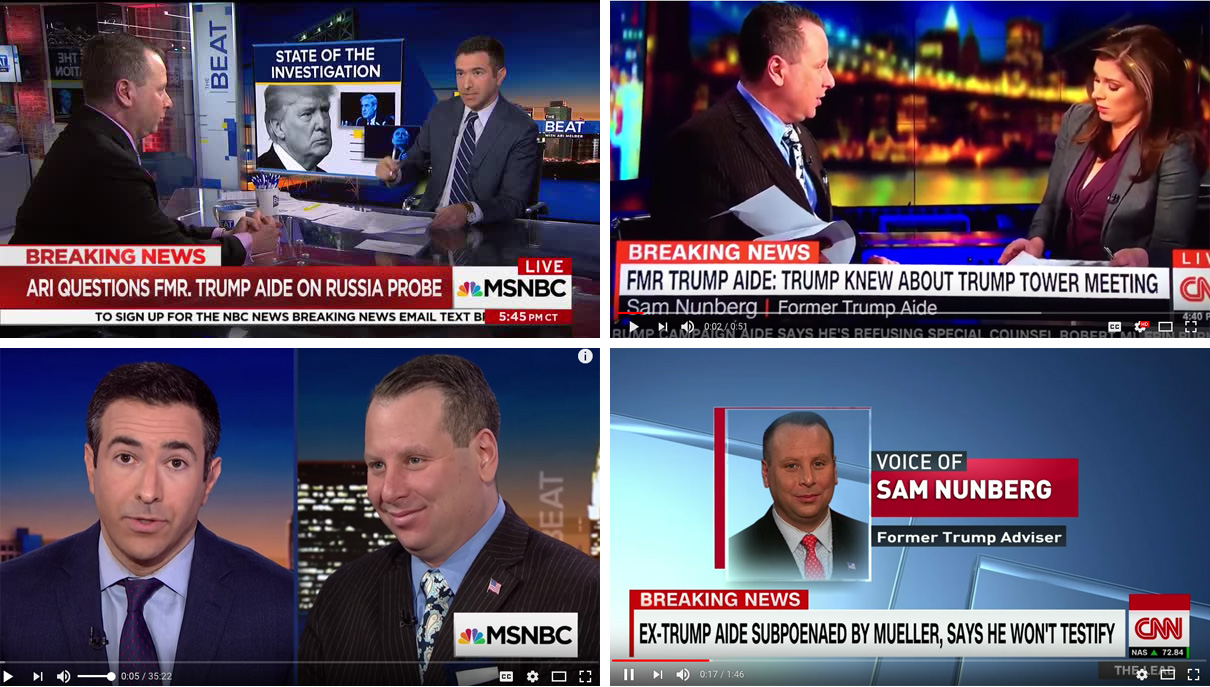
The Full Nunberg. | Youtube
“Was it legal? Fuck legal,” Nunberg says, jabbing his finger in the air and slowing down for a second in his best Pacino impression. “Am I a nice man? Fuck nice! They say terrible things about me in The Nation? Fuck The Nation!You want to be nice or you want to be effective?! You want to make the law, or be subject to it? Choose!”
Nunberg pauses, and resumes his own cadence. “Now, is that good, is that bad, I don’t know, whatever,” he says. “To me that just showed hard grit, tough, you can tell Roy Cohn, obviously Jewish, you know, tough guy, fighter, doesn’t fuck around, was trying to work the system for himself.”
“The idea that that was depicted as being bad,” he says, “that to me was ironic, because by the way, that’s the way the sauce is made. It was like almost Machiavellian to me. But it’s an out-front Machiavelli. He was open about it. On the one hand, you don’t want your enemy to see you coming, but sometimes you want people to think of you as a crazy man.”
The person sitting across from me appears to be the opposite of the diminutive, tightly focused Cohn. There’s something hard to pin down about Nunberg. On one hand, he looks older than his 36 years, dark circles under his eyes suggesting sleepless nights, but on the other he can seem a bit like a child inflated to adult size. Cohn was a ruthlessly successful lawyer who divided his time between New York, Washington and a country house in Connecticut. Nunberg just moved out of his parents’ house. Cohn was a killer; Nunberg, as former Trump campaign aide Michael Caputo put it, “is not a backstabbing soulless climber in an arena where that is almost required.” (One friend of Nunberg’s described him more as “a yenta,” someone who thrives on political gossip, true or not, calling friends in the political world dozens of times a day to find out the latest.) Cohn was tanned and dandyish, an aficionado of the plastic surgeon’s scalpel; Nunberg is dressed plainly, in blue jeans and a sweater, though he does plan to stop by the tanning salon before it closes.
“I like to say I am only bad to three people in my life,” Nunberg says. “People that are disloyal to me, people that hurt my friends. Well, OK, four people. People that are disloyal to me, people that hurt my friends, people that hurt my clients, people that my clients hire me to hurt, and myself occasionally, unfortunately.”
He pauses for a moment
“OK, so that’s five. Those are the five people I am bad to.”
***
Sam Nunberg first crossed paths with Donald Trump on April 2, 1989. It was WrestleMania V. Nunberg’s father is an attorney, and worked with Gerald Schrager, Trump’s longtime real estate attorney and adviser. They were sitting behind Donald and Ivana, and Donald moved the Nunbergs so he could get into a photo shot with some dignitary sitting on the other side of the ring. Nunberg was then a student at Ramaz, an elite private Jewish school on the Upper East Side that counts Michael Mukasey and Philippe Reines as alumni. His mother was a corporate attorney at the white-shoe law firm Wachtell, Lipton, and counted Bain Capital as one of her clients. They were Democrats until the Clinton era—Nunberg interned with Upper West Side liberal lion Jerry Nadler—when the household became, in Nunberg’s words, “Clinton-haters.” He started listening to Mark Levin on the radio.
After college, inspired he said, by the movie Men in Black, Nunberg enrolled in Touro Law School, a fourth-tier, $40,000-a-year law school on Long Island. There he restarted the law school’s Federalist Society, using it to build up a network in conservative politics. When the 2008 campaign rolled around, even though his father had done legal work for members of the Rudy Giuliani administration when they left City Hall, Nunberg volunteered for his rival in the Republican primary, Mitt Romney.
“Mitt was the most conservative candidate in the race. Frankly, he looked the best out of everybody,” Nunberg says. “And going to Touro Law School, if I went to go work for the Rudy campaign, I would be licking envelopes for the students at NYU Law School. I hate to be, but you know what I mean.”
He traveled to Iowa with the Romney campaign, where, he says, he and a couple of other campaign aides concocted a stunt: They would mail anonymous letters to Iowa pastors, warning them that the IRS would come after them if they endorsed Mike Huckabee. The letters were sent from Missouri to make them less traceable.
“It was the first time I made the Drudge Report!” Nunberg says now with evident pride.
In Iowa, he met Jay Sekulow, who leads the American Center for Law and Justice, a nonprofit founded by Pat Robertson to advocate for Christian values. (Sekulow, a right-wing messianic Jew who also hosts a radio show, is now on Trump’s personal legal team.) Sekulow hired him for the group’s fledgling New York operation, and in 2010, when a Manhattan developer named Sharif El-Gamal attempted to build an Islamic community center in lower Manhattan, Nunberg got his first chance to kick up a dirt storm on the political scene.
The issue was the “Ground Zero Mosque,” a building that was neither at Ground Zero nor a mosque. Anti-Islamic firebrands like Pamela Geller seized on the issue, and tried to whip up public anger at the idea of an Islamic anything near the site of World Trade Center attacks. At ACLJ, there was some hesitancy about getting involved in the issue, and “I was like, ‘Are you kidding me? This is going to be a national fucking issue! It is going to be an international issue!’” Nunberg says.
At a Landmarks Preservation Commission hearing, Nunberg represented a fireman who was opposed to the construction of the center, and he introduced testimony from his own uncle, who lived near the site. Building the center “would be like removing the sunken ship in Pearl Harbor to erect a memorial to the Japanese kamikazes killed in the attack," Nunberg told me with a big laugh. He was quoting himself. “It became an international soundbite!” (This is true—the soundbite landed Nunberg on NPR, was picked up by a number of newspapers and became part of the official talking points in opposition to the project.)
There was a Republican primary for governor going on in New York, and Nunberg decided to see who’d be willing to take it on as a campaign issue. He says he took the story to the front-runner, former Congressman Rick Lazio, but his campaign team was ambivalent about it. Then he took it to Carl Paladino, a Buffalo developer running a long-shot campaign, and someone who had promised to take a baseball bat to Albany’s entrenched political class. Paladino seized on the issue immediately, promising to use eminent domain to prevent the building’s construction. He won the primary by 24 points.
As Nunberg tells the story, he kept going, and took the issue national. He says he began calling the White House desks of news organizations like AP and Reuters from an undisclosed number, leaving harassing phone messages asking, “You chicken shits, when are you going to ask [White House press secretary Robert] Gibbs about the ground zero mosque?”
Eventually someone did, and Gibbs responded that the White House didn’t want to get involved in local decision-making. But later, President Barack Obama did mention it. At a gathering at the White House the Friday evening before the Islamic holy month of Ramadan, Obama said he believed "Muslims have the same right to practice their religion as everyone else in this country. That includes the right to build a place of worship and a community center on private property in lower Manhattan.”
“It was at the Iftar dinner!” Nunberg says. “Are you fucking kidding me?! That was like manna from heaven.”
It is hard to know how much of this account—or the Huckabee letters, or meeting Trump at WrestleMania—is, not to put too fine a point on it, bullshit. The checkable facts largely check out, but Nunberg is known as someone willing to traffic in untruths with reporters. “He likes to spread lies,” said one associate of Nunberg’s. “He loves to see some lie he told get into print. He thinks it’s hilarious.”
Most famously, he made up a story about Chris Christie fetching cheeseburgers for Trump on the campaign—an anecdote that made its way into The New Yorker and which he said was justified because “I despise Chris Christie. So I kept going around telling every reporter watch that fat-ass go buy hamburgers for Trump like a good little bitch.” (To try to track down the true story of the story is to enter that Nunberg hall of mirrors: He claims to have made up the story, but also, in his telling, it doesn’t count as making it up since it turned out to be true. A Christie spokesman vociferously denied the account, and the reporter who first brought the story to light, Ryan Lizza, then with the The New Yorker, stands by it and has denied Nunberg was his source, and for that matter, so has Nunberg.)
Nunberg tells me his favorite book is Trust Me, I Am Lying by former American Apparel media stuntman Ryan Holiday. “There is something about manipulating media that I love. It’s like Katy Tur said: ‘Who is Sam Nunberg? You gotta talk to him. Occasionally, he will give you something that is true, but usually you need to confirm it with three other people.’”
Still, he has limits.
“I have never, nor would I ever, lie to [Washington Post reporter Robert] Costa or to my Magela.”
I’m sorry—your who?
“My Magela. I call Maggie Haberman [of The New York Times] my Magela. You know, like Mamela. Maggie is like my aunt.”
He shrugged.
“I don’t know if she feels that way, actually.”
***
The person who really connected Nunberg with Trump is the man who he cites as his mentor: Roger Stone, the legendary dirty trickster of Republican politics, with a massive tattoo of Richard Nixon’s face across his back. Nunberg became enamored of Stone for appearing, at least, to have orchestrated the downfall of New York Gov. Eliot Spitzer. (Later, when Spitzer attempted a comeback run for New York City comptroller, Nunberg and Stone trolled him mercilessly, convincing a woman who claimed to operate a brothel that Spitzer frequented to run against him as a Libertarian, and bringing black socks—which Spitzer was said to keep on during his liaisons—to the victory night party of his opponent.) During the ground zero mosque controversy, he says, he met Stone at a bar during the New York state Republican convention. Stone, a longtime Trump adviser, was working for Paladino. That same summer, Trump offered to buy the site where the ground zero mosque was supposed to be built for $6 million, a move that was dismissed by the developer’s attorneys as a “cheap publicity stunt.”
Nunberg says it was Stone who arranged for him to meet Trump for the first time. It was 2011, and Stone and Jonny Daniels, a PR agent who counts Benjamin Netanyahu as among his clients, wanted Trump to visit Israel in the run-up to another possible presidential campaign. Nunberg told him about their family connection and about meeting him at WrestleMania years before, and Trump hired him as a political jack-of-all trades, printing out news articles, keeping an eye out for political gossip, doing research and writing, handling the press and later mapping out a way that Trump could run as an independent in 2012.
Until he was broomed out four years later, Nunberg never left.
Trump had been a clownish figure around New York for most of Nunberg’s childhood, someone more famous for talking about sex with Howard Stern than trying to stir up populist anger against the Washington swamp. Most people in the elite Upper East Side world of private schools and corporate law firms—the world Nunberg inhabited—rolled their eyes at the thought of Trump, if they thought of him at all. Nunberg, though, was intrigued by the brashness and the airbrushed glamour.
He started dressing like Trump in flashy suits and ostentatious ties. He watched how would-be presidents and potentates came to kiss the ring at Trump Tower, and how Trump dealt with critics. Nunberg says he and Stone started dictating tweets to Trump’s longtime assistant Rhona Graff, and Nunberg would map out on a spreadsheet a running tally of what Trump tweeted about to make sure his business and brands got enough airplay. When Jon Huntsman pointedly refused to supplicate himself before Trump like other rivals to the GOP nomination in 2012, Stone and Nunberg counseled Trump to go on the attack. “@JonHuntsman has zero chance of getting the nomination,” Trump tweeted. “Whoever said I wanted to meet him? Time is money and I don’t waste mine.”
“It blew up!” says Nunberg. “It was on ‘Entertainment Tonight,‘ it was in People Magazine. People were saying that Huntsman was Trump’s new Rosie.”
When no one believed that Trump would actually run for president, let alone could win, Nunberg believed. “To him, Donald Trump hung the moon,” Caputo said
Caputo, a veteran political adviser to Trump, looks at Nunberg with an almost older-brother like affection, and he gives Nunberg significant credit for helping lay out the themes and the approach to the campaign that would launch Trump to the White House. “His DNA was all over the Trump campaign. Corey [Lewandowski] may have set him up to win, and [Paul] Manafort got him through the convention and Kellyanne [Conway] got him over the finish line, but none of that would have happened if it weren’t for Sam.”
Nunberg says the idea of a border wall with Mexico was his, inspired by watching how Paladino and Lazio approached the idea of the ground zero mosque. “Well, I don’t know, maybe we need to let some of these people in, maybe we put some of them in the back of the line, maybe we do this, maybe we do that,” he said in his best impression of an immigration squish. “No, fuck that! We are building a wall and we are deporting them all. Trump’s a builder anyway. And you get Mexico to pay for it! It’s like one of his licensing deals!”
As it happened, Nunberg barely survived into the campaign. He lost his job with Trump in August 2015 when Business Insider published a series of racist Facebook posts Nunberg had written eight years before, including one in which he called Al Sharpton’s daughter a “n---!” Nunberg admits to writing them, and knows it was a mistake. He blames their excavation on Lewandowski, the former Trump campaign manager who he said had it in for him from the beginning.
Afterward, Nunberg fell into deep and lasting depression. He says he had trouble getting out of bed, and couldn’t read or work. He credits Steve Bannon with helping him get back on his feet by giving him a bit of work, as well as the GOP operative Arthur Schwartz.
“That was bad. That a very hard experience. And I wasn’t good to myself. I don’t want to get into it but I wasn’t. It took therapy, and it took help from other people,” he says, “and I will admit that. And there is nothing wrong with that. But I wasn’t good to myself. I wasn’t.”
Nunberg watched from the sidelines as the political animal he helped feed made it all the way to the White House. As the Russia investigation intensified, he was cut off from old friends like Bannon and Stone. And as the White House whipped through personnel changes, Nunberg, whose life is political gossip, found himself less and less in the know. He would occasionally appear on the record or on background in stories about Trump when the perspective of a “former campaign aide” was needed, but even those calls had begun to dry up.
***
When Nunberg was subpoenaed by Robert Mueller in the special counsel investigation into Russian meddling in the campaign, “It brought stuff back in. At the same time I was getting these calls [from bookers and reporters] and it is almost like I am manic.”
“So imagine, holy shit, I was called a low-level part-time consultant and suddenly I am pulling of one of the greatest media days of all time.”
He views March 5 as a form of therapy, and as an unqualified professional success
“This is a fact: When I did Ari Melber he won in total viewers and the demo. When I did Erin Burnett, she won in total viewers and the demo,” he said, reiterating a point he brought up to me repeatedly. (He later texted me, unprompted, with a screen grab of the ratings on the date in question.) “Did you notice there was one station I didn’t go on that day? Fox. You know why? They are the only ones that never invited me on before. That day, I had like eight invitations from them to come on different shows, and I can show them to you.”
Friends were convinced Nunberg was drunk on air, and were emailing and texting television producers and hosts to get him off. Burnett asked him about it on air, telling him that she could smell alcohol on his breath. “She says to me, ‘Are you on something?’ And you know what I wanted to say? ‘Yeah, I am on something—I am on your show, giving you ratings like you never had before.’”
The affair set off a round of media finger-wagging, with some political journalists suggesting—at the urging of Nunberg’s friends—that it was unethical to put him in front of all those television cameras. He was having some kind of psychotic break, he was drunk on the attention, or he was just plain drunk.
Nunberg isn’t having any of it. He’d had a drink the day before, he says, and went to his favorite bar afterward, the preppy New York enclave Dorrian’s Red Hand, but all he had that day was his antidepressant medication.
“People told me I was used and abused. I knew what I was doing. I could have stopped it any time if I wanted to,” he said. “I heard someone on TV say, ‘Oh Sam, he’s an unbelievable attention-seeker.’ There you are, sitting on fucking TV and you are telling me I am the attention-seeker.”
Nunberg thinks Trump probably appreciated his television tour—the brashness of it, for one, and the fact that he was able to command so much media attention for one night.
It was he said, a way to communicate with Trump, too. To say, “Why do I have to be drawn into your bullshit? I don’t do anything to you. I want you to be successful. You know, I have a weird relationship with him. Maybe one day I can, maybe one day not. I like him. Why do I have to be drawn into his bullshit?”
When Trump fired him, as Nunberg recounts it, he told him it wasn’t just the Facebook posts. He told Nunberg, “Every few months there is something new with you.”
{If Trump did indeed tell that to Nunberg,he was right. Even cast into the outer darkness of the Trumpian orbit, Nunberg sees himself as a political operative of the highest order, always hatching, or getting embroiled in, something new. “There aren’t that many people at my level, I can tell you that,” he said when asked about which current political professionals he admires. Like Trump, and like Cohn for that matter, Nunberg never forgets. It’s been 2½ years since he was fired, and he remains at war with anyone who he thinks slighted him, ever.}:
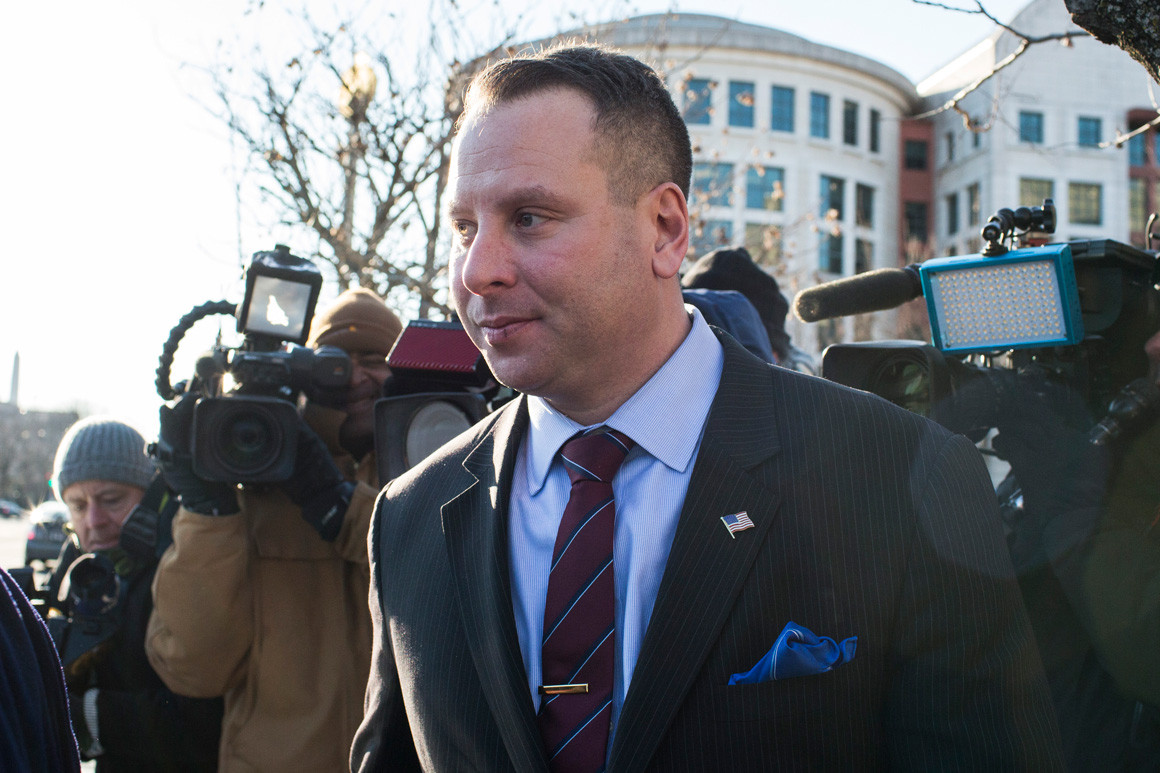
Trump campaign aide Sam Nunberg leaves the U.S. District Courthouse on March 9, 2018 in Washington, D.C. Nunberg appeared before a grand jury as part of Special Counsel Robert Mueller's probe. | Getty
When the Drudge Report published the news that Trump had named Brad Parscale his 2020 campaign manager, it was the same day that it was announced that Jared Kushner was losing his security clearance and that top Kushner aide Josh Raffel was leaving the White House. Nunberg, who considers Kushner a leftist who leaked to Drudge, sent an email to Drudge with the subject line, “Sorry Asshole.”
“Your little escapade failed,” Nunberg wrote. “The Parscale announcement doesn’t outdo Raffel leaving and your crush losing his security access. Fuck you sellout bitch hypocrite. You useless aggregator. Go shoot yourself up with more drugs. Warm regards, Sam.”
And Nunberg continues to be at war with Lewandowski. He told me with evident pride that he orchestrated the story of Lewandowski and Hope Hicks’ argument that landed on Page Six in New York Post. “We are like high school mean girls. The whole Trump circle. We fight and we try to kill each other and then some of us make up in a week and some of us don’t and some of us will always hate each other.”
Trump and Nunberg haven’t talked since December 2015, Nunberg says. That’s when Gawker published Trump’s cellphone number, and Trump accused Nunberg of leaking it. (Nunberg thinks Lewandowski did it just to undermine him, so that Trump would be forced to abandon his cellphone and Nunberg would be unable to communicate with him.) He wrote Trump a letter after he was elected, telling him how proud he was of the president. Trump wrote a nice note back.
“I said a lot of bad things that day when I was stressed out [on television.] He did give me a lot of chances, and if it was up to him I would be on that campaign. He is not a bad guy. He is actually a sweet guy, frankly. He has a heart.”
Caputo says all of the people from the early of days of the Trump for president gambit are “like an island of misfit toys. Sam is the jack-in-the-box.
“He left his heart in Trump Tower,” Caputo said. “I just hope he finds it someday.”
Unlike some others who fell out of Trump’s orbit, Nunberg has nothing to fall back on—no job on Wall Street, no Kennedy School post waiting for him. He can’t, or won’t, leverage his former access to the White House to get work. He has a small consulting business that has only three clients for now, all of whom he declined to name. Nunberg listens to Preet Bharara’s podcast to find out what’s going on in the Russia investigation—and if he gets wrapped up in it further, it will cost him tens of thousands of dollars. Someone who just got back on his feet could easily find himself knocked off them again, and his star turn before the klieg lights doesn’t appear to have helped matters much.
The lure of those lights, however, is not something he has been able to avoid. In fact, Nunberg’s media tour has slowed down only slightly since that Monday. He was on Ari Melber the next day, and ABC radio, and CNN, and was fielding requests throughout our conversation. They get less and less attention though, just another talking head talking his way through the news of the day. After his star turn digging in against Mueller, he quickly reversed himself and said he would in fact cooperate with the special counsel.
Our dinner, such as it was, ended sometime around 10 p.m. He kept checking the mirror, wondering if he needed to get to the tanning salon, if his face was too red for TV. His mother kept calling, and he kept on pushing back their dinner, eventually canceling it, saying he was being interviewed for a profile. “Why don’t you shut that stuff down?” she wanted to know. Eventually he had to go. The tanning salon was about to close, and he needed one more turn under the lights.
---
ggl 3 25
[### Sam Nunberg

Ballotpedia
https://ballotpedia.org › Sam_Nunberg](https://ballotpedia.org/Sam_Nunberg)
Sam Nunberg is a Republican policy analyst. He was an advisor to Donald Trump's 2016 presidential campaign. Nunberg was let go from the campaign staff in ...
[### Colbert Breaks Down Sam Nunberg's Breakdown

Vanity Fair
https://www.vanityfair.com › Hollywood › sam nunberg](https://www.vanityfair.com/hollywood/2018/03/who-is-sam-nunberg-interviews-cnn-msnbc-mueller-russia-stephen-colbert?srsltid=AfmBOopS7P0SWEgv8KF6bjP1Ka7Q_t3Ga4ct7dszXMMP721SzjlQzW7I)
Mar 6, 2018 — Colbert Breaks Down Sam Nunberg's Breakdown: “You Know Mueller Can Arrest You, Right?” “Nunberg took over cable news like a car chase,” Colbert ...
[### Sam Nunberg | FRONTLINE

PBS
https://www.pbs.org › Home › Interviews](https://www.pbs.org/wgbh/frontline/interview/sam-nunberg/)
Sam Nunberg is a political affairs consultant who served as an adviser to Donald Trump's 2016 presidential campaign.
[### Six Takeaways from Sam Nunberg's Big Day Out

The New Yorker
https://www.newyorker.com › News › Donald Trump](https://www.newyorker.com/news/our-columnists/six-takeaways-from-sam-nunbergs-big-day-out)
Mar 6, 2018 — 1. It was all a stunt. · 2. Nunberg will end up talking to Mueller's investigators. · 3. Stone is in the soup. · 4. Nunberg can't get his Trump- ...
Missing: breakdown | Show results with: breakdown
[### Sam Nunberg episode marks the dawn of Mueller's March ...

CNN
https://www.cnn.com › 2018/03/06 › politics › sam-nu...](https://www.cnn.com/2018/03/06/politics/sam-nunberg-robert-mueller-investigation/index.html)
Mar 6, 2018 — A staggering, reality TV-style meltdown of short-lived Trump campaign adviser Sam Nunberg on Monday, played out in a batch of cable news interviews.
[### Sam Nunberg Is Still Talking

Politico
https://www.politico.com › story › 2018/03/23 › sam-n...](https://www.politico.com/magazine/story/2018/03/23/sam-nunberg-donald-trump-217697)
Mar 23, 2018 — The actual Cohn was a knife fighter of the legal world, a mentor to the young Trump who inspired the mogul's punch-back-harder, never-back-down ...
[### I Was Ready To Hurt Sam Nunberg. Instead, I Helped Him.

BuzzFeed News
https://www.buzzfeednews.com › article › mayawiley › i...](https://www.buzzfeednews.com/article/mayawiley/i-was-ready-to-hurt-sam-nunberg-instead-i-helped-him)
Mar 11, 2018 — I was more than happy to do some damage to an arrogant man known for racially charged language. Then something changed. By. Maya Wiley.
---
https://www.alternet.org/2020/01/heres-how-trump-weaponizes-crackpot-ideas-to-maintain-a-firm-grip-on-his-maga-base
no lnx
Here’s how Trump weaponizes crackpot ideas to maintain a firm grip on his MAGA base
Written by Alex Henderson January 10, 2020
If President Donald Trump is reelected in November, it won’t be because the majority of Americans share his views, but because of his ability to fire up his MAGA base, whip them into a frenzy, address their grievances and get them to the polls in large numbers. Trump, journalist Michael Kruse explains in a Politico article headlined “Trump’s Art of the Seal,” knows and understands his audience — and one of the things that has kept that audience excited is his ability to take fringe ideas, get them discussed in mainstream venues and weaponize them.
Trump has inspired widespread discussion of crackpot conspiracy theories ranging from birtherism (the racist claim that President Barack Obama was really born in Kenya instead of the U.S.) to the CrowdStrike theory — a belief that it was Ukraine, not Russia, that interfered in the 2016 presidential election. It was Trump’s pursuit of the CrowdStrike theory, Kruse explains, that led to him being impeached by the U.S. House of Representatives.
During President Barack Obama’s first term, Kruse explains, Trump’s “proto-political operation was essentially a two-man team” consisting of veteran GOP operativeRoger Stone and his protégé Sam Nunberg.
“One of Nunberg’s self-appointed tasks was to help Trump understand what the masses on the right really wanted, and one way he did that was by listening to MarkLevin’s increasingly popular radio show,” Kruse recalls. “The people who were tuning in most intently to Levin, Nunberg thought, were the people most likely to vote for Trump if he launched an actual bid.”
Nunberg, according to Kruse, helped Trump realize that the far-right Tea Party movement was as angry at the GOP establishment as it was at Democrats.
“The Tea Party, in the estimation of Levin and his listeners, didn’t start as a reaction to the liberal outrages of President Barack Obama — it started as a reaction to what they viewed as the inconsistently hardline conservative policies of President George W. Bush,” Kruse observes. “Amnesty for immigrants, for instance? An absolute no-go.”
As Trump’s movement grew, Kruse notes, it didn’t do so by appealing to conservative intellectuals.
“For the better part of the past half-century, Trump, 73, has extracted from an array of similar sources — from the New York Post’s dishy Page Six to the toxicity of Twitter to far-right websites and lowbrow TV — a knack for knowing what people want. Not all people, but many people.”
Poll after poll has demonstrated that Trump is unpopular with the majority of Americans. But among his hardcore MAGA base, he is still quite popular. And Kruse wraps up his Politico article by describing the stranglehold Trump maintains on the Republican Party in 2020.
“If Trump began his political ascent as a follower — cannily co-opting ideas that resonated with a certain segment of the electorate — in doing so, he clearly has proceeded to forge a following of his own,” Kruse explains. “He has become a leader of those who are willing to be led in this way, solidifying lockstep support from the agenda-setting base of his party as well as its kingpins and figureheads, who parrot him the way he once did Levin.”
---
ref
https://www.politico.com/news/magazine/2020/01/10/donald-trump-art-of-the-steal-096841}:
POLITICO
no lnx many
Trump’s Art of the Steal
How Donald Trump rode to power by parroting other people’s fringe ideas, got himself impeached for it—and might prevail anyway.
By MICHAEL KRUSE
:{01/10/2020
Michael Kruse is a senior staff writer for POLITICO.
Sometime soon, Donald Trump, the third president in the history of the United States to be impeached, is expected to face a trial in the Senate, charged with abuse of power and obstruction of Congress. Traced back to its roots, this is a crisis entirely of his own creation: He came across a sketchy scrap of information, a debunked piece of Russian propaganda relating to Ukraine, and he saw it as something he could use, to help himself and to hurt an opponent. He latched onto it, pumped it up, and passed it along.
Anyone wondering how the president could make this kind of mistake has missed something important about Trump’s rise. For as long as he has been in politics—in fact, for longer—he has been a ruthlessly effective practitioner of the art of parroting others’ most provocative, salacious ideas. “There are a lot of people that think …” “That’s what I heard …” “Some people even say …” His gossipy M.O. was a staple of his campaign, propelling his historic victory, but it also has driven the scandal that has consumed his presidency—“I would like you to find out what happened with this whole situation with Ukraine, they say CrowdStrike,” he said on the now well-known call last July with President Volodymyr Zelensky.
If what he was referencing sounded kind of like a dodgy talk radio rant, that’s not an accident. It’s a deliberate tactic, one that Trump was developing, and exploiting, from the moment he first seriously started to consider a run for the White House.
In the early to middle part of the previous decade, Trump’s proto-political operation was essentially a two-man team—there was Roger Stone, now a felon, and there was Stone’s protégé, Sam Nunberg. One of Nunberg’s self-appointed tasks was to help Trump understand what the masses on the right really wanted. And one way he did that was by listening to Mark Levin’s increasingly popular radio show. The people who were tuning in most intently to Levin, Nunberg thought, were the people most likely to vote for Trump if he launched an actual bid. “Donald Trump,” Nunberg told me, meaning his candidacy, meaning his victory, “would never have happened without Mark Levin.”
[Billionaire real estate developer Donald Trump, left, walks to the Federal Courthouse in Newark, N.J., with Roger Stone, the director of Trump's presidential exploratory committee Monday, Oct. 25, 1999, for the swearing-in of Trump's sister as a federal appeals court judge. In a prelude to his possible presidential bid, Trump quit the Republican Party Monday and joined New York's wing of the Reform Party setting the stage for a possible presidential nomination battle with Pat Buchanan.
Donald Trump, photographed in Oct. 1999, with Roger Stone, the director of his presidential exploratory committee, walking behind him. | AP Photo]
Nunberg’s frequent emails to Trump, sent via an assistant in Trump’s office and which have not been reported on before, were accounts of the many grievances that animated Levin and his listeners. Union members resented union leaders. Republican rank and file loathed Republican elites. The Tea Party, in the estimation of Levin and his listeners, didn’t start as a reaction to the liberal outrages of President Barack Obama—it started as a reaction to what they viewed as the inconsistently hard-line conservative policies of President George W. Bush. Amnesty for immigrants, for instance? An absolute no-go. Trump, Nunberg stressed when we talked, didn’t want to be told what to say, but Nunberg nonetheless made his pitch for him as an insurgent outsider: “This is all marketing and you’re a great product … in a new type of market,” he said he told Trump. “Help me help you sell gold to these people that normally buy gold.”
Trump started listening to the show.
“He would call me up sometimes,” Nunberg recalled. “‘Oh, did you just hear what Levin said?’”
For the better part of the past half-century, Trump, 73, has extracted from an array of similar sources—from the New York Post’s dishy Page Six to the toxicity of Twitter to far-right websites and lowbrow TV—a knack for knowing what people want. Not all people but many people. And not what they say they want, but what they really want. Ostentatious and aspirational glitz. Plain talk to the point of crude talk. Conflict.
Employees, executives, aides and others who’ve known Trump well say he’s not a book-reader so much as a room-reader, “sucking in information that he finds valuable,” grabbing “nuggets” that he thinks can help him get what he covets, which is some slurry of wealth, attention, respect and power. “A creature of feel,”the late strategist Pat Caddell described him to me in the summer of 2018, “a visceral stimulus creature”—who could repackage what he took in and sell it back to the hoi polloi.
In 2010, for example, he recognized a lightning-rod issue torquing emotions and jumped right in, gleaning buzz for himself with his offer to purchase the site of the so-called “Ground Zero Mosque”—which alerted him to the potential potency of anti-Obama birtherism, which paved the way for his anger-girded, fear-mongering presidential candidacy. Trump is in this way less a thinker and more a megaphone, an amplifier of the ideas of others, the value of those ideas in his mind based not on veracity so much as utility. Which is another way of saying he’s not so much a leader as he is a follower. Perhaps the ultimate follower. Trump is the Follower of the Free World.
[Top: People protest a mosque construction near Ground Zero during a New York City Landmarks Commission vote in 2010. Bottom: A copy of President Barack Obama's long form birth certificate sits on a reporter's lap in the White House Briefing Room on April 27, 2011, after the administration released the document following extended criticism by those who did not believe he was born in the United States.
Top: People protest a mosque construction near Ground Zero during a New York City Landmarks Commission vote in 2010. Bottom: A copy of President Barack Obama's long form birth certificate sits on a reporter's lap in the White House Briefing Room on April 27, 2011, after the administration released the document following extended criticism by those who did not believe he was born in the United States. | Getty Images]
“Donald was never a CEO. He was a brand manager—you know, how do I appeal to the masses?” former Trump publicist Alan Marcus told me recently. “It’s like Elmer Gantry. It’s the carnival barker. It’s what every pitchman has always done. Tell the people what they want to hear.”
“Taking the information he wants or needs,” former Trump casino exec Jack O’Donnell said.
“Whether it’s true or not,” former Trump Organization exec Barbara Res said.
Taking it in. Sending it out. Over and over. Again and again.
This, regardless of whatever else it is or means, is a remarkable and undeniable talent: hoovering others’ ideas, making them his, and in doing so growing a following uniquely his own that far exceeds the size of the even considerable original audience. AMP It’s what got him elected. In some ways, too, it’s what got him impeached.
“There’s no question,” presidential historian Doug Brinkley told me last week. “He just trolls around and looks for weird stories that grab his attention, and he figures, ‘I know the American psyche, and this’ll grab their attention,’ and he throws it out there.”
But effective as cherrypicking and amplifying the most emotionally and politically useful tidbits has been for Trump throughout his life, it has proved an uneasy fit when practiced from the inside of an office that is supposed to represent the accumulated knowledge and official position of the entire U.S. government. In some sense, the entire impeachment process is a collision between Trump’s magnification of random, unverified rumors and an official regime of fact and process. The outcome will determine more than whether Trump is removed from office. It may well establish a new standard for what our government defines as true.
Speedy with job-site arithmetic but dismissive of academics, whom he considered weak and effete, Fred Trump Sr. of Queens, N.Y., bestowed upon his middle son and eventual heir not just extravagant riches but an anti-elitist, expertise-averse worldview. At New York Military Academy, at Fordham University in the Bronx and then the University of Pennsylvania in Philadelphia, classmates have said, a young Donald Trump was a “disinterested,” skyscraper-doodling student, “loath to really study much,” game to “bluff his way through.”
But the fact that he wasn’t a scholar didn’t mean that he was stupid, according to people who worked with or watched him closely over the decades of his professional existence.
[Donald Trump (L), owner of the New Jersey Generals of the U.S. Football League, said his league’s $1.32 billion antitrust suit against the National Football League will crack “one of the great monopolies in the is country.” At right is his attorney Roy Cohn.
Donald Trump and his attorney Roy Cohn in October, 1984. | Getty Images]
“If he’s willing to listen, he’s a quick learner,” Res said.
“A quick study,” biographer Gwenda Blair concurred.
“Donald just absorbs, absorbs, absorbs,” former Trump Organization executive Louise Sunshine said. “He can extract so much information from his awareness of his surroundings and of the world around him.”
Starting in the 1970s, he learned, of course, how to fight dirty and win from his antagonistic attorney and mentor, Roy Cohn.
In the ’80s, he learned from Stone, and from watching George Steinbrenner, Ed Koch and Ronald Reagan, too. Steinbrenner, the bombastic owner of the New York Yankees, led as a loner. His secretary frequently could be heard saying, “Mr. Steinbrenner, Trump on line 2”. Koch won three terms as the mayor of New York in part “by playing the kibitzer,” wrote Martin Shefter, “the brash fellow who has an opinion on everything.” The formula for success, Koch thought, was relatively uncomplicated: Get attention to get votes. “And you can only do that,” he once said, “by being bigger than life. It’s theatrics.” Staging news conference after news conference, Koch packed the way he talked with superlatives, “best this” and “best that.” Reporters joked about having to join gyms just to keep up with him. But he seldom left them wanting for material. He called foes “wackos” and “kooks.” He called the city council “a gaggle of clowns.”
Reagan, meanwhile, won the Oval Office in one way not dissimilar to Koch’s path to Gracie Mansion—by winning over blue-collar, disaffected Democrats, who sought “safety” in the face of the changing, increasingly diverse society surrounding them. Reagan spent the decade blurring the lines between politics and entertainment, wondering at times how anybody could be an effective president without having been an actor first.
For Trump, the “visceral stimulus creature,” Steinbrenner, Koch and Reagan provided daily tutorials of sorts. And while his political affiliations were elastic and his overall ideology embryonic, Trump demonstrated early his acumen for tearing pages from proven playbooks and giving them his own signature twists—with blaring full-page newspaper ads in the late ’80s, criticizing American foreign policy and calling for the death penalty for (the innocent) Central Park Five. AA
[Top: At the June 1978 launching ceremony of the new New York Hyatt Hotel/Convention facility that will be built on the site of the former Commodore Hotel are, from left: Donald Trump, Mayor Ed Koch, Gov. Hugh Carey and Robert T. Dormer, executive vice president of the Urban Development Corp. Bottom right: President Reagan shakes hands with Donald Trump at a White House reception for members of the Friends of Art and Preservation in Embassies Foundation. Bottom left: New York Yankees manager Billy Martin, standing, meets developer Donald Trump at Municipal Stadium in West Palm Beach in March 1988. Seated with Trump are his son Donald, 10, with a ball given to him by Martin, and Yankees owner George Steinbrenner.
Top: At the June 1978 launching ceremony of the new New York Hyatt Hotel/Convention facility that will be built on the site of the former Commodore Hotel are, from left: Donald Trump, Mayor Ed Koch, Gov. Hugh Carey and Robert T. Dormer, executive vice president of the Urban Development Corp. Bottom right: President Reagan shakes hands with Donald Trump at a White House reception for members of the Friends of Art and Preservation in Embassies Foundation. Bottom left: New York Yankees manager Billy Martin, standing, meets developer Donald Trump at Municipal Stadium in West Palm Beach in March 1988. Seated with Trump are his son Donald, 10, with a ball given to him by Martin, and Yankees owner George Steinbrenner. | AP/Ronald Reagan Presidential Library/Getty]
And in the ’90s, Trump learned from watching Ross Perot run for president (and lose) and Jesse Ventura run for governor of Minnesota (and win). “The nutty billionaire and the wrestler,” he called them, according to Stone. He watched Newt Gingrich weaponize words in the political arena in a new and virulent manner, labeling Democrats “traitors” and “sick,” urging his fellow Republicans to do the same. He watched the rise ofpartisanship on cable TV, MSNBC on the left, Fox News on the right, and the spiking clamor for conservative talk radio—from 240 all-talk stations in the country in 1987 to 900 in ’92 to 1,130 in ’95. Rush Limbaugh, the trailblazer, the precursor to somebody like Mark Levin, railed away about “feminazis” and “commie-libs”—and his listeners loved it. “He’s saying what I think,” they thought.
And Trump in 2011 seized on what people, some people—misguided, bigoted or both—thought about the country’s first black president. The birtherism campaign he began to wage was the distillation of his scattershot but resolute education as the kibitzer, the gossip hound, the insurgent outsider, the nascent politician, the feeder off the fever swamps. The follower.
“I’m starting to wonder myself whether or not he was born in this country,” he said on Fox News in March of that year.
“He doesn’t have a birth certificate,” he told talkerLaura Ingraham two days later.“Somebody told me …”
“A lot of people do not thinkit was an authentic certificate,” he said on CNN in 2012, long after the White House released Obama’s “long form” birth certificate.
[Mark Levin speaks, with President Donald Trump behind him, during a ceremony to present the Presidential Medal of Freedom to former Attorney General Edwin Meese, in the Oval Office of the White House, Tuesday, Oct. 8, 2019, in Washington.
Mark Levin speaks during a ceremony at the White House in 2019. | Alex Brandon/AP Photo]
“Was it a birth certificate?You tell me,” he told ABC News in 2013. “Some people saythat was not his birth certificate.”
That same year, Nunberg arranged for Trump to make his Levin show debut, preparing a memo “to familiarize Mr. Trump with Mark Levin,” he wrote—deploying tried-and-true ways to pique Trump’s interest. Nunberg emphasized Levin’s ratings history (“In the first 18 months on the air, the program jumped to #1 in the time slot”), the company he kept (considersSean Hannity “his best friend”),his reach (books Liberty and Tyranny and Ameritopia: The Unmaking of America sold more than a million copies, Nunberg noted), and his compensation (“a reported annual salary of $12.5 million a year”). Nunberg mentioned, too, that what he said on the air often was disseminated on a variety of websites like TheRightScoop.com. People, in other words, “some people,” “many people,” “a lot of people,” were listening to what Levin was saying.
Armed with this advance work, the memo as well as the emails, Trump fit in well with Levin. In addition toshilling for the upcoming season of “The Celebrity Apprentice”—“Trace Adkins, La Toya Jackson, Dennis Rodman”—Trump delivered to Levin’s listeners what they wanted—which essentially was … Levin’s ideas, studiously collected by Nunberg, consumed by Trump and regurgitated back to the host.
“If the Republicans are going to win,” Trump said, “they’re going to have tobreak away from the Karl Roves of the world and, frankly, get more involved—you know, the Tea Party, these people are great. I’ve done some speeches in front of theTea Party.They are great Americans, they love this country, they work so hard, and they have been so mistreated by … the liberal media. … They truly are not treated with proper respect.”
And he landed especially hard on immigration and any notions of amnesty for undocumented immigrants.
“I watched last night,” he continued, referring to Obama’s State of the Union that year, “as Senator McCain and everybody were jumping up and down, you know, applauding—I never saw him move so fast, you know, nice guy, but he jumped up—and was applauding as soon as the immigration became a part of the discussion, a part of the speech.”
“Immigration,” Trump said, “will be the next thing, based on what I’m watching.”
Trump and Levin wrapped up by exchanging compliments.
“I’m extremely impressed with what you’re doing,” Levin said.
“You just have a great show,” Trump said. “I’m always listening.”
“Donald Trump,” Levin told his listeners after Trump signed off.“See that, folks? Very solid. Very conservative. To the right of the Republican establishment. Strong supporter of the Tea Party.I’m telling you. I’ve been watching this. I’ve been listening. People have been sending me his tweets.”
There was a reason for that. “He’s putting stuff out there,” Nunberg told me of Trump’s tweets at the time, some of which Nunberg was suggesting, “that sounds like Mark Levin.” FEEDBACK LITERALLY
In the few months before his interview with Levin:
Donald J. Trump
@realDonaldTrump
Obama weak on immigration. All words, no action. He's been Prez 4 years.
197
6:12 PM - Oct 16, 2012
Twitter Ads info and privacy
987 people are talking about this
Donald J. Trump
@realDonaldTrump
Obama is laughing at Karl Rove & all the losers who spent hundreds of millions of dollars and didn’t win one race, including the big one!
63
1:05 PM - Dec 3, 2012
Twitter Ads info and privacy
349 people are talking about this
And in the few months after:
Donald J. Trump
@realDonaldTrump
Whether you like it or not, Bush also gave us Obama!
54
8:12 AM - Jun 27, 2013
Twitter Ads info and privacy
190 people are talking about this
This ear-to-the-proverbial-ground political ramp-up wasn’t limited to Levin and talk radio. It was around this time as well that Trump began to give more and more talks on the pre-presidential hustings, GOP chicken dinners in places like Iowa and New Hampshire.
He talked to Pat Caddell about what he was picking up on the trail.“He would put forth his position or his feelings, and he would judge the level of the response to it, and that helped him organize, I suppose to whatever degree it was organized, his views about issues,” Caddell told me in 2018. “Things he said that didn’t go over disappeared. Things that did stayed.”
Twitter, too, increasingly served a similar purpose.
“He glommed onto it like it was an oxygen source,” Caddell explained. “And he would tweet what he believed, and people would retweet or answer or whatever, and it was kind of his ongoing focus group.”
“He loved it,” Nunberg said. “He doesn’t trust the political people who do the focus groups.” Instead: “What are we getting the most retweets on?”
In 2014 and ’15—well before Trump came down the escalator and announced his intention to run—Nunberg sent Trump nearly daily updates of snippets of news and possible topics and wordings for tweets. At the tops of the documents he showed the number of Trump’s Twitter followers ticking up (a snapshot from December of 2014: 2,751,488 … 2,753,548 … 2,757,190 …) and the number of days left until the GOP primary debate at the Reagan library and the Iowa caucuses and the New Hampshire primaries ticking down.
A month into the presidential campaign, after the Vietnam-avoiding Trump insulted McCain by saying he was “not a war hero” and that he liked people “who weren’t captured,” he refused to apologize. That, Nunberg said, partly was because of what he had internalized by listening to Levin. Nunberg told Trump it was going to help him. (It certainly didn’t hurt him.) “He said, ‘Why?’” Nunberg said. “And I said, ‘Because our people despise John McCain. They despise the fact that McCain hides behind his military record to shit on Republicans and you can’t criticize him on anything because of his military record. I said, ‘John McCain—he is hated almost as much as Barack Obama on talk radio.’ … I said, ‘He might as well be Barack Obama on talk radio.’”
Talk radio led the way. Trump followed.
Theoretically, Trump could have changed. As successful as this pattern of behavior had been in the years preceding his run and during the campaign itself—he was, after all, elected president—Trump could have adjusted once he took office, having at his disposal, suddenly and quite unexpectedly, the world’s preeminent intelligence-gathering apparatus. But no—sticking to “that gossip kind of mentality,” said O’Donnell, the casino exec, Trump has continued to mine Twitter, plucking what he wants, “very comfortable with half thoughts,” “always looking for tidbits of information that he can use to his advantage.”
“He sees the ones that are the most popular,” former Fox News anchor Eric Bolling, identified by Time as someone who speaks regularly to Trump, told the magazine in June of 2018, “and getting the most [of the] zeitgeist, most attention on social media.”
And then? The last and most important piece of this by now almost rote process?
“He repeats it,” Bolling said.
[BEDMINSTER TOWNSHIP, NJ - NOVEMBER 20: (L to R) President-elect Donald Trump and former New York City mayor Rudy Giuliani shake hands following their meeting at Trump International Golf Club, November 20, 2016 in Bedminster Township, New Jersey. Trump and his transition team are in the process of filling cabinet and other high level positions for the new administration.
President-elect Donald Trump and former New York City mayor Rudy Giuliani shake hands at Trump International Golf Club in New Jersey, days after the election in Nov. 2016. Giuliani would go on to become President Trump's personal attorney. | Drew Angerer/Getty Images]
And for as long as he’s occupied the Oval Office, Trump’s been thinking about Ukraine.“Ukraine,” Sen. Lindsey Graham of South Carolina said a couple months back, “has always been problematic, from Day One. He’s heard a lotabout Ukraine from a lot of people.” He’s heard about it, according to reports, from RudyGiuliani, from his favored right-wing media outlets, from Vladimir Putin.
He started spreading it almost immediately.AMP
“I heard it’s owned by a very rich Ukrainian,” he said of CrowdStrike, incorrectly, in an interview with The Associated Press in April of 2017. “That’s what I heard.”
Officials have insisted to the president the CrowdStrike conspiracy is just that. He has not heeded their counsel.
It’s what led to the call with Ukraine’s Zelensky that led to the series of events that led to his impeachment. “The server,” Trump said, “they say Ukraine has it.”
“It’s combustible because Trump’s only looking for news stories and information that suits his persona, that build his persona up,”Brinkley, the presidential historian, told me last week. “And by doing that he is following the trolls down an ugly path.”
There are those who predict Trump’s tendencies will ultimately undo him. Thomas Bossert, who was Trump’s first homeland security adviser, logged a warning on a Sunday morning last fall. “If he continues to focus on that white whale,” Bossert said of Trump’s questionable Ukraine theory, “it’s going to bring him down.”
But it is hard to see that happening now. It’s virtually assured that Trump’s impeachment will end not with his ouster but with an acquittal by the Republican-controlled Senate. This purported ordeal could even be a boost. In fundraising, and in some polling, it already has been. And come November, he absolutely could win again. And if that happens,Trump in some sense would possess more power than any president ever—subjected to the gravest constitutional check, then given by voters another four years.
If Trump began his political ascent as a follower, cannily co-opting ideas that resonated with a certain segment of the electorate, in doing so he clearly has proceeded to forge a following of his own. He has become a leader of those who are willing to be led in this way—solidifying lockstep support from the agenda-setting base of his party as well as its kingpins and figureheads, who parrot him the way he once did Levin. The result: a crescendoing feedback loop, in which followers are leaders and leaders are followers, perpetuating ideas based on what works rather than what’s real.
“One of the sacred principles in U.S. history has been that presidents are supposed to tell the public the truth,” Brinkley said. “So this is a new kind of Republican that refuses to ever admit culpability or a mistake and is willing to destroy not just institutions but fact-based thinking, empirical thinking.” Trump? “He doesn’t care whether it’s true or not true, whether it destroys somebody or not—there’s no morality into it. It’s just a strange, weird bit of information—‘and it helps me, and I’m going to propagate it.’”
---
---
119 AN
If the idea that the nation is currently shut down over “a wall” or “steel slats” or “a barrier” didn’t already seem idiotic enough, the truth is far, far worse than it seems. As the New York Times reports, there was never any actual factual basis for the wall. Instead, the whole idea was created by advisers looking to package immigration in a way that made it simple for even Donald Trump to remember.
As Mr. Trump began exploring a presidential run in 2014, his political advisers landed on the idea of a border wall as a mnemonic device of sorts, a way to make sure their candidate — who hated reading from a script but loved boasting about himself and his talents as a builder — would remember to talk about getting tough on immigration, which was to be a signature issue in his nascent campaign.
No one looked at statistics. No one considered alternatives. No one had a study, or a plan, or even a theory about how this would solve America’s immigration problems.
What they had was a need to create a term short enough, and an idea simple enough, that it could be repeated night after night, without Trump wandering off into discussions of how much he’d like to date his daughter, or how he’d like some chocolate cake. The entire idea of the wall—the entire idea—isn’t Trump’s. It’s not even a real strategy. It was just something his advisers fed him to keep him on topic.
“How do we get him to continue to talk about immigration?” Sam Nunberg, one of Mr. Trump’s early political advisers, recalled telling Roger J. Stone Jr., another adviser. “We’re going to get him to talk about he’s going to build a wall.”
The world’s greatest nation is being sidelined over a mnemonic aid.
==
==
https://www.alternet.org/news-amp-politics/theyre-coming-roger-stone-former-prosecutor-explains-what-mueller-may-have-trumps
...At the time, Butler said, "Roger Stone knows all about what's coming out before the hacked emails are released. He's going all over the media and Breitbart predicting that some dirt is coming out on Hillary. How does he know this? He's been inconsistent about his relationship with WikiLeaks. At times he says he knows Julian Assange, at times he says he doesn't know him. ... Then, the day after the election, Ari, there's that bizarre tweet from WikiLeaks to Roger Stone: 'Now we're free to talk.' Really fishy, Mueller's got to investigate that." (Note: The correct quote from WikiLeaks to Stone, reported by the Atlantic, is "Happy? We are now more free to communicate.")
Sam Nunberg, another close associate of Stone's has also been subpoenaed and testified for Mueller's team. Nunberg, too, though that Mueller intends to go after Stone.
---
==
https://www.washingtonpost.com/politics/company-run-by-trump-associate-has-received-75000-from-rnc
2/21
A company run by Keith Schiller, who was one of President Trump’s closest associates when he abruptly left his job as director of Oval Office operations in September, has received $75,000 from the Republican National Committee under a contract to assess security at possible 2020 GOP convention sites, according to records and a party official.
The payments, including $30,000 disclosed in a new filing this week, put Schiller back in the spotlight at a time when he may be of interest to investigators regarding his knowledge of intimate actions involving Trump. Schiller served for more than a decade as Trump’s bodyguard and security chief and then served the president in the Oval Office job, which gave him unusual access.
His company’s work was confirmed by an RNC official who spoke on the condition of anonymity to disclose details that are not included in federal filings.
Schiller worked for Trump during a period that may be of interest to special counsel Robert S. Mueller III and congressional investigators. Schiller accompanied Trump during a 2013 trip to Moscow, and he delivered a letter from Trump telling then-FBI Director James B. Comey that he was being fired. Schiller has testified in private before a House committee about his knowledge of some Trump actions, but there is no public indication that Mueller has sought to interview him.
Schiller’s attorney, Danny Onorato, declined to comment, and Schiller did not respond to a request for comment.
“The president trusts Keith Schiller implicitly,” said Michael Caputo, a former Trump aide who has remained friends with Schiller. For example, in asking Schiller to deliver the letter firing Comey, the president “realized the gravity of what he was doing and turned to his closest aide and friend.”
Most recently, Schiller, a former New York City police detective, has been cited in news accounts for his purported role as a liaison during Trump’s alleged affairs.
Stephanie Clifford, a porn star known as Stormy Daniels, said in an interview with In Touch magazine released last month that she communicated with a Trump bodyguard named “Keith” in 2006 to arrange a consensual affair with Trump while he was married to Melania Trump. The president’s attorney, Michael Cohen, told the New York Times last week that he paid $130,000 from his personal funds to Clifford. Cohen did not return a call requesting comment
...
==
http://heavy.com/news/2016/07/sam-nunberg-donald-trump-sued-lawsuit-hope-hicks-corey-lewandowski-affair-leaked-confidentiality-agreement-reporters-biography-extramarital-relationship/
==
https://www.alternet.org/news-amp-politics/behind-sam-nunbergs-meltdown-it-goes-back-roger-stone
Stone has been the nation's most famous active dirty trickster for more than 40 years. From Richard Nixon's original operation to the "Brooks Brothers riot" during the Florida recount of 2000 to threatening the father of New York's then-Gov. Eliot Spitzer, Stone has honed his "ratf**king" craft to a fine art.
Much like his old pal Donald Trump, Stone has always operated on the legal and ethical fringe while craving the spotlight, which is a dangerous way to live. They are both in their own ways flamboyant thrill-seekers, always dancing on the edge of disaster. So when I first heard that Stone was involved with Donald Trump's presidential campaign it was anything but surprising. It was even less surprising when Trump allegedly fired him early on. Stone does his best work outside the normal political boundaries.
Stone also has connections to Trump's former campaign manager Paul Manafort, who has recently been indicted on multiple charges in Robert Mueller's investigation. The two men were partners in a high-level Republican lobbying firm that included the notorious strategist Lee Atwater, back in the 1980s.
It's pretty clear that Stone is implicated in some aspects of the Russia scandal, and it probably has to do with the hacking. He's been playing fast and loose with his connections to WikiLeaks and the hacker who called himself Guccifer 2.0, as well as ill-advised Twitter previews of hacked materials before they were released.
Stone had also worked with Trump on his earlier aborted presidential runs in 2000 and 2012. By 2014, he'd been working with Trump for some time, preparing for what both men saw as his big chance. By then Stone had brought in a helper named Sam Nunberg to school the candidate on the issues the GOP base cared about. According to journalist Gabriel Sherman, Nunberg taught Trump a lot:
“I listened to thousands of hours of talk radio, and he was getting reports from me,” Nunberg recalled. What those reports said was that the GOP base was frothing over a handful of issues including immigration, Obamacare, and Common Core. While Jeb Bush talked about crossing the border as an “act of love,” Trump was thinking about how high to build his wall. “We either have borders or we don’t,” Trump told the faithful who flocked to the annual CPAC conference in 2014.
Trump fired Nunberg that year for setting up an interview that didn't go well and then hired him back in 2015. He fired him again over some racist Facebook posts and later sued him for $10 million for violating a non-disclosure agreement. (That case was settled "amicably.") Nunberg is yet another example of the top-notch talent Trump always seems to attract.
On Monday, Nunberg had a meltdown on national TV. It was uncomfortable to watch. The story, in a nutshell, is that he received a subpoena from Mueller's grand jury asking for all of his correspondence dating back to November 2015 with a number of the people involved in the Trump campaign, including Roger Stone, Steve Bannon and Trump himself.
On Sunday night, Nunberg shared the contents of the subpoena with Axios and NBC, and then, on Monday, he started calling up reporters to proclaim that he would refuse to cooperate with the grand jury. This was odd, since Nunberg had appeared on Ari Melber's MSNBC show last week with nothing but praise for the professionalism of Mueller's investigation, after having been called in for an initial interview.
According to the Daily Beast, Nunberg's friends were worried about him:
Starting Monday morning, Nunberg began calling several close associates that he was flatly refusing, at this time, to cooperate with Mueller’s investigation into alleged Russian meddling in the 2016 presidential election. Three Nunberg friends said they walked away from those conversations fearful that he was “drinking again” and was about to embark on a personal tailspin. They didn’t know it would play out on daytime TV.
He sounded agitated on the phone while speaking with Katy Tur of MSNBC and Jake Tapper of CNN. He told Tur: "I think he [Trump] may have done something during the election. But I don't know that for sure." He told Tapper, "I believe Carter Page was colluding with the Russians" and said he believed Trump knew about his son's infamous June 2016 meeting with Russians before it happened: “He was talking about it a week before. ... I don't know why he went around trying to hide it."
Nunberg also spoke with The New York Times' Maggie Haberman, The Washington Post's Josh Dawsey and NY1's Josh Robin (to whom he described Sarah Huckabee Sanders as a "fat slob"). Then he appeared in person for two incredibly bizarre interviews, one with Melber on MSNBC and immediately after that with Erin Burnett on CNN. He was waving around his subpoena on the air, insisting it would be "funny" if Mueller tried to put him in jail and complaining about having to turn over emails with people he claimed he didn't know....
==
ballotopedia
Sam Nunberg is a Republican policy analyst. He was an advisor to Donald Trump's 2016 presidential campaign.[1] Nunberg was let go from the campaign staff in August 2015 following a Business Insider report on racially provocative social media posts.[2][3] Nunberg previously worked for the Middle East Forum, the American Center for Law and Justice and as U.N. delegate for the European Centre for Law and Justice.[4]
Career
While in law school at the Touro College Jacob D. Fuchsberg Law Center, Sam Nunberg supported the Mitt Romney presidential campaign as the chair of Students for Mitt NYC.[5] After law school, in 2009, he began work as the deputy political director for the American Center for Law and Justice (ACLJ).[4] ACLJ is a d/b/a (Doing Business As) for Christian Advocates Serving Evangelism, Inc., a 501(c)(3) nonprofit organization advocating for "the ideal that religious freedom and freedom of speech are inalienable, God-given rights."[6] The ACLJ is partnered with the European Centre for Law and Justice, where Nunberg also worked as a delegate to the U.N. in New York City.[4]
From 2012 to 2014, Nunberg worked as the director of the Legal Project at the Middle East Forum, a 501(c)(3) nonprofit.[5] The project was designed "to protect researchers and analysts who work on the topics of terrorism, terrorist funding, and radical Islam from lawsuits designed to silence their exercise of free speech."[4] The mission of the Middle East Forum, as stated on its website, is the following: "The Middle East Forum promotes American interests in the Middle East and protects Western values from Middle Eastern threats."[7]
Nunberg is also a close associate of Roger Stone, a high-profile Republican operative known for his use of opposition research.[8] He and Stone co-wrote a 2015 article on Hillary Clinton for Breitbart News.[9]
Donald Trump presidential campaign, 2016
See also: Donald Trump presidential campaign and *Donald Trump presidential campaign key staff and advisors
Nunberg had advised Donald Trump since early 2014. In February 2014, Nunberg arranged for Buzzfeed writer McCay Coppins to write a profile on Trump for the website. When it was published, the profile cast Trump in a negative light, calling him "a man startled by his suddenly fading relevance — and consumed by a desperate need to get it back."[10] When the article appeared, Nunberg was fired.[11] In April 2014, however, Nunberg was rehired to his same position.[12]
On June 16, 2015, Trump announced his bid for the presidency at Trump Tower in New York City.[13] Nunberg remained on the campaign team as an advisor.[1]
Departure
Nunberg was again fired from the campaign in August 2015. Business Insider reported on Nunberg's history of racially charged and provocative social media activities dating back to 2007. The report noted that Nunberg had a history of attacking African American leaders, like Al Sharpton and President Barack Obama: "Among other things, Nunberg called Obama a 'Socialist Marxist Islamo Fascist Nazi Appeaser' and 'Farrakahn's Messiah.'"[2] According to NBC News, Trump campaign manager Corey Lewandowski called Nunberg a "short-time consultant with the campaign." Nunberg was terminated on August 2, 2015.[3]
Confidentiality arbitration
In July 2016, Trump accused Nunberg of violating a confidentiality agreement and sought $10 million from Nunberg. According to The Hill, Trump accused Nunberg of leaking a story about a dispute between former campaign manager Corey Lewandowski and spokeswoman Hope Hicks. Nunberg claimed that the arbitration was part of the campaign's attempts to "silence" him after he endorsed Ted Cruz (R).[14] On August 11, 2016, Nunberg and Trump settled on an agreement that could not be relitigated, according to Politico.[15]
Recent news
The link below is to the most recent stories in a Google news search for the terms Sam Nunberg Donald Trump. These results are automatically generated from Google. Ballotpedia does not curate or endorse these articles; they are included to provide readers with the most recent news articles on the subject. Click here to learn more about this section.
Sam Nunberg - Google News Feed
- The CEO President: Lessons From Donald Trump's Unique Way Of Managing Conflict - Forbes
- Trump Seeks $10M From Fired Aide In Tawdry Campaign Spat - TPM
- 10 Crucial Decisions That Reshaped America - POLITICO Magazine
- Sam Nunberg: Trump Will Likely Skip Clinton Email Mess, Go After Foundation - Newsmax
- How Donald Trump's transition is like a reality show - Hamilton Spectator
- Former Trump Staffer Sam Nunberg 'Insulted' He's Being Sued for Only $10 Million - ABC News
- Sam Nunberg Says Trump's Campaign Strategy Was 'Common Sense' - Newsmax
- Ex-Trump Adviser Nunberg: Despite Changes, Campaign Still Faces Issues - Newsmax
- Sam Nunberg: Dems Fear Sessions Will Wreck Legacies of Lynch, Holder - Newsmax
- Donald Trump's former aide Sam Nunberg accuses candidate of violating the law - Daily Mail
See also
External links
Footnotes
1.
- *P2016*, "Donald J. Trump for President, Inc.," accessed June 26, 2015
- *Business Insider*, "Top Trump adviser has a history of provocative and racial Facebook posts," July 31, 2015
- *NBC News*, "Trump Campaign Staffer Sam Nunberg Fired After Racist Facebook Posts Uncovered," August 3, 2015
- *Middle East Forum*, "Biography of Sam Nunberg," accessed June 26, 2015
- *LinkedIn*, "Sam Nunberg," accessed June 26, 2015
- *American Center for Law and Justice*, "Home," accessed June 26, 2015
- *Middle East Forum*, "About the Middle East Forum," accessed June 26, 2015
- *Talking Points Memo*, "Donald Trump's Back, And Hiring Staffers For A Possible 2016 Run," February 25, 2015
- *Breitbart News*, "Hillary, Benghazi, and Those Troublesome E-Mails," March 27, 2015
- *Buzzfeed*, "36 Hours On The Fake Campaign Trail With Donald Trump," February 13, 2014
- *Politico*, "Fired Donald Trump aide thought BuzzFeed profile was 'fantastic,'" February 18, 2014
- *Daily Caller*, "Sam Nunberg Is Officially Back On The Stump With Trump," August 26, 2014
- *The Wall Street Journal*, "Donald Trump Enters 2016 Presidential Race," June 16, 2015
- *The Hill*, "Trump seeks $10M from ex-aide in confidentiality suit," July 13, 2016
2016 Presidential Candidate Key Staffers and Advisors
- 2016 election influencers
- Donald Trump former presidential advisors and staff
- Donald Trump primary election influencers
- Conservative influencers
- National influencers
- Political advisors and staff
==
After meeting Matthew Hiltzik, a New York PR shark,in 2011, Hicks landed a job at his firm. It was here that she began working with Ivanka, putting her in the orbit of The Donald, who was quickly impressed. “I thought Hope was outstanding,” Trump told me, recalling his decision to tell Hiltzik that he was poaching Hicks to work for him. In Trump's telling, Hiltzik was powerless to deny him what he wanted. “I wouldn't say he was thrilled,” Trump told me, “but, you know, we give him a lot of business.” (Hiltzik says the parting was amicable all around.)
So Hicks joined the team at Trump Tower in October 2014, without any idea her new boss intended to become president. Or that she had just signed on to his campaign.
One day in late January of last year, Hicks was summoned to Trump's office. There she found Michael Cohen, Trump's ball-busting attorney, andSam Nunberg, a nervy political adviser and protégé of Trump confidant Roger Stone. On the speakerphone was Corey Lewandowski, a journeyman operative whom Trump had just hired for a purpose unclear to Hicks.
To the assembled, Trump said simply: We're going to Iowa. Hicks must have known that that meant jumping into a media circus that might change her life, though she wondered only one thing, half in jest: What do people wear in Iowa? Soon she was at the Iowa Freedom Summit, fielding media requests and improvising in the role of real-deal political press secretary.
Within the tight, alpha-male circle of hired guns, Nunberg could sense her unease. A tall, heavyset man with slicked-back hair, Nunberg gifted Hicks a book, Running for Office. He nicknamed his new friend “Hopesicle” and quickly developed a fondness for her. “She was very cute, because she was very anxious at first about all of this,” he told me as he sipped a Thai iced tea at a restaurant on the Upper East Side. “I joked with her once, like, ‘You're like my Peggy, like I'm Don Draper.’ ”
In reality, there was plenty of competition for the role of bizarro Don Draper in the Trump gang. Michael Cohen—a consigliere of The Donald's for a decade, with a near-parody Long Island accent—told me he didn't know what to make of the novice Hicks. When he answered my call, he was in the midst of yelling at someone else on his other phone (showing a dexterity with the phone Trump would have appreciated, I'm sure). He described Hicks to me as a “sensitive person” who “takes things personally” when it comes to the coverage of her boss.
Hicks wasn't expecting to be the press secretary for long. Trips to key primary states came and went with nobody taking her place, though. Just ahead of Trump's formal announcement in June, Hicks's ambivalence about her position created drama fit for an episode of The Apprentice. Lewandowski, a short man with a shorter fuse who looks like a cross between Frank Sinatra's mug shot and Voldemort, would play a starring role.
A 42-year-old operative who'd worked for the Tea Party group Americans for Prosperity, Lewandowski was now the campaign manager. Hicks was told she couldn't work for both the political and corporate branches of the Trump team. She had to choose: Join the campaign or go back to the kids' floor of Trump Tower. Hicks, who hates to disappoint, nonetheless told Lewandowski he'd have to find a new press secretary, which apparently set him off. “He made her cry a bunch of times,” Nunberg said. In Nunberg's telling, Lewandowski said to Hicks, “You made a big fucking mistake; you're fucking dead to me.” Lewandowski declined to either confirm or correct Nunberg's recollection. “I don't recall the specifics of that,” he told me. “I can say definitively that I don't recall the specific incident that you're referring to.”
Hicks reconsidered when Trump told her to stay. As she traveled with him and a tiny band of staffers around the country, things with Lewandowski eventually mended. Meanwhile, Lewandowski was consolidating power. Racist Facebook posts Nunberg had made beginning in 2007 surfaced and prompted his firing. (He trashed everyone from Al Sharpton to Marxist Muslims to Louis Farrakhan.) Nunberg believes it was Hicks and Lewandowski who petitioned Trump for his ouster and drafted a brutal statement that characterized him as a “low-level part-time consultant.”
Nunberg still seemed wounded eight months later, when we met. “Of course she ratfucked me, which makes me proud,” he told me. Nunberg maintains no feelings of warmth for Lewandowski. “I literally will suck the fucking blood out of his skull by the time I'm done with him,” he said like a screwball gangster. Not long after Nunberg's firing, his mentor, Stone, left. (Stone says he quit, but the campaign claims he was fired.) The circle was getting smaller, and Hicks, the only staffer without a bald spot or a tough-guy lilt, had apparently learned how to hang on.
Trump's campaign headquarters in Trump Tower occupy an old fifth-floor production studio for The Apprentice. The walls are plywood, decorated by lawn signs and cutouts of Trump. For warmth there's a space heater. Befitting its TV past, the place feels quite literally like the backstage workroom from which the whole Trump Show is produced.
---
As early as 1987, Trump talked publicly about his desire to run for president. He toyed with mounting a campaign in 2000 on the Reform Party ticket, and again in 2012 as a Republican (this was at the height of his Obama birtherism). Two years later, Trump briefly explored running for governor of New York as a springboard to the White House. “I have much bigger plans in mind — stay tuned,” he tweeted in March 2014.
Trump taped another season of The Apprenticethat year, but he kept a political organization intact. His team at the time consisted ofthree advisers: Roger Stone, Michael Cohen, and Sam Nunberg. Stone is a veteran operative, known for his gleeful use of dirty tricks and for ending Eliot Spitzer’s political career by leaking his patronage of prostitutes to the FBI. Cohen is Trump’s longtime in-house attorney. And Nunberg is a lawyer wired into right-wing politics who has long looked up to “Mr. Trump,” as he calls him. “I first met him at WrestleMania when I was like 5 years old,” Nunberg told me.
Throughout 2014, the three fed Trump strategy memos and political intelligence. “I listened to thousands of hours of talk radio, and he was getting reports from me,” Nunberg recalled. What those reports said was that the GOP base was frothing over a handful of issues including immigration, Obamacare, and Common Core. While Jeb Bush talked about crossing the border as an “act of love,” Trump was thinking about how high to build his wall. “We either have borders or we don’t,” Trump told the faithful who flocked to the annual CPAC conference in 2014.
Meanwhile, Trump used his wealth as a strategic tool to gather his own intelligence. When Citizens United president David Bossie or GOP chairman Reince Priebus called Trump for contributions, Trump used the conversations as opportunities to talk about 2016. “Reince called Trump thinking they were talking about donations, but Trump was asking him hard questions,” recalled Nunberg. From his conversations with Priebus, Trump learned that the 2016 field was likely to be crowded. “We knew it was going to be like a parliamentary election,” Nunberg said.
Which is how Trump’s scorched-earth strategy coalesced. To break out of the pack, he made what appears to be a deliberate decision to be provocative, even outrageous. “If I were totally presidential, I’d be one of the many people who are already out of the race,” Trump told me. And so, Trump openly stoked racial tensions and appealed to the latent misogyny of a base that thinks of Hillary as the world’s most horrible ballbuster.
It was also thanks to some information he had gathered that Trump was able to do something that no other Republican has done before: take on Fox News. An odd bit of coincidence had given him a card to play against Fox founder Roger Ailes. In 2014, I published a biography of Ailes, which upset the famously paranoid executive. Several months before it landed in stores, Ailes fired his longtime PR adviser Brian Lewis, accusing him of being a source. During Lewis’s severance negotiations, Lewis hired Judd Burstein, a powerhouse litigator, and claimed he had “bombs” that would destroy Ailes and Fox News. That’s when Trump got involved.
“When Roger was having problems, he didn’t call 97 people, he called me,” Trump said. Burstein, it turned out, had worked for Trump briefly in the ’90s, and Ailes asked Trump to mediate. Trump ran the negotiations out of his office at Trump Tower. “Roger had lawyers, very expensive lawyers, and they couldn’t do anything. I solved the problem.” Fox paid Lewis millions to go away quietly, and Trump, I’m told, learned everything Lewis had planned to leak. If Ailes ever truly went to war against Trump, Trump would have the arsenal to launch a retaliatory strike.
In January 2015, Trump hired Corey Lewandowski as campaign manager at the recommendation of Citizen United’s Bossie. On paper, Lewandowski’s credentials didn’t shine, but what he lacked in pedigree he made up for in raw ambition and ruthlessness. Lewandowski grew up poor in the mill town of Lowell, Massachusetts. As an undergraduate at the local UMass branch, he ran unsuccessfully for state representative. After graduating in 1995, he moved to Washington, D.C., got a master’s in politics at American University, and worked as a House aide on Capitol Hill. In 2001, he got a job with the Republican National Committee. But Lewandowski’s time as a member of the GOP Establishment was short-lived.
In 2002, he managed the reelection campaign of New Hampshire Republican senator Bob Smith, who was loathed by George W. Bush’s White House for briefly leaving the party in 1999 to launch an independent run for president. Against Smith, the Bushes backed John Sununu Jr., the son of George H. W. Bush’s former chief of staff. “I told Corey that the Establishment is coming after me, even the president of the United States,” Smith said, recalling his interview with Lewandowski for the job. “I said, ‘If that bothers you in any way, if you don’t want to touch this with a ten-foot pole because of your political career, I understand.’ He just said, ‘No problem.’ ”
Smith lost, and Lewandowski, as Smith had warned, found himself cast into the political wilderness. He settled in New Hampshire, got married, and raised four children while bouncing around a series of jobs, at one point selling real estate and serving as a police officer. In 2008, he landed a position with Americans for Prosperity, the Koch-brothers-backed free-market group. Lewandowski rose through the ranks at AFP to become national director of voter registration but stalled after a voter-recruitment project he spearheaded failed to yield results in 2014. Politico also reported that Lewandowski once threatened to “blow up” a colleague’s car and even called a female co-worker a “cunt.” One former Koch executive told me he was going to be fired. (Lewandowski denies this.)
Luckily, Trump came calling. He hired Lewandowski thinking that the 42-year-old operative had two crucial assets: his Koch connections and an intimate knowledge of New Hampshire’s quirky political terrain. The first assumption was wrong, but on the second, Lewandowski proved his worth. And he gained Trump’s trust by demonstrating he possessed the quality Trump values most: loyalty. “This campaign, above all other things, is about loyalty,” Lewandowski said. In what’s been said to be a unique arrangement for a campaign manager, Lewandowski travels everywhere with Trump, a role normally reserved for the campaign’s “body man.”
Trump turned to an equally unlikely candidate to handle communications. One day in January 2015, Hope Hicks got a call from Trump’s office asking her to come in. At the time, she was working on the 25th floor with Ivanka.“Mr. Trump looked at me and said, ‘I’m thinking about running for president, and you’re going to be my press secretary,’ ” Hicks said. “I think it’s ‘the year of the outsider.’ It helps to have people with outsider perspective.” Her mother told her she should write a book about this experience someday. “She said it would be like Primary Colors, and I told her, ‘You don’t even know.’ ”
Six months later, Lewandowski and Hicks worked into the early hours of the morning prepping for Trump’s campaign announcement in the lobby of Trump Tower. “It had to be perfect,” Lewandowski said. “We had to build the stage, make sure the flags hung perfectly; the eagles faced out; the carpet was red, and he would wear a red tie.” And hire plants.The campaign paid actors $50 each to wear Trump T-shirts and wave placards.
Later that morning, they watched from the wings as Ivanka introduced her father in front of reporters and photographers and the manufactured crowd. “It looked like the Academy Awards!” Trump recalled. “You saw the cameras, forget it. You couldn’t get another person in.”
Trump didn’t read a prepared speech, but he knew what he wanted to say, which hardly mattered anyway because hardly anyone took his candidacy seriously at the time. “Nobody said anything,” Trump said about the fact that he had accused Mexico of sending “rapists” over the border into the U.S. “Then two weeks later, they started saying, ‘Wait a minute! Did he really say that?’ ”
He hadn’t tested the line, but Nunberg’s deep dive into talk radio had shown him that this was the sort of thing that would resonate with a certain segment of the Republican base. He also knew that this kind of outrageous statement would earn him the free media attention ($1.9 billion worth and counting, according to the New York Times) that would propel his campaign.
This strategy did not go over well in all corners of the Trump empire. Ivanka, Trump’s 34-year-old daughter, had carefully tended her public image as the softer, more refined face of the Trump empire. Now her father’s hard-edged nativist rhetoric risked damaging not only her brand but her business. A few days after the announcement speech, Ivanka received a terse email from Kimberly Grant, the CEO of ThinkFood Group, the holding company behind celebrity chef José Andrés, whose restaurant was supposed to be the anchor tenant in one of Ivanka’s biggest projects: the $200 million redevelopment of the Old Post Office in Washington, D.C., into a luxury hotel.
“We need to talk. Getting crushed over DJT comments about Latinos and Mexicans,” Grant wrote her, according to legal filings.
Ivanka forwarded Grant’s email to her executives.
“Ugh,” one responded. “This is not surprising and would expect that this will not be the last that we hear of it. At least for formal, prepared speeches, can someone vet going forward? Hopefully the Latino community does not organize against us more broadly in DC / across Trump properties.”
Ivanka’s older brother, Donald Jr., also weighed in. “Yea I was waiting for that one. Let’s discuss in the am.”
Ivanka did her best to salvage the partnership. She asked her father to issue an apology, even submitting several drafts for him to release to the press. But he refused. “Rapists are coming into the country! You know I was right,” Trump later told me.
On July 8, Andrés backed out of the restaurant deal, citing Trump’s immigration comments. The two sides are now battling in court.
Despite any differences of opinion, Ivanka is by all accounts thrilled at the possibility of her dad becoming president. She managed to persuade him to support Planned Parenthood—at least the part of the organization that doesn’t provide abortions—an extreme position for a Republican to take. “She’s very much into the concept of women’s health issues,” Trump said. (He no doubt embarrassed her last week by saying that women should be punished for getting abortions if the procedure were outlawed, a position held by almost no one even in the pro-life community, and one Trump recanted several hours later.)
Ivanka also pushed him to act more “presidential,” but in one of our conversations, Trump said he disagrees: “You know, there’s a difference between being presidential when you’re now president of the United States than being presidential when you’re running against 17 other people.”
“No one can control him,” said Nunberg. Not even his family.
Ivanka’s husband, the real-estate scion and Observer owner Jared Kushner, has also gotten involved in the campaign, serving as an emissary to the Jewish community. He helped plan Trump’s trip to Israel last December, though it didn’t go exactly as planned. When Prime Minister Benjamin Netanyahu criticized Trump’s proposal to halt Muslim immigration, Trump canceled the trip. “This was all your idea!” Trump scolded his son-in-law, according to a source. He fared better with Trump’s AIPAC speech, which Kushner wrote with input from Observereditor Ken Kurson. It was one of the most subdued of his public statements so far, perhaps because it was the only one he has read from a Teleprompter.
Kushner has tapped his network in an attempt to help his father-in-law. He reached out to hedge-fund billionaire Paul Singer to introduce him to Trump (Singer declined), and during Trump’s feud with Fox, he called Rupert Murdoch to try to make peace (Murdoch told him to deal directly with Roger Ailes). But this is where Kushner’s involvement makes for the strangest of bedfellows. One of Trump’s most prominent endorsers, Chris Christie, happens to be the man who, as U.S. attorney, sent Jared’s father, Charles Kushner, to federal prison for tax fraud, among other felonies, in 2004.
...
http://nymag.com/daily/intelligencer/2016/04/inside-the-donald-trump-presidential-campaign.html
---
Donald Trump sues former campaign aide - CNNPolitics.com
www.cnn.com/2016/07/13/politics/donald-trump-sam-nunberg/
Jul 13, 2016 - Donald Trump is suing a former campaign aide for $10 million, ... Sam Nunberg, who was fired late last summer, said he is the former ... Nunberg, through his association with longtime Trump political adviser Roger Stone, ...
Donald Trump's flea-sharing bed dog: Roger Stone, riot organizer and ...
www.salon.com/.../donald_trumps_flea_sharing_bed_dog_roger_stone_riot_organize...
Apr 6, 2016 - It used to be that Stone, Trump's lawyer Michael Cohen, and a man named Sam Nunberg were the entirety of Trump's campaign staff, until ...
Sam Nunberg: 5 Fast Facts You Need to Know | Heavy.com
heavy.com/.../sam-nunberg-donald-trump-sued-lawsuit-hope-hicks-corey-lewandows...
Jul 13, 2016 - Donald Trump is suing former aide Sam Nunberg for $10 million and ... Costa says Nunberg is an associate of Roger Stone, a controversial top ...
Roger Stone on the delegate battle: Trump's campaign “has no ...
hotair.com/.../roger-stone-on-the-delegate-battle-trumps-campaign-has-no-infrastruct...
Apr 6, 2016 - Roger Stone on the delegate battle: Trump's campaign “has no ... within the Trump campaign last year that saw Stone and fellow advisor Sam Nunberg exit. ... Stone and Nunberg aren't the only Trump allies to find themselves ...
Twice Fired Donald Trump Aide Sam Nunberg Said It Was 'So ...
dailycaller.com/.../sam-nunberg-it-was-so-gracious-of-mr-trump-to-wait-two-days-to-...
Aug 9, 2015 - Sam Nunberg: It Was 'So Gracious' Of Mr. Trump To Wait Two Days To ... Like Roger Stone, another campaign aide who was recently fired (or ...
Campaign Feud Between Top Trump Aides Gets Ugly | Vanity Fair
www.vanityfair.com/.../donald-trump-campaign-aides-feud-paul-manafort-corey-lew...
May 25, 2016 - The power struggle between Trump's campaign chairman, Paul Manafort ... Roger Stone and Sam Nunberg, a former Trump aide who was fired ...
Sam Nunberg - Ballotpedia
https://ballotpedia.org/**Sam**_**Nunberg**
Aug 12, 2016 - Nunberg is also a close associate of Roger Stone, a high-profile ... "Trump Campaign Staffer Sam Nunberg Fired After Racist Facebook Posts ...
Trump adviser's 'racist' Facebook posts - Business Insider
www.businessinsider.com/trump-advisers-racist-facebook-posts-2015-7
Jul 31, 2015 - Sam Nunberg, one of Trump's political advisers, has a personal Facebook ... He is an associate of controversial Trump adviser Roger Stone.
Inside the Unorthodox Donald Trump Campaign -- NYMag
nymag.com/daily/intelligencer/.../inside-the-donald-trump-presidential-campaign.html
Apr 3, 2016 - Trump. Inside the most unorthodox campaign in political history. .... of three advisers: Roger Stone, Michael Cohen, and Sam Nunberg. Stone is ...
Donald Trump breaks with longtime aide Roger Stone | MSNBC
www.msnbc.com/msnbc/donald-trump-breaks-longtime-aide-roger-stone
Aug 8, 2015 - Donald Trump says he fired notorious GOP operative Roger Stone, but ... Trump recently fired another longtime adviser, Sam Nunberg, after ...
==